Hiring two surveyors instead of one can quietly double your party wall costs — yet most building owners never question whether a single agreed surveyor would serve them just as well. The choice between an agreed surveyor vs separate appointments is one of the most financially significant decisions in any 2026 construction project governed by the Party Wall etc. Act 1996, and it is one that is routinely made without a proper cost-benefit analysis. This guide breaks down both options, compares real-world costs, draws on RICS guidance on impartiality, and provides clear checklists to help building owners and adjoining owners choose the right path.
Key Takeaways 📋
- An agreed surveyor is a single professional appointed by both parties, typically cutting total surveyor fees by 30–50% compared to dual appointments.
- Separate appointments provide each party with independent representation, which is best suited to high-value, high-risk, or contentious disputes.
- RICS guidance requires an agreed surveyor to act impartially — not as an advocate for either party.
- The nature of the works (scale, risk, relationship between neighbours) is the primary factor in choosing the right appointment model.
- Early communication between neighbours before serving notice can determine which model is appropriate and save significant time and money.

Understanding the Two Appointment Models Under the Party Wall Act
Before conducting any cost-benefit analysis, it is essential to understand what each appointment model actually means under the Party Wall etc. Act 1996.
What Is an Agreed Surveyor?
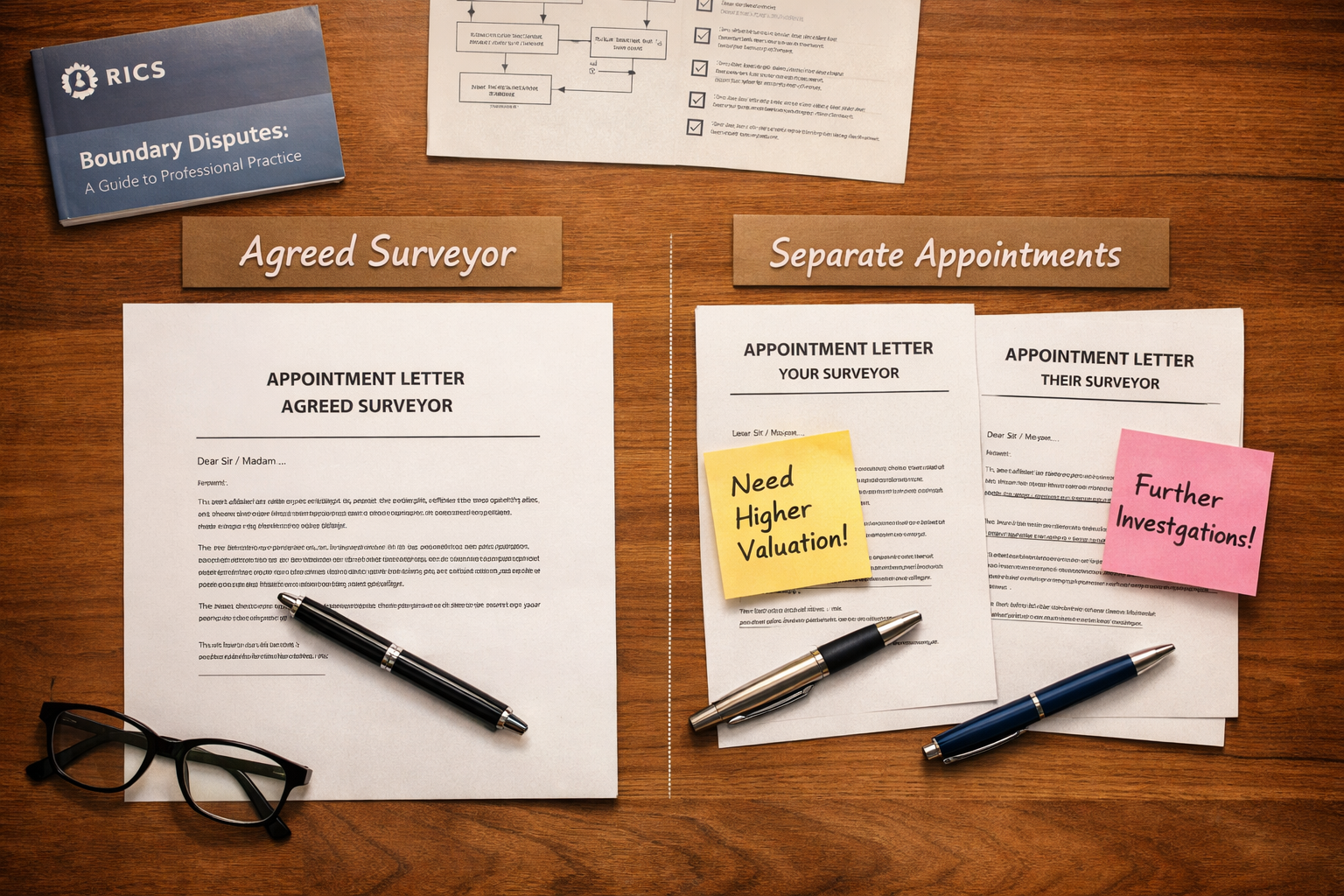
An agreed surveyor is a single, jointly appointed professional who acts on behalf of both the building owner and the adjoining owner. This arrangement is permitted under Section 10(1)(b) of the Party Wall etc. Act 1996. Crucially, the agreed surveyor does not represent either party — they act as a neutral decision-maker whose role is to produce a fair and legally binding party wall award.
💡 Pull Quote: “An agreed surveyor is not a compromise — they are a statutory officer of the process, bound by the same duties of impartiality as any tribunal.”
Key characteristics:
- Appointed jointly by written consent of both parties
- Acts impartially — not as an advocate
- Produces a single award that binds both parties
- Fees are typically paid by the building owner
- Cannot be the building owner’s own surveyor acting in a dual capacity
What Are Separate Appointments?
Under Section 10(1)(a) of the Act, each party appoints their own surveyor. The two surveyors then work together — and if they disagree, they appoint a third surveyor to adjudicate. This is the more traditional route and is the default when parties cannot agree on a single surveyor.
Key characteristics:
- The building owner’s surveyor represents the building owner’s interests
- The adjoining owner’s surveyor represents the adjoining owner’s interests
- A third surveyor is pre-selected in case of dispute
- Fees for both surveyors are generally paid by the building owner
- The process can be slower but offers stronger individual advocacy
Agreed Surveyor vs Separate Appointments: Cost-Benefit Analysis and Best Practices for 2026 Projects
The Real Cost Difference in 2026
Understanding the financial implications of each model is central to any meaningful cost-benefit analysis. In 2026, London party wall surveyor fees typically fall within the following ranges:
| Appointment Model | Typical Fee Range (London) | Who Pays? |
|---|---|---|
| Agreed Surveyor | £800 – £1,400 | Building owner |
| Two Separate Surveyors | £1,400 – £2,800 (combined) | Building owner |
| Third Surveyor (if needed) | £500 – £1,500 additional | Determined by award |
⚠️ Note: These are indicative 2026 figures for standard residential projects. Complex commercial or structural projects may attract significantly higher fees.
For a standard loft conversion or rear extension in London — the most common party wall scenarios — the agreed surveyor route can save £600 to £1,400 in surveyor fees alone. Over the lifetime of a project, that saving compounds when you factor in faster award production, fewer correspondence rounds, and reduced delays to the build programme.
For detailed guidance on managing these costs, see this resource on how to keep party wall costs down.
Time Efficiency: A Hidden Cost
Cost is not only financial. Time is a critical project resource, particularly in 2026 when construction timelines are tight due to material supply pressures and contractor availability.
- Agreed surveyor: Typically produces an award in 2–4 weeks from appointment
- Separate appointments: Typically require 4–8 weeks, sometimes longer if surveyors disagree and a third surveyor is needed
For a building owner paying contractor standing time or bridging finance, a 4-week delay can cost far more than the difference in surveyor fees.
RICS Guidance on Impartiality: Does It Actually Work?
A common concern about the agreed surveyor model is whether one professional can truly be impartial. The RICS (Royal Institution of Chartered Surveyors) guidance on party wall matters is clear: an agreed surveyor must act as a quasi-judicial officer, not as a representative of either party. This is reinforced by the statutory framework of the Act itself.
In practice, RICS-regulated surveyors who accept agreed appointments are bound by professional conduct rules. Any bias or failure to act impartially can result in:
- The award being challenged in the County Court
- A complaint to RICS under its professional standards framework
- Personal liability for costs
The impartiality concern is therefore largely mitigated when appointing a properly qualified, RICS-regulated surveyor. The risk increases only when parties attempt to appoint someone with an existing relationship to one side — which a competent surveyor would decline.
Checklist: When to Choose an Agreed Surveyor ✅
Use the agreed surveyor model when:
- The works are straightforward (loft conversion, rear extension, underpinning)
- Both neighbours have a good or neutral relationship
- The adjoining owner has no specific concerns about the works
- The project timeline is time-sensitive
- Both parties want to minimise costs
- The adjoining property has no known structural vulnerabilities
- Both parties are willing to jointly instruct a single professional
Checklist: When to Choose Separate Appointments ✅
Use separate appointments when:
- There is an existing dispute between neighbours
- The works are high-risk (deep excavations, structural alterations near foundations)
- The adjoining owner has specific concerns they want independently represented
- The project involves high-value properties where the stakes of any damage are significant
- The adjoining owner is unfamiliar with the process and wants their own advocate
- There is a history of non-compliance by the building owner
- The building owner’s contractor has a poor reputation in the area
Best Practices for 2026 Projects: Streamlining the Award Process

Start With the Notice — Get It Right First Time
The entire party wall process begins with serving the correct notice. Errors at this stage cause delays regardless of which appointment model is chosen. Understanding what a party structure notice is and how to serve it is the essential first step for any building owner in 2026.
A correctly served notice:
- Triggers the statutory 14-day response period
- Allows the adjoining owner to consent, dissent, or appoint a surveyor
- Sets the legal clock running for the award process
If the adjoining owner consents in writing to the works within 14 days, no surveyor is required at all. This is the most cost-effective outcome and is worth pursuing through early, transparent communication. For more on this possibility, see the guide on having a party wall agreement without a surveyor.
The Schedule of Condition: Non-Negotiable in Either Model
Regardless of whether an agreed surveyor or separate appointments are used, a schedule of condition should always be prepared before works begin. This is a photographic and written record of the adjoining property’s pre-existing condition.
Without a schedule of condition:
- Any damage claim becomes a dispute about what existed before
- The building owner is exposed to inflated or unfounded claims
- The award process becomes more contentious
A proper schedule of condition is one of the most protective documents in the entire party wall process. It protects both parties — the adjoining owner by establishing a baseline, and the building owner by limiting liability to actual damage caused.
Practical Tips for Agreed Surveyor Appointments in 2026
1. Agree on the surveyor before dissent is served
Both parties should discuss and agree on a suitable professional before the formal dissent period. This avoids the default position of separate appointments being triggered automatically.
2. Confirm the appointment in writing
Both the building owner and adjoining owner must confirm the agreed appointment in writing. A verbal agreement is not sufficient under the Act.
3. Check RICS registration
Always verify that the proposed agreed surveyor holds current RICS membership or is a member of the Faculty of Party Wall Surveyors (FPWS). This ensures professional accountability.
4. Clarify fee arrangements upfront
Agree in writing who pays what and when. While the building owner typically bears all costs, the agreed surveyor’s fee structure should be transparent from the outset. See the full breakdown of party wall costs and the process for a detailed overview.
5. Do not pressure the agreed surveyor
Once appointed, the agreed surveyor must be allowed to act independently. Any attempt to influence the award by either party undermines the statutory process and can invalidate the award.
Regional Considerations for London Projects
Party wall matters in London carry additional complexity due to dense terraced housing stock, basement extensions, and proximity of properties. Whether working in Central London, North London, South London, or West London, the same principles apply — but local knowledge of soil conditions, building types, and common dispute patterns adds genuine value.
In densely built areas, the agreed surveyor model is particularly efficient because:
- Many surveyors are familiar with local property types
- Turnaround times are faster when only one professional manages correspondence
- Award templates for common works (loft conversions, extensions) can be adapted quickly
Agreed Surveyor vs Separate Appointments: Cost-Benefit Analysis Summary Table
| Factor | Agreed Surveyor | Separate Appointments |
|---|---|---|
| Cost | Lower (single fee) | Higher (two fees + possible third) |
| Speed | Faster (2–4 weeks) | Slower (4–8+ weeks) |
| Impartiality | Statutory duty, RICS-regulated | Each surveyor advocates for their client |
| Advocacy | None — neutral decision-maker | Full representation for each party |
| Best for | Simple, low-risk, amicable projects | Complex, high-risk, contentious projects |
| Risk of third surveyor | None | Present if surveyors disagree |
| Adjoining owner protection | Relies on surveyor’s impartiality | Direct representation |
| Building owner control | Less direct influence on outcome | More strategic input via own surveyor |
Conclusion: Making the Right Choice for Your 2026 Project
The agreed surveyor vs separate appointments decision is not a matter of one model being universally superior. It is a contextual choice driven by the nature of the works, the relationship between neighbours, the risk profile of the project, and the financial constraints of the building owner.
For the majority of standard residential projects in 2026 — loft conversions, single-storey extensions, and straightforward structural works — the agreed surveyor route offers compelling advantages: lower cost, faster award production, and a streamlined process that keeps projects on schedule.
For high-risk, high-value, or contentious situations, separate appointments provide the independent advocacy that protects both parties and reduces the likelihood of post-completion disputes.
Actionable Next Steps 🚀
- Assess your project risk — use the checklists above to determine which model fits your situation
- Communicate early — speak to your neighbour before serving notice; consent may eliminate the need for surveyors entirely
- Serve the correct notice — ensure notices are properly prepared and served to start the statutory clock correctly
- Verify surveyor credentials — only appoint RICS-registered or FPWS-accredited professionals
- Document everything — insist on a schedule of condition regardless of appointment model
- Get fee agreements in writing — confirm costs before appointment to avoid disputes later
Taking these steps early in the project lifecycle will save time, money, and neighbourly goodwill — three resources that are always in short supply on any construction project.
Speak to a RICS chartered party wall surveyor
Free initial consultation. Notices, awards and schedules of condition across London and nationwide.