


Only around 1% of party wall disputes ever reach a Third Surveyor — yet when they do, the financial and legal stakes rise sharply for everyone involved. Understanding Third Surveyor Decisions in Party Wall Disputes: Costs, Timelines, and Recent Podcast Insights for 2026 Cases is no longer optional for homeowners, developers, or property professionals navigating London's increasingly active construction market. This guide breaks down exactly how the Third Surveyor mechanism works, what it costs, how long it takes, and what recent professional discussions — including insights shared via FPWS (Faculty of Party Wall Surveyors) podcast content — reveal about managing these escalating disputes effectively in 2026.
Key Takeaways 📌
- A Third Surveyor is only triggered when the two appointed surveyors cannot agree — making prevention the most cost-effective strategy.
- Third Surveyors hold legally binding authority to determine specific points of dispute, with appeals only possible within 14 days via County Court.
- The most common referrals involve surveyor fee disputes and damage claims — not technical construction matters.
- Third Surveyor fees can be significant, and who pays is entirely at the Third Surveyor's discretion.
- Early, professional engagement with the Party Wall etc. Act 1996 process dramatically reduces the risk of reaching this stage.
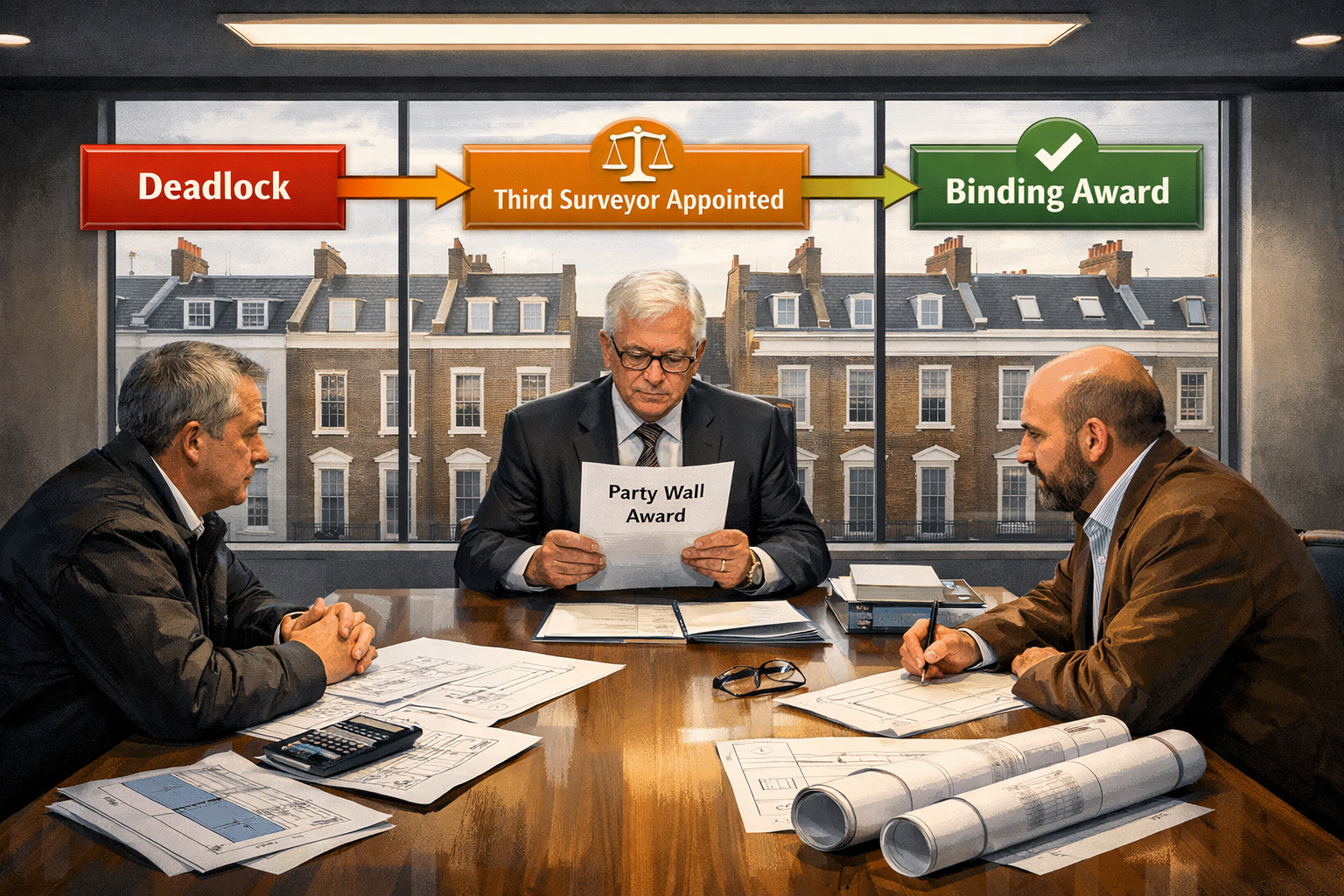
What Is a Third Surveyor and When Are They Triggered?
The Statutory Trigger: Deadlock Between Appointed Surveyors
The Third Surveyor is not a routine figure in party wall proceedings. Their involvement is strictly triggered by deadlock — specifically, when the two appointed surveyors (one representing the building owner, one representing the adjoining owner) cannot agree on a matter under dispute or cannot finalise the terms of a Party Wall Award [1].
This distinction matters enormously. The Third Surveyor does not oversee the entire dispute from the start. They are called in to resolve a specific, defined point of contention. Think of them as a referee brought onto the pitch only when two players cannot agree on whether the ball crossed the line.
💡 Pull Quote: "The Third Surveyor's determination on the specific point of dispute is final and legally binding on all parties — including the two appointed surveyors." [1]
Who Actually Appoints the Third Surveyor?
This surprises many property owners: the building owner and adjoining owner do not appoint the Third Surveyor. The appointment is made by the two appointed surveyors themselves, through a negotiated process [2].
The standard procedure works like this:
- One surveyor proposes three potential Third Surveyors
- The other surveyor reviews the list and negotiates
- Back-and-forth continues until both agree on one name [2]
If the two surveyors fail to agree on a Third Surveyor, the responsibility passes to the "appointing officer" — typically the head of Building Control at the relevant local authority. In cases where the local authority is itself a party to the dispute, the Secretary of State makes the selection [2].
RICS Qualifications: Who Can Serve?
Not just anyone can step into this role. According to RICS guidance, only chartered surveyors holding MRICS or FRICS designations should be appointed as party wall surveyors [3]. This professional standard ensures that the Third Surveyor brings the technical competence and impartiality the role demands — particularly as RICS continues to consult on updated party wall practice guidance [5].
Third Surveyor Decisions in Party Wall Disputes: Costs, Timelines, and Recent Podcast Insights for 2026 Cases
What Does a Third Surveyor Actually Cost?
Cost is where many property owners get an unwelcome shock. Third Surveyor fees are not capped and can vary significantly depending on the complexity of the dispute, the seniority of the appointed surveyor, and the time required to review submissions and issue a determination.
Here is a realistic breakdown of the cost landscape:
| Cost Element | Typical Range (2026) | Who Pays? |
|---|---|---|
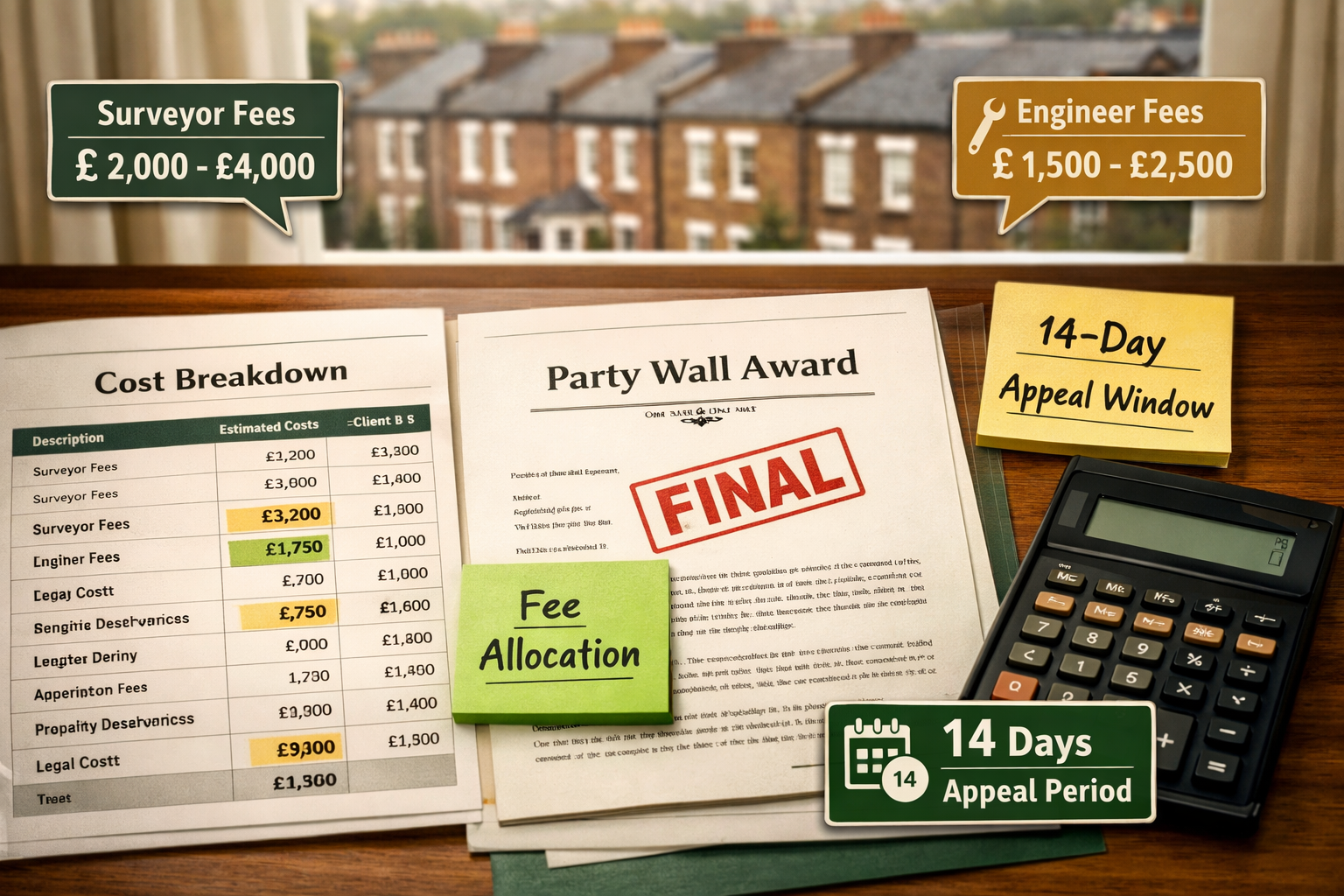
| Third Surveyor's own fees | £1,500 – £5,000+ | Determined by Third Surveyor |
| Appointed surveyors' submission costs | £500 – £2,000 each | Determined by Third Surveyor |
| County Court appeal costs | £5,000 – £20,000+ | Losing party (typically) |
| Total dispute escalation cost | £3,000 – £25,000+ | Varies |
A critical procedural point: unlike the two appointed surveyors, Third Surveyors can and do insist on payment before serving their award [2]. This upfront payment requirement is a practical reality that both parties must prepare for.
On cost allocation, the Third Surveyor holds full discretion. The general principle is that costs are allocated to the party whose surveyor's position or instruction led to the unnecessary disagreement [1]. In practice, Third Surveyors often ask both owners to pay half initially, then leave the final allocation to be sorted after the award is served [2].
For those looking to manage overall party wall costs proactively, reviewing how to keep party wall costs down before disputes escalate is strongly recommended.
Timeline: How Long Does the Process Take?
Speed is not a hallmark of Third Surveyor proceedings. Here is a realistic timeline for 2026 cases:
⏱️ Typical Third Surveyor Timeline:
- Week 1–2: Deadlock identified; surveyors begin negotiating Third Surveyor appointment
- Week 2–4: Third Surveyor selected and formally appointed
- Week 3–6: Both surveyors submit written representations and evidence
- Week 6–10: Third Surveyor reviews submissions, may request further information
- Week 8–12: Determination issued and served on all parties
- Day 1–14 post-service: Window for County Court appeal under Section 10(17)
The 14-day appeal window is non-negotiable [1]. Miss it, and the determination stands as final regardless of any perceived unfairness. Appeals are described by practitioners as rare, highly technical, and often extremely expensive — making them a last resort rather than a routine option [1].
What Types of Disputes Reach the Third Surveyor?
The data here is revealing. The largest proportion of Third Surveyor referrals relate to either:
- 🏷️ Fees proposed by the adjoining owner's surveyor — disputes over whether the costs being charged are reasonable
- 🔨 Damage caused by the works — disagreements about whether damage occurred, its extent, and who is liable [2]
Technical construction disputes — arguments about methodology, materials, or structural approach — are actually less common triggers than many assume. This means that professional fee management and thorough schedule of condition surveys are among the most effective preventative measures available.
A properly prepared schedule of condition before works begin is one of the most powerful tools for avoiding damage-related Third Surveyor referrals entirely.
Recent Podcast Insights and 2026 Trends in Third Surveyor Cases
What FPWS Podcast Discussions Reveal About Award-Making in 2026
The Faculty of Party Wall Surveyors (FPWS) has increasingly used podcast formats to share practitioner insights on award-making, cost disputes, and the evolving landscape of Third Surveyor referrals. Several themes have emerged as particularly relevant for Third Surveyor Decisions in Party Wall Disputes: Costs, Timelines, and Recent Podcast Insights for 2026 Cases:
🎙️ Key themes from professional podcast discussions:
- Fee transparency is under scrutiny. Practitioners are increasingly discussing the need for adjoining owner surveyors to provide detailed fee justifications upfront, reducing the likelihood of fee disputes reaching the Third Surveyor stage.
- The "nuclear option" framing. Experienced surveyors consistently frame Third Surveyor referral as a last resort — a costly, time-consuming process that damages professional relationships and delays construction projects.
- Proportionality in award-making. There is growing professional consensus that awards should be proportionate to the scale of works, and that disproportionate fee demands are a primary driver of unnecessary escalation.
- Digital submissions and efficiency. Some Third Surveyors are now accepting digital-only submissions, which is reducing administrative timelines in straightforward cases.
The 2026 Construction Uptick: Why Third Surveyor Cases Are Rising
London's construction activity has increased notably in 2026, driven by planning reforms, housing targets, and a renewed appetite for basement conversions, rear extensions, and loft developments. This uptick directly correlates with higher volumes of party wall notices being served — and, statistically, more disputes [3].
For homeowners in areas with dense terrace housing, the risk of neighbour disputes is particularly elevated. Whether dealing with works in North London, South London, or Central London, the principles governing Third Surveyor appointments remain consistent — but local construction intensity affects how quickly disputes arise.
Strategies Practitioners Are Recommending to Avoid Third Surveyor Referral
Based on professional discussions and established best practice, the following strategies are consistently highlighted as the most effective ways to avoid the cost and delay of Third Surveyor proceedings:
✅ Prevention Strategies for 2026 Cases:
- Serve notices correctly and on time. Errors in party wall notices are a common source of early-stage friction that can snowball into larger disputes.
- Appoint experienced, RICS-qualified surveyors. Surveyors who understand professional norms are less likely to adopt unreasonable positions that trigger referral.
- Agree fees transparently at the outset. The most common Third Surveyor trigger — fee disputes — is largely preventable through early, written fee agreements.
- Commission a thorough schedule of condition. Documented pre-works condition reduces the scope for damage disputes post-construction.
- Maintain professional communication. Many referrals stem from personality clashes rather than genuine legal disagreements. Experienced surveyors know how to de-escalate.
- Understand the award process. Familiarity with party wall award templates and contract guides helps all parties understand what a reasonable award looks like.
Practical Guidance for Building Owners and Adjoining Owners
If You Are the Building Owner
As the party initiating works, the building owner typically bears the primary cost responsibility for the party wall process — including, potentially, Third Surveyor fees if the referral arises from an unreasonable position taken by your appointed surveyor [1].
Key actions to protect your position:
- Instruct your building owner's surveyor to adopt reasonable, well-evidenced positions in all award negotiations
- Do not pressure your surveyor to resist legitimate adjoining owner concerns — this is a primary driver of unnecessary escalation
- Budget contingency funds for potential Third Surveyor costs if your project is complex or relations with neighbours are strained
If You Are the Adjoining Owner
Adjoining owners sometimes assume that disputing everything strengthens their position. In reality, unreasonable positions by the adjoining owner's surveyor are the single largest driver of Third Surveyor referrals — and costs can be awarded against the adjoining owner as a result [1][2].
Key actions to protect your position:
- Ensure your adjoining owner's surveyor charges proportionate, justifiable fees
- Engage constructively with the award process rather than using delay as a tactic
- Understand your rights clearly — the costs of the party wall process are not unlimited, and overreach can backfire
The Award: What Happens After the Third Surveyor Decides?
Once the Third Surveyor issues their determination, it must be served on all owners — typically via the appointed surveyors. The award also formally determines:
- Who pays the Third Surveyor's fees
- Who pays the appointed surveyors' fees incurred in relation to their submissions
- The specific resolution of the disputed point [2]
From the moment of service, the 14-day clock for County Court appeal begins running [1]. Given the cost and complexity of appeals, the overwhelming majority of determinations are accepted and implemented without challenge.
Conclusion: Actionable Next Steps for 2026 Disputes
The Third Surveyor mechanism exists as a vital safety valve in the party wall system — but it is a safety valve that comes with a significant price tag, measured in both money and time. For anyone involved in party wall proceedings in 2026, the clearest message from practitioners, podcast discussions, and legal commentary is consistent: prevention is dramatically cheaper than resolution.
Actionable Next Steps ✅
- Serve correct notices from day one. Use professional guidance on party wall act notices to avoid procedural errors.
- Appoint MRICS or FRICS qualified surveyors who have demonstrable party wall experience and professional reputations to protect.
- Agree surveyor fees in writing before appointment — this eliminates the most common trigger for Third Surveyor referral.
- Commission a schedule of condition before any works begin to create a clear baseline for damage assessment.
- If deadlock arises, engage the Third Surveyor process promptly rather than allowing the dispute to fester — delay adds cost without adding resolution.
- Budget realistically. If your project is complex, factor potential Third Surveyor costs into your overall construction budget from the outset.
- Seek specialist advice early — whether you are in East London, West London, or anywhere across the capital, local expertise matters.
The Third Surveyor's binding determination is a powerful legal instrument. Understanding how it works — and how to avoid needing it — is the mark of a well-prepared property professional or homeowner in 2026.
References
[1] Appointing The Third Surveyor When Disagreements Arise And Why This Costly Step Is Necessary – https://www.partywallslimited.com/blog/appointing-the-third-surveyor-when-disagreements-arise-and-why-this-costly-step-is-necessary
[2] Role Of The Third Surveyor In Party Wall Matters – https://taylor-mitchell.co.uk/blog/role-of-the-third-surveyor-in-party-wall-matters/
[3] Party Wall Surveys And Neighbour Disputes During 2026s Construction Uptick Rics Compliance Framework – https://nottinghillsurveyors.com/blog/party-wall-surveys-and-neighbour-disputes-during-2026s-construction-uptick-rics-compliance-framework
[4] Party Wall Agreement – https://hoa.org.uk/advice/guides-for-homeowners/i-am-improving/party-wall-agreement/
[5] Rics Consults On Updated Party Wall Practice Guidance – https://www.lexisnexis.co.uk/legal/news/rics-consults-on-updated-party-wall-practice-guidance