

An estimated 90% of party wall notices served by building owners contain at least one defect that could render them legally ineffective — yet most of those owners believe their paperwork is perfectly in order [2]. That gap between perceived compliance and actual statutory validity is exactly where disputes are born, injunctions are filed, and construction projects grind to a halt.
Understanding Party Wall Notice Validity: Red Flags That Invalidate Compliance and Trigger Legal Challenges is not just a legal formality. It is the difference between a smooth renovation and a costly, time-consuming legal battle with a neighbour. This article identifies the most common drafting errors that surveyors and building owners overlook, explains why each one matters under the Party Wall etc. Act 1996, and provides a practical checklist to catch problems before a notice is ever served.
Key Takeaways 📋
- 90% of party wall notices contain defects — most building owners do not realise until it is too late.
- Serving the wrong type of notice (e.g., a party structure notice when a line-of-junction notice is required) can invalidate the entire process.
- Vague work descriptions, missing plans, and incorrect notice periods are among the most common red flags.
- A defective notice must be completely re-served, restarting the full statutory notice period and delaying projects by weeks or months.
- All relevant adjoining owners — including leaseholders with leases over 12 months — must be identified and served correctly.
The Most Common Red Flags in Party Wall Notice Validity
1. 🚩 Serving the Wrong Type of Notice
The Party Wall etc. Act 1996 establishes three distinct notice types, each governing a different category of work:
| Notice Type | When Required | Minimum Notice Period |
|---|---|---|
| Line of Junction Notice | New wall at or astride the boundary | 1 month |
| Party Structure Notice | Works to an existing party wall or structure | 2 months |
| Three Metre / Six Metre Notice | Excavation near a neighbour's foundations | 1 month |
Mixing these up is one of the most critical red flags in party wall notice validity. A building owner who serves a party structure notice for excavation work has not only used the wrong form — they have potentially invalidated the entire notice and must re-serve from scratch, with the full notice period running again [1]. This single error can delay a project by two months or more.
For a full breakdown of which works trigger which obligations, reviewing the types of party wall works covered under the Act is an essential first step.
2. 🚩 Vague or Insufficient Description of Proposed Works
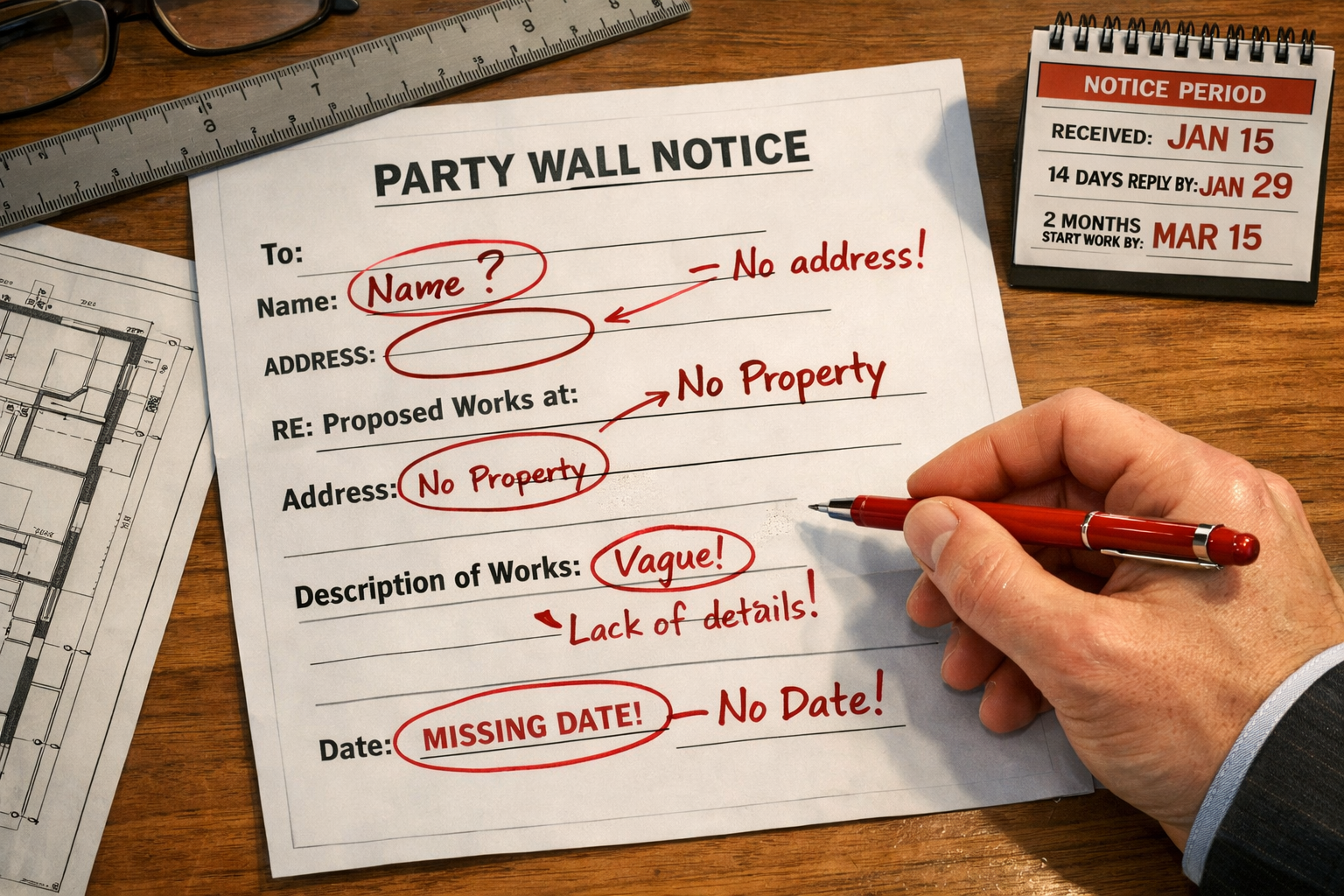
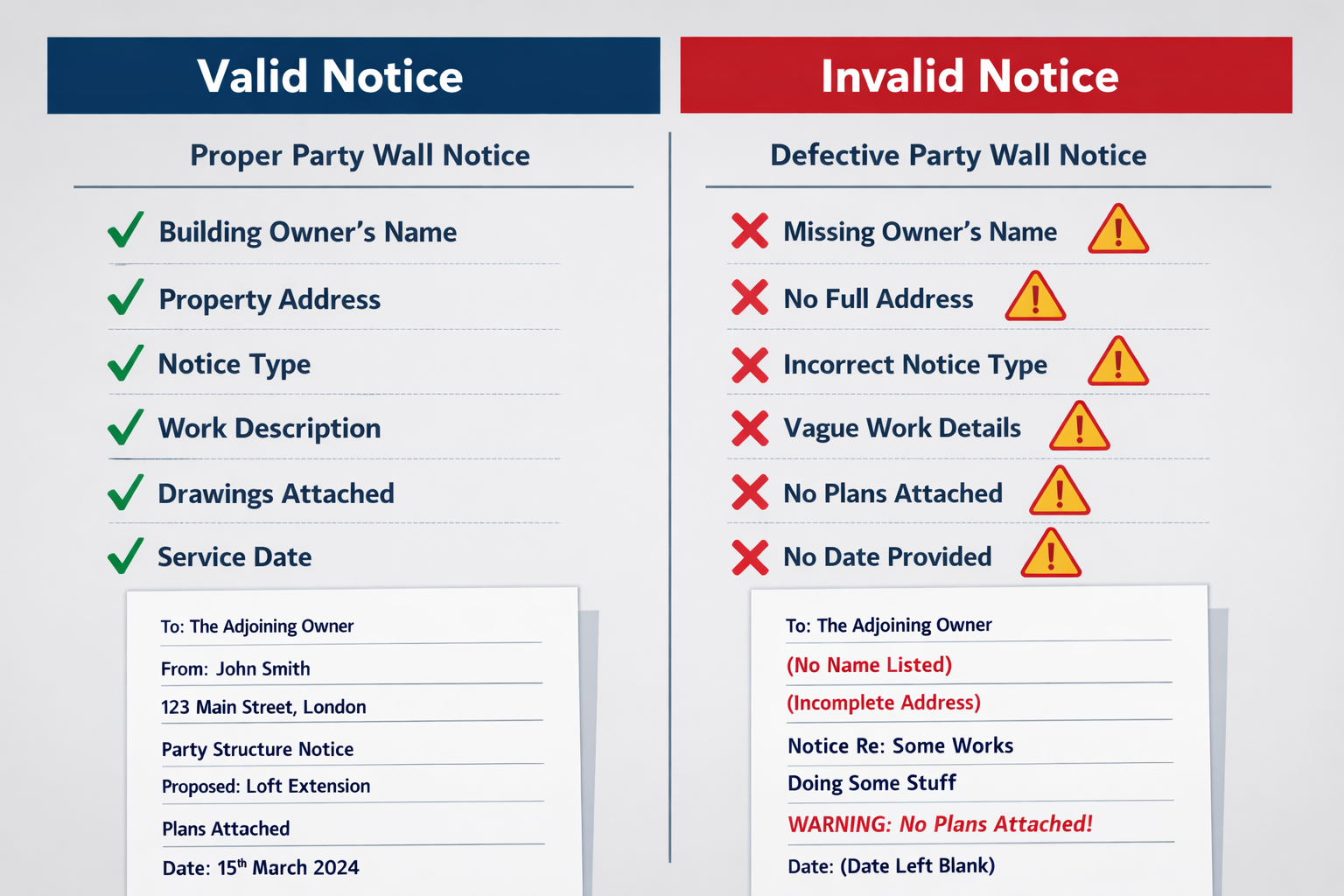
A valid party wall notice must describe the proposed works with enough clarity that an adjoining owner — who may have no construction knowledge — can genuinely understand what is planned [1]. Generic phrases such as "general building works" or "loft conversion" fall far short of this standard.
"A notice that leaves an adjoining owner unable to assess the impact of proposed works on their property is not a valid notice — it is an invitation to dispute."
The description should include:
- The nature of the works (e.g., underpinning, removal of chimney breast, insertion of steel beam)
- The location on the party wall or structure
- The method of construction where relevant
- Reference to accompanying drawings and sections
Vague descriptions significantly increase the likelihood of dissent and formal dispute procedures, which means appointing surveyors, drafting a party wall award, and further delays [1].
3. 🚩 Missing or Inadequate Supporting Plans
For excavation, boundary, and structural works, words alone are rarely sufficient. Missing or insufficient plans and sections is a critical defect — particularly where the depth of excavation, proximity to foundations, or structural load cannot be assessed without drawings [1].
Supporting documents should typically include:
- Location plans showing the site and neighbouring properties
- Floor plans and sections at an appropriate scale
- Elevation drawings for boundary or external wall works
- Structural calculations or engineer's details for load-bearing work
Without these, an adjoining owner cannot make an informed decision about whether to consent or dissent. Courts have consistently recognised that a notice lacking adequate information does not meet the statutory threshold for valid service.
4. 🚩 Incorrect Notice Periods
The Act is precise about minimum notice periods, and failure to provide the correct period can invalidate the proposed start date — even if every other element of the notice is correct [2].
- Party structure works: minimum 2 months' notice before work commences
- Line of junction and excavation works: minimum 1 month's notice
A common mistake is serving notice and then scheduling works to begin before the statutory period has expired. The proposed start date on the notice must reflect these minimums. If it does not, the notice is defective and must be re-served — restarting the clock entirely [1].
For guidance on how to serve a notice correctly, the party wall notices resource provides a clear overview of the process.
5. 🚩 Failure to Identify and Serve All Relevant Adjoining Owners
Many building owners assume they only need to notify the person they know as their neighbour. In reality, all persons with a legal interest in the adjoining property must be served — this includes:
- Freeholders
- Leaseholders with leases exceeding 12 months
- Mortgagees in possession in certain circumstances
HM Land Registry searches are strongly recommended to identify every party with a registrable interest before service [2]. Failing to serve even one qualifying adjoining owner renders the notice ineffective against that party — and can expose the building owner to injunction proceedings if works proceed.
If a neighbour is unsure of their rights as an adjoining owner, the adjoining owners guidance explains their entitlements in plain terms.
6. 🚩 Missing Building Owner's Full Legal Name
The notice must state the building owner's full legal name as it appears on Land Registry records [2]. Using a shortened name, a trading name, or an informal version creates a fundamental defect that undermines proper identification and accountability.
This matters because:
- The notice is a statutory legal document — not an informal letter
- Any subsequent party wall award will reference the building owner by name
- Enforcement of rights and obligations under the award depends on correct identification
A mismatch between the name on the notice and Land Registry records is a red flag that experienced surveyors will flag immediately.
How Defective Notices Trigger Legal Challenges
The Cascade Effect of an Invalid Notice
When a party wall notice contains one or more of the red flags described above, the consequences are rarely minor. Defective notices require complete re-service, with statutory notice periods running again from the new service date [1]. This means:
- A project planned to start in two months may be delayed by four months or more
- Contractors may need to be rescheduled or cancelled
- Costs escalate due to prolonged professional fees and standing time
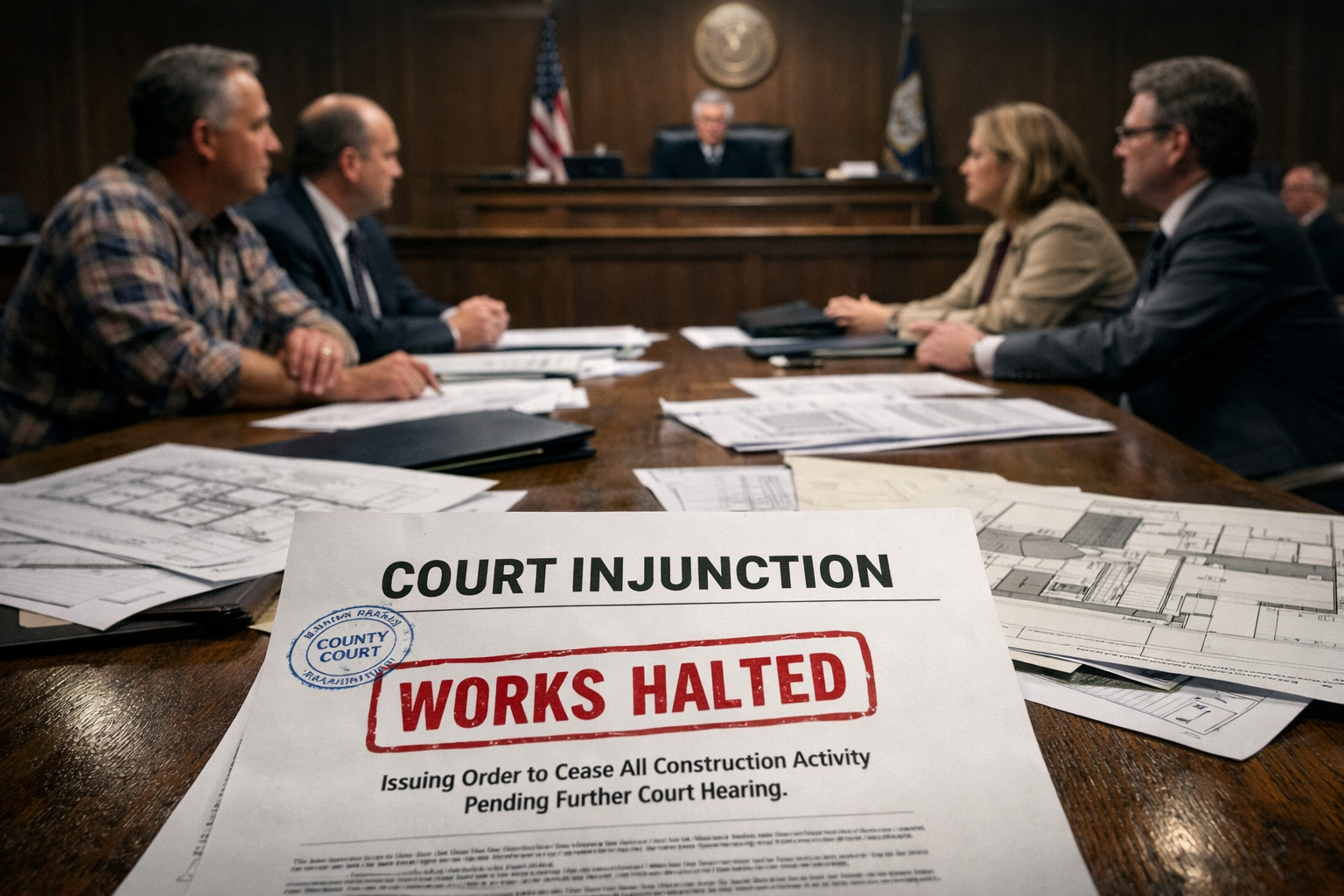
In more serious cases — particularly where a building owner proceeds with works despite a defective notice — adjoining owners can apply to the courts for an injunction to halt works. Courts have shown a willingness to grant such injunctions where the statutory process has not been properly followed [3].
For building owners who have already started works without proper notice, the situation is significantly more complex. The Party Wall etc. Act 1996 provides the statutory framework, but retrospective compliance is rarely straightforward.
Improper Service Documentation: A Hidden Legal Time Bomb ⏱️
Even a perfectly drafted notice can become legally vulnerable if service cannot be properly evidenced. The method and timing of service are critical — later disputes frequently turn on exactly when and how the notice was delivered [1].
Legally acceptable methods of service include:
- Hand delivery with a signed acknowledgement from the recipient
- Recorded post with proof of posting and delivery receipt
- Email, but only where this has been pre-agreed in writing with the adjoining owner
Slipping a notice through a letterbox without any record, or sending an ordinary email without prior agreement, creates a documentation gap that can be exploited in any subsequent dispute. Always retain:
- Proof of postage or delivery
- Dated copies of all documents served
- Any written acknowledgement from the adjoining owner
Notices That Expire Before Works Begin
A valid notice does not remain valid indefinitely. Under the Act, a notice expires if works do not commence within 12 months of the service date, or if works are not prosecuted with due diligence once started [2].
Building owners who experience delays between serving notice and beginning construction must be aware that they may need to re-serve if the 12-month window passes. This is particularly relevant for larger projects where planning permission or funding takes longer than anticipated.
The Template Trap 🪤
Online templates for party wall notices are widely available, and many building owners rely on them as a complete solution. They are not. Treating a generic template as a substitute for project-specific review leads to documents that fail to address the actual complexities of a given project [1].
Templates cannot:
- Identify which notice type is appropriate for specific works
- Assess whether supporting drawings are adequate
- Confirm that all adjoining owners have been correctly identified
- Verify that notice periods align with the proposed programme
For those considering a DIY approach, the guide on having a party wall agreement without a surveyor outlines both the possibilities and the significant risks involved.
Red Flags Checklist: Catch Problems Before Service
Use this checklist before serving any party wall notice in 2026:
✅ Notice Type & Content
- Correct notice type selected (line of junction / party structure / excavation)
- Full legal name of building owner matches Land Registry records
- Full address of the building owner included
- Proposed works described in sufficient detail
- Proposed start date provides the correct statutory notice period
- Notice is signed and dated
✅ Supporting Documents
- Location plan included
- Floor plans and sections attached where required
- Structural drawings or engineer's details included for structural works
- Drawings are to scale and clearly legible
✅ Service & Documentation
- All adjoining owners identified via Land Registry search
- All qualifying leaseholders identified and served
- Service method is legally acceptable (hand delivery / recorded post / pre-agreed email)
- Proof of service retained (signed receipt / postal certificate)
- Dated copy of notice retained for records
Party Wall Notice Validity: Red Flags That Invalidate Compliance and Trigger Legal Challenges — When to Seek Professional Help
The volume and complexity of the red flags outlined above make a compelling case for professional involvement. A qualified party wall surveyor will:
- Identify the correct notice type for the specific works proposed
- Draft a notice that meets all statutory requirements
- Conduct Land Registry searches to identify all relevant adjoining owners
- Manage service documentation to create a clear evidential record
- Advise on notice periods and programme implications
For building owners in London, specialist support is readily available. Whether the project is in West London, Central London, South London, or elsewhere across the capital, local expertise can make the difference between a smooth process and a costly dispute.
The investment in professional advice at the notice stage is almost always significantly less than the cost of re-serving defective notices, defending injunction proceedings, or managing a formal dispute. For a realistic picture of what professional involvement costs, the party wall costs and process guide provides transparent guidance.
Conclusion: Don't Let a Drafting Error Define Your Project
Party wall notice validity is not a box-ticking exercise — it is a statutory obligation with real legal teeth. The red flags identified in this article — wrong notice type, vague work descriptions, missing plans, incorrect notice periods, incomplete service records, and unidentified adjoining owners — are not rare edge cases. They are the everyday mistakes that turn straightforward renovations into protracted disputes [1][2].
Actionable next steps for building owners in 2026:
- Identify the correct notice type for your specific works before drafting anything.
- Conduct a Land Registry search to confirm all adjoining owners who must be served.
- Prepare detailed supporting drawings — do not rely on words alone for structural or excavation works.
- Calculate notice periods carefully and ensure the proposed start date complies with statutory minimums.
- Document service meticulously — retain proof of every notice served.
- Consult a qualified party wall surveyor before service, not after a dispute has arisen.
A few hours of professional review at the outset can prevent months of delay and thousands of pounds in dispute costs. The notice is the foundation of the entire party wall process — get it right the first time.
References
[1] What Makes A Party Wall Notice Valid – https://www.houricanassociates.com/party-wall-news/what-makes-a-party-wall-notice-valid/
[2] How To Serve A Party Wall Notice – https://onlinearchitecturalservices.com/how-to-serve-a-party-wall-notice/
[3] Understanding Party Wall Act What Homeowners Need Know Before Renovating – https://www.partywallslimited.com/blog/understanding-party-wall-act-what-homeowners-need-know-before-renovating
[4] Party Wall Agreement – https://hoa.org.uk/advice/guides-for-homeowners/i-am-improving/party-wall-agreement/
[5] Party Wall Surveys And Neighbour Disputes During 2026s Construction Uptick Rics Compliance Framework – https://nottinghillsurveyors.com/blog/party-wall-surveys-and-neighbour-disputes-during-2026s-construction-uptick-rics-compliance-framework