

Over 4.8 million people in England live in high-rise residential buildings — and until April 2026, a significant proportion of those who cannot self-evacuate had no formal, legally mandated plan to get out alive in a fire. That gap is now closing. New Personal Emergency Evacuation Plan (PEEP) regulations, taking effect from April 2026, are reshaping what responsible parties must document, share, and enforce — and they are pulling party wall surveys squarely into the fire safety conversation.
For developers, building owners, and surveyors working on multi-storey projects, Party Wall Surveys for PEEPs Compliance in High-Rise Projects: Integrating Fire Safety Mandates into Awards Post-April 2026 is no longer a niche regulatory footnote. It is a core professional obligation that must be woven into every party wall award issued for qualifying buildings.
Key Takeaways 📋
- PEEPs are now mandatory for high-rise residential buildings 18 metres or taller (7+ storeys) from April 2026, requiring documented evacuation plans for residents who cannot self-evacuate.
- Party wall awards must now incorporate fire safety clauses that reflect PEEPs obligations, especially where construction works affect shared boundaries, escape routes, and structural fire compartmentation.
- Responsible Persons (RPs) — including building owners and managers — must identify vulnerable residents, agree written evacuation statements, and review these annually.
- Surveyors face new due diligence requirements: failing to address PEEPs-related fire safety in awards for qualifying buildings may expose parties to legal liability.
- Information sharing with Fire & Rescue Authorities is permitted only with resident consent and is limited to essential evacuation data — not medical records.
Why PEEPs Are Changing the Party Wall Landscape in 2026
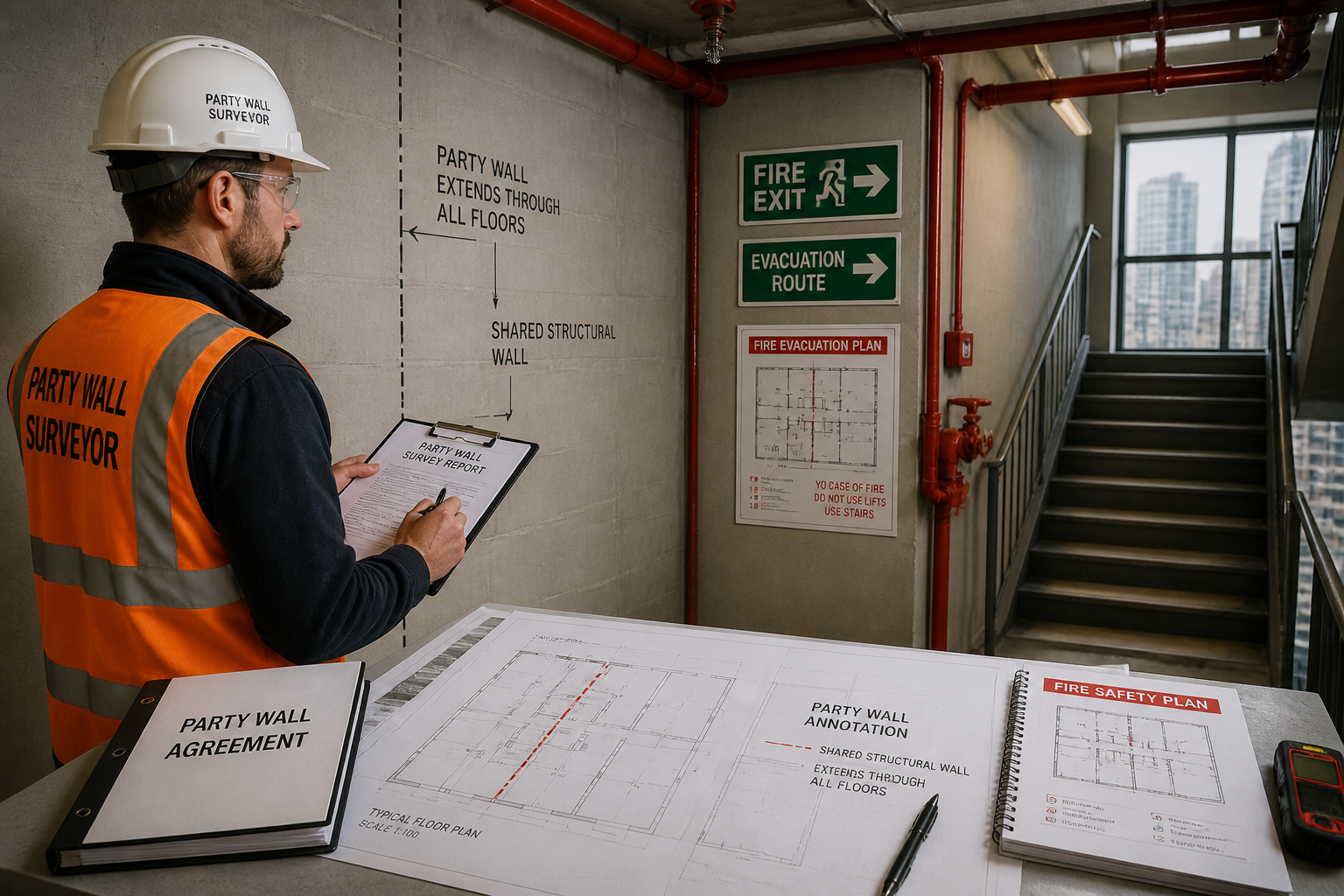
For decades, party wall practice and fire safety compliance existed in largely separate professional silos. A surveyor appointed under the Party Wall etc. Act 1996 focused on protecting structural integrity and adjoining owners' property rights. Fire safety officers focused on evacuation strategies and risk assessments. April 2026 has changed that division of labour.
What Are PEEPs and Who Do They Cover?
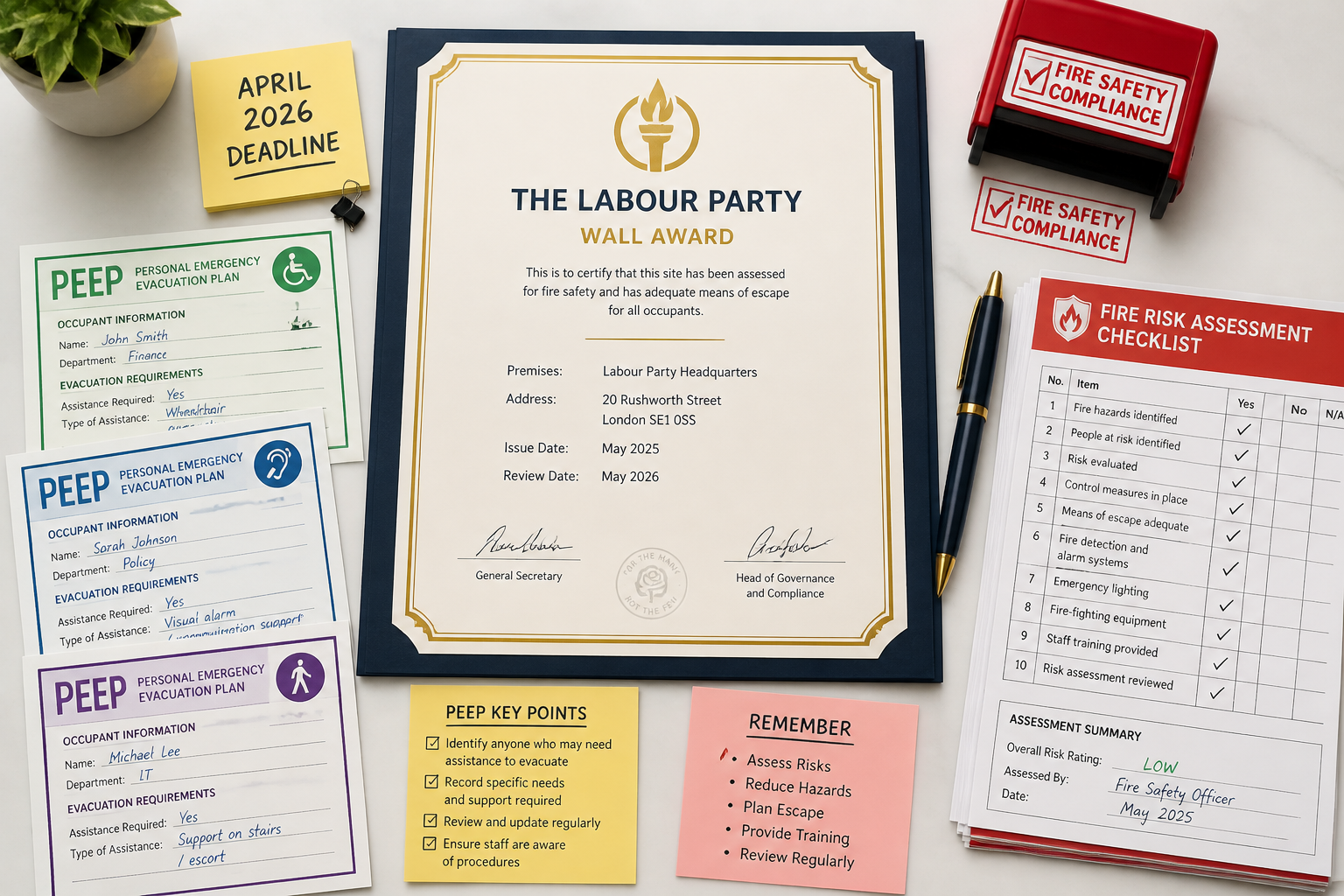
A Personal Emergency Evacuation Plan is a bespoke, written document that sets out how a specific resident — one whose ability to evacuate independently is affected by a physical or cognitive condition — will safely exit a building in an emergency.
Under the new regulations, PEEPs apply to:
| Building Type | Threshold |
|---|---|
| High-rise residential | 18 metres or taller OR 7+ storeys [1][2] |
| Mid-rise with simultaneous evacuation | 11+ metres [1] |
💡 Pull Quote: "A party wall award that ignores PEEPs obligations in a qualifying high-rise is not just incomplete — it may be legally indefensible post-April 2026."
The Responsible Person (RP) — typically the building owner, freeholder, or management company — must use reasonable efforts to identify any resident whose evacuation ability is affected by cognitive or physical conditions. Once identified, the RP must offer a person-centred fire risk assessment and agree a written evacuation statement with that resident [2].
The Construction-Evacuation Overlap
Here is where party wall practice becomes directly implicated. Construction works in high-rise buildings — whether excavations, structural alterations, or works to party structures — routinely affect:
- Fire compartmentation in shared walls and floors
- Common escape routes such as stairwells and corridors
- Structural elements that support fire suppression systems
When a party wall award is issued for works in a qualifying high-rise, it governs what can be done, when, and how. If that award does not address how PEEPs-related evacuation routes and fire safety measures will be maintained during and after construction, the award is materially deficient.
How Party Wall Surveys for PEEPs Compliance in High-Rise Projects Must Evolve
The integration of fire safety mandates into party wall awards is not simply a matter of adding a boilerplate clause. It requires surveyors to understand the PEEPs framework and translate its requirements into enforceable award conditions.
Step 1: Identify Whether the Building Is a Qualifying High-Rise
Before serving party wall notices or drafting an award, the building owner's surveyor must confirm whether the building meets the 18-metre/7-storey threshold [1][7]. This determination affects the entire scope of fire safety obligations embedded in the award.
Buildings that qualify as Higher Risk Buildings (HRBs) under the Building Safety Act 2022 framework face the most stringent requirements. The government's definition of HRBs has been subject to ongoing review [7], and surveyors must stay current with any threshold changes.
Step 2: Assess the Impact of Proposed Works on Evacuation Routes
A thorough schedule of condition — already a standard component of party wall practice — must now be extended to document:
- Pre-works condition of fire doors along shared boundaries
- Existing signage and lighting on escape routes adjacent to the party structure
- Sprinkler or suppression system pipework running through or near the party wall
- Current PEEP-relevant access points such as refuge areas and evacuation lifts
This documentation creates a baseline against which post-works conditions can be assessed, protecting both the building owner and the adjoining owner from disputes about fire safety degradation caused by construction.
Step 3: Draft PEEPs-Aware Award Clauses
The party wall award must include specific, enforceable clauses addressing:
🔥 Fire Compartmentation Integrity
- Works must not compromise fire-rated party walls or floors without approved temporary protection measures.
- Any breaches to compartmentation must be reinstated to the original or superior fire rating within a defined timeframe.
🚪 Escape Route Continuity
- Construction activities must not obstruct or reduce the width of designated escape routes without prior written agreement and alternative provision.
- Where escape routes are temporarily affected, the RP must update all relevant PEEPs to reflect the temporary alternative route [2].
📋 Notification Obligations
- The building owner must notify the RP of any works phase that affects evacuation routes at least 14 days in advance.
- The RP must in turn update individual evacuation statements for affected residents within a defined period [1].
🔒 Information Box Compliance
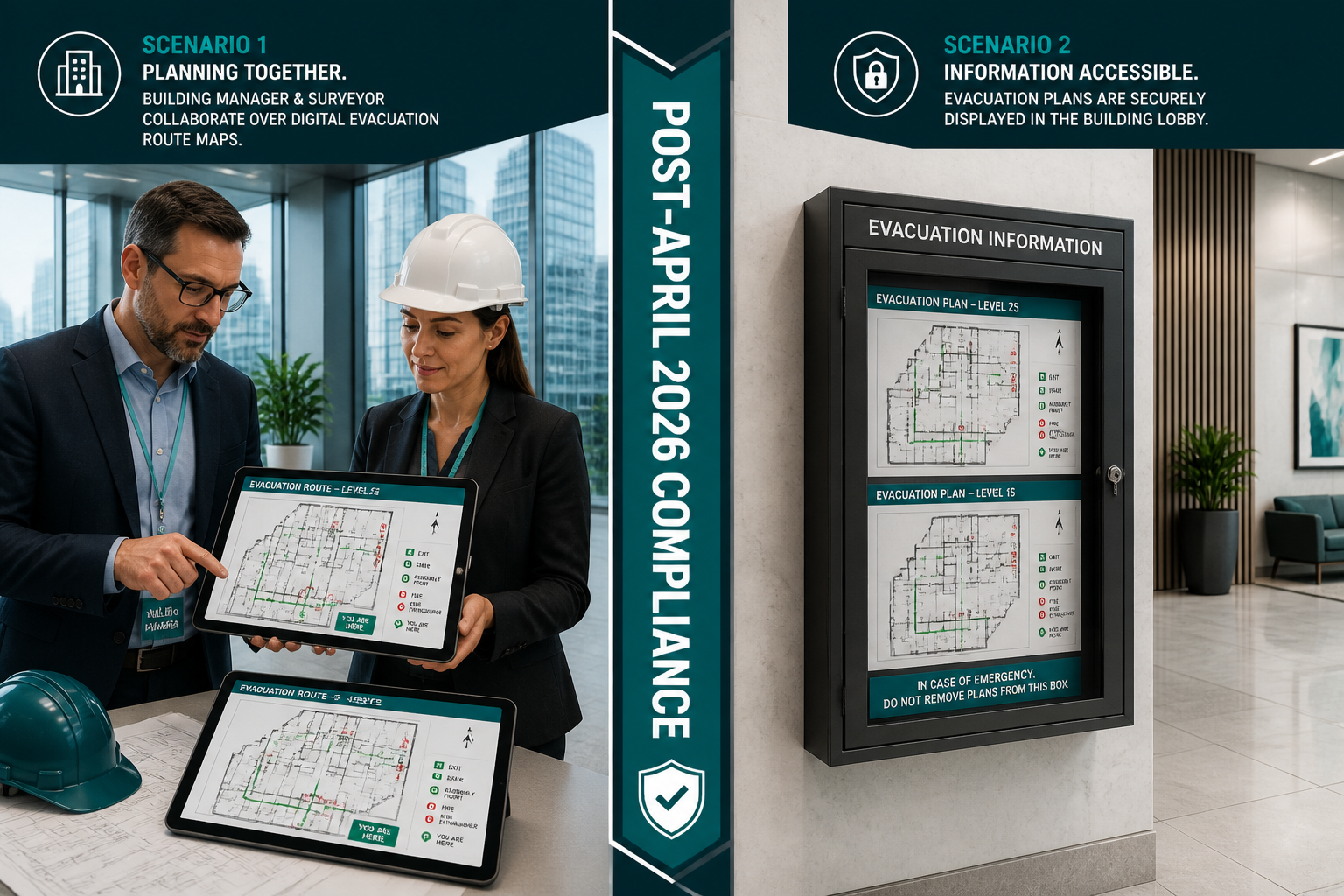
- Building-wide evacuation plans stored in secure information boxes on the premises must be updated to reflect any construction-phase changes to escape routes [2].
📅 Annual Review Alignment
- The award should specify that post-works fire risk assessments, including any PEEPs updates, must be completed within 30 days of practical completion and then aligned with the statutory annual review cycle [2].
Step 4: Coordinate with the Responsible Person
Party wall surveyors are not fire safety officers. However, in 2026, they must engage with the RP as part of the award process for qualifying buildings. This coordination ensures:
- The RP is aware of construction phases that trigger PEEP updates
- The RP's obligations to share limited evacuation data with the Fire & Rescue Authority (with resident consent) are not inadvertently compromised by construction-related changes [1][2]
- The award reflects the RP's existing evacuation strategy rather than cutting across it
⚠️ Important: Information shared with Fire & Rescue Authorities is strictly limited to flat number, floor number, and assistance needs. Medical diagnoses and unnecessary personal details must never be included — and resident consent is mandatory before any sharing occurs [1][2].
Practical Compliance: Integrating Fire Safety Mandates into Awards Post-April 2026
Understanding the theory is one thing. Implementing Party Wall Surveys for PEEPs Compliance in High-Rise Projects: Integrating Fire Safety Mandates into Awards Post-April 2026 in practice requires a structured workflow that surveyors, building owners, and RPs can follow consistently.
A Practical Compliance Checklist ✅
Pre-Notice Stage
- Confirm building height and storey count against HRB thresholds [1][7]
- Obtain existing fire risk assessment and current evacuation plan from RP
- Identify any residents with active PEEPs whose accommodation adjoins the party structure
- Review secure information box contents for current evacuation data [2]
Notice and Award Stage
- Serve notices in accordance with the Party Wall etc. Act 1996 with a cover letter flagging PEEPs implications
- Include fire safety schedule in the award documentation
- Draft compartmentation, escape route, and notification clauses (see Step 3 above)
- Obtain RP sign-off on construction-phase evacuation amendments
During Works
- Monitor compliance with escape route continuity obligations
- Require contractor to report any unplanned compartmentation breaches within 24 hours
- Ensure RP updates individual PEEPs when escape routes change [2]
Post-Works
- Commission post-works fire risk assessment within 30 days of completion
- Update schedule of condition to reflect final state of fire-rated elements
- Confirm RP has reviewed and updated all affected evacuation statements [1]
- Ensure building-wide evacuation plan in information box reflects final building configuration [2]
The Role of the Adjoining Owner's Surveyor
Adjoining owners in high-rise buildings have a direct stake in PEEPs compliance. If construction works affect their escape routes or the fire compartmentation protecting their unit, they need a surveyor who understands both party wall law and the new fire safety framework.
An adjoining owner's surveyor should now routinely:
- Request sight of the RP's current evacuation plan before consenting to award terms
- Insist on notification clauses that give the adjoining owner advance warning of escape route disruptions
- Ensure the award includes reinstatement standards that meet or exceed the original fire rating
For those carrying out works, understanding your obligations as a building owner under both the Party Wall Act and the new PEEPs framework is essential before a single notice is served.
Costs and Proportionality
Integrating PEEPs compliance into party wall awards does add complexity — and some additional cost. However, the costs of the party wall process must be weighed against the liability exposure of issuing a deficient award in a qualifying high-rise.
A party wall award that fails to address fire safety obligations in a building where a resident subsequently cannot evacuate safely during construction could expose the building owner — and potentially the surveyor — to significant legal and regulatory consequences under the Building Safety Act 2022 framework.
The proportionate approach is to build PEEPs awareness into the standard fee structure for high-rise party wall instructions, treating it as a specialist uplift rather than an optional add-on.
Regional Considerations in London
London's high-rise residential stock is concentrated in specific boroughs, and party wall surveyors working in these areas will encounter PEEPs obligations with increasing frequency. Whether working in East London, South London, or Central London, surveyors must be prepared to apply the integrated PEEPs framework to every qualifying instruction.
The density of high-rise development in inner London means that many party wall instructions will now automatically trigger PEEPs considerations — making specialist knowledge in this area a genuine competitive differentiator for surveyors in 2026.
Common Mistakes to Avoid 🚫
| Mistake | Why It Matters | Correct Approach |
|---|---|---|
| Treating PEEPs as a fire safety issue only | Party wall awards govern construction that directly affects evacuation infrastructure | Integrate fire safety clauses into every qualifying award |
| Failing to identify HRB threshold | Awards for non-qualifying buildings need not include PEEPs clauses | Confirm height/storeys before drafting |
| Sharing resident PEEP data without consent | Breach of data protection and regulatory requirements [1][2] | Obtain explicit written consent before any data sharing |
| Omitting annual review obligations | Post-works PEEPs may become outdated as building use changes [2] | Include review cycle in award conditions |
| Ignoring temporary works phases | Escape routes may be affected during construction, not just after [2] | Address all construction phases in the award |
Conclusion: Actionable Next Steps for Surveyors and Building Owners
The arrival of mandatory PEEPs regulations in April 2026 marks a genuine inflection point for party wall practice in high-rise residential buildings. Party Wall Surveys for PEEPs Compliance in High-Rise Projects: Integrating Fire Safety Mandates into Awards Post-April 2026 is not a theoretical concern — it is a live professional obligation that affects every qualifying instruction issued from this point forward.
Here is what to do right now:
-
Audit your current instructions. Review any active party wall matters in buildings at or above 18 metres. Identify whether PEEPs clauses need to be incorporated into pending awards.
-
Update your standard award precedents. Add a fire safety schedule and PEEPs-specific clauses to your high-rise award templates. Do not wait for a dispute to expose the gap.
-
Build relationships with Responsible Persons. Establish a protocol for engaging RPs at the notice stage of qualifying instructions. Their evacuation data is essential to drafting a compliant award.
-
Invest in continuing professional development. The intersection of party wall law and building safety regulation is evolving rapidly. Surveyors who understand both frameworks will be better placed to serve clients and avoid liability.
-
Communicate clearly with clients. Building owners need to understand that PEEPs compliance is now part of the party wall process for qualifying buildings — and that the cost of getting it right is far lower than the cost of getting it wrong.
The post-April 2026 landscape demands a more integrated, safety-conscious approach to party wall practice. Surveyors and building owners who adapt now will be better protected, better informed, and better equipped to serve the residents who depend on them.
References
[1] Residential Peeps What Property Managers Need To Know Tetra Consulting – https://tetraconsulting.co.uk/residential-peeps-what-property-managers-need-to-know-tetra-consulting/
[2] What Every High Rise Resident Needs To Know About New Peeps Rules – https://internationalfireandsafetyjournal.com/what-every-high-rise-resident-needs-to-know-about-new-peeps-rules/
[7] Definition Of Higher Risk Buildings Initial Review And Plans For Ongoing Review – https://www.gov.uk/government/publications/review-of-the-definition-of-higher-risk-buildings/definition-of-higher-risk-buildings-initial-review-and-plans-for-ongoing-review