
{“cover”:”Professional landscape format (1536×1024) hero image with bold text overlay: ‘Party Wall Act Notices for Boundary Fence Rebuilds’ in extra large 72pt white bold sans-serif font with dark semi-transparent background panel, centered upper third. Background shows a British residential street with two adjoining properties, a surveyor in high-visibility vest holding a clipboard examining a brick boundary fence being rebuilt, construction materials visible, warm afternoon light. Color scheme: deep navy blue, white text, amber accent lines. Magazine cover aesthetic, editorial quality, high contrast.”,”content”:[“Detailed landscape format (1536×1024) split-scene infographic illustration showing left side: a simple garden fence exempt from Party Wall Act (wooden picket fence, no foundation, single property side), right side: a notifiable boundary wall rebuild (brick wall straddling boundary line, deep foundation, surveyor measuring height with tape measure). Bold label overlays: ‘EXEMPT’ in green and ‘NOTIFIABLE’ in red. Clean architectural diagram style, white background with blue grid lines, professional property law visual aesthetic.”,”Detailed landscape format (1536×1024) close-up overhead desk scene showing a Party Wall Notice document being completed by a hand holding a pen, surrounded by a surveyor’s checklist clipboard with items ticked off (foundation depth, wall height, shared ownership), a measuring tape, architectural boundary drawings, and a calendar showing a two-month countdown. Warm office lighting, shallow depth of field, professional legal/surveying aesthetic. Color palette: cream, charcoal, gold accents.”,”Detailed landscape format (1536×1024) showing a professional party wall surveyor standing at a boundary wall site, using a laser level and measuring equipment to validate wall height and foundation depth. A second person (property owner) stands nearby reviewing documents. Inset diagram panel shows a Schedule of Condition checklist with photographs of wall sections, crack measurements, and signed Party Wall Award paperwork. Realistic editorial photography style, natural daylight, urban London residential backdrop.”]
Nearly one in three boundary disputes in England and Wales involves a fence or wall rebuild where the property owner had no idea a formal notice was required — and paid the legal price for it. [2] Understanding Party Wall Act Notices for Boundary Fence Rebuilds: When They Apply and Surveyor Validation Steps is not just a legal formality; it is the difference between a smooth project and a costly neighbour dispute that can delay works by months.
The Party Wall etc. Act 1996 draws a precise — and often misunderstood — line between works that are entirely exempt and those that trigger mandatory notice obligations. This guide cuts through the confusion, explains exactly when notices apply to boundary fence and wall rebuilds, and walks through the surveyor validation steps that protect every party involved.
Key Takeaways 📋
- Not all boundary fences trigger the Act — only walls that straddle the boundary line or involve deep excavations are notifiable.
- Two types of notice apply: a two-month notice for existing party wall works, and a one-month notice for new boundary wall builds or excavations.
- Neighbours have 14 days to consent or dissent; silence counts as dissent and triggers surveyor appointment.
- Surveyor validation includes a Schedule of Condition, foundation depth checks, height measurement, and a formal Party Wall Award.
- 2026 boundary dispute reforms have sharpened enforcement, making procedural compliance more important than ever.
Understanding the Act: Exempt Rebuilds vs. Notifiable Works
What the Party Wall etc. Act 1996 Actually Covers
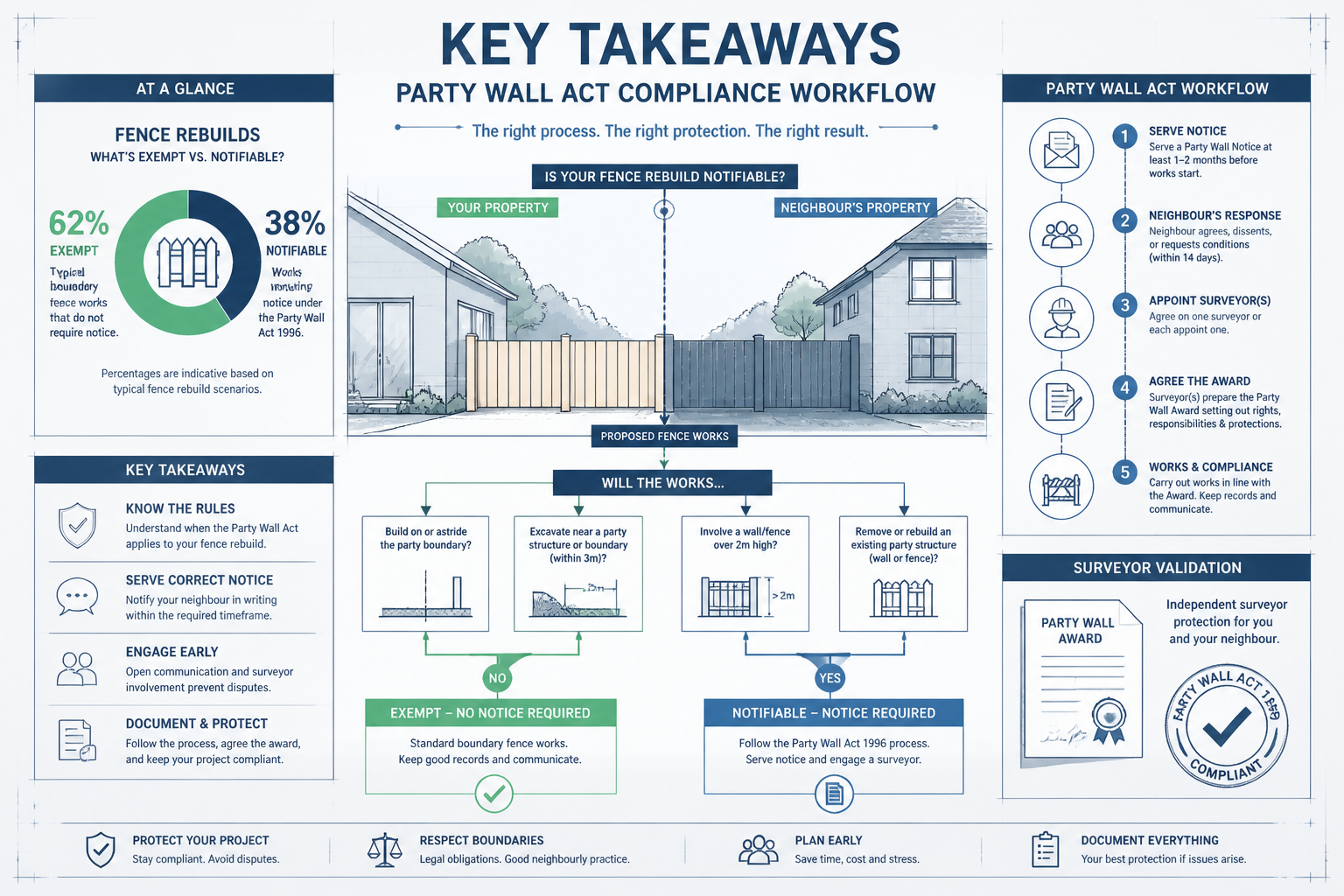
The most common misconception is that any fence or wall on a property boundary automatically falls under the Party Wall etc. Act 1996. It does not. [2] The Act specifically covers three categories of work:
- Works to an existing party wall or party structure
- Building a new wall or fence astride the boundary line (a party fence wall)
- Excavation within 3 or 6 metres of a neighbouring structure, depending on depth
A standard garden fence — a simple wooden or metal structure sitting entirely on one owner’s land — is not a party fence wall under the Act. [1] It is a boundary feature, but it carries no shared legal ownership and therefore falls outside the Act’s scope. To understand the precise legal distinction, it helps to read the Party Wall Act definition of a party fence wall before making any assumptions about your project.
The Critical Distinction: Party Fence Wall vs. Boundary Wall
| Feature | Boundary Wall (Exempt) | Party Fence Wall (Notifiable) |
|---|---|---|
| Position | Entirely on one owner’s land | Straddles the boundary line |
| Ownership | Single owner | Shared between both owners |
| Act applies? | ❌ No | ✅ Yes |
| Notice required? | ❌ No | ✅ Yes |
| Surveyor needed? | Only if dispute arises | Required if neighbour dissents |
💡 Pull Quote: “A boundary wall is not automatically a party fence wall under the Act — position and shared ownership are what trigger notice obligations.” [1]
For a deeper breakdown of these legal categories, the guide on boundary wall rules and the difference between party fence walls and boundary walls is an essential reference.
When a Fence Rebuild Becomes Notifiable in 2026
Several common rebuild scenarios cross the threshold into notifiable territory:
- Rebuilding a fence wall that sits astride the boundary — even partial rebuilding of an existing party fence wall triggers the Act [2]
- Raising the height of a shared boundary wall — height changes to a party structure require notice
- Deepening foundations during a rebuild — excavation near a neighbour’s structure may invoke the excavation provisions
- Cutting into a party wall to insert new posts or supports
The types of party wall works page provides a comprehensive list of notifiable activities that building owners often overlook.
Party Wall Act Notices for Boundary Fence Rebuilds: When They Apply and Surveyor Validation Steps — Notice Types and Timelines
Which Notice Applies to Your Rebuild?
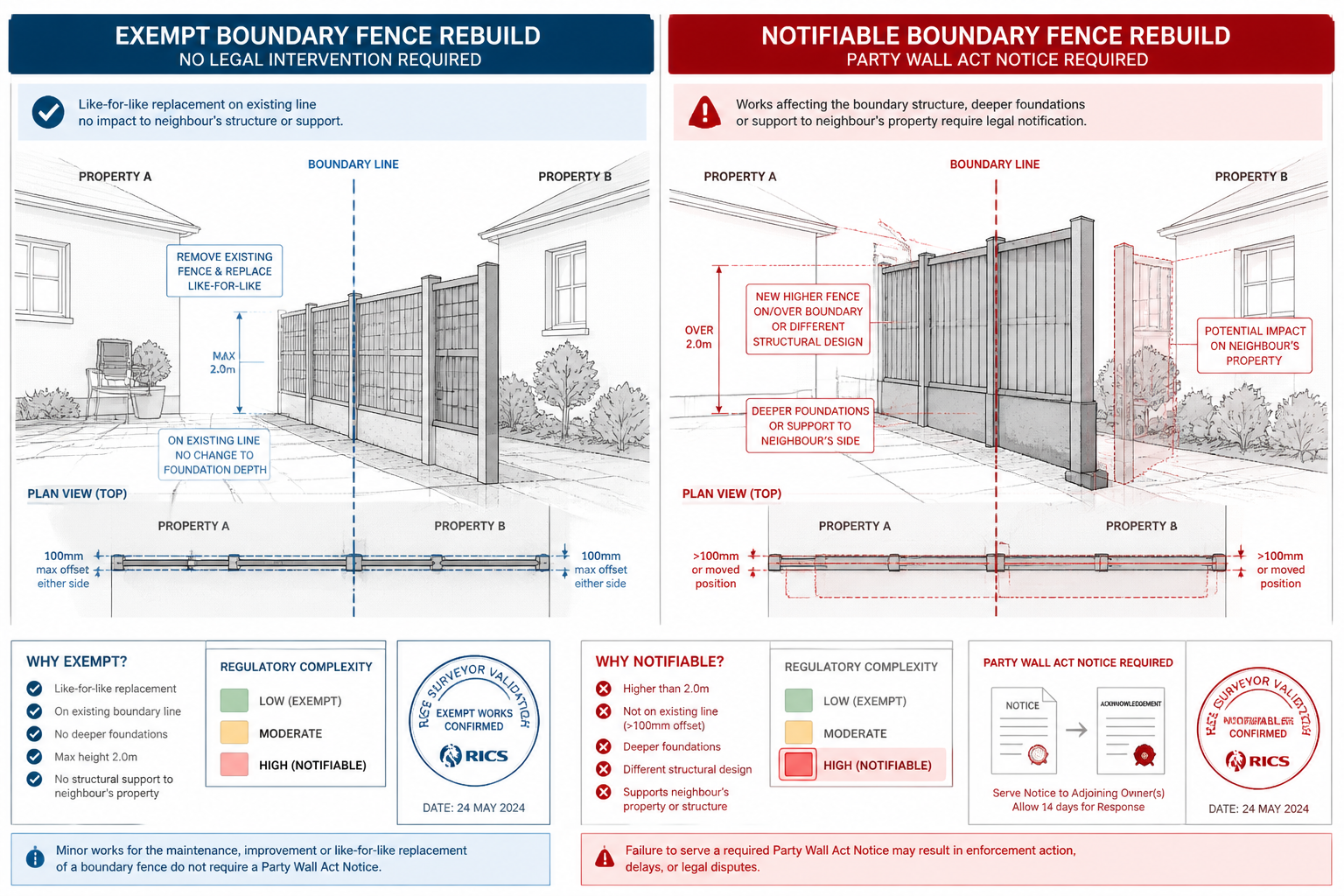
Two distinct notice types apply under the Act, and choosing the wrong one — or serving it too late — can invalidate the entire process.
🕐 Two-Month Notice (Party Structure Notice)
- Required when modifying, repairing, or rebuilding an existing party wall or party fence wall
- Must be served at least two months before work begins [1]
- Covers works such as raising, underpinning, or cutting into a shared wall
🕐 One-Month Notice (Line of Junction Notice)
- Required when building a new wall astride or adjacent to the boundary line
- Must be served at least one month before work begins [1]
- Also applies to excavation works within proximity thresholds
For full guidance on Party Wall Act notices — what they are and how to respond, property owners on both sides of the boundary should familiarise themselves with the process before any works begin.
Building Astride the Boundary: The Consent Rule
If the plan is to build a new party fence wall astride the boundary line, the neighbour must give written consent within 14 days of receiving the notice. [2] Without that written consent:
- The building owner has no right to build astride the boundary
- All works must be carried out entirely on the building owner’s own land
- All costs fall to the building owner [2]
This is a firm statutory rule, not a guideline. Many homeowners discover this only after starting works — at which point the legal exposure can be significant.
The 14-Day Response Window
Once a Party Wall Notice is served, the adjoining owner has 14 days to respond with either:
- ✅ Written consent — works can proceed without a surveyor (though a Schedule of Condition is still advisable)
- ❌ Dissent — a Party Wall Surveyor must be appointed [1]
- 🔇 No response (silence) — treated as dissent, triggering mandatory surveyor appointment [2]
⚠️ Important: Verbal agreement from a neighbour carries no legal weight under the Act. Consent must always be in writing.
Surveyor Validation Steps: The Complete Checklist
Party Wall Act Notices for Boundary Fence Rebuilds: When They Apply and Surveyor Validation Steps — The Surveyor’s Role
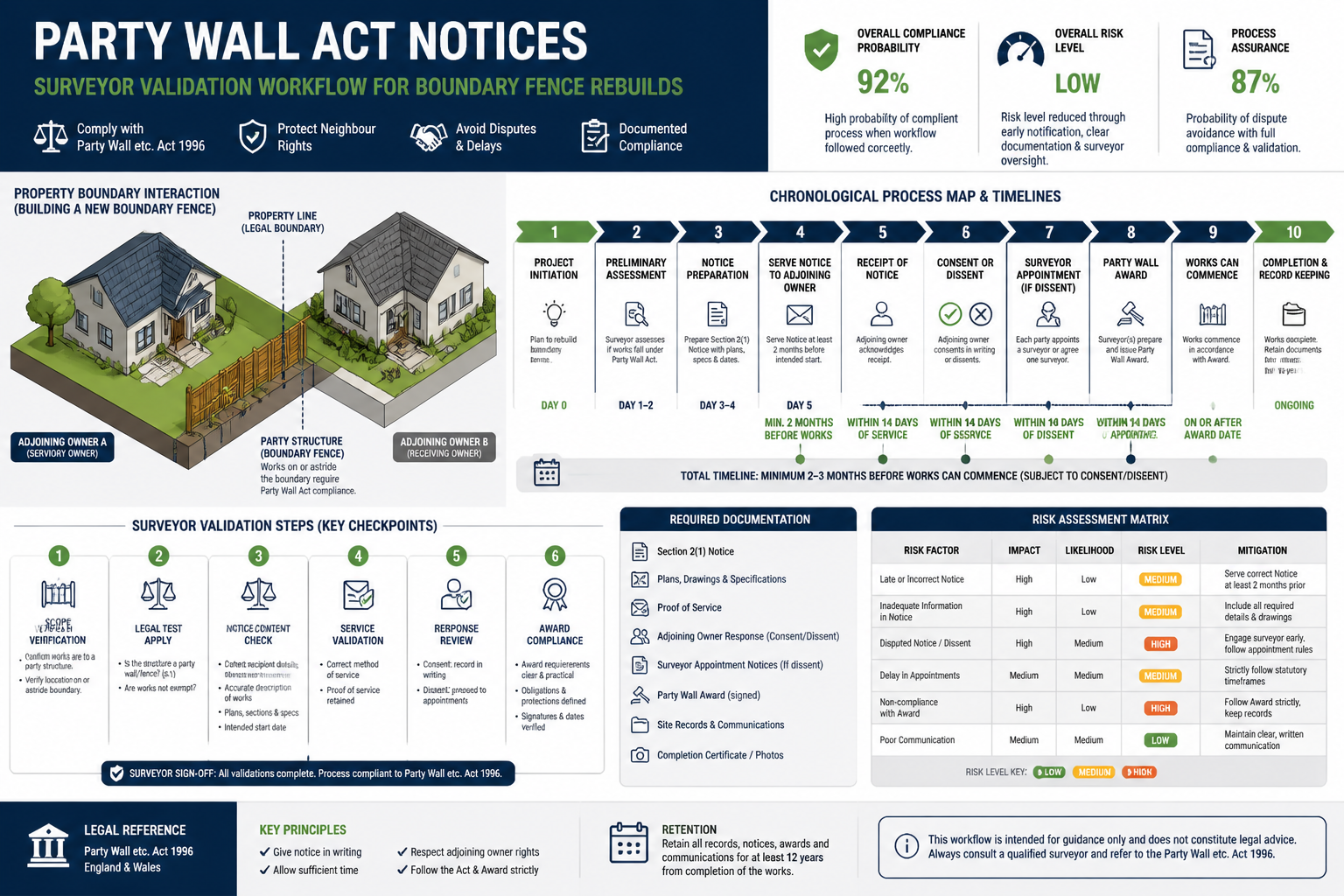
When dissent is registered — or when the complexity of a rebuild warrants professional oversight — a qualified Party Wall Surveyor steps in to protect both parties. The validation process follows a structured sequence.
Step 1: Appointment of Surveyor(s)
Both parties may appoint their own surveyor, or agree to use a single Agreed Surveyor who acts impartially. [6] The building owner typically bears the cost of the process, though this can vary depending on the circumstances of the works.
- Building owners can learn more about the surveyor appointment process here
- Adjoining owners have their own rights and surveyor options
Step 2: Schedule of Condition
Before any work begins, the surveyor must prepare a Schedule of Condition — a detailed photographic and written record of the adjoining property’s current state. [1] This document:
- Establishes a baseline for comparing pre- and post-construction condition
- Protects the building owner from unfounded damage claims
- Protects the adjoining owner by documenting existing defects
The schedule typically covers: existing wall surfaces, cracks, foundations visible at ground level, garden features near the boundary, and any structures within the zone of influence.
Step 3: Foundation Depth Validation ⚙️
For fence wall rebuilds, the surveyor checks whether the proposed foundation depth triggers the excavation provisions of the Act:
| Excavation Depth | Distance from Neighbour’s Structure | Notice Required? |
|---|---|---|
| Any depth | Within 3 metres and deeper than neighbour’s foundations | ✅ Yes |
| Any depth | Within 6 metres and on a line 45° from neighbour’s foundations | ✅ Yes |
| Shallow (above neighbour’s foundation level) | Beyond 3 metres | ❌ No |
[2] These thresholds are non-negotiable. Even a modest fence post rebuild can trigger the excavation provisions if the ground conditions require deep footings.
Step 4: Height and Boundary Position Checks
The surveyor validates:
- Exact boundary position using title deeds, Land Registry data, and physical measurement
- Proposed wall height against permitted development rules and any existing restrictions
- Whether the wall straddles the boundary or sits entirely on one owner’s land
- Compliance with height limits — relevant guidance on how high you can build a wall between neighbours is an important parallel consideration
Step 5: Drafting the Party Wall Award
The surveyor’s final output is the Party Wall Award — a legally binding document that: [1]
- Specifies the exact works permitted
- Sets out working hours and access arrangements
- Defines protection measures for the adjoining property
- Establishes the process for resolving any damage claims after completion
The Award is enforceable in the County Court, giving both parties genuine legal protection. For a detailed look at what this document contains, the guide on Party Wall Awards and contract templates is a practical resource.
2026 Updates: Boundary Disputes and Post-Reform Compliance
What Has Changed in 2026?
The landscape for boundary fence disputes in England has shifted noticeably in 2026. Following the Law Commission’s ongoing review of property boundaries and the increased volume of post-pandemic home improvement projects, enforcement of Party Wall Act procedures has become more rigorous. Key developments include:
- Increased use of injunctions by adjoining owners to halt non-compliant works mid-project
- Greater scrutiny of notice validity — courts have been stricter about notices that fail to meet statutory content requirements
- Digital service of notices gaining wider acceptance, though physical delivery remains the safest approach
- Boundary dispute mediation being encouraged before formal surveyor appointment in some local authority areas
💡 Pull Quote: “In 2026, procedural compliance is not just best practice — it is the primary line of defence against injunctions and compensation claims.”
Common Mistakes That Lead to Disputes
🚫 Starting works before the notice period expires
🚫 Serving notice to the wrong person (e.g., a tenant instead of the freeholder)
🚫 Failing to describe the works accurately in the notice
🚫 Assuming a verbal agreement replaces a written notice
🚫 Ignoring the excavation provisions for deep fence post foundations
For those considering whether a surveyor is strictly necessary, the article on having a party wall agreement without a surveyor explains the limited circumstances where this is legally permissible — and the significant risks involved.
Quick Reference: Is Your Fence Rebuild Notifiable?
Use this decision tree to assess your project:
Is the fence/wall sitting astride the boundary line?
    YES → Notice required (Line of Junction or Party Structure Notice)
    NO  → Is it an existing party fence wall being modified?
              YES → Two-month Party Structure Notice required
              NO  → Do foundations exceed 3m proximity to neighbour's structure?
                        YES → Excavation notice required
                        NO  → Works likely exempt from the Act ✅
Conclusion: Act Early, Document Everything
Party Wall Act Notices for Boundary Fence Rebuilds: When They Apply and Surveyor Validation Steps is a topic that rewards early attention and penalises last-minute action. The Act’s requirements are clear, but they are frequently misapplied — most often because property owners assume a boundary fence is automatically exempt.
Actionable Next Steps ✅
- Identify the legal status of your boundary structure — is it a party fence wall or a simple boundary feature? Use the party fence wall definition guide as a starting point.
- Determine which notice applies — one month for new builds, two months for existing party wall works.
- Serve notice in writing with full details of the proposed works, well before the statutory deadline.
- Appoint a qualified surveyor if the neighbour dissents or if the rebuild involves deep foundations or shared ownership.
- Ensure a Schedule of Condition is completed before any spade hits the ground.
- Seek local expert advice — whether in South London, North London, or elsewhere, a local party wall surveyor brings invaluable knowledge of regional boundary conventions and dispute patterns.
Taking these steps in 2026 is not bureaucratic box-ticking — it is the most effective way to protect the project, the property, and the neighbourly relationship.
References
[1] How Close Can My Neighbour Build To My Fence Learn The Party Fence Wall Rules – surveymerchant.com
[2] The Party Wall Etc Act 1996 Explanatory Booklet – gov.uk
[6] Party Wall Agreements What You Need To Know – fmb.org.uk
[7] Understanding Party Fence Walls And Boundary Walls – acdesignsolution.com
Speak to a RICS chartered party wall surveyor
Free initial consultation. Notices, awards and schedules of condition across London and nationwide.