}
Nearly one in three party wall disputes in England and Wales escalates unnecessarily — not because of genuine disagreement between neighbours, but because the procedural steps were mishandled from the start. As construction activity rebounds across London and beyond, the Party Wall Act Updates Post-2025: Key Changes Impacting Notices and Awards in 2026 Projects have introduced a sharper regulatory lens on how notices are served and how awards are drafted. For building owners, adjoining owners, and surveyors alike, understanding what has changed is no longer optional — it is the foundation of a legally sound project.
Key Takeaways 📋
- The RICS 8th Edition consultation is reshaping party wall practice guidance, introducing updated award formats, revised appointment letters, and stronger conduct standards [1].
- Three notice types govern party wall procedures: Line of Junction Notice, Party Structure Notice, and Adjacent Excavation Notice — each with distinct timelines [3].
- Party wall awards are non-transferable to new building owners; fresh notices or agreements must be obtained upon property sale [4].
- 2026 regulatory updates have tightened compliance requirements around award drafting and enforcement procedures [2].
- Surveyors must adapt quickly to rising dispute volumes by leveraging updated RICS guidance on Third Surveyor referrals and fee transparency [1].
Understanding the Regulatory Landscape in 2026
The Party Wall etc. Act 1996 has remained the statutory backbone of neighbour relations in construction for nearly three decades. However, the post-2025 period has brought meaningful shifts in how that legislation is interpreted and applied in practice. The Party Wall Act Updates Post-2025: Key Changes Impacting Notices and Awards in 2026 Projects reflect both formal RICS guidance revisions and updated regulatory frameworks that tighten compliance obligations across the board [2].
💡 Pull Quote: “Updated guidance is intended to support high standards of competence, conduct and consistency, while also helping practitioners navigate the statutory process with greater clarity and confidence.” — James Kavanagh, RICS Head of Professional Practice (Land & Development) [1]
The Royal Institution of Chartered Surveyors has launched a consultation on the 8th Edition of its party wall practice guidance, replacing the 7th edition. This is not a cosmetic refresh. The 8th edition includes:
- Enhanced appendices covering complex construction scenarios
- Revised letters of appointment and terms of engagement
- Updated draft award formats aligned with 2026 compliance expectations
- Strengthened guidance on fee practices, Third Surveyor use, and public engagement [1]
For practitioners working on 2026 projects, this guidance shift demands an immediate review of existing templates and appointment procedures. Those relying on outdated 7th edition formats risk producing awards that may face challenge or non-enforcement.
To understand the full statutory framework underpinning these changes, the Party Wall etc. Act 1996 overview provides essential context for both professionals and property owners.
The Three Notice Types: Timelines, Triggers, and 2026 Compliance
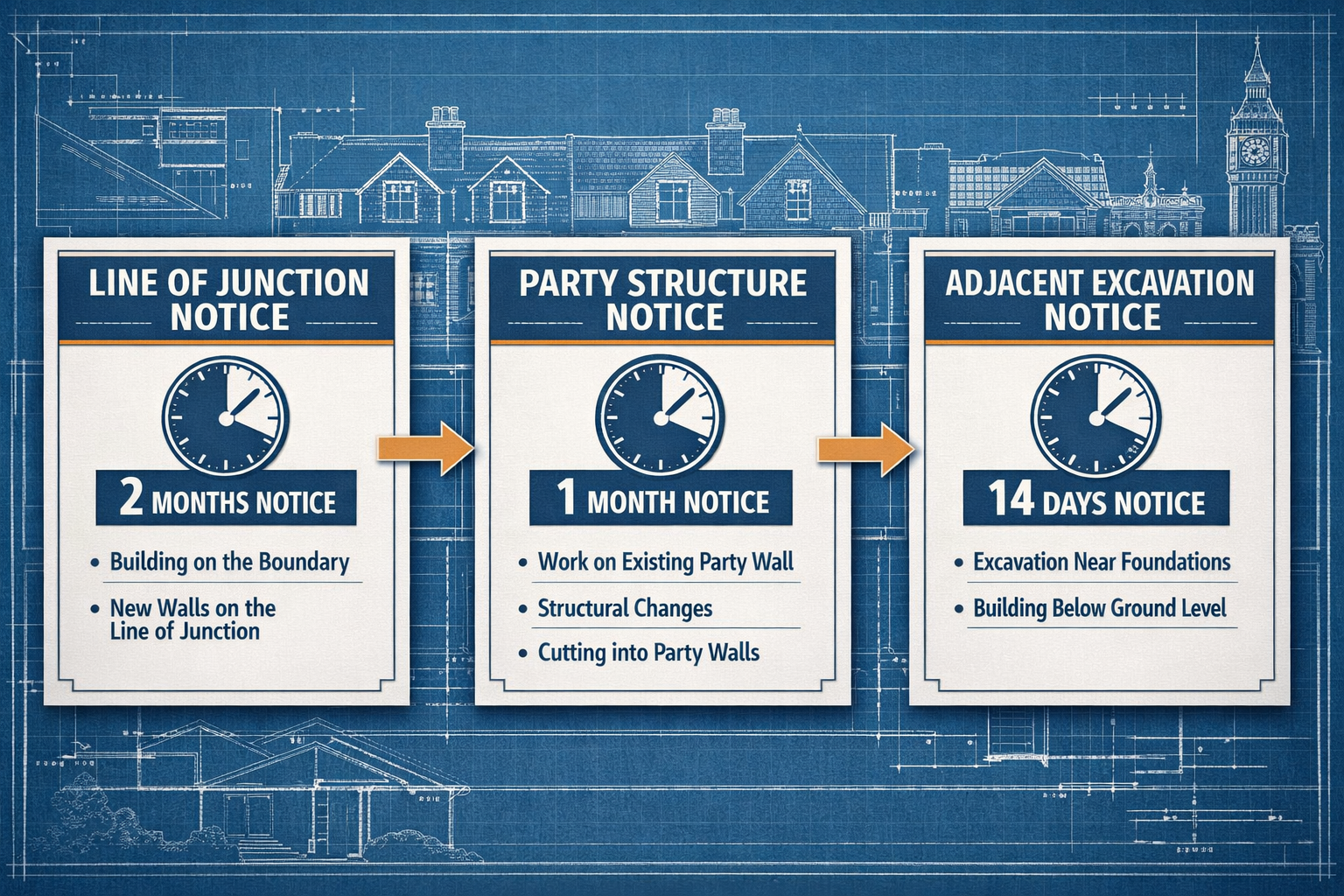
One of the most practically impactful areas of the Party Wall Act Updates Post-2025 concerns how notices are served and within what timeframes. Getting this wrong can invalidate the entire process, expose building owners to injunctions, and cause costly project delays.
The Three Categories of Party Wall Notices
Party wall notices fall into three distinct categories, each triggered by a different type of work [3]:
| Notice Type | Trigger | Notice Period |
|---|---|---|
| Line of Junction Notice | Building a new wall on or at the boundary line | 1 month |
| Party Structure Notice | Works affecting a shared (party) wall or floor | 2 months |
| Adjacent Excavation Notice | Excavation within 3–6 metres of a neighbouring structure | 1 month |
Key Timelines to Know ⏱️
- 2-month notice period: Required for works directly affecting a party wall or boundary line — giving neighbours adequate time to respond or raise concerns [6].
- 1-month notice period: Applies to excavation works and new boundary wall construction, offering expedited processing for specific work types [6].
- 14-day response window: Once a Party Wall Notice is received, the adjoining owner has 14 days to respond. Failure to respond within this window triggers a dispute resolution process under the Act [3].
Serving Notices Correctly in 2026
The updated regulatory environment places greater scrutiny on how notices are served, not just when. Key compliance points for 2026 include:
- Notices must clearly identify the type of work being proposed and reference the relevant section of the Act.
- Service must be made to the correct legal owner of the adjoining property — not merely an occupant.
- Electronic service of notices, while increasingly common, should be backed by confirmation of receipt to avoid disputes over validity.
For a detailed breakdown of the notice serving process, the guide on party wall notices and how to respond is an essential reference. Building owners can also explore the types of party wall works that trigger notice obligations to ensure nothing is overlooked at project inception.
Award Drafting Under the RICS 8th Edition: What Has Changed?
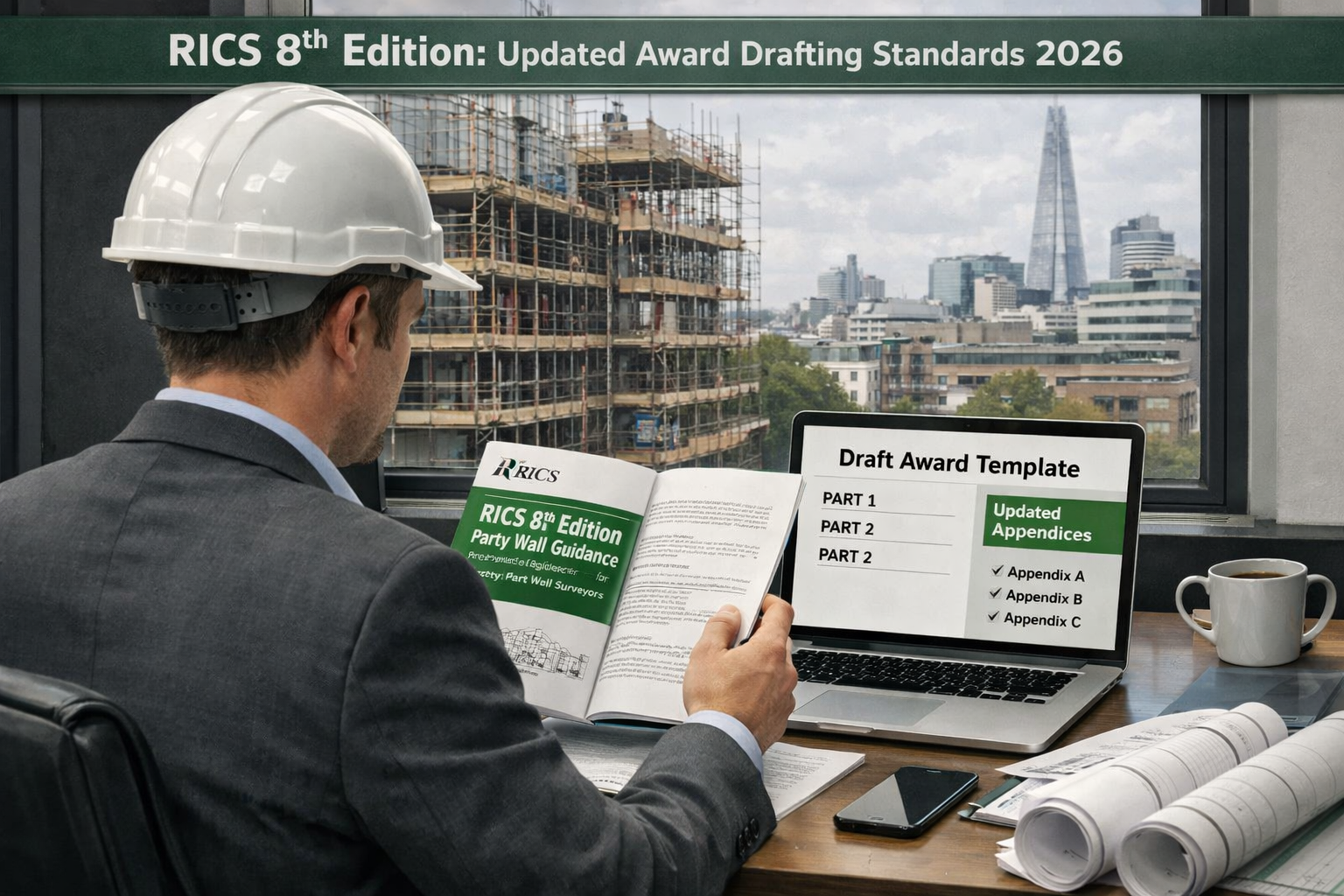
The party wall award is the legal instrument that defines the rights and obligations of both parties during construction. Under the Party Wall Act Updates Post-2025: Key Changes Impacting Notices and Awards in 2026 Projects, award drafting has become a more rigorous and scrutinised process [2].
Updated Award Formats and Enforceable Agreements
The RICS 8th Edition introduces updated draft award formats that reflect current regulatory expectations. Key changes include:
- Greater specificity in describing permitted works, hours of operation, and access rights
- Clearer provisions for schedule of condition surveys, protecting adjoining owners from unsubstantiated damage claims
- Explicit fee transparency clauses, addressing longstanding concerns about surveyor costs being disproportionate to the works involved [1]
- Strengthened Third Surveyor referral procedures, ensuring disputes between appointed surveyors are resolved efficiently
⚠️ Important: Awards drafted using outdated templates may lack the specificity required under 2026 standards, making them harder to enforce and more vulnerable to appeal.
For those seeking a practical starting point, the guide on party wall awards and contract templates offers a detailed walkthrough of what a compliant award should contain. The party wall awards service page also outlines how professional surveyors structure enforceable agreements.
The Schedule of Condition: Now More Critical Than Ever
A schedule of condition — a documented record of the adjoining property’s state before works begin — has always been best practice. Under 2026 frameworks, it is increasingly treated as a mandatory component of a robust award rather than an optional add-on [2].
A properly executed schedule of condition protects both parties: it gives adjoining owners a clear baseline for any damage claims and protects building owners from inflated or spurious allegations.
Fee Practices Under the Spotlight 🔍
One of the more contentious areas addressed in the RICS 8th Edition is surveyor fee practices. The updated guidance calls for:
- Transparent fee agreements at the point of appointment
- Proportionality between fees charged and the complexity of the works
- Clear communication about who bears the cost of the surveyor (typically the building owner)
For property owners concerned about costs, the resource on how to keep party wall costs down provides practical strategies that remain valid under the updated framework.
Non-Transferability of Awards: A Critical Issue for 2026 Property Transactions
One of the most frequently misunderstood aspects of party wall law — and one that the post-2025 updates have brought into sharper focus — is the non-transferability of party wall awards [4].
What Non-Transferability Means in Practice
When a building owner sells a property mid-project or before works begin, the party wall award does not automatically transfer to the new owner. This creates significant risk:
- The new building owner must serve fresh notices before proceeding with any notifiable works.
- Written consent obtained by the previous owner from an adjoining owner does not bind the adjoining owner to accept the new building owner’s works [4].
- Buyers who proceed without fresh notices risk injunctions that halt construction entirely.
The Joint Notice Strategy 🤝
A practical solution gaining traction in 2026 is the joint notice strategy. When a building owner is selling, both the seller and buyer can serve notice jointly. This approach:
- Ensures the award remains valid for future owners
- Accounts for changes in ownership during the notice period
- Reduces the risk of procedural gaps that could delay construction
This is particularly relevant for buy-to-let expansions and institutional landlord projects, where property portfolios change hands regularly and construction timelines span multiple ownership periods [5].
For adjoining owners uncertain about their rights when a neighbouring property is sold, the adjoining owners’ guidance explains the protections available under the Act.
Surveyor Strategies for Navigating Rising Disputes in 2026
Party wall disputes are rising. Increased urban densification, loft conversions, basement extensions, and boundary-adjacent developments have pushed dispute volumes higher across London and major cities. Surveyors must adapt their approach to remain effective under the Party Wall Act Updates Post-2025 framework.
Practical Strategies for Surveyors ✅
1. Adopt RICS 8th Edition templates immediately
Do not wait for the consultation to conclude before updating appointment letters and award formats. The direction of travel is clear, and early adoption reduces the risk of producing documents that will require revision [1].
2. Prioritise Third Surveyor clarity
The updated guidance places renewed emphasis on the Third Surveyor’s role. Surveyors should ensure Third Surveyor selection is agreed and documented at the earliest opportunity — before disputes arise, not after [1].
3. Conduct thorough pre-notice site assessments
Before any notice is served, a detailed assessment of the proposed works and their likely impact on adjoining properties reduces the risk of disputes escalating to formal award proceedings.
4. Communicate proactively with adjoining owners
Many disputes stem from poor communication rather than genuine legal disagreement. Early, transparent dialogue — even before formal notices are served — can prevent the 14-day response window from becoming adversarial [3].
5. Document everything
Under 2026 regulatory standards, comprehensive documentation of every stage — from notice service to award execution — is essential for defending decisions if challenged [2].
For building owners managing their own projects, the building owners’ guidance outlines responsibilities and rights at each stage of the process.
Regional Considerations: London’s Unique Party Wall Challenges
London presents a particularly complex party wall environment. High-density housing, Victorian terrace rows, and active basement conversion markets mean that party wall issues arise on almost every significant residential project. The post-2025 updates are especially relevant for London-based practitioners and property owners.
Whether a project is located in the East End, South of the river, or in a central borough, local expertise matters. Specialist surveyors operating across East London, South London, and North London are well-positioned to navigate the nuances of both the updated Act requirements and local planning contexts.
Conclusion: Actionable Next Steps for 2026 Projects
The Party Wall Act Updates Post-2025: Key Changes Impacting Notices and Awards in 2026 Projects represent the most significant shift in party wall practice guidance in years. The RICS 8th Edition consultation, tightened compliance requirements, and the growing complexity of urban construction projects demand a proactive, informed approach from all parties involved.
Actionable Next Steps 🚀
- Building owners: Serve notices early and verify the correct notice type for each element of proposed works. Do not assume previous consent or awards transfer on property sale.
- Adjoining owners: Respond within the 14-day window and appoint a surveyor promptly if consent is withheld, to ensure your rights are protected under an enforceable award.
- Surveyors: Update appointment letters, award templates, and Third Surveyor procedures to align with RICS 8th Edition guidance without delay.
- Property buyers: Before completing a purchase where party wall works are planned or in progress, obtain independent legal and surveying advice on whether fresh notices are required.
- All parties: Treat the schedule of condition as a non-negotiable component of every award, not an optional extra.
The party wall process, when handled correctly, protects everyone. The 2026 updates make that process more rigorous — but also more transparent and more enforceable than ever before.
References
[1] RICS Launches Consultation On Updated Party Wall Practice Guidance – rics.org
[2] Evergreen Guide To Party Wall Awards Drafting Enforceable Agreements Under 2026 Regulatory Updates – https://nottinghillsurveyors.com/blog/evergreen-guide-to-party-wall-awards-drafting-enforceable-agreements-under-2026-regulatory-updates
[3] Difference Between Party Wall Notices And Awards – partywallslimited.com
[4] Buying Property Party Wall Award – osborneslaw.com
[5] Party Wall Awards For Buy To Let Expansions In 2026 Protocols Amid Institutional Landlord Surge – https://nottinghillsurveyors.com/blog/party-wall-awards-for-buy-to-let-expansions-in-2026-protocols-amid-institutional-landlord-surge
[6] Party Wall Agreement – hoa.org.uk
Speak to a RICS chartered party wall surveyor
Free initial consultation. Notices, awards and schedules of condition across London and nationwide.