
Since the November 2025 Budget introduced a high-value council tax surcharge and the March 2026 Spring Statement left stamp duty thresholds stagnant, London estate agents have reported a sharp uptick in homeowners choosing to extend rather than move. That decision — sensible as it is — triggers one of the most misunderstood pieces of legislation in UK property law: the Party Wall etc. Act 1996. Getting it wrong can halt your build, expose you to injunctions, and sour neighbourly relations for years.
This guide cuts through the complexity of London extensions party wall 2026, covering every notice type, timeline, and cost question you are likely to face.
Key Takeaways 🏠
- Three sections of the Act (1, 2, and 6) cover different works — knowing which applies to your project determines your notice period.
- Two-month notice is required for party structure works; one-month notice applies to adjacent excavations.
- A neighbour’s dissent triggers the Party Wall Award procedure — this is normal and legally protective for both sides.
- The building owner typically pays surveyor fees, but this is not absolute.
- Party wall procedure runs entirely separately from planning permission and building regulations — you may need all three simultaneously.
What the Party Wall etc. Act 1996 Actually Covers
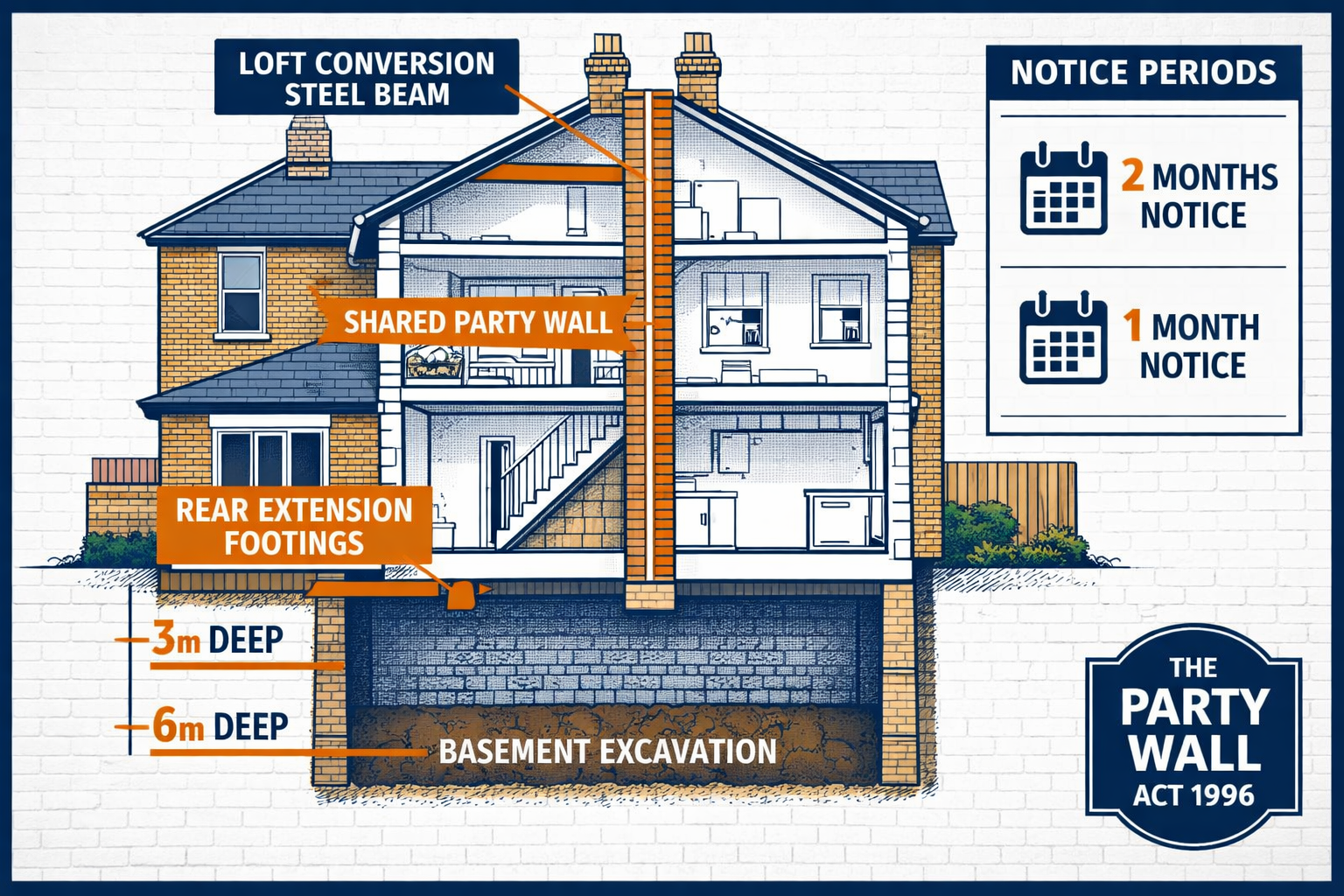
The Act creates a legal framework for three categories of work, each governed by a different section:
| Section | Work Type | Notice Required |
|---|---|---|
| Section 1 | New wall on or astride the boundary line | 1 month |
| Section 2 | Works to an existing party wall or structure | 2 months |
| Section 6 | Excavations within 3 m or 6 m of a neighbour’s structure | 1 month |
💡 Pull quote: “The Act applies even to work entirely on your own land — a fact that catches many London homeowners off guard.”
A critical point: party wall procedure is completely separate from planning permission and building control. Your architect secures planning approval, your structural engineer deals with building control, and your party wall surveyor handles the Act — all three can run concurrently. Skipping any one of them creates legal exposure.
For a deeper look at how the legislation works in practice, see our overview of the Party Wall etc. Act 1996.
When Is a Party Wall Notice Required? London Scenarios Explained
Loft Conversions
Most London loft conversions involve cutting into a party wall to insert steel beams (flitch beams or padstones). This is notifiable under Section 2. You must serve a Party Structure Notice at least two months before work begins.
Design and planning alone typically takes two to four months, followed by four to six weeks for technical drawings — so factor notice periods into your programme from day one. Learn more about what a Party Structure Notice is and how to serve it in London.
Rear Extensions
A single-storey rear extension on a mid-terrace or semi-detached property often involves:
- Section 2 works if the rear wall being demolished or altered is a party wall.
- Section 6 works if new footings are excavated within 3.0 metres of the neighbour’s structure and deeper than their foundations.
Rear extensions in London typically cost £35,000–£75,000. Given that investment, a procedural error that triggers an injunction is a risk no one can afford.
Basement Digs 🏗️
Basement excavations are the most notice-intensive London project type. Deep digs routinely engage both Section 2 and Section 6. Under Section 6, excavation is notifiable if it falls within 3.0 metres of an adjoining structure and is deeper than that structure’s foundations — or within 6.0 metres if a 45-degree line from the base of the neighbour’s foundations intersects your excavation. Basement projects can extend the overall build timeline to well over 12 months.
New Boundary Wall (Section 1)
Building a new wall on the boundary line — rather than just inside your own land — requires a one-month notice under Section 1. This is common in London side-return extensions. Our guide on boundary wall rules and the difference between a party fence wall and a boundary wall explains the distinctions clearly.
Notice Periods: 2 Months vs 1 Month
| Notice Type | Relevant Section | Minimum Notice Period |
|---|---|---|
| Party Structure Notice | Section 2 | 2 months |
| Line of Junction Notice | Section 1 | 1 month |
| Adjacent Excavation Notice | Section 6 | 1 month |
The two-month notice period for Section 2 works is non-negotiable. Starting work before the period expires — even with a neighbour’s verbal agreement — leaves you legally exposed. Always serve notices in writing. For guidance on how to serve party wall notices and how to respond, our dedicated resource walks through every step.
Dissent, Consent, and the Party Wall Award Procedure
Once a notice is served, the adjoining owner has 14 days to respond. Three outcomes are possible:
- ✅ Consent — work may proceed; no Award needed.
- ❌ Dissent (appointing own surveyor) — the two surveyors (or an Agreed Surveyor) draw up a Party Wall Award.
- 🔇 No response — deemed dissent after 14 days; the Award procedure is triggered automatically.
What Is a Party Wall Award?
A Party Wall Award is a legally binding document that sets out:
- The scope and method of the notifiable works
- A schedule of condition recording the adjoining property’s pre-works state
- Working hours and site access arrangements
- Compensation provisions if damage occurs
Dissent is not hostile — it is simply the statutory mechanism that protects both parties. For a full explanation, visit our page on Party Wall Awards.
Agreed Surveyor vs Two Surveyors
Both owners can appoint a single Agreed Surveyor to act impartially for both parties — this is typically faster and cheaper. If each party appoints their own surveyor and those two cannot agree, they select a Third Surveyor whose determination is binding. Our guide on keeping party wall costs down explains when an Agreed Surveyor makes financial sense.
Who Pays the Surveyor Fees?
The general rule under the Act is that the building owner (the person carrying out the works) pays the reasonable surveyor fees of both parties. However, there are exceptions:
- If the adjoining owner’s own works contributed to the need for repairs, costs may be apportioned.
- An unreasonably obstructive adjoining owner may bear some costs at the surveyors’ discretion.
For a full breakdown of what to expect financially, see our costs of party wall and the process page.
London Extensions Party Wall 2026: Regional Considerations
London’s dense, mixed-tenure housing stock creates party wall scenarios that are more complex than anywhere else in England and Wales. Whether you are in a Victorian terrace in East London, a mansion flat in Central London, or a 1930s semi in South London, the Act applies equally — but the physical conditions vary enormously.
Common London-specific complications include:
- Shallow Victorian foundations that make even modest rear extensions notifiable under Section 6
- Converted flats where the party structure is a floor/ceiling rather than a wall
- Leasehold complications requiring freeholder consent alongside party wall notices
- Multiple adjoining owners on corner plots or mid-terrace properties
London Extensions Party Wall 2026: Your Action Checklist ✅
Before breaking ground on any London extension in 2026, work through this sequence:
- Identify which sections apply to your specific works (Sections 1, 2, and/or 6).
- Appoint a party wall surveyor early — ideally during the design stage.
- Serve the correct notice with the required lead time (1 or 2 months).
- Await the response — 14 days for consent or deemed dissent.
- Agree on an Agreed Surveyor where possible to reduce costs and delays.
- Commission a schedule of condition before works commence.
- Keep copies of all correspondence — the Award is a legal document.
If you are the neighbour receiving a notice, visit our adjoining owners page to understand your rights.
Conclusion: Act Early, Build Confidently
The surge in London home extensions in 2026 — driven by stamp duty inertia and council tax pressures — means party wall surveyors across the capital are in high demand. The single biggest mistake homeowners make is treating the Party Wall etc. Act 1996 as an afterthought. Notices served too late, or not at all, can result in injunctions that freeze your entire project.
Your actionable next steps:
- Building owners: Serve your party wall notices as soon as your design is confirmed — do not wait for planning approval.
- Adjoining owners: Understand that dissent is not confrontational; it gives you legal protection and a formal record of your property’s condition.
- Both parties: Consider appointing an Agreed Surveyor to keep the process efficient and costs proportionate.
Whether your project is in North London, West London, or anywhere across the capital, specialist party wall surveyors are available to guide you through every stage — from the first notice to the final Award.
Speak to a RICS chartered party wall surveyor
Free initial consultation. Notices, awards and schedules of condition across London and nationwide.