
Fewer than 20% of adjoining owners in England and Wales fully understand their legal rights under a party wall award — yet those rights have been dramatically reshaped by a sequence of landmark rulings that every property owner and surveyor must now navigate. The question of Adjoining Owner Rights in Party Wall Awards: Case Law Evolution Post-Welter v McKeeve 2026 sits at the heart of modern party wall practice, demanding a clear-eyed analysis of what the courts have decided, what surveyors must do, and what neighbours can realistically enforce.
Key Takeaways 📋
- Welter v McKeeve established that party wall surveyors must act impartially — they are not agents of the owner who appointed them.
- Power and another v Shah [2023] confirmed that adjoining owners cannot unilaterally trigger or impose a party wall award; the building owner must first serve a valid notice.
- Adjoining owners retain powerful indirect protections through surveyor duties, schedule of condition rights, and the courts’ injunction jurisdiction.
- Challenging a flawed award within 14 days of service remains the most effective remedy for an aggrieved adjoining owner.
- Proactive engagement — appointing a dedicated surveyor early — is the single most impactful step an adjoining owner can take.
Understanding the Party Wall Framework: Who Has What Rights?
Before examining how case law has evolved, it helps to be clear on the basic structure of the Party Wall etc. Act 1996. The Act creates a statutory dispute resolution mechanism triggered by a building owner — the person proposing to carry out works. An adjoining owner is the neighbouring property owner or occupier whose land or structure may be affected.
The Building Owner’s Monopoly on Trigger Rights
The Act is explicit: only a building owner can serve a party wall notice and set the machinery in motion. This design choice has profound implications. It means that if a neighbour begins excavation or party wall works without serving notice, the adjoining owner cannot simply “invoke” the Act themselves and demand a surveyor-drafted award [1].
“The Act grants building owner rights only — adjoining owners have no freestanding right to invoke the Act.” [1][3]
This is not a loophole. It is an intentional boundary that the Court of Appeal confirmed in 2023. Understanding it is essential to knowing where an adjoining owner’s real leverage lies.
What a Party Wall Award Actually Covers
A party wall award is a legally binding document that sets out:
- The scope and method of proposed works
- Hours of working and access arrangements
- Protective measures for the adjoining property
- Compensation provisions for any damage caused
- Rights to inspect and monitor during construction
For a detailed breakdown of what these documents contain, the party wall contract template guide provides an accessible starting point.
Welter v McKeeve and the Impartiality Principle
The ruling in Welter v McKeeve (2018–2019) was a watershed moment for party wall practice. The case centred on whether a surveyor appointed by a building owner could act in a way that systematically favoured that owner’s interests, effectively acting as their agent rather than as an independent professional [6][7].
What the Court Decided
The judgment was unambiguous: party wall surveyors owe a duty of impartiality to both parties, regardless of who appointed them. A surveyor appointed solely by the building owner is not that owner’s advocate. Their function is quasi-judicial — to resolve a dispute fairly, with proper regard for the adjoining owner’s legitimate interests [6].
Key principles from Welter v McKeeve include:
| Principle | Practical Effect |
|---|---|
| Surveyors are not agents of appointing owners | Awards cannot be skewed to favour one party |
| Impartiality is a statutory duty, not a courtesy | Breach can invalidate an award |
| Adjoining owners can challenge biased awards | 14-day appeal window to the County Court |
| Third surveyor appointments must be genuinely neutral | Cannot be a pre-selected ally of either party |
This ruling gave adjoining owners a powerful tool: if a surveyor fails to act impartially, the award itself is vulnerable [5][7].
Why Impartiality Matters in Practice
Before Welter v McKeeve, some building owners treated their appointed surveyor as a hired gun — someone to produce an award that minimised restrictions on works and maximised speed of delivery. The ruling ended that approach, at least in principle. In 2026, any surveyor who drafts an award that ignores reasonable protective conditions for the adjoining property risks having that award set aside on appeal [5].
For adjoining owners, this means the most effective strategy is appointing a dedicated adjoining owner’s surveyor as early as possible. A specialist surveyor will scrutinise the proposed works, insist on a thorough schedule of condition before works begin, and negotiate protective provisions into the award.
Power and Another v Shah [2023]: The Limits of Adjoining Owner Rights
If Welter v McKeeve expanded adjoining owner protections through the impartiality principle, the 2023 Court of Appeal decision in Power and another v Shah drew a firm line around what adjoining owners cannot do [1][3].
The Facts and the Ruling
The case arose where an adjoining owner attempted to use the party wall machinery to compel a building owner to submit to an award, even though the building owner had not served a valid party wall notice. The Court of Appeal held that the Act does not give adjoining owners any independent right to trigger the award process [3].
The implications are significant:
- ❌ Adjoining owners cannot appoint surveyors and produce an award in the absence of a valid notice from the building owner
- ❌ They cannot use the Act as a sword — only as a shield
- ✅ They can seek an injunction from the civil courts if a building owner proceeds without notice
- ✅ They can pursue compensation through the courts for damage caused by unlawful works [1][3]
What This Means for Adjoining Owners in 2026
The Power v Shah ruling clarified the landscape considerably. The Adjoining Owner Rights in Party Wall Awards: Case Law Evolution Post-Welter v McKeeve 2026 story is, in part, a story about courts defining boundaries — both literally and legally.
For adjoining owners whose neighbours begin notifiable works without serving notice, the correct route is not to attempt to self-invoke the Act. Instead, the options are:
- Write to the building owner formally requesting that they serve the correct notices
- Seek an injunction to halt works until proper notice is served and an award is in place
- Document all damage meticulously for a subsequent compensation claim
- Contact a specialist surveyor who can advise on the appropriate legal route
The party wall notices guide explains what valid notices look like and how they should be served — useful knowledge for any adjoining owner checking whether their neighbour has complied.
Practical Enforcement Strategies for Adjoining Owners in 2026
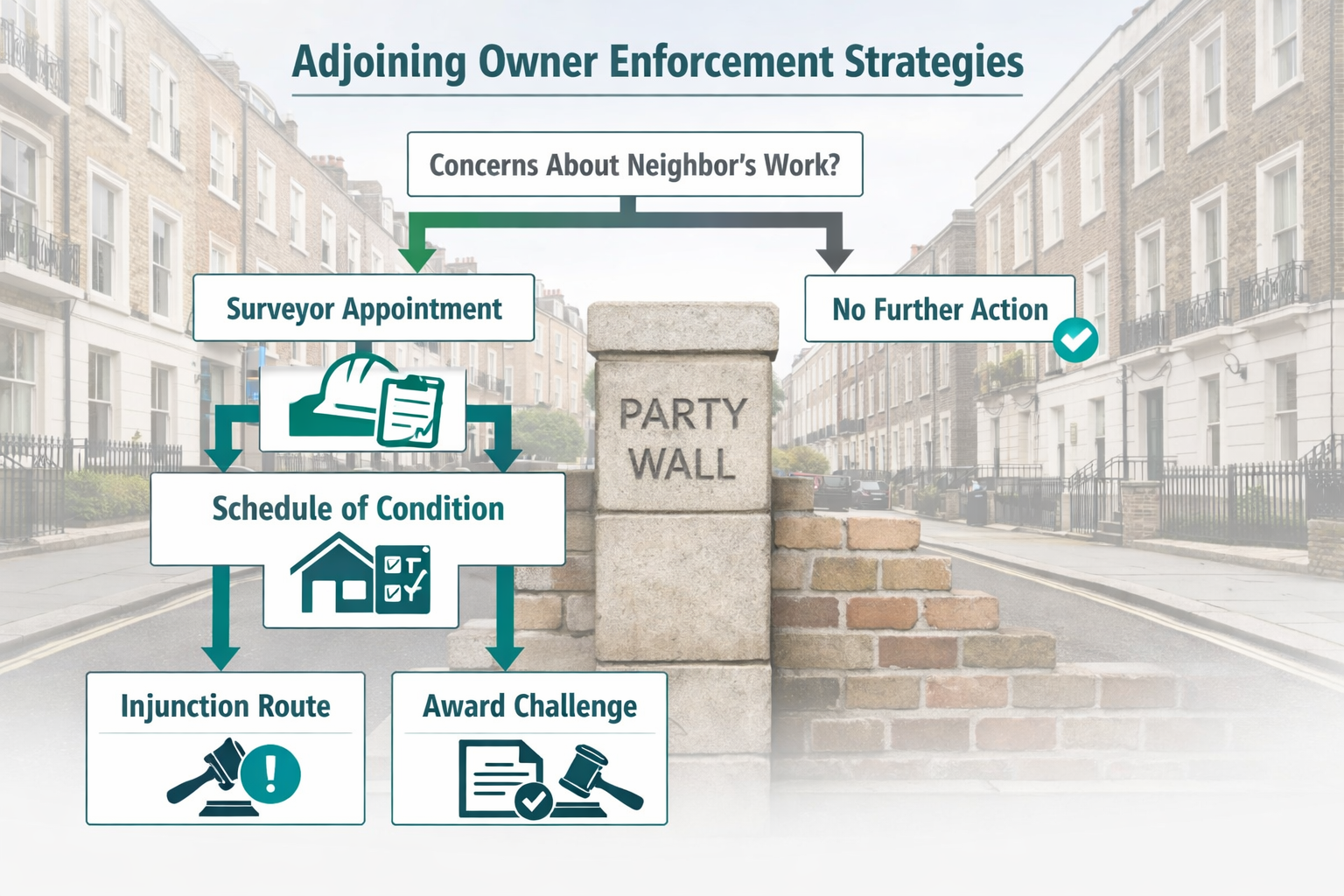
Understanding the case law is one thing. Translating it into effective action is another. The Adjoining Owner Rights in Party Wall Awards: Case Law Evolution Post-Welter v McKeeve 2026 framework points toward several concrete strategies.
Strategy 1: Appoint Early and Appoint Well
The single most impactful decision an adjoining owner can make is appointing a qualified surveyor as soon as a party wall notice arrives. Under the Act, adjoining owners have the right to appoint their own surveyor, with costs typically borne by the building owner [2][4].
An experienced adjoining owner’s surveyor will:
- Review the notice for validity and completeness
- Inspect the proposed works and identify risks
- Negotiate protective conditions into the award
- Ensure a comprehensive schedule of condition is prepared
- Monitor compliance during the works
Strategy 2: Insist on a Thorough Schedule of Condition
A schedule of condition is a photographic and written record of the adjoining property’s state before works begin. It is the cornerstone of any compensation claim if damage occurs. Yet many adjoining owners either skip this step or accept a superficial document.
Post-Welter v McKeeve, surveyors are expected to prepare schedules that are genuinely comprehensive — covering not just the party wall itself but floors, ceilings, windows, and any vulnerable features nearby [6][7].
Strategy 3: Challenge Flawed Awards Promptly
If an award is produced that fails to protect the adjoining owner’s legitimate interests — whether because a surveyor acted partially or because key conditions were omitted — the remedy is an appeal to the County Court within 14 days of the award being served [2][4].
Key grounds for appeal include:
- ✅ Surveyor bias or failure of impartiality (Welter v McKeeve principle)
- ✅ Award exceeding the surveyors’ jurisdiction
- ✅ Failure to properly assess and compensate for foreseeable damage
- ✅ Procedural irregularities in notice service
Pro tip: The 14-day deadline is strict. Missing it can extinguish appeal rights entirely. Always seek legal advice immediately if an award appears defective.
Strategy 4: Use the Third Surveyor Mechanism
Where the two appointed surveyors cannot agree, either party can refer the matter to a third surveyor — a neutral figure selected at the outset of the process. Post-Welter v McKeeve, the third surveyor’s role has been reinforced as genuinely independent [5][6].
Adjoining owners should ensure the third surveyor is agreed upon and recorded before any dispute arises, not after — when tensions may make neutral selection more difficult.
Strategy 5: Know When to Go to Court
Not every dispute is best resolved through the party wall machinery. Following Power v Shah, it is clear that where a building owner has bypassed the Act entirely, the civil courts — not party wall surveyors — are the appropriate forum [1][3].
Injunctions can be obtained relatively quickly in urgent cases, particularly where structural damage is imminent. The costs of obtaining an injunction may ultimately be recoverable from the building owner if they were clearly in breach of their statutory duties.
The Evolving Landscape: What 2026 Practice Looks Like
The cumulative effect of Welter v McKeeve and Power v Shah, combined with ongoing RICS guidance on surveyor impartiality [5], has produced a noticeably more sophisticated party wall practice in 2026.
Key Shifts in Professional Practice
| Before Case Law Evolution | Post-Welter/Power v Shah 2026 |
|---|---|
| Building owner’s surveyor often acted as advocate | Surveyors now expected to act with genuine impartiality |
| Adjoining owners sometimes attempted to self-invoke the Act | Clear understanding that notice must come from building owner first |
| Schedules of condition were sometimes cursory | Comprehensive documentation now standard expectation |
| Third surveyor selection often contentious | Early agreement on third surveyor now best practice |
| Award challenges were rare | Adjoining owners more willing and able to appeal flawed awards |
The Role of Specialist Surveyors
The complexity of the post-Welter landscape makes specialist knowledge more valuable than ever. Whether works involve a loft conversion, basement excavation, or rear extension, the types of party wall works that trigger the Act are varied — and the risks to adjoining properties differ significantly depending on the nature of the works.
For London property owners specifically, accessing local expertise matters. Surveyors familiar with the specific construction challenges of North London, South London, and other areas bring practical knowledge that generic advice cannot replicate.
Common Misconceptions About Adjoining Owner Rights
Several myths persist in this area, often leading adjoining owners to either under-protect or over-reach their position.
Myth 1: “I can refuse to engage and the works cannot proceed.”
❌ False. If an adjoining owner fails to respond to a notice within the statutory period, a deemed dispute arises and the Act’s machinery proceeds regardless.
Myth 2: “The party wall award protects me automatically.”
❌ Partially false. An award only protects what it covers. A poorly negotiated award may leave significant gaps. Active engagement is essential.
Myth 3: “I can use the Act to stop my neighbour’s works entirely.”
❌ False. The Act is not a veto mechanism. It regulates how works are carried out, not whether they can proceed (subject to planning and building regulations).
Myth 4: “My neighbour’s surveyor will look after my interests.”
⚠️ Risky assumption. While Welter v McKeeve requires impartiality, the safest approach is always to appoint a dedicated adjoining owner’s surveyor.
Conclusion: Actionable Next Steps for Adjoining Owners
The Adjoining Owner Rights in Party Wall Awards: Case Law Evolution Post-Welter v McKeeve 2026 story is ultimately one of clarification and empowerment — but only for those who understand the rules. The courts have been consistent: adjoining owners cannot trigger the Act themselves, but they have robust protections once the process is engaged, provided they use them actively.
Your Action Plan 🎯
- Respond to every party wall notice — do not ignore it or assume silence protects you
- Appoint a specialist adjoining owner’s surveyor immediately upon receiving a notice
- Insist on a comprehensive schedule of condition before any works begin
- Review every award carefully — challenge within 14 days if it fails to protect your interests
- If works begin without notice, seek legal advice about injunctive relief rather than attempting to self-invoke the Act
- Keep records of all correspondence, damage, and surveyor communications throughout
The law has never been clearer about the boundaries of adjoining owner rights. The key is knowing those boundaries — and working effectively within them.
References
[1] Adjoining Owners And Party Wall Act Awards – localgovernmentlawyer.co.uk
[2] Party Walls In Case Law – ww3.rics.org
[3] Court Of Appeal Rules That Party Wall Act Awards Cannot Be Imposed On Building Owners By Adjoining Owners – cornerstonebarristers.com
[4] Party Walls Articles – scribd.com
[5] Party Wall Surveyors Impartiality – ww3.rics.org
[6] Welter V Mckeeve 2018 – stokemont.com
[7] Party Wall Case Law Welter V Mckeeve – ansteyhorne.co.uk
[8] Y2024v13i1p57 65 – ideas.repec.org
Speak to a RICS chartered party wall surveyor
Free initial consultation. Notices, awards and schedules of condition across London and nationwide.