

Over 40,000 party wall disputes are estimated to arise annually across England and Wales — and in 2026, that number is climbing fast. The UK’s sustained housing boom, driven by government housebuilding targets and a wave of home extension projects, has pushed demand for qualified party wall surveyors to record levels. For surveyors, building owners, and adjoining property owners alike, understanding Party Wall Awards in 2026 Construction Boom: Surveyor Strategies for High-Demand Dispute Management has never been more critical.
The Party Wall etc. Act 1996 remains the governing legislation, but the pressure of today’s construction environment is testing its processes like never before. Surveyors who master efficient, legally sound strategies will be the ones who thrive — and protect their clients — in this demanding landscape.
Key Takeaways 📋
- 🏗️ The 2026 UK construction boom is generating unprecedented demand for party wall surveyors, making speed and compliance more important than ever.
- 📄 Three distinct notice types exist under the Act, each with specific timelines that must be respected to avoid costly delays.
- ⚖️ Appointing a single agreed surveyor can significantly fast-track the process without compromising legal protection.
- 💷 Surveyor costs typically range from £150–£200 per hour, with a complete party wall award averaging around £1,000 [3].
- 🔍 Proactive dispute management — including thorough schedules of condition — is the most effective way to prevent escalation.
What Is a Party Wall Award and Why Does It Matter in 2026?
A party wall award is a legally binding document produced by one or more appointed surveyors. It sets out the rights and responsibilities of both the building owner (the party carrying out works) and the adjoining owner (the neighbour affected by those works). Think of it as a construction rulebook agreed upon by an impartial authority.
In 2026, with residential extensions, loft conversions, and basement digs surging across urban areas, the award has become the cornerstone of neighbourly construction relations. Without one, disputes can escalate into injunctions, court proceedings, and significant financial loss for all parties.
The Three Types of Party Wall Notices
Before an award can be issued, the correct notice must be served. There are three types [4]:
| Notice Type | Trigger | Notice Period |
|---|---|---|
| Party Structure Notice | Works to an existing shared wall | 2 months |
| Line of Junction Notice | Building a new wall on or at the boundary | 1 month |
| Adjacent Excavation Notice | Excavation within 3–6 metres of a neighbour’s structure | 1 month |
💡 Pull Quote: “Serving the wrong notice — or serving it too late — can halt a project entirely. In a booming construction market, that delay costs real money.”
Understanding what a party structure notice is and how to serve it is the essential first step for any building owner embarking on works in 2026 [3].
Surveyor Strategies for High-Demand Dispute Management in the 2026 Construction Boom
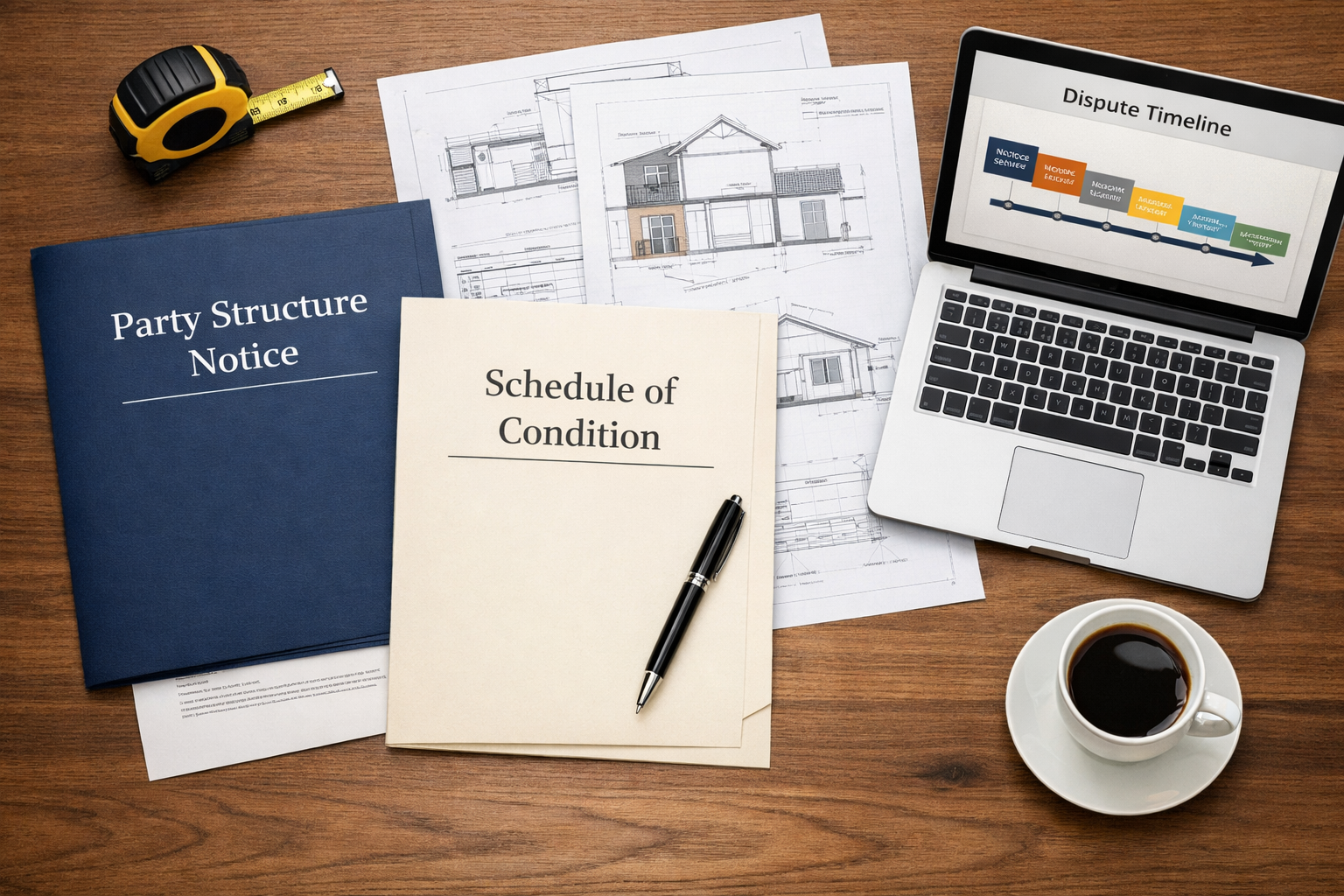
The surge in construction activity means surveyors are juggling more cases simultaneously than at any previous point. Effective strategies are no longer optional — they are a professional necessity.
Strategy 1: Prioritise Early Notice Compliance
The single most effective way to fast-track a party wall award is to ensure notices are served correctly and on time. Delays caused by defective or late notices ripple through the entire project timeline.
Practical steps for surveyors and building owners:
- Serve notices as early as possible — ideally before finalising contractor bookings.
- Use clear, compliant language. Refer to a reliable party wall notice guide to avoid common errors.
- Keep proof of delivery (recorded post, hand-delivery with witness, or electronic service where accepted).
Surveyors should also educate their building owner clients on the types of party wall works that trigger notice requirements, since many homeowners are unaware that even minor works can fall under the Act.
Strategy 2: Recommend the Agreed Surveyor Approach
One of the most powerful tools for managing high-volume caseloads efficiently is the agreed surveyor model. Rather than each party appointing their own surveyor (which doubles costs and communication layers), both the building owner and the adjoining owner jointly appoint a single impartial professional [4].
Benefits of the agreed surveyor approach:
- ✅ Faster award production — one decision-maker, not two
- ✅ Lower combined costs for both parties
- ✅ Reduced risk of procedural disagreements between surveyors
- ✅ Streamlined communication with contractors and architects
This approach works particularly well in straightforward cases such as standard loft conversions or single-storey rear extensions. For more complex or contentious disputes, separate surveyors may still be advisable [3].
Strategy 3: Conduct Thorough Schedules of Condition
A schedule of condition is a detailed photographic and written record of the adjoining property’s state before works begin. It is arguably the most dispute-preventive document in a surveyor’s toolkit.
In 2026’s high-demand environment, skipping or rushing this step is a false economy. When post-construction damage claims arise — and they do — a comprehensive schedule of condition is the clearest evidence available to determine whether the building owner is liable.
What a robust schedule of condition should include:
- Timestamped photographs of all internal and external walls, ceilings, and floors adjacent to the works
- Notes on pre-existing cracks, settlement, or defects
- Measurements of any existing structural movement
- Signed agreement from both parties
Strategy 4: Use Digital Tools to Manage Caseload Pressure
The 2026 construction boom demands that surveyors work smarter. Digital case management platforms, electronic notice serving, and cloud-based document storage are no longer luxuries — they are competitive necessities.
Key digital efficiencies:
- Electronic notice templates reduce drafting time and error rates
- CRM software tracks notice periods, response deadlines, and award milestones
- Digital signature platforms speed up award execution without requiring in-person meetings
- Drone photography for schedules of condition in hard-to-access areas
Managing Disputes: When Awards Are Contested

Even with the best preparation, disputes arise. Understanding how to manage them efficiently — without compromising the integrity of the Act — is what separates good surveyors from exceptional ones.
Common Causes of Party Wall Disputes in 2026
Research highlights a persistent concern that some litigation processes may inadvertently sideline structural safety considerations in favour of procedural arguments [2]. Surveyors must guard against this tendency by keeping structural and safety issues at the forefront of every award.
The most frequent dispute triggers include:
- Damage claims — Cracks, subsidence, or water ingress attributed to neighbouring works
- Access disputes — Building owners requiring access to the adjoining property that the neighbour refuses
- Working hours disagreements — Noise and disruption outside agreed hours
- Inadequate notice — Adjoining owners claiming they were not properly informed
- Cost allocation disputes — Arguments over who pays surveyor fees
💡 Pull Quote: “The best dispute management strategy is prevention. A well-drafted award anticipates conflict before it starts.”
The Third Surveyor Mechanism
When two appointed surveyors cannot agree, the Act provides for a third surveyor — selected at the outset by both party surveyors — to make a binding determination. This mechanism is underused but highly effective.
In a busy 2026 market, surveyors should agree on their third surveyor choice early in the process, not after a deadlock has already formed. This saves weeks of delay.
Cost Considerations for All Parties
Understanding how to keep party wall costs down is a genuine concern for homeowners navigating the process. In 2026, typical surveyor fees are:
| Service | Typical Cost |
|---|---|
| Surveyor hourly rate | £150–£200 per hour |
| Complete party wall award | ~£1,000 |
| Third surveyor determination | Variable (often higher) |
| Schedule of condition | £300–£600 (typical) |
Source: [3]
The building owner is generally responsible for reasonable surveyor costs on both sides. However, if an adjoining owner appoints an unnecessarily expensive surveyor or escalates a simple matter, cost allocation can become contentious. Clear communication from the outset minimises this risk.
Regional Demand Patterns: Where Is Pressure Highest?
London remains the epicentre of party wall activity in 2026. Dense Victorian and Edwardian terraced housing stock, combined with intense development pressure, means that surveyors across the capital are working at capacity.
High-demand areas include:
- North London — Loft conversions and basement extensions dominate. See party wall surveyors in North London for specialist support.
- South London — Rear extensions and side returns are common triggers. South London party wall surveyors handle a high volume of residential cases.
- East London — Regeneration zones and new-build adjacency create complex scenarios. East London party wall surveyors are in particularly high demand.
- West and Central London — High-value properties mean higher stakes disputes. West London and Central London surveyors often deal with premium basement and heritage property cases.
Outside London, cities including Manchester, Birmingham, and Bristol are also experiencing elevated demand as regional housebuilding programmes accelerate.
Upholding Act Standards Under Pressure: The Non-Negotiables
The pressure of a construction boom can tempt some practitioners to cut corners — rushing awards, skipping condition surveys, or serving defective notices. This approach carries serious professional and legal risk.
The Party Wall etc. Act 1996 is clear in its requirements, and the courts have consistently upheld its provisions. Surveyors who produce awards that fail to meet statutory standards face the prospect of those awards being set aside — leaving works without legal protection and clients exposed to injunctions [6].
Non-negotiable standards every surveyor must maintain:
- ✅ Correct notice type served with adequate notice period
- ✅ Award clearly identifies the works, the parties, and the conditions
- ✅ Both parties’ rights explicitly protected
- ✅ Structural safety considerations documented and addressed [2]
- ✅ Award signed and served before works commence
💡 Pull Quote: “Speed is valuable. Compliance is essential. In 2026’s construction boom, surveyors must deliver both — not choose between them.”
The RICS provides professional guidance and training for surveyors working in this space, reinforcing that technical competence must keep pace with market demand [5].
Practical Guidance for Building Owners and Adjoining Owners
Both sides of a party wall dispute benefit from understanding the process. Building owners who understand their obligations are less likely to trigger disputes. Adjoining owners who understand their rights are less likely to feel steamrolled.
For building owners:
- Serve notices as early as possible — don’t wait until the contractor is booked
- Consider appointing an agreed surveyor to save time and money
- Engage proactively with your neighbour before formal notice is served
- Review the costs of party wall process to budget accurately
For adjoining owners:
- Respond to notices within the statutory period (14 days to consent or dissent)
- Understand that dissenting triggers the surveyor appointment process — it does not stop the works
- Request a schedule of condition to protect your property
- Seek independent advice from an adjoining owner’s surveyor if unsure
Conclusion: Thriving in the 2026 Party Wall Landscape
The intersection of Party Wall Awards in 2026 Construction Boom: Surveyor Strategies for High-Demand Dispute Management is not just a professional challenge — it is an opportunity. Surveyors who invest in efficient processes, digital tools, and deep statutory knowledge will be best positioned to serve clients well and build a reputation that outlasts any single boom cycle.
The fundamentals remain unchanged: serve correct notices, conduct thorough condition surveys, draft clear and comprehensive awards, and keep structural safety at the centre of every decision. What changes in 2026 is the pace — and the strategies required to maintain quality at speed.
Actionable Next Steps ✅
- Audit your notice templates — Ensure they comply with current Act requirements and are free of common errors.
- Build your agreed surveyor network — Identify trusted colleagues for joint appointments in straightforward cases.
- Invest in digital case management — Reduce administrative burden so more time goes to technical work.
- Complete a schedule of condition on every case — No exceptions, regardless of how minor the works appear.
- Stay current with RICS guidance — Professional standards evolve; make sure your practice does too [5].
- Communicate early with all parties — Most disputes are rooted in poor communication, not legal complexity.
Whether acting for a building owner or an adjoining owner, the goal is the same: a fair, legally sound award that protects everyone and keeps construction moving forward.
References
[1] Border Wall Contractor Says $2B Federal Award Package Sets Stage For 2026 Construction – enr.com
[2] ASCE Library – Party Wall Disputes and Structural Safety – ascelibrary.org
[3] Party Wall Agreement – HOA.org.uk – hoa.org.uk
[4] Party Wall Act Explained (Video) – youtube.com
[5] Party Walls: The Fundamentals – RICS Training – rics.org
[6] Understanding the Party Wall Act – Designing Buildings – designingbuildings.co.uk
Speak to a RICS chartered party wall surveyor
Free initial consultation. Notices, awards and schedules of condition across London and nationwide.