Only around 1–2% of party wall disputes ever reach the point of Third Surveyor activation — yet when they do, the costs, delays, and legal complexity can escalate dramatically for everyone involved. Understanding exactly when and how to invoke this statutory mechanism is not just useful knowledge; under the Party Wall etc. Act 1996, it is a legal obligation that both surveyors and property owners must navigate correctly.
This guide on Third Surveyor Activation in Party Wall Disputes: Triggers, Procedures, and 2026 RICS Best Practices covers the precise legal triggers, step-by-step appointment procedures, fee allocation rules, and the updated RICS compliance standards that govern this process in 2026. Whether a building owner is planning works or an adjoining owner has received a notice, knowing how this mechanism works can save significant time and money.
Key Takeaways 📌
- The Third Surveyor is a statutory safety valve under the Party Wall etc. Act 1996, activated only when the two appointed surveyors reach a deadlock.
- Both surveyors must jointly nominate the Third Surveyor — neither party can choose them independently.
- The Third Surveyor rules only on the specific point of disagreement, not the entire dispute.
- Their determination is final and legally binding, with only a 14-day window to appeal to the County Court.
- Fee liability can fall on the party whose conduct caused the unnecessary escalation — so invoking the Third Surveyor carelessly is a costly mistake.
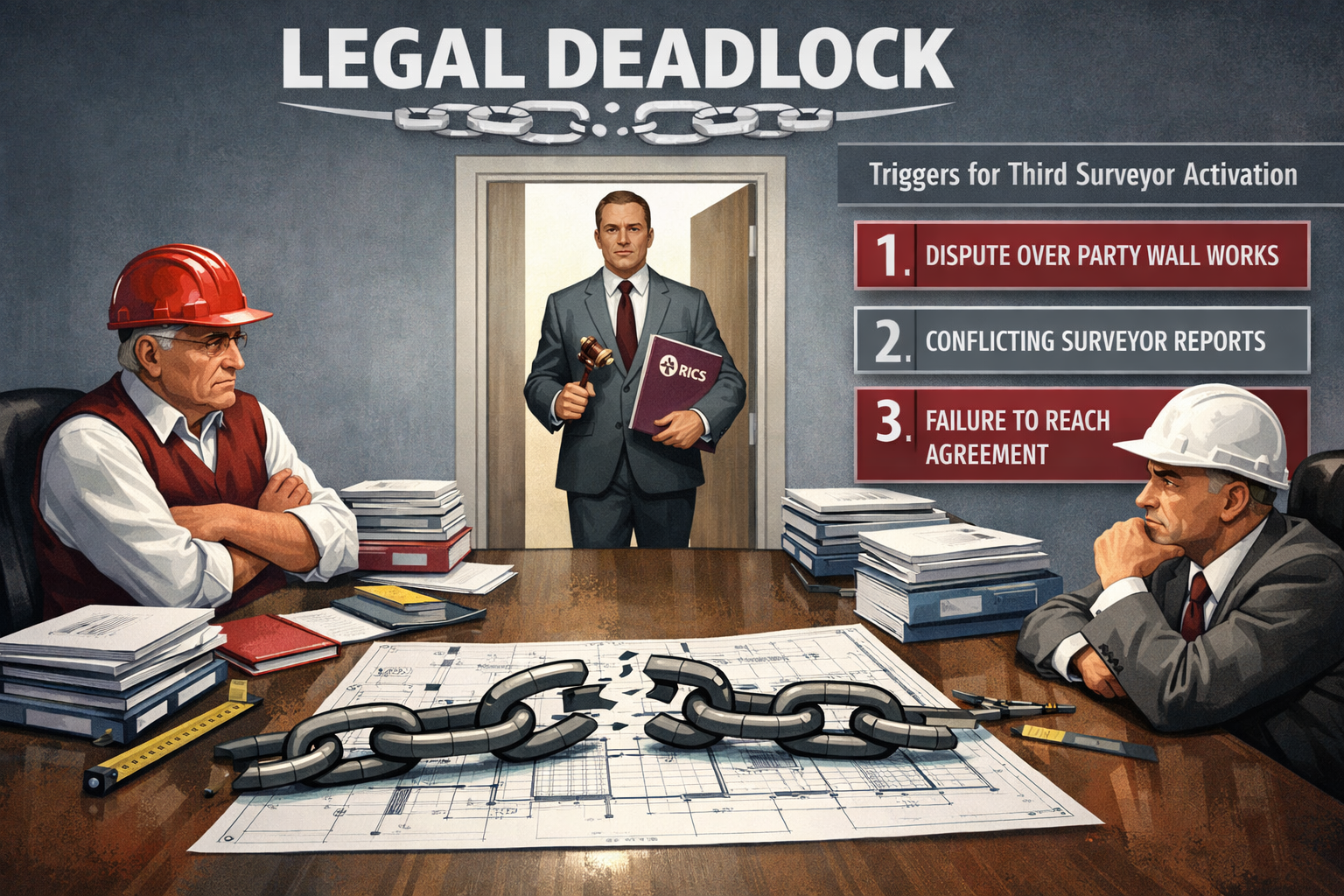
What Triggers Third Surveyor Activation in Party Wall Disputes?
The Legal Basis Under the Party Wall etc. Act 1996
The Third Surveyor role exists under Section 10 of the Party Wall etc. Act 1996. It is not optional — it is a mandatory statutory mechanism. When the two appointed surveyors (one representing the building owner, one representing the adjoining owner) cannot agree on any matter relevant to the party wall award, the Third Surveyor must be called upon to resolve the deadlock [1].
Under Section 10(11), the Third Surveyor “shall make the necessary award” when called upon, giving them full statutory authority to issue binding determinations [2]. This is not a discretionary role — it is a legal obligation built into the framework of the Act.
Common Triggers for Deadlock 🔍
Not every disagreement leads to Third Surveyor activation. Most disputes are resolved through negotiation. However, certain scenarios consistently push cases toward escalation:
| Trigger Scenario | Description |
|---|---|
| Scope of permitted works | Surveyors disagree on what works the Act actually permits |
| Structural methodology | Conflicting views on how works should be carried out safely |
| Schedule of condition disputes | Disagreement on pre-existing damage versus new damage |
| Compensation amounts | Inability to agree on financial redress for damage caused |
| Access rights | Conflict over the extent and timing of access to the adjoining property |
| Award terms | Surveyors cannot finalise the wording of the party wall award |
💬 Pull Quote: “The Third Surveyor is not a referee brought in to restart the game — they are called in to rule on one specific play that the two umpires cannot agree on.”
It is important to understand that the Third Surveyor does not review the entire case from scratch. Their jurisdiction is limited strictly to the specific point of disagreement submitted by the two appointed surveyors [1]. This narrow scope is by design — it keeps the process efficient and prevents the Third Surveyor from becoming a full appeals tribunal.
When Surveyors Act Under Instruction vs. Independently
A subtle but critical trigger involves surveyor conduct. If a surveyor is acting purely on their client’s instructions rather than exercising independent professional judgment, they may take positions that are unreasonable or legally unsupportable. This is one of the most common causes of unnecessary escalation.
Both the building owner’s surveyor and the adjoining owner’s surveyor have a statutory duty to act impartially under the Act — they are not advocates for their appointing party. When this principle is ignored, deadlock follows. Understanding the distinct roles of the building owner’s surveyor and the adjoining owner’s surveyor is essential to avoiding unnecessary escalation.
Step-by-Step Procedures for Third Surveyor Appointment
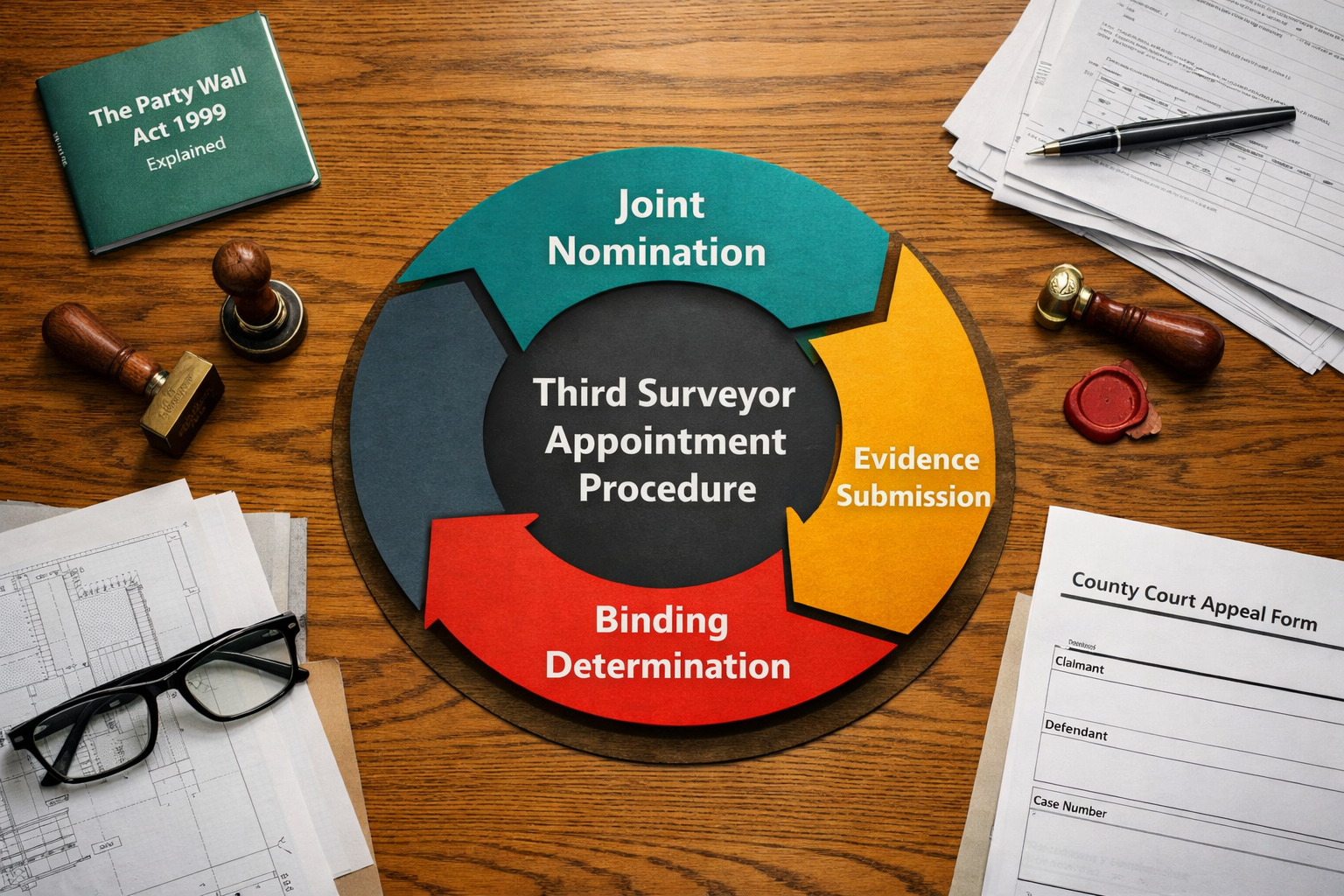
Step 1: Establishing That a Genuine Deadlock Exists
Before the Third Surveyor can be called upon, the two appointed surveyors must genuinely exhaust reasonable attempts at resolution. Jumping to Third Surveyor activation prematurely is not only poor professional practice — it can expose the party who triggers the referral to significant costs.
A genuine deadlock means:
- Both surveyors have exchanged written positions
- At least one round of substantive negotiation has occurred
- The specific point of disagreement has been clearly identified and documented
Step 2: Joint Nomination of the Third Surveyor
The two appointed surveyors must jointly select and nominate the Third Surveyor. This is a crucial procedural safeguard. Neither the building owner nor the adjoining owner has any say in who is chosen — the selection rests entirely with the two surveyors acting together [1].
This joint nomination process ensures that the Third Surveyor is genuinely impartial. In practice, surveyors often agree on a Third Surveyor at the very beginning of the party wall process — before any dispute arises — so that there is no delay if one becomes necessary. This is considered best practice under 2026 RICS guidance.
Key requirements for the nominated Third Surveyor:
- ✅ Must hold MRICS or FRICS designation per RICS 2026 standards [4]
- ✅ Must have no prior involvement in the specific dispute
- ✅ Must be willing and available to act
- ✅ Must not have a conflict of interest with either party
Step 3: Referral of the Specific Point of Disagreement
Once appointed, the Third Surveyor receives a formal referral document from the two surveyors. This document must:
- Clearly state the specific point(s) of disagreement
- Include all relevant evidence and supporting documentation
- Reference the applicable sections of the Party Wall etc. Act 1996
- Set out each surveyor’s position with supporting reasoning
The Third Surveyor then considers the evidence before them and the specific wording of the Act to reach their determination [2]. They may request additional information, visit the site, or seek clarification — but they are not conducting a fresh survey of the entire project.
Step 4: The Determination
The Third Surveyor issues a written determination on the specific point referred. This determination is:
- 🔒 Final and legally binding on all parties and both original surveyors [1]
- 📋 Incorporated into the Party Wall Award to resolve the deadlock
- ⚖️ Accompanied by a costs decision allocating the Third Surveyor’s fees
Once issued, the determination must be incorporated into the final award. There is no mechanism for either surveyor to reject it.
Step 5: The 14-Day Appeal Window
The determination is not entirely without recourse. Under Section 10(17) of the Party Wall etc. Act 1996, any party who is dissatisfied with the Third Surveyor’s determination may appeal to the County Court — but this appeal must be lodged within 14 days of the determination being served [1].
Missing this window means the determination becomes absolutely final. Given the tight timeframe, any party considering an appeal should take immediate legal advice upon receiving the determination.
Fee Allocation, Cost Risks, and 2026 RICS Best Practices
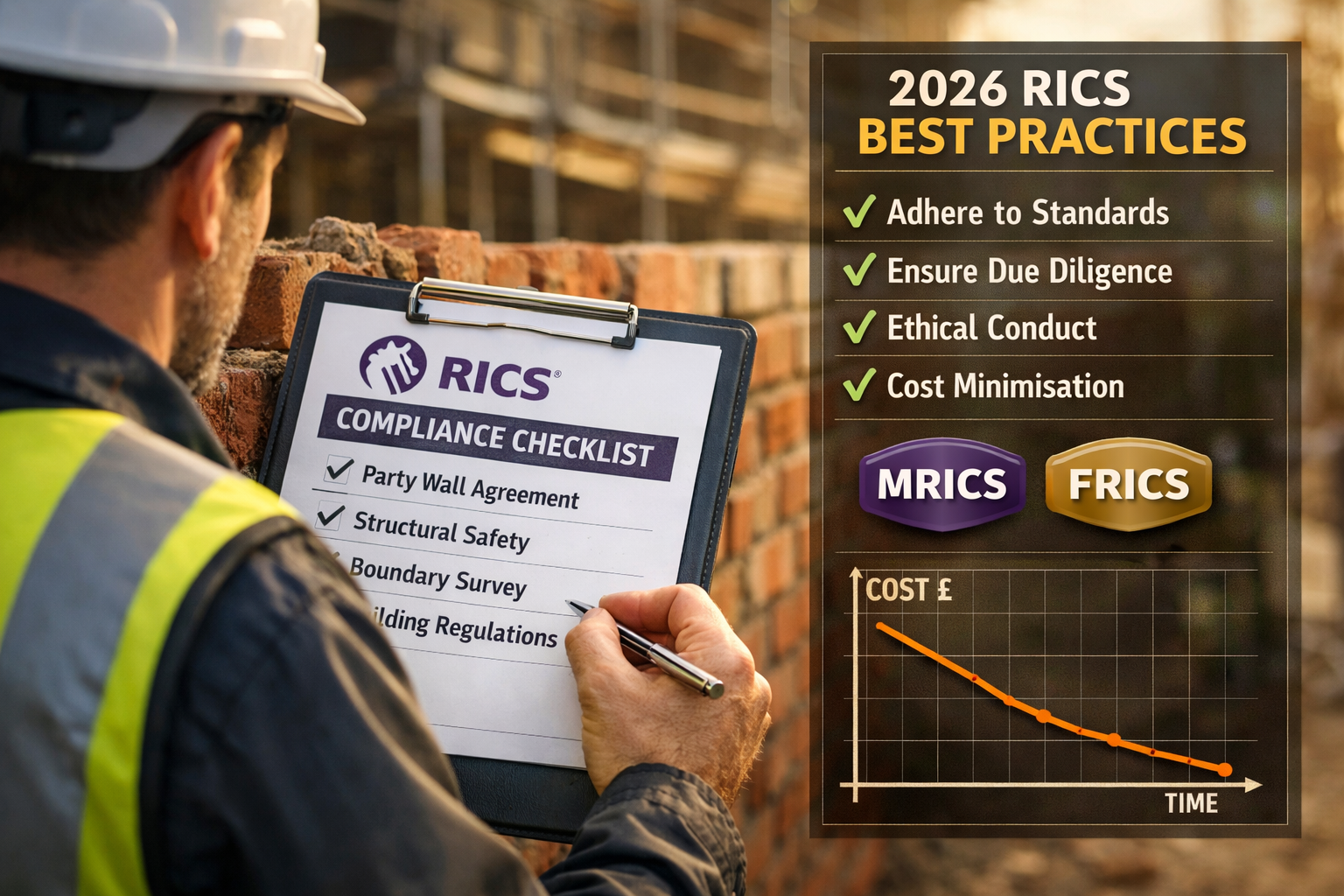
Understanding the Costs of Third Surveyor Involvement
Third Surveyor involvement represents a costly intervention that adds substantial fees on top of costs already incurred with the two original surveyors [1]. In 2026, Third Surveyor fees in London typically range from £1,500 to £5,000+ depending on the complexity of the point referred and the time required for review.
These costs are in addition to — not instead of — the fees already paid to the building owner’s surveyor and the adjoining owner’s surveyor. For guidance on managing overall party wall costs, see this resource on how to keep party wall costs down.
The Caller Liability Rule ⚠️
One of the most misunderstood aspects of Third Surveyor activation is the caller liability rule. If a party calls upon the Third Surveyor during a disagreement, that party is liable for the Third Surveyor’s costs — even if the Third Surveyor ultimately decides in their favour [2].
This rule exists to discourage frivolous or premature referrals. It means that before triggering Third Surveyor activation, a party must be genuinely confident that:
- A real deadlock exists (not just a slow negotiation)
- The point of disagreement is substantive and legally significant
- The cost of the referral is proportionate to the matter in dispute
Fee Allocation Based on Culpability
Beyond the caller liability rule, the Third Surveyor also has discretion to allocate their fees based on which party’s conduct caused the unnecessary escalation [1]. If one surveyor has taken an unreasonable or legally unsupportable position — particularly if acting under client instruction rather than exercising independent judgment — the Third Surveyor may direct that the costs fall on that party.
This means that a building owner whose surveyor has been obstructive, or an adjoining owner who has instructed their surveyor to block reasonable works, may find themselves bearing the full cost of the Third Surveyor’s involvement.
2026 RICS Best Practices for Minimising Third Surveyor Activation
The updated RICS guidance for 2026 places strong emphasis on early dispute resolution and professional conduct standards designed to prevent unnecessary escalation [4]. Key best practices include:
Before Works Begin:
- Serve party wall notices correctly and in good time to allow proper consideration
- Appoint surveyors who hold MRICS or FRICS designations [4]
- Agree on a Third Surveyor at the outset, before any dispute arises
- Commission a thorough schedule of condition to prevent later damage disputes
During the Award Process:
- Ensure surveyors communicate regularly and in writing
- Address points of disagreement promptly rather than allowing them to accumulate
- Keep clients informed of their surveyor’s statutory duty of impartiality
- Document all negotiation attempts thoroughly
If Deadlock Appears Likely:
- Seek a second professional opinion before triggering referral
- Consider whether the point of disagreement is truly irresolvable
- Assess the proportionality of Third Surveyor costs against the matter in dispute
- Explore whether a compromise position exists that neither surveyor has yet proposed
Case Study: Resolving a Structural Methodology Deadlock 🏗️
Scenario: A building owner in North London was carrying out a rear extension requiring underpinning adjacent to the party wall. The building owner’s surveyor approved a specific underpinning methodology; the adjoining owner’s surveyor insisted on a different, more expensive approach. After three rounds of written negotiation, no agreement was reached.
Outcome: The Third Surveyor was jointly nominated. Both surveyors submitted written positions with supporting structural engineering reports. The Third Surveyor reviewed the evidence and the relevant provisions of the Act, then issued a determination approving a modified methodology — neither surveyor’s original position, but a technically sound compromise. The determination was incorporated into the award within three weeks of referral. Costs were split equally, as neither surveyor had acted unreasonably.
Key lesson: Early agreement on a Third Surveyor at the outset, combined with thorough documentation, reduced the resolution timeline significantly. For those carrying out works in the area, a party wall surveyor in North London can help structure the process correctly from the start.
Case Study: The Cost of Premature Referral 💸
Scenario: An adjoining owner in South London, frustrated by delays in receiving a draft award, instructed their surveyor to refer the matter to the Third Surveyor on the grounds that the building owner’s surveyor was being obstructive. In fact, the building owner’s surveyor had been waiting for structural calculations from the project engineer — a reasonable delay.
Outcome: The Third Surveyor reviewed the referral and found that no genuine deadlock existed. The adjoining owner’s surveyor had acted prematurely. The Third Surveyor allocated their full fees to the adjoining owner under the caller liability rule. The delay added three weeks and approximately £2,200 in additional costs.
Key lesson: The caller liability rule has real financial teeth. Parties working with a party wall surveyor in South London — or anywhere in the city — should ensure their surveyor has genuinely exhausted negotiation before triggering a referral.
Frequently Asked Questions About Third Surveyor Activation
Q: Can either party directly appoint the Third Surveyor?
No. The Third Surveyor must be jointly nominated by the two appointed surveyors. Neither the building owner nor the adjoining owner can appoint them directly [1].
Q: What happens if the two surveyors cannot agree on who to appoint as Third Surveyor?
Under the Act, if the two surveyors cannot agree on a Third Surveyor, either surveyor may apply to the appointing officer (typically the local authority) to make the appointment.
Q: Does the Third Surveyor review the entire party wall case?
No. The Third Surveyor’s jurisdiction is strictly limited to the specific point of disagreement referred to them [1]. They do not reopen settled matters or conduct a full review of the award.
Q: Can the Third Surveyor’s determination be challenged?
Yes, but only through a County Court appeal under Section 10(17), lodged within 14 days of the determination being served [1]. After this window, the determination is final.
Q: Is it possible to avoid Third Surveyor costs entirely?
Yes — by agreeing on a Third Surveyor at the outset, maintaining open communication between surveyors, and ensuring both surveyors act independently rather than as client advocates. Understanding the full party wall process and costs from the beginning helps all parties plan effectively.
Conclusion: Navigating Third Surveyor Activation Strategically
Third Surveyor activation is a powerful but expensive statutory tool. When used correctly, it resolves genuine deadlocks efficiently and produces binding, legally enforceable determinations that allow construction projects to move forward. When used prematurely or carelessly, it adds thousands of pounds in costs and weeks of delay — with the triggering party often footing the bill regardless of the outcome.
Actionable Next Steps ✅
- Appoint qualified surveyors from the outset — only MRICS or FRICS-designated professionals meet the 2026 RICS standard [4].
- Agree on a Third Surveyor early — before any dispute arises, to eliminate nomination delays if escalation becomes necessary.
- Document all negotiation attempts — a clear paper trail demonstrates good faith and protects against adverse cost awards.
- Understand the caller liability rule — before triggering a referral, assess whether the cost exposure is proportionate to the matter in dispute.
- Act within the 14-day appeal window — if the determination is genuinely wrong in law, move immediately to take legal advice.
- Seek experienced local expertise — whether the project is in Central London, East London, or elsewhere, working with surveyors who know the local landscape reduces the risk of avoidable disputes.
The best outcome in any party wall dispute is one where the Third Surveyor is never needed — because both surveyors have acted professionally, communicated effectively, and prioritised resolution over escalation.
References
[1] Appointing The Third Surveyor When Disagreements Arise And Why This Costly Step Is Necessary – partywallslimited.com
[2] Disputing Party Wall Third Surveyor – stokemont.com
[3] Party Wall Agreement – hoa.org.uk
[4] Party Wall Surveys And Neighbour Disputes During 2026s Construction Uptick Rics Compliance Framework – https://nottinghillsurveyors.com/blog/party-wall-surveys-and-neighbour-disputes-during-2026s-construction-uptick-rics-compliance-framework
Speak to a RICS chartered party wall surveyor
Free initial consultation. Notices, awards and schedules of condition across London and nationwide.