
A single court ruling in 2021 fundamentally changed how thousands of party wall disputes are administered across England and Wales — and many surveyors, building owners, and adjoining owners are still catching up with the consequences. The Evans v Paterson judgment confirmed a principle that had long been debated: no dispute, no award. Combined with the RICS consultation on its draft 8th edition of Party Wall Legislation and Procedure launched in April 2026, the landscape governing Party Wall Surveyor Duties to Adjoining Owners: Insights from Recent Case Law Trends and RICS 8th Edition Alignment has never been more dynamic — or more consequential for property owners navigating building works. [1][3]

Key Takeaways 📋
- The Evans v Paterson (2021) ruling confirmed that a valid dispute must exist before surveyors can make a binding award under the Party Wall etc. Act 1996.
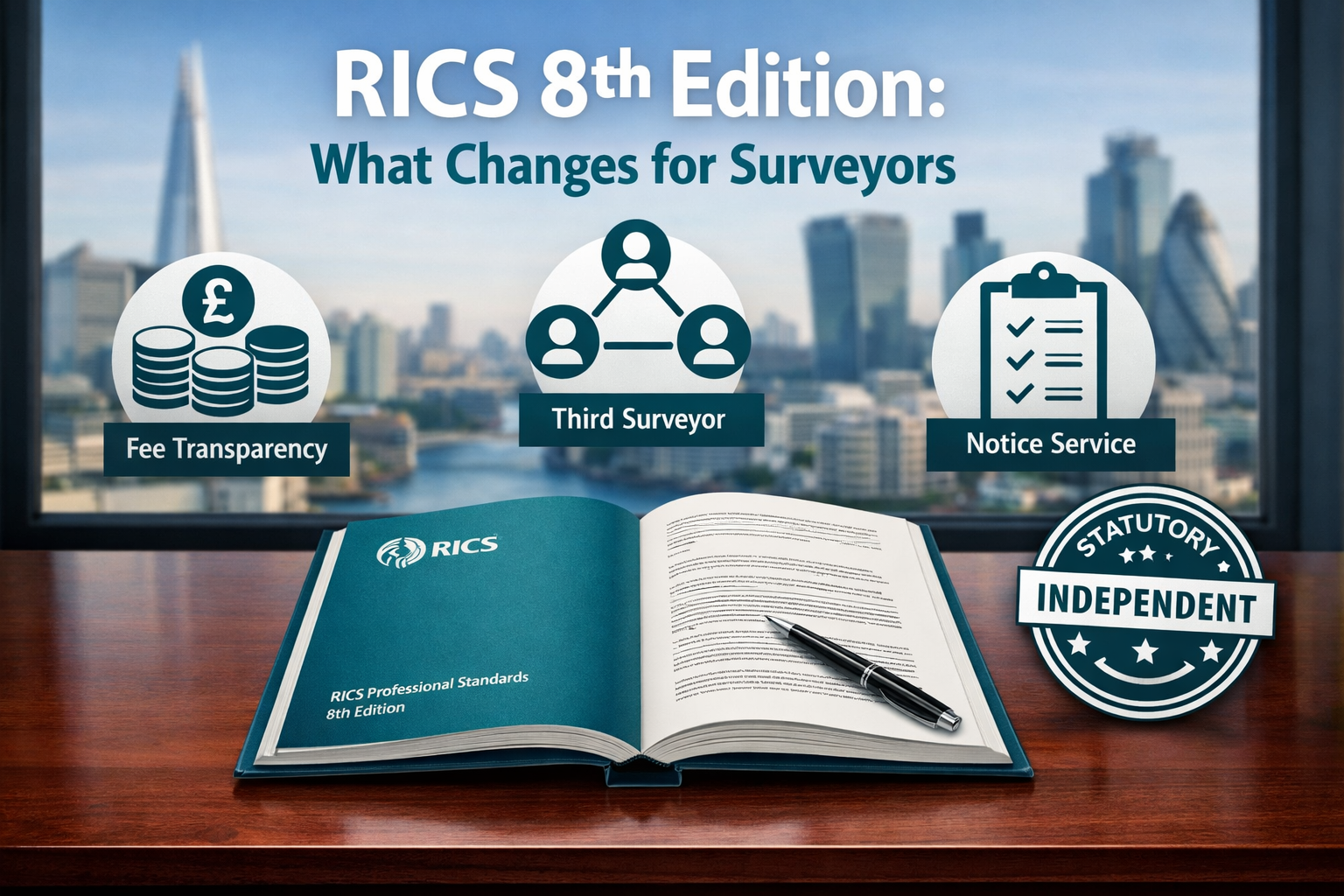
- The RICS draft 8th edition (consultation running April–May 2026) strengthens guidance on fee transparency, third surveyor use, notice service, and statutory independence.
- A party wall surveyor’s appointment is personal and statutory — it cannot be overridden by client instruction.
- Adjoining owners hold significant protections under the Act, but these rights depend on correct procedural steps being followed by all parties.
- Recent case law and updated guidance together demand higher standards of impartiality and jurisdiction awareness from all appointed surveyors.
Understanding the Role of the Party Wall Surveyor
Before examining how case law and updated guidance affect practice, it is essential to understand the foundational role a party wall surveyor plays. Under the Party Wall etc. Act 1996, when a building owner proposes works affecting a shared wall, boundary, or excavation near a neighbouring property, the adjoining owner must be formally notified. [1]
Where the adjoining owner does not consent to the proposed works, a surveyor will determine the time and manner in which the works can be carried out. [1] This is not simply a matter of professional courtesy — it is a statutory function.
Who Appoints the Surveyor?
There are three appointment models under the Act:
| Appointment Type | Description |
|---|---|
| Agreed Surveyor | One surveyor acts for both parties by mutual agreement |
| Two Surveyors | Each party appoints their own surveyor |
| Three Surveyors | Two appointed surveyors select a third to resolve disagreements |
The RICS draft 8th edition places particular emphasis on the use of the Third Surveyor — clarifying when referral is appropriate and how it should be managed. [3] For adjoining owners uncertain about their rights, understanding the role of an adjoining owner’s surveyor is a critical first step.
💬 “A party wall surveyor’s appointment is personal and statutory, and independent of client instruction.” — RICS Draft 8th Edition Guidance [3]
This independence is not merely aspirational. It is a professional and legal requirement. A surveyor who acts purely in the interests of the party who appointed them — rather than administering the Act impartially — risks producing an award that is legally vulnerable to challenge.
Case Law Trends Reshaping Party Wall Surveyor Duties to Adjoining Owners
The Evans v Paterson Principle: No Dispute, No Award
The most significant recent development in party wall case law is the confirmation of the “no dispute, no award” principle in Evans v Paterson (2021). [2] This ruling established that a dispute must have genuinely arisen for surveyors to make an award for compensation under section 7(2) of the Act.
This has profound implications for how the Act is administered in practice:
- ✅ Surveyors cannot assume a dispute exists simply because an adjoining owner has dissented to a notice.
- ✅ Awards made without proper jurisdiction — where no genuine dispute existed — are vulnerable to being struck down.
- ✅ Compensation claims under section 7(2) require a real, existing dispute as their foundation.
The RICS has since highlighted concerns arising from cases where awards have been challenged precisely because surveyors acted without proper jurisdiction. [3] This is now a focal point of the updated 8th edition guidance.
Defining “Dispute” Under the Act
Section 10(10)(b) of the Party Wall etc. Act 1996 defines a dispute as “any matter relating to the notified works which is in dispute between the building owner and the adjoining owner.” Section 10(12) extends this to include “any other matter arising out of or incidental to the dispute.” [2]
This seemingly broad definition has been tested in court. The key lesson from recent case law is that the scope of a surveyor’s jurisdiction is bounded by the genuine dispute — surveyors cannot expand their remit to cover matters that were never in contention between the parties.
The Farrs Lane Exception and Its Limits
A 2016 case — Farrs Lane Developments Ltd v Bristol Magistrates Court — created a narrow exception: surveyor fees can be addressed in an award even when fees were not the primary subject of dispute. [2] However, Evans v Paterson subsequently limited the circumstances in which this exception applies, reinforcing that jurisdiction must always be grounded in a real dispute.
For building owners and adjoining owners alike, these rulings underline the importance of understanding what party wall notices are and how to respond to them correctly from the outset — because procedural errors at the notice stage can undermine the entire award process.
Practical Implications for Adjoining Owners
These case law developments strengthen adjoining owner protections in several concrete ways:
- Awards cannot be manufactured — a surveyor cannot create jurisdiction where none exists.
- Compensation claims must be grounded in a genuine, identified dispute.
- Adjoining owners can challenge awards that were made without proper jurisdiction.
- Surveyor impartiality is legally enforceable, not merely aspirational.
For anyone whose neighbour is carrying out works, understanding your rights as an adjoining owner has never been more important.
RICS 8th Edition Alignment: Strengthening Standards for Party Wall Surveyor Duties to Adjoining Owners

What the Draft 8th Edition Changes
In April 2026, RICS launched a formal consultation on the draft 8th edition of Party Wall Legislation and Procedure, running for approximately eight weeks through May 2026. [3] This replaces the 7th edition and introduces several significant updates directly relevant to party wall surveyor duties to adjoining owners.
Key areas of enhanced guidance include:
| Area | What’s Changing |
|---|---|
| Fee Practices | Clearer standards on how fees are set, disclosed, and justified |
| Third Surveyor Use | Updated guidance on when and how to refer matters to the third surveyor |
| Service of Notices | Revised procedures to reduce jurisdictional errors |
| Public Engagement | Improved guidance on communicating with non-professional parties |
| Statutory Independence | Strengthened emphasis that appointment is personal and cannot be overridden by clients |
| Regulatory Conduct | Enhanced appendices covering professional conduct obligations |
[3]
Statutory Independence: A Non-Negotiable Principle
One of the most significant emphases in the draft 8th edition is the personal and statutory nature of a surveyor’s appointment. [3] This means:
- A building owner cannot instruct their appointed surveyor to act in ways that disadvantage the adjoining owner.
- An adjoining owner’s surveyor cannot be pressured into accepting unreasonable terms by the opposing party.
- Both surveyors must administer the Act in accordance with its purpose — not in the interests of the party who pays them.
This principle has direct implications for building owners’ surveyors and adjoining owners’ surveyors alike. The 8th edition makes clear that professional conduct obligations sit above client instructions.
Fee Transparency and Adjoining Owner Protections 💰
One area where adjoining owners have historically faced challenges is surveyor fee disputes. The draft 8th edition addresses this directly by strengthening guidance on fee practices. [3]
Under the Act, it is typically the building owner who bears the cost of the party wall process — including the reasonable fees of the adjoining owner’s surveyor. However, what constitutes “reasonable” has been a persistent source of conflict.
The updated guidance aims to:
- Provide clearer benchmarks for fee assessment
- Reduce the risk of disproportionate fee awards
- Ensure fee transparency from the point of appointment
For those concerned about costs, a practical overview of party wall costs and the process can help set realistic expectations before appointing a surveyor.
Notice Service: Getting the Foundation Right
The draft 8th edition also revises guidance on service of notices — a procedural step that, when done incorrectly, can invalidate the entire process. [3] Under the Party Wall etc. Act 1996, building owners must serve the correct type of notice depending on the works proposed. Understanding what a party wall notice involves is essential for both parties.
Common notice errors that have led to jurisdictional challenges include:
- Serving notice too late (minimum 1–2 months before works begin, depending on notice type)
- Serving the wrong type of notice for the works proposed
- Failing to identify all adjoining owners correctly
- Incorrect description of proposed works
Balancing Building Owner and Adjoining Owner Rights: The Impartiality Imperative
The Party Wall etc. Act 1996 applies across England and Wales and is designed to balance the rights of building owners to carry out legitimate works with the rights of adjoining owners to be protected from damage and disruption. [1]
This balance is the core purpose of the party wall surveyor’s role. Recent case law and the RICS 8th edition consultation both reinforce that impartiality is not optional — it is the legal and professional foundation of the entire framework.
What Adjoining Owners Should Expect from Their Surveyor
An adjoining owner’s appointed surveyor should:
- ✅ Act independently, not as an advocate for the adjoining owner
- ✅ Assess proposed works objectively against the Act’s requirements
- ✅ Ensure a schedule of condition is prepared before works begin
- ✅ Raise genuine concerns through the correct procedural channels
- ✅ Refer unresolved matters to the Third Surveyor where appropriate
- ✅ Produce or contribute to a party wall award that is legally sound and within jurisdiction
What Building Owners Should Expect from the Process
Building owners are entitled to carry out notifiable works — but must follow the correct procedure. Key obligations include:
- Serving valid notices within the correct timeframes
- Cooperating with the adjoining owner’s surveyor
- Bearing the reasonable costs of the process
- Complying with the terms of any award made
For a full breakdown of types of party wall works that trigger the Act’s requirements, reviewing the relevant guidance before starting any project is strongly recommended.
Party Wall Surveyor Duties to Adjoining Owners: Insights from Recent Case Law Trends and RICS 8th Edition Alignment in Practice
The convergence of Evans v Paterson and the RICS 8th edition consultation creates a clearer — and more demanding — standard for party wall practice in 2026. For adjoining owners, the key practical takeaways are:
🏠 Before Works Begin
- Respond formally to any party wall notice within 14 days
- If dissenting, appoint a qualified party wall surveyor promptly
- Request a schedule of condition to document the existing state of your property
📋 During the Award Process
- Ensure your surveyor is acting within jurisdiction — i.e., that a genuine dispute exists
- Review the draft award carefully before it is finalised
- Understand that the award is a legally binding document — challenge it within 14 days if there are grounds to do so
⚖️ If Damage Occurs
- Document all damage immediately with photographs and written records
- Raise a compensation claim through the correct party wall procedure
- Remember that post-Evans v Paterson, compensation claims must be grounded in a genuine, identified dispute
For those in London, specialist support is available from party wall surveyors across Central London, South London, North London, and beyond.
Conclusion: Actionable Next Steps for 2026
The evolution of party wall surveyor duties to adjoining owners — shaped by landmark case law and the forthcoming RICS 8th edition — points in one clear direction: higher standards, greater transparency, and stronger protections for all parties.
For adjoining owners, the message is empowering. The law is on your side, provided the correct procedures are followed. Surveyors who act without jurisdiction, fail to disclose fees transparently, or allow client pressure to compromise their independence are now operating in an environment where such conduct is more visible — and more challengeable — than ever before.
Actionable next steps:
- If you have received a party wall notice — respond within 14 days and consider appointing a qualified surveyor to protect your interests.
- If works are already underway — document any impact on your property and seek professional advice promptly.
- If you are a building owner — ensure your surveyor is administering the Act correctly and within jurisdiction to avoid costly award challenges.
- If you are a surveyor — engage with the RICS 8th edition consultation and update your practice to reflect the latest guidance on fees, notices, and statutory independence.
- For any party wall matter in London — seek specialist advice from a qualified professional familiar with the latest case law and RICS guidance.
The party wall framework exists to enable progress while protecting neighbours. When it works as intended — with impartial, jurisdiction-aware surveyors on both sides — it is a genuinely effective dispute prevention tool. The challenge for 2026 and beyond is ensuring that practice consistently matches that standard.
References
[1] Rics Consumer Guide Party Walls – ricsfirms.com
[2] Practice Changing Party Wall Case Law Evans V Paterson 2021 – peterbarry.co.uk
[3] Rics Launches Consultation On Updated Party Wall Practice Guidance – rics.org
[4] Y2024v13i1p57 65 – ideas.repec.org
Speak to a RICS chartered party wall surveyor
Free initial consultation. Notices, awards and schedules of condition across London and nationwide.