Fewer than 15% of party wall disputes ever reach the Third Surveyor stage — yet when they do, the costs, delays, and professional risks can dwarf those of the original building works. Understanding exactly when the Third Surveyor mechanism activates, how fees are allocated, and what the updated RICS 8th Edition guidance demands of practitioners is now more critical than ever as 2026 caseloads continue to climb across London and beyond.
This article unpacks Third Surveyor Procedures Under RICS 8th Edition: Triggers, Costs, and 2026 Best Practices in full — covering activation thresholds, fee allocation rules, deadlock resolution flowcharts, and the key reforms introduced by the updated RICS guidance. Whether acting as a building owner’s surveyor or an adjoining owner’s surveyor, every practitioner needs to be across these changes before the next dispute lands on their desk.
Key Takeaways 📌
- The Third Surveyor is selected — not appointed — at the outset of the party wall process, and their jurisdiction is triggered only when the two appointed surveyors reach a genuine deadlock.
- The RICS 8th Edition strengthens guidance on Third Surveyor use, addressing cases where awards have been challenged due to surveyors acting without proper jurisdiction [1][2].
- Fee allocation follows the principle that costs should be reasonable and proportionate; the Third Surveyor has power to determine who pays.
- A surveyor’s appointment under the Party Wall etc. Act 1996 is personal and statutory, independent of client instruction [2].
- Rising 2026 caseloads make procedural compliance more important than ever — errors at the Third Surveyor stage can invalidate entire awards.
What Is the Third Surveyor and When Is the Role Triggered?
The Statutory Framework
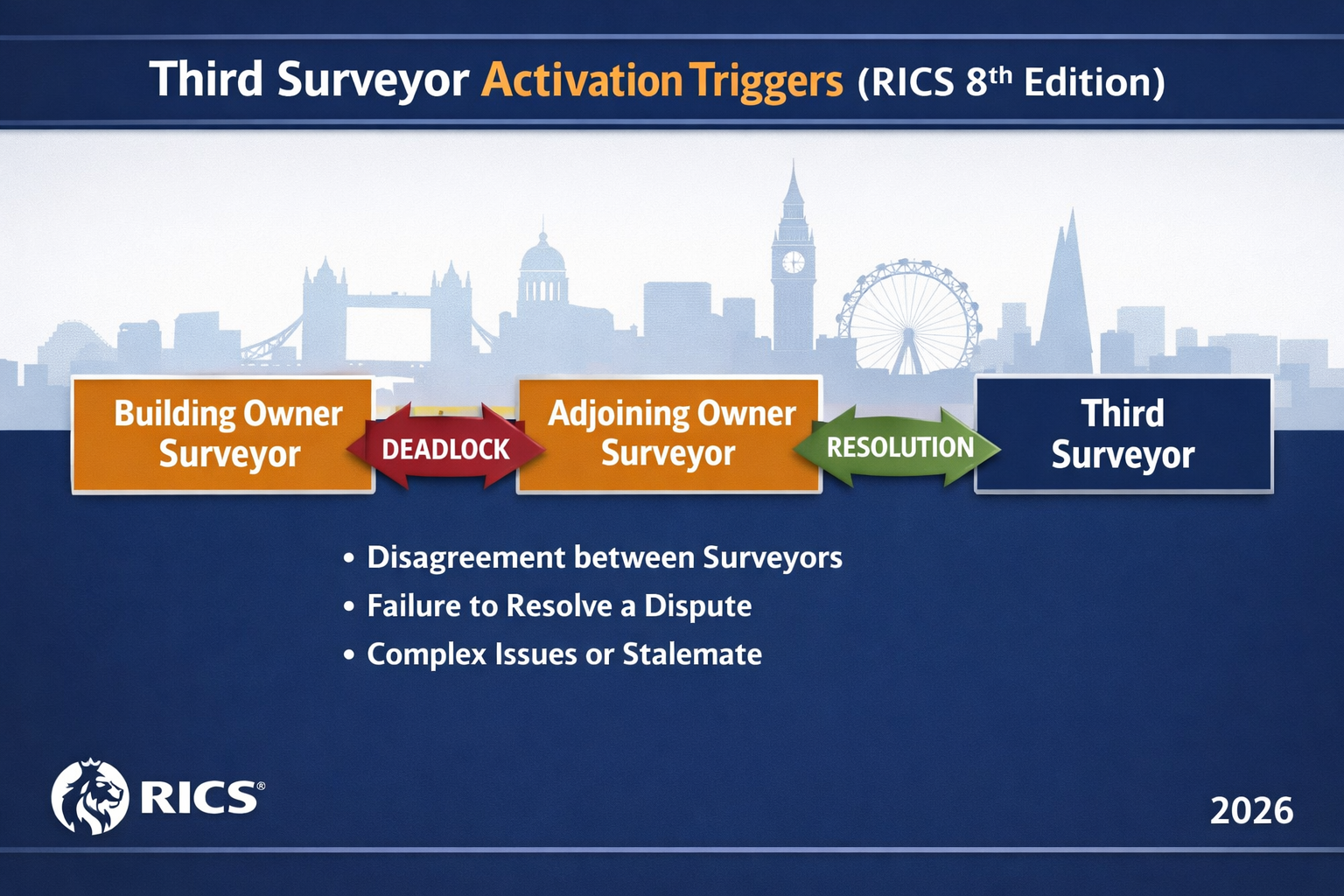
Under the Party Wall etc. Act 1996, when a building owner and an adjoining owner each appoint their own surveyor, those two surveyors must — before any dispute arises — select a Third Surveyor. This selection happens at the very start of the process, not after a deadlock occurs. The Third Surveyor sits in reserve, ready to be called upon if the two appointed surveyors cannot agree.
Section 10 of the Act is the governing provision. It sets out a clear hierarchy:
- Two appointed surveyors attempt to resolve the matter and make an award.
- If they cannot agree, either surveyor may call upon the Third Surveyor to make the award instead.
- The Third Surveyor’s award is binding on all parties, subject to appeal to the County Court within 14 days.
💡 Pull Quote: “The Third Surveyor is not a mediator or arbitrator — they are a statutory decision-maker whose award carries the same legal weight as one made by the two appointed surveyors together.”
Activation Thresholds: What Counts as a Genuine Deadlock?
This is where the RICS 8th Edition guidance makes a meaningful difference. The updated draft specifically addresses concerns arising from cases where awards have been challenged due to surveyors acting without proper jurisdiction, including circumstances where no genuine dispute existed between parties [2].
A Third Surveyor should only be called upon when:
- ✅ The two appointed surveyors have genuinely attempted to agree and failed.
- ✅ There is a real, substantive disagreement about the terms of the award — not a manufactured one.
- ✅ The matter falls within the statutory jurisdiction of the Party Wall etc. Act 1996.
- ❌ NOT when one surveyor simply fails to engage or respond (different remedies apply).
- ❌ NOT when the parties themselves have agreed — the surveyors cannot create a dispute where none exists.
The 8th Edition makes clear that invoking the Third Surveyor prematurely, or without genuine deadlock, risks the validity of the entire award. This is a significant professional risk that practitioners must take seriously in 2026.
The Selection Process
The Third Surveyor must be selected — ideally by agreement between the two appointed surveyors — at the time the two surveyors are appointed. If they cannot agree on a selection, either party can ask the relevant professional body (typically RICS) to nominate one.
Key procedural points:
- The Third Surveyor need not be a member of RICS, but must be competent and independent.
- They must have no conflict of interest with either party.
- Their selection should be documented in writing.
Fee Allocation, Costs, and the RICS 8th Edition Cost Framework
Who Pays the Third Surveyor?
Fee allocation is one of the most contested aspects of Third Surveyor Procedures Under RICS 8th Edition: Triggers, Costs, and 2026 Best Practices. The general principle under the Act is that the building owner bears the costs of the party wall process — because it is their works that trigger the statutory regime. However, the Third Surveyor has significant discretion when it comes to costs at the referral stage.
The RICS 8th Edition guidance reinforces that fees must be reasonable and proportionate [1]. The updated edition includes revised letters of appointment and terms designed to support improved fee transparency [1][2].
Cost Allocation Table
| Scenario | Typical Cost Allocation |
|---|---|
| Building owner’s works trigger the process | Building owner pays both surveyors’ fees |
| Adjoining owner causes unnecessary delay or obstruction | Third Surveyor may apportion costs to adjoining owner |
| Surveyor acts outside jurisdiction | Third Surveyor may disallow that surveyor’s fees |
| Third Surveyor called due to genuine deadlock | Building owner typically pays Third Surveyor’s fees |
| Referral found to be frivolous or vexatious | Referring surveyor’s party may bear costs |
Fee Practices Under the 8th Edition
The updated RICS guidance specifically addresses fee practices as a regulatory and conduct matter [1]. Key points include:
- Hourly rates must be disclosed clearly in letters of appointment.
- Fees should reflect actual time spent, not inflated estimates.
- The Third Surveyor is entitled to charge for time spent reviewing papers, conducting site visits, and drafting the award.
- Surveyors who engage in fee inflation or charge for unnecessary work risk professional sanction.
For a detailed breakdown of how party wall costs are structured across the full process, the costs of party wall procedures guide provides useful context. Parties looking to manage expenditure should also review practical advice on how to keep party wall costs down.
The Third Surveyor’s Award: What It Must Contain
When the Third Surveyor makes an award, it should:
- Clearly identify the works to which it relates.
- State the rights and obligations of each party.
- Address access arrangements, working hours, and protective measures.
- Include a schedule of condition where appropriate.
- Determine costs — including the costs of the Third Surveyor’s own involvement.
- Be served on all parties in accordance with the Act.
The 8th Edition includes an updated draft award template to support consistent practice [1][2]. Using this template reduces the risk of awards being challenged on procedural grounds.
2026 Best Practices: Compliance, Jurisdiction, and Rising Caseloads
Why 2026 Is a Pivotal Year for Third Surveyor Procedures
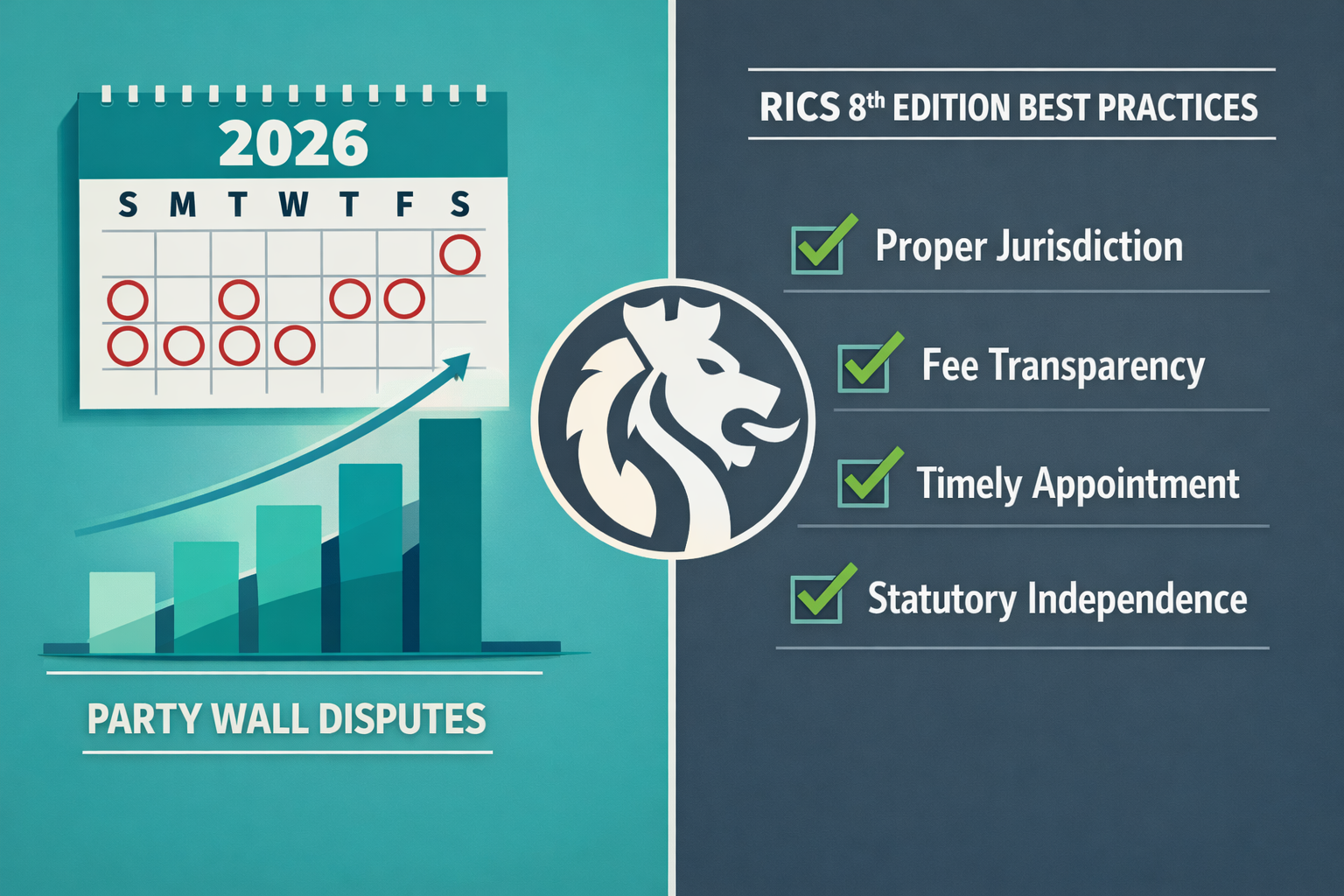
Party wall dispute volumes across London have been rising steadily, driven by increased residential development, permitted development rights extensions, and a surge in basement and rear extension projects. In 2026, practitioners are facing larger caseloads with greater complexity — making procedural rigour at every stage, including the Third Surveyor stage, more important than ever.
The RICS consultation on the 8th Edition was launched precisely to address the accumulation of problematic practices that have emerged as caseloads have grown [1]. The updated guidance reflects a profession taking stock and raising standards.
The Statutory Independence Principle
One of the most important principles reinforced by the 8th Edition is that a party wall surveyor’s appointment is personal and statutory, independent of client instruction [2]. This has direct implications for the Third Surveyor process:
- A surveyor cannot be instructed by their appointing owner to refuse to engage with the Third Surveyor mechanism.
- A surveyor cannot be directed by their client to take a particular position in a dispute.
- Once appointed, the surveyor’s duty is to the Act and to the process — not to the client who appointed them.
This principle is frequently misunderstood by building owners and adjoining owners alike. Surveyors who allow client pressure to influence their professional judgment risk not only the validity of the award but also their professional standing.
💡 Pull Quote: “A party wall surveyor who acts on client instruction rather than professional judgment is not just making a procedural error — they are potentially invalidating the entire award.”
Third Surveyor Procedures: A Step-by-Step Flowchart
Stage 1: Notice Served
↓
Stage 2: Dispute Arises / Surveyors Appointed
↓
Stage 3: Third Surveyor Selected (both surveyors agree, or professional body nominates)
↓
Stage 4: Two Surveyors Attempt to Agree Award
↓
Stage 5: Genuine Deadlock Reached?
- If NO → Award made by two surveyors ✅
- If YES → Proceed to Stage 6
↓
Stage 6: Either Surveyor Calls Upon Third Surveyor
↓
Stage 7: Third Surveyor Reviews Papers, Conducts Site Visit if Needed
↓
Stage 8: Third Surveyor Makes Award
↓
Stage 9: Award Served on All Parties
↓
Stage 10: 14-Day Appeal Window (County Court)
Best Practice Checklist for 2026 ✅
Practitioners handling Third Surveyor referrals in 2026 should verify the following before proceeding:
- Genuine deadlock exists — not a manufactured or premature referral.
- Third Surveyor was properly selected at the outset of the process.
- The Third Surveyor has no conflict of interest.
- The matter falls within statutory jurisdiction under the 1996 Act.
- Fee arrangements are disclosed and agreed in writing.
- The award follows the updated RICS 8th Edition template.
- The award is served correctly on all parties.
- The 14-day appeal window is clearly communicated.
Enhanced Appendices and Updated Templates
The 8th Edition includes enhanced appendices, revised letters of appointment and terms, and an updated draft award template [1][2]. These tools are not merely administrative — they represent the profession’s current best thinking on how to structure the Third Surveyor process to withstand legal challenge.
Surveyors working in high-volume areas such as central London, west London, and south London will find these templates particularly valuable given the density and complexity of disputes in those areas.
Common Errors That Invalidate Third Surveyor Awards
Understanding what goes wrong is as important as knowing what to do right. The most common errors include:
- Premature referral — calling the Third Surveyor before genuine deadlock.
- Jurisdiction creep — the Third Surveyor addressing matters outside the scope of the Act.
- Failure to serve the award correctly on all parties.
- Conflict of interest — a Third Surveyor with undisclosed connections to one party.
- Fee opacity — failing to disclose rates in advance, leading to cost disputes.
- Client capture — surveyors acting on client instruction rather than professional judgment [2].
For parties who are new to the process, understanding the party wall award framework and the types of party wall works that trigger the Act is an essential first step before any dispute reaches the Third Surveyor stage.
Conclusion: Acting Decisively in a More Complex Landscape
Third Surveyor Procedures Under RICS 8th Edition: Triggers, Costs, and 2026 Best Practices represent a significant evolution in how the profession manages its most contested disputes. The updated guidance is not a minor refresh — it is a direct response to a pattern of awards being challenged, fees being disputed, and surveyors acting outside their proper jurisdiction [1][2].
Actionable next steps for practitioners and parties in 2026:
- Review the RICS 8th Edition guidance in full and update your letters of appointment and award templates accordingly.
- Document the Third Surveyor selection at the very start of every dual-surveyor appointment.
- Apply the genuine deadlock test rigorously before making any Third Surveyor referral.
- Disclose all fees in writing before commencing work — the updated guidance makes this a conduct matter, not just good practice.
- Maintain statutory independence — if a client is pressuring you to act against your professional judgment, the 8th Edition provides clear authority to resist that pressure.
- Use the updated award template from the 8th Edition appendices to reduce the risk of procedural challenge.
For those navigating a current dispute or looking to understand their rights and obligations under the Act, professional guidance from a qualified party wall surveyor is the most reliable first step.
References
[1] RICS Launches Consultation On Updated Party Wall Practice Guidance – rics.org
[2] RICS Opens Consultation On Party Wall Guidance Update – propertywire.com
Speak to a RICS chartered party wall surveyor
Free initial consultation. Notices, awards and schedules of condition across London and nationwide.