
Fewer than one in five party wall awards challenged in UK courts are overturned on the merits of the dispute itself — the majority fail on procedural grounds, most commonly defective notice service. That single statistic explains why the RICS 8th Edition consultation, running through April and May 2026, places strengthened public engagement and notice service protocols at the heart of its proposed reforms [1][2].
The Public Engagement and Notice Service Rules: RICS 8th Edition Updates for Party Wall Surveyors represent the most significant overhaul of professional guidance in this field since the 7th edition. The draft guidance, currently open for stakeholder feedback, targets surveyors, legal professionals, property developers, and homeowners across England and Wales — anyone with a stake in how party wall matters are initiated, managed, and resolved [1][3]. This article unpacks what those changes mean in practice, with a focus on ensuring award enforceability in 2026 and beyond.
Key Takeaways 📋
- The RICS 8th Edition consultation (April–May 2026) includes strengthened guidance on notice service and public engagement as part of updated regulatory and conduct requirements.
- Awards can be — and regularly are — challenged successfully when notices are served on the wrong parties or without proper authority.
- The draft 8th edition clarifies that a party wall surveyor’s appointment is personal and statutory, independent of client instruction, reinforcing notice service obligations.
- Updated award templates and appointment letters are included to standardise documentation and reduce procedural vulnerabilities.
- Surveyors, building owners, and adjoining owners all benefit from understanding these changes before works commence.
Why Notice Service Rules Matter More Than Ever in 2026
The Party Wall etc. Act 1996 is deceptively straightforward on paper. In practice, the chain of events from initial notice to enforceable award is riddled with procedural pitfalls. A notice served on a tenant rather than the freeholder, an award issued where no genuine dispute existed, or a surveyor acting without proper jurisdiction — any one of these errors can unravel months of professional work [1].
The RICS 8th Edition consultation directly addresses improper jurisdiction concerns arising from cases where awards were challenged because surveyors acted without proper authority. This includes circumstances where no genuine dispute existed between parties — a scenario that has direct implications for notice service validity [1].
💬 “The statutory appointment of a party wall surveyor is personal and independent of client instruction. This distinction is not merely academic — it defines the limits of a surveyor’s authority to act.” [2][3]
Understanding what the Party Wall etc. Act 1996 requires is the essential starting point. The Act sets out who must be notified, when, and in what form — but it has always relied on professional guidance to fill the gaps. The 8th edition aims to close those gaps more firmly than its predecessors.
Who Must Be Notified? The Expanding Circle of Affected Parties
One of the most practically significant aspects of the updated guidance is its treatment of non-owner parties — those who are affected by party wall works but do not hold freehold title. This includes:
| Party Type | Notification Obligation | Common Oversight |
|---|---|---|
| Freeholder | Primary notice recipient | Serving only on tenant |
| Long leaseholder (21+ years) | Must be notified separately | Overlooked in multi-unit buildings |
| Mortgagee in possession | Notice may be required | Rarely considered |
| Tenant (short-term) | Informational notice advisable | Confused with formal notice |
| Management company | Relevant where common parts affected | Often omitted entirely |
The draft 8th edition guidance strengthens the requirement to identify all relevant parties before serving notice, not just the most obvious property owner. In London’s complex leasehold landscape — where a single terraced house may have a freeholder, a head leaseholder, and multiple sub-tenants — this is not a minor administrative point. It is the difference between a valid and an unenforceable award.
For those navigating party wall notices for the first time, this expanded scope of notification may come as a surprise. The 8th edition makes it explicit rather than leaving it to professional discretion.
Public Engagement and Notice Service Rules: RICS 8th Edition Updates for Party Wall Surveyors — The Consultation in Detail
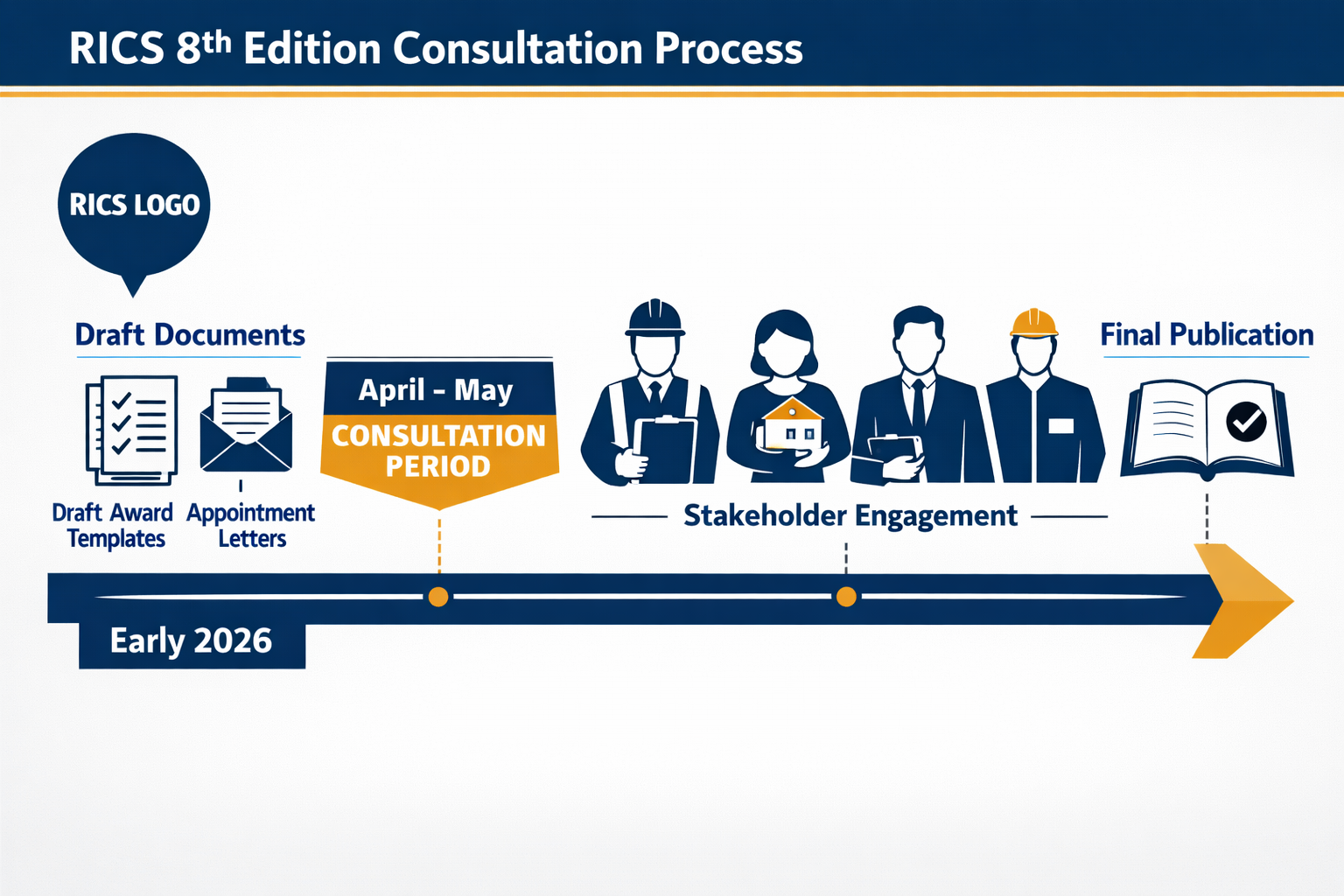
The eight-week consultation period running through April and May 2026 is not a formality. RICS has structured it to gather substantive feedback from a deliberately broad range of stakeholders [1][2]. Understanding what is being consulted on — and what has already been decided — is essential for practitioners and property owners alike.
What the Draft 8th Edition Contains
The draft guidance includes several distinct components, each with implications for notice service and public engagement:
1. Strengthened Regulatory and Conduct Guidance
The most significant change for day-to-day practice. The draft clarifies that a party wall surveyor’s appointment is personal and statutory, not contractual. This means a surveyor cannot simply follow a client’s instruction to delay notice service, serve notice on a preferred party, or withdraw from an appointment because the client requests it [2][3].
2. Updated Draft Award Template
A standardised award template is included to reduce the variation in documentation quality that has historically created enforcement vulnerabilities [1]. The template incorporates clearer recitals about notice service — specifically, confirmation that valid notice was served on all relevant parties before the award was made.
3. Revised Appointment Letters and Terms
Enhanced appendices provide updated frameworks for professional conduct, including clearer terms around the surveyor’s obligations to communicate with all affected parties, not just the appointing owner [2].
4. Guidance on Jurisdiction and Dispute Existence
The draft addresses a recurring problem: surveyors proceeding to award in circumstances where no genuine dispute exists, or where the dispute has been resolved informally. Awards made without proper jurisdiction are vulnerable to challenge — and the 8th edition provides clearer tests for surveyors to apply before proceeding [1].
The Consultation Process: How to Engage
RICS has targeted the consultation at multiple stakeholder groups [1][2]:
- 🏗️ Surveyors (building owners’ and adjoining owners’ surveyors)
- ⚖️ Legal professionals (solicitors and barristers handling party wall disputes)
- 🏘️ Property developers (particularly those undertaking basement, extension, or demolition works)
- 🏠 Homeowners (those planning extensions, loft conversions, or renovations)
- 🔍 Dispute resolution practitioners
Feedback submitted during the consultation period will inform the final published 8th edition. Practitioners who have encountered specific problems with notice service validity or public engagement in recent cases have a direct opportunity to shape the guidance.
Practical Implications: Ensuring Award Enforceability Under the New Rules

The updated Public Engagement and Notice Service Rules: RICS 8th Edition guidance is not purely theoretical. Its practical implications for award enforceability are immediate and significant — particularly for works already in progress or planned for later in 2026.
The Notice Service Chain: A Step-by-Step Framework
Under the strengthened 8th edition guidance, a robust notice service process should follow this sequence:
- Identify all relevant parties — freeholders, long leaseholders, mortgagees in possession, and any management companies with an interest in affected structures.
- Serve notice in the correct form — using the appropriate notice type for the works proposed. The Party Structure Notice applies to works on the party wall itself; a Line of Junction Notice applies to new walls at the boundary; an Excavation Notice applies to foundation works within specified distances.
- Serve at the correct address — the registered address of the property or the last known address of the owner. Serving at the site address alone is insufficient where the owner is not resident.
- Allow the correct response period — 14 days for a response to a Party Structure Notice; one month for a Line of Junction Notice.
- Document service — retain proof of postage, recorded delivery receipts, or personal service records. The 8th edition guidance reinforces the importance of this documentation as part of the award recitals.
- Confirm jurisdiction before proceeding — verify that a genuine dispute exists (or that the response period has expired without consent) before appointing surveyors and proceeding to award.
💡 Key point: An award made before valid notice has been served — or served on the wrong party — is not merely procedurally irregular. It may be void ab initio, meaning it has no legal effect from the outset.
2026 Examples: Where Notice Service Failures Arise
Several scenarios illustrate the practical relevance of the 8th edition updates in 2026:
Scenario A: The Absent Freeholder
A building owner in East London serves a Party Structure Notice on the occupying tenant of an adjoining flat, not realising the freehold is held by a separate company. The tenant does not respond. The building owner’s surveyor proceeds to appointment. The award is later challenged by the freeholder, who had no knowledge of the works. Under the 8th edition guidance, the surveyor should have conducted a Land Registry search to identify the correct notice recipient before serving.
Scenario B: The Informal Agreement That Wasn’t
A building owner in South London reaches an informal agreement with their neighbour about proposed loft conversion works. Both parties believe no formal process is needed. A surveyor is later appointed — not because a dispute exists, but because the building owner’s solicitor advises it for mortgage purposes. Under the 8th edition’s jurisdiction guidance, an award made in these circumstances may be challenged as made without proper authority [1].
Scenario C: The Multi-Unit Development
A developer in Central London undertakes basement excavation works affecting three adjoining properties. Notices are served on the freeholders of two, but the third is held on a long lease. The leaseholder is not notified. The resulting award is enforceable against the two freeholders but vulnerable in respect of the third property.
For those involved in types of party wall works that affect multiple adjoining owners, the 8th edition’s expanded notification requirements are particularly relevant.
The Surveyor’s Independent Role: A Reinforced Principle
One of the most important — and sometimes misunderstood — aspects of the updated guidance is its treatment of surveyor independence. The draft 8th edition makes clear that a party wall surveyor’s appointment is personal and statutory, independent of client instruction [2][3].
This has direct implications for public engagement:
- A surveyor cannot agree to delay notice service because the building owner asks for more time.
- A surveyor cannot serve notice on a party the client prefers, rather than the legally correct recipient.
- A surveyor must communicate with all affected parties, not just the appointing owner.
This principle is not new — it derives from the Act itself — but the 8th edition guidance articulates it more clearly and provides practical examples of where it applies [3].
For building owners who want to understand their own obligations, the building owners’ section provides a useful overview. For adjoining owners concerned about their rights, the adjoining owners’ section explains the protections available.
Public Engagement and Notice Service Rules: RICS 8th Edition Updates for Party Wall Surveyors — What Changes for Different Stakeholders

The 8th edition updates affect different parties in different ways. Here is a concise breakdown:
For Party Wall Surveyors
- Review appointment letter templates against the updated appendices once the final edition is published.
- Update notice service checklists to include identification of all relevant parties, not just freeholders.
- Document jurisdiction more explicitly in award recitals — confirm that valid notice was served and that a genuine dispute exists or that the response period has expired.
- Maintain independence from client instruction on notice service decisions — the 8th edition guidance reinforces this obligation [2][3].
As of March 2026, RICS members and regulated firms must already comply with updated professional standards affecting party wall work [4]. The 8th edition, once finalised, will add a further layer of specific guidance.
For Building Owners
- Instruct a surveyor early — before serving notice — to ensure the correct parties are identified and the correct notice type is used.
- Do not rely on informal agreements as a substitute for formal notice where the Act applies.
- Retain all proof of service — recorded delivery receipts, Land Registry search results, and correspondence with all notified parties.
- Understand the costs implications — defective notice service can require the entire process to restart, significantly increasing costs. Guidance on keeping party wall costs down is available for those managing budgets carefully.
For Adjoining Owners
- Check that notice has been served correctly — if works have commenced without valid notice, the building owner may be acting unlawfully.
- Understand your right to appoint a surveyor — the adjoining owners’ surveyor acts in your interests throughout the process.
- Request a Schedule of Condition before works begin — this documents the pre-existing state of your property and is essential if a damage claim arises later. Learn more about the schedule of condition process.
Frequently Asked Questions About the 8th Edition Updates
Q: When will the RICS 8th Edition be formally published?
The consultation runs through April and May 2026 [1][2]. Publication is expected later in 2026, though RICS has not confirmed a specific date.
Q: Does the 8th edition change the Party Wall etc. Act 1996 itself?
No. The Act remains unchanged. The 8th edition is professional guidance that interprets and supplements the Act — it does not have the force of statute, but courts and tribunals give it significant weight.
Q: What happens if a notice is served incorrectly under the new guidance?
An incorrectly served notice may be invalid, meaning the response period does not run and any subsequent award may be unenforceable. The building owner may need to re-serve notice, potentially delaying works significantly.
Q: Are the updated award templates mandatory?
The draft template is guidance, not a mandatory form. However, using it reduces the risk of procedural challenges and demonstrates compliance with professional standards.
Conclusion: Acting Now to Stay Ahead of the 8th Edition
The RICS 8th Edition consultation is an opportunity — not just a regulatory exercise. The strengthened Public Engagement and Notice Service Rules: RICS 8th Edition Updates for Party Wall Surveyors address real, recurring problems that have caused awards to fail and disputes to escalate unnecessarily. For surveyors, the message is clear: document everything, serve notice on the right parties, and never compromise independence for client convenience.
Actionable Next Steps ✅
- Surveyors: Review the draft 8th edition guidance during the consultation period and submit feedback where your practice experience identifies gaps or ambiguities [1].
- Building owners: Before serving any party wall notice in 2026, conduct a Land Registry search to identify all relevant parties — freeholders, long leaseholders, and mortgagees in possession.
- Adjoining owners: If you receive a party wall notice, check that it has been served correctly and that you have been given the full response period before any works commence.
- All parties: Use the updated award templates and appointment letters once the final 8th edition is published — they are designed to reduce the procedural vulnerabilities that lead to costly challenges.
- Seek professional advice early — whether you are carrying out works or your neighbour is building, early professional involvement prevents the procedural errors that the 8th edition is designed to eliminate.
The party wall process works well when it is followed correctly. The 8th edition guidance is designed to make correct procedure clearer, more consistent, and more enforceable — a goal that benefits every party involved.
References
[1] Rics Launches Consultation On Updated Party Wall Practice Guidance – rics.org
[2] Rics Opens Consultation On Party Wall Guidance Update – propertywire.com
[3] Rics Launches Consultation On Party Wall Guidance – thenegotiator.co.uk
[4] Party Wall Surveys For 5g Mast Installations Rics Protocols Amid 2026 Telecom Infrastructure Expansion – https://nottinghillsurveyors.com/blog/party-wall-surveys-for-5g-mast-installations-rics-protocols-amid-2026-telecom-infrastructure-expansion
Speak to a RICS chartered party wall surveyor
Free initial consultation. Notices, awards and schedules of condition across London and nationwide.