

Nearly one in three party wall disputes in England and Wales stems not from a genuine disagreement between neighbours — but from a notice that was served incorrectly, too late, or not at all. That single administrative failure can halt a construction project for weeks, trigger costly legal proceedings, and destroy neighbourly relations in an instant. As the UK construction sector faces a wave of mandatory process reforms [1], the case for purpose-built digital tools has never been stronger.
Digital Tools Transforming Party Wall Notices: SurvPal and FPWS Tech for 2026 Compliance represents a genuine shift in how surveyors, building owners, and adjoining owners manage one of the most legally sensitive parts of any domestic or commercial build. Platforms like SurvPal and FPWS Tech are being recommended by experienced practitioners precisely because they reduce the human error that paper-based workflows invite — and because busy London markets simply cannot afford the delays that errors cause.
Key Takeaways 📌
- SurvPal and FPWS Tech are purpose-built platforms that automate notice serving, deadline tracking, and award documentation under the Party Wall etc. Act 1996.
- Digital notice tools dramatically reduce the risk of invalid service — one of the most common and costly pitfalls in party wall practice.
- Automation features such as templated notices, e-signature capture, and real-time compliance dashboards are reshaping surveyor workflows in 2026.
- Building owners and adjoining owners both benefit: faster turnaround, clearer audit trails, and reduced professional fees.
- Adopting verified digital platforms does not replace the need for a qualified surveyor — it makes their work faster, more accurate, and more defensible.
Why Paper-Based Party Wall Notices Are Failing in 2026
The Party Wall etc. Act 1996 imposes strict procedural requirements. Notices must be served within specific timeframes, contain prescribed information, and be delivered to the correct parties. Miss any element, and the notice is invalid — full stop.
For decades, this process relied on printed templates, recorded post, and manual diary reminders. That approach was workable when transaction volumes were lower. Today, it is a liability.
“The volume of notifiable works in London alone has increased sharply as permitted development rights expanded. A paper system simply cannot keep pace.” — Industry observation, 2026
The 2026 homebuying and construction reform agenda is accelerating the pressure further. Mandatory upfront surveys and faster transaction timelines mean surveyors are handling more files simultaneously [1]. A single missed deadline on a party wall notice can cascade into project delays measured in months, not days.
The Most Common Paper-Based Pitfalls
| ❌ Common Failure | 💥 Consequence |
|---|---|
| Wrong notice type served | Invalid notice; process restarts |
| Incorrect adjoining owner named | Dispute over validity |
| Notice served too late | Statutory timeframe breached |
| No proof of delivery | Unenforceable in dispute |
| Award not documented properly | Surveyor liability exposure |
| Deadline not tracked | Consent period lapses unnoticed |
Understanding what a party structure notice is and how to serve it correctly is the essential first step — but knowing the rules and executing them flawlessly under time pressure are two very different challenges.
How Digital Tools Transforming Party Wall Notices: SurvPal and FPWS Tech for 2026 Compliance Actually Work
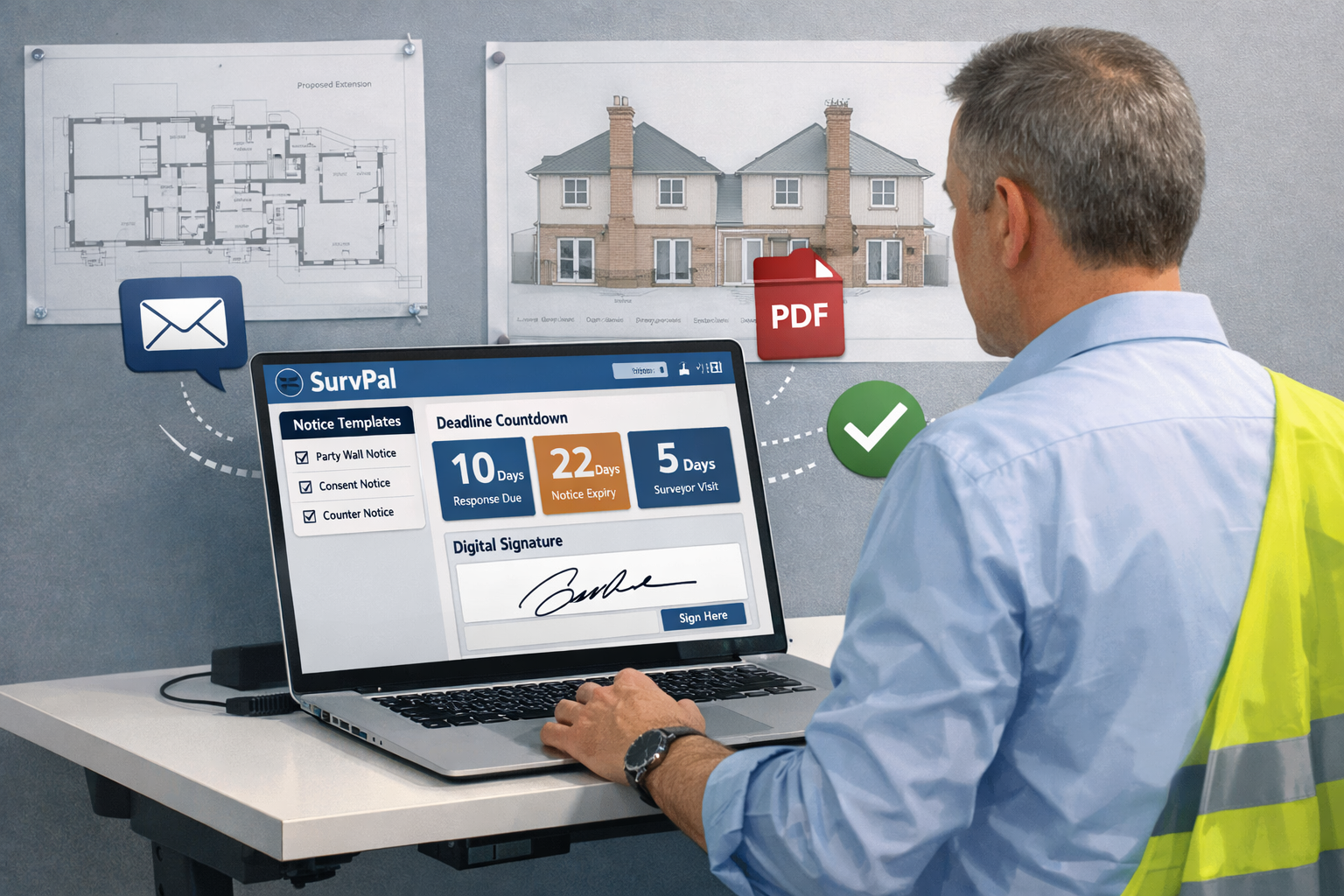
SurvPal: Built for the Practising Surveyor
SurvPal is a cloud-based platform designed specifically for party wall practitioners. Its core value proposition is simple: eliminate the administrative errors that invalidate notices and delay projects. Here is what experienced surveyors highlight as its most practical features.
🔹 Templated, Legally Compliant Notices
SurvPal maintains an up-to-date library of notice templates — Line of Junction Notices, Party Structure Notices, and Three Metre Notices — all pre-formatted to satisfy the Act’s requirements. Users populate project-specific fields; the platform handles the legal structure.
🔹 Automated Deadline Tracking
Once a notice is served, SurvPal’s calendar engine automatically calculates the statutory response window (typically 14 days for consent or dissent) and fires reminders to both the building owner’s surveyor and, where applicable, the adjoining owner. No manual diary entry. No forgotten deadlines.
🔹 Digital Delivery with Proof of Service
The platform generates a timestamped, auditable delivery record for every notice sent. This is critical: in any dispute, the ability to prove when and how a notice was served can be the difference between a valid process and an invalid one.
🔹 Award Document Generation
SurvPal supports the drafting of party wall awards directly within the platform. Surveyors can attach schedules of condition, annotated photographs, and agreed working method statements — all stored in a single, shareable project file.
🔹 Multi-Party Collaboration
Where an agreed surveyor or two appointed surveyors are involved, SurvPal provides a shared workspace. Comments, document versions, and approval statuses are visible to all authorised parties in real time. This directly addresses the communication lag that inflates professional fees.
FPWS Tech: Compliance Infrastructure at Scale
FPWS Tech approaches the same problem from a slightly different angle. While SurvPal is optimised for individual surveyors and small practices, FPWS Tech is built for larger firms and developers managing multiple concurrent party wall matters.
Key FPWS Tech capabilities include:
- Bulk notice management — serve and track notices across dozens of properties from a single dashboard
- Integration with BIM and project management platforms — construction technology is increasingly interconnected, and FPWS Tech plugs into existing workflows [4]
- Automated compliance reporting — generate audit-ready compliance summaries for each project
- Adjoining owner portal — a dedicated interface where adjoining owners can review notices, ask questions, and record consent or dissent without requiring email chains
The adjoining owner portal is particularly significant. One of the most frustrating delays in party wall practice occurs when an adjoining owner simply does not respond — not out of objection, but out of confusion about the process. A clear, guided digital interface reduces that friction considerably.
Preventing the Pitfalls: A Practical Comparison for Busy London Markets
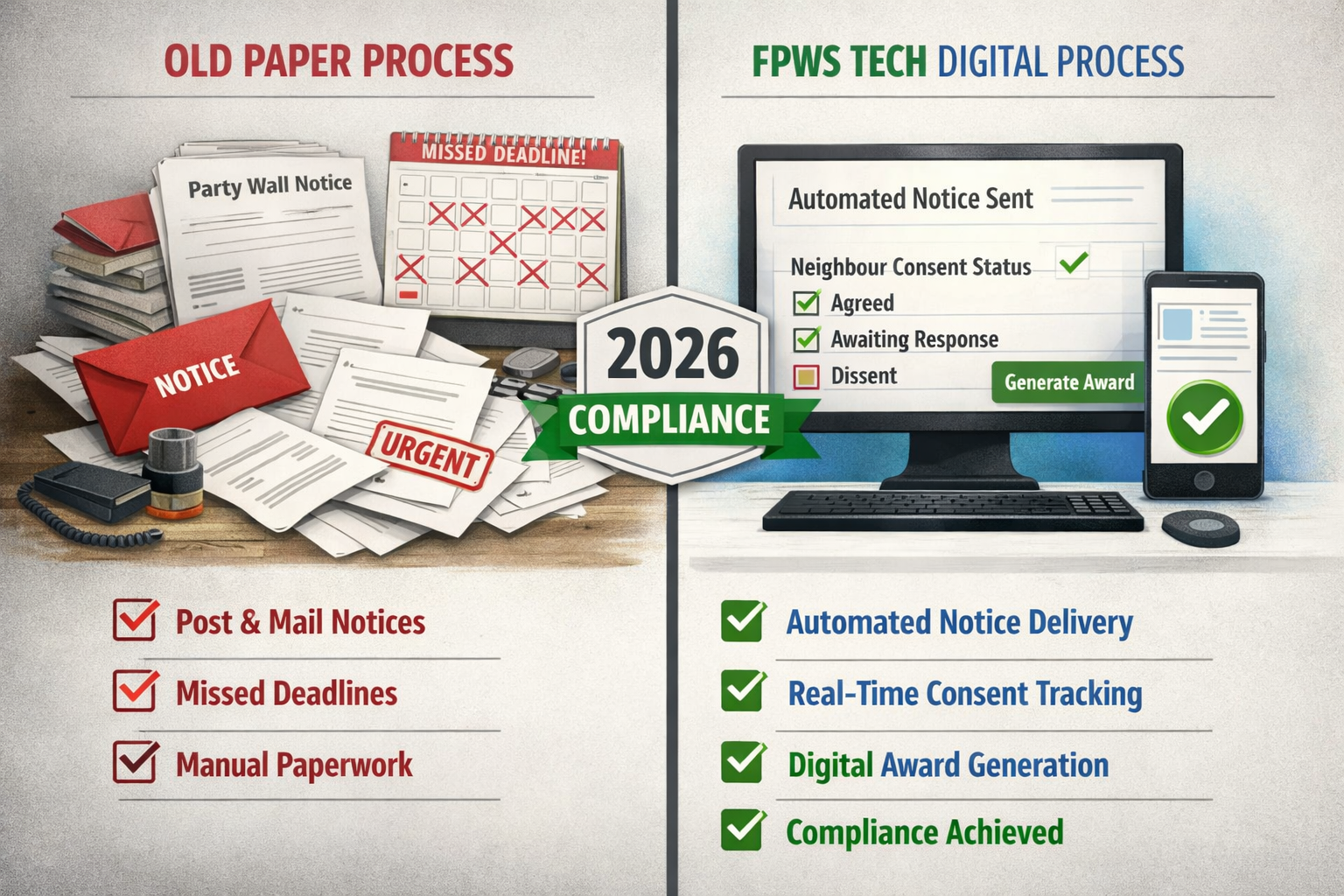
London’s property market is uniquely demanding. Dense terraced streets mean almost every significant renovation triggers party wall obligations. Building owners in areas like North London, Central London, and South London are routinely dealing with multiple adjoining owners simultaneously — each with their own response timeline and potential for dispute.
The cost of getting it wrong is not just financial — it is reputational. A surveyor who serves an invalid notice in a competitive market loses clients fast.
Side-by-Side: Traditional vs. Digital Workflow
| 📋 Stage | 🗂️ Traditional Approach | 💻 SurvPal / FPWS Tech |
|---|---|---|
| Notice preparation | Manual template, Word doc | Auto-populated, legally verified template |
| Delivery | Recorded post | Digital delivery + timestamped proof |
| Deadline tracking | Manual diary/calendar | Automated alerts to all parties |
| Adjoining owner response | Phone/email chase | Portal notification + digital consent capture |
| Award drafting | Word processor, email attachments | Integrated drafting with condition schedule |
| Document storage | Local files, email threads | Cloud-based, searchable, shareable |
| Audit trail | Partial at best | Complete, timestamped, exportable |
The efficiency gains are not trivial. Practitioners report that digital platforms can reduce the administrative time per party wall matter by 30–50%, freeing surveyors to focus on the technical and legal judgements that genuinely require professional expertise.
This matters especially when considering the costs of the party wall process. Faster, more efficient workflows mean lower professional fees — a direct benefit to building owners who are already managing tight project budgets.
What Technology Cannot Replace
It is worth being direct here: digital tools are not a substitute for professional expertise. The Party Wall etc. Act 1996 involves genuine legal and technical complexity. Determining the correct notice type, assessing the scope of notifiable works, and drafting an award that protects all parties requires a qualified surveyor’s judgement.
The question of having a party wall agreement without a surveyor is one that property owners frequently raise — and while it is technically possible in limited circumstances, the risks are significant. Digital tools make the surveyor’s job more efficient; they do not make the surveyor redundant.
Technology is reshaping construction broadly — AI, computer vision, and BIM adoption are accelerating across the sector [4], and building surveying is no exception [2]. But in a legally governed process like party wall notice service, the human professional remains accountable for the outcome.
Integrating Digital Tools into a Party Wall Practice: Actionable Guidance

For surveyors and building owners considering the move to platforms like SurvPal or FPWS Tech, the following practical steps apply.
For Surveyors and Practices 🏗️
1. Audit your current workflow first.
Before adopting any platform, map out where errors and delays most commonly occur in your current process. Is it notice preparation? Deadline tracking? Award drafting? Identify the highest-risk points.
2. Verify legal compliance of platform templates.
Any platform used to serve party wall notices must use templates that satisfy the Act’s requirements. Confirm that the provider updates templates in response to any legislative or case law developments.
3. Train the whole team — not just the lead surveyor.
Digital tools only deliver their efficiency benefits if everyone in the practice uses them consistently. Invest in onboarding time upfront.
4. Use the audit trail actively.
The timestamped delivery records and document histories that platforms like SurvPal generate are not just administrative convenience — they are legal protection. Make a habit of exporting and storing these records for every matter.
5. Communicate the digital process to clients.
Building owners and adjoining owners who understand how the digital process works are more cooperative and less likely to cause delays. A brief explainer at the outset of each matter pays dividends.
For Building Owners 🏠
- Ask your surveyor whether they use a digital notice management platform — it is a reasonable question and signals that you understand the process.
- Understand the types of party wall works that apply to your project before any notice is served.
- Keep your own copy of all digitally served notices and proof-of-delivery records.
- Do not assume that using digital tools means the process is instant — statutory timeframes still apply, and neighbours still have the right to dissent.
For Adjoining Owners 🏘️
- If your neighbour’s surveyor uses a digital platform with an adjoining owner portal, engage with it promptly. Delays in responding can complicate the process unnecessarily.
- Review the party wall notices you receive carefully — digital delivery does not reduce your rights.
- Consider appointing your own adjoining owner’s surveyor to review the award on your behalf.
The Broader Technology Shift in Building Surveying
The adoption of SurvPal and FPWS Tech sits within a much larger transformation of the building surveying profession. Drones, 3D laser scanning, digital twins, and AI-assisted condition assessment are all entering mainstream practice [2]. Construction project management is increasingly software-driven, with permit tracking, compliance monitoring, and stakeholder communication all moving to integrated platforms [3].
The construction sector is being reshaped by four converging forces in 2026: labour constraints, regulatory complexity, sustainability requirements, and digital transformation [4]. Party wall compliance is a microcosm of that broader shift.
Firms that adopt digital tools early gain a competitive advantage — not just in efficiency, but in the quality of service they can offer. A surveyor who can demonstrate a complete, auditable digital record of every notice served and every award issued is a more credible professional than one relying on a filing cabinet and a diary.
The homebuying reform agenda reinforces this direction of travel. As upfront surveys become mandatory and transaction timelines compress [1], the entire property profession — including party wall surveyors — will need to operate with greater speed and precision. Digital tools are not a luxury in that environment. They are infrastructure.
Conclusion: Make the Switch Before the Deadline Catches You
The argument for Digital Tools Transforming Party Wall Notices: SurvPal and FPWS Tech for 2026 Compliance is not abstract. It is grounded in the daily reality of a busy London surveying practice: too many notices, too many deadlines, too many adjoining owners to manage — and too much professional liability riding on every document.
SurvPal and FPWS Tech do not promise to make party wall practice effortless. They promise to eliminate the avoidable errors — the wrong template, the missed deadline, the missing proof of service — that derail projects and damage reputations.
✅ Actionable Next Steps
- Surveyors: Trial SurvPal or FPWS Tech on your next three party wall matters and measure the time saved versus your current workflow.
- Building owners: Before appointing a surveyor, ask specifically whether they use a digital notice management platform and what their proof-of-service process looks like.
- Adjoining owners: Familiarise yourself with how party wall notices work and how to respond — digital delivery is becoming the norm.
- All parties: Understand the full scope of the Party Wall etc. Act 1996 — digital tools operate within this legal framework, not outside it.
- Practices managing volume: Evaluate FPWS Tech’s bulk management and BIM integration capabilities if you are handling multiple concurrent developments.
The paper era of party wall practice is ending. The practices that thrive in 2026 and beyond will be those that embraced the digital shift before the compliance pressure made it unavoidable.
References
[1] Homebuying Process Reforms 2026 How Mandatory Upfront Surveys Will Transform Building Surveyor Workloads – https://nottinghillsurveyors.com/blog/homebuying-process-reforms-2026-how-mandatory-upfront-surveys-will-transform-building-surveyor-workloads
[2] How Technology Is Transforming Building Surveying – bressummerark.co.uk
[3] Construction Technology – permitflow.com
[4] The 4 Forces Reshaping Construction In 2026 – kylenitchen.substack.com
Speak to a RICS chartered party wall surveyor
Free initial consultation. Notices, awards and schedules of condition across London and nationwide.