
Thousands of neighbour disputes escalate to court every year — not because the original building work was unreasonable, but because the paperwork behind it had no legal teeth. A casual “yes, go ahead” from the person next door is not a party wall agreement. Understanding the difference between a voluntary consent agreement and a formally issued Party Wall Award is one of the most practical things any homeowner or developer can do before breaking ground in 2026.
This guide cuts through the confusion around Party Wall Agreements vs. Formal Awards: When Adjoining Owners Consent and How to Draft Binding Settlements in 2026, explaining exactly which document applies in which situation, what each must contain, and how to ensure both parties are genuinely protected.
Key Takeaways 📋
- A Party Wall Notice starts the process; a Party Wall Award concludes it — both documents serve distinct legal functions.
- Adjoining owner consent can lead to a written agreement, but it must still include a Schedule of Condition and working terms to be enforceable.
- Failure to respond within 14 days to a Party Wall Notice is treated as dissent, automatically triggering the Award process.
- A neighbour refusing consent does not stop building work — it simply means a formal Award must be issued instead.
- Retrospective agreements are possible but carry greater risk and complexity; acting before works begin is always preferable.
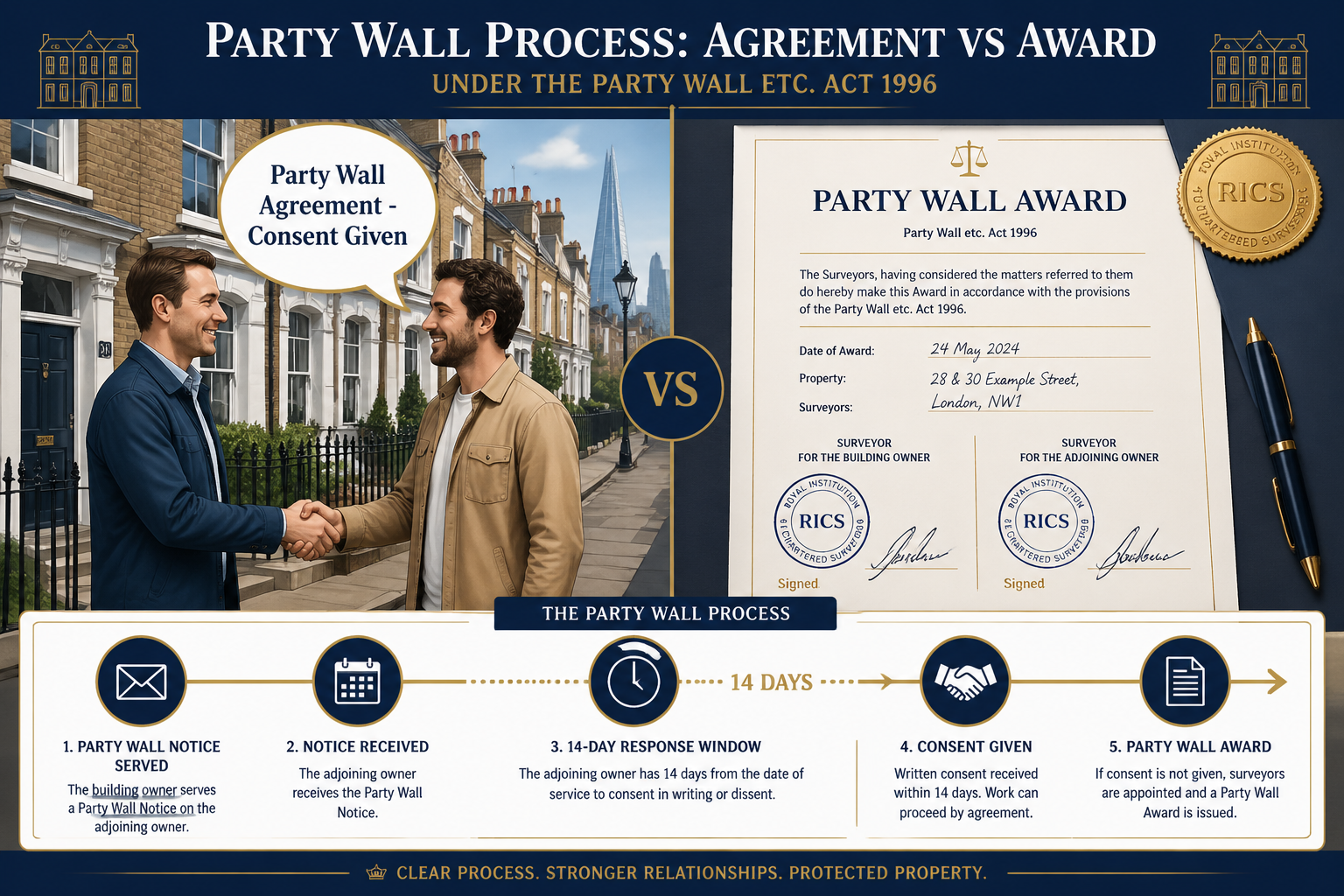
Understanding the Two Documents: Party Wall Agreements vs. Formal Awards
Before diving into drafting specifics, it is essential to understand what each document actually is — and what it is not.
What Is a Party Wall Notice?
A Party Wall Notice is the formal written document a building owner must serve on all adjoining owners before carrying out any notifiable works. It is the trigger — the starting gun. The notice describes the proposed works, the intended start date, and the rights being exercised under the Party Wall etc. Act 1996.
Common works that require a notice include loft conversions, extension foundations, and damp proof course insertions. Once served, the adjoining owner has 14 days to respond [1].
What Is a Party Wall Agreement (Consent)?
When an adjoining owner receives a Party Wall Notice and consents in writing, the result is a Party Wall Agreement. This document confirms the neighbour has agreed to the proposed works. However, consent alone is not enough — a properly drafted agreement must also include [1][4]:
- ✅ Details of working hours
- ✅ Access arrangements for surveyors or contractors
- ✅ A Schedule of Condition recording the property’s pre-work state
- ✅ Procedures for handling any damage claims
Think of the Party Wall Agreement as the friendly route — faster, cheaper, and less formal, but only valid when properly documented.
What Is a Party Wall Award?
A Party Wall Award is a legally binding document issued by one or more appointed Party Wall Surveyors. It comes into play when:
- The adjoining owner dissents to the notice
- The adjoining owner fails to respond within 14 days (treated as dissent) [1]
- The parties cannot agree on the terms of the works
💬 Pull Quote: “A Party Wall Award is not a punishment — it is a protection mechanism for both parties, ensuring impartial oversight of works that could affect a shared structure.”
The Award is far more comprehensive than a consent agreement. It is drafted by surveyors, not the homeowners themselves, and carries the full weight of the Act behind it [3].
The 14-Day Window and What Happens Next
The timeline following a Party Wall Notice is strict and consequential. Understanding it helps both building owners and adjoining owners avoid accidental escalation.
| Adjoining Owner’s Response | Outcome |
|---|---|
| Consents in writing within 14 days | Party Wall Agreement drafted; no surveyors required |
| Dissents within 14 days | Surveyor(s) appointed; Party Wall Award issued |
| No response within 14 days | Treated as dissent; Award process begins automatically [1] |
| Agrees to a single agreed surveyor | One surveyor acts for both parties |
| Appoints their own surveyor | Two surveyors act; may appoint a Third Surveyor if needed |
This table makes one thing clear: silence is not consent. Many adjoining owners make the mistake of ignoring a notice, assuming inaction is a neutral position. It is not — it triggers the formal Award route and all associated costs [1].
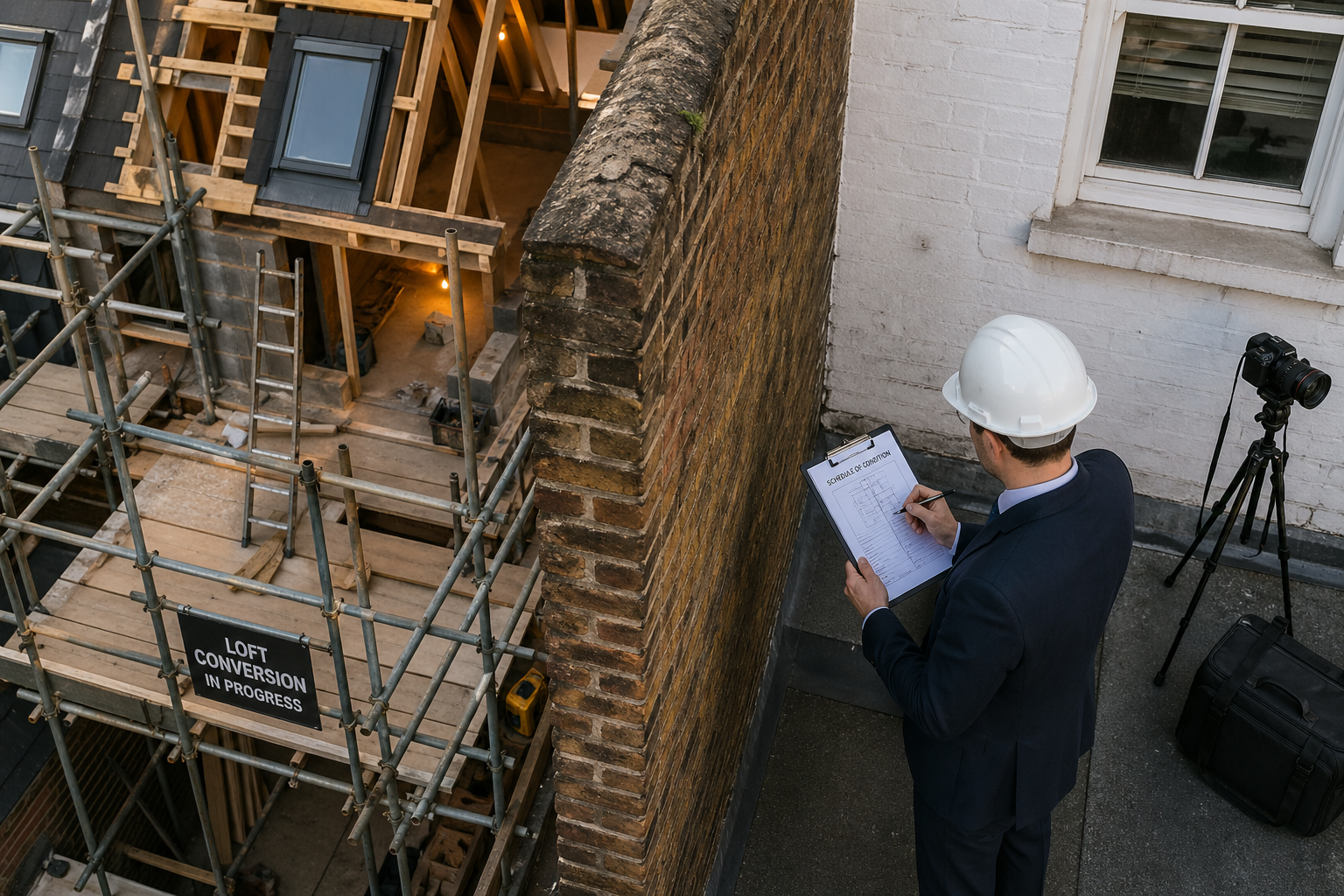
How to Draft Binding Settlements: What Each Document Must Contain
Whether the outcome is a consent-based agreement or a formal Award, the content must be thorough. Vague documentation is the primary reason informal agreements fail to protect either party.
Drafting a Party Wall Agreement After Consent
When an adjoining owner agrees to the works, having a party wall agreement without a surveyor is technically possible — but risky without professional guidance. A properly drafted consent agreement should include:
- Full identification of all parties — names, addresses, and roles (building owner vs. adjoining owner)
- Property descriptions — both properties clearly identified
- Scope of proposed works — detailed description matching the original notice
- Working hours — agreed start and finish times, weekend restrictions
- Access arrangements — when and how contractors may access the adjoining property
- Schedule of Condition — photographic and written record of the adjoining property’s condition before works begin [4]
- Damage resolution process — agreed steps if the neighbour believes the works have caused damage
- Signatures of both parties — dated and witnessed
📌 Pro tip: A free sample party wall agreement template can provide a useful starting framework, but always have the final document reviewed by a qualified surveyor.
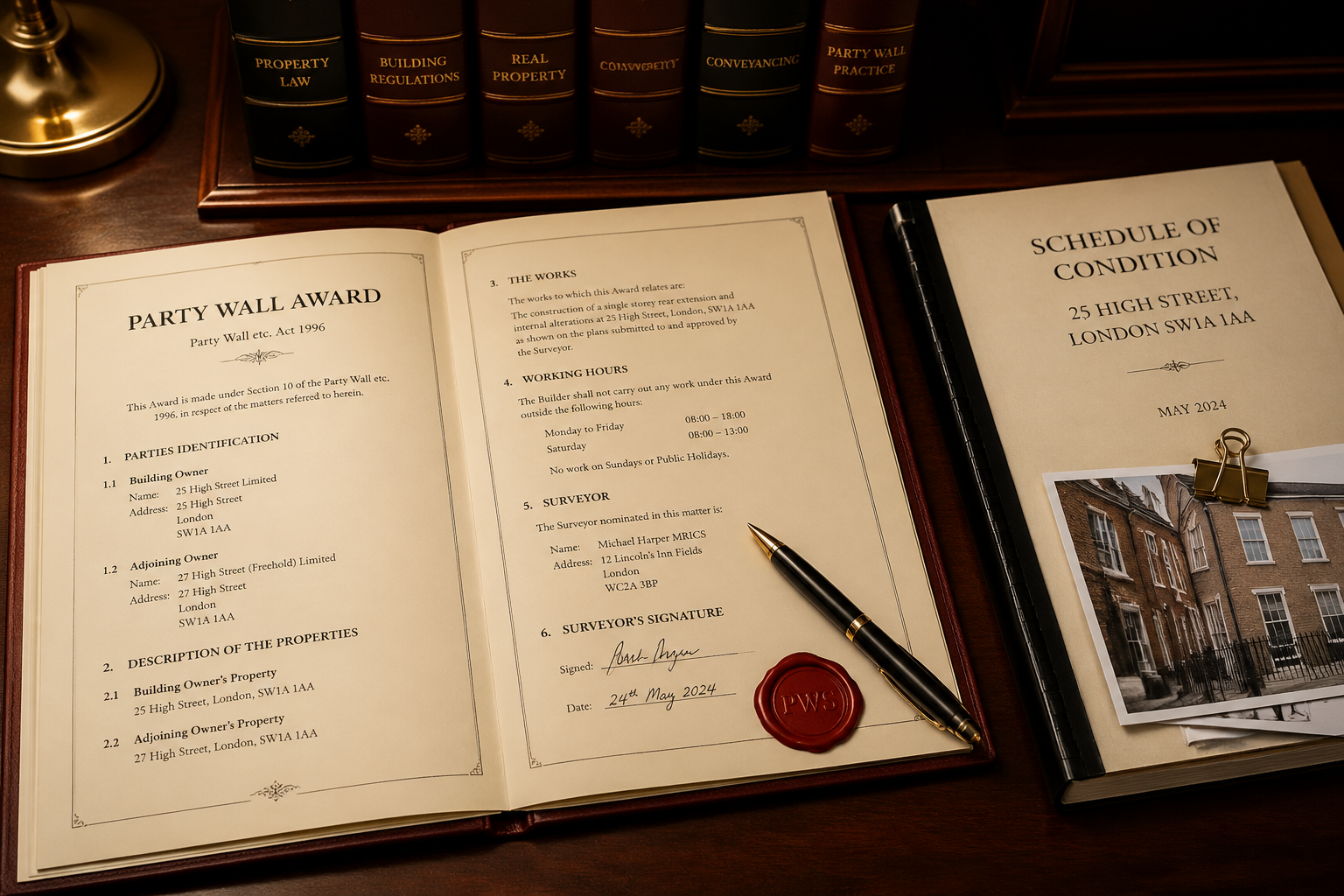
Mandatory Components of a Formal Party Wall Award
A Party Wall Award is more detailed by necessity. According to established practice under the Act, it must contain [1][3]:
- Party identification — all owners and their appointed surveyors
- Property details — both properties fully described
- Description of works — precise scope, method, and sequence
- Surveyor appointments and signatures — confirming authority to act
- Schedule of Condition — photographic evidence attached as an appendix
- Rights and responsibilities — including working hours and safety measures
- Access provisions — legal right of access for inspection during works
- Dispute resolution procedures — what happens if damage is alleged
- Third Surveyor details — in case of disagreement between the two appointed surveyors
The Award is served on both parties once agreed and signed. Either party has 14 days to appeal to the County Court if they disagree with its terms [2].
The Schedule of Condition: Non-Negotiable in Both Routes
Whether the parties consent or dissent, a Schedule of Condition is essential. This document — typically a combination of written notes and photographs — records the exact state of the adjoining property before any work begins.
Without it, proving whether a crack in a wall or a damaged ceiling pre-existed the building works becomes nearly impossible. The Schedule of Condition is the single most important safeguard in any party wall settlement [4].
When Consent Bypasses the Formal Award Process (and When It Cannot)
Understanding Party Wall Agreements vs. Formal Awards: When Adjoining Owners Consent and How to Draft Binding Settlements in 2026 also means knowing the limits of consent.
When Consent Is Sufficient
Consent works well when:
- The works are relatively minor (e.g., minor repairs, non-structural changes)
- The relationship between neighbours is cooperative and trust is established
- Both parties are willing to document the agreement in writing
- A Schedule of Condition is prepared and attached
In these cases, the parties avoid surveyor fees entirely — a meaningful saving, particularly for smaller projects. For guidance on managing costs, the party wall costs and process guide provides a clear breakdown.
When a Formal Award Is Necessary
A formal Award becomes necessary when [1][2]:
- The adjoining owner dissents or does not respond
- Works are significant — such as underpinning, loft conversions, or new foundations near the boundary
- The relationship is contentious — even if the neighbour verbally agrees, a formal Award provides stronger legal protection
- The building owner wants certainty — an Award is harder to challenge retrospectively than an informal agreement
💬 Pull Quote: “A neighbour’s refusal to consent does not end the project — it simply means an independent surveyor takes over the decision-making, which can actually benefit both parties.” [4]
Surveyor Independence: A Critical Requirement
One point that trips up many homeowners: the agreed Party Wall Surveyor must be independent. The surveyor cannot be the same professional already engaged by the building owner for the project. An adjoining owner will — rightly — question the neutrality of someone already on the other side’s payroll [4].
For those in specific areas, finding a qualified local professional is straightforward through resources such as a party wall surveyor in North London or other regional specialists.
Retrospective Agreements and the Risks of Acting Without Documentation
One of the more overlooked aspects of Party Wall Agreements vs. Formal Awards: When Adjoining Owners Consent and How to Draft Binding Settlements in 2026 is what happens when works proceed without any documentation at all.
Retrospective Party Wall Agreements
It is possible to draw up a retrospective party wall agreement after works have begun or even been completed. This may be necessary when [4]:
- Damage complaints arise during or after construction
- A neighbour makes a claim and documentation is needed
- Clarity is required on the scope of works already carried out
However, retrospective agreements are significantly more complex. Without a pre-works Schedule of Condition, establishing the baseline state of the adjoining property is difficult. Both parties must appoint surveyors with knowledge of the works already carried out, and the process can become contentious quickly.
The lesson is clear: acting before works begin is always the better path.
Geographic Scope of the Act
It is worth noting that the Party Wall etc. Act 1996 applies only in England and Wales. In Scotland and Northern Ireland, party wall matters are governed by common law rather than statute [5]. This distinction matters for anyone purchasing property or planning works near borders between jurisdictions.
Practical Steps for Building Owners and Adjoining Owners in 2026
For Building Owners 🏗️
- Serve the correct notice — ensure the right type of notice is used for the type of works planned. A party structure notice guide explains the distinctions clearly.
- Allow the full 14-day response window — do not start works before this period expires.
- Document everything — whether consent is given or an Award is issued, keep copies of all correspondence.
- Appoint an independent surveyor — if the neighbour dissents, use a surveyor not already connected to the project.
- Commission a Schedule of Condition — regardless of the route taken.
For Adjoining Owners 🏠
- Respond to the notice within 14 days — silence is treated as dissent.
- Read the notice carefully — check the party wall act notices guide to understand your rights.
- Request a Schedule of Condition — insist this is included in any agreement.
- Appoint your own surveyor if needed — the building owner typically pays for this [1].
- Do not withhold consent unreasonably — it will not stop the works; it will only formalise the process.
Conclusion: Protecting Both Parties Through Proper Documentation
The distinction between a Party Wall Agreement and a formal Party Wall Award is not merely procedural — it is the difference between a document that holds up under legal scrutiny and one that collapses the moment a dispute arises.
Consent is valuable, but it must be documented. A handshake agreement or a verbal “yes” offers no protection to either party. Whether the route leads to a consent-based agreement or a surveyor-drafted Award, the essentials remain the same: clear identification of parties, a detailed scope of works, agreed working conditions, and — critically — a Schedule of Condition prepared before a single brick is moved.
In 2026, with construction activity in urban areas continuing to rise, getting this right from the outset is not optional. It is the foundation of a dispute-free build.
✅ Actionable Next Steps
- Serve the correct Party Wall Notice at least two months before planned works begin.
- Use a professionally drafted template as a starting point, but always have it reviewed.
- Commission a Schedule of Condition regardless of whether the neighbour consents or dissents.
- Consult a qualified Party Wall Surveyor early — the cost of advice is far lower than the cost of litigation.
- Keep all correspondence — dates, responses, and signed documents create a clear paper trail.
References
[1] Difference Between Party Wall Notices And Awards – partywallslimited.com
[2] Evergreen Guide To Party Wall Awards Drafting Enforceable Agreements Under 2026 Regulatory Updates – https://nottinghillsurveyors.com/blog/evergreen-guide-to-party-wall-awards-drafting-enforceable-agreements-under-2026-regulatory-updates
[3] What Is A Party Wall Agreement And Party Wall Award – westvilleassociates.com
[4] Party Wall Agreement – hoa.org.uk
[5] Party Wall Agreements What You Need To Know – fmb.org.uk
Speak to a RICS chartered party wall surveyor
Free initial consultation. Notices, awards and schedules of condition across London and nationwide.