
London’s basement conversion market grew by an estimated 35% between 2020 and 2025, driven by soaring property values and the push to maximise every square metre of urban space. Yet beneath the appeal of extra living space lies a legally and technically complex process — one where a single miscalculated excavation depth can trigger disputes, injunctions, and costly structural damage to neighbouring properties. Understanding Party Wall Awards for Basement Excavations: Depth Calculations, Structural Risk Assessment, and 2026 Surveyor Protocols is no longer optional for homeowners, developers, or contractors working in densely built urban environments.
Key Takeaways 📋
- Depth determines notice obligations: Whether the 3-metre or 6-metre rule applies depends on how deep your excavation goes relative to your neighbour’s foundations.
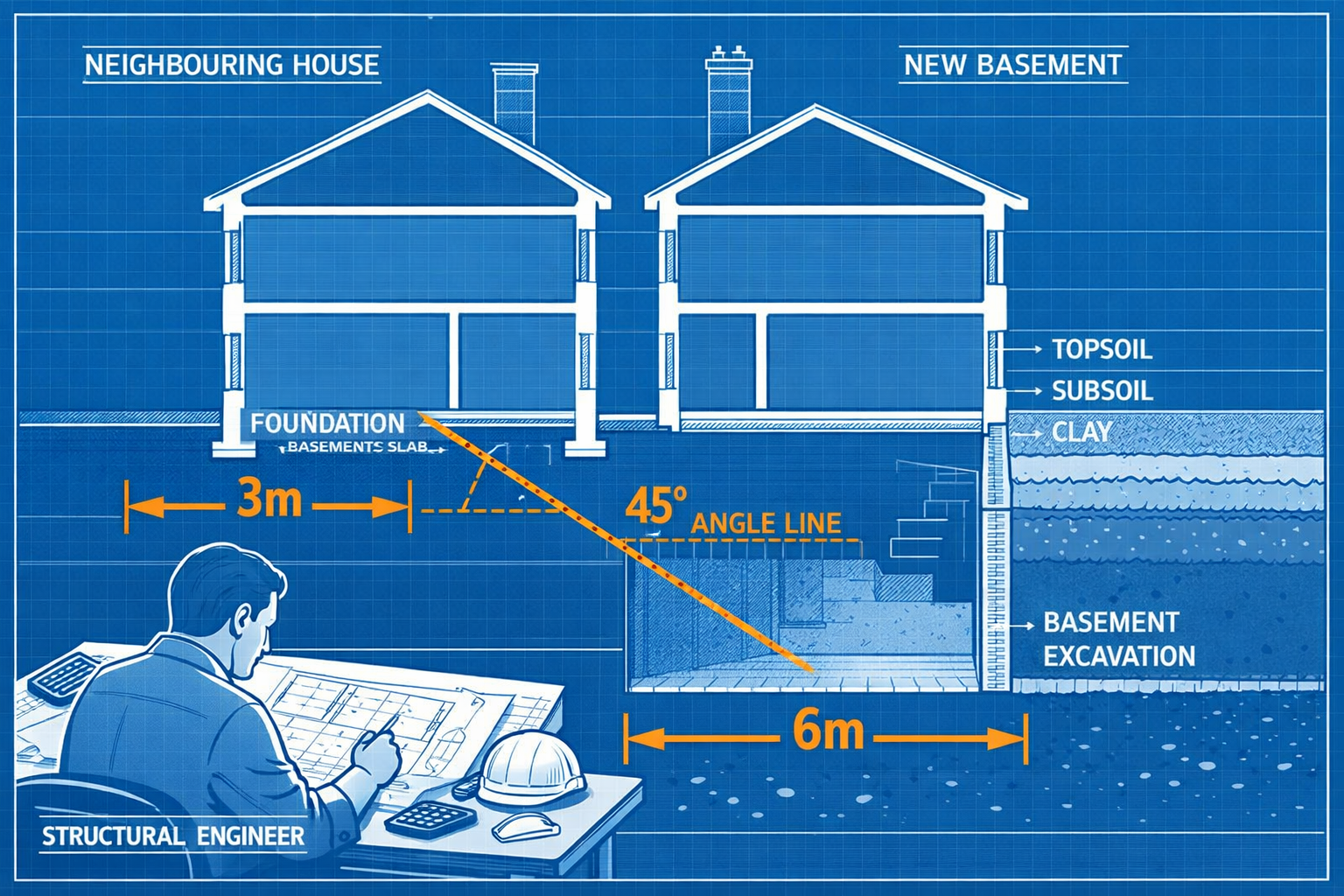
- The 45-degree rule is the critical test for the 6-metre trigger — if your excavation intersects that plane, a Section 6 notice is mandatory. [1]
- A Party Wall Award is a legally binding document that protects both the building owner and the adjoining owner throughout the works.
- Surveyor fees typically start around £1,000 per award, with hourly rates of £150–£200. [3]
- 2026 protocols emphasise pre-commencement schedules of condition and digital monitoring as standard practice for deep basement works.
Why Basement Excavations Are the Most Complex Party Wall Scenario
Most party wall disputes involve relatively straightforward works — a loft conversion, a rear extension, or repairs to a shared wall. Basement excavations are fundamentally different. They involve removing large volumes of soil close to or beneath existing foundations, often in Victorian or Edwardian terraced streets where foundations are shallow, inconsistent, and poorly documented.
The Party Wall etc. Act 1996 governs these works through two specific provisions:
- Section 6(1): Applies when excavation is within 3 metres of a neighbouring structure and goes deeper than the neighbour’s foundations.
- Section 6(2): Applies when excavation is within 6 metres of a neighbouring structure and intersects a 45-degree plane drawn downward from the base of the neighbour’s foundations. [1]
💡 Pull Quote: “The 6-metre rule is the primary concern for basement conversions and deep piling — and it catches many building owners by surprise.” [1]
The key distinction is depth relative to the neighbour’s foundation base, not just horizontal distance. For the 3-metre rule to apply, the planned excavation must go lower than the base of the adjoining property’s existing foundations. Shallower excavations — even within 3 metres — do not automatically trigger the requirement. [1]
This nuance is why professional depth calculations are essential before any basement project begins.
Understanding Depth Calculations: The 3-Metre and 6-Metre Rules Explained
How Surveyors Calculate Trigger Depths
Accurate depth calculations require surveyors to establish two key measurements:
- The depth of the proposed excavation — taken from ground level to the lowest point of the new basement slab or pile.
- The depth of the adjoining owner’s existing foundations — often estimated from property age and construction type, or confirmed through trial pits.
| Property Type | Typical Foundation Depth | Common Trigger Risk |
|---|---|---|
| Victorian terraced (pre-1900) | 0.5m – 1.0m | High (most basements exceed this) |
| Edwardian semi-detached | 0.75m – 1.2m | High |
| 1930s–1960s suburban | 0.9m – 1.5m | Medium |
| Modern construction (post-1990) | 1.0m – 1.8m | Lower, but still possible |
Once foundation depths are estimated, surveyors apply the 45-degree rule for the 6-metre test: a line is drawn at 45 degrees downward from the base of the neighbour’s foundation toward the building owner’s property. If any part of the proposed excavation intersects this line, a Section 6(2) notice is required. [1]
Section 6 Notice Requirements
A valid Section 6 notice must be served at least one month before work begins and must include: [1]
- Plans and sections showing the location and depth of the proposed excavation
- Details of any underpinning, strengthening, or safeguarding works proposed
- The name and address of the building owner
Failure to serve a valid notice can result in injunctions that halt work entirely — a costly outcome on any basement project. [2]
For a detailed walkthrough of the notice process, see the guide on party wall act notices and how to respond.
Structural Risk Assessment: What Surveyors Evaluate in 2026
The Core Risk Factors
Structural risk assessment for basement excavations has become increasingly sophisticated. In 2026, surveyors are expected to evaluate the following factors as standard:
🏗️ 1. Foundation Type and Condition
- Strip, pad, raft, or pile foundations all behave differently under adjacent excavation stress.
- Older strip foundations in clay soils are particularly vulnerable to settlement and heave.
🌍 2. Soil and Ground Conditions
- London clay is notoriously susceptible to shrinkage and swelling.
- Made ground (common in urban areas) can shift unpredictably during excavation.
- Groundwater levels affect both excavation stability and neighbouring foundation behaviour.
📐 3. Proximity and Geometry
- The closer the excavation, the higher the risk of lateral soil movement.
- Basement walls that run parallel to party walls create sustained lateral pressure.
🏚️ 4. Existing Structural Condition of Adjoining Properties
- Pre-existing cracks, subsidence history, and building age all affect vulnerability.
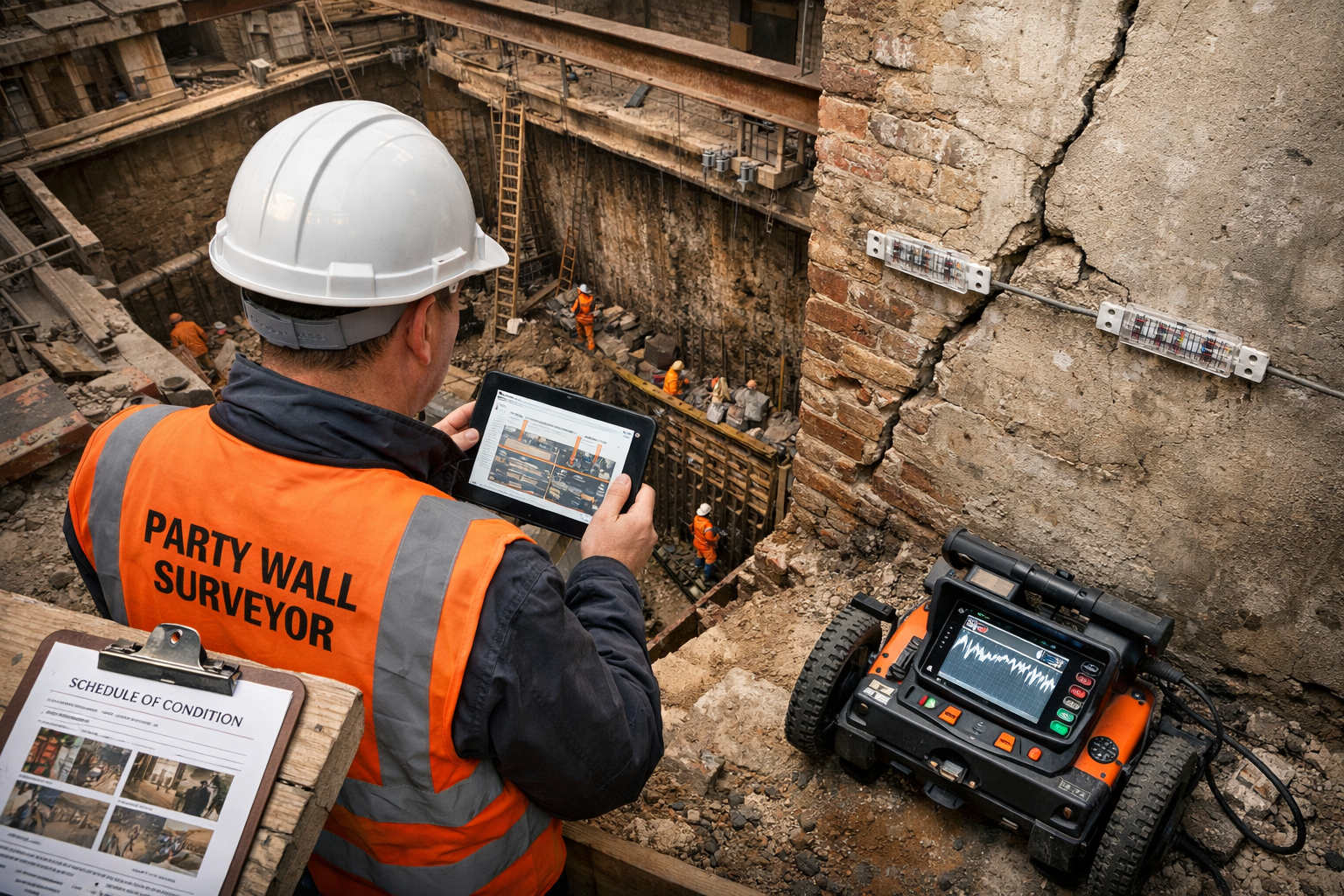
- A schedule of condition survey documents the adjoining property’s state before works begin — this is now considered essential practice.
⚙️ 5. Construction Method
- Secant pile walls, contiguous pile walls, and traditional mass concrete underpinning each carry different risk profiles.
- Temporary works design (propping, shoring) must be reviewed.
The Schedule of Condition: A Non-Negotiable Step
A schedule of condition is a photographic and written record of the adjoining property’s condition before excavation begins. It protects both parties: it gives the adjoining owner evidence if damage occurs, and it protects the building owner from inflated or fraudulent damage claims.
In 2026, digital schedules using high-resolution photography, thermal imaging, and crack monitoring data are increasingly standard on basement projects in London. [4]
Party Wall Awards for Basement Excavations: What the Document Must Contain
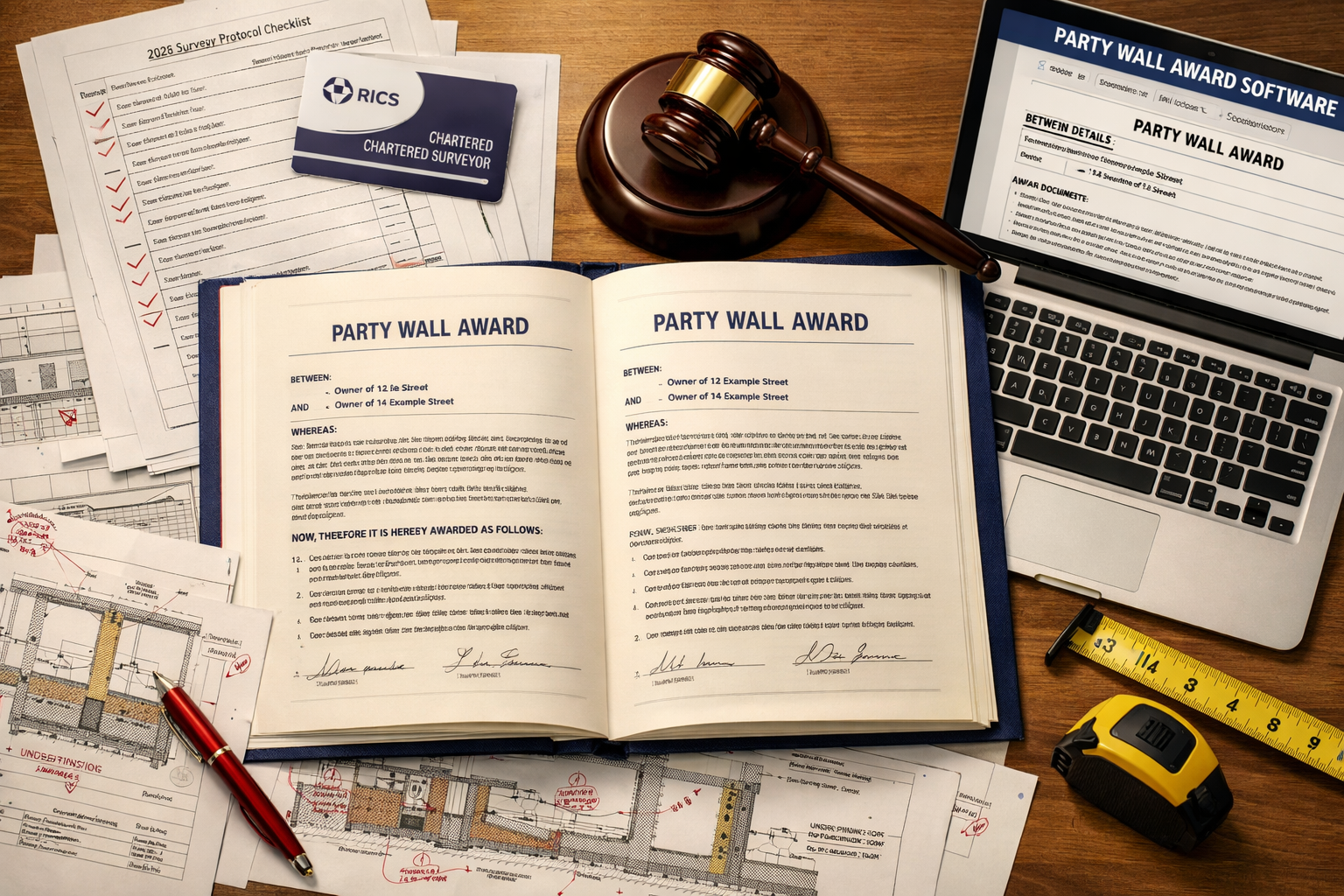
A party wall award is the formal legal document that resolves disputes and sets out the rights and obligations of both parties during the works. For basement excavations specifically, the award must go well beyond the standard template.
Essential Clauses for Basement Excavation Awards
📄 Standard clauses (all awards):
- Identity of the building owner and adjoining owner
- Description of the notifiable works
- Working hours and access provisions
- Damage liability and dispute resolution
🏗️ Basement-specific clauses (2026 protocols):
- Monitoring requirements: Specifying crack monitoring gauges, settlement pins, or inclinometers to be installed and read at defined intervals
- Groundwater management: Requirements for dewatering and its impact on neighbouring foundations
- Structural engineer sign-off: Requiring a structural engineer to approve temporary works before each stage of excavation
- Notification triggers: Defining what level of movement or cracking requires work to stop
- Reinstatement obligations: Detailed specification for making good any damage caused
- Insurance confirmation: Evidence of adequate contractor insurance before works commence
💡 Pull Quote: “A well-drafted party wall award for a basement excavation is not a formality — it is the primary legal instrument protecting both neighbours throughout a high-risk construction process.”
For a comprehensive overview of what these documents contain, the party wall contract template guide on party wall awards provides useful context.
2026 Surveyor Protocols: What Has Changed?
The profession has evolved significantly in response to the increasing complexity of basement projects. Key 2026 protocols reflect both technological advances and lessons learned from high-profile disputes.
Digital-First Documentation
Surveyors are now routinely using:
- Drone surveys for external condition assessments in tight urban plots
- 3D laser scanning to capture precise pre-works geometry
- Digital crack monitoring systems with automated alerts
- Cloud-based award management platforms for multi-party coordination
Agreed Surveyor vs. Two-Surveyor Approach
For complex basement projects, the choice of surveyor structure matters:
| Approach | Pros | Cons |
|---|---|---|
| Agreed Surveyor (single surveyor for both parties) | Cost-effective, faster | Perception of conflict of interest |
| Two Surveyors (one each) | Independent representation | Higher cost, potential for dispute |
| Third Surveyor (appointed in advance) | Resolves deadlock | Only engaged if needed |
For adjoining owners concerned about protecting their interests, understanding the role of an adjoining owner’s surveyor is essential before consenting to any arrangement.
Costs in 2026
Party wall awards for basement excavations are among the most expensive in the residential sector. A standard award costs approximately £1,000, but basement excavation awards — with their additional complexity — often run to £1,500–£3,000 or more per award. Surveyor hourly rates typically range from £150 to £200. [3]
Factors that increase costs include:
- Multiple adjoining owners (e.g., terraced properties with neighbours on both sides)
- Disputes requiring third surveyor involvement
- Complex structural engineering input required
- Extended monitoring periods
For practical advice on managing expenditure, the guide on how to keep party wall costs down offers actionable strategies.
Common Mistakes That Invalidate Awards or Trigger Injunctions
Even experienced contractors make errors that create legal exposure. The most common include:
- Starting work before the notice period expires — the one-month minimum for Section 6 notices is non-negotiable. [1]
- Serving notices without adequate plans — vague or incomplete drawings render notices invalid. [2]
- Failing to identify all adjoining owners — owners of properties below (e.g., basement flats) and above must all be notified.
- Ignoring the 45-degree rule — assuming horizontal distance alone determines the trigger is a frequent and costly error. [1]
- Proceeding without a schedule of condition — leaves the building owner exposed to unverifiable damage claims.
Those carrying out works should review the dedicated guidance for building owners undertaking party wall works before serving any notices.
Regional Considerations: London’s Unique Basement Challenge
London presents specific challenges that make party wall compliance particularly critical for basement projects:
- High density of Victorian terraced housing with shallow, often unmortared rubble foundations
- London clay geology creating elevated subsidence and heave risk
- Groundwater complexity in areas like Islington, Hackney, and Southwark
- Conservation area restrictions adding planning constraints alongside party wall obligations
Whether a project is in North London, South London, East London, or West London, local ground conditions and property stock characteristics should inform the structural risk assessment from the outset.
Conclusion: Actionable Next Steps for 2026 Basement Projects
Party Wall Awards for Basement Excavations: Depth Calculations, Structural Risk Assessment, and 2026 Surveyor Protocols represent a high-stakes intersection of law, engineering, and professional practice. Getting it right protects property values, neighbourly relationships, and legal standing.
Here are the concrete steps to take before breaking ground:
✅ Step 1: Engage a qualified party wall surveyor at the design stage — before planning permission is even submitted. Early identification of trigger distances prevents costly redesigns later.
✅ Step 2: Commission a trial pit or structural engineer’s report to establish the adjoining property’s foundation depth. Do not rely on assumptions.
✅ Step 3: Serve valid Section 6 notices with complete plans and sections at least one month before the intended start date. [1]
✅ Step 4: Agree on a schedule of condition for all adjoining properties before any excavation begins.
✅ Step 5: Ensure the party wall award contains all basement-specific clauses — monitoring protocols, notification triggers, and reinstatement obligations.
✅ Step 6: Maintain open communication with adjoining owners throughout the project. Disputes are far more expensive than proactive engagement.
The complexity of basement excavation work demands expert guidance. Working with experienced surveyors who understand both the legal framework and the structural engineering realities of deep excavation is the single most effective risk mitigation strategy available in 2026.
References
[1] Excavation And The Party Wall Act Navigating The 3 And 6 Metre Rules For Foundations – partywallslimited.com
[2] Party Wall Act Notices For Excavations Near Boundaries Serving Valid Notices To Avoid Injunctions In 2026 – https://nottinghillsurveyors.com/blog/party-wall-act-notices-for-excavations-near-boundaries-serving-valid-notices-to-avoid-injunctions-in-2026
[3] Party Wall Agreement – hoa.org.uk
[4] Party Wall Survey Guide – strutsurveyors.com
Speak to a RICS chartered party wall surveyor
Free initial consultation. Notices, awards and schedules of condition across London and nationwide.