Over 60,000 loft conversions are completed across England and Wales every year — and a significant proportion of them trigger legal obligations that homeowners fail to anticipate until work has already begun. Party Wall Notices for Loft Conversions: Roof Works, Structural Ties, and Award Safeguards in Dense Urban Areas sit at the intersection of property law, structural engineering, and neighbour relations. Getting this process right protects everyone involved. Getting it wrong can halt a project, trigger costly disputes, and expose building owners to legal liability.
This guide breaks down exactly when notices are required, what structural considerations matter most, and how properly drafted Party Wall Awards protect both building owners and their neighbours.
Key Takeaways 📋
- A two-month notice period applies when loft conversion works affect a shared party wall or boundary structure [1][2]
- Structural ties, steel beams, and roof alterations that touch or load a party wall almost always trigger the Party Wall etc. Act 1996
- A Party Wall Award is a legally binding document that defines how works must be carried out and safeguards adjoining owners
- Dense urban areas — particularly London terraces and semi-detached properties — carry the highest risk of dispute due to proximity and structural interdependency
- Adjoining owners who dissent to a notice are entitled to appoint their own surveyor, whose reasonable fees are typically paid by the building owner
When Do Loft Conversions Require Party Wall Notices?
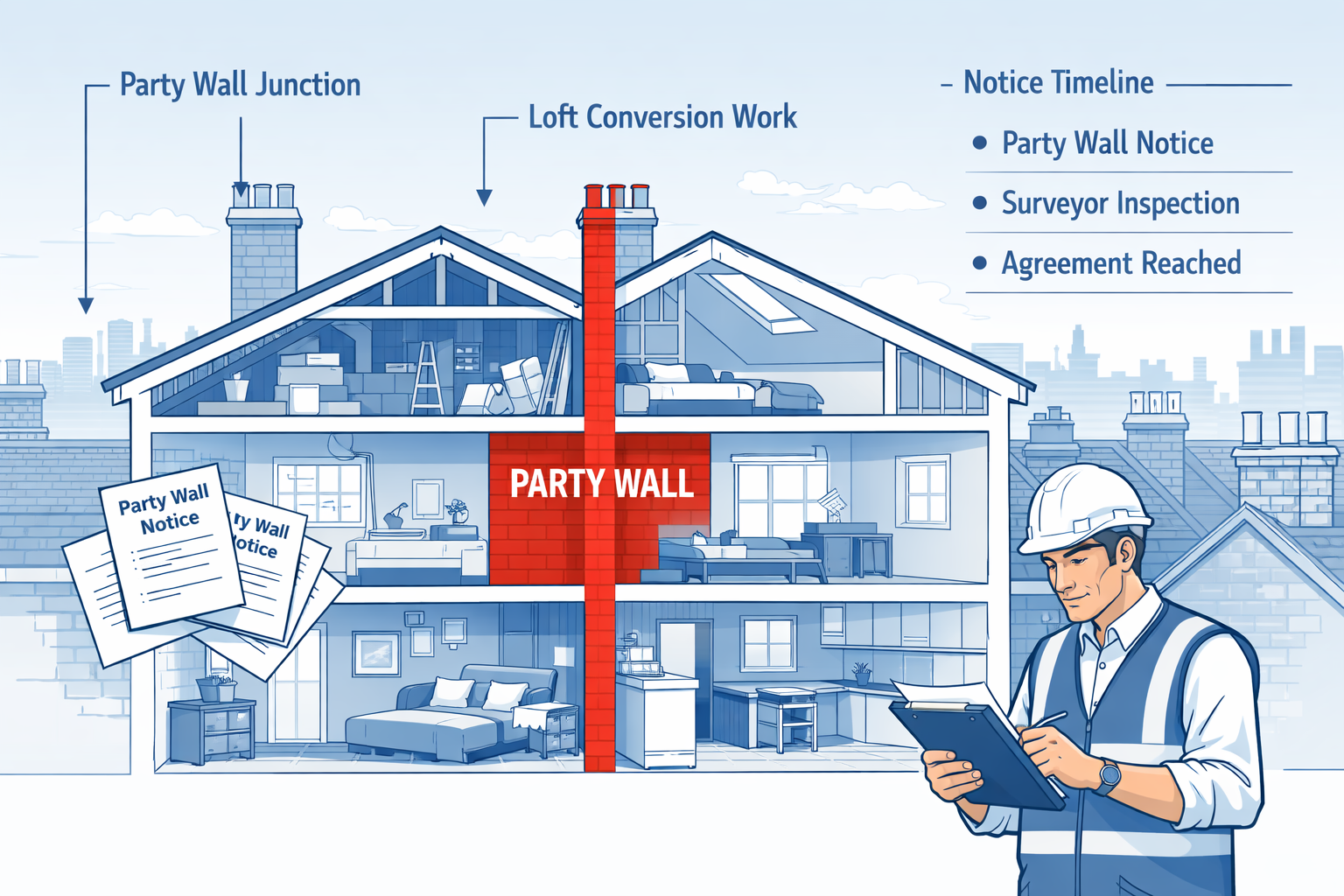
Not every loft conversion triggers the Party Wall etc. Act 1996. The key question is whether the proposed works involve, affect, or load a party wall, party structure, or party fence wall shared with an adjoining property [2].
Works That Typically Require a Notice
The following loft conversion activities almost always require formal notice:
| Work Type | Notice Required? | Notice Type |
|---|---|---|
| Cutting into a party wall to insert a beam | ✅ Yes | Party Structure Notice |
| Building a new wall on the line of junction | ✅ Yes | Line of Junction Notice |
| Raising the height of a party wall | ✅ Yes | Party Structure Notice |
| Removing a chimney breast on a party wall | ✅ Yes | Party Structure Notice |
| Installing joist hangers into a party wall | ✅ Yes | Party Structure Notice |
| Internal plastering only | ❌ No | N/A |
| Fitting shelving or electrics | ❌ No | N/A |
Minor works — including plastering, electrical installations, and fitting kitchen units or shelving — do not require party wall agreements [2]. The distinction lies in whether the work physically affects the shared structure.
For a full breakdown of which works fall under the Act, see the types of party wall works guide.
The Two-Month Notice Rule
For works that affect a party wall or party structure, the building owner must serve notice at least two months before work begins [1][2]. This is not a courtesy — it is a legal requirement under the Party Wall etc. Act 1996.
💡 Pull Quote: “Serving notice too late is one of the most common and costly mistakes in loft conversion projects. A two-month window is mandatory, not optional.”
The notice must include:
- The building owner’s name and address
- A description of the proposed works
- The planned start date
- A statement that it is served under the Party Wall etc. Act 1996
For detailed guidance on how to serve notice correctly, the Party Wall Act notices — what they are and how to respond resource is highly recommended.
Structural Ties and Roof Works: The Technical Reality
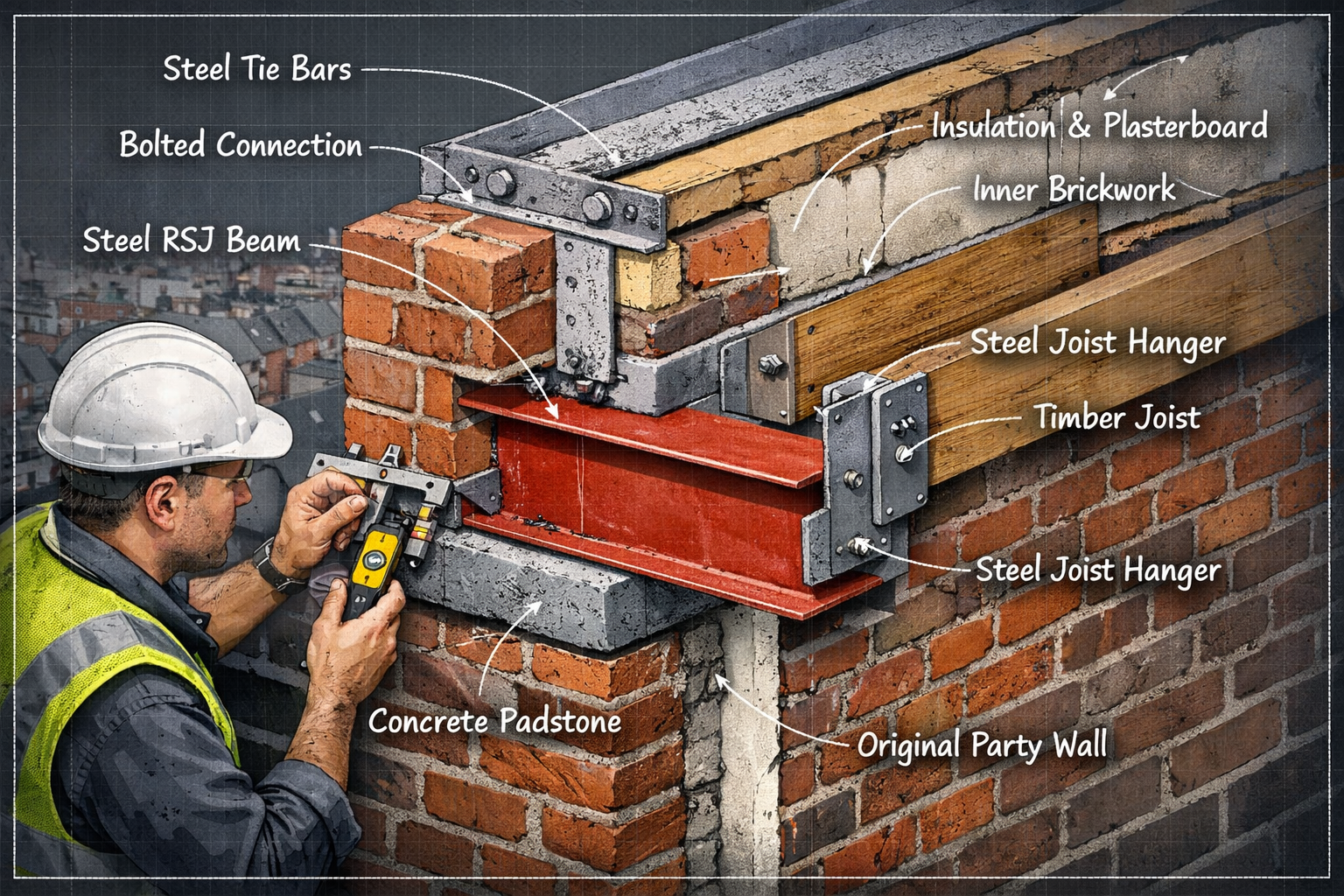
Loft conversions in dense urban areas — particularly Victorian and Edwardian terraces common across London — present unique structural challenges. The party wall is rarely just a dividing line. It is often a load-bearing element that both properties rely on for structural integrity.
Why Structural Ties Matter
When converting a loft, builders frequently need to:
- Insert steel RSJ beams (Rolled Steel Joists) into or onto the party wall to carry new floor loads
- Install joist hangers that tie new floor joists back to the party wall
- Remove or alter chimney breasts that form part of the shared structure
- Raise or extend the party wall to accommodate a new roof line or dormer
Each of these actions affects the party wall structurally. Under the Party Wall etc. Act 1996, the building owner has the right to carry out these works, but only after following the correct notice procedure and, where necessary, obtaining a Party Wall Award.
Roof Works and the Party Wall
Roof-level works are particularly sensitive in terraced properties. A hip-to-gable conversion, for example, involves extending the roof out to the gable end — which may sit directly on or adjacent to the party wall. Similarly, a rear dormer may require cutting into the party wall to support new structural elements.
Some loft conversions are specifically designed to avoid touching party walls altogether [4]. This approach — using independent structural frames or positioning steels within the building owner’s own structure — can sidestep the Act entirely. However, this is not always feasible in tightly packed urban settings where the party wall is the only viable load-bearing option.
⚠️ Important: Even if works are designed to avoid the party wall, if excavations come within 3 metres of an adjoining structure and go deeper than its foundations, a separate notice under Section 6 of the Act may still be required.
To understand the full scope of the legislation, the Party Wall etc. Act 1996 overview provides essential context.
Schedules of Condition: Protecting Both Parties
Before any structural work begins, a Schedule of Condition should be prepared. This is a photographic and written record of the adjoining property’s current state — particularly ceilings, walls, and roof structures that could be affected by vibration or structural movement.
A Schedule of Condition:
- Provides a baseline for any damage claims after work is complete
- Protects the building owner from exaggerated or pre-existing damage claims
- Gives the adjoining owner documented evidence if genuine damage occurs
This document is typically prepared by the appointed surveyor and forms part of the Party Wall Award. Learn more about the schedule of condition process and why it matters.
Party Wall Awards: Safeguards in Dense Urban Areas
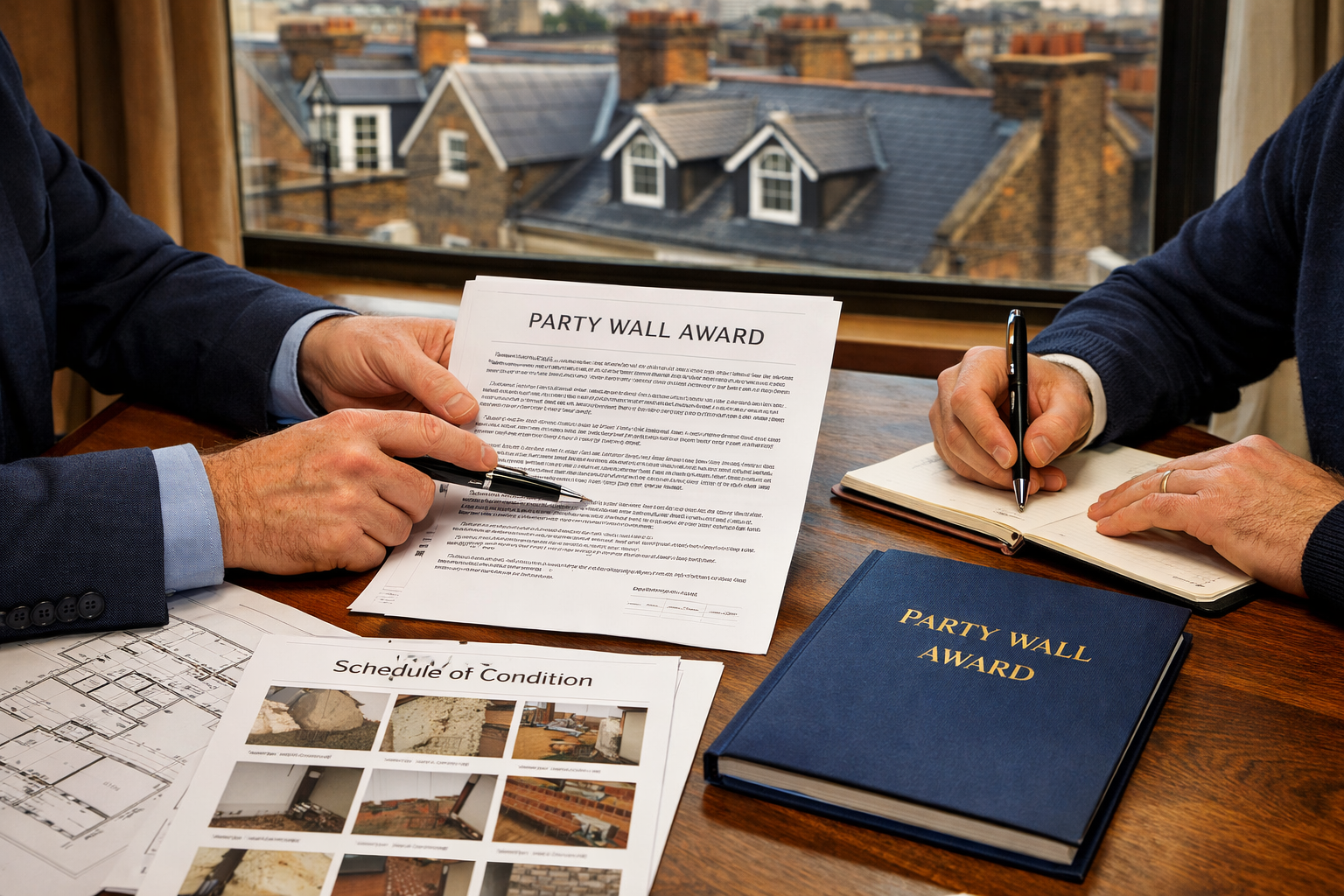
Party Wall Notices for Loft Conversions: Roof Works, Structural Ties, and Award Safeguards in Dense Urban Areas ultimately hinge on one document: the Party Wall Award. This is the legally binding agreement — drafted by one or more surveyors — that governs how notifiable works are carried out.
What a Party Wall Award Contains
A well-drafted Award for a loft conversion will typically address:
- Description of permitted works — exactly what the building owner is allowed to do
- Method of working — how structural elements must be installed (e.g., use of temporary propping, sequence of beam insertion)
- Hours of work — restrictions on noisy or vibration-heavy activities
- Access rights — when and how the building owner’s contractors may access the adjoining property if necessary
- Security for expenses — provisions for the adjoining owner to seek compensation if damage occurs
- Schedule of Condition — appended as evidence of pre-works state
📌 Key Point: The Award is not a planning document. It does not replace building regulations approval or planning permission. It operates alongside these consents.
For a deeper understanding of how Awards are structured, the Party Wall Awards guide provides authoritative detail. There is also a Party Wall contract template guide that illustrates how these documents are formatted in practice.
The Surveyor Appointment Process
When an adjoining owner receives a Party Wall Notice, they have three options:
- Consent — works proceed without an Award (though a Schedule of Condition is still advisable)
- Dissent and appoint a surveyor — the building owner typically pays the adjoining owner’s surveyor’s reasonable fees
- Dissent and agree to use the building owner’s surveyor — a single “agreed surveyor” acts for both parties
In dense urban areas like central and east London, where properties are closely packed and structural interdependency is high, dissent is common [3]. Adjoining owners are understandably cautious about works that could affect their home’s structure, particularly in older terraced housing stock.
If a dispute arises that the appointed surveyors cannot resolve, a Third Surveyor — selected at the outset — can be called upon to make a binding determination.
For homeowners acting as adjoining owners, the adjoining owners’ rights and responsibilities page is essential reading.
Award Safeguards: What Urban Loft Conversions Demand
In dense urban settings, Party Wall Awards for loft conversions should include enhanced safeguards beyond the standard template. These include:
- 🔩 Structural monitoring clauses — requiring crack gauges or settlement monitors to be installed at key points on the party wall
- 🏗️ Propping requirements — mandating temporary support for the party wall during beam insertion
- 📸 Extended Schedule of Condition — covering not just the immediately adjoining property but potentially properties further along the terrace if vibration risk is high
- ⏱️ Phased working clauses — breaking structural works into stages to limit cumulative impact
- 💰 Security for expenses — a financial deposit held against potential damage claims, particularly relevant for high-value urban properties
These provisions are not bureaucratic obstacles. They are practical tools that allow loft conversions to proceed safely while protecting neighbours from undue risk.
Costs and Who Pays
A common concern is cost. In most cases:
- The building owner pays for the preparation of the Award and the adjoining owner’s surveyor’s reasonable fees
- If the adjoining owner appoints an unnecessarily expensive surveyor, the building owner can challenge unreasonable fees
- Using an agreed surveyor (one surveyor acting for both parties) is often the most cost-effective route where the relationship between neighbours is amicable
For practical advice on managing expenses, the guide on how to keep party wall costs down offers actionable strategies.
Navigating the Process in 2026: Practical Steps
The party wall process for a loft conversion in a dense urban area follows a clear sequence. Here is a practical roadmap:
Step-by-Step Process 🗺️
- Commission structural drawings — establish exactly which works will affect the party wall
- Identify all adjoining owners — this includes freeholders, leaseholders, and mortgagees in some cases
- Serve the correct notice(s) — Party Structure Notice for wall works; Line of Junction Notice if building on the boundary
- Wait for the response — adjoining owners have 14 days to respond; silence after this period triggers a deemed dissent
- Appoint surveyors — either an agreed surveyor or separate surveyors for each party
- Agree the Award — surveyors inspect, prepare, and serve the Award
- Commence works — only after the Award is in place (or consent is given)
- Post-works inspection — compare final state against the Schedule of Condition
🏙️ Urban Tip: In London, where loft conversions are particularly common in Victorian terraces, it is worth engaging a surveyor with specific experience in the area. Local knowledge of building stock, common structural issues, and neighbour dynamics adds real value. Specialist surveyors are available across West London, North London, South London, and East London.
Conclusion: Act Early, Protect Everyone
Party Wall Notices for Loft Conversions: Roof Works, Structural Ties, and Award Safeguards in Dense Urban Areas are not a formality to be rushed through. They are a structured legal framework designed to allow ambitious home improvements while protecting the structural integrity and legal rights of neighbouring properties.
The stakes are real. A loft conversion that proceeds without proper notice can be challenged in court, halted by injunction, and result in significant financial liability for the building owner. Conversely, a well-managed party wall process — with clear notices, a thorough Award, and a detailed Schedule of Condition — gives everyone the confidence to proceed.
Actionable Next Steps ✅
- Engage a structural engineer early to identify which works will affect the party wall before serving notice
- Serve notice at least two months in advance — do not wait until the contractor is booked
- Use an experienced party wall surveyor with knowledge of urban terraced properties
- Insist on a Schedule of Condition even if the adjoining owner consents — it protects the building owner too
- Review the Award carefully before works begin to ensure all structural safeguards are in place
- Keep communication open with neighbours throughout — most disputes arise from poor communication, not the works themselves
The party wall process, handled correctly, is not an obstacle. It is the mechanism that makes complex urban loft conversions possible.
References
[1] Loft Conversions And The Party Wall Act – peterbarry.co.uk
[2] Party Wall Agreement – hoa.org.uk
[3] Party Wall Agreement London 2026 – mayfairstudio.co.uk
[4] How Loft Conversion Is Completed Without Touching Party Walls – ashdownlofts.com
Speak to a RICS chartered party wall surveyor
Free initial consultation. Notices, awards and schedules of condition across London and nationwide.