Nearly one in three party wall disputes in dense London boroughs now involves underpinning or foundation-related works — a figure that has climbed steadily as basement conversions, structural extensions, and urban densification projects accelerate across the capital in 2026. When a building owner proposes to underpin a shared wall, the legal, structural, and financial stakes rise sharply for everyone involved.
Party Wall Awards for Underpinning Works: Surveyor Risk Assessments and Safeguard Clauses in 2026 Urban Projects sit at the intersection of property law, structural engineering, and neighbour relations. Getting the process right protects both parties; getting it wrong can trigger subsidence claims, costly legal battles, and project delays that run into months. This guide unpacks everything property owners, surveyors, and developers need to know in 2026. [1][3]
Key Takeaways 📌
- Underpinning a party wall is legally classified as high-risk structural work and triggers mandatory notice requirements under the Party Wall etc Act 1996.
- A properly drafted Party Wall Award must include risk assessment findings, method statements, safeguard clauses, and a schedule of condition.
- Adjoining owners have the right to request an advising engineer and demand security for expenses before works begin.
- In 2026, RICS-compliant awards are reducing appeals and keeping urban projects on schedule during a significant construction uptick.
- The building owner pays all surveyor fees — typically £150–£200/hour, with a full award costing around £1,000.
Why Underpinning Triggers the Party Wall Act
The Legal Basis Under the 1996 Act
The Party Wall etc Act 1996 explicitly covers underpinning works, defining the right “to underpin, thicken or raise a party structure, a party fence wall, or an external wall which belongs to the building owner and is built against a party structure or party fence wall.” [3] This means the moment a building owner plans to underpin any shared or adjoining wall, the Act is engaged — there is no grey area.
Before any spade hits the ground, the building owner must serve a Party Structure Notice on all adjoining owners. Failure to do so doesn’t just create a legal risk; it can result in injunctions halting the project entirely. For a clear overview of how notices work, see this guide on Party Wall Act notices and how to respond.
Why Underpinning Is Classified as High-Risk
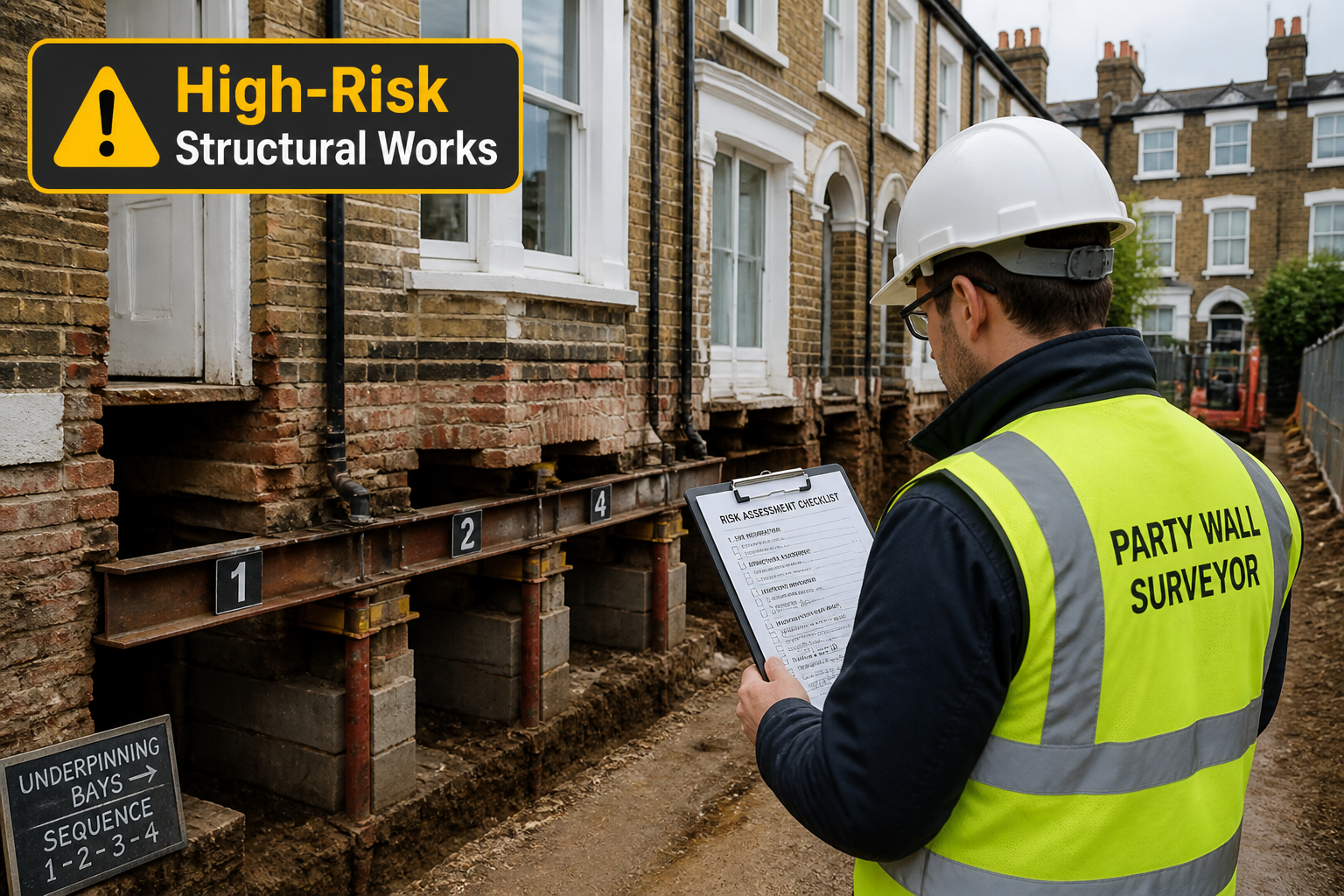
Not all party wall works carry equal risk. Underpinning is classified as a high-risk type of structural work because it directly interferes with the load-bearing capacity of foundations shared between two or more properties. [3] The risks include:
- 🏚️ Differential settlement — uneven movement between the building owner’s and adjoining owner’s structure
- 💧 Water ingress — open excavation trenches can allow groundwater to destabilise adjacent foundations
- 🧱 Cracking and structural damage — vibration and ground movement can affect brickwork, plasterwork, and drainage
- ⚠️ Partial completion risk — if works stop mid-way, open bays can leave the adjoining structure temporarily unsupported
These risks explain why the surveyor’s role in drafting the award goes far beyond paperwork. In 2026 urban projects — particularly in areas with Victorian-era terrace housing stock — these risks are amplified by the age and condition of existing foundations.
💬 “Underpinning is not simply a construction method — it is a legal event that demands procedural precision, multi-party coordination, and enforceable safeguards from day one.”
Surveyor Risk Assessments: What the Award Must Cover
The Three-Party Coordination Requirement
Underpinning a party wall requires three professionals to work in close coordination: the building owner’s architect, the structural engineer, and the on-site contractor. [3] The party wall surveyor does not replace these specialists — instead, the surveyor ensures that the award reflects their combined input and that procedural requirements are fully understood before works commence.
This coordination is particularly important when it comes to the method statement — a document that details exactly how underpinning will be carried out, in what sequence, and with what safety measures. A well-drafted Party Wall Award will incorporate or reference the method statement directly, making it legally binding on the contractor.
For those carrying out works and needing to understand the full process, the building owner’s surveyor service provides expert guidance tailored to the building owner’s position.
What a Structural Risk Assessment Should Include
A thorough risk assessment embedded in the Party Wall Award for underpinning works should address the following:
| Risk Factor | Assessment Required |
|---|---|
| Foundation depth and type | Comparison of both properties’ foundation levels |
| Soil conditions | Borehole or trial pit data, bearing capacity |
| Underpinning sequence | Bay-by-bay methodology, maximum open bay width |
| Vibration and noise limits | Agreed thresholds to protect adjoining structure |
| Groundwater management | Dewatering plan if water table is a concern |
| Monitoring regime | Settlement monitoring points, frequency of readings |
| Emergency procedures | Protocol if unexpected movement is detected |
The Adjoining Owner’s Right to an Advising Engineer
One of the most important — and often overlooked — provisions in the Act is the adjoining owner’s right to request input from an advising engineer. [3] The party wall surveyor acting on behalf of the adjoining owner can legally require the building owner to fund an independent structural engineer to:
- Review the proposed underpinning approach
- Verify that procedures are toward the lower-risk end of the spectrum
- Ensure the adjoining structure has been fully considered in the design
In 2026, with construction activity rising sharply across London, this provision is being invoked more frequently — particularly in areas where older housing stock sits above clay soils prone to shrinkage and heave. If you are an adjoining owner facing underpinning works next door, the adjoining owner’s surveyor service can help protect your interests.
Safeguard Clauses in Party Wall Awards for Underpinning Works
What Are Safeguard Clauses?
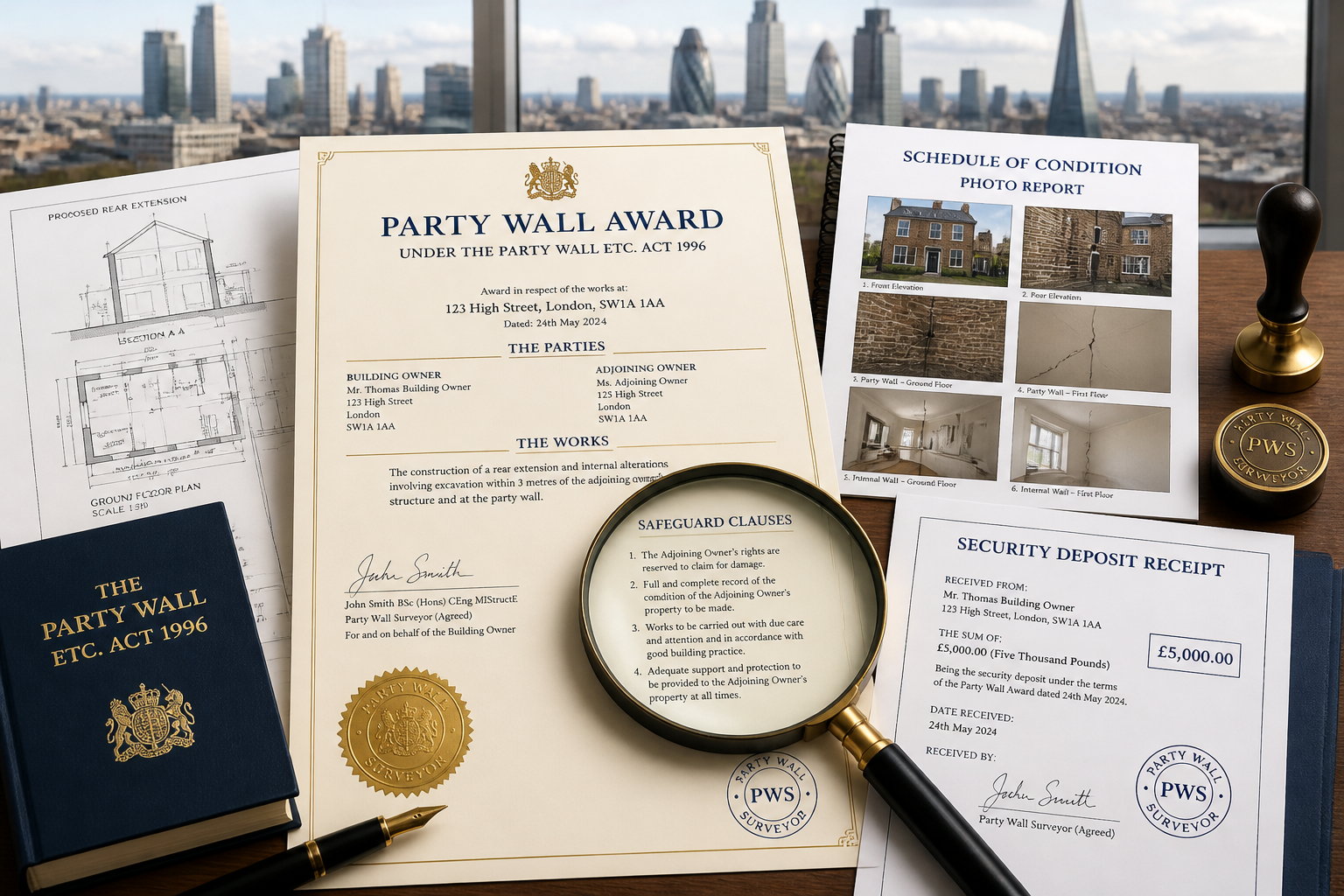
Safeguard clauses are legally binding provisions within a Party Wall Award that protect the adjoining owner’s property and financial interests during and after underpinning works. In 2026, with regulatory guidance evolving, well-drafted awards following RICS standards have become critical for minimising appeals and keeping projects on track. [1][4]
The most important safeguard clauses for underpinning works include:
1. Security for Expenses 🔒
Under the Party Wall etc Act 1996, adjoining owners may serve notice requiring the building owner to provide agreed security — or a security amount determined through the dispute resolution process under Section 10 — before work commences. [3]
This provision exists for a very specific reason: if the building owner delays, stalls, or stops works mid-way through underpinning, open excavation bays can leave the adjoining structure dangerously unsupported. Security for expenses ensures funds are immediately available to instruct contractors to backfill open trenches or complete underpinning without waiting for the building owner to act. [3]
2. Schedule of Condition 📸
Every Party Wall Award involving underpinning must include a schedule of condition — a detailed photographic and written record of the adjoining property’s pre-works state. [2] This document is the single most important piece of evidence if a damage dispute arises after works complete.
A robust schedule of condition should cover:
- All internal rooms adjacent to or above the works
- External walls, brickwork, and render
- Existing cracks (measured and photographed)
- Drainage inspection chambers
- Garden surfaces and boundary structures
For more on how schedules of condition work in practice, see the dedicated schedule of condition service.
3. Working Hours and Noise Restrictions
Awards should specify permitted working hours, maximum vibration levels, and notification requirements before particularly disruptive phases such as breaking out existing foundations.
4. Damage Notification Protocol
A clear clause requiring the contractor to immediately notify both surveyors if any unexpected cracking, movement, or structural anomaly is detected during works.
5. Completion and Reinstatement Obligations
The award should specify exactly how and when the building owner must make good any damage caused to the adjoining property, including timescales and the standard of repair required.
Retrospective Awards: When Things Go Wrong
Despite best efforts, disputes do arise. When damage complaints emerge after underpinning works, retrospective Party Wall Awards can be drawn up with an agreed surveyor or two party wall surveyors appointed with both owners’ knowledge. [2] These retrospective agreements address damage claims, clarify the scope of works undertaken, and establish a framework for compensation or repair.
The lesson for 2026 urban projects is clear: a comprehensive award drafted before works begin is far less costly — financially and relationally — than attempting to resolve disputes after the fact.
2026 Urban Projects: Rising Disputes and RICS Compliance
The 2026 Construction Uptick and Its Impact
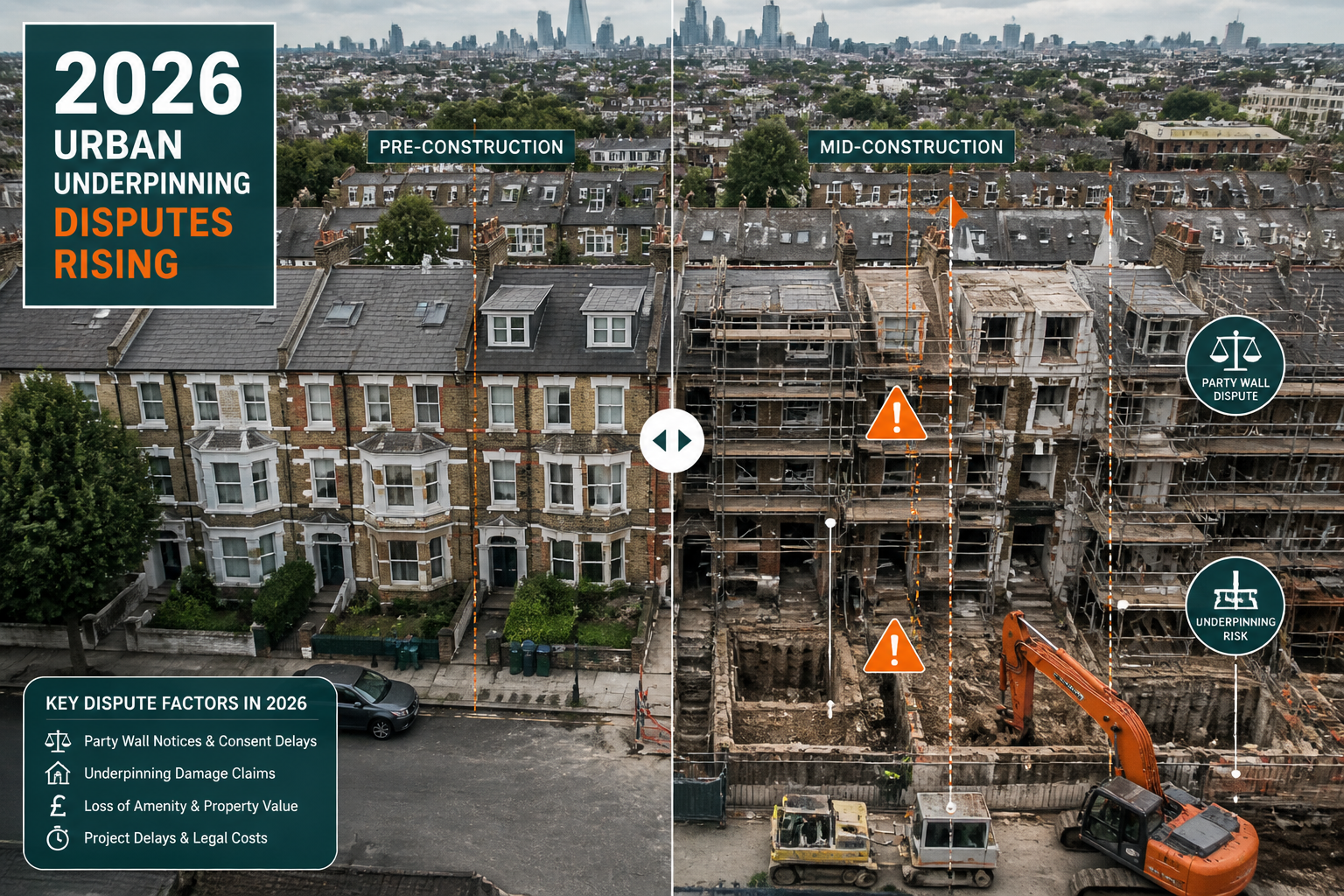
The construction sector in 2026 is experiencing a significant uptick in activity, particularly in dense urban areas. This surge has placed party wall surveyors under considerable pressure, with dispute volumes rising in areas such as East London, South London, and inner-city boroughs where terrace housing predominates. [4]
During this period, RICS-compliant awards have proven their value. Well-prepared awards that follow RICS standards are significantly reducing the number of appeals to the County Court, allowing projects to proceed more efficiently and with greater certainty for all parties. [4]
For location-specific expertise, specialist surveyors operate across East London, South London, North London, and West London — each area presenting its own soil conditions, housing stock characteristics, and dispute patterns.
Common Dispute Triggers in 2026 Underpinning Cases
The following issues are driving the majority of underpinning-related party wall disputes in 2026 urban projects:
- Inadequate notice — building owners proceeding without serving proper Party Structure Notices
- Missing method statements — awards that fail to incorporate detailed underpinning sequences
- No security for expenses — adjoining owners left financially exposed if works stall
- Incomplete schedules of condition — disputes about pre-existing versus new damage
- Scope creep — works extending beyond what the award authorised
Understanding the Costs
Party wall surveyors charge between £150–£200 per hour, with a complete Party Wall Award costing approximately £1,000. [2] The building owner carrying out the works is responsible for paying all surveyor fees, including the adjoining owner’s surveyor if one is appointed. [2]
For those looking to manage costs without cutting corners, this guide on how to keep party wall costs down offers practical strategies. It is also worth understanding the full costs of the party wall process before committing to a project timeline.
For a deeper understanding of what a Party Wall Award contains and how it is structured, the party wall contract template guide is an excellent starting point.
Key Questions to Ask Before Underpinning Begins
✅ Has a Party Structure Notice been correctly served on all adjoining owners?
✅ Has the adjoining owner consented or has a dispute been formally triggered?
✅ Has a structural engineer produced a detailed underpinning method statement?
✅ Does the draft award include security for expenses provisions?
✅ Has a full schedule of condition been completed and agreed?
✅ Are monitoring points installed and a settlement monitoring regime in place?
✅ Do all three parties — architect, engineer, and contractor — understand the procedural requirements?
Conclusion: Protecting All Parties in 2026 Urban Underpinning Projects
Party Wall Awards for Underpinning Works: Surveyor Risk Assessments and Safeguard Clauses in 2026 Urban Projects demand a higher standard of preparation than almost any other type of party wall matter. The combination of high structural risk, dense urban housing stock, and rising construction activity in 2026 means that gaps in the award — missing safeguard clauses, inadequate risk assessments, absent security provisions — translate directly into disputes, delays, and damage claims.
Actionable Next Steps
- Serve notice early — allow the full statutory period before works begin; rushing this step is the single most common cause of disputes.
- Appoint a qualified party wall surveyor with specific experience in underpinning and foundation works — not all party wall matters are equal.
- Commission a detailed schedule of condition before any excavation begins; photographs taken after the fact carry little evidential weight.
- Insist on a method statement from the structural engineer and ensure it is incorporated into the award.
- Discuss security for expenses with your surveyor at the outset — adjoining owners should not wait until works begin to raise this.
- Budget realistically — the cost of a properly drafted award is a fraction of the cost of a subsidence claim or County Court appeal.
Whether acting as a building owner or an adjoining owner, understanding the full scope of party wall obligations for underpinning works is the foundation — quite literally — of a successful urban project in 2026.
References
[1] Evergreen Guide To Party Wall Awards Drafting Enforceable Agreements Under 2026 Regulatory Updates – https://nottinghillsurveyors.com/blog/evergreen-guide-to-party-wall-awards-drafting-enforceable-agreements-under-2026-regulatory-updates
[2] Party Wall Agreement – hoa.org.uk
[3] Underpinning A Party Wall – stokemont.com
[4] Party Wall Surveys And Neighbour Disputes During 2026s Construction Uptick RICS Compliance Framework – https://nottinghillsurveyors.com/blog/party-wall-surveys-and-neighbour-disputes-during-2026s-construction-uptick-rics-compliance-framework
Speak to a RICS chartered party wall surveyor
Free initial consultation. Notices, awards and schedules of condition across London and nationwide.