


Over 60% of party wall disputes that escalate to formal legal proceedings involve disagreements about pre-existing damage — arguments that a properly prepared schedule of condition could have resolved before a single brick was disturbed. Yet despite this, many building owners still treat condition schedules as a bureaucratic afterthought rather than the critical legal shield they truly are.
This guide covers Schedules of Condition in Party Wall Awards: Best Practices for 2026 Deep Excavations and Urban Boundary Works in precise, actionable detail. Whether a developer is planning a deep basement beneath a London terrace or a homeowner is digging close to a shared boundary wall, understanding how to prepare and use a schedule of condition correctly can be the difference between a smooth project and a costly dispute. For a broader overview of how these documents fit into the formal process, see this detailed guide on party wall awards.
Key Takeaways 📋
- A schedule of condition is a factual, photographic record of a neighbouring property's state before construction begins — it is not an opinion or a defect report.
- While not legally required by the Party Wall etc. Act 1996, case law places the burden of proof on the building owner to show their works did not cause damage — making schedules essential.
- For deep excavations (basement works, underpinning), the inspection radius extends to 6.00 metres; for minor works, it is 3.00 metres.
- 3D laser scanning is rapidly becoming the gold standard for 2026 condition surveys near complex urban excavations.
- The building owner pays for the schedule of condition as part of the party wall process.
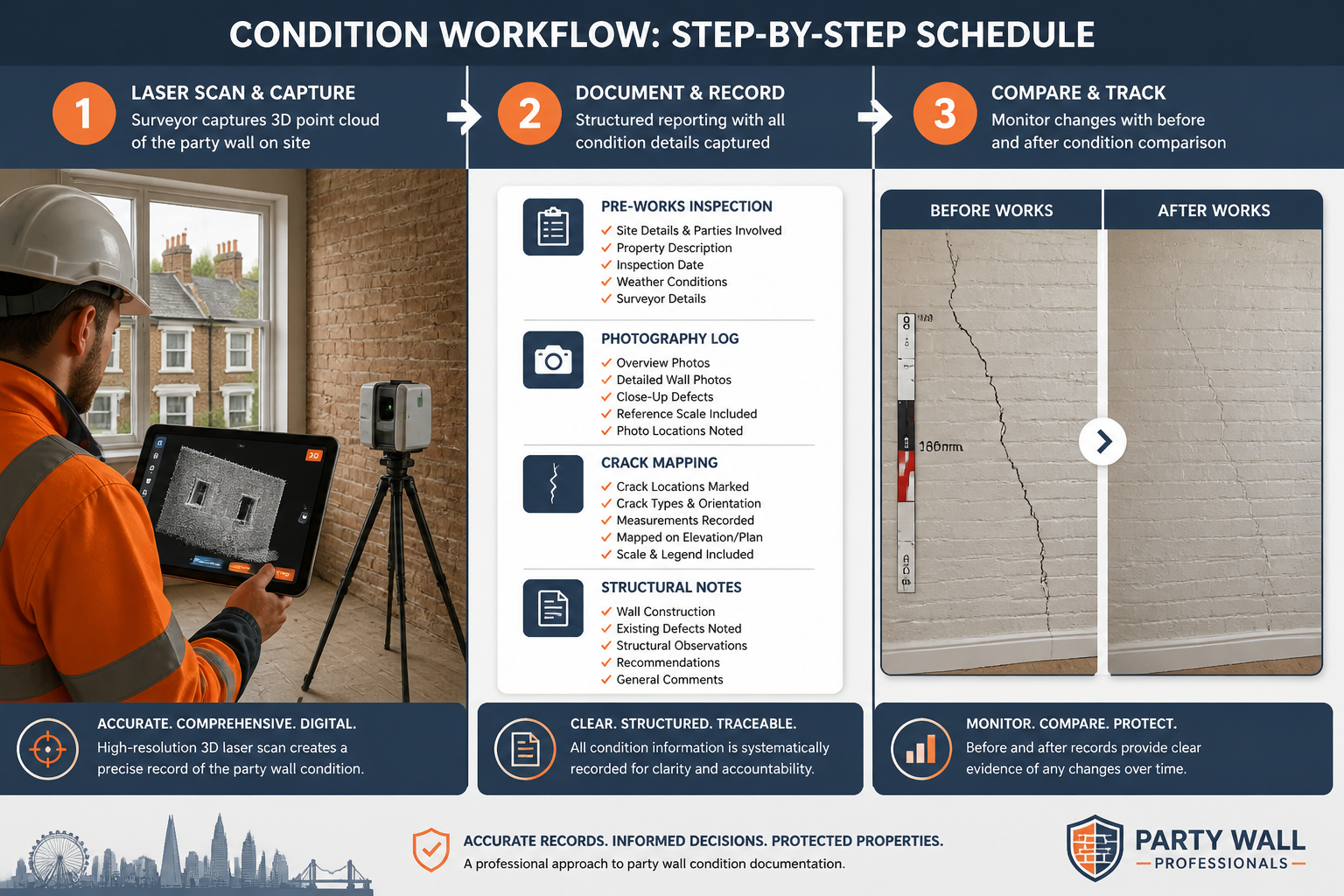
What Is a Schedule of Condition and Why Does It Matter?
A schedule of condition is a structured, factual document — often accompanied by photographs, annotated drawings, and increasingly, 3D point cloud data — that records the precise state of an adjoining property immediately before construction works begin [1].
💬 "A schedule of condition is a purely factual record — 'say what you see' — and does not provide opinions on the nature or cause of defects." [5]
This distinction is critical. Surveyors are not diagnosing structural problems; they are creating a timestamped baseline. If a crack appears in a neighbour's wall after excavation, the schedule is the evidence that determines whether that crack was there before works started or was caused by them [3].
The Legal Position in 2026
The Party Wall etc. Act 1996 does not explicitly require a schedule of condition. However, case law has consistently placed the burden of proof on the building owner — the party carrying out the works — to demonstrate that any damage to an adjoining property was pre-existing and not caused by their construction activity [3].
Without a schedule, the building owner has no baseline evidence. Any crack or settlement found after works are complete becomes almost impossible to defend against. In 2026's high-density urban environment, where deep excavations are increasingly common and properties sit close together, this risk is amplified significantly.
Key legal principle: Absence of a schedule does not mean absence of liability — it means absence of a defence.
Who Pays and Who Prepares It?
| Responsibility | Party |
|---|---|
| Arranging the inspection | Building Owner's Surveyor |
| Attending the inspection | Adjoining Owner's Surveyor (shadows and reviews) |
| Paying for the schedule | Building Owner [3] |
| Agreeing the final document | Both surveyors jointly |
The building owner's surveyor conducts the physical inspection, while the adjoining owner's surveyor accompanies them to observe and later reviews the draft document before it is formally agreed [1]. This dual-surveyor model ensures impartiality and protects both parties. Learn more about the costs involved in the party wall process to budget accordingly.
Best Practices for 2026 Deep Excavations and Urban Boundary Works
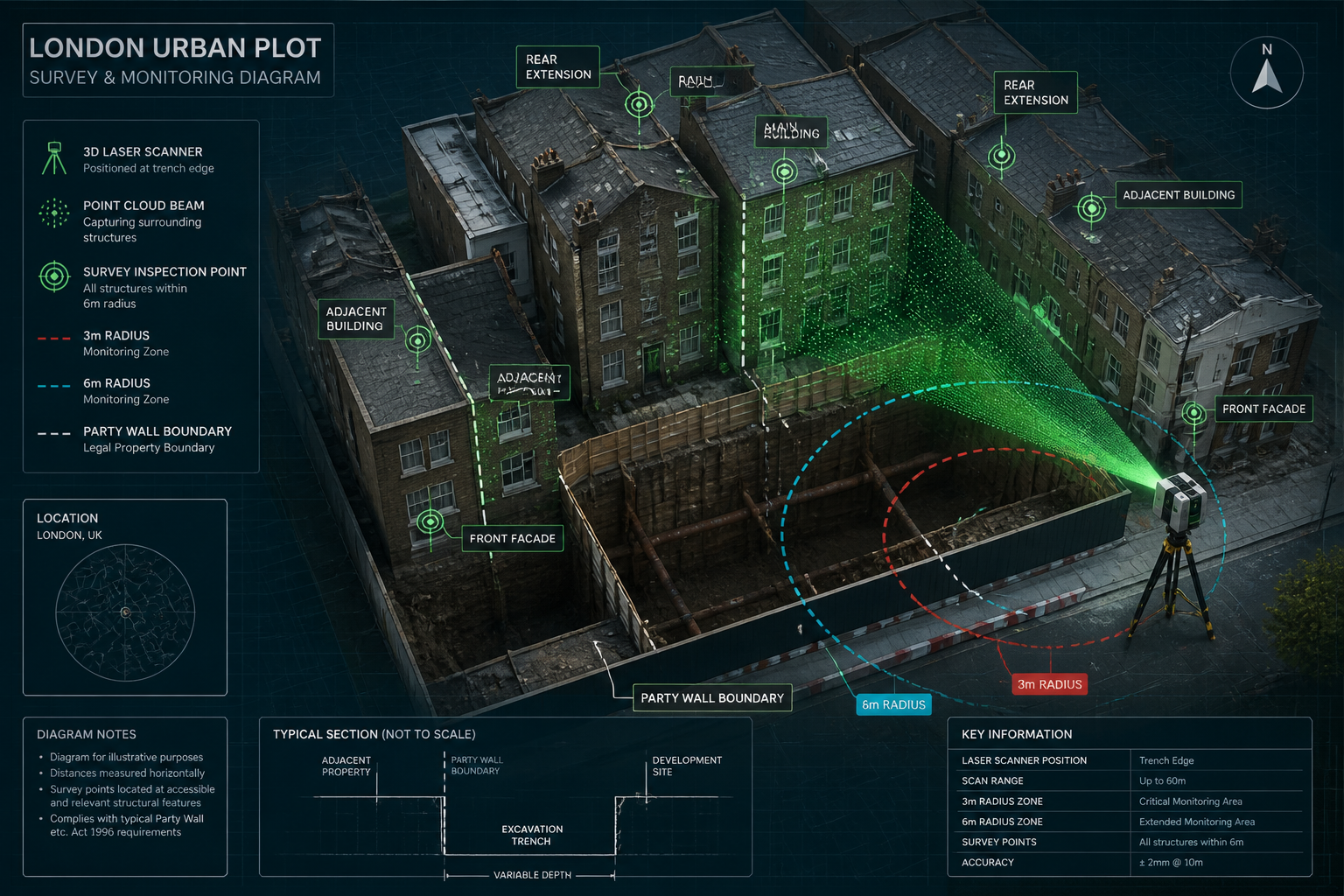
The scope and rigour of a schedule of condition must match the risk profile of the proposed works. This is where many surveyors fall short — applying a one-size-fits-all approach to projects that carry very different levels of risk to neighbouring structures.
Step 1: Determine the Correct Survey Radius
The inspection radius is not arbitrary. It is determined by the nature of the proposed works [1]:
- 🏠 Minor works (extensions, loft conversions, above-ground alterations): 3.00 metre radius from the works
- 🏗️ High-risk works (deep excavations, basement construction, underpinning): 6.00 metre radius from the works
For urban boundary works in 2026 — particularly in dense London boroughs where Victorian terraces sit shoulder-to-shoulder — the 6.00m radius for basement and deep excavation projects will frequently encompass multiple neighbouring properties, not just the immediately adjoining one. Every structure within that radius should be inspected and documented.
Understanding the types of party wall works that trigger these different thresholds is essential before any survey begins.
Step 2: Conduct a Thorough Pre-Survey Assessment
Before the physical inspection, the surveyor should:
- Review the structural drawings and method statements for the proposed works
- Identify the depth of excavation and proximity to existing foundations
- Note any known ground conditions (made ground, clay shrinkage zones, previous basements)
- Check whether the adjoining property has had any previous party wall works or recorded defects
- Confirm the party wall notice has been correctly served — see the guidance on party wall notices for reference
Step 3: Carry Out the Physical Inspection — Room by Room
The physical inspection should be methodical and comprehensive. A typical schedule of condition for a deep excavation project near a party wall will cover:
Externally:
- All elevations visible from the site
- Boundary walls, piers, and coping stones
- Roof line, chimney stacks, and guttering
- Paving, patios, and hard landscaping adjacent to the works
Internally:
- Every room in the property, floor by floor
- Ceilings (particularly plasterwork and cornicing)
- Walls — all four faces in each room
- Floors — timber, concrete, and screed
- Doors and windows (noting any sticking, gaps, or misalignment)
- Staircases and structural elements
Each defect — cracks, staining, settlement, previous repairs — must be described precisely and photographed with a scale rule in frame. Crack widths should be measured using a calibrated gauge and recorded in millimetres.
Step 4: Integrate 3D Laser Scanning for Complex Projects 🔬
For 2026 deep excavation projects near party walls, traditional photography and written descriptions alone are no longer sufficient for high-value or high-risk sites. 3D laser scanning (LiDAR) is rapidly becoming the industry benchmark for condition surveys in complex urban environments [6].
Why 3D scanning adds value:
| Traditional Method | 3D Laser Scanning |
|---|---|
| 2D photographs | Full 3D point cloud model |
| Subjective description of crack widths | Precise millimetre-accurate measurements |
| Limited revisit capability | Model can be re-inspected virtually at any time |
| Difficult to prove settlement post-works | Before/after scan comparison shows movement precisely |
| Time-intensive manual documentation | Faster capture of large, complex structures |
A 3D point cloud model of the adjoining property — captured before works begin — creates an irrefutable geometric baseline. If settlement occurs during or after deep excavation, a post-works scan can be overlaid onto the pre-works model to show exactly where and by how much the structure has moved. This level of precision is particularly valuable in disputes involving basement construction beneath terraced housing or works close to shared boundary walls.
💡 Pro Tip: For excavations deeper than 1.5 metres within 3 metres of a neighbouring foundation, commission a 3D laser scan as standard practice — not as an optional extra.
Step 5: Prepare the Formal Schedule Document
The completed schedule of condition should be structured as follows:
- Cover page — property address, date of inspection, names of both surveyors, reference to the party wall award
- Introduction — brief description of the proposed works and their proximity to the inspected property
- Scope statement — confirming the survey radius applied and why
- Condition record — room-by-room written descriptions, cross-referenced to photographs
- Photographic appendix — numbered, dated photographs with captions
- Crack schedule — tabulated record of all cracks with location, orientation, width, and length
- 3D scan reference (where applicable) — file references and access details for the point cloud data
- Surveyor signatures — both surveyors sign to confirm agreement
The schedule is then appended to the party wall award as a formal exhibit [1]. For guidance on how party wall awards are structured, the party wall contract template guide provides a useful reference.
Common Mistakes to Avoid in Schedule of Condition Preparation
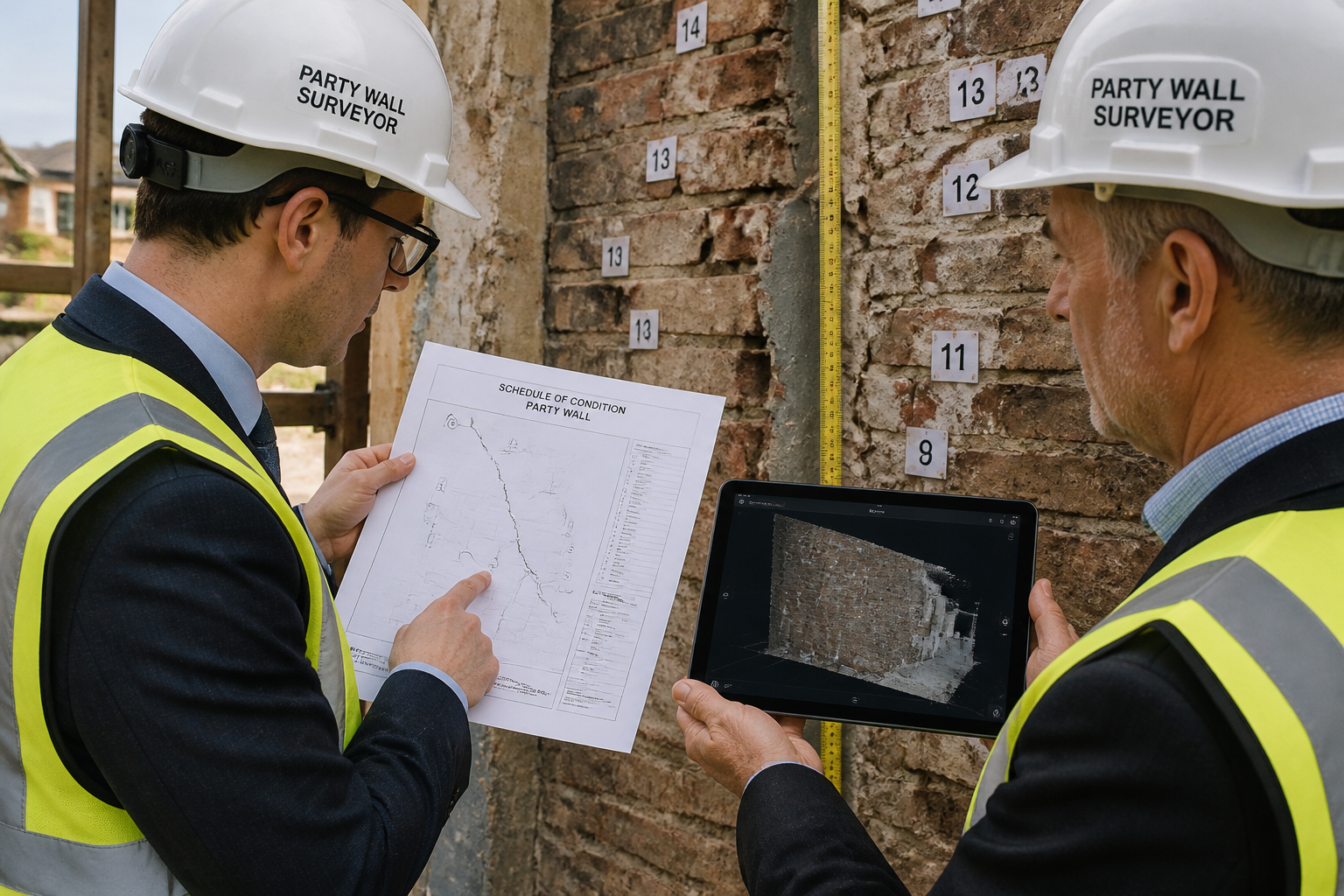
Even experienced surveyors can fall into traps that undermine the protective value of a schedule of condition. The following are the most common errors seen in 2026 practice:
❌ Mistake 1: Inspecting Too Narrow a Radius
Applying a 3.00m radius to a basement excavation project — when 6.00m is required — leaves structures at risk unrecorded. If those structures later show damage, the building owner has no defence for them [1].
❌ Mistake 2: Including Opinions Rather Than Facts
Statements like "this crack appears to be caused by thermal movement" or "this settlement looks historic" have no place in a schedule of condition. The document must be purely descriptive [5]. Opinions belong in expert witness reports, not condition schedules.
❌ Mistake 3: Poor Photographic Quality
Blurred, poorly lit, or undated photographs are almost worthless in a dispute. Every photograph must be:
- Sharp and well-lit
- Taken with a scale rule in frame
- Geotagged or otherwise date-stamped
- Numbered and cross-referenced to the written record
❌ Mistake 4: Failing to Inspect All Areas Within Radius
Surveyors sometimes skip roof spaces, cellars, or outbuildings because access is inconvenient. These areas can be the most vulnerable to deep excavation effects. Access should be formally requested and documented if refused.
❌ Mistake 5: Not Updating the Schedule for Phased Works
For large projects with multiple phases, a single pre-works schedule may not be sufficient. If works pause for an extended period and then resume, a supplementary schedule should be prepared before the next phase begins.
Schedules of Condition in Party Wall Awards: Protecting Both Parties in 2026
It is worth emphasising that a well-prepared schedule of condition protects both the building owner and the adjoining owner — not just the neighbour.
For the adjoining owner, it provides documented evidence of pre-existing conditions, ensuring any genuine damage caused by construction is identifiable and compensable [2].
For the building owner, it provides a clear baseline that prevents spurious claims for damage that predates the works. Without it, any crack found after excavation — however old — can be attributed to the construction, and the building owner bears the burden of proving otherwise [3].
This mutual protection makes the schedule of condition one of the most cost-effective documents in the entire party wall process. Given the costs involved in party wall procedures, the relatively modest fee for a thorough condition survey is excellent value against the potential cost of a disputed damage claim.
When Should the Schedule Be Completed?
Timing is everything. The schedule must be completed and agreed by both surveyors before any works commence on site. A schedule prepared after works have started — even by a single day — loses much of its legal value, as it can no longer be definitively established as a pre-works baseline.
Recommended timeline:
| Stage | Action |
|---|---|
| Party wall notice served | Begin identifying adjoining properties within survey radius |
| Award being drafted | Commission and complete schedule of condition inspection |
| Award finalised | Schedule appended as exhibit to the award |
| Works commence | Both parties hold agreed copies of the schedule |
| Works complete | Post-works inspection carried out for comparison |
Surveyors working across central London and north London will be familiar with the particular challenges of dense urban sites where multiple adjoining owners may require separate schedules — each appended to the same award.
Conclusion: Actionable Next Steps for 2026 Projects
Schedules of Condition in Party Wall Awards: Best Practices for 2026 Deep Excavations and Urban Boundary Works represent one of the most important yet undervalued tools in construction dispute prevention. As urban development intensifies and deep excavation projects become more common across London and other major cities, the standard of condition survey preparation must rise to match the risk.
✅ Actionable Next Steps
- Confirm the correct survey radius before any inspection begins — 3.00m for minor works, 6.00m for deep excavations and underpinning.
- Appoint qualified surveyors early — both the building owner's and adjoining owner's surveyors should be engaged before the party wall award is finalised.
- Commission 3D laser scanning for any deep excavation project within 6 metres of a neighbouring structure — treat it as standard, not optional.
- Ensure the schedule is agreed and signed before works start — not during or after.
- Append the schedule formally to the party wall award as a numbered exhibit.
- Conduct a post-works inspection using the same methodology to create a clear before-and-after comparison.
For building owners beginning the process, the schedule of condition service page provides further detail on what to expect. Those who are neighbours to proposed works can find guidance on their rights and options at the adjoining owners section.
A thorough, professionally prepared schedule of condition is not a luxury — in 2026's complex urban construction landscape, it is an essential foundation for any responsible party wall award.
References
[1] Schedules Of Condition For Party Wall Awards – https://taylor-mitchell.co.uk/blog/schedules-of-condition-for-party-wall-awards/
[2] Schedule Of Condition – https://echelonpartywall.co.uk/resources/guides/schedule-of-condition/
[3] Schedule Of Condition – https://www.ansteyhorne.co.uk/news/schedule-of-condition
[4] Party Wall Agreement – https://hoa.org.uk/advice/guides-for-homeowners/i-am-improving/party-wall-agreement/
[5] Schedules Of Condition – https://www.peterbarry.co.uk/blog/schedules-of-condition/
[6] Party Wall Surveys And Neighbour Disputes During 2026s Construction Uptick Rics Compliance Framework – https://nottinghillsurveyors.com/blog/party-wall-surveys-and-neighbour-disputes-during-2026s-construction-uptick-rics-compliance-framework