

Nearly one in three party wall disputes in England and Wales escalates beyond the initial notice stage — not because of complex legal arguments, but simply because homeowners don't understand what happens after a notice is served. The journey from party wall notice to award: the 14-day timeline and what happens if neighbors ignore or dissent in 2026 is governed by the same legislation that has been in place since 1996, yet it continues to catch building owners and adjoining owners off guard every year. [10]
Understanding this process in full — including the legal risks of non-compliance and what a default award actually means — is essential for anyone planning structural works in 2026.
Key Takeaways 📋
- The Party Wall etc. Act 1996 still governs all party wall procedures in 2026; no new amendments have changed the 14-day response window. [10]
- Adjoining owners have 14 days to respond to a party wall notice — silence is treated as dissent by default.
- Dissent triggers the appointment of surveyors and the preparation of a Party Wall Award, a legally binding document.
- Building owners who ignore the process face injunctions, work stoppages, and personal liability for damages.
- A Party Wall Award protects both parties — it is not just a formality.
Understanding the Party Wall Notice: The Starting Point
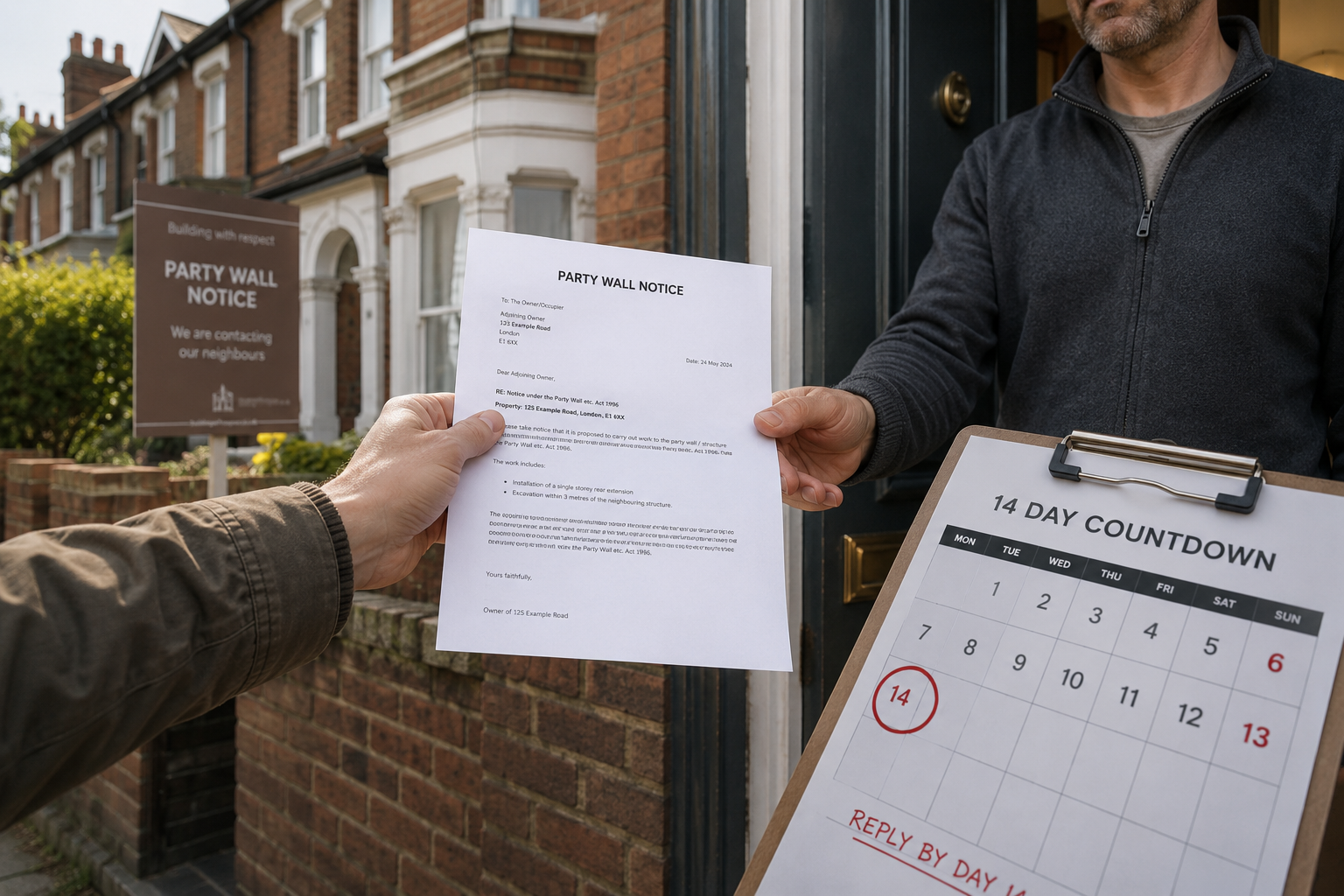
Before the 14-day clock even begins, the building owner must serve a valid party wall notice. This is a formal written document that informs the adjoining owner of the intended works, the proposed start date, and their rights under the Act. [2]
There are different types of notices depending on the nature of the works:
| Notice Type | Trigger | Notice Period Required |
|---|---|---|
| Party Structure Notice | Works to a shared wall or structure | 2 months before works |
| Line of Junction Notice | New wall on or at the boundary | 1 month before works |
| 3-Metre/6-Metre Notice | Excavations near neighbouring foundations | 1 month before works |
For a detailed breakdown of how to serve a Party Structure Notice correctly, see this guide on Party Structure Notices in London.
💡 Pull Quote: "A notice that is served incorrectly — wrong address, missing details, or insufficient notice period — is invalid. The 14-day countdown only starts from a valid service." [5]
Once served, the adjoining owner enters the 14-day response window. This is where most confusion and conflict begins.
The 14-Day Response Window Explained
The 14-day period is the pivotal stage in the journey from party wall notice to award. During this window, the adjoining owner has three choices:
✅ Option 1: Give Written Consent
The adjoining owner signs and returns a consent form. Works can proceed without a formal award. This is the fastest and most cost-effective outcome for both parties. [3]
❌ Option 2: Serve a Counter-Notice or Dissent
The adjoining owner formally disagrees with the proposed works or requests modifications. This triggers the surveyor appointment process. [5]
🔇 Option 3: Do Nothing (Deemed Dissent)
If the adjoining owner does not respond within 14 days, the Act treats this as automatic dissent. Many homeowners are unaware of this rule. Silence is not neutrality — it is a legal trigger. [3] [6]
⚠️ Important: Even if the neighbour simply loses the notice, goes on holiday, or is slow to respond, the deemed dissent mechanism kicks in automatically after 14 days.
This is one of the most commonly misunderstood aspects of the process. As outlined in guidance from the Faculty of Party Wall Surveyors, the 14-day rule exists to prevent indefinite delays to legitimate construction projects. [3]
For a comprehensive overview of party wall notices and how to respond, the process is clearly mapped out with practical steps for both building owners and adjoining owners.
What Happens After Dissent: The Surveyor Appointment Stage
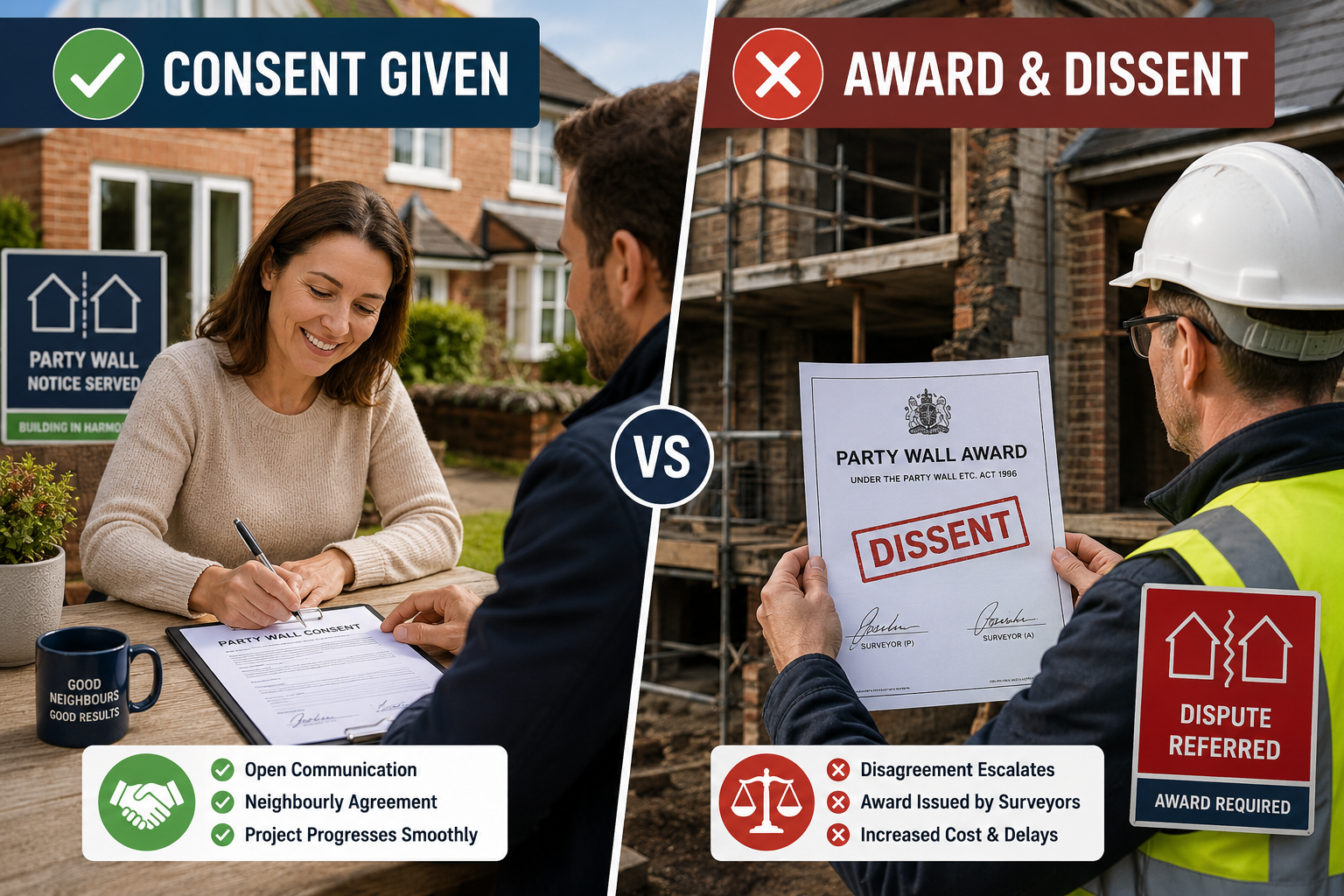
Once dissent is triggered — whether explicit or by default — the Act requires the appointment of surveyors. This is where the process formally transitions toward a Party Wall Award. [1]
Who Appoints the Surveyors?
There are two routes:
- Agreed Surveyor: Both parties agree on a single, independent surveyor who acts for both sides. This is often faster and cheaper.
- Two Surveyors: Each party appoints their own surveyor. If these two cannot agree, they appoint a Third Surveyor to adjudicate. [9]
The building owner typically bears the cost of the surveyor fees, including the adjoining owner's surveyor, unless the adjoining owner has been unreasonable in their dissent. [6]
For those concerned about managing expenses, this guide on keeping party wall costs down offers practical advice on minimising the financial impact of the surveyor process.
The Surveyor's Role
Surveyors are not advocates for either party — they are quasi-judicial officers acting under the statute. Their job is to:
- Inspect the site and assess the proposed works
- Review any objections raised by the adjoining owner
- Prepare a Schedule of Condition of the adjoining property before works begin
- Draft and issue the Party Wall Award [1] [8]
A Schedule of Condition is a photographic and written record of the adjoining property's pre-works state. It is critical evidence if a damage claim arises later.
The Party Wall Award: What It Is and What It Contains
The Party Wall Award is the legally binding document that governs how the works must be carried out. It is not a punishment — it is a framework that protects both the building owner and the adjoining owner. [1] [2]
Typical Contents of a Party Wall Award 📄
- Description of the permitted works and the extent of access rights
- Working hours (e.g., no work before 8am or after 6pm on weekdays)
- Method of construction and materials to be used
- Security for expenses — the adjoining owner may require a financial bond
- Rights of access for the surveyor to inspect ongoing works
- Dispute resolution provisions if damage occurs [1] [9]
💡 Pull Quote: "A Party Wall Award is not an obstacle to construction — it is the legal green light that allows works to proceed with certainty and protection for all parties." [2]
For a detailed look at what these documents contain, this Party Wall Award contract template guide provides a clear breakdown of the standard clauses.
How Long Does the Award Process Take?
| Stage | Typical Duration |
|---|---|
| Notice served | Day 0 |
| 14-day response window | Days 1–14 |
| Surveyor appointed after dissent | Days 15–21 |
| Site inspection and Schedule of Condition | Days 22–35 |
| Award drafted and issued | Days 36–60+ |
In straightforward cases, the full process from notice to award can take 6 to 10 weeks. Complex projects or uncooperative neighbours can extend this significantly. [8]
What Happens if Neighbors Ignore or Dissent in 2026: Legal Risks and Consequences
This is the section that building owners most urgently need to understand. The full picture of what happens if neighbors ignore or dissent in 2026 involves real legal exposure — for both sides.

If the Adjoining Owner Ignores the Notice
As established, ignoring the notice triggers deemed dissent. This means:
- Surveyors must be appointed
- The building owner cannot legally start notifiable works until an Award is in place
- If works begin without an Award, the building owner is acting outside the protection of the Act [5] [10]
If the Building Owner Ignores the Process Entirely
This is where the consequences become severe. A building owner who proceeds with notifiable works without serving a valid notice — or who starts before an Award is issued — faces:
- Court injunctions to stop works immediately, potentially mid-project
- Personal liability for all damage caused to the adjoining property
- Loss of the statutory right to access the neighbour's land
- Criminal liability in some circumstances under the Act [6] [10]
⚠️ Critical Warning: Courts have consistently upheld injunctions against building owners who bypass the party wall process. The cost of stopping a mid-project build — including contractor idle time, material delays, and legal fees — can far exceed the cost of compliance.
If the Adjoining Owner Dissents Unreasonably
Dissent is a legal right, but it cannot be used as a tool to block legitimate works indefinitely. The surveyor process exists precisely to resolve disputes fairly. An adjoining owner who refuses to engage or appoints a surveyor who acts obstructively may find that:
- The Third Surveyor adjudicates in favour of the building owner
- Costs are awarded against the unreasonable party [9]
For adjoining owners navigating this situation, the adjoining owners' section provides clear guidance on rights and obligations.
Appealing a Party Wall Award
Either party has the right to appeal a Party Wall Award to the County Court within 14 days of receiving it. This is a strict deadline. Appeals are relatively rare because the surveyor process is designed to be balanced, but they do occur when:
- The Award contains errors of law
- The surveyor has exceeded their jurisdiction
- Procedural irregularities have occurred [9] [10]
Appeals do not automatically suspend the Award — works may continue unless the court grants a stay.
Practical Steps for Building Owners in 2026
Given that the process from party wall notice to award can span several weeks, planning ahead is essential. Here is a practical checklist:
✅ Pre-Notice Checklist
- Identify all notifiable works (check the types of party wall works covered by the Act)
- Identify all adjoining owners who must be notified
- Serve notices with the correct notice periods (1 or 2 months depending on work type)
- Keep proof of service (recorded delivery, email confirmation, or personal delivery with witness)
✅ Post-Notice Checklist
- Diarise the 14-day response deadline for each adjoining owner
- If consent is received, keep the written record
- If dissent occurs (or 14 days pass without response), appoint a surveyor promptly
- Do not begin notifiable works until the Award is signed and issued
For building owners who want to understand their full obligations and rights, the building owners' guide is an essential starting point.
Can Parties Agree Without a Surveyor?
In some cases, yes. If the adjoining owner gives written consent within the 14-day window, no surveyor is required and no Award is needed. Works can proceed under the terms of the notice alone. [6]
However, even with consent, many building owners choose to obtain a Schedule of Condition to protect against future damage claims. This is strongly advisable for any works involving structural elements. [8]
For those considering whether to proceed without a surveyor, this guide on having a party wall agreement without a surveyor outlines when it is and is not appropriate.
Conclusion: Take the 14-Day Timeline Seriously in 2026
The journey from party wall notice to award: the 14-day timeline and what happens if neighbors ignore or dissent in 2026 is not a bureaucratic inconvenience — it is a structured legal process with real consequences for those who mishandle it.
Key actionable steps to take right now:
- Serve notices early. Factor the full notice-to-award timeline into project planning. Allow at least 10–12 weeks from notice to works starting in disputed cases.
- Never assume silence means consent. If no response arrives within 14 days, treat it as dissent and appoint a surveyor immediately.
- Do not start works without an Award in disputed cases. The legal and financial risks of proceeding without one far outweigh any time saved.
- Document everything. Keep copies of all notices, responses, and correspondence. A Schedule of Condition is essential protection.
- Seek professional advice early. A qualified party wall surveyor can prevent costly disputes before they arise.
The Party Wall etc. Act 1996 remains the governing framework in 2026, and it provides a clear, fair process for all parties. The only way to lose is to ignore it. [10]
References
[1] Understanding Party Wall Award Comprehensive Guide Novellosurveyors – https://www.linkedin.com/pulse/understanding-party-wall-award-comprehensive-guide-novellosurveyors-uuf0e
[2] Difference Between Party Wall Notices And Awards – https://www.partywallslimited.com/blog/difference-between-party-wall-notices-and-awards
[3] Simple Guide To Party Wall Notice Reply – https://fpws.uk/simple-guide-to-party-wall-notice-reply/
[4] Neighbour Sent A Party Wall Notice 17 Days Before – https://www.reddit.com/r/HousingUK/comments/1r7yno3/neighbour_sent_a_party_wall_notice_17_days_before/
[5] What Happens When You Are Served A Party Wall Notice – https://www.squarepointsurveyors.co.uk/blog/what-happens-when-you-are-served-a-party-wall-notice/
[6] Party Wall Agreement – https://hoa.org.uk/advice/guides-for-homeowners/i-am-improving/party-wall-agreement/
[7] Free Download Sample Party Wall Agreement Template Word – https://partywallsurveyorlondon.uk/blogs/free-download-sample-party-wall-agreement-template-word/
[8] Party Wall Surveys And Neighbour Disputes During 2026s Construction Uptick RICS Compliance Framework – https://nottinghillsurveyors.com/blog/party-wall-surveys-and-neighbour-disputes-during-2026s-construction-uptick-rics-compliance-framework
[9] Party Wall FAQs – https://jdmsurveyors.com/party-wall-faqs/
[10] Party Wall Act – https://www.designingbuildings.co.uk/wiki/Party%20Wall%20Act