

Nearly 60% of planning disputes involving loft and basement conversions in UK terraced and semi-detached properties trace back to a single root cause: party wall notices served too late, incorrectly, or not at all. In a stabilizing property market, that administrative gap costs homeowners weeks of delay, thousands in professional fees, and sometimes strained neighbour relationships that outlast the build itself. The 2026 Housing Recovery: Party Wall Strategies for Accelerated Loft and Basement Conversions framework presented in this article offers a sequenced, RICS-aligned approach to serving notices, securing awards, and keeping conversion projects on track from day one.
Key Takeaways
- The Party Wall etc. Act 1996 applies to the majority of loft and basement conversions in semi-detached and terraced properties, requiring formal notice before works begin.
- A correctly sequenced notice and award process can compress project timelines by several weeks compared to reactive or ad hoc approaches.
- Loft conversions cost between £35,000 and £70,000 in 2026 and take 8 to 14 weeks; delays caused by party wall disputes can add significant cost and time [1].
- Basement conversions carry additional complexity around underpinning, waterproofing, and structural loading, all of which trigger specific notice obligations.
- RICS-aligned checklists and early surveyor engagement are the most reliable tools for avoiding disputes and accelerating project delivery.
Why the 2026 Housing Market Makes Party Wall Compliance More Urgent Than Ever
The UK construction sector entered 2026 in a cautiously optimistic phase. After years of subdued activity driven by interest rate pressures and planning uncertainty, residential conversion activity is rising sharply. Urban homeowners, particularly in London and other major cities, are choosing to extend upward and downward rather than move, driven by stamp duty costs and limited stock. This surge in loft and basement conversion activity means that party wall surveyors are in higher demand, adjoining owners are more aware of their rights, and the window for informal, uncontested agreements is narrowing [3].
For building owners planning a conversion in 2026, this environment demands a more disciplined approach to the Party Wall etc. Act 1996 than was common in quieter market periods. Neighbours who might once have signed a consent letter without reading it closely are now more likely to appoint their own surveyor, request a schedule of condition, and scrutinize every aspect of the proposed works. That is not necessarily a problem — it is simply the new baseline, and preparing for it systematically is the fastest path to an uninterrupted build.
The Cost of Getting It Wrong
A missed or defective party wall notice does not just create a legal technicality. It can result in an injunction halting works mid-construction, which on a loft conversion project running at £35,000 to £70,000 represents a serious financial exposure [1]. Disputes that escalate to the Third Surveyor mechanism under the Act add surveyor fees from both sides, potential compensation payments, and delays that ripple through contractor schedules. The 2026 Housing Recovery: Party Wall Strategies for Accelerated Loft and Basement Conversions approach outlined here is designed specifically to prevent those outcomes.
Sequenced Party Wall Notices for Loft Conversions: A Step-by-Step Framework
The notice sequence for a loft conversion is not complicated, but it must be followed in the correct order and within the correct timeframes. Rushing or skipping steps is the primary cause of disputes.
Step 1: Identify Notifiable Works Early in the Design Phase
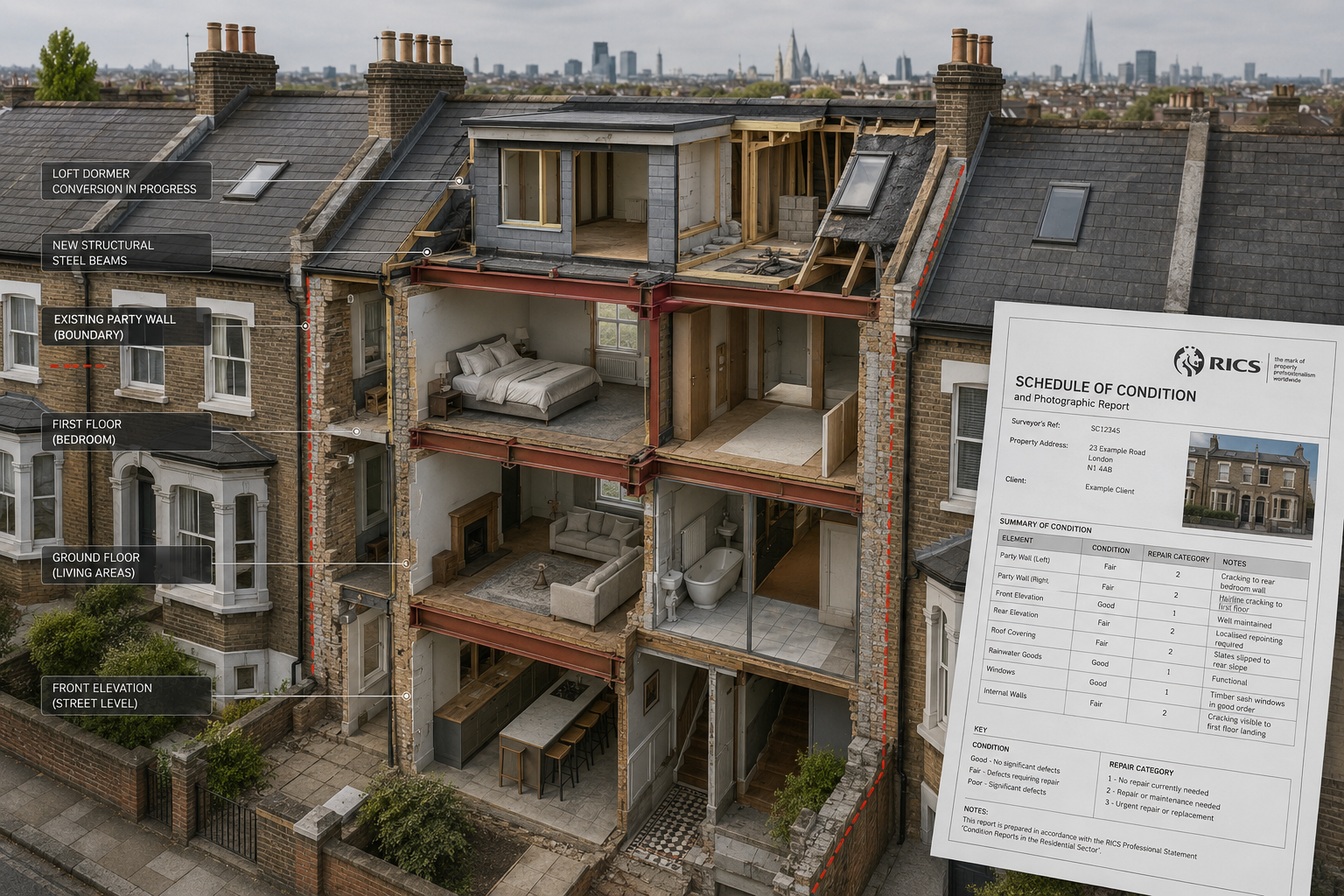
Before any structural drawings are finalized, the design team should audit which elements of the proposed loft conversion touch or affect shared structures. Common notifiable scenarios include [2]:
- Cutting into party walls to insert load-bearing steel beams or timber joists
- Raising the height of a party wall to increase ceiling height in the new loft space
- Altering the roof structure in ways that affect the adjoining property
- Adding dormer windows positioned close to or on the boundary line
- Strengthening party walls to carry additional structural loads
If any of these apply, a Party Structure Notice must be served. Understanding what a Party Structure Notice is and how to serve it is the essential first step for any building owner in London or across the UK.
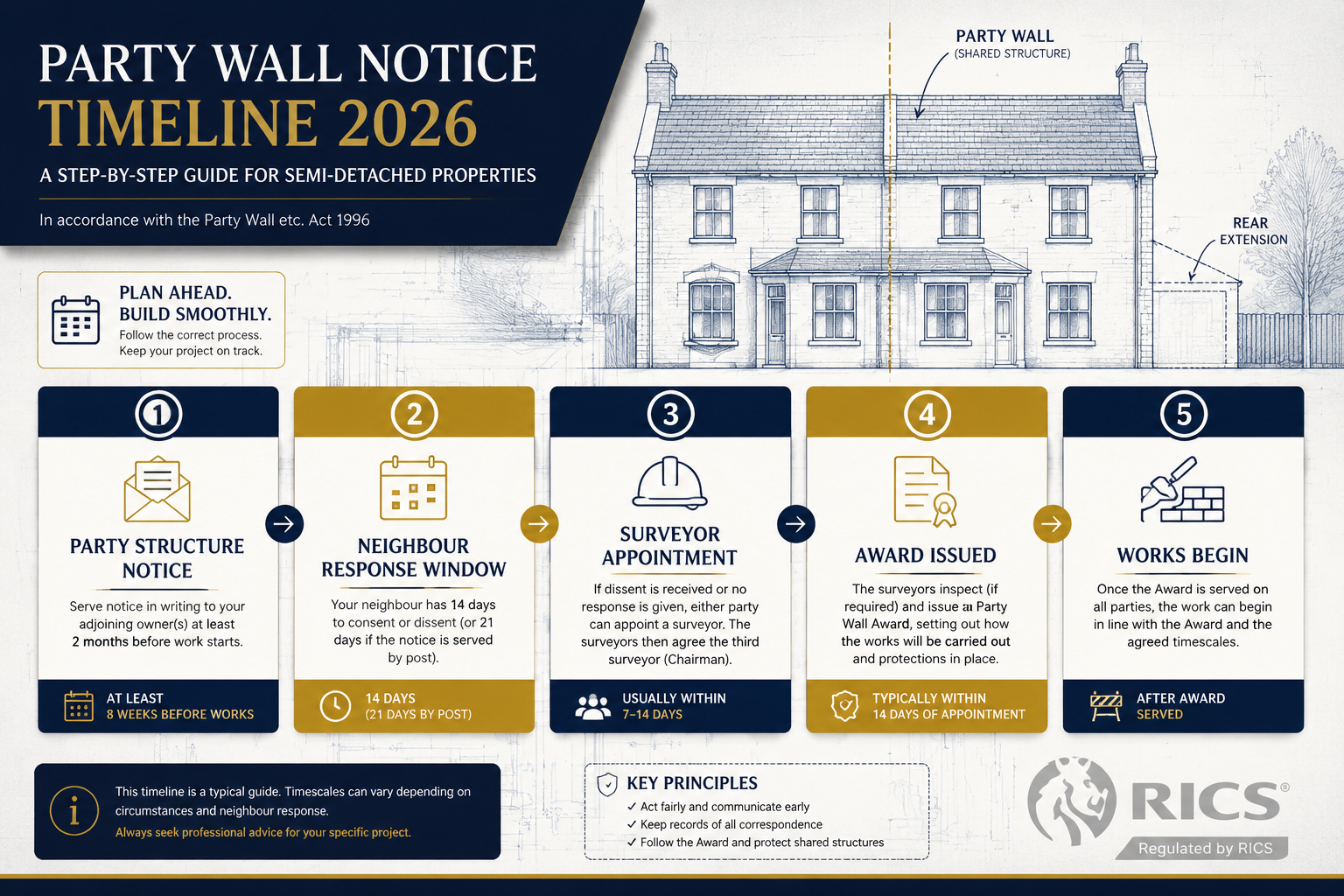
Step 2: Serve Notice at Least Two Months Before Works Begin
The Party Wall etc. Act 1996 requires a minimum two-month notice period for party structure works. This is non-negotiable. Serving notice on the day a contractor is due to start is not compliance — it is a dispute waiting to happen [2].
Best practice in 2026: Serve notice at the earliest possible stage, ideally three to four months before the planned start date. This buffer accommodates:
- The statutory response window (14 days for the adjoining owner to consent or dissent)
- Surveyor appointment and negotiation time if the neighbour dissents
- Preparation and agreement of the Party Wall Award
- Any schedule of condition surveys required before works begin
A schedule of condition is a photographic and written record of the adjoining property's state before works commence. It protects both parties and is strongly recommended even when not strictly required.
Step 3: Respond Correctly to Consent or Dissent
If the adjoining owner consents in writing within 14 days, works may proceed without a formal award, provided the consent is unconditional. Document this carefully.
If the adjoining owner dissents or fails to respond within 14 days, a dispute is deemed to have arisen and surveyors must be appointed. The building owner and adjoining owner each appoint a surveyor, or both may agree to appoint a single Agreed Surveyor. The surveyors then prepare a Party Wall Award — a legally binding document setting out the manner and conditions under which works may proceed [7].
"A well-drafted Party Wall Award is not a bureaucratic obstacle — it is the instrument that allows works to proceed with legal certainty for both sides."
Step 4: Execute Works Strictly Within Award Conditions
Once the award is in place, works must be carried out in strict accordance with its terms. Any deviation — changing beam positions, altering working hours, modifying the structural approach — requires a supplementary award. Building owners who treat the award as a formality rather than a binding document risk injunctions and compensation claims.
Party Wall Strategies for Basement Conversions: Underpinning, Notices, and Waterproofing
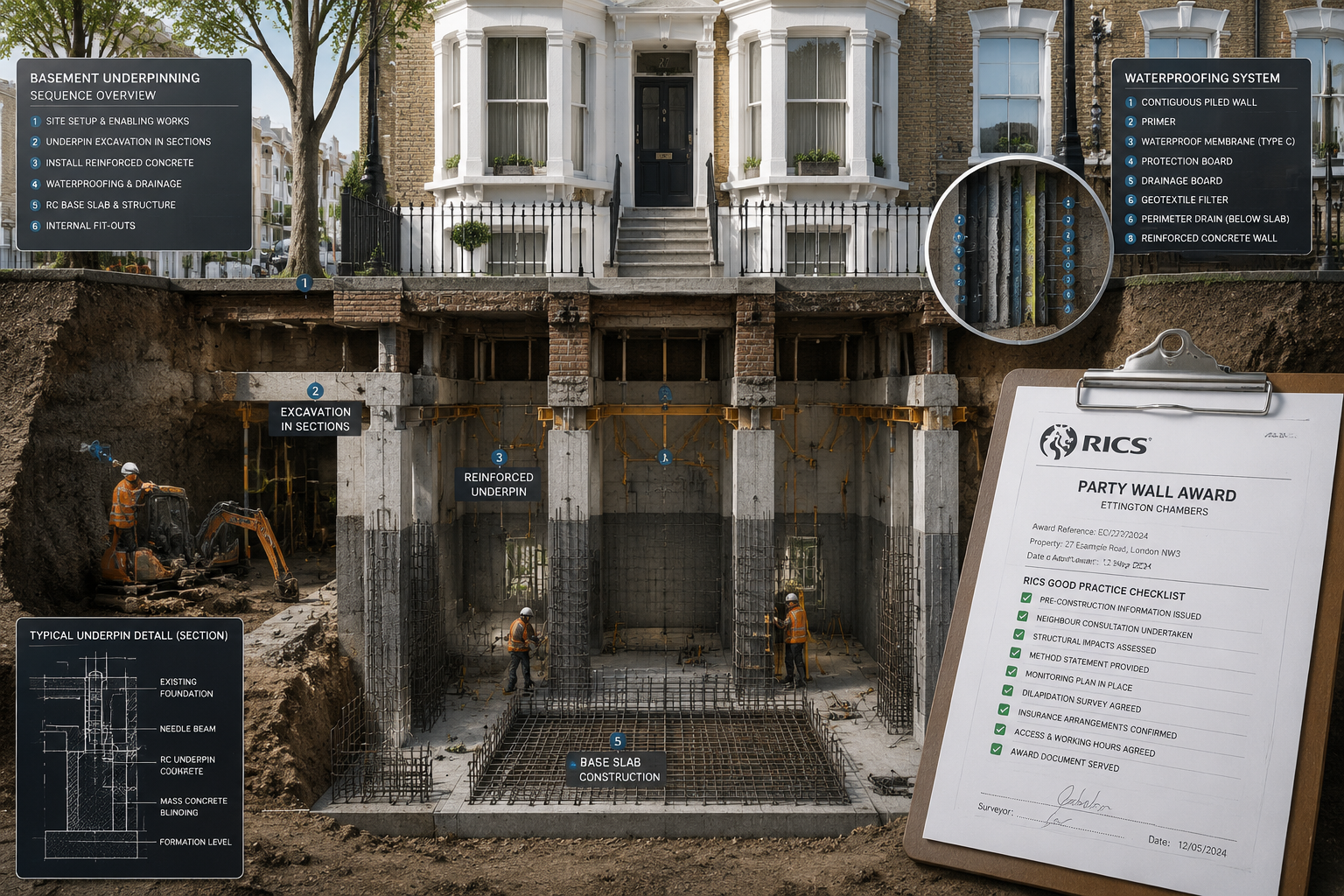
Basement conversions present a more complex party wall picture than loft works. The combination of excavation, underpinning, and waterproofing introduces risks to adjoining foundations that require careful management and, in most cases, a robust Party Wall Award before a single shovel breaks ground [5].
Why Basement Works Trigger More Scrutiny
In 2026, rising urban demand for basement conversions — particularly in inner London boroughs — has led to heightened RICS scrutiny of the notice and award process [6]. The reasons are structural: excavating adjacent to a shared foundation or party wall can cause settlement, cracking, and water ingress in the adjoining property. These are not theoretical risks; they are documented outcomes when works are poorly managed.
The relevant notice for basement works is typically a Line of Junction Notice or a Party Structure Notice, depending on whether excavation occurs within three or six metres of the adjoining owner's foundations (under Section 6 of the Act). Understanding the types of party wall works that apply to basement projects is essential before any design is finalized.
RICS-Aligned Checklist for Basement Conversions in 2026
The following checklist reflects current RICS protocols and the heightened standards expected in the 2026 construction recovery environment [6]:
| Stage | Action Required | Timing |
|---|---|---|
| Design | Identify proximity of excavation to adjoining foundations | Before structural drawings |
| Pre-Notice | Commission geotechnical survey if required | 10-12 weeks before start |
| Notice | Serve Section 6 Notice (excavation within 3m or 6m) | Minimum 1 month before works |
| Dissent/Award | Appoint surveyors; prepare award with method statement | Within statutory period |
| Pre-Works | Complete schedule of condition survey | Before any excavation |
| During Works | Monitoring regime for settlement and vibration | Ongoing |
| Post-Works | Final inspection and sign-off | On completion |
Waterproofing Disputes: A Growing Issue in 2026
One of the emerging pressure points in basement conversion party wall awards is waterproofing. Where a basement conversion involves tanking or membrane systems that abut or rely on the party wall, disputes can arise about responsibility for future water ingress [5]. The Party Wall Award should explicitly address:
- The waterproofing specification and its relationship to the party wall
- Responsibility for maintenance of waterproofing systems at the boundary
- Remediation obligations if water ingress occurs post-completion
Building owners who work with an experienced building owner's surveyor will find that these provisions are standard in well-drafted awards. Adjoining owners who are uncertain about their rights should engage an adjoining owner's surveyor at the earliest opportunity.
Designing to Minimize Party Wall Involvement: Smart Strategies for 2026
Not every loft or basement conversion needs to trigger a full party wall dispute process. Thoughtful design can reduce or eliminate the need for formal awards, saving time and cost without compromising the quality or scale of the project [4].
Loft Conversion Design Strategies
- Self-supporting structural systems: Steel frames or engineered timber systems designed to transfer all loads to external walls, avoiding any reliance on the party wall, can remove the need for a Party Structure Notice entirely.
- Rooflight (Velux) conversions: Where the existing roof structure is adequate, a rooflight conversion that does not alter the party wall, raise its height, or insert new beams into it may fall outside the Act's scope entirely [4].
- Boundary-clear dormer positioning: Positioning dormers well clear of the boundary line avoids triggering notice obligations related to structures near the boundary.
Basement Design Strategies
- Shallow basement designs: Where floor-to-ceiling height requirements allow, a shallower excavation may keep the works outside the six-metre proximity threshold for Section 6 notices.
- Piled retaining walls: Using contiguous or secant piled walls rather than traditional mass concrete underpinning can reduce lateral pressure on adjoining foundations and simplify the award process.
Even where design optimization reduces the formal notice burden, it is always advisable to inform neighbours early and maintain open communication. A neighbour who feels informed and respected is far less likely to dissent or appoint a surveyor than one who receives a formal legal notice without any prior conversation.
The 2026 Housing Recovery: Party Wall Strategies for Accelerated Loft and Basement Conversions in Practice
Pulling together the sequenced approach described above, the following practical framework applies to semi-detached and terraced properties undertaking either a loft or basement conversion in 2026.
Pre-Application Phase (12+ Weeks Before Start)
- Appoint a structural engineer and confirm which works are notifiable
- Engage a party wall surveyor for early advice — not just for serving notices, but for design input that may reduce the notice burden
- Review the costs of the party wall process to budget accurately
- Consider whether keeping party wall costs down through an Agreed Surveyor approach is viable given the relationship with the adjoining owner
Notice Phase (8-10 Weeks Before Start)
- Serve all required notices simultaneously where multiple notice types apply
- Use formally compliant notice templates — a party wall notice guide provides the required content and format
- Retain proof of service (recorded delivery or personal service with a witness)
- Follow up informally with neighbours to encourage timely response
Award Phase (4-8 Weeks Before Start)
- If dissent is received, appoint surveyors promptly — delays in appointment extend the timeline
- Provide the surveyor with full structural drawings, method statements, and working hour proposals
- Agree the schedule of condition survey date and ensure it is completed before any works begin
- Review the draft award carefully before signing — a guide to party wall awards explains the key provisions to check
Construction Phase
- Brief the contractor on award conditions before works begin
- Keep a site diary documenting compliance with working hours, noise controls, and structural method
- Report any unexpected conditions (e.g., undiscovered shared foundations, unexpected wall construction) to the surveyor immediately
- Maintain the monitoring regime specified in the award for basement works
Conclusion: Accelerating Conversions Through Process Discipline
The 2026 Housing Recovery: Party Wall Strategies for Accelerated Loft and Basement Conversions framework is, at its core, a discipline of sequencing and timing. The homeowners and developers who complete loft and basement conversions fastest in 2026 will not be those who cut corners on party wall compliance — they will be those who front-load the process, serve notices early, engage surveyors proactively, and treat the award as an enabling document rather than an obstacle.
Actionable next steps for building owners:
- Audit your design drawings against the Party Wall etc. Act 1996 notifiable works list before finalizing any structural approach.
- Serve party wall notices a minimum of three months before your planned start date to build in adequate buffer.
- Engage a RICS-accredited party wall surveyor for early design-stage advice, not just notice service.
- Budget for a schedule of condition survey as a standard project cost, not an optional extra.
- Communicate with neighbours before serving formal notices — early goodwill reduces the likelihood of dissent and surveyor appointments.
For adjoining owners who have received a notice and are uncertain about their rights and options, independent guidance from a qualified adjoining owner's surveyor is the most reliable first step.
The party wall process, managed well, is not a barrier to conversion projects — it is the legal framework that makes them possible without neighbour disputes, injunctions, or construction stoppages. In a recovering market where every week of delay has a measurable cost, getting that process right from the start is one of the highest-value investments a building owner can make.
References
[1] How To Plan A Loft Conversion Step By Step 2026 Uk – https://www.bestbuilders.co.uk/guides/how-to/how-to-plan-a-loft-conversion-step-by-step-2026-uk?utm_source=openai
[2] Loft Conversions And The Party Wall Act – https://www.peterbarry.co.uk/blog/loft-conversions-and-the-party-wall-act/?utm_source=openai
[3] Party Wall Surveys And The 2026 Construction Recovery Preparing For Increased Development Activity – https://wimbledonsurveyors.com/party-wall-surveys-and-the-2026-construction-recovery-preparing-for-increased-development-activity/?utm_source=openai
[4] Loft Conversion Without Party Wall Hassle Smart Legal And Neighbour Friendly Ways To Build In 2026 – https://nfadesignandbuild.com/loft-conversion-without-party-wall-hassle-smart-legal-and-neighbour-friendly-ways-to-build-in-2026?utm_source=openai
[5] Party Wall Awards For Basement Conversions In 2026 Underpinning Notices And Waterproofing Disputes – https://www.canterburysurveyors.com/blog/party-wall-awards-for-basement-conversions-in-2026-underpinning-notices-and-waterproofing-disputes/?utm_source=openai
[6] Party Wall Surveys For Basement Conversions In 2026 Rics Protocols Amid Rising Urban Demand – https://princesurveyors.co.uk/blog/party-wall-surveys-for-basement-conversions-in-2026-rics-protocols-amid-rising-urban-demand/?utm_source=openai
[7] Party Wall Awards For Loft Conversions Enforcing Security Deposits And Cross Over Joists In 2026 Projects – https://kingstonsurveyors.com/party-wall-awards-for-loft-conversions-enforcing-security-deposits-and-cross-over-joists-in-2026-projects/?utm_source=openai
[8] The Ultimate Guide To Loft Conversions – https://www.buildteam.com/blog/the-ultimate-guide-to-loft-conversions/?utm_source=openai