


Over 60% of party wall disputes in London involve mixed-use buildings, where a ground-floor shop sits directly beneath residential flats — yet the specific legal and practical complexities of these commercial-residential boundaries remain poorly understood by many property owners. Navigating Party Wall Agreements in Mixed-Use Properties: Surveyor Strategies for Commercial-Residential Boundaries demands a sharper toolkit than standard residential work. The Party Wall etc. Act 1996 applies uniformly, but the real-world challenges — differing usage patterns, noise sensitivity, access conflicts, and the 2026 leasehold reform landscape — require surveyors to go well beyond the basics.
This article sets out the key strategies surveyors and property owners need to understand when managing party wall matters at the intersection of commercial and residential use.
Key Takeaways
- Mixed-use buildings create layered party wall obligations because commercial and residential owners have fundamentally different risk profiles and legal interests.
- Serving the correct notices — and serving them on the right parties — is more complex when leasehold reform changes the consent chain.
- Schedules of condition are especially critical in mixed-use settings due to the higher potential for disputed damage claims.
- Reciprocal easement agreements and boundary line agreements often run alongside party wall awards and must be coordinated carefully.
- 2026 legislative changes have increased scrutiny on landlord-initiated works affecting tenanted properties, raising the documentation standard for surveyors.
Why Mixed-Use Buildings Create Unique Party Wall Challenges
A standard semi-detached house shares a wall with one neighbour of the same property type. A mixed-use building shares walls — and often floors and ceilings — with parties whose daily activities could not be more different. A restaurant kitchen operating until midnight sits below a bedroom. A retail unit undergoing a refit shares a structural wall with a family home above.
These differences matter enormously under the Party Wall etc. Act 1996. The Act draws no distinction between commercial and residential use when defining notifiable works. What changes is the practical complexity of applying its procedures.
Key differences in mixed-use settings include:
- Multiple ownership interests — freehold, long leasehold, and short-term commercial tenancies may all coexist in the same building.
- Divergent sensitivity to disruption — a commercial tenant may tolerate daytime noise; a residential leaseholder above cannot.
- Different insurance frameworks — commercial and residential policies must be coordinated to avoid coverage gaps, particularly in shared spaces like lobbies and stairwells [3].
- Varied regulatory requirements — prior approval conditions for Class MA conversions (commercial to residential) require noise, contamination, and natural light assessments that directly intersect with party wall works [1].
Understanding the types of party wall works that trigger obligations is the essential starting point for any surveyor approaching a mixed-use site.
Serving Party Wall Notices in Mixed-Use Properties: Who Gets Served?
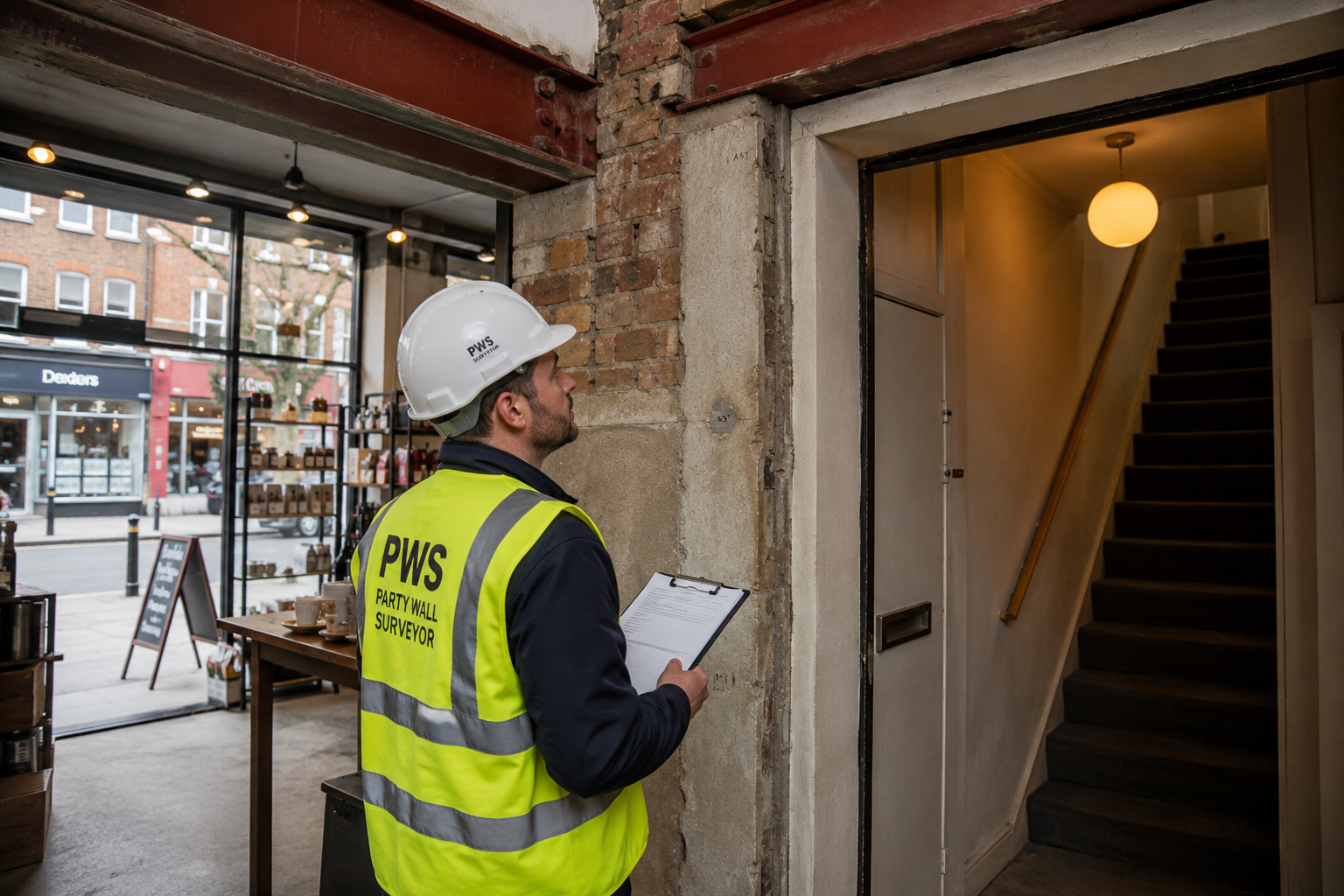
One of the most common errors in mixed-use party wall matters is serving notice on the wrong party — or failing to serve all the right parties. The Act requires notice to be served on every adjoining owner, which is defined as anyone with a freehold or leasehold interest of more than one year.
In a mixed-use building, this can mean:
| Party | Interest Type | Must Be Served? |
|---|---|---|
| Freeholder of adjacent building | Freehold | Yes |
| Long leaseholder of residential flat | Leasehold (typically 99+ years) | Yes |
| Commercial tenant on long lease | Leasehold (over 1 year) | Yes |
| Short-term retail tenant | Licence or short lease | No |
This distinction matters significantly in 2026. The Leasehold and Freehold Reform Act 2024, now fully embedded in practice, has altered the consent chain for works affecting leasehold-held properties. Leaseholders have stronger rights to challenge works that affect their demise, and surveyors must account for this when advising building owners. In practical terms, a building owner proposing to raise a party wall above a commercial unit must now ensure that residential leaseholders above — who may have acquired enhanced rights under the reform — are properly notified and their surveyors engaged.
For a clear explanation of the different notice types and when each applies, the Party Wall Act Notices guide provides a useful reference point.
The Party Structure Notice in Mixed-Use Contexts
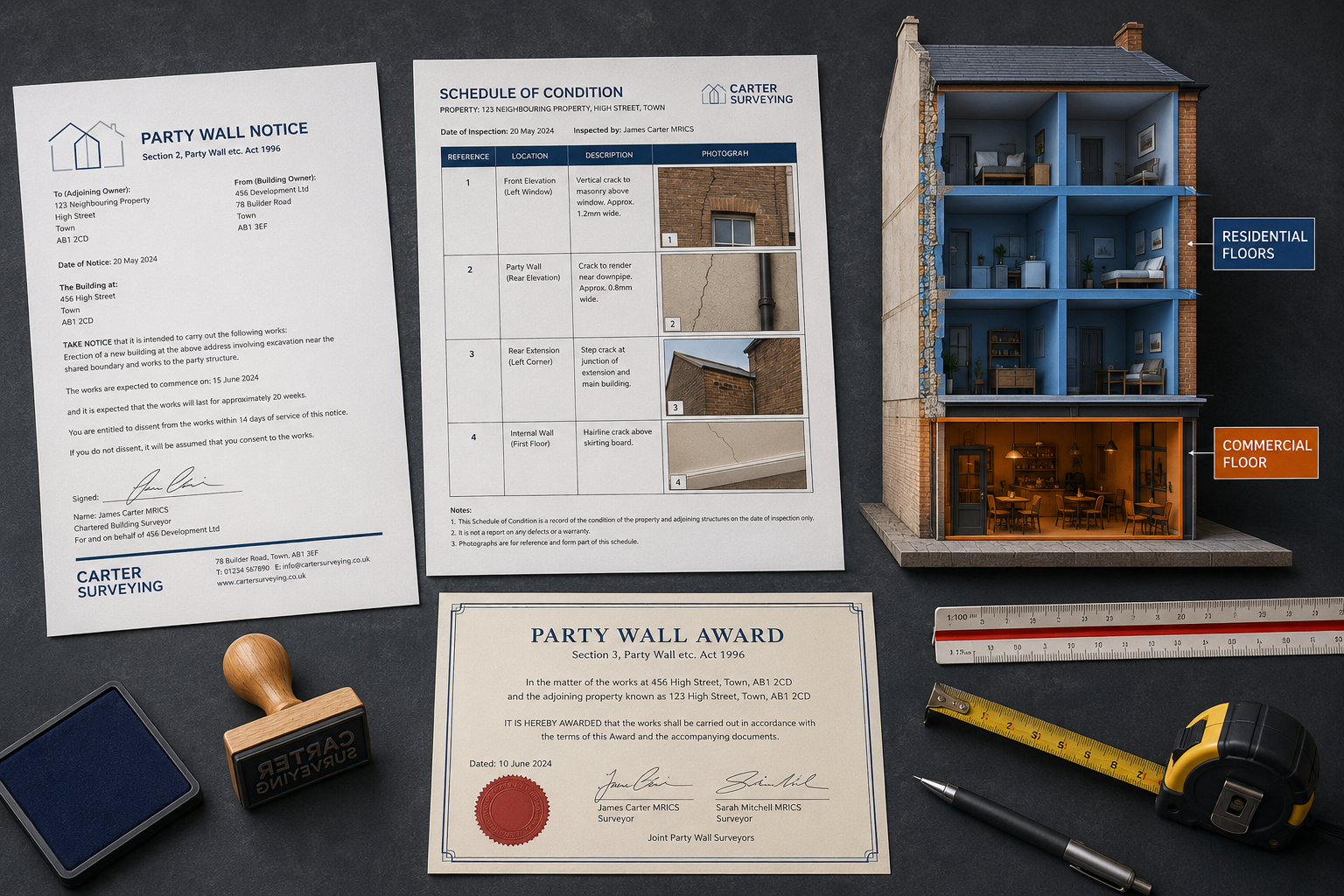
When works involve cutting into, raising, or underpinning a party structure — which in a mixed-use building often means the floor/ceiling separating the commercial ground floor from the flat above — a Party Structure Notice is required. This must be served at least two months before works begin.
The critical point for mixed-use buildings: the floor separating a shop from the flat above is a party structure under the Act. Works to that floor — whether for soundproofing, structural reinforcement, or conversion — trigger the full notice and award procedure.
Surveyor Strategies for Commercial-Residential Boundaries: Notices, Awards, and Risk Management
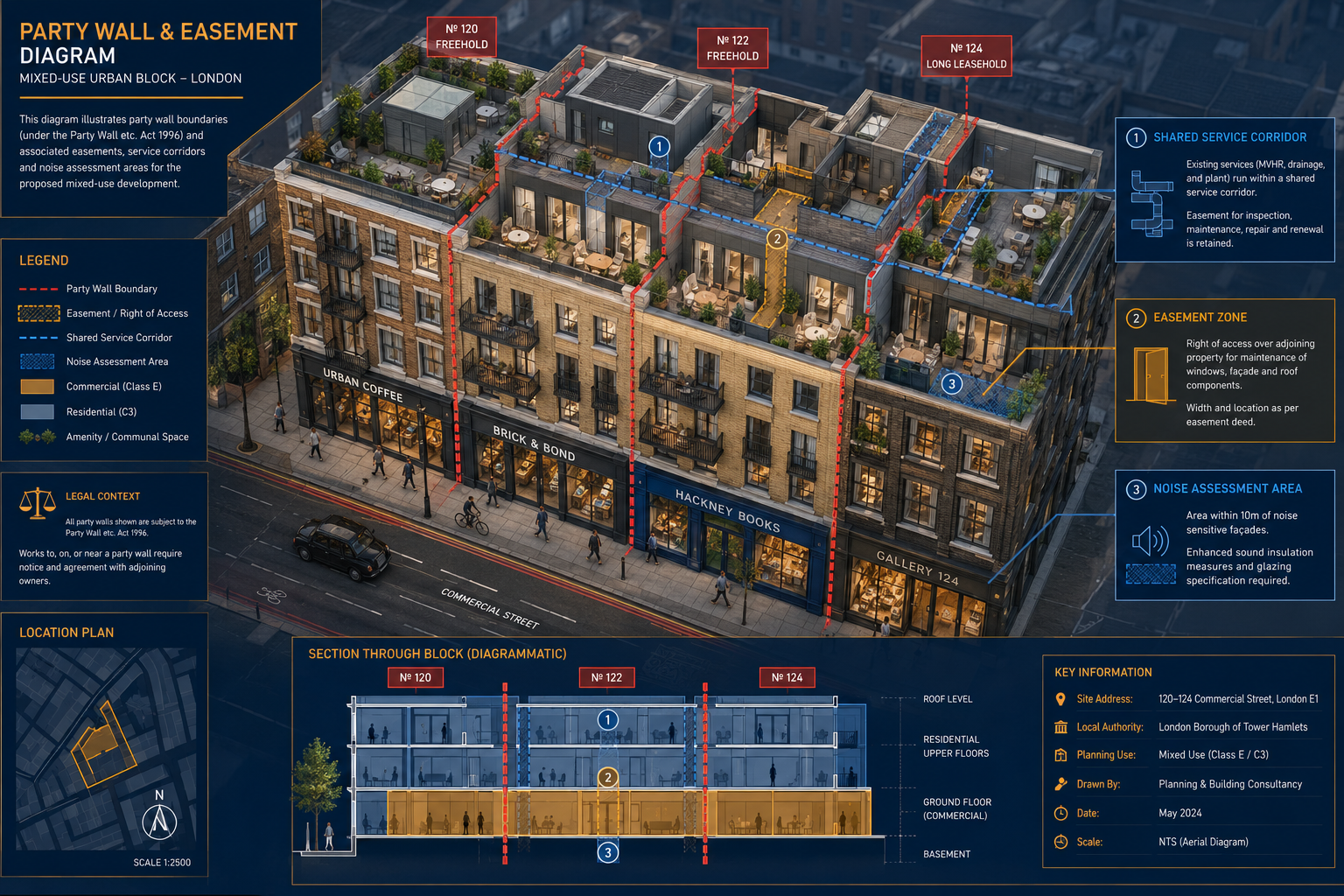
Effective management of Party Wall Agreements in Mixed-Use Properties: Surveyor Strategies for Commercial-Residential Boundaries requires surveyors to adopt a more layered approach than they would in a purely residential context. The following strategies reflect best practice in 2026.
Strategy 1: Conduct a Thorough Schedule of Condition Before Works Begin
In mixed-use buildings, the risk of disputed damage claims is elevated. A commercial tenant may claim business interruption losses; a residential leaseholder may claim for damage to finishes or structural elements. A detailed schedule of condition — photographic and written — covering both the commercial and residential portions of the adjoining property is essential.
2026 legislative changes have specifically heightened the documentation standard for landlord-initiated works affecting tenanted properties. Enhanced communication protocols with tenants and clear records of noise, dust, and access limitations are now expected as part of the surveyor's duty [1].
Strategy 2: Draft Awards That Address Differing Usage Risks
A party wall award in a mixed-use context must go beyond the standard working hours and method statement. It should specifically address:
- Noise thresholds — distinguishing between acceptable noise levels during commercial operating hours versus residential quiet hours.
- Access arrangements — commercial units often have delivery windows, customer-facing hours, and service corridors that must not be disrupted without prior notice.
- Vibration limits — particularly relevant where works involve drilling or underpinning near a restaurant kitchen or retail floor.
- Dust and contamination controls — critical where residential occupiers are present above an active construction zone.
"The award is not merely a permission slip — in a mixed-use building, it is the primary document managing the coexistence of two fundamentally different property uses during a period of construction stress."
For guidance on what a well-drafted award should contain, the party wall contract template guide is a practical resource.
Strategy 3: Coordinate with Reciprocal Easement Agreements
Many mixed-use buildings operate under Reciprocal Easement Agreements (REAs) — legal documents that grant each party specific rights to use portions of another party's property, governing shared corridors, loading docks, parking areas, and utility lines [3]. These agreements run with the land and bind future owners.
A party wall award that ignores an existing REA can create immediate conflict. For example, if an REA grants the commercial tenant a right of access through a shared corridor, and the party wall works temporarily block that corridor, the building owner may face a breach of the REA alongside any party wall dispute.
Surveyors should request copies of all REAs at the outset and ensure the award's working method statement is compatible with existing easement rights.
Strategy 4: Account for Prior Approval Conditions in Conversion Projects
Where the works involve a commercial-to-residential conversion under Class MA permitted development, party wall works directly intersect with prior approval conditions. Noise assessments, contamination surveys, and natural light evaluations required for prior approval can all be affected by how party wall works are carried out [1].
Surveyors advising on these projects should liaise with the planning consultant to ensure the party wall award does not inadvertently undermine a prior approval condition — for example, by specifying works that affect the natural light reaching a proposed residential unit.
Boundary Disputes and Easements at Commercial-Residential Interfaces
Mixed-use developments frequently sit on sites with complex boundary histories. Retail units may have been extended into rear yards; upper-floor residential additions may have been built without precise boundary surveys. When party wall works reveal a discrepancy between the assumed and actual boundary, the surveyor must be prepared to advise on resolution.
Boundary line agreements provide a permanent, legally recognised resolution when surveys reveal conflicts between neighbouring properties. These agreements involve mutual acceptance of a new property line, often based on existing improvements, and are recorded to establish the new boundary legally [4]. In a mixed-use context, this is particularly relevant where a commercial unit's rear wall and a residential property's garden boundary are in dispute.
Easements add another layer of complexity. An easement can restrict development, access, and operations on commercial sites by granting others rights to use specific parts of the property [7]. A surveyor who identifies an easement that limits the scope of proposed party wall works must flag this clearly in the award and advise the building owner accordingly.
For a clear explanation of the distinction between different types of shared boundaries, the guide on boundary wall rules is a useful reference.
Managing Neighbour Disputes in Mixed-Use Settings
Neighbour disputes in mixed-use buildings are qualitatively different from those in purely residential streets. Commercial tenants may have contractual rights against their landlord if works affect their trade. Residential leaseholders may have service charge implications if shared structural elements are damaged. The surveyor's role as a quasi-judicial officer under the Act requires particular care when these competing interests collide [2].
Practical steps to reduce dispute risk include:
- Holding a pre-works meeting with all affected parties — commercial and residential — before serving notices.
- Providing a clear written timeline of works with specific milestones communicated to each party.
- Appointing an agreed surveyor where possible to reduce costs and streamline the award process.
- Ensuring the award contains a clear dispute resolution mechanism for works-related complaints.
For those considering whether to proceed without professional involvement, the guide on having a party wall agreement without a surveyor sets out the risks — risks that are substantially higher in mixed-use settings than in standard residential cases.
Cost Management and the 2026 Legislative Context
The costs of party wall work and the process in mixed-use buildings tend to be higher than in residential-only settings, reflecting the greater complexity of the award and the schedule of condition. Building owners should budget for:
- Separate schedule of condition surveys for commercial and residential portions.
- Additional surveyor time for coordinating with REA holders and easement beneficiaries.
- Potential costs associated with enhanced tenant communication protocols now required under 2026 legislative changes [1].
- Insurance review costs to ensure commercial and residential policies are properly aligned during the works period [3].
Cost segregation principles — allocating building components between residential and commercial portions — are also relevant when apportioning party wall costs in buildings with shared structural systems [5]. Where a roof or HVAC system serves both the commercial and residential portions, the surveyor's award should specify how repair or reinstatement costs are allocated proportionally.
Strategies to keep costs manageable include:
- Instructing a single agreed surveyor where all parties consent.
- Combining the schedule of condition for multiple adjoining owners into a single site visit.
- Serving notices early to avoid the compressed timelines that drive up professional fees.
- Reviewing the tips on keeping party wall costs down before engaging surveyors.
Conclusion: Actionable Steps for Surveyors and Property Owners in 2026
Party Wall Agreements in Mixed-Use Properties: Surveyor Strategies for Commercial-Residential Boundaries represent one of the most technically demanding areas of party wall practice. The coexistence of commercial and residential interests in a single building — each with different legal rights, risk tolerances, and regulatory obligations — demands a more rigorous approach than standard residential work.
Actionable next steps for building owners and surveyors:
- Identify all adjoining owners early — including long leaseholders of residential flats and commercial tenants on leases exceeding one year. Post-leasehold reform, this list may be longer than expected.
- Serve the correct notice type — a Party Structure Notice for works to the floor/ceiling separating commercial and residential uses; a Line of Junction Notice for new walls at boundaries.
- Commission a comprehensive schedule of condition covering both commercial and residential portions before any works begin.
- Draft awards that specifically address commercial-residential risk differences — noise, access, vibration, and dust controls tailored to each use.
- Check for REAs and easements before finalising the working method statement in the award.
- Coordinate with planning consultants on Class MA conversion projects to ensure party wall works do not undermine prior approval conditions.
- Budget for enhanced documentation in line with 2026 legislative expectations for landlord-initiated works affecting tenanted properties.
For property owners and surveyors working across London, specialist support is available from party wall surveyors in Central London, East London, and South London, all of whom bring direct experience of the mixed-use building stock that characterises these areas.
The Act provides the framework. Expert surveyor strategy — adapted to the specific commercial-residential boundary in question — provides the protection.
References
[1] Party Wall Surveys For Commercial To Residential Conversions Managing Structural Complexity And Neighbour Disputes – https://nottinghillsurveyors.com/blog/party-wall-surveys-for-commercial-to-residential-conversions-managing-structural-complexity-and-neighbour-disputes?utm_source=openai
[2] Party Wall Surveys For Mixed Use Developments Tackling Zoning And Neighbour Disputes In 2026 Urban Revivals – https://nottinghillsurveyors.com/blog/party-wall-surveys-for-mixed-use-developments-tackling-zoning-and-neighbour-disputes-in-2026-urban-revivals?utm_source=openai
[3] Mixed Use Development Law Zoning Permits And Key Rules – https://legalclarity.org/mixed-use-development-law-zoning-permits-and-key-rules/?utm_source=openai
[4] Boundary Line Agreement – https://cplandsurveying.com/services/boundary-line-agreement/?utm_source=openai
[5] Cost Segregation Mixed Use Property – https://costsegsmart.com/blog/cost-segregation-mixed-use-property?utm_source=openai
[6] Mixed Use Commercial Property Challenges Strategies – https://drk-realty.com/resources/blog/mixed-use-commercial-property-challenges-strategies?utm_source=openai
[7] Can Easements Limit How You Use Commercial Property In Arizona – https://www.fjslegal.com/blog/2026/06/can-easements-limit-how-you-use-commercial-property-in-arizona/?utm_source=openai