


{"cover":"Professional landscape format (1536×1024) hero image with bold text overlay: 'Three Surveyor Model in Party Wall Disputes: Triggering the Independent Decider in 2026', extra large 72pt white bold sans-serif font with dark semi-transparent overlay box, centered upper-third composition. Background shows two professional surveyors in hard hats standing on either side of a brick party wall in an urban London setting, with a third neutral figure in the background holding documents. Color scheme: deep navy blue, white, and gold accents. High contrast, magazine cover aesthetic, editorial quality, dramatic lighting.","content":["Detailed landscape format (1536×1024) editorial illustration showing a formal diagram of the Three Surveyor Model: three figures arranged in a triangle formation, two on the left and right representing appointed surveyors with briefcases, and one elevated central figure labeled 'Third Surveyor' holding a gavel and legal documents. Background shows a cross-section of a London terraced house with a party wall highlighted in red. Clean infographic style with navy and gold color palette, labeled arrows showing referral pathways, professional architectural drafting aesthetic.","Landscape format (1536×1024) close-up overhead shot of a professional desk scene showing a party wall dispute referral letter, a stopwatch indicating the 14-day appeal window, a cost breakdown sheet with figures ranging from £1,750 to £37,500, a pen, and a copy of the Party Wall etc. Act 1996. Warm professional lighting, dark wood desk surface, crisp document typography visible, selective focus on the referral letter, legal and financial advisory aesthetic, editorial quality.","Landscape format (1536×1024) wide-angle shot of a formal meeting room where three surveyors sit around a conference table reviewing architectural drawings and party wall award documents. One surveyor at the head of the table represents the Third Surveyor in a neutral role. Floor-to-ceiling windows show a London skyline with construction cranes in the background. Professional attire, neutral color palette of grey and white with blue accents, documents and laptops visible, conveying resolution and authority, editorial quality."]
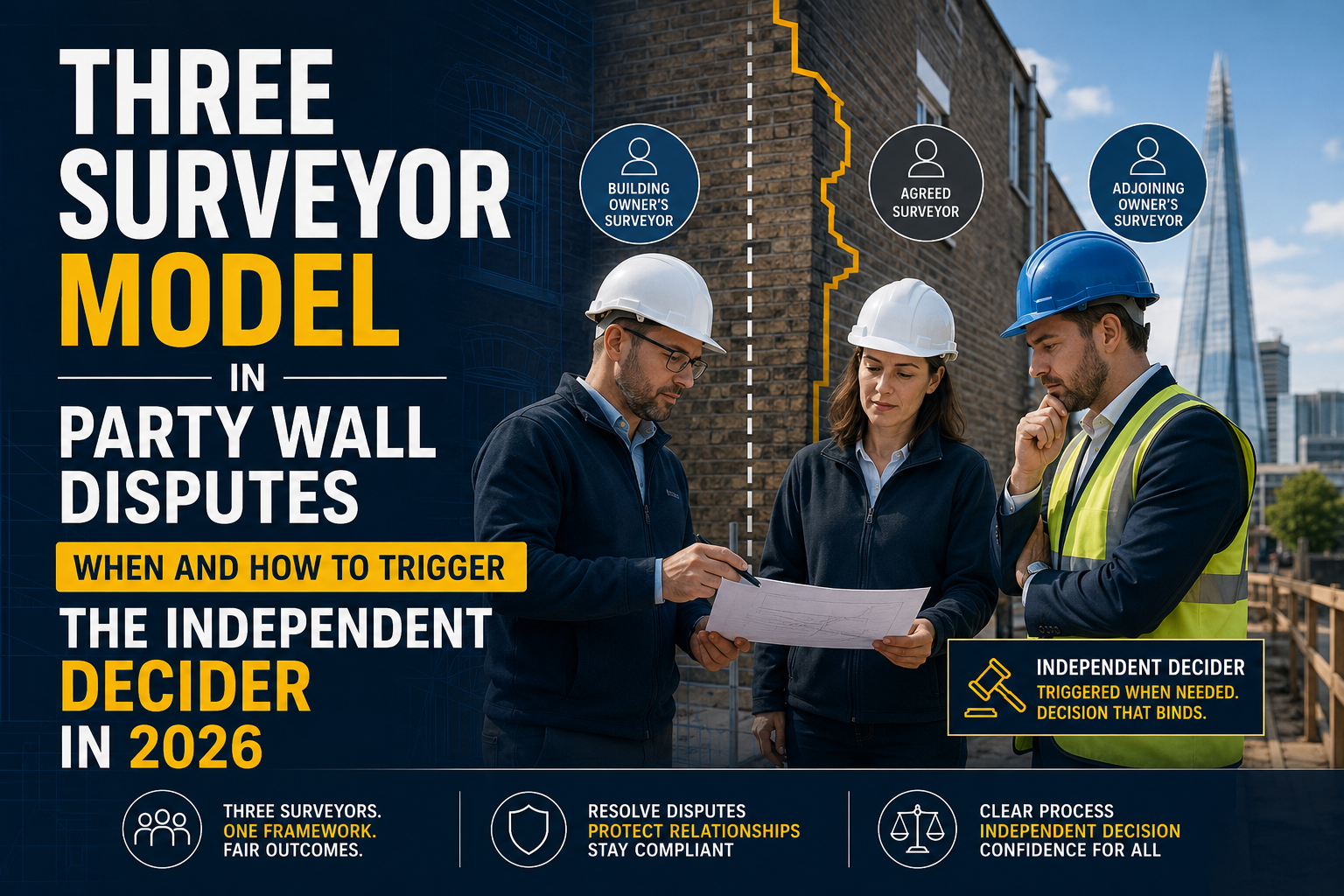
Party wall disputes in the UK have surged by 40% in 2026 compared to the previous year, driven largely by a construction boom in urban areas [3]. When two appointed surveyors reach a deadlock — unable to agree on the terms of a party wall award — the process does not simply grind to a halt. The Party Wall etc. Act 1996 provides a structured escape route: the Three Surveyor Model in Party Wall Disputes: When and How to Trigger the Independent Decider in 2026 is the mechanism that breaks the deadlock and keeps projects moving. Understanding precisely when this model applies, how to activate it, and what it costs is now more important than ever as professional standards tighten and disputes grow more complex.
Key Takeaways
- The Three Surveyor Model is a statutory mechanism under the Party Wall etc. Act 1996 that provides a binding resolution when two appointed surveyors cannot agree.
- A Third Surveyor must be selected at the outset of any two-surveyor appointment — not only when a dispute arises.
- Either appointed surveyor or either property owner can trigger a referral to the Third Surveyor.
- Third Surveyor fees in London range from £350 to £1,250 per hour, with total referral costs potentially reaching £37,500 [6].
- Decisions made by the Third Surveyor are binding and can only be appealed to the County Court within 14 days [4].
What Is the Three Surveyor Model and Why Does It Exist
The Statutory Foundation
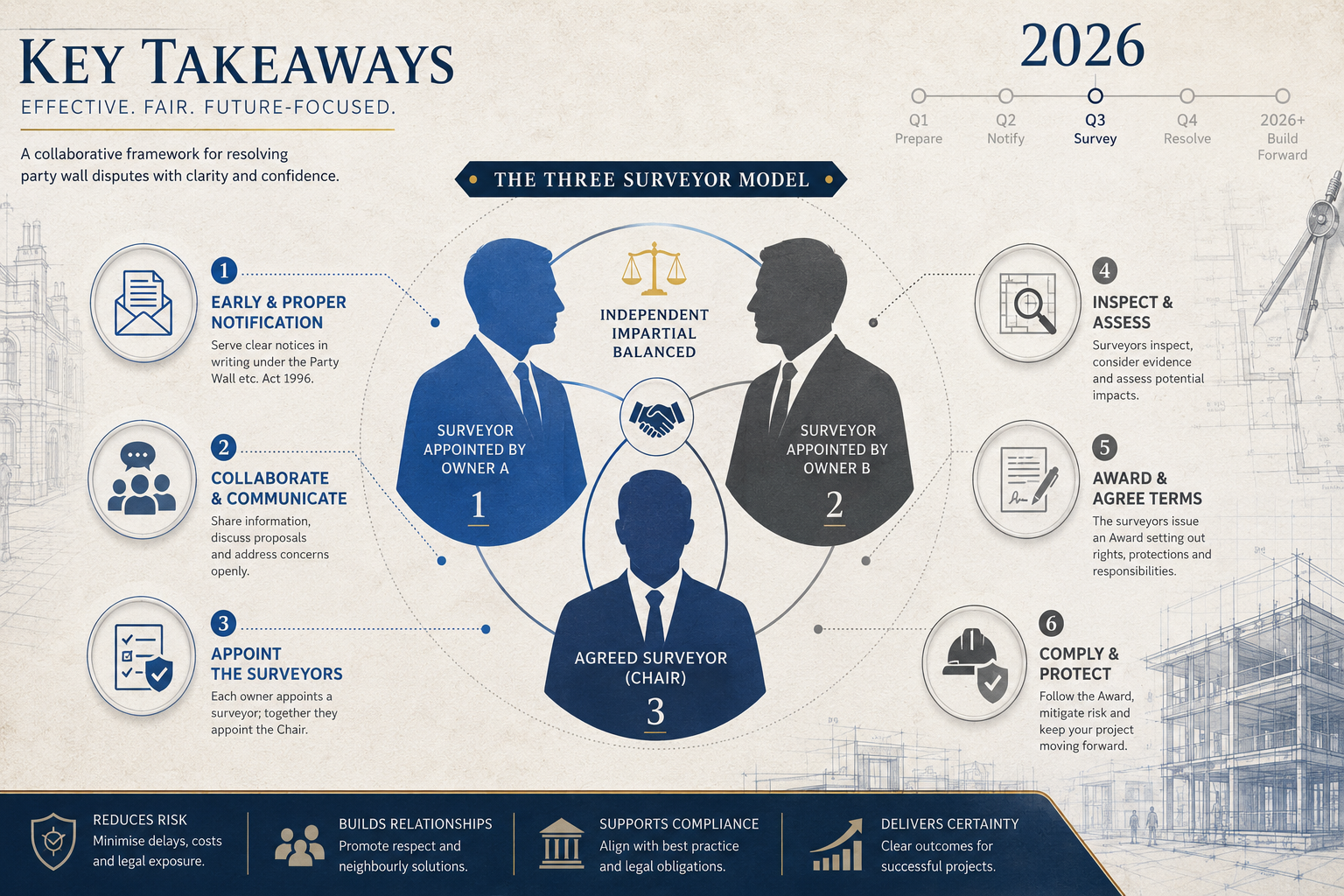
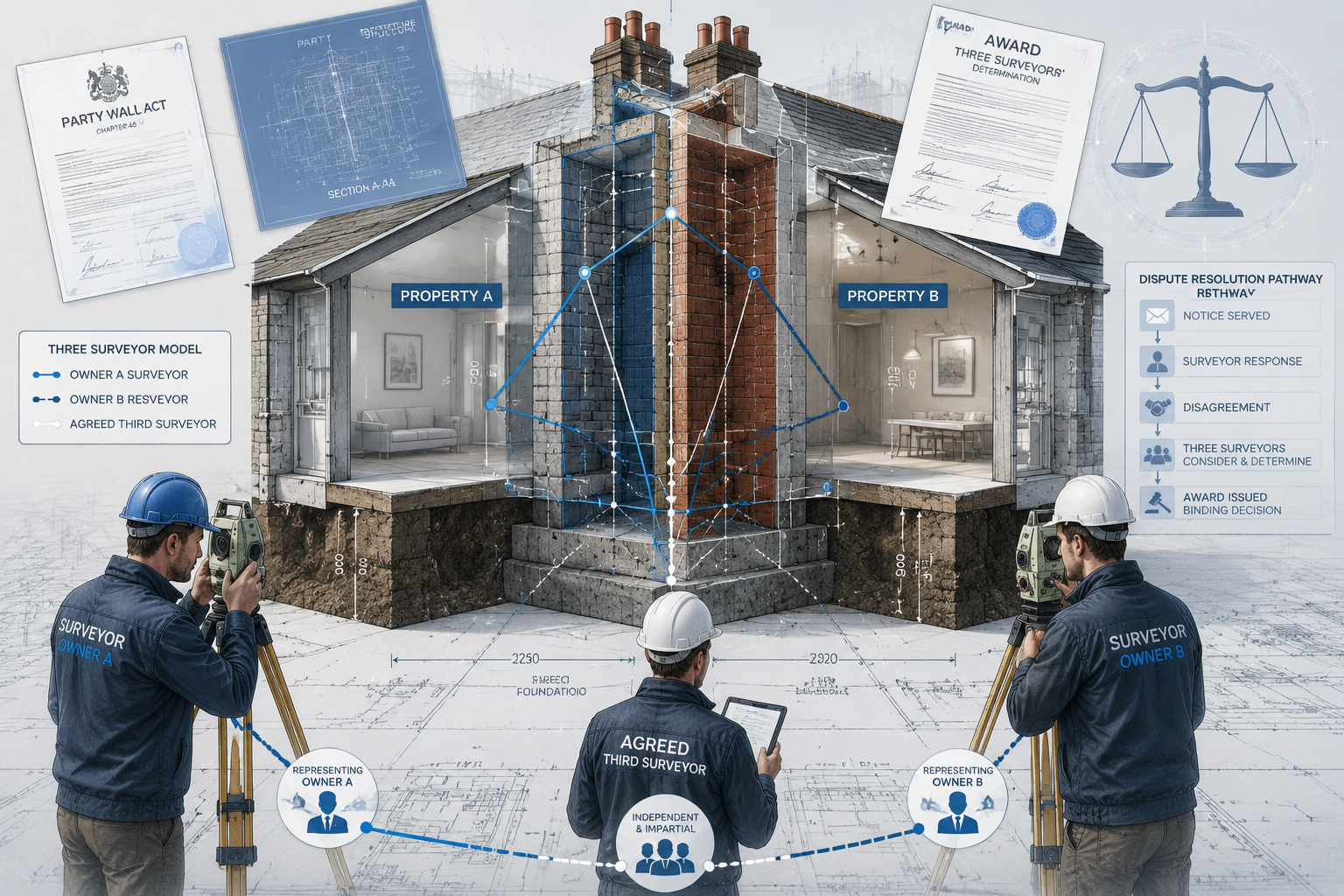
The Three Surveyor Model is embedded in Section 10 of the Party Wall etc. Act 1996. When a building owner serves a valid party wall notice and the adjoining owner dissents or fails to respond, each party appoints their own surveyor. Those two surveyors are then required — by law — to select a Third Surveyor before they proceed with anything else.
This is not optional. The selection of the Third Surveyor happens at the very beginning of the two-surveyor process, not as a reaction to a dispute. The Third Surveyor sits dormant unless and until either surveyor or either owner calls upon them [4]. Think of the Third Surveyor as a safety valve: always in place, rarely needed, but critically important when negotiations break down.
Why the Model Was Designed This Way
The drafters of the 1996 Act recognised a practical problem. Two surveyors, each appointed by an opposing party, will not always agree. Without a pre-agreed independent decision-maker, disputes could become protracted and expensive — or worse, end up in court. The Third Surveyor model keeps resolution within the surveying profession, faster and cheaper than litigation, while still producing a legally binding outcome.
The model also removes a potential conflict of interest. Because the Third Surveyor is selected jointly by the two appointed surveyors — not by either property owner — they are positioned as a genuinely neutral arbiter [5]. Their role is not to favour either side but to make a reasoned, impartial decision on the specific matter referred to them.
How the Three Surveyor Model Works in Practice
Step 1: Appointment and Selection
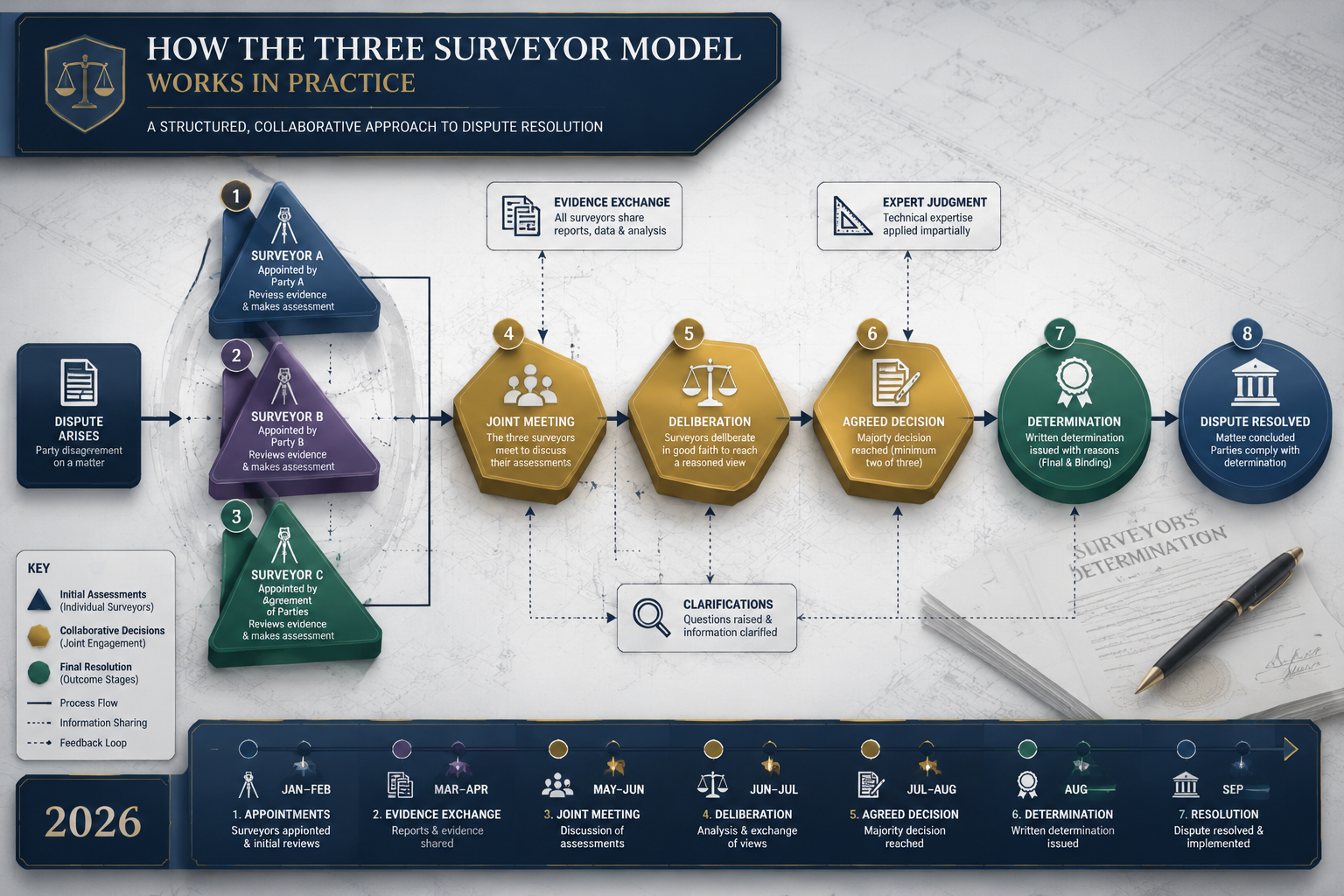
Once both parties have appointed their respective surveyors, those surveyors must agree on a Third Surveyor and record that selection in writing. The Third Surveyor does not need to be informed of every development in the case. They simply need to be identified and available.
For those navigating this process, understanding the role of an adjoining owner's surveyor and a building owner's surveyor is essential. Each has distinct duties and obligations under the Act, and the quality of their initial appointment often determines whether a Third Surveyor referral becomes necessary at all.
Step 2: Identifying a Deadlock
A referral to the Third Surveyor becomes appropriate when the two appointed surveyors cannot agree on one or more of the following:
- The terms of the party wall award
- The extent of works permitted
- Compensation for damage or inconvenience
- Working hours or access arrangements
- Any other matter within the scope of the Act
It is important to note that a mere difference of opinion does not automatically trigger a referral. Surveyors are expected to negotiate in good faith. However, when genuine deadlock exists — and further negotiation would cause unreasonable delay to the project — triggering the Third Surveyor is the correct course of action [5].
Step 3: Making the Referral
Either of the two appointed surveyors can make a referral to the Third Surveyor. Crucially, either property owner also has the right to make a referral directly, bypassing the appointed surveyors if necessary [4]. This is a significant protection for owners who believe their appointed surveyor is failing to act in their interests or is causing unnecessary delay.
The referral must be made in writing and must clearly identify:
- The specific matter or matters in dispute
- The parties involved
- The relevant property and works
- Any supporting documents, drawings, or correspondence
The Third Surveyor then reviews the referral and may request additional information before issuing their decision.
Step 4: The Third Surveyor's Decision
The Third Surveyor issues a party wall award that is binding on all parties. This award carries the same legal weight as an award agreed by the two appointed surveyors. The April 2026 RICS consultation for the 8th edition of its Party Wall Legislation and Procedure guidance specifically emphasises the Third Surveyor's role as a core mechanism to prevent deadlocks — reinforcing that their decisions must be taken seriously and acted upon promptly [1].
For a broader understanding of how party wall awards function, the party wall awards process is explained in detail, including what an award must contain and how it is enforced.
Costs, Timeframes, and the 14-Day Appeal Window
What a Third Surveyor Referral Actually Costs
Cost is one of the most significant practical considerations when deciding whether to trigger the Three Surveyor Model. In London, Third Surveyor fees range from £350 to £1,250 per hour. When factoring in the time required to review documents, conduct any necessary inspections, and draft a binding award, total costs per referral can range from £1,750 to £37,500 depending on the complexity of the dispute [6].
The table below summarises the typical cost range:
| Dispute Complexity | Estimated Third Surveyor Cost |
|---|---|
| Simple (single issue) | £1,750 – £5,000 |
| Moderate (multiple issues) | £5,000 – £15,000 |
| Complex (structural, compensation) | £15,000 – £37,500 |
Who pays these costs? Generally, the Third Surveyor's fees are determined by the Third Surveyor themselves and are typically awarded against the party whose position was found to be unreasonable — or split between the parties. This is not guaranteed, and the cost allocation is itself part of the award. For those concerned about managing overall expenditure, guidance on how to keep party wall costs down provides practical strategies before disputes escalate to this level.
The 14-Day Appeal Window
Once the Third Surveyor issues their award, any party wishing to challenge it must appeal to the County Court within 14 days [4]. This window is extremely short. Missing it means the award becomes final and enforceable without further recourse through the surveying process.
"The 14-day appeal window is one of the most overlooked aspects of the Three Surveyor Model. Property owners who disagree with a Third Surveyor's decision must act immediately — delay is not an option."
This tight deadline underscores why legal advice should be sought promptly if a party believes the Third Surveyor has made an error in law or acted outside their jurisdiction.
Updated Standards and Mandatory Compliance in 2026
As of March 9, 2026, adherence to updated RICS standards became mandatory for all regulated members. These updated standards include stricter protocols for Third Surveyor appointments and the documentation required when making a referral [2]. Surveyors who fail to comply with these standards face not only professional sanctions but also an increased risk of professional indemnity claims — a trend that has grown significantly alongside the rise in party wall disputes [7].
When to Trigger the Third Surveyor: Practical Guidance
Situations That Justify a Referral
Not every disagreement between surveyors warrants a Third Surveyor referral. The following situations typically justify triggering the independent decider:
- Persistent deadlock: The two surveyors have exchanged multiple rounds of correspondence without reaching agreement, and the project is being delayed.
- Unreasonable demands: One surveyor is insisting on conditions that go beyond the scope of the Act or are disproportionate to the works proposed.
- Failure to act: One appointed surveyor is not engaging with the process, is delaying responses, or is obstructing progress without valid reason.
- Compensation disputes: The parties cannot agree on the level of compensation owed for damage or disruption caused by the works.
- Scope disagreements: There is a fundamental dispute about what works the Act permits the building owner to carry out.
Situations Where a Referral May Be Premature
Equally important is knowing when not to trigger the Third Surveyor. A referral made too early — before genuine negotiation has been attempted — may be viewed unfavourably when costs are allocated. If the Third Surveyor determines that the referring party acted prematurely or unreasonably, they may award costs against that party.
Before reaching the point of referral, both surveyors should have:
- Exchanged detailed written positions on the matters in dispute
- Considered whether a site visit or joint inspection might resolve the issue
- Explored whether a compromise position is achievable
The Alternative: Agreed Surveyor
Section 10(1)(a) of the Act provides an alternative to the full Three Surveyor Model. Both parties can agree to appoint a single "agreed surveyor" to act for both sides from the outset. This approach eliminates the risk of deadlock entirely and can significantly reduce costs [4].
However, the agreed surveyor route requires genuine cooperation between the building owner and adjoining owner from the start. For those unsure whether this approach is suitable, reading about having a party wall agreement without a surveyor and the agreed surveyor option can help clarify the options available.
The Three Surveyor Model in Party Wall Disputes: Preventing Escalation Before It Starts
The Role of Early Compliance
The most effective strategy for avoiding a Third Surveyor referral is also the most straightforward: serve a valid party wall notice before commencing any works [3]. A properly served notice gives the adjoining owner the opportunity to engage with the process constructively, appoint their own surveyor, and reach agreement without the need for an independent decider.
Understanding the Party Wall etc. Act 1996 in full — including which works require a notice and which do not — is the foundation of dispute prevention. Works that commonly trigger the Act include:
- Excavation near a neighbouring building's foundations
- Work directly on or to a party wall or party fence wall
- Construction of a new wall on or at the boundary line
For clarity on what constitutes a party wall and related structures, the party wall and party fence wall definition is a useful starting point.
Professional Indemnity and the Consequences of Getting It Wrong
The rise in disputes has brought a corresponding rise in professional indemnity claims against party wall surveyors [7]. Surveyors who fail to select a Third Surveyor at the outset of their appointment, who make referrals prematurely, or who fail to comply with the updated RICS 8th edition protocols face both professional and financial consequences.
For property owners, this means that choosing a qualified, experienced surveyor is not merely a matter of convenience — it is a form of risk management. A surveyor who understands the Three Surveyor Model in Party Wall Disputes: When and How to Trigger the Independent Decider in 2026 will navigate the process efficiently, protect their client's interests, and avoid unnecessary escalation.
Regional Considerations in London
London's density of terraced housing, basement extensions, and loft conversions makes it one of the most active jurisdictions for party wall matters in the UK. Whether a dispute arises in North London, South London, East London, or West London, the Three Surveyor Model applies uniformly — but the practical experience of local surveyors in navigating regional disputes can make a significant difference to outcomes.
Conclusion
The Three Surveyor Model in Party Wall Disputes: When and How to Trigger the Independent Decider in 2026 is not a last resort — it is a carefully designed statutory mechanism that exists to protect all parties when negotiations stall. With disputes rising sharply and professional standards tightening under the updated RICS 8th edition guidance, understanding this model is now a practical necessity for any property owner or surveyor involved in works near a shared boundary.
Actionable next steps for property owners and surveyors:
- Serve a valid party wall notice at the earliest opportunity to reduce the risk of disputes escalating to Third Surveyor level.
- Ensure the Third Surveyor is selected and recorded in writing at the outset of any two-surveyor appointment — not as an afterthought.
- Document all correspondence between surveyors thoroughly so that any referral to the Third Surveyor is supported by a clear paper trail.
- If a referral is made, seek legal advice immediately to understand the 14-day appeal window and whether a challenge to the award is warranted.
- Consider the agreed surveyor route as a cost-effective alternative where both parties are willing to cooperate from the start.
The Third Surveyor is the Act's independent decider — and knowing how to use that mechanism correctly is what separates a managed dispute from a costly, protracted conflict.
References
[1] Third Surveyor Protocols In Updated Rics Party Wall Guidance Avoiding Deadlock In 2026 Disputes – https://kingstonsurveyors.com/third-surveyor-protocols-in-updated-rics-party-wall-guidance-avoiding-deadlock-in-2026-disputes/?utm_source=openai
[2] Rics 8th Edition Party Wall Guidance 2026 Implementation Challenges And Surveyor Compliance Strategies – https://wimbledonsurveyors.com/rics-8th-edition-party-wall-guidance-2026-implementation-challenges-and-surveyor-compliance-strategies/?utm_source=openai
[3] Party Wall Surveys Amid 2026 Construction Boom Resolving High Demand Disputes In Uk Housing Hotspots – https://manchestersurveyors.com/party-wall-surveys-amid-2026-construction-boom-resolving-high-demand-disputes-in-uk-housing-hotspots/?utm_source=openai
[4] The Third Surveyor In Party Wall Disputes Role And Selection – https://legalclarity.org/the-third-surveyor-in-party-wall-disputes-role-and-selection/?utm_source=openai
[5] Third Surveyor Selection And Dispute Resolution When Party Wall Surveyors Cannot Agree – https://www.canterburysurveyors.com/blog/third-surveyor-selection-and-dispute-resolution-when-party-wall-surveyors-cannot-agree/?utm_source=openai
[6] Third Surveyor Party Wall London – https://builderr.co.uk/answers/third-surveyor-party-wall-london?utm_source=openai
[7] Party Wall Surveyor Liability In 2026 Managing Professional Indemnity Claims When Adjoining Owner Disputes Escalate – https://kingstonsurveyors.com/party-wall-surveyor-liability-in-2026-managing-professional-indemnity-claims-when-adjoining-owner-disputes-escalate/?utm_source=openai