

A single Reddit thread posted to r/Surveying in mid-2025 sparked a debate that many practicing surveyors had been quietly having for years: is actively chasing party wall work actually worth it, or does the administrative grind quietly eat into every pound of profit? The thread, titled "UK – Helping a surveyor mate – Is chasing party wall work profitable?" [1], drew candid responses from practitioners across England and Wales, and the consensus was more nuanced than a simple yes or no. For surveyors evaluating their service mix in 2026, the question of whether chasing party wall work is profitable for surveyors deserves a rigorous, data-informed answer.
This article examines that question directly, drawing on Reddit practitioner sentiment, verified fee data, RICS guidance, and practical business strategies for scaling a party wall practice in 2026.
Key Takeaways
- Party wall surveying can be highly profitable in 2026, but only when workload, fee structures, and client management are tightly controlled.
- Reddit practitioners consistently flag small domestic jobs as the lowest-margin work unless batched efficiently or supported by software.
- Hourly rates and fixed fees have risen in 2026, creating a genuine opportunity for surveyors who position themselves correctly.
- Geographic concentration in high-demand urban areas such as London dramatically improves profitability per surveyor.
- Scaling requires more than technical skill: marketing, systemisation, and referral networks are the real differentiators.

What Reddit Actually Says About Party Wall Profitability
The r/Surveying thread [1] is one of the most direct public conversations about the economics of party wall work available online. Respondents ranged from sole practitioners to those working within larger consultancies, and several recurring themes emerged.
Small domestic jobs are the most contentious. Multiple practitioners described small residential party wall cases – typically single-storey rear extensions or minor loft conversions – as "more grief than they are worth" unless managed with strict fee floors and efficient templating. The administrative burden of serving party wall notices, handling dissents, drafting awards, and managing difficult neighbours can easily consume four to six hours on a case that fees may not fully cover.
Volume and batching change the economics. Surveyors who reported satisfaction with party wall income were almost universally those who had developed a pipeline of referrals and could process multiple awards per week using standardised workflows. One contributor noted that once a practice reaches a steady throughput of eight to twelve awards per month, the per-case overhead drops substantially.
Adjoining owner appointments are seen as easier wins. Several Reddit contributors pointed out that being appointed as the adjoining owner's surveyor often involves less initial marketing effort, since the building owner's surveyor or the building owner themselves triggers the process. The fees are also typically paid by the building owner, reducing collection risk.
The grief factor is real but manageable. The phrase "more grief than it's worth" appeared in multiple forms across the thread. However, practitioners who had invested in client communication templates, clear fee agreements upfront, and robust party wall award documentation reported far fewer disputes and write-offs.
Party Wall Surveyor Fees in 2026: What the Data Shows
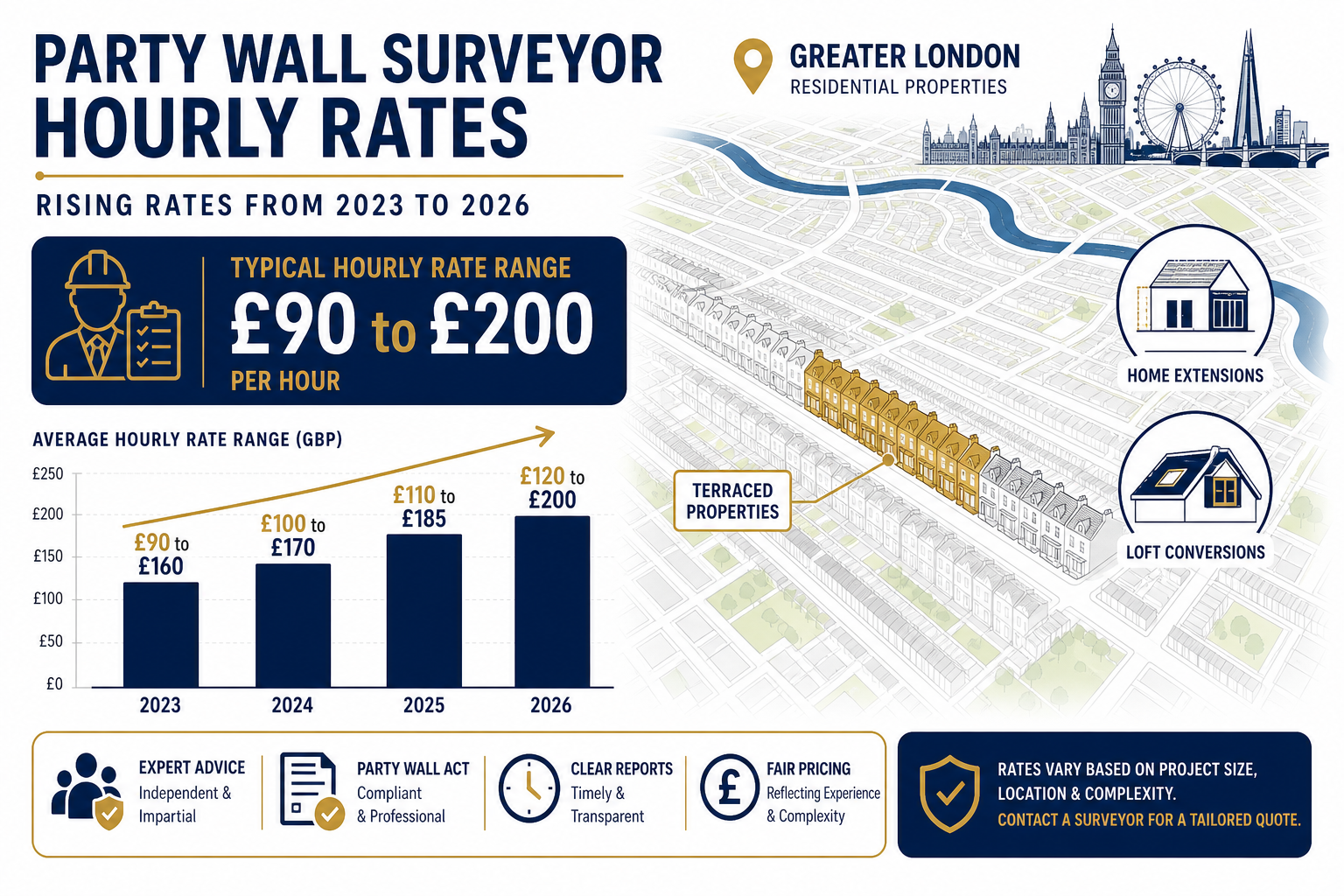
Understanding whether party wall work is profitable requires a clear picture of current fee levels. The data for 2026 is encouraging for practitioners.
Hourly Rates and Fixed Fee Benchmarks
According to verified fee research, party wall surveyors in 2026 are charging between £90 and £200 per hour depending on location, experience, and complexity [2]. In London, rates at the upper end of this range are common, particularly for complex basement excavations or multi-property projects.
Fixed fees for straightforward party wall awards typically range from £700 to £1,500 per award for standard domestic cases [6]. More complex cases involving structural engineers, schedule of condition surveys, and multiple adjoining owners can reach £3,000 or more per instruction.
| Work Type | Typical Fee Range (2026) |
|---|---|
| Standard party wall award (simple) | £700 – £1,200 |
| Award with schedule of condition | £1,000 – £1,800 |
| Complex/basement excavation award | £1,800 – £3,500+ |
| Adjoining owner appointment | £500 – £1,200 |
| Hourly rate (London) | £130 – £200/hr |
| Hourly rate (regional) | £90 – £140/hr |
Sources: [2][5][6]
Are Fees Rising in 2026?
Analysis from industry observers suggests that party wall surveyor fees are continuing to rise in 2026, driven by increased construction activity, a shortage of qualified practitioners relative to demand, and the general inflationary environment affecting professional services [5]. One source notes that fee pressure from clients is being offset by the sheer volume of work generated by the ongoing home improvement boom, particularly in London and the South East [3].
For surveyors who have been holding fees flat, 2026 is a strong year to review and increase pricing.
Who Pays, and Does It Matter?
The question of who pays for a party wall surveyor is directly relevant to profitability, because it affects collection risk. Under the Party Wall etc. Act 1996, the building owner typically bears the cost of the process, including the fees of the adjoining owner's surveyor in most circumstances [4]. This means that surveyors appointed on behalf of adjoining owners face lower credit risk than those relying on building owners who may dispute fees post-completion.
Understanding the costs of party wall work and the process is essential for setting realistic client expectations and protecting fee income.
Business Strategies for Making Party Wall Work Profitable in 2026
Is chasing party wall work profitable for surveyors in 2026 as a deliberate business strategy? The answer depends almost entirely on how the practice is structured. The surveyors generating strong margins are not simply doing more work – they are doing it more systematically.
1. Systemise the Workflow with Purpose-Built Software
One of the most significant shifts in the party wall sector over the past two years has been the adoption of dedicated party wall software. Platforms designed specifically for the UK market allow surveyors to automate notice generation, track statutory timelines, produce award templates, and manage client communications from a single dashboard [8]. For a sole practitioner handling ten or more cases simultaneously, this can reduce administrative time by 30 to 50 percent per case.
The profitability implication is direct: if software reduces a six-hour case to four hours, the effective hourly rate on a fixed-fee instruction rises by 50 percent.
2. Set Minimum Fee Thresholds
A recurring theme in practitioner discussions is the danger of accepting low-value instructions without a minimum fee floor. Surveyors who set a minimum charge of £750 to £900 per instruction – regardless of perceived simplicity – report fewer margin-destroying cases. Small jobs rarely stay simple once a difficult neighbour or an ambiguous boundary is involved.
Reviewing how to keep party wall costs down from the client's perspective also helps surveyors have more productive fee conversations, since clients who understand the process are less likely to dispute reasonable charges.
3. Build a Referral Network Strategically
The most profitable party wall practices in 2026 are not relying on cold outreach. They are embedded in referral ecosystems that include:
- Architects and architectural technologists who specify party wall services for their clients
- Planning consultants who encounter party wall triggers during pre-application advice
- Estate agents who deal with buyers purchasing properties adjacent to planned works
- Main contractors who need surveyors appointed quickly to avoid programme delays
A single productive relationship with a busy London architect can generate eight to fifteen instructions per year. At an average fee of £1,200, that is £9,600 to £18,000 in revenue from one referral source.
4. Concentrate Geographically
Party wall work is inherently local. Travel time is a hidden cost that destroys profitability on fixed-fee instructions. Surveyors who concentrate their marketing and referral efforts within a defined geographic area – for example, focusing on party wall work in West London or party wall surveying in South London – can cluster site visits and dramatically reduce non-billable travel time.
Urban density also means higher instruction volumes. London terraced housing stock, with its shared walls and frequent extension activity, generates a disproportionate share of party wall instructions nationally [3].
5. Market the Full Scope of Party Wall Work Types
Many surveyors undermarket their capabilities by focusing only on rear extensions. The full range of party wall works includes loft conversions, basement excavations, boundary wall alterations, and structural work to existing party structures. Each of these generates different notice types and award complexity, and the higher-complexity work commands premium fees.
Educating referral partners and potential clients about the breadth of triggers under the Party Wall etc. Act 1996 expands the addressable market for any practice.
Demand Signals and Market Conditions in 2026

The structural demand for party wall surveyors in 2026 is strong. Several converging factors are sustaining and growing the market.
Home improvement activity remains elevated. With mortgage rates having stabilised compared to the 2022 to 2023 peak, homeowners are returning to extension and renovation projects that were deferred. This directly increases the volume of party wall notices being served across England and Wales.
Awareness of the legal requirement is growing. Consumer media coverage of neighbour disputes and planning enforcement has raised awareness that party wall agreements are a legal requirement, not an optional courtesy. Homeowners who previously might have proceeded without a surveyor are increasingly seeking professional appointments, partly driven by concerns about liability [7].
Recruitment data confirms demand. Job listings for party wall surveyors at senior level in London cite salaries of £55,000 to £75,000 or more, with firms actively competing for qualified practitioners [9]. This reflects genuine market tightness that benefits established sole practitioners and small firms who can capture work that larger practices cannot absorb.
Trustpilot and review platforms are driving client selection. Clients increasingly choose party wall surveyors based on online reviews [10]. Practices that actively manage their online reputation and accumulate verified reviews are winning instructions over competitors with equivalent technical credentials but weaker digital presence.
The Profitability Ceiling: When Party Wall Work Stops Scaling
There is an honest caveat to the optimistic picture above. Party wall work is time-intensive and cannot be infinitely scaled by a sole practitioner. The practical ceiling for a solo operator is approximately 15 to 20 active cases simultaneously, beyond which quality and turnaround times suffer. Growth beyond this threshold requires either hiring additional surveyors or building a referral-out arrangement with trusted colleagues.
The Reddit thread [1] touched on this directly, with contributors noting that the most successful party wall specialists are those who have built small teams or associate networks rather than trying to handle unlimited volume alone.
RICS Guidance and Professional Standards
Profitability cannot be discussed in isolation from professional obligations. The RICS provides guidance on party wall surveyor conduct, fee transparency, and the duty of impartiality that surveyors owe under the Act. Surveyors who cut corners on documentation to save time create liability exposure that can far exceed any fee income saved.
Key professional obligations that affect business strategy include:
- Impartiality: A surveyor appointed under the Act owes duties to the process, not solely to the appointing party. This limits certain aggressive fee recovery tactics.
- Fee transparency: Clients must understand the fee basis before appointment. Disputes over fees are a leading cause of complaints to professional bodies.
- Award quality: A poorly drafted party wall award that is successfully challenged in the County Court creates reputational and financial damage that no single instruction fee can offset.
Surveyors considering whether to pursue party wall work as a core service line should review the RICS guidance on party wall surveying and ensure their professional indemnity insurance adequately covers the volume and complexity of work they intend to undertake.
Conclusion
Is chasing party wall work profitable for surveyors in 2026? The evidence from Reddit discussions, fee data, and market conditions points to a clear answer: yes, but conditionally. The conditions that separate profitable party wall practices from frustrating ones are not primarily technical – they are operational and strategic.
Actionable next steps for surveyors evaluating or expanding party wall services in 2026:
- Set a minimum fee floor immediately. Review current fee schedules and establish a minimum instruction fee that reflects true time costs, including administration, site visits, and award drafting.
- Invest in workflow software. Evaluate party wall-specific platforms that automate notice generation and case tracking. The time savings directly increase effective hourly rates on fixed-fee work.
- Build three to five referral relationships this quarter. Identify architects, contractors, or planning consultants in the target geographic area and initiate contact with a clear value proposition.
- Concentrate geographically. Define a primary service area and market consistently within it rather than accepting dispersed instructions that inflate travel time.
- Manage online reputation actively. Request reviews from satisfied clients and respond professionally to any negative feedback on Trustpilot and Google.
- Review RICS guidance annually. Professional standards evolve, and compliance protects both reputation and fee income.
Party wall work in 2026 is not a passive income stream – it rewards surveyors who treat it as a structured business line rather than an occasional add-on service. Those who do are finding it to be one of the more resilient and scalable areas of residential surveying practice available today.
References
[1] UK Helping A Surveyor Mate Is Chasing Party Wall – https://www.reddit.com/r/Surveying/comments/1pifn5a/uk_helping_a_surveyor_mate_is_chasing_party_wall/
[2] Party Wall Surveyor Cost 2026 – https://www.bookabuilderuk.com/blog/party-wall-surveyor-cost-2026
[3] Party Wall Agreement London 2026 – https://www.mayfairstudio.co.uk/blog/party-wall-agreement-london-2026
[4] Who Pays For Party Wall Surveyor – https://blackacresurveyors.com/2026/03/12/who-pays-for-party-wall-surveyor/
[5] Will Party Wall Surveyor Fees Go Up In 2026 – https://www.simplesurvey.co.uk/article/will-party-wall-surveyor-fees-go-up-in-2026/
[6] Party Wall Surveyor Cost – https://hoa.org.uk/advice/guides-for-homeowners/i-am-improving/party-wall-surveyor-cost/
[7] Party Wall Agreement – https://hoa.org.uk/advice/guides-for-homeowners/i-am-improving/party-wall-agreement/
[8] Party Wall Software UK – https://www.softomatesolutions.com/blog/party-wall-software-uk/
[9] Party Wall Surveyor – Surveyor or Senior Level – https://talents.studysmarter.co.uk/companies/woodhouse-property-recruitment-limited/city-of-london/party-wall-surveyor-surveyor-or-senior-level-21247819/
[10] Trustpilot Reviews – www.tpwc.co.uk – https://www.trustpilot.com/review/www.tpwc.co.uk