


Fewer than one in three adjoining owners fully understand their rights when a party wall notice lands on their doormat — yet the decisions made in the first 14 days can shape the entire course of a neighbour's building project and protect a property worth hundreds of thousands of pounds. This practical response guide on what adjoining owners should do on receiving a party wall notice sets out every step clearly, so no rights are lost through inaction or misplaced goodwill.
Key Takeaways
- An adjoining owner has exactly 14 days to respond in writing to a party wall notice before a statutory dispute is deemed to have arisen [1]
- There are three formal response options: consent, dissent and appoint your own surveyor, or dissent and agree to a single shared surveyor [3]
- Consenting without requesting a Schedule of Condition leaves a property owner with limited recourse if damage occurs
- A Party Wall Award legally binds both parties and sets out how and when works may be carried out [5]
- In 2026, RICS is consulting on an updated 8th edition of its Party Wall guidance, which will affect how surveyors advise adjoining owners going forward [6]
Understanding the Notice You Have Received
Before deciding how to respond, it is essential to understand what type of notice has been served. The Party Wall etc. Act 1996 creates three distinct categories of notice, each triggered by different types of work [5]:
| Notice Type | When It Is Used |
|---|---|
| Party Structure Notice | Works directly affecting a shared wall, floor, or structure |
| Line of Junction Notice | Building a new wall up to or astride the boundary line |
| Adjacent Excavation Notice | Excavation within 3 or 6 metres of a neighbouring building |
Each notice must include specific information: the name and address of the building owner, a description of the proposed works, and the intended start date. If any of this information is missing or unclear, that is the first issue to raise.
For a deeper explanation of the different notice types, the guide on Party Wall Act notices and how to respond provides useful background. Adjoining owners should also check whether the works described fall under types of party wall works that genuinely require a notice — not all building activity triggers the Act.
Checking the Notice Is Valid
A notice that is served too late, contains incorrect information, or relates to work that does not fall under the Act may not be legally valid. Key checks include:
- Minimum notice periods: A Party Structure Notice requires at least two months' notice; an Adjacent Excavation Notice requires one month
- Correct property description: The notice should clearly identify the shared wall or boundary
- Proposed works description: Vague descriptions such as "general renovation" are insufficient
If the notice appears defective, seeking advice from a qualified party wall surveyor before responding is strongly recommended.
The 14-Day Clock: Why Timing Is Everything
"Silence is not consent under the Party Wall etc. Act 1996 — it is treated as dissent, which triggers a formal dispute resolution process whether the adjoining owner intended it or not."
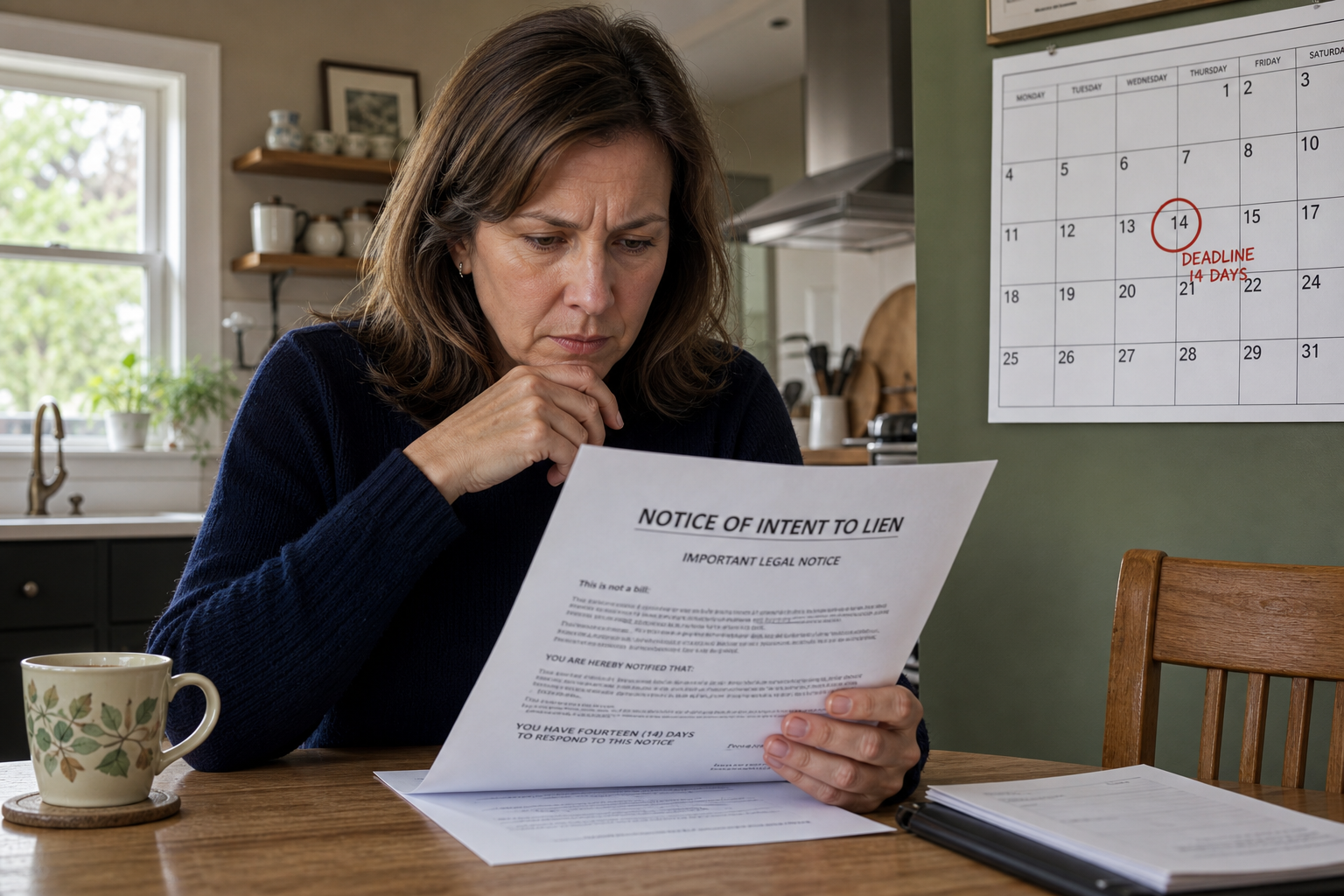
Upon receiving a party wall notice, an adjoining owner has 14 days to respond in writing [1]. This deadline is not a formality. If no response is given within 14 days, the Act deems a dispute to have arisen automatically. This means the building owner must appoint a surveyor to resolve matters — and the adjoining owner may find themselves caught up in a formal process they did not choose to initiate.
The practical risk of doing nothing:
- The building owner can appoint a surveyor on the adjoining owner's behalf
- That surveyor's fees are typically paid by the building owner, but the adjoining owner loses control over who acts for them
- Works may proceed under a Party Wall Award that the adjoining owner had no meaningful input in shaping
Acting within the 14-day window gives adjoining owners the most influence over the process. For a full overview of the rights and responsibilities involved, the dedicated adjoining owners resource page is a helpful starting point.
The Three Response Options Explained
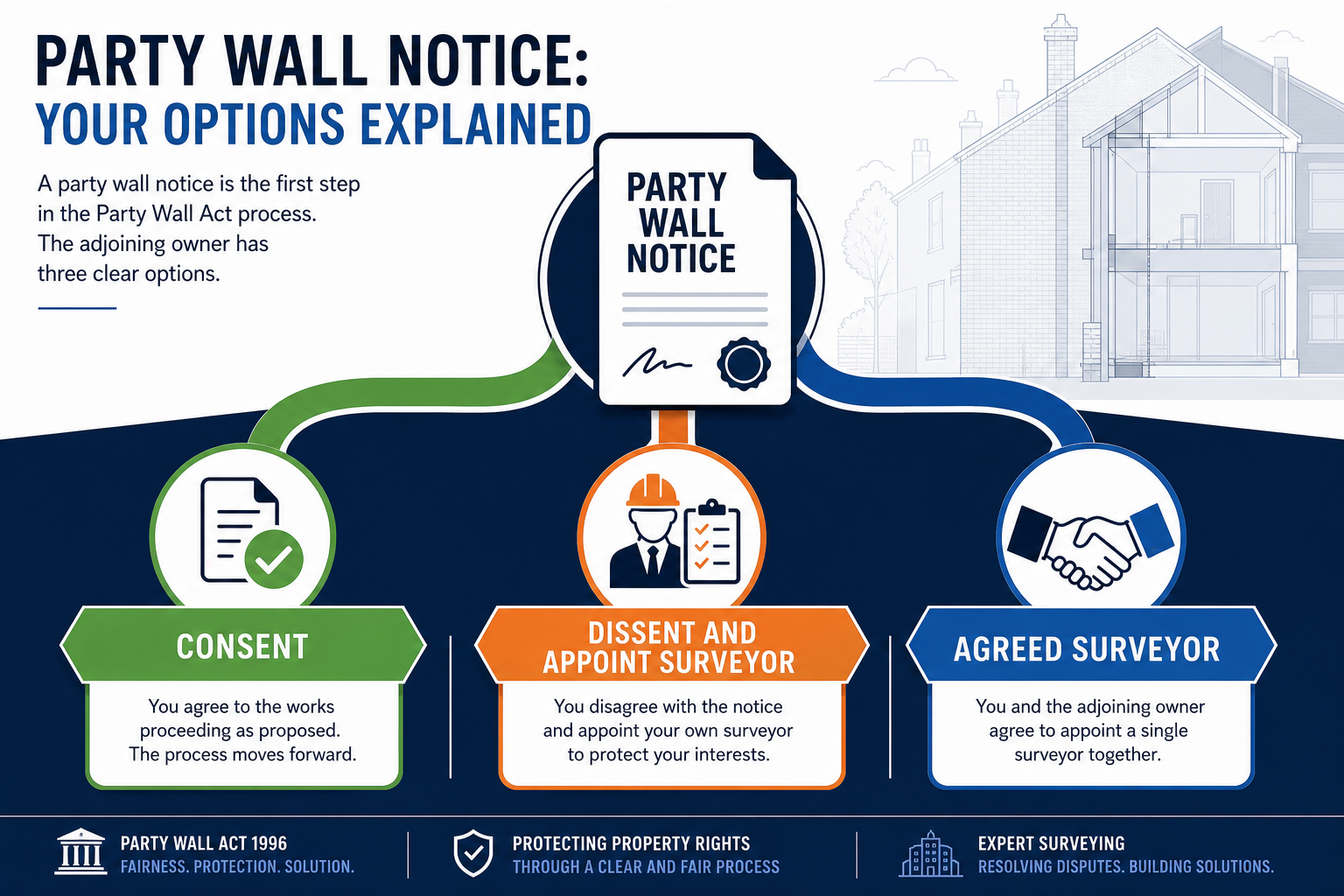
This section of the practical response guide on what adjoining owners should do on receiving a party wall notice covers the three formal choices available under the Act [3].
Option 1: Consent to the Works
Consenting means agreeing in writing that the proposed works may proceed without the need for a formal Party Wall Award. This is the simplest and quickest route, and it avoids surveyor fees entirely.
When consent is appropriate:
- The works are minor and low-risk (for example, plastering a shared wall)
- There is a good relationship with the building owner
- The works are clearly described and limited in scope
The critical condition for consenting safely:
Consent should almost never be given without first requesting a Schedule of Condition. This is a documented record — typically with photographs — of the current state of the adjoining property before works begin. Without it, proving that any cracks or damage were caused by the building works becomes extremely difficult [2].
A Schedule of Condition can be prepared by a surveyor or agreed jointly. It protects the adjoining owner's position without requiring a full Party Wall Award.
Option 2: Dissent and Appoint Your Own Surveyor
Dissenting and appointing a separate surveyor is the most protective option. The building owner's surveyor and the adjoining owner's surveyor then work together to produce a Party Wall Award — a legally binding document that sets out:
- The exact scope of the permitted works
- Working hours and access arrangements
- How any damage will be assessed and compensated
- Any protective measures required before work begins [5]
The adjoining owner's surveyor is paid by the building owner in most cases, which means this protection is effectively free to the adjoining owner [4]. For guidance on what a Party Wall Award contains and how it works, the party wall contract template and awards guide explains the process in plain terms.
When to choose this option:
- The proposed works are substantial (loft conversions, basement excavations, structural alterations)
- There is uncertainty about the scope or impact of the works
- There is an existing dispute or poor relationship with the building owner
- The adjoining property has recently been renovated or contains sensitive features
Option 3: Dissent and Appoint an Agreed Surveyor
Both parties can agree to appoint a single surveyor who acts impartially for both sides. This is faster and less expensive than having two separate surveyors, but it does require a degree of mutual trust [3].
Pros and cons at a glance:
| Factor | Agreed Surveyor | Separate Surveyors |
|---|---|---|
| Cost | Lower | Higher (paid by building owner) |
| Speed | Faster | Slower |
| Independence | Shared | Fully independent |
| Best for | Low-risk works, good relationship | High-risk works, complex disputes |
The option of having a party wall agreement without a separate surveyor is sometimes discussed informally, but for any works of significant scale, professional representation remains the safest course.
What to Review in the Notice Before Responding
A thorough review of the notice itself is a core part of what adjoining owners should do on receiving a party wall notice. The following checklist covers the most important points:
Structural and technical matters:
- Does the description of works match what the building owner has discussed informally?
- Are any structural drawings or engineer's reports attached?
- Does the notice cover excavation work that could affect foundations?
Legal and procedural matters:
- Is the notice served on the correct person (the legal owner of the adjoining property)?
- Is the proposed start date realistic and does it allow adequate notice?
- Has the building owner confirmed they have planning permission where required?
Boundary and ownership matters:
- Is the wall described in the notice actually a party wall, a party fence wall, or a boundary wall? These are distinct legal categories with different implications [4]
- Understanding the difference between a party fence wall and a boundary wall can affect whether the Act applies at all
If the notice relates to a Party Structure Notice, it is particularly important to check whether the proposed works could weaken the shared structure or affect load-bearing elements.
When to Seek Professional Surveyor Advice

Not every party wall notice requires immediate professional involvement, but there are clear situations where seeking advice from an adjoining owner's surveyor is the right move:
- The works involve excavation near the foundations of the adjoining property
- The building owner is planning a loft conversion, basement, or rear extension
- The notice is unclear, incomplete, or appears to have been served incorrectly
- There is already a dispute about the boundary or ownership of the wall
- The adjoining property is leasehold and the freeholder also needs to be notified
In 2026, RICS opened a consultation on the draft 8th edition of its Party Wall Legislation and Procedure guidance. The updated edition includes revised letters of appointment, an updated draft award template, and strengthened guidance on fee practices and the use of the Third Surveyor [6]. This signals a more rigorous professional environment, which is good news for adjoining owners who appoint qualified surveyors.
For those concerned about costs, it is worth noting that in most cases the building owner bears the surveyor fees for the adjoining owner. Guidance on how to keep party wall costs down can help both parties manage the process efficiently.
The Role of the Third Surveyor
If the two appointed surveyors cannot agree on the terms of the Party Wall Award, either party can refer the matter to a Third Surveyor — selected in advance at the start of the process. The Third Surveyor makes a binding determination. This mechanism exists precisely to protect adjoining owners from being overridden, and it is a key reason why appointing a separate surveyor provides stronger protection than relying on an agreed surveyor in contentious situations [5].
After Responding: What Happens Next
Once a response has been submitted, the process moves forward according to the option chosen:
-
If consent was given: The building owner may proceed on the agreed start date. Ensure the Schedule of Condition has been completed and signed before any work begins.
-
If dissent was given: Surveyors are appointed, a Schedule of Condition is prepared, and a Party Wall Award is drafted. The adjoining owner should review the draft Award carefully before it is finalised. A sample party wall agreement template can help adjoining owners understand what a typical Award looks like.
-
During the works: Keep a photographic record of any changes to the property. Report any concerns to the surveyor promptly rather than waiting until works are complete.
-
After the works: If damage has occurred, the Party Wall Award provides the mechanism for making a claim. Acting quickly and with documented evidence is essential.
The party wall awards page provides further detail on how Awards are enforced and what remedies are available if the building owner does not comply.
Common Mistakes Adjoining Owners Make
Understanding what adjoining owners should do on receiving a party wall notice is as much about avoiding errors as it is about taking the right steps. The most frequent mistakes include:
- Ignoring the notice entirely: As noted above, silence triggers a deemed dispute and the adjoining owner loses control of who represents them
- Consenting without a Schedule of Condition: This is the single most common and costly error
- Agreeing informally without written confirmation: Verbal agreements have no standing under the Act
- Assuming planning permission means party wall consent is not needed: These are entirely separate legal processes
- Waiting to see if damage occurs before acting: By that point, the legal protections available are significantly weaker
Conclusion
Receiving a party wall notice is not a bureaucratic inconvenience — it is an opportunity to protect a property and establish clear legal terms before building work begins. The 14-day response window is short, but it is sufficient to review the notice, understand the options, and make an informed decision.
Actionable next steps for adjoining owners in 2026:
- Read the notice carefully and check it is valid and complete
- Identify the type of notice and the nature of the proposed works
- Decide whether to consent, dissent with a separate surveyor, or dissent with an agreed surveyor
- If consenting, arrange a Schedule of Condition before works start
- If dissenting, contact a qualified party wall surveyor promptly to avoid missing the 14-day window
- Keep all correspondence in writing and retain copies throughout the project
The Party Wall etc. Act 1996 exists to protect both building owners and adjoining owners. Used properly, it prevents disputes rather than creating them. Taking the time to respond correctly at the outset is always worth the effort.
References
[1] What To Do If Served Party Wall Notice – https://www.fandt.com/guides/what-to-do-if-served-party-wall-notice/?utm_source=openai
[2] Adjoining Owner – https://www.partywallslimited.com/adjoining-owner?utm_source=openai
[3] What Are The Party Wall Notice Response Options – https://partywallhelp.co.uk/what-are-the-party-wall-notice-response-options/?utm_source=openai
[4] Party Wall Advice For Adjoining Owners – https://www.squarepointsurveyors.co.uk/party-wall-advice-for-adjoining-owners/?utm_source=openai
[5] Party Wall Etc. Act 1996 – https://en.wikipedia.org/wiki/Party_Wall_etc._Act_1996?utm_source=openai
[6] Rics Opens Consultation On Party Wall Guidance Update – https://www.propertywire.com/news/uk/rics-opens-consultation-on-party-wall-guidance-update/?utm_source=openai