RICS
Looking for expert solutions?
Request a Quote

Author: admin

  • Party Wall Surveys for Data Centre Expansions: Navigating Ag

    The global data centre industry is experiencing an unprecedented boom in 2026, with artificial intelligence and cloud computing driving investment to historic levels. As developers race to build cutting-edge facilities across the UK’s most densely populated urban areas, party wall surveys for data centre expansions have become critical gatekeepers to project success. With even minor delays costing millions and neighbouring property owners increasingly aware of their rights, navigating party wall agreements has never been more complex—or more essential.

    The stakes are extraordinarily high. Data centre construction projects involve massive capital expenditure, specialized infrastructure, and tight delivery schedules. When these high-value developments occur in established urban areas where properties share walls, foundations, or boundaries, the Party Wall etc. Act 1996 becomes a non-negotiable part of the development process. Understanding how to navigate party wall surveys for data centre expansions in the 2026 investment surge can mean the difference between project success and costly legal disputes.

    Key Takeaways

    • 📊 Historic investment levels: The UK data centre market is experiencing unprecedented growth in 2026, with demand driven by AI adoption and cloud computing expansion
    • ⚖️ Legal compliance is mandatory: Data centre expansions affecting shared walls, boundaries, or excavations near neighbouring properties require proper party wall notices and agreements
    • 💰 Financial stakes are enormous: Even minor party wall disputes can delay projects worth millions, making proactive surveyor engagement essential
    • 🤝 Early engagement prevents disputes: Serving proper notices and appointing qualified surveyors early in the planning process significantly reduces conflict risk
    • 🔍 Specialized expertise required: Data centre projects demand surveyors who understand both the Party Wall Act and the unique technical requirements of critical digital infrastructure

    Understanding the 2026 Data Centre Investment Boom
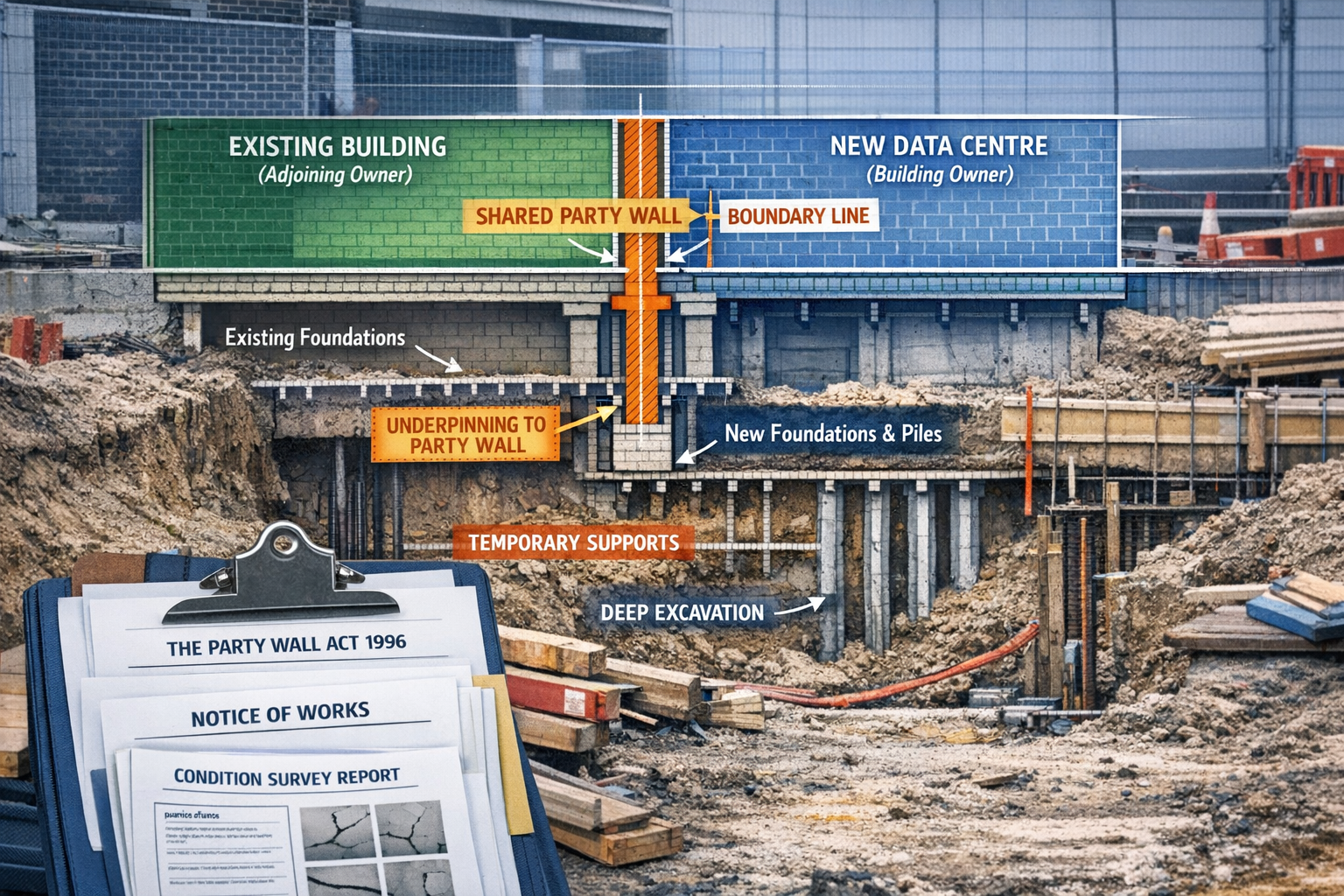
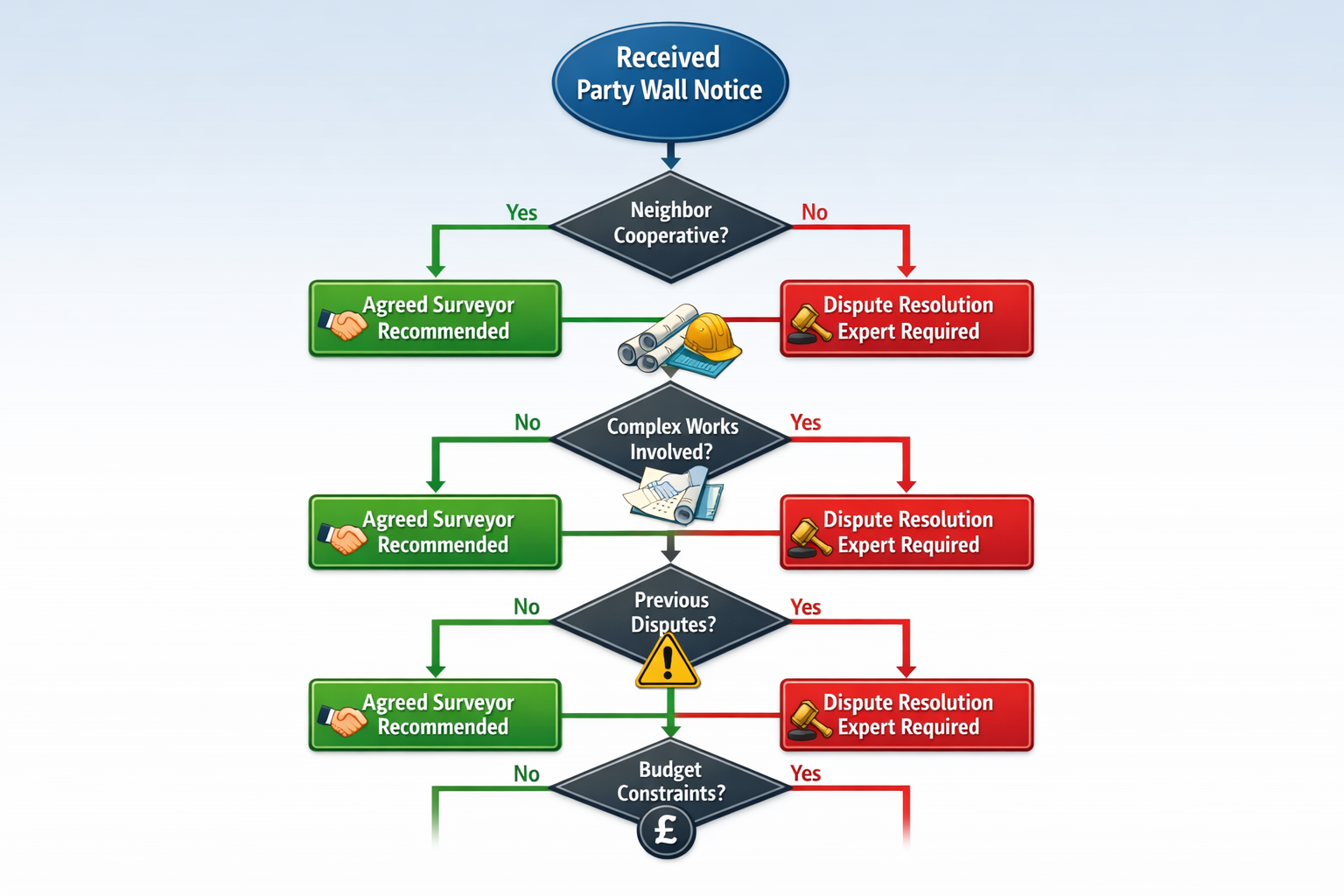
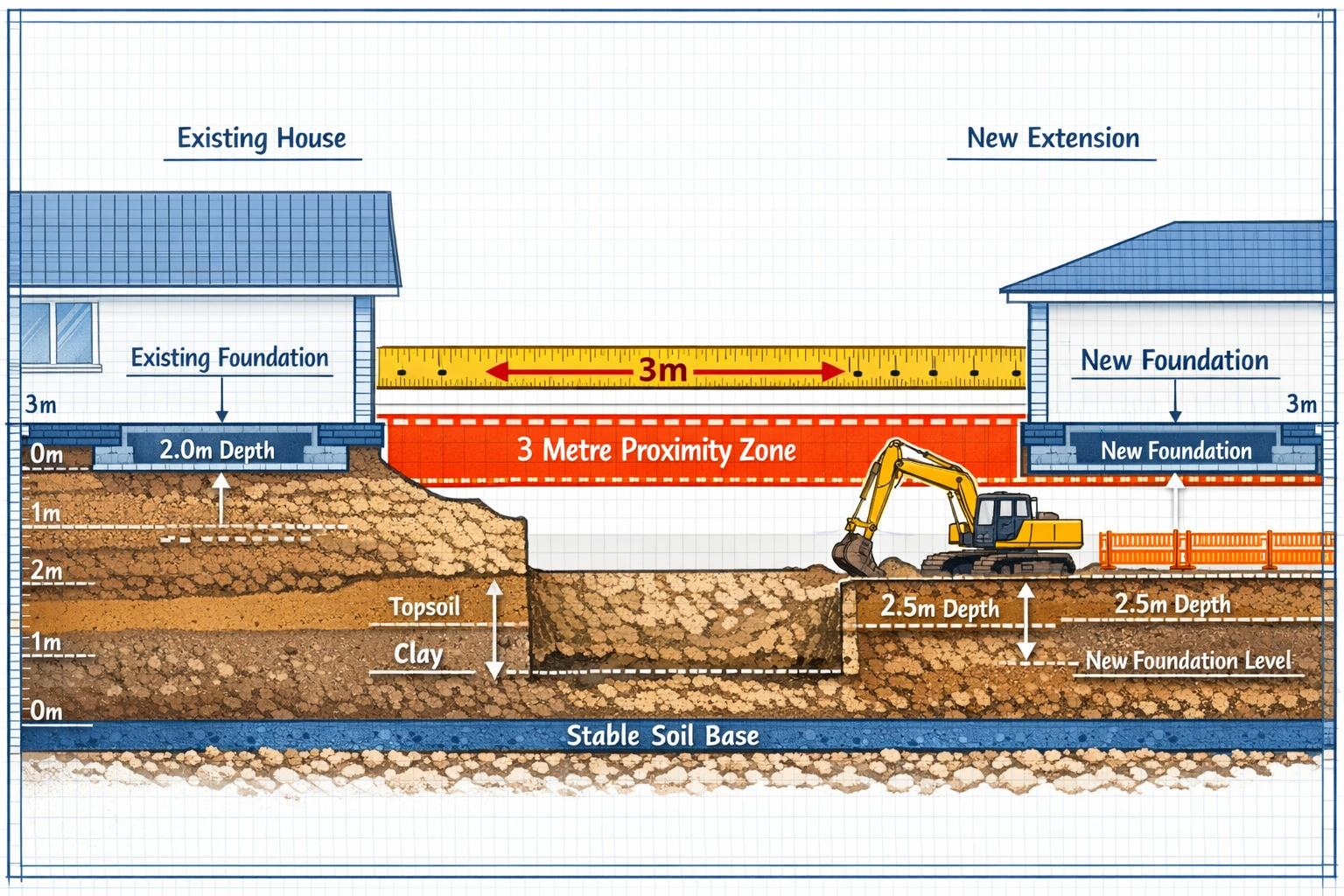
    Landscape format (1536x1024) editorial image showing detailed architectural cross-section diagram of a data centre expansion project adjacen

    Why Data Centres Are Expanding Rapidly

    The UK remains one of the top three data centre markets globally, surpassed only by the USA in total number of facilities[1]. This dominant position is being reinforced in 2026 by several converging factors that are driving unprecedented expansion.

    UK data usage is projected to double by 2026, primarily driven by artificial intelligence adoption and the continued expansion of cloud-based computing[1]. This exponential growth in data consumption requires physical infrastructure—massive facilities filled with servers, cooling systems, and power distribution equipment that must be located close to major population centres for optimal performance.

    The investment environment has become increasingly favorable. Changes to the National Planning Policy Framework and the designation of data centres as nationally significant infrastructure are easing the planning process[1]. This regulatory support, combined with the urgent demand for AI computing capacity, has created a perfect storm of development activity.

    The Urban Density Challenge

    Data centres need to be located in or near major cities to minimize latency and provide fast access to end users. This requirement creates an inevitable challenge: urban areas have limited available space, and new developments frequently occur on sites adjacent to existing buildings.

    When a data centre expansion involves:

    • Excavating foundations deeper than neighbouring properties
    • Building on or near a shared boundary wall
    • Constructing new walls at the property line
    • Carrying out works that could affect the structural stability of adjacent buildings

    The Party Wall etc. Act 1996 applies, and proper procedures must be followed.

    Financial Implications of Delays

    Data centre construction projects involve huge sums with even minor delays resulting in cost overruns into the millions[1]. The specialized nature of these facilities means that:

    • 🔧 Equipment must be ordered months in advance from limited suppliers
    • ⚡ Power infrastructure connections require extensive lead times
    • 🏗️ Construction sequences are tightly choreographed
    • 💼 Client contracts often include substantial penalties for late delivery

    A party wall dispute that delays construction by even a few weeks can trigger cascading financial consequences. This reality makes proper party wall management not just a legal requirement but a critical business imperative.

    Party Wall Surveys for Data Centre Expansions: Legal Framework and Requirements

    When Party Wall Notices Are Required

    The Party Wall etc. Act 1996 establishes three main categories of work that require formal notices:

    1. Works to an Existing Party Wall or Party Structure
    When a data centre expansion involves modifications to a shared wall between properties, such as:

    • Cutting into the wall to insert support beams
    • Raising the height of a party wall
    • Demolishing and rebuilding a party structure
    • Underpinning a party wall

    2. Building on the Boundary Line
    Constructing a new wall or building directly on or astride the boundary between properties triggers notice requirements, even if no existing party wall is present.

    3. Excavation Near Neighbouring Buildings
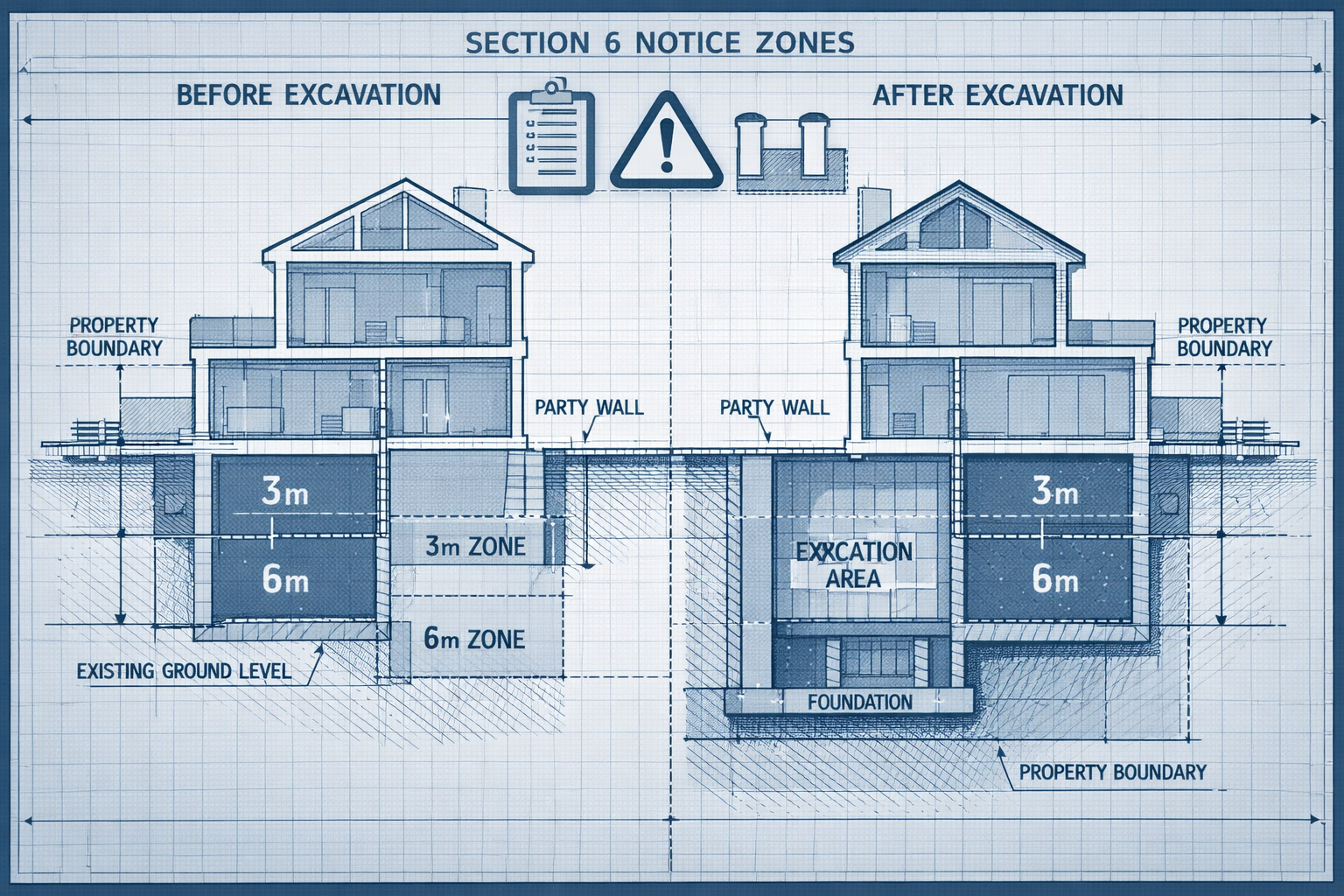
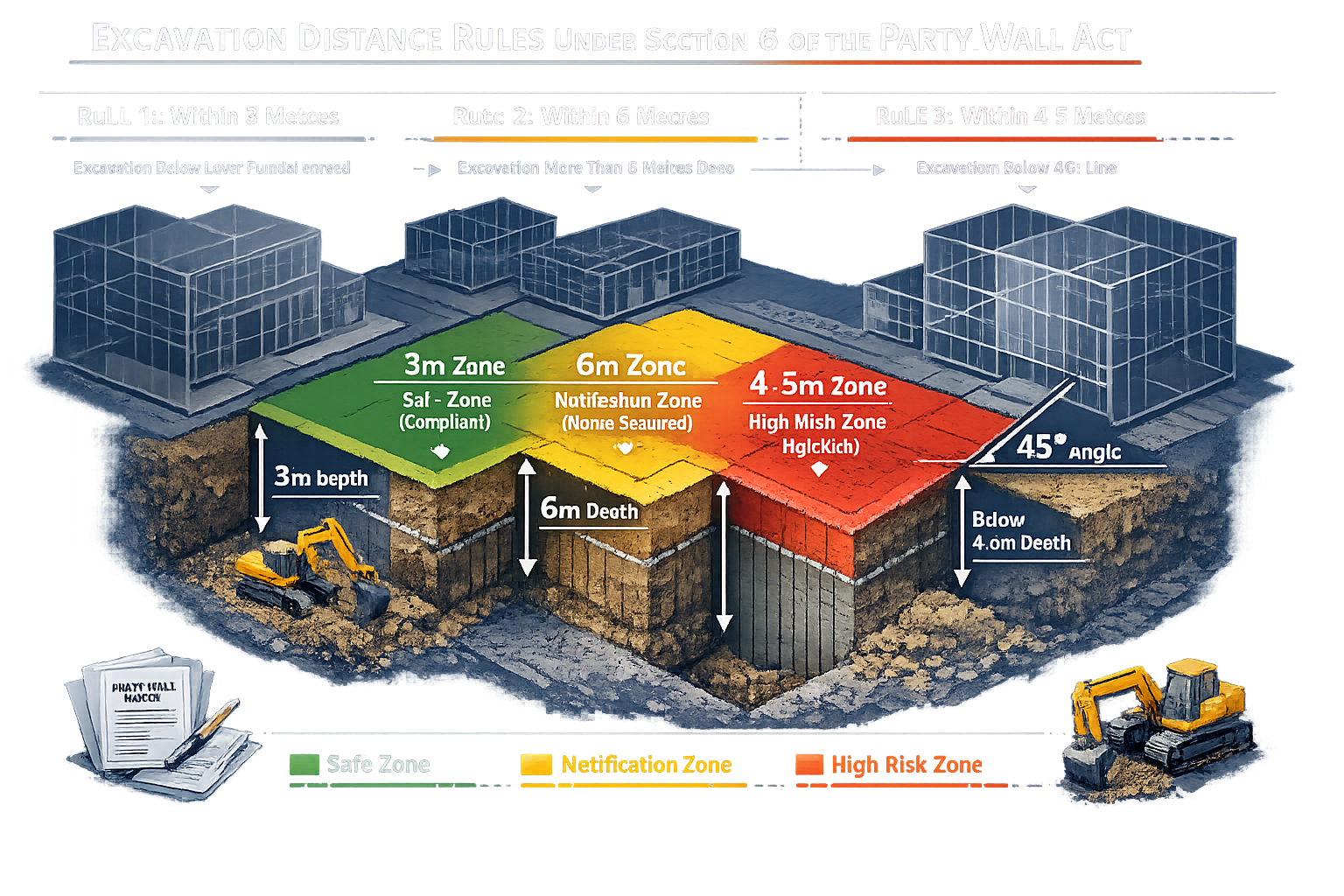
    Data centres often require deep excavations for basement plant rooms, cooling systems, and cable infrastructure. If excavation within three or six metres of a neighbouring building extends below their foundation level, party wall notices must be served.

    Notice Periods and Timelines

    Proper timing is essential for party wall compliance:

    Notice Type Minimum Notice Period When to Serve
    Party Structure Notice 2 months Before works to existing party walls
    Line of Junction Notice 1 month Before building new walls on boundaries
    Adjacent Excavation Notice 1 month Before excavating near neighbours

    For data centre projects with tight construction schedules, these notice periods must be factored into the critical path. Failure to serve notices in time can delay the entire project start date.

    The Role of Party Wall Surveyors

    When a neighbouring owner receives a party wall notice, they have three options:

    1. Consent in writing to the proposed works
    2. Dissent or fail to respond within 14 days
    3. Appoint a surveyor to negotiate terms

    In practice, most data centre expansions involve appointing surveyors due to the complexity and value of the works. The surveyor’s role includes:

    ✅ Preparing detailed schedules of condition documenting the pre-construction state of adjacent properties
    ✅ Negotiating the terms and conditions under which works can proceed
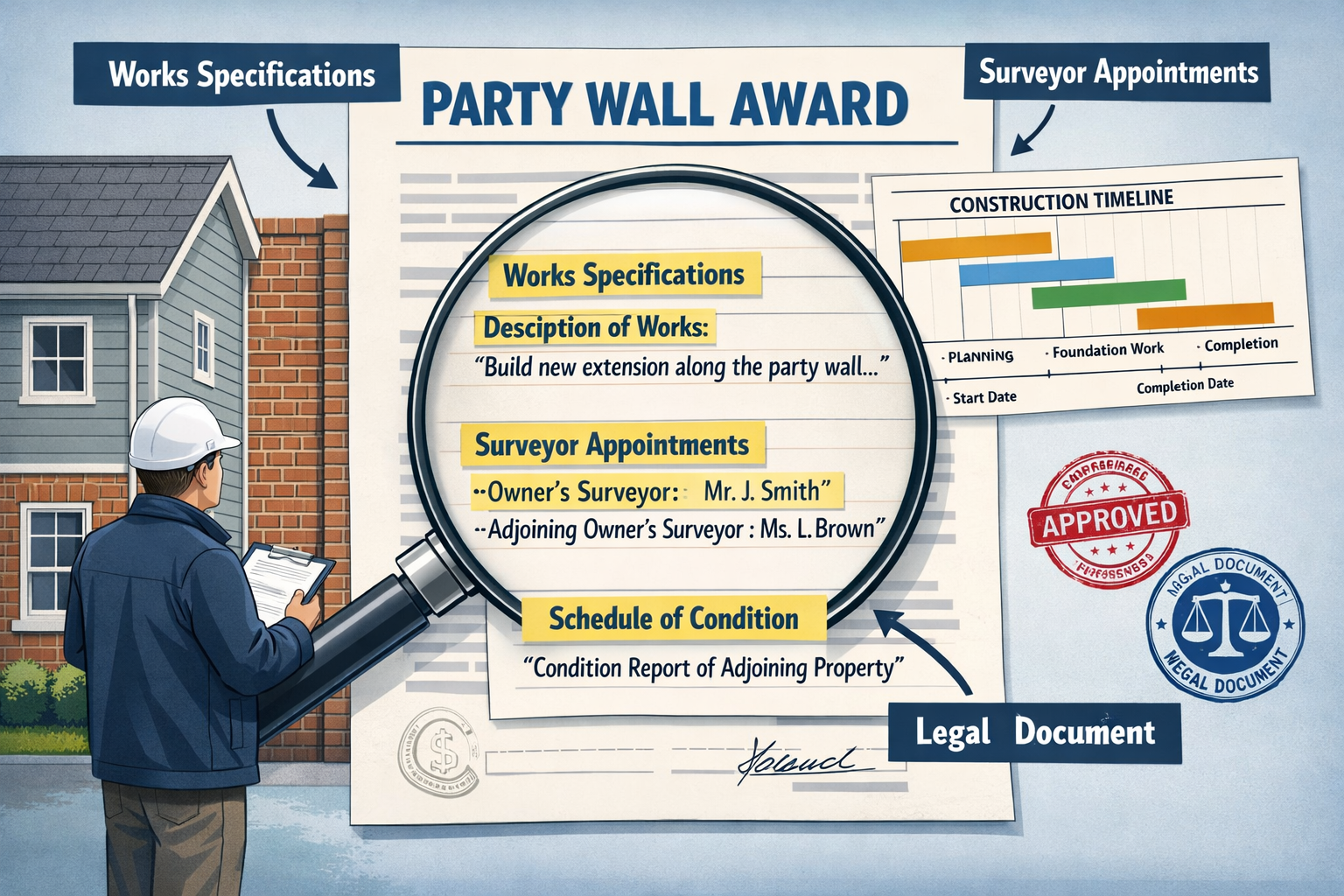
    ✅ Preparing a party wall award that legally binds all parties
    ✅ Monitoring works to ensure compliance with the agreed terms
    ✅ Resolving disputes that arise during construction

    For guidance on the party wall process, developers can review resources on having a party wall agreement without a surveyor, though professional surveyor involvement is strongly recommended for high-value data centre projects.

    Navigating Agreements in the 2026 Investment Surge: Practical Considerations

    Early Engagement Strategies

    The complexity of data centre construction demands proactive party wall management from the earliest planning stages. Successful developers in 2026 are adopting several best practices:

    Pre-Notice Consultation
    Before formally serving party wall notices, experienced developers engage in informal discussions with neighbouring property owners. This approach:

    • Identifies potential concerns early
    • Builds goodwill and trust
    • Allows time to address objections before formal procedures begin
    • Reduces the likelihood of disputes

    Surveyor Selection
    Choosing the right party wall surveyor is critical. For data centre projects, look for professionals with:

    Schedule of Condition: Protecting All Parties

    A comprehensive schedule of condition is the foundation of effective party wall management for data centre expansions. This detailed photographic and written record documents the state of neighbouring properties before construction begins.

    For data centre projects, schedules of condition should include:

    🏠 Structural Elements

    • Foundation condition and any existing settlement
    • Wall integrity, including cracks, bulges, or deterioration
    • Floor levels and any existing slopes
    • Ceiling condition and structural supports

    🔧 Building Services

    • Existing drainage systems
    • Utility connections
    • HVAC systems that could be affected by vibration

    📸 Documentation Standards

    • High-resolution photographs with date stamps
    • Detailed written descriptions
    • Measurements of existing defects
    • Video walkthroughs for complex spaces

    This documentation protects both the building owner undertaking the data centre expansion and the adjoining owner by establishing a clear baseline. If disputes arise about alleged construction damage, the schedule provides objective evidence of pre-existing conditions.

    Party Wall Awards for Data Centre Projects

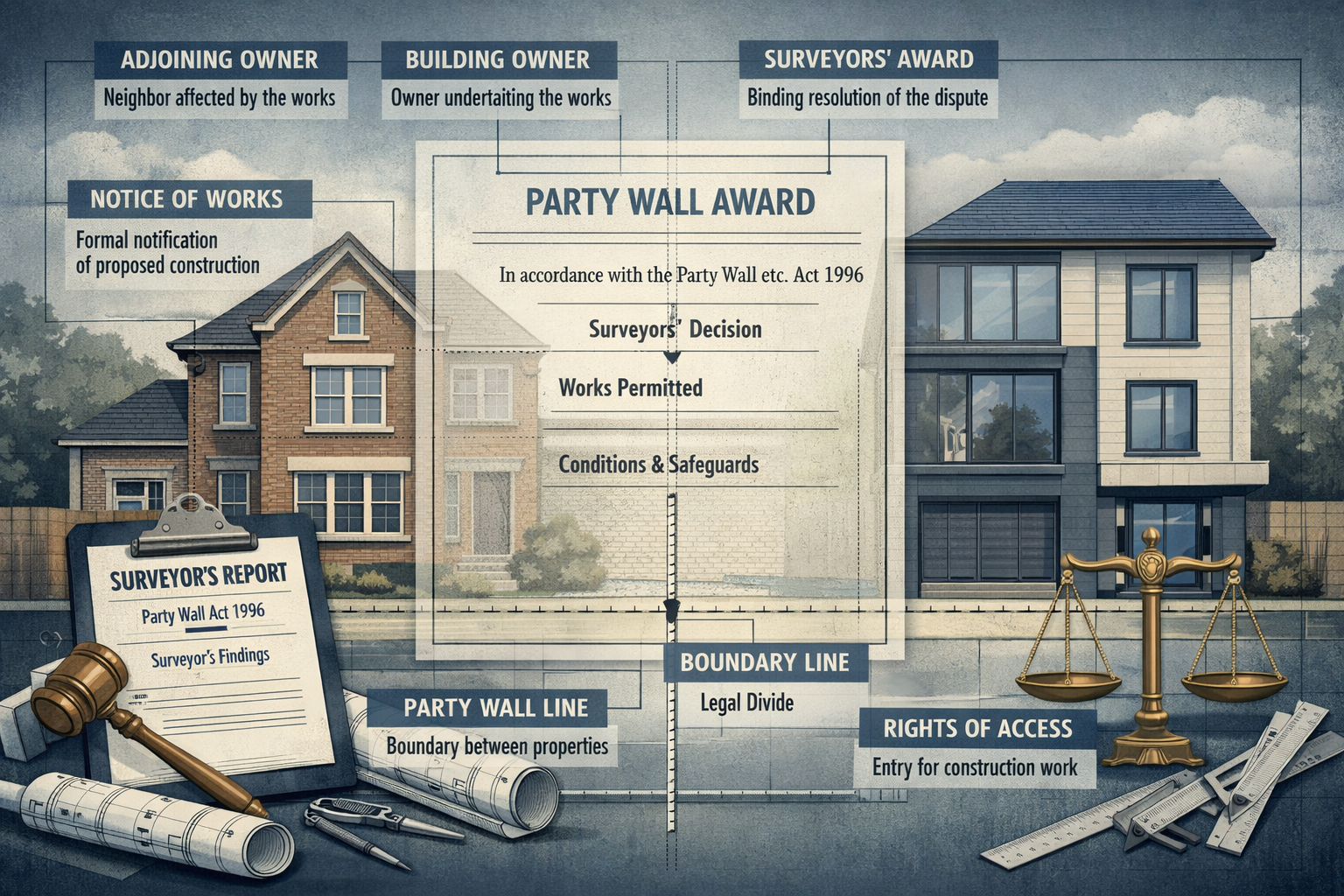
    The party wall award is the legally binding document that authorizes works to proceed under agreed conditions. For data centre expansions, awards typically address:

    Technical Specifications

    • Permitted excavation depths and methods
    • Underpinning requirements and techniques
    • Temporary support measures during construction
    • Vibration and noise limitations
    • Working hours restrictions

    Protection Measures

    • Monitoring requirements (vibration sensors, crack monitoring)
    • Insurance requirements and coverage levels
    • Emergency contact procedures
    • Remediation protocols if damage occurs

    Financial Arrangements

    • Who pays surveyor fees (typically the building owner)
    • Compensation for loss of amenity during construction
    • Security deposits or performance bonds
    • Procedures for handling damage claims

    Understanding how to keep party wall costs down while ensuring comprehensive protection is a balancing act that experienced surveyors navigate effectively.

    Managing Multi-Party Complexity

    Data centre developments often involve multiple parties and stakeholders, increasing dispute risk[1]. A typical project might involve:

    • 🏢 The building owner (developer or data centre operator)
    • 🏘️ Multiple adjoining owners with different concerns
    • 👷 Main contractor and specialized subcontractors
    • 🏛️ Planning authorities and building control
    • ⚡ Utility companies for power and connectivity
    • 💼 Investors and financing institutions

    Each party has different priorities and risk tolerances. Effective party wall management requires:

    Clear Communication Protocols
    Establishing who communicates what information to whom, and when. For example, adjoining owners should receive regular updates on construction progress, while detailed technical information flows between surveyors and contractors.

    Coordinated Surveyor Approach
    When multiple adjoining properties are affected, appointing an agreed surveyor to act for all parties can streamline the process. Alternatively, separate surveyors for each adjoining owner may be appropriate if interests diverge significantly.

    Documented Decision-Making
    All agreements, variations, and decisions should be documented in writing and shared with relevant parties. This creates an audit trail that prevents misunderstandings and supports dispute resolution if needed.

    Special Considerations for Data Centre Construction

    Deep Excavation and Foundation Challenges

    Data centres require substantial below-ground infrastructure for:

    • Cable entry points and distribution systems
    • Cooling systems and water management
    • Emergency power generation equipment
    • Structural support for heavy server loads

    These requirements often necessitate excavations significantly deeper than typical commercial buildings. When excavating near existing structures, several party wall considerations arise:

    Underpinning Requirements
    If excavation extends below neighbouring foundations, underpinning may be necessary to maintain structural stability. The party wall award should specify:

    • Underpinning methodology (mass concrete, beam and base, piling)
    • Sequencing to minimize risk
    • Monitoring during excavation and underpinning
    • Acceptance criteria for settlement

    Temporary Works
    Retaining walls, sheet piling, or other temporary support systems must be designed to protect adjacent properties. The award should address:

    • Design standards and approval processes
    • Installation methods and vibration limits
    • Monitoring and inspection requirements
    • Removal procedures after permanent works are complete

    Vibration and Noise Management

    Data centre construction involves heavy machinery, piling operations, and continuous concrete pours that can generate significant vibration and noise. Party wall awards for these projects typically include:

    📊 Vibration Monitoring

    • Baseline vibration surveys before works commence
    • Continuous monitoring during high-risk activities
    • Trigger levels that require work stoppage
    • Reporting protocols to adjoining owners and surveyors

    🔊 Noise Limitations

    • Permitted working hours (often restricted in urban areas)
    • Maximum noise levels at property boundaries
    • Requirements for acoustic barriers or enclosures
    • Advance notice for exceptionally noisy operations

    Specialist Equipment Installation

    The installation of highly specialized components and equipment in data centres creates unique party wall considerations[1]. Equipment such as:

    • Massive uninterruptible power supply (UPS) systems
    • Precision cooling infrastructure
    • Raised floor systems with extensive cabling
    • Backup generator sets

    This equipment often requires:

    • Crane lifts over adjoining properties (requiring separate access agreements)
    • Structural modifications to party walls for service penetrations
    • Vibration isolation to prevent disturbance to neighbours
    • Emergency access provisions for maintenance and repairs

    Party wall awards should anticipate these requirements and establish clear procedures for managing them.

    Dispute Resolution and Risk Mitigation
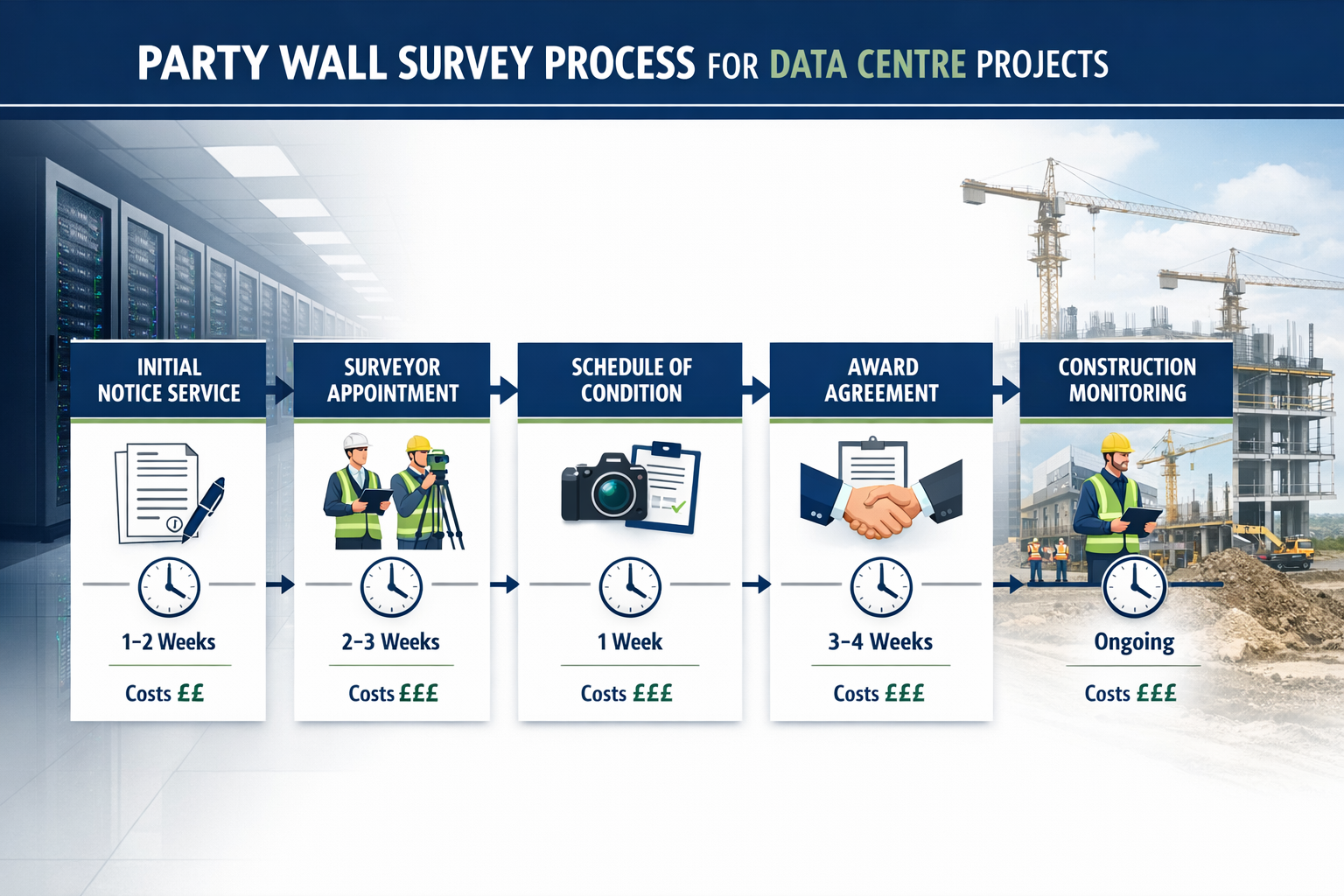
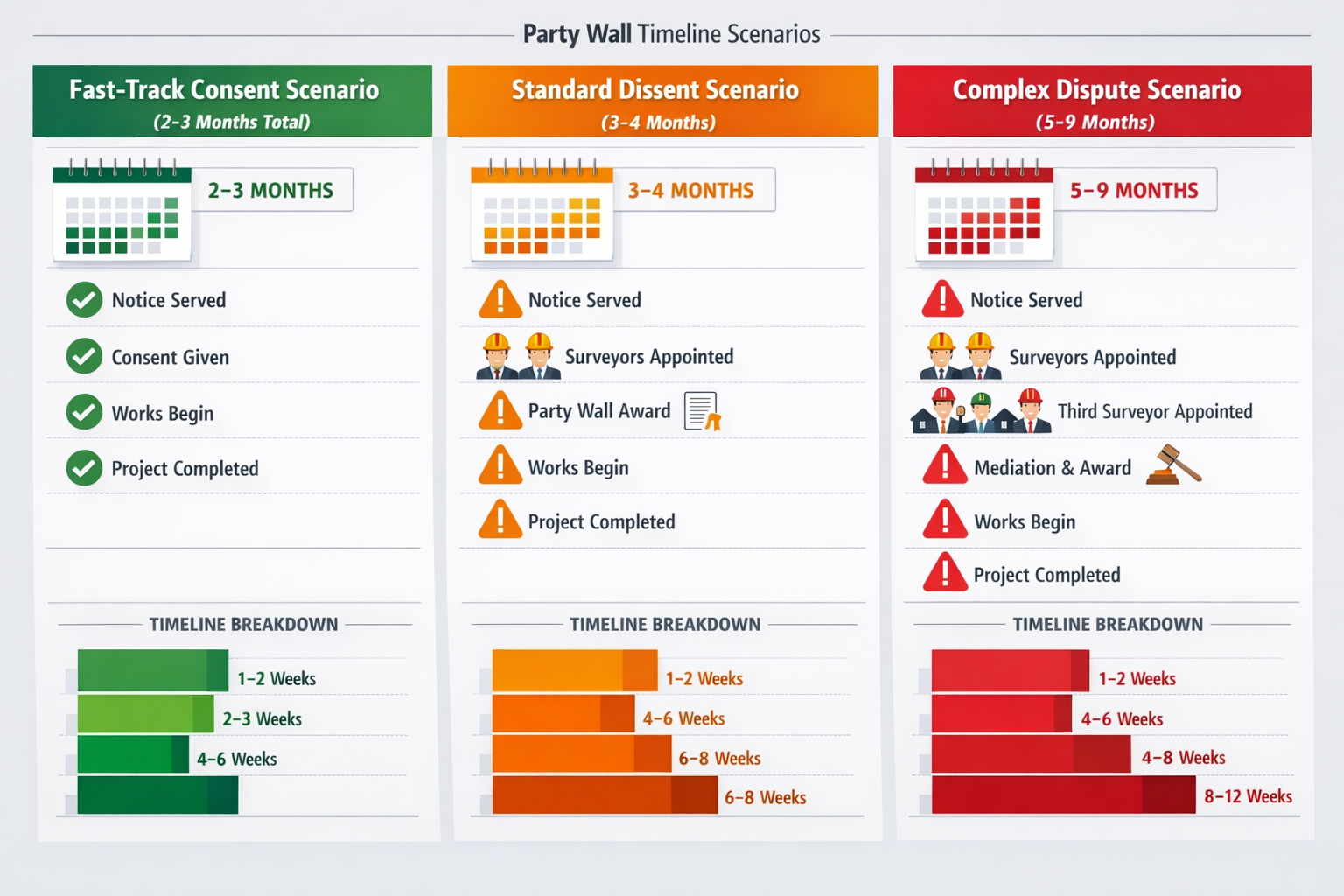
    Landscape format (1536x1024) professional infographic-style image depicting the party wall survey process timeline for data centre projects.

    Common Sources of Party Wall Disputes

    Despite best efforts, disputes can arise during data centre construction projects. Understanding common triggers helps prevent them:

    🚧 Construction Methodology Disagreements
    Adjoining owners may object to proposed construction methods, particularly for deep excavations or works involving vibration. Resolution requires technical evidence and sometimes alternative methodology proposals.

    💰 Cost and Compensation Issues
    Disputes over surveyor fees, compensation for inconvenience, or the scope of required protective works can delay projects. Clear financial terms in the initial award prevent many of these conflicts.

    📅 Timeline and Access Concerns
    Adjoining owners may have concerns about construction duration, working hours, or temporary access requirements. Transparent communication and reasonable accommodations usually resolve these issues.

    🔍 Damage Claims
    Allegations of construction-related damage are among the most contentious disputes. Comprehensive schedules of condition and regular monitoring help distinguish pre-existing conditions from new damage.

    Effective Dispute Resolution Strategies

    When disputes arise, several resolution mechanisms are available:

    Third Surveyor Appointment
    If the building owner’s surveyor and adjoining owner’s surveyor cannot agree, the Party Wall etc. Act 1996 provides for appointment of a third surveyor to make a binding determination. This mechanism:

    • Provides expert technical resolution
    • Avoids court proceedings
    • Maintains project momentum
    • Is typically faster and less expensive than litigation

    Mediation and Negotiation
    Before invoking formal dispute resolution, experienced surveyors often facilitate mediation between parties. This collaborative approach:

    • Preserves relationships between neighbours
    • Allows creative solutions
    • Reduces costs for all parties
    • Maintains confidentiality

    Legal Proceedings
    As a last resort, parties can appeal third surveyor decisions to the County Court. However, this is rare in practice due to the time and expense involved. For high-value data centre projects, avoiding litigation is almost always preferable.

    Insurance and Risk Transfer

    Comprehensive insurance coverage is essential for data centre construction projects. Party wall awards typically require:

    Professional Indemnity Insurance
    Surveyors must maintain adequate PI coverage. For data centre projects, traditional coverage limits may need to be increased given the high values at stake[1].

    Contractor’s All Risks Insurance
    Construction insurance should cover party wall damage, with adjoining owners named as interested parties. Policy limits should reflect the potential cost of repairing high-value adjacent properties.

    Structural Warranty Coverage
    Long-term structural warranties may be required, particularly for works involving underpinning or significant structural modifications to party walls.

    The party wall award should specify minimum insurance requirements and require evidence of coverage before works commence.

    Cost Management for Party Wall Surveys in Data Centre Projects

    Understanding the Cost Structure

    Party wall costs for data centre expansions typically include:

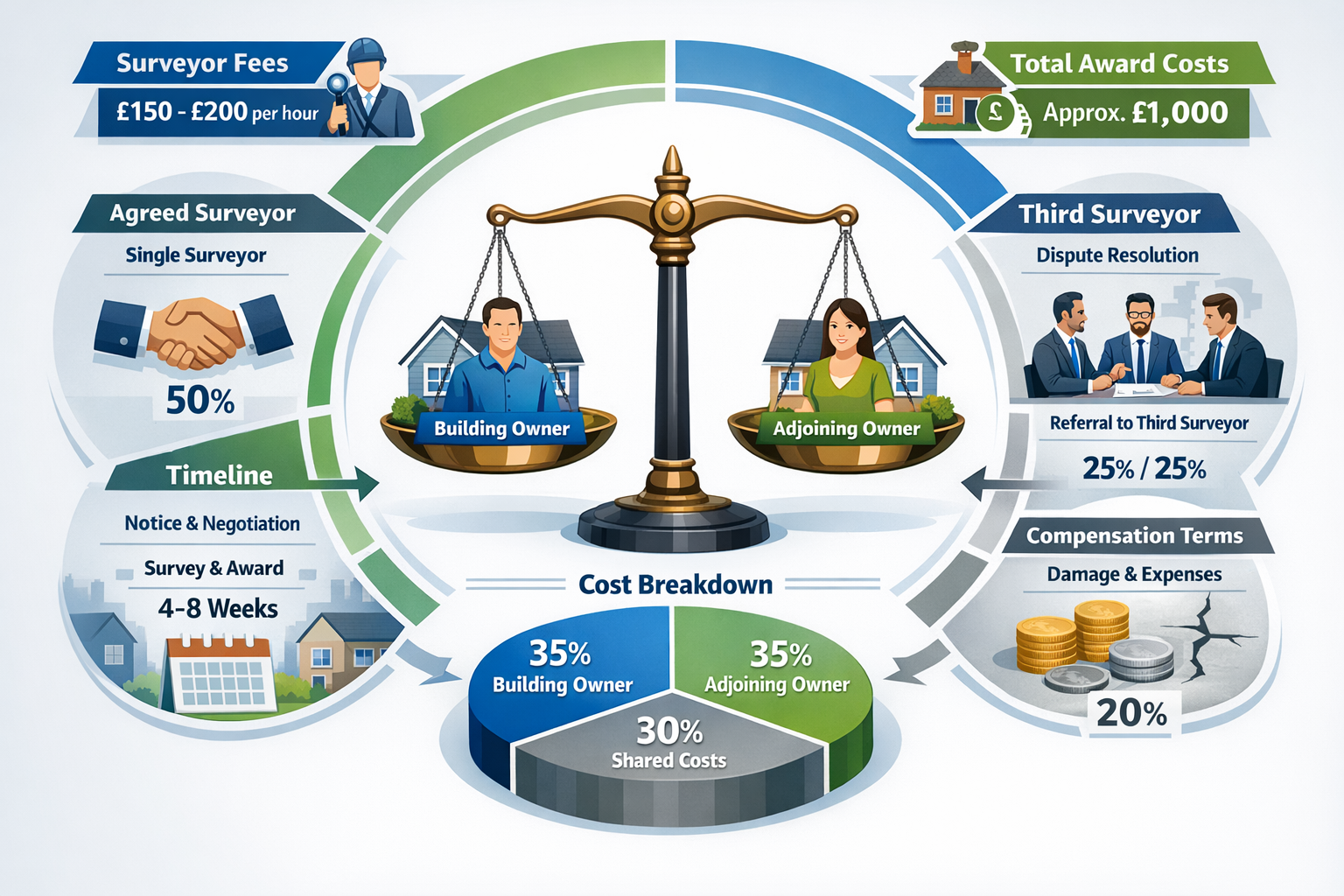
    Cost Component Typical Range Notes
    Building Owner’s Surveyor Fees £3,000-£15,000+ Depends on project complexity
    Adjoining Owner’s Surveyor Fees £2,000-£10,000+ per property Building owner typically pays
    Schedule of Condition £500-£2,000 per property Comprehensive documentation
    Third Surveyor (if required) £2,000-£8,000 For dispute resolution
    Monitoring and Inspections £1,000-£5,000+ Ongoing during construction

    For data centre projects affecting multiple adjoining properties, total party wall costs can easily reach £50,000-£100,000 or more. While substantial, this represents a small fraction of total project costs and is essential for legal compliance and risk management.

    For strategies to minimize expenses while maintaining compliance, review guidance on keeping party wall costs down.

    Budgeting and Contingency Planning

    Experienced developers budget for party wall costs early in the project financial model. Best practices include:

    Early Cost Estimation
    Engage a party wall surveyor during feasibility studies to estimate likely costs based on:

    • Number of affected properties
    • Complexity of proposed works
    • Likelihood of disputes based on local context
    • Required monitoring and protection measures

    Contingency Allowances
    Include contingencies of 20-30% above estimated party wall costs to account for:

    • Unexpected complications during construction
    • Additional properties affected by design changes
    • Extended monitoring periods
    • Dispute resolution costs

    Phased Payment Structures
    Negotiate payment terms with surveyors that align with project milestones, improving cash flow management.

    Regional Considerations Across London

    Data centre developments are occurring across all London regions, each with unique party wall considerations:

    Central London Challenges

    Party wall surveyors in Central London deal with:

    • Historic buildings with sensitive structures
    • High-value properties where stakes are elevated
    • Complex ownership structures (leasehold, commercial tenants)
    • Strict planning and conservation requirements

    North London Developments

    North London party wall surveyors frequently encounter:

    • Mixed residential and commercial areas
    • Varied building ages and construction types
    • Active community engagement and awareness of rights
    • Good transport links attracting data centre investment

    East London Opportunities

    East London has become a data centre hotspot due to:

    • Available land for larger facilities
    • Proximity to financial district connectivity
    • Regeneration areas with supportive planning
    • Mix of industrial and residential neighbours

    South London Characteristics

    South London party wall work involves:

    • Suburban areas with residential neighbours
    • Varied geological conditions affecting excavation
    • Growing commercial development corridors
    • Community-focused approach to neighbour relations

    Understanding regional nuances helps developers anticipate challenges and select surveyors with appropriate local expertise.

    Future Outlook: Party Wall Surveys in the Evolving Data Centre Landscape

    Emerging Trends for 2026 and Beyond

    The data centre construction boom shows no signs of slowing, and several trends will shape party wall practice:

    🤖 AI-Driven Demand
    Artificial intelligence applications require exponentially more computing power, driving continued data centre expansion in urban areas where party wall issues are inevitable.

    ♻️ Sustainability Requirements
    Modern data centres incorporate advanced cooling and power management systems, often requiring deeper excavations and more complex building services that interact with party wall considerations.

    ⚡ Power Infrastructure Constraints
    Limited electrical grid capacity in urban areas means data centres must maximize efficiency on available sites, often leading to more intensive development adjacent to existing buildings.

    🏗️ Alternative Procurement Models
    Traditional “single point responsibility” construction approaches are giving way to phased procurement structures[1] that may involve multiple contractors and extended timelines, complicating party wall management.

    Adapting Party Wall Practice

    Party wall surveyors are adapting their practice to meet data centre sector demands:

    Enhanced Technical Expertise
    Surveyors are developing specialized knowledge of data centre construction techniques, equipment requirements, and operational considerations.

    Digital Documentation
    Advanced photographic equipment, 3D scanning, and digital condition reporting are becoming standard for high-value projects, providing more comprehensive baseline documentation.

    Proactive Monitoring
    Real-time vibration monitoring, crack detection sensors, and automated reporting systems allow early identification of potential issues before they become disputes.

    Collaborative Approaches
    Recognizing the multi-party complexity of data centre projects[1], surveyors are facilitating more collaborative problem-solving rather than adversarial positioning.

    Conclusion

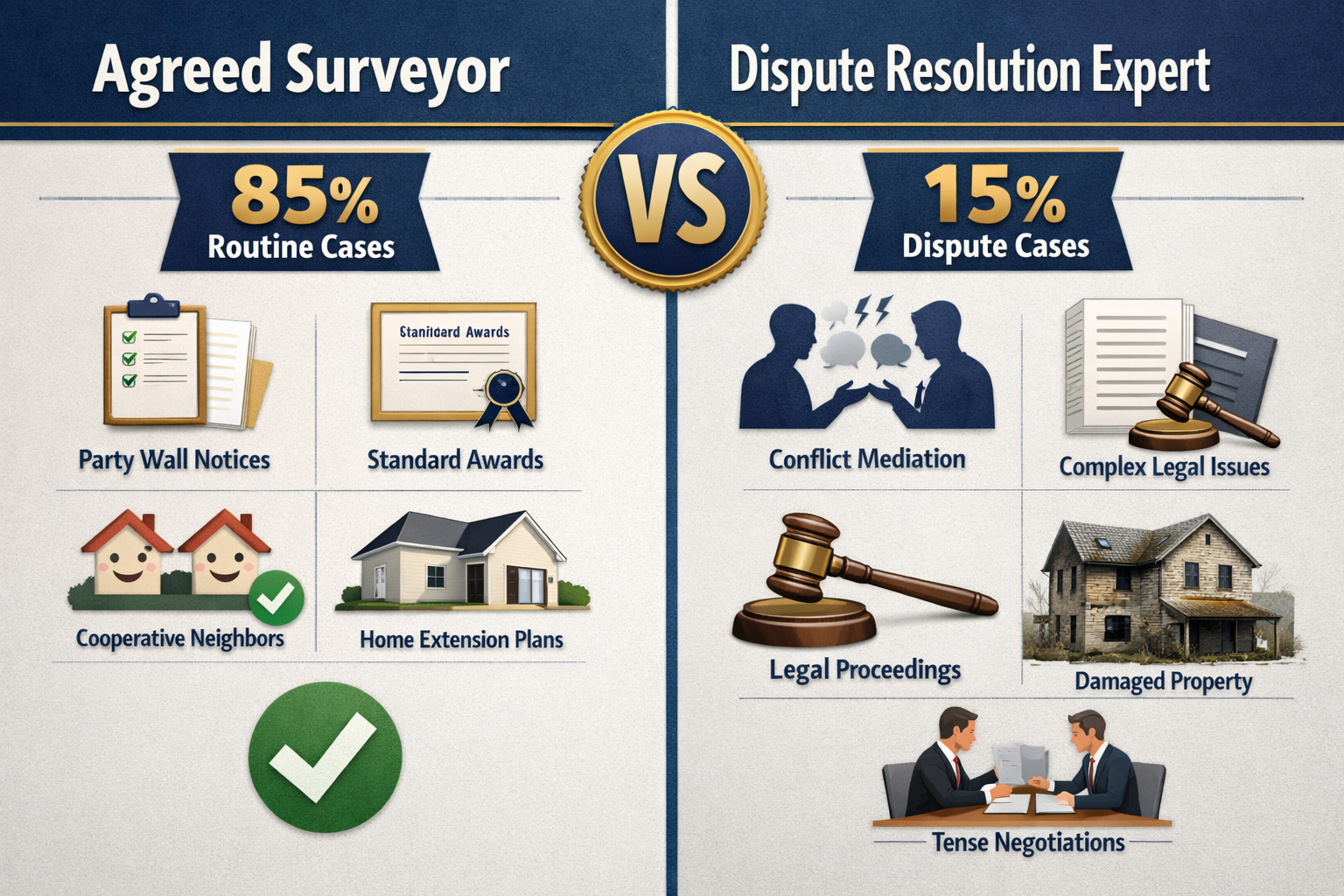
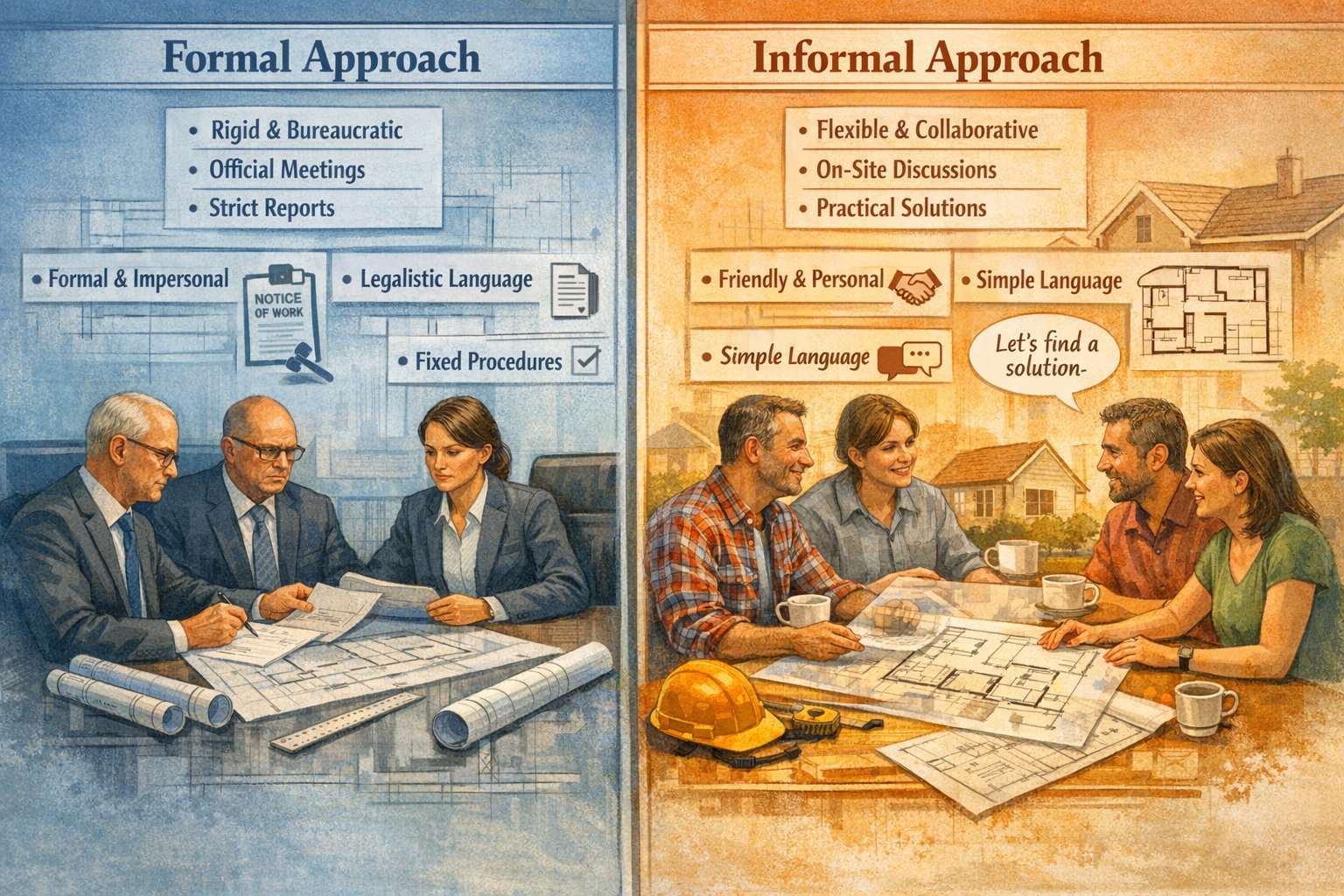
    Landscape format (1536x1024) image showing split-screen composition comparing traditional party wall disputes versus modern collaborative re

    Party wall surveys for data centre expansions have become critical enablers of the 2026 investment surge transforming the UK’s digital infrastructure landscape. As demand for AI computing capacity and cloud services drives unprecedented construction activity in urban areas, understanding and properly managing party wall agreements is no longer optional—it’s essential for project success.

    The legal framework established by the Party Wall etc. Act 1996 provides a proven mechanism for balancing the rights of building owners to develop their properties with the rights of adjoining owners to protection from damage and disturbance. When properly implemented through qualified surveyors, comprehensive schedules of condition, and well-drafted awards, the party wall process protects all stakeholders and enables projects to proceed smoothly.

    Key Success Factors

    Early engagement with neighbours and surveyors, well before construction begins
    Comprehensive documentation through detailed schedules of condition
    Clear communication with all stakeholders throughout the process
    Adequate budgeting for party wall costs and contingencies
    Specialist expertise from surveyors experienced with data centre projects
    Proactive monitoring during construction to identify issues early
    Collaborative dispute resolution when disagreements arise

    Next Steps for Data Centre Developers

    If you’re planning a data centre expansion that may affect neighbouring properties:

    1. Assess party wall implications during initial feasibility studies
    2. Engage a qualified party wall surveyor with relevant experience
    3. Review the types of works that trigger notice requirements under the Party Wall etc. Act 1996
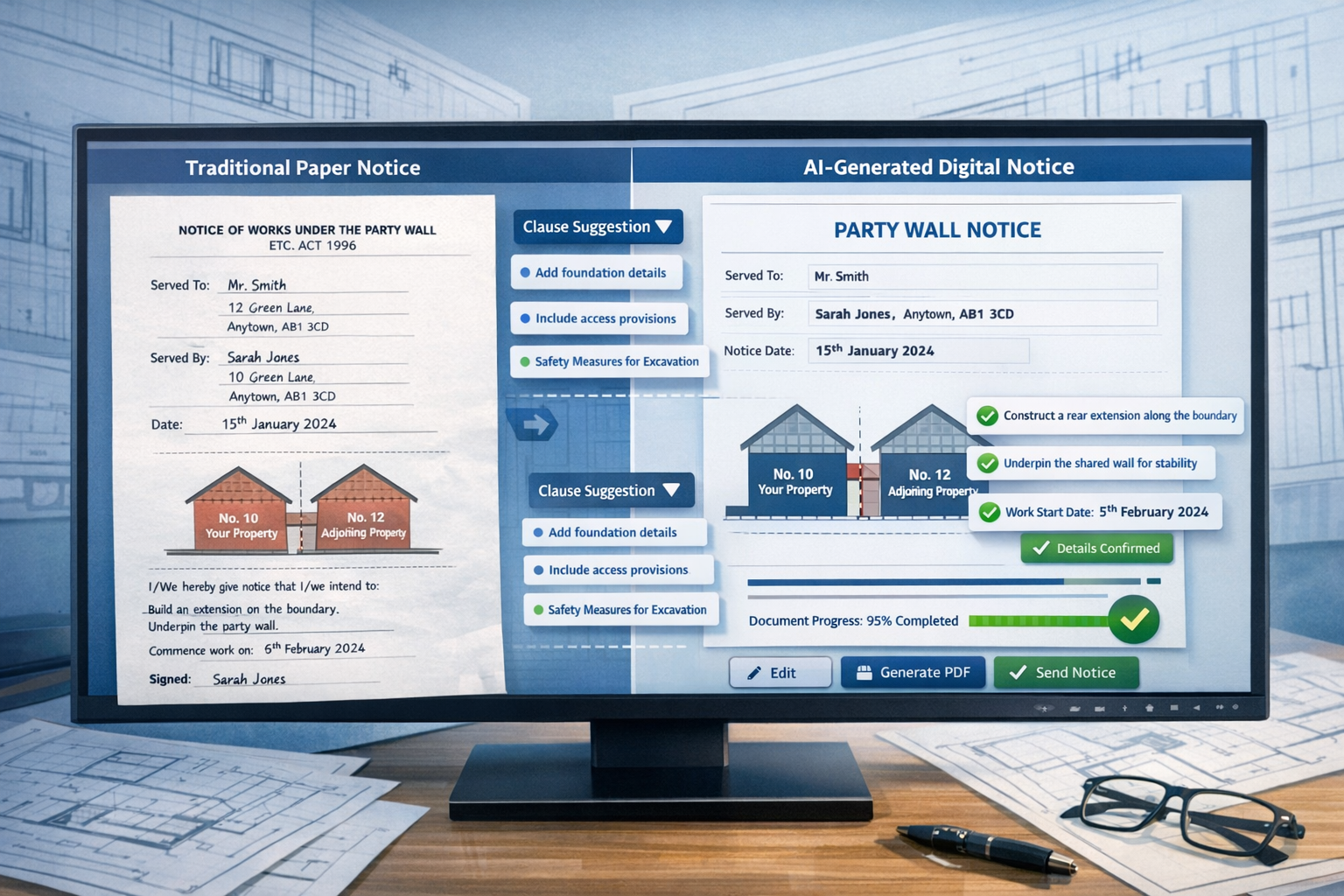
    4. Prepare and serve notices with appropriate lead time before construction
    5. Document existing conditions comprehensively before works commence
    6. Maintain open communication with adjoining owners throughout the project
    7. Monitor compliance with party wall award terms during construction

    The unprecedented growth of data centre construction in 2026 presents both opportunities and challenges. By understanding party wall requirements, engaging qualified professionals early, and approaching the process collaboratively, developers can navigate agreements successfully and deliver the critical digital infrastructure that powers our increasingly AI-driven economy.

    For expert guidance on your data centre expansion project, consider consulting with experienced party wall surveyors who understand both the legal framework and the unique technical demands of this specialized sector. The investment in proper party wall management pays dividends through reduced disputes, minimized delays, and protected relationships with the neighbours who will share your facility’s boundaries for decades to come.


    References

    [1] Data Centres – https://www.brownejacobson.com/insights/2026-horizon-scanning-in-construction/data-centres

    [2] Party Wall Surveys For Data Centre Expansions Navigating Agreements In The 2026 Investment Surge – https://nottinghillsurveyors.com/blog/party-wall-surveys-for-data-centre-expansions-navigating-agreements-in-the-2026-investment-surge

    [3] Party Wall Surveys For Data Centre Expansions In The Uk Ai Boom Rics Guidance And Case Studies From 2026 Projects – https://nottinghillsurveyors.com/blog/party-wall-surveys-for-data-centre-expansions-in-the-uk-ai-boom-rics-guidance-and-case-studies-from-2026-projects

  • Party Wall Agreements for Student Housing Retrofits: Navigat

    The student housing market in 2026 faces unprecedented challenges. After experiencing robust growth throughout 2024 and 2025, the sector now confronts demographic headwinds and significant visa processing delays that have left many purpose-built student accommodation (PBSA) properties struggling with vacancies. For surveyors and property developers working on student housing retrofits, understanding Party Wall Agreements for Student Housing Retrofits: Navigating Complexity in a Volatile Sector has never been more critical. As landlords rush to convert, renovate, and repurpose existing student properties to remain competitive, the legal and technical complexities of party wall procedures become paramount.

    This comprehensive guide explores the unique challenges surveyors face when managing party wall agreements in the volatile student housing sector, providing practical strategies for navigating uncertainty while protecting all parties’ interests.

    Key Takeaways

    • 📉 Market volatility in 2026 requires flexible party wall agreements that account for project delays and budget constraints in student housing retrofits
    • 🏗️ Student housing conversions often involve complex structural work affecting party walls, requiring thorough documentation and experienced surveyors
    • 📋 Proactive communication with adjoining owners and comprehensive schedules of condition are essential risk management tools
    • ⚖️ Legal compliance with the Party Wall etc. Act 1996 remains mandatory regardless of market conditions or project urgency
    • 💰 Cost management strategies can help developers control party wall expenses during uncertain economic periods

    Understanding the 2026 Student Housing Market Context

    Detailed landscape format (1536x1024) image showing split-screen composition of student housing market volatility. Left side displays upward

    The Shift from Growth to Uncertainty

    The student housing sector experienced remarkable expansion during 2024 and 2025, driven by increased international student enrollment and strong domestic demand. However, 2026 has brought significant challenges that directly impact retrofit and renovation projects:

    Demographic headwinds have emerged as birth rates from the early 2000s translate into smaller cohorts entering higher education. This reduction in the traditional student-age population creates immediate pressure on occupancy rates.

    Visa processing delays have severely affected international student intake, particularly from key markets. Extended waiting periods and increased scrutiny have led many institutions to miss enrollment targets, leaving student accommodation providers with unexpected vacancies.

    Financial pressure on property owners has intensified, with many seeking to retrofit existing buildings rather than develop new properties. These renovation projects frequently trigger party wall procedures that must be carefully managed.

    Why Retrofits Are Increasing

    Student housing operators are responding to market volatility through several strategies:

    • 🔄 Converting older properties to modern specifications with en-suite facilities
    • 🏢 Repurposing commercial buildings into student accommodation
    • Upgrading existing stock to meet energy efficiency standards
    • 🎯 Reconfiguring layouts to create different room types and price points

    Each of these approaches typically involves structural alterations that affect party walls, making proper legal procedures essential.

    Party Wall Agreements for Student Housing Retrofits: Navigating Complexity in a Volatile Sector – The Legal Framework

    The Party Wall etc. Act 1996 in Student Housing Context

    The Party Wall etc. Act 1996 applies to all building work affecting party walls, regardless of the property’s use or market conditions. Student housing retrofits commonly trigger the Act through:

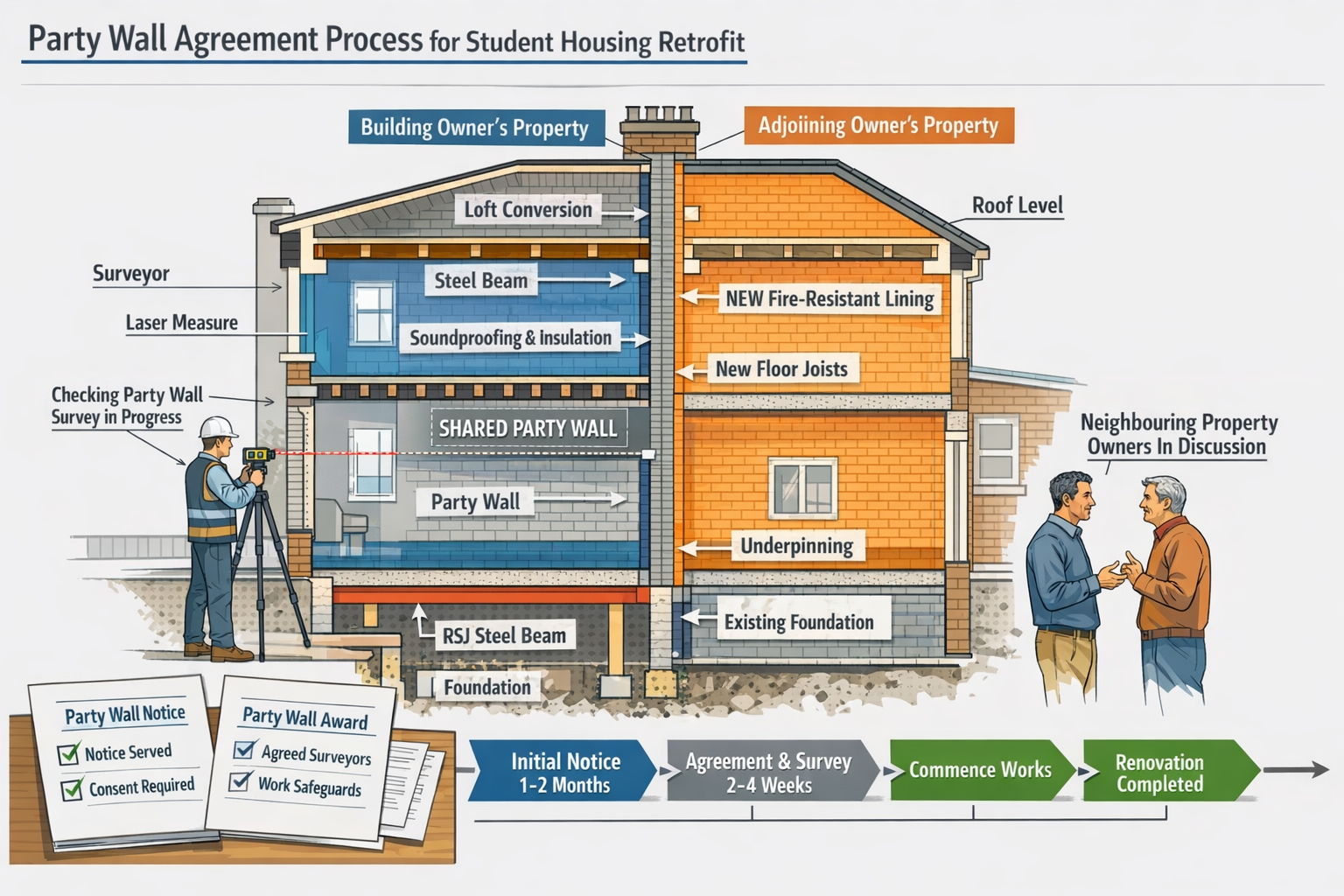
    Structural alterations including removing or inserting beams, cutting into party walls for new openings, or underpinning foundations. These works require serving a Party Structure Notice to adjoining owners.

    Building on the line of junction when constructing new structures that sit astride or immediately adjacent to boundary lines, necessitating a Line of Junction Notice.

    Excavation works within three or six meters of neighboring structures, depending on depth, which require notice under Section 6 of the Act.

    For student housing projects, adjoining properties may include:

    • Other student accommodation blocks
    • Residential properties occupied by homeowners
    • Commercial premises
    • Mixed-use developments
    • Properties owned by educational institutions

    Each type of adjoining owner presents different considerations for the party wall process.

    Notice Requirements and Timelines

    Proper notice is the foundation of lawful party wall procedures. Building owners must serve appropriate party wall notices at least two months before commencing work for Party Structure Notices, or one month for Line of Junction Notices.

    In the volatile 2026 market, these timelines create challenges:

    Challenge Impact Solution
    Project delays Notices may expire before work begins Serve notices strategically when funding confirmed
    Budget uncertainty Cannot commit to surveyor fees early Include contingency in financial planning
    Changing scope Original notices may not cover revised work Re-serve notices if significant changes occur
    Vacant adjoining properties Difficulty locating owners Conduct thorough ownership searches early

    Understanding these timing considerations helps surveyors guide clients through the process efficiently. For detailed guidance on the notice process, review our comprehensive resource on party wall act notices and how to respond.

    Technical Challenges in Student Housing Party Wall Projects

    Common Structural Works Affecting Party Walls

    Student housing retrofits typically involve specific types of structural interventions that trigger party wall procedures:

    1. Creating En-Suite Facilities

    Modern students expect en-suite bathrooms, requiring landlords to reconfigure existing layouts. This work often involves:

    • Cutting into party walls for new plumbing runs
    • Installing drainage systems that penetrate party structures
    • Adding ventilation that may affect party walls
    • Strengthening floors to support additional bathroom weight

    2. Open-Plan Living Conversions

    Converting traditional room layouts into studio apartments or open-plan spaces may require:

    • Removing internal walls that provide lateral support to party walls
    • Installing steel beams that bear on party walls
    • Altering floor structures that connect to party walls
    • Modifying roof structures shared between properties

    3. Basement Conversions and Extensions

    Maximizing space through basement development involves:

    • Underpinning party walls to achieve additional ceiling height
    • Excavating near party wall foundations
    • Installing damp-proofing that affects party structures
    • Creating new openings for access

    4. Facade and Roof Improvements

    Energy efficiency upgrades and aesthetic improvements include:

    • External wall insulation affecting party wall junctions
    • Roof replacements on party wall structures
    • Installation of solar panels requiring roof penetrations
    • Window replacements in party walls

    Surveyor Considerations for Student Housing

    Surveyors working on student housing party wall agreements face unique technical challenges:

    Building age and condition: Many student properties occupy Victorian or Edwardian terraces with aging party walls that may have existing defects, making it difficult to distinguish pre-existing damage from new construction impact.

    Multiple adjoining owners: Student housing often sits within terraces where work may affect several neighboring properties simultaneously, requiring coordination of multiple party wall agreements.

    Mixed construction types: Retrofit projects may encounter unexpected construction methods, particularly in older conversions, complicating structural assessments.

    Access limitations: During term time, accessing student properties for schedules of condition can be challenging, requiring careful planning around academic calendars.

    “The key to successful party wall management in student housing is anticipating complexity. Never assume a straightforward Victorian terrace will be simple—these buildings have often undergone multiple conversions, creating hidden structural interdependencies that only emerge during detailed surveys.”

    Party Wall Agreements for Student Housing Retrofits: Managing Costs and Risks in Uncertain Markets

    Detailed landscape format (1536x1024) technical illustration of party wall agreement process for student housing retrofit project. Shows cut

    Cost Management Strategies

    The volatile market conditions of 2026 place enormous pressure on project budgets. Party wall costs can escalate quickly if not properly managed. Developers should consider:

    Early engagement: Appointing surveyors early in the project planning phase allows for accurate cost estimation and budget allocation. Understanding the full scope of costs of party wall procedures prevents nasty surprises.

    Agreed surveyor approach: When adjoining owners consent, appointing a single agreed surveyor to act for both parties significantly reduces professional fees compared to appointing separate surveyors.

    Scope clarity: Clearly defining the scope of work before serving notices prevents the need to re-serve or amend awards, which generates additional costs.

    Proactive communication: Maintaining open dialogue with adjoining owners often prevents disputes that escalate costs. Many disagreements arise from poor communication rather than genuine conflicts of interest.

    For practical tips on controlling expenses, explore our guide on how to keep party wall costs down.

    Risk Mitigation in Volatile Markets

    The uncertainty characterizing the 2026 student housing market requires robust risk management:

    Comprehensive schedules of condition documenting the pre-existing state of adjoining properties protect building owners from spurious damage claims. In student housing areas, where properties may already show wear and tear, photographic and written records are invaluable.

    Insurance considerations should include adequate cover for party wall work, ensuring protection against claims arising from construction activity.

    Contingency planning for project delays must account for the possibility that party wall procedures may extend timelines, particularly if disputes arise requiring resolution.

    Financial reserves should cover potential party wall awards that may require building owners to fund protective works or make good damage to adjoining properties.

    Dispute resolution protocols established at the outset provide clear pathways if disagreements emerge, preventing costly litigation.

    Managing Adjoining Owner Relations

    Student housing retrofits often affect various types of adjoining owners, each requiring different approaches:

    Institutional owners (universities, large PBSA operators) typically have established procedures for party wall matters and may require compliance with specific protocols.

    Individual landlords of neighboring student properties may be more concerned about minimizing disruption during term time and protecting rental income.

    Residential homeowners adjacent to student housing may have concerns about noise, disruption, and long-term property values that extend beyond pure party wall considerations.

    Commercial property owners focus primarily on business continuity and ensuring work doesn’t interfere with operations.

    Effective communication tailored to each adjoining owner’s priorities helps maintain positive relationships throughout the project.

    Navigating Party Wall Agreements for Student Housing Retrofits: Practical Workflows

    Step-by-Step Process for Surveyors

    Successfully managing party wall agreements for student housing retrofits requires systematic approach:

    Phase 1: Pre-Notice Assessment (4-6 weeks before notice)

    1. 🔍 Conduct thorough site survey identifying all party walls and structures
    2. 📋 Review proposed works against Party Wall Act triggers
    3. 🏘️ Identify all adjoining owners through Land Registry searches
    4. 💰 Estimate party wall costs for client budgeting
    5. 📅 Establish project timeline accounting for statutory notice periods

    Phase 2: Notice Service (2-3 months before work)

    1. ✍️ Prepare accurate notices describing proposed works
    2. 📮 Serve notices on all adjoining owners with appropriate lead time
    3. 📞 Follow up to confirm receipt and offer explanatory discussions
    4. ⏰ Monitor response deadlines (14 days for consent/dissent)
    5. 📝 Document all communications meticulously

    Phase 3: Award Preparation (4-8 weeks)

    1. 🏗️ Appoint surveyors (agreed surveyor or separate appointments)
    2. 📸 Conduct comprehensive schedules of condition on adjoining properties
    3. 📊 Assess proposed works and determine necessary protective measures
    4. 💬 Negotiate award terms with adjoining owners’ surveyors
    5. ⚖️ Prepare and serve party wall awards on all parties

    Phase 4: Construction Monitoring

    1. 👷 Ensure building owner complies with award conditions
    2. 🔎 Conduct periodic inspections of adjoining properties
    3. 📢 Maintain communication with adjoining owners regarding progress
    4. 🚨 Address any emerging issues or damage promptly
    5. 📋 Document all site activities affecting party walls

    Phase 5: Post-Construction

    1. ✅ Conduct final inspections of adjoining properties
    2. 🔧 Arrange making good of any damage identified
    3. 📄 Close out party wall files with final documentation
    4. 💵 Settle all outstanding surveyor fees
    5. 🤝 Obtain sign-off from adjoining owners where appropriate

    Documentation Best Practices

    Thorough documentation protects all parties and provides evidence if disputes arise:

    Photographic records should include date-stamped images of:

    • All party walls before work commences
    • Adjoining properties’ condition (interior and exterior)
    • Construction progress at key milestones
    • Any damage or issues that emerge
    • Completed works

    Written records must capture:

    • All correspondence with adjoining owners
    • Site meeting notes and decisions
    • Variations to the original scope
    • Incidents or concerns raised
    • Remedial works undertaken

    Technical documentation includes:

    • Structural calculations affecting party walls
    • Method statements for sensitive operations
    • Monitoring data (vibration, movement, etc.)
    • As-built drawings showing party wall interfaces
    • Test certificates for materials and installations

    Using cloud-based project management systems ensures all stakeholders can access current documentation while maintaining version control.

    Special Considerations for Student Housing Party Wall Projects

    Term-Time vs. Vacation Scheduling

    The academic calendar significantly impacts student housing retrofit projects:

    Vacation periods (Christmas, Easter, summer) offer advantages:

    • ✅ Easier property access for surveys
    • ✅ Reduced disruption to students
    • ✅ Greater flexibility for noisy or intrusive works
    • ✅ Adjoining student properties may also be vacant

    However, vacation scheduling creates challenges:

    • ❌ Compressed timelines requiring efficient execution
    • ❌ Premium labor costs during peak construction periods
    • ❌ Difficulty accessing adjoining properties if students have left
    • ❌ Pressure to complete before next term starts

    Term-time work requires:

    • Strict working hours to minimize student disruption
    • Enhanced communication about noise and access
    • Careful coordination with academic schedules (exams, etc.)
    • Robust complaints handling procedures

    Surveyors should advise clients on optimal timing considering both party wall procedures and operational constraints.

    Fire Safety and Building Regulations Compliance

    Student housing retrofits in 2026 face heightened scrutiny regarding fire safety, particularly following regulatory changes. Party wall work must not compromise fire separation:

    Fire-stopping at party wall junctions requires specialist materials and installation techniques that comply with current Building Regulations.

    Compartmentation must be maintained when creating new openings or penetrations through party walls.

    Structural fire protection may need upgrading when party walls are exposed during construction.

    Coordination between party wall surveyors and Building Control ensures all works meet both statutory requirements simultaneously.

    HMO Licensing Implications

    Many student properties operate as Houses in Multiple Occupation (HMOs) with specific licensing requirements. Retrofit works affecting party walls may trigger:

    License variations if room layouts or occupancy numbers change
    Additional standards for fire safety, amenity provision, and management
    Inspection requirements that may coincide with party wall schedules of condition

    Surveyors should be aware of HMO regulations in their jurisdiction and how party wall works intersect with licensing compliance.

    Energy Performance Considerations

    With increasing focus on energy efficiency, student housing retrofits often include:

    • External wall insulation systems
    • Replacement windows and doors
    • Roof insulation upgrades
    • Renewable energy installations

    These improvements frequently affect party walls and require careful design to:

    • Maintain structural integrity
    • Preserve fire separation
    • Avoid creating thermal bridges
    • Comply with party wall awards

    Coordinating energy consultants, structural engineers, and party wall surveyors ensures holistic project delivery.

    Regional Variations and Location-Specific Factors

    Detailed landscape format (1536x1024) image depicting risk management strategies for student housing party wall projects. Shows project mana

    University Town Dynamics

    Different university locations present unique party wall challenges:

    Traditional university cities (Oxford, Cambridge, Durham) feature historic buildings with complex party wall arrangements, often involving listed building considerations alongside party wall procedures.

    Modern campus developments may have purpose-built student villages with clearer ownership structures but potentially more restrictive covenants affecting alterations.

    Urban universities (London, Manchester, Birmingham) involve working in dense terraced housing where multiple adjoining owners are common. For London-specific guidance, surveyors can consult resources for party wall surveyors in Central London, North London, South London, East London, and West London.

    Coastal and regional universities may have different property values and owner expectations affecting party wall negotiations.

    Mixed-Use Environments

    Student housing increasingly occupies mixed-use areas where adjoining properties include:

    • Ground-floor retail with residential above
    • Professional offices
    • Traditional family homes
    • Other commercial uses

    Each use type brings different sensitivities regarding:

    • Noise tolerance (offices vs. residential)
    • Access requirements (business hours vs. flexible)
    • Risk perception (commercial vs. personal property)
    • Decision-making speed (corporate vs. individual owners)

    Surveyors must adapt their approach to suit the specific context of each project.

    Future-Proofing Party Wall Agreements in Uncertain Times

    Building Flexibility Into Awards

    Given the market volatility characterizing 2026, party wall awards for student housing projects should incorporate flexibility:

    Phasing provisions allow work to proceed in stages if funding constraints emerge, without requiring new awards for each phase.

    Time extensions acknowledge that market conditions may delay projects beyond original schedules.

    Scope variations permit minor changes without triggering complete award revisions.

    Review mechanisms enable surveyors to reassess conditions if significant delays occur.

    Contingency Planning

    Robust contingency planning addresses potential scenarios:

    Project abandonment: If market conditions force project cancellation, awards should clarify obligations regarding partial works and making good.

    Ownership changes: Both building owner and adjoining owner properties may change hands during projects. Awards should clearly state that obligations run with the land.

    Dispute escalation: Clear procedures for resolving disagreements prevent minor issues becoming major obstacles.

    Financial failure: Protection mechanisms ensure adjoining owners aren’t left with unresolved damage if building owners face financial difficulties.

    Technology and Innovation

    Modern technology enhances party wall management:

    Digital surveys using laser scanning create precise records of existing conditions.

    Structural monitoring systems provide real-time data on movement and vibration, offering objective evidence of construction impact.

    Project management platforms facilitate communication and document sharing among all parties.

    BIM (Building Information Modeling) helps visualize complex party wall interfaces and plan works more accurately.

    Surveyors embracing these technologies deliver better outcomes while managing risk more effectively.

    Conclusion

    Party Wall Agreements for Student Housing Retrofits: Navigating Complexity in a Volatile Sector requires surveyors to balance legal compliance, technical expertise, and commercial awareness. The challenging market conditions of 2026—characterized by demographic headwinds and visa delays—make proper party wall management more critical than ever.

    Successful navigation of this complex landscape depends on:

    Early engagement with party wall procedures during project planning
    Comprehensive documentation protecting all parties’ interests
    Proactive communication with adjoining owners and stakeholders
    Cost management strategies that control expenses without compromising quality
    Flexibility in awards and agreements to accommodate market uncertainty
    Technical excellence in surveys, assessments, and monitoring

    Actionable Next Steps

    For surveyors and developers working on student housing retrofit projects:

    1. Assess your project against Party Wall Act triggers early in the planning process
    2. Engage experienced surveyors familiar with both party wall procedures and student housing sector dynamics
    3. Budget appropriately for party wall costs, including contingencies for potential disputes
    4. Plan timelines accounting for statutory notice periods and potential delays
    5. Establish communication protocols with adjoining owners before serving notices
    6. Document everything from initial surveys through project completion
    7. Stay informed about market conditions affecting the student housing sector
    8. Consider timing carefully, balancing construction efficiency with academic calendars

    The volatile student housing market of 2026 presents challenges, but proper management of party wall agreements transforms potential obstacles into manageable processes. By combining legal compliance, technical competence, and commercial sensitivity, surveyors can deliver successful retrofit projects that protect all parties’ interests while navigating sector uncertainty.

    Whether you’re carrying out works or representing adjoining owners, understanding the unique complexities of student housing party wall agreements positions you for success in this demanding but rewarding sector.

  • Party Wall Notices for Self-Storage Facility Expansions: The

    The self-storage industry is experiencing a revolutionary transformation in 2026. As property developers and investors explore innovative ownership models, the storage condo concept is reshaping how commercial storage facilities are built, owned, and expanded. This evolution brings unique challenges for party wall surveyors who must navigate the complex intersection of commercial property law, individual unit ownership, and shared structural elements. Understanding Party Wall Notices for Self-Storage Facility Expansions: The Emerging Storage Condo Niche has become essential for professionals working in this rapidly growing sector.

    Unlike traditional self-storage facilities where a single owner controls the entire building, storage condos divide the property into individually owned units—similar to residential condominiums but designed for business inventory, vehicle storage, and commercial use. This ownership structure creates intricate party wall scenarios that require specialized knowledge and careful legal compliance.

    Key Takeaways

    • 📋 Storage condos create multiple property owners within a single facility, multiplying party wall notice requirements compared to traditional self-storage developments
    • 🏗️ Expansion projects must serve notices to each individual condo owner whose property shares a wall, not just a single landlord
    • ⚖️ Party wall legislation applies differently when storage units are individually owned versus rented, affecting surveyor appointments and award processes
    • 💰 Cost allocation for party wall works becomes more complex with multiple adjoining owners, requiring clear financial agreements
    • 🔍 Due diligence before purchasing a storage condo unit should include reviewing existing party wall awards and potential future expansion impacts

    Understanding the Storage Condo Business Model

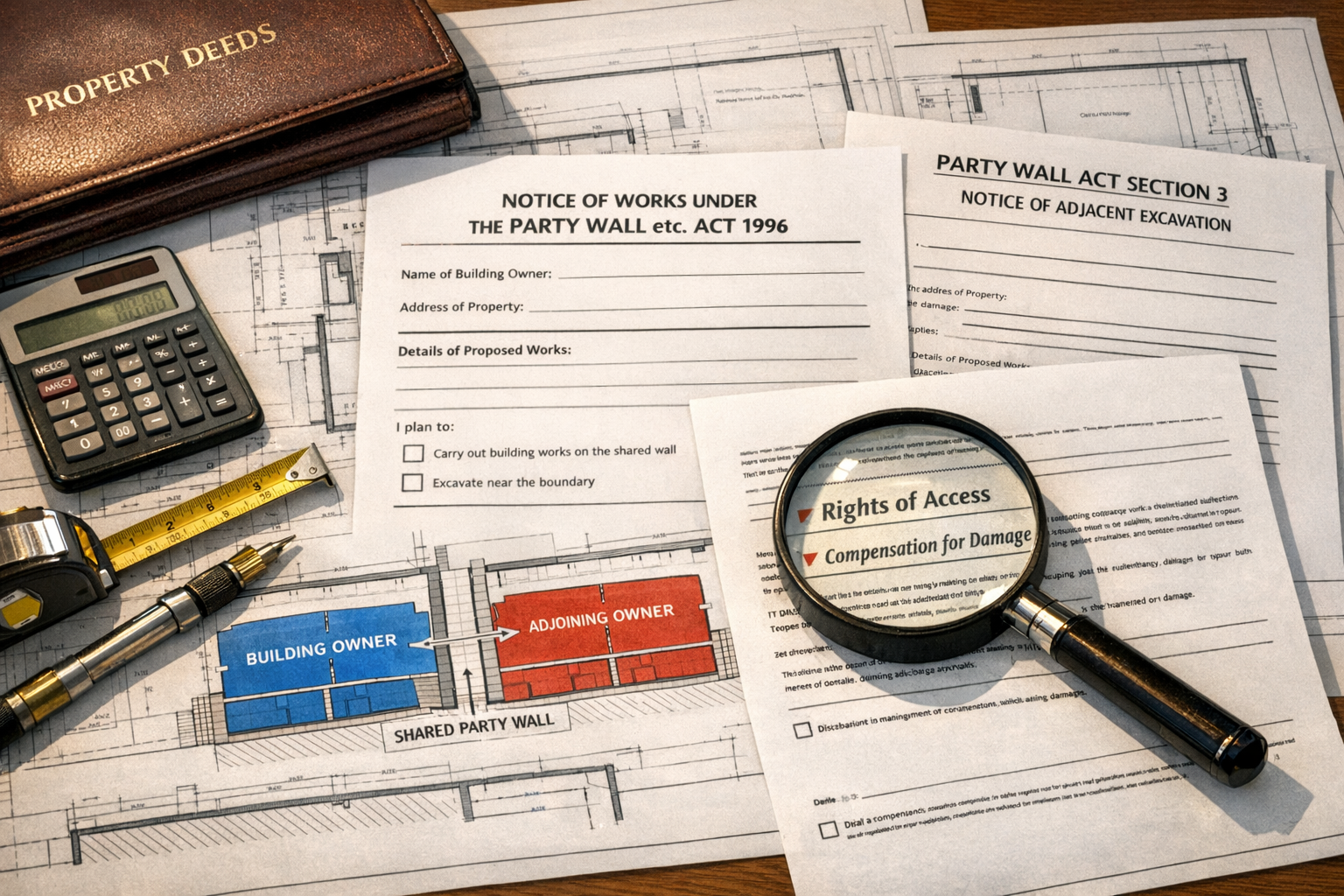
    Detailed landscape format (1536x1024) image showing close-up of party wall legal documentation and notices laid out on architectural plans f

    What Makes Storage Condos Different? 🏢

    Storage condos represent a hybrid between commercial real estate and personal property investment. Rather than renting storage space monthly, buyers purchase individual units within a larger facility—typically ranging from 200 to 2,000 square feet. These units serve various purposes:

    • Business inventory storage for e-commerce operations
    • Vehicle and boat storage with climate control
    • Workshop spaces for hobbyists and craftspeople
    • Wine storage and collector facilities
    • Equipment storage for contractors and tradespeople

    The ownership model provides several advantages over traditional rental storage:

    Storage Condos Traditional Rental Storage
    One-time purchase with long-term ownership Monthly rental payments indefinitely
    Property appreciation potential No equity building
    Customization allowed Limited modifications
    Fixed costs (excluding maintenance fees) Rent increases over time
    Can be sold or leased out No ownership rights

    The Growth of Storage Condos in 2026

    The storage condo market has expanded significantly across major metropolitan areas. Developers recognize that individual unit sales provide immediate capital recovery compared to the gradual income stream of traditional rental facilities. Buyers appreciate the investment diversification and practical utility these properties offer.

    This growth trajectory means more construction projects, more facility expansions, and consequently, more party wall considerations. When a storage condo facility plans to expand—whether adding vertical floors or horizontal wings—the legal complexity increases exponentially compared to single-owner developments.

    Party Wall Notices for Self-Storage Facility Expansions: Legal Framework and Requirements

    How Party Wall Legislation Applies to Storage Facilities

    The Party Wall etc. Act 1996 governs construction work on or near boundaries between properties in England and Wales. For self-storage facilities, this legislation becomes relevant in several scenarios:

    Section 1 Works – Building a new wall at the boundary line when expanding a storage facility

    Section 2 Works – Working on an existing party wall, such as:

    • Raising the height of a shared wall between storage units
    • Underpinning a party wall during expansion
    • Cutting into a party wall to insert structural elements

    Section 6 Works – Excavating within three or six meters of a neighboring structure (depending on depth)

    When dealing with storage condos, the critical distinction is that each unit owner is a separate legal entity. An expansion project affecting ten adjoining storage condo units requires serving party wall notices to ten different owners—not just one landlord.

    Serving Notices in the Storage Condo Context

    The notice-serving process for storage condo expansions follows these essential steps:

    1. Identify all adjoining owners – Review property deeds and condo association records to determine who owns units sharing walls with the expansion area

    2. Prepare appropriate notices – Draft party wall act notices based on the specific work type (Section 1, 2, or 6)

    3. Serve notices properly – Deliver notices at least two months before starting work (for Section 1 and 2 works) or one month (for Section 6 works)

    4. Document service – Maintain proof of delivery for each individual owner

    5. Await responses – Adjoining owners have 14 days to consent or dissent

    The complexity multiplies when storage condo owners have leased their units to tenants. Notices must typically go to the legal owner, not the occupant, though best practice involves informing tenants as well to prevent disputes.

    Common Challenges with Multiple Adjoining Owners

    Storage condo expansions present unique obstacles:

    Varied Response Rates ⏰ – While some owners may consent immediately, others may delay or dissent, creating a patchwork of agreements that complicates project timelines.

    Surveyor Appointments – When multiple adjoining owners dissent, each can theoretically appoint their own surveyor, though the Party Wall Act allows for an agreed surveyor to represent multiple parties.

    Inconsistent Concerns – Different owners may have different priorities—one concerned about structural integrity, another about noise during construction, and another about access disruption.

    Cost Disputes – Determining fair cost allocation when works benefit some units more than others requires careful negotiation and clear documentation.

    “The storage condo model fundamentally changes party wall dynamics. Instead of negotiating with a single commercial landlord who understands construction processes, surveyors must communicate with individual owners who may have limited property development experience.” – Industry Professional

    Party Wall Notices for Self-Storage Facility Expansions: The Emerging Storage Condo Niche in Practice

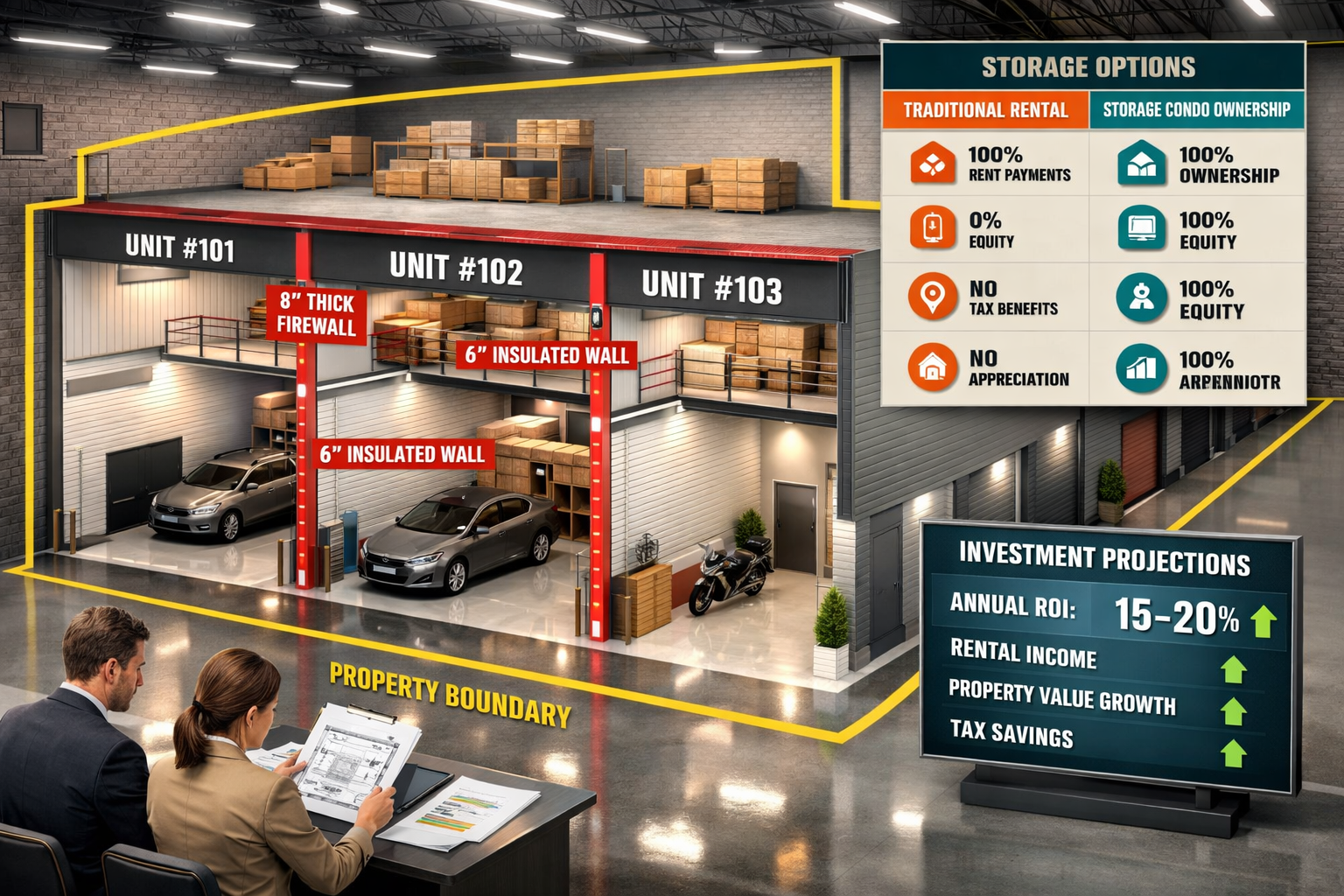
    Detailed landscape format (1536x1024) infographic-style image showing cutaway architectural rendering of storage condo facility with multipl

    Case Study: Vertical Expansion of a Storage Condo Facility

    Consider a three-story storage condo building where the developer retained ownership of the roof and plans to add two additional floors. This expansion affects:

    • 18 third-floor unit owners whose ceiling structures will bear additional load
    • 6 adjacent property owners whose buildings are within excavation distance
    • The condo association representing common area interests

    The building owner must serve party structure notices to all 18 third-floor owners, as the works involve raising and thickening the party walls between units to support the new floors. Additionally, Section 6 notices go to the six neighboring properties.

    Timeline Implications:

    • Month 1: Identify all owners and prepare notices
    • Month 2: Serve notices and begin response period
    • Month 3-4: Negotiate with dissenting owners and appoint surveyors
    • Month 5-6: Prepare and agree party wall awards
    • Month 7: Construction can commence (if all awards finalized)

    This extended timeline—potentially six months before breaking ground—represents a significant planning consideration for storage condo expansions.

    Horizontal Expansion Considerations

    When a storage facility expands horizontally by adding new wings or buildings, the party wall implications differ:

    Boundary Wall Construction 🧱 – New storage buildings often require constructing walls at or near property boundaries. Understanding the difference between party fence walls and boundary walls becomes crucial, as the notice requirements vary.

    Foundation Work – Excavation for new building foundations may trigger Section 6 notices to existing storage condo owners if the work occurs within the prescribed distances.

    Shared Infrastructure – Expanding facilities often share utilities, drainage, and access roads with existing buildings, creating additional easement and rights-of-way considerations beyond standard party wall matters.

    The Role of Condo Associations

    Most storage condo developments establish homeowners’ associations (HOAs) or property management companies. These entities typically:

    • Maintain common areas and shared infrastructure
    • Collect fees for collective expenses
    • Enforce usage restrictions and architectural guidelines
    • Coordinate with developers on expansion projects

    However, condo associations cannot consent to party wall notices on behalf of individual owners. Each owner retains personal property rights requiring individual notice and consent. The association may facilitate communication and coordinate responses, but legal authority remains with individual unit owners.

    Smart developers work with condo associations early in the planning process to:

    1. Present expansion plans at association meetings
    2. Address collective concerns before formal notices
    3. Identify owners who may need additional information
    4. Coordinate surveyor appointments to minimize costs

    Financial and Legal Considerations

    Cost Allocation in Multi-Owner Scenarios

    The costs of party wall processes in storage condo expansions require careful consideration:

    Building Owner’s Responsibilities:

    • Serving all required notices
    • Paying for the building owner’s surveyor
    • Covering reasonable costs of adjoining owners’ surveyors
    • Funding the actual construction work
    • Compensating for any damage caused

    Adjoining Owners’ Positions:

    • May claim surveyor fees if they dissent
    • Can request specific protective measures
    • May negotiate compensation for disruption
    • Cannot block reasonable development but can ensure proper safeguards

    When expansion works benefit certain units more than others, equitable cost-sharing becomes complex. For example, if adding upper floors increases property values for ground-floor units (by enhancing the overall facility), should those owners contribute? These questions often require negotiation beyond statutory party wall requirements.

    Protecting Adjoining Owners’ Interests

    Storage condo owners affected by expansion works should take several protective steps:

    Request a Schedule of Condition – Professional schedules of condition document the pre-construction state of your property with photographs and detailed descriptions, providing evidence if damage claims arise later.

    Appoint a Qualified Surveyor – Even if costs seem prohibitive, appointing an experienced adjoining owner’s surveyor ensures your interests receive proper representation throughout the process.

    Review Insurance Coverage – Verify that your property insurance covers construction-related damage and understand the claims process.

    Understand Award Terms – Party wall awards specify working hours, access arrangements, and protective measures. Read these documents carefully and request clarifications.

    Document Everything – Keep copies of all notices, correspondence, and agreements related to the expansion project.

    Due Diligence for Storage Condo Buyers

    Prospective storage condo purchasers should investigate potential party wall issues before buying:

    Pre-Purchase Inquiries:

    • Are there existing party wall awards affecting the unit?
    • Has the developer or condo association announced expansion plans?
    • What are the facility’s development rights and future building potential?
    • Have previous expansions caused disputes or damage claims?
    • Does the purchase agreement address future party wall obligations?

    Understanding these factors helps buyers assess long-term ownership costs and potential disruptions. A unit adjacent to undeveloped expansion areas may face construction impacts within a few years of purchase.

    Best Practices for Surveyors and Developers

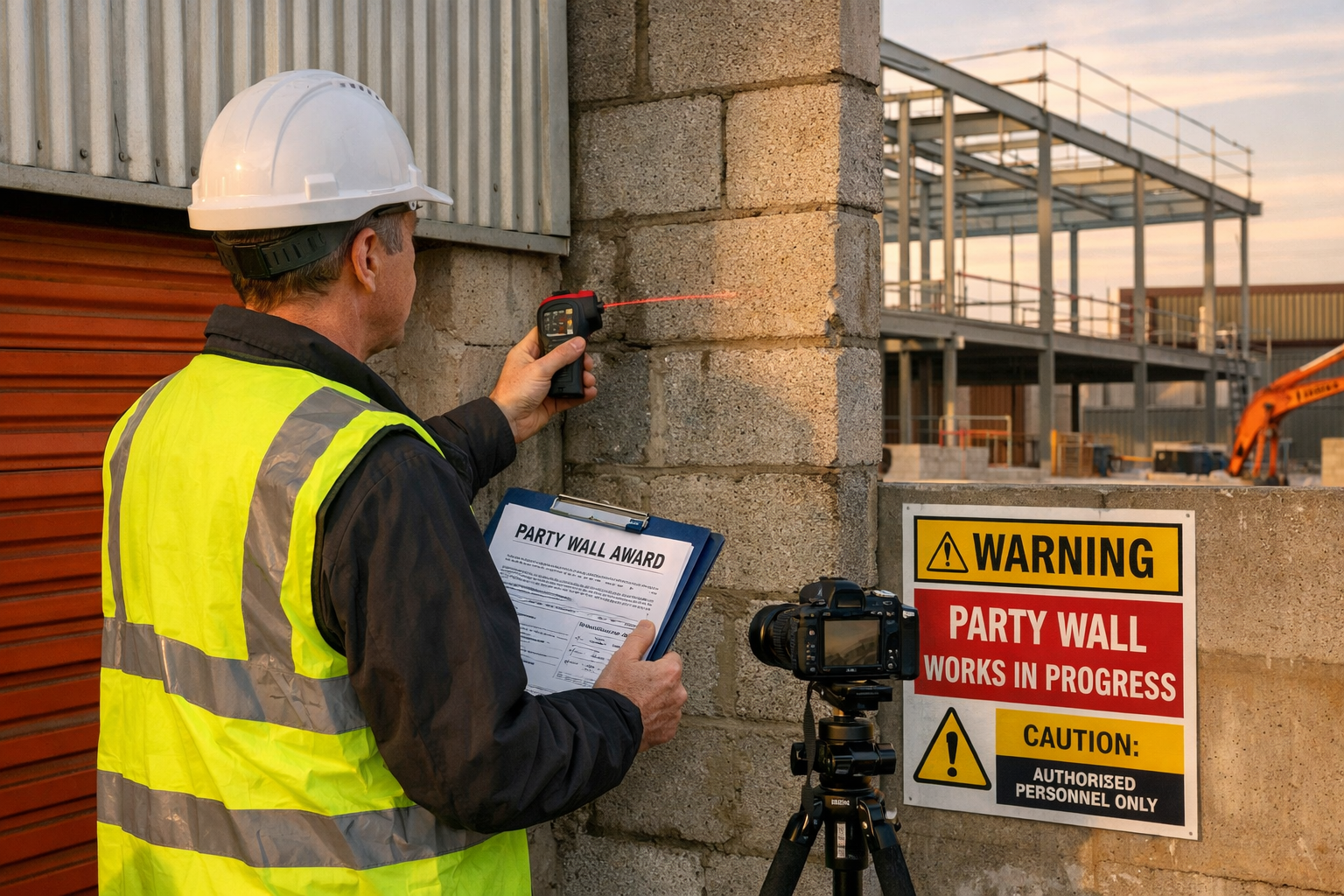
    Detailed landscape format (1536x1024) image depicting party wall surveyor conducting site inspection at self-storage facility expansion proj

    Streamlining the Notice Process

    Professional surveyors working on storage condo expansion projects can improve efficiency through:

    Early Stakeholder Engagement 🤝 – Contact the condo association months before formal notices to explain the project, timeline, and expected impacts. This proactive communication reduces anxiety and opposition.

    Batch Processing – When serving notices to multiple owners, create standardized documentation with unit-specific details inserted. This ensures consistency while addressing individual circumstances.

    Clear Communication – Many storage condo owners are small business operators or individual investors unfamiliar with party wall procedures. Use plain language explanations alongside technical notices to improve understanding and response rates.

    Coordinated Surveyor Appointments – Encourage adjoining owners to appoint a single agreed surveyor to represent multiple parties, reducing costs and simplifying negotiations. The types of party wall works often affect multiple units similarly, making collective representation practical.

    Digital Documentation – Utilize electronic notice service where legally permissible, maintain digital records of all correspondence, and create shared document repositories for awards and schedules of condition.

    Managing Construction Impact

    Storage condo facilities often remain operational during expansion projects, creating additional considerations:

    Access Management – Coordinate construction vehicle access to minimize disruption to unit owners and their tenants accessing stored goods.

    Noise and Hours – Party wall awards should specify working hours that balance construction efficiency with minimal disruption to business operations in adjacent units.

    Security Concerns – Storage facilities house valuable goods. Construction access points require additional security measures to prevent unauthorized entry or theft.

    Dust and Debris Control – Climate-controlled storage units demand stringent dust control measures during construction to protect stored items.

    Communication Protocols – Establish clear channels for reporting concerns or damage during construction, with designated contacts for both the building owner and adjoining owners.

    Regional Variations and Considerations

    While this article focuses primarily on English and Welsh party wall legislation, storage condo developments occur in various jurisdictions with different legal frameworks:

    Scotland – Different property law traditions mean party wall matters follow common law principles rather than the Party Wall etc. Act 1996.

    International Markets – Storage condo concepts have gained traction in North America, Australia, and parts of Europe, each with distinct construction and property rights legislation.

    Surveyors working across regions must understand local requirements while applying general principles of fair dealing and proper notice. For London-based projects, working with specialists familiar with local authorities—whether in North London, South London, East London, West London, or Central London—provides valuable local knowledge.

    Emerging Trends and Future Outlook

    Technology Integration in Party Wall Processes

    The storage condo sector’s growth coincides with technological advancement in property management and construction:

    Digital Notice Platforms – Emerging software solutions streamline notice service, response tracking, and document management for projects involving numerous adjoining owners.

    Virtual Inspections – Drone photography and 3D scanning technology enhance schedule of condition documentation, providing comprehensive pre-construction records.

    Blockchain Property Records – Some jurisdictions experiment with blockchain-based property registries that could simplify ownership verification and notice service in multi-owner developments.

    Collaborative Project Management – Cloud-based platforms allow building owners, surveyors, and adjoining owners to track project progress, share documents, and communicate efficiently.

    Regulatory Developments

    As storage condos become more prevalent, regulatory frameworks may evolve:

    Standardized Disclosure Requirements – Future regulations might mandate that storage condo developers disclose expansion plans and party wall implications during initial unit sales.

    Condo Association Authority – Legislation could grant condo associations limited authority to consent to certain party wall works on behalf of owners, streamlining processes while protecting individual rights.

    Dispute Resolution Mechanisms – Specialized arbitration or mediation services for storage condo party wall disputes may emerge as the sector matures.

    Investment and Market Implications

    The storage condo model’s success depends partly on how effectively party wall and expansion issues are managed:

    Property Values – Well-managed expansions that follow proper party wall procedures protect and potentially enhance unit values. Conversely, contentious construction projects with inadequate notice compliance can depress prices.

    Investor Confidence – Institutional investors entering the storage condo market scrutinize legal frameworks and historical dispute patterns. Jurisdictions with clear, efficient party wall processes attract more development capital.

    Insurance Products – Specialized insurance covering party wall disputes and construction impacts may become more available as the market grows, providing additional protection for unit owners.

    Conclusion

    Party Wall Notices for Self-Storage Facility Expansions: The Emerging Storage Condo Niche represents a fascinating intersection of property law, commercial development, and innovative investment models. As the storage condo sector continues expanding in 2026 and beyond, understanding the unique party wall implications becomes increasingly critical for developers, surveyors, and individual unit owners.

    The fundamental challenge—serving proper notices to multiple individual owners rather than a single landlord—requires careful planning, clear communication, and professional expertise. Success depends on recognizing that storage condo owners bring diverse backgrounds and varying levels of property development knowledge to the party wall process.

    Actionable Next Steps

    For Developers Planning Storage Condo Expansions:

    • Begin party wall planning at least 6-9 months before intended construction start dates
    • Engage with the condo association early to build support and address concerns
    • Budget adequately for surveyor costs reflecting the number of adjoining owners
    • Consider phasing expansions to reduce the number of simultaneous party wall processes

    For Storage Condo Owners Receiving Party Wall Notices:

    • Respond within the 14-day statutory period, even if you need more time to make a final decision
    • Consult with a qualified building owner’s surveyor or adjoining owner’s surveyor to understand your rights and options
    • Request a comprehensive schedule of condition before works commence
    • Maintain open communication with the building owner and their representatives

    For Party Wall Surveyors:

    • Develop specialized knowledge of storage condo ownership structures and condo association dynamics
    • Create efficient systems for managing multiple adjoining owner relationships
    • Stay current with emerging technologies that can streamline documentation and communication
    • Build relationships with condo associations and property managers in your service area

    For Prospective Storage Condo Buyers:

    • Investigate the facility’s expansion plans and development rights before purchasing
    • Review any existing party wall awards or ongoing disputes
    • Understand your potential obligations if future expansions occur
    • Factor potential construction disruption into your investment analysis

    The storage condo niche offers compelling opportunities for investors, developers, and service providers. By approaching Party Wall Notices for Self-Storage Facility Expansions with professionalism, transparency, and attention to legal requirements, all parties can benefit from this innovative property model while protecting their respective interests.

    As this sector matures, best practices will continue evolving. Staying informed about regulatory changes, technological tools, and industry standards ensures that storage condo developments proceed smoothly, with proper respect for party wall rights and obligations. The future of self-storage is increasingly about individual ownership and mixed-use flexibility—and party wall professionals who understand this evolution will be well-positioned to serve this growing market.

  • Party Wall Act Compliance for Senior Housing Developments: M

    As baby boomers turn 80 in 2026, the senior housing sector is experiencing unprecedented growth. With record-high occupancy rates and an explosion of new construction projects, developers and property managers face a unique challenge: navigating Party Wall Act compliance for multi-unit residential facilities designed specifically for elderly residents. The surge in senior housing developments has created a complex landscape where traditional party wall procedures intersect with specialized accessibility requirements, healthcare considerations, and the unique needs of aging populations.

    Understanding Party Wall Act Compliance for Senior Housing Developments: Managing Awards in the 2026 Boomer Wave has become essential for surveyors, developers, and property managers working in this booming sector. This demographic shift represents the largest generational housing transition in modern history, demanding specialized knowledge and careful planning.

    Key Takeaways

    • 🏘️ Senior housing developments require specialized party wall approaches due to unique accessibility features, shared medical facilities, and complex multi-unit configurations
    • 📋 Party wall awards must address additional considerations including noise insulation for health equipment, emergency access provisions, and modifications for aging-in-place
    • ⏱️ Proper notice periods and surveyor selection become critical when managing multiple adjoining owners in senior housing complexes
    • 💰 Cost management strategies can significantly reduce expenses while maintaining compliance in large-scale senior developments
    • 🔍 Proactive schedules of condition protect both developers and elderly residents from disputes related to structural work

    Understanding the 2026 Senior Housing Boom

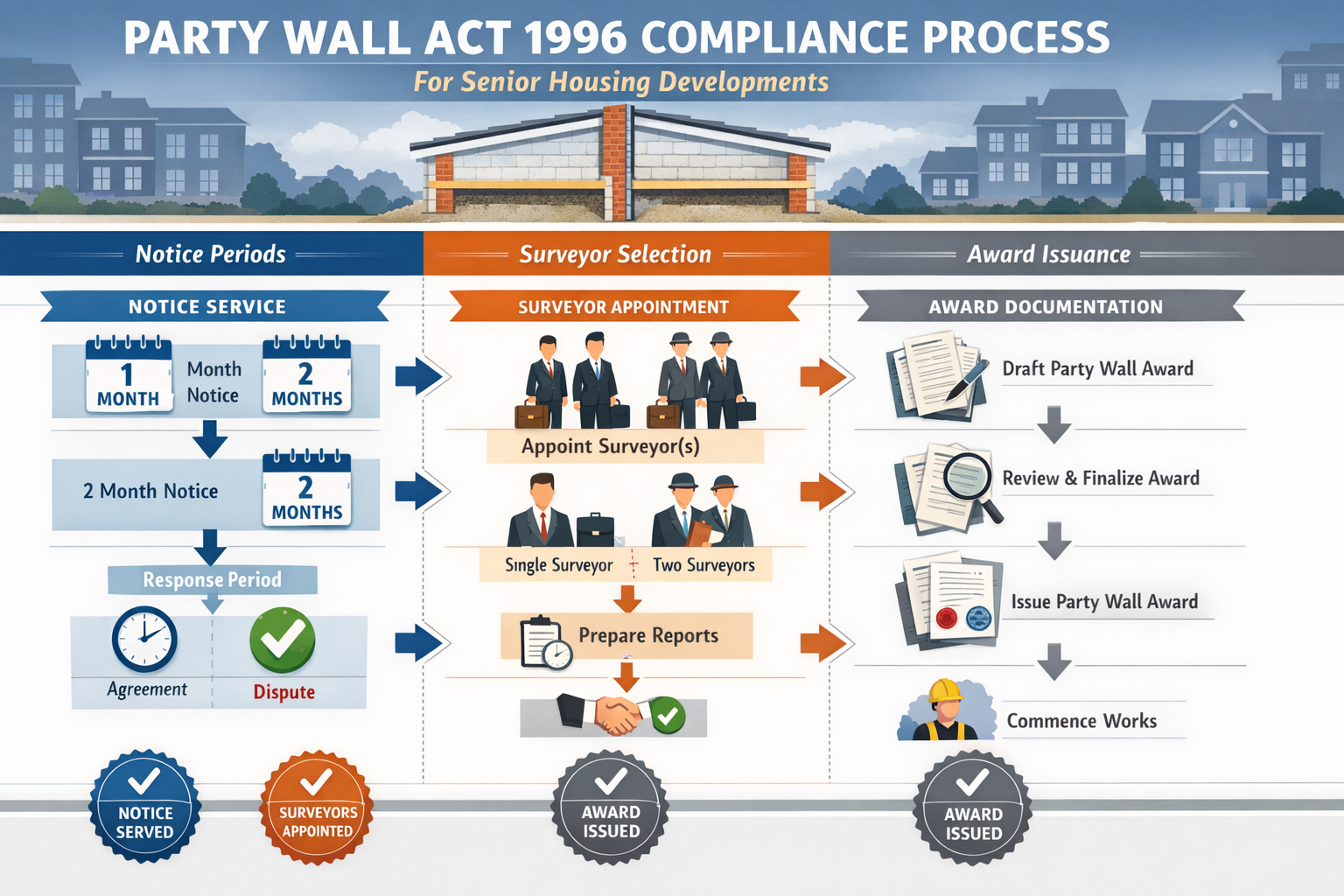
    Detailed landscape format (1536x1024) infographic showing Party Wall Act 1996 compliance flowchart specifically for senior housing developme

    The demographic reality of 2026 cannot be ignored. The oldest baby boomers, born in 1946, are now turning 80 years old. This milestone has triggered massive demand for age-appropriate housing, from independent living communities to assisted living facilities and continuing care retirement communities (CCRCs).

    Why Senior Housing Differs from Standard Residential Development

    Senior housing developments present unique party wall challenges that standard residential projects don’t encounter:

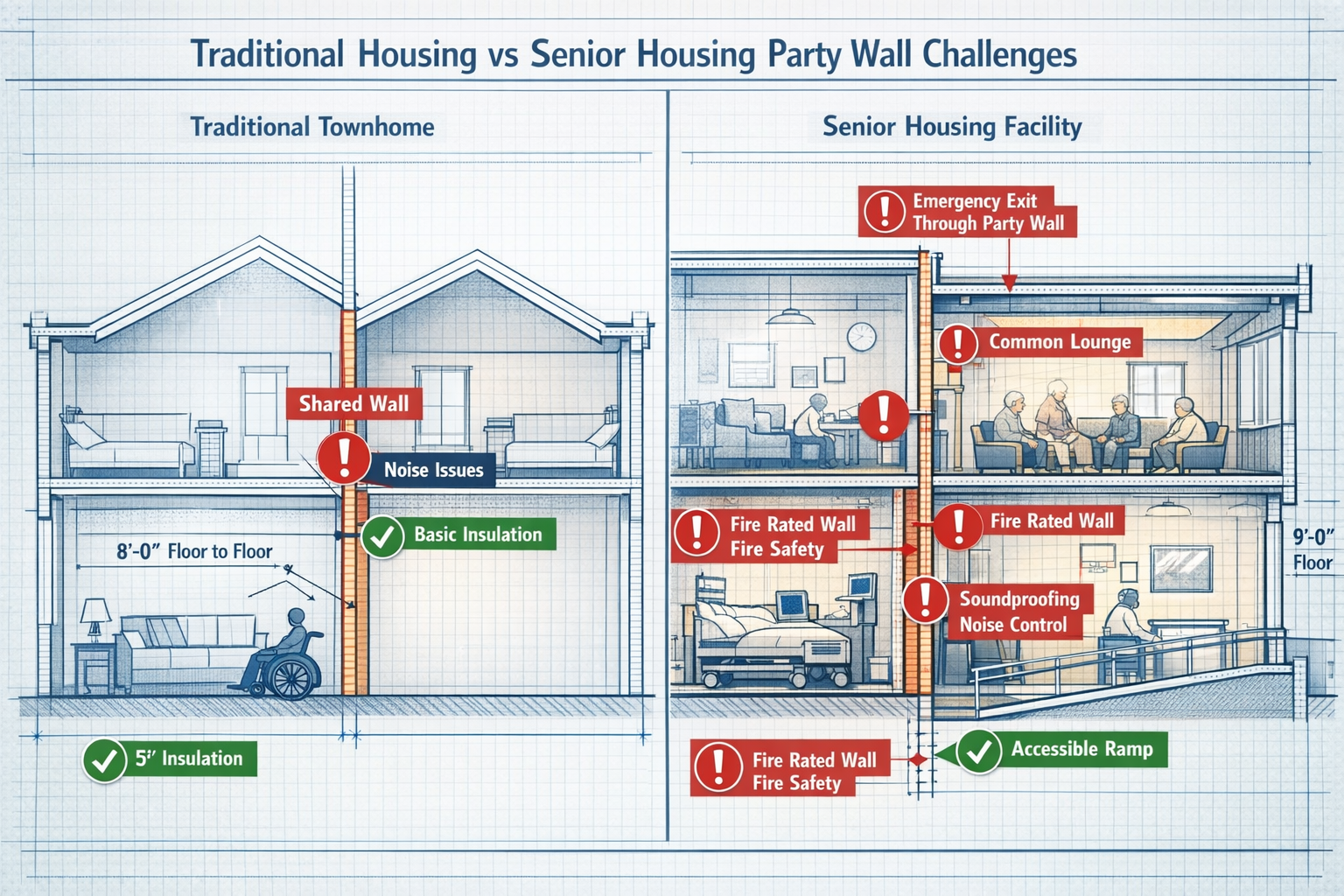
    Accessibility Modifications: Wider doorways, reinforced walls for grab bars, and structural changes to accommodate wheelchairs often affect party walls between units [1].

    Shared Facilities: Unlike traditional townhomes, senior developments frequently include communal spaces—dining halls, medical clinics, therapy rooms—that share walls with private residences.

    Healthcare Equipment: Medical devices, emergency call systems, and monitoring equipment installed on or through party walls require special consideration in party wall awards.

    Enhanced Sound Insulation: Elderly residents often require quieter environments, necessitating superior acoustic treatments in party wall construction.

    Party Wall Act Compliance for Senior Housing Developments: Core Requirements

    The Party Wall etc. Act 1996 applies to senior housing just as it does to any other development, but the application requires specialized knowledge and careful attention to detail.

    Notice Requirements for Multi-Unit Senior Developments

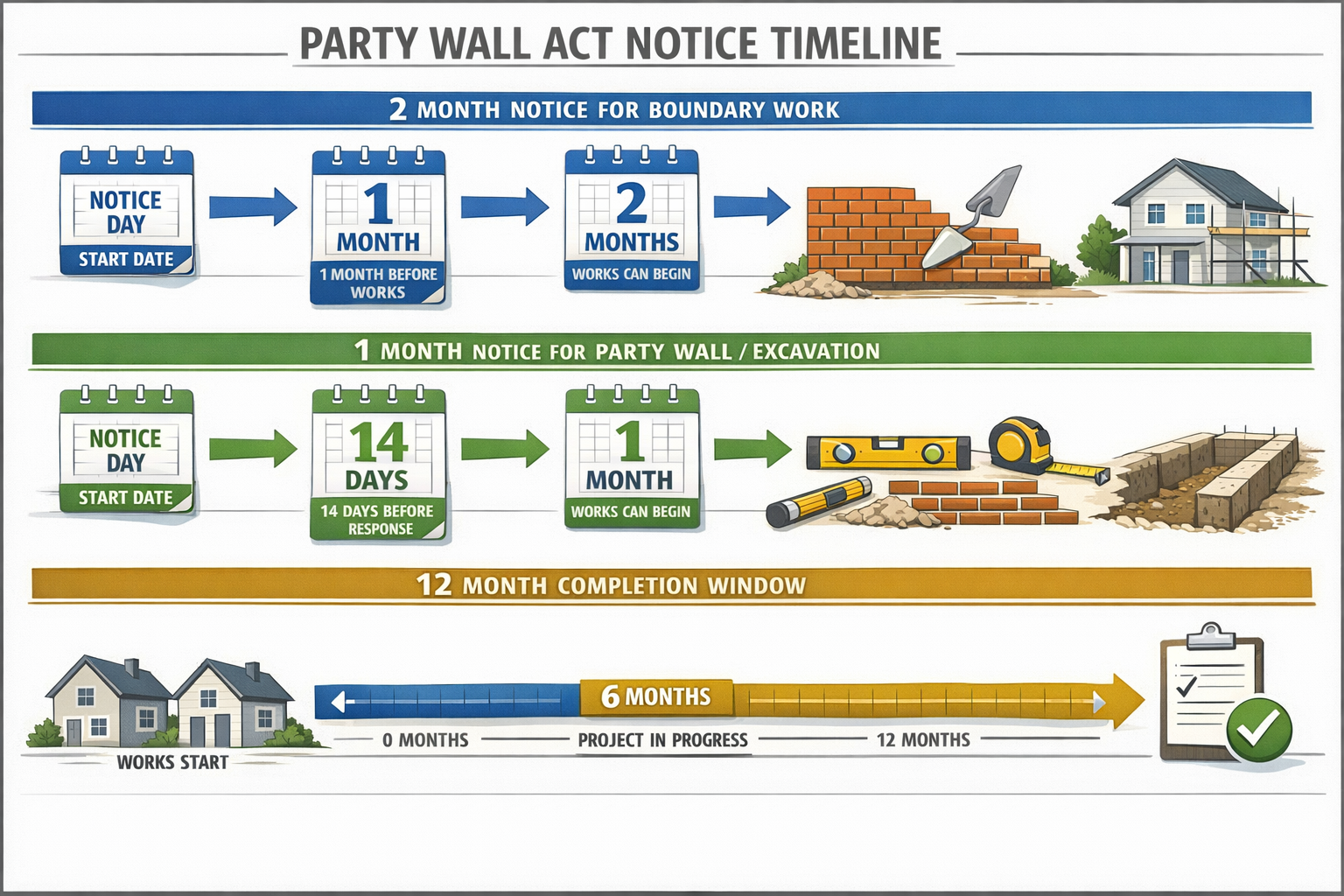
    When building or renovating senior housing facilities, developers must serve appropriate party wall notices to all adjoining owners. The notice period requirements remain the same [1]:

    Notice Type Minimum Notice Period Common Senior Housing Applications
    Party Structure Notice 2 months Building on existing party walls, inserting beams, cutting into shared structures
    Line of Junction Notice 1 month New builds on boundary lines, new party walls between units
    3-Meter/6-Meter Notice 1 month Foundation work near existing senior housing buildings

    The complexity increases when a single development involves dozens or even hundreds of units sharing walls. Each adjoining owner must receive proper notice, creating an administrative challenge that requires meticulous organization.

    Appointing Surveyors for Large-Scale Senior Projects

    When working with senior housing developments, the surveyor appointment process becomes more complex. Options include [1]:

    1. Agreed Surveyor: A single surveyor acts for both building and adjoining owners—efficient for large projects
    2. Two Surveyors: Each party appoints their own surveyor—appropriate when disputes arise
    3. Third Surveyor: Appointed to resolve disagreements between the two surveyors

    For developers managing Party Wall Act Compliance for Senior Housing Developments: Managing Awards in the 2026 Boomer Wave, selecting experienced surveyors familiar with elderly housing requirements proves essential. Look for professionals who understand:

    • Accessibility standards and building regulations specific to senior housing
    • Healthcare equipment installation requirements
    • Sound insulation standards for residential care facilities
    • Fire safety provisions affecting party walls in senior developments

    A qualified party wall surveyor in Central London or other major urban areas can navigate these specialized requirements effectively.

    Managing Party Wall Awards in the 2026 Boomer Wave

    A party wall award is the legal document that sets out the rights and responsibilities of all parties involved in the work [2]. For senior housing developments, these awards must address additional considerations beyond standard residential projects.

    Essential Components of Senior Housing Party Wall Awards

    When drafting awards for senior developments, surveyors should include:

    📌 Detailed Work Descriptions: Specify exactly what construction or renovation work will occur, including any modifications for accessibility or medical equipment installation.

    📌 Access Provisions: Define how and when workers can access adjoining properties, with special consideration for elderly residents who may need advance notice and assistance.

    📌 Protection Measures: Outline steps to protect vulnerable residents from dust, noise, and disruption during construction.

    📌 Emergency Protocols: Establish procedures if urgent work becomes necessary, particularly important in facilities housing frail or medically dependent residents.

    📌 Dispute Resolution: Include clear mechanisms for resolving disagreements without requiring elderly residents to navigate complex legal processes.

    Understanding the party wall contract template and awards structure helps ensure comprehensive documentation.

    Special Considerations for Shared Facilities

    Senior housing developments often feature shared amenities that complicate party wall compliance:

    Communal Dining Areas: When dining halls share walls with residential units, awards must address kitchen equipment, ventilation systems, and noise control.

    Medical Clinics: Healthcare facilities within senior developments may require specialized electrical, plumbing, or HVAC installations through party walls.

    Activity Centers: Therapy rooms, fitness centers, and social spaces need appropriate sound insulation to prevent disturbance to adjacent residents.

    Emergency Exits: Fire safety regulations may require emergency doors or corridors that pass through party walls, requiring specific provisions in awards [4].

    Cost Management Strategies for Senior Housing Party Wall Compliance

    The costs of party wall procedures can escalate quickly in large-scale senior developments. However, strategic planning can control expenses while maintaining full compliance.

    Typical Cost Breakdown

    Understanding where money goes helps developers budget appropriately:

    • Surveyor Fees: £500-£1,500 per party wall matter for straightforward cases; more complex senior housing projects may cost significantly more
    • Award Preparation: £800-£2,000 depending on complexity and number of adjoining owners
    • Schedule of Condition: £300-£800 per property for photographic documentation [1]
    • Legal Fees: Variable, but can be substantial if disputes arise

    For developers managing multiple units, these costs multiply rapidly. A 50-unit senior housing development with shared walls could involve 25-50 separate party wall matters.

    Strategies to Keep Costs Down

    Smart developers employ several tactics to manage Party Wall Act Compliance for Senior Housing Developments: Managing Awards in the 2026 Boomer Wave expenses [2]:

    Use Agreed Surveyors: When possible, negotiate for a single agreed surveyor to act for all parties, reducing duplication of effort.

    Bundle Related Work: Combine multiple notices and awards for simultaneous work across the development.

    Invest in Quality Documentation: Thorough initial surveys and schedules of condition prevent costly disputes later.

    Communicate Proactively: Early, clear communication with adjoining owners reduces objections and simplifies the process.

    Plan Timing Strategically: Coordinate work schedules to minimize disruption and avoid peak periods when surveyor fees may be higher.

    For additional guidance, review tips on how to keep party wall costs down.

    Handling Disputes in High-Demand Senior Housing Markets

    Detailed landscape format (1536x1024) split-screen comparison image showing 'Traditional Housing vs Senior Housing Party Wall Challenges'. L

    The 2026 construction boom has intensified party wall disputes across the UK housing market [3]. Senior housing developments face particular challenges due to the vulnerability of elderly residents and the complexity of multi-unit facilities.

    Common Dispute Triggers in Senior Housing

    Noise and Vibration Concerns: Construction work can be particularly distressing for elderly residents with health conditions. Awards must specify working hours, noise limits, and vibration monitoring.

    Structural Concerns: Older residents may worry about building stability and safety. Clear communication and professional reassurance become essential.

    Access Issues: Mobility-impaired residents may struggle with construction-related access disruptions. Awards should address alternative routes and assistance provisions.

    Duration Anxiety: Elderly residents often have limited tolerance for prolonged disruption. Realistic timelines and regular progress updates help manage expectations.

    Resolution Strategies

    When disputes arise, several approaches can help:

    1. Mediation: Engage neutral third parties to facilitate discussions before conflicts escalate
    2. Enhanced Communication: Provide regular updates, site visits, and opportunities for residents to ask questions
    3. Third Surveyor Appointment: When building and adjoining owner surveyors cannot agree, a third surveyor makes binding decisions [1]
    4. Reasonable Accommodations: Offer temporary relocation assistance or other support for severely affected elderly residents

    Understanding what party wall notices are and how to respond helps all parties navigate the process smoothly.

    Best Practices for Party Wall Act Compliance for Senior Housing Developments: Managing Awards in the 2026 Boomer Wave

    Success in this specialized sector requires adopting proven strategies that address both legal requirements and the unique needs of elderly populations.

    Pre-Construction Planning

    Conduct Comprehensive Site Assessments: Before serving notices, thoroughly survey the property and all adjoining structures. Identify all party walls, boundary walls, and structures within three or six meters of planned excavation [1].

    Engage Specialized Surveyors Early: Select surveyors with experience in both party wall law and senior housing development. Their expertise prevents costly mistakes and delays.

    Develop Resident Communication Plans: Create clear, accessible materials explaining the party wall process to elderly residents. Use large print, simple language, and multiple communication channels.

    Budget Realistically: Factor party wall costs into project budgets from the outset, including contingencies for potential disputes or unexpected complications.

    During Construction

    Maintain Detailed Records: Document all work meticulously, including photographs, inspection reports, and communications with adjoining owners. This schedule of condition approach protects all parties.

    Monitor Compliance Continuously: Ensure work proceeds according to the award specifications. Regular surveyor inspections verify compliance and identify issues early.

    Prioritize Resident Welfare: Implement measures to minimize disruption to elderly residents, including dust control, noise management, and maintaining safe access routes.

    Respond Promptly to Concerns: Address questions or complaints from adjoining owners immediately. Quick responses prevent minor issues from becoming major disputes.

    Post-Construction Follow-Up

    Complete Final Inspections: Conduct thorough post-construction surveys to document the condition of all affected properties and verify that work complies with the award.

    Resolve Outstanding Issues: Address any damage or non-compliance items promptly and professionally.

    Maintain Documentation: Retain all party wall records, awards, and correspondence. These documents may be needed years later if questions arise.

    Gather Feedback: Learn from each project by soliciting feedback from residents, surveyors, and contractors about what worked well and what could improve.

    Regional Considerations Across London and the UK

    Party wall compliance requirements remain consistent across England and Wales, but local market conditions and development patterns vary significantly. Understanding regional nuances helps developers navigate Party Wall Act Compliance for Senior Housing Developments: Managing Awards in the 2026 Boomer Wave more effectively.

    London’s Senior Housing Landscape

    London’s high property values and dense development make party wall compliance particularly critical. Different areas present unique challenges:

    • North London: Established neighborhoods with aging housing stock often see senior housing conversions requiring extensive party wall work
    • East London: Rapid development and regeneration create opportunities for purpose-built senior communities
    • South London: Suburban areas accommodate larger senior housing campuses with complex party wall arrangements
    • West London: Premium developments demand high-quality finishes and superior sound insulation in party walls

    Each region requires surveyors familiar with local building practices, property values, and development trends.

    Technology and Innovation in Party Wall Management

    The 2026 senior housing boom has accelerated adoption of new technologies that streamline party wall compliance:

    Digital Documentation: Cloud-based platforms enable efficient management of multiple party wall matters across large developments, ensuring nothing falls through the cracks.

    3D Scanning: Advanced surveying tools create precise digital models of existing structures, improving accuracy in schedules of condition and reducing disputes.

    Virtual Consultations: Video conferencing allows elderly residents to participate in surveyor appointments without physical strain or mobility challenges.

    Automated Notifications: Digital systems track notice periods and deadlines, ensuring compliance with statutory requirements across complex projects.

    These innovations make managing Party Wall Act Compliance for Senior Housing Developments: Managing Awards in the 2026 Boomer Wave more efficient and less prone to error.

    Future Outlook: Beyond 2026

    Detailed landscape format (1536x1024) professional photograph of party wall surveyor conducting inspection in modern senior housing facility

    While 2026 represents a peak year for the boomer wave’s impact on senior housing, the trend will continue for years to come. Developers and surveyors who build expertise in this sector now will be well-positioned for sustained success.

    Emerging Trends to Watch

    Aging-in-Place Modifications: Increasing numbers of existing properties will undergo conversions to accommodate elderly residents, creating ongoing party wall work.

    Intergenerational Developments: Mixed-age communities that include senior housing will require sophisticated party wall management balancing different resident needs.

    Sustainable Senior Housing: Green building techniques and renewable energy installations will add new dimensions to party wall considerations.

    Technology Integration: Smart home systems, health monitoring, and assistive technologies will continue affecting party wall installations and awards.

    Conclusion

    Party Wall Act Compliance for Senior Housing Developments: Managing Awards in the 2026 Boomer Wave represents a critical challenge and opportunity for the construction and property sectors. As the largest generation in history transitions into their 80s, the demand for age-appropriate housing continues to surge, creating unprecedented volumes of party wall work.

    Success in this specialized field requires:

    Deep understanding of both party wall law and senior housing requirements
    Proactive planning with early surveyor engagement and comprehensive site assessments
    Cost-effective strategies that maintain compliance while controlling expenses
    Sensitive communication that addresses the unique needs of elderly residents
    Meticulous documentation protecting all parties throughout the process

    Next Steps for Developers and Property Managers

    If you’re planning or managing senior housing development in 2026:

    1. Engage experienced party wall surveyors who understand elderly housing requirements
    2. Budget appropriately for party wall costs across your entire development
    3. Develop comprehensive communication plans for elderly residents and adjoining owners
    4. Invest in quality documentation including thorough schedules of condition
    5. Stay informed about regulatory changes and best practices in this evolving sector

    The 2026 boomer wave presents challenges, but with proper planning and expert guidance, developers can navigate party wall compliance efficiently while creating high-quality housing that serves this growing population. Whether you’re working on a small conversion or a large-scale purpose-built community, understanding and implementing proper party wall procedures protects your investment and ensures positive outcomes for all stakeholders.

    For expert assistance with your senior housing party wall matters, consider consulting with qualified professionals who can guide you through every step of the process, from initial party wall notices through final award completion.


    References

    [1] Party Wall Agreement – https://hoa.org.uk/advice/guides-for-homeowners/i-am-improving/party-wall-agreement/

    [2] Party Wall Maintenance Tips For Keeping Your Property In Compliance – https://www.adamjoseph.co.uk/party-wall-maintenance-tips-for-keeping-your-property-in-compliance

    [3] Party Wall Surveys Amid 2026 Construction Boom Handling Disputes In High Demand Uk Housing Markets – https://nottinghillsurveyors.com/blog/party-wall-surveys-amid-2026-construction-boom-handling-disputes-in-high-demand-uk-housing-markets

    [4] Party Wall Agreements And Townhome Declarations Key Issues To Watch Out For When Drafting – https://ngazette.com/party-wall-agreements-and-townhome-declarations-key-issues-to-watch-out-for-when-drafting/

  • Party Wall Notice Timelines: The Two-Month Service Period an

    Misunderstanding party wall notice timelines can derail even the most carefully planned construction projects. A homeowner in London recently discovered this the hard way when their basement extension was delayed by four months—not due to construction issues, but because they served their party wall notice just three weeks before their planned start date. The result? Costly contractor rescheduling fees, extended rental accommodation, and significant financial stress that could have been easily avoided.

    Understanding Party Wall Notice Timelines: The Two-Month Service Period and One-Year Completion Window Explained is essential for any property owner planning construction work in 2026. The Party Wall etc. Act 1996 establishes specific timeframes that must be followed, and failing to comply can result in legal disputes, project delays, and unnecessary expenses. This comprehensive guide clarifies when notices must be served, how long neighbours have to respond, and the critical one-year window for commencing work.

    Key Takeaways

    Two-month notice required for boundary work: Building on or at the boundary line requires serving notice at least two months before work begins[1][2]

    One-month notice for party walls and excavations: Work to existing party structures or excavation near a neighbour’s foundation needs only one month’s advance notice[1][2]

    Twelve-month completion window: Once served, party wall notices remain valid for up to one year, giving building owners flexibility in scheduling[2]

    Fourteen-day neighbour response period: Adjoining owners have exactly 14 days to consent or dissent after receiving formal notice[1][4]

    Total timeline ranges from 2-9 months: Depending on neighbour cooperation and complexity, the complete party wall process typically takes between two and nine months from initial surveyor appointment to work commencement[4]

    Understanding the Statutory Notice Periods Under the Party Wall Act

    Detailed landscape format (1536x1024) infographic illustration showing Party Wall Act notice timeline flowchart with three distinct pathways

    The Party Wall etc. Act 1996 establishes two distinct statutory notice periods that depend entirely on the type of work being undertaken. These aren’t arbitrary timeframes—they’re legally mandated minimum periods designed to give adjoining owners adequate time to understand proposed works, seek professional advice, and protect their property interests.

    The Two-Month Notice Period for Boundary Work 📅

    When planning to build a new wall on or at the boundary line between properties, the Act requires serving a Party Structure Notice or Line of Junction Notice at least two months before commencing work[1][2][3]. This extended period recognizes that boundary construction represents significant work that could substantially affect a neighbour’s property rights and enjoyment.

    Types of work requiring two-month notice include:

    • Building a new wall directly on the boundary line
    • Constructing foundations that straddle the property boundary
    • Erecting a new party fence wall between properties
    • Any structure positioned astride the line of junction

    The two-month period begins from the date the notice is actually received by the adjoining owner—not the date it was posted or sent[2]. This distinction is crucial for timeline planning, as proof of delivery becomes essential documentation.

    The One-Month Notice Period for Party Wall and Excavation Work ⏰

    For work to existing party structures or excavation within specified distances of a neighbour’s foundation, the Act requires only one month’s advance notice[1][2]. This shorter period applies because the work involves structures or ground already subject to shared rights and obligations.

    Work requiring one-month notice includes:

    • Cutting into an existing party wall for beam insertion
    • Raising, thickening, or underpinning a party wall
    • Demolishing and rebuilding a party structure
    • Excavating within three metres of a neighbour’s structure (going deeper than their foundation)
    • Excavating within six metres of a neighbour’s structure (going deeper than a line drawn at 45 degrees from their foundation bottom)

    Understanding which notice period applies to your specific types of party wall works is the first critical step in timeline planning. Many projects involve multiple types of work, requiring careful coordination of different notice periods.

    Why These Specific Timeframes Matter

    The statutory notice periods serve several important purposes beyond simple notification. They provide adjoining owners time to:

    • Consult with professionals about the proposed work’s implications
    • Arrange property inspections to establish pre-work conditions
    • Appoint their own surveyor if they choose to dissent
    • Negotiate protective measures through the Party Wall Award process
    • Prepare for potential disruption to their property use

    For building owners, respecting these timelines demonstrates good faith and often leads to smoother neighbour relations. Rushing or attempting to circumvent these periods almost invariably creates conflict and delays that far exceed the original notice requirement.

    The One-Year Completion Window: Flexibility and Limitations

    One of the most misunderstood aspects of Party Wall Notice Timelines: The Two-Month Service Period and One-Year Completion Window Explained involves what happens after serving notice. The Act provides building owners with considerable scheduling flexibility through a twelve-month validity period[2].

    How the Twelve-Month Window Works

    Once a party wall notice is formally served and the statutory notice period expires, the building owner has up to one year to actually commence the notified works[2]. This provision recognizes the practical realities of construction projects, including:

    • Planning permission delays that extend beyond initial estimates
    • Building control approval processes taking longer than anticipated
    • Contractor availability requiring schedule adjustments
    • Financing arrangements needing additional time to finalize
    • Seasonal considerations making certain work periods more practical

    This flexibility proves invaluable for complex projects where multiple approvals and arrangements must align. A homeowner can serve their party wall notice while still finalizing other permissions, confident that the notice remains valid for twelve months.

    What Happens When the One-Year Period Expires ⚠️

    If construction work does not commence within twelve months of serving the notice, the notice becomes invalid. At this point, the building owner must:

    1. Serve fresh notices to all affected adjoining owners
    2. Restart the statutory notice period (one or two months depending on work type)
    3. Potentially prepare new documentation if project details have changed
    4. Incur additional surveyor fees for re-serving notices and updating assessments

    This restart can be particularly problematic if the original party wall award was contentious or if neighbour relations have deteriorated during the delay. The fresh notice may receive a less cooperative response than the original.

    Strategic Timing Considerations

    Smart building owners use the twelve-month window strategically:

    Scenario Strategic Approach
    Uncertain start date Serve notice once planning permission is granted but before finalizing contractor schedules
    Seasonal work Serve notice in autumn for spring commencement, avoiding winter weather delays
    Phased projects Coordinate notice timing with critical path activities requiring party wall access
    Multiple properties Stagger notice service if work will proceed sequentially rather than simultaneously

    The one-year window provides breathing room, but it shouldn’t encourage complacency. Projects that drag on without clear timelines often encounter additional complications, including changing regulations, cost increases, and neighbour frustration.

    Extending Beyond Twelve Months

    There is no formal mechanism for extending a party wall notice beyond the twelve-month validity period. However, practical solutions exist:

    • Serve a fresh notice before the original expires if delays are anticipated
    • Commence work minimally (even preparatory activities) to satisfy the “commencement” requirement, then pause if necessary
    • Communicate proactively with neighbours about delays—goodwill often prevents disputes even if technical compliance lapses

    Understanding how to keep party wall costs down includes avoiding the expense of re-serving notices due to poor timeline management.

    Complete Timeline Breakdown: From Surveyor Appointment to Work Commencement

    Detailed landscape format (1536x1024) visual timeline diagram showing complete Party Wall process from start to finish with specific time du

    Understanding Party Wall Notice Timelines: The Two-Month Service Period and One-Year Completion Window Explained requires looking beyond just the statutory notice periods. The complete party wall process involves multiple phases, each with its own typical duration.

    Phase 1: Pre-Notice Preparation (2-4 Weeks Total)

    Before any formal notice can be served, several preparatory steps must occur:

    Surveyor Appointment (1-2 weeks): Identifying and engaging a qualified party wall surveyor typically requires 1-2 weeks[4]. This includes:

    • Researching and contacting potential surveyors
    • Obtaining quotes and comparing services
    • Reviewing terms of appointment
    • Signing engagement letters

    Notice Preparation (1-2 weeks): Once appointed, the surveyor needs 1-2 weeks to prepare proper notices for straightforward projects[1][4]. This involves:

    • Reviewing architectural drawings and specifications
    • Identifying all affected adjoining owners
    • Determining which notice types apply
    • Drafting legally compliant notice documents
    • Arranging proper service methods

    For complex projects involving multiple properties or unusual work types, this preparation phase can extend to 3-4 weeks. Having complete, accurate architectural drawings and project specifications ready when appointing your surveyor significantly accelerates this phase.

    Phase 2: Statutory Notice Period (1-2 Months)

    This is the legally mandated waiting period discussed earlier:

    • Two months for boundary work (new walls on the line of junction)[1][2][3]
    • One month for party wall work and excavations[1][2]

    During this period, the building owner cannot commence work, regardless of neighbour consent. The clock starts when the notice is received by the adjoining owner, making proof of service critical.

    Phase 3: Neighbour Response Window (14 Days)

    After receiving the notice, adjoining owners have exactly 14 days to respond[1][4]. They can:

    Consent to the works (allowing the process to proceed quickly)
    Dissent from the works (triggering the Party Wall Award process)
    ⏸️ Fail to respond (treated as deemed dissent after 14 days)[1]

    This 14-day period runs concurrently with the statutory notice period—not in addition to it. For example, with a two-month boundary notice, the neighbour’s 14-day response window falls within those two months.

    Phase 4: Schedule of Condition (1-2 Weeks)

    Whether neighbours consent or dissent, preparing a Schedule of Condition is essential. This baseline assessment typically requires 1-2 weeks[1][4] and involves:

    • Arranging access to adjoining properties
    • Conducting thorough photographic surveys
    • Documenting existing conditions, defects, and finishes
    • Preparing detailed written descriptions
    • Obtaining adjoining owner signatures

    Neighbour cooperation significantly affects this timeline. Difficult access arrangements or uncooperative adjoining owners can extend this phase to 3-4 weeks or longer.

    Phase 5: Party Wall Award Preparation (2-6 Weeks When Required)

    If a neighbour dissents (or fails to respond), the appointed surveyors must prepare a Party Wall Award—a legally binding document setting out work details, protective measures, and dispute resolution mechanisms. This process typically takes 2-6 weeks[4], depending on:

    • Project complexity and number of protective conditions required
    • Surveyor cooperation and communication efficiency
    • Disagreements requiring Third Surveyor involvement
    • Documentation quality provided by the building owner

    In complex or contentious cases, Award preparation can extend to 8-12 weeks, particularly if a Third Surveyor must be appointed to resolve disputes between the building owner’s and adjoining owner’s surveyors.

    Realistic Timeline Scenarios 📊

    Best-Case Scenario (Prompt Consent): 2-3 Months Total

    • Surveyor appointment: 1 week
    • Notice preparation: 1 week
    • Statutory notice period: 2 months (boundary work)
    • Schedule of Condition: 1 week
    • Total: ~10-12 weeks[4]

    Standard Scenario (Dissent): 3-4 Months Total

    • Surveyor appointment: 1-2 weeks
    • Notice preparation: 1-2 weeks
    • Statutory notice period: 2 months
    • Schedule of Condition: 1-2 weeks
    • Party Wall Award: 3-4 weeks
    • Total: ~14-18 weeks[4]

    Complex Scenario (Disputes/Delays): 5-9 Months Total

    • Surveyor appointment: 2 weeks
    • Notice preparation: 2-3 weeks
    • Statutory notice period: 2 months
    • Access difficulties for Schedule: 3-4 weeks
    • Party Wall Award with Third Surveyor: 8-12 weeks
    • Additional negotiations: 2-4 weeks
    • Total: ~20-36 weeks[4]

    Understanding these realistic timelines helps building owners plan appropriately and avoid the costly mistakes that result from underestimating the party wall process duration.

    Common Timeline Challenges and How to Avoid Them

    Even with careful planning, several common challenges can disrupt Party Wall Notice Timelines: The Two-Month Service Period and One-Year Completion Window Explained. Recognizing these potential pitfalls allows building owners to implement preventive strategies.

    Challenge 1: Incorrect Notice Service 📮

    The Problem: Notices served incorrectly or to wrong parties don’t satisfy statutory requirements, forcing the building owner to re-serve and restart the clock.

    Common mistakes include:

    • Serving notice to tenants rather than freeholders
    • Using incorrect notice types for the work proposed
    • Insufficient detail about proposed works
    • Missing or incorrect property descriptions
    • Inadequate proof of service

    Prevention strategies:

    • Engage an experienced party wall surveyor early
    • Conduct thorough land registry searches to identify all owners
    • Use recorded delivery or hand-delivery with signed receipts
    • Include comprehensive drawings and specifications
    • Verify notice content before service

    When working with a professional party wall surveyor in London, these errors become far less likely, as experienced practitioners understand the technical requirements intimately.

    Challenge 2: Unresponsive or Difficult Neighbours 🚧

    The Problem: Adjoining owners who ignore communications, refuse access, or create unnecessary obstacles can significantly extend timelines.

    Impact on timelines:

    • Delayed Schedule of Condition access (adding 2-6 weeks)
    • Extended Award negotiations (adding 4-8 weeks)
    • Potential Third Surveyor involvement (adding 6-12 weeks)
    • Legal proceedings in extreme cases (adding 3-6 months)

    Mitigation strategies:

    • Communicate early and informally before serving formal notices
    • Explain benefits and protections the process provides
    • Offer flexible scheduling for property access
    • Consider whether having a party wall agreement without a surveyor might work for simple, consensual situations
    • Document all communication attempts thoroughly

    Building positive neighbour relationships before construction begins pays enormous dividends when formal party wall procedures commence.

    Challenge 3: Project Scope Changes Mid-Process ⚙️

    The Problem: Significant changes to proposed works after serving notices may require fresh notices and restarting the process.

    Triggering changes include:

    • Extending excavation depth beyond originally notified levels
    • Adding additional party wall penetrations not in original notice
    • Changing construction methods that affect party structures differently
    • Expanding work area to affect additional adjoining properties

    Prevention strategies:

    • Finalize designs thoroughly before serving notices
    • Include reasonable contingencies in original notice descriptions
    • Consult your surveyor before implementing any scope changes
    • Serve supplementary notices promptly if changes become necessary

    Understanding what is a party structure notice and how to serve it helps ensure the original notice covers all anticipated work comprehensively.

    Challenge 4: Underestimating Total Process Duration ⏳

    The Problem: Building owners frequently focus only on the statutory notice period, forgetting the additional time required for preparation, surveys, and awards.

    Reality check:

    • Statutory notice period: 1-2 months
    • Actual total process: 2-9 months depending on circumstances[4]

    Planning recommendations:

    • Add 4-6 weeks minimum to statutory notice periods for realistic planning
    • Assume dissent rather than consent when creating critical path schedules
    • Build 2-3 month contingency into overall project timelines
    • Engage surveyors 3-4 months before desired work commencement
    • Communicate realistic timelines to contractors and other professionals

    For building owners managing complex projects, conservative timeline estimates prevent the cascade of problems that result from premature contractor scheduling.

    Challenge 5: Missing the Twelve-Month Commencement Window 🗓️

    The Problem: Projects delayed beyond twelve months from notice service require completely restarting the party wall process.

    Cost implications:

    • Re-serving all notices (surveyor fees: £500-1,500+)
    • New Schedule of Condition (surveyor fees: £300-800 per property)
    • Fresh Party Wall Award if dissent occurs (surveyor fees: £1,500-3,000+)
    • Potential neighbour goodwill loss leading to disputes
    • Additional project delays of 2-4 months minimum

    Avoidance strategies:

    • Monitor notice expiry dates actively
    • Commence work (even minimally) before twelve-month deadline if delays occur
    • Communicate proactively with neighbours about timing changes
    • Serve fresh notices 2-3 months before original expiry if significant delays are certain
    • Consider whether project viability has changed if year-long delays are occurring

    The costs of the party wall process multiply significantly when notices must be re-served, making timeline management a financial imperative.

    Strategies for Expediting the Party Wall Process

    Detailed landscape format (1536x1024) comparison chart showing three Party Wall timeline scenarios side-by-side: left column displays 'Fast-

    While statutory minimums cannot be shortened, building owners can implement several strategies to ensure the party wall process proceeds as efficiently as possible within Party Wall Notice Timelines: The Two-Month Service Period and One-Year Completion Window Explained.

    Early Engagement and Preparation 🎯

    Start the process early: Engage your party wall surveyor 3-4 months before your desired work commencement date, not 2 months. This buffer accommodates unexpected delays without derailing your project schedule.

    Prepare comprehensive documentation upfront:

    • Complete architectural drawings showing all party wall implications
    • Detailed specifications of construction methods
    • Structural calculations if relevant
    • Clear project timeline and phasing plans

    Conduct preliminary neighbour outreach: Before formal notice service, informally discuss your plans with neighbours. This courtesy often results in:

    • Faster consent when formal notices arrive
    • Smoother Schedule of Condition access
    • Reduced likelihood of disputes
    • Better working relationships during construction

    Choosing the Right Professionals 👷

    Select experienced party wall surveyors: Not all surveyors have equal expertise. Look for:

    • Specialists in party wall matters (not general practice surveyors)
    • Members of the Faculty of Party Wall Surveyors
    • Strong local knowledge of your area
    • Proven track record of efficient, dispute-free processes
    • Clear fee structures and communication practices

    Whether you need a party wall surveyor in North London, South London, East London, or West London, selecting a local specialist familiar with area-specific challenges accelerates the process.

    Consider appointing the same surveyor for both parties: When neighbours agree, appointing an “Agreed Surveyor” to act for both building and adjoining owners can:

    • Reduce overall costs by 30-50%
    • Eliminate surveyor-to-surveyor communication delays
    • Streamline Award preparation
    • Minimize potential for inter-surveyor disputes

    This approach works best when relationships are good and work is relatively straightforward.

    Proactive Communication and Cooperation 💬

    Maintain open communication channels:

    • Respond promptly to surveyor requests for information
    • Facilitate neighbour access for surveys without delay
    • Address concerns raised by adjoining owners constructively
    • Keep all parties informed of timeline changes

    Be flexible on protective measures: Adjoining owners often dissent because they fear damage or disruption. Demonstrating willingness to implement reasonable protective measures—even beyond minimum requirements—frequently converts dissent to consent.

    Offer Schedule of Condition at your expense: While not legally required unless dissent occurs, proactively offering to document adjoining properties’ conditions demonstrates good faith and provides neighbours reassurance.

    Leveraging Technology and Modern Practices 📱

    Digital documentation: Use digital platforms for:

    • Sharing drawings and specifications instantly
    • Obtaining electronic signatures on consents
    • Conducting virtual preliminary meetings
    • Maintaining transparent communication logs

    Professional project management: Treat the party wall process as a critical path activity with:

    • Dedicated timeline tracking
    • Regular status reviews
    • Proactive risk identification
    • Contingency planning

    For adjoining owners who receive party wall notices, understanding the process and responding promptly helps everyone achieve timely project completion.

    Conclusion: Mastering Party Wall Timelines for Project Success

    Understanding Party Wall Notice Timelines: The Two-Month Service Period and One-Year Completion Window Explained transforms what seems like a bureaucratic obstacle into a manageable project component. The key insights to remember:

    Critical statutory requirements:

    • Two months minimum for boundary work before commencement[1][2][3]
    • One month minimum for party wall and excavation work[1][2]
    • Fourteen days for neighbour response after notice receipt[1][4]
    • Twelve months maximum validity period for commencing notified works[2]

    Realistic total timelines:

    • Best case (consent): 2-3 months from surveyor appointment to work start[4]
    • Standard case (dissent): 3-4 months with Party Wall Award required[4]
    • Complex case (disputes): 5-9 months with Third Surveyor involvement[4]

    Success strategies:

    • Engage qualified party wall surveyors 3-4 months before desired work commencement
    • Prepare comprehensive documentation before serving notices
    • Build positive neighbour relationships through early, informal communication
    • Plan conservatively with timeline contingencies
    • Monitor the twelve-month validity window carefully
    • Respond promptly to all surveyor and neighbour communications

    Your Next Steps 🚀

    If you’re planning construction work affecting party walls:

    1. Assess your project timeline using the realistic scenarios outlined above
    2. Engage a qualified party wall surveyor at least 3-4 months before your desired start date
    3. Review your project documentation to ensure completeness before notice service
    4. Initiate informal neighbour discussions to build goodwill before formal processes begin
    5. Create a comprehensive project timeline incorporating party wall process milestones

    If you’ve received a party wall notice:

    1. Respond within 14 days to avoid deemed dissent[1][4]
    2. Consult with a party wall surveyor to understand your rights and protections
    3. Request a Schedule of Condition to document your property’s current state
    4. Engage constructively with your neighbour’s reasonable proposals
    5. Know that the process protects you through proper documentation and oversight

    The party wall process, when properly understood and managed, protects both building and adjoining owners while enabling necessary construction work. The timelines may seem lengthy, but they serve essential purposes: allowing proper preparation, protecting property rights, and preventing disputes that would cause far greater delays.

    By mastering these timelines and implementing the strategies outlined in this guide, building owners can navigate the party wall process efficiently, maintain positive neighbour relationships, and keep their construction projects on schedule. The two-month service period and one-year completion window aren’t obstacles—they’re the framework for successful, dispute-free construction in shared property situations.

    For expert guidance tailored to your specific project, consult with qualified party wall professionals who can navigate these timelines while protecting your interests and maintaining productive neighbour relationships throughout the construction process.


    References

    [1] Party Wall Act Procedure Long Take – https://www.murrins.co.uk/party-wall-act-procedure-long-take/

    [2] Party Wall Agreement – https://hoa.org.uk/advice/guides-for-homeowners/i-am-improving/party-wall-agreement/

    [3] Knowledge Article Partywall Notice – https://www.aylingassociates.com/knowledge-article-partywall-notice.html

    [4] Party Wall Agreement London 2026 – https://www.mayfairstudio.co.uk/blog/party-wall-agreement-london-2026

  • Party Wall Surveyor Selection: How to Choose Between Agreed

    {"cover":"Professional landscape format (1536x1024) hero image featuring bold text overlay 'Party Wall Surveyor Selection: How to Choose Between Agreed Surveyors and Dispute Resolution Experts' in extra large 70pt white sans-serif font with dark shadow and semi-transparent navy overlay box, positioned in upper third. Background shows split composition: left side displays two professional surveyors reviewing architectural plans at a shared boundary wall between terraced houses, right side shows mediation meeting with dispute resolution expert gesturing between concerned neighbors. Modern UK residential street setting with scaffolding visible. Color scheme: navy blue, white, gold accents. High contrast, magazine cover quality, editorial style with professional gravitas","content":["Landscape format (1536x1024) detailed comparison infographic showing two distinct surveyor types side-by-side. Left panel: 'Agreed Surveyor' with icons representing routine party wall notices, standard awards, cooperative neighbors, checkmark symbols, simple residential extension drawings. Right panel: 'Dispute Resolution Expert' with icons showing conflict mediation, complex legal documents, gavel symbol, negotiation table, distressed property imagery. Center dividing line with 'VS' badge. Clean professional design with navy and gold color scheme, clear typography labels, percentage statistics overlays showing 85% routine cases versus 15% disputes, modern infographic aesthetic with subtle texture background","Landscape format (1536x1024) detailed decision-making flowchart visualization for party wall surveyor selection process. Starting at top with 'Received Party Wall Notice' in bold circle, branching downward through diamond-shaped decision nodes: 'Neighbor Cooperative?', 'Complex Works Involved?', 'Previous Disputes?', 'Budget Constraints?'. Each path leads to rectangular outcome boxes highlighting either 'Agreed Surveyor Recommended' or 'Dispute Resolution Expert Required'. Color-coded paths in green (straightforward) and red (complex). Include small illustrative icons: handshake, construction plans, warning triangle, pound sterling symbol. Professional business diagram style with clean lines, modern sans-serif labels, subtle gradient background from white to light blue","Landscape format (1536x1024) professional scene showing qualified party wall surveyor conducting site inspection at London terraced house boundary. Surveyor wearing hard hat and hi-vis vest, holding clipboard and laser measuring device, examining shared wall between two Victorian properties. Visible RICS accreditation badge on surveyor's jacket. Background shows typical London residential architecture with scaffolding, building works in progress. Foreground includes professional survey equipment, camera, detailed architectural drawings spread on portable table. Natural daylight, documentary photography style, sharp focus on surveyor's professional demeanor, authentic UK construction site atmosphere with safety signage visible"]
    }
    

    Professional landscape format (1536x1024) hero image featuring bold text overlay 'Party Wall Surveyor Selection: How to Choose Between Agree

    When your neighbor serves a party wall notice or you’re planning building works that affect a shared boundary, one critical decision stands between smooth progress and costly delays: choosing the right party wall surveyor. Not all party wall surveyors possess equal expertise, and the distinction between general surveyors handling routine notices and specialist dispute resolution professionals can determine whether your project proceeds harmoniously or descends into protracted conflict. Understanding Party Wall Surveyor Selection: How to Choose Between Agreed Surveyors and Dispute Resolution Experts is essential for property owners navigating the complexities of the Party Wall etc. Act 1996 in 2026.

    The construction landscape across the UK has intensified dramatically, with party wall surveys experiencing unprecedented demand as homeowners undertake extensions, loft conversions, and basement excavations [1]. This surge has revealed a critical knowledge gap: many property owners don’t understand when a standard agreed surveyor suffices and when specialized dispute resolution expertise becomes necessary.

    Key Takeaways

    • Agreed surveyors handle straightforward party wall matters where both neighbors cooperate, typically managing routine notices and standard awards efficiently and cost-effectively
    • Dispute resolution experts specialize in complex conflicts, contentious relationships, and legally intricate situations requiring advanced negotiation and mediation skills
    • Selection criteria should consider the complexity of proposed works, neighbor relationships, previous disputes, property value, and budget constraints
    • Professional qualifications matter significantly—RICS-accredited surveyors with party wall specialization offer superior protection and expertise
    • Early assessment of your situation helps avoid costly mistakes, with approximately 85% of cases suitable for agreed surveyors and 15% requiring dispute specialists

    Understanding the Two Types of Party Wall Surveyors

    Landscape format (1536x1024) detailed comparison infographic showing two distinct surveyor types side-by-side. Left panel: 'Agreed Surveyor'

    What Is an Agreed Surveyor?

    An agreed surveyor represents both the building owner and adjoining owner simultaneously under the Party Wall etc. Act 1996. This arrangement proves most efficient when neighbors maintain cordial relationships and the proposed works follow standard patterns—extensions, loft conversions, or minor structural alterations.

    Agreed surveyors typically:

    • ✅ Prepare and serve party wall notices on behalf of building owners
    • ✅ Conduct pre-construction condition surveys
    • ✅ Draft party wall awards outlining rights and responsibilities
    • ✅ Monitor works to ensure compliance with agreed terms
    • ✅ Resolve minor disagreements through informal discussion

    The agreed surveyor route offers significant cost savings since both parties share the fees of a single professional rather than appointing separate representatives. For straightforward projects where trust exists between neighbors, this approach streamlines the process and minimizes administrative burden.

    What Is a Dispute Resolution Expert?

    A dispute resolution expert brings specialized skills in conflict management, legal interpretation, and complex negotiation to contentious party wall situations. These professionals typically possess extensive experience with:

    • 🔧 High-value or architecturally complex projects
    • 🔧 Pre-existing neighbor disputes or litigation history
    • 🔧 Properties with previous structural damage claims
    • 🔧 Situations involving multiple adjoining owners
    • 🔧 Cases where standard procedures have already failed

    Dispute resolution experts often hold additional qualifications in mediation, arbitration, or construction law beyond their surveying credentials. They understand the psychological dynamics of conflict and employ sophisticated techniques to find workable solutions when positions have become entrenched.

    When neighbors appoint separate surveyors—a building owner’s surveyor and an adjoining owner’s surveyor—these professionals must work together to produce a party wall award. In contentious cases, their ability to navigate disagreements professionally becomes paramount.

    Key Factors in Party Wall Surveyor Selection: How to Choose Between Agreed Surveyors and Dispute Resolution Experts

    Assessing Your Neighbor Relationship

    The quality of your relationship with adjoining owners fundamentally influences surveyor selection. Consider these indicators:

    Relationship Status Recommended Surveyor Type Rationale
    Friendly, communicative Agreed Surveyor Cost-effective, collaborative approach
    Neutral, minimal contact Agreed Surveyor (initially) Can escalate if issues emerge
    Strained but civil Separate Surveyors Protects both parties’ interests
    Hostile or litigious Dispute Resolution Expert Requires specialized conflict management
    Previous party wall disputes Dispute Resolution Expert Pattern suggests complexity

    If you’ve already experienced tension over boundary wall rules or disagreements about how high walls can be built between neighbors, these historical conflicts signal the need for more robust professional support.

    Evaluating Work Complexity

    The scope and nature of proposed works directly impact surveyor requirements. Simple projects with minimal structural impact suit agreed surveyors, while complex undertakings demand specialized expertise.

    Straightforward works suitable for agreed surveyors:

    • Standard single-story rear extensions
    • Loft conversions without significant structural alterations
    • Minor repairs to existing party walls
    • Installation of damp-proof courses
    • Chimney breast removal (non-load bearing)

    Complex works requiring dispute resolution expertise:

    • Basement excavations within three meters of neighboring foundations
    • Multi-story extensions affecting multiple party structures
    • Works to listed buildings or conservation areas
    • Projects involving underpinning or foundation work
    • Demolition and rebuilding of party walls

    Understanding the types of party wall works helps categorize your project appropriately. If your plans involve multiple notice types or affect several adjoining properties simultaneously, specialist expertise becomes increasingly valuable.

    Financial Considerations and Budget Planning

    Cost differences between agreed surveyors and dispute resolution experts can be substantial, yet false economy often proves more expensive than appropriate professional investment.

    Typical fee structures in 2026:

    • Agreed surveyor (routine case): £700-£1,200 total, shared between parties
    • Separate surveyors (standard case): £800-£1,500 per surveyor
    • Dispute resolution expert: £1,500-£3,500+ depending on complexity
    • Third surveyor (appointed when agreement fails): £2,000-£5,000+

    While keeping party wall costs down remains important, underinvesting in professional expertise can trigger:

    • Delayed projects costing thousands in contractor standby time
    • Legal challenges requiring expensive solicitor involvement
    • Damage claims from inadequately protected adjoining properties
    • Relationship breakdowns creating long-term neighbor hostility

    Expert Insight: “Choosing the cheapest surveyor for a complex dispute is like hiring a general practitioner to perform brain surgery—technically qualified but lacking the specialized skills that prevent catastrophic outcomes.” — Senior RICS Party Wall Specialist

    The costs of the party wall process should be viewed as insurance against far greater potential losses, not merely an administrative expense.

    Geographic and Local Expertise

    Location-specific knowledge significantly enhances surveyor effectiveness, particularly in areas with distinctive building characteristics or local planning peculiarities.

    Property owners benefit from surveyors with demonstrated experience in their specific area:

    Local expertise accelerates the process because familiar surveyors already understand typical construction methods, common structural issues, and regional building practices.

    Professional Qualifications and Credentials to Verify

    Essential Professional Memberships

    When evaluating Party Wall Surveyor Selection: How to Choose Between Agreed Surveyors and Dispute Resolution Experts, professional accreditation provides crucial quality assurance.

    Minimum qualifications to require:

    1. RICS Membership (MRICS or FRICS) — The Royal Institution of Chartered Surveyors sets rigorous standards for professional competence and ethical conduct
    2. Professional Indemnity Insurance — Minimum £1 million coverage protects clients against professional negligence
    3. Party Wall Specialization — Demonstrated focus on party wall matters rather than general surveying practice
    4. Continuing Professional Development (CPD) — Evidence of ongoing education in party wall law and practice

    Additional credentials for dispute resolution experts:

    • Mediation or arbitration qualifications (e.g., Civil Mediation Council accreditation)
    • Legal training or collaboration with construction law specialists
    • Expert witness experience in party wall litigation
    • Published articles or presentations on complex party wall matters

    Experience Indicators and Track Record

    Beyond formal qualifications, practical experience distinguishes competent surveyors from exceptional ones.

    Questions to ask prospective surveyors:

    • How many party wall awards have you prepared in the past 12 months?
    • What percentage of your practice focuses specifically on party wall matters?
    • Have you handled projects similar to mine in scope and complexity?
    • Can you provide references from recent clients in comparable situations?
    • What is your approach when neighbors disagree on proposed works?
    • Have any of your awards been challenged or overturned?

    Surveyors handling 50+ party wall cases annually develop pattern recognition and problem-solving capabilities that occasional practitioners cannot match. The 2026 construction boom has created opportunities for less experienced professionals to enter the market, making due diligence increasingly important [1].

    When to Choose an Agreed Surveyor

    Ideal Scenarios for Agreed Surveyor Appointments

    Agreed surveyors excel in situations characterized by cooperation, straightforward works, and mutual trust. Consider this route when:

    ✔️ Both parties communicate respectfully and want to minimize costs and complexity

    ✔️ Proposed works follow standard patterns without unusual structural challenges

    ✔️ No previous disputes exist regarding property boundaries or building works

    ✔️ Timeline pressure requires efficient processing without protracted negotiations

    ✔️ Budget constraints make dual surveyor appointments financially challenging

    ✔️ Neighbors have successfully used party wall procedures previously

    Many property owners wonder about having a party wall agreement without a surveyor, but professional involvement typically prevents misunderstandings that create future conflicts.

    Advantages of the Agreed Surveyor Approach

    The single surveyor model delivers tangible benefits when circumstances align appropriately:

    Cost efficiency: Shared fees reduce financial burden for both parties, with total costs often 40-60% lower than dual appointments.

    Speed: Single decision-maker eliminates back-and-forth negotiations between separate surveyors, accelerating party wall award production.

    Simplicity: One point of contact streamlines communication and reduces administrative complexity.

    Relationship preservation: Collaborative approach maintains neighborly goodwill rather than creating adversarial dynamics.

    Practical problem-solving: Experienced agreed surveyors find creative solutions satisfying both parties’ legitimate concerns.

    Potential Risks and Limitations

    Despite advantages, the agreed surveyor route carries inherent vulnerabilities:

    ⚠️ Perceived bias: Either party may question whether the surveyor truly represents their interests equally

    ⚠️ Conflict of interest: Surveyor faces difficult position when parties’ interests genuinely diverge

    ⚠️ Limited advocacy: Agreed surveyor cannot aggressively champion one party’s position

    ⚠️ Relationship dependency: Approach fails if cooperation breaks down mid-process

    ⚠️ Complexity ceiling: Some situations exceed what single surveyor can fairly manage

    If disagreement emerges after appointing an agreed surveyor, either party can withdraw consent and appoint their own representative, potentially creating delays and additional costs.

    When to Choose a Dispute Resolution Expert

    Landscape format (1536x1024) detailed decision-making flowchart visualization for party wall surveyor selection process. Starting at top wit

    Warning Signs Requiring Specialist Expertise

    Dispute resolution experts become essential when standard approaches prove inadequate for the situation’s complexity or conflict level.

    🚨 Red flags indicating specialist need:

    • Existing litigation between neighbors on any property matter
    • Previous party wall disputes that ended unsatisfactorily
    • Significant property value where errors could cost tens of thousands
    • Multiple adjoining owners with conflicting interests
    • Commercial properties with complex lease arrangements
    • Structural concerns about existing damage or instability
    • Planning permission opposition from neighbors
    • Personality conflicts making cooperation impossible
    • Cultural or language barriers complicating communication
    • Mental capacity questions regarding any party’s decision-making

    When neighbors have already consulted solicitors or threatened legal action, dispute resolution expertise becomes not merely advisable but essential for protecting your interests.

    Specialized Skills Dispute Experts Provide

    Advanced capabilities distinguish dispute resolution specialists from general party wall surveyors:

    Conflict de-escalation: Techniques to reduce emotional temperature and create productive dialogue even in hostile situations.

    Legal sophistication: Deep understanding of case law, statutory interpretation, and procedural requirements that withstand legal scrutiny.

    Creative problem-solving: Ability to identify solutions outside standard frameworks when conventional approaches fail.

    Negotiation mastery: Strategic positioning and persuasive communication that advances client interests while maintaining professional relationships.

    Expert witness capability: Preparation and presentation skills for tribunal or court proceedings if disputes escalate.

    Multi-party coordination: Managing complex situations involving multiple adjoining owners with divergent concerns.

    These specialists understand that technical surveying represents only one dimension of their role—the psychological and interpersonal aspects often determine success or failure in contentious cases.

    Case Study Scenarios

    Scenario 1: Basement Excavation Dispute

    A Kensington property owner planned a two-story basement excavation affecting three adjoining Victorian terraces. Initial agreed surveyor appointment collapsed when one neighbor raised concerns about foundation stability based on previous subsidence. Dispute resolution expert successfully negotiated enhanced monitoring protocols, increased insurance coverage, and phased construction approach satisfying all parties. Project proceeded after three-month delay versus potential 12-18 month legal battle.

    Scenario 2: Commercial-Residential Boundary

    Restaurant owner sought to install extraction equipment on party wall shared with residential flat above. Noise and odor concerns created immediate conflict. Specialist surveyor with hospitality sector experience designed acoustic isolation solution and operational restrictions balancing business needs with residential amenity. Award included detailed performance specifications and independent testing requirements preventing future disputes.

    Making Your Party Wall Surveyor Selection: How to Choose Between Agreed Surveyors and Dispute Resolution Experts

    Step-by-Step Selection Process

    Follow this systematic approach to make informed surveyor selection decisions:

    Step 1: Assess Your Situation

    • Evaluate neighbor relationship honestly
    • Categorize work complexity
    • Identify any dispute history or warning signs
    • Determine budget parameters

    Step 2: Understand Your Notice Requirements

    • Review party wall act notices to understand procedural requirements
    • Determine which notice types your works require
    • Calculate appropriate notice periods

    Step 3: Research Potential Surveyors

    • Seek recommendations from architects, builders, or neighbors
    • Verify RICS membership and specialization
    • Review online presence and published expertise
    • Request initial consultations from 2-3 candidates

    Step 4: Conduct Interviews

    • Discuss your specific situation and concerns
    • Ask about experience with similar cases
    • Clarify fee structures and payment terms
    • Assess communication style and responsiveness

    Step 5: Make Informed Decision

    • Compare qualifications, experience, and fees
    • Trust professional judgment about approach needed
    • Consider long-term relationship implications
    • Document appointment formally

    Step 6: Establish Clear Expectations

    • Agree on timeline and milestones
    • Define communication protocols
    • Clarify scope of services included
    • Understand additional cost triggers

    Questions to Ask Prospective Surveyors

    Essential interview questions reveal surveyor suitability for your specific needs:

    About their practice:

    • “What percentage of your work involves party wall matters specifically?”
    • “How many awards do you typically prepare each year?”
    • “Do you have experience with [specific work type] in [your area]?”

    About their approach:

    • “How would you characterize my situation—straightforward or complex?”
    • “Do you recommend agreed surveyor or separate appointments in my case?”
    • “What potential complications do you foresee with my project?”

    About fees and process:

    • “What is your fee structure, and what does it include?”
    • “How long does the typical process take for cases like mine?”
    • “What additional costs might arise beyond your base fee?”

    About dispute management:

    • “How do you handle situations where neighbors disagree?”
    • “Have you ever had an award challenged or required third surveyor involvement?”
    • “What is your success rate in achieving mutually acceptable outcomes?”

    About communication:

    • “How frequently will you update me on progress?”
    • “Will I work directly with you or with junior staff?”
    • “What is your typical response time for questions or concerns?”

    Red Flags to Avoid

    Warning signs indicating potentially unsuitable surveyors:

    Lack of specific party wall focus — General surveyors without specialized expertise

    Pressure tactics — Pushing immediate decisions without adequate explanation

    Unrealistic promises — Guaranteeing specific outcomes or minimal neighbor objections

    Poor communication — Slow responses, unclear explanations, or dismissive attitude

    Inadequate insurance — Professional indemnity coverage below £1 million

    No local knowledge — Unfamiliarity with your area’s typical building characteristics

    Reluctance to provide references — Unwillingness to connect you with previous clients

    Vague fee structures — Unclear about what services cost or what’s included

    Dismissive of concerns — Minimizing legitimate questions or worries

    No written terms — Operating without formal engagement letters or service agreements

    Trust professional instincts—if something feels wrong during initial interactions, that discomfort likely reflects genuine concerns about surveyor suitability.

    The Role of Party Wall Awards and Documentation

    Understanding Party Wall Awards

    Party wall awards represent legally binding documents outlining rights, responsibilities, and procedures for building works affecting shared boundaries. Whether prepared by agreed surveyors or separate professionals, these awards must address:

    📋 Detailed work descriptions specifying exactly what the building owner may undertake

    📋 Access arrangements defining when and how workers enter adjoining property

    📋 Protection measures requiring specific actions to prevent damage

    📋 Monitoring protocols establishing inspection schedules and reporting requirements

    📋 Dispute resolution mechanisms outlining procedures if disagreements arise during works

    📋 Cost allocation determining who pays for various aspects of the process

    📋 Time limitations setting deadlines for work commencement and completion

    Quality awards demonstrate surveyor competence through precision, clarity, and comprehensive coverage of potential scenarios. Reviewing party wall contract templates and award guides helps property owners understand what constitutes adequate documentation.

    Schedule of Condition Importance

    Pre-construction condition surveys create vital baseline documentation protecting both parties from unfounded damage claims or unrecognized genuine damage.

    Comprehensive schedules of condition include:

    • Detailed written descriptions of existing defects
    • Extensive photographic documentation
    • Measurements of existing cracks or movement
    • Assessment of structural condition
    • Video walkthroughs for complex properties

    Dispute resolution experts typically conduct more thorough condition surveys than general practitioners, recognizing that documentation quality often determines outcomes when damage claims arise months or years after work completion.

    Regional Considerations and Local Market Dynamics

    2026 Construction Boom Impact

    The UK housing market has experienced unprecedented activity in 2026, with party wall surveys in particularly high demand across major urban centers [1]. This surge creates both opportunities and challenges for property owners:

    Opportunities:

    • Greater surveyor availability and competitive pricing
    • Increased awareness of party wall procedures among homeowners
    • More sophisticated approaches to common scenarios

    Challenges:

    • Less experienced practitioners entering the market
    • Scheduling delays during peak construction seasons
    • Pressure to rush processes that require careful attention

    High-demand markets require extra diligence in surveyor selection, as quality varies significantly among the expanded practitioner pool.

    Urban vs. Suburban Considerations

    Urban environments (particularly London) present distinct party wall challenges:

    • Higher property values increasing financial stakes
    • More complex ownership structures (leaseholds, freeholds, multiple flats)
    • Closer building proximity creating greater impact potential
    • Diverse building ages and construction methods
    • Higher neighbor density affecting multiple parties

    Suburban and rural areas involve different dynamics:

    • Lower property density reducing neighbor impact frequency
    • More straightforward ownership arrangements
    • Greater distances between structures
    • Less surveyor availability requiring wider geographic search
    • Lower overall costs but potentially less specialized expertise

    Location influences whether agreed surveyor or dispute resolution expert proves more appropriate, with urban complexity often justifying specialist investment.

    Conclusion

    Landscape format (1536x1024) professional scene showing qualified party wall surveyor conducting site inspection at London terraced house bo

    Navigating Party Wall Surveyor Selection: How to Choose Between Agreed Surveyors and Dispute Resolution Experts represents a critical decision that profoundly impacts construction project success, neighbor relationships, and financial outcomes. The fundamental distinction between general agreed surveyors handling routine matters and specialized dispute resolution experts managing complex conflicts determines whether your building works proceed smoothly or encounter costly obstacles.

    The key principles guiding effective selection include:

    🎯 Honest relationship assessment — Evaluate neighbor dynamics realistically rather than optimistically

    🎯 Work complexity recognition — Match surveyor expertise to project technical demands

    🎯 Professional credential verification — Insist on RICS accreditation and demonstrated party wall specialization

    🎯 Early expert consultation — Seek professional guidance before situations escalate

    🎯 Investment perspective — View surveyor fees as insurance against far greater potential losses

    For straightforward projects between cooperative neighbors, agreed surveyors offer cost-effective, efficient solutions that preserve relationships while ensuring legal compliance. When warning signs emerge—previous disputes, complex works, hostile relationships, or high-value properties—dispute resolution experts provide specialized skills that prevent minor disagreements from becoming major conflicts.

    The 2026 construction boom has created both opportunities and risks in the party wall surveying market [1]. Property owners must exercise careful judgment, conducting thorough due diligence rather than selecting surveyors based solely on cost or convenience. The right professional choice creates foundation for successful projects, protected properties, and maintained neighbor goodwill.

    Actionable Next Steps

    Take these concrete actions to move forward with confidence:

    1. Assess your situation using the criteria outlined in this guide—relationship quality, work complexity, dispute history, and budget parameters

    2. Research qualified surveyors in your area, verifying RICS membership and party wall specialization through professional directories

    3. Schedule consultations with at least two candidates, asking the essential questions provided to evaluate their suitability

    4. Request detailed fee proposals outlining exactly what services are included and potential additional costs

    5. Check references from recent clients with similar project types and circumstances

    6. Make informed appointment based on qualifications, experience, and professional judgment rather than cost alone

    7. Establish clear communication protocols and expectations from the outset of the professional relationship

    Whether you’re a building owner planning works or an adjoining owner responding to notices, the surveyor selection decision deserves careful consideration and appropriate professional investment. The difference between adequate and exceptional party wall surveying often determines whether your construction project becomes a success story or a cautionary tale.


    References

    [1] Party Wall Surveys Amid 2026 Construction Boom Handling Disputes In High Demand Uk Housing Markets – https://nottinghillsurveyors.com/blog/party-wall-surveys-amid-2026-construction-boom-handling-disputes-in-high-demand-uk-housing-markets

  • Section 6 of the Party Wall Act: When Excavation Triggers No

    When planning to dig foundations for an extension or basement in 2026, many property owners discover an unexpected legal obligation: Section 6 of the Party Wall Act: When Excavation Triggers Notice Requirements. With modern building standards pushing foundation depths deeper than ever before under BS 8004:2015, understanding when excavation work requires formal notice to neighbours has become critical for avoiding costly delays and legal disputes.

    Section 6 of the Party Wall Act governs excavation work near neighbouring properties, establishing clear distance and depth thresholds that trigger mandatory notice procedures. Whether digging foundations for a single-storey extension or underpinning an existing structure, these requirements protect adjoining owners from the risk of subsidence and structural damage.

    Key Takeaways

    • Three-metre rule: Any excavation within 3 metres of a neighbour’s building that goes deeper than their foundations requires formal Section 6 notice[1]
    • Six-metre extended zone: Excavations between 3-6 metres away still trigger notice requirements if they’re deeper than the neighbouring foundations[1]
    • One-month minimum notice: Building owners must serve Section 6 notices at least one month before starting excavation work[1]
    • Formal procedures are mandatory: Even with a neighbour’s verbal agreement, proper written notice must be served and the full legal process followed[3]
    • Modern depths increase compliance: Contemporary foundation standards mean more projects now fall within Section 6 thresholds than in previous decades

    🏗️ Understanding Section 6 of the Party Wall Act: When Excavation Triggers Notice Requirements

    Detailed landscape format (1536x1024) technical diagram showing cross-sectional view of two neighboring properties with foundation depths cl

    The Party Wall etc. Act 1996 applies to properties throughout England and Wales, establishing statutory procedures for construction work that could affect neighbouring buildings. Section 6 specifically addresses excavation and foundation work—activities that present genuine risks of undermining adjacent structures.

    Unlike Sections 1 and 2 of the Act, which deal with work directly on or to party walls and structures, Section 6 focuses exclusively on excavation proximity. The legislation recognizes that digging near a neighbour’s property creates a “bona fide risk” of destabilizing their foundations, regardless of whether any shared wall exists between the properties[2].

    Why Section 6 Matters in 2026

    Modern building regulations have significantly increased typical foundation depths. BS 8004:2015 requires foundations to extend below frost action depth and bear on suitable ground, often resulting in excavations of 1.2 to 1.5 metres for standard extensions—and considerably deeper for basement conversions or properties on challenging soil conditions.

    This regulatory evolution means that excavation work that might not have triggered Section 6 requirements decades ago now frequently does. A modest single-storey extension can easily require notice if the neighbouring property has shallow Victorian foundations.

    Common Excavation Works Covered

    Section 6 applies to various excavation activities, including:

    • Foundation digging for extensions and new buildings
    • Underpinning works to strengthen existing foundations
    • Basement excavations and conversions
    • Drainage installation requiring deep trenches
    • Swimming pool construction below ground level
    • Underground utility installations near boundaries

    Any of these projects may trigger notice requirements depending on their proximity to neighbouring structures and relative depth to existing foundations.

    The Three Critical Distance Rules for Section 6 Compliance

    Section 6 of the Party Wall Act: When Excavation Triggers Notice Requirements operates on three distinct distance-based thresholds. Understanding these rules determines whether formal notice must be served.

    Rule 1: The Three-Metre Proximity Zone ⚠️

    Any excavation within 3 metres of a neighbouring building or structure that goes deeper than the base of their foundations triggers Section 6 notice requirements[1].

    This rule applies regardless of how much deeper the excavation goes. Even excavating just 10 centimetres below the neighbour’s foundation base activates the notice requirement if within the 3-metre zone.

    Distance from Neighbour Excavation Depth Notice Required?
    2.5 metres Below neighbour’s foundation ✅ Yes
    2.5 metres Above neighbour’s foundation ❌ No
    3.5 metres Below neighbour’s foundation See Rule 2

    Important consideration: The 3-metre distance is measured from the nearest point of the neighbouring building or structure, not necessarily the boundary line. A building set back from the boundary extends the measurement zone accordingly.

    Rule 2: The Six-Metre Extended Zone 📏

    Excavations within 6 metres of an adjoining owner’s building or structure require notice if they extend to a depth greater than the neighbouring structure’s foundations[1].

    This extended zone recognizes that deeper excavations can affect stability even at greater distances. The critical factor here is relative depth—the excavation must be deeper than the existing foundations to trigger notice requirements.

    For properties with particularly deep foundations, such as piled foundations, this 6-metre rule becomes the primary consideration rather than the 3-metre threshold[3].

    Rule 3: The 45-Degree Angle Calculation 📐

    The most technical aspect of Section 6 involves the 45-degree plane rule. When excavations fall within a plane drawn downwards at a 45-degree angle from the bottom level of the neighbouring foundations, Section 6 notice requirements apply[1].

    This geometric calculation accounts for the natural angle at which ground movement and subsidence pressure can affect adjacent structures. Even excavations beyond the 6-metre distance may trigger notice if they’re sufficiently deep to intersect this 45-degree plane.

    “The 45-degree rule ensures that very deep excavations—such as multi-level basements—cannot avoid notice requirements simply by maintaining horizontal distance while digging significantly below neighbouring foundation levels.”

    Practical Application Example

    Consider a typical scenario in 2026:

    Your project: Two-storey rear extension requiring foundations 1.5 metres deep, located 2 metres from the boundary

    Neighbour’s property: Victorian terrace with original foundations at 0.8 metres depth

    Analysis:

    • Distance from neighbour’s building: 2.5 metres (within 3-metre zone) ✅
    • Your excavation depth (1.5m) exceeds neighbour’s foundation depth (0.8m) ✅
    • Result: Section 6 notice required

    Understanding these distance rules helps determine early in the planning process whether party wall notices will be necessary, allowing proper timeline and budget allocation.

    The Section 6 Notice Process: Timeline and Procedures

    Once a building owner determines that Section 6 of the Party Wall Act: When Excavation Triggers Notice Requirements applies to their project, specific procedural steps must be followed. The legislation mandates formal processes that cannot be circumvented, even with neighbourly goodwill.

    Serving the Section 6 Notice

    Timing requirement: Notice must be served at least one month before excavation works commence[1]. This minimum period gives adjoining owners time to review proposals, seek professional advice, and respond appropriately.

    The notice must include:

    • Detailed description of the proposed excavation work
    • Depth and extent of excavation
    • Plans and drawings showing the work’s location
    • Proposed commencement date
    • Building owner’s details and contact information

    Unlike informal communication, formal notice must be served even if the neighbour has verbally indicated consent[3]. A casual conversation over the fence does not satisfy statutory requirements.

    The 14-Day Response Period

    After receiving a Section 6 notice, the adjoining owner has 14 days to respond in one of three ways:

    1. Consent in writing to the proposed works
    2. Dissent (refuse consent or not respond within 14 days)
    3. Request additional information before deciding

    If the adjoining owner consents, work may proceed after the one-month notice period expires. However, if they dissent or fail to respond within 14 days, a dispute is deemed to exist under the Act, triggering the surveyor appointment process.

    Appointing Party Wall Surveyors

    When a dispute arises, the Act requires surveyor involvement to resolve matters and authorize work to proceed. Learn more about what party wall notices are and how to respond to them properly.

    Surveyor appointment options:

    • Agreed Surveyor: Both parties jointly appoint a single impartial surveyor
    • Two Surveyors: Each party appoints their own surveyor, who then select a Third Surveyor to resolve any disagreements

    The surveyor assessment process involves[4]:

    • Site inspections of both properties
    • Review of excavation proposals and structural calculations
    • Risk assessment for potential damage
    • Preparation of a Schedule of Condition documenting the adjoining property’s current state
    • Drafting a Party Wall Award setting out the work authorized and protective conditions

    The Party Wall Award

    The culminating document is the Party Wall Award—a legally binding agreement that must be signed by the appointed surveyor(s) and served on both building owner and adjoining owner before work can legally commence[4].

    The Award typically includes:

    • ✅ Authorization for specific excavation work
    • ✅ Protective measures and working methods required
    • ✅ Access rights for monitoring and inspection
    • ✅ Schedule of Condition baseline documentation
    • ✅ Cost allocation for surveyor fees
    • ✅ Dispute resolution procedures

    Timeline consideration: The entire process from serving notice to receiving an executed Award typically takes 6-10 weeks minimum. Building owners should factor this into project schedules to avoid costly delays.

    For guidance on managing expenses, review our tips on how to keep party wall costs down throughout the process.

    Common Misconceptions About Section 6 Requirements

    Professional architectural visualization depicting a cross-section of adjacent urban properties, highlighting excavation boundaries and part

    Several persistent misunderstandings about Section 6 of the Party Wall Act: When Excavation Triggers Notice Requirements can lead property owners into compliance problems.

    ❌ Myth 1: “My neighbour agreed verbally, so I don’t need formal notice”

    Reality: Formal written notice must be served regardless of informal agreements[3]. The Act’s procedural requirements exist to protect both parties legally and cannot be waived through casual conversation. Even the most cooperative neighbour relationship requires proper documentation.

    ❌ Myth 2: “Section 6 only applies if I’m building right on the boundary”

    Reality: Section 6 can apply to excavations up to 6 metres away from a neighbouring building[1], and even further in cases involving the 45-degree plane calculation. Distance from the boundary line is irrelevant—what matters is proximity to the neighbouring structure and relative foundation depths.

    ❌ Myth 3: “The Party Wall Award covers my entire extension project”

    Reality: Section 6 Awards specifically authorize only the excavation and foundation work[3]. If a building owner constructs a large extension set back slightly from the boundary, the party wall procedures cover only the foundation excavation, not the entire superstructure construction. Separate building regulations approval and planning permission may still be required.

    ❌ Myth 4: “I can start work once I’ve served the notice”

    Reality: The one-month notice period is a minimum waiting time, not authorization to proceed[1]. If the adjoining owner dissents or doesn’t respond, the surveyor appointment and Award process must be completed before any excavation begins. Starting work prematurely constitutes a breach of the Act.

    ❌ Myth 5: “Section 6 doesn’t apply to small projects”

    Reality: The Act makes no distinction based on project size or cost. A modest garden wall requiring 1-metre-deep foundations can trigger Section 6 requirements just as readily as a major basement conversion, provided the proximity and depth thresholds are met.

    Special Considerations and Edge Cases

    Certain scenarios present unique challenges when assessing Section 6 of the Party Wall Act: When Excavation Triggers Notice Requirements.

    Properties with Unknown Foundation Depths

    Victorian and Edwardian properties often lack documentation of original foundation depths. In such cases:

    • Conservative assumption: Assume shallow foundations (typically 0.6-0.9 metres for properties of this era)
    • Trial pit investigation: Consider excavating small test pits to determine actual foundation depth before finalizing excavation plans
    • Professional survey: Engage a structural engineer to assess likely foundation construction

    When foundation depth cannot be determined with certainty, serving a Section 6 notice provides legal protection even if it later proves unnecessary.

    Multiple Adjoining Owners

    Terraced properties and semi-detached houses may have multiple adjoining owners potentially affected by excavation work:

    • Separate notices must be served on each adjoining owner
    • Each owner has independent right to consent or dissent
    • Different surveyors may be appointed by different neighbours
    • Multiple Awards may result from a single excavation project

    This multiplicity can significantly extend timelines and costs. For comprehensive information about different types of party wall works, consult specialist resources.

    Stepped or Sloping Sites

    Properties on sloping terrain present measurement challenges:

    • Foundation depths vary along the building’s length
    • The deepest point of the neighbour’s foundation determines the threshold
    • Excavation depths must be measured relative to the corresponding section of neighbouring foundations
    • Professional surveying may be necessary to establish accurate levels

    Boundary Walls and Outbuildings

    Section 6 applies to excavations near any building or structure, not just the main dwelling[1]. This includes:

    A project well clear of the main house might still trigger Section 6 requirements due to proximity to a boundary wall or outbuilding.

    Regional Considerations and Professional Support

    While the Party Wall etc. Act 1996 applies uniformly across England and Wales, local building practices and soil conditions create regional variations in how Section 6 requirements typically manifest.

    London-Specific Factors

    The capital’s dense housing stock and challenging ground conditions make Section 6 compliance particularly common:

    • Clay soil predominance: London clay’s shrink-swell behavior necessitates deeper foundations
    • Terraced housing density: Close proximity between properties increases likelihood of triggering distance thresholds
    • Basement conversions: The popularity of basement extensions in London frequently invokes Section 6

    Specialist party wall surveyors operate throughout the capital’s regions, including Central London, North London, South London, East London, and West London.

    When to Engage Professional Help

    While property owners can technically serve Section 6 notices themselves, professional support often proves valuable:

    Consider professional assistance when:

    • Foundation depths are uncertain or complex
    • Multiple adjoining owners are affected
    • The project involves deep excavations (basements, underpinning)
    • Neighbouring properties show existing structural issues
    • The adjoining owner has appointed a surveyor

    Professional party wall surveyors can:

    • Accurately assess whether Section 6 applies
    • Draft compliant notices with appropriate technical detail
    • Negotiate with adjoining owners and their surveyors
    • Prepare robust Party Wall Awards protecting all parties
    • Provide Schedule of Condition documentation
    • Monitor work to ensure Award compliance

    For those considering the DIY approach, resources on having a party wall agreement without a surveyor provide useful guidance, though professional involvement often saves time and reduces dispute risk.

    Cost Implications and Budget Planning

    Detailed engineering infographic mapping three critical excavation distance rules under Section 6 of Party Wall Act. Isometric 3D diagram sh

    Understanding the financial aspects of Section 6 compliance helps building owners budget appropriately for excavation projects.

    Typical Cost Components

    Surveyor fees constitute the primary expense:

    Service Typical Cost Range (2026)
    Building Owner’s Surveyor £700 – £1,500
    Adjoining Owner’s Surveyor £700 – £1,500
    Schedule of Condition £300 – £600
    Party Wall Award preparation Included in surveyor fees

    Important: Under the Act, the building owner typically pays all reasonable surveyor fees—both their own surveyor’s costs and the adjoining owner’s surveyor fees[3]. This can represent a significant project expense, particularly when multiple neighbours are affected.

    Additional costs may include:

    • Structural engineer reports (£500 – £1,500)
    • Trial pit investigations (£400 – £800)
    • Insurance premium increases
    • Project delays if notice procedures aren’t followed

    For detailed breakdowns, consult our comprehensive guide on costs of party wall procedures and the process.

    Cost Management Strategies

    Reduce expenses by:

    • Serving notices early to avoid rushed fees for expedited service
    • Proposing an Agreed Surveyor (single surveyor for both parties) rather than separate appointments
    • Providing comprehensive technical information with initial notices
    • Maintaining good communication with neighbours to facilitate consent
    • Scheduling work to minimize disruption and monitoring requirements

    Hidden Costs of Non-Compliance

    Failing to follow Section 6 procedures can prove far more expensive than compliance:

    • Injunctions: Adjoining owners can obtain court orders stopping work
    • Damages: Liability for any structural damage caused
    • Retrospective Awards: More expensive and complex than proactive compliance
    • Project delays: Weeks or months of construction stoppage
    • Legal fees: Dispute resolution through courts rather than surveyors

    Prevention is invariably cheaper than cure when it comes to party wall compliance.

    Conclusion: Navigating Section 6 Requirements Successfully

    Section 6 of the Party Wall Act: When Excavation Triggers Notice Requirements represents a critical legal framework that protects both building owners and their neighbours during excavation projects. As foundation depths continue to increase under modern building standards in 2026, understanding these requirements has become essential for anyone planning construction work near property boundaries.

    The three core distance rules—3 metres, 6 metres, and the 45-degree plane calculation—provide clear thresholds for when formal notice becomes mandatory. While the procedural requirements may initially seem burdensome, they exist to prevent disputes, protect property values, and ensure construction proceeds safely for all parties.

    Actionable Next Steps

    Before starting any excavation project:

    1. Measure accurately: Determine the distance from your proposed excavation to neighbouring buildings and structures
    2. Investigate foundation depths: Research or investigate both your planned excavation depth and neighbouring foundation levels
    3. Assess early: Determine whether Section 6 applies before finalizing project timelines
    4. Serve notice promptly: Allow minimum 6-8 weeks for the complete notice and Award process
    5. Engage professionals: Consider appointing an experienced party wall surveyor, particularly for complex projects
    6. Budget appropriately: Include surveyor fees and potential delays in project financial planning
    7. Communicate proactively: Inform neighbours of plans early, even before formal notice

    For comprehensive support throughout the process, explore our party wall awards services and download our sample party wall agreement template to understand documentation requirements.

    Understanding Section 6 requirements transforms what might seem like a legal obstacle into a structured process that protects everyone’s interests. With proper planning, professional guidance where needed, and adherence to statutory timelines, excavation projects can proceed smoothly while maintaining positive neighbourly relations and full legal compliance.


    References

    [1] Notifiable Works – https://www.home-approved.com/party-wall-advice/notifiable-works/

    [2] Three Types Of Party Wall Notices – https://stokemont.com/advice/three-types-of-party-wall-notices/

    [3] The Party Wall Act Common Misunderstandings – https://www.peterbarry.co.uk/blog/the-party-wall-act-common-misunderstandings/

    [4] Party Wall My Neighbour Is Undertaking Works Which Invoke Party Wall Act – https://grahamkinnear.com/landing-pages/party-wall-my-neighbour-is-undertaking-works-which-invoke-party-wall-act/

    [5] Understanding The Party Structure Notice What It Is And When It Needs To Be Issued – https://www.adamjoseph.co.uk/understanding-the-party-structure-notice-what-it-is-and-when-it-needs-to-be-issued

  • Early Engagement with Party Wall Surveyors: Why Informal Dis

    Serving a formal party wall notice is often the last resort, not the first step. When planning building works that affect shared walls or boundaries, many property owners rush straight to legal formalities without realising that early engagement with party wall surveyors through informal discussions can prevent disputes, accelerate consent, and preserve valuable neighbour relationships.

    In 2026, as construction projects continue to increase across urban areas, understanding the strategic advantage of preliminary conversations over immediate formal procedures has become essential. Early Engagement with Party Wall Surveyors: Why Informal Discussions Beat Formal Notices isn’t just about following protocol—it’s about creating a collaborative environment where building projects proceed smoothly, costs remain controlled, and community relationships stay intact.

    This comprehensive guide explores why taking time for informal engagement before issuing party wall notices can transform potentially contentious situations into cooperative ventures.

    Key Takeaways

    • 🤝 Informal discussions before formal notices establish trust, address concerns proactively, and often secure neighbour consent without lengthy formal processes
    • ⏱️ Early surveyor involvement prevents disputes from escalating and provides expert guidance before legal timelines begin
    • 📋 Written consent eliminates surveyor requirements when neighbours agree, though condition surveys remain advisable for protection
    • 💰 Proactive engagement reduces overall costs by minimizing disputes, shortening timelines, and preventing expensive conflict resolution
    • 🏗️ Relationship preservation ensures smoother project execution and maintains positive community connections beyond the construction period

    Understanding the Party Wall Process: Formal vs Informal Approaches

    Landscape format (1536x1024) editorial image showing a warm, friendly conversation between two homeowners standing at their shared property

    The Traditional Formal Route

    Under the Party Wall etc. Act 1996, property owners planning certain types of party wall works must serve written notice to adjoining owners. This legal requirement cannot be satisfied through verbal communication alone—a party wall notice must be served in writing[1].

    The formal process involves:

    Stage Timeline Requirements
    Notice Service 2 months before work (party walls) or 1 month (excavations) Written documentation delivered to neighbours
    Neighbour Response 14 days from receipt Written consent or dissent
    Surveyor Appointment If dissent or no response Professional surveyors appointed
    Award Preparation 2-4 weeks typically Formal agreement drafted
    Work Commencement Within 12 months of notice Project can begin

    While this structured approach provides legal clarity, it can feel adversarial and may strain relationships before work even begins.

    The Informal Engagement Alternative

    Early Engagement with Party Wall Surveyors: Why Informal Discussions Beat Formal Notices centres on a different philosophy: building understanding before building walls. This approach involves:

    • Preliminary conversations with neighbours about planned works
    • Early surveyor consultation to understand requirements and options
    • Sharing project information through casual discussions or informal meetings
    • Addressing concerns proactively before they become formal objections
    • Establishing collaborative relationships that facilitate smoother processes

    This doesn’t replace legal requirements—it enhances them by creating a foundation of goodwill and mutual understanding.

    Why Early Engagement with Party Wall Surveyors Transforms the Process

    Building Trust Before Building Begins

    When neighbours first learn about construction plans through an official legal notice landing on their doormat, the immediate reaction is often defensive. The formal language, legal implications, and perceived lack of consultation can trigger anxiety and resistance.

    Conversely, informal preliminary discussions establish context and address concerns proactively. When a neighbour hears directly from you about your plans—ideally weeks or months before formal notices—they feel respected and included rather than legally cornered.

    “Establishing cordial relationships with neighbours enables their consent from the project start, which streamlines progress and prevents unnecessary conflict.”

    Preventing Disputes Before They Escalate

    Many party wall disputes arise not from genuine objections to the work itself, but from poor communication and perceived disrespect. Early surveyor involvement helps prevent disputes by providing professional guidance on how to approach neighbours, what information to share, and how to address common concerns[2].

    A party wall surveyor can:

    • ✅ Explain what work is actually planned in accessible language
    • ✅ Clarify which aspects require formal agreement
    • ✅ Identify potential neighbour concerns before they’re raised
    • ✅ Suggest modifications that address issues while preserving project goals
    • ✅ Facilitate conversations when direct communication feels difficult

    This proactive approach often resolves concerns that might otherwise become formal objections requiring lengthy dispute resolution.

    Accelerating Consent and Project Timelines

    Written consent eliminates the surveyor appointment requirement[1]. When neighbours respond to a party wall notice with written permission, the formal process significantly shortens. However, securing that consent is far more likely when:

    1. Neighbours already understand the project from informal discussions
    2. Their concerns have been heard and addressed
    3. They trust the building owner’s commitment to minimizing disruption
    4. A professional surveyor has facilitated clear communication

    The time invested in early engagement typically saves weeks or months compared to navigating formal disputes.

    Reducing Overall Project Costs

    Understanding how to keep party wall costs down starts with preventing disputes. The costs of the party wall process escalate dramatically when disagreements arise:

    Cost Comparison:

    • Smooth consent process: £500-£1,200 for basic surveyor consultation and documentation
    • Formal agreement with cooperation: £1,500-£3,000 for surveyor appointments and awards
    • Disputed process: £3,000-£10,000+ for extended negotiations, multiple surveyors, and potential legal intervention

    Early engagement reduces costs by:

    • 💷 Minimizing surveyor hours through efficient communication
    • 💷 Preventing duplicate work from misunderstandings
    • 💷 Avoiding dispute resolution procedures
    • 💷 Reducing project delays that increase contractor costs

    The Strategic Approach: When and How to Engage Early

    Timing Your Informal Discussions

    Optimal engagement timeline:

    6-8 weeks before formal notice: Initial informal conversation about project plans

    4-6 weeks before formal notice: Detailed discussion with architectural drawings or plans

    2-4 weeks before formal notice: Surveyor consultation to review approach and documentation

    Formal notice service: Following party wall act notice requirements with proper documentation

    This timeline allows neighbours to process information, raise concerns, and feel genuinely consulted rather than merely notified.

    What to Discuss During Informal Engagement

    Effective early conversations should cover:

    🔹 Project overview: What you’re planning and why
    🔹 Timeline expectations: When work will begin and estimated duration
    🔹 Potential impacts: Noise, access requirements, temporary disruptions
    🔹 Mitigation measures: How you’ll minimize inconvenience
    🔹 Formal process explanation: What comes next legally
    🔹 Questions and concerns: Open dialogue about neighbour worries

    Whether you’re working with a party wall surveyor in North London, South London, or elsewhere, professional guidance during these conversations ensures you communicate effectively without making commitments that could complicate formal agreements later.

    Involving Surveyors at the Right Stage

    Early surveyor consultation doesn’t mean immediately appointing surveyors under the formal Act. Instead, it involves:

    • Pre-notice consultation: Discussing your project with a surveyor before serving notices
    • Strategy development: Understanding the best approach for your specific situation
    • Documentation preparation: Ensuring notices and supporting materials are clear and complete
    • Neighbour communication support: Getting advice on how to present information effectively

    This early involvement positions the surveyor as a facilitator rather than an adversary, which neighbours appreciate.

    Common Misconceptions About Early Engagement with Party Wall Surveyors

    Myth 1: “Informal Discussions Replace Legal Requirements”

    Reality: Informal engagement complements but never replaces formal notice requirements. Even when neighbours verbally agree to your plans, you still must serve proper written notices for works covered by the Party Wall Act.

    However, informal discussions make the formal process smoother and increase the likelihood of written consent.

    Myth 2: “Neighbours Can Block Projects Through Objections”

    Reality: Unjustified refusal based on inconvenience is not valid[2]. Neighbours cannot legally prevent reasonable building works simply because they find them inconvenient or disruptive.

    The Party Wall Act provides a framework for work to proceed even without neighbour consent, but early engagement often prevents objections from arising in the first place.

    Myth 3: “Early Engagement Delays Projects”

    Reality: While informal discussions require upfront time investment, they typically accelerate overall timelines by:

    • Securing consent faster
    • Preventing disputes that cause lengthy delays
    • Ensuring smooth work commencement once formal processes complete

    Myth 4: “You Can Handle Everything Without Professional Help”

    Some property owners consider having a party wall agreement without a surveyor, but this approach carries significant risks. Even with neighbour consent, professional involvement ensures:

    • ✓ Proper documentation that protects both parties
    • ✓ Comprehensive schedule of condition before work begins
    • ✓ Clear party wall awards that prevent future disputes
    • ✓ Insurance and liability clarity

    Practical Steps for Implementing Early Engagement

    Split-screen editorial illustration comparing formal vs informal party wall surveyor approaches. Left side: Rigid, bureaucratic setting with

    Step 1: Assess Your Project Requirements

    Before approaching neighbours, understand exactly what your project involves:

    Step 2: Consult a Party Wall Surveyor Early

    Engage a professional surveyor before approaching neighbours. Whether you need a party wall surveyor in Central London, West London, or East London, early consultation provides:

    • Expert assessment of your obligations
    • Strategy for neighbour engagement
    • Documentation preparation assistance
    • Guidance on potential concerns and solutions

    Step 3: Initiate Informal Conversations

    Approach neighbours in a friendly, non-threatening manner:

    Effective opening: “I wanted to let you know about some building work we’re planning and get your thoughts before we proceed with formal notices.”

    What to bring:

    • Simple drawings or plans (not overly technical)
    • Timeline overview
    • Contact information for your surveyor or contractor
    • Openness to questions and concerns

    Step 4: Document Informal Agreements (Carefully)

    While informal discussions are valuable, be cautious about written commitments outside the formal process:

    • Do: Take notes about concerns raised and how you’ll address them
    • Do: Follow up with a friendly summary email
    • Don’t: Make binding commitments without surveyor consultation
    • Don’t: Bypass formal notice requirements based on verbal agreements

    Step 5: Transition to Formal Process

    After informal engagement, proceed with proper legal notices:

    • Serve notices according to statutory requirements
    • Reference previous discussions positively in covering letters
    • Provide clear response mechanisms
    • Remain available for questions during the 14-day response period

    Step 6: Maintain Communication Throughout

    Early Engagement with Party Wall Surveyors: Why Informal Discussions Beat Formal Notices extends beyond the initial stages. Continue:

    • Regular updates as work progresses
    • Prompt responses to concerns
    • Adherence to agreed working hours and conditions
    • Post-completion follow-up to ensure satisfaction

    Real-World Benefits: Case Studies in Effective Early Engagement

    Scenario 1: Loft Conversion with Shared Wall Work

    Without early engagement: Formal notice served, neighbour alarmed by legal language, dissent filed, surveyors appointed, 8-week delay, £4,500 in surveyor fees.

    With early engagement: Informal discussion 6 weeks prior, plans shared, concerns about noise addressed with specific working hours commitment, written consent received within 3 days of formal notice, £800 in basic surveyor consultation, work commenced on schedule.

    Time saved: 7+ weeks | Cost saved: £3,700+

    Scenario 2: Basement Excavation Near Boundary

    Without early engagement: Notice served, neighbour concerned about foundation stability, appointed own surveyor, extensive investigation required, modified design necessary after formal process began, 12-week delay, £7,200 in combined surveyor fees.

    With early engagement: Surveyor-facilitated preliminary meeting, structural engineer’s report shared informally, foundation protection measures explained, neighbour reassured before formal notice, consent granted, condition survey completed cooperatively, £2,100 in surveyor fees, minimal delay.

    Time saved: 10+ weeks | Cost saved: £5,100+

    Special Considerations for Different Property Types

    Terraced Properties

    Terraced homes often involve multiple adjoining owners. Early engagement becomes even more critical when:

    • Work affects both neighbours simultaneously
    • Coordinating multiple responses and concerns
    • Ensuring consistent communication to prevent misunderstandings

    Semi-Detached Properties

    With typically one adjoining owner, semi-detached properties offer the simplest scenario for informal engagement, but the relationship impact is more concentrated.

    Flats and Apartments

    Leasehold properties add complexity with:

    • Freeholder permissions required
    • Multiple stakeholders (above, below, adjacent)
    • Building management involvement
    • Potential lease restriction considerations

    Legal Protections That Remain Essential

    Even with excellent informal engagement, certain legal protections remain non-negotiable:

    Schedule of Condition

    A comprehensive schedule of condition documenting the neighbour’s property before work begins protects both parties by:

    • Establishing baseline property condition
    • Providing evidence if damage claims arise
    • Clarifying pre-existing issues
    • Supporting fair damage assessment

    Formal Party Wall Award

    A properly drafted party wall award provides:

    • Legal certainty about work scope
    • Clear dispute resolution mechanisms
    • Defined working parameters
    • Insurance and liability clarity
    • Enforceable terms if issues arise

    These protections benefit everyone involved and should never be skipped, regardless of how positive informal relationships may be.

    When Informal Engagement Isn’t Enough

    Landscape format (1536x1024) detailed image showing a professional party wall surveyor in business attire conducting an early consultation m

    Despite best efforts, some situations require formal procedures from the outset:

    ⚠️ Pre-existing disputes: When relationships are already strained
    ⚠️ Absent neighbours: When adjoining owners cannot be contacted
    ⚠️ Complex commercial properties: Where multiple stakeholders require formal documentation
    ⚠️ Legal advice received: When neighbours have already engaged solicitors
    ⚠️ Previous negative experiences: Where trust has been damaged by past projects

    In these cases, professional surveyors become even more valuable as neutral facilitators who can navigate difficult dynamics.

    The Role of Building Owners and Adjoining Owners

    For Building Owners

    As the building owner, early engagement demonstrates:

    • Respect for neighbours’ rights and concerns
    • Commitment to transparent communication
    • Professionalism in project management
    • Willingness to address legitimate issues

    This approach positions you as a responsible property owner rather than an adversarial party.

    For Adjoining Owners

    If your neighbour is carrying out works, engaging positively in informal discussions:

    • Ensures your concerns are heard early
    • Allows input before plans are finalized
    • Establishes communication channels for the project duration
    • Protects your property through proper documentation

    Understanding your rights as an adjoining owner empowers constructive participation in the process.

    Conclusion: Building Better Outcomes Through Early Engagement

    Early Engagement with Party Wall Surveyors: Why Informal Discussions Beat Formal Notices represents a fundamental shift from viewing party wall procedures as purely legal obligations to recognizing them as opportunities for collaborative problem-solving. In 2026, as urban development continues intensifying and properties share increasingly complex boundaries, the ability to navigate these processes with professionalism and empathy separates successful projects from contentious nightmares.

    The evidence is clear: informal preliminary discussions, supported by early professional surveyor involvement, consistently deliver better outcomes across every metric—cost, timeline, relationship quality, and project success. While formal legal requirements remain essential and non-negotiable, the manner in which you approach them dramatically influences results.

    Your Next Steps

    If you’re planning building works:

    1. Consult a party wall surveyor before approaching neighbours—get expert guidance on your obligations and strategy
    2. Initiate informal conversations 6-8 weeks before formal notices are required
    3. Prepare clear, accessible information about your project to share with neighbours
    4. Listen actively to concerns and address them genuinely
    5. Proceed with formal notices properly documented and professionally presented

    If you’re receiving notice of neighbour works:

    1. Engage positively in preliminary discussions if offered
    2. Seek professional advice from an adjoining owner’s surveyor if uncertain
    3. Respond within 14 days to formal notices
    4. Focus on legitimate concerns rather than general inconvenience
    5. Maintain communication throughout the project

    The party wall process doesn’t have to be adversarial. With early engagement, professional guidance, and mutual respect, building projects can proceed smoothly while preserving the community relationships that make neighbourhoods thrive.

    Ready to start your party wall process the right way? Early engagement isn’t just recommended—it’s the proven path to successful outcomes for everyone involved.


    References

    [1] Party Wall Agreement – https://hoa.org.uk/advice/guides-for-homeowners/i-am-improving/party-wall-agreement/

  • The Complete Party Wall Award: What Surveyors Include and Wh

    When construction work affects a shared boundary between properties, a party wall award becomes far more than simple permission to proceed. This legally binding document serves as a detailed contract that governs every aspect of the building process—from precise work schedules and payment terms to insurance requirements and access rights. Understanding The Complete Party Wall Award: What Surveyors Include and Why Each Element Matters can mean the difference between a smooth construction project and costly disputes with neighbours.

    Under the Party Wall etc. Act 1996, a party wall award is a formal document prepared by qualified surveyors to protect both the building owner undertaking construction and adjoining neighbours when work may affect shared boundaries[1]. Rather than a simple approval letter, this comprehensive agreement addresses complex legal, technical, and financial considerations that safeguard all parties involved.

    Key Takeaways

    • A party wall award is a legally binding contract that covers work specifications, timelines, surveyor authority, access rights, and dispute resolution procedures—not just permission to build
    • Schedule of Condition documentation establishes a baseline record of the adjoining property’s condition, preventing disputes over pre-existing versus construction-related damage
    • Total costs for party wall awards in 2026 average approximately £1,000, with surveyor fees ranging from £150-£200 per hour depending on project complexity[2]
    • Agreed surveyor appointments can reduce costs significantly by using one independent surveyor instead of separate representatives for each party
    • Comprehensive protection measures detailed in the award include dust control, vibration limits, noise reduction, and specific compensation terms if damage occurs

    Understanding the Legal Foundation of Party Wall Awards

    Landscape format (1536x1024) detailed illustration showing annotated party wall award document with magnifying glass highlighting key sectio

    What Triggers the Need for a Party Wall Award?

    A party wall award becomes necessary when construction projects involve specific types of work affecting shared boundaries. These triggering circumstances include excavating within a specified distance of shared boundaries (typically up to six metres or to depths that might affect adjoining foundations), working directly on existing party walls, or constructing new walls positioned on boundary lines[1].

    Property owners planning such work must first serve party wall notices to affected neighbours. When neighbours dissent or fail to respond within the statutory 14-day period, the formal party wall award process begins. This legal framework ensures that construction proceeds with proper safeguards rather than being blocked entirely.

    The Role of Surveyors in Creating Awards

    Qualified party wall surveyors possess the technical expertise and legal knowledge to prepare comprehensive awards. The award formally lists appointed surveyors and outlines their authority to make decisions and oversee the project[1]. This includes establishing procedures for appointing a third surveyor to determine solutions if disputes arise between the building owner’s surveyor and the adjoining owner’s surveyor.

    Understanding party wall awards requires recognizing that surveyors act as impartial professionals bound by statutory duties, not simply as advocates for the party who appointed them. Their role centres on creating fair, balanced agreements that protect all stakeholders.

    Core Components of The Complete Party Wall Award: What Surveyors Include

    📋 Detailed Work Specifications and Timelines

    Every comprehensive party wall award includes a clear description of the work to be undertaken, covering precise specifications, realistic timelines, and requirements for special construction techniques designed to minimize impact on adjoining properties[1].

    These specifications typically detail:

    • Exact nature of construction work (excavation depth, wall modifications, structural alterations)
    • Construction methods and techniques to be employed
    • Project timeline with start dates, anticipated completion, and working hours
    • Special requirements for sensitive operations near the party wall
    • Materials specifications to ensure compatibility and safety

    The importance of detailed work descriptions cannot be overstated. Vague specifications create ambiguity that can lead to disputes, delays, and additional costs. Precise documentation ensures all parties understand exactly what work will occur and when.

    🏗️ Schedule of Condition: Your Protection Baseline

    A Schedule of Condition represents one of the most critical components of any party wall award. This detailed report documents the current condition of the adjoining property before construction begins, establishing an objective baseline that prevents disputes over pre-existing damage versus damage caused during construction[1].

    Professional schedule of condition documentation includes:

    Component Details
    Photographic Evidence Comprehensive images of all rooms, external walls, ceilings, and existing defects
    Written Descriptions Detailed notes on cracks, settlement, decoration condition, and structural elements
    Measurements Precise crack width measurements and location documentation
    Date Stamps Verified dates proving condition before work commenced
    Professional Certification Surveyor’s signature and credentials validating the assessment

    Without this baseline documentation, disputes frequently arise when neighbours notice existing cracks or damage after construction and attribute them to the building work. The schedule of condition provides definitive proof of pre-existing conditions, protecting building owners from unfounded claims while ensuring legitimate damage can be properly identified and compensated.

    🔑 Access Rights and Arrangements

    Party wall awards define access arrangements allowing the property owner and contractors to enter the neighbour’s property when necessary to complete work safely and effectively[1]. This often-overlooked component carries significant practical importance.

    Access provisions typically specify:

    • Notice periods required before entering adjoining property
    • Permitted hours for access (usually aligned with construction working hours)
    • Specific purposes for which access is granted
    • Number of personnel allowed on the property
    • Security measures to protect the neighbour’s property during access
    • Liability provisions covering damage during authorized access

    These detailed arrangements prevent confrontations and ensure contractors can complete necessary work without legal complications. For building owners undertaking complex projects, access rights can prove essential for installing scaffolding, performing inspections, or conducting repairs that cannot be completed from their own property alone.

    Protection Measures and Risk Management Elements

    🛡️ Property Protection Requirements

    Comprehensive party wall awards detail precautions to safeguard the adjoining property during construction, including specific limits and controls for dust, vibration, and noise[1]. These protection measures transform the award from a simple permission document into a practical risk management tool.

    Dust Control Measures:

    • Installation of dust barriers and protective sheeting
    • Regular cleaning schedules for shared areas
    • Air filtration requirements for certain operations
    • Protocols for notifying neighbours before particularly dusty work

    Vibration Limits:

    • Maximum vibration levels measured in millimetres per second
    • Monitoring equipment requirements
    • Restrictions on certain equipment near party walls
    • Protocols if vibration limits are exceeded

    Noise Reduction Specifications:

    • Permitted working hours (typically 8am-6pm weekdays)
    • Weekend and holiday restrictions
    • Requirements for acoustic barriers
    • Limits on particularly noisy equipment

    These specifications aren’t merely suggestions—they represent legally enforceable requirements that contractors must follow. Violations can result in work stoppages, additional surveyor inspections, and potential compensation claims.

    ⚖️ Dispute Resolution Mechanisms

    Even with comprehensive planning, disagreements sometimes arise during construction. Party wall awards provide formal procedures for resolving disputes that arise during the work, including mechanisms for appointing third surveyors if initial disputes cannot be resolved between the appointed surveyors[1].

    The dispute resolution framework typically includes:

    1. Initial resolution attempts between appointed surveyors
    2. Documentation requirements for disputed issues
    3. Third surveyor selection process (usually by agreement or, failing that, by the appointing officer)
    4. Timeline for dispute resolution to prevent extended project delays
    5. Cost allocation for dispute resolution procedures
    6. Appeal mechanisms under the Party Wall etc. Act 1996

    This structured approach ensures that disagreements don’t derail entire construction projects. Rather than resorting to expensive court proceedings, parties can resolve issues through the established surveyor framework—typically faster and more cost-effectively.

    For those wondering about party wall agreement options without surveyors, it’s worth noting that formal awards with proper dispute resolution mechanisms often prove more valuable than informal arrangements when problems arise.

    Financial Components: Costs, Compensation, and Payment Terms

    💰 Understanding Party Wall Award Costs in 2026

    Party wall awards currently cost approximately £1,000 in total in 2026, with surveyor fees ranging from £150-£200 per hour[2]. However, these costs vary significantly depending on location, project complexity, and the number of surveyors involved.

    Cost Breakdown Factors:

    • Project complexity (simple loft conversion vs. complex basement excavation)
    • Number of adjoining properties affected by the work
    • Geographic location (London typically commands higher fees than other regions)
    • Surveyor experience and qualifications
    • Schedule of condition complexity (number of rooms, property size, existing defects)
    • Dispute resolution requirements (additional costs if third surveyor needed)

    Building owners can potentially reduce costs through the agreed surveyor option. When neighbours dissent to a party wall notice, both homeowner and neighbour can appoint one agreed surveyor, usually within ten days, which reduces costs to a single set of fees rather than paying for separate surveyors[2]. The agreed surveyor must remain independent and cannot be the same professional the homeowner uses for their own architectural or structural work.

    For detailed information on managing expenses, review our guide on how to keep party wall costs down.

    💵 Compensation and Repair Terms

    Party wall awards outline terms for making good or compensating the affected party if damage occurs, which may involve repair work or financial compensation[1]. These provisions represent crucial protection for adjoining owners while providing clarity for building owners about their potential liabilities.

    Typical compensation provisions include:

    • Repair obligations specifying who performs repairs and to what standard
    • Financial compensation for damage that cannot be practically repaired
    • Timeline requirements for completing repairs after construction finishes
    • Quality standards ensuring repairs match original materials and finishes
    • Temporary inconvenience compensation in some cases
    • Professional fees for additional surveyor inspections if damage occurs

    The schedule of condition becomes essential when determining compensation. By comparing the property’s post-construction state to the documented baseline, surveyors can objectively identify construction-related damage versus pre-existing conditions.

    📊 Who Pays for What?

    Understanding payment responsibilities prevents surprises and disputes. The Party Wall etc. Act 1996 establishes that building owners typically bear all reasonable costs associated with party wall procedures, including:

    • Their own surveyor’s fees
    • The adjoining owner’s surveyor fees (when separate surveyors are appointed)
    • Third surveyor fees if disputes require resolution
    • Schedule of condition costs
    • Award preparation and documentation
    • Reasonable legal advice costs for adjoining owners

    However, if a neighbour responds to a party wall notice giving written permission, there is usually no need to appoint surveyors, eliminating these costs entirely[2]. Some building owners still opt for a condition survey in these situations to minimize future dispute risk, but this represents a voluntary expense rather than a statutory requirement.

    Special Provisions and Additional Award Elements

    Professional architectural illustration depicting the legal foundation of party wall awards, split-screen layout showing two adjacent buildi

    🔍 Insurance and Indemnity Requirements

    Comprehensive party wall awards often specify insurance requirements for building owners and contractors. These provisions protect all parties from financial exposure if unexpected damage occurs despite proper precautions.

    Common insurance specifications include:

    • Minimum public liability coverage (typically £2-5 million)
    • Professional indemnity insurance for contractors
    • Proof of coverage requirements before work commences
    • Named insured parties (often including adjoining owners)
    • Notification requirements if insurance lapses during construction

    📅 Working Hours and Operational Restrictions

    Beyond basic noise limits, awards may include detailed operational restrictions that govern when and how work can proceed:

    • Specific permitted working hours (e.g., 8am-6pm Monday-Friday, 8am-1pm Saturday)
    • Bank holiday and Sunday restrictions
    • Special provisions for particularly disruptive operations
    • Notification requirements before commencing certain work phases
    • Restrictions on deliveries and vehicle access

    These provisions balance the building owner’s need to complete work efficiently with the adjoining owner’s right to reasonable enjoyment of their property.

    🏛️ Special Construction Techniques

    For complex projects, awards may mandate specific construction techniques designed to minimize risk to adjoining properties:

    • Underpinning methods and sequences
    • Temporary support requirements for party walls
    • Excavation techniques (hand-digging vs. mechanical excavation near boundaries)
    • Monitoring requirements (crack monitoring, vibration sensors, settlement gauges)
    • Contingency procedures if unexpected conditions arise

    These technical specifications ensure that contractors employ appropriate methods for sensitive work near shared boundaries.

    When Surveyors Are and Aren’t Required

    Consent Scenarios: Avoiding the Award Process

    Understanding when party wall awards become necessary helps property owners plan appropriately. If neighbours provide written consent to proposed work after receiving proper notice, the formal award process typically isn’t required[2].

    However, even with consent, prudent building owners often commission schedule of condition surveys to document the baseline property condition. This modest investment (typically £200-400) provides protection if neighbours later claim damage occurred, even when they initially consented to the work.

    The Agreed Surveyor Advantage

    The agreed surveyor option offers significant advantages for straightforward projects where neighbours maintain reasonable relationships. Benefits include:

    • Reduced costs (one surveyor fee instead of two)
    • Faster process (no need for coordination between multiple surveyors)
    • Simplified communication (single point of contact)
    • Maintained impartiality (agreed surveyors must remain independent)

    For building owners seeking this approach, early communication with neighbours about appointing an agreed surveyor can facilitate smoother processes and better relationships throughout construction.

    Practical Implications: Why Each Element Truly Matters

    Real-World Scenarios Demonstrating Award Value

    Scenario 1: Basement Excavation Damage
    A building owner excavates a basement within three metres of the party wall. Despite precautions, minor cracking appears in the neighbour’s property. The schedule of condition clearly shows these cracks didn’t exist before work began. The award’s compensation provisions require the building owner to repair the damage to match original finishes. Without the schedule of condition, the building owner might have faced claims for pre-existing damage, potentially costing thousands in unnecessary repairs.

    Scenario 2: Access Dispute Resolution
    Contractors need access to a neighbour’s garden to install scaffolding for party wall work. The neighbour initially refuses, citing concerns about damage to landscaping. The award’s access provisions specify permitted access, notice requirements, and liability for any damage. The surveyor mediates, ensuring contractors can proceed while establishing protection measures for the garden. Work continues without legal action or project delays.

    Scenario 3: Vibration Concerns
    During excavation, a neighbour complains about excessive vibration. The award specifies maximum vibration limits and requires monitoring equipment. Measurements show vibration remains within permitted levels. The objective data prevents disputes and provides reassurance to the concerned neighbour, allowing work to continue smoothly.

    Long-Term Value Beyond Construction

    The party wall award’s value extends beyond the construction period. The document serves as:

    • Permanent record of agreed work and conditions
    • Reference document for future property transactions
    • Evidence if disputes arise years after construction
    • Template for future party wall work at the property

    Property solicitors often request party wall awards during conveyancing, and their presence demonstrates that construction work proceeded properly under statutory procedures.

    Regional Considerations and Local Expertise

    London-Specific Factors

    Party wall procedures in London carry unique considerations due to property density, construction complexity, and property values. Building owners in different areas benefit from local surveyor expertise:

    Local expertise ensures awards address region-specific construction challenges and property characteristics effectively.

    Conclusion

    Landscape format (1536x1024) conceptual illustration of dispute resolution and cost breakdown for party wall awards. Center shows balanced s

    The Complete Party Wall Award: What Surveyors Include and Why Each Element Matters encompasses far more than simple permission to build. This comprehensive legal document serves as a detailed contract governing every aspect of construction affecting shared boundaries—from precise work specifications and protection measures to compensation terms and dispute resolution procedures.

    Understanding the award’s components empowers building owners to navigate party wall procedures confidently while protecting their interests and maintaining positive neighbour relationships. The schedule of condition establishes objective baselines preventing unfounded damage claims. Access provisions ensure contractors can complete necessary work. Protection measures safeguard adjoining properties. Compensation terms provide clarity about repair obligations. Dispute resolution mechanisms offer structured approaches to disagreements without expensive litigation.

    Next Steps for Building Owners

    If you’re planning construction work that may trigger party wall procedures:

    1. Determine whether your work requires party wall notices by reviewing types of party wall works
    2. Serve proper notices to affected neighbours with adequate notice periods
    3. Appoint qualified surveyors if neighbours dissent or fail to respond
    4. Consider the agreed surveyor option to reduce costs for straightforward projects
    5. Commission schedule of condition surveys even if neighbours consent, for baseline protection
    6. Review award terms carefully before construction begins to understand all obligations
    7. Maintain communication with neighbours throughout the process

    For building owners ready to proceed with party wall procedures, consulting experienced professionals ensures comprehensive awards that protect all parties while facilitating smooth construction projects. The modest investment in proper party wall procedures prevents costly disputes, project delays, and damaged neighbour relationships—making thorough awards invaluable for any construction affecting shared boundaries.


    References

    [1] Overview Of A Party Wall Award – https://iconsurveyors.co.uk/blog/overview-of-a-party-wall-award/

    [2] Party Wall Agreement – https://hoa.org.uk/advice/guides-for-homeowners/i-am-improving/party-wall-agreement/

    [3] Party Wall Agreements What You Need To Know – https://www.fmb.org.uk/find-a-builder/ultimate-guides-to-home-renovation/party-wall-agreements-what-you-need-to-know.html

  • Using AI in Party Wall Agreements: 2026 Tools for Drafting N

    The traditional party wall process—serving notices, negotiating agreements, and resolving disputes—has long been a paper-intensive, time-consuming endeavor that frustrates building owners and surveyors alike. In 2026, artificial intelligence is transforming how professionals approach Using AI in Party Wall Agreements: 2026 Tools for Drafting Notices and Resolving Disputes Efficiently, offering unprecedented speed and accuracy while maintaining legal compliance under the Party Wall etc. Act 1996.

    Property owners planning construction work that affects shared walls now have access to AI-powered platforms that can draft compliant notices in minutes, analyze complex agreements for potential issues, and even predict dispute outcomes before they escalate. These technological advances arrive at a critical time, as construction activity surges and regulatory scrutiny intensifies across the legal and built environment sectors.[5]

    Key Takeaways

    • 🤖 AI tools can reduce party wall notice drafting time by up to 75% while ensuring compliance with statutory requirements under the Party Wall etc. Act 1996
    • ⚖️ Automated contract analysis identifies potential dispute triggers before agreements are finalized, preventing costly conflicts between building and adjoining owners
    • 📊 Predictive analytics help surveyors forecast resolution timelines and costs with greater accuracy than traditional estimation methods
    • 🛡️ Legal guardrails and human oversight remain essential to manage liability risks and maintain professional standards in AI-assisted party wall work
    • 💡 Hybrid approaches combining AI efficiency with surveyor expertise deliver the best outcomes for all parties involved in party wall agreements

    Understanding AI Applications in Party Wall Agreements

    Landscape format (1536x1024) detailed illustration showing an AI-powered document drafting interface on a large desktop screen with party wa

    Artificial intelligence has moved beyond experimental status in the construction legal sector. In 2026, AI applications specifically designed for party wall work are becoming mainstream tools that complement traditional surveying practices rather than replacing them entirely.

    What AI Can Do for Party Wall Processes

    Modern AI platforms offer several capabilities that directly address common pain points in party wall agreements:

    Document Generation and Automation 📝
    AI systems can automatically populate party wall notice templates based on property data, construction plans, and statutory requirements. These tools extract relevant information from architectural drawings, property records, and previous agreements to generate compliant notices that would traditionally take hours to draft manually.

    Contract Review and Redlining 🔍
    Advanced natural language processing algorithms can analyze party wall agreements to identify inconsistencies, missing clauses, or provisions that deviate from standard practice. The technology highlights areas requiring attention and suggests alternative language that better protects client interests.

    Risk Assessment and Prediction 📈
    Machine learning models trained on thousands of historical party wall cases can predict the likelihood of disputes based on specific project characteristics, property types, and neighborhood patterns. This predictive capability helps surveyors advise clients more effectively about potential challenges.

    Communication Streamlining 💬
    AI-powered chatbots and automated response systems can handle routine inquiries from building owners and adjoining owners, freeing surveyors to focus on complex technical issues requiring professional judgment.

    The Legal and Regulatory Context in 2026

    The integration of AI into party wall work doesn’t occur in a regulatory vacuum. Construction legal experts emphasize that AI deployment must align with evolving compliance frameworks.[5][6]

    “The construction industry faces heightened scrutiny around AI implementation, particularly concerning liability when automated systems make recommendations that affect property rights and neighbor relationships.” [6]

    Key regulatory considerations include:

    • Data privacy compliance when AI systems process property information and personal details
    • Professional liability insurance coverage for AI-assisted advice and documentation
    • Transparency requirements ensuring clients understand when AI tools influence decisions
    • Quality assurance protocols maintaining professional standards despite automation

    The regulatory landscape continues to evolve, with new AI-specific legislation expected to impact how construction professionals deploy these technologies.[2][3]

    AI Tools for Drafting Party Wall Notices in 2026

    The notice-serving process represents one of the most time-sensitive and compliance-critical aspects of party wall work. Using AI in Party Wall Agreements: 2026 Tools for Drafting Notices and Resolving Disputes Efficiently has become particularly valuable in this domain.

    Automated Notice Generation Systems

    Several specialized platforms now offer AI-powered notice drafting specifically calibrated to UK party wall requirements:

    Feature Traditional Method AI-Assisted Method
    Initial draft completion 2-4 hours 15-30 minutes
    Statutory compliance checking Manual review Automated validation
    Property data integration Manual entry Automatic extraction
    Template customization Limited flexibility Dynamic adaptation
    Error detection Post-draft review Real-time flagging

    These systems integrate with property databases and planning records to auto-populate critical information including:

    • Precise property boundaries and party fence wall descriptions
    • Accurate addresses for all affected parties
    • Specific work descriptions aligned with types of party wall works
    • Appropriate notice periods based on work classification
    • Statutory language required under the Party Wall etc. Act 1996

    Contract Summary and Analysis Tools

    Beyond initial drafting, AI excels at analyzing complex agreements and extracting key provisions. For surveyors reviewing party wall awards or existing agreements, AI tools can:

    Generate Executive Summaries 📋
    Transform lengthy technical documents into concise summaries highlighting critical obligations, timelines, and conditions. This capability proves especially valuable when multiple properties and complex construction sequences are involved.

    Identify Non-Standard Clauses ⚠️
    Flag provisions that deviate from typical party wall agreement language, drawing attention to potentially problematic terms that require closer scrutiny or renegotiation.

    Cross-Reference Regulatory Requirements
    Automatically check agreement provisions against current statutory requirements, ensuring compliance with the Party Wall etc. Act 1996 and related regulations.

    Track Version Changes 🔄
    Maintain clear audit trails showing how agreements evolve through negotiation, making it easier to understand what changed and why.

    Redline Comparison and Version Control

    When negotiations involve multiple draft iterations, AI-powered redline comparison tools provide clarity that manual review often misses:

    • Intelligent change detection that recognizes substantive modifications versus formatting adjustments
    • Semantic analysis explaining the practical implications of proposed changes
    • Conflict identification highlighting contradictions between different sections
    • Suggestion generation offering alternative language that addresses concerns from both parties

    These capabilities significantly reduce the time surveyors spend reconciling different versions and help prevent misunderstandings that could trigger disputes later.

    Practical Implementation Considerations

    While AI tools offer impressive capabilities, successful implementation requires thoughtful integration into existing workflows:

    Training and Familiarization 🎓
    Surveyors must invest time learning how AI platforms function, understanding their limitations, and developing protocols for quality assurance. The most effective approaches combine AI efficiency with professional expertise.

    Client Communication 💼
    Building owners and adjoining owners should understand how AI contributes to their party wall process. Transparency about AI usage builds trust and manages expectations appropriately.

    Cost-Benefit Analysis 💰
    AI platforms typically require subscription fees or per-use charges. Practices should evaluate whether efficiency gains justify these costs, particularly considering how AI might help keep party wall costs down for clients.

    Using AI in Party Wall Agreements: 2026 Tools for Resolving Disputes Efficiently

    Dispute resolution represents perhaps the most valuable application of AI in party wall work. When disagreements arise between neighbors over proposed construction, AI tools can accelerate resolution while reducing costs and stress for all parties.

    Predictive Dispute Analytics

    Machine learning models trained on historical party wall disputes can forecast outcomes with remarkable accuracy. These predictive analytics help surveyors and property owners make informed decisions about:

    Settlement Probability 🎯
    Based on specific dispute characteristics—work type, property values, neighborhood patterns, and parties’ stated positions—AI can estimate the likelihood of reaching agreement without formal proceedings.

    Timeline Forecasting ⏱️
    Predictive models analyze similar historical cases to project realistic timelines for resolution, helping parties plan construction schedules more effectively.

    Cost Estimation 💵
    AI tools can project likely costs for different resolution paths, enabling more strategic decision-making about whether to compromise or proceed with formal dispute processes.

    Outcome Scenarios 📊
    Advanced systems generate multiple potential resolution scenarios with probability weightings, helping parties understand the range of possible outcomes and identify mutually acceptable middle ground.

    AI-Mediated Negotiation Support

    Some platforms now offer AI-assisted mediation tools that facilitate communication between disputing parties:

    Neutral Language Suggestions 🤝
    AI analyzes communications between parties and suggests rephrasing that reduces confrontational language while maintaining substantive positions. This helps prevent emotional escalation that often derails productive negotiation.

    Interest-Based Analysis 🔍
    Natural language processing identifies underlying interests and concerns from each party’s communications, helping surveyors craft proposals that address core needs rather than stated positions.

    Compromise Generation ⚖️
    AI systems can propose creative compromise solutions that human negotiators might overlook, drawing on patterns from thousands of successfully resolved disputes.

    Communication Timing Optimization 📅
    Analytics suggest optimal timing for communications based on response patterns and engagement levels, improving the likelihood of productive dialogue.

    Document Comparison for Dispute Resolution

    When disputes involve disagreements about what was agreed or what changed, AI-powered document comparison provides clarity:

    • Forensic analysis of agreement versions showing exactly when and how specific provisions evolved
    • Intent interpretation using semantic analysis to understand what parties likely meant by ambiguous language
    • Precedent matching identifying how similar language was interpreted in previous cases
    • Consistency checking ensuring proposed resolutions align with other agreement provisions

    These capabilities help resolve factual disputes about documentation quickly, allowing parties to focus on substantive disagreements.

    Guardrails and Limitations

    Construction legal experts emphasize that AI dispute resolution tools require careful oversight to avoid unintended consequences.[5][6]

    Human Judgment Remains Essential 👨‍⚖️
    AI can analyze patterns and suggest approaches, but professional surveyors must apply judgment about what recommendations suit specific circumstances. Party wall work involves nuanced neighbor relationships that algorithms cannot fully comprehend.

    Liability Considerations ⚠️
    When AI tools contribute to dispute resolution strategies that prove unsuccessful, questions arise about professional responsibility. Clear documentation of how AI informed decisions—and where human judgment overrode AI suggestions—becomes critical.[6]

    Bias and Fairness ⚖️
    Machine learning models reflect patterns in their training data, which may contain historical biases. Surveyors must remain alert to whether AI recommendations systematically favor certain parties or property types.

    Confidentiality and Data Security 🔒
    Dispute information often involves sensitive details about property conditions, financial situations, and personal relationships. AI platforms must maintain robust security to protect this confidential information.[1]

    Integration with Traditional Surveying Practice

    The most effective approach to Using AI in Party Wall Agreements: 2026 Tools for Drafting Notices and Resolving Disputes Efficiently combines technological capability with traditional professional expertise:

    AI for Analysis, Humans for Decisions 🤖👤
    Use AI to rapidly analyze documents, identify issues, and generate options—but rely on experienced surveyors to make final recommendations based on professional judgment and client relationships.

    Efficiency Where It Matters
    Deploy AI for time-consuming administrative tasks like document review and data entry, freeing surveyors to focus on relationship management and technical problem-solving that requires human insight.

    Transparency with Clients 💡
    Clearly communicate how AI contributes to the process while emphasizing that professional surveyors remain responsible for all advice and decisions.

    Continuous Learning 📚
    Treat AI as an evolving tool requiring ongoing education about capabilities, limitations, and best practices for responsible deployment.

    Practical Workflows: Implementing AI in Your Party Wall Practice

    Landscape format (1536x1024) infographic-style visualization showing AI-powered dispute resolution workflow for party wall disagreements. Ce

    Transitioning from traditional methods to AI-enhanced workflows requires systematic planning and gradual implementation. Here’s how forward-thinking surveyors are integrating these technologies in 2026:

    Phase 1: Document Automation

    Start with low-risk, high-value applications:

    1. Implement AI-powered notice templates for routine party structure notices
    2. Use automated compliance checking to verify statutory requirements before serving notices
    3. Deploy contract summary tools to quickly review incoming agreements from other surveyors
    4. Establish quality assurance protocols requiring human review of all AI-generated documents

    This initial phase builds familiarity with AI capabilities while maintaining rigorous oversight.

    Phase 2: Enhanced Analysis

    Once comfortable with basic automation, expand to analytical applications:

    1. Implement redline comparison tools for complex negotiations involving multiple draft iterations
    2. Use risk assessment algorithms to identify potential dispute triggers early in the process
    3. Deploy predictive analytics for timeline and cost estimation
    4. Integrate AI insights into client communications and strategic recommendations

    This phase leverages AI’s analytical power while maintaining professional judgment about how to apply insights.

    Phase 3: Dispute Resolution Support

    For practices handling significant dispute work, advanced AI applications offer substantial value:

    1. Use predictive dispute analytics to inform settlement strategy
    2. Implement AI-mediated communication tools for complex multi-party negotiations
    3. Deploy outcome modeling to help clients understand resolution options
    4. Maintain detailed records of how AI informed decisions for liability protection

    Regional Considerations

    AI implementation may vary based on practice location and typical project characteristics. Surveyors working in Central London, North London, South London, East London, or West London may encounter different property types, construction patterns, and dispute frequencies that affect which AI tools deliver the greatest value.

    Cost Implications and ROI Analysis

    Implementing AI tools requires financial investment, but the return can be substantial when properly deployed.

    Typical Cost Structure

    Software Subscriptions 💳
    Most AI platforms use subscription pricing ranging from £50-£500 monthly depending on features and usage volume. Enterprise solutions for larger practices may cost significantly more.

    Training Investment 🎓
    Initial training requires 10-40 hours of professional time to achieve competency with AI tools. Ongoing education adds 5-10 hours annually.

    Integration Costs 🔧
    Connecting AI platforms with existing practice management systems may require technical support, typically £500-£2,000 for initial setup.

    Efficiency Gains

    Practices report significant time savings:

    • Notice drafting: 60-75% time reduction
    • Contract review: 50-65% time reduction
    • Dispute analysis: 40-55% time reduction
    • Administrative tasks: 70-80% time reduction

    These efficiency gains translate to either increased capacity (handling more cases with existing staff) or improved service quality (dedicating more time to complex issues requiring professional judgment).

    Client Value Proposition

    AI-enhanced services can justify premium pricing when positioned effectively:

    • Faster turnaround on time-sensitive notices and agreements
    • More comprehensive analysis identifying risks that manual review might miss
    • Data-driven insights about dispute resolution strategy
    • Reduced overall costs through efficient process management

    Many clients willingly pay for services that deliver superior outcomes, even when AI reduces the surveyor’s time investment.

    Ethical Considerations and Professional Standards

    As AI becomes more prevalent in party wall work, professional bodies and practitioners must address important ethical questions.

    Professional Responsibility

    Surveyors remain fully responsible for work product regardless of AI involvement. This means:

    • Verifying AI-generated content for accuracy and appropriateness
    • Maintaining competence to evaluate AI recommendations critically
    • Disclosing AI usage when professional standards or client agreements require transparency
    • Ensuring AI tools meet professional standards for quality and reliability

    Client Consent and Communication

    Best practices include:

    • Informing clients about AI usage in their matters
    • Explaining how AI contributes to service delivery
    • Clarifying that professional judgment guides all final decisions
    • Addressing concerns about data privacy and confidentiality

    Data Privacy and Security

    Party wall work involves sensitive information about properties and personal circumstances. AI implementation must include:

    • Robust data encryption for information processed by AI systems
    • Clear data retention policies aligned with privacy regulations[2]
    • Vendor due diligence ensuring AI providers maintain appropriate security standards
    • Client data rights allowing individuals to understand and control how their information is used

    Future Developments: What’s Next for AI in Party Wall Work

    Landscape format (1536x1024) conceptual illustration depicting the future of party wall agreements with AI integration. Shows a transparent

    The AI tools available in 2026 represent just the beginning of technological transformation in party wall practice.

    Emerging Capabilities

    Integrated Property Intelligence 🏘️
    Future systems will combine AI analysis with comprehensive property databases, automatically accessing historical records, previous party wall agreements, and construction histories to inform current work.

    Augmented Reality Site Assessments 🥽
    AI-powered AR tools will overlay property boundary data, party wall locations, and construction impact zones onto real-world views during site inspections.

    Automated Monitoring and Compliance 📹
    IoT sensors combined with AI analysis will track construction progress and automatically verify compliance with party wall agreement conditions.

    Blockchain-Based Agreement Management ⛓️
    Distributed ledger technology will create tamper-proof records of party wall agreements, notices, and amendments, reducing disputes about documentation.

    Regulatory Evolution

    As AI adoption accelerates, expect regulatory frameworks to evolve:[2][3]

    • Mandatory disclosure requirements for AI usage in professional services
    • Liability standards clarifying responsibility when AI contributes to errors
    • Quality benchmarks establishing minimum performance standards for AI tools
    • Continuing education requirements ensuring professionals maintain competence with evolving technology

    Conclusion: Embracing AI While Maintaining Professional Standards

    Using AI in Party Wall Agreements: 2026 Tools for Drafting Notices and Resolving Disputes Efficiently represents a significant advancement for property owners, surveyors, and the construction industry. The technology delivers tangible benefits—faster notice preparation, more thorough contract analysis, and data-driven dispute resolution strategies—that improve outcomes for all parties involved.

    However, successful AI implementation requires thoughtful integration that preserves the essential human elements of party wall work: professional judgment, relationship management, and ethical responsibility. The most effective approach combines AI’s analytical power and efficiency with surveyors’ expertise and client advocacy.

    Actionable Next Steps

    For surveyors ready to explore AI integration:

    1. Research available platforms specifically designed for construction legal work and party wall applications
    2. Start with low-risk applications like document automation and compliance checking
    3. Establish quality assurance protocols ensuring human oversight of all AI-generated work
    4. Develop client communication strategies explaining how AI enhances service delivery
    5. Invest in training to build competence with AI tools and understanding of their limitations
    6. Monitor regulatory developments affecting AI usage in professional practice
    7. Join professional discussions about best practices and ethical standards for AI deployment

    For property owners planning construction work:

    1. Ask surveyors about their AI capabilities and how technology might benefit your project
    2. Understand how AI contributes to notice preparation and agreement analysis
    3. Ensure human expertise remains central to professional advice and decision-making
    4. Consider whether AI-enhanced services justify any premium pricing

    The future of party wall work will increasingly involve AI collaboration, but the core professional values—competence, integrity, and client service—remain unchanged. By embracing technology thoughtfully while maintaining rigorous professional standards, surveyors can deliver superior outcomes that benefit building owners, adjoining owners, and the broader construction industry.

    Whether you’re working with a sample party wall agreement template or navigating complex disputes, AI tools offer valuable support. The key is finding the right balance between technological efficiency and human expertise—a balance that will define excellence in party wall practice for years to come.


    References

    [1] Build Corporate Ai Fortress Walled Gardens 2026 – https://www.baytechconsulting.com/blog/build-corporate-ai-fortress-walled-gardens-2026

    [2] 2026 Ai Laws Update Key Regulations And Practical Guidance – https://www.gunder.com/en/news-insights/insights/2026-ai-laws-update-key-regulations-and-practical-guidance

    [3] How 2026 Will Reshape Technology And Ai Law – https://founderslegal.com/how-2026-will-reshape-technology-and-ai-law/

    [4] Party Wall Surveys For Data Centre Expansions Navigating Agreements In The 2026 Investment Surge – https://nottinghillsurveyors.com/blog/party-wall-surveys-for-data-centre-expansions-navigating-agreements-in-the-2026-investment-surge

    [5] constructiondive – https://www.constructiondive.com/news/5-construction-legal-trends-2026/810550/

    [6] Ai And Emerging Legal Challenges – https://www.brownejacobson.com/insights/2026-horizon-scanning-in-construction/ai-and-emerging-legal-challenges