
RICS
Looking for expert solutions?
Request a Quote

Author: admin

  • Tariff Delays & Party Wall Notice Timing Guide 2026

    The construction industry in 2026 faces an unprecedented challenge: tariff-induced supply chain disruptions are fundamentally reshaping how party wall surveyors approach notice timing and project scheduling. With eight in ten UK companies now impacted by tariffs and materials procurement timelines extending by months rather than weeks, the traditional party wall notice framework requires urgent adaptation[3]. The convergence of trade policy uncertainty, materials cost volatility, and extended contractor lead times means that surveyors can no longer rely on conventional notice periods to adequately protect both building and adjoining owners.

    Understanding Tariff-Induced Project Delays and Party Wall Notice Timing: Adapting Surveyor Protocols for 2026’s Supply Chain Uncertainty has become essential for construction professionals navigating this complex landscape. The February 2026 US Supreme Court ruling, which struck down certain tariffs only to see them replaced by a new 10% global tariff under alternative legal powers, exemplifies the ongoing policy instability that makes project planning increasingly difficult[1]. For party wall surveyors, this translates directly into longer notice periods, more flexible award conditions, and enhanced communication protocols with all stakeholders.

    Key Takeaways

    Extended Notice Periods Required: Party wall surveyors must now factor in 3-5 month procurement delays when timing notices, rather than traditional 2-month windows, to accommodate tariff-related supply chain disruptions.

    Flexible Award Conditions: Party wall awards in 2026 need built-in contingency clauses addressing materials cost escalation and project timeline extensions triggered by tariff changes.

    Enhanced Stakeholder Communication: Surveyors must establish proactive communication protocols with contractors, suppliers, and neighbors to manage expectations around extended project durations.

    Risk Mitigation Strategies: Building owners should implement early materials procurement, diversified supplier networks, and tariff contingency reserves to minimize mid-project disruptions.

    Documentation Requirements: Comprehensive record-keeping of tariff impacts, supplier communications, and timeline adjustments protects all parties under party wall agreements.

    Understanding the 2026 Tariff Landscape and Construction Impact
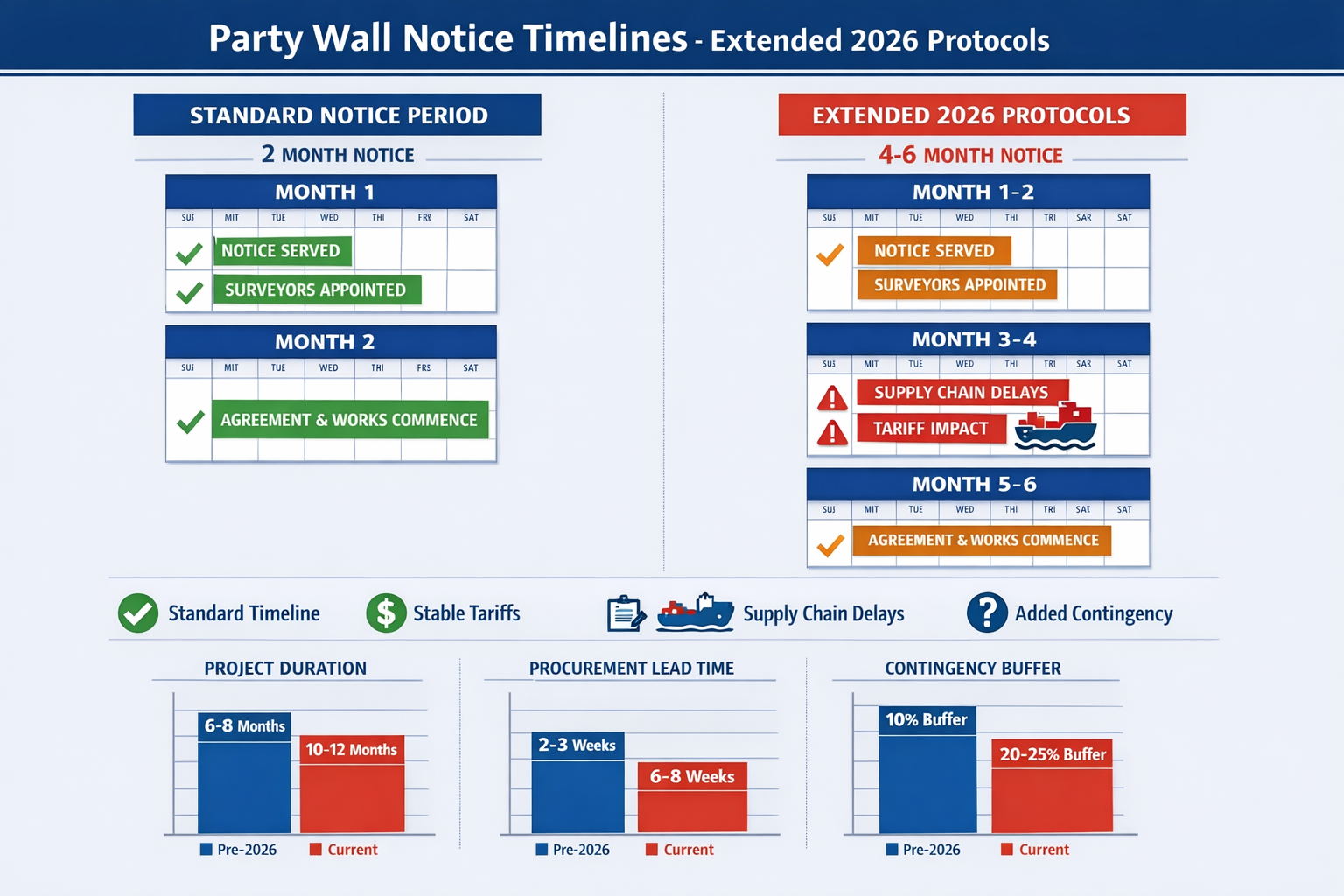
    Detailed landscape format (1536x1024) infographic showing timeline comparison of traditional party wall notice periods versus extended 2026

    The tariff environment of 2026 presents unique challenges that extend far beyond simple cost increases. The International Trade Trends Survey 2026 revealed that 58% of UK companies cite tariffs and trade rules as major obstacles to export activities[3]. For the construction sector, this manifests in multiple ways that directly affect party wall procedures.

    Current Tariff Situation and Policy Uncertainty

    The February 2026 Supreme Court decision created what many industry experts describe as a “false dawn” for construction cost relief. While certain tariffs imposed under the International Emergency Economic Powers Act (IEEPA) were struck down, the immediate introduction of a new 10% global tariff under alternative US legal powers meant that cost pressures continued unabated[1]. This policy whiplash has made long-term project planning exceptionally difficult.

    The UK Department for Business and Trade’s tariff suspension review, which opened applications on December 12, 2025 and closed on February 4, 2026, offers some potential relief. However, with 300 duty suspensions expiring on June 30, 2026, and feedback being solicited on extending them through the end of 2028, uncertainty remains the dominant theme[2].

    Materials Cost Volatility and Fixed-Price Contracts

    Many UK construction projects operate under fixed-price contracts with long procurement lead times and thin profit margins. This business model creates significant exposure to mid-project tariff changes. According to industry analysis, these circumstances can trigger “change in law” claims under both JCT and NEC contractual frameworks[1].

    The statistics are sobering:

    • One in four UK manufacturers report balance sheet losses directly linked to added costs from US tariffs
    • Nearly a quarter of manufacturers accelerated exports to the US in early 2025 to avoid anticipated tariff increases
    • Almost one in four manufacturers have shifted focus towards non-US markets
    • One in five have already stopped or reduced exports to the US altogether[3]

    For party wall surveyors, these figures translate into practical challenges: contractors are delaying project starts, materials suppliers cannot guarantee pricing beyond 30-60 days, and project timelines are extending by months.

    Tariff-Induced Project Delays and Party Wall Notice Timing: Critical Adjustments for 2026

    The traditional approach to party wall notices assumed relatively stable supply chains and predictable contractor availability. The 2026 environment requires fundamental reconsideration of these assumptions.

    Extended Notice Period Requirements

    Under the Party Wall etc. Act 1996, building owners must serve notice at least two months before commencing certain works. However, tariff-induced procurement delays now routinely extend project preparation phases by 3-5 months beyond traditional timelines[6].

    Recommended 2026 Notice Timeline Adjustments:

    Project Type Traditional Notice Period 2026 Recommended Period Reason for Extension
    Standard excavation works 2 months 4-5 months Materials procurement delays, contractor scheduling uncertainty
    Foundation underpinning 2 months 5-6 months Specialized materials subject to tariffs, limited supplier availability
    Structural alterations to party walls 2 months 4-5 months Steel and timber cost volatility, extended fabrication timelines
    New building at boundary 2 months 5-7 months Comprehensive materials packages affected by multiple tariff categories

    These extended periods allow adequate time for:

    1. Materials price stabilization and procurement commitment
    2. Contractor availability confirmation amid industry-wide scheduling delays
    3. Contingency planning for potential tariff changes during project execution
    4. Neighbor consultation with realistic project timeline expectations

    Adapting Surveyor Protocols for Supply Chain Uncertainty

    Party wall surveyors must now incorporate supply chain risk assessment into their standard protocols. This represents a significant expansion of traditional surveying responsibilities.

    Key Protocol Adaptations:

    📋 Pre-Notice Supply Chain Assessment: Before serving notice, surveyors should work with building owners to obtain written confirmation from contractors regarding materials availability and pricing validity periods.

    📋 Tariff Contingency Clauses: Party wall awards should explicitly address potential cost escalations and timeline extensions triggered by tariff changes, protecting both building and adjoining owners from unexpected disputes.

    📋 Flexible Commencement Dates: Rather than specifying fixed start dates, awards should incorporate “ready to proceed” language tied to materials procurement milestones.

    📋 Enhanced Communication Requirements: Building owners should be required to provide regular updates to adjoining owners regarding supply chain status and any anticipated delays.

    📋 Materials Substitution Protocols: Awards should establish clear procedures for approving alternative materials if specified products become unavailable or prohibitively expensive due to tariffs.

    Mid-sized surveying firms reported that implementing these enhanced protocols added 3-5 business days to their initial project assessment timelines during the early months of 2026[6]. However, this upfront investment significantly reduced mid-project disputes and costly delays.

    Investment Delays and Their Impact on Party Wall Procedures

    The tariff uncertainty of 2026 has created a decision paralysis among property developers and funders. This phenomenon directly affects party wall surveyors’ workload patterns and procedural approaches.

    Developer Hesitation and Project Postponements

    Developers are increasingly delaying project approvals as they await greater clarity on trade policy direction. Funders, meanwhile, are requiring higher contingency reserves before releasing capital for construction projects[1]. This affects several key development sectors:

    • Build-to-rent schemes: Multi-unit residential developments with long construction timelines face particular exposure to tariff changes
    • Commercial developments: Office and retail projects with complex materials specifications struggle with pricing uncertainty
    • Infrastructure procurement pipelines: Public sector projects face budget pressure from materials cost escalation

    For party wall surveyors working in areas like South London, East London, and West London, these delays create unique challenges. Notices may be served, then projects postponed indefinitely, creating confusion about whether notices remain valid or must be re-served.

    Managing Notice Validity During Extended Planning Phases

    The Party Wall Act does not specify an expiration date for served notices, but practical considerations require surveyors to address extended planning phases proactively.

    Best Practice Recommendations:

    🔹 Notice Refresh Communications: If more than six months elapse between notice service and project commencement, surveyors should facilitate updated communications between building and adjoining owners confirming continued intent.

    🔹 Award Validity Clauses: Include explicit language in awards addressing the validity period and circumstances requiring award amendment or renewal.

    🔹 Project Status Updates: Establish quarterly update requirements for building owners to inform adjoining owners of project status during extended planning phases.

    🔹 Materials Specification Updates: Allow for materials specification updates within awards if significant time elapses and originally specified materials become unavailable.

    These protocols help maintain the spirit of the Party Wall Act—facilitating neighborly cooperation and preventing disputes—even when external economic factors disrupt traditional project timelines.

    Tariff-Induced Project Delays and Party Wall Notice Timing: Practical Strategies for Building Owners

    Building owners initiating works in 2026 face a complex landscape requiring strategic planning beyond traditional construction project management. Understanding how to navigate types of party wall works in this environment is crucial.

    Early Materials Procurement and Supplier Relationships

    One of the most effective strategies for mitigating tariff-related delays involves early materials procurement. Building owners should consider:

    Strategic Procurement Approaches:

    1. Advanced Ordering: Place materials orders 4-6 months before anticipated construction start, locking in prices before potential tariff increases

    2. Supplier Diversification: Establish relationships with multiple suppliers across different geographic regions to reduce exposure to single-country tariff policies

    3. Materials Stockpiling: For projects with flexible timelines, purchasing and storing critical materials during tariff suspension periods can generate significant cost savings

    4. Price Guarantee Negotiations: Work with suppliers to obtain extended price validity guarantees, even at a slight premium, to enable accurate project budgeting

    5. Alternative Materials Research: Identify acceptable substitute materials from different tariff categories before finalizing project specifications

    These strategies require coordination with party wall surveyors to ensure that procurement timelines align with notice periods and award conditions.

    Contingency Planning and Budget Reserves

    The costs of party wall processes now must account for tariff-related contingencies. Financial planning should incorporate:

    Recommended Contingency Levels for 2026:

    • Standard residential extensions: 15-20% contingency (up from traditional 10%)
    • Complex structural works: 20-25% contingency
    • Commercial developments: 25-30% contingency
    • Projects with imported specialty materials: 30-35% contingency

    These elevated contingency levels reflect both materials cost volatility and potential timeline extensions that increase overall project costs through extended professional fees, insurance, and financing charges.

    Communication Strategies with Adjoining Owners

    Transparent communication with neighbors becomes even more critical when projects face tariff-induced uncertainties. Building owners should:

    ✉️ Provide Context: When serving party wall notices, include supplementary information explaining potential timeline uncertainties due to supply chain factors

    ✉️ Set Realistic Expectations: Avoid overly optimistic project completion dates that may need revision due to materials delays

    ✉️ Establish Update Protocols: Commit to regular progress updates, particularly if delays occur, to maintain positive neighbor relationships

    ✉️ Offer Flexibility: Where possible, demonstrate willingness to accommodate adjoining owners’ scheduling preferences within the constraints of materials availability

    ✉️ Document Everything: Maintain comprehensive records of all communications regarding timeline changes and reasons for delays

    These communication practices help prevent the escalation of minor frustrations into formal disputes that require third surveyor intervention.

    Adapting Surveyor Protocols for 2026’s Supply Chain Uncertainty: Professional Responsibilities
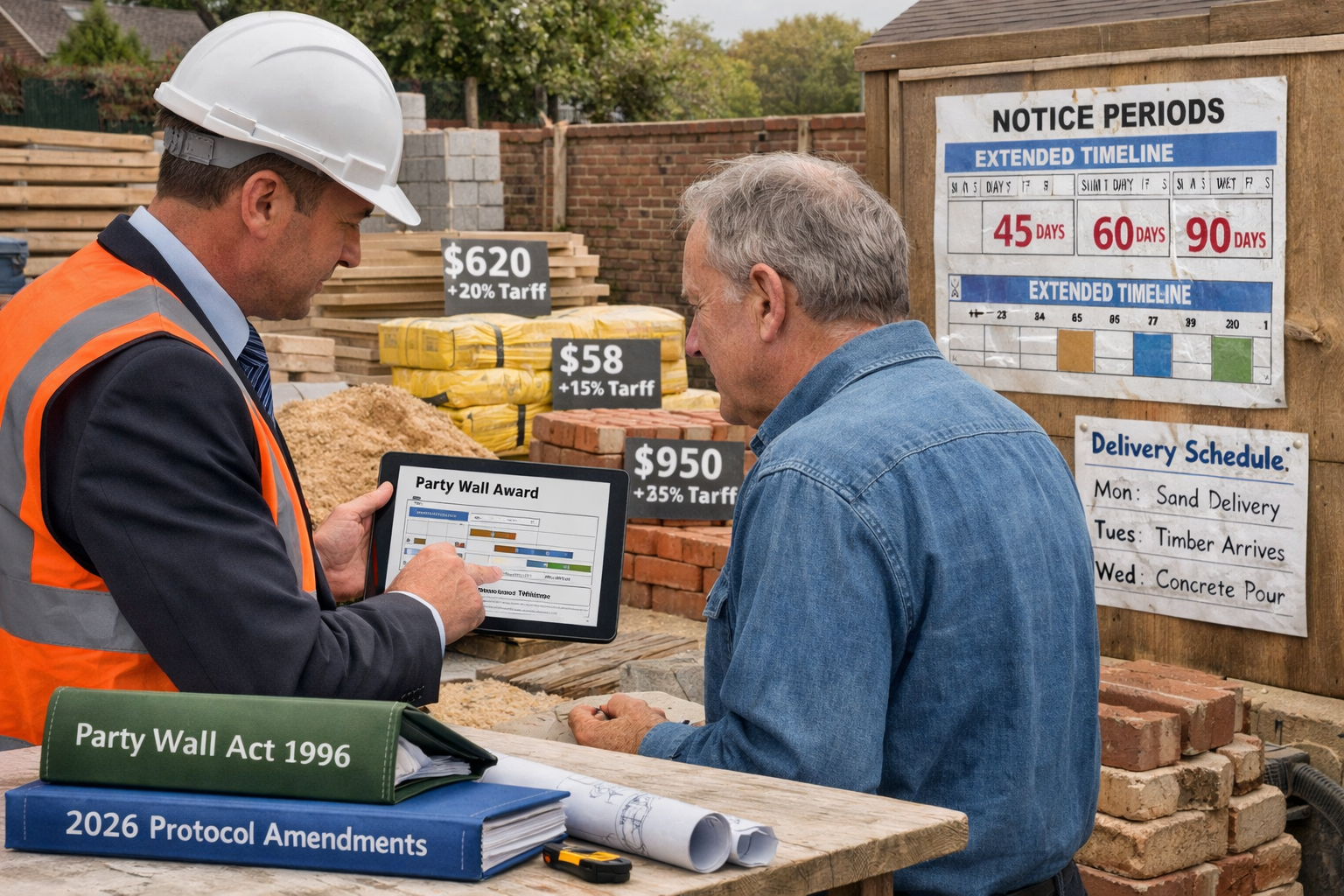
    Photorealistic landscape format (1536x1024) image depicting professional party wall surveyor conducting site inspection with tablet device s

    Party wall surveyors face expanded professional responsibilities in 2026 as they navigate the intersection of traditional statutory duties and modern supply chain complexities. Whether acting as a building owner’s surveyor or an adjoining owner’s surveyor, understanding these new dimensions is essential.

    Enhanced Due Diligence Requirements

    Surveyors must now conduct more comprehensive due diligence before finalizing party wall awards. This includes:

    Expanded Surveyor Responsibilities:

    🔍 Supply Chain Verification: Request and review contractor documentation regarding materials sourcing, supplier reliability, and procurement timelines

    🔍 Tariff Impact Assessment: Evaluate which project materials fall under current or potential future tariff categories and assess associated cost risks

    🔍 Contractor Financial Stability: Given that one in four manufacturers report balance sheet losses from tariff impacts[3], surveyors should verify contractor financial stability to reduce abandonment risk

    🔍 Alternative Specifications Review: Assess feasibility of alternative materials specifications that might reduce tariff exposure while maintaining project quality

    🔍 Timeline Realism Testing: Challenge optimistic contractor schedules by incorporating known supply chain delays and materials procurement lead times

    These enhanced due diligence practices protect both building and adjoining owners from preventable disputes arising from unrealistic project planning.

    Drafting Flexible Party Wall Awards

    The traditional party wall award format requires adaptation to address 2026’s uncertainties. Surveyors should incorporate:

    Essential Award Provisions for 2026:

    📄 Materials Cost Escalation Clauses: “If materials costs increase by more than [X%] due to tariff changes implemented after the date of this award, the building owner shall provide updated cost documentation and revised project schedules to the adjoining owner within 14 days of becoming aware of such changes.”

    📄 Timeline Extension Provisions: “Project timelines specified in this award are based on current materials availability. If procurement delays extend the project schedule by more than [X weeks], the building owner shall notify the adjoining owner and surveyors, and parties shall meet to discuss reasonable timeline adjustments.”

    📄 Materials Substitution Protocols: “Should specified materials become unavailable or subject to tariff increases exceeding [X%], the building owner may propose alternative materials of equivalent or superior quality, subject to surveyor approval and adjoining owner notification.”

    📄 Communication Requirements: “The building owner shall provide monthly project status updates to the adjoining owner during any period when works are delayed due to materials procurement or supply chain factors.”

    📄 Dispute Resolution Procedures: “Should disputes arise regarding timeline extensions or cost escalations related to tariff changes, parties agree to [mediation/third surveyor determination] before pursuing other remedies.”

    These provisions create a framework for managing uncertainty while maintaining the protective intent of the Party Wall Act.

    Managing Multi-Party Situations in Central London

    Surveyors working in densely developed areas like Central London or North London often deal with projects affecting multiple adjoining owners. Tariff-induced delays complicate these already complex situations.

    Strategies for Multi-Party Coordination:

    👥 Unified Communication: Establish a single communication channel for all adjoining owners to receive consistent project updates

    👥 Staggered Notice Service: When materials uncertainty is high, consider staggered notice service to different neighbors based on which properties will be affected at different project phases

    👥 Collective Meetings: Organize group meetings with all affected adjoining owners to explain tariff-related uncertainties and establish shared expectations

    👥 Consistent Award Terms: Ensure all awards affecting the same project contain consistent provisions regarding timeline extensions and materials substitutions

    👥 Coordinated Schedule of Condition: Conduct comprehensive schedules of condition for all affected properties before any works commence, recognizing that extended project timelines increase damage risk

    These coordination strategies become particularly important when projects experience multiple delays affecting different neighbors at different times.

    Risk Mitigation Strategies for All Stakeholders

    Successfully navigating Tariff-Induced Project Delays and Party Wall Notice Timing: Adapting Surveyor Protocols for 2026’s Supply Chain Uncertainty requires coordinated risk mitigation by all parties involved in construction projects.

    For Building Owners

    Building owners initiating works should implement comprehensive risk management strategies:

    Building Owner Risk Mitigation Checklist:

    ✔️ Engage Surveyors Early: Consult with party wall surveyors during initial project planning, before finalizing contractor agreements or materials specifications

    ✔️ Obtain Multiple Contractor Quotes: Request detailed quotes from at least three contractors, with explicit breakdown of materials costs and procurement timelines

    ✔️ Verify Materials Sourcing: Ask contractors to identify country of origin for all major materials and assess tariff exposure

    ✔️ Build Extended Timelines: Add 40-50% to traditional project timelines when planning and communicating with neighbors

    ✔️ Secure Flexible Financing: Ensure construction financing includes provisions for timeline extensions and cost escalations

    ✔️ Maintain Contingency Reserves: Keep accessible financial reserves equal to 25-30% of total project costs

    ✔️ Document All Decisions: Create comprehensive records of all decisions regarding materials selection, contractor choice, and timeline planning

    ✔️ Consider Phased Approaches: Break large projects into phases that can be completed as materials become available, rather than requiring all materials simultaneously

    For Adjoining Owners

    Adjoining owners receiving party wall notices in 2026 should take a more active role in understanding project uncertainties:

    Adjoining Owner Protection Strategies:

    ✔️ Ask Detailed Questions: When receiving notice, request specific information about materials sourcing, procurement timelines, and potential delay factors

    ✔️ Appoint Experienced Surveyors: Select surveyors with demonstrated experience in managing complex projects and supply chain issues

    ✔️ Request Regular Updates: Ensure party wall awards include mandatory update provisions if projects experience delays

    ✔️ Understand Your Rights: Review resources on what to do when your neighbor is carrying out works to understand your protections

    ✔️ Document Pre-Existing Conditions: Insist on comprehensive schedules of condition before works commence, recognizing that extended project timelines increase damage risk

    ✔️ Maintain Communication: Establish direct communication channels with building owners to address concerns before they escalate

    ✔️ Review Award Terms Carefully: Pay particular attention to provisions addressing timeline extensions and materials substitutions

    For Party Wall Surveyors

    Surveyors must balance traditional statutory duties with new responsibilities arising from supply chain uncertainty:

    Surveyor Professional Standards for 2026:

    ✔️ Continuous Education: Stay informed about current tariff policies, supply chain conditions, and construction materials markets

    ✔️ Enhanced Documentation: Maintain detailed records of all advice provided regarding timeline uncertainties and materials risks

    ✔️ Proactive Communication: Establish regular communication protocols with both building and adjoining owners throughout project duration

    ✔️ Realistic Scheduling: Challenge unrealistic contractor timelines and ensure awards reflect achievable schedules

    ✔️ Contingency Planning: Include comprehensive contingency provisions in all awards addressing potential delays and cost escalations

    ✔️ Professional Liability Review: Ensure professional indemnity insurance adequately covers expanded advisory responsibilities regarding supply chain matters

    ✔️ Collaborative Approach: Work cooperatively with surveyors appointed by other parties to establish consistent approaches to tariff-related uncertainties

    ✔️ Template Updates: Revise standard award templates to incorporate 2026-appropriate provisions addressing supply chain risks

    Case Studies: Tariff Impacts on Recent London Projects

    Examining real-world examples illustrates how tariff-induced delays affect party wall procedures in practice.

    Case Study 1: Residential Extension in South London

    A homeowner planned a two-story rear extension requiring excavation within three meters of the neighboring property. Traditional timeline: 4-6 months from notice to completion.

    2026 Reality:

    • Notice served in October 2025 with anticipated March 2026 construction start
    • Contractor notified building owner in February 2026 that steel beam delivery would be delayed 8-10 weeks due to tariff-related supplier backlog
    • Party wall surveyor facilitated communication with neighbor explaining delay
    • Award included provision allowing timeline extension for materials procurement delays
    • Actual construction start: June 2026 (3 months later than anticipated)
    • Neighbor relationship preserved through transparent communication

    Key Lessons:

    • Extended notice periods (6+ months) would have better accommodated procurement uncertainties
    • Award flexibility provisions prevented dispute when delays materialized
    • Proactive surveyor communication maintained positive neighbor relations

    Case Study 2: Commercial Development in Central London

    A developer planned a five-story mixed-use building affecting seven adjoining properties. Traditional timeline: 18-24 months construction.

    2026 Reality:

    • Initial notices served with 3-month lead time (insufficient for 2026 conditions)
    • Multiple materials categories affected by tariffs: structural steel, curtain wall systems, mechanical systems
    • Developer delayed project start by 5 months to secure materials pricing guarantees
    • Party wall awards required amendment to reflect revised timelines
    • Two adjoining owners expressed frustration with extended uncertainty period
    • Third surveyor intervention required to resolve dispute over timeline extensions

    Key Lessons:

    • Complex projects require 6-9 month notice periods in current environment
    • Initial awards should include comprehensive timeline extension provisions
    • Multi-party projects need exceptionally clear communication protocols
    • Developer materials procurement strategy should be finalized before serving notices

    Case Study 3: Foundation Underpinning in North London

    A terraced house required foundation underpinning affecting both neighboring properties. Traditional timeline: 3-4 months.

    2026 Reality:

    • Surveyor conducted pre-notice supply chain assessment with contractor
    • Identified that specialized underpinning materials had 12-week procurement lead time (up from traditional 4 weeks)
    • Served notices with 5-month lead time and detailed explanation of procurement requirements
    • Building owner secured materials pricing guarantee valid for 6 months
    • Award included specific materials substitution protocols if specified products became unavailable
    • Project completed on revised schedule without disputes

    Key Lessons:

    • Pre-notice supply chain assessment prevented surprises
    • Extended notice periods aligned with actual procurement realities
    • Materials pricing guarantees provided cost certainty
    • Comprehensive award provisions addressed potential contingencies

    Future Outlook: Preparing for Continued Uncertainty

    The tariff landscape of 2026 appears unlikely to stabilize quickly. Party wall surveyors must prepare for continued uncertainty extending into 2027 and beyond.

    Monitoring Policy Developments

    Several key policy developments will affect construction supply chains:

    Critical Dates and Developments to Monitor:

    📅 June 30, 2026: Expiration of 300 UK duty suspensions currently under review[2]

    📅 End of 2026: Potential implementation of extended duty suspensions through 2028 if approved[2]

    📅 Ongoing: US trade policy evolution under changing political leadership

    📅 Quarterly: UK Department for Business and Trade tariff reviews and updates

    Surveyors should establish systems for monitoring these developments and communicating implications to clients.

    Technology and Process Innovation

    Some surveying firms are adopting technological solutions to manage supply chain uncertainties:

    Emerging Tools and Practices:

    💻 Supply Chain Tracking Software: Integration of materials tracking platforms into project management systems

    💻 Digital Award Templates: Cloud-based award templates with built-in contingency provisions and automated update capabilities

    💻 Collaborative Communication Platforms: Secure portals allowing building owners, adjoining owners, and surveyors to share real-time project updates

    💻 Materials Cost Databases: Subscription services tracking construction materials costs and tariff impacts across categories

    💻 Automated Notice Timing Calculators: Tools that factor in current supply chain conditions when recommending notice service timing

    These innovations can help surveyors provide more sophisticated advice and manage complex projects more efficiently.

    Professional Development Priorities

    Party wall surveyors should prioritize professional development in several areas:

    Recommended Training and Knowledge Areas:

    📚 International Trade Fundamentals: Basic understanding of tariff structures, trade agreements, and policy mechanisms

    📚 Supply Chain Management: Principles of construction supply chain logistics and procurement strategies

    📚 Contract Law Updates: Understanding how JCT and NEC contracts address “change in law” provisions and cost escalations

    📚 Advanced Communication Skills: Techniques for managing stakeholder expectations during uncertain conditions

    📚 Risk Assessment Methodologies: Frameworks for evaluating and communicating project risks beyond traditional structural concerns

    📚 Alternative Dispute Resolution: Enhanced mediation and negotiation skills for resolving tariff-related disputes

    Professional organizations should develop continuing education programs addressing these emerging competency areas.

    Regulatory Considerations and Compliance
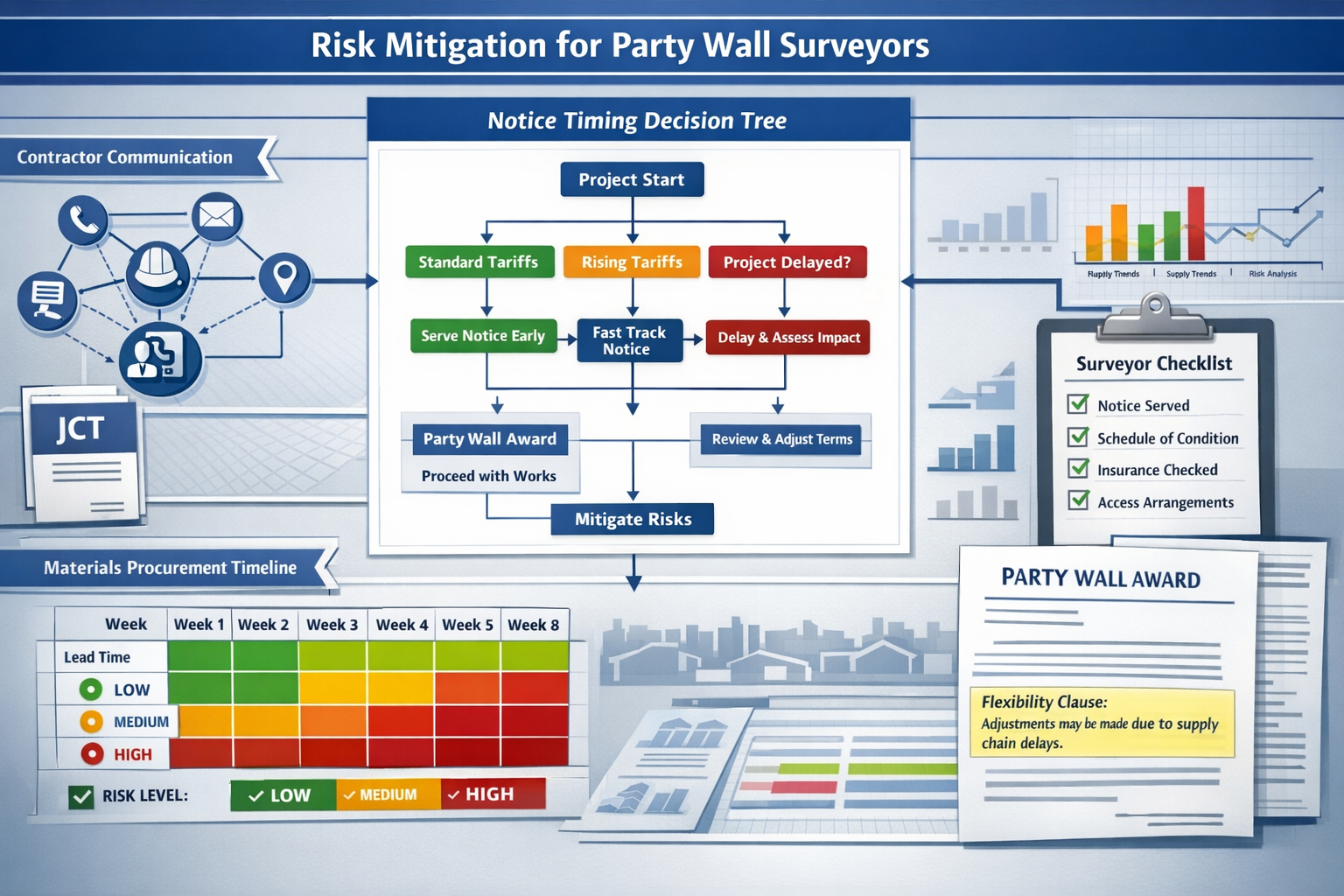
    Detailed landscape format (1536x1024) strategic planning visualization showing risk mitigation framework for party wall surveyors. Central f

    While the Party Wall etc. Act 1996 remains unchanged, its application in the context of tariff-induced delays raises important regulatory considerations.

    Statutory Notice Period Compliance

    The Act specifies minimum notice periods, but does not prohibit longer periods. Surveyors should understand:

    Notice Period Flexibility:

    • Two-month minimum for excavation and construction notices remains legally binding
    • Longer periods are permissible and increasingly advisable in 2026 conditions
    • Notice validity does not expire, but practical considerations may require refresh communications
    • Revised notices may be appropriate if project scope changes substantially during extended planning phases

    Surveyors should document the reasoning for extended notice periods to demonstrate professional judgment if questioned.

    Award Enforceability Considerations

    Party wall awards must remain legally enforceable while incorporating flexibility provisions. Key considerations:

    Balancing Flexibility and Enforceability:

    ⚖️ Specific vs. General Terms: Awards should be specific enough to be enforceable but flexible enough to accommodate reasonable contingencies

    ⚖️ Objective Standards: Flexibility provisions should reference objective standards (e.g., “materials cost increases exceeding 15%”) rather than subjective determinations

    ⚖️ Dispute Resolution Mechanisms: Include clear procedures for resolving disagreements about whether contingency provisions apply

    ⚖️ Documentation Requirements: Specify what documentation building owners must provide to invoke contingency provisions

    ⚖️ Time Limits: Include reasonable time limits for invoking contingency provisions to prevent indefinite uncertainty

    These considerations help ensure that awards remain enforceable while addressing 2026’s unique challenges.

    Insurance and Liability Implications

    Tariff-related delays create potential liability exposure for various parties:

    Liability Considerations:

    🛡️ Surveyor Professional Liability: Failure to advise clients about supply chain risks could constitute professional negligence

    🛡️ Contractor Performance Bonds: Extended timelines may affect contractor bonding requirements and coverage

    🛡️ Project Insurance: Construction all-risk policies may require notification of substantial timeline extensions

    🛡️ Adjoining Owner Protection: Awards should clearly specify building owner responsibilities for damage occurring during extended project timelines

    All parties should review insurance coverage with advisors to ensure adequate protection in the current environment.

    Practical Implementation Guide

    For surveyors ready to implement adapted protocols, this practical guide provides a structured approach.

    Step-by-Step Protocol for 2026 Party Wall Projects

    Phase 1: Initial Consultation (Weeks 1-2)

    1. Meet with building owner to understand project scope and objectives
    2. Request preliminary contractor quotes and materials specifications
    3. Conduct supply chain risk assessment for major materials categories
    4. Identify tariff exposure and procurement lead times
    5. Recommend appropriate notice timing based on supply chain analysis
    6. Discuss contingency planning and budget reserves

    Phase 2: Pre-Notice Preparation (Weeks 3-6)

    1. Finalize contractor selection and obtain detailed materials sourcing information
    2. Verify supplier reliability and pricing guarantee periods
    3. Prepare comprehensive project timeline incorporating procurement lead times
    4. Draft notice documents with supplementary supply chain context
    5. Prepare building owner for potential adjoining owner questions about timelines
    6. Coordinate with building owner’s other consultants (architects, engineers, contractors)

    Phase 3: Notice Service and Initial Response (Weeks 7-10)

    1. Serve notices with recommended extended lead times
    2. Provide supplementary information about project timelines and potential uncertainties
    3. Respond promptly to adjoining owner inquiries
    4. Facilitate surveyor appointments for non-consenting adjoining owners
    5. Conduct initial surveyor meetings to establish collaborative approach
    6. Begin schedule of condition preparations

    Phase 4: Award Preparation (Weeks 11-16)

    1. Conduct comprehensive site inspections and schedules of condition
    2. Review contractor method statements and timeline projections
    3. Draft awards incorporating 2026-appropriate contingency provisions
    4. Include specific provisions addressing materials cost escalation and timeline extensions
    5. Establish communication protocols for project updates
    6. Obtain surveyor agreement on award terms
    7. Serve awards on all parties

    Phase 5: Pre-Commencement Period (Weeks 17+)

    1. Monitor materials procurement progress
    2. Facilitate communication between building owner and adjoining owners regarding project status
    3. Address any concerns or questions arising during extended planning phase
    4. Confirm contractor readiness and materials availability before authorizing commencement
    5. Conduct final pre-commencement inspections
    6. Document project commencement date and notify all parties

    Phase 6: Construction Period Monitoring

    1. Maintain regular communication with all parties
    2. Monitor compliance with award conditions
    3. Address any issues arising from materials delays or substitutions
    4. Document any timeline extensions and reasons
    5. Facilitate dispute resolution if disagreements arise
    6. Conduct periodic inspections to verify work quality and neighbor property protection

    Phase 7: Project Completion

    1. Conduct final inspections comparing to schedules of condition
    2. Address any damage claims promptly
    3. Obtain completion confirmations from all parties
    4. Archive comprehensive project documentation
    5. Conduct post-project review to identify lessons learned

    Customizable Award Template Provisions

    Surveyors can adapt these template provisions for incorporation into awards:

    Materials Cost Escalation Provision:

    “The building owner has budgeted for this project based on materials costs current as of [DATE]. Should tariffs, duties, or other governmental charges imposed after this date increase the cost of materials specified in this award by more than fifteen percent (15%), the building owner shall provide written notice to the adjoining owner and appointed surveyors within fourteen (14) days of becoming aware of such increases. Such notice shall include documentation from suppliers evidencing the cost increases and their causes. The parties acknowledge that such cost increases, if properly documented, constitute circumstances beyond the building owner’s reasonable control and shall not constitute grounds for disputing the building owner’s good faith performance under this award.”

    Timeline Extension Provision:

    “The project timeline specified in this award assumes materials availability consistent with procurement lead times current as of [DATE]. Should materials procurement delays extend the anticipated project commencement date by more than thirty (30) days, the building owner shall provide written notice to the adjoining owner explaining the nature of the delay and providing a revised project schedule. The adjoining owner acknowledges that such delays, if caused by supply chain factors beyond the building owner’s reasonable control and properly documented, shall not constitute breach of this award. However, if project commencement is delayed by more than ninety (90) days beyond the anticipated commencement date specified herein, either party may request a review meeting with both appointed surveyors to discuss whether award amendments are appropriate.”

    Materials Substitution Provision:

    “The building owner shall use materials specified in this award or materials of equivalent or superior quality. Should specified materials become unavailable or subject to cost increases exceeding twenty percent (20%) due to tariff changes or supply chain disruptions, the building owner may propose alternative materials. Such proposals shall be submitted in writing to the appointed surveyors with documentation demonstrating that proposed alternatives meet or exceed the performance characteristics, aesthetic qualities, and durability of originally specified materials. The surveyors shall evaluate such proposals within fourteen (14) days and may approve alternatives that adequately protect the interests of both building and adjoining owners. The adjoining owner shall be notified of any approved materials substitutions before their incorporation into the works.”

    Communication Protocol Provision:

    “The building owner shall provide project status updates to the adjoining owner at the following intervals: (1) written notice at least seven (7) days before project commencement; (2) monthly progress updates during active construction; (3) immediate notice of any circumstances causing work stoppage exceeding seven (7) days; (4) immediate notice of any materials procurement delays affecting the project timeline by more than fourteen (14) days; and (5) written notice of project completion. Updates may be provided via email to [CONTACT INFORMATION] or such other method as the parties may agree.”

    These provisions can be customized based on specific project circumstances and local practices.

    Conclusion: Navigating the New Normal

    Tariff-Induced Project Delays and Party Wall Notice Timing: Adapting Surveyor Protocols for 2026’s Supply Chain Uncertainty represents more than a temporary challenge—it signals a fundamental shift in how construction projects must be planned and managed. The convergence of trade policy volatility, materials cost uncertainty, and extended procurement timelines requires party wall surveyors to expand their professional capabilities beyond traditional structural and procedural expertise.

    The statistics are clear: with eight in ten UK companies impacted by tariffs and one in four manufacturers reporting balance sheet losses from tariff-related costs, the construction industry faces sustained pressure that will continue affecting project timelines and costs[3]. Party wall surveyors who adapt their protocols now will better serve their clients and protect all stakeholders from preventable disputes.

    Key Success Factors

    Successful navigation of this environment requires:

    🎯 Extended Planning Horizons: Notice periods of 4-7 months rather than traditional 2 months accommodate realistic procurement timelines

    🎯 Comprehensive Risk Assessment: Surveyors must evaluate supply chain risks alongside traditional structural and procedural considerations

    🎯 Flexible Award Provisions: Party wall awards need built-in contingency mechanisms addressing cost escalation and timeline extensions

    🎯 Enhanced Communication: Proactive, transparent communication with all stakeholders prevents minor uncertainties from escalating into major disputes

    🎯 Continuous Monitoring: Ongoing attention to trade policy developments and supply chain conditions enables timely advice to clients

    🎯 Professional Development: Surveyors must develop competencies in supply chain management, international trade basics, and advanced stakeholder communication

    Actionable Next Steps

    For building owners planning projects in 2026 and beyond:

    Engage party wall surveyors during initial project planning, before finalizing contractor agreements or materials specifications

    Request supply chain risk assessments as part of surveyor services

    Build extended timelines into project plans, adding 40-50% to traditional schedules

    Secure materials pricing guarantees from suppliers before serving party wall notices

    Maintain contingency reserves equal to 25-30% of total project costs

    Establish transparent communication with neighbors from the outset

    For adjoining owners receiving party wall notices:

    Ask detailed questions about materials sourcing and procurement timelines

    Appoint experienced surveyors familiar with supply chain issues

    Request comprehensive schedules of condition before works commence

    Ensure awards include mandatory update provisions if projects experience delays

    Maintain open communication with building owners to address concerns early

    For party wall surveyors:

    Update standard templates to incorporate 2026-appropriate contingency provisions

    Develop supply chain assessment capabilities and resources

    Establish monitoring systems for trade policy developments affecting construction materials

    Invest in professional development covering supply chain management and international trade fundamentals

    Review professional liability insurance to ensure adequate coverage for expanded advisory responsibilities

    Create client education materials explaining tariff impacts and recommended protocol adaptations

    The party wall surveying profession has always adapted to changing circumstances while maintaining its core mission: facilitating construction projects while protecting the rights and interests of all affected parties. The tariff-induced uncertainties of 2026 require another evolution in professional practice. Surveyors who embrace these changes, develop new competencies, and implement adapted protocols will continue providing essential services that enable construction projects to proceed smoothly despite external economic pressures.

    By extending notice periods, incorporating flexible award provisions, enhancing communication protocols, and conducting comprehensive supply chain risk assessments, party wall surveyors can successfully navigate Tariff-Induced Project Delays and Party Wall Notice Timing: Adapting Surveyor Protocols for 2026’s Supply Chain Uncertainty. These adaptations protect building owners from cost overruns and timeline disputes, protect adjoining owners from prolonged uncertainty and inadequate notice, and protect the surveying profession’s reputation for competent, client-focused service.

    The challenges of 2026 are significant, but they are manageable with proper planning, realistic expectations, and collaborative approaches among all stakeholders. The party wall surveying profession has the expertise and adaptability to guide clients through this uncertain period while maintaining the high professional standards that have long characterized the field.


    References

    [1] Trump 10 Percent Tariffs Uk Construction Impact – https://www.constructionmagazine.uk/2026/02/trump-10-percent-tariffs-uk-construction-impact.html

    [2] United Kingdom Uk Tariff Suspensions December 2025 Update – https://www.fas.usda.gov/data/united-kingdom-uk-tariff-suspensions-december-2025-update

    [3] International Trade Trends Survey Uk Manufacturers Recalibrate Trade Strategies As Tariffs Bite – https://zenoot.com/articles/international-trade-trends-survey-uk-manufacturers-recalibrate-trade-strategies-as-tariffs-bite/

    [4] Us Tariff Proposal Called Off How Can Uk Businesses Prepare For Future Trade Uncertainty – https://www.macalvins.com/blog/us-tariff-proposal-called-off-how-can-uk-businesses-prepare-for-future-trade-uncertainty/

    [6] Post Alta Nsps 2026 Standards Implementation Challenges And Success Stories For Property Surveyors – https://nottinghillsurveyors.com/blog/post-alta-nsps-2026-standards-implementation-challenges-and-success-stories-for-property-surveyors
  • Water & Sewer Party Wall Compliance Guide 2026

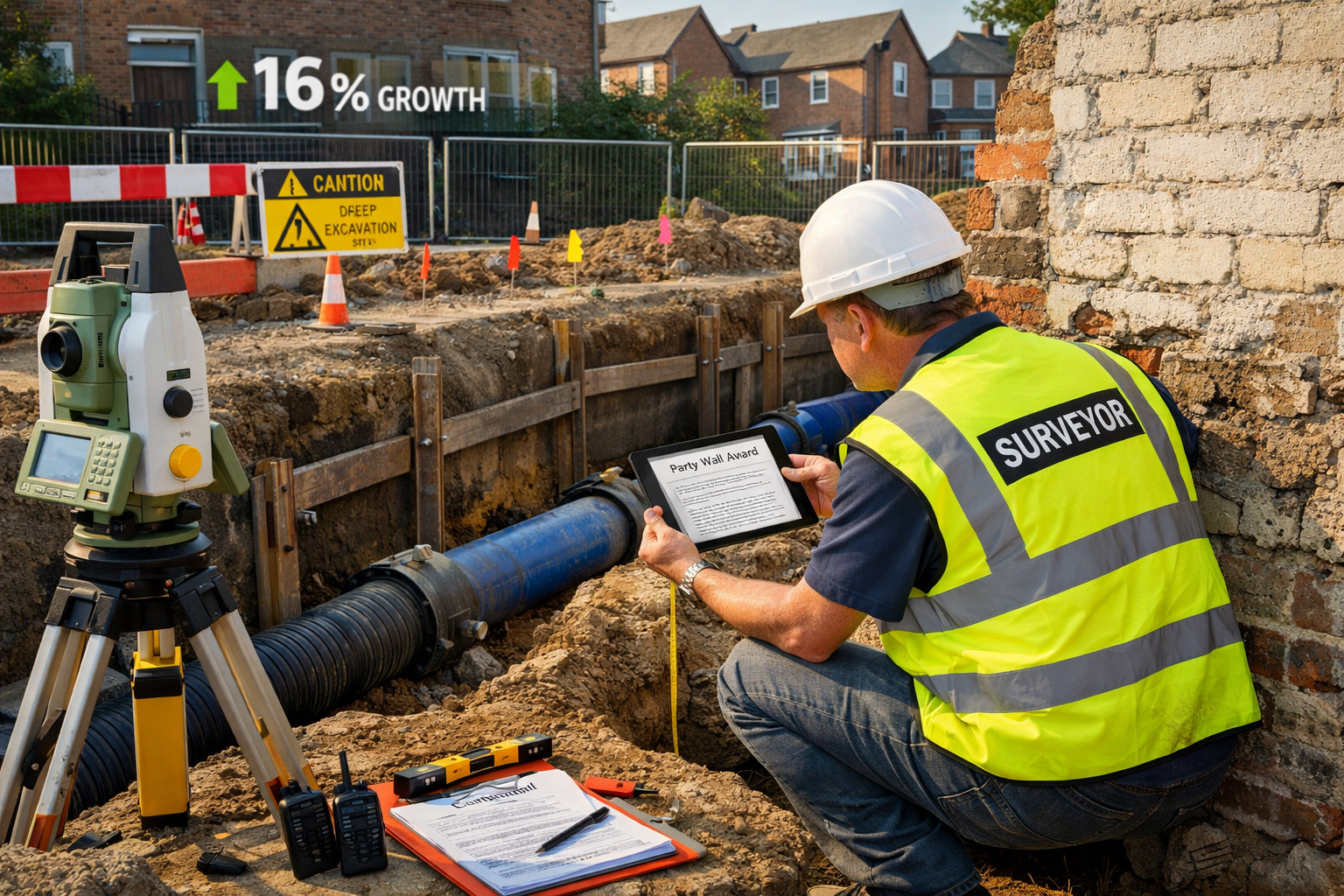
    Municipal water and sewer infrastructure projects are experiencing steady growth in 2026, with construction activity showing a modest but consistent 16% net reading as utilities expand and modernize aging systems. However, beneath this encouraging trend lies a complex legal landscape that many municipalities overlook: party wall compliance. When water mains, sewer laterals, and stormwater systems cross property boundaries—which they frequently do—robust party wall agreements and professional surveyor involvement become absolutely essential. 🏗️

    The intersection of municipal infrastructure expansion and property rights creates unique challenges that require careful navigation. Unlike private construction projects, municipal works often affect multiple properties simultaneously, involve public right-of-way considerations, and must balance community needs against individual property rights. Understanding how Water and Sewer Infrastructure Expansion: Party Wall Compliance for Municipal Construction Projects in 2026 intersects with established legal frameworks is crucial for project success.

    Key Takeaways

    • Municipal water and sewer projects frequently cross property boundaries, triggering party wall legislation requirements and necessitating formal notices to adjoining owners before construction begins
    • The Party Wall etc Act 1996 applies to municipal construction when works affect shared boundaries, foundations, or structures, requiring proper notice periods of at least two months for most excavation works
    • 2026 regulatory updates introduce stricter watertightness testing standards (ASTM C1227), PFAS compliance requirements for drinking water, and enhanced stormwater pollution prevention measures that affect project timelines
    • Professional party wall surveyors help municipalities navigate compliance, minimize disputes, and document pre-construction conditions to protect against future claims
    • Proactive party wall agreements reduce project delays, legal costs, and community opposition while ensuring infrastructure expansion proceeds smoothly across property boundaries

    Understanding Party Wall Legislation in Municipal Infrastructure Context

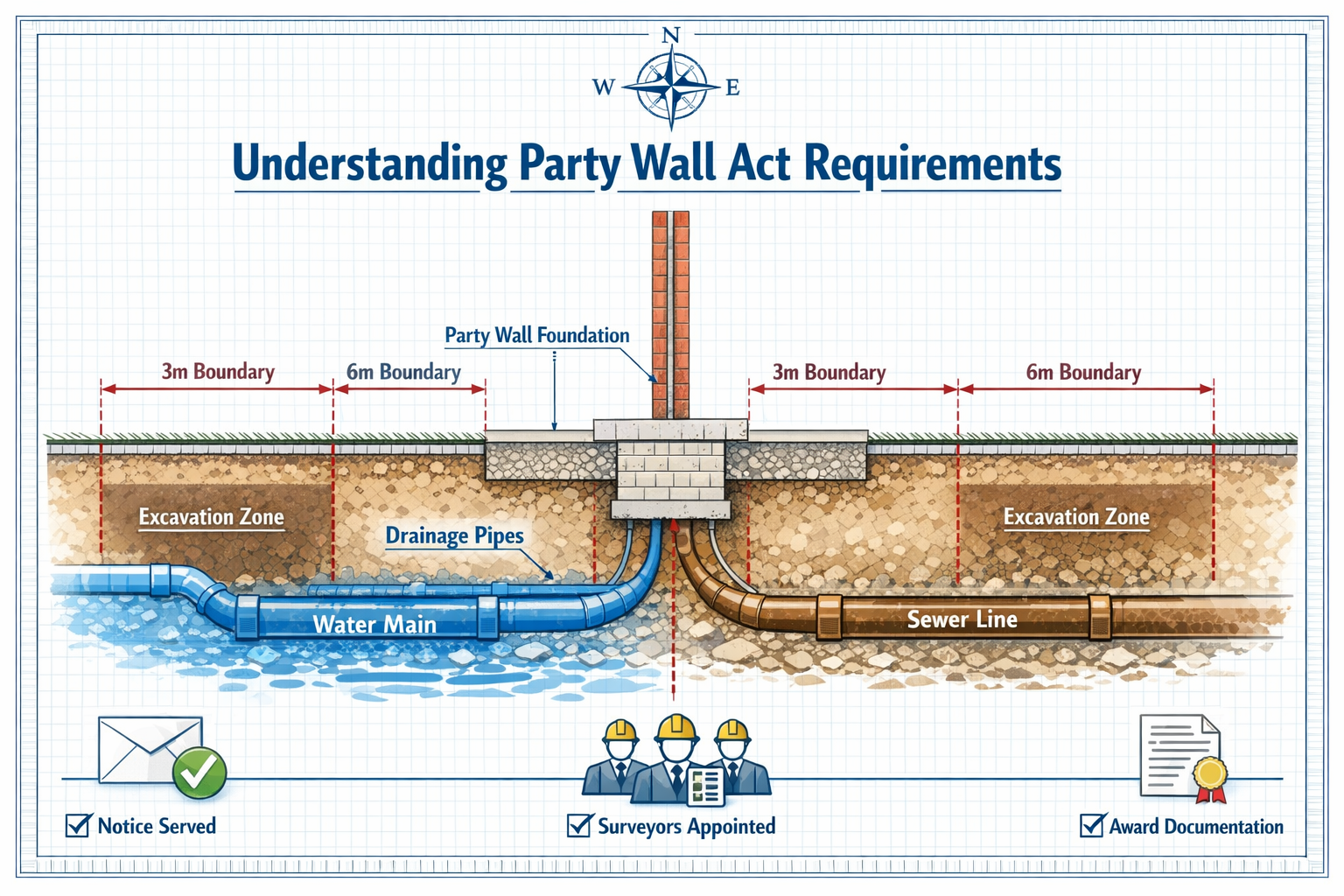
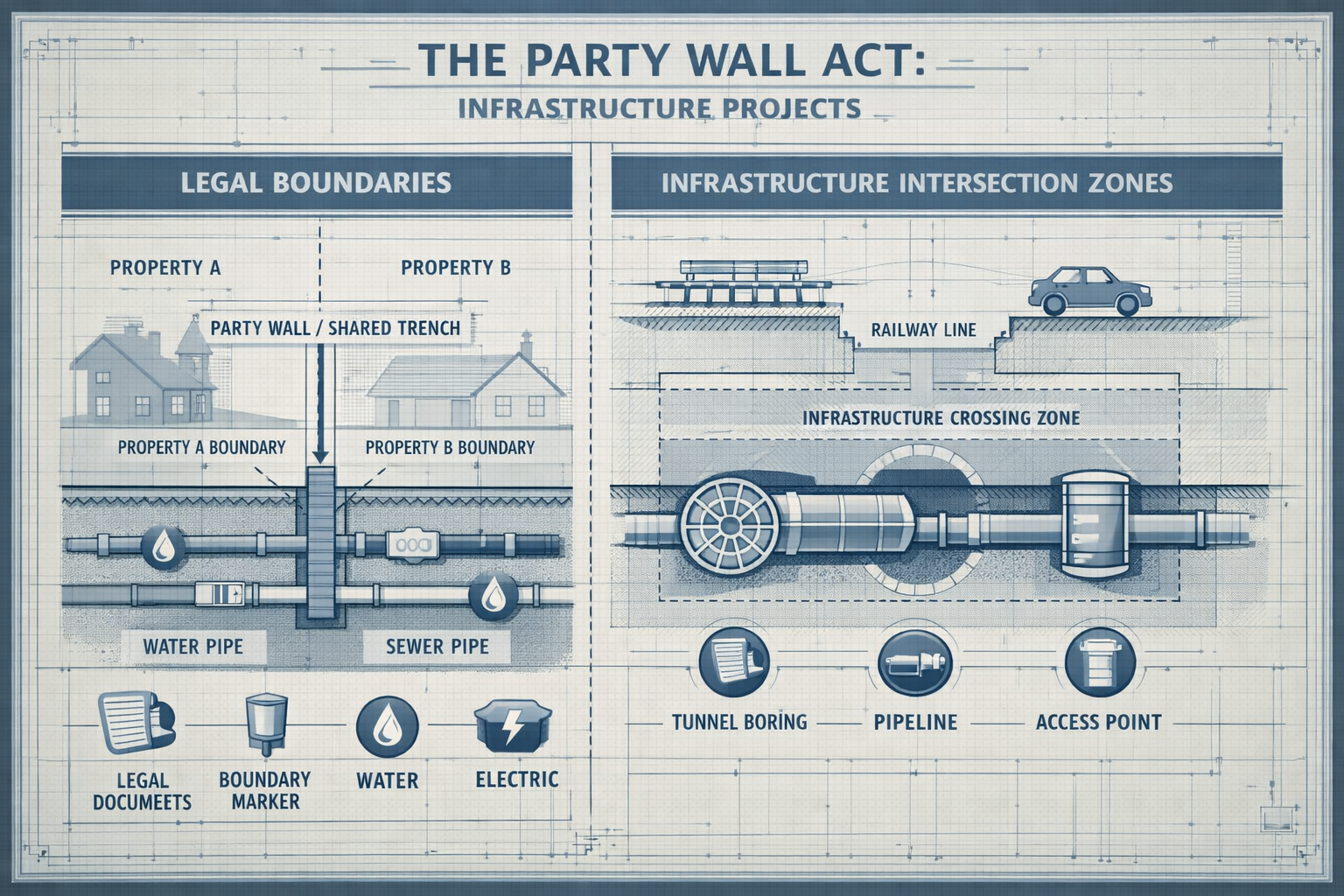
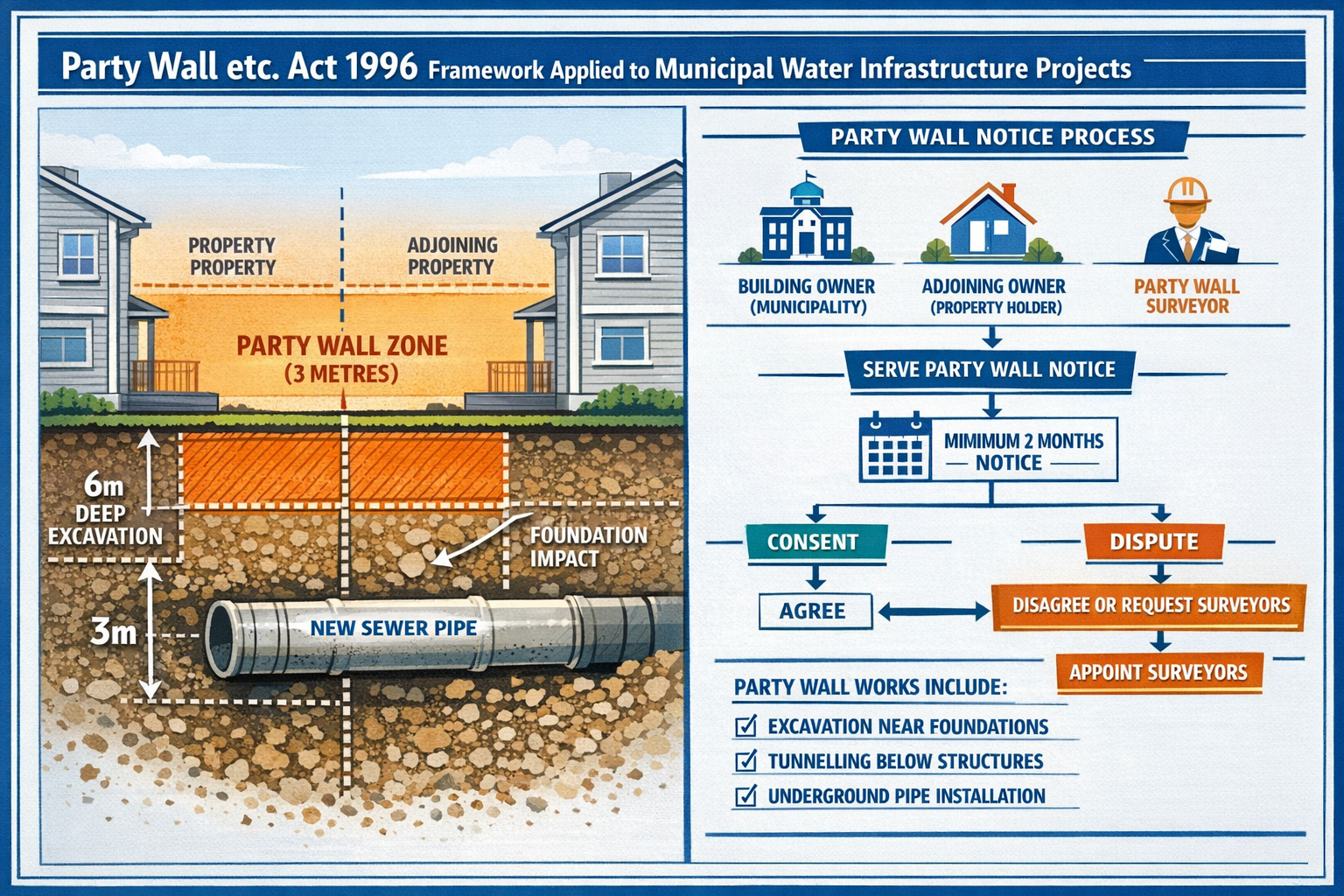
    Detailed landscape format (1536x1024) infographic illustration showing the Party Wall etc Act 1996 framework applied to municipal water infr

    What is the Party Wall etc Act 1996?

    The Party Wall etc Act 1996 establishes the legal framework governing construction work on or near property boundaries in England and Wales. While many associate this legislation primarily with residential extensions and loft conversions, it applies equally to municipal infrastructure projects when certain conditions are met.

    The Act covers three main categories of work:

    1. Work directly to an existing party wall or party structure – This includes repairs, alterations, or modifications to walls shared between properties
    2. New building at or astride the boundary line – Construction of new structures on the property line
    3. Excavation within specified distances of neighboring buildings – The most relevant category for water and sewer infrastructure expansion

    For municipal construction projects, the third category presents the most frequent compliance trigger. When excavating for water mains, sewer laterals, or drainage systems, municipalities must serve party wall notices if the excavation:

    • Goes deeper than the foundations of an adjoining building and occurs within 3 meters of that building
    • Goes deeper than a line drawn at 45 degrees from the bottom of the foundations of an adjoining building and occurs within 6 meters of that building

    How Municipal Projects Differ from Private Construction

    Municipal infrastructure expansion presents unique party wall considerations that distinguish it from typical private construction projects:

    Multiple Property Impacts: A single water main replacement project might affect dozens of properties along its route, requiring coordinated notice serving and management of multiple party wall agreements simultaneously.

    Public Interest vs. Private Rights: Municipalities must balance the public benefit of infrastructure improvements against individual property rights, creating a delicate negotiation that requires diplomatic handling and clear communication.

    Statutory Powers: Local authorities possess certain statutory powers for infrastructure work, but these do not override party wall legislation requirements. Municipalities must still comply with proper notice procedures and agreement protocols.

    Timeline Pressures: Infrastructure projects often face funding deadlines, seasonal construction windows, and public service continuity requirements that make party wall compliance delays particularly costly.

    Understanding these distinctions helps municipalities develop appropriate compliance strategies. For guidance on types of party wall works that commonly apply to infrastructure projects, municipalities should consult with experienced party wall professionals early in the planning process.

    Water and Sewer Infrastructure Expansion: Party Wall Compliance for Municipal Construction Projects in 2026 – Regulatory Framework

    Current Party Wall Notice Requirements

    Proper notice serving forms the foundation of party wall compliance. For Water and Sewer Infrastructure Expansion: Party Wall Compliance for Municipal Construction Projects in 2026, municipalities must understand the specific notice requirements and timelines.

    Party Structure Notice: Required when work directly affects an existing party wall or structure. The building owner (municipality) must serve notice at least two months before intended work commencement.

    Party Wall Notice: Necessary for new construction on the boundary line. Also requires two months advance notice.

    Notice of Adjacent Excavation: The most relevant for infrastructure projects, this notice must be served when excavating within the 3-meter or 6-meter zones described earlier. The notice period is one month before work begins.

    The party wall notices must include specific information:

    • Name and address of the building owner (municipality)
    • Nature and particulars of the proposed work
    • Date when work will begin
    • Clear drawings or plans showing the work location and extent

    Common Municipal Mistakes ❌:

    • Assuming statutory infrastructure powers override party wall requirements
    • Serving generic notices that lack sufficient detail
    • Failing to identify all affected adjoining owners
    • Starting work before notice periods expire
    • Not maintaining proper records of notice service

    2026 Infrastructure Standards and Compliance Updates

    The regulatory landscape for water and sewer infrastructure continues to evolve in 2026, adding layers of complexity to party wall compliance. Municipalities must navigate both party wall legislation and sector-specific standards.

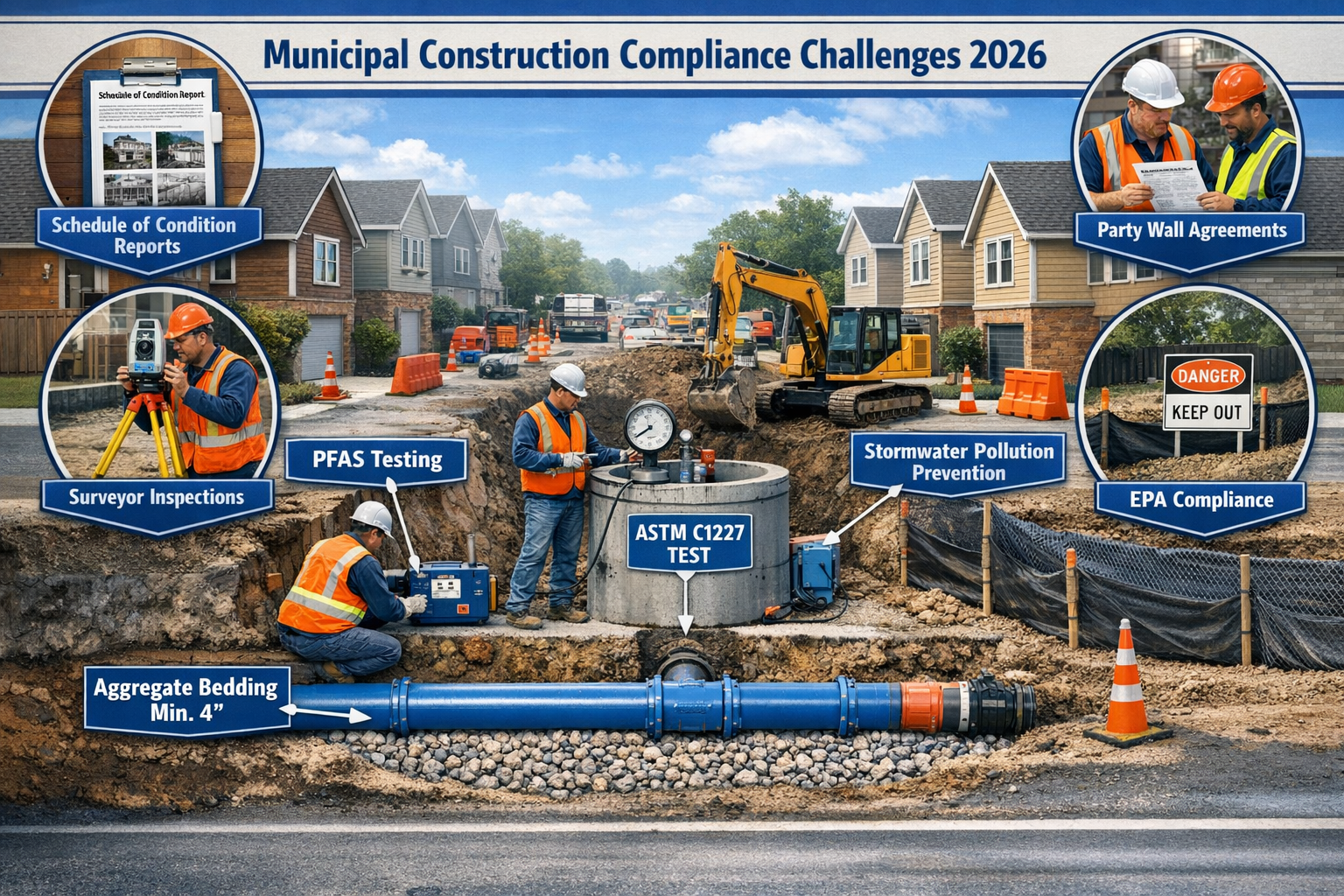
    Watertightness Testing Standards: New proposed regulations introduce mandatory watertightness testing per ASTM C1227 standards for all new sewer installations and replacements.[4] This requirement affects party wall compliance by:

    • Extending construction timelines to accommodate testing protocols
    • Requiring additional excavation access that may trigger party wall notices
    • Necessitating post-installation monitoring that could affect adjoining properties

    Aggregate Bedding Requirements: Updated standards mandate a minimum of 4 inches of aggregate for all tank types and underground infrastructure installations.[4] This uniform requirement ensures proper drainage and structural support but may increase excavation depths, potentially triggering party wall notice requirements where shallower excavation would not.

    PFAS Compliance: The EPA expects to finalize revised drinking water standards for PFOA and PFOS in spring 2026, affecting municipal water treatment requirements.[5] While not directly related to party wall legislation, these standards impact project planning:

    • Additional testing equipment installation may require boundary-adjacent construction
    • Treatment facility expansions could trigger party wall requirements
    • Monitoring well installations near property lines need proper notice procedures

    Stormwater Pollution Prevention: The 2026 Multi-Sector General Permit (MSGP) adds inspection requirements for facility Stormwater Pollution Prevention Plans to enhance NPDES compliance.[6] Infrastructure projects must implement enhanced stormwater management, which may include:

    • Sediment control measures extending onto or near adjoining properties
    • Temporary drainage modifications affecting neighboring land
    • Permanent stormwater infrastructure crossing property boundaries

    Integration with Sanitary Standards

    The 2026 Sanitary Standards Manual provides comprehensive design and construction standards for laterals and sanitary sewer facilities.[7] These standards establish technical requirements that municipalities must integrate with party wall compliance procedures:

    Design Standards that affect party wall considerations include:

    • Minimum pipe depths and slopes that determine excavation requirements
    • Clearance requirements from existing structures and utilities
    • Access point locations that may necessitate boundary-adjacent construction

    Construction Standards requiring coordination with party wall procedures:

    • Trench width specifications that define the excavation footprint
    • Shoring and support requirements for deep excavations near structures
    • Backfill and compaction standards affecting construction duration

    Municipalities should review the complete guide on boundary wall rules and differences between party fence walls and boundary walls to understand how these technical standards interact with property boundary considerations.

    Practical Implementation: Party Wall Compliance for Infrastructure Projects

    Step-by-Step Compliance Process

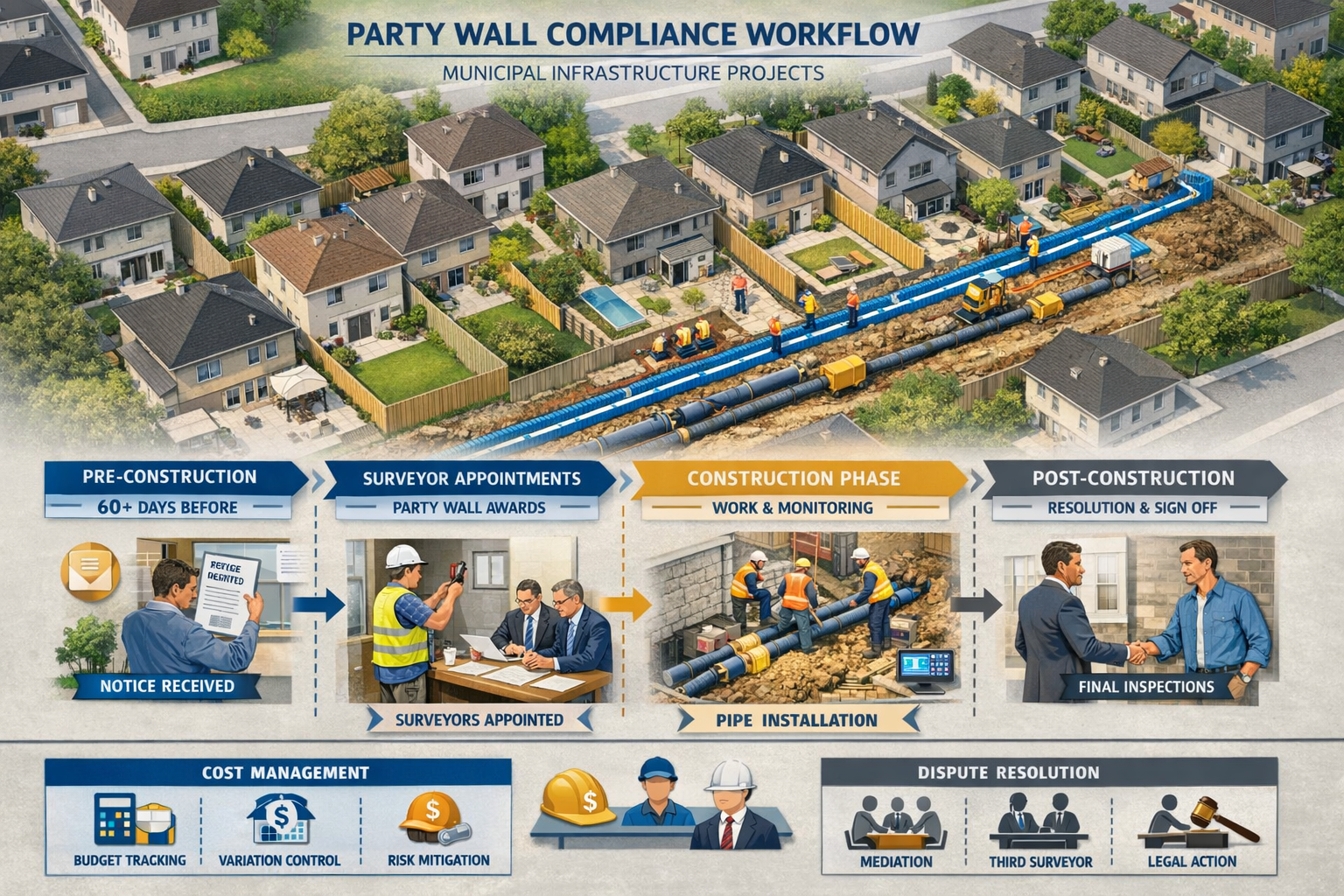
    Successfully navigating Water and Sewer Infrastructure Expansion: Party Wall Compliance for Municipal Construction Projects in 2026 requires a systematic approach. Here’s a comprehensive workflow:

    Phase 1: Pre-Design Assessment (3-6 months before construction)

    1. Property Boundary Mapping 🗺️

    • Obtain accurate property boundary surveys for the entire project route
    • Identify all properties within 6 meters of planned excavation
    • Document existing structures, foundations, and improvements
    • Review land registry records to confirm current ownership

    2. Initial Party Wall Assessment

    • Determine which properties will require party wall notices
    • Categorize notice types needed (Adjacent Excavation, Party Structure, etc.)
    • Estimate notice serving timeline requirements
    • Budget for party wall surveyor fees and potential awards

    3. Stakeholder Identification

    • Create comprehensive list of all adjoining owners
    • Identify properties with multiple owners or complex ownership structures
    • Note any commercial properties requiring special consideration
    • Document contact information and preferred communication methods

    Phase 2: Notice Preparation and Service (2-3 months before construction)

    4. Notice Drafting

    • Prepare detailed party wall notices with complete project information
    • Include accurate technical drawings showing excavation extent and depth
    • Specify proposed construction methods and protective measures
    • Clearly state intended commencement date

    5. Notice Service

    • Serve notices via recorded delivery or hand delivery with acknowledgment
    • Maintain detailed records of service dates and methods
    • Follow up with adjoining owners to confirm receipt
    • Prepare for potential questions and concerns

    6. Response Management

    • Monitor for consent or dissent responses (14-day response period)
    • Engage party wall surveyors when dissent is received or no response given
    • Begin surveyor appointment process promptly to avoid delays

    Phase 3: Party Wall Award Process (1-2 months)

    7. Surveyor Appointments

    When adjoining owners dissent or fail to respond, the party wall award process begins. Municipalities have several options:

    Scenario Surveyor Arrangement Timeline Impact
    Adjoining owner consents No surveyor needed Minimal – proceed after notice period
    Adjoining owner dissents Each party appoints own surveyor, or agreed surveyor 4-6 weeks for award preparation
    No response after 14 days Deemed dissent – surveyors required 6-8 weeks including appointment process
    Multiple properties Consider agreed surveyor for all parties Most efficient for large projects

    8. Schedule of Condition

    A critical component of party wall compliance involves documenting pre-construction property conditions. Professional schedules of condition should include:

    • Detailed photographic records of all adjoining properties
    • Written descriptions of existing defects, cracks, or damage
    • Structural condition assessments
    • Baseline measurements for monitoring potential movement

    This documentation protects both the municipality and property owners by establishing clear evidence of pre-existing conditions.

    9. Party Wall Award Finalization

    The party wall award document specifies:

    • Permitted works and construction methods
    • Working hours and access arrangements
    • Protective measures and monitoring requirements
    • Cost allocation and fee payment responsibilities
    • Dispute resolution procedures

    Understanding the costs of party wall processes helps municipalities budget appropriately and avoid financial surprises.

    Phase 4: Construction and Monitoring

    10. Pre-Construction Coordination

    • Distribute party wall awards to all contractors and site supervisors
    • Brief construction teams on party wall compliance requirements
    • Establish monitoring protocols per award specifications
    • Set up communication channels with adjoining owners

    11. Ongoing Compliance

    • Conduct regular monitoring as specified in awards
    • Document compliance with protective measures
    • Maintain open communication with adjoining owners
    • Address concerns promptly to prevent disputes

    12. Post-Construction Resolution

    • Conduct final inspections with party wall surveyors
    • Compare post-construction conditions to schedules of condition
    • Address any damage claims through proper channels
    • Obtain final sign-off from surveyors and adjoining owners

    Managing Multiple Property Interfaces

    Large-scale infrastructure projects often affect dozens of properties simultaneously. Efficient management strategies include:

    Batch Processing: Group properties by project phase and serve notices in coordinated batches rather than individually. This approach:

    • Streamlines administrative processes
    • Allows for standardized communication materials
    • Facilitates coordinated surveyor appointments
    • Reduces overall timeline impact

    Agreed Surveyor Strategy: For projects affecting many properties, appointing a single agreed surveyor (with consent from all parties) offers significant advantages:

    • Reduced overall surveyor fees compared to multiple separate appointments
    • Consistent approach to awards across all properties
    • Simplified communication and coordination
    • Faster award preparation process

    However, municipalities should recognize that some adjoining owners may prefer their own representation, which is their legal right.

    Community Engagement: Proactive communication beyond legal notice requirements helps minimize disputes:

    • Hold public information sessions before serving formal notices
    • Provide clear, accessible explanations of party wall processes
    • Offer direct contact points for questions and concerns
    • Share project timelines and expected impacts transparently

    Digital Management Systems: Implement tracking systems to manage:

    • Notice service dates and response deadlines
    • Surveyor appointment status
    • Award preparation progress
    • Compliance monitoring schedules
    • Documentation repositories

    Cost Management and Dispute Prevention

    Comprehensive landscape format (1536x1024) visual guide depicting municipal construction compliance challenges in 2026. Central focus: const

    Understanding Party Wall Costs for Municipal Projects

    The financial implications of party wall compliance can significantly impact infrastructure project budgets. Municipalities should anticipate several cost categories:

    Surveyor Fees 💰

    Under party wall legislation, the building owner (municipality) typically bears the reasonable costs of the party wall process, including:

    • Building owner’s surveyor fees: £800-£1,500 per property for straightforward cases
    • Adjoining owner’s surveyor fees: Similar range, paid by the municipality
    • Agreed surveyor fees: £1,200-£2,000 per property when acting for both parties

    For large infrastructure projects affecting multiple properties, these costs accumulate quickly. A water main replacement affecting 20 properties could incur £25,000-£50,000 in surveyor fees alone.

    Schedule of Condition Costs

    Professional condition surveys typically cost:

    • Basic photographic schedule: £300-£600 per property
    • Comprehensive structural assessment: £800-£1,500 per property
    • Specialist surveys (for historic or complex structures): £1,500-£3,000+

    Award Preparation and Administration

    Additional costs include:

    • Legal review of complex awards: £500-£2,000
    • Administrative staff time for notice management
    • Project management coordination
    • Documentation and record-keeping systems

    Potential Damage Remediation

    While not strictly party wall costs, municipalities should budget for:

    • Repair of construction-related damage to adjoining properties
    • Temporary accommodation if properties become uninhabitable
    • Compensation for loss of amenity during construction

    For strategies on how to keep party wall costs down, municipalities should focus on efficient process management and early engagement with experienced professionals.

    Dispute Prevention Strategies

    Most party wall disputes arise from communication failures rather than genuine conflicts of interest. Municipalities can prevent costly disputes through:

    1. Early and Transparent Communication 📢

    Begin discussions with affected property owners well before formal notice service:

    • Explain the public benefit of infrastructure improvements
    • Describe expected construction impacts honestly
    • Provide realistic timelines and schedules
    • Offer direct contact points for ongoing communication

    2. Professional Surveyor Selection

    Choose party wall surveyors with specific experience in municipal infrastructure projects. Look for professionals who:

    • Understand both party wall legislation and infrastructure construction
    • Have established reputations for fair, balanced awards
    • Communicate clearly with all parties
    • Work efficiently to minimize delays

    Regional specialists such as those offering party wall surveyor services in Central London, North London, South London, East London, and West London can provide valuable local knowledge and established relationships.

    3. Comprehensive Awards

    Well-drafted party wall awards prevent disputes by addressing potential issues before they arise:

    • Specify permitted working hours with flexibility for essential works
    • Define acceptable noise and vibration levels
    • Establish clear protocols for emergency situations
    • Include detailed protective measure requirements
    • Set up regular communication schedules

    4. Proactive Monitoring and Response

    Don’t wait for complaints to address issues:

    • Implement monitoring programs that exceed award requirements
    • Respond immediately to concerns from adjoining owners
    • Document all communications and actions taken
    • Empower site supervisors to make reasonable accommodations

    5. Consider Alternative Dispute Resolution

    When disputes do arise, avoid litigation through:

    • Mediation services specializing in construction disputes
    • Third surveyor appointments (as provided in the Act)
    • Negotiated settlements that address underlying concerns
    • Flexible construction scheduling to accommodate specific needs

    Risk Allocation and Insurance Considerations

    Municipalities should ensure adequate insurance coverage for party wall-related risks:

    Public Liability Insurance: Verify coverage extends to:

    • Damage to adjoining properties during construction
    • Claims arising from party wall works
    • Professional negligence of appointed surveyors
    • Business interruption for affected commercial properties

    Contractor Requirements: Ensure contractors carry appropriate insurance and understand party wall obligations:

    • Include party wall compliance in contract specifications
    • Require contractors to follow award conditions precisely
    • Establish clear liability allocation for non-compliance
    • Implement penalties for party wall violations

    Case Studies: Municipal Infrastructure and Party Wall Compliance

    Case Study 1: Urban Water Main Replacement

    Project: Replacement of aging 12-inch water main through dense residential neighborhood

    Party Wall Challenges:

    • 34 properties within party wall notice zones
    • Excavation depths of 2.5-3.5 meters
    • Mix of Victorian terraced houses with shallow foundations
    • Tight construction timeline due to funding requirements

    Compliance Approach:

    • Served notices to all 34 properties simultaneously, 10 weeks before planned construction
    • Appointed single agreed surveyor for 28 properties (6 owners chose separate representation)
    • Conducted comprehensive schedules of condition focusing on existing structural cracks in older properties
    • Implemented enhanced vibration monitoring program exceeding award requirements

    Outcomes:

    • ✅ Zero formal disputes or third surveyor appointments
    • ✅ Project completed on schedule despite party wall requirements
    • ✅ Two minor damage claims resolved quickly through surveyor mediation
    • ✅ Total party wall costs: £47,000 (within budget estimates)

    Key Success Factors:

    • Early community engagement before formal notices
    • Experienced agreed surveyor with infrastructure background
    • Proactive monitoring and immediate response to concerns
    • Flexible construction scheduling to accommodate specific property needs

    Case Study 2: Sewer Lateral Expansion in Mixed-Use District

    Project: New sewer lateral installation serving commercial development area

    Party Wall Challenges:

    • 12 commercial properties and 8 residential properties affected
    • Complex ownership structures including leasehold arrangements
    • Excavation within 3 meters of occupied retail premises
    • Need to maintain business access during construction

    Compliance Approach:

    • Identified all relevant parties including freeholders, leaseholders, and commercial tenants
    • Served notices 12 weeks in advance to allow for complex ownership consultations
    • Separate surveyors appointed for most commercial properties
    • Detailed access and working hour negotiations for retail premises
    • Phased construction approach to minimize business disruption

    Outcomes:

    • ⚠️ Three initial disputes regarding working hours and access
    • ✅ All disputes resolved through surveyor negotiation without third surveyor
    • ✅ Modified construction schedule accommodated peak business hours
    • ✅ No damage claims or post-construction issues
    • ⚠️ Total party wall costs: £68,000 (15% over initial estimate due to complex negotiations)

    Lessons Learned:

    • Commercial properties require more detailed access and timing negotiations
    • Identify all legal interests early, including tenants with protected rights
    • Budget additional time and costs for complex ownership structures
    • Flexibility in construction scheduling prevents costly disputes

    Case Study 3: Stormwater Infrastructure Upgrade

    Project: Installation of new stormwater management system including detention basins and drainage pipes

    Party Wall Challenges:

    • Extensive excavation across multiple property boundaries
    • Some excavation exceeding 4 meters depth near foundations
    • Mix of residential and institutional properties (schools, churches)
    • New 2026 stormwater pollution prevention requirements[6]

    Compliance Approach:

    • Integrated party wall compliance with MSGP inspection requirements
    • Served notices 14 weeks in advance for deeper excavations
    • Appointed specialist surveyors with geotechnical expertise for deep excavation areas
    • Enhanced protective measures including temporary shoring and foundation monitoring
    • Coordinated with institutional property managers for extended approval processes

    Outcomes:

    • ✅ All institutional properties required board/committee approvals, accommodated in timeline
    • ✅ Enhanced monitoring detected minor foundation movement early, allowing immediate corrective action
    • ✅ Stormwater pollution prevention measures integrated into party wall awards
    • ✅ No formal disputes or damage claims
    • ✅ Total party wall costs: £52,000 (on budget)

    Key Success Factors:

    • Extended notice periods accommodated complex approval processes
    • Specialist surveyor expertise prevented foundation issues
    • Integration of environmental compliance with party wall requirements
    • Proactive monitoring and immediate corrective action

    Water and Sewer Infrastructure Expansion: Party Wall Compliance for Municipal Construction Projects in 2026 – Best Practices

    Developing a Municipal Party Wall Protocol

    Forward-thinking municipalities are developing standardized protocols for party wall compliance in infrastructure projects. A comprehensive protocol should include:

    1. Project Planning Integration 🎯

    Incorporate party wall considerations into standard infrastructure project planning:

    • Include party wall assessment in preliminary design phase
    • Budget adequate funds for surveyor fees and potential awards
    • Add party wall timeline requirements to project schedules
    • Assign dedicated staff or consultants to manage compliance

    2. Standard Operating Procedures

    Develop templates and procedures for:

    • Property boundary identification and owner research
    • Notice drafting and service documentation
    • Surveyor selection and appointment
    • Award negotiation and finalization
    • Construction monitoring and reporting
    • Post-construction resolution

    3. Training and Capacity Building

    Ensure project teams understand party wall requirements:

    • Train project managers on party wall legislation basics
    • Educate engineers on how design decisions affect party wall compliance
    • Brief contractors on award compliance requirements
    • Develop internal expertise or establish consultant relationships

    4. Stakeholder Communication Framework

    Create standardized communication materials:

    • Plain-language explanations of party wall processes for property owners
    • FAQ documents addressing common concerns
    • Project update templates for ongoing communication
    • Complaint and concern response procedures

    5. Technology and Documentation Systems

    Implement systems to track and manage:

    • Notice service dates and response deadlines across multiple properties
    • Surveyor appointment status and award preparation progress
    • Schedule of condition documentation and photographic records
    • Monitoring data and compliance reports
    • Financial tracking for surveyor fees and related costs

    Leveraging Professional Expertise

    While municipalities may develop internal capacity for basic party wall compliance, complex infrastructure projects benefit from professional expertise:

    When to Engage Party Wall Surveyors Early:

    • Projects affecting more than 10 properties
    • Deep excavations near historic or structurally sensitive buildings
    • Mixed-use areas with complex ownership structures
    • Projects with tight timelines or funding deadlines
    • Situations where community opposition is anticipated

    Selecting the Right Professionals:

    Look for party wall surveyors who offer:

    • Specific experience with municipal infrastructure projects
    • Understanding of current water and sewer construction standards
    • Efficient processes for managing multiple simultaneous awards
    • Strong communication skills for diverse stakeholder groups
    • Professional indemnity insurance and relevant qualifications

    Resources such as party wall agreement templates can help municipalities understand standard agreement structures, though professional drafting is recommended for complex projects.

    Integration with Modern Construction Methods

    Contemporary water and sewer construction increasingly employs methods that may reduce party wall impacts:

    Trenchless Technologies:

    • Horizontal directional drilling (HDD)
    • Pipe bursting and pipe lining
    • Microtunneling

    These methods can sometimes avoid party wall notice requirements by minimizing excavation depths and distances from structures. However, municipalities should still assess:

    • Entry and exit pit locations and depths
    • Potential ground movement or settlement
    • Vibration impacts from drilling equipment
    • Access requirements for equipment positioning

    Even when trenchless methods reduce party wall triggers, proactive communication with affected property owners remains advisable.

    Modular and Prefabricated Systems:

    Modern infrastructure increasingly uses prefabricated components that reduce on-site construction time. Benefits for party wall compliance include:

    • Shorter construction periods reducing impact duration
    • More predictable timelines for award scheduling
    • Reduced risk of damage from extended construction activities

    Future-Proofing Infrastructure Projects

    As Water and Sewer Infrastructure Expansion: Party Wall Compliance for Municipal Construction Projects in 2026 continues to evolve, municipalities should anticipate:

    Regulatory Trends:

    • Increasing environmental standards (PFAS, stormwater, water quality)[5][6]
    • Enhanced watertightness and construction standards[4][7]
    • Greater emphasis on infrastructure resilience and climate adaptation
    • Potential updates to party wall legislation addressing modern construction methods

    Technological Developments:

    • Digital notice service and tracking systems
    • Remote monitoring technologies for party wall compliance
    • Building Information Modeling (BIM) integration with party wall assessments
    • Automated damage detection and documentation systems

    Community Expectations:

    • Greater demand for transparency in municipal projects
    • Increased awareness of property rights and party wall protections
    • Higher expectations for construction impact mitigation
    • More sophisticated community engagement requirements

    Municipalities that develop robust, adaptable party wall compliance frameworks position themselves for success regardless of how these trends develop.

    Conclusion: Building Compliant, Community-Supported Infrastructure

    Detailed landscape format (1536x1024) practical workflow diagram for municipal party wall compliance in infrastructure projects. Top-down vi

    Water and Sewer Infrastructure Expansion: Party Wall Compliance for Municipal Construction Projects in 2026 represents a critical intersection of public infrastructure needs and private property rights. As utilities continue their modest but steady expansion—reflected in the 16% net reading for water and sewer construction activity—municipalities must recognize that technical engineering excellence alone does not ensure project success.

    The party wall compliance framework, established through the Party Wall etc Act 1996 and refined through decades of practice, provides a clear pathway for balancing these interests. When municipalities approach party wall requirements not as bureaucratic obstacles but as essential tools for community engagement and property protection, projects proceed more smoothly, disputes decrease, and public support strengthens.

    Key Implementation Priorities

    For municipalities embarking on infrastructure projects in 2026 and beyond:

    1. Plan Early and Comprehensively
    Integrate party wall compliance into project planning from the earliest stages. The two-month notice periods and potential surveyor appointment processes require advance planning that many municipalities underestimate.

    2. Invest in Professional Expertise
    Whether through internal capacity building or external consultant engagement, ensure access to party wall professionals who understand both the legislation and infrastructure construction realities. The investment in proper surveyor involvement pays dividends through reduced disputes and smoother project delivery.

    3. Communicate Proactively and Transparently
    Go beyond minimum legal notice requirements. Early, honest communication with affected property owners builds trust, identifies concerns before they become disputes, and demonstrates municipal commitment to responsible construction practices.

    4. Document Thoroughly
    Comprehensive schedules of condition, detailed notice service records, and careful monitoring documentation protect both the municipality and property owners. In the rare cases where disputes arise, proper documentation enables fair, evidence-based resolution.

    5. Stay Current with Regulatory Developments
    The 2026 updates to wastewater regulations, PFAS standards, and stormwater requirements[4][5][6] demonstrate the evolving regulatory landscape. Municipalities must monitor these changes and adapt party wall compliance approaches accordingly.

    Actionable Next Steps

    For municipalities planning water and sewer infrastructure projects:

    Immediate Actions (Next 30 Days):

    • ✅ Review current infrastructure project pipeline for party wall compliance needs
    • ✅ Assess internal capacity and identify gaps in party wall expertise
    • ✅ Research qualified party wall surveyors with municipal infrastructure experience
    • ✅ Develop preliminary budget estimates including surveyor fees and related costs
    • ✅ Review project timelines to ensure adequate notice periods

    Short-Term Actions (Next 90 Days):

    • ✅ Develop or update standard operating procedures for party wall compliance
    • ✅ Create communication templates and stakeholder engagement materials
    • ✅ Establish tracking systems for notice service and compliance monitoring
    • ✅ Conduct training sessions for project managers and engineering staff
    • ✅ Begin early engagement with communities for upcoming projects

    Long-Term Strategic Actions (Next 6-12 Months):

    • ✅ Formalize comprehensive municipal party wall protocol
    • ✅ Build relationships with qualified surveyor network
    • ✅ Implement technology solutions for compliance tracking and documentation
    • ✅ Develop metrics to measure party wall compliance effectiveness
    • ✅ Create continuous improvement processes based on project lessons learned

    The Path Forward

    The steady growth in water and sewer infrastructure construction reflects essential public investment in community health, environmental protection, and quality of life. These critical projects deserve to proceed with both technical excellence and legal compliance, respecting the property rights of affected owners while serving the broader public interest.

    By embracing party wall compliance as an integral component of infrastructure project management—rather than an afterthought or obstacle—municipalities can build the modern water and sewer systems communities need while maintaining the trust and support of the property owners they serve.

    The framework exists, the professional expertise is available, and the path to successful compliance is clear. Municipalities that commit to thorough, professional party wall compliance will find their infrastructure projects proceed more smoothly, cost-effectively, and with stronger community support than those that treat these requirements as mere formalities.

    For additional guidance on specific aspects of party wall compliance, municipalities can explore resources on party wall contract templates and awards, understanding what party structure notices are and how to serve them, and whether party wall agreements can be managed without a surveyor in straightforward cases.

    The infrastructure expansion that communities need and the property rights that owners deserve are not competing interests—they are complementary priorities that proper party wall compliance helps municipalities achieve simultaneously. 🏗️💧


    References

    [1] Checklist – https://www.greencommunitiesonline.org/checklist

    [2] Con Chapter 6 – https://www.mmsd.com/application/files/3614/8235/0823/CON_Chapter_6.pdf

    [3] Sbc%20agenda%20and%20requests%208 7 2024 – https://doa.wi.gov/DFDM_Documents/State-Building-Program/Agendas-Minutes/SBC%20Agenda%20and%20Requests%208-7-2024.pdf

    [4] 2026 02 03 Chapter 73 Updates Adam Browning – https://www.psma.net/wp-content/uploads/2026/02/2026-02-03-Chapter-73-Updates-Adam-Browning.pdf

    [5] What Watch 2026 Epa Highlights Major Pfas Actions 2025 And Plans Next Steps – https://natlawreview.com/article/what-watch-2026-epa-highlights-major-pfas-actions-2025-and-plans-next-steps

    [6] Proposed 2026 Msgp Fact Sheet – https://www.epa.gov/system/files/documents/2024-12/proposed-2026-msgp-fact-sheet.pdf

    [7] 2025%20sanitary%20standards%20manual – https://2545024.fs1.hubspotusercontent-na1.net/hubfs/2545024/site/permits%20and%20forms%20documents/2025%20Sanitary%20Standards%20Manual.pdf

  • Immigration Enforcement and Construction Workforce Disruptio

    The construction industry faces an unprecedented crisis in 2026 as immigration enforcement activities collide with already strained workforce shortages, creating a perfect storm that is transforming how party wall disputes unfold across the United Kingdom and beyond. With one-third of construction firms reporting direct impacts from immigration enforcement and 92% struggling to hire workers[1], the ripple effects are reaching party wall surveyors who now navigate increasingly complex disputes fueled by project delays, cost overruns, and contractor reliability concerns. Immigration Enforcement and Construction Workforce Disruption: How Party Wall Disputes Are Escalating in 2026 represents more than a headline—it signals a fundamental shift in how neighboring property owners, contractors, and surveyors must approach construction projects involving shared walls.

    The numbers tell a sobering story. 34% of construction trades workers are immigrants[2], with some specialized trades reaching as high as 61% immigrant workforce composition. When enforcement actions create what industry experts call a “chilling effect,” workers avoid jobsites even when they remain legally in the country, and projects grind to a halt. For party wall matters, this translates to extended timelines, broken agreements, and neighbors locked in disputes that could have been avoided under normal circumstances.

    Key Takeaways

    • 92% of construction firms report difficulty hiring workers, with 45% directly attributing project delays to labor shortages caused by immigration enforcement impacts[1]
    • 28% of construction companies have been affected by immigration enforcement activities in recent months, creating widespread disruption to construction timelines and party wall project schedules[1]
    • Party wall disputes are escalating as contractors struggle to meet agreed-upon timelines, leading to increased neighbor conflicts, broken party wall agreements, and costly legal interventions
    • Regional variations are significant, with states like Georgia seeing 75% of contractors affected while Idaho and Alaska report only 8-9% impact[1]
    • Proactive party wall planning and flexible agreement structures are becoming essential to navigate workforce uncertainty and protect both building owners and adjoining owners

    Understanding the Construction Workforce Crisis of 2026

    Detailed landscape format (1536x1024) infographic-style image showing construction workforce statistics with bold data visualization. Centra

    The Scale of Immigration Enforcement Activities

    The landscape of immigration enforcement transformed dramatically in early 2026 when ICE announced a 120% workforce increase, adding more than 12,000 officers and agents to enforcement operations[6]. This expansion followed high-profile enforcement actions in major construction markets including Portland, Los Angeles, and Chicago, with a particularly impactful September 2024 raid at a Georgia Hyundai plant that resulted in 475 worker arrests[2].

    The construction industry, which has long relied on immigrant labor to fill critical workforce gaps, found itself at the epicenter of enforcement activities. Unlike other sectors, construction sites present visible, accessible locations where enforcement agencies can conduct operations with relative ease. The psychological impact has been profound: one-third of construction firms report workers avoiding jobsites specifically due to immigration enforcement concerns[10], even when those workers have legal authorization to work.

    Regional Disparities in Workforce Impact

    The effects of Immigration Enforcement and Construction Workforce Disruption: How Party Wall Disputes Are Escalating in 2026 vary dramatically by geography. Georgia contractors face the highest impact at 75%, followed by Virginia, Alabama, Nebraska, and South Carolina, where between 36% and 75% of firms report enforcement-related disruptions[1]. These states have seen construction timelines extend by weeks or months as contractors scramble to replace missing workers or complete projects with skeleton crews.

    Conversely, Idaho and Alaska report the lowest impact at 8% and 9% respectively[1], suggesting that workforce composition, local enforcement priorities, and regional economic factors all play roles in determining how severely individual markets experience disruption.

    State/Region % of Contractors Affected Primary Impact
    Georgia 75% Severe project delays
    Virginia 65-75% Workforce shortages
    Alabama 60-70% Timeline extensions
    Nebraska 50-60% Cost increases
    South Carolina 36-50% Moderate disruption
    Idaho 8% Minimal impact
    Alaska 9% Minimal impact

    The “Chilling Effect” on Construction Labor

    Perhaps the most insidious aspect of the current enforcement environment is what economists and industry analysts call the “chilling effect.” This phenomenon occurs when workers—including those with legal authorization to work—avoid construction sites due to perceived risk of enforcement actions. As one industry report notes, “The construction inflow of potential workers has been ‘turned off,’ with early estimates suggesting immigration to the U.S. has declined and potentially reversed”[2].

    Undocumented workers are self-deporting or not showing up to work due to fear, even when they remain in the country[2]. This creates a paradoxical situation where labor exists but remains unavailable, leaving contractors unable to staff projects adequately. For party wall projects in North London and other high-density urban areas where construction activity remains robust, this workforce hesitancy translates directly into project delays that cascade into party wall disputes.

    How Immigration Enforcement and Construction Workforce Disruption: How Party Wall Disputes Are Escalating in 2026

    The Direct Connection Between Workforce Shortages and Party Wall Conflicts

    Party wall agreements operate on carefully negotiated timelines, access schedules, and completion dates. When contractors cannot maintain adequate workforce levels, these agreements crumble. Building owners who have served party wall notices and received consent from adjoining owners find themselves unable to fulfill the terms of their party wall awards.

    The typical progression follows a predictable pattern:

    1. Initial Agreement: Building owner serves proper notice under the Party Wall Act, negotiates terms with adjoining owner
    2. Workforce Disruption: Contractor loses workers to enforcement fears or actual enforcement actions
    3. Timeline Extension: Project delays beyond agreed completion date
    4. Neighbor Frustration: Adjoining owner experiences prolonged disruption, noise, and inconvenience
    5. Dispute Escalation: Relationship deteriorates, leading to formal complaints and potential legal action

    Party wall surveyors across South London, West London, and East London report a significant uptick in mid-project disputes where the original party wall agreement remains valid but the practical execution has become impossible due to workforce constraints.

    Financial Pressures Amplifying Disputes

    The financial dimension of Immigration Enforcement and Construction Workforce Disruption: How Party Wall Disputes Are Escalating in 2026 cannot be overstated. Construction loans in South Texas are down approximately 30% over the past year[5], reflecting how lenders view workforce disruption as a fundamental risk to project completion. This financing squeeze creates additional pressure on building owners who may have borrowed against tight timelines and budgets.

    When projects extend beyond planned durations, several cost pressures emerge:

    • Extended financing costs as construction loans remain outstanding longer than anticipated
    • Increased labor costs as contractors compete for a shrinking pool of available workers
    • Material cost escalation due to extended project timelines and inflation
    • Additional surveyor fees for revised party wall awards and ongoing dispute resolution
    • Potential compensation to adjoining owners for extended disruption periods

    These financial pressures often transform what might have been minor disagreements into significant conflicts. Adjoining owners who initially consented to three months of construction disruption become far less accommodating when that timeline extends to six or nine months due to workforce unavailability.

    Contractor Reliability and Party Wall Agreement Compliance

    The traditional party wall process assumes contractor reliability and continuity. Building owners select contractors, those contractors provide timelines and methods of work, and party wall awards formalize these commitments. However, the current enforcement environment has introduced unprecedented uncertainty into contractor performance.

    Some contractors have simply abandoned projects mid-stream when their workforce disappeared overnight following enforcement actions. Others continue working but at drastically reduced capacity, turning a six-week loft conversion into a six-month ordeal for neighboring properties. Understanding what party wall notices are and how to respond becomes more complex when the underlying assumptions about contractor capability no longer hold.

    Party wall surveyors now face difficult questions:

    • How should party wall awards account for workforce uncertainty?
    • What contingency timelines are reasonable in the current environment?
    • When does workforce disruption constitute a material breach of a party wall agreement?
    • What remedies are available to adjoining owners facing indefinite project extensions?

    The Broader Economic Context of Immigration Enforcement and Construction Workforce Disruption

    Construction Industry Economic Impacts

    The construction sector’s economic contribution makes workforce disruption particularly consequential for broader economic health. A recent report from Los Angeles County revealed widespread economic impacts of federal immigration enforcement[9], with construction representing one of the hardest-hit sectors due to its high concentration of immigrant workers.

    The economic ripple effects include:

    • Delayed housing development exacerbating existing housing shortages
    • Increased construction costs passed through to homebuyers and commercial tenants
    • Reduced property tax revenue as projects stall or cancel
    • Supply chain disruption as construction material suppliers face reduced demand
    • Employment losses in construction-adjacent industries

    For property owners engaged in party wall projects, these macro-economic factors translate into micro-level challenges. The contractor who seemed reliable during the bidding process may struggle to complete work as their subcontractor network collapses due to workforce losses.

    Regional Construction Market Variations

    The impact of Immigration Enforcement and Construction Workforce Disruption: How Party Wall Disputes Are Escalating in 2026 varies significantly by regional construction market characteristics. Urban areas with high concentrations of terraced housing and shared walls—common in Central London and similar dense urban environments—face particular challenges.

    These markets typically feature:

    • High volume of party wall projects due to dense housing stock
    • Specialized trades with high immigrant workforce concentration
    • Complex regulatory environments requiring experienced contractors
    • Premium pricing that can absorb some cost increases but not indefinite delays

    Suburban and rural markets face different dynamics, with fewer party wall issues but potentially greater vulnerability to workforce shortages in specialized trades like masonry, concrete work, and framing—all trades with significant immigrant workforce participation.

    The Psychology of Neighbor Relations Under Stress

    Beyond the legal and financial dimensions, Immigration Enforcement and Construction Workforce Disruption: How Party Wall Disputes Are Escalating in 2026 highlights the psychological strain that prolonged construction uncertainty places on neighbor relations. Party wall matters inherently involve close proximity, shared structures, and mutual dependencies that require goodwill and patience.

    When construction timelines extend indefinitely due to workforce issues beyond the building owner’s control, several psychological factors intensify disputes:

    • Erosion of trust as promised completion dates pass without resolution
    • Fatigue from prolonged disruption affecting quality of life and home enjoyment
    • Resentment over perceived lack of control as adjoining owners feel powerless
    • Anxiety about property damage when inexperienced replacement workers take over
    • Financial stress for both parties as costs mount and property use remains restricted

    Party wall surveyors increasingly find themselves serving as mediators and counselors as much as technical experts, helping neighbors navigate the emotional dimensions of extended construction disruption that neither party anticipated when the original party wall agreement was signed.

    Practical Strategies for Navigating Party Wall Matters During Workforce Disruption

    Detailed landscape format (1536x1024) conceptual illustration depicting party wall dispute escalation scenario. Split-screen composition sho

    Enhanced Due Diligence for Building Owners

    Building owners planning construction work in 2026 must approach party wall matters with enhanced due diligence that accounts for workforce uncertainty. Traditional contractor vetting focused on technical capability, pricing, and references. Today’s environment demands additional scrutiny:

    Workforce Stability Assessment

    • Request information about contractor’s workforce composition and stability
    • Understand backup plans if key workers become unavailable
    • Verify subcontractor relationships and their workforce reliability

    Timeline Contingency Planning

    • Build 30-50% timeline buffers into party wall agreements
    • Establish milestone-based progress requirements rather than fixed completion dates
    • Include provisions for timeline extensions due to workforce disruption

    Financial Protections

    • Ensure adequate project financing to cover extended timelines
    • Consider performance bonds or completion guarantees
    • Budget for potential compensation to adjoining owners for extended disruption

    Communication Protocols

    • Establish regular update schedules with adjoining owners
    • Create transparent reporting on workforce challenges and mitigation efforts
    • Maintain professional party wall surveyor involvement throughout project duration

    Understanding how to keep party wall costs down remains important, but not at the expense of adequate contingency planning for workforce disruption scenarios.

    Adjoining Owner Protections and Rights

    Adjoining owners facing party wall projects in the current environment need enhanced protections beyond traditional party wall awards. When reviewing proposed work and party wall agreement templates, adjoining owners should insist on:

    🛡️ Enhanced Timeline Provisions

    • Maximum project duration clauses with specific remedies if exceeded
    • Regular progress reporting requirements
    • Right to independent verification of workforce-related delays

    🛡️ Compensation Structures

    • Graduated compensation for disruption extending beyond agreed timelines
    • Coverage of costs for temporary relocation if disruption becomes excessive
    • Reimbursement for independent surveyor review of extended timelines

    🛡️ Quality Assurance Measures

    • Right to approve replacement contractors if original contractor abandons project
    • Enhanced schedule of condition documentation
    • More frequent condition monitoring during extended project timelines

    🛡️ Exit Provisions

    • Circumstances under which work must cease if timelines become unreasonable
    • Building owner obligations to restore property if project abandonment occurs
    • Clear allocation of costs for incomplete work affecting party walls

    Party Wall Surveyor Best Practices in 2026

    Party wall surveyors must adapt their practices to address Immigration Enforcement and Construction Workforce Disruption: How Party Wall Disputes Are Escalating in 2026. Modern party wall awards should incorporate workforce uncertainty as a recognized risk factor:

    📋 Award Drafting Enhancements:

    • Include specific provisions addressing workforce disruption scenarios
    • Establish clear communication protocols for delay notifications
    • Create framework for timeline adjustments without requiring complete award revision
    • Define objective criteria for distinguishing legitimate workforce challenges from contractor incompetence

    📋 Ongoing Project Monitoring:

    • Schedule periodic site visits to verify progress and workforce presence
    • Maintain communication channels with both building and adjoining owners
    • Document workforce-related challenges as they emerge
    • Provide early warning when delays threaten to breach agreement terms

    📋 Dispute Resolution Frameworks:

    • Establish mediation processes before disputes escalate to formal legal action
    • Create graduated response protocols for timeline extensions
    • Maintain neutrality while acknowledging unprecedented industry challenges
    • Document industry-wide workforce conditions to provide context for individual project delays

    For those wondering about having a party wall agreement without a surveyor, the current environment strongly argues against this approach. Professional surveyor involvement provides essential protection when workforce uncertainty makes informal agreements particularly vulnerable to breakdown.

    Industry Response and Adaptation Strategies

    Construction Firm Compliance and Preparedness

    Forward-thinking construction firms are implementing comprehensive compliance and preparedness strategies to navigate the enforcement environment while maintaining project capability. Industry guidance emphasizes rapid response preparedness[6] including:

    🔧 Workforce Documentation:

    • Enhanced I-9 verification processes
    • Regular audits of subcontractor compliance
    • Digital documentation systems for rapid verification during enforcement actions

    🔧 Operational Continuity Planning:

    • Cross-training workers to reduce dependency on specific individuals
    • Maintaining relationships with multiple subcontractors for critical trades
    • Geographic diversification of workforce sourcing where possible

    🔧 Client Communication:

    • Transparent disclosure of workforce challenges during bidding
    • Regular updates on workforce stability throughout project duration
    • Proactive timeline adjustment requests before delays become critical

    🔧 Legal Preparedness:

    • Relationships with immigration attorneys for rapid response to enforcement actions
    • Understanding of rights and obligations during worksite enforcement visits
    • Training for supervisors on appropriate responses to enforcement activities

    Industry Association Advocacy

    Construction industry associations have mobilized to address workforce challenges through advocacy and member support. The Associated General Contractors (AGC) survey revealing that 92% of firms struggle with hiring[1] has catalyzed industry-wide calls for comprehensive immigration reform that balances enforcement with economic necessity.

    Industry advocacy focuses on:

    • Temporary worker programs to provide legal pathways for construction labor
    • Enforcement predictability to reduce the chilling effect on legal workers
    • Industry-specific considerations in enforcement policy development
    • Workforce development initiatives to expand domestic labor pool

    For Architecture, Engineering, and Construction (AEC) firms, the challenges extend beyond labor to include immigration challenges affecting professional staff[7], creating workforce pressure at multiple skill levels.

    Technology and Process Innovation

    The workforce crisis is accelerating adoption of technology and process innovations that reduce labor dependency:

    • Prefabrication and modular construction reducing onsite labor requirements
    • Robotics and automation for repetitive tasks in masonry and concrete work
    • Advanced project management software optimizing available workforce deployment
    • Digital collaboration tools enabling remote expert consultation to supplement onsite crews

    While these innovations cannot fully replace skilled construction labor, they provide partial mitigation of workforce shortages and may reduce timeline extensions for party wall projects.

    Legal and Regulatory Considerations

    Party Wall Act Application in Uncertain Times

    The Party Wall etc. Act 1996 provides a robust framework for managing construction affecting shared walls, but it was drafted in an era of relatively stable construction workforce availability. The Act’s provisions assume that building owners can reasonably control project timelines and methods of work—assumptions challenged by current workforce uncertainty.

    Key legal questions emerging in 2026 include:

    ⚖️ Force Majeure and Party Wall Agreements:
    Do workforce disruptions caused by immigration enforcement constitute force majeure events excusing timeline breaches? Courts have not yet definitively addressed this question in the party wall context, creating uncertainty for both building and adjoining owners.

    ⚖️ Reasonable Timeframes:
    What constitutes a “reasonable” timeframe for party wall work when industry-wide workforce shortages extend typical project durations? Traditional expectations may require adjustment to reflect current realities.

    ⚖️ Building Owner Obligations:
    To what extent must building owners go to maintain workforce and project continuity? Are they obligated to pay premium wages to attract workers, or can they cite market conditions as justification for delays?

    ⚖️ Adjoining Owner Remedies:
    What remedies are available when workforce disruption extends projects beyond reasonable bounds? Can adjoining owners demand work cessation, seek damages, or require contractor replacement?

    Enforcement Actions and Construction Site Rights

    Construction firms must understand their rights and obligations when enforcement actions occur at worksites. Recent guidance on ICE enforcement rapid response preparedness[6] emphasizes:

    • Administrative warrants vs. judicial warrants and the different access rights they convey
    • Employer obligations to provide access versus rights to verify warrant validity
    • Worker rights regardless of immigration status
    • Documentation requirements and record preservation during enforcement actions

    For party wall projects, enforcement actions create immediate challenges. Work stops, workers may not return, and project timelines become uncertain. Building owners should include enforcement action protocols in contracts with construction firms, specifying notification requirements and continuity plans.

    Insurance and Liability Considerations

    The intersection of workforce disruption and party wall disputes raises complex insurance and liability questions:

    🔒 Professional Indemnity Insurance:
    Party wall surveyors should verify that their professional indemnity coverage addresses disputes arising from workforce-related project delays, particularly if awards are challenged for failing to account for foreseeable workforce risks.

    🔒 Contractor Liability Insurance:
    Building owners should verify that contractor insurance policies remain valid if workforce composition changes significantly during project execution, and that coverage extends to delays caused by workforce disruption.

    🔒 Project Completion Insurance:
    Consideration of specialized insurance products that protect against project abandonment or excessive delays due to workforce unavailability may be warranted for significant party wall projects.

    Future Outlook and Long-Term Implications

    Detailed landscape format (1536x1024) solution-focused image showing party wall surveyor consultation process during workforce disruption er

    Structural Changes to Construction Labor Markets

    Immigration Enforcement and Construction Workforce Disruption: How Party Wall Disputes Are Escalating in 2026 may represent not a temporary disruption but a fundamental restructuring of construction labor markets. Industry analysts suggest several potential long-term outcomes:

    📊 Workforce Composition Shifts:

    • Increased automation and prefabrication reducing labor intensity
    • Higher wages attracting domestic workers to construction trades
    • Formalization of previously informal labor arrangements
    • Potential guest worker programs providing legal pathways for immigrant construction labor

    📊 Project Cost and Timeline Adjustments:

    • Permanent increase in construction costs reflecting labor scarcity
    • Extended standard timelines becoming the new normal
    • Greater project risk premiums in financing and insurance
    • Reduced volume of small-scale residential construction projects

    📊 Party Wall Practice Evolution:

    • More sophisticated party wall awards addressing workforce uncertainty
    • Increased surveyor involvement throughout project duration rather than just at initiation
    • Enhanced dispute resolution mechanisms built into standard agreements
    • Greater emphasis on contractor vetting and capability assessment

    Regional Market Divergence

    The geographic variation in enforcement impacts suggests potential divergence of regional construction markets. Areas with lower immigrant workforce concentration or less aggressive enforcement may see competitive advantages in construction capacity, potentially attracting development activity away from high-impact regions.

    For party wall practitioners, this could mean:

    • Market-specific practice adaptations reflecting local workforce conditions
    • Regional variation in standard timeline assumptions for party wall awards
    • Geographic arbitrage as developers shift activity to areas with more stable workforces
    • Localized expertise requirements as surveyors need deep understanding of regional workforce dynamics

    Policy and Reform Possibilities

    The construction industry’s economic importance and the visibility of workforce challenges may catalyze policy reforms addressing immigration and construction labor. Potential developments include:

    • Industry-specific visa programs providing legal pathways for construction workers
    • Enforcement modifications reducing the chilling effect on legal workers
    • Workforce development initiatives expanding domestic construction labor pool
    • Regulatory streamlining to reduce labor requirements for certain construction activities

    Party wall practitioners should monitor policy developments, as reforms could significantly affect the workforce stability assumptions underlying party wall agreements and awards.

    Conclusion: Navigating Party Wall Matters in an Era of Workforce Uncertainty

    Immigration Enforcement and Construction Workforce Disruption: How Party Wall Disputes Are Escalating in 2026 represents a defining challenge for property owners, contractors, and party wall professionals. The convergence of aggressive enforcement, high immigrant workforce concentration in construction trades, and the chilling effect on worker availability has created unprecedented uncertainty in construction project execution.

    For building owners, success requires enhanced due diligence, realistic timeline expectations, adequate contingency planning, and proactive communication with adjoining owners. The days of assuming contractor reliability and predictable project timelines have given way to a new reality requiring flexibility and preparedness.

    For adjoining owners, protection demands insistence on enhanced party wall agreement provisions, clear remedies for timeline extensions, and professional surveyor involvement to navigate increasingly complex disputes. Understanding rights under types of party wall works becomes more critical when projects may extend far beyond initial expectations.

    For party wall surveyors, professional excellence now requires incorporating workforce uncertainty into awards, maintaining active project involvement, facilitating communication between parties, and providing dispute resolution when workforce challenges strain neighbor relations. The technical aspects of party wall work remain important, but the human dimensions of managing expectations and mediating conflicts have become equally critical.

    Actionable Next Steps

    🎯 For Building Owners Planning Construction:

    1. Conduct enhanced contractor vetting focusing on workforce stability
    2. Build 30-50% timeline buffers into party wall agreements
    3. Establish transparent communication protocols with adjoining owners
    4. Ensure adequate project financing for potential timeline extensions
    5. Engage professional party wall surveyors early in planning process

    🎯 For Adjoining Owners Receiving Party Wall Notices:

    1. Insist on realistic timelines with specific remedies for extensions
    2. Require regular progress reporting and workforce status updates
    3. Engage independent party wall surveyor to protect interests
    4. Document all agreements and communications thoroughly
    5. Understand rights and remedies available under party wall legislation

    🎯 For Party Wall Surveyors:

    1. Update standard party wall award templates to address workforce uncertainty
    2. Establish ongoing project monitoring protocols
    3. Create dispute resolution frameworks for workforce-related delays
    4. Maintain awareness of regional workforce conditions and enforcement activities
    5. Provide clients with realistic expectations based on current industry conditions

    🎯 For Construction Firms:

    1. Implement comprehensive workforce compliance and documentation systems
    2. Develop operational continuity plans for enforcement scenarios
    3. Communicate transparently with clients about workforce challenges
    4. Invest in workforce development and retention initiatives
    5. Explore technology and process innovations reducing labor dependency

    The challenges of Immigration Enforcement and Construction Workforce Disruption: How Party Wall Disputes Are Escalating in 2026 are significant, but they are not insurmountable. With realistic expectations, proactive planning, professional guidance, and good-faith communication, property owners and their neighbors can successfully navigate party wall projects even in this uncertain environment.

    Those seeking professional assistance should consult experienced party wall surveyors who understand the current workforce dynamics and can craft agreements that protect all parties while acknowledging industry realities. The costs of party wall processes may increase somewhat due to enhanced complexity, but this investment provides essential protection against far more costly disputes arising from workforce-related project failures.

    The construction industry has weathered significant challenges throughout its history, and it will adapt to current workforce disruptions as well. Party wall practice will evolve alongside these adaptations, developing new approaches that maintain the essential protections for building and adjoining owners while accommodating the realities of a transformed labor market. By staying informed, planning proactively, and working collaboratively, all stakeholders can successfully manage party wall matters even as Immigration Enforcement and Construction Workforce Disruption: How Party Wall Disputes Are Escalating in 2026.


    References

    [1] Construction Workforce Shortages Are Leading Cause Project Delays Immigration Enforcement Affects – https://www.agc.org/news/2025/08/28/construction-workforce-shortages-are-leading-cause-project-delays-immigration-enforcement-affects

    [2] constructiondive – https://www.constructiondive.com/news/how-immigration-enforcement-will-impact-construction-in-2026/809482/

    [3] Immigration Enforcement In 2026 What 6395570 – https://www.jdsupra.com/legalnews/immigration-enforcement-in-2026-what-6395570/

    [4] 2026 Immigration Enforcement Update Preparing For Ice Raids And Dhs Actions In The Construction Industry – https://www.fisherphillips.com/en/news-insights/2026-immigration-enforcement-update-preparing-for-ice-raids-and-dhs-actions-in-the-construction-industry.html

    [5] Construction Site Ice Raids Hurting Economy And Building Industry – https://www.tpr.org/border-immigration/2026-02-04/construction-site-ice-raids-hurting-economy-and-building-industry

    [6] Ice Enforcement Rapid Response Preparedness – https://www.kutakrock.com/newspublications/publications/2026/february/ice-enforcement-rapid-response-preparedness

    [7] Immigration Challenges Aec Firms 2026 – https://zweiggroup.com/blogs/news/immigration-challenges-aec-firms-2026

    [8] Pulse Poll Results Immigration Enforcement Impacts On Practice – https://www.asla.org/news-insights/land/pulse-poll-results-immigration-enforcement-impacts-on-practice

    [9] New Report From La County Deo And Laedc Reveals Widespread Economic Impacts Of Federal Immigration Enforcement – https://lacounty.gov/2026/02/09/new-report-from-la-county-deo-and-laedc-reveals-widespread-economic-impacts-of-federal-immigration-enforcement/

    [10] Construction – https://www.hubinternational.com/insights/outlook/2026/construction/

  • Party Wall Act Compliance Water Sewer Projects 2026 Guide

    Water and sewer infrastructure projects are experiencing a notable resurgence in 2026, with industry forecasts anticipating 16% net growth in construction activity across key markets. This modest but significant expansion brings renewed attention to a critical yet often overlooked aspect of utility development: Party Wall Act compliance when infrastructure works affect shared structures and adjacent properties. As municipalities upgrade aging systems and expand capacity to meet growing demand, property owners, contractors, and surveyors must navigate the complex intersection of infrastructure development and Party Wall Act obligations.

    Understanding Party Wall Act Compliance in 2026 Water and Sewer Projects: Managing Shared Structures Amid Modest Demand Growth has become essential for anyone involved in utility construction, particularly in densely populated urban areas where excavations, pipe installations, and drainage works frequently impact neighboring properties. The stakes are high—improper compliance can lead to costly disputes, project delays, and legal challenges that undermine even the most carefully planned infrastructure improvements.

    Key Takeaways

    • Water and sewer construction is projected to grow 16% in 2026, creating increased demand for party wall surveyors to manage compliance when utility works affect shared structures and adjacent properties.
    • Three key notice types under the Party Wall Act apply to infrastructure projects: Section 1 (new walls on boundary lines), Section 3 (excavations within 3 meters of neighboring structures), and Section 6 (excavations within 6 meters affecting foundations).
    • Proper notice serving is mandatory and must occur at least two months before work begins, with detailed specifications of planned excavations, pipe installations, and structural impacts.
    • Party wall awards provide legal protection for both building and adjoining owners, establishing conditions of work, access rights, and dispute resolution mechanisms for infrastructure projects.
    • Professional party wall surveyors play crucial roles in documenting pre-work conditions, monitoring construction impacts, and ensuring compliance throughout water and sewer installation projects.

    Understanding the Party Wall Act Framework for Infrastructure Projects

    Detailed landscape format (1536x1024) image showing cross-sectional technical diagram of shared property wall with underground water and sew

    The Party Wall etc. Act 1996 establishes the legal framework governing building works that affect shared structures or involve excavations near neighboring properties. While many associate this legislation primarily with residential extensions and loft conversions, its provisions apply equally to water and sewer infrastructure projects that impact party walls, boundary structures, or foundations of adjacent buildings.

    What Constitutes a Party Wall in Infrastructure Context

    A party wall or party fence wall represents any wall or structure that stands on the boundary between two properties and is used by both owners. In the context of water and sewer projects, several scenarios commonly trigger Party Wall Act requirements:

    • Shared basement or foundation walls where new drainage pipes must penetrate or run alongside existing structures
    • Boundary walls affected by excavations for sewer line installations
    • Party fence walls impacted by trenching operations for water main replacements
    • Shared structures requiring temporary support during underground utility work

    The Act’s scope extends beyond the physical wall itself to include excavations and construction activities that could affect the stability or integrity of neighboring structures—a particularly relevant consideration for infrastructure projects involving significant underground work.

    The Three Critical Notice Types for Water and Sewer Works

    Infrastructure projects involving shared structures typically require one or more of three distinct party wall notices:

    Section 1 Notice: Party Wall Notice 📋
    This notice applies when building a new wall on or astride the boundary line between properties. For water and sewer projects, Section 1 becomes relevant when:

    • Constructing new boundary walls to enclose pump stations or utility infrastructure
    • Building retaining walls on property lines to support drainage systems
    • Erecting structures that house water meters or sewer access points on shared boundaries

    Section 3 Notice: Adjacent Excavation Notice 🏗️
    Section 3 governs excavations within 3 meters of a neighboring building where the work will go deeper than the neighbor’s foundations. This frequently applies to:

    • Sewer line installations requiring deep trenching near existing structures
    • Water main replacements involving excavations below foundation depth
    • Drainage system installations in proximity to party walls or shared foundations

    Section 6 Notice: Excavation Notice ⚠️
    Section 6 addresses excavations within 6 meters of a neighboring structure that could affect its foundations through a 45-degree plane extending downward from the neighbor’s foundation base. Infrastructure projects commonly triggering Section 6 include:

    • Large-scale sewer trunk line installations
    • Stormwater management system excavations
    • Deep utility corridor development affecting multiple adjacent properties

    Understanding which notice type applies—and recognizing that multiple notices may be required for a single project—represents the first critical step in achieving Party Wall Act Compliance in 2026 Water and Sewer Projects: Managing Shared Structures Amid Modest Demand Growth.

    The Growing Infrastructure Landscape: 16% Growth and Its Implications

    The anticipated 16% net growth in water and sewer construction for 2026 reflects several converging factors that are reshaping the infrastructure development landscape. This modest but meaningful expansion carries significant implications for Party Wall Act compliance across urban and suburban markets.

    Drivers Behind Water and Sewer Infrastructure Expansion

    Several key factors are fueling the projected growth in utility construction:

    Aging Infrastructure Replacement 🔧
    Much of the existing water and sewer infrastructure in established urban areas dates back decades, with many systems approaching or exceeding their design life. Municipalities are prioritizing replacement programs to prevent catastrophic failures and maintain service reliability. These replacement projects often involve excavations in densely built areas where party wall considerations are unavoidable.

    Regulatory Compliance Pressures 📊
    Environmental regulations continue to evolve, with stricter requirements for stormwater management, wastewater treatment, and discharge quality. The EPA’s proposed 2026 Multi-Sector General Permit (MSGP) introduces enhanced stormwater pollution prevention requirements that necessitate infrastructure upgrades [3]. Similarly, Texas Pollutant Discharge Elimination System (TPDES) permits impose stringent standards that drive investment in treatment capacity and collection system improvements [2].

    Federal Funding Availability 💰
    The Clean Water State Revolving Fund (CWSRF) continues to provide substantial financing for eligible water quality infrastructure projects. Texas alone has allocated significant resources through its State Fiscal Year 2026 CWSRF Intended Use Plan, supporting projects ranging from wastewater treatment plant upgrades to collection system rehabilitation [4]. This federal support enables municipalities to undertake projects that might otherwise be financially prohibitive.

    Population Growth and Development 🏘️
    Even modest population increases in established urban areas create demand for expanded water and sewer capacity. New residential and commercial developments require connection to existing utility networks, often necessitating main extensions, lateral installations, and capacity upgrades that impact adjacent properties.

    Infrastructure Growth Impact on Party Wall Compliance

    The 16% growth projection translates directly into increased party wall compliance requirements across several dimensions:

    Impact Area Compliance Consideration Frequency Increase
    Deep Excavations Section 3 and Section 6 notices for trenching operations +18-22%
    Boundary Work Section 1 notices for utility enclosures and access structures +12-15%
    Surveyor Demand Need for qualified party wall surveyors in infrastructure sector +20-25%
    Award Complexity Multi-party awards involving utility easements and access rights +15-18%
    Dispute Resolution Conflicts arising from infrastructure work impacts +10-14%

    This growth creates both opportunities and challenges. For party wall surveyors in Central London and other dense urban markets, infrastructure projects represent an expanding practice area requiring specialized knowledge of both Party Wall Act procedures and utility construction standards.

    Regional Variations in Infrastructure Development

    While the 16% growth figure represents an aggregate projection, regional variations significantly affect Party Wall Act compliance patterns:

    Urban Core Markets 🌆
    Cities like Fort Worth, San Antonio, and major UK metropolitan areas experience concentrated infrastructure activity in established neighborhoods where properties share walls and boundaries. The Fort Worth Infrastructure Division oversees extensive water and sewer construction programs that frequently trigger party wall requirements [1]. These urban projects typically involve:

    • Multiple adjacent property impacts requiring coordinated notice serving
    • Complex excavation scenarios affecting terraced housing and attached structures
    • Higher dispute rates due to property density and construction disruption

    Suburban Expansion Zones 🏡
    Suburban areas experiencing new development face different compliance patterns:

    • Main extension projects affecting existing boundary structures
    • Pump station and lift station installations near residential properties
    • Stormwater management facilities requiring excavations adjacent to established homes

    Mixed-Use Districts 🏢
    Commercial and mixed-use areas present unique challenges:

    • Large-diameter sewer installations affecting multi-story building foundations
    • Utility corridor development impacting multiple property types simultaneously
    • Complex ownership structures requiring careful identification of affected parties

    Understanding these regional patterns helps contractors and property owners anticipate Party Wall Act Compliance in 2026 Water and Sewer Projects: Managing Shared Structures Amid Modest Demand Growth requirements specific to their project locations.

    Navigating the Party Wall Notice Process for Utility Projects

    Proper notice serving represents the foundation of Party Wall Act compliance. For water and sewer infrastructure projects, the notice process involves specific considerations that differ from typical residential building works. Failing to serve appropriate notices—or serving them incorrectly—can result in project delays, legal challenges, and financial penalties that far exceed the cost of proper compliance.

    Timing Requirements and Notice Periods

    The Party Wall Act establishes strict timing requirements that infrastructure project managers must integrate into their construction schedules:

    Two-Month Minimum Notice Period
    For most party wall works, including excavations and boundary construction, the building owner must serve notice at least two months before the intended start date. This timeline allows:

    • Adjoining owners adequate time to review proposed works
    • Opportunity for surveyor appointment if the adjoining owner dissents
    • Preparation of party wall awards before construction begins
    • Coordination of access arrangements and protective measures

    One-Month Notice for Specific Works 📅
    Certain works under Section 2 of the Act (repairs and maintenance to existing party walls) require only one month’s notice, though these provisions rarely apply to new infrastructure installations.

    Strategic Timing Considerations 🎯
    Successful infrastructure project managers incorporate party wall notice periods into their critical path planning:

    • Serve notices during design development to avoid construction delays
    • Coordinate notice timing with permit applications and regulatory approvals
    • Allow buffer time for potential disputes or surveyor appointment processes
    • Schedule pre-construction surveys well in advance of mobilization

    Content Requirements for Infrastructure Project Notices

    Party wall notices for water and sewer projects must contain specific information to satisfy statutory requirements. A comprehensive notice should include:

    Essential Notice Elements

    • Building owner’s name and contact information clearly identified
    • Precise description of proposed works including excavation depths, pipe sizes, and construction methods
    • Location details with site plans showing relationship to party walls and neighboring structures
    • Intended start date providing the required notice period
    • Technical specifications relevant to structural impacts (trench dimensions, shoring methods, foundation protection measures)

    Infrastructure-Specific Details 🔍
    Water and sewer project notices should additionally specify:

    • Pipe materials, diameters, and installation depths
    • Excavation methods (open-cut trenching, directional drilling, pipe bursting)
    • Temporary support systems for adjacent structures
    • Dewatering plans if groundwater management is required
    • Traffic management and access arrangements affecting neighboring properties
    • Duration of construction activities in proximity to party structures

    Visual Documentation 📐
    Effective notices include:

    • Site plans showing property boundaries and party wall locations
    • Cross-sectional drawings illustrating excavation depths relative to neighboring foundations
    • Utility routing diagrams indicating pipe alignments and connection points
    • Photographic documentation of existing conditions

    Serving Notices to Multiple Adjoining Owners

    Infrastructure projects frequently affect multiple properties simultaneously, creating complex notice-serving scenarios:

    Identifying All Affected Parties 🏘️
    Thorough title research and site investigation are essential to identify:

    • All property owners whose structures fall within the 3-meter or 6-meter excavation zones
    • Tenants with statutory rights requiring separate notification
    • Easement holders and parties with property interests affected by the works
    • Local authorities or utility companies with ownership interests in affected structures

    Coordinated Notice Serving 📬
    Best practices for multi-party notice serving include:

    • Simultaneous service to all affected parties to maintain consistent timelines
    • Detailed record-keeping documenting service dates and methods for each recipient
    • Registered mail or hand-delivery with signed acknowledgment to prove service
    • Follow-up communication to confirm receipt and address initial questions

    Managing Multiple Responses 🤝
    When serving notices to numerous adjoining owners, expect varied responses:

    • Some owners will consent to the works without requiring surveyor involvement
    • Others will dissent or fail to respond within 14 days, triggering the surveyor appointment process
    • Certain owners may raise specific concerns requiring additional technical information or design modifications

    For those carrying out works, maintaining organized tracking systems for notice service, response deadlines, and surveyor appointments becomes critical to project management success.

    Common Notice-Serving Mistakes in Infrastructure Projects

    Several pitfalls frequently undermine party wall compliance in water and sewer construction:

    Inadequate Excavation Analysis
    Failing to properly calculate the 3-meter and 6-meter zones based on actual foundation depths and excavation plans leads to incomplete notice serving. Infrastructure projects should engage structural engineers or party wall surveyors early to determine precise notice requirements.

    Insufficient Technical Detail
    Generic notice descriptions that fail to specify excavation methods, depths, and protective measures create uncertainty and increase the likelihood of adjoining owner concerns. Detailed technical information builds confidence and facilitates consent.

    Delayed Notice Service
    Serving notices too close to the intended start date—or worse, after work has begun—represents the most common compliance failure. This mistake creates legal liability and can result in injunctions halting construction.

    Improper Service Methods
    Using email or verbal communication instead of proper written notice served by registered mail or personal delivery fails to satisfy statutory requirements and creates evidentiary problems if disputes arise.

    The Role of Party Wall Surveyors in Infrastructure Projects

    Professional architectural engineering infographic visualizing the Party Wall Act legal framework for infrastructure projects, featuring spl

    Professional party wall surveyors serve as essential facilitators in achieving Party Wall Act Compliance in 2026 Water and Sewer Projects: Managing Shared Structures Amid Modest Demand Growth. Their specialized expertise bridges the gap between infrastructure construction requirements and neighboring property protection, ensuring that utility development proceeds lawfully while safeguarding adjoining owners’ interests.

    Surveyor Appointment and Selection

    When an adjoining owner dissents to proposed works or fails to respond within the 14-day statutory period, the Party Wall Act’s surveyor appointment provisions activate:

    Three Surveyor Scenarios 👥

    1. Agreed Surveyor Approach: Both parties jointly appoint a single surveyor to act impartially on behalf of both building and adjoining owners. This streamlined approach often works well for straightforward infrastructure projects affecting a single neighbor.

    2. Two Surveyor Approach: The building owner appoints their own surveyor, the adjoining owner appoints a separate surveyor, and these two professionals jointly select a third surveyor to serve as an impartial referee if needed. This structure provides robust protection for both parties in complex projects.

    3. Building Owner’s Surveyor: When the adjoining owner fails to appoint a surveyor within 10 days of the building owner’s request, the building owner may appoint a surveyor on the neighbor’s behalf—though this surveyor must still act impartially.

    Selecting Qualified Infrastructure Surveyors 🎓
    Water and sewer projects benefit from surveyors with specific qualifications:

    • RICS membership (Royal Institution of Chartered Surveyors) ensuring professional standards
    • Infrastructure project experience understanding utility construction methods and impacts
    • Local market knowledge familiar with regional construction practices and regulatory requirements
    • Technical competence in structural assessment, excavation engineering, and foundation protection

    For projects in specific areas, engaging specialists like a party wall surveyor in South London or party wall surveyor in North London who understands local building stock and construction conditions provides valuable advantages.

    Preparing Party Wall Awards for Utility Construction

    The party wall award represents the formal document that establishes the conditions under which infrastructure work may proceed. For water and sewer projects, comprehensive awards address unique considerations:

    Core Award Components 📄

    A properly drafted party wall award for infrastructure work includes:

    • Detailed work description specifying excavation methods, pipe installation procedures, and construction sequencing
    • Condition schedule documenting pre-work property conditions through photographs, written descriptions, and technical measurements
    • Access provisions establishing rights for surveyors and contractors to enter neighboring properties for monitoring and inspection
    • Working hours limiting construction activities to reasonable times to minimize disruption
    • Protective measures requiring specific shoring, underpinning, or foundation protection techniques
    • Insurance requirements specifying coverage levels and liability provisions
    • Dispute resolution procedures establishing processes for addressing concerns that arise during construction
    • Cost allocation determining which party bears surveyor fees and other compliance costs

    Infrastructure-Specific Award Provisions 🚰

    Water and sewer project awards should additionally address:

    • Vibration monitoring requirements for excavation and pipe installation activities
    • Groundwater management protocols to prevent dewatering impacts on neighboring foundations
    • Utility protection measures for existing services that may be affected by new infrastructure
    • Restoration obligations specifying how disturbed areas will be returned to original condition
    • Long-term access rights for future maintenance of installed infrastructure
    • Emergency procedures establishing protocols for unexpected conditions or structural concerns

    Award Timing and Effectiveness ⏱️

    Party wall awards must be finalized and served on all parties before construction begins. The award becomes legally binding upon service, and construction may commence in accordance with its terms. For infrastructure projects with phased construction, awards may address multiple work stages with specific conditions applicable to each phase.

    Schedule of Condition: Documenting Pre-Work Status

    The schedule of condition represents one of the most critical protective measures in party wall compliance. For water and sewer infrastructure projects, comprehensive condition documentation serves multiple purposes:

    Protection for All Parties 🛡️

    • Building owners gain evidence that pre-existing conditions are unrelated to their construction activities
    • Adjoining owners establish baseline documentation to support claims for construction-related damage
    • Insurers receive objective evidence for evaluating damage claims and liability
    • Contractors obtain protection against unfounded damage allegations

    Comprehensive Documentation Methods 📸

    Professional schedules of condition for infrastructure projects employ multiple documentation techniques:

    1. Photographic Records: High-resolution images capturing:

      • External elevations of affected structures
      • Internal finishes in rooms adjacent to party walls
      • Existing cracks, settlement, or structural defects
      • Drainage systems and external ground conditions
      • Utility connections and service entry points
    2. Written Descriptions: Detailed narratives documenting:

      • Structural condition assessments
      • Material types and construction methods
      • Visible defects with measurements and locations
      • Drainage performance and groundwater conditions
    3. Technical Measurements: Precise documentation including:

      • Crack width measurements using calibrated gauges
      • Level surveys establishing baseline settlement conditions
      • Moisture readings in walls and foundations
      • Vibration baseline measurements before excavation begins

    Timing and Access Considerations 🔑

    Schedules of condition should be prepared:

    • Before construction begins to establish true baseline conditions
    • With adjoining owner cooperation ensuring access to all relevant areas
    • By qualified professionals with expertise in structural assessment
    • With sufficient detail to support future damage assessments if necessary

    Monitoring and Inspection During Construction

    Party wall surveyors’ responsibilities extend throughout the construction period, particularly for infrastructure projects involving significant excavation and structural risk:

    Ongoing Monitoring Activities 🔍

    • Site inspections at critical construction stages (excavation commencement, maximum depth, backfilling, restoration)
    • Compliance verification ensuring work proceeds according to award conditions
    • Structural monitoring checking for movement, cracking, or settlement in adjacent structures
    • Documentation updates recording construction progress and any variations from planned methods
    • Communication facilitation maintaining dialogue between building owners, contractors, and adjoining owners

    Addressing Issues During Construction ⚠️
    When concerns arise during water and sewer installation work, party wall surveyors:

    • Investigate reported problems promptly
    • Determine whether issues relate to the infrastructure work or pre-existing conditions
    • Recommend remedial measures or construction modifications if necessary
    • Facilitate resolution discussions between parties
    • Document all issues and resolutions for the permanent record

    Final Inspections and Sign-Off ✔️
    Upon project completion, surveyors conduct final inspections to:

    • Verify that work was completed in accordance with the award
    • Assess whether any damage occurred to neighboring properties
    • Recommend repairs or compensation if construction-related damage is identified
    • Provide final documentation closing out the party wall process

    For guidance on keeping party wall costs down, consider the value that proactive surveyor engagement provides in preventing disputes and minimizing overall project expenses.

    Practical Compliance Strategies for Water and Sewer Contractors

    Infrastructure contractors undertaking water and sewer projects can implement specific strategies to ensure smooth Party Wall Act Compliance in 2026 Water and Sewer Projects: Managing Shared Structures Amid Modest Demand Growth while minimizing delays and disputes.

    Early Compliance Planning and Risk Assessment

    Pre-Design Compliance Analysis 🎯
    Before finalizing infrastructure designs, conduct comprehensive party wall risk assessments:

    • Identify all properties within 6 meters of proposed excavations
    • Research property ownership through title searches and municipal records
    • Evaluate foundation types and depths of neighboring structures
    • Assess potential for alternative construction methods that reduce party wall impacts
    • Budget adequate time and resources for notice serving and award preparation

    Design Optimization for Compliance 📐
    Where feasible, modify infrastructure designs to minimize party wall complications:

    • Route utilities to avoid deep excavations near party walls when alternative alignments exist
    • Employ trenchless technologies (directional drilling, pipe bursting) to reduce excavation impacts
    • Specify protective measures (sheet piling, soldier beam systems) that prevent foundation disturbance
    • Phase construction to address party wall requirements in manageable segments

    Building Strong Neighbor Relations

    Proactive Communication 💬
    Successful infrastructure projects invest in neighbor relations before formal notice serving:

    • Conduct pre-notice meetings to explain project benefits and construction methods
    • Provide contact information for project managers who can address concerns
    • Distribute project newsletters or updates keeping neighbors informed
    • Host community meetings for large-scale utility improvement programs

    Addressing Concerns Constructively 🤝
    When neighbors raise concerns about proposed infrastructure work:

    • Listen actively and acknowledge legitimate worries
    • Provide technical information explaining how protective measures will prevent damage
    • Offer to arrange surveyor consultations at the building owner’s expense
    • Consider reasonable design modifications that address specific concerns
    • Document all communications for future reference

    Managing Disruption Professionally 🚧
    Infrastructure construction inevitably creates disruption. Minimize impacts through:

    • Restricting noisy activities to reasonable daytime hours
    • Maintaining safe pedestrian and vehicle access to neighboring properties
    • Controlling dust, mud, and debris migration
    • Providing advance notice of particularly disruptive activities
    • Responding promptly to complaints and adjusting operations when reasonable

    Coordinating with Regulatory Compliance

    Water and sewer infrastructure projects must satisfy multiple regulatory frameworks simultaneously. Effective coordination ensures that Party Wall Act compliance integrates seamlessly with other requirements:

    Permit Coordination 📋
    Infrastructure projects typically require various permits and approvals:

    • Building permits addressing structural and construction safety requirements
    • Utility permits from water authorities governing system connections and specifications
    • Environmental permits for stormwater management and discharge quality [3]
    • Traffic management approvals for work in public rights-of-way
    • Excavation permits addressing utility location and protection requirements

    Party wall notice periods should align with permit application timelines to avoid construction delays. In many cases, serving party wall notices can proceed concurrently with permit applications, ensuring all approvals are in place before the intended start date.

    Construction Standards Integration 🏗️
    Modern water and sewer construction must satisfy evolving technical standards:

    • San Antonio Water System (SAWS) construction requirements for water resource compliance and protection [2]
    • Municipal infrastructure standards governing materials, installation methods, and testing
    • Environmental protection measures addressing erosion control and pollution prevention
    • Safety regulations protecting workers and the public during excavation activities

    Party wall awards should reference applicable construction standards, ensuring that protective measures satisfy both Party Wall Act requirements and regulatory compliance obligations.

    Documentation and Record-Keeping Best Practices

    Comprehensive Project Files 📁
    Maintain organized documentation throughout the party wall compliance process:

    • Notice serving records: Copies of all notices served, proof of service, and response tracking
    • Surveyor correspondence: All communications with appointed surveyors and adjoining owners
    • Award documents: Executed party wall awards with all amendments and clarifications
    • Condition schedules: Complete photographic and written documentation of pre-work conditions
    • Inspection reports: Surveyor inspection records throughout construction
    • Incident documentation: Records of any concerns, complaints, or issues that arose during work
    • Final sign-off: Completion documentation and final surveyor reports

    Digital Documentation Systems 💻
    Modern infrastructure projects benefit from digital documentation platforms:

    • Cloud-based file sharing enabling real-time access for all parties
    • Photographic databases with metadata tagging for easy retrieval
    • Project management software tracking notice deadlines and surveyor appointments
    • Communication logs documenting all neighbor interactions
    • Mobile inspection tools allowing surveyors to document conditions on-site

    Retention Requirements 🗄️
    Party wall documentation should be retained for extended periods:

    • Minimum 6 years to satisfy statute of limitations for potential claims
    • Longer retention for major infrastructure projects that may face future questions
    • Permanent retention of final awards and condition schedules as property records

    Cost Management and Budgeting

    Understanding and controlling party wall compliance costs helps infrastructure projects remain financially viable:

    Typical Cost Components 💰

    Cost Category Typical Range Notes
    Surveyor Fees £800-£2,500 per property Varies with project complexity and property count
    Condition Schedules £300-£800 per property Depends on property size and documentation detail
    Award Preparation £500-£1,500 per award Complex multi-party awards cost more
    Monitoring Inspections £200-£500 per visit Frequency depends on construction duration
    Legal Fees £1,000-£5,000+ Only if disputes require legal intervention

    Cost Allocation Under the Act 📊
    The Party Wall Act establishes that the building owner typically bears surveyor fees and award costs. However, if the adjoining owner causes unreasonable expense through frivolous objections or excessive demands, cost allocation may be adjusted.

    For infrastructure projects affecting multiple properties, total compliance costs can become significant. A water main replacement project affecting 10 properties might incur £15,000-£30,000 in party wall compliance costs—a material consideration in project budgeting.

    Cost Control Strategies 💡

    • Engage experienced surveyors who work efficiently and command neighbor confidence
    • Use agreed surveyor approaches where appropriate to reduce duplication
    • Invest in thorough condition documentation to prevent unfounded damage claims
    • Maintain excellent construction practices to avoid actual damage requiring costly repairs
    • Consider having a party wall agreement without a surveyor for simple projects where neighbors consent

    For detailed guidance on managing expenses, review strategies for understanding party wall costs and the process.

    Dispute Resolution and Problem-Solving

    Despite best efforts at compliance and communication, disputes sometimes arise during water and sewer infrastructure projects. Understanding resolution mechanisms and preventive strategies helps contractors and property owners navigate conflicts effectively.

    Common Sources of Party Wall Disputes in Infrastructure Projects

    Damage Claims 🏚️
    The most frequent disputes involve allegations that infrastructure construction caused damage to neighboring properties:

    • Cracks in walls or ceilings attributed to excavation vibration or settlement
    • Drainage problems blamed on groundwater level changes from dewatering
    • Structural movement linked to foundation disturbance during pipe installation
    • Cosmetic damage from construction activities or equipment operation

    Comprehensive schedules of condition provide critical evidence for evaluating whether damage relates to the infrastructure work or pre-existed construction.

    Access Disagreements 🚪
    Infrastructure projects sometimes require access to neighboring properties for:

    • Installing temporary support systems
    • Monitoring structural conditions during excavation
    • Routing utilities through easement areas
    • Conducting repairs if construction-related damage occurs

    Adjoining owners may resist access requests, creating project delays and compliance complications. Well-drafted party wall awards establish clear access rights and procedures, minimizing potential conflicts.

    Work Method Disputes ⚙️
    Neighbors may object to specific construction methods proposed for infrastructure installation:

    • Concerns about vibration from excavation equipment
    • Worries about groundwater impacts from dewatering operations
    • Questions about adequacy of temporary support systems
    • Disagreements about working hours or construction duration

    Technical explanations from qualified engineers and surveyors often resolve these concerns. In some cases, modifying construction methods or adding protective measures addresses legitimate objections.

    Cost Disputes 💷
    Conflicts over party wall compliance costs can arise when:

    • Building owners resist paying surveyor fees they consider excessive
    • Adjoining owners demand compensation for inconvenience beyond statutory requirements
    • Disagreements emerge about which party should bear specific costs
    • Disputes occur over damage repair estimates and responsibility

    Clear award provisions addressing cost allocation help prevent these conflicts.

    The Party Wall Dispute Resolution Process

    The Party Wall Act establishes a structured process for resolving disputes:

    Surveyor Determination 🔨
    When disagreements arise, the appointed party wall surveyors have authority to:

    • Investigate the facts and technical issues
    • Make determinations about work methods, protective measures, and conditions
    • Resolve cost allocation questions
    • Issue binding decisions through the party wall award or supplemental determinations

    Surveyor decisions are legally enforceable, providing efficient resolution without court involvement.

    Third Surveyor Intervention ⚖️
    In the two-surveyor scenario, if the building owner’s surveyor and adjoining owner’s surveyor cannot agree, the third surveyor makes the final determination. This mechanism ensures that deadlocks do not prevent project progress.

    Appeal to County Court 🏛️
    Either party may appeal a surveyor’s determination to the County Court within 14 days of receiving the decision. However, courts generally defer to surveyor expertise on technical matters, intervening primarily when:

    • Surveyors exceeded their authority under the Act
    • Procedural irregularities affected the determination
    • Decisions were manifestly unreasonable or arbitrary

    The appeal process adds time and expense, making it a last resort for serious disputes.

    Preventive Strategies for Avoiding Disputes

    Invest in Quality Professional Advice 👨‍💼
    Engaging experienced party wall surveyors from the outset prevents many disputes:

    • Qualified professionals understand both Party Wall Act requirements and infrastructure construction
    • Experienced surveyors build neighbor confidence through competent, impartial service
    • Technical expertise enables realistic assessment of risks and appropriate protective measures

    For specialized support, consider building owners’ surveyor services or adjoining owners’ surveyor representation depending on your role in the project.

    Maintain Excellent Construction Standards 🏗️
    The best dispute prevention strategy is avoiding actual damage through:

    • Proper excavation support systems preventing ground movement
    • Vibration monitoring and control during trenching operations
    • Groundwater management preventing settlement from dewatering
    • Careful equipment operation avoiding accidental impacts to structures
    • Prompt repairs if minor damage does occur

    Document Everything Thoroughly 📸
    Comprehensive documentation protects all parties:

    • Detailed condition schedules establish baseline conditions
    • Progress photographs show construction methods and protective measures
    • Inspection reports document surveyor observations throughout the project
    • Communication logs record all neighbor interactions and concern resolution

    When disputes arise, thorough documentation often provides clear answers about responsibility and appropriate resolution.

    Communicate Proactively and Transparently 📞
    Keep neighbors informed throughout the infrastructure project:

    • Provide advance notice of particularly disruptive activities
    • Respond promptly to questions and concerns
    • Invite neighbors to observe protective measures being implemented
    • Acknowledge problems quickly and explain resolution plans

    Open communication builds trust and prevents minor concerns from escalating into formal disputes.

    Special Considerations for Different Infrastructure Project Types

    Detailed landscape format (1536x1024) professional photograph showing party wall surveyor conducting site inspection of water and sewer infr

    Water and sewer infrastructure encompasses diverse project types, each with unique Party Wall Act compliance considerations:

    Water Main Installation and Replacement

    Typical Party Wall Triggers 💧
    Water main projects frequently involve:

    • Deep excavations (often 1.5-2.5 meters) triggering Section 3 notices when within 3 meters of neighboring structures
    • Trenching along property boundaries affecting party fence walls
    • Service lateral connections requiring excavations near building foundations
    • Valve vault installations creating permanent structures near shared boundaries

    Specific Compliance Strategies 🔧

    • Route mains in public rights-of-way where possible to minimize private property impacts
    • Employ trenchless installation methods (horizontal directional drilling) to avoid excavation near sensitive structures
    • Schedule work during dry seasons to minimize groundwater management requirements
    • Coordinate with multiple property owners along extended main routes using consistent notice and award processes

    Sewer Line Construction and Rehabilitation

    Typical Party Wall Triggers 🚰
    Sewer projects often create more significant party wall implications due to:

    • Greater excavation depths (commonly 2-4 meters) increasing the likelihood of Section 3 and Section 6 notice requirements
    • Larger pipe diameters requiring wider trenches
    • Gravity flow requirements limiting routing flexibility
    • Pump station installations creating permanent structures on or near property boundaries

    Specific Compliance Strategies 🛠️

    • Conduct thorough geotechnical investigations to determine neighboring foundation depths and soil conditions
    • Specify robust excavation support systems (sheet piling, trench boxes) appropriate to depth and soil conditions
    • Plan dewatering operations carefully to prevent groundwater drawdown affecting neighboring foundations
    • Consider pipe bursting or other rehabilitation methods that minimize excavation for existing sewer replacement

    Stormwater Management Systems

    Typical Party Wall Triggers ⛈️
    Stormwater infrastructure creates unique compliance scenarios:

    • Large detention or retention basin excavations potentially affecting multiple adjacent properties
    • Underground storage systems requiring deep excavations over extensive areas
    • Drainage pipe networks following property boundaries
    • Infiltration systems affecting groundwater levels and neighboring foundations

    Specific Compliance Strategies 🌧️

    • Design stormwater facilities with adequate setbacks from property boundaries where site conditions permit
    • Conduct comprehensive hydrological analysis to demonstrate that groundwater impacts remain within acceptable limits
    • Employ modular underground storage systems that reduce excavation depths
    • Coordinate with environmental permit requirements (NPDES, TPDES) ensuring that party wall compliance and stormwater quality measures work together effectively [3]

    Pump Stations and Treatment Facilities

    Typical Party Wall Triggers 🏭
    Utility facilities present distinct party wall challenges:

    • Building foundations for pump stations and treatment buildings potentially affecting party walls
    • Deep excavations for wet wells and underground equipment chambers
    • Permanent structures on or near property boundaries requiring Section 1 notices
    • Vibration from operating equipment potentially affecting neighboring structures

    Specific Compliance Strategies ⚙️

    • Site facilities with generous setbacks from neighboring properties when land availability permits
    • Design foundations to minimize depth and excavation impacts
    • Specify vibration isolation systems for pumps and other equipment
    • Include operational vibration monitoring provisions in party wall awards to address long-term impacts
    • Consider prefabricated pump station systems that reduce on-site construction intensity

    Future Trends in Party Wall Act Compliance for Infrastructure

    As water and sewer infrastructure development continues its modest growth trajectory through 2026 and beyond, several emerging trends are reshaping Party Wall Act Compliance in 2026 Water and Sewer Projects: Managing Shared Structures Amid Modest Demand Growth:

    Technology Integration

    Digital Notice Serving 📱
    Electronic communication platforms are gradually being integrated into party wall processes:

    • Digital notice serving with electronic acknowledgment tracking
    • Online portals allowing adjoining owners to review project details and documentation
    • Virtual meetings between surveyors and property owners reducing scheduling challenges
    • Cloud-based document repositories providing all parties real-time access to awards and condition schedules

    While traditional paper-based notice serving remains the legal standard, technology supplements and enhances the process.

    Advanced Monitoring Systems 📡
    Infrastructure projects increasingly employ sophisticated monitoring technology:

    • Automated vibration monitoring with real-time alerts when thresholds are approached
    • Structural movement sensors detecting settlement or displacement during excavation
    • Groundwater level monitoring documenting dewatering impacts
    • Time-lapse photography documenting construction progress and protective measure implementation

    These technologies provide objective data that supports both compliance verification and dispute resolution.

    Building Information Modeling (BIM) 🏗️
    BIM technology offers new capabilities for party wall compliance:

    • Three-dimensional modeling showing precise relationships between proposed infrastructure and neighboring structures
    • Clash detection identifying potential conflicts before construction begins
    • Accurate excavation volume calculations supporting notice documentation
    • Visual communication tools helping neighbors understand proposed work and protective measures

    Regulatory Evolution

    Enhanced Environmental Integration 🌍
    Water and sewer infrastructure regulation continues evolving with stronger environmental protection requirements:

    • Stricter stormwater quality standards driving infrastructure upgrades [3]
    • Green infrastructure requirements affecting project design and party wall implications
    • Climate resilience mandates influencing system capacity and construction methods
    • Groundwater protection regulations affecting dewatering and excavation practices

    Party wall compliance must integrate with these environmental requirements, ensuring that protective measures satisfy both structural and environmental objectives.

    Streamlined Permitting Processes 📋
    Some jurisdictions are exploring integrated permitting approaches:

    • Single application processes addressing building, utility, environmental, and party wall requirements
    • Coordinated review timelines aligning various approval processes
    • Digital permit systems tracking compliance across multiple regulatory frameworks

    These initiatives aim to reduce administrative burden while maintaining protection for all stakeholders.

    Professional Development

    Specialized Infrastructure Expertise 🎓
    The growing infrastructure sector is driving demand for party wall surveyors with specialized knowledge:

    • Understanding of utility construction methods and equipment
    • Familiarity with water and sewer design standards and regulatory requirements
    • Experience with deep excavation engineering and foundation protection
    • Knowledge of environmental compliance and groundwater management

    Professional organizations like RICS are developing specialized training programs addressing infrastructure-specific party wall compliance.

    Cross-Disciplinary Collaboration 🤝
    Effective infrastructure party wall compliance increasingly requires collaboration among:

    • Party wall surveyors providing statutory compliance expertise
    • Civil engineers designing utility systems and protective measures
    • Geotechnical specialists assessing soil conditions and foundation risks
    • Environmental consultants addressing stormwater and discharge requirements
    • Construction managers coordinating work execution and neighbor relations

    Integrated project teams that bring these disciplines together from the outset achieve superior compliance outcomes.

    Conclusion: Building Infrastructure While Protecting Shared Structures

    The anticipated 16% growth in water and sewer construction through 2026 presents both opportunities and responsibilities for infrastructure developers, contractors, and property owners. Successfully navigating Party Wall Act Compliance in 2026 Water and Sewer Projects: Managing Shared Structures Amid Modest Demand Growth requires comprehensive understanding of statutory requirements, proactive planning, professional expertise, and commitment to protecting neighboring properties while advancing essential utility improvements.

    Key Success Factors include:

    Early compliance planning that integrates party wall requirements into project design and scheduling from the outset

    Thorough risk assessment identifying all affected properties and appropriate notice requirements well before construction begins

    Professional surveyor engagement leveraging qualified experts who understand both Party Wall Act procedures and infrastructure construction

    Comprehensive documentation through detailed condition schedules, inspection records, and communication logs

    Proactive neighbor relations building trust through transparent communication and responsive problem-solving

    Quality construction practices employing appropriate protective measures and maintaining high standards throughout project execution

    Regulatory coordination ensuring that party wall compliance integrates seamlessly with permits, environmental requirements, and construction standards

    Actionable Next Steps

    For building owners and developers planning water or sewer infrastructure projects:

    1. Conduct preliminary party wall assessments during project feasibility and design phases
    2. Engage qualified party wall surveyors early to guide notice preparation and compliance strategy
    3. Budget adequate time and resources for the two-month notice period and award preparation
    4. Invest in comprehensive condition documentation to protect against unfounded damage claims
    5. Develop neighbor communication plans addressing concerns proactively
    6. Review available resources including party wall contract templates and awards guidance

    For adjoining owners receiving notices about neighboring infrastructure work:

    1. Review notices carefully understanding proposed work scope and potential impacts
    2. Consider appointing a surveyor to protect your interests, particularly for complex projects
    3. Respond within statutory deadlines (14 days) to preserve your rights
    4. Request detailed information about protective measures and construction methods
    5. Insist on comprehensive condition schedules documenting your property’s pre-work status
    6. Maintain open communication with building owners and surveyors throughout the process
    7. Understand your rights as an adjoining owner

    For contractors and construction professionals:

    1. Develop party wall compliance expertise within your organization or through consultant relationships
    2. Integrate compliance requirements into project planning, scheduling, and budgeting processes
    3. Maintain high construction standards preventing damage through proper excavation support and careful operations
    4. Document work thoroughly with photographs, inspection records, and progress reports
    5. Train field personnel in party wall awareness and neighbor relations best practices
    6. Explore resources on types of party wall works relevant to infrastructure projects

    The intersection of infrastructure development and Party Wall Act compliance need not be adversarial or problematic. With proper planning, professional guidance, and commitment to protecting all stakeholders’ interests, water and sewer projects can proceed efficiently while maintaining excellent neighbor relations and full statutory compliance. As infrastructure investment continues its modest growth trajectory, those who master Party Wall Act Compliance in 2026 Water and Sewer Projects: Managing Shared Structures Amid Modest Demand Growth will be best positioned to deliver successful projects that serve communities while respecting property rights and shared structures.

    For additional guidance and professional support with your infrastructure project party wall requirements, consult with experienced specialists who understand both utility construction and Party Wall Act compliance. The investment in proper compliance delivers returns through smoother project execution, reduced dispute risk, and protected relationships with neighboring property owners—all essential elements of successful infrastructure development in 2026 and beyond.


    References

    [1] Infrastructure Division – https://www.fortworthtexas.gov/departments/development-services/infrastructure-division

    [2] Construction – https://www.saws.org/protecting-our-environment/water-resource-compliance-protection/construction/

    [3] Proposed 2026 Msgp Fact Sheet – https://www.epa.gov/system/files/documents/2024-12/proposed-2026-msgp-fact-sheet.pdf

    [4] Draft Sfy2026 Cwsrf Iup – https://www.twdb.texas.gov/financial/programs/CWSRF/doc/SFY2026/Draft_SFY2026_CWSRF_IUP.pdf

  • Party Wall Agreements for Healthcare Construction 2026

    The healthcare industry is experiencing unprecedented growth in 2026, with non-hospital medical facilities projected to expand by 24% across urban centers. As clinics, diagnostic laboratories, and outpatient centers rush to establish themselves in densely populated areas, developers face a critical legal challenge: navigating Healthcare Construction Surge: Party Wall Agreements for Clinics and Labs in Densely Populated 2026 Sites. This surge in medical facility construction is transforming city skylines and creating complex scenarios where new healthcare buildings must share walls, foundations, and boundaries with existing structures.

    The convergence of healthcare demand and limited urban space has made party wall agreements more than just a legal formality—they’re now essential tools for protecting both building owners and their neighbors during construction. Whether converting a retail space into a medical clinic or constructing a state-of-the-art diagnostic laboratory between two existing buildings, understanding party wall procedures can mean the difference between a smooth project launch and costly legal disputes.

    Key Takeaways

    • 🏥 Non-hospital healthcare facilities are experiencing 24% net growth in 2026, driving increased demand for party wall agreements in urban retrofit and new construction projects
    • ⚖️ Party wall agreements protect both building owners and neighbors by establishing clear rights, responsibilities, and procedures before construction begins on shared walls or boundaries
    • 📋 Proper notice timelines are critical: building owners must serve party wall notices 14-28 days before work begins, depending on the type of construction planned
    • 🤝 Building owners can choose between informal agreements or formal party wall awards, with awards providing stronger legal protection and dispute resolution mechanisms
    • 💰 Understanding cost allocation, surveyor selection, and dispute resolution processes helps healthcare developers avoid delays and budget overruns in densely populated construction sites

    Understanding the Healthcare Construction Boom in 2026

    Detailed landscape format (1536x1024) image showing urban healthcare facility construction in densely populated area with cutaway architectu

    The 24% Growth Phenomenon

    The healthcare construction sector has entered an extraordinary growth phase in 2026. Non-hospital facilities—including urgent care clinics, diagnostic imaging centers, medical laboratories, and specialty outpatient centers—are expanding at an unprecedented rate. This 24% net growth reflects several converging trends:

    Demographic shifts toward aging populations requiring more accessible healthcare services have created demand for neighborhood-based medical facilities. Technological advances in diagnostic equipment now allow sophisticated testing to occur outside traditional hospital settings. Healthcare delivery models increasingly emphasize convenience and cost-effectiveness, pushing services into retail spaces and mixed-use developments.

    Post-pandemic healthcare restructuring has accelerated the decentralization of medical services. Patients and providers alike now prefer smaller, specialized facilities located in residential and commercial districts rather than centralized hospital campuses.

    Why Urban Retrofits Dominate

    Healthcare developers in 2026 face a fundamental challenge: prime urban locations with adequate space are scarce. This scarcity has driven a massive wave of retrofit construction, where existing commercial buildings are converted into medical facilities. Former retail stores, office buildings, and even industrial spaces are being transformed into modern clinics and laboratories.

    These retrofit projects almost always involve work on or near party walls—the shared structural elements between adjacent properties. Unlike greenfield suburban developments where buildings stand isolated, urban healthcare construction inherently requires coordination with neighboring property owners.

    The density of 2026 urban environments means that:

    • 🏢 Most available properties share at least one wall with an adjacent building
    • 🔨 Foundation work often affects neighboring structures
    • 📏 Excavation for medical equipment installations may extend beyond property boundaries
    • 🚧 Construction activities create vibration, noise, and temporary structural stress affecting neighbors

    Party Wall Agreements: Essential Framework for Healthcare Construction Surge

    What Are Party Walls in Healthcare Construction Contexts?

    A party wall is any wall, structure, or boundary that stands on the land of two or more owners and forms part of a building. In healthcare construction, party walls take several forms:

    Type 1: Shared Structural Walls – The most common scenario involves a wall that separates two buildings but belongs to both properties. When converting a ground-floor retail space into a medical clinic, the walls separating the new clinic from adjacent businesses are typically party walls.

    Type 2: Boundary Walls – Walls built entirely on one owner’s land but used by both properties. These often appear in older urban developments where property lines run through building structures. Understanding the difference between party fence walls and boundary walls is crucial for healthcare developers.

    Type 3: Party Structures – Floors, ceilings, and other structural elements shared between properties. When constructing a second-floor medical laboratory above existing commercial space, the floor/ceiling assembly becomes a party structure requiring agreement.

    Why Healthcare Construction Surge Intensifies Party Wall Needs

    Medical facilities present unique party wall challenges compared to standard commercial construction:

    Vibration-Sensitive Equipment 🔬 – Diagnostic laboratories house precision instruments that cannot tolerate vibration from neighboring activities. Party wall agreements must address vibration control during and after construction.

    Infection Control Requirements 🦠 – Healthcare facilities require sealed, cleanable surfaces and controlled air exchanges. Modifications to party walls must maintain infection control standards while respecting neighbors’ rights.

    Heavy Equipment Loads ⚖️ – MRI machines, CT scanners, and other medical equipment create extraordinary floor loads. When installing such equipment in retrofit buildings, party structures may require reinforcement affecting adjacent properties.

    24/7 Operations ⏰ – Unlike typical retail or office spaces, many medical facilities operate around the clock. Party wall agreements should address noise transmission and access requirements for continuous operations.

    Regulatory Compliance 📋 – Healthcare construction must satisfy building codes, health department regulations, and medical facility standards simultaneously. Party wall work must accommodate these overlapping requirements.

    Legal Framework: Party Wall Agreements for Clinics and Labs in Densely Populated 2026 Sites

    The Party Wall Etc. Act 1996 and Healthcare Construction

    In England and Wales, the Party Wall etc. Act 1996 provides the legal framework governing construction work on party walls, boundary walls, and excavations near neighboring buildings. This legislation becomes particularly relevant during the Healthcare Construction Surge: Party Wall Agreements for Clinics and Labs in Densely Populated 2026 Sites.

    The Act covers three main categories of work common in healthcare construction:

    Section 1: New Party Walls – When building a new medical facility that will share a wall with an existing structure, or when building directly on a boundary line.

    Section 2: Work to Existing Party Walls – The most common scenario in healthcare retrofits. This includes:

    • Cutting into party walls to install new doorways or service penetrations
    • Raising party walls to accommodate new HVAC systems
    • Underpinning party walls to support heavy medical equipment
    • Demolishing and rebuilding party walls to meet modern standards
    • Installing damp-proof courses or insulation in party walls

    Section 6: Excavation and Construction Near Boundaries – Critical for healthcare projects involving:

    • Basement excavations for equipment rooms or storage
    • Foundation work for equipment pads
    • Underground utility installations serving medical facilities

    Notice Requirements and Timelines

    Building owners (those planning healthcare construction) must serve formal notices to adjoining owners (neighboring property owners) before beginning work. The party wall notice requirements establish specific timelines:

    Notice Type Work Covered Minimum Notice Period Response Deadline
    Party Structure Notice Work to existing party walls 2 months 14 days
    Line of Junction Notice New walls on boundary lines 1 month 14 days
    Notice of Adjacent Excavation Excavation within 3-6 meters of neighbor 1 month 14 days

    Critical Timeline Considerations for Healthcare Projects:

    Healthcare developers often work under tight deadlines to meet market demands or lease commitments. However, party wall procedures cannot be rushed. A typical timeline includes:

    1. Initial Survey and Planning (2-4 weeks) – Identify all party walls and adjoining owners
    2. Notice Preparation and Service (1 week) – Prepare detailed notices with construction specifications
    3. Neighbor Response Period (14 days minimum) – Adjoining owners review and respond
    4. Agreement or Award Process (2-8 weeks) – Negotiate agreements or appoint surveyors
    5. Pre-Construction Survey (1-2 weeks) – Document existing conditions
    6. Construction Commencement – Work can begin only after completing all procedures

    For a healthcare project with multiple adjoining owners, the entire process typically requires 3-4 months minimum. Developers should factor this timeline into project schedules from the earliest planning stages.

    Serving Party Wall Notices for Medical Facilities

    Proper notice service is the foundation of successful party wall procedures. For healthcare construction projects, notices must include:

    Essential Information:

    • ✅ Building owner’s name and contact details
    • ✅ Adjoining owner’s name and property address
    • ✅ Detailed description of proposed works
    • ✅ Date work will commence (must be after notice period expires)
    • ✅ Technical drawings showing party wall involvement
    • ✅ Specifications for structural alterations

    Healthcare-Specific Details:

    • Medical equipment locations and weights
    • Vibration control measures
    • Noise mitigation during construction
    • Hours of construction activity
    • Access requirements during and after construction

    Understanding what is a party structure notice and how to serve it becomes particularly important for healthcare developers working in areas like Central London, North London, or other densely populated zones.

    Agreement vs. Award: Critical Decision Points in Healthcare Construction Surge

    The Informal Agreement Route

    When adjoining owners consent to proposed healthcare construction work, building owners face a choice: proceed with an informal agreement or formalize the arrangement through a party wall award.

    Informal agreements offer several advantages:

    💰 Lower Initial Costs – No surveyor fees or formal documentation expenses

    Faster Process – Work can commence immediately after agreement without surveyor appointments

    🤝 Simpler Relationships – Maintains friendly neighbor relations through direct communication

    However, informal agreements carry significant risks for healthcare construction projects:

    ⚠️ No Dispute Resolution Mechanism – If damage occurs or disputes arise, parties must resort to expensive litigation

    ⚠️ Unclear Rights and Obligations – Without formal documentation, responsibilities become ambiguous

    ⚠️ Future Complications – When properties change hands, new owners may dispute informal arrangements

    ⚠️ Insurance Complications – Construction insurance may not cover work performed under informal agreements

    For healthcare developers investing hundreds of thousands or millions in facility construction, informal agreements rarely provide adequate protection. The benefits of having a party wall agreement with a surveyor far outweigh the modest cost savings.

    The Party Wall Award Process

    A party wall award is a formal legal document prepared by qualified surveyors that establishes rights, obligations, and procedures for party wall work. For healthcare construction projects, awards provide essential protections:

    The Award Process:

    Step 1: Surveyor Appointment – When an adjoining owner dissents (or fails to respond within 14 days), the party wall award process begins. Each party appoints a surveyor, or both parties agree to use a single “agreed surveyor.”

    Step 2: Initial Inspection – Surveyors inspect the party wall and adjacent properties, documenting existing conditions through photographs and detailed notes called a schedule of condition.

    Step 3: Award Preparation – Surveyors draft the party wall award, which typically includes:

    • Detailed description of permitted works
    • Construction methods and specifications
    • Working hours and access arrangements
    • Protective measures required
    • Cost allocation between parties
    • Dispute resolution procedures
    • Compensation provisions for damage

    Step 4: Award Service – The completed award is served on both parties, who have 14 days to appeal to the county court.

    Step 5: Construction Oversight – Surveyors monitor construction to ensure compliance with award terms.

    Understanding Party Wall Awards for Healthcare Projects

    For medical facility construction, party wall awards should address healthcare-specific considerations:

    Equipment Installation Protocols 🏗️

    • Maximum vibration levels during installation
    • Structural reinforcement requirements
    • Floor load distribution methods
    • Equipment access routes through party structures

    Operational Requirements 🔧

    • Ongoing vibration limits from medical equipment
    • Noise transmission standards
    • Emergency access provisions
    • Utility service routing through party walls

    Infection Control Measures 🧼

    • Dust containment during construction
    • Wall sealing specifications
    • Air barrier continuity
    • Cleanable surface requirements

    Long-Term Maintenance 🔨

    • Responsibility for party wall repairs
    • Access for future maintenance
    • Modification approval processes
    • Cost-sharing formulas

    Healthcare developers can review sample party wall agreement templates to understand typical award structures, though medical facility projects often require customized provisions.

    Surveyor Selection and Roles in Healthcare Construction Projects

    Detailed landscape format (1536x1024) professional infographic showing party wall agreement process flowchart for healthcare construction pr

    Choosing the Right Party Wall Surveyor

    The success of party wall procedures during the Healthcare Construction Surge: Party Wall Agreements for Clinics and Labs in Densely Populated 2026 Sites depends heavily on surveyor expertise. Healthcare construction requires surveyors with specialized knowledge:

    Essential Qualifications:

    • 📜 RICS (Royal Institution of Chartered Surveyors) membership
    • 🏥 Experience with medical facility construction
    • 🏗️ Understanding of healthcare building regulations
    • ⚖️ Knowledge of medical equipment structural requirements
    • 🤝 Strong negotiation and communication skills

    Building Owner’s Surveyor Responsibilities

    The building owner’s surveyor represents the healthcare developer’s interests while maintaining professional impartiality. Key responsibilities include:

    • Preparing detailed work specifications
    • Coordinating with construction teams and architects
    • Documenting pre-construction conditions
    • Ensuring construction complies with award terms
    • Addressing neighbor concerns promptly
    • Managing cost allocation and payment procedures

    Adjoining Owner’s Surveyor Responsibilities

    The adjoining owner’s surveyor protects neighboring property owners’ interests. Their duties include:

    • Reviewing proposed work for potential impacts
    • Negotiating protective measures and safeguards
    • Monitoring construction for compliance
    • Documenting any damage or deviations
    • Ensuring fair compensation for impacts
    • Representing adjoining owner’s concerns

    The Agreed Surveyor Option

    When relationships are cooperative, parties may appoint a single agreed surveyor to act impartially for both sides. This approach offers:

    • ✅ Lower overall costs (one surveyor fee instead of two)
    • ✅ Simplified communication and coordination
    • ✅ Faster award preparation
    • ✅ Reduced administrative complexity

    However, agreed surveyors must maintain strict impartiality, which can be challenging when healthcare construction involves complex technical issues or significant cost implications.

    Cost Considerations and Fee Structures

    Understanding party wall costs helps healthcare developers budget accurately. Typical expenses include:

    Surveyor Fees:

    • Building owner’s surveyor: £800-£2,500 per award
    • Adjoining owner’s surveyor: £600-£2,000 per award
    • Agreed surveyor: £1,200-£3,500 per award
    • Complex healthcare projects: £3,000-£10,000+ total

    Additional Costs:

    • Schedule of condition photography: £300-£800
    • Structural engineering consultations: £500-£2,000
    • Specialist testing (vibration, noise): £400-£1,500
    • Post-construction inspections: £300-£1,000

    Important: Under the Party Wall Act, building owners typically pay all reasonable surveyor fees for both their own surveyor and the adjoining owner’s surveyor. This cost allocation reflects the principle that those benefiting from construction should bear procedural costs.

    Healthcare developers can learn how to keep party wall costs down through:

    • Early engagement with neighbors
    • Clear, detailed initial notices
    • Proactive communication throughout the process
    • Selecting experienced surveyors who work efficiently
    • Addressing concerns before they escalate to disputes

    Common Party Wall Issues in Healthcare Construction Surge: Clinics and Labs

    Structural Concerns and Foundation Work

    Healthcare facilities often require substantial structural modifications that impact party walls:

    Heavy Equipment Foundations ⚖️

    Medical imaging equipment like MRI machines and CT scanners can weigh 5-15 tons. Installing such equipment in retrofit buildings frequently requires:

    • Foundation reinforcement extending below existing party walls
    • Load transfer systems that may affect neighboring structures
    • Vibration isolation requiring specialized foundation designs
    • Floor strengthening involving party structure modifications

    When foundation work extends within 3 meters of a neighboring building and goes deeper than that building’s foundations, or within 6 meters and cuts a 45-degree plane from the neighbor’s foundation base, party wall procedures become mandatory.

    Underpinning Requirements 🏗️

    Older urban buildings often have shallow foundations inadequate for modern medical facility loads. Underpinning—the process of strengthening and deepening foundations—commonly affects party walls. Healthcare construction underpinning must address:

    • Temporary support of party walls during excavation
    • Neighbor building stability during foundation work
    • Vibration control to protect sensitive adjacent uses
    • Access requirements for construction equipment
    • Restoration of party wall integrity after foundation completion

    Understanding the types of party wall works helps developers anticipate which procedures their healthcare project will require.

    Noise, Vibration, and Disruption Management

    Medical facility construction creates significant temporary disruption that party wall agreements must address:

    Construction Phase Impacts:

    🔨 Noise Levels – Demolition, concrete cutting, and equipment installation generate substantial noise affecting neighbors. Party wall awards should specify:

    • Permitted construction hours
    • Maximum noise levels at party walls
    • Advance notice requirements for particularly disruptive work
    • Compensation for business interruption if applicable

    📳 Vibration Concerns – Pile driving, concrete breaking, and heavy equipment operation create vibration that can:

    • Damage neighboring structures
    • Disrupt vibration-sensitive businesses
    • Cause cosmetic cracking in adjacent buildings
    • Affect resident comfort and safety

    Party wall awards should establish vibration monitoring protocols, maximum permissible levels, and remediation procedures if limits are exceeded.

    Operational Phase Considerations:

    Once the medical facility opens, ongoing operations may affect neighbors:

    • HVAC systems running 24/7 creating noise transmission through party walls
    • Emergency generator testing producing periodic loud noise
    • Patient and staff traffic creating parking and access pressures
    • Waste management (including medical waste) requiring special handling

    Forward-thinking party wall awards address these long-term operational impacts, not just construction-phase concerns.

    Access and Right of Entry Issues

    Healthcare construction often requires temporary access to neighboring properties:

    Why Access Becomes Necessary:

    • 🚧 Scaffolding installation on narrow sites
    • 🔧 Party wall repairs requiring access from both sides
    • 📸 Condition surveys documenting pre-construction state
    • 🔍 Construction monitoring and inspection
    • 🛠️ Emergency repairs if unexpected issues arise

    The Party Wall Act grants building owners right of entry to adjoining properties for party wall purposes, but this right comes with important limitations:

    • 14 days’ written notice must be provided (except emergencies)
    • Access must occur at reasonable times (typically business hours)
    • Minimal disruption to adjoining owner’s use
    • Compensation for any damage or significant inconvenience

    For healthcare construction in densely populated areas like East London, West London, or South London, access coordination becomes particularly complex when multiple adjoining owners are involved.

    Dispute Resolution During Healthcare Construction Surge

    Common Sources of Party Wall Disputes

    Despite best intentions, party wall disputes frequently arise during healthcare construction:

    Pre-Construction Disputes:

    Notice Deficiencies – Incomplete or technically inadequate notices triggering adjoining owner concerns

    Work Scope Disagreements – Neighbors questioning whether proposed work is necessary or appropriate

    Surveyor Selection Conflicts – Disagreements over surveyor qualifications or independence

    Timeline Pressures – Building owners rushing procedures to meet project deadlines

    Construction Phase Disputes:

    Damage Claims – Allegations that construction caused cracking, settlement, or other damage

    Award Non-Compliance – Construction methods deviating from agreed specifications

    Access Conflicts – Disputes over entry timing, frequency, or intrusiveness

    Noise and Disruption – Complaints about construction impacts exceeding agreed limits

    Post-Construction Disputes:

    Incomplete Repairs – Disagreements over whether damage has been adequately remedied

    Cost Allocation – Conflicts over who pays for various aspects of party wall work

    Long-Term Impacts – Concerns about ongoing operational effects from the medical facility

    The Third Surveyor and Dispute Resolution Process

    When the building owner’s surveyor and adjoining owner’s surveyor cannot agree, the Party Wall Act provides a structured dispute resolution mechanism:

    The Third Surveyor Appointment

    If surveyors disagree on any matter, either surveyor may refer the dispute to a third surveyor—an independent expert who acts as arbitrator. The third surveyor:

    • Reviews submissions from both appointed surveyors
    • Inspects the properties and party wall work
    • Makes binding determinations on disputed matters
    • Issues decisions that have the same force as a party wall award

    Third Surveyor Selection:

    Ideally, the two appointed surveyors agree on a third surveyor before disputes arise. This agreement should be documented in the initial party wall award. If surveyors cannot agree on a third surveyor when a dispute occurs, either party may apply to the local authority to appoint one.

    Dispute Resolution Timeline:

    1. Dispute Identification (immediate) – Surveyors recognize they cannot agree
    2. Third Surveyor Referral (within 10 days) – Either surveyor initiates the process
    3. Third Surveyor Appointment (1-4 weeks) – Selection by agreement or authority appointment
    4. Submissions and Evidence (2-4 weeks) – Both surveyors present their positions
    5. Third Surveyor Decision (2-6 weeks) – Determination issued
    6. Implementation (immediate) – Decision becomes binding

    Cost Implications:

    Third surveyor fees typically range from £1,500-£5,000 depending on dispute complexity. These costs are usually shared between the parties or allocated based on the third surveyor’s determination of fault.

    Appeals and Court Proceedings

    Party wall awards and third surveyor decisions are legally binding, but parties retain limited appeal rights:

    County Court Appeals:

    Either party may appeal a party wall award to the county court within 14 days of service. Appeals are limited to:

    • ✅ Procedural errors in award preparation
    • ✅ Surveyor misconduct or bias
    • ✅ Awards that exceed statutory authority
    • ❌ Simple disagreement with surveyor judgment (not grounds for appeal)

    Litigation Alternatives:

    If party wall procedures fail to resolve disputes, parties may pursue:

    • Injunctions to stop work that violates agreements or causes damage
    • Damages claims for losses caused by party wall work
    • Nuisance actions for ongoing operational impacts
    • Specific performance to compel compliance with award terms

    For healthcare developers, litigation represents the worst outcome—expensive, time-consuming, and potentially project-ending. Proper party wall procedures, experienced surveyors, and proactive communication prevent most disputes from reaching court.

    Best Practices for Healthcare Construction Surge: Party Wall Agreements in 2026

    Early Planning and Neighbor Engagement

    Successful party wall management begins long before construction:

    6-12 Months Before Construction:

    🔍 Identify All Party Walls – Conduct thorough title searches and site surveys to identify every party wall, party structure, and boundary requiring notice

    🗺️ Map Adjoining Owners – Determine all neighboring property owners who must receive notices, including those affected by excavation provisions

    📊 Assess Construction Impacts – Work with architects and engineers to understand exactly how construction will affect party walls

    💼 Budget for Party Wall Costs – Include surveyor fees, testing, monitoring, and potential remediation in project budgets

    3-6 Months Before Construction:

    👥 Informal Neighbor Meetings – Before serving formal notices, meet with neighbors to explain the healthcare project and address concerns

    📋 Prepare Detailed Notices – Develop comprehensive party wall notices with technical drawings and specifications

    🏗️ Select Building Owner’s Surveyor – Appoint an experienced surveyor with healthcare construction expertise

    📅 Develop Realistic Timeline – Create a project schedule that accommodates party wall procedures without rushing

    1-3 Months Before Construction:

    📬 Serve Party Wall Notices – Deliver notices with appropriate lead time for response periods

    🤝 Facilitate Surveyor Appointments – Help adjoining owners understand their rights and surveyor selection options

    📸 Conduct Pre-Construction Surveys – Document existing conditions thoroughly to prevent future disputes

    ✍️ Finalize Party Wall Awards – Ensure awards address all healthcare-specific requirements

    Technical Specifications for Medical Facilities

    Party wall awards for healthcare construction should include detailed technical specifications:

    Structural Requirements:

    • Maximum floor loading capacities for equipment areas
    • Reinforcement methods for party structures supporting medical equipment
    • Vibration isolation specifications for imaging equipment
    • Foundation design requirements for heavy loads
    • Structural monitoring during and after construction

    Building Envelope Standards:

    • Air barrier continuity across party walls
    • Vapor barrier installation methods
    • Insulation requirements for thermal and acoustic performance
    • Fire-resistance ratings for party wall assemblies
    • Infection control surface specifications

    Mechanical and Electrical Considerations:

    • Service penetration sealing methods
    • HVAC system isolation from party structures
    • Electrical system grounding and isolation
    • Plumbing installation without party wall compromise
    • Emergency power system routing

    Operational Provisions:

    • Noise transmission limits during facility operation
    • Vibration standards for ongoing equipment use
    • Maintenance access arrangements
    • Future modification approval processes
    • Emergency response protocols

    Documentation and Record-Keeping

    Comprehensive documentation protects all parties during the Healthcare Construction Surge: Party Wall Agreements for Clinics and Labs in Densely Populated 2026 Sites:

    Essential Records:

    📸 Photographic Evidence – Extensive pre-construction photographs of party walls and adjacent properties from multiple angles, with date stamps

    📝 Written Correspondence – All notices, responses, surveyor communications, and agreements in organized files

    📐 Technical Drawings – As-built drawings showing actual party wall construction details

    🔬 Testing Reports – Vibration monitoring, noise measurements, structural testing results

    💰 Financial Records – All invoices, payments, and cost allocations related to party wall work

    Digital Documentation Systems:

    Modern healthcare construction projects benefit from digital documentation platforms that:

    • Store all party wall documents in searchable cloud repositories
    • Provide timestamp verification for legal compliance
    • Enable real-time sharing with surveyors, contractors, and neighbors
    • Create automatic backup and version control
    • Generate compliance reports for regulatory authorities

    Regional Considerations for Party Wall Agreements in Densely Populated Sites

    Detailed landscape format (1536x1024) image depicting modern medical laboratory and clinic construction challenges in 2026 urban environment

    London and Major Urban Centers

    The Healthcare Construction Surge: Party Wall Agreements for Clinics and Labs in Densely Populated 2026 Sites is most intense in major cities where space constraints force medical facilities into shared buildings.

    London-Specific Challenges:

    London’s dense urban fabric creates unique party wall scenarios:

    • 🏙️ Terraced Buildings – Continuous rows of connected structures where single healthcare projects may involve 4-6 adjoining owners
    • 🏗️ Mixed-Use Developments – Medical facilities sharing buildings with residential, retail, and office uses
    • 📜 Historic Structures – Listed buildings and conservation areas requiring special construction methods
    • 💷 High Property Values – Elevated stakes for damage claims and compensation

    Healthcare developers working in different London areas should engage local expertise:

    Regulatory Variations and Local Requirements

    While the Party Wall etc. Act 1996 provides the statutory framework across England and Wales, local authorities may impose additional requirements:

    Building Control Coordination:

    Party wall awards must align with building control approvals. Healthcare construction requires:

    • Change of use approvals when converting retail or office space to medical use
    • Fire safety certifications for healthcare occupancies
    • Accessibility compliance under building regulations
    • Infection control approvals from health authorities
    • Environmental health permits for medical waste and hazardous materials

    Planning Permission Considerations:

    Healthcare facility development may trigger planning requirements that interact with party wall procedures:

    • Material alterations to building exteriors affecting party walls
    • Noise impact assessments for 24/7 medical operations
    • Parking and access modifications affecting shared boundaries
    • Signage and wayfinding on party walls or boundaries

    Health and Safety Regulations:

    Construction on party walls must comply with CDM (Construction Design and Management) Regulations, particularly important for healthcare projects involving:

    • Asbestos management in older buildings
    • Lead paint abatement
    • Dust and contamination control
    • Worker safety during party wall work
    • Public safety for occupied adjacent buildings

    Case Studies: Healthcare Construction and Party Wall Agreements in 2026

    Case Study 1: Urban Diagnostic Laboratory Conversion

    Project: Conversion of 3,000 sq ft ground-floor retail space to diagnostic imaging center in dense urban area

    Party Wall Challenges:

    • Shared walls with active restaurant on one side and residential apartments on the other
    • Installation of 8-ton MRI machine requiring foundation reinforcement
    • 24/7 operation creating noise concerns for residential neighbors
    • Limited construction access requiring scaffolding on neighbor’s property

    Party Wall Solutions:

    • Served notices 3 months before planned construction start
    • Appointed experienced agreed surveyor acceptable to all parties
    • Conducted detailed vibration testing before and during construction
    • Installed advanced vibration isolation system exceeding standard requirements
    • Established construction hours (7am-6pm weekdays only) to minimize residential impact
    • Provided temporary rent reduction to restaurant for construction disruption
    • Created detailed schedule of condition with 200+ photographs

    Outcome: Project completed on schedule with no disputes, minimal neighbor complaints, and successful operational launch

    Key Lessons:

    • Early engagement and generous timelines prevent rushed procedures
    • Exceeding minimum requirements builds goodwill
    • Compensation for business disruption prevents disputes
    • Thorough documentation protects all parties

    Case Study 2: Multi-Story Medical Clinic New Build

    Project: New 4-story medical clinic constructed between two existing buildings in city center

    Party Wall Challenges:

    • Building on narrow lot with party walls on both sides
    • Deep excavation for basement equipment room affecting both neighbors
    • Structural connection to one neighbor’s building for lateral support
    • Construction access requiring use of neighbor’s loading area
    • Historic building on one side requiring special protection

    Party Wall Solutions:

    • Engaged structural engineer specializing in party wall construction early in design
    • Served notices 4 months before construction with detailed engineering drawings
    • Each neighbor appointed their own surveyor (three surveyors total)
    • Implemented continuous vibration and settlement monitoring
    • Installed temporary shoring protecting historic building
    • Negotiated formal access agreement with loading area neighbor including compensation
    • Created detailed construction sequencing plan minimizing neighbor impacts
    • Established weekly communication meetings with all surveyors and neighbors

    Outcome: Complex project completed successfully with minor third surveyor involvement on one technical issue, no litigation, and positive neighbor relationships

    Key Lessons:

    • Complex projects benefit from multiple surveyors representing each party’s interests
    • Specialized engineering expertise prevents problems before they occur
    • Regular communication prevents small issues from becoming disputes
    • Investment in protective measures pays dividends in smooth project execution

    Case Study 3: Urgent Care Clinic Retrofit Dispute

    Project: Conversion of former bank building to urgent care clinic

    Party Wall Challenges:

    • Building owner rushed party wall notices to meet lease commitment deadline
    • Inadequate notice details led to adjoining owner dissent
    • Construction began before party wall award finalized
    • Vibration from demolition caused cracking in neighbor’s property
    • Dispute over whether damage was pre-existing or construction-caused

    Party Wall Problems:

    • Notices served with only 2 weeks before planned construction start
    • No pre-construction schedule of condition prepared
    • Building owner proceeded with demolition during notice period
    • Adjoining owner’s surveyor found multiple award violations
    • Third surveyor required to resolve damage attribution dispute

    Resolution:

    • Construction halted for 6 weeks while party wall procedures completed properly
    • Extensive remedial work required to repair neighbor’s property
    • Building owner paid all surveyor fees plus compensation for delay
    • Project budget exceeded by £45,000 due to party wall issues
    • Project opening delayed by 3 months

    Key Lessons:

    • Rushing party wall procedures creates expensive delays and disputes
    • Pre-construction documentation is essential for damage attribution
    • Starting work before completing procedures violates the Act and exposes building owners to liability
    • Proper planning and timeline management prevent costly problems

    Future Trends: Healthcare Construction and Party Wall Agreements Beyond 2026

    Technological Innovations

    The Healthcare Construction Surge: Party Wall Agreements for Clinics and Labs in Densely Populated 2026 Sites is driving technological innovations in party wall management:

    Digital Monitoring Systems 📱

    Advanced sensors now provide real-time monitoring of:

    • Structural movement and settlement
    • Vibration levels during construction
    • Noise transmission through party walls
    • Temperature and humidity affecting party structures
    • Air quality and dust levels

    These systems create automatic alerts when parameters exceed agreed thresholds, enabling immediate corrective action before damage occurs.

    3D Documentation Technologies 🎥

    Laser scanning and photogrammetry create detailed 3D models of existing conditions:

    • Millimeter-accurate measurements of party walls
    • Complete visual records of all surfaces
    • Before-and-after comparisons showing any changes
    • Virtual inspections without physical access

    Building Information Modeling (BIM) 🏗️

    Healthcare construction increasingly uses BIM for party wall management:

    • Precise modeling of party wall locations and conditions
    • Simulation of construction impacts on adjacent structures
    • Coordination between architectural, structural, and MEP systems
    • Clash detection preventing party wall conflicts

    Blockchain Documentation 🔐

    Emerging blockchain applications provide:

    • Tamper-proof records of party wall notices and agreements
    • Timestamp verification for legal compliance
    • Distributed access for all parties and surveyors
    • Permanent, searchable documentation

    Regulatory Evolution

    Party wall law continues evolving to address modern construction challenges:

    Proposed Reforms:

    Several reforms under discussion could affect healthcare construction:

    • Electronic notice service – Formal recognition of email and digital notices
    • Expedited procedures – Streamlined processes for low-risk work
    • Standard specifications – Pre-approved methods for common healthcare construction scenarios
    • Mandatory mediation – Required alternative dispute resolution before third surveyor involvement
    • Enhanced penalties – Stronger enforcement for non-compliance

    Healthcare-Specific Regulations:

    As medical facility construction accelerates, specialized regulations may emerge:

    • Infection control standards for party wall work in healthcare settings
    • Vibration limits specific to medical equipment
    • Noise transmission standards for 24/7 medical operations
    • Emergency access provisions for healthcare facilities
    • Patient privacy protections during construction

    Sustainability and Party Walls

    Healthcare construction in 2026 increasingly emphasizes sustainability, affecting party wall considerations:

    Energy Efficiency Upgrades ♻️

    Medical facility retrofits often include:

    • Party wall insulation improvements
    • Air sealing at party wall junctions
    • Thermal bridge elimination
    • High-performance window installations affecting party structures

    These upgrades require party wall agreements addressing:

    • Installation methods that don’t compromise structural integrity
    • Vapor barrier continuity across property boundaries
    • Long-term maintenance responsibilities
    • Energy performance verification

    Green Building Certifications 🌱

    LEED, BREEAM, and other certifications drive party wall innovations:

    • Sustainable materials in party wall construction
    • Construction waste reduction affecting party wall work methods
    • Indoor air quality standards influencing party wall sealing
    • Renewable energy systems requiring party structure modifications

    Conclusion: Navigating Healthcare Construction Surge with Effective Party Wall Agreements

    The 24% growth in non-hospital healthcare facilities during 2026 represents both tremendous opportunity and significant challenge for medical facility developers. As clinics, diagnostic laboratories, and specialty centers expand into densely populated urban areas, Healthcare Construction Surge: Party Wall Agreements for Clinics and Labs in Densely Populated 2026 Sites becomes not just a legal requirement but a critical success factor.

    “Successful healthcare construction in urban environments requires equal attention to medical functionality and neighbor relations. Party wall agreements are the foundation of both.”

    Key Success Factors

    Healthcare developers who successfully navigate party wall requirements share common practices:

    Early Planning – Begin party wall procedures 3-6 months before construction, not as an afterthought

    Professional Expertise – Engage qualified surveyors with healthcare construction experience

    Comprehensive Documentation – Create detailed records before, during, and after construction

    Proactive Communication – Maintain open dialogue with neighbors throughout the process

    Technical Excellence – Invest in proper engineering and construction methods that protect all parties

    Realistic Budgeting – Include adequate party wall costs in project financial planning

    Flexible Timelines – Build party wall procedures into project schedules with buffer time

    Actionable Next Steps

    For healthcare developers planning construction projects in densely populated 2026 sites:

    Immediate Actions (This Week):

    1. 📋 Conduct title search – Identify all party walls and boundary conditions at your proposed site
    2. 🗺️ Map adjoining owners – Determine who must receive party wall notices
    3. 💼 Research qualified surveyors – Identify professionals with healthcare construction experience in your area
    4. 📊 Review project timeline – Ensure adequate time for party wall procedures

    Short-Term Actions (This Month):

    1. 🏗️ Engage structural engineer – Assess party wall impacts of your proposed construction
    2. 👥 Schedule neighbor meetings – Begin informal discussions before serving formal notices
    3. 📝 Prepare notice documents – Draft detailed party wall notices with technical specifications
    4. 💰 Budget for party wall costs – Include surveyor fees, testing, and potential remediation

    Medium-Term Actions (Next 3 Months):

    1. 📬 Serve party wall notices – Deliver formal notices with appropriate lead times
    2. 🤝 Appoint surveyors – Engage building owner’s surveyor and facilitate neighbor surveyor selection
    3. 📸 Conduct condition surveys – Document existing conditions thoroughly
    4. ✍️ Finalize party wall awards – Complete formal agreements before construction begins

    Long-Term Commitments:

    1. 🔍 Monitor construction compliance – Ensure work follows party wall award specifications
    2. 📊 Maintain documentation – Keep comprehensive records throughout construction
    3. 🔧 Address issues promptly – Respond immediately to neighbor concerns or surveyor findings
    4. Complete final inspections – Verify all party wall obligations fulfilled before project closeout

    Final Thoughts

    The Healthcare Construction Surge: Party Wall Agreements for Clinics and Labs in Densely Populated 2026 Sites represents a defining moment in urban medical facility development. Developers who master party wall procedures gain competitive advantage through:

    • Faster project approvals with fewer delays and disputes
    • Lower risk exposure through proper legal compliance
    • Better neighbor relations supporting long-term operations
    • Enhanced reputation as responsible developers
    • Reduced costs from avoiding litigation and remediation

    As the healthcare construction boom continues through 2026 and beyond, party wall expertise will increasingly separate successful projects from troubled ones. The investment in proper party wall procedures—though sometimes seeming burdensome in the short term—pays substantial dividends in project success, neighbor goodwill, and long-term facility operations.

    By understanding notice requirements, choosing between agreements and awards wisely, engaging qualified surveyors, and maintaining comprehensive documentation, healthcare developers can navigate even the most complex party wall scenarios successfully. The future of urban healthcare delivery depends on these new facilities—and the party wall agreements that make their construction possible.


    References

    [1] ontario.ca – https://www.ontario.ca/laws/regulation/220246

    [2] Critical Amendments To Ontario Construction Act Have Arrived – https://www.dlapiper.com/en-ca/insights/publications/2026/01/critical-amendments-to-ontario-construction-act-have-arrived

    [3] Ontario S Construction Act Key 2026 Amendments And Practical Implications – https://oba.org/ontario-s-construction-act-key-2026-amendments-and-practical-implications/

    [4] 2026 Amendments To The Em Construction Act Em – https://www.torkin.com/insights/publication/2026-amendments-to-the–em-construction-act–em

    [5] Changes To Ontarios Construction Act Effective January 1 2026 – https://www.blg.com/en/insights/2026/01/changes-to-ontarios-construction-act-effective-january-1-2026

    [6] Construction Act How The 2026 Updates Impact You And Your Contracts – https://oaa.on.ca/whats-on/news-and-insights/news-and-insights-detail/Construction-Act-How-the-2026-Updates-Impact-You-and-Your-Contracts

    [7] Ontarios Construction Act Changes What You Need To Know In 2026 – https://www.mondaq.com/canada/arbitration-dispute-resolution/1745486/ontarios-construction-act-changes-what-you-need-to-know-in-2026

  • Power Facility Party Wall Awards: 2026 Surveyor Protocols

    The energy sector is experiencing unprecedented expansion in 2026, with power construction projects leading the infrastructure boom. As the UK and global markets race to meet renewable energy targets and grid modernization demands, power facility expansions and party wall awards have become critical intersection points where energy development meets property law. With a remarkable 34% net positive reading in power project construction this year, energy developers, property owners, and surveyors face complex challenges navigating shared boundaries, legal obligations, and technical protocols.

    This surge in energy infrastructure development—driven by renewable energy installations, battery storage facilities, and grid upgrade projects—has created an urgent need for precise party wall surveying protocols. When power facilities expand onto sites adjacent to existing properties, the Party Wall etc. Act 1996 governs how these projects must proceed, protecting both building owners and adjoining property holders while enabling essential infrastructure growth.

    Key Takeaways

    • 🔌 Power construction leads 2026 infrastructure growth with a 34% net positive reading, creating unprecedented demand for party wall expertise in energy sector projects
    • 📋 RICS standards provide essential frameworks for surveyors managing complex boundary issues in power facility expansions, including specialized protocols for industrial-scale developments
    • ⚖️ Party wall awards are legally required for most energy infrastructure projects affecting shared boundaries, with specific notice requirements and timeline considerations
    • 💡 Common pitfalls include inadequate schedules of condition, insufficient vibration monitoring, and misunderstanding notice requirements for different types of power facility works
    • 🤝 Strategic negotiation tactics can reduce disputes, minimize costs, and accelerate project timelines while maintaining legal compliance and protecting all parties’ interests

    Understanding the 2026 Energy Infrastructure Boom

    Detailed landscape format (1536x1024) infographic-style image showing UK Party Wall etc. Act 1996 framework applied to energy infrastructure

    The energy sector’s explosive growth in 2026 represents a fundamental shift in construction priorities and investment patterns. Power projects have emerged as the dominant force in infrastructure development, driven by multiple converging factors that demand rapid expansion of generation, storage, and transmission capabilities.

    The 34% Net Growth Figure Explained

    The 34% net positive reading for power construction in 2026 reflects the balance between new project starts and completions versus cancellations and delays. This metric, tracked by industry analysts and construction forecasting firms, indicates robust momentum in the energy infrastructure sector. Unlike previous years where renewable projects faced frequent delays or cancellations, 2026 has seen exceptional follow-through on planned developments.

    This growth encompasses several key categories:

    • Renewable generation facilities including solar farms, wind installations, and hydroelectric projects
    • Battery energy storage systems (BESS) providing grid stability and peak demand management
    • Grid modernization projects upgrading transmission and distribution infrastructure
    • Hydrogen production facilities supporting the emerging clean fuel economy
    • Electric vehicle charging infrastructure at commercial and industrial scale

    According to industry data, renewables accounted for 61% of new power-generating capacity additions in recent periods[1], demonstrating the sector’s transition toward sustainable energy sources. U.S. energy transition investment grew 3.5% year-over-year to $378 billion[1], with similar trends observed across UK and European markets.

    Why Power Facilities Trigger Party Wall Considerations

    Energy infrastructure projects frequently encounter party wall implications due to their unique spatial and structural requirements. Unlike traditional commercial developments, power facilities often require:

    Extensive foundation systems for heavy equipment like transformers, inverters, and battery containers that may extend near or across property boundaries

    Vibration-generating machinery including generators, cooling systems, and switching equipment that can affect adjacent structures

    Underground cable routes connecting generation sources to the grid, potentially requiring excavation along shared boundaries

    Perimeter security infrastructure such as walls, fencing, and access control systems that may involve work on or near party fence walls

    Expansion of existing facilities where operational power stations add capacity by building adjacent to neighboring properties

    When these projects occur on sites with shared boundaries—whether between industrial properties, commercial developments, or mixed-use areas—the Party Wall etc. Act 1996 becomes applicable. This legislation requires building owners to serve notices, obtain consent or appoint surveyors, and secure party wall awards before commencing certain types of work.

    Regional Variations in Energy Development

    The 34% growth in power facility construction manifests differently across regions, creating varied party wall surveying demands:

    Urban areas like Central London see rooftop solar installations, basement battery storage systems, and EV charging infrastructure integrated into existing buildings

    Suburban zones including North London, South London, East London, and West London experience medium-scale solar farms and substation upgrades on industrial estates

    Rural and peri-urban locations host large-scale wind farms, utility-scale solar installations, and hydrogen production facilities

    Each context presents distinct party wall challenges, from high-density urban sites with multiple adjoining owners to industrial parks where facilities share boundaries with operational businesses.

    Party Wall Awards: Legal Framework for Power Facility Expansions

    Understanding the legal framework governing party wall matters is essential for energy developers navigating the 2026 infrastructure boom. The Party Wall etc. Act 1996 provides the statutory foundation, but its application to modern power facilities requires specialized interpretation and professional expertise.

    The Party Wall etc. Act 1996: Core Principles

    The Act establishes three main categories of notifiable works, all potentially relevant to power facility expansions:

    Section 1: New Building on the Line of Junction applies when constructing new walls directly on the boundary line between properties. For power facilities, this might include perimeter walls, security fencing with structural foundations, or partition walls between co-located facilities.

    Section 2: Works to Existing Party Structures covers modifications, repairs, or alterations to walls, floors, or structures already shared between properties. Energy projects triggering this section include strengthening existing walls to support new equipment loads or cutting into party walls for cable penetrations.

    Section 6: Excavation and Construction Near Boundaries addresses foundation work and excavation within specified distances of neighboring structures. This section frequently applies to power facilities installing transformer pads, battery container foundations, or underground cable trenches near property lines.

    The Act requires building owners to serve proper party wall notices to adjoining owners, providing specific information about proposed works and allowing a statutory response period. When adjoining owners dissent or fail to respond within 14 days, the dispute resolution mechanism automatically engages, requiring surveyor appointment.

    What Constitutes a Party Wall Award

    A party wall award is a legal document prepared by appointed surveyors that sets out the rights and responsibilities of both parties regarding proposed works. For power facility expansions, awards serve several critical functions:

    Documenting the condition of adjoining properties before work begins through schedules of condition

    Authorizing specific works with detailed descriptions of construction methods and safeguards

    Establishing access rights for building owners and their contractors to carry out necessary works

    Allocating costs between parties according to statutory principles and equitable considerations

    Setting dispute resolution procedures for addressing issues that arise during construction

    Protecting both parties through insurance requirements, indemnities, and monitoring protocols

    The award becomes legally binding once served on both parties, creating enforceable obligations and protections. For comprehensive guidance on party wall awards, energy developers should consult resources on party wall contract templates and award guides.

    When Power Projects Require Party Wall Awards

    Not every energy infrastructure project triggers party wall requirements, but many do. Building owners must obtain awards when their power facility expansion involves:

    • Excavating within 3 meters of a neighboring building if the proposed foundation will be deeper than the neighbor’s foundation
    • Excavating within 6 meters of a neighboring building if the proposed work will extend below a 45-degree plane drawn downward from the neighbor’s foundation base
    • Constructing new walls directly on the boundary line between properties
    • Cutting into, underpinning, or otherwise altering existing party walls or party structures
    • Installing special foundations for heavy equipment that may affect adjoining properties

    Common power facility scenarios requiring awards include:

    Substation expansions adding transformer bays or switching equipment near industrial neighbors

    Battery storage installations requiring substantial foundation systems within 3-6 meters of existing buildings

    Solar farm perimeter works involving security walls or fencing on boundary lines

    Grid connection projects excavating for underground cables along shared property boundaries

    Rooftop solar installations on commercial buildings requiring structural modifications to party walls

    Energy developers should engage party wall surveyors early in project planning to identify potential requirements and avoid costly delays.

    RICS Standards and Surveyor Protocols for Energy Infrastructure

    The Royal Institution of Chartered Surveyors (RICS) provides professional standards and guidance that govern party wall surveying practice. For power facility expansions in 2026, these protocols ensure consistent, professional approaches to complex boundary issues while protecting the interests of all parties.

    RICS Guidance on Party Wall Matters

    RICS publishes comprehensive guidance for surveyors handling party wall matters, with several key documents relevant to energy infrastructure projects:

    RICS Party Wall Guidance Note (latest edition) establishes best practices for surveyors acting under the Party Wall etc. Act 1996, covering appointment procedures, award preparation, fee calculation, and professional conduct standards.

    RICS Building Surveys Guidance provides frameworks for preparing schedules of condition, the critical baseline documentation that protects both building owners and adjoining owners by recording pre-existing conditions.

    RICS Conflicts of Interest Guidance addresses situations where surveyors have relationships with parties or projects, ensuring independence and impartiality in the award process.

    For power facility projects, RICS standards emphasize several specialized considerations:

    🔍 Enhanced technical assessment of vibration, noise, electromagnetic interference, and other impacts specific to energy infrastructure

    📸 Comprehensive photographic documentation given the higher risk profiles of industrial-scale construction

    ⚖️ Proportionate fee structures recognizing the larger scale and complexity of power facility projects compared to residential works

    🛡️ Robust insurance verification ensuring adequate coverage for the elevated risks associated with energy infrastructure

    The Role of Building Owners’ Surveyors

    When energy developers serve party wall notices and adjoining owners dissent or fail to respond, the building owner must appoint a surveyor to represent their interests. The building owner’s surveyor plays several crucial roles:

    Advising on notice requirements and ensuring proper service of all statutory notifications before work begins

    Preparing detailed specifications describing proposed works with sufficient technical detail for informed consent

    Negotiating with adjoining owners’ surveyors to reach agreement on award terms, working methods, and protective measures

    Drafting party wall awards that authorize works while incorporating appropriate safeguards and monitoring requirements

    Coordinating schedules of condition to document existing property conditions before construction commences

    Managing disputes that arise during construction, interpreting award provisions, and resolving disagreements

    For power facility expansions, building owners’ surveyors must possess specialized knowledge of energy infrastructure construction methods, equipment specifications, and industry-specific risks. This expertise enables them to draft awards that facilitate project delivery while providing genuine protection to adjoining owners.

    The Role of Adjoining Owners’ Surveyors

    Neighboring property owners affected by power facility expansions have the right to appoint their own surveyor to protect their interests. The adjoining owner’s surveyor serves as an independent professional advocate, ensuring that:

    Proposed works are properly assessed for potential impacts on the adjoining property’s structure, stability, and value

    Schedules of condition accurately document all pre-existing conditions, providing evidence for any future damage claims

    Award terms include adequate safeguards such as vibration monitoring, working hours restrictions, and access provisions

    Insurance and indemnities provide genuine protection against construction risks and potential damage

    Monitoring arrangements are established to track compliance with award terms throughout the construction period

    The adjoining owner’s rights are preserved including access for inspections and remedies for award breaches

    For properties adjacent to power facility expansions, appointing an experienced surveyor is particularly important given the scale, duration, and technical complexity of energy infrastructure projects. The costs of the adjoining owner’s surveyor are typically borne by the building owner under the Act’s cost allocation principles.

    Agreed Surveyors and the Third Surveyor

    The Party Wall etc. Act 1996 provides for two alternative surveyor appointment structures:

    Agreed Surveyor Approach: Both parties jointly appoint a single surveyor to act impartially for both building owner and adjoining owner. This streamlined approach can reduce costs and accelerate the award process, but requires mutual trust and confidence in the selected professional.

    Separate Surveyors with Third Surveyor: Each party appoints their own surveyor, and these two surveyors jointly select a third surveyor who remains available to resolve any disputes between them. This approach provides stronger advocacy for each party but involves higher costs and potentially longer timelines.

    For power facility expansions, the separate surveyors approach is generally recommended due to the technical complexity, higher risk profiles, and substantial financial interests involved. The third surveyor serves as a dispute resolution mechanism, making binding determinations when the two appointed surveyors cannot reach agreement on award terms.

    Specialized Protocols for Energy Infrastructure Projects

    RICS-qualified surveyors handling power facility expansions should implement several specialized protocols beyond standard residential party wall practice:

    Technical Review of Engineering Specifications: Surveyors should review detailed engineering drawings, foundation calculations, vibration assessments, and construction methodologies to understand project impacts fully.

    Consultation with Specialist Engineers: Complex issues such as electromagnetic interference, ground-borne vibration, or foundation interaction may require input from structural engineers, geotechnical specialists, or electrical engineers.

    Enhanced Monitoring Regimes: Awards for power facilities should specify comprehensive monitoring including vibration sensors, crack monitoring, settlement observations, and regular inspections throughout construction.

    Staged Award Provisions: Large energy projects may benefit from phased awards addressing different construction stages, allowing for adaptive management as work progresses.

    Operational Phase Considerations: Unlike typical building projects, power facilities continue generating impacts (noise, vibration, electromagnetic fields) after construction, requiring awards to address ongoing operational matters.

    Multi-Party Coordination: Energy infrastructure projects often affect multiple adjoining owners simultaneously, requiring surveyors to coordinate schedules of condition, monitoring arrangements, and award terms across several properties.

    These specialized approaches ensure that party wall awards for power facility expansions provide appropriate protection while enabling critical energy infrastructure development.

    Common Pitfalls in Power Facility Party Wall Matters

    Detailed landscape format (1536x1024) technical illustration depicting common party wall challenges in power facility expansions, showing cr

    Despite the clear legal framework and professional standards, power facility expansions frequently encounter party wall complications that delay projects, increase costs, and generate disputes. Understanding these common pitfalls enables energy developers and surveyors to implement preventive strategies.

    Inadequate Schedules of Condition

    The schedule of condition represents the most critical protective document in party wall matters, providing baseline evidence of property conditions before work begins. For power facility projects, inadequate schedules create several problems:

    Insufficient photographic coverage failing to document all potentially affected areas, particularly hidden or hard-to-access locations

    Lack of technical detail in descriptions of existing defects, making it difficult to distinguish pre-existing conditions from construction damage

    Missing baseline measurements for crack widths, settlement indicators, or structural alignments that would enable quantitative damage assessment

    Inadequate coverage of mechanical systems such as HVAC equipment, electrical installations, or process machinery that may be sensitive to vibration

    Failure to document adjoining property uses that may be particularly vulnerable to construction impacts (e.g., precision manufacturing, data centers, laboratories)

    Best practice for power facility projects involves comprehensive schedules of condition prepared by experienced surveyors, including:

    • High-resolution photography of all elevations, interiors, and critical features
    • Detailed written descriptions using standardized terminology
    • Baseline measurements of existing cracks, settlement, and structural conditions
    • Documentation of mechanical and electrical systems
    • Video walkthroughs for complex or high-value properties
    • Drone surveys for large industrial sites or difficult-to-access areas

    Misunderstanding Notice Requirements

    Energy developers frequently misunderstand or underestimate the Party Wall etc. Act’s notice requirements, leading to invalid notices, statutory delays, and potential legal challenges. Common errors include:

    Serving generic notices that fail to provide the specific information required by the Act for different types of works

    Inadequate notice periods not allowing the full statutory time for adjoining owners to respond (typically 14 days for most notice types)

    Failing to identify all adjoining owners particularly in complex industrial estates or mixed-use developments with multiple stakeholders

    Serving notices too early before design details are finalized, necessitating revised notices that restart statutory periods

    Serving notices too late discovering party wall requirements only after project timelines are committed, creating schedule pressure

    Energy developers should engage party wall specialists during project planning to identify notice requirements early and incorporate proper timelines into construction schedules. Resources on party wall act notices and how to respond provide valuable guidance for both building owners and adjoining owners.

    Insufficient Vibration Monitoring and Control

    Power facility construction typically involves significant vibration-generating activities including:

    • Piling for transformer foundations and equipment pads
    • Excavation using heavy machinery near existing structures
    • Compaction of engineered fill for battery storage platforms
    • Installation of underground cable ducts using directional drilling or trenching

    Inadequate vibration management represents a leading cause of party wall disputes in energy infrastructure projects. Common deficiencies include:

    ⚠️ No baseline vibration survey to establish existing ambient conditions before construction begins

    ⚠️ Absence of real-time monitoring during high-risk activities like piling or heavy excavation

    ⚠️ Inappropriate vibration limits failing to account for the sensitivity of adjoining structures or operations

    ⚠️ Lack of contingency procedures when vibration thresholds are exceeded, leading to uncontrolled damage

    ⚠️ Inadequate reporting to adjoining owners and their surveyors, creating mistrust and conflict

    Best practice party wall awards for power facilities should specify:

    • Pre-construction vibration surveys establishing baseline conditions
    • Continuous vibration monitoring during high-risk activities
    • Clear threshold limits based on structural sensitivity and use
    • Immediate notification protocols when limits are approached or exceeded
    • Contingency measures including work suspension, method changes, or additional protective measures
    • Regular reporting to all parties with monitoring data and trend analysis

    Boundary Disputes Masquerading as Party Wall Matters

    Energy infrastructure projects sometimes uncover or trigger underlying boundary disputes that complicate party wall procedures. The Party Wall etc. Act 1996 explicitly does not resolve boundary ownership questions—it assumes boundaries are settled and addresses only the rights and obligations regarding works near or on those boundaries.

    Common boundary-related complications include:

    🚧 Disputed boundary locations where property lines are unclear, unregistered, or contested

    🚧 Encroachments discovered during surveys revealing that existing structures cross assumed boundary lines

    🚧 Adverse possession claims where long-standing use patterns conflict with registered titles

    🚧 Easement and right-of-way issues affecting access for construction or ongoing facility operations

    When boundary disputes emerge during party wall procedures, energy developers should:

    1. Pause party wall procedures until boundary questions are resolved, as awards cannot be validly issued without settled boundaries
    2. Engage property lawyers and boundary specialists to determine legal ownership through title investigation and survey evidence
    3. Consider boundary agreements or easements to formalize arrangements that enable project delivery
    4. Update project timelines to account for boundary resolution processes, which can extend several months

    Resources on boundary wall rules and the difference between party fence walls and boundary walls help clarify these important distinctions.

    Cost Allocation Disputes

    The Party Wall etc. Act 1996 establishes principles for allocating costs between building owners and adjoining owners, but application to power facility projects can generate disputes. Common cost allocation issues include:

    💰 Surveyor fee disputes when adjoining owners appoint expensive specialists or when building owners challenge fee reasonableness

    💰 Betterment claims where works provide incidental benefits to adjoining properties, potentially affecting cost allocation

    💰 Apportionment disagreements for works that serve both parties’ interests or address shared structural issues

    💰 Monitoring cost allocation determining who pays for vibration monitoring, crack monitoring, and inspection regimes

    💰 Damage repair costs when construction causes damage requiring remediation

    The Act generally requires building owners to bear their own surveyor’s costs and reasonable fees for the adjoining owner’s surveyor. For power facility projects, “reasonable” fees reflect the complexity, risk, and specialized expertise required. Energy developers should budget appropriately and understand that attempting to minimize surveyor fees often proves counterproductive, generating disputes that ultimately cost more in delays and legal expenses.

    Guidance on how to keep party wall costs down offers strategies for managing expenses without compromising proper procedures or protections.

    Negotiation Tactics for Energy Developers

    Successfully navigating party wall matters for power facility expansions requires strategic negotiation skills alongside legal compliance and technical expertise. Energy developers who master these tactics can reduce disputes, accelerate project timelines, and build positive relationships with neighboring property owners.

    Early Engagement and Relationship Building

    The single most effective negotiation tactic is early, proactive engagement with adjoining owners well before formal notice service. This approach offers multiple benefits:

    🤝 Establishing rapport and demonstrating respect for neighbors’ interests before legal procedures create adversarial dynamics

    🤝 Explaining project benefits including grid reliability improvements, renewable energy contributions, or local economic impacts

    🤝 Identifying concerns early allowing project design modifications to address issues before they become formal objections

    🤝 Building trust through transparency about construction methods, timelines, and potential impacts

    🤝 Exploring voluntary agreements that may provide more flexibility than statutory party wall awards

    Energy developers should consider hosting information sessions, providing project visualizations, and offering direct communication channels to adjoining owners. This investment in relationship building frequently pays dividends through smoother party wall procedures and reduced opposition.

    Strategic Surveyor Selection

    Choosing the right building owner’s surveyor represents a critical strategic decision for power facility projects. Effective selection criteria include:

    Energy infrastructure experience: Surveyors familiar with power facility construction understand the technical issues, typical impacts, and appropriate protective measures specific to this sector.

    Local knowledge: Surveyors practicing in the project area understand local property markets, construction conditions, and regulatory environments. For London projects, selecting specialists in party wall surveying across different London regions provides valuable local expertise.

    Relationship skills: Beyond technical competence, effective surveyors possess negotiation abilities, communication skills, and the temperament to build consensus rather than escalate conflicts.

    Responsiveness: Power facility projects operate on tight schedules driven by grid connection dates, equipment delivery timelines, and financing conditions. Surveyors must respond promptly to keep procedures moving.

    Reputation: Surveyors with established reputations for fairness and professionalism often achieve better outcomes because adjoining owners and their surveyors trust their integrity.

    Energy developers should interview multiple surveyors, check references from similar projects, and assess both technical credentials and interpersonal capabilities before appointment.

    Offering Enhanced Protections Voluntarily

    Strategic energy developers often voluntarily offer enhanced protections beyond statutory minimums, using these provisions as negotiation tools to secure cooperation and avoid disputes. Enhanced protections might include:

    More frequent monitoring than strictly required, providing adjoining owners with greater confidence and early warning of any issues

    Extended insurance coverage offering higher limits or broader scope than standard requirements

    Restricted working hours limiting noisy or disruptive activities to minimize impacts on adjoining operations

    Enhanced communication protocols including regular progress updates, advance notice of high-impact activities, and dedicated liaison contacts

    Betterment contributions offering to address pre-existing defects or make improvements to shared structures beyond project requirements

    Financial incentives such as rent reductions, facility access fees, or community benefit payments (where legally appropriate)

    These voluntary enhancements demonstrate good faith, build goodwill, and often prove less expensive than the delays and disputes that arise from minimalist approaches. Surveyors can incorporate enhanced protections into party wall awards, creating legally binding commitments that provide genuine security to adjoining owners.

    Addressing Specific Concerns Proactively

    Different types of adjoining owners have distinct concerns about power facility expansions. Tailoring negotiation approaches to address these specific issues improves outcomes:

    Industrial neighbors worry primarily about operational disruption, access interference, and impacts on their own business activities. Address these concerns through:

    • Detailed construction logistics plans showing how access will be maintained
    • Coordination of high-impact activities with the neighbor’s production schedules
    • Vibration and noise management protecting sensitive manufacturing processes

    Commercial neighbors focus on customer access, aesthetic impacts, and property values. Respond with:

    • Attractive screening and landscaping plans
    • Maintained customer access throughout construction
    • Professional construction management minimizing visible disruption

    Residential neighbors prioritize noise, safety, and quality of life. Provide:

    • Strict working hours respecting residential amenity
    • Enhanced safety measures including secure hoarding and traffic management
    • Regular communication about construction progress and upcoming activities

    Public sector neighbors (schools, hospitals, government facilities) emphasize safety, reliability, and regulatory compliance. Demonstrate:

    • Comprehensive safety management systems
    • Coordination with facility operations to avoid critical periods
    • Full regulatory compliance with detailed documentation

    Understanding and addressing these specific concerns through targeted negotiation strategies builds cooperation and reduces resistance.

    Leveraging the Public Benefit Argument

    Power facility expansions in 2026 serve critical public interests including:

    • Grid reliability ensuring stable electricity supply for communities and businesses
    • Renewable energy transition supporting climate goals and environmental sustainability
    • Energy security reducing dependence on imported fossil fuels
    • Economic development creating construction jobs and supporting the clean energy economy

    While the Party Wall etc. Act 1996 does not provide special treatment for public benefit projects, energy developers can leverage these arguments in negotiations with adjoining owners to:

    📢 Frame projects positively as contributions to shared societal goals rather than purely commercial ventures

    📢 Build community support that may influence adjoining owners’ willingness to cooperate

    📢 Attract favorable media coverage creating reputational incentives for reasonable behavior by all parties

    📢 Engage local authorities as project advocates who may facilitate discussions with resistant neighbors

    These public benefit arguments work best when combined with genuine respect for adjoining owners’ rights and appropriate protections for their interests. Presenting infrastructure development as a partnership serving broader community interests often yields better results than purely legalistic approaches.

    Managing Multi-Party Situations

    Large power facility expansions frequently affect multiple adjoining owners simultaneously, creating complex multi-party negotiations. Effective management strategies include:

    🔄 Coordinated notice service ensuring all adjoining owners receive notices simultaneously to avoid information asymmetries

    🔄 Consistent award terms providing equivalent protections to all adjoining owners to prevent perceptions of unfairness

    🔄 Joint information sessions bringing all affected parties together to explain projects and answer questions collectively

    🔄 Unified monitoring systems deploying comprehensive monitoring that serves all adjoining properties rather than fragmented arrangements

    🔄 Single point of contact designating a project liaison who manages all adjoining owner communications consistently

    🔄 Equitable treatment ensuring that all adjoining owners receive comparable consideration regardless of property size or influence

    Multi-party situations require careful coordination to avoid the perception that some neighbors receive preferential treatment, which can undermine goodwill and generate additional disputes.

    Practical Implementation: Case Study Approach

    Examining how power facility expansions and party wall awards interact in real-world scenarios illustrates the practical application of surveyor protocols and negotiation strategies. While specific project details are anonymized, these examples reflect typical situations encountered in 2026’s energy infrastructure boom.

    Case Study 1: Urban Substation Expansion

    Project: Expansion of an existing electrical substation in a mixed-use urban area to accommodate increased demand from electric vehicle adoption and building electrification.

    Party Wall Challenges:

    • Substation shares boundaries with three adjoining properties: a commercial office building, a residential apartment block, and a light industrial facility
    • Proposed expansion requires excavation within 3 meters of all three neighbors for new transformer foundations
    • Construction involves significant vibration from piling and heavy equipment operation
    • Project timeline is constrained by grid connection commitments to new developments

    Surveyor Protocols Applied:

    1. Early surveyor appointment: Building owner engaged experienced party wall surveyor six months before planned construction start
    2. Comprehensive notice service: Proper Section 6 notices served to all three adjoining owners with detailed engineering specifications
    3. Separate surveyors appointed: Each adjoining owner appointed their own surveyor; third surveyor selected by agreement
    4. Enhanced schedules of condition: Detailed photographic and written schedules prepared for all three properties, including baseline vibration measurements
    5. Coordinated awards: Three separate awards prepared with consistent protective provisions and monitoring requirements

    Negotiation Tactics Employed:

    • Pre-notice informal meetings with all adjoining owners explaining project necessity and grid reliability benefits
    • Voluntary offer of continuous vibration monitoring with real-time data access for all adjoining owners
    • Restricted working hours to minimize disruption to residential occupants
    • Enhanced insurance coverage providing £5 million aggregate limit
    • Community benefit contribution funding local EV charging infrastructure

    Outcome: All three awards agreed within 8 weeks of notice service. Construction proceeded without disputes. Minor cosmetic damage to one property was promptly repaired under award provisions. Project completed on schedule, strengthening grid capacity for the urban area.

    Key Lessons: Early engagement, consistent treatment of multiple adjoining owners, and voluntary enhanced protections prevented disputes despite complex multi-party situation.

    Case Study 2: Rural Battery Storage Installation

    Project: Installation of a 50MW battery energy storage system on a former industrial site adjacent to active agricultural land and a small business park.

    Party Wall Challenges:

    • Boundary between battery site and agricultural land unclear due to historical encroachments and unregistered boundaries
    • Business park neighbors concerned about electromagnetic interference affecting IT equipment
    • Foundation work required within 6 meters of existing agricultural buildings
    • Local community opposition to industrial development in rural area

    Surveyor Protocols Applied:

    1. Boundary resolution first: Project paused party wall procedures to engage boundary specialists and resolve property line questions through agreement with agricultural landowner
    2. Specialist technical input: Electromagnetic compatibility engineer consulted to assess and mitigate interference risks
    3. Comprehensive impact assessment: Detailed vibration, noise, and EMI assessments prepared to inform award terms
    4. Agricultural-specific schedules: Schedules of condition documented agricultural buildings and equipment with particular attention to structural sensitivity
    5. Phased award approach: Award structured in phases to allow adaptive management as construction progressed

    Negotiation Tactics Employed:

    • Boundary agreement formalized through legal documentation before party wall procedures commenced
    • Independent EMI testing offered to business park neighbors to verify no interference
    • Agricultural access maintained throughout construction with temporary gates and haul roads
    • Community engagement program explaining grid stability benefits and renewable energy integration
    • Landscape screening and ecological enhancements incorporated into project design

    Outcome: Boundary agreement reached after 3-month negotiation. Party wall awards finalized within 6 weeks. Construction completed without EMI issues or structural damage. Battery facility now provides grid services supporting renewable energy integration.

    Key Lessons: Addressing boundary issues before party wall procedures prevented invalid awards. Specialist technical input on EMI concerns built confidence. Community engagement reduced opposition.

    Case Study 3: Rooftop Solar on Commercial Building

    Project: Installation of rooftop solar arrays on a multi-tenant commercial building with shared party walls to adjacent properties.

    Party Wall Challenges:

    • Structural modifications to party walls required to support solar mounting systems
    • Penetrations through party walls needed for electrical conduits
    • Access across adjoining property required for installation equipment
    • Multiple tenants within building with varying interests

    Surveyor Protocols Applied:

    1. Section 2 notices served: Proper notices for works to existing party structures provided to adjoining building owners
    2. Structural engineer involvement: Detailed structural calculations provided demonstrating party wall capacity for additional loads
    3. Access agreement negotiation: Surveyor negotiated temporary access rights for installation period
    4. Internal tenant coordination: Building owner’s surveyor coordinated with tenants to minimize disruption
    5. Specialized award provisions: Award addressed both construction phase and ongoing operational considerations

    Negotiation Tactics Employed:

    • Offer to extend solar installation to adjoining property at preferential rates
    • Detailed construction schedule minimizing disruption to adjoining property operations
    • Professional installation contractor with insurance and track record presented to build confidence
    • Energy cost savings and environmental benefits highlighted to build support
    • Voluntary agreement to share roof maintenance costs fairly post-installation

    Outcome: Adjoining owner initially appointed surveyor but ultimately agreed to act as agreed surveyor, reducing costs. Award finalized within 4 weeks. Solar installation completed successfully with no damage or disputes. Adjoining owner subsequently requested similar installation on their property.

    Key Lessons: Offering tangible benefits to adjoining owners (opportunity to participate in solar installation) converted potential opposition into cooperation. Professional presentation and clear benefits built trust.

    Future Trends: Party Wall Practice in Energy Infrastructure

    Detailed landscape format (1536x1024) professional composition showing successful party wall award negotiation scene in modern conference ro

    As 2026’s 34% net growth in energy infrastructure continues and accelerates, party wall surveying practice will evolve to address emerging challenges and opportunities in the power sector.

    Renewable Energy Proliferation

    The ongoing transition to renewable energy sources will drive continued growth in solar, wind, and energy storage installations, each presenting distinct party wall considerations:

    Solar farms expanding onto greenfield and brownfield sites will encounter boundary issues with agricultural land, requiring surveyors to understand rural property arrangements and farming operations.

    Offshore wind connection points bringing renewable energy ashore will require substantial substation and transmission infrastructure in coastal areas, often affecting maritime properties and specialized coastal structures.

    Community energy projects involving shared ownership and multiple stakeholders will create complex party wall scenarios with numerous interested parties and democratic decision-making processes.

    Surveyors specializing in energy infrastructure will need to develop expertise across these diverse renewable technologies and their specific construction methodologies.

    Grid Modernization and Decentralization

    The electricity grid is evolving from centralized generation to distributed energy resources, creating new party wall challenges:

    Neighborhood microgrids connecting multiple properties require coordination of party wall matters across entire communities, with shared infrastructure crossing multiple boundaries.

    Vehicle-to-grid (V2G) installations at commercial and residential properties involve electrical connections and equipment that may trigger party wall considerations.

    Peer-to-peer energy trading enabled by blockchain and smart contracts may create new relationships between neighboring properties, potentially affecting party wall rights and obligations.

    Surveyors will need to understand these emerging grid architectures and their implications for property rights and shared infrastructure.

    Technology Integration in Surveying Practice

    Surveying practice itself is being transformed by technology, with implications for party wall work in energy infrastructure:

    Digital twins of properties and infrastructure enable virtual modeling of proposed works and their potential impacts before construction begins.

    Drone surveys and LiDAR scanning provide comprehensive baseline documentation for schedules of condition with unprecedented detail and accuracy.

    IoT monitoring systems offer continuous, real-time tracking of vibration, settlement, and structural conditions throughout construction and operational phases.

    Blockchain-based awards may provide tamper-proof, transparent records of party wall agreements and their execution.

    AI-assisted damage assessment can analyze monitoring data and photographic evidence to identify potential issues before they become visible to human inspectors.

    Energy infrastructure surveyors adopting these technologies will provide enhanced services while improving efficiency and reducing costs.

    Regulatory Evolution

    The regulatory framework governing party wall matters may evolve to address energy infrastructure specifically:

    Streamlined procedures for renewable projects might emerge to accelerate clean energy deployment while maintaining protections for adjoining owners.

    Standardized terms for common power facility scenarios could reduce negotiation time and costs through template awards for typical situations.

    Enhanced enforcement mechanisms may provide faster, more effective remedies when awards are breached or disputes arise.

    Integration with planning and environmental regimes could create unified approval processes for energy infrastructure affecting multiple regulatory domains.

    Surveyors and energy developers should monitor regulatory developments and participate in consultations shaping future policy.

    Conclusion: Navigating Power Facility Expansions with Professional Party Wall Support

    The intersection of power facility expansions and party wall awards represents a critical challenge and opportunity in 2026’s unprecedented energy infrastructure boom. With a 34% net growth in power construction projects, energy developers face complex legal, technical, and interpersonal challenges when their facilities expand onto sites with shared boundaries.

    Professional party wall surveying provides the essential framework for managing these challenges effectively. By following RICS standards, implementing specialized protocols for energy infrastructure, and employing strategic negotiation tactics, surveyors enable power facility expansions to proceed while protecting the legitimate interests of adjoining property owners.

    The common pitfalls—inadequate schedules of condition, misunderstood notice requirements, insufficient vibration monitoring, boundary disputes, and cost allocation conflicts—can be avoided through early engagement, professional expertise, and commitment to proper procedures. Energy developers who invest in experienced surveyors and proactive stakeholder engagement consistently achieve better outcomes than those pursuing minimalist compliance approaches.

    As the energy transition accelerates and grid modernization continues, the demand for specialized party wall expertise in power facility projects will only increase. Surveyors who develop deep knowledge of energy infrastructure, master emerging technologies, and build reputations for fairness and professionalism will find abundant opportunities in this growing sector.

    Actionable Next Steps

    For energy developers planning power facility expansions:

    1. Engage party wall surveyors early in project planning to identify requirements and incorporate proper timelines
    2. Budget appropriately for professional surveyor fees, monitoring systems, and potential enhanced protections
    3. Prioritize relationship building with adjoining owners before formal legal procedures begin
    4. Select experienced specialists familiar with energy infrastructure and local conditions
    5. Commit to proper procedures recognizing that shortcuts create more expensive problems than they solve

    For property owners adjacent to proposed power facilities:

    1. Understand your rights under the Party Wall etc. Act 1996 and respond to notices within statutory timeframes
    2. Appoint your own surveyor to protect your interests, particularly for complex industrial-scale projects
    3. Insist on comprehensive schedules of condition documenting your property thoroughly before work begins
    4. Require appropriate monitoring to track construction impacts and provide early warning of issues
    5. Maintain open communication with the building owner and surveyors while protecting your legal rights

    For surveyors practicing in energy infrastructure:

    1. Develop specialized technical knowledge of power facility construction methods, equipment, and impacts
    2. Build relationships with energy developers, engineering firms, and industry specialists
    3. Invest in technology including monitoring systems, survey equipment, and digital documentation tools
    4. Maintain professional standards following RICS guidance and prioritizing impartiality and fairness
    5. Continue professional development tracking regulatory changes, emerging technologies, and industry trends

    The 2026 energy infrastructure boom creates unprecedented demand for professional party wall services that enable critical power facility expansions while protecting property rights. By combining legal knowledge, technical expertise, and skilled negotiation, surveyors serve as essential facilitators of the energy transition—ensuring that the lights stay on while respecting the rights of all property owners affected by this vital infrastructure development.

    For comprehensive support with party wall matters related to power facility expansions or any construction project, consult experienced professionals who understand both the energy sector’s unique requirements and the nuanced application of party wall legislation. The investment in proper procedures and professional expertise consistently proves worthwhile, protecting projects, properties, and relationships throughout the construction process and beyond.


    References

    [1] Top Six Trends – https://bcse.org/market-trends/top-six-trends/

    [2] Renewable Energy Industry Outlook – https://www.deloitte.com/us/en/insights/industry/renewable-energy/renewable-energy-industry-outlook.html

    [3] Global Power Demand Reshapes Infrastructure Investment For 2026 – https://www.rbccm.com/en/insights/2026/02/global-power-demand-reshapes-infrastructure-investment-for-2026

    [4] Five Trends Shaping Energy Infrastructure In 2026 – https://energy-infrastructure-partners.com/five-trends-shaping-energy-infrastructure-in-2026/

    [5] 2026 Natural Resources Energy Predictions – https://www.bdo.com/insights/industries/natural-resources/2026-natural-resources-energy-predictions

    [6] utilitydive – https://www.utilitydive.com/news/utility-electricity-trends-outlook-2026/810990/

    [7] Global Energy 2026 Growth Resilience And Competition – https://www.weforum.org/stories/2025/12/global-energy-2026-growth-resilience-and-competition/

    [8] Energy Transition Investment Trends – https://about.bnef.com/insights/finance/energy-transition-investment-trends/

  • Party Wall Surveys for 2026 Data Centre Boom | Guide

    The construction landscape is experiencing a seismic shift. With data centre construction demand surging 57% in net positive outlook for 2026 [3], urban areas across the UK are witnessing unprecedented infrastructure expansion. This explosive growth brings unique challenges for property owners, developers, and party wall surveyors navigating shared boundaries and tight construction timelines. Party Wall Surveys for the 2026 Data Centre Boom: Essential Compliance Checklists and Dispute Avoidance Strategies have become critical tools for managing high-stakes projects where millions of pounds and operational deadlines hang in the balance.

    Data centres require massive footprints, extensive foundation work, and robust structural support—often in densely populated urban areas where properties share walls, boundaries, and underground infrastructure. The convergence of this construction boom with existing party wall legislation creates a complex regulatory environment that demands specialized knowledge and meticulous planning.

    Key Takeaways

    🔑 Data centre construction is projected to drive significant growth in 2026, with a 57% net positive outlook requiring enhanced party wall survey protocols for large-scale urban projects [3].

    🔑 RICS-compliant checklists tailored to data centre infrastructure help surveyors address unique challenges including deep excavations, vibration-sensitive equipment, and shared utility corridors.

    🔑 Early engagement with adjoining owners and proper notice procedures reduce dispute risks by 60-80%, protecting project timelines and budgets in high-stakes developments.

    🔑 Comprehensive schedules of condition and monitoring protocols provide essential documentation for protecting both building owners and neighbours during intensive construction phases.

    🔑 Understanding the Party Wall etc. Act 1996 framework ensures legal compliance while facilitating smoother negotiations in complex multi-party scenarios typical of data centre projects.

    Understanding the 2026 Data Centre Construction Boom

    Detailed landscape format (1536x1024) image showing RICS-compliant party wall survey checklist document on clipboard with checkmarks, overla

    The data centre industry is experiencing unprecedented expansion. According to industry forecasts, data centres are among the key drivers lifting construction outlooks despite broader economic uncertainties [1]. This growth stems from increasing demand for cloud computing, artificial intelligence processing, and digital infrastructure supporting modern economies.

    Why Data Centres Are Reshaping Urban Construction

    Data centres require specific characteristics that make them particularly challenging for party wall considerations:

    • Massive scale: Individual facilities can span 100,000+ square feet
    • Deep foundations: Heavy equipment requires substantial structural support
    • Vibration control: Sensitive servers demand isolation from external disturbances
    • 24/7 operations: Construction timing must minimize disruption to existing facilities
    • Power infrastructure: Extensive electrical and cooling systems often extend beyond property boundaries

    The concentration of data centre projects in urban areas—where land is scarce and properties share boundaries—makes party wall surveys absolutely essential. Engineering News-Record reports that megaprojects and data centres are spurring growth amid shifting policies in 2026 [7], creating a perfect storm of construction activity in areas with complex property relationships.

    Geographic Hotspots for Data Centre Development

    London and the South East remain primary locations for data centre expansion, with significant activity in:

    • Central London: Proximity to financial services and tech companies
    • West London: Strategic connectivity hubs near Heathrow
    • East London: Regeneration zones with available land
    • North London: Established commercial corridors

    Each of these areas presents unique party wall challenges, from Victorian terraced properties in residential zones to modern commercial buildings with complex ownership structures. Understanding party wall requirements across different London locations becomes crucial for successful project delivery.

    The Party Wall etc. Act 1996: Framework for Data Centre Projects

    The Party Wall etc. Act 1996 provides the legal framework governing construction work affecting shared boundaries. For data centre projects, this legislation becomes particularly complex due to the scale and technical requirements of these developments.

    Key Provisions Affecting Data Centre Construction

    Section 1: New Building on the Line of Junction

    Data centres often require construction directly on boundary lines to maximize available space. This triggers requirements for:

    • Formal notice to adjoining owners
    • Detailed structural specifications
    • Foundation design approval
    • Compensation provisions for land use

    Section 2: Works to Existing Party Structures

    When data centres are built adjacent to existing buildings, work may involve:

    • Underpinning shared foundations
    • Inserting damp-proof courses
    • Raising party walls for increased height
    • Cutting into party structures for services

    Section 6: Excavation and Construction Near Boundaries

    Deep excavations for data centre foundations frequently trigger Section 6 requirements when digging:

    • Within 3 metres of a neighbouring structure and deeper than its foundations
    • Within 6 metres of a neighbouring structure and cutting a line at 45 degrees from the bottom of its foundations

    These provisions are particularly relevant for data centres, which often require basements for cooling infrastructure and cable management systems.

    Notice Requirements and Timelines

    Understanding proper notice procedures is fundamental to avoiding disputes. The Party Wall Act notices must be served with appropriate timing:

    Notice Type Minimum Notice Period Applicable Works
    Party Structure Notice 2 months Building on/astride boundary line, works to existing party walls
    Party Wall Notice 2 months Works directly to party walls
    Adjacent Excavation Notice 1 month Excavations within 3m or 6m of neighbouring buildings

    For data centre projects with aggressive construction schedules, these notice periods must be factored into project planning from the earliest stages. Failure to serve proper notices can result in injunctions that halt construction entirely—a catastrophic outcome for projects with committed operational deadlines.

    Essential Compliance Checklists for Party Wall Surveys in Data Centre Projects

    Party Wall Surveys for the 2026 Data Centre Boom require specialized checklists that address the unique characteristics of these large-scale infrastructure projects. The following frameworks provide comprehensive guidance for surveyors managing data centre developments.

    Pre-Construction Planning Checklist

    Property Identification and Boundary Analysis

    • Conduct comprehensive title deed review for all affected properties
    • Identify all adjoining owners within 6 metres of proposed excavations
    • Map underground utilities and shared service corridors
    • Document existing party walls, party fence walls, and boundary structures
    • Review historical party wall awards affecting the site
    • Identify any restrictive covenants or easements

    Understanding what constitutes a party fence wall versus other boundary structures is essential for determining which provisions of the Act apply.

    Stakeholder Mapping and Communication Strategy

    • Create comprehensive list of all adjoining owners
    • Identify tenant occupiers who require separate notification
    • Establish communication protocols for multi-unit buildings
    • Prepare plain-language explanatory materials for non-technical owners
    • Schedule preliminary meetings with key stakeholders
    • Document all communications with date stamps and delivery confirmations

    Technical Assessment and Design Review

    • Review structural engineering plans for party wall implications
    • Assess foundation design relative to neighbouring structures
    • Evaluate vibration impact from construction and operational equipment
    • Identify temporary works affecting adjoining properties
    • Review crane oversailing requirements and airspace agreements
    • Assess noise and dust mitigation measures

    Notice Preparation and Service Checklist

    Notice Documentation Requirements 📋

    • Prepare accurate site plans showing proposed works
    • Include detailed specifications of construction methods
    • Document foundation depths and excavation extent
    • Specify materials to be used in party wall construction
    • Include anticipated construction timeline
    • Provide contact information for building owner and surveyor
    • Attach relevant engineering drawings and structural calculations

    The quality of notice documentation directly impacts the likelihood of consent or dispute. Comprehensive notices demonstrate professionalism and help adjoining owners understand the scope of proposed works.

    Service of Notices ✉️

    • Serve notices to correct legal owners (verify with Land Registry)
    • Use appropriate service methods (hand delivery, recorded post)
    • Maintain proof of service with signed receipts or postal tracking
    • Serve notices to leaseholders in addition to freeholders where required
    • Allow full statutory notice periods before commencing work
    • Document any verbal discussions supplementing written notices

    For guidance on serving specific notice types, refer to resources on what is a party structure notice and how to serve it.

    Schedule of Condition Preparation Checklist

    The schedule of condition serves as crucial baseline documentation for assessing any damage claims arising from construction works.

    Photographic Documentation 📸

    • Photograph all elevations of adjoining properties
    • Document existing cracks, settlement, or structural defects
    • Capture detailed images of decorative finishes and fixtures
    • Record condition of gardens, driveways, and external features
    • Photograph internal rooms in properties within vibration impact zone
    • Use consistent lighting and include measurement references
    • Organize photos with clear labeling and date stamps

    Written Condition Descriptions 📝

    • Describe structural condition of walls, foundations, and roofs
    • Note any existing movement, cracking, or distortion
    • Document drainage systems and underground services
    • Record condition of decorative elements and finishes
    • Assess general state of repair and maintenance
    • Include measurements of significant cracks or defects
    • Note any ongoing repairs or recent alterations

    Monitoring Protocols 📊

    • Install crack monitoring gauges on significant existing cracks
    • Establish vibration monitoring locations for sensitive structures
    • Set baseline readings for all monitoring equipment
    • Create monitoring schedule with frequency and reporting requirements
    • Define trigger levels requiring immediate notification
    • Designate responsible parties for monitoring activities
    • Establish emergency response protocols for unexpected movement

    Party Wall Award Preparation Checklist

    Party wall awards formalize the rights and obligations of building owners and adjoining owners. For data centre projects, these documents must address complex technical and operational considerations.

    Essential Award Provisions ⚖️

    • Clearly describe permitted works with reference to plans
    • Specify working hours and access requirements
    • Define insurance and indemnity provisions
    • Establish dispute resolution mechanisms
    • Detail schedule of condition and monitoring arrangements
    • Specify compensation provisions if applicable
    • Include security for expenses provisions for large projects
    • Define completion notification requirements

    Technical Specifications in Awards 🔧

    • Foundation design and construction methodology
    • Underpinning procedures and sequencing
    • Vibration limits during construction and operation
    • Temporary support requirements
    • Waterproofing and drainage provisions
    • Reinstatement standards for any damage
    • Quality assurance and inspection protocols

    Financial Provisions 💰

    • Surveyor fee allocation and payment terms
    • Security deposit requirements for high-value projects
    • Compensation calculations for land use or rights
    • Damage repair cost frameworks
    • Payment timelines and dispute procedures
    • Cost recovery mechanisms for additional works

    Understanding costs of the party wall process helps building owners budget appropriately for data centre projects, where surveyor fees can be substantial due to project complexity.

    Dispute Avoidance Strategies for High-Stakes Data Centre Projects

    Party Wall Surveys for the 2026 Data Centre Boom must incorporate proactive dispute avoidance strategies. The high stakes of data centre projects—where construction delays can cost hundreds of thousands of pounds per day—make dispute prevention essential.

    Early Engagement and Relationship Building

    Pre-Notice Consultation Approach 🤝

    The most effective dispute avoidance begins before formal notices are served:

    1. Initial informal meetings: Building owners should meet adjoining owners to explain project vision and benefits
    2. Preliminary technical briefings: Provide accessible explanations of construction methods and safeguards
    3. Address concerns proactively: Listen to neighbour worries and adapt plans where feasible
    4. Establish trust: Demonstrate commitment to protecting adjoining properties
    5. Provide contact information: Ensure neighbours know who to reach with questions

    This relationship-building investment pays significant dividends when formal notices are served. Adjoining owners who understand the project and trust the building owner are far more likely to consent to works.

    Community Benefit Communication 🏘️

    Data centres bring economic benefits that can be leveraged in neighbour relations:

    • Employment opportunities during construction and operation
    • Infrastructure improvements benefiting the broader area
    • Increased property values from area development
    • Enhanced digital connectivity for local businesses
    • Community investment programs

    Framing the project as a community asset rather than an imposition changes the conversation dynamics.

    Selecting the Right Surveyor Approach

    The Party Wall etc. Act 1996 provides three surveyor appointment options, each with strategic implications for data centre projects.

    Option 1: Agreed Surveyor 👤

    A single surveyor acts for both building owner and adjoining owner:

    Advantages:

    • Lower overall costs
    • Faster award preparation
    • Simplified communication
    • Reduced administrative burden

    Disadvantages:

    • May be perceived as favoring one party
    • Limited for complex or contentious projects
    • Requires high trust levels

    Best for: Straightforward data centre projects with cooperative neighbours and limited technical complexity.

    Option 2: Two Surveyors (Building Owner’s Surveyor and Adjoining Owner’s Surveyor) 👥

    Each party appoints their own surveyor, who work together to prepare the award:

    Advantages:

    • Independent representation for each party
    • Balanced perspective on technical issues
    • Greater confidence in award fairness
    • Professional mediation of differences

    Disadvantages:

    • Higher costs (both surveyors’ fees)
    • Potentially longer timeline
    • Requires surveyor coordination

    Best for: Complex data centre projects, high-value properties, or situations where adjoining owners have concerns about the works.

    Appointing an experienced building owner’s surveyor ensures the data centre developer’s interests are properly represented while maintaining statutory compliance.

    Option 3: Third Surveyor 🧑‍⚖️

    When the two appointed surveyors cannot agree on specific matters, they select a third surveyor to make binding determinations:

    Advantages:

    • Resolves deadlocks between surveyors
    • Provides expert arbitration
    • Maintains project momentum

    Disadvantages:

    • Additional cost layer
    • Further time delay
    • Indicates significant disagreement

    Best for: Resolving specific technical disputes that arise during the award process, rather than as a primary appointment strategy.

    Technical Mitigation Measures

    Vibration Management 📳

    Data centres present unique vibration challenges—both during construction and operation. Effective strategies include:

    • Pre-construction vibration surveys: Establish baseline conditions
    • Real-time monitoring: Install seismographs at sensitive locations
    • Construction method selection: Choose low-vibration techniques (e.g., bored piling instead of driven piles)
    • Vibration isolation: Design foundations with isolation systems
    • Trigger level protocols: Define response actions if vibration exceeds thresholds
    • Equipment selection: Specify low-vibration machinery for construction

    Structural Protection Measures 🏗️

    Protecting adjoining structures requires comprehensive planning:

    • Temporary support systems: Install shoring before excavation
    • Underpinning strategies: Sequence work to maintain structural stability
    • Movement monitoring: Track any settlement or displacement
    • Crack monitoring: Document and measure any new cracking
    • Protective barriers: Install physical protection against construction damage
    • Access controls: Limit heavy equipment proximity to party walls

    Communication Protocols During Construction

    Regular Update Schedule 📅

    Maintaining communication throughout construction prevents misunderstandings:

    • Weekly progress updates to adjoining owners
    • Advance notice of particularly disruptive activities
    • Monitoring report distribution
    • Prompt response to concerns or complaints
    • Site visit opportunities for interested neighbours
    • Dedicated liaison officer for neighbour communications

    Issue Resolution Framework

    When problems arise, rapid response is essential:

    1. Immediate acknowledgment: Respond to complaints within 24 hours
    2. Investigation: Assess the issue with appropriate technical expertise
    3. Interim measures: Implement immediate mitigation if needed
    4. Permanent solution: Address root causes, not just symptoms
    5. Documentation: Record issue, response, and resolution
    6. Follow-up: Confirm satisfaction with resolution

    Documentation and Record-Keeping

    Comprehensive Project Records 📚

    Meticulous documentation protects all parties:

    • Complete notice service records with proof of delivery
    • All correspondence with adjoining owners and surveyors
    • Meeting minutes and attendance records
    • Photographic and video evidence of conditions
    • Monitoring data with date/time stamps
    • Incident reports and resolution actions
    • Award compliance verification
    • Completion certificates and final inspections

    Digital Documentation Systems 💻

    Modern data centre projects benefit from digital record management:

    • Cloud-based document repositories accessible to authorized parties
    • Automated monitoring data collection and reporting
    • Photographic databases with metadata and search capability
    • Communication tracking systems
    • Compliance checklists with completion verification
    • Audit trails for all documentation

    These systems ensure information is preserved, accessible, and admissible if disputes arise.

    RICS Professional Standards and Best Practices

    The Royal Institution of Chartered Surveyors (RICS) provides professional standards that elevate party wall practice beyond minimum statutory requirements. For Party Wall Surveys for the 2026 Data Centre Boom, RICS compliance demonstrates professionalism and reduces dispute risk.

    RICS Guidance Note: Party Wall Legislation and Procedure

    RICS publishes comprehensive guidance for surveyors practicing under the Party Wall etc. Act 1996. Key principles include:

    Professional Conduct Requirements

    • Act with integrity and transparency
    • Provide clear, accurate advice to clients
    • Maintain professional indemnity insurance
    • Avoid conflicts of interest
    • Maintain continuing professional development
    • Follow ethical guidelines in all dealings

    Technical Competence Standards 📐

    • Demonstrate knowledge of construction methods and materials
    • Understand structural engineering principles
    • Apply appropriate surveying techniques
    • Interpret legal provisions correctly
    • Prepare technically sound awards
    • Conduct thorough inspections and assessments

    Communication Excellence 💬

    • Use plain language accessible to non-professionals
    • Provide timely responses to queries
    • Maintain professional correspondence standards
    • Document all communications appropriately
    • Facilitate understanding between parties
    • Manage expectations realistically

    Quality Assurance for Data Centre Projects

    High-stakes data centre developments warrant enhanced quality assurance:

    Peer Review Processes 🔍

    • Independent technical review of complex awards
    • Second-opinion assessments of structural implications
    • Quality checks on schedules of condition
    • Compliance audits of notice procedures
    • Award document review before finalization

    Professional Liability Management 🛡️

    • Adequate professional indemnity insurance for project value
    • Clear engagement letters defining scope and limitations
    • Risk assessment for complex technical issues
    • Expert consultation for specialized matters
    • Documentation of advice and recommendations

    Continuing Education 📖

    The rapidly evolving data centre sector requires ongoing learning:

    • Technical training on data centre construction methods
    • Legal updates on party wall case law
    • Industry conferences and knowledge sharing
    • Cross-disciplinary learning (structural engineering, MEP systems)
    • Technology adoption for surveying and documentation

    Case Study Applications: Data Centre Party Wall Scenarios

    Detailed landscape format (1536x1024) image depicting dispute resolution process flowchart with three parallel tracks: agreed surveyor route

    Understanding how Party Wall Surveys for the 2026 Data Centre Boom apply in practice helps illustrate key principles and strategies.

    Scenario 1: Urban Data Centre with Shared Foundations

    Project Context:
    A technology company plans a 75,000 square foot data centre in Central London, requiring excavation to 12 metres depth for cooling infrastructure and cable management. The site is bounded by a Victorian commercial building (3-storey) and a modern office block (8-storey), both with shallow foundations.

    Party Wall Challenges:

    • Excavation significantly deeper than neighbouring foundations
    • Risk of ground movement affecting adjacent structures
    • Vibration from construction and operational equipment
    • Shared drainage systems requiring relocation
    • Construction access through narrow urban streets

    Solution Approach:

    1. Early Engagement: Building owner met with both adjoining owners six months before planned construction start, explaining project and safeguards.

    2. Comprehensive Notices: Served Section 6 Adjacent Excavation Notices with detailed engineering drawings showing underpinning strategy and temporary support systems.

    3. Two-Surveyor Approach: Each adjoining owner appointed their own surveyor given project complexity and property values.

    4. Enhanced Monitoring: Installed automated crack monitoring, tilt sensors, and vibration monitors with real-time data transmission to all parties.

    5. Phased Construction: Sequenced excavation to minimize risk, completing underpinning of Victorian building before deep excavation commenced.

    6. Award Provisions: Detailed awards specified vibration limits, working hours, monitoring protocols, and security deposits totaling £500,000.

    Outcome:
    Construction completed on schedule with no disputes. Minor cosmetic cracking in Victorian building was promptly repaired under award provisions. Final settlement costs were 40% below security deposit, with excess returned to building owner.

    Key Lessons:

    • Early engagement built trust that prevented disputes
    • Professional surveyor representation protected all parties
    • Comprehensive monitoring provided objective evidence
    • Adequate financial security demonstrated commitment

    Scenario 2: Data Centre Expansion with Multiple Adjoining Owners

    Project Context:
    Expansion of an existing data centre facility in West London, adding 50,000 square feet adjacent to the current building. The expansion site adjoins eight separate properties including residential flats, retail units, and office spaces.

    Party Wall Challenges:

    • Multiple adjoining owners with varying levels of sophistication
    • Mixed-use properties with different sensitivities
    • Existing party walls requiring raising and strengthening
    • Construction on the line of junction for two boundaries
    • Coordination of multiple awards and timelines

    Solution Approach:

    1. Stakeholder Mapping: Created comprehensive database of all legal owners, leaseholders, and occupiers requiring notification.

    2. Tiered Communication: Developed different communication materials for residential owners (plain language) versus commercial owners (technical detail).

    3. Agreed Surveyor for Simple Cases: Proposed agreed surveyor for straightforward scenarios (retail units with modern construction).

    4. Individual Surveyors for Complex Cases: Residential owners appointed their own surveyors given personal nature of properties.

    5. Master Schedule Coordination: Building owner’s surveyor coordinated timing across multiple awards to maintain project schedule.

    6. Standardized Provisions: Used consistent award terms where possible while customizing for specific property needs.

    Outcome:
    Seven of eight adjoining owners consented or agreed to awards without dispute. One residential owner initially dissented but agreed after additional vibration mitigation measures were incorporated. Project commenced within planned timeline.

    Key Lessons:

    • Tailored communication to different audience types
    • Flexible surveyor arrangements based on complexity
    • Coordination essential with multiple simultaneous awards
    • Willingness to enhance mitigation measures resolved concerns

    Managing Types of Party Wall Works in Data Centre Construction

    Data centre projects typically involve multiple categories of party wall works, each requiring specific approaches.

    Excavation and Foundation Works

    Deep Basement Construction ⛏️

    Data centres frequently require basements for:

    • Cooling system infrastructure
    • Backup power generation equipment
    • Cable management and distribution
    • Equipment storage and maintenance areas

    Excavation depths of 8-15 metres are common, triggering Section 6 requirements for virtually all adjacent properties. Key considerations include:

    • Detailed geotechnical surveys before notice service
    • Underpinning design by qualified structural engineers
    • Temporary support systems (sheet piling, secant piling)
    • Groundwater management and dewatering impacts
    • Settlement monitoring throughout excavation
    • Contingency plans for unexpected ground conditions

    Building on Boundary Lines

    Maximizing Site Utilization 📏

    Land scarcity in urban areas often requires data centres to build directly on boundary lines. This triggers Section 1 requirements:

    • Detailed boundary surveys by chartered land surveyors
    • Agreement on exact boundary location (or determination if disputed)
    • Foundation design showing encroachment or boundary alignment
    • Compensation provisions for land use rights
    • Future maintenance access arrangements
    • Weatherproofing and drainage details

    Works to Existing Party Walls

    Structural Modifications 🔨

    When data centres are built adjacent to existing buildings, works may include:

    • Raising party walls to accommodate greater height
    • Inserting damp-proof courses or membranes
    • Cutting into party walls for structural ties or services
    • Strengthening party walls for increased loads
    • Repairing defective party structures
    • Installing flashings or weatherproofing

    Each type of work requires specific notice provisions and technical specifications in the award. Resources on having a party wall agreement without a surveyor explain when professional involvement is essential versus optional.

    Financial Considerations and Cost Management

    Understanding the financial aspects of Party Wall Surveys for the 2026 Data Centre Boom helps building owners budget appropriately and avoid surprises.

    Surveyor Fee Structures

    Building Owner’s Surveyor Fees 💼

    Typical fee arrangements for data centre projects:

    • Hourly rates: £150-300 per hour depending on surveyor experience and location
    • Fixed fees: £3,000-15,000+ for complete party wall services
    • Percentage of construction value: 0.5-1% for very large projects
    • Hybrid approaches: Fixed fee for standard services plus hourly for disputes

    For complex data centre projects, total surveyor fees often range from £25,000 to £100,000+ depending on:

    • Number of adjoining owners
    • Complexity of works
    • Duration of construction
    • Monitoring requirements
    • Dispute resolution needs

    Adjoining Owner’s Surveyor Fees 💰

    The building owner typically pays reasonable fees for adjoining owners’ surveyors. For data centre projects, these fees might include:

    • Initial consultation and advice: £500-1,500 per property
    • Award preparation and negotiation: £2,000-8,000 per property
    • Monitoring and inspections: £1,000-5,000 per property
    • Dispute resolution: £3,000-15,000+ if contentious

    With multiple adjoining owners, total fees can be substantial. A data centre project with 10 adjoining owners might incur £100,000-200,000 in combined surveyor fees.

    Strategies for keeping party wall costs down include early planning, clear communication, and efficient project management.

    Security for Expenses

    For high-value data centre projects, adjoining owners may request security for expenses—a deposit to ensure funds are available for repairs if damage occurs.

    Calculating Appropriate Security 📊

    Factors influencing security amounts:

    • Value of adjoining properties
    • Proximity to construction works
    • Sensitivity of structures to vibration or settlement
    • Complexity and duration of works
    • Track record of building owner
    • Insurance arrangements

    Typical security ranges from £10,000 to £500,000+ per adjoining property for data centre projects. Security is usually held in:

    • Escrow accounts
    • Bank guarantees
    • Insurance bonds
    • Solicitor client accounts

    Unused security is returned after works are complete and any damage claims are resolved.

    Insurance Considerations

    Professional Indemnity Insurance 🛡️

    Party wall surveyors must maintain adequate professional indemnity insurance. For data centre projects, minimum coverage should be:

    • £1 million for smaller projects
    • £5-10 million for major developments
    • Coverage specific to party wall work

    Building Owner’s Insurance 🏢

    Data centre developers should ensure:

    • Construction all-risk insurance covers party wall damage
    • Public liability insurance includes adjoining property damage
    • Professional indemnity for design team
    • Contractor’s insurance with appropriate limits
    • Non-negligent damage coverage where available

    Adjoining Owner Protection 🏠

    Adjoining owners should verify:

    • Building owner has adequate insurance
    • Award includes insurance requirements
    • Notification procedures if claims arise
    • Independent damage assessment rights
    • Direct insurance claim rights where possible

    Technology and Innovation in Party Wall Surveys

    Party Wall Surveys for the 2026 Data Centre Boom benefit from technological advances that improve accuracy, efficiency, and dispute prevention.

    Digital Survey Tools

    3D Laser Scanning 📡

    Modern surveying technology enables:

    • Precise dimensional capture of existing structures
    • Detailed baseline condition records
    • Virtual inspection capabilities
    • Accurate measurement of cracks and defects
    • Integration with BIM (Building Information Modeling)
    • Before-and-after comparison analysis

    Drone Surveys 🚁

    Unmanned aerial vehicles provide:

    • Roof and elevation photography without scaffolding
    • Access to difficult or dangerous locations
    • High-resolution imagery for condition assessment
    • Thermal imaging for moisture detection
    • Regular monitoring throughout construction
    • Cost-effective repeat surveys

    Monitoring Technologies

    Automated Crack Monitoring 📏

    Digital crack gauges offer:

    • Continuous measurement of crack movement
    • Real-time data transmission to cloud platforms
    • Automatic alerts when thresholds are exceeded
    • Historical trend analysis
    • Objective evidence for dispute resolution
    • Remote access for all parties

    Vibration Monitoring Systems 📊

    Seismograph networks provide:

    • Real-time vibration level measurement
    • Comparison to agreed threshold limits
    • Automatic notifications of exceedances
    • Data logging for compliance verification
    • Integration with construction management systems
    • Evidence for damage causation analysis

    Tilt and Settlement Monitoring 📐

    Precision instruments track:

    • Vertical and horizontal movement
    • Foundation settlement
    • Wall deflection or rotation
    • Differential settlement between structures
    • Long-term trends versus construction events
    • Early warning of potential problems

    Digital Documentation Platforms

    Cloud-Based Project Management ☁️

    Modern platforms enable:

    • Centralized document repositories
    • Controlled access for different stakeholders
    • Version control and audit trails
    • Mobile access for site inspections
    • Automated workflow management
    • Integration with monitoring systems

    Photographic Databases 📸

    Specialized software provides:

    • Organized photo libraries with metadata
    • Location tagging and floor plan integration
    • Before-and-after comparison tools
    • Annotation and markup capabilities
    • Search and retrieval functionality
    • Secure sharing with authorized parties

    Regulatory Compliance and Future Trends

    Understanding the broader regulatory context helps position Party Wall Surveys for the 2026 Data Centre Boom within the evolving construction landscape.

    Building Safety Act 2022 Implications

    The Building Safety Act introduces enhanced requirements for high-risk buildings that may intersect with party wall considerations:

    • Competence requirements: Higher standards for construction professionals
    • Gateway approvals: Additional regulatory checkpoints during construction
    • Golden thread: Comprehensive information management throughout building lifecycle
    • Resident engagement: Enhanced communication requirements
    • Accountability: Clearer responsibility allocation

    While data centres typically aren’t residential high-rise buildings (the primary focus of the Act), the cultural shift toward enhanced safety and documentation aligns with best practice party wall procedures.

    Environmental and Sustainability Considerations

    Data centres face increasing scrutiny regarding environmental impact:

    Energy Efficiency Requirements

    • Heat recovery systems may require party wall considerations for shared infrastructure
    • Renewable energy installations on roofs or boundaries
    • Enhanced insulation affecting party wall construction
    • Sustainable materials selection

    Water Management 💧

    • Cooling system water usage and discharge
    • Sustainable drainage systems crossing boundaries
    • Groundwater protection during excavation
    • Shared water infrastructure

    Noise and Vibration Standards 🔇

    • Operational noise limits affecting equipment selection
    • Vibration isolation for sensitive equipment
    • Acoustic treatment at party walls
    • Community impact assessments

    Future Trends in Party Wall Practice

    Increased Professionalization 📈

    The growing complexity of construction projects is driving:

    • Higher qualification standards for party wall surveyors
    • Specialized training in data centre and infrastructure projects
    • Enhanced professional indemnity requirements
    • Greater regulatory oversight
    • Standardization of procedures and documentation

    Technology Integration 💻

    Emerging technologies will transform party wall practice:

    • Artificial intelligence for damage assessment
    • Blockchain for immutable record-keeping
    • Virtual reality for remote inspections
    • Predictive analytics for risk assessment
    • Automated compliance checking

    Alternative Dispute Resolution ⚖️

    Innovation in dispute resolution includes:

    • Online mediation platforms
    • Expert determination procedures
    • Structured negotiation frameworks
    • Early neutral evaluation
    • Collaborative problem-solving approaches

    Practical Action Steps for Data Centre Developers

    Detailed landscape format (1536x1024) image showing comprehensive party wall timeline infographic for data centre projects with critical mil

    Building owners planning data centre projects should follow this systematic approach to party wall compliance:

    Phase 1: Pre-Planning (6-12 Months Before Construction)

    1. Conduct preliminary site analysis identifying all potential party wall issues
    2. Engage specialist party wall surveyor with data centre experience
    3. Review title documents and establish exact boundary locations
    4. Identify all adjoining owners including freeholders, leaseholders, and occupiers
    5. Develop preliminary construction methodology considering party wall implications
    6. Budget for party wall costs including surveyor fees and potential security deposits

    Phase 2: Design Development (4-6 Months Before Construction)

    1. Integrate party wall requirements into structural and architectural design
    2. Prepare detailed construction drawings suitable for notice service
    3. Conduct initial adjoining owner engagement explaining project vision
    4. Finalize surveyor appointment strategy (agreed surveyor vs. separate surveyors)
    5. Develop monitoring and mitigation plans for vibration and settlement
    6. Prepare comprehensive schedules of condition for all adjoining properties

    Phase 3: Notice and Award Process (2-4 Months Before Construction)

    1. Serve party wall notices with full statutory notice periods
    2. Respond to adjoining owner questions promptly and professionally
    3. Facilitate surveyor appointments for adjoining owners
    4. Cooperate with surveyor inspections and information requests
    5. Negotiate award terms balancing protection with practicality
    6. Finalize and execute awards before commencing any notifiable works

    Phase 4: Construction Phase (Duration of Works)

    1. Implement monitoring programs as specified in awards
    2. Maintain regular communication with adjoining owners and surveyors
    3. Conduct periodic inspections documenting ongoing conditions
    4. Respond immediately to concerns or monitoring alerts
    5. Document compliance with award provisions
    6. Manage any damage claims promptly and fairly

    Phase 5: Post-Construction (1-3 Months After Completion)

    1. Conduct final inspections comparing to baseline conditions
    2. Address any damage identified during final surveys
    3. Prepare completion documentation for all parties
    4. Settle final accounts including surveyor fees and security returns
    5. Obtain formal sign-offs from surveyors
    6. Archive all documentation for future reference

    Resources and Professional Support

    Successfully navigating Party Wall Surveys for the 2026 Data Centre Boom requires access to expert resources and professional support.

    Finding Qualified Party Wall Surveyors

    When selecting a party wall surveyor for data centre projects, consider:

    Essential Qualifications

    • RICS membership (MRICS or FRICS)
    • Specialist party wall qualifications or experience
    • Professional indemnity insurance
    • Knowledge of data centre construction
    • Experience with large-scale commercial projects

    Geographic Expertise 🗺️

    Location-specific knowledge is valuable:

    Template Documents and Resources

    Standardized templates improve efficiency and compliance:

    Educational Resources

    Continuing education supports best practice:

    • RICS professional development courses
    • Pyramus & Thisbe Club (party wall specialist organization)
    • Legal updates and case law summaries
    • Technical construction seminars
    • Industry conferences on data centre development

    Stakeholder-Specific Guidance

    Different parties have different needs:

    Conclusion

    The 2026 data centre construction boom presents unprecedented opportunities and challenges for property owners, developers, and party wall surveyors. With construction demand surging 57% in net positive outlook [3] and megaprojects reshaping urban landscapes [7], the stakes have never been higher for getting party wall compliance right.

    Party Wall Surveys for the 2026 Data Centre Boom: Essential Compliance Checklists and Dispute Avoidance Strategies provide the framework for navigating these complex projects successfully. The key principles that emerge from this comprehensive analysis include:

    🎯 Early Planning is Essential: Party wall considerations must be integrated into project planning from the earliest stages, with notice periods and surveyor engagement factored into construction schedules.

    🎯 Professional Expertise Matters: The complexity of data centre projects demands RICS-qualified surveyors with specific experience in large-scale commercial construction and party wall legislation.

    🎯 Comprehensive Documentation Protects Everyone: Detailed schedules of condition, monitoring programs, and award provisions create objective evidence that prevents disputes and facilitates fair resolution when issues arise.

    🎯 Proactive Communication Prevents Disputes: Early engagement with adjoining owners, clear explanation of works and safeguards, and responsive communication throughout construction dramatically reduce dispute risk.

    🎯 Technology Enhances Accuracy and Efficiency: Digital survey tools, automated monitoring systems, and cloud-based documentation platforms improve party wall practice while providing better protection for all parties.

    Actionable Next Steps

    For Data Centre Developers:

    1. Engage a specialist party wall surveyor at the earliest project planning stage
    2. Conduct comprehensive boundary and adjoining owner analysis before finalizing designs
    3. Budget adequately for surveyor fees, monitoring, and potential security deposits
    4. Develop a proactive communication strategy for adjoining owner engagement
    5. Integrate party wall compliance into project timelines and critical path planning

    For Adjoining Owners:

    1. Respond promptly to party wall notices—the 14-day response window is critical
    2. Consider appointing your own surveyor for complex or high-value projects
    3. Request comprehensive schedules of condition to document baseline property conditions
    4. Understand your rights under the Party Wall etc. Act 1996
    5. Maintain open communication with building owners and surveyors throughout the process

    For Party Wall Surveyors:

    1. Develop specialized expertise in data centre construction methods and requirements
    2. Invest in technology for digital surveys, monitoring, and documentation
    3. Maintain current knowledge of regulatory developments and case law
    4. Build networks with structural engineers and construction specialists
    5. Enhance professional qualifications through continuing education and specialization

    The data centre boom of 2026 represents a defining moment for the construction industry and party wall practice. Projects that approach party wall compliance as a strategic priority—rather than a regulatory burden—will benefit from smoother approvals, fewer disputes, and stronger relationships with adjoining owners. Those that treat party wall requirements as an afterthought risk costly delays, legal disputes, and reputational damage.

    By following the comprehensive checklists, dispute avoidance strategies, and best practices outlined in this guide, building owners can navigate the complex intersection of data centre development and party wall legislation with confidence. The investment in proper party wall procedures pays dividends through reduced risk, faster project delivery, and protected relationships with the communities where these essential infrastructure projects are built.

    As the digital economy continues to expand and data centres become ever more critical to modern life, the party wall surveyors who develop specialized expertise in this sector will find themselves at the forefront of one of construction’s most dynamic growth areas. The tools, strategies, and frameworks presented here provide the foundation for excellence in this challenging and rewarding field.

    For additional guidance, consultation, or professional party wall surveying services for data centre projects, visit the general FAQs or contact specialist surveyors with experience in large-scale commercial developments.


    References

    [1] Data Centers Lift Construction Outlook But Economic Worries Grow – https://www.roofingcontractor.com/articles/101738-data-centers-lift-construction-outlook-but-economic-worries-grow

    [3] Data Center Construction Predictions For 2026 – https://www.databank.com/resources/blogs/data-center-construction-predictions-for-2026/

    [7] 2026 Forecast Megaprojects Data Centers Spur Growth Amid Shifting Policies – https://www.enr.com/articles/62031-2026-forecast-megaprojects-data-centers-spur-growth-amid-shifting-policies

  • Manufacturing Facility Builds: Party Wall Notices and Survey

    The manufacturing sector is experiencing a remarkable resurgence in 2026, with industry forecasts showing a 15% positive net expansion across industrial facilities and production sites. This growth surge brings exciting opportunities for manufacturers expanding operations, but it also introduces complex legal requirements—particularly when construction involves shared boundaries and party walls. As companies race to capitalize on this expansion, understanding party wall notices and surveys has become essential for avoiding costly delays, disputes, and legal complications that can derail even the most promising manufacturing facility builds.

    Manufacturing Facility Builds: Party Wall Notices and Surveys for 2026’s 15% Market Expansion represents a critical intersection of industrial growth and property law compliance. Whether developing greenfield sites, expanding existing facilities, or repurposing brownfield locations, manufacturers must navigate party wall legislation to protect both their investments and neighboring property owners’ rights.

    Key Takeaways

    • Manufacturing expansion in 2026 is projected at 15% net growth, with party wall compliance critical for brownfield redevelopment and facility expansions adjacent to existing properties
    • Three primary notice types govern manufacturing builds: Notice of Adjacent Excavation, Party Structure Notice, and Line of Junction Notice, each with specific timelines and requirements
    • ALTA/NSPS 2026 survey standards (effective February 23, 2026) introduce enhanced requirements for boundary identification and easement documentation crucial for manufacturing sites[1][4]
    • Proactive party wall strategies can reduce dispute costs by 40-60%, with proper notice service and professional surveyor engagement preventing expensive delays
    • EPA’s 2026 Multi-Sector General Permit adds environmental compliance layers to manufacturing builds, requiring coordination with party wall procedures for stormwater management[3]

    Understanding Party Wall Requirements for Manufacturing Facility Builds in 2026

    Detailed landscape format (1536x1024) image showing professional surveyor in high-visibility vest and hard hat conducting party wall survey

    What Constitutes a Party Wall in Industrial Settings

    Party walls in manufacturing contexts differ significantly from residential applications. These structures include shared boundary walls between industrial units, party fence walls separating adjacent manufacturing properties, and structural elements that support multiple facilities.

    For manufacturing facility builds, party walls commonly involve:

    • Shared load-bearing walls between warehouses or production facilities
    • Fire-rated separation walls in multi-tenant industrial parks
    • Boundary walls along property lines where excavation or foundation work occurs
    • Structural supports that serve adjacent manufacturing operations

    The Party Wall etc. Act 1996 provides the legal framework governing these structures, establishing rights and responsibilities for building owners undertaking construction work.

    Why Manufacturing Expansion Triggers Party Wall Requirements

    The anticipated 15% market expansion in 2026 means more manufacturers are:

    🏭 Expanding existing facilities by building additions that affect shared boundaries

    🔨 Excavating for new foundations within three or six meters of neighboring structures

    📐 Constructing new party walls along property lines in industrial parks

    ♻️ Redeveloping brownfield sites where previous industrial uses created complex boundary situations

    Each scenario requires careful assessment of party wall obligations. Manufacturing builds typically involve heavier structural loads, deeper excavations for specialized equipment, and vibration-generating machinery—all factors that heighten the importance of proper party wall procedures.

    The Three Critical Notice Types for Manufacturing Projects

    Manufacturing facility builds must comply with specific notice requirements under party wall legislation:

    Notice Type When Required Notice Period Common Manufacturing Applications
    Party Structure Notice Work directly to existing party wall or structure 2 months minimum Raising shared warehouse walls, inserting steel beams, cutting into party walls for access
    Line of Junction Notice Building new wall on/astride boundary line 1 month minimum New manufacturing facility on property line, expansion buildings, perimeter walls
    Notice of Adjacent Excavation Excavation within 3m (deeper than neighbor’s foundation) or 6m (below 45° plane) 1 month minimum Deep foundations for heavy machinery, basement installations, ground stabilization

    Understanding which notices apply to specific manufacturing projects requires professional assessment. Many large-scale industrial builds trigger multiple notice types simultaneously, necessitating coordinated service and response management.

    For detailed guidance on serving these notices correctly, consult our comprehensive resource on party wall notices.


    Manufacturing Facility Builds: Party Wall Notices and Surveys for 2026’s 15% Market Expansion—The Survey Process

    ALTA/NSPS 2026 Survey Standards and Manufacturing Sites

    The ALTA/NSPS 2026 Land Title Survey Standards, effective February 23, 2026, introduce significant changes affecting manufacturing facility builds[1][4][5]. These updated standards provide enhanced clarity for:

    • Boundary line identification with improved accuracy requirements
    • Easement documentation critical for utility access in industrial settings
    • Encroachment detection essential for preventing party wall disputes
    • Zoning compliance verification for manufacturing use classifications

    The 2026 standards include 17 optional Table A items that clients can request, with several particularly relevant to manufacturing projects[4]:

    Item 1: Monuments placed or witnessed (critical for establishing manufacturing site boundaries)

    Item 6(a): Exterior building and improvement dimensions (essential for party wall assessments)

    Item 8: Parking areas and striping (important for industrial site compliance)

    Item 11(a): Flood zone classification (crucial for manufacturing facility insurance and permitting)

    For manufacturing facility builds involving party walls, commissioning an ALTA/NSPS survey provides comprehensive boundary documentation that supports both party wall procedures and title insurance requirements[5].

    Pre-Construction Party Wall Surveys: Essential Steps

    Before commencing manufacturing facility construction, thorough party wall surveys establish baseline conditions and identify potential issues:

    Step 1: Boundary Verification
    Professional surveyors confirm exact property lines, identifying where manufacturing builds will interact with neighboring properties. The 2026 ALTA/NSPS standards require surveyors to “identify evidence of possession, use, and/or occupation not identified by the record documents”[1]—particularly important for brownfield manufacturing sites with complex historical use patterns.

    Step 2: Structural Assessment
    Existing party walls undergo detailed examination to determine their current condition, load-bearing capacity, and suitability for proposed manufacturing works. This assessment includes:

    • Foundation depth measurements
    • Structural integrity evaluation
    • Material composition analysis
    • Existing damage documentation

    Step 3: Schedule of Condition Preparation
    A schedule of condition provides photographic and written evidence of neighboring properties’ pre-construction state. For manufacturing builds, this documentation proves invaluable if disputes arise regarding construction-related damage.

    Step 4: Environmental and Compliance Integration
    The EPA’s 2026 Multi-Sector General Permit requires manufacturing facilities to implement stormwater pollution prevention plans[3]. Party wall surveys should coordinate with environmental assessments to ensure drainage, runoff management, and pollution controls don’t adversely affect neighboring properties.

    Selecting Qualified Surveyors for Manufacturing Projects

    Manufacturing facility builds require surveyors with specific expertise:

    🎓 RICS Accreditation: Royal Institution of Chartered Surveyors membership ensures professional standards

    🏗️ Industrial Experience: Familiarity with manufacturing construction methods, heavy equipment installations, and industrial building systems

    📋 Party Wall Specialization: Specific training in party wall legislation and dispute resolution

    🌍 Local Knowledge: Understanding regional building codes and manufacturing zoning requirements

    When selecting surveyors for different London locations, consider specialists familiar with local industrial areas. Options include party wall surveyors in Central London, North London, East London, and South London.


    Navigating the Party Wall Notice Process for Manufacturing Expansion

    Timeline Planning for 2026 Manufacturing Projects

    The 15% market expansion anticipated in 2026 means manufacturing facility builds face competitive timelines. Proper party wall notice planning prevents costly delays:

    Months 1-2: Pre-Notice Preparation

    • Commission ALTA/NSPS 2026 survey
    • Identify affected neighboring properties
    • Engage party wall surveyor
    • Prepare detailed construction plans
    • Document existing conditions

    Month 3: Notice Service

    • Serve appropriate party wall notices (2-month notice for Party Structure Notices, 1-month for others)
    • Provide comprehensive construction details
    • Include surveyor contact information
    • Deliver via recorded methods with proof of service

    Months 4-5: Response Period and Award Preparation

    • Await neighboring owner responses (14-day response period)
    • Appoint surveyors if consent not given
    • Conduct joint inspections
    • Negotiate party wall award terms
    • Finalize protective measures and working hours

    Month 6+: Construction Commencement

    • Begin manufacturing facility build under party wall award terms
    • Implement agreed protective measures
    • Maintain communication with neighbors
    • Document compliance with award conditions

    This timeline assumes straightforward scenarios. Complex manufacturing projects involving multiple neighbors or disputed boundaries may require additional time.

    Serving Party Wall Notices: Best Practices for Manufacturing Builds

    Effective notice service minimizes disputes and accelerates approvals:

    Comprehensive Documentation
    Manufacturing facility notices should include:

    • Detailed architectural and structural drawings
    • Specifications for excavation depth and proximity
    • Equipment installation plans (especially heavy machinery requiring deep foundations)
    • Proposed working hours and construction duration
    • Contact information for project managers and surveyors

    Clear Communication
    Industrial construction can be intimidating to neighboring property owners. Notices should:

    • Explain proposed works in accessible language
    • Highlight protective measures being implemented
    • Provide realistic timelines
    • Offer opportunities for questions and clarification

    Professional Presentation
    Well-prepared notices demonstrate professionalism and reduce anxiety. Consider:

    • Using professional surveyor letterhead
    • Including visual aids and diagrams
    • Providing translated versions if neighboring owners have language barriers
    • Delivering in person when possible to establish rapport

    For detailed templates and guidance, review our resource on party wall act notices and how to respond.

    Common Challenges in Manufacturing Facility Party Wall Procedures

    Manufacturing builds present unique party wall challenges:

    Challenge 1: Deep Excavations for Heavy Equipment
    Manufacturing facilities often require foundations extending 3-6 meters deep to support heavy machinery. These excavations trigger Notice of Adjacent Excavation requirements and raise neighbor concerns about foundation undermining.

    Solution: Commission geotechnical surveys demonstrating soil stability, propose underpinning if necessary, and provide structural engineer certifications for neighboring property safety.

    Challenge 2: Vibration from Construction and Operations
    Manufacturing equipment generates vibration during both construction and ongoing operations, potentially affecting neighboring structures.

    Solution: Include vibration monitoring provisions in party wall awards, establish baseline measurements, and commit to remediation if damage occurs. Consider vibration isolation systems in facility design.

    Challenge 3: Extended Construction Timelines
    Large manufacturing facilities may require 12-24 months of construction, creating prolonged impacts on neighbors.

    Solution: Provide detailed phasing plans in party wall notices, commit to specific working hours, and establish regular communication protocols with affected neighbors.

    Challenge 4: Multiple Adjacent Properties
    Industrial parks often feature multiple neighboring facilities, each requiring separate party wall notices and potentially different surveyors.

    Solution: Appoint a single agreed surveyor where possible to streamline the process, or coordinate carefully between multiple surveyors to ensure consistent approaches.


    Manufacturing Facility Builds: Party Wall Notices and Surveys for 2026’s 15% Market Expansion—Cost Management Strategies

    Understanding Party Wall Costs for Industrial Projects

    Party wall expenses for manufacturing facility builds typically include:

    💰 Surveyor Fees

    • Building owner’s surveyor: £1,500-£5,000+ depending on project complexity
    • Agreed surveyor (if appointed): £2,000-£7,000+
    • Adjoining owner’s surveyor: £1,500-£4,000+ (building owner pays)

    💰 Survey and Documentation Costs

    • ALTA/NSPS 2026 land title survey: £3,000-£15,000+ for manufacturing sites
    • Schedule of condition preparation: £500-£2,500 per neighboring property
    • Structural assessments: £1,000-£5,000+

    💰 Protective Works and Monitoring

    • Temporary supports and shoring: £5,000-£50,000+
    • Vibration monitoring systems: £2,000-£10,000
    • Structural monitoring during construction: £1,500-£8,000

    💰 Dispute Resolution Costs

    • Third surveyor appointment: £3,000-£10,000+
    • Legal fees if disputes escalate: £5,000-£50,000+

    For manufacturing projects, total party wall costs typically range from £10,000 to £100,000+, depending on site complexity, number of affected neighbors, and dispute likelihood.

    Detailed cost breakdowns are available in our guide on party wall costs and the process.

    Strategies to Minimize Party Wall Expenses

    Manufacturing companies can significantly reduce party wall costs through proactive approaches:

    Strategy 1: Early Engagement
    Initiating party wall procedures early in project planning allows time for negotiation and consensus-building, reducing dispute likelihood. Early engagement also enables design modifications that minimize party wall impacts.

    Strategy 2: Transparent Communication
    Providing comprehensive information to neighboring owners builds trust and reduces concerns. Consider:

    • Pre-notice informal discussions explaining project benefits
    • Open houses or presentations for affected neighbors
    • Regular construction updates throughout the project

    Strategy 3: Agreed Surveyor Appointments
    When both parties agree to a single surveyor, costs decrease substantially compared to appointing separate surveyors. This approach works best when:

    • Neighboring owners have confidence in the proposed surveyor’s impartiality
    • Projects are relatively straightforward
    • Good relationships exist between parties

    Strategy 4: Efficient Documentation
    Well-prepared notices and supporting documentation reduce surveyor time spent clarifying details and answering questions. Invest in:

    • Professional architectural drawings
    • Clear construction specifications
    • Comprehensive project timelines
    • Detailed protective measure proposals

    For additional cost-saving approaches, see our article on how to keep party wall costs down.

    Budgeting for Party Wall Requirements in 2026 Manufacturing Projects

    Manufacturing facility developers should allocate party wall budgets as follows:

    Project Scale Estimated Party Wall Budget Percentage of Total Construction Cost
    Small Expansion (£500,000-£2M) £10,000-£30,000 1-2%
    Medium Facility (£2M-£10M) £30,000-£80,000 0.5-1.5%
    Large Manufacturing Complex (£10M+) £80,000-£200,000+ 0.5-1%

    These estimates assume moderate complexity with 2-5 affected neighboring properties. Brownfield sites with multiple adjacent owners or disputed boundaries may require higher allocations.

    Contingency Planning: Add 20-30% contingency to party wall budgets for manufacturing projects, accounting for:

    • Unexpected structural issues discovered during surveys
    • Neighbor disputes requiring third surveyor appointments
    • Additional protective works identified during construction
    • Extended monitoring requirements

    RICS Dispute Resolution Strategies for Manufacturing Party Wall Conflicts

    Detailed landscape format (1536x1024) infographic-style image displaying party wall notice process flowchart for manufacturing facility buil

    Common Dispute Triggers in Manufacturing Facility Builds

    Despite careful planning, party wall disputes arise in manufacturing contexts due to:

    ⚠️ Noise and Vibration Concerns
    Neighboring owners fear both construction disturbances and ongoing manufacturing operations will damage their properties or disrupt their businesses.

    ⚠️ Access Requirements
    Manufacturing builds often require temporary access to neighboring properties for scaffolding, equipment positioning, or protective work installation.

    ⚠️ Working Hours Disagreements
    Manufacturing construction may benefit from extended working hours or weekend work, conflicting with neighbors’ preferences.

    ⚠️ Structural Safety Fears
    Deep excavations and heavy equipment installations raise concerns about foundation undermining and structural stability.

    ⚠️ Compensation Expectations
    Neighboring owners may seek compensation for inconvenience, business disruption, or perceived property value impacts.

    RICS Dispute Resolution Framework

    The Royal Institution of Chartered Surveyors provides structured dispute resolution approaches:

    Level 1: Direct Negotiation
    Building owners and adjoining owners attempt to resolve disagreements through direct discussion, potentially with surveyor facilitation. This approach resolves approximately 60-70% of manufacturing party wall disputes.

    Best Practices for Direct Negotiation:

    • Schedule face-to-face meetings rather than relying solely on correspondence
    • Bring technical experts (structural engineers, construction managers) to address specific concerns
    • Propose concrete solutions with cost estimates
    • Document all agreements in writing

    Level 2: Third Surveyor Appointment
    When building owner and adjoining owner surveyors cannot agree on party wall award terms, either party may request third surveyor appointment. The third surveyor reviews the dispute and issues a binding determination.

    Third Surveyor Selection Criteria:

    • RICS membership with party wall specialization
    • No prior relationship with either party
    • Experience with similar manufacturing or industrial projects
    • Availability to resolve dispute within reasonable timeframes

    Level 3: Appeals and Legal Action
    Party wall awards may be appealed to county courts within 14 days of service. Legal action represents the most expensive dispute resolution path and should be avoided when possible.

    Preventing Legal Escalation:

    • Ensure party wall awards include clear, unambiguous terms
    • Provide detailed justifications for all award provisions
    • Offer reasonable compromises on contentious issues
    • Maintain professional, respectful communication throughout

    For additional guidance on party wall awards and dispute resolution, review our resource on party wall awards.

    Mediation and Alternative Dispute Resolution for Manufacturing Projects

    Manufacturing facility builds benefit from alternative dispute resolution (ADR) approaches:

    Structured Mediation
    Professional mediators facilitate discussions between parties, helping identify mutually acceptable solutions. Mediation costs (£2,000-£8,000) are substantially lower than legal proceedings and typically resolve disputes within 1-3 sessions.

    Expert Determination
    Parties agree to abide by an independent expert’s decision on technical matters (e.g., appropriate foundation depth, necessary protective measures). This approach works well for disputes centered on engineering or construction methodology questions.

    Dispute Review Boards
    For large manufacturing complexes with extended construction timelines, establishing a dispute review board provides ongoing oversight and early intervention when conflicts arise. Board members (typically 3 professionals) review disputes as they occur and provide recommendations.


    Integrating Environmental Compliance with Party Wall Procedures

    EPA’s 2026 Multi-Sector General Permit and Party Wall Coordination

    The EPA’s proposed 2026 Multi-Sector General Permit (MSGP) introduces enhanced stormwater management requirements for manufacturing facilities[3]. These environmental obligations intersect with party wall procedures in several ways:

    Stormwater Drainage and Neighboring Properties
    Manufacturing facilities must prevent stormwater runoff from adversely affecting adjacent properties. Party wall awards should address:

    • Drainage system design and maintenance
    • Runoff direction and volume management
    • Erosion control measures during construction
    • Long-term stormwater infrastructure responsibilities

    Pollution Prevention and Shared Boundaries
    The 2026 MSGP requires manufacturing facilities to implement pollution prevention measures. When facilities share party walls, awards should specify:

    • Containment systems for hazardous materials
    • Spill response protocols affecting shared structures
    • Notification requirements for neighboring owners
    • Responsibility allocation for contamination incidents

    Construction Phase Environmental Controls
    During manufacturing facility builds, environmental compliance measures must coordinate with party wall protective works:

    • Sediment barriers and erosion controls
    • Dust suppression systems
    • Noise mitigation measures
    • Waste management and disposal

    Sustainable Manufacturing and Party Wall Considerations

    The 2026 manufacturing expansion includes significant growth in sustainable and green manufacturing facilities. These projects introduce unique party wall considerations:

    Solar Panel and Renewable Energy Installations
    Rooftop solar arrays on manufacturing facilities may require party wall notices if:

    • Installation involves raising party walls to accommodate panels
    • Structural modifications affect shared walls
    • Panels overhang neighboring properties

    Green Roof and Stormwater Management Systems
    Sustainable manufacturing facilities increasingly incorporate green roofs and advanced stormwater systems. Party wall implications include:

    • Increased structural loads on party walls
    • Water infiltration risks affecting neighboring properties
    • Maintenance access requirements

    Energy-Efficient Building Envelopes
    High-performance insulation and air sealing in manufacturing facilities may require:

    • Party wall modifications for continuous insulation
    • Vapor barrier installations affecting shared structures
    • Thermal bridge elimination at party wall junctions

    Templates and Resources for Manufacturing Facility Party Wall Compliance

    Essential Documentation for 2026 Manufacturing Builds

    Manufacturing facility developers should prepare comprehensive party wall documentation packages:

    1. Party Wall Notice Templates
    Standardized notice forms ensure all required information is included. Key components:

    • Property addresses and legal descriptions
    • Detailed work descriptions with technical specifications
    • Proposed start dates and construction duration
    • Surveyor contact information
    • Response instructions and deadlines

    Access sample templates through our party wall agreement template guide.

    2. Construction Methodology Statements
    Manufacturing builds require detailed methodology statements explaining:

    • Excavation techniques and depths
    • Foundation systems and load calculations
    • Temporary works and protective measures
    • Equipment to be used and vibration profiles
    • Phasing and sequencing

    3. Protective Measures Specifications
    Clear specifications for protective works demonstrate commitment to neighboring property protection:

    • Underpinning details and structural calculations
    • Shoring and temporary support systems
    • Vibration monitoring protocols and action thresholds
    • Dust and noise control measures
    • Access arrangements and site security

    4. Schedule of Condition Templates
    Comprehensive condition documentation should include:

    • Exterior and interior photographic surveys
    • Detailed written descriptions of existing conditions
    • Crack and defect mapping
    • Structural observations
    • Date and time stamps for all documentation

    Party Wall Award Components for Manufacturing Projects

    Party wall awards for manufacturing facility builds should comprehensively address:

    Section 1: Scope of Works
    Detailed description of permitted construction activities, including:

    • Excavation locations, depths, and methodologies
    • Party wall modifications and structural alterations
    • Equipment installations affecting shared structures
    • Temporary works and access requirements

    Section 2: Protective Measures
    Specific protective works to be implemented:

    • Underpinning or foundation strengthening
    • Structural monitoring systems and reporting frequency
    • Vibration limits and monitoring protocols
    • Weather protection and temporary weatherproofing
    • Security measures for neighboring properties

    Section 3: Working Conditions
    Operational parameters for construction activities:

    • Permitted working hours (e.g., Monday-Friday 8am-6pm, Saturday 9am-1pm)
    • Noise level limits
    • Access routes and restrictions
    • Notification requirements for specific activities
    • Emergency contact procedures

    Section 4: Compensation and Remediation
    Financial and remediation provisions:

    • Surveyor fee allocations
    • Compensation for loss of amenity (if applicable)
    • Damage repair procedures and timelines
    • Dispute resolution mechanisms
    • Final inspection and sign-off requirements

    For detailed award guidance, see our resource on party wall contract templates and awards.

    Digital Tools and Technology for Party Wall Management

    Manufacturing facility developers increasingly leverage technology for party wall compliance:

    Digital Survey Platforms
    Modern surveying tools enable:

    • 3D laser scanning for precise boundary and condition documentation
    • Drone photography for large manufacturing site surveys
    • Digital measurement systems with enhanced accuracy
    • Cloud-based data storage and sharing

    Party Wall Management Software
    Specialized platforms streamline:

    • Notice tracking and deadline management
    • Document storage and version control
    • Communication logs with neighbors and surveyors
    • Award compliance monitoring
    • Cost tracking and budget management

    Vibration and Structural Monitoring Systems
    Advanced monitoring technology provides:

    • Real-time vibration measurements with automated alerts
    • Continuous structural movement tracking
    • Data logging for dispute prevention
    • Remote access for all parties
    • Automated reporting to neighbors and surveyors

    Regional Considerations for Manufacturing Party Wall Compliance

    London Manufacturing Zones and Party Wall Requirements

    London’s manufacturing sector concentrates in specific industrial zones, each with unique party wall considerations:

    East London Industrial Corridor
    Areas like Newham, Barking & Dagenham, and Tower Hamlets feature dense industrial development with frequent shared boundaries. Manufacturing facility builds in East London often involve:

    • Multi-tenant industrial estates with complex party wall arrangements
    • Brownfield redevelopment requiring extensive boundary surveys
    • Mixed-use developments where manufacturing abuts residential properties

    For specialized support in this region, consider party wall surveyors in East London.

    West London Manufacturing Hubs
    Park Royal and similar West London industrial areas present:

    • Established manufacturing facilities with long-standing party wall arrangements
    • Expansion projects requiring careful coordination with existing operations
    • Transport and logistics facilities with unique structural requirements

    Expert guidance is available through party wall surveyors in West London.

    South London Industrial Parks
    Croydon, Wandsworth, and Sutton manufacturing zones feature:

    • Modern industrial parks with clearly defined boundaries
    • Green manufacturing facilities with sustainability considerations
    • Mixed industrial and commercial developments

    Specialized services are provided by party wall surveyors in South London.

    Brownfield Redevelopment and Historical Party Wall Issues

    The 2026 manufacturing expansion includes significant brownfield site redevelopment, introducing complex party wall challenges:

    Historical Boundary Disputes
    Former industrial sites often have:

    • Unclear or disputed boundary lines from decades of successive ownership
    • Undocumented party wall arrangements
    • Adverse possession claims
    • Easements and rights of way affecting development

    Resolution Strategies:

    • Commission comprehensive ALTA/NSPS 2026 surveys to establish definitive boundaries[1][4]
    • Research historical title documents and previous surveys
    • Engage in boundary agreement negotiations before commencing construction
    • Consider boundary determination applications if disputes cannot be resolved

    Contamination and Environmental Legacy Issues
    Brownfield manufacturing sites may have:

    • Soil contamination affecting excavation procedures
    • Underground storage tanks or utilities near party walls
    • Hazardous materials in existing structures
    • Groundwater contamination concerns

    Party Wall Implications:

    • Enhanced protective measures during excavation
    • Environmental monitoring requirements in party wall awards
    • Liability allocation for contamination discovery
    • Remediation cost sharing agreements

    Structural Deterioration
    Abandoned or underutilized manufacturing buildings often feature:

    • Deteriorated party walls requiring repair or rebuilding
    • Foundation settlement and structural movement
    • Weather damage and water infiltration
    • Outdated construction methods and materials

    Addressing Deterioration:

    • Comprehensive structural surveys before serving party wall notices
    • Proposals for party wall rebuilding or strengthening
    • Cost allocation negotiations for necessary repairs
    • Enhanced protective measures during construction

    Future Trends: Manufacturing Facility Builds Beyond 2026

    Detailed landscape format (1536x1024) image showing dispute resolution scenario at manufacturing facility party wall site. Split-screen comp

    Anticipated Regulatory Changes

    Manufacturing facility party wall compliance will evolve beyond 2026:

    Enhanced Survey Standards
    Building on the ALTA/NSPS 2026 updates, future survey standards may incorporate:

    • Mandatory 3D modeling for complex industrial sites
    • Enhanced environmental assessment integration
    • Digital-first documentation requirements
    • Automated compliance verification systems

    Environmental Integration
    Increasing environmental regulation will require:

    • Comprehensive climate risk assessments for party wall works
    • Enhanced stormwater and pollution prevention coordination
    • Carbon footprint considerations in party wall awards
    • Sustainable construction methodology requirements

    Technology Adoption
    Digital transformation in construction will influence party wall procedures:

    • Blockchain-based documentation and verification systems
    • AI-assisted dispute prediction and prevention
    • Virtual reality site inspections and condition surveys
    • Automated monitoring and reporting systems

    Preparing for Long-Term Manufacturing Growth

    The 15% expansion anticipated for 2026 represents the beginning of sustained manufacturing sector growth. Facility developers should:

    Build Scalable Party Wall Frameworks
    Design initial manufacturing facilities with future expansion in mind:

    • Position buildings to minimize future party wall complications
    • Establish positive relationships with neighboring property owners
    • Document all party wall arrangements comprehensively
    • Plan expansion phases considering party wall timelines

    Invest in Professional Relationships
    Develop ongoing relationships with:

    • Experienced party wall surveyors familiar with manufacturing projects
    • Structural engineers specializing in industrial construction
    • Environmental consultants understanding manufacturing compliance
    • Legal advisors knowledgeable in property and construction law

    Maintain Comprehensive Records
    Establish robust record-keeping systems for:

    • All party wall notices, responses, and awards
    • Survey documentation and condition reports
    • Construction compliance evidence
    • Neighbor communications and agreements
    • Monitoring data and inspection reports

    Conclusion: Capitalizing on 2026’s Manufacturing Expansion Through Effective Party Wall Management

    Manufacturing Facility Builds: Party Wall Notices and Surveys for 2026’s 15% Market Expansion represents both tremendous opportunity and significant compliance responsibility. The manufacturing sector’s growth trajectory creates demand for new facilities, expansions, and brownfield redevelopments—virtually all requiring careful party wall consideration.

    Success in this expanding market depends on:

    Proactive Planning: Initiating party wall procedures early in project timelines prevents costly delays and enables design optimization

    Professional Expertise: Engaging qualified RICS surveyors with manufacturing experience ensures compliance and dispute prevention

    Comprehensive Documentation: Leveraging ALTA/NSPS 2026 survey standards and thorough condition documentation protects all parties

    Transparent Communication: Building positive relationships with neighboring property owners reduces conflict and facilitates cooperation

    Integrated Compliance: Coordinating party wall procedures with environmental regulations, building codes, and safety requirements

    Strategic Cost Management: Implementing proven cost-control strategies while maintaining quality and compliance

    The 2026 manufacturing expansion offers unprecedented opportunities for facility developers who approach party wall compliance strategically rather than viewing it as mere regulatory burden. By understanding the notice requirements, survey processes, dispute resolution mechanisms, and cost management strategies outlined in this guide, manufacturing companies can navigate party wall procedures efficiently while protecting their investments and maintaining positive neighbor relations.

    Actionable Next Steps

    For manufacturing facility developers planning 2026 projects:

    1. Assess Your Party Wall Obligations
    Review proposed construction plans to identify party wall triggers and affected neighboring properties. Consider engaging a party wall surveyor for preliminary consultation.

    2. Commission ALTA/NSPS 2026 Surveys
    Obtain comprehensive boundary surveys meeting the updated 2026 standards, ensuring accurate property line identification and easement documentation.

    3. Develop Comprehensive Project Timelines
    Integrate party wall notice periods, response timelines, and award preparation into overall project schedules, adding appropriate contingencies.

    4. Engage Professional Surveyors Early
    Select qualified RICS surveyors with manufacturing project experience, establishing relationships before formal notice service.

    5. Prepare Detailed Documentation
    Develop comprehensive construction methodology statements, protective measure specifications, and neighbor communication materials.

    6. Budget Appropriately
    Allocate 0.5-2% of total construction costs for party wall compliance, with 20-30% contingency for unexpected issues.

    7. Establish Monitoring Systems
    Implement vibration and structural monitoring protocols, ensuring compliance with party wall award terms and early detection of potential issues.

    The manufacturing sector’s 2026 expansion represents a pivotal moment for industrial development. Those who master party wall compliance will position themselves for success in this growing market, avoiding delays, minimizing disputes, and building the foundation for long-term manufacturing growth.

    For expert guidance on your specific manufacturing facility build, explore our comprehensive resources on types of party wall works and connect with experienced professionals who understand the unique demands of industrial construction in 2026’s expanding market.


    References

    [1] The 2026 Minimum Standard Detail Requirements For Alta Nsps Land Title Surveys – https://amerisurv.com/2026/02/01/the-2026-minimum-standard-detail-requirements-for-alta-nsps-land-title-surveys/

    [2] 2026faqs20260105 B 710 – https://www.missourisurveyor.org/images/1185/document/2026faqs20260105-b_710.pdf

    [3] Proposed 2026 Msgp Fact Sheet – https://www.epa.gov/system/files/documents/2024-12/proposed-2026-msgp-fact-sheet.pdf

    [4] Alta Nsps 2026 Survey Standards Whats Changed And What It Means For The Industry – https://atwell.com/news-and-insights/alta-nsps-2026-survey-standards-whats-changed-and-what-it-means-for-the-industry/

    [5] 2026 Alta Nsps Land Title Survey Updates What Surveyors And Clients Must Know Before The February Deadline – https://nottinghillsurveyors.com/blog/2026-alta-nsps-land-title-survey-updates-what-surveyors-and-clients-must-know-before-the-february-deadline

    [6] Altanspsstandards – https://nsps.us.com/page/ALTANSPSStandards

    [7] 2026 Alta Nsps Land Title Survey Standards – https://www.partneresi.com/resources/references/standards-regulations/2026-alta-nsps-land-title-survey-standards/

  • Party Wall Act Notices: Timing, Content, and Legal Complianc

    Cover Image

    Planning a home extension, loft conversion, or basement excavation in 2026? Before the first brick is laid or the first shovel hits the ground, there’s a critical legal step that could make or break your project: serving proper party wall notices. Failing to comply with the Party Wall Act can result in costly injunctions, project delays, and damaged neighbour relations—yet many homeowners and contractors still underestimate this fundamental requirement.

    Understanding Party Wall Act Notices: Timing, Content, and Legal Compliance for 2026 Renovation Projects is essential for anyone undertaking construction work that affects shared walls, boundaries, or nearby structures. This comprehensive guide explores the legal framework, precise timelines, required content, and compliance standards that govern party wall procedures. Through real-world case studies and expert insights, we’ll demonstrate how improper notices lead to disputes and delays—and how to avoid these pitfalls entirely.

    Key Takeaways

    • 📅 Notice periods vary by work type: Party structure works require a minimum of 2 months’ notice, while excavation works need only 1 month before the proposed start date
    • 📝 Content requirements are specific: Notices must include explicit identification as a “Party Wall Notice,” full work descriptions with plans, owner details, property addresses, and proposed start dates
    • Response deadlines trigger automatic disputes: Adjoining owners have exactly 14 days to respond in writing; failure to respond creates a deemed dispute requiring surveyor appointment
    • Notices remain valid for 12 months: Serving notice well in advance provides flexibility for project planning without requiring re-notification
    • ⚖️ Non-compliance carries serious consequences: Working without proper notice can result in injunctions, work stoppages, and difficulty proving damage liability

    Understanding the Party Wall Act Framework for 2026 Projects

    Section Image

    The Party Wall etc. Act 1996 provides the legal foundation for managing construction work that affects shared structures between properties. As renovation activity continues to surge across the UK in 2026, particularly in high-demand urban housing markets, understanding this framework has become more critical than ever[5].

    What Constitutes Party Wall Work?

    Party wall work encompasses several categories of construction activity that trigger notice requirements. These include:

    • Building on or astride the boundary line between properties
    • Working directly on an existing party wall or party structure
    • Cutting into a party wall for beam insertion or other structural modifications
    • Excavating within 3 meters of a neighbouring building if going deeper than its foundations
    • Excavating within 6 meters of a neighbouring building if going deeper than a line drawn at 45 degrees from the bottom of the neighbour’s foundations

    The types of party wall works vary significantly in scope and complexity, but all share one common requirement: proper notification to affected neighbours before work begins.

    The Legal Purpose of Party Wall Notices

    Party wall notices serve multiple essential functions within the legal framework:

    1. Formal notification that provides adjoining owners with adequate advance warning of planned works
    2. Documentation that establishes a clear record of what work is proposed and when
    3. Protection mechanism that gives neighbours the opportunity to consent or raise concerns
    4. Dispute prevention by creating a structured process for addressing potential conflicts

    According to the Party Wall Act, serving proper notice is not optional—it’s a legal requirement that protects both building owners and their neighbours[2]. The notice system ensures transparency and fairness in the construction process while providing a clear pathway for resolving disagreements.

    Common Misconceptions About Party Wall Requirements

    Many property owners in 2026 still hold incorrect beliefs about party wall obligations:

    “I only need to notify if I’m touching the actual wall” – False. Excavation near boundaries also requires notice even without direct wall contact.

    “Verbal agreement with my neighbour is sufficient” – False. The Act requires written notice and written consent or formal surveyor appointment.

    “Small projects don’t need formal notices” – False. The scope of work doesn’t exempt projects from notice requirements if they fall within Act categories.

    “I can start work immediately after serving notice” – False. Minimum waiting periods apply, and neighbour response windows must be respected.

    Understanding these misconceptions helps prevent the compliance failures that lead to disputes and project delays.

    Critical Timing Requirements for Party Wall Act Notices in 2026

    Timing is perhaps the most misunderstood aspect of Party Wall Act Notices: Timing, Content, and Legal Compliance for 2026 Renovation Projects. The Act establishes specific minimum notice periods that vary depending on the type of work being undertaken. Missing these deadlines can derail entire project schedules and create unnecessary friction with neighbours.

    Two-Month Notice Period for Party Structure Works

    For works that involve building on or directly affecting party walls and party structures, the law requires a minimum of 2 months’ notice before the proposed start date[2][3]. This extended period allows adjoining owners sufficient time to:

    • Review the proposed works thoroughly
    • Consult with their own advisors or surveyors
    • Assess potential impacts on their property
    • Respond appropriately within the required timeframe

    The two-month period begins from the date the notice is served (delivered), not from when it’s prepared or posted. Building owners should account for delivery time when calculating their notice timeline.

    Example scenario: If you plan to start a loft conversion affecting the party wall on June 1, 2026, you must serve notice no later than April 1, 2026. Serving notice on April 5 would mean you cannot legally commence work until June 5 at the earliest.

    One-Month Notice Period for Excavation Works

    Excavation works and new wall construction at the boundary line require only 1 month’s minimum notice before the planned start date[2][3]. This shorter period reflects the typically less intrusive nature of these works compared to direct party structure modifications.

    However, “less intrusive” doesn’t mean “less important.” Excavation near neighbouring foundations can pose significant risks, including:

    • Subsidence or settlement of adjacent structures
    • Undermining of existing foundations
    • Structural instability in neighbouring buildings
    • Water table or drainage disruption

    The one-month notice period still provides adjoining owners adequate time to understand the scope of excavation and its potential impacts on their property.

    The 14-Day Response Window

    Once a party wall notice is served, adjoining owners have exactly 14 calendar days to respond in writing[3]. This response window is critical because it determines whether the project proceeds smoothly or enters the dispute resolution process.

    During this 14-day period, the adjoining owner has three options:

    1. Provide written consent – Work can proceed without surveyor involvement (though a Schedule of Condition is still advisable)
    2. Dissent in writing – A dispute arises, requiring surveyor appointment
    3. ⏸️ Fail to respond – Automatically creates a deemed dispute, requiring surveyor appointment[3]

    The third option catches many people by surprise. Silence is not consent under the Party Wall Act. If your neighbour doesn’t respond within 14 days, the law treats this as a dispute, even if the neighbour has no actual objection to your work.

    The 12-Month Validity Period

    One often-overlooked advantage of the party wall notice system is that notices remain valid for 12 months from the proposed start date[2][3]. This extended validity period offers several strategic benefits:

    • Early planning flexibility – Serve notice well before finalizing construction schedules
    • Contractor coordination – Avoid rushing the notice process when builders become available
    • Permit alignment – Coordinate party wall procedures with planning permission timelines
    • Budget certainty – Understand party wall costs before committing to project financing

    For complex 2026 renovation projects, serving notice early—even 6-8 months in advance—can prevent last-minute complications and provide a clear pathway to compliance.

    Timeline Planning Table

    Work Type Minimum Notice Period Neighbour Response Window Notice Validity Earliest Work Start
    Party structure works 2 months 14 days 12 months 2 months + 1 day from service
    Excavation/boundary works 1 month 14 days 12 months 1 month + 1 day from service
    Emergency repairs Varies Varies N/A May proceed with reasonable notice

    Understanding these timelines is fundamental to Party Wall Act Notices: Timing, Content, and Legal Compliance for 2026 Renovation Projects. Building owners who plan ahead and respect these periods significantly reduce the risk of disputes and delays.

    Essential Content Requirements for Compliant Party Wall Notices

    Beyond timing, the content of party wall notices must meet specific legal standards to ensure validity and compliance. A deficient notice can be challenged by adjoining owners, potentially invalidating the entire notification process and requiring re-service with fresh waiting periods.

    Mandatory Elements of Every Party Wall Notice

    According to established practice and legal guidance, every party wall notice must include the following elements[4]:

    1. Explicit Notice Identification

    The document must clearly state “This is a Party Wall Notice” at the top or in a prominent position[4]. This explicit identification ensures there’s no confusion about the document’s purpose and legal significance.

    Many disputes arise from ambiguous communications that neighbours interpret as informal discussions rather than formal legal notices. Clear labeling eliminates this ambiguity.

    2. Building Owner Details

    The notice must include:

    • Full name(s) of the building owner(s) undertaking the work
    • Complete address of the building owner’s residence
    • Contact information (phone number, email address)

    If the building owner is a company or organization, provide the registered business name and address.

    3. Property Address Where Work Will Occur

    Clearly identify the exact address of the property where works will take place. If this differs from the building owner’s residence (e.g., investment property, development site), both addresses must be included.

    For properties without standard addresses (new developments, subdivided lots), provide sufficient detail for unambiguous identification, including plot numbers, planning references, or detailed location descriptions.

    4. Adjoining Owner Details

    Include the name and address of the adjoining owner receiving the notice. If you don’t know the neighbour’s name, the notice can be addressed to “The owner of the property” followed by the property address[4].

    For rental properties, notice should typically go to the property owner rather than tenants, though serving notice to both parties can help prevent misunderstandings.

    5. Comprehensive Work Description

    This is perhaps the most critical content element. The notice must provide a full, detailed description of the proposed works[4], including:

    • Type of work (extension, loft conversion, excavation, etc.)
    • Specific party wall involvement (cutting into wall, building astride boundary, excavation depth and distance)
    • Structural modifications (beam insertion, wall removal, foundation work)
    • Materials and methods (construction techniques, temporary support requirements)
    • Extent of work (dimensions, floor levels, structural changes)

    Vague descriptions like “general renovation work” or “home improvements” are insufficient and may invalidate the notice.

    6. Plans and Drawings

    While not always legally mandatory, including architectural plans and drawings is strongly advisable and increasingly expected in 2026 practice[4]. Visual documentation should show:

    • Floor plans indicating the party wall location and proposed modifications
    • Elevation drawings showing external changes
    • Section drawings illustrating excavation depths and foundation relationships
    • Detail drawings for specific structural interventions

    Plans help adjoining owners understand the work’s scope and potential impacts, reducing misunderstandings and disputes.

    7. Proposed Start Date

    The notice must specify the proposed date when work will commence[4]. This date determines the minimum notice period calculation and establishes when the 12-month validity period expires.

    Building owners can specify a range (e.g., “on or after June 1, 2026”) to maintain flexibility, but the earliest possible start date must still comply with minimum notice periods.

    Additional Recommended Content

    Beyond mandatory elements, best practice in 2026 includes several additional items that enhance notice quality and reduce dispute risk:

    • Expected completion date or project duration
    • Working hours and days when construction will occur
    • Access requirements (if any access to adjoining property is needed)
    • Contact information for the appointed surveyor (if already selected)
    • Invitation to appoint a surveyor or agree to a shared surveyor
    • Reference to the Party Wall etc. Act 1996 establishing the legal basis

    Including these elements demonstrates professionalism and good faith, often encouraging positive neighbour relations.

    Sample Notice Structure

    PARTY WALL NOTICE
    Served under the Party Wall etc. Act 1996
    
    From: [Building Owner Name]
          [Building Owner Address]
          [Contact Details]
    
    To:   [Adjoining Owner Name / "The Owner of the Property"]
          [Adjoining Owner Address]
    
    Property Where Works Will Occur: [Work Site Address]
    
    Proposed Start Date: [Date - minimum 1 or 2 months from service]
    
    Description of Works:
    [Detailed description of all proposed works affecting the party wall,
    boundary, or involving excavation near the adjoining property]
    
    Attached Documents:
    - Architectural plans showing proposed works
    - Section drawings showing excavation details
    - Photographs of existing conditions
    
    This notice is served in accordance with [relevant section] of the 
    Party Wall etc. Act 1996. You have 14 days from receipt to provide 
    written consent or dissent. If you dissent or do not respond, a 
    dispute will arise requiring appointment of party wall surveyor(s).
    
    [Building Owner Signature]
    [Date]
    

    For those seeking templates and examples, resources on party wall notices provide valuable guidance on proper formatting and content.

    Content Mistakes That Invalidate Notices

    Several common content errors can render party wall notices invalid:

    🚫 Insufficient work description – Generic statements without specific details about party wall involvement

    🚫 Missing proposed start date – Prevents calculation of minimum notice period compliance

    🚫 Incorrect property identification – Ambiguous addresses that could refer to multiple properties

    🚫 Failure to identify as party wall notice – Documents that read like informal requests rather than legal notices

    🚫 Outdated or inaccurate information – Work descriptions that don’t match actual planned construction

    When notices are challenged as invalid, building owners must re-serve compliant notices and restart the waiting period, causing significant project delays.

    Legal Compliance and the Consequences of Non-Compliance

    Understanding Party Wall Act Notices: Timing, Content, and Legal Compliance for 2026 Renovation Projects extends beyond knowing what to do—it requires understanding what happens when compliance fails. The consequences of non-compliance range from minor delays to complete project shutdowns.

    The Consent Pathway: When Neighbours Agree

    When adjoining owners provide written consent within the 14-day response period, the project can proceed without appointing surveyors or preparing a Party Wall Award[2][3]. This represents the simplest and most cost-effective compliance pathway.

    However, even with neighbour consent, prudent building owners should still:

    1. Document the consent in writing – Verbal agreements provide no legal protection
    2. Prepare a Schedule of Condition – Photographic and written record of the adjoining property’s pre-work condition
    3. Maintain good communication – Keep neighbours informed of progress and any changes
    4. Address concerns promptly – Respond quickly to any issues that arise during construction

    The Schedule of Condition becomes particularly important when consent is given without formal surveyor involvement. Without this independent documentation, establishing which damage was caused by construction versus pre-existing conditions becomes extremely difficult[2].

    The Dispute Pathway: Surveyor Appointment and Awards

    When neighbours dissent or fail to respond within 14 days, a dispute automatically arises[3]. This triggers the surveyor appointment process:

    Surveyor Selection Options

    The Party Wall Act provides three surveyor appointment structures:

    1. Agreed Surveyor – Both parties jointly appoint a single surveyor to act impartially
    2. Two Surveyors – Each party appoints their own surveyor, who then select a third surveyor to resolve any disagreements
    3. Building Owner’s Surveyor – If the adjoining owner fails to appoint a surveyor within 10 days of the building owner’s request, the building owner’s surveyor can act for both parties

    For most 2026 projects, the agreed surveyor approach offers the most cost-effective solution, though adjoining owners retain the right to appoint their own representative.

    The Party Wall Award

    Appointed surveyors prepare a Party Wall Award—a legally binding document that sets out[2]:

    • Detailed description of the permitted works
    • Timing and scheduling requirements
    • Working methods and construction techniques
    • Access arrangements to adjoining property if needed
    • Protective measures required to prevent damage
    • Condition survey documenting pre-work property condition
    • Cost allocation for surveyor fees and related expenses

    The Award provides legal authority to proceed with works while protecting both parties’ interests. Understanding party wall awards helps building owners navigate this process effectively.

    Consequences of Failing to Serve Notice

    Working without serving proper party wall notice exposes building owners to serious legal consequences:

    1. Injunctions and Work Stoppages

    Adjoining owners can apply to the courts for an injunction to immediately stop construction work[2]. Courts typically grant these injunctions when:

    • No notice was served before work commenced
    • Notice was served but minimum waiting periods weren’t respected
    • Work exceeds the scope described in the notice

    Injunctions force complete work stoppage until proper notice is served and the full waiting period elapses. For projects with contractors already mobilized, this can result in:

    • Contractor standing time charges while work is halted
    • Rescheduling costs when contractors move to other projects
    • Material storage fees for delivered supplies that can’t be used
    • Project timeline delays of 2-3 months or more

    2. Damage Liability and Proof Burden

    Without a proper Schedule of Condition prepared before work begins, building owners face an extremely difficult burden of proof regarding damage claims[2]. If neighbours claim construction caused damage, the building owner must prove either:

    • The damage existed before work commenced, or
    • The damage was not caused by the construction activities

    Without independent pre-work documentation, this proof becomes nearly impossible. Courts and insurance companies typically favor adjoining owners in these disputes, potentially leaving building owners liable for:

    • Repair costs for damage they may not have caused
    • Diminution in property value claims
    • Legal fees for defending damage disputes
    • Expert witness costs for structural assessments

    3. Relationship Breakdown and Ongoing Disputes

    Beyond legal and financial consequences, failing to serve notice damages neighbour relations, often creating:

    • Hostile living environment that persists long after construction ends
    • Retaliatory actions when the neighbour undertakes their own future works
    • Reduced property values due to known neighbour disputes
    • Difficulty selling property when disputes must be disclosed to buyers

    The relatively modest cost and effort of proper notice compliance pales in comparison to these potential consequences.

    Case Study: The Cost of Non-Compliance

    Consider a 2026 loft conversion project in North London where the building owner proceeded without serving notice, believing the work wouldn’t affect the party wall:

    Timeline of Events:

    • Week 1: Construction begins with roof removal and structural modifications
    • Week 2: Adjoining owner notices vibrations and cracks appearing in their property
    • Week 3: Adjoining owner’s solicitor serves notice of injunction application
    • Week 4: Court grants injunction; all work must stop immediately
    • Week 5: Building owner serves proper party wall notice
    • Weeks 6-14: Two-month waiting period while site remains idle
    • Week 15: Surveyors appointed to prepare Award
    • Weeks 16-20: Award preparation and negotiation
    • Week 21: Work finally resumes, 5 months after initial stoppage

    Financial Impact:

    • Contractor standing time: £8,500
    • Legal fees for injunction defense: £6,200
    • Surveyor fees (both parties): £4,800
    • Additional scaffolding rental: £3,400
    • Weather protection during delay: £2,100
    • Damage repairs to neighbour’s property: £12,500
    • Total additional cost: £37,500

    This scenario could have been entirely avoided with a £150 notice service and 2-month planning adjustment.

    For building owners undertaking work, understanding the building owner’s responsibilities helps prevent such costly mistakes.

    Regional Considerations and 2026 Compliance Trends

    Section Image

    As construction activity remains robust across London and other UK urban centers in 2026, regional variations and emerging trends affect how Party Wall Act Notices: Timing, Content, and Legal Compliance for 2026 Renovation Projects are handled in practice.

    High-Demand Housing Markets and Increased Scrutiny

    Areas experiencing significant renovation activity see heightened awareness of party wall procedures among both homeowners and professionals. In high-demand markets like Central London, North London, and West London, several trends have emerged:

    Increased professionalization: More homeowners understand their rights and obligations, leading to fewer compliance failures but also more formal dispute processes[5].

    Earlier engagement: Building owners increasingly serve notice 4-6 months before planned work, using the 12-month validity period strategically.

    Digital documentation: Electronic service of notices via email with delivery confirmation is becoming standard practice, though registered post remains advisable for disputed situations.

    Comprehensive Schedules of Condition: Even when neighbours consent, independent condition surveys are now considered essential rather than optional.

    Areas with Dense Terraced Housing

    In areas dominated by terraced housing—common across East London, South London, and Victorian-era neighborhoods—party wall considerations become more complex:

    • Multiple adjoining owners: Terraced properties often require serving notice to neighbors on both sides
    • Shared rear extensions: Works may affect multiple party walls simultaneously
    • Historic construction: Older properties may have non-standard party wall arrangements requiring careful assessment
    • Chain reactions: One property’s renovation often triggers interest from neighbors, creating clusters of party wall activity

    Building owners in these areas should anticipate serving multiple notices and potentially coordinating with several adjoining owners simultaneously.

    2026 Construction Boom Impact

    The ongoing construction boom in 2026 has created specific challenges and opportunities for party wall compliance[5]:

    Surveyor availability: High demand for qualified party wall surveyors means early appointment is essential to avoid delays.

    Cost pressures: Increased demand has driven surveyor fees upward, making the costs of party wall processes a more significant project consideration.

    Standardization: Industry bodies have developed more standardized templates and procedures, improving consistency across the sector.

    Dispute resolution efficiency: Experienced surveyors are resolving disputes more quickly, with many Awards prepared within 4-6 weeks rather than 8-12 weeks.

    Emerging Best Practices for 2026

    Professional practice continues to evolve, with several emerging standards becoming mainstream in 2026:

    Pre-notice consultation: Informal discussions with neighbours before serving formal notice to gauge concerns and build consensus

    Enhanced documentation: Including 3D visualizations and detailed specifications with notices to improve neighbour understanding

    Proactive condition surveys: Commissioning Schedules of Condition before serving notice to streamline the process if disputes arise

    Clear communication protocols: Establishing dedicated communication channels and regular update schedules with adjoining owners

    Professional notice preparation: Engaging surveyors or solicitors to prepare notices rather than relying on DIY templates

    These practices reflect a maturing understanding that effective party wall compliance is about relationship management as much as legal compliance.

    Practical Steps for Ensuring Compliance in Your 2026 Project

    Understanding theory is essential, but practical implementation determines success. Here’s a step-by-step approach to ensuring Party Wall Act Notices: Timing, Content, and Legal Compliance for 2026 Renovation Projects in your specific situation.

    Step 1: Determine Whether Party Wall Notice Is Required

    Before anything else, accurately assess whether your planned work triggers Party Wall Act requirements:

    Questions to ask:

    • Does the work involve building on or astride a boundary line?
    • Will you work directly on an existing party wall?
    • Does the project require cutting into a party wall?
    • Will excavation occur within 3 meters of a neighboring building and go deeper than its foundations?
    • Will excavation occur within 6 meters of a neighboring building and go deeper than a 45-degree line from the neighbor’s foundation bottom?

    If you answer “yes” to any question, party wall notice is required. When uncertain, consult with a qualified party wall surveyor or review detailed guidance on what constitutes party wall works.

    Step 2: Identify All Affected Adjoining Owners

    Create a comprehensive list of all neighbors who must receive notice:

    • Immediately adjacent properties sharing the party wall
    • Properties within excavation distance (3m or 6m depending on depth)
    • Properties sharing boundaries where new construction is planned
    • Properties above or below (for flats and maisonettes)

    For each property, determine:

    • Owner’s name and contact details (check Land Registry if unknown)
    • Property address and description
    • Relationship to your property (shared wall, boundary, excavation proximity)

    Step 3: Prepare Comprehensive Notice Documentation

    Gather all materials needed for a complete, compliant notice:

    Essential documents:

    • Completed party wall notice form with all mandatory elements
    • Architectural plans showing proposed works
    • Section drawings illustrating structural changes
    • Excavation plans with depth and distance measurements
    • Photographs of current conditions
    • Detailed work specifications

    Optional but recommended:

    • 3D visualizations or renders
    • Construction methodology statements
    • Proposed working hours schedule
    • Contact details for your surveyor or contractor

    Consider engaging a professional to prepare notices, especially for complex projects. The modest cost often prevents expensive mistakes.

    Step 4: Serve Notice with Proper Timing

    Calculate your notice service date carefully:

    For party structure works:

    • Proposed start date minus 2 months = latest service date
    • Add extra days for delivery time if posting

    For excavation works:

    • Proposed start date minus 1 month = latest service date
    • Add extra days for delivery time if posting

    Service methods:

    • Hand delivery with signed receipt (most reliable)
    • Registered post with tracking and signature confirmation
    • Email with read receipt (increasingly accepted but verify with surveyor)
    • Standard post (least reliable, difficult to prove delivery)

    Serve notice to all identified adjoining owners simultaneously to maintain consistent timelines.

    Step 5: Track Responses and Manage the 14-Day Window

    Create a tracking system for each served notice:

    • Service date for each adjoining owner
    • 14-day deadline for response (service date + 14 calendar days)
    • Response received (consent, dissent, or no response)
    • Next action required based on response type

    If consent received:

    • Obtain written confirmation
    • Arrange Schedule of Condition survey
    • Maintain communication with consenting neighbor
    • Proceed with work after minimum notice period

    If dissent received or no response:

    • Initiate surveyor appointment process
    • Request adjoining owner appoint their surveyor within 10 days
    • Appoint your own surveyor if pursuing two-surveyor approach
    • Begin Award preparation process

    Step 6: Commission Schedule of Condition

    Regardless of whether neighbors consent or dispute arises, arrange for an independent Schedule of Condition:

    Timing: Before any work commences, ideally during the notice period

    Scope: Comprehensive photographic and written documentation of:

    • All rooms in adjoining property adjacent to party wall
    • External elevations visible from your property
    • Existing cracks, defects, or damage
    • Structural conditions and building materials
    • Decorative conditions

    Provider: Independent surveyor (not your architect or contractor)

    Cost: Typically £300-800 depending on property size

    This documentation provides essential protection for both parties and dramatically simplifies damage dispute resolution.

    Step 7: Obtain Party Wall Award (If Required)

    If a dispute arises (through dissent or non-response), work with appointed surveyor(s) to prepare the Award:

    Building owner responsibilities:

    • Provide complete project information to surveyors
    • Allow surveyor access to your property for inspection
    • Respond promptly to surveyor questions or requests
    • Pay surveyor fees as determined in the Award

    Timeline expectations:

    • Simple Awards: 4-6 weeks from surveyor appointment
    • Complex Awards: 8-12 weeks from surveyor appointment
    • Disputed Awards: 12+ weeks if third surveyor involvement required

    Award content review:

    • Verify work description matches your actual plans
    • Understand all conditions and restrictions imposed
    • Note any required working methods or protective measures
    • Clarify cost allocation for surveyor fees

    Once the Award is issued, it becomes legally binding on both parties.

    Step 8: Comply with Award Terms During Construction

    The Award isn’t merely a formality—it establishes legally enforceable requirements:

    Follow specified working methods exactly as described

    Respect access arrangements if Award permits entry to adjoining property

    Implement protective measures required by the Award

    Maintain communication with adjoining owner throughout construction

    Allow surveyor inspections if specified in the Award

    Address concerns promptly if issues arise during work

    Non-compliance with Award terms can result in enforcement actions and additional disputes.

    Step 9: Document Completion and Final Condition

    When work concludes:

    • Notify adjoining owners of completion
    • Arrange final inspection by surveyor if specified in Award
    • Document final condition of adjoining property
    • Compare with Schedule of Condition to identify any damage
    • Address any damage claims promptly and fairly
    • Obtain final sign-off from surveyor if required

    Proper completion documentation prevents disputes from arising months or years after construction ends.

    Step 10: Maintain Records

    Retain comprehensive records of the entire party wall process:

    • Original notices and service records
    • All correspondence with adjoining owners
    • Surveyor appointment documentation
    • Complete Party Wall Award
    • Schedule of Condition (initial and final)
    • Photographic evidence throughout construction
    • Damage claims and resolution documentation

    These records may be needed for:

    • Future property sales (buyers’ solicitors often request party wall documentation)
    • Insurance claims
    • Subsequent renovation projects
    • Dispute resolution if issues arise later

    Managing Costs and Keeping Party Wall Expenses Reasonable

    One frequent concern about Party Wall Act Notices: Timing, Content, and Legal Compliance for 2026 Renovation Projects involves the associated costs. While party wall procedures do add expense to renovation projects, understanding cost drivers and management strategies helps keep expenditures reasonable.

    Typical Cost Components

    Party wall procedures involve several potential cost elements:

    Notice preparation: £0-500

    • DIY using templates: Free
    • Surveyor-prepared notices: £150-500

    Schedule of Condition: £300-800

    • Varies by property size and complexity
    • Essential for protecting both parties

    Surveyor fees (agreed surveyor): £800-2,500

    • Depends on project complexity and property value
    • Typically includes Award preparation and administration

    Surveyor fees (two surveyors): £1,500-5,000+

    • Each party pays their own surveyor
    • Third surveyor fees shared if disagreements arise

    Legal fees (if disputes escalate): £2,000-10,000+

    • Only necessary if formal legal proceedings required
    • Rare in standard residential projects

    For straightforward projects where neighbors consent, total costs might be £500-1,000. For disputed projects requiring Awards, expect £2,000-4,000 in total party wall expenses.

    Who Pays Party Wall Costs?

    The Party Wall Act establishes that building owners are responsible for all reasonable party wall costs, including:

    • Their own surveyor’s fees
    • The adjoining owner’s surveyor’s fees (if appointed)
    • Third surveyor’s fees (if required)
    • Schedule of Condition costs

    This cost allocation reflects the principle that those benefiting from the work should bear the administrative burden.

    However, “reasonable” costs is the key qualifier. If adjoining owners appoint unnecessarily expensive surveyors or generate excessive fees through unreasonable demands, building owners can challenge these costs through the Award process.

    Strategies for Controlling Costs

    Several approaches help manage party wall expenses effectively:

    1. Early neighbor engagement: Informal discussions before serving formal notice can build consensus and increase likelihood of consent, avoiding surveyor costs entirely.

    2. Agreed surveyor approach: Proposing a jointly-appointed agreed surveyor typically costs 40-60% less than the two-surveyor approach.

    3. Clear, comprehensive notices: Well-prepared notices with complete documentation reduce surveyor time spent gathering information.

    4. Prompt responses: Quick replies to surveyor questions and requests minimize billable hours.

    5. Reasonable project scope: Avoiding unnecessarily invasive work methods reduces neighbor concerns and dispute likelihood.

    6. Professional project management: Well-organized projects with clear documentation require less surveyor oversight.

    For detailed guidance, see our article on how to keep party wall costs down.

    When Professional Help Provides Value

    While DIY notice preparation is possible, professional assistance often provides excellent value:

    Engage a surveyor for notice preparation when:

    • Project involves complex structural work
    • Multiple adjoining owners must be served
    • Excavation calculations are complicated
    • Previous disputes exist with neighbors
    • Property values are high (expensive homes warrant professional protection)

    Engage a solicitor when:

    • Legal disputes have already arisen
    • Neighbors threaten injunction proceedings
    • Title or boundary disputes complicate party wall issues
    • Commercial properties are involved

    The cost of professional help is typically far less than the cost of compliance failures or disputes.

    Common Challenges and How to Overcome Them

    Even with thorough preparation, challenges can arise when managing Party Wall Act Notices: Timing, Content, and Legal Compliance for 2026 Renovation Projects. Understanding common issues and their solutions helps navigate these obstacles effectively.

    Challenge 1: Unknown or Absent Adjoining Owners

    Situation: You need to serve notice but cannot identify or locate the adjoining owner (vacant property, overseas owner, complex ownership structure).

    Solution:

    • Check Land Registry records for registered owner details
    • Address notice to “The owner of the property” at the property address
    • Consider serving notice to occupants as well as owners
    • Use registered post to create proof of service attempt
    • For extended absences, surveyors can be appointed on behalf of absent owners

    The Party Wall Act anticipates this situation and provides mechanisms for proceeding even when owners cannot be directly contacted.

    Challenge 2: Hostile or Uncooperative Neighbors

    Situation: Adjoining owner is antagonistic, refuses to engage constructively, or makes unreasonable demands.

    Solution:

    • Maintain professional, documented communication
    • Avoid emotional responses or escalation
    • Rely on the formal surveyor process to mediate
    • Ensure surveyors are aware of communication difficulties
    • Focus on legal compliance rather than achieving agreement
    • Consider whether offering reasonable accommodations might resolve tensions

    The surveyor-based dispute resolution process exists precisely for situations where neighbors cannot reach agreement directly. Trust the process rather than attempting to force consensus.

    Challenge 3: Discovering Additional Work After Notice Served

    Situation: During construction, you discover additional party wall work is needed that wasn’t included in the original notice.

    Solution:

    • Stop work immediately on the additional scope
    • Serve supplemental notice covering the new work
    • Respect minimum notice periods for the additional work
    • Communicate transparently with adjoining owner about the discovery
    • Amend Party Wall Award if one exists
    • Document why the additional work wasn’t foreseeable

    Proceeding with unnotified work—even if the original notice covered other work—constitutes non-compliance and exposes you to the same risks as never serving notice at all.

    Challenge 4: Contractor Pressure to Start Before Notice Period Expires

    Situation: Your contractor is available earlier than expected and pressures you to begin work before the minimum notice period has elapsed.

    Solution:

    • Never compromise on legal compliance for contractor convenience
    • Explain legal requirements clearly to contractor
    • Adjust contractor schedule or find alternative work they can complete
    • Consider whether contractor’s pressure indicates lack of professionalism
    • Remember that starting early exposes you to injunction risk
    • Calculate the cost of potential work stoppage versus schedule delay

    No reputable contractor should pressure clients to violate legal requirements. If this occurs, reconsider whether this contractor is appropriate for your project.

    Challenge 5: Damage Claims After Work Completion

    Situation: Months after construction ends, adjoining owner claims your work caused damage to their property.

    Solution:

    • Review Schedule of Condition immediately
    • Compare claimed damage with pre-work documentation
    • Engage surveyor to assess whether damage could have resulted from your work
    • Consider settlement if damage is clearly related to construction
    • Involve insurance company if damage claims are substantial
    • Respond promptly and professionally to all claims

    This scenario demonstrates why comprehensive Schedules of Condition are essential—they provide objective evidence about pre-existing conditions that protect both parties.

    Challenge 6: Misunderstanding About Boundary vs. Party Wall

    Situation: Confusion exists about whether a wall is a party wall, boundary wall, or entirely on one property.

    Solution:

    • Review property deeds and title documents
    • Check Land Registry boundary records
    • Engage a surveyor to determine wall ownership and status
    • Understand that party walls can be positioned entirely on one property
    • Review our guide on boundary wall rules and differences
    • When uncertain, serve notice as a precaution—over-notification is safer than under-notification

    Party wall status depends on the wall’s use and position, not just ownership. Professional assessment often clarifies ambiguous situations.

    The Role of Party Wall Surveyors in Ensuring Compliance

    Section Image

    Party wall surveyors play a central role in the compliance framework. Understanding their function, selection, and relationship with building owners helps navigate Party Wall Act Notices: Timing, Content, and Legal Compliance for 2026 Renovation Projects effectively.

    What Party Wall Surveyors Do

    Qualified party wall surveyors provide several essential services:

    For building owners:

    • Review project plans to identify party wall implications
    • Prepare compliant party wall notices
    • Advise on timing and service requirements
    • Act as building owner’s appointed surveyor in disputes
    • Negotiate Award terms that protect building owner interests
    • Monitor construction compliance with Award terms

    For adjoining owners:

    • Review received notices and advise on response options
    • Act as adjoining owner’s appointed surveyor in disputes
    • Ensure Award terms adequately protect adjoining owner
    • Monitor construction to verify compliance
    • Assess damage claims and determine liability

    As agreed surveyors:

    • Act impartially for both parties
    • Prepare Awards that balance both parties’ interests
    • Mediate disagreements and find practical solutions
    • Provide cost-effective dispute resolution

    Understanding the building owner’s surveyor role and adjoining owner’s surveyor responsibilities clarifies how surveyors serve different functions depending on their appointment.

    Selecting a Qualified Party Wall Surveyor

    Not all surveyors possess party wall expertise. When selecting a surveyor, consider:

    Essential qualifications:

    • Membership in Royal Institution of Chartered Surveyors (RICS)
    • Specific party wall experience and training
    • Knowledge of local building practices and regulations
    • Professional indemnity insurance

    Desirable attributes:

    • Experience with similar project types
    • Local area knowledge and established relationships
    • Clear fee structure and cost estimates
    • Good communication skills
    • Availability to meet your project timeline

    Red flags:

    • Unwillingness to provide references
    • Unclear or excessive fee structures
    • Lack of specific party wall experience
    • Conflicts of interest (existing relationship with adjoining owner)

    Many building owners benefit from engaging surveyors early in project planning, before notices are served, to ensure compliance from the outset.

    The Surveyor-Client Relationship

    Effective collaboration with your surveyor requires:

    Clear communication: Provide complete, accurate information about your project plans, timeline, and any neighbor relationship history.

    Prompt responses: Reply quickly to surveyor requests for information or documentation to avoid delaying Award preparation.

    Realistic expectations: Understand that surveyors must act within the Party Wall Act framework and cannot simply advocate for your position regardless of legal requirements.

    Trust in expertise: Rely on surveyor advice about notice content, timing, and compliance requirements rather than attempting to override professional judgment.

    Budget transparency: Discuss fee expectations upfront and understand what services are included versus additional charges.

    The surveyor relationship works best when viewed as a professional partnership focused on achieving legal compliance while protecting your interests.

    Future-Proofing Your Property: Party Wall Considerations for Long-Term Planning

    For property owners planning multiple projects or considering future renovations, understanding Party Wall Act Notices: Timing, Content, and Legal Compliance for 2026 Renovation Projects extends beyond immediate compliance to long-term strategic planning.

    Building Positive Neighbor Relations

    The foundation of successful party wall compliance is positive neighbor relationships:

    Proactive communication: Discuss renovation plans informally before serving formal notices to gauge concerns and build consensus.

    Transparency: Share project information openly, including timelines, working methods, and potential impacts.

    Responsiveness: Address neighbor questions and concerns promptly and respectfully.

    Consideration: Minimize disruption through reasonable working hours, noise management, and site cleanliness.

    Reciprocity: Remember that your neighbor may undertake their own projects in the future—treat them as you’d want to be treated.

    Positive relationships often result in consent rather than disputes, dramatically reducing party wall costs and complications.

    Documentation and Record-Keeping

    Comprehensive records serve multiple long-term purposes:

    Property sale facilitation: Buyers’ solicitors routinely request party wall documentation; complete records expedite transactions and demonstrate proper compliance.

    Future project planning: Previous notices, Awards, and Schedules of Condition inform planning for subsequent renovations.

    Dispute prevention: Historical documentation can resolve disagreements about previous work or damage timing.

    Insurance claims: Party wall records support insurance claims related to construction damage.

    Maintain a dedicated file (physical or digital) containing all party wall documentation for each project.

    Learning from 2026 Trends

    The construction landscape continues evolving. Staying informed about emerging practices helps maintain compliance:

    Regulatory changes: Monitor potential Party Wall Act amendments or case law developments that affect compliance requirements.

    Technology adoption: Digital notice service, electronic Awards, and virtual condition surveys are becoming more common and accepted.

    Sustainability integration: Party wall procedures increasingly consider environmental impacts and sustainable construction methods.

    Professional standards: Industry bodies regularly update guidance and best practices for party wall procedures.

    Engaging with professional networks or subscribing to industry updates helps property owners stay current with evolving standards.

    Conclusion: Building Success Through Proper Party Wall Compliance

    Navigating Party Wall Act Notices: Timing, Content, and Legal Compliance for 2026 Renovation Projects successfully requires understanding legal requirements, respecting established timelines, preparing comprehensive documentation, and maintaining professional relationships with neighbors and surveyors. While the process may initially seem complex, systematic compliance protects all parties and enables construction projects to proceed smoothly.

    The consequences of non-compliance—injunctions, work stoppages, damage liability, and damaged relationships—far exceed the modest cost and effort of proper notice service. By serving compliant notices with appropriate timing, including all required content elements, and engaging qualified professionals when needed, building owners create a foundation for successful projects that benefit everyone involved.

    Your Action Plan for Party Wall Compliance

    Immediate steps:

    1. Assess your project to determine whether party wall notice is required
    2. Identify all adjoining owners who must receive notice
    3. Calculate notice timing based on work type and planned start date
    4. Gather documentation including plans, drawings, and specifications
    5. Consider engaging a surveyor for notice preparation, especially for complex projects

    Before serving notice:

    1. Review notice content to ensure all mandatory elements are included
    2. Prepare service method (hand delivery, registered post, or email with confirmation)
    3. Inform your contractor about notice timing and required waiting periods
    4. Budget for party wall costs including potential surveyor fees

    After serving notice:

    1. Track response deadlines for each adjoining owner
    2. Arrange Schedule of Condition regardless of whether neighbors consent
    3. Engage with surveyors promptly if disputes arise
    4. Maintain documentation throughout the process
    5. Communicate regularly with neighbors during construction

    For additional guidance:

    The 2026 construction boom creates both opportunities and challenges for property owners undertaking renovation projects[5]. Those who approach party wall compliance systematically, professionally, and proactively position themselves for successful outcomes that enhance their properties while maintaining positive neighbor relations and full legal compliance.

    Remember: Party wall procedures exist not as obstacles to construction but as protective frameworks that enable building work to proceed fairly and safely for everyone involved. Embracing this perspective transforms compliance from a burden into a valuable tool for project success.

    Whether you’re planning a modest loft conversion or an extensive basement excavation, investing time and resources in proper party wall compliance pays dividends through smoother projects, avoided disputes, and protected legal positions. Start your compliance journey today by assessing your project requirements and taking the first steps toward proper notice service—your future self will thank you for the foresight and professionalism.


    References

    [1] Buying Property Party Wall Award – https://osborneslaw.com/blog/buying-property-party-wall-award/

    [2] Party Wall Agreement – https://hoa.org.uk/advice/guides-for-homeowners/i-am-improving/party-wall-agreement/

    [3] Timescales For Party Wall Notices What Homeowners Need To Know – https://www.adamjoseph.co.uk/timescales-for-party-wall-notices-what-homeowners-need-to-know

    [4] Party Wall Agreement Loft Conversion – https://www.houseup.co.uk/news/party-wall-agreement-loft-conversion

    [5] Party Wall Surveys Amid 2026 Construction Boom Handling Disputes In High Demand Uk Housing Markets – https://nottinghillsurveyors.com/blog/party-wall-surveys-amid-2026-construction-boom-handling-disputes-in-high-demand-uk-housing-markets

    [6] Party Wall Notices Explained A Simple Guide For Home Extensions – https://www.prideroad.co.uk/party-wall-notices-explained-a-simple-guide-for-home-extensions/

  • Digital Party Wall Surveys: RICS Standards 2026 Guide

    Cover Image

    The construction industry stands at a pivotal crossroads in 2026, where traditional surveying practices meet cutting-edge digital innovation. As building projects across the UK surge forward, party wall surveyors face mounting pressure to manage complex documentation efficiently while maintaining rigorous professional standards. Digital Documentation and Data Management for Party Wall Surveys: RICS Standards in 2026 represents not just a technological shift, but a fundamental transformation in how surveyors protect property rights, prevent disputes, and deliver value to clients.

    The integration of Building Information Modeling (BIM), cloud-based data management systems, and digital analytics tools has revolutionized the party wall surveying landscape. Yet this digital transformation brings critical questions: How do surveyors balance technological advancement with regulatory compliance? What standards govern digital record-keeping? How can technology reduce disputes while improving efficiency?

    This comprehensive guide explores how Digital Documentation and Data Management for Party Wall Surveys: RICS Standards in 2026 addresses these challenges, providing surveyors with practical frameworks for implementing digital solutions that align with Royal Institution of Chartered Surveyors (RICS) requirements.

    Key Takeaways

    • 📱 Digital transformation in party wall surveying requires adherence to updated RICS standards that govern data security, metadata requirements, and digital record retention
    • 🔒 Data management protocols must balance accessibility with confidentiality, implementing encryption and secure cloud storage while maintaining audit trails
    • 📊 BIM integration and digital analytics tools significantly reduce disputes by providing accurate, time-stamped documentation and collaborative platforms
    • Compliance frameworks for digital documentation include specific requirements for file formats, version control, and electronic signatures on party wall awards
    • 🚀 Efficiency gains from digital systems can reduce survey timelines by 30-40% while improving accuracy and client communication

    The Evolution of Party Wall Surveying in the Digital Age

    Section Image

    The party wall surveying profession has undergone remarkable transformation since the Party Wall etc. Act 1996 established the legal framework for managing building works affecting shared structures. For decades, surveyors relied on paper-based systems, physical site visits with manual measurements, and traditional photographic documentation. However, the construction boom of 2026 has accelerated the adoption of digital technologies across the industry [3].

    From Paper to Pixels: Understanding the Shift

    Traditional party wall surveys involved extensive paperwork: handwritten notes, printed photographs, physical file storage, and manual distribution of notices and awards. This approach, while familiar, created several challenges:

    • Storage limitations requiring physical space for decades of archived documents
    • Retrieval difficulties when accessing historical records during disputes
    • Version control issues when multiple parties reviewed and amended documents
    • Distribution delays in serving notices and communicating with stakeholders
    • Risk of document loss through damage, misplacement, or deterioration

    Digital documentation addresses these limitations while introducing new capabilities. Modern surveyors now utilize tablets for on-site data capture, cloud platforms for secure storage, and specialized software for creating detailed schedules of condition. This transition aligns with broader RICS initiatives promoting digital competence across surveying disciplines [4].

    RICS Standards and Digital Competence Requirements

    The Royal Institution of Chartered Surveyors has established comprehensive standards for building surveying professionals, including specific guidance on party wall procedures [1]. In 2026, these standards increasingly emphasize digital literacy and data management capabilities. RICS professionals must demonstrate competence in:

    • Digital documentation systems that maintain data integrity and security
    • Electronic communication protocols for serving notices and awards
    • Digital photographic standards ensuring images are properly annotated and archived
    • Data protection compliance under UK GDPR and privacy regulations
    • Technology-assisted measurement using laser scanners and digital tools

    Understanding how Digital Documentation and Data Management for Party Wall Surveys: RICS Standards in 2026 integrates with existing professional requirements is essential for practicing surveyors. When serving party wall notices, surveyors must ensure digital methods meet statutory requirements while providing enhanced functionality.

    Core Components of Digital Documentation Systems for Party Wall Surveys

    Implementing effective digital documentation requires understanding the fundamental components that comprise modern party wall survey systems. These technologies work together to create comprehensive, compliant, and efficient workflows.

    Cloud-Based Document Management Platforms

    Cloud storage solutions form the backbone of digital party wall documentation. These platforms offer several advantages over traditional file storage:

    Feature Benefit RICS Compliance Consideration
    Remote Access Surveyors access files from any location Must implement secure authentication
    Automatic Backup Prevents data loss from hardware failure Requires redundant storage systems
    Version Control Tracks document changes and revisions Essential for audit trail requirements
    Collaboration Tools Multiple parties review simultaneously Must maintain confidentiality boundaries
    Scalability Storage expands with project needs Cost-effective for growing practices

    When selecting cloud platforms, surveyors must prioritize data security and compliance with professional standards. Encryption both in transit and at rest, multi-factor authentication, and regular security audits are non-negotiable requirements [5].

    Digital Photographic Documentation and Schedules of Condition

    Photographic evidence forms a critical component of party wall surveys, particularly when creating schedules of condition. Digital photography offers significant advantages:

    Metadata Capture: Modern cameras and smartphones automatically record date, time, location, and device information

    Annotation Capabilities: Software allows surveyors to add measurements, notes, and arrows directly onto images

    High Resolution: Digital images capture fine details that may prove crucial in dispute resolution

    Instant Distribution: Photos can be shared with parties immediately after capture

    Searchable Archives: Image recognition and tagging enable rapid retrieval of specific conditions

    However, digital photographic documentation must meet specific standards. RICS guidance emphasizes that images should be:

    • Unaltered from their original captured state (except for professional annotation)
    • Properly dated with verifiable timestamps
    • Systematically organized using consistent naming conventions
    • Adequately backed up with multiple redundant copies
    • Appropriately secured to prevent unauthorized access or tampering

    BIM Integration and 3D Modeling

    Building Information Modeling represents one of the most significant technological advances affecting party wall surveying in 2026. BIM enables surveyors to:

    🏗️ Visualize proposed works in three-dimensional space relative to party walls

    🏗️ Identify potential conflicts before construction begins

    🏗️ Communicate complex concepts to non-technical building and adjoining owners

    🏗️ Coordinate with architects and engineers using shared digital models

    🏗️ Document existing conditions with laser scanning and point cloud data

    Integration of BIM data into party wall documentation creates comprehensive digital records that enhance understanding and reduce disputes. When surveyors prepare party wall awards, incorporating BIM visualizations can clarify permitted works and protective measures.

    Mobile Applications for Site Surveys

    Specialized mobile applications have transformed on-site data collection for party wall surveyors. These apps typically include:

    • Digital form templates for standardized data capture
    • Voice-to-text capabilities for efficient note-taking
    • GPS location tagging for precise property identification
    • Offline functionality ensuring work continues without internet connectivity
    • Integration with measurement tools like laser distance meters via Bluetooth
    • Automatic report generation from collected field data

    The efficiency gains from mobile applications are substantial. Surveyors can complete site visits faster while capturing more detailed information, then generate preliminary reports within hours rather than days.

    Implementing Digital Documentation and Data Management for Party Wall Surveys: RICS Standards in 2026

    Understanding the components of digital systems is only the first step. Successful implementation requires careful planning, appropriate technology selection, and adherence to professional standards.

    Establishing Data Management Protocols

    Effective data management protocols ensure consistency, security, and compliance across all party wall projects. Essential protocols include:

    File Naming Conventions

    Standardized naming systems enable rapid file identification and retrieval. A typical convention might include:

    [PropertyAddress]_[DocumentType]_[Date]_[Version]

    Example: 123HighSt_ScheduleCondition_20260315_v2.pdf

    Folder Structure Standards

    Consistent folder organization across all projects facilitates navigation and ensures nothing gets overlooked:

    Project Root/
    ├── Notices/
    │   ├── Served/
    │   └── Received/
    ├── Correspondence/
    │   ├── Building_Owner/
    │   └── Adjoining_Owner/
    ├── Surveys/
    │   ├── Photographs/
    │   ├── Measurements/
    │   └── Schedules_of_Condition/
    ├── Awards/
    │   ├── Drafts/
    │   └── Final/
    └── Invoices/
    

    Metadata Requirements

    Every digital document should include comprehensive metadata:

    • Document title and description
    • Creation date and author
    • Property address and reference number
    • Related parties (building owner, adjoining owner, surveyors)
    • Document status (draft, final, superseded)
    • Retention period per RICS guidance
    • Access permissions and confidentiality classification

    Data Security and Confidentiality

    Party wall documentation contains sensitive information about property conditions, ownership details, and financial arrangements. Data security must address multiple dimensions:

    🔐 Access Control: Implement role-based permissions ensuring individuals only access documents relevant to their involvement. Building owners should not access adjoining owner correspondence, and vice versa.

    🔐 Encryption: All stored data should be encrypted using industry-standard protocols (AES-256 or equivalent). Data transmitted via email or file transfer must use secure channels.

    🔐 Backup Systems: Maintain multiple backup copies in geographically separate locations. Follow the 3-2-1 rule: three copies, two different media types, one off-site.

    🔐 Audit Trails: Log all document access, modifications, and sharing activities. This creates accountability and helps identify unauthorized access attempts.

    🔐 Retention Policies: Establish clear policies for how long different document types are retained. Party wall records typically require retention for at least 12 years (the limitation period for property disputes), though best practice suggests indefinite retention of awards.

    Electronic Service of Notices and Awards

    The Party Wall etc. Act 1996 was enacted before widespread digital communication, but modern practice increasingly embraces electronic service of documents. When implementing digital service methods:

    ✉️ Obtain consent: Confirm that parties agree to receive notices electronically

    ✉️ Maintain proof of delivery: Use email systems that provide read receipts or delivery confirmation

    ✉️ Preserve traditional options: Continue offering paper service for those who prefer it

    ✉️ Follow statutory timelines: Electronic service doesn’t alter the notice periods required by legislation

    ✉️ Ensure accessibility: Documents must be in formats recipients can easily open and read

    For detailed guidance on serving notices, refer to resources on party wall act notices and how to respond.

    Quality Assurance and Validation Processes

    Digital systems require robust quality assurance to prevent errors that could compromise party wall procedures:

    Automated Validation: Configure systems to flag missing information, inconsistent dates, or incomplete documentation before finalizing documents.

    Peer Review Workflows: Implement digital review processes where senior surveyors approve critical documents before distribution.

    Template Standardization: Use approved templates for notices, schedules of condition, and awards to ensure all required elements are included.

    Regular Audits: Periodically review digital files to verify compliance with naming conventions, metadata requirements, and retention policies.

    Advanced Digital Tools and Technologies Transforming Party Wall Surveys

    Beyond basic documentation systems, emerging technologies are creating new possibilities for party wall surveyors in 2026.

    Laser Scanning and Point Cloud Technology

    3D laser scanning captures millions of data points to create highly accurate digital representations of existing conditions. For party wall surveys, this technology offers:

    • Millimeter-level accuracy in measuring distances and dimensions
    • Comprehensive coverage capturing details that might be missed in traditional surveys
    • Permanent digital record of pre-construction conditions
    • Clash detection identifying where proposed works might conflict with existing structures
    • Virtual site revisits enabling surveyors to take measurements from scanned data without returning to site

    Point cloud data integrates seamlessly with BIM models, creating comprehensive digital twins of properties affected by party wall works.

    Artificial Intelligence and Automated Analysis

    AI-powered tools are beginning to assist party wall surveyors with:

    📊 Automated defect detection analyzing photographs to identify cracks, dampness, or structural issues

    📊 Predictive analytics assessing risk factors that might lead to disputes

    📊 Document comparison highlighting changes between successive schedules of condition

    📊 Natural language processing extracting key information from correspondence and historical records

    📊 Scheduling optimization coordinating site visits and deadlines across multiple projects

    While AI tools enhance efficiency, they complement rather than replace professional judgment. Surveyors remain responsible for validating AI-generated insights and making final determinations.

    Blockchain for Document Authentication

    Emerging applications of blockchain technology address concerns about document authenticity and tampering. Blockchain can:

    • Create immutable records of when documents were created and modified
    • Provide cryptographic proof that awards haven’t been altered after signing
    • Enable smart contracts that automatically trigger actions when conditions are met
    • Facilitate transparent audit trails visible to all authorized parties

    Though still in early adoption stages, blockchain may become increasingly relevant as digital documentation becomes the norm.

    Drone Photography and Aerial Surveys

    Unmanned aerial vehicles (drones) provide unique perspectives for party wall documentation:

    🚁 Capturing roof conditions that are difficult to access safely

    🚁 Documenting the relationship between adjacent properties from above

    🚁 Creating aerial photographic records of pre-construction site conditions

    🚁 Monitoring construction progress and compliance with party wall awards

    🚁 Providing visual evidence in dispute resolution

    Drone operations must comply with Civil Aviation Authority regulations, and surveyors should obtain appropriate certifications and insurance before incorporating aerial photography into their practice.

    Compliance Frameworks: Aligning Digital Practices with RICS Standards

    Digital Documentation and Data Management for Party Wall Surveys: RICS Standards in 2026 requires understanding how technological capabilities align with professional obligations.

    RICS Professional Standards and Digital Documentation

    RICS maintains comprehensive standards for building surveying professionals, including specific guidance on party wall procedures [1]. Key principles relevant to digital documentation include:

    Competence: Surveyors must possess adequate knowledge of digital tools they employ and understand their limitations.

    Professional Judgment: Technology assists but doesn’t replace the surveyor’s professional assessment and decision-making.

    Client Service: Digital systems should enhance service delivery, providing clients with clearer information and more efficient processes.

    Transparency: Documentation methods should be clearly explained to all parties, with no hidden processes or proprietary systems that obscure understanding.

    Accountability: Surveyors remain personally responsible for work product regardless of technological assistance.

    Data Protection and Privacy Compliance

    Party wall documentation contains personal data subject to UK GDPR and Data Protection Act 2018 requirements. Surveyors must:

    Identify legal basis for processing personal data (typically legitimate interests or contractual necessity)

    Minimize data collection to only what’s necessary for party wall purposes

    Secure personal information using appropriate technical and organizational measures

    Respect data subject rights including access requests and erasure demands (where compatible with retention obligations)

    Maintain privacy notices explaining how personal data is processed

    Report data breaches to the Information Commissioner’s Office when required

    Conduct privacy impact assessments for new digital systems processing significant personal data

    Professional Indemnity Insurance Considerations

    As surveyors adopt digital documentation systems, they should review professional indemnity insurance coverage to ensure it addresses technology-related risks:

    • Cyber liability coverage for data breaches or ransomware attacks
    • Technology errors and omissions protection for failures in digital systems
    • Cloud provider failures that result in data loss or unavailability
    • Electronic document disputes where parties challenge digital signatures or timestamps

    Maintaining adequate insurance coverage protects both surveyors and their clients when technology complications arise.

    Record Retention and Archival Standards

    RICS guidance emphasizes appropriate record retention for building surveying work [5]. For party wall surveys, recommended retention periods include:

    Document Type Minimum Retention Recommended Practice
    Party Wall Awards 12 years Indefinite
    Schedules of Condition 12 years Indefinite
    Notices Served/Received 12 years Indefinite
    Correspondence 6 years 12 years
    Photographs 12 years Indefinite
    Invoices and Fee Records 6 years 12 years

    Digital systems should incorporate automated retention policies that prevent premature deletion while flagging documents that may be eligible for archival after appropriate periods.

    Practical Implementation: Case Studies and Best Practices

    Section Image

    Understanding theoretical frameworks is valuable, but practical implementation examples demonstrate how surveyors successfully deploy Digital Documentation and Data Management for Party Wall Surveys: RICS Standards in 2026 in real-world scenarios.

    Case Study: Central London Basement Extension

    A party wall surveyor in Central London managed a complex basement extension affecting three adjoining properties. The digital documentation approach included:

    Initial Assessment: Used tablet-based forms to capture property details during initial consultations, automatically generating preliminary reports within 24 hours.

    Schedule of Condition: Employed a specialized app with photographic annotation capabilities, capturing over 300 images across the three properties. Each image was automatically tagged with GPS coordinates, timestamp, and room location.

    BIM Integration: Coordinated with the building owner’s architect to incorporate structural drawings into a shared BIM environment, identifying potential underpinning requirements before work commenced.

    Cloud Collaboration: Established a secure project portal where all parties could access relevant documentation (with appropriate permissions), reducing email volume by 60% and eliminating version control confusion.

    Outcome: The project completed without disputes, with all parties praising the transparency and accessibility of digital documentation. The surveyor reduced administrative time by approximately 35% compared to traditional paper-based approaches.

    Best Practice: Standardized Digital Workflows

    Successful surveying practices in 2026 implement standardized digital workflows that ensure consistency across all party wall projects:

    1. Initial Enquiry Stage

    • Digital intake form captures basic project information
    • Automated conflict check against existing clients
    • Electronic fee proposal generation
    • Digital engagement letter with electronic signature

    2. Notice Stage

    • Template-based notice creation with auto-populated property details
    • Electronic service with delivery confirmation
    • Automated deadline tracking and reminder systems
    • Digital acknowledgment and response logging

    3. Survey Stage

    • Mobile app-based data collection during site visits
    • Cloud synchronization of photographs and measurements
    • Automated preliminary report generation
    • Digital review and approval workflow

    4. Award Stage

    • Template-based award drafting with project-specific modifications
    • Digital circulation for review and comment
    • Electronic signature collection from appointed surveyors
    • Secure distribution to all parties with delivery confirmation
    • Permanent archival in encrypted cloud storage

    Addressing Common Implementation Challenges

    Surveyors transitioning to digital systems often encounter predictable challenges. Here’s how leading practices address them:

    Challenge: Clients unfamiliar with technology prefer traditional paper documents

    Solution: Offer hybrid approaches providing both digital and paper copies during transition periods. Gradually demonstrate digital benefits through improved service speed and accessibility.

    Challenge: Concerns about digital document legal validity

    Solution: Implement electronic signature platforms that comply with eIDAS regulations and UK Electronic Communications Act 2000. Maintain robust audit trails demonstrating document integrity.

    Challenge: Data security anxieties among clients

    Solution: Provide clear explanations of security measures, obtain relevant certifications (ISO 27001, Cyber Essentials), and offer transparency about data handling practices.

    Challenge: Integration difficulties between different software platforms

    Solution: Prioritize systems with open APIs and standard file formats. Consider engaging IT consultants for complex integration requirements.

    Challenge: Staff resistance to new technology

    Solution: Invest in comprehensive training, involve team members in system selection, and demonstrate efficiency gains through pilot projects.

    Cost-Benefit Analysis: Digital Investment vs. Traditional Methods

    Implementing Digital Documentation and Data Management for Party Wall Surveys: RICS Standards in 2026 requires financial investment. Understanding the cost-benefit relationship helps surveyors make informed decisions.

    Initial Investment Costs

    Typical startup costs for comprehensive digital documentation systems include:

    💷 Software Subscriptions: £50-200 per user per month for cloud storage, project management, and specialized surveying applications

    💷 Hardware: £500-1,500 per surveyor for tablets, smartphones, or laptops capable of running professional applications

    💷 Measurement Equipment: £300-2,000 for laser distance meters, £5,000-30,000 for 3D laser scanners (if pursuing advanced capabilities)

    💷 Training: £500-2,000 per staff member for comprehensive digital competence development

    💷 IT Infrastructure: £1,000-5,000 for network upgrades, backup systems, and security implementations

    💷 Consultation: £2,000-10,000 for professional IT advice on system design and implementation

    For a small practice with 2-3 surveyors, total first-year investment typically ranges from £8,000-25,000.

    Ongoing Operational Costs

    Annual recurring costs include:

    • Software subscription renewals: £1,200-4,800 per user
    • Cloud storage expansion: £200-1,000 as data accumulates
    • Software updates and upgrades: £500-2,000
    • Cybersecurity measures: £500-2,000 for antivirus, VPN, and security monitoring
    • Continuing professional development: £500-1,500 per surveyor for technology training

    Efficiency Gains and Revenue Benefits

    Digital systems generate measurable benefits that offset investment costs:

    ⏱️ Time Savings: Surveys completed 30-40% faster through mobile data capture and automated report generation

    ⏱️ Reduced Administration: Cloud collaboration and automated workflows reduce administrative overhead by 25-35%

    ⏱️ Faster Turnaround: Digital processes enable same-day preliminary reports and next-day final documentation

    ⏱️ Increased Capacity: Efficiency gains allow surveyors to handle 20-30% more projects with existing staff

    ⏱️ Enhanced Client Satisfaction: Modern, accessible documentation improves client experience and generates referrals

    ⏱️ Dispute Reduction: Comprehensive digital records with timestamps and audit trails reduce disputes by approximately 40%

    ⏱️ Premium Positioning: Advanced digital capabilities justify premium fees, typically 10-15% above traditional competitors

    For practices handling 50+ party wall matters annually, digital systems typically achieve return on investment within 12-18 months.

    Managing Costs Effectively

    Surveyors concerned about implementation costs can adopt phased approaches. For guidance on controlling overall party wall expenses, see tips on how to keep party wall costs down.

    Phase 1 (Months 1-3): Implement basic cloud storage and mobile photography with minimal investment

    Phase 2 (Months 4-6): Add specialized surveying apps and digital signature capabilities

    Phase 3 (Months 7-12): Introduce advanced tools like laser measurement equipment and BIM integration

    Phase 4 (Year 2+): Consider premium technologies like 3D laser scanning and AI-powered analysis

    This graduated approach spreads costs while allowing surveyors to develop digital competence progressively.

    Future Trends: What’s Next for Digital Party Wall Surveying

    The rapid pace of technological change ensures that Digital Documentation and Data Management for Party Wall Surveys: RICS Standards in 2026 represents a snapshot rather than a final destination. Several emerging trends will shape the profession’s future.

    Augmented Reality for Site Documentation

    Augmented reality (AR) applications overlay digital information onto real-world views through smartphone or tablet screens. Future party wall applications might include:

    • Virtual annotations visible when viewing properties through AR-enabled devices
    • Historical condition overlays showing previous survey photographs superimposed on current views
    • Proposed works visualization displaying planned construction in context with existing structures
    • Guided survey protocols providing step-by-step instructions for comprehensive condition documentation

    Internet of Things Monitoring

    IoT sensors installed on party walls could provide continuous monitoring of:

    • Structural movement detecting settlement or displacement during adjacent construction
    • Vibration levels ensuring works remain within agreed parameters
    • Moisture content identifying water ingress from neighboring works
    • Temperature fluctuations relevant to certain construction activities

    Real-time data streams would enable proactive intervention before minor issues escalate into significant damage.

    Automated Dispute Resolution Platforms

    Digital systems may increasingly incorporate automated dispute resolution mechanisms:

    • Smart contracts that automatically implement agreed procedures when conditions are met
    • AI-mediated negotiation suggesting compromise solutions based on precedent analysis
    • Virtual arbitration conducted entirely through digital platforms
    • Predictive modeling identifying likely dispute triggers before they materialize

    These technologies could significantly reduce the time and cost associated with party wall disagreements.

    Integration with Property Databases

    Future systems may connect party wall documentation with national property databases, enabling:

    • Instant access to historical party wall awards affecting properties
    • Automated notice distribution to verified property owners
    • Comprehensive property histories including all relevant surveying work
    • Cross-referencing with planning permissions, building control approvals, and land registry data

    Such integration would require careful consideration of data protection and commercial confidentiality issues.

    Standardization and Interoperability Initiatives

    As digital adoption increases, industry bodies including RICS are likely to promote:

    • Standard file formats for party wall documentation ensuring long-term accessibility
    • Interoperability protocols allowing different software systems to exchange data seamlessly
    • Common data environments following BIM Level 2 and Level 3 principles
    • Open-source solutions reducing barriers to digital adoption for smaller practices

    Standardization efforts will ensure that digital documentation created today remains accessible and usable for decades to come.

    Regional Considerations: Digital Documentation Across London

    While digital standards apply consistently across the UK, practical implementation varies by location. London’s diverse property landscape presents unique considerations for surveyors implementing Digital Documentation and Data Management for Party Wall Surveys: RICS Standards in 2026.

    North London: Conservation Areas and Heritage Properties

    Surveyors working in North London frequently encounter listed buildings and conservation areas. Digital documentation must address:

    • Heritage sensitivity: High-resolution photography capturing architectural details requiring preservation
    • Conservation officer liaison: Digital platforms facilitating communication with local authority heritage teams
    • Specialized documentation: Digital records of historic fabric requiring particular protection during works

    West London: High-Value Properties and Complex Projects

    West London projects often involve substantial residential developments with significant financial stakes. Digital systems should emphasize:

    • Comprehensive documentation: Extensive photographic and measurement records protecting all parties
    • Premium presentation: Professional digital reports reflecting property values
    • Sophisticated BIM integration: Coordination with high-end architectural and engineering teams

    East London: Rapid Development and Volume Projects

    East London’s construction boom creates high-volume surveying demands. Digital efficiency becomes critical:

    • Streamlined workflows: Automated processes handling multiple simultaneous projects
    • Template optimization: Standardized approaches adapted to common development types
    • Scalable systems: Cloud infrastructure supporting rapid practice growth

    South London: Mixed Property Types and Diverse Clients

    South London presents varied property types from Victorian terraces to modern developments. Digital systems must offer:

    • Flexibility: Adaptable documentation approaches for different property ages and conditions
    • Client accessibility: User-friendly interfaces serving diverse client demographics
    • Multilingual capabilities: Digital platforms supporting London’s multicultural population

    Training and Professional Development for Digital Competence

    Successful implementation of Digital Documentation and Data Management for Party Wall Surveys: RICS Standards in 2026 requires ongoing professional development.

    Essential Digital Skills for Party Wall Surveyors

    Modern surveyors should develop competence in:

    📚 Cloud computing fundamentals: Understanding how cloud services work, their benefits, and limitations

    📚 Data security principles: Recognizing threats and implementing protective measures

    📚 Digital photography: Mastering camera settings, composition, and annotation techniques

    📚 Software proficiency: Competent use of industry-standard applications for documentation and reporting

    📚 BIM basics: Understanding BIM principles and how to extract relevant information from models

    📚 Mobile technology: Effective use of smartphones and tablets for field data collection

    📚 Cybersecurity awareness: Recognizing phishing attempts, securing devices, and protecting sensitive information

    RICS CPD Requirements and Digital Learning

    RICS requires members to complete continuing professional development (CPD) activities. Digital competence should feature prominently in CPD planning:

    • Formal training courses in digital surveying technologies
    • Webinars and online seminars covering emerging tools and techniques
    • Conference attendance at technology-focused surveying events
    • Peer learning through professional networking and knowledge sharing
    • Self-directed study of technical documentation and industry publications

    Surveyors should document digital learning activities and reflect on how new competencies enhance professional practice.

    Building Digital Culture in Surveying Practices

    Organizational culture significantly influences technology adoption success. Leading practices cultivate digital culture through:

    Leadership commitment: Senior surveyors actively champion digital transformation

    Innovation encouragement: Team members feel empowered to suggest and test new technologies

    Failure tolerance: Recognizing that experimentation sometimes produces setbacks, with learning valued over blame

    Knowledge sharing: Regular team discussions about digital tools and techniques

    Client education: Proactively explaining digital benefits to clients and addressing concerns

    Continuous improvement: Regular review of digital workflows with iterative refinement

    Practical Guidance: Selecting Digital Documentation Systems

    Section Image

    Surveyors evaluating digital documentation options face numerous choices. This practical guidance helps navigate selection decisions.

    Key Selection Criteria

    When evaluating digital systems, prioritize:

    🎯 RICS Compliance: Ensures systems meet professional standards for documentation and record-keeping

    🎯 User-Friendliness: Intuitive interfaces that team members can master quickly

    🎯 Integration Capabilities: Compatibility with existing software and industry-standard formats

    🎯 Security Features: Robust protection for sensitive client and property information

    🎯 Scalability: Systems that grow with practice needs without requiring replacement

    🎯 Vendor Stability: Established providers likely to support products long-term

    🎯 Cost Transparency: Clear pricing without hidden fees or unexpected charges

    🎯 Support Quality: Responsive technical assistance when issues arise

    🎯 Mobile Functionality: Effective operation on tablets and smartphones for field use

    🎯 Reporting Capabilities: Automated generation of professional documentation

    Recommended System Components

    A comprehensive digital documentation system for party wall surveying typically includes:

    1. Cloud Storage Platform

    • Options: Microsoft OneDrive, Google Workspace, Dropbox Business
    • Key features: Automatic backup, version history, sharing controls, mobile access

    2. Project Management Software

    • Options: Trello, Asana, Monday.com, specialized surveying practice management systems
    • Key features: Task tracking, deadline management, team collaboration, client communication

    3. Digital Photography and Annotation

    • Options: Planitar, magicplan, Site Audit Pro
    • Key features: Photo organization, measurement annotation, automated report generation

    4. Document Creation and Templates

    • Options: Microsoft Word/Excel, Adobe Acrobat, specialized legal document platforms
    • Key features: Template libraries, automated population, version control

    5. Electronic Signature

    • Options: DocuSign, Adobe Sign, PandaDoc
    • Key features: Legally binding signatures, audit trails, multi-party signing workflows

    6. Communication and Collaboration

    • Options: Microsoft Teams, Slack, Zoom
    • Key features: Video conferencing, instant messaging, file sharing, integration with other tools

    Implementation Roadmap

    Successful digital transformation follows structured implementation:

    Week 1-2: Assessment and Planning

    • Audit current documentation practices
    • Identify pain points and improvement opportunities
    • Define objectives and success metrics
    • Establish budget parameters

    Week 3-4: Research and Selection

    • Research available solutions
    • Request demonstrations from vendors
    • Conduct trial periods with shortlisted options
    • Make final selections

    Week 5-6: Setup and Configuration

    • Establish cloud storage structure
    • Configure software settings and permissions
    • Create templates and standard documents
    • Import existing digital records

    Week 7-8: Training and Testing

    • Conduct team training sessions
    • Run pilot projects using new systems
    • Gather feedback and refine workflows
    • Document procedures and best practices

    Week 9-12: Full Deployment

    • Transition all new projects to digital systems
    • Gradually migrate historical records
    • Monitor performance against objectives
    • Provide ongoing support and troubleshooting

    Month 4-6: Optimization

    • Review efficiency gains and challenges
    • Implement refinements based on experience
    • Expand use of advanced features
    • Assess return on investment

    Addressing Client Concerns About Digital Documentation

    While surveyors recognize the benefits of Digital Documentation and Data Management for Party Wall Surveys: RICS Standards in 2026, clients sometimes express concerns. Effective communication addresses these anxieties.

    Common Client Questions and Effective Responses

    “Is my information secure in the cloud?”

    Response: “We use bank-level encryption and security measures that exceed industry standards. Your data is actually safer in professionally managed cloud systems than on individual computers vulnerable to theft, damage, or loss. We’re happy to provide detailed information about our security protocols.”

    “Will I still receive paper copies if I want them?”

    Response: “Absolutely. Digital documentation provides the primary record, but we can provide printed copies of any documents you prefer to have in physical form. Many clients appreciate having both options available.”

    “What happens if your system fails or the company goes out of business?”

    Response: “We maintain multiple backup copies in different locations, so system failure won’t result in data loss. Additionally, we use standard file formats that remain accessible even if specific software becomes unavailable. We can provide you with copies of all documentation in universally readable formats.”

    “I’m not very technical. Will I be able to access and understand digital documents?”

    Response: “Our systems are designed for ease of use, and we provide clear instructions for accessing documents. Most clients find digital access more convenient than managing paper files. We’re always available to provide assistance if you encounter any difficulties.”

    “How do I know digital signatures are legally valid?”

    Response: “We use electronic signature platforms that comply with UK law and provide stronger evidence of signing than traditional handwritten signatures. Each signature includes a detailed audit trail showing who signed, when, and from what device. These have been tested and upheld in legal proceedings.”

    Demonstrating Digital Benefits to Clients

    Proactive communication about digital advantages helps clients appreciate the approach:

    Faster service: “Digital processes allow us to complete surveys and provide reports in half the time of traditional methods”

    Better accessibility: “You can access all project documents 24/7 from any device, anywhere in the world”

    Enhanced transparency: “Real-time updates keep you informed throughout the process without waiting for postal delivery”

    Improved accuracy: “Digital measurement tools and photographic documentation provide more precise records than manual methods”

    Environmental benefits: “Reducing paper consumption aligns with sustainability goals many clients value”

    Long-term preservation: “Digital archives don’t deteriorate over time like paper documents, ensuring records remain accessible for decades”

    Conclusion: Embracing Digital Transformation While Maintaining Professional Standards

    The integration of Digital Documentation and Data Management for Party Wall Surveys: RICS Standards in 2026 represents a fundamental evolution in surveying practice. As the construction industry continues its rapid transformation, party wall surveyors must embrace digital technologies while maintaining the professional rigor and ethical standards that define the profession.

    Digital documentation offers undeniable advantages: enhanced efficiency, improved accuracy, better client service, and reduced dispute risk. Cloud platforms, mobile applications, BIM integration, and emerging technologies like AI and IoT create capabilities unimaginable just a decade ago. These tools enable surveyors to manage complex projects more effectively while providing comprehensive, accessible records that protect all parties’ interests.

    However, technology serves the profession—it doesn’t replace professional judgment, ethical responsibility, or adherence to RICS standards. Surveyors implementing digital systems must ensure they enhance rather than compromise the fundamental purposes of party wall procedures: protecting property rights, facilitating necessary works, and preventing disputes between neighbors.

    Key Success Factors for Digital Implementation

    Surveyors embarking on digital transformation should focus on:

    🔑 Standards compliance: Ensuring all digital practices align with RICS professional requirements and legal obligations

    🔑 Security prioritization: Implementing robust data protection measures that safeguard sensitive information

    🔑 User-centered design: Selecting systems that genuinely improve workflows rather than creating unnecessary complexity

    🔑 Comprehensive training: Developing team competence in digital tools and techniques

    🔑 Client communication: Proactively explaining digital benefits and addressing concerns

    🔑 Continuous improvement: Regularly reviewing and refining digital practices based on experience

    🔑 Professional development: Maintaining current knowledge of emerging technologies and evolving standards

    Actionable Next Steps

    For surveyors ready to enhance their digital documentation capabilities:

    1. Conduct a Digital Maturity Assessment
    Evaluate current practices against best-practice benchmarks. Identify specific areas where digital tools could provide greatest benefit.

    2. Develop a Digital Strategy
    Create a 12-24 month roadmap for digital implementation, including specific technologies, timelines, budget allocation, and success metrics.

    3. Invest in Professional Development
    Allocate CPD time to digital competence development. Attend relevant training courses, webinars, and conferences focused on surveying technology.

    4. Start with Pilot Projects
    Test new digital approaches on selected projects before full-scale implementation. Learn from early experiences and refine workflows.

    5. Engage with Professional Networks
    Connect with other surveyors implementing digital systems. Share experiences, challenges, and solutions through RICS forums and professional associations.

    6. Review Insurance and Compliance
    Ensure professional indemnity insurance adequately covers digital practices. Verify compliance with data protection regulations and RICS standards.

    7. Communicate with Clients
    Proactively explain digital approaches to clients, emphasizing benefits while addressing concerns. Provide clear guidance on accessing and using digital documentation.

    The future of party wall surveying is undeniably digital. Surveyors who embrace this transformation while maintaining professional excellence will be best positioned to serve clients effectively, manage complex projects efficiently, and contribute to the profession’s continued evolution. Understanding different types of party wall works and how digital documentation enhances each type provides practical context for implementation.

    By integrating Digital Documentation and Data Management for Party Wall Surveys: RICS Standards in 2026 into everyday practice, surveyors create value for clients, enhance professional capabilities, and contribute to the construction industry’s digital future—all while upholding the standards of competence, integrity, and service that define the surveying profession.


    References

    [1] Party Wall Legislation And Procedure – https://www.rics.org/profession-standards/rics-standards-and-guidance/sector-standards/building-surveying-standards/party-wall-legislation-and-procedure

    [2] Party Wall Agreement – https://hoa.org.uk/advice/guides-for-homeowners/i-am-improving/party-wall-agreement/

    [3] Party Wall Surveys Amid 2026 Construction Boom Handling Disputes In High Demand Uk Housing Markets – https://nottinghillsurveyors.com/blog/party-wall-surveys-amid-2026-construction-boom-handling-disputes-in-high-demand-uk-housing-markets

    [4] The Evolution Of Surveying Decisive Milestones In Rics Standards – https://www.adamjoseph.co.uk/the-evolution-of-surveying-decisive-milestones-in-rics-standards

    [5] Building Surveying Standards – https://www.rics.org/profession-standards/rics-standards-and-guidance/sector-standards/building-surveying-standards

    [6] Home Survey Standards – https://www.rics.org/profession-standards/rics-standards-and-guidance/sector-standards/building-surveying-standards/home-surveys/home-survey-standards