
RICS
Looking for expert solutions?
Request a Quote

Author: admin

  • Party Wall Awards Under RICS Standards: Essential Requiremen

    Cover Image

    When construction work affects a shared wall between properties, the stakes are high. A poorly executed party wall award can transform a straightforward renovation into a legal nightmare, costing thousands in litigation and damaging neighbour relationships beyond repair. Yet despite the critical importance of these legal documents, many surveyors and property owners continue to misunderstand the rigorous requirements set by the Royal Institution of Chartered Surveyors (RICS).

    Understanding Party Wall Awards Under RICS Standards: Essential Requirements and Common Pitfalls in 2026 is no longer optional for property professionals. With the 2026 construction boom bringing unprecedented scrutiny to party wall procedures, RICS members face dual compliance obligations: meeting statutory requirements under the Party Wall etc. Act 1996 while upholding the higher ethical standards expected of chartered professionals.[1] The consequences of failure extend beyond dissatisfied clients—surveyors can face disciplinary panels for allegations of incompetence or bad faith, with no judicial immunity to protect them.[1]

    This comprehensive guide examines the essential requirements for party wall awards under current RICS professional standards, explores the documentation best practices that prevent disputes, and identifies the common pitfalls that lead to costly litigation in 2026.

    Key Takeaways

    RICS members must comply with both statutory Party Wall Act 1996 requirements AND higher professional standards—compliance with legislation alone is insufficient for chartered surveyors[1]

    Complete surveyor independence is mandatory—the agreed party wall surveyor cannot be the same professional used by the building owner, ensuring neutrality in dispute resolution[2]

    Proper documentation including detailed schedules of condition with photographs is non-negotiable within party wall awards to prevent future disputes[2]

    Notice periods are strictly enforced: two months for building works affecting shared walls, one month for excavation or new boundary walls[2]

    Both parties retain 14-day appeal rights to challenge awards in County Court, making accuracy and thoroughness essential from the outset[2]

    Understanding Party Wall Awards Under Current RICS Standards

    Section Image

    What Constitutes a Party Wall Award?

    A party wall award is a legally binding document issued by appointed surveyors that determines how building work affecting shared structures or boundaries will proceed. This formal decision-making instrument resolves disputes between building owners (those undertaking construction) and adjoining owners (neighbours affected by the works).

    The award serves multiple critical functions:

    • Authorizes specific construction activities that would otherwise constitute trespass
    • Establishes protective conditions for the adjoining owner’s property
    • Documents the pre-construction condition of affected structures
    • Allocates costs between parties according to statutory principles
    • Creates an enforceable framework for dispute resolution

    Unlike simple agreements between neighbours, party wall awards carry quasi-judicial authority. They function as binding determinations that both parties must follow, with enforcement available through County Court proceedings if necessary.

    The 2023 RICS Professional Standard Update

    In May 2023, RICS reissued the Party Wall etc. Act 1996 guidance as a professional standard, elevating it from mere guidance to mandatory compliance for all RICS members.[1] While the regulatory requirements remained consistent with the previous August 2019 version, the reclassification significantly enhanced the focus on professional conduct and ethical obligations.

    This change means RICS members now face dual compliance obligations:

    1. Statutory compliance with the Party Wall etc. Act 1996 requirements applicable to all surveyors
    2. Professional standards compliance with higher ethical expectations specific to RICS membership[1]

    The professional standard emphasizes that simply meeting the minimum legal requirements is insufficient. RICS members must demonstrate competence, integrity, and professional judgment that exceeds baseline statutory compliance. This elevated expectation creates additional liability exposure for chartered surveyors who fail to maintain these standards.

    Jurisdictional Scope and Application

    The Party Wall etc. Act 1996 applies exclusively to England and Wales.[2] Scotland and Northern Ireland have no equivalent party wall legislation, creating significant regional variations in how adjoining owner rights are protected across the United Kingdom.

    Within England and Wales, the Act covers three primary categories of work requiring party wall notices:

    Notice Type Works Covered Notice Period
    Party Structure Notice Building on/cutting into party walls, cutting beams, removing chimney breasts 2 months
    Line of Junction Notice Building new walls at boundaries between properties 1 month
    Adjacent Excavation Notice Excavating within 3-6 meters of neighbouring structures 1 month

    Understanding which notice type applies to specific construction activities is fundamental to issuing valid party wall act notices and subsequently preparing compliant awards.

    Essential Requirements for RICS-Compliant Party Wall Awards in 2026

    Surveyor Independence and Appointment Procedures

    The independence requirement represents one of the most critical—and frequently misunderstood—aspects of Party Wall Awards Under RICS Standards: Essential Requirements and Common Pitfalls in 2026. When neighbours cannot agree on party wall matters, the agreed surveyor appointed to resolve the dispute must be completely independent and cannot be the same surveyor previously used by the building owner.[2]

    This independence requirement serves several vital purposes:

    🔍 Ensures impartiality in decision-making affecting both parties’ interests

    🔍 Prevents conflicts of interest that could bias award determinations

    🔍 Maintains public confidence in the party wall dispute resolution process

    🔍 Protects RICS professional reputation by demonstrating ethical conduct

    Common appointment scenarios include:

    Scenario 1: Agreed Surveyor Approach
    Both parties jointly appoint a single independent surveyor to prepare the award. This streamlined approach reduces costs but requires consensus on surveyor selection.

    Scenario 2: Two Surveyors Plus Third Surveyor
    Each party appoints their own surveyor, who then jointly select a third surveyor. The two appointed surveyors work together to prepare the award, with the third surveyor available to resolve any disagreements between them.

    Scenario 3: Default Appointment
    If the adjoining owner fails to respond to notices within 14 days, the building owner’s surveyor can proceed to prepare the award, effectively acting for both parties by default.

    Regardless of appointment method, RICS members must maintain professional independence and avoid any appearance of bias or impropriety.[1]

    Mandatory Documentation Components

    A compliant party wall award must contain specific documentation elements to satisfy both statutory requirements and RICS professional standards. Missing or inadequate documentation represents one of the most common pitfalls leading to disputes and appeals.

    Core Award Components

    Every RICS-compliant party wall award must include:

    1. Formal Preamble

    • Names and addresses of all parties
    • Property descriptions and addresses
    • Surveyor appointments and qualifications
    • Date of award issuance

    2. Description of Proposed Works

    • Detailed specification of construction activities
    • Architectural drawings and technical plans
    • Timeline for commencement and completion
    • Methods of construction to be employed

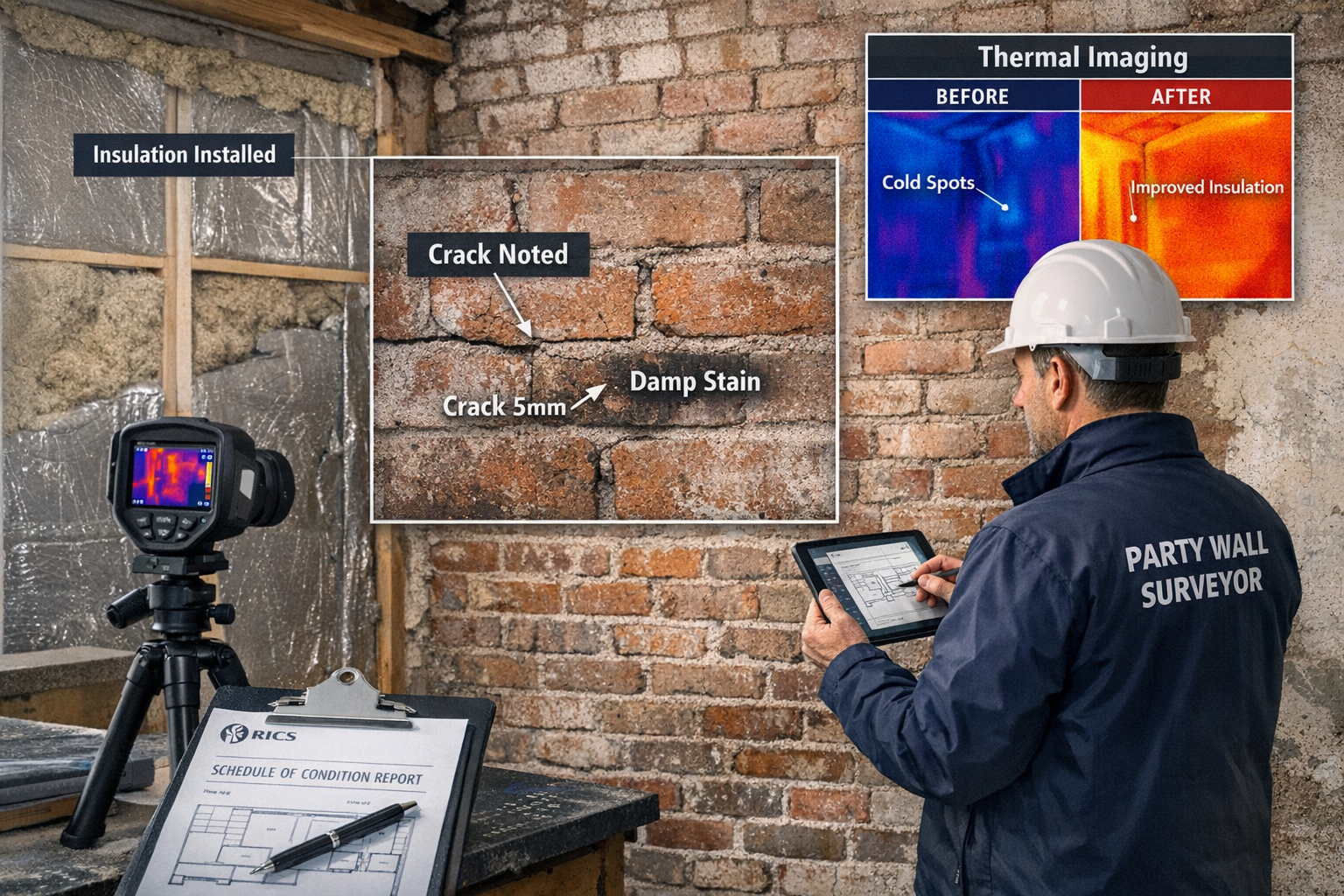
    3. Schedule of Condition
    A schedule of condition represents the most critical protective element within party wall awards.[2] This detailed documentation must include:

    • Comprehensive written descriptions of the adjoining owner’s property condition
    • Extensive photographic evidence of all potentially affected areas
    • Identification of existing defects, cracks, or structural issues
    • Baseline measurements and structural assessments

    The schedule of condition serves as the reference point for determining whether subsequent damage results from the building works. Without thorough documentation, proving causation becomes nearly impossible, leaving both parties vulnerable to disputes.

    For guidance on preparing comprehensive schedules, review our detailed resource on schedule of condition requirements.

    4. Protective Conditions

    • Working hours restrictions
    • Noise and dust mitigation measures
    • Access requirements for monitoring
    • Insurance and indemnity provisions
    • Temporary support or protection requirements

    5. Cost Allocation

    • Surveyor fees and how they will be apportioned
    • Responsibility for award preparation costs
    • Provisions for additional costs if work scope changes

    6. Dispute Resolution Procedures

    • Appeal rights and timeframes (14 days to County Court)[2]
    • Procedures for addressing unforeseen circumstances
    • Amendment protocols if work scope changes

    Notice Period Compliance and Timing Requirements

    Proper timing represents a fundamental requirement that cannot be waived or shortened by agreement. The Party Wall etc. Act 1996 establishes strict notice periods that must be observed:

    Two months’ notice for party structure works affecting shared walls or structures[2]

    One month’s notice for excavation work within specified distances of neighbouring foundations[2]

    One month’s notice for new walls built at the boundary line[2]

    These notice periods run from the date of service, not the date of preparation. Proper service requires:

    • Personal delivery to the adjoining owner, or
    • Registered or recorded delivery post, or
    • Leaving the notice at the property if personal service cannot be achieved

    Starting construction before notice periods expire constitutes a statutory breach, potentially rendering any subsequent award invalid and exposing the building owner to injunction proceedings and damages claims.

    Award Costs and Fee Structures in 2026

    Understanding the financial implications of party wall awards helps property owners budget appropriately and avoid cost-related disputes. Current market rates in 2026 reflect both the technical complexity of surveying work and the professional liability undertaken by RICS members.

    Typical Cost Framework:

    💰 Average party wall award cost: Approximately £1,000 for straightforward residential cases[2]

    💰 Surveyor hourly rates: Between £150-£200 per hour as of 2026[2]

    💰 Complex cases: Can exceed £3,000-£5,000 for extensive commercial or multi-party situations

    The building owner typically bears the cost of preparing the party wall award, including:

    • Their own surveyor’s fees
    • The agreed surveyor’s fees (in single surveyor appointments)
    • Reasonable costs of the adjoining owner’s surveyor
    • Third surveyor fees if appointed

    However, cost allocation can vary based on:

    • Which party requested specific protective measures
    • Whether works provide benefit to the adjoining owner
    • Unreasonable conduct by either party during the process

    For strategies to manage expenses effectively, consult our guide on how to keep party wall costs down.

    Common Pitfalls in Party Wall Awards Under RICS Standards

    Pitfall #1: Inadequate Surveyor Independence

    The most serious professional failing involves conflicts of interest that compromise surveyor independence. Common scenarios that violate RICS standards include:

    ❌ A building owner’s regular surveyor attempting to act as the “agreed surveyor”

    ❌ Surveyors with ongoing commercial relationships with one party claiming independence

    ❌ Failure to disclose previous professional relationships with either party

    ❌ Accepting appointments where personal relationships create bias

    “RICS members can face disciplinary panels for allegations of incompetence or bad faith, with party wall surveyors receiving no judicial immunity for their decisions.”[1]

    This lack of immunity means professional reputation and RICS membership status remain at risk whenever independence standards are compromised. Unlike judges who enjoy protection for judicial decisions, party wall surveyors bear full professional liability for their determinations.

    Best Practice Solution:
    Always disclose any previous relationships with parties before accepting appointments. When in doubt about independence, decline the appointment or recommend the two-surveyor approach to ensure impartiality.

    Pitfall #2: Incomplete or Inadequate Schedules of Condition

    Rushing through schedule of condition preparation represents a false economy that frequently leads to expensive disputes. Common deficiencies include:

    ❌ Insufficient photographic documentation of affected areas

    ❌ Failure to document pre-existing defects that could be blamed on construction

    ❌ Inadequate written descriptions accompanying photographs

    ❌ Missing measurements or structural assessments

    ❌ Failure to update schedules if work commencement is delayed

    Case Example:
    A building owner undertook basement excavation after a cursory schedule documented only the adjoining property’s ground floor. When cracks appeared in the neighbour’s upper floors, the building owner argued they pre-existed the works. Without photographic evidence, the dispute proceeded to litigation, costing both parties over £15,000 in legal fees—far exceeding the cost of a comprehensive initial schedule.

    Best Practice Solution:
    Allocate sufficient time and resources for thorough schedule preparation. Document every room, all elevations, and any area potentially affected by vibration, excavation, or structural alterations. Include:

    • Wide-angle room shots showing overall condition
    • Close-up photographs of existing cracks, stains, or defects
    • External elevations from multiple angles
    • Detailed written descriptions with measurements
    • Date and time stamps on all photographs

    Pitfall #3: Scope Creep and Award Amendments

    Construction projects frequently evolve, with building owners modifying plans after awards are issued. Proceeding with altered works without amending the award creates multiple problems:

    ❌ Original protective conditions may be inadequate for changed works

    ❌ Adjoining owners may challenge unauthorized variations

    ❌ Insurance coverage may not extend to unapproved activities

    ❌ Liability for damage becomes unclear when works differ from award specifications

    Best Practice Solution:
    Treat any material change in work scope as requiring a supplemental award or formal amendment. Material changes include:

    • Deeper excavations than originally specified
    • Additional structural alterations
    • Changes to construction methodology
    • Extended timelines significantly beyond original estimates

    Issue supplemental notices and prepare amended awards documenting the changes, updated protective conditions, and any cost implications.

    Pitfall #4: Inadequate Response to Adjoining Owner Concerns

    RICS professional standards require surveyors to demonstrate competence and professional judgment that exceeds minimum statutory compliance.[1] Dismissing legitimate adjoining owner concerns or failing to implement reasonable protective measures damages professional reputation and increases dispute risk.

    Common failures include:

    ❌ Refusing reasonable requests for additional monitoring

    ❌ Inadequate communication about work schedules and progress

    ❌ Failure to investigate complaints about excessive noise, dust, or vibration

    ❌ Dismissive attitudes toward adjoining owner anxieties

    Best Practice Solution:
    Adopt a collaborative, communicative approach that acknowledges adjoining owner concerns while balancing building owner interests. Implement:

    • Regular progress updates to adjoining owners
    • Prompt investigation of complaints
    • Reasonable accommodations for special circumstances (elderly occupants, health conditions, etc.)
    • Clear communication channels for raising concerns
    • Periodic monitoring visits to verify compliance with protective conditions

    Pitfall #5: Failure to Document Variations and Site Conditions

    Construction rarely proceeds exactly as planned. Unexpected ground conditions, concealed structural elements, or unforeseen complications require adaptive responses. Failing to document these variations and the surveyor’s decisions creates liability exposure.

    ❌ Verbal approvals for variations without written confirmation

    ❌ Failure to photograph unexpected conditions discovered during works

    ❌ Inadequate documentation of surveyor site visits and findings

    ❌ Missing records of communications between surveyors and parties

    Best Practice Solution:
    Maintain comprehensive contemporaneous records including:

    • Site visit reports with photographs and observations
    • Email correspondence confirming decisions and approvals
    • Photographic documentation of unexpected conditions
    • Updated schedules reflecting any variations approved
    • Meeting notes from discussions with parties or contractors

    This documentation provides essential evidence if disputes arise and demonstrates the professional diligence expected under RICS standards.

    Pitfall #6: Misunderstanding Appeal Rights and Timeframes

    Both building owners and adjoining owners retain the right to appeal party wall awards to the County Court within 14 days of award service.[2] Surveyors who fail to clearly communicate these rights or who misunderstand the appeal process create additional problems.

    ❌ Failing to include appeal rights information in awards

    ❌ Encouraging parties to commence works before the appeal period expires

    ❌ Misrepresenting the scope or likelihood of successful appeals

    ❌ Inadequate explanation of grounds for appeal

    Best Practice Solution:
    Every award should include a clear statement of appeal rights, including:

    • The 14-day timeframe from service of the award
    • The jurisdiction (County Court)
    • The grounds on which appeals may be brought
    • The potential consequences of successful appeals
    • Recommendation to seek legal advice if considering an appeal

    Advise building owners to delay commencement until the appeal period expires unless they accept the risk of potential injunction if an appeal succeeds.

    Best Practices for Party Wall Awards Under RICS Standards in 2026

    Section Image

    Embracing Technology and Digital Documentation

    The 2026 construction environment increasingly leverages technology to enhance documentation quality and efficiency. RICS members should adopt:

    📱 Digital photography with embedded metadata showing date, time, and location

    📱 Cloud-based document management ensuring secure storage and version control

    📱 3D scanning technology for complex structural assessments

    📱 Digital signature platforms for efficient award execution

    📱 Project management software tracking notice periods, deadlines, and milestones

    These technologies enhance professional service delivery while creating more robust documentation that withstands scrutiny during disputes.

    Maintaining Professional Development and Standards Awareness

    RICS professional standards evolve to address emerging challenges and incorporate lessons from disputes. Maintaining competence requires:

    📚 Regular review of updated RICS guidance and professional standards[1]

    📚 Participation in continuing professional development (CPD) programs

    📚 Engagement with professional networks and peer consultation

    📚 Awareness of case law developments affecting party wall practice

    📚 Understanding regional variations in interpretation and enforcement

    The May 2023 reclassification of party wall guidance as a professional standard[1] exemplifies the importance of staying current with regulatory developments that affect practice requirements.

    Proactive Communication and Relationship Management

    Many party wall disputes stem from poor communication rather than genuine technical disagreements. RICS members should prioritize:

    🤝 Early engagement with all parties before formal notice service

    🤝 Plain language explanations of technical matters and legal requirements

    🤝 Realistic timeline expectations accounting for notice periods and potential delays

    🤝 Transparent cost estimates with explanations of fee structures

    🤝 Regular progress updates throughout the award preparation and construction phases

    Building trust through professional, accessible communication reduces dispute risk and enhances client satisfaction.

    Understanding the Broader Regulatory Context

    Party wall awards do not exist in isolation. RICS members must understand how party wall procedures interact with:

    This holistic understanding enables surveyors to identify potential complications early and provide comprehensive professional advice.

    The 2026 Construction Boom and Heightened Scrutiny

    The construction surge occurring in 2026 brings unprecedented attention to party wall procedures and professional standards.[3] High-demand housing markets experience increased renovation activity, basement conversions, and extensions—all triggering party wall requirements.

    This boom creates several challenges:

    ⚠️ Increased workload potentially compromising thoroughness if surveyors overextend

    ⚠️ Rising neighbour tensions as construction activity intensifies in residential areas

    ⚠️ Greater regulatory scrutiny of professional standards compliance

    ⚠️ Higher stakes disputes involving valuable properties in premium locations

    ⚠️ Media attention to party wall conflicts highlighting professional failures

    For surveyors practicing in high-demand areas like Central London, North London, South London, East London, and West London, maintaining RICS standards amid increased demand requires careful workload management and unwavering commitment to professional quality.

    Navigating Disputes and Appeals

    Despite best efforts, some party wall awards face challenges requiring formal dispute resolution. Understanding the appeal process and alternative resolution mechanisms helps RICS members guide clients effectively.

    County Court Appeals

    Either party may appeal a party wall award to the County Court within 14 days of service.[2] Appeals typically proceed on grounds including:

    • Procedural irregularities in award preparation or service
    • Surveyor bias or lack of independence
    • Failure to consider relevant factors or material evidence
    • Unreasonable protective conditions or cost allocations
    • Errors of law in interpreting statutory requirements

    Successful appeals may result in:

    • Award being set aside and remitted for reconsideration
    • Appointment of different surveyors
    • Court-imposed variations to award terms
    • Cost orders against the unsuccessful party

    Alternative Dispute Resolution

    Before formal appeals, parties may consider:

    💡 Mediation to resolve disagreements about award terms

    💡 Expert determination on specific technical questions

    💡 Negotiated amendments addressing particular concerns

    💡 Third surveyor determination when two appointed surveyors disagree

    These alternatives often prove faster and less expensive than County Court proceedings while preserving neighbour relationships.

    Practical Guidance for Building and Adjoining Owners

    Section Image

    For Building Owners Planning Construction

    Property owners undertaking works affecting party walls should:

    Engage RICS-qualified surveyors with demonstrated party wall expertise

    Serve notices well in advance of planned commencement dates

    Budget appropriately for surveyor fees and potential protective works

    Maintain open communication with neighbours throughout the process

    Understand your obligations under party wall contract templates and awards

    Consider whether you need a building owner’s surveyor for complex projects

    For comprehensive guidance, review resources on carrying out works under the Party Wall Act.

    For Adjoining Owners Receiving Notices

    Neighbours affected by party wall works should:

    Respond promptly to notices within the 14-day timeframe

    Appoint an adjoining owner’s surveyor to protect your interests

    Understand your rights regarding protective conditions and monitoring

    Document existing property condition independently if possible

    Review the party wall agreement template to understand typical provisions

    Seek clarification on any aspects of proposed works or awards you don’t understand

    For detailed guidance, consult resources for adjoining owners and neighbours carrying out works.

    Conclusion: Achieving Excellence in Party Wall Awards Under RICS Standards

    Mastering Party Wall Awards Under RICS Standards: Essential Requirements and Common Pitfalls in 2026 requires more than technical knowledge of the Party Wall etc. Act 1996. RICS members must embrace the elevated professional standards that distinguish chartered surveyors from general practitioners, maintaining independence, thoroughness, and ethical conduct that exceeds minimum statutory compliance.[1]

    The key principles for excellence include:

    🎯 Unwavering independence free from conflicts of interest

    🎯 Comprehensive documentation including detailed schedules of condition

    🎯 Proactive communication with all parties throughout the process

    🎯 Strict compliance with notice periods and procedural requirements

    🎯 Continuous professional development maintaining awareness of evolving standards

    🎯 Technological adoption enhancing documentation quality and efficiency

    🎯 Holistic understanding of the broader regulatory and construction context

    As the 2026 construction boom intensifies scrutiny of party wall procedures,[3] the surveyors who thrive will be those who view RICS standards not as burdensome constraints but as frameworks for delivering exceptional professional service. By avoiding common pitfalls—inadequate independence, rushed schedules of condition, poor communication, and insufficient documentation—RICS members protect both their clients’ interests and their own professional reputations.

    Next Steps

    Whether you’re a building owner planning construction, an adjoining owner receiving party wall notices, or a surveyor preparing awards, taking action now ensures compliance and prevents costly disputes:

    For Building Owners:

    • Engage qualified RICS surveyors early in your project planning
    • Budget appropriately for party wall procedures and costs
    • Review the costs of party wall process to understand financial implications
    • Serve notices with adequate lead time before planned commencement

    For Adjoining Owners:

    • Respond promptly to any party wall notices received
    • Appoint your own surveyor to protect your interests
    • Document your property’s current condition independently
    • Understand your rights regarding protective measures and monitoring

    For Surveyors:

    • Review the latest RICS professional standards issued in May 2023[1]
    • Assess your current practices against the essential requirements outlined in this guide
    • Implement robust documentation systems and quality controls
    • Invest in continuing professional development to maintain competence

    For Everyone:

    • Consult the general FAQs for answers to common questions
    • Seek professional advice when uncertainty exists
    • Prioritize communication and relationship preservation
    • Understand that proper party wall procedures protect all parties’ interests

    The party wall framework exists to facilitate construction while protecting property rights. When implemented according to RICS standards with professionalism, thoroughness, and integrity, party wall awards achieve this balance—enabling development while preserving neighbour relationships and preventing disputes that benefit no one except litigators.

    Excellence in party wall practice begins with understanding the essential requirements, avoiding common pitfalls, and maintaining the professional standards that distinguish RICS members as trusted advisors in property matters. By embracing these principles, surveyors contribute to a construction environment where development proceeds smoothly, property rights are respected, and professional standards elevate the entire industry.


    References

    [1] Party Wall Legislation And Procedure – https://www.rics.org/profession-standards/rics-standards-and-guidance/sector-standards/building-surveying-standards/party-wall-legislation-and-procedure

    [2] Party Wall Agreement – https://hoa.org.uk/advice/guides-for-homeowners/i-am-improving/party-wall-agreement/

    [3] Party Wall Surveys Amid 2026 Construction Boom Handling Disputes In High Demand Uk Housing Markets – https://nottinghillsurveyors.com/blog/party-wall-surveys-amid-2026-construction-boom-handling-disputes-in-high-demand-uk-housing-markets
  • Party Wall Awards Under RICS Standards: Essential Requiremen

    Cover Image

    When construction work affects a shared wall between properties, the stakes are high. A poorly executed party wall award can transform a straightforward renovation into a legal nightmare, costing thousands in litigation and damaging neighbour relationships beyond repair. Yet despite the critical importance of these legal documents, many surveyors and property owners continue to misunderstand the rigorous requirements set by the Royal Institution of Chartered Surveyors (RICS).

    Understanding Party Wall Awards Under RICS Standards: Essential Requirements and Common Pitfalls in 2026 is no longer optional for property professionals. With the 2026 construction boom bringing unprecedented scrutiny to party wall procedures, RICS members face dual compliance obligations: meeting statutory requirements under the Party Wall etc. Act 1996 while upholding the higher ethical standards expected of chartered professionals.[1] The consequences of failure extend beyond dissatisfied clients—surveyors can face disciplinary panels for allegations of incompetence or bad faith, with no judicial immunity to protect them.[1]

    This comprehensive guide examines the essential requirements for party wall awards under current RICS professional standards, explores the documentation best practices that prevent disputes, and identifies the common pitfalls that lead to costly litigation in 2026.

    Key Takeaways

    RICS members must comply with both statutory Party Wall Act 1996 requirements AND higher professional standards—compliance with legislation alone is insufficient for chartered surveyors[1]

    Complete surveyor independence is mandatory—the agreed party wall surveyor cannot be the same professional used by the building owner, ensuring neutrality in dispute resolution[2]

    Proper documentation including detailed schedules of condition with photographs is non-negotiable within party wall awards to prevent future disputes[2]

    Notice periods are strictly enforced: two months for building works affecting shared walls, one month for excavation or new boundary walls[2]

    Both parties retain 14-day appeal rights to challenge awards in County Court, making accuracy and thoroughness essential from the outset[2]

    Understanding Party Wall Awards Under Current RICS Standards

    Section Image

    What Constitutes a Party Wall Award?

    A party wall award is a legally binding document issued by appointed surveyors that determines how building work affecting shared structures or boundaries will proceed. This formal decision-making instrument resolves disputes between building owners (those undertaking construction) and adjoining owners (neighbours affected by the works).

    The award serves multiple critical functions:

    • Authorizes specific construction activities that would otherwise constitute trespass
    • Establishes protective conditions for the adjoining owner’s property
    • Documents the pre-construction condition of affected structures
    • Allocates costs between parties according to statutory principles
    • Creates an enforceable framework for dispute resolution

    Unlike simple agreements between neighbours, party wall awards carry quasi-judicial authority. They function as binding determinations that both parties must follow, with enforcement available through County Court proceedings if necessary.

    The 2023 RICS Professional Standard Update

    In May 2023, RICS reissued the Party Wall etc. Act 1996 guidance as a professional standard, elevating it from mere guidance to mandatory compliance for all RICS members.[1] While the regulatory requirements remained consistent with the previous August 2019 version, the reclassification significantly enhanced the focus on professional conduct and ethical obligations.

    This change means RICS members now face dual compliance obligations:

    1. Statutory compliance with the Party Wall etc. Act 1996 requirements applicable to all surveyors
    2. Professional standards compliance with higher ethical expectations specific to RICS membership[1]

    The professional standard emphasizes that simply meeting the minimum legal requirements is insufficient. RICS members must demonstrate competence, integrity, and professional judgment that exceeds baseline statutory compliance. This elevated expectation creates additional liability exposure for chartered surveyors who fail to maintain these standards.

    Jurisdictional Scope and Application

    The Party Wall etc. Act 1996 applies exclusively to England and Wales.[2] Scotland and Northern Ireland have no equivalent party wall legislation, creating significant regional variations in how adjoining owner rights are protected across the United Kingdom.

    Within England and Wales, the Act covers three primary categories of work requiring party wall notices:

    Notice Type Works Covered Notice Period
    Party Structure Notice Building on/cutting into party walls, cutting beams, removing chimney breasts 2 months
    Line of Junction Notice Building new walls at boundaries between properties 1 month
    Adjacent Excavation Notice Excavating within 3-6 meters of neighbouring structures 1 month

    Understanding which notice type applies to specific construction activities is fundamental to issuing valid party wall act notices and subsequently preparing compliant awards.

    Essential Requirements for RICS-Compliant Party Wall Awards in 2026

    Surveyor Independence and Appointment Procedures

    The independence requirement represents one of the most critical—and frequently misunderstood—aspects of Party Wall Awards Under RICS Standards: Essential Requirements and Common Pitfalls in 2026. When neighbours cannot agree on party wall matters, the agreed surveyor appointed to resolve the dispute must be completely independent and cannot be the same surveyor previously used by the building owner.[2]

    This independence requirement serves several vital purposes:

    🔍 Ensures impartiality in decision-making affecting both parties’ interests

    🔍 Prevents conflicts of interest that could bias award determinations

    🔍 Maintains public confidence in the party wall dispute resolution process

    🔍 Protects RICS professional reputation by demonstrating ethical conduct

    Common appointment scenarios include:

    Scenario 1: Agreed Surveyor Approach
    Both parties jointly appoint a single independent surveyor to prepare the award. This streamlined approach reduces costs but requires consensus on surveyor selection.

    Scenario 2: Two Surveyors Plus Third Surveyor
    Each party appoints their own surveyor, who then jointly select a third surveyor. The two appointed surveyors work together to prepare the award, with the third surveyor available to resolve any disagreements between them.

    Scenario 3: Default Appointment
    If the adjoining owner fails to respond to notices within 14 days, the building owner’s surveyor can proceed to prepare the award, effectively acting for both parties by default.

    Regardless of appointment method, RICS members must maintain professional independence and avoid any appearance of bias or impropriety.[1]

    Mandatory Documentation Components

    A compliant party wall award must contain specific documentation elements to satisfy both statutory requirements and RICS professional standards. Missing or inadequate documentation represents one of the most common pitfalls leading to disputes and appeals.

    Core Award Components

    Every RICS-compliant party wall award must include:

    1. Formal Preamble

    • Names and addresses of all parties
    • Property descriptions and addresses
    • Surveyor appointments and qualifications
    • Date of award issuance

    2. Description of Proposed Works

    • Detailed specification of construction activities
    • Architectural drawings and technical plans
    • Timeline for commencement and completion
    • Methods of construction to be employed

    3. Schedule of Condition
    A schedule of condition represents the most critical protective element within party wall awards.[2] This detailed documentation must include:

    • Comprehensive written descriptions of the adjoining owner’s property condition
    • Extensive photographic evidence of all potentially affected areas
    • Identification of existing defects, cracks, or structural issues
    • Baseline measurements and structural assessments

    The schedule of condition serves as the reference point for determining whether subsequent damage results from the building works. Without thorough documentation, proving causation becomes nearly impossible, leaving both parties vulnerable to disputes.

    For guidance on preparing comprehensive schedules, review our detailed resource on schedule of condition requirements.

    4. Protective Conditions

    • Working hours restrictions
    • Noise and dust mitigation measures
    • Access requirements for monitoring
    • Insurance and indemnity provisions
    • Temporary support or protection requirements

    5. Cost Allocation

    • Surveyor fees and how they will be apportioned
    • Responsibility for award preparation costs
    • Provisions for additional costs if work scope changes

    6. Dispute Resolution Procedures

    • Appeal rights and timeframes (14 days to County Court)[2]
    • Procedures for addressing unforeseen circumstances
    • Amendment protocols if work scope changes

    Notice Period Compliance and Timing Requirements

    Proper timing represents a fundamental requirement that cannot be waived or shortened by agreement. The Party Wall etc. Act 1996 establishes strict notice periods that must be observed:

    Two months’ notice for party structure works affecting shared walls or structures[2]

    One month’s notice for excavation work within specified distances of neighbouring foundations[2]

    One month’s notice for new walls built at the boundary line[2]

    These notice periods run from the date of service, not the date of preparation. Proper service requires:

    • Personal delivery to the adjoining owner, or
    • Registered or recorded delivery post, or
    • Leaving the notice at the property if personal service cannot be achieved

    Starting construction before notice periods expire constitutes a statutory breach, potentially rendering any subsequent award invalid and exposing the building owner to injunction proceedings and damages claims.

    Award Costs and Fee Structures in 2026

    Understanding the financial implications of party wall awards helps property owners budget appropriately and avoid cost-related disputes. Current market rates in 2026 reflect both the technical complexity of surveying work and the professional liability undertaken by RICS members.

    Typical Cost Framework:

    💰 Average party wall award cost: Approximately £1,000 for straightforward residential cases[2]

    💰 Surveyor hourly rates: Between £150-£200 per hour as of 2026[2]

    💰 Complex cases: Can exceed £3,000-£5,000 for extensive commercial or multi-party situations

    The building owner typically bears the cost of preparing the party wall award, including:

    • Their own surveyor’s fees
    • The agreed surveyor’s fees (in single surveyor appointments)
    • Reasonable costs of the adjoining owner’s surveyor
    • Third surveyor fees if appointed

    However, cost allocation can vary based on:

    • Which party requested specific protective measures
    • Whether works provide benefit to the adjoining owner
    • Unreasonable conduct by either party during the process

    For strategies to manage expenses effectively, consult our guide on how to keep party wall costs down.

    Common Pitfalls in Party Wall Awards Under RICS Standards

    Pitfall #1: Inadequate Surveyor Independence

    The most serious professional failing involves conflicts of interest that compromise surveyor independence. Common scenarios that violate RICS standards include:

    ❌ A building owner’s regular surveyor attempting to act as the “agreed surveyor”

    ❌ Surveyors with ongoing commercial relationships with one party claiming independence

    ❌ Failure to disclose previous professional relationships with either party

    ❌ Accepting appointments where personal relationships create bias

    “RICS members can face disciplinary panels for allegations of incompetence or bad faith, with party wall surveyors receiving no judicial immunity for their decisions.”[1]

    This lack of immunity means professional reputation and RICS membership status remain at risk whenever independence standards are compromised. Unlike judges who enjoy protection for judicial decisions, party wall surveyors bear full professional liability for their determinations.

    Best Practice Solution:
    Always disclose any previous relationships with parties before accepting appointments. When in doubt about independence, decline the appointment or recommend the two-surveyor approach to ensure impartiality.

    Pitfall #2: Incomplete or Inadequate Schedules of Condition

    Rushing through schedule of condition preparation represents a false economy that frequently leads to expensive disputes. Common deficiencies include:

    ❌ Insufficient photographic documentation of affected areas

    ❌ Failure to document pre-existing defects that could be blamed on construction

    ❌ Inadequate written descriptions accompanying photographs

    ❌ Missing measurements or structural assessments

    ❌ Failure to update schedules if work commencement is delayed

    Case Example:
    A building owner undertook basement excavation after a cursory schedule documented only the adjoining property’s ground floor. When cracks appeared in the neighbour’s upper floors, the building owner argued they pre-existed the works. Without photographic evidence, the dispute proceeded to litigation, costing both parties over £15,000 in legal fees—far exceeding the cost of a comprehensive initial schedule.

    Best Practice Solution:
    Allocate sufficient time and resources for thorough schedule preparation. Document every room, all elevations, and any area potentially affected by vibration, excavation, or structural alterations. Include:

    • Wide-angle room shots showing overall condition
    • Close-up photographs of existing cracks, stains, or defects
    • External elevations from multiple angles
    • Detailed written descriptions with measurements
    • Date and time stamps on all photographs

    Pitfall #3: Scope Creep and Award Amendments

    Construction projects frequently evolve, with building owners modifying plans after awards are issued. Proceeding with altered works without amending the award creates multiple problems:

    ❌ Original protective conditions may be inadequate for changed works

    ❌ Adjoining owners may challenge unauthorized variations

    ❌ Insurance coverage may not extend to unapproved activities

    ❌ Liability for damage becomes unclear when works differ from award specifications

    Best Practice Solution:
    Treat any material change in work scope as requiring a supplemental award or formal amendment. Material changes include:

    • Deeper excavations than originally specified
    • Additional structural alterations
    • Changes to construction methodology
    • Extended timelines significantly beyond original estimates

    Issue supplemental notices and prepare amended awards documenting the changes, updated protective conditions, and any cost implications.

    Pitfall #4: Inadequate Response to Adjoining Owner Concerns

    RICS professional standards require surveyors to demonstrate competence and professional judgment that exceeds minimum statutory compliance.[1] Dismissing legitimate adjoining owner concerns or failing to implement reasonable protective measures damages professional reputation and increases dispute risk.

    Common failures include:

    ❌ Refusing reasonable requests for additional monitoring

    ❌ Inadequate communication about work schedules and progress

    ❌ Failure to investigate complaints about excessive noise, dust, or vibration

    ❌ Dismissive attitudes toward adjoining owner anxieties

    Best Practice Solution:
    Adopt a collaborative, communicative approach that acknowledges adjoining owner concerns while balancing building owner interests. Implement:

    • Regular progress updates to adjoining owners
    • Prompt investigation of complaints
    • Reasonable accommodations for special circumstances (elderly occupants, health conditions, etc.)
    • Clear communication channels for raising concerns
    • Periodic monitoring visits to verify compliance with protective conditions

    Pitfall #5: Failure to Document Variations and Site Conditions

    Construction rarely proceeds exactly as planned. Unexpected ground conditions, concealed structural elements, or unforeseen complications require adaptive responses. Failing to document these variations and the surveyor’s decisions creates liability exposure.

    ❌ Verbal approvals for variations without written confirmation

    ❌ Failure to photograph unexpected conditions discovered during works

    ❌ Inadequate documentation of surveyor site visits and findings

    ❌ Missing records of communications between surveyors and parties

    Best Practice Solution:
    Maintain comprehensive contemporaneous records including:

    • Site visit reports with photographs and observations
    • Email correspondence confirming decisions and approvals
    • Photographic documentation of unexpected conditions
    • Updated schedules reflecting any variations approved
    • Meeting notes from discussions with parties or contractors

    This documentation provides essential evidence if disputes arise and demonstrates the professional diligence expected under RICS standards.

    Pitfall #6: Misunderstanding Appeal Rights and Timeframes

    Both building owners and adjoining owners retain the right to appeal party wall awards to the County Court within 14 days of award service.[2] Surveyors who fail to clearly communicate these rights or who misunderstand the appeal process create additional problems.

    ❌ Failing to include appeal rights information in awards

    ❌ Encouraging parties to commence works before the appeal period expires

    ❌ Misrepresenting the scope or likelihood of successful appeals

    ❌ Inadequate explanation of grounds for appeal

    Best Practice Solution:
    Every award should include a clear statement of appeal rights, including:

    • The 14-day timeframe from service of the award
    • The jurisdiction (County Court)
    • The grounds on which appeals may be brought
    • The potential consequences of successful appeals
    • Recommendation to seek legal advice if considering an appeal

    Advise building owners to delay commencement until the appeal period expires unless they accept the risk of potential injunction if an appeal succeeds.

    Best Practices for Party Wall Awards Under RICS Standards in 2026

    Section Image

    Embracing Technology and Digital Documentation

    The 2026 construction environment increasingly leverages technology to enhance documentation quality and efficiency. RICS members should adopt:

    📱 Digital photography with embedded metadata showing date, time, and location

    📱 Cloud-based document management ensuring secure storage and version control

    📱 3D scanning technology for complex structural assessments

    📱 Digital signature platforms for efficient award execution

    📱 Project management software tracking notice periods, deadlines, and milestones

    These technologies enhance professional service delivery while creating more robust documentation that withstands scrutiny during disputes.

    Maintaining Professional Development and Standards Awareness

    RICS professional standards evolve to address emerging challenges and incorporate lessons from disputes. Maintaining competence requires:

    📚 Regular review of updated RICS guidance and professional standards[1]

    📚 Participation in continuing professional development (CPD) programs

    📚 Engagement with professional networks and peer consultation

    📚 Awareness of case law developments affecting party wall practice

    📚 Understanding regional variations in interpretation and enforcement

    The May 2023 reclassification of party wall guidance as a professional standard[1] exemplifies the importance of staying current with regulatory developments that affect practice requirements.

    Proactive Communication and Relationship Management

    Many party wall disputes stem from poor communication rather than genuine technical disagreements. RICS members should prioritize:

    🤝 Early engagement with all parties before formal notice service

    🤝 Plain language explanations of technical matters and legal requirements

    🤝 Realistic timeline expectations accounting for notice periods and potential delays

    🤝 Transparent cost estimates with explanations of fee structures

    🤝 Regular progress updates throughout the award preparation and construction phases

    Building trust through professional, accessible communication reduces dispute risk and enhances client satisfaction.

    Understanding the Broader Regulatory Context

    Party wall awards do not exist in isolation. RICS members must understand how party wall procedures interact with:

    This holistic understanding enables surveyors to identify potential complications early and provide comprehensive professional advice.

    The 2026 Construction Boom and Heightened Scrutiny

    The construction surge occurring in 2026 brings unprecedented attention to party wall procedures and professional standards.[3] High-demand housing markets experience increased renovation activity, basement conversions, and extensions—all triggering party wall requirements.

    This boom creates several challenges:

    ⚠️ Increased workload potentially compromising thoroughness if surveyors overextend

    ⚠️ Rising neighbour tensions as construction activity intensifies in residential areas

    ⚠️ Greater regulatory scrutiny of professional standards compliance

    ⚠️ Higher stakes disputes involving valuable properties in premium locations

    ⚠️ Media attention to party wall conflicts highlighting professional failures

    For surveyors practicing in high-demand areas like Central London, North London, South London, East London, and West London, maintaining RICS standards amid increased demand requires careful workload management and unwavering commitment to professional quality.

    Navigating Disputes and Appeals

    Despite best efforts, some party wall awards face challenges requiring formal dispute resolution. Understanding the appeal process and alternative resolution mechanisms helps RICS members guide clients effectively.

    County Court Appeals

    Either party may appeal a party wall award to the County Court within 14 days of service.[2] Appeals typically proceed on grounds including:

    • Procedural irregularities in award preparation or service
    • Surveyor bias or lack of independence
    • Failure to consider relevant factors or material evidence
    • Unreasonable protective conditions or cost allocations
    • Errors of law in interpreting statutory requirements

    Successful appeals may result in:

    • Award being set aside and remitted for reconsideration
    • Appointment of different surveyors
    • Court-imposed variations to award terms
    • Cost orders against the unsuccessful party

    Alternative Dispute Resolution

    Before formal appeals, parties may consider:

    💡 Mediation to resolve disagreements about award terms

    💡 Expert determination on specific technical questions

    💡 Negotiated amendments addressing particular concerns

    💡 Third surveyor determination when two appointed surveyors disagree

    These alternatives often prove faster and less expensive than County Court proceedings while preserving neighbour relationships.

    Practical Guidance for Building and Adjoining Owners

    Section Image

    For Building Owners Planning Construction

    Property owners undertaking works affecting party walls should:

    Engage RICS-qualified surveyors with demonstrated party wall expertise

    Serve notices well in advance of planned commencement dates

    Budget appropriately for surveyor fees and potential protective works

    Maintain open communication with neighbours throughout the process

    Understand your obligations under party wall contract templates and awards

    Consider whether you need a building owner’s surveyor for complex projects

    For comprehensive guidance, review resources on carrying out works under the Party Wall Act.

    For Adjoining Owners Receiving Notices

    Neighbours affected by party wall works should:

    Respond promptly to notices within the 14-day timeframe

    Appoint an adjoining owner’s surveyor to protect your interests

    Understand your rights regarding protective conditions and monitoring

    Document existing property condition independently if possible

    Review the party wall agreement template to understand typical provisions

    Seek clarification on any aspects of proposed works or awards you don’t understand

    For detailed guidance, consult resources for adjoining owners and neighbours carrying out works.

    Conclusion: Achieving Excellence in Party Wall Awards Under RICS Standards

    Mastering Party Wall Awards Under RICS Standards: Essential Requirements and Common Pitfalls in 2026 requires more than technical knowledge of the Party Wall etc. Act 1996. RICS members must embrace the elevated professional standards that distinguish chartered surveyors from general practitioners, maintaining independence, thoroughness, and ethical conduct that exceeds minimum statutory compliance.[1]

    The key principles for excellence include:

    🎯 Unwavering independence free from conflicts of interest

    🎯 Comprehensive documentation including detailed schedules of condition

    🎯 Proactive communication with all parties throughout the process

    🎯 Strict compliance with notice periods and procedural requirements

    🎯 Continuous professional development maintaining awareness of evolving standards

    🎯 Technological adoption enhancing documentation quality and efficiency

    🎯 Holistic understanding of the broader regulatory and construction context

    As the 2026 construction boom intensifies scrutiny of party wall procedures,[3] the surveyors who thrive will be those who view RICS standards not as burdensome constraints but as frameworks for delivering exceptional professional service. By avoiding common pitfalls—inadequate independence, rushed schedules of condition, poor communication, and insufficient documentation—RICS members protect both their clients’ interests and their own professional reputations.

    Next Steps

    Whether you’re a building owner planning construction, an adjoining owner receiving party wall notices, or a surveyor preparing awards, taking action now ensures compliance and prevents costly disputes:

    For Building Owners:

    • Engage qualified RICS surveyors early in your project planning
    • Budget appropriately for party wall procedures and costs
    • Review the costs of party wall process to understand financial implications
    • Serve notices with adequate lead time before planned commencement

    For Adjoining Owners:

    • Respond promptly to any party wall notices received
    • Appoint your own surveyor to protect your interests
    • Document your property’s current condition independently
    • Understand your rights regarding protective measures and monitoring

    For Surveyors:

    • Review the latest RICS professional standards issued in May 2023[1]
    • Assess your current practices against the essential requirements outlined in this guide
    • Implement robust documentation systems and quality controls
    • Invest in continuing professional development to maintain competence

    For Everyone:

    • Consult the general FAQs for answers to common questions
    • Seek professional advice when uncertainty exists
    • Prioritize communication and relationship preservation
    • Understand that proper party wall procedures protect all parties’ interests

    The party wall framework exists to facilitate construction while protecting property rights. When implemented according to RICS standards with professionalism, thoroughness, and integrity, party wall awards achieve this balance—enabling development while preserving neighbour relationships and preventing disputes that benefit no one except litigators.

    Excellence in party wall practice begins with understanding the essential requirements, avoiding common pitfalls, and maintaining the professional standards that distinguish RICS members as trusted advisors in property matters. By embracing these principles, surveyors contribute to a construction environment where development proceeds smoothly, property rights are respected, and professional standards elevate the entire industry.


    References

    [1] Party Wall Legislation And Procedure – https://www.rics.org/profession-standards/rics-standards-and-guidance/sector-standards/building-surveying-standards/party-wall-legislation-and-procedure

    [2] Party Wall Agreement – https://hoa.org.uk/advice/guides-for-homeowners/i-am-improving/party-wall-agreement/

    [3] Party Wall Surveys Amid 2026 Construction Boom Handling Disputes In High Demand Uk Housing Markets – https://nottinghillsurveyors.com/blog/party-wall-surveys-amid-2026-construction-boom-handling-disputes-in-high-demand-uk-housing-markets
  • Party Wall Agreements vs. Awards: When to Use Each and How t

    Cover Image

    When planning construction work that affects a shared wall with your neighbor, understanding the difference between party wall agreements and awards can save thousands of pounds and weeks of delays. Not every party wall situation requires a surveyor’s award—knowing when parties can settle disputes through mutual agreement versus when formal awards become necessary is crucial for any property owner in England and Wales. This comprehensive guide explores Party Wall Agreements vs. Awards: When to Use Each and How to Negotiate Successfully, providing the knowledge needed to navigate these processes efficiently in 2026.

    Key Takeaways

    • Party wall notices are formal written communications served before work begins, while party wall awards are legally binding documents created by surveyors when disputes arise or neighbors dissent
    • Adjoining owners have 14 days to respond to a party wall notice; no response is treated as dissent and triggers the award process
    • Mutual agreements can resolve many party wall situations without expensive surveyor involvement, potentially saving £1,000+ in award costs
    • Party wall awards typically cost £1,000 and take 2-6 weeks to complete, with the building owner responsible for all surveyor fees
    • Understanding negotiation strategies and when to escalate to formal awards helps property owners maintain good neighbor relations while protecting their legal rights

    Understanding the Fundamental Difference Between Party Wall Agreements and Awards

    Section Image

    The terms “party wall agreement” and “party wall award” are often used interchangeably, but they represent distinctly different stages in the party wall process. Recognizing this distinction is the first step toward managing your construction project effectively.

    What Is a Party Wall Notice?

    A party wall notice is the formal written communication that a building owner must serve to adjoining property owners before commencing certain types of work. This notice is required under the Party Wall etc. Act 1996 and applies only to England and Wales.[2]

    The notice serves several critical purposes:

    • 📋 Formal notification of intended works affecting shared structures
    • 📅 Timeline establishment giving neighbors 14 days to respond
    • 📝 Work description outlining the scope and nature of proposed construction
    • ⚖️ Legal compliance fulfilling statutory requirements before work begins

    Common works requiring a party wall notice include:

    • Loft conversions affecting shared walls
    • Installation of damp proof courses
    • New foundations for extensions near boundary lines
    • Structural alterations to party walls
    • Excavations within 3-6 meters of neighboring foundations[2]

    For more details on the types of work requiring notices, review our guide on types of party wall works.

    What Is a Party Wall Award?

    A party wall award is a completely different document—it’s a legally binding determination prepared by appointed party wall surveyors after a dispute or dissent arises.[1][3] This award becomes necessary when:

    • The adjoining owner dissents (disagrees) with the proposed works
    • The adjoining owner fails to respond within the 14-day period
    • Either party requests formal documentation of rights and responsibilities
    • Complex works require detailed conditions and protections

    The award is not simply an agreement between neighbors—it’s a formal legal document that can be enforced through the courts if necessary.[1]

    Important Legal Distinction: A party wall notice is a communication tool, while a party wall award is a binding legal instrument with enforcement power.

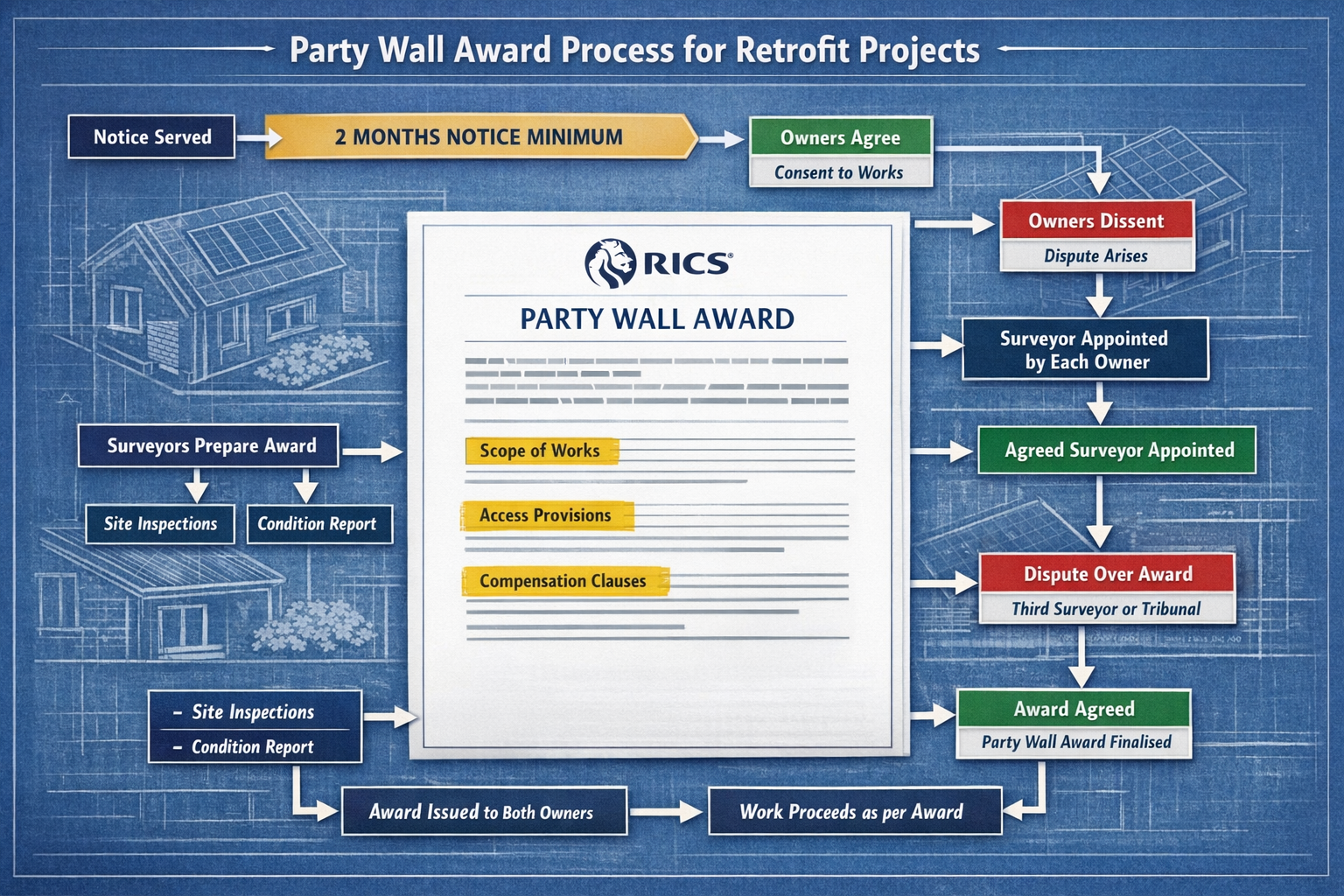
    The Complete Party Wall Process Timeline

    Understanding Party Wall Agreements vs. Awards: When to Use Each and How to Negotiate Successfully requires knowledge of the complete process timeline. Here’s how the sequence typically unfolds:

    Stage 1: Service of Notice (Day 0)

    The building owner serves the appropriate party wall notice to all adjoining owners. The notice must include:

    • Detailed description of proposed works
    • Start date (at least 2 months for Party Structure Notice, 1 month for Line of Junction Notice)
    • Building owner’s contact information
    • Clear drawings or plans where applicable

    Stage 2: Response Period (Days 1-14)

    The adjoining owner has 14 days to respond in one of three ways:[1]

    1. Consent to the works (informal agreement reached)
    2. Dissent from the works (triggering award process)
    3. 🔇 No response (treated as dissent by default)

    If consent is given, work may proceed without a formal award—though many property owners still choose to document the agreement for protection.

    Stage 3: Surveyor Appointment (Days 15-21)

    When dissent occurs or no response is received, surveyors must be appointed:

    • Option A: Both parties agree on a single “Agreed Surveyor”
    • Option B: Each party appoints their own surveyor, who then work together

    The building owner is responsible for paying all surveyor fees, typically £150-£200 per hour.[2]

    Stage 4: Property Inspection and Schedule of Condition (Days 22-35)

    The appointed surveyor(s) conduct a thorough inspection of the adjoining property, creating a schedule of condition that includes:

    • Detailed photographs of all relevant areas
    • Written descriptions of existing conditions
    • Documentation of any pre-existing damage or defects
    • Baseline evidence for future damage claims[2]

    This schedule of condition is crucial protection for both parties.

    Stage 5: Award Preparation and Issuance (Days 36-42)

    The surveyor(s) prepare the party wall award document, which must include:

    • Description of proposed works with technical specifications
    • Rights granted to the building owner
    • Conditions and restrictions protecting the adjoining owner
    • Access arrangements for inspections and work
    • Damage resolution framework for handling issues during construction
    • Schedule of condition as an appendix[3]

    Stage 6: Appeal Period (Days 43-56)

    Both parties have 14 days to appeal the award to the County Court if they disagree with its terms.[2][4] Appeals are relatively rare but provide an important safety valve.

    Stage 7: Works Commence

    Once the appeal period expires without challenge, work can legally begin under the terms specified in the award.

    Total Timeline: The entire process from notice to award typically takes 2-6 weeks, depending on work complexity and surveyor availability.[1]

    When You Can Use Informal Party Wall Agreements (Without a Formal Award)

    Here’s where property owners can save significant time and money: not every party wall situation requires a formal surveyor’s award. Understanding when informal agreements suffice is key to navigating Party Wall Agreements vs. Awards: When to Use Each and How to Negotiate Successfully.

    Scenarios Where Informal Agreements Work Well

    ✅ Minor, Low-Risk Works

    When proposed works are straightforward and pose minimal risk to the adjoining property, neighbors often consent without requiring a formal award:

    • Simple repairs to existing party walls
    • Minor alterations not affecting structural integrity
    • Cosmetic changes to shared surfaces
    • Routine maintenance activities

    ✅ Excellent Neighbor Relations

    When trust exists between neighbors and communication is open, informal agreements can work effectively. Both parties understand the work, agree on protections, and trust each other to act reasonably.

    ✅ Professional Building Owner Reputation

    Established developers or contractors with strong local reputations may find neighbors more willing to consent without formal awards, especially when they:

    • Provide comprehensive work descriptions
    • Offer voluntary schedules of condition
    • Maintain appropriate insurance coverage
    • Have track records of respectful, careful work

    For guidance on creating informal agreements, see our free party wall agreement template.

    The Risks of Informal Agreements

    While informal agreements can save money, they carry risks that both parties should understand:

    Risk Impact Mitigation Strategy
    No legal protection Difficult to enforce if disputes arise Document agreement in writing with signatures
    Unclear scope Disagreements about what was agreed Include detailed work descriptions and drawings
    No damage baseline Difficult to prove work caused damage Create voluntary photographic record
    Insurance gaps Insurer may not cover informal arrangements Confirm coverage with insurance provider
    Future sale complications Buyers’ solicitors may question informal agreements Keep comprehensive documentation

    Expert Recommendation: Even when neighbors consent informally, create a written document outlining the agreed works, protections, and any conditions. This provides some protection without the full cost of a surveyor’s award.

    When Informal Agreements Are NOT Appropriate

    Certain situations demand formal party wall awards regardless of neighbor relations:

    • 🏗️ Structural alterations involving load-bearing elements
    • 🕳️ Deep excavations near neighboring foundations
    • 🏠 Complex loft conversions affecting party walls
    • 💰 High-value properties where potential damage claims are significant
    • 📜 Commercial properties where formal documentation is standard practice
    • ⚠️ Any dissent or concern expressed by the adjoining owner

    For more information on whether you need professional involvement, read our guide on having a party wall agreement without a surveyor.

    When Formal Party Wall Awards Become Necessary

    Understanding when to escalate from informal agreement to formal award is crucial for Party Wall Agreements vs. Awards: When to Use Each and How to Negotiate Successfully. Several triggers make awards not just advisable but legally required.

    Legal Triggers for Awards

    1. Dissent from Adjoining Owner

    When an adjoining owner dissents—either explicitly or by failing to respond within 14 days—the award process becomes mandatory.[1] There is no option to proceed without surveyors at this point.

    2. Multiple Adjoining Owners

    Projects affecting several neighbors increase complexity exponentially. A formal award ensures:

    • All parties receive equal protection
    • Conditions are consistently applied
    • Documentation is comprehensive and clear
    • Disputes between different neighbors are managed fairly

    3. Complex or High-Risk Works

    Certain types of construction inherently require formal awards:

    • Basement excavations requiring underpinning
    • Structural steel insertions through party walls
    • Removal of chimney breasts affecting shared structures
    • Foundation work within 3 meters of neighbors (and deeper than their foundations)
    • Significant alterations to load-bearing party walls

    Practical Triggers for Awards

    Beyond legal requirements, practical considerations often make awards the sensible choice:

    🛡️ Protection for Building Owners

    Formal awards protect the person doing the work by:

    • Establishing clear rights to proceed
    • Preventing future claims of unauthorized work
    • Documenting agreed-upon methods and protections
    • Creating legal recourse if neighbors interfere with legitimate work

    🏡 Protection for Adjoining Owners

    Awards safeguard neighbors through:

    • Mandatory schedules of condition proving pre-work state
    • Enforceable conditions on work methods and timing
    • Clear damage resolution procedures
    • Professional oversight of construction quality

    💼 Lender and Insurance Requirements

    Many mortgage lenders and insurance companies now require formal party wall awards for significant works, making them practically mandatory even when neighbors consent.

    📊 Property Value Protection

    For high-value properties, the relatively small cost of an award (approximately £1,000)[2] is negligible compared to potential damage claims or sale complications from undocumented party wall works.

    The Award Document: What It Contains

    A comprehensive party wall award typically includes:

    1. Preamble – Identifies parties, properties, and surveyors
    2. Recitals – Describes the notice served and responses received
    3. Description of Works – Detailed technical specifications
    4. Rights Granted – Specific permissions given to building owner
    5. Conditions Imposed – Restrictions and requirements for the work
    6. Working Hours – Permitted times for noisy or disruptive activities
    7. Access Rights – Arrangements for inspections and emergency access
    8. Schedule of Condition – Photographic and written record of adjoining property
    9. Damage Resolution – Procedures for handling damage claims
    10. Costs – Allocation of surveyor fees and expenses
    11. Signatures – Formal execution by surveyor(s)

    For templates and examples, review our party wall contract template guide.

    Negotiation Strategies for Successful Party Wall Agreements and Awards

    Section Image

    Whether pursuing an informal agreement or working through the formal award process, effective negotiation skills are essential for Party Wall Agreements vs. Awards: When to Use Each and How to Negotiate Successfully. Here are proven strategies for both building owners and adjoining owners.

    For Building Owners: Proactive Engagement Strategies

    1. Early Communication (Before Formal Notice)

    Don’t let the first communication be the formal notice. Instead:

    • 🗣️ Discuss plans informally several weeks before serving notice
    • 📋 Share preliminary drawings and explain the benefits
    • 🤝 Address concerns proactively before they become objections
    • Ask about timing preferences to minimize disruption

    2. Comprehensive Documentation

    Provide more information than legally required:

    • Detailed architectural drawings
    • Structural engineer’s calculations
    • Method statements explaining work procedures
    • Timeline with key milestones
    • Contact information for project manager
    • Insurance certificates

    3. Voluntary Protections

    Offer protections even when not legally required:

    • Voluntary schedule of condition
    • Dust and noise mitigation measures
    • Vibration monitoring equipment
    • Regular progress updates
    • Direct communication channel for concerns

    4. Strategic Surveyor Selection

    If an award becomes necessary, choosing the right surveyor matters:

    • Select someone with strong local reputation
    • Ensure they are truly independent (not your architect or builder)[2]
    • Look for excellent communication skills
    • Verify relevant experience with similar projects
    • Check professional qualifications and insurance

    For cost-conscious approaches, read our guide on how to keep party wall costs down.

    For Adjoining Owners: Protecting Your Interests

    1. Understand Your Rights

    Before responding to a party wall notice:

    • Review the notice carefully – ensure it contains required information
    • 📚 Research the Act – understand your statutory rights
    • 🏛️ Know your options – consent, dissent, or appoint surveyor
    • ⏱️ Respect deadlines – you have 14 days to respond

    2. Ask Questions

    Don’t consent without understanding:

    • What exactly will be done to the shared wall?
    • How long will the work take?
    • What protections are offered?
    • Who is the contractor and what is their track record?
    • What insurance coverage exists?
    • How will damage be identified and resolved?

    3. Consider Professional Advice

    Even if you plan to consent, consider:

    • Brief consultation with a party wall surveyor
    • Review by a solicitor if the work is extensive
    • Independent structural engineer’s opinion for complex works

    4. Document Everything

    Whether consenting or dissenting:

    • Keep copies of all correspondence
    • Photograph your property before work begins
    • Maintain a diary of work activities and any issues
    • Save contact information for all parties

    Negotiating Award Terms

    When the formal award process is underway, both parties can influence the terms:

    Building Owner Negotiation Points:

    • Working hours – negotiate reasonable times that allow efficient work
    • Access arrangements – ensure practical access without excessive restrictions
    • Method flexibility – avoid overly prescriptive methods that increase costs
    • Timeline – secure reasonable completion deadlines

    Adjoining Owner Negotiation Points:

    • Enhanced schedule of condition – request comprehensive documentation
    • Additional protections – negotiate extra safeguards for valuable features
    • Monitoring requirements – request vibration or movement monitoring
    • Restoration standards – specify quality expectations for any repairs
    • Communication protocols – establish regular update requirements

    Key Insight: The surveyor’s role is to be fair to both parties, not to advocate for one side. Both building and adjoining owners can present reasonable requests, but the surveyor will balance competing interests based on what is fair and practical.

    Cost Considerations: Awards vs. Informal Agreements

    Financial implications play a significant role in deciding between informal agreements and formal awards. Understanding the costs helps with Party Wall Agreements vs. Awards: When to Use Each and How to Negotiate Successfully.

    Costs of Informal Agreements

    Direct Costs:

    • £0 – £500 for voluntary schedule of condition (if hired photographer/surveyor)
    • £0 – £300 for document preparation (if using solicitor)
    • Total: £0 – £800

    Indirect Costs:

    • Risk of future disputes without clear documentation
    • Potential insurance complications
    • Possible sale complications if documentation is poor

    Costs of Formal Party Wall Awards

    Surveyor Fees:

    • Hourly rate: £150-£200 per hour[2]
    • Complete award: approximately £1,000[2]
    • Complex projects: £1,500 – £3,000+

    Who Pays:
    The building owner (person doing the work) pays for:

    • Their own surveyor (if appointed separately)
    • The adjoining owner’s surveyor
    • The agreed surveyor (if using single surveyor approach)
    • All reasonable costs associated with the award[2]

    Additional Costs:

    • Appeal costs if either party challenges the award
    • Monitoring costs if specified in the award
    • Remedial work costs if damage occurs

    For detailed cost breakdowns, visit our costs of party wall process page.

    Cost-Benefit Analysis

    Scenario Recommended Approach Reasoning
    Simple repair, good relations Informal agreement Cost savings outweigh minimal risk
    Loft conversion, uncertain relations Formal award £1,000 cost is small compared to potential disputes
    Basement excavation Formal award (always) High risk requires professional oversight
    Minor alteration, commercial property Formal award Professional standards and documentation requirements
    Extension, multiple neighbors Formal award Complexity justifies professional management

    Hidden Value of Awards

    While awards cost more upfront, they provide value that informal agreements cannot:

    • 🛡️ Legal enforceability if disputes arise
    • 📸 Professional documentation of pre-work conditions
    • ⚖️ Impartial oversight by qualified professionals
    • 🏛️ Court-admissible evidence if litigation occurs
    • 💼 Lender satisfaction for mortgage requirements
    • 🏠 Sale facilitation with proper documentation for conveyancing

    Common Mistakes to Avoid

    Understanding what NOT to do is as important as knowing best practices for Party Wall Agreements vs. Awards: When to Use Each and How to Negotiate Successfully.

    Mistakes Building Owners Make

    ❌ Starting Work Before Proper Notice

    Beginning construction before serving notice or receiving consent/award is a serious breach that can result in:

    • Injunctions stopping all work
    • Mandatory removal of completed work
    • Liability for all damage (with no protection)
    • Legal costs for the adjoining owner
    • Significant project delays

    ❌ Inadequate Notice Content

    Serving a notice that lacks required information:

    • Incomplete work descriptions
    • Missing drawings or specifications
    • Incorrect notice type for the work planned
    • Insufficient advance notice period

    ❌ Assuming Silence Means Consent

    No response from a neighbor does NOT mean consent—it legally means dissent and triggers the award process.[1]

    ❌ Using Non-Independent Surveyors

    Appointing your architect or builder as the surveyor undermines the process and will likely be rejected by the adjoining owner.[2]

    ❌ Ignoring Award Conditions

    Once an award is issued, its conditions are legally binding. Ignoring them can result in:

    • Work stoppages
    • Breach of statutory duty claims
    • Liability for resulting damage
    • Additional legal costs

    Mistakes Adjoining Owners Make

    ❌ Ignoring the Notice

    Failing to respond within 14 days triggers the award process, which:

    • Removes your choice of surveyor approach
    • Increases costs (which the building owner pays, but may affect relations)
    • Creates unnecessary formality when simple consent might have sufficed

    ❌ Unreasonable Dissent

    Dissenting to reasonable works without valid grounds:

    • Doesn’t stop the work (it just triggers the award process)
    • Can damage neighbor relations unnecessarily
    • May result in an award that grants the same permissions anyway

    ❌ Trying to Negotiate Prohibited Matters

    The Party Wall Act gives building owners certain rights that cannot be negotiated away:

    • Right to carry out necessary works
    • Right of access for the work
    • Basic permissions for notifiable activities

    Adjoining owners can negotiate conditions and protections, but cannot veto work that falls within the Act’s scope.

    ❌ Failing to Document Pre-Existing Conditions

    Without a proper schedule of condition:

    • Proving that damage was caused by the work becomes difficult
    • Pre-existing defects may be blamed on new construction
    • Claims may be weakened or dismissed

    ❌ Appointing Unqualified Surveyors

    Choosing a surveyor based solely on cost or personal relationship rather than:

    • Relevant qualifications and experience
    • Professional indemnity insurance
    • Knowledge of the Party Wall Act
    • Reputation for fairness and thoroughness

    Special Situations and Complex Scenarios

    Some party wall situations require special consideration when determining whether informal agreements or formal awards are appropriate.

    Retrospective Awards

    Sometimes work proceeds without proper party wall procedures, and issues arise afterward. Retrospective awards can be created to address:

    • Damage claims after work completion
    • Clarification of work scope that was performed
    • Resolution of disputes about unauthorized work

    While possible, retrospective awards are more complex and expensive than following proper procedures initially.[2] They require both parties to cooperate in appointing surveyors after the fact.

    Multiple Properties Affected

    Large projects may affect several adjoining properties simultaneously. In these cases:

    • Separate notices must be served to each affected owner
    • Different owners may respond differently (some consent, others dissent)
    • A single agreed surveyor can often handle multiple awards efficiently
    • Costs increase with the number of properties involved

    Leasehold Properties

    When the building owner or adjoining owner is a leaseholder:

    • The freeholder may need to be notified
    • Lease terms may impose additional requirements
    • The leaseholder typically handles the party wall process
    • Freeholder consent may be required for certain works

    Commercial Properties

    Business premises often require different approaches:

    • Formal awards are standard practice regardless of consent
    • Working hours may be more restricted
    • Business interruption concerns are paramount
    • Professional documentation is expected by all parties

    Listed Buildings and Conservation Areas

    Additional complexity arises with protected properties:

    • Party wall procedures run parallel to (not instead of) planning and listed building consent
    • Conservation officers may impose additional requirements
    • Work methods may be more restricted
    • Professional oversight is essential

    For boundary-related questions, see our guide on boundary wall rules and differences between party fence walls and boundary walls.

    Regional Considerations in London and Beyond

    Section Image

    While the Party Wall etc. Act 1996 applies uniformly across England and Wales, practical considerations vary by location.

    London-Specific Factors

    London’s dense urban environment creates unique party wall challenges:

    • Higher property values make formal awards more advisable
    • Terraced housing means multiple adjoining owners are common
    • Active construction market means surveyors are in high demand
    • Experienced neighbors who have been through the process before

    Whether you’re in North London, South London, East London, West London, or Central London, local surveyors understand regional nuances.

    2026 Construction Boom Considerations

    The UK housing market in 2026 continues to see high construction activity, particularly in urban areas. This creates additional pressures:

    • Surveyor availability may affect timelines
    • Neighbor fatigue from multiple nearby projects
    • Increased awareness of party wall rights
    • Higher standards expected for documentation[4]

    Outside London

    In less dense areas:

    • Informal agreements may be more common
    • Surveyor availability may be more limited
    • Costs may be slightly lower
    • Neighbor relations may carry more weight in decision-making

    Conclusion: Making the Right Choice for Your Situation

    Understanding Party Wall Agreements vs. Awards: When to Use Each and How to Negotiate Successfully empowers property owners to make informed decisions that protect their interests while maintaining positive neighbor relations.

    Key Decision Framework

    Choose an informal agreement when:

    • ✅ Works are minor and low-risk
    • ✅ Neighbor relations are excellent
    • ✅ Both parties understand and accept the risks
    • ✅ Comprehensive documentation will be created voluntarily
    • ✅ Insurance and lender requirements are satisfied

    Choose a formal award when:

    • ✅ The adjoining owner dissents or doesn’t respond
    • ✅ Works are structural, complex, or high-risk
    • ✅ Property values are high
    • ✅ Multiple neighbors are affected
    • ✅ Professional documentation is required
    • ✅ Any doubt exists about the appropriateness of informal agreement

    Actionable Next Steps

    If you’re a building owner planning works:

    1. Research requirements – Determine if your work requires party wall procedures
    2. Communicate early – Discuss plans with neighbors before formal notices
    3. Prepare documentation – Gather drawings, specifications, and insurance certificates
    4. Serve proper notice – Use the correct notice type with complete information
    5. Respond to concerns – Address neighbor questions promptly and thoroughly
    6. Appoint qualified surveyors – If awards become necessary, choose experienced professionals
    7. Follow award conditions – Comply strictly with all requirements

    If you’re an adjoining owner who received a notice:

    1. Review carefully – Read the notice thoroughly and identify any concerns
    2. Ask questions – Request clarification on anything unclear
    3. Assess risk – Consider the type of work and potential impact on your property
    4. Seek advice – Consult a surveyor or solicitor if uncertain
    5. Respond timely – Don’t miss the 14-day deadline
    6. Document conditions – Photograph your property before work begins
    7. Stay engaged – Maintain communication throughout the process

    The Value of Professional Guidance

    While informal agreements can work in simple situations, professional party wall surveyors provide invaluable expertise for complex scenarios. Their services include:

    • Interpreting the Party Wall Act correctly
    • Preparing comprehensive schedules of condition
    • Negotiating fair terms for both parties
    • Providing impartial oversight
    • Resolving disputes efficiently
    • Creating enforceable legal documentation

    The cost of professional involvement—approximately £1,000 for a complete award—is modest compared to the potential costs of disputes, damage claims, or work stoppages.[2]

    Final Thoughts

    The party wall process exists to balance the rights of building owners to improve their properties with the rights of adjoining owners to protection from damage and disruption. Whether you choose an informal agreement or formal award, the principles remain the same:

    • Clear communication prevents misunderstandings
    • Comprehensive documentation protects all parties
    • Professional standards ensure quality outcomes
    • Mutual respect maintains neighbor relations
    • Legal compliance avoids costly disputes

    By understanding when to use each approach and how to negotiate successfully, property owners can navigate party wall matters confidently, efficiently, and cost-effectively in 2026 and beyond.

    For additional guidance and resources, explore our general FAQs or learn more about what to do if your neighbor is carrying out works.


    References

    [1] Difference Between Party Wall Notices And Awards – https://www.partywallslimited.com/blog/difference-between-party-wall-notices-and-awards

    [2] Party Wall Agreement – https://hoa.org.uk/advice/guides-for-homeowners/i-am-improving/party-wall-agreement/

    [3] Do I Need A Party Wall Agreement – https://www.murrins.co.uk/do-i-need-a-party-wall-agreement/

    [4] Party Wall Surveys Amid 2026 Construction Boom Handling Disputes In High Demand Uk Housing Markets – https://nottinghillsurveyors.com/blog/party-wall-surveys-amid-2026-construction-boom-handling-disputes-in-high-demand-uk-housing-markets
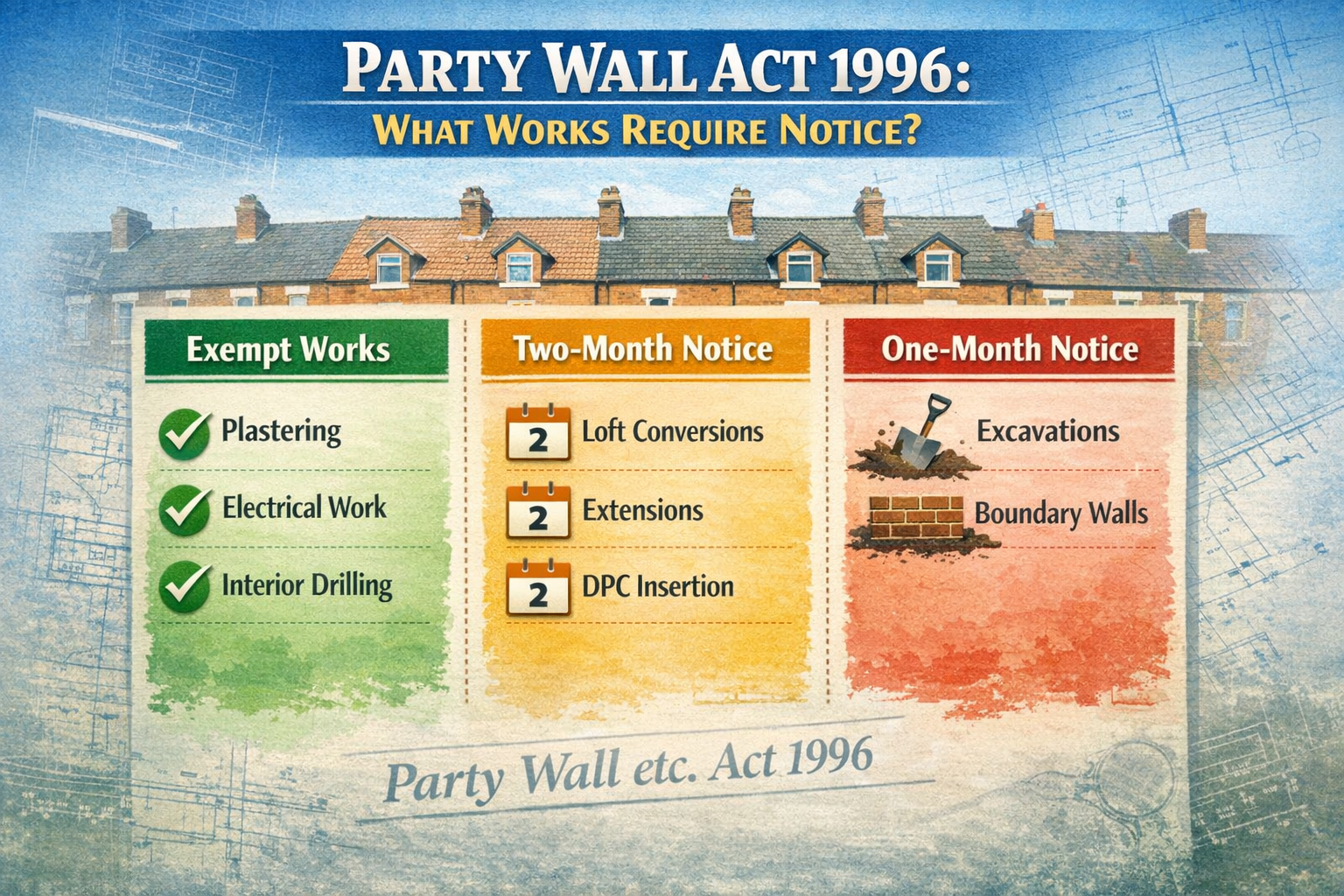
  • Party Wall Agreements vs. Awards: When to Use Each and How t

    Cover Image

    When planning construction work that affects a shared wall with your neighbor, understanding the difference between party wall agreements and awards can save thousands of pounds and weeks of delays. Not every party wall situation requires a surveyor’s award—knowing when parties can settle disputes through mutual agreement versus when formal awards become necessary is crucial for any property owner in England and Wales. This comprehensive guide explores Party Wall Agreements vs. Awards: When to Use Each and How to Negotiate Successfully, providing the knowledge needed to navigate these processes efficiently in 2026.

    Key Takeaways

    • Party wall notices are formal written communications served before work begins, while party wall awards are legally binding documents created by surveyors when disputes arise or neighbors dissent
    • Adjoining owners have 14 days to respond to a party wall notice; no response is treated as dissent and triggers the award process
    • Mutual agreements can resolve many party wall situations without expensive surveyor involvement, potentially saving £1,000+ in award costs
    • Party wall awards typically cost £1,000 and take 2-6 weeks to complete, with the building owner responsible for all surveyor fees
    • Understanding negotiation strategies and when to escalate to formal awards helps property owners maintain good neighbor relations while protecting their legal rights

    Understanding the Fundamental Difference Between Party Wall Agreements and Awards

    Section Image

    The terms “party wall agreement” and “party wall award” are often used interchangeably, but they represent distinctly different stages in the party wall process. Recognizing this distinction is the first step toward managing your construction project effectively.

    What Is a Party Wall Notice?

    A party wall notice is the formal written communication that a building owner must serve to adjoining property owners before commencing certain types of work. This notice is required under the Party Wall etc. Act 1996 and applies only to England and Wales.[2]

    The notice serves several critical purposes:

    • 📋 Formal notification of intended works affecting shared structures
    • 📅 Timeline establishment giving neighbors 14 days to respond
    • 📝 Work description outlining the scope and nature of proposed construction
    • ⚖️ Legal compliance fulfilling statutory requirements before work begins

    Common works requiring a party wall notice include:

    • Loft conversions affecting shared walls
    • Installation of damp proof courses
    • New foundations for extensions near boundary lines
    • Structural alterations to party walls
    • Excavations within 3-6 meters of neighboring foundations[2]

    For more details on the types of work requiring notices, review our guide on types of party wall works.

    What Is a Party Wall Award?

    A party wall award is a completely different document—it’s a legally binding determination prepared by appointed party wall surveyors after a dispute or dissent arises.[1][3] This award becomes necessary when:

    • The adjoining owner dissents (disagrees) with the proposed works
    • The adjoining owner fails to respond within the 14-day period
    • Either party requests formal documentation of rights and responsibilities
    • Complex works require detailed conditions and protections

    The award is not simply an agreement between neighbors—it’s a formal legal document that can be enforced through the courts if necessary.[1]

    Important Legal Distinction: A party wall notice is a communication tool, while a party wall award is a binding legal instrument with enforcement power.

    The Complete Party Wall Process Timeline

    Understanding Party Wall Agreements vs. Awards: When to Use Each and How to Negotiate Successfully requires knowledge of the complete process timeline. Here’s how the sequence typically unfolds:

    Stage 1: Service of Notice (Day 0)

    The building owner serves the appropriate party wall notice to all adjoining owners. The notice must include:

    • Detailed description of proposed works
    • Start date (at least 2 months for Party Structure Notice, 1 month for Line of Junction Notice)
    • Building owner’s contact information
    • Clear drawings or plans where applicable

    Stage 2: Response Period (Days 1-14)

    The adjoining owner has 14 days to respond in one of three ways:[1]

    1. Consent to the works (informal agreement reached)
    2. Dissent from the works (triggering award process)
    3. 🔇 No response (treated as dissent by default)

    If consent is given, work may proceed without a formal award—though many property owners still choose to document the agreement for protection.

    Stage 3: Surveyor Appointment (Days 15-21)

    When dissent occurs or no response is received, surveyors must be appointed:

    • Option A: Both parties agree on a single “Agreed Surveyor”
    • Option B: Each party appoints their own surveyor, who then work together

    The building owner is responsible for paying all surveyor fees, typically £150-£200 per hour.[2]

    Stage 4: Property Inspection and Schedule of Condition (Days 22-35)

    The appointed surveyor(s) conduct a thorough inspection of the adjoining property, creating a schedule of condition that includes:

    • Detailed photographs of all relevant areas
    • Written descriptions of existing conditions
    • Documentation of any pre-existing damage or defects
    • Baseline evidence for future damage claims[2]

    This schedule of condition is crucial protection for both parties.

    Stage 5: Award Preparation and Issuance (Days 36-42)

    The surveyor(s) prepare the party wall award document, which must include:

    • Description of proposed works with technical specifications
    • Rights granted to the building owner
    • Conditions and restrictions protecting the adjoining owner
    • Access arrangements for inspections and work
    • Damage resolution framework for handling issues during construction
    • Schedule of condition as an appendix[3]

    Stage 6: Appeal Period (Days 43-56)

    Both parties have 14 days to appeal the award to the County Court if they disagree with its terms.[2][4] Appeals are relatively rare but provide an important safety valve.

    Stage 7: Works Commence

    Once the appeal period expires without challenge, work can legally begin under the terms specified in the award.

    Total Timeline: The entire process from notice to award typically takes 2-6 weeks, depending on work complexity and surveyor availability.[1]

    When You Can Use Informal Party Wall Agreements (Without a Formal Award)

    Here’s where property owners can save significant time and money: not every party wall situation requires a formal surveyor’s award. Understanding when informal agreements suffice is key to navigating Party Wall Agreements vs. Awards: When to Use Each and How to Negotiate Successfully.

    Scenarios Where Informal Agreements Work Well

    ✅ Minor, Low-Risk Works

    When proposed works are straightforward and pose minimal risk to the adjoining property, neighbors often consent without requiring a formal award:

    • Simple repairs to existing party walls
    • Minor alterations not affecting structural integrity
    • Cosmetic changes to shared surfaces
    • Routine maintenance activities

    ✅ Excellent Neighbor Relations

    When trust exists between neighbors and communication is open, informal agreements can work effectively. Both parties understand the work, agree on protections, and trust each other to act reasonably.

    ✅ Professional Building Owner Reputation

    Established developers or contractors with strong local reputations may find neighbors more willing to consent without formal awards, especially when they:

    • Provide comprehensive work descriptions
    • Offer voluntary schedules of condition
    • Maintain appropriate insurance coverage
    • Have track records of respectful, careful work

    For guidance on creating informal agreements, see our free party wall agreement template.

    The Risks of Informal Agreements

    While informal agreements can save money, they carry risks that both parties should understand:

    Risk Impact Mitigation Strategy
    No legal protection Difficult to enforce if disputes arise Document agreement in writing with signatures
    Unclear scope Disagreements about what was agreed Include detailed work descriptions and drawings
    No damage baseline Difficult to prove work caused damage Create voluntary photographic record
    Insurance gaps Insurer may not cover informal arrangements Confirm coverage with insurance provider
    Future sale complications Buyers’ solicitors may question informal agreements Keep comprehensive documentation

    Expert Recommendation: Even when neighbors consent informally, create a written document outlining the agreed works, protections, and any conditions. This provides some protection without the full cost of a surveyor’s award.

    When Informal Agreements Are NOT Appropriate

    Certain situations demand formal party wall awards regardless of neighbor relations:

    • 🏗️ Structural alterations involving load-bearing elements
    • 🕳️ Deep excavations near neighboring foundations
    • 🏠 Complex loft conversions affecting party walls
    • 💰 High-value properties where potential damage claims are significant
    • 📜 Commercial properties where formal documentation is standard practice
    • ⚠️ Any dissent or concern expressed by the adjoining owner

    For more information on whether you need professional involvement, read our guide on having a party wall agreement without a surveyor.

    When Formal Party Wall Awards Become Necessary

    Understanding when to escalate from informal agreement to formal award is crucial for Party Wall Agreements vs. Awards: When to Use Each and How to Negotiate Successfully. Several triggers make awards not just advisable but legally required.

    Legal Triggers for Awards

    1. Dissent from Adjoining Owner

    When an adjoining owner dissents—either explicitly or by failing to respond within 14 days—the award process becomes mandatory.[1] There is no option to proceed without surveyors at this point.

    2. Multiple Adjoining Owners

    Projects affecting several neighbors increase complexity exponentially. A formal award ensures:

    • All parties receive equal protection
    • Conditions are consistently applied
    • Documentation is comprehensive and clear
    • Disputes between different neighbors are managed fairly

    3. Complex or High-Risk Works

    Certain types of construction inherently require formal awards:

    • Basement excavations requiring underpinning
    • Structural steel insertions through party walls
    • Removal of chimney breasts affecting shared structures
    • Foundation work within 3 meters of neighbors (and deeper than their foundations)
    • Significant alterations to load-bearing party walls

    Practical Triggers for Awards

    Beyond legal requirements, practical considerations often make awards the sensible choice:

    🛡️ Protection for Building Owners

    Formal awards protect the person doing the work by:

    • Establishing clear rights to proceed
    • Preventing future claims of unauthorized work
    • Documenting agreed-upon methods and protections
    • Creating legal recourse if neighbors interfere with legitimate work

    🏡 Protection for Adjoining Owners

    Awards safeguard neighbors through:

    • Mandatory schedules of condition proving pre-work state
    • Enforceable conditions on work methods and timing
    • Clear damage resolution procedures
    • Professional oversight of construction quality

    💼 Lender and Insurance Requirements

    Many mortgage lenders and insurance companies now require formal party wall awards for significant works, making them practically mandatory even when neighbors consent.

    📊 Property Value Protection

    For high-value properties, the relatively small cost of an award (approximately £1,000)[2] is negligible compared to potential damage claims or sale complications from undocumented party wall works.

    The Award Document: What It Contains

    A comprehensive party wall award typically includes:

    1. Preamble – Identifies parties, properties, and surveyors
    2. Recitals – Describes the notice served and responses received
    3. Description of Works – Detailed technical specifications
    4. Rights Granted – Specific permissions given to building owner
    5. Conditions Imposed – Restrictions and requirements for the work
    6. Working Hours – Permitted times for noisy or disruptive activities
    7. Access Rights – Arrangements for inspections and emergency access
    8. Schedule of Condition – Photographic and written record of adjoining property
    9. Damage Resolution – Procedures for handling damage claims
    10. Costs – Allocation of surveyor fees and expenses
    11. Signatures – Formal execution by surveyor(s)

    For templates and examples, review our party wall contract template guide.

    Negotiation Strategies for Successful Party Wall Agreements and Awards

    Section Image

    Whether pursuing an informal agreement or working through the formal award process, effective negotiation skills are essential for Party Wall Agreements vs. Awards: When to Use Each and How to Negotiate Successfully. Here are proven strategies for both building owners and adjoining owners.

    For Building Owners: Proactive Engagement Strategies

    1. Early Communication (Before Formal Notice)

    Don’t let the first communication be the formal notice. Instead:

    • 🗣️ Discuss plans informally several weeks before serving notice
    • 📋 Share preliminary drawings and explain the benefits
    • 🤝 Address concerns proactively before they become objections
    • Ask about timing preferences to minimize disruption

    2. Comprehensive Documentation

    Provide more information than legally required:

    • Detailed architectural drawings
    • Structural engineer’s calculations
    • Method statements explaining work procedures
    • Timeline with key milestones
    • Contact information for project manager
    • Insurance certificates

    3. Voluntary Protections

    Offer protections even when not legally required:

    • Voluntary schedule of condition
    • Dust and noise mitigation measures
    • Vibration monitoring equipment
    • Regular progress updates
    • Direct communication channel for concerns

    4. Strategic Surveyor Selection

    If an award becomes necessary, choosing the right surveyor matters:

    • Select someone with strong local reputation
    • Ensure they are truly independent (not your architect or builder)[2]
    • Look for excellent communication skills
    • Verify relevant experience with similar projects
    • Check professional qualifications and insurance

    For cost-conscious approaches, read our guide on how to keep party wall costs down.

    For Adjoining Owners: Protecting Your Interests

    1. Understand Your Rights

    Before responding to a party wall notice:

    • Review the notice carefully – ensure it contains required information
    • 📚 Research the Act – understand your statutory rights
    • 🏛️ Know your options – consent, dissent, or appoint surveyor
    • ⏱️ Respect deadlines – you have 14 days to respond

    2. Ask Questions

    Don’t consent without understanding:

    • What exactly will be done to the shared wall?
    • How long will the work take?
    • What protections are offered?
    • Who is the contractor and what is their track record?
    • What insurance coverage exists?
    • How will damage be identified and resolved?

    3. Consider Professional Advice

    Even if you plan to consent, consider:

    • Brief consultation with a party wall surveyor
    • Review by a solicitor if the work is extensive
    • Independent structural engineer’s opinion for complex works

    4. Document Everything

    Whether consenting or dissenting:

    • Keep copies of all correspondence
    • Photograph your property before work begins
    • Maintain a diary of work activities and any issues
    • Save contact information for all parties

    Negotiating Award Terms

    When the formal award process is underway, both parties can influence the terms:

    Building Owner Negotiation Points:

    • Working hours – negotiate reasonable times that allow efficient work
    • Access arrangements – ensure practical access without excessive restrictions
    • Method flexibility – avoid overly prescriptive methods that increase costs
    • Timeline – secure reasonable completion deadlines

    Adjoining Owner Negotiation Points:

    • Enhanced schedule of condition – request comprehensive documentation
    • Additional protections – negotiate extra safeguards for valuable features
    • Monitoring requirements – request vibration or movement monitoring
    • Restoration standards – specify quality expectations for any repairs
    • Communication protocols – establish regular update requirements

    Key Insight: The surveyor’s role is to be fair to both parties, not to advocate for one side. Both building and adjoining owners can present reasonable requests, but the surveyor will balance competing interests based on what is fair and practical.

    Cost Considerations: Awards vs. Informal Agreements

    Financial implications play a significant role in deciding between informal agreements and formal awards. Understanding the costs helps with Party Wall Agreements vs. Awards: When to Use Each and How to Negotiate Successfully.

    Costs of Informal Agreements

    Direct Costs:

    • £0 – £500 for voluntary schedule of condition (if hired photographer/surveyor)
    • £0 – £300 for document preparation (if using solicitor)
    • Total: £0 – £800

    Indirect Costs:

    • Risk of future disputes without clear documentation
    • Potential insurance complications
    • Possible sale complications if documentation is poor

    Costs of Formal Party Wall Awards

    Surveyor Fees:

    • Hourly rate: £150-£200 per hour[2]
    • Complete award: approximately £1,000[2]
    • Complex projects: £1,500 – £3,000+

    Who Pays:
    The building owner (person doing the work) pays for:

    • Their own surveyor (if appointed separately)
    • The adjoining owner’s surveyor
    • The agreed surveyor (if using single surveyor approach)
    • All reasonable costs associated with the award[2]

    Additional Costs:

    • Appeal costs if either party challenges the award
    • Monitoring costs if specified in the award
    • Remedial work costs if damage occurs

    For detailed cost breakdowns, visit our costs of party wall process page.

    Cost-Benefit Analysis

    Scenario Recommended Approach Reasoning
    Simple repair, good relations Informal agreement Cost savings outweigh minimal risk
    Loft conversion, uncertain relations Formal award £1,000 cost is small compared to potential disputes
    Basement excavation Formal award (always) High risk requires professional oversight
    Minor alteration, commercial property Formal award Professional standards and documentation requirements
    Extension, multiple neighbors Formal award Complexity justifies professional management

    Hidden Value of Awards

    While awards cost more upfront, they provide value that informal agreements cannot:

    • 🛡️ Legal enforceability if disputes arise
    • 📸 Professional documentation of pre-work conditions
    • ⚖️ Impartial oversight by qualified professionals
    • 🏛️ Court-admissible evidence if litigation occurs
    • 💼 Lender satisfaction for mortgage requirements
    • 🏠 Sale facilitation with proper documentation for conveyancing

    Common Mistakes to Avoid

    Understanding what NOT to do is as important as knowing best practices for Party Wall Agreements vs. Awards: When to Use Each and How to Negotiate Successfully.

    Mistakes Building Owners Make

    ❌ Starting Work Before Proper Notice

    Beginning construction before serving notice or receiving consent/award is a serious breach that can result in:

    • Injunctions stopping all work
    • Mandatory removal of completed work
    • Liability for all damage (with no protection)
    • Legal costs for the adjoining owner
    • Significant project delays

    ❌ Inadequate Notice Content

    Serving a notice that lacks required information:

    • Incomplete work descriptions
    • Missing drawings or specifications
    • Incorrect notice type for the work planned
    • Insufficient advance notice period

    ❌ Assuming Silence Means Consent

    No response from a neighbor does NOT mean consent—it legally means dissent and triggers the award process.[1]

    ❌ Using Non-Independent Surveyors

    Appointing your architect or builder as the surveyor undermines the process and will likely be rejected by the adjoining owner.[2]

    ❌ Ignoring Award Conditions

    Once an award is issued, its conditions are legally binding. Ignoring them can result in:

    • Work stoppages
    • Breach of statutory duty claims
    • Liability for resulting damage
    • Additional legal costs

    Mistakes Adjoining Owners Make

    ❌ Ignoring the Notice

    Failing to respond within 14 days triggers the award process, which:

    • Removes your choice of surveyor approach
    • Increases costs (which the building owner pays, but may affect relations)
    • Creates unnecessary formality when simple consent might have sufficed

    ❌ Unreasonable Dissent

    Dissenting to reasonable works without valid grounds:

    • Doesn’t stop the work (it just triggers the award process)
    • Can damage neighbor relations unnecessarily
    • May result in an award that grants the same permissions anyway

    ❌ Trying to Negotiate Prohibited Matters

    The Party Wall Act gives building owners certain rights that cannot be negotiated away:

    • Right to carry out necessary works
    • Right of access for the work
    • Basic permissions for notifiable activities

    Adjoining owners can negotiate conditions and protections, but cannot veto work that falls within the Act’s scope.

    ❌ Failing to Document Pre-Existing Conditions

    Without a proper schedule of condition:

    • Proving that damage was caused by the work becomes difficult
    • Pre-existing defects may be blamed on new construction
    • Claims may be weakened or dismissed

    ❌ Appointing Unqualified Surveyors

    Choosing a surveyor based solely on cost or personal relationship rather than:

    • Relevant qualifications and experience
    • Professional indemnity insurance
    • Knowledge of the Party Wall Act
    • Reputation for fairness and thoroughness

    Special Situations and Complex Scenarios

    Some party wall situations require special consideration when determining whether informal agreements or formal awards are appropriate.

    Retrospective Awards

    Sometimes work proceeds without proper party wall procedures, and issues arise afterward. Retrospective awards can be created to address:

    • Damage claims after work completion
    • Clarification of work scope that was performed
    • Resolution of disputes about unauthorized work

    While possible, retrospective awards are more complex and expensive than following proper procedures initially.[2] They require both parties to cooperate in appointing surveyors after the fact.

    Multiple Properties Affected

    Large projects may affect several adjoining properties simultaneously. In these cases:

    • Separate notices must be served to each affected owner
    • Different owners may respond differently (some consent, others dissent)
    • A single agreed surveyor can often handle multiple awards efficiently
    • Costs increase with the number of properties involved

    Leasehold Properties

    When the building owner or adjoining owner is a leaseholder:

    • The freeholder may need to be notified
    • Lease terms may impose additional requirements
    • The leaseholder typically handles the party wall process
    • Freeholder consent may be required for certain works

    Commercial Properties

    Business premises often require different approaches:

    • Formal awards are standard practice regardless of consent
    • Working hours may be more restricted
    • Business interruption concerns are paramount
    • Professional documentation is expected by all parties

    Listed Buildings and Conservation Areas

    Additional complexity arises with protected properties:

    • Party wall procedures run parallel to (not instead of) planning and listed building consent
    • Conservation officers may impose additional requirements
    • Work methods may be more restricted
    • Professional oversight is essential

    For boundary-related questions, see our guide on boundary wall rules and differences between party fence walls and boundary walls.

    Regional Considerations in London and Beyond

    Section Image

    While the Party Wall etc. Act 1996 applies uniformly across England and Wales, practical considerations vary by location.

    London-Specific Factors

    London’s dense urban environment creates unique party wall challenges:

    • Higher property values make formal awards more advisable
    • Terraced housing means multiple adjoining owners are common
    • Active construction market means surveyors are in high demand
    • Experienced neighbors who have been through the process before

    Whether you’re in North London, South London, East London, West London, or Central London, local surveyors understand regional nuances.

    2026 Construction Boom Considerations

    The UK housing market in 2026 continues to see high construction activity, particularly in urban areas. This creates additional pressures:

    • Surveyor availability may affect timelines
    • Neighbor fatigue from multiple nearby projects
    • Increased awareness of party wall rights
    • Higher standards expected for documentation[4]

    Outside London

    In less dense areas:

    • Informal agreements may be more common
    • Surveyor availability may be more limited
    • Costs may be slightly lower
    • Neighbor relations may carry more weight in decision-making

    Conclusion: Making the Right Choice for Your Situation

    Understanding Party Wall Agreements vs. Awards: When to Use Each and How to Negotiate Successfully empowers property owners to make informed decisions that protect their interests while maintaining positive neighbor relations.

    Key Decision Framework

    Choose an informal agreement when:

    • ✅ Works are minor and low-risk
    • ✅ Neighbor relations are excellent
    • ✅ Both parties understand and accept the risks
    • ✅ Comprehensive documentation will be created voluntarily
    • ✅ Insurance and lender requirements are satisfied

    Choose a formal award when:

    • ✅ The adjoining owner dissents or doesn’t respond
    • ✅ Works are structural, complex, or high-risk
    • ✅ Property values are high
    • ✅ Multiple neighbors are affected
    • ✅ Professional documentation is required
    • ✅ Any doubt exists about the appropriateness of informal agreement

    Actionable Next Steps

    If you’re a building owner planning works:

    1. Research requirements – Determine if your work requires party wall procedures
    2. Communicate early – Discuss plans with neighbors before formal notices
    3. Prepare documentation – Gather drawings, specifications, and insurance certificates
    4. Serve proper notice – Use the correct notice type with complete information
    5. Respond to concerns – Address neighbor questions promptly and thoroughly
    6. Appoint qualified surveyors – If awards become necessary, choose experienced professionals
    7. Follow award conditions – Comply strictly with all requirements

    If you’re an adjoining owner who received a notice:

    1. Review carefully – Read the notice thoroughly and identify any concerns
    2. Ask questions – Request clarification on anything unclear
    3. Assess risk – Consider the type of work and potential impact on your property
    4. Seek advice – Consult a surveyor or solicitor if uncertain
    5. Respond timely – Don’t miss the 14-day deadline
    6. Document conditions – Photograph your property before work begins
    7. Stay engaged – Maintain communication throughout the process

    The Value of Professional Guidance

    While informal agreements can work in simple situations, professional party wall surveyors provide invaluable expertise for complex scenarios. Their services include:

    • Interpreting the Party Wall Act correctly
    • Preparing comprehensive schedules of condition
    • Negotiating fair terms for both parties
    • Providing impartial oversight
    • Resolving disputes efficiently
    • Creating enforceable legal documentation

    The cost of professional involvement—approximately £1,000 for a complete award—is modest compared to the potential costs of disputes, damage claims, or work stoppages.[2]

    Final Thoughts

    The party wall process exists to balance the rights of building owners to improve their properties with the rights of adjoining owners to protection from damage and disruption. Whether you choose an informal agreement or formal award, the principles remain the same:

    • Clear communication prevents misunderstandings
    • Comprehensive documentation protects all parties
    • Professional standards ensure quality outcomes
    • Mutual respect maintains neighbor relations
    • Legal compliance avoids costly disputes

    By understanding when to use each approach and how to negotiate successfully, property owners can navigate party wall matters confidently, efficiently, and cost-effectively in 2026 and beyond.

    For additional guidance and resources, explore our general FAQs or learn more about what to do if your neighbor is carrying out works.


    References

    [1] Difference Between Party Wall Notices And Awards – https://www.partywallslimited.com/blog/difference-between-party-wall-notices-and-awards

    [2] Party Wall Agreement – https://hoa.org.uk/advice/guides-for-homeowners/i-am-improving/party-wall-agreement/

    [3] Do I Need A Party Wall Agreement – https://www.murrins.co.uk/do-i-need-a-party-wall-agreement/

    [4] Party Wall Surveys Amid 2026 Construction Boom Handling Disputes In High Demand Uk Housing Markets – https://nottinghillsurveyors.com/blog/party-wall-surveys-amid-2026-construction-boom-handling-disputes-in-high-demand-uk-housing-markets
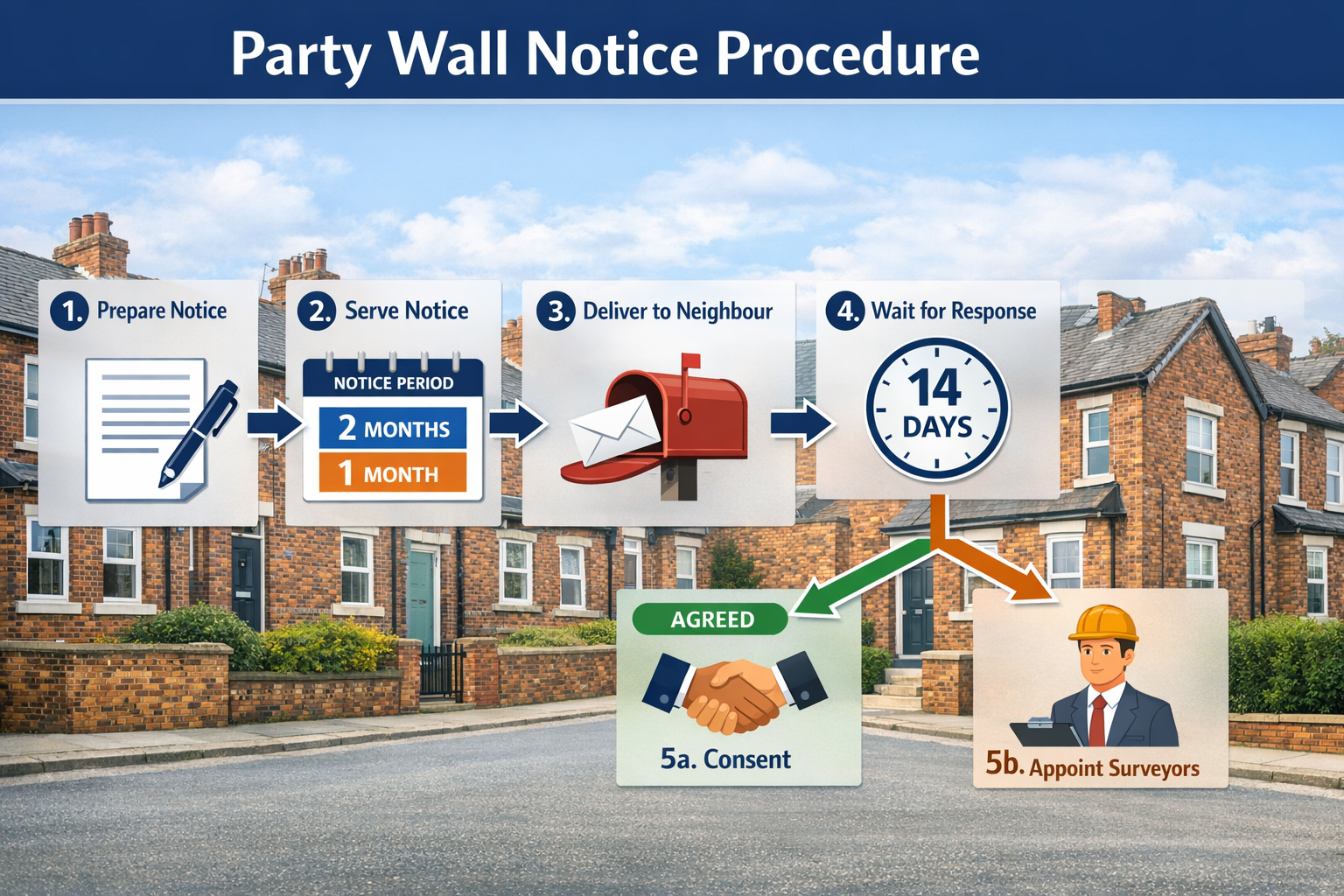
  • Party Wall Agreements vs. Awards: When to Use Each and How t

    Cover Image

    When planning construction work that affects a shared wall with your neighbor, understanding the difference between party wall agreements and awards can save thousands of pounds and weeks of delays. Not every party wall situation requires a surveyor’s award—knowing when parties can settle disputes through mutual agreement versus when formal awards become necessary is crucial for any property owner in England and Wales. This comprehensive guide explores Party Wall Agreements vs. Awards: When to Use Each and How to Negotiate Successfully, providing the knowledge needed to navigate these processes efficiently in 2026.

    Key Takeaways

    • Party wall notices are formal written communications served before work begins, while party wall awards are legally binding documents created by surveyors when disputes arise or neighbors dissent
    • Adjoining owners have 14 days to respond to a party wall notice; no response is treated as dissent and triggers the award process
    • Mutual agreements can resolve many party wall situations without expensive surveyor involvement, potentially saving £1,000+ in award costs
    • Party wall awards typically cost £1,000 and take 2-6 weeks to complete, with the building owner responsible for all surveyor fees
    • Understanding negotiation strategies and when to escalate to formal awards helps property owners maintain good neighbor relations while protecting their legal rights

    Understanding the Fundamental Difference Between Party Wall Agreements and Awards

    Section Image

    The terms “party wall agreement” and “party wall award” are often used interchangeably, but they represent distinctly different stages in the party wall process. Recognizing this distinction is the first step toward managing your construction project effectively.

    What Is a Party Wall Notice?

    A party wall notice is the formal written communication that a building owner must serve to adjoining property owners before commencing certain types of work. This notice is required under the Party Wall etc. Act 1996 and applies only to England and Wales.[2]

    The notice serves several critical purposes:

    • 📋 Formal notification of intended works affecting shared structures
    • 📅 Timeline establishment giving neighbors 14 days to respond
    • 📝 Work description outlining the scope and nature of proposed construction
    • ⚖️ Legal compliance fulfilling statutory requirements before work begins

    Common works requiring a party wall notice include:

    • Loft conversions affecting shared walls
    • Installation of damp proof courses
    • New foundations for extensions near boundary lines
    • Structural alterations to party walls
    • Excavations within 3-6 meters of neighboring foundations[2]

    For more details on the types of work requiring notices, review our guide on types of party wall works.

    What Is a Party Wall Award?

    A party wall award is a completely different document—it’s a legally binding determination prepared by appointed party wall surveyors after a dispute or dissent arises.[1][3] This award becomes necessary when:

    • The adjoining owner dissents (disagrees) with the proposed works
    • The adjoining owner fails to respond within the 14-day period
    • Either party requests formal documentation of rights and responsibilities
    • Complex works require detailed conditions and protections

    The award is not simply an agreement between neighbors—it’s a formal legal document that can be enforced through the courts if necessary.[1]

    Important Legal Distinction: A party wall notice is a communication tool, while a party wall award is a binding legal instrument with enforcement power.

    The Complete Party Wall Process Timeline

    Understanding Party Wall Agreements vs. Awards: When to Use Each and How to Negotiate Successfully requires knowledge of the complete process timeline. Here’s how the sequence typically unfolds:

    Stage 1: Service of Notice (Day 0)

    The building owner serves the appropriate party wall notice to all adjoining owners. The notice must include:

    • Detailed description of proposed works
    • Start date (at least 2 months for Party Structure Notice, 1 month for Line of Junction Notice)
    • Building owner’s contact information
    • Clear drawings or plans where applicable

    Stage 2: Response Period (Days 1-14)

    The adjoining owner has 14 days to respond in one of three ways:[1]

    1. Consent to the works (informal agreement reached)
    2. Dissent from the works (triggering award process)
    3. 🔇 No response (treated as dissent by default)

    If consent is given, work may proceed without a formal award—though many property owners still choose to document the agreement for protection.

    Stage 3: Surveyor Appointment (Days 15-21)

    When dissent occurs or no response is received, surveyors must be appointed:

    • Option A: Both parties agree on a single “Agreed Surveyor”
    • Option B: Each party appoints their own surveyor, who then work together

    The building owner is responsible for paying all surveyor fees, typically £150-£200 per hour.[2]

    Stage 4: Property Inspection and Schedule of Condition (Days 22-35)

    The appointed surveyor(s) conduct a thorough inspection of the adjoining property, creating a schedule of condition that includes:

    • Detailed photographs of all relevant areas
    • Written descriptions of existing conditions
    • Documentation of any pre-existing damage or defects
    • Baseline evidence for future damage claims[2]

    This schedule of condition is crucial protection for both parties.

    Stage 5: Award Preparation and Issuance (Days 36-42)

    The surveyor(s) prepare the party wall award document, which must include:

    • Description of proposed works with technical specifications
    • Rights granted to the building owner
    • Conditions and restrictions protecting the adjoining owner
    • Access arrangements for inspections and work
    • Damage resolution framework for handling issues during construction
    • Schedule of condition as an appendix[3]

    Stage 6: Appeal Period (Days 43-56)

    Both parties have 14 days to appeal the award to the County Court if they disagree with its terms.[2][4] Appeals are relatively rare but provide an important safety valve.

    Stage 7: Works Commence

    Once the appeal period expires without challenge, work can legally begin under the terms specified in the award.

    Total Timeline: The entire process from notice to award typically takes 2-6 weeks, depending on work complexity and surveyor availability.[1]

    When You Can Use Informal Party Wall Agreements (Without a Formal Award)

    Here’s where property owners can save significant time and money: not every party wall situation requires a formal surveyor’s award. Understanding when informal agreements suffice is key to navigating Party Wall Agreements vs. Awards: When to Use Each and How to Negotiate Successfully.

    Scenarios Where Informal Agreements Work Well

    ✅ Minor, Low-Risk Works

    When proposed works are straightforward and pose minimal risk to the adjoining property, neighbors often consent without requiring a formal award:

    • Simple repairs to existing party walls
    • Minor alterations not affecting structural integrity
    • Cosmetic changes to shared surfaces
    • Routine maintenance activities

    ✅ Excellent Neighbor Relations

    When trust exists between neighbors and communication is open, informal agreements can work effectively. Both parties understand the work, agree on protections, and trust each other to act reasonably.

    ✅ Professional Building Owner Reputation

    Established developers or contractors with strong local reputations may find neighbors more willing to consent without formal awards, especially when they:

    • Provide comprehensive work descriptions
    • Offer voluntary schedules of condition
    • Maintain appropriate insurance coverage
    • Have track records of respectful, careful work

    For guidance on creating informal agreements, see our free party wall agreement template.

    The Risks of Informal Agreements

    While informal agreements can save money, they carry risks that both parties should understand:

    Risk Impact Mitigation Strategy
    No legal protection Difficult to enforce if disputes arise Document agreement in writing with signatures
    Unclear scope Disagreements about what was agreed Include detailed work descriptions and drawings
    No damage baseline Difficult to prove work caused damage Create voluntary photographic record
    Insurance gaps Insurer may not cover informal arrangements Confirm coverage with insurance provider
    Future sale complications Buyers’ solicitors may question informal agreements Keep comprehensive documentation

    Expert Recommendation: Even when neighbors consent informally, create a written document outlining the agreed works, protections, and any conditions. This provides some protection without the full cost of a surveyor’s award.

    When Informal Agreements Are NOT Appropriate

    Certain situations demand formal party wall awards regardless of neighbor relations:

    • 🏗️ Structural alterations involving load-bearing elements
    • 🕳️ Deep excavations near neighboring foundations
    • 🏠 Complex loft conversions affecting party walls
    • 💰 High-value properties where potential damage claims are significant
    • 📜 Commercial properties where formal documentation is standard practice
    • ⚠️ Any dissent or concern expressed by the adjoining owner

    For more information on whether you need professional involvement, read our guide on having a party wall agreement without a surveyor.

    When Formal Party Wall Awards Become Necessary

    Understanding when to escalate from informal agreement to formal award is crucial for Party Wall Agreements vs. Awards: When to Use Each and How to Negotiate Successfully. Several triggers make awards not just advisable but legally required.

    Legal Triggers for Awards

    1. Dissent from Adjoining Owner

    When an adjoining owner dissents—either explicitly or by failing to respond within 14 days—the award process becomes mandatory.[1] There is no option to proceed without surveyors at this point.

    2. Multiple Adjoining Owners

    Projects affecting several neighbors increase complexity exponentially. A formal award ensures:

    • All parties receive equal protection
    • Conditions are consistently applied
    • Documentation is comprehensive and clear
    • Disputes between different neighbors are managed fairly

    3. Complex or High-Risk Works

    Certain types of construction inherently require formal awards:

    • Basement excavations requiring underpinning
    • Structural steel insertions through party walls
    • Removal of chimney breasts affecting shared structures
    • Foundation work within 3 meters of neighbors (and deeper than their foundations)
    • Significant alterations to load-bearing party walls

    Practical Triggers for Awards

    Beyond legal requirements, practical considerations often make awards the sensible choice:

    🛡️ Protection for Building Owners

    Formal awards protect the person doing the work by:

    • Establishing clear rights to proceed
    • Preventing future claims of unauthorized work
    • Documenting agreed-upon methods and protections
    • Creating legal recourse if neighbors interfere with legitimate work

    🏡 Protection for Adjoining Owners

    Awards safeguard neighbors through:

    • Mandatory schedules of condition proving pre-work state
    • Enforceable conditions on work methods and timing
    • Clear damage resolution procedures
    • Professional oversight of construction quality

    💼 Lender and Insurance Requirements

    Many mortgage lenders and insurance companies now require formal party wall awards for significant works, making them practically mandatory even when neighbors consent.

    📊 Property Value Protection

    For high-value properties, the relatively small cost of an award (approximately £1,000)[2] is negligible compared to potential damage claims or sale complications from undocumented party wall works.

    The Award Document: What It Contains

    A comprehensive party wall award typically includes:

    1. Preamble – Identifies parties, properties, and surveyors
    2. Recitals – Describes the notice served and responses received
    3. Description of Works – Detailed technical specifications
    4. Rights Granted – Specific permissions given to building owner
    5. Conditions Imposed – Restrictions and requirements for the work
    6. Working Hours – Permitted times for noisy or disruptive activities
    7. Access Rights – Arrangements for inspections and emergency access
    8. Schedule of Condition – Photographic and written record of adjoining property
    9. Damage Resolution – Procedures for handling damage claims
    10. Costs – Allocation of surveyor fees and expenses
    11. Signatures – Formal execution by surveyor(s)

    For templates and examples, review our party wall contract template guide.

    Negotiation Strategies for Successful Party Wall Agreements and Awards

    Section Image

    Whether pursuing an informal agreement or working through the formal award process, effective negotiation skills are essential for Party Wall Agreements vs. Awards: When to Use Each and How to Negotiate Successfully. Here are proven strategies for both building owners and adjoining owners.

    For Building Owners: Proactive Engagement Strategies

    1. Early Communication (Before Formal Notice)

    Don’t let the first communication be the formal notice. Instead:

    • 🗣️ Discuss plans informally several weeks before serving notice
    • 📋 Share preliminary drawings and explain the benefits
    • 🤝 Address concerns proactively before they become objections
    • Ask about timing preferences to minimize disruption

    2. Comprehensive Documentation

    Provide more information than legally required:

    • Detailed architectural drawings
    • Structural engineer’s calculations
    • Method statements explaining work procedures
    • Timeline with key milestones
    • Contact information for project manager
    • Insurance certificates

    3. Voluntary Protections

    Offer protections even when not legally required:

    • Voluntary schedule of condition
    • Dust and noise mitigation measures
    • Vibration monitoring equipment
    • Regular progress updates
    • Direct communication channel for concerns

    4. Strategic Surveyor Selection

    If an award becomes necessary, choosing the right surveyor matters:

    • Select someone with strong local reputation
    • Ensure they are truly independent (not your architect or builder)[2]
    • Look for excellent communication skills
    • Verify relevant experience with similar projects
    • Check professional qualifications and insurance

    For cost-conscious approaches, read our guide on how to keep party wall costs down.

    For Adjoining Owners: Protecting Your Interests

    1. Understand Your Rights

    Before responding to a party wall notice:

    • Review the notice carefully – ensure it contains required information
    • 📚 Research the Act – understand your statutory rights
    • 🏛️ Know your options – consent, dissent, or appoint surveyor
    • ⏱️ Respect deadlines – you have 14 days to respond

    2. Ask Questions

    Don’t consent without understanding:

    • What exactly will be done to the shared wall?
    • How long will the work take?
    • What protections are offered?
    • Who is the contractor and what is their track record?
    • What insurance coverage exists?
    • How will damage be identified and resolved?

    3. Consider Professional Advice

    Even if you plan to consent, consider:

    • Brief consultation with a party wall surveyor
    • Review by a solicitor if the work is extensive
    • Independent structural engineer’s opinion for complex works

    4. Document Everything

    Whether consenting or dissenting:

    • Keep copies of all correspondence
    • Photograph your property before work begins
    • Maintain a diary of work activities and any issues
    • Save contact information for all parties

    Negotiating Award Terms

    When the formal award process is underway, both parties can influence the terms:

    Building Owner Negotiation Points:

    • Working hours – negotiate reasonable times that allow efficient work
    • Access arrangements – ensure practical access without excessive restrictions
    • Method flexibility – avoid overly prescriptive methods that increase costs
    • Timeline – secure reasonable completion deadlines

    Adjoining Owner Negotiation Points:

    • Enhanced schedule of condition – request comprehensive documentation
    • Additional protections – negotiate extra safeguards for valuable features
    • Monitoring requirements – request vibration or movement monitoring
    • Restoration standards – specify quality expectations for any repairs
    • Communication protocols – establish regular update requirements

    Key Insight: The surveyor’s role is to be fair to both parties, not to advocate for one side. Both building and adjoining owners can present reasonable requests, but the surveyor will balance competing interests based on what is fair and practical.

    Cost Considerations: Awards vs. Informal Agreements

    Financial implications play a significant role in deciding between informal agreements and formal awards. Understanding the costs helps with Party Wall Agreements vs. Awards: When to Use Each and How to Negotiate Successfully.

    Costs of Informal Agreements

    Direct Costs:

    • £0 – £500 for voluntary schedule of condition (if hired photographer/surveyor)
    • £0 – £300 for document preparation (if using solicitor)
    • Total: £0 – £800

    Indirect Costs:

    • Risk of future disputes without clear documentation
    • Potential insurance complications
    • Possible sale complications if documentation is poor

    Costs of Formal Party Wall Awards

    Surveyor Fees:

    • Hourly rate: £150-£200 per hour[2]
    • Complete award: approximately £1,000[2]
    • Complex projects: £1,500 – £3,000+

    Who Pays:
    The building owner (person doing the work) pays for:

    • Their own surveyor (if appointed separately)
    • The adjoining owner’s surveyor
    • The agreed surveyor (if using single surveyor approach)
    • All reasonable costs associated with the award[2]

    Additional Costs:

    • Appeal costs if either party challenges the award
    • Monitoring costs if specified in the award
    • Remedial work costs if damage occurs

    For detailed cost breakdowns, visit our costs of party wall process page.

    Cost-Benefit Analysis

    Scenario Recommended Approach Reasoning
    Simple repair, good relations Informal agreement Cost savings outweigh minimal risk
    Loft conversion, uncertain relations Formal award £1,000 cost is small compared to potential disputes
    Basement excavation Formal award (always) High risk requires professional oversight
    Minor alteration, commercial property Formal award Professional standards and documentation requirements
    Extension, multiple neighbors Formal award Complexity justifies professional management

    Hidden Value of Awards

    While awards cost more upfront, they provide value that informal agreements cannot:

    • 🛡️ Legal enforceability if disputes arise
    • 📸 Professional documentation of pre-work conditions
    • ⚖️ Impartial oversight by qualified professionals
    • 🏛️ Court-admissible evidence if litigation occurs
    • 💼 Lender satisfaction for mortgage requirements
    • 🏠 Sale facilitation with proper documentation for conveyancing

    Common Mistakes to Avoid

    Understanding what NOT to do is as important as knowing best practices for Party Wall Agreements vs. Awards: When to Use Each and How to Negotiate Successfully.

    Mistakes Building Owners Make

    ❌ Starting Work Before Proper Notice

    Beginning construction before serving notice or receiving consent/award is a serious breach that can result in:

    • Injunctions stopping all work
    • Mandatory removal of completed work
    • Liability for all damage (with no protection)
    • Legal costs for the adjoining owner
    • Significant project delays

    ❌ Inadequate Notice Content

    Serving a notice that lacks required information:

    • Incomplete work descriptions
    • Missing drawings or specifications
    • Incorrect notice type for the work planned
    • Insufficient advance notice period

    ❌ Assuming Silence Means Consent

    No response from a neighbor does NOT mean consent—it legally means dissent and triggers the award process.[1]

    ❌ Using Non-Independent Surveyors

    Appointing your architect or builder as the surveyor undermines the process and will likely be rejected by the adjoining owner.[2]

    ❌ Ignoring Award Conditions

    Once an award is issued, its conditions are legally binding. Ignoring them can result in:

    • Work stoppages
    • Breach of statutory duty claims
    • Liability for resulting damage
    • Additional legal costs

    Mistakes Adjoining Owners Make

    ❌ Ignoring the Notice

    Failing to respond within 14 days triggers the award process, which:

    • Removes your choice of surveyor approach
    • Increases costs (which the building owner pays, but may affect relations)
    • Creates unnecessary formality when simple consent might have sufficed

    ❌ Unreasonable Dissent

    Dissenting to reasonable works without valid grounds:

    • Doesn’t stop the work (it just triggers the award process)
    • Can damage neighbor relations unnecessarily
    • May result in an award that grants the same permissions anyway

    ❌ Trying to Negotiate Prohibited Matters

    The Party Wall Act gives building owners certain rights that cannot be negotiated away:

    • Right to carry out necessary works
    • Right of access for the work
    • Basic permissions for notifiable activities

    Adjoining owners can negotiate conditions and protections, but cannot veto work that falls within the Act’s scope.

    ❌ Failing to Document Pre-Existing Conditions

    Without a proper schedule of condition:

    • Proving that damage was caused by the work becomes difficult
    • Pre-existing defects may be blamed on new construction
    • Claims may be weakened or dismissed

    ❌ Appointing Unqualified Surveyors

    Choosing a surveyor based solely on cost or personal relationship rather than:

    • Relevant qualifications and experience
    • Professional indemnity insurance
    • Knowledge of the Party Wall Act
    • Reputation for fairness and thoroughness

    Special Situations and Complex Scenarios

    Some party wall situations require special consideration when determining whether informal agreements or formal awards are appropriate.

    Retrospective Awards

    Sometimes work proceeds without proper party wall procedures, and issues arise afterward. Retrospective awards can be created to address:

    • Damage claims after work completion
    • Clarification of work scope that was performed
    • Resolution of disputes about unauthorized work

    While possible, retrospective awards are more complex and expensive than following proper procedures initially.[2] They require both parties to cooperate in appointing surveyors after the fact.

    Multiple Properties Affected

    Large projects may affect several adjoining properties simultaneously. In these cases:

    • Separate notices must be served to each affected owner
    • Different owners may respond differently (some consent, others dissent)
    • A single agreed surveyor can often handle multiple awards efficiently
    • Costs increase with the number of properties involved

    Leasehold Properties

    When the building owner or adjoining owner is a leaseholder:

    • The freeholder may need to be notified
    • Lease terms may impose additional requirements
    • The leaseholder typically handles the party wall process
    • Freeholder consent may be required for certain works

    Commercial Properties

    Business premises often require different approaches:

    • Formal awards are standard practice regardless of consent
    • Working hours may be more restricted
    • Business interruption concerns are paramount
    • Professional documentation is expected by all parties

    Listed Buildings and Conservation Areas

    Additional complexity arises with protected properties:

    • Party wall procedures run parallel to (not instead of) planning and listed building consent
    • Conservation officers may impose additional requirements
    • Work methods may be more restricted
    • Professional oversight is essential

    For boundary-related questions, see our guide on boundary wall rules and differences between party fence walls and boundary walls.

    Regional Considerations in London and Beyond

    Section Image

    While the Party Wall etc. Act 1996 applies uniformly across England and Wales, practical considerations vary by location.

    London-Specific Factors

    London’s dense urban environment creates unique party wall challenges:

    • Higher property values make formal awards more advisable
    • Terraced housing means multiple adjoining owners are common
    • Active construction market means surveyors are in high demand
    • Experienced neighbors who have been through the process before

    Whether you’re in North London, South London, East London, West London, or Central London, local surveyors understand regional nuances.

    2026 Construction Boom Considerations

    The UK housing market in 2026 continues to see high construction activity, particularly in urban areas. This creates additional pressures:

    • Surveyor availability may affect timelines
    • Neighbor fatigue from multiple nearby projects
    • Increased awareness of party wall rights
    • Higher standards expected for documentation[4]

    Outside London

    In less dense areas:

    • Informal agreements may be more common
    • Surveyor availability may be more limited
    • Costs may be slightly lower
    • Neighbor relations may carry more weight in decision-making

    Conclusion: Making the Right Choice for Your Situation

    Understanding Party Wall Agreements vs. Awards: When to Use Each and How to Negotiate Successfully empowers property owners to make informed decisions that protect their interests while maintaining positive neighbor relations.

    Key Decision Framework

    Choose an informal agreement when:

    • ✅ Works are minor and low-risk
    • ✅ Neighbor relations are excellent
    • ✅ Both parties understand and accept the risks
    • ✅ Comprehensive documentation will be created voluntarily
    • ✅ Insurance and lender requirements are satisfied

    Choose a formal award when:

    • ✅ The adjoining owner dissents or doesn’t respond
    • ✅ Works are structural, complex, or high-risk
    • ✅ Property values are high
    • ✅ Multiple neighbors are affected
    • ✅ Professional documentation is required
    • ✅ Any doubt exists about the appropriateness of informal agreement

    Actionable Next Steps

    If you’re a building owner planning works:

    1. Research requirements – Determine if your work requires party wall procedures
    2. Communicate early – Discuss plans with neighbors before formal notices
    3. Prepare documentation – Gather drawings, specifications, and insurance certificates
    4. Serve proper notice – Use the correct notice type with complete information
    5. Respond to concerns – Address neighbor questions promptly and thoroughly
    6. Appoint qualified surveyors – If awards become necessary, choose experienced professionals
    7. Follow award conditions – Comply strictly with all requirements

    If you’re an adjoining owner who received a notice:

    1. Review carefully – Read the notice thoroughly and identify any concerns
    2. Ask questions – Request clarification on anything unclear
    3. Assess risk – Consider the type of work and potential impact on your property
    4. Seek advice – Consult a surveyor or solicitor if uncertain
    5. Respond timely – Don’t miss the 14-day deadline
    6. Document conditions – Photograph your property before work begins
    7. Stay engaged – Maintain communication throughout the process

    The Value of Professional Guidance

    While informal agreements can work in simple situations, professional party wall surveyors provide invaluable expertise for complex scenarios. Their services include:

    • Interpreting the Party Wall Act correctly
    • Preparing comprehensive schedules of condition
    • Negotiating fair terms for both parties
    • Providing impartial oversight
    • Resolving disputes efficiently
    • Creating enforceable legal documentation

    The cost of professional involvement—approximately £1,000 for a complete award—is modest compared to the potential costs of disputes, damage claims, or work stoppages.[2]

    Final Thoughts

    The party wall process exists to balance the rights of building owners to improve their properties with the rights of adjoining owners to protection from damage and disruption. Whether you choose an informal agreement or formal award, the principles remain the same:

    • Clear communication prevents misunderstandings
    • Comprehensive documentation protects all parties
    • Professional standards ensure quality outcomes
    • Mutual respect maintains neighbor relations
    • Legal compliance avoids costly disputes

    By understanding when to use each approach and how to negotiate successfully, property owners can navigate party wall matters confidently, efficiently, and cost-effectively in 2026 and beyond.

    For additional guidance and resources, explore our general FAQs or learn more about what to do if your neighbor is carrying out works.


    References

    [1] Difference Between Party Wall Notices And Awards – https://www.partywallslimited.com/blog/difference-between-party-wall-notices-and-awards

    [2] Party Wall Agreement – https://hoa.org.uk/advice/guides-for-homeowners/i-am-improving/party-wall-agreement/

    [3] Do I Need A Party Wall Agreement – https://www.murrins.co.uk/do-i-need-a-party-wall-agreement/

    [4] Party Wall Surveys Amid 2026 Construction Boom Handling Disputes In High Demand Uk Housing Markets – https://nottinghillsurveyors.com/blog/party-wall-surveys-amid-2026-construction-boom-handling-disputes-in-high-demand-uk-housing-markets
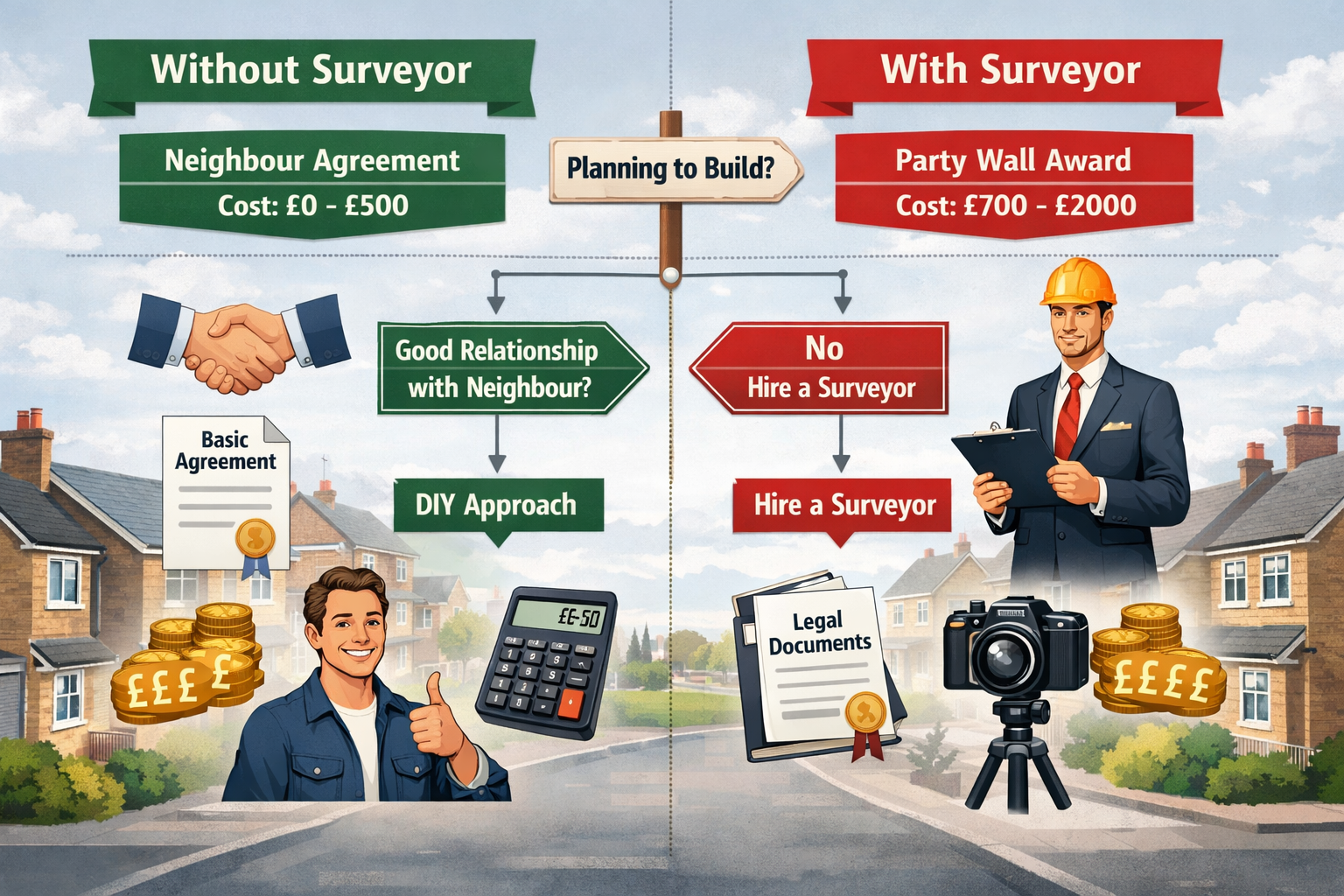
  • Party Wall Disputes in 2026 Retrofit Projects | RICS Guide

    The United Kingdom’s ambitious journey toward net-zero carbon emissions has triggered an unprecedented surge in residential retrofit projects throughout 2026. As homeowners rush to meet increasingly stringent Energy Performance Certificate (EPC) requirements and capitalize on government incentives, party wall disputes have emerged as one of the most significant obstacles to timely project completion. Understanding how to navigate Handling Party Wall Disputes in 2026 Retrofit Projects: RICS Standards and Award Essentials Post-Quality Summit has become essential for property owners, surveyors, and construction professionals alike.

    The landscape of party wall matters has evolved considerably following recent industry developments, particularly the Quality Summit initiatives that have reshaped professional standards and dispute resolution protocols. With retrofit works involving external wall insulation, cavity wall treatments, and structural modifications to improve thermal performance, the potential for neighbor conflicts has multiplied exponentially. This comprehensive guide examines the critical intersection of energy efficiency upgrades and party wall legislation, providing actionable strategies for minimizing disputes while maintaining compliance with current RICS standards.

    Key Takeaways

    • EPC-driven retrofits in 2026 have increased party wall notice requirements by an estimated 40%, making proper notification and surveyor engagement more critical than ever for avoiding costly delays
    • RICS standards post-Quality Summit emphasize enhanced documentation, transparent communication, and standardized award templates specifically adapted for energy efficiency works
    • Early engagement strategies including pre-notice consultations and comprehensive Schedules of Condition can reduce dispute escalation by up to 60% in retrofit projects
    • Party Wall Awards for retrofit works must address unique considerations such as thermal bridging, condensation risk, and reversibility of energy efficiency installations
    • Professional surveyor selection following updated RICS guidance ensures disputes are resolved efficiently while protecting both building and adjoining owners’ interests

    Understanding the 2026 Retrofit Boom and Party Wall Implications

    Detailed landscape format (1536x1024) image showing a professional party wall surveyor conducting a Schedule of Condition inspection in a Vi

    The year 2026 has witnessed an extraordinary acceleration in residential energy efficiency upgrades across the UK. Government mandates requiring rental properties to achieve minimum EPC ratings, combined with enhanced grant programs and rising energy costs, have created what industry experts call the “Great Retrofit Wave.” This phenomenon has profound implications for party wall matters, as many of the most effective energy improvements directly impact shared structures.

    The EPC Requirement Catalyst

    Recent legislative changes have established EPC Band C as the minimum standard for rental properties by 2028, with owner-occupied homes facing similar requirements by 2030. This regulatory pressure has compressed what might have been a decade-long transition into just a few years, creating intense demand for retrofit solutions. The most common improvements—external wall insulation (EWI), cavity wall insulation, and loft conversions for additional insulation—frequently trigger party wall notice requirements under the Party Wall etc. Act 1996.

    According to recent industry analysis, approximately 65% of retrofit projects in terraced and semi-detached properties now involve works that fall under party wall legislation [6]. This represents a dramatic increase from pre-2026 levels and has placed unprecedented strain on surveying resources and dispute resolution mechanisms.

    Common Retrofit Works Triggering Party Wall Procedures

    Understanding which energy efficiency improvements require party wall notices is fundamental to avoiding legal complications. The following types of party wall works are particularly prevalent in 2026 retrofit projects:

    External Wall Insulation (EWI)

    • Attachment of insulation boards to external walls that form part of a party wall structure
    • Installation of render systems that may affect the party wall’s weather resistance
    • Scaffolding and access requirements that impact adjoining property

    Cavity Wall Insulation

    • Drilling into party walls to inject insulation materials
    • Potential impact on wall structure and moisture management
    • Risk of material migration to adjoining property’s cavity

    Structural Modifications

    • Cutting into party walls to install ventilation systems
    • Beam insertions for thermal bridging solutions
    • Floor and ceiling works affecting party structures

    Loft Conversions and Roof Insulation

    • Works to party walls extending into roof space
    • Modifications to shared roof structures
    • Installation of roof ventilation affecting both properties

    Each of these interventions requires careful consideration of notice requirements, with party wall notices typically needing to be served at least two months before work commences for most structural works.

    Why Retrofit Projects Generate More Disputes

    The surge in party wall disputes related to retrofit works stems from several unique factors that distinguish energy efficiency projects from traditional building work:

    🔧 Technical Complexity: Retrofit solutions often involve unfamiliar technologies and materials that adjoining owners may not understand, leading to heightened anxiety and opposition.

    Time Pressures: Grant deadlines and EPC compliance timelines create urgency that can lead building owners to rush or skip proper party wall procedures.

    💰 Cost Concerns: Adjoining owners worry about potential damage or future maintenance costs associated with retrofit installations, particularly with external insulation systems.

    🏠 Aesthetic Impact: External wall insulation significantly alters a building’s appearance, which can be contentious in conservation areas or where architectural consistency matters to neighbors.

    📋 Information Gaps: Many homeowners undertaking their first retrofit project are unfamiliar with party wall legislation, leading to procedural errors and unnecessary conflicts.

    The Quality Summit initiatives of late 2025 and early 2026 specifically addressed these challenges, resulting in updated guidance that emphasizes proactive communication, comprehensive documentation, and specialized expertise for retrofit-related party wall matters [3].


    RICS Standards for Handling Party Wall Disputes in 2026 Retrofit Projects: RICS Standards and Award Essentials Post-Quality Summit

    The Royal Institution of Chartered Surveyors (RICS) has long provided the professional framework for party wall practice in the UK. Following the Quality Summit—a series of industry consultations held throughout 2025—RICS updated its guidance to address the specific challenges posed by the retrofit boom. Understanding these current standards is essential for anyone involved in Handling Party Wall Disputes in 2026 Retrofit Projects: RICS Standards and Award Essentials Post-Quality Summit.

    Updated RICS Guidance on Party Wall Legislation and Procedure

    The RICS professional standard “Party Wall Legislation and Procedure” serves as the authoritative reference for surveyors operating under the Party Wall etc. Act 1996 [3]. The most recent updates, implemented in early 2026, include specific provisions for energy efficiency works:

    Enhanced Pre-Notice Consultation Requirements
    The updated guidance strongly recommends that building owners engage in informal consultation with adjoining owners before serving formal notices for retrofit works. This pre-notice phase should include:

    • Clear explanations of the proposed energy efficiency improvements
    • Visual representations (drawings, photographs of similar installations)
    • Expected timelines and access requirements
    • Anticipated noise, dust, and disruption levels
    • Contact information for the project team

    This approach aligns with RICS’s emphasis on dispute avoidance rather than dispute resolution [1]. Early dialogue helps address concerns before they escalate into formal dissent.

    Specialized Surveyor Competency
    The 2026 guidance introduces the concept of retrofit-competent surveyors—professionals who possess both traditional party wall expertise and understanding of building physics, thermal performance, and energy efficiency technologies. When appointing surveyors for retrofit-related party wall matters, both building and adjoining owners are encouraged to verify:

    • Current RICS membership and professional indemnity insurance
    • Demonstrated experience with energy efficiency projects
    • Understanding of thermal bridging, condensation risk, and moisture management
    • Familiarity with relevant building regulations and EPC requirements

    Documentation Standards
    RICS has elevated documentation requirements for retrofit projects, recognizing that energy efficiency installations may have long-term implications for building performance. Surveyors must now ensure that party wall awards include:

    • Detailed specifications of insulation materials and installation methods
    • Thermal performance calculations demonstrating compliance
    • Moisture management strategies
    • Long-term maintenance responsibilities
    • Provisions for future access if remedial work becomes necessary

    The Quality Summit Impact on Professional Practice

    The Quality Summit represented a collaborative effort among RICS, the Faculty of Party Wall Surveyors, and other professional bodies to address emerging challenges in party wall practice. Key outcomes relevant to retrofit projects include:

    Standardized Award Templates for Energy Works
    The Summit resulted in development of specialized party wall award templates specifically designed for common retrofit scenarios. These templates address:

    • External wall insulation installations
    • Cavity wall treatment works
    • Roof and loft insulation projects
    • Ventilation system installations

    These standardized documents reduce ambiguity and provide clearer guidance for all parties involved, potentially reducing disputes by ensuring consistent treatment of common scenarios.

    Enhanced Dispute Resolution Protocols
    The Quality Summit established clearer pathways for resolving disagreements that arise during retrofit projects. The updated protocols emphasize:

    1. Mediation before escalation: Encouraging informal resolution through surveyor-facilitated discussions
    2. Technical expert involvement: Bringing in building physics specialists when disputes involve thermal performance questions
    3. Time-bound resolution processes: Establishing maximum timeframes for surveyor responses to prevent project delays
    4. Cost transparency: Clearer guidelines on fee allocation and expense recovery

    Professional Conduct Standards
    New ethical guidelines specifically address the unique pressures of the 2026 retrofit environment, including:

    • Prohibition against surveyors creating unnecessary delays when EPC deadlines are at stake
    • Requirements for timely communication (48-hour response standards for urgent matters)
    • Transparency regarding potential conflicts of interest in energy efficiency projects
    • Continuing professional development requirements for retrofit-related competencies

    Applying RICS Standards to Common Retrofit Scenarios

    To illustrate how current RICS standards apply in practice, consider these typical 2026 retrofit situations:

    Retrofit Work Type Notice Required Key RICS Considerations Typical Award Provisions
    External Wall Insulation Line of Junction Notice (Section 1) Attachment method, weather protection, appearance impact Material specifications, installation supervision, warranty terms, future maintenance access
    Cavity Wall Insulation Notice of Adjacent Excavation (Section 6) if drilling near foundations Drilling depth, material containment, moisture barrier integrity Drilling methodology, inspection protocols, remediation if material migration occurs
    Party Wall Beam Installation Party Structure Notice (Section 2) Structural calculations, thermal bridging mitigation, load distribution Engineering approval, installation monitoring, thermal break details
    Loft Conversion with Party Wall Works Party Structure Notice (Section 2) Sound insulation, fire resistance, structural adequacy Building control coordination, acoustic testing, fire barrier specifications

    Each scenario requires careful application of RICS guidance to ensure both legal compliance and practical project success [5].


    Essential Elements of Party Wall Awards for 2026 Retrofit Projects

    A party wall award serves as the legally binding document that governs how notifiable works will proceed, what protections exist for the adjoining owner, and how disputes will be resolved. For retrofit projects in 2026, awards must address both traditional party wall concerns and the unique technical requirements of energy efficiency installations.

    Core Components of a Retrofit-Specific Party Wall Award

    Understanding the essential elements of a properly drafted award is crucial for anyone involved in Handling Party Wall Disputes in 2026 Retrofit Projects: RICS Standards and Award Essentials Post-Quality Summit. The following components should appear in every retrofit-related award:

    1. Comprehensive Scope of Works

    The award must precisely describe the proposed energy efficiency improvements, including:

    • Detailed specifications of all materials (insulation type, thickness, thermal conductivity values)
    • Installation methodology (mechanical fixings, adhesive systems, render application)
    • Extent of works (which elevations, height parameters, interface with existing structures)
    • Associated works (scaffolding, temporary weather protection, making good)

    Vague descriptions like “installation of external insulation” are insufficient. The award should reference detailed drawings and specifications that leave no ambiguity about what is permitted [4].

    2. Schedule of Condition

    A thorough Schedule of Condition documenting the pre-works state of both the party wall and the adjoining owner’s property is absolutely essential for retrofit projects. This photographic and written record should capture:

    • Current condition of all party wall structures
    • Existing cracks, defects, or areas of concern
    • Internal finishes in rooms adjacent to party walls
    • External conditions where insulation will be installed
    • Baseline moisture readings and thermal imaging results

    The Schedule of Condition provides the benchmark against which any damage claims will be assessed. For retrofit works, it’s particularly important to document existing thermal performance issues to avoid later disputes about whether condensation or moisture problems were caused by the new installation.

    3. Access Provisions

    Retrofit works frequently require access to the adjoining owner’s property for:

    • Installation of scaffolding or access equipment
    • Inspection of internal wall conditions
    • Verification that works haven’t caused damage
    • Future maintenance or remedial work

    The award must specify:

    • When and how access will be requested (reasonable notice periods)
    • Duration and frequency of access requirements
    • Protections for the adjoining owner’s property during access
    • Compensation for significant inconvenience or loss of use

    RICS guidance emphasizes that access provisions should be proportionate and clearly justified by the technical requirements of the work [1].

    4. Damage and Making Good Provisions

    The award should establish clear protocols for addressing any damage that occurs during retrofit works:

    • Immediate notification requirements when damage is discovered
    • Documentation procedures (photographs, written descriptions)
    • Repair standards (matching existing materials and finishes)
    • Timeframes for completion of making good
    • Dispute resolution if parties disagree about damage or repair adequacy

    For retrofit projects, it’s particularly important to address latent damage that may only become apparent after works are completed, such as moisture ingress or thermal bridging effects.

    5. Cost Allocation and Fee Payment

    The award must clearly state:

    • Who pays surveyor fees (typically the building owner pays all reasonable fees)
    • How costs are apportioned if works benefit both properties
    • Payment terms and schedules
    • Dispute resolution for fee disagreements

    The updated RICS guidance encourages transparency about likely costs early in the process to avoid disputes later [3]. For more information on managing expenses, see our guide on how to keep party wall costs down.

    Retrofit-Specific Award Clauses

    Beyond the standard elements, awards for 2026 retrofit projects should include specialized provisions addressing energy efficiency concerns:

    Thermal Performance Guarantees

    The award should specify:

    • Minimum thermal performance standards (U-values) to be achieved
    • Testing and verification procedures
    • Remediation protocols if performance targets aren’t met
    • Long-term performance monitoring (where appropriate)

    Condensation and Moisture Management

    Given the risks associated with adding insulation to existing structures, awards should address:

    • Pre-installation moisture surveys
    • Vapor barrier and breathability requirements
    • Ventilation provisions to prevent interstitial condensation
    • Post-installation monitoring periods
    • Responsibility for addressing moisture issues that arise

    Reversibility and Future Modifications

    Energy efficiency technologies evolve rapidly. Awards should consider:

    • Provisions for future upgrades or replacements
    • Notice requirements for modifications to installed systems
    • Access rights for future maintenance
    • Responsibilities if systems need to be removed or altered

    Building Regulations and EPC Compliance

    The award should confirm:

    • That works will comply with current Building Regulations Part L (Conservation of Fuel and Power)
    • EPC improvement targets being pursued
    • Building Control notification and inspection protocols
    • Responsibility for obtaining necessary approvals

    Common Award Deficiencies in Retrofit Projects

    Based on 2026 dispute analysis, the following award deficiencies frequently lead to problems:

    Insufficient material specifications: Awards that don’t specify exact insulation products, allowing substitution of inferior materials

    Vague timelines: Failure to establish clear start and completion dates, leading to prolonged disruption

    Inadequate damage protocols: No clear process for documenting and resolving damage claims

    Missing maintenance provisions: No consideration of long-term access needs for system maintenance

    Unclear cost allocation: Ambiguity about who pays for various aspects of the work and associated surveyor involvement

    Avoiding these deficiencies requires careful drafting by experienced surveyors familiar with both party wall law and retrofit technology.


    Strategies for Minimizing Disputes in Retrofit Party Wall Matters

    Detailed landscape format (1536x1024) infographic-style image displaying the Party Wall Award process flowchart specifically for retrofit pr

    While the Party Wall etc. Act 1996 provides a framework for managing disagreements, the best outcome for all parties is avoiding disputes altogether. The following strategies, aligned with current RICS best practices for Handling Party Wall Disputes in 2026 Retrofit Projects: RICS Standards and Award Essentials Post-Quality Summit, can significantly reduce conflict potential.

    Pre-Notice Engagement and Neighbor Relations

    The foundation of dispute avoidance is proactive communication before formal notices are served. Building owners should:

    1. Conduct Informal Preliminary Discussions

    Before serving official party wall notices, arrange a friendly conversation with adjoining owners to:

    • Explain the energy efficiency goals and benefits
    • Show examples of similar completed projects
    • Discuss potential concerns and how they’ll be addressed
    • Provide preliminary timelines
    • Offer contact information for questions

    This informal approach often prevents the defensive reaction that formal legal notices can trigger. Many adjoining owners are more cooperative when they feel informed and respected rather than legally compelled.

    2. Provide Comprehensive Information Packages

    When serving formal notices, supplement the legal minimum with:

    • Visual materials: Photographs, drawings, or renderings showing the proposed changes
    • Technical summaries: Plain-language explanations of the retrofit technology
    • Benefit statements: How the works might benefit the adjoining property (improved weather protection, potential property value increase)
    • Disruption mitigation plans: Specific measures to minimize noise, dust, and inconvenience
    • Contact details: Direct access to the project manager or building owner for questions

    3. Demonstrate Professional Project Management

    Adjoining owners are more likely to consent when they have confidence in the building owner’s professionalism:

    • Engage reputable contractors with retrofit expertise
    • Obtain necessary planning permissions and building control approvals before serving notices
    • Provide evidence of adequate insurance coverage
    • Establish clear communication channels and response commitments

    Selecting the Right Surveyors

    If the adjoining owner dissents or doesn’t respond to the notice, surveyors must be appointed. The choice of surveyor can significantly influence whether disputes escalate or resolve smoothly.

    Building Owner’s Surveyor Selection

    When selecting a surveyor to represent the building owner’s interests, prioritize:

    • Retrofit experience: Demonstrated familiarity with energy efficiency projects and associated technical challenges
    • Local knowledge: Understanding of local building practices and common construction types in the area
    • Communication skills: Ability to explain technical matters clearly to non-experts
    • Efficiency: Track record of timely award production and project progression
    • RICS membership: Current professional standing and continuing education

    For London-based projects, consider specialists such as party wall surveyors in West London, Central London, or other regional specialists who understand local building characteristics.

    Adjoining Owner’s Surveyor Considerations

    Adjoining owners have three options when a party wall notice is served:

    1. Consent to the works (no surveyor needed)
    2. Appoint their own surveyor to negotiate terms
    3. Agree to the building owner’s surveyor acting for both parties

    While option 3 can reduce costs, adjoining owners should carefully consider whether independent representation better protects their interests, particularly for complex retrofit projects [2]. When appointing their own surveyor, adjoining owners should seek:

    • Independence from the building owner and their contractors
    • Technical expertise relevant to the proposed works
    • Clear fee structures and cost estimates
    • Responsiveness and accessibility

    The Third Surveyor Safety Net

    If the building owner’s and adjoining owner’s surveyors cannot reach agreement, they may appoint a third surveyor to resolve the dispute. This mechanism provides an important safety valve, but adds time and cost. Selecting surveyors who work collaboratively and professionally reduces the likelihood of third surveyor involvement.

    Effective Communication Throughout the Project

    Once the award is in place and work commences, ongoing communication remains essential:

    Regular Progress Updates

    Building owners or their surveyors should provide:

    • Weekly updates during active work periods
    • Advance notice of particularly disruptive activities
    • Prompt notification of any issues or delays
    • Photographic progress records shared with the adjoining owner

    Responsive Issue Resolution

    When concerns arise during construction:

    • Acknowledge immediately: Respond to adjoining owner concerns within 24-48 hours
    • Investigate thoroughly: Don’t dismiss complaints without proper assessment
    • Propose solutions: Offer concrete remediation plans, not just explanations
    • Document everything: Maintain written records of all issues and resolutions

    Post-Completion Follow-Up

    After retrofit works are finished:

    • Conduct a joint final inspection with the adjoining owner
    • Address any outstanding making good items promptly
    • Provide warranty information and maintenance guidance for new installations
    • Confirm that all award conditions have been satisfied

    Leveraging Technology for Dispute Prevention

    Modern technology offers new tools for managing party wall matters more transparently:

    Digital Documentation

    • Cloud-based photo sharing: Real-time access to condition surveys and progress photographs
    • Digital award distribution: Ensuring all parties have immediate access to the agreed terms
    • Electronic communication trails: Clear records of all correspondence and agreements

    Building Performance Monitoring

    • Thermal imaging: Demonstrating that retrofit works are performing as intended
    • Moisture monitoring: Early detection of any condensation or dampness issues
    • Energy consumption tracking: Proving the effectiveness of efficiency improvements

    Project Management Platforms

    • Shared timelines: Transparent scheduling that keeps all parties informed
    • Issue tracking systems: Formal logging and resolution of concerns
    • Document repositories: Centralized access to all project documentation

    Case Studies: Successful Dispute Resolution in 2026 Retrofit Projects

    Examining real-world examples of how party wall disputes have been successfully managed in 2026 retrofit contexts provides valuable practical insights. The following case studies (details anonymized) illustrate effective application of RICS standards and dispute resolution strategies.

    Case Study 1: External Wall Insulation in Victorian Terrace

    Situation: A homeowner in a Victorian terrace in North London planned to install external wall insulation to achieve EPC Band C for rental compliance. The property shared party walls with neighbors on both sides, one of whom immediately dissented to the party wall notice.

    Challenges:

    • Adjoining owner concerned about aesthetic impact on the terrace’s period character
    • Worry about potential moisture problems from “sealing” the walls
    • Previous negative experience with building works causing damage

    Resolution Strategy:

    The building owner’s surveyor, working with a party wall surveyor in North London experienced in retrofit projects, implemented several key strategies:

    1. Technical education session: Arranged a meeting with both the building owner and adjoining owner where a building physics consultant explained modern breathable insulation systems and moisture management

    2. Enhanced Schedule of Condition: Conducted an exceptionally detailed pre-works survey including thermal imaging and moisture readings, giving the adjoining owner confidence that any future issues could be objectively assessed

    3. Aesthetic protections: Included award provisions requiring that the insulation system match the existing render finish and that all architectural details be replicated

    4. Performance guarantees: Specified that if any moisture issues arose within two years, the building owner would fund investigation and remediation

    5. Regular communication protocol: Established weekly email updates with photographs during the eight-week installation period

    Outcome: The award was agreed within three weeks, works proceeded without incident, and the adjoining owner later reported satisfaction with both the process and the finished appearance. The building owner achieved the target EPC rating, and the property was successfully re-let.

    Key Lesson: Investing time in education and relationship-building early in the process prevented what could have escalated into a protracted dispute requiring third surveyor involvement.

    Case Study 2: Cavity Wall Insulation Dispute

    Situation: A semi-detached property owner in South London arranged for cavity wall insulation as part of a government-funded retrofit program. The work was completed before party wall notices were served, and the adjoining owner discovered insulation material had migrated into their cavity, causing damp patches on internal walls.

    Challenges:

    • Works completed without proper party wall procedure
    • Actual damage had occurred to the adjoining property
    • Grant funding timeline pressure to complete works quickly
    • Adjoining owner considering legal action beyond the Party Wall Act

    Resolution Strategy:

    Recognizing the serious procedural failure, the building owner engaged a party wall surveyor in South London to manage remediation:

    1. Immediate acknowledgment: Building owner formally apologized and accepted responsibility for the procedural failure

    2. Retrospective award: Surveyors prepared an award documenting the works that had been completed and establishing remediation obligations

    3. Expert investigation: Engaged a building pathologist to assess the extent of insulation migration and moisture damage

    4. Comprehensive remediation: Building owner funded complete removal of contaminated insulation from the adjoining property’s cavity, treatment of affected walls, and re-plastering of damaged internal surfaces

    5. Compensation payment: Award included financial compensation for the adjoining owner’s inconvenience and distress

    6. Procedural improvements: Building owner committed to proper party wall procedures for future planned loft insulation works

    Outcome: The adjoining owner agreed not to pursue legal action beyond the Party Wall Act framework. Remediation was completed to the adjoining owner’s satisfaction within six weeks. The building owner incurred approximately £8,500 in additional costs that could have been avoided with proper initial procedures.

    Key Lesson: Attempting to bypass party wall procedures to meet grant deadlines or save costs almost always results in greater expense and delay. Proper process from the outset protects all parties and facilitates smoother project delivery.

    Case Study 3: Loft Conversion with Party Wall Extension

    Situation: An East London property owner planned a loft conversion that required raising the party wall by 1.2 meters and installing steel beams within the party wall structure. The project aimed to create additional living space while also installing high-performance insulation to achieve EPC Band B.

    Challenges:

    • Significant structural intervention in party wall
    • Extended construction period (estimated 14 weeks)
    • Adjoining owner initially refused to appoint a surveyor, causing procedural delay
    • Complex coordination between party wall requirements and Building Regulations

    Resolution Strategy:

    Working with an experienced party wall surveyor in East London, the building owner implemented a comprehensive approach:

    1. Statutory notice compliance: When the adjoining owner didn’t respond to the party structure notice within the 14-day period, the building owner’s surveyor properly invoked the deemed appointment provisions of the Act

    2. Collaborative surveyor approach: Despite representing different parties, both surveyors worked cooperatively to produce a comprehensive award within four weeks

    3. Detailed structural specifications: Award included full structural engineer’s calculations, steel beam specifications, and installation methodology

    4. Phased access provisions: Established clear schedule for when adjoining owner access would be needed for inspections, minimizing disruption

    5. Enhanced protections: Given the significant structural work, the award required:

      • Professional indemnity insurance confirmation
      • Structural engineer supervision during critical phases
      • Immediate notification of any unexpected conditions
      • Post-completion structural verification
    6. Thermal performance documentation: Award specified insulation U-values and required Building Control sign-off before works were considered complete

    Outcome: Works proceeded according to schedule with only minor issues (temporary scaffolding adjustment) that were quickly resolved. The loft conversion achieved the planned EPC improvement and added significant value to the property. The adjoining owner reported that the process, while lengthy, was professionally managed with minimal disruption.

    Key Lesson: Proper use of the Act’s deemed appointment provisions ensures that projects can proceed even when adjoining owners are unresponsive, while still protecting their interests through independent surveyor representation. For more information on this scenario, see our guide for adjoining owners.


    The Future of Party Wall Practice in the Retrofit Era

    As 2026 progresses and the retrofit boom continues, party wall practice is evolving to meet new challenges. Understanding emerging trends helps property owners and professionals prepare for the changing landscape of Handling Party Wall Disputes in 2026 Retrofit Projects: RICS Standards and Award Essentials Post-Quality Summit.

    Anticipated Regulatory Developments

    Several regulatory changes are on the horizon that will further impact party wall matters in retrofit contexts:

    Enhanced EPC Requirements

    Government consultations suggest that minimum EPC standards may be progressively raised through the late 2020s, with Band B potentially becoming the rental standard by 2030. This will drive even more extensive retrofit works, including:

    • Whole-house retrofit approaches requiring multiple party wall interventions
    • More complex insulation systems (internal wall insulation where EWI isn’t possible)
    • Heat pump installations potentially affecting party wall structures
    • Solar panel and renewable energy installations on shared roof structures

    Building Safety Act Implications

    The Building Safety Act’s emphasis on competence and accountability is beginning to influence party wall practice, with expectations that:

    • Surveyors will need to demonstrate continuing professional development specifically in retrofit technologies
    • Documentation standards will increase, with digital record-keeping becoming standard
    • Competence frameworks may be formalized for surveyors working on energy efficiency projects

    Permitted Development Changes

    Ongoing reviews of permitted development rights for energy efficiency works may affect when party wall procedures are required, potentially:

    • Exempting certain minor retrofit works from planning requirements while still requiring party wall compliance
    • Creating fast-track approval processes for standard retrofit installations
    • Establishing pre-approved specifications that simplify party wall award drafting

    Technology and Innovation in Party Wall Practice

    Technological advancement is transforming how party wall matters are managed:

    Digital Awards and Electronic Service

    The profession is moving toward:

    • Fully digital award production using standardized templates and automated clause libraries
    • Electronic service of notices with proof of delivery
    • Blockchain-based record-keeping for permanent, tamper-proof documentation
    • AI-assisted drafting that suggests appropriate provisions based on work descriptions

    Remote Surveying Capabilities

    Post-pandemic innovations continue to develop:

    • Virtual inspections using high-resolution video and photographs
    • Drone surveys for external condition assessment
    • 3D scanning to create detailed pre-works records
    • Remote collaboration platforms allowing surveyors to work together across distances

    Predictive Analytics

    Emerging data analysis tools may soon enable:

    • Dispute risk assessment based on project characteristics and historical patterns
    • Cost prediction models for more accurate fee estimates
    • Timeline optimization identifying likely bottlenecks before they occur

    Professional Development and Specialization

    The complexity of retrofit party wall work is driving increasing specialization:

    Retrofit-Specialist Surveyors

    A new category of party wall surveyors is emerging with dual expertise in:

    • Traditional party wall law and procedure
    • Building physics and energy efficiency technology
    • Moisture management and thermal performance
    • Renewable energy systems and their structural implications

    Interdisciplinary Collaboration

    Effective retrofit party wall practice increasingly requires collaboration among:

    • Party wall surveyors
    • Building physics consultants
    • Structural engineers
    • Energy assessors
    • Building control officers

    Awards and project management approaches that facilitate this interdisciplinary cooperation produce better outcomes for all parties [8].

    Industry Initiatives and Best Practice Development

    Following the Quality Summit, ongoing initiatives continue to refine best practices:

    Standardized Retrofit Award Templates

    Industry bodies are developing comprehensive template libraries for common retrofit scenarios, including:

    • External wall insulation (various fixing methods)
    • Cavity wall insulation (injection and extraction methods)
    • Internal wall insulation systems
    • Roof and loft insulation with party wall implications
    • Heat pump installations affecting party structures

    Dispute Resolution Innovation

    New approaches to resolving disagreements include:

    • Early neutral evaluation: Independent technical experts providing non-binding assessments early in disputes
    • Mediation protocols: Structured facilitation before formal third surveyor appointment
    • Online dispute resolution: Digital platforms for managing disagreement resolution efficiently

    Consumer Education Programs

    Recognizing that many property owners are unfamiliar with party wall requirements, industry initiatives focus on:

    • Plain-language guidance materials
    • Online decision tools helping owners determine if notices are required
    • Template letters for initial neighbor consultations
    • Video resources explaining the party wall process

    These educational efforts aim to reduce accidental non-compliance and improve the overall quality of party wall practice in the retrofit context.


    Practical Checklist for Retrofit Project Party Wall Compliance

    Detailed landscape format (1536x1024) image showing modern dispute resolution meeting for retrofit party wall matters. Scene depicts three p

    To ensure proper handling of party wall matters in 2026 retrofit projects, use this comprehensive checklist:

    Pre-Project Planning Phase

    Identify all potentially notifiable works in the retrofit plan

    • External wall insulation affecting party walls
    • Cavity wall treatment
    • Structural modifications for thermal performance
    • Roof works affecting party structures
    • Foundation works for ground source heat pumps

    Determine notice requirements for each element

    • Section 1 (Line of Junction) notices
    • Section 2 (Party Structure) notices
    • Section 6 (Adjacent Excavation) notices

    Prepare comprehensive project documentation

    • Detailed drawings and specifications
    • Thermal performance calculations
    • Structural engineer’s reports (if applicable)
    • Building Regulations compliance strategy
    • Project timeline with key milestones

    Identify all adjoining owners

    • Immediate neighbors sharing party walls
    • Properties potentially affected by excavation
    • Leaseholders vs. freeholders (serve notices on both)

    Neighbor Engagement Phase

    Conduct preliminary informal consultation

    • Explain retrofit goals and benefits
    • Show visual representations of proposed works
    • Discuss potential concerns
    • Provide contact information

    Prepare and serve formal notices

    • Use correct notice forms for work types
    • Include all required information
    • Serve on all relevant parties
    • Maintain proof of service

    Allow statutory response periods

    • 14 days for consent/dissent or surveyor appointment
    • Don’t commence works prematurely

    Surveyor Appointment and Award Phase

    Appoint qualified surveyor(s)

    • Verify RICS membership and retrofit experience
    • Confirm professional indemnity insurance
    • Agree fee structures in advance
    • Establish communication protocols

    Cooperate with Schedule of Condition preparation

    • Provide access for pre-works inspection
    • Review and approve photographic records
    • Ensure thermal imaging and moisture readings are included
    • Keep copies of all documentation

    Review draft award carefully

    • Verify work descriptions match actual plans
    • Confirm timelines are realistic
    • Understand access provisions
    • Clarify any ambiguous terms
    • Ensure retrofit-specific provisions are included

    Obtain all necessary approvals before commencing

    • Party wall award signed by all surveyors
    • Building Regulations approval
    • Planning permission (if required)
    • Contractor appointments and insurance confirmation

    Construction Phase

    Comply with award terms

    • Adhere to specified timelines
    • Provide required access
    • Use specified materials and methods
    • Maintain required insurances

    Maintain communication

    • Provide regular progress updates
    • Give advance notice of disruptive activities
    • Respond promptly to concerns
    • Document all interactions

    Monitor for issues

    • Conduct regular inspections
    • Address any damage immediately
    • Keep photographic records
    • Notify surveyors of unexpected conditions

    Completion Phase

    Conduct final inspections

    • Joint inspection with adjoining owner
    • Surveyor verification of award compliance
    • Building Control final inspection
    • EPC assessment

    Complete making good

    • Address all damage or defects
    • Match existing finishes
    • Obtain adjoining owner approval
    • Document completion

    Finalize documentation

    • Obtain final surveyor sign-off
    • Settle all fees
    • Provide warranty information
    • Archive all records for future reference

    Following this systematic approach significantly reduces the risk of disputes and ensures compliance with current standards for Handling Party Wall Disputes in 2026 Retrofit Projects: RICS Standards and Award Essentials Post-Quality Summit.


    Conclusion: Navigating Party Wall Matters in the Retrofit Era

    The intersection of the UK’s ambitious energy efficiency goals and the practical realities of party wall legislation creates both challenges and opportunities for property owners in 2026. As retrofit projects continue to surge in response to EPC requirements and climate commitments, understanding how to properly navigate party wall procedures has become an essential competency for homeowners, developers, and construction professionals.

    The key to successful Handling Party Wall Disputes in 2026 Retrofit Projects: RICS Standards and Award Essentials Post-Quality Summit lies in proactive engagement, professional expertise, and transparent communication. The updated RICS guidance and Quality Summit outcomes provide a robust framework for managing these complex matters, but success ultimately depends on how these standards are applied in practice.

    Essential Principles for Success

    Early Engagement: Begin party wall considerations during project planning, not as an afterthought when contractors are ready to start. Informal neighbor consultations before formal notices can prevent many disputes from arising.

    Professional Expertise: Engage RICS-qualified surveyors with demonstrated retrofit experience. The modest investment in professional fees is insignificant compared to the costs of disputes, delays, or non-compliance.

    Comprehensive Documentation: Detailed Schedules of Condition, precise work specifications, and thorough awards protect all parties and provide clear reference points if disagreements arise.

    Transparent Communication: Regular updates, prompt responses to concerns, and honest acknowledgment of issues build trust and facilitate cooperative problem-solving.

    Regulatory Compliance: Party wall procedures complement, rather than replace, Building Regulations, planning requirements, and other legal obligations. Ensure all aspects of compliance are addressed.

    Actionable Next Steps

    For property owners planning retrofit projects in 2026 and beyond:

    1. Assess your retrofit plans against party wall requirements using the checklist provided in this guide or consult our resources on types of party wall works

    2. Engage with neighbors early before serving formal notices, using the communication strategies outlined above

    3. Appoint qualified professionals including RICS surveyors with retrofit expertise and contractors familiar with party wall requirements

    4. Budget appropriately for party wall costs, including surveyor fees, Schedule of Condition preparation, and potential making good expenses (see our guide on costs of party wall procedures)

    5. Allow adequate time in project schedules for the party wall process, including notice periods, award preparation, and potential dispute resolution

    6. Maintain comprehensive records of all communications, inspections, and agreements throughout the project

    7. Stay informed about evolving RICS guidance and industry best practices as the retrofit sector continues to develop

    The 2026 retrofit boom represents a critical moment in the UK’s journey toward sustainable building stock and net-zero emissions. By properly managing party wall matters according to current RICS standards and the enhanced guidance emerging from the Quality Summit, property owners can achieve their energy efficiency goals while maintaining positive neighbor relations and legal compliance.

    The Party Wall etc. Act 1996 provides a balanced framework that protects both building owners’ rights to improve their properties and adjoining owners’ interests in preventing damage and maintaining their property’s integrity. When applied thoughtfully and professionally, particularly in the context of energy efficiency upgrades, this framework facilitates progress while ensuring fairness.

    As retrofit technologies continue to evolve and regulatory requirements become more stringent, party wall practice will undoubtedly continue to adapt. Property owners who invest in understanding these procedures, engage professional expertise, and approach neighbor relations with transparency and respect will find that party wall requirements, rather than being obstacles, provide a structured pathway to successful project delivery.

    The future of UK housing depends on successful delivery of millions of retrofit projects over the coming years. Proper party wall practice is an essential component of this transformation, ensuring that the drive for energy efficiency proceeds in a manner that respects property rights, maintains building integrity, and preserves community relationships. By following the principles and practices outlined in this guide, property owners can contribute to this vital national effort while protecting their own interests and those of their neighbors.


    References

    [1] Party Walls – https://www.rics.org/consumer-guides/party-walls

    [2] Party Wall Agreement – https://hoa.org.uk/advice/guides-for-homeowners/i-am-improving/party-wall-agreement/

    [3] Party Wall Legislation And Procedure – https://www.rics.org/profession-standards/rics-standards-and-guidance/sector-standards/building-surveying-standards/party-wall-legislation-and-procedure

    [4] Party Wall – https://www.allcottassociates.co.uk/advice/party-wall/

    [5] Mastering Party Wall Agreements A Comprehensive Breakdown For Homeowners – https://kandasurveyors.co.uk/about-surveys/mastering-party-wall-agreements-a-comprehensive-breakdown-for-homeowners/

    [6] Party Wall Surveys Amid 2026 Construction Boom Handling Disputes In High Demand Uk Housing Markets – https://nottinghillsurveyors.com/blog/party-wall-surveys-amid-2026-construction-boom-handling-disputes-in-high-demand-uk-housing-markets
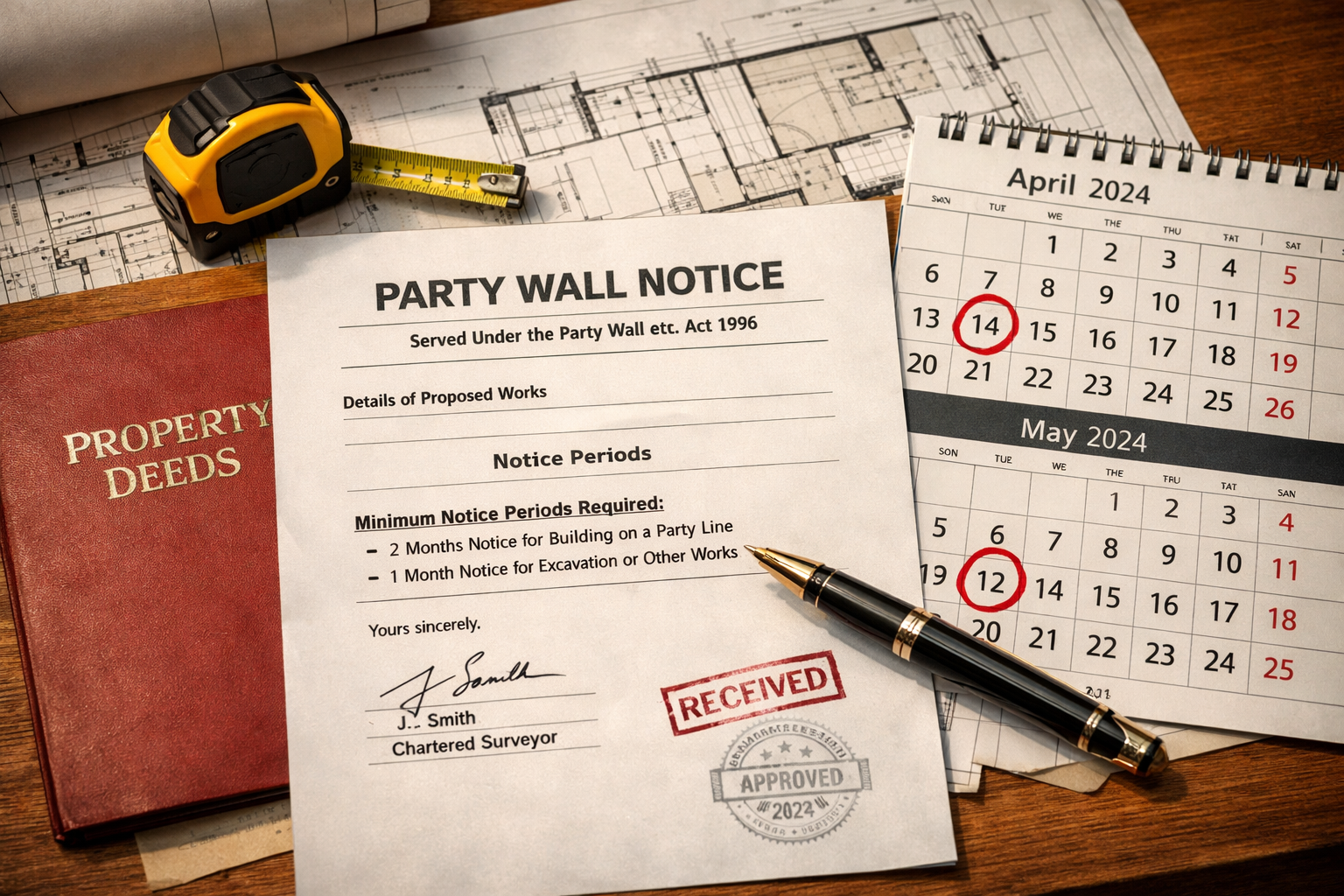
    [7] Rics Consumer Guide Party Walls – https://www.ricsfirms.com/residential/legal-issues/party-walls/rics-consumer-guide-party-walls/

    [8] Building Surveying Standards – https://www.rics.org/profession-standards/rics-standards-and-guidance/sector-standards/building-surveying-standards

  • Party Wall Act Guide for First-Time Developers 2026

    Northern England’s property market is experiencing unprecedented growth in 2026, with first-time developers seizing opportunities in cities like Manchester, Leeds, and Newcastle. As terraced housing renovations and urban infill projects multiply, understanding the Party Wall Act 1996 has never been more critical. Yet for newcomers to development, the legislation can feel like navigating a legal maze—one wrong turn, and your entire project grinds to a halt.

    This comprehensive guide demystifies the Party Wall Act Essentials for First-Time Developers: Navigating Notices and Agreements in Northern England’s 2026 Surge, providing step-by-step instructions to serve notices correctly, secure neighbour agreements, and keep surveyor fees from spiraling out of control. Whether you’re converting a Victorian terrace loft or building an extension on a semi-detached property, this article equips you with the knowledge to comply with the law while protecting your budget and timeline.

    Key Takeaways

    The Party Wall Act 1996 applies exclusively to England and Wales—developers in Northern England must comply with specific notice requirements before starting construction work affecting shared walls or boundaries[1].

    Two distinct notice periods exist: two months for works affecting party walls or party structures, and one month for excavation or new boundary wall construction, with neighbours having 14 days to respond[1][3].

    Not all construction requires formal agreements—plastering, electrical work, and drilling interior walls for fixtures are exempt from Party Wall Act procedures[1].

    Failing to serve proper notice can halt your project—neighbours may obtain injunctions, and you’ll face complications during property sales and weakened positions in future disputes[1][2].

    Cost-effective pathways exist—first-time developers can secure direct written consent from neighbours without appointing surveyors, dramatically reducing expenses in cooperative scenarios[1].

    Understanding the Party Wall Act 1996: Jurisdiction and Application in Northern England

    Detailed landscape format (1536x1024) infographic showing three-column comparison chart titled 'Party Wall Act 1996: What Works Require Noti

    What Is the Party Wall Act and Where Does It Apply?

    The Party Wall etc. Act 1996 is legislation governing construction work on shared walls, boundaries, and excavations near neighbouring properties. Critically, this Act applies exclusively to England and Wales—it does not extend to Scotland or Northern Ireland[1]. For developers working in Northern England’s booming markets of Manchester, Leeds, Sheffield, or Newcastle, compliance with this Act is mandatory for qualifying construction projects.

    The legislation exists to balance property owners’ rights to improve their buildings with neighbours’ rights to protect their properties from damage. It establishes formal procedures for notifying adjacent property owners, obtaining consent, and resolving disputes through appointed surveyors when agreement cannot be reached directly.

    Why Northern England’s 2026 Development Surge Demands Party Wall Expertise

    Northern England is experiencing a construction renaissance in 2026, driven by affordability pressures pushing buyers and developers northward from overheated southern markets[9]. This surge brings thousands of first-time developers into the market—individuals purchasing Victorian terraces for conversion, semi-detached properties for extension, or infill plots for new construction.

    The region’s characteristic terraced housing stock means party walls are ubiquitous. Unlike detached properties common in newer suburbs, Northern England’s urban fabric consists predominantly of properties sharing structural walls with neighbours. This architectural reality makes Party Wall Act compliance not an occasional concern but a standard requirement for most development projects.

    Additionally, the Building Safety Levy scheduled to take effect October 1, 2026[5], may accelerate project timelines as developers rush to commence work before additional costs apply. This urgency makes understanding streamlined Party Wall procedures—particularly cost-effective direct neighbour agreements—essential for maintaining project viability.

    Common Misconceptions About Party Wall Requirements

    Myth 1: “I only need to worry about party walls if I’m doing major structural work.”

    Reality: Even seemingly minor works like inserting a damp proof course require formal Party Wall notices if they affect a shared wall[1]. Understanding which types of party wall works trigger the Act prevents costly compliance failures.

    Myth 2: “The Act applies throughout the UK.”

    Reality: The Party Wall Act 1996 applies only to England and Wales[1]. Developers working across multiple UK regions must understand jurisdictional differences.

    Myth 3: “I always need to hire an expensive surveyor.”

    Reality: If your neighbour consents in writing to your proposed works, you can proceed without appointing surveyors, saving thousands of pounds[1]. The surveyor pathway only becomes necessary when neighbours dissent or fail to respond within 14 days.

    Party Wall Act Essentials: Which Works Require Notices and Agreements?

    Works Requiring Two-Month Notice Period

    The Act mandates two months’ written notice for the following construction activities[1]:

    🏗️ Loft Conversions

    Converting attic space in terraced or semi-detached properties almost always involves party walls. Steel beam installation, floor joist work, and structural modifications to shared walls all trigger notice requirements. Given Northern England’s abundance of Victorian and Edwardian terraces with conversion potential, this represents one of the most common scenarios for first-time developers.

    🏗️ Building Extensions

    Single-storey rear extensions, side returns, and two-storey additions frequently require work on or near party walls. Even if your extension doesn’t directly modify the shared wall, excavating foundations within certain distances of your neighbour’s structure triggers notice requirements (covered below).

    🏗️ Damp Proof Course (DPC) Insertion

    Retrofitting damp proof courses in older properties—a common necessity in Northern England’s aging housing stock—requires cutting into walls. When performed on party walls, this necessitates formal notice[1].

    🏗️ Structural Alterations

    Removing chimney breasts (particularly when shared between properties), inserting steel beams, or underpinning party walls all require two-month notice periods. For detailed guidance on serving these notices, consult our resource on party wall notices.

    Works Requiring One-Month Notice Period

    🏗️ Excavation Within Three Meters

    If you’re excavating within three meters of your neighbour’s structure and your excavation will go deeper than their foundations, you must serve one month’s notice[1]. This commonly affects basement conversions and foundation work for extensions.

    🏗️ Excavation Within Six Meters

    For excavations within six meters of a neighbour’s structure, notice is required if you’re digging deeper than a line drawn at 45 degrees from the bottom of their foundations[1].

    🏗️ New Boundary Walls

    Constructing a new wall directly on the boundary line between properties requires one month’s notice[3]. Understanding the distinction between party fence walls and boundary walls helps developers navigate these requirements correctly.

    Works EXEMPT from Party Wall Requirements

    Not every construction activity triggers Party Wall Act procedures. The following works do not require formal notices or agreements[1]:

    Plastering and decorating interior surfaces of party walls
    Electrical installations including socket outlets and lighting
    Drilling interior walls for kitchen units, shelving, or picture hanging
    Plumbing work that doesn’t involve cutting into structural elements
    Cosmetic repairs to party wall surfaces

    Understanding these exemptions prevents unnecessary delays and costs. First-time developers often over-comply, assuming every interaction with a party wall requires formal procedures. Focusing compliance efforts only where legally required streamlines projects and preserves neighbour relationships.

    Special Considerations for Northern England’s Housing Stock

    Northern England’s characteristic Victorian and Edwardian terraced housing presents unique Party Wall challenges:

    Shared Chimney Stacks: Many terraces share chimney stacks between properties. Removing chimney breasts requires careful consideration of structural implications for both properties.

    Cellar Conversions: Basement spaces in older terraces often extend beneath the party wall. Converting these spaces triggers both party wall and excavation notice requirements.

    Rear Extensions on Terraces: The typical terraced layout means rear extensions almost always involve work near or on party walls separating properties.

    Historic Construction Methods: Older properties may have party walls constructed with materials and techniques that require specialist assessment, particularly when planning structural alterations.

    Navigating the Notice Process: Step-by-Step Guide for First-Time Developers

    Step 1: Identify All Affected Neighbours

    Before drafting notices, create a comprehensive list of all adjoining owners—anyone with a legal interest in properties sharing walls or boundaries with your development site. This includes:

    • Direct neighbours sharing party walls
    • Properties within three to six meters of planned excavations
    • Leaseholders and freeholders (both must be notified)
    • Tenants with specific property interests

    Common mistake: First-time developers often notify only the immediate neighbour while overlooking other affected parties, invalidating the entire notice process.

    Step 2: Prepare Compliant Party Wall Notices

    Party Wall Notices must include specific information to be legally valid[4]:

    📋 Essential Notice Components:

    1. Work description: Detailed explanation of proposed construction activities
    2. Party wall location: Precise identification of affected walls or boundaries
    3. Project timeline: Proposed start date (must be at least two months or one month ahead, depending on work type)
    4. Your contact information: Full name, address, and contact details
    5. Building owner declaration: Statement of your rights under the Act

    The notice must be served in writing—verbal notifications have no legal standing[4]. For those seeking templates and guidance, our sample party wall agreement template provides a starting framework.

    Step 3: Serve Notices Correctly and Document Delivery

    Acceptable Service Methods:

    • Hand delivery: Personally delivering the notice to your neighbour (obtain signed receipt)
    • Registered post: Sending via Royal Mail Signed For or Special Delivery (retain proof of postage and delivery)
    • Standard post: Legally acceptable but risky as you cannot prove delivery
    • Email: Only if the neighbour explicitly agrees to electronic service

    Best practice: Use registered post with proof of delivery, and follow up with a courtesy copy via email or hand delivery. Document everything—photograph the notice, retain postal receipts, and save email confirmations.

    Timing calculation: The notice period begins the day after the neighbour receives the notice, not the day you send it[1].

    Step 4: Understand Your Neighbour’s Response Options

    After receiving your notice, neighbours have 14 days to respond[3]. They have three options:

    Option 1: Written Consent

    Your neighbour provides written agreement to the proposed works. This is the ideal outcome for first-time developers as it allows you to proceed without appointing surveyors, dramatically reducing costs. Ensure consent is documented in writing—verbal agreement is insufficient.

    For guidance on proceeding without surveyors, see our article on having a party wall agreement without a surveyor.

    Option 2: Written Dissent

    Your neighbour objects to the works or specific aspects of your proposal. This triggers the Party Wall Award process, requiring surveyor appointments (detailed below).

    Option 3: No Response

    If your neighbour fails to respond within 14 days, this is legally treated as dissent[3]. You must proceed with the surveyor appointment process—you cannot interpret silence as consent.

    Step 5: Navigate the Party Wall Award Process (When Required)

    When neighbours dissent or fail to respond, the Act provides a structured dispute resolution mechanism:

    Surveyor Appointment Options:

    1. Agreed Surveyor: Both parties jointly appoint a single surveyor to act impartially (most cost-effective surveyor route)
    2. Two Surveyors: Each party appoints their own surveyor, who then appoint a third surveyor to resolve disagreements (more expensive)
    3. Building Owner’s Surveyor: If the neighbour doesn’t appoint a surveyor within 10 days, you can appoint one on their behalf[1]

    The appointed surveyor(s) will:

    • Inspect both properties
    • Prepare a Schedule of Condition documenting pre-existing conditions
    • Draft a Party Wall Award detailing permitted works, working methods, and timelines
    • Determine cost allocation (typically the building owner pays all surveyor fees)

    For comprehensive information on this process, review our guide on party wall awards.

    Cost implications: Surveyor fees for straightforward residential projects typically range from £700 to £2,000+, depending on complexity and whether you use an agreed surveyor or two separate surveyors. Understanding how to keep party wall costs down becomes crucial for budget-conscious first-time developers.

    Step 6: Create a Schedule of Condition

    Whether working with surveyors or proceeding with neighbour consent, creating a Schedule of Condition is essential. This photographic and written record documents the condition of your neighbour’s property before work commences, providing crucial evidence if damage disputes arise later.

    What to document:

    • Interior walls adjacent to party walls
    • Ceilings and floors
    • External walls and facades
    • Existing cracks, stains, or defects
    • Decorative finishes

    Professional surveyors prepare comprehensive schedules, but even with direct neighbour agreements, first-time developers should create basic photographic records with timestamps. Learn more about this protective measure in our schedule of condition resource.

    Step 7: Understand the Appeals Process

    Both parties have 14 days to appeal a Party Wall Award to County Court after it’s served[1]. Appeals are rare but can occur when:

    • A party believes the award is unfair or unreasonable
    • Procedural errors occurred during the surveyor process
    • Significant factual disputes exist about property conditions

    For first-time developers: The appeals process represents another reason to maintain cooperative neighbour relationships and work with experienced surveyors who produce defensible awards.

    Cost Management Strategies: Keeping Party Wall Expenses Under Control in 2026

    The True Cost of Party Wall Compliance

    Understanding the full financial picture helps first-time developers budget accurately:

    Scenario 1: Direct Neighbour Consent 💰

    • Notice preparation: £0-£200 (DIY or solicitor assistance)
    • Postal/delivery costs: £10-£20
    • Optional basic Schedule of Condition: £0-£300 (DIY photography or professional)
    • Total: £10-£520

    Scenario 2: Agreed Surveyor Appointment 💰💰

    • Notice preparation: £0-£200
    • Agreed surveyor fees: £700-£1,200
    • Schedule of Condition: Included in surveyor fees
    • Total: £700-£1,400

    Scenario 3: Two Surveyor Appointments 💰💰💰

    • Notice preparation: £0-£200
    • Your surveyor fees: £800-£1,500
    • Neighbour’s surveyor fees: £800-£1,500 (you pay both)
    • Third surveyor fees (if required): £500-£1,000
    • Total: £2,100-£4,200+

    For detailed cost breakdowns, consult our comprehensive guide on costs of the party wall process.

    Strategies to Minimize Party Wall Costs

    Strategy 1: Prioritize Neighbour Communication 🤝

    The single most effective cost-control measure is securing direct neighbour consent. First-time developers should:

    • Communicate early: Discuss plans informally before serving formal notices
    • Be transparent: Share architectural drawings and explain how you’ll minimize disruption
    • Address concerns proactively: If neighbours worry about noise, offer to limit working hours
    • Put agreements in writing: Even friendly neighbours need formal written consent

    Real-world example: A Manchester developer converting a terraced house loft saved £1,800 in surveyor fees by meeting neighbours for coffee, walking them through plans, and addressing concerns about structural safety before serving formal notices. Both neighbours provided written consent within a week.

    Strategy 2: Choose the Right Surveyor Pathway

    If surveyor appointment becomes necessary:

    • Propose an agreed surveyor: This single-surveyor approach typically costs 30-40% less than two separate surveyors
    • Research surveyors’ fee structures: Some charge flat fees; others bill hourly
    • Verify qualifications: Ensure surveyors are members of the Faculty of Party Wall Surveyors or Royal Institution of Chartered Surveyors
    • Get written fee quotes: Avoid open-ended fee arrangements

    Strategy 3: Prepare Thoroughly Before Serving Notices

    Rushed or incomplete notices lead to disputes and delays:

    • Finalize designs first: Don’t serve notices until architectural plans are complete
    • Identify all affected parties: Missing even one adjoining owner invalidates the process
    • Use clear, jargon-free language: Neighbours who understand your plans are more likely to consent
    • Include helpful visuals: Annotated drawings showing exactly what you’re doing help neighbours visualize work

    Strategy 4: Understand What You’re Legally Required to Pay

    Under the Party Wall Act:

    • Building owners pay their own surveyor fees: This is standard
    • Building owners typically pay neighbours’ surveyor fees: This is also standard practice[1]
    • Building owners pay for damage repairs: Any damage caused by your works is your financial responsibility

    However, neighbours cannot use the Party Wall process to demand improvements to their property or extract unreasonable concessions. Surveyors must act impartially, and awards must be reasonable.

    Northern England-Specific Cost Considerations in 2026

    Regional factors affecting Party Wall costs in Northern England:

    Lower surveyor fees: Northern England generally has lower professional fees than London and the Southeast, with typical agreed surveyor fees ranging £700-£1,200 versus £1,200-£2,000+ in London.

    Higher construction activity: The 2026 construction boom[6] means surveyors are in high demand. Booking surveyors early prevents delays and may secure better rates.

    Building Safety Levy impact: The October 1, 2026 implementation of the Building Safety Levy[5] may indirectly affect Party Wall timelines as developers accelerate projects, creating surveyor capacity constraints.

    Terraced housing prevalence: The region’s housing stock means party wall compliance is nearly universal for development projects, making local surveyors highly experienced with typical scenarios—potentially streamlining the process.

    Consequences of Non-Compliance: What Happens When You Skip Party Wall Procedures

    Detailed landscape format (1536x1024) step-by-step process flowchart showing Party Wall Notice serving procedure. Visual timeline from left

    Legal Consequences: Injunctions and Work Stoppages

    The most immediate risk of failing to serve proper Party Wall notices is a neighbour-obtained injunction halting your construction project[2]. Courts take Party Wall Act compliance seriously, and judges routinely grant injunctions when building owners proceed without following statutory procedures.

    Real-world scenario: A Leeds developer began a loft conversion without serving Party Wall notices, assuming their friendly neighbour wouldn’t object. Midway through the project, the neighbour discovered structural cracks in their property. Despite the developer’s willingness to make repairs, the neighbour obtained a court injunction stopping all work until proper Party Wall procedures were completed retroactively. The project delay cost the developer:

    • Three months of lost construction time
    • £4,500 in emergency surveyor fees (higher than standard rates due to urgency)
    • £2,800 in legal fees defending the injunction application
    • £6,000 in contractor standby costs and remobilization
    • Damage to the neighbour relationship, complicating future projects

    Evidential Consequences: Inability to Prove Pre-Existing Conditions

    Without a properly prepared Schedule of Condition, developers cannot definitively prove whether damage existed before their work commenced[1][2]. This creates several problems:

    Dispute vulnerability: Neighbours can claim your work caused pre-existing damage, and you’ll lack evidence to refute these claims.

    Insurance complications: Professional indemnity and construction insurance may not cover damage claims when you’ve failed to follow statutory procedures.

    Financial exposure: You may end up paying for repairs to damage you didn’t cause, simply because you cannot prove the damage predated your work.

    Example: A Newcastle developer extended a semi-detached property without serving Party Wall notices or creating a Schedule of Condition. After completion, the neighbour claimed the work caused ceiling cracks and demanded £3,200 in repairs. The developer believed the cracks existed previously but had no photographic evidence. Faced with potential litigation costs exceeding the repair costs, the developer settled and paid for repairs they likely didn’t cause.

    Property Transaction Consequences

    Party Wall non-compliance creates complications when selling your developed property:

    Solicitor inquiries: Buyers’ solicitors routinely ask whether Party Wall procedures were followed for recent construction work[2].

    Sale delays: Discovering non-compliance during conveyancing can delay or derail sales as you scramble to regularize the situation.

    Price reductions: Buyers may demand price reductions to account for potential neighbour disputes or liability risks.

    Indemnity insurance: You may need to purchase costly indemnity insurance to protect buyers against future claims—insurance that wouldn’t be necessary with proper compliance.

    Weakened Position in Future Disputes

    Perhaps most insidiously, Party Wall non-compliance weakens your position in any future property disputes with neighbours[1][2]:

    Credibility damage: Courts and surveyors view previous non-compliance unfavorably when assessing current disputes.

    Reciprocal obligations: If your neighbour later serves Party Wall notices for their work, you’ll have limited moral authority to raise concerns or request protective measures.

    Relationship deterioration: Neighbours who discover you bypassed legal requirements lose trust, making cooperative resolution of future issues nearly impossible.

    How to Remedy Non-Compliance

    If you’ve already started work without proper Party Wall procedures:

    1. Stop work immediately: Continuing compounds the problem
    2. Consult a Party Wall surveyor urgently: Explain the situation and seek guidance on retroactive compliance
    3. Communicate with neighbours: Acknowledge the oversight and propose a path forward
    4. Serve notices retroactively: While not ideal, late compliance is better than continued non-compliance
    5. Document current conditions: Create a Schedule of Condition immediately to establish a baseline
    6. Consider legal advice: For complex situations, consult a property solicitor

    The costs and complications of remedying non-compliance almost always exceed the costs of doing it right initially—making proper Party Wall procedures a wise investment for first-time developers.

    Regional Insights: Party Wall Considerations Specific to Northern England’s 2026 Market

    Northern England’s Property Development Landscape in 2026

    Northern England is experiencing a development renaissance driven by multiple converging factors[9]:

    Affordability Migration: Southern buyers and investors, priced out of London and Southeast markets, are driving demand northward. Cities like Manchester, Leeds, and Newcastle offer Victorian terraces at £200,000-£350,000—properties that would command £600,000+ in London—creating attractive development opportunities.

    Urban Regeneration: Major infrastructure investments, including Northern Powerhouse Rail planning and city center regeneration schemes, are catalyzing development activity in previously overlooked areas.

    First-Time Developer Entry: Lower property prices enable first-time developers to enter the market with smaller capital requirements, but many lack experience with Party Wall procedures.

    Terraced Housing Dominance: Unlike newer suburban developments with detached properties, Northern England’s urban cores consist predominantly of Victorian and Edwardian terraces—meaning Party Wall considerations affect nearly every development project.

    Characteristic Party Wall Scenarios in Northern England

    Scenario 1: Victorian Terrace Loft Conversions 🏠

    The region’s abundant Victorian terraces present classic Party Wall challenges. Typical issues include:

    • Shared chimney stacks: Many terraces have chimney stacks straddling party walls
    • Roof structure: Hip-to-gable conversions affect roof structures that may extend over party walls
    • Floor joists: Original construction often has joists embedded in party walls
    • Access: Narrow terraced plots mean scaffolding may need to overhang neighbours’ properties

    Developer tip: When planning loft conversions in terraces, engage structural engineers early to identify party wall implications before finalizing designs.

    Scenario 2: Side Return Extensions 🏠

    Popular in terraced properties with side access, these extensions typically involve:

    • Boundary wall construction: New walls directly on property boundaries
    • Excavation near neighbours: Foundation work within three meters of adjoining structures
    • Roof tie-ins: Connecting new roofs to existing party walls

    Developer tip: Side returns often require both party wall notices (for the new boundary wall) and excavation notices (for foundations), each with different notice periods. Plan timelines accordingly.

    Scenario 3: Cellar and Basement Conversions 🏠

    Converting existing cellars or creating new basements involves complex Party Wall considerations:

    • Underpinning party walls: Deepening foundations beneath shared walls
    • Excavation proximity: Working within three to six meters of neighbours’ foundations
    • Structural loading changes: Altering how loads transfer through party walls

    Developer tip: Basement projects almost always require surveyor involvement due to technical complexity. Budget £1,500-£3,000 for Party Wall procedures on these projects.

    Working with Northern England’s Building Control Authorities

    While Party Wall compliance is separate from Building Regulations approval, coordinating both processes streamlines development:

    Timeline coordination: Serve Party Wall notices while preparing Building Control applications to avoid sequential delays.

    Structural calculations: Engineers’ calculations required for Building Control often inform Party Wall Awards, so commission these early.

    Inspection scheduling: Coordinate Building Control inspections with Party Wall surveyors’ site visits to minimize disruption.

    Regional Surveyor Availability and Selection

    Northern England’s 2026 construction boom[6] means surveyor demand is high. First-time developers should:

    Book early: Contact surveyors as soon as neighbours dissent or fail to respond—don’t wait.

    Verify local experience: Choose surveyors familiar with Northern England’s characteristic housing stock and construction methods.

    Check professional memberships: Verify membership in the Faculty of Party Wall Surveyors or RICS.

    Request references: Ask for references from recent clients with similar project types.

    Compare fee structures: Get written quotes from multiple surveyors before appointing.

    Practical Tools and Templates for First-Time Developers

    Essential Documents and Templates

    Party Wall Notice Template 📄

    While professional assistance is advisable for complex projects, straightforward scenarios may use template notices. Key sections include:

    • Building owner details and property address
    • Adjoining owner details and property address
    • Detailed work description with reference to specific Act sections
    • Proposed start date (respecting minimum notice periods)
    • Invitation for neighbour to consent or appoint a surveyor
    • Contact information for questions

    Access our party wall structure notice guide for detailed serving instructions.

    Neighbour Consent Form 📄

    When neighbours agree to your works, document consent with:

    • Clear identification of consenting neighbour
    • Acknowledgment they’ve received and understood your notice
    • Explicit consent to proceed with described works
    • Date and signature
    • Witness signature (recommended but not legally required)

    Schedule of Condition Template 📄

    Basic schedules should include:

    • Date and time of inspection
    • Room-by-room photographic documentation
    • Written descriptions of existing conditions
    • Notation of pre-existing cracks, stains, or defects
    • Signatures of both parties (if neighbour cooperates)

    Checklists for First-Time Developers

    Pre-Notice Checklist

    • Finalize architectural and structural designs
    • Identify all adjoining owners (including leaseholders and freeholders)
    • Determine which type of notice is required (party wall or excavation)
    • Calculate correct notice period (two months or one month)
    • Prepare clear work descriptions and drawings
    • Research surveyor options in case neighbours dissent
    • Budget for potential surveyor costs

    Notice Service Checklist

    • Draft compliant notice with all required information
    • Prepare copies for all adjoining owners
    • Choose service method (registered post recommended)
    • Serve notices with appropriate lead time
    • Document service with proof of delivery
    • Diarize 14-day response deadline
    • Prepare follow-up communication for non-responders

    Post-Consent Checklist

    • Obtain written consent from all neighbours
    • Create Schedule of Condition (even with consent)
    • File all documentation securely
    • Inform contractors they can proceed
    • Maintain communication with neighbours during works
    • Document completion and any issues
    • Conduct post-work inspection with neighbours

    Technology Tools for Party Wall Management

    Digital Documentation 📱

    Modern first-time developers can leverage technology:

    • Timestamped photography apps: Apps like Timestamp Camera automatically embed date/time metadata in photos for Schedules of Condition
    • Cloud storage: Store all Party Wall documentation in cloud services (Google Drive, Dropbox) for easy access and backup
    • Email tracking: Use read receipt features to confirm neighbours received electronic communications
    • Project management apps: Tools like Trello or Asana help track notice deadlines and surveyor appointments

    Communication Platforms 📱

    Maintain neighbour relationships with:

    • WhatsApp groups: Create project update groups for transparent communication
    • Email updates: Send weekly progress reports during construction
    • Video calls: For neighbours who can’t attend site meetings, offer video walkthroughs

    Common Pitfalls and How to Avoid Them

    Pitfall 1: Assuming Friendly Neighbours Don’t Need Formal Notices

    The mistake: First-time developers often believe good neighbour relationships eliminate the need for formal Party Wall procedures.

    The reality: The Party Wall Act is statutory legislation—it applies regardless of relationship quality[1]. Even the friendliest neighbour cannot waive your legal obligation to serve proper notices.

    The solution: Serve formal notices to all neighbours, but accompany them with friendly, informal communication explaining the process and your plans. Frame compliance as protecting both parties’ interests.

    Pitfall 2: Serving Notices Too Late

    The mistake: Developers finalize contractor schedules, then realize they need two months’ notice before work can legally commence.

    The reality: Notice periods are minimum requirements—you cannot shorten them regardless of urgency[1].

    The solution: Incorporate Party Wall timelines into project planning from day one. Serve notices as soon as designs are finalized, even if construction is months away. For guidance on timing, review our resource on party wall act notices and how to respond.

    Pitfall 3: Inadequate Work Descriptions

    The mistake: Vague notices stating “extension works” or “loft conversion” without technical details.

    The reality: Neighbours and surveyors need specific information to assess implications and provide informed consent or awards.

    The solution: Include detailed descriptions referencing architectural drawings, structural calculations, and specific Party Wall Act sections. Specify:

    • Exact wall locations and dimensions
    • Structural modifications (beam insertions, joist work, etc.)
    • Excavation depths and distances
    • Proposed working methods and timelines

    Pitfall 4: Ignoring Non-Responding Neighbours

    The mistake: Assuming neighbour silence equals consent and proceeding with work after 14 days.

    The reality: Non-response is legally treated as dissent, requiring surveyor appointment[3].

    The solution: If neighbours don’t respond within 14 days, immediately initiate surveyor appointment procedures. Send a follow-up letter explaining that non-response triggers the surveyor process and inviting them to appoint their own surveyor or agree to a single agreed surveyor.

    Pitfall 5: Skipping Schedules of Condition

    The mistake: Proceeding without photographic documentation of neighbours’ properties before work commences.

    The reality: Without baseline documentation, you’re vulnerable to damage claims for pre-existing conditions[1][2].

    The solution: Always create a Schedule of Condition, even when neighbours provide written consent and surveyors aren’t appointed. The modest cost (or time investment for DIY schedules) provides invaluable protection.

    Pitfall 6: Choosing Surveyors Based Solely on Price

    The mistake: Appointing the cheapest surveyor to minimize costs.

    The reality: Inexperienced or unqualified surveyors may produce deficient awards that fail to protect your interests or lead to disputes.

    The solution: Evaluate surveyors based on:

    • Professional qualifications and memberships
    • Experience with similar project types
    • References from recent clients
    • Understanding of local building practices
    • Communication skills and responsiveness
    • Then consider price among qualified candidates

    Pitfall 7: Poor Communication During Construction

    The mistake: Serving proper notices, then failing to keep neighbours informed during actual construction.

    The reality: Even with formal compliance, poor communication during works damages relationships and can lead to complaints or disputes.

    The solution: Maintain proactive communication:

    • Provide advance notice of particularly noisy or disruptive work
    • Share updated timelines when delays occur
    • Respond promptly to neighbour concerns
    • Invite neighbours to inspect work at key milestones
    • Address minor issues before they escalate

    Future-Proofing Your Development: Beyond Initial Compliance

    Detailed landscape format (1536x1024) cost-saving strategy visualization showing split-screen comparison. Left side titled 'Without Surveyor

    Maintaining Records for Property Sales

    First-time developers planning to sell completed projects must maintain comprehensive Party Wall documentation:

    Essential records to preserve:

    • Original Party Wall notices and proof of service
    • Neighbour consent letters or Party Wall Awards
    • Schedules of Condition (before and after)
    • Surveyor correspondence and reports
    • Photographic documentation of work progress
    • Completion certificates and final inspections

    Storage recommendations: Create both physical and digital archives. Buyers’ solicitors will request these documents during conveyancing, and inability to produce them can derail sales.

    Building Long-Term Neighbour Relationships

    For developers planning multiple projects or buy-to-let portfolios, neighbour relationships are valuable assets:

    Best practices:

    • Exceed minimum requirements: Offer more protective measures than legally required
    • Maintain properties well: Demonstrate you’re a responsible owner
    • Be responsive: Address concerns promptly, even after projects complete
    • Share expertise: Help neighbours navigate their own Party Wall procedures when they undertake work

    Long-term benefits: Developers with strong neighbour relationships secure consent more easily on future projects, receive fewer complaints, and build reputations that facilitate additional opportunities.

    Understanding Evolving Legislation

    While the Party Wall Act 1996 itself remains stable, related legislation evolves:

    Building Safety Act 2022: Introduced enhanced building safety requirements that may interact with Party Wall procedures for certain projects.

    Building Safety Levy (October 1, 2026): This new levy applies to residential buildings in England requiring Building Control approval[5]. While not directly part of Party Wall legislation, it affects project economics and timelines.

    Local authority variations: Some councils have additional requirements or guidance supplementing the Party Wall Act.

    Best practice: First-time developers should consult the Party Wall etc. Act 1996 periodically and work with professionals who stay current on legislative changes.

    Conclusion: Empowering First-Time Developers in Northern England’s 2026 Market

    The Party Wall Act Essentials for First-Time Developers: Navigating Notices and Agreements in Northern England’s 2026 Surge need not be intimidating. While the legislation imposes specific requirements, understanding these procedures transforms compliance from a barrier into a manageable project component—one that protects both your investment and your neighbour relationships.

    Northern England’s 2026 development boom presents extraordinary opportunities for first-time developers willing to navigate the region’s characteristic terraced housing stock and party wall complexities. The strategies outlined in this guide—prioritizing neighbour communication, serving compliant notices with appropriate lead times, choosing cost-effective surveyor pathways when necessary, and maintaining comprehensive documentation—enable developers to comply with the law while controlling costs.

    Remember the key principles:

    🎯 Serve proper notices for all qualifying works—the two-month or one-month lead time is non-negotiable[1]

    🎯 Pursue direct neighbour consent whenever possible—this dramatically reduces costs compared to surveyor appointments

    🎯 Always create a Schedule of Condition—this modest investment provides invaluable protection against damage disputes[1][2]

    🎯 Choose qualified surveyors when needed—professional expertise prevents costly mistakes

    🎯 Maintain excellent documentation—comprehensive records protect you during construction and property sales

    Actionable Next Steps for Your Development Project

    If you’re planning a development project in Northern England:

    1. Review your plans against Party Wall Act requirements using the work categories outlined in this guide
    2. Identify all adjoining owners who must receive notices
    3. Calculate notice periods and incorporate them into your project timeline
    4. Draft compliant notices or engage professional assistance for complex projects
    5. Initiate neighbour communication before serving formal notices to build cooperative relationships
    6. Serve notices via registered post and document delivery meticulously
    7. Prepare for both consent and dissent scenarios by researching local surveyors
    8. Create Schedules of Condition before work commences, regardless of the consent pathway
    9. Maintain communication with neighbours throughout construction
    10. Archive all documentation for future property transactions

    For additional support:

    The Party Wall Act exists to balance competing interests—your right to improve your property and your neighbours’ right to protection from damage. By embracing these procedures rather than viewing them as obstacles, first-time developers in Northern England’s surging 2026 market can execute successful projects that enhance properties, preserve relationships, and comply fully with the law.

    Your development journey begins with knowledge, proceeds with proper procedure, and succeeds through diligent execution. Armed with the Party Wall Act essentials outlined in this guide, you’re equipped to navigate notices and agreements confidently, keeping your Northern England development project on schedule and on budget.


    References

    [1] Party Wall Agreement – https://hoa.org.uk/advice/guides-for-homeowners/i-am-improving/party-wall-agreement/

    [2] What Happens If I Forget To Follow The Party Wall Procedure – https://www.adamjoseph.co.uk/what-happens-if-i-forget-to-follow-the-party-wall-procedure

    [3] How Close Can My Neighbour Build To My Fence Learn The Party Fence Wall Rules – https://www.surveymerchant.com/blog/how-close-can-my-neighbour-build-to-my-fence-learn-the-party-fence-wall-rules

    [4] Party Wall Agreement – https://www.moveiq.co.uk/blog/managing-your-home/party-wall-agreement/

    [5] Construction Look Ahead 2026 What You Need To Know Key Legislations And Updates – https://www.herrington-carmichael.com/construction-look-ahead-2026-what-you-need-to-know-key-legislations-and-updates/

    [6] Party Wall Surveys Amid 2026 Construction Boom Handling Disputes In High Demand Uk Housing Markets – https://nottinghillsurveyors.com/blog/party-wall-surveys-amid-2026-construction-boom-handling-disputes-in-high-demand-uk-housing-markets
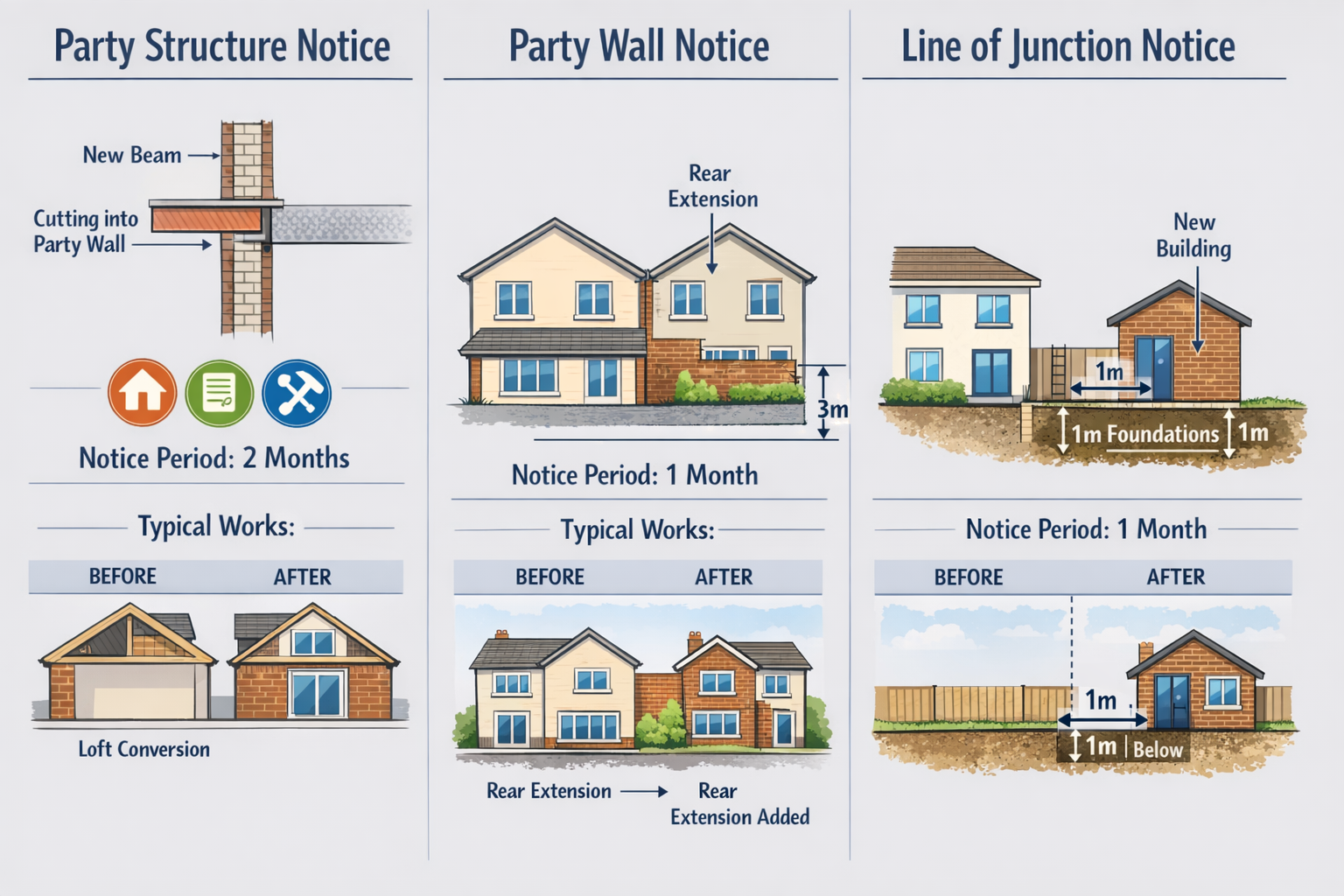
    [7] Commercial Real Estate Disputes In 2026 Whats Coming Into View – https://www.ashurst.com/en/insights/commercial-real-estate-disputes-in-2026-whats-coming-into-view/

    [8] Legal Tips For Kent Property Owners On Party Walls – https://fpws-kent.co.uk/legal-tips-for-kent-property-owners-on-party-walls/

    [9] Valuing Northern England Properties In 2026 Surveyor Tactics For Outpacing Southern Affordability Pressures – https://nottinghillsurveyors.com/blog/valuing-northern-england-properties-in-2026-surveyor-tactics-for-outpacing-southern-affordability-pressures

  • Party Wall Notices: 2026 UK Best Practices & Disputes

    As the UK experiences a significant construction boom in 2026, understanding Party Wall Notices Under the Party Wall Act: Best Practices for 2026’s UK Construction Uptick and Neighbor Disputes has never been more critical for homeowners, developers, and construction professionals. With housing demand surging and renovation projects multiplying across England and Wales, knowing how to properly serve notices, navigate timelines, and respond to neighbor concerns can mean the difference between smooth construction progress and costly legal disputes. This comprehensive guide breaks down everything property owners need to know about party wall procedures in today’s high-demand housing market.

    Key Takeaways

    • Two-month notice required for works affecting existing party walls (loft conversions, structural modifications), while excavation and new boundary structures require one-month notice
    • 📋 Neighbors cannot permanently block your project – the Party Wall Act provides dispute resolution mechanisms that allow work to proceed with protective measures
    • 💷 Early compliance saves money – proper notice procedures and cooperative agreements can reduce surveyor costs from £5,000+ to £1,000-£2,500
    • 📸 Documentation protects all parties – schedule of condition surveys with photographs safeguard both building and adjoining owners during construction
    • 🏴󠁧󠁢󠁥󠁮󠁧󠁿 England and Wales only – the Party Wall Act 1996 doesn’t apply in Scotland or Northern Ireland, which have different legal frameworks

    Understanding the Party Wall Act 1996 Framework

    Detailed landscape format (1536x1024) image showing formal Party Wall Notice document on wooden desk with official stamps and signatures, ca

    The Party Wall etc. Act 1996 provides the legal foundation for managing construction works that affect shared walls, boundaries, and structures between neighboring properties in England and Wales. This legislation creates a balanced framework that protects the rights of both building owners who want to carry out works and adjoining owners whose properties may be affected.[2]

    What Qualifies as a Party Wall?

    A party wall is any wall or structure that stands on the boundary between two properties and is used by both owners. This includes:

    • 🏠 Walls separating semi-detached or terraced houses
    • 🧱 Shared garden walls between properties
    • 🏢 Walls dividing different units in converted buildings
    • 🔧 Floor and ceiling structures separating flats in different ownership

    Understanding what constitutes a party fence wall versus other boundary structures is essential for determining whether the Act applies to your planned works.[3]

    Geographic Limitations and Jurisdiction

    Important: The Party Wall Act 1996 applies exclusively to England and Wales. Property owners in Scotland and Northern Ireland operate under completely different legal frameworks for boundary and shared wall matters.[2] This geographic limitation becomes particularly relevant in 2026 as construction activity increases across all UK regions, requiring property owners to verify which regulations govern their specific location.

    Types of Party Wall Notices: When and How to Serve

    Navigating Party Wall Notices Under the Party Wall Act: Best Practices for 2026’s UK Construction Uptick and Neighbor Disputes requires understanding which type of notice applies to your specific construction project. The Act establishes three distinct notice categories, each with unique timelines and requirements.

    Party Structure Notice (Section 3)

    This notice applies when you plan to carry out works directly to an existing party wall or structure. Common scenarios requiring a Party Structure Notice include:[3][5]

    Work Type Description Notice Period
    Wall Thickening Adding thickness to a party wall for insulation or structural reasons 2 months
    Wall Height Increase Raising the height of a party wall or building 2 months
    Damp Proof Course Inserting or replacing damp proof course in party walls 2 months
    Cutting Projections Removing chimney breasts or other projections from party walls 2 months
    Demolition/Rebuilding Taking down and rebuilding sections of party walls 2 months

    The two-month notice period for Party Structure Notices is mandatory and begins from the date your neighbor receives the notice, not when you send it.[2][5] This extended timeline allows adjoining owners adequate time to review plans, seek professional advice, and respond appropriately.

    Party Wall Notice (Section 2)

    This notice type covers works to walls that sit astride the boundary line between properties, including:[4]

    • Building a new wall directly on the property boundary
    • Repairing or modifying an existing boundary wall
    • Constructing extensions that involve boundary walls

    For these works, property owners must serve notice one month before construction begins.[2] This shorter timeline reflects the typically less invasive nature of boundary-line construction compared to works affecting existing shared structures.

    Line of Junction Notice (Section 6)

    The third notice category addresses excavation and foundation work near neighboring properties. You must serve a Line of Junction Notice if you plan to:[2][4]

    • Excavate within 3 meters of a neighbor’s structure and deeper than their foundations
    • Excavate within 6 meters of a neighbor’s structure at depths that create a 45-degree angle below their foundation level

    This notice requires one month’s advance warning and includes detailed information about excavation depth, proximity to neighboring foundations, and protective measures.[4]

    Statutory Timelines and Response Protocols

    Understanding the precise timelines governing Party Wall Notices Under the Party Wall Act: Best Practices for 2026’s UK Construction Uptick and Neighbor Disputes is crucial for project planning in 2026’s fast-paced construction environment.

    The 14-Day Response Window

    Once you serve a party wall notice, your neighbor has 14 days to respond in one of three ways:[2][9]

    1. Consent – Written agreement allowing works to proceed as planned
    2. Dissent – Formal disagreement triggering the surveyor appointment process
    3. 🔇 No Response – Silence after 14 days automatically constitutes dissent

    “The 14-day response period is strict and non-negotiable. Building owners should never assume silence means consent – legally, it triggers the dispute resolution process.”[9]

    Calculating Notice Periods Correctly

    Many homeowners make critical errors when calculating notice periods. Here’s the correct approach:

    • Day Zero = The day your neighbor receives the notice (not the day you send it)
    • Proof of Service = Always use recorded delivery or hand-delivery with signed receipt
    • Count Forward = Two months means exactly two calendar months from receipt date
    • Work Start Date = Cannot begin until the notice period expires AND consent is received (or Party Wall Award is in place)

    For example, if your neighbor receives a Party Structure Notice on January 15, 2026, the earliest you can legally commence work is March 15, 2026 – and only if they’ve consented or a Party Wall Award has been issued.[5]

    Common Timing Mistakes to Avoid

    🚫 Starting work before notice period expires – This constitutes a breach of the Act and can result in injunctions and legal costs

    🚫 Assuming email service is sufficient – While increasingly accepted, formal notice should be served via recorded post or hand delivery

    🚫 Failing to account for surveyor appointment time – If neighbors dissent, add 2-4 weeks for surveyor selection and initial assessments

    🚫 Not coordinating with planning permission timelines – Party wall procedures run independently of planning applications

    Works Requiring Party Wall Agreements vs. Exemptions

    Not all construction work triggers Party Wall Act requirements. Understanding which projects need formal notices helps property owners avoid unnecessary delays and costs while ensuring compliance where legally required.

    Major Works Requiring Notices

    Loft Conversions represent one of the most common scenarios requiring party wall agreements in 2026’s housing market. When converting a loft in a semi-detached or terraced property, notices are typically necessary if the work involves:[1][5]

    • Installing steel beams that rest on or connect to party walls
    • Removing chimney breasts that form part of the party structure
    • Adding dormers that require modifications to shared roof structures
    • Underpinning or strengthening foundations near the boundary

    Basement Excavations and extensions almost always trigger Line of Junction Notice requirements, particularly in urban areas where properties sit close together.[4] The 2026 construction boom has seen increased basement conversion demand, making proper notice procedures essential.

    Structural Modifications including:

    • Removing or inserting load-bearing walls
    • Creating new openings in party walls
    • Strengthening existing party structures
    • Installing damp proof courses or cavity wall insulation[3][5]

    Minor Works Exempted from the Act

    The following common household improvements do not require party wall notices:[2][3]

    • 🎨 Plastering or decorating party walls
    • 🔌 Installing electrical wiring or sockets
    • 🪛 Drilling for shelves, kitchen units, or picture frames
    • 🚿 Plumbing work that doesn’t affect wall structure
    • 🪟 Replacing windows in existing openings
    • 🚪 Installing new doors in existing doorways

    These exemptions apply only when work remains genuinely non-structural. If you’re uncertain whether your project requires notice, consulting with professionals who understand types of party wall works can prevent costly mistakes.

    Best Practices for Serving Party Wall Notices in 2026

    With construction activity intensifying across England and Wales, implementing Party Wall Notices Under the Party Wall Act: Best Practices for 2026’s UK Construction Uptick and Neighbor Disputes ensures smooth project progression and maintains positive neighbor relationships.

    Pre-Notice Communication Strategy

    Before formal notice service, consider these relationship-preserving steps:

    1. 🗣️ Informal Discussion – Talk to neighbors about your plans before serving formal notices
    2. 📐 Share Preliminary Plans – Show drawings and explain how you’ll protect their property
    3. Discuss Timing – Ask about any concerns regarding construction schedules
    4. 🤝 Address Concerns Early – Identify potential objections and find solutions proactively

    This approach, while not legally required, significantly reduces the likelihood of disputes. In 2026’s competitive construction environment where surveyor availability may be limited, avoiding formal dispute procedures saves both time and money.[6]

    Notice Content Requirements

    A valid party wall notice must include:[2][5]

    • Building owner’s name and address
    • Adjoining owner’s name and address
    • Detailed description of proposed works
    • Drawings or plans showing the work
    • Proposed start date (respecting statutory notice periods)
    • Statement of rights explaining the adjoining owner’s options

    Many property owners find using a party wall agreement template helpful for ensuring all required information is included.

    Service Methods and Proof

    Recommended service methods in order of reliability:

    1. ✉️ Hand Delivery with Receipt – Personally deliver and obtain signed acknowledgment
    2. 📬 Recorded Delivery Post – Provides tracking and delivery confirmation
    3. 📧 Email (with confirmation) – Increasingly accepted but should be followed by hard copy
    4. 🚪 Affixing to Property – Last resort if neighbor cannot be located

    Always retain proof of service including:

    • Signed receipts
    • Postal tracking numbers
    • Email delivery confirmations
    • Photographs of affixed notices (if applicable)

    This documentation becomes critical if disputes arise or if you need to demonstrate compliance with statutory timelines.[8]

    Responding to Party Wall Notices: Options for Adjoining Owners

    When you receive a party wall notice as an adjoining owner, understanding your options for responding to party wall notices protects your property interests while maintaining reasonable relationships with neighbors.

    Response Option 1: Consent

    Giving consent means you agree to the proposed works proceeding as described in the notice. This option works best when:[9]

    • The proposed works are minor and unlikely to affect your property
    • You trust your neighbor to carry out work responsibly
    • The building owner has addressed your concerns satisfactorily
    • You want to avoid surveyor costs

    Important: Even when consenting, you can request:

    • A schedule of condition documenting your property’s current state
    • Specific working hours or access arrangements
    • Regular progress updates
    • Contact information for the contractor

    Consent should always be in writing and clearly reference the notice you’re responding to.[9]

    Response Option 2: Conditional Consent

    This middle-ground approach allows you to consent with specific conditions, such as:[5][9]

    • Requiring additional protective measures
    • Specifying acceptable working hours
    • Requesting particular construction methods
    • Demanding regular inspections or updates

    Conditional consent can reduce surveyor costs to £1,000-£2,500 compared to full dispute procedures while still protecting your interests.[5] However, both parties must agree to the conditions, or the matter proceeds to formal surveyor appointment.

    Response Option 3: Dissent

    Formal dissent doesn’t mean you’re blocking the work – you’re simply requiring the statutory dispute resolution process. Dissent is appropriate when:[2][5]

    • The proposed works are extensive or potentially damaging
    • You have significant concerns about construction methods
    • The building owner hasn’t adequately addressed your questions
    • You want professional protection throughout the process

    “Dissenting to a party wall notice is not obstructive – it’s a legitimate right that triggers professional oversight to protect all parties during construction.”[8]

    The “Deemed Dissent” Rule

    If you don’t respond within 14 days, the law automatically treats this as dissent, triggering the surveyor appointment process.[2] This rule protects adjoining owners who may be away, unwell, or simply overwhelmed by the legal complexity.

    The Party Wall Award Process: Dispute Resolution

    When neighbors dissent to a notice, the Party Wall Act’s dispute resolution mechanism creates a Party Wall Award – a legally binding document that allows construction to proceed with appropriate safeguards.

    Surveyor Appointment Options

    The Act provides three surveyor appointment structures:[5][6]

    Option 1: Agreed Surveyor

    • Both parties jointly appoint a single impartial surveyor
    • Most cost-effective approach (£1,500-£3,000 typically)
    • Requires mutual trust and cooperation
    • Surveyor must act impartially for both parties

    Option 2: Two Surveyors

    • Each party appoints their own surveyor
    • The two surveyors work together to create the award
    • More expensive (£3,000-£5,000+) but provides dedicated representation
    • Most common approach in 2026’s construction boom[6]

    Option 3: Third Surveyor

    • Appointed by the two party-appointed surveyors
    • Acts as arbitrator if the two surveyors cannot agree
    • Additional cost but ensures resolution
    • Rarely needed in straightforward cases

    What the Party Wall Award Contains

    A comprehensive Party Wall Award includes:[5]

    • Detailed work description – Exactly what construction is permitted
    • Protective measures – How the building owner will safeguard the adjoining property
    • Schedule of condition – Photographic and written record of the adjoining property’s current state
    • Access rights – When and how contractors can access neighboring property (if necessary)
    • Working hours – Permitted times for construction activity
    • Cost allocation – Who pays for what aspects of the process
    • Dispute resolution – Procedures if problems arise during construction

    Schedule of Condition: Essential Protection

    The schedule of condition represents one of the most valuable components of the Party Wall Award process. This detailed survey:[5]

    • 📸 Documents the adjoining property’s condition before work begins
    • 🔍 Identifies existing cracks, damage, or defects
    • 📝 Creates baseline for assessing any construction-related damage
    • 🛡️ Protects both parties from false claims

    In 2026’s busy construction market, thorough schedules of condition have become increasingly important as multiple simultaneous projects in dense urban areas increase the risk of construction-related damage.[6]

    Timeline for Award Preparation

    From dissent to completed award typically takes:[5][6]

    • Week 1-2: Surveyor appointments and initial property inspections
    • Week 3-4: Schedule of condition preparation and photography
    • Week 5-6: Draft award preparation and review
    • Week 7-8: Final award issued to both parties

    Building owners should factor this 6-8 week timeline into project planning, particularly in 2026 when surveyor availability may be constrained by high demand.[6]

    Cost Implications and Financial Responsibilities

    Landscape format (1536x1024) infographic-style image displaying three distinct types of Party Wall Act notices as vertical columns: Party St

    Understanding the financial aspects of Party Wall Notices Under the Party Wall Act: Best Practices for 2026’s UK Construction Uptick and Neighbor Disputes helps property owners budget accurately and make informed decisions about construction projects.

    Who Pays for Party Wall Procedures?

    The building owner (the person carrying out the work) typically bears all costs associated with party wall procedures, including:[5]

    • Their own surveyor’s fees
    • The adjoining owner’s surveyor’s fees
    • Third surveyor fees (if required)
    • Schedule of condition preparation
    • Award documentation and administration

    This cost allocation reflects the principle that those benefiting from construction should bear the associated expenses.[2]

    Typical Cost Ranges in 2026

    Agreed Surveyor Approach:

    • Simple projects: £1,500-£2,500
    • Complex projects: £2,500-£4,000

    Two Surveyor Approach:

    • Simple projects: £3,000-£4,000
    • Complex projects: £4,000-£6,000
    • Highly complex or disputed cases: £6,000-£10,000+[5][6]

    Factors affecting costs:

    • 📊 Project complexity and scope
    • 🏘️ Number of adjoining properties affected
    • 📸 Extent of schedule of condition required
    • ⚖️ Level of disagreement between parties
    • 📍 Geographic location (London typically higher)

    For property owners across different London areas, costs may vary – those working with a party wall surveyor in West London may encounter different fee structures than those using surveyors in other regions.

    Strategies to Minimize Party Wall Costs

    💡 Early neighbor engagement – Addressing concerns before formal dissent reduces surveyor involvement

    💡 Agreed surveyor where possible – Mutual appointment of a single surveyor cuts costs significantly

    💡 Clear, detailed notices – Comprehensive initial notices reduce back-and-forth and surveyor time

    💡 Realistic timelines – Rushing the process often increases costs through expedited fees

    💡 Professional notice preparation – Well-prepared notices reduce the likelihood of disputes

    For more cost-saving approaches, review guidance on how to keep party wall costs down.

    Regional Considerations Across England and Wales

    The 2026 construction boom affects different regions with varying intensity, creating location-specific considerations for party wall procedures.

    London and Major Urban Centers

    High-density housing in London creates unique party wall challenges:[6]

    • Multiple adjoining owners – Terraced properties may require notices to neighbors on both sides
    • Vertical neighbors – Flat conversions require notices to properties above and below
    • Limited surveyor availability – High demand in 2026 may extend surveyor appointment timelines
    • Higher costs – Urban surveyor fees typically exceed rural equivalents

    Property owners should consider location-specific expertise, whether working with a party wall surveyor in North London, East London, South London, or Central London.

    Suburban and Rural Areas

    Lower-density areas present different considerations:

    • Fewer party wall scenarios (more detached properties)
    • Longer distances between surveyors and properties
    • Potentially limited local surveyor availability
    • Generally lower costs but possibly longer travel times

    Wales-Specific Considerations

    While the Party Wall Act 1996 applies throughout Wales, property owners should note:[2]

    • Language requirements may apply in certain areas
    • Local building traditions may affect construction approaches
    • Rural Wales may have limited surveyor availability
    • Cross-border properties (Wales-England) follow English law if the property is in England

    Case Studies: Lessons from 2026’s Construction Boom

    Real-world examples illustrate best practices and common pitfalls in managing Party Wall Notices Under the Party Wall Act: Best Practices for 2026’s UK Construction Uptick and Neighbor Disputes.

    Case Study 1: Successful Loft Conversion Through Early Engagement

    Scenario: Homeowner in terraced property plans loft conversion requiring steel beam installation on party wall.

    Approach:

    • Informal discussion with neighbors 3 months before planned work
    • Shared architect’s drawings and explained protective measures
    • Served formal Party Structure Notice 10 weeks before desired start date
    • Neighbors consented after requesting specific working hours

    Outcome:

    • ✅ Work commenced on schedule
    • ✅ No surveyor costs incurred
    • ✅ Positive neighbor relationships maintained
    • ✅ Project completed without disputes

    Key Lesson: Early, transparent communication often eliminates the need for formal dispute procedures.[8]

    Case Study 2: Basement Excavation Requiring Full Award Process

    Scenario: Property owner plans basement excavation within 3 meters of neighbor’s Victorian terrace foundation.

    Approach:

    • Served Line of Junction Notice with detailed excavation plans
    • Neighbor dissented due to concerns about foundation stability
    • Both parties appointed surveyors (two-surveyor approach)
    • Comprehensive schedule of condition documented neighbor’s existing cracks
    • Award specified underpinning requirements and monitoring protocols

    Outcome:

    • ✅ Work proceeded with enhanced protective measures
    • ✅ Regular monitoring confirmed no new damage
    • ✅ Total surveyor costs: £4,200
    • ✅ Schedule of condition protected building owner from pre-existing damage claims

    Key Lesson: For complex, high-risk works, the Party Wall Award process provides essential protection for all parties.[5][6]

    Case Study 3: Avoiding Delays Through Proper Timeline Planning

    Scenario: Developer plans rear extension on semi-detached property with tight completion deadline.

    Mistake:

    • Served Party Wall Notice only 6 weeks before desired start date
    • Neighbor dissented, triggering surveyor appointment
    • Surveyor appointment and award process took 7 weeks
    • Project delayed by 3 weeks beyond planned start

    Corrective Action:

    • Future projects now factor 12-week buffer for party wall procedures
    • Pre-notice neighbor engagement initiated earlier
    • Surveyor identified during planning phase for faster appointment

    Key Lesson: Inadequate timeline planning remains the most common cause of construction delays in party wall scenarios.[6]

    Appeals and Dispute Escalation

    While Party Wall Awards resolve most disputes, the Act provides mechanisms for addressing persistent disagreements.

    County Court Appeals

    Either party may appeal a Party Wall Award to the County Court within 14 days of the award being served.[6] Grounds for appeal include:

    • Surveyor bias or improper conduct
    • Award contains factual errors
    • Procedural irregularities in award preparation
    • Unreasonable conditions or requirements

    Important: Appeals must be filed within the strict 14-day window – late appeals are typically rejected regardless of merit.[6]

    Alternative Dispute Resolution

    Before pursuing formal appeals, consider:

    • Mediation – Neutral third party facilitates agreement
    • Surveyor clarification – Request surveyor explain or clarify award terms
    • Negotiated modifications – Discuss concerns with the other party directly
    • Third surveyor determination – If two surveyors disagree, third surveyor resolves

    These approaches often resolve issues faster and more cost-effectively than County Court proceedings.[9]

    Having a Party Wall Agreement Without a Surveyor

    In some circumstances, parties can create party wall agreements without formal surveyor involvement, though this approach carries both benefits and risks.

    When DIY Agreements Work

    Surveyor-free agreements may be appropriate for:[7]

    • Very minor works with minimal risk
    • Neighbors with excellent existing relationships
    • Simple, straightforward construction projects
    • Situations where both parties fully understand the Act

    Essential Elements of Self-Prepared Agreements

    If proceeding without surveyors, the agreement must still include:

    • Detailed work description
    • Protective measures
    • Access arrangements (if needed)
    • Working hours and duration
    • Photographic record of adjoining property
    • Dispute resolution procedures
    • Signatures from both parties

    Risks of Avoiding Professional Involvement

    ⚠️ Legal validity concerns – Improperly drafted agreements may not satisfy statutory requirements

    ⚠️ Inadequate protection – Missing critical protective measures or documentation

    ⚠️ Future disputes – Ambiguous terms can lead to conflicts during construction

    ⚠️ Insurance implications – Some insurers require professional party wall procedures

    For most projects in 2026’s active construction environment, professional surveyor involvement provides valuable risk mitigation.[6]

    Practical Tips for Building Owners in 2026

    Property owners planning construction in 2026’s busy market should follow these best practices:

    Pre-Construction Planning

    📅 Start early – Begin party wall procedures 3-4 months before desired construction start

    📋 Assess all affected neighbors – Identify every property that may require notice

    🔍 Research local surveyors – Identify qualified professionals before disputes arise

    💰 Budget for full costs – Assume dissent and budget for two-surveyor approach

    📐 Prepare detailed plans – Comprehensive drawings reduce questions and concerns

    During the Notice Period

    ✉️ Document everything – Keep copies of all notices, responses, and communications

    🤝 Stay accessible – Respond promptly to neighbor questions or surveyor requests

    Respect timelines – Never commence work before notice periods expire

    📸 Take photographs – Document your own property’s condition before work begins

    During Construction

    🚧 Follow award terms exactly – Deviation can result in injunctions or legal action

    👷 Maintain communication – Update neighbors on progress and any issues

    🔊 Minimize disruption – Respect agreed working hours and access arrangements

    🛠️ Address concerns immediately – Respond quickly to neighbor complaints or surveyor observations

    For those carrying out works, understanding these practical considerations ensures smoother project execution.

    Practical Tips for Adjoining Owners in 2026

    Receiving a party wall notice can be stressful, but informed adjoining owners can protect their interests effectively.

    Upon Receiving Notice

    📖 Read carefully – Review all details of proposed works

    Ask questions – Request clarification on anything unclear

    ⏱️ Note the deadline – You have 14 days to respond

    🔍 Inspect your property – Document current condition with photographs

    💼 Consider professional advice – Consult a surveyor if works seem significant

    For guidance, review resources for neighbors carrying out works.

    Evaluating Your Response

    Consider these factors when deciding how to respond:[9]

    Consent if:

    • Works are minor and low-risk
    • You trust your neighbor’s approach
    • The building owner has addressed your concerns
    • You want to avoid surveyor costs

    Dissent if:

    • Works are extensive or potentially damaging
    • You have significant concerns about methods
    • Your property is particularly vulnerable
    • You want professional protection and documentation

    Conditional consent if:

    • You generally agree but have specific requirements
    • You want some professional oversight without full dispute procedures
    • The building owner is willing to negotiate terms

    Protecting Your Rights

    🛡️ Insist on schedule of condition – Even if consenting, request photographic documentation

    📝 Get everything in writing – Verbal agreements are difficult to enforce

    ⚖️ Know your rights – The building owner cannot start work without proper procedures

    🚫 Don’t be pressured – You have 14 days to respond and shouldn’t be rushed

    Understanding Boundary Walls vs. Party Walls

    Landscape format (1536x1024) split-screen comparison image showing left side: two neighbors shaking hands over garden fence with approved Pa

    Confusion between boundary walls and party walls can lead to incorrect notice procedures. Understanding the difference between party fence walls and boundary walls is essential.

    Key Distinctions

    Party Wall:

    • Stands on the boundary line
    • Shared ownership between neighbors
    • Both parties have rights to the structure
    • Party Wall Act applies

    Boundary Wall:

    • Stands entirely on one property
    • Single ownership
    • Other party has no structural rights
    • Party Wall Act generally doesn’t apply (except for excavation near foundations)

    Determining Wall Status

    To identify whether a wall is a party wall:[3]

    1. Check property deeds and title documents
    2. Review historical surveys
    3. Examine wall construction (straddling boundary suggests party wall)
    4. Consult a surveyor if uncertain

    Misidentifying wall status can lead to serving incorrect notices or failing to serve required notices.[3]

    Height Restrictions and Planning Considerations

    Party wall procedures operate independently from planning permission, but both may apply to the same project. Understanding how high you can build a wall between neighbours requires considering multiple regulatory frameworks.

    Party Wall Act vs. Planning Permission

    Party Wall Act:

    • Addresses structural and procedural issues
    • Protects neighboring property rights
    • Required regardless of planning status
    • Focuses on construction methods and protection

    Planning Permission:

    • Addresses land use and development control
    • Considers broader community impact
    • May be required in addition to party wall procedures
    • Focuses on appropriateness of development

    Critical Point: You need both party wall compliance and planning permission (if required) – one doesn’t substitute for the other.[7]

    Building Regulations Compliance

    Beyond party wall and planning requirements, all construction must comply with Building Regulations covering:

    • Structural safety
    • Fire safety
    • Energy efficiency
    • Accessibility
    • Drainage and waste

    Party Wall Awards don’t override Building Regulations requirements – full compliance with all applicable regulations is mandatory.[7]

    The Future of Party Wall Procedures: 2026 and Beyond

    As the UK construction sector continues its 2026 boom, several trends are shaping party wall practice:

    Technology Integration

    Digital notice service – Electronic notice service is becoming more widely accepted, though physical copies remain recommended

    Virtual surveys – Some surveyors now offer remote schedule of condition services using video technology

    Online dispute resolution – Digital platforms are emerging for surveyor communication and award preparation

    Drone photography – Aerial documentation is increasingly used for complex or hard-to-access properties

    Regulatory Developments

    While the Party Wall Act 1996 remains the foundational legislation, emerging trends include:[6]

    • Greater emphasis on environmental protection during construction
    • Enhanced requirements for noise and vibration monitoring
    • Stricter enforcement of working hours in residential areas
    • Increased focus on heritage property protection

    Market Pressures

    The 2026 construction boom creates specific pressures:[6]

    • Surveyor shortage – High demand may extend appointment timelines
    • Cost inflation – Surveyor fees are rising with general construction costs
    • Quality concerns – Rushed procedures may compromise thoroughness
    • Neighbor fatigue – Multiple simultaneous projects in dense areas increase tensions

    Property owners should anticipate these challenges and plan accordingly, building extra time and budget into project schedules.

    Common Myths and Misconceptions

    Clearing up misunderstandings about Party Wall Notices Under the Party Wall Act: Best Practices for 2026’s UK Construction Uptick and Neighbor Disputes helps property owners make informed decisions.

    Myth 1: “My neighbor can block my project”

    Reality: Neighbors cannot permanently prevent lawful construction. The Party Wall Act provides dispute resolution mechanisms that allow work to proceed with appropriate safeguards.[5]

    Myth 2: “I don’t need party wall procedures if I have planning permission”

    Reality: Planning permission and party wall procedures are completely separate. Both may be required for the same project.[7]

    Myth 3: “Party wall procedures only apply in London”

    Reality: The Party Wall Act 1996 applies throughout England and Wales, not just London.[2]

    Myth 4: “I can start work as soon as I serve the notice”

    Reality: You must wait for the full notice period to expire (1-2 months depending on work type) AND receive consent or have a Party Wall Award in place.[2][5]

    Myth 5: “If my neighbor doesn’t respond, I can proceed”

    Reality: No response after 14 days constitutes dissent, triggering the surveyor appointment process – you cannot simply proceed.[2]

    Myth 6: “Party wall surveyors are too expensive”

    Reality: While surveyors cost money, they often save more by preventing disputes, documenting conditions, and ensuring proper construction methods that avoid damage claims.[5][6]

    Conclusion: Navigating Party Wall Procedures Successfully in 2026

    As the UK experiences unprecedented construction activity in 2026, mastering Party Wall Notices Under the Party Wall Act: Best Practices for 2026’s UK Construction Uptick and Neighbor Disputes has become essential for property owners, developers, and construction professionals. The Party Wall Act 1996 provides a balanced framework that protects both those undertaking construction and their neighbors, but success requires understanding statutory timelines, proper notice procedures, and dispute resolution mechanisms.

    Key Success Factors

    Early planning – Start party wall procedures 3-4 months before desired construction dates

    Transparent communication – Engage neighbors informally before serving formal notices

    Accurate notice service – Include all required information and use reliable delivery methods

    Realistic budgeting – Prepare for potential surveyor costs of £3,000-£6,000

    Professional involvement – Engage qualified surveyors for complex or high-risk projects

    Complete documentation – Maintain comprehensive records of all notices, responses, and agreements

    Regulatory compliance – Ensure party wall procedures complement (not replace) planning and building regulations

    Actionable Next Steps

    For Building Owners Planning Construction:

    1. 📋 Identify all potentially affected neighbors
    2. 📅 Create a timeline incorporating 2-month notice periods
    3. 💷 Budget for potential surveyor costs
    4. 🗣️ Initiate informal neighbor discussions
    5. 📐 Prepare detailed plans and drawings
    6. ✉️ Serve formal notices with proof of delivery
    7. 🔍 Research qualified local surveyors in case of dissent

    For Adjoining Owners Who Receive Notices:

    1. 📖 Read the notice carefully and completely
    2. 📸 Document your property’s current condition
    3. ❓ Ask questions about anything unclear
    4. 💼 Consider consulting a surveyor for significant works
    5. ⏰ Respond within 14 days (consent, dissent, or conditional consent)
    6. 📝 Ensure all agreements are documented in writing
    7. 🛡️ Request a schedule of condition regardless of response type

    The Bottom Line

    The 2026 construction boom presents both opportunities and challenges for UK property owners. Those who understand and properly implement party wall procedures will find their projects proceed smoothly, costs remain controlled, and neighbor relationships stay positive. Those who ignore or mishandle these requirements face delays, legal disputes, and potentially significant financial penalties.

    The Party Wall Act 1996 isn’t an obstacle to construction – it’s a framework for ensuring development proceeds responsibly and fairly. By following best practices, serving notices correctly, respecting statutory timelines, and engaging professional surveyors when needed, property owners can navigate even complex party wall scenarios successfully.

    Whether you’re planning a simple loft conversion or a major basement excavation, investing time and resources in proper party wall procedures at the outset saves money, stress, and neighbor relationships in the long run. In 2026’s competitive construction environment, this investment represents not just legal compliance but sound business practice.


    References

    [1] Buying Property Party Wall Award – https://osborneslaw.com/blog/buying-property-party-wall-award/

    [2] Party Wall Agreement – https://hoa.org.uk/advice/guides-for-homeowners/i-am-improving/party-wall-agreement/

    [3] An Introductory Guide To The Party Wall Etc Act 1996 – https://www.parklaneplowden.co.uk/an-introductory-guide-to-the-party-wall-etc-act-1996/

    [4] Rear Extensions And The Party Wall Act – https://www.peterbarry.co.uk/blog/rear-extensions-and-the-party-wall-act/

    [5] Party Wall Agreement Loft Conversion – https://www.houseup.co.uk/news/party-wall-agreement-loft-conversion

    [6] Party Wall Surveys Amid 2026 Construction Boom Handling Disputes In High Demand Uk Housing Markets – https://nottinghillsurveyors.com/blog/party-wall-surveys-amid-2026-construction-boom-handling-disputes-in-high-demand-uk-housing-markets

    [7] The Benefits Of Party Wall Agreements In Kent For – https://fpws-kent.co.uk/the-benefits-of-party-wall-agreements-in-kent-for/

    [8] Understanding Party Wall Matters Why Early Advice Protects You Your Property And Your Neighbours – https://thebusinessgroup.co.uk/understanding-party-wall-matters-why-early-advice-protects-you-your-property-and-your-neighbours

    [9] Options For Responding To Party Wall Notices A Complete Guide For Homeowners – https://www.adamjoseph.co.uk/options-for-responding-to-party-wall-notices-a-complete-guide-for-homeowners

  • AI Tools for Party Wall Surveyors 2026: Complete Guide

    The party wall surveying profession stands at a technological crossroads in 2026. As London continues its relentless pace of development and property owners pursue ever-more-ambitious building projects, party wall surveyors face mounting pressure to deliver faster, more accurate, and more cost-effective services. Enter artificial intelligence: a transformative force that promises to revolutionize how surveyors draft party wall notices, review agreements, and document disputes while maintaining the rigorous standards demanded by the Royal Institution of Chartered Surveyors (RICS) and the Party Wall etc. Act 1996.

    AI Tools for Party Wall Surveyors in 2026: Streamlining Notices, Agreements, and Dispute Documentation represents more than just technological advancement—it signals a fundamental shift in professional practice. The integration of AI-powered platforms into everyday workflows enables surveyors to automate repetitive tasks, minimize human error, and focus their expertise where it matters most: professional judgment, client relationships, and complex dispute resolution.

    Key Takeaways

    AI automation reduces party wall notice drafting time by up to 70% while improving statutory compliance and accuracy under the Party Wall Act 1996

    Intelligent document review tools can identify inconsistencies, missing clauses, and compliance gaps in party wall agreements within seconds, enhancing professional standards

    Dispute documentation systems powered by AI create comprehensive chronologies, organize evidence, and suggest resolution pathways based on historical case outcomes

    RICS compliance guardrails must be embedded in all AI workflows to ensure professional standards, ethical practice, and surveyor accountability remain paramount

    Hybrid approaches combining AI efficiency with human expertise deliver the best outcomes for building owners, adjoining owners, and the surveying profession


    Understanding the AI Revolution in Party Wall Surveying

    Key visual for 'Key Takeaways' section depicting futuristic AI-driven party wall surveying workflow: Split-screen infographic with left side

    The surveying profession has traditionally relied on manual processes, template libraries, and individual expertise to navigate the complexities of party wall notices and awards. While these methods have served the industry well, they present significant challenges in 2026’s fast-paced construction environment.

    The Traditional Challenges

    Party wall surveyors routinely manage multiple concurrent cases, each requiring:

    • Precise statutory notices tailored to specific works and property configurations
    • Detailed agreements that protect both building and adjoining owners
    • Comprehensive condition surveys documenting pre-works property status
    • Meticulous dispute records tracking communications, site visits, and resolution attempts
    • Legally compliant awards that stand up to scrutiny and potential appeals

    Manual preparation of these documents consumes substantial time, introduces opportunities for transcription errors, and creates bottlenecks when surveyors handle high caseloads across Central London, North London, and beyond.

    How AI Changes the Game

    Artificial intelligence platforms designed for building surveying applications are transforming these workflows through several key capabilities:

    Document Generation 📄
    AI systems can analyze project specifications, property details, and statutory requirements to auto-generate compliant party wall notices in minutes rather than hours. These tools draw from extensive databases of precedent language while customizing content to specific circumstances.

    Intelligent Review 🔍
    Machine learning algorithms trained on thousands of party wall agreements can identify missing clauses, inconsistent terms, and potential compliance issues that human reviewers might overlook during time-pressured reviews.

    Workflow Automation ⚙️
    From scheduling site visits to tracking response deadlines and generating reminder communications, AI-powered practice management systems keep cases moving efficiently while ensuring nothing falls through the cracks.

    Data Analytics 📊
    AI tools can analyze historical case data to identify patterns in dispute resolution, predict potential conflict areas, and suggest proactive measures based on similar past situations.

    According to recent industry analysis, AI is already changing building surveying by automating lease reviews, processing documentation, and enhancing efficiency across various surveying disciplines[1]. The same principles apply powerfully to party wall work, where standardized procedures and statutory frameworks create ideal conditions for AI augmentation.


    AI Tools for Drafting Party Wall Notices: Speed Meets Compliance

    Serving proper notice represents the critical first step in any party wall matter. Under the Party Wall etc. Act 1996, building owners must provide specific statutory notices depending on the proposed works. Getting these notices right—with accurate descriptions, correct timelines, and complete information—sets the foundation for smooth project progression.

    The Notice Drafting Challenge

    Party wall surveyors must prepare several types of notices:

    • Party Structure Notices for works directly to party walls
    • Line of Junction Notices for new walls at boundaries
    • 3-Metre and 6-Metre Notices for excavations near neighboring structures

    Each notice type requires specific information, statutory language, and timing. Traditional drafting involves:

    1. Reviewing architectural plans and structural specifications
    2. Identifying affected neighbors and properties
    3. Selecting appropriate notice templates
    4. Manually populating property addresses, work descriptions, and dates
    5. Cross-checking statutory requirements and timings
    6. Proofreading for accuracy and completeness

    This process typically consumes 1-3 hours per notice, depending on project complexity.

    AI-Powered Notice Generation

    Modern AI platforms streamline this workflow dramatically through:

    Automated Data Extraction 🤖
    AI systems can analyze uploaded architectural drawings, structural calculations, and project specifications to automatically identify:

    • Work types requiring party wall notices
    • Affected party walls and boundaries
    • Excavation depths and proximities
    • Structural elements involved

    Template Intelligence
    Rather than static templates, AI tools use dynamic document assembly that:

    • Selects appropriate notice types based on identified works
    • Populates fields automatically from extracted project data
    • Adjusts language based on specific work descriptions
    • Calculates proper notice periods and response deadlines
    • Incorporates property-specific details from land registry data

    Compliance Checking
    Before finalizing notices, AI systems verify:

    • Statutory language requirements under the Act
    • Completeness of required information
    • Accuracy of timelines and deadlines
    • Consistency between multiple notices for the same project
    • Compliance with recent case law and RICS guidance

    Real-World Application Example

    Consider a typical loft conversion project in West London involving:

    • Steel beam insertion into party wall
    • Underpinning within 3 metres of adjoining property
    • New party wall at rear extension line of junction

    Traditional approach: A surveyor would spend approximately 2.5 hours drafting three separate notices, manually describing each work type, calculating distances, and ensuring statutory compliance.

    AI-assisted approach: The surveyor uploads project drawings and specifications. The AI system:

    1. Identifies all three notice requirements (2 minutes)
    2. Extracts relevant work descriptions and measurements (3 minutes)
    3. Generates draft notices with populated fields (5 minutes)
    4. Runs compliance checks against statutory requirements (2 minutes)
    5. Presents notices for surveyor review and approval (15 minutes)

    Total time: Approximately 30 minutes—an 80% reduction—while improving accuracy and consistency.

    Guardrails for Professional Standards

    While AI dramatically accelerates notice drafting, professional surveyors must maintain critical oversight:

    AI Function Required Human Oversight
    Work identification from drawings Verify AI correctly interpreted architectural details
    Automated measurements Confirm distances and depths against site conditions
    Template population Review descriptions for accuracy and clarity
    Statutory language Ensure notice remains comprehensible to lay recipients
    Final approval Surveyor signs off as professionally responsible party

    The RICS emphasizes that technology should augment, not replace, professional judgment. Surveyors remain personally accountable for all notices served, regardless of the tools used to prepare them.

    For those wondering about party wall agreements without a surveyor, AI tools don’t eliminate the need for professional expertise—they enhance it by freeing surveyors to focus on judgment calls, client communication, and complex situations where experience matters most.


    Streamlining Party Wall Agreements and Awards with AI

    Once notices are served and responses received, party wall surveyors must prepare detailed agreements or awards that govern how works proceed. These documents form legally binding contracts between building and adjoining owners, making accuracy and completeness absolutely essential.

    The Agreement and Award Process

    Traditional preparation of party wall awards involves:

    Information Gathering 📋

    • Reviewing condition survey reports
    • Analyzing structural engineer specifications
    • Documenting agreed working hours and access arrangements
    • Recording special conditions or concerns
    • Compiling photographic evidence

    Document Drafting

    • Describing permitted works in precise detail
    • Specifying protective measures and working methods
    • Establishing compensation provisions
    • Setting dispute resolution procedures
    • Including relevant schedules and appendices

    Review and Finalization

    • Cross-checking against statutory requirements
    • Ensuring consistency with notice descriptions
    • Verifying all parties’ details and addresses
    • Obtaining surveyor signatures
    • Serving completed awards on all parties

    This process typically requires 4-8 hours for straightforward cases and considerably longer for complex projects involving multiple properties or contentious issues.

    AI-Enhanced Agreement Workflows

    Artificial intelligence transforms this workflow through several sophisticated capabilities:

    Intelligent Document Assembly 🏗️
    AI platforms can:

    • Pull relevant content from condition survey reports automatically
    • Extract work specifications from architectural and structural documents
    • Populate award templates with case-specific information
    • Generate consistent descriptions across multiple sections
    • Create properly formatted schedules and appendices

    Clause Libraries and Precedents
    Advanced AI systems maintain extensive databases of:

    • Standard clauses for common work types
    • Precedent language from thousands of previous awards
    • Jurisdiction-specific requirements for different London boroughs
    • Recent case law affecting award provisions
    • RICS best practice recommendations

    The system suggests appropriate clauses based on project characteristics while allowing surveyors to customize language for specific circumstances.

    Consistency and Completeness Checking ✔️
    Machine learning algorithms can:

    • Identify inconsistencies between notice descriptions and award provisions
    • Flag missing standard clauses or required information
    • Detect contradictory terms within the document
    • Verify cross-references and section numbering
    • Ensure all parties and properties are correctly identified throughout

    Advanced Features for Complex Cases

    For challenging situations involving multiple types of party wall works, AI tools offer additional capabilities:

    Multi-Property Coordination
    When works affect several adjoining properties (common in terraced housing), AI systems can:

    • Generate coordinated awards with consistent provisions
    • Track different response statuses and timelines
    • Manage separate condition surveys and schedules
    • Ensure fair allocation of costs among multiple parties

    Version Control and Amendments
    AI-powered document management provides:

    • Automatic tracking of draft versions and revisions
    • Highlighted changes between versions for easy review
    • Audit trails showing who made which modifications
    • Simplified amendment processes when work scopes change

    Integration with Condition Surveys
    Leading platforms connect award generation with schedule of condition documentation:

    • Automatically incorporating photographic evidence
    • Linking award clauses to specific pre-existing conditions
    • Generating comprehensive appendices from survey data
    • Creating baseline references for post-works comparisons

    Case Study: Basement Excavation in South London

    A recent South London basement excavation project demonstrates AI’s practical benefits:

    Project complexity:

    • Excavation exceeding 3 metres depth
    • Affecting four adjoining properties
    • Requiring underpinning and temporary shoring
    • Involving listed building considerations

    Traditional approach: The appointed surveyor would spend approximately 12-15 hours preparing four separate awards, ensuring consistency while addressing each property’s unique concerns.

    AI-assisted approach:

    1. Surveyor inputs core project specifications once (30 minutes)
    2. AI generates base award template with standard clauses (15 minutes)
    3. System creates four property-specific versions (20 minutes)
    4. AI incorporates unique conditions from each survey (40 minutes)
    5. Surveyor reviews, customizes, and approves all awards (3 hours)

    Total time: Approximately 5 hours—a 60% reduction—with improved consistency across all four documents and fewer opportunities for transcription errors between versions.

    Professional Judgment Remains Essential

    Despite AI’s impressive capabilities, critical decisions require human expertise:

    “AI can draft an award, but only an experienced surveyor can determine whether the protective measures are truly adequate for the specific ground conditions and construction methodology involved.”

    Surveyors must apply professional judgment to:

    • Assess risk levels and determine appropriate protective measures
    • Evaluate compensation claims for fairness and reasonableness
    • Mediate disagreements between building and adjoining owners
    • Adapt standard provisions to unusual property configurations
    • Consider practical implications of working methods and access requirements

    The most effective approach combines AI’s efficiency in handling routine documentation with the surveyor’s irreplaceable expertise in professional decision-making.

    For those seeking guidance on party wall contract templates and awards, AI tools provide excellent starting points, but professional review and customization remain essential for legally sound, practically workable agreements.


    AI-Powered Dispute Documentation and Resolution Support

    Conceptual illustration for 'Understanding the AI Revolution in Party Wall Surveying' section: Architectural cross-section revealing digital

    Despite best efforts, party wall disputes arise in approximately 15-20% of cases. When disagreements occur, thorough documentation becomes critical for protecting all parties’ interests and supporting fair resolution. This area represents one of the most promising applications of AI Tools for Party Wall Surveyors in 2026: Streamlining Notices, Agreements, and Dispute Documentation.

    The Dispute Documentation Challenge

    Party wall disputes require meticulous record-keeping:

    Communication Tracking 📧

    • Emails, letters, and phone call notes
    • Site visit reports and observations
    • Photographic and video evidence
    • Expert opinions and technical reports
    • Neighbor complaints and concerns

    Timeline Management

    • Chronological sequence of events
    • Deadline tracking and compliance monitoring
    • Response time documentation
    • Escalation point identification

    Evidence Organization

    • Categorizing documents by issue type
    • Cross-referencing related materials
    • Maintaining version control
    • Ensuring accessibility for all parties

    Traditional dispute management relies on manual filing systems, spreadsheet trackers, and individual surveyor organization methods—approaches that become unwieldy as disputes escalate and documentation accumulates.

    AI-Enhanced Dispute Management Systems

    Modern AI platforms revolutionize dispute handling through:

    Automated Chronology Building 📅
    AI systems can:

    • Scan emails, letters, and reports to extract key dates and events
    • Automatically construct chronological timelines
    • Identify critical decision points and escalation triggers
    • Link related documents to timeline entries
    • Update chronologies in real-time as new information arrives

    Intelligent Document Categorization
    Machine learning algorithms:

    • Classify incoming documents by type and subject matter
    • Tag materials with relevant issue categories
    • Identify duplicate or superseded versions
    • Flag urgent items requiring immediate attention
    • Organize evidence by claim or counterclaim

    Pattern Recognition and Precedent Analysis 🔎
    Advanced AI tools can:

    • Compare current disputes to historical cases with similar characteristics
    • Identify common resolution pathways that proved successful
    • Suggest negotiation strategies based on past outcomes
    • Predict likely points of compromise or continued disagreement
    • Recommend expert evidence types that proved persuasive in comparable situations

    Practical Applications in Dispute Resolution

    Early Warning Systems
    AI platforms can monitor case communications for indicators of escalating conflict:

    • Sentiment analysis detecting increasingly hostile language
    • Identification of new issues or expanding scope of disagreement
    • Recognition of communication breakdowns or non-responses
    • Flagging of potential professional conduct concerns

    These early warnings enable surveyors to intervene proactively before disputes become entrenched.

    Evidence Gap Identification 🕵️
    AI systems can analyze dispute documentation to identify:

    • Missing evidence needed to support positions
    • Inconsistencies requiring clarification
    • Unanswered questions or unaddressed concerns
    • Areas where additional expert input would strengthen cases

    Resolution Pathway Suggestions
    Based on dispute characteristics and historical data, AI can propose:

    • Mediation approaches likely to succeed
    • Technical solutions addressing both parties’ concerns
    • Compensation ranges consistent with similar cases
    • Procedural options for breaking deadlocks

    Integration with RICS Professional Standards

    The Royal Institution of Chartered Surveyors maintains strict standards for professional conduct in dispute situations. AI tools must support, not undermine, these requirements:

    RICS Requirement AI Support Function
    Impartiality and independence Audit trails showing unbiased documentation of all parties’ positions
    Transparent communication Automatic logging of all correspondence and discussions
    Timely responses Deadline tracking and reminder systems
    Professional competence Access to technical resources and precedent research
    Confidentiality Secure document storage with access controls

    Ethical Guardrails ⚖️
    AI systems must incorporate safeguards ensuring:

    • Surveyors retain final decision-making authority
    • AI suggestions are clearly identified as such, not presented as determinations
    • All parties receive equal access to relevant information
    • Professional judgment overrides algorithmic recommendations when appropriate
    • Confidential information remains protected

    Real-World Dispute Case Example

    A recent East London case illustrates AI’s value in complex disputes:

    Situation: Disagreement over alleged damage to adjoining property during basement excavation, involving:

    • Conflicting claims about pre-existing cracks
    • Disputes over monitoring data interpretation
    • Questions about contractor working methods
    • Compensation demands

    AI-assisted resolution:

    1. Chronology generation (AI): System compiled 6-month timeline from 200+ emails, site reports, and monitoring records in 30 minutes (versus 4+ hours manually)

    2. Evidence organization (AI): Categorized 500+ photographs, documents, and reports by issue type and date, with cross-referencing

    3. Precedent research (AI): Identified 12 similar historical cases with comparable damage patterns and resolution outcomes

    4. Pattern analysis (AI): Highlighted that monitoring data showed movement within normal settlement ranges for the soil type and excavation depth

    5. Resolution pathway (Human surveyor): Used AI-compiled evidence and precedents to facilitate mediated settlement, avoiding formal third surveyor appointment

    Outcome: Dispute resolved in 6 weeks rather than the typical 4-6 months for comparable cases, with significant cost savings for all parties.

    Limitations and Human Oversight Requirements

    Despite impressive capabilities, AI dispute tools have important limitations:

    Contextual Understanding 🧠
    AI systems may miss:

    • Subtle interpersonal dynamics affecting negotiations
    • Cultural or communication style factors
    • Unstated concerns underlying stated positions
    • Creative compromise solutions outside standard patterns

    Professional Judgment Calls
    Surveyors must personally assess:

    • Credibility of witness statements and expert opinions
    • Reasonableness of claims and counterclaims
    • Appropriate balance between technical correctness and practical resolution
    • Ethical considerations in settlement recommendations

    Legal and Professional Accountability
    Ultimately, the appointed surveyor—not the AI system—bears professional responsibility for:

    • Award determinations
    • Procedural fairness
    • Compliance with statutory requirements
    • Professional conduct standards

    The most effective approach treats AI as a powerful research assistant and documentation tool while preserving the surveyor’s essential role as impartial decision-maker and professional expert.

    For those dealing with party wall act notices and responses, AI-enhanced dispute documentation provides unprecedented clarity and organization, supporting fair and efficient resolution.


    Implementing AI Tools: Practical Considerations for Party Wall Surveyors

    Adopting AI Tools for Party Wall Surveyors in 2026: Streamlining Notices, Agreements, and Dispute Documentation requires thoughtful planning and implementation. Success depends on selecting appropriate tools, integrating them into existing workflows, and maintaining professional standards throughout.

    Selecting the Right AI Platform

    Party wall surveyors should evaluate potential AI tools against several criteria:

    Functionality Match 🎯
    Does the platform address your specific needs?

    • Notice generation and statutory compliance checking
    • Agreement and award drafting with precedent libraries
    • Dispute documentation and case management
    • Condition survey integration
    • Practice management and deadline tracking

    Data Security and Confidentiality 🔒
    Critical considerations include:

    • UK data protection compliance (GDPR)
    • Secure cloud storage with encryption
    • Access controls and user permissions
    • Backup and disaster recovery provisions
    • Client confidentiality protections

    Integration Capabilities
    Effective AI tools should connect with:

    • Existing practice management systems
    • Document storage platforms (cloud and local)
    • Email and communication tools
    • Accounting and billing software
    • Survey and photographic documentation systems

    Training and Support 📚
    Evaluate vendor offerings for:

    • Initial onboarding and training programs
    • Ongoing technical support availability
    • User documentation and resources
    • Regular updates and feature enhancements
    • User community and knowledge sharing

    Cost Structure
    Consider total cost of ownership:

    • Subscription fees (monthly or annual)
    • Per-user licensing costs
    • Implementation and training expenses
    • Integration and customization fees
    • Long-term value versus manual process costs

    Implementation Best Practices

    Phased Rollout Approach 📈
    Rather than attempting complete transformation overnight, successful firms typically:

    1. Pilot phase (1-2 months): Test AI tools on a small number of straightforward cases
    2. Evaluation (2-4 weeks): Assess time savings, accuracy improvements, and user experience
    3. Refinement (1 month): Adjust workflows and configurations based on pilot learning
    4. Broader deployment (2-3 months): Expand to full practice with ongoing monitoring
    5. Optimization (ongoing): Continuously improve processes and leverage new features

    Staff Training and Change Management
    Technology adoption succeeds when team members:

    • Understand the benefits and purpose of new tools
    • Receive adequate training and support
    • Have opportunities to provide feedback
    • See leadership commitment to the change
    • Experience quick wins demonstrating value

    Quality Assurance Protocols
    Maintain professional standards through:

    • Mandatory human review of all AI-generated documents before serving
    • Spot-checking AI outputs against manual preparation for accuracy validation
    • Regular audits of compliance with statutory and RICS requirements
    • Client feedback mechanisms to identify issues or concerns
    • Continuous improvement processes addressing identified weaknesses

    Maintaining RICS Compliance and Professional Standards

    The Royal Institution of Chartered Surveyors expects members to use technology responsibly while maintaining professional competence and ethical standards.

    Key RICS Principles for AI Use:

    Professional Competence 🎓
    Surveyors must:

    • Understand how AI tools work and their limitations
    • Maintain underlying technical knowledge and expertise
    • Recognize when AI outputs require additional scrutiny
    • Stay current with evolving technology and best practices

    Client Service
    AI adoption should enhance, not compromise:

    • Quality of advice and documentation
    • Responsiveness and communication
    • Transparency about processes and methods
    • Value for money and cost-effectiveness

    Accountability
    Surveyors remain personally responsible for:

    • All professional work product, regardless of tools used
    • Accuracy and completeness of documents
    • Compliance with statutory requirements
    • Ethical conduct and professional standards

    Transparency
    Consider informing clients about:

    • Use of AI tools in service delivery
    • How technology enhances quality and efficiency
    • Continued professional oversight and accountability
    • Data security and confidentiality protections

    Cost-Benefit Analysis for Practices

    Investing in AI tools requires evaluating financial implications:

    Quantifiable Benefits 💰

    Metric Typical Improvement Annual Value (10 cases/month)
    Notice drafting time 70% reduction 140 hours saved
    Award preparation time 60% reduction 200 hours saved
    Dispute documentation 50% reduction 80 hours saved
    Error correction/rework 40% reduction 60 hours saved
    Total time savings 480 hours/year £24,000-£48,000 (at £50-£100/hour)

    Additional Benefits:

    • Improved client satisfaction through faster turnaround
    • Enhanced professional reputation for efficiency
    • Reduced stress and burnout from administrative burden
    • Capacity to handle more cases without additional staff
    • Better work-life balance for surveyors

    Investment Costs:

    • Software subscriptions: £1,200-£3,600 annually
    • Training and implementation: £2,000-£5,000 one-time
    • Ongoing support and updates: included in subscription

    Net benefit: Most practices achieve positive ROI within 3-6 months of implementation.

    For surveyors concerned about keeping party wall costs down, AI tools enable more efficient service delivery that benefits both practices and clients through reduced fees and faster resolution.


    Future Trends: Where AI and Party Wall Surveying Are Headed

    The landscape of AI Tools for Party Wall Surveyors in 2026: Streamlining Notices, Agreements, and Dispute Documentation continues evolving rapidly. Understanding emerging trends helps surveyors prepare for the profession’s future.

    Emerging Technologies on the Horizon

    Natural Language Processing Advances 💬
    Next-generation AI will:

    • Understand complex verbal instructions and convert them to draft documents
    • Analyze site meeting notes and automatically extract action items
    • Translate technical surveying language into plain English for lay clients
    • Generate customized explanations of awards tailored to recipient sophistication

    Computer Vision for Condition Surveys 📸
    AI-powered image analysis will:

    • Automatically identify and catalog defects from photographs
    • Measure crack widths and structural movements from images
    • Compare pre- and post-works photographs to detect changes
    • Generate annotated condition reports with minimal manual input

    Predictive Analytics 📊
    Machine learning models will:

    • Forecast dispute likelihood based on project and party characteristics
    • Predict optimal resolution strategies for specific situations
    • Estimate realistic timelines for complex cases
    • Identify high-risk projects requiring additional protective measures

    Integration with Building Information Modeling (BIM) 🏗️
    AI tools will connect directly with:

    • 3D building models to automatically identify party wall implications
    • Structural analysis software to assess work impacts
    • Project management systems for coordinated scheduling
    • Contractor documentation for real-time progress tracking

    Industry-Wide Transformation

    Standardization and Best Practices 📋
    As AI adoption grows, expect:

    • Industry-wide standards for AI-assisted party wall documentation
    • RICS guidance on appropriate AI use and professional oversight
    • Shared precedent libraries and knowledge bases
    • Collaborative platforms connecting surveyors across regions

    Enhanced Accessibility 🌐
    AI tools will democratize access to quality party wall services:

    • Reduced costs making professional surveying more affordable
    • Faster turnaround times minimizing project delays
    • Improved consistency reducing disputes and confusion
    • Better documentation supporting clearer understanding

    Professional Evolution
    The surveyor’s role will shift toward:

    • Strategic advisory work rather than routine documentation
    • Complex problem-solving requiring human judgment
    • Client relationship management and communication
    • Quality oversight of AI-assisted processes
    • Specialized expertise in unusual or contentious situations

    Preparing for the AI-Augmented Future

    Continuous Learning 📖
    Successful surveyors will:

    • Stay current with emerging AI capabilities and tools
    • Develop complementary skills in technology management
    • Maintain core technical expertise in party wall matters
    • Cultivate judgment and communication abilities AI cannot replicate

    Ethical Leadership
    The profession must:

    • Establish clear guidelines for responsible AI use
    • Maintain human accountability and professional standards
    • Ensure technology serves clients’ and society’s interests
    • Address concerns about automation and professional roles

    Collaborative Innovation
    Progress requires:

    • Surveyor feedback shaping AI tool development
    • Vendor responsiveness to professional needs
    • Industry cooperation on standards and best practices
    • Regulatory adaptation to technological change

    Industry experts predict that digital transformation will continue accelerating across surveying disciplines in 2026 and beyond[4], with AI playing an increasingly central role in professional practice.


    Conclusion: Embracing AI While Preserving Professional Excellence

    Dynamic visualization for 'AI Tools for Drafting Party Wall Notices' section: Split-screen digital workspace showing AI-powered document gen

    AI Tools for Party Wall Surveyors in 2026: Streamlining Notices, Agreements, and Dispute Documentation represents a transformative opportunity for the profession. By automating routine tasks, enhancing accuracy, and accelerating workflows, artificial intelligence enables surveyors to deliver better service while managing growing caseloads and client expectations.

    The evidence is compelling:

    70-80% time savings in notice drafting through automated document generation
    60% faster award preparation with intelligent templates and consistency checking
    50% reduction in dispute documentation time via automated chronologies and organization
    Improved accuracy through AI-powered compliance checking and error detection
    Enhanced client satisfaction from faster turnaround and reduced costs

    Yet technology’s promise comes with important responsibilities. Party wall surveyors must:

    🎯 Maintain professional judgment as the ultimate decision-making authority
    🎯 Ensure RICS compliance through proper oversight and quality assurance
    🎯 Preserve accountability for all professional work product
    🎯 Protect client interests through ethical, transparent AI use
    🎯 Continue developing expertise in core surveying competencies

    The most successful approach combines AI’s efficiency with human expertise, creating a powerful partnership that elevates professional practice.

    Actionable Next Steps for Party Wall Surveyors

    Immediate Actions (This Month):

    1. Research available AI platforms designed for surveying and legal documentation
    2. Assess current workflows to identify time-consuming tasks suitable for automation
    3. Calculate potential ROI based on your practice’s caseload and fee structure
    4. Consult with peers about their AI experiences and recommendations

    Short-Term Implementation (Next 3 Months):

    1. Select and trial one AI tool for a specific function (notices, awards, or dispute documentation)
    2. Establish quality assurance protocols ensuring professional oversight
    3. Train team members on proper AI tool use and limitations
    4. Monitor results tracking time savings, accuracy, and client feedback

    Long-Term Development (Next 6-12 Months):

    1. Expand AI integration to additional practice areas based on pilot success
    2. Refine workflows optimizing the balance between automation and human expertise
    3. Invest in ongoing training keeping current with evolving capabilities
    4. Contribute to professional dialogue sharing experiences and shaping best practices

    The Path Forward

    The party wall surveying profession stands at an inflection point. Those who thoughtfully embrace AI tools while maintaining rigorous professional standards will thrive in 2026’s competitive environment. They’ll deliver superior service, achieve better work-life balance, and position themselves as forward-thinking leaders in the field.

    The technology exists. The benefits are proven. The question is no longer whether to adopt AI, but how to implement it responsibly and effectively.

    For building owners, adjoining owners, and the broader construction industry, AI-augmented party wall surveying promises faster project progression, reduced costs, and more consistent outcomes. For surveyors themselves, it offers liberation from administrative burden and the opportunity to focus on the challenging, rewarding aspects of professional practice that drew them to the field.

    The future of party wall surveying is here—intelligent, efficient, and more professional than ever.

    Whether you’re a building owner’s surveyor, an adjoining owner’s surveyor, or serve in both capacities, embracing AI tools while maintaining professional excellence will define success in 2026 and beyond.


    References

    [1] How Ai Is Changing Building Surveying Opportunities And Limitations – https://www.eddisons.com/insights/how-ai-is-changing-building-surveying-opportunities-and-limitations

    [2] Top 7 Ai Powered Tools Land Surveyors Can T Afford To Ignore In T – https://landsurveyorsunited.com/articles/top-7-ai-powered-tools-land-surveyors-can-t-afford-to-ignore-in-t

    [3] Best Ai Tools For Real Estate – https://www.v7labs.com/blog/best-ai-tools-for-real-estate

    [4] Doubling Down On Digital Top 6 Surveying Trends Shaping 2026 From Trimble Experts – https://nottinghillsurveyors.com/blog/doubling-down-on-digital-top-6-surveying-trends-shaping-2026-from-trimble-experts

    [5] Where We Are And Where We Are Headed With Ai On Ibm I – https://www.itjungle.com/2026/02/16/where-we-are-and-where-we-are-headed-with-ai-on-ibm-i/

    [6] 97984 Beyond The Blueprint Six Ai Solutions Revolutionizing Walls And Ceilings – https://www.wconline.com/articles/97984-beyond-the-blueprint-six-ai-solutions-revolutionizing-walls-and-ceilings

  • Party Wall Awards in the 2026 Data Center Boom: Surveyor Str

    The global race to build digital infrastructure has reached unprecedented heights. As artificial intelligence, cloud computing, and cryptocurrency drive insatiable demand for processing power, the construction industry faces a $3 trillion data center boom that’s reshaping urban landscapes across the United Kingdom and beyond [1][2]. This explosive growth brings a critical challenge that many developers underestimate: party wall disputes that can derail multi-million-pound projects and create legal nightmares for unprepared stakeholders.

    Party Wall Awards in the 2026 Data Center Boom: Surveyor Strategies for High-Stakes Tech Projects has become essential knowledge for construction professionals navigating this complex landscape. Unlike traditional residential or commercial developments, data center projects involve unique complications—24/7 construction schedules, massive excavations for cooling systems, continuous vibration from heavy machinery, and utility installations that can affect neighboring properties for months or even years. Party wall surveyors must now adapt their traditional approaches to accommodate these high-stakes technical requirements while protecting the rights of adjoining owners.

    The convergence of rapid construction timelines, substantial financial investments, and complex technical specifications has elevated party wall awards from routine administrative documents to critical project management tools. Surveyors who understand these specialized requirements position themselves as invaluable partners in the data center development process.

    Key Takeaways

    • Data center construction is projected to dominate the UK construction sector in 2026, with billions invested in new facilities requiring sophisticated party wall management strategies [3][5]
    • Traditional party wall award templates are insufficient for data center projects due to unique factors including continuous construction schedules, specialized cooling infrastructure, and extended timelines
    • Surveyors must develop specialized checklists addressing noise restrictions, vibration monitoring, utility disruptions, and emergency access provisions specific to data center developments
    • Proactive dispute resolution mechanisms built into awards can prevent costly construction delays that threaten tight project deadlines and substantial financial commitments
    • Understanding data center technical requirements allows surveyors to draft more effective awards that balance developer needs with adjoining owner protections

    Understanding the 2026 Data Center Construction Surge

    Detailed landscape format (1536x1024) illustration showing cross-section diagram of data center construction adjacent to existing commercial

    The Scale of Investment

    The data center construction boom represents one of the most significant infrastructure investments of the decade. Industry analysts predict that data center construction will account for a substantial portion of commercial building activity in 2026, driven by artificial intelligence workloads, edge computing requirements, and digital transformation initiatives across all economic sectors [1][7].

    This growth translates into immediate challenges for party wall surveyors. Major urban centers—particularly London, Manchester, and Birmingham—are experiencing concentrated development in areas where available land is scarce and existing buildings share boundaries with proposed data center sites. The party wall awards process becomes exponentially more complex when dealing with projects valued at £50 million or more.

    Why Data Centers Create Unique Party Wall Challenges

    Data center construction differs fundamentally from traditional commercial development in several critical ways:

    🏗️ Foundation and Excavation Requirements

    Data centers require substantial excavations to accommodate cooling systems, backup power infrastructure, and cable management systems. These excavations often extend 3-5 meters below ground level—significantly deeper than standard commercial buildings. Such work triggers multiple sections of the Party Wall etc. Act 1996, particularly concerning excavation near neighboring foundations.

    ⚡ Continuous Construction Schedules

    Unlike conventional projects that observe standard working hours, data center developers often pursue 24/7 construction schedules to meet aggressive deployment timelines [3]. This creates tension with standard party wall award provisions that typically restrict noisy work to daytime hours on weekdays.

    🔊 Vibration and Noise Intensity

    The installation of massive cooling systems, backup generators, and server infrastructure generates sustained vibration and noise levels that exceed those of typical construction projects. Adjoining owners face prolonged disruption, requiring carefully crafted compensation and mitigation provisions within party wall awards.

    🔌 Utility Infrastructure Complexity

    Data centers consume enormous amounts of electricity—often equivalent to small towns. The installation of dedicated power lines, cooling water systems, and fiber optic connections frequently requires work that affects party walls, boundary structures, and shared utility corridors.

    Party Wall Awards in the 2026 Data Center Boom: Essential Surveyor Adaptations

    Tailoring Award Documents for Technical Complexity

    Standard party wall award templates require significant modification when applied to data center projects. Surveyors must incorporate specialized provisions that address the unique characteristics of these developments while maintaining legal compliance with the Party Wall etc. Act 1996.

    Key modifications include:

    Award Section Standard Provision Data Center Adaptation
    Working Hours Monday-Friday, 8am-6pm Phased schedule with noise-restricted periods and emergency provisions
    Duration 6-12 months typical 18-36 months with milestone-based reviews
    Vibration Monitoring Basic threshold monitoring Continuous real-time monitoring with automated alerts
    Access Rights Standard inspection access Emergency access provisions for critical infrastructure
    Compensation Property value diminution Extended disruption payments plus utility service guarantees

    Developing Comprehensive Pre-Construction Surveys

    The schedule of condition becomes critically important in data center projects due to the extended construction period and intensity of work. Surveyors must document existing conditions with exceptional thoroughness to protect both parties from future disputes.

    Best practices for data center schedules of condition:

    • Photographic documentation of every room in adjoining properties, with particular attention to areas likely affected by vibration (plaster finishes, tile work, decorative features)
    • Structural surveys identifying pre-existing cracks, settlement patterns, and foundation conditions
    • Utility baseline assessments documenting current service levels for water pressure, electrical supply, and telecommunications
    • Noise baseline measurements establishing pre-construction ambient noise levels for comparison during construction
    • Vibration sensitivity testing identifying vulnerable building elements that may require additional protection

    Addressing Extended Construction Timelines

    Data center projects frequently extend beyond initial projections due to supply chain challenges, technical complications, and scope changes [7]. Party wall awards must anticipate these extensions while protecting adjoining owners from indefinite disruption.

    Effective strategies include:

    📋 Milestone-Based Review Provisions

    Rather than setting a fixed completion date, sophisticated awards establish review milestones at 6-month intervals. These reviews allow surveyors to reassess compensation, update protective measures, and address emerging concerns before they escalate into formal disputes.

    💷 Escalating Compensation Structures

    Awards can incorporate tiered compensation that increases if construction extends beyond agreed timelines. This approach incentivizes developers to maintain schedules while ensuring adjoining owners receive fair compensation for extended disruption.

    🔄 Adaptive Working Hour Frameworks

    Instead of rigid time restrictions, modern awards may establish noise budgets or cumulative disruption limits that allow developers flexibility while protecting adjoining owners. For example, an award might permit limited overnight work if daytime noise levels remain below specified thresholds.

    Surveyor Strategies for High-Stakes Tech Projects: Practical Implementation

    Pre-Notice Consultation and Strategic Planning

    Successful party wall surveyors recognize that proactive engagement before formal notices are served significantly reduces conflict and streamlines the award process. This approach proves particularly valuable in data center projects where multiple adjoining owners may be affected.

    Strategic pre-notice activities include:

    1. Stakeholder mapping – Identifying all potentially affected properties and prioritizing engagement based on proximity and impact severity
    2. Technical briefings – Arranging presentations where developers explain project scope, timeline, and mitigation measures to adjoining owners
    3. Preliminary condition surveys – Conducting informal assessments to identify sensitive properties requiring enhanced protection
    4. Communication protocols – Establishing clear channels for ongoing dialogue throughout the project lifecycle

    These preparatory steps create goodwill and understanding that facilitate smoother formal processes once party wall notices are served.

    Specialized Checklists for Data Center Party Wall Awards

    Surveyors handling data center projects benefit from comprehensive checklists that ensure all critical issues receive appropriate attention. The following framework addresses the most common challenges:

    Foundation and Excavation Checklist

    Excavation depth and proximity analysis – Document exact depths and distances from adjoining foundations

    Underpinning requirements assessment – Determine if neighboring structures require support during excavation

    Groundwater management plan – Address dewatering impacts on adjacent properties

    Vibration monitoring protocol – Specify equipment, threshold levels, and response procedures

    Emergency shoring provisions – Establish procedures if unexpected ground conditions arise

    Progressive inspection schedule – Define inspection frequency as excavation progresses

    Noise and Disruption Management Checklist

    Baseline noise survey – Document existing ambient noise levels at property boundaries

    Noise limit specifications – Set maximum decibel levels for different times and activities

    Monitoring equipment installation – Position continuous noise monitors with data sharing to adjoining owners

    Mitigation measure requirements – Specify acoustic barriers, equipment selection, and operational restrictions

    Complaint response protocol – Establish 24-hour contact system and response timelines

    Compensation trigger thresholds – Define noise levels or duration that trigger additional payments

    Utility Infrastructure Checklist

    Service continuity guarantees – Ensure uninterrupted water, electricity, and telecommunications

    Temporary service provisions – Plan backup systems if permanent services require disconnection

    Cable routing documentation – Map all new utility installations affecting party walls or boundaries

    Access maintenance provisions – Protect existing utility access rights for adjoining owners

    Future maintenance protocols – Establish procedures for accessing installed infrastructure after completion

    Emergency utility response – Define procedures for urgent utility failures during construction

    Managing Multiple Adjoining Owners in Dense Urban Environments

    Data center developments in areas like Central London or East London frequently affect numerous neighboring properties simultaneously. This complexity requires coordinated approaches that traditional bilateral party wall processes struggle to accommodate.

    Effective multi-party strategies include:

    🤝 Agreed Surveyor Appointments

    When multiple adjoining owners are affected similarly, appointing a single agreed surveyor to represent their collective interests can streamline the process and reduce costs. This approach requires careful attention to potential conflicts of interest and clear communication about the surveyor’s duties to all parties.

    📊 Standardized Award Templates with Property-Specific Schedules

    Developing a master award document that addresses common issues across all affected properties, supplemented by property-specific schedules addressing unique circumstances, ensures consistency while accommodating individual needs.

    💬 Group Consultation Sessions

    Organizing collective meetings where all adjoining owners receive simultaneous updates and can raise concerns creates transparency and reduces the risk of information asymmetries that fuel disputes.

    ⚖️ Coordinated Dispute Resolution

    Establishing a unified dispute resolution mechanism that can address concerns from multiple adjoining owners prevents the project from facing simultaneous separate disputes that could compound delays.

    Navigating Compressed Timelines and Developer Pressure

    Balancing Speed with Thoroughness

    The data center construction boom creates intense pressure on surveyors to expedite the party wall process. Developers facing competitive markets and substantial financial commitments often push for accelerated timelines that may conflict with the careful deliberation required for effective awards [2][5].

    Professional surveyors must maintain ethical standards while acknowledging legitimate business pressures:

    ⏱️ Realistic Timeline Communication

    Setting clear expectations from the outset about minimum timeframes required for proper surveys, consultations, and award preparation prevents misunderstandings and reduces pressure for inappropriate shortcuts.

    📝 Efficient Process Design

    Streamlining administrative procedures, using technology for documentation and communication, and preparing template provisions for common issues allows surveyors to work efficiently without compromising quality.

    🛡️ Professional Independence

    Maintaining independence from developer pressure ensures awards adequately protect adjoining owners while facilitating legitimate construction activities. Surveyors must remember their duties under the Party Wall etc. Act 1996 include protecting the interests of the party they represent.

    Addressing Financial Stakes and Risk Management

    Data center projects involve extraordinary financial commitments—often exceeding £100 million for major facilities. This scale creates unique risk profiles that party wall awards must address:

    💰 Security for Costs and Damages

    Standard security provisions may prove inadequate for projects of this magnitude. Awards should specify substantial financial guarantees or insurance policies ensuring funds are available to address any damage to adjoining properties.

    📈 Escalation Provisions

    Given the long timelines typical of data center construction, awards should include provisions for reviewing and adjusting compensation and security amounts if project scope or duration changes significantly.

    ⚖️ Professional Indemnity Considerations

    Surveyors handling high-value data center projects should verify their professional indemnity insurance provides adequate coverage for the potential liabilities involved. The financial consequences of errors in awards for projects of this scale can be substantial.

    Dispute Prevention and Resolution Mechanisms

    Detailed landscape format (1536x1024) infographic showing party wall award process timeline specifically for data center projects. Visual fl

    Building Dispute Avoidance into Award Structure

    The most effective party wall awards for data center projects incorporate proactive dispute prevention mechanisms rather than relying solely on reactive resolution procedures.

    Key dispute prevention provisions include:

    🔍 Regular Progress Meetings

    Mandatory monthly meetings between surveyors, developers, and adjoining owner representatives create forums for addressing emerging concerns before they escalate into formal disputes.

    📊 Transparent Monitoring Data Sharing

    Real-time access to vibration, noise, and structural monitoring data allows adjoining owners to verify compliance with award provisions, building trust and reducing suspicion.

    🎯 Clear Performance Standards

    Specifying objective, measurable standards for noise levels, vibration limits, working hours, and other critical factors eliminates ambiguity that often fuels disputes.

    💡 Adaptive Management Protocols

    Establishing procedures for adjusting construction methods if monitoring reveals unexpected impacts allows problems to be addressed collaboratively rather than through adversarial processes.

    Expedited Dispute Resolution for Time-Sensitive Projects

    When disputes do arise in data center projects, traditional resolution mechanisms may prove too slow given the financial implications of construction delays. Modern awards increasingly incorporate alternative approaches:

    ⚡ Expert Determination Provisions

    Rather than relying on the Third Surveyor appointment process specified in the Act, some awards incorporate expert determination clauses allowing rapid resolution of technical disputes by pre-agreed specialists.

    🤝 Mediation Requirements

    Mandatory mediation before formal dispute procedures can resolve many conflicts quickly and preserve working relationships essential for long-term project success.

    ⏰ Accelerated Third Surveyor Procedures

    Awards can specify shortened timelines for Third Surveyor appointments and decisions when disputes threaten critical construction milestones, provided all parties agree to these modifications.

    Regional Considerations Across London and the UK

    Location-Specific Challenges

    Data center development patterns vary significantly across different regions, creating location-specific party wall challenges that surveyors must understand:

    North London Developments

    Industrial conversions and brownfield redevelopments in areas like Tottenham and Edmonton often involve contaminated land remediation alongside party wall works, requiring specialized environmental provisions in awards.

    South London Projects

    Victorian and Edwardian terraced properties adjacent to data center sites in areas like Croydon require particular attention to structural sensitivity and heritage considerations.

    West London Facilities

    Proximity to Heathrow and excellent connectivity makes West London attractive for data centers, but high property values increase financial stakes in party wall disputes.

    Understanding Local Authority Requirements

    Data center developments face varying planning and building control requirements across different local authorities. Party wall surveyors should coordinate with these regulatory frameworks to ensure awards complement rather than conflict with other approval conditions.

    Key coordination points include:

    • Construction Management Plans – Aligning party wall award working hour provisions with planning condition requirements
    • Section 61 Consents – Coordinating noise restrictions in awards with environmental health department approvals
    • Highway Works – Addressing utility installations in public highways that may affect party boundaries
    • Building Control Inspections – Scheduling party wall inspections to coincide with building control visits when appropriate

    Cost Management and Fee Structures

    Transparent Fee Arrangements for Complex Projects

    The extended timelines and complexity of data center party wall awards require clear fee structures that fairly compensate surveyors for substantial work while remaining reasonable for the parties bearing costs.

    Recommended approaches include:

    📋 Phased Fee Structures

    Breaking fees into distinct phases (initial consultation, award preparation, construction monitoring, completion inspection) provides transparency and allows parties to understand cost drivers.

    ⏱️ Time-Based Billing with Caps

    Hourly rates with agreed maximum fees for specific activities balance flexibility with cost certainty, particularly important for building owners managing project budgets.

    🎯 Value-Based Arrangements

    For particularly complex projects, fees reflecting the value delivered through dispute avoidance and efficient project facilitation may prove more appropriate than simple time-based billing.

    For guidance on managing overall party wall expenses, adjoining owners can review strategies for keeping party wall costs down while ensuring adequate protection.

    Allocation of Costs in Multi-Party Scenarios

    When data center projects affect numerous adjoining owners, cost allocation becomes complex. Awards should clearly specify:

    • Surveyor fee responsibility – Whether the building owner bears all costs or if some expenses are shared
    • Monitoring equipment costs – Allocation of expenses for vibration sensors, noise monitors, and structural monitoring
    • Dispute resolution costs – How Third Surveyor fees or mediation expenses will be distributed
    • Remediation cost responsibility – Clear provisions for who bears costs of addressing any damage discovered

    Technology Integration in Modern Party Wall Practice

    Digital Documentation and Communication

    The 2026 data center boom coincides with rapid advancement in construction technology. Forward-thinking party wall surveyors leverage these tools to enhance service delivery:

    📱 Digital Survey Tools

    Tablet-based survey applications with integrated photography, annotation, and measurement capabilities streamline schedule of condition preparation and ensure consistent documentation quality.

    ☁️ Cloud-Based Document Management

    Secure cloud platforms providing all parties with access to award documents, monitoring data, correspondence, and inspection reports enhance transparency and reduce administrative burden.

    📊 Real-Time Monitoring Dashboards

    Integration of vibration sensors, noise monitors, and structural movement tracking into accessible dashboards allows continuous compliance verification without constant site visits.

    🤖 Automated Compliance Alerts

    Systems that automatically notify relevant parties when monitoring data approaches or exceeds award thresholds enable rapid response to emerging issues.

    Building Information Modeling (BIM) Integration

    Advanced data center projects increasingly utilize BIM throughout design and construction. Party wall surveyors can leverage these models to:

    • Visualize party wall interfaces and identify potential conflict points before construction begins
    • Simulate construction sequences to assess impacts on adjoining properties at different project phases
    • Coordinate monitoring locations by integrating sensor positions into the overall project model
    • Document as-built conditions showing final relationships between new construction and party structures

    Training and Professional Development for Data Center Specialists

    Detailed landscape format (1536x1024) photograph-style image of professional party wall surveyor in modern office reviewing multiple data ce

    Emerging Specialization Requirements

    As data center construction becomes increasingly significant within the broader construction sector, party wall surveyors benefit from developing specialized expertise in this niche:

    🎓 Technical Knowledge Development

    Understanding data center design fundamentals—cooling systems, power distribution, structural loading, vibration isolation—enables surveyors to anticipate issues and communicate effectively with technical teams.

    📚 Continuous Learning

    Attending industry conferences, participating in data center construction forums, and maintaining awareness of technological developments ensures surveyors remain current with evolving best practices.

    🤝 Professional Networking

    Building relationships with data center developers, specialized contractors, and fellow surveyors experienced in these projects creates referral networks and knowledge-sharing opportunities.

    ✍️ Case Study Documentation

    Systematically documenting lessons learned from each data center project builds institutional knowledge and improves future practice.

    Future Trends: Looking Beyond 2026

    Sustainability and Environmental Considerations

    The data center industry faces increasing scrutiny regarding environmental impact, particularly energy consumption and carbon emissions [6]. This focus will influence future party wall practice:

    🌱 Green Construction Methods

    Awards may need to accommodate innovative sustainable construction techniques, including modular construction, recycled materials, and renewable energy integration affecting party walls.

    💧 Water Management

    As data centers seek alternatives to traditional water-intensive cooling, awards must address new technologies and their potential impacts on adjoining properties.

    ♻️ Circular Economy Approaches

    Deconstruction and material reuse provisions may become standard in awards as the industry moves away from traditional demolition practices.

    Regulatory Evolution

    The party wall framework may evolve to address challenges revealed by the data center boom:

    📜 Potential Legislative Updates

    Industry stakeholders may advocate for amendments to the Party Wall etc. Act 1996 addressing extended construction timelines, continuous operations, and multi-party scenarios.

    ⚖️ Case Law Development

    Disputes arising from data center projects will generate precedents clarifying how existing legislation applies to these unique circumstances.

    🏛️ Professional Standards

    Industry bodies may develop specific guidance for surveyors handling data center and other high-tech construction projects.

    Conclusion: Excellence in High-Stakes Party Wall Practice

    Party Wall Awards in the 2026 Data Center Boom: Surveyor Strategies for High-Stakes Tech Projects represents both a significant challenge and an exceptional opportunity for construction professionals. The unprecedented scale of investment, technical complexity, and compressed timelines characteristic of data center development demand evolution in traditional party wall practice.

    Surveyors who develop specialized expertise in this area position themselves as indispensable partners in projects that will define the digital infrastructure landscape for decades to come. Success requires balancing multiple competing interests: developer urgency against adjoining owner protection, technical requirements against practical constraints, innovation against proven practice.

    The strategies outlined in this comprehensive guide—from specialized award provisions and comprehensive checklists to proactive dispute prevention and technology integration—provide a foundation for excellence in this demanding field. However, each project presents unique circumstances requiring professional judgment, ethical practice, and commitment to the fundamental principles underlying the Party Wall etc. Act 1996.

    Actionable Next Steps

    For surveyors seeking to capitalize on the data center construction boom:

    1. Audit your current capabilities – Assess technical knowledge gaps and identify areas requiring professional development
    2. Develop specialized templates – Create data center-specific award provisions, checklists, and monitoring protocols
    3. Build strategic relationships – Connect with data center developers, specialized contractors, and fellow surveyors active in this sector
    4. Invest in technology – Implement digital tools for documentation, monitoring, and communication that enhance service delivery
    5. Document and share knowledge – Contribute to professional discourse through case studies, articles, and presentations that advance collective understanding

    For building owners and developers planning data center projects:

    1. Engage party wall surveyors early – Involve specialists during project planning rather than treating party wall compliance as an afterthought
    2. Budget appropriately – Recognize that thorough party wall management represents sound risk management, not unnecessary expense
    3. Prioritize communication – Invest in stakeholder engagement and transparent processes that prevent disputes
    4. Build flexibility into timelines – Acknowledge that proper party wall procedures require time and avoid unrealistic compression
    5. Maintain professional standards – Resist pressure to cut corners that may create legal liabilities or damage community relationships

    For adjoining owners affected by data center construction:

    1. Understand your rights – Familiarize yourself with protections provided under the Party Wall etc. Act 1996
    2. Appoint qualified surveyors – Select adjoining owner surveyors with relevant experience in complex commercial projects
    3. Document everything – Maintain records of all communications, site conditions, and disruption impacts
    4. Engage constructively – Participate in consultation processes and raise concerns promptly rather than allowing issues to escalate
    5. Seek professional advice – Consult specialists when facing complex technical issues or significant property impacts

    The $3 trillion data center construction surge transforms the built environment while creating unprecedented demands on party wall professionals. Those who rise to meet these challenges with expertise, integrity, and innovation will not only protect the interests of their clients but will also contribute to the sustainable development of critical digital infrastructure that underpins modern society.

    The future of party wall practice in the data center era belongs to professionals who combine deep technical knowledge, sophisticated project management skills, and unwavering commitment to the balanced protection of all parties’ legitimate interests. As 2026 unfolds and this construction boom accelerates, the strategies and approaches outlined in this guide will prove essential for navigating successfully through this complex and rewarding landscape.


    References

    [1] Data Center Construction Boom To Grow In 2026 – https://www.equipmentworld.com/market-pulse/article/15816534/data-center-construction-boom-to-grow-in-2026

    [2] Data Center Boom Powers 2026 Construction – https://www.constructionowners.com/news/data-center-boom-powers-2026-construction

    [3] constructiondive – https://www.constructiondive.com/news/data-centers-construction-2026-trends/810016/

    [5] Construction In 2026 A Boon For Data Centers But Uncertainty Elsewhere – https://www.smartbrief.com/original/construction-in-2026-a-boon-for-data-centers-but-uncertainty-elsewhere

    [6] Virginia Data Center Tax Exemption – https://insideclimatenews.org/news/18022026/virginia-data-center-tax-exemption/

    [7] Data Center Construction Predictions For 2026 – https://www.databank.com/resources/blogs/data-center-construction-predictions-for-2026/