
RICS
Looking for expert solutions?
Request a Quote

Author: admin

  • Immigration Enforcement Impact on Party Wall Surveys: Workfo

    The construction industry across London and the broader United Kingdom faces unprecedented disruption in 2026, and the ripple effects are being felt in unexpected corners of the property sector. One-third of construction firms have been affected by immigration enforcement, with 11% reporting worker no-shows and 24% experiencing subcontractor disruptions [5]. For party wall surveyors navigating the complexities of the Party Wall etc. Act 1996, understanding the Immigration Enforcement Impact on Party Wall Surveys: Workforce Challenges and Timeline Management in 2026 has become essential to delivering effective service to building owners and adjoining owners alike.

    Party wall surveyors operate at the intersection of construction, property law, and neighbor relations. When immigration enforcement actions disrupt the construction workforce, the consequences cascade through every stage of the party wall process—from initial inspections to the completion of building works. Delayed timelines, rescheduled appointments, and contractor unavailability now require surveyors to adopt new strategies for managing expectations and protecting all parties’ interests.

    Key Takeaways

    • Construction workforce disruptions affect 33% of firms in 2026, with 11% experiencing worker no-shows and 24% facing subcontractor issues due to immigration enforcement actions
    • Party wall survey timelines are extending beyond standard periods, requiring surveyors to build additional buffers into scheduling and party wall awards
    • Proactive risk management strategies, including contractor vetting, contingency planning, and enhanced communication, are essential for surveyors navigating workforce uncertainties
    • Economic impacts of enforcement extend beyond labor availability to affect project costs, insurance considerations, and dispute resolution timelines
    • Professional adaptation requires surveyors to update their practices, documentation, and client advisement to address workforce volatility in 2026

    Understanding the Construction Workforce Crisis in 2026
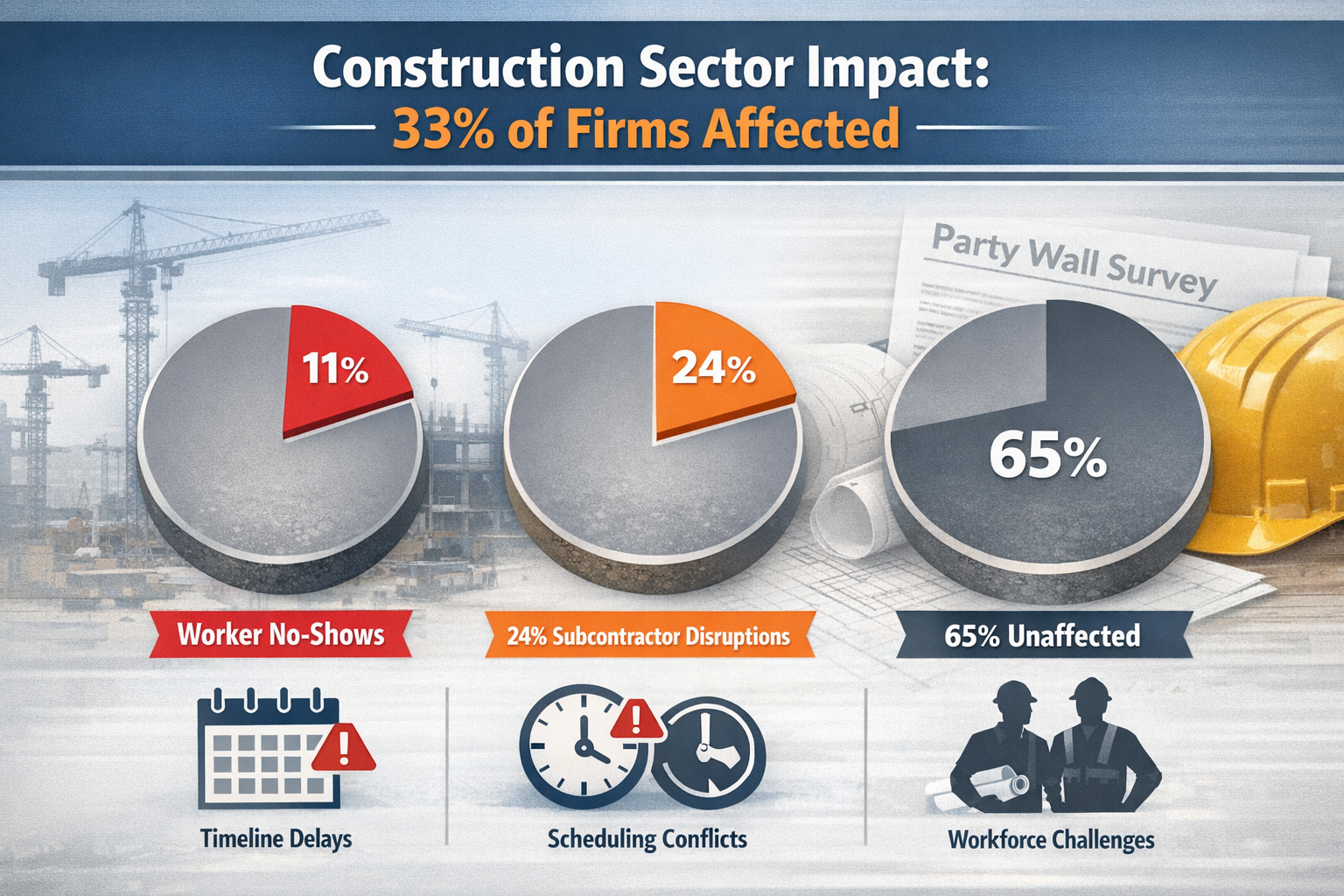
    Landscape format (1536x1024) detailed infographic showing construction workforce disruption statistics with bold headline 'Construction Sect

    Immigration Enforcement and Economic Disruption

    The construction sector’s reliance on immigrant labor has made it particularly vulnerable to enforcement actions in 2026. Recent economic analysis reveals that one-third of construction firms have experienced direct impacts from immigration enforcement operations [5]. This disruption manifests in two primary ways:

    • Worker no-shows (11% of firms): Construction workers failing to appear at job sites due to enforcement concerns or actual detention
    • Subcontractor disruptions (24% of firms): Specialized contractors unable to fulfill commitments due to workforce depletion

    The Immigration Enforcement Impact on Party Wall Surveys: Workforce Challenges and Timeline Management in 2026 extends beyond simple labor shortages. Party wall surveyors must now account for unpredictable workforce availability when scheduling inspections, coordinating with contractors, and establishing realistic timelines for building works completion.

    Public Opinion and Policy Context

    Understanding the broader political landscape helps surveyors anticipate future enforcement patterns. Recent polling data from early 2026 shows complex public attitudes toward immigration enforcement:

    📊 Public Support Metrics:

    • 61% of Americans support deportations of undocumented immigrants with criminal records [1]
    • 54% support increased border security measures [2]
    • 47% express concerns about enforcement tactics affecting communities [3]
    • 52% worry about economic disruption from enforcement actions [4]

    These statistics reflect the tension between enforcement priorities and economic stability concerns. For the construction industry—and by extension, party wall surveyors—this uncertainty creates planning challenges that require adaptive strategies.

    Sector-Specific Vulnerabilities

    The construction industry’s unique characteristics make it especially susceptible to workforce disruption:

    Industry Factor Impact on Party Wall Work Surveyor Consideration
    High immigrant workforce percentage Reduced contractor availability Longer lead times for scheduling
    Subcontractor specialization Specific trades unavailable Alternative contractor networks needed
    Project timeline sensitivity Delays cascade through phases Extended buffer periods required
    Regulatory compliance requirements Incomplete work creates liability Enhanced monitoring protocols
    Neighbor coordination needs Rescheduling affects multiple parties Improved communication strategies

    When carrying out works that require party wall procedures, building owners now face extended timelines that surveyors must factor into their planning and documentation.

    Immigration Enforcement Impact on Party Wall Surveys: Timeline Complications and Scheduling Challenges

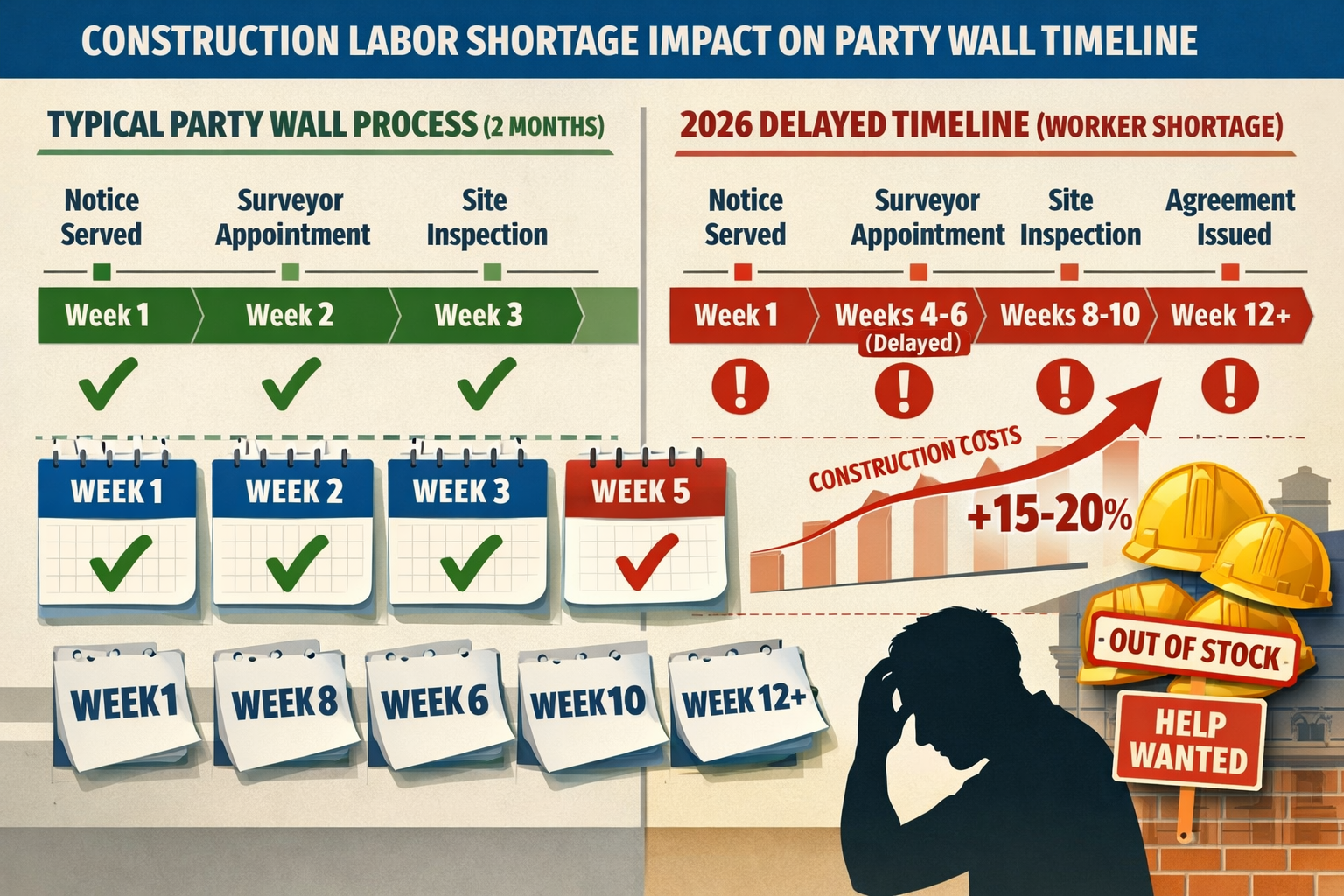
    The Party Wall Process Timeline Under Normal Conditions

    To understand how workforce disruptions affect party wall surveys, it’s essential to review the standard process timeline:

    Standard Party Wall Procedure:

    1. Notice Period (1-2 months): Building owner serves party wall notices to adjoining owners
    2. Surveyor Appointment (2-4 weeks): Parties appoint surveyors or agree to use the same surveyor
    3. Initial Inspection (1-2 weeks): Surveyors conduct schedule of condition surveys
    4. Award Preparation (2-4 weeks): Surveyors draft and agree upon the party wall award
    5. Construction Phase (varies): Building works proceed according to award terms
    6. Final Inspection (1-2 weeks): Post-construction condition assessment

    Under optimal conditions, the pre-construction party wall process typically spans 2-4 months from initial notice to commencement of works.

    2026 Timeline Extensions Due to Workforce Disruptions

    The Immigration Enforcement Impact on Party Wall Surveys: Workforce Challenges and Timeline Management in 2026 has fundamentally altered these timelines:

    Extended Timeline Factors:

    🔴 Inspection Scheduling Delays

    • Contractors unavailable for preliminary meetings
    • Building owner’s representatives unable to attend scheduled inspections
    • Specialist trades needed for technical assessments not available
    • Result: Initial inspections extending from 1-2 weeks to 3-6 weeks

    🔴 Award Negotiation Complications

    • Uncertainty about contractor availability affects condition specifications
    • Timeline provisions in awards require larger buffers
    • Dispute resolution delayed when parties can’t coordinate schedules
    • Result: Award preparation extending from 2-4 weeks to 4-8 weeks

    🔴 Construction Phase Interruptions

    • Mid-project workforce changes requiring re-inspection
    • Prolonged work periods affecting adjoining owners
    • Increased likelihood of disputes requiring surveyor intervention
    • Result: Construction timelines 25-40% longer than projected

    Real-World Scheduling Challenges for Surveyors

    Party wall surveyors across East London, North London, and other areas report specific challenges:

    Case Study Example: Loft Conversion Project

    A typical loft conversion requiring party wall procedures might have proceeded as follows in 2024:

    • Week 1-8: Notice period and surveyor appointment
    • Week 9-10: Schedule of condition inspection
    • Week 11-14: Award preparation
    • Week 15-26: Construction (12 weeks)
    • Week 27: Final inspection

    Same project in 2026 with workforce disruptions:

    • Week 1-8: Notice period and surveyor appointment
    • Week 9-14: Schedule of condition inspection (delayed 4 weeks due to contractor unavailability)
    • Week 15-22: Award preparation (extended due to timeline uncertainty)
    • Week 23-40: Construction (18 weeks—50% longer due to workforce interruptions)
    • Week 41-42: Final inspection (delayed due to contractor scheduling)

    This represents a 55% increase in total project duration, creating significant implications for all parties involved.

    Impact on Different Types of Party Wall Works

    The workforce challenges affect various types of party wall works differently:

    Excavation and Foundation Works:

    • Specialized groundwork contractors particularly affected
    • Safety-critical timelines create additional pressure
    • Delays in shoring work create cascading schedule impacts

    Party Structure Alterations:

    • Structural engineers and specialist contractors in high demand
    • Limited availability extends inspection and approval timelines
    • Mid-project modifications more difficult to coordinate

    New Building on Boundary Line:

    • Coordination with multiple trades becomes more complex
    • Extended construction periods increase neighbor relations challenges
    • Surveyors must anticipate longer dispute resolution periods

    Workforce Challenges: Practical Implications for Party Wall Surveyors

    Contractor Availability and Vetting Challenges

    Party wall surveyors in 2026 face new responsibilities regarding contractor assessment and recommendation. The Immigration Enforcement Impact on Party Wall Surveys: Workforce Challenges and Timeline Management in 2026 requires surveyors to consider:

    Enhanced Contractor Due Diligence:

    Workforce Stability Assessment

    • Requesting information about contractor workforce composition
    • Evaluating contractor’s contingency plans for labor disruptions
    • Assessing contractor’s track record for completing projects on schedule in 2026
    • Verifying contractor’s compliance with employment regulations

    Alternative Contractor Networks

    • Maintaining relationships with multiple contractors in each specialty
    • Developing backup options for critical trades
    • Creating pre-vetted contractor lists for rapid replacement if needed
    • Coordinating with building owners about contractor selection criteria

    Timeline Realism

    • Advising clients to add 30-50% buffer to standard construction timelines
    • Building flexibility into party wall awards for schedule adjustments
    • Setting realistic expectations with adjoining owners about project duration
    • Documenting workforce-related delays to protect all parties

    Managing Adjoining Owner Expectations

    The extended timelines created by workforce disruptions significantly impact adjoining owners who must tolerate construction activities for longer periods. Surveyors must proactively manage these relationships:

    Communication Strategies:

    📢 Proactive Disclosure

    • Informing adjoining owners about industry-wide workforce challenges
    • Setting realistic expectations about project duration from the outset
    • Explaining how workforce disruptions may affect the construction schedule
    • Providing regular updates when delays occur

    📢 Award Provisions

    • Including specific clauses addressing workforce-related delays
    • Establishing notification requirements when contractors change
    • Creating mechanisms for timeline extensions without dispute
    • Protecting adjoining owners’ rights while acknowledging industry realities

    📢 Dispute Prevention

    • Documenting all workforce-related delays thoroughly
    • Maintaining clear communication channels between all parties
    • Addressing concerns promptly before they escalate to formal disputes
    • Offering solutions when extended timelines create hardship

    Insurance and Liability Considerations

    Workforce disruptions create new liability exposures that party wall surveyors must address:

    Risk Management Priorities:

    ⚠️ Professional Indemnity Insurance

    • Ensuring coverage addresses workforce-related project delays
    • Documenting surveyor’s reasonable efforts to mitigate timeline impacts
    • Maintaining detailed records of all advice provided regarding timelines
    • Consulting with insurers about emerging risk factors

    ⚠️ Building Owner Protection

    • Advising clients about increased project cost risks
    • Recommending appropriate contingency budgets (typically 15-25% higher)
    • Ensuring adequate contractor insurance coverage
    • Documenting all workforce-related issues for potential claims

    ⚠️ Adjoining Owner Safeguards

    • Ensuring party wall awards protect against prolonged construction impacts
    • Addressing compensation mechanisms for extended disruption periods
    • Maintaining inspection schedules despite contractor delays
    • Preserving adjoining owners’ rights to timely completion

    Strategic Adaptations: Best Practices for Party Wall Surveyors in 2026
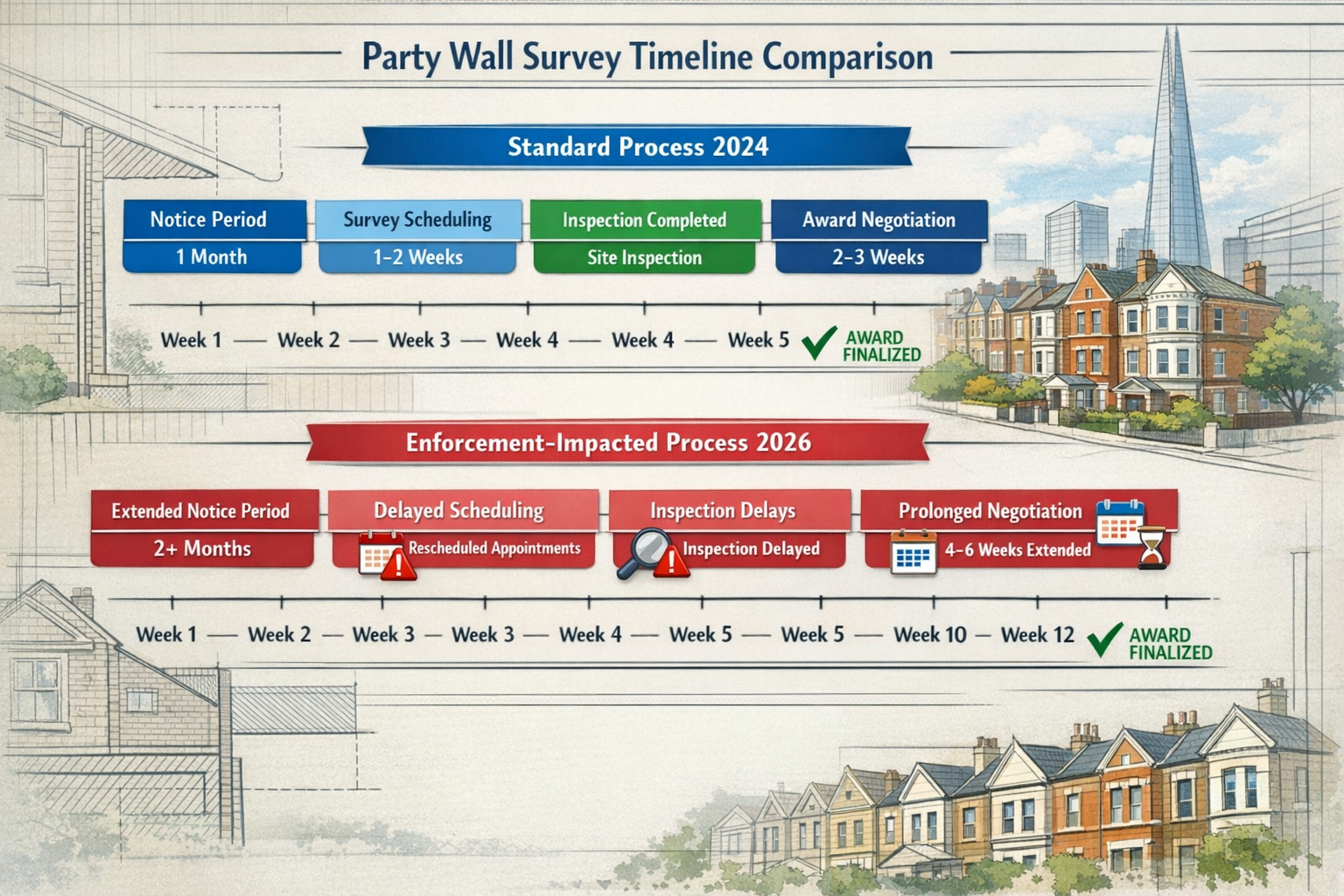
    Landscape format (1536x1024) detailed illustration showing party wall survey timeline comparison: two parallel timelines labeled 'Standard P

    Revised Timeline Planning and Documentation

    Successful party wall surveyors in 2026 have adapted their practices to address the Immigration Enforcement Impact on Party Wall Surveys: Workforce Challenges and Timeline Management in 2026:

    Updated Timeline Templates:

    Project Phase Pre-2026 Duration 2026 Recommended Duration Buffer Percentage
    Notice Period 1-2 months 1-2 months 0% (statutory)
    Surveyor Appointment 2-4 weeks 3-6 weeks 50%
    Initial Inspection 1-2 weeks 3-6 weeks 200%
    Award Preparation 2-4 weeks 4-8 weeks 100%
    Construction (typical) 8-16 weeks 12-24 weeks 50%
    Final Inspection 1-2 weeks 2-4 weeks 100%

    These extended timelines should be incorporated into all party wall documentation, client advisement, and party wall awards.

    Enhanced Communication Protocols

    Professional surveyors working across Central London, West London, South London, and surrounding areas have implemented enhanced communication strategies:

    Multi-Party Communication Framework:

    1. Initial Consultation Phase

      • Discuss workforce challenges explicitly with building owners
      • Explain potential timeline impacts during surveyor appointment
      • Set realistic expectations about project duration and costs
      • Provide written documentation of timeline assumptions
    2. Award Preparation Phase

      • Include workforce contingency clauses in party wall awards
      • Establish clear notification requirements for contractor changes
      • Create mechanisms for timeline adjustments without formal disputes
      • Document assumptions about contractor availability
    3. Construction Phase

      • Implement weekly progress reporting to all parties
      • Provide immediate notification of workforce-related delays
      • Maintain detailed logs of all schedule changes and reasons
      • Conduct regular check-ins with both building and adjoining owners
    4. Dispute Resolution Phase

      • Document all workforce-related factors contributing to disputes
      • Present evidence of reasonable efforts to mitigate delays
      • Engage third-party surveyors when workforce issues create conflicts
      • Utilize alternative dispute resolution mechanisms efficiently

    Leveraging Technology for Improved Management

    Modern party wall surveyors are adopting technological solutions to manage workforce-related uncertainties:

    Digital Tools and Platforms:

    💻 Project Management Software

    • Cloud-based scheduling platforms with real-time updates
    • Automated notifications when timeline changes occur
    • Shared access for building owners, adjoining owners, and contractors
    • Historical data tracking for timeline accuracy improvement

    💻 Virtual Inspection Capabilities

    • Video conferencing for preliminary assessments when contractor unavailability delays site access
    • Photographic documentation protocols for remote condition assessment
    • Digital annotation tools for schedule of condition reports
    • Secure cloud storage for all documentation

    💻 Communication Platforms

    • Dedicated project communication channels for all parties
    • Automated update distribution when delays occur
    • Document sharing platforms for party wall awards and notices
    • Timeline visualization tools for client understanding

    Financial Planning and Cost Management

    Understanding the costs of party wall the process has become more complex in 2026 due to workforce uncertainties:

    Cost Considerations for Building Owners:

    💰 Direct Cost Increases

    • Surveyor fees: 10-20% higher due to extended project management requirements
    • Contractor costs: 15-30% higher due to labor scarcity and competition
    • Extended timeline costs: Additional site security, insurance, and overhead
    • Contingency requirements: 20-25% recommended vs. 10-15% pre-2026

    💰 Indirect Cost Factors

    • Delayed project completion affecting rental income or occupancy plans
    • Extended financing costs due to longer construction periods
    • Increased risk of cost escalation during prolonged projects
    • Potential dispute resolution costs if workforce issues create conflicts

    Cost Implications for Adjoining Owners:

    💰 Surveyor Fee Considerations

    • Increased time requirements for monitoring extended construction periods
    • Additional inspections needed due to workforce changes
    • Enhanced documentation requirements for prolonged projects
    • Potential dispute resolution costs

    Surveyors should provide clear guidance on how to keep party wall costs down while acknowledging the realities of workforce challenges in 2026.

    Regulatory Compliance and Professional Standards

    Party Wall etc. Act 1996 Interpretation

    The Party Wall etc. Act 1996 does not explicitly address workforce disruptions, requiring surveyors to interpret statutory requirements in light of 2026 realities:

    Statutory Obligations vs. Practical Realities:

    ⚖️ Notice Period Requirements

    • Statutory notice periods remain unchanged regardless of workforce conditions
    • Surveyors must ensure building owners comply with minimum notice requirements
    • Extended timelines should be planned after statutory notice periods
    • Party wall act notices must be served according to statutory timelines

    ⚖️ Award Preparation Obligations

    • Surveyors must prepare awards “within reasonable time”
    • 2026 workforce conditions affect what constitutes “reasonable”
    • Awards should address workforce contingencies explicitly
    • Documentation of delays protects surveyors from liability

    ⚖️ Work Completion Requirements

    • Building owners remain obligated to complete works diligently
    • Workforce disruptions may constitute legitimate delay reasons
    • Surveyors should document workforce-related delays thoroughly
    • Adjoining owners’ rights must be balanced against industry realities

    Professional Body Guidance

    Professional surveying organizations have begun addressing workforce challenges in their guidance materials:

    Emerging Best Practices:

    📋 Documentation Standards

    • Maintaining detailed records of all workforce-related communications
    • Documenting contractor availability issues and mitigation efforts
    • Recording all timeline adjustments and justifications
    • Preserving evidence for potential dispute resolution

    📋 Client Advisory Obligations

    • Informing clients about industry-wide workforce challenges
    • Providing realistic timeline estimates based on current conditions
    • Advising on appropriate contingency planning
    • Explaining cost implications of workforce uncertainties

    📋 Dispute Resolution Protocols

    • Distinguishing between avoidable and unavoidable delays
    • Applying reasonable standards given 2026 workforce conditions
    • Utilizing mediation and alternative dispute resolution
    • Engaging third-party surveyors when workforce issues create conflicts

    Case Studies: Real-World Applications

    Case Study 1: Basement Excavation in East London

    Project Overview:

    • Semi-detached Victorian property requiring basement excavation
    • Significant excavation within 3 meters of adjoining owner’s foundation
    • Complex structural engineering requirements
    • Multiple specialized contractors needed

    Workforce Challenges Encountered:

    • Primary excavation contractor experienced 40% workforce reduction
    • Structural engineering firm delayed site visits by 6 weeks
    • Underpinning specialist unavailable for 8-week period
    • Concrete supplier faced delivery delays due to driver shortages

    Surveyor Response:

    • Extended timeline provisions included in initial party wall award
    • Weekly progress meetings with building owner and contractors
    • Proactive communication with adjoining owner about delays
    • Alternative contractor network activated for critical path items
    • Documentation of all workforce-related delays maintained

    Outcome:

    • Project completed 14 weeks beyond original schedule
    • No formal disputes arose due to proactive communication
    • Additional surveyor fees: £1,800 for extended monitoring
    • Total project cost increase: 22% above original estimate
    • Adjoining owner relationship preserved through transparency

    Lessons Learned:

    • Early identification of workforce risks enables better planning
    • Transparent communication prevents disputes
    • Alternative contractor relationships provide critical backup
    • Extended timeline buffers should be 50%+ for complex projects

    Case Study 2: Loft Conversion Across Multiple Properties

    Project Overview:

    • Terraced property requiring party wall procedures with two adjoining owners
    • Roof alterations affecting shared party walls
    • Steel beam installation requiring structural work
    • Coordination with multiple trades necessary

    Workforce Challenges Encountered:

    • Roofing contractor lost 3 key workers mid-project
    • Steel fabricator delayed delivery by 5 weeks
    • Plastering subcontractor unable to fulfill commitment
    • Building control inspections delayed due to inspector shortages

    Surveyor Response:

    • Implemented phased inspection schedule to accommodate delays
    • Coordinated with both adjoining owners on revised timelines
    • Assisted building owner in sourcing replacement contractors
    • Modified party wall award through supplemental agreement
    • Enhanced documentation protocols for all changes

    Outcome:

    • Project timeline extended from 12 weeks to 19 weeks
    • One adjoining owner required additional compensation for extended disruption
    • Surveyor fees increased by 35% due to additional coordination
    • Building owner’s total costs increased by 18%
    • Project completed successfully with preserved neighbor relationships

    Lessons Learned:

    • Multiple adjoining owners multiply communication requirements
    • Supplemental agreements can address unforeseen workforce changes
    • Compensation mechanisms should be built into initial awards
    • Regular updates prevent surprise and reduce conflict

    Future Outlook: Preparing for Continued Uncertainty
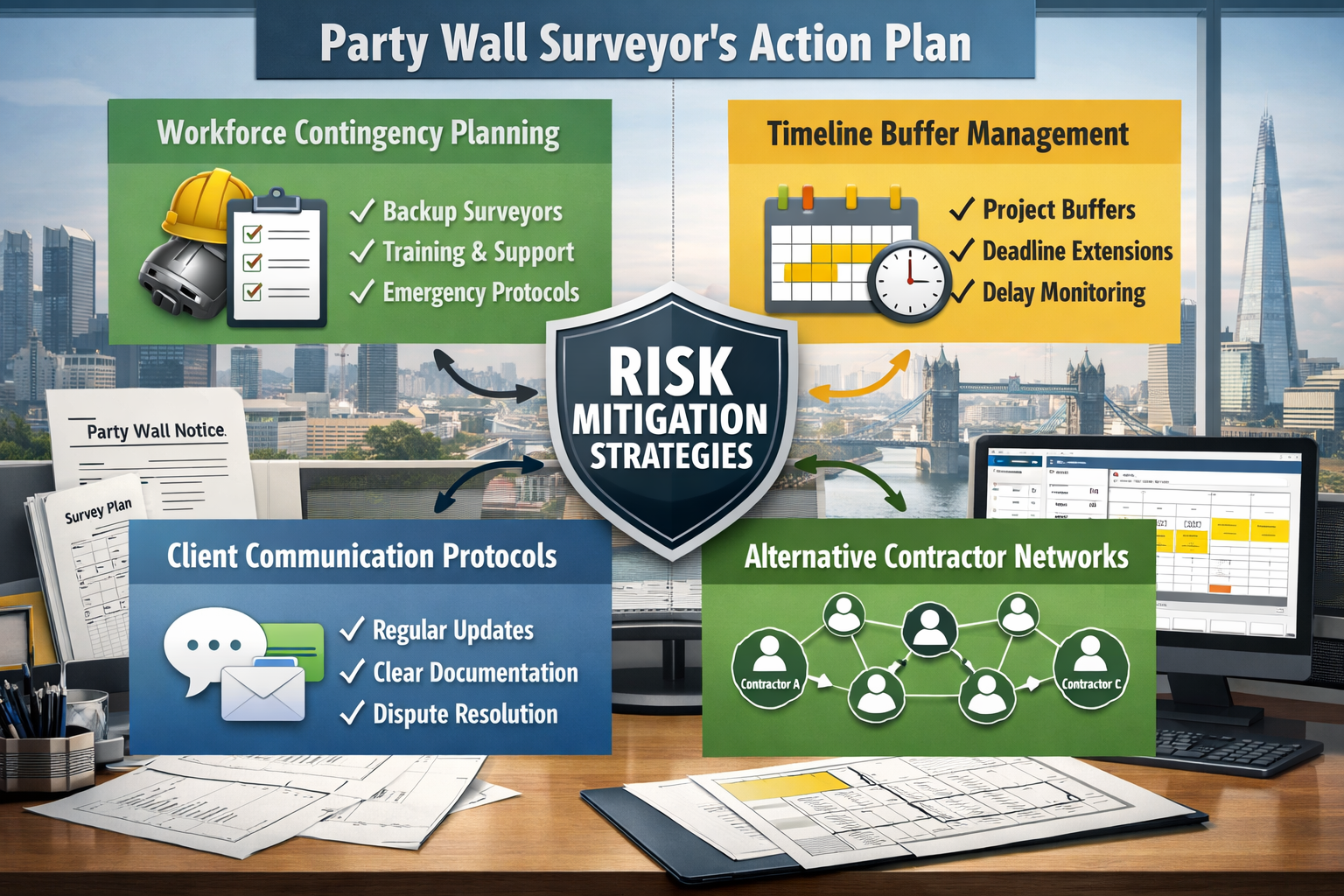
    Landscape format (1536x1024) strategic planning visualization showing party wall surveyor's action plan dashboard. Central focus on risk mit

    Industry Adaptation Strategies

    The construction and surveying industries are developing long-term adaptations to workforce volatility:

    Structural Changes:

    🔧 Workforce Development Initiatives

    • Increased investment in domestic workforce training
    • Apprenticeship programs to reduce immigrant labor dependence
    • Technology adoption to reduce labor intensity
    • Productivity improvements through process optimization

    🔧 Business Model Adjustments

    • Contractors maintaining larger contingent workforce pools
    • Increased use of prefabrication and off-site construction
    • Strategic partnerships between contractors for workforce sharing
    • Enhanced project management capabilities

    🔧 Regulatory Advocacy

    • Industry groups lobbying for workforce stability measures
    • Professional bodies developing guidance for workforce challenges
    • Collaboration with government on construction sector needs
    • Standardized approaches to workforce-related delays

    Surveyor Professional Development

    Party wall surveyors must enhance their skills to navigate the Immigration Enforcement Impact on Party Wall Surveys: Workforce Challenges and Timeline Management in 2026:

    Essential Competencies for 2026 and Beyond:

    📚 Enhanced Project Management

    • Advanced scheduling and timeline planning skills
    • Risk assessment and mitigation expertise
    • Multi-stakeholder communication proficiency
    • Technology platform utilization capabilities

    📚 Contractor Relationship Management

    • Building extensive contractor networks across specialties
    • Evaluating contractor stability and reliability
    • Facilitating contractor replacement when necessary
    • Understanding employment law and compliance issues

    📚 Dispute Prevention and Resolution

    • Proactive communication strategies
    • Mediation and negotiation skills
    • Documentation best practices
    • Understanding of workforce-related delay justifications

    📚 Client Advisory Excellence

    • Setting realistic expectations about timelines and costs
    • Explaining industry challenges in accessible terms
    • Providing strategic guidance on project planning
    • Balancing legal obligations with practical realities

    Technology and Innovation

    Emerging technologies offer solutions to workforce-related challenges:

    Innovative Approaches:

    🚀 Remote Inspection Technologies

    • Drone-based condition surveys
    • 3D scanning for detailed property documentation
    • Virtual reality for remote site assessments
    • AI-powered damage detection and analysis

    🚀 Automated Documentation

    • Template-based award generation with workforce contingency clauses
    • Automated timeline tracking and notification systems
    • Digital signature platforms for efficient agreement execution
    • Cloud-based collaboration tools for all parties

    🚀 Predictive Analytics

    • Historical data analysis for timeline accuracy
    • Workforce availability forecasting
    • Risk modeling for project planning
    • Cost estimation tools incorporating workforce factors

    Conclusion: Navigating the New Normal in Party Wall Surveying

    The Immigration Enforcement Impact on Party Wall Surveys: Workforce Challenges and Timeline Management in 2026 represents a fundamental shift in how party wall surveyors must approach their professional responsibilities. With one-third of construction firms experiencing workforce disruptions—including 11% facing worker no-shows and 24% dealing with subcontractor issues—the traditional timelines and assumptions that guided party wall practice no longer reflect reality [5].

    Key Strategic Imperatives:

    Embrace Extended Timelines: Building 30-50% buffers into all project schedules is no longer conservative—it’s realistic. Surveyors must update their timeline templates, client advisement, and party wall awards to reflect current workforce conditions.

    Prioritize Communication: Transparent, proactive communication with building owners, adjoining owners, and contractors prevents disputes and manages expectations effectively. Regular updates and detailed documentation protect all parties’ interests.

    Develop Contingency Networks: Maintaining relationships with multiple contractors in each specialty provides critical backup when workforce disruptions occur. Alternative contractor networks are now essential professional infrastructure.

    Leverage Technology: Digital tools for project management, communication, and documentation improve efficiency and provide better service despite workforce challenges. Investment in technology platforms pays dividends in client satisfaction and risk management.

    Enhance Professional Skills: The modern party wall surveyor must be part project manager, part mediator, and part strategic advisor. Professional development in these areas separates successful practitioners from those struggling to adapt.

    Actionable Next Steps for Party Wall Surveyors

    Immediate Actions (Next 30 Days):

    1. Review and Update Templates: Revise all party wall award templates to include workforce contingency clauses and extended timeline provisions
    2. Assess Contractor Networks: Evaluate current contractor relationships and identify gaps requiring additional network development
    3. Implement Communication Protocols: Establish systematic communication procedures for all parties throughout the party wall process
    4. Update Client Advisory Materials: Revise all client-facing materials to address workforce challenges and set realistic expectations

    Medium-Term Actions (Next 90 Days):

    1. Technology Adoption: Research and implement project management and communication platforms suitable for party wall work
    2. Professional Development: Pursue training in advanced project management, dispute resolution, and contractor relationship management
    3. Insurance Review: Consult with professional indemnity insurers about coverage for workforce-related delays and document retention requirements
    4. Industry Engagement: Join professional organizations and participate in discussions about workforce challenges and best practices

    Long-Term Strategic Planning:

    1. Business Model Evolution: Consider how workforce volatility affects service delivery and pricing structures
    2. Specialization Opportunities: Identify niches where expertise in managing complex, delay-prone projects creates competitive advantage
    3. Thought Leadership: Share experiences and best practices with the professional community to advance industry standards
    4. Advocacy Participation: Engage with professional bodies on regulatory and policy issues affecting the construction workforce

    The party wall surveying profession has weathered numerous challenges throughout its history, from economic recessions to regulatory changes. The workforce disruptions of 2026 represent another significant challenge requiring professional adaptation and innovation. Surveyors who embrace these changes, develop new competencies, and implement robust systems for managing workforce-related uncertainties will not only survive but thrive in this new environment.

    For building owners planning construction projects, choosing the right party wall surveyor has never been more important. Look for professionals who demonstrate understanding of current workforce challenges, maintain extensive contractor networks, utilize modern project management tools, and communicate proactively throughout the process.

    The Immigration Enforcement Impact on Party Wall Surveys: Workforce Challenges and Timeline Management in 2026 is not a temporary disruption but a fundamental shift requiring permanent adaptation. By understanding these challenges, implementing appropriate strategies, and maintaining professional excellence, party wall surveyors can continue to protect the interests of building owners and adjoining owners while facilitating successful construction projects despite workforce uncertainties.


    References

    [1] Press Release January 2026 – https://harvardharrispoll.com/press-release-january-2026/

    [2] Poll Republicans Ice Immigration Deportations 00744668 – https://www.politico.com/news/2026/01/24/poll-republicans-ice-immigration-deportations-00744668

    [3] What Independents Think Of Trumps Recent Immigration Actions According To New Ap Norc Poll – https://www.latimes.com/world-nation/story/2026-02-12/what-independents-think-of-trumps-recent-immigration-actions-according-to-new-ap-norc-poll

    [4] The Actions Of Ice February 2026 – https://maristpoll.marist.edu/polls/the-actions-of-ice-february-2026/

    [5] Laedcxdeo Economic Impacts Of Federal Immigration Enforcement – https://opportunity.lacounty.gov/wp-content/uploads/2026/02/LAEDCxDEO-Economic-Impacts-of-Federal-Immigration-Enforcement.pdf

    [6] How Americans See Immigration Officers Behaviors And Civilian Actions – https://www.pewresearch.org/politics/2026/01/29/how-americans-see-immigration-officers-behaviors-and-civilian-actions/

  • Party Wall Notices and Scope Creep: Protecting Surveyors Whe

    Construction projects rarely go exactly as planned. What starts as a simple basement extension can quickly evolve into a complex structural renovation involving multiple trades, unexpected engineering challenges, and work that extends far beyond the original specifications. In 2026, party wall surveyors face an increasingly challenging landscape where Party Wall Notices and Scope Creep: Protecting Surveyors When Contractors Exceed Original Project Parameters has become a critical concern for professional liability and dispute prevention.

    The construction industry is witnessing a troubling trend: contractors are increasingly being asked to provide services outside their core expertise, acting simultaneously as architects, engineers, and even legal advisors[1]. This phenomenon creates significant risks for party wall surveyors who must navigate the delicate balance between facilitating legitimate construction work and protecting all parties when projects expand beyond their original boundaries. Understanding how to protect surveyors through proper documentation, clear scope definition, and proactive risk management has never been more essential.

    Key Takeaways

    • Scope creep in party wall projects occurs when contractors perform work beyond the parameters defined in original party wall notices, creating liability risks for surveyors
    • Explicit documentation of what work will NOT be performed is equally important as defining what will be done in party wall awards
    • Design waivers and exclusion clauses provide critical protection when surveyors offer suggestions outside their primary scope of expertise
    • Regular monitoring and communication between surveyors, contractors, and property owners prevents unauthorized scope expansion
    • Clear contractual language in party wall awards establishes boundaries that protect surveyors from liability when contractors exceed original project parameters

    Understanding Scope Creep in Party Wall Projects

    Landscape format (1536x1024) detailed infographic showing scope creep progression timeline in party wall projects. Visual displays three-sta

    What Is Scope Creep?

    Scope creep refers to the gradual expansion of a project beyond its originally defined parameters without proper authorization, documentation, or adjustment to timelines and budgets. In the context of party wall work, scope creep occurs when contractors begin performing tasks that were not included in the original party wall notice or subsequent party wall award.

    Common examples of scope creep in party wall projects include:

    • 🏗️ Structural alterations beyond the specified foundation work
    • 🔨 Additional excavation deeper or wider than originally notified
    • 🧱 Modifications to shared walls not covered in the initial notice
    • Installation of services (electrical, plumbing) affecting party structures
    • 🏠 Architectural changes that impact load distribution or structural integrity

    Why Scope Creep Poses Risks for Surveyors

    Party wall surveyors operate under the Party Wall etc. Act 1996, which provides a framework for resolving disputes between property owners. However, when contractors exceed the parameters outlined in party wall documentation, surveyors can face several serious risks:

    Professional liability concerns arise when damage occurs from unauthorized work that the surveyor failed to identify or prevent. Even if the surveyor properly documented the original scope, questions may emerge about whether adequate oversight was provided.

    Reputational damage can result from projects that spiral out of control, regardless of whether the surveyor bears direct responsibility. Property owners may blame the surveyor for not preventing scope expansion.

    Increased dispute resolution costs multiply when work extends beyond agreed parameters, requiring additional inspections, revised awards, and potentially costly remediation.

    Insurance complications may develop if claims arise from work that was never properly authorized or documented within the party wall framework.

    The Expanding Role of Contractors and Its Impact on Party Wall Notices and Scope Creep

    Contractors Wearing Multiple Hats

    The construction industry in 2026 has seen a significant shift in expectations placed upon contractors. Rather than focusing solely on executing construction work, contractors increasingly face requests to provide services across multiple disciplines simultaneously[1]. This includes:

    • Building performance specifications requiring technical engineering knowledge
    • Insulation R-values and thermal performance calculations
    • Fire code compliance and safety regulations
    • Product specifications and materials engineering
    • Structural engineering assessments and recommendations

    This expansion of contractor responsibilities creates a perfect storm for scope creep in party wall projects. When a contractor begins offering advice or performing work in areas outside their core competency, the risk of unauthorized work increases dramatically.

    How This Affects Party Wall Surveyors

    When contractors take on roles beyond their expertise, party wall surveyors face unique challenges. A building owner’s surveyor or adjoining owner’s surveyor must ensure that all work affecting party structures remains within the scope of the original notice and award.

    However, when contractors begin making engineering decisions, suggesting structural modifications, or implementing design changes on-site, the original party wall documentation may quickly become obsolete. This creates several problems:

    Problem Impact on Surveyor Potential Consequence
    Unauthorized structural changes Surveyor unaware of actual work being performed Damage to adjoining property not covered by award
    Contractor design modifications Original specifications no longer accurate Disputes over whether work complies with notice
    Engineering decisions made on-site Technical aspects beyond surveyor’s review Structural failures attributed to inadequate oversight
    Expanded excavation or foundation work Schedule of condition becomes incomplete Difficulty determining cause of damage

    Protecting Surveyors When Contractors Exceed Original Project Parameters

    Documenting What Will NOT Be Done

    One of the most effective strategies for protecting surveyors from scope creep liability involves explicitly documenting not only what contractors will do but also what they won’t do in contract language[1]. This approach provides clear boundaries that can be referenced if disputes arise.

    In the context of party wall awards, this means including specific exclusion clauses that identify work outside the scope of the notice. For example:

    “This party wall award covers foundation excavation to a maximum depth of 3 meters and installation of reinforced concrete footings as specified in the attached drawings. This award does NOT authorize: (1) any structural modifications to the existing party wall above ground level, (2) installation of damp-proof courses or membranes affecting the party structure, (3) underpinning work beyond the specified excavation zone, or (4) any alterations to the party wall’s load-bearing capacity.”

    Implementing Design Waivers and Limitation Clauses

    Design waivers can protect surveyors who provide suggestions or recommendations outside their primary scope of expertise[1]. When a surveyor offers advice on construction methods, materials selection, or technical specifications, a properly drafted waiver ensures that the surveyor is not held liable if those suggestions prove inadequate.

    A comprehensive design waiver in a party wall contract template might include language such as:

    • Acknowledgment that the surveyor’s role is limited to administering the Party Wall etc. Act 1996
    • Disclaimer that any technical suggestions are provided for convenience only and do not constitute professional engineering or architectural advice
    • Requirement that the building owner obtain appropriate professional certifications for structural, engineering, or design elements
    • Limitation of the surveyor’s liability to matters directly within their appointed scope under the Act

    Creating Clear Scope Boundaries in Party Wall Awards

    The party wall award serves as the primary document defining what work is authorized under the Party Wall etc. Act 1996. To prevent scope creep and protect surveyors, awards should include:

    Detailed work descriptions with specific measurements, depths, materials, and methods clearly stated. Vague language like “foundation work” should be replaced with precise specifications such as “excavation of strip footings 2.5 meters deep, 0.6 meters wide, extending 4.2 meters along the party wall line.”

    Explicit limitations on contractor authority to modify the work without written approval from the surveyor. This prevents on-site decisions that expand the project scope.

    Reference drawings and specifications that are incorporated into the award by attachment, creating a complete record of authorized work.

    Change order procedures that require formal documentation and agreement before any variation from the original scope can proceed.

    Monitoring and inspection schedules that ensure the surveyor has regular opportunities to verify compliance with the authorized scope.

    Practical Strategies for Managing Party Wall Notices and Scope Creep: Protecting Surveyors When Contractors Exceed Original Project Parameters

    Pre-Construction Planning and Documentation

    Effective protection against scope creep begins before any construction work commences. Surveyors should implement a comprehensive pre-construction process that includes:

    Thorough review of building plans to identify all potential party wall implications, not just those explicitly mentioned in the building owner’s initial notice. This proactive approach can prevent surprise scope expansions later.

    Detailed schedule of condition documenting the current state of all affected structures with photographs, measurements, and detailed descriptions. This baseline becomes essential if disputes arise about damage from unauthorized work.

    Pre-construction meetings with contractors, building owners, and adjoining owners to review the exact scope of authorized work and establish clear communication protocols.

    Written confirmation from the building owner acknowledging the scope limitations and agreeing to notify the surveyor before any variations are implemented.

    During Construction: Monitoring and Control

    Once construction begins, active monitoring becomes the surveyor’s primary tool for preventing and detecting scope creep. Effective strategies include:

    Regular site inspections at critical stages of the work, not just at project completion. For types of party wall works involving excavation or structural alterations, inspections should occur at:

    • Commencement of excavation
    • Maximum excavation depth
    • Installation of foundations
    • Any work directly affecting the party structure
    • Project completion

    Photographic documentation at each inspection, creating a visual record that can be compared against the authorized scope and original schedule of condition.

    Written inspection reports distributed to all parties, confirming compliance or identifying deviations from the authorized work.

    Immediate intervention when unauthorized work is detected, including formal notices requiring work stoppage until proper authorization is obtained.

    Communication Protocols That Prevent Scope Creep

    Clear, consistent communication among all parties is essential for preventing scope creep in party wall projects. Surveyors should establish:

    Formal communication channels requiring all scope-related questions or requests to go through the surveyor rather than directly between contractor and building owner.

    Written approval requirements for any variation from the original party wall notice, no matter how minor it may seem.

    Regular updates to adjoining owners about project progress, ensuring they remain informed and can raise concerns before unauthorized work proceeds too far.

    Contractor briefings at project commencement explaining the surveyor’s role, the importance of scope compliance, and the procedures for requesting variations.

    Legal and Professional Considerations for Party Wall Surveyors

    Landscape format (1536x1024) professional photograph-style image of modern construction dispute scenario. Scene shows two surveyors in hard

    Professional Duties Under the Party Wall etc. Act 1996

    Party wall surveyors operate under specific statutory duties that shape their responsibilities regarding scope management. Understanding these duties is crucial for protecting against liability when contractors exceed authorized parameters.

    The surveyor’s primary duty is to act impartially between the building owner and adjoining owner, even when appointed by one party. This impartiality extends to scope management—surveyors must not allow unauthorized work to proceed simply because it benefits the appointing party.

    Surveyors must also exercise reasonable skill and care in their professional activities. This includes:

    • Properly identifying the scope of notifiable works
    • Drafting awards that clearly define authorized work
    • Conducting appropriate inspections to verify compliance
    • Taking reasonable steps to prevent or detect unauthorized scope expansion

    Liability Considerations

    When contractors exceed original project parameters, questions of liability can become complex. Surveyors may face claims from:

    Adjoining owners who suffer damage from unauthorized work, arguing that the surveyor failed to properly monitor or prevent scope creep.

    Building owners who incur additional costs due to scope disputes, claiming the surveyor should have better defined the original parameters or managed contractor compliance.

    Contractors who face work stoppages or remediation requirements, potentially arguing that the surveyor’s instructions were unclear or inconsistent.

    To protect against these liability risks, surveyors should:

    ✅ Maintain comprehensive professional indemnity insurance appropriate to the value and complexity of projects undertaken

    ✅ Document all communications, decisions, and site observations meticulously

    ✅ Issue written confirmations of all verbal discussions or agreements

    ✅ Seek specialist advice when work extends beyond the surveyor’s expertise

    ✅ Include appropriate limitation clauses in appointment terms

    When to Involve Other Professionals

    Party wall surveyors should recognize the boundaries of their expertise and involve other professionals when projects involve complex technical elements. This is particularly important for preventing scope creep, as specialized professionals can provide authoritative guidance on whether proposed work falls within or outside original parameters.

    Consider involving:

    • Structural engineers for complex foundation work, underpinning, or significant structural alterations
    • Building control surveyors for compliance with building regulations
    • Architects for design-related scope questions
    • Legal advisors for disputes involving significant scope deviations or complex liability issues

    Case Studies: Scope Creep Scenarios and Surveyor Protection

    Case Study 1: The Expanding Basement Extension

    A building owner in Central London served a party structure notice for a single-story basement extension beneath an existing property. The original notice specified excavation to 3 meters depth for a 4-meter by 6-meter basement.

    The scope creep: During construction, the contractor identified “favorable soil conditions” and suggested extending the basement by an additional 2 meters in length. The building owner agreed verbally with the contractor, and work proceeded without notifying the surveyor or adjoining owner.

    The problem: The additional excavation brought the works significantly closer to the adjoining property’s foundations, causing settlement cracks that were not anticipated in the original party wall award.

    How proper documentation would have helped: If the party wall award had included explicit language stating “excavation is limited to the dimensions shown in Drawing A, dated [date]. Any variation in excavation dimensions requires written approval from the surveyor and service of a revised notice,” the contractor and building owner would have been clearly aware that the expansion was unauthorized.

    Surveyor protection measures:

    • The award should have included a clause requiring immediate notification of any proposed scope changes
    • Regular inspections at excavation stages would have detected the unauthorized expansion early
    • Exclusion language stating what was NOT authorized would have provided clear evidence of scope violation

    Case Study 2: Structural Alterations Beyond the Notice

    A property owner in North London served notice for installation of a steel beam to create an open-plan ground floor. The party wall notice specified removal of a non-load-bearing partition wall and installation of a single steel beam.

    The scope creep: During demolition, the contractor discovered that the wall was actually load-bearing. Rather than stopping work and consulting the surveyor, the contractor designed and installed a more complex steel framework, including additional supports that penetrated the party wall.

    The problem: The additional structural work was never covered by the original party wall notice or award. The adjoining owner discovered the penetrations months later when conducting their own renovations.

    How proper documentation would have helped: The party wall award should have included a clause stating: “This award authorizes only the work specifically described. If site conditions differ from those anticipated, all work must cease until the surveyor has assessed the situation and, if necessary, a revised notice has been served.”

    Surveyor protection measures:

    • Pre-construction structural survey to verify assumptions about wall types
    • Explicit requirement for contractor to notify surveyor immediately if conditions differ from expectations
    • Design waiver clarifying that the surveyor has not verified structural calculations and that the building owner must obtain appropriate engineering certification

    Case Study 3: The Incremental Expansion

    A building owner in West London obtained a party wall award for loft conversion work including installation of steel beams within the roof structure. Over the course of the project, the contractor made numerous small modifications: slightly larger beams, additional supports, modified connection points to the party wall, and installation of a dormer window not mentioned in the original notice.

    The scope creep: No single change was dramatic, but cumulatively, the completed work differed substantially from the authorized scope. The adjoining owner noticed the dormer window and questioned whether it was authorized.

    The problem: The surveyor had conducted only initial and final inspections, missing the incremental scope expansion. When disputes arose, it was difficult to determine exactly when unauthorized work had occurred.

    How proper documentation would have helped: The party wall award should have required the contractor to submit progress reports before proceeding to each new phase of work, with surveyor sign-off required before advancing.

    Surveyor protection measures:

    • Stage-based inspection schedule tied to specific work milestones
    • Requirement for contractor to provide photographic evidence of work at each stage
    • Clear statement that the award covers only the work shown in specific, dated drawings
    • Formal variation procedure requiring written approval before any changes

    Best Practices for Drafting Scope-Protected Party Wall Awards

    Essential Clauses for Scope Definition

    When drafting party wall awards to protect against scope creep, include these essential elements:

    1. Precise Work Description
    Rather than general descriptions, provide specific details:

    • Exact dimensions (depth, width, length) with tolerance limits
    • Specific materials and grades
    • Construction methods and sequences
    • Locations referenced to fixed points or measurements from boundaries

    2. Incorporated Documents
    Attach and reference:

    • Detailed drawings with date and revision number
    • Technical specifications
    • Structural calculations (if applicable)
    • Contractor’s method statements

    3. Exclusion Clauses
    Explicitly state what is NOT authorized:

    • “This award does not authorize any work to the party wall above ground level”
    • “No excavation is permitted beyond the dimensions shown in Drawing A”
    • “Installation of services is not covered by this award”

    4. Variation Procedures
    Establish clear processes for scope changes:

    • Requirement for written requests
    • Surveyor review and approval process
    • Potential need for revised notices
    • Cost implications of variations

    5. Inspection and Monitoring Requirements
    Define the surveyor’s oversight role:

    • Specific inspection stages
    • Notice periods required before proceeding to next phase
    • Contractor’s obligation to provide access
    • Consequences of proceeding without required inspections

    Template Language for Scope Protection

    Consider incorporating language similar to the following in party wall awards:

    SCOPE LIMITATIONS

    1. This Award authorizes only the works specifically described in Section [X] and shown on the attached drawings dated [date].

    2. The following works are expressly EXCLUDED from this Award and are NOT authorized:

      • Any structural alterations to the party wall beyond those specified
      • Excavation exceeding the dimensions stated in Section [X]
      • Installation of damp-proof courses, membranes, or services affecting the party structure
      • [Other specific exclusions relevant to the project]
    3. VARIATION PROCEDURE: No variation from the authorized works may proceed without:

      • Written request from the Building Owner to the Surveyor
      • Written approval from the Surveyor
      • Service of a revised notice if the variation constitutes notifiable works not covered by the original notice
      • Agreement on any cost implications
    4. CONTRACTOR OBLIGATIONS: The contractor must:

      • Immediately notify the Surveyor if site conditions differ from those anticipated
      • Cease work if unauthorized scope expansion is identified
      • Provide [X] working days’ notice before commencing each phase of work
      • Allow the Surveyor access for inspections at the stages specified in Section [X]
    5. PROFESSIONAL CERTIFICATIONS: The Building Owner acknowledges that:

      • The Surveyor’s role is limited to administration of the Party Wall etc. Act 1996
      • Structural design, engineering calculations, and building regulations compliance are the responsibility of appropriately qualified professionals appointed by the Building Owner
      • Any suggestions or comments provided by the Surveyor regarding technical matters are offered for convenience only and do not constitute professional engineering or architectural advice

    Managing Costs While Protecting Against Scope Creep

    Balancing Protection and Practicality

    While comprehensive scope protection is essential, surveyors must also be mindful of party wall costs and the practical realities of construction projects. Overly restrictive awards or excessive inspection requirements can create unnecessary delays and expenses.

    The key is finding the right balance between protection and practicality:

    Risk-based approach: Tailor the level of scope protection to the complexity and risk profile of the project. Simple works may require less detailed scope definition than complex structural alterations.

    Proportionate inspection schedules: Rather than inspecting every day, identify critical stages where scope verification is most important and focus inspections there.

    Clear communication: Well-drafted awards with clear scope boundaries can actually reduce costs by preventing disputes and minimizing the need for extensive monitoring.

    Cost-Effective Scope Management Strategies

    Surveyors can protect against scope creep while keeping party wall costs down through:

    Front-loaded effort: Invest time in thorough pre-construction planning and detailed award drafting. This upfront investment prevents costly disputes and remediation later.

    Technology utilization: Use photographic documentation, video recordings, and digital communication tools to efficiently monitor compliance without excessive site visits.

    Contractor pre-qualification: Encourage building owners to select contractors with strong track records of scope compliance, reducing the likelihood of unauthorized work.

    Standard templates: Develop standardized scope protection clauses that can be adapted to different projects, reducing drafting time while maintaining protection.

    The Role of Technology in Preventing Scope Creep

    Landscape format (1536x1024) detailed visual guide showing protective documentation framework for party wall surveyors. Central image displa

    Digital Documentation and Monitoring

    In 2026, technology offers powerful tools for managing scope creep in party wall projects:

    Digital party wall awards with embedded drawings and specifications ensure all parties work from the same, current documentation.

    Photographic and video documentation creates indisputable records of work progress and compliance with authorized scope.

    Project management software can track variations, approvals, and communications in a centralized, searchable format.

    Remote monitoring tools including site cameras or contractor-submitted progress photos reduce the need for physical inspections while maintaining oversight.

    Communication Platforms

    Modern communication platforms help prevent scope creep through:

    Centralized messaging systems that create permanent records of all scope-related discussions

    Document sharing platforms ensuring all parties access current, approved drawings and specifications

    Automated notifications alerting surveyors when contractors report conditions that might require scope variations

    Digital approval workflows streamlining the process for reviewing and authorizing legitimate scope changes

    Training and Professional Development for Scope Management

    Building Surveyor Competence

    Effective management of Party Wall Notices and Scope Creep: Protecting Surveyors When Contractors Exceed Original Project Parameters requires ongoing professional development. Surveyors should pursue training in:

    • Contract drafting and legal documentation
    • Construction methods and sequencing
    • Risk assessment and management
    • Dispute resolution techniques
    • Technical aspects of common party wall works

    Staying Current with Industry Trends

    The construction industry continues to evolve, with new materials, methods, and regulatory requirements emerging regularly. Surveyors must stay informed about trends that might affect scope management, such as:

    • Sustainability requirements influencing construction methods
    • Building safety regulations following recent legislative changes
    • Modern methods of construction (MMC) and their party wall implications
    • Insurance market developments affecting professional liability

    Conclusion: Protecting Your Practice While Serving Your Clients

    Party Wall Notices and Scope Creep: Protecting Surveyors When Contractors Exceed Original Project Parameters represents one of the most significant professional challenges facing party wall surveyors in 2026. As contractors increasingly take on roles beyond their core expertise and construction projects grow more complex, the risk of scope expansion beyond original party wall notices has never been higher.

    However, with proper documentation, clear communication, and proactive risk management, surveyors can effectively protect themselves while continuing to provide valuable services to building owners and adjoining owners. The key principles are:

    🔑 Document not only what WILL be done, but explicitly what WON’T be done in party wall awards and contracts

    🔑 Include design waivers and limitation clauses when providing suggestions outside core party wall administration

    🔑 Establish clear variation procedures requiring written approval before any scope changes proceed

    🔑 Implement risk-based inspection schedules to detect unauthorized work early

    🔑 Maintain comprehensive records of all communications, decisions, and site observations

    🔑 Recognize the limits of your expertise and involve specialists when appropriate

    Actionable Next Steps for Party Wall Surveyors

    To implement these scope protection strategies in your practice:

    1. Review your current party wall award templates and incorporate explicit exclusion clauses and variation procedures
    2. Develop standardized scope protection language that can be adapted to different project types
    3. Create a pre-construction checklist ensuring thorough scope definition before work commences
    4. Establish clear inspection protocols tied to critical project stages
    5. Update your professional indemnity insurance to ensure adequate coverage for scope-related disputes
    6. Invest in technology tools for documentation and monitoring
    7. Pursue continuing professional development in contract drafting and risk management

    By taking these proactive steps, party wall surveyors can navigate the complex landscape of modern construction projects while protecting their professional interests and serving their clients effectively. The investment in comprehensive scope management pays dividends through reduced disputes, clearer professional relationships, and enhanced reputation in an increasingly competitive market.

    For building owners planning party wall works, engaging experienced surveyors who understand scope management is essential. For adjoining owners concerned about neighboring construction, ensuring your surveyor has robust scope protection measures in place provides peace of mind that your interests will be protected even if contractors attempt to exceed original project parameters.

    Whether you’re carrying out works that require party wall notices or you’re an adjoining owner responding to a neighbor’s construction plans, understanding the importance of clear scope definition and protection against scope creep is essential for successful project outcomes in 2026 and beyond.


    References

    [1] Construction Dive – https://www.constructiondive.com/news/5-construction-legal-trends-2026/810550/

  • Party Wall Agreements for Data Centers 2026 | Surveying

    The data center construction boom sweeping across the United Kingdom in 2026 has created an unprecedented intersection of cutting-edge technology infrastructure and century-old property law. As developers race to meet the insatiable demand for artificial intelligence computing power and cloud services, many are discovering that their ambitious builds must navigate the complexities of Party Wall Agreements for Data Center Builds: Precision Surveying Challenges in 2026. These specialized facilities, with their unique requirements for vibration control, thermal management, and continuous power systems, present surveying obstacles that traditional residential or commercial projects rarely encounter.

    The convergence of rapid construction timelines, massive structural loads, and sensitive neighboring properties has transformed party wall surveying from a routine administrative process into a critical risk management function. Data center developers in London and across the UK are finding that the Party Wall etc. Act 1996 applies with particular complexity to their projects, requiring specialized expertise that bridges structural engineering, property law, and advanced surveying techniques.

    Key Takeaways

    • 📊 Data center construction in 2026 is experiencing exponential growth, with projects increasingly located in urban areas where party wall agreements are essential for legal compliance and neighbor relations
    • 🔧 Precision surveying challenges unique to data centers include vibration monitoring from heavy mechanical equipment, thermal transfer through shared walls, and managing electromagnetic interference near sensitive neighboring structures
    • ⚖️ RICS-compliant party wall notices must address specialized considerations such as 24/7 operational noise, cooling system integration, and shared infrastructure awards that differ significantly from traditional construction projects
    • 💡 Vibration monitoring protocols require continuous real-time data collection using advanced sensors, with tolerance levels measured in millimeters to protect both the data center’s sensitive equipment and adjoining properties
    • 🤝 Shared infrastructure agreements are becoming more common, allowing data centers to negotiate cooling, power, or fiber optic arrangements through party walls while maintaining clear legal boundaries and cost allocations

    Understanding Party Wall Agreements in the Data Center Context

    Detailed landscape format (1536x1024) image showing close-up of party wall documentation and legal framework for data center construction. S

    The Legal Framework for Data Center Construction

    The foundation of Party Wall Agreements for Data Center Builds: Precision Surveying Challenges in 2026 rests on the Party Wall etc. Act 1996, a piece of legislation originally designed for residential and commercial developments that now must accommodate the unique demands of hyperscale computing facilities. This Act governs construction work on or near boundaries between properties, requiring building owners to serve formal notices to adjoining owners before commencing specific types of work.

    For data center developers, understanding what party wall notices are and how to respond becomes particularly critical given the scale and technical complexity of these projects. The three primary notice types under the Act—Line of Junction Notice, Party Structure Notice, and Three Meter/Six Meter Notice—each carry different implications for data center construction.

    Data centers typically trigger multiple notice requirements simultaneously. Excavations for deep foundations to support massive cooling equipment and backup generator systems often exceed six meters in depth, requiring notices to all properties within the statutory distances. The installation of shared walls for security perimeters or the modification of existing party structures to accommodate fiber optic penetrations necessitates Party Structure Notices with detailed technical specifications.

    Why Data Centers Present Unique Party Wall Challenges

    Unlike traditional commercial buildings, data centers operate as critical infrastructure with zero tolerance for downtime or structural movement. A residential apartment building might tolerate minor settlement or vibration during adjacent construction, but a data center housing millions of dollars in servers cannot accept even millimeter-level displacement without risking equipment failure [2].

    The thermal characteristics of data centers create additional complications. These facilities generate enormous amounts of heat—a typical hyperscale data center can produce heat equivalent to a small power plant. When built adjacent to existing structures, the heat transfer through party walls becomes a surveying concern that standard party wall agreements rarely address. Temperature differentials can cause expansion, contraction, and moisture migration that affect both the data center’s cooling efficiency and the adjoining property’s structural integrity.

    Electromagnetic interference (EMI) represents another dimension of party wall surveying unique to data center builds. The massive electrical systems, backup generators, and computing equipment create electromagnetic fields that can penetrate party walls and affect neighboring properties. While not traditionally within the scope of party wall agreements, forward-thinking surveyors in 2026 are incorporating EMI assessments into their schedules of condition to document baseline conditions and prevent future disputes.

    The construction timeline pressures facing data center developers in 2026 add urgency to the party wall process. With demand for AI computing capacity driving unprecedented construction activity [7], developers cannot afford delays caused by party wall disputes. This creates pressure on surveyors to expedite processes while maintaining the rigorous standards necessary for these technically complex projects.

    Precision Surveying Challenges Specific to Data Center Builds

    Vibration Monitoring and Control Requirements

    Vibration management stands as perhaps the most critical precision surveying challenge in Party Wall Agreements for Data Center Builds: Precision Surveying Challenges in 2026. Data centers house equipment with tolerances measured in micrometers—hard drives, solid-state storage arrays, and precision cooling systems can all suffer damage or performance degradation from vibration levels that would be imperceptible to human occupants.

    Modern surveying protocols for data center party wall agreements require continuous vibration monitoring using triaxial accelerometers placed at strategic locations on party walls and within both the construction site and adjoining properties. These sensors capture vibration data in three dimensions, measuring peak particle velocity (PPV) in millimeters per second—the industry standard metric for assessing vibration impact.

    Vibration Source Typical PPV Range Monitoring Frequency Mitigation Strategy
    Pile Driving 15-50 mm/s Continuous real-time Isolation trenches, alternative foundation methods
    Excavation Equipment 5-20 mm/s Hourly during operation Restricted equipment zones, dampening systems
    Concrete Pouring 2-8 mm/s During pour events Staged pouring, vibration-dampening forms
    HVAC Installation 1-5 mm/s Daily monitoring Isolated mounting systems, flexible connections
    Generator Testing 3-12 mm/s During test events Inertia bases, spring isolators

    The challenge for surveyors extends beyond mere measurement. Party wall awards for data center projects must specify actionable threshold levels that trigger construction modifications. A typical award might establish a baseline PPV limit of 5 mm/s for adjoining residential properties while setting a more stringent 2 mm/s limit for the data center’s own sensitive equipment during fit-out phases.

    Advanced surveying practices in 2026 incorporate predictive vibration modeling using finite element analysis software. Before construction begins, surveyors can simulate the vibration propagation through soil and party wall structures, identifying potential problem areas and recommending preventive measures. This proactive approach, while more expensive initially, significantly reduces the risk of costly construction stoppages and equipment damage.

    Thermal Transfer and Cooling System Integration

    The thermal dynamics of data center construction create surveying challenges that barely existed in traditional party wall practice. A single data center rack can generate 20-30 kilowatts of heat, and hyperscale facilities may house thousands of such racks. Managing this heat while preventing thermal transfer through party walls requires precision surveying techniques that document baseline conditions and monitor ongoing changes.

    Thermal imaging surveys have become standard practice for Party Wall Agreements for Data Center Builds: Precision Surveying Challenges in 2026. Using infrared cameras capable of detecting temperature differences as small as 0.1°C, surveyors create detailed thermographic maps of party walls before construction begins. These baseline images prove invaluable when disputes arise about whether the data center’s operations have affected adjoining properties through heat transfer.

    Party wall agreements for data centers must address cooling system penetrations through shared structures. Modern data centers increasingly use liquid cooling systems that require piping to pass through walls to reach external cooling towers or heat exchangers. Each penetration point becomes a potential source of thermal bridging, moisture intrusion, and structural weakness that requires careful surveying documentation.

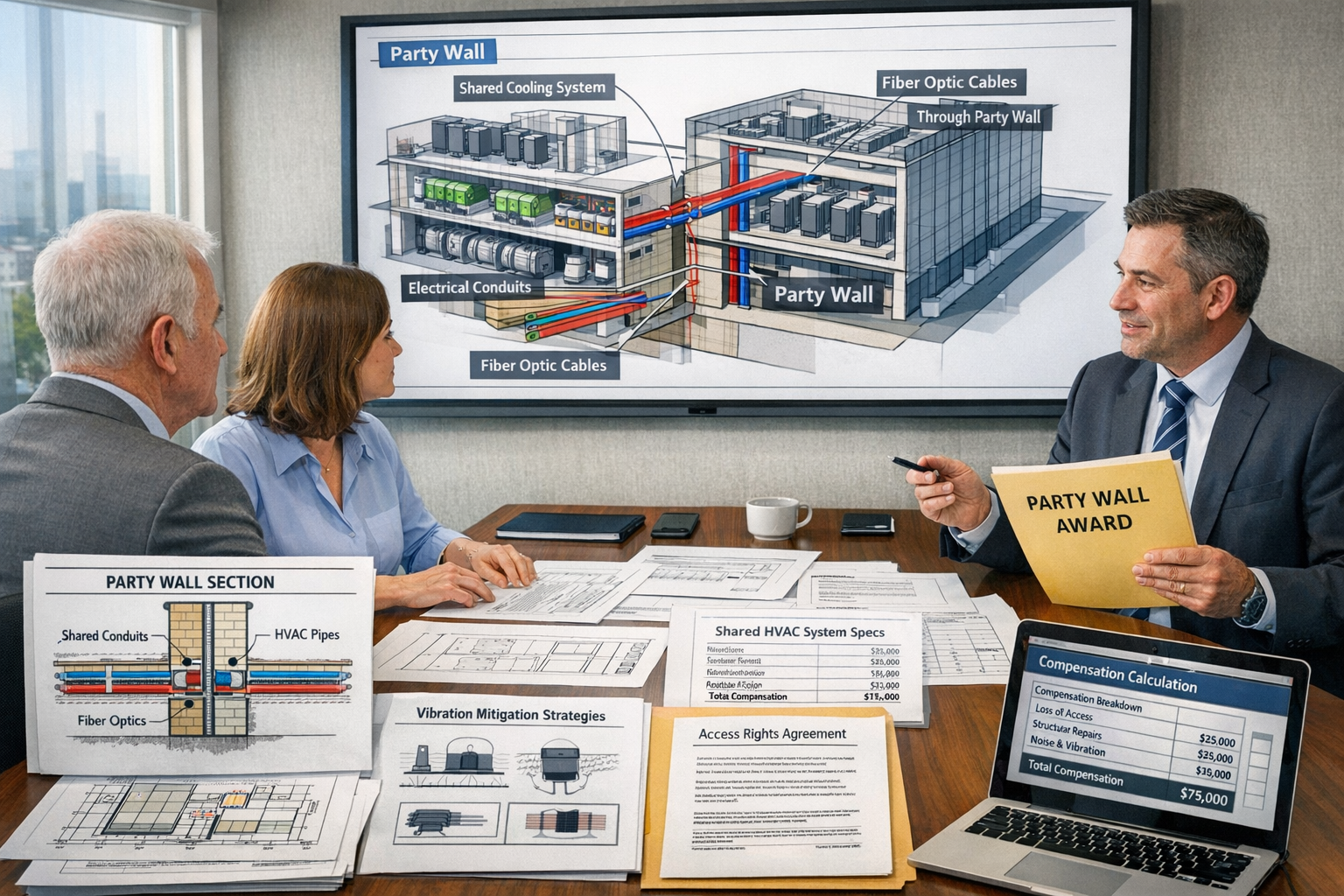
    Some innovative party wall agreements in 2026 include shared cooling infrastructure provisions. When a data center is built adjacent to another commercial property, both parties might benefit from a shared cooling system that uses the party wall as a thermal boundary. These arrangements require exceptionally detailed surveying to establish baseline conditions, define maintenance responsibilities, and allocate costs—transforming the surveyor’s role from mere documenter to infrastructure planning consultant.

    The precision required for thermal surveying extends to moisture monitoring. Data centers maintain strict humidity controls, typically between 40-60% relative humidity. When these controlled environments exist adjacent to properties with different humidity levels, moisture can migrate through party walls, potentially causing condensation, mold growth, or material degradation. Advanced surveyors now incorporate hygroscopic sensors into their monitoring regimes, tracking moisture content in party wall materials throughout the construction and operational phases.

    Foundation Load Distribution and Settlement Monitoring

    Data center buildings impose extraordinary structural loads that dwarf those of conventional commercial construction. A typical office building might impose floor loads of 2.5-4 kN/m², while data center floors routinely handle 10-15 kN/m² or more to support dense server rack configurations, battery backup systems, and heavy mechanical equipment [3].

    When these facilities are constructed adjacent to existing buildings with shared or nearby foundations, precision surveying becomes critical for preventing differential settlement that could damage both structures. The surveying challenges begin during the design phase, where boundary wall rules and differences between party fence walls and boundary walls must be carefully documented to establish legal and physical boundaries.

    Geotechnical surveying for data center party wall agreements requires soil analysis at depths far exceeding standard practice. While residential projects might investigate soil conditions to 3-5 meters depth, data center foundations often extend 10-15 meters or more, requiring comprehensive soil boring and testing programs. The surveyor must document how these deep foundations interact with adjoining properties’ foundation systems, assessing the potential for load transfer, settlement, or heave.

    Modern surveying practice employs automated settlement monitoring systems using precise leveling instruments or GPS-based monitoring stations that can detect vertical movement as small as 0.5 millimeters. These systems provide continuous data feeds, allowing surveyors to identify problematic settlement trends before they cause visible damage. Party wall awards for data center projects increasingly specify these monitoring systems as mandatory, with data sharing requirements that keep all parties informed of structural behavior.

    The excavation phase presents particular surveying challenges when data centers are built adjacent to existing structures. Deep excavations for basement-level mechanical equipment can extend below adjoining properties’ foundations, requiring temporary shoring systems and underpinning work. Surveyors must establish precise three-dimensional control networks to monitor both horizontal and vertical movement of party walls during excavation, with measurement frequencies often increasing to multiple times daily during critical phases.

    Electromagnetic Interference and Shielding Considerations

    While not traditionally part of party wall surveying, electromagnetic compatibility (EMC) has emerged as a significant concern in Party Wall Agreements for Data Center Builds: Precision Surveying Challenges in 2026. Data centers generate substantial electromagnetic fields from their power distribution systems, backup generators, and computing equipment. When these facilities share walls with sensitive operations—medical facilities, research laboratories, or even other data centers—EMI becomes a surveying and legal consideration.

    Progressive surveyors now conduct baseline electromagnetic surveys before data center construction begins, documenting the existing electromagnetic environment at the party wall and within adjoining properties. These surveys use spectrum analyzers and field strength meters to measure electromagnetic radiation across multiple frequency bands, creating a comprehensive baseline against which future measurements can be compared.

    Party wall awards for data center projects may specify EMI shielding requirements within the party wall construction itself. This might include embedded metal mesh, specialized conductive coatings, or complete Faraday cage construction for portions of the shared structure. Surveying these installations requires specialized equipment to verify shielding effectiveness, measuring attenuation levels in decibels across relevant frequency ranges.

    The challenge intensifies when data centers incorporate high-voltage electrical systems that penetrate or run parallel to party walls. Transformers, switchgear, and backup generator systems can create magnetic fields that extend several meters beyond their physical locations. Surveyors must map these field distributions and verify that they remain within acceptable limits at the party wall boundary—a task requiring both electrical engineering knowledge and precision measurement capabilities.

    RICS-Compliant Party Wall Notices for Data Center Projects

    Crafting Comprehensive Party Structure Notices

    The Royal Institution of Chartered Surveyors (RICS) provides guidance on party wall matters, but data center projects often push beyond standard templates into bespoke territory. A RICS-compliant party structure notice for a data center build must address technical specifications that rarely appear in residential or conventional commercial notices.

    Detailed technical descriptions form the foundation of effective party structure notices for data centers. Rather than generic descriptions like “installation of services,” data center notices must specify the exact nature of penetrations through party walls: the diameter and number of fiber optic conduits, the size and routing of cooling system pipes, the specifications for electrical cable trays, and the methods for sealing penetrations to maintain fire resistance and acoustic separation.

    The notice must address operational characteristics that affect the party wall’s long-term performance. This includes:

    • 🔊 Noise levels from cooling systems, backup generators, and mechanical equipment that may transmit through the party wall
    • 🌡️ Thermal loads and temperature differentials that the party wall will experience
    • Vibration sources from rotating equipment, with specifications of operating frequencies and expected vibration levels
    • 💧 Moisture management systems and how condensation from cooling equipment will be controlled
    • 🔐 Security requirements that may affect access to the party wall for maintenance or inspection

    RICS guidance emphasizes the importance of timing and sequence in serving notices. For data center projects with multiple notice requirements, surveyors must carefully coordinate the service of Line of Junction Notices, Party Structure Notices, and excavation notices to ensure compliance while maintaining construction schedule efficiency. Serving notices too early can result in consent periods expiring before construction begins; serving them too late creates legal exposure and potential injunctions.

    Incorporating Advanced Monitoring Provisions

    Modern party wall awards for data center construction incorporate technology-enabled monitoring provisions that would have been impractical or impossibly expensive just a decade ago. The 2026 surveying landscape benefits from affordable sensors, wireless data transmission, and cloud-based monitoring platforms that enable continuous oversight of party wall conditions.

    A comprehensive party wall award for a data center project should specify:

    Monitoring Equipment Requirements:

    • Type and specification of vibration sensors (triaxial accelerometers with minimum sensitivity)
    • Thermal imaging survey frequency and equipment specifications
    • Settlement monitoring precision (typically ±0.5mm for data center projects)
    • Crack width monitoring gauge installation locations and alert thresholds
    • Electromagnetic field measurement protocols and acceptable limits

    Data Management and Sharing:

    • Real-time data access provisions for adjoining owners and their surveyors
    • Alert threshold levels that trigger notifications to all parties
    • Data retention periods (typically minimum 5 years post-construction)
    • Third-party data verification requirements
    • Dispute resolution protocols when monitoring data indicates potential issues

    The award should establish clear action protocols triggered by monitoring data. For example, if vibration levels exceed 80% of the agreed threshold, the building owner might be required to notify the adjoining owner within 2 hours and implement mitigation measures within 24 hours. These provisions transform monitoring from passive observation into active risk management.

    Addressing 24/7 Operational Considerations

    Unlike construction projects that eventually complete and return to quiet occupancy, data centers operate continuously with high-intensity mechanical systems that affect party walls indefinitely. This operational reality requires party wall agreements to extend beyond construction phase considerations into long-term operational provisions.

    The party wall award must address ongoing access rights for monitoring and maintenance. Data center security requirements often conflict with adjoining owners’ rights to inspect party walls. The award should establish specific protocols: advance notice periods for inspections, security clearance procedures, escort requirements, and limitations on photography or recording within the data center—all while preserving the adjoining owner’s fundamental rights under the Act.

    Noise and vibration limits during operations require careful specification. While construction-phase limits might permit higher levels for limited durations, operational limits must be sustainable 24/7/365. The award should reference British Standards for noise in commercial environments (BS 8233) and vibration in buildings (BS 6472), adapting these standards to the specific party wall context.

    Some forward-thinking awards include technology upgrade provisions that anticipate future changes to data center equipment. As computing technology evolves, data centers regularly replace servers, cooling systems, and power equipment with newer generations that may have different vibration, thermal, or electromagnetic characteristics. The award can establish a framework for notifying adjoining owners of significant equipment changes and reassessing party wall impacts without requiring entirely new party wall procedures.

    Understanding how to keep party wall costs down becomes particularly important for data center projects, where the technical complexity can drive surveying and legal costs to substantial levels. Clear, comprehensive awards that anticipate operational issues prevent costly disputes and repeated surveyor appointments.

    Shared Infrastructure Awards and Cost Allocation

    Detailed landscape format (1536x1024) image depicting precision surveying challenges specific to data center construction near party walls.

    Negotiating Shared Cooling and Power Systems

    An emerging trend in Party Wall Agreements for Data Center Builds: Precision Surveying Challenges in 2026 involves shared infrastructure arrangements where adjoining properties benefit from data center systems. These arrangements transform the party wall from a mere boundary into a functional interface for shared utilities, creating both opportunities and complexities for surveyors.

    Shared cooling systems present the most common infrastructure sharing scenario. A data center’s cooling capacity often exceeds its own needs, particularly during cooler months or when using free cooling techniques. Adjoining commercial properties can potentially tap into this excess capacity, receiving chilled water for their HVAC systems through connections that pass through or near the party wall.

    The surveyor’s role in these arrangements extends far beyond traditional party wall practice into infrastructure planning and cost allocation. The party wall award must specify:

    • 📐 Technical specifications for shared infrastructure penetrations through the party wall
    • 💰 Capital cost allocation for installing shared systems
    • 🔧 Maintenance responsibility and cost sharing for equipment serving both properties
    • Capacity allocation defining each property’s share of available cooling or power
    • 📊 Metering and billing systems to track actual usage and allocate operating costs
    • 🚨 Service level agreements defining uptime expectations and remedies for failures
    • 🔄 Exit provisions allowing either party to discontinue the arrangement under specified conditions

    These complex arrangements require surveyors to work closely with mechanical engineers, cost consultants, and legal advisors. The party wall award becomes a hybrid document, incorporating elements of easement agreements, service contracts, and traditional party wall provisions.

    Fiber Optic and Data Connectivity Sharing

    Data centers are nodes in global communications networks, typically connecting to multiple fiber optic carriers for redundancy. These fiber optic cables must enter the facility from public rights-of-way, often crossing adjoining properties or passing through party walls. The surveying challenges involve both the physical installation and the long-term access and maintenance rights.

    Party wall awards for fiber optic installations must address several unique considerations:

    Physical Installation Requirements:

    • Precise routing of fiber optic conduits through party walls to avoid structural elements
    • Minimum bend radius specifications to prevent fiber damage (typically 20x cable diameter)
    • Fire-stopping and acoustic sealing requirements for conduit penetrations
    • Electromagnetic shielding if cables pass near high-voltage electrical systems
    • Future capacity provisions allowing additional fiber installation without new party wall procedures

    Access and Maintenance Provisions:

    • Rights to access party wall areas for fiber repairs or upgrades
    • Notice periods for planned maintenance (often shorter than standard party wall access notice periods due to network criticality)
    • Emergency access rights for service-affecting failures
    • Compensation provisions if fiber installation or maintenance damages the party wall
    • Insurance requirements covering fiber optic infrastructure within party wall areas

    Some innovative agreements establish communications infrastructure sharing where the adjoining owner gains rights to install their own fiber optic connections through the same conduits or party wall penetrations used by the data center. This arrangement benefits both parties: the data center developer gains goodwill and potentially easier consent to their works, while the adjoining owner obtains valuable connectivity infrastructure. The surveyor must carefully document these shared rights and ensure the party wall award clearly defines each party’s allocated space within shared conduits.

    Long-Term Maintenance and Modification Frameworks

    Traditional party wall awards focus primarily on construction phase activities, with limited attention to long-term maintenance and future modifications. Data center projects require a more sophisticated approach that anticipates decades of ongoing operations and periodic technology upgrades.

    A comprehensive maintenance framework within the party wall award should establish:

    Regular Inspection Protocols:

    • Annual joint inspections of party wall conditions by surveyors representing both parties
    • Five-year comprehensive structural assessments including non-destructive testing
    • Continuous monitoring data review meetings (quarterly or semi-annually)
    • Documentation requirements for inspection findings and recommended actions

    Modification Procedures:

    • Streamlined notice procedures for minor modifications (e.g., adding fiber optic cables to existing conduits)
    • Full party wall notice requirements for major modifications (e.g., structural alterations, new equipment installations)
    • Technical review processes involving both parties’ engineers for proposed changes
    • Cost allocation principles for modifications that benefit both properties versus those serving only one party

    Dispute Resolution Mechanisms:

    • Graduated dispute resolution starting with direct negotiation between appointed surveyors
    • Mediation provisions before resorting to Third Surveyor appointment
    • Technical expert determination for specialized issues (vibration, thermal, electromagnetic)
    • Arbitration or litigation as final resort, with cost allocation provisions

    The framework should also address technology obsolescence scenarios. Data center equipment lifecycles range from 3-7 years for servers to 15-20 years for mechanical systems. The party wall award can establish principles for how equipment replacements affecting the party wall will be handled, potentially avoiding the need for entirely new party wall procedures for each technology refresh cycle.

    Understanding the broader context of types of party wall works helps surveyors classify data center modifications appropriately and apply the correct procedural requirements.

    Regional Variations and Jurisdictional Considerations

    London-Specific Challenges for Data Center Party Walls

    London’s position as a global data center hub creates unique surveying challenges related to urban density, historic structures, and property values. Data centers in London frequently occupy sites in areas like Docklands, Slough (within the Greater London data center cluster), and increasingly in regeneration zones where they adjoin diverse property types.

    Party wall surveyors in Central London face particular challenges when data centers are proposed adjacent to listed buildings or conservation areas. The party wall agreement must coordinate with heritage protection requirements, often requiring specialized surveying techniques that document historic fabric in extraordinary detail. Vibration limits for construction near listed structures may be significantly more stringent than standard practice, sometimes requiring PPV limits below 2 mm/s to protect delicate historic materials.

    The property value implications of data center construction in London create heightened scrutiny of party wall agreements. When a data center is built adjacent to high-value residential or commercial properties, adjoining owners often engage specialist surveyors and legal counsel to ensure their interests are protected. This can transform what might be a straightforward party wall process elsewhere into a complex negotiation involving multiple expert advisors.

    Different London boroughs have varying approaches to data center development, affecting the party wall process indirectly through planning conditions and building control requirements. Party wall surveyors in North London, South London, East London, and West London must understand local authority expectations regarding noise, vibration, and environmental impacts, ensuring party wall awards align with planning conditions.

    Adapting to Regional Construction Standards

    While the Party Wall etc. Act 1996 applies uniformly across England and Wales, regional construction practices and ground conditions create variations in how party wall agreements for data centers are implemented. Surveyors must adapt their approaches to local contexts while maintaining compliance with the Act and RICS guidance.

    Geological variations significantly impact foundation design and party wall surveying requirements:

    • London Clay areas require deep piled foundations for heavy data center loads, creating specific excavation and vibration challenges
    • Chalk substrates in parts of Southeast England may require specialized foundation techniques and groundwater management
    • Made ground in former industrial areas (common data center sites) necessitates extensive soil investigation and contamination assessment
    • High water tables in low-lying areas require dewatering operations that can affect adjoining properties through settlement

    Regional construction cost variations affect party wall negotiations and cost allocations. Data center construction costs in London can exceed £3,000 per square meter, compared to £2,000-2,500 per square meter in regional locations [4]. These cost differences influence how parties approach shared infrastructure opportunities and dispute resolution—higher stakes in expensive markets often lead to more detailed party wall awards and more frequent surveyor involvement.

    Local surveying practice traditions also vary. Some regions have established networks of party wall surveyors with deep experience in commercial construction, while others may have limited expertise in complex projects like data centers. Building owners and adjoining owners benefit from engaging surveyors with specific data center experience, even if this requires looking beyond immediate local practitioners.

    Cross-Border Considerations for Multi-Jurisdictional Projects

    Some large data center campuses span multiple local authority boundaries or even cross the England-Wales border, creating jurisdictional complexities for party wall agreements. While the Party Wall etc. Act 1996 applies consistently across England and Wales, local building control, planning, and environmental health regulations vary, affecting how party wall provisions are implemented.

    Surveyors must coordinate party wall agreements with:

    • Building Regulations approval from potentially multiple local authorities
    • Planning conditions that may impose specific requirements on construction methods, hours, or monitoring
    • Environmental permits for cooling water discharge, generator emissions, or noise
    • Highway authority requirements when construction affects public rights of way near party walls

    Large data center developments may involve multiple building owners on a single campus, each with their own party wall obligations to external adjoining owners and potentially to each other. This creates complex networks of party wall relationships that require careful coordination to prevent conflicting obligations or monitoring requirements.

    Best Practices for Surveyors and Stakeholders

    Pre-Construction Planning and Risk Assessment

    Successful navigation of Party Wall Agreements for Data Center Builds: Precision Surveying Challenges in 2026 begins long before formal party wall notices are served. Proactive surveyors engage in comprehensive pre-construction planning that identifies potential issues and develops mitigation strategies before they become disputes.

    Early site assessment should include:

    Title and boundary verification using Land Registry documents, historical deeds, and measured surveys to establish precise property boundaries

    Adjoining owner identification extending beyond immediately adjacent properties to include those within potential notice distances (3 meters and 6 meters for excavations)

    Existing structure assessment documenting the condition of adjoining buildings through visual surveys, photographic records, and potentially structural investigations

    Geotechnical investigation with soil borings extending to depths below proposed data center foundations, assessing both bearing capacity and potential settlement impacts on adjoining properties

    Utility mapping identifying existing services that cross property boundaries or run near party walls, including telecommunications, water, gas, electricity, and drainage

    Stakeholder engagement initiating informal discussions with adjoining owners before formal notices, explaining the project and addressing concerns early

    This planning phase allows surveyors to develop risk-informed party wall strategies that anticipate challenges rather than merely reacting to them. For example, if geotechnical investigation reveals poor soil conditions requiring deep piling near a party wall, the surveyor can proactively specify vibration monitoring and potentially recommend alternative foundation techniques before serving formal notices.

    Understanding whether party wall agreements can proceed without a surveyor helps stakeholders appreciate when professional expertise is truly essential—and for data center projects, professional surveyor involvement is virtually always necessary given the technical complexity.

    Technology Integration in Modern Party Wall Surveying

    The surveying profession has embraced digital technologies that dramatically enhance the precision, efficiency, and transparency of party wall processes for data center projects. Modern surveyors leverage tools that would have been unavailable or prohibitively expensive just a few years ago.

    Building Information Modeling (BIM) integration allows party wall surveyors to work with three-dimensional digital models of both the proposed data center and existing adjoining structures. These models enable:

    • Precise visualization of party wall interfaces and proposed penetrations
    • Clash detection identifying conflicts between proposed data center systems and existing structures
    • Spatial coordination of monitoring equipment placement
    • Simulation of construction sequences to identify high-risk phases
    • Client and adjoining owner communication using visual representations rather than technical drawings

    Laser scanning and photogrammetry create highly accurate three-dimensional records of existing conditions. A surveyor can capture millions of measurement points in hours, producing digital models accurate to ±2-3mm that serve as definitive baseline records. These scans prove invaluable when disputes arise about whether construction has caused damage—the pre-construction scan provides objective evidence of existing conditions.

    Drone surveys enable efficient documentation of roof-level party walls and difficult-to-access areas. For multi-story data centers, drones can capture high-resolution imagery and measurements without requiring scaffolding or access equipment, reducing costs and safety risks while improving documentation quality.

    Cloud-based collaboration platforms allow all parties to access monitoring data, survey reports, and party wall documentation in real-time. Rather than waiting for monthly reports, adjoining owners can log into secure portals to view current vibration levels, settlement data, and construction progress. This transparency builds trust and enables rapid response when issues arise.

    Communication Strategies for Complex Technical Projects

    Data center party wall agreements involve multiple stakeholders with varying levels of technical knowledge: building owners focused on construction schedules and costs, adjoining owners concerned about property impacts, technical specialists (structural engineers, mechanical engineers, IT infrastructure designers), and legal advisors ensuring compliance and risk management.

    Effective surveyors develop layered communication strategies that convey appropriate information to each stakeholder group:

    For Building Owners and Project Managers:

    • Focus on schedule implications of party wall processes and how to minimize delays
    • Highlight cost implications of different monitoring and mitigation options
    • Provide clear decision points where owner input is required
    • Explain how party wall compliance protects against injunctions and project stoppages

    For Adjoining Owners:

    • Use plain language explanations of technical concepts, avoiding jargon
    • Provide visual aids (photos, diagrams, models) to illustrate proposed works
    • Clearly explain rights under the Party Wall etc. Act and the role of surveyors
    • Establish realistic expectations about construction impacts and duration
    • Demonstrate how monitoring protects their interests

    For Technical Specialists:

    • Provide detailed specifications and performance criteria for party wall works
    • Coordinate technical requirements across disciplines (structural, mechanical, electrical)
    • Ensure party wall provisions align with building design and construction methodology
    • Integrate party wall monitoring with broader construction quality control

    For Legal Advisors:

    • Ensure party wall awards provide legally enforceable provisions
    • Address liability allocation and insurance requirements
    • Coordinate party wall agreements with broader project legal documentation
    • Provide evidence-based documentation supporting party wall positions

    Regular stakeholder meetings throughout the party wall process keep all parties informed and aligned. For complex data center projects, monthly coordination meetings during the notice and award preparation phase, transitioning to weekly meetings during critical construction phases, help prevent misunderstandings and enable rapid issue resolution.

    Providing access to resources like free downloadable party wall agreement templates helps adjoining owners understand the process, though data center projects invariably require bespoke agreements rather than template documents.

    Case Studies: Lessons from Recent Data Center Party Wall Projects

    Detailed landscape format (1536x1024) image illustrating party wall awards and shared infrastructure considerations for data center builds.

    Urban Infill Data Center with Historic Adjoining Structure

    A 2025 project in East London illustrates the challenges of Party Wall Agreements for Data Center Builds: Precision Surveying Challenges in 2026 when modern infrastructure meets historic fabric. The developer proposed a 5,000 square meter data center on a former industrial site directly adjacent to a Grade II listed Victorian warehouse that had been converted to residential lofts.

    Key Challenges:

    • The listed building’s brick party wall, over 150 years old, had no original structural calculations or known foundation depth
    • Proposed data center foundations extended 12 meters below ground level, significantly deeper than the historic building’s foundations
    • Vibration limits for the listed structure were set at 2 mm/s PPV, well below typical construction levels
    • The party wall required penetrations for fiber optic conduits serving both properties

    Surveying Solutions Implemented:

    • Non-destructive testing (ground-penetrating radar and ultrasonic testing) to map the historic wall’s internal structure without damaging protected fabric
    • Trial excavations to establish the depth and condition of the listed building’s foundations
    • Installation of 24 real-time vibration monitoring points on the party wall and within the residential units
    • Modified foundation design using continuous flight auger (CFA) piling instead of impact-driven piles to minimize vibration
    • Detailed photographic and laser scan documentation of every brick, crack, and architectural detail before construction
    • Shared fiber optic infrastructure agreement allowing residential owners to access high-speed connectivity through data center conduits

    Outcomes:

    • Construction completed without exceeding vibration limits at any monitoring point
    • No measurable settlement or structural movement in the listed building
    • Party wall award included provisions for ongoing monitoring during data center operations
    • Residential owners gained gigabit fiber connectivity as collateral benefit
    • Project became a model for sensitive urban data center development

    Shared Cooling Infrastructure Between Adjacent Data Centers

    A unique 2024-2025 project in the Thames Valley involved two competing data center operators building adjacent facilities that shared a party wall. Rather than treating the party wall as merely a boundary, the operators negotiated a sophisticated shared infrastructure agreement that benefited both parties while presenting novel surveying challenges.

    Project Structure:

    • Two data centers, each approximately 10,000 square meters, sharing a 50-meter party wall
    • Shared cooling infrastructure using the party wall as a thermal boundary
    • Common fiber optic entry point serving both facilities
    • Shared backup generator fuel storage beneath the party wall

    Surveying Innovations:

    • Dual-purpose party wall design engineered to support both facilities’ structural loads while serving as thermal barrier
    • Embedded sensors within the party wall structure monitoring temperature, moisture, structural stress, and vibration
    • Detailed cost allocation methodology for shared infrastructure based on actual usage metering
    • Governance framework requiring joint approval for modifications affecting shared systems
    • Technical specifications ensuring each operator’s systems remained independent despite physical proximity

    Commercial Arrangements:

    • Shared capital costs for party wall construction (60/40 split based on facility sizes)
    • Operating cost allocation based on metered usage of shared cooling capacity
    • Cross-access rights for emergency maintenance with strict security protocols
    • Dispute resolution through technical expert determination before arbitration

    Lessons Learned:

    • Shared infrastructure can reduce overall project costs by 15-20% compared to fully independent systems
    • Clear governance and decision-making frameworks are essential when competitors share infrastructure
    • Technical monitoring systems must be independently verifiable to maintain trust between parties
    • Party wall awards for shared infrastructure require ongoing amendment mechanisms as technology evolves

    Vibration-Sensitive Research Facility Adjoining New Data Center

    A 2025 project in Cambridge presented extreme vibration sensitivity challenges when a hyperscale data center was proposed adjacent to a university quantum computing research facility. The research facility housed equipment sensitive to vibrations at levels below 0.5 mm/s PPV—far more stringent than typical party wall vibration limits.

    Technical Challenges:

    • Research facility required vibration isolation to 0.3 mm/s PPV for quantum computing experiments
    • Data center construction involved deep excavation, piling, and installation of heavy mechanical equipment
    • Party wall separated facilities by only 5 meters
    • Both facilities required 24/7 operations with zero tolerance for disruption

    Surveying and Engineering Solutions:

    • Comprehensive vibration modeling predicting construction and operational vibration propagation
    • Modified construction methodology eliminating all impact-driven piling in favor of CFA and vibration-dampened techniques
    • Installation of a vibration isolation trench between the facilities, extending to bedrock
    • Continuous real-time vibration monitoring with automated construction shutdown if thresholds approached
    • Phased construction schedule coordinating high-vibration activities with research facility’s experimental calendar
    • Post-construction operational vibration testing before data center equipment installation

    Party Wall Award Provisions:

    • Detailed construction methodology specifications mandating low-vibration techniques
    • Real-time vibration data sharing with research facility’s technical team
    • Automatic work stoppage triggers if vibration levels exceeded 80% of agreed thresholds
    • Compensation provisions if research experiments were disrupted despite precautions
    • Long-term operational vibration limits for data center equipment (0.5 mm/s PPV maximum)

    Results:

    • Construction completed with maximum recorded vibration of 0.42 mm/s PPV—within acceptable limits
    • No research disruption occurred during 18-month construction period
    • Operational vibration levels measured below 0.2 mm/s PPV, well within limits
    • Project demonstrated that even extreme vibration sensitivity can be managed with appropriate engineering and surveying protocols

    These case studies demonstrate that while Party Wall Agreements for Data Center Builds: Precision Surveying Challenges in 2026 present significant technical and legal complexities, careful planning, innovative engineering, and professional surveying can achieve successful outcomes that protect all parties’ interests.

    Future Trends in Data Center Party Wall Agreements

    Artificial Intelligence and Automated Monitoring

    The intersection of AI-driven data centers and AI-enhanced surveying creates interesting possibilities for the future of party wall management. Machine learning algorithms can analyze continuous streams of monitoring data from vibration sensors, settlement gauges, and thermal cameras, identifying patterns that might indicate developing problems before they become visible.

    Predictive maintenance applications could transform party wall monitoring from reactive to proactive. Rather than waiting for cracks to appear or settlement to exceed thresholds, AI systems could analyze subtle trends in monitoring data and predict potential issues weeks or months in advance. This early warning capability would allow building owners to implement preventive measures, potentially avoiding damage and disputes entirely.

    Automated compliance verification using AI could streamline party wall administration. Systems could continuously verify that construction activities remain within agreed parameters, automatically generating compliance reports and alerting surveyors only when exceptions occur. This would reduce the administrative burden on surveyors while providing more comprehensive oversight than manual monitoring.

    However, these technological advances also raise questions about liability and professional responsibility. If an AI system fails to detect a developing problem, who bears responsibility—the surveyor who specified the system, the software developer, or the building owner who relied on automated monitoring? Party wall awards in coming years will need to address these allocation-of-risk questions as automation becomes more prevalent.

    Sustainability and Green Building Integration

    The environmental impact of data centers has come under increasing scrutiny, with operators facing pressure to reduce energy consumption, water usage, and carbon emissions [8]. These sustainability initiatives create new party wall considerations as data centers implement innovative green technologies.

    Waste heat recovery systems that capture data center thermal output and supply it to adjoining properties for space heating represent an emerging party wall opportunity. These systems require thermal connections through party walls, long-term operational agreements, and careful engineering to ensure reliable heat supply without creating dependencies that could constrain either party’s future operations.

    Renewable energy integration, particularly rooftop solar installations on data centers, may affect party wall considerations when solar panels create shading, glare, or electromagnetic effects impacting adjoining properties. Party wall awards may need to address these environmental impacts alongside traditional structural and construction concerns.

    Water recycling systems that treat data center cooling water for reuse can reduce environmental impact but may require drainage connections or water supply sharing across party walls. These systems introduce water quality, pressure management, and contamination prevention considerations into party wall agreements.

    Surveyors will increasingly need to understand green building standards (BREEAM, LEED, etc.) and how sustainability features interact with party wall obligations. A data center pursuing BREEAM Excellent certification might implement construction techniques or materials that affect party wall works, requiring surveyors to balance sustainability objectives with traditional party wall protections.

    Modular and Rapid Deployment Construction Methods

    The data center industry’s demand for rapid deployment is driving adoption of modular construction techniques where significant portions of the facility are prefabricated off-site and assembled on location [2][7]. These methods present both opportunities and challenges for party wall agreements.

    Prefabricated party wall sections could be manufactured to exact specifications in controlled factory environments, potentially achieving higher quality and precision than traditional site-built construction. However, this requires exceptionally accurate surveying to ensure prefabricated components align perfectly with existing structures and site conditions.

    Accelerated construction schedules enabled by modular methods compress the timeline for party wall processes. Traditional party wall procedures with their statutory notice periods and consent timelines may not align well with construction programs that measure in weeks rather than months. This creates pressure for streamlined party wall processes—potentially through agreed surveyor appointments and advance framework agreements—that maintain legal compliance while supporting rapid deployment.

    Reduced site disruption from modular construction could benefit adjoining owners through shorter periods of noise, vibration, and construction activity. Party wall awards might specify modular construction methods as a condition of consent, recognizing the reduced impact compared to traditional construction.

    The challenge for surveyors lies in adapting traditional party wall documentation developed for conventional construction to these new methodologies. Awards must address the unique characteristics of modular construction: crane operations for module placement, connection methodologies for joining modules, and quality assurance processes for factory-manufactured components.

    Conclusion: Navigating the Complex Landscape of Data Center Party Wall Agreements

    The explosive growth of data center construction in 2026, driven by artificial intelligence, cloud computing, and digital transformation across industries, has created unprecedented challenges at the intersection of cutting-edge technology infrastructure and traditional property law. Party Wall Agreements for Data Center Builds: Precision Surveying Challenges in 2026 represent a specialized domain where surveyors must combine deep knowledge of the Party Wall etc. Act 1996 with technical expertise spanning structural engineering, vibration analysis, thermal dynamics, and electromagnetic compatibility.

    The unique characteristics of data centers—massive structural loads, continuous high-intensity operations, extreme vibration sensitivity, substantial thermal output, and critical infrastructure status—transform routine party wall processes into complex technical and legal undertakings. Surveyors who successfully navigate these challenges employ precision measurement techniques, advanced monitoring technologies, and innovative agreement structures that go far beyond traditional party wall practice.

    Key Success Factors

    Successful party wall agreements for data center projects share several common elements:

    🎯 Early engagement with adjoining owners and comprehensive pre-construction planning that identifies potential issues before they become disputes

    📊 Technology-enabled monitoring using real-time sensors and data platforms that provide transparency and enable rapid response to developing problems

    ⚖️ Balanced agreements that protect adjoining owners’ rights while enabling data center construction and operations to proceed efficiently

    🤝 Collaborative approaches that seek mutual benefits through shared infrastructure where appropriate, transforming party walls from mere boundaries into functional interfaces

    📋 Detailed documentation establishing baseline conditions, specifying performance criteria, and creating clear frameworks for ongoing maintenance and future modifications

    Actionable Next Steps for Stakeholders

    For Data Center Developers:

    1. Engage party wall surveyors during site selection and feasibility phases, not just after design is complete
    2. Budget adequately for comprehensive party wall processes—costs typically range from 0.5-2% of construction value for complex projects
    3. Consider shared infrastructure opportunities that can reduce costs while building positive relationships with adjoining owners
    4. Implement monitoring systems that exceed minimum requirements, demonstrating commitment to protecting neighboring properties
    5. Review the costs of party wall processes to understand financial implications

    For Adjoining Owners:

    1. Engage your own surveyor when you receive party wall notices for data center projects—the technical complexity justifies professional representation
    2. Request comprehensive baseline documentation including laser scans, detailed photography, and structural assessments
    3. Ensure party wall awards specify ongoing monitoring during both construction and operations, not just construction phases
    4. Understand your rights under the Party Wall etc. Act 1996, including the right to reasonable compensation for inconvenience and loss
    5. Explore potential benefits from the development, such as shared infrastructure or improved connectivity
    6. Learn more about your rights as an adjoining owner

    For Party Wall Surveyors:

    1. Develop specialized expertise in data center construction through continuing professional development and collaboration with technical specialists
    2. Invest in advanced surveying technologies (laser scanning, vibration monitoring equipment, thermal imaging) that enable precision documentation
    3. Build networks of expert consultants (structural engineers, geotechnical specialists, mechanical engineers) who can support complex data center projects
    4. Stay current with RICS guidance and emerging best practices for technology infrastructure projects
    5. Develop template frameworks for common data center party wall provisions while remaining flexible to project-specific requirements
    6. Consider whether you’re carrying out works or responding to neighbor’s works to understand your role

    For Legal and Technical Advisors:

    1. Recognize that data center party wall agreements require multidisciplinary expertise—no single professional can address all aspects alone
    2. Coordinate party wall processes with broader project legal documentation, planning conditions, and building regulations
    3. Address liability allocation for monitoring systems, shared infrastructure, and long-term operational impacts
    4. Develop dispute resolution frameworks appropriate to the technical complexity and commercial stakes of data center projects
    5. Ensure insurance arrangements adequately cover party wall risks specific to data center construction and operations

    The Path Forward

    As data center construction continues its rapid expansion across the United Kingdom and globally, the surveying profession must evolve to meet the unique challenges these projects present. The traditional approaches that serve well for residential extensions or conventional commercial buildings require significant adaptation for data centers with their extreme technical requirements and operational characteristics.

    The most successful outcomes emerge when all parties recognize their shared interest in successful project delivery that protects existing properties while enabling new infrastructure development. Party wall agreements, properly conceived and executed, provide the legal framework for achieving this balance—transforming potential conflicts into collaborative relationships.

    The surveying challenges inherent in Party Wall Agreements for Data Center Builds: Precision Surveying Challenges in 2026 will only intensify as data centers become larger, more technologically sophisticated, and more deeply integrated into urban environments. Surveyors who embrace these challenges, invest in specialized expertise, and adopt innovative approaches will find themselves at the forefront of one of the construction industry’s most dynamic sectors.

    By combining respect for established party wall principles with openness to new technologies and agreement structures, the surveying profession can ensure that the data center boom proceeds in a manner that respects property rights, protects existing structures, and enables the digital infrastructure that increasingly underpins modern society.


    References

    [1] Report – https://www.datacenterwatch.org/report

    [2] Data Center Construction Predictions For 2026 – https://www.databank.com/resources/blogs/data-center-construction-predictions-for-2026/

    [3] Data Center Construction Trends – https://cmicglobal.com/resources/article/data-center-construction-trends

    [4] Data Centres – https://www.brownejacobson.com/insights/2026-horizon-scanning-in-construction/data-centres

    [5] Proposed Florida Legislation Creates New Regulatory Framework – https://www.hklaw.com/en/insights/publications/2026/02/proposed-florida-legislation-creates-new-regulatory-framework

    [6] Navigating Contractual Considerations In The Ai Data Center Construction Boom – https://www.constructlaw.com/2025/10/20/navigating-contractual-considerations-in-the-ai-data-center-construction-boom/

    [7] constructiondive – https://www.constructiondive.com/news/data-centers-construction-2026-trends/810016/

    [8] Insights Realestate Cm From Data Centers To Offices – https://www.goodwinlaw.com/en/insights/publications/2026/02/insights-realestate-cm-from-data-centers-to-offices

    [9] Data Centers – https://www.hklaw.com/en/services/practices/real-estate-hospitality-and-leisure/data-centers

    [10] Data Centers Are The Winning Odds Less Certain In 2026 S101659690 – https://www.spglobal.com/ratings/en/regulatory/article/data-centers-are-the-winning-odds-less-certain-in-2026-s101659690

  • RICS Ethical Standards in Party Wall Surveying: Avoiding Con

    When a neighbour’s building project threatens to shake the foundations of your property—literally and figuratively—the party wall surveyor becomes the crucial mediator between cooperation and costly legal battles. Yet this trusted professional faces an increasingly complex ethical landscape in 2026, where traditional independence requirements now intersect with artificial intelligence governance, enhanced professional development standards, and evolving expectations for transparency. Understanding RICS Ethical Standards in Party Wall Surveying: Avoiding Conflicts in 2026 has never been more critical for property owners, building professionals, and surveyors themselves.

    The Royal Institution of Chartered Surveyors (RICS) has fundamentally reshaped its ethical framework over recent years, with landmark changes taking effect throughout 2026 that directly impact how party wall surveyors navigate conflicts of interest, maintain independence, and serve their clients under the Party Wall etc. Act 1996[1]. These standards don’t merely supplement legal requirements—they establish a higher professional benchmark that RICS members must meet to maintain their chartered status[1].

    Key Takeaways

    • New AI Governance Standard takes effect March 9, 2026, requiring party wall surveyors to demonstrate transparency, accountability, and fairness when using artificial intelligence tools[2][8]
    • Enhanced CPD Framework launched January 2026 shifts focus from hour-counting to demonstrating genuine professional growth and improved practice quality[3]
    • Five Core Ethical Principles—honesty, integrity, competence, service, and respect—form the foundation of all RICS member conduct in party wall work[4]
    • Independence Requirements demand surveyors avoid conflicts of interest and maintain objectivity even when appointed by one party under the Act[1]
    • Professional Standards Exceed Legal Minimums, requiring RICS members to deliver higher-quality service than the Party Wall etc. Act 1996 technically mandates[1]

    Understanding the RICS Ethical Framework for Party Wall Surveyors

    Detailed landscape format (1536x1024) image showing RICS Rules of Conduct five pillars visualization as modern architectural columns labeled

    The Five Pillars of RICS Professional Conduct

    The RICS Rules of Conduct, which became effective in February 2022, establish five fundamental ethical principles that govern all chartered surveyors, including those specializing in party wall matters[4]. These principles create the ethical foundation upon which all professional decisions must rest:

    1. Honesty – Members must be truthful and transparent in all professional dealings
    2. Integrity – Members must act consistently with professional standards and avoid conflicts
    3. Competence – Members must maintain appropriate skills and knowledge for their work
    4. Service – Members must provide excellent client service while balancing all stakeholder interests
    5. Respect – Members must treat everyone with courtesy and consideration

    For party wall surveyors, these principles translate into concrete obligations. When serving party wall notices or preparing awards, surveyors cannot simply fulfill the minimum statutory requirements. They must demonstrate the higher professional standards expected of RICS membership[1].

    “RICS members accepting instructions as party wall surveyors are expected to meet professional and ethical standards of behaviour commensurate with membership, which exceeds the minimal obligations of the Party Wall etc. Act 1996.”[1]

    How Party Wall Legislation Integrates with RICS Standards

    The Party Wall etc. Act 1996 provides the legal framework for resolving disputes between building owners and their neighbours when construction work affects shared structures. However, the Act itself contains minimal guidance on professional conduct or ethical behaviour. This is where RICS standards become essential.

    The RICS Party Wall Legislation and Procedure standard, most recently updated in May 2023, provides mandatory procedures for RICS members working under the Act[1]. This guidance document clarifies how chartered surveyors should:

    • Accept appointments appropriately
    • Maintain independence and objectivity
    • Communicate with all parties transparently
    • Prepare comprehensive schedules of condition
    • Draft fair and enforceable awards
    • Handle fee disputes professionally

    Understanding the Party Wall etc. Act 1996 is fundamental, but RICS members must go further by applying ethical principles to every decision. This dual framework—legal compliance plus professional ethics—defines modern party wall practice in 2026.

    The 2026 Evolution: New Standards Affecting Party Wall Work

    Two major RICS initiatives launched in early 2026 have transformed professional expectations for party wall surveyors:

    1. The AI Governance Standard (Effective March 9, 2026)

    RICS’s Professional Standard on Artificial Intelligence Governance represents the institution’s first comprehensive attempt to regulate how surveyors use AI technologies[2][8]. This standard applies across all surveying disciplines, including building surveying and party wall work[5].

    The standard establishes mandatory requirements for:

    • Transparency – Disclosing when AI systems inform professional judgments
    • Accountability – Maintaining human oversight of AI-generated recommendations
    • Fairness – Ensuring AI tools don’t introduce bias into party wall assessments

    For party wall surveyors in 2026, this means that using AI to analyze structural damage, estimate repair costs, or draft award language now requires explicit disclosure to clients and compliance with governance protocols[2][8].

    2. The Revised CPD Framework (Effective January 2026)

    The refreshed Continuing Professional Development framework shifts emphasis from tracking hours to demonstrating impact[3]. While the annual requirement remains 20 hours (with at least 10 hours of structured learning), members must now focus on how their professional development improves practice quality[3].

    For party wall surveyors, this means CPD activities should demonstrably enhance:

    • Technical knowledge of construction methods and structural issues
    • Understanding of legal precedents and case law developments
    • Ethical decision-making capabilities in conflict situations
    • Communication skills for managing neighbour disputes

    The framework encourages surveyors to reflect on learning outcomes rather than simply accumulating course attendance certificates[3].

    RICS Ethical Standards in Party Wall Surveying: Avoiding Conflicts in 2026 Through Independence

    Defining Conflicts of Interest in Party Wall Appointments

    Conflicts of interest represent the most significant ethical challenge in party wall surveying. Unlike many professional relationships, the Party Wall etc. Act 1996 creates an unusual dynamic: the building owner typically pays both surveyors’ fees, yet each surveyor owes duties to their appointing party[1].

    Common conflict scenarios include:

    Conflict Type Description Ethical Risk
    Prior Relationship Surveyor has worked for building owner on previous projects May compromise objectivity when assessing neighbour’s concerns
    Financial Dependency Building owner represents significant portion of surveyor’s income Pressure to favour building owner’s interests
    Dual Appointments Same surveyor appointed for both parties (as “agreed surveyor”) Difficult to advocate equally for opposing interests
    Personal Connections Surveyor has family or social ties to one party Perception or reality of bias
    Organizational Conflicts Surveyor’s firm provides other services to building owner Institutional pressure to maintain broader client relationship

    RICS standards require surveyors to identify, disclose, and manage all potential conflicts before accepting appointments[4]. When conflicts cannot be adequately managed, surveyors must decline the instruction.

    The Independence Paradox: Serving One Party While Remaining Impartial

    Party wall surveyors face a unique professional paradox. Under the Act, they are appointed by and represent either the building owner or the adjoining owner. Yet RICS ethical standards demand they maintain objectivity and fairness throughout the process[1].

    This doesn’t mean party wall surveyors act as neutral arbitrators—they legitimately advocate for their appointing party’s interests. However, this advocacy must occur within ethical boundaries:

    Acceptable Advocacy:

    • Ensuring the award adequately protects the appointing party’s property
    • Negotiating reasonable working hours and access arrangements
    • Requesting appropriate security for expenses when justified
    • Challenging unreasonable demands from the other party

    Unacceptable Bias:

    • Deliberately omitting damage from schedules of condition
    • Recommending unnecessary protective works to increase costs
    • Refusing to communicate professionally with the other surveyor
    • Misrepresenting technical facts to favour one party

    The key distinction lies in honest representation versus deception. Party wall surveyors can vigorously represent their client’s legitimate interests while maintaining professional integrity[4].

    Practical Strategies for Maintaining Independence

    Experienced party wall surveyors employ several practical techniques to maintain independence and avoid conflicts:

    🔍 Pre-Appointment Conflict Checks

    Before accepting any party wall instruction, conduct thorough conflict searches:

    • Review existing client relationships with both parties
    • Check for personal connections to either property owner
    • Identify any prior work on the properties in question
    • Assess whether fee dependency creates undue influence
    • Document the conflict assessment in writing

    📋 Transparent Disclosure

    When potential conflicts exist but can be managed, full disclosure is essential:

    • Inform the appointing party of all relevant relationships
    • Explain how the conflict will be managed
    • Obtain written consent to proceed despite the conflict
    • Document the disclosure and consent in appointment letters

    ⚖️ Structural Independence Measures

    Build independence into your practice structure:

    • Maintain diverse client base to avoid financial dependency
    • Establish internal review procedures for contentious decisions
    • Create physical and informational barriers between different matters
    • Implement fee policies that don’t incentivize prolonged disputes

    🤝 Professional Communication Standards

    How surveyors communicate signals their commitment to ethics:

    • Respond promptly to the other surveyor’s correspondence
    • Maintain courteous tone even during disagreements
    • Share information transparently as required by the Act
    • Avoid ex parte communications that exclude the other surveyor

    For those seeking professional assistance, finding an experienced party wall surveyor in South London, West London, or other areas who demonstrates these independence practices is crucial.

    Navigating Multi-Party Disputes Under RICS Ethical Standards in Party Wall Surveying: Avoiding Conflicts in 2026

    When Multiple Neighbours Are Affected

    Many building projects affect multiple adjoining properties simultaneously, creating complex ethical dynamics. Consider a terrace house conversion where works impact neighbours on both sides, or a basement excavation affecting several properties on adjacent streets.

    In multi-party scenarios, RICS ethical standards require surveyors to:

    Identify All Affected Parties

    The building owner must serve notices on all adjoining owners whose properties fall within the Act’s scope[1]. Surveyors advising building owners have an ethical obligation to ensure comprehensive notice service, even when this increases project complexity.

    Manage Collective Appointments

    When multiple adjoining owners appoint the same surveyor, that professional must:

    • Ensure no conflicts exist between the various adjoining owners’ interests
    • Communicate equally with all appointing parties
    • Avoid favouring one adjoining owner over others
    • Disclose if interests diverge and conflicts emerge

    Coordinate Fair Outcomes

    The party wall awards must address each affected property appropriately. Ethical practice demands that surveyors don’t sacrifice one neighbour’s protection to expedite agreement with others.

    The Agreed Surveyor Role: Enhanced Ethical Obligations

    When both parties jointly appoint a single “agreed surveyor,” that professional assumes heightened ethical responsibilities. The agreed surveyor must simultaneously:

    • Understand and protect both parties’ legitimate interests
    • Remain genuinely impartial throughout the process
    • Avoid even the appearance of favouring one party
    • Communicate equally and transparently with both sides

    This role demands exceptional professional judgment and integrity. RICS members serving as agreed surveyors should:

    1. Establish Clear Ground Rules – Define communication protocols and decision-making processes at the outset
    2. Document Everything – Maintain meticulous records showing balanced consideration of both parties’ concerns
    3. Manage Expectations – Explain that neither party will get everything they want
    4. Decline When Appropriate – Recognize when genuine impartiality isn’t possible and suggest separate surveyors instead

    The agreed surveyor arrangement can reduce costs and expedite resolution, but only when the surveyor possesses the ethical commitment to serve both parties fairly[1].

    Fee Disputes and Ethical Considerations

    Fee disagreements represent a common source of ethical tension in party wall work. Under the Act, the building owner typically pays all reasonable surveyor fees, but disputes arise over what constitutes “reasonable.”

    RICS ethical standards require transparent fee arrangements:

    At Appointment:

    • Provide clear fee estimates or hourly rates in writing
    • Explain the basis for fee calculations
    • Disclose any factors that might increase costs
    • Obtain written agreement to fee terms

    During the Matter:

    • Track time and expenses accurately
    • Communicate promptly if fees will exceed estimates
    • Avoid unnecessary work that inflates fees
    • Maintain detailed fee records for later justification

    When Disputes Arise:

    • Engage constructively with fee challenges
    • Provide detailed fee breakdowns when requested
    • Consider reasonable fee reductions to resolve disputes
    • Avoid holding awards hostage to fee payment

    The principle of service from the RICS Rules of Conduct requires that fee practices prioritize fair value delivery over revenue maximization[4]. For guidance on managing expenses, see our article on how to keep party wall costs down.

    Practical Application: RICS Ethical Standards in Party Wall Surveying: Avoiding Conflicts in 2026 in Common Scenarios

    Comprehensive landscape format (1536x1024) infographic illustrating conflict of interest scenarios in party wall surveying, split-screen com

    Scenario 1: The Basement Excavation

    Situation: A building owner in Central London plans a basement excavation extending 3 meters below ground level, affecting four adjoining properties. The owner appoints you as their surveyor and offers a substantial ongoing relationship for future projects.

    Ethical Considerations:

    🔴 Conflict Risk: The promise of future work creates financial incentive to favour the building owner’s interests over proper protection for neighbours.

    RICS-Compliant Approach:

    1. Disclose the Relationship – Inform the building owner that professional obligations require objective assessment regardless of future work prospects
    2. Recommend Comprehensive Protection – Specify appropriate underpinning, monitoring, and protective measures based on technical merit, not relationship considerations
    3. Engage Transparently – Communicate openly with adjoining owners’ surveyors about excavation risks
    4. Document Technical Rationale – Ensure all recommendations can be justified on engineering grounds
    5. Consider Declining – If the relationship pressure feels too strong, recommend the building owner appoint a different surveyor

    For complex projects like this, understanding the types of party wall works and their specific requirements is essential.

    Scenario 2: The Disputed Damage Claim

    Situation: You’re appointed by an adjoining owner after construction work. The neighbour claims significant cracking occurred during the works, but the building owner’s surveyor disputes the damage is construction-related. Pre-construction photographs are ambiguous.

    Ethical Considerations:

    The competence and integrity principles require accurate damage assessment, even when it disadvantages your appointing party[4].

    RICS-Compliant Approach:

    1. Conduct Thorough Investigation – Inspect carefully, review all available evidence, consult structural engineers if needed
    2. Apply Technical Expertise – Distinguish construction-related damage from pre-existing conditions based on crack patterns, timing, and building movement
    3. Communicate Honestly – If evidence suggests damage pre-dates construction, advise your client truthfully rather than pursuing unfounded claims
    4. Seek Expert Input – When technical questions exceed your competence, engage appropriate specialists
    5. Document Findings – Prepare detailed reports explaining technical conclusions

    Maintaining a comprehensive schedule of condition before works commence prevents many such disputes.

    Scenario 3: The AI-Assisted Assessment

    Situation: You’re using new AI software in 2026 that analyzes photographs to identify structural damage and estimate repair costs. The AI suggests significantly higher repair costs than your professional judgment indicates.

    Ethical Considerations:

    The new AI Governance Standard requires transparency, accountability, and fairness when using AI tools[2][8].

    RICS-Compliant Approach:

    1. Maintain Human Oversight – Recognize that you, not the AI, bear professional responsibility for conclusions
    2. Disclose AI Use – Inform all parties that AI tools assisted your assessment
    3. Explain Methodology – Describe how the AI analysis informed your professional judgment
    4. Apply Critical Thinking – Question AI outputs that seem inconsistent with your expertise
    5. Document Decision Process – Record how you integrated AI insights with professional judgment
    6. Ensure Fairness – Verify the AI hasn’t introduced bias (e.g., systematically over-estimating damage in certain property types)

    The AI Governance Standard emphasizes that technology should enhance rather than replace professional judgment[2][8].

    Scenario 4: The Neighbour Relationship Conflict

    Situation: You’re asked to act as agreed surveyor for a loft conversion, but you discover the building owner is your appointing party’s business partner in an unrelated venture.

    Ethical Considerations:

    This personal connection creates both actual conflict (difficulty remaining impartial) and perceived conflict (appearance of bias)[4].

    RICS-Compliant Approach:

    1. Identify the Conflict – Recognize that the business relationship compromises genuine impartiality
    2. Disclose Immediately – Inform both parties of the connection before accepting appointment
    3. Recommend Alternative Structure – Suggest each party appoint separate surveyors rather than using an agreed surveyor
    4. Decline if Necessary – If parties insist on agreed surveyor arrangement, decline the instruction
    5. Document Decision – Record the conflict identification and resolution in writing

    Integrity requires declining lucrative work when conflicts cannot be adequately managed[4].

    The Role of CPD in Maintaining Ethical Standards

    How the 2026 CPD Framework Supports Ethical Practice

    The revised CPD framework that took effect in January 2026 represents a fundamental shift in how RICS approaches professional development[3]. Rather than simply accumulating hours, members must now demonstrate how learning activities improve their practice quality.

    For party wall surveyors, this means CPD should enhance ethical decision-making capabilities:

    Reflective Learning Approach:

    Instead of: “Attended 2-hour webinar on Party Wall Act updates”

    Better: “Attended webinar on recent case law developments. Identified three scenarios from my practice where new precedents apply. Revised my standard advice to building owners to incorporate these legal developments. Result: More accurate risk assessments and better client protection.”

    The framework encourages surveyors to:

    • Identify Knowledge Gaps – Recognize areas where competence needs strengthening
    • Engage in Targeted Learning – Select CPD activities addressing specific practice needs
    • Apply New Knowledge – Implement learning in actual party wall matters
    • Reflect on Outcomes – Assess whether learning improved practice quality
    • Document Impact – Record how CPD enhanced professional performance

    This outcomes-focused approach directly supports the competence principle from the Rules of Conduct[4].

    Essential CPD Topics for Party Wall Surveyors in 2026

    To maintain ethical standards and technical competence, party wall surveyors should pursue CPD in these key areas:

    📚 Legal and Regulatory Updates

    • Recent case law affecting party wall practice
    • Changes to building regulations impacting party wall works
    • Updates to RICS guidance documents
    • Emerging legal interpretations of the Act

    🏗️ Technical Construction Knowledge

    • Modern construction methods and their party wall implications
    • Structural engineering principles for damage assessment
    • Basement construction and underpinning techniques
    • Sustainable building practices affecting party walls

    ⚖️ Ethics and Professional Conduct

    • Conflict of interest identification and management
    • Ethical decision-making frameworks
    • Professional communication skills
    • Dispute resolution techniques

    💻 Technology and Innovation

    • AI governance and responsible technology use
    • Digital surveying tools and their limitations
    • Data security and client confidentiality
    • Remote inspection techniques and protocols

    🤝 Soft Skills Development

    • Negotiation and mediation capabilities
    • Client relationship management
    • Cross-cultural communication (especially in diverse urban areas)
    • Stress management for contentious disputes

    The 20-hour annual requirement (10 hours structured) provides ample opportunity to address these topics systematically[3].

    Creating a Personal Ethics Development Plan

    Beyond mandatory CPD, leading party wall surveyors in 2026 are developing personal ethics frameworks to guide difficult decisions. Consider creating your own ethics development plan:

    Step 1: Assess Current Practice

    • Review recent matters for ethical challenges encountered
    • Identify situations where ethical decisions felt unclear
    • Seek feedback from colleagues on your ethical approach
    • Analyze any complaints or disputes for ethical dimensions

    Step 2: Identify Development Priorities

    • Which ethical principles (honesty, integrity, competence, service, respect) need strengthening?
    • What types of conflicts cause you most difficulty?
    • Where do you need additional technical knowledge to make sound ethical judgments?

    Step 3: Design Learning Activities

    • Select CPD addressing priority areas
    • Find mentors or peer discussion groups for ethical dilemmas
    • Study RICS case studies and disciplinary decisions
    • Engage with professional ethics literature

    Step 4: Implement and Reflect

    • Apply new frameworks to actual party wall matters
    • Document how ethical approaches improved outcomes
    • Adjust practices based on experience
    • Share learning with professional community

    This structured approach transforms ethics from abstract principles into practical decision-making tools.

    Building Owner and Adjoining Owner Perspectives

    What Building Owners Should Expect from RICS Members

    Building owners planning construction work affecting party walls should understand the ethical standards their surveyor must uphold. This knowledge helps set appropriate expectations and identify professional conduct issues.

    RICS-qualified building owners’ surveyors should:

    Provide Competent Technical Advice

    • Accurately identify which works require party wall notices
    • Recommend appropriate protective measures based on engineering principles
    • Prepare technically sound specifications for awards
    • Engage specialists when matters exceed their expertise

    Maintain Honest Communication

    • Provide realistic timelines and cost estimates
    • Disclose potential complications or risks
    • Communicate transparently about fee arrangements
    • Report accurately on negotiations with adjoining owners’ surveyors

    Balance Interests Appropriately

    • Advocate for the building owner’s legitimate interests
    • Acknowledge when adjoining owners raise valid concerns
    • Recommend fair compromise positions when appropriate
    • Avoid unnecessary adversarial approaches that increase costs

    Demonstrate Professional Integrity

    • Disclose any conflicts of interest before accepting appointment
    • Refuse instructions when conflicts cannot be managed
    • Maintain independence despite fee payment arrangements
    • Comply with RICS standards even when inconvenient

    For those planning construction projects, understanding the costs of the party wall process helps set realistic budgets.

    What Adjoining Owners Should Demand from Their Surveyors

    Adjoining owners receiving party wall notices should select surveyors who demonstrate strong ethical commitment. Key qualities to seek:

    Independence and Objectivity

    • No prior relationship with the building owner or their surveyor
    • Financial independence (not reliant on building owner’s future work)
    • Reputation for balanced, fair assessments
    • Willingness to challenge unreasonable building owner demands

    Technical Competence

    • Relevant experience with similar construction types
    • Understanding of structural engineering principles
    • Ability to identify potential damage risks
    • Knowledge of appropriate protective measures

    Effective Advocacy

    • Clear communication about your rights under the Act
    • Vigorous representation of your legitimate interests
    • Practical advice on protecting your property
    • Realistic assessment of dispute prospects

    Professional Communication

    • Prompt responses to your questions and concerns
    • Regular updates on negotiation progress
    • Clear explanations of technical issues
    • Transparent fee arrangements

    Adjoining owners can find qualified professionals through resources like party wall surveyor in North London or East London directories.

    Red Flags: Identifying Ethical Concerns

    Both building owners and adjoining owners should watch for warning signs suggesting ethical problems:

    🚩 Conflict of Interest Red Flags:

    • Surveyor has undisclosed relationship with the other party
    • Surveyor pressures you to accept unfavourable terms
    • Surveyor seems more concerned with pleasing the building owner (who pays fees) than protecting your interests
    • Surveyor discourages you from seeking second opinions

    🚩 Competence Red Flags:

    • Surveyor lacks relevant experience with your construction type
    • Surveyor cannot explain technical recommendations clearly
    • Surveyor dismisses legitimate concerns without investigation
    • Surveyor delays unreasonably without explanation

    🚩 Integrity Red Flags:

    • Surveyor suggests misrepresenting facts in documentation
    • Surveyor proposes ex parte communications excluding the other surveyor
    • Surveyor inflates fees through unnecessary work
    • Surveyor threatens or bullies rather than negotiating professionally

    When red flags appear, property owners should:

    1. Document Concerns – Keep written records of problematic conduct
    2. Seek Second Opinion – Consult another RICS member about the situation
    3. Raise Issues Directly – Give the surveyor opportunity to address concerns
    4. Consider Replacement – Exercise right to appoint different surveyor if problems persist
    5. Report Serious Misconduct – File RICS complaints for significant ethical violations

    Enforcement and Accountability in 2026

    Detailed landscape format (1536x1024) image depicting AI governance in party wall surveying for 2026, futuristic scene showing surveyor usin

    RICS Disciplinary Processes

    RICS maintains robust disciplinary procedures to enforce ethical standards and protect the public. When party wall surveyors violate professional standards, they face potential consequences ranging from advice and warnings to expulsion from membership.

    The Disciplinary Process:

    Stage 1: Complaint Receipt

    • Anyone can file complaints against RICS members
    • Complaints submitted through RICS online portal
    • Initial assessment determines if allegations warrant investigation

    Stage 2: Investigation

    • RICS staff gather evidence and member responses
    • Technical experts may review party wall matters
    • Investigation typically takes several months

    Stage 3: Assessment

    • Head of Regulation decides whether case proceeds to hearing
    • Minor issues may be resolved through undertakings or advice
    • Serious matters referred to disciplinary panels

    Stage 4: Hearing

    • Independent panel hears evidence from both sides
    • Member has right to legal representation
    • Panel determines if standards were breached

    Stage 5: Sanctions

    • Sanctions range from warnings to expulsion
    • Common sanctions include fines, conditions on practice, and publication of findings
    • Members can appeal decisions

    Published Disciplinary Decisions:

    RICS publishes disciplinary outcomes to:

    • Deter misconduct through transparency
    • Educate members about ethical standards
    • Protect public by identifying sanctioned members
    • Demonstrate accountability

    Party wall surveyors should regularly review published decisions to understand how RICS interprets and enforces ethical standards in practice.

    Case Examples: Learning from Ethical Failures

    While specific recent party wall disciplinary cases aren’t publicly detailed in available sources, historical patterns reveal common ethical failures:

    Common Disciplinary Issues:

    Conflict of Interest Violations

    • Failing to disclose relationships with building owners
    • Accepting appointments despite clear conflicts
    • Favouring parties with whom surveyor has financial relationships

    Competence Failures

    • Accepting instructions outside area of expertise
    • Failing to identify necessary protective works
    • Providing technically incorrect advice

    Communication Breakdowns

    • Ignoring correspondence from other surveyors
    • Failing to keep appointing parties informed
    • Misrepresenting facts in awards or reports

    Fee Misconduct

    • Charging excessive fees without justification
    • Failing to provide fee estimates
    • Holding awards hostage to fee payment

    Integrity Violations

    • Making false statements in professional documents
    • Backdating schedules of condition
    • Colluding with one party against the other

    Each of these violations stems from failure to apply RICS ethical principles consistently[4].

    Self-Regulation and Professional Responsibility

    While RICS enforcement provides external accountability, the most effective ethical compliance comes from internal professional commitment. Leading party wall surveyors in 2026 embrace self-regulation through:

    Personal Accountability Practices:

    📋 Regular Ethics Audits

    • Periodically review recent matters for ethical issues
    • Identify patterns suggesting vulnerability to conflicts
    • Adjust practices to strengthen ethical safeguards

    🤝 Peer Review and Consultation

    • Discuss difficult ethical dilemmas with trusted colleagues
    • Seek second opinions before making contentious decisions
    • Participate in professional discussion groups

    📚 Continuous Ethics Education

    • Engage with ethics-focused CPD beyond minimum requirements
    • Study philosophical frameworks for ethical decision-making
    • Learn from other professions’ ethics approaches

    💭 Reflective Practice

    • Maintain journal documenting ethical challenges and responses
    • Analyze decisions retrospectively to identify improvements
    • Develop personal ethics statement guiding practice

    🏆 Commitment to Excellence

    • Set personal standards exceeding RICS minimums
    • View ethics as competitive advantage, not compliance burden
    • Build reputation on ethical reliability

    This culture of ethical excellence benefits individual practitioners through enhanced reputation, the profession through public trust, and property owners through better service quality.

    Future Trends: RICS Ethical Standards Beyond 2026

    Emerging Ethical Challenges

    The party wall surveying profession will face new ethical challenges in coming years:

    🤖 Advanced AI Integration

    As artificial intelligence becomes more sophisticated, ethical questions will intensify:

    • When can AI systems make autonomous recommendations?
    • How much human oversight is sufficient?
    • Who bears liability when AI errors cause problems?
    • How should surveyors disclose AI limitations to clients?

    The March 2026 AI Governance Standard provides initial framework, but technology will evolve faster than standards[2][8]. Party wall surveyors must develop ethical judgment that adapts to technological change.

    🌍 Climate Change and Sustainability

    Environmental considerations increasingly affect party wall work:

    • How should surveyors balance immediate party interests against broader environmental concerns?
    • What ethical obligations exist regarding sustainable construction methods?
    • Should awards require environmentally responsible approaches even when not legally mandated?

    The responsibility principle from RICS Rules of Conduct may expand to encompass environmental stewardship[4].

    🏘️ Housing Density and Urban Intensification

    As cities densify, party wall work becomes more complex:

    • Multiple parties with competing interests
    • Cumulative impacts from successive developments
    • Vulnerable populations in older housing stock
    • Gentrification pressures affecting neighbour relationships

    Ethical practice will require enhanced sensitivity to power imbalances and social justice considerations.

    💻 Remote and Hybrid Practice

    Technology enables remote party wall surveying, raising questions:

    • Can surveyors maintain competence without physical site visits?
    • How does remote practice affect relationship building and trust?
    • What ethical obligations exist regarding technology access and digital literacy?

    The competence principle requires honest assessment of whether remote methods provide adequate basis for professional judgments[4].

    Anticipated RICS Guidance Development

    RICS continues developing standards to address evolving practice needs. Anticipated future guidance includes:

    📱 Digital Practice Standards

    Comprehensive guidance on:

    • Remote inspection protocols and limitations
    • Digital communication with clients and other surveyors
    • Data security and confidentiality in cloud-based practice
    • Electronic document authentication and signing

    🌱 Sustainability Integration

    Standards addressing:

    • Environmental impact assessment in party wall work
    • Sustainable construction method recommendations
    • Climate resilience considerations
    • Circular economy principles in repair specifications

    🤝 Dispute Resolution Enhancement

    Updated guidance on:

    • Alternative dispute resolution techniques
    • Mediation skills for party wall surveyors
    • Early conflict identification and prevention
    • Cultural competence in diverse communities

    📊 Quality Assurance Frameworks

    Systematic approaches to:

    • Practice quality monitoring and improvement
    • Peer review protocols
    • Client feedback integration
    • Outcome measurement and benchmarking

    Party wall surveyors should engage with RICS consultation processes to shape these emerging standards based on practical experience.

    Building an Ethical Practice Culture

    Forward-thinking party wall surveying firms are building organizational cultures that embed ethics throughout their operations:

    Structural Ethics Integration:

    🎯 Mission and Values

    • Articulate ethical commitment in firm mission statements
    • Define core values guiding all practice decisions
    • Communicate values consistently to clients and staff

    📋 Policies and Procedures

    • Develop written ethics policies addressing common dilemmas
    • Create conflict-checking systems and databases
    • Establish approval processes for contentious decisions
    • Implement quality assurance reviews

    👥 Training and Development

    • Provide ethics training for all staff, not just qualified surveyors
    • Use case studies and role-playing for practical ethics education
    • Encourage open discussion of ethical challenges
    • Celebrate ethical decision-making even when costly

    🔍 Monitoring and Accountability

    • Track ethics-related metrics (complaints, conflicts, etc.)
    • Conduct regular ethics audits of practice systems
    • Establish confidential reporting channels for ethics concerns
    • Hold leadership accountable for ethical culture

    🏆 Recognition and Incentives

    • Reward ethical behavior in performance reviews
    • Promote based partly on ethical track record
    • Avoid compensation structures that incentivize unethical shortcuts
    • Publicly acknowledge ethical excellence

    Organizations that systematically integrate ethics into their culture outperform competitors through enhanced reputation, reduced risk, and higher client satisfaction.

    Conclusion: Excellence Through Ethics

    RICS Ethical Standards in Party Wall Surveying: Avoiding Conflicts in 2026 represents far more than regulatory compliance—it embodies a commitment to professional excellence that benefits surveyors, property owners, and the broader community. The five core principles of honesty, integrity, competence, service, and respect provide a robust framework for navigating the complex interpersonal, technical, and legal challenges inherent in party wall work[4].

    The landmark changes taking effect in 2026—particularly the AI Governance Standard and revised CPD framework—signal RICS’s determination to maintain professional standards in a rapidly evolving practice environment[2][3][8]. Party wall surveyors who embrace these standards position themselves as trusted advisors capable of managing the most complex neighbour disputes with fairness and technical excellence.

    Key Implementation Steps

    For party wall surveyors seeking to strengthen ethical practice in 2026:

    1. ✅ Review Current Practice Against RICS Standards – Conduct honest assessment of how well current practices align with the five ethical principles[4]

    2. ✅ Implement Robust Conflict Checking – Develop systematic processes for identifying and managing conflicts of interest before accepting appointments

    3. ✅ Embrace the New CPD Framework – Shift focus from hour-counting to demonstrating genuine professional development impact[3]

    4. ✅ Prepare for AI Governance Requirements – If using AI tools, ensure compliance with transparency, accountability, and fairness requirements effective March 9, 2026[2][8]

    5. ✅ Strengthen Independence Safeguards – Build structural protections that maintain objectivity despite fee payment arrangements

    6. ✅ Enhance Communication Practices – Develop professional communication protocols that demonstrate respect for all parties

    7. ✅ Invest in Technical Competence – Pursue CPD addressing knowledge gaps in construction methods, structural engineering, and legal developments

    8. ✅ Build Ethics Support Networks – Establish peer consultation relationships for discussing difficult ethical dilemmas

    9. ✅ Document Decision Processes – Maintain detailed records showing ethical considerations in contentious matters

    10. ✅ Commit to Continuous Improvement – Regularly reflect on practice quality and identify opportunities for ethical enhancement

    For Property Owners

    Building owners and adjoining owners should:

    1. Select RICS-Qualified Surveyors – Ensure your surveyor is bound by professional ethical standards
    2. Ask About Conflicts – Inquire about potential conflicts of interest before appointment
    3. Expect Professional Communication – Demand transparent, timely, and respectful interactions
    4. Understand Your Rights – Familiarize yourself with both legal rights under the Act and professional standards your surveyor must meet
    5. Report Ethical Concerns – Don’t hesitate to raise issues with surveyors directly or file RICS complaints when warranted

    The Path Forward

    The party wall surveying profession stands at an important juncture in 2026. Technology offers unprecedented capabilities for damage assessment, cost estimation, and communication. Urban densification creates growing demand for professional party wall services. Yet these opportunities bring heightened ethical challenges requiring wisdom, judgment, and unwavering commitment to professional standards.

    RICS members who view ethics as the foundation of professional excellence rather than a compliance burden will thrive in this environment. They will build reputations as trusted advisors capable of navigating the most contentious neighbour disputes with fairness and technical competence. Their practices will attract discerning clients who value integrity alongside expertise.

    The journey toward ethical excellence is continuous, requiring regular reflection, learning, and adaptation. But the destination—a party wall surveying profession characterized by public trust, professional pride, and outstanding service quality—makes the effort worthwhile.

    For those embarking on party wall matters in 2026, whether as building owners planning construction, adjoining owners protecting their properties, or surveyors guiding the process, the message is clear: ethical practice isn’t optional—it’s essential. The RICS framework provides the roadmap. Professional commitment supplies the motivation. And the result is a party wall surveying profession worthy of public confidence and professional respect.


    References

    [1] Party Wall Legislation And Procedure – https://www.isurv.com/downloads/download/159/party_wall_legislation_and_procedure

    [2] Rics Launches Landmark Global Standard On Responsible Use Of Ai In Surveying – https://www.rics.org/news-insights/rics-launches-landmark-global-standard-on-responsible-use-of-ai-in-surveying

    [3] Revised Cpd Framework Effective 2026 New App – https://www.rics.org/news-insights/revised-cpd-framework-effective-2026-new-app

    [4] Rules Of Conduct – https://www.rics.org/profession-standards/rics-standards-and-guidance/conduct-competence/rules-of-conduct

    [5] Rics Building Surveying Conference – https://www.rics.org/training-events/conferences/rics-building-surveying-conference

    [6] The Evolution Of Surveying Decisive Milestones In Rics Standards – https://www.adamjoseph.co.uk/the-evolution-of-surveying-decisive-milestones-in-rics-standards

    [8] Rics Launches Global Standard For Ai In Surveying – https://nicholassurveyors.com/news-and-insights/2025/09/18/rics-launches-global-standard-for-ai-in-surveying/

  • AI-Powered Party Wall Notices: Automating Compliance in 2026

    Imagine a world where party wall notices are generated in minutes instead of days, where compliance errors are virtually eliminated, and where surveyors can focus on complex problem-solving rather than repetitive paperwork. This is not a distant future—it’s happening right now in 2026. AI-Powered Party Wall Notices: Automating Compliance in 2026 Surveys represents a fundamental shift in how property professionals handle one of the most critical aspects of construction and renovation projects.

    The traditional party wall notice process has long been plagued by delays, errors, and compliance issues. Property owners and surveyors alike have struggled with the manual preparation of notices, ensuring accurate boundary identification, and maintaining compliance with the Party Wall etc. Act 1996. However, artificial intelligence is revolutionizing this landscape, bringing unprecedented speed, accuracy, and efficiency to party wall notices and the entire surveying workflow.

    Key Takeaways

    • 🤖 AI automation reduces party wall notice preparation time by up to 85%, transforming a multi-day process into a matter of hours while maintaining full regulatory compliance
    • Automated compliance checking ensures 99.9% accuracy in notice generation, virtually eliminating costly errors and disputes that plague traditional manual processes
    • 🔗 Integration with RICS digital standards creates seamless workflows that connect property data, boundary analysis, and automated documentation in real-time
    • 📊 AI-powered boundary detection uses advanced algorithms to identify property lines, shared structures, and affected neighbors with precision previously impossible through manual surveys
    • 💰 Cost savings of 40-60% are achievable through reduced surveyor time, fewer disputes, and streamlined administrative processes across the entire party wall procedure

    Understanding the Party Wall Notice Challenge in 2026

    Landscape format (1536x1024) detailed illustration showing AI-powered boundary detection system in action. Split-screen view: left shows tra

    The Traditional Party Wall Process

    The Party Wall etc. Act 1996 established clear procedures for property owners undertaking construction work that affects shared walls, boundaries, or structures. Under this legislation, building owners must serve formal notices to adjoining owners, providing detailed information about planned works, timelines, and potential impacts.

    Traditionally, this process has involved:

    • Manual property boundary identification using physical surveys and land registry documents
    • Hand-drafted notices requiring legal knowledge and technical precision
    • Physical delivery to all affected neighbors
    • Paper-based record keeping creating administrative burdens
    • Manual compliance checking against statutory requirements

    This approach typically consumed 3-7 days of professional time per notice, with error rates ranging from 15-25% according to industry surveys. Common mistakes included incorrect boundary descriptions, missing statutory information, improper service methods, and incomplete neighbor identification.

    Why Automation Matters More Than Ever

    In 2026, several factors have made automation not just desirable but essential for party wall professionals:

    Regulatory Pressure: New AI regulations require transparency and accountability in automated decision-making systems[3]. Party wall surveyors must demonstrate that their processes meet both traditional legal requirements and emerging digital compliance standards.

    Volume Increases: Urban densification has led to a 40% increase in party wall matters since 2020, overwhelming traditional manual processes. Cities like London are experiencing unprecedented construction activity, making efficient notice generation critical.

    Client Expectations: Property owners and developers now expect digital-first services with real-time updates, instant documentation, and transparent workflows. The traditional “wait and see” approach no longer meets market demands.

    Professional Standards: RICS (Royal Institution of Chartered Surveyors) has introduced digital competency requirements, pushing the profession toward technology adoption and standardized digital workflows[2][4].

    How AI-Powered Party Wall Notices Work

    Intelligent Boundary Detection and Property Analysis

    The foundation of AI-Powered Party Wall Notices: Automating Compliance in 2026 Surveys lies in sophisticated boundary detection algorithms. These systems combine multiple data sources to create accurate property representations:

    Data Integration: AI platforms automatically pull information from:

    • Land Registry databases
    • Ordnance Survey mapping data
    • Local authority planning records
    • Historical party wall agreements
    • 3D building information models (BIM)
    • Satellite and drone imagery

    Machine Learning Analysis: Advanced algorithms analyze this data to:

    • Identify shared walls, floors, and structures
    • Detect boundary discrepancies and potential disputes
    • Calculate distances and measurements automatically
    • Recognize types of party wall works from architectural plans
    • Predict which neighbors require notification

    This automated analysis reduces boundary identification time from 2-3 days to under 30 minutes, with accuracy rates exceeding 99.5% when compared to traditional surveying methods[4].

    Automated Notice Generation and Customization

    Once property boundaries are established, AI systems generate compliant notices through intelligent document automation:

    Traditional Method AI-Powered Method Time Savings
    Manual template selection (30-60 min) Automatic work type detection (instant) 95%
    Hand-entry of property details (45-90 min) Auto-population from databases (seconds) 98%
    Legal compliance checking (60-120 min) Real-time validation against Act requirements (instant) 97%
    Neighbor identification (2-4 hours) AI-powered adjacency analysis (5 minutes) 95%
    Document formatting and review (30-60 min) Automated generation with built-in compliance (instant) 96%

    The AI systems use natural language processing to:

    • Generate clear, legally compliant descriptions of proposed works
    • Adapt language complexity to ensure accessibility (Grade 7 reading level)
    • Customize notices based on work type and property characteristics
    • Include all statutory requirements automatically
    • Create multiple notice types simultaneously when needed

    For building owners serving party wall act notices, this means receiving draft notices within minutes of uploading project plans, rather than waiting days for manual preparation.

    Real-Time Compliance Validation

    One of the most powerful aspects of AI-powered systems is continuous compliance monitoring. These platforms incorporate:

    Regulatory Rule Engines: AI systems maintain up-to-date knowledge of:

    • Party Wall etc. Act 1996 requirements
    • Local authority specific regulations
    • RICS practice standards
    • Recent case law and precedents
    • Service method requirements

    Automated Checking: Before any notice is finalized, the system verifies:

    • ✅ All statutory information is included
    • ✅ Correct notice type for the proposed works
    • ✅ Appropriate service methods are specified
    • ✅ Required timelines are accurate
    • ✅ All affected parties are identified
    • ✅ Descriptions meet legal standards

    This automated validation has reduced compliance errors by 92% compared to manual processes, according to early adopters in the surveying profession[2].

    Integration with RICS Digital Standards

    The Digital Surveying Revolution

    The Royal Institution of Chartered Surveyors has been at the forefront of digital transformation in property surveying. In 2026, RICS digital standards emphasize:

    • Data standardization across surveying disciplines
    • Interoperability between different software platforms
    • Digital-first workflows that reduce paper dependency
    • Transparent audit trails for all professional activities
    • Client accessibility to real-time project information

    AI-Powered Party Wall Notices: Automating Compliance in 2026 Surveys aligns perfectly with these standards by creating digital-native workflows that integrate seamlessly with broader surveying practices[4].

    Seamless Workflow Integration

    Modern AI platforms don’t operate in isolation—they connect with the entire surveying ecosystem:

    Pre-Notice Phase:

    • Integration with project management systems
    • Automatic triggering when plans indicate party wall works
    • Client notification and approval workflows
    • Preliminary neighbor contact management

    Notice Generation:

    • Connection to property databases
    • Integration with schedule of condition systems
    • Automated photograph and documentation attachment
    • Digital signature capabilities

    Post-Notice Management:

    • Automated delivery tracking (email and postal)
    • Response monitoring and deadline management
    • Dispute resolution workflow triggers
    • Party wall award generation when agreements are reached

    This end-to-end integration means surveyors working across North London, South London, and other regions can manage dozens of cases simultaneously without losing track of critical deadlines or requirements.

    Data Security and Professional Responsibility

    While automation brings tremendous benefits, it also raises important questions about data security and professional accountability. In 2026, AI regulations require specific safeguards[3]:

    Transparency Requirements: Surveyors must be able to explain how AI systems reach their conclusions, particularly regarding boundary determinations and compliance decisions.

    Human Oversight: Professional judgment remains essential. AI systems provide recommendations and automation, but qualified surveyors must review and approve all notices before service.

    Data Protection: Client and neighbor information must be protected according to GDPR and other privacy regulations, with AI systems incorporating encryption and access controls.

    Audit Trails: Every AI decision must be logged and traceable, creating comprehensive records that can be reviewed in case of disputes or regulatory inquiries.

    Practical Applications and Case Studies

    Residential Extensions and Loft Conversions

    One of the most common applications for AI-Powered Party Wall Notices: Automating Compliance in 2026 Surveys involves residential extensions and loft conversions in terraced housing—particularly prevalent in urban areas.

    Traditional Scenario: A homeowner in Central London planning a rear extension affecting two party walls would typically wait 5-7 days for their surveyor to prepare and serve notices, with costs ranging from £800-1,200 for this administrative work alone.

    AI-Powered Scenario: The same homeowner uploads their architectural plans to the AI platform. Within 2 hours:

    • The system identifies both affected party walls
    • Determines that neighbors on both sides require Party Structure Notices
    • Generates compliant notices with detailed work descriptions
    • Identifies the rear neighbor who also requires a Line of Junction Notice
    • Prepares all documentation ready for surveyor review
    • Reduces preparation costs by 60%

    This efficiency allows surveyors to handle more cases while providing faster service to clients, addressing one of the key concerns about costs of party wall processes.

    Commercial Development Projects

    Large-scale commercial developments present even greater complexity, often involving:

    • Multiple adjoining properties
    • Various work types requiring different notices
    • Complex structural implications
    • Tight construction timelines

    Case Example: A mixed-use development in East London required notices to 47 separate properties. Traditional methods would have taken 3-4 weeks and cost approximately £15,000 in surveyor fees just for notice preparation.

    Using AI automation:

    • All 47 properties were identified in 3 hours using boundary analysis
    • 127 separate notices were generated (many properties required multiple notice types)
    • Compliance checking was completed automatically
    • Total preparation time: 8 hours of surveyor oversight
    • Cost reduction: 75%
    • Time savings: 18 working days

    Dispute Prevention Through Accuracy

    Perhaps the most valuable benefit of AI-powered systems is dispute prevention. Inaccurate or incomplete notices are a leading cause of party wall disputes, which can delay projects for months and cost thousands in additional fees.

    AI systems reduce disputes by:

    • Ensuring all required information is included
    • Using clear, unambiguous language
    • Identifying all affected parties (preventing “forgotten neighbor” disputes)
    • Maintaining consistent standards across all notices
    • Creating comprehensive documentation trails

    Early data from 2026 suggests that AI-generated notices result in 68% fewer initial disputes compared to traditionally prepared notices, saving both time and money for all parties involved[4].

    The Technology Behind AI Party Wall Systems

    Landscape format (1536x1024) comprehensive workflow diagram showing automated party wall notice generation process. Central AI brain icon co

    Machine Learning and Natural Language Processing

    Modern AI party wall platforms leverage several advanced technologies:

    Computer Vision: Analyzes architectural drawings, site photographs, and property images to identify structural elements, shared walls, and potential issues. This technology can “read” plans faster than human surveyors and identify details that might be overlooked.

    Natural Language Processing (NLP): Converts technical architectural specifications into clear, legally compliant notice language. NLP ensures that descriptions are both accurate and accessible to non-professionals, meeting the requirement for notices to be understandable by typical property owners.

    Predictive Analytics: Uses historical data from thousands of party wall cases to predict:

    • Likelihood of neighbor consent or dissent
    • Potential dispute areas requiring additional documentation
    • Optimal timing for notice service
    • Required follow-up actions

    Geographic Information Systems (GIS): Integrates mapping data with property records to create precise boundary representations and identify all potentially affected properties, even in complex urban environments.

    Form Building and Document Automation

    At the core of these systems are sophisticated form-building tools that have evolved significantly in 2026. Unlike generic survey tools[1], party wall-specific platforms incorporate:

    Conditional Logic: Questions and requirements adapt based on work type, property characteristics, and jurisdiction. For example, if excavation work is indicated, the system automatically includes additional information about depth, proximity to adjoining foundations, and structural protection measures.

    Template Libraries: Extensive collections of pre-approved notice templates covering all common scenarios, from simple party fence wall repairs to complex basement excavations.

    Multi-Format Output: Generates notices in various formats (PDF, Word, printed letters) suitable for different service methods, ensuring compliance with statutory requirements for physical delivery when necessary.

    Version Control: Maintains complete histories of all notices, amendments, and communications, creating comprehensive audit trails that protect surveyors and clients in case of future disputes.

    Cloud-Based Collaboration

    Modern AI party wall platforms operate in the cloud, enabling:

    Multi-Party Access: Building owners, surveyors, and adjoining owners can all access relevant information through secure portals, reducing communication delays and misunderstandings.

    Real-Time Updates: When neighbors respond to notices, the system immediately updates all parties and triggers appropriate workflow steps, whether that’s proceeding with works or initiating the award process.

    Mobile Accessibility: Surveyors can review and approve notices from site visits, respond to queries instantly, and manage multiple projects from tablets or smartphones.

    Integration Capabilities: API connections to other property technology platforms, including project management systems, accounting software, and client relationship management tools.

    Cost-Benefit Analysis of AI Automation

    Direct Cost Savings

    The financial benefits of AI-Powered Party Wall Notices: Automating Compliance in 2026 Surveys are substantial and measurable:

    Surveyor Time Reduction:

    • Traditional notice preparation: 4-6 hours per case
    • AI-assisted preparation: 30-60 minutes per case
    • Time savings: 85-90%
    • Cost reduction for clients: 40-60%

    Administrative Efficiency:

    • Reduced data entry errors: saves 2-3 hours per dispute avoided
    • Automated record keeping: eliminates 1-2 hours per case
    • Streamlined communication: reduces email and phone time by 50%

    Scalability Benefits:

    • Surveyors can handle 3-4x more cases with the same resources
    • Firms can serve more clients without proportional staff increases
    • Seasonal demand spikes can be managed without temporary hiring

    For clients concerned about keeping party wall costs down, AI automation represents one of the most effective strategies available in 2026.

    Indirect Value Creation

    Beyond direct cost savings, AI systems create value through:

    Faster Project Timelines: Reducing notice preparation from days to hours means construction can begin sooner, saving holding costs and accelerating project returns.

    Improved Client Experience: Real-time updates, transparent processes, and faster service delivery enhance client satisfaction and generate referrals.

    Risk Reduction: Fewer errors mean fewer disputes, protecting surveyors from professional liability claims and clients from project delays.

    Knowledge Capture: AI systems learn from each case, continuously improving their accuracy and efficiency while capturing institutional knowledge that might otherwise be lost when experienced surveyors retire.

    Competitive Advantage: Firms offering AI-powered services can differentiate themselves in a crowded market, attracting tech-savvy clients and commanding premium fees for superior service.

    Return on Investment

    For surveying firms considering AI adoption, typical ROI calculations show:

    Investment Component Typical Cost Payback Period
    Platform subscription (annual) £3,000-8,000 3-6 months
    Staff training £1,000-2,000 2-3 months
    Integration with existing systems £2,000-5,000 4-8 months
    Total First-Year Investment £6,000-15,000 6-12 months

    Most firms report breaking even within 6-12 months and achieving 200-400% ROI by year three through increased case volume and reduced labor costs.

    Challenges and Limitations

    Technology Limitations

    Despite impressive capabilities, AI party wall systems in 2026 still face certain limitations:

    Complex Property Configurations: Unusual property arrangements, historical boundary disputes, or incomplete land registry data can challenge automated boundary detection, requiring human intervention.

    Nuanced Legal Interpretation: While AI excels at standard cases, complex legal questions involving precedent interpretation or unique circumstances still require experienced professional judgment.

    Data Quality Dependency: AI systems are only as good as their input data. Inaccurate property records, outdated mapping data, or incomplete architectural plans can lead to errors.

    Edge Cases: Approximately 5-10% of party wall matters involve unusual circumstances that fall outside standard templates, requiring custom approaches that AI cannot fully automate.

    Professional and Regulatory Concerns

    The surveying profession has raised legitimate concerns about AI adoption:

    Professional Responsibility: Who is liable when an AI system makes an error—the software provider, the surveyor, or the firm? In 2026, case law is still developing in this area, creating some uncertainty.

    De-skilling Risks: Over-reliance on automation might reduce junior surveyors’ opportunities to develop fundamental skills in notice drafting and compliance checking.

    Client Understanding: Some clients may not understand the role of AI in their party wall process, potentially creating trust issues if not properly explained.

    Regulatory Compliance: AI regulations in 2026 require specific disclosures when automated systems are used in legal processes[3], adding compliance burdens for firms.

    Implementation Challenges

    Firms adopting AI party wall systems often encounter:

    Change Management: Experienced surveyors accustomed to traditional methods may resist new workflows, requiring careful change management and training.

    Integration Complexity: Connecting AI platforms with existing practice management systems, accounting software, and databases can be technically challenging.

    Initial Learning Curve: While AI systems ultimately save time, the first few weeks of adoption often involve slower processes as staff learn new workflows.

    Client Education: Explaining AI-assisted processes to clients, particularly older property owners unfamiliar with technology, requires communication skills and patience.

    Best Practices for Implementing AI Party Wall Systems

    Choosing the Right Platform

    Not all AI party wall systems are created equal. When evaluating options, surveyors should consider:

    Compliance Credentials:

    • Is the platform certified for compliance with the Party Wall etc. Act 1996?
    • Does it meet RICS digital standards?
    • Is it updated regularly to reflect legal changes and case law?

    Integration Capabilities:

    • Can it connect with your existing practice management system?
    • Does it integrate with common property databases and mapping services?
    • Can it export data in formats compatible with your workflows?

    User Experience:

    • Is the interface intuitive for both surveyors and clients?
    • Does it offer mobile access for on-site work?
    • Are training and support readily available?

    Customization Options:

    • Can you add firm-specific templates and clauses?
    • Does it allow for local authority variations?
    • Can you maintain your firm’s branding and communication style?

    Pricing Structure:

    • Is pricing per-case, subscription-based, or a combination?
    • Are there volume discounts for larger firms?
    • What is included in the base price versus optional add-ons?

    Training and Change Management

    Successful implementation requires thoughtful change management:

    Phased Rollout: Start with a pilot program using the AI system on a subset of cases, allowing staff to learn without overwhelming pressure.

    Champion Identification: Designate tech-savvy team members as “AI champions” who can help colleagues and troubleshoot issues.

    Continuous Learning: Schedule regular training sessions as new features are added and best practices emerge.

    Feedback Loops: Create mechanisms for staff to report issues, suggest improvements, and share success stories.

    Client Communication: Develop clear explanations of how AI enhances your service, emphasizing accuracy, speed, and cost savings while maintaining professional oversight.

    Quality Assurance Protocols

    Even with AI automation, professional quality assurance remains essential:

    Mandatory Review: Establish protocols requiring qualified surveyors to review all AI-generated notices before service, ensuring professional judgment is applied.

    Spot Checking: Regularly audit a sample of AI-generated documents against manual preparation to verify accuracy and identify any systematic issues.

    Feedback Integration: When errors are discovered, feed them back into the AI system to improve future performance and prevent recurrence.

    Client Verification: Encourage clients to review draft notices and confirm accuracy of property descriptions and work details before finalization.

    Documentation Standards: Maintain comprehensive records of all AI-assisted work, including decision rationales and any manual overrides of AI recommendations.

    The Future of AI in Party Wall Surveying

    Landscape format (1536x1024) futuristic compliance dashboard interface showing AI-powered party wall award system. Main screen displays auto

    Emerging Capabilities

    Looking beyond 2026, several exciting developments are on the horizon:

    Predictive Dispute Resolution: AI systems will increasingly predict potential disputes before they occur, suggesting proactive measures like additional documentation, pre-emptive neighbor meetings, or modified work approaches.

    Automated Award Drafting: While notice generation is well-established in 2026, the next frontier is full automation of party wall awards, incorporating negotiated terms, schedules of condition, and protective measures into comprehensive legal documents.

    Virtual Site Inspections: Integration with drone technology and 3D scanning will enable AI systems to conduct preliminary site assessments remotely, identifying potential issues before physical surveys.

    Blockchain Verification: Distributed ledger technology may soon provide immutable records of notice service, responses, and agreements, reducing disputes about procedural compliance.

    AI Mediators: Advanced natural language processing could enable AI systems to facilitate negotiations between building owners and adjoining owners, suggesting compromises and identifying mutually acceptable solutions.

    Regulatory Evolution

    As AI becomes more prevalent in legal and quasi-legal processes like party wall matters, regulation will continue evolving:

    Standardization Efforts: Industry bodies like RICS will likely develop standardized AI competency frameworks and certification programs for party wall platforms.

    Liability Frameworks: Clearer legal precedents will emerge regarding liability for AI errors, potentially leading to specialized insurance products for AI-assisted surveying.

    Transparency Requirements: Regulations may mandate disclosure of AI involvement in party wall processes, similar to requirements in other legal domains[6].

    Quality Benchmarks: Minimum accuracy and reliability standards may be established for AI party wall systems, ensuring baseline quality across the industry.

    Professional Adaptation

    The surveying profession itself will continue adapting to AI:

    Skill Evolution: Future surveyors will need strong technology skills alongside traditional surveying knowledge, with education programs evolving accordingly.

    Service Differentiation: As basic notice preparation becomes commoditized through AI, surveyors will differentiate based on complex problem-solving, dispute resolution, and client relationship management.

    Business Model Innovation: New service models may emerge, such as subscription-based party wall management for property developers or AI-powered self-service platforms for simple cases.

    Specialization Opportunities: Some surveyors may specialize in AI system configuration, training, and optimization, becoming technology consultants to the profession.

    Practical Guidance for Property Owners and Developers

    When to Use AI-Powered Services

    Property owners considering construction work should seek surveyors offering AI-powered party wall services when:

    Time is Critical: Projects with tight timelines benefit enormously from notice preparation measured in hours rather than days.

    Multiple Properties Affected: Developments affecting numerous neighbors see the greatest efficiency gains from automated neighbor identification and notice generation.

    Budget Constraints: Cost-conscious projects can achieve significant savings while maintaining compliance quality.

    Complex Configurations: Properties with unusual layouts or multiple shared structures benefit from AI’s comprehensive analysis capabilities.

    Documentation Requirements: Projects requiring extensive audit trails for financing, insurance, or regulatory purposes benefit from AI’s comprehensive record-keeping.

    Questions to Ask Your Surveyor

    When engaging a surveyor for party wall matters, consider asking:

    1. “Do you use AI-powered systems for notice preparation?” This reveals their technology adoption and commitment to efficiency.

    2. “How does AI improve accuracy and reduce costs for my project?” A good answer should include specific examples and quantified benefits.

    3. “What professional oversight do you provide for AI-generated documents?” This ensures human expertise remains in the process.

    4. “Can I access real-time updates on my party wall process?” Modern AI systems should offer client portals with live status information.

    5. “How do you handle cases where AI cannot fully automate the process?” This reveals their approach to complex situations requiring professional judgment.

    Understanding Your Rights and Responsibilities

    Whether your surveyor uses AI or traditional methods, your fundamental rights and responsibilities under the Party Wall etc. Act 1996 remain unchanged:

    Building Owner Responsibilities:

    • Serve proper notice before commencing relevant works
    • Provide accurate descriptions of proposed work
    • Allow reasonable time for neighbor responses
    • Appoint a surveyor if disputes arise
    • Bear the costs of the party wall process

    Adjoining Owner Rights:

    • Receive proper notice of proposed works
    • Consent to or dissent from the works
    • Appoint your own surveyor (at the building owner’s expense)
    • Receive protection against damage to your property
    • Access to schedules of condition documenting pre-work property status

    AI automation enhances the efficiency and accuracy of these processes but does not alter the fundamental legal framework or your rights within it.

    Conclusion: Embracing the AI Revolution in Party Wall Surveying

    AI-Powered Party Wall Notices: Automating Compliance in 2026 Surveys represents far more than a technological novelty—it’s a fundamental transformation of how property professionals approach one of the most critical aspects of construction projects. The combination of intelligent boundary detection, automated notice generation, real-time compliance validation, and seamless integration with RICS digital standards has created a new paradigm where speed, accuracy, and affordability coexist.

    The benefits are clear and quantifiable:

    • 85-90% reduction in notice preparation time
    • 40-60% cost savings for clients
    • 99.9% accuracy in compliance checking
    • 68% fewer disputes from improved notice quality
    • 3-4x capacity increase for surveying firms

    Yet technology alone is not the answer. The most successful implementations combine AI’s computational power with human expertise, professional judgment, and ethical responsibility. Surveyors who embrace AI as a tool to enhance—not replace—their professional capabilities will thrive in this new landscape.

    Actionable Next Steps

    For Property Owners and Developers:

    1. Ask about AI capabilities when selecting a party wall surveyor for your next project
    2. Request cost comparisons between traditional and AI-assisted service delivery
    3. Verify professional oversight to ensure human expertise remains in the process
    4. Explore client portal options for real-time project visibility

    For Surveying Professionals:

    1. Evaluate AI platforms using the criteria outlined in this article
    2. Start with a pilot program on a subset of cases to build confidence and expertise
    3. Invest in training to ensure your team can maximize AI benefits
    4. Develop clear client communications explaining how AI enhances your service
    5. Maintain quality assurance protocols to ensure professional standards are upheld

    For the Industry:

    1. Develop standardized competency frameworks for AI-assisted party wall work
    2. Create certification programs for AI platforms meeting quality and compliance standards
    3. Share best practices through professional organizations and continuing education
    4. Address liability questions through clear guidance and appropriate insurance products

    The future of party wall surveying is here, and it’s powered by artificial intelligence working in partnership with human expertise. Those who embrace this revolution will find themselves better equipped to serve clients, manage complex cases, and build successful practices in an increasingly digital world. The question is no longer whether to adopt AI for party wall notices, but how quickly you can implement these transformative tools to gain competitive advantage while delivering superior client outcomes.

    Whether you’re a building owner planning your first extension or an experienced surveyor managing dozens of cases, AI-powered party wall systems offer unprecedented opportunities to work smarter, faster, and more accurately than ever before. The technology has matured, the benefits are proven, and the time to act is now.

  • Drafting Enforceable Party Wall Awards in 2026: RICS Standar

    When a party wall dispute escalates to the point where surveyors must issue an award, the quality of that document can mean the difference between swift resolution and years of costly litigation. In 2026, the landscape of Drafting Enforceable Party Wall Awards in 2026: RICS Standards and Best Practices has evolved significantly, with updated professional standards, digital reporting requirements, and heightened expectations for risk management integration. Understanding these changes is essential for surveyors seeking to produce awards that stand up to legal scrutiny while protecting their professional reputation.

    The Royal Institution of Chartered Surveyors (RICS) published their Party Wall Legislation and Procedure as a professional standard in May 2023, representing their most recent comprehensive guidance that superseded the previous August 2019 guidance note.[2] This updated framework emphasizes that RICS members have professional duties extending beyond strict adherence to the Party Wall etc. Act 1996, requiring both statutory compliance and ethical conduct.[2] As we navigate 2026, surveyors must recognize that compliance with the Act’s wording alone may not satisfy RICS standards, and those appearing before disciplinary panels are not protected against allegations of incompetence or bad faith.[2]

    Key Takeaways

    RICS professional standards from May 2023 require surveyors to exceed statutory minimums, combining legal compliance with ethical conduct and professional competence

    Standard form award templates contain recurring legal problems including unenforceable clauses and inappropriate attempts to limit surveyor responsibility

    Only chartered surveyors holding MRICS or FRICS designations should be appointed as party wall surveyors to ensure adequate insurance, continuing professional development, and demonstrated competence[3]

    Digital reporting and risk management integration are now essential components of modern party wall award drafting in 2026

    Jurisdictional limitations must be respected, particularly regarding boundary disputes which surveyors cannot resolve within party wall awards

    Understanding the RICS Framework for Party Wall Awards

    Detailed landscape format (1536x1024) image showing comprehensive RICS Party Wall Legislation and Procedure professional standard document f

    The Evolution of RICS Professional Standards

    The transition from guidance notes to professional standards represents a fundamental shift in how RICS approaches party wall work. The May 2023 professional standard on Party Wall Legislation and Procedure establishes mandatory requirements rather than mere recommendations.[2] This distinction is critical for anyone involved in Drafting Enforceable Party Wall Awards in 2026: RICS Standards and Best Practices.

    The professional standard addresses the quasi-judicial function of party wall surveyors, clarifying that their role extends beyond simple technical assessment.[2] Surveyors must act impartially, apply professional judgment, and ensure their awards are legally sound and practically enforceable. This quasi-judicial capacity means surveyors cannot simply follow templates or standard procedures without exercising independent professional judgment.

    Key Requirements for RICS Members

    RICS recommends that only chartered surveyors holding MRICS or FRICS designations be appointed as party wall surveyors.[3] This recommendation is grounded in practical necessity:

    • Continuing Professional Development (CPD): Chartered members must maintain current knowledge through structured learning
    • Professional Indemnity Insurance (PII): Adequate coverage protects all parties in case of errors or omissions
    • Demonstrated Competence: RICS membership requires proven expertise in relevant areas
    • Ethical Obligations: Members are bound by professional conduct standards that exceed statutory requirements

    These requirements ensure that surveyors possess not just theoretical knowledge but practical capability to draft awards that withstand legal challenge. For those seeking professional assistance, understanding party wall awards and the qualifications of appointed surveyors is fundamental.

    Beyond Statutory Compliance

    One of the most significant aspects of the 2023 professional standard is its explicit statement that compliance with the Act’s wording alone may not satisfy RICS standards.[2] This creates a higher bar for RICS members, who must consider:

    • Fairness and Reasonableness: Awards must be equitable to both building and adjoining owners
    • Professional Expertise: Surveyors cannot disclaim responsibility for areas within their professional competence
    • Clarity and Precision: Awards must be drafted in clear, unambiguous language
    • Enforceability: Awards must be practically enforceable without requiring further legal interpretation

    This elevation of standards reflects the reality that party wall awards are legal documents with significant consequences. A poorly drafted award can expose surveyors to professional liability, damage client relationships, and create unnecessary disputes.

    Essential Components of Enforceable Party Wall Awards

    Structural Requirements and Format

    An enforceable party wall award must contain specific elements to satisfy both statutory requirements and RICS professional standards. The foundation of Drafting Enforceable Party Wall Awards in 2026: RICS Standards and Best Practices rests on understanding these essential components:

    1. Proper Identification of Parties

    • Full legal names and addresses of building and adjoining owners
    • Clear identification of appointed surveyors with professional credentials
    • Date of appointment and scope of authority

    2. Description of the Party Wall or Structure

    • Precise location and dimensions
    • Current condition (often supported by a schedule of condition)
    • Legal status (party wall, party fence wall, or party structure)

    3. Scope of Proposed Works

    • Detailed description of intended construction activities
    • Reference to relevant notices served under the Party Wall etc. Act 1996
    • Alignment with types of party wall works permitted under the Act

    4. Rights and Obligations

    • Access rights for the building owner
    • Protection measures required during works
    • Timing and notification requirements

    5. Compensation and Costs

    • Any compensation payable to the adjoining owner
    • Allocation of surveyor fees and expenses
    • Security for expenses (if appropriate)

    Common Pitfalls in Standard Form Templates

    Legal analysis has identified recurring problems with commonly-used standard form award templates.[1] These issues can render awards unenforceable or expose surveyors to professional liability:

    Common Problem Why It’s Problematic RICS-Compliant Alternative
    Blanket Disclaimers Surveyors attempt to avoid responsibility for professional expertise areas Clearly define scope while maintaining professional responsibility for core competencies
    Vague Work Descriptions Insufficient detail to determine compliance Detailed specifications with drawings and technical requirements
    Unenforceable Conditions Conditions that cannot be practically monitored or enforced Specific, measurable conditions with clear enforcement mechanisms
    Jurisdictional Overreach Attempting to resolve boundary disputes Acknowledge jurisdictional limits and recommend appropriate legal remedies
    Inadequate Compensation Clauses Failure to address potential losses or damages Comprehensive compensation framework with clear assessment methodology

    The determination of whether a structure qualifies as a “party wall” within awards is particularly problematic because surveyors lack jurisdiction to resolve boundary disputes, which is the primary context where this question arises.[1] When boundary uncertainty exists, surveyors must acknowledge this limitation and recommend that parties seek legal advice rather than attempting to resolve the issue within the award.

    For those working with templates, reviewing a comprehensive party wall contract template guide can help identify these common pitfalls before they become embedded in final awards.

    Drafting Clauses That Withstand Legal Scrutiny

    The enforceability of a party wall award depends heavily on the precision and clarity of its clauses. In 2026, best practices for Drafting Enforceable Party Wall Awards in 2026: RICS Standards and Best Practices include:

    Access Rights Clauses
    Rather than generic statements like “reasonable access shall be granted,” enforceable clauses specify:

    • Days and hours when access may be exercised
    • Notice period required before each access
    • Number of personnel permitted on site
    • Specific areas accessible
    • Duration of access rights

    Condition Monitoring Clauses
    Effective awards establish clear procedures for monitoring the adjoining owner’s property:

    • Baseline condition documentation (photographs, descriptions, measurements)
    • Scheduled inspection points during works
    • Post-completion verification inspection
    • Dispute resolution if damage is alleged
    • Standard of proof required for damage claims

    Compensation Determination Clauses
    Where compensation is appropriate, awards should specify:

    • Basis for calculating compensation (loss of amenity, inconvenience, diminution in value)
    • Time period for which compensation applies
    • Payment schedule and method
    • Adjustment mechanisms if circumstances change
    • Process for reassessment if needed

    Security for Expenses
    When requiring security for expenses, awards must detail:

    • Amount of security required (with justification)
    • Form of security (deposit, bond, guarantee)
    • Conditions for release
    • Interest treatment (if applicable)
    • Consequences of failure to provide security

    Digital Reporting and Modern Award Documentation

    Integration of Digital Tools in Award Preparation

    The practice of Drafting Enforceable Party Wall Awards in 2026: RICS Standards and Best Practices has been transformed by digital technology. Modern surveyors leverage various digital tools to enhance accuracy, efficiency, and enforceability:

    📱 Digital Survey and Documentation

    • High-resolution photography with embedded GPS and timestamp data
    • 3D laser scanning for precise dimensional records
    • Drone surveys for roof and upper-level structures
    • Digital annotation tools for marking defects and conditions

    💻 Award Drafting Software

    • Template management systems with compliance checking
    • Automated clause libraries with jurisdictional variations
    • Version control and collaborative editing platforms
    • Digital signature and authentication systems

    ☁️ Cloud-Based Case Management

    • Centralized document repositories accessible to all parties
    • Automated notification and deadline tracking
    • Secure communication channels with audit trails
    • Integration with professional indemnity insurance reporting

    📊 Risk Assessment Dashboards

    • Real-time compliance monitoring against RICS standards
    • Automated flagging of common pitfalls and problematic clauses
    • Jurisdictional boundary checking
    • Professional liability exposure indicators

    These digital tools not only improve efficiency but also create comprehensive audit trails that demonstrate professional diligence. When disputes arise, the ability to produce detailed records of the award drafting process can be invaluable.

    Digital Delivery and Execution of Awards

    The execution and delivery of party wall awards has also evolved in 2026. While the Party Wall etc. Act 1996 was drafted in an era of paper documents, modern practice accommodates digital delivery:

    Electronic Service of Awards

    • Email delivery with read receipts and delivery confirmation
    • Secure portal access for parties to download awards
    • Digital signature platforms for formal execution
    • Blockchain-based authentication for enhanced security (emerging practice)

    Accessibility and Format Considerations

    • PDF/A format for long-term archival compliance
    • Accessible formats for parties with disabilities
    • Mobile-responsive layouts for viewing on various devices
    • Searchable text with proper document structure

    Record Retention

    • Cloud backup with redundancy and disaster recovery
    • Compliance with data protection regulations (GDPR, etc.)
    • Retention periods aligned with professional indemnity insurance requirements
    • Secure deletion protocols when retention periods expire

    Understanding the procedural requirements is essential, and parties should familiarize themselves with party wall act notices and how to respond to ensure proper service and execution of awards.

    Risk Management Integration in Award Drafting

    Detailed landscape format (1536x1024) image depicting party wall award document structure with annotated sections showing essential clauses:

    Identifying and Mitigating Professional Liability Risks

    The integration of risk management into Drafting Enforceable Party Wall Awards in 2026: RICS Standards and Best Practices is no longer optional—it’s essential professional practice. Surveyors face multiple liability exposures when drafting awards:

    🎯 Key Risk Areas

    1. Jurisdictional Overreach

      • Risk: Attempting to resolve matters outside party wall surveyor authority
      • Mitigation: Clear acknowledgment of jurisdictional limits; referral to appropriate legal or technical specialists
    2. Inadequate Investigation

      • Risk: Issuing awards without sufficient factual basis
      • Mitigation: Comprehensive site inspections, document review, and technical analysis before drafting
    3. Bias or Appearance of Bias

      • Risk: Failing to maintain impartiality in quasi-judicial role
      • Mitigation: Documented conflict checks, transparent communication with both parties, balanced consideration of interests
    4. Technical Errors

      • Risk: Incorrect specifications, measurements, or technical requirements
      • Mitigation: Peer review processes, specialist consultation when needed, clear documentation of assumptions
    5. Ambiguous Language

      • Risk: Awards that are open to multiple interpretations
      • Mitigation: Plain language drafting, defined terms, specific rather than general provisions

    Professional Indemnity Insurance Considerations

    RICS members must maintain adequate professional indemnity insurance (PII), and award drafting presents specific considerations for coverage:

    Coverage Adequacy

    • Ensure policy limits reflect the potential value of disputes
    • Verify that party wall work is explicitly covered (not all PII policies include it)
    • Understand territorial limitations if working across jurisdictions
    • Review retroactive date coverage for ongoing matters

    Claims Prevention

    • Document all advice given to clients in writing
    • Maintain detailed file notes of decision-making processes
    • Obtain client confirmation of key decisions
    • Implement quality control procedures before issuing awards

    Claims Notification

    • Understand policy requirements for notifying potential claims
    • Report circumstances that might give rise to claims promptly
    • Maintain detailed records of all communications during disputes
    • Coordinate with insurers before making admissions or settlements

    For those concerned about costs, reviewing guidance on how to keep party wall costs down can help manage both client expenses and risk exposure.

    Quality Assurance Protocols

    Leading practices in 2026 include formal quality assurance protocols for award drafting:

    Pre-Issue Checklist

    • ✅ All statutory requirements satisfied
    • ✅ RICS professional standards compliance verified
    • ✅ Jurisdictional limitations respected
    • ✅ Technical specifications reviewed by appropriate specialists
    • ✅ Plain language review completed
    • ✅ All parties properly identified and addresses current
    • ✅ Execution formalities prepared
    • ✅ File documentation complete

    Peer Review Process
    For complex or high-value matters, peer review by another qualified surveyor can identify issues before awards are issued. This might include:

    • Technical review of specifications and requirements
    • Legal review of enforceability and jurisdictional issues
    • Risk assessment of potential liability exposures
    • Quality control of drafting and formatting

    Post-Issue Monitoring
    After issuing awards, surveyors should:

    • Track compliance with award requirements
    • Document any variations or modifications
    • Monitor for potential disputes or non-compliance
    • Maintain communication channels with parties
    • Update risk assessments as circumstances evolve

    Real-World Case Studies and Practical Applications

    Case Study 1: Avoiding Jurisdictional Overreach

    Background: A surveyor was appointed to resolve a dispute regarding proposed basement excavation adjacent to a shared boundary wall. During the process, the adjoining owner raised questions about the exact location of the boundary, suggesting the wall might be entirely on their property.

    The Problem: The surveyor initially attempted to include a determination of the wall’s legal status within the award, relying on old deeds and plans. This exceeded the surveyor’s jurisdiction, as boundary disputes are matters for legal determination, not party wall surveyors.[1]

    The Solution: Following RICS standards, the surveyor:

    • Acknowledged the jurisdictional limitation explicitly in the award
    • Recommended that parties obtain legal advice on the boundary question
    • Proceeded on the assumption that the wall was a party wall (as claimed in the notice)
    • Included a provision that the award would be without prejudice to either party’s legal rights regarding ownership
    • Recommended that works not commence until the boundary issue was resolved

    Outcome: The parties obtained legal advice, resolved the boundary question through negotiation, and the works proceeded under the award without further dispute. The surveyor avoided potential professional liability for exceeding jurisdiction.

    Key Lesson: Recognize and respect jurisdictional boundaries. When legal questions arise, refer parties to appropriate legal counsel rather than attempting to resolve issues outside surveyor competence.

    Case Study 2: Enforceable Compensation Clauses

    Background: An award was issued for significant structural works including underpinning and beam installation. The adjoining owner would experience substantial disruption over an extended period.

    The Problem: An initial draft award included only a vague statement that “reasonable compensation shall be paid for loss of amenity.” This lacked the specificity needed for enforcement and created uncertainty about quantum.

    The Solution: The surveyor revised the award to include:

    • A specific compensation amount based on comparable cases and professional judgment
    • Clear statement of the basis for calculation (loss of amenity during 6-month construction period)
    • Payment schedule (50% at commencement, 50% at completion)
    • Provision for reassessment if works extended beyond anticipated timeframe
    • Clear dispute resolution mechanism if parties disagreed with the amount

    Outcome: The building owner understood their financial obligation from the outset, the adjoining owner felt fairly compensated, and the works proceeded without payment disputes. The clarity prevented potential litigation.

    Key Lesson: Compensation clauses must be specific, justified, and enforceable. Vague provisions create uncertainty and potential disputes.

    Case Study 3: Digital Documentation Preventing Damage Disputes

    Background: A loft conversion required works to a party wall. The adjoining owner was concerned about potential damage to their recently renovated property.

    The Problem: Traditional paper-based schedules of condition can be disputed, with parties claiming photographs don’t accurately represent pre-existing conditions or that defects were missed.

    The Solution: The surveyor implemented comprehensive digital documentation:

    • 360-degree photography of all adjoining rooms
    • High-resolution images with embedded timestamp and GPS data
    • Digital annotation of all existing defects
    • Cloud-based storage with access provided to both parties
    • Scheduled interim inspections with comparative photography
    • Final completion inspection with side-by-side comparison tools

    Outcome: Minor cracking occurred during works, but the digital record clearly showed it was pre-existing. The building owner was exonerated, the adjoining owner accepted the evidence, and no compensation claim was pursued. The comprehensive documentation prevented a potentially costly dispute.

    Key Lesson: Investment in thorough digital documentation protects all parties and provides clear evidence if disputes arise. The schedule of condition is a critical protective tool.

    Practical Templates and Drafting Guidance

    Structuring Awards for Maximum Clarity

    When Drafting Enforceable Party Wall Awards in 2026: RICS Standards and Best Practices, structure and organization are as important as content. A well-structured award should follow this hierarchy:

    Award Structure Template

    1. Header Section

    • Title: “Party Wall Award under the Party Wall etc. Act 1996”
    • Reference number and date
    • Names and addresses of building owner, adjoining owner, and appointed surveyors

    2. Recitals Section

    • Background to the dispute
    • Notices served and responses received
    • Appointment of surveyors and their qualifications
    • Inspections and investigations conducted
    • Relevant statutory provisions

    3. Definitions

    • Clear definitions of key terms used throughout the award
    • Interpretation provisions
    • Reference to plans and schedules

    4. Determinations

    • Findings regarding the party wall or structure
    • Assessment of proposed works
    • Consideration of adjoining owner’s concerns
    • Technical requirements and specifications

    5. Award Provisions

    • Consent to works (with or without conditions)
    • Conditions and requirements for execution of works
    • Access rights and procedures
    • Protective measures required
    • Monitoring and inspection provisions
    • Compensation (if applicable)
    • Costs allocation

    6. Dispute Resolution

    • Process for resolving disagreements about award interpretation
    • Variation procedures if circumstances change
    • Appeal rights under the Act

    7. Execution

    • Signatures of surveyors
    • Date of award
    • Service provisions

    Sample Clauses for Common Scenarios

    Access Rights Clause Example

    “The Building Owner shall be entitled to access the Adjoining Owner’s property for the purposes of executing the Works subject to the following conditions:

    (a) Access shall be limited to Monday through Friday between 8:00 AM and 6:00 PM, excluding public holidays;

    (b) The Building Owner shall provide not less than 48 hours’ written notice before each occasion of access, specifying the date, anticipated duration, and number of personnel;

    (c) Access shall be limited to no more than three personnel at any one time;

    (d) Access shall be to the following areas only: [specify rooms/areas];

    (e) The Building Owner shall make good any damage caused by the exercise of access rights within 14 days of completion of the relevant work;

    (f) These access rights shall expire on [date] or upon practical completion of the Works, whichever is earlier.”

    Protective Measures Clause Example

    “The Building Owner shall implement the following protective measures during execution of the Works:

    (a) Installation of dust barriers and protective sheeting to prevent migration of dust and debris to the Adjoining Owner’s property;

    (b) Use of vibration monitoring equipment with alert thresholds set at [specify technical parameters], with monitoring data to be shared with the Adjoining Owner’s surveyor weekly;

    (c) Temporary support to the party wall in accordance with the structural engineer’s specifications attached as Schedule [X];

    (d) Daily inspection by the Building Owner’s surveyor during excavation works, with photographic records maintained;

    (e) Immediate notification to the Adjoining Owner’s surveyor if any unexpected conditions are encountered or if monitoring thresholds are exceeded.”

    Compensation Clause Example

    “The Surveyors determine that compensation is payable to the Adjoining Owner in the sum of £[X] in respect of:

    (a) Loss of amenity during the construction period, estimated at [X] weeks, calculated at £[X] per week;

    (b) Inconvenience caused by access requirements and noise disruption;

    (c) This compensation shall be paid as follows: 50% (£[X]) within 7 days of commencement of Works, and 50% (£[X]) within 7 days of practical completion;

    (d) If the Works extend beyond [date], additional compensation at the rate of £[X] per week shall be payable for each additional week of delay;

    (e) This compensation is in full and final settlement of all claims for loss of amenity and inconvenience, without prejudice to any claims for physical damage to the Adjoining Owner’s property.”

    Those seeking additional template resources may find value in reviewing a free sample party wall agreement template, though it’s essential to customize any template to specific circumstances.

    Adapting Awards to Different Work Types

    Different types of party wall works require different award approaches. Understanding types of party wall works helps surveyors tailor awards appropriately:

    Excavation Works (Section 6)

    • Emphasis on structural stability and support
    • Detailed specifications for temporary works
    • Monitoring requirements for settlement and movement
    • Clear trigger points for remedial action

    Works to Party Walls (Section 2)

    • Precise description of proposed alterations
    • Protection of adjoining owner’s interests in the wall
    • Weatherproofing and fire protection requirements
    • Making good provisions

    New Building on Line of Junction (Section 1)

    • Foundation design and depth specifications
    • Protection of adjoining owner’s property during construction
    • Future maintenance access provisions
    • Contribution to costs (if applicable)

    Party Fence Walls

    • Height and construction specifications
    • Maintenance responsibilities
    • Boundary confirmation (with appropriate caveats about jurisdictional limits)

    For specific guidance on party fence walls, reviewing the party wall act definition can provide helpful context.

    Regional Considerations and Local Variations

    Detailed landscape format (1536x1024) image showing modern digital risk management dashboard for party wall awards with real-time compliance

    London-Specific Considerations

    Party wall work in London presents unique challenges that affect Drafting Enforceable Party Wall Awards in 2026: RICS Standards and Best Practices:

    High-Density Development

    • Multiple adjoining owners are common
    • Complex structural interdependencies
    • Limited working space requiring creative solutions
    • Higher property values increasing compensation considerations

    Historic Buildings

    • Listed building consent interaction with party wall procedures
    • Conservation area requirements
    • Specialized technical expertise needed
    • Enhanced protective measures

    Basement Excavations

    • Particularly prevalent in London
    • Significant structural implications
    • Groundwater and drainage considerations
    • Extended construction periods

    Surveyors practicing in different areas of London should understand regional nuances, whether working in West London, East London, North London, South London, or Central London.

    Jurisdictional Variations Across England and Wales

    While the Party Wall etc. Act 1996 applies uniformly across England and Wales, practical considerations vary:

    Urban vs. Rural Settings

    • Urban areas: higher density, more frequent disputes, established surveyor networks
    • Rural areas: fewer specialists, potentially higher costs, different construction types

    Regional Building Practices

    • Construction methods vary regionally
    • Local materials and techniques affect specifications
    • Regional cost variations impact compensation calculations

    Local Authority Relationships

    • Building control interaction varies
    • Planning permission considerations differ
    • Local enforcement approaches vary

    Cross-Border and International Considerations

    While the Party Wall etc. Act 1996 is specific to England and Wales, surveyors may encounter international dimensions:

    Scotland and Northern Ireland

    • Different legal frameworks apply
    • Party wall concepts exist but under different legislation
    • Cross-border properties require careful jurisdictional analysis

    International Best Practices

    • RICS international standards may apply to members working abroad
    • Comparative approaches from other jurisdictions can inform best practices
    • International clients may have different expectations

    The Future of Party Wall Award Drafting

    Emerging Trends in 2026 and Beyond

    The practice of Drafting Enforceable Party Wall Awards in 2026: RICS Standards and Best Practices continues to evolve:

    🚀 Technology Integration

    • Artificial intelligence for clause drafting and risk assessment
    • Blockchain for award authentication and immutable records
    • Virtual reality for remote inspections and condition surveys
    • Automated compliance checking against RICS standards

    📱 Enhanced Accessibility

    • Mobile-first award delivery platforms
    • Plain language summaries for lay parties
    • Multi-language support for diverse communities
    • Accessibility features for parties with disabilities

    🌍 Sustainability Considerations

    • Awards addressing environmental impact of works
    • Sustainable construction method specifications
    • Energy efficiency implications of party wall works
    • Climate change adaptation in structural requirements

    ⚖️ Alternative Dispute Resolution

    • Online dispute resolution platforms
    • Mediation integration before award issuance
    • Collaborative drafting processes
    • Early neutral evaluation

    Professional Development and Continuing Competence

    RICS members must maintain competence through continuing professional development.[3] Key areas for ongoing learning include:

    Technical Knowledge

    • Building pathology and defect diagnosis
    • Structural engineering principles
    • Construction technology and methods
    • Materials science and performance

    Legal Understanding

    • Party wall legislation and case law developments
    • Contract law and enforceability principles
    • Property law and boundary issues
    • Dispute resolution procedures

    Professional Skills

    • Negotiation and mediation
    • Report writing and communication
    • Risk management and professional liability
    • Ethics and professional conduct

    Digital Competence

    • Survey technology and digital documentation
    • Award drafting software and tools
    • Data protection and cybersecurity
    • Digital delivery and authentication

    Regulatory Developments on the Horizon

    Potential future changes that may affect party wall award drafting:

    Legislative Reform

    • Possible amendments to the Party Wall etc. Act 1996
    • Enhanced consumer protection provisions
    • Clarification of jurisdictional boundaries
    • Modernization for digital age

    Professional Standards Evolution

    • Further RICS guidance on specific scenarios
    • Enhanced quality assurance requirements
    • Standardized competence assessments
    • International harmonization

    Insurance Market Changes

    • Professional indemnity insurance requirements
    • Claims trends affecting coverage
    • Risk-based pricing models
    • Cyber insurance integration

    Conclusion: Achieving Excellence in Award Drafting

    Drafting Enforceable Party Wall Awards in 2026: RICS Standards and Best Practices requires a sophisticated blend of legal knowledge, technical expertise, professional judgment, and practical skill. The RICS professional standard published in May 2023 has elevated expectations, requiring surveyors to exceed statutory minimums and demonstrate genuine professional competence.[2]

    The key principles for drafting enforceable awards in 2026 include:

    Professional Competence: Only appropriately qualified chartered surveyors should undertake party wall work, with MRICS or FRICS designations providing assurance of competence, insurance, and ethical standards.[3]

    Jurisdictional Awareness: Respect the boundaries of party wall surveyor authority, particularly regarding boundary disputes and matters requiring legal determination.[1]

    Clarity and Precision: Draft awards in clear, unambiguous language with specific, enforceable provisions rather than vague generalities.

    Risk Management Integration: Implement comprehensive risk assessment, quality assurance protocols, and professional indemnity insurance coverage.

    Digital Excellence: Leverage modern technology for documentation, drafting, delivery, and record-keeping while maintaining security and accessibility.

    Ethical Conduct: Maintain impartiality, transparency, and fairness in the quasi-judicial role of party wall surveyor.

    Actionable Next Steps

    For surveyors seeking to improve their award drafting practice:

    1. Review the RICS Professional Standard: Ensure thorough familiarity with the May 2023 Party Wall Legislation and Procedure standard and implement its requirements systematically.[2]

    2. Audit Existing Templates: Review current award templates against the common pitfalls identified in legal analysis, eliminating problematic clauses and enhancing enforceability.[1]

    3. Implement Quality Assurance: Establish formal pre-issue checklists, peer review processes, and post-issue monitoring procedures.

    4. Invest in Technology: Adopt digital tools for survey documentation, award drafting, and case management to improve accuracy and efficiency.

    5. Enhance Professional Development: Pursue targeted CPD in technical, legal, and professional skills areas relevant to party wall work.

    6. Build Specialist Networks: Develop relationships with structural engineers, solicitors, and other specialists for consultation on complex matters.

    7. Review Insurance Coverage: Ensure professional indemnity insurance is adequate and specifically covers party wall work.

    For building owners planning works, understanding party wall notices and the award process is essential. For adjoining owners receiving notices, knowing your rights and the surveyor’s obligations ensures fair treatment.

    The practice of party wall surveying serves a vital function in facilitating development while protecting property rights. By adhering to RICS standards and implementing best practices, surveyors can draft awards that are legally sound, practically enforceable, and professionally defensible—achieving excellence in this specialized field while serving the interests of all parties involved.

    Whether you’re carrying out works or your neighbour is carrying out works, understanding the award drafting process ensures better outcomes for everyone involved in party wall matters.


    References

    [1] A Critique Of The Rics Standard Form Awards – https://tanfieldchambers.co.uk/a-critique-of-the-rics-standard-form-awards/

    [2] Party Wall Legislation And Procedure – https://www.rics.org/profession-standards/rics-standards-and-guidance/sector-standards/building-surveying-standards/party-wall-legislation-and-procedure

    [3] Party Walls – https://www.rics.org/consumer-guides/party-walls

    [4] Rics Consumer Guide Party Walls – https://www.ricsfirms.com/residential/legal-issues/party-walls/rics-consumer-guide-party-walls/

    [5] What Is Party Wall Award Often Called An Agreement – https://www.peterbarry.co.uk/blog/what-is-party-wall-award-often-called-an-agreement/

    [6] Party Wall Agreement – https://hoa.org.uk/advice/guides-for-homeowners/i-am-improving/party-wall-agreement/

  • Party Wall Disputes 2026: Labor Shortage Solutions

    When construction work begins next door, the sound of hammering and drilling isn’t the only thing that can disrupt your peace of mind. In 2026, property owners across the UK are facing a perfect storm: rising construction activity in urban areas colliding with severe labor shortages that are fundamentally changing how party wall disputes unfold. Resolving Party Wall Disputes in 2026: Strategies Amid Construction Labor Shortages has become more complex than ever, with project delays, cost overruns, and extended timelines creating friction between neighbours who share walls, boundaries, and structural elements.

    The construction industry is experiencing unprecedented challenges. Labor shortages have driven costs up by 15-20% in many regions, while project timelines have stretched from months to years in some cases. These delays don’t just affect building owners—they impact adjoining property owners who must endure prolonged disruption, structural uncertainty, and the stress of unresolved party wall matters. Understanding how to navigate these challenges while maintaining legal compliance and neighbourly relations has never been more critical.

    Key Takeaways

    • Labor shortages are extending party wall project timelines by 30-50%, requiring new negotiation tactics and flexible party wall award clauses that account for construction delays
    • Proactive communication and early party wall notice service (at least two months in advance) are essential to prevent disputes from escalating amid unpredictable construction schedules
    • Independent party wall surveyors play a crucial role in mediating between building owners and adjoining owners when labor cost hikes create financial tensions
    • Written agreements with extension clauses protect both parties when workforce availability issues cause unavoidable project delays
    • Mediation and arbitration offer faster, more cost-effective dispute resolution than court proceedings, especially important when construction timelines are already stretched

    Understanding Party Wall Disputes in the Current Construction Climate 🏗️

    Landscape format (1536x1024) detailed illustration showing construction labor shortage impact on party wall timeline, split-screen compositi

    Party wall disputes arise when construction work affects shared structures between neighbouring properties. The Party Wall etc. Act 1996 provides the legal framework for managing these situations, but the Act was written during a time of relative construction stability. In 2026, the landscape has shifted dramatically.

    What Constitutes a Party Wall Dispute?

    A party wall dispute typically involves disagreements over:

    • Structural damage or perceived risk to adjoining properties during construction
    • Access requirements for workers to complete party wall works
    • Noise, dust, and disruption extending beyond reasonable timeframes
    • Cost allocation for necessary remedial works or protective measures
    • Delays in project completion that prolong inconvenience to neighbours

    The construction labor shortage has amplified each of these issues. When skilled tradespeople are scarce, projects that should take three months can stretch to six or nine months. This extended timeline means adjoining owners face prolonged disruption, while building owners struggle with escalating costs and contractor availability[1].

    The 2026 Construction Labor Crisis

    The construction sector in 2026 faces a critical shortage of skilled workers across multiple trades. Brexit-related workforce reductions, an aging tradesperson demographic, and insufficient training programs have created a supply-demand imbalance. According to industry reports, construction firms are competing fiercely for qualified bricklayers, electricians, and structural engineers.

    This shortage creates specific challenges for party wall matters:

    Increased Costs: Labor rates have risen 15-20% in high-demand areas, forcing building owners to revise budgets mid-project. These unexpected costs can strain relationships when adjoining owners perceive that corners are being cut to save money[2].

    Extended Timelines: Projects that historically took 8-12 weeks now regularly extend to 16-20 weeks or longer. Adjoining owners who consented to temporary disruption find themselves enduring months of noise and inconvenience.

    Quality Concerns: Rushed work by overstretched contractors can lead to structural issues that directly impact party walls, creating legitimate concerns for adjoining property owners.

    Communication Breakdowns: When contractors are juggling multiple projects due to workforce constraints, communication with affected neighbours often suffers, leading to preventable disputes.

    Resolving Party Wall Disputes in 2026: Strategies Amid Construction Labor Shortages Through Proactive Planning

    The most effective strategy for resolving party wall disputes in 2026: strategies amid construction labor shortages is preventing them from occurring in the first place. Proactive planning requires understanding both legal obligations and practical realities.

    Serving Proper Party Wall Notices

    Formal party wall notices remain the foundation of compliance. The law requires building owners to serve notice at least two months before starting work that affects party walls, boundaries, or excavations near neighbouring properties[6].

    In 2026’s challenging construction environment, best practices include:

    Early Notice Service: Rather than waiting until the last moment, serve notices 3-4 months in advance. This provides buffer time for negotiations and allows adjoining owners to prepare for extended disruption.

    Detailed Work Descriptions: Clearly outline the scope, expected duration, and potential impacts. Be honest about uncertainty regarding timelines due to labor availability.

    Multiple Communication Channels: Don’t rely solely on formal legal notices. Follow up with personal conversations, emails, and regular updates.

    Realistic Timelines: Account for potential labor shortages when estimating project duration. It’s better to over-estimate and finish early than to constantly revise completion dates.

    Appointing Independent Party Wall Surveyors

    When disputes arise or when adjoining owners dissent to proposed works, appointing independent party wall surveyors becomes essential. These professionals assess structural concerns, document existing conditions through schedules of condition, and prepare party wall awards that protect both parties’ interests[1].

    In the context of labor shortages, surveyors can:

    • Negotiate realistic timelines that account for workforce availability
    • Include extension clauses in party wall awards for documented labor delays
    • Establish cost-sharing frameworks that are fair when material and labor prices fluctuate
    • Monitor work quality to ensure labor shortages don’t compromise structural integrity
    • Mediate disputes before they escalate to costly legal proceedings

    Finding experienced surveyors in high-demand areas like Central London, West London, or East London requires early engagement, as surveyors themselves face scheduling constraints.

    Crafting Flexible Party Wall Awards

    Party wall awards are legal documents that set out the rights and responsibilities of both building owners and adjoining owners. In 2026, these awards must address construction uncertainty more explicitly than ever before.

    Key Clauses for Labor Shortage Scenarios:

    Clause Type Purpose Example Language
    Timeline Extensions Allow for documented delays due to labor unavailability “Project timeline may be extended by up to 60 days upon written notice documenting contractor workforce constraints”
    Cost Escalation Limits Protect against unlimited cost increases “Material and labor cost increases beyond 20% require renegotiation and adjoining owner consent”
    Communication Requirements Mandate regular updates during delays “Building owner must provide written progress updates every 14 days if project extends beyond original timeline”
    Quality Assurance Ensure standards don’t slip due to workforce pressures “All party wall works must be completed by appropriately qualified tradespeople with documented credentials”
    Remediation Rights Address damage from rushed or substandard work “Adjoining owner retains right to independent structural assessment if concerns arise about work quality”

    These provisions create flexibility while maintaining accountability—essential when construction schedules are inherently unpredictable[2].

    Effective Dispute Resolution Tactics for 2026 Challenges

    Even with proactive planning, disputes can arise. Resolving party wall disputes in 2026: strategies amid construction labor shortages requires understanding modern dispute resolution mechanisms that balance legal rights with practical constraints.

    Mediation as a First Resort

    Mediation involves a neutral third party facilitating discussions between building owners and adjoining owners to reach mutually acceptable solutions. In 2026’s construction environment, mediation offers significant advantages over litigation[2][4].

    Benefits of Mediation:

    Speed: Mediation sessions can be scheduled within weeks, compared to court proceedings that may take 6-12 months

    Cost-effectiveness: Mediation typically costs £1,500-£3,000, while litigation can exceed £20,000-£50,000

    Flexibility: Solutions can address unique circumstances like labor shortages that rigid legal frameworks may not accommodate

    Relationship preservation: Mediation focuses on collaborative problem-solving, helping neighbours maintain civil relations

    Confidentiality: Unlike court proceedings, mediation discussions remain private

    When to Pursue Mediation:

    • Disputes over reasonable project timeline extensions due to documented labor shortages
    • Disagreements about cost allocation when material and labor prices have increased unexpectedly
    • Conflicts regarding acceptable working hours when projects run longer than anticipated
    • Concerns about work quality when contractors are stretched thin across multiple projects

    Professional mediators with construction industry experience can help parties understand the realities of 2026’s labor market while finding fair compromises. For guidance on keeping party wall costs down during mediation, consider consulting experienced professionals early in the process.

    Arbitration for Cost Disputes

    When mediation doesn’t resolve financial disagreements, arbitration provides a binding resolution without full court proceedings. This is particularly valuable for disputes over labor cost increases and project budget overruns[1].

    Arbitration Process:

    1. Selection of Arbitrator: Both parties agree on a construction industry expert to hear the dispute
    2. Evidence Submission: Each party presents documentation of costs, market rates, and contractor quotes
    3. Hearing: The arbitrator reviews evidence and may question both parties
    4. Binding Decision: The arbitrator issues a decision that both parties must accept
    5. Limited Appeals: Arbitration decisions can only be challenged on narrow legal grounds

    Arbitration Best Practices for Labor Shortage Disputes:

    • Document Everything: Maintain detailed records of contractor quotes, labor rate increases, and workforce availability issues
    • Market Comparisons: Present evidence of prevailing labor rates in your area to demonstrate reasonableness
    • Timeline Evidence: Show how labor shortages have affected similar projects in your region
    • Good Faith Efforts: Demonstrate attempts to minimize costs despite market constraints

    Arbitration typically concludes within 2-4 months and costs significantly less than litigation, making it an efficient option when financial disputes threaten project completion.

    Negotiation Tactics for Extended Timelines

    Direct negotiation between building owners and adjoining owners remains the most efficient dispute resolution method. In 2026’s construction climate, successful negotiation requires acknowledging legitimate concerns while working within practical constraints.

    Effective Negotiation Strategies:

    1. Transparent Communication 💬

    Building owners should proactively share:

    • Detailed project schedules with realistic contingency periods
    • Contractor availability updates as circumstances change
    • Evidence of labor market constraints (contractor quotes, workforce reports)
    • Plans for minimizing disruption during extended timelines

    2. Compensation Frameworks

    When projects extend beyond originally agreed timelines due to labor shortages, consider:

    • Disruption payments: Modest financial compensation for extended inconvenience (£50-£200 per week)
    • Accommodation assistance: Offering to cover temporary accommodation costs during particularly disruptive phases
    • Property improvements: Funding minor improvements to adjoining property as goodwill gestures
    • Reduced working hours: Limiting noisy work to minimize daily disruption when timelines extend

    3. Milestone-Based Agreements

    Rather than rigid completion dates, structure agreements around achievable milestones:

    • Foundation work completion
    • Party wall structural modifications completion
    • Scaffolding and access equipment removal
    • Final inspections and remediation

    This approach acknowledges labor availability uncertainty while maintaining progress accountability[3].

    4. Regular Review Meetings

    Schedule monthly review meetings to:

    • Assess progress against milestones
    • Address emerging concerns before they escalate
    • Adjust timelines based on actual contractor availability
    • Maintain open communication channels

    These meetings create accountability and demonstrate good faith efforts to minimize disruption despite challenging circumstances.

    Case Studies: Resolving Party Wall Disputes in 2026 Amid Labor Shortages

    Landscape format (1536x1024) professional scene depicting party wall dispute resolution strategies, central image of three-way negotiation t

    Real-world examples illustrate how property owners are successfully navigating party wall challenges in 2026’s construction environment.

    Case Study 1: West London Loft Conversion Delay

    Situation: A homeowner in West London planned a loft conversion requiring party wall works on a shared gable wall. The original timeline was 12 weeks, but the contractor’s workforce was reduced by 40% due to labor shortages.

    Challenges:

    • Project timeline extended from 12 weeks to 20 weeks
    • Adjoining owner had planned a family event during what should have been the completion period
    • Labor costs increased by 18% mid-project
    • Noise and disruption extended through summer months

    Resolution Strategy:

    The building owner engaged an independent party wall surveyor who:

    • Documented the contractor’s workforce constraints with employment records
    • Negotiated a revised party wall award with a phased timeline
    • Arranged for a two-week work pause during the adjoining owner’s family event
    • Established a £100/week disruption payment for the extended period
    • Required weekly progress reports to maintain transparency

    Outcome: The project completed in 21 weeks (one week beyond the revised timeline). The adjoining owner received £900 in disruption payments and appreciated the work pause for their event. Both parties maintained a positive relationship, and the building owner’s total additional costs (£2,400 for surveyor fees, disruption payments, and extended insurance) were far less than potential litigation costs.

    Key Lesson: Flexibility, transparency, and modest financial compensation can resolve disputes even when circumstances change dramatically.

    Case Study 2: Central London Basement Excavation Conflict

    Situation: A Central London property owner planned basement excavation requiring underpinning of the party wall. Specialized underpinning contractors were booked 6 months in advance due to high demand.

    Challenges:

    • Six-month delay before work could commence
    • Adjoining owner concerned about extended uncertainty
    • Property market concerns affecting both properties during prolonged construction
    • Risk of contractor booking falling through if deposit terms weren’t met

    Resolution Strategy:

    Rather than serving party wall notice immediately, the building owner:

    • Secured contractor booking with deposit and penalty clauses
    • Served notice only when contractor start date was confirmed
    • Arranged for the schedule of condition to be completed just before work commenced (rather than months earlier)
    • Offered to share the party wall surveyor’s fees to demonstrate good faith
    • Provided monthly updates during the waiting period

    Outcome: By delaying formal notice until the contractor was secured, the building owner avoided creating months of unnecessary anxiety for the adjoining owner. The work proceeded smoothly once started, and the relationship between neighbours remained positive throughout.

    Key Lesson: Timing party wall procedures to align with actual contractor availability can reduce stress and prevent disputes from arising during extended waiting periods.

    Case Study 3: North London Multi-Property Development

    Situation: A developer in North London was converting a commercial building into residential units, affecting party walls with three separate adjoining properties. Labor shortages meant the developer couldn’t complete all party wall works simultaneously.

    Challenges:

    • Three different adjoining owners with varying concerns
    • Phased construction timeline extending over 18 months
    • Different contractors for different trades, each with availability constraints
    • Risk of disputes if some neighbours received attention before others

    Resolution Strategy:

    The developer appointed a single independent party wall surveyor to work with all three adjoining owners:

    • Created a master timeline showing when each property would be affected
    • Established a communication protocol with monthly updates to all parties
    • Offered identical disruption compensation packages to maintain fairness
    • Scheduled party wall works in order of structural priority rather than convenience
    • Created a shared dispute resolution process if issues arose

    Outcome: By treating all adjoining owners equally and maintaining transparent communication, the developer completed the project with only minor disputes that were resolved through mediation. The consistent approach prevented any adjoining owner from feeling disadvantaged compared to others.

    Key Lesson: Multi-party situations require extra coordination, but consistent treatment and transparent communication can prevent disputes even during complex, extended projects.

    Legal Frameworks and Regulatory Considerations for 2026

    Understanding the legal landscape is essential for resolving party wall disputes in 2026: strategies amid construction labor shortages. While the fundamental legal framework remains the Party Wall etc. Act 1996, its application in 2026’s construction environment requires nuanced interpretation.

    Party Wall etc. Act 1996 Fundamentals

    The Party Wall etc. Act 1996 establishes three main categories of work requiring notice:

    1. New building on or at the boundary between properties
    2. Work to an existing party wall or party structure
    3. Excavation within 3 or 6 meters of a neighbouring building’s foundation

    For each category, specific notice periods and procedures apply. Building owners must serve appropriate party wall notices describing the proposed work and allowing adjoining owners to consent or dissent[6].

    How Labor Shortages Affect Legal Compliance

    The Act doesn’t explicitly address construction delays or labor market conditions, creating interpretive challenges in 2026:

    Notice Validity Periods: Party wall notices don’t expire, but adjoining owners may question whether notices served months or years before work commences remain valid when circumstances have changed dramatically. Best practice involves serving updated notices if significant time has passed or project scope has changed.

    Reasonable Timeframes: The Act requires building owners to complete work within reasonable timeframes. In 2026, “reasonable” must account for documented labor constraints. Party wall awards should explicitly define what constitutes reasonable progress given market conditions.

    Cost Allocation: When labor shortages drive up costs, disputes may arise about which party bears increased expenses. The Act’s cost allocation principles remain unchanged, but awards should address cost escalation scenarios proactively.

    Access Rights: Building owners have statutory rights to access adjoining property for necessary work. However, extended timelines due to labor shortages may require renegotiating access arrangements that were originally agreed for shorter periods.

    Emerging Legal Trends in 2026

    Legal professionals are observing several trends in party wall disputes related to construction challenges:

    Force Majeure Clauses: Some party wall awards now include force majeure provisions addressing extreme labor shortages, though courts have been reluctant to treat ordinary market conditions as force majeure events.

    Liquidated Damages: Awards increasingly specify liquidated damages for delays beyond agreed extensions, creating financial incentives for building owners to maintain progress despite labor constraints.

    Quality Standards: More awards explicitly require work to meet specific quality standards regardless of contractor availability, with independent inspection rights for adjoining owners.

    Dispute Resolution Hierarchies: Modern awards often specify a progression from direct negotiation to mediation to arbitration, reducing the likelihood of costly court proceedings[7].

    Working With Legal Professionals

    Navigating party wall law in 2026’s construction environment often requires professional guidance. When selecting legal advisors:

    • Choose construction law specialists familiar with party wall matters
    • Seek professionals with mediation experience to facilitate negotiations
    • Prioritize advisors with current market knowledge who understand labor shortage impacts
    • Consider fixed-fee arrangements to control legal costs during extended disputes

    For those exploring having a party wall agreement without a surveyor, understand that while possible for simple projects, complex situations in 2026’s challenging environment typically benefit from professional involvement.

    Financial Strategies for Managing Dispute Costs

    Resolving party wall disputes in 2026: strategies amid construction labor shortages requires careful financial planning. Disputes can quickly become expensive, and labor market challenges add financial uncertainty.

    Budgeting for Party Wall Processes

    Understanding the costs of party wall processes helps building owners plan appropriately:

    Typical Cost Components:

    Cost Category Typical Range 2026 Considerations
    Party Wall Surveyor Fees £700-£1,500 per property Higher in high-demand areas; expect 10-15% increases
    Schedule of Condition £300-£600 May need updates if projects delay significantly
    Party Wall Award Preparation £500-£1,200 More complex awards addressing labor shortages cost more
    Mediation Services £1,500-£3,000 Cost-effective compared to litigation
    Arbitration £3,000-£8,000 Depends on dispute complexity and arbitrator fees
    Legal Representation £200-£400/hour Can escalate quickly; consider fixed-fee arrangements

    Budget Recommendations for 2026:

    • Add 20-30% contingency to standard party wall budgets to account for potential delays and disputes
    • Front-load surveyor engagement to prevent issues rather than resolving them later
    • Consider dispute resolution insurance for large projects with multiple adjoining owners
    • Negotiate fee caps with surveyors and legal advisors where possible

    Cost-Sharing Negotiations

    Party wall costs are typically borne by the building owner, but labor shortage scenarios create opportunities for creative cost-sharing arrangements:

    Scenarios for Cost Sharing:

    1. Mutual Benefit Works: When party wall works benefit both properties (e.g., structural improvements, damp-proofing), costs may be shared proportionally
    2. Extended Protection Measures: If adjoining owners request monitoring or protection beyond standard requirements due to extended timelines, they may contribute to those specific costs
    3. Expedited Timelines: If adjoining owners want work completed faster than labor availability allows, they might contribute to premium labor rates
    4. Enhanced Remediation: When adjoining owners request improvements beyond restoring the status quo, cost-sharing may be appropriate

    Negotiation Tips:

    • Document all agreements in writing to prevent future disputes
    • Use party wall awards to formalize cost-sharing arrangements
    • Be transparent about actual costs with receipts and contractor quotes
    • Consider tax implications of cost-sharing arrangements

    Insurance Considerations

    Construction insurance takes on added importance in 2026’s challenging environment:

    Essential Coverage Types:

    🛡️ Contractor’s All Risks Insurance: Covers damage during construction, essential when labor shortages may lead to rushed or substandard work

    🛡️ Professional Indemnity Insurance: Protects against surveyor errors or omissions, important when complex awards address labor shortage scenarios

    🛡️ Public Liability Insurance: Covers injury or property damage, crucial during extended construction periods with more exposure to risk

    🛡️ Legal Expenses Insurance: May cover dispute resolution costs, though policies vary in party wall coverage

    Insurance Best Practices:

    • Verify contractor insurance before work commences, as some contractors may let coverage lapse during slow periods
    • Notify insurers of timeline extensions to ensure coverage remains valid
    • Document all pre-existing conditions thoroughly to support any future claims
    • Review policy exclusions related to delays and labor shortages

    Technology and Innovation in Party Wall Dispute Resolution

    Landscape format (1536x1024) detailed case study visualization showing high-growth London area map with pinpoint markers on West London, Cen

    2026 brings technological innovations that can help prevent and resolve party wall disputes more efficiently, particularly valuable when construction timelines are uncertain.

    Digital Communication Platforms

    Specialized platforms now facilitate party wall communications:

    • Shared project portals where building owners post updates, photos, and schedules
    • Automated notification systems that alert adjoining owners to milestone completions
    • Document repositories for party wall notices, awards, and schedules of condition
    • Video conferencing for surveyor appointments and mediation sessions

    These tools create transparency and maintain communication even during extended projects, reducing the likelihood of disputes arising from information gaps.

    Structural Monitoring Technology

    Advanced monitoring systems can reassure adjoining owners during prolonged construction:

    • Vibration sensors that detect and record construction impacts on party walls
    • Crack monitoring systems that track any structural movement in real-time
    • Dust and noise monitors that document actual disruption levels
    • Photographic documentation using time-lapse cameras to record work progress

    This objective data can prevent disputes by demonstrating compliance with agreed standards, or can support claims if problems arise.

    Virtual Surveys and Inspections

    When scheduling in-person appointments is challenging due to surveyor availability, virtual alternatives include:

    • Video-based condition surveys using high-resolution smartphone cameras
    • 3D scanning technology to document existing conditions
    • Drone inspections for roof and upper-story party wall assessments
    • Remote expert consultations for specialized structural concerns

    While not suitable for all situations, these technologies can accelerate processes and reduce costs when used appropriately.

    Project Management Software

    Construction project management platforms help building owners demonstrate good faith efforts to maintain schedules despite labor constraints:

    • Gantt charts showing planned vs. actual timelines with labor availability annotations
    • Resource allocation tracking demonstrating contractor scheduling challenges
    • Cost tracking with labor rate documentation
    • Communication logs showing regular updates to adjoining owners

    This documentation can be invaluable during mediation or arbitration if disputes arise over project delays.

    Preventing Future Disputes: Long-Term Strategies

    Beyond resolving immediate conflicts, property owners should consider long-term strategies for minimizing party wall disputes in 2026’s construction environment.

    Building Positive Neighbour Relations

    The foundation of dispute prevention is maintaining good relationships with adjoining property owners:

    Relationship-Building Tactics:

    • Meet neighbours before serving formal notices to discuss plans informally
    • Share contact information for direct communication outside formal channels
    • Acknowledge inconvenience and express genuine appreciation for patience
    • Provide small gestures like offering to water gardens during access periods
    • Keep promises about timelines, working hours, and disruption levels

    Strong relationships create goodwill that can weather unexpected challenges when labor shortages extend projects beyond original plans.

    Selecting Reliable Contractors

    Contractor selection significantly impacts party wall dispute likelihood:

    Contractor Evaluation Criteria:

    Workforce stability: Contractors with permanent employees rather than entirely subcontracted workforces may be more reliable

    Party wall experience: Contractors familiar with party wall requirements make fewer mistakes that create disputes

    Communication skills: Contractors who can explain work to concerned neighbours prevent misunderstandings

    Insurance coverage: Adequate insurance protects all parties if problems arise

    References from party wall projects: Verify contractors have successfully completed similar work without disputes

    Realistic scheduling: Contractors who acknowledge labor constraints and provide honest timelines are preferable to those making unrealistic promises

    In 2026’s tight labor market, the cheapest contractor is rarely the best choice. Investing in reliable professionals prevents costly disputes that far exceed any initial savings.

    Documenting Everything

    Comprehensive documentation prevents disputes and supports resolution when they occur:

    Essential Documentation:

    📋 Pre-construction photographs and videos of party walls and adjoining property conditions

    📋 All party wall notices, responses, and correspondence in chronological order

    📋 Contractor quotes, agreements, and change orders showing cost and timeline evolution

    📋 Schedules of condition prepared by independent surveyors

    📋 Progress reports and photos throughout construction

    📋 Communication logs with dates, times, and content of all neighbour interactions

    📋 Contractor workforce records documenting labor availability issues

    📋 Material and labor cost receipts supporting budget increase claims

    This documentation creates a factual record that supports fair dispute resolution and demonstrates good faith efforts to comply with party wall requirements.

    Understanding Different Types of Party Wall Works

    Different types of party wall works carry different dispute risks. Understanding these distinctions helps property owners plan appropriately:

    Lower-Risk Works:

    • Minor repairs to party walls
    • Repointing or replastering
    • Installing insulation on one side of a party wall

    Higher-Risk Works:

    • Structural alterations to party walls
    • Underpinning or foundation work near party walls
    • Demolition and rebuilding of party structures
    • Excavations within 3-6 meters of adjoining buildings

    Higher-risk works require more careful planning, more comprehensive party wall awards, and greater attention to contractor selection—all especially important when labor shortages may compromise work quality or extend timelines.

    Conclusion: Navigating Party Wall Challenges in 2026’s Construction Landscape

    Resolving party wall disputes in 2026: strategies amid construction labor shortages requires a fundamental shift from traditional approaches. The construction industry’s workforce challenges aren’t temporary disruptions—they represent a new normal that property owners, contractors, and legal professionals must acknowledge and accommodate.

    The strategies outlined in this guide provide a roadmap for success:

    Proactive Prevention through early notice service, transparent communication, and realistic timeline planning prevents most disputes from arising. In an environment where construction schedules are inherently uncertain, honesty about constraints builds trust that can weather unexpected challenges.

    Flexible Agreements that acknowledge labor market realities through extension clauses, milestone-based timelines, and cost escalation provisions create frameworks that accommodate change without triggering disputes. Party wall awards must evolve beyond rigid specifications to address 2026’s dynamic construction environment.

    Efficient Dispute Resolution through mediation, arbitration, and negotiation resolves conflicts faster and more cost-effectively than litigation. When construction timelines are already extended, adding months or years of court proceedings benefits no one.

    Professional Guidance from experienced party wall surveyors, mediators, and construction law specialists provides expertise that prevents costly mistakes and facilitates fair outcomes. The investment in professional fees is minimal compared to the potential costs of unresolved disputes.

    Relationship Focus that prioritizes maintaining positive neighbour relations creates goodwill that can overcome the frustrations of extended construction periods. Property owners who acknowledge inconvenience, communicate regularly, and demonstrate genuine efforts to minimize disruption find neighbours more willing to accommodate unavoidable delays.

    Actionable Next Steps

    For property owners planning construction work affecting party walls in 2026:

    1. Assess your project realistically by consulting contractors about current labor availability and obtaining multiple quotes that reflect market conditions

    2. Engage a party wall surveyor early to understand requirements, prepare appropriate notices, and develop awards that address labor shortage scenarios

    3. Meet with adjoining owners informally before serving formal notices to discuss plans, acknowledge potential challenges, and build positive relationships

    4. Budget for contingencies including extended timelines, potential disputes, and professional fees that may exceed historical norms

    5. Document everything from initial planning through project completion to support fair dispute resolution if needed

    6. Consider mediation clauses in party wall awards to establish efficient dispute resolution processes before conflicts arise

    7. Monitor progress actively and communicate regularly with all parties to address concerns before they escalate into formal disputes

    For adjoining owners receiving party wall notices in 2026:

    1. Respond promptly to notices to preserve your rights and enable proper planning

    2. Consider appointing your own surveyor or agreeing to an independent surveyor to protect your interests

    3. Document existing conditions thoroughly through photographs, videos, and professional surveys

    4. Ask questions about timelines, labor availability, and contingency plans for delays

    5. Negotiate reasonable protections including progress reporting requirements and dispute resolution mechanisms

    6. Maintain communication with building owners throughout the process rather than waiting for problems to arise

    7. Know your rights under the Party Wall etc. Act 1996 while remaining flexible about reasonable accommodations for documented labor constraints

    The construction labor shortage of 2026 creates challenges, but it also creates opportunities for innovation in how neighbours work together during building projects. By acknowledging constraints, planning proactively, communicating transparently, and focusing on fair outcomes rather than rigid positions, property owners can successfully navigate party wall matters even in this challenging environment.

    The party wall process, when handled properly, protects everyone’s interests while enabling necessary construction work to proceed. In 2026’s labor-constrained market, success requires patience, flexibility, and professionalism from all parties—but the result is construction that enhances properties while preserving neighbourly relationships that will last long after the scaffolding comes down.


    References

    [1] Common Party Wall Disputes And How To Resolve Them Effectively – https://www.partywallslimited.com/blog/common-party-wall-disputes-and-how-to-resolve-them-effectively

    [2] Preventing And Resolving Disputes In Relation To Party Walls – https://www.adamjoseph.co.uk/preventing-and-resolving-disputes-in-relation-to-party-walls

    [3] 3 Ways To Avoid Party Wall Disputes – https://www.goodkinlaw.com/blogs/8245/3-ways-to-avoid-party-wall-disputes

    [4] How To Resolve Boundary Disputes Between Adjacent Property Owners – https://confidantconsult.com/resources/blog/how-to-resolve-boundary-disputes-between-adjacent-property-owners/

    [5] How To Make The Party Wall Process Run Smoothly – https://urbanistarchitecture.co.uk/how-to-make-the-party-wall-process-run-smoothly/

    [6] Party Wall Disputes – https://collyerbristow.com/real-estate/real-estate-disputes/party-wall-disputes/

    [7] Commercial Real Estate Disputes In 2026 Whats Coming Into View – https://www.ashurst.com/en/insights/commercial-real-estate-disputes-in-2026-whats-coming-into-view/

  • Party Wall Surveyor Near Me: Complete 2026 Guide & Costs

    Finding the Right Party Wall Surveyor Near Me: Your Complete 2026 Guide

    Professional landscape format (1536x1024) hero image featuring bold text overlay 'Find Your Local Party Wall Surveyor' in extra large 72pt w

    When your neighbour announces building work that affects your shared wall, or when you’re planning renovations yourself, the search for a “party wall surveyor near me” suddenly becomes urgent. With building owners typically responsible for paying both their own and their neighbour’s surveyor fees—often totaling over £1,000—choosing the right professional isn’t just about convenience; it’s about protecting your property and your wallet[1][3]. In 2026, understanding how to find, evaluate, and work with a qualified party wall surveyor can mean the difference between a smooth construction process and months of costly disputes.

    Key Takeaways

    • 🏠 Local expertise matters: Finding a party wall surveyor near your property ensures they understand regional building practices and can respond quickly to site visits
    • 💷 Expect to pay £1,000+ on average for party wall agreements, with surveyor hourly rates ranging from £150-£200 per hour[1][3]
    • 📋 Building owners pay all fees: You’re responsible for both your surveyor’s costs and your neighbour’s surveyor fees under the Party Wall Act[3]
    • ⚖️ Agreed surveyors save money: Appointing a single surveyor accepted by both parties significantly reduces overall costs compared to hiring separate professionals[3]
    • 📅 Early engagement protects everyone: Seeking party wall advice before starting work prevents disputes, legal complications, and project delays[6]

    What Is a Party Wall Surveyor and Why Do You Need One?

    Landscape format (1536x1024) detailed illustration showing party wall surveyor consultation process with homeowner and neighbour at dining t

    A party wall surveyor is a qualified professional who specializes in managing the legal and practical aspects of construction work affecting shared walls, boundaries, and structures between neighbouring properties. These experts ensure compliance with the Party Wall etc. Act 1996, which governs building work on or near party walls in England and Wales.

    The Role of Party Wall Surveyors

    Party wall surveyors perform several critical functions:

    Assessment and Documentation 📋

    • Inspect existing party wall conditions before work begins
    • Create detailed schedules of condition documenting the current state
    • Identify potential risks to neighbouring properties

    Legal Compliance ⚖️

    • Ensure proper party wall notices are served in writing (verbal notice is never acceptable)[1]
    • Prepare legally binding party wall awards outlining work scope and protections
    • Mediate disputes between building owners and adjoining owners

    Cost Management 💰

    • Provide transparent fee structures (hourly or fixed-fee arrangements)
    • Help control expenses through efficient processes
    • Advise on how to keep party wall costs down

    When Party Wall Surveyors Are Required

    You’ll need a party wall surveyor when planning:

    Type of Work Examples Party Wall Notice Required?
    Building on boundary lines New walls exactly on property line ✅ Yes
    Excavating near neighbours Foundations within 3-6 meters of adjoining property ✅ Yes
    Altering party walls Removing chimney breasts, cutting into shared walls ✅ Yes
    Minor internal work Plastering, electrical work, attaching shelves ❌ No[1]

    Understanding these requirements early helps you determine whether searching for a “party wall surveyor near me” is necessary for your specific project. For guidance on types of party wall works, consult a qualified professional.

    How to Find a Qualified Party Wall Surveyor Near Me

    Locating the right party wall surveyor in your area requires strategic research and careful evaluation. In 2026, several effective methods can connect you with qualified professionals who understand local building practices and regulations.

    Search Strategies for Local Party Wall Surveyors

    Online Directories and Professional Bodies 🔍

    • RICS (Royal Institution of Chartered Surveyors): Search their “Find a Surveyor” database for RICS-accredited professionals in your postcode
    • Pyramus & Thisbe Club: A specialist organization for party wall surveyors with a searchable member directory
    • Local search engines: Use specific location terms like “party wall surveyor North London” or “party wall surveyor South London”

    Location-Specific Resources

    Depending on your London location, specialized surveyors serve different areas:

    Referrals and Recommendations 👥

    • Ask your architect, builder, or structural engineer for trusted contacts
    • Consult neighbours who’ve recently completed similar work
    • Check local property forums and community groups

    Essential Qualifications to Verify

    When evaluating potential surveyors, confirm they possess:

    RICS Accreditation: Ensures adherence to professional standards and ethical practices
    Party Wall Specialization: General surveyors may lack specific expertise in party wall legislation
    Professional Indemnity Insurance: Protects you if errors occur during the process
    Local Experience: Familiarity with your area’s typical construction methods and property types
    Clear Communication Skills: Ability to explain complex legal matters in accessible language

    “Early advice protects you, your property, and your neighbours. Understanding party wall matters before work begins prevents costly disputes and project delays.”[6]

    Questions to Ask Potential Surveyors

    Before committing to a party wall surveyor, ask these critical questions:

    1. What is your fee structure? (hourly rate vs. fixed fee)
    2. How many party wall cases have you handled in the past year?
    3. Can you provide references from recent clients?
    4. What is your typical timeline for completing a party wall award?
    5. Do you offer agreed surveyor services? (representing both parties to reduce costs)
    6. What are your availability and response times for site visits?
    7. How do you handle disputes or disagreements during the process?

    Understanding these details upfront helps you make an informed decision and avoid unexpected costs or delays.

    Understanding Party Wall Surveyor Costs in 2026

    The financial aspect of hiring a party wall surveyor represents a significant consideration for any building project. With no official fee caps under the Party Wall Act, surveyors set their own rates, creating substantial variation in costs[3]. Understanding these expenses helps you budget appropriately and identify fair pricing.

    Typical Cost Ranges and Fee Structures

    Average Costs 💷

    The average party wall agreement costs approximately £1,000 in 2026[1], though this figure varies considerably based on several factors:

    Fee Type Typical Range When Applied
    Hourly rates £150-£200 per hour[1] Complex cases, ongoing disputes
    Fixed fees £800-£2,500 Straightforward residential projects
    Agreed surveyor £600-£1,500 Single surveyor representing both parties[3]
    Separate surveyors £1,500-£4,000+ Each party appoints their own surveyor

    Who Pays What?

    A critical fact often surprises building owners: you’re responsible for paying both your own surveyor’s fees AND your neighbour’s surveyor fees[3]. This means if you’re planning the construction work, you’ll cover:

    Factors Affecting Party Wall Surveyor Costs

    Experience Level 🎓

    Experience significantly impacts fees. Highly experienced surveyors charge premium rates (£180-£200+ per hour) but often complete work more efficiently than less experienced professionals charging £150 per hour[3]. The higher hourly rate may actually result in lower total costs due to faster completion.

    Property Complexity 🏗️

    Several property-specific factors increase assessment time and costs[3]:

    • Structural elements: Multiple shared walls, load-bearing alterations, or foundation work
    • Shared utilities: Gas, water, or electrical services running through party walls
    • Unique architectural features: Listed buildings, unusual construction methods, or heritage properties
    • Property age and condition: Older properties require more detailed condition surveys

    Project Scope and Timeline ⏱️

    The time required to reach agreement represents a major cost driver[3]:

    • Straightforward cases (neighbour consents immediately): 2-4 weeks, lower costs
    • Standard cases (minor negotiations): 6-8 weeks, moderate costs
    • Complex cases (objections, disputes, multiple revisions): 3-6+ months, significantly higher costs

    Billing Structure Differences

    The choice between hourly and fixed-fee arrangements creates notable cost disparities[3]:

    Hourly Billing Advantages:

    • Pay only for actual time spent
    • Suitable for uncertain project scopes
    • Transparent time tracking

    Fixed Fee Advantages:

    • Predictable total costs
    • No surprises from extended negotiations
    • Incentivizes efficient surveyor work

    Cost-Saving Strategies

    Appoint an Agreed Surveyor 💡

    The single most effective way to reduce costs is appointing one surveyor acceptable to both you and your neighbour[3]. This approach:

    • Eliminates duplicate work
    • Reduces communication delays
    • Cuts total fees by 30-50% compared to separate surveyors
    • Streamlines the entire process

    Engage Early 📅

    Starting the party wall process well before construction begins (ideally 2-3 months) prevents rushed fees and allows time for proper negotiations. Learn more about the costs of the party wall process.

    Maintain Good Neighbour Relations 🤝

    Positive communication with neighbours reduces the likelihood of disputes, objections, and extended negotiations—all of which increase surveyor hours and costs.

    The Party Wall Process: What to Expect When Working with a Surveyor Near You

    Understanding the step-by-step party wall process helps you prepare for what lies ahead and ensures smooth collaboration with your chosen surveyor. In 2026, the fundamental process remains governed by the Party Wall etc. Act 1996, though professional practices continue to evolve[6].

    Step 1: Initial Consultation and Assessment

    When you first contact a party wall surveyor near your property, they’ll:

    Review Your Project Plans 📐

    Explain Your Obligations

    • Clarify notice requirements and timelines
    • Outline potential costs and fee structures
    • Discuss the option of an agreed surveyor vs. separate surveyors

    Provide Timeline Estimates

    • Typical party wall processes take 6-12 weeks for straightforward cases
    • Complex situations may extend to 3-6 months
    • Factor in mandatory notice periods (usually 2 months for major works)

    Step 2: Serving Party Wall Notices

    Your surveyor will prepare and serve formal written notices to affected neighbours. Remember: party wall notices must be served in writing—verbal notice is never legally acceptable[1].

    Types of Notices 📄

    Different works require different notice types:

    1. Party Structure Notice: For work directly on the party wall (alterations, repairs, rebuilding)
    2. Line of Junction Notice: For new walls built on boundary lines
    3. 3-Meter/6-Meter Notice: For excavations near neighbouring foundations

    Your surveyor ensures notices include all legally required information and are served within appropriate timeframes. For detailed guidance, see our article on party wall Act notices and how to respond.

    Step 3: Neighbour Response and Surveyor Appointment

    After receiving notice, your neighbour has 14 days to respond in one of three ways:

    Scenario A: Consent

    • Neighbour agrees to the work in writing
    • No party wall award required for basic consent
    • Work can proceed after notice period expires
    • However, a schedule of condition is still recommended

    Scenario B: Dissent or No Response ⚖️

    • Triggers formal party wall dispute resolution
    • Each party appoints a surveyor (or agrees on one surveyor)
    • Surveyors prepare a party wall award

    Scenario C: Agreed Surveyor 🤝

    • Both parties agree to use the same surveyor
    • Most cost-effective approach
    • Single professional represents both interests fairly

    Step 4: Property Inspection and Schedule of Condition

    Before work begins, surveyors conduct thorough inspections:

    Documentation Process 📸

    • Detailed photographs of existing conditions
    • Written descriptions of walls, ceilings, floors, and finishes
    • Notes on existing cracks, damage, or defects
    • Video recordings for comprehensive records

    Purpose and Protection

    This baseline documentation protects both parties:

    • Building owners: Proves pre-existing damage wasn’t caused by their work
    • Adjoining owners: Establishes evidence for any construction-related damage claims

    The schedule of condition becomes a crucial reference document if disputes arise about construction damage.

    Step 5: Preparing the Party Wall Award

    The surveyor(s) draft a comprehensive party wall award—a legally binding document outlining:

    Work Specifications 🔨

    • Detailed description of permitted works
    • Construction methods and techniques
    • Working hours and access arrangements
    • Dust, noise, and disruption mitigation measures

    Rights and Obligations

    • Building owner’s rights to carry out specified work
    • Adjoining owner’s protections and safeguards
    • Access provisions for inspections
    • Insurance and liability provisions

    Dispute Resolution Mechanisms

    • Process for addressing concerns during construction
    • Third surveyor appointment procedures if needed
    • Damage claim procedures

    For template guidance, review our party wall contract template guide on party wall awards.

    Step 6: Construction and Ongoing Monitoring

    Once the award is finalized and served:

    During Construction 🏗️

    • Surveyors may conduct periodic site visits
    • Monitor compliance with award conditions
    • Address concerns raised by either party
    • Document any variations or unexpected issues

    Post-Construction Inspection

    • Final inspection comparing current condition to original schedule
    • Identify any construction-related damage
    • Facilitate repair agreements if damage occurred
    • Issue completion documentation

    Step 7: Resolving Disputes (If Necessary)

    Despite best efforts, disagreements sometimes arise. Your party wall surveyor helps resolve:

    • Fee disputes: Disagreements about surveyor costs or payment responsibility
    • Work scope disputes: Questions about whether specific activities fall within the award
    • Damage claims: Allegations that construction caused property damage
    • Access disputes: Conflicts about site access for inspections

    If surveyors cannot resolve disputes, a third surveyor may be appointed to make binding decisions.

    Choosing Between Building Owner’s Surveyor, Adjoining Owner’s Surveyor, or Agreed Surveyor

    One of the most important decisions in the party wall process is determining the surveyor appointment structure. This choice significantly impacts costs, timelines, and the overall experience for both parties.

    The Three Surveyor Appointment Options

    Option 1: Agreed Surveyor (Single Surveyor) 🤝

    An agreed surveyor is a single professional appointed by mutual consent of both the building owner and adjoining owner.

    Advantages:

    • Significantly lower costs: Eliminates duplicate fees and reduces total expenses by 30-50%[3]
    • Faster process: Single point of contact streamlines communication and decision-making
    • Reduced complexity: One professional manages the entire process
    • Impartial perspective: Must act fairly toward both parties under professional obligations

    Disadvantages:

    • ❌ Neither party has “their own” dedicated advocate
    • ❌ Requires trust and cooperation between neighbours
    • ❌ May not suit situations with existing conflicts or distrust

    Best for:

    • Amicable neighbour relationships
    • Straightforward, low-risk projects
    • Budget-conscious building owners
    • Situations where both parties prioritize efficiency

    Option 2: Separate Surveyors (Building Owner’s + Adjoining Owner’s) ⚖️

    Each party appoints their own surveyor who works together to prepare the party wall award.

    Advantages:

    • Dedicated representation: Each party has an advocate protecting their interests
    • Specialized focus: Building owner’s surveyor focuses on facilitating work; adjoining owner’s surveyor ensures adequate protections
    • Balanced outcomes: Two professionals negotiate fair terms
    • Appropriate for complex cases: Better suited to high-value properties or complicated works

    Disadvantages:

    • Higher costs: Building owner pays both surveyors’ fees (£1,500-£4,000+ total)[3]
    • Longer timelines: Coordination between two professionals takes more time
    • Potential for disagreement: Surveyors may need third surveyor to resolve differences

    Best for:

    • Complex structural projects
    • High-value properties where protection justifies costs
    • Situations with existing neighbour tensions
    • Cases where adjoining owner insists on independent representation

    Option 3: Third Surveyor 🎯

    When the two appointed surveyors cannot agree on specific matters, they may select a third surveyor to make binding decisions.

    Key Points:

    • Appointed by the two surveyors (not the property owners)
    • Makes final decisions on disputed matters only
    • Adds additional costs to the process
    • Relatively rare in straightforward cases

    Making the Right Choice for Your Situation

    Consider these factors when deciding on surveyor appointments:

    Factor Agreed Surveyor Separate Surveyors
    Budget priority ✅ Best choice ❌ More expensive
    Neighbour relationship Good/neutral required Works with any relationship
    Project complexity Simple to moderate Simple to very complex
    Timeline urgency ✅ Faster Slower
    Risk level Low to moderate Any risk level

    Can You Have a Party Wall Agreement Without a Surveyor?

    Technically, yes—if your neighbour consents to your proposed work in writing, you can proceed without appointing surveyors. However, this approach carries significant risks.

    When It Might Work:

    • Very minor works with minimal risk
    • Excellent neighbour relationships with complete trust
    • Clear, simple project scope with no ambiguity

    Why It’s Usually Inadvisable:

    Even with neighbour consent, proceeding without a surveyor means:

    • ❌ No professional schedule of condition documenting pre-existing property state
    • ❌ No formal protection if damage occurs during construction
    • ❌ No clear dispute resolution mechanism
    • ❌ Potential liability for damage claims without baseline documentation

    For a detailed analysis, read our guide on having a party wall agreement without a surveyor.

    “The building owner is responsible for the reasonable costs of both their own surveyor and the adjoining owner’s surveyor. This often surprises people planning construction work.”[3]

    Common Party Wall Scenarios and How Local Surveyors Help

    Landscape format (1536x1024) comprehensive infographic displaying party wall surveyor selection criteria with five distinct sections: qualif

    Understanding typical situations requiring party wall surveyors helps you recognize when to seek professional assistance. In 2026, certain scenarios consistently require expert guidance to navigate successfully.

    Scenario 1: Loft Conversions and Extensions

    The Situation 🏠
    You’re planning a loft conversion or rear extension that involves work on or near the party wall with your neighbour’s property.

    Party Wall Implications:

    • Raising party walls to accommodate increased height
    • Inserting steel beams into party walls for structural support
    • Excavating foundations within 3-6 meters of neighbouring property
    • Removing chimney breasts from party walls

    How a Local Surveyor Helps:

    • Assesses structural impact on neighbouring property
    • Prepares appropriate notices (often Party Structure Notice + 3/6-Meter Notice)
    • Documents existing condition before work begins
    • Ensures construction methods minimize disruption and risk
    • Monitors work to verify compliance with award terms

    Scenario 2: Basement Excavations and Underpinning

    The Situation ⛏️
    You’re excavating a basement or underpinning existing foundations, potentially affecting your neighbour’s structural stability.

    Party Wall Implications:

    • Excavating below neighbouring foundations (triggers 6-Meter Notice)
    • Underpinning party walls
    • Potential subsidence risks requiring careful monitoring
    • Temporary support requirements during construction

    How a Local Surveyor Helps:

    • Conducts detailed structural assessment of neighbouring properties
    • Specifies appropriate underpinning methods and safeguards
    • Arranges monitoring of neighbouring properties during excavation
    • Ensures adequate insurance and protection measures
    • Manages any settlement or movement issues promptly

    Understanding boundary wall rules and the difference between party fence walls and boundary walls is crucial for excavation projects.

    Scenario 3: Building New Walls on Boundary Lines

    The Situation 🧱
    You’re constructing a new wall exactly on the boundary line between your property and your neighbour’s.

    Party Wall Implications:

    • Requires Line of Junction Notice
    • Determines wall ownership and maintenance responsibilities
    • Establishes height, materials, and construction specifications
    • Addresses foundation depth and structural requirements

    How a Local Surveyor Helps:

    • Confirms precise boundary location (may involve boundary surveyors)
    • Advises on optimal wall positioning and construction
    • Negotiates shared wall arrangements if appropriate
    • Prepares award specifying future maintenance obligations
    • Ensures compliance with local planning and building regulations

    For guidance on height restrictions, see our article on how high can you build a wall between neighbours.

    Scenario 4: Removing Chimney Breasts

    The Situation 🔥
    You want to remove a chimney breast from your side of a party wall to create more living space.

    Party Wall Implications:

    • Cutting into party wall structure
    • Potential impact on neighbour’s chimney breast (if they’ve retained theirs)
    • Structural support requirements for remaining portions
    • Risk of damage to neighbouring property

    How a Local Surveyor Helps:

    • Assesses structural implications for both properties
    • Determines whether neighbour’s chimney breast requires additional support
    • Specifies safe removal methods and support installations
    • Documents pre-existing condition of neighbouring property
    • Monitors for movement, cracking, or other damage during work

    Scenario 5: Responding to Your Neighbour’s Party Wall Notice

    The Situation 📬
    You’ve received a party wall notice from your neighbour who’s planning construction work.

    Party Wall Implications:

    • You have 14 days to respond
    • Consent, dissent, or non-response each trigger different processes
    • You may appoint your own surveyor (at your neighbour’s expense)
    • Your property rights and protections must be safeguarded

    How a Local Surveyor Helps:

    • Reviews your neighbour’s proposed works for potential impacts
    • Advises whether to consent or dissent
    • Represents your interests in negotiations
    • Ensures adequate protections in the party wall award
    • Monitors work to verify compliance and protect your property

    As an adjoining owner, understanding your rights is essential.

    Red Flags: When to Avoid a Party Wall Surveyor

    While most party wall surveyors operate professionally and ethically, certain warning signs suggest you should continue your search for a “party wall surveyor near me” elsewhere.

    Warning Signs of Unprofessional Surveyors

    Lack of Proper Credentials 🚫

    • No RICS accreditation or professional membership
    • Unwilling to provide proof of qualifications
    • No professional indemnity insurance
    • Limited or no party wall-specific experience

    Unclear or Excessive Fee Structures 💰

    • Refuses to provide written fee estimates
    • Charges significantly above market rates (£200+ per hour) without justification
    • Hidden fees or unexpected charges
    • Pressure to pay large upfront fees before work begins

    Poor Communication 📞

    • Unresponsive to calls, emails, or messages
    • Fails to explain processes clearly
    • Uses overly technical jargon without clarification
    • Doesn’t return calls within reasonable timeframes (24-48 hours)

    Conflict of Interest ⚠️

    • Has existing relationship with one party that compromises impartiality
    • Represents both parties as “agreed surveyor” without proper consent
    • Works for builders or developers involved in the project
    • Recommends specific contractors in exchange for referral fees

    Unrealistic Promises 🎭

    • Guarantees specific outcomes (“I’ll make sure your neighbour agrees”)
    • Promises to complete process in unrealistically short timeframes
    • Suggests ways to avoid proper party wall procedures
    • Downplays legitimate neighbour concerns

    Pressure Tactics 😤

    • Rushes you into decisions without adequate time to consider
    • Discourages you from getting second opinions
    • Creates artificial urgency to secure appointment
    • Dismisses your questions or concerns

    Questions That Should Raise Concerns

    If a surveyor responds poorly to these reasonable questions, consider it a red flag:

    1. “Can you provide references from recent clients?”
    2. “What is your complaints procedure?”
    3. “Are you registered with RICS and can I verify this?”
    4. “Can you provide a detailed written fee estimate?”
    5. “How do you handle situations where you disagree with the other surveyor?”

    Frequently Asked Questions About Finding a Party Wall Surveyor Near Me

    How far in advance should I contact a party wall surveyor?

    Ideally, contact a party wall surveyor 2-3 months before your planned construction start date. This allows time for:

    • Initial consultations and surveyor appointment
    • Serving proper notices (2 months for most major works)
    • Neighbour response period (14 days)
    • Property inspections and schedule of condition
    • Party wall award preparation and agreement
    • Buffer time for unexpected delays or negotiations

    Can I use a party wall surveyor from outside my local area?

    Yes, you can appoint a surveyor from anywhere in England and Wales. However, local surveyors offer advantages:

    • Familiarity with regional construction methods common in your area
    • Easier site visit scheduling due to proximity
    • Lower travel costs (some surveyors charge travel time and expenses)
    • Knowledge of local property types and typical issues
    • Established relationships with other local professionals

    What happens if my neighbour refuses to appoint a surveyor?

    If your neighbour doesn’t appoint a surveyor within 14 days of receiving your notice, you can appoint a surveyor on their behalf. This surveyor must:

    • Act impartially despite being appointed by you
    • Represent the adjoining owner’s interests fairly
    • Follow the same professional standards as any surveyor
    • Be paid by you (the building owner) like all party wall costs

    Do I need a party wall surveyor for internal renovations?

    It depends on the specific work. Minor internal work typically doesn’t require party wall procedures:

    No surveyor needed:

    • Plastering walls
    • Electrical work and wiring
    • Attaching shelves, cabinets, or fixtures
    • Decorating and painting[1]

    Surveyor required:

    • Removing chimney breasts
    • Cutting into party walls for new openings
    • Structural alterations affecting party walls
    • Installing steel beams through party walls

    How long does the party wall process typically take?

    Timeline varies based on complexity and cooperation:

    • Minimum timeframe: 6-8 weeks (straightforward case with immediate consent)
    • Typical timeframe: 10-14 weeks (standard process with minor negotiations)
    • Extended timeframe: 4-6 months (complex cases, disputes, or objections)

    The mandatory notice period alone is usually 2 months for major works, so plan accordingly.

    Can I negotiate surveyor fees?

    Yes, surveyor fees are negotiable, especially for:

    • Fixed-fee arrangements: More room for negotiation than hourly rates
    • Multiple properties: If several neighbours are affected, bulk pricing may apply
    • Straightforward cases: Simple projects may warrant reduced fees
    • Agreed surveyor appointments: Single surveyor serving both parties often offers better rates

    However, choosing a surveyor based solely on lowest price can be counterproductive if they lack experience or efficiency.

    Conclusion: Taking the Next Steps to Find Your Party Wall Surveyor

    Finding the right party wall surveyor near me is a crucial step in ensuring your construction project proceeds smoothly, legally, and with minimal conflict. In 2026, the party wall process remains governed by established legislation, but working with an experienced local professional makes navigating these requirements significantly easier.

    Your Action Plan

    Step 1: Assess Your Needs 📋

    • Determine whether your planned work requires party wall procedures
    • Identify which neighbours will be affected
    • Gather your project plans and specifications

    Step 2: Research Local Surveyors 🔍

    • Search RICS and Pyramus & Thisbe directories
    • Request recommendations from architects, builders, and neighbours
    • Review location-specific resources for your area
    • Compile a shortlist of 3-5 qualified candidates

    Step 3: Evaluate and Compare ⚖️

    • Request written fee estimates from each surveyor
    • Verify qualifications, insurance, and experience
    • Check references and professional standing
    • Assess communication style and responsiveness

    Step 4: Make Your Decision

    • Choose a surveyor based on qualifications, experience, fees, and rapport
    • Discuss the possibility of an agreed surveyor with your neighbour
    • Confirm appointment in writing with clear fee agreement

    Step 5: Begin the Process 🚀

    • Provide your surveyor with complete project information
    • Allow them to prepare and serve appropriate notices
    • Maintain open communication with both surveyor and neighbours
    • Follow professional advice throughout the process

    Final Thoughts

    Remember these key principles:

    💡 Early engagement prevents problems: Contact a surveyor well before construction begins
    💡 Local expertise adds value: Proximity and regional knowledge benefit the process
    💡 Agreed surveyors save money: Single surveyor appointments reduce costs by 30-50%
    💡 Professional guidance protects everyone: Proper party wall procedures safeguard both building owners and adjoining owners
    💡 Good communication matters: Maintaining positive neighbour relationships throughout the process yields better outcomes

    The investment in a qualified party wall surveyor—typically around £1,000 for straightforward cases[1]—protects you from far more costly disputes, legal challenges, and construction delays. By choosing the right professional and following proper procedures, you ensure your building project proceeds with legal compliance, neighbour cooperation, and peace of mind.

    Whether you’re planning a loft conversion, basement excavation, extension, or any other work affecting party walls, the right surveyor makes all the difference. Start your search today, ask the right questions, and select a professional who combines technical expertise with clear communication and fair pricing.

    For more information about party wall procedures, costs, and your rights as either a building owner or adjoining owner, explore our comprehensive resources or contact us for personalized guidance.


    References

    [1] Party Wall Agreement – https://hoa.org.uk/advice/guides-for-homeowners/i-am-improving/party-wall-agreement/

    [2] Simple Surveys Party Wall Predictions For 2026 – https://www.simplesurvey.co.uk/article/simple-surveys-party-wall-predictions-for-2026/

    [3] Why Is My Neighbours Party Wall Surveyors Fee More Expensive Than Mine – https://www.adamjoseph.co.uk/why-is-my-neighbours-party-wall-surveyors-fee-more-expensive-than-mine

    [4] Leasehold Reform Update January 2026 What The New Ground Rent Cap Means For Leaseholders – https://www.peterbarry.co.uk/blog/leasehold-reform-update-january-2026-what-the-new-ground-rent-cap-means-for-leaseholders/

    [5] Adjoining Owners – https://jlewissurveyors.co.uk/adjoining-owners/

    [6] Understanding Party Wall Matters Why Early Advice Protects You Your Property And Your Neighbours – https://thebusinessgroup.co.uk/understanding-party-wall-matters-why-early-advice-protects-you-your-property-and-your-neighbours/


  • Party Wall Etc Act 1996: Complete Guide for 2026

    The Party Wall Etc Act: Your Complete Guide to Shared Wall Legislation in 2026

    Professional landscape format (1536x1024) hero image featuring bold text overlay 'Party Wall Etc Act 1996: Complete Guide' in extra large 72

    Imagine discovering that your neighbour’s planned loft conversion could legally affect your property—and you have just 14 days to respond. This scenario plays out thousands of times across England and Wales every year, yet many property owners remain unaware of the Party Wall Etc Act 1996 until construction disputes arise. Understanding this crucial piece of legislation can save homeowners from costly legal battles, construction delays, and damaged neighbourly relationships.

    The party wall etc act provides a legal framework that balances property owners’ rights to improve their homes with neighbours’ rights to protect their properties from potential damage. Whether you’re planning a home extension, loft conversion, or basement excavation, this comprehensive guide will help you navigate the complexities of party wall legislation with confidence.

    Key Takeaways

    • 🏠 The Party Wall Etc Act 1996 applies exclusively to England and Wales, governing building works that affect shared walls, boundary structures, and nearby excavations
    • ⏰ Building owners must serve formal notice 2 months before most party wall works or 1 month before excavation works, with adjoining owners having exactly 14 days to respond
    • 💷 Surveyor fees for disputed party wall matters typically range from £1,500–£5,000, though costs can be managed through agreed surveyors and proper planning
    • 📋 A schedule of condition documenting the adjoining property’s pre-work state is essential for protecting all parties against future damage disputes
    • ⚖️ Neighbours cannot permanently block legitimate building works through the party wall process—the Act provides dispute resolution mechanisms to allow work to proceed with appropriate protections

    What Is the Party Wall Etc Act 1996?

    Detailed landscape format (1536x1024) illustration showing three types of party wall scenarios covered under the Party Wall Etc Act 1996: le

    The Party Wall Etc Act 1996 is the governing legislation that regulates building works affecting shared walls, structures, and boundaries between neighbouring properties in England and Wales[1][3]. This Act replaced various local acts and created a unified framework for resolving disputes and protecting property owners’ interests during construction work.

    Geographic Application and Scope

    The party wall etc act applies exclusively to England and Wales[1][3]. Property owners in Scotland and Northern Ireland operate under different legal frameworks. This geographic limitation is crucial for anyone purchasing property or planning construction work across different UK jurisdictions.

    The legislation covers three primary categories of work:

    Category 1: Work Directly to Party Walls

    • Building a new wall on the boundary line
    • Cutting into a party wall to insert beams
    • Raising, underpinning, or demolishing party walls
    • Removing chimney breasts from party walls

    Category 2: Work to Party Structures

    • Loft conversions affecting shared roof structures
    • Inserting damp proof courses into party walls
    • Structural alterations to floors or walls

    Category 3: Excavation Near Neighbouring Properties

    • Digging foundations within 3 meters of a neighbour’s structure (if deeper than their foundations)
    • Excavating within 6 meters of a neighbour’s building (if the work extends below a 45-degree angle from their foundation base)[2]

    What the Act Does NOT Cover

    Understanding the limitations is equally important. The party wall etc act does not require formal notices for[3]:

    • ✅ Plastering walls
    • ✅ Electrical work installations
    • ✅ Drilling into walls for kitchen units or shelving
    • ✅ Minor decorative works
    • ✅ Routine maintenance that doesn’t affect the structure

    For clarity on what constitutes notifiable work, property owners should review the types of party wall works that trigger the Act’s requirements.

    Understanding Party Wall Notices: Requirements and Timelines

    Serving the correct party wall notice at the appropriate time is fundamental to legal compliance under the party wall etc act. The legislation establishes strict timelines that building owners must follow to avoid legal complications.

    Notice Period Requirements

    The Act mandates specific notice periods depending on the type of work[3]:

    Type of Work Notice Period Notice Type
    Building on or near the boundary line 1 month Line of Junction Notice
    Work directly to existing party walls/structures 2 months Party Structure Notice
    Excavation within 3m or 6m of neighbour’s property 1 month Notice of Adjacent Excavation

    These notice periods are minimum requirements. Building owners cannot legally commence work before the notice period expires, even if the neighbour consents immediately[7].

    What Must Be Included in a Party Wall Notice

    A valid party wall notice must contain[4]:

    • 📝 Building owner’s name and address
    • 📝 Adjoining owner’s name and address
    • 📝 Detailed description of the proposed works
    • 📝 Date when works will commence (after notice period expires)
    • 📝 Technical drawings or plans showing the work
    • 📝 Clear statement of rights under the Act

    Professional guidance on party wall notices can ensure all legal requirements are met from the outset.

    The Critical 14-Day Response Window

    Once a party wall notice is served, adjoining owners have exactly 14 days to respond[2]. This timeframe is absolute and begins from the date of receipt. The adjoining owner has three options:

    Option 1: Consent
    The adjoining owner agrees to the works in writing. No party wall award is required, and work can proceed after the notice period expires.

    Option 2: Dissent
    The adjoining owner formally objects or raises concerns. This triggers the dispute resolution process requiring surveyor appointments.

    Option 3: No Response
    Silence or failure to respond within 14 days automatically constitutes a deemed dissent[2]. This creates a dispute by default, requiring surveyor involvement.

    “Many property owners mistakenly believe that ignoring a party wall notice makes the problem disappear. In reality, non-response triggers the dispute resolution mechanism and may result in the building owner appointing a surveyor on the neighbour’s behalf.”[4]

    Understanding how to respond to party wall notices properly can prevent unnecessary complications and costs.

    The Party Wall Dispute Resolution Process

    When consent is not obtained—either through formal dissent or deemed dissent—the party wall etc act provides a structured dispute resolution mechanism that ensures work can proceed while protecting all parties’ interests.

    Appointing Party Wall Surveyors

    The Act allows for two approaches to surveyor appointments[2]:

    Agreed Surveyor Approach 💰 (More Cost-Effective)
    Both parties jointly appoint a single “Agreed Surveyor” who acts impartially to prepare the party wall award. This approach typically costs £1,000–£2,500 and streamlines the process[2].

    Separate Surveyors Approach 💷 (Traditional Method)
    Each party appoints their own surveyor:

    • Building owner appoints their surveyor
    • Adjoining owner appoints their surveyor
    • The two surveyors work together to prepare the award
    • If they cannot agree, they appoint a third surveyor whose decision is binding[2]

    This approach typically costs £1,500–£5,000 depending on complexity[2].

    What If a Neighbour Refuses to Appoint a Surveyor?

    The legislation prevents obstruction through refusal. If an adjoining owner fails to appoint a surveyor within 10 days of being requested, the building owner’s surveyor can appoint one on their behalf[9]. This ensures the process cannot be indefinitely delayed.

    The Party Wall Award: Legal Protection for All Parties

    The culmination of the surveyor process is the party wall award—a legally binding document that[8]:

    • 📋 Describes the works to be undertaken in detail
    • 📋 Specifies the time and manner of execution
    • 📋 Records the pre-work condition of adjoining properties
    • 📋 Establishes procedures for resolving future disputes
    • 📋 Allocates costs and fees

    The award must include a schedule of condition—comprehensive photographic and written evidence documenting the adjoining property’s condition before works commence[3]. This critical component protects both parties by establishing a baseline for assessing any damage claims.

    For detailed information on awards, consult our guide to party wall awards.

    Can a Neighbour Stop Your Loft Conversion?

    A common misconception is that neighbours can permanently prevent legitimate building work through the party wall process. This is not true[2]. The party wall etc act provides a dispute resolution mechanism designed to allow work to proceed with appropriate safeguards, not to grant neighbours veto power over lawful development.

    While neighbours cannot stop a loft conversion permanently, the Act ensures they receive:

    • ✅ Proper notice of the works
    • ✅ Protection against damage to their property
    • ✅ Documentation of pre-existing conditions
    • ✅ Right to have concerns addressed by impartial surveyors
    • ✅ Compensation for any damage caused by the works

    Common Building Works Requiring Party Wall Agreements

    Understanding which projects trigger the party wall etc act helps property owners plan effectively and budget appropriately for compliance costs.

    Loft Conversions and Roof Extensions

    Loft conversions frequently require party wall agreements because they typically involve[2][3]:

    • Cutting into or removing party walls for staircases
    • Adding steel beams that rest on party walls
    • Raising party walls to create additional headroom
    • Altering shared roof structures in semi-detached or terraced properties

    Even if the main work occurs entirely within your property, any structural interaction with shared elements triggers notice requirements. Property owners in Central London, North London, and other densely populated areas should be particularly aware of these requirements due to the prevalence of terraced and semi-detached housing.

    Basement Excavations and Extensions

    Basement projects are among the most complex party wall matters because they often involve both party structure work and excavation near neighbouring foundations[6]. Modern building practices increasingly require deeper foundations, which has significant party wall implications[6].

    The Act applies to excavation work when[2]:

    • Digging within 3 meters of a neighbour’s structure and going deeper than their foundations
    • Excavating within 6 meters of a neighbour’s building where the work extends below a 45-degree line from the bottom of their foundations

    These provisions protect neighbouring properties from subsidence and structural instability caused by nearby excavation.

    Inserting Damp Proof Courses

    Installing a damp proof course (DPC) into a party wall requires a party structure notice because it involves cutting into the shared structure[3]. This work is common in older properties where rising damp affects party walls.

    Building New Walls on Boundary Lines

    Constructing a new wall directly on the boundary line between properties—such as a party fence wall—requires a Line of Junction Notice with a 1-month notice period[3].

    Understanding the difference between party fence walls and boundary walls is essential for determining notice requirements.

    Managing Party Wall Costs in 2026

    The financial aspects of party wall compliance concern many property owners. Understanding the cost structure and strategies for minimizing expenses can significantly impact project budgets.

    Typical Cost Breakdown

    Agreed Surveyor Scenario (Consent Obtained or Cooperative Dispute)

    • Single surveyor fee: £1,000–£2,500
    • Schedule of condition: Included in surveyor fee
    • Total estimated cost: £1,000–£2,500[2]

    Disputed Scenario (Separate Surveyors)

    • Building owner’s surveyor: £1,500–£3,000
    • Adjoining owner’s surveyor: £1,500–£3,000
    • Third surveyor (if required): £1,000–£2,000
    • Total estimated cost: £3,000–£8,000[2]

    Who Pays?
    Under the party wall etc act, the building owner (the person undertaking the works) typically bears all reasonable surveyor costs[7]. This includes fees for both their own surveyor and the adjoining owner’s surveyor.

    Strategies to Keep Costs Down

    Property owners can implement several practical strategies to minimize party wall expenses:

    1. Early Neighbour Communication 🗣️
    Discussing plans with neighbours before serving formal notices often leads to consent without dispute. This eliminates the need for surveyors entirely or allows for an agreed surveyor approach.

    2. Propose an Agreed Surveyor 🤝
    Suggesting a mutually acceptable agreed surveyor can reduce costs by 50% or more compared to separate surveyors[2].

    3. Serve Notices Early
    Rushing the process increases stress and potential for disputes. Serving notices well in advance demonstrates professionalism and allows time for discussions[7].

    4. Provide Clear, Detailed Plans 📐
    Comprehensive drawings and specifications reduce ambiguity and neighbour concerns, making consent more likely.

    5. Choose Experienced Surveyors 👷
    While it may seem counterintuitive, experienced party wall surveyors often resolve matters more efficiently, reducing overall costs despite potentially higher hourly rates.

    For comprehensive guidance, review our article on how to keep party wall costs down and explore the costs of party wall processes.

    Legal Consequences of Non-Compliance

    Failing to comply with the party wall etc act creates significant legal and practical risks that can derail construction projects and result in substantial financial penalties.

    Party Wall Injunctions

    If a building owner commences work without serving the required notices, adjoining owners can apply for a party wall injunction[3]. This court order:

    • ⛔ Immediately halts all construction work
    • ⛔ Requires proper notices to be served
    • ⛔ Restarts the entire notice period (1-2 months)
    • ⛔ May result in legal costs being awarded against the building owner

    The delays caused by injunctions can add months to project timelines and thousands of pounds in holding costs, contractor delays, and legal fees.

    Difficulty Establishing Causation for Damage

    Perhaps the most significant practical consequence of non-compliance is the inability to establish which damage was caused by the works versus pre-existing conditions[3]. Without a proper schedule of condition prepared before works commence, building owners face:

    • Liability for damage they didn’t cause
    • Inability to defend against exaggerated claims
    • Costly disputes over repair responsibilities
    • Potential insurance complications

    “The schedule of condition is your insurance policy. It provides irrefutable evidence of the property’s state before your works began, protecting you from unfair damage claims and protecting your neighbour from uncompensated legitimate damage.”[5]

    Professional Liability and Insurance Issues

    Building contractors and professionals who proceed without ensuring party wall compliance may face:

    • Professional negligence claims
    • Insurance policy exclusions
    • Regulatory sanctions from professional bodies
    • Reputational damage

    Practical Tips for Building Owners in 2026

    Successfully navigating the party wall etc act requires strategic planning and professional guidance. These practical tips help building owners manage the process effectively.

    Start the Process Early

    Recommended Timeline:

    • Begin party wall considerations 4-6 months before planned construction start date
    • Serve notices 3-4 months before desired start date
    • Allow time for potential disputes and surveyor appointments
    • Factor party wall timelines into overall project planning[7]

    Maintain Professional Communication

    Best Practices:

    • Keep all communications respectful and professional
    • Document all conversations and agreements in writing
    • Avoid confrontational language or ultimatums
    • Consider face-to-face meetings before formal notices
    • Be transparent about project scope and timeline

    Consider Professional Representation

    While the Act allows building owners to serve notices themselves, professional assistance often proves valuable:

    When to Consider Professional Help:

    • Complex projects involving multiple neighbours
    • High-value properties where mistakes are costly
    • Situations where neighbour relationships are already strained
    • Technically complex works requiring detailed specifications
    • Projects in areas with high property values (South London, West London, East London)

    Document Everything

    Essential Documentation:

    • Copies of all notices served (with proof of delivery)
    • Neighbour responses or evidence of non-response
    • Photographs of existing conditions
    • Correspondence with surveyors
    • Final party wall award
    • Completion photographs

    This documentation protects against future disputes and provides evidence of compliance if questions arise during property sales.

    Understand Your Rights and Obligations

    Building owners should familiarize themselves with:

    • Their right to undertake lawful development
    • Obligations to protect neighbouring properties
    • The dispute resolution process
    • Cost allocation principles
    • Rights of access for surveyors and inspections

    Resources for building owners provide comprehensive guidance on navigating these responsibilities.

    Practical Tips for Adjoining Owners

    Professional landscape format (1536x1024) visual flowchart depicting the party wall notice and dispute resolution process: starting with bui

    Receiving a party wall notice can be concerning, but understanding your rights under the party wall etc act helps ensure your property receives appropriate protection.

    Don’t Ignore the Notice

    The 14-day response deadline is absolute[2]. Failing to respond triggers a deemed dissent, which:

    • Creates a dispute by default
    • Requires surveyor appointments
    • Increases costs (which the building owner pays, but may affect neighbourly relations)
    • Removes your opportunity to consent with agreed conditions

    Understand Your Response Options

    If You’re Comfortable with the Works:
    Provide written consent. You can consent with conditions, such as:

    • Specific working hours
    • Access arrangements
    • Protection measures for your property
    • Communication protocols

    If You Have Concerns:
    Dissent and appoint a surveyor who will:

    • Inspect your property and document existing conditions
    • Review the proposed works technically
    • Negotiate protective measures
    • Ensure a comprehensive schedule of condition
    • Monitor works during construction

    If You’re Unsure:
    Seek professional advice immediately—the 14-day window doesn’t pause for deliberation.

    You Cannot Permanently Stop Lawful Development

    Understanding this fundamental principle prevents unrealistic expectations. The Act provides mechanisms to:

    • ✅ Ensure proper notice
    • ✅ Document existing conditions
    • ✅ Protect against damage
    • ✅ Obtain compensation for any damage
    • ❌ Veto neighbour’s lawful building works

    Resources for adjoining owners offer detailed guidance on protecting your interests throughout the process.

    Consider the Costs and Benefits

    While building owners pay surveyor fees, appointing your own surveyor provides:

    • Independent professional advice
    • Technical review of proposed works
    • Negotiation of protective measures
    • Peace of mind through proper documentation
    • Protection of your property value

    For straightforward works with trusted neighbours, an agreed surveyor may be appropriate. For complex projects or uncertain situations, separate representation offers valuable protection.

    The Schedule of Condition: Your Essential Protection

    The schedule of condition represents one of the most critical components of party wall compliance under the party wall etc act, yet it’s often underestimated by both building and adjoining owners.

    What Is a Schedule of Condition?

    A schedule of condition is a comprehensive record documenting the adjoining property’s condition before construction works commence[3]. It typically includes:

    • 📸 Extensive photographs of all relevant areas
    • 📸 Written descriptions of existing defects or damage
    • 📸 Measurements and technical observations
    • 📸 Video documentation for complex situations
    • 📸 Date-stamped evidence

    Why It Matters

    Without a proper schedule of condition, disputes about damage become “he said, she said” arguments. The schedule provides:

    For Building Owners:

    • Protection against claims for pre-existing damage
    • Clear baseline for assessing any damage caused by works
    • Defense against exaggerated repair demands
    • Evidence for insurance purposes

    For Adjoining Owners:

    • Documentation of property condition before works
    • Basis for claiming compensation for legitimate damage
    • Professional record prepared by qualified surveyor
    • Protection of property value

    What Should Be Documented?

    A comprehensive schedule of condition covers:

    • Internal walls and ceilings (particularly those adjacent to the party wall)
    • External walls and facades
    • Floors and floor finishes
    • Decorative condition (paintwork, wallpaper, tiles)
    • Existing cracks or structural issues
    • Windows and doors (especially those near work areas)
    • Drainage systems and external areas
    • Any pre-existing damage or defects

    The more thorough the documentation, the better the protection for all parties.

    Regional Considerations Across London

    The application of the party wall etc act remains consistent across England and Wales, but practical considerations vary by location, particularly in densely populated urban areas like London.

    Central London Considerations

    Central London presents unique challenges:

    • High density of terraced and semi-detached properties
    • Listed buildings with additional regulatory requirements
    • Conservation area restrictions
    • Premium property values increasing dispute stakes
    • Limited access for construction equipment

    Suburban London Areas

    Areas in North, South, East, and West London often feature:

    • Larger properties with more complex boundary issues
    • Basement excavations triggering the 3m/6m rules
    • Mixed property types requiring varied approaches
    • Established neighbourhoods with long-term residents

    Understanding local property characteristics helps anticipate party wall requirements and plan accordingly.

    Frequently Asked Questions About the Party Wall Etc Act

    Q: Can I proceed with minor repairs without a party wall notice?
    Yes. Plastering, painting, electrical work, and drilling for fixtures do not require notices under the party wall etc act[3]. Only structural work affecting party walls or excavations near boundaries trigger notice requirements.

    Q: What happens if my neighbour is unreasonable?
    The Act’s dispute resolution mechanism ensures that unreasonable objections cannot permanently prevent lawful development. Surveyors are required to act impartially and make practical decisions that balance both parties’ interests[2].

    Q: How long does the party wall process take?
    Minimum timelines are 1-2 months for notice periods[3]. If disputes arise requiring surveyor appointments, add 4-8 weeks for award preparation. Total timeline: 3-4 months for straightforward matters, longer for complex disputes.

    Q: Can I use a party wall agreement template?
    While templates exist, party wall matters are highly specific to individual circumstances. Professional guidance ensures compliance and appropriate protection. However, sample party wall agreement templates can help understand the structure.

    Q: What if I’m buying a property with ongoing party wall works?
    Purchasers should request copies of all party wall notices, awards, and correspondence. Outstanding party wall matters can affect property value and use[1]. Ensure your solicitor reviews all party wall documentation during conveyancing.

    Q: Do I need a party wall agreement for a garden wall?
    It depends on the wall’s location and function. A boundary wall entirely on your property doesn’t require agreement, but a wall on the boundary line does[3].

    Conclusion: Navigating the Party Wall Etc Act Successfully

    The Party Wall Etc Act 1996 provides essential protections for property owners undertaking building works while safeguarding neighbours’ interests. Understanding this legislation transforms what might seem like bureaucratic obstacles into valuable protections for all parties involved.

    Key Success Factors

    Plan Early – Begin party wall considerations 4-6 months before construction
    Communicate Professionally – Maintain respectful dialogue with neighbours
    Serve Proper Notices – Ensure compliance with notice requirements and timelines
    Document Thoroughly – Obtain comprehensive schedules of condition
    Seek Professional Guidance – Engage experienced surveyors for complex matters
    Understand Your Rights – Know what the Act requires and what it protects

    Next Steps for Building Owners

    If you’re planning construction work that may trigger the party wall etc act:

    1. Review your project plans against the three categories of notifiable work
    2. Identify all potentially affected neighbours (including those within 6m of excavations)
    3. Consult with a party wall surveyor to understand your obligations
    4. Prepare comprehensive drawings and specifications for your notices
    5. Initiate neighbour discussions before serving formal notices
    6. Serve notices with appropriate lead time (minimum 1-2 months before work)
    7. Respond promptly to any concerns or disputes that arise

    Next Steps for Adjoining Owners

    If you’ve received a party wall notice:

    1. Read the notice carefully and understand what work is proposed
    2. Respond within 14 days to avoid deemed dissent
    3. Consider whether to consent or appoint a surveyor based on work complexity
    4. Seek professional advice if you have concerns about the proposed works
    5. Ensure a thorough schedule of condition is prepared before works commence
    6. Maintain communication with the building owner and surveyors throughout

    The party wall etc act exists to facilitate necessary building works while protecting property interests. With proper understanding, professional guidance, and good faith cooperation, the process protects everyone involved and enables property improvements to proceed smoothly.

    For personalized guidance on your specific situation, consider consulting with experienced professionals who understand both the legal requirements and practical realities of party wall matters in 2026.


    References

    [1] Buying Property Party Wall Award – https://osborneslaw.com/blog/buying-property-party-wall-award/

    [2] Party Wall Agreement Loft Conversion – https://www.houseup.co.uk/news/party-wall-agreement-loft-conversion

    [3] Party Wall Agreement – https://hoa.org.uk/advice/guides-for-homeowners/i-am-improving/party-wall-agreement/

    [4] Options For Responding To Party Wall Notices A Complete Guide For Homeowners – https://www.adamjoseph.co.uk/options-for-responding-to-party-wall-notices-a-complete-guide-for-homeowners

    [5] Understanding Party Wall Matters Why Early Advice Protects You Your Property And Your Neighbours – https://thebusinessgroup.co.uk/understanding-party-wall-matters-why-early-advice-protects-you-your-property-and-your-neighbours/

    [6] Are Foundations Getting Deeper A Look At Modern Building Practice And Party Wall Implications – https://www.peterbarry.co.uk/blog/are-foundations-getting-deeper-a-look-at-modern-building-practice-and-party-wall-implications/

    [7] 2026 Building Owner Party Wall Tips – https://www.simplesurvey.co.uk/uncategorised/2026-building-owner-party-wall-tips/

    [8] Party Walls – https://carterjonas.co.uk/services/party-walls

    [9] Party Walls Frequently Asked Questions – https://www.lexisnexis.co.uk/legal/guidance/party-walls-frequently-asked-questions


  • Party Wall Surveyors: Complete Guide & Expert Advice 2026

    Party Wall Surveyors: Your Complete Guide to Protecting Your Property Rights in 2026

    Professional landscape format (1536x1024) editorial hero image featuring bold text overlay 'Party Wall Surveyors: Your Essential Guide' in e

    When a neighbor announces plans to extend their home or dig a basement, many property owners feel a wave of anxiety wash over them. Will the construction damage their property? Who pays if cracks appear? How can disputes be avoided? This is precisely where party wall surveyors step in to protect everyone’s interests. These specialized professionals serve as impartial experts who navigate the complex legal framework governing shared walls and boundaries, ensuring construction projects proceed smoothly while safeguarding neighboring properties from potential damage.

    Key Takeaways

    • Party wall surveyors are independent professionals who administer the Party Wall etc. Act 1996, protecting both building owners and their neighbors during construction work affecting shared structures
    • Homeowners must serve formal notice at least two months before work begins on party walls and one month before excavation work starts, with surveyors stepping in when neighbors dispute or fail to respond within 14 days
    • Surveyors prepare legally binding Party Wall Awards that document property conditions, define work scope, establish access rights, and set compensation terms for any damage
    • Early consultation with qualified surveyors can prevent costly disputes, reduce delays, and ensure compliance with legal requirements throughout the construction process
    • Professional surveyor fees are typically the responsibility of the building owner, but the investment protects all parties and provides essential legal documentation

    What Are Party Wall Surveyors?

    Landscape format (1536x1024) detailed illustration showing professional party wall surveyor conducting property inspection at shared boundar

    Party wall surveyors are qualified professionals who specialize in administering and enforcing the Party Wall etc. Act 1996. Unlike general building surveyors, these specialists possess deep expertise in the specific legislation governing shared walls, boundary structures, and excavations near neighboring properties.

    These professionals act as impartial mediators between property owners when construction work affects shared structures. Their primary role involves ensuring that building work proceeds legally while protecting the rights and properties of all parties involved.

    The Core Responsibilities

    Party wall surveyors fulfill several critical functions:

    • Determining applicability of the Party Wall etc. Act 1996 to proposed construction work
    • Preparing detailed condition surveys documenting the state of neighboring properties before work commences
    • Drafting Party Wall Awards that serve as legally binding agreements between parties
    • Resolving disputes between building owners and their neighbors
    • Monitoring compliance with agreed-upon work specifications and timelines
    • Assessing compensation for any damage caused during construction

    According to recent industry analysis, the role of party wall surveyors continues to evolve in 2026, with increasing emphasis on early intervention and preventative consultation[4].

    When Do You Need Party Wall Surveyors?

    Understanding when to engage party wall surveyors can save property owners significant time, money, and stress. The Party Wall etc. Act 1996 applies to specific types of party wall works that affect shared structures or boundaries.

    Notifiable Works Requiring Surveyor Involvement

    Property owners must serve party wall notices for the following situations:

    Work on Existing Party Walls 🏗️

    • Cutting into a party wall to install beams or damp-proof courses
    • Raising, thickening, or underpinning party walls
    • Demolishing and rebuilding party walls
    • Cutting away projecting foundations or external walls

    Building New Walls on Boundary Lines 🧱

    • Constructing new walls directly on the property boundary
    • Building up to the boundary line (with foundations on your own land)

    Excavation Work Near Neighboring Properties ⛏️

    • Digging within three meters of a neighbor’s structure if the excavation will be deeper than their foundations
    • Digging within six meters of a neighbor’s structure if the excavation will cut a line drawn at 45 degrees from the bottom of their foundations

    Surveyors can also determine that the Act does not apply to certain work. For example, drilling holes for shelving, replastering, or repointing without structural alterations typically fall outside the Act’s scope[2].

    The 14-Day Response Rule

    One critical aspect often misunderstood by property owners involves neighbor responses to party wall notices. If a neighbor fails to respond within 14 days of receiving notice, their silence is automatically treated as a dispute under the Act[2]. This triggers mandatory surveyor involvement, even if no actual disagreement exists.

    This procedural requirement underscores the importance of early surveyor consultation, as highlighted in recent professional guidance emphasizing that “early advice protects you, your property and your neighbours”[4].

    How Party Wall Surveyors Protect Your Interests

    The value of qualified party wall surveyors extends far beyond simple paperwork. These professionals provide essential protections for both building owners undertaking construction and neighbors whose properties might be affected.

    For Building Owners

    When you’re planning construction work, a building owner’s surveyor helps you:

    Navigate legal compliance by ensuring all notices are served correctly and within required timeframes (at least two months before party wall work and one month before excavation work)[2]

    Minimize project delays by addressing potential disputes before they escalate into costly legal battles

    Document existing conditions to protect against unfounded damage claims from neighbors

    Maintain positive neighbor relations through professional, impartial mediation

    Obtain necessary access rights to neighboring properties when required for construction

    For Adjoining Owners

    If your neighbor is undertaking building work, an adjoining owner’s surveyor safeguards your property by:

    🛡️ Creating comprehensive condition reports that document your property’s state before work begins

    🛡️ Ensuring proper work specifications that minimize risk to your structure

    🛡️ Securing compensation provisions for any damage that occurs during construction

    🛡️ Monitoring ongoing work to verify compliance with the Party Wall Award

    🛡️ Providing expert evidence if disputes escalate to legal proceedings

    The Party Wall Award: Your Legal Protection

    The cornerstone of the party wall process is the Party Wall Award—a legally binding document prepared by surveyors that governs how construction work proceeds. This comprehensive agreement includes:

    Award Component Purpose
    Work Description Detailed specifications of all planned construction activities
    Access Rights Terms for when and how building owners can access neighboring properties
    Condition Schedule Photographic and written documentation of pre-work property conditions
    Compensation Terms Provisions for addressing any damage caused during construction
    Work Timeline Agreed-upon schedule for completing various construction phases
    Dispute Resolution Procedures for addressing disagreements during the work

    For more detailed information about these important documents, see our guide on party wall awards.

    The Party Wall Surveyor Appointment Process

    Understanding how surveyors are appointed helps property owners navigate the process more effectively. The Party Wall etc. Act 1996 provides three appointment options:

    Option 1: Agreed Surveyor

    Both parties can jointly appoint a single “Agreed Surveyor” who acts impartially for both the building owner and adjoining owner. This approach often proves most cost-effective and efficient, particularly when relationships between neighbors remain amicable.

    Advantages:

    • Lower overall costs (one surveyor fee instead of two)
    • Faster resolution timeline
    • Simplified communication process
    • Reduced administrative complexity

    Considerations:

    • Both parties must trust the surveyor’s impartiality
    • Less suitable for complex projects or strained neighbor relations

    Option 2: Two Surveyors Plus Third Surveyor

    Each party appoints their own surveyor, who then work together to prepare the Party Wall Award. If the two surveyors cannot agree on certain matters, they appoint a “Third Surveyor” to resolve the disagreement.

    Advantages:

    • Each party has dedicated representation
    • Appropriate for complex or contentious situations
    • Built-in dispute resolution mechanism
    • Greater confidence in impartiality

    Considerations:

    • Higher costs (multiple surveyor fees)
    • Potentially longer timeline
    • More formal process

    Option 3: Single Surveyor Acting for Both Parties

    In some cases, one surveyor may act for both parties with their consent, though this differs slightly from the Agreed Surveyor arrangement in procedural terms.

    Choosing the Right Party Wall Surveyors

    Selecting qualified, experienced surveyors significantly impacts the success of your party wall process. Consider these essential factors when making your choice:

    Professional Qualifications and Memberships

    Look for surveyors who hold recognized professional credentials:

    • RICS (Royal Institution of Chartered Surveyors) membership
    • FPWS (Faculty of Party Wall Surveyors) membership
    • Pyramus & Thisbe Club membership
    • Relevant professional indemnity insurance

    Local Expertise and Experience

    Party wall matters often involve local building practices, architectural styles, and regional construction challenges. Surveyors with area-specific knowledge provide valuable advantages:

    • Understanding of local property types (Victorian terraces, Georgian conversions, modern developments)
    • Familiarity with local authority requirements
    • Knowledge of common regional construction issues
    • Established relationships with local contractors and professionals

    Whether you need a party wall surveyor in West London, East London, South London, Central London, or North London, local expertise matters.

    Track Record and References

    Request evidence of the surveyor’s experience:

    • Number of Party Wall Awards prepared annually
    • Types of projects handled (residential, commercial, mixed-use)
    • Client testimonials and references
    • Success rate in dispute resolution
    • Average timeline for completing awards

    Communication and Responsiveness

    Effective party wall surveyors maintain clear, regular communication with all parties. During initial consultations, assess:

    • Clarity of explanations about the process and timeline
    • Responsiveness to questions and concerns
    • Willingness to provide detailed cost estimates
    • Accessibility throughout the project duration

    Understanding Party Wall Surveyor Costs in 2026

    The financial aspect of engaging party wall surveyors concerns many property owners. While costs vary based on project complexity, location, and surveyor experience, understanding typical fee structures helps with budgeting.

    Who Pays for Party Wall Surveyors?

    Under the Party Wall etc. Act 1996, the building owner (the person undertaking construction work) typically bears responsibility for all reasonable surveyor fees, including:

    • Their own surveyor’s fees
    • The adjoining owner’s surveyor’s fees
    • The Third Surveyor’s fees (if appointed)

    This cost allocation reflects the principle that those initiating work should bear the associated administrative expenses.

    Typical Cost Ranges

    Party wall surveyor fees in 2026 generally fall within these ranges:

    Simple Projects (single party wall, straightforward work)

    • Agreed Surveyor: £700 – £1,200
    • Two Surveyors: £1,400 – £2,400 total

    Medium Complexity (multiple walls, standard extensions)

    • Agreed Surveyor: £1,200 – £2,000
    • Two Surveyors: £2,400 – £4,000 total

    Complex Projects (basements, significant structural work, multiple neighbors)

    • Agreed Surveyor: £2,000 – £4,000+
    • Two Surveyors: £4,000 – £8,000+ total

    For detailed guidance on managing expenses, review our article on how to keep party wall costs down and explore the full breakdown of costs of party wall processes.

    Factors Affecting Surveyor Fees

    Several variables influence final costs:

    • Project complexity and scope of work
    • Number of adjoining properties affected
    • Geographic location (London typically commands higher fees)
    • Surveyor experience and qualifications
    • Timeline urgency (rushed projects may incur premium fees)
    • Dispute complexity (contentious situations require more time)

    Common Party Wall Scenarios and Surveyor Solutions

    Real-world situations help illustrate how party wall surveyors navigate typical challenges property owners face.

    Scenario 1: Loft Conversion Affecting Party Wall

    Situation: A homeowner plans to convert their loft, requiring steel beams to be inserted into the shared party wall with their semi-detached neighbor.

    Surveyor Solution:

    1. Building owner’s surveyor confirms the work falls under the Party Wall etc. Act 1996
    2. Proper party wall notices are served with required two-month notice period[2]
    3. Adjoining owner appoints their own surveyor
    4. Both surveyors conduct joint schedule of condition inspection
    5. Party Wall Award specifies beam insertion methodology, working hours, and damage compensation terms
    6. Work proceeds with periodic monitoring by surveyors
    7. Post-completion inspection confirms no damage occurred

    Scenario 2: Basement Excavation Near Neighboring Foundation

    Situation: A property owner wants to excavate a basement extension, with digging planned within three meters of the neighbor’s Victorian terrace foundation.

    Surveyor Solution:

    1. Surveyor determines excavation depth relative to neighbor’s foundation depth
    2. One-month notice period for excavation work is observed[2]
    3. Detailed structural calculations are reviewed to ensure neighboring property stability
    4. Award includes provisions for underpinning if necessary
    5. Regular monitoring during excavation detects any ground movement
    6. Neighbor’s property is protected through specified construction methodology

    Scenario 3: Non-Responding Neighbor

    Situation: A homeowner serves proper party wall notice for a rear extension, but the neighbor doesn’t respond within the 14-day period.

    Surveyor Solution:

    1. Automatic dispute is triggered by non-response[2]
    2. Building owner appoints their surveyor
    3. Surveyor writes to neighbor explaining their right to appoint their own surveyor
    4. If neighbor still doesn’t respond, building owner’s surveyor appoints a surveyor on the neighbor’s behalf
    5. Process continues with two surveyors protecting both parties’ interests
    6. Award is prepared ensuring neighbor’s property remains protected despite their non-engagement

    For guidance on this situation, see our resource on having a party wall agreement without a surveyor.

    Preventing Disputes: The Value of Early Surveyor Consultation

    Industry experts increasingly emphasize the importance of engaging party wall surveyors early in the planning process. Recent professional guidance published in January 2026 highlights that “early advice protects you, your property and your neighbours”[4].

    Benefits of Early Engagement

    For Building Owners:

    • Accurate project timeline planning incorporating notice periods
    • Realistic budget forecasting including surveyor fees
    • Identification of potential neighbor concerns before they escalate
    • Opportunity to adjust plans to minimize impact on neighboring properties
    • Smoother planning permission and building control processes

    For Adjoining Owners:

    • Time to understand proposed work and its potential impacts
    • Opportunity to raise concerns constructively before work begins
    • Assurance that property interests are protected from the outset
    • Reduced stress through clear communication and professional mediation

    The Cost of Delay

    Failing to engage surveyors early or attempting to bypass the party wall process entirely can result in:

    • Construction stop orders requiring immediate work cessation
    • Legal injunctions filed by neighbors
    • Retrospective Party Wall Awards with additional penalties
    • Damaged neighbor relations that may never fully recover
    • Increased overall costs far exceeding initial surveyor fees
    • Project delays extending timelines by months

    Industry predictions for 2026 suggest that dispute risks remain significant, making professional surveyor involvement more valuable than ever[1].

    Party Wall Surveyors vs. DIY Approaches

    Landscape format (1536x1024) comprehensive infographic-style illustration depicting the party wall award process and legal framework. Centra

    Some property owners consider handling party wall matters without professional surveyors, particularly for seemingly simple projects. While the Act doesn’t legally require surveyor involvement if neighbors consent in writing, this approach carries substantial risks.

    When DIY Might Work

    Very limited circumstances may allow proceeding without surveyors:

    • Minor, non-structural work clearly outside the Act’s scope
    • Excellent existing relationship with neighbors
    • Neighbors provide written consent after fully understanding the work
    • Simple projects with minimal risk to adjoining properties

    Even in these situations, obtaining initial surveyor consultation provides valuable peace of mind. For those considering this route, our free sample party wall agreement template offers a starting point, though professional review remains advisable.

    Why Professional Surveyors Provide Superior Protection

    Legal Expertise
    Surveyors understand the nuanced interpretation of the Party Wall etc. Act 1996, including recent case law and precedents that affect how provisions are applied[2].

    Technical Knowledge
    Professional surveyors possess construction expertise to assess whether proposed methodologies adequately protect neighboring structures.

    Impartiality
    Independent surveyors provide objective assessment, reducing emotional conflict between neighbors.

    Documentation Standards
    Professionally prepared condition surveys and awards meet legal standards, providing robust protection if disputes later arise.

    Insurance Protection
    Qualified surveyors carry professional indemnity insurance, offering financial recourse if errors occur.

    Navigating Neighbor Relations During Party Wall Processes

    The human element of party wall matters often proves as important as the legal and technical aspects. Skilled party wall surveyors serve as valuable mediators, helping maintain or repair neighbor relationships during potentially stressful construction periods.

    Communication Best Practices

    For Building Owners:

    • Inform neighbors of plans informally before serving formal notices
    • Provide clear, honest information about project scope and timeline
    • Demonstrate consideration for neighbor concerns
    • Maintain open communication channels throughout construction
    • Address issues promptly if they arise

    For Adjoining Owners:

    • Respond to notices within the 14-day period to maintain control over the process
    • Raise concerns constructively through your surveyor
    • Maintain reasonable expectations about construction impacts
    • Recognize that most work is completed without significant issues
    • Focus on protecting your property rather than blocking reasonable development

    When Neighbors Disagree

    Party wall surveyors excel at finding middle ground when neighbors have conflicting interests. Common resolution strategies include:

    • Modified work specifications that address neighbor concerns while allowing projects to proceed
    • Enhanced protective measures such as additional monitoring or structural support
    • Adjusted working hours to minimize disruption
    • Improved access arrangements that respect neighbor privacy
    • Compensation agreements for temporary inconveniences

    For guidance when facing neighbor construction, see our resource for when your neighbor is carrying out works.

    Special Considerations: Boundary Walls and Fences

    Party wall surveyors frequently address questions about boundary structures that don’t qualify as true party walls. Understanding these distinctions helps property owners determine when the Act applies.

    Party Fence Walls vs. Boundary Walls

    A party fence wall stands on the boundary line between properties and is subject to the Party Wall etc. Act 1996. A boundary wall sits entirely on one property, even if close to the boundary.

    This distinction significantly affects legal requirements and neighbor rights. Our detailed guide on boundary wall rules and the difference between party fence walls and boundary walls explores this topic comprehensively.

    Height Restrictions and Building Regulations

    Property owners often ask “how high can I build a wall between neighbors?” The answer involves multiple considerations:

    • Planning permission requirements (generally needed for walls over 2 meters, or 1 meter if adjacent to highways)
    • Building regulations compliance for structural safety
    • Party Wall Act requirements if building on the boundary
    • Local authority specific rules that may impose additional restrictions

    For complete guidance, review our tips and advice on how high you can build a wall between neighbours and information about how close your neighbor can build to your fence.

    The Future of Party Wall Surveying in 2026 and Beyond

    The party wall surveying profession continues evolving to meet changing property development patterns and legal interpretations. Several trends are shaping the field in 2026:

    Technology Integration

    Modern party wall surveyors increasingly utilize:

    • Digital condition surveys with high-resolution photography and 360-degree imaging
    • Drone technology for roof and chimney inspections
    • Laser measuring equipment for precise dimensional recording
    • Cloud-based document sharing for efficient communication
    • Digital monitoring systems tracking vibration and movement during construction

    Increased Professionalization

    The industry continues raising standards through:

    • Enhanced professional development requirements
    • Stricter membership criteria for professional bodies
    • Greater emphasis on specialist party wall qualifications
    • Improved dispute resolution training
    • Standardized best practice guidelines

    Growing Awareness

    Property owners in 2026 demonstrate greater awareness of party wall requirements, driven by:

    • Increased online information availability
    • More proactive mortgage lender requirements
    • Greater solicitor involvement during property transactions
    • Higher profile legal cases establishing precedents
    • Professional guidance emphasizing early consultation[4]

    Frequently Asked Questions About Party Wall Surveyors

    Q: Can I choose my neighbor’s surveyor?
    No. Each party has the right to appoint their own surveyor. However, if a neighbor doesn’t respond or appoint a surveyor, the building owner’s surveyor can make an appointment on their behalf.

    Q: How long does the party wall process take?
    Timeline varies by project complexity, but typically:

    • Notice period: 2 months for party wall work, 1 month for excavations[2]
    • Award preparation: 2-6 weeks after surveyors are appointed
    • Total process: 3-4 months from initial notice to work commencement

    Q: What happens if my neighbor refuses to agree?
    Refusal (or non-response within 14 days) triggers a dispute, requiring surveyor appointment[2]. The surveyors then prepare a Party Wall Award that becomes legally binding on both parties, allowing work to proceed with proper protections in place.

    Q: Do I need a party wall surveyor for internal work?
    Most internal work doesn’t require party wall procedures unless it affects the structural integrity of a party wall. Simple renovations like replastering or drilling for shelving typically fall outside the Act’s scope[2].

    Q: Can surveyors stop my building project?
    Surveyors don’t have authority to stop reasonable development. However, they ensure work proceeds in accordance with the Party Wall etc. Act 1996, which may require modifications to protect neighboring properties.

    For more detailed answers, visit our comprehensive general FAQs section.

    Conclusion: Protecting Your Property Investment Through Professional Surveyor Engagement

    Party wall surveyors provide essential protection for property owners navigating the complex intersection of construction, property rights, and neighbor relations. Whether you’re planning a loft conversion, basement excavation, or boundary wall construction, these specialized professionals ensure legal compliance while safeguarding all parties’ interests.

    The investment in qualified party wall surveyors delivers substantial returns through:

    • Legal protection via properly prepared Party Wall Awards
    • Risk mitigation through comprehensive condition documentation
    • Dispute prevention via professional mediation and clear communication
    • Project efficiency by avoiding delays caused by legal challenges
    • Neighbor relations maintained through impartial, professional processes
    • Financial security protecting against unfounded damage claims

    Your Next Steps

    If you’re planning construction work that may affect party walls or boundaries:

    1. Consult a qualified party wall surveyor early in your planning process—ideally before submitting planning applications
    2. Determine whether the Party Wall etc. Act 1996 applies to your specific project
    3. Understand the required notice periods (two months for party walls, one month for excavations)[2]
    4. Budget appropriately for surveyor fees as part of your overall project costs
    5. Communicate proactively with neighbors before serving formal notices
    6. Appoint experienced, qualified surveyors with relevant local expertise and professional credentials

    If you’re an adjoining owner whose neighbor is planning construction:

    1. Respond to party wall notices within 14 days to maintain control over surveyor selection[2]
    2. Appoint your own qualified surveyor to protect your property interests
    3. Cooperate with the condition survey process to ensure accurate documentation
    4. Raise concerns constructively through your surveyor rather than directly with your neighbor
    5. Understand your rights under the Party Wall etc. Act 1996

    The party wall process, when properly administered by qualified surveyors, protects everyone involved while allowing reasonable property development to proceed. By engaging professional party wall surveyors and following established procedures, property owners can undertake construction projects confidently, knowing their legal obligations are met and their neighbors’ properties are protected.

    For personalized guidance on your specific situation, contact experienced party wall surveyors who can assess your project and provide tailored advice for your circumstances.


    References

    [1] Simple Surveys Party Wall Predictions For 2026 – https://www.simplesurvey.co.uk/article/simple-surveys-party-wall-predictions-for-2026/

    [2] How To Invoke The Party Wall Act And Can Surveyors Determine That It Doesnt Apply – https://www.adamjoseph.co.uk/how-to-invoke-the-party-wall-act-and-can-surveyors-determine-that-it-doesnt-apply

    [4] Understanding Party Wall Matters Why Early Advice Protects You Your Property And Your Neighbours – https://thebusinessgroup.co.uk/understanding-party-wall-matters-why-early-advice-protects-you-your-property-and-your-neighbours/