
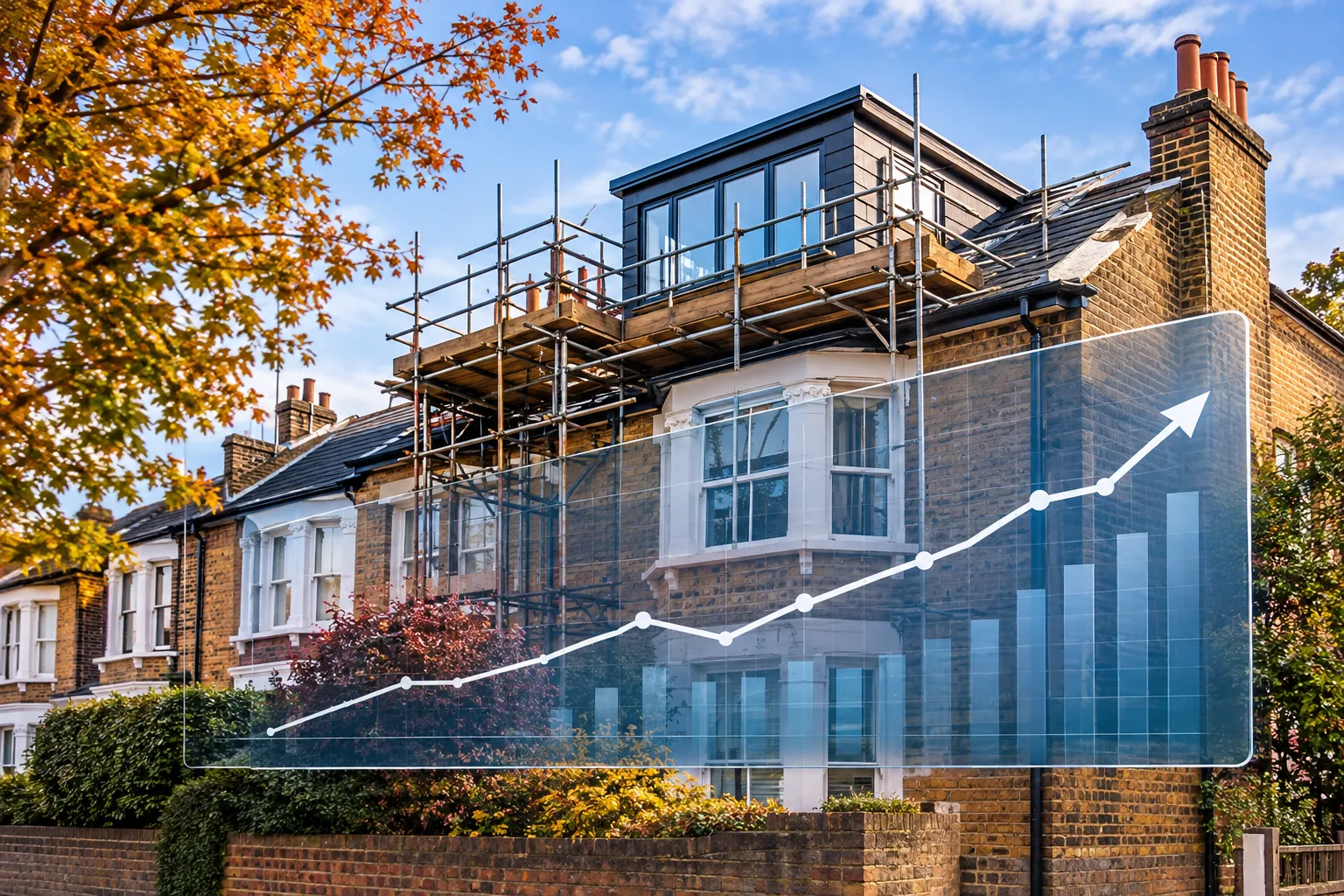
Three years of held rates ended on Thursday. On 5 November 2026, the Bank of England’s Monetary Policy Committee voted 8-1 to raise Bank Rate by 0.25 percentage points, from 3.75% to 4%. One member wanted to go further, to 4.25%. For London homeowners who have spent the autumn pricing up a loft conversion, rear extension or basement dig, this is the first live test of Bank Rate 4% home extension finance London borrowing since the increase cycle paused back in 2023. This article explains what changed, what it costs, and why party wall notices should still go out this winter if you want builders on site by spring.
Key Takeaways
- Bank Rate rose from 3.75% to 4% on 5 November 2026, the first rise in over three years, driven by inflation hitting 3.5% in September 2026.
- Tracker mortgages rise immediately by around £15 a month per £100,000 borrowed, according to MoneySavingExpert; fixed deals are unaffected until they expire.
- Average two-year fixed rates sit at 5.97% and five-year at 5.99%, per Moneyfacts figures reported 6 November 2026.
- Markets price a further rise as early as February 2027, though Capital Economics expects only around two more small rises before cuts begin.
- Party wall notices take weeks to clear even when neighbours cooperate, so serving them now keeps a spring 2027 start realistic.
Why Bank Rate 4% Home Extension Finance London Matters Now
The Monetary Committee’s decision followed six consecutive holds. It came after CPI inflation climbed to 3.5% in the 12 months to September 2026, up from 3.1% in August, well above the Bank’s 2% target. The MPC said “the degree of inflationary pressure in the pipeline is now sufficient to warrant an increase in Bank Rate,” pointing to higher energy prices as the main driver.
For anyone funding home improvements, this single quarter-point move changes the maths on several common financing routes.
Tracker mortgages and variable borrowing. These move with Bank Rate immediately. MoneySavingExpert calculates the increase adds roughly £15 a month for every £100,000 borrowed. A homeowner using a tracker-linked further advance of £150,000 to fund a loft conversion will feel that straight away.
Standard variable rate (SVR) loans. These typically sit between 4.9% and 6.9%, and lenders usually pass on Bank Rate changes within weeks.
Fixed-rate deals. Existing fixes are unaffected until they end. New fixed rates have been edging down recently: Barclays, Nationwide, Santander and Halifax had all cut fixed pricing shortly before this announcement, and top two- and five-year fixes are available from around 4.9%. However, the wider average tells a different story, Moneyfacts put the average two-year fixed rate at 5.97% and the average five-year fixed rate at 5.99% as of 6 November 2026.
Rightmove data, also reported 6 November, shows the average five-year fixed rate climbing from 5% at the end of June to 5.5% by 31 October, a trend that predates this week’s rate rise and suggests lenders had already been pricing in tighter conditions.
Where Rates Go Next
Markets are currently pricing in another rise as early as February 2027, with some forecasts suggesting Bank Rate could reach around 4.75% by Christmas 2027. Not everyone agrees that path is realistic. Nicholas Mendes of John Charcol described that scenario as looking “too aggressive.” Capital Economics takes a more measured view, expecting only around two further rises totalling roughly 0.5 percentage points, followed by cuts.
For homeowners deciding between fixing now or waiting, this split in expert opinion matters. Locking into a fixed deal protects against further rises in the near term; staying variable is a bet that Capital Economics’s softer forecast proves right.
Financing a Loft Conversion or Extension Under Bank Rate 4% Home Extension Finance London Conditions
Most London extension and loft projects are funded through one of three routes:
| Finance route | How Bank Rate 4% affects it |
|---|---|
| Further advance / remortgage on a tracker | Cost rises immediately, roughly £15/month per £100,000 |
| New fixed-rate further advance | Priced off current averages, around 5.97%-5.99% |
| Existing fixed mortgage, separate personal loan | Mortgage unaffected; loan rate depends on lender terms |
Homeowners part-way through arranging finance should get written confirmation of whether their offer is rate-locked or still floating. A quarter-point shift can alter monthly affordability calculations lenders use, particularly for larger basement or wraparound extension projects where borrowing runs into six figures.
The Building Side: Why Delays Are Easing Slightly
Money isn’t the only constraint. UK construction activity fell sharply in October, with the PMI reading at 43.6, reflecting a housebuilding slump. The Federation of Master Builders says around £2 billion of London building work is currently on hold, and 35% of homeowners report they cannot find a builder they trust.
That combination, tighter finance and a strained building sector, makes timing more important than ever. Securing a trusted contractor and starting the legal process early gives a project the best chance of staying on schedule, even if the market around it stays unsettled.
Why Party Wall Notices Should Still Go Out This Winter
Whatever happens to Bank Rate next, the legal timetable under the Party Wall etc. Act 1996 does not shorten. If a loft conversion, extension or basement touches a shared wall, boundary or nearby foundations, notice must go out before work starts, and the clock only begins once it’s served.
“Serving notice in November, rather than waiting for spring, is often the difference between starting on time and losing the whole season.”
The Act covers three main situations:
- Section 1 (line of junction): building on or near a boundary line. Requires notice to adjoining owners.
- Section 2 (works to a party structure): cutting into, raising, or altering a shared wall. Requires two months’ notice.
- Section 6 (excavation): digging foundations within 3 metres (or 6 metres for deeper excavations) of a neighbouring building. Requires one month’s notice.
Once served, the adjoining owner has 14 days to respond. They can consent, dissent, or stay silent, silence after 14 days is treated as dissent, triggering the formal surveyor process. Owners can agree on one surveyor between them, or each appoint their own; either way, the surveyors produce a party wall award setting out how and when work can proceed.
Add up the notice periods, the 14-day response window, and the time needed to negotiate or finalise an award, and it is easy to lose six to eight weeks before a single brick is touched. Serving notices in November, rather than waiting until the new year, gives that process room to run its course without pushing a start date into summer.
Practical Checklist for Homeowners Planning Work This Winter
- Confirm whether your mortgage or further advance is fixed or variable before committing to a build timeline.
- Get an updated written quote from your lender reflecting the new 4% Bank Rate if you’re on a tracker or SVR.
- Identify every adjoining owner affected by your proposed extension, loft conversion or excavation.
- Instruct a party wall surveyor to prepare and serve Section 1, 2 or 6 notices as applicable.
- Diarise the 14-day response deadline and the one- or two-month notice period depending on the works.
- Vet contractors carefully given the FMB’s reported shortage of trusted builders in London.
- Build a financing buffer into your budget in case rates move again in February 2027.
FAQ
Does the Bank Rate rise affect my existing fixed-rate mortgage? No. Fixed deals are unaffected until they expire. Only tracker and variable-rate borrowing moves immediately.
How much more will a tracker mortgage cost after this rise? Roughly £15 a month more per £100,000 borrowed, according to MoneySavingExpert.
Do I need a party wall surveyor for a loft conversion? If the work affects a shared wall or structure, yes, Section 2 of the Act applies and two months’ notice is required.
How long does the party wall process take overall? Including the 14-day response window and notice periods, six to eight weeks is a realistic minimum before work can lawfully start.
Should I wait for rates to settle before applying for finance? Experts disagree on where rates go next, Capital Economics expects only modest further rises, while markets price in more. Speak to a mortgage adviser about your specific situation rather than timing the market alone.
Conclusion
The rise to 4% Bank Rate is a reminder that financing conditions for London extensions, loft conversions and basements have shifted after years of stability. Variable borrowers face an immediate cost increase; fixed borrowers have breathing room but should plan ahead of their next renewal. None of this changes the legal timetable under the Party Wall etc. Act 1996, notices served now, in November 2026, give homeowners the best chance of a spring start despite a strained building sector.
Party Wall Surveyor London acts for both building owners and adjoining owners across the capital. To get notices served correctly and your project moving before costs or contractor availability shift further, book a consultation with the team today.
Speak to a RICS chartered party wall surveyor
Free initial consultation. Notices, awards and schedules of condition across London and nationwide.