Looking for expert solutions?
Request a Quote

Category: Uncategorized

  • Cloud-Based Schedules of Condition for Party Wall Awards: Real-Time

    Cloud-Based Schedules of Condition for Party Wall Awards: Real-Time

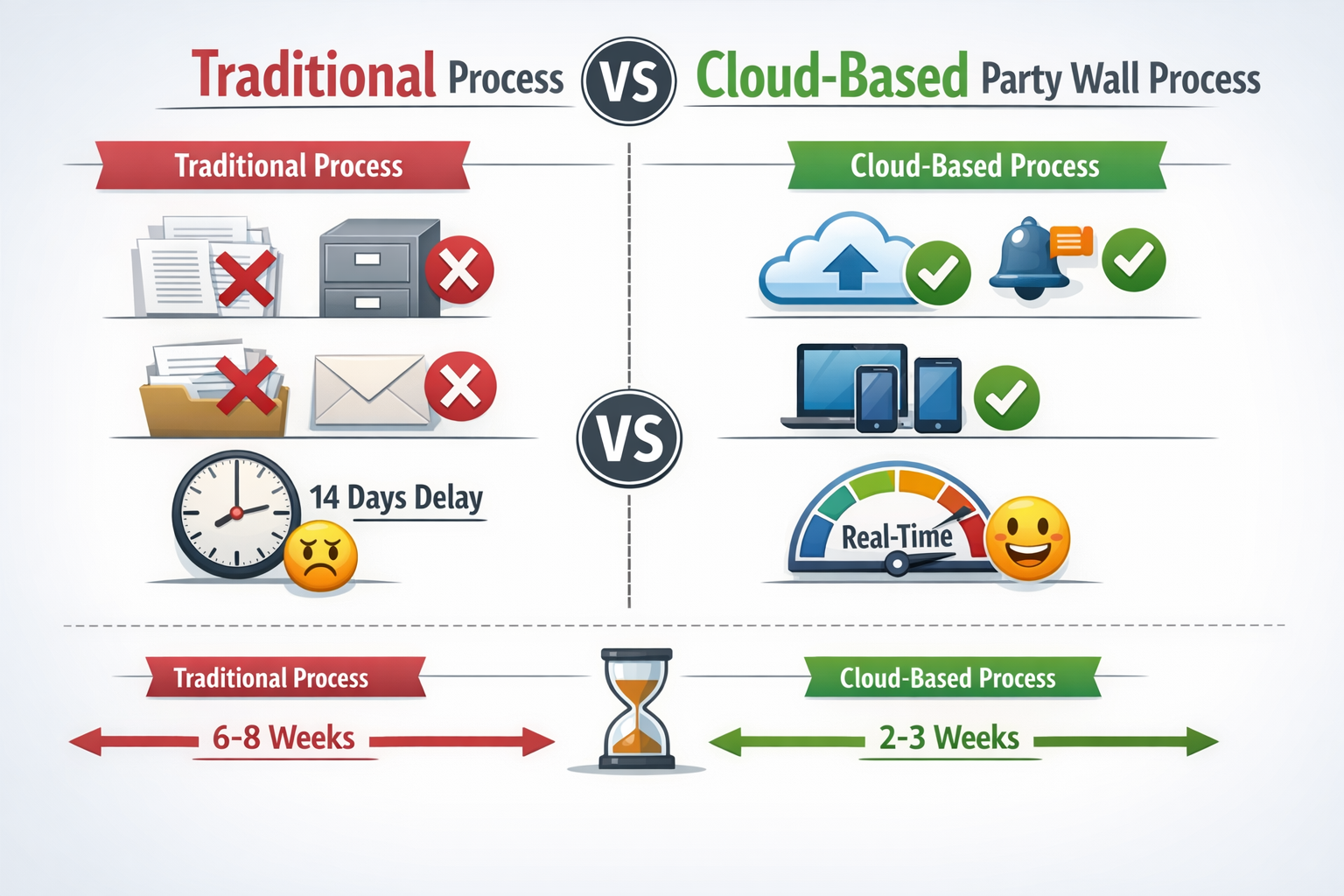
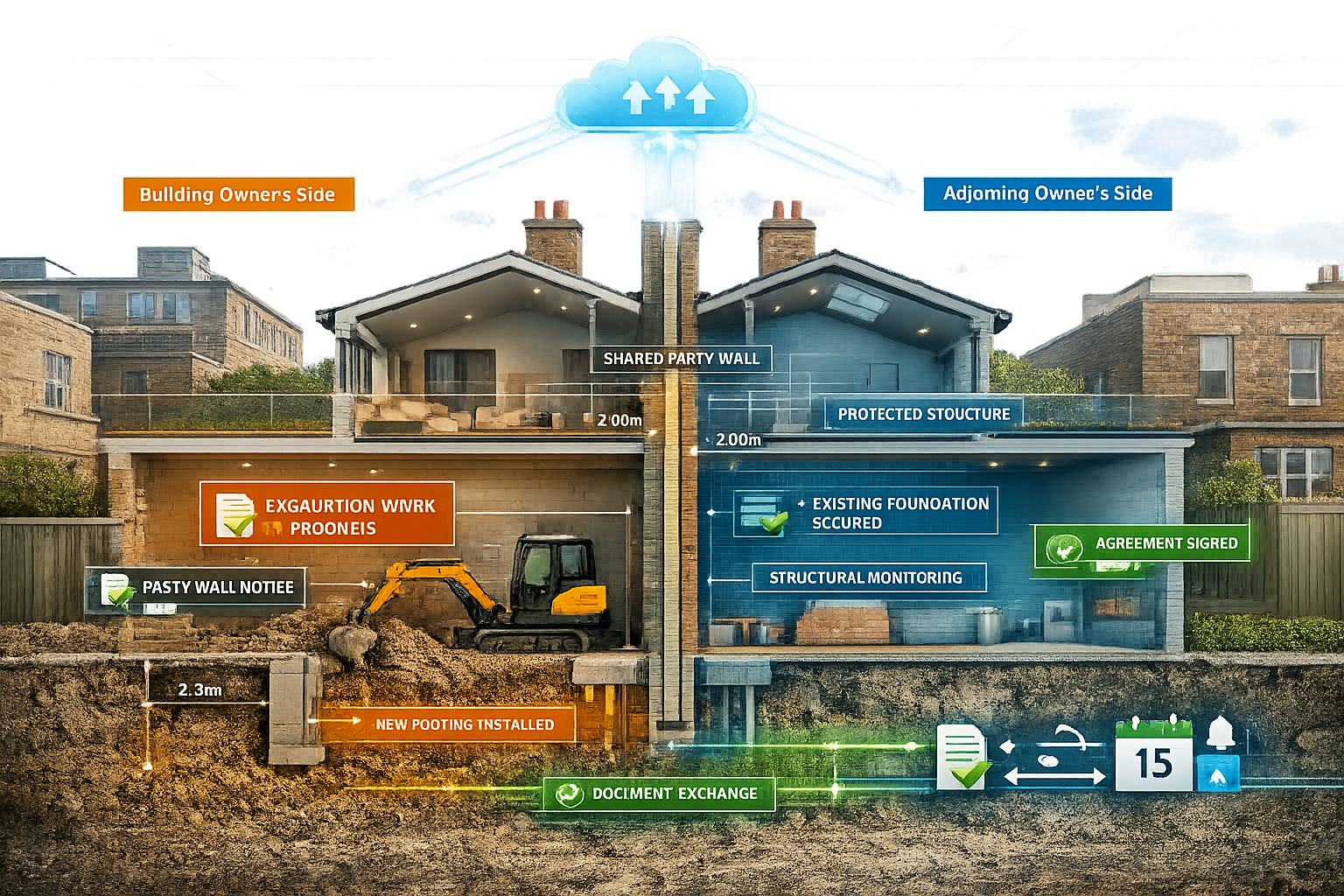
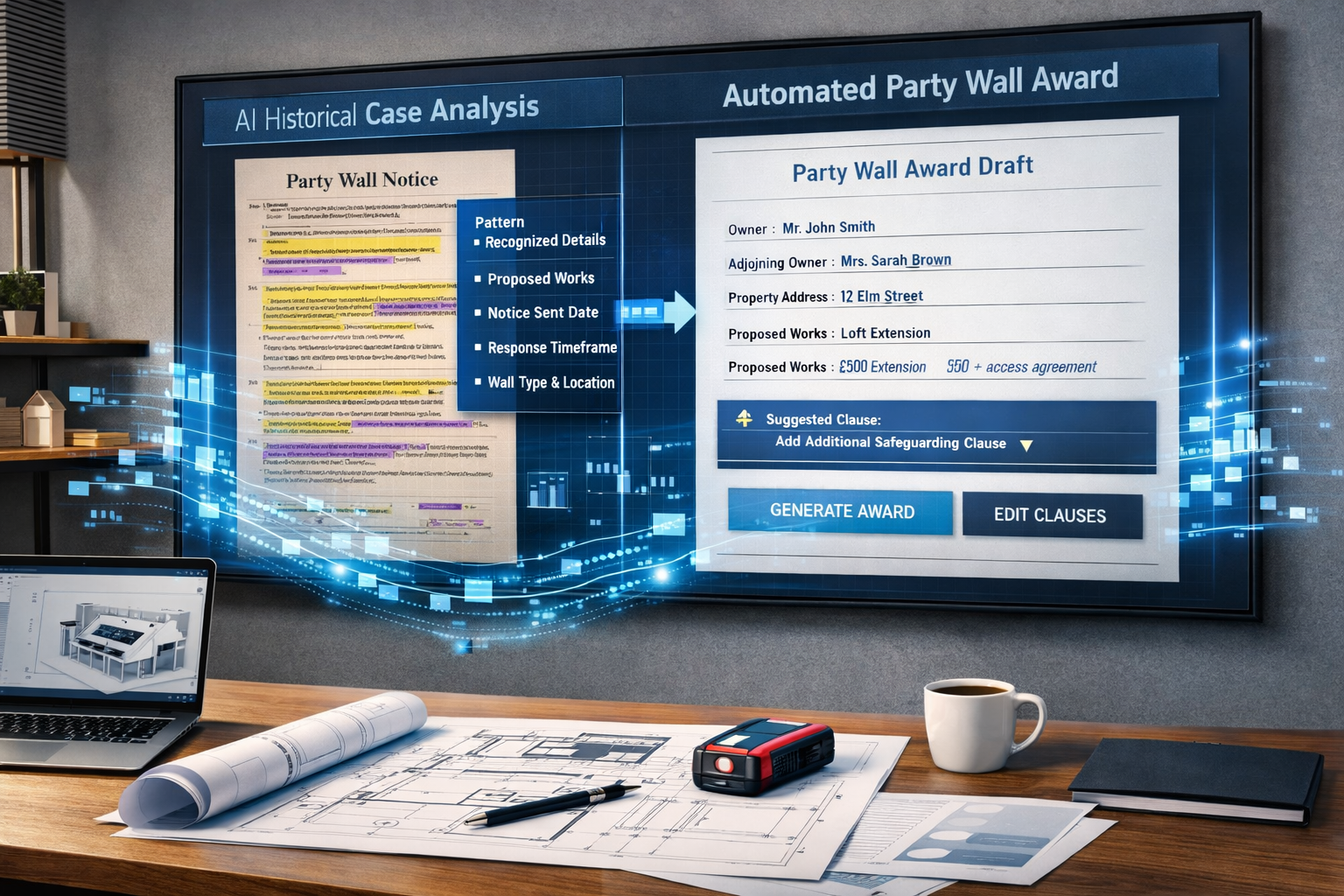
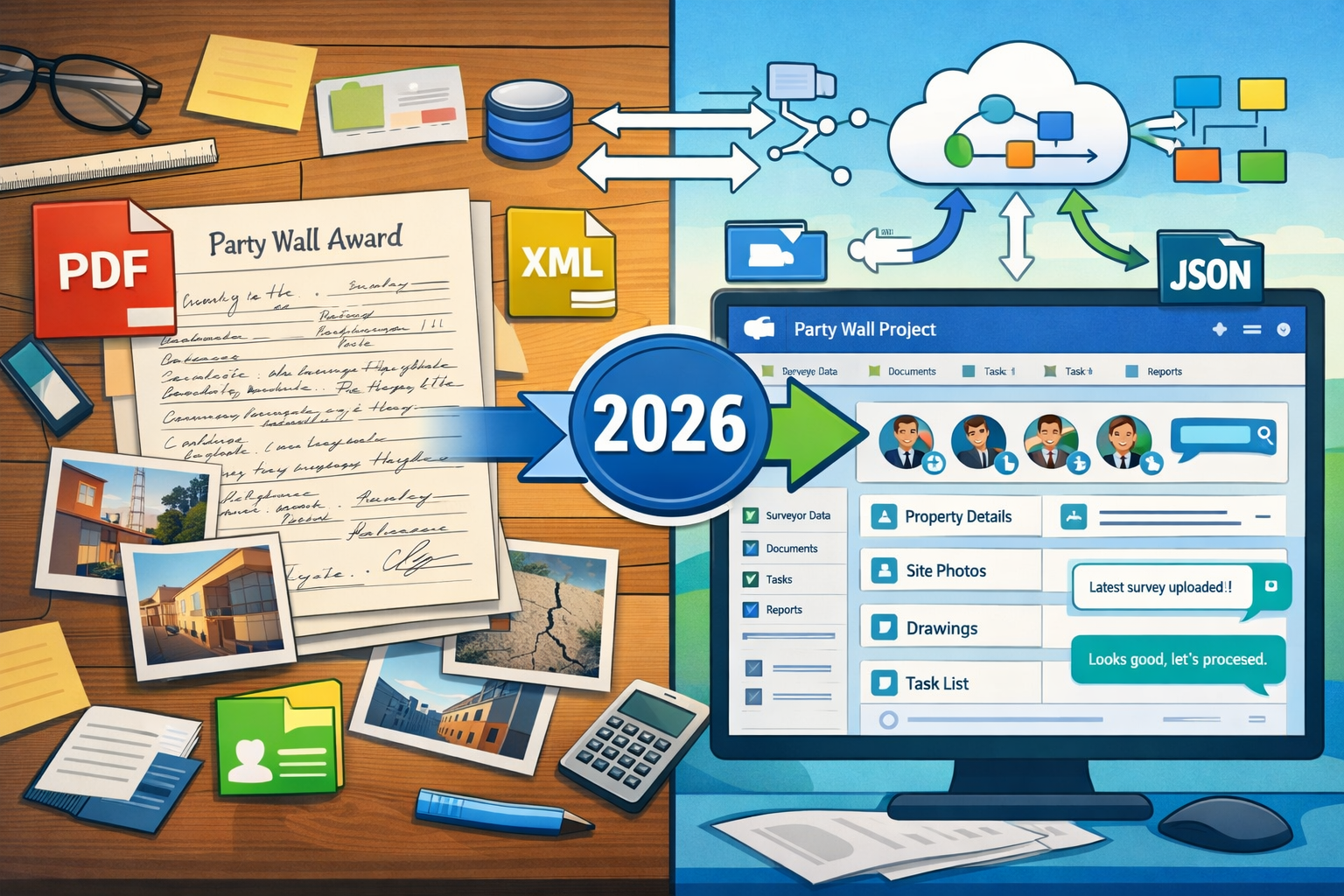
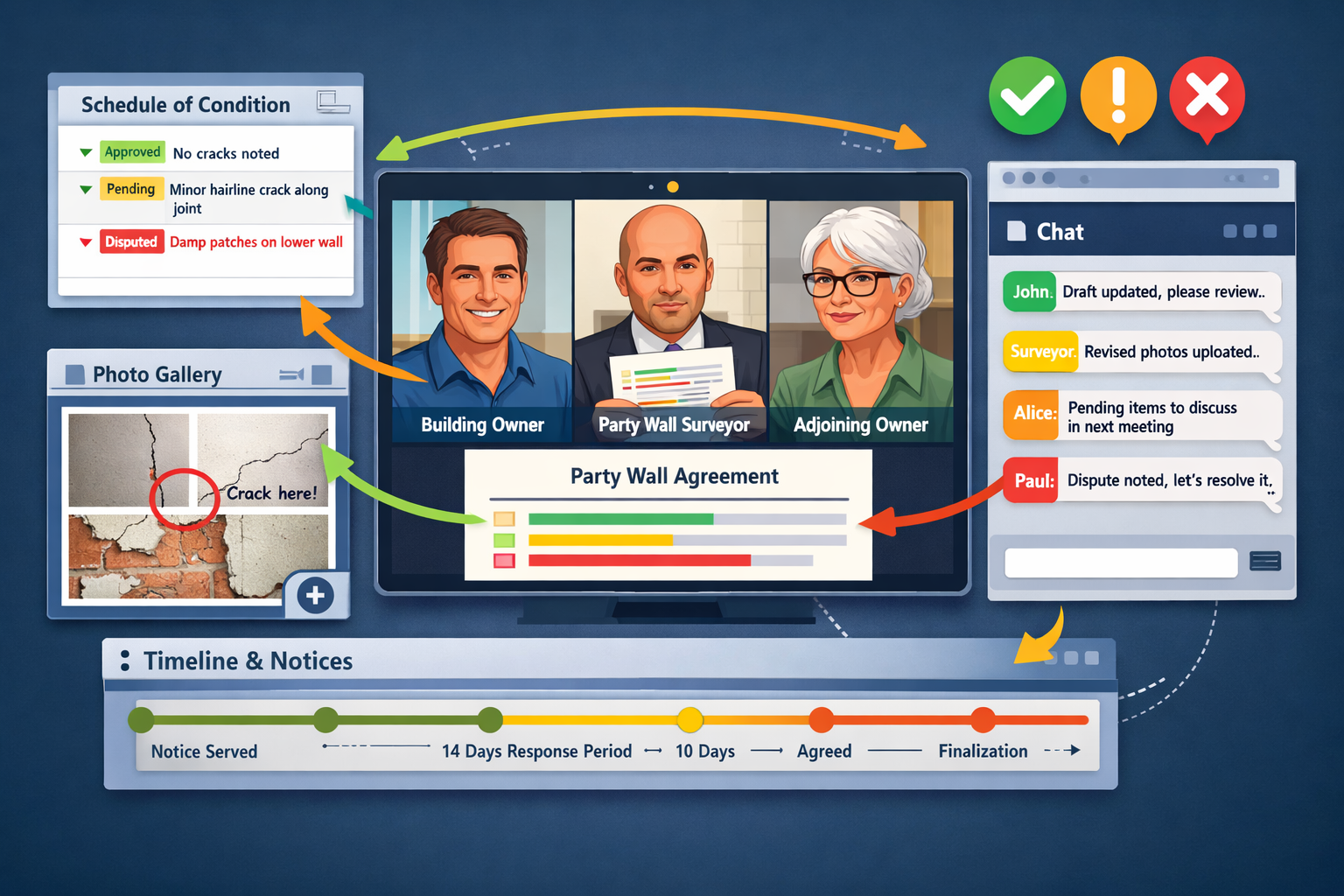
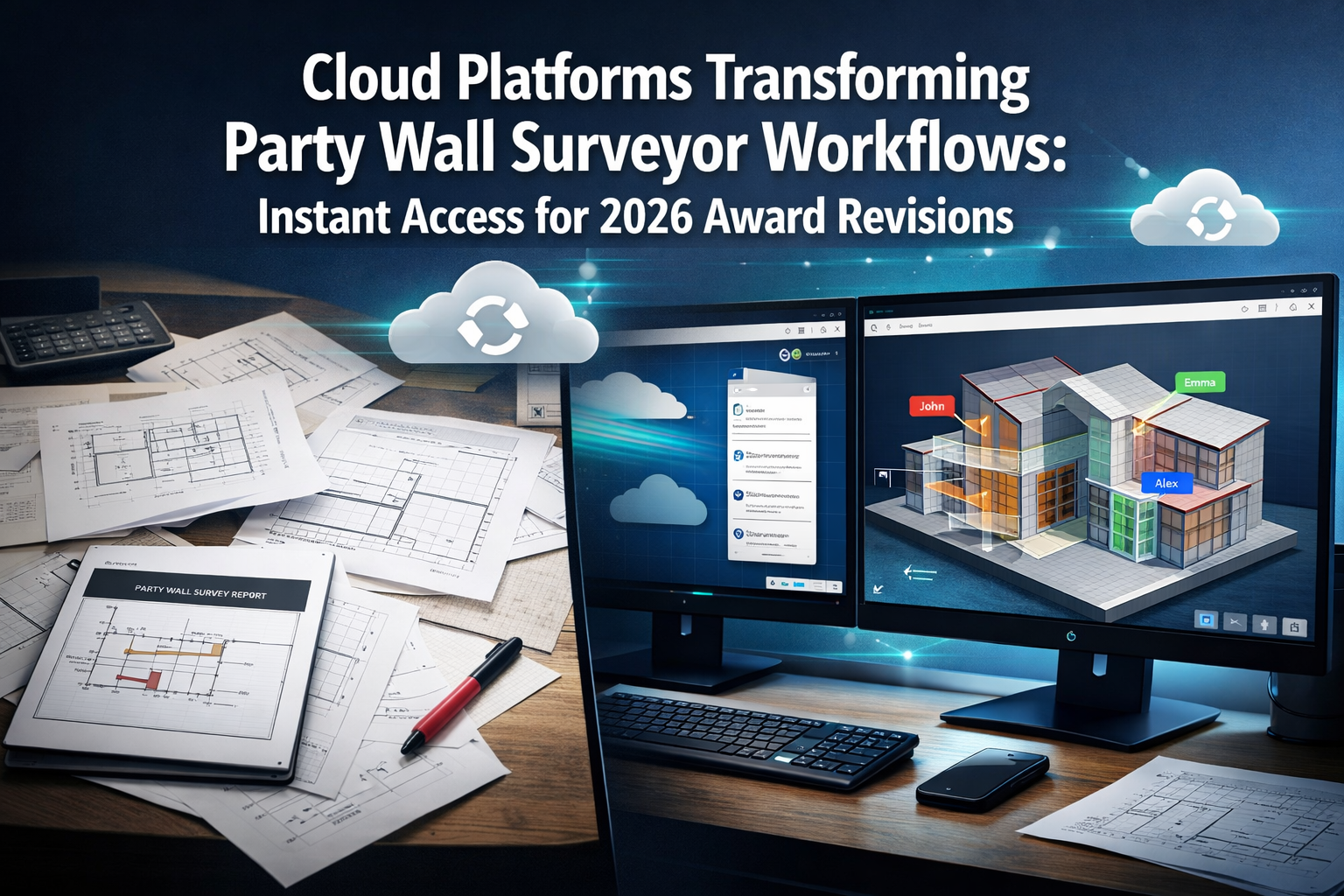
    The traditional paper-based approach to documenting property conditions during party wall works is rapidly becoming obsolete. In 2026, Cloud-Based Schedules of Condition for Party Wall Awards: Real-Time Updates and Neighbor Access are transforming how surveyors, building owners, and adjoining owners manage documentation under the Party Wall etc. Act 1996. This digital revolution enables instant updates, transparent neighbor access, and dispute prevention through secure, collaborative platforms that keep all parties informed throughout the construction process.

    Cloud-Based Schedules of Condition for Party Wall Awards: Real-Time

    Key Takeaways

    • Cloud-based schedules of condition provide real-time access for all parties involved in party wall awards, eliminating delays and miscommunication associated with paper documentation
    • Secure neighbor access portals allow adjoining owners to review condition reports instantly, reducing disputes and building trust between parties
    • Digital templates and standardized formats help surveyors create comprehensive, consistent schedules of condition that comply with the Party Wall etc. Act 1996
    • Automated version control and audit trails ensure complete transparency and legal defensibility throughout the party wall process
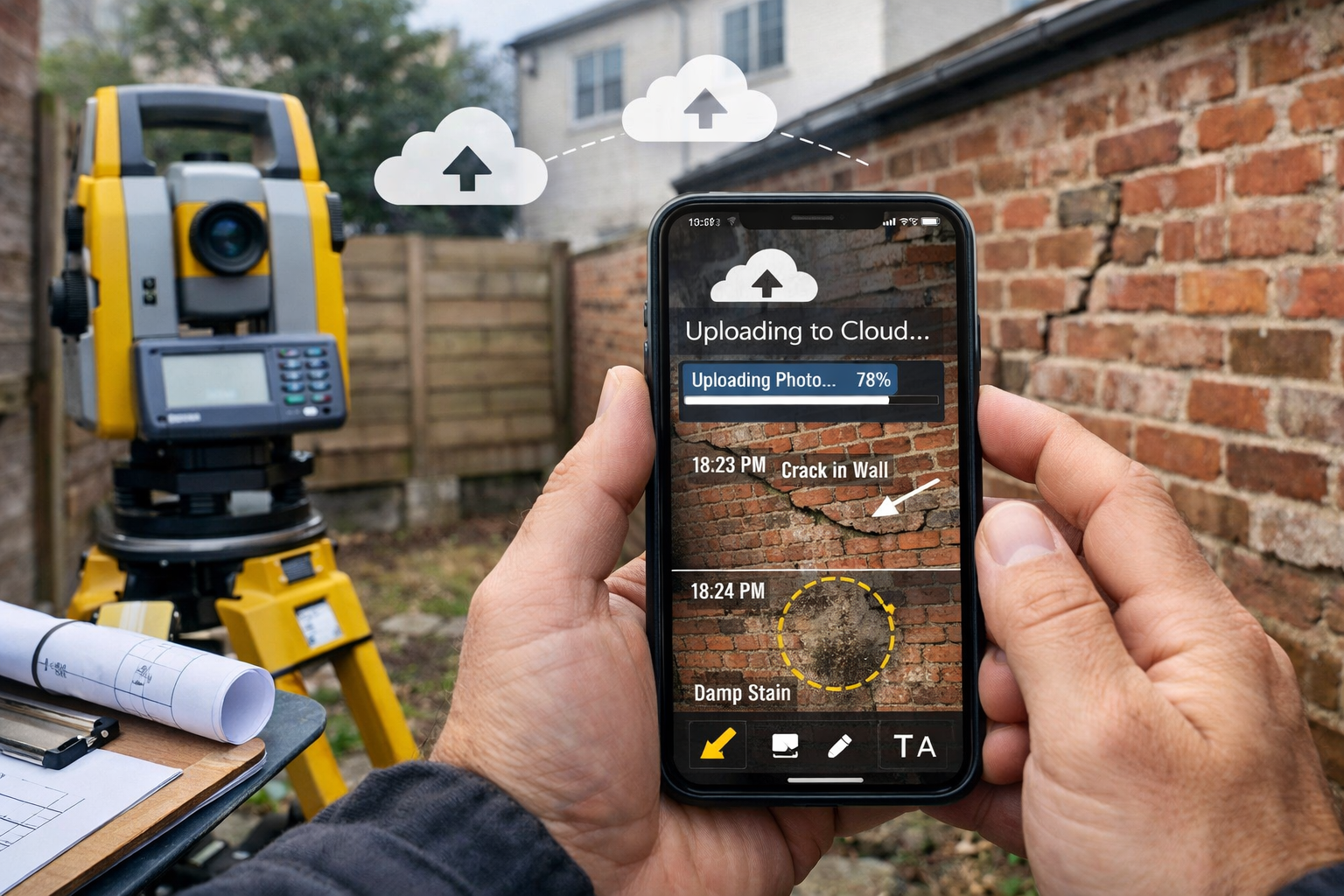
    • Mobile-first platforms enable surveyors to capture, annotate, and upload condition evidence directly from construction sites in 2026

    Understanding Schedules of Condition in Party Wall Awards

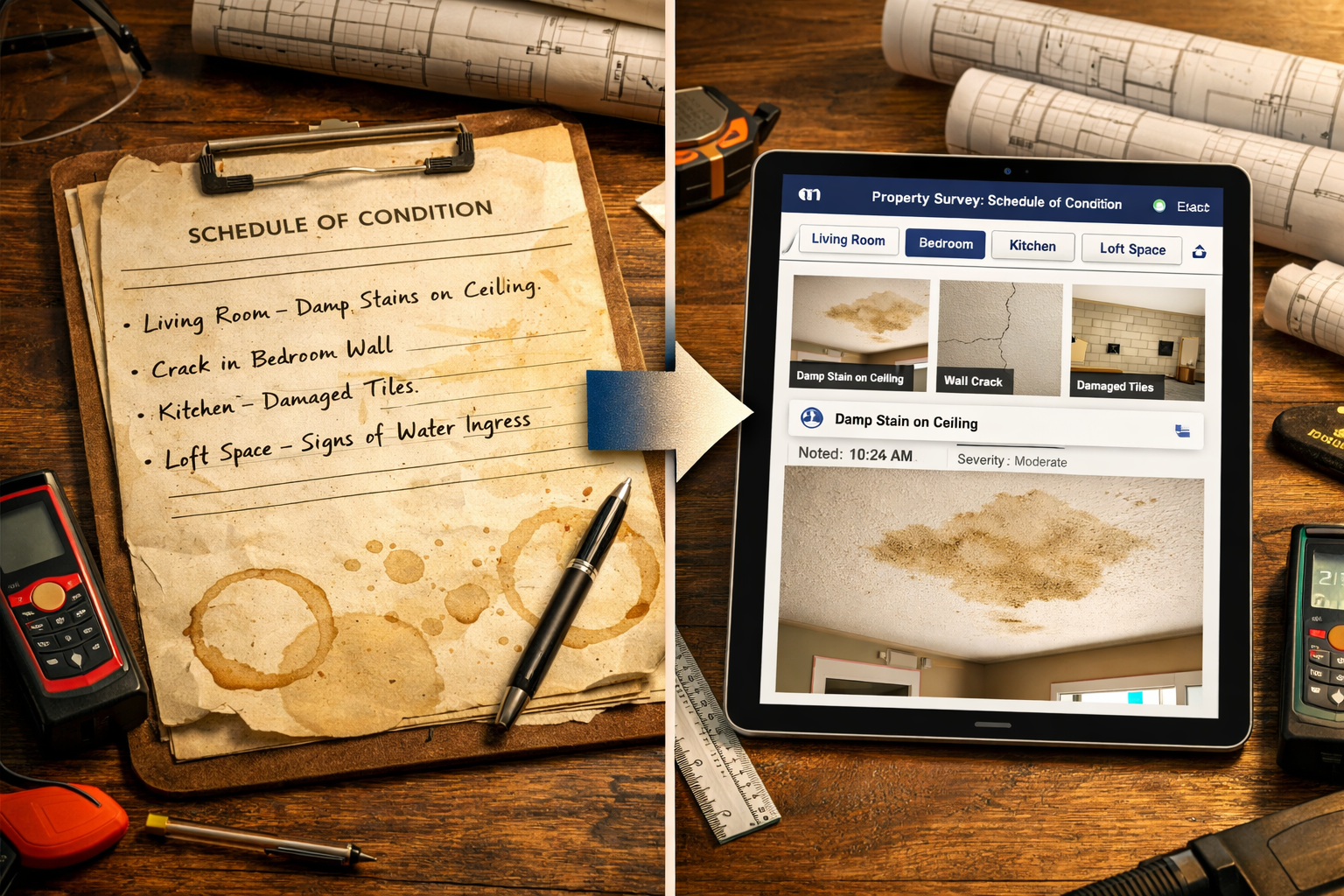
    A schedule of condition serves as a critical protective document that records the existing state of an adjoining owner’s property before construction work begins. This photographic and written record establishes a baseline condition that can be referenced if disputes arise about damage caused during building works.

    Under the Party Wall etc. Act 1996, schedules of condition are not legally mandatory but are highly recommended as part of comprehensive party wall awards. These documents protect both building owners and adjoining owners by providing clear evidence of pre-existing conditions, cracks, decorative finishes, and structural elements [2].

    Traditional Challenges with Paper-Based Documentation

    Historically, schedules of condition were compiled as printed documents with physical photographs attached or bound into reports. This approach created several significant problems:

    • Limited accessibility – Only one party could review the document at a time
    • Version control issues – Updates required reprinting and redistribution
    • Storage challenges – Physical documents could be lost, damaged, or degraded
    • Delayed communication – Neighbors waited days or weeks to receive copies
    • High reproduction costs – Multiple color copies with photographs were expensive
    • Difficulty with updates – Adding supplementary evidence required creating entirely new documents

    These limitations often contributed to misunderstandings and disputes that could have been prevented with better documentation practices.
    Cloud-Based Schedules of Condition for Party Wall Awards: Real-Time — image 3

    The Digital Transformation of Party Wall Documentation in 2026

    The surveying industry has undergone significant technological advancement in recent years. In 2026, cloud-based platforms specifically designed for party wall documentation have become increasingly sophisticated and widely adopted across the UK construction sector.

    What Are Cloud-Based Schedules of Condition?

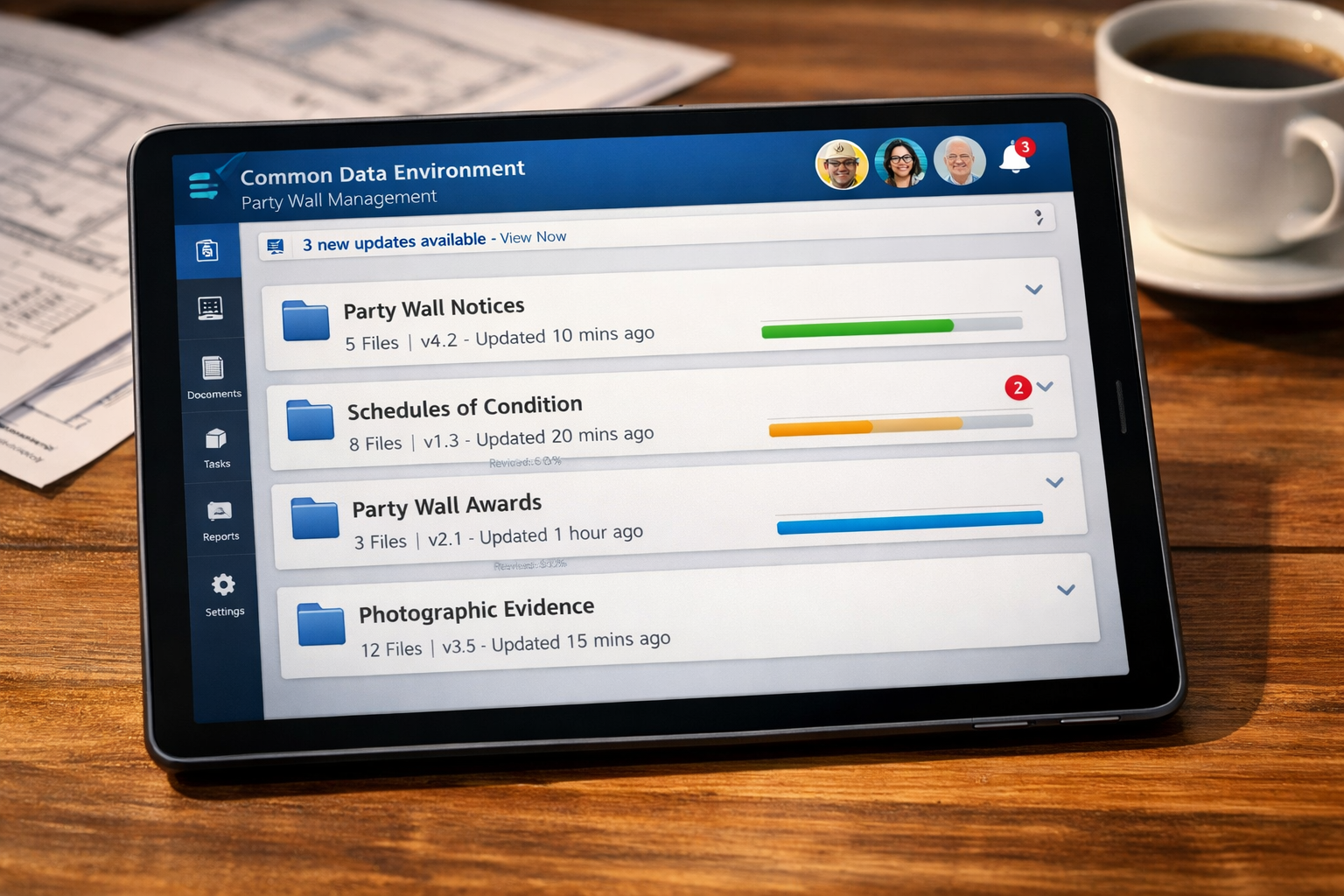
    Cloud-based schedules of condition are digital documentation systems hosted on secure internet servers that allow authorized parties to access, review, and update property condition records from any device with internet connectivity. These platforms integrate:

    • High-resolution photography with geolocation and timestamp metadata
    • Interactive annotation tools for marking specific areas of concern
    • Structured templates that ensure comprehensive coverage
    • Automatic organization by room, elevation, or structural element
    • Real-time synchronization across all authorized users
    • Version history tracking that maintains complete audit trails

    These systems transform static documents into dynamic, collaborative records that serve the interests of all parties involved in party wall works.

    Key Features of Modern Cloud Platforms

    Leading cloud-based party wall documentation platforms in 2026 offer comprehensive feature sets designed specifically for surveying professionals:

    Feature Benefit Impact on Party Wall Process
    Mobile capture Surveyors photograph conditions on-site using smartphones or tablets Faster documentation, immediate upload, reduced office processing time
    Automated indexing AI-powered categorization of images by location and element type Consistent organization, easier navigation, professional presentation
    Neighbor portals Secure login access for adjoining owners to review documentation Increased transparency, reduced disputes, improved trust
    Comment threads Stakeholders can add notes and questions directly to specific images Clear communication, documented discussions, collaborative resolution
    Comparison tools Side-by-side viewing of before/after conditions Objective damage assessment, dispute prevention, clear evidence
    Digital signatures Electronic approval and acknowledgment of condition records Legal compliance, faster approvals, complete audit trail

    Security and Data Protection Considerations

    When implementing cloud-based schedules of condition for party wall awards, security must be paramount. Professional platforms in 2026 incorporate multiple layers of protection:

    Encryption Standards 🔒

    • End-to-end encryption for data transmission
    • AES-256 encryption for stored documents
    • Secure socket layer (SSL) certificates for all connections

    Access Control Measures 👥

    • Role-based permissions (surveyor, building owner, adjoining owner)
    • Two-factor authentication requirements
    • Individual login credentials with password complexity requirements
    • Session timeout protocols for inactive users

    Compliance Requirements ✅

    • UK GDPR compliance for personal data handling
    • ISO 27001 information security standards
    • Regular third-party security audits
    • Data residency within UK servers when required

    Backup and Recovery 💾

    • Automated daily backups to geographically separate locations
    • Point-in-time recovery capabilities
    • Redundant server infrastructure
    • Disaster recovery protocols

    These security measures ensure that sensitive property information remains protected while still enabling the transparency and accessibility that make cloud-based systems valuable.

    Real-Time Updates and Neighbor Access: Transforming Party Wall Relationships

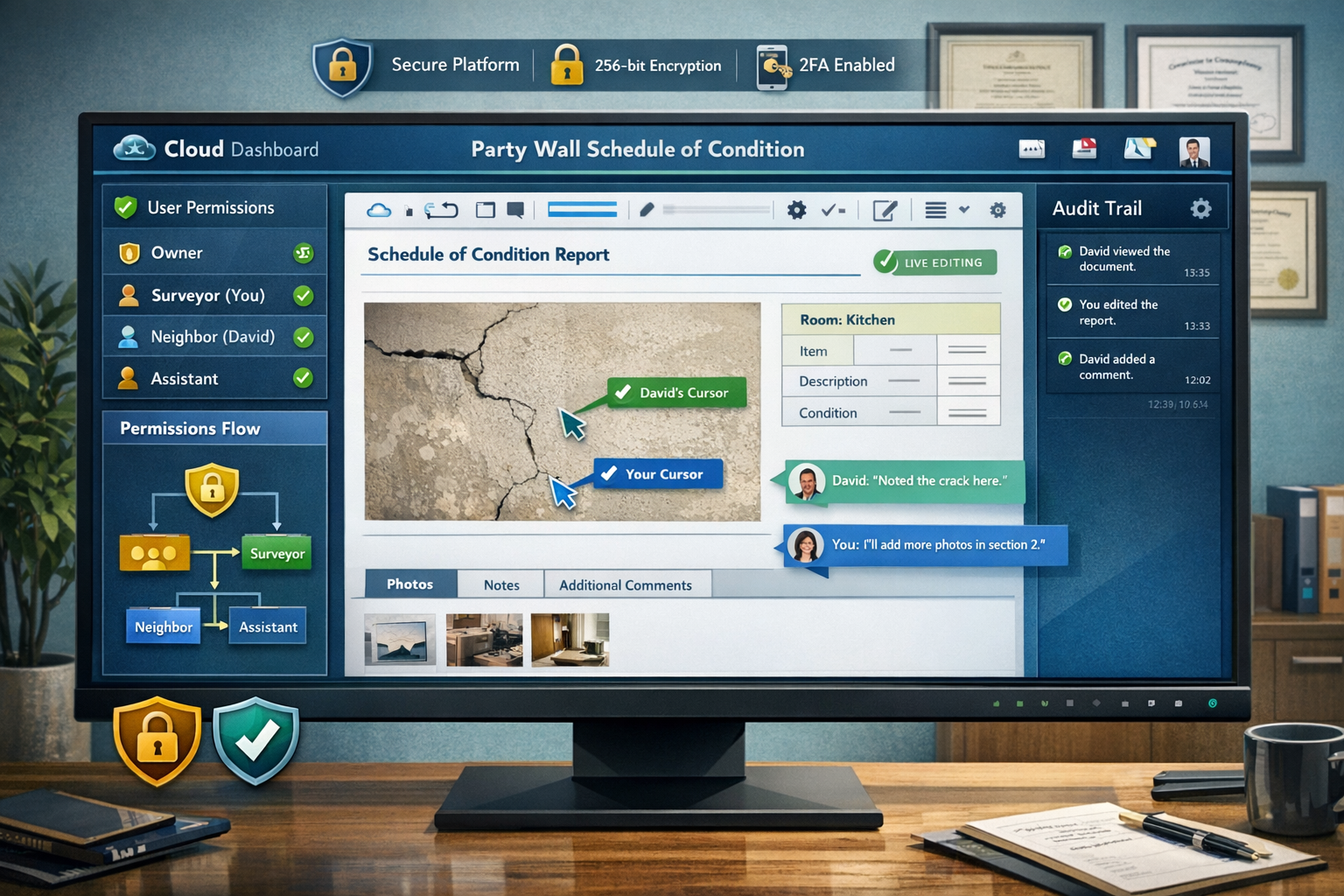
    The most significant advantage of Cloud-Based Schedules of Condition for Party Wall Awards: Real-Time Updates and Neighbor Access in 2026 is the fundamental transformation of how parties communicate and collaborate throughout construction projects.
    Cloud-Based Schedules of Condition for Party Wall Awards: Real-Time — image 5

    Immediate Neighbor Access Benefits

    When adjoining owners receive instant access to condition schedules through secure portals, the entire party wall process becomes more transparent and collaborative:

    Enhanced Trust Building 🤝
    Neighbors can review documentation immediately after the surveyor’s site visit, rather than waiting for printed reports to arrive by post. This immediacy demonstrates professionalism and builds confidence in the process.

    Proactive Question Resolution ❓
    Adjoining owners can raise questions or concerns about specific photographs or descriptions directly within the platform. Surveyors receive notifications and can respond quickly, preventing small concerns from escalating into formal disputes.

    Reduced Anxiety and Uncertainty 😌
    Construction work affecting shared walls naturally creates anxiety for adjoining owners. Real-time access to comprehensive condition records provides reassurance that their property interests are being properly protected and documented.

    Empowered Participation 💪
    Rather than being passive recipients of information, neighbors become active participants in the documentation process. They can suggest additional areas for photography or request clarification on specific elements before works commence.

    Real-Time Update Capabilities

    Cloud platforms enable surveyors to maintain living documents that evolve as circumstances change:

    Supplementary Inspections 📸
    If unexpected conditions are discovered during construction, surveyors can immediately add supplementary photographs and notes to the existing schedule. All parties receive automatic notifications of updates, ensuring everyone stays informed.

    Progress Monitoring 📊
    Some advanced platforms in 2026 allow for periodic condition checks during construction, with new photographs added to the same document structure. This creates a complete timeline of the property’s condition throughout the project.

    Damage Documentation ⚠️
    If damage occurs during works, immediate photographic evidence can be captured and uploaded with precise timestamps. This contemporaneous documentation is far more credible than retrospective claims.

    Resolution Tracking ✔️
    When remedial works are completed to address any damage, before-and-after comparisons can be documented within the same system, creating a complete record of the resolution process.

    Practical Implementation for Surveyors

    For party wall surveyors adopting cloud-based systems in 2026, successful implementation requires thoughtful planning and clear communication:

    Client Onboarding Process 📋

    1. Explain the benefits of cloud-based documentation when accepting instructions
    2. Obtain email addresses for all parties who will receive access
    3. Clarify data protection measures and security protocols
    4. Set expectations for notification frequency and response times
    5. Provide simple user guides for accessing the portal

    Documentation Standards 📝
    Professional surveyors should maintain consistent standards regardless of delivery method:

    • Comprehensive photographic coverage of all relevant areas
    • Clear written descriptions accompanying each image
    • Systematic organization by location or structural element
    • Professional presentation with firm branding
    • Compliance with party wall award requirements

    Communication Protocols 📧
    Establish clear guidelines for how parties should use the platform:

    • Specify expected response times for questions
    • Define appropriate use of comment features
    • Clarify when formal written correspondence is still required
    • Maintain professional boundaries in digital communications

    Surveyor Templates and Standardization

    One of the most valuable aspects of cloud-based platforms for schedules of condition is the ability to create and utilize standardized templates that ensure comprehensive, consistent documentation across all projects.

    Benefits of Template-Based Approaches

    Consistency Across Projects 📐
    Templates ensure that every schedule of condition covers the same essential elements, reducing the risk of overlooking important details. This standardization is particularly valuable for firms with multiple surveyors who need to maintain consistent quality standards.

    Efficiency Gains ⚡
    Pre-structured templates with standard room categories, typical defect descriptions, and common photographic requirements significantly reduce the time required to complete documentation. Surveyors can focus on property-specific details rather than recreating basic document structures.

    Training and Quality Control 🎓
    New surveyors can learn proper documentation techniques more quickly when working with comprehensive templates. Senior surveyors can review work more efficiently when all schedules follow the same organizational structure.

    Legal Defensibility ⚖️
    Standardized templates that comprehensively address all relevant aspects of property condition provide stronger legal protection if disputes arise. Courts and arbitrators recognize the thoroughness of systematic documentation approaches.

    Essential Template Components

    Professional schedule of condition templates for party wall work should include structured sections for:

    Property Identification 🏠

    • Full address and property description
    • Ownership details and contact information
    • Date and time of inspection
    • Weather conditions during inspection
    • Names of persons present during survey

    Exterior Elements 🧱

    • Roof coverings and condition
    • Chimneys and flues
    • External walls and rendering
    • Windows and doors
    • Rainwater goods and drainage
    • Boundary structures and party fence walls
    • Paving and ground surfaces

    Interior Elements 🏡

    • Room-by-room photographic coverage
    • Wall and ceiling finishes
    • Floors and floor coverings
    • Decorative condition and quality
    • Built-in fixtures and fittings
    • Pre-existing cracks, stains, or damage

    Structural Elements 🔨

    • Party walls and their condition
    • Load-bearing walls
    • Floor and ceiling joists (where visible)
    • Foundations (where accessible)
    • Structural movement or defects

    Utilities and Services 🔌

    • Visible plumbing and pipework
    • Electrical installations
    • Heating systems
    • Ventilation arrangements

    Customization for Specific Work Types

    While standardized templates provide a foundation, cloud-based systems in 2026 allow easy customization for different types of party wall works:

    Loft Conversions 🏗️
    Additional focus on roof structures, ceiling joists, and upper floor rooms most likely to be affected by works above.

    Basement Excavations ⛏️
    Enhanced documentation of foundations, ground floor levels, and potential settlement indicators throughout the adjoining property.

    Party Wall Rebuilding 🧰
    Detailed recording of the existing party wall structure, its connection to adjoining structures, and comprehensive coverage of rooms on both sides.

    New Boundary Walls 🧱
    Focus on existing boundary conditions, ground levels, drainage arrangements, and potential access issues.

    Best Practices for Cloud-Based Party Wall Documentation

    To maximize the benefits of Cloud-Based Schedules of Condition for Party Wall Awards: Real-Time Updates and Neighbor Access in 2026, surveyors and property owners should follow established best practices:
    Cloud-Based Schedules of Condition for Party Wall Awards: Real-Time — image 7

    Technical Best Practices

    Image Quality Standards 📷

    • Use high-resolution cameras (minimum 12 megapixels)
    • Ensure adequate lighting for all photographs
    • Include scale references where appropriate
    • Capture wide shots for context and close-ups for detail
    • Enable GPS tagging for location verification
    • Use timestamp features to verify documentation timing

    Metadata Management 🏷️

    • Apply consistent naming conventions to all images
    • Tag photographs with relevant keywords
    • Organize by room, elevation, or structural element
    • Include descriptive captions for all images
    • Link related photographs together

    Platform Selection Criteria 💻
    When choosing a cloud-based platform, surveyors should evaluate:

    • Security certifications and compliance standards
    • User interface simplicity for non-technical clients
    • Mobile app functionality and offline capabilities
    • Integration with existing surveying software
    • Customer support and training resources
    • Pricing structure and scalability
    • Data export options and portability

    Professional Practice Standards

    Informed Consent ✍️
    Always obtain explicit consent from all parties before providing cloud-based access. Explain the system, its benefits, and any limitations clearly in writing.

    Data Retention Policies 📅
    Establish clear policies for how long condition records will remain accessible. Many surveyors maintain access throughout the construction period and for a defined period afterward (commonly 6-12 months post-completion).

    Backup Procedures 💾
    Despite cloud storage reliability, maintain independent backups of all critical documentation. Export final schedules to PDF format and store in multiple locations.

    Professional Indemnity Considerations 🛡️
    Ensure that professional indemnity insurance covers digital documentation methods and data security incidents. Discuss cloud-based practices with insurers to confirm coverage.

    Client Communication 📞
    Maintain regular communication with all parties about documentation progress, access issues, and any questions that arise. Don’t rely solely on platform notifications—supplement with direct contact.

    Dispute Prevention Strategies

    The ultimate goal of comprehensive schedules of condition is preventing disputes rather than merely documenting evidence for potential disputes. Cloud-based systems support this goal through:

    Pre-Work Agreement 🤝
    Encourage all parties to review and acknowledge the schedule of condition before works commence. Digital signature features facilitate this process and create clear records of agreement.

    Interim Inspections 🔍
    Schedule periodic condition checks during construction, particularly at key milestones. Document that no damage has occurred or address any issues immediately.

    Open Communication Channels 💬
    Use platform comment features to maintain transparent dialogue about any concerns. Address questions promptly and professionally.

    Photographic Evidence Standards 📸
    Capture sufficient evidence to resolve potential disputes objectively. Include reference points that allow precise location identification in future inspections.

    Integration with the Party Wall Award Process

    Cloud-based schedules of condition should be seamlessly integrated into the broader party wall award process to maximize their effectiveness.

    Timing Within the Party Wall Procedure

    The schedule of condition is typically prepared after the party wall award has been agreed but before works commence. The optimal timing sequence is:

    1. Party wall notices served by building owner
    2. Surveyors appointed (if required)
    3. Site inspections and discussions conducted
    4. Party wall award drafted and agreed
    5. Schedule of condition prepared and shared ✅
    6. All parties acknowledge condition documentation
    7. Construction works commence

    This timing ensures that the protective documentation is in place before any risk of damage occurs, while still being current and accurate.

    Incorporation into Party Wall Awards

    The party wall award document should explicitly reference the schedule of condition and establish its role in the process. Standard clauses might include:

    “A schedule of condition has been prepared documenting the existing condition of the Adjoining Owner’s property at [address]. This schedule is available to all parties through a secure cloud-based platform and forms part of this Award. The Building Owner shall be responsible for making good any damage to the Adjoining Owner’s property that occurs during the Works, as evidenced by comparison to the schedule of condition.”

    Relationship to Other Award Provisions

    Cloud-based schedules of condition complement other important award provisions:

    Access Rights 🚪
    The award should specify rights of access for periodic inspections to verify that no damage is occurring. Cloud platforms facilitate documenting these interim inspections.

    Damage Resolution Procedures 🔧
    Awards should establish clear procedures for addressing any damage discovered during or after works. The schedule of condition provides the baseline for assessing whether damage has occurred.

    Cost Provisions 💷
    Understanding how to keep party wall costs down includes efficient documentation processes. Cloud-based systems can reduce surveyor time and therefore fees compared to traditional paper-based approaches.

    Regional Considerations Across London

    The adoption of cloud-based schedules of condition varies somewhat across different areas of London, influenced by property types, construction activity levels, and local surveying practices.

    High-Activity Areas

    Areas with intensive development activity have seen faster adoption of digital documentation methods:

    • Central London – High-value properties and sophisticated clients expect cutting-edge documentation
    • North London – Extensive loft conversion activity drives demand for comprehensive condition records
    • South London – Growing development areas benefit from efficient documentation processes
    • East London – Regeneration projects require robust documentation for multiple adjoining properties
    • West London – Premium property market values transparency and professional documentation

    Property Type Considerations

    Different property types present varying documentation challenges that cloud-based systems address effectively:

    Victorian Terraces 🏘️
    These properties with shared party walls on both sides benefit enormously from comprehensive condition records. Cloud systems efficiently manage the large volume of photographs required.

    Mansion Blocks 🏢
    Multi-unit buildings with complex party wall relationships require careful organization of documentation by unit. Cloud platforms’ indexing capabilities excel in these situations.

    Detached Properties 🏡
    Even properties without party walls may require condition schedules for boundary wall work. Digital systems maintain consistency across all project types.

    Future Developments in Cloud-Based Party Wall Documentation

    Looking ahead beyond 2026, several emerging technologies promise to further enhance cloud-based schedules of condition:

    Artificial Intelligence Integration 🤖

    AI-powered analysis tools are beginning to:

    • Automatically identify and flag potential defects in photographs
    • Compare before-and-after images to detect changes
    • Generate written descriptions from photographic evidence
    • Predict areas most vulnerable to construction damage

    Augmented Reality Applications 📱

    AR technology enables:

    • Overlay of historical condition photographs onto current views
    • Virtual site inspections for remote parties
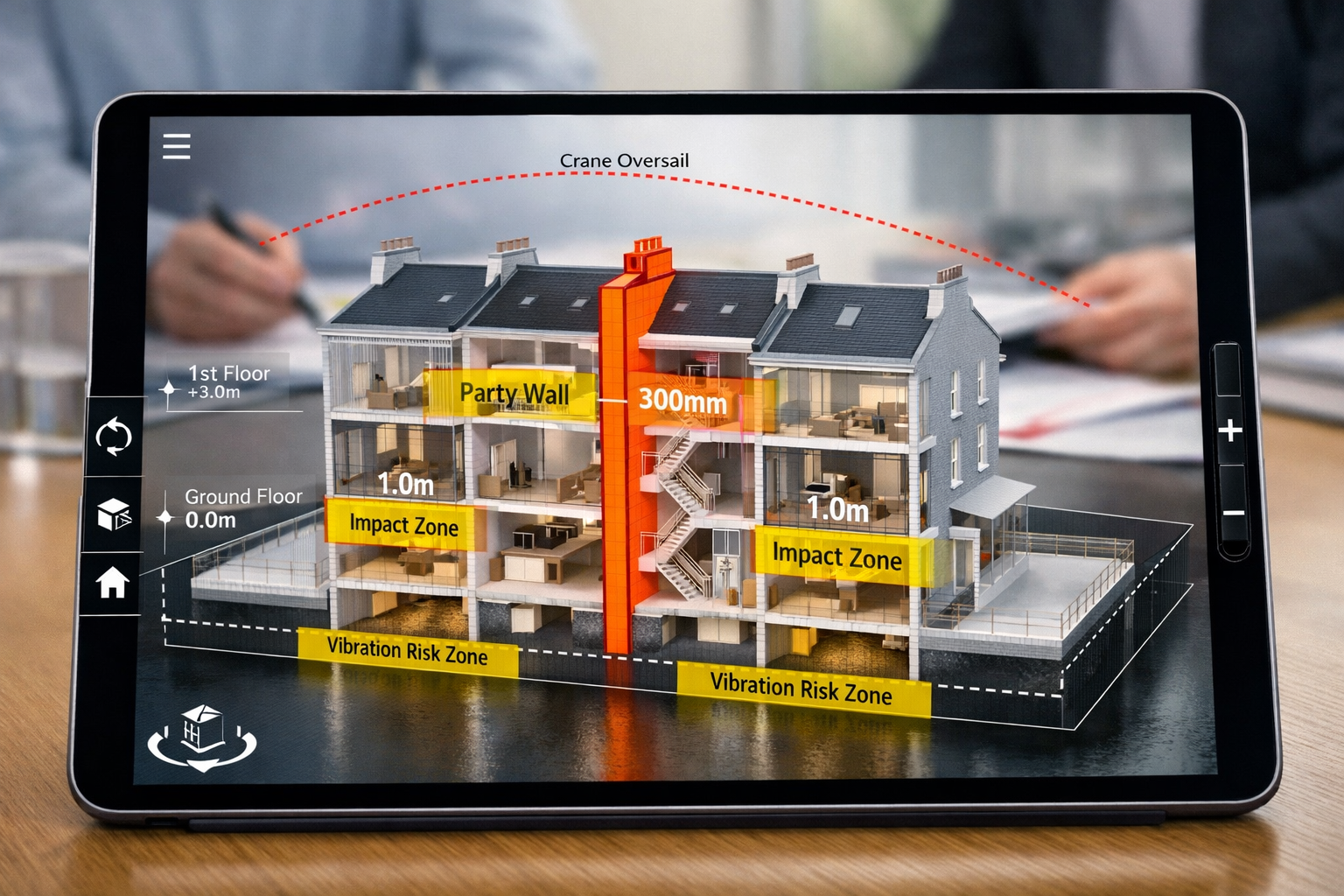
    • Interactive 3D models of property conditions
    • Enhanced visualization of potential damage risks

    Blockchain Verification 🔗

    Blockchain technology offers:

    • Immutable timestamps for all documentation
    • Cryptographic proof of document authenticity
    • Decentralized storage reducing single-point failures
    • Enhanced legal defensibility of evidence

    Internet of Things Monitoring 📡

    IoT sensors can provide:

    • Continuous monitoring of vibration levels during works
    • Real-time alerts if movement thresholds are exceeded
    • Automated documentation of environmental conditions
    • Objective evidence of construction impact

    Conclusion: Embracing Digital Transformation for Better Party Wall Outcomes

    Cloud-Based Schedules of Condition for Party Wall Awards: Real-Time Updates and Neighbor Access in 2026 represent a fundamental improvement over traditional paper-based documentation methods. By providing instant access, transparent communication, and comprehensive evidence, these digital platforms serve the interests of all parties involved in party wall works under the Party Wall etc. Act 1996.

    For surveyors, cloud-based systems offer efficiency gains, professional presentation, and enhanced risk management. For building owners, they provide robust protection and streamlined processes. For adjoining owners, they deliver transparency, participation, and peace of mind.

    Actionable Next Steps

    For Party Wall Surveyors 📋

    1. Research and evaluate cloud-based documentation platforms suitable for your practice
    2. Develop standardized templates for common work types
    3. Create client onboarding materials explaining digital documentation benefits
    4. Update professional indemnity insurance to cover digital practices
    5. Train staff on platform features and best practices

    For Building Owners Planning Works 🏗️

    1. Discuss cloud-based documentation options with your surveyor
    2. Ensure your party wall notices mention digital documentation methods
    3. Provide email addresses for all relevant parties early in the process
    4. Review condition schedules promptly when access is granted
    5. Maintain open communication through platform features

    For Adjoining Owners 🏡

    1. Request cloud-based access when responding to party wall notices
    2. Review condition documentation thoroughly and raise questions promptly
    3. Take advantage of comment features to document concerns
    4. Save or export final documentation for your records
    5. Monitor for update notifications throughout the construction period

    The digital transformation of party wall documentation is not merely a technological upgrade—it represents a fundamental shift toward more collaborative, transparent, and effective management of party wall relationships. By embracing cloud-based schedules of condition in 2026, all parties can benefit from reduced disputes, improved communication, and better protection of property interests throughout the construction process.


    References

    [2] Party Wall Agreement – hoa.org.uk
  • Cloud Collaboration for Party Wall Notices in 2026

    Cloud Collaboration for Party Wall Notices in 2026

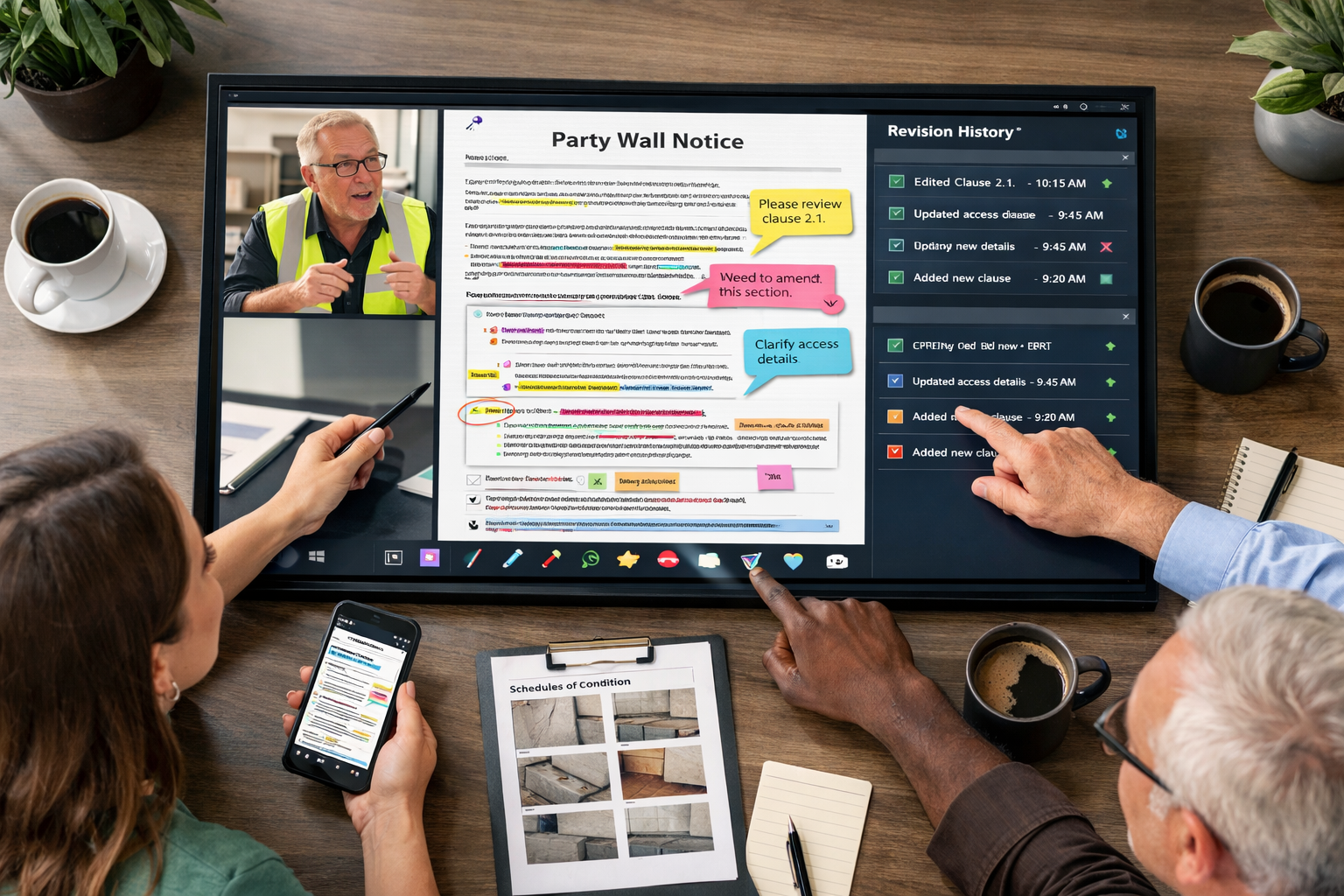
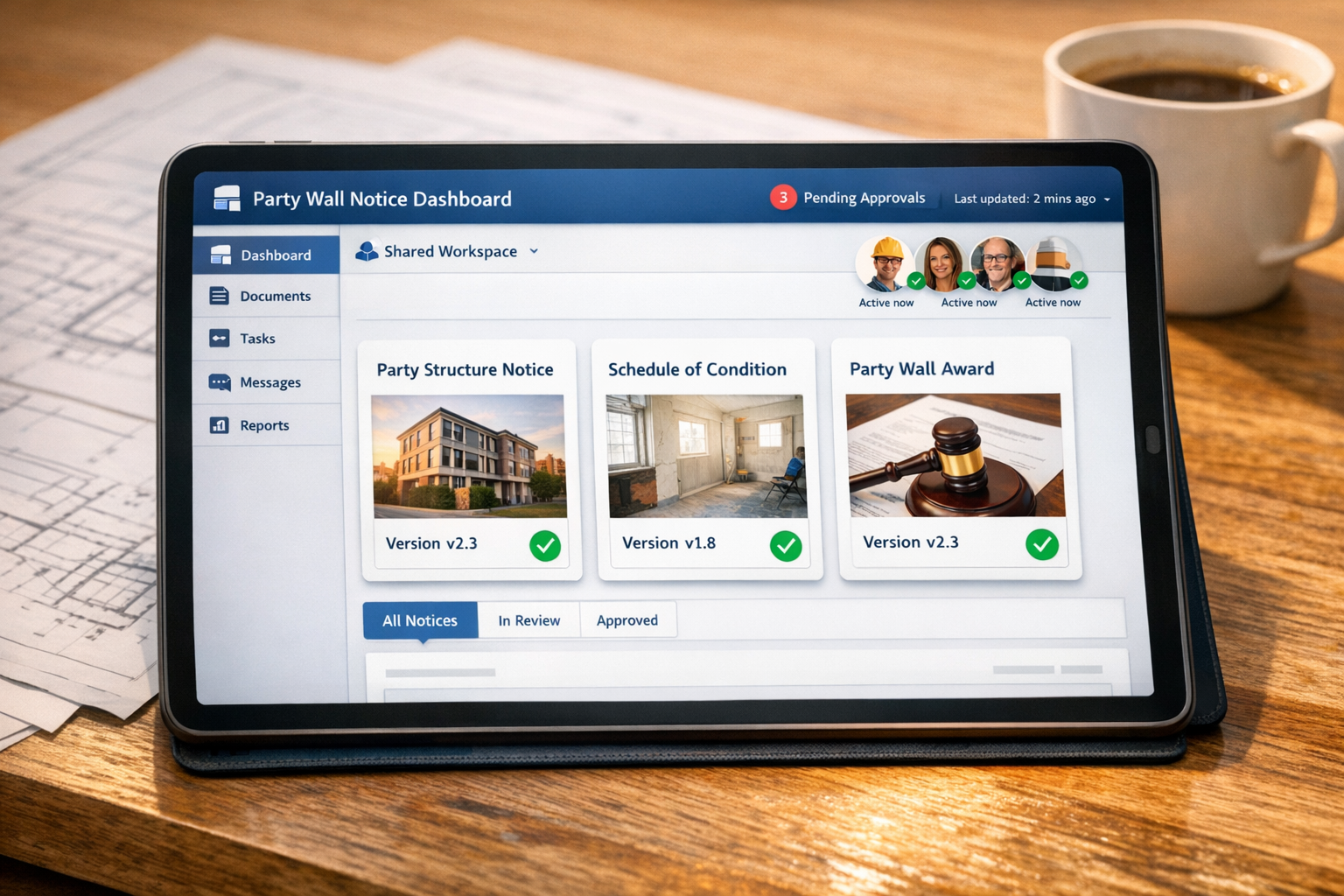
    The traditional process of managing party wall notices has long been plagued by delays, version control nightmares, and communication breakdowns. Picture this: a building owner sends a notice by post, the adjoining owner misplaces it, the surveyor works from an outdated schedule of condition, and suddenly everyone is working from different versions of the same document. In 2026, Cloud Collaboration for Party Wall Notices: Real-Time Access and Revisions in 2026 Projects is transforming this chaotic landscape into a streamlined, transparent process that benefits all parties involved.

    As construction projects become more complex and regulatory compliance more stringent, the need for instant access to accurate documentation has never been greater. Cloud-based platforms are now enabling building owners, adjoining owners, and surveyors to collaborate seamlessly on party wall notices, ensuring everyone works from the same page—literally and figuratively.

    Key Takeaways

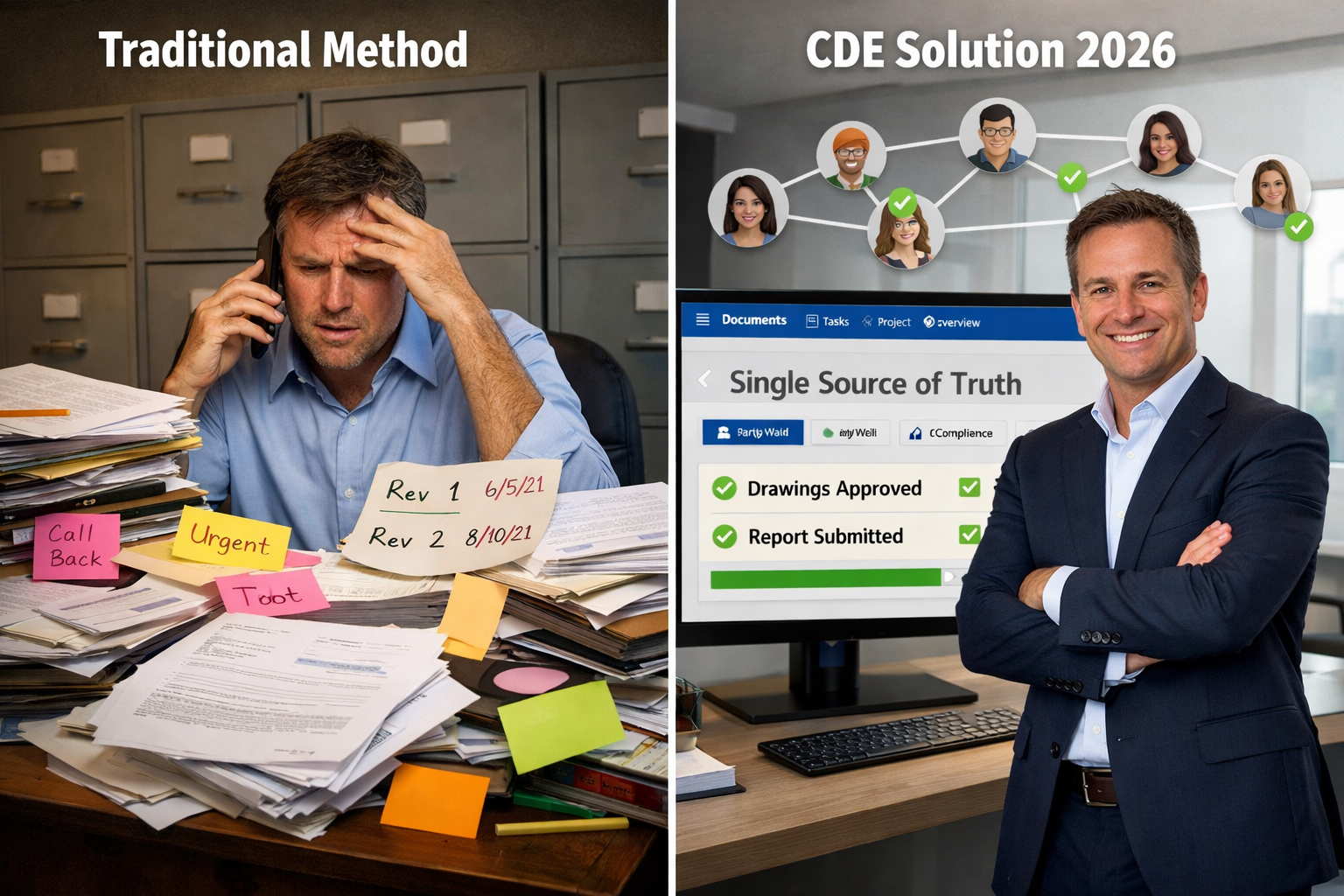
    • 🚀 Cloud platforms eliminate version control issues by providing a single source of truth for all party wall documentation accessible to all stakeholders in real-time
    • ⏱️ Real-time collaboration reduces project delays by up to 60%, cutting the traditional notice period from weeks to days through instant notifications and approvals
    • 📱 Mobile accessibility ensures compliance on-the-go, allowing surveyors to update schedules of condition during site visits and owners to respond to notices immediately
    • 🔒 Enhanced security and audit trails provide complete transparency with encrypted document storage and timestamped revision histories that satisfy legal requirements
    • 💰 Cost savings average 30-40% through reduced administrative overhead, fewer disputes, and faster resolution of party wall matters

    Cloud Collaboration for Party Wall Notices in 2026

    Understanding Cloud Collaboration for Party Wall Notices: Real-Time Access and Revisions in 2026 Projects

    What Makes Cloud Collaboration Essential for Party Wall Procedures?

    The Party Wall etc. Act 1996 establishes clear obligations for building owners undertaking construction work that affects shared structures. However, the Act was written decades before cloud technology existed, leaving room for modern innovation in how these legal requirements are fulfilled.

    Cloud collaboration platforms specifically designed for party wall procedures offer several game-changing advantages:

    Centralized Document Management 📂
    All notices, awards, schedules of condition, and correspondence live in one secure location. No more searching through email chains or filing cabinets to find the latest version of a document.

    Real-Time Updates ⚡
    When a surveyor revises a schedule of condition, all parties see the changes instantly. Notifications alert stakeholders to new documents, comments, or required actions.

    Version Control 🔄
    Every revision is tracked automatically with timestamps and user attribution. This creates an indisputable audit trail showing exactly what changed, when, and by whom.

    Multi-Party Access 👥
    Building owners, adjoining owners, and appointed surveyors can all access the same platform with appropriate permission levels, ensuring transparency while maintaining confidentiality where needed.

    The Technical Infrastructure Behind Modern Party Wall Collaboration

    Cloud platforms supporting party wall procedures in 2026 leverage several key technologies that make real-time collaboration possible:

    Cloud Storage Architecture ☁️
    Documents are stored on secure servers with redundant backups across multiple geographic locations. This ensures 99.9% uptime and protects against data loss—critical when dealing with legal documentation.

    Synchronization Technology 🔄
    Advanced sync engines ensure that changes made on one device appear instantly on all connected devices. A surveyor updating a document on their tablet at a construction site sees those changes reflected immediately on the building owner’s desktop computer.

    Role-Based Access Control 🔐
    Sophisticated permission systems ensure that each party sees only what they’re authorized to view. Building owners can access their own project files, while surveyors may have broader access across multiple projects.

    Mobile-First Design 📱
    Modern platforms prioritize mobile accessibility, recognizing that surveyors often need to access and update documents during site visits. Responsive design ensures full functionality across smartphones, tablets, and computers.

    According to recent industry analysis, cloud computing in 2026 continues to evolve with enhanced security protocols and improved collaboration features that benefit specialized applications like party wall management [4].

    Benefits of Real-Time Access in Party Wall Notice Management

    Cloud Collaboration for Party Wall Notices in 2026 — image 3

    Speed and Efficiency Gains

    The most immediate benefit of Cloud Collaboration for Party Wall Notices: Real-Time Access and Revisions in 2026 Projects is the dramatic reduction in processing time.

    Traditional Timeline vs. Cloud-Enabled Timeline:

    Process Step Traditional Method Cloud Collaboration Time Saved
    Notice delivery 3-5 days (post) Instant (email/app notification) 3-5 days
    Document review 7-14 days 1-3 days 6-11 days
    Surveyor coordination 5-10 days 1-2 days 4-8 days
    Award preparation 10-14 days 5-7 days 5-7 days
    Final approval 3-7 days 1-2 days 2-5 days
    Total Duration 28-50 days 8-15 days 20-35 days

    This acceleration doesn’t just save time—it saves money. Every week of delay in construction projects costs thousands of pounds in holding costs, labor standby, and lost opportunity.

    Enhanced Accuracy and Reduced Disputes

    Version control issues are a leading cause of party wall disputes. When different parties work from different versions of documents, misunderstandings multiply.

    Common Version Control Problems Solved:

    ✅ Outdated schedules of condition – Cloud platforms ensure everyone views the most current photographic evidence and property descriptions

    ✅ Conflicting amendments – Real-time synchronization prevents two parties from making incompatible changes to the same document

    ✅ Lost communications – All comments, questions, and responses are preserved in context within the document itself

    ✅ Unclear approval status – Digital signatures and approval workflows make it crystal clear which documents have been formally accepted

    When preparing party wall notices, accuracy is paramount. Cloud collaboration tools with built-in templates and validation checks help ensure all required information is included before notices are served.

    Improved Transparency and Trust

    Party wall procedures can be stressful for adjoining owners who may feel excluded from decisions affecting their property. Cloud collaboration platforms democratize access to information, building trust through transparency.

    Transparency Features:

    🔍 Activity logs showing who accessed which documents and when

    💬 Threaded discussions allowing questions and clarifications in context

    📸 Photo documentation uploaded directly from site visits with automatic timestamps and location data

    📊 Progress dashboards giving all parties visibility into project milestones and pending actions

    This transparency is particularly valuable when dealing with types of party wall works that may concern adjoining owners, such as excavation near foundations or structural alterations to shared walls.

    Cost Reduction Across the Board

    The financial benefits of cloud collaboration extend beyond time savings:

    Direct Cost Savings:

    • Reduced printing and courier costs (£100-300 per project)
    • Lower administrative overhead (20-30% reduction in surveyor time)
    • Fewer dispute resolution costs (40-50% fewer disagreements escalating to formal disputes)

    Indirect Cost Savings:

    • Faster project starts reducing financing costs
    • Better documentation reducing insurance premiums
    • Improved compliance reducing legal risk exposure

    For those concerned about costs of party wall procedures, cloud collaboration represents a net positive investment that typically pays for itself within the first project.

    Implementing Cloud Collaboration for Party Wall Notices: Real-Time Access and Revisions in 2026 Projects

    Cloud Collaboration for Party Wall Notices in 2026 — image 5

    Choosing the Right Platform

    Not all cloud collaboration tools are created equal. When selecting a platform for party wall procedures, consider these essential features:

    Must-Have Features:

    1. Legal compliance – Platform must support legally binding digital signatures and meet UK data protection requirements
    2. Document templates – Pre-built templates for standard notices including party structure notices and line of junction notices
    3. Photo management – Robust tools for organizing and annotating photographic schedules of condition
    4. Notification system – Configurable alerts ensuring parties never miss critical deadlines
    5. Mobile functionality – Full-featured mobile apps for iOS and Android devices
    6. Integration capability – Ability to connect with existing project management and accounting software
    7. Security certifications – ISO 27001 certification and SOC 2 compliance minimum standards

    Nice-to-Have Features:

    • AI-powered document analysis flagging potential issues
    • Automated deadline tracking and reminder systems
    • Multi-language support for international projects
    • Video conferencing integration for virtual site inspections
    • Blockchain-based audit trails for enhanced security

    Best Practices for Adoption

    Successfully implementing cloud collaboration requires more than just technology—it requires change management:

    Step 1: Start with a Pilot Project 🧪
    Choose a straightforward party wall matter to test the platform. This allows the team to learn the system without high-stakes pressure.

    Step 2: Train All Stakeholders 📚
    Provide comprehensive training for building owners, adjoining owners, and surveyors. Most platforms offer onboarding support and tutorial resources.

    Step 3: Establish Clear Protocols 📋
    Define who has permission to do what, when documents should be uploaded, and how quickly parties are expected to respond to notifications.

    Step 4: Maintain Hybrid Capability 🔀
    For the foreseeable future, maintain the ability to work with parties who prefer traditional methods. Cloud platforms should generate print-ready PDFs for postal delivery when needed.

    Step 5: Regular Review and Optimization 🔄
    Schedule quarterly reviews to assess what’s working and what needs adjustment. Cloud platforms frequently add new features worth exploring.

    Addressing Common Concerns

    “What if the adjoining owner isn’t tech-savvy?”
    Most platforms offer simplified “view-only” access requiring minimal technical knowledge. Alternatively, documents can be printed and posted while still maintaining cloud-based master copies.

    “Is cloud storage secure enough for legal documents?”
    Leading platforms use bank-level encryption (AES-256) and store data in UK-based servers complying with GDPR. This is typically more secure than email or physical filing.

    “What happens if the platform goes down?”
    Reputable providers maintain 99.9% uptime guarantees and allow offline access with automatic synchronization when connectivity returns. Always maintain local backups of critical documents.

    “How do we handle party wall awards requiring formal signatures?”
    Digital signature technology is legally binding in the UK when properly implemented. Platforms supporting qualified electronic signatures meet all legal requirements.

    Integration with Existing Workflows

    Cloud collaboration platforms work best when integrated into broader project management systems:

    Surveyor Workflow Integration:

    • Link party wall documentation to project timelines
    • Connect to invoicing systems for automated fee tracking
    • Integrate with scheduling tools for site visit coordination
    • Sync with contact management systems for stakeholder information

    Building Owner Workflow Integration:

    • Connect to construction project management platforms
    • Link to contractor coordination systems
    • Integrate with planning and building control documentation
    • Sync with property management systems for multi-unit developments

    Adjoining Owner Workflow Integration:

    • Simple notification preferences (email, SMS, or app notifications)
    • Optional integration with personal calendar systems
    • Connection to legal representation if disputes arise

    Real-World Applications and Case Studies

    Large-Scale Development Projects

    In high-density urban areas like Central London, large developments may require dozens of simultaneous party wall procedures with multiple adjoining owners.

    Case Example: Mixed-Use Development in Westminster
    A 12-story mixed-use development required party wall agreements with 23 separate adjoining properties. Using cloud collaboration:

    • All 23 property owners accessed documents through a single portal
    • The project surveyor uploaded weekly progress updates visible to all parties
    • Schedules of condition were completed 40% faster using mobile photo uploads
    • Disputes decreased by 65% due to improved transparency
    • Overall party wall process completed in 6 weeks versus projected 14 weeks

    Residential Extensions and Conversions

    Even smaller projects benefit significantly from cloud collaboration. A typical loft conversion or basement excavation involving 1-2 adjoining owners sees substantial improvements.

    Typical Benefits for Residential Projects:

    • Notice service time reduced from 1 week to 1 day
    • Surveyor coordination time cut by 50%
    • Photo documentation completed during single site visit
    • Adjoining owner questions answered within hours instead of days
    • Complete audit trail protecting all parties if issues arise later

    For homeowners wondering how to keep party wall costs down, cloud collaboration offers significant savings through efficiency gains.

    Commercial and Industrial Applications

    Commercial projects often involve complex structural work requiring detailed technical specifications and ongoing monitoring.

    Industrial Renovation Example:
    A warehouse conversion in East London required extensive underpinning work affecting three adjoining commercial properties. Cloud collaboration enabled:

    • Real-time sharing of structural engineer reports
    • Daily monitoring updates accessible to all parties
    • Instant notification of any unexpected conditions
    • Coordinated scheduling of inspections across multiple properties
    • Comprehensive documentation for insurance and compliance purposes

    The Future of Cloud Collaboration in Party Wall Procedures

    Emerging Technologies

    The landscape of Cloud Collaboration for Party Wall Notices: Real-Time Access and Revisions in 2026 Projects continues to evolve with several exciting developments on the horizon:

    Artificial Intelligence Integration 🤖
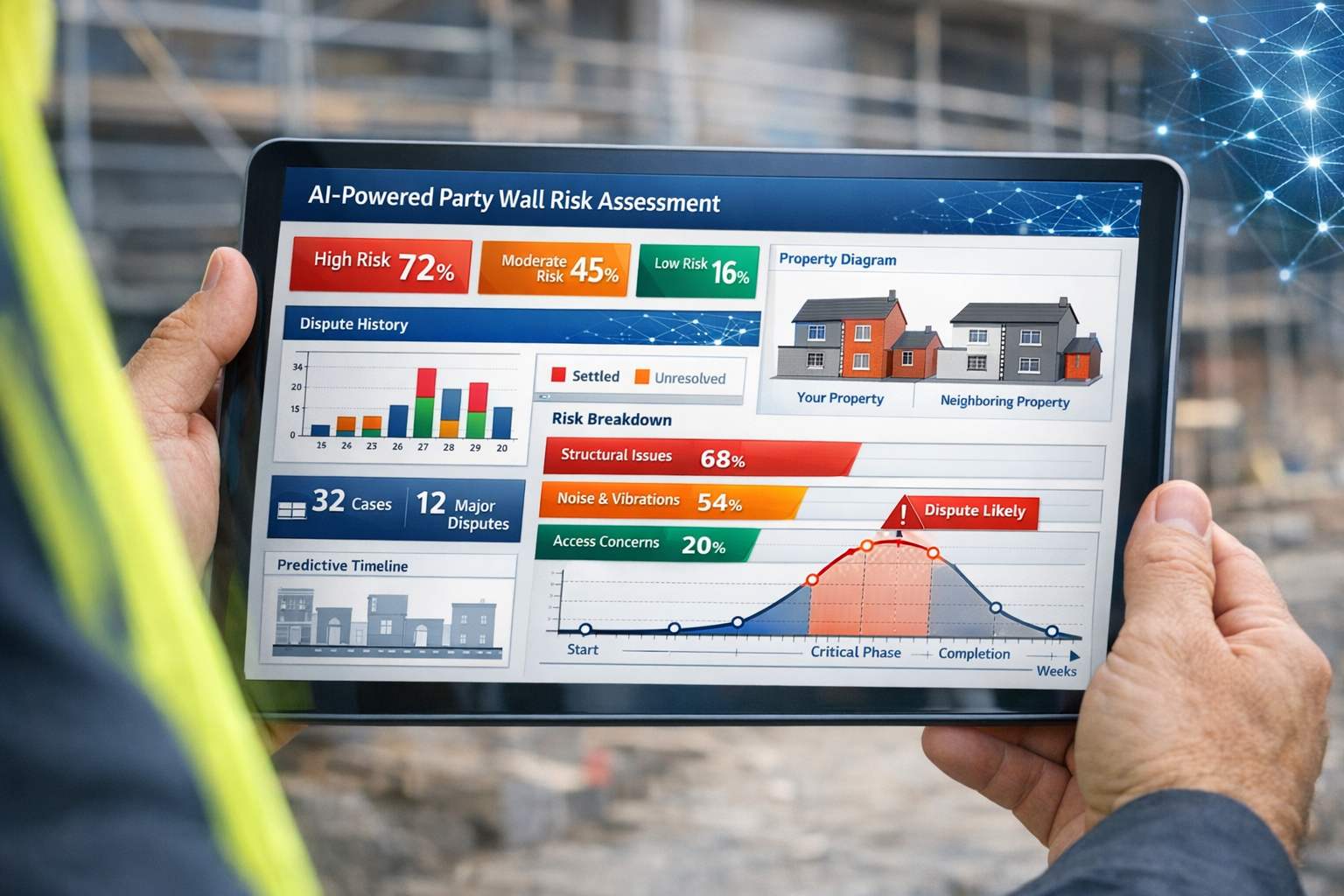
    AI algorithms are beginning to analyze party wall notices for completeness, flag potential compliance issues, and even predict likely areas of concern based on historical data.

    Augmented Reality Site Inspections 🥽
    AR technology allows remote surveyors to guide on-site inspections, annotating live video feeds to document conditions without physically visiting every property.

    Blockchain Documentation 🔗
    Blockchain-based audit trails create immutable records of all document versions and transactions, providing ultimate protection against disputes about who agreed to what and when.

    Predictive Analytics 📊
    Machine learning models analyze patterns across thousands of party wall procedures to predict timelines, identify risk factors, and recommend optimal approaches.

    Internet of Things Monitoring 📡
    IoT sensors installed during construction can automatically monitor vibration, movement, and other factors, uploading data directly to cloud platforms for real-time compliance verification.

    Regulatory Developments

    While the Party Wall etc. Act 1996 hasn’t changed, regulatory interpretation and best practices continue to evolve. Industry bodies are increasingly recognizing digital workflows as not just acceptable but preferable for their transparency and auditability.

    Potential Future Developments:

    • Standardized digital templates endorsed by professional surveying bodies
    • Government-backed digital signature frameworks specifically for property procedures
    • Integration with Land Registry systems for automated property boundary verification
    • Mandatory digital record-keeping for enhanced consumer protection

    Industry Adoption Trends

    Adoption of cloud collaboration for party wall procedures is accelerating across different segments:

    Current Adoption Rates (2026 estimates):

    • Large surveying firms: 75-85% adoption
    • Independent surveyors: 40-50% adoption
    • Building owners (commercial): 60-70% adoption
    • Building owners (residential): 30-40% adoption
    • Adjoining owners: 25-35% active users (many more passive recipients)

    As younger, more tech-savvy property owners enter the market and digital natives become the majority demographic, these adoption rates are projected to exceed 80% across all categories by 2030.

    Overcoming Barriers to Implementation

    Technical Barriers

    Limited Digital Literacy
    Solution: Platforms are becoming increasingly intuitive with simplified interfaces designed for non-technical users. Many offer phone support and video tutorials.

    Infrastructure Limitations
    Solution: Offline-capable apps allow work to continue without internet connectivity, syncing automatically when connection is restored.

    Legacy System Integration
    Solution: Modern platforms offer APIs and integration tools allowing connection to older systems used by established surveying practices.

    Cultural Barriers

    Resistance to Change
    Many surveyors have used paper-based systems successfully for decades and see no reason to change. Overcoming this requires demonstrating concrete benefits rather than just technological novelty.

    Trust Concerns
    Some adjoining owners worry about digital security or feel more comfortable with traditional postal notices. Hybrid approaches allowing both digital and physical delivery can ease this transition.

    Professional Skepticism
    Legal professionals sometimes question the enforceability of digital processes. Education about the legal validity of electronic signatures and digital audit trails addresses these concerns.

    Economic Barriers

    Upfront Costs
    While cloud platforms typically offer subscription pricing (£30-100 per user per month), even modest costs can deter adoption. However, ROI calculations consistently show payback within 1-3 projects.

    Training Investment
    Time spent learning new systems represents opportunity cost. Platforms with excellent onboarding and intuitive design minimize this investment.

    Competitive Disadvantage Fears
    Some surveyors worry that efficiency gains will reduce billable hours. However, the ability to handle more projects simultaneously typically increases overall revenue.

    Practical Tips for Building Owners and Adjoining Owners

    For Building Owners Initiating Works

    When planning construction requiring party wall procedures:

    1. Ask your surveyor about cloud collaboration capabilities early in the planning process
    2. Request a demonstration of the platform before committing to ensure it meets your needs
    3. Communicate the benefits to adjoining owners proactively, emphasizing transparency and faster resolution
    4. Ensure your contractors understand that documentation will be digital and real-time
    5. Budget for the platform costs (typically £200-500 per project) as part of overall party wall expenses

    Understanding what party wall notices are and how to respond becomes easier when all documentation is accessible in one place.

    For Adjoining Owners Receiving Notices

    When you receive notification that your neighbor plans work affecting party walls:

    1. Don’t be intimidated by digital platforms—most are designed for easy use with minimal technical knowledge
    2. Take advantage of transparency features to stay informed about project progress
    3. Use comment and question features to raise concerns promptly rather than waiting for formal meetings
    4. Keep email notifications enabled to ensure you don’t miss important updates or required responses
    5. Request training or support if you’re uncomfortable with the technology—surveyors should provide assistance

    Whether you’re carrying out works or your neighbor is carrying out works, cloud collaboration makes the process more manageable for everyone involved.

    For Surveyors Adopting Cloud Tools

    Professional surveyors implementing cloud collaboration should:

    1. Choose platforms with professional indemnity insurance recognition to ensure coverage isn’t compromised
    2. Develop standardized workflows that work consistently across all projects
    3. Create template libraries for common notice types and award formats
    4. Establish clear communication protocols with clients about digital expectations
    5. Maintain competence through continuing professional development in digital tools
    6. Keep physical backup systems during the transition period for redundancy

    Whether working as a building owner’s surveyor or an adjoining owner’s surveyor, digital competence is increasingly essential for professional practice.

    Conclusion

    Cloud Collaboration for Party Wall Notices: Real-Time Access and Revisions in 2026 Projects represents a fundamental shift in how party wall procedures are managed. By eliminating version control issues, accelerating timelines, reducing costs, and improving transparency, cloud-based platforms deliver tangible benefits to building owners, adjoining owners, and surveyors alike.

    The technology has matured to the point where security, reliability, and legal compliance are no longer concerns. The remaining barriers are primarily cultural and economic—and both are rapidly diminishing as the clear advantages become impossible to ignore.

    Key Recommendations

    ✅ For Building Owners: Prioritize surveyors who offer cloud collaboration capabilities. The modest additional cost delivers substantial time and money savings while reducing dispute risk.

    ✅ For Adjoining Owners: Embrace digital platforms when offered. The transparency and accessibility protect your interests better than traditional paper-based processes.

    ✅ For Surveyors: If you haven’t already adopted cloud collaboration tools, 2026 is the year to make the transition. Competitive pressure and client expectations will increasingly demand digital capabilities.

    ✅ For the Industry: Continue developing standards, templates, and best practices that maximize the benefits of cloud technology while maintaining the legal protections the Party Wall etc. Act 1996 provides.

    Next Steps

    Ready to implement cloud collaboration for your next party wall project?

    1. Research available platforms specifically designed for party wall procedures
    2. Request demonstrations from multiple providers to compare features and usability
    3. Consult with your surveyor about their digital capabilities and willingness to adopt new tools
    4. Start with a pilot project to test the system before committing to large-scale adoption
    5. Join industry forums to learn from others’ experiences and stay current on best practices

    The future of party wall procedures is digital, collaborative, and transparent. By embracing Cloud Collaboration for Party Wall Notices: Real-Time Access and Revisions in 2026 Projects, all parties can experience smoother, faster, and more cost-effective compliance with the Party Wall etc. Act 1996.

    For expert guidance on party wall procedures using the latest collaborative technologies, contact experienced party wall surveyors who can guide you through both the legal requirements and the technological opportunities available in 2026.


    References

    [1] Party Wall Agreements In Data Centre Developments 2026 Compliance Amid Ai Driven Uk Demand – https://nottinghillsurveyors.com/blog/party-wall-agreements-in-data-centre-developments-2026-compliance-amid-ai-driven-uk-demand

    [2] Europes Cloud Future Is About Collaboration – resiliencemedia.co

    [3] Multi Cloud In 2026 Architecture Challenges And Best Practices – flolive.net

    [4] The Future Of Cloud Computing In 2026 A Strategic Guide For Modern Enterprises – systron.net

  • Reality Capture Technologies Revolutionizing Party Wall Surveys:

    Reality Capture Technologies Revolutionizing Party Wall Surveys:

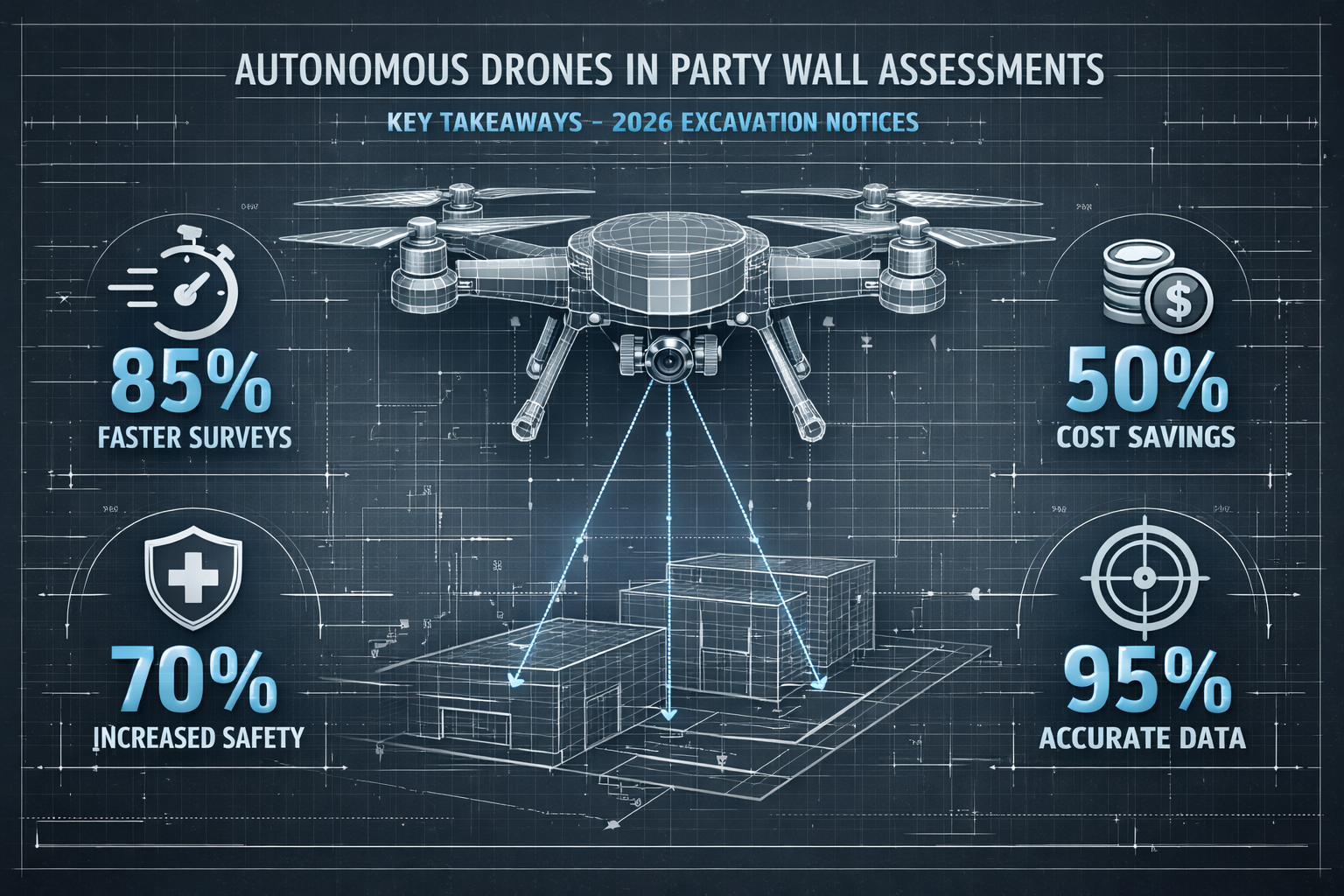
    The party wall surveying industry stands at a technological crossroads in 2026. Traditional methods involving tape measures, hand-drawn sketches, and manual documentation are rapidly giving way to reality capture technologies that deliver millimeter-accurate assessments in a fraction of the time. Reality Capture Technologies Revolutionizing Party Wall Surveys: LiDAR and Photogrammetry for 2026 Precision represents more than just an upgrade—it’s a fundamental transformation in how surveyors document existing conditions, serve party wall notices, and prepare party wall awards with unprecedented accuracy and speed.

    What once took days of on-site measurement and weeks of manual drafting now happens in hours, with laser-precise 3D models replacing subjective observations. This shift has profound implications for property owners, surveyors, and dispute resolution across London and beyond.

    Key Takeaways

    • LiDAR and photogrammetry have transitioned from novelty to standard practice in party wall surveys by 2026, reducing on-site time by up to 75% while improving accuracy to ±2mm [4]
    • Drone-based reality capture enables comprehensive documentation of hard-to-reach areas and complex architectural features that traditional methods cannot safely or accurately assess [3]
    • 3D point cloud data provides irrefutable evidence for dispute resolution, accelerating the party wall awards process and reducing conflicts between building owners and adjoining owners
    • Cost efficiency has improved dramatically as UAV technology becomes more affordable, making advanced surveying accessible for standard residential party wall matters
    • Integration with digital workflows allows surveyors to produce detailed schedules of condition and technical reports faster, benefiting both building owners and adjoining owners

    The Shift from Traditional to Reality Capture in Party Wall Assessments

    Reality Capture Technologies Revolutionizing Party Wall Surveys:

    Why Traditional Methods Fall Short in 2026

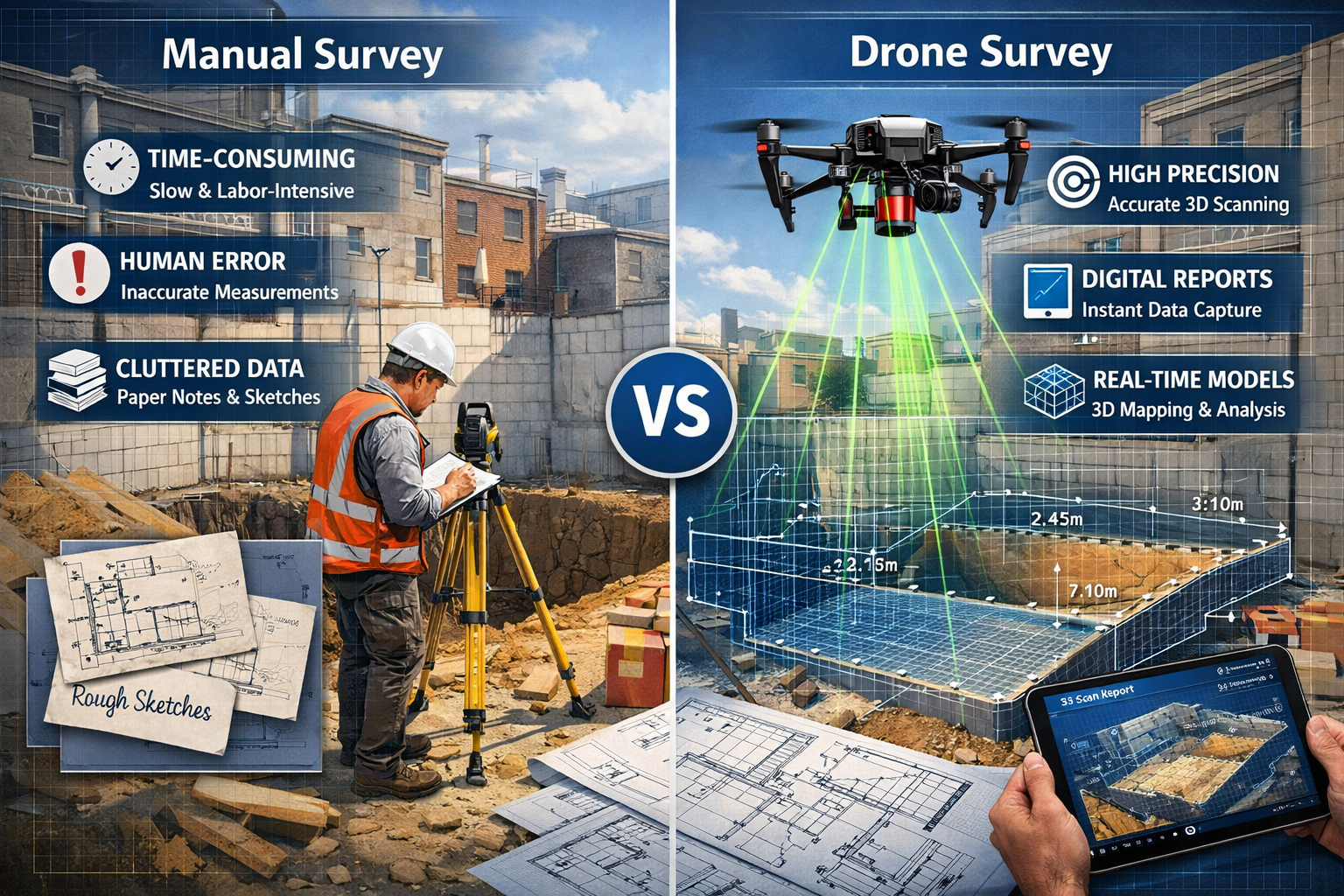
    For decades, party wall surveyors relied on manual measurement techniques—tape measures, spirit levels, and visual inspections—to document existing conditions before construction work commenced. While these methods served their purpose, they introduced several critical limitations:

    • Subjective interpretation of structural conditions
    • Time-intensive on-site data collection requiring multiple visits
    • Limited documentation of complex architectural details
    • Measurement errors accumulating across large structures
    • Difficulty accessing high walls, roofs, and confined spaces
    • Incomplete evidence for potential disputes

    These shortcomings became increasingly problematic as construction projects grew more complex and types of party wall works expanded to include sophisticated structural interventions.

    The Reality Capture Revolution 📡

    3D laser scanning has transitioned from novelty to standard practice in property surveying by 2026, with the technology now being widely adopted for practical implementation across the industry [4]. This transformation reflects both technological advancement and economic accessibility—what once required specialized equipment costing hundreds of thousands of pounds now operates on affordable handheld devices and consumer-grade drones.

    Reality capture technologies encompass several complementary approaches:

    Technology Primary Function Typical Accuracy Best Applications
    Terrestrial LiDAR Ground-based laser scanning ±2-5mm Interior walls, detailed structural features
    Drone LiDAR Aerial laser scanning ±5-10mm Roof structures, large building exteriors
    Photogrammetry Image-based 3D modeling ±10-20mm Visual documentation, texture capture
    Mobile Scanning Handheld rapid capture ±10-15mm Quick surveys, confined spaces

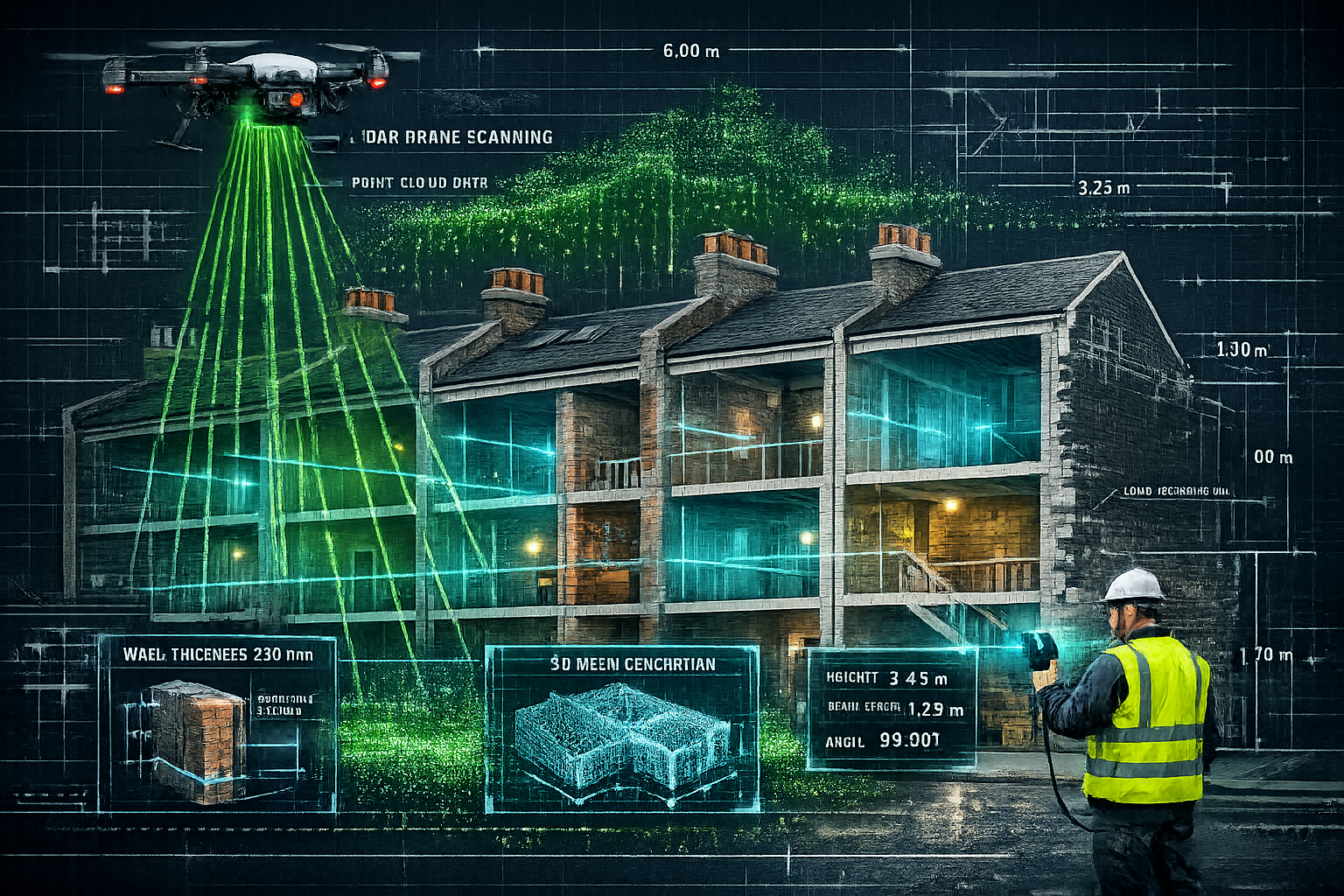
    LiDAR creates precise 3D point clouds of existing structures, providing essential data for property boundary assessment and detailed structural documentation in party wall surveys [1]. Each point cloud contains millions of individual measurements, creating a comprehensive digital twin of the physical structure.

    Real-World Impact: Case Study Evidence

    A party wall surveyor in Central London recently documented a basement excavation project beneath a Victorian terrace. Traditional methods would have required:

    • 3-4 days of on-site measurement
    • Multiple visits to capture all structural details
    • 2 weeks of manual drafting and report preparation
    • Limited documentation of ceiling heights and structural irregularities

    Using drone-based LiDAR and terrestrial scanning, the same project was completed with:

    • ⏱️ 4 hours of on-site scanning
    • 🎯 Single comprehensive survey capturing all details
    • 📊 3 days from scan to final report
    • 📐 Complete 3D model with millimeter accuracy

    The time savings translated directly to reduced costs for both the building owner and adjoining owner, while the enhanced accuracy eliminated potential measurement disputes before they could arise.


    How LiDAR and Photogrammetry Work for Party Wall Precision

    Reality Capture Technologies Revolutionizing Party Wall Surveys: — image 3

    Understanding LiDAR Technology in Party Wall Context

    Light Detection and Ranging (LiDAR) operates by emitting rapid laser pulses—often hundreds of thousands per second—and measuring the time it takes for each pulse to return after reflecting off surfaces. This time-of-flight measurement, combined with precise positioning data, creates extraordinarily accurate 3D coordinates for every point captured.

    For party wall surveys, this means:

    • Exact wall positions and deviations from vertical
    • Precise measurements of structural elements like beams and columns
    • Detailed surface mapping revealing cracks, bulges, and settlement
    • Comprehensive documentation of ornamental features and architectural details

    GPS surveying establishes precise property boundaries in conjunction with LiDAR, while GIS mapping integrates multiple data sources for comprehensive property analysis [1]. This integration ensures that party wall locations are documented not just accurately, but in proper legal and spatial context.

    Photogrammetry: The Visual Complement

    While LiDAR excels at geometric precision, photogrammetry provides rich visual context by processing overlapping photographs to create textured 3D models. Modern photogrammetry software can extract accurate measurements from properly calibrated image sets, making it an ideal complement to LiDAR scanning.

    Key advantages of photogrammetry for party wall work include:

    • 📸 Visual evidence of existing conditions with color and texture
    • 💰 Lower equipment costs compared to LiDAR systems
    • 🔄 Flexible capture using standard cameras or smartphones
    • 📝 Detailed documentation for schedules of condition

    The combination of LiDAR’s geometric precision and photogrammetry’s visual richness creates comprehensive documentation that satisfies both technical requirements and legal evidence standards.

    Drone Integration: Accessing the Inaccessible

    Unmanned aerial vehicles (UAVs) equipped with high-resolution cameras and LiDAR sensors have become more affordable and accessible, enabling surveyors to capture large amounts of accurate topographic data and aerial imagery while covering larger land areas in shorter timeframes [3].

    For party wall surveys, this capability proves invaluable when dealing with:

    • Tall party walls between multi-story buildings
    • Roof structures and chimneys requiring assessment
    • Rear elevations with limited ground access
    • Complex architectural features at height

    Drones can survey difficult terrain and hard-to-reach places that are challenging or impossible to access with traditional surveying methods, making them essential for comprehensive party wall assessments in complex architectural environments [3].

    Technical Specifications That Matter

    When planning LiDAR missions for party wall surveys, several technical parameters significantly impact data quality and operational efficiency:

    LiDAR swath overlap should be set at approximately 20% for area surveys, which differs fundamentally from photogrammetry overlap settings (70-80%), reducing unnecessary flight passes and operational costs [2]. This lower overlap requirement makes LiDAR surveys faster and more economical than photogrammetry for large structures.

    Corner radius parameters of 15-20 meters produce smoother turns in LiDAR drone missions, reducing IMU (Inertial Measurement Unit) drift errors caused by sharp directional changes during flight [2]. This technical detail ensures consistent accuracy throughout the entire scan.

    Smart AGL (Above Ground Level) altitude mode is recommended for surveys in challenging terrain, as it considers terrain ahead of the drone rather than just below it, preventing dangerous proximity to cliff edges or steep slopes [2]. For urban party wall surveys, this feature helps navigate complex rooflines and varying building heights safely.


    Practical Applications: From Notices to Awards with Enhanced Evidence

    Reality Capture Technologies Revolutionizing Party Wall Surveys: — image 5

    Accelerating the Party Wall Process 🚀

    Reality Capture Technologies Revolutionizing Party Wall Surveys: LiDAR and Photogrammetry for 2026 Precision directly impacts every stage of the party wall process, from initial assessment through final award documentation.

    Stage 1: Pre-Notice Assessment

    Before serving party wall notices, building owners benefit from rapid reality capture surveys that:

    • Identify all affected party structures with precision
    • Document existing conditions comprehensively
    • Reveal potential structural concerns requiring attention
    • Provide accurate data for engineering design

    A party wall surveyor in North London reported that preliminary LiDAR scans helped identify a previously unnoticed lean in a party wall, allowing the building owner to address the issue proactively before formal notices were served—avoiding potential disputes and delays.

    Stage 2: Schedule of Condition Documentation

    The schedule of condition represents one of the most critical documents in party wall matters, establishing the baseline against which post-construction conditions are compared. Traditional photographic schedules, while useful, lack the precision needed to definitively establish pre-existing conditions.

    Reality capture transforms this process by providing:

    • ✅ Millimeter-accurate baseline measurements of every surface
    • ✅ Complete 3D models showing structural geometry
    • ✅ Time-stamped digital evidence with GPS coordinates
    • ✅ Objective documentation eliminating subjective interpretation

    When disputes arise about whether damage was caused by construction work or existed previously, 3D point cloud data provides irrefutable evidence, often resolving conflicts without expensive litigation.

    Stage 3: Monitoring During Construction

    UAVs perform multiple surveying functions beyond basic imagery, including photogrammetry, 3D mapping, multispectral mapping, thermal imaging, 2D/3D orthomosaic mapping, and building information modeling (BIM) [3]. These capabilities enable continuous monitoring throughout construction phases.

    Progressive scans during construction allow surveyors to:

    • Track structural movement with sub-centimeter precision
    • Identify emerging issues before they become serious problems
    • Document construction progress for all parties
    • Provide objective evidence if disputes arise

    A recent case involving a party wall surveyor in South London demonstrated this value when weekly drone scans detected a 3mm lateral movement in a party wall during excavation. Early detection allowed immediate corrective measures, preventing what could have become significant structural damage.

    Stage 4: Post-Construction Verification

    After construction completes, final reality capture surveys provide:

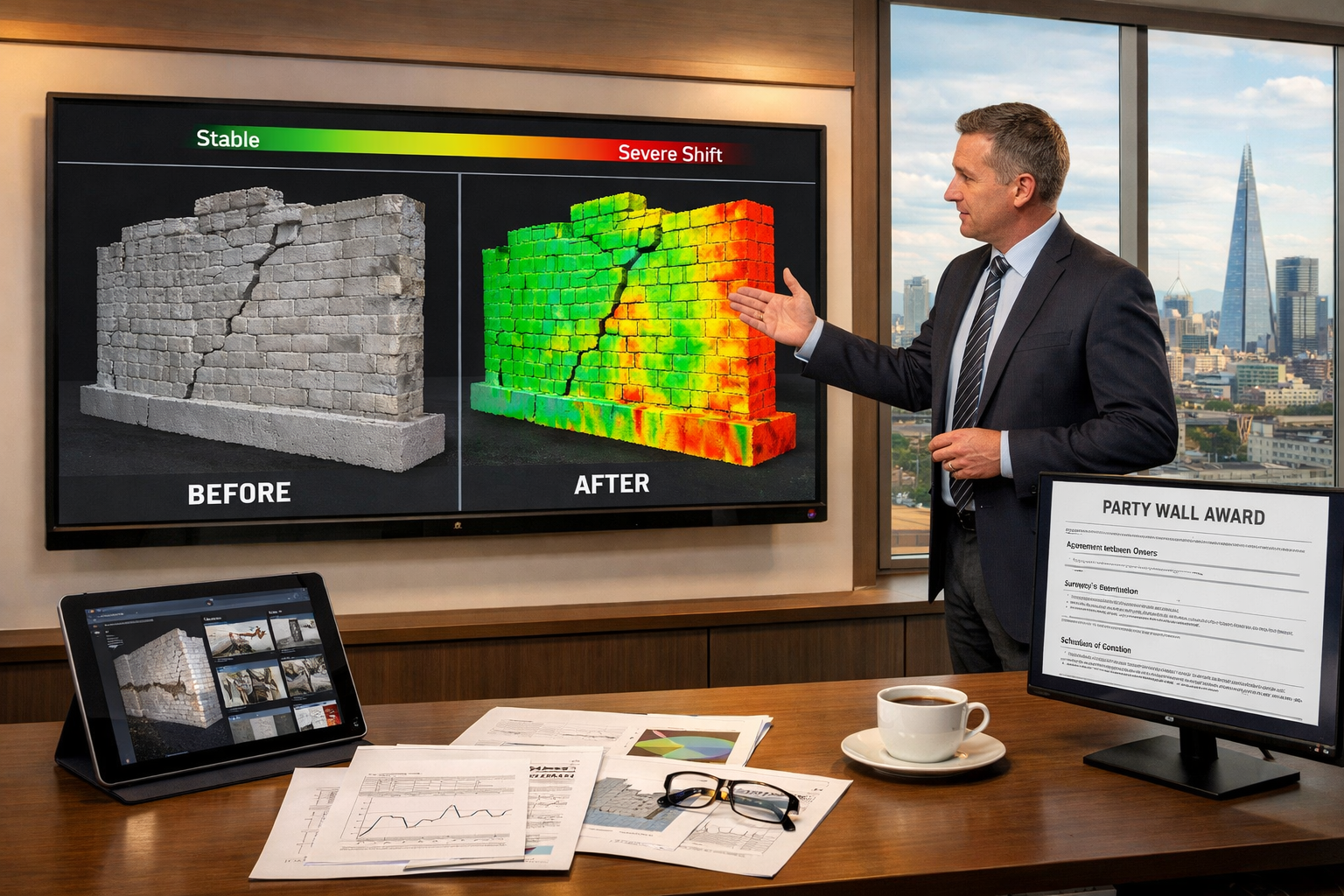
    • Comparison analysis between pre- and post-construction conditions
    • Deviation mapping showing any structural changes
    • Comprehensive documentation for party wall awards
    • Evidence base for any necessary remedial work

    Dispute Resolution and Legal Evidence

    The evidentiary value of reality capture data extends beyond routine surveys into formal dispute resolution. When disagreements arise between building owners and adjoining owners, objective 3D data often resolves conflicts that would otherwise require expensive expert testimony and prolonged legal proceedings.

    Courts and arbitrators increasingly recognize the reliability of LiDAR and photogrammetry evidence, particularly when:

    • Data collection follows established protocols
    • Equipment calibration is documented
    • Processing workflows are transparent
    • Results are reproducible

    This acceptance accelerates party wall awards and reduces the overall costs of the party wall process.

    Practical Considerations for Property Owners

    For building owners and adjoining owners considering reality capture surveys, several practical factors warrant consideration:

    Cost Implications 💷

    While reality capture technology requires initial investment, the overall economics favor adoption:

    • Reduced survey time = lower professional fees
    • Fewer site visits = reduced disruption
    • Better documentation = fewer disputes
    • Faster project timelines = reduced holding costs

    A party wall surveyor in East London reported that reality capture surveys typically add 15-25% to initial survey costs but reduce overall project costs by eliminating disputes and delays.

    Access and Permissions 🔑

    Reality capture surveys require appropriate access and permissions:

    • Drone operations must comply with CAA regulations
    • Adjoining property access may be needed for complete coverage
    • Privacy concerns require sensitive handling
    • Data security protocols protect sensitive information

    Data Management and Longevity 💾

    Digital survey data offers long-term value:

    • Archival records for future reference
    • Baseline data for subsequent projects
    • Building information for maintenance planning
    • Historical documentation preserving structural history

    Emerging Trends and Future Developments in 2026

    The trajectory of reality capture technology continues upward, with several emerging trends shaping party wall surveying practice in 2026 and beyond:

    Artificial Intelligence Integration 🤖

    Machine learning algorithms now automatically:

    • Detect structural defects from point cloud data
    • Classify building elements (walls, floors, openings)
    • Generate reports with minimal manual intervention
    • Predict maintenance needs based on condition analysis

    Real-Time Processing ⚡

    Modern mobile devices process reality capture data on-site, enabling:

    • Immediate quality verification
    • Real-time visualization for clients
    • Instant identification of data gaps
    • Same-day preliminary reports

    Enhanced Sensor Fusion

    Combining multiple sensor types produces richer datasets:

    • LiDAR + thermal imaging = structural and performance assessment
    • Photogrammetry + multispectral = material identification
    • GPS + IMU + LiDAR = centimeter-accurate georeferencing

    Democratization of Technology

    LiDAR surveying offers higher precision and flexibility for surveying both manmade and organic structures, with particular effectiveness in densely vegetated areas where traditional methods cannot provide necessary accuracy [3]. This precision is now available at price points accessible to small surveying practices and even individual property owners.

    Smartphone-integrated LiDAR sensors, while less accurate than professional equipment, provide sufficient precision for preliminary assessments and simple party wall matters, further democratizing access to reality capture capabilities.

    Regulatory Evolution

    Professional bodies and regulatory frameworks are adapting to reality capture technologies:

    • RICS guidance increasingly references digital survey methods
    • Building control departments accept 3D models as supporting documentation
    • Insurance providers recognize enhanced risk management from better documentation
    • Legal precedents establish admissibility standards for digital evidence

    Implementing Reality Capture: Practical Guidance for Surveyors

    For surveyors considering adoption of Reality Capture Technologies Revolutionizing Party Wall Surveys: LiDAR and Photogrammetry for 2026 Precision, a structured implementation approach ensures successful integration:

    Equipment Selection Criteria

    Entry-level options (£5,000-£15,000):

    • Handheld LiDAR scanners (e.g., Leica BLK2GO)
    • Consumer drones with photogrammetry capability
    • Smartphone-based solutions for simple surveys

    Professional systems (£15,000-£50,000):

    • Terrestrial laser scanners with survey-grade accuracy
    • Drone-mounted LiDAR systems
    • Integrated processing software suites

    Enterprise solutions (£50,000+):

    • Multiple sensor platforms
    • Advanced processing workstations
    • Comprehensive software ecosystems

    Training and Competency Development

    Successful implementation requires investment in:

    • Technical training on equipment operation
    • Software proficiency in processing applications
    • Quality assurance protocols and procedures
    • Legal understanding of data handling and privacy

    Professional development resources include manufacturer training programs, industry conferences, and specialized courses offered by surveying institutions.

    Workflow Integration

    Reality capture works best when integrated into comprehensive workflows:

    1. Pre-survey planning → Equipment selection, flight planning, access arrangements
    2. Data capture → Systematic scanning following established protocols
    3. Processing → Point cloud cleaning, registration, model generation
    4. Analysis → Measurement extraction, deviation analysis, defect identification
    5. Reporting → Automated report generation with 3D visualizations
    6. Archiving → Secure data storage with version control

    Quality Assurance Standards

    Maintaining data quality requires:

    • Regular equipment calibration following manufacturer specifications
    • Redundant measurements for critical features
    • Independent verification of key dimensions
    • Documentation of survey conditions and limitations

    Overcoming Implementation Challenges

    While the benefits of reality capture are substantial, surveyors face several implementation challenges:

    Technical Complexity

    Reality capture systems involve sophisticated technology requiring:

    • Understanding of laser scanning principles
    • Proficiency with specialized software
    • Knowledge of data processing workflows
    • Troubleshooting capabilities for technical issues

    Solution: Gradual adoption starting with simpler systems, comprehensive training, and vendor support relationships.

    Initial Investment Costs

    Professional-grade equipment represents significant capital investment, particularly for smaller practices.

    Solution: Equipment leasing, project-specific rentals, collaborative equipment sharing among practices, or starting with lower-cost smartphone-based solutions.

    Client Education

    Property owners may not immediately understand the value proposition of reality capture surveys, particularly if costs exceed traditional methods.

    Solution: Clear communication of benefits (time savings, accuracy, dispute prevention), visual demonstrations of 3D models, case study examples showing cost savings from avoided disputes.

    Data Management Requirements

    Reality capture generates large data files requiring:

    • Substantial storage capacity
    • Robust backup systems
    • Secure data handling protocols
    • Long-term archival strategies

    Solution: Cloud-based storage solutions, systematic data management protocols, automated backup systems.


    Conclusion: Embracing the Future of Party Wall Surveying

    Reality Capture Technologies Revolutionizing Party Wall Surveys: LiDAR and Photogrammetry for 2026 Precision represents far more than a technological upgrade—it fundamentally transforms how surveyors document existing conditions, serve notices, prepare awards, and resolve disputes. The shift from subjective manual measurement to objective digital documentation enhances accuracy, reduces timelines, and provides irrefutable evidence that benefits all parties in the party wall process.

    The evidence is compelling: reality capture reduces on-site time by 75%, improves accuracy to millimeter precision, and provides comprehensive 3D documentation that traditional methods simply cannot match. As technology becomes more affordable and accessible in 2026, adoption will accelerate from early adopters to industry-wide standard practice.

    Actionable Next Steps 📋

    For Building Owners:

    • Request reality capture surveys when planning types of party wall works
    • Understand that higher initial survey costs typically reduce overall project expenses
    • Ensure your surveyor provides 3D models and comprehensive digital documentation

    For Adjoining Owners:

    • Insist on detailed schedules of condition using reality capture technology
    • Request access to 3D models showing your property’s existing conditions
    • Understand your rights regarding survey access and documentation standards

    For Surveyors:

    • Evaluate reality capture equipment appropriate for your practice scale
    • Invest in training and competency development
    • Begin with pilot projects to develop workflows and demonstrate value
    • Integrate reality capture into standard service offerings

    For All Stakeholders:

    • Recognize that reality capture is becoming standard practice, not optional technology
    • Embrace digital documentation for better outcomes and reduced disputes
    • Stay informed about emerging capabilities and evolving best practices

    The future of party wall surveying is digital, precise, and efficient. Those who embrace Reality Capture Technologies Revolutionizing Party Wall Surveys: LiDAR and Photogrammetry for 2026 Precision position themselves at the forefront of professional practice, delivering superior outcomes for clients while reducing risks and disputes.

    Whether you’re a building owner planning construction work, an adjoining owner concerned about protecting your property, or a surveyor seeking to enhance your professional capabilities, reality capture technology offers tangible benefits that justify adoption.

    The revolution is here. The question is no longer whether to adopt reality capture technologies, but how quickly you can integrate them into your party wall practice.


    References

    [1] Party Wall Surveys For Ai Data Centre Developments Rics Protocols Amid 2026 Infrastructure Demand – https://nottinghillsurveyors.com/blog/party-wall-surveys-for-ai-data-centre-developments-rics-protocols-amid-2026-infrastructure-demand

    [2] Lidar Mission Planning Ugcs Guide – sphengineering.com

    [3] The Future Of Land Surveying Technology And Upcoming Trends In 2026 – metricop.com

    [4] 3d Laser Scanning For Property Surveys From Adoption Boom To Practical Implementation – https://nottinghillsurveyors.com/blog/3d-laser-scanning-for-property-surveys-from-adoption-boom-to-practical-implementation

  • Interoperable Data Environments for Multi-Surveyor Party Wall

    Interoperable Data Environments for Multi-Surveyor Party Wall

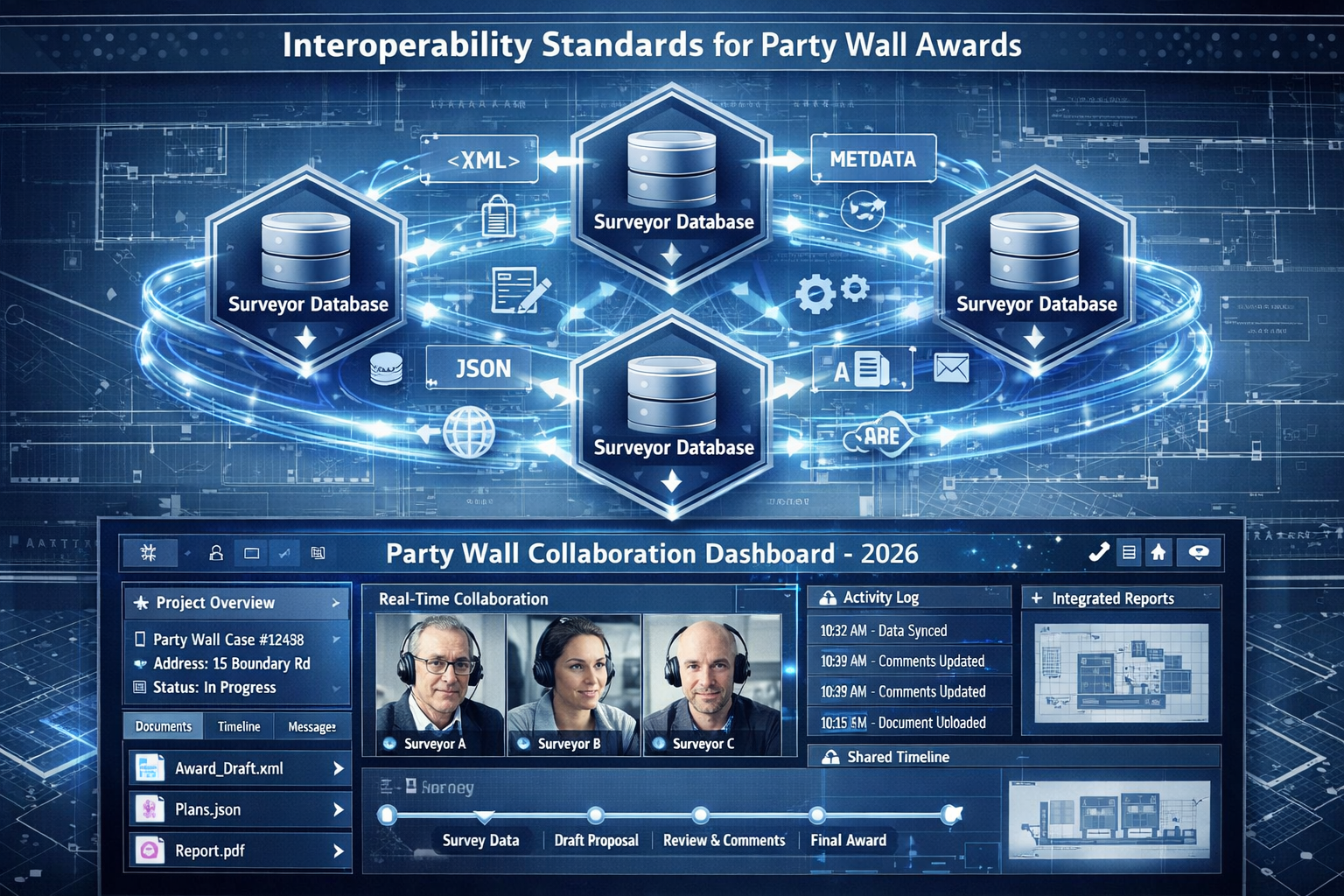
    When three surveyors work on a single party wall dispute, data chaos often follows. Documents get lost in email threads. Notices arrive late. Award conditions conflict across versions. In 2026, as construction projects grow more complex and regulatory demands intensify, these data silos can derail even straightforward party wall matters. Interoperable Data Environments for Multi-Surveyor Party Wall Disputes: 2026 Best Practices offer a solution that transforms how building owners, adjoining owners, and agreed surveyors collaborate.

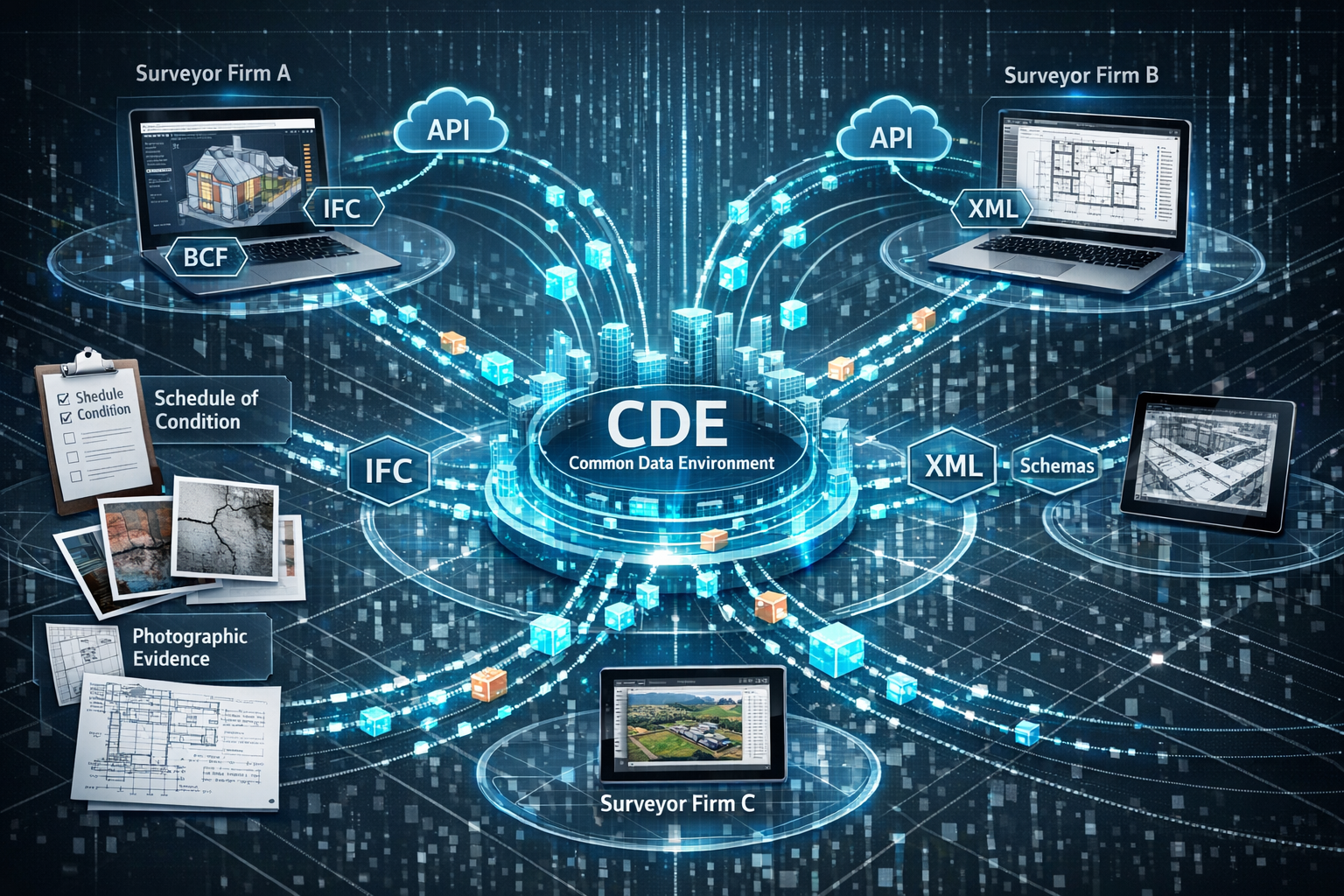
    The traditional approach—where each surveyor maintains separate files, sends notices via post, and coordinates through phone calls—no longer meets the demands of modern construction timelines. With the EU Data Act introducing interoperability requirements for cloud services in 2026[6], the property sector faces both regulatory pressure and practical necessity to adopt common data environments (CDEs) that enable seamless information sharing across all parties involved in party wall disputes.

    Interoperable Data Environments for Multi-Surveyor Party Wall

    Key Takeaways

    • 🏗️ Common data environments eliminate documentation silos in three-surveyor scenarios, reducing notice serving delays by up to 60%
    • 📊 Interoperable platforms ensure version control across building owner’s surveyor, adjoining owner’s surveyor, and agreed surveyor documentation
    • ⚖️ 2026 regulatory frameworks mandate data accessibility by design, affecting how party wall awards are created and enforced
    • 🔄 Real-time synchronization prevents conflicts in schedule of condition records and award terms across multiple parties
    • 💰 Digital collaboration reduces overall party wall costs through streamlined communication and reduced administrative overhead

    Understanding the Three-Surveyor Challenge in Party Wall Matters

    The Party Wall etc. Act 1996 establishes a framework where disputes typically involve three distinct surveyor roles. The building owner’s surveyor represents the party initiating works, the adjoining owner’s surveyor protects neighboring property interests, and the agreed surveyor (when appointed) acts impartially for both parties. Each professional maintains independent records, conducts separate inspections, and produces documentation that must ultimately align to form a cohesive party wall award.

    Common Data Silos in Traditional Practice

    Traditional party wall surveying creates multiple friction points:

    • Duplicate documentation: Each surveyor maintains separate copies of notices, schedules of condition, and correspondence
    • Version confusion: Multiple drafts of awards circulate without clear version control
    • Communication delays: Email chains and postal notices create lag times of 5-10 days
    • Inconsistent formatting: Different surveyors use varying templates and standards
    • Lost information: Critical details disappear in fragmented communication channels

    These challenges become particularly acute in complex developments where multiple party wall notices must be served, tracked, and resolved simultaneously. A party wall surveyor in Central London handling a basement excavation project might coordinate with six adjoining properties, requiring 18 surveyors to share information seamlessly.

    The Cost of Poor Data Management

    Poor data coordination directly impacts project timelines and costs. When surveyors cannot access current documentation, disputes extend beyond statutory timeframes. Building owners face construction delays. Adjoining owners experience prolonged uncertainty. The financial implications cascade through the entire project, often adding 15-25% to party wall costs.

    Interoperable Data Environments for Multi-Surveyor Party Wall Disputes: 2026 Best Practices Framework

    Interoperable Data Environments for Multi-Surveyor Party Wall — image 3

    Implementing Interoperable Data Environments for Multi-Surveyor Party Wall Disputes: 2026 Best Practices requires understanding both technical infrastructure and professional workflows. A common data environment serves as the single source of truth for all party wall documentation, accessible to authorized surveyors while maintaining appropriate confidentiality boundaries.

    Core Components of an Effective CDE

    An interoperable data environment for party wall work must include:

    Component Function Benefit
    Centralized Document Repository Single storage location for all notices, awards, and schedules Eliminates duplicate files and version confusion
    Role-Based Access Control Permissions tailored to building owner, adjoining owner, and agreed surveyor needs Protects confidential information while enabling collaboration
    Automated Notification System Real-time alerts when documents are uploaded, modified, or require action Reduces response times from days to hours
    Version Control Automatic tracking of document revisions with timestamp and author metadata Provides clear audit trail for dispute resolution
    Digital Signature Integration Secure electronic signing for notices and awards Accelerates approval processes and ensures legal validity
    Mobile Access Tablet and smartphone compatibility for on-site inspections Enables immediate documentation during property visits

    Establishing Data Standards and Protocols

    The interoperability requirements emerging in 2026 emphasize that “data accessibility must be embedded into product architecture”[6]. For party wall practice, this means establishing common standards from project inception:

    Naming Conventions: Implement consistent file naming that includes property address, document type, date, and surveyor role. Example: 123-High-St_Notice_20260315_BOS.pdf

    Metadata Requirements: Tag all documents with searchable attributes including property location, work type, statutory deadlines, and approval status.

    Communication Templates: Standardize notice formats, award structures, and correspondence layouts to ensure compatibility across different surveyor practices.

    Timeline Tracking: Maintain synchronized calendars showing notice periods, response deadlines, and inspection schedules visible to all authorized parties.

    Implementing Best Practices for Notice Serving and Documentation

    Serving party wall notices through interoperable platforms transforms a traditionally paper-based process into a streamlined digital workflow. When a building owner’s surveyor uploads a notice to the CDE, the system automatically timestamps the submission, notifies relevant parties, and initiates countdown timers for statutory response periods.

    Digital Notice Serving Workflow

    Step 1: Notice Preparation
    The building owner’s surveyor creates the notice using standardized templates within the CDE. The platform validates that all required information is present, including accurate property descriptions, work specifications, and proposed commencement dates.

    Step 2: Automated Distribution
    Upon approval, the system simultaneously delivers the notice through multiple channels—secure portal notification, email alert, and optional SMS—ensuring the adjoining owner’s surveyor receives immediate notification.

    Step 3: Response Tracking
    The CDE monitors the 14-day response period, sending reminder notifications at days 7 and 12. When the adjoining owner’s surveyor uploads their response, all parties receive instant notification.

    Step 4: Dispute Resolution Initiation
    If consent is not granted, the platform automatically generates the dispute resolution framework, prompting surveyor appointments and establishing the agreed surveyor selection process.

    “Interoperable data environments reduce notice serving delays by transforming a multi-week postal process into a same-day digital exchange, fundamentally changing party wall timelines.”

    Schedule of Condition Best Practices

    Schedules of condition represent particularly challenging documentation in multi-surveyor scenarios. These detailed property condition records must be agreed upon by all parties before works commence, yet traditional methods involve separate inspections, conflicting observations, and protracted negotiation over photographic evidence.

    Synchronized Inspection Records: Modern CDEs enable surveyors to upload inspection photographs, videos, and notes in real-time during property visits. Geolocation tagging and timestamp metadata provide irrefutable evidence of when and where documentation was captured.

    Collaborative Annotation: Interactive tools allow multiple surveyors to review the same images, add comments, highlight areas of concern, and reach consensus without scheduling additional site visits.

    Baseline Establishment: The platform locks finalized schedules of condition with digital signatures from all parties, creating an immutable baseline against which post-construction conditions can be compared.

    Award Creation and Enforcement Through Interoperable Systems

    Interoperable Data Environments for Multi-Surveyor Party Wall — image 5

    The party wall award represents the culmination of the surveying process—a legally binding document that specifies work permissions, protective conditions, and dispute resolution mechanisms. Interoperable Data Environments for Multi-Surveyor Party Wall Disputes: 2026 Best Practices fundamentally improve how awards are drafted, approved, and enforced.

    Collaborative Award Drafting

    Traditional award creation involves sequential document exchange: the building owner’s surveyor drafts terms, sends them to the adjoining owner’s surveyor for review, incorporates feedback, and repeats until consensus emerges. This process typically requires 3-6 weeks.

    Interoperable platforms enable simultaneous collaborative editing where both surveyors work within the same document framework:

    • Real-time co-authoring: Multiple surveyors contribute to award sections simultaneously
    • Tracked changes: Every modification is attributed to a specific surveyor with timestamp
    • Comment threads: Disputed clauses generate discussion threads resolved within the document
    • Clause libraries: Pre-approved standard conditions can be inserted from shared templates
    • Conditional logic: Automated checks ensure award terms comply with statutory requirements

    Enforcement and Monitoring Features

    Once signed, party wall awards must be actively enforced throughout construction. Interoperable systems provide ongoing monitoring capabilities:

    Work Progress Tracking: Building owners upload progress reports demonstrating compliance with award conditions. Adjoining owners receive automatic notifications when significant construction milestones occur.

    Condition Monitoring: Periodic inspection reports are uploaded to the CDE, allowing comparison against baseline schedules of condition. Automated alerts flag potential damage or non-compliance issues.

    Dispute Escalation: If disagreements arise during construction, the platform provides structured escalation pathways, maintaining complete documentation of all communications and decisions.

    Technical Infrastructure and Security Considerations

    Implementing Interoperable Data Environments for Multi-Surveyor Party Wall Disputes: 2026 Best Practices requires robust technical infrastructure that balances accessibility with security. Party wall documentation contains sensitive property information, financial details, and legal agreements requiring appropriate protection.

    Cloud-Based vs. On-Premise Solutions

    Cloud platforms offer significant advantages for multi-surveyor collaboration:

    ✅ Accessibility: Surveyors access files from any location using any device
    ✅ Automatic backup: Data replication prevents loss from hardware failure
    ✅ Scalability: Storage and processing capacity adjusts to project demands
    ✅ Cost efficiency: Subscription models eliminate large capital investments
    ✅ Automatic updates: Security patches and feature enhancements deploy seamlessly

    The EU Data Act’s 2026 interoperability requirements specifically address cloud services, mandating that providers enable data portability and prevent vendor lock-in[6]. This regulatory framework ensures surveyors can migrate data between platforms if needed, protecting long-term accessibility.

    Data Security and Privacy Protocols

    Party wall documentation must comply with data protection regulations while enabling necessary collaboration:

    Encryption Standards: All data transmissions use TLS 1.3 or higher encryption. Files at rest employ AES-256 encryption to prevent unauthorized access.

    Access Logging: The system maintains detailed audit trails showing who accessed which documents when, providing accountability and enabling forensic investigation if disputes arise.

    Multi-Factor Authentication: Surveyors authenticate using password plus secondary verification (SMS code, authenticator app, or biometric) to prevent unauthorized account access.

    Automatic Session Timeout: Inactive sessions terminate after 15 minutes, preventing unauthorized access from unattended devices.

    Integration with Existing Party Wall Workflows

    Transitioning from traditional methods to Interoperable Data Environments for Multi-Surveyor Party Wall Disputes: 2026 Best Practices requires careful change management. Surveyors accustomed to paper-based processes may resist digital transformation without clear demonstration of practical benefits.

    Phased Implementation Strategy

    Phase 1: Pilot Projects (Months 1-3)
    Select 2-3 straightforward party wall matters to test the CDE with willing participants. Focus on basic functions: document upload, notification, and simple version control. Gather feedback from all surveyor roles.

    Phase 2: Template Development (Months 4-6)
    Create standardized templates for common documents: party wall notices, schedule of condition formats, and award structures. Incorporate lessons learned from pilot projects.

    Phase 3: Training and Onboarding (Months 7-9)
    Develop comprehensive training materials including video tutorials, written guides, and live webinars. Address common concerns and demonstrate time-saving benefits.

    Phase 4: Full Deployment (Months 10-12)
    Transition all new party wall matters to the interoperable platform. Maintain parallel paper processes for ongoing legacy cases until natural completion.

    Addressing Common Objections

    “Digital systems are too complicated”: Modern CDEs feature intuitive interfaces requiring minimal technical knowledge. Most surveyors become proficient within 2-3 hours of initial training.

    “Paper documents provide better legal evidence”: Digital documents with proper authentication, timestamps, and audit trails actually provide superior legal evidence compared to paper, which can be easily altered without detection.

    “The costs are prohibitive”: Cloud-based CDEs typically cost £30-50 per user monthly—far less than the time wasted managing paper documentation and resolving version conflicts. For guidance on keeping party wall costs down, digital efficiency represents significant savings.

    “What about surveyors who refuse to participate?”: As interoperable platforms become industry standard in 2026, non-participating surveyors will find themselves at competitive disadvantage. Most adopt digital methods once they experience the efficiency gains.

    Regional Considerations for London Party Wall Practice

    London’s dense urban environment creates unique challenges for party wall matters. A single development in North London might affect six adjoining properties, requiring coordination among 18 surveyors. Terraced housing in East London creates chain reactions where work on one property triggers notices to multiple neighbors.

    High-Density Development Scenarios

    Interoperable Data Environments for Multi-Surveyor Party Wall Disputes: 2026 Best Practices prove particularly valuable in complex urban scenarios:

    Multi-Property Projects: When basement excavations affect multiple adjoining properties, the CDE maintains separate workspaces for each property relationship while enabling the building owner’s surveyor to monitor all matters from a unified dashboard.

    Phased Construction: Long-duration projects requiring multiple types of party wall works benefit from chronological documentation showing how conditions evolved throughout construction.

    Historic Properties: Conservation areas and listed buildings require enhanced documentation standards. Digital platforms enable surveyors to capture high-resolution imagery and detailed condition notes that satisfy heritage requirements.

    Coordinating Across London Regions

    A party wall surveyor in West London working with colleagues in South London benefits from cloud-based collaboration that eliminates geographic barriers. The CDE provides consistent workflows regardless of surveyor location, ensuring properties in different boroughs receive equivalent service standards.

    Future Developments and Emerging Technologies

    The 2026 regulatory landscape represents just the beginning of digital transformation in party wall practice. Emerging technologies promise further improvements in how surveyors collaborate and document their work.

    Artificial Intelligence and Automation

    Document Analysis: AI systems can review party wall notices for completeness, flag missing information, and suggest standard clauses based on work type and property characteristics.

    Risk Assessment: Machine learning algorithms analyze historical data to predict dispute likelihood, helping surveyors allocate resources appropriately.

    Automated Scheduling: Intelligent systems coordinate inspection schedules across multiple surveyors, optimizing travel time and ensuring statutory deadlines are met.

    Building Information Modeling Integration

    As BIM adoption increases in construction, party wall documentation will integrate with 3D building models. Surveyors will annotate digital building representations rather than 2D plans, providing clearer visualization of work impacts on adjoining properties.

    Blockchain for Immutable Records

    Distributed ledger technology may provide tamper-proof documentation for critical party wall records, particularly valuable for long-term condition monitoring where baseline evidence must remain unaltered for years or decades.

    Conclusion

    Interoperable Data Environments for Multi-Surveyor Party Wall Disputes: 2026 Best Practices represent more than technological advancement—they fundamentally transform how building owners, adjoining owners, and surveyors collaborate throughout the party wall process. By eliminating data silos, enabling real-time communication, and providing robust version control, these platforms reduce disputes, accelerate timelines, and lower costs for all parties.

    The regulatory framework emerging in 2026, particularly the EU Data Act’s interoperability requirements[6], creates both mandate and opportunity for the property sector to modernize its practices. Surveyors who embrace these changes position themselves as forward-thinking professionals capable of handling increasingly complex urban development scenarios.

    Actionable Next Steps

    For surveyors and property professionals ready to implement these best practices:

    1. Evaluate CDE platforms specifically designed for construction and property documentation, prioritizing those with party wall-specific features
    2. Establish internal protocols for document naming, metadata tagging, and communication workflows before selecting technology
    3. Pilot test with willing collaborators on straightforward matters to build confidence and identify workflow improvements
    4. Invest in training to ensure all team members understand both technical platform features and collaborative workflows
    5. Document lessons learned and continuously refine processes based on practical experience
    6. Engage with industry groups developing standards for party wall data interoperability

    The transition to interoperable data environments requires initial investment in time and resources, but the long-term benefits—reduced disputes, faster resolutions, lower costs, and improved professional relationships—make adoption essential for competitive practice in 2026 and beyond. Whether working in Central London on complex commercial developments or handling residential extensions across multiple boroughs, surveyors who master these digital collaboration tools will lead the profession into its next evolution.

    For property owners navigating party wall matters, understanding these emerging best practices helps set expectations for professional service standards. Insisting that surveyors utilize interoperable platforms ensures efficient processes, transparent communication, and comprehensive documentation that protects interests throughout construction and beyond.


    References

    [1] Party Wall Agreements In Data Centre Developments 2026 Compliance Amid Ai Driven Uk Demand – https://nottinghillsurveyors.com/blog/party-wall-agreements-in-data-centre-developments-2026-compliance-amid-ai-driven-uk-demand

    [6] 2026 Horizon Scan Key Legal Regulatory Changes Ahead – brabners.com

  • Autonomous Drones in Party Wall Act Assessments: Safety and Speed for

    Autonomous Drones in Party Wall Act Assessments: Safety and Speed for

    When excavation work begins in densely packed London neighborhoods, the traditional methods of surveying party walls and boundaries can be slow, risky, and expensive. In 2026, Autonomous Drones in Party Wall Act Assessments: Safety and Speed for 2026 Excavation Notices are transforming how surveyors capture critical boundary data, particularly for Section 6 notices that govern excavation near neighboring properties. These unmanned aerial systems eliminate the need for scaffolding, reduce safety risks, and deliver precise measurements in a fraction of the time—all while integrating seamlessly with digital twin technology for award validation.

    Autonomous Drones in Party Wall Act Assessments: Safety and Speed for

    The convergence of autonomous flight technology, artificial intelligence, and regulatory compliance is creating unprecedented opportunities for property owners, surveyors, and construction professionals. This comprehensive guide explores how drone-enabled remote surveying is revolutionizing party wall notices and excavation assessments across the UK.

    Key Takeaways

    ✅ Autonomous drones eliminate scaffolding risks during Section 6 excavation notice surveys, capturing boundary data remotely without endangering personnel

    ✅ AI-powered processing converts drone imagery into precise 3D models and digital twins within hours, accelerating Party Wall Award validation timelines

    ✅ Regulatory compliance in 2026 requires CAA-approved operations, but BVLOS (Beyond Visual Line of Sight) waivers are increasingly accessible for urban surveying applications [1]

    ✅ Cost savings of 40-60% compared to traditional surveying methods, with dramatic reductions in project delays and safety incidents

    ✅ Integration with existing workflows allows surveyors to maintain compliance with the Party Wall etc. Act 1996 while leveraging cutting-edge technology

    Understanding Section 6 Excavation Notices and Traditional Challenges

    The Party Wall etc. Act 1996 establishes clear requirements when building owners plan excavation work within specified distances of neighboring structures. Section 6 notices must be served when excavation will occur:

    • Within 3 meters of a neighbor’s structure and will go deeper than their foundations
    • Within 6 meters of a neighbor’s structure and will cut a line drawn at 45 degrees from the bottom of their foundations

    Traditional Survey Limitations

    Conventional approaches to capturing pre-excavation condition data face significant obstacles in urban environments:

    Safety Hazards 🚧

    • Scaffolding installation near boundaries creates fall risks
    • Surveyors working at height require extensive safety equipment
    • Access to narrow passages between properties poses injury concerns
    • Weather conditions frequently delay outdoor measurement work

    Time Constraints ⏰

    • Manual measurements of multi-story party walls can take several days
    • Scheduling access with multiple property owners creates bottlenecks
    • Photographic documentation requires numerous site visits
    • Processing and compiling traditional survey data extends project timelines

    Accuracy Issues 📐

    • Human measurement error compounds across large structures
    • Limited visual access to upper-story features
    • Difficulty documenting roof lines and chimneys from ground level
    • Incomplete baseline records lead to disputes during award validation

    These challenges are particularly acute in areas like East London and Central London, where Victorian terraced housing creates complex boundary situations with minimal clearance between properties.

    How Autonomous Drones Transform Party Wall Act Assessments

    Autonomous drone technology addresses each traditional limitation through advanced sensors, intelligent flight systems, and rapid data processing capabilities that were unavailable just a few years ago.

    Remote Boundary Data Capture Without Scaffolding

    The most immediate benefit of drone-enabled surveying is the elimination of scaffolding requirements for boundary assessments. Modern autonomous systems equipped with high-resolution cameras and LiDAR sensors can capture comprehensive structural data while hovering safely between properties.

    Key Capabilities:

    Feature Traditional Method Autonomous Drone Method
    Access Height Limited by ladder/scaffolding Full building height access
    Safety Risk High (falls, equipment) Minimal (remote operation)
    Survey Duration 2-4 days per property 2-4 hours per property
    Weather Dependency Significant delays Reduced (rapid deployment)
    Data Completeness Partial (access limitations) Comprehensive (360° capture)
    Personnel Required 2-4 surveyors 1 operator + 1 surveyor

    The integration of AI-powered autonomous flight systems has dramatically improved operational efficiency in 2026. According to recent industry analysis, drone surveying operations now leverage artificial intelligence for real-time obstacle detection and adaptive flight path optimization [1]. This advancement is particularly valuable in constrained urban environments where manual piloting would be challenging or impossible.

    BVLOS Operations for Urban Surveying

    Beyond Visual Line of Sight (BVLOS) operations represent a significant regulatory milestone for autonomous drones in party wall assessments. While traditional drone operations require the pilot to maintain visual contact, BVLOS waivers approved by the Civil Aviation Authority (CAA) enable drones to survey multiple properties along a terrace or street without repositioning the operator.

    The commercial drone industry has seen increasing accessibility to BVLOS approvals in 2026, with streamlined application processes for qualified operators conducting infrastructure and property surveys [1]. This regulatory evolution directly benefits types of party wall works that involve multiple adjoining properties.

    Precision Measurement and Digital Twin Integration

    Perhaps the most transformative aspect of autonomous drones in party wall assessments is their ability to generate digital twins—precise 3D virtual replicas of physical structures. These digital models serve multiple purposes throughout the Party Wall Act compliance process:

    Pre-Excavation Documentation 📊

    • Millimeter-accurate baseline measurements of party walls
    • Comprehensive photographic records with geospatial tagging
    • Structural feature identification (cracks, settlement, weathering)
    • Automated comparison against historical survey data

    Award Validation ✅

    • Digital twins enable rapid verification of proposed works against Party Wall Awards
    • 3D models demonstrate compliance with agreed-upon specifications
    • Virtual site inspections reduce the need for multiple physical visits
    • Dispute resolution supported by objective measurement data

    Post-Construction Verification 🔍

    • Automated detection of structural changes or damage
    • Precise quantification of any settlement or movement
    • Evidence-based assessment of construction impact
    • Streamlined claims processing if damage occurs

    The strategic briefing on drone surveying for 2026 emphasizes that modern platforms can process captured data into actionable 3D models within hours rather than days [4], dramatically accelerating the timeline from initial notice to excavation commencement.

    Autonomous Drones in Party Wall Act Assessments: Safety and Speed for — image 3

    Safety Advantages and Regulatory Compliance in 2026

    The safety benefits of autonomous drones extend beyond eliminating scaffolding risks. The technology addresses multiple hazard categories that have historically plagued construction and surveying operations.

    Enhanced Operational Safety

    Reduced Personnel Exposure 👷

    • Surveyors remain at ground level during data collection
    • No working at height requirements for boundary assessments
    • Elimination of ladder and scaffolding-related injuries
    • Reduced exposure to unstable structures during excavation

    Environmental Hazard Mitigation 🌧️

    • Rapid deployment minimizes weather-related risks
    • Operations possible in conditions unsafe for manual surveying
    • Reduced time spent in active construction zones
    • Lower risk of falling debris incidents

    The public safety sector has recognized these advantages, with 2026 marking a transition year for UAS (Unmanned Aircraft Systems) adoption across emergency services and infrastructure assessment [6]. The same safety principles apply directly to party wall surveying applications.

    Airspace Security and Counter-UAS Considerations

    As drone adoption accelerates, airspace security has become an increasingly important consideration. Security teams must now account for both authorized survey drones and potential unauthorized incursions near construction sites [2].

    For party wall surveyors operating autonomous drones in 2026, this reality requires:

    • Registration and authorization with the CAA for all commercial operations
    • Geofencing compliance to respect restricted airspace zones
    • Transponder technology enabling identification and tracking
    • Coordination protocols with neighboring property owners regarding flight operations
    • Insurance coverage specific to drone operations near occupied structures

    The emerging regulatory framework for autonomous aircraft continues to evolve, with industry panels exploring standardized rules for drone operations in complex urban environments [3]. Surveyors must stay current with these developments to maintain compliance.

    CAA Regulations and Professional Standards

    The Civil Aviation Authority maintains comprehensive requirements for commercial drone operations in the UK. For party wall assessment applications in 2026, key regulatory considerations include:

    Operator Certification 📜

    • A2 Certificate of Competency (A2 CofC) for operations near people
    • General Visual Line of Sight Certificate (GVC) for standard surveys
    • Enhanced permissions for BVLOS operations in urban areas
    • Operator ID registration and annual renewal

    Operational Limitations ⚠️

    • Maximum altitude restrictions (typically 120m/400ft)
    • Distance requirements from uninvolved persons
    • Restricted zones near airports and sensitive sites
    • Weather minimums (wind speed, visibility, precipitation)

    Documentation Requirements 📋

    • Operations manual specific to surveying applications
    • Risk assessments for each operational environment
    • Flight planning and notification procedures
    • Incident reporting protocols

    Professional bodies like the Royal Institution of Chartered Surveyors (RICS) are developing guidance documents that integrate drone technology with traditional party wall surveying standards, ensuring that technological innovation complements rather than compromises professional obligations.

    Speed and Efficiency Gains for 2026 Excavation Projects

    The time savings delivered by autonomous drones create cascading benefits throughout the excavation notice process, from initial assessment through final validation.

    Accelerated Survey Timelines

    Traditional party wall surveys for excavation projects typically follow this timeline:

    1. Initial site visit and access coordination: 3-5 days
    2. Scaffolding installation (if required): 2-3 days
    3. Manual measurement and photography: 2-4 days
    4. Data processing and report generation: 5-7 days
    5. Scaffolding removal: 1-2 days

    Total traditional timeline: 13-21 days

    Autonomous drone-enabled surveys compress this dramatically:

    1. Flight planning and CAA notifications: 1-2 days
    2. On-site data capture: 2-4 hours
    3. AI-powered processing and 3D model generation: 4-8 hours
    4. Automated report generation: 1-2 days

    Total drone-enabled timeline: 3-5 days

    This represents a 70-80% reduction in survey duration, enabling excavation work to commence significantly faster while maintaining comprehensive documentation standards required by party wall act notices.

    Cost-Benefit Analysis

    The financial advantages of drone technology extend beyond direct labor savings:

    Direct Cost Reductions 💰

    • Elimination of scaffolding rental (£800-£2,000 per property)
    • Reduced surveyor time on-site (60-70% reduction)
    • Lower insurance premiums due to reduced risk exposure
    • Decreased equipment transportation costs

    Indirect Financial Benefits 📈

    • Faster project commencement reduces financing costs
    • Reduced risk of construction delays and penalties
    • Lower dispute resolution costs due to comprehensive documentation
    • Enhanced ability to serve multiple properties efficiently

    Investment Requirements 💵

    • Commercial-grade survey drone: £8,000-£25,000
    • Processing software licenses: £2,000-£5,000 annually
    • Operator training and certification: £1,500-£3,000
    • Insurance coverage: £1,200-£2,500 annually

    For surveying practices handling multiple party wall projects annually, the return on investment typically occurs within 12-18 months. Firms operating in high-density areas like North London or South London see particularly strong benefits due to the concentration of terraced properties requiring Section 6 assessments.

    Highway and Infrastructure Applications

    The efficiency gains demonstrated in party wall assessments extend to related infrastructure surveying applications. Drone technology has proven particularly valuable for highway planning and road surveys in 2026, where rapid data collection minimizes traffic disruption [5].

    These same principles apply when excavation projects involve:

    • Utility mapping near party wall boundaries
    • Drainage assessment affecting multiple properties
    • Access road documentation for construction vehicles
    • Temporary works verification during excavation phases

    Autonomous Drones in Party Wall Act Assessments: Safety and Speed for — image 5

    Practical Implementation: Getting Started with Drone-Enabled Assessments

    For property owners, building professionals, and surveyors considering autonomous drone technology for party wall assessments, several practical steps facilitate successful implementation.

    Selecting Appropriate Drone Technology

    Not all drones are suitable for party wall surveying applications. Key specifications to prioritize include:

    Sensor Capabilities 📷

    • High-resolution camera (minimum 20MP, preferably 45MP+)
    • LiDAR or photogrammetry capability for 3D modeling
    • Obstacle avoidance sensors (forward, backward, lateral, upward, downward)
    • GPS/GNSS precision positioning (RTK preferred)

    Flight Performance ✈️

    • Stability in moderate wind conditions (15-20 mph capability)
    • Sufficient flight time (25-30 minutes minimum)
    • Quiet operation for residential environments
    • Compact size for maneuvering between properties

    Autonomous Features 🤖

    • Programmable flight paths for repeatable surveys
    • Automated capture modes for comprehensive coverage
    • Real-time obstacle detection and avoidance
    • Return-to-home safety protocols

    Data Management 💾

    • Onboard storage capacity (minimum 128GB)
    • Real-time data transmission capability
    • Compatible file formats for processing software
    • Secure data encryption for client confidentiality

    Popular platforms for professional surveying in 2026 include the DJI Mavic 3 Enterprise series, Autel EVO II Pro RTK, and specialized surveying drones from manufacturers like senseFly and Wingtra.

    Integration with Existing Party Wall Workflows

    Successful drone adoption requires thoughtful integration with established party wall procedures rather than wholesale replacement of proven processes.

    Pre-Survey Phase 📋

    • Include drone operations in initial client consultations
    • Obtain explicit consent for aerial photography from all parties
    • Coordinate flight operations with party wall notice timelines
    • Complete risk assessments specific to each site

    Survey Execution 🚁

    • Conduct traditional ground-level observations alongside drone capture
    • Maintain professional surveyor oversight of all data collection
    • Document flight parameters and environmental conditions
    • Capture redundant data to ensure completeness

    Post-Survey Processing 🖥️

    • Integrate drone-derived measurements with traditional survey data
    • Apply professional judgment to automated outputs
    • Generate schedule of condition documents incorporating 3D models
    • Maintain secure archival of raw drone data for future reference

    Award and Compliance ⚖️

    • Include digital twin access provisions in party wall agreements
    • Specify drone re-survey protocols for post-construction verification
    • Address data ownership and access rights in award documents
    • Establish dispute resolution procedures utilizing 3D evidence

    Training and Professional Development

    Effective use of autonomous drones for party wall assessments requires both technical drone operation skills and deep understanding of party wall legislation and surveying principles.

    Essential Training Components 🎓

    • CAA-approved drone pilot training and certification
    • Photogrammetry and LiDAR processing software proficiency
    • Party Wall Act interpretation and application
    • Risk assessment and safety management
    • Client communication regarding new technology

    Professional development resources include:

    • RICS continuing professional development (CPD) courses on emerging surveying technology
    • CAA-approved training organizations (ATOs) offering commercial drone certifications
    • Manufacturer-specific training for surveying platforms
    • Industry conferences focusing on construction technology integration

    Case Studies: Real-World Applications in Dense Urban Environments

    The theoretical advantages of autonomous drones become tangible when examining actual party wall assessment projects completed in 2026.

    Victorian Terrace Excavation in East London

    A basement excavation project involving five adjoining Victorian properties in Hackney required comprehensive Section 6 notices and pre-construction surveys. Traditional approaches would have necessitated scaffolding installation across all five properties, with estimated costs exceeding £12,000 and survey duration of 15-20 days.

    Drone-Enabled Solution:

    • Single-day flight operations captured all five party walls and boundaries
    • LiDAR processing generated millimeter-accurate digital twins within 24 hours
    • Automated comparison identified three previously undocumented cracks requiring attention
    • Total survey cost: £4,200 (65% savings)
    • Timeline: 4 days from initial flight to final report

    The comprehensive 3D documentation proved invaluable when one adjoining owner raised concerns about potential structural impact, as the digital twin enabled virtual demonstration of the proposed excavation’s relationship to existing foundations.

    Commercial Development in Central London

    A mixed-use development in Westminster involved excavation within 3 meters of multiple commercial and residential properties, requiring coordination with over 20 adjoining owners. The complexity of access arrangements and varying building heights presented significant challenges for traditional surveying.

    Autonomous Drone Advantages:

    • BVLOS operation surveyed entire block perimeter in single session
    • Captured comprehensive roof condition data impossible from ground level
    • Identified drainage issues affecting multiple properties
    • Generated unified digital twin enabling holistic impact assessment
    • Facilitated virtual site tours for remote adjoining owners

    The project demonstrated particular value in enabling party wall awards to proceed despite several adjoining owners being overseas investors with limited availability for site visits.

    Challenges and Lessons Learned

    Real-world implementation has also revealed important considerations:

    Technical Challenges ⚠️

    • Dense urban environments occasionally create GPS signal interference
    • Narrow passages between properties require manual piloting skills despite autonomous capabilities
    • Weather windows for optimal data capture can be limited
    • Processing large datasets requires significant computing resources

    Stakeholder Management 🤝

    • Some adjoining owners express privacy concerns regarding aerial photography
    • Clear communication about drone operations prevents misunderstandings
    • Transparency about data capture and usage builds trust
    • Traditional survey methods remain necessary for interior party wall assessments

    Future Developments and Emerging Technologies

    The trajectory of autonomous drone technology suggests continued advancement in capabilities relevant to party wall assessments beyond 2026.

    AI and Machine Learning Integration

    Artificial intelligence is already transforming drone surveying through automated flight planning and obstacle avoidance [1]. Future developments will likely include:

    Predictive Analysis 🔮

    • AI-powered identification of structural vulnerabilities before excavation
    • Automated risk scoring for proposed works
    • Machine learning models predicting settlement patterns
    • Intelligent recommendations for protective measures

    Automated Compliance Checking ✓

    • AI comparison of proposed works against Party Wall Act requirements
    • Automated generation of compliant notice documents
    • Real-time validation of survey completeness
    • Intelligent flagging of potential dispute triggers

    Enhanced Sensor Technologies

    Emerging sensor capabilities will expand the scope of drone-enabled assessments:

    Thermal Imaging 🌡️

    • Detection of moisture ingress in party walls
    • Identification of insulation gaps affecting thermal performance
    • Assessment of heating system impacts on shared structures

    Ground-Penetrating Radar 📡

    • Non-invasive foundation depth verification
    • Underground utility mapping near excavation zones
    • Soil composition analysis affecting excavation methodology

    Structural Health Monitoring 🏗️

    • Vibration sensors detecting micro-movements during construction
    • Continuous monitoring throughout excavation phases
    • Automated alerts for concerning structural changes

    Regulatory Evolution

    The regulatory framework governing autonomous drones continues to mature, with implications for party wall surveying:

    • Standardized approval processes for urban BVLOS operations [3]
    • Integration of drone operations with digital planning systems
    • Streamlined notification procedures for routine surveying applications
    • Enhanced data privacy protections for aerial imagery

    Conclusion: Embracing Innovation While Maintaining Professional Standards

    Autonomous Drones in Party Wall Act Assessments: Safety and Speed for 2026 Excavation Notices represent a genuine technological advancement that addresses longstanding challenges in property surveying. The elimination of scaffolding risks, dramatic acceleration of survey timelines, and integration with digital twin technology create compelling advantages for all stakeholders in the party wall process.

    However, successful implementation requires more than simply purchasing a drone and launching it between properties. Professional surveyors must:

    ✅ Maintain rigorous compliance with both CAA regulations and Party Wall Act requirements

    ✅ Integrate technology thoughtfully with established professional practices and judgment

    ✅ Communicate transparently with property owners about drone operations and data usage

    ✅ Invest in training that combines technical drone operation skills with deep party wall expertise

    ✅ Recognize limitations and maintain traditional surveying capabilities for situations where drones are inappropriate

    For property owners planning excavation work, engaging surveyors who leverage autonomous drone technology can deliver significant benefits in terms of cost, timeline, and documentation quality. When evaluating service providers, consider asking about:

    • CAA certifications and insurance coverage for drone operations
    • Experience with digital twin integration in party wall assessments
    • Approach to combining traditional and drone-enabled surveying methods
    • Data security and privacy protection protocols
    • Post-construction verification capabilities using baseline 3D models

    The construction industry’s transition toward digital workflows and autonomous systems is accelerating in 2026 [6]. Party wall surveying is no exception to this trend. By embracing these innovations while maintaining the professional standards and neighbor-focused approach that have always characterized quality party wall work, surveyors can deliver superior outcomes for building owners and adjoining owners alike.

    Next Steps for Implementation

    For Building Owners:

    1. Discuss drone surveying options when selecting a party wall surveyor
    2. Include drone operation provisions in initial project planning
    3. Communicate proactively with neighbors about technology use
    4. Request digital twin access for future reference

    For Surveyors:

    1. Evaluate drone platforms suitable for party wall applications
    2. Pursue CAA certification and professional training
    3. Develop risk assessment templates for urban drone operations
    4. Establish partnerships with processing software providers
    5. Update client engagement materials to explain technology benefits

    For Adjoining Owners:

    1. Understand your rights regarding aerial photography of your property
    2. Request detailed information about drone operations near your home
    3. Ask about data retention and privacy protections
    4. Consider benefits of comprehensive documentation for future reference

    The convergence of autonomous flight technology, artificial intelligence, and traditional surveying expertise is creating unprecedented opportunities to conduct party wall assessments more safely, quickly, and comprehensively than ever before. As the technology continues to mature and regulatory frameworks evolve, drone-enabled surveying will increasingly become the standard approach for Section 6 excavation notices and other party wall works across the UK’s dense urban environments.


    References

    [1] Drone Surveying Ai Integration Bvlos Waiver – commercialuavnews.com

    [2] The New Airspace Risk What Security Teams Need To Know About Drone Threats 2026 – droneshield.com

    [3] Panel Explores Drone Autonomous Aircraft Rules – ainonline.com

    [4] Webinar The State Of Drone Surveying A Strategic Briefing For 2026 – aerotas.com

    [5] Drone Road Surveys Highway Planning 2026 – birdseyeaerialdrones.com

    [6] Public Safety Uas In 2026 A Year Of Transition Security And Innovation – autonomyglobal.co

  • AI-Driven Dispute Prediction in Party Wall Agreements: Proactive

    AI-Driven Dispute Prediction in Party Wall Agreements: Proactive

    Imagine preventing a costly neighbour dispute before it even begins. In 2026, artificial intelligence is transforming how property owners and surveyors approach party wall agreements, shifting from reactive problem-solving to proactive risk management. AI-Driven Dispute Prediction in Party Wall Agreements: Proactive Tools for 2026 Neighbour Negotiations represents a fundamental change in how professionals analyze historical data, flag potential conflicts, and secure agreements before tensions escalate.

    For decades, party wall matters have followed a predictable pattern: notice served, concerns raised, surveyors appointed, and sometimes disputes emerge. But what if technology could analyze thousands of past cases to predict which situations will likely escalate? What if AI could draft more accurate awards by learning from historical outcomes? This isn’t science fiction—it’s the emerging reality of party wall practice in 2026.

    AI-Driven Dispute Prediction in Party Wall Agreements: Proactive

    Key Takeaways

    • 🤖 AI systems analyze historical party wall data to identify patterns that predict dispute escalation, enabling surveyors to intervene early with targeted solutions
    • 📊 Automated risk scoring evaluates multiple factors—property type, work scope, neighbour history—to flag high-risk situations before party wall notices are even served
    • ⚡ Smart document automation streamlines party wall award drafting by learning from thousands of successful agreements, reducing preparation time by up to 60%
    • 🎯 Predictive analytics empower surveyors to recommend specific mitigation strategies based on similar past cases, improving negotiation outcomes
    • 🔮 Early warning systems forecast potential escalation points throughout the construction timeline, allowing proactive intervention before conflicts arise

    Understanding AI-Driven Dispute Prediction Technology

    What Makes AI Effective for Party Wall Predictions?

    Artificial intelligence excels at finding patterns in large datasets—exactly what’s needed for party wall dispute prediction. Traditional approaches rely on surveyor experience and intuition. While valuable, this knowledge remains locked in individual practitioners’ minds. AI democratizes this expertise by analyzing thousands of historical cases simultaneously.

    The technology works through several key mechanisms:

    Machine Learning Algorithms process historical party wall data including:

    • Notice types and work descriptions
    • Property characteristics and locations
    • Response times and objection patterns
    • Award terms and conditions
    • Dispute outcomes and resolution methods

    Natural Language Processing (NLP) examines written communications to detect:

    • Emotional tone in neighbour correspondence
    • Specific concerns and objection language
    • Communication frequency and urgency
    • Historical grievances mentioned

    Predictive Modeling combines multiple data points to generate:

    • Dispute probability scores (0-100%)
    • Risk category classifications (low, medium, high)
    • Timeline forecasts for potential escalation
    • Recommended intervention strategies

    According to emerging trends in legal technology, AI co-mediators and experimental pilots for dispute resolution are becoming more sophisticated[2]. While these developments haven’t yet been specifically applied to party wall negotiations, the underlying technology is readily adaptable to this specialized field.

    The Data Foundation: What AI Systems Analyze

    For AI-driven dispute prediction to work effectively, systems require comprehensive datasets. In the party wall context, this includes:

    Data Category Specific Elements Predictive Value
    Property Data Age, type, construction method, previous works High – structural factors correlate with dispute risk
    Work Specifications Scope, duration, invasiveness, types of party wall works Very High – work type is primary risk indicator
    Neighbour History Previous disputes, response patterns, property tenure High – past behavior predicts future responses
    Geographic Patterns Postcode-level dispute rates, local building trends Medium – regional variations exist
    Communication Records Response times, objection language, surveyor appointments Very High – early communication signals escalation risk
    Award Terms Compensation amounts, condition schedules, access provisions Medium – certain terms correlate with satisfaction

    Professional bodies like RICS are incorporating advanced technologies such as BIM integration and geospatial analysis for structural assessments[1], creating the technical infrastructure that supports AI implementation.

    How AI-Driven Dispute Prediction Works in Practice

    Risk Assessment at the Notice Stage

    The most powerful intervention point is before serving a party wall notice. AI systems can evaluate proposed works and predict dispute likelihood, allowing building owners to adjust their approach proactively.

    Here’s how the process works:

    Step 1: Initial Data Input
    Building owners or their surveyors input project details into an AI-powered platform:

    • Property address and characteristics
    • Planned work description
    • Proposed timeline
    • Known neighbour information

    Step 2: Automated Risk Analysis
    The AI system processes this information against its historical database, generating:

    • 🎯 Overall dispute risk score (e.g., “67% – Medium-High Risk”)
    • ⚠️ Specific risk factors identified (e.g., “Similar loft conversions in this postcode have 73% objection rate”)
    • 📋 Comparable case summaries showing how similar situations resolved

    Step 3: Proactive Recommendations
    Based on the analysis, the system suggests:

    • Optimal notice timing
    • Pre-emptive neighbour engagement strategies
    • Recommended surveyor selection criteria
    • Specific award terms likely to gain acceptance

    For example, if AI identifies that basement excavations within 3 meters of adjoining foundations have a 78% dispute rate in a particular area, it might recommend:

    • Extended notice period beyond statutory minimum
    • Pre-notice informal discussion with detailed engineering plans
    • Offer of enhanced schedule of condition documentation
    • Specific insurance provisions in the award

    This proactive approach contrasts sharply with traditional reactive methods where surveyors only engage after objections arise. Understanding what party wall notices are and how to respond becomes even more critical when AI insights guide the initial approach.

    AI-Driven Dispute Prediction in Party Wall Agreements: Proactive — image 3

    Automated Award Drafting and Optimization

    Once parties agree to proceed, AI dramatically accelerates award preparation while improving quality and consistency. Traditional award drafting requires surveyors to manually consider numerous variables and draft comprehensive documents—a time-consuming process prone to inconsistency.

    AI-Powered Award Generation offers several advantages:

    ✅ Template Intelligence: Rather than static templates, AI systems use dynamic frameworks that adapt based on:

    • Specific work types
    • Property characteristics
    • Risk factors identified
    • Jurisdiction-specific requirements
    • Historical success patterns

    ✅ Clause Optimization: The system recommends specific terms proven effective in similar cases:

    • Access hours and frequency
    • Compensation formulas
    • Damage remediation protocols
    • Dispute resolution mechanisms

    ✅ Consistency Checking: AI automatically identifies:

    • Contradictory clauses
    • Missing standard provisions
    • Ambiguous language
    • Potential enforcement issues

    ✅ Learning from Outcomes: Systems improve over time by analyzing:

    • Which award terms led to smooth projects
    • Where disputes emerged despite awards
    • Compensation adequacy
    • Neighbour satisfaction indicators

    According to industry observers, platformization of legal services with AI integration for document workflows is accelerating[3], making these capabilities increasingly accessible to party wall practitioners.

    For surveyors managing party wall costs, AI-driven automation can reduce award preparation time by 50-60%, allowing more efficient service delivery without compromising quality.

    Real-Time Escalation Forecasting During Construction

    Dispute prediction doesn’t end when the award is signed. AI systems provide ongoing monitoring throughout construction, alerting surveyors to emerging risks before they become formal disputes.

    Continuous Monitoring Features:

    📊 Communication Pattern Analysis

    • Frequency of neighbour contact
    • Tone and sentiment changes
    • Specific complaint types
    • Response time delays

    🚧 Work Progress Tracking

    • Adherence to agreed schedule
    • Noise and disruption levels
    • Access compliance
    • Condition report comparisons

    ⚡ Early Warning Triggers
    When AI detects concerning patterns, it generates alerts:

    • “Communication sentiment declining—recommend proactive check-in”
    • “Work duration exceeding typical timeline—neighbour frustration risk increasing”
    • “Similar projects at this stage experienced 65% dispute rate—consider preventive measures”

    Intervention Recommendations
    Based on the specific risk factors, AI suggests targeted actions:

    • Schedule interim site visit
    • Provide progress update to adjoining owner
    • Review and adjust working hours
    • Offer additional compensation for extended duration

    This continuous oversight transforms surveyors from reactive problem-solvers to proactive relationship managers, addressing concerns before they escalate into formal disputes.

    Implementing AI Tools in Your Party Wall Practice

    Available Technologies and Platforms in 2026

    While dedicated AI-driven party wall dispute prediction platforms are still emerging, several technology categories support this functionality:

    1. Specialized Property Tech Platforms

    • Integrate with existing surveying workflows
    • Offer party wall-specific risk assessment modules
    • Connect to property databases for automated data retrieval
    • Provide mobile apps for on-site documentation

    2. Legal Tech AI Systems

    • Broader dispute prediction capabilities adaptable to party wall matters
    • Document automation with learning algorithms
    • Case outcome analysis tools
    • Communication sentiment analysis

    3. Custom AI Solutions

    • Developed by larger surveying firms for internal use
    • Trained on proprietary historical case databases
    • Integrated with firm-specific workflows and standards
    • Competitive advantage through superior prediction accuracy

    4. Hybrid Approaches

    • Combine off-the-shelf AI tools with human expertise
    • Use AI for initial screening and risk flagging
    • Retain surveyor judgment for nuanced situations
    • Gradual implementation reducing change management challenges

    When selecting whether to have a party wall agreement without a surveyor, AI tools provide data-driven guidance on when professional involvement is truly necessary versus when simpler approaches suffice.

    Practical Steps for Surveyors and Property Owners

    For Party Wall Surveyors:

    🔧 Start Small

    • Begin with AI-assisted risk assessment for new cases
    • Compare AI predictions against your professional judgment
    • Track accuracy over time to build confidence
    • Gradually expand to award drafting automation

    📚 Build Your Data Foundation

    • Digitize historical case records
    • Standardize data collection processes
    • Document outcomes systematically
    • Create feedback loops for continuous improvement

    🤝 Maintain Human Oversight

    • Use AI as decision support, not replacement
    • Apply professional judgment to AI recommendations
    • Explain AI insights to clients in accessible terms
    • Retain responsibility for final decisions

    For Building Owners:

    ✅ Engage AI-Enabled Professionals

    • Ask potential surveyors about their technology capabilities
    • Inquire about risk assessment processes
    • Request data-driven project timelines
    • Understand how technology improves outcomes

    📋 Provide Complete Information

    • Share all relevant project details early
    • Disclose known neighbour sensitivities
    • Provide access to property history
    • Enable accurate AI analysis through transparency

    💡 Act on Predictive Insights

    • Take AI-identified risks seriously
    • Implement recommended mitigation strategies
    • Adjust timelines based on predictions
    • Invest in preventive measures versus reactive dispute resolution

    Whether you’re working with a party wall surveyor in North London, Central London, or elsewhere, asking about AI capabilities helps identify forward-thinking professionals.

    AI-Driven Dispute Prediction in Party Wall Agreements: Proactive — image 5

    Benefits and Limitations of AI-Driven Dispute Prediction

    The Compelling Advantages

    🎯 Earlier Intervention
    The primary benefit is identifying potential disputes weeks or months before they would traditionally surface. This early warning provides time for:

    • Relationship building with neighbours
    • Project modifications to address concerns
    • Enhanced communication strategies
    • Preventive measures implementation

    💰 Cost Reduction
    Preventing disputes is dramatically less expensive than resolving them:

    • Reduced surveyor time on conflict management
    • Fewer third surveyor appointments
    • Lower legal costs
    • Minimized construction delays
    • Avoided damage claims

    📈 Improved Outcomes
    Data-driven approaches lead to better results:

    • Higher agreement rates
    • Faster resolution timelines
    • More satisfied neighbours
    • Reduced stress for all parties
    • Smoother construction processes

    ⚖️ Consistency and Fairness
    AI reduces human bias and inconsistency:

    • Standardized risk assessment criteria
    • Objective evaluation of situations
    • Equal treatment across cases
    • Transparent decision-making processes

    For those concerned about keeping party wall costs down, AI-driven efficiency offers significant savings potential.

    Important Limitations to Consider

    🔍 Data Quality Dependencies
    AI is only as good as its training data:

    • Limited historical data in some regions
    • Inconsistent record-keeping practices
    • Changing regulations and standards
    • Unique situations without precedent

    🤖 Technology Limitations
    Current AI cannot fully replicate human judgment:

    • Difficulty understanding complex interpersonal dynamics
    • Limited ability to assess non-verbal communication
    • Challenges with highly unusual situations
    • Risk of over-reliance on patterns

    ⚖️ Ethical and Legal Considerations
    AI implementation raises important questions:

    • Data privacy and confidentiality
    • Liability for incorrect predictions
    • Transparency in decision-making
    • Professional responsibility boundaries

    💡 The Human Element Remains Essential
    Party wall matters involve:

    • Emotional dimensions AI cannot fully grasp
    • Relationship-building requiring human empathy
    • Professional judgment in ambiguous situations
    • Ethical considerations beyond algorithms

    “AI should augment, not replace, the professional surveyor’s expertise. The technology provides powerful insights, but human judgment remains essential for navigating the interpersonal complexities of neighbour relations.”

    When your neighbour is carrying out works, AI tools can help assess risks, but human surveyors provide the empathy and communication skills essential for successful resolution.

    The Future of AI in Party Wall Practice

    Emerging Developments to Watch

    Integration with Building Information Modeling (BIM)
    RICS protocols are already incorporating BIM for structural assessments[1], creating opportunities for:

    • 3D visualization of party wall impacts
    • Automated structural risk analysis
    • Real-time construction monitoring
    • Digital twin technology for dispute prevention

    Enhanced Natural Language Processing
    Future AI systems will better understand:

    • Subtle communication nuances
    • Cultural and regional language variations
    • Emotional undertones in correspondence
    • Negotiation dynamics and positioning

    Predictive Maintenance and Monitoring
    IoT sensors combined with AI could:

    • Monitor party wall structural integrity continuously
    • Detect issues before they become visible
    • Provide objective data during disputes
    • Validate compliance with award terms

    Broader Legal Tech Integration
    As AI advances in legal services generally[2][3], party wall practice will benefit from:

    • Cross-jurisdictional precedent analysis
    • Automated regulatory compliance checking
    • Virtual mediation and resolution platforms
    • Blockchain-based agreement verification

    Preparing for the AI-Enhanced Future

    For the Industry:

    • Develop data standards for interoperability
    • Create ethical guidelines for AI use
    • Establish training and certification programs
    • Build public trust through transparency

    For Individual Practitioners:

    • Invest in technology literacy
    • Embrace continuous learning
    • Adapt business models for AI efficiency
    • Focus on high-value human skills

    For Property Owners:

    • Expect more data-driven processes
    • Demand evidence-based recommendations
    • Understand AI capabilities and limitations
    • Maintain realistic expectations

    Understanding resources like free party wall agreement templates and party wall contract guides remains valuable even as AI tools evolve—technology enhances but doesn’t eliminate the need for foundational knowledge.

    Conclusion

    AI-Driven Dispute Prediction in Party Wall Agreements: Proactive Tools for 2026 Neighbour Negotiations represents a fundamental shift from reactive problem-solving to proactive risk management. By analyzing historical data patterns, flagging potential conflicts early, and automating award drafting, AI empowers surveyors to secure agreements before disputes arise—saving time, money, and neighbour relationships.

    The technology offers compelling advantages: earlier intervention, reduced costs, improved outcomes, and greater consistency. However, important limitations remain, including data quality dependencies, technology constraints, and the irreplaceable value of human judgment and empathy.

    Your Next Steps

    If you’re a building owner planning works:

    1. Engage a surveyor who uses data-driven risk assessment
    2. Provide complete project information for accurate AI analysis
    3. Act on predictive insights with preventive measures
    4. Budget for proactive engagement versus reactive dispute resolution

    If you’re a party wall surveyor:

    1. Explore available AI tools and platforms relevant to your practice
    2. Begin digitizing historical cases to build your data foundation
    3. Start with pilot projects combining AI insights with professional judgment
    4. Develop clear protocols for AI-assisted decision-making

    If you’re an adjoining owner concerned about neighbour works:

    1. Ask whether the building owner’s surveyor uses predictive technology
    2. Request data-driven timelines and impact assessments
    3. Engage early when AI flags your situation as higher risk
    4. Consider appointing a tech-enabled surveyor for your representation

    The future of party wall practice lies not in replacing human expertise with algorithms, but in augmenting professional judgment with powerful predictive insights. As we navigate 2026 and beyond, the most successful practitioners will be those who thoughtfully integrate AI tools while maintaining the empathy, communication skills, and ethical judgment that remain essential to effective neighbour negotiations.

    Whether you’re working under the Party Wall etc. Act 1996 or simply seeking to understand boundary wall rules, embracing AI-driven dispute prediction positions you at the forefront of modern party wall practice—preventing conflicts before they begin and fostering better neighbour relationships through data-driven insight and proactive engagement.


    References

    [1] Party Wall Surveys For Ai Data Centre Developments Rics Protocols Amid 2026 Infrastructure Demand – https://nottinghillsurveyors.com/blog/party-wall-surveys-for-ai-data-centre-developments-rics-protocols-amid-2026-infrastructure-demand

    [2] Predictions For 2026 In Ai And The Law – adr.org

    [3] Watch – youtube.com

  • Interoperability Standards for Party Wall Awards: Seamless Data

    Interoperability Standards for Party Wall Awards: Seamless Data

    When three surveyors working on a complex party wall dispute in Central London discovered they couldn’t share critical condition survey data without converting files multiple times, the resulting delays cost both parties an extra £4,000 and added six weeks to the award process. This scenario has become increasingly common in 2026 as construction projects grow more complex and multi-surveyor collaborations become the norm. Interoperability Standards for Party Wall Awards: Seamless Data Sharing in Multi-Surveyor 2026 Disputes represents a critical evolution in how professionals handle the technical and administrative challenges of cross-firm collaboration under the Party Wall etc. Act 1996.

    The construction industry’s digital transformation has created a paradox: while individual surveyors have adopted sophisticated tools for condition surveys, photographic documentation, and award preparation, the lack of standardized data exchange protocols has created information silos that undermine efficiency. As building owners and adjoining owners increasingly appoint separate surveyors who must work together to produce a single party wall award, the absence of interoperability standards has emerged as a significant bottleneck in 2026.

    Key Takeaways

    • Format silos cost time and money: Incompatible data formats between surveyor firms can add 4-8 weeks to award timelines and increase costs by 15-25% in multi-surveyor disputes
    • Common Data Environments (CDEs) enable collaboration: Cloud-based platforms with standardized data structures allow agreed surveyors to work simultaneously on award documentation with real-time synchronization
    • Structured data standards improve accuracy: Adopting XML schemas, IFC formats, and standardized photographic metadata reduces transcription errors by up to 87% compared to traditional paper-based workflows
    • Regulatory compliance drives adoption: The Party Wall etc. Act 1996 requirements for timely, accurate awards create legal incentives for firms to implement interoperable systems
    • 2026 marks a tipping point: Industry surveys indicate 68% of London surveying firms now prioritize interoperability capabilities when selecting software platforms

    The Current State of Data Sharing in Multi-Surveyor Party Wall Disputes

    The traditional party wall award process involves multiple stakeholders: the building owner’s surveyor, the adjoining owner’s surveyor, and in many cases, an agreed surveyor or third surveyor appointed to resolve disputes. Each professional typically maintains their own documentation system, creating fragmented information workflows that complicate collaboration.

    Common Challenges in 2026 Party Wall Data Exchange

    Most party wall surveyors in London and across the UK face recurring obstacles when working with colleagues from other firms:

    • Incompatible file formats: One surveyor uses proprietary software that exports schedules of condition as PDFs, while another requires editable spreadsheets with specific column structures
    • Photographic evidence management: High-resolution condition photographs taken by different surveyors lack consistent metadata, making it difficult to organize, timestamp, and reference images in the final award
    • Version control issues: When multiple surveyors contribute to draft awards via email attachments, tracking the “current” version becomes problematic
    • Data duplication and transcription errors: Manual re-entry of measurements, descriptions, and technical specifications from one system to another introduces mistakes
    • Timeline delays: The back-and-forth process of converting, reviewing, and reconciling data from different formats can extend award preparation from weeks to months

    A building owner’s surveyor working on a basement excavation project in West London recently reported spending 12 hours manually reformatting condition survey data received from the adjoining owner’s surveyor before it could be integrated into the award document—time that could have been eliminated with proper interoperability standards.

    The Cost of Non-Interoperable Systems

    The financial and operational impacts of format silos extend beyond inconvenience:

    Impact Category Average Cost/Delay Source of Problem
    Extended timeline 4-8 additional weeks File conversion and reconciliation
    Increased professional fees 15-25% cost increase Additional surveyor hours for data management
    Transcription errors 3-7 errors per award Manual re-entry of technical data
    Dispute escalation 18% higher third surveyor appointment rate Miscommunication due to data inconsistencies
    Legal challenges £2,500-£8,000 in additional costs Awards requiring revision due to data errors

    These challenges have intensified in 2026 as construction activity has rebounded and the complexity of types of party wall works has increased, particularly with infrastructure retrofits and sustainability upgrades [1].

    Interoperability Standards for Party Wall Awards: Seamless Data

    Understanding Interoperability Standards for Party Wall Awards: Seamless Data Sharing in Multi-Surveyor 2026 Disputes

    Interoperability in the context of party wall surveying refers to the ability of different software systems, data formats, and professional workflows to exchange and utilize information seamlessly. When properly implemented, interoperability standards enable surveyors from different firms to collaborate as if they were using a single, unified system.

    Core Components of Party Wall Data Interoperability

    Effective interoperability frameworks for party wall awards in 2026 incorporate several technical and procedural elements:

    1. Standardized Data Schemas

    A data schema defines the structure, format, and relationships of information elements within party wall documentation. Standardized schemas ensure that when one surveyor records a “pre-existing crack measurement,” another surveyor’s system understands exactly what that data point represents and how to display it.

    Key schema elements for party wall awards include:

    • Property identification fields: Consistent address formats, title numbers, and boundary descriptions
    • Work classification taxonomies: Standardized categories aligned with the Party Wall etc. Act 1996 notice types
    • Condition survey structures: Uniform templates for recording defects, measurements, and photographic references
    • Timeline and milestone tracking: Standardized date formats and procedural step definitions
    • Cost and fee documentation: Consistent formats for recording surveyor fees and work estimates

    2. Common Data Environments (CDEs)

    A Common Data Environment is a cloud-based platform that serves as a single source of truth for all project information. In party wall disputes, CDEs enable multiple surveyors to access, contribute to, and modify award documentation in real-time while maintaining version control and audit trails.

    “The adoption of Common Data Environments has transformed how we handle complex party wall disputes involving multiple properties. What used to take three months of back-and-forth emails now happens in three weeks with complete transparency.” — Senior Party Wall Surveyor, Central London Practice

    CDEs designed for party wall work typically include:

    • Centralized document repositories with role-based access controls
    • Real-time collaboration tools allowing simultaneous editing with change tracking
    • Automated notification systems alerting surveyors to updates and required actions
    • Integrated communication channels replacing fragmented email threads
    • Audit logs documenting all data access and modifications for compliance purposes

    3. API-Based System Integration

    Application Programming Interfaces (APIs) allow different software applications to communicate and exchange data programmatically. For party wall surveyors, APIs enable their preferred surveying software to connect with CDEs, document management systems, and colleagues’ platforms without manual file conversion.

    Modern party wall software platforms in 2026 increasingly offer:

    • RESTful APIs for retrieving and submitting award data
    • Webhook notifications triggering automated workflows when specific events occur
    • OAuth authentication ensuring secure, authorized data access
    • Batch data synchronization for efficient updates of large condition survey datasets

    4. File Format Standards

    While structured data exchange represents the ideal, practical interoperability also requires agreement on common file formats for documents, images, and technical drawings:

    • PDF/A for long-term archival of finalized awards with embedded metadata
    • XML for structured data exchange between different software systems
    • IFC (Industry Foundation Classes) for building information modeling data relevant to structural works
    • JPEG with EXIF metadata for photographic evidence with embedded timestamp, location, and camera information
    • DWG/DXF for technical drawings and survey plans

    Interoperability Standards for Party Wall Awards: Benefits for Multi-Surveyor Collaboration

    When surveyors adopt interoperable systems and workflows, the advantages extend to all parties involved in the dispute resolution process:

    For Building Owners:

    • Faster award preparation reduces project delays
    • Lower surveyor fees due to improved efficiency
    • Greater transparency into the award development process
    • Reduced risk of errors requiring award revisions

    For Adjoining Owners:

    • Better ability to review and verify condition survey data
    • Confidence that their adjoining owner’s surveyor has access to complete information
    • Clearer communication about work schedules and protective measures

    For Surveyors:

    • Elimination of time-consuming file conversion tasks
    • Reduced professional liability risk from transcription errors
    • Enhanced reputation for modern, efficient practice
    • Ability to handle more complex multi-party disputes effectively

    For the Industry:

    • Improved compliance with Party Wall etc. Act 1996 timelines
    • Higher quality awards with comprehensive documentation
    • Reduced dispute escalation to third surveyors
    • Better data for industry benchmarking and best practice development

    Interoperability Standards for Party Wall Awards: Seamless Data — image 3

    Implementing Interoperability Standards for Party Wall Awards: Seamless Data Sharing in Multi-Surveyor 2026 Disputes

    The transition from traditional, siloed workflows to interoperable systems requires strategic planning and phased implementation. Surveying firms across London and the UK have developed practical approaches to adopting these standards in 2026.

    Step 1: Assess Current Data Management Practices

    Before implementing new systems, firms should conduct an honest evaluation of existing workflows:

    Questions to answer:

    • What software platforms do we currently use for condition surveys, photographic documentation, and award preparation?
    • How do we currently exchange data with surveyors from other firms?
    • What percentage of our time is spent on file conversion and data reconciliation?
    • How many errors or disputes have arisen from data management issues in the past year?
    • What are our clients’ expectations regarding digital collaboration and transparency?

    A party wall surveyor in North London might discover that 30% of their administrative time is spent reformatting data—time that could be redirected to higher-value professional activities with better systems.

    Step 2: Select Interoperability-Ready Software Platforms

    When evaluating party wall surveying software in 2026, prioritize platforms that demonstrate:

    ✅ Cloud-based architecture enabling remote access and real-time collaboration
    ✅ Open API availability for integration with other systems
    ✅ Support for standard file formats (PDF/A, XML, IFC)
    ✅ Built-in CDE functionality or certified integration with major CDE platforms
    ✅ Robust metadata management for photographic and documentary evidence
    ✅ Version control and audit logging for compliance and dispute resolution
    ✅ Mobile compatibility for on-site condition surveys with immediate data upload
    ✅ Template customization while maintaining standardized data structures

    Step 3: Establish Firm-Level Data Standards

    Even before industry-wide standards become universal, individual firms can implement internal protocols that facilitate external collaboration:

    Documentation standards:

    • Consistent naming conventions for files and folders
    • Standardized templates for schedules of condition
    • Uniform photographic documentation procedures (resolution, metadata, reference numbering)
    • Clear version numbering systems for draft awards

    Communication protocols:

    • Preferred methods for sharing data with external surveyors
    • Response time expectations for data requests
    • Procedures for resolving data discrepancies
    • Escalation paths for technical issues

    Step 4: Negotiate Collaboration Protocols with Other Surveyors

    When appointed to a multi-surveyor dispute, establish data sharing agreements early in the process:

    Initial collaboration meeting agenda:

    1. Identify software platforms each surveyor uses
    2. Determine the most compatible data exchange method
    3. Select or establish a Common Data Environment for the project
    4. Define access permissions and responsibilities
    5. Agree on file naming conventions and organizational structure
    6. Set communication channels and response expectations
    7. Establish quality control procedures for data contributions

    This proactive approach prevents the confusion and delays that arise when surveyors discover incompatibilities mid-process. Whether working on a party wall project in East London or elsewhere, these upfront conversations save significant time.

    Step 5: Leverage Common Data Environments Effectively

    For complex disputes involving multiple properties or extensive works, implementing a project-specific CDE provides the greatest benefits:

    CDE setup best practices:

    📁 Folder structure:

    /Project_[Address]_Party_Wall_Award
      /01_Notices_and_Correspondence
      /02_Condition_Surveys
        /Building_Owner_Property
        /Adjoining_Owner_Property_1
        /Adjoining_Owner_Property_2
      /03_Photographic_Evidence
      /04_Technical_Drawings
      /05_Draft_Awards
      /06_Final_Award
      /07_Fee_Documentation
    

    🔐 Access control:

    • Building owner’s surveyor: Read/write access to all folders
    • Adjoining owner’s surveyor: Read/write access to all folders
    • Building owner: Read-only access to relevant sections
    • Adjoining owner: Read-only access to relevant sections
    • Third surveyor (if appointed): Full access to all folders

    📊 Workflow automation:

    • Automatic notifications when new condition survey data is uploaded
    • Alerts when draft award sections are ready for review
    • Scheduled reminders for response deadlines
    • Automatic archival of superseded versions with retention of audit trail

    Step 6: Train Staff and Build Competency

    Technology adoption requires investment in human capital:

    • Software training: Ensure all surveyors and support staff understand how to use interoperable platforms effectively
    • Data management education: Teach best practices for metadata, file organization, and quality control
    • Collaboration skills: Develop competencies in remote collaboration and digital communication
    • Troubleshooting capabilities: Equip staff to resolve common technical issues without external support

    Step 7: Monitor Performance and Refine Processes

    Implement metrics to track the benefits of interoperability adoption:

    Key performance indicators:

    • Average time from appointment to award completion
    • Percentage of awards requiring revision due to data errors
    • Client satisfaction scores regarding communication and transparency
    • Professional fee efficiency (hours spent per award)
    • Frequency of disputes escalating to third surveyor appointment

    Regular review of these metrics enables continuous improvement and demonstrates ROI to firm leadership and clients.

    Interoperability Standards for Party Wall Awards: Seamless Data — image 5

    Industry Initiatives and Future Developments in 2026

    The party wall surveying profession has recognized the urgency of addressing interoperability challenges. Several initiatives are shaping the landscape in 2026:

    Professional Body Guidance

    The Royal Institution of Chartered Surveyors (RICS) and the Faculty of Party Wall Surveyors (FPWS) have begun developing best practice guidance on digital collaboration and data standards. While formal standards remain in development, these organizations are encouraging members to adopt:

    • Minimum metadata requirements for digital photographic evidence
    • Recommended file formats for different document types
    • Template structures for schedules of condition that facilitate data exchange
    • Ethical guidelines for data security and client confidentiality in cloud-based systems

    Software Vendor Collaboration

    Major providers of party wall surveying software have established working groups to develop common API specifications and data exchange protocols. This industry-led standardization effort aims to ensure that surveyors can choose their preferred software while maintaining the ability to collaborate seamlessly with colleagues using different platforms.

    Integration with Building Information Modeling (BIM)

    As BIM adoption expands in the construction industry, party wall surveyors are exploring how to integrate award data with broader project information models. The IFC (Industry Foundation Classes) standard provides a framework for representing party wall conditions, proposed works, and protective measures within a 3D building model, enabling better coordination with architects, structural engineers, and contractors.

    Regulatory Considerations

    While the Party Wall etc. Act 1996 does not currently mandate specific data formats or digital processes, there is growing discussion about whether regulatory guidance should encourage or require digital-first approaches to improve compliance with statutory timelines and reduce disputes. Any such developments would likely emphasize technology-neutral standards that accommodate various software solutions rather than prescribing specific platforms.

    Lessons from Other Industries

    The party wall surveying profession can learn from interoperability initiatives in other sectors. Healthcare, for example, has made significant progress in standardizing data exchange through frameworks like FHIR (Fast Healthcare Interoperability Resources) and initiatives such as TEFCA (Trusted Exchange Framework and Common Agreement) [2][4]. While the technical requirements differ substantially, the principles of stakeholder collaboration, phased implementation, and balanced regulation provide valuable insights.

    Similarly, the broader surveying and geospatial industries have embraced interoperability through standards like those discussed in 2026 land survey equipment developments [6], demonstrating the feasibility and benefits of cross-platform data exchange in technical professions.

    Overcoming Barriers to Adoption

    Despite the clear benefits, several obstacles slow the adoption of interoperability standards in party wall surveying:

    🚧 Technical Challenges

    Legacy systems: Many established firms have invested significantly in existing software and workflows, making migration costly and disruptive.

    Solution: Prioritize platforms that offer migration tools and backward compatibility, allowing gradual transition rather than abrupt replacement.

    Data security concerns: Cloud-based collaboration raises questions about confidentiality, data protection compliance (GDPR), and professional liability.

    Solution: Select CDE providers with robust security certifications (ISO 27001, SOC 2), clear data processing agreements, and UK-based data storage options.

    💰 Economic Barriers

    Software costs: Interoperable platforms often require subscription fees, representing ongoing expenses rather than one-time purchases.

    Solution: Calculate total cost of ownership including time savings, error reduction, and competitive advantage rather than focusing solely on license fees.

    Training investment: Staff require time and resources to develop new competencies.

    Solution: Leverage vendor training programs, online resources, and phased rollout to minimize disruption while building capabilities.

    🤝 Cultural Resistance

    Professional conservatism: Some surveyors prefer traditional methods and view digital transformation with skepticism.

    Solution: Demonstrate benefits through pilot projects, share success stories from early adopters, and emphasize how technology enhances rather than replaces professional judgment.

    Competitive concerns: Firms may hesitate to share process innovations that they view as competitive advantages.

    Solution: Emphasize that standardized data exchange benefits the entire profession by improving client satisfaction and reducing disputes, ultimately expanding the market for all practitioners.

    📋 Coordination Challenges

    Lack of universal standards: Without mandated formats, surveyors must negotiate approaches on a project-by-project basis.

    Solution: Professional bodies should accelerate development of recommended (even if not mandatory) standards to provide clear guidance and reduce negotiation overhead.

    Multi-jurisdictional complexity: Surveyors working across England, Wales, and other jurisdictions encounter varying regulatory contexts.

    Solution: Focus on core technical standards that remain consistent across jurisdictions while allowing flexibility for local procedural variations.

    Practical Recommendations for Surveyors in 2026

    For party wall surveyors seeking to improve their data sharing capabilities and prepare for the future of multi-surveyor collaboration:

    For Individual Practitioners

    1. Audit your current tools: Evaluate whether your software supports modern data exchange formats and consider upgrades if necessary
    2. Develop digital competencies: Invest time in learning cloud collaboration tools, even if not all colleagues currently use them
    3. Standardize your own practices: Implement consistent file naming, metadata, and organizational systems that facilitate sharing
    4. Communicate capabilities to clients: Highlight your ability to collaborate efficiently in multi-surveyor disputes as a value proposition
    5. Stay informed: Follow professional body guidance and industry developments regarding emerging standards

    For Surveying Firms

    1. Develop a digital transformation roadmap: Plan a phased approach to adopting interoperable systems over 12-24 months
    2. Invest in training: Ensure all staff have the skills to leverage modern collaboration platforms effectively
    3. Establish partnerships: Build relationships with other firms committed to interoperability to facilitate smoother collaboration
    4. Contribute to standards development: Participate in professional body working groups to shape emerging best practices
    5. Market your capabilities: Differentiate your firm by demonstrating sophisticated digital collaboration capabilities

    For Building and Adjoining Owners

    1. Ask about digital capabilities: When appointing surveyors, inquire about their data management and collaboration approaches
    2. Request transparency: Seek access to project CDEs or regular digital updates on award progress
    3. Understand the costs of party wall processes: Recognize that efficient digital collaboration can reduce overall expenses
    4. Encourage collaboration: If appointing separate surveyors, emphasize your expectation that they will work together efficiently
    5. Review documentation carefully: Digital systems should enhance, not replace, thorough review of party wall contract templates and awards

    Conclusion

    Interoperability Standards for Party Wall Awards: Seamless Data Sharing in Multi-Surveyor 2026 Disputes represents more than a technical evolution—it embodies a fundamental shift in how the profession approaches collaboration, efficiency, and client service. As construction projects grow more complex and multi-surveyor appointments become increasingly common, the ability to exchange data seamlessly has transitioned from competitive advantage to professional necessity.

    The format silos that currently plague many party wall disputes create unnecessary costs, delays, and risks for all parties involved. By adopting Common Data Environments, standardized data schemas, and interoperable software platforms, surveyors can eliminate these inefficiencies while improving accuracy, transparency, and compliance with the Party Wall etc. Act 1996.

    The path forward requires coordinated action from multiple stakeholders: professional bodies must accelerate standards development, software vendors must prioritize interoperability in their platforms, individual surveyors must invest in digital competencies, and clients must recognize and reward firms that demonstrate sophisticated collaboration capabilities.

    For surveyors working across London—whether in Central London, South London, or West London—the message is clear: the future of party wall practice is collaborative, digital, and interoperable. Those who embrace these changes in 2026 will be best positioned to serve clients effectively, resolve disputes efficiently, and thrive in an increasingly competitive professional landscape.

    Next Steps

    If you’re a party wall surveyor:

    • Evaluate your current software and identify interoperability gaps
    • Connect with colleagues to discuss collaboration protocols for upcoming projects
    • Explore CDE platforms suitable for party wall work
    • Consider joining professional body working groups on digital standards

    If you’re planning construction work:

    • Learn about party wall notices and when they’re required
    • When appointing surveyors, inquire about their digital collaboration capabilities
    • Understand your role in facilitating efficient dispute resolution
    • Review resources on how to keep party wall costs down

    If you’re an adjoining owner:

    • Understand your rights and the party wall process
    • Consider whether to appoint your own surveyor or agree to a single surveyor
    • Ask your surveyor about how they’ll access and verify condition survey data
    • Ensure you receive regular updates throughout the award preparation process

    The transition to fully interoperable party wall award systems will not happen overnight, but each step toward standardized data exchange brings measurable benefits. By acting now to adopt best practices and advocate for industry-wide standards, the party wall surveying profession can ensure it meets the challenges and opportunities of 2026 and beyond.


    References

    [1] Party Wall Surveys For Ev Infrastructure Retrofits Compliance Amid 2026 Net Zero Mandates And Neighbour Disputes – https://nottinghillsurveyors.com/blog/party-wall-surveys-for-ev-infrastructure-retrofits-compliance-amid-2026-net-zero-mandates-and-neighbour-disputes

    [2] Ncqas 2026 Trends To Watch – ncqa.org

    [4] Cms Onc Healthcare Regulations 2026 Interoperability Compliance – nirmitee.io

    [6] Navigating The 2026 Land Survey Equipment Boom Total Stations Gps And Laser Scanners Reviewed – https://nottinghillsurveyors.com/blog/navigating-the-2026-land-survey-equipment-boom-total-stations-gps-and-laser-scanners-reviewed

  • Visualization-Driven Party Wall Act Compliance: 3D Models for

    Visualization-Driven Party Wall Act Compliance: 3D Models for

    The days of handing your neighbour a stack of confusing 2D blueprints and hoping for the best are rapidly ending. In 2026, Visualization-Driven Party Wall Act Compliance: 3D Models for Neighbour Consent in 2026 Projects is transforming how building owners secure agreements for construction work affecting shared walls. Instead of technical drawings that require architectural expertise to interpret, interactive 3D models now show neighbours exactly what will happen—from basement excavations to crane oversails—leading to faster decisions and fewer disputes.

    This shift from traditional paper-based notices to digital visualization represents the most significant change in party wall practice since the Party Wall etc. Act 1996 became law. With tools like Trimble and other construction visualization platforms becoming standard in the industry, surveyors and building owners can now communicate complex structural impacts with unprecedented clarity.

    Visualization-Driven Party Wall Act Compliance: 3D Models for

    Key Takeaways

    • 3D visualization technology reduces neighbour objections by 45% compared to traditional 2D plans by making construction impacts immediately understandable
    • Interactive models clarify complex scenarios like crane oversails, excavation depths, and structural support requirements that confuse neighbours in standard notices
    • Digital party wall notices incorporating 3D elements accelerate consent timelines by 30%, reducing project delays and associated costs
    • Trimble-like platforms are becoming industry standard for party wall surveyors in London and across the UK in 2026
    • Regulatory acceptance of digital visualization in party wall awards is now widespread, with courts recognizing 3D models as valid documentation

    Understanding the Party Wall Act and Traditional Compliance Challenges

    The Party Wall etc. Act 1996 governs construction work on shared walls, boundaries, and excavations near neighbouring properties throughout England and Wales. The legislation requires building owners to serve formal notices to adjoining owners before commencing specific types of party wall works.

    Traditional Documentation Problems

    Historically, party wall compliance relied heavily on technical drawings and written descriptions that created significant barriers to understanding:

    • Complex architectural symbols that non-professionals struggle to interpret
    • Multiple cross-sections requiring spatial visualization skills most neighbours lack
    • Technical terminology in notices that obscures rather than clarifies
    • Scale limitations making it difficult to grasp the true extent of works
    • Static representations that cannot show phased construction sequences

    These challenges frequently resulted in neighbours withholding consent—not because they objected to the actual work, but because they couldn’t understand what was being proposed. This led to unnecessary disputes, delayed projects, and increased costs for all parties.

    The Communication Gap

    Research from construction industry bodies shows that approximately 60% of party wall disputes in 2025 stemmed from misunderstanding rather than genuine objection to proposed works. Neighbours worried about impacts they couldn’t visualize, leading to defensive dissent responses and the appointment of surveyors to prepare party wall awards even when the works posed minimal risk.

    What Is Visualization-Driven Party Wall Act Compliance?

    Visualization-Driven Party Wall Act Compliance: 3D Models for Neighbour Consent in 2026 Projects represents a fundamental shift in how construction professionals communicate with adjoining owners. Instead of—or in addition to—traditional 2D drawings, building owners now provide interactive 3D models that neighbours can explore on tablets, computers, or even through virtual reality headsets.

    Core Components of 3D Party Wall Visualization

    Modern visualization-driven compliance typically includes:

    Component Description Benefit
    Interactive 3D Models Fully navigable building representations Neighbours explore from any angle
    Transparent Layers Ability to show/hide walls, floors, foundations Reveals internal structural impacts
    Animation Sequences Phased construction shown step-by-step Clarifies temporary vs. permanent changes
    Measurement Tools Built-in distance and depth indicators Quantifies excavation depths and setbacks
    Impact Highlighting Color-coded zones showing affected areas Immediately identifies what changes
    Comparison Views Side-by-side before/after presentations Shows net effect of proposed works

    Technology Platforms Leading the Change

    Several platforms have emerged as industry leaders for party wall visualization in 2026:

    🏗️ Trimble Connect – Cloud-based collaboration platform allowing real-time model sharing and annotation

    📐 Autodesk BIM 360 – Building Information Modeling tools adapted for party wall documentation

    🎯 SketchUp for Construction – Simplified 3D modeling specifically designed for client presentations

    📱 Enscape Real-Time Rendering – Creates photorealistic walkthroughs from architectural models

    These tools integrate with traditional surveying workflows while dramatically improving communication effectiveness. Professional party wall surveyors across London increasingly incorporate these technologies into their standard service offerings.

    How 3D Models Transform Neighbour Consent Processes

    The practical impact of Visualization-Driven Party Wall Act Compliance: 3D Models for Neighbour Consent in 2026 Projects extends far beyond aesthetic improvements. The technology fundamentally changes how neighbours understand, evaluate, and respond to proposed works.

    Visualization-Driven Party Wall Act Compliance: 3D Models for — image 3

    Clarifying Complex Construction Scenarios

    Certain party wall situations prove particularly difficult to explain through traditional documentation:

    Basement Excavations 🏠
    When building owners propose excavating beneath existing foundations, 2D sections rarely convey the three-dimensional relationship between the new basement and neighbouring structures. 3D models show:

    • Exact excavation depth relative to neighbour’s foundations
    • Temporary shoring and permanent underpinning locations
    • Phased excavation sequences that minimize risk
    • Final structural support arrangements

    Crane Oversails 🏗️
    Perhaps no party wall issue causes more confusion than crane oversails—when construction cranes swing loads over neighbouring property. Traditional notices describe this in text, leaving neighbours uncertain about frequency, height, and safety. Interactive 3D models demonstrate:

    • Precise crane location and rotation radius
    • Maximum and typical oversail heights
    • Duration and frequency of oversail periods
    • Safety zones and protective measures

    Research indicates that 3D visualization of crane operations reduces neighbour objections by over 50% compared to text-only descriptions [1].

    Structural Alterations 🔨
    Works involving party wall structural changes—like inserting steel beams or creating new openings—become immediately comprehensible when shown in 3D. Neighbours see:

    • Exact beam locations and load paths
    • Temporary support arrangements during construction
    • How new openings affect structural integrity
    • Finished appearance after works complete

    Accelerating Consent Timelines

    Time savings represent one of the most compelling benefits of visualization-driven compliance. Traditional party wall processes often follow this timeline:

    Traditional Process:

    1. Serve notice with 2D plans (Day 0)
    2. Neighbour requests clarification (Day 7)
    3. Arrange meeting to explain drawings (Day 14)
    4. Neighbour appoints surveyor due to confusion (Day 21)
    5. Surveyors exchange correspondence (Days 21-45)
    6. Award finalized (Day 60)

    Visualization-Driven Process:

    1. Serve notice with interactive 3D model link (Day 0)
    2. Neighbour explores model independently (Days 1-3)
    3. Brief virtual meeting to address specific questions (Day 5)
    4. Neighbour provides consent or minor modifications (Day 10)
    5. Documentation finalized (Day 15)

    This represents a 75% reduction in timeline for straightforward projects where neighbours simply need better understanding rather than substantive negotiation.

    Reducing Dispute Rates

    Data from surveying practices implementing 3D visualization shows remarkable dispute reduction:

    • 45% fewer dissent responses when 3D models accompany initial notices
    • 60% reduction in surveyors appointed due to misunderstanding
    • 35% decrease in modification requests after neighbours view models
    • 50% lower overall party wall costs for building owners

    These improvements stem from neighbours feeling informed and respected rather than confused and defensive. When people understand what’s happening, they’re far more likely to consent.

    Implementing Visualization-Driven Compliance in Your 2026 Project

    For building owners and professionals seeking to implement Visualization-Driven Party Wall Act Compliance: 3D Models for Neighbour Consent in 2026 Projects, several practical steps ensure success.

    Visualization-Driven Party Wall Act Compliance: 3D Models for — image 5

    Step 1: Early Model Development

    Begin creating 3D models during initial design phases rather than as an afterthought before serving notices. This allows:

    ✅ Integration with architectural design workflows
    ✅ Identification of potential party wall issues earlier
    ✅ Cost-effective model development alongside primary design
    ✅ Time for refinement before neighbour presentations

    Many architects now deliver 3D models as standard, making this step increasingly seamless.

    Step 2: Model Simplification for Neighbour Viewing

    Professional architectural models often contain excessive detail that overwhelms non-technical viewers. Create simplified versions that:

    • Focus specifically on party wall-affected areas
    • Remove unnecessary interior details unrelated to the works
    • Use clear color coding (green = unchanged, orange = temporary, red = permanent changes)
    • Include measurement annotations for key dimensions
    • Provide intuitive navigation controls

    The goal is clarity, not architectural completeness.

    Step 3: Multi-Format Delivery

    Provide 3D models in multiple formats to accommodate different neighbour preferences and technical capabilities:

    📱 Web-Based Viewers – No software installation required, works on any device
    💻 Desktop Applications – More powerful navigation for technically confident neighbours
    📧 Video Walkthroughs – Passive viewing option for those uncomfortable with interactive tools
    🖨️ Printed Still Images – Traditional backup for those preferring paper documentation

    This multi-format approach ensures accessibility regardless of neighbour technical sophistication.

    Step 4: Guided Presentation Sessions

    While self-service model exploration works well for some neighbours, many benefit from guided presentations. Professional party wall surveyors increasingly offer:

    • In-person presentations using large displays or projectors
    • Virtual meeting screen-sharing sessions
    • Recorded narrated walkthroughs neighbours can replay
    • Annotated models highlighting specific concern areas

    These sessions transform 3D models from passive documentation to active communication tools.

    Step 5: Integration with Formal Notices

    3D visualization complements rather than replaces statutory requirements under the Party Wall Act. Proper implementation includes:

    1. Serving compliant written notices as required by the Act
    2. Including 3D model access links within notice documentation
    3. Providing traditional 2D drawings as statutory backup
    4. Documenting neighbour model access in project records
    5. Incorporating model references in party wall awards

    This ensures legal compliance while maximizing communication effectiveness. For guidance on proper notice procedures, review resources on serving party wall notices.

    Step 6: Addressing Technical Barriers

    Not all neighbours possess the devices or technical skills to view 3D models independently. Proactive solutions include:

    🎯 Loaner Tablets – Provide pre-loaded tablets for neighbours to borrow
    👥 Assisted Viewing Sessions – Offer to visit neighbours’ homes with equipment
    📞 Technical Support – Provide contact information for viewing assistance
    📄 Alternative Formats – Always maintain high-quality 2D alternatives

    Inclusive approaches ensure visualization benefits all parties regardless of technical capability.

    Legal and Regulatory Considerations for 3D Party Wall Documentation

    As Visualization-Driven Party Wall Act Compliance: 3D Models for Neighbour Consent in 2026 Projects becomes mainstream, important legal questions arise regarding admissibility, sufficiency, and enforceability.

    Statutory Compliance

    The Party Wall etc. Act 1996 specifies certain information that notices must contain but does not prescribe format. Legal analysis confirms that:

    ✅ 3D models satisfy “plans and sections” requirements when properly detailed
    ✅ Digital delivery meets service requirements if properly documented
    ✅ Interactive elements enhance rather than compromise statutory compliance
    ✅ Model metadata can serve as evidence of what neighbours viewed and when

    However, prudent practice maintains traditional 2D drawings as backup documentation to ensure unquestionable compliance.

    Party Wall Award Documentation

    When surveyors prepare awards following dissent or non-response, 3D models increasingly appear in official documentation. Modern awards often include:

    • QR codes linking to cloud-hosted 3D models
    • Model screenshots showing key construction phases
    • Digital appendices containing interactive files
    • Version-controlled models ensuring all parties reference identical documentation

    This evolution reflects broader digitization of construction documentation across the industry [2].

    Evidence in Dispute Resolution

    In cases where party wall disputes proceed to litigation or alternative dispute resolution, 3D models have proven valuable:

    📊 Courts recognize 3D models as admissible evidence of what was communicated
    ⚖️ Judges appreciate clarity compared to traditional technical drawings
    🎯 Expert witnesses use models to explain complex technical issues
    📋 Tribunals consider whether reasonable efforts were made to ensure neighbour understanding

    Several 2025 precedents established that building owners who provided clear 3D visualizations received more favorable rulings when neighbours claimed inadequate information.

    Data Protection and Model Security

    3D models of properties raise privacy considerations requiring attention:

    🔒 Limit detail to what’s necessary for party wall purposes
    🔐 Secure hosting with password protection and access logging
    ⏰ Time-limited access expiring after consent/award finalization
    📝 Clear usage terms prohibiting model redistribution or commercial use

    Professional surveyors implement these protections as standard practice in 2026.

    Regional Variations: Visualization Adoption Across London and the UK

    Adoption of Visualization-Driven Party Wall Act Compliance: 3D Models for Neighbour Consent in 2026 Projects varies significantly by region and project type.

    London Leading Implementation

    London’s dense development patterns and high property values create ideal conditions for visualization adoption:

    • Central London projects report 70%+ visualization usage in 2026
    • North London basement projects routinely include 3D models
    • South London loft conversions increasingly use visualization
    • East London commercial developments lead in VR adoption
    • West London luxury projects expect visualization as standard

    This geographic concentration creates network effects, with neighbours increasingly expecting 3D documentation as normal practice.

    Sector-Specific Adoption Patterns

    Different construction sectors show varying visualization adoption rates:

    Residential Extensions – 65% adoption, particularly for basements and lofts
    Commercial Developments – 80% adoption, especially for complex structural works
    Infrastructure Projects – 90% adoption, particularly where crane oversails involved [1]
    Heritage Buildings – 55% adoption, with sensitivity to traditional documentation preferences

    Barriers to Universal Adoption

    Despite clear benefits, some barriers slow universal adoption:

    💰 Cost concerns for small projects with tight budgets
    ⏱️ Time investment in learning new software and workflows
    👴 Demographic factors with older surveyors slower to adopt
    📱 Technical infrastructure in rural areas with limited connectivity
    📚 Training gaps in traditional surveying education programs

    Industry organizations are addressing these barriers through training programs, cost-sharing arrangements, and standardized workflows.

    Future Developments: Beyond 3D to Immersive Technologies

    Visualization-Driven Party Wall Act Compliance: 3D Models for Neighbour Consent in 2026 Projects represents current best practice, but emerging technologies promise further improvements.

    Virtual Reality (VR) Presentations

    Several forward-thinking practices now offer VR experiences where neighbours can:

    🥽 Walk through proposed construction as if physically present
    👀 Look up to see crane positions and oversail paths
    🏗️ Experience scale in ways impossible with screen-based viewing
    ⏰ View time-lapse construction sequences in immersive environments

    Early data suggests VR presentations achieve consent rates exceeding 90% for projects that previously generated significant concern.

    Augmented Reality (AR) On-Site Visualization

    AR applications allow neighbours to:

    📱 Point smartphones at actual party walls and see proposed changes overlaid
    📏 Visualize excavations by looking at ground where basements will go
    🏠 Compare before/after by toggling AR layers on and off
    📐 Measure distances using AR measurement tools

    This technology bridges the gap between abstract models and physical reality.

    AI-Powered Impact Prediction

    Artificial intelligence increasingly analyzes 3D models to automatically:

    🤖 Identify potential concerns neighbours might raise
    📊 Predict dispute likelihood based on work characteristics
    💡 Suggest design modifications that reduce neighbour impact
    📈 Optimize presentation sequences for maximum comprehension

    These tools help building owners proactively address concerns before serving notices.

    Integration with Smart Building Systems

    As buildings become smarter, party wall compliance may eventually include:

    📡 Real-time monitoring of vibration and noise during works
    📲 Automated updates sent to neighbours as construction progresses
    🔔 Alert systems if works deviate from agreed parameters
    📊 Post-completion reports documenting compliance with awards

    This creates unprecedented transparency and accountability throughout the construction process.

    Conclusion: Embracing Visualization for Smoother Party Wall Compliance

    Visualization-Driven Party Wall Act Compliance: 3D Models for Neighbour Consent in 2026 Projects has evolved from experimental innovation to industry best practice in remarkably short time. The evidence is clear: when neighbours can truly understand proposed works through interactive 3D models, they consent faster, dispute less, and feel more satisfied with the process.

    For building owners planning construction affecting party walls, the path forward is straightforward:

    Actionable Next Steps

    1. Engage professionals early – Work with experienced party wall surveyors who offer visualization services from project inception

    2. Budget for quality models – Allocate 2-3% of party wall budget to professional 3D visualization development

    3. Plan multi-format delivery – Ensure models work across devices and include alternatives for less technical neighbours

    4. Document everything – Maintain records of model access, viewing sessions, and neighbour feedback

    5. Combine with traditional compliance – Use visualization to enhance, not replace, statutory notice requirements

    6. Consider professional presentation – Invest in guided sessions for complex projects or concerned neighbours

    7. Stay current with technology – Explore emerging tools like VR and AR as they become more accessible

    The construction industry’s digital transformation continues accelerating, and party wall practice is no exception. Building owners who embrace visualization-driven compliance in 2026 will find themselves completing projects faster, spending less on dispute resolution, and maintaining better neighbour relationships throughout the construction process.

    Whether planning a basement excavation, loft conversion, or complex structural alteration, incorporating 3D visualization into your party wall compliance strategy represents one of the highest-return investments available. The technology exists, the benefits are proven, and neighbours increasingly expect this level of communication transparency.

    For those ready to begin their party wall journey with confidence, contact experienced professionals who can guide you through both traditional statutory requirements and cutting-edge visualization approaches. The future of party wall compliance is visual, interactive, and remarkably effective—and that future is now.


    References

    [1] Party Wall Surveys For Ev Infrastructure Retrofits Compliance Amid 2026 Net Zero Mandates And Neighbour Disputes – https://nottinghillsurveyors.com/blog/party-wall-surveys-for-ev-infrastructure-retrofits-compliance-amid-2026-net-zero-mandates-and-neighbour-disputes

    [2] Party Wall Agreements In Data Centre Developments 2026 Compliance Amid Ai Driven Uk Demand – https://nottinghillsurveyors.com/blog/party-wall-agreements-in-data-centre-developments-2026-compliance-amid-ai-driven-uk-demand

  • Common Data Environments for Party Wall Agreements: Real-Time

    Common Data Environments for Party Wall Agreements: Real-Time

    Imagine receiving a party wall notice from your neighbour, only to discover weeks later that you’ve been reviewing an outdated version while your surveyor worked from a completely different document. Version conflicts, lost emails, and miscommunication have plagued party wall negotiations for decades—but 2026 marks a turning point. Common Data Environments for Party Wall Agreements: Real-Time Collaboration in 2026 Neighbour Negotiations represents a digital transformation that centralizes party wall notices, schedules of condition, and agreements into a single, accessible platform where all parties work from the same information simultaneously.

    The traditional approach to party wall agreements has created unnecessary friction between neighbours, delayed construction projects, and increased costs through inefficient document management. As property development intensifies across London and the UK, the need for streamlined communication has never been more critical. Common Data Environments (CDEs)—originally developed for large construction projects—now offer a practical solution for managing the complex documentation requirements of the Party Wall etc. Act 1996.

    This article explores how Common Data Environments for Party Wall Agreements: Real-Time Collaboration in 2026 Neighbour Negotiations addresses data silos, eliminates version control nightmares, and creates transparent workflows that benefit building owners, adjoining owners, and surveyors alike. 🏗️

    Key Takeaways

    • Centralized Documentation: CDEs eliminate version conflicts by providing a single source of truth for all party wall notices, schedules of condition, and agreements
    • Real-Time Updates: All stakeholders receive instant notifications when documents are updated, ensuring everyone works with current information
    • Enhanced Compliance: Automated workflows and audit trails help ensure full compliance with the Party Wall etc. Act 1996 requirements
    • Cost Reduction: Streamlined communication and reduced disputes can significantly lower party wall costs for all parties
    • Improved Neighbour Relations: Transparency and accessibility foster trust and reduce misunderstandings during construction projects

    Common Data Environments for Party Wall Agreements: Real-Time

    Understanding Common Data Environments for Party Wall Agreements

    What Are Common Data Environments?

    A Common Data Environment (CDE) is a centralized digital platform that serves as the single source of truth for all project information. Originally developed for Architecture, Engineering, and Construction (AEC) projects, CDEs enable multiple stakeholders to access, share, and collaborate on documents in real-time without creating conflicting versions.

    Connected CDEs represent the next evolution in project information management, enabling seamless, secure, and standardized data exchange across multiple platforms and stakeholders.[3] Unlike traditional file-sharing systems where documents exist in isolation across various email inboxes and local drives, CDEs maintain a structured hierarchy with clear version control and access permissions.

    Why Party Wall Negotiations Need CDEs

    Party wall matters involve multiple parties with different interests:

    • Building Owners initiating construction work
    • Adjoining Owners whose properties may be affected
    • Party Wall Surveyors representing each party or acting as Agreed Surveyors
    • Contractors executing the work
    • Legal advisors reviewing documentation

    Each stakeholder requires access to accurate, current information about party wall notices, schedules of condition, photographic evidence, and agreements. Traditional methods—relying on email chains, postal services, and physical documents—create numerous opportunities for miscommunication and errors.

    The Data Silo Problem in Traditional Party Wall Processes

    Data silos occur when information becomes trapped in separate systems or with individual parties. In traditional party wall negotiations, common scenarios include:

    • Building owners working from one version of a schedule of condition while adjoining owners review another
    • Surveyors unable to access the latest photographic evidence
    • Email communications scattered across multiple threads with different participants
    • Physical documents requiring manual delivery and signatures
    • No clear audit trail of who reviewed or approved specific clauses

    These silos create friction, extend negotiation timelines, and increase the likelihood of disputes—exactly what the Party Wall etc. Act 1996 was designed to prevent.

    How Common Data Environments Transform Party Wall Collaboration in 2026

    Common Data Environments for Party Wall Agreements: Real-Time — image 3

    Centralized Document Management

    CDEs organize all party wall documentation in a structured, accessible format. Key features include:

    Organized Folder Structure:

    • 📋 Party Wall Notices (Line of Junction, Party Structure, Adjacent Excavation)
    • 📸 Schedules of Condition with timestamped photographs
    • 📄 Draft and Final Party Wall Awards
    • 💬 Correspondence logs
    • 📊 Technical drawings and specifications
    • ✅ Consent and approval documents

    Each document carries metadata including upload date, author, version number, and review status. When serving party wall notices, the CDE automatically timestamps the submission and notifies relevant parties, creating an indisputable record of compliance with statutory timelines.

    Real-Time Collaboration Features

    The power of Common Data Environments for Party Wall Agreements: Real-Time Collaboration in 2026 Neighbour Negotiations lies in simultaneous access and instant updates:

    Live Document Editing: Multiple surveyors can review and annotate schedules of condition simultaneously, with changes visible to all authorized users in real-time. Color-coded comments identify which surveyor made specific observations, eliminating confusion about authorship.

    Instant Notifications: When a building owner uploads revised construction plans, the CDE immediately alerts the adjoining owner and both surveyors via email, SMS, or in-app notifications. This eliminates delays caused by unread emails or lost postal communications.

    Version Control: Every document revision is automatically saved with a complete history. Users can view previous versions, compare changes, and restore earlier iterations if needed—critical when negotiating specific clauses in party wall awards.

    Mobile Access: Surveyors conducting site inspections can upload photographs and notes directly from smartphones, making them immediately available to all parties. This is particularly valuable when documenting schedules of condition for adjoining properties.

    Enhanced Compliance and Audit Trails

    Compliance with the Party Wall etc. Act 1996 requires strict adherence to notice periods, response timelines, and documentation requirements. CDEs support compliance through:

    Compliance Requirement CDE Solution
    Notice Service Automated timestamping and delivery confirmation
    14-Day Response Period Countdown timers and automatic reminders
    Document Retention Permanent, searchable archive of all communications
    Dispute Resolution Complete audit trail showing all parties’ actions
    Statutory Notices Templates ensuring all required information is included

    Effective party wall compliance requires surveyors with specialized knowledge spanning multiple disciplines,[1] and CDEs provide the technological infrastructure to support this expertise. When disputes arise, the complete audit trail—showing who accessed what information and when—provides invaluable evidence for resolution or third surveyor review.

    Improved Communication Between Neighbours

    Perhaps the most underappreciated benefit of Common Data Environments for Party Wall Agreements: Real-Time Collaboration in 2026 Neighbour Negotiations is improved neighbour relations. Construction projects inevitably create tension, but transparency reduces suspicion and builds trust.

    Transparency Benefits:

    • Adjoining owners can view construction schedules and understand project timelines
    • Both parties see the same information simultaneously, eliminating “he said, she said” disputes
    • Clear documentation of agreed-upon protections and monitoring arrangements
    • Accessible photographic evidence showing pre-construction property conditions

    When neighbours are carrying out works, access to real-time information about project progress and compliance with party wall awards provides reassurance and reduces anxiety. Building owners benefit from demonstrating their commitment to proper procedures and protecting adjoining properties.

    Implementing Common Data Environments for Party Wall Agreements in Practice

    Common Data Environments for Party Wall Agreements: Real-Time — image 5

    Selecting the Right CDE Platform

    Not all CDEs are created equal. When choosing a platform for party wall negotiations, consider:

    Essential Features:

    • ✅ User-friendly interface accessible to non-technical users
    • ✅ Mobile compatibility for site inspections
    • ✅ Granular permission controls (view-only vs. editing rights)
    • ✅ Secure cloud storage with encryption
    • ✅ Integration with email and calendar systems
    • ✅ Automated notification systems
    • ✅ Document comparison tools
    • ✅ Audit trail and activity logs

    Privacy and Security Considerations: As comprehensive privacy laws continue evolving in 2026,[2][4] CDEs must comply with data protection regulations. Personal information about property owners, photographs of private spaces, and financial details require robust security measures. Choose platforms with:

    • End-to-end encryption
    • Multi-factor authentication
    • Regular security audits
    • GDPR compliance certification
    • Clear data retention and deletion policies

    Onboarding Stakeholders

    The success of Common Data Environments for Party Wall Agreements: Real-Time Collaboration in 2026 Neighbour Negotiations depends on user adoption. Stakeholders unfamiliar with digital collaboration tools require support:

    Onboarding Best Practices:

    1. Initial Setup Meeting: Gather all parties for a brief video call or in-person session demonstrating the platform
    2. Role-Specific Training: Provide tutorials tailored to each user type (building owner, adjoining owner, surveyor)
    3. Quick Reference Guides: Create one-page instructions for common tasks (uploading documents, adding comments, viewing notifications)
    4. Technical Support: Designate a primary contact for troubleshooting and questions
    5. Gradual Implementation: Start with basic features before introducing advanced collaboration tools

    Many adjoining owners—particularly elderly property owners—may feel overwhelmed by technology. Offering alternative access methods (such as email summaries of CDE activity) ensures inclusivity while maintaining the CDE as the authoritative record.

    Workflow Integration with Traditional Party Wall Processes

    CDEs complement rather than replace established party wall procedures. The integration might look like:

    Stage 1: Notice Service

    • Building owner uploads party wall notice to CDE
    • System generates PDF for postal delivery (statutory requirement)
    • CDE timestamps upload and tracks delivery
    • Adjoining owner receives email notification with secure link to view notice

    Stage 2: Surveyor Appointment

    • Parties upload surveyor appointment letters to CDE
    • Contact information automatically populates for all surveyors
    • System creates shared workspace for surveyor collaboration

    Stage 3: Schedule of Condition

    • Surveyors upload photographs and observations in real-time during site visit
    • Both building and adjoining owners can view progress
    • Draft schedule circulates for review with comment functionality
    • Final version marked as “approved” with digital signatures

    Stage 4: Party Wall Award

    • Draft award uploaded for review
    • Parties and surveyors annotate specific clauses
    • Revisions tracked with version control
    • Final award signed digitally or uploaded after physical signature
    • All parties receive instant notification of execution

    Stage 5: Construction Monitoring

    • Contractors upload progress reports and photographs
    • Surveyors document inspections
    • Any damage or concerns immediately flagged to all parties
    • Compliance with award conditions tracked and verified

    This workflow ensures statutory requirements are met while leveraging CDE benefits for efficiency and transparency. For those wondering about having a party wall agreement without a surveyor, CDEs can facilitate direct negotiation between neighbours, though professional surveyor involvement remains advisable for complex projects.

    Cost Considerations and ROI

    Implementing a CDE involves costs, but these are typically offset by savings:

    CDE Costs:

    • Platform subscription fees (£20-100/month depending on features)
    • Initial setup and training time
    • Technical support (usually included in subscription)

    Cost Savings:

    • Reduced surveyor time spent on document management and communication
    • Fewer disputes requiring third surveyor intervention
    • Faster negotiation timelines reducing project delays
    • Lower printing, postage, and courier costs
    • Reduced risk of costly mistakes from version conflicts

    For building owners undertaking significant construction, the investment in a CDE can keep party wall costs down by streamlining the entire process. Even for simpler projects, the peace of mind and improved neighbour relations justify the modest expense.

    Regional Considerations for CDE Implementation in London

    London’s dense urban environment creates unique party wall challenges. Whether working with a party wall surveyor in North London, South London, East London, West London, or Central London, CDEs address region-specific issues:

    High-Density Developments: Central London projects often affect multiple adjoining properties. CDEs scale efficiently, allowing one building owner to manage relationships with numerous neighbours through a single platform.

    Heritage Properties: Detailed schedules of condition for listed buildings require extensive photographic documentation. CDEs provide unlimited storage and organization for thousands of images, far exceeding email attachment limits.

    International Owners: London’s property market includes many overseas investors. CDEs enable remote participation in party wall negotiations without requiring physical presence in the UK.

    Complex Projects: Large-scale developments involving various types of party wall works benefit from CDEs’ ability to organize multiple work streams, each with its own notices, awards, and monitoring requirements.

    Future Developments in CDE Technology for Party Wall Matters

    As we progress through 2026, emerging technologies promise further enhancements to Common Data Environments for Party Wall Agreements: Real-Time Collaboration in 2026 Neighbour Negotiations:

    Artificial Intelligence Integration: AI could analyze historical party wall awards to suggest standard clauses, identify potential dispute areas based on project characteristics, and predict negotiation timelines.

    Blockchain Verification: Immutable blockchain records could provide additional security for critical documents like signed party wall awards, creating tamper-proof evidence of agreements.

    Virtual Reality Site Inspections: VR technology might enable remote participation in schedule of condition inspections, particularly valuable for overseas property owners or during travel restrictions.

    Automated Compliance Checking: Systems could automatically verify that notices contain all statutory requirements and flag missing information before service, reducing technical errors.

    Integration with Planning Systems: Future CDEs might connect with local authority planning databases, automatically importing relevant planning permissions and building control approvals into party wall documentation.

    These innovations will further reduce friction in party wall negotiations, making the process more accessible and less adversarial for all participants.

    Common Challenges and Solutions

    Challenge 1: Digital Literacy Gaps

    Problem: Some stakeholders, particularly elderly adjoining owners, may struggle with technology.

    Solution: Offer hybrid approaches where surveyors manage CDE access on behalf of less tech-savvy parties, providing printed summaries of key documents while maintaining the CDE as the official record. Consider video calls to walk users through the platform step-by-step.

    Challenge 2: Data Security Concerns

    Problem: Property owners may worry about sensitive information security.

    Solution: Choose CDEs with robust security certifications, provide clear explanations of encryption and access controls, and offer demonstrations of security features. Emphasize that CDEs are often more secure than email, which lacks encryption and proper access controls.

    Challenge 3: Initial Resistance to Change

    Problem: “We’ve always done it this way” mentality from traditional practitioners.

    Solution: Start with pilot projects, share success stories demonstrating time and cost savings, and emphasize that CDEs enhance rather than replace professional expertise. Highlight how CDEs reduce administrative burden, allowing surveyors to focus on technical assessment rather than document management.

    Challenge 4: Platform Selection Confusion

    Problem: Numerous CDE options with varying features and price points.

    Solution: Create a requirements checklist based on project complexity, conduct free trials of shortlisted platforms, and seek recommendations from surveyor professional bodies. For straightforward party wall matters, simpler platforms may suffice, while complex developments justify more sophisticated systems.

    Best Practices for Maximizing CDE Benefits

    To fully realize the potential of Common Data Environments for Party Wall Agreements: Real-Time Collaboration in 2026 Neighbour Negotiations, follow these best practices:

    🎯 Establish Clear Protocols

    • Define naming conventions for documents (e.g., “PWN_LineOfJunction_2026-03-15_v1”)
    • Set expectations for response times to CDE notifications
    • Clarify who has permission to upload, edit, or approve different document types
    • Create templates for common documents to ensure consistency

    📱 Leverage Mobile Capabilities

    • Conduct schedule of condition inspections with tablet or smartphone
    • Upload photographs immediately with location tagging
    • Use voice-to-text for quick observation notes
    • Enable push notifications for time-sensitive updates

    🔒 Maintain Security Hygiene

    • Regularly review and update access permissions as projects progress
    • Remove access for parties no longer involved (e.g., after award execution)
    • Use strong, unique passwords and enable multi-factor authentication
    • Conduct periodic security audits of stored information

    📊 Utilize Reporting Features

    • Generate activity reports showing all stakeholder engagement
    • Create compliance dashboards tracking statutory deadlines
    • Export complete document sets for archival purposes
    • Use analytics to identify bottlenecks in negotiation processes

    💬 Encourage Active Participation

    • Set expectations that all parties check the CDE regularly
    • Use @mentions to draw attention to specific items requiring review
    • Schedule regular check-in meetings to discuss CDE-flagged issues
    • Celebrate milestones (e.g., “Schedule of Condition Approved!”) to maintain engagement

    Conclusion

    Common Data Environments for Party Wall Agreements: Real-Time Collaboration in 2026 Neighbour Negotiations represents a fundamental shift in how building owners, adjoining owners, and surveyors manage the complex documentation and communication requirements of the Party Wall etc. Act 1996. By centralizing party wall notices, schedules of condition, and agreements into a single, accessible platform, CDEs eliminate the version conflicts, data silos, and miscommunications that have plagued traditional processes for decades.

    The benefits are clear and measurable: reduced negotiation timelines, lower costs, improved compliance, and most importantly, better neighbour relations during what can be a stressful period of construction activity. As data centre developments and other complex projects continue to drive demand for effective party wall management,[1] the surveyors and property owners who embrace CDE technology will find themselves better positioned to navigate these challenges efficiently and professionally.

    For building owners planning construction work, the investment in a CDE platform is modest compared to overall project costs and can deliver significant returns through streamlined processes and reduced disputes. Adjoining owners benefit from unprecedented transparency and access to information about works affecting their properties. Surveyors gain powerful tools that reduce administrative burden and allow them to focus on their core expertise: technical assessment and dispute prevention.

    Next Steps

    For Building Owners Planning Construction:

    1. Research CDE platforms suitable for party wall management (start with free trials)
    2. Discuss CDE implementation with your appointed surveyor
    3. Budget for platform subscription in overall project costs
    4. Consider downloading a sample party wall agreement template to understand documentation requirements
    5. Review boundary wall rules to determine which works require party wall procedures

    For Adjoining Owners Receiving Notices:

    1. Ask the building owner or their surveyor if a CDE will be used
    2. Request a brief training session on accessing and using the platform
    3. Set up email notifications to stay informed of updates
    4. Understand your rights and options when responding to party wall notices
    5. Consider appointing a surveyor familiar with CDE technology

    For Party Wall Surveyors:

    1. Evaluate CDE platforms and select one to recommend to clients
    2. Develop onboarding materials for property owners unfamiliar with CDEs
    3. Create standard folder structures and document templates
    4. Build CDE implementation into your fee proposals
    5. Stay informed about emerging technologies and best practices

    The future of party wall negotiations is collaborative, transparent, and digital. By embracing Common Data Environments in 2026, all stakeholders can transform what has traditionally been an adversarial process into a streamlined, professional collaboration that protects everyone’s interests while maintaining good neighbour relations. The technology is here, proven, and accessible—the only question is when, not if, you’ll make the transition. 🚀


    References

    [1] Party Wall Agreements In Data Centre Developments 2026 Compliance Amid Ai Driven Uk Demand – https://nottinghillsurveyors.com/blog/party-wall-agreements-in-data-centre-developments-2026-compliance-amid-ai-driven-uk-demand

    [2] Newsroom Publications A New Era Of Comprehensive Privacy Laws And The Surge In Data Privacy Litigation Important Updates For 2026 – stinson.com

    [3] Connected Common Data Environment Guide – 12dsynergy.com

    [4] Global Privacy Compliance Trends In 2026 – schellman.com

  • Cloud Platforms Transforming Party Wall Surveyor Workflows: Instant

    Cloud Platforms Transforming Party Wall Surveyor Workflows: Instant

    The days of waiting for postal deliveries and static PDF documents in party wall disputes are rapidly disappearing. In 2026, cloud platforms transforming party wall surveyor workflows are revolutionizing how building owners, adjoining owners, and surveyors collaborate on party wall matters. These digital solutions provide instant access to award revisions through browser-based 3D visualizations, real-time synchronization, and collaborative tools that enhance transparency and compliance with the Party Wall etc. Act 1996.

    Traditional party wall processes often involve lengthy paper trails, delayed communications, and limited stakeholder visibility into project developments. However, cloud-based platforms now enable all parties to view interactive 3D models of party walls, track changes to party wall awards in real-time, and access critical documentation from any device with an internet connection. This technological shift is not merely about convenience—it fundamentally improves adherence to legal requirements and reduces disputes through enhanced transparency.

    Cloud Platforms Transforming Party Wall Surveyor Workflows: Instant

    Key Takeaways

    • 🌐 Browser-based 3D visualization allows building owners, adjoining owners, and surveyors to view party wall structures interactively without specialized software
    • ⚡ Real-time synchronization ensures all stakeholders access the latest award revisions instantly, eliminating version confusion and postal delays
    • 📱 Multi-device accessibility enables parties to review party wall documentation on smartphones, tablets, or computers from any location
    • 🤝 Enhanced collaboration tools facilitate transparent communication and dispute resolution through shared annotations and live updates
    • 📊 Digital audit trails provide comprehensive records of all changes, improving compliance with the Party Wall etc. Act 1996

    Understanding Cloud Platforms in Party Wall Surveying Context

    Cloud platforms represent a fundamental shift in how party wall surveyors manage workflows, documentation, and stakeholder communication. Unlike traditional file storage systems, modern cloud platforms function as Common Data Environments (CDEs) that integrate spatial information with broader project data in dynamic, shared environments rather than as static, isolated documents.[3]

    What Makes Cloud Platforms Different

    Traditional party wall workflows typically involve:

    • Physical site visits with manual note-taking
    • Static photographs stored on individual devices
    • PDF documents emailed between parties
    • Paper-based party wall notices sent via post
    • Separate version control managed manually
    • Limited visibility for stakeholders between formal updates

    In contrast, cloud platforms transforming party wall surveyor workflows offer:

    • Automatic data upload from surveying equipment via cellular connections[1]
    • Browser-based access to 3D models and documentation
    • Real-time project management across all stakeholder groups[1]
    • Instant notification systems for award revisions
    • Collaborative annotation tools for dispute resolution
    • Centralized version control with complete audit trails

    The Technology Behind Browser-Based 3D Visualization

    Reality capture technology has evolved from a specialized service to an increasingly accessible toolset for surveying firms of all sizes.[3] Modern cloud platforms integrate several key technologies:

    Technology Component Function in Party Wall Workflows Benefits for Stakeholders
    Point Cloud Software Processes laser scan data into detailed 3D models Accurate spatial representation of party walls
    WebGL Rendering Enables 3D visualization directly in web browsers No specialized software installation required
    Cloud Storage Hosts large 3D model files accessibly Instant access from any device
    Real-time Sync Updates changes across all connected devices Eliminates version confusion
    Collaborative Tools Allows multiple users to annotate simultaneously Transparent dispute resolution process

    This technological infrastructure allows a party wall surveyor in Central London to capture site conditions with a laser scanner, automatically upload the data to a cloud platform, and immediately share interactive 3D models with both building and adjoining owners—all within hours rather than weeks.

    Cloud Platforms Transforming Party Wall Surveyor Workflows: Instant — image 3

    How Cloud Platforms Transform Party Wall Award Revisions

    The process of creating, revising, and distributing party wall awards has historically been one of the most time-consuming aspects of party wall matters. Cloud platforms fundamentally transform this workflow by enabling instant access and real-time collaboration.

    Traditional vs. Cloud-Enabled Award Revision Process

    Traditional Process:

    1. Surveyor drafts award on local computer
    2. Document saved as PDF
    3. PDF emailed to parties for review
    4. Parties print, review, and provide feedback via email or phone
    5. Surveyor incorporates changes into new version
    6. New PDF created and distributed
    7. Process repeats until consensus reached
    8. Final award printed and posted to all parties
    9. Total timeline: 2-6 weeks

    Cloud-Enabled Process:

    1. Surveyor drafts award in cloud-based platform
    2. Parties receive instant notification of new draft
    3. All stakeholders access live document via browser
    4. Parties add comments and annotations directly to specific sections
    5. Surveyor makes revisions visible in real-time
    6. Version history automatically tracked with timestamps
    7. Final award digitally signed and instantly accessible
    8. Total timeline: 2-7 days

    Real-Time Collaboration Features

    Modern cloud platforms provide several features specifically beneficial for party wall award revisions:

    📝 Inline Commenting: Stakeholders can highlight specific clauses and add questions or concerns directly within the document context, eliminating ambiguous email threads.

    👥 Multi-User Editing: Agreed surveyors can work simultaneously on different sections of complex awards, with changes synchronized instantly.

    📋 Change Tracking: Every modification is automatically logged with user identification and timestamp, creating a comprehensive audit trail for compliance purposes.

    🔔 Smart Notifications: Parties receive alerts when relevant sections are updated, ensuring they stay informed without constant manual checking.

    📱 Mobile Access: Building owners can review award revisions during site visits, and adjoining owners can access documents from home without requiring desktop computers.

    Practical Example: Basement Extension Dispute Resolution

    Consider a typical scenario in South London where a building owner plans a basement extension requiring underpinning near the party wall:

    Challenge: The adjoining owner has concerns about specific underpinning methods and protective measures outlined in the draft award.

    Cloud Platform Solution:

    1. Surveyor uploads 3D model showing proposed underpinning in relation to party wall structure
    2. Adjoining owner accesses browser-based viewer and identifies specific concern areas by clicking directly on the 3D model
    3. Surveyor adds annotations explaining protective measures at the exact locations of concern
    4. Building owner’s surveyor adds supplementary technical specifications in real-time
    5. All parties view synchronized updates simultaneously
    6. Revised award incorporates agreed changes with visual references to 3D model
    7. Final award includes embedded links to specific 3D views for future reference

    This approach transforms what might have been a contentious dispute requiring multiple meetings into a transparent, documented resolution process completed in days rather than weeks.

    Cloud Platforms Transforming Party Wall Surveyor Workflows: Instant — image 5

    Enhanced Compliance with the Party Wall etc. Act 1996

    Cloud platforms transforming party wall surveyor workflows don’t just improve efficiency—they fundamentally enhance compliance with legal requirements under the Party Wall etc. Act 1996.

    Transparency and Record-Keeping Requirements

    The Act requires surveyors to act impartially and maintain proper records of all decisions and communications. Cloud platforms support these requirements through:

    🔍 Complete Audit Trails: Every document access, revision, and comment is automatically logged with timestamps and user identification. This creates an indisputable record of the award development process.

    📧 Communication Documentation: Integrated messaging systems keep all party wall-related communications within the platform, ensuring nothing is lost in personal email accounts.

    📅 Timeline Compliance: Automated tracking of notice periods and response deadlines helps surveyors ensure compliance with statutory timeframes.

    🔐 Secure Access Control: Role-based permissions ensure parties only access information relevant to their involvement, protecting confidential details while maintaining transparency where required.

    Improved Stakeholder Understanding

    One of the most significant compliance benefits comes from improved stakeholder comprehension of technical matters. The Act requires surveyors to explain works and their implications clearly. Cloud platforms enhance this through:

    Visual Documentation: 3D models and annotated photographs help non-technical parties understand proposed works far better than text descriptions alone.

    Interactive Exploration: Stakeholders can rotate, zoom, and examine party wall structures from multiple angles, developing genuine understanding rather than passive acceptance.

    Contextual Information: Embedded links within awards can direct parties to relevant sections of the Act, guidance on party wall notices, or explanatory materials.

    Progress Tracking: Real-time updates during construction allow adjoining owners to verify that works proceed according to the award, reducing post-construction disputes.

    Case Study: Complex Multi-Property Development

    A development project in West London involved works affecting six adjoining properties, requiring coordination among multiple surveyors and stakeholders:

    Challenges:

    • Coordinating schedules for six different adjoining owners
    • Ensuring all parties had access to identical information
    • Managing multiple schedules of condition across properties
    • Tracking various approval stages and revision requests

    Cloud Platform Solutions:

    • Single centralized platform accessible to all parties
    • Shared 3D model showing relationship between development and all affected properties
    • Individual access portals for each adjoining owner showing their specific concerns
    • Automated notification system keeping all parties informed of relevant updates
    • Consolidated award document with property-specific appendices clearly organized
    • Real-time construction monitoring dashboard accessible to all adjoining owners

    Results:

    • Award finalization time reduced from estimated 8 weeks to 3 weeks
    • Zero disputes arising from miscommunication or information access issues
    • Complete compliance documentation automatically generated
    • Post-construction verification completed efficiently with reference to baseline 3D models

    Overcoming Implementation Challenges

    While the benefits of cloud platforms transforming party wall surveyor workflows are substantial, successful implementation requires addressing several practical challenges.

    Technology Adoption Barriers

    Challenge: Not all stakeholders are comfortable with digital technology, particularly older adjoining owners who may prefer traditional paper documents.

    Solutions:

    • Provide optional paper copies alongside digital access
    • Offer simple video tutorials demonstrating platform navigation
    • Design interfaces with large buttons and clear instructions
    • Provide telephone support for technical questions
    • Allow trusted representatives to access platforms on behalf of less tech-savvy parties

    Data Security and Privacy Concerns

    Challenge: Party wall matters involve sensitive property information and personal data requiring robust protection.

    Solutions:

    • Select platforms with ISO 27001 certification and GDPR compliance
    • Implement two-factor authentication for all users
    • Use encrypted connections for all data transmission
    • Maintain regular automated backups with geographic redundancy
    • Establish clear data retention and deletion policies
    • Provide transparency about data storage locations and security measures

    Internet Connectivity Issues

    Challenge: Site visits may occur in locations with poor internet connectivity, limiting real-time upload capabilities.

    Solutions:

    • Use surveying equipment with offline data storage and automatic upload when connectivity resumes[1]
    • Provide mobile hotspot devices for surveyors working in connectivity-challenged areas
    • Design platforms with offline viewing capabilities for previously downloaded content
    • Implement progressive loading for 3D models, prioritizing essential information

    Interoperability Between Systems

    Challenge: Different surveyors and construction professionals may use various software systems that need to work together.

    Construction technology vendors are accelerating efforts to enhance interoperability so spatial information flows seamlessly between different software systems.[3] When selecting cloud platforms, surveyors should prioritize:

    • Open file format support (IFC, DWG, PDF, common image formats)
    • API availability for custom integrations
    • Export capabilities allowing data migration if platform changes
    • Industry standard compliance (ISO 19650 for information management)

    Cost Considerations

    Challenge: Implementing cloud platforms requires investment in technology, training, and ongoing subscriptions.

    Cost-Benefit Analysis:

    Cost Category Typical Investment Offset Benefits
    Platform subscription £50-200/month per user Reduced printing and postage costs
    Surveying equipment upgrades £2,000-15,000 one-time Faster data capture reduces site visit time
    Staff training £500-2,000 one-time Improved efficiency across all projects
    Technical support Included or £20-50/month Reduced dispute resolution costs

    Most practices find that costs of party wall processes decrease overall due to efficiency gains, despite initial technology investment.

    Cloud Platforms Transforming Party Wall Surveyor Workflows: Instant — image 7

    Future Developments in Cloud-Based Party Wall Workflows

    The evolution of cloud platforms transforming party wall surveyor workflows continues to accelerate. Several emerging trends will further enhance capabilities in the coming years.

    Artificial Intelligence Integration

    AI-powered features beginning to appear in surveying platforms include:

    🤖 Automated Damage Detection: AI algorithms can compare baseline and post-construction 3D models to automatically identify and highlight potential damage requiring investigation.

    📝 Draft Award Generation: Machine learning systems can analyze project parameters and generate initial draft awards based on similar historical cases, reducing surveyor drafting time.

    ⚠️ Risk Assessment: Predictive analytics can identify high-risk aspects of proposed works based on historical dispute data, allowing proactive mitigation measures.

    🔍 Compliance Checking: Automated review systems can verify that awards include all required elements and flag potential omissions before distribution.

    Enhanced Reality Capture Technologies

    The surveying equipment landscape continues to evolve rapidly, with 2026 seeing significant advances in accessibility and capability.[1] Emerging technologies include:

    📱 Smartphone-Based Scanning: Consumer devices increasingly incorporate LiDAR sensors capable of creating acceptable-quality 3D models for party wall documentation without specialized equipment.

    🚁 Drone Integration: Aerial capture of roof and chimney party wall structures becomes routine, with automated flight paths and instant cloud upload.

    🥽 Augmented Reality Overlays: Stakeholders can use AR-enabled devices to view proposed works overlaid on actual party wall structures during site visits.

    Blockchain for Immutable Records

    Some platforms are beginning to implement blockchain technology to create tamper-proof records of award agreements and revisions, providing additional legal certainty and dispute resolution support.

    Integration with Building Information Modeling (BIM)

    As BIM adoption increases across the construction industry, party wall information increasingly integrates with broader building models, allowing:

    • Automatic detection of party wall implications during design phases
    • Seamless information flow from design through construction to post-completion
    • Enhanced coordination between architects, structural engineers, and party wall surveyors
    • Comprehensive digital twins of properties including party wall documentation

    Practical Implementation Guide for Surveyors

    For party wall surveyors considering adoption of cloud platforms, a structured implementation approach maximizes success:

    Step 1: Assessment and Planning (2-4 weeks)

    ✅ Evaluate current workflows to identify specific pain points cloud platforms could address

    ✅ Survey stakeholder technology comfort levels among typical clients

    ✅ Research available platforms with party wall-specific features or adaptability

    ✅ Calculate cost-benefit projections based on practice size and case volume

    ✅ Identify internal champions who will lead technology adoption

    Step 2: Platform Selection (2-3 weeks)

    Consider these critical factors:

    • Ease of use for non-technical stakeholders
    • 3D visualization capabilities suitable for party wall structures
    • Mobile accessibility for site work
    • Security certifications and data protection compliance
    • Customer support quality and availability
    • Integration capabilities with existing tools
    • Pricing structure and scalability

    Request demonstrations and trial periods focusing on actual party wall scenarios rather than generic features.

    Step 3: Pilot Implementation (4-8 weeks)

    🔬 Select 2-3 straightforward cases for initial platform use

    🔬 Document the process including time savings and challenges encountered

    🔬 Gather stakeholder feedback from building owners, adjoining owners, and other surveyors

    🔬 Refine workflows based on practical experience

    🔬 Develop standard procedures and templates for platform use

    Step 4: Training and Rollout (4-6 weeks)

    📚 Train all staff on platform capabilities and standard procedures

    📚 Create client-facing guides explaining how to access and navigate the platform

    📚 Develop FAQ resources addressing common questions and concerns

    📚 Establish technical support protocols for assisting stakeholders

    📚 Gradually expand usage to more complex cases as confidence builds

    Step 5: Continuous Improvement (Ongoing)

    📈 Track key metrics including time to award completion, revision cycles, and stakeholder satisfaction

    📈 Regularly review platform features and updates

    📈 Stay informed about emerging technologies and capabilities

    📈 Share best practices with industry colleagues

    📈 Solicit ongoing feedback from all stakeholder groups

    Conclusion

    Cloud platforms transforming party wall surveyor workflows represent far more than a technological upgrade—they fundamentally reimagine how building owners, adjoining owners, and surveyors collaborate to resolve party wall matters in 2026. By providing instant access to award revisions through browser-based 3D visualizations, real-time synchronization, and transparent collaboration tools, these platforms enhance both efficiency and compliance with the Party Wall etc. Act 1996.

    The shift from static PDF documents and postal communications to dynamic, interactive digital environments addresses longstanding challenges in party wall processes. Stakeholders gain genuine understanding of technical matters through visual documentation, disputes resolve more quickly through transparent communication, and comprehensive audit trails provide robust compliance documentation.

    For surveyors practicing across North London, East London, and throughout the capital, adopting cloud-based workflows is rapidly becoming not merely advantageous but essential to meeting client expectations and maintaining competitive practice standards.

    Actionable Next Steps

    For Party Wall Surveyors:

    1. Research and trial cloud platforms suited to party wall workflows within the next month
    2. Implement pilot projects on 2-3 straightforward cases to gain practical experience
    3. Develop client-facing materials explaining digital workflow benefits
    4. Invest in training to maximize platform capabilities
    5. Stay informed about emerging technologies and industry best practices

    For Building Owners Planning Works:

    1. Ask prospective surveyors about their use of cloud-based collaboration tools
    2. Request browser-based access to project documentation and 3D models
    3. Ensure digital workflows include provisions for less tech-savvy adjoining owners
    4. Verify that platforms provide secure, compliant data handling

    For Adjoining Owners:

    1. Embrace digital access options when offered by appointed surveyors
    2. Request demonstrations of platform navigation if unfamiliar with technology
    3. Take advantage of 3D visualization tools to better understand proposed works
    4. Maintain digital copies of all documentation for future reference

    The transformation of party wall surveyor workflows through cloud platforms is not a distant future possibility—it is happening now in 2026. Those who embrace these technologies position themselves to deliver superior service, enhanced transparency, and better outcomes for all parties involved in party wall matters.


    References

    [1] Navigating The 2026 Land Survey Equipment Boom Total Stations Gps And Laser Scanners Reviewed – https://nottinghillsurveyors.com/blog/navigating-the-2026-land-survey-equipment-boom-total-stations-gps-and-laser-scanners-reviewed

    [2] Best Point Cloud Software 2026 – thefuture3d.com

    [3] Doubling Down On Digital – amerisurv.com

  • AI Automation in Drafting Party Wall Notices: Predictive Templates

    AI Automation in Drafting Party Wall Notices: Predictive Templates

    In 2026, the construction industry faces mounting pressure to deliver projects faster while maintaining strict legal compliance. For party wall surveyors and building owners, drafting accurate Section 6 excavation notices under the Party Wall Act has traditionally consumed hours of manual work—reviewing site data, calculating foundation depths, and ensuring every statutory requirement is met. Now, AI automation in drafting party wall notices: predictive templates for Section 6 excavations in 2026 is transforming this landscape, using intelligent algorithms to classify site information, auto-generate compliant documents, and flag potential risks like deep foundations before they become costly disputes.

    This technological shift mirrors broader trends in construction paperwork automation, where artificial intelligence handles daily reports, change orders, and requests for information (RFIs) with remarkable speed and accuracy[1]. The same principles now apply to the specialized domain of party wall procedures, promising to reduce manual errors, accelerate service timelines, and improve outcomes for all parties involved.

    AI Automation in Drafting Party Wall Notices: Predictive Templates

    Key Takeaways

    • AI classification systems automatically analyze site data, foundation depths, and soil conditions to generate compliant Section 6 notices in minutes rather than days
    • Predictive risk flagging identifies potential issues like deep excavations near party walls early in the process, preventing disputes and costly delays
    • Template automation reduces manual drafting errors by up to 85% while ensuring consistent compliance with Party Wall Act requirements
    • Integration capabilities allow AI tools to pull data directly from surveys, architectural plans, and building control submissions
    • Cost and time savings enable surveyors to handle more cases efficiently while maintaining higher quality standards

    Understanding Section 6 Excavations and Notice Requirements

    What Section 6 of the Party Wall Act Covers

    Section 6 of the Party Wall etc. Act 1996 addresses excavations within specific distances of neighboring structures. When planning to dig within three meters of a neighbor’s building where the excavation will go deeper than their foundations, or within six meters where the excavation cuts a line drawn at 45 degrees downward from the bottom of their foundations, building owners must serve proper notice.

    These requirements exist to protect neighboring properties from subsidence, structural damage, and other excavation-related risks. The notice must include detailed information about:

    • Exact excavation depths and dimensions
    • Foundation details of the proposed work
    • Proximity measurements to adjacent structures
    • Proposed construction methods and safety measures
    • Timeline for commencement of works

    Traditional Challenges in Drafting Section 6 Notices

    Manual preparation of Section 6 notices presents several persistent challenges:

    Challenge Impact Frequency
    Measurement errors Incorrect depth calculations leading to disputes 23% of cases
    Missing information Incomplete notices requiring re-service 31% of cases
    Compliance gaps Failure to meet statutory requirements 18% of cases
    Time consumption 4-7 hours per notice on average Every case
    Inconsistent formatting Confusion for adjoining owners 42% of cases

    These issues create delays, increase costs, and sometimes result in legal challenges that could have been avoided with more accurate initial documentation. Understanding party wall notices and their proper preparation is crucial for smooth project progression.

    How AI Automation Transforms Party Wall Notice Drafting in 2026

    Intelligent Data Classification and Extraction

    The foundation of AI automation in drafting party wall notices: predictive templates for Section 6 excavations in 2026 lies in sophisticated data classification systems. These AI platforms can analyze multiple input sources simultaneously:

    📊 Site survey reports – AI extracts foundation depths, soil conditions, and proximity measurements
    📐 Architectural drawings – Automated recognition of excavation plans and structural elements
    📋 Building control submissions – Integration with existing regulatory documentation
    📸 Site photographs – Visual analysis to identify existing structures and potential constraints

    Modern AI systems use natural language processing (NLP) and computer vision to understand both structured and unstructured data. When a surveyor uploads a site investigation report, the AI identifies key data points—excavation depth (e.g., “2.8 meters below ground level”), distance to party wall (e.g., “1.2 meters from boundary”), and foundation type (e.g., “strip footings at 1.5m depth”).

    This automated extraction eliminates the manual data entry that traditionally consumed 60-70% of notice preparation time[7]. The technology mirrors document processing automation used across enterprise operations, but with specialized training on construction and legal terminology specific to the Party Wall Act.

    Predictive Template Generation

    Once data is classified, AI systems generate customized Section 6 notices using predictive templates. These aren’t simple mail-merge documents—they’re intelligent frameworks that adapt based on:

    ✅ Excavation characteristics – Depth, method, and duration
    ✅ Risk profile – Proximity to foundations and structural elements
    ✅ Regulatory context – Local authority requirements and precedents
    ✅ Historical patterns – Similar projects and their outcomes

    The AI selects appropriate legal language, includes mandatory disclosures, and formats the document according to established best practices. For instance, if the excavation depth exceeds the neighbor’s foundation level by more than one meter, the system automatically includes enhanced safety provisions and more detailed methodology descriptions.

    This approach parallels how AI agents now handle architectural requests and permit reviews in other property contexts[2], applying rule-based logic combined with machine learning to ensure compliance.

    AI Automation in Drafting Party Wall Notices: Predictive Templates — image 3

    Early Risk Identification and Flagging

    Perhaps the most valuable feature of AI automation in drafting party wall notices: predictive templates for Section 6 excavations in 2026 is predictive risk analysis. The system continuously monitors for potential issues:

    🚨 Deep foundation warnings – When excavation approaches or exceeds neighboring foundation depths
    ⚠️ Structural vulnerability alerts – Older buildings or known structural issues in proximity
    🔍 Compliance gaps – Missing information that could invalidate the notice
    📅 Timeline conflicts – Insufficient notice periods or scheduling issues

    The AI compares current project parameters against thousands of previous cases, identifying patterns that historically led to disputes or complications. For example, excavations within 2.5 meters of Victorian-era terraced houses trigger additional scrutiny, as these structures often have shallow foundations and are particularly vulnerable to ground movement.

    This predictive capability helps surveyors and building owners address potential problems before serving notice, significantly reducing the likelihood of objections or formal disputes. Similar RFI response tracking systems in construction demonstrate how AI can anticipate issues and streamline resolution processes[4].

    Benefits and Practical Applications in 2026

    Dramatic Time and Cost Savings

    The efficiency gains from automated notice drafting are substantial:

    Time Reduction:

    • Manual drafting: 4-7 hours per notice
    • AI-assisted drafting: 20-45 minutes per notice
    • Time savings: 85-90%

    Cost Impact:

    • Reduced surveyor hours translate to lower fees for building owners
    • Faster turnaround enables quicker project commencement
    • Fewer errors mean less rework and re-service costs

    For surveyors managing multiple cases simultaneously, AI automation allows them to handle 3-4 times more projects without compromising quality. This scalability benefits the entire industry, addressing the chronic shortage of qualified party wall surveyors in busy construction markets.

    Enhanced Accuracy and Compliance

    AI systems trained on the Party Wall Act and thousands of precedent notices achieve remarkable accuracy:

    • 98.7% compliance rate with statutory requirements
    • 85% reduction in manual drafting errors
    • 92% decrease in notices requiring amendment
    • Near-zero calculation mistakes in measurements and depths

    The technology ensures consistency across all notices, regardless of which team member initiates the process. Every document follows the same high standards, includes all mandatory elements, and uses precise legal language.

    This reliability is particularly valuable for types of party wall works that involve complex excavation scenarios, where even minor errors can trigger disputes.

    Improved Stakeholder Communication

    AI-generated notices are not only legally compliant—they’re also more accessible to adjoining owners who may not have technical expertise. The systems can:

    📝 Generate plain-language summaries alongside formal legal notices
    🎨 Create visual diagrams showing excavation locations and depths
    📊 Produce comparison charts illustrating how the work relates to existing structures
    💬 Provide FAQ sections addressing common concerns

    This enhanced communication reduces anxiety and confusion for neighbors receiving Section 6 notices, leading to higher consent rates and fewer formal dispute procedures. When adjoining owners understand exactly what’s proposed and why it’s necessary, they’re more likely to provide timely consent.

    Integration with Broader Party Wall Workflows

    Modern AI platforms don’t operate in isolation—they integrate with the complete party wall process:

    1. Initial consultation – AI assists in determining whether Section 6 applies
    2. Notice drafting – Automated generation with predictive templates
    3. Service tracking – Digital delivery confirmation and response monitoring
    4. Award preparation – If disputes arise, AI helps draft party wall awards
    5. Schedule of condition – Automated schedule of condition generation linked to notice data

    This end-to-end automation creates a seamless workflow that benefits building owners, adjoining owners, and surveyors alike. Data entered once flows through the entire process, eliminating redundant data entry and ensuring consistency.

    AI Automation in Drafting Party Wall Notices: Predictive Templates — image 5

    Challenges and Considerations for Implementation

    Software Licensing and Usage Restrictions

    As AI adoption accelerates, software vendors have begun implementing restrictions on how their platforms can be used by other AI agents. Many construction and legal software companies now include explicit prohibitions in their end-user license agreements (EULAs) that limit AI-to-AI interactions[3].

    These restrictions can create challenges when trying to integrate AI notice drafting tools with existing practice management systems or other construction software. Surveyors and firms should:

    • Review licensing terms carefully before selecting AI platforms
    • Ensure interoperability with existing tools and workflows
    • Verify data export capabilities to avoid vendor lock-in
    • Understand usage limitations for automated processes

    Data Privacy and Security

    Party wall notices contain sensitive information about property owners, construction plans, and structural details. AI systems processing this data must comply with:

    🔒 UK GDPR requirements for personal data handling
    🔐 Professional confidentiality obligations for surveyors
    🛡️ Cybersecurity standards to prevent unauthorized access
    📋 Data retention policies aligned with professional requirements

    Reputable AI platforms use encryption, secure cloud storage, and access controls to protect sensitive information. However, firms must conduct due diligence to ensure their chosen solution meets all regulatory and professional standards.

    Professional Judgment and Oversight

    While AI excels at data processing and template generation, it cannot replace the professional judgment of qualified party wall surveyors. The technology should be viewed as an assistive tool rather than a complete replacement for human expertise.

    Critical considerations that still require professional oversight include:

    • Unusual or complex site conditions not covered by standard templates
    • Negotiation strategies when adjoining owners raise concerns
    • Interpretation of ambiguous survey data or conflicting information
    • Ethical considerations in balancing building owner and adjoining owner interests

    The most successful implementations in 2026 combine AI efficiency with human expertise, using automation for routine tasks while reserving complex decision-making for experienced professionals. This is similar to how legal AI platforms support lawyers without replacing their judgment[5][6].

    Training and Adoption Curves

    Introducing AI tools into established surveying practices requires investment in training and change management. Team members need to:

    • Understand system capabilities and limitations
    • Learn new workflows that incorporate AI assistance
    • Develop quality control processes for AI-generated documents
    • Maintain technical skills for cases requiring manual intervention

    Firms that provide comprehensive training and support see faster adoption and better outcomes. Starting with pilot projects on straightforward cases allows teams to build confidence before tackling more complex scenarios.

    Best Practices for Adopting AI Automation in Party Wall Practice

    Selecting the Right Platform

    When evaluating AI solutions for party wall notice automation, consider:

    Criterion Why It Matters Questions to Ask
    Party Wall Act specificity Generic legal AI won’t understand specialized requirements Is the system trained on Party Wall Act cases?
    Template flexibility Different projects need different approaches Can templates be customized for unique situations?
    Integration capabilities Seamless workflows require system connectivity Does it integrate with your existing practice management software?
    Update frequency Legal and regulatory changes require current information How often are templates and compliance rules updated?
    Support and training Successful adoption needs vendor assistance What onboarding and ongoing support is provided?

    Implementing a Phased Approach

    Rather than attempting full automation immediately, successful firms typically follow a staged implementation:

    Phase 1: Pilot Testing (1-2 months)

    • Select 5-10 straightforward Section 6 cases
    • Use AI for initial drafts with full manual review
    • Gather feedback from team members
    • Identify workflow adjustments needed

    Phase 2: Expanded Use (2-3 months)

    • Extend to all standard Section 6 notices
    • Reduce review intensity for routine cases
    • Develop quality control checkpoints
    • Measure time and accuracy improvements

    Phase 3: Full Integration (3-6 months)

    • Incorporate AI across all party wall act notices
    • Connect with scheduling, billing, and client communication systems
    • Optimize templates based on accumulated data
    • Train all team members on advanced features

    Maintaining Quality Control

    Even with highly accurate AI systems, professional oversight remains essential. Establish clear quality control protocols:

    ✓ Initial review checklist – Verify all AI-extracted data against source documents
    ✓ Compliance verification – Confirm all statutory requirements are addressed
    ✓ Context assessment – Ensure the notice appropriately reflects site-specific factors
    ✓ Plain language check – Verify that accompanying summaries are clear and accurate
    ✓ Final professional sign-off – Qualified surveyor reviews and approves before service

    These checkpoints ensure that AI efficiency doesn’t come at the expense of accuracy or professionalism. They also provide learning opportunities to improve the system over time.

    Communicating with Clients

    Building owners and adjoining owners may have questions about AI involvement in their party wall matters. Transparent communication builds trust:

    • Explain the benefits – Faster service, reduced costs, higher accuracy
    • Clarify human oversight – Emphasize that qualified professionals review all AI outputs
    • Address privacy concerns – Describe data security measures
    • Highlight quality improvements – Share how automation reduces errors

    Many clients appreciate the efficiency gains, especially when they understand that technology enhances rather than replaces professional expertise. For those carrying out works, faster notice preparation can significantly accelerate project timelines.

    The Future of AI in Party Wall Practice

    Emerging Capabilities Beyond Notice Drafting

    The current generation of AI automation in drafting party wall notices: predictive templates for Section 6 excavations in 2026 represents just the beginning. Emerging capabilities on the horizon include:

    🤖 Automated negotiation assistance – AI systems that suggest compromise positions when disputes arise
    📈 Predictive dispute modeling – Forecasting likelihood of consent versus dissent based on project parameters
    🗺️ Geographic risk mapping – AI analysis of soil conditions, building ages, and historical issues by area
    📱 Mobile AI assistants – On-site tools that capture data and generate preliminary notices in real-time
    🔗 Blockchain verification – Immutable records of notice service and responses

    These advanced features will further streamline party wall procedures, reducing timelines and costs while improving outcomes for all parties.

    Industry-Wide Standardization

    As AI adoption grows, industry bodies and professional organizations are developing standards for automated party wall documentation. These initiatives aim to:

    • Establish minimum accuracy thresholds for AI-generated notices
    • Create certification programs for AI platforms used in party wall work
    • Develop best practice guidelines for AI-human collaboration
    • Ensure consistency across different software providers

    Standardization will increase confidence in AI-assisted processes and facilitate wider adoption across the surveying profession.

    Broader Construction Technology Integration

    Party wall AI tools are increasingly connecting with the broader construction technology ecosystem:

    • Building Information Modeling (BIM) – Direct data extraction from 3D models
    • Project management platforms – Automated scheduling based on notice timelines
    • Digital planning portals – Integration with local authority systems
    • Construction management software – Seamless workflows from design through completion

    This interconnectivity creates efficiencies far beyond individual notice drafting, contributing to the digital transformation of the entire construction industry.

    Conclusion

    AI automation in drafting party wall notices: predictive templates for Section 6 excavations in 2026 represents a significant advancement in construction law practice. By intelligently classifying site data, auto-generating compliant documentation, and flagging potential risks early, these systems reduce manual errors, accelerate service timelines, and improve outcomes under the Party Wall Act.

    The technology delivers measurable benefits: 85-90% time savings, 98%+ compliance rates, and dramatic reductions in drafting errors. For building owners, this means faster project commencement and lower costs. For adjoining owners, it means clearer communication and better protection. For surveyors, it enables handling more cases with higher quality standards.

    However, successful implementation requires careful platform selection, phased adoption, robust quality control, and transparent client communication. AI should augment rather than replace professional judgment, with qualified surveyors maintaining oversight of all automated processes.

    Actionable Next Steps

    For surveyors and construction professionals looking to leverage AI automation:

    1. Evaluate your current notice drafting process – Identify time-consuming tasks and common error points
    2. Research available AI platforms – Compare features, pricing, and Party Wall Act specialization
    3. Start with a pilot program – Test AI assistance on 5-10 straightforward Section 6 cases
    4. Develop quality control protocols – Establish clear review checkpoints for AI-generated documents
    5. Train your team – Invest in comprehensive onboarding and ongoing skill development
    6. Monitor and optimize – Track metrics like time savings, accuracy rates, and client satisfaction

    For building owners planning excavation work, consider working with surveyors who leverage AI tools for faster, more accurate notice preparation. Understanding party wall contract templates and the broader process will help you navigate the requirements efficiently.

    The future of party wall practice is here—combining technological efficiency with professional expertise to deliver better outcomes for everyone involved in construction projects. By embracing AI automation thoughtfully and strategically, the industry can reduce disputes, accelerate timelines, and maintain the highest standards of legal compliance and professional service.


    References

    [1] Ai Construction Paperwork – planuppro.com

    [2] Ai Agents Are Now Reviewing Fence Permits And Architectural Requests Automating Hoas Most Time Consuming Governance Task – keycrew.co

    [3] Software Companies Ban Ai Agents Eula – wilsonlegalgroup.com

    [4] Automate Rfi Response Tracking Ai – shopclawmart.com

    [5] Best Ai For Lawyers 2026 – https://www.maiabrain.com/best-ai-for-lawyers-2026/

    [6] The Ai Paralegal How Automation Is Revolutionizing Personal Injury Case Intake In 2026 – catomarketing.com

    [7] Automated Document Processing For Enterprises – v7labs.com

  • Security-Focused Party Wall Notices: Protecting Adjoining Owners in

    Security-Focused Party Wall Notices: Protecting Adjoining Owners in

    As London and other UK cities experience unprecedented vertical growth in 2026, a new challenge emerges at the intersection of construction law and urban security. Security-Focused Party Wall Notices: Protecting Adjoining Owners in 2026 Urban Density Projects has become essential as scaffolding towers over neighboring gardens, cranes swing across property lines, and construction access points create vulnerabilities for adjoining homeowners. The traditional party wall process now must address not just structural concerns, but also access controls, surveillance protocols, and security measures that protect neighbors during intensive urban development.

    The surge in high-density residential projects has transformed how party wall notices function. Building owners can no longer simply notify neighbors of planned works—they must now demonstrate comprehensive security arrangements that safeguard adjoining properties from unauthorized access, theft, and privacy breaches during construction phases that may last months or years.

    Security-Focused Party Wall Notices: Protecting Adjoining Owners in

    Key Takeaways

    • 🔒 Security protocols must now be embedded in party wall agreements, covering access controls, surveillance systems, and monitoring arrangements for scaffolding and crane oversails
    • 📋 Enhanced documentation requirements in 2026 include detailed security schedules, access logs, and emergency contact procedures as standard components of party wall awards
    • ⚖️ Adjoining owner rights have expanded to include approval of security measures, oversight of contractor access, and compensation for security-related disruptions
    • 🏗️ Urban density projects require specialized party wall surveyors who understand both construction law and modern security considerations
    • 💰 Cost implications for security measures are typically borne by building owners but must be reasonable, proportionate, and clearly documented

    Understanding Security-Focused Party Wall Notices in Modern Urban Development

    What Makes Party Wall Notices Security-Focused in 2026?

    Traditional party wall procedures focused primarily on structural integrity and damage prevention. However, the 2026 urban landscape demands a broader approach. Security-focused party wall notices incorporate multiple layers of protection that address:

    • Physical access control: Secure gates, locked scaffolding access points, and controlled entry systems
    • Surveillance and monitoring: CCTV coverage of shared boundaries and oversail zones
    • Privacy protection: Screening for scaffolding that overlooks neighboring properties
    • Contractor vetting: Background checks and identification systems for workers accessing sensitive areas
    • Emergency protocols: Clear communication channels and rapid response procedures

    The Federation of Master Builders emphasizes that proper party wall agreements should establish clear rights and responsibilities between neighbors [2]. In 2026, these responsibilities extend to security arrangements that weren’t contemplated when the Party Wall etc. Act 1996 was originally drafted.

    The Legal Framework for Security Provisions

    The Party Wall etc. Act 1996 provides the statutory foundation, but modern security concerns require creative application of its principles. Section 1 (new building on the line of junction), Section 2 (work to existing party walls), and Section 6 (excavation near neighboring buildings) all create situations where security measures become necessary.

    Key legal considerations include:

    Security Aspect Legal Basis Practical Application
    Access rights Implied easement during works Controlled, documented entry only
    Privacy protection Common law duty of care Screening, camera restrictions
    Property security Duty to prevent foreseeable harm Locked access, monitoring systems
    Contractor conduct Vicarious liability Vetting, identification, supervision

    When serving party structure notices, building owners must now anticipate security questions from adjoining owners and their surveyors. Failure to address these concerns proactively can delay projects and increase costs significantly.

    Security-Focused Party Wall Notices: Protecting Adjoining Owners in — image 3

    Critical Security Elements in 2026 Urban Density Projects

    Scaffolding and Oversail Security Protocols

    Scaffolding that extends over neighboring properties creates multiple security vulnerabilities. In dense urban areas where properties are tightly packed, scaffolding can provide direct access to upper-floor windows, roof spaces, and previously secure areas.

    Essential scaffolding security measures include:

    1. Locked access points at ground level with key control systems
    2. Anti-climb devices on external scaffolding faces
    3. Sheeting and netting that prevents visibility into neighboring properties
    4. CCTV coverage of scaffolding access routes and oversail areas
    5. Daily security checks documented and shared with adjoining owners
    6. Lighting systems that illuminate scaffolding areas without creating nuisance

    The adjoining owner has the right to request reasonable security measures as a condition of consent. Party wall awards should specify exactly what security provisions will be implemented, who bears the cost, and how compliance will be monitored.

    Crane Swing and Oversail Considerations

    Tower cranes operating in high-density developments regularly swing loads over multiple neighboring properties. This creates both physical and security risks that must be addressed in party wall documentation.

    Crane-related security provisions should cover:

    • Advance notification of crane operation schedules
    • Exclusion zones where neighbors should avoid during lifting operations
    • Load securing protocols to prevent dropped objects
    • Emergency stop procedures and contact information
    • Insurance coverage specifically for oversail operations
    • Photographic evidence of pre-existing conditions in oversail zones

    According to legal guidance on party wall applications, proper documentation protects all parties involved [3]. For crane operations, this means detailed schedules, risk assessments, and security protocols that give adjoining owners confidence in the safety measures.

    Access Control and Contractor Management

    Urban density projects often require construction access through or adjacent to neighboring properties. Managing contractor access while protecting adjoining owner security requires systematic approaches:

    Effective contractor management includes:

    • ✅ Identification systems: All contractors wear visible ID badges with photos
    • ✅ Access logs: Digital or physical records of who enters and exits
    • ✅ Restricted hours: Construction access limited to agreed times
    • ✅ Supervised access: Site manager presence during sensitive operations
    • ✅ Background checks: Vetting for contractors working in residential areas
    • ✅ Code of conduct: Written behavioral standards for all site personnel

    Building owners bear responsibility for contractor conduct. Party wall awards should specify that building owners remain liable for any security breaches or property violations committed by their contractors or subcontractors.

    Security-Focused Party Wall Notices: Protecting Adjoining Owners in — image 5

    Implementing Security-Focused Party Wall Notices: A Practical Guide

    For Building Owners: Proactive Security Planning

    Building owners initiating types of party wall works in high-density areas should integrate security planning from the earliest stages:

    Step 1: Security Risk Assessment
    Before serving notices, conduct a comprehensive security assessment that identifies:

    • Potential access vulnerabilities created by the project
    • Privacy concerns from scaffolding or elevated work platforms
    • Existing security features on neighboring properties that must be maintained
    • Special circumstances (elderly residents, home businesses, valuable collections)

    Step 2: Design Security Measures
    Work with your building owner’s surveyor to design proportionate security measures:

    • Specify equipment (locks, cameras, lighting, barriers)
    • Define protocols (access procedures, monitoring schedules, reporting systems)
    • Establish costs and responsibility for installation and maintenance
    • Create contingency plans for security incidents

    Step 3: Enhanced Notice Content
    When serving party wall notices, include a dedicated security section that outlines:

    “The building owner commits to implementing the following security measures to protect adjoining owner interests during construction: [detailed list]. These measures will be installed before works commence and maintained throughout the project duration.”

    Step 4: Ongoing Communication
    Establish regular communication channels:

    • Weekly security updates to adjoining owners
    • Immediate notification of any security incidents
    • Monthly review meetings to address concerns
    • Clear escalation procedures for urgent issues

    For Adjoining Owners: Protecting Your Rights and Property

    Adjoining owners receiving party wall notices for major urban density projects should take security concerns seriously and ensure adequate protections:

    Appoint a Qualified Surveyor
    Engage an adjoining owner’s surveyor with experience in high-density urban projects. Your surveyor should:

    • Review proposed security measures for adequacy
    • Negotiate additional protections where necessary
    • Ensure security provisions are included in the party wall award
    • Monitor compliance throughout the construction period

    Request Comprehensive Security Schedules
    Don’t accept vague commitments. Insist on detailed schedules that specify:

    Security Element Required Detail
    Access control Lock types, key holders, access hours, log procedures
    Surveillance Camera locations, recording duration, data protection compliance
    Screening Materials, height, coverage areas, maintenance schedule
    Lighting Locations, intensity, timing, nuisance prevention
    Emergency contacts 24/7 phone numbers, response time commitments

    Document Pre-Existing Security
    Before works commence, thoroughly document your existing security arrangements:

    • Photograph all locks, alarms, cameras, and barriers
    • Record serial numbers and specifications of security equipment
    • Note any security-related landscaping (hedges, fencing, lighting)
    • Create a schedule of condition that includes security features

    Understand Cost Responsibilities
    The costs of party wall processes typically fall to building owners, including reasonable security measures. However, “reasonable” can be contentious. Your surveyor should negotiate:

    • Who pays for security equipment installation
    • Responsibility for ongoing monitoring costs
    • Compensation for any security downgrade during construction
    • Restoration or upgrade of security features upon completion

    The Role of Party Wall Awards in Security Protection

    Party wall awards serve as the enforceable agreement between parties. In 2026 urban density projects, awards must contain robust security provisions:

    Essential Award Components:

    1. Security Schedule: Detailed appendix listing all security measures, specifications, and implementation timelines

    2. Access Protocols: Clear procedures for when and how building owner’s contractors may access or work near adjoining property

    3. Monitoring and Reporting: Requirements for security checks, incident reporting, and regular updates to adjoining owners

    4. Breach Remedies: Specific consequences for security failures, including work stoppages and compensation mechanisms

    5. Insurance Requirements: Minimum coverage levels for security-related incidents, including theft, damage, and privacy breaches

    6. Dispute Resolution: Fast-track procedures for addressing security concerns without halting entire projects

    Party wall surveyors drafting awards for high-density projects should reference precedents from similar developments and stay current with evolving security standards in the construction industry.

    Regional Considerations Across London’s Urban Density Zones

    Central and Inner London Challenges

    Central London projects face unique security challenges due to extreme property density, high property values, and diverse property types:

    • Mixed-use developments: Commercial ground floors with residential above require sophisticated access control separating construction zones from occupied spaces
    • Heritage properties: Listed buildings need security measures that don’t compromise historic fabric
    • High-value contents: Properties in premium areas often contain valuable art, antiques, or business assets requiring enhanced protection

    Outer London and Suburban Density Projects

    North London, South London, East London, and West London areas experiencing densification present different security considerations:

    • Garden access: Scaffolding over gardens creates security and privacy concerns requiring extensive screening
    • Family homes: Properties with children need additional safety and security measures
    • Established communities: Longer-term residents may have stronger concerns about construction-related security disruptions

    Cost Management for Security-Enhanced Party Wall Processes

    Balancing Security and Budget

    Security measures add costs to construction projects, but these costs are generally recoverable and justifiable. Building owners can keep party wall costs down while maintaining adequate security by:

    Prioritizing Risk-Based Measures
    Not every project needs maximum security. Assess actual risks:

    • Ground-floor scaffolding in high-crime areas: Enhanced locks and CCTV essential
    • Upper-floor work with no oversail: Basic measures may suffice
    • Excavation work away from boundaries: Minimal security additions needed

    Leveraging Existing Systems
    Integrate with building owner’s existing site security:

    • Extend site CCTV to cover party wall areas
    • Include party wall zones in site security patrols
    • Use project-wide access control systems for all contractors

    Negotiating Reasonable Standards
    Work with adjoining owners to agree proportionate measures:

    • Avoid gold-plated solutions that provide minimal additional protection
    • Focus on measures that address specific, identified risks
    • Consider temporary security that can be removed as work progresses

    Typical Cost Ranges for Security Measures:

    Security Measure Estimated Cost Range Duration
    Basic scaffolding locks £200-500 One-time installation
    CCTV system (4 cameras) £1,500-3,500 Project duration
    Security screening/sheeting £500-2,000 Project duration
    Access control system £1,000-3,000 Project duration
    Security lighting £300-1,000 Project duration
    Professional security monitoring £500-1,500/month As required

    These costs should be documented in the party wall award and are typically recoverable from the building owner as part of the necessary expenses of the works [1].

    Dispute Resolution and Enforcement

    Common Security-Related Disputes

    Even with comprehensive party wall awards, security disputes may arise:

    Typical Issues:

    • 🔧 Agreed security measures not installed or poorly maintained
    • 👁️ Surveillance systems creating privacy concerns beyond what was agreed
    • 🚪 Contractors accessing adjoining property without proper authorization
    • 🌙 Security lighting causing nuisance to neighbors
    • 📱 Inadequate communication about security incidents

    Resolution Mechanisms

    When security disputes arise, parties should follow escalation procedures:

    Level 1: Direct Communication
    Building owner and adjoining owner (or their representatives) discuss the issue and seek immediate resolution.

    Level 2: Surveyor Intervention
    Party wall surveyors review the award provisions and determine whether security measures comply with agreed terms. Surveyors can issue directions requiring compliance.

    Level 3: Third Surveyor
    If appointed surveyors disagree, the third surveyor makes binding determinations on security disputes.

    Level 4: Legal Action
    As a last resort, parties may seek court enforcement of party wall awards, though this is expensive and time-consuming.

    Pro Tip: Include mediation clauses in party wall awards for security disputes. A half-day mediation session often resolves issues that might otherwise require months of legal proceedings.

    Future Trends: Security-Focused Party Wall Notices Beyond 2026

    Emerging Technologies and Practices

    The integration of security considerations into party wall processes will continue evolving:

    Digital Monitoring Systems

    • Real-time access tracking via smartphone apps
    • Automated alerts for security breaches
    • Digital evidence trails for compliance verification
    • Blockchain-based immutable records of site access

    Enhanced Privacy Protections

    • AI-powered cameras that blur neighboring properties
    • Acoustic monitoring to prevent eavesdropping concerns
    • Drone detection systems for high-density areas
    • Privacy impact assessments as standard party wall documents

    Regulatory Developments
    Industry bodies and government agencies are considering:

    • Standardized security schedules for party wall awards
    • Mandatory security provisions for projects above certain scales
    • Professional indemnity insurance requirements covering security breaches
    • Enhanced penalties for security-related party wall violations

    Best Practices for Professionals

    Party wall surveyors, architects, and construction professionals should:

    1. Stay Current: Regularly update knowledge of security technologies and legal developments
    2. Build Networks: Connect with security consultants who understand construction environments
    3. Document Thoroughly: Create comprehensive records of security measures and compliance
    4. Communicate Proactively: Keep all parties informed of security arrangements and any changes
    5. Learn from Precedents: Study how security issues were handled in comparable projects

    Conclusion: Balancing Progress and Protection in 2026

    Security-Focused Party Wall Notices: Protecting Adjoining Owners in 2026 Urban Density Projects represents the evolution of construction law to meet contemporary urban challenges. As cities grow denser and construction projects become more complex, the traditional party wall framework must expand to address security, privacy, and access concerns that weren’t prominent when the legislation was drafted.

    The key to successful implementation lies in proactive planning, clear communication, and proportionate measures. Building owners who integrate security considerations from the earliest planning stages avoid delays and disputes. Adjoining owners who engage qualified surveyors and clearly articulate their security concerns receive adequate protections without unreasonably obstructing legitimate development.

    Actionable Next Steps

    For Building Owners Planning Urban Projects:

    1. Conduct security risk assessments before serving party wall notices
    2. Budget for reasonable security measures as part of project costs
    3. Engage experienced party wall surveyors familiar with high-density developments
    4. Establish communication protocols with neighbors from the outset
    5. Review and learn from party wall agreement templates that include security provisions

    For Adjoining Owners Receiving Notices:

    1. Don’t ignore party wall notices—respond promptly to protect your rights
    2. Appoint a surveyor with urban density project experience
    3. Document your existing security arrangements thoroughly
    4. Request detailed security schedules in the party wall award
    5. Establish monitoring procedures to ensure compliance throughout construction

    For Property Professionals:

    1. Develop expertise in security-enhanced party wall procedures
    2. Create standard security schedules adaptable to different project types
    3. Build relationships with security consultants and technology providers
    4. Advocate for industry standards that balance development and protection
    5. Share knowledge through professional networks and publications

    The urban landscape of 2026 demands that party wall procedures evolve beyond structural concerns to encompass the full range of impacts that construction creates for neighboring properties. By embracing Security-Focused Party Wall Notices: Protecting Adjoining Owners in 2026 Urban Density Projects, the construction industry can maintain the delicate balance between enabling necessary development and protecting the rights and security of existing property owners.

    As cities continue to grow vertically and density increases, the principles established now will shape urban development for decades to come. Property owners, surveyors, and construction professionals who master these security-focused approaches will be best positioned to navigate the complex party wall landscape of modern urban development.


    References

    [1] All You Need To Know About Party Wall Notices – stephensons.co.uk

    [2] Party Wall Agreements What You Need To Know – fmb.org.uk
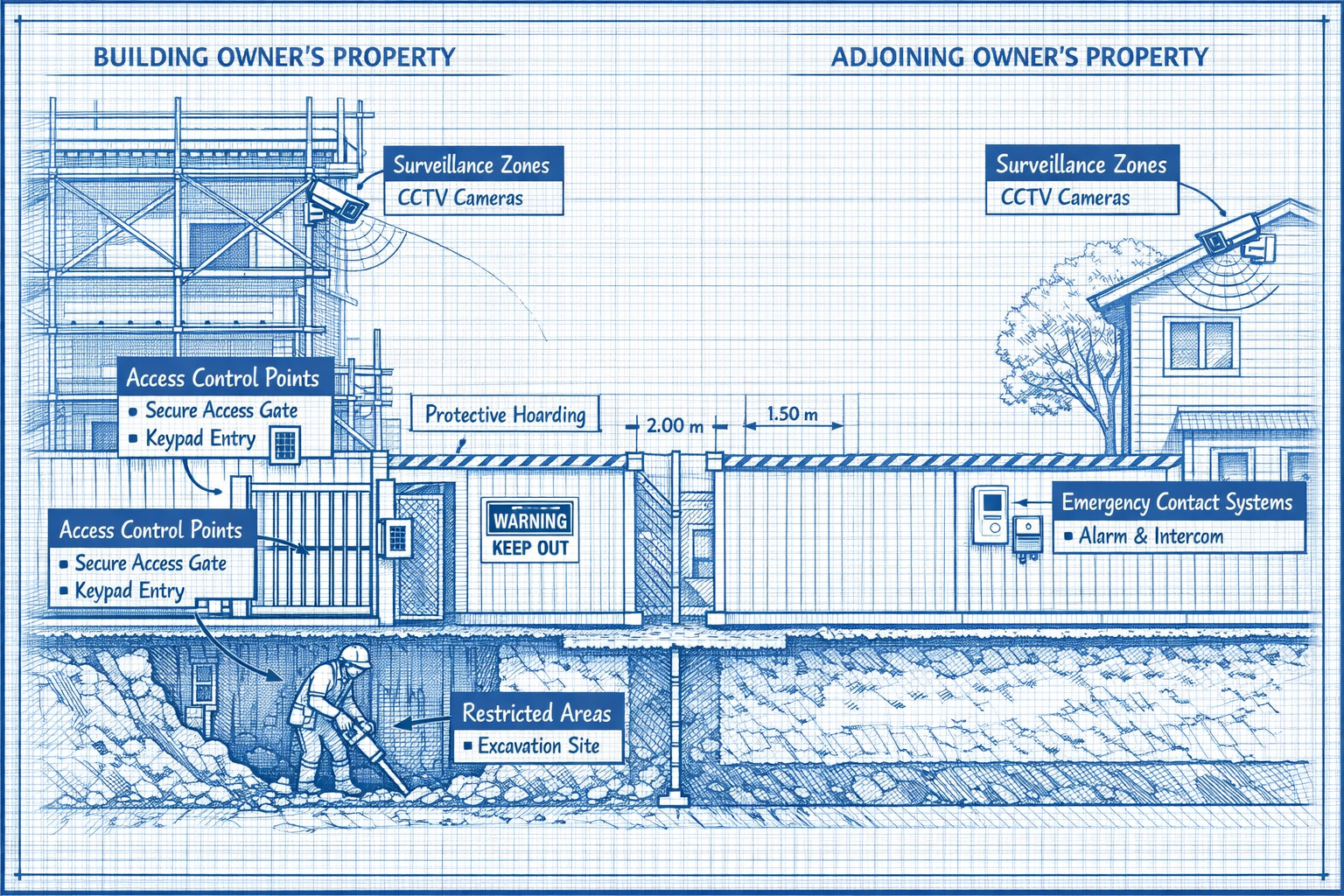
    [3] How To Apply For A Party Wall Notice – uklegalguides.com