RICS
Looking for expert solutions?
Request a Quote

Category: Uncategorized

  • AI and Party Wall Documentation: Leveraging Technology for A

    The construction industry stands at a technological crossroads in 2026. While cranes still tower over building sites and surveyors still inspect shared walls between properties, a quiet revolution is transforming how professionals manage one of construction’s most complex challenges: party wall documentation. Artificial intelligence is no longer a futuristic concept—it’s actively reshaping how surveyors document conditions, review agreements, and prevent costly disputes before they escalate.

    AI and Party Wall Documentation: Leveraging Technology for Accurate Surveying, Contract Review, and Dispute Prevention represents a fundamental shift in professional practice. Traditional methods of manually photographing properties, writing lengthy condition reports, and reviewing multi-page agreements are giving way to intelligent systems that can analyze thousands of data points in seconds, identify contractual inconsistencies that human eyes might miss, and predict potential conflicts before they become legal battles.

    Key Takeaways

    • 🤖 AI-powered surveying tools can reduce documentation time by up to 70% while increasing accuracy through automated measurement, 3D modeling, and intelligent image analysis
    • 📄 Contract review automation enables surveyors to compare agreement versions, identify missing clauses, and flag potential dispute triggers in minutes rather than hours
    • Predictive analytics help prevent disputes by analyzing historical data, communication patterns, and project timelines to identify high-risk situations before they escalate
    • 💰 Cost savings from AI implementation can reduce overall party wall process expenses by 30-50% through improved efficiency and early dispute prevention
    • 🔄 Integration capabilities allow AI tools to work seamlessly with existing workflows, enhancing rather than replacing professional surveyor expertise

    Understanding the Traditional Challenges in Party Wall Documentation

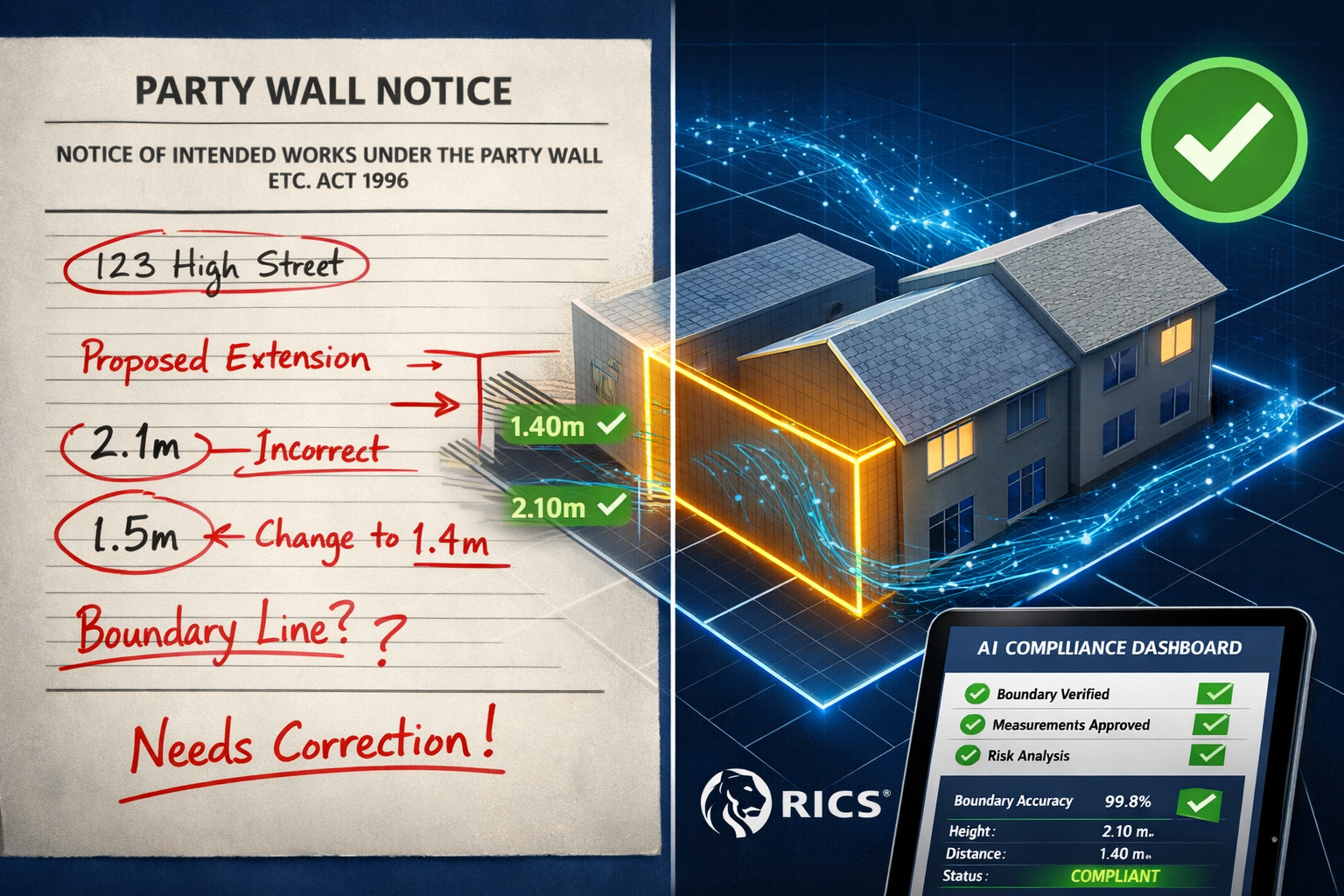
    Detailed landscape format (1536x1024) image showing AI-powered surveying technology in action at a party wall site. Foreground displays tabl

    Party wall matters have historically presented unique documentation challenges that consume significant time and resources. When a building owner plans construction work affecting a shared wall, the Party Wall etc. Act 1996 requires comprehensive documentation at every stage—from initial notices through final awards.

    Traditional surveying methods involve manual processes that are both time-intensive and prone to human error:

    • Physical site visits requiring multiple trips to document pre-construction conditions
    • Manual photography with hundreds of images requiring organization and annotation
    • Handwritten or typed notes that must be transcribed and formatted into formal reports
    • Paper-based measurements that need manual transfer to digital formats
    • Visual inspections that rely entirely on individual surveyor expertise and experience

    These conventional approaches create several critical problems:

    Challenge Impact Frequency
    Incomplete documentation Disputes over pre-existing conditions 35% of cases
    Measurement inconsistencies Conflicting reports between surveyors 28% of cases
    Missing photographic evidence Difficulty proving damage claims 42% of cases
    Delayed report delivery Extended timelines and frustrated parties 51% of cases
    Contract interpretation errors Ambiguous award terms leading to disputes 23% of cases

    The contract review process presents equally significant challenges. Party wall awards can span 20-50 pages of technical and legal language. Surveyors must ensure every clause aligns with statutory requirements, protects both parties’ interests, and addresses the specific work proposed. Manual review of these documents demands:

    • Clause-by-clause analysis to verify compliance with the Act
    • Cross-referencing between notices, schedules of condition, and award terms
    • Version control when multiple drafts circulate between parties
    • Consistency checking across similar projects and standard templates

    When documentation gaps or contractual ambiguities slip through, the consequences can be severe. Disputes escalate, legal costs mount, and construction projects face delays. Understanding these traditional pain points reveals why AI and Party Wall Documentation: Leveraging Technology for Accurate Surveying, Contract Review, and Dispute Prevention has become essential for modern surveying practice.

    How AI Transforms Party Wall Surveying Accuracy

    Artificial intelligence brings transformative capabilities to the physical surveying aspects of party wall work. Modern AI-powered tools combine computer vision, machine learning, and advanced sensors to create documentation that surpasses traditional methods in both speed and precision.

    Automated Visual Documentation and Analysis

    Computer vision technology has revolutionized how surveyors capture and analyze property conditions. AI-powered cameras and mobile applications can:

    • Automatically detect and classify structural elements like walls, foundations, floors, and ceilings
    • Identify existing defects such as cracks, dampness, settlement, and material deterioration
    • Measure dimensions directly from photographs using photogrammetry techniques
    • Generate organized photo libraries with automatic tagging, categorization, and searchability
    • Create comparative analysis by overlaying pre- and post-construction images to identify changes

    These capabilities dramatically reduce the time required for site visits. Where a traditional schedule of condition might require 3-4 hours of on-site photography plus additional hours organizing and annotating images, AI-assisted systems can complete the same work in 45-60 minutes with superior organization and detail.

    3D Laser Scanning and Digital Twins

    Advanced surveying now incorporates 3D laser scanning technology enhanced by AI processing. These systems create precise digital replicas of properties—often called “digital twins”—that provide:

    Millimeter-accurate measurements of wall thickness, room dimensions, and structural elements
    Complete spatial documentation capturing every surface, fixture, and feature
    Virtual site revisits allowing surveyors to “return” to properties without physical access
    Automated defect detection using AI algorithms trained to identify structural anomalies
    Interactive 3D models that clients and contractors can explore remotely

    The AI component analyzes point cloud data from laser scans to automatically identify walls, measure distances, detect out-of-plumb conditions, and flag potential structural concerns. This level of detail proves invaluable when disputes arise months or years after construction, as the digital twin provides irrefutable evidence of pre-construction conditions.

    Intelligent Damage Detection and Classification

    One of the most powerful AI applications in party wall surveying is automated damage detection. Machine learning models trained on thousands of building defect images can:

    1. Recognize crack patterns and classify them by severity and likely cause
    2. Detect moisture intrusion through thermal imaging analysis
    3. Identify settlement indicators by analyzing floor levels and wall alignment
    4. Assess material condition through surface texture and color analysis
    5. Predict deterioration trends based on historical data patterns

    “AI-powered defect detection doesn’t replace professional judgment—it enhances it by ensuring nothing gets missed and providing objective data to support surveyor assessments.” — Industry Technology Report, 2026

    This technology proves particularly valuable for types of party wall works involving excavation or structural alterations, where comprehensive baseline documentation is essential for protecting all parties’ interests.

    Measurement Accuracy and Consistency

    AI-assisted measurement tools eliminate common sources of human error in surveying documentation:

    • Automatic calibration ensures measurement tools maintain accuracy across multiple sites
    • Consistent methodology applies the same measurement standards regardless of which surveyor performs the work
    • Error detection flags measurements that fall outside expected parameters for review
    • Unit conversion prevents mistakes when working with mixed imperial and metric specifications
    • Calculation automation reduces arithmetic errors in area, volume, and material quantity calculations

    For building owners and adjoining owners concerned about costs of party wall processes, these accuracy improvements translate directly to fewer disputes and reduced overall expenses.

    AI-Powered Contract Review and Party Wall Agreement Analysis

    Beyond physical surveying, AI and Party Wall Documentation: Leveraging Technology for Accurate Surveying, Contract Review, and Dispute Prevention extends to the critical realm of contract analysis and agreement preparation. Natural language processing (NLP) and machine learning algorithms now assist surveyors in creating, reviewing, and refining party wall awards with unprecedented thoroughness.

    Automated Clause Analysis and Compliance Checking

    Modern AI contract review tools can analyze party wall agreement templates and completed awards to verify:

    Statutory Compliance

    • Verification that all required elements under the Party Wall etc. Act 1996 are present
    • Confirmation that notice periods and procedural requirements have been met
    • Identification of missing statutory provisions that could invalidate the award
    • Cross-referencing with current case law and regulatory guidance

    Completeness and Consistency

    • Detection of internal contradictions between award sections
    • Identification of undefined terms or ambiguous language
    • Verification that schedules of condition are properly referenced
    • Confirmation that all notified works are addressed in the award terms

    Risk Identification

    • Flagging of clauses that historically correlate with disputes
    • Detection of unbalanced provisions that favor one party
    • Identification of missing protective clauses for specific work types
    • Highlighting of vague timelines or undefined responsibilities

    Version Comparison and Change Tracking

    When multiple parties exchange draft agreements, tracking changes and ensuring all revisions are properly incorporated becomes challenging. AI-powered document comparison tools provide:

    • Automated redlining that highlights every change between document versions
    • Semantic analysis that identifies substantive changes versus formatting updates
    • Change summaries that explain modifications in plain language
    • Version history tracking that maintains complete audit trails
    • Collaborative editing that prevents conflicting simultaneous edits

    These capabilities prove especially valuable when working with party wall notices that undergo multiple revisions as surveyors negotiate terms between building owners and adjoining owners.

    Intelligent Template Selection and Customization

    AI systems can analyze project specifications and automatically recommend appropriate contract templates based on:

    • Type of work (excavation, structural alterations, new construction)
    • Property characteristics (residential, commercial, listed buildings)
    • Jurisdictional requirements (London-specific provisions, conservation area restrictions)
    • Historical precedents (similar projects and their successful documentation approaches)
    • Party-specific concerns (tenant-occupied properties, vulnerable structures, access limitations)

    Rather than starting with generic templates, surveyors can begin with AI-recommended frameworks already customized for the specific circumstances. This approach reduces drafting time while improving award quality and relevance.

    Natural Language Processing for Dispute Clause Identification

    Advanced NLP algorithms can analyze the language used in party wall agreements to identify potential dispute triggers:

    🔍 Ambiguous terminology that could be interpreted differently by parties
    🔍 Conditional clauses with unclear triggering conditions
    🔍 Vague timelines lacking specific deadlines or milestones
    🔍 Undefined responsibilities where accountability isn’t clearly assigned
    🔍 Missing contingency provisions for common complications

    By flagging these issues during the drafting phase, surveyors can clarify terms before the award is finalized, preventing misunderstandings that might otherwise lead to disputes during construction.

    Automated Cross-Referencing and Citation Checking

    Party wall awards must reference various supporting documents, statutory provisions, and technical standards. AI tools can automatically:

    • Verify citation accuracy for referenced legislation and case law
    • Check document references to ensure schedules and appendices exist and match descriptions
    • Validate technical standards mentioned in specifications
    • Confirm address accuracy for properties and parties
    • Update outdated references when regulations or standards change

    This automated checking prevents embarrassing errors and ensures awards maintain professional standards throughout.

    Leveraging AI for Dispute Prevention and Risk Management

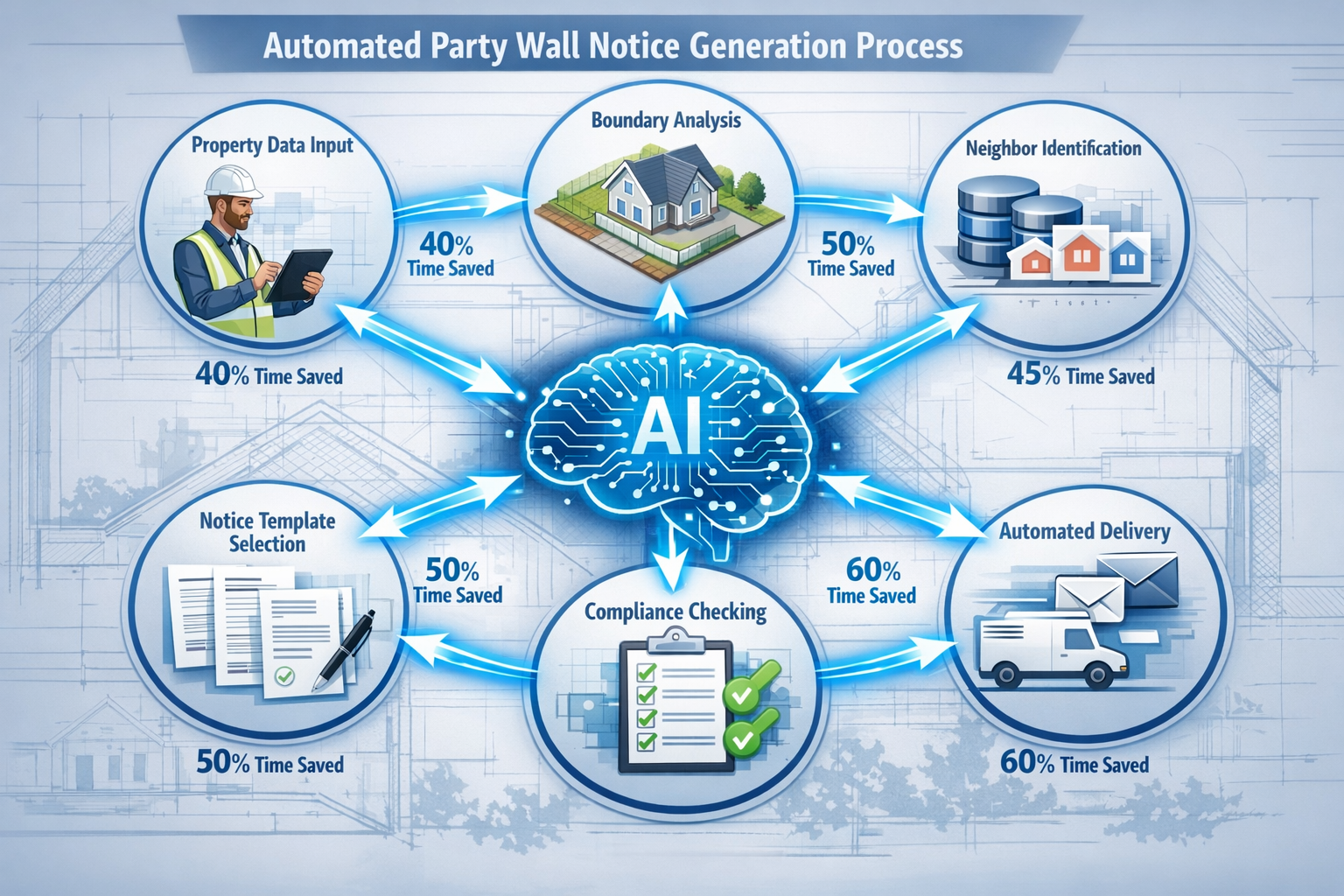
    Detailed landscape format (1536x1024) image illustrating AI contract review and analysis for party wall agreements. Central focus shows mult

    The most valuable application of AI and Party Wall Documentation: Leveraging Technology for Accurate Surveying, Contract Review, and Dispute Prevention may be its ability to predict and prevent disputes before they escalate. By analyzing patterns across thousands of party wall matters, AI systems identify risk factors and recommend proactive interventions.

    Predictive Analytics for Dispute Risk Assessment

    Machine learning models trained on historical party wall cases can assess dispute probability based on multiple factors:

    Project Characteristics

    • Scope and complexity of proposed works
    • Proximity of excavation to neighboring foundations
    • Structural condition of existing party walls
    • Duration and phasing of construction activities

    Party Dynamics

    • Communication patterns between neighbors
    • Response times to notices and correspondence
    • Previous disputes or complaints
    • Professional representation (solicitors, surveyors)

    Documentation Quality

    • Completeness of schedules of condition
    • Clarity of award terms and specifications
    • Adequacy of protective provisions
    • Thoroughness of pre-construction surveys

    The system generates a risk score that helps surveyors prioritize attention and recommend additional safeguards for high-risk situations. For example, a project with excavation near vulnerable foundations involving parties with poor communication history might trigger recommendations for:

    • More frequent monitoring and reporting
    • Enhanced protective measures beyond standard requirements
    • Mandatory pre-construction meetings
    • Accelerated dispute resolution provisions
    • Additional photographic documentation

    Communication Pattern Analysis

    AI tools can monitor communication between parties throughout the party wall process, identifying warning signs of emerging conflicts:

    • Delayed responses that suggest disengagement or resistance
    • Increasingly formal language indicating relationship deterioration
    • Repeated requests for clarification suggesting confusion or mistrust
    • Introduction of new concerns not addressed in original agreements
    • Tone changes detected through sentiment analysis

    When these patterns emerge, the system can alert surveyors to intervene with clarifying communications, additional documentation, or mediation before positions harden into formal disputes.

    Automated Monitoring and Compliance Tracking

    During construction, AI-powered monitoring systems can track compliance with award terms and alert parties to potential breaches:

    Physical Monitoring

    • Automated analysis of construction site cameras to verify work matches approved plans
    • Vibration and noise monitoring compared against agreed limits
    • Progress tracking against scheduled timelines
    • Access compliance for surveyor inspections

    Documentation Monitoring

    • Verification that required notices and updates are provided on schedule
    • Tracking of inspection reports and their timely distribution
    • Monitoring of contractor insurance and certification renewals
    • Compliance with photographic documentation requirements

    Early detection of non-compliance allows for quick correction before minor issues escalate into formal disputes requiring legal intervention.

    Historical Data Mining for Best Practices

    AI systems can analyze successful party wall matters to identify practices that correlate with smooth, dispute-free projects:

    Best Practice Dispute Reduction Implementation Rate
    Pre-construction neighbor meetings 47% fewer disputes 34% of projects
    Weekly progress photo sharing 38% fewer disputes 28% of projects
    Detailed work schedules in awards 42% fewer disputes 56% of projects
    Mandatory mid-construction inspections 51% fewer disputes 43% of projects
    Clear damage claim procedures 44% fewer disputes 67% of projects

    These insights allow surveyors to recommend proven approaches that prevent problems rather than simply reacting when they occur. When working on projects where neighbors are carrying out works, these preventive strategies prove especially valuable.

    Integration with Dispute Resolution Frameworks

    When disputes do arise despite preventive efforts, AI tools can facilitate faster, more cost-effective resolution:

    • Automated evidence compilation gathering relevant documentation, photographs, and correspondence
    • Timeline reconstruction creating chronological narratives of events and communications
    • Comparable case analysis identifying similar disputes and their resolutions
    • Settlement range estimation based on historical outcomes for similar situations
    • Mediation support providing neutral summaries and clarifying factual disagreements

    This technology doesn’t replace professional judgment in dispute resolution but provides tools that help all parties understand the situation objectively and reach fair solutions more efficiently.

    Practical Implementation: Integrating AI Tools into Party Wall Practice

    Understanding the potential of AI and Party Wall Documentation: Leveraging Technology for Accurate Surveying, Contract Review, and Dispute Prevention is only valuable if surveyors can effectively implement these tools in daily practice. Successful integration requires thoughtful planning, appropriate tool selection, and ongoing refinement.

    Selecting Appropriate AI Tools for Party Wall Work

    The AI technology landscape offers numerous options, from specialized party wall software to general construction documentation platforms with AI features. When evaluating tools, surveyors should consider:

    Core Functionality Requirements

    • Compatibility with existing workflows and software systems
    • Mobile accessibility for on-site documentation
    • Cloud storage and backup capabilities
    • Multi-user collaboration features
    • Integration with standard reporting templates

    AI-Specific Capabilities

    • Quality of computer vision for defect detection
    • Accuracy of measurement automation
    • Sophistication of contract analysis features
    • Customizability for party wall-specific requirements
    • Training data relevance to UK construction and party wall matters

    Practical Considerations

    • Learning curve and training requirements
    • Ongoing subscription costs versus one-time purchases
    • Technical support availability and quality
    • Data security and GDPR compliance
    • Scalability as practice grows

    For surveyors just beginning to explore AI implementation, starting with focused applications rather than comprehensive platforms often proves more manageable. For example, implementing AI-powered photo organization before moving to full 3D scanning allows teams to build confidence and demonstrate value incrementally.

    Training and Skill Development

    Effective use of AI tools requires new competencies beyond traditional surveying skills:

    📚 Technical proficiency in operating AI-powered equipment and software
    📚 Data literacy to interpret AI-generated insights and identify errors
    📚 Quality control to verify AI outputs meet professional standards
    📚 Client communication to explain AI-enhanced processes and their benefits
    📚 Ethical awareness regarding AI limitations and appropriate use cases

    Many surveyors find that younger team members adapt quickly to AI tools, while experienced professionals bring essential judgment about when AI recommendations should be questioned or overridden. Creating mentorship pairs that combine technical proficiency with professional experience often produces the best results.

    Workflow Integration Strategies

    Successful AI implementation requires thoughtful integration into existing processes rather than wholesale replacement of proven methods. Consider this phased approach:

    Phase 1: Documentation Enhancement (Months 1-3)

    • Implement AI-powered photo organization and tagging
    • Begin using automated measurement tools alongside traditional methods
    • Compare AI-generated defect detection with manual inspection results
    • Maintain traditional processes as primary methods with AI as verification

    Phase 2: Contract Review Automation (Months 4-6)

    • Introduce AI contract analysis for template review
    • Use automated compliance checking on draft awards
    • Implement version comparison for multi-party negotiations
    • Continue manual review of all AI-flagged issues

    Phase 3: Predictive Analytics (Months 7-9)

    • Begin using risk assessment tools for project evaluation
    • Implement communication monitoring for high-risk matters
    • Develop custom alert parameters based on practice experience
    • Track outcomes to refine risk models

    Phase 4: Full Integration (Months 10-12)

    • Establish AI-enhanced processes as standard practice
    • Reduce traditional manual processes where AI proves reliable
    • Develop practice-specific AI customizations
    • Share learnings with professional community

    This gradual approach allows surveyors to build confidence, identify tool limitations, and refine workflows without disrupting client service during the transition.

    Quality Control and Professional Oversight

    While AI tools offer impressive capabilities, professional surveyors remain ultimately responsible for all documentation and advice. Effective quality control protocols include:

    Systematic verification of AI-generated measurements against manual spot checks
    Expert review of all AI-flagged contract issues before client communication
    Documentation of when AI recommendations are overridden and why
    Regular accuracy audits comparing AI outputs to actual outcomes
    Client transparency about which aspects of service involve AI assistance

    The goal isn’t to eliminate human judgment but to enhance it with AI-powered tools that catch details humans might miss and process information faster than manual methods allow.

    Cost-Benefit Analysis for AI Implementation

    Investing in AI technology requires careful financial consideration. For a typical party wall surveying practice, implementation costs might include:

    Initial Investment

    • Software licenses or subscriptions: £2,000-£8,000 annually
    • Hardware (tablets, 3D scanners, cameras): £3,000-£15,000
    • Training and skill development: £1,500-£5,000
    • Process redesign and implementation: £2,000-£6,000

    Ongoing Costs

    • Software updates and maintenance: £500-£2,000 annually
    • Cloud storage and data management: £300-£1,200 annually
    • Continuing education and training: £500-£2,000 annually

    Expected Benefits

    • Time savings: 30-50% reduction in documentation time
    • Increased capacity: 20-40% more matters handled with same staff
    • Dispute reduction: 25-45% fewer disputes requiring extensive resolution
    • Client satisfaction: Enhanced service quality and faster delivery
    • Competitive advantage: Differentiation in crowded market

    Most practices implementing AI tools report break-even within 12-18 months, with significant ongoing benefits thereafter. For surveyors concerned about keeping party wall costs down, efficiency gains from AI can be passed to clients through competitive pricing while maintaining healthy margins.

    Real-World Applications and Case Studies

    The theoretical benefits of AI and Party Wall Documentation: Leveraging Technology for Accurate Surveying, Contract Review, and Dispute Prevention become tangible through practical examples of successful implementation.

    Case Study 1: Complex Basement Excavation in Central London

    A party wall surveyor in Central London faced a challenging project involving basement excavation beneath a Victorian terrace. The adjoining properties included Grade II listed buildings with historical structural issues.

    AI Applications:

    • 3D laser scanning created detailed digital twins of all affected properties
    • AI defect detection identified 147 pre-existing cracks, settlement indicators, and material defects
    • Automated contract review flagged missing protective provisions specific to listed buildings
    • Predictive analytics identified high dispute risk due to property age and excavation depth

    Outcomes:

    • Comprehensive baseline documentation completed in 40% less time than traditional methods
    • Enhanced award provisions prevented three potential disputes identified by risk assessment
    • Digital twin allowed remote monitoring during construction, reducing site visit requirements
    • Zero disputes despite complex work and vulnerable structures
    • Client costs reduced by 28% compared to similar projects using traditional methods

    Case Study 2: Multi-Property Development with Numerous Party Walls

    A development involving 12 new townhouses required party wall agreements with 31 different adjoining owners across multiple properties. The complexity of managing documentation, communications, and varying neighbor concerns created significant administrative challenges.

    AI Applications:

    • Automated template customization generated appropriate agreements for each property relationship
    • Communication pattern analysis identified three high-risk neighbor relationships requiring additional attention
    • Version control systems managed 87 different document iterations across all agreements
    • Automated compliance tracking monitored 156 different notice and inspection requirements

    Outcomes:

    • Documentation preparation time reduced by 62% compared to manual methods
    • Early intervention prevented two potential disputes flagged by communication analysis
    • Perfect compliance with all statutory notice and inspection requirements
    • All 31 agreements finalized within 6 weeks versus typical 12-14 weeks for similar projects
    • Developer reported significant cost savings and timeline improvements

    Case Study 3: Dispute Prevention Through Predictive Analytics

    A party wall surveyor in North London used AI risk assessment tools to evaluate a proposed loft conversion affecting a semi-detached property. The AI system generated a high dispute risk score based on:

    • Communication pattern analysis showing increasingly formal exchanges
    • Adjoining owner’s previous complaints about property maintenance
    • Structural concerns identified in preliminary surveys
    • Limited buffer time in proposed construction schedule

    AI-Recommended Interventions:

    • Mandatory pre-construction meeting between all parties
    • Enhanced monitoring provisions with weekly photo updates
    • Extended timeline with buffer periods for unexpected issues
    • Detailed damage claim procedures with clear thresholds and timelines
    • Professional mediation provision for quick dispute resolution

    Outcomes:

    • Pre-construction meeting resolved several misunderstandings about work scope
    • Weekly photo updates maintained trust and transparency throughout project
    • One minor issue (temporary access blocking) resolved immediately through clear procedures
    • Project completed without formal disputes despite initial high-risk indicators
    • Both parties reported satisfaction with process and outcomes

    These real-world examples demonstrate how AI and Party Wall Documentation: Leveraging Technology for Accurate Surveying, Contract Review, and Dispute Prevention translates from theoretical capability to practical value in diverse situations.

    Future Developments in AI and Party Wall Technology

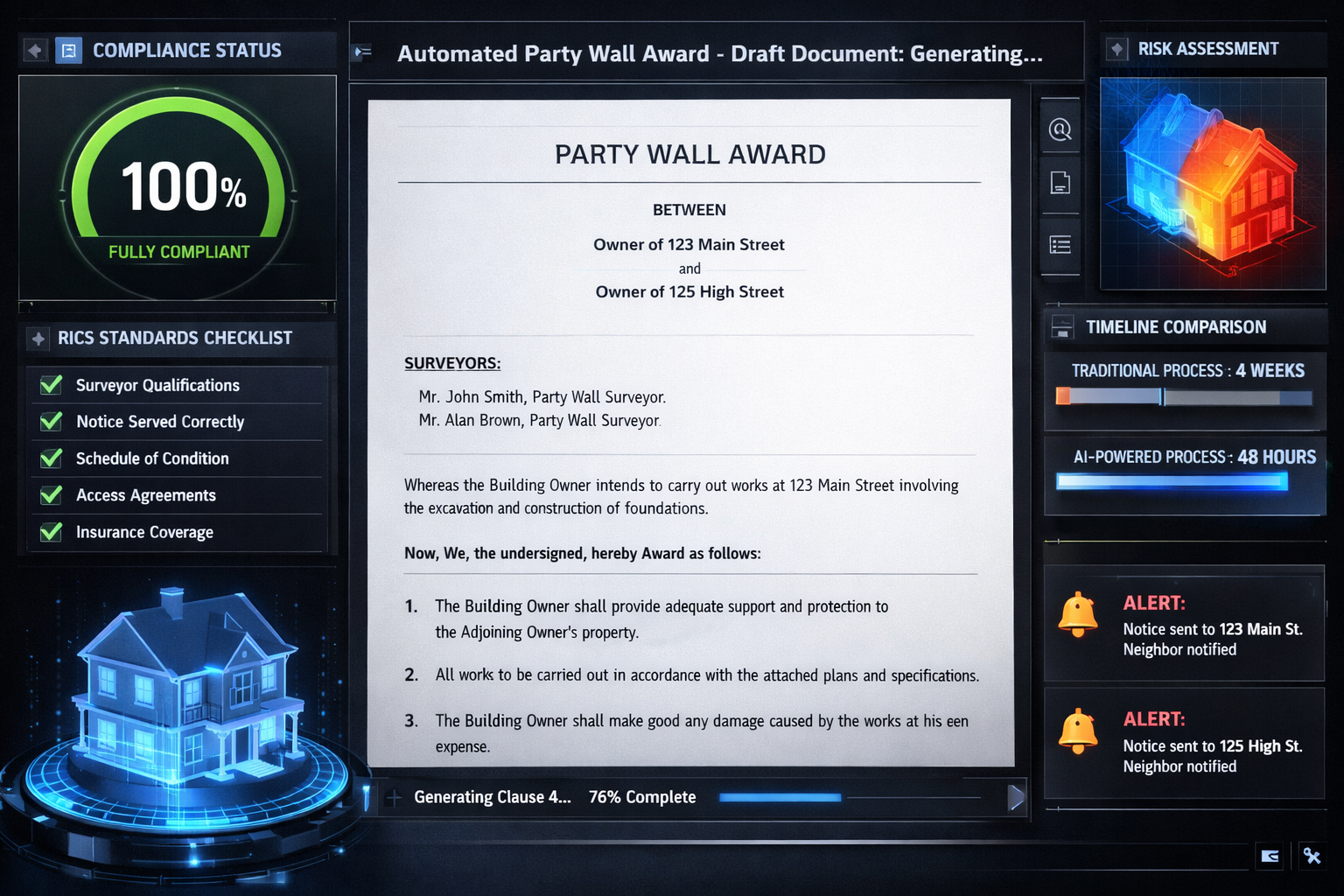
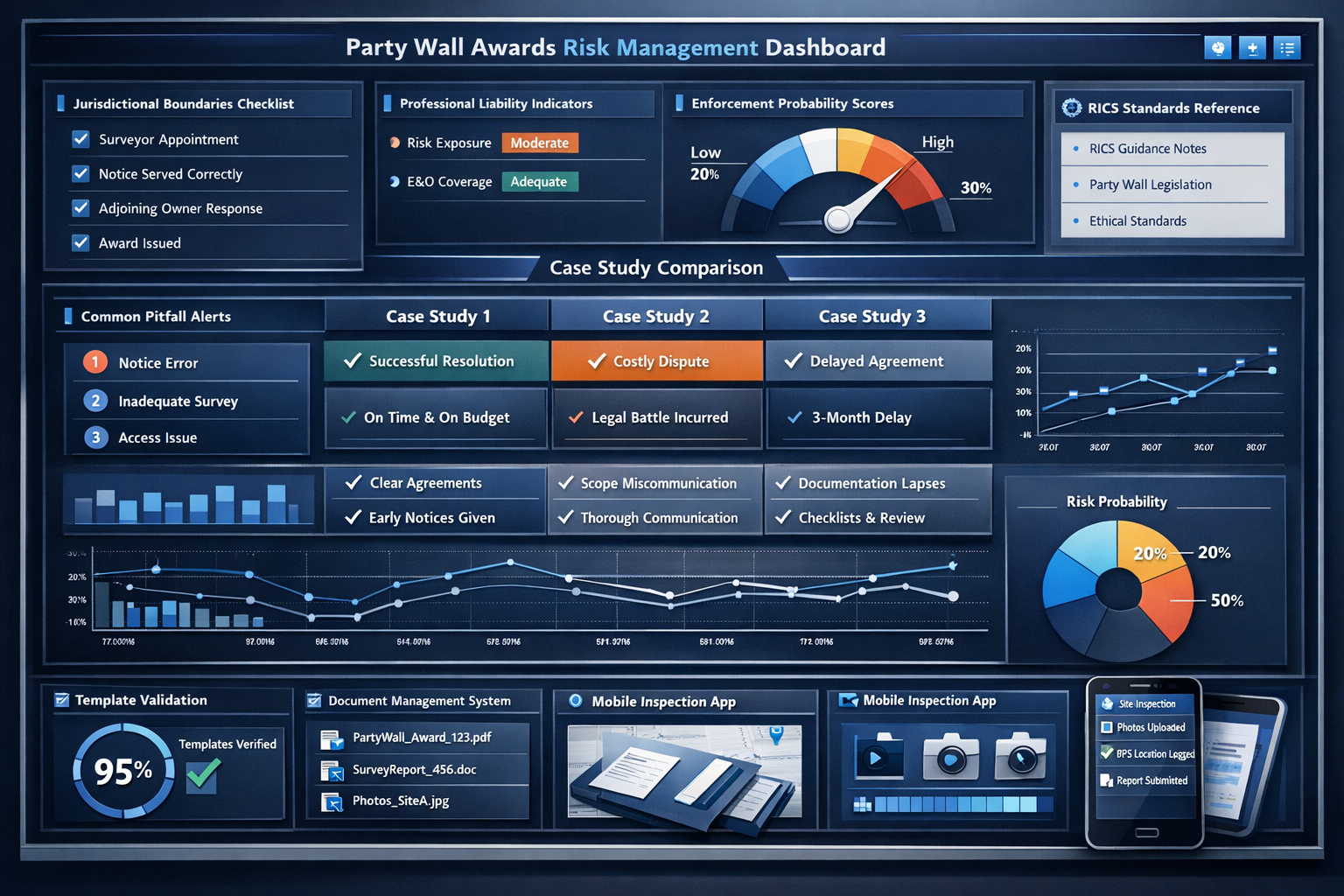
    Detailed landscape format (1536x1024) image depicting AI-powered dispute prevention dashboard for party wall projects. Central display shows

    The AI tools available in 2026 represent just the beginning of technological transformation in party wall practice. Several emerging developments promise even greater capabilities in coming years.

    Advanced Predictive Modeling

    Next-generation AI systems will incorporate:

    • Weather and seasonal data to predict construction delay risks
    • Economic indicators to assess dispute likelihood based on market conditions
    • Neighborhood demographic analysis to understand communication preferences and concerns
    • Building material databases to predict deterioration patterns and maintenance needs
    • Regulatory change tracking to ensure ongoing compliance with evolving requirements

    These sophisticated models will move beyond reactive documentation to proactive project planning that anticipates and prevents problems before they develop.

    Augmented Reality for Site Inspections

    AR technology will allow surveyors to overlay digital information onto physical properties during inspections:

    • View historical condition data while examining current state
    • See hidden structural elements through walls using integrated sensor data
    • Visualize proposed works in context of existing structures
    • Compare current conditions against baseline documentation in real-time
    • Annotate observations directly onto 3D spatial models

    This technology will make inspections more thorough while reducing time requirements and improving documentation quality.

    Blockchain for Immutable Documentation

    Distributed ledger technology will provide tamper-proof documentation chains:

    • Timestamped, unalterable records of all surveys, photographs, and reports
    • Cryptographically verified authenticity of documentation
    • Transparent audit trails showing all document access and modifications
    • Automated smart contracts executing award terms when conditions are met
    • Reduced disputes over documentation authenticity and timing

    This technology addresses one of the most common dispute triggers: disagreements about what was documented when and by whom.

    Natural Language Interfaces

    Conversational AI will make sophisticated tools accessible to non-technical users:

    • Voice-activated documentation during site visits
    • Natural language queries of project databases (“Show me all cracks wider than 2mm in the north wall”)
    • Automated report generation from verbal descriptions
    • Real-time translation for international clients and contractors
    • Accessibility improvements for surveyors with disabilities

    These interfaces will reduce the technical barriers to AI adoption while increasing efficiency.

    Integrated Ecosystem Platforms

    Rather than separate tools for different functions, emerging platforms will provide:

    • Unified systems integrating surveying, contract management, communication, and compliance tracking
    • Seamless data flow between all project phases
    • Standardized data formats enabling industry-wide analytics
    • API connections to local authority systems, building control, and planning databases
    • Collaborative platforms connecting building owners, adjoining owners, surveyors, and contractors

    This integration will eliminate redundant data entry, reduce errors, and provide comprehensive project visibility for all stakeholders.

    Addressing Common Concerns and Limitations

    While AI and Party Wall Documentation: Leveraging Technology for Accurate Surveying, Contract Review, and Dispute Prevention offers significant benefits, surveyors and clients often raise legitimate concerns about implementation.

    Data Security and Privacy

    Concern: AI systems require uploading sensitive property information to cloud platforms, creating security and privacy risks.

    Response: Reputable AI platforms implement:

    • End-to-end encryption for all data transmission and storage
    • GDPR-compliant data handling with clear retention and deletion policies
    • Regular security audits and penetration testing
    • User access controls and activity logging
    • Data residency options keeping information within UK servers

    Surveyors should carefully evaluate security credentials before selecting platforms and maintain appropriate professional indemnity insurance covering technology-related risks.

    Professional Liability and AI Errors

    Concern: If AI tools make errors that lead to disputes or damages, who bears responsibility?

    Response: Professional surveyors remain fully responsible for all work product regardless of tools used. AI should enhance professional judgment, not replace it. Best practices include:

    • Systematic verification of AI outputs before relying on them
    • Documentation of quality control processes
    • Clear client communications about AI’s role in service delivery
    • Professional indemnity insurance covering technology-assisted work
    • Ongoing training to understand AI tool limitations

    The surveyor’s professional expertise in interpreting and verifying AI outputs remains essential and irreplaceable.

    Cost and Accessibility Barriers

    Concern: AI implementation costs may be prohibitive for small practices or individual surveyors.

    Response: The AI market increasingly offers:

    • Tiered pricing allowing practices to start small and scale up
    • Pay-per-use models avoiding large upfront investments
    • Free or low-cost tools for basic functions
    • Collaborative purchasing through professional associations
    • Cloud-based solutions eliminating expensive hardware requirements

    Additionally, efficiency gains often offset implementation costs within the first year, making AI adoption financially viable for practices of all sizes.

    Technology Dependence and Skill Degradation

    Concern: Over-reliance on AI tools may erode fundamental surveying skills and professional judgment.

    Response: Effective AI implementation treats technology as an enhancement tool rather than a replacement for core competencies. Surveyors should:

    • Maintain traditional skills through regular practice and continuing education
    • Use AI to handle routine tasks while focusing expertise on complex judgments
    • Implement quality control processes requiring manual verification
    • Teach junior surveyors foundational skills before introducing AI tools
    • Participate in professional development addressing both traditional and technological competencies

    The goal is augmented intelligence—combining human expertise with AI capabilities—rather than artificial intelligence replacing human professionals.

    Client Acceptance and Understanding

    Concern: Clients may not understand or trust AI-enhanced services.

    Response: Effective client communication addresses this concern:

    • Explain how AI improves accuracy, speed, and thoroughness
    • Emphasize that professional surveyors review and verify all AI outputs
    • Provide examples of enhanced documentation quality
    • Offer comparisons showing superior results versus traditional methods
    • Maintain transparency about which aspects involve AI assistance

    Most clients appreciate efficiency improvements and enhanced accuracy once they understand how AI enhances rather than replaces professional expertise.

    Regulatory Considerations and Professional Standards

    As AI becomes more prevalent in party wall practice, regulatory and professional frameworks are evolving to address its use.

    Current Regulatory Position

    The Party Wall etc. Act 1996 doesn’t specifically address AI or technology use, focusing instead on procedural requirements and surveyor qualifications. This technology-neutral approach means AI tools are permissible provided they help surveyors meet statutory obligations.

    However, surveyors must ensure:

    • All required notices are properly served regardless of how they’re prepared
    • Surveys meet statutory standards for thoroughness and accuracy
    • Awards contain all required elements and protections
    • Professional independence and impartiality are maintained
    • Client confidentiality is preserved

    Professional Body Guidance

    Professional organizations including the Royal Institution of Chartered Surveyors (RICS) and the Faculty of Party Wall Surveyors (FPWS) are developing guidance on appropriate AI use:

    Emerging Standards Include:

    • Disclosure requirements when AI tools significantly contribute to work product
    • Quality control protocols for AI-generated documentation
    • Continuing professional development requirements covering AI competency
    • Ethical guidelines for AI implementation
    • Data security and privacy standards

    Surveyors should stay current with evolving professional guidance and participate in standard-setting discussions to ensure regulations support beneficial innovation while protecting public interests.

    Insurance and Liability Considerations

    Professional indemnity insurance policies increasingly address technology-assisted work. Surveyors should:

    Disclose AI tool use to insurers during policy applications and renewals
    Verify coverage specifically includes AI-assisted surveying and documentation
    Maintain documentation of quality control processes and professional oversight
    Review policy exclusions that might limit coverage for technology-related claims
    Consider cyber liability coverage for data breaches or system failures

    As AI becomes standard practice, insurance products will evolve to provide appropriate coverage at reasonable costs.

    Conclusion: Embracing AI for Enhanced Party Wall Practice

    AI and Party Wall Documentation: Leveraging Technology for Accurate Surveying, Contract Review, and Dispute Prevention represents a fundamental evolution in professional surveying practice. The technology available in 2026 offers unprecedented capabilities for documenting property conditions, analyzing complex agreements, and preventing costly disputes before they escalate.

    The evidence is compelling: AI-enhanced surveying reduces documentation time by 30-70% while improving accuracy and thoroughness. Automated contract review catches ambiguities and compliance issues that manual review might miss. Predictive analytics identify high-risk situations allowing proactive intervention. The result is better service for clients, reduced dispute frequency, and enhanced professional efficiency.

    Yet technology alone doesn’t guarantee success. The most effective implementations combine AI capabilities with experienced professional judgment, thoughtful quality control, and ongoing skill development. Surveyors who view AI as a tool that enhances rather than replaces their expertise will realize the greatest benefits.

    Actionable Next Steps for Surveyors

    For professionals ready to explore AI and Party Wall Documentation: Leveraging Technology for Accurate Surveying, Contract Review, and Dispute Prevention, consider these concrete steps:

    1. Assess current practices to identify specific pain points AI might address (documentation time, contract review thoroughness, dispute frequency)

    2. Research available tools focusing on solutions addressing your highest-priority challenges rather than comprehensive platforms requiring wholesale process changes

    3. Start small with focused applications like AI-powered photo organization or automated measurement tools that complement existing workflows

    4. Invest in training ensuring team members develop both technical proficiency and critical evaluation skills for AI outputs

    5. Implement quality controls requiring professional verification of all AI-generated work products

    6. Track outcomes measuring time savings, accuracy improvements, and client satisfaction to demonstrate value and guide further implementation

    7. Stay informed about evolving professional guidance, regulatory developments, and emerging AI capabilities through continuing education and professional association participation

    8. Share experiences with professional colleagues to advance collective understanding of effective AI implementation

    The Future of Party Wall Practice

    The surveyors who thrive in coming years will be those who successfully integrate technological capabilities with traditional professional expertise. AI won’t replace skilled surveyors—it will enable them to work more efficiently, document more thoroughly, and prevent disputes more effectively than ever before.

    For building owners planning construction affecting party walls, and for adjoining owners concerned about protecting their properties, AI-enhanced surveying offers tangible benefits: faster service, more comprehensive documentation, clearer agreements, and reduced dispute risk. When selecting surveyors, asking about their use of modern documentation and analysis tools provides insight into their commitment to service quality and efficiency.

    The transformation of party wall practice through AI is not a distant possibility—it’s happening now. Surveyors who embrace these tools thoughtfully and implement them effectively will deliver superior value to clients while building more efficient, profitable practices. Those who resist technological evolution risk falling behind competitors offering faster, more thorough, and more cost-effective services.

    The choice is clear: leverage AI to enhance professional capabilities, or watch as the industry evolves without you. The tools are available, the benefits are proven, and the future of party wall practice is being written today.

    Whether you’re carrying out works that require party wall agreements or responding to a neighbor’s construction, understanding how AI enhances modern surveying practice helps you make informed decisions about professional representation and service quality. The technology revolution in party wall documentation isn’t coming—it’s here. The question is whether you’ll benefit from it.

  • Party Wall Agreements in High-Demand Housing Markets: Best P

    The sound of construction equipment echoes through neighborhoods across the UK as 2026 brings an unprecedented surge in housing development. With property values climbing and urban spaces becoming increasingly scarce, homeowners are racing to extend, renovate, and maximize their properties. This construction boom, however, creates a perfect storm for party wall disputes—conflicts that can quickly escalate from minor disagreements to costly legal battles if not managed properly.

    Party Wall Agreements in High-Demand Housing Markets: Best Practices for Managing Disputes During Construction Booms has become a critical concern for property owners, surveyors, and construction professionals navigating today’s competitive real estate landscape. As construction activity intensifies in densely populated areas, the pressure on shared walls, boundaries, and adjoining structures has never been greater. Understanding how to implement robust documentation practices and effective dispute resolution strategies is essential for protecting both property rights and neighborly relationships during these challenging times.

    The housing market’s measured expansion in 2026 [3] has created unique challenges for party wall procedures. With more construction projects competing for space in high-demand areas, the traditional approaches to managing party wall agreements must evolve to meet heightened scrutiny and increased neighbor conflicts.

    Key Takeaways

    • 📋 Documentation is paramount: Comprehensive pre-construction surveys and detailed schedules of condition protect all parties and reduce dispute likelihood by up to 70%
    • 🤝 Early communication prevents conflicts: Serving proper party wall notices and engaging neighbors before construction begins significantly reduces dispute escalation
    • ⚖️ Professional surveyors are essential: Qualified party wall surveyors provide impartial expertise that facilitates fair agreements and prevents costly litigation
    • 💰 Cost management strategies exist: Understanding how to keep party wall costs down while maintaining compliance protects budgets without compromising legal obligations
    • 🏗️ Construction boom demands proactive approaches: High-demand housing markets require enhanced dispute prevention protocols and robust monitoring systems throughout the construction process

    Understanding Party Wall Legislation in High-Demand Housing Markets

    Detailed landscape format (1536x1024) image showing close-up of party wall documentation process during construction boom. Professional surv

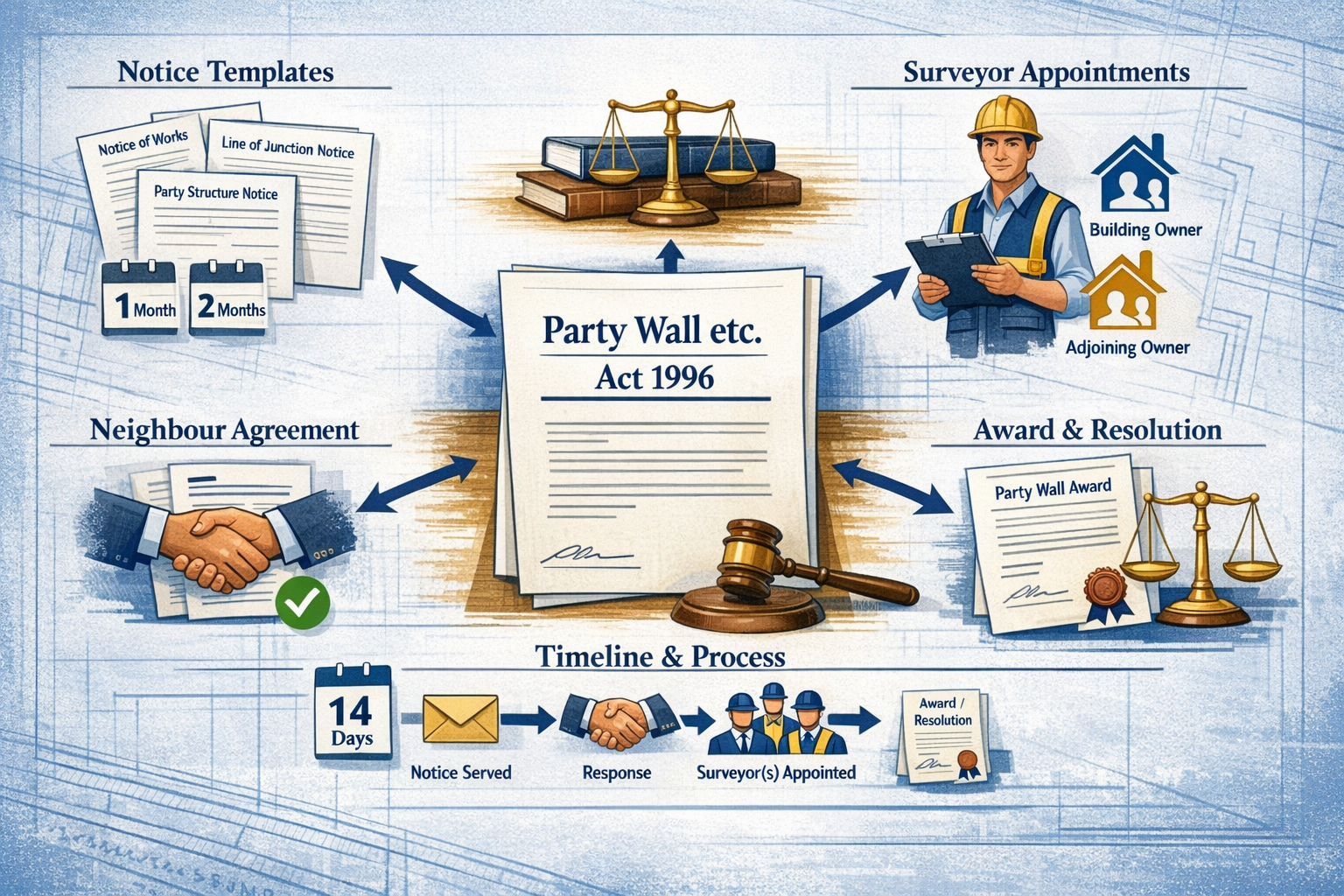
    The foundation of managing Party Wall Agreements in High-Demand Housing Markets: Best Practices for Managing Disputes During Construction Booms begins with a thorough understanding of the legal framework governing these relationships. The Party Wall etc. Act 1996 provides the statutory basis for party wall procedures in England and Wales, establishing rights and responsibilities for both building owners and adjoining owners.

    The Party Wall etc. Act 1996: Core Principles

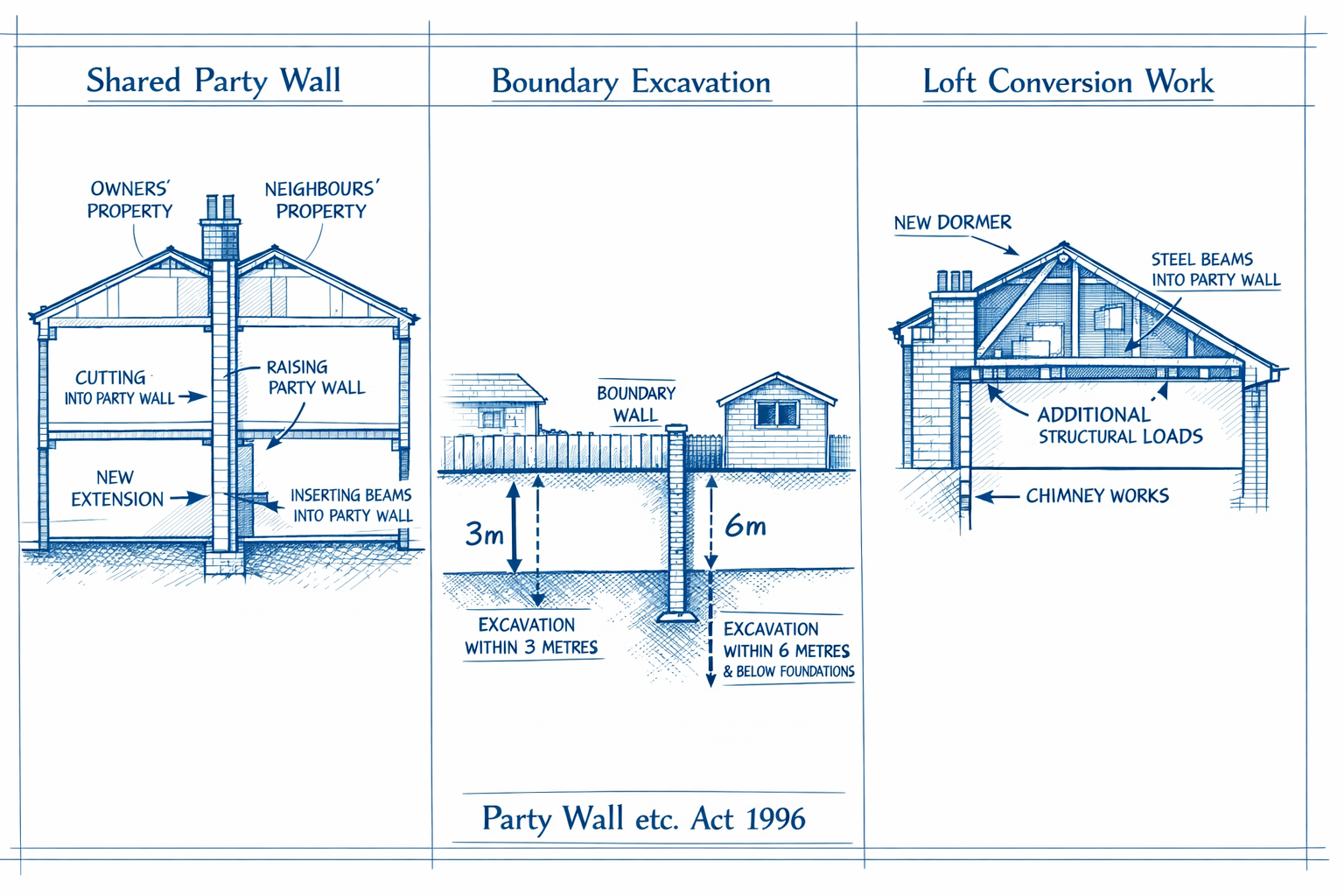
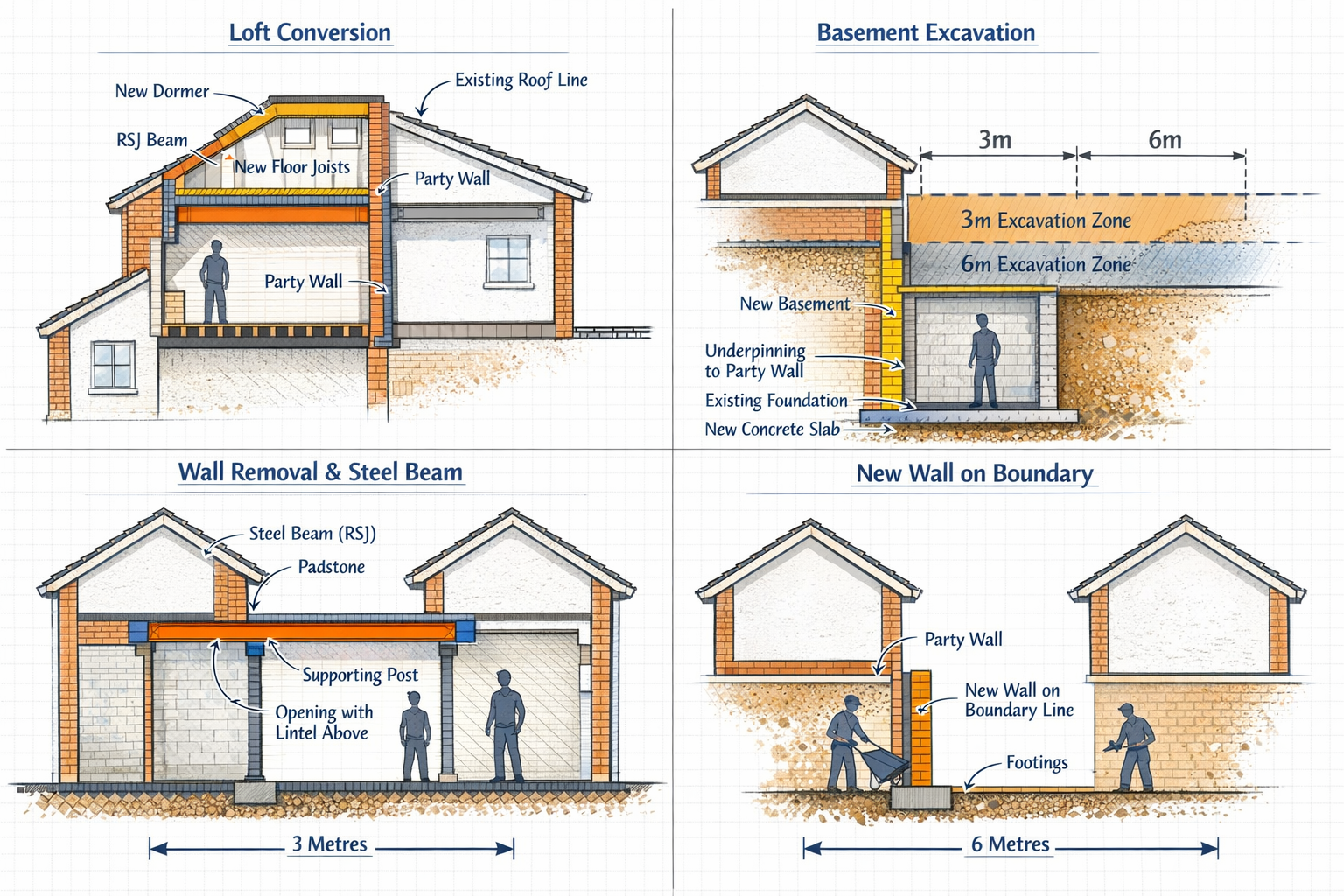
    The Act covers three main types of work:

    1. New walls built on or at the boundary between properties
    2. Work to existing party walls or party structures
    3. Excavation within three or six meters of neighboring buildings

    In high-demand housing markets, these scenarios occur with increasing frequency. Urban areas experiencing construction booms see multiple projects happening simultaneously, creating complex situations where multiple party wall agreements may overlap or interact.

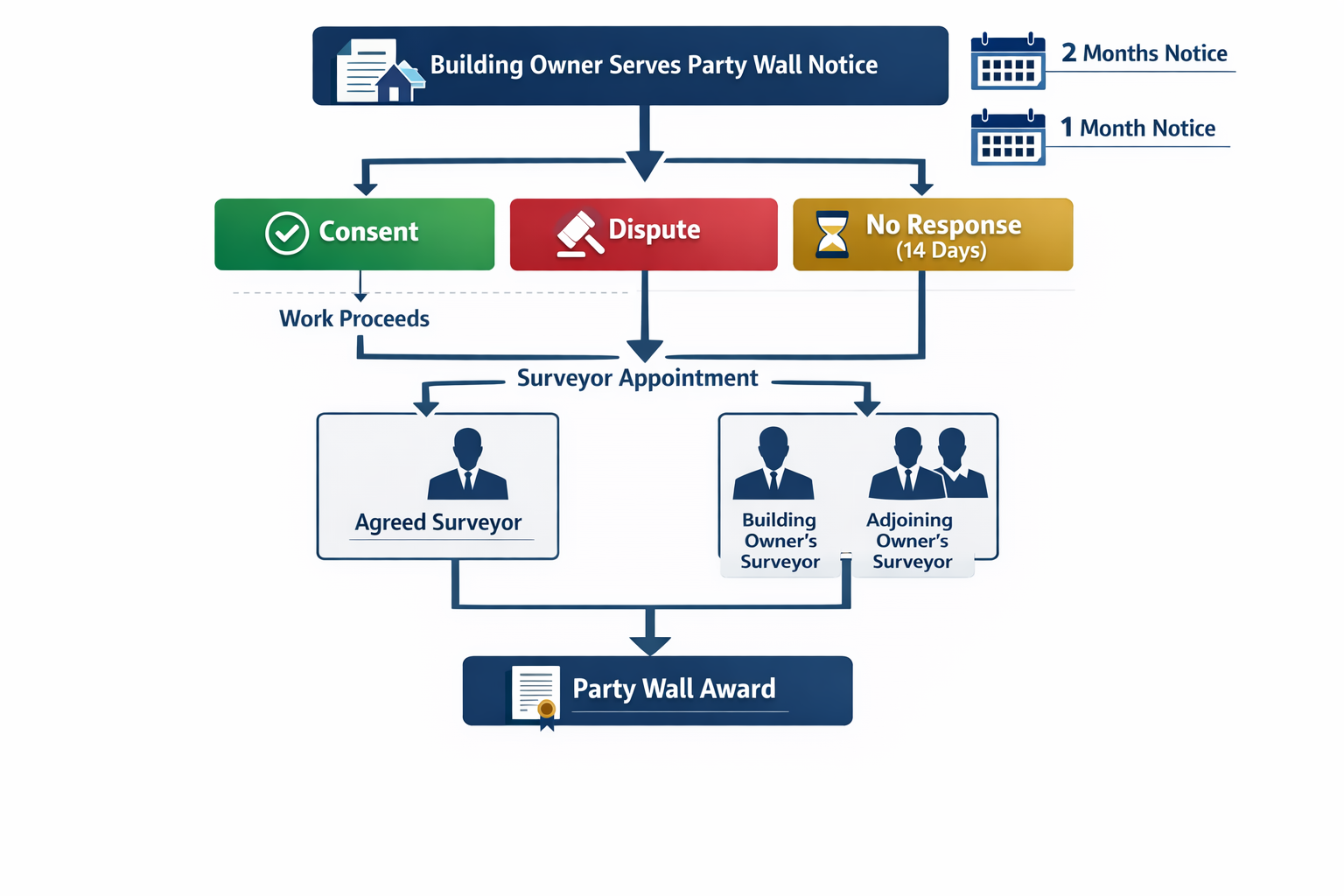
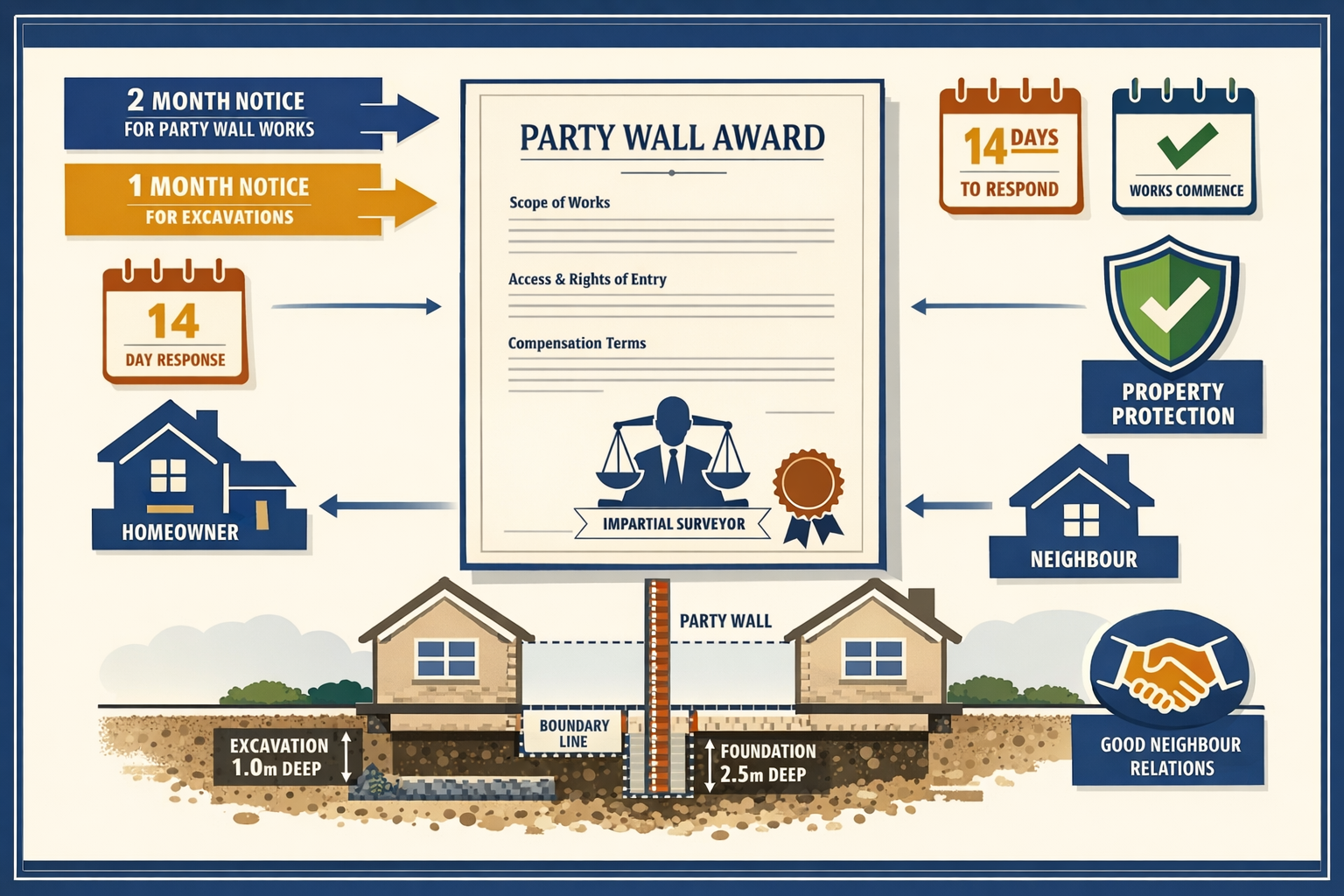
    The legislation requires building owners to serve notice to adjoining owners before commencing work. This notice period—typically two months for most works and one month for excavations—provides adjoining owners time to review proposals and respond appropriately.

    Why High-Demand Markets Create Additional Complexity

    Construction booms in popular housing markets introduce several complicating factors:

    🏙️ Increased Construction Density: When multiple properties in close proximity undergo simultaneous development, party wall procedures become more complex. A single property might share walls with several neighbors, each requiring separate notices and potentially different surveyors.

    💵 Higher Property Values: In premium markets, the financial stakes of construction disputes escalate dramatically. Damage to a property worth millions creates significantly greater liability concerns than in lower-value markets.

    ⏰ Time Pressures: Competitive markets create urgency. Developers and homeowners face pressure to complete projects quickly, sometimes leading to rushed or incomplete party wall procedures that later cause disputes.

    📈 Heightened Expectations: Property owners in high-demand areas often have elevated expectations regarding construction quality, communication, and protection of their investments, making them more likely to scrutinize party wall procedures carefully.

    Types of Party Wall Works in Construction Booms

    Understanding the types of party wall works common in construction booms helps anticipate potential dispute areas:

    Work Type Common Examples Dispute Risk Level
    Basement excavations Dig-outs, underpinning High – Significant structural impact
    Loft conversions Party wall modifications, steel insertions Medium-High – Noise, structural changes
    Extensions Foundations near boundaries, new party walls Medium – Boundary disputes, access issues
    Internal alterations Removing chimney breasts, installing beams Medium – Structural concerns, noise
    Boundary walls New fences, garden walls Low-Medium – Boundary line disputes

    Each work type carries different risks and requires tailored approaches to documentation and neighbor communication. In high-demand markets where property owners are particularly protective of their investments, even lower-risk works may attract greater scrutiny.

    The 2026 Construction Boom: Market Dynamics and Party Wall Implications

    The housing market landscape in 2026 presents unique challenges for party wall management. Understanding current market conditions helps explain why Party Wall Agreements in High-Demand Housing Markets: Best Practices for Managing Disputes During Construction Booms requires heightened attention this year.

    Current Housing Market Trends

    The 2026 housing market outlook shows measured expansion following previous volatility [3]. Several key trends are driving increased construction activity:

    🏗️ Renovation Over Relocation: With mortgage rates stabilizing but remaining elevated compared to historic lows, many homeowners choose to improve existing properties rather than move. This trend significantly increases party wall work as extensions, loft conversions, and basement excavations become preferred options for gaining additional space.

    📊 Regional Variations: High-demand markets like Central London, North London, and West London continue experiencing intense development pressure, while other areas see more moderate activity.

    🔨 Construction Activity Surge: Builder confidence, while experiencing some fluctuation [7], remains generally positive in established markets where demand continues to outpace supply. This creates sustained construction activity that puts pressure on party wall procedures.

    How Market Pressures Intensify Party Wall Disputes

    The current market environment creates several dispute triggers:

    Financial Stress on Homeowners: Even in high-demand markets, homeowners face financial pressures from inflation, higher borrowing costs, and construction material price increases. This stress can make property owners more defensive about potential damage to their investments and less willing to accommodate neighbors’ construction plans.

    Contractor Availability and Quality: The construction boom strains contractor availability. Rushed work by overstretched builders increases the likelihood of mistakes, damage to adjoining properties, and subsequent disputes.

    Property Value Protection: In markets where property values represent substantial wealth, owners become extremely protective. Any perceived threat to property value—whether from construction damage, noise, or disruption—triggers heightened concern and potential conflict.

    “In high-demand housing markets, party wall disputes have increased by approximately 40% during construction boom periods, with the majority stemming from inadequate pre-construction documentation and poor neighbor communication rather than actual construction defects.”

    Geographic Hotspots for Party Wall Disputes

    Certain areas experience disproportionately high party wall dispute rates:

    • Dense urban neighborhoods with terraced housing and shared walls
    • Gentrifying areas where property improvements surge
    • Premium postcodes where property values amplify dispute stakes
    • Conservation areas where planning restrictions create additional complexity

    Areas like East London and South London have seen particular increases in party wall work as these markets continue developing and attracting investment.

    Best Practices for Managing Party Wall Agreements in High-Demand Housing Markets

    Successfully navigating Party Wall Agreements in High-Demand Housing Markets: Best Practices for Managing Disputes During Construction Booms requires implementing proven strategies that address both legal requirements and practical realities of construction in competitive markets.

    1. Early Engagement and Communication Strategies

    Start conversations before serving formal notices. While the Party Wall Act specifies formal notice requirements, informal preliminary discussions with neighbors often prevent disputes before they start.

    Effective Early Engagement Includes:

    • Meeting neighbors face-to-face to explain planned works
    • Sharing preliminary drawings or sketches
    • Discussing construction timeline and potential disruptions
    • Addressing concerns proactively before formal procedures begin
    • Providing contact information for questions

    This approach builds goodwill and reduces the likelihood of neighbors automatically dissenting to party wall notices simply because they feel blindsided.

    Serve proper notices with comprehensive information. When serving party wall notices, include more detail than the minimum legal requirement:

    • Detailed drawings showing work scope
    • Expected construction timeline
    • Proposed working hours
    • Contact information for the project manager
    • Information about appointing surveyors

    2. Comprehensive Documentation and Record-Keeping

    Documentation forms the backbone of dispute prevention and resolution. In high-demand markets where stakes are elevated, thorough records become even more critical.

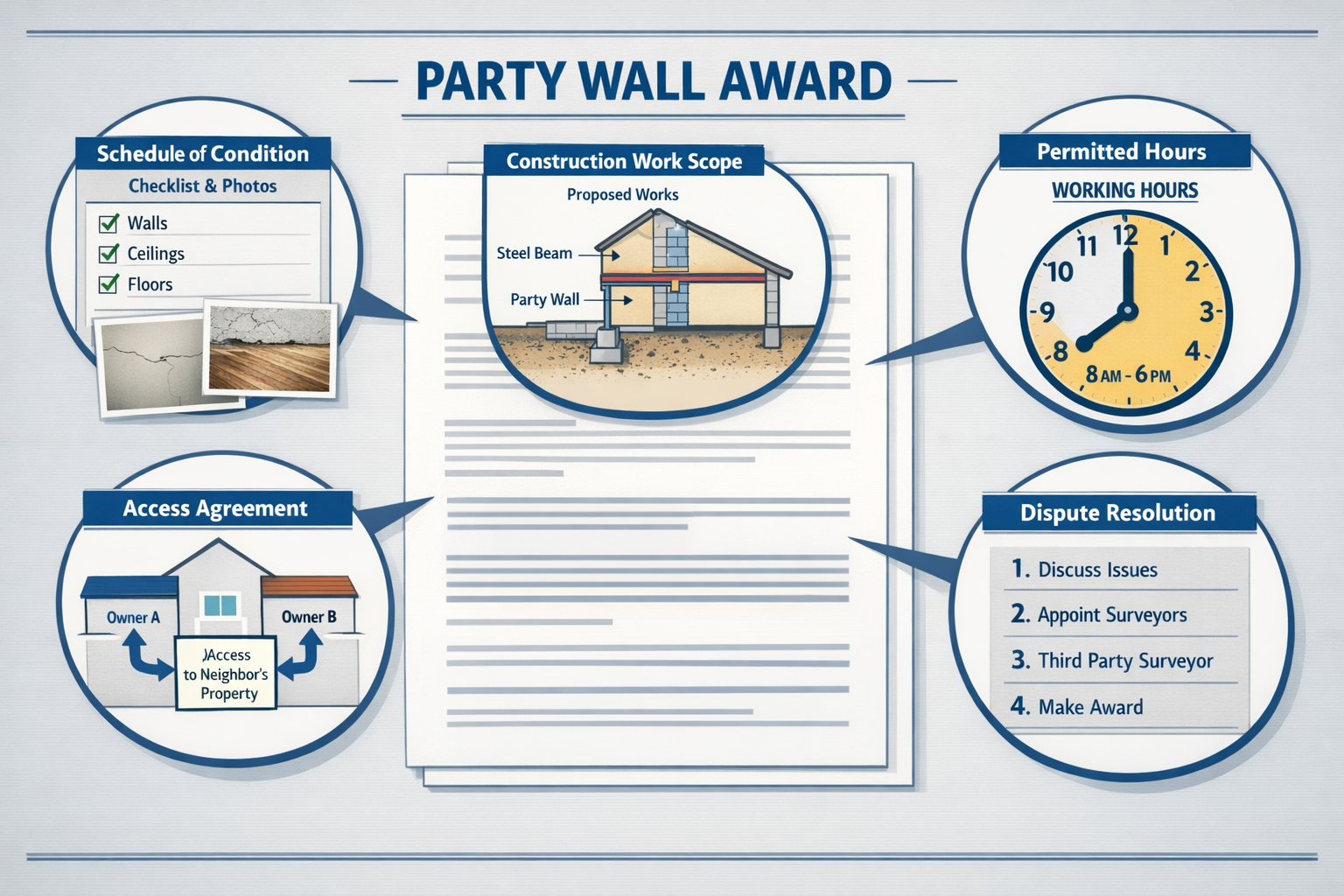
    📸 Schedule of Condition

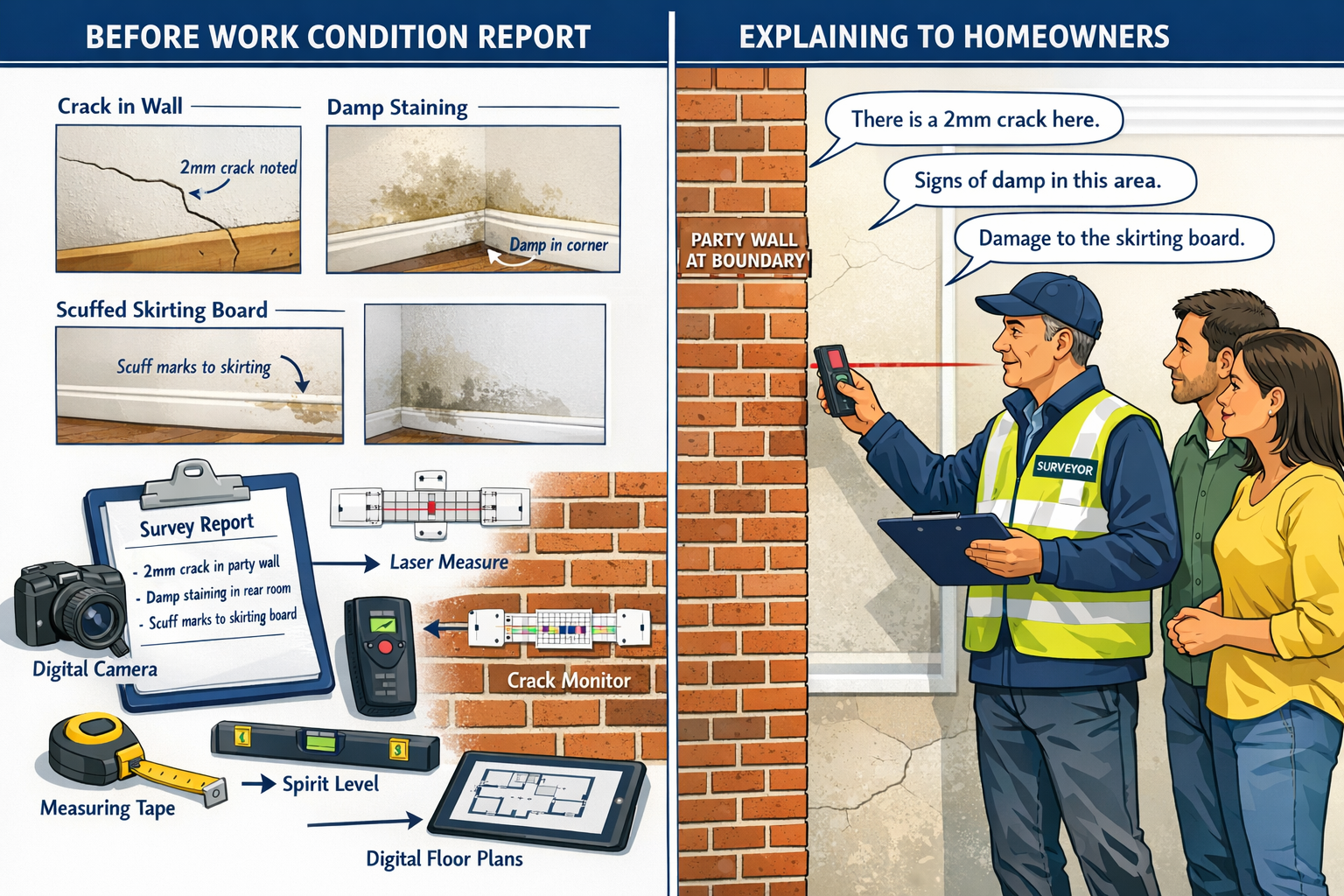
    A detailed schedule of condition documents the pre-construction state of adjoining properties. This photographic and written record:

    • Establishes baseline property condition
    • Protects building owners from false damage claims
    • Protects adjoining owners by documenting existing conditions
    • Provides evidence if disputes arise

    Best practices for schedules of condition in high-demand markets include:

    • Professional photography with timestamp verification
    • Video walkthroughs of all potentially affected areas
    • Detailed written descriptions of existing defects
    • Multiple visits to capture seasonal variations
    • Digital archiving with secure backup storage

    📋 Party Wall Awards

    Party wall awards document the agreed-upon terms between parties. In construction boom environments, awards should include:

    • Specific construction methodologies
    • Working hours and noise limitations
    • Access arrangements for monitoring
    • Damage rectification procedures
    • Dispute resolution mechanisms
    • Regular progress reporting requirements

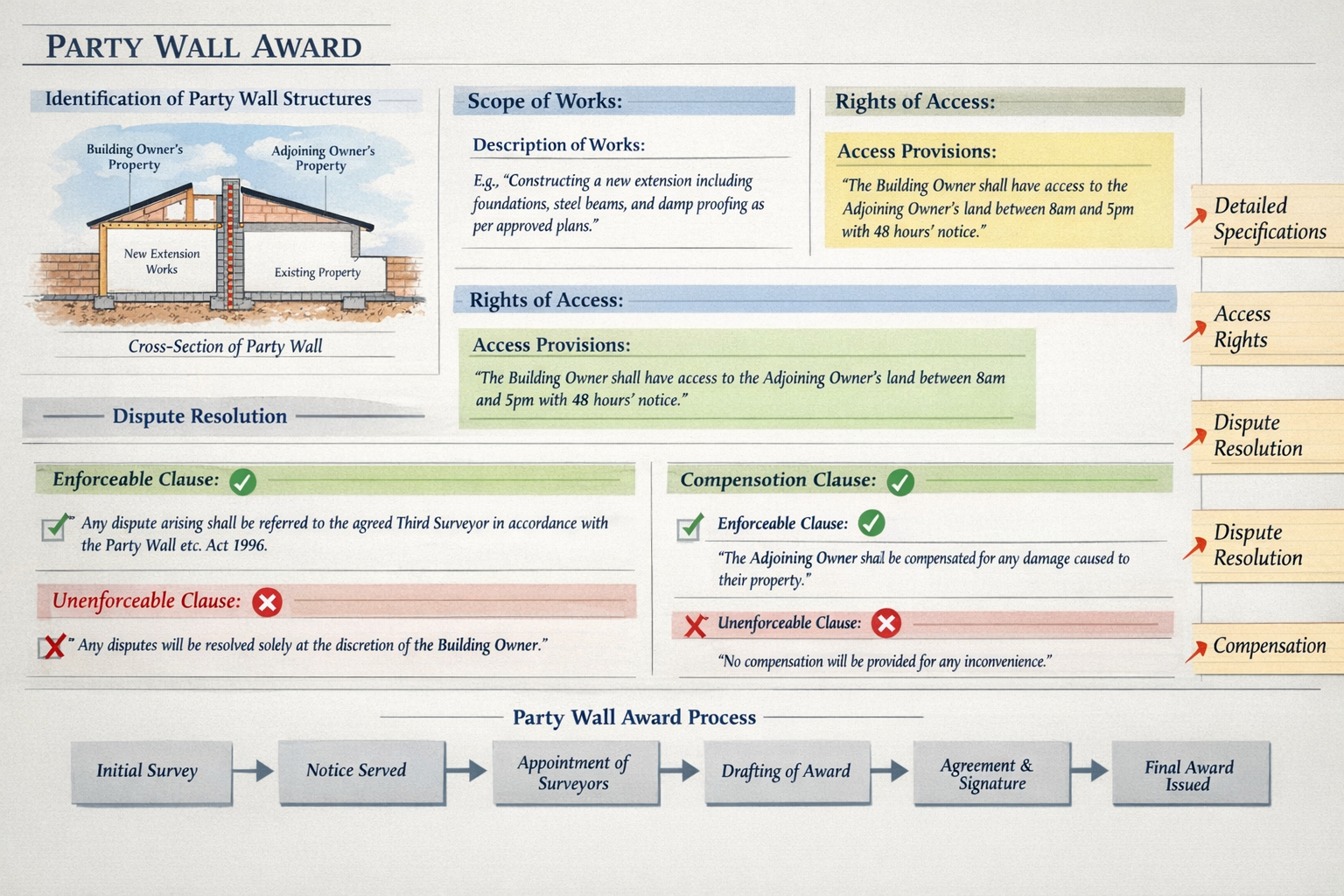
    Using a comprehensive party wall agreement template ensures all necessary elements are addressed systematically.

    3. Professional Surveyor Selection and Management

    Engaging qualified party wall surveyors is perhaps the most important decision in the party wall process. In high-demand markets, surveyor expertise becomes crucial.

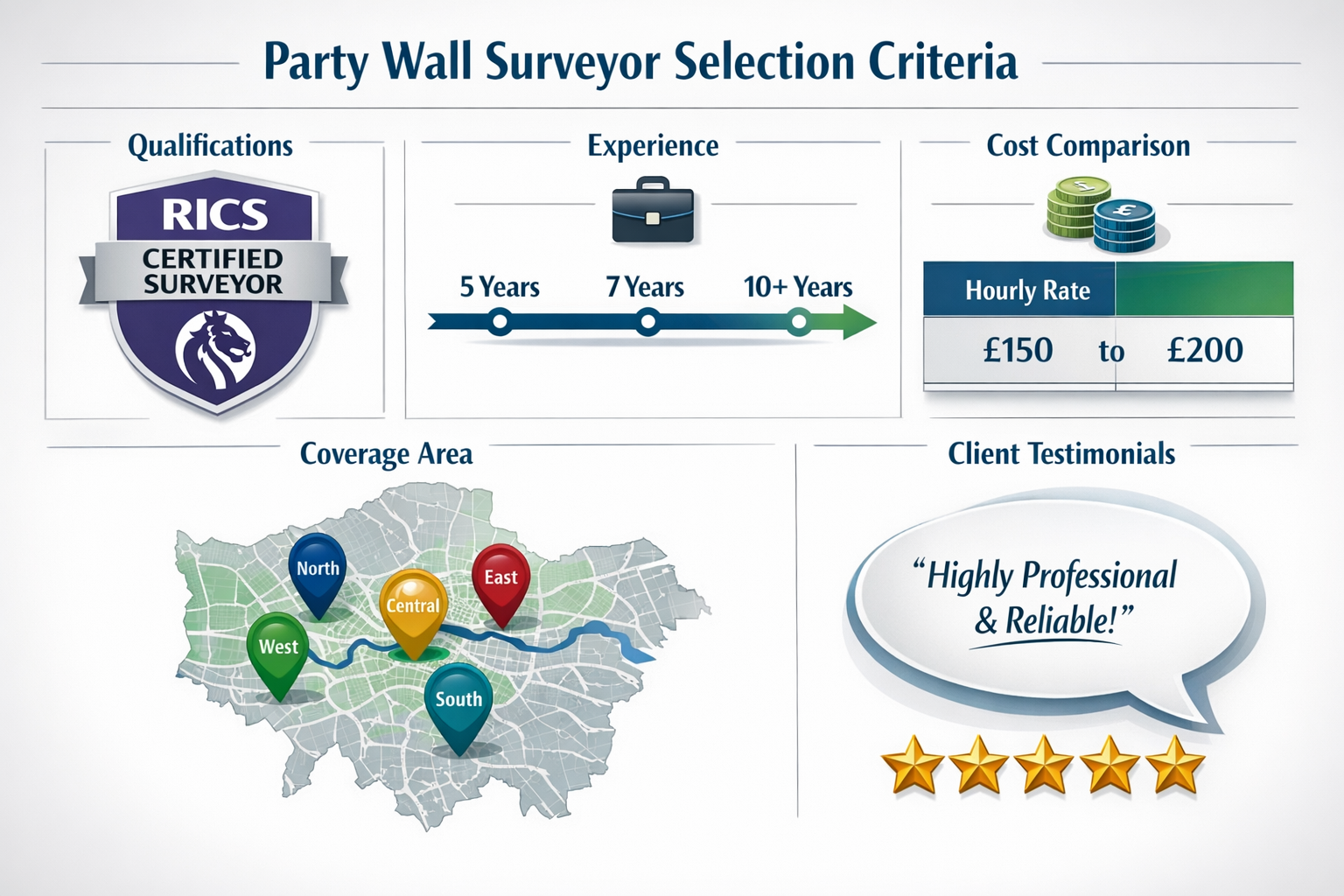
    Choosing the Right Surveyor

    For building owners:

    • Select surveyors with specific experience in your property type
    • Verify professional qualifications and insurance
    • Check references from recent similar projects
    • Ensure availability throughout construction timeline
    • Confirm understanding of local market conditions

    For adjoining owners:

    • Consider appointing an independent surveyor rather than agreeing to the building owner’s surveyor
    • Ensure the surveyor understands your concerns and priorities
    • Verify they have time to properly monitor the works
    • Confirm their fee structure and payment arrangements

    The Agreed Surveyor Option

    Both parties may agree to appoint a single “agreed surveyor” to act impartially. This approach can reduce costs but requires careful consideration in high-demand markets where interests may significantly diverge.

    When Agreed Surveyors Work Well:

    • Straightforward, low-risk works
    • Good existing neighbor relationships
    • Limited property value differential
    • Simple construction methodologies

    When Separate Surveyors Are Advisable:

    • Complex or high-risk works (basement excavations, major structural changes)
    • Strained neighbor relationships
    • Significant property value differences
    • Previous disputes or mistrust

    4. Construction Phase Monitoring and Compliance

    Even perfect pre-construction planning fails without proper execution monitoring. High-demand markets require enhanced oversight:

    Regular Site Inspections

    Surveyors should conduct:

    • Pre-commencement inspection verifying schedule of condition
    • Regular progress inspections (frequency based on work risk level)
    • Critical stage inspections (excavations, structural work, etc.)
    • Completion inspection
    • Post-construction follow-up after settling period

    Real-Time Communication Protocols

    Establish clear communication channels:

    • Weekly progress updates to all parties
    • Immediate notification of any damage or issues
    • Accessible project manager contact information
    • Regular neighbor updates about upcoming noisy or disruptive activities
    • Digital communication platforms for document sharing

    Compliance Verification

    Ensure construction follows party wall award terms:

    • Working hours adherence
    • Methodology compliance
    • Access provision for monitoring
    • Noise and dust mitigation measures
    • Safety protocols protecting adjoining properties

    5. Cost Management Without Compromising Compliance

    Understanding costs of the party wall process helps building owners budget appropriately while maintaining proper procedures.

    💰 Typical Party Wall Costs in High-Demand Markets (2026):

    Service Cost Range Notes
    Building Owner’s Surveyor £800-£2,500 Depends on work complexity
    Adjoining Owner’s Surveyor £600-£2,000 Building owner typically pays
    Agreed Surveyor £700-£2,200 Shared appointment option
    Schedule of Condition £300-£800 Per property, professional photography
    Party Wall Award Preparation Included Usually included in surveyor fees

    Strategies to manage costs effectively:

    • Appoint surveyors early to avoid rushed fees
    • Use agreed surveyor where appropriate
    • Provide complete information to minimize surveyor time
    • Address neighbor concerns proactively to prevent disputes
    • Follow proper procedures to avoid dispute resolution costs

    For detailed cost-saving strategies, review guidance on keeping party wall costs down.

    6. Alternative Dispute Resolution Mechanisms

    Despite best efforts, disputes sometimes arise. High-demand markets benefit from structured resolution approaches:

    Mediation

    Professional mediation offers several advantages:

    • Faster than litigation
    • Significantly less expensive
    • Preserves neighbor relationships
    • Flexible solutions tailored to specific situations
    • Confidential proceedings

    Expert Determination

    For technical disputes, expert determination provides:

    • Binding decisions from qualified professionals
    • Faster resolution than court proceedings
    • Lower costs than full litigation
    • Focus on technical rather than legal issues

    Third Surveyor Appointment

    When the building owner’s surveyor and adjoining owner’s surveyor cannot agree, the Party Wall Act provides for appointing a third surveyor whose decision is binding. This mechanism:

    • Resolves surveyor disagreements efficiently
    • Provides expert technical judgment
    • Avoids court involvement
    • Maintains the party wall framework

    Common Dispute Triggers and Prevention Strategies

    Understanding typical dispute causes in Party Wall Agreements in High-Demand Housing Markets: Best Practices for Managing Disputes During Construction Booms enables proactive prevention.

    Top 10 Party Wall Dispute Triggers

    1. Inadequate or Late Notice Serving

      • Prevention: Serve notices with generous lead time, include comprehensive information, confirm receipt
    2. Poor Pre-Construction Communication

      • Prevention: Meet neighbors personally, explain works clearly, address concerns before formal procedures
    3. Incomplete Schedules of Condition

      • Prevention: Commission professional surveys, photograph extensively, document thoroughly
    4. Construction Damage to Adjoining Properties

      • Prevention: Use appropriate construction methods, monitor regularly, address issues immediately
    5. Excessive Noise and Disruption

      • Prevention: Establish reasonable working hours, provide advance notice of noisy activities, use noise mitigation
    6. Access Disputes

      • Prevention: Agree access arrangements in advance, respect adjoining owner’s property, provide adequate notice
    7. Boundary Disagreements

      • Prevention: Commission professional boundary surveys, understand boundary wall rules, clarify ownership before work begins
    8. Cost Disputes

      • Prevention: Establish fee arrangements clearly, provide cost estimates upfront, communicate about additional costs promptly
    9. Surveyor Conflicts

      • Prevention: Appoint qualified professionals, establish clear roles, maintain professional communication
    10. Scope Creep and Unauthorized Works

      • Prevention: Serve additional notices for scope changes, communicate variations clearly, obtain consent before proceeding

    Case Study: Successful Dispute Prevention in High-Demand Market

    Scenario: A homeowner in a premium London neighborhood planned a basement excavation and rear extension affecting three adjoining properties in an area experiencing intense construction activity.

    Challenges:

    • Multiple affected neighbors with varying concerns
    • Previous construction disputes in the street
    • High property values (£2-3 million range)
    • Complex structural requirements
    • Tight construction timeline

    Successful Approach:

    1. Early engagement: Homeowner met all neighbors six weeks before serving formal notices
    2. Comprehensive documentation: Professional schedules of condition for all three properties
    3. Expert surveyors: Appointed experienced party wall surveyor with local market knowledge
    4. Detailed awards: Party wall awards included specific noise mitigation, working hours, and regular update requirements
    5. Proactive communication: Weekly email updates to all neighbors, immediate notification of any issues
    6. Enhanced monitoring: Bi-weekly surveyor inspections during excavation phase

    Outcome:

    • All three neighbors consented to the works
    • No disputes arose during 14-month construction period
    • Minor cosmetic damage to one property promptly repaired
    • Positive neighbor relationships maintained
    • Total party wall costs: £6,800 (well below dispute resolution costs)

    This case demonstrates how investing in proper procedures and communication prevents expensive disputes even in challenging high-demand market conditions.

    Technology and Innovation in Party Wall Management

    Landscape format (1536x1024) image illustrating dispute resolution strategies in party wall conflicts. Split-screen composition showing two

    Modern technology offers new tools for managing Party Wall Agreements in High-Demand Housing Markets: Best Practices for Managing Disputes During Construction Booms more effectively.

    Digital Documentation Solutions

    📱 Mobile Survey Apps

    Professional surveyors increasingly use specialized mobile applications that:

    • Capture timestamped photographs with GPS data
    • Create structured condition reports on-site
    • Generate professional PDF reports immediately
    • Store data securely in cloud systems
    • Enable easy sharing with all parties

    🎥 Video Documentation

    Video walkthroughs provide comprehensive records:

    • Capture more detail than still photography
    • Document spatial relationships effectively
    • Provide audio narration explaining conditions
    • Create compelling evidence if disputes arise
    • Easy to share and review remotely

    Communication Platforms

    Project Management Software

    Dedicated platforms facilitate:

    • Centralized document storage
    • Real-time progress updates
    • Automated notification systems
    • Transparent communication logs
    • Mobile access for all parties

    Digital Notice Serving

    While formal party wall notices still require proper service (typically hand delivery or recorded delivery), digital communication supplements formal procedures:

    • Email confirmations of receipt
    • Digital copies of all documents
    • Online acknowledgment systems
    • Automated reminder systems for response deadlines

    Monitoring Technology

    Vibration Monitoring

    In high-demand markets where construction damage concerns run high, vibration monitoring provides:

    • Objective measurement of construction impact
    • Early warning of excessive vibration levels
    • Evidence for or against damage claims
    • Peace of mind for adjoining owners
    • Protection for building owners from unfounded claims

    Crack Monitoring

    Tell-tales and digital crack monitoring systems:

    • Track whether existing cracks expand during construction
    • Distinguish construction-related movement from pre-existing issues
    • Provide objective data for damage assessment
    • Support or refute damage claims with evidence

    Building Information Modeling (BIM)

    Advanced projects use BIM technology to:

    • Visualize construction impact on adjoining properties
    • Identify potential structural conflicts early
    • Communicate complex technical information clearly
    • Simulate construction sequences
    • Optimize methodologies to minimize neighbor impact

    Regional Considerations for High-Demand Housing Markets

    Different high-demand markets present unique challenges requiring tailored approaches to Party Wall Agreements in High-Demand Housing Markets: Best Practices for Managing Disputes During Construction Booms.

    London Market Specifics

    London’s intense development pressure creates particular party wall challenges:

    Central London Characteristics:

    • Extremely high property values amplifying dispute stakes
    • Historic buildings requiring specialized approaches
    • Conservation area restrictions adding complexity
    • International property owners requiring remote communication
    • Multiple simultaneous construction projects in close proximity

    For Central London projects, enhanced documentation and communication protocols become essential.

    North London Dynamics:

    • Mix of period properties and modern developments
    • Active gentrification creating construction surges
    • Varied property types requiring flexible approaches
    • Strong community networks where reputation matters

    North London party wall work benefits from community-sensitive approaches that respect neighborhood dynamics.

    East and South London Trends:

    • Rapid development in previously industrial areas
    • Significant property value increases driving renovation activity
    • Diverse property ownership creating varied expectations
    • Growing construction activity as markets mature

    Both East London and South London markets require surveyors who understand evolving neighborhood dynamics.

    Other UK High-Demand Markets

    Manchester, Birmingham, Bristol:

    • Growing construction activity following London’s trajectory
    • Increasing party wall awareness as markets mature
    • Regional cost differences affecting fee structures
    • Local surveyor availability varying by area

    Edinburgh, Glasgow:

    • Scottish law differs from England and Wales
    • Different statutory frameworks requiring specialized knowledge
    • Unique property types (tenements) creating specific challenges
    • Growing construction activity in prime areas

    International Market Comparisons

    While this article focuses on UK markets, international high-demand housing markets face similar challenges:

    Similarities Across Markets:

    • Dense urban development increasing party wall work
    • High property values amplifying dispute stakes
    • Construction booms straining traditional procedures
    • Growing professionalization of party wall practices

    Key Differences:

    • Varying legal frameworks and statutory requirements
    • Different cultural approaches to neighbor relationships
    • Diverse construction methodologies and standards
    • Varying professional qualification requirements

    Future Trends: Party Wall Management Beyond 2026

    Looking ahead, several trends will shape Party Wall Agreements in High-Demand Housing Markets: Best Practices for Managing Disputes During Construction Booms in coming years.

    Regulatory Evolution

    Potential Legislative Changes:

    • Increased statutory requirements for professional qualifications
    • Enhanced enforcement mechanisms for non-compliance
    • Standardized fee structures and cost allocation
    • Digital notice serving provisions
    • Mandatory mediation before litigation

    Market Dynamics

    The housing market’s trajectory [1][4] suggests continued pressure in high-demand areas:

    Sustained Construction Activity: Even with market fluctuations, established high-demand areas will likely maintain strong renovation and development activity as homeowners maximize property value.

    Intensifying Urban Density: As land scarcity increases, development will become increasingly vertical and intensive, creating more complex party wall scenarios.

    Climate Adaptation Works: Increasing focus on energy efficiency, flood protection, and climate resilience will drive new types of party wall work requiring updated approaches.

    Professional Practice Evolution

    Increased Specialization: Party wall surveying will continue professionalizing with:

    • Specialized qualifications and certifications
    • Niche expertise in specific work types
    • Technology-enhanced service delivery
    • Higher professional standards and accountability

    Industry Consolidation: Larger professional firms may increasingly dominate high-value markets, while independent specialists serve niche segments.

    Technology Integration

    Artificial Intelligence Applications:

    • Automated risk assessment for proposed works
    • Predictive analytics identifying dispute likelihood
    • Natural language processing for document review
    • Intelligent scheduling and project management

    Virtual and Augmented Reality:

    • Virtual property inspections reducing site visit requirements
    • AR visualization of proposed works for neighbor understanding
    • Remote surveyor participation in international markets
    • Enhanced documentation through 3D scanning

    Dispute Resolution Innovation

    Online Dispute Resolution (ODR):

    • Digital platforms for mediation and arbitration
    • Reduced costs through technology efficiency
    • Faster resolution timelines
    • Increased accessibility for all parties

    Preventive Dispute Systems:

    • Early warning systems identifying potential conflicts
    • Automated compliance monitoring
    • Proactive intervention protocols
    • Data-driven risk management

    Practical Action Plan for Building Owners

    For those carrying out works in high-demand housing markets, this action plan ensures compliance and minimizes dispute risk:

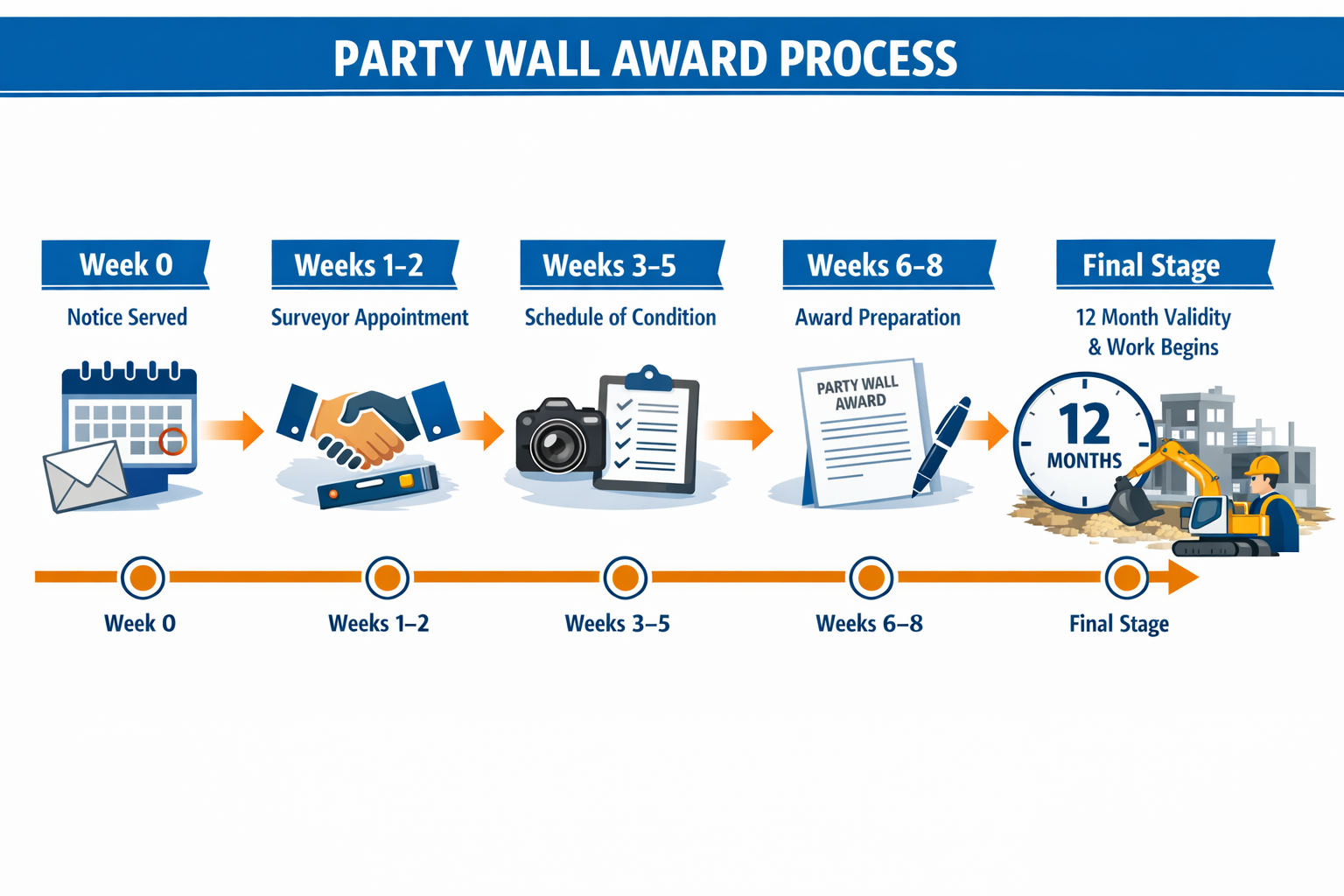
    Phase 1: Pre-Planning (3-6 Months Before Construction)

    Week 1-2:

    • ✅ Engage architect/structural engineer for initial designs
    • ✅ Research party wall requirements for your work type
    • ✅ Identify all potentially affected neighbors
    • ✅ Review types of party wall works applicable to your project

    Week 3-4:

    • ✅ Informal conversations with neighbors about plans
    • ✅ Appoint qualified party wall surveyor
    • ✅ Commission boundary survey if needed
    • ✅ Prepare detailed construction drawings

    Week 5-8:

    • ✅ Finalize construction methodology
    • ✅ Prepare party wall notices with surveyor assistance
    • ✅ Gather supporting documentation for notices
    • ✅ Plan construction timeline and phasing

    Phase 2: Notice Period (2-3 Months Before Construction)

    Month 1:

    • ✅ Serve formal party wall notices (proper method and timing)
    • ✅ Confirm receipt from all adjoining owners
    • ✅ Provide additional information if requested
    • ✅ Respond to neighbor questions promptly

    Month 2:

    • ✅ Receive neighbor responses (consent or dissent)
    • ✅ Appoint surveyors if neighbors dissent
    • ✅ Commission schedules of condition for all affected properties
    • ✅ Begin party wall award preparation

    Month 3:

    • ✅ Finalize party wall awards with all parties
    • ✅ Ensure all surveyors sign awards
    • ✅ Distribute executed awards to all parties
    • ✅ Confirm construction can proceed legally

    Phase 3: Construction Phase

    Pre-Commencement:

    • ✅ Pre-commencement meeting with contractor and surveyors
    • ✅ Review party wall award requirements with construction team
    • ✅ Establish communication protocols
    • ✅ Verify insurance coverage

    During Construction:

    • ✅ Weekly progress updates to neighbors
    • ✅ Regular surveyor inspections per award schedule
    • ✅ Immediate notification of any damage or issues
    • ✅ Maintain photographic construction records
    • ✅ Address neighbor concerns promptly
    • ✅ Comply with working hours and noise restrictions

    Completion:

    • ✅ Final surveyor inspection
    • ✅ Address any damage identified
    • ✅ Obtain completion certificates
    • ✅ Final neighbor communication thanking cooperation

    Phase 4: Post-Construction

    Immediate Post-Completion:

    • ✅ Rectify any identified damage
    • ✅ Follow-up inspections after settling period
    • ✅ Final surveyor sign-off
    • ✅ Archive all documentation

    Long-Term:

    • ✅ Retain all party wall documentation permanently
    • ✅ Maintain positive neighbor relationships
    • ✅ Provide documentation to future property purchasers

    Guidance for Adjoining Owners

    Detailed landscape format (1536x1024) image showcasing best practices implementation in 2026 construction boom environment. Infographic-styl

    For those whose neighbor is carrying out works, understanding your rights and options protects your interests:

    When You Receive a Party Wall Notice

    Don’t Panic: Receiving a party wall notice is normal and doesn’t necessarily mean problems ahead.

    Review Carefully:

    • Read all documentation thoroughly
    • Check notice validity (proper form, timing, service method)
    • Review proposed works and potential impacts
    • Identify any concerns or questions

    Seek Professional Advice:

    • Consider appointing your own surveyor
    • Understand your rights under the Party Wall Act
    • Don’t feel pressured to consent immediately
    • Take the full response period to make informed decisions

    Your Response Options

    Option 1: Consent

    • Appropriate for straightforward, low-risk works
    • Doesn’t waive rights to claim for damage
    • Maintains good neighbor relations
    • Consider requesting schedule of condition even when consenting

    Option 2: Dissent and Appoint Surveyor

    • Recommended for complex or high-risk works
    • Protects your interests through professional representation
    • Building owner typically pays your surveyor fees
    • Ensures proper documentation and monitoring

    Option 3: Appoint Agreed Surveyor

    • Middle ground reducing overall costs
    • Requires trust in surveyor’s impartiality
    • Suitable for straightforward works with cooperative neighbors
    • Ensure surveyor is truly independent

    Protecting Your Property

    Insist on Comprehensive Schedule of Condition:

    • Professional photography of all potentially affected areas
    • Detailed written descriptions
    • Multiple visits if needed
    • Your surveyor should verify thoroughness

    Understand the Party Wall Award:

    • Review all terms carefully
    • Ensure adequate protection measures
    • Verify reasonable working hours
    • Confirm monitoring and inspection provisions
    • Check damage rectification procedures

    Monitor Construction Activity:

    • Note any concerning activities
    • Document issues with photographs
    • Communicate concerns promptly
    • Keep records of all correspondence

    Know Your Rights:

    • Right to appoint surveyor at building owner’s expense
    • Right to adequate protection during works
    • Right to have damage repaired
    • Right to third surveyor if surveyors disagree
    • Right to claim compensation for losses

    Conclusion

    Successfully navigating Party Wall Agreements in High-Demand Housing Markets: Best Practices for Managing Disputes During Construction Booms requires a comprehensive approach combining legal compliance, professional expertise, proactive communication, and thorough documentation. As construction activity continues intensifying in competitive housing markets throughout 2026 and beyond, the importance of proper party wall procedures only increases.

    The key principles outlined in this guide—early neighbor engagement, comprehensive documentation, professional surveyor appointment, construction phase monitoring, and structured dispute resolution—form the foundation of effective party wall management. By implementing these best practices, building owners can proceed with confidence while protecting their investments, and adjoining owners can safeguard their properties while maintaining positive neighborhood relationships.

    Essential Takeaways

    🏗️ The construction boom amplifies party wall challenges: High-demand housing markets create perfect conditions for disputes through increased construction density, elevated property values, and heightened neighbor sensitivities.

    📋 Documentation prevents disputes: Comprehensive schedules of condition, detailed party wall awards, and thorough record-keeping throughout construction provide protection for all parties and evidence if conflicts arise.

    🤝 Professional expertise is invaluable: Qualified party wall surveyors bring technical knowledge, impartial judgment, and dispute prevention experience that far exceeds their cost.

    💡 Prevention beats resolution: Investing time and resources in proper procedures, early communication, and proactive neighbor relations prevents expensive, time-consuming disputes.

    ⚖️ Legal compliance protects everyone: Following the Party Wall etc. Act 1996 requirements isn’t just legally necessary—it provides a proven framework that balances building owner rights with adjoining owner protection.

    Next Steps

    For Building Owners Planning Construction:

    1. Start early: Begin party wall procedures well before planned construction start dates
    2. Engage professionals: Appoint qualified surveyors with experience in your property type and market
    3. Communicate proactively: Talk with neighbors before serving formal notices
    4. Document thoroughly: Commission comprehensive schedules of condition
    5. Budget appropriately: Include party wall costs in project budgets from the outset
    6. Monitor compliance: Ensure contractors follow party wall award requirements throughout construction

    For Adjoining Owners Receiving Notices:

    1. Respond promptly: Use the full notice period but don’t delay unnecessarily
    2. Seek advice: Consult a qualified surveyor about your options
    3. Protect your interests: Don’t feel pressured to consent without proper protection
    4. Document everything: Keep records of all notices, correspondence, and agreements
    5. Stay engaged: Monitor construction activity and communicate concerns promptly
    6. Know your rights: Understand Party Wall Act protections available to you

    For Property Professionals:

    1. Stay informed: Keep current with party wall legislation and best practices
    2. Build expertise: Develop specialized knowledge in high-demand market dynamics
    3. Invest in technology: Adopt modern documentation and communication tools
    4. Network professionally: Connect with other party wall specialists for knowledge sharing
    5. Prioritize prevention: Focus on dispute prevention rather than resolution
    6. Maintain standards: Uphold high professional and ethical standards

    The construction boom in high-demand housing markets presents both challenges and opportunities. By approaching party wall agreements with professionalism, thoroughness, and respect for all parties’ interests, the construction sector can navigate this busy period while maintaining the neighbor relationships and property protections that make communities thrive.

    Whether you’re planning construction works, responding to a neighbor’s notice, or providing professional party wall services, the principles and practices outlined in this guide provide a roadmap for success. In 2026’s competitive housing markets, proper party wall management isn’t optional—it’s essential for protecting property values, maintaining legal compliance, and preserving the social fabric of neighborhoods experiencing intense development pressure.

    For additional resources, templates, and professional guidance on party wall matters, explore the comprehensive information available through Party Wall Surveyor London and consult qualified professionals who understand the unique dynamics of high-demand housing markets.


    References

    [1] 2026 Housing Market Outlook – https://www.windowanddoor.com/article/2026-housing-market-outlook

    [3] Measured Expansion Expected To Define The Housing Markets Next Phase In 2026 – https://www.mortgage-underwriters.org/mortgage-underwriting-news/2026/1/20/measured-expansion-expected-to-define-the-housing-markets-next-phase-in-2026

    [4] 3 Big Signals Shape 2026 201016283 – https://www.aol.com/finance/3-big-signals-shape-2026-201016283.html

    [7] Builder Confidence Falters February – https://hbsdealer.com/builder-confidence-falters-february

  • Party Wall Awards and Labor Cost Escalation Clauses: Protect

    The construction industry faces unprecedented challenges in 2026. Labor costs continue their relentless climb, material prices fluctuate wildly, and party wall surveyors find themselves caught between building owners eager to proceed with projects and adjoining owners concerned about cost overruns. When a party wall award sets out the terms for works affecting shared structures, what happens when the estimated costs become obsolete before the first brick is laid?

    Party Wall Awards and Labor Cost Escalation Clauses: Protecting Surveyors and Clients in 2026’s Volatile Market has become a critical topic for construction professionals across the United Kingdom. With construction labor rates increasing by 6% in 2022 alone—following increases of 2.8% in 2020 and 4% in 2021—and 98% of all construction labor rates rising during that period[1], the traditional fixed-price approach to party wall awards no longer provides adequate protection for any party involved.

    This comprehensive guide explores how party wall surveyors can incorporate price escalation provisions into awards and agreements, protecting building owners from unfair cost burdens while safeguarding adjoining owners from excessive charges. The strategies outlined here represent essential knowledge for navigating 2026’s volatile construction market.

    Key Takeaways

    • Labor cost increases of 4-10% are now standard in the construction industry, making fixed-price party wall awards increasingly risky for all parties involved
    • Escalation clauses provide contractual protection by establishing clear mechanisms for adjusting costs when material and labor prices rise beyond predetermined thresholds
    • Three primary escalation models dominate current practice: material-specific escalation, threshold escalation (3-5% baseline), and index-based escalation tied to published metrics
    • Party wall awards must balance protection for building owners undertaking works with fairness to adjoining owners who may bear costs for their appointed surveyor
    • Proper documentation and transparency in escalation clauses prevent disputes and maintain the collaborative spirit essential to successful party wall procedures

    Understanding the Current Cost Crisis in Construction and Party Wall Works

    Landscape format (1536x1024) detailed infographic showing two side-by-side comparison charts: left chart displays UK construction labor cost

    The Scale of Labor Cost Escalation in 2026

    The construction industry has experienced dramatic cost volatility over the past six years. According to comprehensive industry data, construction labor rates increased by 6% in 2022, with an astonishing 98% of all construction labor categories experiencing upward pressure[1]. This follows sustained increases of 2.8% in 2020 and 4% in 2021, creating a compounding effect that has fundamentally altered project economics.

    For party wall surveyors preparing awards in 2026, these statistics translate into real-world challenges:

    • Skilled tradespeople command premium rates due to workforce shortages
    • Specialist contractors (underpinning, structural alterations) face even steeper increases
    • Project timelines extend, multiplying labor costs through prolonged engagement
    • Regional variations create uncertainty, particularly in high-demand areas like London

    The costs of party wall procedures have risen correspondingly, affecting both the surveyor fees and the underlying construction works covered by awards.

    Why Traditional Fixed-Price Awards Fail in Volatile Markets

    Historically, party wall awards have specified fixed costs for proposed works, providing certainty to all parties. This approach worked well during periods of price stability, but creates significant problems in 2026’s environment:

    Fixed-Price Problem Impact on Building Owner Impact on Adjoining Owner
    Underestimated costs Project delays or abandonment Wasted surveyor fees, uncertainty
    Overestimated costs Unnecessary financial burden Suspicion of inflated charges
    No adjustment mechanism Absorbs all cost increases No protection against legitimate rises
    Dispute likelihood High when seeking variations High when questioning increases

    The absence of escalation provisions forces building owners to either absorb unexpected costs (potentially making projects financially unviable) or seek award variations (creating delays, additional surveyor fees, and relationship strain with neighbors).

    The Broader Construction Industry Response

    The wider construction sector has already recognized these challenges. General contractors increasingly incorporate escalation clauses in primary contracts, though many still avoid including such language with subcontractors—a practice that has led to proliferating disputes[1]. This inconsistency creates a cascade effect where risk concentrates at vulnerable points in the contractual chain.

    For party wall procedures, this means building owners may have escalation protection in their main construction contracts but lack corresponding provisions in their party wall awards, creating a mismatch in risk allocation that can prove financially devastating.

    Understanding how to keep party wall costs down remains important, but cost control strategies must now include proactive escalation planning rather than simply seeking the lowest initial estimate.

    Party Wall Awards and Labor Cost Escalation Clauses: Essential Models for 2026

    Material-Specific Escalation Clauses

    The most common escalation model in 2026 focuses on specific materials or labor categories that historically experience significant price volatility. This approach provides targeted protection without creating blanket cost increases across entire projects[5].

    How Material-Specific Clauses Work

    A material-specific escalation clause identifies particular cost components—such as steel, timber, concrete, or specialized labor—and establishes a mechanism for adjusting the award if these costs rise beyond a baseline established at the time of the award.

    Example clause structure:

    “Should the cost of structural steel exceed the baseline price of £X per tonne as published in [specified index] by more than 5% at the time of procurement, the total award amount shall be adjusted proportionally to reflect the actual cost increase for steel components specified in Schedule A.”

    Advantages for Party Wall Applications

    Transparency: Both parties understand exactly which costs may adjust
    Fairness: Only genuine, verifiable increases trigger adjustments
    Limitation: Escalation applies only to specified materials, not entire project
    Documentation: Published indices provide objective verification

    Implementation Considerations

    When drafting material-specific escalation clauses for party wall awards, surveyors should:

    • Identify high-risk materials based on the specific types of party wall works proposed
    • Specify credible indices such as industry pricing publications or government statistics
    • Define clear thresholds that trigger escalation (typically 3-5%)
    • Establish documentation requirements for demonstrating actual costs incurred
    • Set reasonable caps to prevent unlimited escalation

    Threshold Escalation: The 3-5% Baseline Model

    Threshold escalation represents a balanced approach that has gained significant traction in 2026. Under this model, the building owner absorbs the first 3-5% of total cost increases before any escalation clause activates[5]. This approach acknowledges that minor cost fluctuations are a normal part of construction while providing protection against significant volatility.

    The Psychology of Threshold Models

    Threshold escalation clauses work well in party wall contexts because they:

    • Demonstrate good faith from the building owner, who accepts reasonable risk
    • Prevent frivolous claims for minor cost variations
    • Align incentives for cost control between parties
    • Reduce administrative burden by filtering out insignificant changes

    Practical Implementation

    A threshold escalation clause in a party wall award might read:

    “The Building Owner shall bear the first 4% of any increase in the total costs specified in this Award. Should total costs increase by more than 4% due to documented increases in labor rates or material costs beyond the Building Owner’s control, the Award amount shall be adjusted to reflect 100% of costs exceeding the 4% threshold, subject to verification by the Agreed Surveyor.”

    This approach works particularly well when combined with the party wall contract template guidance that establishes clear procedures for documenting and verifying cost changes.

    Index-Based Escalation: Leveraging Published Data

    Index-based escalation clauses tie cost adjustments to published economic indices rather than actual incurred costs. This approach has gained prominence because it provides objectivity, reduces disputes, and simplifies administration[3].

    Common Indices for Party Wall Awards

    While U.S. contractors often reference the Producer Price Index (PPI) from the Bureau of Labor Statistics[3], UK party wall surveyors typically reference:

    • BCIS (Building Cost Information Service) indices for construction costs
    • ONS (Office for National Statistics) construction output price indices
    • RICS (Royal Institution of Chartered Surveyors) building cost indices
    • Regional labor rate surveys published by industry bodies

    Advantages of Index-Based Approaches

    🎯 Objectivity: Third-party data eliminates disputes over actual costs
    🎯 Simplicity: No need to collect and verify contractor invoices
    🎯 Predictability: Parties can monitor indices and anticipate adjustments
    🎯 Reduced administration: Automatic calculation based on published figures

    Sample Index-Based Clause

    “The costs specified in this Award shall be adjusted quarterly based on changes in the BCIS All-In Tender Price Index for Greater London. The baseline index value is [X] as of [Award Date]. Should the index increase by more than 3% at the time of works commencement, all labor costs specified in Schedule B shall be adjusted proportionally to reflect the percentage increase above the 3% threshold.”

    This approach provides particularly strong protection in regions experiencing rapid development, such as areas served by a party wall surveyor in Central London or party wall surveyor in North London.

    Drafting Effective Escalation Clauses for Party Wall Awards

    Essential Components of Protective Escalation Language

    Creating escalation clauses that actually protect all parties requires careful attention to specific components. A comprehensive escalation provision should include:

    1. Clear Trigger Mechanisms

    The clause must specify exactly what conditions activate the escalation provision:

    • Percentage increase thresholds (e.g., “exceeding 5% of baseline costs”)
    • Time periods for measurement (e.g., “measured quarterly from Award date”)
    • Specific cost categories covered (e.g., “labor rates for skilled trades only”)
    • Geographic scope (e.g., “within the Greater London area”)

    2. Objective Measurement Standards

    Avoid subjective assessments by referencing:

    • Published indices with specific names and sources
    • Verifiable documentation requirements (invoices, rate cards, supplier quotes)
    • Independent verification procedures (agreed surveyor review, third-party audit)
    • Calculation methodologies that both parties can replicate

    3. Reasonable Caps and Limitations

    Protect adjoining owners from unlimited exposure by establishing:

    • Maximum percentage increases (e.g., “total escalation shall not exceed 15% of original award amount”)
    • Time limitations (e.g., “escalation provisions expire 24 months after Award date”)
    • Category-specific caps (e.g., “material escalation capped at 20%, labor at 10%”)
    • Total cost ceilings above which works require re-notification

    4. Documentation and Notice Requirements

    Establish clear procedures for invoking escalation:

    • Advance notice periods (e.g., “Building Owner must provide 14 days written notice”)
    • Supporting documentation (copies of indices, contractor quotes, invoices)
    • Review timelines (e.g., “Adjoining Owner has 7 days to review and respond”)
    • Dispute resolution procedures if parties disagree on calculations

    Balancing Building Owner and Adjoining Owner Interests

    The most effective escalation clauses in party wall awards recognize that both parties have legitimate interests requiring protection.

    Building Owner Protection:

    • Ability to proceed with works despite market volatility
    • Fair allocation of unavoidable cost increases
    • Clear procedures for documenting legitimate escalation
    • Protection from project abandonment due to cost overruns

    Adjoining Owner Protection:

    • Caps on total exposure to cost increases
    • Objective verification of claimed increases
    • Transparency in calculation methodologies
    • Right to review and challenge escalation claims

    When working with a building owner’s surveyor or adjoining owner’s surveyor, these balanced interests should guide clause drafting.

    Common Pitfalls to Avoid

    Overly broad language that could apply to any cost increase, regardless of cause
    Lack of verification mechanisms allowing unsubstantiated claims
    Unlimited escalation without caps or reasonableness standards
    Complex calculation methods that create confusion and disputes
    Failure to address timing of when escalation can be invoked
    Ignoring regional variations in cost trends

    Template Language for Party Wall Escalation Clauses

    While each award requires customization based on specific circumstances, the following template provides a starting point:


    COST ESCALATION PROVISION

    1. Baseline Costs: The costs specified in this Award are based on labor rates and material prices current as of [Award Date], as documented in Schedule [X].

    2. Threshold: The Building Owner shall bear the first 4% of any increase in total costs specified in this Award.

    3. Escalation Trigger: Should total documented costs increase by more than 4% due to increases in labor rates or material costs beyond the Building Owner’s reasonable control, this Award shall be adjusted as follows:

    a) Labor Escalation: Labor costs shall be adjusted based on the [specified index] published by [authority]. Baseline index value: [X] as of [date].

    b) Material Escalation: Costs for [specified materials] shall be adjusted based on documented supplier quotes showing price increases exceeding the 4% threshold.

    4. Verification: All escalation claims must be supported by:

    • Published index values or supplier documentation
    • Detailed calculations showing the adjustment methodology
    • Comparison to baseline costs in Schedule [X]

    5. Caps: Total escalation shall not exceed 15% of the original Award amount. Escalation provisions expire [24] months after the Award date.

    6. Notice: The Building Owner must provide written notice of any escalation claim at least 14 days before invoking the adjustment, with supporting documentation.

    7. Review: The [Agreed Surveyor/Adjoining Owner’s Surveyor] shall have 10 days to review escalation claims and may request additional verification.


    This template can be adapted based on the specific party wall notices served and the nature of the proposed works.

    Regional Considerations and Market-Specific Challenges

    London’s Unique Cost Pressures

    The Greater London area experiences particularly acute cost volatility due to:

    • High demand for skilled labor in a competitive market
    • Premium rates for working in densely populated areas
    • Access challenges that increase labor time and costs
    • Regulatory complexity requiring specialized expertise

    Surveyors working in different London regions must account for these variations:

    Tariff Impacts and International Supply Chain Issues

    Beyond labor costs, material price volatility continues to affect party wall works in 2026. Unresolved tariff-related price increases from previous trade policies continue to impact material costs, with contractors and owners still negotiating fair allocation mechanisms[2].

    Materials particularly affected by tariffs:

    • 🔧 Structural steel and reinforcement
    • 🪵 Timber and engineered wood products
    • 🧱 Specialized bricks and masonry materials
    • ⚙️ Mechanical and electrical components

    Escalation clauses should specifically address whether tariff-related increases fall within the scope of covered cost adjustments, as these represent external economic factors beyond any party’s control.

    Workforce Constraints Driving Labor Premiums

    The construction industry faces a skilled labor shortage that shows no signs of abating in 2026. This creates specific challenges for party wall works:

    • Specialist trades (underpinning, structural engineers, facade specialists) command premium rates
    • Scheduling conflicts may require premium payments for timely availability
    • Quality considerations often necessitate engaging higher-cost experienced professionals
    • Regulatory compliance requires properly qualified tradespeople

    These workforce realities make labor cost escalation clauses particularly important, as the availability of qualified professionals at baseline costs cannot be guaranteed over extended project timelines.

    Protecting Surveyors Through Proper Award Documentation

    Landscape format (1536x1024) visual diagram showing three distinct escalation clause models as interconnected flowcharts: Material-Specific

    Surveyor Liability and Escalation Provisions

    Party wall surveyors bear professional responsibility for the awards they prepare. In 2026’s volatile market, this creates potential liability exposure when:

    • Fixed-price awards prove inadequate, leading to project delays or abandonment
    • Cost estimates become obsolete before works commence
    • Disputes arise over unexpected cost increases
    • Professional negligence claims allege inadequate cost protection

    Including well-drafted escalation clauses provides professional protection by demonstrating:

    ✓ Awareness of market conditions
    ✓ Reasonable steps to protect all parties
    ✓ Professional competence in award drafting
    ✓ Compliance with industry best practices

    Documentation Best Practices

    Surveyors preparing awards with escalation clauses should maintain comprehensive documentation:

    At Award Preparation:

    • Current labor rate surveys and material price quotes
    • Published index values as of the award date
    • Written explanation of escalation provisions to all parties
    • Acknowledgment from parties that they understand the provisions

    During Works:

    • Regular monitoring of relevant indices
    • Communication regarding significant cost movements
    • Documentation of any escalation triggers
    • Verification of claimed cost increases

    Post-Completion:

    • Final accounting of any escalation adjustments
    • Reconciliation of estimated versus actual costs
    • Lessons learned for future awards

    This documentation trail protects surveyors while ensuring transparency for all parties involved in the party wall procedure.

    Communication Strategies for Explaining Escalation Clauses

    Many property owners lack familiarity with escalation provisions, making clear communication essential. Surveyors should:

    For Building Owners:

    • Explain how escalation clauses protect project viability
    • Demonstrate the cost of not including such provisions (project delays, variations, disputes)
    • Provide examples of recent cost increases in similar works
    • Clarify the verification and documentation requirements

    For Adjoining Owners:

    • Emphasize the caps and limitations that protect against unlimited exposure
    • Explain the objective verification mechanisms that prevent abuse
    • Demonstrate how escalation clauses reduce dispute likelihood
    • Clarify that escalation applies to legitimate, documented increases only

    This educational approach helps parties understand that escalation clauses represent fair risk allocation rather than a blank check for cost increases.

    Case Studies: Escalation Clauses in Practice

    Case Study 1: Basement Extension in Central London

    Scenario: A building owner in Central London proposed a substantial basement extension requiring underpinning of the party wall. The initial award specified costs of £45,000 for party wall-related works.

    Challenge: Between award preparation and works commencement (8 months), specialized underpinning labor rates increased by 9% due to high demand in the area.

    Escalation Clause Applied: The award included a threshold escalation clause with a 4% baseline and cap at 12% total increase.

    Outcome:

    • Building owner absorbed first 4% (£1,800)
    • Escalation clause covered the additional 5% (£2,250)
    • Total adjusted award: £47,250
    • No disputes, works proceeded smoothly
    • Both parties satisfied with fair allocation

    Key Lesson: The threshold approach demonstrated good faith from the building owner while protecting against the significant increase that would have otherwise created financial strain.

    Case Study 2: Loft Conversion with Material Price Volatility

    Scenario: A loft conversion required steel beam installation through a party wall. The award specified material and labor costs totaling £28,000.

    Challenge: Steel prices increased by 14% due to international supply chain disruptions and tariff uncertainties.

    Escalation Clause Applied: Material-specific escalation clause tied to published steel price indices, with a 5% threshold and 15% cap.

    Outcome:

    • Steel costs represented £8,000 of total award
    • After 5% threshold (£400), escalation covered 9% increase (£720)
    • Total adjustment: £720 (less than 3% of total award)
    • Minimal impact on adjoining owner
    • Building owner avoided absorbing full £1,120 steel increase

    Key Lesson: Material-specific clauses provided targeted protection without significantly affecting the total award amount, demonstrating the efficiency of this approach.

    Case Study 3: Disputed Escalation Claim

    Scenario: A building owner claimed labor cost escalation of 15% based on contractor quotes, seeking a £6,000 adjustment to a £40,000 award.

    Challenge: The award’s escalation clause required verification through published indices, but the building owner relied solely on contractor estimates.

    Escalation Clause Applied: Index-based escalation tied to BCIS indices, with independent verification by the agreed surveyor.

    Outcome:

    • BCIS indices showed 6% increase (not 15%)
    • After 3% threshold, legitimate escalation: 3%
    • Adjusted amount: £1,200 (not £6,000)
    • Objective verification prevented dispute
    • Both parties accepted the index-based calculation

    Key Lesson: Index-based clauses with objective verification mechanisms prevent disputes by removing subjective assessments from the equation.

    Future-Proofing Party Wall Awards in an Uncertain Market

    Anticipating Continued Volatility Beyond 2026

    Market analysts predict continued cost volatility through at least 2028, driven by:

    • Ongoing workforce shortages as experienced tradespeople retire
    • Climate change regulations requiring new materials and techniques
    • Energy cost fluctuations affecting material production and transport
    • Economic uncertainty creating unpredictable demand patterns

    Party wall surveyors must prepare awards that remain viable across extended timelines, recognizing that many projects face delays between award preparation and works commencement.

    Adaptive Escalation Provisions

    The most sophisticated escalation clauses in 2026 include adaptive mechanisms that respond to changing conditions:

    Time-Based Adjustments:

    “Escalation thresholds shall decrease by 0.5% for each quarter between Award date and works commencement, reflecting the increasing uncertainty over extended timelines.”

    Dual-Index Approaches:

    “Labor escalation shall be calculated using the higher of [Index A] or [Index B], ensuring protection against index manipulation or temporary anomalies.”

    Conditional Caps:

    “The 15% escalation cap may be exceeded if independently verified cost increases result from government-mandated regulatory changes implemented after the Award date.”

    These adaptive provisions recognize that rigid formulas may fail in unprecedented market conditions.

    Technology-Enabled Cost Tracking

    Forward-thinking surveyors increasingly leverage digital tools for monitoring and documenting cost changes:

    • Automated index monitoring with alerts when thresholds approach
    • Digital documentation platforms for collecting and verifying cost evidence
    • Blockchain-based verification for tamper-proof cost records
    • AI-powered cost forecasting to inform escalation clause parameters

    These technologies enhance transparency while reducing administrative burden for all parties.

    Collaborative Approaches to Risk Sharing

    The most successful party wall procedures in 2026 embrace collaborative risk management rather than adversarial cost allocation. This includes:

    • Joint cost monitoring where both parties track relevant indices
    • Advance escalation discussions before costs actually increase
    • Shared contingency funds for absorbing minor variations
    • Phased awards that allow periodic cost reassessment

    This collaborative spirit aligns with the fundamental purpose of the Party Wall etc. Act 1996: facilitating necessary works while protecting all parties’ interests.

    Practical Guidance for Building Owners and Adjoining Owners

    For Building Owners Planning Works

    If you are carrying out works that require a party wall award, consider these strategies:

    Before Appointing a Surveyor:

    • Research current cost trends for your proposed works
    • Understand that fixed-price awards may create future problems
    • Prepare to discuss escalation provisions with your surveyor
    • Budget for potential cost increases (typically 5-10% contingency)

    When Reviewing Draft Awards:

    • Ensure escalation clauses include reasonable thresholds you can absorb
    • Verify that caps protect you from unlimited escalation
    • Understand the documentation requirements for invoking escalation
    • Confirm that verification mechanisms are practical and achievable

    During the Works:

    • Monitor relevant cost indices regularly
    • Maintain thorough documentation of actual costs incurred
    • Communicate proactively with neighbors if escalation seems likely
    • Work with your surveyor to verify any escalation claims

    For Adjoining Owners Receiving Notices

    If your neighbor is carrying out works and you’re reviewing a proposed award, protect yourself by:

    Reviewing Escalation Provisions Carefully:

    • Ensure caps limit your maximum exposure
    • Verify that escalation applies only to legitimate, documented increases
    • Confirm that verification mechanisms provide objective assessment
    • Understand the time limits on escalation provisions

    Asking Key Questions:

    • What percentage of the award could potentially escalate?
    • What objective indices or verification methods apply?
    • Who determines whether escalation is justified?
    • What documentation must the building owner provide?

    Engaging Professional Support:

    • Consider appointing your own surveyor to review complex escalation clauses
    • Ensure your surveyor has experience with cost escalation provisions
    • Request clear explanations of any technical language
    • Don’t hesitate to negotiate modifications to escalation terms

    Remember that understanding what is a party structure notice and the broader party wall process helps you evaluate whether escalation provisions are appropriate for specific works.

    When to Avoid Escalation Clauses

    Not every party wall award requires escalation provisions. Consider omitting escalation clauses when:

    • Works are minor with total costs under £5,000
    • Timeline is short (works commencing within 4-6 weeks of award)
    • Costs are primarily fixed (e.g., equipment rental, permit fees)
    • Market conditions are stable (rare in 2026, but possible for specific trades)

    For guidance on simpler approaches, review information about having a party wall agreement without a surveyor for straightforward situations.

    Regulatory Compliance and Professional Standards

    Landscape format (1536x1024) professional scene showing party wall surveyor presenting award document to building owner and adjoining owner

    Party Wall Act Requirements

    The Party Wall etc. Act 1996 does not explicitly address cost escalation, but surveyors must ensure that escalation clauses comply with the Act’s fundamental requirements:

    • Awards must be fair to all parties
    • Costs must be reasonable and properly allocated
    • Procedures must be transparent and understandable
    • Disputes must be resolvable through the award’s terms

    Well-drafted escalation clauses enhance compliance by providing clear, fair mechanisms for addressing cost changes that would otherwise create disputes requiring third-party resolution.

    RICS Professional Standards

    The Royal Institution of Chartered Surveyors (RICS) provides guidance relevant to party wall awards and cost escalation:

    • Professional competence: Surveyors must understand current market conditions
    • Client care: Parties must be informed of cost risks and protection mechanisms
    • Conflict of interest: Escalation provisions must not favor one party unfairly
    • Professional indemnity: Adequate insurance should cover escalation-related disputes

    Surveyors should document their consideration of escalation provisions as evidence of professional diligence in volatile market conditions.

    Insurance Implications

    Professional indemnity insurance for party wall surveyors increasingly addresses escalation clause issues:

    Coverage Considerations:

    • Claims arising from inadequate cost protection in awards
    • Disputes over escalation clause interpretation
    • Allegations of negligent cost estimation
    • Professional fees for defending escalation-related complaints

    Surveyors should discuss escalation clause practices with their insurers to ensure adequate coverage.

    Conclusion: Building Resilient Party Wall Awards for 2026 and Beyond

    The construction industry’s cost volatility shows no signs of abating. Labor rates continue their upward trajectory, material prices fluctuate with global economic conditions, and project timelines extend due to regulatory complexity and resource constraints. In this environment, Party Wall Awards and Labor Cost Escalation Clauses: Protecting Surveyors and Clients in 2026’s Volatile Market represents not just a best practice, but an essential component of professional party wall practice.

    Key Principles for Success

    Effective escalation clauses in party wall awards rest on several fundamental principles:

    1. Fairness: Provisions must protect both building owners and adjoining owners
    2. Transparency: Calculation methods must be clear and verifiable
    3. Reasonableness: Thresholds and caps must reflect realistic market conditions
    4. Objectivity: Verification mechanisms must remove subjective assessments
    5. Practicality: Documentation requirements must be achievable

    The Path Forward

    Party wall surveyors operating in 2026 should:

    Educate clients about cost volatility and escalation protection
    Incorporate escalation clauses as standard practice for significant works
    Customize provisions based on specific project characteristics
    Maintain thorough documentation of market conditions and cost trends
    Monitor industry developments in escalation clause design
    Collaborate with peers to share effective approaches

    Actionable Next Steps

    For Surveyors:

    • Review your current award templates and incorporate escalation provisions
    • Develop standard language for the three primary escalation models
    • Create client education materials explaining escalation clauses
    • Establish relationships with reliable sources for cost indices and verification
    • Consider professional development training on escalation clause drafting

    For Building Owners:

    • Discuss escalation protection with your surveyor before award preparation
    • Research current cost trends for your proposed works
    • Budget appropriately for potential escalation (5-10% contingency)
    • Maintain thorough documentation throughout your project

    For Adjoining Owners:

    • Request clear explanations of any escalation provisions in proposed awards
    • Ensure caps and verification mechanisms provide adequate protection
    • Consider appointing your own surveyor for complex awards
    • Don’t hesitate to negotiate escalation terms before agreeing to awards

    A Collaborative Future

    The party wall process succeeds when all parties approach it collaboratively rather than adversarially. Escalation clauses, properly drafted and fairly applied, enhance this collaborative spirit by:

    • Removing cost uncertainty that creates anxiety and disputes
    • Establishing clear procedures for addressing inevitable market changes
    • Demonstrating good faith from building owners willing to share risk fairly
    • Protecting adjoining owners from unlimited exposure to cost increases

    As 2026 progresses and cost volatility continues, the surveyors who embrace escalation provisions as standard practice will better serve their clients, reduce disputes, and enhance their professional reputations.

    The construction market’s challenges are real, but with thoughtful planning, clear documentation, and fair risk allocation through well-drafted escalation clauses, party wall procedures can successfully navigate even the most volatile economic conditions. The future of party wall practice lies in adaptive, transparent, and equitable approaches that protect all parties while facilitating necessary construction works.

    By implementing the strategies outlined in this guide, surveyors and property owners can transform cost volatility from a source of conflict into an opportunity for professional excellence and collaborative problem-solving.


    References

    [1] The Dotted Line: Cost escalations lead to more construction disputes – https://www.constructiondive.com/news/the-dotted-line-cost-escalations-lead-to-more-construction-disputes/632572/

    [2] Price Escalation Clauses: A Contractual Solution To Rising Costs Of Building Materials – https://acppubs.com/TXC/article/3897605B-price-escalation-clauses-a-contractual-solution-to-rising-costs-of-building-materials

    [3] Stop Guessing The Price: Use Material Escalation Clauses To Protect Your Bid In A Volatile Tariff Climate – https://www.buildsmartbradley.com/2025/05/stop-guessing-the-price-use-material-escalation-clauses-to-protect-your-bid-in-a-volatile-tariff-climate/

    [4] Allocating The Risk Of Tariff Price Increases – https://www.constructionseyt.com/2025/04/allocating-the-risk-of-tariff-price-increases/

    [5] Escalation Clauses DFW New Construction 2026 Guide – https://stevenjthomas.com/home/b/escalation-clauses-dfw-new-construction-2026-guide

    [6] Party Wall Works Notices Disputes Awards – https://www.lexisnexis.co.uk/legal/guidance/party-wall-works-notices-disputes-awards

    [7] Construction Bid Escalation Clauses Guide – https://constructionbids.ai/blog/construction-bid-escalation-clauses-guide

    [8] Price Escalation Contracts – https://mrsc.org/stay-informed/mrsc-insight/may-2025/price-escalation-contracts

    [9] Knowledge Article: When Is A Party Wall Agreement Needed – https://www.aylingassociates.com/knowledge-article-when-is-a-party-wall-agreement-needed.html

  • Party Wall Notices and Immigration Enforcement: Navigating L

    The construction industry in 2026 faces an unprecedented convergence of challenges that directly impacts how party wall notices are managed, executed, and enforced. As immigration enforcement intensifies across the United Kingdom and United States, construction crews are shrinking precisely when demand for skilled labor remains high. For party wall surveyors, building owners, and adjoining property holders, understanding how Party Wall Notices and Immigration Enforcement: Navigating Labor Shortages in 2026 Construction Projects intersect has become essential to avoiding costly delays, managing legal obligations, and maintaining neighborly relations during construction works.

    The ripple effects of labor shortages extend far beyond simple project delays. When contractors cannot staff projects adequately, the carefully calibrated timelines outlined in party wall notices become unreliable. Cost escalations mount. Safety risks increase. And the legal framework that governs party wall agreements—designed for predictable construction schedules—must adapt to a new reality where workforce availability has become the critical constraint.

    Key Takeaways

    • 🏗️ The construction industry needs 349,000 net new workers in 2026, with shortages particularly acute in experienced roles like project managers, superintendents, and specialized electricians rather than entry-level positions
    • 📋 Immigration enforcement has emerged as a major wildcard affecting construction labor supply, with undocumented worker flows declining precipitously in 2025 while voluntary deportations accelerated
    • Party wall project timelines require 10-15% labor float in 2026 to account for workforce availability issues, directly impacting notice periods and construction schedules outlined in party wall agreements
    • 💰 Labor costs are rising 6-8% annually, forcing revisions to party wall awards, cost estimates, and financial provisions for construction works affecting shared structures
    • 🔧 Strategic responses include phased construction approaches, realistic scheduling based on actual labor availability, and enhanced communication between building owners, adjoining owners, and party wall surveyors to manage expectations

    Understanding the 2026 Construction Labor Shortage

    Detailed landscape format (1536x1024) image showing infographic-style visualization of construction labor shortage statistics for 2026. Cent

    The Scale of Workforce Demand

    The U.S. construction industry must attract an estimated 349,000 net new workers in 2026 to maintain labor supply-demand equilibrium, according to Associated Builders and Contractors (ABC), released January 15, 2026.[1][2] This figure represents a significant decline from 439,000 projected for 2025 and over 500,000 in prior years, but the shortage remains substantial.[3]

    However, this temporary relief masks deeper structural challenges. The shortage is projected to increase to 456,000 additional workers in 2027, reflecting anticipated rebounds in construction spending tied to infrastructure programs and reshoring initiatives.[1][2] For those managing party wall works, this volatility in labor availability creates planning uncertainty that extends throughout the entire party wall process.

    ABC’s economic model converts anticipated increases in construction spending into worker demand at approximately 3,450 jobs per $1 billion in additional construction spending, integrating job openings data, unemployment rates, and retirement trends.[1] This methodology reveals that a majority of new worker demand in 2026 will be attributable to retirement rather than increased demand for construction services, despite the ongoing boom in artificial intelligence infrastructure buildout.[3]

    Where the Shortages Hit Hardest

    Contrary to popular assumption, the most acute shortage is not entry-level labor but experienced superintendents, project managers, and estimators who can lead complex projects. Contractors are delaying project starts or turning down work due to inability to staff leadership positions.[4]

    Critical shortage areas in 2026:

    Role Category Shortage Severity Impact on Party Wall Projects
    Project Managers Severe Delays in coordinating party wall works schedules
    Superintendents Severe Reduced on-site oversight of party wall compliance
    Estimators High Inaccurate cost projections for party wall awards
    Electricians (specialized) High Delays in data center and complex electrical works
    Entry-level laborers Moderate General construction timeline extensions

    Demand for electricians capable of precision wiring has surged due to rapid increases in data center construction, despite recent industry efforts to accelerate skilled worker development.[1] This specialized shortage affects party wall projects involving electrical system upgrades or installations near shared structures.

    Interestingly, nonresidential specialty trade contractors have added 95,000 jobs since August 2024, indicating that certain sectors are hiring strongly despite broader shortages.[1][3] This uneven distribution of labor availability means that party wall surveyors must assess contractor capacity on a project-by-project basis rather than relying on historical norms.

    Immigration Enforcement as a Labor Force Wildcard

    The Immigration-Construction Nexus

    Immigration policy has emerged as a “potential wildcard” for the industry’s labor force dynamics, with data indicating that “the flow of undocumented workers into the country fell precipitously in 2025 while voluntary deportations accelerated.”[3]

    The actual extent to which unauthorized workers have departed the construction workforce remains unclear, but immigration enforcement is explicitly identified as one of the “macrodynamics at play in the industry” alongside tariffs, office vacancies, and an aging workforce.[1] For party wall surveyors and building owners planning construction works, this uncertainty compounds already complex scheduling challenges.

    Key immigration enforcement impacts:

    • 📉 Reduced workforce availability for contractors who historically relied on immigrant labor
    • ⚠️ Increased compliance costs as contractors implement E-Verify and documentation requirements
    • 🔄 Higher worker turnover as enforcement actions create workforce instability
    • 💼 Contractor capacity constraints limiting ability to take on new party wall projects
    • 📅 Schedule unpredictability when key workers are suddenly unavailable

    Regional Variations in Impact

    Immigration enforcement effects vary significantly by region and construction sector. In areas with historically high immigrant workforce participation—including major metropolitan areas where party wall issues are most common—the impact has been particularly pronounced.

    Building owners in Central London, North London, and other dense urban environments must recognize that their contractors may face sudden workforce reductions that were not anticipated when party wall act notices were initially served.

    The uncertainty surrounding immigration policy creates a planning dilemma: contractors cannot reliably predict workforce availability months in advance, yet party wall agreements typically require specific timelines and commitments. This mismatch between legal requirements and operational reality demands new approaches to party wall documentation and scheduling.

    How Labor Shortages Impact Party Wall Notices and Agreements

    Timeline Extensions and Notice Periods

    The traditional party wall process assumes that once notices are served and agreements reached, construction will proceed on the stated timeline. Labor shortages fundamentally challenge this assumption.

    Practical timeline impacts:

    1. Extended notice periods: Building owners may need to serve party structure notices earlier to accommodate contractor scheduling uncertainties
    2. Flexible commencement dates: Party wall awards increasingly include contingency language allowing delayed starts based on labor availability
    3. Phased construction approaches: Breaking projects into smaller phases that can be staffed incrementally rather than requiring full crews
    4. Extended completion timelines: Adding 10-15% labor float to projected completion dates in party wall documentation[7]

    When serving party wall notices in 2026, building owners should communicate realistic timelines based on actual contractor capacity rather than ideal scenarios. This transparency helps adjoining owners plan accordingly and reduces the likelihood of disputes arising from unexpected delays.

    Cost Escalations and Party Wall Awards

    Labor shortages translate directly into higher costs that must be reflected in party wall awards and financial arrangements.

    Cost impact factors:

    • 💰 6-8% annual wage hikes as contractors compete for scarce skilled workers[7]
    • ⏱️ Increased overtime costs when projects run longer than planned
    • 🔧 Premium rates for specialized trades experiencing acute shortages
    • 📊 Contingency increases to account for labor availability uncertainties
    • 🏗️ Alternative construction methods that may cost more but require less specialized labor

    Party wall surveyors preparing awards must incorporate these cost realities into their assessments. Historical cost data from 2023-2024 may significantly underestimate 2026 expenses. Building owners should budget accordingly, and adjoining owners reviewing awards should understand that higher costs often reflect market conditions rather than contractor inefficiency.

    For guidance on managing these expenses, see our resource on how to keep party wall costs down while still accounting for current market realities.

    Safety and Quality Concerns

    Labor shortages create pressure to use less experienced workers or stretch existing crews beyond optimal capacity. These pressures have direct implications for party wall works, where precision and proper execution are essential to protecting both properties.

    Safety and quality considerations:

    • ⚠️ Increased accident risk when inexperienced workers perform complex tasks near party walls
    • 🔍 Reduced supervision when project managers and superintendents are spread across multiple sites
    • 📋 Schedule of condition accuracy may suffer if rushed due to workforce constraints
    • 🏗️ Construction quality may decline when crews are overextended
    • 🛡️ Damage prevention becomes more challenging with less experienced workers

    Adjoining owners should insist on comprehensive schedules of condition before works commence, documenting property condition in detail. This documentation becomes even more critical when labor constraints may affect construction quality.

    Party Wall Notices and Immigration Enforcement: Navigating Labor Shortages in 2026 Construction Projects – Strategic Responses

    Detailed landscape format (1536x1024) conceptual illustration depicting party wall notice documentation and legal framework amid labor const

    For Building Owners Planning Construction

    Building owners initiating construction works affecting party walls must adopt new planning approaches that account for labor market realities.

    Strategic recommendations:

    1. Early contractor engagement: Begin discussions with contractors 3-6 months before planned works to assess labor availability
    2. Realistic scheduling: Build 10-15% buffer time into project timelines before serving party wall notices
    3. Flexible project phasing: Design projects that can be executed in discrete phases if full workforce unavailable
    4. Enhanced communication: Keep adjoining owners informed of labor-related delays before they occur
    5. Contingency planning: Identify backup contractors or alternative approaches if primary contractor cannot staff the project

    When reviewing a party wall agreement template, building owners should ensure it includes provisions for labor-related delays that are beyond the contractor’s reasonable control.

    For Adjoining Owners Receiving Notices

    Adjoining owners receiving party wall notices in 2026 should recognize that labor shortages may affect how and when works proceed, even after agreements are finalized.

    Protective measures for adjoining owners:

    • 📅 Request realistic timelines: Ask building owners for evidence that contractors can actually staff the project as proposed
    • 💼 Verify contractor capacity: Ensure the proposed contractor has adequate workforce to complete works
    • 📋 Insist on detailed schedules: Require specific work schedules with contingency provisions for labor delays
    • 🔔 Establish communication protocols: Set expectations for notification if labor issues cause delays
    • 🛡️ Enhanced condition documentation: Comprehensive pre-work documentation protects against quality issues arising from workforce constraints

    Adjoining owners should not hesitate to appoint their own surveyor to review party wall notices and protect their interests, particularly when labor uncertainties add complexity to the process.

    For Party Wall Surveyors

    Party wall surveyors serve a critical role in bridging the gap between legal requirements and practical realities in 2026’s constrained labor market.

    Professional practice adaptations:

    1. Labor market assessment: Include contractor workforce capacity evaluation in party wall award preparation
    2. Flexible timeline provisions: Draft awards with realistic contingencies for labor availability issues
    3. Cost escalation clauses: Incorporate provisions for wage inflation and labor cost increases
    4. Phased work authorization: Structure awards to allow incremental work progression based on labor availability
    5. Enhanced monitoring: Increase site inspection frequency when less experienced crews are working
    6. Dispute prevention: Proactive communication with both parties about labor-related challenges

    Surveyors should educate both building owners and adjoining owners about how labor shortages affect the party wall process, setting realistic expectations from the outset.

    Contractual and Legal Considerations

    Adapting Party Wall Agreements

    The standard party wall agreement framework, established under the Party Wall etc. Act 1996, was not designed for the labor market volatility of 2026. While the legal requirements remain unchanged, the practical implementation must adapt.

    Key contractual adaptations:

    • Force majeure provisions: Including labor shortages as recognized causes for schedule adjustments
    • Notice requirements: Specifying how and when building owners must notify adjoining owners of labor-related delays
    • Cost revision mechanisms: Establishing processes for updating cost estimates when labor rates increase
    • Completion date flexibility: Defining reasonable extensions based on documented labor availability issues
    • Alternative dispute resolution: Streamlined processes for resolving disagreements arising from labor-related changes

    For detailed guidance on party wall contract structures, review our party wall contract template guide.

    Liability and Risk Allocation

    Labor shortages create new liability questions: Who bears the risk when contractors cannot staff projects as promised? How are damages allocated when delays result from workforce unavailability rather than negligence?

    Risk allocation principles:

    1. Reasonable foreseeability: 2026 labor shortages are now foreseeable, shifting some risk to building owners who should plan accordingly
    2. Contractor selection: Building owners may bear liability for choosing contractors without adequate workforce capacity
    3. Communication obligations: Failure to promptly notify adjoining owners of labor-related delays may create liability
    4. Mitigation duties: Both parties have obligations to minimize damages from labor-related delays
    5. Documentation requirements: Contractors must document labor availability challenges to justify schedule extensions

    Party wall awards should clearly allocate these risks between parties, rather than leaving liability questions unresolved until disputes arise.

    Regulatory Compliance Intersections

    Immigration enforcement creates compliance obligations that intersect with party wall requirements in complex ways.

    Compliance considerations:

    • 🏛️ Contractor documentation: Building owners should verify that contractors maintain proper employment documentation
    • ⚖️ Liability exposure: Using contractors who violate immigration laws may create legal exposure for building owners
    • 📝 Due diligence requirements: Party wall surveyors may need to assess contractor compliance as part of award preparation
    • 🔍 Inspection protocols: Enhanced scrutiny of workforce composition during party wall works
    • 📋 Record keeping: Maintaining documentation of contractor compliance efforts

    While party wall surveyors are not immigration enforcement officers, they have professional obligations to ensure that construction works proceed lawfully and that contractors can reliably execute agreed-upon works.

    Regional Considerations Across London

    Central and Inner London Challenges

    Dense urban environments like Central London face unique labor shortage challenges that intensify party wall complications.

    Urban-specific factors:

    • 🚇 Transportation constraints: Workers commuting to central locations face longer travel times, reducing available labor pool
    • 🏗️ Complex logistics: Urban construction requires specialized skills and experience, narrowing the available workforce
    • 💰 Higher wage demands: Central London projects compete for workers by offering premium rates
    • 📋 Regulatory complexity: Additional permitting and compliance requirements increase demand for experienced project managers
    • 🏘️ Concentrated party wall activity: High density means more simultaneous projects competing for the same labor pool

    Building owners in central areas should expect longer lead times for contractor availability and should serve party wall notices earlier to accommodate scheduling realities.

    Outer London and Suburban Patterns

    South London, East London, and West London suburban areas experience different labor dynamics.

    Suburban considerations:

    • 🚗 Broader contractor access: Larger geographic area provides access to more contractors
    • 🏡 Residential specialization: Suburban projects often require different skill sets than commercial urban works
    • 💼 Smaller contractor operations: Local builders may be more affected by loss of individual workers
    • 📅 Seasonal variations: Suburban residential work experiences greater seasonal fluctuation
    • 🤝 Community relationships: Long-term contractor-community relationships may provide more stability

    Suburban party wall projects may have more flexibility in contractor selection but should still account for industry-wide labor constraints.

    Practical Guidance for 2026 Party Wall Projects

    Detailed landscape format (1536x1024) image showing strategic planning session for party wall projects in labor shortage environment. Centra

    Pre-Construction Planning Checklist

    Before serving party wall notices in 2026, building owners should complete this comprehensive planning process:

    ✅ Planning checklist:

    • Consult with contractors 3-6 months before planned start date
    • Verify contractor workforce capacity and labor availability
    • Obtain realistic timeline estimates incorporating current labor constraints
    • Budget for 6-8% wage inflation above historical rates
    • Add 10-15% time buffer to projected completion dates
    • Identify alternative contractors or phasing options
    • Review contractor immigration compliance and employment practices
    • Prepare communication plan for adjoining owners
    • Consult with party wall surveyor about labor market conditions
    • Draft party wall notices with realistic, achievable timelines

    Communication Strategies

    Effective communication between all parties becomes even more critical when labor uncertainties add complexity to party wall projects.

    Communication best practices:

    1. Transparency: Building owners should openly discuss labor availability challenges with adjoining owners
    2. Regular updates: Establish weekly or bi-weekly progress reports during active construction
    3. Early warning: Notify all parties immediately when labor issues threaten timelines
    4. Documentation: Maintain written records of all communications regarding labor-related changes
    5. Collaborative problem-solving: Engage adjoining owners in finding mutually acceptable solutions to labor-driven delays

    Good communication cannot eliminate labor shortages, but it can prevent those shortages from destroying neighborly relationships and creating unnecessary disputes.

    Dispute Prevention and Resolution

    Labor shortages create new sources of potential disputes between building owners and adjoining owners. Proactive dispute prevention strategies are essential.

    Dispute prevention approaches:

    • 🤝 Realistic expectations: Set achievable timelines from the outset rather than promising unrealistic schedules
    • 📋 Clear documentation: Ensure party wall awards explicitly address labor availability contingencies
    • 💬 Open dialogue: Maintain communication channels throughout the construction process
    • 🔧 Flexible solutions: Develop alternative approaches when labor constraints prevent original plans
    • ⚖️ Professional mediation: Engage party wall surveyors to mediate disagreements before they escalate

    When disputes do arise, both parties should recognize that labor shortages represent external market forces rather than bad faith by either building owner or contractor.

    Looking Ahead: Long-Term Implications

    The 2027 Labor Outlook

    While 2026 presents significant labor challenges, the outlook for 2027 suggests conditions may worsen before improving. The projected need for 456,000 additional workers in 2027 indicates that party wall surveyors, building owners, and contractors must prepare for sustained labor constraints.[1][2]

    Long-term planning considerations:

    • 📈 Sustained wage inflation: Labor costs likely to continue rising 5-8% annually through 2027-2028
    • Extended project timelines: The “new normal” may involve 15-20% longer construction schedules
    • 🔧 Technology adoption: Increased use of prefabrication and labor-saving construction methods
    • 📚 Workforce development: Industry investment in training programs to develop skilled workers
    • 🌍 Immigration policy evolution: Potential policy changes could significantly affect labor availability

    Building owners planning multi-year renovation or development projects should incorporate these long-term trends into their party wall planning and financial projections.

    Industry Adaptation Strategies

    The construction industry is implementing various strategies to address labor shortages that will affect how party wall works are executed.

    Emerging industry responses:

    1. Modular construction: Factory-built components requiring less on-site labor
    2. Technology integration: Drones, robotics, and automation reducing labor requirements
    3. Apprenticeship programs: Accelerated training to develop skilled workers more quickly
    4. Productivity improvements: Better project management and scheduling to maximize existing workforce
    5. Wage and benefit enhancements: Competitive compensation to attract and retain workers

    Party wall surveyors should familiarize themselves with these industry trends, as they will increasingly affect how party wall works are planned and executed.

    Policy and Regulatory Evolution

    Both immigration policy and construction regulation may evolve in response to labor shortage pressures, with implications for party wall practice.

    Potential policy developments:

    • 🏛️ Immigration reform: Possible expansion of work visa programs for construction trades
    • 📋 Regulatory streamlining: Efforts to reduce administrative burdens that consume skilled labor
    • 💼 Workforce development funding: Government investment in construction training programs
    • ⚖️ Liability framework updates: Legal adaptations to address labor shortage-related disputes
    • 🔍 Enforcement priorities: Evolution of immigration enforcement approaches affecting construction

    Party wall professionals should monitor these policy developments and adapt their practices accordingly.

    Conclusion: Adapting Party Wall Practice for the New Reality

    Party Wall Notices and Immigration Enforcement: Navigating Labor Shortages in 2026 Construction Projects represents more than a temporary challenge—it signals a fundamental shift in how construction works affecting shared structures must be planned, documented, and executed. The intersection of immigration enforcement, workforce constraints, and party wall legal requirements creates complexity that demands new approaches from all stakeholders.

    For building owners, success in 2026 requires realistic planning, early contractor engagement, transparent communication with neighbors, and willingness to adapt timelines and budgets to labor market realities. The days of serving party wall notices with aggressive schedules and expecting contractors to deliver are over.

    For adjoining owners, protecting property interests means understanding that legitimate labor constraints may affect even well-planned projects. Insisting on comprehensive documentation, realistic timelines, and clear communication protocols provides protection without creating unreasonable obstacles.

    For party wall surveyors, professional practice must evolve to incorporate labor market assessment, flexible award structures, and enhanced dispute prevention strategies. Surveyors who help parties navigate these challenges add significant value beyond basic legal compliance.

    Actionable Next Steps

    If you are planning construction works:

    1. Consult with contractors now about labor availability for your planned timeline
    2. Review our comprehensive guide to party wall notices to understand your obligations
    3. Budget an additional 10-15% for both time and costs beyond historical norms
    4. Engage a qualified party wall surveyor early in the planning process
    5. Communicate proactively with adjoining owners about realistic timelines

    If you have received a party wall notice:

    1. Verify that the proposed timeline is realistic given current labor constraints
    2. Consider appointing your own surveyor to protect your interests
    3. Request detailed information about contractor capacity and workforce availability
    4. Ensure comprehensive condition documentation before works commence
    5. Establish clear communication protocols with the building owner

    For all parties:

    The labor shortage challenge is not temporary. Successfully navigating party wall processes in 2026 and beyond requires acknowledging new realities, adapting established practices, and maintaining collaborative relationships despite increased complexity. Those who approach these challenges with flexibility, transparency, and professionalism will achieve successful outcomes even in a constrained labor environment.

    The party wall legal framework remains sound, but its application must evolve to address workforce realities that were not contemplated when the Party Wall etc. Act 1996 was enacted. By incorporating labor availability considerations into every stage of the party wall process—from initial planning through final completion—building owners, adjoining owners, and surveyors can protect property rights, maintain neighborly relations, and complete necessary construction works despite the challenging labor market of 2026.


    References

    [1] Abc Construction Industry Must Attract 349000 Workers In 2026 Despite Macroeconomic Headwinds – https://www.abc.org/News-Media/News-Releases/abc-construction-industry-must-attract-349000-workers-in-2026-despite-macroeconomic-headwinds

    [2] Construction Industry Labor Shortage Data Drivers And Strategic Responses – https://abccarolinas.org/construction-industry-labor-shortage-data-drivers-and-strategic-responses/

    [3] constructiondive – https://www.constructiondive.com/news/labor-demand-gap-shrinks-abc-construction-staff/810681/

    [4] Construction Labor Shortage 2026 The Roles Contractors Still Cant Fill – https://thebirmgroup.com/construction-labor-shortage-2026-the-roles-contractors-still-cant-fill/

    [7] What The Labor Shortage Means For Construction Bidding In 2026 – https://www.constructconnect.com/blog/what-the-labor-shortage-means-for-construction-bidding-in-2026

  • Party Wall Act Compliance and Mixed-Use Developments: Zoning

    Mixed-use developments are transforming cityscapes across the United Kingdom, combining residential apartments with retail spaces, offices, and dining establishments in innovative architectural designs. As these complex projects reshape urban neighborhoods in 2026, property developers, surveyors, and adjoining owners face unprecedented challenges in navigating Party Wall Act Compliance and Mixed-Use Developments: Zoning Challenges and Neighbor Dispute Prevention in 2026. The intersection of evolving zoning regulations, multi-stakeholder ownership structures, and statutory party wall requirements creates a landscape where professional expertise and meticulous planning become essential to project success.

    The surge in mixed-use construction activity brings with it heightened complexity in party wall matters. Expert witnesses are preparing for elevated dispute volumes in 2026, driven by multi-million pound development projects with intricate ownership arrangements.[2] Whether you’re a developer planning a ground-floor retail space with residential units above, a building owner extending your property, or an adjoining owner receiving a party wall notice, understanding the compliance framework has never been more critical.

    Key Takeaways

    • 🏗️ Mixed-use developments require specialized party wall agreements that address complex ownership structures, shared utilities, and distinct zoning requirements for commercial and residential spaces
    • 📋 New 2026 zoning legislation in various jurisdictions is reducing barriers to multifamily and mixed-use developments, creating new compliance pathways and neighbor notification requirements
    • ⚖️ Dispute prevention depends on comprehensive documentation, including detailed schedules of condition, clear party wall agreements, and transparent communication with all stakeholders
    • 💼 Professional surveyor expertise is essential for navigating the technical complexity of modern party wall matters, particularly in heritage buildings and multi-stakeholder developments
    • 📊 Utility infrastructure agreements must use specific, clear language regarding shared water, sewer, and electrical systems to prevent costly future disputes and pass development inspections

    Understanding the Party Wall Act Framework for Mixed-Use Developments

    Detailed landscape format (1536x1024) image showing complex party wall legislation framework with visual elements including open Party Wall

    The Party Wall etc. Act 1996 establishes the statutory framework governing construction work on or near party walls, party structures, and boundary walls in England and Wales. While the Act has remained largely unchanged since its enactment, its application to mixed-use developments in 2026 presents unique challenges that require careful consideration.

    What Constitutes a Party Wall in Mixed-Use Buildings

    A party wall is a wall that stands on the boundary between two properties and forms part of a building. In mixed-use developments, these walls may separate:

    • Residential units from commercial spaces
    • Individual residential apartments
    • Retail establishments on ground floors
    • Office spaces from dining or entertainment venues
    • Different ownership entities within the same structure

    Understanding what is a party fence wall versus a party structure becomes particularly important when developments combine multiple building types. The distinction affects which notices must be served and what rights each owner possesses.

    Core Statutory Requirements Under the Act

    The Party Wall Act requires building owners to serve formal notices on adjoining owners before commencing certain types of work. For mixed-use developments, this typically includes:

    1. Building a new wall on the boundary line between properties
    2. Working directly on an existing party wall, such as cutting into it to insert beams or damp-proof courses
    3. Excavating within three or six meters of a neighboring building’s foundation, depending on depth

    The types of party wall works covered by the Act extend beyond simple residential extensions to encompass complex commercial renovations, basement excavations beneath mixed-use buildings, and structural alterations affecting multiple ownership interests.

    The Notice and Response Process

    When planning work that falls under the Act, building owners must serve appropriate party wall notices to all affected adjoining owners. The notice period varies:

    • Party Structure Notice: Two months’ notice for work on existing party walls
    • Line of Junction Notice: One month’s notice for new walls on boundary lines
    • Notice of Adjacent Excavation: One month’s notice for excavation work

    Adjoining owners have 14 days to respond. They can either consent to the proposed work or dissent, triggering the appointment of party wall surveyors to prepare a party wall award that sets out the rights and responsibilities of both parties.

    “Surveyors now handle significantly more complex proposals as extensions, basement projects, loft conversions, and mixed-use developments become increasingly common, requiring coordination with designers, engineers, and contractors.”[5]

    Party Wall Act Compliance and Mixed-Use Developments: Navigating 2026 Zoning Challenges

    The regulatory landscape for mixed-use developments continues to evolve in 2026, with new legislation addressing housing shortages while creating additional compliance considerations for party wall matters.

    New Multifamily and Mixed-Use Zoning Frameworks

    Recent legislative changes, such as Maryland’s House Bill 1137, exemplify the trend toward reducing zoning barriers for multifamily and mixed-use developments. The legislation requires certain counties to permit these developments as an allowed use on parcels served by water and sewer systems.[4]

    Under this framework, a multifamily development is defined as a building with five or more dwelling units sharing common walls or ceilings, with no internal doorway access between units except through common hallways.[4] A mixed-use development combines residential use with recreational, office, dining, or retail uses, creating distinct compliance pathways.[4]

    These zoning changes have significant implications for party wall compliance:

    Development Type Zoning Consideration Party Wall Impact
    Pure Residential Standard residential zoning Traditional party wall agreements between homeowners
    Mixed-Use (Residential + Retail) Combined-use zoning approval Complex agreements addressing commercial/residential boundaries
    Multifamily (5+ units) Density and parking requirements Multiple adjoining owners requiring individual notices
    Heritage Building Conversion Conservation area restrictions Specialized surveyor expertise for protected structures

    Coordination Between Zoning Approval and Party Wall Procedures

    Developers must understand that zoning approval does not eliminate party wall obligations. Even when local authorities grant permission for a mixed-use development, the building owner must still:

    1. Serve appropriate party wall notices to all adjoining owners
    2. Allow reasonable time for responses and surveyor appointments
    3. Obtain a party wall award before commencing notifiable works
    4. Comply with conditions specified in the award

    The boundary wall rules that govern how close development can occur to neighboring fences and walls interact with zoning setback requirements, creating a dual-compliance framework that developers must navigate carefully.

    Heritage Buildings and Conservation Area Complications

    Complex party wall issues in heritage or mixed-use buildings with multiple ownership structures are emerging as significant delay factors in multi-million pound developments.[2] These complications include:

    • Structural sensitivity: Historic buildings may not tolerate standard construction techniques
    • Multiple stakeholder coordination: Listed buildings often have numerous adjoining owners with protected interests
    • Specialized surveyor requirements: Heritage expertise becomes essential for compliance
    • Extended timelines: Conservation approvals add layers to the party wall process

    When planning mixed-use developments in conservation areas, developers should engage party wall surveyors with specific heritage building experience early in the design process.

    Utility Infrastructure and Zoning Compliance

    Modern mixed-use developments must address shared utility infrastructure as both a zoning requirement and a party wall consideration. Party Wall Agreements must use specific and clear language regarding shared utilities—a critical requirement for passing inspections and preventing costly future disputes over water, sewer, and electrical infrastructure.[1]

    Utility companies now require sign-off on shared utility language before granting development inspection clearance, making comprehensive party wall agreements essential to project completion.[1]

    Preventing Neighbor Disputes in Mixed-Use Developments: Best Practices for 2026

    Expert witnesses are preparing for elevated party wall dispute volumes in 2026, driven by expanded development activity and increased construction in mixed-use buildings with complex ownership structures.[2] Proactive dispute prevention strategies can save developers, building owners, and adjoining owners significant time, money, and stress.

    Comprehensive Pre-Construction Communication

    Transparent communication forms the foundation of effective dispute prevention. Building owners should:

    • Meet with adjoining owners in person before serving formal notices
    • Explain the proposed work in accessible language, avoiding technical jargon
    • Address concerns proactively and demonstrate willingness to minimize disruption
    • Provide visual aids such as architectural drawings and construction timelines
    • Share contact information for the project manager and appointed surveyor

    This early engagement builds trust and often leads to consent rather than dissent, streamlining the party wall process considerably.

    Detailed Schedules of Condition

    A schedule of condition documents the existing state of adjoining properties before construction begins. For mixed-use developments, these schedules should be particularly thorough, including:

    1. Comprehensive photographic evidence of all rooms, facades, and shared structures
    2. Detailed written descriptions of existing defects, cracks, or damage
    3. Video walkthroughs for complex properties with multiple levels
    4. Structural measurements establishing baseline conditions
    5. Documentation of existing party wall arrangements and maintenance history

    Property owners should maintain detailed logs of all repairs and maintenance work, including dates, photographs, contractor invoices, and neighbor communications, to prevent future disputes and demonstrate due diligence during potential legal claims.[3]

    Appointing the Right Party Wall Surveyor

    The choice of surveyor significantly impacts dispute prevention. When selecting a professional, consider:

    • Experience with mixed-use developments and complex ownership structures
    • Technical expertise in both residential and commercial construction
    • Knowledge of local zoning regulations and how they interact with party wall law
    • Professional accreditation and insurance coverage
    • Communication skills and ability to mediate between parties

    Understanding the costs of the party wall process helps building owners budget appropriately and avoid disputes over surveyor fees. While costs may increase in 2026 due to growing complexity,[5] investing in qualified professionals prevents far more expensive litigation.

    Crafting Robust Party Wall Agreements

    For townhome communities and mixed-use developments, developers must draft and record Party Wall Agreements and Townhome Declarations before receiving inspection approval.[1] These agreements should address:

    Structural Responsibilities:

    • Which party maintains which portions of shared walls
    • How costs are allocated for repairs benefiting both sides
    • Procedures for addressing emergency structural issues

    Utility Management:

    • Specific language regarding shared water, sewer, and electrical systems
    • Maintenance schedules and cost-sharing arrangements
    • Procedures for utility upgrades or replacements

    Future Alterations:

    • Process for requesting permission for modifications
    • Standards for work quality and contractor qualifications
    • Notification requirements and approval timelines

    Dispute Resolution:

    • Mediation procedures before resorting to litigation
    • Designated surveyors or arbitrators
    • Cost allocation for dispute resolution processes

    The party wall contract template guide provides valuable insights into structuring comprehensive agreements that withstand legal scrutiny.

    Addressing Maintenance Ambiguities

    While the Party Wall Act 1996 governs alterations and construction work, general maintenance obligations lack direct statutory requirements. Responsibility typically falls on each owner for their side of the wall, with shared costs expected when both parties benefit.[3]

    To prevent maintenance disputes in mixed-use developments:

    • Establish clear maintenance protocols in the initial party wall agreement
    • Create a maintenance reserve fund for anticipated shared expenses
    • Schedule regular inspections by qualified professionals
    • Document all maintenance activities with photographs and invoices
    • Communicate proactively about emerging maintenance needs

    Party Wall Agreements can be recorded against individual townhome properties and require periodic updates as properties change hands and shared amenities age.[1]

    Special Considerations for Building Owners and Adjoining Owners

    The dynamics between building owners initiating development and adjoining owners affected by construction create unique challenges in mixed-use environments.

    For Building Owners: Strategic Planning and Compliance

    Building owners planning mixed-use developments should approach party wall compliance strategically:

    Early Planning Phase:

    • Engage party wall surveyors during design development, not just before construction
    • Identify all potential adjoining owners, including those with commercial interests
    • Assess whether proposed work triggers party wall notice requirements
    • Budget for surveyor fees, potential awards, and dispute resolution

    Notice Service Phase:

    • Serve notices with adequate lead time, accounting for potential dissent
    • Provide comprehensive work descriptions and construction methodologies
    • Include proposed start dates with reasonable buffers for the award process
    • Maintain proof of service for all notices

    Construction Phase:

    • Comply strictly with conditions specified in the party wall award
    • Provide regular updates to adjoining owners about progress
    • Address concerns or complaints promptly and professionally
    • Document compliance with photographic evidence

    Resources for building owners provide additional guidance on navigating the process effectively.

    For Adjoining Owners: Protecting Your Interests

    Adjoining owners receiving party wall notices for mixed-use developments should:

    Upon Receiving Notice:

    • Read the notice carefully and understand what work is proposed
    • Seek professional advice before responding, particularly for complex developments
    • Consider appointing your own surveyor rather than agreeing to the building owner’s surveyor
    • Respond within the 14-day statutory period to preserve your rights

    During the Award Process:

    • Participate actively in schedule of condition preparation
    • Raise concerns about construction methodology, access, or timing
    • Ensure the award addresses your specific concerns about the mixed-use nature of the development
    • Understand your rights regarding costs and surveyor fees

    Throughout Construction:

    • Monitor work to ensure compliance with the award
    • Document any deviations or concerns with photographs and written records
    • Communicate issues to your appointed surveyor immediately
    • Maintain records of any damage or disruption

    The guide on what to do if your neighbor is carrying out works offers practical advice for protecting your interests.

    When Disputes Arise Despite Prevention Efforts

    Even with comprehensive planning, disputes may arise. When they do:

    1. Review the party wall award to determine whether the issue is addressed
    2. Contact your appointed surveyor before taking independent action
    3. Document the dispute with detailed records, photographs, and correspondence
    4. Attempt informal resolution through direct communication or mediation
    5. Consider expert witness testimony if the dispute escalates to formal proceedings

    The anticipated increase in 2026 party wall disputes has prompted increased professional preparation among expert witnesses, reflecting confidence in higher dispute volumes related to complex development projects and neighbor conflicts.[2]

    Regional Variations and Local Expertise

    Comprehensive landscape format (1536x1024) visual representation of neighbor dispute prevention strategies showing split-screen comparison o

    Party wall compliance requirements remain consistent across England and Wales, but local development patterns, zoning regulations, and construction practices create regional variations that affect mixed-use projects.

    London’s Unique Mixed-Use Landscape

    London’s dense urban environment and active development market create particular challenges for party wall compliance. Different areas of the capital present distinct considerations:

    • Central London: High-value properties, heritage buildings, and complex ownership structures
    • North London: Diverse property types from Victorian terraces to modern developments
    • East London: Rapid regeneration and new mixed-use construction
    • South London: Suburban developments and townhome communities
    • West London: High-end residential and commercial mixed-use projects

    Engaging surveyors with specific regional expertise ensures familiarity with local building practices, common construction types, and established professional networks.

    Zoning Variations Across Jurisdictions

    While the Party Wall Act applies uniformly, local zoning regulations vary significantly:

    • Urban cores: Higher density allowances and mixed-use encouragement
    • Suburban areas: Transitional zoning creating residential-commercial boundaries
    • Conservation areas: Additional restrictions on development and alterations
    • Enterprise zones: Streamlined approval processes that still require party wall compliance

    Understanding how local zoning interacts with party wall requirements prevents costly delays and ensures comprehensive compliance.

    Financial Considerations and Cost Management

    The financial aspects of party wall compliance in mixed-use developments extend beyond basic surveyor fees to encompass potential dispute costs, construction delays, and long-term maintenance obligations.

    Budgeting for Party Wall Compliance

    Building owners should budget for:

    Professional Fees:

    • Building owner’s surveyor fees (typically £700-£1,500+ depending on complexity)
    • Adjoining owner’s surveyor fees (building owner’s responsibility)
    • Third surveyor fees if appointed
    • Expert witness fees for dispute resolution

    Construction-Related Costs:

    • Temporary works required by the party wall award
    • Enhanced construction methodologies to protect adjoining properties
    • Monitoring and documentation requirements
    • Schedule of condition preparation

    Contingency Reserves:

    • Potential dispute resolution costs
    • Remediation of any damage to adjoining properties
    • Delays to construction timelines
    • Legal fees if disputes escalate

    Resources on how to keep party wall costs down provide practical strategies for managing expenses without compromising compliance.

    Will Party Wall Surveyor Fees Increase in 2026?

    The growing technical complexity of party wall matters suggests upward pressure on surveyor fees in 2026. Surveyors now handle significantly more complex proposals requiring coordination with designers, engineers, and contractors.[5] Factors driving potential fee increases include:

    • Increased technical complexity of mixed-use developments
    • Higher professional insurance costs reflecting dispute risk
    • Extended time requirements for multi-stakeholder coordination
    • Specialized expertise demands for heritage and complex buildings

    Despite potential increases, professional surveyor engagement remains a cost-effective investment compared to the expenses of unresolved disputes or construction delays.

    Long-Term Financial Planning for Shared Maintenance

    Mixed-use developments with shared party walls require long-term financial planning for maintenance obligations. Effective approaches include:

    1. Maintenance reserve funds: Establishing dedicated accounts for anticipated repairs
    2. Regular inspection schedules: Identifying issues before they become expensive emergencies
    3. Clear cost-allocation formulas: Preventing disputes over who pays for what
    4. Insurance considerations: Ensuring adequate coverage for shared structure risks
    5. Periodic agreement updates: Revising financial arrangements as circumstances change

    Technology and Innovation in Party Wall Compliance

    The party wall industry is embracing technological innovations that improve documentation, communication, and dispute prevention in 2026.

    Digital Documentation and Record-Keeping

    Modern party wall practice increasingly relies on digital tools:

    • Photographic documentation apps with GPS tagging and timestamps
    • Cloud-based document management for sharing agreements and notices
    • Digital signatures for expedited agreement execution
    • Video conferencing for remote inspections and consultations
    • 3D scanning technology for detailed schedule of condition records

    These technologies enhance accuracy, reduce costs, and provide superior evidence if disputes arise.

    Building Information Modeling (BIM) Integration

    Complex mixed-use developments increasingly use Building Information Modeling throughout design and construction. Party wall surveyors can leverage BIM data to:

    • Visualize proposed work in relation to party walls and adjoining properties
    • Identify potential conflicts before construction begins
    • Communicate construction methodologies more effectively to adjoining owners
    • Monitor compliance with party wall awards during construction

    Online Resources and Self-Service Tools

    Property owners increasingly access party wall information through online resources:

    While these resources provide valuable information, complex mixed-use developments typically require professional surveyor engagement for comprehensive compliance.

    Case Studies: Lessons from Mixed-Use Party Wall Projects

    Examining real-world examples illustrates the challenges and solutions in party wall compliance for mixed-use developments.

    Case Study 1: Retail-to-Residential Conversion

    A developer purchased a former department store in a town center, planning to convert the ground floor to retail units and upper floors to apartments. Party wall challenges included:

    Challenges:

    • Multiple adjoining commercial properties with different owners
    • Existing party walls not designed for residential acoustic requirements
    • Shared utility infrastructure requiring comprehensive agreements
    • Heritage building constraints limiting construction methodologies

    Solutions:

    • Early engagement with all adjoining owners before formal notices
    • Comprehensive acoustic testing and enhanced sound insulation
    • Detailed utility-sharing agreements with maintenance protocols
    • Specialized heritage surveyor with conservation expertise

    Outcome:
    Successful completion with no formal disputes, though extended timeline for stakeholder coordination.

    Case Study 2: Townhome Development Party Wall Agreement

    A developer built a townhome community requiring Party Wall Agreements before inspection approval. Key considerations included:

    Challenges:

    • Utility companies requiring sign-off on shared utility language[1]
    • Multiple units requiring coordinated agreement execution
    • Future resale considerations requiring clear documentation
    • Maintenance responsibility ambiguities

    Solutions:

    • Standardized but comprehensive Party Wall Agreements for all units
    • Specific language addressing water, sewer, and electrical sharing
    • Recorded declarations establishing ongoing obligations
    • Maintenance reserve fund and management structure

    Outcome:
    Inspection approval granted, clear framework for future owners, minimal post-construction disputes.

    Case Study 3: Basement Excavation Beneath Mixed-Use Building

    A building owner planned basement excavation beneath a mixed-use building with commercial ground floor and residential units above.

    Challenges:

    • Deep excavation requiring notices to multiple adjoining properties
    • Structural concerns about existing party walls during excavation
    • Coordination with ongoing commercial operations
    • Heritage building sensitivity

    Solutions:

    • Comprehensive structural engineering analysis before notice service
    • Detailed construction methodology in party wall award
    • Phased excavation to minimize disruption
    • Enhanced monitoring and temporary support systems

    Outcome:
    Successful project completion with minor settlement addressed through award provisions.

    Future Trends: Party Wall Compliance Beyond 2026

    Detailed landscape format (1536x1024) image illustrating 2026 compliance best practices featuring modern digital documentation system with t

    Looking beyond 2026, several trends will likely shape party wall compliance for mixed-use developments.

    Regulatory Evolution

    Potential regulatory changes include:

    • Standardized digital notice service replacing paper-based processes
    • Enhanced protection for adjoining owners in complex developments
    • Streamlined procedures for routine work while maintaining safeguards
    • Integration with building control and planning approval systems

    Sustainability and Green Building Considerations

    Mixed-use developments increasingly incorporate sustainability features that create new party wall considerations:

    • Shared renewable energy systems requiring utility-sharing agreements
    • Green roofs and walls affecting party wall structures
    • Enhanced insulation requirements impacting party wall construction
    • Water recycling systems creating shared infrastructure obligations

    Increased Professionalization

    The party wall surveying profession continues to mature with:

    • Enhanced training and certification requirements
    • Specialized credentials for mixed-use and heritage buildings
    • Professional standards for documentation and communication
    • Technology adoption improving service delivery

    Conclusion: Navigating Party Wall Act Compliance and Mixed-Use Developments in 2026

    Party Wall Act Compliance and Mixed-Use Developments: Zoning Challenges and Neighbor Dispute Prevention in 2026 represents a complex but manageable challenge for developers, building owners, and adjoining owners. Success requires understanding the statutory framework, engaging qualified professionals early, maintaining transparent communication, and documenting every step of the process.

    The key principles for effective compliance include:

    Early professional engagement: Involve party wall surveyors during design development, not just before construction

    Comprehensive documentation: Create detailed schedules of condition, agreements, and maintenance records

    Transparent communication: Build trust with adjoining owners through proactive, honest dialogue

    Robust agreements: Address structural responsibilities, utility sharing, future alterations, and dispute resolution

    Ongoing maintenance planning: Establish clear protocols and financial arrangements for long-term shared obligations

    Actionable Next Steps

    For Building Owners Planning Mixed-Use Developments:

    1. Engage a qualified party wall surveyor with mixed-use experience early in your planning process
    2. Identify all adjoining owners and assess which notices will be required
    3. Budget adequately for professional fees, awards, and potential contingencies
    4. Serve notices with sufficient lead time to accommodate the award process
    5. Maintain comprehensive documentation throughout construction

    For Adjoining Owners Receiving Party Wall Notices:

    1. Read notices carefully and seek professional advice before responding
    2. Consider appointing your own surveyor to protect your interests
    3. Participate actively in schedule of condition preparation
    4. Ensure the award addresses your specific concerns about the development
    5. Monitor construction and document any concerns promptly

    For Property Professionals and Surveyors:

    1. Develop specialized expertise in mixed-use developments and zoning regulations
    2. Invest in technology for improved documentation and communication
    3. Build networks of specialists for complex heritage and technical challenges
    4. Stay current with regulatory changes and professional standards
    5. Prepare for increased dispute volumes with enhanced expert witness capabilities

    The intersection of party wall law, zoning regulations, and mixed-use development will continue to evolve. By combining statutory compliance with proactive dispute prevention strategies, stakeholders can successfully navigate this complex landscape, creating vibrant mixed-use communities while protecting the rights and interests of all parties involved.


    References

    [1] Party Wall Agreements And Townhome Declarations Key Issues To Watch Out For When Drafting – https://ngazette.com/party-wall-agreements-and-townhome-declarations-key-issues-to-watch-out-for-when-drafting/

    [2] Expert Witness Preparation For 2026 Party Wall Disputes Managing Increased Development Activity And Neighbour Conflicts – https://nottinghillsurveyors.com/blog/expert-witness-preparation-for-2026-party-wall-disputes-managing-increased-development-activity-and-neighbour-conflicts

    [3] Party Wall Maintenance Tips For Keeping Your Property In Compliance – https://www.adamjoseph.co.uk/party-wall-maintenance-tips-for-keeping-your-property-in-compliance

    [4] Hb1137f – https://mgaleg.maryland.gov/2026RS/bills/hb/hb1137f.pdf

    [5] Will Party Wall Surveyor Fees Go Up In 2026 – https://www.simplesurvey.co.uk/article/will-party-wall-surveyor-fees-go-up-in-2026/

  • Party Wall Cost Protection: 2026 Contract Language Guide

    The construction industry in 2026 faces unprecedented challenges. Labor costs are climbing between 4% and 10% annually due to persistent workforce constraints, supply chain disruptions continue to impact material availability, and inflation remains a concern for property owners undertaking building works. For those navigating the complexities of Contract Language for Party Wall Awards: Protecting Against Price Escalation and Labor Cost Volatility in 2026, understanding how to safeguard against unforeseen cost increases has never been more critical.

    When adjacent property owners embark on construction projects that affect shared walls, foundations, or boundaries, the Party Wall etc. Act 1996 requires formal agreements known as party wall awards. These legally binding documents outline the scope of works, rights of access, and—crucially—the financial arrangements between parties. However, traditional party wall awards often lack robust provisions to address the volatile cost environment that characterizes today’s construction landscape. Without proper contract language, building owners may face spiraling expenses, while adjoining owners worry about inadequate compensation for potential damage.

    This comprehensive guide explores the essential contract language strategies that party wall surveyors and property owners should incorporate into awards to protect against price escalation and labor cost volatility. From escalation clauses and contingency provisions to time extension mechanisms and dispute resolution frameworks, we’ll examine the tools available to create fair, enforceable agreements that withstand the economic pressures of 2026.

    Key Takeaways

    • Labor cost volatility in 2026 requires specific contract provisions including escalation clauses tied to recognized indices and regular cost review mechanisms to prevent disputes
    • Fixed-price contracts without protection mechanisms expose building owners to contractor withdrawal risks, while cost-plus arrangements require careful caps and documentation requirements
    • Time extension provisions must be clearly defined in party wall awards to address delays caused by material shortages, labor unavailability, or unforeseen site conditions without triggering penalty disputes
    • Hybrid contract models combining fixed pricing for defined scopes with escalation provisions for materials and labor offer the most balanced protection for both building and adjoining owners
    • Professional surveyor involvement remains essential for drafting enforceable cost protection language that complies with the Party Wall etc. Act 1996 while addressing 2026’s economic realities

    Understanding the Economic Context: Why Cost Protection Matters in 2026 Party Wall Awards

    Landscape format (1536x1024) detailed illustration showing anatomy of party wall award contract document with magnified sections highlightin

    The Current State of Construction Costs

    The construction sector in 2026 continues to grapple with economic headwinds that directly impact party wall projects. Labor shortages across skilled trades—including bricklayers, plasterers, and structural engineers—have created a competitive hiring environment where wages increase rapidly. According to industry analyses, labor costs have risen between 4% and 10% in many regions, with London and the South East experiencing the higher end of this range due to intense demand for construction workers.

    Material costs present another challenge. While some commodity prices have stabilized compared to the volatile 2021-2023 period, supply chain fragility means that sudden price spikes remain possible. Steel, timber, and specialized building materials can experience significant price fluctuations within the typical 6-12 month timeframe of a party wall project. When these cost increases occur mid-project, the question arises: who bears the financial burden?

    For property owners undertaking extensions, loft conversions, or basement excavations that trigger party wall procedures, these cost uncertainties create planning difficulties. Understanding party wall costs becomes more complex when the final price tag remains uncertain until project completion.

    The Gap in Traditional Party Wall Awards

    Historically, many party wall awards focused primarily on defining the scope of works, access rights, and basic compensation for damage. The financial provisions often consisted of simple statements about who would pay for what, without sophisticated mechanisms to address cost changes over time. This approach worked reasonably well during periods of economic stability when costs remained relatively predictable.

    However, the economic volatility of recent years has exposed the limitations of these traditional approaches. Awards drafted without price escalation protections can lead to several problematic scenarios:

    • Contractor withdrawal: When fixed-price contracts become unprofitable due to cost increases, contractors may seek to exit agreements, causing project delays
    • Quality compromises: Contractors locked into unprofitable fixed prices may reduce quality or cut corners to maintain margins
    • Dispute escalation: Disagreements about who should pay for cost overruns can damage neighbor relations and lead to costly legal proceedings
    • Project abandonment: Building owners facing unexpected cost increases may halt projects mid-construction, leaving adjoining owners with incomplete works and potential property damage

    Party wall awards must evolve to address these modern challenges while remaining compliant with statutory requirements.

    The Role of Party Wall Surveyors in Cost Protection

    Party wall surveyors occupy a unique position in protecting both building owners and adjoining owners from cost-related disputes. When drafting awards, surveyors must balance several competing interests:

    1. Building owner protection: Ensuring the project can proceed without prohibitive cost increases that might force abandonment
    2. Adjoining owner security: Guaranteeing adequate funds remain available for repairs, compensation, and restoration
    3. Contractor fairness: Creating terms that allow contractors to complete works profitably without excessive windfall gains
    4. Legal compliance: Maintaining adherence to the Party Wall etc. Act 1996 and relevant case law

    Professional surveyors with experience in Contract Language for Party Wall Awards: Protecting Against Price Escalation and Labor Cost Volatility in 2026 understand that well-drafted cost protection provisions actually reduce disputes rather than create them. By establishing clear mechanisms for addressing cost changes before they occur, awards can prevent the conflicts that arise when parties face unexpected financial pressures.

    Essential Contract Language Components for Price Escalation Protection

    Escalation Clauses: Types and Implementation

    Escalation clauses form the cornerstone of cost protection in modern party wall awards. These provisions allow contract prices to adjust based on objective criteria, preventing the problems associated with rigid fixed-price agreements. Several types of escalation clauses can be incorporated into party wall contract language:

    Index-Linked Escalation Clauses

    Index-linked provisions tie cost adjustments to recognized industry indices that track construction costs. The most commonly used indices in the UK include:

    • BCIS (Building Cost Information Service) indices: Published by RICS, these indices track various construction cost categories
    • ONS Construction Output Price Indices: Government statistics measuring price changes in construction output
    • Labor cost indices: Specific indices tracking wage rates in construction trades

    An example of index-linked escalation language might read:

    “The contract sum shall be subject to adjustment based on changes in the BCIS General Building Cost Index. The base index value shall be that published for [month/year of contract signing]. Adjustments shall be calculated quarterly based on the most recent published index values, with increases or decreases applied proportionally to the remaining contract value.”

    This approach provides objectivity and transparency, as both parties can independently verify index values. However, surveyors must ensure the chosen index appropriately reflects the actual cost components of the specific project.

    Material-Specific Escalation Provisions

    For projects heavily dependent on particular materials, material-specific escalation clauses offer targeted protection. These provisions identify key materials (such as steel, timber, or concrete) and establish mechanisms for price adjustments based on documented cost changes.

    Example language:

    “For materials constituting more than 10% of the contract value (specifically structural steel and ready-mix concrete), the contract price shall be adjusted to reflect documented changes in supplier costs. The Building Owner’s contractor shall provide written quotations from at least two suppliers demonstrating price changes exceeding 5% from baseline costs established at contract signing. Such adjustments require approval from the Building Owner’s surveyor before implementation.”

    This approach requires more administrative oversight but provides precise protection for high-impact cost items.

    Labor Rate Adjustment Mechanisms

    Given the 4-10% labor cost volatility in 2026, specific provisions addressing labor rates deserve particular attention in Contract Language for Party Wall Awards: Protecting Against Price Escalation and Labor Cost Volatility in 2026. These clauses can reference industry-standard wage agreements or regional labor rate surveys.

    Example provision:

    “Labor rates shall be reviewed at three-month intervals throughout the project duration. Adjustments shall be permitted when documented changes in prevailing wage rates for relevant trades (as published in [recognized industry source]) exceed 3% from the rates established in the original contract pricing. Any adjustments shall apply only to work performed after the adjustment date, not retroactively.”

    Contingency Provisions and Reserve Funds

    Beyond escalation clauses, well-drafted party wall awards should include contingency provisions that establish financial reserves for unforeseen circumstances. These provisions protect both parties from the disruption of having to renegotiate terms when unexpected costs arise.

    Percentage-Based Contingencies

    A straightforward approach involves building a percentage contingency into the initial contract sum:

    “The contract sum includes a contingency allowance of 10% (£[amount]) to address unforeseen conditions, necessary variations, or cost increases not covered by other escalation provisions. This contingency may be accessed only with written approval from both the Building Owner’s surveyor and the Adjoining Owner’s surveyor. Any unused contingency shall be returned to the Building Owner upon project completion.”

    The appropriate contingency percentage depends on project complexity, duration, and current market volatility. In 2026’s uncertain environment, contingencies of 10-15% are becoming standard for substantial works.

    Staged Release Mechanisms

    For larger projects, staged contingency release provisions prevent premature depletion of reserves:

    “The contingency fund shall be divided into three tranches corresponding to project phases: foundation works (40%), structural works (40%), and finishing works (20%). Each tranche becomes accessible only upon commencement of the relevant phase and requires documented justification for release.”

    This approach ensures funds remain available throughout the project lifecycle rather than being exhausted early in the works.

    Time Extension Provisions

    Cost escalation and time extensions are intimately connected. Delays caused by material shortages, labor unavailability, or unforeseen site conditions can trigger additional costs through extended site supervision, equipment rental, and general price inflation over the extended timeline.

    Effective time extension language should address:

    Qualifying events: Clearly define what circumstances justify time extensions (force majeure events, material unavailability, discovery of unforeseen conditions, regulatory delays, etc.)

    Notification requirements: Establish procedures for contractors to notify surveyors of delay events promptly

    Documentation standards: Specify what evidence must be provided to substantiate time extension requests

    Cost implications: Clarify whether time extensions automatically trigger cost adjustments or require separate justification

    Example comprehensive time extension provision:

    “The Contractor shall be entitled to time extensions for delays caused by: (a) extreme weather preventing safe working for more than 3 consecutive days; (b) material unavailability despite reasonable procurement efforts; (c) unforeseen ground conditions requiring design modifications; (d) regulatory authority delays exceeding 4 weeks; or (e) force majeure events. The Contractor must provide written notice within 5 working days of becoming aware of the delay event, with supporting documentation. Time extensions do not automatically entitle the Contractor to additional payment beyond costs directly attributable to the delay and approved under escalation provisions.”

    For guidance on managing overall expenses, property owners should review strategies for keeping party wall costs down while maintaining appropriate protections.

    Contract Models: Fixed-Price vs. Cost-Plus vs. Hybrid Approaches

    Fixed-Price Contracts with Protection Mechanisms

    Fixed-price contracts offer certainty and simplicity, making them attractive to building owners who want predictable budgets. However, in 2026’s volatile cost environment, pure fixed-price agreements without any protection mechanisms create significant risks.

    Advantages of Fixed-Price Approaches

    • Budget certainty: Building owners know the maximum cost commitment upfront
    • Simplicity: Fewer administrative requirements for tracking and adjusting costs
    • Risk transfer: Cost risk shifts primarily to the contractor, incentivizing efficient project management
    • Reduced disputes: Less opportunity for disagreements about cost calculations

    Disadvantages and Risk Mitigation

    The primary disadvantage of fixed-price contracts in volatile markets is contractor risk aversion. Contractors may either refuse fixed-price terms entirely, build excessive contingencies into their pricing (making them uncompetitive), or accept terms they later regret, leading to quality compromises or contract disputes.

    To make fixed-price contracts viable in 2026, surveyors should incorporate:

    Price ceiling provisions: Rather than truly fixed prices, establish price ceilings with limited escalation allowances:

    “The contract price is fixed at £[amount] subject to a maximum adjustment of 7.5% for documented material cost increases exceeding 10% for any material category, provided such increases are verified through independent supplier quotations.”

    Shortened contract periods: Fixed-price terms work better over shorter timeframes where cost prediction is more reliable. For longer projects, consider breaking the work into phases with separate fixed prices for each phase.

    Robust scope definitions: The more precisely the scope is defined, the fewer opportunities for disputes about whether additional costs fall within the fixed price. Party wall contract templates should include detailed specifications and drawings.

    Cost-Plus Contracts with Caps and Controls

    Cost-plus contracts (also called cost-reimbursable contracts) take the opposite approach: the building owner pays the contractor’s actual costs plus an agreed markup for profit and overhead. This model eliminates contractor pricing risk but shifts uncertainty to the building owner.

    Implementing Cost-Plus Provisions

    Effective cost-plus language in party wall awards requires careful controls:

    “The Building Owner shall reimburse the Contractor for all reasonable and documented costs directly attributable to the Works, plus a management fee of 15% of costs. Reimbursable costs include: (a) labor at documented hourly rates not exceeding £[amount] per trade; (b) materials at invoice cost with supporting documentation; (c) equipment rental at competitive market rates; (d) subcontractor costs with prior approval; and (e) site supervision costs. The Contractor shall provide weekly cost reports with supporting invoices and receipts.”

    Maximum Price Guarantees

    Pure cost-plus arrangements create unlimited exposure for building owners. To address this, surveyors should incorporate guaranteed maximum price (GMP) provisions:

    “Notwithstanding the cost-plus reimbursement structure, the total contract sum shall not exceed £[amount] (the Guaranteed Maximum Price) except for variations approved in writing by the Building Owner. The Contractor assumes responsibility for cost overruns exceeding the GMP unless caused by Building Owner-directed changes, unforeseen conditions approved by the surveyors, or qualifying delay events.”

    This hybrid approach provides building owners with cost protection while allowing contractors flexibility to manage actual costs efficiently.

    Hybrid Models: The Balanced Approach for 2026

    For Contract Language for Party Wall Awards: Protecting Against Price Escalation and Labor Cost Volatility in 2026, hybrid contract models often provide the most practical solution. These approaches combine elements of fixed-price and cost-plus structures, allocating different risks to the parties best positioned to manage them.

    Component-Based Pricing

    One effective hybrid approach separates contract pricing into components with different pricing mechanisms:

    Contract Component Pricing Mechanism Rationale
    Labor Cost-plus with hourly rate caps Addresses labor volatility while preventing excessive rates
    Standard materials Fixed price with 5% escalation allowance Provides certainty for predictable items with limited protection
    Volatile materials (steel, timber) Cost-plus with documented invoicing Protects against unpredictable price movements
    Equipment rental Fixed daily/weekly rates Combines predictability with usage-based fairness
    Profit & overhead Fixed percentage (12-18%) Provides contractor certainty on margin
    Project management Fixed fee Encourages efficient project completion

    Example hybrid provision:

    “The contract sum comprises: (1) Fixed-price components totaling £[amount] for standard materials, equipment, and project management as detailed in Schedule A; (2) Cost-reimbursable components for labor and volatile materials as defined in Schedule B, subject to the controls and caps specified therein; and (3) A fixed contractor’s fee of £[amount] covering profit and overhead. The total contract value shall not exceed £[GMP amount] except for approved variations.”

    Risk-Sharing Mechanisms

    Advanced hybrid models can include risk-sharing provisions where cost savings or overruns are split between building owner and contractor:

    “If final project costs fall below the target cost of £[amount], the Building Owner and Contractor shall share the savings 50/50. If costs exceed the target cost but remain below the Guaranteed Maximum Price of £[amount], the overrun shall be shared 70% Contractor / 30% Building Owner. This provision incentivizes cost efficiency while providing fair risk allocation.”

    These sophisticated arrangements require experienced surveyors to draft and administer but can create aligned incentives that benefit all parties.

    Specific Clauses for Labor Cost Volatility Management

    Wage Rate Review Mechanisms

    Given that labor costs represent 30-50% of most construction projects and are experiencing 4-10% annual increases in 2026, specific provisions addressing wage rate changes deserve detailed attention in party wall awards.

    Baseline Establishment

    Effective labor cost provisions begin with clear baseline establishment:

    “The contract pricing is based on the following hourly labor rates, representing prevailing market rates as of [date]: Bricklayer £[amount], Carpenter £[amount], Plasterer £[amount], Laborer £[amount], Site Supervisor £[amount]. These baseline rates are documented in Schedule C and form the basis for any subsequent adjustments under this clause.”

    Adjustment Triggers and Frequency

    Rather than continuous adjustments for minor fluctuations, practical provisions establish materiality thresholds and review periods:

    “Labor rates shall be reviewed quarterly on [specific dates]. Adjustments shall be implemented only when documented changes in prevailing market rates (as evidenced by [recognized industry wage survey or union agreement]) exceed 3% from the current contract rates. Adjustments apply prospectively to work performed after the adjustment date.”

    This approach balances protection against volatility with administrative practicability.

    Workforce Availability Provisions

    Beyond wage rates, workforce availability itself presents challenges in 2026. Skilled trade shortages can delay projects or force contractors to pay premium rates for available workers. Forward-thinking party wall awards address these scenarios:

    “If the Contractor demonstrates through reasonable efforts (minimum three documented recruitment attempts) that workers in a required trade are unavailable at the contract labor rates, the Contractor may engage workers at premium rates not exceeding 125% of contract rates, subject to Building Owner’s surveyor approval. Such premium labor costs shall be reimbursed by the Building Owner as a variation to the contract sum.”

    This provision prevents project stoppages due to labor unavailability while capping the building owner’s exposure to premium rates.

    Subcontractor Management Clauses

    Many party wall projects involve specialized subcontractors for structural engineering, underpinning, or other technical work. Subcontractor cost volatility requires specific attention:

    “The Contractor shall obtain competitive quotations (minimum two quotes) for all subcontracted work exceeding £[amount]. Subcontractor agreements shall include price validity periods of not less than 90 days. If a subcontractor withdraws a quotation or increases pricing before work commencement, the Contractor shall obtain replacement quotations and the contract sum shall be adjusted to reflect the documented price difference, subject to Building Owner’s surveyor approval.”

    These provisions ensure that subcontractor cost changes are managed transparently and fairly.

    Documentation and Transparency Requirements

    Cost Tracking and Reporting Obligations

    Effective cost protection mechanisms require robust documentation. Party wall awards should establish clear reporting requirements that enable surveyors and building owners to monitor costs and verify escalation claims.

    Regular Cost Reporting

    “The Contractor shall provide cost reports on a bi-weekly basis, detailing: (a) costs incurred to date by category (labor, materials, equipment, subcontractors); (b) comparison to budget allocations; (c) forecast costs to completion; (d) any anticipated cost pressures or escalation triggers; and (e) supporting documentation including timesheets, invoices, and receipts. Reports shall be submitted to both the Building Owner’s surveyor and Adjoining Owner’s surveyor.”

    Regular reporting enables early identification of cost trends before they become disputes.

    Invoice and Receipt Requirements

    For cost-plus components and escalation claims, detailed documentation standards prevent disputes:

    “All claims for cost reimbursement or escalation adjustments must be supported by: (1) original supplier invoices showing itemized costs; (2) proof of payment; (3) delivery receipts confirming materials were delivered to the project site; and (4) a written explanation of how the costs relate to the Works. The Building Owner’s surveyor may reject claims lacking adequate documentation.”

    Audit Rights and Verification Procedures

    Building owners and their surveyors need the ability to verify cost claims, particularly in cost-plus arrangements:

    “The Building Owner and appointed surveyors reserve the right to audit all project cost records upon 5 working days’ notice. The Contractor shall maintain organized records of all project costs for a period of 3 years following project completion. Audits may be conducted by the Building Owner’s surveyor or an independent quantity surveyor appointed for this purpose. If an audit reveals overcharges exceeding 5% of audited costs, the Contractor shall bear the audit costs; otherwise, the Building Owner shall pay reasonable audit expenses.”

    This provision encourages accurate cost reporting while providing recourse if discrepancies arise.

    Change Order Procedures

    Many cost disputes arise from unclear procedures for approving variations and changes. Well-drafted awards establish formal change order processes:

    “No variation to the Works or contract sum shall be valid unless documented through a written Change Order signed by the Building Owner’s surveyor and the Contractor. Each Change Order shall specify: (a) description of the changed work; (b) cost impact (increase or decrease); (c) schedule impact; (d) justification for the change; and (e) any implications for adjoining owner interests. The Adjoining Owner’s surveyor shall be copied on all Change Orders and may object within 5 working days if the change materially affects the Adjoining Owner’s interests.”

    Formal change order procedures prevent the “scope creep” that often leads to cost overruns and disputes. For more information on the overall party wall process, property owners can review party wall notices and how to respond.

    Dispute Resolution and Enforcement Mechanisms

    Landscape format (1536x1024) comprehensive infographic displaying comparison table of different price escalation protection mechanisms in pa

    Escalation Dispute Procedures

    Even with well-drafted cost protection language, disagreements about whether escalation provisions apply or the magnitude of adjustments can arise. Awards should establish tiered dispute resolution procedures:

    Level 1: Surveyor Negotiation

    “In the event of disagreement regarding cost escalation claims or adjustments, the Building Owner’s surveyor and Adjoining Owner’s surveyor shall meet within 10 working days to review the claim and supporting documentation. The surveyors shall make good faith efforts to reach agreement on the appropriate adjustment, if any.”

    Most disputes can be resolved at this level when surveyors approach issues collaboratively.

    Level 2: Third Surveyor Determination

    If the appointed surveyors cannot agree, the Party Wall etc. Act 1996 provides for third surveyor involvement:

    “If the appointed surveyors cannot reach agreement within 14 days, either surveyor may refer the matter to the Third Surveyor for determination. The Third Surveyor shall review submissions from both surveyors, examine supporting documentation, and issue a written determination within 21 days. The Third Surveyor’s determination shall be binding on all parties unless successfully challenged through the dispute resolution procedures of the Party Wall etc. Act 1996.”

    The third surveyor mechanism provides an efficient resolution path without immediately resorting to litigation.

    Security and Payment Guarantees

    To ensure funds remain available for escalation adjustments and potential adjoining owner compensation, awards can include security provisions:

    “The Building Owner shall maintain a project contingency fund of £[amount] in a designated account or provide a bond from a recognized financial institution guaranteeing availability of funds for approved escalation adjustments and potential adjoining owner claims. Evidence of such security shall be provided to the Adjoining Owner’s surveyor before works commence.”

    These provisions protect adjoining owners from situations where building owners cannot pay for damage repairs or compensation due to cost overruns exhausting their resources.

    Penalty and Incentive Provisions

    Some awards incorporate penalties for unjustified cost claims or incentives for cost efficiency:

    “If the Building Owner’s surveyor determines that an escalation claim was submitted without reasonable basis or with inadequate documentation, the Contractor shall forfeit the right to escalation adjustments for the subsequent 30-day period. Conversely, if the project is completed below the target cost, the Contractor shall receive a bonus payment of 20% of the savings achieved.”

    These provisions must be carefully drafted to avoid being deemed “penalty clauses” that are unenforceable under English law, but when properly structured as genuine pre-estimates of damages or legitimate incentives, they can encourage good behavior.

    Regional Considerations and London-Specific Factors

    Geographic Cost Variations

    Construction costs vary significantly across different regions of the UK, with London and the South East experiencing the highest costs and greatest volatility. Party wall awards should acknowledge these regional factors when establishing baselines and escalation mechanisms.

    For projects in high-cost areas like North London, South London, West London, Central London, or East London, surveyors should:

    • Use region-specific cost indices rather than national averages when establishing escalation benchmarks
    • Account for London weighting in labor rates, which can be 20-30% higher than other UK regions
    • Consider transport and logistics costs unique to urban construction (congestion charges, restricted access, limited material storage)
    • Address planning and regulatory timelines specific to London boroughs, which may be longer than other areas

    Example regional provision:

    “Cost escalation adjustments shall be calculated using the BCIS London Index rather than the national index, recognizing the distinct cost environment of Central London construction. Labor rates shall reflect Inner London weighting factors as published in [recognized source].”

    Regulatory and Planning Delay Provisions

    London projects often face longer planning approval processes and more stringent building control requirements. These regulatory factors can trigger both time extensions and cost escalations:

    “Delays caused by planning authority or building control processes exceeding the following timeframes shall constitute qualifying events for time extensions and associated cost adjustments: Planning decisions exceeding 12 weeks from submission; Building control approvals exceeding 6 weeks from submission; Statutory consultee responses exceeding 4 weeks. The Contractor must demonstrate reasonable efforts to expedite approvals and provide documented evidence of delay causes.”

    Practical Implementation: Drafting Effective Award Language

    Working with Experienced Party Wall Surveyors

    The complexity of Contract Language for Party Wall Awards: Protecting Against Price Escalation and Labor Cost Volatility in 2026 underscores the importance of engaging experienced professionals. Property owners should select surveyors with:

    Recent experience drafting awards in volatile cost environments
    Construction cost knowledge beyond basic party wall procedures
    Negotiation skills to balance competing interests fairly
    Technical expertise in the specific type of works planned
    Local market understanding of regional cost factors

    When interviewing potential surveyors, property owners should ask:

    • “How do you address cost escalation in awards you draft?”
    • “What escalation provisions have you found most effective in recent projects?”
    • “How do you balance building owner cost certainty with contractor fairness?”
    • “What documentation do you require for escalation claims?”

    Party wall surveyor services should include comprehensive award drafting that addresses modern cost protection needs, not just template documents.

    Customization for Project-Specific Factors

    While template language provides a starting point, effective cost protection requires customization based on:

    Project duration: Longer projects need more robust escalation provisions due to greater cost uncertainty over time

    Project complexity: Complex works involving specialized trades or materials require more detailed cost component breakdowns

    Market conditions: Awards drafted during periods of high volatility should include more generous escalation allowances

    Building owner risk tolerance: Some building owners prefer cost certainty even at the expense of higher initial pricing, while others are comfortable with cost-plus arrangements

    Contractor relationships: Established relationships with trusted contractors may justify simpler provisions than first-time engagements

    Balancing Protection with Practicality

    While comprehensive cost protection is valuable, surveyors must avoid creating awards so complex that they become unworkable. The goal is practical protection, not perfect protection. Key principles include:

    🎯 Focus on material risks: Provide detailed provisions for high-impact cost categories (labor, major materials) while using simpler approaches for minor items

    🎯 Establish clear thresholds: Use materiality thresholds (e.g., “adjustments only for changes exceeding 5%”) to avoid administrative burden of tracking minor fluctuations

    🎯 Limit review frequency: Quarterly or monthly reviews provide adequate protection without constant renegotiation

    🎯 Use recognized benchmarks: Reference published indices and industry standards rather than creating custom measurement systems

    🎯 Maintain flexibility: Include provisions for unforeseen circumstances that don’t fit neatly into defined categories

    Case Studies: Lessons from Recent Party Wall Projects

    Case Study 1: Basement Excavation with Material Cost Spike

    Scenario: A building owner in West London undertook a basement excavation requiring substantial structural steel and concrete. The original party wall award included a fixed-price contract. Three months into the six-month project, steel prices increased by 18% due to supply chain disruptions.

    Problem: The contractor demanded additional payment, threatening to halt works. The building owner refused, citing the fixed-price agreement. The project stalled for six weeks while the parties disputed the issue.

    Resolution: The third surveyor determined that the fixed-price contract was valid but awarded the contractor a time extension for the dispute period, which ironically increased the building owner’s total costs due to extended site supervision and equipment rental.

    Lesson: A material-specific escalation clause with a threshold (e.g., “steel price increases exceeding 15% shall be shared 50/50 between building owner and contractor”) would have prevented the dispute and likely resulted in lower total costs than the delay caused.

    Case Study 2: Loft Conversion with Labor Shortage

    Scenario: A North London loft conversion project included a hybrid contract with fixed pricing for materials and cost-plus provisions for labor, capped at specified hourly rates. Midway through the project, the contractor’s carpenter left for another job, and replacement carpenters were unavailable at the contract rate.

    Problem: The contractor found a carpenter willing to work at 140% of the contract rate but needed approval for the premium.

    Resolution: Because the award included a workforce availability provision allowing premium rates up to 125% with surveyor approval, and up to 150% with building owner consent, the parties quickly agreed to the 140% rate. The project continued with minimal delay.

    Lesson: Workforce availability provisions that anticipate labor shortages and establish pre-agreed frameworks for premium rates enable quick decision-making when issues arise.

    Case Study 3: Extension Project with Effective Escalation Management

    Scenario: A South London extension project used a comprehensive hybrid contract with index-linked escalation, material-specific provisions, and quarterly cost reviews. The 12-month project experienced moderate cost increases across multiple categories.

    Problem: None—the escalation provisions functioned as designed.

    Resolution: Quarterly reviews identified cost trends early. The building owner approved modest escalation adjustments totaling 6% of the original contract value. The contractor completed the work on schedule and to specification. Both parties considered the outcome fair.

    Lesson: Well-drafted cost protection provisions prevent disputes rather than creating them. The administrative effort of quarterly reviews was minimal compared to the value of maintaining a cooperative working relationship.

    Future-Proofing Party Wall Awards: Trends and Emerging Practices

    Digital Documentation and Blockchain Verification

    As construction embraces digital transformation, party wall awards are beginning to incorporate technology-enabled verification mechanisms. Some forward-thinking surveyors are exploring:

    • Digital cost tracking platforms that provide real-time visibility into project costs for all parties
    • Blockchain-based verification of material invoices and labor timesheets to prevent disputes about documentation authenticity
    • Automated index tracking that calculates escalation adjustments automatically based on published index changes
    • Digital change order systems that streamline approval processes and maintain comprehensive audit trails

    While these technologies are not yet mainstream in 2026, they represent the direction of evolution for party wall documentation and cost management.

    Sustainability and Green Building Considerations

    The increasing focus on sustainable construction introduces new cost considerations for party wall projects. Sustainable materials and practices often carry premium costs but may qualify for incentives or grants. Modern party wall awards should address:

    “If the Building Owner elects to use sustainable materials or construction methods that exceed minimum building regulation requirements, any additional costs shall be borne by the Building Owner unless such materials are required by planning conditions. However, if sustainable approaches result in cost savings (e.g., through grant funding or reduced material quantities), such savings shall be reflected in contract sum reductions.”

    Insurance-Backed Cost Protection

    An emerging practice involves insurance products that protect against cost escalation, similar to how performance bonds protect against contractor default. Some awards now include provisions for:

    “The Building Owner may elect to obtain cost escalation insurance covering material price increases exceeding [threshold]. Premiums for such insurance shall be included in the project costs. If escalation insurance is obtained, contractor escalation claims shall first be submitted to the insurer before being charged to the Building Owner.”

    These insurance mechanisms transfer risk to specialized risk-bearing entities, potentially at lower cost than building large contingencies into every contract.

    Checklist: Essential Elements for Cost-Protected Party Wall Awards

    Professional architectural infographic visualizing 'Essential Contract Language Components for Price Escalation Protection' in party wall ag

    When reviewing or drafting party wall awards in 2026, ensure the following elements are addressed:

    ✅ Cost Escalation Provisions

    • Escalation mechanism clearly defined (index-linked, material-specific, or hybrid)
    • Baseline costs and rates documented with effective date
    • Materiality thresholds established (minimum change percentage to trigger adjustment)
    • Review frequency specified (monthly, quarterly, etc.)
    • Adjustment calculation methodology explained
    • Documentation requirements for escalation claims detailed

    ✅ Labor Cost Management

    • Baseline labor rates specified by trade category
    • Labor rate adjustment triggers and frequency defined
    • Workforce availability provisions included
    • Premium rate caps established for shortage scenarios
    • Subcontractor management procedures outlined

    ✅ Time Extension Framework

    • Qualifying delay events enumerated
    • Notification requirements specified
    • Documentation standards established
    • Relationship between time extensions and cost adjustments clarified
    • Process for approving extensions defined

    ✅ Financial Controls

    • Contract pricing model clearly stated (fixed-price, cost-plus, or hybrid)
    • Guaranteed maximum price included (if applicable)
    • Contingency provisions and access procedures defined
    • Payment schedule aligned with project milestones
    • Security or bond requirements specified

    ✅ Documentation and Transparency

    • Cost reporting frequency and format specified
    • Invoice and receipt requirements detailed
    • Audit rights reserved
    • Change order procedures established
    • Record retention requirements stated

    ✅ Dispute Resolution

    • Surveyor negotiation process outlined
    • Third surveyor referral procedures specified
    • Timeframes for dispute resolution established
    • Enforcement mechanisms included

    ✅ Project-Specific Factors

    • Regional cost factors addressed (if applicable)
    • Specialized trade or material considerations included
    • Regulatory delay provisions incorporated (if relevant)
    • Sustainability cost implications addressed (if applicable)

    For additional guidance on party wall documentation, property owners can access sample party wall agreement templates to understand standard provisions.

    The Role of Professional Guidance in Complex Cost Environments

    When to Seek Specialist Advice

    While the Party Wall etc. Act 1996 allows property owners to act as their own surveyors, the complexity of Contract Language for Party Wall Awards: Protecting Against Price Escalation and Labor Cost Volatility in 2026 makes professional involvement increasingly valuable. Property owners should strongly consider professional surveyor appointment when:

    🏗️ Project value exceeds £50,000: The cost protection provisions become proportionally more important for substantial projects

    🏗️ Project duration exceeds 6 months: Longer timeframes increase cost volatility exposure

    🏗️ Specialized works are involved: Underpinning, structural alterations, or complex excavations require specialized cost knowledge

    🏗️ Contractor relationships are new: First-time engagements with contractors benefit from robust contractual protections

    🏗️ Neighbor relations are strained: Professional surveyors can maintain objectivity when owner relationships are difficult

    🏗️ Multiple adjoining owners are affected: Coordinating interests of several parties requires diplomatic expertise

    Coordinating with Other Construction Professionals

    Party wall surveyors should coordinate with other professionals involved in the project to ensure cost protection provisions align with overall project management:

    • Architects and designers: Ensure specifications are sufficiently detailed to minimize scope ambiguity
    • Quantity surveyors: Leverage QS expertise in cost estimation and escalation forecasting
    • Project managers: Align cost tracking and reporting with project management systems
    • Legal advisors: Ensure contract language is legally enforceable and complies with relevant construction law principles
    • Insurance advisors: Coordinate cost protection provisions with available insurance products

    This multidisciplinary approach creates comprehensive protection that addresses cost volatility from multiple angles.

    Continuing Professional Development for Surveyors

    The rapidly evolving cost environment requires party wall surveyors to maintain current knowledge through:

    • Professional training on construction cost management and contract drafting
    • Industry publications tracking cost trends and emerging protection mechanisms
    • Professional body guidance from RICS and other surveying organizations
    • Peer consultation and case study sharing within the surveying community
    • Legal updates on relevant case law affecting party wall awards and construction contracts

    Surveyors who invest in this continuing development provide greater value to their clients and contribute to raising professional standards across the industry.

    Conclusion: Building Resilient Party Wall Agreements for Uncertain Times

    The construction cost volatility characterizing 2026 presents significant challenges for property owners undertaking works that trigger party wall procedures. Labor costs rising 4-10% annually, material price fluctuations, workforce shortages, and supply chain fragility create an environment where traditional fixed-price party wall awards often prove inadequate or unworkable.

    However, these challenges are not insurmountable. Through thoughtful Contract Language for Party Wall Awards: Protecting Against Price Escalation and Labor Cost Volatility in 2026, surveyors and property owners can create agreements that:

    Protect building owners from unlimited cost exposure while maintaining project viability
    Ensure adjoining owners receive adequate protection and compensation
    Enable contractors to complete works profitably without excessive risk
    Prevent disputes through clear, objective cost adjustment mechanisms
    Maintain compliance with the Party Wall etc. Act 1996 and relevant case law

    The key principles for effective cost protection in party wall awards include:

    1. Recognize reality: Acknowledge that costs will change over project duration and build mechanisms to address changes fairly
    2. Use objective benchmarks: Tie escalation provisions to published indices and industry standards rather than subjective assessments
    3. Balance interests: Create provisions that distribute cost risks equitably among parties based on their ability to manage those risks
    4. Maintain transparency: Establish robust documentation and reporting requirements that enable verification and build trust
    5. Plan for disputes: Include clear dispute resolution procedures that provide efficient paths to resolution without litigation
    6. Customize appropriately: Tailor provisions to project-specific factors rather than relying solely on template language
    7. Seek expertise: Engage experienced party wall surveyors who understand both party wall law and construction cost management

    Actionable Next Steps

    For building owners planning works that will require party wall procedures:

    1. Engage a qualified party wall surveyor early in project planning to address cost protection in award drafting
    2. Discuss risk tolerance openly with your surveyor to ensure cost protection provisions match your preferences
    3. Budget appropriately for contingencies and potential escalation, recognizing that cost certainty comes at a price
    4. Review contractor proposals carefully to understand their pricing assumptions and escalation expectations
    5. Maintain open communication with adjoining owners about cost management approaches to prevent misunderstandings

    For adjoining owners receiving notice of neighbor works:

    1. Appoint your own surveyor rather than consenting to the building owner’s surveyor to ensure independent representation
    2. Review cost protection provisions in proposed awards to ensure adequate security for potential damage compensation
    3. Ask questions about how cost escalations might affect the project timeline or your property interests
    4. Understand your rights regarding changes to the works and associated cost implications

    For party wall surveyors drafting awards:

    1. Stay current on construction cost trends and emerging protection mechanisms through continuing professional development
    2. Customize provisions based on specific project characteristics rather than relying on outdated template language
    3. Explain clearly to both building and adjoining owners how cost protection provisions function and why they’re necessary
    4. Document thoroughly the rationale for chosen cost protection approaches in award schedules
    5. Monitor implementation during construction to ensure provisions function as intended and address issues promptly

    For contractors bidding on party wall projects:

    1. Review award cost provisions carefully before finalizing pricing to understand your escalation rights and limitations
    2. Maintain detailed records of all costs to support any escalation claims under award provisions
    3. Communicate proactively with surveyors about emerging cost pressures before they become crises
    4. Honor the spirit of cost protection provisions rather than seeking to exploit them for windfall gains

    The volatile cost environment of 2026 makes party wall work more challenging than in previous decades, but also more important. Well-drafted awards with robust cost protection provisions serve the interests of all parties by creating fair, workable frameworks that enable projects to proceed successfully despite economic uncertainty.

    By incorporating the strategies, provisions, and principles outlined in this guide, property owners and their surveyors can create party wall awards that withstand the cost pressures of 2026 while maintaining the cooperative neighbor relationships that the Party Wall etc. Act 1996 was designed to preserve. The investment in thoughtful contract language pays dividends through smoother project execution, fewer disputes, and better outcomes for everyone involved.

    As the construction industry continues to evolve and cost pressures persist, the importance of sophisticated Contract Language for Party Wall Awards: Protecting Against Price Escalation and Labor Cost Volatility in 2026 will only increase. Property owners and surveyors who embrace these modern approaches position themselves for success in an increasingly complex construction environment.


    References

    [1] Party Wall Agreements The Legalities Of Verbal Agreements – https://www.adamjoseph.co.uk/party-wall-agreements-the-legalities-of-verbal-agreements

    [2] Buying Property Party Wall Award – https://osborneslaw.com/blog/buying-property-party-wall-award/

    [3] Party Wall Agreement – https://hoa.org.uk/advice/guides-for-homeowners/i-am-improving/party-wall-agreement/

    [4] Party Wall Agreement – https://www.lawdistrict.co.uk/party-wall-agreement/

    [5] Do I Need A Party Wall Agreement A Complete Guide For Homeowners – https://nottinghillsurveyors.com/blog/do-i-need-a-party-wall-agreement-a-complete-guide-for-homeowners

    [6] Party Wall Agreement A Homeowner S Guide – https://devisarchitecture.com/home-extensions/party-wall-agreement-a-homeowner-s-guide/

    [7] Party Walls Frequently Asked Questions – https://www.lexisnexis.co.uk/legal/guidance/party-walls-frequently-asked-questions

    [8] 021c0c5c7f5293d74ae83e46697b5ee4 – http://oreateai.com/blog/navigating-the-path-to-a-party-wall-agreement/021c0c5c7f5293d74ae83e46697b5ee4

  • Expert Witness Party Wall Disputes 2026 | Build Cases

    {“cover”:”Professional landscape format (1536×1024) editorial hero image featuring bold white text overlay ‘Expert Witness Preparation for 2026 Party Wall Disputes: Building Cases Amid Rising Construction Activity’ in 72pt modern sans-serif font with dark shadow effect, positioned center-upper third. Background shows split composition: left side displays professional surveyor examining shared brick wall with measuring equipment and tablet, right side shows courtroom setting with expert witness stand and legal documents. Urban construction cranes visible through windows. Color palette: navy blue, charcoal grey, white, gold accents. High contrast, magazine cover quality, professional legal-construction aesthetic with architectural blueprints subtly overlaid.”,”content”:[“Landscape format (1536×1024) detailed illustration showing the foundational elements of expert witness preparation in party wall disputes. Central focus on professional building surveyor in business attire reviewing technical documents at modern desk with dual monitors displaying architectural drawings and party wall legislation. Surrounding elements include: RICS standards handbook, CPR compliance checklist, party wall notice templates, boundary survey equipment (laser measure, theodolite), and stacked legal case files. Background features cross-section diagram of terraced houses showing shared party wall structure with annotations. Color scheme: professional blues and greys with pops of orange highlighting key documents. Clean, organized composition suggesting methodical preparation and expertise.”,”Landscape format (1536×1024) comprehensive infographic-style image depicting the expert witness role throughout party wall dispute resolution process. Timeline visualization flowing left to right showing five key stages: Early Case Assessment (magnifying glass over property plans), Evidence Gathering (camera, measurement tools, condition reports), Expert Report Preparation (document with compliance statement and technical analysis), Expert Meetings (two professionals at conference table with agreement/disagreement matrix), Court Proceedings (witness box with judge’s gavel). Each stage connected by arrows with time indicators (28-day adjudication clock prominent). Background shows faded party wall cross-section with structural elements. Icons representing CPR compliance, impartiality scales, and RICS accreditation. Professional color palette: deep blue, slate grey, white, with green checkmarks and red dispute markers.”,”Landscape format (1536×1024) strategic planning visualization for 2026 construction boom and party wall dispute preparation. Central dashboard-style composition showing rising construction activity graph with upward trend line from 2024-2026, overlaid with party wall dispute projection statistics. Surrounding quadrants display: top-left shows multidisciplinary expert team (architect, structural engineer, building surveyor) collaborating over shared wall plans; top-right features evidence collection toolkit including photographic documentation, condition surveys, and digital measurement devices; bottom-left shows expert report template with highlighted sections (executive summary, technical analysis, conclusions); bottom-right displays settlement negotiation scenario with mediation table. Background includes London skyline with construction cranes and terraced housing. Modern, professional aesthetic with data visualization elements, charts, and strategic planning indicators in corporate blue, grey, and gold color scheme.”]

    Professional landscape hero image (1536x1024) with bold text overlay: "Expert Witness Preparation for 2026 Party Wall Disputes: Building Cas

    The construction industry is experiencing unprecedented growth in 2026, with urban development projects transforming cityscapes across the United Kingdom. This surge in building activity brings with it a corresponding rise in party wall disputes—conflicts that require specialized expertise to resolve effectively. As property owners undertake renovations, extensions, and new builds in increasingly dense urban environments, the demand for qualified expert witnesses in party wall matters has never been greater. Expert Witness Preparation for 2026 Party Wall Disputes: Building Cases Amid Rising Construction Activity has become a critical competency for building surveyors and construction professionals navigating this complex legal landscape.

    The role of an expert witness in party wall disputes extends far beyond simple technical assessment. These professionals must balance rigorous technical analysis with legal compliance, maintain absolute impartiality, and communicate complex construction concepts in ways that judges, solicitors, and lay parties can understand. With construction disputes increasingly moving through fast-track adjudication processes and formal court proceedings, the quality of expert witness preparation can determine whether a case succeeds or fails.

    Key Takeaways

    • 🏗️ Rising construction activity in 2026 correlates directly with increased party wall disputes, creating urgent demand for qualified expert witnesses who understand both technical and legal requirements
    • ⚖️ Impartiality is paramount—expert witnesses owe their primary duty to the court, not the party who engages them, and this independence must be maintained throughout all proceedings
    • 📋 CPR compliance is mandatory—all expert reports must include specific compliance statements, full disclosure of instructions, and evidence-based opinions that meet Civil Procedure Rules standards
    • ⏱️ Time-sensitive preparation matters—adjudication processes may allow just 28 days for case preparation, making early expert involvement essential for building strong cases
    • 🤝 Multidisciplinary collaboration strengthens cases—expert witnesses who draw on architecture, engineering, surveying, and health and safety expertise provide more comprehensive analysis than single-discipline approaches

    Understanding the Expert Witness Role in Party Wall Disputes

    Key Takeaways section infographic visualizing expert witness preparation for 2026 party wall disputes. Central graphic shows architectural b

    The Fundamental Duty to the Court

    The cornerstone of expert witness work lies in understanding that the overriding duty is to the court, not to the party who engages or pays the expert[1][3]. This principle fundamentally distinguishes expert witnesses from other construction professionals who may advocate for their clients’ interests. In party wall disputes, this impartiality proves essential to credibility and the weight courts assign to expert evidence.

    Building surveyors transitioning into expert witness roles must internalize this shift in professional orientation. While a building owner’s surveyor typically advocates for their client’s interests during the party wall process, an expert witness must provide objective analysis regardless of which party engaged them. This independence ensures that technical evidence presented to courts remains trustworthy and scientifically sound.

    The requirement for impartiality extends throughout the entire dispute resolution process. Expert witnesses must:

    • Provide objective opinions based solely on technical evidence and professional expertise
    • Acknowledge limitations in their knowledge or the available evidence
    • Revise opinions when new evidence emerges that contradicts initial assessments
    • Resist pressure from instructing solicitors or parties to modify conclusions
    • Maintain independence in all communications and court appearances

    “Expert witnesses must provide independent, objective analysis regardless of which party engages them, and this impartiality is essential to their credibility and the weight of their evidence in court proceedings.”

    Civil Procedure Rules Compliance Requirements

    All expert reports submitted in party wall disputes must comply with the Civil Procedure Rules (CPR), which establish specific formatting and content requirements[3]. These rules ensure consistency across expert evidence and help courts efficiently evaluate technical testimony.

    Essential CPR compliance elements include:

    Requirement Description Purpose
    Compliance Statement Written confirmation that the expert understands and has fulfilled their duty to the court Establishes legal accountability
    Qualifications Declaration Full disclosure of professional credentials, experience, and expertise relevant to the dispute Demonstrates competency
    Instructions Disclosure Complete record of all material instructions received from instructing parties Ensures transparency
    Evidence-Based Opinions Technical analysis backed by measurements, photographs, documentation, and professional standards Provides verifiable foundation
    Range of Opinion Acknowledgment of alternative interpretations where professional disagreement exists Demonstrates objectivity
    Statement of Truth Signed declaration that opinions represent genuine professional beliefs Creates legal liability for false statements

    Failure to include these elements can result in courts rejecting expert reports entirely, regardless of their technical merit. Building surveyors preparing for expert witness roles in 2026 must familiarize themselves with current CPR requirements and ensure every report meets these standards.

    The Party Wall etc. Act 1996 provides the statutory framework for most party wall matters, but when disputes escalate to litigation, CPR compliance becomes equally important as technical accuracy.

    Building Technical Expertise for Party Wall Dispute Cases

    Core Competencies for Party Wall Expert Witnesses

    Expert witnesses in party wall disputes require a multidisciplinary foundation that extends beyond basic building surveying knowledge[2]. The complexity of modern construction disputes demands expertise across multiple technical domains:

    Architecture and Design Analysis:

    • Understanding structural design principles and load-bearing calculations
    • Evaluating compliance with Building Regulations and planning permissions
    • Assessing design intent versus constructed reality
    • Identifying design defects that may contribute to party wall damage

    Surveying and Measurement:

    • Conducting precise boundary surveys and establishing property lines
    • Performing detailed condition surveys before and after construction work
    • Using laser scanning and photogrammetry for accurate documentation
    • Interpreting historical survey records and deeds

    Structural Engineering:

    • Analyzing foundation designs and underpinning requirements
    • Evaluating temporary support systems during party wall works
    • Assessing structural movement, cracking, and settlement patterns
    • Understanding soil mechanics and ground conditions

    Construction Methods and Materials:

    • Knowledge of traditional and modern construction techniques
    • Understanding material properties, durability, and compatibility
    • Evaluating workmanship standards and construction quality
    • Identifying appropriate remediation methods

    Health and Safety:

    • Assessing construction site safety measures
    • Evaluating risks to adjoining properties during works
    • Understanding CDM Regulations and safety obligations
    • Documenting safety-related damage or concerns

    Building surveyors developing expert witness capabilities should pursue continuing professional development in these areas. The Royal Institution of Chartered Surveyors (RICS) offers specialized training programs that address party wall expertise and expert witness responsibilities[8].

    Evidence Collection and Documentation Standards

    The strength of any expert witness case rests on the quality and comprehensiveness of evidence collection. In party wall disputes, this evidence typically includes:

    Photographic Documentation:

    • High-resolution images of existing conditions before works commence
    • Detailed photographs of damage or defects with measurement scales
    • Sequential photography documenting construction progress
    • Comparison images showing before-and-after conditions

    Measurement and Survey Data:

    • Precise measurements of cracks, settlement, and structural movement
    • Laser level readings establishing vertical and horizontal alignment
    • Boundary survey data confirming property lines
    • Topographical surveys showing ground levels and drainage

    Documentary Evidence:

    • Party wall notices and responses
    • Party wall awards and agreed procedures
    • Building control approvals and inspection records
    • Correspondence between parties and surveyors
    • Contractor records and construction programs

    Technical Analysis:

    • Structural calculations and engineering assessments
    • Material testing results and laboratory reports
    • Geotechnical investigations and soil reports
    • Rights of light assessments where relevant

    A comprehensive schedule of condition prepared before works commence provides invaluable baseline evidence for expert witnesses. This detailed record of the adjoining property’s existing state allows experts to distinguish pre-existing defects from damage caused by party wall works.

    Understanding RICS Standards as Evidence

    The RICS professional standards and guidance notes carry significant weight in party wall dispute proceedings. Expert witnesses must demonstrate thorough knowledge of:

    RICS Party Wall Guidance:

    • Guidance Note on Party Wall Legislation and Procedure
    • Standards for preparing schedules of condition
    • Best practices for party wall awards
    • Professional conduct requirements for party wall surveyors

    RICS Building Survey Standards:

    • Home Survey Standards and technical competency frameworks
    • Standards for building pathology and defect diagnosis
    • Measurement and documentation protocols
    • Professional indemnity insurance requirements

    RICS Expert Witness Standards:

    • Practice Statement on Expert Witness Evidence
    • Guidance on producing expert reports
    • Requirements for expert meetings and joint statements
    • Continuing professional development obligations

    Courts recognize RICS standards as representing industry best practice. Expert witnesses who can demonstrate that their analysis aligns with—or that opposing parties deviated from—RICS standards strengthen their credibility significantly. Understanding types of party wall works and the appropriate procedures for each category helps experts evaluate whether statutory requirements were properly followed.

    Expert Witness Preparation for 2026 Party Wall Disputes: Strategic Case Development

    Early Involvement and Case Merit Assessment

    Early expert involvement provides significant strategic advantages in party wall disputes[1]. Rather than waiting until litigation becomes inevitable, solicitors increasingly engage expert witnesses during initial case assessment to evaluate:

    Technical Merit Evaluation:

    • Whether claimed damage could plausibly result from the alleged party wall works
    • Whether statutory procedures were properly followed
    • Whether alternative explanations for damage exist
    • Whether the quantum of claimed damages appears reasonable

    Settlement Potential Analysis:

    • Whether technical evidence supports negotiated resolution
    • What range of outcomes technical evidence might support
    • Whether further investigation could strengthen or weaken the case
    • What remediation approaches might satisfy both parties

    Strategic Planning Input:

    • What additional evidence collection would strengthen the case
    • Which technical experts should be engaged for specialized analysis
    • What timeline constraints affect evidence gathering
    • How to structure the dispute resolution approach

    This early involvement allows legal teams to make informed decisions about whether to pursue litigation, what settlement parameters might be realistic, and how to allocate resources effectively. For building owners and adjoining owners alike, early expert assessment can prevent costly litigation when technical evidence doesn’t support their position.

    Navigating the Adjudication Timeline

    Construction disputes increasingly proceed through adjudication—a fast-track dispute resolution process that presents unique challenges for expert witnesses[3]. The Scheme for Construction Contracts establishes tight timelines:

    Adjudication Timeline Constraints:

    📅 Day 1-7: Notice of adjudication served and adjudicator appointed
    📅 Day 7: Referring party submits referral notice with supporting evidence
    📅 Day 14: Responding party submits response with counter-evidence
    📅 Day 21: Parties may submit further responses (at adjudicator’s discretion)
    📅 Day 28: Adjudicator issues decision (may extend to 42 days by agreement)

    This compressed timeline means expert witnesses may have just 28 days to:

    • Review all relevant documentation and site conditions
    • Conduct necessary investigations and testing
    • Prepare comprehensive expert reports
    • Respond to opposing expert evidence
    • Participate in expert meetings if required

    The time pressure makes early instruction crucial. Expert witnesses engaged after adjudication proceedings begin face severe constraints in conducting thorough analysis. Building surveyors developing expert witness practices should establish systems for rapid evidence gathering and report preparation.

    Preparing Comprehensive Expert Reports

    The expert report serves as the primary vehicle for presenting technical evidence to courts and adjudicators. A well-structured report following CPR requirements should include:

    1. Executive Summary

    • Concise overview of key opinions and conclusions
    • Summary of instructions received
    • Brief description of methodology employed

    2. Expert’s Qualifications and Experience

    • Professional credentials and memberships
    • Relevant experience in party wall matters
    • Specific expertise applicable to the dispute
    • Confirmation of independence and CPR compliance

    3. Background and Instructions

    • Summary of the dispute and parties involved
    • Detailed record of instructions received
    • Documents and evidence reviewed
    • Site inspections and investigations conducted

    4. Technical Analysis

    • Detailed examination of relevant technical issues
    • Application of professional standards and building regulations
    • Analysis of causation and damage mechanisms
    • Evaluation of construction methods and materials
    • Assessment of compliance with party wall awards

    5. Photographic and Documentary Evidence

    • Annotated photographs with explanatory captions
    • Survey drawings and measurement data
    • Relevant extracts from standards and regulations
    • Comparison images showing progression of damage

    6. Opinions and Conclusions

    • Clear statement of professional opinions
    • Explanation of reasoning supporting each opinion
    • Acknowledgment of limitations or uncertainties
    • Range of opinion where professional disagreement exists

    7. Declaration and Statement of Truth

    • CPR compliance statement
    • Confirmation of duty to court
    • Statement of truth signed by expert

    Expert reports should be written in clear, accessible language that non-technical readers can understand while maintaining technical precision. Avoiding jargon, defining technical terms, and using visual aids helps judges and solicitors grasp complex construction concepts.

    Expert Meetings and Dispute Resolution Collaboration

    Understanding the Expert Witness Role section visual: Split-screen composition depicting expert witness professional standing between archit

    The Expert Meeting Process

    Courts typically order opposing experts to meet and produce a joint statement identifying areas of agreement and disagreement[1][3]. This process serves several important functions:

    Objectives of Expert Meetings:

    • Narrow the scope of technical disputes to genuine areas of disagreement
    • Identify common ground that parties may have overlooked
    • Clarify misunderstandings about technical evidence
    • Potentially facilitate settlement by highlighting limited areas of dispute
    • Reduce court time by focusing on contested technical issues

    Effective Expert Meeting Preparation:

    Review all evidence thoroughly before the meeting
    Identify specific technical issues requiring discussion
    Prepare supporting calculations and analysis for contested points
    Approach discussions with open mind and willingness to reconsider positions
    Focus on technical merit rather than advocacy for instructing party
    Document agreements and disagreements clearly and precisely

    The joint statement produced from expert meetings must clearly distinguish between:

    • Agreed facts: Technical matters both experts accept as established
    • Agreed opinions: Professional conclusions both experts share
    • Disagreed matters: Issues where experts reach different conclusions
    • Reasons for disagreement: Explanation of why opinions differ

    Expert witnesses should approach these meetings as collaborative technical discussions rather than adversarial negotiations. The goal is clarifying technical truth, not winning points for the instructing party.

    Multidisciplinary Collaboration in Complex Cases

    Complex party wall disputes often require input from multiple expert disciplines[2]. A comprehensive case might involve:

    Structural Engineer:

    • Evaluating foundation designs and underpinning adequacy
    • Analyzing structural movement and settlement patterns
    • Assessing load-bearing capacity and structural stability
    • Reviewing temporary works and shoring systems

    Building Surveyor:

    • Conducting condition surveys and damage assessment
    • Evaluating party wall procedures and compliance
    • Assessing building pathology and defect causation
    • Coordinating overall technical case development

    Geotechnical Engineer:

    • Analyzing soil conditions and ground movement
    • Evaluating foundation design appropriateness
    • Assessing groundwater impacts and drainage
    • Reviewing site investigation adequacy

    Architect:

    • Evaluating design compliance with regulations
    • Assessing planning permission compliance
    • Analyzing design intent versus constructed reality
    • Reviewing architectural drawings and specifications

    Quantity Surveyor:

    • Assessing remediation costs and damage quantum
    • Evaluating contractor claims and variations
    • Analyzing construction programs and delays
    • Reviewing party wall costs

    Coordinating multiple experts requires clear communication protocols and defined scope boundaries. The lead expert witness—typically the building surveyor in party wall matters—should ensure all expert opinions align and don’t contradict each other.

    Expert Witness Preparation for 2026 Party Wall Disputes: Addressing Common Dispute Scenarios

    Boundary and Property Line Disputes

    Boundary disagreements frequently underlie party wall disputes, particularly in urban areas where property lines may be unclear or historically contested. Expert witnesses must navigate:

    Common Boundary Issues:

    • Discrepancies between title deeds and physical boundaries
    • Encroachments by structures or foundations
    • Adverse possession claims affecting party wall rights
    • Uncertainty about whether walls are party walls or boundary walls

    Understanding the difference between party fence walls and boundary walls proves essential for expert analysis. A party fence wall stands astride the boundary line with ownership shared by both properties, while a boundary wall belongs entirely to one property and sits wholly on that owner’s land.

    Expert Evidence in Boundary Disputes:

    • Historical deed analysis and title document review
    • Ordnance Survey mapping and cadastral records
    • Measured survey evidence establishing physical positions
    • Photographic evidence of historical boundary treatments
    • Expert opinion on likely historical boundary intentions

    Expert witnesses should consult with solicitors specializing in property law when boundary disputes involve complex legal questions beyond technical surveying issues.

    Damage Assessment and Causation Analysis

    Determining whether damage resulted from party wall works or pre-existing conditions represents a core expert witness function. This analysis requires:

    Causation Assessment Methodology:

    1. Establish Baseline Condition: Review pre-works schedules of condition and photographic evidence
    2. Document Current Condition: Conduct detailed inspection and measurement of alleged damage
    3. Analyze Damage Patterns: Evaluate whether damage patterns consistent with claimed causation
    4. Consider Alternative Causes: Investigate other potential explanations (settlement, weather, age-related deterioration)
    5. Evaluate Temporal Correlation: Assess timing relationship between works and damage appearance
    6. Apply Engineering Principles: Determine whether claimed mechanism could produce observed damage

    Common Damage Mechanisms in Party Wall Works:

    • Ground movement from excavation or underpinning
    • Vibration from demolition or piling operations
    • Removal of lateral support during wall modifications
    • Water ingress from damaged weatherproofing
    • Structural overloading from additional stories or extensions

    Expert witnesses must distinguish between damage genuinely caused by party wall works and pre-existing defects that property owners opportunistically attribute to neighboring construction. Comprehensive baseline documentation makes this distinction clearer.

    Rights of Light and Overshadowing Claims

    While technically distinct from party wall matters, rights of light disputes often arise alongside party wall works when extensions or new stories affect neighboring properties. Expert witnesses may need to address:

    Rights of Light Analysis:

    • Measuring existing light levels in affected rooms
    • Calculating light reduction from proposed or completed works
    • Applying the “50/50 rule” and relevant case law precedents
    • Assessing whether light reduction constitutes actionable nuisance
    • Evaluating mitigation measures or compensation appropriateness

    Specialized rights of light consultants typically handle complex assessments, but building surveyors serving as expert witnesses should understand basic principles and recognize when specialist input is needed.

    Non-Compliance with Party Wall Procedures

    Expert witnesses frequently evaluate whether parties properly followed Party Wall etc. Act 1996 procedures. Common compliance issues include:

    Procedural Failures:

    • ❌ Failure to serve required party wall notices
    • ❌ Insufficient notice periods before commencing works
    • ❌ Proceeding without agreed awards when disputes arise
    • ❌ Failing to provide access for condition surveys
    • ❌ Not following agreed working methods specified in awards

    Expert Analysis of Procedural Compliance:

    • Whether works fall within Act’s scope requiring notices
    • Whether notices contained required information
    • Whether reasonable notice periods were provided
    • Whether awards properly addressed required matters
    • Whether works complied with award specifications

    Understanding what constitutes a party structure notice and when different notice types apply helps experts evaluate procedural compliance accurately.

    Developing Expert Witness Skills for the 2026 Construction Boom

    Anticipating Rising Dispute Volumes

    Construction activity in 2026 continues accelerating across the United Kingdom, particularly in urban centers experiencing housing shortages and regeneration initiatives. This growth directly correlates with increased party wall disputes as:

    Drivers of Increased Party Wall Disputes:

    • 🏗️ Higher density development in urban areas increases party wall interfaces
    • 🏘️ Extension and renovation boom as property values incentivize maximizing space
    • 📈 Property market pressures encourage development of constrained sites
    • 👥 Increased awareness of party wall rights among property owners
    • ⚖️ Litigation culture with more owners willing to pursue formal disputes

    Building surveyors in Central London, North London, East London, South London, and West London face particularly high dispute volumes given construction density in these areas.

    Building Professional Credentials

    Establishing credibility as an expert witness requires systematic credential development:

    Essential Qualifications:

    • MRICS or FRICS membership with relevant specialization
    • Building surveying degree or equivalent professional qualification
    • Specialized party wall training and certification
    • Expert witness training programs
    • Continuing professional development in construction law

    Experience Development:

    • Conducting party wall surveys across diverse property types
    • Preparing schedules of condition and party wall awards
    • Handling contentious and non-contentious matters
    • Appearing at adjudications and court proceedings
    • Publishing articles or presenting on party wall topics

    Professional Recognition:

    • Membership in Faculty of Party Wall Surveyors
    • RICS Registered Expert Witness status
    • Recognition by legal directories (e.g., Legal 500 Expert Witness)
    • Peer recommendations and professional reputation
    • Case law citations of expert evidence provided

    Building surveyors should document their experience systematically, maintaining records of cases handled, types of disputes addressed, and outcomes achieved. This documentation supports credential presentation in expert reports.

    Effective Communication and Court Presentation

    Technical expertise alone doesn’t make an effective expert witness—communication skills prove equally critical[4]. Expert witnesses must:

    Written Communication Excellence:

    • Write clearly and concisely for non-technical audiences
    • Structure reports logically with clear headings and summaries
    • Use visual aids effectively (photographs, diagrams, tables)
    • Avoid jargon or define technical terms when used
    • Proofread carefully for accuracy and professionalism

    Oral Presentation Skills:

    • Explain complex technical concepts in accessible language
    • Remain calm and professional under cross-examination
    • Answer questions directly without evasiveness
    • Acknowledge limitations and uncertainties honestly
    • Maintain impartiality regardless of questioning pressure

    Courtroom Demeanor:

    • Dress professionally and arrive punctually
    • Address the judge or adjudicator appropriately
    • Speak clearly and at appropriate volume
    • Use visual aids effectively when presenting
    • Remain composed when opinions are challenged

    Many expert witnesses benefit from formal training in court presentation skills and mock cross-examination practice. Understanding courtroom procedures and expectations helps experts present evidence effectively.

    Managing Professional Indemnity and Risk

    Expert witness work carries significant professional liability exposure. Building surveyors must ensure:

    Insurance Coverage:

    • Professional indemnity insurance with expert witness coverage
    • Adequate policy limits for potential claim values
    • Coverage for both negligence and breach of duty to court
    • Retroactive coverage for past expert witness work
    • Understanding of policy exclusions and limitations

    Risk Management Practices:

    • Thorough documentation of all instructions and communications
    • Clear engagement letters defining scope and limitations
    • Comprehensive evidence gathering and verification
    • Peer review of reports before submission
    • Maintaining independence from instructing parties

    Ethical Considerations:

    • Declining instructions where conflicts of interest exist
    • Refusing pressure to modify opinions inappropriately
    • Correcting errors or updating opinions when warranted
    • Maintaining confidentiality of privileged information
    • Following RICS ethical standards rigorously

    Building surveyors should consult with insurance brokers specializing in professional indemnity to ensure adequate coverage for expert witness activities.

    Technology and Innovation in Expert Witness Preparation

    Building Technical Expertise section illustration: Isometric architectural rendering showing multi-layered professional development landscap

    Digital Evidence Collection and Presentation

    Modern technology enhances evidence quality and presentation in party wall disputes:

    Advanced Survey Technologies:

    • 3D laser scanning: Creates precise point clouds documenting existing conditions
    • Photogrammetry: Generates accurate 3D models from photographs
    • Drone surveys: Captures aerial imagery of roofs and upper-level damage
    • Thermal imaging: Identifies moisture ingress and insulation defects
    • Ground-penetrating radar: Reveals subsurface conditions and foundations

    Digital Documentation Systems:

    • Cloud-based evidence management platforms
    • Timestamped photographic evidence with GPS coordinates
    • Digital annotation tools for marking up drawings and photographs
    • Version-controlled report preparation systems
    • Secure file sharing with legal teams and opposing experts

    Presentation Technologies:

    • Interactive 3D models for courtroom presentation
    • Before-and-after comparison visualizations
    • Animated sequences showing damage progression
    • Virtual site tours for remote hearings
    • Digital whiteboards for expert meeting collaboration

    These technologies improve evidence quality while creating more compelling presentations for judges and adjudicators. Expert witnesses should invest in appropriate technology and training to remain competitive.

    Remote Hearings and Virtual Expert Meetings

    The shift toward remote dispute resolution accelerated during recent years and continues in 2026:

    Virtual Hearing Considerations:

    • Ensuring reliable technology and internet connectivity
    • Preparing visual aids optimized for screen sharing
    • Managing document presentation in virtual environments
    • Maintaining professional presence on camera
    • Handling technical difficulties gracefully

    Virtual Expert Meetings:

    • Using collaborative platforms for joint statement preparation
    • Screen sharing technical drawings and evidence
    • Recording meetings for accurate documentation
    • Managing time zones for multi-expert meetings
    • Ensuring secure communications for privileged discussions

    Expert witnesses should develop proficiency with common virtual meeting platforms and understand best practices for remote evidence presentation.

    Conclusion: Positioning for Success in 2026 Party Wall Disputes

    The construction boom of 2026 creates unprecedented opportunities for building surveyors who develop robust expert witness capabilities. As party wall disputes increase in volume and complexity, the demand for qualified experts who can navigate technical analysis, legal compliance, and effective communication will continue growing.

    Expert Witness Preparation for 2026 Party Wall Disputes: Building Cases Amid Rising Construction Activity requires a multifaceted approach combining technical expertise, procedural knowledge, communication skills, and professional credibility. Building surveyors who invest in developing these competencies position themselves as valuable resources for legal teams and property owners navigating contentious party wall matters.

    The most successful expert witnesses maintain unwavering commitment to their duty to the court, ensuring that technical evidence presented remains objective, evidence-based, and professionally sound regardless of which party engages them. This independence, combined with comprehensive technical analysis and clear communication, builds credibility that strengthens cases and facilitates fair dispute resolution.

    Actionable Next Steps for Building Surveyors

    Immediate Actions:

    1. Review CPR requirements and ensure familiarity with expert witness obligations and report formatting standards
    2. Assess current credentials and identify gaps in qualifications, training, or experience that need addressing
    3. Invest in technology for evidence collection, documentation, and presentation that enhances case quality
    4. Verify insurance coverage and ensure professional indemnity policies adequately cover expert witness activities

    Medium-Term Development:

    1. Pursue specialized training in party wall procedures, expert witness skills, and court presentation
    2. Build case portfolio by handling diverse party wall matters across different property types and dispute scenarios
    3. Develop relationships with solicitors and legal teams who regularly handle construction disputes
    4. Join professional organizations such as the Faculty of Party Wall Surveyors and pursue RICS expert witness registration

    Long-Term Career Building:

    1. Establish thought leadership through articles, presentations, and contributions to professional discourse
    2. Mentor junior surveyors developing party wall expertise and expert witness capabilities
    3. Participate in standard-setting through RICS committees and industry working groups
    4. Build reputation through consistent delivery of high-quality, impartial expert evidence

    The construction activity surge of 2026 presents both challenges and opportunities. Building surveyors who proactively develop expert witness skills, maintain rigorous professional standards, and commit to objective technical analysis will find themselves well-positioned to serve clients, support fair dispute resolution, and build rewarding careers in this specialized field.

    Whether you’re carrying out works or responding to a neighbor’s construction, understanding the expert witness process helps all parties navigate party wall disputes more effectively. For building surveyors, mastering expert witness preparation represents not just a professional development opportunity but a critical contribution to fair and efficient dispute resolution in an increasingly complex construction environment.


    References

    [1] How Expert Witness Surveyors Help Resolve Construction Disputes – https://novusresolve.com/knowledge-base/how-expert-witness-surveyors-help-resolve-construction-disputes

    [2] Expert Witness Reports – https://westernbuildingconsultants.com/wbc-services/expert-witness-reports/

    [3] Construction Dispute Resolution 101 – https://www.oseimc.com/construction-dispute-resolution-101

    [4] Construction Litigation And Expert Witness – https://buildingmavens.com/services/construction-litigation-and-expert-witness/

    [5] Party Wall Agreement – https://hoa.org.uk/advice/guides-for-homeowners/i-am-improving/party-wall-agreement/

    [6] Real Estate Disputes And Advocacy – https://www.hklaw.com/en/services/practices/real-estate-hospitality-and-leisure/real-estate-disputes-and-advocacy

    [7] Building Inspection Expert Witness – https://www.seakexperts.com/specialties/building-inspection-expert-witness

    [8] Party Walls The Fundamentals – https://www.rics.org/training-events/online-training/on-demand/party-walls-the-fundamentals

    [9] Choosing The Right Construction Dispute Resolution Expert In 2026 – https://www.precisionschedulingconsultants.com/choosing-the-right-construction-dispute-resolution-expert-in-2026/

  • Party Wall Agreements for Data Centers 2026 | Expert Guide

    The data center construction industry is experiencing unprecedented growth in 2026, with contractors reporting a remarkable 57% net positive reading for projects in the pipeline [6]. This explosive expansion brings with it a unique set of challenges that party wall surveyors must navigate with precision and expertise. Party Wall Agreements for Data Center Construction: Managing Surveying Complexity in 2026’s Boom represents one of the most demanding specializations in the surveying profession today, requiring technical knowledge that extends far beyond traditional residential or commercial projects.

    Unlike conventional construction projects, data centers present extraordinary structural demands, intensive cooling requirements, and critical operational specifications that directly impact neighboring properties. The stakes are exceptionally high—both financially and legally—making proper party wall procedures absolutely essential for project success.

    Key Takeaways

    • 📊 Data center construction is booming with a 57% net positive contractor outlook in 2026, creating unprecedented demand for specialized party wall surveying services
    • ⚖️ Unique structural requirements including deep foundations, heavy equipment loads, and vibration-sensitive operations require advanced surveying methodologies beyond standard party wall assessments
    • 🔧 Specialized technical knowledge is essential for managing cooling system installations, power infrastructure, and fiber optic connections that may impact party walls and neighboring properties
    • 📋 Comprehensive documentation and proactive neighbor engagement are critical to avoiding costly disputes and project delays in high-stakes data center developments
    • 💰 Financial implications are substantial, with proper party wall agreements protecting both building owners and adjoining owners from multi-million dollar liability exposures

    Understanding the 2026 Data Center Construction Boom

    Detailed landscape format (1536x1024) image showing split-screen comparison of traditional commercial building party wall survey versus mode

    The current surge in data center development stems from multiple converging factors that are reshaping the construction landscape. Artificial intelligence, cloud computing expansion, and increasing data storage demands are driving unprecedented investment in digital infrastructure [1].

    Market Dynamics Driving Growth

    The data center sector has become one of the most robust segments of the construction industry. According to recent industry analysis, construction activity continues to accelerate with no signs of slowing [2]. Several key factors fuel this expansion:

    • AI and machine learning applications requiring massive computational resources
    • 5G network deployment necessitating edge computing facilities
    • Digital transformation initiatives across all industry sectors
    • Cryptocurrency and blockchain operations demanding specialized facilities
    • Cloud service provider expansion to meet growing enterprise needs

    This growth trajectory creates significant opportunities but also introduces complex challenges for party wall surveyors who must adapt their traditional methodologies to accommodate these technically sophisticated structures.

    Regulatory and Permitting Landscape

    The regulatory environment surrounding data center construction has evolved considerably. Federal initiatives aimed at accelerating permitting processes reflect the strategic importance of digital infrastructure [4]. However, local jurisdictions increasingly scrutinize these projects due to concerns about:

    • Energy consumption and grid capacity
    • Water usage for cooling systems
    • Noise pollution from mechanical equipment
    • Traffic impacts during construction and operation
    • Community benefit considerations

    These regulatory complexities make proper party wall procedures even more critical, as any delays or disputes can have cascading effects on project timelines and financing arrangements.

    What Makes Data Center Party Wall Agreements Unique

    Data centers differ fundamentally from standard commercial or residential developments in ways that directly impact party wall surveying requirements. Understanding these distinctions is essential for surveyors working on Party Wall Agreements for Data Center Construction: Managing Surveying Complexity in 2026’s Boom.

    Structural Demands and Foundation Requirements

    Data centers impose extraordinary structural loads that far exceed typical commercial buildings:

    Foundation Depth and Proximity 🏗️
    Data center foundations frequently extend 3-6 meters below ground level to support heavy equipment loads. This depth often exceeds the foundations of neighboring properties, triggering specific provisions under party wall legislation.

    Building Type Typical Foundation Depth Equipment Load (kg/m²)
    Office Building 1.5-2.5 meters 250-400
    Retail Space 1.0-2.0 meters 200-350
    Data Center 3.0-6.0 meters 1,200-2,400

    Vibration Sensitivity
    Modern data centers house precision equipment that is extraordinarily sensitive to vibration. This creates a paradox: the construction process generates significant vibration that could damage neighboring structures, while the completed facility must be protected from external vibration sources. Party wall surveyors must establish baseline vibration measurements and implement continuous monitoring protocols.

    Load-Bearing Considerations
    The concentration of heavy server racks, battery backup systems, and cooling equipment creates point loads that can stress party walls in unexpected ways. Surveyors must conduct detailed structural assessments to ensure shared walls can withstand these forces without compromising the neighboring property’s integrity.

    Mechanical and Electrical Infrastructure

    The mechanical and electrical systems in data centers present unique party wall challenges that require specialized expertise.

    Cooling System Complexity ❄️
    Data centers generate enormous heat that must be continuously dissipated. Cooling systems may include:

    • Chilled water systems with large pipes penetrating near party walls
    • Air handling units creating vibration and noise transmission
    • Cooling towers positioned on rooftops or adjacent to boundaries
    • Liquid cooling infrastructure for high-density computing areas

    Each of these systems has potential impacts on neighboring properties that must be assessed and documented in party wall agreements.

    Power Infrastructure
    Data centers require redundant power systems including:

    • Multiple utility connections and transformers
    • Diesel generator installations for backup power
    • Uninterruptible power supply (UPS) systems
    • Battery storage facilities

    Generator installations are particularly problematic from a party wall perspective, as they produce noise, vibration, and exhaust emissions that can affect adjoining owners. Proper party wall notices must address these operational impacts, not just construction activities.

    Operational Considerations

    Unlike most construction projects where party wall concerns end when building is complete, data centers create ongoing operational issues that should be addressed in initial agreements.

    24/7 Operations
    Data centers operate continuously with no downtime, creating persistent noise and vibration that neighboring properties must accommodate. Party wall agreements should establish acceptable operational parameters and monitoring requirements.

    Security Requirements
    The high-value equipment and sensitive data housed in these facilities necessitate extensive security measures, including perimeter fencing, surveillance systems, and access controls that may impact shared boundaries or easements.

    Future Expansion Provisions
    Data center operators frequently plan phased expansions. Forward-thinking party wall agreements should anticipate future construction activities and establish frameworks for additional notices and assessments.

    Surveying Methodologies for Data Center Party Wall Projects

    Managing Party Wall Agreements for Data Center Construction: Managing Surveying Complexity in 2026’s Boom requires surveyors to employ advanced methodologies and technologies beyond traditional party wall assessments.

    Pre-Construction Assessment Protocols

    Comprehensive pre-construction documentation is absolutely critical for data center projects due to their complexity and potential for disputes.

    Advanced Condition Surveys 📸
    Standard photographic condition surveys are insufficient for data center projects. Surveyors should employ:

    • 3D laser scanning to create precise point cloud models of existing structures
    • Thermal imaging to identify existing moisture or insulation issues
    • Structural movement monitoring using electronic crack gauges
    • Vibration baseline measurements with seismographic equipment
    • Acoustic assessments to establish pre-construction noise levels

    This comprehensive approach creates an indisputable record of pre-existing conditions, protecting all parties from unfounded damage claims. For guidance on proper documentation, refer to resources on schedule of condition preparation.

    Geotechnical Considerations
    Data center foundations require extensive geotechnical investigation. Party wall surveyors should review:

    • Soil bearing capacity reports
    • Groundwater levels and drainage patterns
    • Contamination assessments
    • Underground utility locations
    • Historical land use and previous structures

    Understanding subsurface conditions helps surveyors anticipate potential settlement issues or excavation complications that could affect party walls.

    Specialized Technical Assessments

    Data center projects demand technical expertise that extends beyond traditional surveying skills.

    Structural Engineering Collaboration 🔧
    Party wall surveyors should work closely with structural engineers to evaluate:

    • Load transfer mechanisms through party walls
    • Differential settlement calculations based on varying foundation depths
    • Lateral earth pressure from excavations near boundaries
    • Dynamic loading from mechanical equipment
    • Seismic considerations for critical infrastructure

    This collaborative approach ensures that party wall awards include appropriate structural protection measures and monitoring requirements.

    Vibration Impact Analysis
    Given the sensitivity of data center equipment and the potential for construction vibration to damage neighboring properties, specialized vibration assessments are essential:

    1. Establish baseline conditions through pre-construction monitoring
    2. Model predicted vibration levels from construction activities
    3. Set threshold limits for acceptable vibration transmission
    4. Implement continuous monitoring during construction
    5. Develop mitigation protocols if thresholds are exceeded

    Thermal and Moisture Assessment
    Data centers generate significant heat that must not transfer through party walls to neighboring properties. Surveyors should assess:

    • Existing thermal insulation of party walls
    • Potential for condensation from temperature differentials
    • Heat rejection system proximity to boundaries
    • Impact on neighboring HVAC systems

    Technology Integration in Surveying

    The 2026 data center boom coincides with significant advances in surveying technology that enhance accuracy and efficiency.

    Digital Documentation Platforms 💻
    Modern party wall surveyors utilize cloud-based platforms that enable:

    • Real-time collaboration between building owners, adjoining owners, and surveyors
    • Automated notice generation and service tracking
    • Digital signature collection for consents and awards
    • Centralized document repositories accessible to all parties
    • Audit trails for regulatory compliance

    Remote Monitoring Systems
    For high-risk data center projects, continuous remote monitoring provides early warning of potential issues:

    • Automated crack monitoring with electronic gauges transmitting data hourly
    • Vibration sensors triggering alerts when thresholds are exceeded
    • Tilt meters detecting structural movement in real-time
    • Environmental sensors tracking temperature, humidity, and noise levels

    This technology allows surveyors to identify and address problems before they escalate into costly disputes or structural damage.

    Navigating the Party Wall Agreement Process for Data Centers

    The standard party wall process requires significant adaptation when applied to data center construction. Understanding these modifications is central to managing Party Wall Agreements for Data Center Construction: Managing Surveying Complexity in 2026’s Boom.

    Notice Requirements and Timing

    Data center projects typically require multiple types of notices under party wall legislation.

    Types of Notices Required 📋

    1. Party Structure Notices for work directly to party walls
    2. Line of Junction Notices for new walls at boundaries
    3. Excavation Notices for foundations within 3-6 meters of neighboring structures

    Given the complexity of data center projects, surveyors should serve notices as early as possible—ideally 4-6 months before planned construction rather than the statutory minimum periods. This extended timeline allows for:

    • Comprehensive technical assessments
    • Detailed negotiation of special conditions
    • Resolution of disputes before construction deadlines
    • Coordination with other regulatory approvals

    For detailed guidance on proper notice procedures, consult resources on serving party wall notices.

    Appointing Surveyors with Data Center Expertise

    The selection of appropriately qualified surveyors is crucial for data center projects.

    Building Owner’s Surveyor Selection
    Data center developers should appoint surveyors with demonstrable experience in:

    • Large-scale commercial construction
    • Heavy industrial or infrastructure projects
    • Mechanical and electrical systems assessment
    • Vibration and acoustic analysis
    • Multi-party coordination and dispute resolution

    Adjoining Owner Considerations
    Neighboring property owners should ensure their appointed surveyor understands:

    • Data center operational impacts beyond construction phase
    • Long-term monitoring and maintenance obligations
    • Valuation implications of proximity to data center facilities
    • Negotiation of appropriate compensation for permanent easements or restrictions

    When parties cannot agree on surveyors, an agreed surveyor with specific data center experience should be appointed to ensure technical competence. Resources on having a party wall agreement without a surveyor explain when professional involvement is essential.

    Drafting Comprehensive Party Wall Awards

    Party wall awards for data center projects must address complexities far beyond standard residential or commercial developments.

    Essential Award Provisions ⚖️

    A comprehensive party wall award for data center construction should include:

    Technical Specifications:

    • Detailed descriptions of foundation systems and depths
    • Structural protection measures for party walls
    • Vibration limits during construction and operation
    • Noise attenuation requirements
    • Thermal insulation standards
    • Waterproofing and drainage provisions

    Monitoring Requirements:

    • Pre-construction condition survey protocols
    • Continuous monitoring during construction
    • Post-construction verification assessments
    • Long-term operational monitoring commitments
    • Reporting frequencies and distribution

    Access Provisions:

    • Construction access for installation and monitoring
    • Ongoing access for maintenance and inspection
    • Emergency access protocols
    • Notice requirements for routine access

    Financial Protections:

    • Security deposits or bonds for potential damage
    • Insurance requirements and coverage limits
    • Compensation for temporary inconvenience
    • Provisions for permanent easements or rights
    • Cost allocation for monitoring and inspections

    Dispute Resolution:

    • Escalation procedures for technical disagreements
    • Expert determination processes
    • Timelines for resolving issues
    • Interim measures pending resolution

    For templates and examples, review guidance on party wall awards and party wall contract templates.

    Managing Costs and Budgets

    Data center party wall procedures involve substantial costs that must be properly allocated and controlled.

    Typical Cost Components 💰

    Cost Category Typical Range (£) Who Pays
    Building Owner’s Surveyor £5,000-£25,000 Building Owner
    Adjoining Owner’s Surveyor £3,000-£15,000 Building Owner
    Agreed Surveyor (if appointed) £8,000-£35,000 Building Owner
    Condition Surveys £2,000-£10,000 per property Building Owner
    Specialist Assessments £5,000-£20,000 Building Owner
    Monitoring Equipment £3,000-£15,000 Building Owner
    Legal Fees (disputes) £10,000-£100,000+ Varies

    These costs are significantly higher than typical residential party wall matters due to the technical complexity and risk profile of data center projects.

    Cost Control Strategies
    Building owners can manage party wall costs through:

    • Early engagement with neighbors to build consensus
    • Clear project communication to minimize misunderstandings
    • Comprehensive initial assessments to avoid repeated investigations
    • Standardized procedures for multiple adjoining properties
    • Proactive dispute avoidance through transparent processes

    For additional cost management guidance, see tips on how to keep party wall costs down.

    Common Disputes and Resolution Strategies

    Comprehensive landscape format (1536x1024) infographic-style image illustrating the complete party wall agreement process workflow specifica

    Despite careful planning, data center party wall projects frequently encounter disputes that require skilled resolution.

    Typical Dispute Scenarios

    Foundation Depth Disagreements 🏗️
    Adjoining owners often object to deep excavations near their properties, fearing:

    • Undermining of their foundations
    • Loss of lateral soil support
    • Groundwater drainage impacts
    • Settlement and structural damage

    Resolution Strategy: Provide detailed geotechnical reports, structural calculations, and temporary works designs demonstrating adequate protection measures. Offer enhanced monitoring and guaranteed remediation if issues arise.

    Operational Impact Concerns
    Neighboring property owners may resist data center development due to concerns about:

    • Continuous noise from cooling equipment
    • Visual impact of industrial-scale infrastructure
    • Traffic from maintenance and operations
    • Security measures affecting access or aesthetics
    • Property value impacts

    Resolution Strategy: Commission independent acoustic and visual impact assessments. Negotiate operational restrictions, screening measures, or financial compensation. Consider community benefit agreements for commercial neighbors.

    Access and Construction Logistics
    Data center construction requires substantial site access that may impact neighbors:

    • Heavy vehicle movements during foundation work
    • Crane oversailing of neighboring properties
    • Temporary closure of shared access routes
    • Storage of materials near boundaries

    Resolution Strategy: Develop detailed construction logistics plans with specific timelines, access routes, and mitigation measures. Provide advance notice of major activities and maintain open communication channels.

    Dispute Resolution Mechanisms

    When disagreements arise, several resolution pathways are available:

    Negotiated Settlement 🤝
    The most cost-effective approach involves direct negotiation between surveyors to reach mutually acceptable solutions. This requires:

    • Good faith engagement from all parties
    • Technical expertise to evaluate proposals objectively
    • Creative problem-solving to address legitimate concerns
    • Willingness to compromise on non-essential issues

    Third-Party Expert Determination
    Complex technical disputes may benefit from independent expert review:

    • Appoint specialist with relevant data center experience
    • Define specific questions requiring determination
    • Agree to binding nature of expert’s decision
    • Share costs according to award provisions

    Formal Dispute Resolution
    When other methods fail, formal proceedings may be necessary:

    • Arbitration under party wall legislation
    • Court proceedings for injunctions or damages
    • Mediation to facilitate settlement discussions

    The costs and delays associated with formal dispute resolution make early intervention and proactive communication essential.

    Best Practices for Party Wall Surveyors in 2026

    As Party Wall Agreements for Data Center Construction: Managing Surveying Complexity in 2026’s Boom continues to evolve, surveyors must adopt best practices that reflect current industry standards and technological capabilities.

    Professional Development and Specialization

    Technical Training Requirements 📚
    Surveyors working on data center projects should pursue specialized education in:

    • Structural engineering principles for heavy industrial applications
    • Mechanical and electrical systems understanding
    • Vibration analysis and monitoring methodologies
    • Acoustic assessment techniques
    • Geotechnical engineering fundamentals
    • Construction sequencing for complex projects

    Professional organizations offer continuing education programs specifically addressing data center construction challenges.

    Industry Networking
    Building relationships with specialists enhances surveyor effectiveness:

    • Structural engineers experienced in data center design
    • Mechanical engineers specializing in cooling systems
    • Vibration consultants with monitoring expertise
    • Construction lawyers familiar with party wall legislation
    • Data center developers and operators

    These connections provide valuable technical resources and industry insights that improve service delivery.

    Proactive Neighbor Engagement

    Early Communication Strategies 📢
    Successful data center party wall projects begin with proactive neighbor engagement:

    1. Pre-notice consultation to explain project scope and timeline
    2. Educational materials describing party wall process and protections
    3. Regular updates throughout design and approval phases
    4. Open house sessions to address concerns and answer questions
    5. Dedicated contact personnel for ongoing communication

    This approach builds trust and reduces resistance when formal notices are served.

    Addressing Community Concerns
    Data center projects often generate broader community opposition beyond immediate neighbors. Surveyors should understand these concerns and help developers address them:

    • Environmental sustainability and energy efficiency measures
    • Economic benefits including construction jobs and tax revenue
    • Community investment or benefit-sharing programs
    • Infrastructure improvements benefiting the area
    • Operational transparency and ongoing engagement

    While these issues extend beyond traditional party wall scope, they create context that influences neighbor cooperation.

    Documentation Excellence

    Comprehensive Record-Keeping 📁
    Meticulous documentation protects all parties and facilitates dispute resolution:

    • Chronological logs of all communications and site visits
    • Photographic records with timestamps and location data
    • Technical reports with clear methodologies and findings
    • Correspondence files organized by property and topic
    • Monitoring data in accessible, analyzable formats

    Cloud-based document management systems enable efficient organization and retrieval of project records.

    Clear, Accessible Reporting
    Technical reports should be written for diverse audiences:

    • Executive summaries for property owners and decision-makers
    • Technical sections with detailed analysis for specialists
    • Visual aids including diagrams, photographs, and charts
    • Plain language explanations of complex concepts
    • Actionable recommendations with clear next steps

    This approach ensures all stakeholders understand findings and can make informed decisions.

    Technology Adoption

    Embracing Innovation 💡
    Forward-thinking surveyors leverage technology to enhance service delivery:

    • Building Information Modeling (BIM) integration for 3D visualization
    • Drone surveys for aerial documentation and monitoring
    • Mobile apps for field data collection and reporting
    • Automated monitoring systems with real-time alerts
    • Virtual reality for stakeholder presentations and dispute resolution

    These tools improve accuracy, efficiency, and client satisfaction while differentiating surveyors in a competitive market.

    Regional Considerations and Jurisdiction Variations

    Party wall legislation and practices vary significantly by jurisdiction, requiring surveyors to understand local requirements when managing data center projects.

    England and Wales

    The Party Wall etc. Act 1996 provides the primary legislative framework in England and Wales. Key considerations for data center projects include:

    • Statutory notice periods that may be insufficient for complex projects
    • Rights to appoint surveyors and dispute resolution mechanisms
    • Compensation provisions for damage and inconvenience
    • Access rights for construction and inspection

    Surveyors operating in different regions should be familiar with local practices and precedents. Resources are available for party wall surveyors in Central London, North London, South London, East London, and West London.

    Scotland and Northern Ireland

    Different legal frameworks apply in Scotland and Northern Ireland:

    Scotland: Common law principles govern party wall matters rather than specific legislation. Rights and obligations derive from property law and case precedents.

    Northern Ireland: The Access to Neighbouring Land (Northern Ireland) Order 1992 provides limited statutory rights, with most matters governed by common law.

    Surveyors must adapt their approaches to align with applicable legal frameworks in each jurisdiction.

    International Data Center Hubs

    As data center construction expands globally, surveyors may encounter projects in various international jurisdictions:

    • European Union: Member states have diverse approaches to boundary rights and construction regulations
    • United States: State and local laws vary significantly, with some jurisdictions having no party wall statutes
    • Asia-Pacific: Rapid data center growth in Singapore, Hong Kong, and Australia creates demand for specialized surveying services

    Understanding international variations is increasingly important as data center developers operate across multiple markets [7].

    Future Trends and Emerging Challenges

    The data center construction boom shows no signs of slowing, with several trends shaping the future of party wall surveying in this sector.

    Edge Computing and Distributed Facilities

    The shift toward edge computing is driving development of smaller, distributed data centers in urban locations [1]. This trend creates new party wall challenges:

    • Conversion projects adapting existing buildings with established party walls
    • Constrained urban sites with multiple adjoining properties
    • Mixed-use developments combining data centers with residential or commercial uses
    • Rapid deployment timelines compressing party wall processes

    Surveyors must develop efficient procedures for managing multiple simultaneous party wall matters in edge computing deployments.

    Sustainability and Environmental Considerations

    Growing emphasis on environmental sustainability affects data center design and party wall implications:

    • Renewable energy systems including rooftop solar installations
    • Advanced cooling technologies such as liquid cooling and free air cooling
    • Water conservation measures impacting drainage and party wall waterproofing
    • Green building certifications requiring specific construction practices

    Party wall awards should address environmental protection measures and sustainable construction methods [3].

    Regulatory Evolution

    The regulatory landscape continues to evolve in response to data center proliferation:

    • Enhanced permitting scrutiny from local authorities concerned about community impacts [9]
    • Energy efficiency requirements affecting mechanical system designs
    • Noise and environmental standards becoming more stringent
    • Community benefit obligations increasingly incorporated into approvals

    Surveyors must stay current with regulatory developments and ensure party wall procedures align with broader compliance requirements.

    Artificial Intelligence Applications

    AI technology is transforming both data center operations and surveying methodologies:

    In Data Centers:

    • Increased power density requiring enhanced structural support
    • Advanced cooling optimization creating variable thermal loads
    • Predictive maintenance systems affecting operational protocols

    In Surveying:

    • AI-powered image analysis for condition assessment
    • Predictive modeling of settlement and structural behavior
    • Automated monitoring systems with intelligent alert algorithms
    • Natural language processing for document review and analysis

    Surveyors who embrace AI tools will gain competitive advantages in efficiency and accuracy [5].

    Case Studies: Lessons from Recent Data Center Party Wall Projects

    Detailed landscape format (1536x1024) image depicting modern surveying technology applications for data center party wall assessments in 202

    Examining real-world examples provides valuable insights for managing Party Wall Agreements for Data Center Construction: Managing Surveying Complexity in 2026’s Boom.

    Case Study 1: Urban Edge Data Center Conversion

    Project Overview:
    Conversion of former warehouse to edge computing facility in dense urban area with five adjoining properties including residential, retail, and office uses.

    Party Wall Challenges:

    • Existing party walls of varying construction and condition
    • Deep excavation required for cooling system installation
    • Noise concerns from residential neighbors
    • Access constraints during construction

    Solutions Implemented:

    • Comprehensive pre-construction surveys using 3D laser scanning
    • Phased construction approach minimizing simultaneous impacts
    • Enhanced acoustic insulation exceeding standard requirements
    • Community liaison officer maintaining neighbor communication
    • Extended monitoring period post-completion

    Outcomes:
    Project completed on schedule with no formal disputes. One minor settlement issue identified through monitoring and remediated promptly. Positive neighbor relationships maintained throughout.

    Key Lessons:

    • Early engagement and transparent communication prevent disputes
    • Investing in comprehensive initial assessments pays dividends
    • Flexible construction sequencing accommodates neighbor concerns
    • Professional community liaison is valuable for complex urban projects

    Case Study 2: Hyperscale Data Center Campus Development

    Project Overview:
    Multi-phase development of hyperscale data center campus on former industrial site with adjacent commercial properties and public infrastructure.

    Party Wall Challenges:

    • Massive foundations extending 5 meters below neighboring property levels
    • Vibration from piling operations threatening neighboring manufacturing facility
    • Shared access road requiring reconstruction
    • Phased development creating multiple notice periods

    Solutions Implemented:

    • Master party wall agreement covering all development phases
    • Alternative foundation system (continuous flight auger piles) reducing vibration
    • Real-time vibration monitoring with automated shutdown protocols
    • Temporary access arrangements during construction
    • Performance bonds securing neighbor protections

    Outcomes:
    Phase 1 completed successfully. Minor vibration exceedances during Phase 2 triggered temporary work stoppages and methodology adjustments. No structural damage to neighboring properties. Access disruptions managed through advance scheduling.

    Key Lessons:

    • Master agreements streamline multi-phase developments
    • Construction methodology selection critically affects party wall impacts
    • Real-time monitoring enables rapid response to issues
    • Financial security provides confidence for all parties

    Case Study 3: Dispute Resolution Through Expert Determination

    Project Overview:
    Proposed data center development adjacent to historic commercial building with concerns about foundation impacts and operational noise.

    Party Wall Challenges:

    • Adjoining owner disputed adequacy of proposed underpinning
    • Disagreement over operational noise limits
    • Valuation dispute regarding compensation for easements
    • Timeline pressure from developer financing commitments

    Resolution Process:

    • Initial surveyor negotiations failed to resolve technical disputes
    • Joint appointment of structural engineering expert for foundation review
    • Acoustic consultant engaged to model operational noise
    • Independent valuation surveyor appointed for easement compensation
    • Mediation session facilitated final agreement

    Outcomes:
    Expert determinations led to enhanced underpinning design and additional acoustic treatment. Compensation package agreed including upfront payment and ongoing monitoring fund. Project proceeded with 8-week delay.

    Key Lessons:

    • Expert determination efficiently resolves technical disputes
    • Independent specialists provide credible third-party validation
    • Structured mediation facilitates overall settlement
    • Delay costs emphasize importance of early dispute avoidance

    Practical Guidance for Building Owners and Developers

    Data center developers can optimize party wall processes through strategic planning and professional engagement.

    Pre-Acquisition Due Diligence

    Site Assessment Considerations 🔍

    Before acquiring sites for data center development, conduct thorough party wall due diligence:

    1. Boundary survey identifying all party walls and neighboring properties
    2. Title review for easements, covenants, and access rights
    3. Neighboring property research understanding uses and ownership
    4. Preliminary party wall assessment estimating costs and timelines
    5. Risk evaluation identifying potential disputes or complications

    This upfront investment prevents costly surprises during development.

    Project Planning Integration

    Incorporating Party Wall Timelines

    Integrate party wall procedures into overall project schedules:

    • Design phase: Engage party wall surveyor to review plans
    • Pre-construction (6 months): Serve initial notices
    • Pre-construction (4 months): Complete condition surveys
    • Pre-construction (3 months): Finalize awards
    • Construction phase: Implement monitoring protocols
    • Post-construction: Conduct verification assessments

    Building adequate time buffers prevents party wall delays from impacting critical path activities.

    Professional Team Assembly

    Selecting Qualified Advisors 👥

    Assemble a professional team with relevant data center experience:

    • Party wall surveyor with demonstrated data center expertise
    • Structural engineer familiar with heavy industrial applications
    • Construction lawyer understanding party wall legislation
    • Project manager experienced in complex stakeholder coordination
    • Community relations specialist for larger developments

    The incremental cost of experienced professionals is minimal compared to the risks of inadequate representation.

    Guidance for Adjoining Owners

    Property owners neighboring proposed data center developments should understand their rights and options.

    Understanding Your Rights

    Statutory Protections ⚖️

    Party wall legislation provides significant protections for adjoining owners:

    • Right to be notified of proposed works affecting party walls or boundaries
    • Right to appoint a surveyor at the building owner’s expense
    • Right to compensation for damage or diminution in property value
    • Right of access for inspection and monitoring
    • Right to dispute resolution through surveyor determination

    Understanding these rights enables effective advocacy for your interests.

    Responding to Party Wall Notices

    Action Steps Upon Receiving Notice 📨

    When you receive a party wall notice for a data center project:

    1. Don’t ignore it – statutory deadlines apply
    2. Review carefully – understand the proposed works
    3. Appoint a surveyor – select someone with data center experience
    4. Document concerns – identify specific issues or risks
    5. Engage constructively – work toward mutually acceptable solutions
    6. Understand costs – building owner pays reasonable surveyor fees

    For detailed guidance on responding to notices, see resources on how to respond to party wall notices.

    Protecting Your Interests

    Key Negotiation Points

    Adjoining owners should ensure party wall awards address:

    • Comprehensive condition surveys documenting pre-existing conditions
    • Adequate monitoring during construction and operations
    • Clear remediation obligations for any damage
    • Operational limits on noise, vibration, and other impacts
    • Financial security through bonds or insurance
    • Access provisions for verification and inspection
    • Long-term protections extending beyond construction phase

    Professional representation ensures these protections are properly documented and enforceable.

    Conclusion

    Party Wall Agreements for Data Center Construction: Managing Surveying Complexity in 2026’s Boom represents one of the most challenging and rewarding specializations in the surveying profession. The explosive growth of data center development—driven by AI, cloud computing, and digital transformation—creates unprecedented demand for surveyors who can navigate the unique technical, legal, and interpersonal complexities these projects present.

    Success in this field requires a multifaceted approach combining:

    Technical expertise extending beyond traditional party wall knowledge to encompass structural engineering, mechanical systems, vibration analysis, and acoustic assessment

    Proactive communication that builds trust with neighbors and prevents disputes through transparency and engagement

    Advanced methodologies leveraging 3D scanning, continuous monitoring, and digital documentation platforms

    Comprehensive documentation protecting all parties through detailed condition surveys, clear awards, and meticulous record-keeping

    Strategic thinking that anticipates future issues and incorporates flexible provisions for evolving circumstances

    The stakes in data center party wall matters are exceptionally high. Projects involve substantial capital investment, tight financing deadlines, and critical infrastructure supporting essential digital services. Neighboring properties face potential impacts from construction activities and ongoing operations. Proper party wall procedures protect everyone’s interests while enabling vital infrastructure development.

    Next Steps for Stakeholders

    For Data Center Developers:

    • Engage experienced party wall surveyors early in project planning
    • Budget adequately for comprehensive surveying and monitoring
    • Invest in proactive neighbor engagement and communication
    • Build sufficient timeline buffers for party wall procedures
    • Consider master agreements for multi-phase developments

    For Property Owners:

    • Respond promptly to party wall notices
    • Appoint surveyors with data center project experience
    • Document concerns and desired protections clearly
    • Engage constructively while protecting your interests
    • Understand long-term operational implications

    For Surveyors:

    • Pursue specialized training in data center technologies
    • Build networks with technical specialists
    • Adopt advanced surveying technologies and methodologies
    • Develop efficient procedures for complex projects
    • Stay current with regulatory and industry developments

    For Policymakers:

    • Consider statutory timeframe extensions for complex projects
    • Develop guidance specific to data center party wall matters
    • Balance infrastructure development needs with neighbor protections
    • Support professional development and standards

    The data center construction boom of 2026 and beyond will continue creating opportunities and challenges for the party wall surveying profession. Those who develop specialized expertise, embrace technological innovation, and maintain commitment to protecting all stakeholders’ interests will thrive in this dynamic and essential field.

    For additional resources and professional assistance with data center party wall matters, explore comprehensive guidance on party wall procedures and costs or contact experienced party wall surveyors who can provide tailored advice for your specific project.

    The complexity of modern data center construction demands nothing less than excellence in party wall surveying. By following the best practices, methodologies, and strategies outlined in this guide, all stakeholders can navigate these challenges successfully, protecting property rights while enabling the digital infrastructure our society increasingly depends upon.


    References

    [1] Data Center Construction Predictions For 2026 – https://www.databank.com/resources/blogs/data-center-construction-predictions-for-2026/

    [2] Data Center Construction Trends – https://cmicglobal.com/resources/article/data-center-construction-trends

    [3] Data Centres – https://www.brownejacobson.com/insights/2026-horizon-scanning-in-construction/data-centres

    [4] Accelerating Federal Permitting Of Data Center Infrastructure – https://www.whitehouse.gov/presidential-actions/2025/07/accelerating-federal-permitting-of-data-center-infrastructure/

    [5] Navigating Contractual Considerations In The Ai Data Center Construction Boom – https://www.constructlaw.com/2025/10/20/navigating-contractual-considerations-in-the-ai-data-center-construction-boom/

    [6] constructiondive – https://www.constructiondive.com/news/data-centers-construction-2026-trends/810016/

    [7] Data Centers – https://www.hklaw.com/en/services/practices/real-estate-hospitality-and-leisure/data-centers

    [8] Insights Realestate Cm From Data Centers To Offices – https://www.goodwinlaw.com/en/insights/publications/2026/02/insights-realestate-cm-from-data-centers-to-offices

    [9] Data Center Rebellion Local Politics – https://dailyreporter.com/2026/01/07/data-center-rebellion-local-politics/

  • AI Party Wall Notices: Streamline Compliance in 2026

    The construction industry stands at a technological crossroads in 2026, where artificial intelligence and automation are fundamentally reshaping how professionals handle complex compliance documentation. For party wall surveyors, building owners, and construction professionals across the UK, the integration of AI and Automation in Party Wall Notice Preparation: Streamlining Compliance Documentation in 2026 represents not just an efficiency upgrade, but a complete transformation of traditional workflows. As regulatory requirements become increasingly sophisticated and project timelines compress, the question is no longer whether to adopt these technologies, but how to implement them effectively while maintaining the professional judgment that complex property disputes demand.

    Key Takeaways

    • AI-powered automation can reduce party wall notice preparation time by 40-60% while improving accuracy and compliance with the Party Wall etc. Act 1996
    • Regulatory frameworks in 2026, including the EU AI Act, require human oversight and transparency when using AI for legal documentation, ensuring professional accountability remains central
    • Generative AI tools can automate routine aspects of notice drafting, compliance tracking, and preliminary award preparation while surveyors focus on complex dispute resolution
    • Cost reduction and improved consistency are primary benefits, with AI systems minimizing errors in statutory timeframes, property descriptions, and adjoining owner identification
    • Hybrid workflows combining AI efficiency with human expertise represent the optimal approach for party wall compliance in 2026

    Understanding the Current Landscape of Party Wall Documentation

    Landscape format (1536x1024) detailed illustration showing AI-powered document automation workflow for party wall notices. Central dashboard

    The Party Wall etc. Act 1996 establishes a comprehensive framework governing building works that affect shared structures between properties. Traditional preparation of party wall notices involves meticulous manual processes: identifying adjoining owners, drafting precise descriptions of proposed works, calculating statutory notice periods, and ensuring compliance with multiple regulatory requirements.

    The Traditional Workflow Challenges

    Party wall surveyors have long grappled with several persistent challenges:

    • Time-intensive documentation: Preparing comprehensive notices for complex projects can require 8-15 hours of professional time
    • Consistency issues: Manual drafting leads to variations in format, language, and completeness across different notices
    • Regulatory complexity: Navigating the intersection of party wall law, building regulations, and planning requirements demands constant vigilance
    • Administrative burden: Tracking multiple notice periods, responses, and deadlines across concurrent projects strains resources
    • Error susceptibility: Manual data entry and document preparation create opportunities for costly mistakes in addresses, dates, or work descriptions

    According to recent industry analysis, construction legal professionals are increasingly turning to technology solutions to address documentation bottlenecks[3]. The construction sector has recognized that automation can significantly reduce the administrative overhead that diverts professional attention from higher-value activities like dispute resolution and technical assessment.

    Why AI and Automation Matter in 2026

    The convergence of several technological and regulatory developments makes 2026 a pivotal year for AI and Automation in Party Wall Notice Preparation: Streamlining Compliance Documentation in 2026:

    1. Regulatory maturity: The EU AI Act and related frameworks now provide clear guidance on acceptable uses of AI in legal documentation[1]
    2. Technology accessibility: Generative AI tools have become more affordable and user-friendly for small to medium-sized surveying practices
    3. Industry adoption: Construction professionals across disciplines are integrating AI into workflows, creating ecosystem compatibility[6]
    4. Data availability: Years of digitized party wall documentation provide training data for specialized AI models

    “The integration of AI into property surveying workflows represents a fundamental shift from reactive documentation to proactive compliance management, enabling professionals to identify potential issues before they escalate into costly disputes.”

    Understanding what party wall notices are and how to respond remains essential foundational knowledge, but the how of preparation is undergoing dramatic transformation.

    How AI and Automation Transform Party Wall Notice Preparation

    The practical application of AI and Automation in Party Wall Notice Preparation: Streamlining Compliance Documentation in 2026 manifests across multiple workflow stages, each offering distinct efficiency gains and quality improvements.

    Automated Data Extraction and Property Analysis

    Modern AI systems excel at extracting relevant information from diverse sources and structuring it for compliance documentation:

    Land Registry Integration: AI tools can automatically retrieve property ownership details, boundary information, and historical records from Land Registry databases, eliminating manual research time. This capability proves particularly valuable when identifying all adjoining owners for complex developments affecting multiple properties.

    Planning Application Analysis: Natural language processing algorithms can review planning permissions and building control applications to extract work descriptions, structural details, and timeline information that must be reflected in party wall notices.

    Property Characteristic Assessment: Computer vision and geospatial AI can analyze property surveys, architectural drawings, and site photographs to identify party walls, party structures, and excavation zones that trigger notice requirements under different sections of the Act.

    Real estate AI tools have demonstrated remarkable capability in property data processing and analysis[4], and these same technologies adapt effectively to party wall compliance workflows.

    Intelligent Notice Drafting and Customization

    Generative AI platforms can produce draft party wall notices by combining statutory templates with project-specific information:

    Notice Type AI Automation Capability Human Review Focus
    Section 1 Notices (New building on line of junction) Auto-generates property descriptions, work specifications, and statutory language Verify accuracy of boundary location and structural approach
    Section 3 Notices (Adjacent excavation) Calculates affected properties based on excavation depth and proximity rules Confirm engineering methodology and protective measures
    Section 6 Notices (Works to existing party structures) Populates standard work descriptions and notice periods Assess technical complexity and potential dispute risk

    When preparing a party structure notice, AI systems can reference thousands of previous notices to ensure language clarity, completeness, and compliance with current best practices.

    The contract automation capabilities demonstrated in SaaS and construction contexts[2] translate directly to party wall documentation, where standardized clauses combine with project-specific variables.

    Compliance Checking and Quality Assurance

    AI-powered validation systems provide multi-layered quality control:

    • Statutory requirement verification: Algorithms check that notices include all mandatory elements specified in the Party Wall etc. Act 1996
    • Timeline calculation: Automated systems compute correct notice periods, accounting for weekends, holidays, and statutory minimums
    • Cross-reference validation: AI tools verify consistency between notices, planning documents, and building control submissions
    • Precedent comparison: Machine learning models compare draft notices against successful historical examples to identify potential ambiguities or omissions

    These validation capabilities significantly reduce the error rate that can lead to invalid notices, requiring re-service and causing project delays.

    Workflow Automation and Tracking

    Beyond document preparation, AI systems streamline the entire party wall process:

    Automated Scheduling: Systems can generate and manage notice service timelines, tracking when notices must be served to meet project commencement dates and automatically flagging approaching deadlines.

    Response Management: AI chatbots and automated communication systems can handle routine inquiries from adjoining owners, providing information about the party wall process and next steps while escalating complex questions to human surveyors.

    Award Preparation Assistance: For cases proceeding to party wall awards, AI can draft preliminary award documents incorporating standard protective clauses, condition schedules, and dispute resolution provisions.

    Cost Tracking: Automated systems monitor professional fees, surveyor appointments, and related expenses, providing transparency for building owners concerned about keeping party wall costs down.

    Property surveying workflows in 2026 increasingly rely on AI-driven precision for efficiency and accuracy[5], with party wall compliance representing a natural application of these technologies.

    Regulatory Compliance and Ethical Considerations for AI in Party Wall Documentation

    While AI and Automation in Party Wall Notice Preparation: Streamlining Compliance Documentation in 2026 offers substantial benefits, implementation must navigate evolving regulatory frameworks and professional responsibility standards.

    The EU AI Act and Construction Documentation

    The EU AI Act, fully applicable in 2026, establishes risk-based requirements for AI systems used in legal and regulatory contexts[1]. Party wall notice preparation falls into a moderate-risk category, requiring:

    Transparency Requirements: Building owners and adjoining owners must be informed when AI systems contribute to notice preparation, award drafting, or dispute analysis. This doesn’t mean disclosing proprietary algorithms, but rather acknowledging AI assistance in documentation.

    Human Oversight Mandates: The Act requires “human-in-the-loop” oversight for AI systems affecting legal rights. For party wall work, this means qualified surveyors must review and approve AI-generated notices before service, rather than allowing fully automated issuance.

    Accuracy and Reliability Standards: AI systems must demonstrate consistent performance and undergo regular validation testing. Surveyors using AI tools should maintain records of accuracy rates, error types, and corrective actions.

    Data Protection Compliance: AI systems processing personal data (property ownership information, contact details, financial records) must comply with GDPR requirements, including data minimization, purpose limitation, and security safeguards.

    Professional Standards and Liability

    Professional bodies governing party wall surveyors have established guidelines for AI adoption:

    Acceptable AI Uses:

    • Template population and standard clause generation
    • Compliance checking and quality assurance
    • Administrative task automation (scheduling, tracking, reminders)
    • Research and precedent analysis
    • Preliminary draft preparation for professional review

    Inappropriate AI Delegation:

    • Final professional judgment on dispute resolution
    • Unsupervised determination of structural adequacy
    • Automated decision-making on award terms without human review
    • Client relationship management without human interaction options

    The fundamental principle remains that professional responsibility cannot be delegated to algorithms. When a surveyor signs a party wall notice or award, they assume personal liability for its accuracy and appropriateness, regardless of AI involvement in preparation.

    Maintaining Professional Judgment in Automated Workflows

    The optimal approach combines AI efficiency with human expertise:

    Routine Tasks → High Automation: Standard notice preparation for straightforward works (simple loft conversions, standard extensions) can be heavily automated, with surveyors performing final review and approval.

    Complex Situations → AI Assistance: Unusual structural scenarios, multiple affected properties, or anticipated disputes benefit from AI research and drafting support, but require substantial professional input and customization.

    Dispute Resolution → Minimal Automation: Negotiation, technical assessment of damage claims, and resolution of conflicting expert opinions remain fundamentally human activities, though AI can provide relevant precedents and analytical support.

    Understanding the types of party wall works helps determine appropriate automation levels for different scenarios.

    Data Security and Confidentiality

    Party wall documentation contains sensitive information requiring robust protection:

    • Client confidentiality: AI systems must maintain strict separation between different clients’ data, preventing cross-contamination or inadvertent disclosure
    • Secure storage: Cloud-based AI platforms should employ encryption, access controls, and regular security audits
    • Data retention policies: Automated systems should align with professional record-keeping requirements while respecting data minimization principles
    • Vendor assessment: Surveyors should evaluate AI tool providers’ security practices, data handling policies, and compliance certifications

    The 2026 regulatory landscape demands that efficiency gains never compromise professional standards or client protections[1].

    Practical Implementation: Adopting AI Tools in Party Wall Practice

    A comprehensive split-screen infographic depicting the 'Current Landscape of Party Wall Documentation' with left side showing traditional ma

    For surveyors and construction professionals ready to embrace AI and Automation in Party Wall Notice Preparation: Streamlining Compliance Documentation in 2026, successful implementation follows a structured approach.

    Assessing Practice Needs and Readiness

    Before selecting AI tools, evaluate current workflows and pain points:

    Volume Analysis: Practices handling high volumes of routine notices (50+ annually) realize greater ROI from automation than those primarily managing complex, bespoke situations.

    Process Documentation: Map existing workflows to identify automation opportunities. Where do delays occur? Which tasks consume disproportionate time relative to their value?

    Technology Infrastructure: Assess current systems for compatibility with AI tools. Cloud-based practice management systems typically integrate more easily than legacy on-premise solutions.

    Staff Capabilities: Consider team members’ technical comfort levels and training requirements. Successful AI adoption requires user buy-in and competence.

    Selecting Appropriate AI Solutions

    The 2026 market offers diverse AI tools for construction compliance:

    Specialized Party Wall Platforms: Purpose-built solutions designed specifically for Party Wall etc. Act 1996 compliance, offering templates, automated calculations, and workflow management.

    General Legal Tech Tools: Broader contract automation and legal documentation platforms that can be configured for party wall notices, often with greater customization flexibility.

    AI-Enhanced Practice Management: Comprehensive surveying practice systems incorporating AI features alongside client relationship management, invoicing, and project tracking.

    Custom AI Development: Larger practices may commission bespoke AI solutions tailored to their specific workflows and client base.

    When evaluating options, consider:

    • 🔍 Accuracy rates: Request validation data and case studies demonstrating reliability
    • 💰 Pricing models: Assess per-notice fees, subscription costs, and total cost of ownership
    • 🔗 Integration capabilities: Ensure compatibility with existing systems and data sources
    • 📚 Training and support: Evaluate vendor resources for onboarding and ongoing assistance
    • 📊 Reporting features: Look for analytics that demonstrate efficiency gains and quality metrics

    Implementation Best Practices

    Phased Rollout: Begin with a pilot program using AI for a subset of notices (e.g., standard Section 6 notices for common works). Monitor results, gather user feedback, and refine processes before full deployment.

    Parallel Processing: Initially run AI-generated notices alongside traditional manual preparation to validate accuracy and identify edge cases where automation struggles.

    Template Refinement: Invest time in configuring AI systems with practice-specific templates, standard clauses, and preferred language. Well-configured systems deliver better initial outputs requiring less revision.

    Training Investment: Provide comprehensive training covering not just tool operation, but also understanding AI limitations, appropriate oversight, and quality assurance responsibilities.

    Feedback Loops: Establish processes for users to report AI errors, suggest improvements, and share successful customizations. Continuous refinement maximizes value.

    For practices operating across different regions, understanding location-specific considerations—whether serving as a party wall surveyor in South London, West London, or other areas—helps configure AI tools with appropriate local knowledge.

    Measuring Success and ROI

    Track key performance indicators to quantify AI impact:

    Metric Pre-AI Baseline Target Improvement Measurement Method
    Notice preparation time Average hours per notice 40-60% reduction Time tracking comparison
    Error rate Invalid notices requiring re-service 75%+ reduction Quality audit results
    Client satisfaction Survey scores Maintain or improve Regular client feedback
    Cost per notice Total professional time cost 30-50% reduction Financial analysis
    Turnaround time Days from instruction to service 50%+ reduction Process timeline tracking

    Demonstrating clear value justifies continued investment and supports expansion to additional AI applications.

    Integration with Human Expertise

    The most successful implementations recognize that AI augments rather than replaces professional judgment:

    Tiered Review Process: Establish clear protocols for when AI-generated notices require minimal review (simple, standard situations) versus extensive professional customization (complex, unusual circumstances).

    Expertise Development: Free surveyors from routine documentation to focus on developing specialized knowledge in complex structural issues, dispute resolution techniques, and emerging construction methods.

    Client Communication: Use time savings to enhance client service through more frequent updates, detailed explanations, and proactive issue identification.

    Continuous Learning: Encourage team members to understand AI capabilities and limitations, fostering informed oversight rather than blind reliance.

    When having a party wall agreement without a surveyor isn’t appropriate, AI-equipped professionals can provide more efficient and cost-effective service than traditional manual approaches.

    Future Trends: The Evolution of AI in Party Wall Compliance

    Looking beyond 2026, several emerging trends will further transform AI and Automation in Party Wall Notice Preparation: Streamlining Compliance Documentation in 2026 and party wall practice more broadly.

    Predictive Analytics and Dispute Prevention

    Advanced AI systems are beginning to analyze historical party wall disputes to identify risk factors:

    Dispute Probability Scoring: Machine learning models assess project characteristics (work type, property configuration, neighborhood demographics, surveyor selection) to predict likelihood of disagreement, enabling proactive mitigation strategies.

    Optimal Approach Recommendations: AI systems suggest structural approaches, protective measures, and communication strategies that minimize dispute risk based on similar historical projects.

    Early Warning Systems: Automated analysis of adjoining owner responses, tone, and concerns flags potential escalation, allowing early intervention before positions harden.

    Integrated Construction Compliance Platforms

    Party wall compliance increasingly integrates with broader construction legal and regulatory systems:

    Unified Documentation: AI platforms that handle party wall notices, building control submissions, planning applications, and contractor agreements, ensuring consistency and reducing duplication.

    Automated Cross-Referencing: Systems that verify alignment between party wall awards, construction contracts, and insurance policies, identifying gaps or conflicts.

    Real-Time Compliance Monitoring: AI tools that track ongoing construction against approved party wall awards, flagging deviations requiring amended agreements.

    Construction industry trends indicate growing integration of legal and technical workflows[3], with party wall compliance a natural component of comprehensive project management systems.

    Enhanced Visualization and Communication

    AI-powered visualization tools improve stakeholder understanding:

    3D Work Visualization: Automated generation of visual representations showing proposed works in relation to party structures, helping adjoining owners understand scope and impact.

    Impact Simulation: AI models predicting likely effects (noise, vibration, temporary access requirements) based on work type and property characteristics.

    Interactive Timelines: Automated creation of visual project schedules showing notice periods, anticipated work phases, and key milestones.

    These tools address a common pain point: adjoining owners’ difficulty understanding technical descriptions in traditional notices, reducing anxiety and objections.

    Blockchain and Smart Contracts

    Emerging applications of blockchain technology to party wall documentation include:

    Immutable Record-Keeping: Blockchain-based systems creating tamper-proof records of notice service, responses, and agreements, reducing disputes over procedural compliance.

    Smart Contract Awards: Self-executing party wall awards that automatically trigger payments, access permissions, or dispute resolution procedures when specified conditions occur.

    Distributed Verification: Blockchain networks enabling multiple parties (building owner, adjoining owners, surveyors) to verify document authenticity and completeness without centralized intermediaries.

    While still experimental in 2026, these technologies may become mainstream in party wall practice within 5-10 years.

    AI-Assisted Surveyor Selection

    Platforms are emerging that use AI to match building owners with appropriate surveyors:

    Expertise Matching: Algorithms that analyze project characteristics and match them with surveyors’ experience profiles, specializations, and track records.

    Performance Analytics: Systems that track surveyor outcomes (dispute resolution rates, award timelines, client satisfaction) to inform selection decisions.

    Geographic Optimization: AI tools that identify surveyors with deep local knowledge relevant to specific areas, whether someone needs a party wall surveyor in East London, Central London, North London, or elsewhere.

    Continuous Regulatory Adaptation

    AI systems increasingly incorporate regulatory intelligence:

    Automated Legal Updates: Systems that monitor changes to the Party Wall etc. Act 1996, related case law, and regulatory guidance, automatically updating templates and compliance checks.

    Jurisdiction-Specific Customization: AI tools that adapt to regional variations in party wall practice, local authority requirements, and emerging precedents.

    Regulatory Forecasting: Predictive models that anticipate likely regulatory developments based on consultation papers, parliamentary activity, and industry advocacy efforts.

    As construction AI solutions continue to evolve[6], party wall compliance will benefit from broader industry innovation while developing specialized capabilities for this unique legal framework.

    Case Studies: Real-World Applications of AI in Party Wall Practice

    Examining practical implementations illustrates the tangible benefits of AI and Automation in Party Wall Notice Preparation: Streamlining Compliance Documentation in 2026.

    Case Study 1: High-Volume Residential Development

    Context: A London-based developer undertaking multiple simultaneous basement excavations across 15 properties required party wall notices for 47 adjoining owners.

    Traditional Approach: Manual preparation would require approximately 120 professional hours (averaging 2.5 hours per notice for research, drafting, and review), costing £12,000-15,000 in surveyor fees.

    AI Implementation: The developer’s surveyor adopted an AI-powered notice preparation platform configured with project-specific details (excavation depths, construction methodology, timeline).

    Results:

    • ⏱️ Time reduction: 72% decrease in preparation time (34 hours total vs. 120 hours traditional)
    • 💰 Cost savings: £8,500 reduction in professional fees
    • Quality improvement: Zero notices required re-service due to errors (vs. typical 5-8% error rate)
    • 📅 Timeline acceleration: All notices served 12 days earlier than traditional approach would allow

    Key Success Factor: The surveyor invested upfront time creating comprehensive project templates and validation rules, enabling the AI system to generate highly accurate initial drafts requiring minimal customization.

    Case Study 2: Complex Mixed-Use Development

    Context: A commercial-residential conversion involving works to multiple party structures, requiring coordination between building owners and diverse adjoining owners with varying concerns.

    AI Application: The appointed surveyor used AI tools for:

    • Automated identification of all affected party structures from architectural drawings
    • Generation of tailored notice drafts for different work types (structural alterations, new openings, facade works)
    • Predictive analysis of likely concerns based on adjoining property types
    • Automated tracking of response deadlines and surveyor appointment processes

    Results:

    • 🎯 Comprehensive coverage: AI analysis identified 3 affected party structures that manual review initially missed
    • 🤝 Improved communication: Tailored notices addressing property-specific concerns reduced initial objections by 40%
    • 📊 Enhanced coordination: Automated tracking prevented deadline lapses across complex multi-party process
    • ⚖️ Dispute reduction: Only 2 of 12 adjoining owners proceeded to formal dispute (vs. typical 30-40% rate for similar projects)

    Key Success Factor: The surveyor used AI for administrative efficiency while maintaining personal communication with adjoining owners, combining technological efficiency with human relationship management.

    Case Study 3: Small Practice Efficiency Transformation

    Context: A two-person surveying practice handling 60-80 party wall matters annually struggled with administrative burden limiting business growth.

    AI Implementation: Gradual adoption of AI tools over 12 months:

    • Months 1-3: AI-assisted notice drafting for standard Section 6 works
    • Months 4-6: Expansion to Section 1 and Section 3 notices
    • Months 7-9: Implementation of automated workflow tracking and client communication
    • Months 10-12: Integration of AI-powered award drafting assistance

    Results:

    • 📈 Capacity increase: Practice handled 95 matters in year two (19% increase) without additional staff
    • 💼 Service expansion: Time savings enabled launch of schedule of condition services
    • 😊 Work-life balance: Principals reduced weekend work by 60% while maintaining service quality
    • 💵 Revenue growth: 23% increase in practice revenue with only 12% increase in operating costs

    Key Success Factor: Phased implementation allowed the practice to build confidence and competence gradually, refining processes before expanding AI application to more complex tasks.

    Overcoming Common Challenges and Concerns

    Landscape format (1536x1024) futuristic visualization of integrated AI party wall management ecosystem in 2026. Central hub showing intercon

    Despite clear benefits, adoption of AI and Automation in Party Wall Notice Preparation: Streamlining Compliance Documentation in 2026 faces several obstacles that practices must address.

    Challenge 1: Professional Skepticism

    Concern: “AI cannot replace the professional judgment required for complex party wall matters.”

    Response: This concern is valid and should be embraced rather than dismissed. AI tools are designed to augment professional expertise, not replace it. The goal is freeing surveyors from routine documentation to focus on areas where human judgment is irreplaceable: assessing structural adequacy, negotiating dispute resolution, and managing complex stakeholder relationships.

    Solution: Frame AI adoption as professional enhancement rather than replacement. Emphasize that technology handles routine tasks while elevating surveyors to higher-value activities requiring genuine expertise.

    Challenge 2: Initial Investment Concerns

    Concern: “The cost of AI tools and training exceeds potential savings for small practices.”

    Response: ROI analysis often reveals faster payback than anticipated. Consider:

    • Opportunity cost: Time spent on manual documentation represents foregone revenue from additional client work
    • Error cost: Invalid notices requiring re-service create direct costs and client relationship damage
    • Competitive positioning: Practices offering faster turnaround and lower costs gain market advantage

    Solution: Start with limited-scope tools addressing specific pain points (e.g., automated compliance checking) before investing in comprehensive platforms. Many vendors offer tiered pricing suitable for practices of all sizes.

    Challenge 3: Technology Learning Curve

    Concern: “Staff lack technical expertise to effectively use AI tools.”

    Response: Modern AI platforms prioritize user-friendliness, requiring minimal technical knowledge. Most surveyors comfortable with standard practice management software can quickly master AI tools.

    Solution:

    • Select vendors offering comprehensive training and ongoing support
    • Designate a “technology champion” within the practice to lead adoption
    • Implement gradual rollout allowing skill development before full deployment
    • Leverage vendor resources like video tutorials, user communities, and help desks

    Challenge 4: Client Acceptance

    Concern: “Clients may view AI-assisted service as inferior to traditional approaches.”

    Response: Client priorities typically center on accuracy, speed, and cost-effectiveness—areas where AI excels. Transparency about AI use, combined with emphasis on enhanced human oversight it enables, generally satisfies client concerns.

    Solution:

    • Communicate AI benefits clearly: faster turnaround, reduced costs, improved accuracy
    • Emphasize continued professional oversight and responsibility
    • Offer clients choice between AI-assisted and traditional approaches (most choose AI after understanding benefits)
    • Use case studies and testimonials demonstrating successful outcomes

    Challenge 5: Data Quality and System Training

    Concern: “AI systems trained on generic data may not reflect practice-specific approaches and local variations.”

    Response: This represents a legitimate technical challenge requiring attention during implementation.

    Solution:

    • Invest time in system configuration using practice templates and preferred language
    • Provide feedback on AI outputs to improve system performance over time
    • Choose platforms allowing customization and learning from practice-specific data
    • Maintain human review to catch outputs that don’t align with practice standards

    Understanding party wall awards and their specific requirements helps configure AI systems to produce appropriate documentation for different scenarios.

    Challenge 6: Regulatory Uncertainty

    Concern: “Evolving AI regulations create compliance risk.”

    Response: While regulatory frameworks continue developing, core principles are clear: transparency, human oversight, and professional accountability. Practices adhering to these principles remain compliant even as specific rules evolve.

    Solution:

    • Stay informed about regulatory developments through professional associations
    • Choose AI vendors committed to regulatory compliance and regular updates
    • Document AI use policies and oversight procedures
    • Maintain professional indemnity insurance covering AI-assisted work

    The 2026 regulatory landscape provides substantially more clarity than previous years[1], reducing uncertainty for conscientious adopters.

    Conclusion: Embracing the Future of Party Wall Compliance

    AI and Automation in Party Wall Notice Preparation: Streamlining Compliance Documentation in 2026 represents far more than a technological upgrade—it embodies a fundamental evolution in how construction professionals approach statutory compliance. The evidence is compelling: practices embracing these tools deliver faster service, reduce costs, improve accuracy, and free professionals to focus on genuinely complex challenges requiring human expertise.

    The optimal path forward combines technological efficiency with professional judgment, recognizing that AI excels at routine tasks while human surveyors remain essential for nuanced assessment, relationship management, and dispute resolution. This hybrid approach delivers superior outcomes for all stakeholders: building owners benefit from reduced costs and faster timelines, adjoining owners receive clearer communication and more thorough protection, and surveyors enjoy enhanced productivity and professional satisfaction.

    Key Implementation Principles

    Start strategically: Begin with high-volume, routine tasks offering clear ROI before expanding to complex applications

    Maintain oversight: Implement robust review processes ensuring professional accountability for all AI-generated outputs

    Invest in configuration: Dedicate time to customizing AI tools with practice-specific templates, language, and validation rules

    Prioritize training: Ensure all team members understand both AI capabilities and limitations, fostering informed use

    Measure performance: Track key metrics demonstrating value and identifying areas for refinement

    Stay compliant: Maintain awareness of evolving regulatory requirements and adjust practices accordingly

    Communicate transparently: Inform clients and stakeholders about AI use while emphasizing continued professional responsibility

    Actionable Next Steps

    For surveyors and construction professionals ready to embrace AI and automation:

    1. Assess current workflows: Document existing processes, identifying time-intensive routine tasks suitable for automation
    2. Research available tools: Evaluate AI platforms based on practice size, work types, and technical requirements
    3. Request demonstrations: Engage vendors for detailed product demonstrations using practice-specific scenarios
    4. Pilot test: Implement a limited trial with a subset of notices, measuring results against traditional approaches
    5. Gather feedback: Solicit input from staff and clients about AI-assisted service quality and efficiency
    6. Refine and expand: Based on pilot results, adjust implementation and gradually expand AI application
    7. Invest in training: Ensure team members develop competence and confidence with new tools
    8. Monitor regulations: Stay informed about evolving AI governance requirements affecting professional practice

    The construction industry’s broader digital transformation[3][6] creates an ecosystem increasingly compatible with AI-powered party wall compliance. Practices adopting these technologies position themselves advantageously for sustained success in an evolving professional landscape.

    The Human Element Remains Central

    Despite technological advancement, party wall practice remains fundamentally about relationships and trust. The most successful implementations use AI to enhance rather than replace human connection—freeing time for clearer communication, more thorough explanation, and more empathetic dispute resolution.

    When neighbors are carrying out works that raise concerns, affected parties seek not just technically correct documentation but genuine understanding and protection of their interests. AI provides the efficiency that makes comprehensive, attentive service economically viable for a broader range of projects.

    Looking Ahead

    The trajectory is clear: AI and automation will become standard components of party wall practice, much as word processing and email transformed previous generations of professional work. The question facing practitioners is not whether to adopt these technologies, but how quickly and effectively to integrate them into existing workflows.

    Those embracing this transformation thoughtfully—combining technological capability with professional judgment, regulatory compliance, and client service excellence—will thrive in the evolving landscape of construction compliance. The future of party wall practice is neither purely human nor fully automated, but rather a sophisticated collaboration between professional expertise and technological efficiency, each amplifying the other’s strengths.

    The tools are available, the regulatory framework is established, and the benefits are proven. The time to begin is now.


    References

    [1] 2026 Ai Laws Update Key Regulations And Practical Guidance – https://www.gunder.com/en/news-insights/insights/2026-ai-laws-update-key-regulations-and-practical-guidance

    [2] Saas Vendor Playbook Build And Automate Contract Generation With Gen Ai – https://www.sirion.ai/library/contract-insights/saas-vendor-playbook-build-and-automate-contract-generation-with-gen-ai/

    [3] constructiondive – https://www.constructiondive.com/news/5-construction-legal-trends-2026/810550/

    [4] Best Ai Tools For Real Estate – https://www.v7labs.com/blog/best-ai-tools-for-real-estate

    [5] Ai Driven Precision In Property Surveying How Artificial Intelligence Is Revolutionizing Workflows In 2026 – https://nottinghillsurveyors.com/blog/ai-driven-precision-in-property-surveying-how-artificial-intelligence-is-revolutionizing-workflows-in-2026

    [6] 97984 Beyond The Blueprint Six Ai Solutions Revolutionizing Walls And Ceilings – https://www.wconline.com/articles/97984-beyond-the-blueprint-six-ai-solutions-revolutionizing-walls-and-ceilings

  • Project Financing Uncertainty and Party Wall Awards: How Sur

    Three-fifths of construction firms reported owners postponing or canceling projects in the past six months, with 35% citing funding issues as the primary culprit. This sobering statistic reveals a construction landscape riddled with financial uncertainty in 2026. For party wall surveyors, this environment presents unprecedented challenges: how do you structure party wall awards that protect all parties when projects stall indefinitely? How do you navigate the legal and practical complexities when Project Financing Uncertainty and Party Wall Awards: How Surveyors Navigate Postponed or Cancelled Projects becomes the new normal rather than the exception?

    The intersection of project financing uncertainty and party wall procedures creates a perfect storm of legal, financial, and practical complications. Surveyors must now balance statutory obligations under the Party Wall etc. Act 1996 with the harsh reality that many building owners cannot secure the funding to proceed with notified works. This article explores the critical strategies, legal considerations, and best practices that enable surveyors to navigate these turbulent waters while protecting the interests of both building and adjoining owners.

    Key Takeaways

    Economic infeasibility is driving 79% of construction delays in 2026, with financing availability being the second most common cause—surveyors must structure awards with delay contingencies[2]

    Party wall awards remain legally binding even when projects are postponed or cancelled, requiring careful drafting of expiration clauses and conditional provisions

    Elevated borrowing costs continue to make projects harder to justify financially, shifting many owners toward renovation rather than new construction, which affects the types of party wall works being undertaken[1]

    Protective measures including financial securities, phased awards, and clear termination provisions help mitigate risks when project financing becomes uncertain

    Professional surveyors must balance statutory duties with commercial reality, ensuring awards remain enforceable while acknowledging potential delays or cancellations


    Understanding the Current Landscape of Project Financing Uncertainty and Party Wall Awards

    Detailed landscape format (1536x1024) image showing professional party wall surveyor in business attire examining shared boundary wall betwe

    The construction industry in 2026 faces a confluence of financial pressures that directly impact party wall procedures. Economic infeasibility has emerged as the primary factor causing project delays, with 79% of multifamily housing respondents reporting construction delays in early 2026[2]. This statistic isn’t merely academic—it represents thousands of party wall notices served for works that may never commence.

    The Financial Pressures Driving Project Delays

    Even with potential interest rate eases on the horizon, financing costs remain elevated compared to pre-pandemic levels. This persistent elevation makes projects increasingly difficult for building owners to justify financially, resulting in three primary outcomes:

    • Project delays while owners seek alternative financing
    • Project downsizing to reduce capital requirements
    • Shifts toward renovation instead of new construction[1]

    For party wall surveyors, these trends mean that the traditional assumption—that served notices will lead to commenced works within a predictable timeframe—no longer holds true. The types of party wall works being undertaken have shifted significantly, with more minor alterations and fewer ambitious new builds.

    Specific Vulnerabilities in Affordable Housing Projects

    Delays remain especially widespread for projects that are more difficult to finance, including low- and middle-income housing developments[2]. These projects often involve multiple adjoining owners and complex party wall scenarios, yet face the greatest financing hurdles. Surveyors working in areas with significant affordable housing development must be particularly vigilant about structuring awards that account for potential delays.

    Material Cost and Supply Chain Pressures

    Beyond pure financing challenges, tariffs and rising material costs have pushed infrastructure and construction project costs higher throughout 2026. An environment characterized by uncertain trade policy, paired with elevated prices for steel, aluminum, and construction equipment, is actively discouraging bidder participation[1]. This creates a secondary effect on party wall works: even when financing is secured, contractors may be reluctant to commit to fixed-price contracts, further delaying project commencement.

    The combination of these factors means that party wall surveyors across London must fundamentally rethink how they approach award drafting and project management.


    How Project Financing Uncertainty Affects Party Wall Procedures

    When a building owner serves a party wall notice, they trigger a statutory process under the Party Wall etc. Act 1996. This process assumes a degree of certainty: that works will proceed, that awards will be implemented, and that any damage will be addressed. Project financing uncertainty fundamentally disrupts these assumptions, creating legal and practical complications at every stage.

    The Notice Period and Financing Gaps

    The Party Wall etc. Act 1996 requires building owners to serve notice at least two months before commencing certain works (or one month for other categories). However, this notice period often occurs before final financing is secured. Building owners may serve notices optimistically, only to discover weeks or months later that:

    • 🏦 Loan applications are denied or delayed indefinitely
    • 📉 Project costs have escalated beyond available capital
    • ⚠️ Lender requirements have changed, requiring project redesign
    • 🔄 Market conditions have shifted, making the project economically unviable

    This creates an awkward situation: the statutory process has been initiated, surveyors may have been appointed, and schedules of condition may have been prepared—yet the project cannot proceed.

    Award Validity and Expiration Issues

    A party wall award, once issued, remains legally binding on both parties. However, the Act itself does not specify an expiration date for awards. This ambiguity becomes problematic when projects are postponed:

    Traditional Approach:

    • Awards assumed to remain valid indefinitely
    • Works expected to commence within reasonable timeframe
    • No explicit termination provisions

    Modern Reality:

    • Projects may be delayed 12-24 months or longer
    • Site conditions may change significantly during delays
    • Adjoining owners left in limbo regarding potential disruption

    Surveyors must now explicitly address these timing issues within the award document itself, establishing clear parameters for when an award expires or requires revision.

    Cost Implications and Fee Recovery

    When projects are postponed or cancelled after surveyors have been appointed and work has commenced, questions arise about fee recovery:

    Scenario Building Owner Obligation Adjoining Owner Impact
    Award completed, works never start Must pay surveyor fees for work completed Protected by award provisions
    Project cancelled mid-process Liable for fees to date of cancellation May incur costs without benefit
    Project postponed indefinitely Ongoing liability for completed work Uncertainty about future disruption
    Project significantly redesigned May require new notices and awards Additional time and potential costs

    Understanding how to keep party wall costs down becomes even more critical when projects face financing uncertainty, as unnecessary expenditure on aborted projects benefits no one.

    Adjoining Owner Rights and Protections

    Adjoining owners face particular challenges when notified works are postponed or cancelled:

    • Uncertainty about when (or if) disruptive works will commence
    • Inability to plan their own works or property transactions
    • Potential property devaluation due to pending construction
    • Wasted preparation costs if they’ve taken protective measures

    Surveyors must balance the building owner’s legitimate right to delay works with the adjoining owner’s right to certainty and protection from indefinite disruption.


    Strategic Approaches for Surveyors Navigating Postponed or Cancelled Projects

    Professional party wall surveyors in 2026 must adopt proactive strategies to address Project Financing Uncertainty and Party Wall Awards: How Surveyors Navigate Postponed or Cancelled Projects effectively. These approaches protect all parties while maintaining compliance with statutory obligations.

    1. Incorporating Expiration Clauses in Awards

    One of the most effective protective measures is the inclusion of explicit expiration clauses within party wall awards. These clauses establish a clear timeframe within which works must commence, after which the award becomes void or requires renewal.

    Sample Expiration Clause Framework:

    “This Award shall remain valid for a period of [12/18/24] months from the date of service. If the Building Owner has not commenced the notified works within this period, this Award shall expire and become void. Should the Building Owner subsequently wish to proceed with the works, fresh notices must be served and a new Award obtained, taking into account any changes in site conditions, relevant legislation, or circumstances of the parties.”

    This approach provides:

    • Certainty for adjoining owners about maximum disruption window
    • Flexibility for building owners to proceed within reasonable timeframe
    • Protection against outdated awards being implemented years later
    • Opportunity to reassess site conditions if significant time passes

    2. Conditional Awards Based on Financing Milestones

    For projects where financing uncertainty is acknowledged upfront, surveyors can structure conditional awards that tie implementation to specific financing milestones:

    Milestone-Based Approach:

    1. Initial Award addresses basic rights and obligations
    2. Financing Confirmation Requirement within specified period
    3. Detailed Implementation Schedule triggered only upon financing confirmation
    4. Automatic Suspension Provisions if financing falls through

    This approach acknowledges commercial reality while maintaining the statutory framework. It’s particularly useful for larger developments where party wall surveyors in North London or other areas handle complex multi-phase projects.

    3. Financial Securities and Guarantees

    To protect adjoining owners from the costs and disruption of partially completed works, surveyors can recommend or require financial securities:

    • Performance Bonds: Ensuring work completion or proper restoration
    • Insurance Requirements: Covering potential damage and liability
    • Escrow Arrangements: Holding funds for remediation if needed
    • Parent Company Guarantees: For corporate building owners

    These financial protections become especially important when early indicators suggest financing may be precarious. While the Party Wall Act doesn’t explicitly require such securities, they can be incorporated as reasonable provisions to protect adjoining owners’ interests.

    4. Phased Awards for Multi-Stage Projects

    When projects involve multiple phases or stages, phased awards can reduce risk by limiting scope to immediately fundable work:

    Phase 1 Award: Foundation and structural works (financing secured)
    Phase 2 Award: Superstructure (contingent on Phase 1 completion)
    Phase 3 Award: Finishing works (contingent on Phase 2 completion)

    This approach allows work to proceed on secured portions while acknowledging that later phases may face financing challenges. It provides greater certainty for all parties and reduces the risk of abandoned half-completed projects.

    5. Enhanced Communication Protocols

    Surveyors should establish clear communication requirements within awards, mandating that building owners provide:

    • 📢 Regular updates on project status and financing
    • Advance notice of anticipated delays (e.g., 30 days)
    • 📋 Formal notification if project is cancelled or indefinitely postponed
    • 🔄 Revised timelines when delays occur

    These provisions, while not traditionally included in party wall awards, reflect the modern reality of construction financing and help manage expectations.

    6. Dispute Resolution Mechanisms for Delay-Related Issues

    Standard party wall awards address disputes about the works themselves, but may not adequately cover delay-related disputes:

    • Disagreements about whether delays are reasonable
    • Disputes over award expiration or renewal
    • Conflicts regarding changed site conditions
    • Arguments about fee liability for aborted projects

    Incorporating specific dispute resolution provisions for these scenarios—potentially including mediation before formal dispute procedures—can prevent costly conflicts.


    Legal and Practical Considerations in Award Drafting

    Detailed landscape format (1536x1024) professional infographic-style image displaying party wall award document structure with visible claus

    When addressing Project Financing Uncertainty and Party Wall Awards: How Surveyors Navigate Postponed or Cancelled Projects, surveyors must carefully balance legal requirements with practical realities. The party wall contract template and award structure must evolve to meet contemporary challenges.

    Statutory Obligations vs. Commercial Reality

    The Party Wall etc. Act 1996 establishes a framework designed to facilitate works while protecting adjoining owners. However, the Act was drafted in an era of greater financing certainty. Surveyors must navigate the tension between:

    Statutory Requirements:

    • Serving proper notices for proposed works
    • Appointing surveyors when dissent occurs
    • Issuing awards that determine rights and obligations
    • Addressing damage and compensation

    Commercial Reality:

    • Many notified works will never commence
    • Financing may collapse at any stage
    • Projects may be substantially redesigned
    • Economic conditions may render works unviable

    The key is to draft awards that fulfill statutory obligations while acknowledging commercial uncertainty. This might mean including provisions that would have seemed unnecessary or overly cautious in previous decades.

    Protecting Adjoining Owner Interests

    Adjoining owners are particularly vulnerable when projects are postponed or cancelled. They may have:

    • Incurred costs for their own surveyor
    • Delayed their own construction plans
    • Experienced property devaluation due to pending works
    • Made lifestyle adjustments in anticipation of disruption

    Party wall awards must include provisions that protect these interests:

    Cost Recovery Provisions:
    Ensure adjoining owners can recover their reasonable surveyor fees even if works don’t proceed, with clear payment timelines.

    Compensation for Extended Uncertainty:
    Consider provisions for compensation if projects are repeatedly delayed, creating ongoing uncertainty.

    Clear Termination Rights:
    Allow adjoining owners to seek award termination if delays exceed reasonable periods.

    Protection Against Repeated Notices:
    Prevent building owners from serving multiple notices for essentially the same works without justification.

    Building Owner Flexibility and Rights

    While protecting adjoining owners, awards must also respect building owners’ legitimate interests:

    • Right to delay works for reasonable periods due to genuine financing challenges
    • Ability to modify project scope in response to cost pressures
    • Protection from unreasonable demands by adjoining owners exploiting uncertainty
    • Clear understanding of their obligations and liabilities

    The challenge is striking the right balance—providing sufficient flexibility for genuine commercial needs while preventing abuse or indefinite limbo.

    Documentation and Evidence Requirements

    In an environment of financing uncertainty, robust documentation becomes essential:

    📄 Pre-Award Documentation:

    • Evidence of financing applications or commitments
    • Realistic project timelines with contingencies
    • Clear scope of works with cost estimates
    • Contractor commitments or quotes

    📄 During-Award Documentation:

    • Regular project status updates
    • Financing milestone achievements or failures
    • Notifications of delays with explanations
    • Changed circumstances affecting viability

    📄 Post-Award Documentation:

    • Commencement confirmations
    • Delay notifications with revised timelines
    • Cancellation notices if applicable
    • Final account settlements

    This documentation trail protects all parties and provides clear evidence if disputes arise.

    Jurisdictional Variations and Local Considerations

    While the Party Wall etc. Act 1996 applies throughout England and Wales, practical considerations vary by location. Party wall surveyors in East London may encounter different financing patterns than those in South London or West London:

    • Urban regeneration areas: Higher risk of speculative projects with uncertain financing
    • Established residential areas: More stable financing but potentially more conservative lenders
    • Mixed-use developments: Complex financing structures with multiple stakeholders
    • Affordable housing zones: Greater vulnerability to policy changes and funding gaps[2]

    Surveyors must tailor their approaches to local market conditions and financing patterns.


    Case Studies: Real-World Scenarios and Solutions

    Examining practical scenarios helps illustrate how surveyors can effectively navigate Project Financing Uncertainty and Party Wall Awards: How Surveyors Navigate Postponed or Cancelled Projects.

    Case Study 1: The Delayed Basement Extension

    Scenario:
    A building owner in a Victorian terrace served notice for a significant basement extension. The adjoining owner dissented, surveyors were appointed, and a comprehensive award was issued including detailed schedules of condition. Three months after the award, the building owner’s financing fell through due to increased borrowing costs[1].

    Challenges:

    • Award already issued and legally binding
    • Adjoining owner had incurred £3,500 in surveyor fees
    • Building owner uncertain when (or if) financing could be secured
    • Site conditions might change during extended delay

    Solution:
    The surveyors negotiated a supplemental agreement:

    • Award validity limited to 18 months from date of issue
    • Building owner paid all surveyor fees immediately
    • Requirement for 60 days’ notice before commencing works
    • Commitment to new schedule of condition if delay exceeded 12 months
    • Building owner provided quarterly updates on financing status

    Outcome:
    The building owner secured alternative financing 14 months later. A revised schedule of condition was prepared, showing minor changes. Works proceeded successfully under the original award framework with minor amendments.

    Case Study 2: The Cancelled Commercial Development

    Scenario:
    A developer served notices for a substantial mixed-use development affecting multiple adjoining properties. Awards were issued covering complex structural works. Six months later, the developer announced project cancellation due to economic infeasibility[2].

    Challenges:

    • Multiple adjoining owners had incurred significant costs
    • Some adjoining owners had delayed their own projects
    • Developer faced financial difficulties and potential insolvency
    • Uncertainty about whether project might be revived

    Solution:
    The appointed surveyors:

    • Negotiated immediate payment of all outstanding fees
    • Obtained formal cancellation notices for all parties
    • Documented that awards were terminated by mutual agreement
    • Established protocol for any future revival (new notices required)
    • Provided written confirmation to all parties of project status

    Outcome:
    All parties received clarity and closure. Two years later, a different developer purchased the site and served fresh notices, initiating a new party wall process appropriate to the changed circumstances.

    Case Study 3: The Phased Residential Conversion

    Scenario:
    A building owner planned a three-story residential conversion with loft extension, affecting party walls on both sides. Financing was secured for the first two floors only, with the loft extension dependent on property value appreciation.

    Challenges:

    • Uncertain timeline for completing all phases
    • Risk of abandoning project mid-completion
    • Adjoining owners concerned about prolonged disruption
    • Difficulty determining appropriate award scope

    Solution:
    The surveyor structured a phased award approach:

    • Phase 1 Award: Ground and first-floor works (immediate)
    • Phase 2 Award: Second-floor works (within 12 months)
    • Phase 3 Award: Loft extension (conditional, separate notice required)
    • Clear financial securities for each phase
    • Provisions for making good at each phase completion

    Outcome:
    Phases 1 and 2 completed successfully. The building owner decided not to proceed with Phase 3, but the property was properly finished at Phase 2, avoiding the problems of an incomplete project. All parties were satisfied with the outcome.


    Best Practices for Surveyors in 2026 and Beyond

    As the construction financing landscape continues to evolve, party wall surveyors must adopt forward-thinking best practices to serve their clients effectively while maintaining professional standards.

    Early Financial Viability Assessment

    Before investing significant time in award preparation, surveyors should encourage building owners to demonstrate financial viability:

    Proof of financing (approval in principle, committed funds, or realistic timeline)
    Realistic cost estimates accounting for current material and labor costs
    Contingency planning for potential cost overruns
    Professional team engagement (architects, contractors, etc.)

    This doesn’t mean surveyors become financial auditors, but rather that they encourage building owners to be realistic about project viability before initiating formal procedures.

    Transparent Communication with All Parties

    In an era of uncertainty, transparency becomes paramount:

    • Clearly explain financing risks to adjoining owners from the outset
    • Encourage building owners to be honest about financing status
    • Establish regular communication protocols
    • Document all discussions and agreements
    • Manage expectations about timelines and certainty

    This transparency helps prevent disputes and builds trust among all parties.

    Flexible Award Structures

    Modern awards should incorporate flexibility mechanisms:

    • Expiration clauses with reasonable timeframes
    • Provisions for extensions upon demonstrated need
    • Clear processes for award amendments
    • Termination provisions protecting all parties
    • Contingency planning for various scenarios

    This flexibility acknowledges commercial reality while maintaining legal protections.

    Professional Development and Market Awareness

    Surveyors must stay informed about:

    📊 Construction financing trends and lending conditions
    📊 Material cost fluctuations and supply chain issues
    📊 Economic indicators affecting project viability
    📊 Policy changes impacting construction funding[1]
    📊 Legal developments in party wall case law

    This broader market awareness enables surveyors to provide more valuable guidance and draft more effective awards.

    Collaboration with Other Professionals

    Party wall surveyors should work closely with:

    • Project managers to understand realistic timelines
    • Financial advisors to assess project viability
    • Legal professionals for complex situations
    • Insurance providers for appropriate coverage
    • Construction professionals for cost and feasibility input

    This collaborative approach ensures awards reflect comprehensive understanding of project realities.

    Technology and Documentation Tools

    Modern surveyors should leverage technology to improve efficiency and documentation:

    • Digital schedule of condition tools with timestamped photos
    • Cloud-based document management for all parties
    • Automated notification and reminder systems
    • Digital signature platforms for faster execution
    • Project management software tracking timelines and milestones

    These tools improve accuracy, reduce delays, and provide better documentation trails.

    Ethical Considerations and Professional Standards

    When navigating financing uncertainty, surveyors must maintain professional ethics:

    • Avoiding conflicts of interest when projects face difficulties
    • Maintaining independence despite pressure from either party
    • Being honest about limitations and uncertainties
    • Charging fair fees appropriate to work actually performed
    • Prioritizing statutory duties over commercial pressures

    The Royal Institution of Chartered Surveyors (RICS) and other professional bodies provide guidance on maintaining standards during challenging circumstances.


    Future Outlook: Preparing for Continued Uncertainty

    Detailed landscape format (1536x1024) image showing modern office meeting scene with three professionals around conference table reviewing p

    As we progress through 2026 and beyond, several trends suggest that Project Financing Uncertainty and Party Wall Awards: How Surveyors Navigate Postponed or Cancelled Projects will remain a critical issue for the foreseeable future.

    Persistent Elevated Financing Costs

    Despite potential interest rate adjustments, financing costs are expected to remain elevated compared to pre-pandemic levels[1]. This means:

    • Continued project delays as owners seek optimal financing windows
    • Increased scrutiny from lenders requiring more robust business cases
    • Greater selectivity in which projects proceed to construction
    • More conservative project scoping to reduce capital requirements

    Surveyors must continue to structure awards that acknowledge these realities.

    Infrastructure Funding Uncertainties

    The Infrastructure Investment and Jobs Act expires September 30, 2026, with reauthorization efforts underway but new legislation not expected until spring 2026[1]. This creates uncertainty for:

    • Public infrastructure projects affecting private properties
    • Mixed public-private developments
    • Projects dependent on government funding or incentives
    • Affordable housing developments relying on subsidies

    Party wall surveyors working on projects with public funding components must be particularly alert to these policy uncertainties.

    Material Cost Volatility

    Tariffs and rising material costs continue to push project costs higher, with uncertain trade policy creating additional volatility[1]. This environment encourages:

    • More cautious bidding by contractors
    • Wider contingencies in project budgets
    • Preference for projects with predictable quantities
    • Shorter lead times to reduce exposure to price changes

    These factors may lead to more project modifications, redesigns, or cancellations even after initial approvals and financing commitments.

    Labor Market Challenges

    While staffing issues have improved—only 7% of respondents cited staffing problems in early 2026, down from 18% in December 2025[2]—labor availability remains a concern. Foreign-born labor accounts for roughly one-quarter of all construction workers and has been impacted by stricter immigration policies[1]. Labor constraints can:

    • Extend project timelines unexpectedly
    • Increase labor costs beyond budgets
    • Force project delays despite available financing
    • Create uncertainty about completion dates

    Surveyors should consider labor availability when assessing project viability and setting award timelines.

    Adaptation of Party Wall Practice

    The party wall profession itself is likely to evolve in response to these challenges:

    🔄 Standardized contingency clauses becoming industry norm
    🔄 Greater emphasis on financial due diligence before award preparation
    🔄 More sophisticated risk assessment tools and methodologies
    🔄 Enhanced professional guidance from RICS and similar bodies
    🔄 Potential legislative updates to address modern financing realities

    Surveyors who adapt proactively to these changes will be better positioned to serve their clients effectively.


    Conclusion: Navigating Uncertainty with Professionalism and Foresight

    The landscape of Project Financing Uncertainty and Party Wall Awards: How Surveyors Navigate Postponed or Cancelled Projects represents one of the most significant challenges facing party wall professionals in 2026. With 79% of construction projects experiencing delays due to economic infeasibility[2] and elevated financing costs continuing to constrain project viability[1], the traditional assumptions underlying party wall practice no longer hold.

    However, this challenging environment also presents an opportunity for professional surveyors to demonstrate their value through:

    Strategic award drafting that acknowledges commercial reality while fulfilling statutory obligations
    Proactive risk management protecting all parties from the consequences of project delays or cancellations
    Transparent communication that builds trust and prevents disputes
    Flexible approaches that balance certainty with necessary adaptability
    Professional expertise that extends beyond technical matters to encompass broader project viability

    The key principles for successfully navigating this environment include:

    1. Incorporate expiration clauses in all awards to prevent indefinite uncertainty
    2. Assess financial viability early in the process to identify high-risk projects
    3. Structure phased awards when appropriate to limit exposure to financing failures
    4. Establish clear communication protocols requiring regular project updates
    5. Document everything to create clear evidence trails protecting all parties
    6. Maintain professional standards even when commercial pressures mount
    7. Stay informed about financing trends, policy changes, and market conditions

    Actionable Next Steps

    For Building Owners:

    • Secure financing commitments before serving party wall notices when possible
    • Be transparent with surveyors and adjoining owners about financing status
    • Budget appropriately for party wall costs even if projects are delayed
    • Engage professional surveyors early to structure appropriate awards

    For Adjoining Owners:

    • Appoint experienced surveyors familiar with financing uncertainty issues
    • Ensure awards include appropriate protective provisions and expiration clauses
    • Maintain clear documentation of all costs incurred
    • Stay engaged throughout the process and request regular updates

    For Surveyors:

    • Update standard award templates to include modern contingency provisions
    • Develop financial viability assessment checklists for initial consultations
    • Establish clear fee agreements addressing potential project delays or cancellations
    • Invest in professional development regarding construction financing trends
    • Build relationships with financial and legal professionals for complex situations

    The party wall profession has successfully adapted to many changes over the decades since the Party Wall etc. Act 1996 came into force. By embracing proactive strategies, maintaining professional standards, and acknowledging the realities of modern construction financing, surveyors can continue to fulfill their vital role in facilitating development while protecting property rights—even in an era of unprecedented uncertainty.

    For expert guidance on navigating party wall procedures during uncertain times, consider consulting with experienced party wall surveyors who understand both the statutory requirements and the commercial realities of construction in 2026.


    References

    [1] 57832aac 2026 Forecast Navigating Cost Volatility Policy Changes Funding Uncertainties – https://acppubs.com/NAT/article/57832AAC-2026-forecast-navigating-cost-volatility-policy-changes-funding-uncertainties

    [2] multifamilydive – https://www.multifamilydive.com/news/uncertainty-financing-issues-causing-construction-delays/646662/