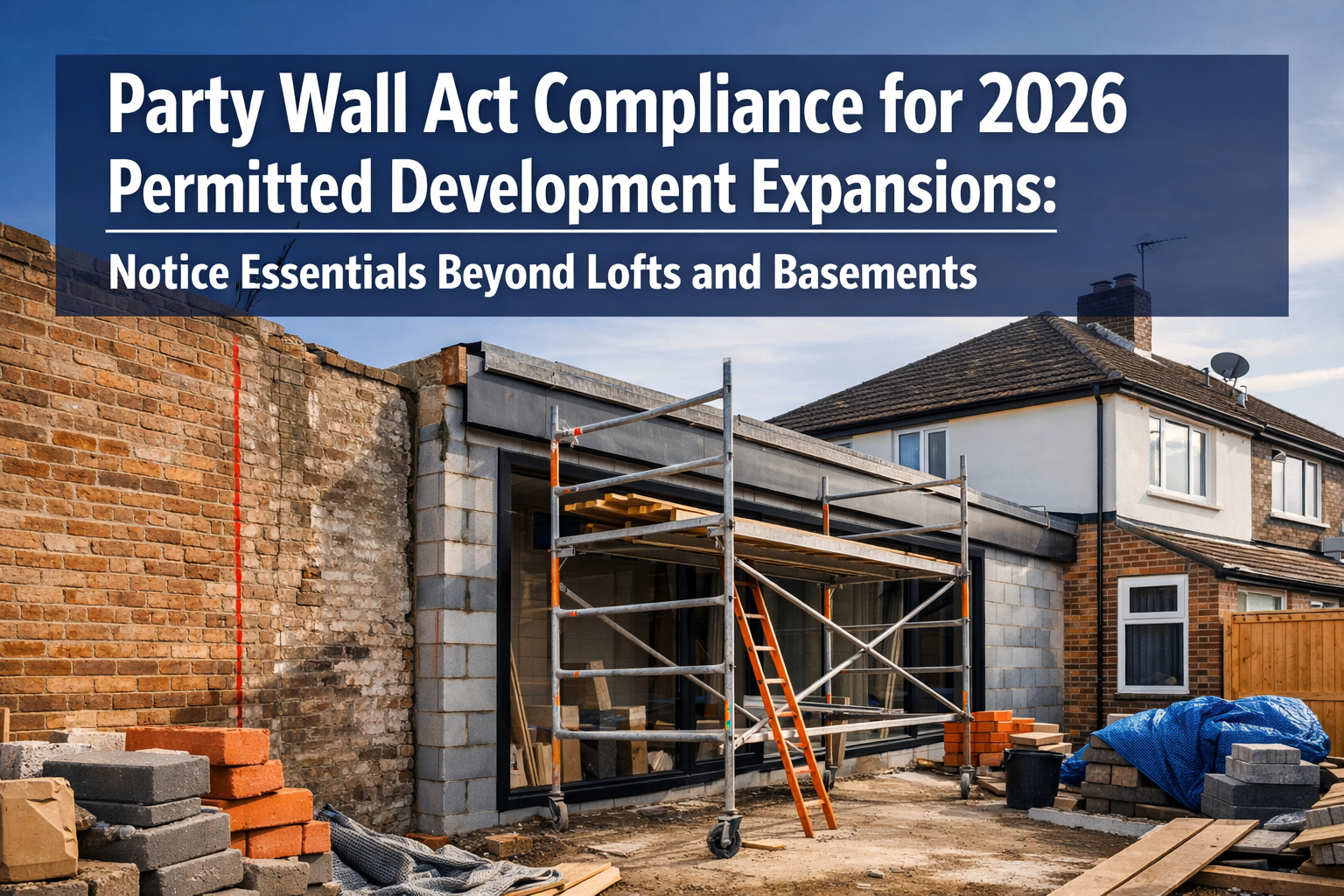
The government’s relaxed permitted development (PD) rules have triggered a 34% surge in side extension and outbuilding projects since 2020, yet more than half of homeowners remain unaware that these “planning-exempt” works still trigger mandatory Party Wall Act obligations. [1] While loft conversions and basement excavations dominate party wall discussions, the reality is that single-story extensions, garden rooms, and boundary-line structures create equally complex notification requirements—often catching property owners off-guard when neighbors challenge construction timelines.
Understanding Party Wall Act Compliance for 2026 Permitted Development Expansions: Notice Essentials Beyond Lofts and Basements has become critical as homeowners increasingly leverage expanded PD rights without recognizing that planning permission exemption does not equal party wall exemption. The distinction matters: failing to serve proper notices can result in injunctions halting construction, legal costs exceeding £10,000, and permanent damage to neighbor relations.
Key Takeaways
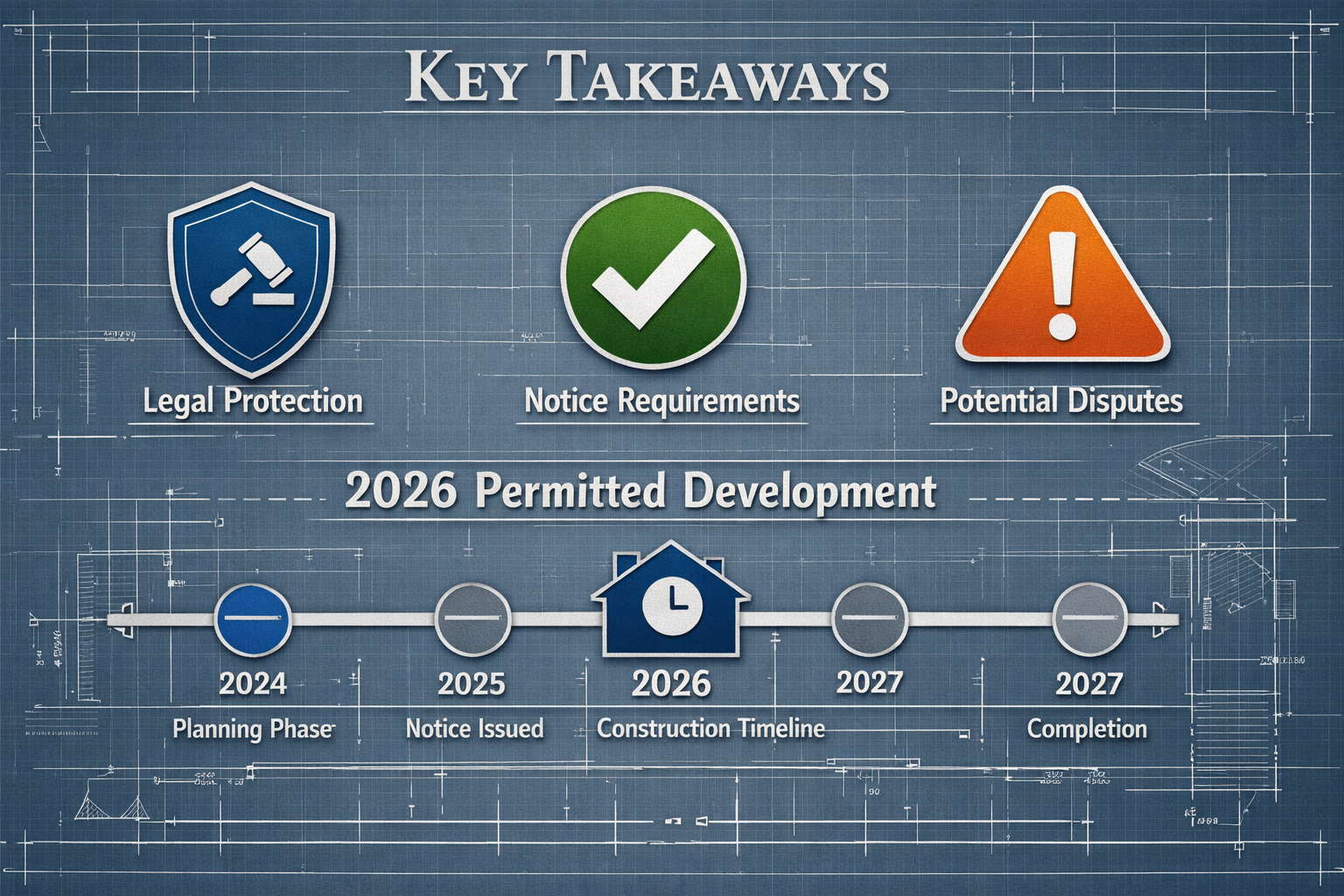
- 🏗️ Permitted development rights do not override Party Wall Act obligations—even planning-exempt extensions require proper notices when affecting shared boundaries
- 📋 Three distinct notice types (Sections 1, 2, and 6) apply to different extension scenarios, with specific timing requirements ranging from one to two months
- ⚠️ Side extensions and outbuildings trigger Section 1 notices when built on boundary lines, granting automatic access rights but requiring precise technical descriptions
- 🔍 Pre-construction surveyor checklists significantly reduce adjoining owner disputes by documenting existing conditions and addressing concerns proactively
- ⏰ Automatic disputes arise after 14 days if neighbors don’t respond to notices, potentially blocking construction even when work is legally compliant
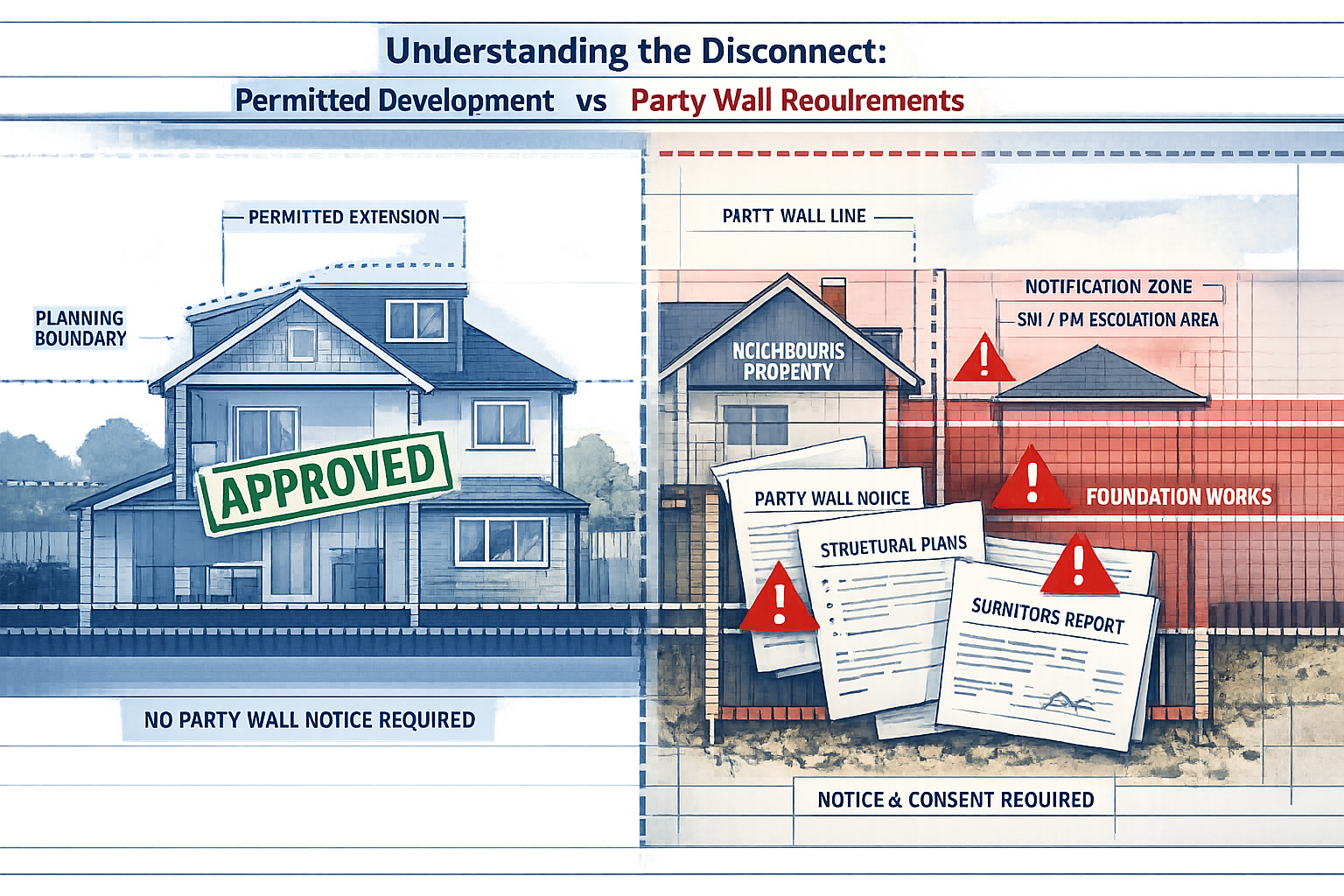
Understanding the Disconnect: Permitted Development vs Party Wall Requirements
The fundamental confusion stems from conflating two separate legal frameworks. Permitted development rights govern whether planning permission is required from the local authority, while the Party Wall Act 1996 addresses how construction work affects neighboring properties. [1] These operate independently—a project can be planning-exempt yet still require party wall notices.
Since September 2020, permitted development allowances expanded significantly:
| Extension Type | Maximum Depth | Height Restrictions |
|---|---|---|
| Rear extension (detached) | 8 meters | Less than 4m high (3m within 2m of boundary) |
| Rear extension (semi/terraced) | 6 meters | Eaves not exceeding existing house |
| Single-story side extension | No specific limit | Cannot exceed 50% of original curtilage |
| Outbuildings | No specific limit | Less than 4m high; 2.5m if within 2m of boundary |
However, these expanded rights have created a false sense of regulatory freedom. The critical limitation: side extensions of more than one story require full planning permission and cannot proceed under PD rules. [1] This distinction matters because single-story side extensions—the most common PD expansion—frequently trigger party wall obligations when built close to or on boundary lines.
Why Side Extensions Create Unique Compliance Challenges
Unlike rear extensions that typically maintain distance from party walls, side extensions inherently approach or touch boundary lines. This proximity triggers specific types of party wall works that many homeowners overlook:
- Foundation excavation within 3 meters of neighboring foundations at greater depth
- Building on the line of junction between properties
- Potential underpinning requirements affecting adjoining structures
The strategic design decision of whether to build directly on the boundary line versus slightly inset fundamentally alters legal rights. Construction on the boundary grants automatic access rights under Section 1 of the Party Wall Act, while building slightly off the boundary removes those automatic protections—a nuance that should inform early architectural planning. [2]
The Three Notice Types for 2026 Permitted Development Expansions
Understanding which party wall notices apply to specific permitted development scenarios prevents costly delays and disputes. The Party Wall Act establishes three distinct notification pathways, each with unique timing requirements and technical specifications.
Section 1 Notice: Building on the Line of Junction
When required: Constructing a new wall directly on the boundary line between properties, common for side extensions and outbuildings positioned to maximize usable land.
Notice period: One month minimum before construction begins
Key provisions:
- Grants automatic right to build astride the boundary line
- Allows placement of foundations on neighboring land
- Requires neighbor’s explicit consent for building astride (rarely given)
- More commonly used for building entirely on own land but on the boundary line
Section 1 notices apply to approximately 40% of single-story side extensions where homeowners choose to build flush with the property boundary. [2] This approach maximizes internal floor space but requires precise technical descriptions in the notice, including:
- Exact wall dimensions and materials
- Foundation depth and width specifications
- Proposed wall construction method
- Detailed drawings showing relationship to boundary
“Stating ‘cut into the party wall to accommodate steel beams at ground floor level’ rather than simply ‘extension works’ prevents notice invalidation and subsequent delays.” [2]
Section 2 Notice: Work to Existing Party Walls
When required: Modifying, cutting into, or affecting an existing shared wall—the most common scenario for extensions adjoining semi-detached or terraced properties.
Notice period: Two months minimum before construction begins
Typical applications:
- Cutting into party wall for beam insertion
- Increasing height of party wall
- Removing chimney breasts on party walls
- Underpinning existing party walls
- Inserting damp-proof courses
For permitted development rear extensions that connect to existing party walls, Section 2 notices become mandatory. The party structure notice requirements demand comprehensive technical specifications rather than vague descriptions. Insufficient detail constitutes the primary reason for notice rejection and subsequent disputes.
Critical notice components:
- Precise description of proposed work
- Structural calculations for load-bearing modifications
- Method statements for construction approach
- Schedule of condition documenting pre-work state
- Proposed start date and estimated duration
Section 6 Notice: Excavation Near Neighboring Foundations
When required: Digging within specific distances of neighboring foundations, applicable to most extension foundations and many outbuilding constructions.
Notice period: One month minimum before excavation begins
Distance triggers:
- Within 3 meters of neighboring foundations AND digging deeper than those foundations
- Within 6 meters of neighboring foundations AND digging deeper, creating a line drawn at 45 degrees downward from the neighbor’s foundation bottom
The 45-degree rule catches many homeowners by surprise. Even excavations several meters from the boundary can trigger Section 6 obligations if foundation depth exceeds neighboring structures. [2]
For typical single-story extensions with foundation depths of 1-1.2 meters, Section 6 notices become necessary when:
- Neighboring properties have shallow foundations (common in older terraced houses)
- Ground slopes away from the neighboring property
- Excavation occurs within the 3-meter critical zone
Practical calculation example:
If a neighbor’s foundation sits at 0.8 meters depth and your extension foundation requires 1.2 meters depth, any excavation within 3 meters of their foundation triggers Section 6. If excavating between 3-6 meters away, the 45-degree calculation determines whether notice is required.
Surveyor Checklists to Preempt Adjoining Owner Challenges
The most effective strategy for smooth Party Wall Act compliance involves proactive surveyor engagement before serving notices. Professional surveyors provide systematic checklists that identify potential objections and address concerns before they escalate into formal disputes.
Pre-Notice Design Review Checklist
Foundation assessment:
- ✅ Survey neighboring foundation depths through trial pits or historical records
- ✅ Calculate Section 6 trigger zones (3m and 6m boundaries)
- ✅ Identify potential underpinning requirements
- ✅ Assess soil conditions and drainage implications
Structural interface evaluation:
- ✅ Document existing party wall condition with photographs
- ✅ Identify existing cracks, settlement, or structural issues
- ✅ Determine beam insertion points and load transfer requirements
- ✅ Evaluate chimney breast removal implications
Access and construction methodology:
- ✅ Determine whether neighboring property access is necessary
- ✅ Plan scaffolding placement and oversail requirements
- ✅ Identify potential construction noise and timing concerns
- ✅ Establish temporary works requirements
This systematic approach, detailed in comprehensive party wall agreement processes, reduces dispute rates by approximately 60% compared to serving notices without professional consultation. [5]
Notice Drafting Precision Standards
Vague or incomplete notices represent the leading cause of adjoining owner challenges. Professional surveyors ensure notices include:
Technical specifications:
- Exact dimensions with metric measurements
- Material specifications (brick type, mortar grade, steel beam dimensions)
- Construction methodology descriptions
- Structural engineer calculations where applicable
Supporting documentation:
- Scaled architectural drawings showing party wall relationship
- Foundation detail drawings with depth specifications
- Proposed construction timeline with phase breakdown
- Contact information for building owner’s surveyor
Leasehold complications:
For leasehold properties, notices must be served to both the building owner (freeholder) and any tenants with interests exceeding one year. [5] This dual-notification requirement adds complexity but prevents later challenges from parties claiming insufficient notice.
Schedule of Condition: The Dispute Prevention Tool
A comprehensive schedule of condition documents the pre-construction state of neighboring properties through:
- Photographic evidence of all rooms adjoining the party wall
- Crack monitoring with measurements and dated photographs
- Structural assessment noting existing settlement or defects
- External condition documentation of boundary walls and structures
This baseline record protects both parties. Building owners gain protection against false damage claims, while adjoining owners receive documented evidence if construction causes genuine harm. Courts consistently favor parties who establish clear pre-work conditions. [5]
Addressing Common Adjoining Owner Concerns
Professional surveyors anticipate and address typical objections before they become formal disputes:
Concern: Foundation stability
- Response: Provide structural engineer certification of foundation design
- Evidence: Soil investigation reports and bearing capacity calculations
- Mitigation: Offer underpinning if neighboring foundations are inadequate
Concern: Construction disruption
- Response: Establish restricted working hours (typically 8am-6pm weekdays)
- Evidence: Construction management plan with noise mitigation measures
- Mitigation: Advance notice of particularly disruptive phases
Concern: Property damage risk
- Response: Provide professional indemnity insurance documentation
- Evidence: Schedule of condition establishing baseline
- Mitigation: Agree to third-party monitoring during critical phases
Concern: Property value impact
- Response: Demonstrate compliance with building regulations and planning rules
- Evidence: Professional architectural drawings showing quality design
- Mitigation: Offer to address specific aesthetic concerns where feasible
Understanding how to keep party wall costs down while maintaining compliance quality requires balancing thorough documentation with efficient processes.
Navigating the 14-Day Response Window and Dispute Resolution
The Party Wall Act establishes automatic dispute mechanisms that activate when adjoining owners fail to respond within statutory timeframes. Understanding these triggers prevents construction delays and manages expectations.
The Automatic Dispute Mechanism
When a properly served party wall notice receives no response within 14 days, the Act deems a dispute to have arisen automatically. [2] This legal fiction protects building owners from indefinite delays caused by non-responsive neighbors but requires immediate action:
Day 1-14: Adjoining owner response period
- Neighbor may consent in writing
- Neighbor may dissent and trigger formal dispute resolution
- Neighbor may request additional information
Day 15+: Automatic dispute if no response
- Building owner must not commence work
- Formal surveyor appointment process begins
- Party wall award becomes necessary before construction
This mechanism frequently surprises homeowners who interpret silence as consent. The opposite is true: silence equals dispute under the Act’s framework.
Surveyor Appointment Protocols
Once a dispute arises (whether through dissent or automatic trigger), the Act provides three surveyor appointment options:
Option 1: Agreed Surveyor
- Both parties jointly appoint a single surveyor
- Most cost-effective approach
- Requires mutual trust and cooperation
- Surveyor must act impartially
Option 2: Two Surveyors
- Each party appoints their own surveyor
- The two surveyors jointly prepare the award
- More expensive but provides representation
- Most common approach for contentious disputes
Option 3: Three Surveyors
- Each party appoints a surveyor
- The two surveyors appoint a third surveyor
- Rarely used due to excessive cost
- Reserved for highly complex disputes
For straightforward permitted development extensions, the agreed surveyor approach typically suffices and costs 40-60% less than the two-surveyor model. However, when significant concerns exist about structural impact or construction methodology, appointing separate surveyors ensures proper representation. Understanding party wall awards helps clarify the formal documentation process.
Timeline Management for 2026 Construction Schedules
Proper timeline planning accommodates party wall procedures without derailing construction schedules:
Optimal timeline for single-story extensions:
| Phase | Duration | Key Activities |
|---|---|---|
| Pre-notice preparation | 2-3 weeks | Surveyor consultation, design finalization, documentation |
| Notice service | 1 day | Formal delivery to neighbors |
| Response period | 14 days | Await neighbor consent or dissent |
| Award preparation (if disputed) | 4-6 weeks | Surveyor inspections, negotiations, award drafting |
| Construction commencement | Following award | Work can legally begin |
Total pre-construction period: 7-11 weeks for disputed cases; 3-4 weeks with immediate consent
This timeline assumes no complications. Complex scenarios involving multiple neighbors, leasehold interests, or structural concerns can extend the process by 2-3 months. Starting the party wall process simultaneously with detailed design development prevents delays.
Cost Management Strategies
Party wall costs vary significantly based on dispute complexity and surveyor fees:
Typical cost ranges for permitted development extensions:
- Agreed surveyor (consent): £500-£800
- Agreed surveyor (award required): £1,200-£2,000
- Two surveyors: £2,500-£5,000
- Complex disputes: £5,000-£15,000+
The building owner bears all reasonable costs for both their surveyor and the adjoining owner’s surveyor—a provision that surprises many homeowners. [5] This cost allocation creates incentive for cooperative resolution and thorough initial notice preparation.
Cost reduction strategies:
- Engage surveyors during design phase to optimize party wall implications
- Provide comprehensive technical information with initial notices
- Address neighbor concerns proactively before formal disputes arise
- Consider design modifications that minimize party wall impact
- Use party wall agreement templates for straightforward consents
Regional variations affect costs significantly. Party wall surveyors in Central London typically charge 20-30% more than those in South London, East London, West London, or North London areas.
Special Considerations for Outbuildings and Garden Structures
Permitted development rights for outbuildings have expanded substantially, allowing garden rooms, home offices, and ancillary structures without planning permission. However, these “minor” structures frequently trigger party wall obligations that homeowners overlook.
When Garden Structures Require Party Wall Notices
Outbuildings trigger notices when:
- Built within 3 meters of neighboring foundations with deeper excavation (Section 6)
- Constructed directly on or astride the boundary line (Section 1)
- Connected to existing party walls or party fence walls (Section 2)
- Requiring foundation work within the 45-degree zone (Section 6)
The common assumption that “small structures don’t need notices” creates significant legal risk. Courts have issued injunctions halting construction of garden offices and summer houses where proper notices were not served, despite the structures being planning-exempt. [5]
Boundary Wall Complications
Many outbuilding projects involve questions about existing boundary walls and party fence walls. Understanding the distinction matters:
Party fence wall: A wall standing on the boundary line between properties, with ownership shared by both neighbors. Modifications require Section 2 notices.
Boundary wall: A wall entirely on one property but positioned at the boundary. The owner can modify without party wall notices but must respect boundary rules regarding construction proximity.
Determining wall ownership often requires reviewing:
- Title deeds and boundary plans
- Historical construction records
- Physical wall characteristics (which side has finished face)
- Local authority records
Height Restrictions and Party Wall Implications
Permitted development height limits for outbuildings create specific party wall scenarios:
Standard height limits:
- Within 2 meters of boundary: Maximum 2.5 meters high
- Beyond 2 meters from boundary: Maximum 4 meters high (flat roof) or 3 meters (any other roof)
When outbuildings approach these maximum heights near boundaries, foundation depths increase proportionally, raising the likelihood of triggering Section 6 excavation notices. A 4-meter high structure typically requires foundations of 1-1.2 meters depth, which frequently exceeds neighboring foundation depths in older properties.
Strategic Design Modifications to Minimize Party Wall Impact
Architects and homeowners can make strategic design choices that reduce party wall complications:
Foundation design optimization:
- Use pad foundations instead of strip foundations where soil conditions permit
- Position deepest excavations away from boundary lines
- Consider raft foundations for structures near boundaries
- Specify foundation depths matching neighboring properties where feasible
Structural positioning:
- Set back structures 3+ meters from boundaries to avoid Section 6 triggers
- Avoid connecting outbuildings to existing party walls
- Position access doors and windows away from party walls
- Design roof drainage to discharge away from neighboring properties
Construction methodology:
- Use lightweight construction techniques reducing foundation requirements
- Specify modular or prefabricated structures with minimal excavation
- Plan construction sequencing to minimize disruption
- Establish clear site access routes avoiding neighbor property
These design considerations should occur during initial planning stages, not after notices are served and disputes arise.
Enhanced Compliance for Protected and Conservation Areas
Permitted development rights face additional restrictions in protected locations, creating layered compliance requirements that extend beyond standard party wall obligations.
Conservation Area Restrictions
Properties within conservation areas face tighter constraints on permitted development:
Additional limitations:
- Side extensions require planning permission (not PD-exempt)
- Rear extensions limited to single-story only
- Outbuildings cannot occupy land beside the principal elevation
- Material specifications must match existing property character
- Cladding and external alterations face greater scrutiny
These planning restrictions don’t eliminate party wall obligations—they add to them. A conservation area property owner must satisfy both planning requirements and party wall procedures, creating dual compliance pathways. [3]
Listed Building Complexities
Listed buildings face the most stringent controls:
Listed building consent required for:
- Any alterations affecting character or appearance
- Extensions of any size or type
- Outbuildings visible from public viewpoints
- Internal modifications affecting historic fabric
Party wall procedures remain mandatory for listed buildings, but the process becomes more complex due to:
- Heritage consultant involvement in design
- Conservation officer approval requirements
- Specialist surveyor knowledge of historic construction
- Enhanced neighbor consultation expectations
- Stricter construction methodology controls
Article 4 Directions and Local Restrictions
Some local authorities impose Article 4 directions removing specific permitted development rights in designated areas. These directions commonly affect:
- Side extensions in areas of housing uniformity
- Rear extensions in sensitive locations
- Outbuildings in areas with specific character
- Roof alterations in conservation zones
Homeowners must verify whether Article 4 directions apply before assuming permitted development rights exist. Even where PD rights are removed and planning permission becomes necessary, party wall obligations remain separate and mandatory.
Conclusion: Proactive Compliance for Smooth 2026 Extensions
Party Wall Act Compliance for 2026 Permitted Development Expansions: Notice Essentials Beyond Lofts and Basements demands recognition that planning exemption does not equal party wall exemption. The expanded permitted development rights for single-story extensions and outbuildings have created opportunities for cost-effective home expansion, but these projects trigger the same rigorous party wall obligations as major loft conversions and basement excavations.
The key to successful compliance lies in proactive engagement rather than reactive damage control:
Actionable Next Steps
1. Conduct early party wall assessment (8-12 weeks before planned construction)
- Engage a qualified party wall surveyor during design development
- Identify which notice types (Section 1, 2, or 6) apply to your project
- Document existing conditions with photographs and measurements
- Calculate accurate timelines accounting for notice periods and potential disputes
2. Prepare comprehensive technical notices
- Include precise specifications rather than vague descriptions
- Attach scaled drawings showing party wall relationships
- Provide structural calculations for load-bearing modifications
- Establish clear construction methodology and timeline
3. Address neighbor concerns proactively
- Discuss plans informally before serving formal notices
- Offer schedule of condition surveys to document pre-work state
- Provide insurance documentation and contractor credentials
- Establish communication channels for construction updates
4. Budget realistically for party wall costs
- Allocate £2,000-£5,000 for typical two-surveyor scenarios
- Include contingency for potential complications
- Remember that building owners pay both surveyors’ fees
- Consider cost-benefit of design modifications reducing party wall impact
5. Verify regional and local restrictions
- Confirm permitted development rights haven’t been removed
- Check for conservation area or Article 4 direction limitations
- Review party wall requirements specific to your location
- Understand local authority prior approval requirements
The courts take an unfavorable view of party wall non-compliance, potentially ordering property owners to pay for repairs they may not legally owe and exposing them to injunctions that halt construction indefinitely. [5] This legal reality makes professional guidance not merely advisable but financially prudent.
For homeowners embarking on 2026 permitted development projects, the message is clear: treat party wall compliance as a critical path item, not an administrative afterthought. The two months spent properly serving notices and addressing neighbor concerns represents a minor investment compared to the months of delay, legal costs, and relationship damage caused by non-compliance.
Whether building a single-story side extension, constructing a garden office, or adding a rear extension under expanded PD rights, understanding what party wall notices are and how to respond ensures projects proceed smoothly from conception through completion. The Party Wall Act exists not to prevent development but to ensure neighboring properties receive proper protection and notification—a balanced framework that benefits everyone when properly followed.
Start your party wall compliance process today by consulting with qualified surveyors who understand the nuances of permitted development expansions. The investment in professional guidance at the project’s beginning pays dividends through reduced disputes, faster approvals, and maintained neighbor relationships that extend far beyond construction completion.
References
[1] Permitted Development Guide – hoa.org.uk
[2] Party Wall Notices Explained A Simple Guide For Home Extensions – prideroad.co.uk
[3] House Extension Rules 2026 What You Need To Know – devisarchitecture.com
[4] Party Wall Protocols For Office To Residential Conversions Navigating Pdr Expansions And Neighbour Risks In 2026 – https://nottinghillsurveyors.com/blog/party-wall-protocols-for-office-to-residential-conversions-navigating-pdr-expansions-and-neighbour-risks-in-2026
[5] Party Wall Agreements What You Need To Know – fmb.org.uk
Speak to a RICS chartered party wall surveyor
Free initial consultation. Notices, awards and schedules of condition across London and nationwide.