
More than 40% of neighbor disputes in England and Wales stem from boundary works and outbuilding construction—yet most property owners remain unaware of when the Party Wall Act 1996 applies to their garden projects. Understanding the precise thresholds that trigger formal notice requirements can save thousands in legal fees and preserve neighborly relations during construction.
Navigating Party Wall Notices for Boundary Fences and Outbuildings: Act Thresholds and Neighbor Consent Paths requires understanding when garden projects cross from simple DIY into regulated territory. The distinction between a straightforward fence repair and work requiring formal notices often confuses homeowners, leading to costly mistakes and strained relationships. This comprehensive guide clarifies exactly when you need formal consent, how to serve proper notices, and when informal agreements suffice.
Key Takeaways
- Boundary fences up to 2 metres (back garden) or 1 metre (front garden) typically don’t require Party Wall notices unless they involve building on the boundary line itself or excavating near existing structures [2]
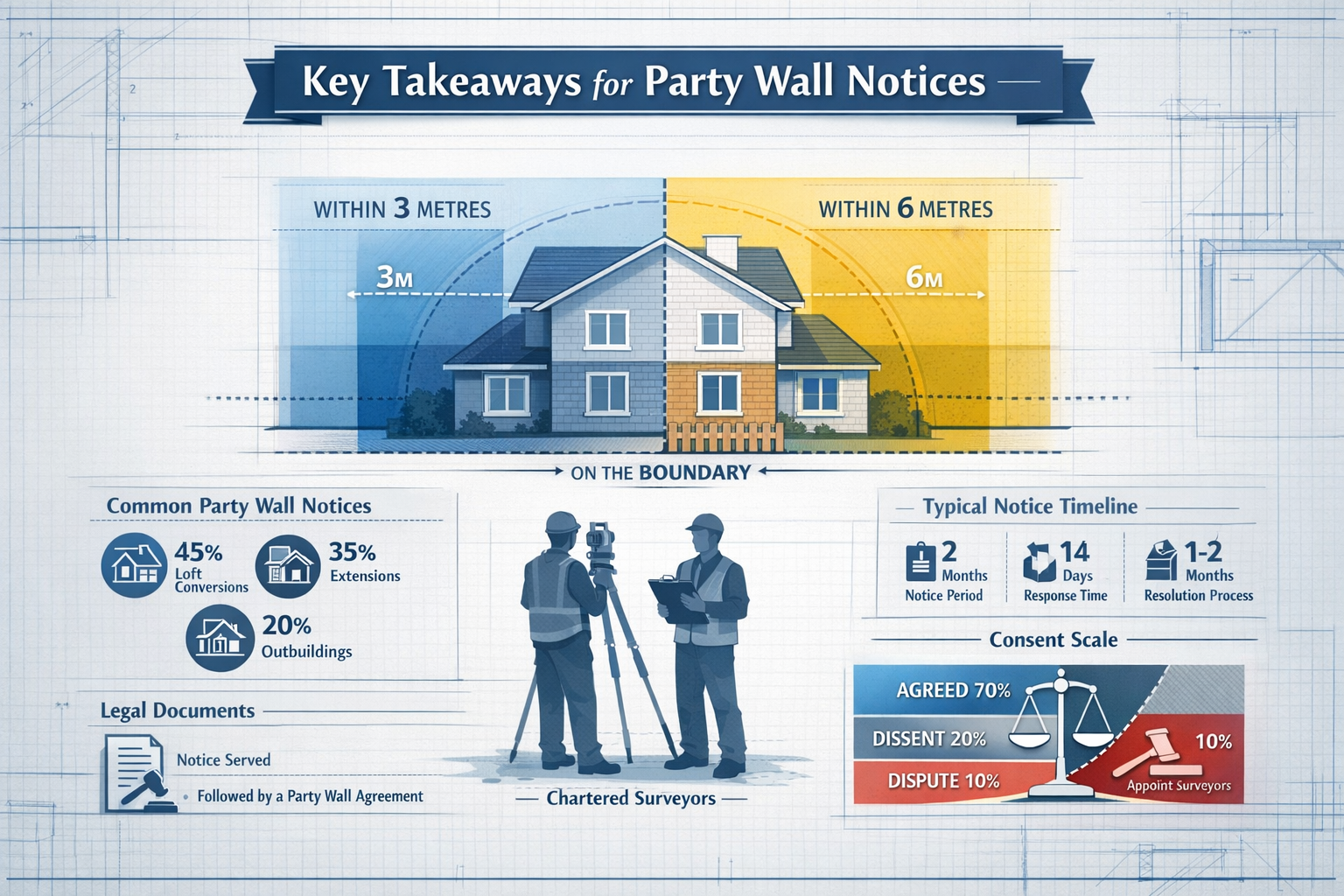
- New walls built directly on the boundary line or excavations within 3-6 metres of neighboring structures trigger mandatory notice periods of 1-2 months under the Party Wall Act 1996 [3][6]
- Garden outbuildings and sheds require formal notices only when foundations are within specific distances from the boundary or when they affect existing party structures
- Informal neighbor agreements work for minor projects, but formal Party Wall Awards with schedules of condition protect both parties for substantial works
- The Act applies exclusively to England and Wales, with different requirements in Scotland and Northern Ireland [3]
Understanding When Party Wall Notices for Boundary Fences and Outbuildings Apply
The Party Wall etc. Act 1996 establishes clear thresholds for when construction work near boundaries requires formal notification. However, the legislation distinguishes between different types of boundary works, creating confusion about which projects trigger notice requirements.
The Three Core Scenarios Requiring Notices
The Act covers three distinct situations relevant to boundary fences and outbuildings [1][5]:
- Section 1 Works: Building a new wall directly on the boundary line between properties
- Section 2 Works: Repairs, alterations, or modifications to existing party walls or party fence walls
- Section 6 Works: Excavations within 3 metres (if deeper than neighboring foundations) or 6 metres (for any excavation) of neighboring structures
Understanding what is a party fence wall versus a boundary fence is crucial for determining notice requirements.
Height Thresholds and Planning Permission
Standard boundary fences have specific height limits before planning permission becomes necessary [2]:
| Location | Maximum Height Without Planning Permission |
|---|---|
| Back Garden | 2 metres (6 feet 6 inches) |
| Front Garden | 1 metre (3 feet 2 inches) |
| Adjacent to Highway | 1 metre (3 feet 2 inches) |
| Conservation Areas | May require additional approvals |
Important distinction: These planning thresholds differ from Party Wall Act requirements. A fence within height limits may still require Party Wall notices if built directly on the boundary line or if excavation work affects neighboring structures [2].
When Fences DON’T Require Party Wall Notices
Most standard fence replacements and repairs fall outside Party Wall Act scope:
✅ No notice required for:
- Replacing existing fence panels on your own land
- Repairing fence posts within your boundary
- Installing fences entirely on your property (not on the boundary line)
- Fence work without excavation near neighboring foundations
- Maintenance work on existing boundary structures
These projects may still benefit from informal neighbor communication, but they don’t trigger formal legal requirements under the Act [3].
Act Thresholds for Outbuilding Construction and Foundation Work
Garden outbuildings—including sheds, garages, workshops, and summer houses—present more complex scenarios for Party Wall Notice requirements. The determining factors involve foundation depth, proximity to boundaries, and excavation extent rather than the building’s size or purpose.
The 3-Metre and 6-Metre Rules Explained
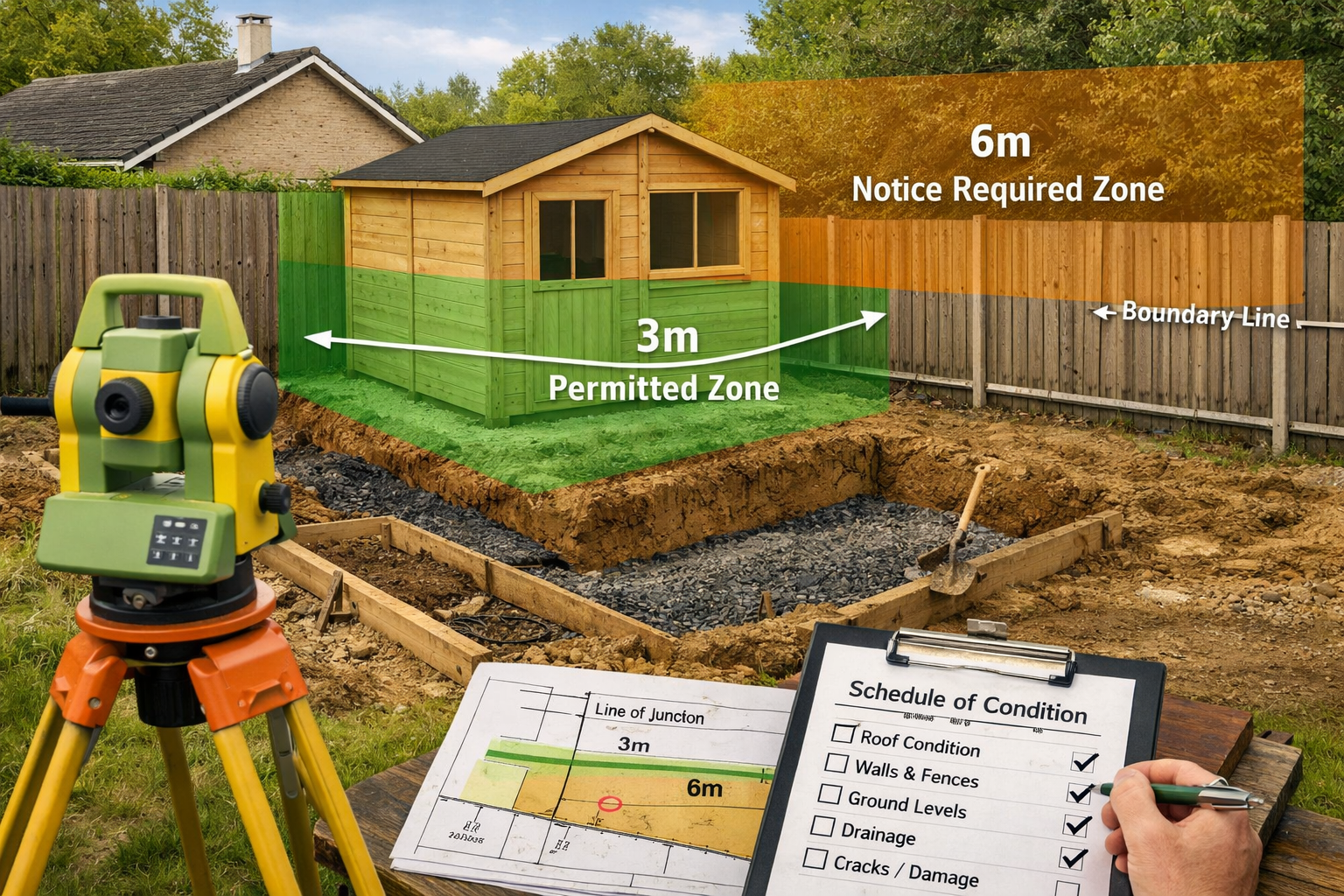
Section 6 of the Party Wall Act establishes distance-based thresholds for excavation work [6]:
3-Metre Rule 🏗️
- Applies when excavating within 3 metres of a neighboring building or structure
- Notice required only if your excavation goes deeper than your neighbor’s foundations
- Measured horizontally from the nearest point of the neighboring structure
6-Metre Rule 🏗️
- Applies when excavating within 6 metres of a neighboring building or structure
- Notice required regardless of depth if excavation creates a line drawn at 45 degrees from the bottom of your neighbor’s foundations
- More technical assessment often requiring professional surveyor input
Outbuilding Scenarios and Notice Requirements
Different outbuilding projects trigger different requirements:
| Outbuilding Type | Foundation Depth | Distance from Boundary | Notice Required? |
|---|---|---|---|
| Small shed on blocks | Minimal/none | Any distance | ❌ No |
| Medium shed with concrete base | 150-300mm | >6 metres | ❌ No |
| Large shed with strip foundations | 400-600mm | 2-6 metres | ⚠️ Possibly (depends on neighbor’s foundations) |
| Garage with deep foundations | 800mm+ | <3 metres | ✅ Yes |
| Workshop on boundary line | Any depth | 0 metres (on line) | ✅ Yes (Section 1) |
Special Considerations for Outbuildings
Existing party walls: If your outbuilding will attach to or affect an existing party wall (such as a shared boundary wall), this triggers Section 2 notice requirements regardless of distance [7].
Line of junction disputes: When property boundaries are unclear or disputed, the Party Wall Act provides mechanisms for resolution. Professional surveyors can establish the precise line of junction before construction begins, preventing future conflicts [7].
Permitted development rights: Even when outbuildings fall within permitted development for planning purposes, they may still require Party Wall notices if excavation or boundary work meets Act thresholds [2].
Professional Tip: “Most homeowners underestimate foundation depth requirements for outbuildings. Even modest garden structures often need foundations exceeding 450mm in clay soils, potentially triggering the 3-metre rule.” — Building Control Guidance
Understanding boundary wall rules and the difference between party fence walls and boundary walls helps clarify when your outbuilding project requires formal notices.
Neighbor Consent Paths: Informal Agreements vs. Formal Party Wall Awards
Once you’ve determined that your fence or outbuilding project requires neighbor involvement, you face a critical decision: pursue an informal agreement or follow the formal Party Wall Award process. Each path offers distinct advantages and protections.
The Informal Agreement Route
For straightforward projects with cooperative neighbors, informal agreements provide a simpler path:
✅ Best suited for:
- Minor boundary fence repairs or replacements
- Small outbuildings with minimal excavation
- Projects where neighbors have expressed support
- Work unlikely to cause structural concerns
- Situations where both parties have good existing relationships
Informal agreement essentials:
- Written documentation (even simple letters or emails)
- Clear description of planned work
- Agreed timelines and working hours
- Acknowledgment of potential temporary inconveniences
- Contact information for questions during construction
⚠️ Limitations of informal agreements:
- No legal protection if disputes arise later
- No formal schedule of condition documenting pre-work property state
- Difficult to enforce if neighbors change their minds
- May not satisfy mortgage lender or insurance requirements
- Provides no framework for resolving damage claims
The Formal Party Wall Award Process
The formal process under the Party Wall Act provides comprehensive legal protection for both building and adjoining owners [3]:
Step 1: Serve the Party Wall Notice 📋
- Use appropriate notice type (Party Wall Notice Section 1, 2, or 6)
- Provide 2 months advance notice for most party wall works [3][6]
- Provide 1 month advance notice for excavation or new boundary walls [3]
- Include detailed work descriptions, plans, and timelines
- Deliver to all affected adjoining owners
Step 2: Neighbor Response Period ⏰
- Neighbors have 14 days to respond in writing
- Three possible responses:
- Consent: Work proceeds without further formality
- Dissent: Triggers surveyor appointment process
- No response: Treated as dissent after 14 days [6]
Step 3: Surveyor Appointment 👷
- Building owner appoints their surveyor
- Adjoining owner either:
- Appoints their own surveyor (two-surveyor approach), or
- Agrees to use the building owner’s surveyor (agreed surveyor)
- If adjoining owner doesn’t appoint, building owner can appoint on their behalf [3]
Step 4: Schedule of Condition 📸
- Professional surveyors document existing condition of adjoining properties
- Includes photographs, measurements, and crack mapping
- Creates baseline for assessing any construction-related damage
- Essential protection for both parties [3]
Step 5: Party Wall Award Issued 📄
- Formal document detailing permitted work
- Specifies working hours, access rights, and procedures
- Establishes dispute resolution mechanisms
- Legally binding on both parties
- Valid for work commencing within 12 months [3]
Cost Considerations for Formal Awards
The building owner (person doing the work) typically bears all reasonable costs for the Party Wall Award process, including:
- Their own surveyor’s fees (£700-£1,500 typical)
- Adjoining owner’s surveyor fees (if separate surveyor appointed)
- Schedule of condition costs
- Award preparation and administration
For guidance on managing expenses, review strategies on how to keep party wall costs down.
Template Documents and Resources
Basic Informal Agreement Template:
[Date]
Dear [Neighbor's Name],

I am writing to inform you of my intention to [describe work:
e.g., "replace the boundary fence between our properties" or
"construct a garden shed with foundations approximately 4 metres
from our shared boundary"].

The work will involve:
- [Specific details]
- [Timeline]
- [Any temporary impacts]

I have reviewed the Party Wall Act requirements and believe this
work [does/does not] require formal notices because [reason].

If you have any concerns or questions, please contact me at
[contact details]. I am happy to discuss the project and address
any issues.

With kind regards,
[Your name]
For formal notices, professional templates and guidance are available through Party Wall Act notices resources, though many property owners benefit from professional surveyor assistance for complex projects.
When to Choose Each Path
Choose informal agreement when:
- Work clearly falls outside Act thresholds
- Neighbors are cooperative and communicative
- Project is straightforward with minimal risk
- Both parties understand and accept the limitations
Choose formal Party Wall Award when:
- Work definitively triggers Act requirements
- Significant excavation or structural work involved
- Neighbor relationship is strained or uncertain
- Property values are high, increasing damage risk
- Mortgage lenders or insurers require formal compliance
- You want comprehensive legal protection
Understanding how close your neighbor can build to your fence helps contextualize these decisions from both perspectives.
Line of Junction Disputes and Surveyor Resolution Steps
Boundary uncertainty creates one of the most challenging aspects of Party Wall Notices for Boundary Fences and Outbuildings. When property lines are unclear or contested, the Act provides specific mechanisms for resolution before construction begins.
Identifying Line of Junction Issues
Common indicators of boundary disputes:
- 🚩 Conflicting property title plans showing different boundary positions
- 🚩 “T” marks on deeds that don’t align with physical fences or walls
- 🚩 Historical boundary movements or encroachments
- 🚩 Missing or damaged boundary markers
- 🚩 Disagreement about fence ownership and maintenance responsibility
Property deeds typically mark ownership with “T” symbols (single owner responsibility) or “H” symbols (shared party wall responsibility) [2]. However, these marks may not reflect current physical boundaries, especially in older properties.
Surveyor-Led Resolution Process
When boundary disputes arise during Party Wall Notice procedures, professional surveyors follow established protocols:
Phase 1: Documentary Evidence Review 📋
- Examine title deeds and Land Registry plans
- Review historical planning applications and building control records
- Analyze previous surveys and boundary agreements
- Identify any registered boundary determinations
Phase 2: Physical Site Assessment 📐
- Conduct precise measurements using professional surveying equipment
- Document existing structures, fences, and boundary markers
- Photograph evidence of boundary features
- Compare physical reality with documentary evidence
Phase 3: Negotiated Settlement 🤝
- Present findings to both parties
- Facilitate discussions between building and adjoining owners
- Propose practical boundary solutions
- Draft agreed boundary positions if consensus reached
Phase 4: Party Wall Award with Boundary Determination ⚖️
- If agreement reached, incorporate boundary determination into Award
- Specify exact line of junction for construction purposes
- Note that Party Wall Awards don’t legally determine ownership (only Land Registry or courts can do this)
- Provide sufficient clarity for construction to proceed safely
When Boundary Disputes Can’t Be Resolved
If surveyors cannot facilitate agreement on the boundary line, several options exist:
- Proceed with conservative approach: Build entirely within undisputed land, avoiding contested areas
- Seek Land Registry boundary determination: Formal legal process establishing registered boundaries
- Court proceedings: Last resort for intractable disputes, involving significant legal costs
- Mediation services: Alternative dispute resolution before litigation
For projects in specific areas, local expertise proves invaluable. Property owners can consult specialists such as party wall surveyors in Central London, East London, South London, North London, or West London depending on property location.
Special Circumstances and Exemptions
Several scenarios create exceptions or special considerations for Party Wall Notices for Boundary Fences and Outbuildings:
Works Explicitly NOT Requiring Notices
The following common projects fall outside Party Wall Act scope [3]:
❌ Internal-only work:
- Plastering existing walls
- Electrical installations not affecting structure
- Plumbing work within your property
- Decorating and non-structural alterations
❌ Minor external work:
- Painting boundary fences or walls
- Replacing like-for-like fence panels
- Garden landscaping without excavation near boundaries
- Installing trellis or screening on existing structures
Conservation Areas and Listed Buildings
Properties in conservation areas or with listed building status face additional requirements [2]:
- Standard height restrictions may not apply: Local authorities may impose stricter limits
- Materials and appearance regulations: Fencing and outbuilding materials may require approval
- Additional planning permissions: Even permitted development may need consent
- Party Wall Act still applies: Conservation status doesn’t exempt properties from Act requirements
Leasehold Properties and Shared Ownership
Leasehold and shared ownership properties add complexity:
- Lease terms may restrict boundary work: Check lease covenants before planning
- Freeholder consent often required: Separate from Party Wall notices
- Management company involvement: May need approval for external alterations
- Service charge implications: Boundary work might affect shared maintenance responsibilities
Commercial and Mixed-Use Properties
When residential properties adjoin commercial premises:
- Same Party Wall Act applies: No exemptions for commercial neighbors
- Different working hour expectations: Commercial premises may accept extended working times
- Higher damage risk concerns: Commercial operations may have specific vibration or access sensitivities
- Insurance considerations: Commercial property insurance may require more extensive documentation
Practical Timeline for Fence and Outbuilding Projects
Planning your project timeline around Party Wall Notice requirements prevents costly delays:
Recommended Project Timeline
8-12 Weeks Before Construction: 🗓️
- Finalize design and obtain planning permission (if required)
- Determine whether Party Wall notices are necessary
- Identify all adjoining owners requiring notices
- Commission boundary surveys if line of junction unclear
6-8 Weeks Before Construction: 📨
- Serve Party Wall notices (2 months for Section 1/2 works, 1 month for Section 6)
- Provide comprehensive work descriptions and plans
- Include contact information for questions
4-6 Weeks Before Construction: ⏰
- Await neighbor responses (14-day response period)
- Appoint surveyors if dissent received or no response given
- Begin schedule of condition process
2-4 Weeks Before Construction: 📄
- Complete schedule of condition surveys
- Receive and review Party Wall Award
- Address any Award conditions or requirements
- Finalize contractor arrangements
Construction Phase: 🔨
- Comply with Award terms (working hours, access, methods)
- Maintain communication with neighbors
- Document progress with photographs
- Address concerns promptly
Post-Construction: ✅
- Conduct final inspection with surveyors if required
- Address any damage claims within Award framework
- Obtain completion certificates
- Archive all Party Wall documentation
Remember: Work can commence up to 12 months after serving Party Wall notices, providing flexibility if project delays occur [3].
Common Mistakes to Avoid
Learning from others’ errors saves time, money, and neighborly goodwill:
Top 10 Pitfalls in Party Wall Notices for Boundary Fences and Outbuildings
-
Assuming height compliance means no notices needed ❌
- Planning permission thresholds differ from Party Wall Act triggers
- A permitted 2-metre fence may still require notices if built on the boundary line
-
Serving notices too late ⏰
- Minimum 2-month notice for most works cannot be shortened
- Late notices delay entire project timelines
-
Incomplete or vague notice descriptions 📝
- Insufficient detail gives neighbors grounds for dissent
- Ambiguous plans create enforcement difficulties later
-
Failing to identify all adjoining owners 🏘️
- Must serve notices to all affected neighbors, not just immediate adjacent property
- Missing even one adjoining owner invalidates the process
-
Ignoring the 3-metre and 6-metre excavation rules 📏
- Many homeowners underestimate how far these distances extend
- Foundation depth calculations require accurate neighbor foundation information
-
Relying on verbal agreements alone 🗣️
- Verbal consent provides no legal protection
- Always document agreements in writing, even informal ones
-
Skipping schedule of condition 📸
- Pre-existing damage becomes impossible to distinguish from construction damage
- Neighbors can claim any defects arose from your work
-
Proceeding before Award issued 🚫
- Starting work before formal Award creates legal liability
- Neighbors can seek injunctions stopping construction
-
Inadequate insurance coverage 🛡️
- Standard home insurance may not cover Party Wall Act disputes
- Contractor insurance should include adjoining property damage
-
Poor communication during construction 📞
- Unexpected noise, dust, or disruption strains relationships
- Regular updates and responsive communication prevent escalation
Regional Variations and Jurisdictional Limits
Understanding where Party Wall Notices for Boundary Fences and Outbuildings apply prevents confusion about requirements:
England and Wales: Full Act Application
The Party Wall etc. Act 1996 applies throughout England and Wales [3][5]. All provisions discussed in this guide govern construction work in these jurisdictions.
Scotland: Different Framework
Scotland operates under separate common law principles rather than the Party Wall Act [3]:
- No statutory Party Wall Act equivalent
- Boundary work governed by common law and local building standards
- Neighbor consent requirements differ significantly
- Professional advice specific to Scottish law essential for projects there
Northern Ireland: Distinct Regulations
Northern Ireland has its own property and construction regulations [3]:
- Party Wall Act 1996 does not apply
- Different statutory frameworks govern boundary work
- Local planning and building control requirements vary
- Consult Northern Ireland-specific legal guidance
Cross-Border Properties
Properties straddling England-Wales border or near Scottish/Northern Irish borders should:
- Determine which jurisdiction governs based on property location
- Seek specialist legal advice for unusual boundary situations
- Apply the most stringent requirements when uncertainty exists
Conclusion
Navigating Party Wall Notices for Boundary Fences and Outbuildings: Act Thresholds and Neighbor Consent Paths requires understanding precise legal triggers, following proper notice procedures, and choosing appropriate consent pathways for your specific project. The distinction between work requiring formal Party Wall Awards and projects suitable for informal agreements can save thousands in costs while protecting your legal position.
Key principles to remember:
✅ Know your thresholds: 2-metre back fence height, 1-metre front fence height, 3-metre and 6-metre excavation rules
✅ Serve timely notices: 2 months for most party wall works, 1 month for excavations and new boundary walls
✅ Document everything: Written agreements, schedules of condition, and photographic evidence protect all parties
✅ Engage professionals when needed: Complex projects, boundary disputes, and high-value properties warrant surveyor involvement
✅ Maintain good neighbor relations: Communication and transparency prevent disputes before they escalate
Your Next Steps
For building owners planning fence or outbuilding projects:
- Assess your project against Act thresholds using the criteria in this guide
- Check your property deeds for boundary markings and ownership indicators
- Measure distances from your planned work to neighboring structures accurately
- Decide on consent path: informal agreement for simple projects, formal Award for complex work
- Serve notices early or initiate neighbor conversations well before construction dates
- Engage qualified surveyors for projects triggering formal requirements
For adjoining owners receiving notices:
- Review notices carefully within the 14-day response period
- Seek clarification on any unclear aspects of proposed work
- Consider appointing your own surveyor for substantial projects
- Understand your rights under the Act, including schedule of condition protections
- Respond in writing even if consenting to create documentation
Resources for further guidance:
- Review types of party wall works to understand which category applies to your project
- Explore party wall awards to understand the formal process outcomes
- Calculate costs of the party wall process for budget planning
- Consider whether you can proceed with a party wall agreement without a surveyor for simpler projects
The Party Wall Act exists to protect both building and adjoining owners during construction work near boundaries. Understanding when formal processes apply—and when simpler approaches suffice—empowers property owners to proceed confidently with fence and outbuilding projects while maintaining positive neighbor relationships and legal compliance.
Whether you’re installing a garden fence, constructing a substantial outbuilding, or simply replacing boundary panels, knowing the thresholds and consent paths ensures your project proceeds smoothly from planning through completion in 2026 and beyond.
References
[1] Party Walls – lexisnexis.co.uk
[2] Boundary Fence Rules – wadebuildingsupplies.co.uk
[3] Party Wall Agreement – hoa.org.uk
[4] Ftc Announces 2026 Jurisdictional Threshold Updates Interlocking Directorates – ftc.gov
[5] What Is The Party Wall Act – buonconstruction.com
[6] When How Tell Them – gov.uk
[7] Understanding Party Fence Walls And Boundary Walls – acdesignsolution.com
Speak to a RICS chartered party wall surveyor
Free initial consultation. Notices, awards and schedules of condition across London and nationwide.