Last updated: September 28, 2026
Kensington & Chelsea alone processes basement planning applications by the dozen every year, and surveyors working across that borough report that almost every one of those schemes triggers Section 6 of the Party Wall etc. Act 1996. As London’s autumn 2026 construction season picks up pace, London basement extension party wall act 2026 section 6 disputes are becoming one of the most common flashpoints between neighbours on terraced and semi-detached streets across the capital.
Quick answer
Section 6 of the Party Wall etc. Act 1996 applies to almost every London basement extension because it governs excavation near a neighbour’s structure, not just shared walls. If your dig comes within 3 metres of an adjoining building and goes deeper than its foundations, or within 6 metres and cuts a line drawn down from its foundations at 45 degrees, you must serve notice. Disputes usually arise from vague notices, missed deadlines, or disagreement over damage risk, and most are resolved through a Party Wall Award rather than court.
Key takeaways
- Section 6 notice is required for basement digs within 3 metres (any depth deeper than the neighbour’s foundations) or 6 metres (if the excavation line intersects the neighbour’s foundation at 45 degrees).
- Notice must be served at least one month before work starts, in writing, with plans and calculations for deep basements.
- Ignoring Section 6 can lead to injunctions, stopped works, and personal liability for damage, even if planning permission was granted.
- Adjoining owners have 14 days to consent, dissent, or stay silent, silence after 14 days is treated as dissent.
- An Agreed Surveyor is cheaper and faster for straightforward basements, two-surveyor panels suit contentious or high-risk digs.
- Taylor v Jones & another [2024] EWCA Civ 170 reinforces that Awards must clearly cover damage compensation and that surveyors’ decisions carry real legal weight.
- There is no formal appeal against a Party Wall Award, only a court challenge within 14 days on limited grounds.
- Basement Awards in 2026 increasingly include monitoring schedules, method statements, and structural safeguards, not just a schedule of condition.
What is the party wall act Section 6 and how does it apply to basement extensions
Section 6 covers excavation near a neighbouring owner’s building or structure, separately from the wall-related provisions in Sections 1 and 2. It exists specifically because deep digs can undermine a neighbour’s foundations even when no shared wall is touched.
The rule has two distance tests, and either one can trigger the Act:
- The 3-metre rule: if any part of the proposed excavation is within 3 metres of the adjoining building and will go deeper than the bottom of that building’s foundations.
- The 6-metre rule: if the excavation is within 6 metres and would cut a line drawn at 45 degrees downward from the bottom of the neighbour’s foundations.
Basements almost always fail one of these tests because they dig deeper than typical Victorian or Edwardian footings, which sit relatively shallow. A single-storey basement under a terraced house in Fulham or Islington, for example, routinely triggers the 3-metre rule on both party wall lines, and can trigger the 6-metre rule on a rear extension foundation too.
Choose Section 6 as the relevant trigger if the works involve digging a hole, shaft, or trench near a boundary. Choose Section 2 instead if the work only involves cutting into, underpinning, or raising an existing party wall without separate excavation nearby. Many basement projects need notices under both sections, and the “Guide On Boundary Wall Rules” resource on the difference between party fence walls and boundary walls is a useful companion for understanding which structures count as party walls versus simple boundary features.
Do I need Party Wall Act notice for a shallow basement extension in London
Shallow basements can still need Section 6 notice if they meet the 3-metre or 6-metre depth-and-distance tests, regardless of how “shallow” the dig feels compared to a full-depth basement conversion.
Depth is measured against the neighbour’s foundation depth, not against ground level. A basement that only drops 1.5 metres below existing ground floor level can still be deeper than a neighbour’s shallow strip foundation, which in older London housing stock is often less than a metre down. Homeowners assuming a light-touch dig is exempt is one of the most frequent planning mistakes on these projects.
Decision rule: if a structural engineer’s excavation plan shows any point closer than 6 metres to next door, get the boundary distances checked against both statutory tests before assuming notice isn’t needed. When in doubt, serve notice, because the cost of an unnecessary notice is far lower than the cost of an injunction.
Party Wall Act Section 6 dispute resolution process London 2026
The dispute resolution process runs through Party Wall Awards produced by appointed surveyors, not through the courts, unless someone challenges the Award itself. This keeps most basement disputes out of litigation and inside a structured, deadline-driven framework.
The standard sequence looks like this:
- Building owner serves Section 6 notice with plans, sections, and (for basements) usually a structural method statement.
- Adjoining owner has 14 days to consent, dissent, or stay silent.
- Silence after 14 days is deemed dissent, which then requires surveyor appointment.
- Surveyors inspect the site, record a schedule of condition on the adjoining property, and negotiate terms.
- An Award is issued covering working hours, methodology, monitoring, security for expenses, and cost allocation.
- Either owner has 14 days from the Award to challenge it in the County Court, on limited procedural or substantive grounds.
2026 RICS-aligned guidance for practitioners places heavy emphasis on basement-specific content within Awards: monitoring regimes for movement, trigger levels for stopping work, and clear method statements for underpinning sequences. This reflects the higher risk profile of deep excavation compared with a simple wall-related job. For a broader look at how Awards are structured, see the dedicated page on party wall awards.
Party Wall Act Section 6 disputes London basement extension costs, who pays
The building owner undertaking the basement work pays for the Party Wall process in almost all cases, including the adjoining owner’s surveyor fees, unless the Award specifies otherwise. This is standard practice under the Act because the excavating owner is the one creating the risk.
Typical cost categories include:
| Cost item | Who typically pays | Notes |
|---|---|---|
| Notice preparation and service | Building owner | Often done via a surveyor or solicitor |
| Agreed Surveyor fee | Building owner | Single fee for both parties |
| Two-surveyor panel fees | Building owner (both surveyors) | Higher total cost than one Agreed Surveyor |
| Schedule of condition survey | Building owner | Protects both sides with photographic record |
| Structural monitoring during works | Building owner | Common on basement digs, ongoing cost |
| Adjoining owner’s own legal advice | Adjoining owner (usually) | Unless Award allocates otherwise |
For more detail on how these figures build up in practice, the guide on costs of the party wall process breaks down typical fee ranges, and the article on how to keep party wall costs down covers practical ways to control spend without cutting corners on safety.
How much does a party wall surveyor cost for a basement extension in London
Basement projects typically cost more in surveyor fees than standard loft or rear extension work because the risk, inspection frequency, and Award complexity are all higher. An Agreed Surveyor arrangement is usually the cheaper route when both owners are cooperative.
As a general guide for London basement schemes in 2026:
- Agreed Surveyor (one surveyor acting for both owners): typically the most cost-effective option for straightforward basements with no history of neighbour conflict.
- Two-surveyor panel (each owner appoints their own, who then appoint a Third Surveyor if needed): costs more because two professionals bill separately, but gives each owner independent representation.
- Ongoing monitoring visits during excavation add to the total, and should be budgeted as a separate line item rather than assumed to be included in the initial Award fee.
Choose an Agreed Surveyor if the adjoining owner is broadly supportive and the project is a single basement under one property with no unusual ground conditions. Choose a two-surveyor panel if there’s already tension, multiple adjoining owners are affected (common with stacked flats), or the excavation is unusually deep or close to a listed building.
Common dispute triggers on London basement schemes
Most Section 6 disputes trace back to a handful of recurring problems rather than genuine disagreement about whether the work should happen at all.
- Vague or incomplete notices: missing structural calculations, unclear excavation depths, or no method statement. 2026 commentary from party wall specialists flags this as the single biggest cause of delay and dispute.
- Mis-identified adjoining owners: especially in stacked flats above or beside the basement site, where leaseholders, freeholders, and management companies all have separate rights and need separate notices.
- Missed or rushed notice periods: serving notice too close to the planned start date and then trying to push work forward before the 14-day and one-month periods have run.
- No schedule of condition: starting work without an agreed, photographed record of the neighbour’s property, which makes later damage claims hard to prove either way.
- Disagreement over monitoring and trigger levels: how much movement is acceptable before work pauses, and who decides.
Common mistakes with Party Wall Act Section 6 London basement extensions
The most damaging mistake is starting excavation before notice periods expire or before an Award is in place, because this removes the legal protection the Act gives to both sides and can lead to an injunction stopping the entire project.
Other frequent errors include:
- Treating Section 6 as optional because planning permission was already granted. Planning and party wall consent are entirely separate legal processes.
- Serving a generic notice template without basement-specific technical detail, which adjoining owners’ surveyors will often reject and send back for revision.
- Failing to notify every relevant adjoining owner in a block of flats, not just the ground-floor neighbour.
- Assuming a friendly relationship with the neighbour removes the need for a written Award. Verbal agreements offer no protection if a dispute or damage claim arises later.
- Not budgeting time for the two-surveyor process, which typically takes longer than an Agreed Surveyor route.
The free downloadable sample party wall agreement template can help homeowners understand what a properly drafted notice should contain before instructing a surveyor.
What happens if you don’t follow Party Wall Act Section 6 on a London basement
Skipping Section 6 notice on a basement dig exposes the building owner to an injunction that can halt work immediately, plus personal liability for any damage caused to the neighbouring property. Courts have consistently supported adjoining owners in these situations because the Act exists precisely to protect against uncompensated foundation damage.
Practical consequences include:
- Work stoppage orders from the court, sometimes with contractors and equipment already on site.
- Direct liability for cracking, subsidence, or foundation movement, without the negotiated protections an Award would have provided.
- Difficulty obtaining a resolution later, since starting without notice damages trust and often pushes adjoining owners straight to a two-surveyor process instead of an Agreed Surveyor.
- Potential complications with mortgage lenders or future property sales, since unresolved party wall issues frequently surface in conveyancing searches.
Can you appeal a Party Wall Act Section 6 surveyor decision
There is no informal appeal against a Party Wall Award, but either owner can challenge it in the County Court within 14 days of the Award being served, on specific legal or procedural grounds. This is a narrow route, not a general re-hearing of the dispute.
Valid grounds typically include procedural errors (such as an invalidly appointed surveyor), a decision that goes beyond the surveyor’s powers under the Act, or a clear factual or legal mistake in the Award itself. Simply disagreeing with the outcome is not enough.
Taylor v Jones & another [2024] EWCA Civ 170 is a key recent authority in this area. The Court of Appeal’s reasoning reinforced that Awards need to clearly address damage compensation and that surveyors’ decisions, once properly made, carry substantial legal weight and are not easily overturned. For basement projects specifically, this case has encouraged surveyors to draft more detailed damage provisions into Awards from the outset, rather than leaving compensation terms vague and open to later dispute.
Basement extension Party Wall Act Section 6 insurance and liability
Standard buildings insurance rarely covers damage caused by a neighbour’s basement excavation, which is why the Party Wall Award itself, backed by adequate security for expenses, is the main protection adjoining owners have. Building owners undertaking basement works should also confirm contractor liability cover before work starts.
Key points on liability:
- The building owner is liable for damage caused by the works, even if a contractor performed the excavation, unless the contract states otherwise.
- Awards for basement projects increasingly require the building owner to provide a bond or security for expenses, held until work completes safely.
- Adjoining owners should check their own buildings insurance policy for exclusions relating to excavation or subsidence near their property before works start next door.
- A schedule of condition, agreed before work begins, is the practical evidence base for any later liability or insurance claim.
Agreed Surveyor vs two surveyors for basement disputes
An Agreed Surveyor works for both owners jointly and suits low-conflict basement projects, while a two-surveyor panel gives each owner independent representation and suits higher-risk or already contentious digs.
| Factor | Agreed Surveyor | Two-surveyor panel |
|---|---|---|
| Cost | Lower, one fee | Higher, two fees plus possible Third Surveyor |
| Speed | Generally faster | Slower, more coordination needed |
| Independence | Shared professional, neutral duty | Each owner has dedicated representation |
| Best suited to | Cooperative neighbours, single basement | Multiple adjoining owners, prior conflict, complex ground |
If talks stall, either surveyor can refer the matter to a jointly selected Third Surveyor, whose decision on that specific point is binding. This structure is what makes London basement extension party wall act 2026 section 6 disputes largely resolvable without ever reaching a courtroom.
Homeowner’s step-by-step timeline for a basement extension
- Design stage: instruct a structural engineer early and check excavation depth and distance against the 3-metre and 6-metre rules.
- Twelve weeks before start: identify every adjoining owner, including leaseholders in flats, and begin drafting notices.
- At least one month before start: serve Section 6 notice (and Section 2 notice if the party wall itself is affected), with plans and calculations attached. See guidance on what a party structure notice is and how to serve it.
- Within 14 days of service: track responses, consent, dissent, or silence, from each adjoining owner.
- If dissent or silence: appoint an Agreed Surveyor or begin the two-surveyor process.
- Before excavation: complete a schedule of condition on all adjoining properties and finalise the Award.
- During works: follow the monitoring schedule in the Award and pause immediately if trigger levels are reached.
- Post-completion: close out the Award, resolve any final account for surveyor costs, and retain the schedule of condition for future reference.
Adjoining owner’s checklist
- Read the notice carefully and check it names the correct owner, address, and works.
- Note the 14-day response deadline in writing.
- Do not ignore the notice, silence counts as dissent and starts the surveyor appointment process anyway.
- Ask for, or commission, a schedule of condition of your own property before work starts.
- Confirm who is paying for your surveyor, this should normally be the building owner.
- Check the Award includes monitoring provisions and a clear damage compensation clause.
- Keep records (photos, cracks, existing damp) independently, in addition to the formal schedule of condition.
- Contact a surveyor covering your area, for example a party wall surveyor in West London, South London, or North London, if you’re unsure how to respond.
Party Wall Act Section 6 basement extension neighbour objection, what to do
An objection or dissent from a neighbour is a normal part of the process, not a project-ending event, and it simply moves the dispute into the surveyor appointment stage rather than blocking the works outright.
Practical steps after an objection:
- Do not take the objection personally or escalate informally, respond through the formal surveyor process.
- Appoint a surveyor promptly rather than letting the 14-day window lapse without action.
- Be willing to adjust working hours, sequencing, or monitoring frequency if that resolves the neighbour’s specific concerns.
- Keep communication in writing through the surveyors once appointed, to avoid informal disputes contaminating the formal record.
FAQ
Does Section 6 apply if my basement doesn’t touch the party wall? Yes. Section 6 is triggered by excavation distance and depth relative to the neighbour’s foundations, not by physical contact with a shared wall.
How long does a Section 6 dispute typically take to resolve in London? Straightforward Agreed Surveyor cases can resolve within 6 to 10 weeks from notice, while contested two-surveyor cases on complex basements can take several months.
Can I start digging before the one-month notice period ends? No. Starting excavation before the notice period expires and before any required Award is in place removes your legal protection and risks an injunction.
What if my neighbour is a leaseholder, not the freeholder? Both leaseholder and freeholder can have separate rights under the Act, so basement projects near flats often require notice to more than one party at the same address.
Is a verbal agreement with my neighbour enough? No. Only a written Party Wall Award, or written consent following a valid notice, provides real legal protection for either side.
Who decides if there’s a genuine dispute? Once an adjoining owner dissents, or 14 days pass with no response, a dispute is deemed to exist under the Act, and surveyors take over the resolution process automatically.
Conclusion
Section 6 is not a bureaucratic add-on for London basement extensions, it is the core legal safeguard that determines whether a project proceeds smoothly or ends up in an injunction. Homeowners planning a basement this autumn should get excavation depths checked against the 3-metre and 6-metre rules early, serve detailed notices well before the one-month deadline, and budget for proper surveyor involvement rather than treating it as an afterthought. Adjoining owners should respond to notices promptly, insist on a schedule of condition, and use the surveyor process rather than informal pressure. For projects already heading toward disagreement, or for anyone unsure which notice route applies, consulting a specialist, such as a party wall surveyor in East London, Central London, or a broader overview of the Party Wall etc. Act 1996, is the most reliable way to keep a basement project on schedule and legally sound.
.cg-wrap{max-width:640px;margin:20px auto;font-family:Arial,Helvetica,sans-serif;border:1px solid #d8d8d8;border-radius:8px;padding:18px;background:#fafafa;color:#222} .cg-wrap h2{font-size:18px;margin:0 0 10px;color:#1a3a5c} .cg-row{display:flex;gap:10px;margin-bottom:10px;flex-wrap:wrap} .cg-row label{flex:1;min-width:140px;font-size:14px} .cg-row input{width:100%;padding:6px;box-sizing:border-box;border:1px solid #bbb;border-radius:4px} .cg-btn{background:#1a3a5c;color:#fff;border:none;padding:9px 14px;border-radius:5px;cursor:pointer;font-size:14px} .cg-result{margin-top:14px;padding:12px;border-radius:6px;font-size:15px;font-weight:bold;text-align:center} .cg-yes{background:#ffe1e1;color:#7a1f1f} .cg-no{background:#e1f5e1;color:#1f5c1f} .cg-note{font-size:12px;color:#555;margin-top:8px}Section 6 Basement Trigger Checker
Estimate only, based on the 3m and 6m rules under Section 6. Always confirm with a qualified party wall surveyor.
Party Wall Act 1996 disputes London 2026 case law court avoidance: what property owners need to know
Last updated: September 25, 2026
One Court of Appeal ruling has quietly changed the risk calculus for every London extension and basement project. Since Power & Kyson v Shah [2023] EWCA Civ 239, building owners who skip a party wall notice no longer face the surveyor system at all, they face the High Court, full stop [2][6].
Quick Answer
Party Wall Act 1996 disputes in London during 2026 are increasingly shaped by Power & Kyson v Shah, which confirmed that surveyors have no jurisdiction over notifiable works carried out without a valid notice [2][6][9]. That leaves neighbours to pursue trespass or nuisance claims through the courts instead of a quicker surveyor’s award. Court avoidance in 2026 depends almost entirely on serving correct notices early, appointing surveyors promptly, and using the Act’s award system rather than letting disputes drift into common-law litigation [4][11][14].
Key Takeaways
- The Party Wall Act 1996 only protects parties who serve or receive a valid notice; without one, there is no statutory dispute for surveyors to resolve [2][6].
- Power & Kyson v Shah [2023] EWCA Civ 239 is the leading 2026 authority: no notice means no section 10 jurisdiction, pushing neighbours toward common-law claims [2][6][9][15].
- Common-law routes (trespass, nuisance, negligence) are generally slower and costlier than a party wall award [9][14].
- Party wall awards remain legally binding and can only be appealed to the county court within 14 days [4][11].
- London basement and rear-extension projects are the most frequent source of disputes because of excavation, shared foundations and vibration damage [1][14].
- Early notice, prompt surveyor appointment and clear schedules of condition are the most reliable ways to stay inside the Act’s framework and out of court [4][11][14].
- RICS commentary in 2026 questions whether parts of the Act are becoming ineffective where notice is skipped, and floats possible reform [10][13].
What is the Party Wall Act 1996 and how does it apply in London
The Party Wall etc. Act 1996 is the statute governing work on shared walls, boundary structures and excavations near a neighbour’s property, and it applies across England and Wales including every London borough [5]. It gives building owners a right to carry out certain works while giving adjoining owners a right to compensation, access and a say in how work proceeds.
In London, where terraced houses, semi-detached properties and close-set flats are the norm, the Act is triggered constantly by:
- Building or repairing a wall that sits on the boundary between two properties.
- Cutting into a party wall to insert beams, damp-proof courses or steel supports.
- Excavating within 3 metres of a neighbouring building where the excavation goes deeper than the neighbour’s foundations, or within 6 metres if it cuts a line drawn downward from the foundation at 45 degrees [5][11].
The government’s explanatory booklet, refreshed in 2026, still frames the Act as a mechanism to prevent and resolve disputes about party structures, boundary walls and nearby excavation before they escalate [11]. The core provisions, notices, surveyor appointments, and awards, have not changed substantively, aside from narrow statutory carve-outs such as the exclusion of section 2 for the Cambridge Waste Water Treatment Plant Relocation Order 2025, which shows Parliament is willing to legislate around specific infrastructure but has not yet addressed the wider issues raised by Power v Shah [12].
Party Wall Act disputes London 2026 recent case law
The single most important case shaping 2026 practice is Power & Kyson v Shah [2023] EWCA Civ 239, which held that surveyors have no jurisdiction under section 10 if the building owner never served a notice for notifiable works [2][6][9][15]. This means the Act’s entire dispute-resolution machinery, surveyor appointments, awards, the 14-day appeal window, simply does not switch on.
Specialist commentary describes this as creating a “contradiction at the heart of party wall jurisdiction”: failing to serve notice breaches the Act, yet that same failure removes the neighbour’s statutory protection, leaving only slower and pricier common-law remedies [2][10]. Falcon Chambers and New Law Journal commentary confirms the ratio decidendi: without a served notice, there is no “building owner” in the Act’s legal sense, so no statutory dispute exists for surveyors to resolve [6][15].
Other cases still cited by London surveyors in 2026 include:
- Raheel Shah v Ken Power [2022] EWHC 209 (QB), addressing damage assessment and causation principles that feed into how awards allocate compensation [7][8].
- Rashid v Sharif [2014] EWCA Civ 377, still referenced for classifying party fence walls and apportioning responsibility [3].
The Trowers & Hamlins 2024/2026 analysis of these authorities highlights how courts separate pre-existing structural defects from damage genuinely caused by notifiable works, with compensation reduced where damage predates the project [3]. RICS journal commentary asks whether parts of the Act are becoming “obsolete” in practice, since Power v Shah confirms common law is the only route once notice has been skipped, and argues this could weaken neighbour protection in dense cities like London unless reform follows [10][13].
“Failing to serve notice both breaches the Act and removes its protections, a contradiction that defeats the Act’s protective purpose.”, paraphrased from 2026 doctrinal commentary on Power v Shah [2][10]
What counts as a party wall dispute under the 1996 act
A statutory dispute exists once a building owner has served a valid notice and the adjoining owner either dissents, fails to respond within 14 days, or disagrees on how work should proceed [5][11]. Only then does the surveyor system, an agreed surveyor, or two surveyors plus a third, have authority to make a binding award.
Common triggers for a formal dispute include:
- Disagreement over the scope of underpinning or excavation depth.
- Refusal of access for the building owner’s contractors.
- Disputes over the schedule of condition (the “before” record of the neighbour’s property).
- Compensation claims after cracking, subsidence or vibration damage appears mid-build.
Decision rule: if notice has been properly served and 14 days pass without written consent, a dispute is deemed to have arisen automatically, and either party can appoint a surveyor [11]. If no notice was served at all, there is no statutory dispute under Power v Shah, only a potential common-law claim [2][6].
How do you avoid court when there’s a Party Wall Act dispute
Avoiding court means keeping every dispute inside the Act’s award system rather than letting it spill into trespass or nuisance litigation. The single biggest lever is serving a valid, correctly detailed notice before any notifiable work starts [4][11][14].
Practical steps that London surveyors are recommending in September 2026:
- Serve notice early, at least two months before starting work on a party structure, or one month before excavation, giving neighbours proper time to respond [5][11].
- Commission a schedule of condition on the neighbouring property before work begins, to prevent arguments about pre-existing versus new damage [3].
- Appoint surveyors promptly once a dispute is deemed to arise, rather than letting weeks pass while positions harden [4].
- Use an agreed surveyor where relationships are still cordial, since this is usually faster and cheaper than three separate surveyors [4][14].
- Respond to the award within the 14-day appeal window if genuinely necessary, but treat appeal as a last resort given the cost of county court proceedings [4][11].
Common mistake: building owners sometimes assume informal texts or emails to a neighbour count as notice. They do not. Notice must follow the Act’s formal requirements, and getting this wrong is precisely what exposed building owners to common-law claims in Power v Shah [2][6].
Party Wall Act disputes who needs a surveyor and why
Anyone served with a party wall notice who does not consent in writing effectively needs a surveyor, because once a dispute is deemed to exist, the Act requires surveyor involvement to produce a binding award [5][11]. Building owners undertaking notifiable works also need to instruct a surveyor from the outset to ensure notices and schedules of condition are correct.
Surveyors matter because they:
- Draft and serve notices that meet the Act’s technical requirements.
- Prepare or review schedules of condition to protect both sides against false damage claims.
- Produce awards covering the scope of works, working hours, access rights and security for expenses.
- Act as an independent referee, reducing the emotional temperature between neighbours.
Edge case: in flats and shared freeholds, more than one adjoining owner may need separate notices, and each may appoint their own surveyor, increasing cost and coordination complexity on larger London developments [14].
What are common mistakes people make with party wall disputes
The most damaging mistake is starting notifiable work without serving notice at all, which, following Power v Shah, strips away the Act’s protections entirely and forces neighbours into court-based common-law claims [2][6][9]. This is especially common on basement conversions where owners underestimate how deep excavation triggers the Act.
Other frequent errors include:
- Treating verbal agreement with a neighbour as sufficient, without a written award.
- Ignoring a notice completely, assuming it will “go away.”
- Failing to record the condition of the neighbouring property before excavation starts.
- Appointing a surveyor who is not genuinely independent, risking a challengeable award.
- Rushing the works programme without allowing for the statutory notice periods.
Quick example: a Zone 2 London homeowner extending a rear kitchen and lowering a basement floor without notice found their neighbour later suing for trespass and nuisance after cracking appeared, a claim that, post Power v Shah, bypassed the party wall surveyor system entirely and went straight to litigation [2][9].
What happens if you ignore a party wall notice in London
Ignoring a notice for 14 days is treated as a dissent, which automatically triggers the statutory dispute procedure and surveyor appointment [5][11]. It does not stop the building owner’s works, and it does not protect the neighbour from anything, it simply moves the matter to surveyors.
By contrast, if a building owner ignores its own duty to serve notice in the first place, the consequences are different and, under Power v Shah, arguably worse for the neighbour: there is no statutory dispute at all, so the neighbour must rely on common-law claims like trespass or nuisance through the courts [2][6][9]. Building owners retain a common-law right to carry out certain works, but risk more expensive litigation exposure if they bypass the Act rather than resolve matters via an award [9][14].
How much does it cost to resolve a party wall dispute
Resolving a dispute through the Act’s surveyor system is normally far cheaper than court litigation, though exact fees vary by project size and complexity. Surveyor fees for straightforward extensions in London are typically a few hundred to low thousands of pounds per surveyor, while contested basement schemes with structural engineering input can run considerably higher [1][14] (industry-reported ranges, not official statistics).
Party wall award vs. court litigation, quick comparison| Factor | Party wall award | Court litigation |
|---|---|---|
| Typical timeframe | Weeks to a few months | Many months to years |
| Typical cost | Lower, surveyor fees only | Higher, legal and court fees |
| Who decides | Independent surveyor(s) | Judge |
| Appeal route | County court, 14 days | Standard appeal process |
| Requires valid notice? | Yes [2][6] | No |
Litigation costs escalate quickly once trespass or nuisance claims are involved, because both sides typically need solicitors, expert structural evidence and, potentially, barristers [9][14].
What’s the difference between party wall awards and court cases, and can you settle without going to court
A party wall award is a legally binding decision made by appointed surveyors under the Act, covering the works, access and compensation, and it can only be challenged by appeal to the county court within 14 days of service [4][11]. Court cases, by contrast, are full civil claims, usually trespass, nuisance or negligence, heard by a judge, with no equivalent statutory 14-day fast-track.
Yes, settling without court is entirely possible and remains the norm for the majority of London party wall matters, provided notice was validly served [4][14]. The award mechanism exists specifically to avoid litigation: once surveyors sign an award, both parties are bound unless a timely appeal is lodged. Where no notice was served, however, settlement without court becomes harder, because there is no statutory framework compelling either side to negotiate, parties are left to reach a private agreement or proceed to litigation [2][9].
How long does a party wall dispute take, and when do disputes end up in court
A dispute handled through the Act typically resolves in a few weeks to a few months, depending on surveyor availability and the complexity of the works [4][14]. Disputes end up in court mainly in two scenarios: first, when a party appeals an award within the 14-day window; second, and increasingly since 2023, when no notice was served at all and the adjoining owner must sue for trespass or nuisance instead [2][6][9].
Decision rule: choose the surveyor-award route if notice has been served and both sides accept the Act applies. Expect litigation if notice was skipped, or if one party disputes whether the Act’s jurisdiction even attaches to the works, this is the exact fact pattern that produced Power v Shah [2][6].
Party Wall Act disputes: what’s the alternative to litigation, and what triggers a dispute in the first place
The main alternative to litigation is the Act’s own surveyor-award system, supplemented in some cases by mediation before a formal dispute is even declared [4][11][14]. Triggers for disputes typically involve excavation depth, foundation proximity, and disagreement over compensation for cracking or settlement, all common on London basement and rear-extension schemes where properties sit close together [1][14].
Forward-looking commentary in 2026 predicts that, unless higher courts or Parliament revisit the Power v Shah line, surveyors and lawyers will increasingly run parallel strategies: using the Act’s award process where notice was validly served, while preparing common-law claims or defences in case jurisdiction is disputed [2][10][15]. Analysts expect more hybrid disputes in London, blending party wall awards, engineering evidence, and nuisance or trespass claims, which makes early legal advice essential to keep matters manageable [3][9][14].
Conclusion
The Party Wall Act 1996 remains the fastest and cheapest route to resolving disputes over shared walls, extensions and basement excavations across London, but only when the process is followed from day one. Power & Kyson v Shah [2023] EWCA Civ 239 has made clear that skipping notice does not just risk a slap on the wrist, it removes the Act’s protections entirely and forces neighbours toward costly common-law litigation [2][6][9]. As of September 2026, the practical advice from London surveyors is unchanged in principle but sharper in urgency: serve notice correctly, appoint a surveyor promptly, document the neighbouring property’s condition before work starts, and treat the award system as the default route rather than an optional extra.
Property owners planning basement or extension work should instruct a party wall surveyor before finalising a build programme. Neighbours who receive a notice should respond in writing within 14 days rather than ignoring it, and should seek their own surveyor if anything about the proposed works seems unclear. Both sides benefit from treating the Act as a tool for cooperation rather than confrontation, because the real alternative, as 2026 case law confirms, is a courtroom.
FAQ
Does the Party Wall Act 1996 still apply the same way in London in 2026? Yes. The core statutory framework on notices, surveyor appointments and awards is unchanged, though Power v Shah has clarified that the Act only applies once a valid notice has been served [2][5][6].
What is the single biggest cause of party wall disputes on London basement projects? Excavation near shared foundations, particularly where depth or proximity triggers the Act’s notice requirements, is the most common flashpoint, often combined with disagreement over damage caused by vibration or settlement [1][14].
Can a neighbour stop building work using the Party Wall Act? No. The Act does not give neighbours a veto; it gives them a right to a surveyor’s award covering how work proceeds, access and compensation, once a dispute is deemed to have arisen [5][11].
What should I do if I receive a party wall notice in London? Respond in writing within 14 days, either consenting or dissenting, and consider appointing your own surveyor if you have any concerns about the proposed works [11].
Is it cheaper to use a party wall surveyor or go to court? Using a party wall surveyor and award system is almost always cheaper and faster than litigation, since court claims for trespass or nuisance involve solicitors, expert evidence and longer timescales [4][9][14].
What did Power & Kyson v Shah actually decide? The Court of Appeal held that surveyors have no jurisdiction under section 10 of the Act where the building owner never served a notice for notifiable works, meaning the adjoining owner must pursue common-law remedies instead [2][6][9][15].
References
[1] Page – peterbarry.co.uk [2] Kyson Power V Shah A Contradiction – lkbc.co.uk [3] Party Wall Etc Act 1996 – trowers.com [4] Last Man Standing – partywallconsultancy.co.uk [5] legislation.gov.uk – legislation.gov.uk [6] Party Wall Disputes In On The Act – falcon-chambers.com [7] Raheel Shah V Ken 896598342 – vlex.co.uk [8] 63fa59d8afc23314151e1043 – casemine.com [9] Party Wall Etc Act 1996 V Common Law – osborneslaw.com [10] Whycourtofappealwrong – lkbc.co.uk
Neighbour Refuses to Appoint a Party Wall Surveyor: Your Legal Rights, Default Procedures and Typical Outcomes
Fewer than one in five party wall disputes actually reach a county court, yet thousands of building projects stall every year because an adjoining owner simply refuses to engage with the process. Understanding what happens when a neighbour refuses to appoint a party wall surveyor, and knowing the exact legal steps available, is the difference between a project that proceeds lawfully and one that grinds to an expensive halt.
This guide sets out the complete step-by-step pathway that applies when a neighbour will not appoint a surveyor, explains the critical concept of the “deemed appointment,” and shows how a valid party wall award can still be produced and enforced, with or without the neighbour’s cooperation.
Key Takeaways
- A neighbour cannot legally veto qualifying works by refusing to appoint a party wall surveyor; the Party Wall etc. Act 1996 provides a clear default mechanism.
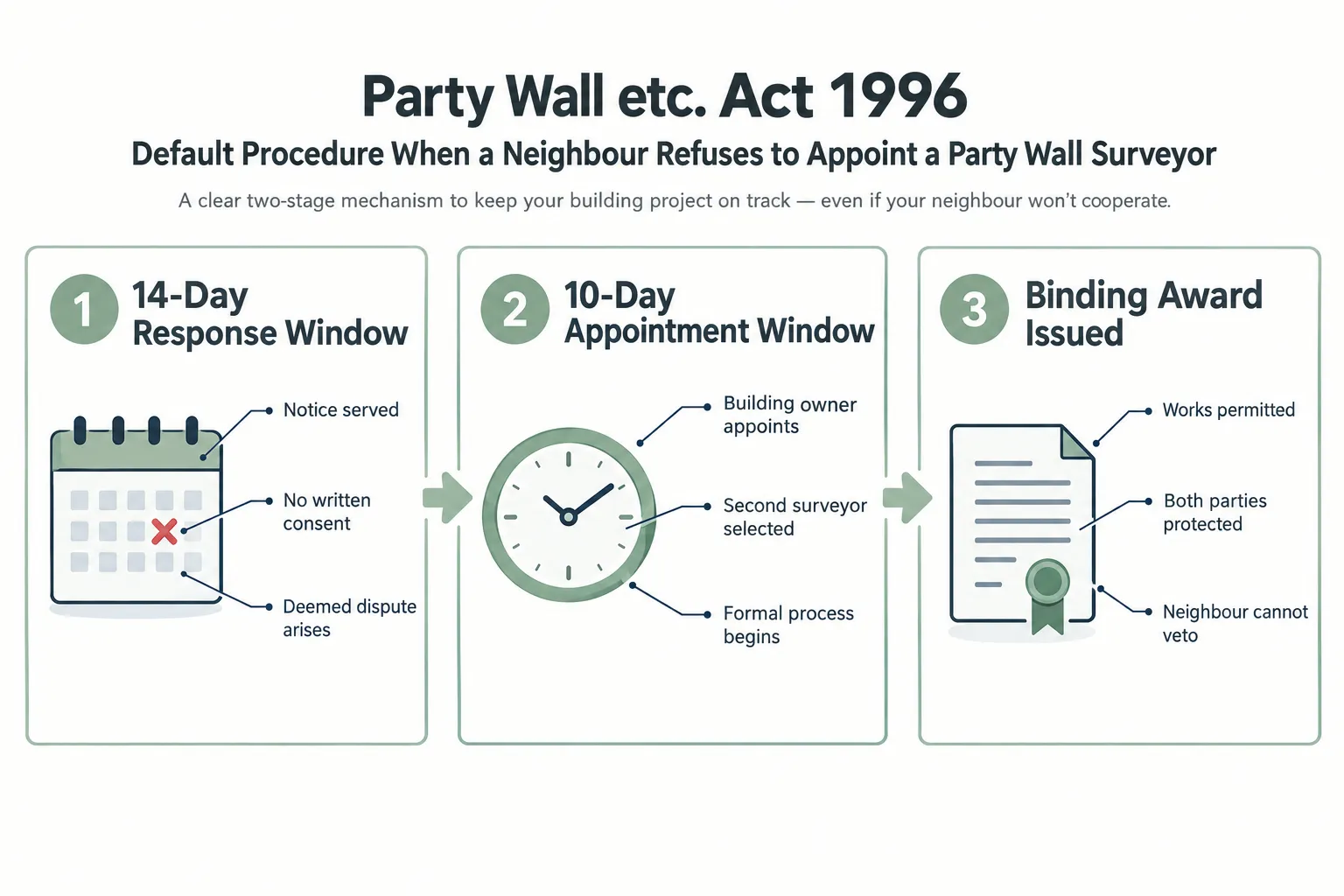
- Once the initial 14-day response window closes without written consent, a dispute is automatically “deemed” to have arisen and the surveyor appointment process under Section 10 must begin.
- If the neighbour still refuses after a further 10-day notice, the building owner’s surveyor can make a “deemed appointment” on the neighbour’s behalf.
- The resulting party wall award is legally binding on both parties, regardless of whether the neighbour participated in producing it.
- Typical timelines run 3 to 6 weeks for an award to be agreed, with total surveyor fees usually ranging from approximately £700 to £1,500.
What the Party Wall etc. Act 1996 Actually Requires
The Party Wall etc. Act 1996 is the statutory backbone governing all qualifying building works that affect a shared wall, boundary, or structure between neighbouring properties in England and Wales. Before any notifiable work begins, the building owner must serve a formal party wall notice on every adjoining owner. Understanding party wall notices, what they are and how to respond is the essential starting point for both sides.
Once a valid notice is served, the adjoining owner has exactly three formal choices [6][10]:
- Consent in writing, work may proceed under the notice without a formal award.
- Dissent and appoint a surveyor, triggering the dispute resolution process under Section 10.
- Serve a counter-notice, requesting additional or modified works, which the adjoining owner must fund if they are the sole beneficiary.
What the Act does not provide is a fourth option: silence or outright refusal. The legislation is deliberately designed so that an adjoining owner cannot simply do nothing and thereby block lawful works indefinitely [3][9].
The 14-Day and 10-Day Default Procedure Explained
When a neighbour refuses to appoint a party wall surveyor, or simply ignores the notice entirely, a specific two-stage default procedure applies. This is the core mechanism that prevents a building project from being held hostage by an uncooperative neighbour.
Stage One: The Deemed Dispute (14 Days)
If the adjoining owner does not respond in writing within 14 days of receiving a valid party wall notice, a dispute is automatically “deemed” to have arisen under the Act [1][9]. This is not a subjective judgment, it is a statutory trigger. The building owner does not need to prove bad faith or obstruction; the mere absence of written consent within the deadline is sufficient.
At this point, both parties are required to appoint surveyors under Section 10 of the Act. The building owner should appoint their own surveyor promptly and notify the adjoining owner of that appointment [4][6].
Stage Two: The 10-Day Default Notice
If the adjoining owner still refuses to appoint a surveyor after the deemed dispute has arisen, the building owner’s surveyor serves a further formal notice under Section 10(4), giving the neighbour 10 additional days to nominate their own surveyor [2][4][6].
This notice is a critical legal step. It must be served correctly and documented carefully, because it is the final procedural gateway before the deemed appointment mechanism activates.
Stage Three: The Deemed Appointment
If the 10-day period expires without the neighbour appointing a surveyor, the building owner’s surveyor is empowered by the Act to select and appoint a surveyor to act on behalf of the non-responsive adjoining owner [2][6][9]. This is known as the deemed appointment.
The deemed-appointed surveyor acts in the adjoining owner’s interests, not the building owner’s. They are independent and must assess the works objectively. The two surveyors then proceed to produce a party wall award.
“A neighbour cannot legally veto qualifying works by refusing to sign or appoint a surveyor. Once a dispute arises, surveyors must proceed to make an award.” [3][5]
Two-Surveyor Process vs. Agreed Single Surveyor: What Changes When a Neighbour Refuses
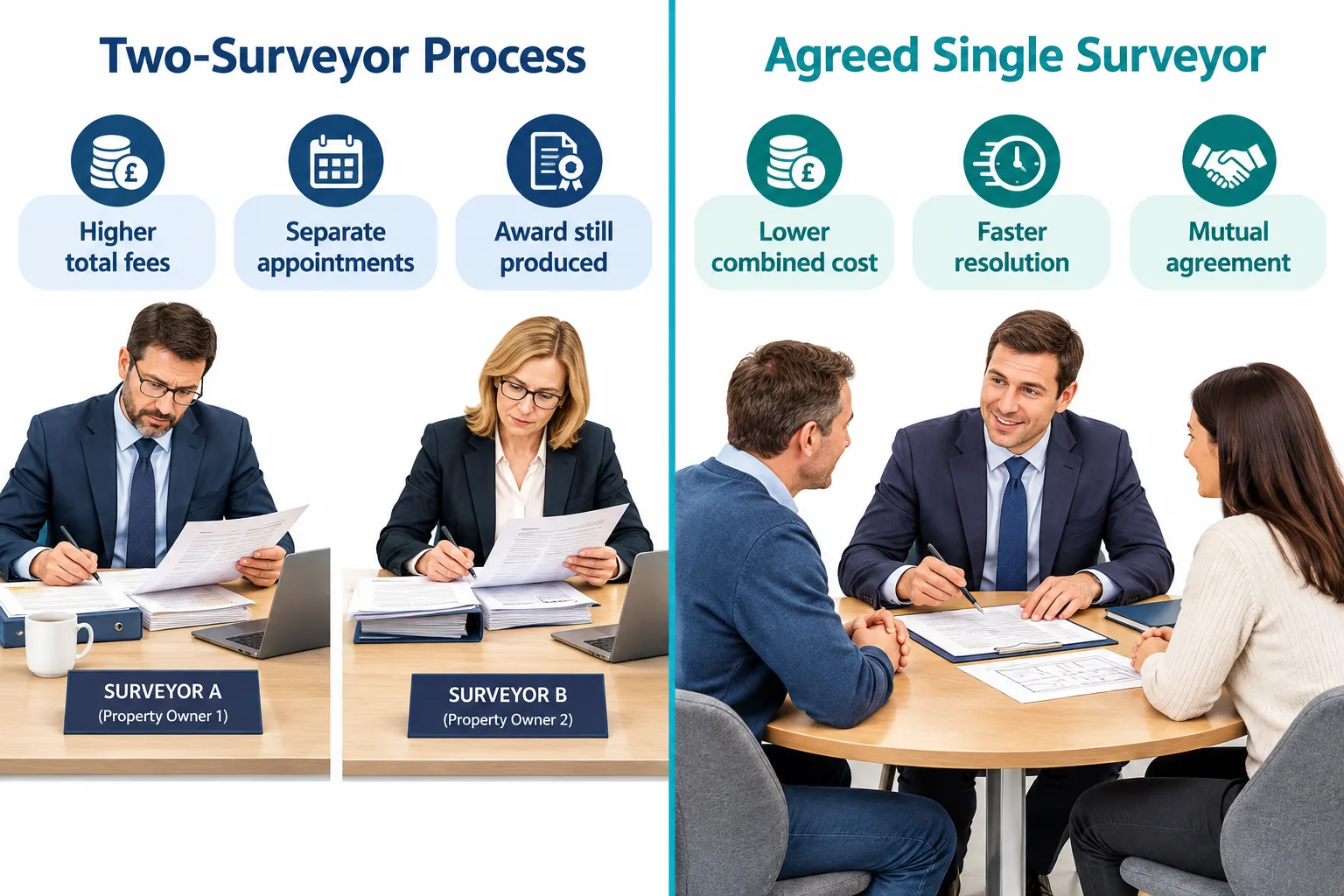
When both parties cooperate, they can agree to appoint a single “agreed surveyor” to act for both sides, typically the most cost-efficient outcome. When a neighbour refuses to appoint a party wall surveyor, that option is usually lost, and the two-surveyor process applies instead.
Cost Implications
The two-surveyor route carries higher total fees because two professionals must be paid. Current specialist guidance puts typical total surveyor fees in the range of £700 to £1,500 for straightforward cases, with the building owner usually bearing the cost [5][6][11]. For guidance on managing expenses, the resource on how to keep party wall costs down provides practical strategies.
Time Implications
The two-surveyor process adds procedural steps, but it does not indefinitely delay a project. Most awards are agreed within 3 to 6 weeks of the surveyors being appointed, assuming no unusual complications [5][6].
The Neighbour’s Substantive Position
Critically, a neighbour who refuses to engage does not improve their legal position by doing so. They remain fully bound by the award once it is made. Their refusal may increase the building owner’s costs, but it does not give the neighbour any additional rights or protections beyond those the Act already provides [2][3][5].
Important:If the neighbour forces a two-surveyor process rather than agreeing to a single agreed surveyor, total surveyor fees are higher, but these are usually borne by the building owner. The neighbour still remains bound by the award and may face costs or damages if they obstruct lawful access or works. [2][5][6][7]
What a Party Wall Award Contains and How It Protects Both Parties
A party wall award is a formal legal document produced by the appointed surveyors. It is binding on both the building owner and the adjoining owner, regardless of whether the latter participated in the process [1][3][9].
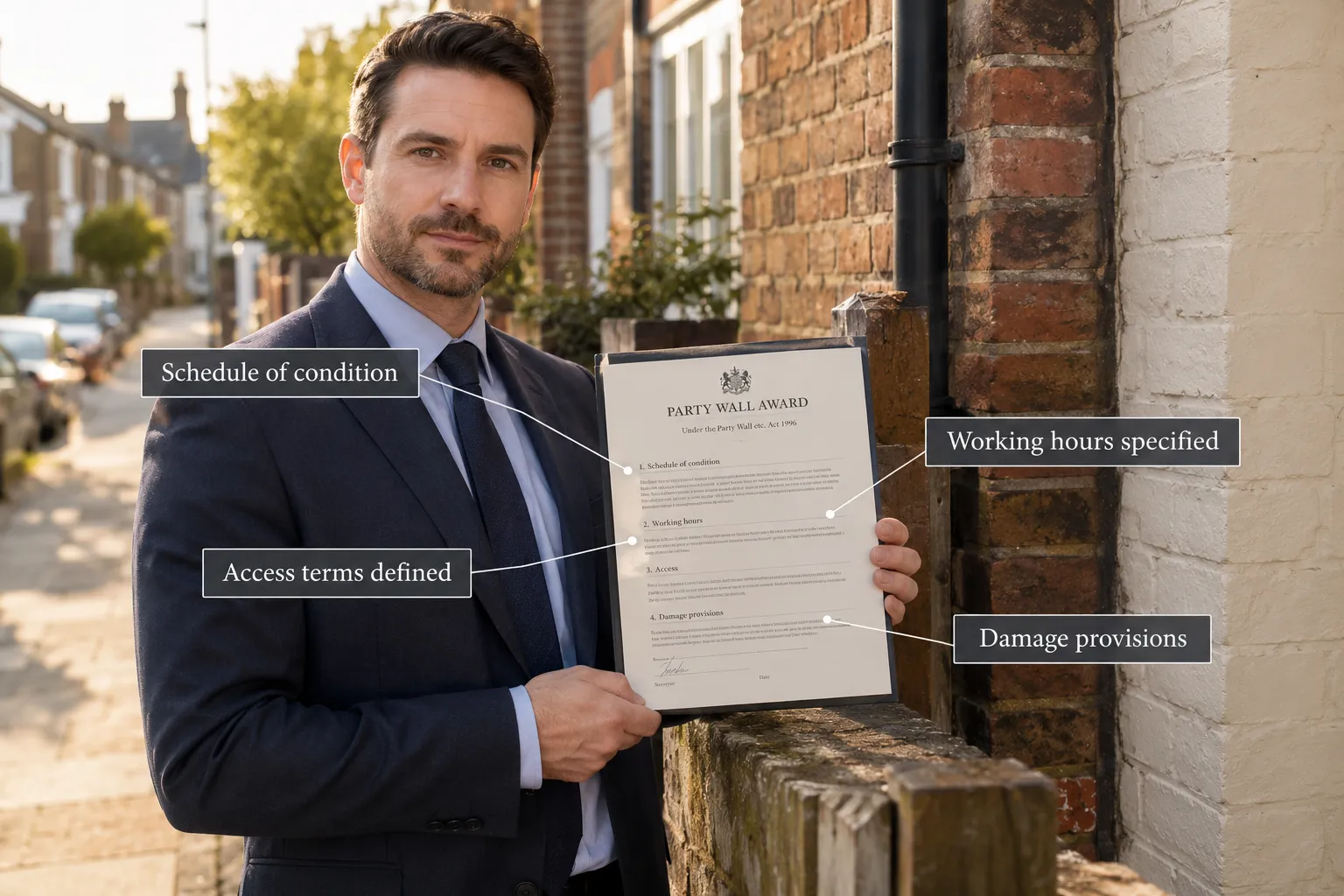
A standard award typically covers [6][10]:
- Permitted works, a precise description of what the building owner is authorised to carry out
- Working hours, the times during which noisy or disruptive work may take place
- Schedule of condition, a photographic and written record of the adjoining property’s condition before works begin, used to assess any future damage claims
- Access terms, the right of the building owner’s surveyor (and contractors) to enter the adjoining property for inspections
- Protective measures, requirements for dust sheets, temporary supports, or other safeguards
- Damage provisions, the process by which any damage caused will be assessed and remedied
For a detailed overview of what these documents contain, see the guide on party wall awards.
Challenging an Award
Either party may challenge a party wall award in the county court within 14 days of it being served. The courts will scrutinise grounds such as whether the works exceed the Act’s scope, whether there are jurisdictional errors, unreasonable conditions, errors in the schedule of condition, or evidence of surveyor bias [8][9]. Outside of exceptional circumstances, the courts retain discretion but rarely overturn awards that have been properly made [8].
Access Rights and What Happens If a Neighbour Obstructs Them
One area where a neighbour’s refusal can have serious practical consequences is access. The Party Wall etc. Act 1996 grants surveyors and building owners a statutory right of access to the adjoining property for the purpose of carrying out notifiable works and inspections [9].
A neighbour cannot simply refuse entry without consequence. Persistent obstruction of lawful access can be addressed in two ways [7][9]:
- Through the party wall award, the surveyors can specify detailed access terms and conditions in the award itself, making the access right explicit and enforceable.
- Through the county court, if the neighbour continues to obstruct access after the award is made, the building owner can apply for an injunction.
Professional guidance in 2026 emphasises that surveyors should document all access attempts carefully, preserving photographic evidence and written correspondence, so that any obstruction is clearly evidenced if court action becomes necessary [7].
If the building owner’s surveyor cannot access the adjoining property to prepare a schedule of condition, they should note this in the award and proceed on the basis of what can be observed from the building owner’s side. This protects the building owner from unsubstantiated damage claims later [7].
Practical Steps for Building Owners: A Summary Checklist
When a neighbour refuses to appoint a party wall surveyor, the building owner should follow this sequence carefully:
| Step | Action | Timeframe |
|---|---|---|
| 1 | Serve a valid party wall notice | Before works begin |
| 2 | Wait for the 14-day response window | 14 days from service |
| 3 | Appoint own surveyor; notify neighbour | Immediately after deemed dispute |
| 4 | Serve 10-day default notice under S.10(4) | After step 3 |
| 5 | Surveyor makes deemed appointment | After 10-day period expires |
| 6 | Two surveyors produce the award | Typically 3-6 weeks |
| 7 | Wait for 14-day appeal period to expire | 14 days from award service |
| 8 | Commence works lawfully | After appeal period |
Building owners should ensure their appointed surveyor is genuinely independent and suitably experienced. Using the project architect or structural engineer as the party wall surveyor is strongly discouraged because of the potential for conflicts of interest [5][14].
For those in London, specialist local expertise is available across the city, including party wall surveyors in North London, South London, East London, and West London.
Common Misconceptions About a Neighbour’s Right to Refuse
Several persistent myths circulate about what a neighbour can and cannot do under the Party Wall etc. Act 1996. Addressing these directly helps both building owners and adjoining owners understand the true legal position.
Myth 1: “My neighbour can stop my works by refusing to sign anything.” False. A refusal to sign or respond simply triggers the deemed dispute mechanism. It does not give the neighbour a veto [3][9].
Myth 2: “If there is no agreement, I cannot start work.” False. Once a valid award has been made and the 14-day appeal period has expired, the building owner may lawfully commence the notifiable works [1][6].
Myth 3: “The surveyor appointed for my neighbour will favour them.” Not necessarily. The deemed-appointed surveyor has a professional and statutory duty to act impartially. They are not the building owner’s advocate, they represent the adjoining owner’s interests objectively [4][9].
Myth 4: “A party wall agreement is only needed for major works.” The Act applies to a defined range of works, including relatively modest projects. For clarity on what qualifies, the resource on types of party wall works provides a comprehensive breakdown.
When the Adjoining Owner Is the One Carrying Out Works
The situation is sometimes reversed: the adjoining owner is carrying out works and the building owner is the one seeking protection. In those circumstances, the guidance on what to do when a neighbour is carrying out works and the role of an adjoining owner’s surveyor become directly relevant.
The same default procedures apply in reverse. If the building owner (in this scenario, the neighbour carrying out works) fails to serve a notice, the adjoining owner has the right to seek an injunction to halt works until the Act’s requirements are met.
Conclusion: Actionable Next Steps
When a neighbour refuses to appoint a party wall surveyor, the situation can feel frustrating, but the legal framework is firmly on the building owner’s side. The Party Wall etc. Act 1996 provides a clear, tested pathway that does not require the neighbour’s cooperation to reach a lawful outcome.
Actionable next steps for building owners in 2026:
- Verify the notice was validly served. An improperly served notice can undermine the entire process. Check the requirements carefully before assuming the 14-day clock has started.
- Appoint an independent, experienced party wall surveyor immediately after the deemed dispute arises. Do not delay, every week of delay is a week added to the project timeline.
- Serve the 10-day default notice under Section 10(4) correctly. This step must be documented in writing and retained as evidence.
- Allow the deemed appointment to proceed if the neighbour remains unresponsive. Trust the process, the Act was designed for exactly this situation.
- Do not commence notifiable works until the award has been served and the 14-day appeal period has expired. Starting early exposes the building owner to injunctions and damages claims.
- Keep records of all correspondence and access attempts. These records are invaluable if the matter ever reaches the county court.
The most common outcome in cases where a neighbour refuses to engage is straightforward: surveyors proceed, an award is produced, and the building owner starts work lawfully. The neighbour’s refusal adds time and cost, but it does not change the destination [1][3][5][6].
References
[1] If You Can’t Agree – gov.uk
[2] Neighbor Refused Agreed Surveyor – partywallslimited.com
[3] Refuse Party Wall Agreement – ansteyhorne.co.uk
[4] Surveyor Under S10 – england.surveyone.co.uk
[5] Party Wall Agreement Neighbour Refuses – trackeveryday.com
[6] Neighbour Refuse Party Wall Works – princesurveyors.co.uk
[7] How To Handle Access Problems In Party Wall And Boundary Surveys Without Weakening Your Evidence – princesurveyors.co.uk
[8] Expert Witness Roles In Party Wall Award Challenges 2026 Case Law And RICS Best Practices – princesurveyors.co.uk
[9] Party Wall etc. Act 1996 – legislation.gov.uk
[10] Preventing And Resolving Disputes In Relation To Party Walls – gov.uk
Party Wall Award Disputes: How to Challenge, Vary or Appeal a Surveyor’s Decision in England & Wales
}
Fewer than 1% of party wall awards ever reach a County Court, yet when they do, the costs can dwarf the original building works by a significant margin [5]. For homeowners caught in a difficult dispute, understanding exactly when and how a party wall award can be challenged is the difference between a proportionate legal response and an expensive mistake.
This guide walks through the full process of party wall award disputes: how to challenge, vary or appeal a surveyor’s decision in England & Wales, covering the statutory framework, recognised legal grounds, court procedures, costs, and practical strategies to protect your position without unnecessary escalation.
Key Takeaways
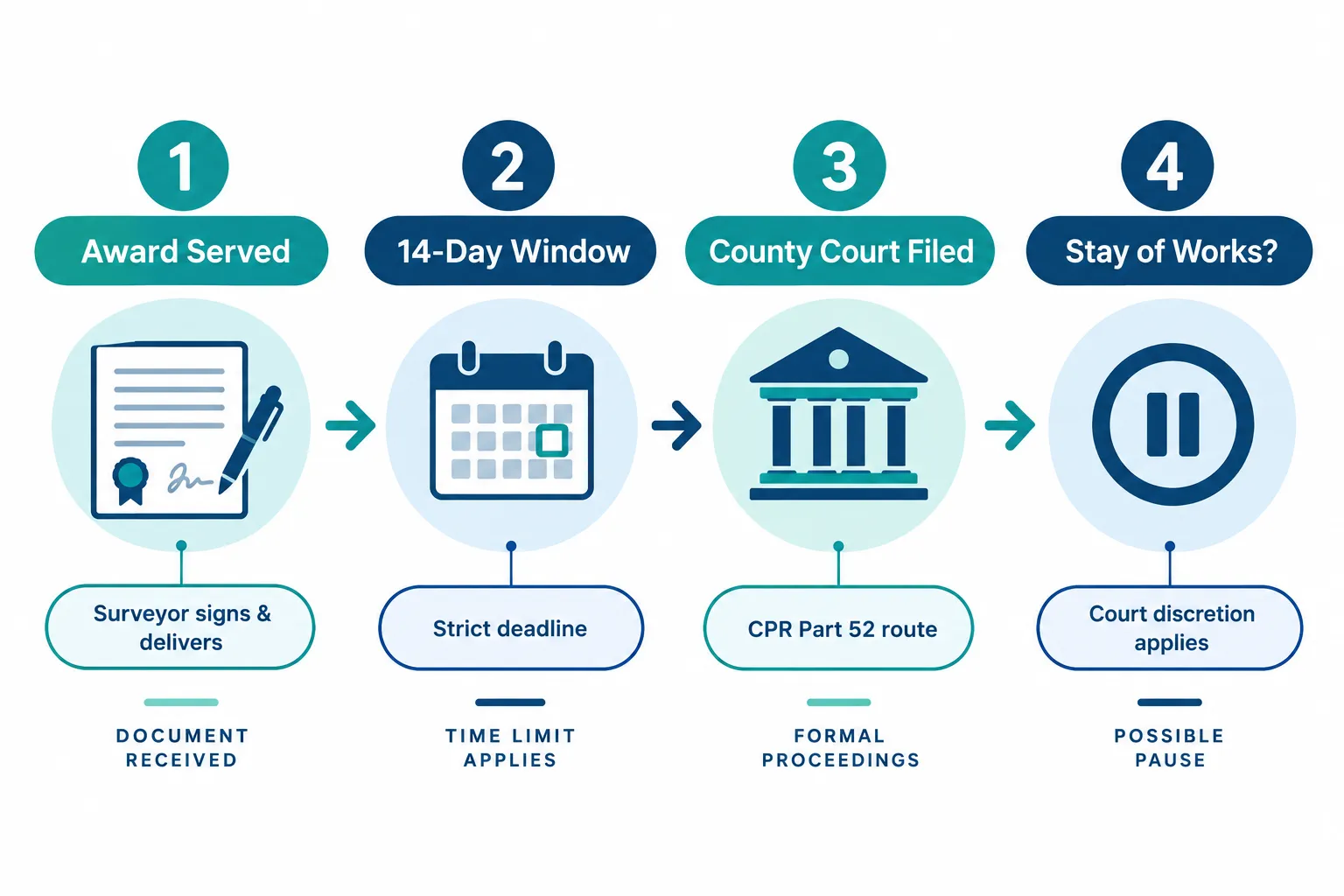
- A party wall award can only be appealed to the County Court within a strict 14-day window from the date it is served [2]
- Valid grounds for appeal are narrow: they include jurisdictional error, legal mistake, and procedural unfairness, not simply disagreement with the outcome [3]
- An award that is fundamentally flawed may be challenged as a nullity at any time, but courts apply this route sparingly [8]
- Appeals do not automatically stop building works; a separate application for a stay of proceedings is required [8]
- Costs in party wall appeal cases can be substantial, and courts have wide discretion over who pays [5]
What Is a Party Wall Award and Why Disputes Arise
A party wall award is the formal written document produced by one or more appointed surveyors under the Party Wall Etc Act 1996. It sets out the rights and obligations of both the building owner and the adjoining owner in relation to proposed works affecting a shared wall, boundary, or nearby excavation. You can read a detailed overview of how awards are structured on the Party Wall Awards page.
Awards typically cover the scope and method of works, working hours, protective measures, access arrangements, and compensation provisions. When either party believes the award is wrong, whether due to legal error, overreach by the surveyor, or procedural failure, the Act provides a specific mechanism to challenge it.
Disputes tend to arise in several common situations:
- The surveyor is alleged to have acted outside the powers granted by the Act
- One party believes the award imposes unreasonable conditions or fails to reflect the true extent of damage
- There are questions about whether a valid dispute actually existed before the award was made
- The process leading to the award is alleged to have been unfair or irregular
Understanding types of party wall works that typically trigger these situations helps homeowners identify whether their concerns have legal merit before committing to a challenge.
The 14-Day Appeal Window: A Deadline That Cannot Be Ignored
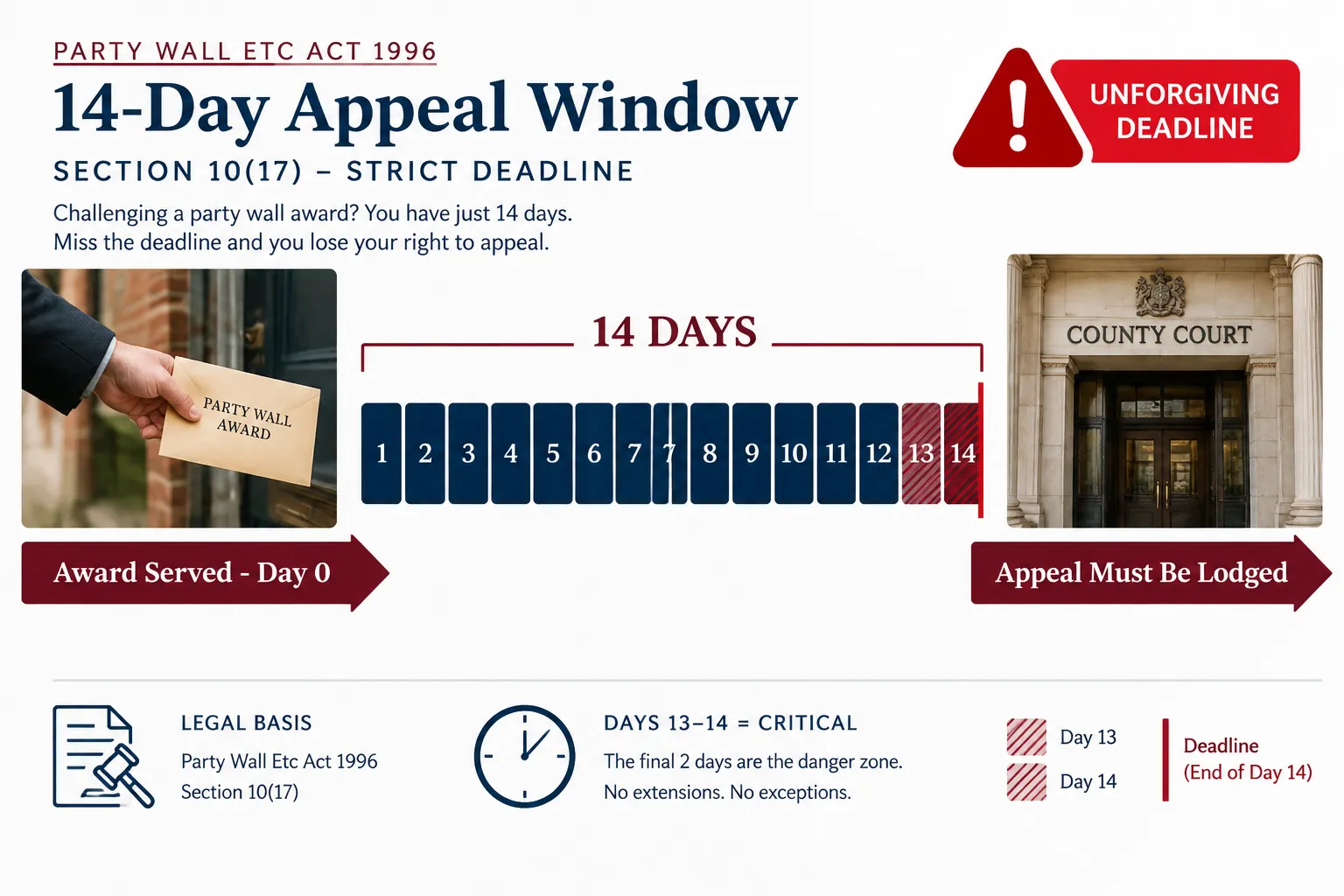
Section 10(17) of the Party Wall Etc Act 1996 gives either party the right to appeal an award to the County Court. The appeal must be lodged within 14 days of the date the award is served [2]. This is one of the most unforgiving deadlines in property law.
“The 14-day limit is not a guideline, it is a statutory cut-off. Missing it almost certainly ends any prospect of a conventional appeal.” [3]
Key points about the appeal window:
- The clock starts from the date of service, not the date the party reads or acknowledges the award
- Service is typically by hand delivery or first-class post, and the date is recorded on the award itself
- There is no general discretion for the court to extend this period under ordinary circumstances [8]
- If the deadline is missed, the only remaining route is a nullity challenge, a much harder legal threshold to meet
What if the deadline has passed?
Where the 14-day window has closed, a party may still apply to the court under CPR Part 8 to argue that the award is a nullity, meaning it was so fundamentally defective that it never had legal effect in the first place [8]. Courts treat this as a high bar. Mere legal error or disagreement with the surveyor’s judgment will not suffice. The award must be shown to be void from the outset, for example because the surveyor had no jurisdiction to act at all.
Recognised Grounds for Challenging a Party Wall Award
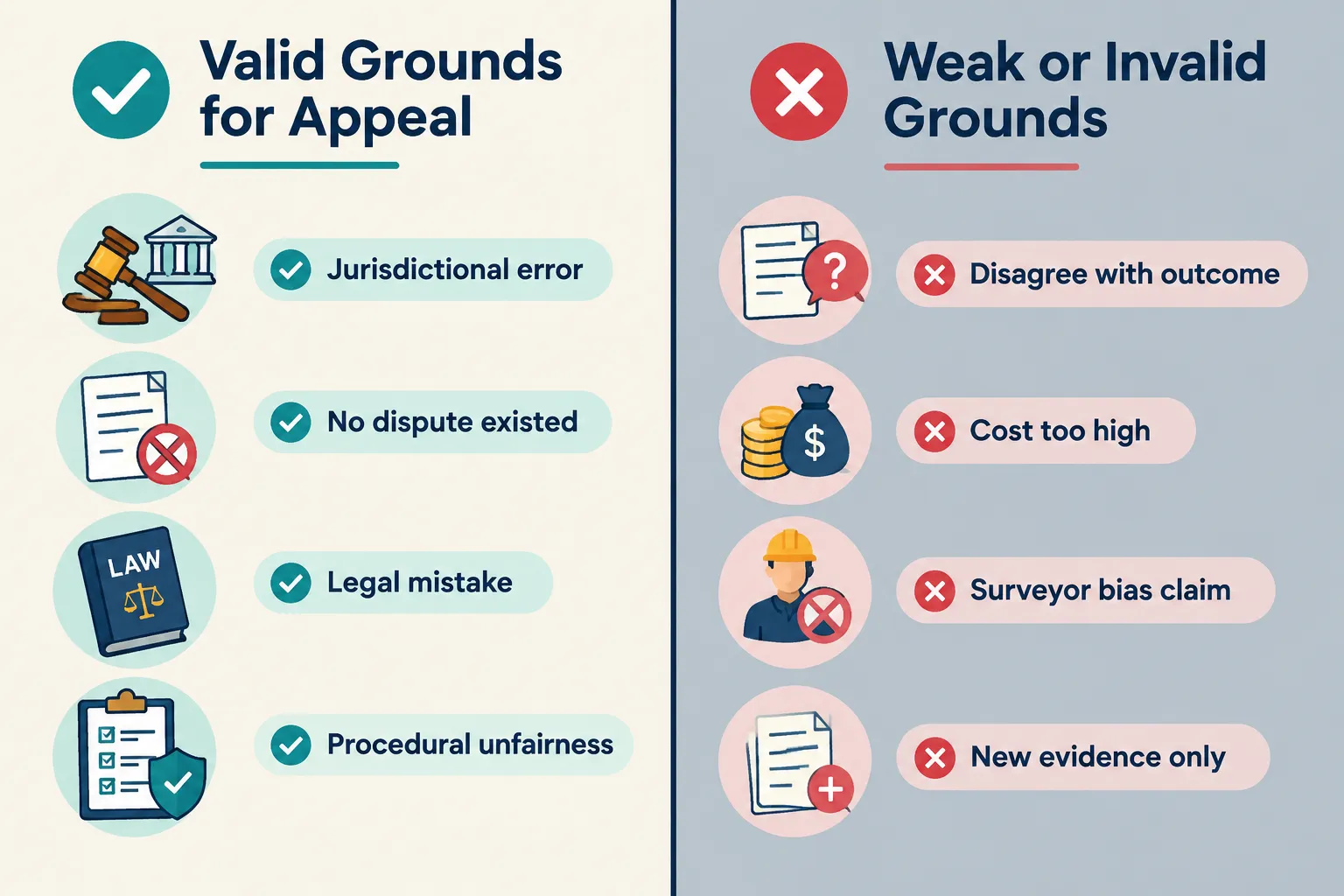
Not every grievance amounts to a valid legal ground for appeal. Courts in England and Wales apply a structured analysis when reviewing party wall award disputes. The following are the recognised grounds under which a challenge may succeed [3][8]:
Jurisdictional Error
A surveyor’s authority under the Act is strictly defined. If a surveyor has made an award that goes beyond the scope of the dispute, for example, by ruling on matters that were never notified under a valid party wall notice, the award may be challenged on jurisdictional grounds. This is one of the stronger grounds available.
Absence of a Valid Dispute
The Act only empowers surveyors to act once a dispute has arisen or is deemed to have arisen. If no valid notice was served, or if the adjoining owner consented to the works in writing, there may be no jurisdiction for an award at all [4]. An award made in the absence of a genuine dispute may be void.
Legal Error
Where a surveyor has misapplied the law, for example, by misinterpreting the Act’s provisions on compensation or access, this may constitute a ground of appeal. The error must be one of law, not simply a judgment call the losing party disagrees with [3].
Procedural Unfairness
If the process leading to the award was fundamentally unfair, for instance, if one party was denied a reasonable opportunity to make representations, this may support a challenge. Courts look carefully at whether the procedural defect actually affected the outcome [9].
What Does NOT Constitute a Valid Ground
It is equally important to understand what courts will not accept as grounds for appeal:
- Mere dissatisfaction with the surveyor’s decision
- A belief that the surveyor favoured the other party without evidence of procedural unfairness
- New evidence that could have been presented during the surveying process
- Disagreement with the level of compensation awarded, absent a legal error
How to Appeal: The County Court Process Under CPR Part 52
Party wall award appeals are heard in the County Court and proceed under CPR Part 52, the standard civil appeals procedure [8]. This is an important distinction: despite some confusion in practice, these are not brought as Part 8 claims (which are reserved for nullity challenges).
Step-by-Step Overview of the Appeal Process
1. Obtain legal advice immediately Given the 14-day deadline, the first step is to consult a solicitor with party wall or property litigation experience as soon as the award is served.
2. File an Appellant’s Notice (Form N161) The appeal is initiated by filing Form N161 at the appropriate County Court. The notice must set out the grounds of appeal clearly and concisely.
3. Serve the Respondent The appellant must serve the notice on the other party (the respondent) promptly after filing.
4. Apply for a Stay of Works if Needed An appeal does not automatically halt building works. If the building owner intends to proceed while the appeal is pending, the adjoining owner must make a separate application for a stay [8]. Courts have discretion to grant or refuse a stay, and will weigh the balance of convenience and potential harm to both parties.
5. Attend the Hearing The County Court will list the appeal for a hearing. Both parties may be represented by solicitors or barristers. Expert witnesses, typically experienced party wall surveyors, often play a significant role in explaining technical matters to the court [9].
6. Await Judgment The court may uphold the award, vary it, or set it aside. It also has power to make a fresh award or remit the matter back to the surveyors.
The Role of Expert Witnesses
In complex party wall award disputes, the court will often benefit from expert evidence on surveying practice and the technical aspects of the works. Expert witnesses in these cases are expected to comply with CPR Part 35 and RICS best practice guidance [9]. Their duty is to the court, not to the party instructing them, a distinction that matters greatly in contested proceedings.
Varying an Award: The Less Adversarial Route
Before committing to a court appeal, it is worth considering whether the award can be varied by agreement or through the surveyor process itself. Section 10(12) of the Act allows the appointed surveyor or surveyors to make a further award varying or supplementing an earlier one, provided a dispute still subsists [7].
The case of Evans v Paterson (November 2021) confirmed important principles about surveyors’ jurisdiction to make further and compensation awards, reinforcing that the surveying process retains flexibility even after an initial award is made [7]. This means that in some cases, a further award, rather than a court appeal, may be the more proportionate and cost-effective way to address a genuine grievance.
Parties should also be aware that the costs of the party wall process can escalate significantly once litigation begins. Exploring variation through the surveyor route first is almost always worth considering.
Costs, Financial Risk, and Practical Considerations in 2026
The financial stakes in party wall award appeals are high. In 2026, practitioners report that the total costs of a contested County Court appeal, including solicitors’ fees, expert witness fees, and court fees, routinely range from several thousand pounds to well over £20,000 for complex cases [5].
Key cost considerations include:
- Court fees: Filing an appeal incurs court fees based on the value of the claim
- Solicitor and barrister fees: Hourly rates vary significantly; specialist property litigators command a premium
- Expert witness costs: Party wall surveyors acting as expert witnesses typically charge between £150 and £350 per hour [9]
- Adverse costs risk: If the appeal fails, the court may order the appellant to pay the respondent’s costs as well as their own
Before filing an appeal, obtain a realistic costs estimate from your solicitor and weigh it against the financial benefit of a successful outcome. In many cases, the cost of appealing exceeds the value of what can be gained [5].
The government’s official explanatory booklet on the Party Wall Etc Act 1996 advises that parties should always try to resolve disputes amicably before resorting to formal legal proceedings [2]. This remains sound advice in 2026, particularly given the current pressures on County Court listing times.
For those looking to manage costs proactively from the outset, the guidance on how to keep party wall costs down offers practical strategies applicable at every stage of the process.
Enforcement of Awards and the Status of Works During an Appeal
A party wall award is legally binding and enforceable once served, even if an appeal is pending [1]. The building owner is entitled to proceed with the notified works unless the court grants a stay.
Enforcement options available to the adjoining owner include:
- Applying to the County Court for an injunction to halt works that breach the award
- Seeking damages for breach of the award’s conditions
- In cases of ongoing damage, applying for an emergency injunction on short notice
Conversely, if the building owner fails to comply with protective measures set out in the award, such as making good damage or paying compensation, the adjoining owner can enforce those obligations through the court.
It is worth noting that where works have already been completed before an appeal is resolved, the court’s ability to provide meaningful relief may be limited. This makes early action essential.
When to Seek Professional Help: Choosing the Right Surveyor
The quality of the original surveying appointment significantly affects the likelihood of disputes arising. A well-qualified, impartial surveyor will produce an award that is legally sound, proportionate, and difficult to challenge successfully.
If a dispute has already arisen and an appeal is being considered, the adjoining owner should consider appointing their own adjoining owner’s surveyor if they have not already done so. Similarly, building owners should ensure their building owner’s surveyor has the experience to defend the award if challenged.
For those in London, specialist surveyors are available across all areas, including Central London, South London, and North London.
Expert Outlook: Predictions for Party Wall Award Disputes in 2026 and Beyond
Based on current practitioner analysis, several trends are expected to shape party wall award disputes in the coming years [9]:
- Increased scrutiny of surveyors’ jurisdiction as urban development intensifies and more complex multi-party projects arise
- Greater use of expert witnesses in County Court appeals, following clarification of their role under RICS best practice guidance
- Growing awareness among homeowners of the 14-day appeal deadline, reducing the number of out-of-time nullity applications
- Continued judicial reluctance to disturb awards on grounds that amount to mere disagreement with the surveyor’s professional judgment
These are forward-looking expectations based on current industry trends, not guaranteed outcomes.
Conclusion
Party wall award disputes require prompt, informed action. The 14-day appeal window under the Party Wall Etc Act 1996 is unforgiving, and the grounds on which courts will intervene are deliberately narrow. Jurisdictional error, absence of a valid dispute, legal mistake, and procedural unfairness are the recognised routes, but none of them is a substitute for a well-run surveying process from the start.
Actionable next steps for homeowners facing a disputed award:
- Note the exact date the award was served and calculate the 14-day deadline immediately
- Consult a solicitor with party wall or property litigation experience within the first 48 hours
- Assess whether the concern is a genuine legal ground or a disagreement with the outcome
- Consider whether a further award through the surveyor process is a more proportionate remedy
- Obtain a realistic costs estimate before committing to County Court proceedings
- If works are ongoing and potentially harmful, apply for a stay without delay
Getting the right surveyor appointed at the outset, and ensuring the process is properly followed from the first notice, remains the single most effective way to avoid costly disputes altogether.
References
[1] If You Can’t Agree – gov.uk
[2] The Party Wall Etc Act 1996 Explanatory Booklet – gov.uk
[3] When To Appeal A Party Wall Award And When Not To – boundariesbook.co.uk
[4] How To Apply For A Party Wall Award 3 – uklegalguides.com
[5] Party Wall Award Appeal Costs 2026 – calchub.uk
[6] UK Party Wall Agreement Guide 2026 – calchub.uk
[7] Evans V Paterson 17 November 2021 – boundariesbook.co.uk
[8] Appeal Party Wall Award – ansteyhorne.co.uk
[9] Expert Witness Roles In Party Wall Award Challenges 2026 Case Law And RICS Best Practices – princesurveyors.co.uk
[10] Party Wall FAQs – christopheranthony.org.uk

Party Wall Insurance and Indemnity: What Happens If Your Neighbour’s Works Cause Damage to Your Property?
Structural cracks appearing on an interior wall after a neighbour begins a loft conversion are among the most stressful discoveries a homeowner can make, and they are far more common than most people realise. Understanding the intersection of party wall insurance and indemnity, the statutory framework under the Party Wall etc. Act 1996, and the practical claim routes available is essential for any adjoining owner facing this situation in 2026.
This article breaks down how insurance, indemnity clauses, and the Party Wall Award interact when damage occurs, who bears the financial responsibility, and how a properly prepared schedule of condition can be the difference between a swift settlement and a protracted legal dispute.
Key Takeaways
- The building owner is legally responsible under section 7(2) of the Party Wall etc. Act 1996 for compensating any loss or damage caused by their works, even when procedures were correctly followed.
- A schedule of condition prepared before works begin is the single most powerful piece of evidence an adjoining owner can use to support a compensation claim.
- A Party Wall Award issued by appointed surveyors is a binding legal document that sets out the works permitted, the access rights, and the obligation to make good any damage.
- Compensation can cover direct repair costs, professional fees, loss of value, and landscape or garden restoration, not just visible cracks.
- If no party wall notice was served, the adjoining owner can still invoke the Act’s dispute provisions and pursue a claim through the statutory framework or common law.
The Legal Foundation: Who Is Responsible When Damage Occurs?
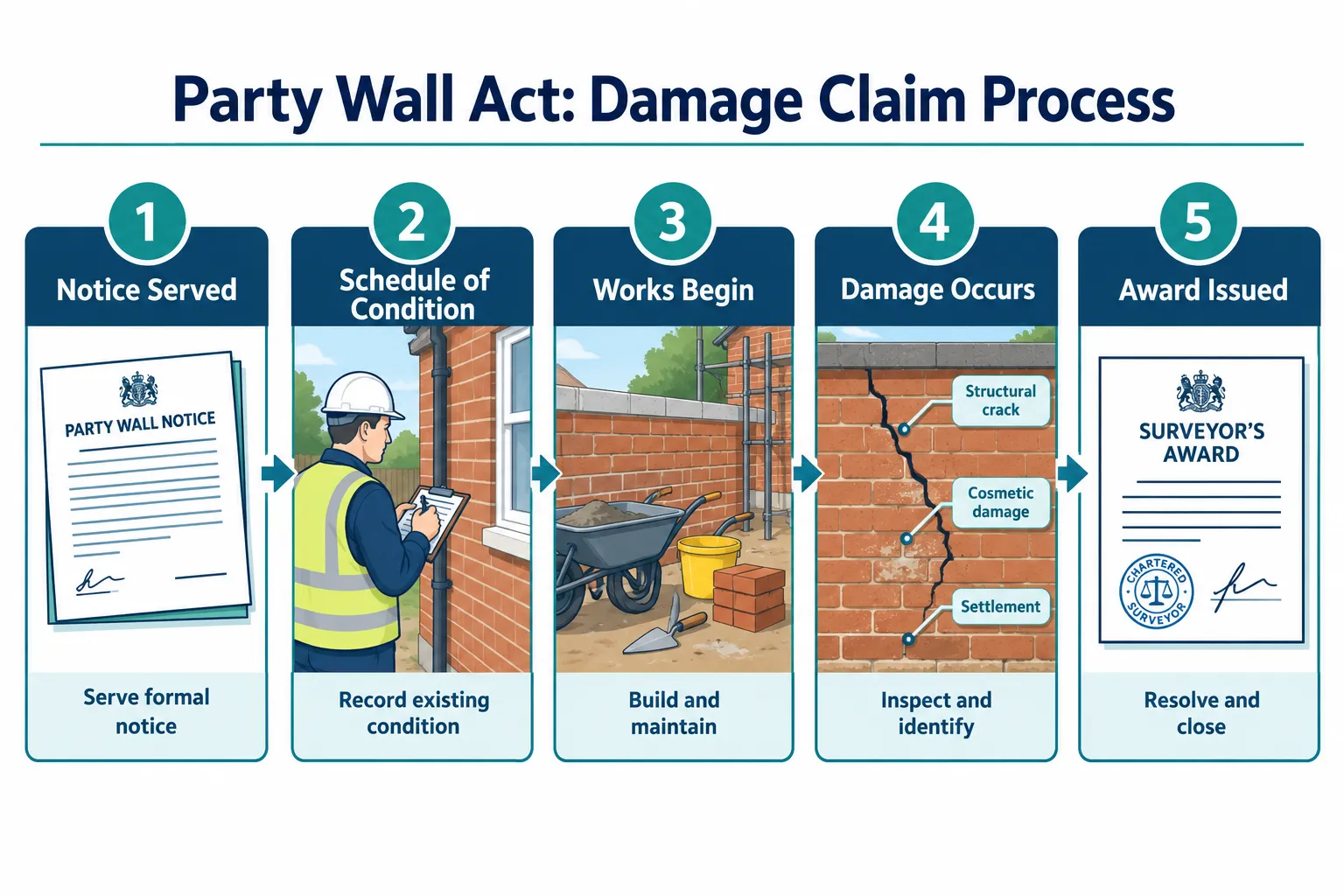
The Party Wall etc. Act 1996 places a clear statutory duty on the “building owner”, the person carrying out the works, to protect the adjoining owner’s property throughout the construction process. Section 7(2) of the Act states that the building owner must compensate the adjoining owner and any other person for any loss or damage arising as a consequence of the works. Critically, this liability applies even when the building owner has followed every procedural step correctly [2].
This is a strict liability provision in practical terms. The adjoining owner does not need to prove negligence; they need only demonstrate that the damage was caused by the notifiable works. The GOV.UK guidance on party walls confirms that the building owner is responsible for making good any damage caused to the adjoining property, or for paying compensation if making good is not practicable [6].
What Works Trigger the Party Wall Act?
Not every construction activity at a shared boundary requires formal notice. GOV.UK guidance confirms that written notice must be given before:
- Carrying out work on an existing party wall or party structure, such as cutting into it, raising it, or underpinning it
- Building on or at the boundary line between two properties
- Excavating below and near the foundation level of a neighbour’s property [7]
Minor works such as plastering, drilling for shelves, or inserting plugs do not require notice [3]. For a full breakdown of notifiable activities, the guide on types of party wall works provides a useful reference.
Understanding whether works are notifiable is the first step. If they are, the statutory protections, including the indemnity provisions, are engaged automatically.
How the Party Wall Award Interacts with Insurance and Indemnity
The Party Wall Award is the central document in any dispute or damage claim. It is issued by the appointed surveyor or surveyors after a formal dissent to a party wall notice, and it functions as a binding legal instrument that governs the entire works process [2].
What the Party Wall Award Contains
A well-drafted Party Wall Award will typically address:
| Element | Purpose |
|---|---|
| Description of permitted works | Defines the scope of what the building owner may carry out |
| Schedule of condition | Records the pre-works state of the adjoining property |
| Access rights | Sets out when and how the building owner may access the adjoining property |
| Making good obligations | Specifies how damage must be repaired or compensated |
| Security for expenses | May require the building owner to deposit funds before works begin |
The Party Wall Awards process exists precisely to create this documented framework. Without it, disputes become far harder to resolve.
The Schedule of Condition: Your Most Important Protection
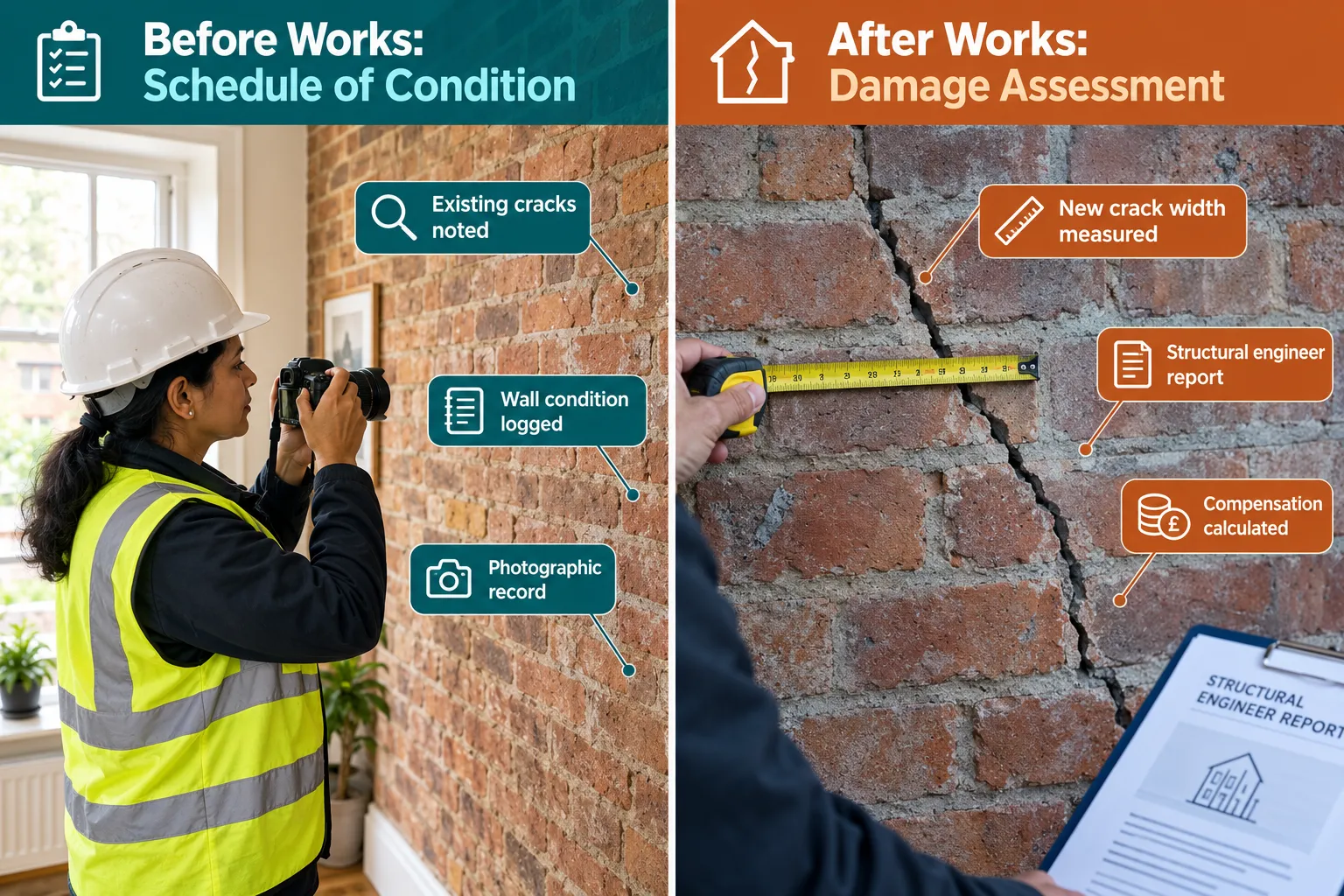
A schedule of condition is a detailed photographic and written record of the adjoining property’s state immediately before works begin. It is typically prepared by the adjoining owner’s surveyor and appended to the Party Wall Award.
Its importance cannot be overstated. When cracks or other damage appear after works begin, the schedule of condition provides the baseline against which new damage is measured. Without it, a building owner can argue that a crack was pre-existing, making it significantly harder for the adjoining owner to establish causation and claim compensation.
“A schedule of condition is not merely a procedural formality, it is the evidentiary foundation of any successful damage claim under the Party Wall etc. Act 1996.”
Insurance and the Building Owner’s Obligations
The building owner’s standard buildings insurance policy may or may not cover damage caused to a neighbour’s property. Many policies exclude third-party property damage arising from construction works, which is why specialist party wall insurance, sometimes called contractor’s liability or adjacent property insurance, is often required.
From the adjoining owner’s perspective, the key point is that the building owner’s insurance arrangements do not affect the statutory liability owed under section 7(2). Whether or not the building owner has adequate insurance, they remain personally liable to compensate the adjoining owner for damage caused. If the building owner’s insurer declines the claim, the adjoining owner can still pursue the building owner directly through the party wall dispute mechanism or, where necessary, through the courts.
The RICS consumer guidance on party walls also notes that chartered surveyors acting in party wall matters must maintain adequate professional indemnity insurance [10]. This matters for adjoining owners because if a negligent surveyor appointment contributes to loss, for example, by failing to prepare an adequate schedule of condition, the surveyor’s professional indemnity policy provides an additional layer of financial protection.
Claim Routes, Compensation Ranges, and What You Can Recover

When damage occurs, the adjoining owner has several routes available, and these can run concurrently in serious cases.
Route 1: The Party Wall Award Mechanism
Where a Party Wall Award is already in place, the adjoining owner’s surveyor can issue a supplementary award dealing specifically with the damage. This award will typically:
- Identify the damage and its cause
- Specify the remedial works required
- Allocate the cost to the building owner
- Address professional fees
Under section 10(13) of the Act, the costs of the party wall procedure, including surveyor fees on both sides, are generally paid by the building owner [2]. This means the adjoining owner should not ordinarily bear the cost of appointing their own surveyor to deal with a legitimate damage claim.
Route 2: Invoking the Act Without a Prior Award
If the building owner failed to serve a valid party wall notice before starting works, the adjoining owner is not left without remedy. The Act’s dispute provisions can be invoked retrospectively, allowing the appointment of surveyors and the production of an award even after works have begun or been completed. This is a critical protection for adjoining owners who discover damage but were never formally notified [1].
Route 3: Common Law Claims
Party wall damage can also give rise to claims in private nuisance and negligence, entirely separate from the statutory framework. Substantial physical damage to a property, encroachment, or significant interference with the enjoyment of land may support these causes of action [5]. Legal expenses insurance, often included in home insurance policies as an add-on, may cover the cost of pursuing such claims.
What Compensation Can Cover
Compensation under the Act is not limited to the cost of repairing visible cracks. Recoverable losses can include:
- Direct repair costs, plastering, structural reinforcement, underpinning
- Professional fees, structural engineers, surveyors, architects
- Loss of value, where the property’s market value is demonstrably reduced
- Temporary accommodation costs, if the property is uninhabitable during repairs
- Garden and landscape restoration, damage to gardens, patios, or boundary features
The scale of potential liability varies considerably. Industry data cited by party wall practitioners indicates typical compensation ranges:
- Minor cosmetic cracks: approximately £2,400 to £4,800
- Settlement cracks requiring plaster repair: approximately £6,200 to £11,500
- Structural cracks requiring reinforcement: approximately £18,000 to £45,000
- Severe subsidence cases: approximately £75,000 to £180,000
These figures illustrate why adequate insurance and indemnity provisions are not optional extras, they are fundamental to managing the financial risk on both sides of the party wall.
Practical Steps for Adjoining Owners: Before, During, and After Works
Before Works Begin
1. Respond formally to any party wall notice. When a neighbour serves notice, the adjoining owner has 14 days to consent or dissent. Consenting without conditions removes most statutory protections. Dissenting triggers the appointment of surveyors and the production of a Party Wall Award [4]. The guide on party wall notices and how to respond covers this process in detail.
2. Appoint a surveyor. Even where the adjoining owner is tempted to agree informally, having a surveyor involved ensures that a schedule of condition is prepared and that the Party Wall Award contains robust making-good provisions. The risks of having a party wall agreement without a surveyor are significant and should not be underestimated.
3. Check the building owner’s insurance. Ask for confirmation that the building owner holds adequate public liability or adjacent property insurance covering damage to neighbouring properties during construction. This does not replace the statutory liability but provides a practical route to compensation.
During Works
- Monitor the property regularly for new cracks, movement, or water ingress
- Photograph any new damage immediately, with date stamps
- Report damage to the building owner and their surveyor in writing without delay
- Keep records of all communications
After Works
If damage is discovered after works are complete, act promptly. The ability to invoke the Act’s dispute provisions does not expire immediately, but delay can complicate the causation argument. Seek advice from a qualified party wall surveyor and, where the damage is significant, instruct a structural engineer to provide an independent assessment.
For those in the capital, specialist advice is available from surveyors covering Party Wall Surveyor Central London, Party Wall Surveyor South London, and Party Wall Surveyor North London depending on location.
Common Misconceptions About Party Wall Insurance and Indemnity
“My neighbour’s builder is responsible, not my neighbour.” Under the Act, the building owner, the property owner commissioning the works, bears the statutory liability, not the contractor. The building owner may have a separate claim against their contractor, but that is a private matter between them. The adjoining owner’s claim is against the building owner directly [2].
“If my neighbour followed the Act correctly, I cannot claim.” This is incorrect. Section 7(2) imposes liability regardless of procedural compliance. A building owner who serves all the correct notices, obtains a Party Wall Award, and still causes damage remains liable to compensate the adjoining owner [2][6].
“I need to go to court to recover compensation.” In most cases, the party wall surveyor mechanism resolves compensation disputes without litigation. The Party Wall Award is enforceable as a court order, and surveyors have wide powers to deal with damage claims within the statutory framework. Court proceedings are typically a last resort [4].
“A verbal agreement is sufficient.” Verbal agreements provide no enforceable record of the pre-works condition of the property or the agreed scope of works. Written agreements, and ideally a formal Party Wall Award, are essential for protecting both parties [8].
Conclusion
Party wall insurance and indemnity, what happens if your neighbour’s works cause damage to your property, is a question with a clear statutory answer: the building owner is liable, the Party Wall Award is the enforcement mechanism, and the schedule of condition is the evidentiary foundation of any successful claim.
Actionable next steps for adjoining owners in 2026:
- Never ignore a party wall notice. Respond within 14 days, and consider dissenting to trigger the full surveyor and award process.
- Insist on a schedule of condition being prepared and appended to the Party Wall Award before any works begin.
- Ask for evidence of the building owner’s insurance covering adjacent property damage before works commence.
- Document everything, photograph your property before, during, and after works, and keep written records of all communications.
- Act promptly if damage occurs, instruct a party wall surveyor immediately and obtain an independent structural assessment.
- Know that you have multiple routes, the statutory party wall mechanism, common law nuisance and negligence claims, and legal expenses insurance can all be engaged where warranted.
If a neighbour is already carrying out works and damage has appeared, the resource on what to do when your neighbour is carrying out works is a practical starting point. The statutory framework exists to protect adjoining owners, but only those who engage with it proactively will benefit from its full protections.
References
[1] How To Get Redress When A Neighbours Building Work Damages Your Property Know Your Rights – hklaw.uk
[2] The Party Wall Etc Act 1996 Explanatory Booklet – gov.uk
[3] Preventing And Resolving Disputes In Relation To Party Walls – gov.uk
[4] Reaching Agreement With Neighbours – gov.uk
[5] Party Wall Disputes – lexisnexis.co.uk
[6] When Works Begin – gov.uk
[7] Work Tell Your Neighbour About – gov.uk
[8] If You Disagree With Your Neighbour About A Wall Or Fence – citizensadvice.org.uk
[9] Party Walls Building Works – gov.uk
[10] Party Walls – rics.org