
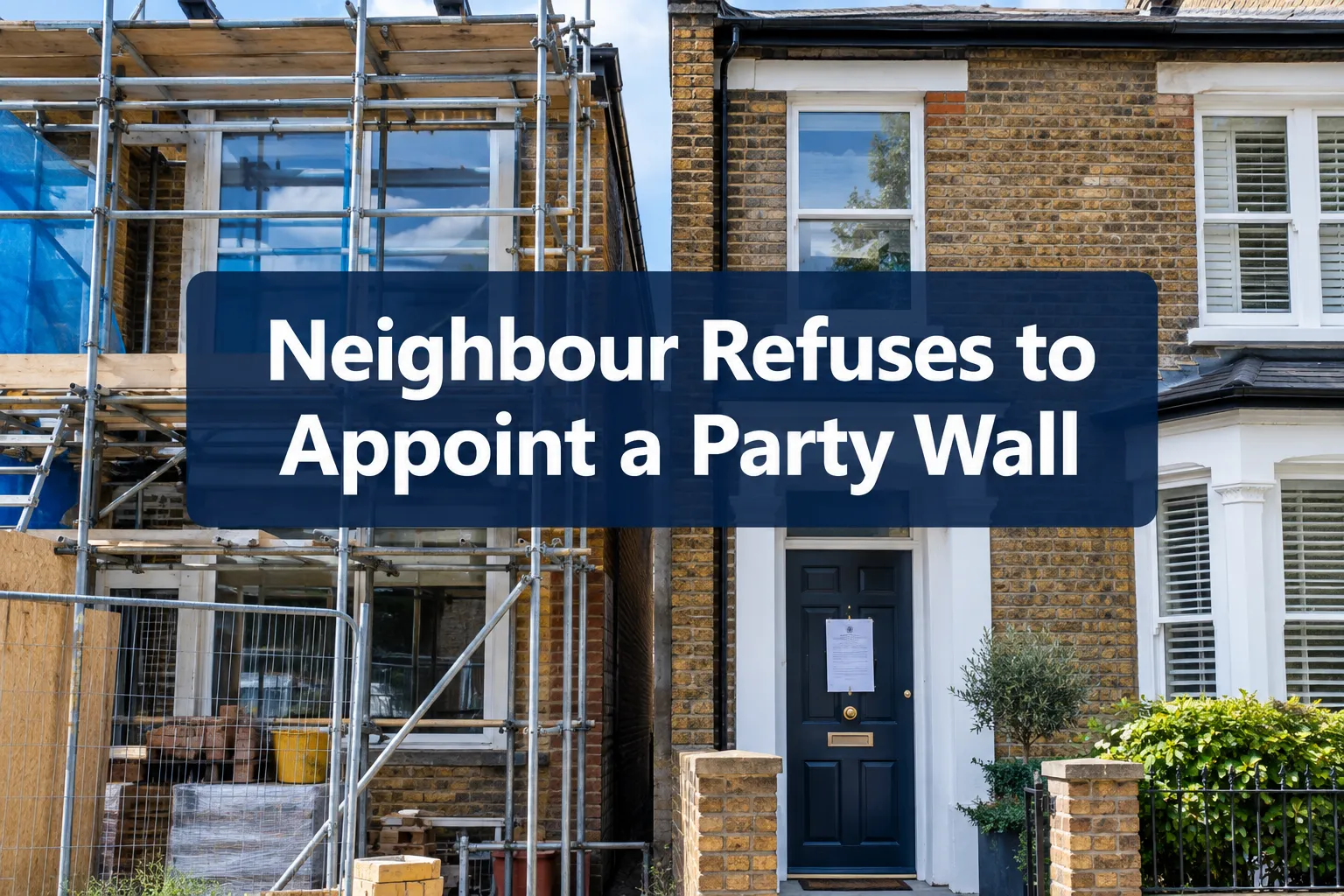
Fewer than one in five party wall disputes actually reach a county court, yet thousands of building projects stall every year because an adjoining owner simply refuses to engage with the process. Understanding what happens when a neighbour refuses to appoint a party wall surveyor, and knowing the exact legal steps available, is the difference between a project that proceeds lawfully and one that grinds to an expensive halt.
This guide sets out the complete step-by-step pathway that applies when a neighbour will not appoint a surveyor, explains the critical concept of the “deemed appointment,” and shows how a valid party wall award can still be produced and enforced, with or without the neighbour’s cooperation.
Key Takeaways
- A neighbour cannot legally veto qualifying works by refusing to appoint a party wall surveyor; the Party Wall etc. Act 1996 provides a clear default mechanism.
- Once the initial 14-day response window closes without written consent, a dispute is automatically “deemed” to have arisen and the surveyor appointment process under Section 10 must begin.
- If the neighbour still refuses after a further 10-day notice, the building owner’s surveyor can make a “deemed appointment” on the neighbour’s behalf.
- The resulting party wall award is legally binding on both parties, regardless of whether the neighbour participated in producing it.
- Typical timelines run 3 to 6 weeks for an award to be agreed, with total surveyor fees usually ranging from approximately £700 to £1,500.
What the Party Wall etc. Act 1996 Actually Requires
The Party Wall etc. Act 1996 is the statutory backbone governing all qualifying building works that affect a shared wall, boundary, or structure between neighbouring properties in England and Wales. Before any notifiable work begins, the building owner must serve a formal party wall notice on every adjoining owner. Understanding party wall notices, what they are and how to respond is the essential starting point for both sides.
Once a valid notice is served, the adjoining owner has exactly three formal choices [6][10]:
- Consent in writing, work may proceed under the notice without a formal award.
- Dissent and appoint a surveyor, triggering the dispute resolution process under Section 10.
- Serve a counter-notice, requesting additional or modified works, which the adjoining owner must fund if they are the sole beneficiary.
What the Act does not provide is a fourth option: silence or outright refusal. The legislation is deliberately designed so that an adjoining owner cannot simply do nothing and thereby block lawful works indefinitely [3][9].
The 14-Day and 10-Day Default Procedure Explained
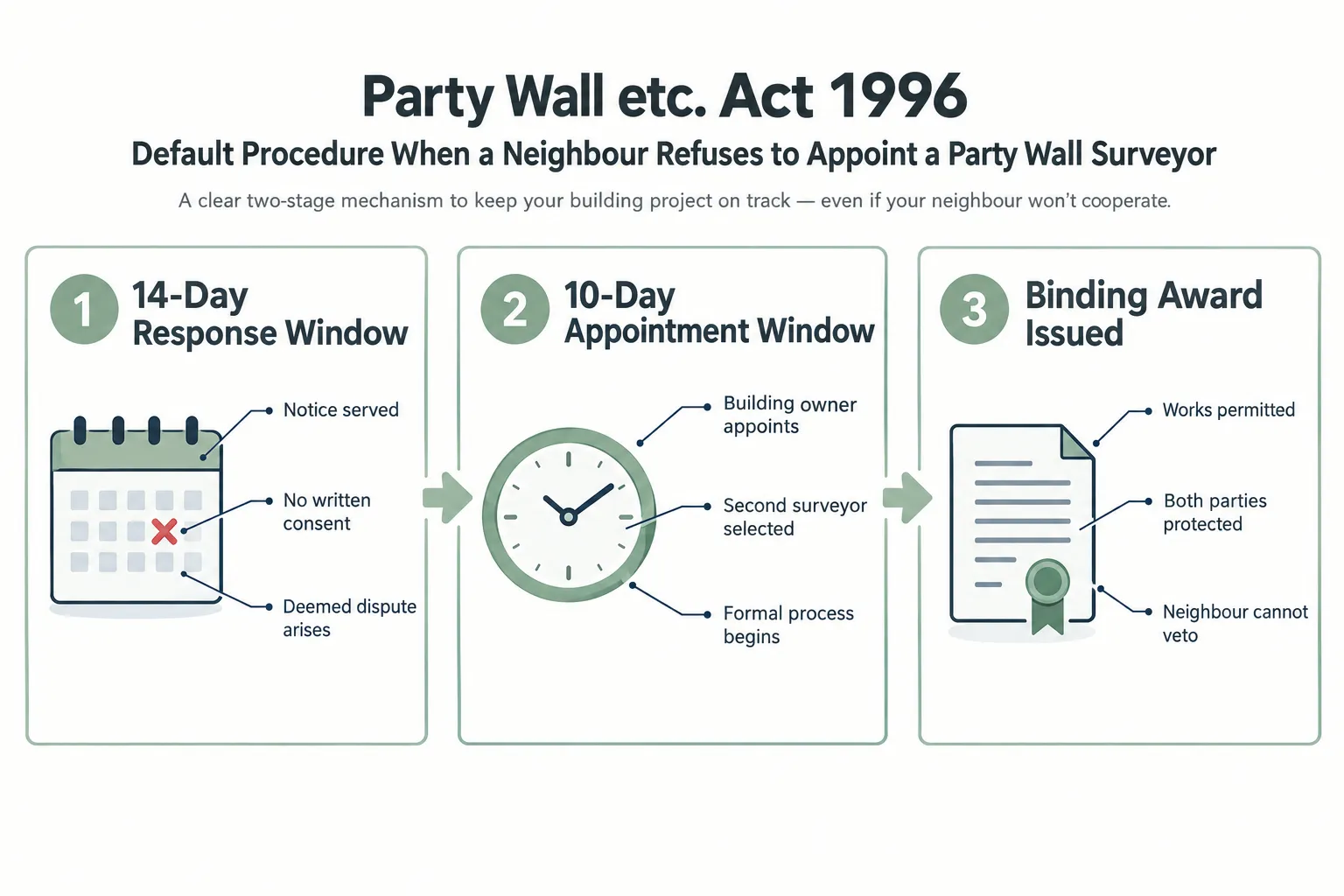
When a neighbour refuses to appoint a party wall surveyor, or simply ignores the notice entirely, a specific two-stage default procedure applies. This is the core mechanism that prevents a building project from being held hostage by an uncooperative neighbour.
Stage One: The Deemed Dispute (14 Days)
If the adjoining owner does not respond in writing within 14 days of receiving a valid party wall notice, a dispute is automatically “deemed” to have arisen under the Act [1][9]. This is not a subjective judgment, it is a statutory trigger. The building owner does not need to prove bad faith or obstruction; the mere absence of written consent within the deadline is sufficient.
At this point, both parties are required to appoint surveyors under Section 10 of the Act. The building owner should appoint their own surveyor promptly and notify the adjoining owner of that appointment [4][6].
Stage Two: The 10-Day Default Notice
If the adjoining owner still refuses to appoint a surveyor after the deemed dispute has arisen, the building owner’s surveyor serves a further formal notice under Section 10(4), giving the neighbour 10 additional days to nominate their own surveyor [2][4][6].
This notice is a critical legal step. It must be served correctly and documented carefully, because it is the final procedural gateway before the deemed appointment mechanism activates.
Stage Three: The Deemed Appointment
If the 10-day period expires without the neighbour appointing a surveyor, the building owner’s surveyor is empowered by the Act to select and appoint a surveyor to act on behalf of the non-responsive adjoining owner [2][6][9]. This is known as the deemed appointment.
The deemed-appointed surveyor acts in the adjoining owner’s interests, not the building owner’s. They are independent and must assess the works objectively. The two surveyors then proceed to produce a party wall award.
“A neighbour cannot legally veto qualifying works by refusing to sign or appoint a surveyor. Once a dispute arises, surveyors must proceed to make an award.” [3][5]
Two-Surveyor Process vs. Agreed Single Surveyor: What Changes When a Neighbour Refuses
When both parties cooperate, they can agree to appoint a single “agreed surveyor” to act for both sides, typically the most cost-efficient outcome. When a neighbour refuses to appoint a party wall surveyor, that option is usually lost, and the two-surveyor process applies instead.

Cost Implications
The two-surveyor route carries higher total fees because two professionals must be paid. Current specialist guidance puts typical total surveyor fees in the range of £700 to £1,500 for straightforward cases, with the building owner usually bearing the cost [5][6][11]. For guidance on managing expenses, the resource on how to keep party wall costs down provides practical strategies.
Time Implications
The two-surveyor process adds procedural steps, but it does not indefinitely delay a project. Most awards are agreed within 3 to 6 weeks of the surveyors being appointed, assuming no unusual complications [5][6].
The Neighbour’s Substantive Position
Critically, a neighbour who refuses to engage does not improve their legal position by doing so. They remain fully bound by the award once it is made. Their refusal may increase the building owner’s costs, but it does not give the neighbour any additional rights or protections beyond those the Act already provides [2][3][5].
Important:If the neighbour forces a two-surveyor process rather than agreeing to a single agreed surveyor, total surveyor fees are higher, but these are usually borne by the building owner. The neighbour still remains bound by the award and may face costs or damages if they obstruct lawful access or works. [2][5][6][7]
What a Party Wall Award Contains and How It Protects Both Parties
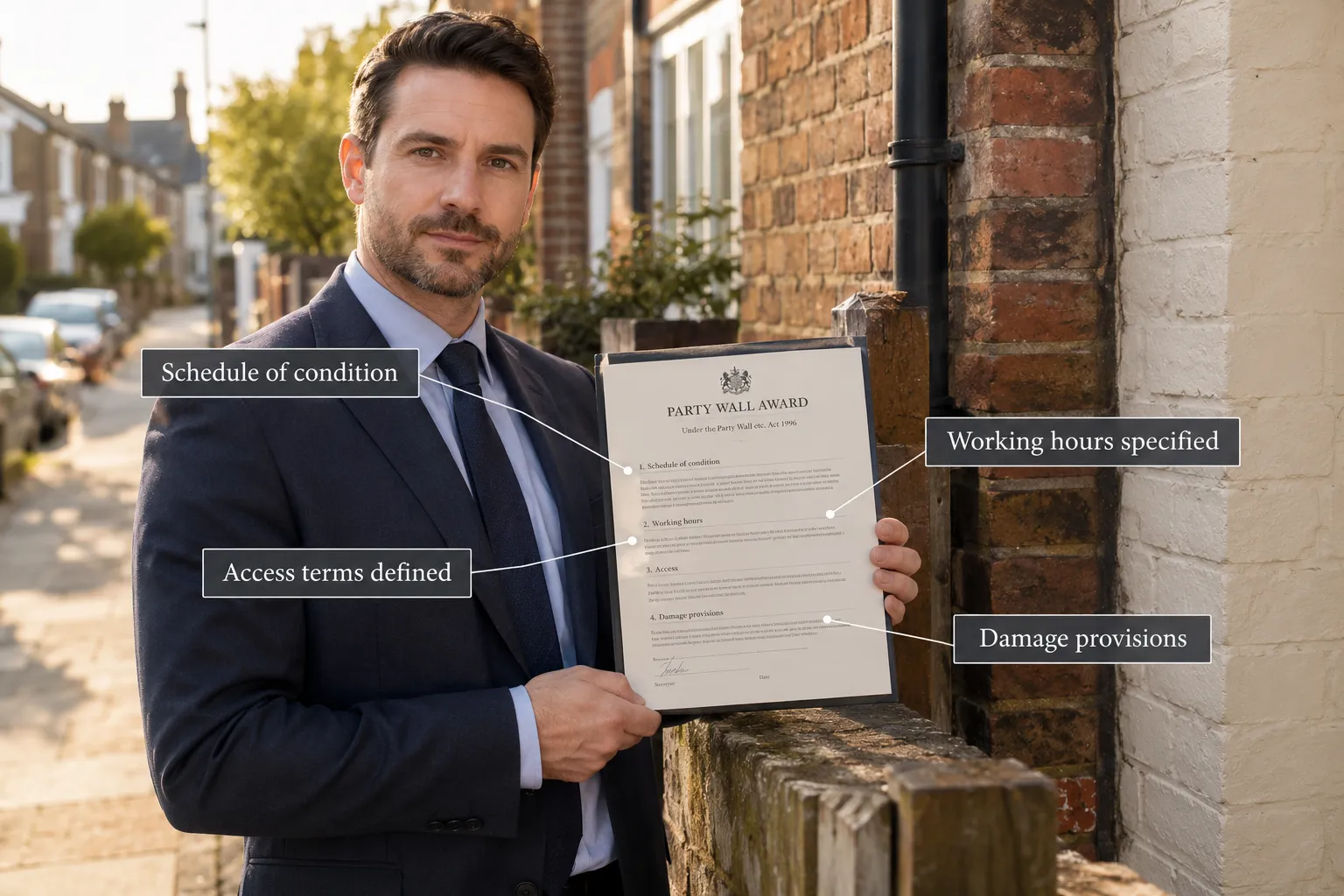
A party wall award is a formal legal document produced by the appointed surveyors. It is binding on both the building owner and the adjoining owner, regardless of whether the latter participated in the process [1][3][9].
A standard award typically covers [6][10]:
- Permitted works, a precise description of what the building owner is authorised to carry out
- Working hours, the times during which noisy or disruptive work may take place
- Schedule of condition, a photographic and written record of the adjoining property’s condition before works begin, used to assess any future damage claims
- Access terms, the right of the building owner’s surveyor (and contractors) to enter the adjoining property for inspections
- Protective measures, requirements for dust sheets, temporary supports, or other safeguards
- Damage provisions, the process by which any damage caused will be assessed and remedied
For a detailed overview of what these documents contain, see the guide on party wall awards.
Challenging an Award
Either party may challenge a party wall award in the county court within 14 days of it being served. The courts will scrutinise grounds such as whether the works exceed the Act’s scope, whether there are jurisdictional errors, unreasonable conditions, errors in the schedule of condition, or evidence of surveyor bias [8][9]. Outside of exceptional circumstances, the courts retain discretion but rarely overturn awards that have been properly made [8].
Access Rights and What Happens If a Neighbour Obstructs Them
One area where a neighbour’s refusal can have serious practical consequences is access. The Party Wall etc. Act 1996 grants surveyors and building owners a statutory right of access to the adjoining property for the purpose of carrying out notifiable works and inspections [9].
A neighbour cannot simply refuse entry without consequence. Persistent obstruction of lawful access can be addressed in two ways [7][9]:
- Through the party wall award, the surveyors can specify detailed access terms and conditions in the award itself, making the access right explicit and enforceable.
- Through the county court, if the neighbour continues to obstruct access after the award is made, the building owner can apply for an injunction.
Professional guidance in 2026 emphasises that surveyors should document all access attempts carefully, preserving photographic evidence and written correspondence, so that any obstruction is clearly evidenced if court action becomes necessary [7].
If the building owner’s surveyor cannot access the adjoining property to prepare a schedule of condition, they should note this in the award and proceed on the basis of what can be observed from the building owner’s side. This protects the building owner from unsubstantiated damage claims later [7].
Practical Steps for Building Owners: A Summary Checklist
When a neighbour refuses to appoint a party wall surveyor, the building owner should follow this sequence carefully:
| Step | Action | Timeframe |
|---|---|---|
| 1 | Serve a valid party wall notice | Before works begin |
| 2 | Wait for the 14-day response window | 14 days from service |
| 3 | Appoint own surveyor; notify neighbour | Immediately after deemed dispute |
| 4 | Serve 10-day default notice under S.10(4) | After step 3 |
| 5 | Surveyor makes deemed appointment | After 10-day period expires |
| 6 | Two surveyors produce the award | Typically 3-6 weeks |
| 7 | Wait for 14-day appeal period to expire | 14 days from award service |
| 8 | Commence works lawfully | After appeal period |
Building owners should ensure their appointed surveyor is genuinely independent and suitably experienced. Using the project architect or structural engineer as the party wall surveyor is strongly discouraged because of the potential for conflicts of interest [5][14].
For those in London, specialist local expertise is available across the city, including party wall surveyors in North London, South London, East London, and West London.
Common Misconceptions About a Neighbour’s Right to Refuse
Several persistent myths circulate about what a neighbour can and cannot do under the Party Wall etc. Act 1996. Addressing these directly helps both building owners and adjoining owners understand the true legal position.
Myth 1: “My neighbour can stop my works by refusing to sign anything.” False. A refusal to sign or respond simply triggers the deemed dispute mechanism. It does not give the neighbour a veto [3][9].
Myth 2: “If there is no agreement, I cannot start work.” False. Once a valid award has been made and the 14-day appeal period has expired, the building owner may lawfully commence the notifiable works [1][6].
Myth 3: “The surveyor appointed for my neighbour will favour them.” Not necessarily. The deemed-appointed surveyor has a professional and statutory duty to act impartially. They are not the building owner’s advocate, they represent the adjoining owner’s interests objectively [4][9].
Myth 4: “A party wall agreement is only needed for major works.” The Act applies to a defined range of works, including relatively modest projects. For clarity on what qualifies, the resource on types of party wall works provides a comprehensive breakdown.
When the Adjoining Owner Is the One Carrying Out Works
The situation is sometimes reversed: the adjoining owner is carrying out works and the building owner is the one seeking protection. In those circumstances, the guidance on what to do when a neighbour is carrying out works and the role of an adjoining owner’s surveyor become directly relevant.
The same default procedures apply in reverse. If the building owner (in this scenario, the neighbour carrying out works) fails to serve a notice, the adjoining owner has the right to seek an injunction to halt works until the Act’s requirements are met.
Conclusion: Actionable Next Steps
When a neighbour refuses to appoint a party wall surveyor, the situation can feel frustrating, but the legal framework is firmly on the building owner’s side. The Party Wall etc. Act 1996 provides a clear, tested pathway that does not require the neighbour’s cooperation to reach a lawful outcome.
Actionable next steps for building owners in 2026:
- Verify the notice was validly served. An improperly served notice can undermine the entire process. Check the requirements carefully before assuming the 14-day clock has started.
- Appoint an independent, experienced party wall surveyor immediately after the deemed dispute arises. Do not delay, every week of delay is a week added to the project timeline.
- Serve the 10-day default notice under Section 10(4) correctly. This step must be documented in writing and retained as evidence.
- Allow the deemed appointment to proceed if the neighbour remains unresponsive. Trust the process, the Act was designed for exactly this situation.
- Do not commence notifiable works until the award has been served and the 14-day appeal period has expired. Starting early exposes the building owner to injunctions and damages claims.
- Keep records of all correspondence and access attempts. These records are invaluable if the matter ever reaches the county court.
The most common outcome in cases where a neighbour refuses to engage is straightforward: surveyors proceed, an award is produced, and the building owner starts work lawfully. The neighbour’s refusal adds time and cost, but it does not change the destination [1][3][5][6].
References
[1] If You Can’t Agree – https://www.gov.uk/party-walls-building-works/if-you-cant-agree
[2] Neighbor Refused Agreed Surveyor – https://www.partywallslimited.com/blog/neighbor-refused-agreed-surveyor
[3] Refuse Party Wall Agreement – https://www.ansteyhorne.co.uk/news/refuse-party-wall-agreement
[4] Surveyor Under S10 – https://england.surveyone.co.uk/surveyor-under-s10/
[5] Party Wall Agreement Neighbour Refuses – https://trackeveryday.com/guides/party-wall-agreement-neighbour-refuses/
[6] Neighbour Refuse Party Wall Works – https://princesurveyors.co.uk/blog/neighbour-refuse-party-wall-works/
[7] How To Handle Access Problems In Party Wall And Boundary Surveys Without Weakening Your Evidence – https://princesurveyors.co.uk/blog/how-to-handle-access-problems-in-party-wall-and-boundary-surveys-without-weakening-your-evidence/
[8] Expert Witness Roles In Party Wall Award Challenges 2026 Case Law And RICS Best Practices – https://princesurveyors.co.uk/blog/expert-witness-roles-in-party-wall-award-challenges-2026-case-law-and-rics-best-practices/
[9] Party Wall etc. Act 1996 – https://www.legislation.gov.uk/ukpga/1996/40
[10] Preventing And Resolving Disputes In Relation To Party Walls – https://www.gov.uk/government/publications/preventing-and-resolving-disputes-in-relation-to-party-walls
Speak to a RICS chartered party wall surveyor
Free initial consultation. Notices, awards and schedules of condition across London and nationwide.