

London’s dense Victorian and Edwardian housing stock means that nearly every basement extension or rear addition shares a structural wall with a neighbour. A single poorly documented crack can become the centrepiece of a costly dispute months after the scaffolding comes down. That is why using mobile 3D mapping and crack gauges in party wall monitoring has moved from a specialist add-on to a baseline expectation on higher-risk London projects in 2026, and why surveyors who cannot explain their monitoring methodology are increasingly vulnerable to challenge.
This article sets out a practical, evidence-based framework for combining crack gauge instruments with mobile 3D scanning technology. It covers instrument selection, baseline protocols, trigger thresholds, monitoring frequencies, and the documentation chain that satisfies both Party Wall Etc Act 1996 obligations and borough-level planning conditions.
Key Takeaways
- Crack gauges and 3D monitoring are most effective when used together: gauges provide low-cost continuous data, while 3D scanning provides a spatially complete baseline and change-detection record.
- Baseline surveys must be completed before any notifiable works begin, covering all rooms and all elevations, not just the wall directly facing the excavation.
- Trigger thresholds of 0.5 mm for new cracks and 0.5 mm widening of existing cracks are the current London market standard.
- Monitoring frequency should be weekly during excavation, fortnightly during active construction, and monthly during the post-construction period.
- Automated 24/7 robotic total station monitoring is preferred for high-risk or deep-basement projects; manual tell-tale and Demec gauge reading remains appropriate for standard residential works.
Why Monitoring Has Become Non-Negotiable in 2026 London
The regulatory and commercial pressure on London party wall surveyors has intensified steadily. Boroughs such as Camden, Westminster, and Kensington & Chelsea now require Basement Impact Assessments as a planning condition, and those assessments explicitly mandate structural monitoring of neighbouring properties throughout the construction period [6]. Failure to produce a credible monitoring record exposes building owners to liability claims and can invalidate a party wall award if a dispute reaches the courts.
At the same time, the technology available to surveyors has matured. One London survey firm has provided integrated 3D point structural movement monitoring, crack monitoring, inclinometer/tilt monitoring, and vibration monitoring as a combined package for party wall and construction projects since 2003 [1]. That longevity signals that the tools are proven, not experimental.
The core argument for combining methods is simple: crack gauges give you a number at a specific point; 3D scanning gives you the spatial context that explains what that number means. Together they create a defensible evidence chain.
The Legal Foundation
Under the Party Wall Etc Act 1996, the building owner is responsible for making good any damage caused by notifiable works. That responsibility only has teeth if there is a documented pre-works condition record. A photographic schedule alone is no longer considered sufficient for basement-adjacent works on many London projects; crack mapping and dimensional baselines are now expected [5].
For a full breakdown of which works trigger these obligations, the guide on types of party wall works is a useful starting reference.
Instrument Selection: Crack Gauges and 3D Tools Explained
Manual Crack Gauges: Tell-Tales and Demec Studs
Manual gauges remain the workhorse of residential party wall monitoring. They are inexpensive, require no power source, and produce a readable record that any surveyor can verify on site.
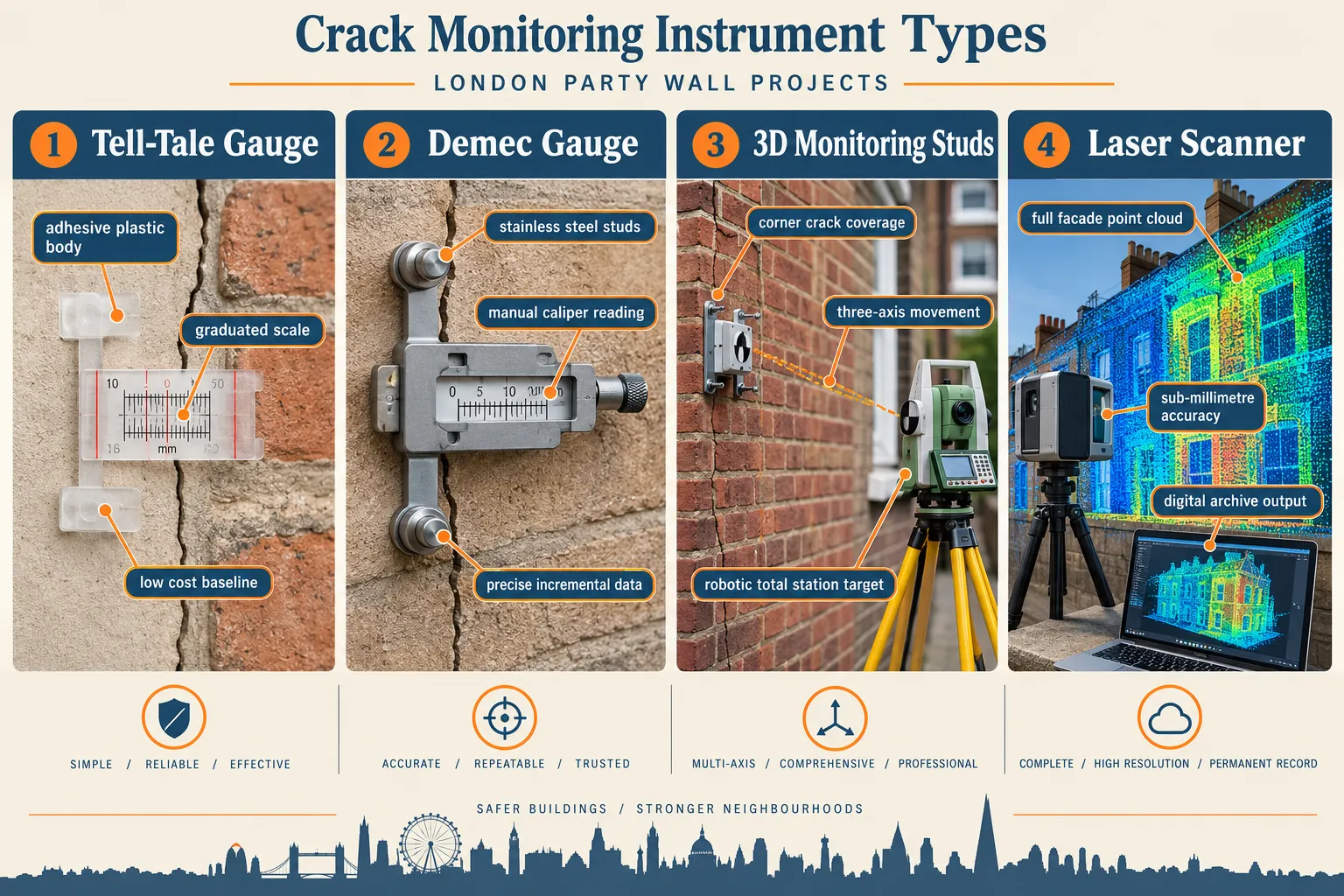
- Tell-tale gauges are adhesive plastic devices with a graduated scale. They bridge an existing crack and show any relative movement between the two sides. A London monitoring firm updated its guidance in August 2026 confirming that tell-tale and Demec crack gauges are installed and read over time to determine whether cracks are active or stable [3].
- Demec gauges use stainless steel studs bonded to the masonry, with a precision caliper reading the distance between them. They offer greater accuracy than tell-tales and are preferred where incremental data is needed over a long monitoring period.
- 3D monitoring studs are a more sophisticated variant. A UK crack-monitoring provider notes that these studs are specifically used for corner cracks, party-wall cracks, and any situation involving three-dimensional movement, which is common in London’s mixed-foundation terraces where differential settlement and rotation occur simultaneously [8].
Remote crack monitoring services, which transmit gauge readings automatically to a web portal, remain an active 2026 service line in London, with vendors emphasising high-accuracy device-based readings for sites where weekly site visits are impractical [2].
Mobile 3D Scanning: Point Clouds and Robotic Total Stations
Mobile 3D mapping technology captures the full geometry of a structure, not just a point measurement. The two most relevant tools for party wall work are:
| Tool | Typical Accuracy | Best Use Case |
|---|---|---|
| Handheld / mobile laser scanner | ±2-5 mm | Full facade and interior baseline capture |
| Robotic total station | ±1 mm | Ongoing deformation monitoring at prism targets |
| Tilt / inclinometer sensors | ±0.01 degrees | Rotation and lean detection in retaining walls |
A 2026 London guide for basement monitoring confirms that 3D movement can be tracked to approximately ±1 mm using robotic total stations, 3D laser scanners, tilt sensors, and crack gauges in combination [6]. That level of accuracy is sufficient to detect the early stages of differential settlement before visible damage becomes significant.
Key advantage of mobile scanning: a single site visit can produce a georeferenced point cloud of an entire terrace elevation, creating a permanent spatial baseline against which any future scan can be compared automatically. This is particularly valuable for party wall surveyor work in Central London where access windows are short and scaffolding is expensive.
Practical Protocols: Setting Up a Monitoring Programme
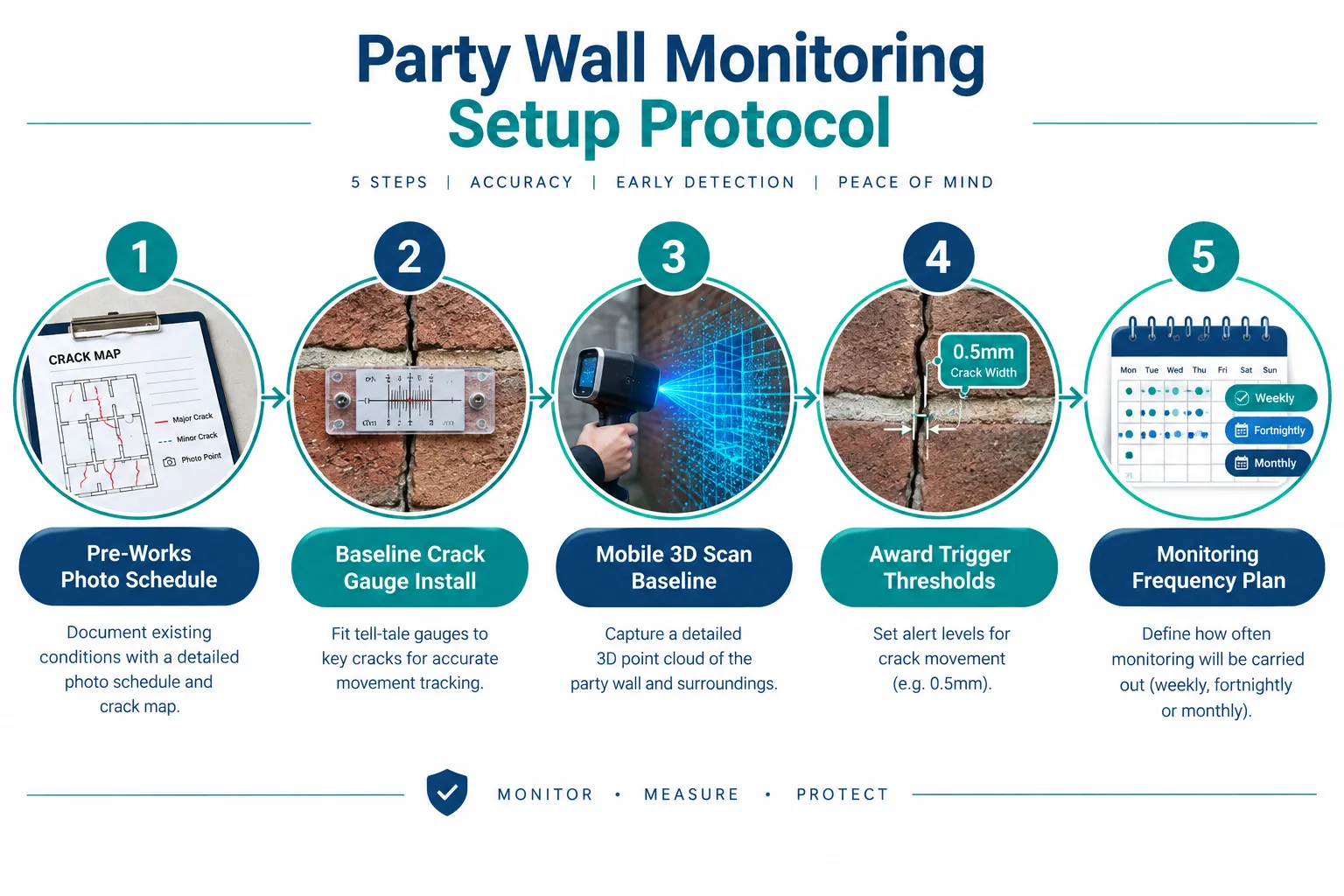
Using mobile 3D mapping and crack gauges in party wall monitoring requires a structured setup sequence. Rushing the baseline phase is the most common mistake on London projects, and it is one that cannot be corrected after excavation begins.
Step 1: Pre-Works Condition Survey
The condition survey must be completed before any notifiable works commence. Current London practice requires that the survey covers all rooms in the adjoining property, not just the wall directly facing the works [5]. This is critical because vibration and ground movement can cause damage at a distance from the excavation face.
The survey should include:
- A full photographic schedule of every room, ceiling, floor, and external elevation
- Crack mapping with width measurements using a crack width gauge
- Notation of all pre-existing defects with their location, orientation, and estimated width
- A 3D laser scan of the external elevation and any accessible internal walls
Step 2: Baseline Instrument Installation
Once the condition survey is complete, crack gauges are installed across all identified cracks and at standard monitoring points on the party wall. The baseline readings are recorded and signed off by both surveyors where an agreed surveyor arrangement is in place.
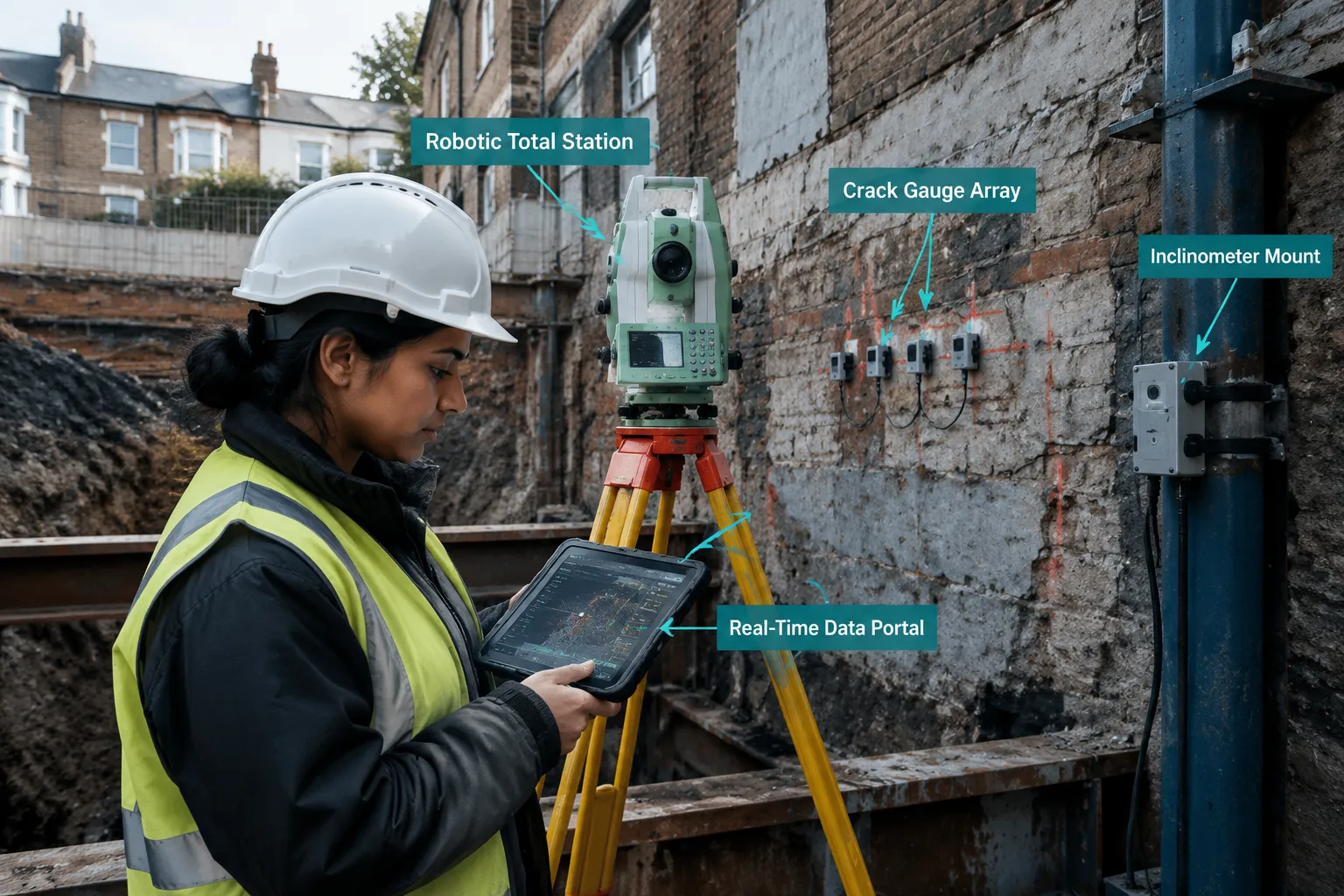
For higher-risk projects, typically those involving excavation deeper than one metre adjacent to a party wall, robotic total station prisms are installed at multiple heights on the structure. These prisms allow automated deformation monitoring without repeated site visits [4].
Step 3: Define Trigger Thresholds in the Award
The party wall award should specify measurable trigger thresholds. The current London market standard is:
New cracks should not exceed 0.5 mm in width, and existing cracks should not widen by more than 0.5 mm from the baseline reading. [5]
These thresholds should be tied to a defined response protocol: who is notified, within what timeframe, and what remedial action is required before works can continue. Embedding this in the award wording removes ambiguity and protects both parties.
Step 4: Establish Monitoring Frequency
Monitoring frequency should be proportionate to the risk level and the phase of works:
- Weekly during excavation and foundation works
- Fortnightly during above-ground construction
- Monthly during the post-construction monitoring period [5]
For high-risk sites, automated 24/7 robotic total station monitoring with real-time web portals and instant alerts replaces manual weekly visits entirely [4]. Manual tell-tale and Demec gauge reading remains appropriate for standard residential extensions where the risk profile is lower.
Step 5: Reporting and Documentation
Each monitoring visit should produce a written report that includes:
- Current readings for all crack gauges and prism targets
- Comparison against baseline and previous readings
- Any exceedances of trigger thresholds and the response taken
- Updated photographic record of any changed cracks
- A 3D scan comparison overlay if a re-scan has been conducted
This documentation chain is the evidence base that protects the building owner if a damage claim is made. For surveyors working across South London or East London where Victorian terrace density is high, a standardised reporting template saves significant time across multiple concurrent projects.
Cost Planning and Budget Benchmarks for 2026
Cost is a frequent obstacle when surveyors try to specify comprehensive monitoring programmes. Understanding the published market benchmarks helps frame the conversation with building owners at the award stage.
Published 2026 London figures suggest the following ranges [4]:
- Small residential installation: from approximately £800 plus VAT
- Monthly monitoring packages: £600,£1,200 per month depending on instrument count and reporting requirements
- Per-visit monitoring with reports: approximately £354,£630 per visit
For larger basement projects, a commonly cited 2026 budget is roughly £7,000,£9,000 over an 8-10 month project, broken down across installation, baseline survey, weekly readings during excavation, and less frequent readings in later phases [5].
These figures are meaningful for award drafting. Building owners who understand the cost structure are less likely to resist monitoring conditions, particularly when the alternative, an undocumented damage claim, can cost multiples of the monitoring budget.
For practical advice on managing overall project costs, the guide on how to keep party wall costs down offers useful context on where efficiencies can be found without compromising the monitoring standard.
When to Upgrade to Automated Monitoring
The decision to move from manual to automated monitoring should be driven by risk, not budget alone. Automated systems are strongly preferred when:
- Excavation depth exceeds 2 metres adjacent to a party wall
- The adjoining property is occupied by vulnerable residents
- The project programme does not allow reliable weekly site access
- The borough planning condition specifies continuous monitoring
A London structural monitoring guide confirms that automated 24/7 robotic total stations are the appropriate tool for high-risk projects, while manual methods remain suitable for standard sites [4].
Common Errors and How to Avoid Them
Even experienced surveyors make avoidable mistakes in monitoring programme design. The most frequent errors on London party wall projects include:
Incomplete baseline coverage. Limiting the pre-works survey to the party wall face only. Ground movement from deep excavation can cause damage to front elevations, rear extensions, and internal plasterwork well away from the shared wall.
No trigger thresholds in the award. Specifying that monitoring will take place without defining what constitutes an actionable reading. Without a threshold, a monitoring report is evidence without a standard.
Gauge installation after works begin. Installing tell-tales after excavation has started means the baseline reading already includes construction movement. Any subsequent reading is uninterpretable.
Failure to re-scan after significant events. A 3D baseline scan is only useful if it is compared against a post-event scan after any significant ground movement, flooding, or vibration event. A single scan is a snapshot, not a monitoring programme.
Inadequate frequency during the critical phase. Reducing monitoring to monthly visits during active excavation to save cost. The excavation phase is when the greatest movement risk occurs, and weekly readings are the minimum defensible standard [5].
Surveyors working on North London or West London projects involving deep basements in conservation areas should pay particular attention to borough-specific planning conditions, which may impose additional monitoring requirements beyond the party wall award.
Conclusion
Using mobile 3D mapping and crack gauges in party wall monitoring is no longer a premium option reserved for major commercial projects. In 2026, it is the practical standard for any London project involving excavation adjacent to a shared structure. The combination of crack gauge instruments and 3D scanning creates a monitoring programme that is both technically robust and legally defensible.
Actionable next steps for surveyors and building owners:
- Specify monitoring requirements in the party wall award before works begin, including trigger thresholds, frequency, and reporting obligations.
- Commission a full pre-works condition survey covering all elevations and all rooms, not just the party wall face.
- Install crack gauges across all identified defects and at standard monitoring points before the first excavation cut.
- For basement-adjacent works, obtain a 3D laser scan baseline of the external elevation and install robotic total station prisms for ongoing deformation tracking.
- Establish a clear escalation protocol in the award so that any threshold exceedance triggers an immediate, documented response.
- Retain all monitoring reports, scan files, and photographic records for a minimum of six years after practical completion.
A well-designed monitoring programme protects everyone involved. It gives building owners evidence that they met their duty of care, gives adjoining owners confidence that their property is being watched, and gives surveyors the documentation they need to resolve disputes quickly and professionally.
References
[1] Monitoring – https://seseltd.co.uk/monitoring/ [2] Crack Monitoring – https://www.benchmarkses.com/crack-monitoring [3] pointandlevel.co.uk – https://pointandlevel.co.uk/ [4] Structural Monitoring Survey Company Uk And London Guide – https://icelabz.co.uk/resources/structural-monitoring-survey-company-uk-and-london-guide/ [5] Party Wall Requirements London – https://www.surveyofpartywall.co.uk/party-wall-requirements-london/ [6] Basement Monitoring Survey For Architects – https://icelabz.co.uk/resources/basement-monitoring-survey-for-architects/ [8] Crack Monitoring – https://subsidencesurveys.co.uk/services/crack-monitoring/
Speak to a RICS chartered party wall surveyor
Free initial consultation. Notices, awards and schedules of condition across London and nationwide.