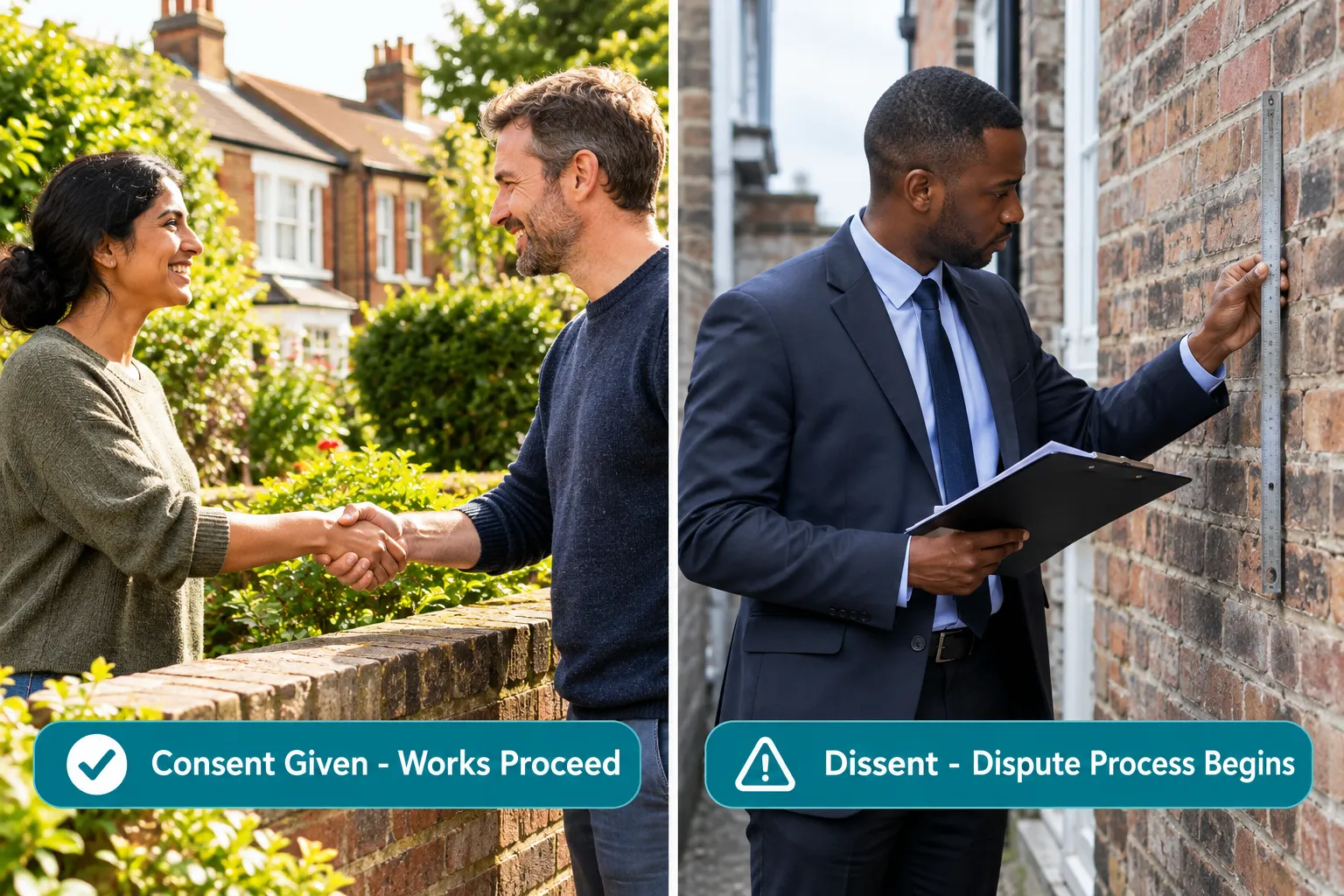
Looking for expert solutions?
Request a Quote

Tag: party wall surveyor london

  • Leasehold Permission Fees Cap, Alterations Licence to Alter and Party Wall London: October 2026 Update

    A single loft conversion in a London mansion block can now trigger three separate approval processes, two different pieces of legislation, and a fee structure that government ministers have just admitted needs fixing. That is the reality facing flat owners this month, as Westminster moves to rein in the costs landlords and managing agents charge for permission, while the 1996 law governing shared walls stays exactly as it was.

    This article explains what the leasehold permission fees cap, alterations licence to alter and party wall London changes mean in practice for anyone planning an extension, loft conversion or internal alteration in the capital, and how the two systems, lease-based consent and statutory party wall notice, fit together.

    Key Takeaways

    • On 29 September 2026 the government announced plans to cap certain leaseholder and estate permission/admin fees, including those for minor alterations, pet permission, document provision and mortgage change notifications.
    • A consultation will decide which fees are capped and at what level, no figures have been set yet.
    • Independent regulation of managing agents (licensing, qualifications, conduct standards) is also planned, with further detail to come.
    • The Commonhold and Leasehold Reform Bill is due in Parliament before Christmas 2026, but this is separate from, and will not replace, the Party Wall etc. Act 1996.
    • Flat owners in London still need both a landlord’s licence to alter under their lease and, where relevant, party wall notices served under the 1996 Act, these are two distinct legal requirements.

    Why This Matters for London Flat Owners Right Now

    London’s housing stock is dominated by converted terraces, mansion blocks and purpose-built flats where structural work almost always touches a neighbour’s property, a shared wall, or both. For most leaseholders planning works, the practical journey has two checkpoints:

    1. Getting the freeholder or managing agent’s consent under the terms of the lease (the licence to alter).
    2. Serving statutory notice under the Party Wall etc. Act 1996 if the works affect a party wall, party structure, boundary wall or nearby excavation.

    These are not the same thing, they are not interchangeable, and, crucially, paying one does not satisfy the other.

    “A licence to alter is a private contractual permission from your landlord. A party wall notice is a public statutory process that exists regardless of what your lease says.”

    The September 2026 Fee Cap Announcement Explained

    On 29 September 2026, the government confirmed it intends to cap certain fees charged to leaseholders and to homeowners on privately managed estates. The fee types under consideration include:

    • Permission for pets
    • Minor property changes and alterations
    • Providing documents (such as lease copies or management information)
    • Recording a change of mortgage provider

    No specific cap amounts have been announced. The government has said it will consult on which fees should be capped and at what level, meaning the final list and figures remain open. Alongside this, ministers set out plans for independent regulation of managing agents, covering:

    • A licensing requirement for agents
    • Minimum qualifications
    • A regulator with power to set conduct and complaints standards
    • Powers to withdraw an agent’s licence for poor practice

    Further details on both the fee cap consultation and the regulatory framework are still to be published.

    What This Means for Alteration Permission Fees

    Because “minor property changes/alterations” is explicitly listed among the fee types under review, the administration charge many leaseholders currently pay simply to apply for a licence to alter could eventually be capped. However, until the consultation concludes and a cap level is set, leaseholders and homeowners on managed estates should expect current fee structures, including charges that can feel disproportionate to the admin work involved, to remain in place for now.

    Practical note:

    Fee caps, once set, are expected to apply to landlord/managing agent charges for granting consent under the lease. They will not apply to, or replace, party wall surveyor fees, which arise under a separate statutory regime and are payable by the building owner carrying out the works.

    Commonhold and Leasehold Reform: The Bigger Picture

    On 7 October 2026, the Prime Minister confirmed the Commonhold and Leasehold Reform Bill will be introduced to Parliament before Christmas 2026. This builds on a draft published in January 2026, which proposed:

    • Commonhold as the default tenure for new flats
    • Caps on ground rent
    • Replacing forfeiture as a means of enforcing lease breaches

    Separately, the Leasehold and Freehold Reform Act 2024’s valuation changes are not yet in force. A consultation on valuation rates under that Act closes on 21 October 2026, so leaseholders should not assume enfranchisement or extension costs have already changed.

    None of this reform activity alters party wall law. The Party Wall etc. Act 1996 remains untouched by both the fee cap proposals and the leasehold reform bill.

    Licence to Alter vs Party Wall Notice: What’s the Difference?

    Confusion between these two processes is one of the most common issues flat owners raise with party wall surveyors. The table below sets out the core distinctions.

    Feature Licence to Alter Party Wall Notice
    Legal basis The lease (private contract) Party Wall etc. Act 1996 (statute)
    Who grants/receives it Freeholder/landlord, often via managing agent Adjoining owner(s)
    Purpose Permission to alter the demised premises under lease terms Protects structural and boundary interests
    Typical fee Admin/legal fee set by landlord or agent Surveyor’s fee, paid by building owner
    Government fee cap plans Potentially covered by 2026 consultation Not covered, statutory process unaffected
    Timescale Varies by lease; often weeks 1 or 2 months’ statutory notice period

    A licence to alter is about whether your landlord agrees to the works happening at all under your lease terms. A party wall notice is about whether your proposed works affect a neighbour’s structural or boundary rights, and that obligation exists even if your landlord has already said yes.

    When the Party Wall Act Applies in London Flats

    The Act creates notice obligations in three situations:

    • Section 1, building a new wall at or astride a boundary (1 month’s notice)
    • Section 2, work to an existing party wall or party structure, such as cutting in beams, inserting damp-proofing, or underpinning (2 months’ notice)
    • Section 6, excavation within 3 metres (where new foundations go deeper than the neighbour’s) or 6 metres (where a line drawn at 45 degrees would meet the neighbour’s foundations) (1 month’s notice)

    For flats, a critical point often missed is that both the leaseholder and the freeholder can be “owners” under the Act. The legislation defines an owner to include anyone with a leasehold interest of more than one year remaining, as well as the freeholder. Practically, this means:

    • The leaseholder carrying out works may need to serve notice as the “building owner”.
    • The freeholder of the building being worked on, and the freeholder or long leaseholder of the adjoining flat, may all need to be served as “adjoining owners”.
    • In a block of flats, it is common for notice to need serving on the freeholder, the flat below, the flat beside, and sometimes the flat above, depending on what the works touch.

    Sequencing: Get This Order Right

    Flat owners who tackle these processes out of order often face delays, re-service of notices, or disputes that could have been avoided. A sensible sequence is:

    1. Check the lease for alteration clauses and apply for the licence to alter early, since landlord consent can take time and may come with conditions (such as requiring a schedule of condition).
    2. Instruct a party wall surveyor to assess which sections of the Act apply once drawings are reasonably settled.
    3. Serve party wall notices on all relevant owners, this can often run in parallel with, rather than strictly after, the licence to alter process, but works should not start until both are resolved.
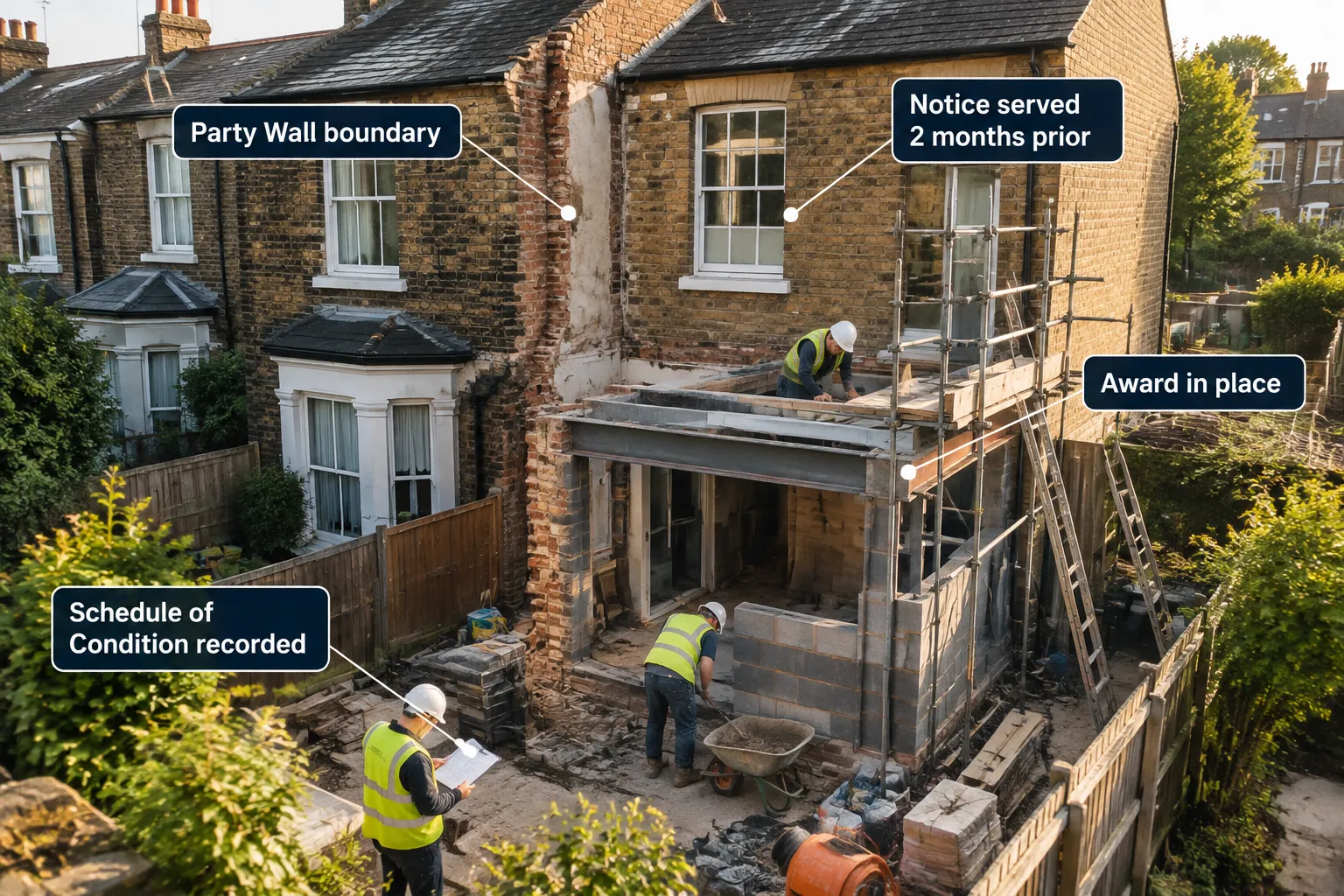
    4. Agree a schedule of condition for the adjoining property before works begin, recording existing cracks, finishes and structural condition. This protects both the building owner and adjoining owner if damage is later alleged.
    5. Obtain the party wall award (if the adjoining owner dissents or a surveyor is appointed) before starting notifiable work.

    Skipping the schedule of condition is a frequent and costly mistake, without it, disputes over pre-existing damage become far harder to resolve fairly.

    Fee Pressures Flat Owners Should Expect

    While no specific figures have been confirmed for either licence to alter charges or the proposed fee caps, London leaseholders should be aware of two separate cost pressures:

    • Landlord/managing agent fees for processing a licence to alter application, which the September 2026 announcement signals could eventually be capped, pending consultation outcomes.
    • Party wall surveyor fees, which remain a statutory cost of the works themselves, payable by the building owner, and are not part of the fee cap discussion at all.

    Flat owners should budget for both, and should not assume that future caps on landlord admin fees will reduce party wall costs.

    Frequently Asked Questions

    Does the leasehold fee cap announcement change party wall surveyor fees? No. The 29 September 2026 announcement concerns landlord and managing agent fees, such as alteration permission charges. Party wall surveyor fees arise under separate statute and are unaffected.

    If my landlord grants a licence to alter, do I still need to serve party wall notices? Yes, if the works fall within sections 1, 2 or 6 of the Party Wall etc. Act 1996. Landlord consent and statutory notice are independent requirements.

    Who counts as an “owner” under the Party Wall Act in a block of flats? Both freeholders and leaseholders with more than one year remaining on their lease can be owners, meaning notices may need to be served on several parties for a single project.

    Has the government set a cap figure for alteration permission fees yet? No. The government has only announced that it will consult on which fees to cap and at what level. No amounts have been confirmed.

    Will the Commonhold and Leasehold Reform Bill replace the Party Wall Act? No. The Bill, expected before Christmas 2026, addresses tenure, ground rent and forfeiture. It does not affect party wall notice requirements.

    Is the Leasehold and Freehold Reform Act 2024 already affecting lease extension costs? Not yet. Valuation changes under that Act are not in force, and the related consultation on valuation rates closes on 21 October 2026.

    Conclusion

    London flat owners planning extensions, loft conversions or internal alterations face a genuinely two-track approval landscape: a lease-based licence to alter governed by private contract, and a statutory party wall process governed by the 1996 Act. The government’s 29 September 2026 announcement on capping leasehold permission fees, and the Prime Minister’s 7 October 2026 confirmation of the Commonhold and Leasehold Reform Bill, both signal meaningful change ahead for landlord-side costs and leasehold structure generally. None of this, however, alters the party wall notice periods, owner definitions or procedural requirements that have applied since 1996.

    The practical next step for anyone starting works is straightforward: review the lease for alteration clauses, instruct a party wall surveyor early to identify which sections of the Act apply, and keep the licence to alter and party wall notice processes moving in parallel rather than treating one as a substitute for the other. Watch for the upcoming consultation details on fee caps, but plan current projects on today’s rules, not anticipated ones.

  • A Hedge, a Fence and a £200,000 Bill: The Torquay Boundary Dispute Every London Homeowner Should Learn From

    A few millimetres. That is the margin that separated two neighbours in a Devon courtroom after years of legal argument, a High Court appeal, and a costs bill that could leave one party worse off by more than £200,000. This Torquay case is now the clearest real-world lesson in why every London homeowner needs to understand the difference between a party wall notice and a boundary claim, because the neighbour boundary dispute £200,000 costs party wall lessons buried in this judgment apply just as much to a Victorian terrace in Hackney as they do to a hilltop house in Devon.

    Sarah Douglas, managing director of a Devon estate agency, bought her £700,000 hilltop home in 2017. In 2018, her then-neighbour removed a hedge that divided the two properties. When Ronald Channon, an 87-year-old former rally driver, bought the neighbouring house for £1.4 million in 2021, he later built a fence along the strip where the hedge once stood. Douglas said the fence sat partly on her land. What followed was years of litigation over a boundary line that, in the end, moved by only a few millimetres.

    Key Takeaways

    • The Party Wall etc. Act 1996 governs work to shared walls, structures and excavations near neighbouring buildings, it does not decide who owns the land.
    • Land Registry title plans show “general boundaries” only, not precise legal lines, which is exactly why disputes like this one happen.
    • Judge Mitchell rejected the “southernmost leaf” argument because a boundary tied to foliage can shift with growth or trimming; stems, not leaves, mark a fixed line.
    • Douglas was ordered to pay 70% of Channon’s costs, estimated above £300,000, with £108,402 due upfront, a bill that could exceed £200,000 beyond her own legal spend.
    • RICS boundary surveys, determined boundary applications and early mediation are far cheaper than litigation and should be standard practice before removing hedges or building on a boundary line.

    What Actually Happened in Torquay

    Douglas argued the boundary followed the hedge’s “southernmost leaf”, essentially, wherever the furthest edge of foliage happened to reach. Judge Paul Mitchell at Plymouth County Court rejected this. A boundary defined by leaf growth is not fixed; it moves every time the plant is trimmed or left to grow. Instead, the judge found the boundary ran through the middle of where the hedge stems had once stood, following the outer edge of those stems. The practical difference between the two competing lines was described in court as a matter of millimetres.

    Douglas’s claims, ownership of the disputed strip, an injunction, and damages over a stepped bank, all failed. Channon’s own £200,000 counterclaim for lost property value, harassment and nuisance was also dismissed. Both sides lost their main arguments, yet one side still ended up with a devastating costs order.

    On appeal, Mr Justice Linden in the High Court upheld the costs decision, noting: “The difference between the two lines was, the judge permissibly found, immaterial.” He added that “the costs of the litigation were already very substantial” and that “both sides pursued their respective positions robustly.” Judge Mitchell had earlier observed that the case had “caused a significant amount of stress and upset, let alone cost,” calling it, in its own way, “a tragedy.”

    Boundary Dispute vs Party Wall Matter: Know the Difference

    This is the single most important distinction London homeowners misunderstand, and it sits at the heart of the neighbour boundary dispute £200,000 costs party wall lessons from this case.

    Issue Party Wall etc. Act 1996 Boundary Dispute
    What it covers Work to shared walls, structures, and excavations near a neighbour’s building Ownership and location of the legal boundary line
    Who decides Party wall surveyors (one, two or three-surveyor procedure) Courts, Land Registry, or First-tier Tribunal
    Typical trigger Loft conversions, extensions, excavations within 3-6 metres of a neighbour’s foundations Fences, hedges, walls, extensions built on or near a disputed line
    Outcome A party wall award covering the works A determined boundary, injunction, or damages ruling

    The Party Wall Act does not and cannot resolve who owns a strip of land. A party wall surveyor appointed under the Act has no authority to rule on title or ownership, that is a legal and Land Registry matter entirely separate from the Act’s remit. Many homeowners wrongly assume that serving a party wall notice, or going through the party wall process, settles boundary questions. It does not. Douglas and Channon’s dispute was never a party wall matter at all; it was a pure boundary and land ownership claim, which is precisely why it ended up in court rather than being resolved through a surveyor’s award.

    Why Land Registry Plans Will Not Save You

    Many London homeowners assume their title plan shows an exact boundary line. It does not. HM Land Registry title plans are based on Ordnance Survey mapping and show what is called a general boundary, an approximate line, not a legally precise one. The Land Registry itself states that general boundaries are not guaranteed to be accurate to the exact inch, or even the exact metre, in some cases.

    This matters enormously in densely packed London streets, where terraced and semi-detached houses often share walls, fences, and tiny strips of garden land worth arguing over. A title plan that looks definitive on screen may be legally silent on exactly where a boundary sits once you get into stems, leaves, footings or historic fence lines.

    How to Avoid a £200,000 Mistake

    Get a RICS Boundary Survey First

    Before removing a hedge, replacing a fence, or building an extension near a shared line, commission a RICS boundary survey. A chartered surveyor can measure the physical features, review historic deeds, and produce a report that identifies where the likely legal boundary sits, long before any structure goes up.

    Consider a Determined Boundary Application

    HM Land Registry offers a determined boundary process. This is a formal application to fix the exact boundary line on the title register, supported by survey evidence. It is slower and costs more than doing nothing, but it is dramatically cheaper than six-figure litigation.

    Try Mediation or Expert Determination Early

    Courts and the Royal Institution of Chartered Surveyors both encourage early neutral evaluation, mediation, or expert determination for boundary disputes. An independent expert can review the evidence and give a binding or advisory opinion far faster, and far more cheaply, than a trial.

    Document Everything Before You Touch a Hedge or Fence

    • Photograph the hedge, fence or wall from multiple angles before any removal or alteration.
    • Keep copies of historic title deeds, conveyances and any boundary agreements.
    • Speak to previous owners or long-term neighbours about historic boundary features.
    • Notify your neighbour in writing before removing shared boundary features, even if you believe they sit entirely on your land.

    Separate Party Wall Works from Boundary Questions

    If planned works also involve excavation or building near a shared wall, serve a party wall notice under the 1996 Act separately from any boundary discussion. Appoint a party wall surveyor for the structural works, and seek separate legal or RICS surveying advice if ownership of the land itself is in question.

    FAQ

    Does the Party Wall Act decide who owns a boundary? No. The Act governs notifiable building work near shared walls and structures. Ownership of land is decided by title deeds, Land Registry records, or the courts.

    Why did a few millimetres matter so much in the Torquay case? It did not, in practical terms, the High Court called the difference “immaterial.” What mattered, and drove the costs, was the years of litigation over that tiny margin.

    Can a hedge mark a legal boundary? A hedge can be evidence of a historic boundary, but foliage itself is not a reliable marker because growth and trimming change its shape. Courts tend to look at fixed features like stems, roots or old fence posts.

    What is a determined boundary application? It is a formal Land Registry process to fix an exact boundary line on the register, supported by survey evidence, rather than relying on the general boundary shown on a standard title plan.

    How can London homeowners avoid costly boundary litigation? Get a RICS boundary survey before building or removing hedges and fences, keep deeds and photographic evidence, and use mediation or expert determination before issuing court proceedings.

    Conclusion

    The Torquay case is a stark warning dressed up as a minor disagreement over a hedge. Two neighbours spent years and well over £300,000 combined arguing over millimetres, and one now faces a bill that could exceed £200,000 on top of her own costs. The neighbour boundary dispute £200,000 costs party wall lessons from this judgment are simple: boundaries are not party wall matters, Land Registry plans are not precise, and litigation is a last resort that rarely produces a winner. London homeowners planning any work near a shared boundary should commission a RICS survey, consider a determined boundary application, and try mediation before a single brick is laid or a hedge is cut. As Judge Mitchell put it, these cases are, in their own way, a tragedy, and nearly all of them are avoidable.

  • Property Sale Fall Through Rate, Completion Delays and Party Wall London 2026: October 2026 Market Analysis

    Nearly a quarter of agreed property sales in England and Wales are collapsing before completion, and the ones that survive are taking longer than ever to close. That is the uncomfortable headline buried inside the October 2026 data, and for London homeowners it carries an extra sting: party wall problems are quietly contributing to the delays that push deals past the six-month mark. Understanding the property sale fall through rate, completion delays and party wall London 2026 picture is no longer optional for anyone buying, selling or extending a home in the capital.

    Property Industry Eye’s October 2026 analysis names getting sales to completion as the market’s single biggest challenge. The average gap between agreeing a sale and actually completing it has stretched to 154 days nationally, more than five months, according to Rightmove. Roughly 23% of agreed sales fall through before completion. Party wall matters, from undocumented loft conversions to unresolved neighbour disputes, sit among the enquiry-related issues now slowing London transactions to a crawl.

    Key Takeaways

    • The average UK sale now takes 154 days from agreement to completion, according to Rightmove, with roughly 23% of agreed sales falling through before completion.
    • TwentyEA reports 60.8% of exchanges now take more than six months from instruction, up sharply from 36.1% in 2019.
    • HMRC recorded 96,250 residential transactions in August 2026, down 11% on the month and 9% on the year, while Bank of England mortgage approvals fell to 54,900.
    • Nationwide data shows London house price growth of just 0.4% annually in Q3 2026, against 0.8% UK-wide in September 2026.
    • Missing party wall awards, undisclosed loft and basement works, and unresolved damage claims are a recurring cause of solicitor enquiries that stall London completions.

    The Numbers Behind the Property Sale Fall Through Rate Completion Delays Party Wall London 2026 Story

    The scale of the slowdown is now well documented across multiple sources, and together they paint a consistent picture of a market struggling with friction rather than demand.

    Metric Figure Source
    Average time from sale agreed to completion (national) 154 days Rightmove
    Agreed sales that fall through Approx. 23% Industry-wide, reported by Property Industry Eye
    Exchanges taking more than six months from instruction 60.8% (vs 36.1% in 2019) TwentyEA
    Forecast transactions for 2026 1.16 million (4.4% below 2025) TwentyEA
    Sales agreed, year on year Down 5.8% TwentyEA
    Residential transactions, August 2026 (not seasonally adjusted) 96,250 (down 11% on month, 9% on year) HMRC
    Residential transactions, August 2026 (seasonally adjusted) 95,220 HMRC
    Mortgage approvals, August 2026 54,900 (down from 56,000 in July) Bank of England
    London annual house price growth, Q3 2026 0.4% Nationwide
    UK annual house price growth, September 2026 0.8% Nationwide

    Richard Donnell of Zoopla points to mortgage affordability as a key driver, noting that “sales agreed have fallen 9% as mortgage rates climbed above 5% since the start of the year”. Jeremy Leaf, meanwhile, has described how transactions take “painfully long to complete” once agreed, which is exactly where enquiry-related delays, including party wall questions, do their damage.

    Why London Sales Are Taking Over Five Months to Complete

    Property Industry Eye is blunt about the cause: “Enquiries continue to be a major source of delay” because information often sits with third parties or historical documentation is incomplete. For London’s older housing stock, much of it extended, converted or dug out beneath ground level over the decades, that historical documentation frequently includes party wall paperwork.

    A conveyancing enquiry about party wall compliance can sit unanswered for weeks while a seller tries to locate an award signed a decade earlier, or while a surveyor is instructed retrospectively to assess works that were never notified in the first place. Multiply that across a chain of three or four properties, and the 154-day national average from Rightmove starts to look optimistic for homes with unresolved structural history.

    Party Wall Issues: The Hidden Driver of Completion Delays

    London’s terraces, semis and converted flats share walls, floors and foundations more often than almost anywhere else in the UK. That makes the Party Wall etc. Act 1996 relevant to an enormous share of the capital’s housing stock, and it means party wall gaps are a recurring, specific contributor to the broader property sale fall through rate, completion delays and party wall London 2026 trend.

    Missing or Unregistered Party Wall Awards

    Many London sellers discover during conveyancing that a past loft conversion, rear extension or basement dig-out was carried out without a retained party wall award, or that the award exists but was never shared with the buyer’s solicitor. Awards and schedules of condition are the paper trail that proves a project was handled correctly. Without them, a buyer’s solicitor has no way to confirm the work was lawful or that any damage to a neighbouring property was properly recorded and resolved.

    Works Started Without Notice Under the Party Wall etc. Act 1996

    Some projects, particularly basement conversions and loft extensions involving shared walls, begin without the statutory notice required under the Act. This leaves sellers exposed later, because a buyer’s solicitor who spots recent structural work with no corresponding award will almost always raise a formal enquiry. Resolving that enquiry after the fact, sometimes years after the building work finished, takes considerably longer than handling it at the time.

    Outstanding Neighbour Damage Claims

    Where a party wall project caused cracking, damp or other damage to an adjoining property, and the claim was never formally closed out, it can resurface during a sale. An unresolved claim, even a minor one, is exactly the kind of “information sitting with third parties” that, in our experience, is a major source of delay.

    “Enquiries continue to be a major source of delay” as information often sits with third parties or historical documentation is incomplete.

    What Buyers’ Solicitors Are Asking About Party Wall Compliance

    Conveyancers acting for London buyers are increasingly thorough on this point, and typical enquiries include:

    • Was a party wall notice served before any extension, loft conversion or basement work began?
    • Is there a signed party wall award, and can a copy be provided?
    • Was a schedule of condition completed before works started, and is there photographic evidence?
    • Were any damage claims from neighbours raised, and how were they resolved?
    • Has the seller disclosed all relevant works on the TA6 Property Information Form?

    Each unanswered question adds days, sometimes weeks, to a transaction that is already averaging 154 days nationally from agreement to completion.

    Practical Steps for Sellers Facing Completion Delays

    Sellers who get ahead of these questions can materially reduce their risk of becoming part of the 23% fall-through statistic.

    1. Locate every party wall award and schedule of condition connected to past building work before marketing the property.
    2. Obtain retrospective evidence where notice was never served, including photographs, structural reports or a surveyor’s written assessment confirming no outstanding issues.
    3. Disclose fully on the TA6 form. Omissions discovered later by a buyer’s solicitor cause far more delay than an upfront, honest answer.
    4. Instruct a party wall surveyor early if any uncertainty exists, rather than waiting for a solicitor’s enquiry to force the issue mid-transaction.

    Practical Steps for Buyers Dealing With Party Wall Uncertainty

    Buyers have a clear interest in surfacing party wall issues before exchange rather than after completion.

    • Request copies of all party wall awards and schedules of condition relating to any extension, loft conversion or basement work.
    • Instruct a qualified party wall surveyor to inspect shared walls and any recent structural changes, particularly in older London terraces and converted properties.
    • Ask specifically about any history of neighbour disputes or damage claims connected to the property.
    • Build realistic timescales into mortgage offers and removal plans, given that 60.8% of exchanges, per TwentyEA, now take more than six months from instruction.

    Owners Planning Works While a Sale Is Pending

    Some London homeowners continue building projects even after accepting an offer, assuming it will not affect the sale. This is risky. Starting works without serving notice under the Party Wall etc. Act 1996 while a sale is live can trigger fresh enquiries, delay exchange, or give a buyer grounds to withdraw. Anyone planning an extension, loft conversion or basement project while marketing or selling a property should pause and take advice, or at minimum ensure notices are served and consents documented before legal work begins, so the transaction is not derailed by avoidable structural disputes.

    How a Party Wall Surveyor Can Prevent Completion Delays in London 2026

    Against a backdrop of 1.16 million forecast transactions nationally, 4.4% below 2025 according to TwentyEA, and London price growth of just 0.4% annually per Nationwide, every week saved in the conveyancing process matters. An appointed party wall surveyor can:

    • Verify or reconstruct missing documentation quickly, reducing the time a solicitor’s enquiry sits open.
    • Mediate and resolve disputes between neighbours before they escalate into formal objections that stall a sale.
    • Produce retrospective schedules of condition and written confirmations that satisfy buyers’ solicitors without requiring a full new award process.
    • Advise sellers and buyers on realistic timescales so expectations match the reality of a market where exchanges regularly exceed six months, as TwentyEA data confirms.

    Early, decisive surveyor involvement is often the difference between a transaction that completes within the 154-day national Rightmove average and one that drifts past the six-month threshold reported by TwentyEA.

    FAQ: Property Sale Fall Through Rate, Completion Delays and Party Wall London 2026

    How long does it currently take to complete a property sale in London? Rightmove’s data puts the national average at 154 days from sale agreed to completion, over five months, though TwentyEA notes 60.8% of exchanges now take more than six months from instruction.

    What proportion of agreed sales fall through? Roughly 23% of agreed sales fall through before completion, according to industry-wide data reported by Property Industry Eye in October 2026.

    Can a missing party wall award really delay a sale? Yes. Buyers’ solicitors routinely raise enquiries when no award or schedule of condition exists for past extensions, loft conversions or basement works, and resolving these after the fact takes time.

    What should a seller do if a party wall notice was never served for past work? Instruct a party wall surveyor to assess the situation, gather retrospective evidence such as photographs or structural reports, and disclose the position honestly on the TA6 form.

    Does the current mortgage market make delays worse? Yes. Bank of England data shows mortgage approvals fell to 54,900 in August 2026, down from 56,000 in July, and Zoopla’s Richard Donnell notes sales agreed have fallen 9% as mortgage rates climbed above 5%.

    Is this just a London problem? No, it is a UK-wide issue, but London’s dense terraced and converted housing stock makes party wall compliance a more frequent factor in enquiry-related delays than in many other regions.

    Conclusion

    The property sale fall through rate, completion delays and party wall London 2026 story is ultimately one of friction: a market with fewer transactions, slower mortgage approval rates, and conveyancing enquiries that take weeks to resolve. Party wall issues, whether a missing award, unreported works, or an unresolved neighbour dispute, are an avoidable piece of that friction. Sellers should audit their party wall history before marketing a property. Buyers should ask the right questions early and instruct a qualified surveyor to inspect shared walls. Owners mid-project should pause before starting new works on a property under offer. Acting early, with professional party wall advice, is the clearest way for London transactions to avoid joining the queue of sales pushed past the six-month mark.

    LANGUAGE: en

  • Using Mobile 3D Mapping and Crack Gauges in Party Wall Monitoring: Practical Protocols for 2026 London Projects

    Using Mobile 3D Mapping and Crack Gauges in Party Wall Monitoring: Practical Protocols for 2026 London Projects

    London’s dense Victorian and Edwardian housing stock means that nearly every basement extension or rear addition shares a structural wall with a neighbour. A single poorly documented crack can become the centrepiece of a costly dispute months after the scaffolding comes down. That is why using mobile 3D mapping and crack gauges in party wall monitoring has moved from a specialist add-on to a baseline expectation on higher-risk London projects in 2026, and why surveyors who cannot explain their monitoring methodology are increasingly vulnerable to challenge.

    This article sets out a practical, evidence-based framework for combining crack gauge instruments with mobile 3D scanning technology. It covers instrument selection, baseline protocols, trigger thresholds, monitoring frequencies, and the documentation chain that satisfies both Party Wall Etc Act 1996 obligations and borough-level planning conditions.

    Key Takeaways

    • Crack gauges and 3D monitoring are most effective when used together: gauges provide low-cost continuous data, while 3D scanning provides a spatially complete baseline and change-detection record.
    • Baseline surveys must be completed before any notifiable works begin, covering all rooms and all elevations, not just the wall directly facing the excavation.
    • Trigger thresholds of 0.5 mm for new cracks and 0.5 mm widening of existing cracks are the current London market standard.
    • Monitoring frequency should be weekly during excavation, fortnightly during active construction, and monthly during the post-construction period.
    • Automated 24/7 robotic total station monitoring is preferred for high-risk or deep-basement projects; manual tell-tale and Demec gauge reading remains appropriate for standard residential works.

    Why Monitoring Has Become Non-Negotiable in 2026 London

    The regulatory and commercial pressure on London party wall surveyors has intensified steadily. Boroughs such as Camden, Westminster, and Kensington & Chelsea now require Basement Impact Assessments as a planning condition, and those assessments explicitly mandate structural monitoring of neighbouring properties throughout the construction period [6]. Failure to produce a credible monitoring record exposes building owners to liability claims and can invalidate a party wall award if a dispute reaches the courts.

    Why Monitoring Has Become Non-Negotiable in 2026 London

    At the same time, the technology available to surveyors has matured. One London survey firm has provided integrated 3D point structural movement monitoring, crack monitoring, inclinometer/tilt monitoring, and vibration monitoring as a combined package for party wall and construction projects since 2003 [1]. That longevity signals that the tools are proven, not experimental.

    The core argument for combining methods is simple: crack gauges give you a number at a specific point; 3D scanning gives you the spatial context that explains what that number means. Together they create a defensible evidence chain.

    The Legal Foundation

    Under the Party Wall Etc Act 1996, the building owner is responsible for making good any damage caused by notifiable works. That responsibility only has teeth if there is a documented pre-works condition record. A photographic schedule alone is no longer considered sufficient for basement-adjacent works on many London projects; crack mapping and dimensional baselines are now expected [5].

    For a full breakdown of which works trigger these obligations, the guide on types of party wall works is a useful starting reference.

    Instrument Selection: Crack Gauges and 3D Tools Explained

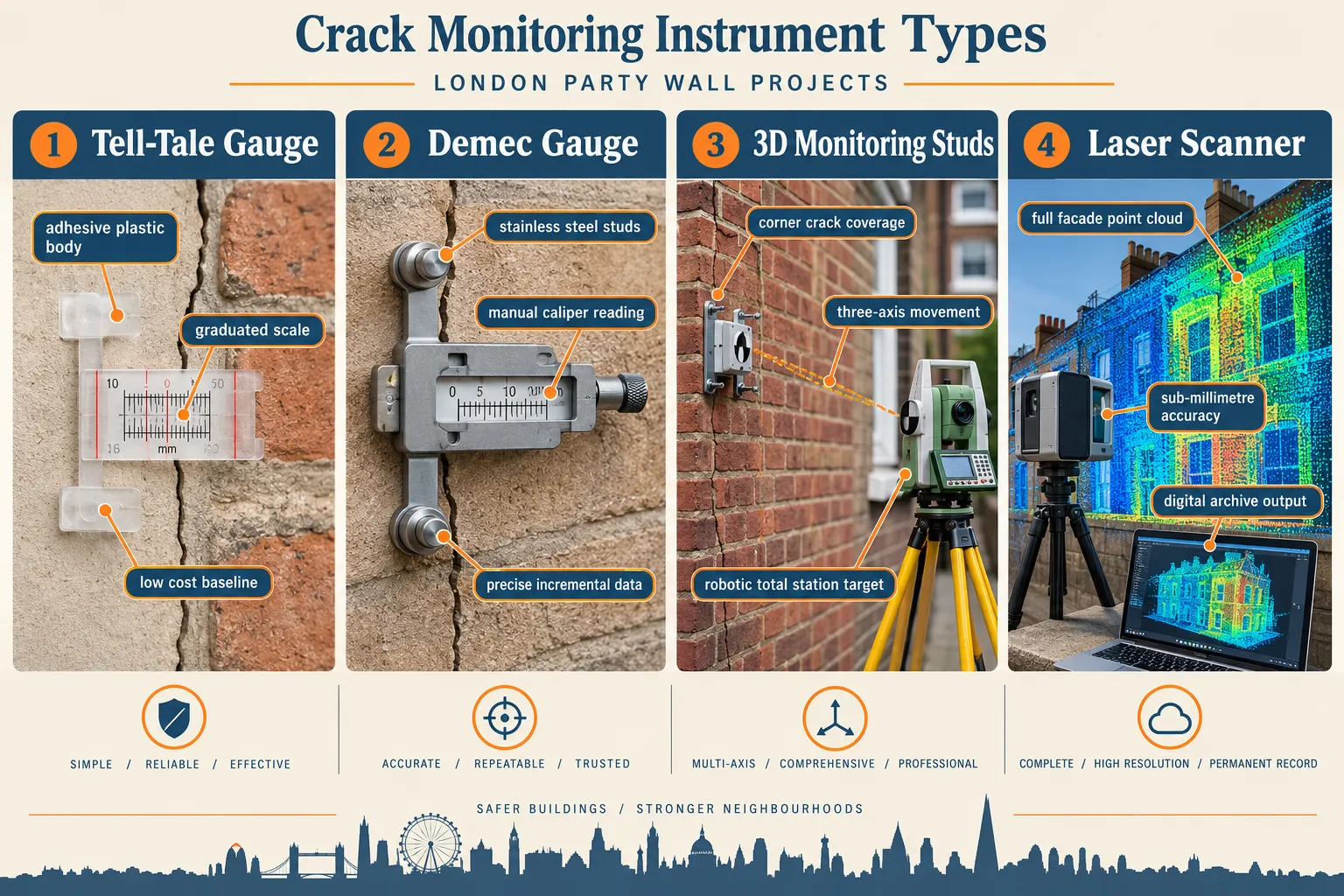
    Manual Crack Gauges: Tell-Tales and Demec Studs

    Manual gauges remain the workhorse of residential party wall monitoring. They are inexpensive, require no power source, and produce a readable record that any surveyor can verify on site.

    • Tell-tale gauges are adhesive plastic devices with a graduated scale. They bridge an existing crack and show any relative movement between the two sides. A London monitoring firm updated its guidance in August 2026 confirming that tell-tale and Demec crack gauges are installed and read over time to determine whether cracks are active or stable [3].
    • Demec gauges use stainless steel studs bonded to the masonry, with a precision caliper reading the distance between them. They offer greater accuracy than tell-tales and are preferred where incremental data is needed over a long monitoring period.
    • 3D monitoring studs are a more sophisticated variant. A UK crack-monitoring provider notes that these studs are specifically used for corner cracks, party-wall cracks, and any situation involving three-dimensional movement, which is common in London’s mixed-foundation terraces where differential settlement and rotation occur simultaneously [8].

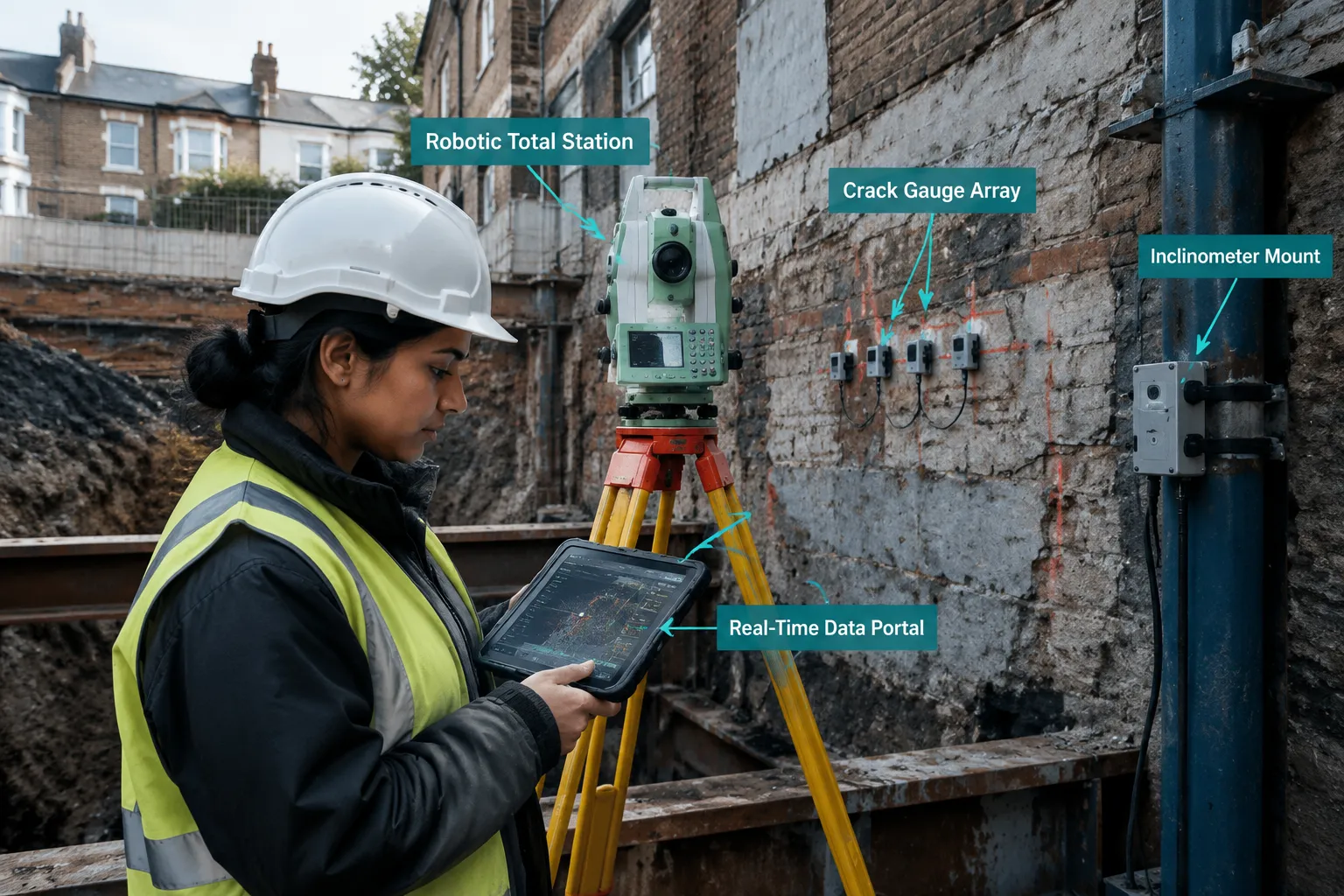
    Remote crack monitoring services, which transmit gauge readings automatically to a web portal, remain an active 2026 service line in London, with vendors emphasising high-accuracy device-based readings for sites where weekly site visits are impractical [2].

    Mobile 3D Scanning: Point Clouds and Robotic Total Stations

    Mobile 3D mapping technology captures the full geometry of a structure, not just a point measurement. The two most relevant tools for party wall work are:

    Tool Typical Accuracy Best Use Case
    Handheld / mobile laser scanner ±2-5 mm Full facade and interior baseline capture
    Robotic total station ±1 mm Ongoing deformation monitoring at prism targets
    Tilt / inclinometer sensors ±0.01 degrees Rotation and lean detection in retaining walls

    A 2026 London guide for basement monitoring confirms that 3D movement can be tracked to approximately ±1 mm using robotic total stations, 3D laser scanners, tilt sensors, and crack gauges in combination [6]. That level of accuracy is sufficient to detect the early stages of differential settlement before visible damage becomes significant.

    Key advantage of mobile scanning: a single site visit can produce a georeferenced point cloud of an entire terrace elevation, creating a permanent spatial baseline against which any future scan can be compared automatically. This is particularly valuable for party wall surveyor work in Central London where access windows are short and scaffolding is expensive.

    Practical Protocols: Setting Up a Monitoring Programme

    Practical Protocols: Setting Up a Monitoring Programme

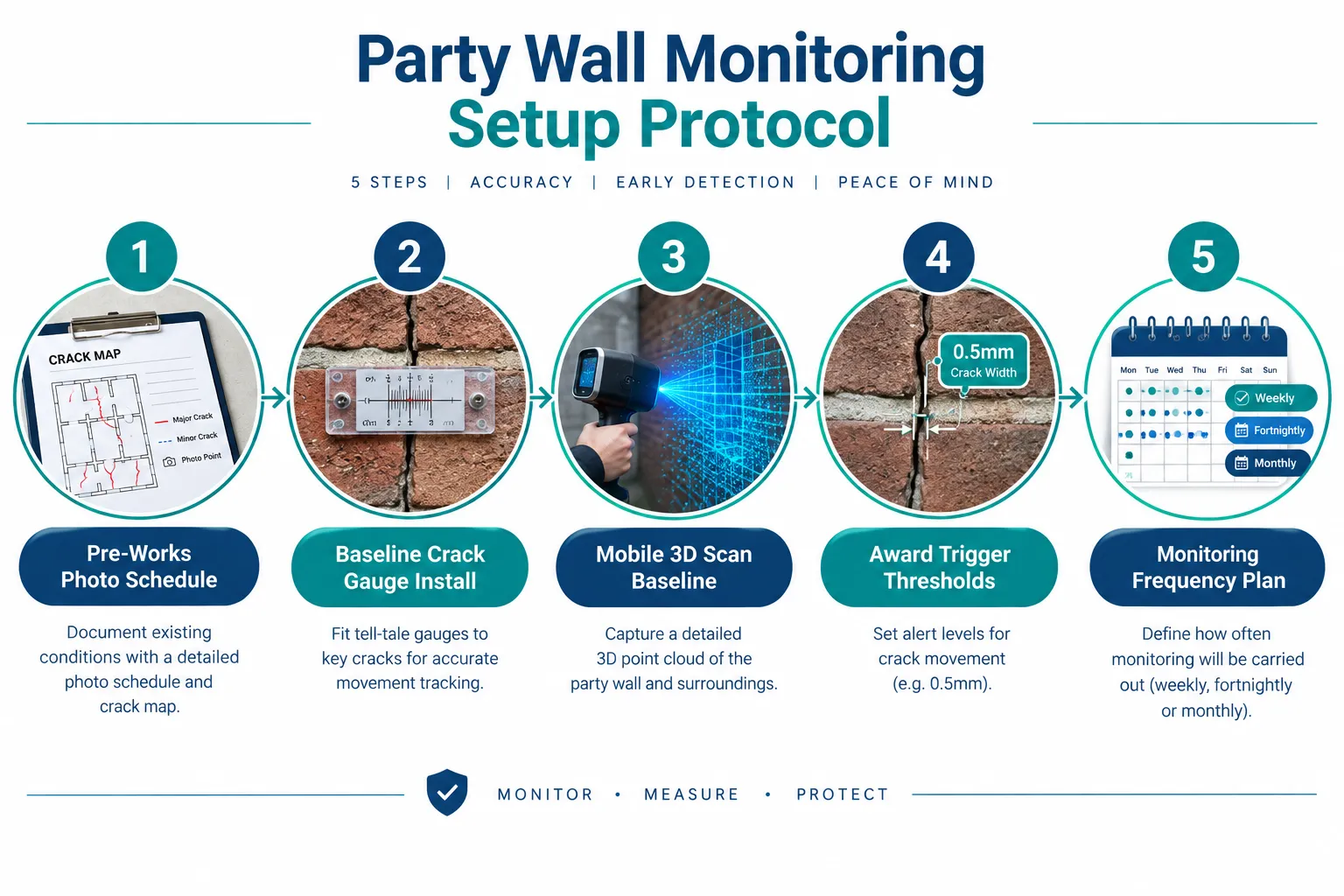
    Using mobile 3D mapping and crack gauges in party wall monitoring requires a structured setup sequence. Rushing the baseline phase is the most common mistake on London projects, and it is one that cannot be corrected after excavation begins.

    Step 1: Pre-Works Condition Survey

    The condition survey must be completed before any notifiable works commence. Current London practice requires that the survey covers all rooms in the adjoining property, not just the wall directly facing the works [5]. This is critical because vibration and ground movement can cause damage at a distance from the excavation face.

    The survey should include:

    • A full photographic schedule of every room, ceiling, floor, and external elevation
    • Crack mapping with width measurements using a crack width gauge
    • Notation of all pre-existing defects with their location, orientation, and estimated width
    • A 3D laser scan of the external elevation and any accessible internal walls

    Step 2: Baseline Instrument Installation

    Once the condition survey is complete, crack gauges are installed across all identified cracks and at standard monitoring points on the party wall. The baseline readings are recorded and signed off by both surveyors where an agreed surveyor arrangement is in place.

    For higher-risk projects, typically those involving excavation deeper than one metre adjacent to a party wall, robotic total station prisms are installed at multiple heights on the structure. These prisms allow automated deformation monitoring without repeated site visits [4].

    Step 3: Define Trigger Thresholds in the Award

    The party wall award should specify measurable trigger thresholds. The current London market standard is:

    New cracks should not exceed 0.5 mm in width, and existing cracks should not widen by more than 0.5 mm from the baseline reading. [5]

    These thresholds should be tied to a defined response protocol: who is notified, within what timeframe, and what remedial action is required before works can continue. Embedding this in the award wording removes ambiguity and protects both parties.

    Step 4: Establish Monitoring Frequency

    Monitoring frequency should be proportionate to the risk level and the phase of works:

    • Weekly during excavation and foundation works
    • Fortnightly during above-ground construction
    • Monthly during the post-construction monitoring period [5]

    For high-risk sites, automated 24/7 robotic total station monitoring with real-time web portals and instant alerts replaces manual weekly visits entirely [4]. Manual tell-tale and Demec gauge reading remains appropriate for standard residential extensions where the risk profile is lower.

    Step 5: Reporting and Documentation

    Each monitoring visit should produce a written report that includes:

    • Current readings for all crack gauges and prism targets
    • Comparison against baseline and previous readings
    • Any exceedances of trigger thresholds and the response taken
    • Updated photographic record of any changed cracks
    • A 3D scan comparison overlay if a re-scan has been conducted

    This documentation chain is the evidence base that protects the building owner if a damage claim is made. For surveyors working across South London or East London where Victorian terrace density is high, a standardised reporting template saves significant time across multiple concurrent projects.

    Cost Planning and Budget Benchmarks for 2026

    Cost Planning and Budget Benchmarks for 2026

    Cost is a frequent obstacle when surveyors try to specify comprehensive monitoring programmes. Understanding the published market benchmarks helps frame the conversation with building owners at the award stage.

    Published 2026 London figures suggest the following ranges [4]:

    • Small residential installation: from approximately £800 plus VAT
    • Monthly monitoring packages: £600,£1,200 per month depending on instrument count and reporting requirements
    • Per-visit monitoring with reports: approximately £354,£630 per visit

    For larger basement projects, a commonly cited 2026 budget is roughly £7,000,£9,000 over an 8-10 month project, broken down across installation, baseline survey, weekly readings during excavation, and less frequent readings in later phases [5].

    These figures are meaningful for award drafting. Building owners who understand the cost structure are less likely to resist monitoring conditions, particularly when the alternative, an undocumented damage claim, can cost multiples of the monitoring budget.

    For practical advice on managing overall project costs, the guide on how to keep party wall costs down offers useful context on where efficiencies can be found without compromising the monitoring standard.

    When to Upgrade to Automated Monitoring

    The decision to move from manual to automated monitoring should be driven by risk, not budget alone. Automated systems are strongly preferred when:

    • Excavation depth exceeds 2 metres adjacent to a party wall
    • The adjoining property is occupied by vulnerable residents
    • The project programme does not allow reliable weekly site access
    • The borough planning condition specifies continuous monitoring

    A London structural monitoring guide confirms that automated 24/7 robotic total stations are the appropriate tool for high-risk projects, while manual methods remain suitable for standard sites [4].

    Common Errors and How to Avoid Them

    Even experienced surveyors make avoidable mistakes in monitoring programme design. The most frequent errors on London party wall projects include:

    Incomplete baseline coverage. Limiting the pre-works survey to the party wall face only. Ground movement from deep excavation can cause damage to front elevations, rear extensions, and internal plasterwork well away from the shared wall.

    No trigger thresholds in the award. Specifying that monitoring will take place without defining what constitutes an actionable reading. Without a threshold, a monitoring report is evidence without a standard.

    Gauge installation after works begin. Installing tell-tales after excavation has started means the baseline reading already includes construction movement. Any subsequent reading is uninterpretable.

    Failure to re-scan after significant events. A 3D baseline scan is only useful if it is compared against a post-event scan after any significant ground movement, flooding, or vibration event. A single scan is a snapshot, not a monitoring programme.

    Inadequate frequency during the critical phase. Reducing monitoring to monthly visits during active excavation to save cost. The excavation phase is when the greatest movement risk occurs, and weekly readings are the minimum defensible standard [5].

    Surveyors working on North London or West London projects involving deep basements in conservation areas should pay particular attention to borough-specific planning conditions, which may impose additional monitoring requirements beyond the party wall award.

    Conclusion

    Using mobile 3D mapping and crack gauges in party wall monitoring is no longer a premium option reserved for major commercial projects. In 2026, it is the practical standard for any London project involving excavation adjacent to a shared structure. The combination of crack gauge instruments and 3D scanning creates a monitoring programme that is both technically robust and legally defensible.

    Actionable next steps for surveyors and building owners:

    1. Specify monitoring requirements in the party wall award before works begin, including trigger thresholds, frequency, and reporting obligations.
    2. Commission a full pre-works condition survey covering all elevations and all rooms, not just the party wall face.
    3. Install crack gauges across all identified defects and at standard monitoring points before the first excavation cut.
    4. For basement-adjacent works, obtain a 3D laser scan baseline of the external elevation and install robotic total station prisms for ongoing deformation tracking.
    5. Establish a clear escalation protocol in the award so that any threshold exceedance triggers an immediate, documented response.
    6. Retain all monitoring reports, scan files, and photographic records for a minimum of six years after practical completion.

    A well-designed monitoring programme protects everyone involved. It gives building owners evidence that they met their duty of care, gives adjoining owners confidence that their property is being watched, and gives surveyors the documentation they need to resolve disputes quickly and professionally.

    References

    [1] Monitoring – seseltd.co.uk [2] Crack Monitoring – benchmarkses.com [3] pointandlevel.co.uk – pointandlevel.co.uk [4] Structural Monitoring Survey Company Uk And London Guide – icelabz.co.uk [5] Party Wall Requirements London – surveyofpartywall.co.uk [6] Basement Monitoring Survey For Architects – icelabz.co.uk [8] Crack Monitoring – subsidencesurveys.co.uk

  • Party Wall Notice Response Time in London: How Long You Really Have Before a Dispute Starts

    Party Wall Notice Response Time in London: How Long You Really Have Before a Dispute Starts

    }

    Fourteen days. That is the entire window separating a smooth building project from a formal legal dispute under the Party Wall etc. Act 1996, yet most London homeowners discover this only after the deadline has already passed. Understanding the party wall notice response time in London: how long you really have before a dispute starts is not just useful background knowledge; it is the difference between a project that runs on schedule and one that stalls for months while surveyors negotiate a formal award.

    Key Takeaways

    • An adjoining owner has exactly 14 days to respond to a party wall notice before a dispute is legally deemed to have started.
    • London practitioners typically add buffer days for postage, making the effective working window closer to 16 days from the date of service.
    • Three types of notice carry different lead-in times: 1 month for a Party Structure Notice, 2 months for a Line of Junction Notice, and 1 month for an Excavation Notice.
    • If no response arrives within 14 days, the building owner may appoint a surveyor on the adjoining owner’s behalf, a process called deemed dissent.
    • Once a Party Wall Award is issued, either party has a further 14-day statutory appeal window before it becomes binding.

    What the Party Wall etc. Act 1996 Actually Requires

    The Party Wall etc. Act 1996 creates a statutory framework that governs works affecting shared walls, boundary structures, and excavations near neighbouring buildings. Before any notifiable work begins, the building owner must serve a formal notice on every adjoining owner [1].

    The Act sets out three distinct notice types, each with its own lead-in period:

    Notice Type Trigger Minimum Lead-In
    Party Structure Notice Works to a shared wall or floor 1 month
    Line of Junction Notice Building a new wall on or near the boundary 1 month
    Excavation Notice Digging within 3 m or 6 m of a neighbour’s structure 1 month

    These lead-in periods are the minimum time the adjoining owner must have before work begins, they are not the same as the response deadline [4]. A notice served too late is invalid, meaning work cannot legally start even if the neighbour has no objection.

    For a detailed breakdown of how to serve each type correctly, see this guide on what is a Party Structure Notice and how to serve it in London.

    What the Party Wall etc. Act 1996 Actually Requires

    The Critical 14-Day Response Window Explained

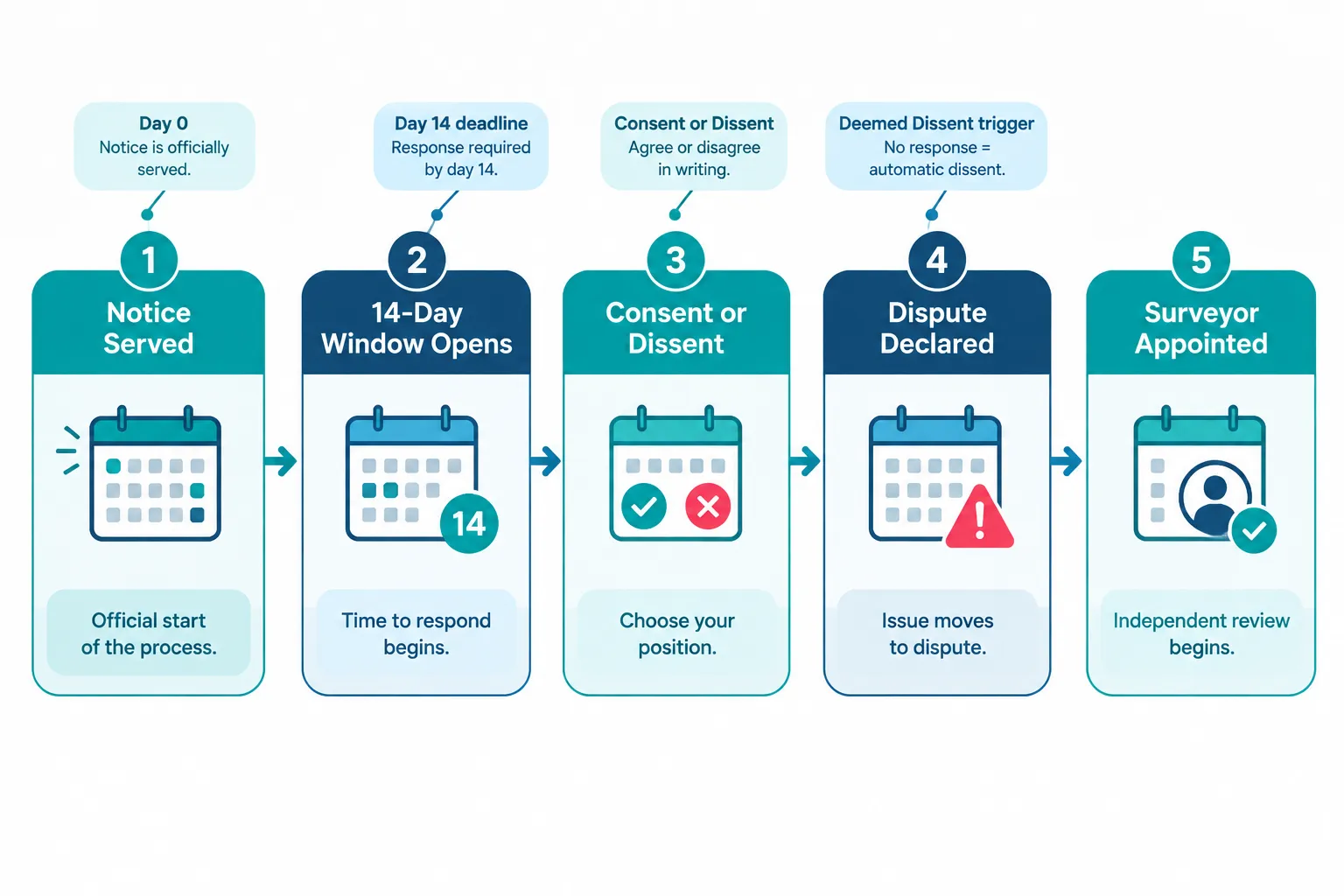
    Once a valid notice is served, the adjoining owner has 14 days to respond in writing [6]. This is the core of the party wall notice response time in London: how long you really have before a dispute starts. The response can take one of three forms:

    • Written consent, the adjoining owner agrees to the works as described; no surveyor is required.
    • Written dissent, the adjoining owner objects; a surveyor or surveyors must be appointed.
    • No response at all, after 14 days of silence, a dispute is automatically deemed to have arisen under Section 10 of the Act [1].

    That third outcome, silence, is where many London projects run into trouble. Adjoining owners sometimes believe that ignoring a notice delays or blocks the works. In legal terms, it does the opposite: it triggers the formal dispute resolution process, which ultimately gives the building owner the right to appoint a surveyor on the adjoining owner’s behalf [7].

    What “Deemed Dissent” Means in Practice

    Deemed dissent is the legal term for a dispute that arises automatically when no response is received within 14 days [1]. At that point:

    1. The building owner serves a further notice on the adjoining owner, giving them 10 days to appoint their own surveyor.
    2. If the adjoining owner still does not respond, the building owner appoints a surveyor to act for both parties, an agreed surveyor, or appoints a second surveyor themselves.
    3. Those two surveyors then select a third surveyor in case of deadlock.

    This process does not stop the works indefinitely. It creates a structured path toward a Party Wall Award, which is the formal document that sets out the rights and obligations of both parties before work begins [9].

    Practical London Timelines: What the Numbers Look Like

    In theory, the 14-day clock starts the moment a notice is delivered. In London practice, surveyors and solicitors routinely add buffer days to account for postal delivery, missed deliveries, and the realities of serving notices on busy urban households [8].

    The standard London approach in 2026 is to treat the effective response window as at least 16 days from the date of posting when notices are served by first-class post [2]. Hand delivery resets the clock to the actual delivery date, but many practitioners still build in a one-day buffer.

    Example Timeline: Rear Extension on a London Terraced House

    Below is a realistic timeline for one of the most common London party wall scenarios, a rear single-storey extension on a Victorian terraced house:

    Week 1: Building owner instructs a surveyor and prepares notices.

    Day 0: Party Structure Notice served on both adjoining neighbours (left and right).

    Day 14: Deadline for written response. If no response is received by end of business, deemed dissent applies.

    Day 15-25: Building owner serves notice of surveyor appointment; adjoining owner has 10 days to appoint their own surveyor.

    Week 6-10: Surveyors prepare and agree the Party Wall Award, including a Schedule of Condition of the adjoining property.

    Week 10-12: Award served on both parties. A 14-day appeal window opens immediately.

    Week 12+: Works may begin, subject to planning permission and building regulations approval.

    This means a project that needs a party wall notice can realistically expect 10 to 14 weeks from first instruction to lawful start date when disputes arise [10]. Where both neighbours consent in writing within the 14-day window, that timeline compresses to as little as 4 to 6 weeks.

    Example Timeline: Rear Extension on a London Terraced House

    Counter-Notices and Their Own 14-Day Trigger

    A less well-known aspect of the party wall notice response time in London: how long you really have before a dispute starts concerns counter-notices. Under Section 4 of the Act, an adjoining owner who consents to the works in principle may still serve a counter-notice within one month of the original notice, requesting modifications or additional works [4].

    The building owner then has 14 days to respond to that counter-notice. Failure to respond within that window, or a refusal that cannot be agreed, triggers a second, separate dispute under the Act.

    This is a frequently overlooked double-deadline that can catch building owners off guard, particularly on larger London projects where adjoining owners want to add their own works, such as underpinning or chimney breast removal, to the same programme.

    For a full explanation of how notices work and the options available to both parties, the guide on Party Wall Act notices, what they are and how to respond covers the process in detail.

    What Happens After the Award: The Final 14-Day Window

    Once surveyors have agreed and served a Party Wall Award, the work is not automatically free to proceed. Both the building owner and the adjoining owner have 14 days from the date of service of the Award to appeal to the County Court [1].

    Key points about this appeal window:

    • Either party can appeal, not just the adjoining owner.
    • The court may rescind or modify the Award, or confirm it as served.
    • Appeals are relatively rare in London practice, but they do occur on high-value or complex projects.
    • If no appeal is lodged within 14 days, the Award becomes final and binding on both parties.

    This final 14-day period is why experienced London surveyors advise building owners not to mobilise contractors or order materials until the appeal window has closed. Starting work before that point, while technically possible, carries the risk of a court order requiring works to stop.

    Regional Variations Across London Boroughs

    While the statutory deadlines are uniform across England and Wales, the practical experience of serving notices and managing responses varies considerably across London’s 33 boroughs [8]. Several factors influence this:

    Density of terraced housing. In boroughs such as Hackney, Lewisham, and Islington, the density of Victorian terraced housing means almost every rear extension or loft conversion triggers multiple notices. Surveyors in these areas are experienced with high volumes of party wall work.

    Leasehold complications. In central and inner London, many properties are leasehold. Both the freeholder and the leaseholder may need to be served separately, effectively doubling the number of notices and response windows to manage.

    Absentee owners. In some central London postcodes, adjoining owners are overseas investors or second-home owners who are harder to contact, making the deemed dissent route more common.

    Whether a project is in the south, east, north, west, or centre of the city, specialist local knowledge matters. Homeowners can find area-specific support through a Party Wall Surveyor in South London, Party Wall Surveyor in East London, Party Wall Surveyor in North London, or Party Wall Surveyor in West London, depending on location.

    Common Mistakes That Extend the Timeline

    Most delays in London party wall projects are avoidable. The following errors consistently push timelines beyond what the statute requires:

    Serving notice too late. Serving a Party Structure Notice only four weeks before the intended start date violates the one-month minimum lead-in and invalidates the notice entirely.

    Incorrect notice content. A notice that fails to describe the works accurately, or that names the wrong party, can be challenged and must be re-served, restarting the 14-day clock.

    Serving by email without consent. The Act does not recognise email as a valid method of service unless the adjoining owner has explicitly agreed to receive notices electronically. Notices sent only by email may be treated as unserved [8].

    Assuming silence is consent. As explained above, silence after 14 days is dissent, not agreement. Building owners who proceed on the assumption that no news is good news risk injunctions.

    Missing the counter-notice deadline. Failing to respond to a counter-notice within 14 days creates a second dispute that must be resolved before work can start.

    For projects where both parties want to avoid surveyor costs altogether, it is worth understanding the conditions under which a party wall agreement without a surveyor is possible, though this route requires genuine written consent from the adjoining owner within the statutory window.

    Common Mistakes That Extend the Timeline

    How Long Does the Full Process Take in London?

    Pulling together all the statutory deadlines, a realistic end-to-end timeline for a London party wall dispute, from first notice to lawful start date, looks like this:

    Stage Statutory Deadline Realistic London Duration
    Notice lead-in period 1-2 months 1-2 months
    Adjoining owner response window 14 days 14-16 days
    Surveyor appointment after deemed dissent 10 days 10-14 days
    Preparation and agreement of Award No fixed period 4-8 weeks
    Appeal window after Award 14 days 14 days
    Total (disputed route) , 10-16 weeks
    Total (consent route) , 4-6 weeks

    These figures align with guidance from London-based practitioners and government explanatory materials [1][10]. The consent route is significantly faster, which is why experienced surveyors often recommend proactive, early engagement with neighbours before any notice is formally served.

    Conclusion

    The party wall notice response time in London: how long you really have before a dispute starts is, at its core, a deceptively simple number, 14 days. But that single deadline sits within a layered system of lead-in periods, counter-notice windows, surveyor appointment deadlines, and post-Award appeal periods, each of which can extend a project timeline if mishandled.

    Actionable next steps for building owners:

    1. Serve notices early. Build at least two months of party wall process time into any project programme before the intended start date.
    2. Use a qualified surveyor. A specialist ensures notices are correctly drafted, validly served, and that the 14-day clock starts on the right day.
    3. Do not wait for silence. If no response arrives by day 14, act immediately on the deemed dissent procedure rather than waiting further.
    4. Communicate with neighbours first. An informal conversation before serving notice significantly increases the chance of written consent within the 14-day window.
    5. Budget for the disputed route. Even with the best intentions, disputes happen. Understanding the costs of the party wall process in advance prevents financial surprises mid-project.

    The Act exists to protect both parties, not to obstruct development. Treated as a structured process rather than a bureaucratic obstacle, the party wall framework in London is manageable, provided every deadline is respected from the moment the first notice is served.

    References

    [1] The Party Wall Etc Act 1996 Explanatory Booklet – gov.uk

    [2] Party Wall Notice – ansteyhorne.co.uk

    [4] legislation.gov.uk – legislation.gov.uk

    [6] Reaching Agreement With Neighbours – gov.uk

    [7] Party Wall Act Explained London Homeowners – trustbuiltprojects.com

    [8] Serving A Notice Under The Party Wall Act – richmond.gov.uk

    [9] Party Wall Notices London – houricanassociates.com

    [10] How Long Does It Take To Agree A Party Wall Agreement – stokemont.com

  • Party Wall Surveyor Qualifications in London: How to Check RICS Status, Experience and Insurance Before You Instruct

    Party Wall Surveyor Qualifications in London: How to Check RICS Status, Experience and Insurance Before You Instruct

    Nearly one in three party wall disputes in London escalates because a homeowner instructed an unqualified or uninsured surveyor whose award was later challenged as invalid. Understanding party wall surveyor qualifications in London, how to check RICS status, experience and insurance before you instruct, is not a bureaucratic formality. It is the single most effective way to protect the legal standing of your notices, your award, and your building project from the outset.

    Key Takeaways

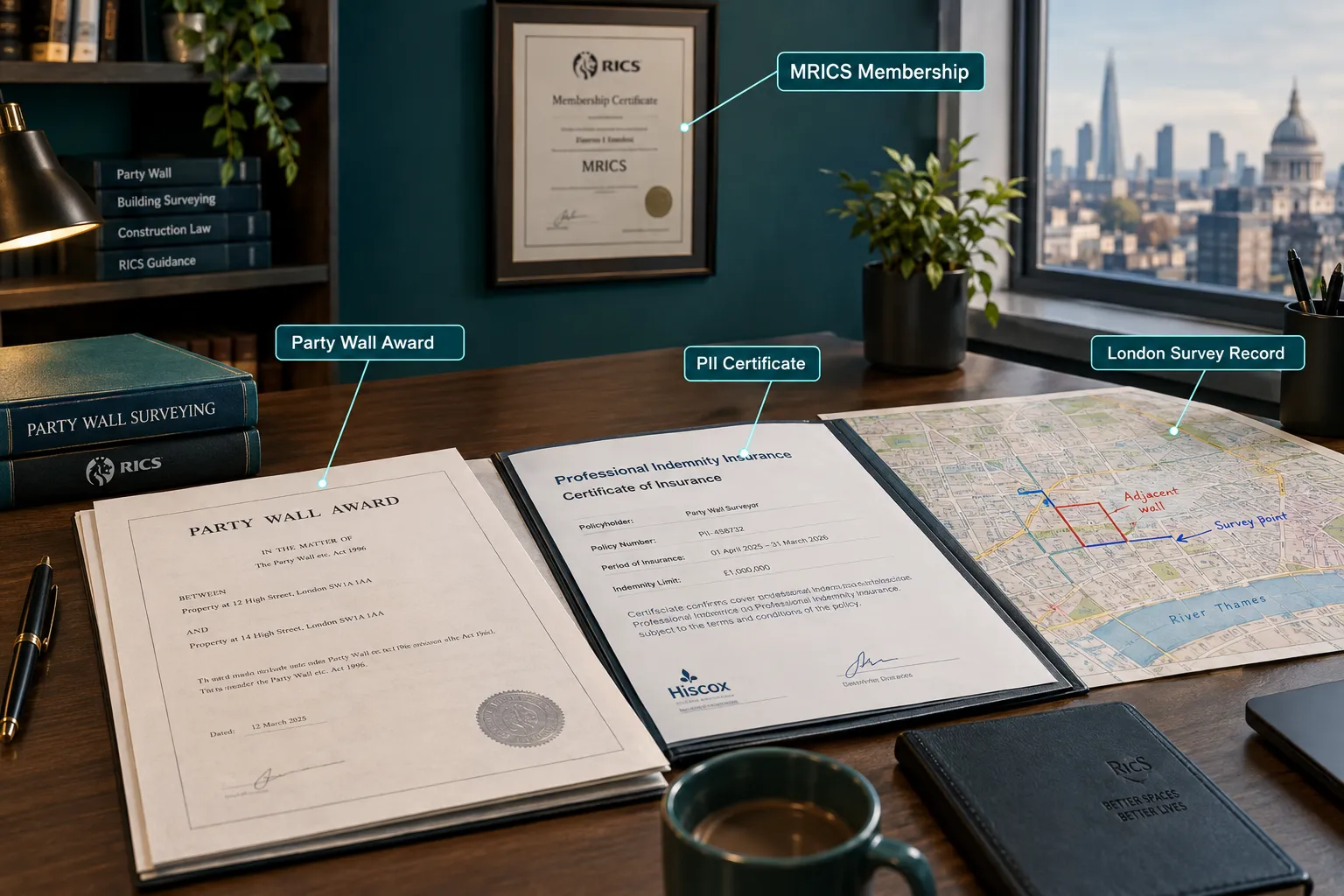
    • Party wall surveyors in London are not required by law to hold a specific qualification, but instructing an MRICS or FRICS-chartered surveyor is the standard recommended by RICS and followed by leading London firms.
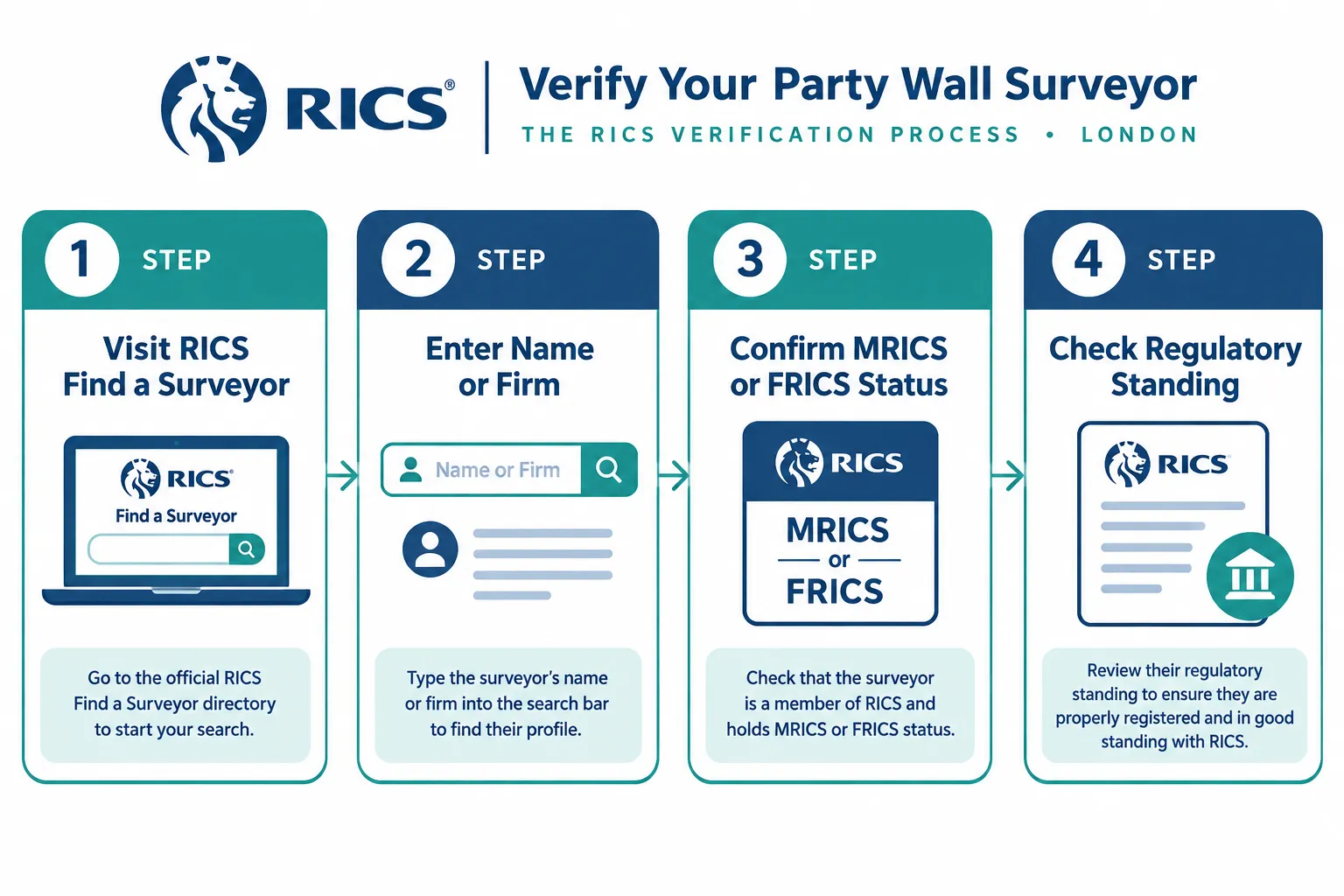
    • You can verify any surveyor’s RICS membership status in seconds using the free RICS Find a Surveyor directory.
    • Professional indemnity insurance (PII) is essential; always request written confirmation of cover before instruction.
    • Experience matters: check for a demonstrable London track record, specialist party wall knowledge, and familiarity with the Party Wall Etc Act 1996.
    • A surveyor who lacks the right credentials can produce an award that is legally vulnerable, causing costly delays and disputes.

    Why Qualifications Matter Under the Party Wall Etc Act 1996

    The Party Wall etc Act 1996 gives surveyors significant statutory powers. They can enter properties, determine the scope of works, and issue legally binding party wall awards that govern how construction proceeds. Despite this authority, the Act itself does not specify that a party wall surveyor must hold any formal qualification. Any person, in theory, can be appointed as a party wall surveyor.

    This gap in the legislation creates real risk for property owners. An award prepared by someone without adequate professional knowledge may contain errors that expose it to appeal, or fail to protect the adjoining owner’s property adequately. In London, where party wall matters frequently involve complex basement excavations, loft conversions in Victorian terraces, and high-value properties in close proximity, the consequences of instructing the wrong person can be severe.

    RICS, the Royal Institution of Chartered Surveyors, addresses this directly. Its professional guidance states that chartered surveyors holding MRICS or FRICS status are the appropriate choice for party wall appointments, and its updated standards set a clear benchmark for competence [1]. The forthcoming RICS 8th Edition party wall guidance, for which consultation closed in June 2026, is expected to sharpen these competency requirements further [9].

    Key principle: The absence of a legal qualification requirement makes your own due diligence more important, not less.

    The RICS Standard: What MRICS and FRICS Mean in Practice

    The RICS Standard: What MRICS and FRICS Mean in Practice

    RICS membership is the most widely recognised mark of professional competence for surveyors in the United Kingdom. Two grades are relevant when checking party wall surveyor qualifications in London:

    Grade Full Title What It Indicates
    MRICS Member of the Royal Institution of Chartered Surveyors Full chartered status; passed Assessment of Professional Competence
    FRICS Fellow of the Royal Institution of Chartered Surveyors Senior grade; recognised for significant contribution to the profession

    Both grades require surveyors to meet continuing professional development (CPD) requirements, adhere to the RICS Rules of Conduct, and maintain professional indemnity insurance. RICS-regulated firms are also subject to firm-level oversight, which adds a further layer of accountability [8].

    RICS publishes a dedicated professional standard, Party Wall Legislation and Procedure, that sets out how chartered surveyors should handle appointments, serve notices, conduct schedule of condition surveys, and draft awards [1]. The August 2026 update to this standard reinforces best practice around impartiality, record-keeping, and the handling of disputes. Surveyors who follow this guidance are operating within a framework that protects all parties.

    How to verify RICS status:

    1. Go to the RICS Find a Surveyor directory at ricsfirms.com.
    2. Search by the surveyor’s name or the firm’s name.
    3. Confirm the individual holds MRICS or FRICS designation.
    4. Check that the firm itself is RICS-regulated.
    5. Note any disciplinary findings or regulatory flags.

    This search takes under two minutes and costs nothing. RICS also operates a consumer helpline specifically for party wall queries, which can assist property owners who are uncertain about a surveyor’s standing [2].

    Checking Experience: London Specialism and Track Record

    RICS membership confirms professional standing, but it does not automatically confirm specialist party wall experience. A chartered surveyor whose practice focuses on commercial valuations, for example, may hold MRICS status but have limited practical knowledge of party wall procedure.

    When assessing party wall surveyor qualifications in London, experience checks should cover three distinct areas.

    Years of Specialist Practice

    Look for a surveyor who has been practising party wall work as a primary specialism for at least five years. In London’s dense urban environment, party wall matters arise constantly, loft conversions, rear extensions, basement digs, and boundary works generate a steady volume of notices and awards. A surveyor with genuine London specialism will have handled hundreds of appointments across a range of property types and dispute scenarios [3][4].

    Ask directly:

    • How many party wall awards have you prepared in the last 12 months?
    • What proportion of your practice is party wall work?
    • Do you have experience with the specific type of works being proposed?

    London-Specific Knowledge

    London’s housing stock is distinctive. Victorian and Edwardian terraces, Georgian townhouses, and post-war blocks all present different structural considerations. A surveyor who understands the particular challenges of, say, a basement excavation in Central London or a loft conversion in a North London semi-detached will produce a more thorough schedule of condition and a more robust award than one without that contextual knowledge.

    Check the firm’s website for evidence of London-specific case experience. Leading London party wall specialists will typically reference the boroughs and property types they cover, and may publish case studies or guidance notes that demonstrate depth of knowledge [5][6].

    Team Credentials

    In larger practices, the surveyor who attends your property may not be the named partner. Confirm that the individual who will conduct the survey and draft the award holds MRICS or FRICS status, not merely that the firm’s principal does. Reputable firms are transparent about their team’s credentials and will confirm individual qualifications on request [7].

    Professional Indemnity Insurance: Why It Is Non-Negotiable

    Professional Indemnity Insurance: Why It Is Non-Negotiable

    Professional indemnity insurance (PII) protects property owners if a surveyor makes an error or omission that causes financial loss. If an award is negligently drafted and a building owner suffers damage as a result, PII is the mechanism through which compensation can be recovered.

    RICS requires all regulated firms to maintain adequate PII as a condition of membership. However, “adequate” must be interpreted in context. For party wall work in London, where property values are high and structural damage claims can be substantial, a minimum level of cover may not be sufficient.

    Before instructing any party wall surveyor, request:

    • Written confirmation that PII is in place
    • The name of the insurer and the policy number
    • The level of cover (indemnity limit per claim and in aggregate)
    • Confirmation that party wall work is explicitly covered under the policy

    Some surveyors operating as sole traders or through informal arrangements may carry insufficient cover or may have allowed their policy to lapse. This is particularly relevant when instructing an individual rather than an established firm. RICS-regulated firms are subject to annual checks on their insurance status, which is one reason firm-level regulation matters [2].

    Practical tip: If a surveyor is reluctant to provide written confirmation of PII, treat that as a significant warning sign and seek an alternative appointment.

    It is also worth noting that the costs of the party wall process can be substantial, and instructing a properly insured surveyor from the outset is far less expensive than pursuing a negligence claim after the fact.

    A Practical Verification Checklist Before You Instruct

    The following checklist consolidates the key qualification, experience, and insurance checks into a single reference. Use it before committing to any party wall surveyor appointment in London.

    Qualifications and Regulatory Status

    • Confirm the individual surveyor holds MRICS or FRICS designation via the RICS Find a Surveyor directory
    • Confirm the firm is RICS-regulated (not just that an individual within it is chartered)
    • Check for any disciplinary findings or regulatory sanctions on the RICS register
    • Ask whether the surveyor follows the RICS Party Wall Legislation and Procedure professional standard [1]

    Experience and Specialism

    • Ask how many party wall appointments the surveyor has completed in London in the past year
    • Confirm the surveyor has experience with the specific type of works being proposed (e.g., basement, loft, rear extension)
    • Review the firm’s website for published party wall awards, case studies, or London-specific guidance
    • Check whether the firm covers your area of London, whether that is South London, East London, or West London

    Insurance

    • Request written confirmation of professional indemnity insurance
    • Confirm the indemnity limit is appropriate for the value of the project and the property
    • Verify that party wall work is explicitly included within the scope of the policy
    • Check that the policy is current and will remain in force throughout the project

    Notice and Award Competence

    • Ask the surveyor to explain how they would handle service of party wall notices for your specific works
    • Confirm they understand the distinction between different types of party wall works and the corresponding notice requirements
    • Ask for a sample award or a description of the award drafting process to assess thoroughness

    How Qualifications Affect the Validity of Notices and Awards

    How Qualifications Affect the Validity of Notices and Awards

    A party wall award is only as strong as the process that produced it. Where a surveyor lacks the competence to correctly identify the scope of notifiable works, serve notices in the proper form, or draft an award that addresses all relevant matters, the resulting document can be challenged on appeal to the County Court under Section 10(17) of the Act.

    Common errors made by less experienced or unqualified practitioners include:

    • Incorrect notice type: Serving a Line of Junction Notice when a Party Structure Notice was required, or vice versa
    • Inadequate schedule of condition: Failing to document pre-existing defects thoroughly, leaving disputes about causation unresolved
    • Incomplete award: Omitting provisions for working hours, method statements, or reinstatement obligations
    • Conflict of interest: Acting in a way that compromises the surveyor’s statutory duty of impartiality

    Each of these errors can result in delays, additional costs, and in some cases, the invalidation of the award itself. A surveyor who holds MRICS status, carries adequate PII, and has a demonstrable London track record is far less likely to make these mistakes, and far better placed to remedy them if they arise.

    It is also worth understanding the distinction between a building owner’s surveyor and an adjoining owner’s surveyor. Both appointments carry the same qualification and insurance requirements. The adjoining owner’s surveyor in particular must be genuinely independent and competent to protect their client’s interests, since they are appointed specifically to scrutinise the proposed works.

    Using RICS Resources and Free Consultations

    RICS provides several consumer-facing resources that property owners in London can use at no cost. The RICS party wall consumer guide explains the process in accessible terms and directs readers to the RICS Find a Surveyor tool [8]. The RICS party walls helpline offers guidance to those who are uncertain about their obligations or who have concerns about a surveyor’s conduct [2].

    Many leading London party wall firms also offer free initial consultations. These conversations serve a dual purpose: they allow the property owner to assess the surveyor’s knowledge and communication style, and they give the surveyor an opportunity to identify any complications that may affect the appointment. A firm that offers a free consultation and is willing to answer detailed questions about its qualifications, experience, and insurance is demonstrating the transparency that should be expected of any reputable practice.

    Conclusion

    Checking party wall surveyor qualifications in London, RICS status, experience, and insurance, before instructing is not optional due diligence. It is the foundation of a legally sound party wall process. The Party Wall etc Act 1996 grants surveyors significant powers, and the validity of every notice and award depends on those powers being exercised by someone with the competence and accountability to use them correctly.

    Actionable next steps:

    1. Use the RICS Find a Surveyor directory to verify MRICS or FRICS status for any surveyor you are considering.
    2. Request written confirmation of professional indemnity insurance before signing any instruction letter.
    3. Ask specific questions about London experience and the number of party wall awards completed in the past year.
    4. Check that the firm covers your specific area of London and has experience with your type of works.
    5. Use the free RICS party walls helpline if you have any concerns about a surveyor’s standing or conduct.
    6. Review the RICS Party Wall Legislation and Procedure standard to understand what best practice looks like from the surveyor’s perspective.

    Taking these steps before instruction costs nothing and protects everything.

    References

    [1] Party Wall Legislation And Procedure – rics.org

    [2] Party Walls (RICS Helplines) – ricsfirms.com

    [3] partywallspecialistlondon.co.uk – partywallspecialistlondon.co.uk

    [4] stanleystrong.co.uk – stanleystrong.co.uk

    [5] Party Wall (Barnes and Barnes) – barnesandbarnes.london

    [6] Party Wall Surveyor (Square Point Surveyors) – squarepointsurveyors.co.uk

    [7] websterssurveyors.co.uk – websterssurveyors.co.uk

    [8] Party Walls (RICS Consumer Guide) – rics.org

    [9] RICS 8th Edition Party Wall Guidance – hudsonpartywallsurveyors.co.uk

    [10] Party Walls (RICS Firms West London) – ricsfirms.com