
}
Fourteen days. That is the entire window separating a smooth building project from a formal legal dispute under the Party Wall etc. Act 1996, yet most London homeowners discover this only after the deadline has already passed. Understanding the party wall notice response time in London: how long you really have before a dispute starts is not just useful background knowledge; it is the difference between a project that runs on schedule and one that stalls for months while surveyors negotiate a formal award.
Key Takeaways
- An adjoining owner has exactly 14 days to respond to a party wall notice before a dispute is legally deemed to have started.
- London practitioners typically add buffer days for postage, making the effective working window closer to 16 days from the date of service.
- Three types of notice carry different lead-in times: 1 month for a Party Structure Notice, 2 months for a Line of Junction Notice, and 1 month for an Excavation Notice.
- If no response arrives within 14 days, the building owner may appoint a surveyor on the adjoining owner’s behalf, a process called deemed dissent.
- Once a Party Wall Award is issued, either party has a further 14-day statutory appeal window before it becomes binding.
What the Party Wall etc. Act 1996 Actually Requires
The Party Wall etc. Act 1996 creates a statutory framework that governs works affecting shared walls, boundary structures, and excavations near neighbouring buildings. Before any notifiable work begins, the building owner must serve a formal notice on every adjoining owner [1].
The Act sets out three distinct notice types, each with its own lead-in period:
| Notice Type | Trigger | Minimum Lead-In |
|---|---|---|
| Party Structure Notice | Works to a shared wall or floor | 1 month |
| Line of Junction Notice | Building a new wall on or near the boundary | 1 month |
| Excavation Notice | Digging within 3 m or 6 m of a neighbour’s structure | 1 month |
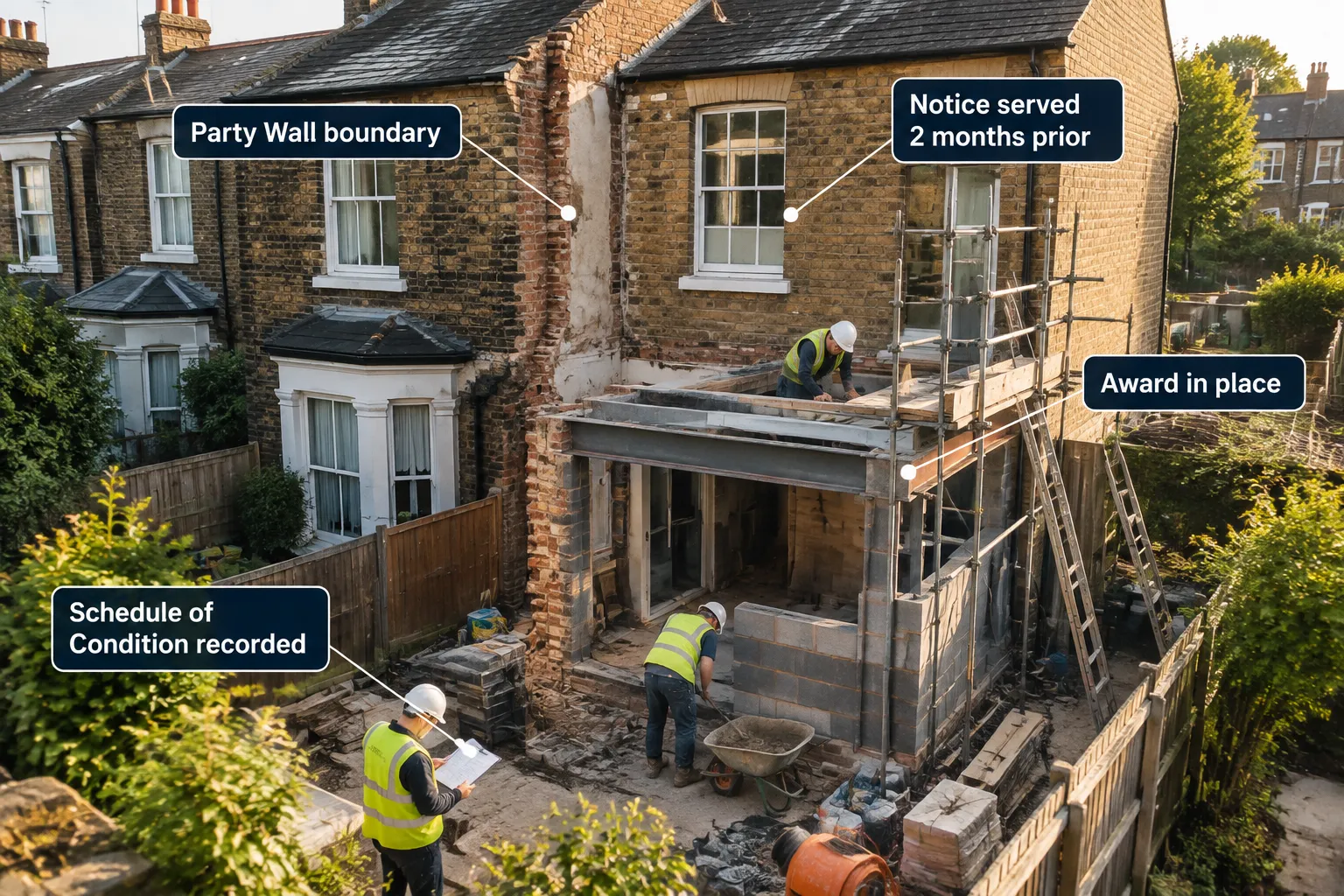
These lead-in periods are the minimum time the adjoining owner must have before work begins, they are not the same as the response deadline [4]. A notice served too late is invalid, meaning work cannot legally start even if the neighbour has no objection.
For a detailed breakdown of how to serve each type correctly, see this guide on what is a Party Structure Notice and how to serve it in London.
The Critical 14-Day Response Window Explained
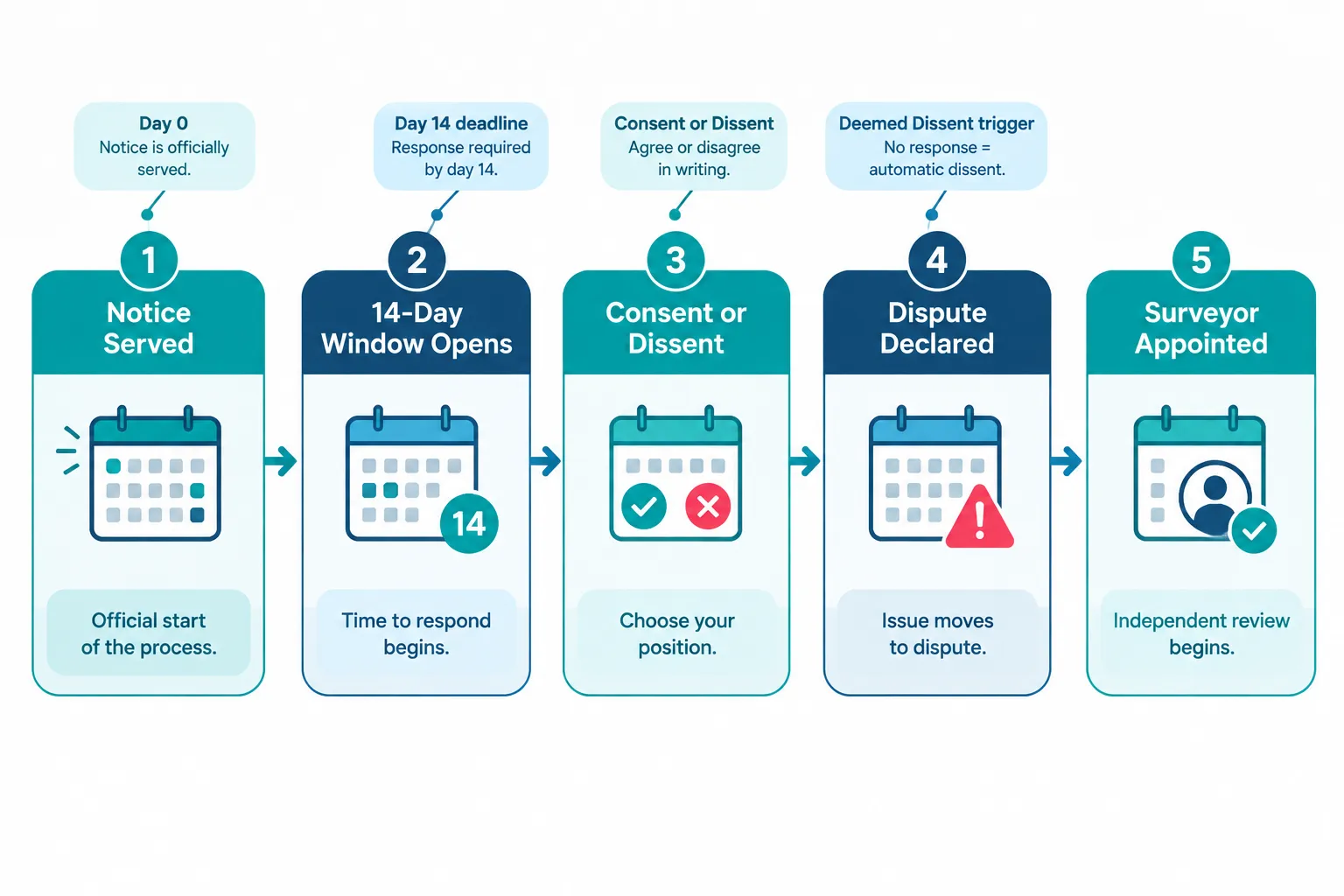
Once a valid notice is served, the adjoining owner has 14 days to respond in writing [6]. This is the core of the party wall notice response time in London: how long you really have before a dispute starts. The response can take one of three forms:
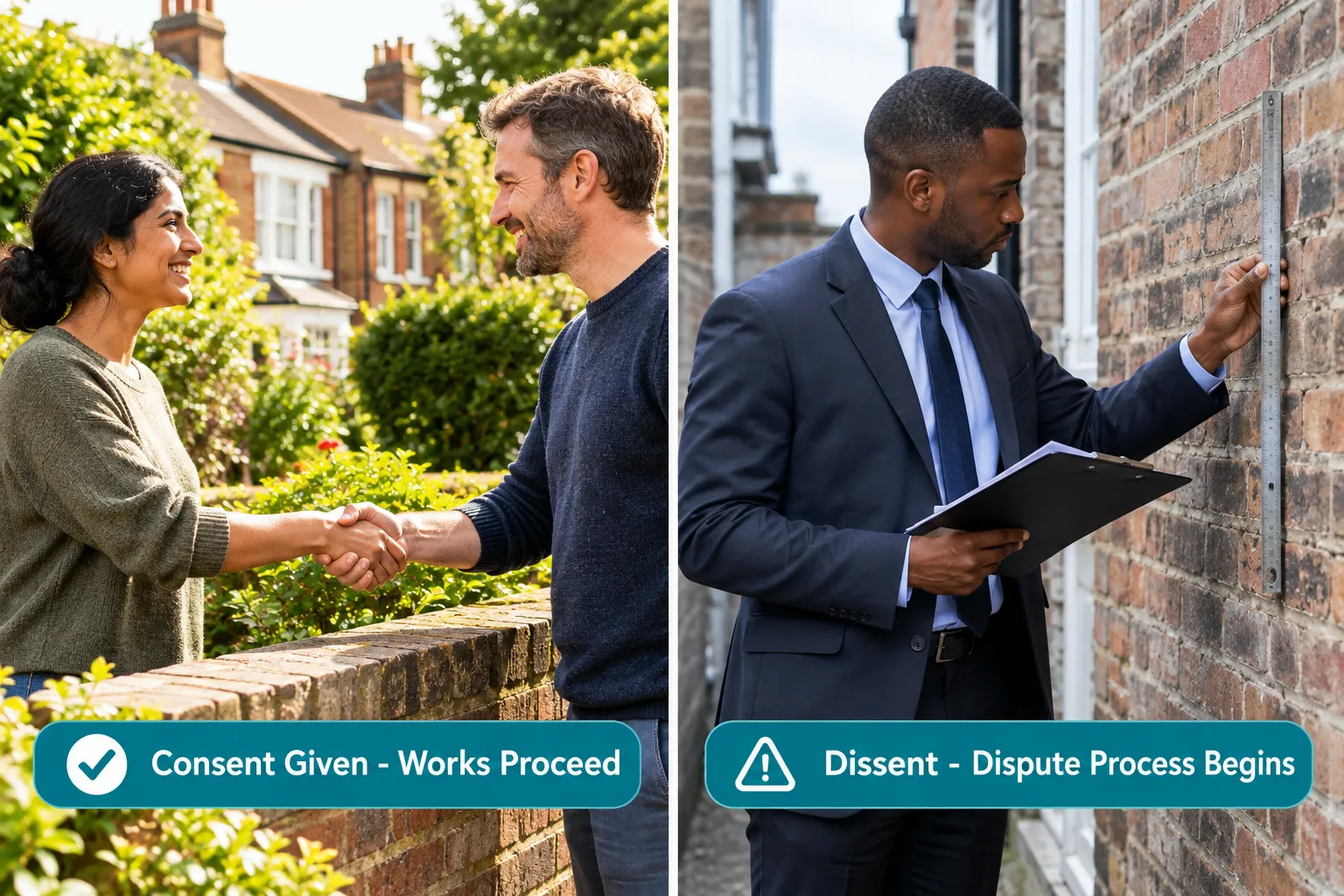
- Written consent, the adjoining owner agrees to the works as described; no surveyor is required.
- Written dissent, the adjoining owner objects; a surveyor or surveyors must be appointed.
- No response at all, after 14 days of silence, a dispute is automatically deemed to have arisen under Section 10 of the Act [1].
That third outcome, silence, is where many London projects run into trouble. Adjoining owners sometimes believe that ignoring a notice delays or blocks the works. In legal terms, it does the opposite: it triggers the formal dispute resolution process, which ultimately gives the building owner the right to appoint a surveyor on the adjoining owner’s behalf [7].
What “Deemed Dissent” Means in Practice
Deemed dissent is the legal term for a dispute that arises automatically when no response is received within 14 days [1]. At that point:
- The building owner serves a further notice on the adjoining owner, giving them 10 days to appoint their own surveyor.
- If the adjoining owner still does not respond, the building owner appoints a surveyor to act for both parties, an agreed surveyor, or appoints a second surveyor themselves.
- Those two surveyors then select a third surveyor in case of deadlock.
This process does not stop the works indefinitely. It creates a structured path toward a Party Wall Award, which is the formal document that sets out the rights and obligations of both parties before work begins [9].
Practical London Timelines: What the Numbers Look Like
In theory, the 14-day clock starts the moment a notice is delivered. In London practice, surveyors and solicitors routinely add buffer days to account for postal delivery, missed deliveries, and the realities of serving notices on busy urban households [8].
The standard London approach in 2026 is to treat the effective response window as at least 16 days from the date of posting when notices are served by first-class post [2]. Hand delivery resets the clock to the actual delivery date, but many practitioners still build in a one-day buffer.
Example Timeline: Rear Extension on a London Terraced House
Below is a realistic timeline for one of the most common London party wall scenarios, a rear single-storey extension on a Victorian terraced house:
Week 1: Building owner instructs a surveyor and prepares notices.
Day 0: Party Structure Notice served on both adjoining neighbours (left and right).
Day 14: Deadline for written response. If no response is received by end of business, deemed dissent applies.
Day 15-25: Building owner serves notice of surveyor appointment; adjoining owner has 10 days to appoint their own surveyor.
Week 6-10: Surveyors prepare and agree the Party Wall Award, including a Schedule of Condition of the adjoining property.
Week 10-12: Award served on both parties. A 14-day appeal window opens immediately.
Week 12+: Works may begin, subject to planning permission and building regulations approval.
This means a project that needs a party wall notice can realistically expect 10 to 14 weeks from first instruction to lawful start date when disputes arise [10]. Where both neighbours consent in writing within the 14-day window, that timeline compresses to as little as 4 to 6 weeks.
Counter-Notices and Their Own 14-Day Trigger
A less well-known aspect of the party wall notice response time in London: how long you really have before a dispute starts concerns counter-notices. Under Section 4 of the Act, an adjoining owner who consents to the works in principle may still serve a counter-notice within one month of the original notice, requesting modifications or additional works [4].
The building owner then has 14 days to respond to that counter-notice. Failure to respond within that window, or a refusal that cannot be agreed, triggers a second, separate dispute under the Act.
This is a frequently overlooked double-deadline that can catch building owners off guard, particularly on larger London projects where adjoining owners want to add their own works, such as underpinning or chimney breast removal, to the same programme.
For a full explanation of how notices work and the options available to both parties, the guide on Party Wall Act notices, what they are and how to respond covers the process in detail.
What Happens After the Award: The Final 14-Day Window
Once surveyors have agreed and served a Party Wall Award, the work is not automatically free to proceed. Both the building owner and the adjoining owner have 14 days from the date of service of the Award to appeal to the County Court [1].
Key points about this appeal window:
- Either party can appeal, not just the adjoining owner.
- The court may rescind or modify the Award, or confirm it as served.
- Appeals are relatively rare in London practice, but they do occur on high-value or complex projects.
- If no appeal is lodged within 14 days, the Award becomes final and binding on both parties.
This final 14-day period is why experienced London surveyors advise building owners not to mobilise contractors or order materials until the appeal window has closed. Starting work before that point, while technically possible, carries the risk of a court order requiring works to stop.
Regional Variations Across London Boroughs
While the statutory deadlines are uniform across England and Wales, the practical experience of serving notices and managing responses varies considerably across London’s 33 boroughs [8]. Several factors influence this:
Density of terraced housing. In boroughs such as Hackney, Lewisham, and Islington, the density of Victorian terraced housing means almost every rear extension or loft conversion triggers multiple notices. Surveyors in these areas are experienced with high volumes of party wall work.
Leasehold complications. In central and inner London, many properties are leasehold. Both the freeholder and the leaseholder may need to be served separately, effectively doubling the number of notices and response windows to manage.
Absentee owners. In some central London postcodes, adjoining owners are overseas investors or second-home owners who are harder to contact, making the deemed dissent route more common.
Whether a project is in the south, east, north, west, or centre of the city, specialist local knowledge matters. Homeowners can find area-specific support through a Party Wall Surveyor in South London, Party Wall Surveyor in East London, Party Wall Surveyor in North London, or Party Wall Surveyor in West London, depending on location.
Common Mistakes That Extend the Timeline
Most delays in London party wall projects are avoidable. The following errors consistently push timelines beyond what the statute requires:
Serving notice too late. Serving a Party Structure Notice only four weeks before the intended start date violates the one-month minimum lead-in and invalidates the notice entirely.
Incorrect notice content. A notice that fails to describe the works accurately, or that names the wrong party, can be challenged and must be re-served, restarting the 14-day clock.
Serving by email without consent. The Act does not recognise email as a valid method of service unless the adjoining owner has explicitly agreed to receive notices electronically. Notices sent only by email may be treated as unserved [8].
Assuming silence is consent. As explained above, silence after 14 days is dissent, not agreement. Building owners who proceed on the assumption that no news is good news risk injunctions.
Missing the counter-notice deadline. Failing to respond to a counter-notice within 14 days creates a second dispute that must be resolved before work can start.
For projects where both parties want to avoid surveyor costs altogether, it is worth understanding the conditions under which a party wall agreement without a surveyor is possible, though this route requires genuine written consent from the adjoining owner within the statutory window.
How Long Does the Full Process Take in London?
Pulling together all the statutory deadlines, a realistic end-to-end timeline for a London party wall dispute, from first notice to lawful start date, looks like this:
| Stage | Statutory Deadline | Realistic London Duration |
|---|---|---|
| Notice lead-in period | 1-2 months | 1-2 months |
| Adjoining owner response window | 14 days | 14-16 days |
| Surveyor appointment after deemed dissent | 10 days | 10-14 days |
| Preparation and agreement of Award | No fixed period | 4-8 weeks |
| Appeal window after Award | 14 days | 14 days |
| Total (disputed route) | , | 10-16 weeks |
| Total (consent route) | , | 4-6 weeks |
These figures align with guidance from London-based practitioners and government explanatory materials [1][10]. The consent route is significantly faster, which is why experienced surveyors often recommend proactive, early engagement with neighbours before any notice is formally served.
Conclusion
The party wall notice response time in London: how long you really have before a dispute starts is, at its core, a deceptively simple number, 14 days. But that single deadline sits within a layered system of lead-in periods, counter-notice windows, surveyor appointment deadlines, and post-Award appeal periods, each of which can extend a project timeline if mishandled.
Actionable next steps for building owners:
- Serve notices early. Build at least two months of party wall process time into any project programme before the intended start date.
- Use a qualified surveyor. A specialist ensures notices are correctly drafted, validly served, and that the 14-day clock starts on the right day.
- Do not wait for silence. If no response arrives by day 14, act immediately on the deemed dissent procedure rather than waiting further.
- Communicate with neighbours first. An informal conversation before serving notice significantly increases the chance of written consent within the 14-day window.
- Budget for the disputed route. Even with the best intentions, disputes happen. Understanding the costs of the party wall process in advance prevents financial surprises mid-project.
The Act exists to protect both parties, not to obstruct development. Treated as a structured process rather than a bureaucratic obstacle, the party wall framework in London is manageable, provided every deadline is respected from the moment the first notice is served.
References
[1] The Party Wall Etc Act 1996 Explanatory Booklet – https://www.gov.uk/government/publications/preventing-and-resolving-disputes-in-relation-to-party-walls/the-party-wall-etc-act-1996-explanatory-booklet
[2] Party Wall Notice – https://www.ansteyhorne.co.uk/services/party-wall-notice
[4] legislation.gov.uk – https://www.legislation.gov.uk/ukpga/1996/40
[6] Reaching Agreement With Neighbours – https://www.gov.uk/party-walls-building-works/reaching-agreement-with-neighbours
[7] Party Wall Act Explained London Homeowners – https://trustbuiltprojects.com/blog/party-wall-act-explained-london-homeowners/
[8] Serving A Notice Under The Party Wall Act – https://www.richmond.gov.uk/serving_a_notice_under_the_party_wall_act
[9] Party Wall Notices London – https://www.houricanassociates.com/party-wall-surveyor-services/party-wall-notices-london/
[10] How Long Does It Take To Agree A Party Wall Agreement – https://stokemont.com/advice/how-long-does-it-take-to-agree-a-party-wall-agreement/
Speak to a RICS chartered party wall surveyor
Free initial consultation. Notices, awards and schedules of condition across London and nationwide.