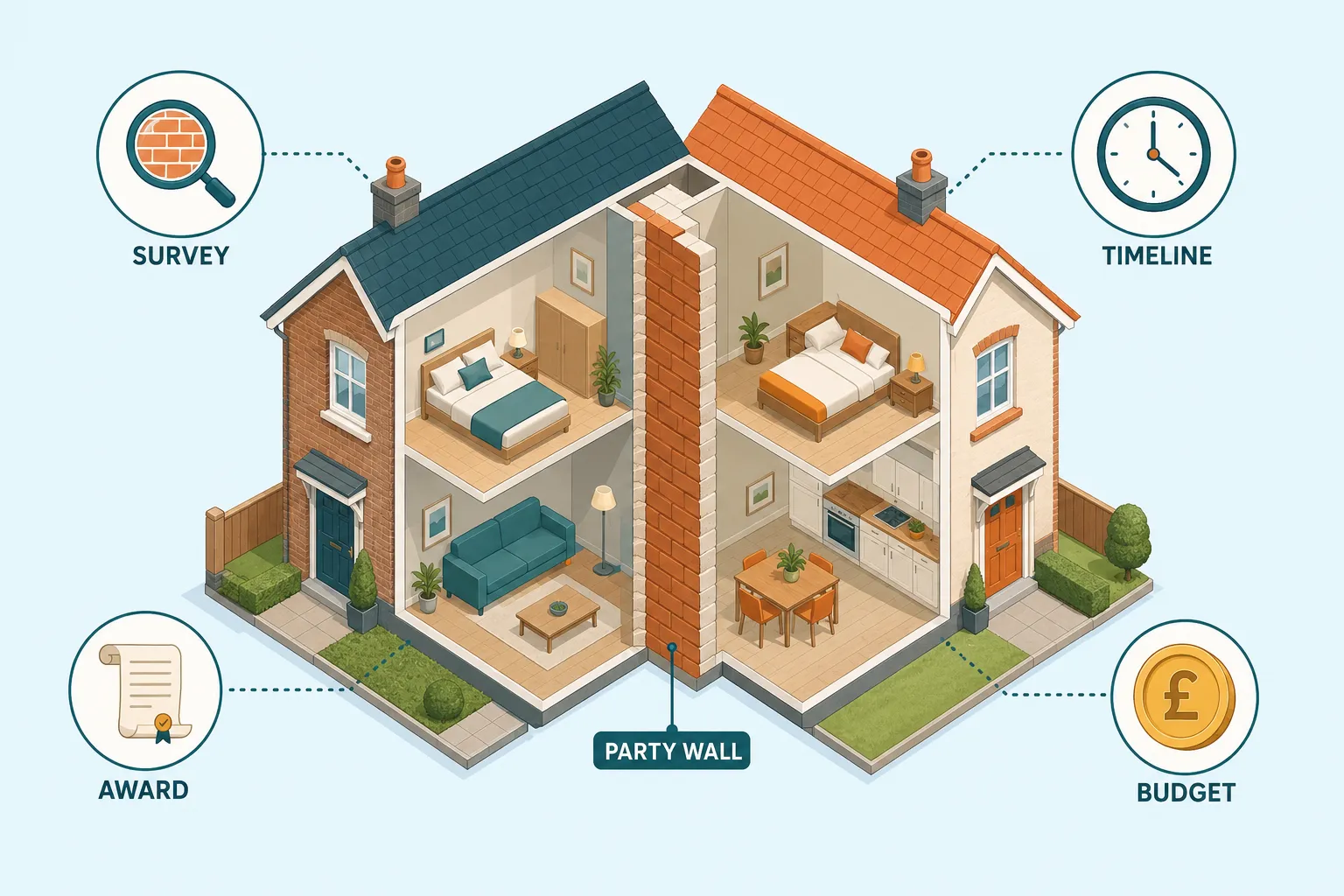
Looking for expert solutions?
Request a Quote

Tag: party wall notice

  • Party Wall Act Extensions September 2026 London Homeowners: What You Need to Know This Autumn

    Last updated: September 26, 2026

    Every fourteen days, a fresh batch of injunctions lands on London building sites where homeowners skipped a legal notice they assumed was optional. As of 26 September 2026, the Party Wall etc. Act 1996 is still the law governing every rear extension, loft conversion, and basement dig that touches a shared wall or boundary in England and Wales, and courts continue to grant stop-work orders against homeowners who ignore it.

    Quick Answer

    The Party Wall etc. Act 1996 remains fully in force with no legal changes for September 2026, but enforcement has become noticeably stricter across London. Homeowners planning rear extensions, loft conversions, or basement works must serve notice on adjoining owners, 2 months for party wall works, 1 month for boundary line-of-junction works, before starting on-site this autumn. Skipping notice risks injunctions, and appointing a properly qualified RICS surveyor early is now the single biggest factor separating smooth autumn builds from stalled ones.

    Key Takeaways

    • The Party Wall etc. Act 1996 has no amendments recorded for 2026; the legal rules are unchanged, only guidance wording has been refreshed.
    • Party wall notices need 2 months’ notice for work to a shared wall; boundary wall or line-of-junction works need 1 month.
    • Rear extensions, loft conversions cutting into party walls, and excavations near neighbouring foundations all typically trigger the Act.
    • Excavation notice generally applies within 3 metres of a neighbour’s building, extending to 6 metres for deeper foundations.
    • Detached homes are not automatically exempt, boundary walls, garages, and nearby excavations can still trigger notice duties.
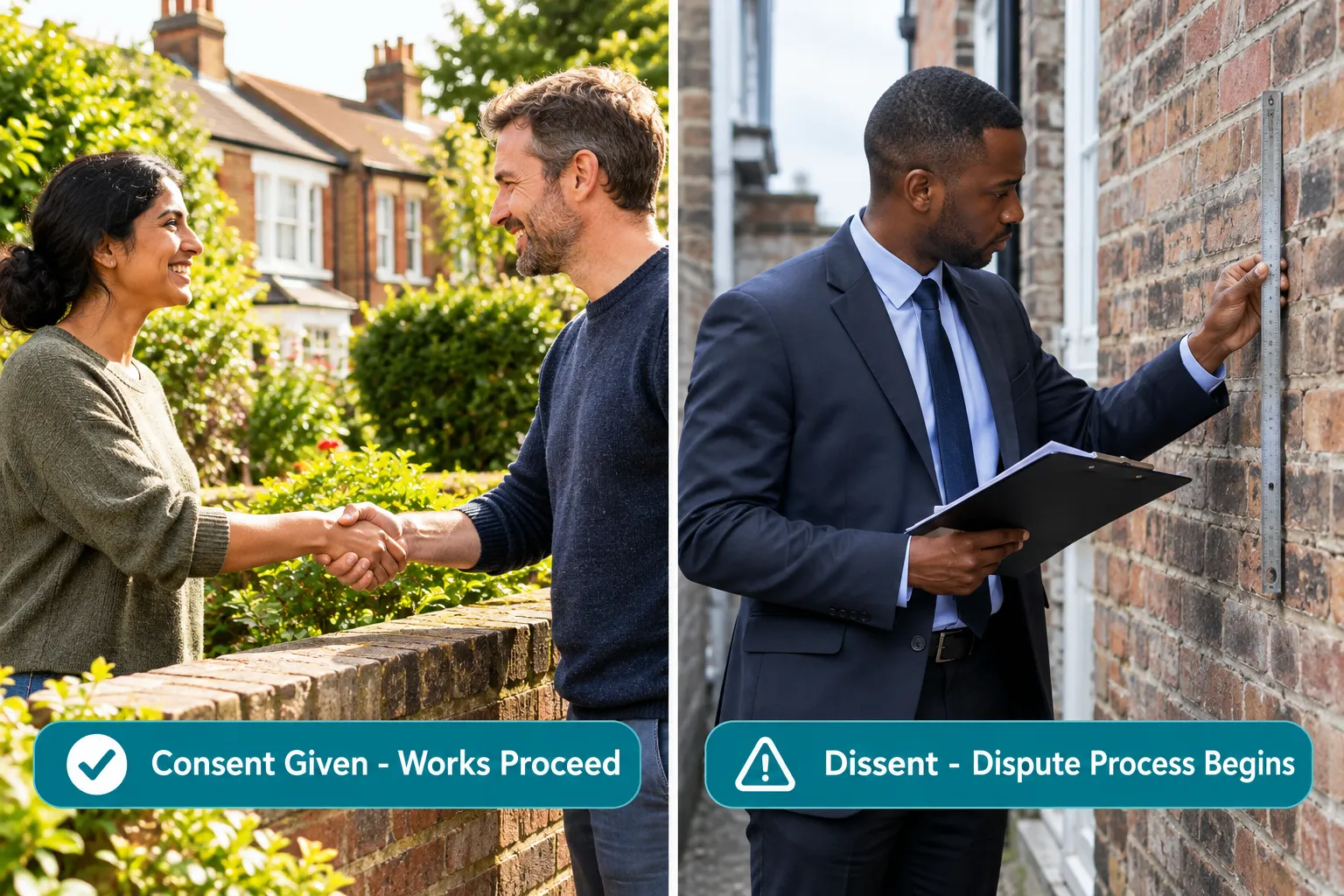
    • Adjoining owners have three options: consent, appoint an agreed surveyor, or appoint separate surveyors.
    • London courts and adjoining owners are increasingly willing to seek injunctions against homeowners who start without notice.
    • Notices can legally be sent by email under the Electronic Communication Order 2016, provided the recipient agrees.

    What Is the Party Wall Act and Why Does It Matter for Your Extension

    The Party Wall etc. Act 1996 is the law that governs building work affecting shared walls, boundary walls, and excavations near neighbouring properties in England and Wales. It matters for extensions because it forces homeowners to notify affected neighbours before starting work, protecting both sides from unresolved structural disputes.

    The Act does three practical things:

    • Requires written notice before specific types of work begin.
    • Gives adjoining owners the right to consent, object, or bring in a surveyor.
    • Creates a formal dispute process (an “award”) when neighbours cannot agree informally.

    For London specifically, dense terraced streets mean a single rear extension can touch two or three separate neighbours at once, each entitled to their own notice and response.

    Do You Need Party Wall Act Permission for Your Extension in London

    Most London extensions that touch a shared wall, sit on a boundary, or involve deep excavation near a neighbouring building require formal notice under the Act, this is not the same as “permission” but a legal process that must be followed regardless of planning consent. Building work can lawfully begin without a neighbour’s outright approval, provided the correct procedure and timelines are respected.

    You are very likely covered by the Act if the project involves:

    • A rear or side extension built up to or straddling a party wall.
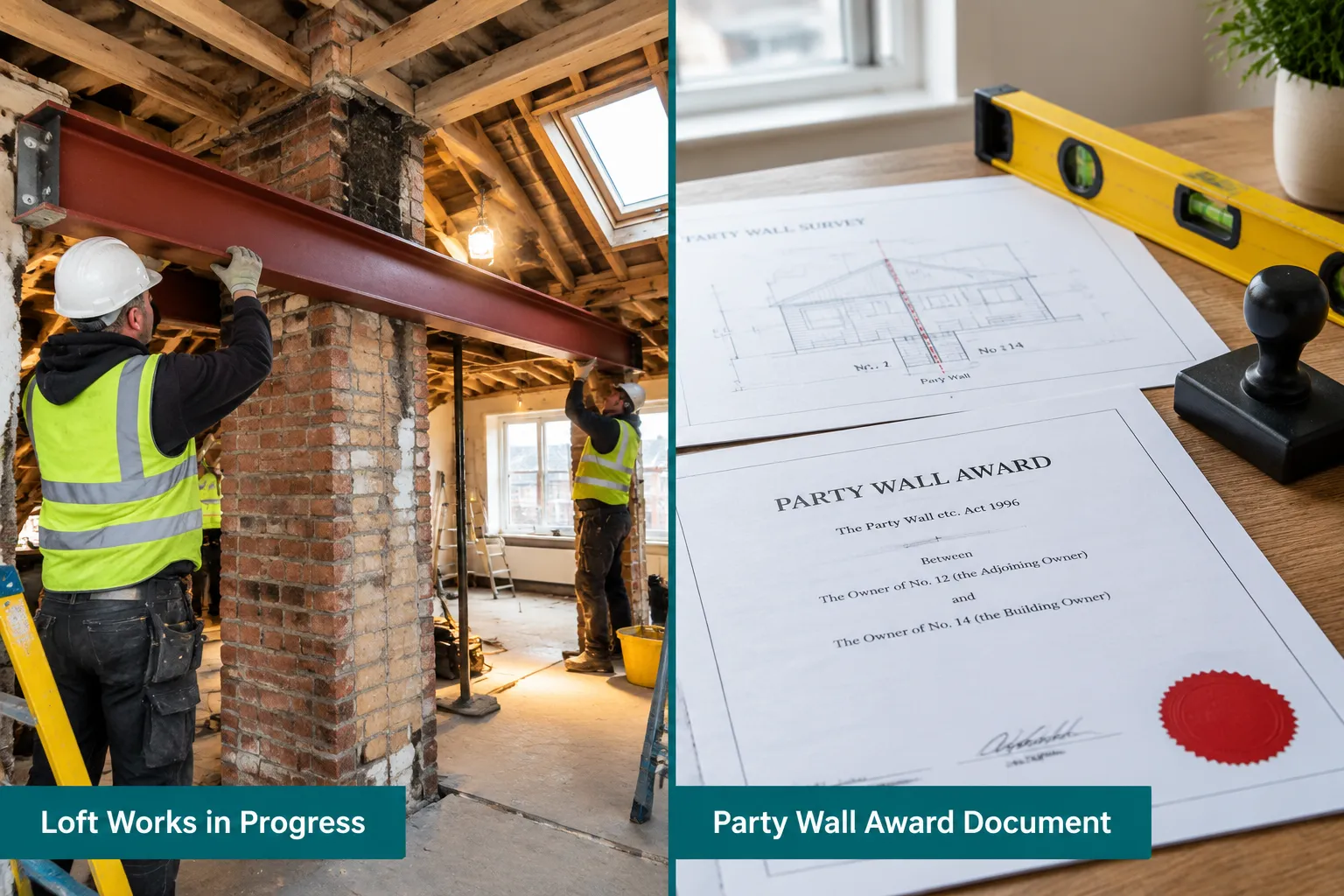
    • A loft conversion that cuts into, raises, or underpins a shared wall.
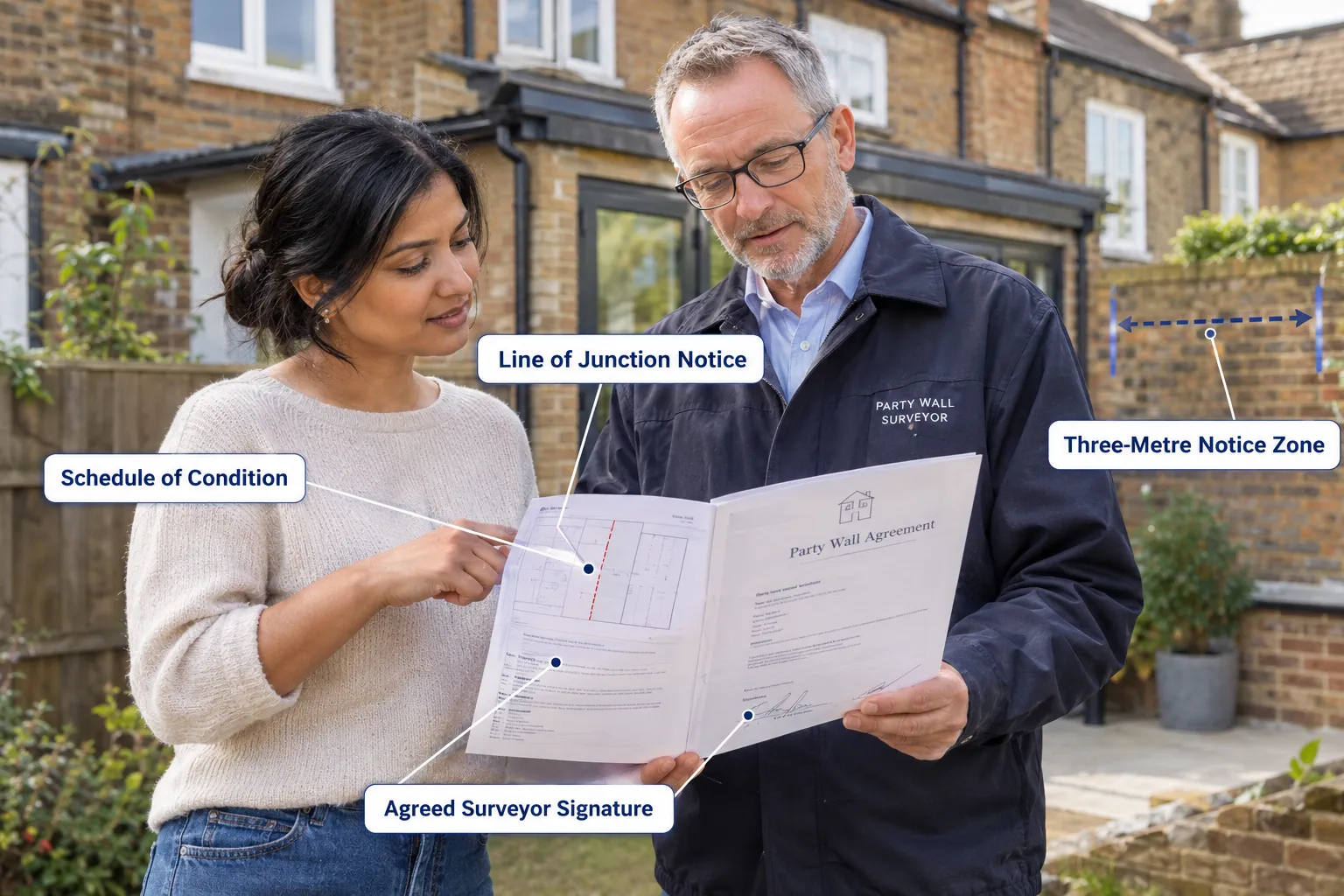
    • New foundations dug within 3 to 6 metres of a neighbour’s building, depending on depth.
    • A new boundary wall built on or near the property line.

    Choose to serve notice if: any part of the build touches, rests on, or excavates near a shared structure. When in doubt, treat the Act as applicable and get advice, assuming it does not apply is the costliest mistake homeowners make.

    Party Wall Act Requirements September 2026 Changes

    There are no new legal requirements for September 2026. The Party Wall etc. Act 1996 has not been amended, and government guidance updates this year have focused on clarifying language rather than altering obligations.

    What has changed is the enforcement environment, not the statute itself:

    • Refreshed official explanatory guidance simplifies FAQs but keeps the same notice periods and procedures.
    • Adjoining owners across London are more willing to pursue court injunctions against unnotified work.
    • Surveyors are producing more detailed, evidence-based awards than in previous years.

    Common mistake: assuming updated online guidance means updated law. The rules homeowners followed in 2020 are the same rules that apply to autumn 2026 projects.

    How Much Does a Party Wall Act Surveyor Cost in London

    Party wall surveyor costs in London vary by project complexity, number of adjoining owners, and whether a single agreed surveyor or separate surveyors are appointed, so no fixed figure applies universally. Homeowners should request written fee quotes before appointment rather than relying on general estimates.

    Factors that influence cost include:

    • Number of neighbouring properties affected by the extension or loft conversion.
    • Whether neighbours consent quickly or dissent and appoint their own surveyor.
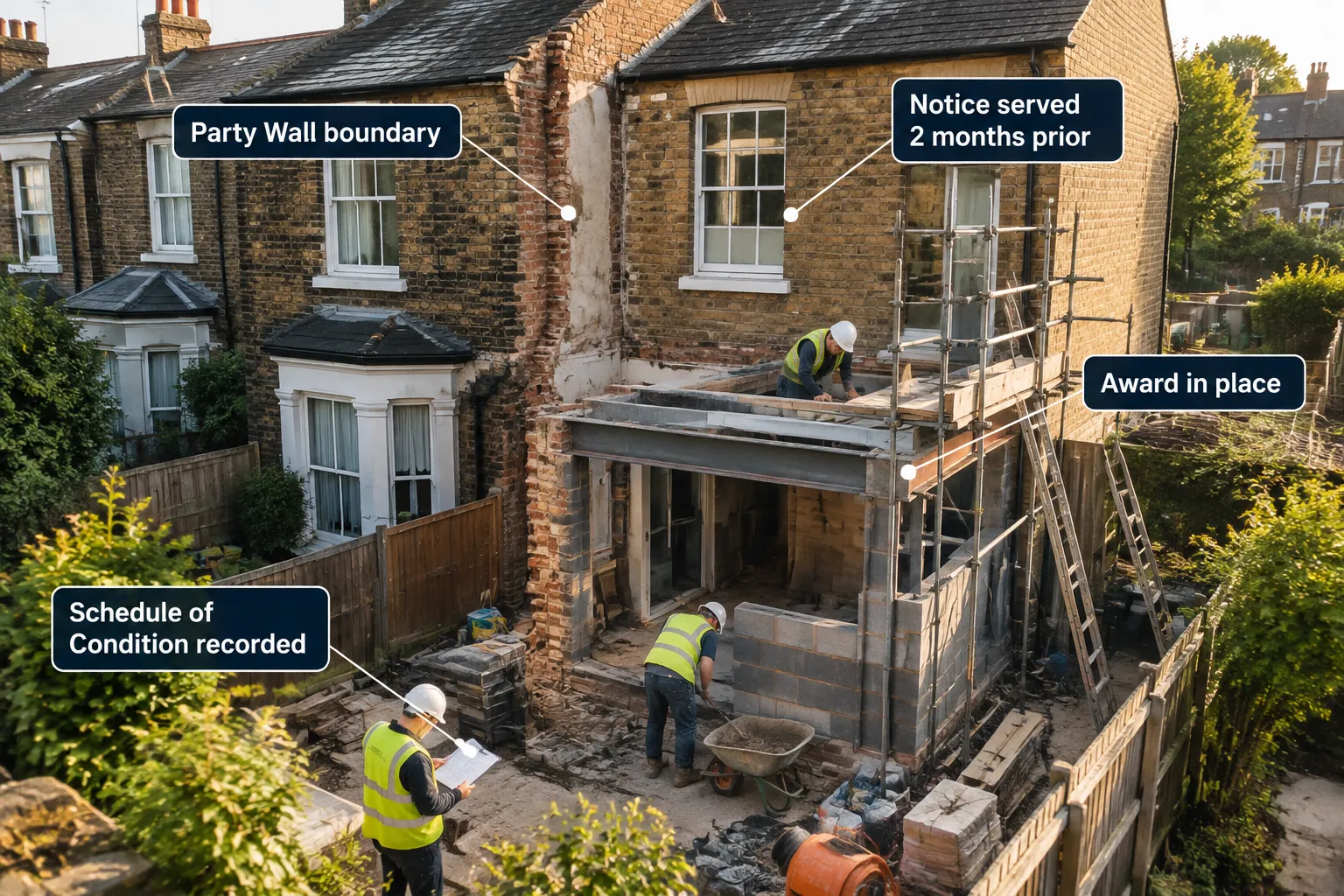
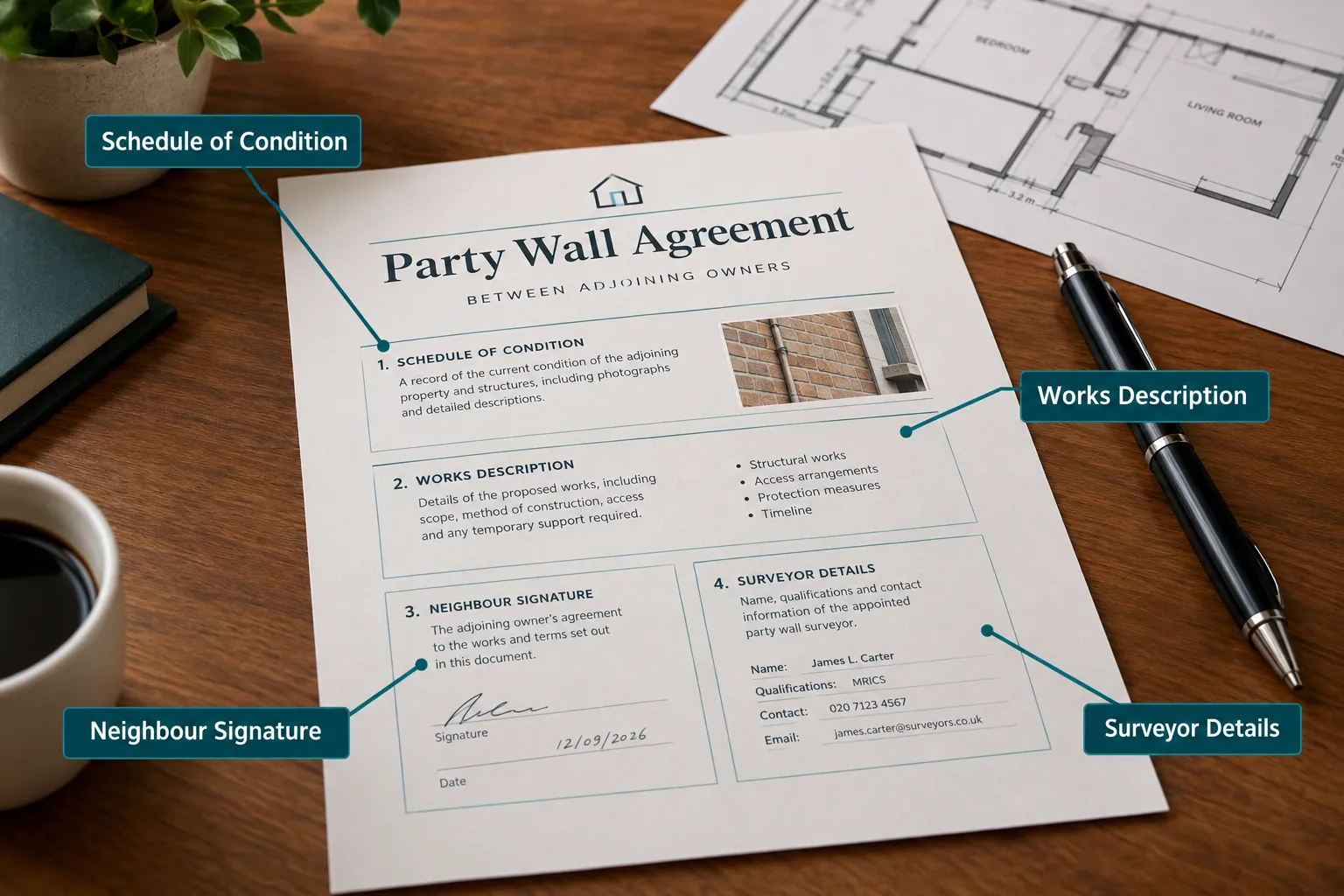
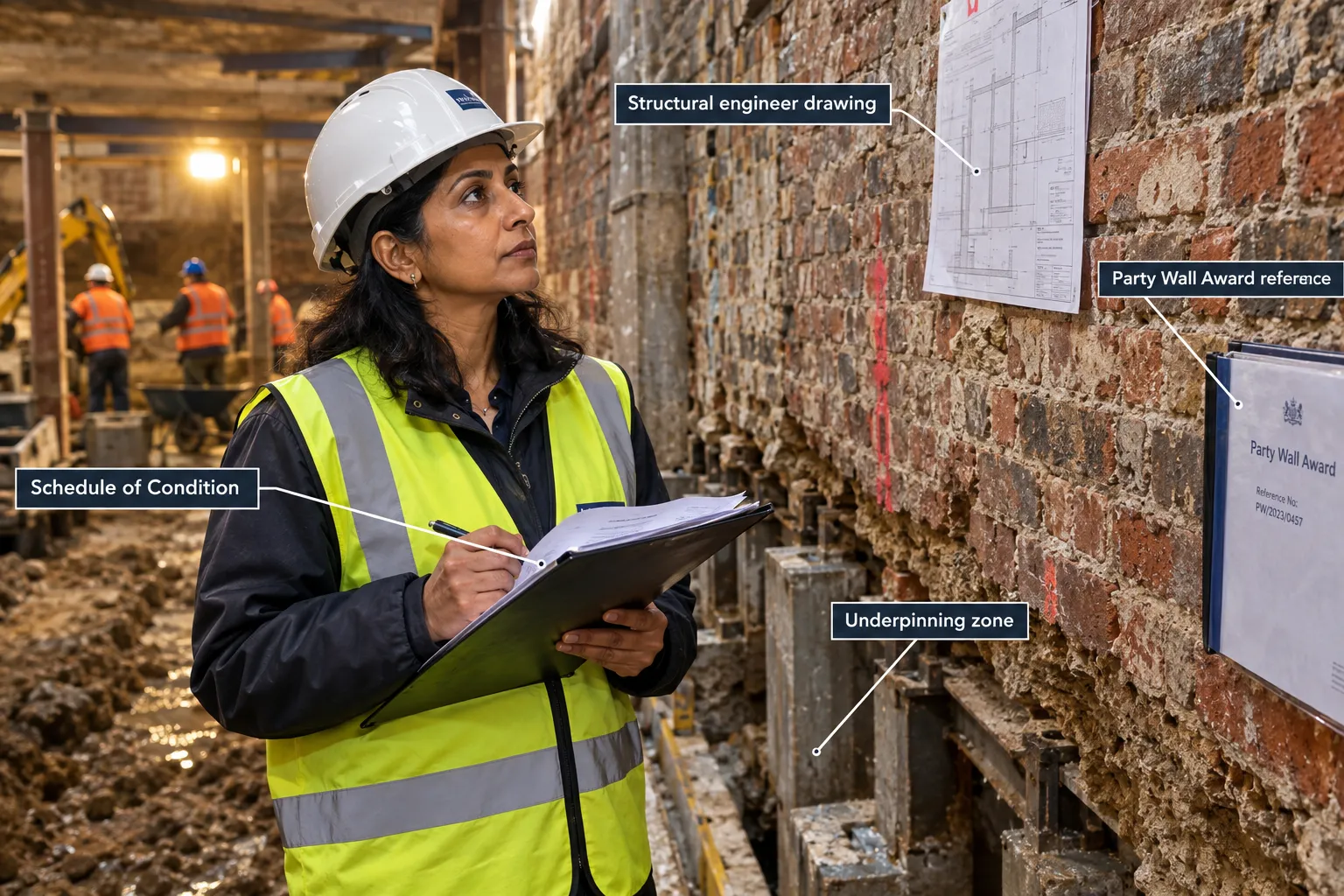
    • Complexity of the schedule of condition (photos and notes on existing neighbouring structures).
    • Scope of excavation or structural work involved.

    Decision rule: if a quote seems unusually low or a surveyor promises to “guarantee no disputes,” treat that as a warning sign rather than reassurance.

    Party Wall Act vs Building Regulations: What Is the Difference

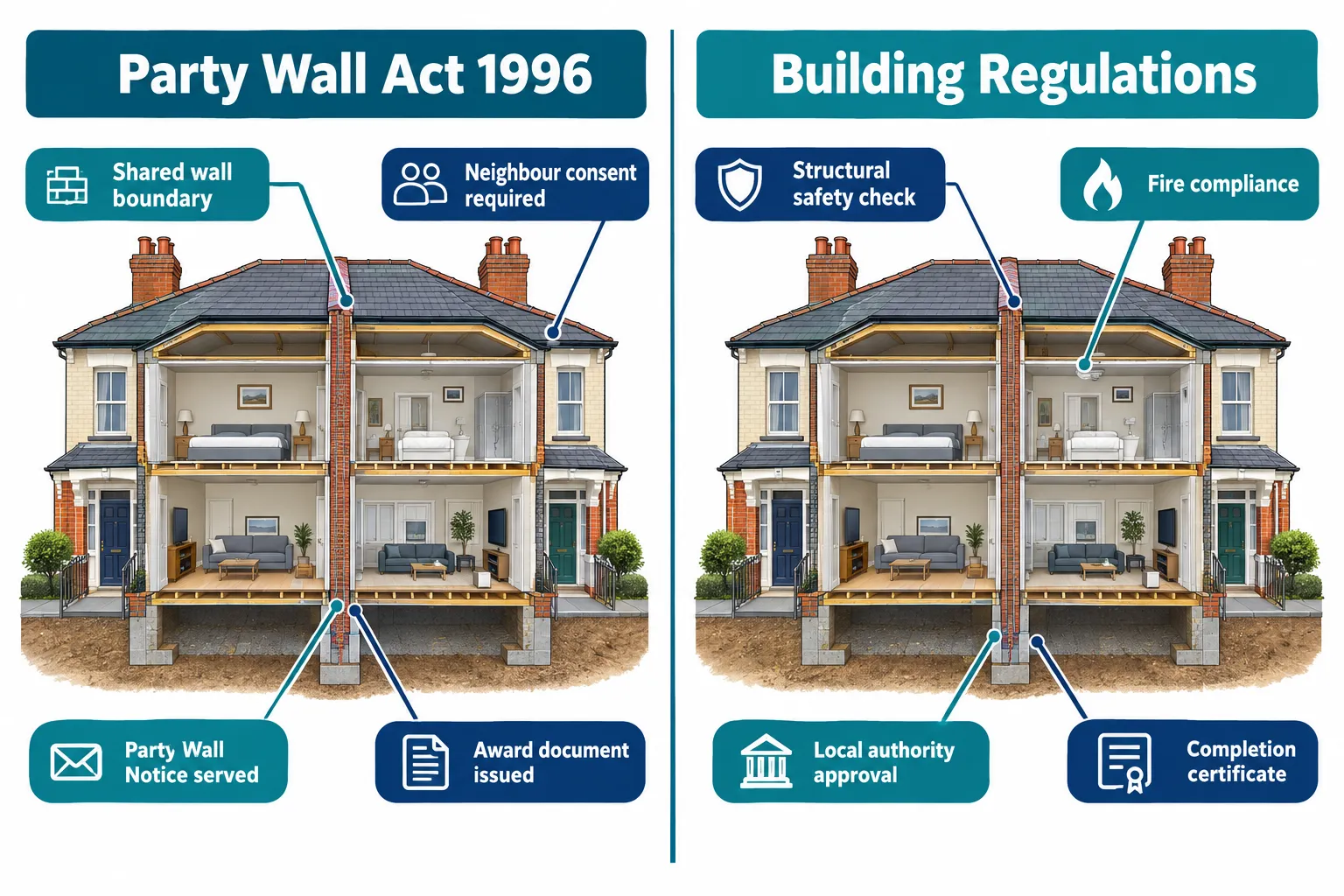
    The Party Wall Act and Building Regulations are separate legal systems that both apply to most London extensions but serve different purposes. The Party Wall Act protects neighbours’ interests in shared structures; Building Regulations ensure the building itself is structurally safe and energy-efficient.

    Area Party Wall Act Building Regulations
    Purpose Protects adjoining owners’ property rights Ensures construction safety and standards
    Who enforces Surveyors, courts Local authority building control
    Approval needed Notice and consent/award Building control sign-off
    Skipping it Risk of injunction, disputes Risk of enforcement notice, unsafe build

    Both processes can run alongside each other, and satisfying one does not satisfy the other.

    Can You Start Your Extension Without a Party Wall Act Notice

    Starting notifiable work without serving a party wall notice is a breach of statutory duty, and adjoining owners can apply to court for an injunction to halt the project. Even if the homeowner believes the neighbour “won’t mind,” the legal obligation to notify exists regardless of the relationship.

    Risks of skipping notice include:

    • Court injunctions stopping work mid-build, sometimes after foundations are already poured.
    • Legal costs awarded against the homeowner if a court finds the Act was ignored.
    • Damaged neighbour relationships that complicate future maintenance access.

    Edge case: even friendly neighbours who verbally agree to work can later dispute damage without a formal award in place, leaving the homeowner with no protection.

    Party Wall Act Timeline: How Long Does It Take

    The statutory minimum is 1 month’s notice for line-of-junction (boundary) works and 2 months for work directly to a party wall or structure, but real-world timelines usually run longer once responses, surveyor appointments, and awards are factored in. London homeowners planning to start building this autumn should build in extra weeks beyond the legal minimum.

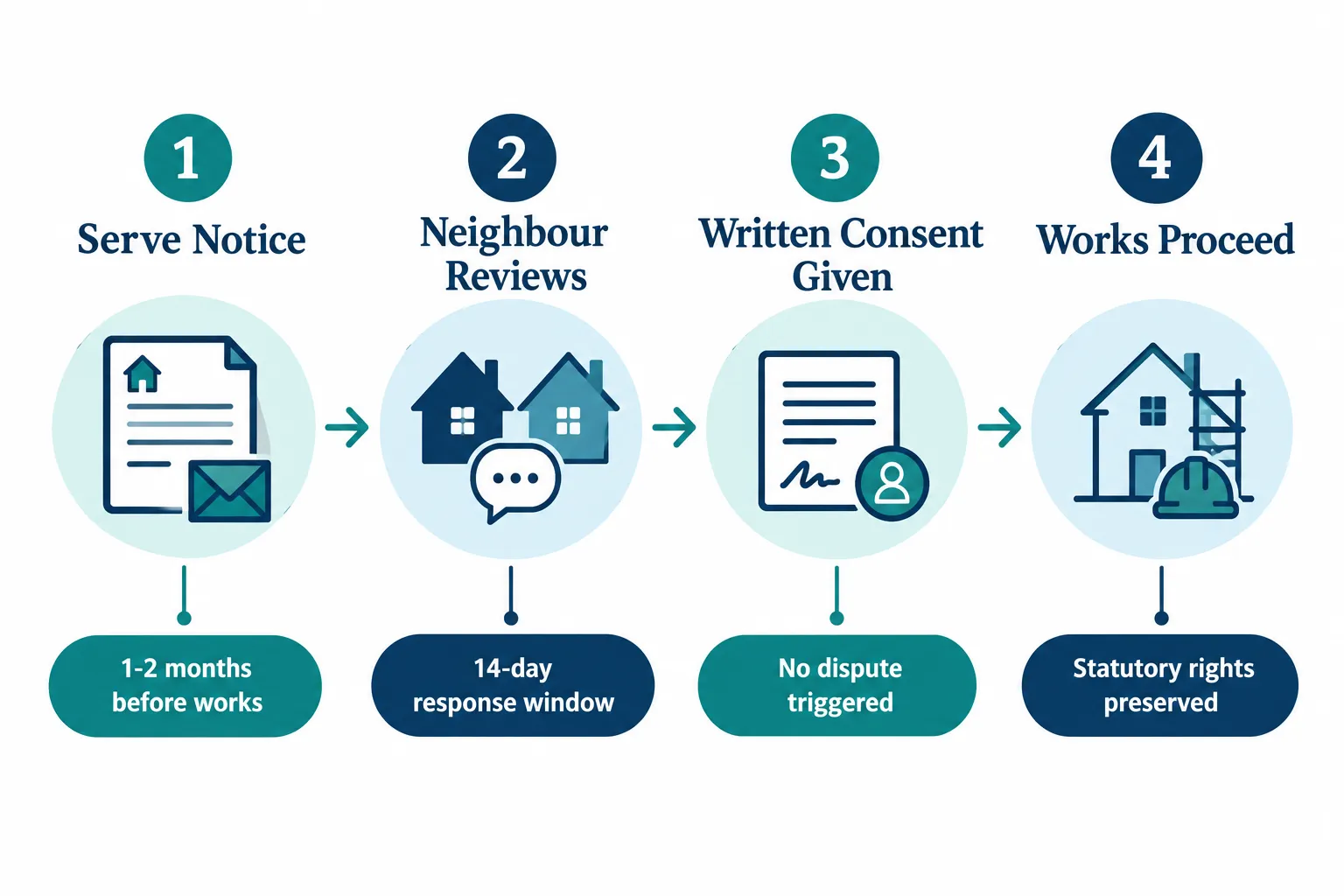
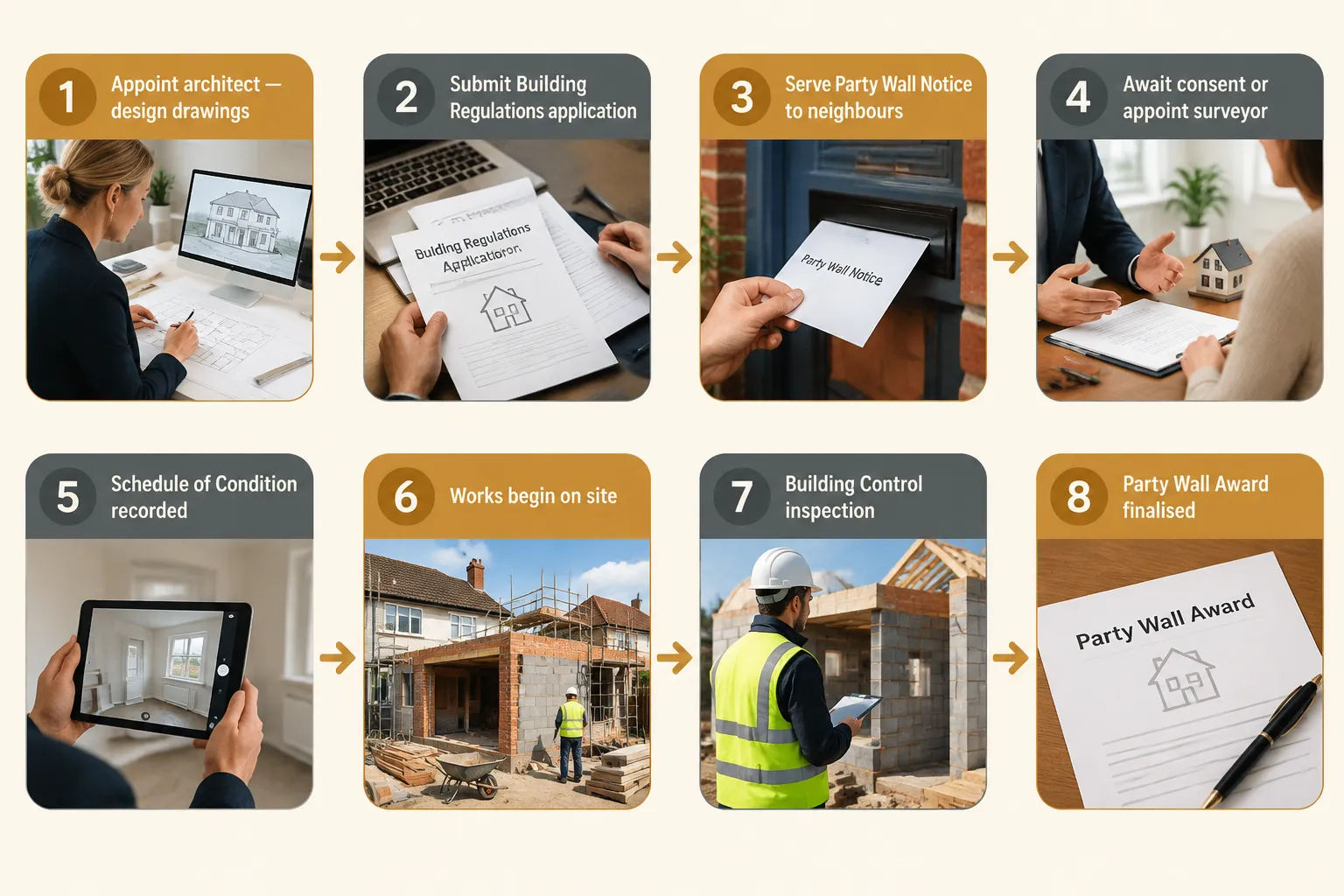
    Realistic planning sequence:

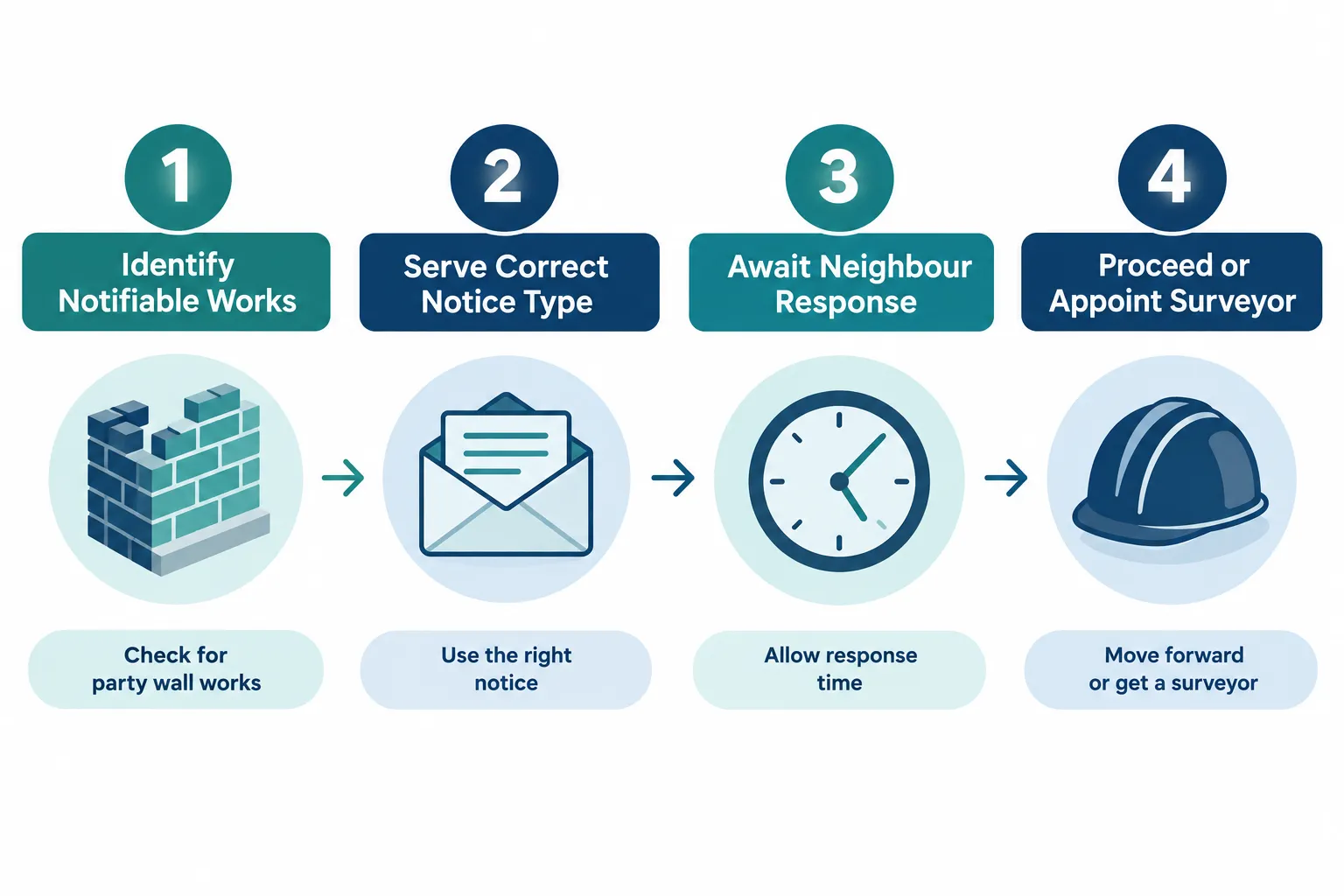
    1. Confirm the project triggers the Act (extension design stage).
    2. Serve notice at least 2 months before the planned start date for party wall work.
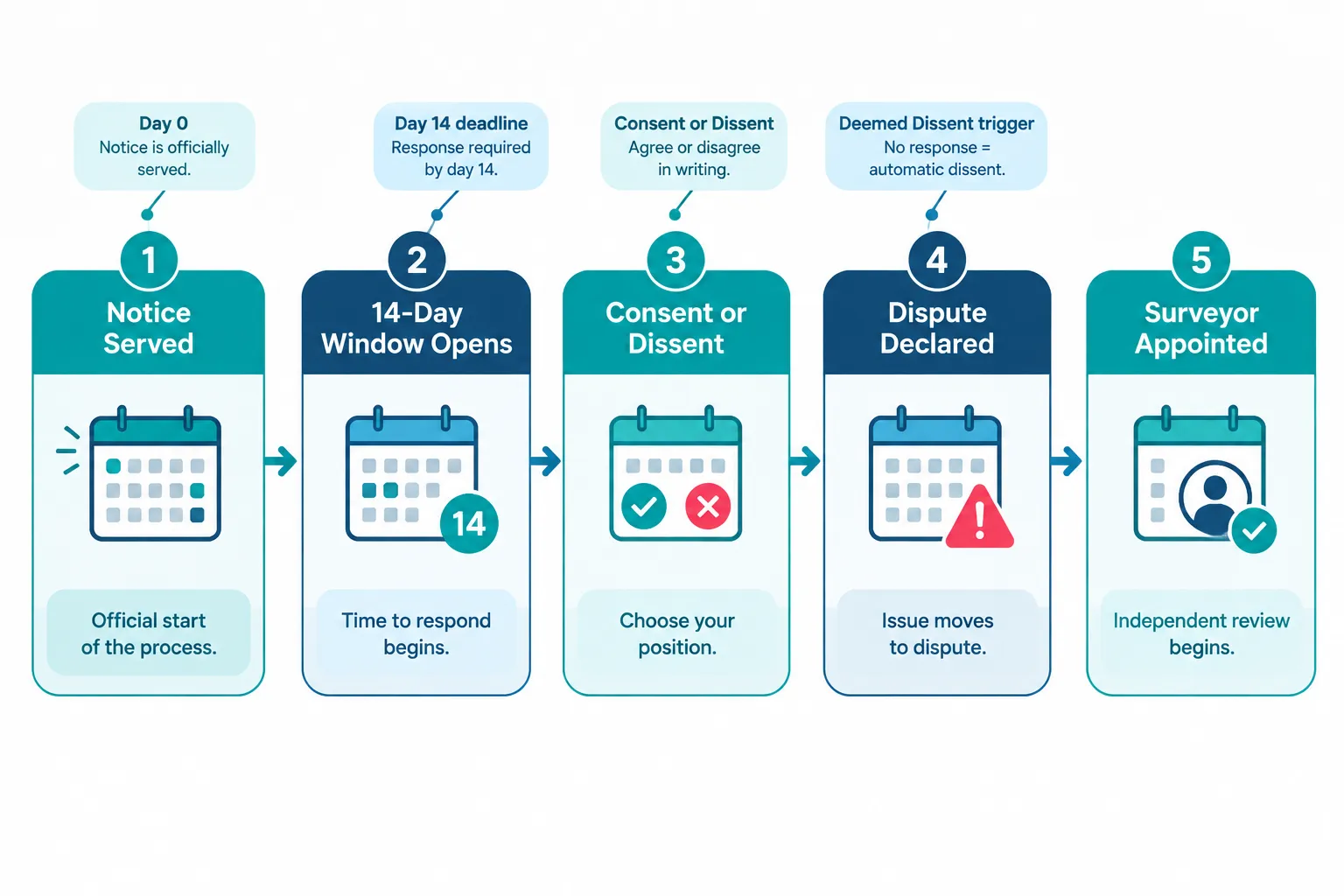
    3. Allow up to 14 days for neighbours to respond formally.
    4. If dissent occurs, allow several additional weeks for surveyor appointment and award preparation.
    5. Begin construction only once consent or an award is in place.

    Quick example: a homeowner serving notice in late September 2026 for a rear extension touching a shared wall should not expect to break ground before late November, once realistic response and surveyor time is included.

    What Happens If You Don’t Follow Party Wall Act Rules

    Ignoring party wall procedure exposes homeowners to injunctions, legal costs, and forced remedial work, and 2026 reporting shows adjoining owners are increasingly using the courts to enforce this. A stopped building site during autumn can also mean losing a weather window before winter.

    Consequences can include:

    • Work being paused by court order until proper notice and awards are completed.
    • Liability for any damage caused to the neighbour’s property during unauthorised works.
    • Additional professional fees to retrospectively resolve a dispute that could have been avoided.

    Party Wall Act for Terraced Houses vs Detached Homes

    Terraced houses almost always trigger the Act because they share structural walls directly with neighbours on both sides, while detached homes trigger it less often but are not automatically exempt. Boundary walls, garages, link structures, and excavation near a neighbour’s foundations can still bring a detached property within scope.

    Property type Common trigger Notice usually needed
    Terraced Shared party wall extension/loft Yes, almost always
    Semi-detached Shared wall on one side Yes, for that side
    Detached Boundary wall, garage, or deep excavation near neighbour Sometimes

    Common mistake: detached homeowners assuming the Act never applies to them, then discovering an excavation notice is required because new foundations sit within 3 to 6 metres of a neighbour’s building.

    Party Wall Act Surveyor Appointment Process in London

    The surveyor appointment process starts once notice is served: neighbours can consent, agree to a single shared surveyor, or each appoint their own surveyor if they dissent. In London, where multiple adjoining owners are common, this process can involve more than one surveyor relationship on a single project.

    Steps typically followed:

    1. Homeowner serves notice on all affected adjoining owners.
    2. Neighbour responds: consents, or dissents and names a surveyor.
    3. If both sides agree, one surveyor acts for everyone.
    4. If not, each side’s surveyor negotiates and issues a joint award.
    5. The award sets out rights, conditions, and any compensation terms.

    Decision rule: choose an agreed single surveyor if the relationship with neighbours is straightforward and low-conflict; choose separate surveyors if there is any sign of dispute over damage risk or access.

    Party Wall Act Notice Period Requirements 2026

    Notice periods remain unchanged for 2026: 2 months for work directly affecting a party wall or party structure (covering sections dealing with shared walls), and 1 month for new walls built on or at the boundary line. These are legal minimums, not recommended timeframes.

    RICS and industry guidance consistently advise serving notice earlier than the minimum, particularly for autumn projects, because:

    • Response and negotiation time often exceeds the statutory minimum.
    • Surveyor appointments can take several weeks to finalise.
    • Delays risk pushing groundworks into winter weather.

    Common Mistakes Homeowners Make with the Party Wall Act

    The most frequent mistake is assuming planning permission or building control approval covers party wall obligations, when in fact they are entirely separate legal processes. Other recurring errors include serving notice too late and appointing an unqualified surveyor.

    Frequent errors to avoid:

    • Confusing planning permission with party wall consent.
    • Serving notice only weeks before the planned start date.
    • Hiring a surveyor without checking RICS membership or London extension experience.
    • Assuming verbal neighbour agreement replaces a formal award.

    Do You Need the Party Wall Act for a Loft Extension or Side Extension

    Loft conversions that cut into, raise, or place loads on a party wall almost always require notice, and side extensions built up to or on a boundary line typically require notice too. The specific trigger depends on whether the work touches a shared structure or sits on the property line.

    • Loft extensions: notice usually needed if steel beams, raised walls, or party wall cutting are involved.
    • Side extensions: notice usually needed under the line-of-junction provisions if built on or near the boundary.

    Party Wall Act Dispute Resolution: What Are the Options

    When neighbours dissent, the Act provides a structured resolution route through surveyors rather than court action as a first step. Homeowners have three response paths available once notice is served and a neighbour objects.

    • Consent: neighbour agrees in writing, and work can proceed.
    • Agreed surveyor: both sides use one surveyor to produce a binding award.
    • Separate surveyors: each side appoints their own, who jointly issue an award; a third surveyor can be called in if they disagree.

    Courts remain a last resort, generally used when notice was skipped entirely or an award is ignored.

    FAQ

    Does the Party Wall Act apply in Scotland or Northern Ireland? No. The Party Wall etc. Act 1996 applies only in England and Wales, so London homeowners are fully within its scope.

    Can party wall notices be sent by email in 2026? Yes, provided the recipient agrees to electronic communication, under rules that remain in force from the Electronic Communication Order 2016.

    Is planning permission the same as party wall consent? No. Planning permission and Building Regulations approval are separate from party wall notice and consent, and satisfying one does not satisfy the other.

    What if a neighbour ignores the notice completely? If a neighbour does not respond within the statutory period, they are treated as dissenting, and the surveyor appointment process begins.

    Do basement extensions need party wall notice? Yes, in most cases, because excavation near neighbouring foundations is one of the clearest triggers under the Act.

    Can work start before the notice period ends if the neighbour consents early? Yes, if the adjoining owner gives written consent, work can often start sooner than the full statutory period.

    Conclusion

    The Party Wall Act extensions September 2026 London homeowners landscape has not changed legally, but the margin for error has shrunk. Courts and neighbours are less forgiving of skipped notices than in previous years, and a stalled autumn build can push a project into winter. Homeowners planning rear extensions, loft conversions, or excavation work this season should confirm early whether the Act applies, serve notice well ahead of the statutory minimum, and appoint a properly credentialed RICS surveyor before committing to a start date. Acting early is the clearest way to protect both the build timeline and the neighbour relationship.

    .cg-pw-wrap{font-family:Arial,Helvetica,sans-serif;max-width:640px;margin:0 auto;padding:16px;border:1px solid #d9d9d9;border-radius:8px;background:#fafafa} .cg-pw-wrap h2{font-size:18px;margin:0 0 10px;color:#1a3c5e} .cg-pw-btns{display:flex;gap:8px;flex-wrap:wrap;margin-bottom:14px} .cg-pw-btn{flex:1;min-width:120px;padding:9px 6px;border:1px solid #1a3c5e;border-radius:6px;background:#fff;color:#1a3c5e;cursor:pointer;font-size:13px;text-align:center} .cg-pw-btn.active{background:#1a3c5e;color:#fff} .cg-pw-result{background:#fff;border:1px solid #e0e0e0;border-radius:6px;padding:14px;font-size:14px;color:#222;line-height:1.5} .cg-pw-result b{color:#1a3c5e} .cg-pw-note{font-size:11px;color:#666;margin-top:10px} @media(max-width:420px){.cg-pw-btn{min-width:100%}}

    Does Your Autumn 2026 Project Need Party Wall Notice?

    Select a project type above to see typical notice requirements.
    Guide only, not legal advice. Always confirm with a qualified RICS party wall surveyor.
    var data={ rear:”Rear Extension: If it touches or straddles a shared party wall, serve 2 months notice (Section 2) before your planned start date.”, loft:”Loft Conversion: Cutting into, raising, or loading a party wall usually requires 2 months notice (Section 2). Check beam and structural plans first.”, side:”Side Extension / Boundary Wall: New walls on or at the boundary line typically need 1 month notice (Section 1/3, line of junction).”, dig:”Deep Excavation: Foundations within roughly 3 to 6 metres of a neighbouring building usually trigger 1 month notice under Section 6.” }; var btns=document.querySelectorAll(“.cg-pw-btn”); var out=document.getElementById(“cg-pw-out”); btns.forEach(function(b){ b.addEventListener(“click”,function(){ btns.forEach(function(x){x.classList.remove(“active”)}); b.classList.add(“active”); out.innerHTML=data[b.getAttribute(“data-r”)]; }); });
  • Party Wall Act 1996 disputes London 2026 case law court avoidance: what property owners need to know

    Last updated: September 25, 2026

    One Court of Appeal ruling has quietly changed the risk calculus for every London extension and basement project. Since Power & Kyson v Shah [2023] EWCA Civ 239, building owners who skip a party wall notice no longer face the surveyor system at all, they face the High Court, full stop [2][6].

    Quick Answer

    Party Wall Act 1996 disputes in London during 2026 are increasingly shaped by Power & Kyson v Shah, which confirmed that surveyors have no jurisdiction over notifiable works carried out without a valid notice [2][6][9]. That leaves neighbours to pursue trespass or nuisance claims through the courts instead of a quicker surveyor’s award. Court avoidance in 2026 depends almost entirely on serving correct notices early, appointing surveyors promptly, and using the Act’s award system rather than letting disputes drift into common-law litigation [4][11][14].

    Key Takeaways

    • The Party Wall Act 1996 only protects parties who serve or receive a valid notice; without one, there is no statutory dispute for surveyors to resolve [2][6].
    • Power & Kyson v Shah [2023] EWCA Civ 239 is the leading 2026 authority: no notice means no section 10 jurisdiction, pushing neighbours toward common-law claims [2][6][9][15].
    • Common-law routes (trespass, nuisance, negligence) are generally slower and costlier than a party wall award [9][14].
    • Party wall awards remain legally binding and can only be appealed to the county court within 14 days [4][11].
    • London basement and rear-extension projects are the most frequent source of disputes because of excavation, shared foundations and vibration damage [1][14].
    • Early notice, prompt surveyor appointment and clear schedules of condition are the most reliable ways to stay inside the Act’s framework and out of court [4][11][14].
    • RICS commentary in 2026 questions whether parts of the Act are becoming ineffective where notice is skipped, and floats possible reform [10][13].

    What is the Party Wall Act 1996 and how does it apply in London

    The Party Wall etc. Act 1996 is the statute governing work on shared walls, boundary structures and excavations near a neighbour’s property, and it applies across England and Wales including every London borough [5]. It gives building owners a right to carry out certain works while giving adjoining owners a right to compensation, access and a say in how work proceeds.

    In London, where terraced houses, semi-detached properties and close-set flats are the norm, the Act is triggered constantly by:

    • Building or repairing a wall that sits on the boundary between two properties.
    • Cutting into a party wall to insert beams, damp-proof courses or steel supports.
    • Excavating within 3 metres of a neighbouring building where the excavation goes deeper than the neighbour’s foundations, or within 6 metres if it cuts a line drawn downward from the foundation at 45 degrees [5][11].

    The government’s explanatory booklet, refreshed in 2026, still frames the Act as a mechanism to prevent and resolve disputes about party structures, boundary walls and nearby excavation before they escalate [11]. The core provisions, notices, surveyor appointments, and awards, have not changed substantively, aside from narrow statutory carve-outs such as the exclusion of section 2 for the Cambridge Waste Water Treatment Plant Relocation Order 2025, which shows Parliament is willing to legislate around specific infrastructure but has not yet addressed the wider issues raised by Power v Shah [12].

    Party Wall Act disputes London 2026 recent case law

    The single most important case shaping 2026 practice is Power & Kyson v Shah [2023] EWCA Civ 239, which held that surveyors have no jurisdiction under section 10 if the building owner never served a notice for notifiable works [2][6][9][15]. This means the Act’s entire dispute-resolution machinery, surveyor appointments, awards, the 14-day appeal window, simply does not switch on.

    Specialist commentary describes this as creating a “contradiction at the heart of party wall jurisdiction”: failing to serve notice breaches the Act, yet that same failure removes the neighbour’s statutory protection, leaving only slower and pricier common-law remedies [2][10]. Falcon Chambers and New Law Journal commentary confirms the ratio decidendi: without a served notice, there is no “building owner” in the Act’s legal sense, so no statutory dispute exists for surveyors to resolve [6][15].

    Other cases still cited by London surveyors in 2026 include:

    • Raheel Shah v Ken Power [2022] EWHC 209 (QB), addressing damage assessment and causation principles that feed into how awards allocate compensation [7][8].
    • Rashid v Sharif [2014] EWCA Civ 377, still referenced for classifying party fence walls and apportioning responsibility [3].

    The Trowers & Hamlins 2024/2026 analysis of these authorities highlights how courts separate pre-existing structural defects from damage genuinely caused by notifiable works, with compensation reduced where damage predates the project [3]. RICS journal commentary asks whether parts of the Act are becoming “obsolete” in practice, since Power v Shah confirms common law is the only route once notice has been skipped, and argues this could weaken neighbour protection in dense cities like London unless reform follows [10][13].

    “Failing to serve notice both breaches the Act and removes its protections, a contradiction that defeats the Act’s protective purpose.”, paraphrased from 2026 doctrinal commentary on Power v Shah [2][10]

    What counts as a party wall dispute under the 1996 act

    A statutory dispute exists once a building owner has served a valid notice and the adjoining owner either dissents, fails to respond within 14 days, or disagrees on how work should proceed [5][11]. Only then does the surveyor system, an agreed surveyor, or two surveyors plus a third, have authority to make a binding award.

    Common triggers for a formal dispute include:

    • Disagreement over the scope of underpinning or excavation depth.
    • Refusal of access for the building owner’s contractors.
    • Disputes over the schedule of condition (the “before” record of the neighbour’s property).
    • Compensation claims after cracking, subsidence or vibration damage appears mid-build.

    Decision rule: if notice has been properly served and 14 days pass without written consent, a dispute is deemed to have arisen automatically, and either party can appoint a surveyor [11]. If no notice was served at all, there is no statutory dispute under Power v Shah, only a potential common-law claim [2][6].

    How do you avoid court when there’s a Party Wall Act dispute

    Avoiding court means keeping every dispute inside the Act’s award system rather than letting it spill into trespass or nuisance litigation. The single biggest lever is serving a valid, correctly detailed notice before any notifiable work starts [4][11][14].

    Practical steps that London surveyors are recommending in September 2026:

    1. Serve notice early, at least two months before starting work on a party structure, or one month before excavation, giving neighbours proper time to respond [5][11].
    2. Commission a schedule of condition on the neighbouring property before work begins, to prevent arguments about pre-existing versus new damage [3].
    3. Appoint surveyors promptly once a dispute is deemed to arise, rather than letting weeks pass while positions harden [4].
    4. Use an agreed surveyor where relationships are still cordial, since this is usually faster and cheaper than three separate surveyors [4][14].
    5. Respond to the award within the 14-day appeal window if genuinely necessary, but treat appeal as a last resort given the cost of county court proceedings [4][11].

    Common mistake: building owners sometimes assume informal texts or emails to a neighbour count as notice. They do not. Notice must follow the Act’s formal requirements, and getting this wrong is precisely what exposed building owners to common-law claims in Power v Shah [2][6].

    Party Wall Act disputes who needs a surveyor and why

    Anyone served with a party wall notice who does not consent in writing effectively needs a surveyor, because once a dispute is deemed to exist, the Act requires surveyor involvement to produce a binding award [5][11]. Building owners undertaking notifiable works also need to instruct a surveyor from the outset to ensure notices and schedules of condition are correct.

    Surveyors matter because they:

    • Draft and serve notices that meet the Act’s technical requirements.
    • Prepare or review schedules of condition to protect both sides against false damage claims.
    • Produce awards covering the scope of works, working hours, access rights and security for expenses.
    • Act as an independent referee, reducing the emotional temperature between neighbours.

    Edge case: in flats and shared freeholds, more than one adjoining owner may need separate notices, and each may appoint their own surveyor, increasing cost and coordination complexity on larger London developments [14].

    What are common mistakes people make with party wall disputes

    The most damaging mistake is starting notifiable work without serving notice at all, which, following Power v Shah, strips away the Act’s protections entirely and forces neighbours into court-based common-law claims [2][6][9]. This is especially common on basement conversions where owners underestimate how deep excavation triggers the Act.

    Other frequent errors include:

    • Treating verbal agreement with a neighbour as sufficient, without a written award.
    • Ignoring a notice completely, assuming it will “go away.”
    • Failing to record the condition of the neighbouring property before excavation starts.
    • Appointing a surveyor who is not genuinely independent, risking a challengeable award.
    • Rushing the works programme without allowing for the statutory notice periods.

    Quick example: a Zone 2 London homeowner extending a rear kitchen and lowering a basement floor without notice found their neighbour later suing for trespass and nuisance after cracking appeared, a claim that, post Power v Shah, bypassed the party wall surveyor system entirely and went straight to litigation [2][9].

    What happens if you ignore a party wall notice in London

    Ignoring a notice for 14 days is treated as a dissent, which automatically triggers the statutory dispute procedure and surveyor appointment [5][11]. It does not stop the building owner’s works, and it does not protect the neighbour from anything, it simply moves the matter to surveyors.

    By contrast, if a building owner ignores its own duty to serve notice in the first place, the consequences are different and, under Power v Shah, arguably worse for the neighbour: there is no statutory dispute at all, so the neighbour must rely on common-law claims like trespass or nuisance through the courts [2][6][9]. Building owners retain a common-law right to carry out certain works, but risk more expensive litigation exposure if they bypass the Act rather than resolve matters via an award [9][14].

    How much does it cost to resolve a party wall dispute

    Resolving a dispute through the Act’s surveyor system is normally far cheaper than court litigation, though exact fees vary by project size and complexity. Surveyor fees for straightforward extensions in London are typically a few hundred to low thousands of pounds per surveyor, while contested basement schemes with structural engineering input can run considerably higher [1][14] (industry-reported ranges, not official statistics).

    Party wall award vs. court litigation, quick comparison
    Factor Party wall award Court litigation
    Typical timeframe Weeks to a few months Many months to years
    Typical cost Lower, surveyor fees only Higher, legal and court fees
    Who decides Independent surveyor(s) Judge
    Appeal route County court, 14 days Standard appeal process
    Requires valid notice? Yes [2][6] No

    Litigation costs escalate quickly once trespass or nuisance claims are involved, because both sides typically need solicitors, expert structural evidence and, potentially, barristers [9][14].

    What’s the difference between party wall awards and court cases, and can you settle without going to court

    A party wall award is a legally binding decision made by appointed surveyors under the Act, covering the works, access and compensation, and it can only be challenged by appeal to the county court within 14 days of service [4][11]. Court cases, by contrast, are full civil claims, usually trespass, nuisance or negligence, heard by a judge, with no equivalent statutory 14-day fast-track.

    Yes, settling without court is entirely possible and remains the norm for the majority of London party wall matters, provided notice was validly served [4][14]. The award mechanism exists specifically to avoid litigation: once surveyors sign an award, both parties are bound unless a timely appeal is lodged. Where no notice was served, however, settlement without court becomes harder, because there is no statutory framework compelling either side to negotiate, parties are left to reach a private agreement or proceed to litigation [2][9].

    How long does a party wall dispute take, and when do disputes end up in court

    A dispute handled through the Act typically resolves in a few weeks to a few months, depending on surveyor availability and the complexity of the works [4][14]. Disputes end up in court mainly in two scenarios: first, when a party appeals an award within the 14-day window; second, and increasingly since 2023, when no notice was served at all and the adjoining owner must sue for trespass or nuisance instead [2][6][9].

    Decision rule: choose the surveyor-award route if notice has been served and both sides accept the Act applies. Expect litigation if notice was skipped, or if one party disputes whether the Act’s jurisdiction even attaches to the works, this is the exact fact pattern that produced Power v Shah [2][6].

    Party Wall Act disputes: what’s the alternative to litigation, and what triggers a dispute in the first place

    The main alternative to litigation is the Act’s own surveyor-award system, supplemented in some cases by mediation before a formal dispute is even declared [4][11][14]. Triggers for disputes typically involve excavation depth, foundation proximity, and disagreement over compensation for cracking or settlement, all common on London basement and rear-extension schemes where properties sit close together [1][14].

    Forward-looking commentary in 2026 predicts that, unless higher courts or Parliament revisit the Power v Shah line, surveyors and lawyers will increasingly run parallel strategies: using the Act’s award process where notice was validly served, while preparing common-law claims or defences in case jurisdiction is disputed [2][10][15]. Analysts expect more hybrid disputes in London, blending party wall awards, engineering evidence, and nuisance or trespass claims, which makes early legal advice essential to keep matters manageable [3][9][14].

    Conclusion

    The Party Wall Act 1996 remains the fastest and cheapest route to resolving disputes over shared walls, extensions and basement excavations across London, but only when the process is followed from day one. Power & Kyson v Shah [2023] EWCA Civ 239 has made clear that skipping notice does not just risk a slap on the wrist, it removes the Act’s protections entirely and forces neighbours toward costly common-law litigation [2][6][9]. As of September 2026, the practical advice from London surveyors is unchanged in principle but sharper in urgency: serve notice correctly, appoint a surveyor promptly, document the neighbouring property’s condition before work starts, and treat the award system as the default route rather than an optional extra.

    Property owners planning basement or extension work should instruct a party wall surveyor before finalising a build programme. Neighbours who receive a notice should respond in writing within 14 days rather than ignoring it, and should seek their own surveyor if anything about the proposed works seems unclear. Both sides benefit from treating the Act as a tool for cooperation rather than confrontation, because the real alternative, as 2026 case law confirms, is a courtroom.

    FAQ

    Does the Party Wall Act 1996 still apply the same way in London in 2026? Yes. The core statutory framework on notices, surveyor appointments and awards is unchanged, though Power v Shah has clarified that the Act only applies once a valid notice has been served [2][5][6].

    What is the single biggest cause of party wall disputes on London basement projects? Excavation near shared foundations, particularly where depth or proximity triggers the Act’s notice requirements, is the most common flashpoint, often combined with disagreement over damage caused by vibration or settlement [1][14].

    Can a neighbour stop building work using the Party Wall Act? No. The Act does not give neighbours a veto; it gives them a right to a surveyor’s award covering how work proceeds, access and compensation, once a dispute is deemed to have arisen [5][11].

    What should I do if I receive a party wall notice in London? Respond in writing within 14 days, either consenting or dissenting, and consider appointing your own surveyor if you have any concerns about the proposed works [11].

    Is it cheaper to use a party wall surveyor or go to court? Using a party wall surveyor and award system is almost always cheaper and faster than litigation, since court claims for trespass or nuisance involve solicitors, expert evidence and longer timescales [4][9][14].

    What did Power & Kyson v Shah actually decide? The Court of Appeal held that surveyors have no jurisdiction under section 10 of the Act where the building owner never served a notice for notifiable works, meaning the adjoining owner must pursue common-law remedies instead [2][6][9][15].

    References

    [1] Page – peterbarry.co.uk [2] Kyson Power V Shah A Contradiction – lkbc.co.uk [3] Party Wall Etc Act 1996 – trowers.com [4] Last Man Standing – partywallconsultancy.co.uk [5] legislation.gov.uk – legislation.gov.uk [6] Party Wall Disputes In On The Act – falcon-chambers.com [7] Raheel Shah V Ken 896598342 – vlex.co.uk [8] 63fa59d8afc23314151e1043 – casemine.com [9] Party Wall Etc Act 1996 V Common Law – osborneslaw.com [10] Whycourtofappealwrong – lkbc.co.uk

  • London Party Wall Notices September 2026: BoE Rate Hold, Autumn Budget Speculation and the Renovation Surge

    London Party Wall Notices September 2026: BoE Rate Hold, Autumn Budget Speculation and the Renovation Surge

    Last updated: September 17, 2026

    Quick Answer

    The Bank of England held Bank Rate at 3.75% at today’s meeting on 17 September 2026, extending a stable borrowing environment that is encouraging London homeowners to press ahead with extensions, loft conversions and basement digs before any Autumn Budget property-tax changes land.[1][3][6] That construction activity is pushing up the number of party wall notices being served across the capital, with typical surveyor fees for September 2026 running from £950 to £2,500 or more depending on complexity and whether a dispute arises.

    Key Takeaways

    • The Bank of England kept Bank Rate at 3.75% on 17 September 2026, matching near-unanimous economist expectations from a Reuters poll of 65 forecasters.[9][5]
    • Nearly 90% of polled economists expect rates to stay at 3.75% for the rest of 2026, giving renovation borrowers a predictable financing backdrop.[9]
    • Autumn Budget 2026 speculation about capital gains tax, a possible mansion tax and wider property-tax reform remains unconfirmed but is fuelling homeowner urgency.[7][11]
    • Party wall notices are legally required under the Party Wall etc. Act 1996 for most work on or near a shared boundary wall, including many extensions and loft conversions.
    • Notice periods are two months for wall works and one month for excavations near a neighbour’s foundations.
    • London surveyor fees for party wall matters in September 2026 typically range from £950 to £2,500+, rising with dissent or dispute.
    • A neighbour who dissents does not stop the project outright, it triggers a formal Party Wall Award process instead.
    • Skipping a required notice can lead to injunctions, forced remedial work and personal liability for damage.

    What Is a Party Wall Notice in London Party Wall Notices September 2026?

    A party wall notice is a formal written document served on a neighbouring owner under the Party Wall etc. Act 1996, giving legal notice of planned building work that touches or affects a shared wall, boundary or nearby foundations. It is separate from planning permission and building regulations, a homeowner can have full planning approval and still be legally required to serve notice on next door.

    In practice, the notice sets out:

    • What work is planned and roughly when it will start
    • Which wall, boundary or foundation area is affected
    • The homeowner’s proposed method of construction (for excavations near a boundary)

    The Act applies specifically in England and Wales, and London’s dense terraced and semi-detached housing stock means a very high proportion of extensions, loft conversions and basement projects trigger at least one notice. Choose a party wall notice service if works involve a shared wall, boundary excavation, or building astride the line of junction, this covers most inner and outer London terrace and semi projects.

    Do I Need a Party Wall Notice for My Renovation?

    A party wall notice is needed whenever work involves cutting into, underpinning, raising, or building against a shared wall, or excavating within three to six metres of a neighbour’s foundations at certain depths. It is not automatically required for every home improvement, many internal-only projects fall outside the Act entirely.

    Common trigger scenarios in London:

    • Rear or side return extensions that connect to or sit on a shared boundary wall
    • Loft conversions requiring new steel beams bearing on a party wall
    • Basement or lower-ground-floor digs that excavate close to a neighbour’s footings
    • Building a new wall on, or astride, the line of junction between two properties
    • Cutting into a party wall for damp-proofing, chimney removal, or flashing work

    Decision rule: if the nearest point of digging or structural alteration is within three metres of the neighbouring foundation (or six metres where deeper excavation reduces load-bearing angle rules), a notice is very likely required. When in doubt, a short consultation with a chartered party wall surveyor resolves the question quickly and cheaply compared with getting it wrong.

    Party Wall Notice for Extensions vs Loft Conversions

    Extensions and loft conversions trigger different notice types under the same Act, and mixing them up is a common mistake. Extensions typically fall under Section 1 (line of junction) or Section 2 (party structure) notices, while loft conversions usually fall under Section 2 because new steel beams or padstones bear directly onto the existing party wall.

    • Extensions: often need a Line of Junction notice (new wall on the boundary) plus a party structure notice if the extension connects into an existing shared wall.
    • Loft conversions: almost always need a party structure notice because ridge beams, steel supports or chimney breast alterations touch the party wall between terraced or semi-detached homes.
    • Basement conversions: need notice under Section 6 (adjacent excavation), which has the shorter one-month notice period.

    Is a Party Wall Notice Required for Internal Walls?

    Purely internal, non-shared walls within a single property do not require a party wall notice, because the Act only governs walls, boundaries and structures shared with, or adjacent to, a neighbouring owner. Removing an internal stud wall in the middle of a house, for example, sits entirely outside the Act.

    A notice becomes necessary only when the “internal” wall in question is actually a party wall, meaning it straddles or forms part of the boundary between two properties, even if it feels internal to the homeowner doing the work.

    Party Wall Notice Requirements September 2026: Timing and the Line of Junction

    Notice periods under the Party Wall etc. Act 1996 are fixed by law and have not changed for September 2026: two months for work to an existing party wall or structure, and one month for excavation-only projects under Section 6. These periods start from the date the notice is validly served, not from the date work is planned to begin.

    Type of work Section of the Act Notice period Typical London trigger
    Party structure alterations Section 2 2 months Loft conversion beams, chimney removal
    New wall on the boundary Section 1 (Line of Junction) 1 month Rear extension wall on the boundary line
    Excavation near foundations Section 6 1 month Basement dig, deep footings

    The Line of Junction is the legal boundary line between two properties, and Section 1 notices apply when a homeowner wants to build a new wall on or astride that line. Neighbours can agree to a wall built entirely on the boundary (shared cost, shared use) or insist it sits wholly on the building owner’s own land, the notice period gives them a month to state a preference.

    Common mistake: starting building work before the notice period has run its course, even with a friendly neighbour, invalidates the statutory protection and can leave the homeowner exposed if a dispute later emerges.

    How Much Does a Party Wall Notice Cost in London September 2026?

    London homeowners in September 2026 should budget roughly £950 to £2,500 or more in surveyor fees per party wall matter, with the final figure depending on the number of adjoining owners, project complexity, and whether the neighbour appoints their own surveyor.

    Scenario Typical September 2026 London cost
    Simple loft conversion, agreed neighbour, one surveyor acting for both £950,£1,400
    Single-storey rear extension, one adjoining owner £1,200,£1,800
    Basement or excavation works, two adjoining owners £1,800,£2,500
    Dissenting neighbour, separate surveyors appointed, formal Award needed £2,500,£4,000+

    Edge case: where a neighbour appoints their own surveyor rather than accepting the building owner’s proposed surveyor, the building owner is normally responsible for paying both surveyors’ reasonable fees. This is a legal obligation under the Act, not a courtesy, and it is a major reason costs escalate once a notice is contested.

    Party Wall Notice vs Party Wall Award: What’s the Difference?

    A party wall notice is the initial written warning of intended works, while a party wall award is the binding legal document a surveyor (or surveyors) produces once a notice has been served and either agreed or disputed. The notice starts the clock; the award sets the rules.

    • Notice: served by the building owner, states intent, starts the one- or two-month statutory period.
    • Award: drawn up by an agreed surveyor or two appointed surveyors, sets out the work method, timing, access rights, and a schedule of condition for the neighbouring property.

    If a neighbour consents in writing to a notice, no award is strictly needed. If they dissent, stay silent for 14 days, or ask for more detail, an award becomes the mechanism that lets works legally proceed while protecting both properties.

    Can My Neighbour Reject a Party Wall Notice?

    A neighbour cannot simply refuse to allow lawful party wall works to happen, but they can dissent from the notice, which moves the matter into the formal surveyor and award process rather than stopping the project. Dissent is common and does not signal a hostile relationship, it is often the safer legal route for both sides.

    Three outcomes follow a served notice:

    1. Written consent, works proceed on the terms proposed, no award needed.
    2. No response after 14 days, treated in law as a dispute, triggering surveyor appointment.
    3. Written dissent, the neighbour appoints their own surveyor (or agrees to share one), and an award is drawn up.

    Choose formal dissent if: the neighbour wants an independent schedule of condition recorded before work starts, wants their own surveyor reviewing the excavation method, or is concerned about vibration, noise, or access. This protects both parties and rarely delays a well-managed project by more than a few weeks.

    What Happens If You Don’t Serve a Party Wall Notice?

    Failing to serve a required party wall notice exposes the building owner to a court injunction halting work, liability for any damage caused to the neighbouring property, and potential legal costs even where the work itself was otherwise lawful and well built. Courts take the absence of notice seriously because it removes the neighbour’s statutory right to inspect, comment, or record a schedule of condition beforehand.

    Practical consequences seen across London include:

    • Stop-work orders issued mid-build, adding weeks of delay and site costs
    • Disputes over pre-existing cracks or damp being blamed on the unnotified works
    • Difficulty selling the property later, since conveyancing solicitors routinely ask for party wall paperwork

    Common mistake: assuming a friendly relationship with a neighbour removes the legal requirement to serve notice. Verbal agreement offers no protection if damage occurs later and there is no schedule of condition on record.

    How the BoE Rate Hold and Autumn Budget 2026 Speculation Are Driving London’s Renovation Surge

    The Bank of England’s decision to hold Bank Rate at 3.75% on 17 September 2026 gives London homeowners a stable, largely predictable borrowing cost for extension and conversion loans, and this stability is one factor behind sustained renovation activity feeding into party wall notice volumes.[1][3][6] Bank Rate has sat at 3.75% since December 2025, and a Reuters poll of 65 economists conducted 4-8 September 2026 found near-unanimous agreement that the rate would hold this month, with most expecting no change through the rest of 2026.[9][5]

    Alongside that, Autumn Budget 2026 previews have discussed, though not confirmed, potential reforms to property taxation, including speculation around capital gains tax treatment and a so-called mansion tax on higher-value homes, alongside broader modelling exercises such as replacing stamp duty and council tax with an annual property tax.[7] Sector commentary is clear that these remain rumours and modelling scenarios rather than confirmed policy, and that a full stamp-duty and council-tax replacement, along with a specific land-value tax proposal, have reportedly been ruled out for this Budget.[7] There is no official confirmation of any change until the Chancellor’s statement in Parliament, expected around the Autumn Budget date.

    How the two forces combine:

    • A stable Bank Rate reduces uncertainty around mortgage top-ups or renovation loans used to fund extensions and loft conversions.
    • Budget speculation about property taxes, even unconfirmed, motivates some owners to complete or lock in improvements before any rule changes take effect.
    • More live building projects on shared boundaries directly means more required party wall notices across London boroughs.

    It is worth stressing that this renovation-to-party-wall-notice link is an inferred pattern based on market and policy context rather than a published, verified statistic, there is no official national dataset tracking party wall notice volumes, since these are handled by private surveyors rather than government bodies.

    How to Choose a Party Wall Surveyor

    Choose a party wall surveyor who holds recognised professional accreditation (such as RICS or FPWS membership), has direct experience with London terraced and semi-detached properties, and is transparent about fees before any notice is served. The right surveyor should also be willing to act as an “agreed surveyor” for straightforward cases to keep costs down for both sides.

    Checklist for choosing well:

    1. Confirm professional accreditation and ask for two recent London-based references.
    2. Ask for a written fee estimate covering notice drafting, site inspection, and award preparation.
    3. Check whether they are comfortable acting as an agreed surveyor for both owners on simple projects.
    4. Ask how they handle a schedule of condition and photographic evidence.
    5. Clarify response times, a slow surveyor can eat into the one- or two-month notice window unnecessarily.

    Example: a homeowner in Islington planning a loft conversion appoints a surveyor who also drafts the notice, serves it correctly on both neighbouring flats, and negotiates one agreed surveyor role for a straightforward case, keeping total fees near the lower end of the £950,£1,400 range.

    Party Wall Notice Disputes: How to Resolve Them

    Most party wall disputes are resolved through the surveyor and award process rather than court, and early communication with the neighbour before formal notice is served prevents the majority of conflicts. A short, friendly conversation explaining the planned dates, likely noise, and access needs often heads off formal dissent altogether.

    Practical steps to avoid and resolve disputes:

    • Talk first, notify second: share plans informally before the statutory notice lands on the doormat.
    • Commission a schedule of condition: a dated, photographed record of the neighbouring property’s current state protects both owners against later blame.
    • Use one agreed surveyor where possible: cheaper and faster than two competing surveyors, provided both owners trust the process.
    • Respond to dissent calmly: dissent is a legal safeguard, not an attack, and usually just adds a surveyor appointment step.
    • Keep to the agreed method statement: deviating from the award’s approved construction method is the single most common cause of escalated disputes mid-build.

    Frequently Asked Questions

    Do I need a party wall notice for a small single-storey extension in London? Most likely yes, if the extension connects to or is built on a shared boundary wall, or involves excavation within three to six metres of a neighbour’s foundations. A quick check with a surveyor confirms whether the specific footprint triggers the Act.

    How long before starting work should I serve a party wall notice? Serve a Section 2 party structure notice at least two months before starting wall works, and a Section 6 excavation notice at least one month before digging begins. Building before these periods expire, even with a cooperative neighbour, removes statutory protection.

    What if my neighbour ignores the notice completely? No response within 14 days is treated in law as a dispute, which automatically triggers the surveyor appointment and award process rather than leaving the project stuck.

    Can I serve a party wall notice myself without a surveyor? Yes, homeowners can legally serve their own notice, but incorrect wording or timing is a common reason disputes escalate, so many choose a surveyor-appointed service to draft and serve it correctly from the outset.

    Will the September 2026 Bank Rate hold change my renovation loan costs? The Bank of England’s hold at 3.75% on 17 September 2026 means existing tracker-rate borrowing costs should not shift immediately, though fixed-rate products depend on wider swap rate movements rather than Bank Rate alone.[1][3][9]

    Is the Autumn Budget 2026 definitely bringing in a mansion tax or CGT change? No. As of mid-September 2026, mansion tax and capital gains tax changes remain speculation reported in Budget previews, not confirmed government policy, and details will only be confirmed in the Chancellor’s Autumn Budget statement.[7][11]

    Conclusion

    London’s party wall system has not changed for September 2026, but the environment around it has: a held Bank Rate of 3.75% gives renovation borrowing a settled backdrop, while Autumn Budget speculation about property taxes is nudging some homeowners to bring extension and loft conversion plans forward.[1][7][9] That combination is a sensible reason to plan carefully rather than rush. Homeowners should confirm early whether their project triggers a Section 1, 2 or 6 notice, budget realistically for surveyor fees between £950 and £2,500 or more, and build in the full one- or two-month statutory notice period before setting a start date. Talking to the neighbour before the formal notice lands, and appointing an accredited party wall surveyor to draft and serve the notice correctly, remains the most reliable way to keep a London renovation on schedule and off the dispute list.

    References

    [1] Monetary Policy – bankofengland.co.uk [3] The Interest Rate Bank Rate – bankofengland.co.uk [5] Bank England Set Hold Rates Steady Slow Qt 2026 09 14 – reuters.com [6] Current Interest Rate – bankofengland.co.uk [7] Autumn Budget 2026 Predictions – financeclearly.com [9] Bank England Hold Rates Show Patience With War Driven Inflation 2026 09 08 – reuters.com [11] Autumn Budget 2026 Predictions – financeclearly.com

    Party Wall Notice Timeline & Cost Estimator .cg-pw-wrap{font-family:Arial,Helvetica,sans-serif;max-width:640px;margin:0 auto;background:#f7f9fb;border:1px solid #d7dee5;border-radius:8px;padding:20px} .cg-pw-wrap h2{font-size:1.1rem;color:#1a2c42;margin-top:0} .cg-pw-row{margin-bottom:12px} .cg-pw-row label{display:block;font-weight:bold;font-size:0.9rem;color:#1a2c42;margin-bottom:4px} .cg-pw-row select{width:100%;padding:8px;border-radius:5px;border:1px solid #b9c4cf;font-size:0.9rem} .cg-pw-result{margin-top:16px;background:#eaf2fb;border-left:4px solid #1a5fb4;padding:12px 14px;border-radius:5px} .cg-pw-result strong{color:#1a2c42} .cg-pw-note{font-size:0.78rem;color:#5a6b7a;margin-top:10px} @media(max-width:480px){.cg-pw-wrap{padding:14px}}

    Party Wall Notice: Timeline & Cost Estimator (London, Sept 2026)

    Loft conversion (party structure) Rear/side extension on boundary Basement / deep excavation
    Likely to agree / one shared surveyor May dissent / separate surveyors
    Select options above to see your estimate.
    Estimates only, based on typical London September 2026 ranges. Actual notice periods and fees depend on project detail and surveyor appointed.
    function cgPwCalc(){ var type=document.getElementById(‘cg-pw-type’).value; var neigh=document.getElementById(‘cg-pw-neighbour’).value; var period, base; if(type===’loft’){period=’2 months (Section 2 party structure notice)’;base=[950,1400];} else if(type===’ext’){period=’1-2 months (Section 1 Line of Junction and/or Section 2)’;base=[1200,1800];} else {period=’1 month (Section 6 excavation notice)’;base=[1800,2500];} var low=base[0], high=base[1]; if(neigh===’dissent’){low=Math.round(low*1.5);high=Math.round(high*1.7)+300;} var out=document.getElementById(‘cg-pw-result’); out.innerHTML=’Notice period: ‘+period+’
    Estimated surveyor fees: £’+low.toLocaleString()+’ – £’+high.toLocaleString()+(neigh===’dissent’?’+’:”); } document.getElementById(‘cg-pw-type’).addEventListener(‘change’,cgPwCalc); document.getElementById(‘cg-pw-neighbour’).addEventListener(‘change’,cgPwCalc); cgPwCalc();
  • 2026 Party Wall Agreement and Award Costs: How Rising Surveyor Fees Are Reshaping Budgets

    2026 Party Wall Agreement and Award Costs: How Rising Surveyor Fees Are Reshaping Budgets

    Party wall surveyor fees in London have climbed by an estimated 15 to 25 percent over the past two years, and 2026 is proving to be the year that homeowners and developers can no longer absorb those increases quietly. Recent analysis of 2026 party wall agreement and award costs confirms that what was once a modest administrative line item has become one of the most scrutinised expenses in any residential construction budget. Understanding why fees are rising, what drives the total cost of a party wall award, and how to manage those costs strategically is now essential knowledge for anyone planning notifiable works.

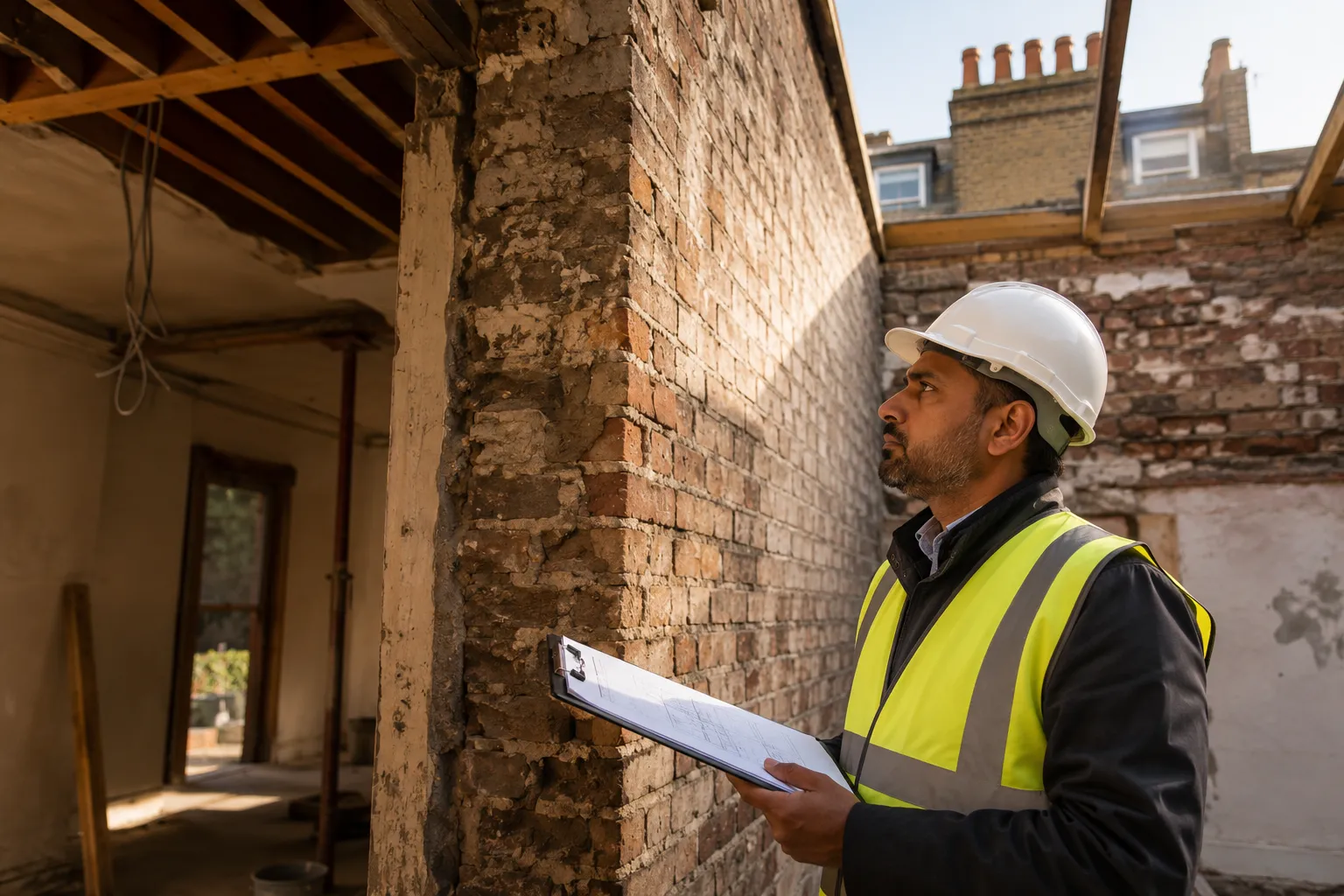
    Editorial (): A professional male surveyor in his 40s, South Asian, wearing a hard hat and hi-vis vest, standing beside a

    Key Takeaways

    • Party wall surveyor fees in 2026 are significantly higher than in previous years, with hourly rates and fixed-fee packages both increasing.
    • The total cost of a party wall award depends on project complexity, surveyor appointment type, and London location.
    • Appointing an agreed surveyor rather than two separate surveyors is the single most effective way to reduce costs.
    • Failing to serve correct notices on time can trigger disputes that multiply fees several times over.
    • Proactive budget planning and early surveyor engagement are the clearest paths to cost control in 2026.

    What Is a Party Wall Agreement and Why Do Costs Matter in 2026

    Before examining the numbers, it helps to understand what the process actually involves. The Party Wall etc. Act 1996 requires building owners to notify adjoining neighbours before carrying out specific types of construction work. These include loft conversions, rear extensions, basement excavations, and any work directly on or near a shared wall. If a neighbour dissents or does not respond, the Act triggers a formal dispute resolution process that results in a legally binding document called a party wall award.

    A party wall award sets out the rights and responsibilities of both parties, the method of working, and the schedule of condition of the adjoining property. Surveyors, either an agreed single surveyor or two separate surveyors, are appointed to produce this document. Their fees form the core of the total cost.

    For a full breakdown of what the process involves financially, the costs of the party wall process guide provides a useful reference point. What has changed in 2026 is not the structure of those costs but their scale.

    The 2026 Cost Landscape: What Surveyors Are Charging Now

    Hourly Rates and Fixed Fees

    The 2026 party wall agreement and award costs: how rising surveyor fees are reshaping budgets story begins with the numbers themselves. Surveyor hourly rates in London now typically range from £150 to £350 per hour, with some specialist or central London practices charging above that band [1][8]. Fixed-fee packages for straightforward single-neighbour agreements generally start at around £700 to £1,000 for a notice-only service, rising to £1,500 to £2,500 or more when a full award is required [2][5].

    For projects involving multiple adjoining owners, common in terraced streets or apartment blocks, costs escalate quickly. A basement excavation affecting two neighbours on either side, for example, could generate surveyor fees of £4,000 to £8,000 or more before any construction work begins [3][9].

    Key figure:

    In 2026, the average total cost of a party wall award in London, including schedule of condition, surveyor attendance, and award drafting, sits between £1,800 and £3,500 for a typical single-neighbour loft conversion or rear extension. [5][7]

    What Is Driving Fee Increases

    Several converging pressures explain why 2026 party wall costs are higher than in previous years:

    • Inflation in professional services: General inflationary pressure on wages and overheads has pushed surveying firm costs upward, and those costs are passed to clients [4].
    • Increased demand: The post-pandemic home improvement boom has not fully subsided. High mortgage rates have kept many homeowners extending rather than moving, sustaining demand for party wall services [7].
    • Greater project complexity: Modern extensions increasingly involve basement works, structural steel, and proximity to foundations, all of which require more detailed surveys and longer award documents [6].
    • Shortage of qualified surveyors: The pool of surveyors with specific party wall expertise has not grown proportionally with demand, giving established practitioners pricing power [10].
    • Rising schedule of condition costs: Photographic and video condition surveys have become more thorough, and more expensive, as disputes over pre-existing damage become more common [8].

    London Location Premiums

    Location within London adds a further layer of cost variation. Central London projects consistently attract the highest fees. Surveyors working in Central London and West London typically charge at the upper end of published ranges, reflecting higher business costs and property values. South London, North London, and East London practices tend to offer slightly more competitive rates, though the gap has narrowed in 2026 [9].

    London Zone Typical Award Cost Range (2026)
    Central London £2,500, £5,000+
    West London £2,000, £4,000
    North / South London £1,800, £3,500
    East London £1,500, £3,000

    Figures are indicative ranges for a single-neighbour award on a standard residential extension. [5][8][9]

    How the Award Process Works and Where Costs Accumulate

    How the Award Process Works and Where Costs Accumulate

    Understanding the mechanics of a party wall award helps identify exactly where money is spent, and where it can be saved.

    Stage 1: Serving Party Wall Notices

    The process begins when the building owner serves a party wall notice on all adjoining owners. Notices must be served within specific timeframes: two months before works begin for party structure notices, and one month for line of junction notices. Errors in notice service are a common and costly mistake, because an invalid notice restarts the clock and can delay projects by weeks or months [5].

    Some building owners attempt to serve notices themselves using a sample party wall agreement template to reduce upfront costs. This is legally permissible but carries risk if the notice content or service method is incorrect.

    Stage 2: Neighbour Response and Surveyor Appointment

    If the adjoining owner consents in writing, no award is needed and costs remain low. If they dissent or fail to respond within 14 days, a dispute is deemed to exist and surveyors must be appointed. At this point, costs diverge significantly depending on the appointment structure:

    • Agreed surveyor: Both parties appoint a single neutral surveyor. This is almost always the most cost-effective route, as only one set of fees is generated.
    • Two surveyors: Each party appoints their own surveyor. Both surveyors’ fees are typically paid by the building owner, effectively doubling the professional cost.
    • Three surveyors: If the two appointed surveyors cannot agree, they appoint a third surveyor to adjudicate. This is the most expensive outcome and should be avoided wherever possible [2][4].

    Stage 3: Schedule of Condition

    Before works begin, surveyors inspect and document the condition of the adjoining property. This photographic and written record protects both parties if damage claims arise later. In 2026, thorough schedules of condition, particularly for basement works or projects near older properties, can add £400 to £900 to the total bill [3][7].

    Stage 4: Drafting and Serving the Award

    The award document itself sets out the permitted works, working hours, protective measures, and compensation provisions. Drafting a complex award for a basement excavation or structural alteration can take considerably longer than a straightforward loft conversion, and surveyor time is billed accordingly [6][10].

    Stage 5: Post-Award Attendance

    Many surveyors charge for site visits during construction to monitor compliance with the award. These visits are not always mandatory but are strongly recommended for high-risk works. Each visit typically costs £150 to £300 [1][5].

    Practical Strategies for Managing 2026 Party Wall Costs

    The 2026 party wall agreement and award costs: how rising surveyor fees are reshaping budgets challenge is real, but it is manageable with the right approach. The following strategies have the strongest track record for keeping total costs under control.

    Practical Strategies for Managing 2026 Party Wall Costs

    Pursue the Agreed Surveyor Route

    The single most impactful cost decision is to encourage the adjoining owner to agree to a single shared surveyor. A building owner can approach their neighbour directly and explain the financial benefit to both parties. When neighbours understand that a two-surveyor scenario means the building owner pays both sets of fees, which can amount to an additional £1,500 to £3,000, many are receptive to the agreed surveyor approach [4][7].

    Serve Notices Early and Correctly

    Delays caused by invalid or late notices are a significant hidden cost driver. Serving correct notices at the earliest permissible stage gives the maximum time for neighbours to respond, reduces the risk of last-minute disputes, and avoids the programme costs of construction delays. A detailed guide on party wall act notices and how to respond is a useful starting point for getting this right.

    Obtain Fixed-Fee Quotes Upfront

    Hourly billing is the least predictable cost structure for party wall work. Many surveyors in 2026 offer fixed-fee packages for standard residential projects. Requesting fixed-fee proposals from two or three surveyors before appointing one provides both cost certainty and a market comparison. Always confirm what is included, some fixed fees exclude schedule of condition or post-award site visits [2][6].

    Consider Whether a Surveyor Is Strictly Required

    In limited circumstances, neighbours can reach an informal agreement without a surveyor. The party wall agreement without a surveyor route is only appropriate for very minor, low-risk works where both parties have a good relationship and full understanding of the Act. For any structural work, this approach carries significant legal and financial risk and is not recommended as a general cost-saving measure.

    Budget Realistically from the Start

    Given current market conditions, the following budget benchmarks are a reasonable starting point for 2026 planning:

    • Simple loft conversion, single neighbour, agreed surveyor: £1,200, £2,000
    • Rear extension, single neighbour, two surveyors: £2,500, £4,000
    • Basement excavation, two neighbours, two surveyors each: £5,000, £10,000+
    • Complex multi-neighbour development: £8,000, £20,000+

    Sources [5][7][9] broadly support these ranges, though individual quotes will vary based on project specifics and surveyor.

    For additional practical guidance on reducing the financial burden, the resource on how to keep party wall costs down covers several further tactics worth reviewing before appointing a surveyor.

    Understand Who Pays

    The default rule under the Party Wall etc. Act 1996 is that the building owner pays all reasonable surveyor fees, including those of the adjoining owner’s surveyor, unless the adjoining owner has been unreasonable or has requested unnecessary work. This means the building owner carries the financial risk of escalating disputes. Keeping communication with neighbours positive and transparent is therefore not just courteous; it is financially prudent [1][3].

    The Broader Budget Impact: Why This Matters Beyond the Fee Invoice

    The cumulative effect of rising 2026 party wall costs extends beyond the surveyor’s invoice. Construction lenders and project managers are now factoring party wall fees into feasibility assessments at an earlier stage. For smaller residential developers working on tight margins, a £6,000 to £10,000 party wall bill on a terrace conversion can shift a project from viable to marginal.

    For individual homeowners, the psychological impact is also significant. A process that was once seen as a bureaucratic formality is now a meaningful financial commitment that requires the same planning rigour as any other professional service in the project. Homeowners who discover mid-project that they need to appoint a second surveyor, because their neighbour dissented after an initially positive conversation, often face both cost shock and programme disruption simultaneously [4][10].

    The answer is not to avoid the party wall process, compliance with the Act is a legal obligation, but to engage with it proactively, budget for realistic worst-case scenarios, and use every legitimate tool available to reduce unnecessary cost.

    Conclusion

    The 2026 party wall agreement and award costs: how rising surveyor fees are reshaping budgets is not a temporary blip. Structural factors, sustained demand, inflation in professional services, greater project complexity, and a constrained supply of qualified surveyors, point to continued upward pressure on fees beyond 2026. For homeowners and developers, the response must be proactive rather than reactive.

    Actionable next steps:

    1. Engage a party wall surveyor at the design stage, before planning permission is granted, to get a realistic cost estimate for your specific project.
    2. Serve notices as early as legally permitted to maximise response time and reduce the risk of programme-disrupting disputes.
    3. Have an honest conversation with your neighbour about the agreed surveyor option before notices are formally served, it is the single most effective cost-reduction lever available.
    4. Request fixed-fee proposals from at least two surveyors and confirm precisely what each fee covers.
    5. Build a contingency of at least 20 percent on top of the surveyor’s quoted fee to cover post-award site visits, any additional award variations, and the possibility of a more complex schedule of condition than initially anticipated.

    Party wall costs in 2026 are higher, but they are manageable with the right preparation. The homeowners and developers who treat the party wall process as a professional project in its own right, rather than an afterthought, consistently achieve better outcomes, lower costs, and fewer disputes.

    References

    [1] Party Wall Surveyor Cost – checkatrade.com [2] Party Wall Surveyor Cost – hoa.org.uk [3] Party Wall Surveyor Cost UK – bestbuilders.co.uk [4] Party Wall Surveyor Costs – princesurveyors.co.uk [5] Costs Of Party Wall Surveyors In 2026 Who Pays And Factors Influencing Fees For Awards And Notices – Costs of party wall surveyors in 2026 who pays and factors influencing fees for awards and notices [6] Party Wall Surveyor Costs – harperlatterarchitects.co.uk [7] Party Wall Surveyor Cost 2026 – bookabuilderuk.com [8] Party Wall Cost London Guidelines – surveyofpartywall.co.uk [9] Party Wall Agreement Cost London – alstruct.co.uk [10] Party Wall Surveyor Cost Analysis How Much Does A Party Wall Agreement Cost – surveymerchant.com

  • Party Wall Dispute Resolution: When to Escalate Beyond Agreement and Award

    Party Wall Dispute Resolution: When to Escalate Beyond Agreement and Award

    Fewer than one in five party wall disputes ever reach a County Court, yet the consequences of escalating at the wrong moment, or failing to escalate when it is genuinely necessary, can cost property owners tens of thousands of pounds and months of delay. Understanding the precise escalation pathways in party wall dispute resolution: when to escalate beyond agreement and award is therefore one of the most practically valuable pieces of knowledge any building owner or adjoining owner can hold.

    The Party Wall etc. Act 1996 remains the governing statutory framework, with no outstanding amendments as of 2026 [6]. It creates a structured, tiered system designed to resolve most disputes through surveyors and legally binding awards, reserving courts as a genuine last resort. This article maps every stage of that system, explains the triggers that justify moving from one tier to the next, and sets out what property owners, surveyors, and legal advisers should consider before escalating.

    Key Takeaways

    • Most party wall disputes are resolved through surveyor appointments and a formal award under section 10 of the Act, court action is the exception, not the rule.
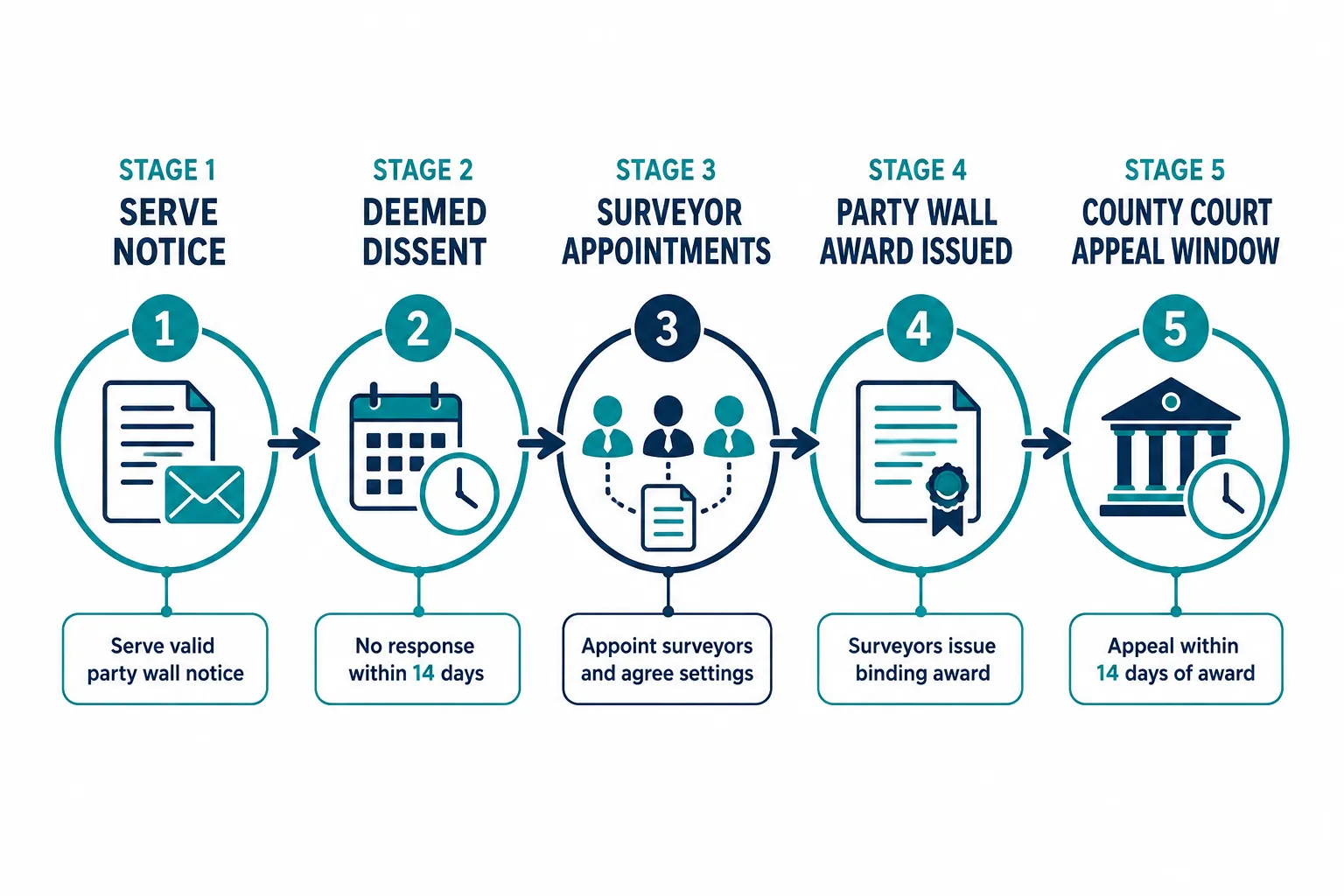
    • A failure by an adjoining owner to respond to a notice within 14 days triggers automatic deemed dissent, starting the formal dispute resolution process [3].
    • A party wall award is legally binding and allows works to proceed even without the neighbour’s consent, provided its terms are followed [7].
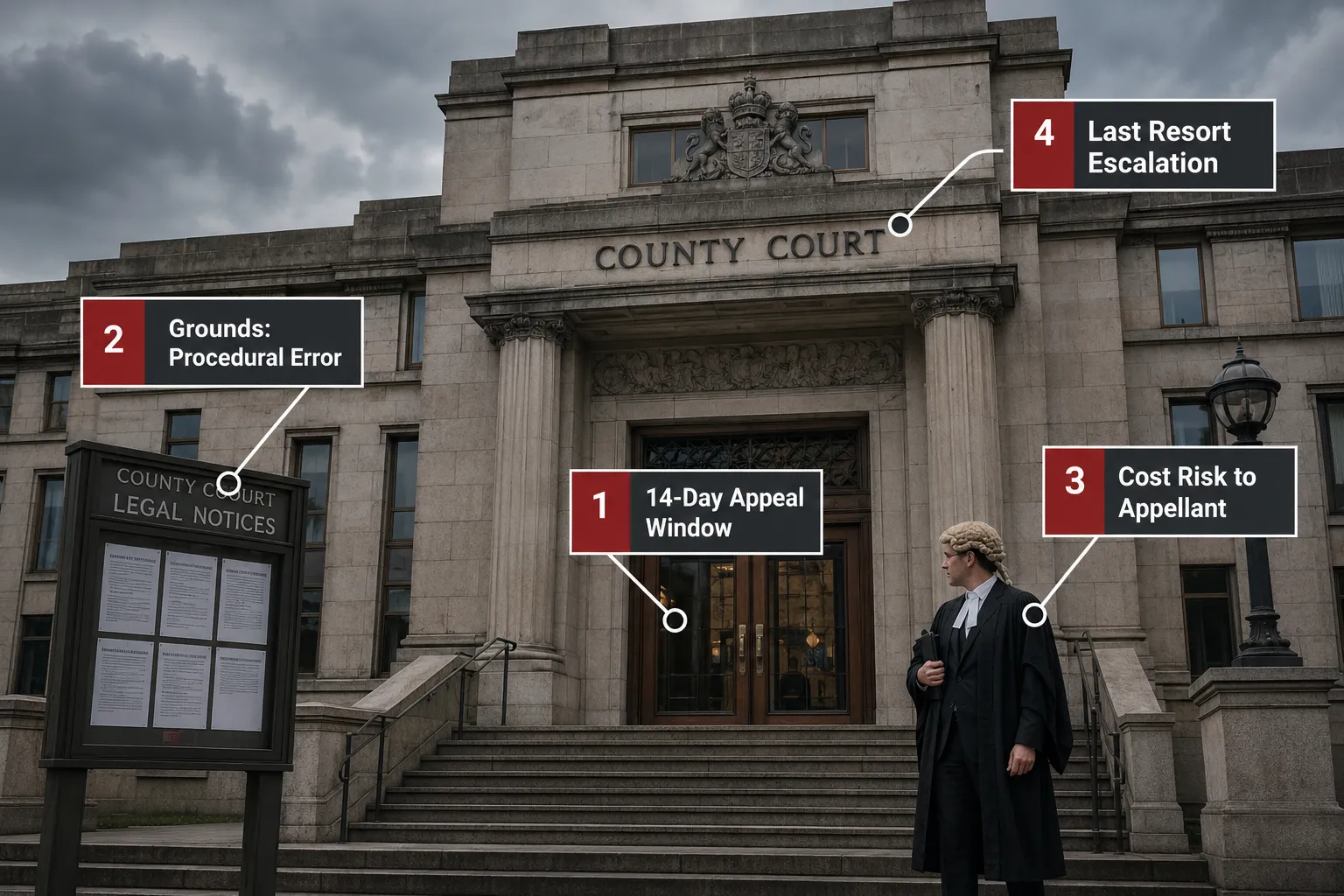
    • Either party has a 14-day window after service of the award to appeal to the County Court, but grounds are narrow and cost risks are significant [7].
    • The RICS draft 8th edition guidance, consulted in 2026, emphasises proportionality and early dispute avoidance over routine escalation [1][9].

    How the Party Wall Act Creates a Tiered Dispute Resolution Framework

    How the Party Wall Act Creates a Tiered Dispute Resolution Framework

    The Act does not treat every disagreement between neighbours as a formal dispute. Instead, it establishes a clear sequence: notice, response, appointment of surveyors, and award. Understanding where a matter sits within this sequence is the first step in deciding whether escalation is warranted.

    Serving Notice: The Starting Point

    Every party wall matter begins with a valid notice. Depending on the nature of the works, this may be a party structure notice, a line of junction notice, or a notice under section 6 relating to excavation near an adjoining owner’s foundations. The Party Wall Act Notices: What They Are and How to Respond guide provides a detailed breakdown of each notice type and the correct response procedures.

    Once a notice is served, the adjoining owner has 14 days to respond. They can consent, refuse, or serve a counter-notice requesting additional or protective works [3]. Critically, silence is not consent. If no response is received within 14 days, the adjoining owner is deemed to have dissented under section 6 of the Act, and a dispute is legally deemed to have arisen [10]. This automatic trigger is one of the most commonly misunderstood aspects of the process, and it is the point at which the formal dispute resolution machinery begins.

    From Deemed Dissent to Surveyor Appointments

    Once a dispute is deemed to have arisen, both parties must appoint surveyors. Each party appoints their own surveyor, or they may agree to use a single Agreed Surveyor. The surveyors’ role is to reach a Party Wall Award, a legally binding document that sets out the rights and obligations of both parties in relation to the notifiable works.

    The award covers practical matters such as:

    • The scope and method of the proposed works
    • Hours of working and access arrangements
    • Protective measures for the adjoining property
    • A schedule of condition to record the pre-works state of the neighbouring property
    • Who bears the costs of the award

    For a deeper understanding of what these documents contain and how they are structured, the Party Wall Contract Template Guide on Party Wall Awards is a useful reference.

    Escalation Within the Surveyor Framework: The Role of the Third Surveyor

    Escalation Within the Surveyor Framework: The Role of the Third Surveyor

    Not all disputes between appointed surveyors can be resolved by negotiation alone. When the two party-appointed surveyors cannot agree on the terms of an award, the matter is referred to a Third Surveyor, a neutral professional selected in advance by both parties at the time of their appointments.

    When the Third Surveyor Is Engaged

    The Third Surveyor does not automatically become involved in every case. Their role is triggered when:

    • The two appointed surveyors cannot reach agreement on a specific point within the award
    • One surveyor believes the other is acting unreasonably or outside their proper function
    • A party wishes to challenge a specific provision being proposed by the surveyors

    The Third Surveyor then makes a determination on the disputed point, and their decision is incorporated into the award. This mechanism is designed to keep technical disagreements within the surveyor framework, avoiding unnecessary court proceedings [7][12].

    The RICS draft 8th edition guidance, currently under consultation in 2026, explicitly identifies early dispute avoidance as a priority theme, encouraging surveyors to resolve disagreements through careful drafting and negotiation before involving the Third Surveyor [9]. Proportionality is a core principle: conditions and protective measures in awards should be no more onerous than necessary, reducing the likelihood that either party will seek further escalation [1][9].

    Proportionality and the Award

    A well-drafted award is the most effective tool for preventing escalation beyond the surveyor framework. Surveyors are expected to ensure that the award is balanced, practical, and proportionate to the nature of the works. Overly restrictive conditions, for example, prohibiting works during hours that are commercially reasonable, increase the risk that the building owner will challenge the award. Equally, inadequate protective measures may lead the adjoining owner to seek redress.

    For guidance on managing the costs associated with this process, the resource on how to keep party wall costs down outlines practical strategies for both parties.

    Party Wall Dispute Resolution: When to Escalate Beyond Agreement and Award to the County Court

    Party Wall Dispute Resolution: When to Escalate Beyond Agreement and Award to the County Court

    The award is a legally binding document. Once served, it allows the building owner’s works to proceed even without the adjoining owner’s agreement, provided the terms of the award are strictly complied with [7]. In the vast majority of cases, this is where the formal dispute resolution process ends.

    However, the Act provides a statutory right of appeal. Either party may appeal the award to the County Court within 14 days of service of the award [7]. This window is strict. Missing it will almost certainly mean the award stands as final.

    Grounds for Appeal: What Justifies Escalation

    The grounds for appealing a party wall award to the County Court are deliberately narrow. They are not a mechanism for general dissatisfaction. Recognised grounds include:

    Ground Description
    Procedural error The award was made without proper jurisdiction, e.g., notice was invalid or not properly served
    Unreasonable provisions Specific conditions in the award are unreasonable in the circumstances
    Failure of due process A party was not given a proper opportunity to make representations
    Conflict of interest A surveyor had an undisclosed interest that undermined impartiality

    The RICS consultation on the 8th edition specifically highlights surveyor conduct, impartiality, and conflicts of interest as areas requiring updated guidance [9]. Electronic service of notices and documents is also recognised within official guidance [4], and challenges to the validity of electronic service can, in rare cases, provide grounds for escalation.

    Cost risk is a serious consideration. Unsuccessful appellants may be ordered to pay the other party’s legal costs [7]. This means that escalating to the County Court on weak or speculative grounds can result in a significantly worse financial outcome than accepting the award and negotiating any outstanding concerns through the surveyor framework.

    When Court Action Is Genuinely Warranted

    Beyond the 14-day appeal window, court proceedings may still be appropriate in specific circumstances:

    • Breach of the award by the building owner, if works proceed outside the terms of the award, the adjoining owner may seek an injunction or damages through the courts
    • Trespass or nuisance, where works cause damage that goes beyond what the award contemplated, common law remedies remain available
    • Failure to serve notice at all, where a building owner has carried out notifiable works without serving any notice, the adjoining owner may seek damages and, in some cases, an order to undo the works

    It is worth noting that the Party Wall etc. Act 1996 framework is designed to prevent exactly these situations by requiring advance notice and agreement. Where the process has been followed correctly, the need for court action is rare.

    Mediation as an Alternative Escalation Route

    Mediation is not explicitly provided for within the Party Wall etc. Act 1996, but it is increasingly recognised as a valuable tool in party wall dispute resolution: when to escalate beyond agreement and award becomes necessary, mediation can offer a faster and less costly alternative to court proceedings.

    Mediation is particularly useful where:

    • The dispute is primarily about the relationship between neighbours rather than a technical point of law
    • Both parties want to preserve an ongoing relationship (for example, in a terraced or semi-detached property)
    • The costs of court proceedings are disproportionate to the value of the matter in dispute

    A mediator does not make a binding decision but facilitates negotiation between the parties. Any agreement reached in mediation can then be formalised through the surveyor framework or, if necessary, recorded in a separate legally binding agreement.

    Practical Escalation Checklist: A Step-by-Step Summary

    Before escalating any party wall matter beyond the award stage, property owners and their advisers should work through the following steps:

    1. Confirm the award has been properly served, check the date of service and calculate the 14-day appeal window
    2. Identify the specific ground for escalation, procedural error, unreasonable provision, or breach of the award
    3. Assess proportionality, is the cost and time of escalation proportionate to the issue at stake?
    4. Exhaust surveyor-level remedies first, has the Third Surveyor been engaged where appropriate?
    5. Consider mediation, particularly where the dispute is relational rather than purely technical
    6. Take legal advice, before filing a County Court appeal, obtain specialist advice on the strength of the grounds and the likely cost exposure
    7. Act within the 14-day window, if appealing the award, do not delay

    For those in London seeking specialist support at any stage of this process, local expertise is available through Party Wall Surveyor North London and Party Wall Surveyor South London.

    The 2026 Regulatory Landscape: What Is Changing

    The RICS launched a formal eight-week consultation on the draft 8th edition of Party Wall Legislation and Procedure in April 2026, with the consultation closing on 5 June 2026 [1][9]. This is the most significant update to practice guidance in several years, and its four core themes directly affect how escalation decisions should be made:

    1. Validity and service of notices, updated guidance on what constitutes a valid notice and the implications of defective service
    2. Surveyor appointments and conduct, strengthened expectations around impartiality and conflicts of interest
    3. Proportionality in awards, a clear steer that awards should be no more onerous than necessary
    4. Early dispute avoidance, a shift in emphasis away from routine recourse to the Third Surveyor and towards negotiated resolution [9]

    Once the final 8th edition is published, it is expected to take effect approximately three months later, with sector analysis suggesting it will start influencing practice in late 2026 [9]. While the statutory framework remains unchanged [6], this guidance will shape how surveyors, legal advisers, and dispute resolution practitioners approach escalation decisions going forward.

    The government’s own guidance on preventing and resolving party wall disputes has also been updated in 2026, reinforcing that the award process, not the courts, is the primary resolution mechanism, and that escalation beyond it should be reserved for situations where statutory rights or due process have arguably been breached [2].

    “Most issues, such as access, timing, and safeguards, should be dealt with through negotiation and the award process, reserving escalation beyond the award for situations where statutory rights or due process are arguably breached.”, Government guidance, 2026 [2]

    Conclusion

    Party wall dispute resolution: when to escalate beyond agreement and award is not a question with a single answer. The Act creates a carefully designed sequence, notice, deemed dissent, surveyor appointments, award, Third Surveyor, and finally County Court appeal, and each stage has its own triggers, timelines, and cost implications.

    The most important practical principle is this: exhaust the surveyor framework before considering court action. The Third Surveyor exists precisely to resolve disagreements that the appointed surveyors cannot settle between themselves. The County Court appeal is reserved for cases where the award itself is procedurally defective or contains genuinely unreasonable provisions, not for general dissatisfaction with the outcome.

    Actionable next steps for property owners in 2026:

    • If you have received a party wall notice, read the Party Wall Act Notices: What They Are and How to Respond guide before deciding whether to consent or dissent.
    • If works are already underway and you believe the terms of an award are being breached, seek specialist surveyor advice immediately, do not wait for damage to accumulate.
    • If you are considering a County Court appeal, take legal advice on the strength of your grounds before the 14-day window closes.
    • Keep records of all notices, correspondence, and the schedule of condition throughout the process, these documents are essential if escalation becomes necessary.

    The evolving RICS guidance and the government’s updated materials in 2026 both point in the same direction: earlier dialogue, more proportionate awards, and a strong preference for resolution within the surveyor framework. Following that approach is not just good practice, it is the most cost-effective and time-efficient route for all parties involved.

    References

    [1] RICS Launches Consultation on Updated Party Wall Practice Guidance – rics.org

    [2] Preventing and Resolving Disputes in Relation to Party Walls – gov.uk

    [3] Reaching Agreement with Neighbours – gov.uk

    [4] Building Regulations Circulars – gov.uk

    [6] Party Wall etc. Act 1996 – legislation.gov.uk

    [7] 2026 Party Wall Act Updates: Key Changes Impacting Awards and Agreements in Stabilizing Property Markets – 2026 party wall act updates key changes impacting awards and agreements in stabilizing property markets

    [9] RICS 8th Edition Party Wall Guidance – hudsonpartywallsurveyors.co.uk

    [10] Party Wall etc. Act 1996, Section 6 – legislation.gov.uk

  • Extensions and Loft Conversions: Party Wall Notice, Agreement and Award Requirements Explained

    Extensions and Loft Conversions: Party Wall Notice, Agreement and Award Requirements Explained

    Nearly 40% of homeowners who carry out extensions or loft conversions in England and Wales fail to serve the correct party wall notices before work begins, a costly oversight that can halt construction, trigger legal disputes, and expose building owners to compensation claims. Understanding the full scope of Extensions and Loft Conversions: Party Wall Notice, Agreement and Award Requirements Explained is not optional; it is a legal duty under the Party Wall etc. Act 1996 [7].

    Whether a homeowner is adding a rear extension to a London terrace or converting a loft in a semi-detached property, the Act imposes clear obligations on the “building owner” (the person carrying out the works). Permitted development rights allow certain works without planning permission, but they do not remove party wall duties, a distinction that continues to catch homeowners off guard [5][6].

    Key Takeaways

    • The Party Wall etc. Act 1996 applies to extensions and loft conversions that affect shared walls, boundaries, or foundations within defined distances.
    • Three distinct notice types exist: a Party Structure Notice, a Line of Junction Notice, and a Three/Six Metre Notice, each triggered by different types of work.
    • Neighbours have 14 days to respond to a notice; failure to respond triggers a deemed dispute, requiring surveyor appointment.
    • A Party Wall Award is a legally binding document that governs how works proceed; it is not the same as a party wall agreement.
    • Permitted development rights do not override party wall obligations, both sets of rules apply independently.

    What the Party Wall etc. Act 1996 Actually Covers

    The Party Wall etc. Act 1996 is the sole statutory framework governing works to shared walls, boundary structures, and foundations in England and Wales. It applies to three categories of work, each governed by a different notice type:

    1. Works to an existing party wall or party structure (Section 2), cutting into, raising, underpinning, or inserting beams into a shared wall.
    2. New building at or on the boundary line (Section 1), erecting a new wall astride or adjacent to the boundary.
    3. Excavation near a neighbouring building (Section 6), digging foundations within 3 metres of a neighbour’s structure to a depth below their foundations, or within 6 metres under a 45-degree line.

    For extensions and loft conversions, all three categories can be triggered simultaneously. A rear extension, for example, may involve new foundations close to the boundary (Section 6), a new wall on the boundary (Section 1), and structural work to the existing shared wall (Section 2) [1].

    “Permitted development rights and party wall obligations are entirely separate legal regimes. Having one does not substitute for the other.” [5]

    What the Party Wall etc. Act 1996 Actually Covers

    When Loft Conversions Trigger Party Wall Obligations

    Loft conversions are among the most commonly misunderstood works in relation to party wall law. Many homeowners assume that because the works are “internal,” no notice is required. This is incorrect.

    The following loft conversion activities are almost always notifiable under the Act [10]:

    • Installing steel RSJ beams that bear on or are built into a party wall
    • Raising the height of a party wall to accommodate a new roof structure
    • Cutting into the party wall to form a new structural connection
    • Inserting padstones or bearing plates into the shared wall
    • Underpinning the party wall as part of structural alterations

    In a typical London Victorian terrace, the party wall runs along the full depth of the property. Any loft conversion involving a steel beam spanning across the party wall, which is standard practice, will require a Party Structure Notice to be served on the adjoining owner before work begins [2].

    Extensions and Loft Conversions: Party Wall Notice Types and Timeframes

    Understanding which notice applies to which works is central to Extensions and Loft Conversions: Party Wall Notice, Agreement and Award Requirements Explained. Serving the wrong notice type, or no notice at all, does not make the works lawful; it simply means the building owner is proceeding without statutory protection.

    Notice Type Relevant Section Typical Trigger Minimum Notice Period
    Party Structure Notice Section 2 Steel beams in party wall, raising, cutting 2 months
    Line of Junction Notice Section 1 New wall on or at the boundary 1 month
    Three/Six Metre Notice Section 6 Excavation near neighbour’s foundations 1 month

    How to Serve a Valid Party Wall Notice

    The government’s official guidance on preventing and resolving party wall disputes sets out the minimum content requirements for a valid notice [7]. A notice must include:

    • The name and address of the building owner
    • The address of the property where works will take place
    • A description of the proposed works
    • The proposed start date
    • A statement that it is served under the relevant section of the Party Wall etc. Act 1996

    Notices must be served on every adjoining owner, which includes all registered proprietors of the neighbouring property. In a block of flats, this can mean serving multiple notices on different leaseholders and the freeholder. For a comprehensive overview of how party wall notices work and what they must contain, practitioners and homeowners should review the full statutory requirements carefully.

    What Happens After a Notice Is Served

    Once a valid notice is served, the adjoining owner has 14 days to respond in writing. Three outcomes are possible:

    1. Consent in writing, works may proceed after the notice period expires; no award is needed.
    2. Counter-notice (under Section 2 only), the adjoining owner requests additional works or modifications.
    3. Dissent or no response, a dispute is deemed to have arisen, triggering the surveyor appointment process.

    If no response is received within 14 days, the Act deems a dispute to exist automatically. At that point, both parties must appoint surveyors, either an agreed single surveyor or one each, to produce a Party Wall Award [6].

    For a detailed breakdown of how to respond to a notice as an adjoining owner, the guide on Party Wall Act notices, what they are and how to respond provides practical step-by-step guidance.

    What Happens After a Notice Is Served

    Party Wall Agreements and Awards: The Critical Distinction

    One of the most persistent sources of confusion in Extensions and Loft Conversions: Party Wall Notice, Agreement and Award Requirements Explained is the difference between a party wall agreement and a party wall award. These are not interchangeable terms.

    A party wall agreement is an informal, consensual arrangement between neighbours. It is not produced by surveyors and carries no statutory force beyond what the parties agree. It is only valid where both owners consent to the works without dispute.

    A party wall award is a formal, legally binding document produced by appointed surveyor(s) under the Act. It sets out:

    • The works permitted and how they must be carried out
    • The hours during which works may take place
    • Access rights for the building owner
    • A schedule of condition of the adjoining property (before works begin)
    • Provisions for making good any damage caused
    • Who bears the costs of the award

    The award is enforceable in the county court. Either party may appeal it within 14 days of service, but the works may proceed while an appeal is pending unless the court orders otherwise [7].

    For a thorough explanation of what a party wall award contains and how it is structured, the party wall awards resource provides authoritative detail. Homeowners who want to understand the template format before engaging surveyors may also find the party wall contract template guide on party wall awards a useful starting point.

    Can Homeowners Proceed Without a Surveyor?

    In some circumstances, where both parties consent and the works are straightforward, it is possible to document the agreement without appointing a surveyor. However, this approach carries significant risk, particularly for loft conversions involving structural works to a shared wall. Without a schedule of condition, there is no baseline record of the neighbouring property’s pre-works state, which makes resolving any damage claims extremely difficult [10].

    For homeowners exploring this route, the guide on having a party wall agreement without a surveyor outlines both the process and the risks involved.

    Practical Scenarios: London Terraces and Semi-Detached Properties

    The following scenarios illustrate how party wall obligations play out in the most common residential contexts in London.

    Scenario 1: Rear Extension on a Victorian Terrace

    A homeowner in North London plans a single-storey rear extension with new strip foundations extending 1.2 metres below ground level. The neighbouring property’s foundations are at 0.9 metres. Because the new foundations will be deeper than the neighbour’s within 3 metres, a Three Metre Notice under Section 6 is required. If the new side wall is to be built astride the boundary, a Line of Junction Notice under Section 1 is also needed. Both notices must be served at least one month before work starts [1].

    A party wall surveyor in North London can advise on the specific notice requirements based on the structural drawings.

    Scenario 2: Loft Conversion on a Semi-Detached Property

    A homeowner in South London is converting a loft with a hip-to-gable extension. The works involve:

    • Raising the party wall gable by 600mm
    • Installing two steel RSJ beams bearing on the party wall
    • Cutting pockets into the party wall for padstones

    All three elements require a Party Structure Notice under Section 2, served at least two months before work begins. If the neighbour dissents or fails to respond within 14 days, surveyors must be appointed and an award produced before any structural work to the party wall can commence [2][10].

    A party wall surveyor in South London familiar with the typical construction of Victorian and Edwardian semis can prepare the notice and, if needed, act as agreed surveyor for both parties.

    Scenario 3: Basement Extension Beneath an Extension

    Basement extensions beneath rear additions are increasingly common in London. These almost always trigger Section 6 notices due to the depth of excavation required. In some cases, right to light concerns also arise, particularly where a new extension or raised loft reduces natural light to a neighbouring habitable room [2].

    “Right to light disputes are increasingly being identified during party wall surveys on loft extensions, adding a layer of complexity that surveyors must address proactively.” [2]

    Scenario 3: Basement Extension Beneath an Extension

    Costs, Timeframes, and Common Pitfalls

    Typical Costs

    Party wall surveyor costs vary depending on the complexity of the works and whether one or two surveyors are appointed. As a general guide:

    • Agreed surveyor (both parties): Lower overall cost; typically suitable for straightforward works
    • Two surveyors (one each): Higher cost; the building owner typically bears both fees unless the adjoining owner’s surveyor acts unreasonably
    • Third surveyor: Appointed only if the two party surveyors cannot agree; rarely needed

    For a detailed breakdown of what drives party wall costs and how to manage them, the guide on how to keep party wall costs down offers practical strategies.

    Common Pitfalls to Avoid

    • Serving notice too late: The two-month notice period for Section 2 works is a minimum. Serving notice after works have started is a breach of the Act.
    • Incomplete notice content: A notice that omits the proposed start date or a description of works is invalid and must be re-served, resetting the clock.
    • Failing to identify all adjoining owners: In leasehold properties, both the leaseholder and the freeholder may be “adjoining owners” under the Act.
    • Assuming consent means no award is needed: Consent removes the need for an award, but only if given in writing within the 14-day response period.
    • Ignoring counter-notices: A counter-notice must be responded to within one month; failure to do so can create further delays.

    Forthcoming Changes to Professional Standards

    RICS is currently finalising the 8th edition of its Party Wall Legislation and Procedure guidance, following a formal consultation process [4]. Expert commentary in 2026 suggests the updated guidance will tighten standards on the content and service of notices, and clarify the obligations of surveyors when producing awards for complex structural works such as loft conversions [2][4]. Building owners and their surveyors should monitor these updates, as revised professional standards will influence best practice expectations across the industry.

    Conclusion

    Extensions and loft conversions are among the most significant investments a homeowner can make, and the party wall process is a legal safeguard that protects both the building owner and their neighbours. The core requirements of Extensions and Loft Conversions: Party Wall Notice, Agreement and Award Requirements Explained are clear: identify the correct notice type, serve it within the required timeframe, and respond appropriately to the neighbour’s reply.

    Actionable next steps for homeowners planning works in 2026:

    1. Obtain structural drawings early, party wall obligations cannot be assessed without knowing the depth of foundations and the structural connection to the party wall.
    2. Identify all adjoining owners before serving any notice, including freeholders and leaseholders in leasehold properties.
    3. Serve the correct notice type at least one month (Sections 1 and 6) or two months (Section 2) before the proposed start date.
    4. Do not assume consent, if no written response is received within 14 days, a dispute is deemed to exist and surveyors must be appointed.
    5. Engage a qualified party wall surveyor for any loft conversion involving steel beams, wall raising, or cutting into the party wall, the schedule of condition alone is worth the cost.
    6. Keep costs proportionate by exploring the agreed surveyor route where both parties are cooperative and the works are well-defined.

    The party wall process exists to enable works to proceed, not to prevent them. Approached correctly and early, it protects everyone involved.

    References

    [1] London Party Wall Extensions 2026 Rules Disputes And Neighbour Rights Explained – princesurveyors.co.uk

    [2] Party Wall Surveys For Right To Light Disputes In 2026 Loft Extensions Rics Protocols Post Planning Reforms – princesurveyors.co.uk

    [4] Rics Launches Consultation On Updated Party Wall Practice Guidance – rics.org

    [5] Permitted Development Guide – hoa.org.uk

    [6] Party Wall Agreement – hoa.org.uk

    [7] Preventing And Resolving Disputes In Relation To Party Walls – gov.uk

    [10] Party Wall Agreement Loft Conversion – houseup.co.uk

  • Party Wall Notice Response Time in London: How Long You Really Have Before a Dispute Starts

    Party Wall Notice Response Time in London: How Long You Really Have Before a Dispute Starts

    }

    Fourteen days. That is the entire window separating a smooth building project from a formal legal dispute under the Party Wall etc. Act 1996, yet most London homeowners discover this only after the deadline has already passed. Understanding the party wall notice response time in London: how long you really have before a dispute starts is not just useful background knowledge; it is the difference between a project that runs on schedule and one that stalls for months while surveyors negotiate a formal award.

    Key Takeaways

    • An adjoining owner has exactly 14 days to respond to a party wall notice before a dispute is legally deemed to have started.
    • London practitioners typically add buffer days for postage, making the effective working window closer to 16 days from the date of service.
    • Three types of notice carry different lead-in times: 1 month for a Party Structure Notice, 2 months for a Line of Junction Notice, and 1 month for an Excavation Notice.
    • If no response arrives within 14 days, the building owner may appoint a surveyor on the adjoining owner’s behalf, a process called deemed dissent.
    • Once a Party Wall Award is issued, either party has a further 14-day statutory appeal window before it becomes binding.

    What the Party Wall etc. Act 1996 Actually Requires

    The Party Wall etc. Act 1996 creates a statutory framework that governs works affecting shared walls, boundary structures, and excavations near neighbouring buildings. Before any notifiable work begins, the building owner must serve a formal notice on every adjoining owner [1].

    The Act sets out three distinct notice types, each with its own lead-in period:

    Notice Type Trigger Minimum Lead-In
    Party Structure Notice Works to a shared wall or floor 1 month
    Line of Junction Notice Building a new wall on or near the boundary 1 month
    Excavation Notice Digging within 3 m or 6 m of a neighbour’s structure 1 month

    These lead-in periods are the minimum time the adjoining owner must have before work begins, they are not the same as the response deadline [4]. A notice served too late is invalid, meaning work cannot legally start even if the neighbour has no objection.

    For a detailed breakdown of how to serve each type correctly, see this guide on what is a Party Structure Notice and how to serve it in London.

    What the Party Wall etc. Act 1996 Actually Requires

    The Critical 14-Day Response Window Explained

    Once a valid notice is served, the adjoining owner has 14 days to respond in writing [6]. This is the core of the party wall notice response time in London: how long you really have before a dispute starts. The response can take one of three forms:

    • Written consent, the adjoining owner agrees to the works as described; no surveyor is required.
    • Written dissent, the adjoining owner objects; a surveyor or surveyors must be appointed.
    • No response at all, after 14 days of silence, a dispute is automatically deemed to have arisen under Section 10 of the Act [1].

    That third outcome, silence, is where many London projects run into trouble. Adjoining owners sometimes believe that ignoring a notice delays or blocks the works. In legal terms, it does the opposite: it triggers the formal dispute resolution process, which ultimately gives the building owner the right to appoint a surveyor on the adjoining owner’s behalf [7].

    What “Deemed Dissent” Means in Practice

    Deemed dissent is the legal term for a dispute that arises automatically when no response is received within 14 days [1]. At that point:

    1. The building owner serves a further notice on the adjoining owner, giving them 10 days to appoint their own surveyor.
    2. If the adjoining owner still does not respond, the building owner appoints a surveyor to act for both parties, an agreed surveyor, or appoints a second surveyor themselves.
    3. Those two surveyors then select a third surveyor in case of deadlock.

    This process does not stop the works indefinitely. It creates a structured path toward a Party Wall Award, which is the formal document that sets out the rights and obligations of both parties before work begins [9].

    Practical London Timelines: What the Numbers Look Like

    In theory, the 14-day clock starts the moment a notice is delivered. In London practice, surveyors and solicitors routinely add buffer days to account for postal delivery, missed deliveries, and the realities of serving notices on busy urban households [8].

    The standard London approach in 2026 is to treat the effective response window as at least 16 days from the date of posting when notices are served by first-class post [2]. Hand delivery resets the clock to the actual delivery date, but many practitioners still build in a one-day buffer.

    Example Timeline: Rear Extension on a London Terraced House

    Below is a realistic timeline for one of the most common London party wall scenarios, a rear single-storey extension on a Victorian terraced house:

    Week 1: Building owner instructs a surveyor and prepares notices.

    Day 0: Party Structure Notice served on both adjoining neighbours (left and right).

    Day 14: Deadline for written response. If no response is received by end of business, deemed dissent applies.

    Day 15-25: Building owner serves notice of surveyor appointment; adjoining owner has 10 days to appoint their own surveyor.

    Week 6-10: Surveyors prepare and agree the Party Wall Award, including a Schedule of Condition of the adjoining property.

    Week 10-12: Award served on both parties. A 14-day appeal window opens immediately.

    Week 12+: Works may begin, subject to planning permission and building regulations approval.

    This means a project that needs a party wall notice can realistically expect 10 to 14 weeks from first instruction to lawful start date when disputes arise [10]. Where both neighbours consent in writing within the 14-day window, that timeline compresses to as little as 4 to 6 weeks.

    Example Timeline: Rear Extension on a London Terraced House

    Counter-Notices and Their Own 14-Day Trigger

    A less well-known aspect of the party wall notice response time in London: how long you really have before a dispute starts concerns counter-notices. Under Section 4 of the Act, an adjoining owner who consents to the works in principle may still serve a counter-notice within one month of the original notice, requesting modifications or additional works [4].

    The building owner then has 14 days to respond to that counter-notice. Failure to respond within that window, or a refusal that cannot be agreed, triggers a second, separate dispute under the Act.

    This is a frequently overlooked double-deadline that can catch building owners off guard, particularly on larger London projects where adjoining owners want to add their own works, such as underpinning or chimney breast removal, to the same programme.

    For a full explanation of how notices work and the options available to both parties, the guide on Party Wall Act notices, what they are and how to respond covers the process in detail.

    What Happens After the Award: The Final 14-Day Window

    Once surveyors have agreed and served a Party Wall Award, the work is not automatically free to proceed. Both the building owner and the adjoining owner have 14 days from the date of service of the Award to appeal to the County Court [1].

    Key points about this appeal window:

    • Either party can appeal, not just the adjoining owner.
    • The court may rescind or modify the Award, or confirm it as served.
    • Appeals are relatively rare in London practice, but they do occur on high-value or complex projects.
    • If no appeal is lodged within 14 days, the Award becomes final and binding on both parties.

    This final 14-day period is why experienced London surveyors advise building owners not to mobilise contractors or order materials until the appeal window has closed. Starting work before that point, while technically possible, carries the risk of a court order requiring works to stop.

    Regional Variations Across London Boroughs

    While the statutory deadlines are uniform across England and Wales, the practical experience of serving notices and managing responses varies considerably across London’s 33 boroughs [8]. Several factors influence this:

    Density of terraced housing. In boroughs such as Hackney, Lewisham, and Islington, the density of Victorian terraced housing means almost every rear extension or loft conversion triggers multiple notices. Surveyors in these areas are experienced with high volumes of party wall work.

    Leasehold complications. In central and inner London, many properties are leasehold. Both the freeholder and the leaseholder may need to be served separately, effectively doubling the number of notices and response windows to manage.

    Absentee owners. In some central London postcodes, adjoining owners are overseas investors or second-home owners who are harder to contact, making the deemed dissent route more common.

    Whether a project is in the south, east, north, west, or centre of the city, specialist local knowledge matters. Homeowners can find area-specific support through a Party Wall Surveyor in South London, Party Wall Surveyor in East London, Party Wall Surveyor in North London, or Party Wall Surveyor in West London, depending on location.

    Common Mistakes That Extend the Timeline

    Most delays in London party wall projects are avoidable. The following errors consistently push timelines beyond what the statute requires:

    Serving notice too late. Serving a Party Structure Notice only four weeks before the intended start date violates the one-month minimum lead-in and invalidates the notice entirely.

    Incorrect notice content. A notice that fails to describe the works accurately, or that names the wrong party, can be challenged and must be re-served, restarting the 14-day clock.

    Serving by email without consent. The Act does not recognise email as a valid method of service unless the adjoining owner has explicitly agreed to receive notices electronically. Notices sent only by email may be treated as unserved [8].

    Assuming silence is consent. As explained above, silence after 14 days is dissent, not agreement. Building owners who proceed on the assumption that no news is good news risk injunctions.

    Missing the counter-notice deadline. Failing to respond to a counter-notice within 14 days creates a second dispute that must be resolved before work can start.

    For projects where both parties want to avoid surveyor costs altogether, it is worth understanding the conditions under which a party wall agreement without a surveyor is possible, though this route requires genuine written consent from the adjoining owner within the statutory window.

    Common Mistakes That Extend the Timeline

    How Long Does the Full Process Take in London?

    Pulling together all the statutory deadlines, a realistic end-to-end timeline for a London party wall dispute, from first notice to lawful start date, looks like this:

    Stage Statutory Deadline Realistic London Duration
    Notice lead-in period 1-2 months 1-2 months
    Adjoining owner response window 14 days 14-16 days
    Surveyor appointment after deemed dissent 10 days 10-14 days
    Preparation and agreement of Award No fixed period 4-8 weeks
    Appeal window after Award 14 days 14 days
    Total (disputed route) , 10-16 weeks
    Total (consent route) , 4-6 weeks

    These figures align with guidance from London-based practitioners and government explanatory materials [1][10]. The consent route is significantly faster, which is why experienced surveyors often recommend proactive, early engagement with neighbours before any notice is formally served.

    Conclusion

    The party wall notice response time in London: how long you really have before a dispute starts is, at its core, a deceptively simple number, 14 days. But that single deadline sits within a layered system of lead-in periods, counter-notice windows, surveyor appointment deadlines, and post-Award appeal periods, each of which can extend a project timeline if mishandled.

    Actionable next steps for building owners:

    1. Serve notices early. Build at least two months of party wall process time into any project programme before the intended start date.
    2. Use a qualified surveyor. A specialist ensures notices are correctly drafted, validly served, and that the 14-day clock starts on the right day.
    3. Do not wait for silence. If no response arrives by day 14, act immediately on the deemed dissent procedure rather than waiting further.
    4. Communicate with neighbours first. An informal conversation before serving notice significantly increases the chance of written consent within the 14-day window.
    5. Budget for the disputed route. Even with the best intentions, disputes happen. Understanding the costs of the party wall process in advance prevents financial surprises mid-project.

    The Act exists to protect both parties, not to obstruct development. Treated as a structured process rather than a bureaucratic obstacle, the party wall framework in London is manageable, provided every deadline is respected from the moment the first notice is served.

    References

    [1] The Party Wall Etc Act 1996 Explanatory Booklet – gov.uk

    [2] Party Wall Notice – ansteyhorne.co.uk

    [4] legislation.gov.uk – legislation.gov.uk

    [6] Reaching Agreement With Neighbours – gov.uk

    [7] Party Wall Act Explained London Homeowners – trustbuiltprojects.com

    [8] Serving A Notice Under The Party Wall Act – richmond.gov.uk

    [9] Party Wall Notices London – houricanassociates.com

    [10] How Long Does It Take To Agree A Party Wall Agreement – stokemont.com

  • Party Wall Agreements When Neighbours Consent Upfront: Streamlined Routes Without a Dispute

    Party Wall Agreements When Neighbours Consent Upfront: Streamlined Routes Without a Dispute

    Nearly 40% of party wall matters in England and Wales are resolved without a formal dispute ever arising, yet many building owners still assume the process must be adversarial, expensive, and slow. Party Wall Agreements When Neighbours Consent Upfront: Streamlined Routes Without a Dispute represent one of the most practical and underused efficiencies within the Party Wall etc. Act 1996. When a neighbour gives written consent promptly after receiving a valid notice, the entire process can be compressed into weeks rather than months, without sacrificing the legal protections the Act was designed to provide [3].

    Understanding exactly how that streamlined route works, and where it can still go wrong, is essential for any building owner planning works in 2026.

    Key Takeaways

    • A neighbour’s written consent within 14 days of receiving a party wall notice removes the need for a formal party wall award, but the notice itself remains legally mandatory.
    • Consent does not waive the adjoining owner’s statutory rights; the building owner must still follow the Act’s procedures and avoid unnecessary damage.
    • Even on a consent route, a schedule of condition and a written record of agreed works are strongly advisable to prevent disputes arising mid-build.
    • A formal party wall award is still recommended when works are complex, when the boundary situation is unclear, or when either party has concerns about damage.
    • The 2026 RICS consultation on updated party wall practice guidance signals better communication standards ahead, without changing the underlying law.

    What the Party Wall etc. Act 1996 Actually Requires

    The Party Wall etc. Act 1996 is the statutory framework governing works to shared walls, boundary structures, and excavations near neighbouring buildings in England and Wales [6]. It applies to three broad categories of work:

    • Works to an existing party wall or party structure (for example, cutting into a wall to insert a steel beam, raising the height of a shared wall, or underpinning)
    • Building a new wall on or at the boundary line between two properties
    • Excavations within 3 or 6 metres of a neighbouring structure, depending on depth [5]

    For each category, the building owner must serve a formal written notice on every adjoining owner before work begins. The notice periods vary: two months’ notice is required for party structure works and new walls on the line of junction, while excavation notices require one month [5].

    Understanding what party wall notices are and how to respond to them is the essential first step before any consent conversation takes place.

    “The Act is designed to facilitate building works while protecting the interests of adjoining owners, not to obstruct reasonable development.”, RICS Consumer Guide to Party Walls [2]

    Once a valid notice is served, the adjoining owner has 14 days to respond. Their options are:

    Response Outcome
    Written consent Consent route, no award needed
    No response within 14 days Deemed dispute, surveyors appointed
    Written dissent Dispute, surveyors appointed

    The consent route is the subject of this article. It is the fastest and least costly path available under the Act [3].

    What the Party Wall etc. Act 1996 Actually Requires

    How the Consent Route Works: Party Wall Agreements When Neighbours Consent Upfront

    When an adjoining owner gives written consent within the 14-day window, a formal party wall award is not required. Works may proceed once the notice period expires, provided the building owner carries out the notifiable works in accordance with the Act [3].

    This is the core of Party Wall Agreements When Neighbours Consent Upfront: Streamlined Routes Without a Dispute, the building owner and adjoining owner reach an informal but legally significant agreement without appointing surveyors or producing a formal award document.

    What “Written Consent” Must Include

    The Act does not prescribe a rigid format for consent, but best practice requires that the consent:

    • Identifies the notice it is responding to (by date and description of works)
    • Is signed by the adjoining owner or their authorised representative
    • Is unconditional, conditional consent can create ambiguity
    • Is retained by both parties as a permanent record

    A free sample party wall agreement template can help building owners and their neighbours structure this documentation correctly from the outset.

    What Consent Does Not Remove

    A common misconception is that written consent from a neighbour removes all obligations under the Act. It does not. The building owner remains legally required to:

    1. Carry out only the works described in the notice
    2. Avoid unnecessary inconvenience to the adjoining owner
    3. Make good any damage caused to the adjoining property
    4. Provide adequate security if required
    5. Comply with any reasonable hours of working [5]

    The adjoining owner retains the right to appoint a surveyor at any point if damage occurs or the building owner exceeds the scope of the notified works. Consent is not a blank cheque [2].

    Consent vs. Party Wall Award: Knowing When a Formal Award Is Still Advisable

    The distinction between a consent-based arrangement and a formal party wall award is one of the most important practical decisions in the entire process. Party Wall Agreements When Neighbours Consent Upfront: Streamlined Routes Without a Dispute are efficient, but they are not always the safest option for either party.

    Consent vs. Party Wall Award: Knowing When a Formal Award Is Still Advisable

    When the Consent Route Is Appropriate

    The consent route works well when:

    • Works are straightforward (for example, a standard loft conversion or single-storey rear extension)
    • The party wall is in good condition and unlikely to be significantly affected
    • Both parties have a cooperative relationship and clear communication
    • The building owner is using a reputable, experienced contractor

    In these circumstances, having a party wall agreement without a surveyor is a realistic and legally sound option.

    When a Formal Party Wall Award Remains Advisable

    Despite upfront consent, a formal party wall award, produced by an agreed or appointed surveyor, offers protections that a simple consent letter cannot replicate. A formal award should still be considered when:

    • Works are complex or high-risk: deep excavations, underpinning, or significant structural alterations to a shared wall
    • The party wall is in poor condition: pre-existing cracks or structural weakness mean damage attribution disputes are likely
    • The boundary is unclear: disputes about the exact line of junction can arise mid-build without a surveyor’s input
    • Either party is risk-averse: a formal award is enforceable in the county court; a consent letter is not a court-enforceable document in the same way [4]
    • The adjoining property is tenanted or has multiple owners: ensuring all parties have consented correctly is more complex

    A party wall contract template and guide on party wall awards provides a clear overview of what a formal award contains and why it offers stronger protection in complex cases.

    The Schedule of Condition: A Non-Negotiable Best Practice

    Whether or not a formal award is produced, a schedule of condition should always be prepared before works begin. This is a photographic and written record of the adjoining property’s condition at the time works commence. It serves one critical purpose: if damage is alleged after works finish, the schedule of condition shows what was pre-existing and what is new.

    Without a schedule of condition, even the most cooperative neighbour relationship can deteriorate rapidly once cracks appear in a shared wall.

    Practical Steps to Streamline a No-Dispute Party Wall Route

    The following process represents best practice for building owners seeking to use Party Wall Agreements When Neighbours Consent Upfront: Streamlined Routes Without a Dispute effectively in 2026.

    Step 1: Identify All Notifiable Works Early

    Before any drawings are finalised, confirm which elements of the proposed works trigger the Act. This is not always obvious, for example, the difference between a party fence wall and a boundary wall affects whether the Act applies at all. Reviewing the types of party wall works that trigger notice obligations at this stage prevents costly delays later.

    Step 2: Communicate With Neighbours Before Serving Notice

    Informal early communication significantly increases the likelihood of upfront consent. Sharing plans informally, explaining the scope of works, and answering questions before serving the formal notice builds trust and reduces the chance of a reflexive dissent.

    Step 3: Serve a Clear, Complete Notice

    A poorly drafted notice is one of the most common reasons neighbours dissent or fail to respond. The notice must:

    • Describe the works clearly and in sufficient detail
    • State the proposed start date
    • Be served on all adjoining owners (including any mortgagees in some circumstances)
    • Allow the correct statutory notice period [5]

    Step 4: Request Written Consent Promptly

    Once the notice is served, follow up with the adjoining owner before the 14-day window expires. Provide a simple consent form for them to sign and return. Keep a copy of the signed consent alongside the original notice.

    Step 5: Prepare a Schedule of Condition

    Commission a schedule of condition of the adjoining property before any works begin. This can be done by a party wall surveyor, a building surveyor, or even, for straightforward cases, by the building owner and neighbour jointly, using a detailed photographic record.

    Step 6: Carry Out Works Within the Notified Scope

    Any variation to the works that affects the party wall or boundary must be re-notified. Do not assume that consent to the original works covers additional or altered works.

    Step 7: Make Good Any Damage Promptly

    If any damage occurs during works, address it immediately and document the repair. Prompt action prevents minor issues from escalating into formal disputes after the fact.

    Step 7: Make Good Any Damage Promptly

    The 2026 Regulatory Landscape: Refinement, Not Revolution

    The legal framework governing party wall matters in England and Wales has remained stable since the Party Wall etc. Act 1996 came into force. There is no current legislation to replace or significantly amend it [6].

    However, RICS launched a consultation in 2025 on updated party wall practice guidance, signalling a move toward clearer professional standards and better communication practices between surveyors and the parties they serve [8]. The direction of travel in 2026 is toward:

    • Improved transparency in how surveyors communicate fees and timelines
    • Stronger guidance on the use of agreed surveyors to reduce costs
    • Better documentation standards for consent-based arrangements
    • Clearer protocols for schedules of condition

    This is a refinement of practice, not a change in the law. The 14-day consent window, the notice periods, and the statutory rights of adjoining owners all remain unchanged [4].

    For building owners in London, local expertise matters. Whether the project is in West London, North London, or South London, a surveyor familiar with local property types and boundary conventions can help facilitate the consent route efficiently.

    Interaction With Planning Permission and Building Regulations

    Party wall consent operates entirely independently of planning permission and building regulations approval. Obtaining planning consent does not remove the obligation to serve party wall notices, and a neighbour’s party wall consent does not constitute planning approval.

    Building owners should ensure all three regimes are addressed in parallel:

    • Planning permission (where required)
    • Building regulations approval (for structural works)
    • Party wall notices and consent (for notifiable works under the 1996 Act)

    Conflating these processes is a common and costly mistake [5].

    Keeping Costs Down on the Consent Route

    One of the principal advantages of the consent route is cost. When neighbours consent upfront, neither party needs to appoint a surveyor, and no party wall award fee is incurred. The costs of the party wall process can be significant when a dispute arises, typically several hundred to several thousand pounds per surveyor, depending on complexity.

    Practical steps to keep party wall costs down include:

    • Pursuing the consent route wherever genuinely appropriate
    • Using an agreed surveyor (a single surveyor acting for both parties) when a formal award is needed
    • Preparing clear, detailed notices to avoid re-service
    • Addressing neighbour concerns early to prevent dissent

    The consent route is not just faster, it is typically the most cost-effective outcome for both parties [7].

    Conclusion

    Party Wall Agreements When Neighbours Consent Upfront: Streamlined Routes Without a Dispute offer a legally sound, cost-effective, and time-efficient alternative to the full dispute resolution process under the Party Wall etc. Act 1996. The route is available to any building owner whose neighbour provides written consent within 14 days of receiving a valid notice, and it is more achievable than many assume when the groundwork is laid correctly.

    Actionable next steps for building owners in 2026:

    1. Identify all notifiable works before finalising designs and consult the Act’s explanatory guidance if uncertain about scope.
    2. Speak informally with neighbours before serving formal notice, early communication is the single most effective way to secure upfront consent.
    3. Serve a clear, complete, and correctly timed notice using a reliable template.
    4. Obtain written consent in a signed, dated document and retain it permanently.
    5. Always prepare a schedule of condition before works begin, regardless of how cooperative the relationship appears.
    6. Seek professional advice whenever works are complex, the boundary is unclear, or either party has reservations, a formal party wall award remains the gold standard for high-risk projects.

    The consent route is not a shortcut around the law. It is the law working exactly as Parliament intended: enabling reasonable building works to proceed efficiently while protecting the rights of everyone affected.

    References

    [1] Party Walls – rics.org

    [2] Rics Consumer Guide Party Walls 1 – chpk.co.uk

    [3] Reaching Agreement With Neighbours – gov.uk

    [4] Party Wall Legislation And Procedure – rics.org

    [5] The Party Wall Etc Act 1996 Explanatory Booklet – gov.uk

    [6] legislation.gov.uk – legislation.gov.uk

    [7] Party Walls Consumer Guide 2022 – rics.org

    [8] Rics Launches Consultation On Updated Party Wall Practice Guidance – rics.org

  • Party Wall Act 1996 vs Building Regulations: Why You Need Both and How They Interact on Real Projects

    Party Wall Act 1996 vs Building Regulations: Why You Need Both and How They Interact on Real Projects

    Nearly half of all neighbour disputes in England and Wales that escalate to formal legal action involve a failure to properly separate two distinct legal frameworks: the Party Wall etc. Act 1996 and Building Regulations. These are not interchangeable. They are not alternatives. They are parallel obligations that apply simultaneously on the vast majority of residential construction projects, and confusing them is one of the most expensive mistakes a building owner can make in 2026.

    Understanding the Party Wall Act 1996 vs Building Regulations distinction is not just a legal technicality. It is a practical necessity that shapes project timelines, contractor procurement, neighbour relations, and liability exposure from the first day of design through to the final completion certificate.

    Key Takeaways

    • The Party Wall etc. Act 1996 and Building Regulations are entirely separate legal regimes with different purposes, authorities, and procedures.
    • Most domestic projects, extensions, loft conversions, basement excavations, trigger both frameworks simultaneously.
    • Failing to comply with either regime can halt a project, expose the building owner to civil liability, and damage neighbour relationships permanently.
    • Sequencing matters: Party Wall notices should be served early in the design stage, not after Building Regulations approval is granted.
    • Professional guidance from a qualified party wall surveyor reduces risk, cost, and delay on any project where a shared wall or boundary is involved.

    Two Legal Regimes, One Building Project

    Two Legal Regimes, One Building Project

    The single most common misconception encountered on residential building projects is that obtaining Building Regulations approval somehow covers the Party Wall process, or vice versa. It does not. These two frameworks operate entirely independently of each other, enforced by different bodies, serving different purposes. [1]

    Building Regulations set minimum technical standards for the design and construction of buildings in England and Wales. They cover structural integrity, fire safety, energy efficiency, drainage, ventilation, and accessibility. Compliance is assessed and enforced by the local authority’s Building Control department, or by an approved inspector. A Building Regulations approval confirms that the proposed works meet those technical standards.

    The Party Wall etc. Act 1996, by contrast, is a civil piece of legislation. It governs the rights and obligations of property owners when construction works affect a shared wall, boundary structure, or the land adjacent to a neighbouring property. [4] It does not assess whether a building is structurally sound in the abstract, it protects the specific interests of the adjoining owner whose property could be affected by the works. [2]

    “Building Regulations approval does not remove the obligation to serve Party Wall notices. Both requirements exist independently and must both be satisfied.”

    Local authorities consistently reinforce this point in their guidance to homeowners. The two regimes answer entirely different questions:

    Question Answered by
    Is this structure safe to build? Building Regulations
    Does my neighbour have rights over how I build it? Party Wall etc. Act 1996
    Will the design meet fire and energy standards? Building Regulations
    Is my neighbour protected from damage to their property? Party Wall etc. Act 1996
    Who certifies the completed work? Building Control (Regulations)
    Who records the condition of adjoining property before works? Party Wall surveyor (Act 1996)

    Understanding this table is the foundation of any competent approach to the Party Wall Act 1996 vs Building Regulations question on real projects.

    How the Party Wall Act 1996 vs Building Regulations Apply to Real Projects

    How the Party Wall Act 1996 vs Building Regulations Apply to Real Projects

    The practical interaction between these two frameworks becomes clearest when mapped against common project types. Three scenarios illustrate the point well.

    Rear Single-Storey Extension on a Terraced House

    A homeowner in East London plans a rear extension that will involve cutting into the rear wall of the property, a wall shared with the neighbour. This triggers the Party Wall etc. Act 1996 under Section 2, which covers works to an existing party wall or party structure. [10]

    At the same time, the extension requires Building Regulations approval because it involves structural alterations, new foundations, and changes to drainage.

    The correct sequence is:

    1. Appoint an architect and produce design drawings.
    2. Submit a Building Regulations application (full plans application recommended for structural works).
    3. Serve a Party Wall Notice on the adjoining owner, this must happen at least two months before works commence where Section 2 works are involved.
    4. Await the neighbour’s response. If they consent in writing, works can proceed. If they dissent or do not respond within 14 days, a dispute is deemed to have arisen and surveyors must be appointed.
    5. A Party Wall Award is prepared, setting out the manner and conditions under which works are to be carried out.
    6. Building Control inspections proceed alongside the works, independently of the Party Wall process.

    A critical point: Building Regulations approval does not satisfy the notice requirements under the Act. The two processes run in parallel, not in sequence. [3]

    Loft Conversion Involving a Party Wall

    A loft conversion that requires raising a party wall, inserting steel beams into the party wall, or cutting into the party wall structure will trigger the Act. [2] Building Regulations will also apply because the conversion creates a new habitable floor, requiring compliance with fire escape routes, structural loading, insulation, and staircase standards.

    For types of party wall works such as these, the notice period under the Act is two months. Homeowners who apply for Building Regulations approval and then only serve the Party Wall notice afterwards will find their project delayed by at least two months, a costly and entirely avoidable mistake.

    The loft conversion also illustrates why a Schedule of Condition matters. Before any works begin, the party wall surveyor will inspect and document the current condition of the adjoining property, cracks, finishes, existing damage. This protects both parties: the building owner is not held liable for pre-existing damage, and the adjoining owner has a clear record if new damage does occur. [3]

    Basement Excavation Near a Neighbouring Foundation

    Basement projects are the highest-risk category under the Act. Section 6 of the Party Wall etc. Act 1996 applies where excavation is carried out within three metres of a neighbouring structure and to a lower depth than the neighbour’s foundations, or within six metres where the excavation would cut a line drawn downwards at 45 degrees from the bottom of the neighbour’s foundations. [10]

    Building Regulations will require structural calculations, drainage details, waterproofing specifications, and often a structural engineer’s sign-off. The Party Wall process will require a notice, a Schedule of Condition, and almost certainly a formal Award given the complexity of the works.

    For basement projects in particular, the interaction between the two regimes is intense. Building Control inspectors may request evidence that Party Wall procedures are in place before signing off on structural stages. Contractors should not commence excavation until both a Building Regulations application has been submitted and a Party Wall Award (or written consent from the adjoining owner) is in place.

    Why You Need Both: Risk, Liability, and Common Misconceptions

    Why You Need Both: Risk, Liability, and Common Misconceptions

    The professional bodies representing surveyors and construction professionals are unambiguous: both regimes are necessary, and neither substitutes for the other. The risks of ignoring either are substantial.

    The Risk of Ignoring Building Regulations

    Carrying out notifiable works without Building Regulations approval is a criminal offence. The local authority can require the works to be opened up for inspection or even demolished if they cannot be shown to comply. This creates a defect in the property’s title that will surface on any future sale.

    The Risk of Ignoring the Party Wall Act

    The Party Wall etc. Act 1996 does not carry criminal penalties for non-compliance, but the civil consequences are serious. An adjoining owner can seek an injunction to stop the works. Courts have consistently held that building owners who proceed without complying with the Act do so at their own risk. Any damage caused to the adjoining property will be the building owner’s liability, with no procedural protection. [2]

    Homeowners sometimes assume that because their neighbour has not complained, the Party Wall Act does not apply. This is incorrect. The obligation to serve notice arises from the nature of the works, not from the neighbour’s attitude. [1]

    Common Misconceptions Addressed

    “My architect said I only need planning permission and Building Regs.” Planning permission, Building Regulations, and the Party Wall Act are three separate requirements. A project may need all three, or any combination. None replaces another.

    “The works are entirely within my own property.” Section 6 of the Act applies to excavation near neighbouring foundations even where the excavation is entirely within the building owner’s own land. [10] The boundary of the land is not the boundary of the Act’s reach.

    “We have a good relationship with our neighbours, we don’t need a formal agreement.” Neighbour relationships can change. A verbal agreement provides no legal protection if the neighbour sells, if damage occurs, or if the relationship deteriorates. A formal Party Wall Agreement without a surveyor is possible in limited circumstances, but the risks of proceeding without proper documentation are significant.

    “The Party Wall Award covers the building work.” A Party Wall Award governs the manner in which works affecting the party wall or adjoining property are carried out. It does not certify that the works are structurally safe or compliant with Building Regulations. Both are required. [3]

    Sequencing and Coordination: Getting the Order Right

    Getting the sequence right between Party Wall procedures and Building Regulations is one of the most practical challenges on a real project. Industry guidance consistently points to the following best practice:

    Stage 1, Design: Appoint an architect. Identify at the design stage whether the works will trigger the Act. Most competent architects will flag this, but the ultimate responsibility lies with the building owner.

    Stage 2, Pre-application: Before submitting a Building Regulations application, serve Party Wall notices. For Section 3 (party structure notices) and Section 6 (adjacent excavation notices), the minimum notice period is two months. For Section 1 (building on the line of junction), the notice period is one month. [4]

    Stage 3, Parallel processing: Run the Building Regulations application and the Party Wall process simultaneously. There is no legal requirement for one to precede the other, but serving notices early avoids the scenario where Building Regulations approval is granted but works cannot start because the Party Wall process is incomplete.

    Stage 4, Pre-commencement: Before any works begin on site, confirm that either written consent has been received from all adjoining owners or a Party Wall Award is in place. Confirm that Building Regulations approval (or a valid building notice) is also in place.

    Stage 5, During works: Keep both processes active. Building Control will carry out stage inspections. The party wall surveyor may need access to inspect works affecting the party wall. Ensure the contractor is aware of both sets of obligations.

    Stage 6, Completion: Obtain the Building Regulations completion certificate. Confirm that any outstanding matters under the Party Wall Award have been resolved.

    Understanding the costs of the party wall process at the outset allows building owners to budget accurately and avoid surprises. Surveyor fees, notice preparation, and Award drafting are all foreseeable costs that should be included in the project budget from day one.

    Practical Guidance for Building Owners in 2026

    The updated official guidance published by the UK government reinforces that the Party Wall etc. Act 1996 is a practical tool for preventing disputes, not just resolving them. [2] The emphasis in 2026 is on early communication, early notice, and early documentation, all of which reduce the likelihood of costly disputes and injunctions.

    For building owners undertaking works in London, local expertise matters. Whether the project is in a dense terrace in Central London or a Victorian semi-detached in South London, the interaction between the Act and Building Regulations follows the same legal framework, but local knowledge of typical construction conditions, common party wall configurations, and local authority Building Control practices adds real value.

    Key practical steps for building owners in 2026:

    • Identify all adjoining owners early, including those above, below, and to the side in flats and maisonettes.
    • Serve notices in the correct form and within the correct notice periods. [3]
    • Do not wait for Building Regulations approval before serving Party Wall notices.
    • Appoint a qualified party wall surveyor if the neighbour dissents or fails to respond.
    • Ensure the contractor has seen and understood both the Building Regulations drawings and any Party Wall Award before starting work.
    • Retain all documentation, notices, consents, Awards, Schedules of Condition, for the full duration of the project and beyond.

    The Building Owners section of the Act places clear obligations on the person carrying out the works. Ignorance of those obligations is not a defence, and the courts have shown limited sympathy for building owners who proceed without compliance.

    Conclusion

    The Party Wall Act 1996 vs Building Regulations question is not a matter of choosing one over the other. Both frameworks apply, both serve distinct and essential purposes, and both must be managed with equal care on any project that involves a shared wall, boundary structure, or excavation near a neighbouring foundation.

    Building Regulations protect the public and future occupants by ensuring that construction meets minimum technical standards. The Party Wall etc. Act 1996 protects the specific property rights and interests of adjoining owners. Together, they form the legal framework within which safe, compliant, and neighbourly construction takes place in England and Wales.

    Actionable next steps for building owners:

    1. At the design stage, ask the architect to confirm whether the works trigger the Party Wall etc. Act 1996 and which sections apply.
    2. Serve Party Wall notices as early as possible, ideally before or simultaneously with the Building Regulations application.
    3. Budget for party wall surveyor fees from the outset. Costs are predictable and manageable when planned early.
    4. Do not begin any notifiable works on site until both Building Regulations approval and Party Wall compliance (consent or Award) are confirmed in writing.
    5. Consult a qualified party wall surveyor if there is any doubt about whether the Act applies or how to serve notices correctly.

    References

    [1] Party Walls Building Works – gov.uk

    [2] Preventing And Resolving Disputes In Relation To Party Walls – gov.uk

    [3] The Party Wall Etc Act 1996 Explanatory Booklet – gov.uk

    [4] Contents – legislation.gov.uk

    [10] Section – legislation.gov.uk