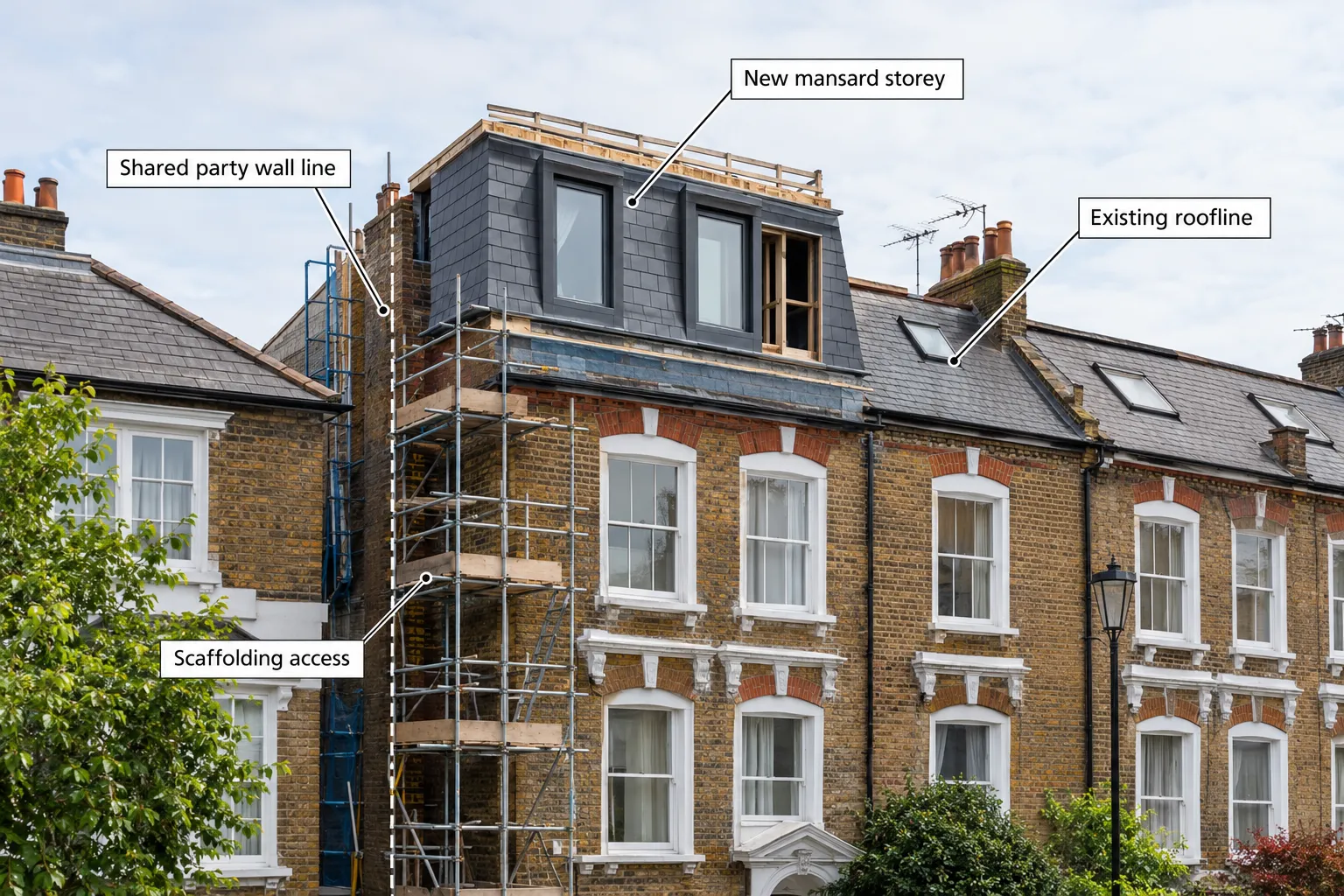
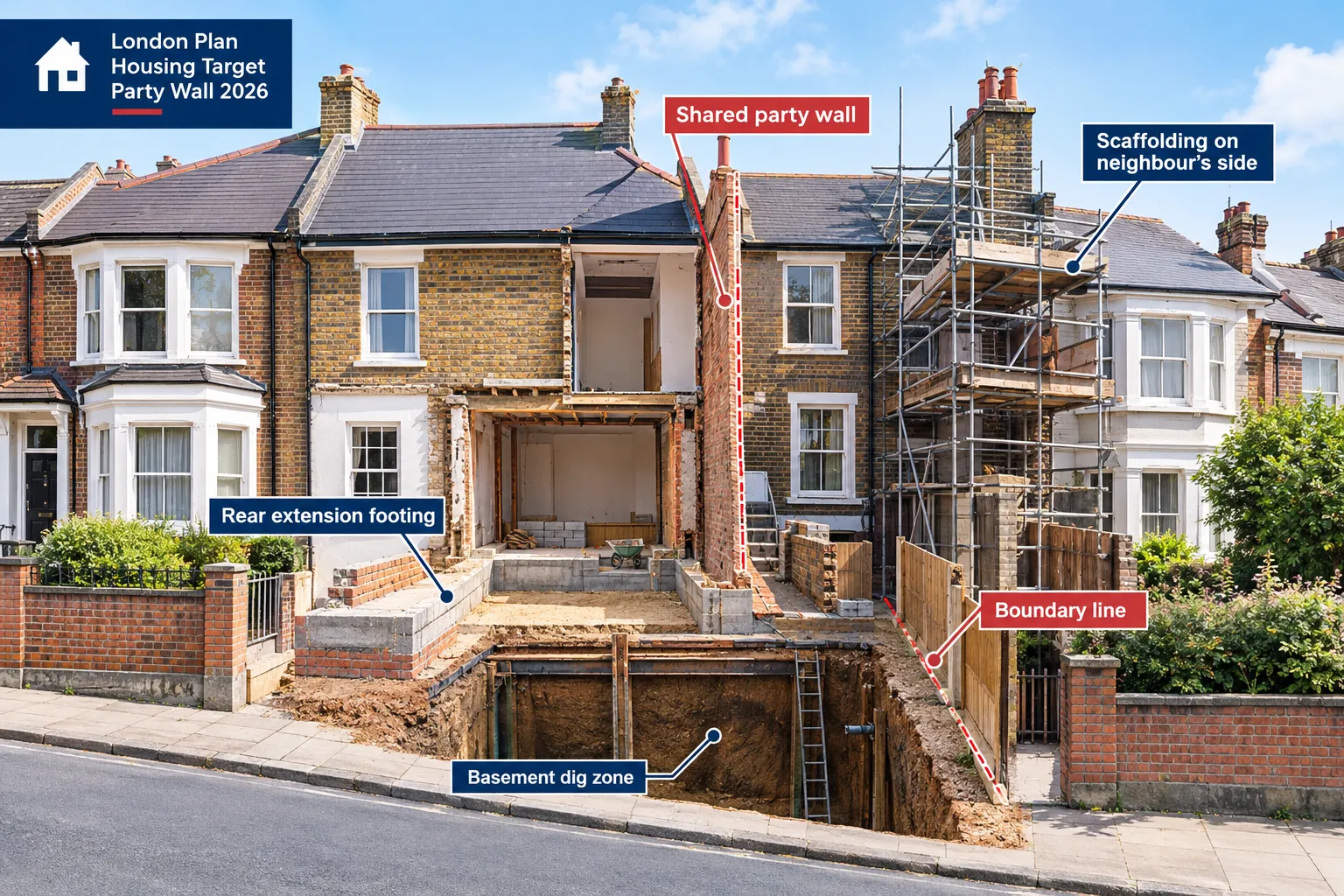
Looking for expert solutions?
Request a Quote

Tag: party wall act 1996

  • PlanAssist AI Set to Halve Planning Decision Times for Extensions and Loft Conversions: What London Homeowners and Neighbours Need to Know (November 2026)

    {“content”:[]}

    Eight weeks down to four. That is the change in processing time for routine householder planning applications reported in early testing of the PlanAssist AI planning tool, according to Propertymark’s 5 November 2026 briefing on the government rollout [1]. For London homeowners planning an extension, loft conversion or basement, a faster planning decision sounds like pure good news. For their neighbours, it means the Party Wall etc. Act 1996 timetable arrives sooner than many expect.

    Key Takeaways

    • PlanAssist helps planning officers produce initial assessments of routine applications such as extensions, loft conversions and conservatories; officers still make the final decision [1].
    • Early testing cut time spent on key planning tasks by 58% and halved processing time for routine applications from eight weeks to four [1].
    • The tool was tested with Camden, Barnet and Dorset councils, is expanding to 12 more, and is intended to reach every council in England by the end of 2027 [1].
    • Planning permission and party wall consent are separate. A faster planning decision does not shorten the statutory notice periods under the Party Wall Act.
    • Serving party wall notices early, and agreeing a schedule of condition, protects both the building owner and the adjoining owner.

    What the PlanAssist AI Planning Tool Does

    PlanAssist is a government AI tool designed to help planning officers process routine applications faster. It targets householder projects such as extensions, loft conversions and conservatories, as well as small business property improvements [1].

    The tool combines three inputs to produce an initial assessment [1]:

    1. The planning application itself.
    2. Local planning policies.
    3. Site constraints, such as conservation area status.

    Propertymark quotes the government position that “qualified planning officers will remain responsible for reviewing assessments and making final decisions” [1]. The AI drafts; a human decides.

    PlanAssist AI Planning Tool Rollout: Dates and Councils

    Milestone Detail
    Pilot councils Camden, Barnet and Dorset
    Current expansion 12 further councils
    Linked planning rules New rules in force from 31 October 2026
    National target Every council in England by the end of 2027
    Reported time saving 58% on key planning tasks
    Routine application time Eight weeks to four in testing

    Alongside the rollout, the government has renewed the National Scheme of Delegation and recruited 420 additional planners, in support of its target of 1.5 million homes this Parliament [1]. Two of the three pilot councils, Camden and Barnet, are London boroughs, so parts of the capital are already seeing the effect.

    Propertymark welcomed faster processing for smaller applications but questioned whether similar gains can be achieved on larger developments, and pointed to staffing shortages and financial pressures at local planning authorities [1]. It also notes that the Future Homes and Buildings Standards for new homes take effect from March 2027 [1].

    Why Faster Planning Means Earlier Party Wall Notices

    The PlanAssist AI planning tool changes when a homeowner can start building. It does not change the Party Wall etc. Act 1996. The two processes run in parallel, and the Act’s notice periods are fixed by statute:

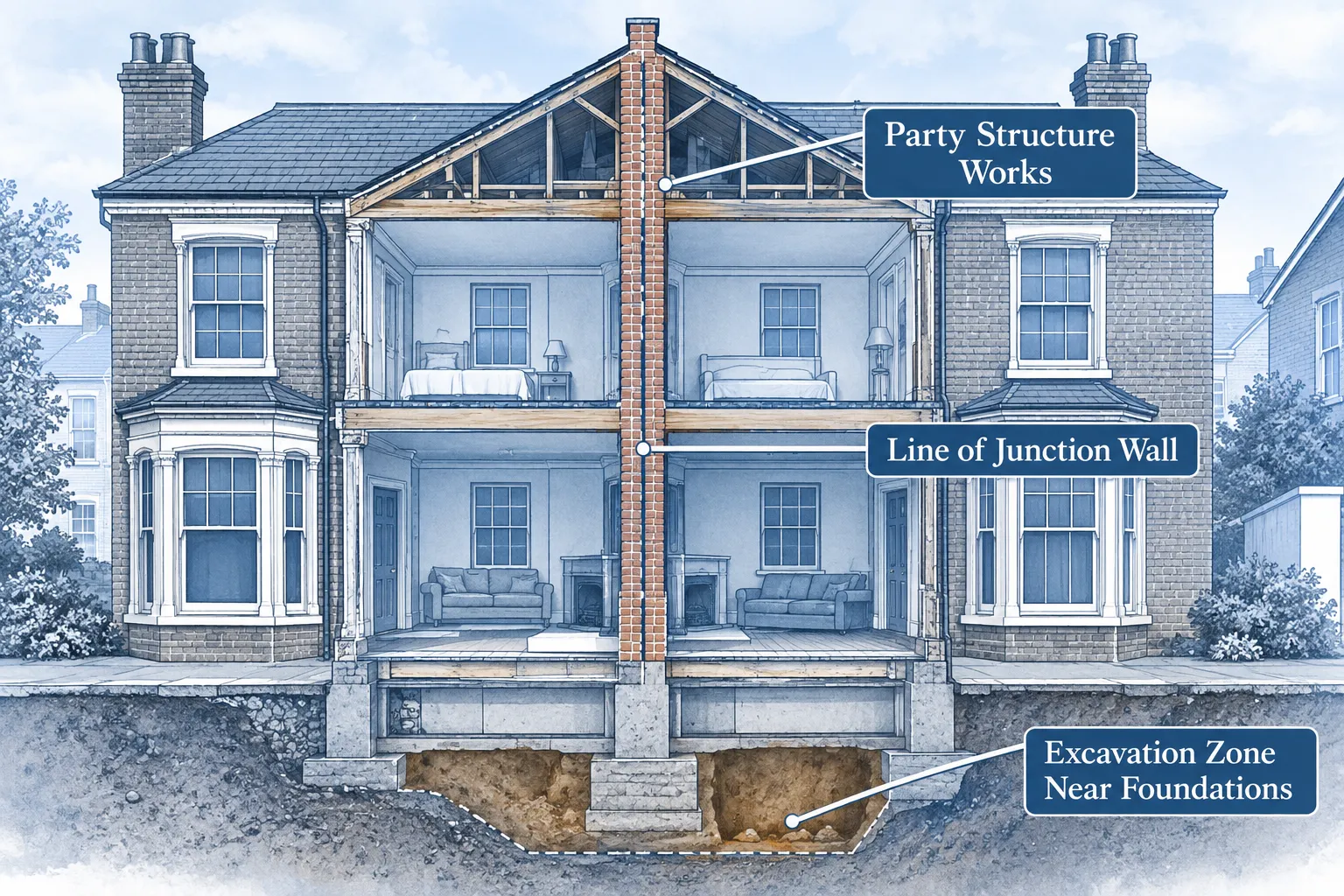
    • Works to a party wall or party structure (for example cutting in beams for a loft conversion or raising a shared wall): notice must be served at least two months before the work starts.
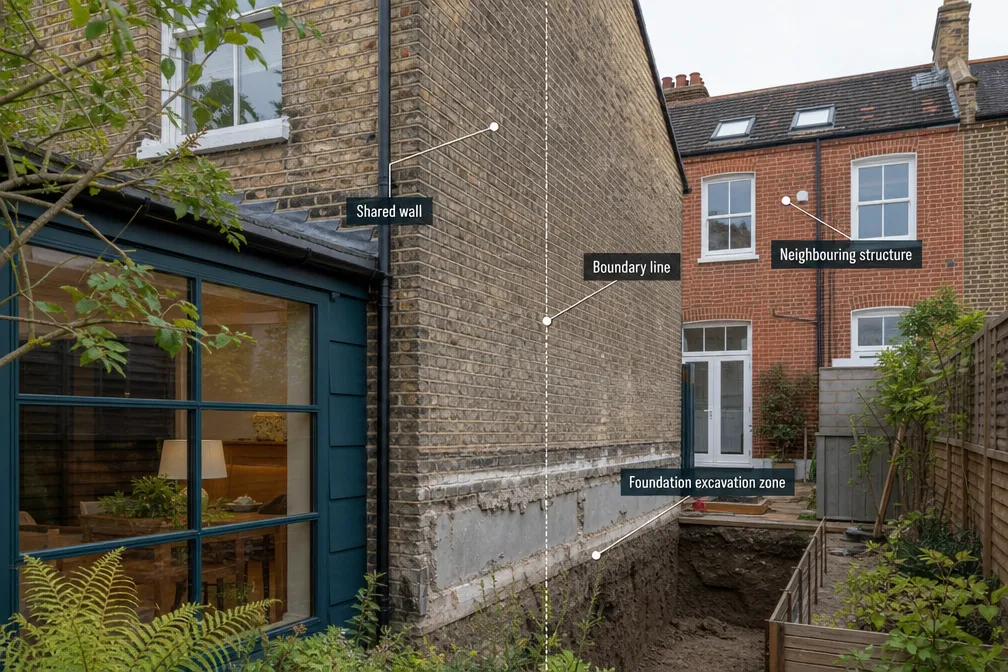
    • Excavation within 3 metres or 6 metres of a neighbour’s foundations, depending on depth (typical for rear extensions and basements): notice must be served at least one month before.
    • New walls on the line of junction: notice must be served at least one month before.

    Under the old eight-week planning timeline, a homeowner who served notices on the day of submission would usually have the two-month period run alongside the planning decision. With a four-week decision, the planning permission can arrive before the party wall notice period has ended. Builders are then booked, and the neighbour’s reply becomes the critical path.

    A faster planning decision is only useful if the party wall process keeps pace with it. Serve notices at the design stage, not after the approval letter arrives.

    What Adjoining Owners Should Do When a Notice Arrives

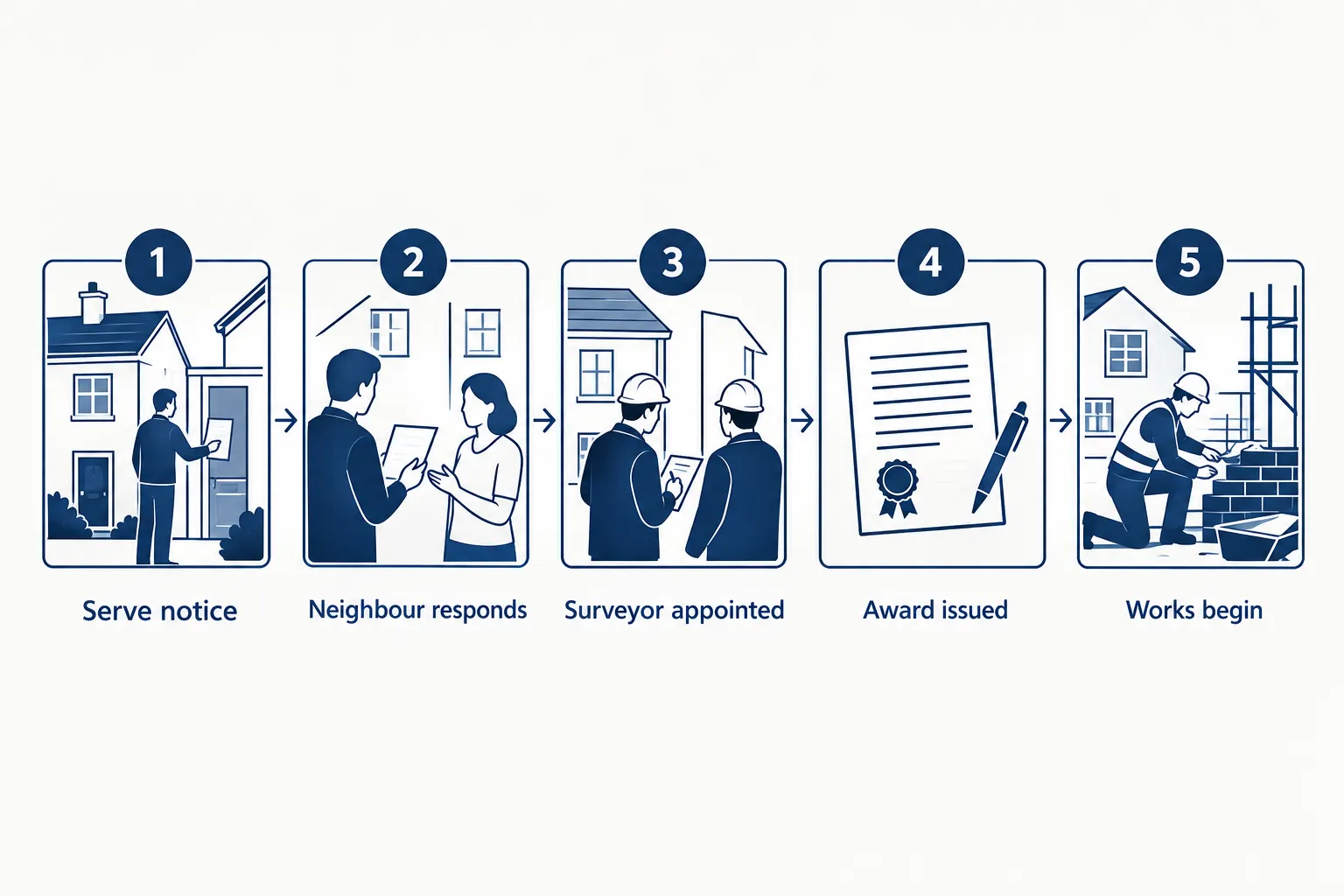
    Neighbours receiving a party wall notice have three options:

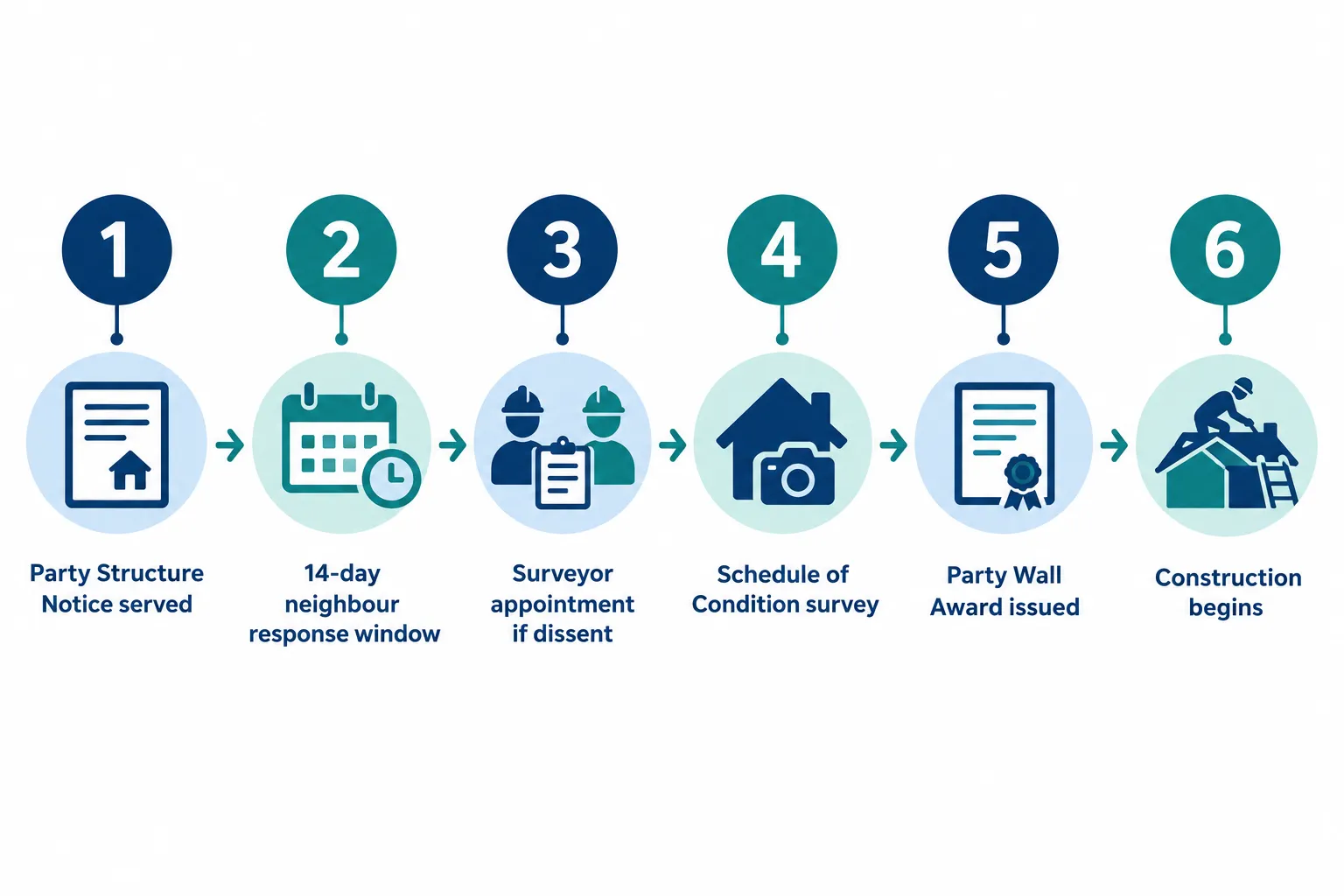
    1. Consent in writing within 14 days. Even with consent, a schedule of condition is strongly advisable.
    2. Dissent and appoint a surveyor. The parties may agree a single “agreed surveyor” or each appoint their own.
    3. Do nothing. After 14 days the notice is deemed dissented, and a dispute arises that surveyors must resolve.

    The adjoining owner’s reasonable surveyor costs are normally paid by the building owner. A schedule of condition records cracks, finishes and defects before work starts, so any later damage can be fairly assessed.

    What This Means for London Homeowners

    For a building owner, the practical sequence in late 2026 is:

    • Identify which neighbours are affected as soon as drawings exist.
    • Serve the correct notices early so the two-month or one-month period runs during, not after, the planning process.
    • Appoint a party wall surveyor to prepare the notices, agree the award and record the schedule of condition.
    • Keep neighbours informed, which reduces the chance of dissent.

    A party wall surveyor can serve valid notices, act as agreed surveyor for both sides, prepare the award and schedule of condition, and advise where excavation depth brings the 6-metre rule into play.

    FAQ

    Does PlanAssist approve my extension automatically?

    No. It produces an initial assessment. Propertymark reports that qualified planning officers remain responsible for the final decision [1].

    If planning is granted in four weeks, can I start work straight away?

    Not if the work is notifiable under the Party Wall Act. The statutory notice periods of one or two months still apply, and work cannot lawfully start until consent is given or an award is made.

    Do I need a party wall surveyor for a loft conversion?

    If the loft conversion involves cutting into or raising a party wall, notice is required. A surveyor is needed if the neighbour dissents or fails to respond within 14 days.

    Which London councils use PlanAssist now?

    Camden and Barnet were pilot councils, with Dorset, and the tool is expanding to 12 further councils ahead of national rollout by the end of 2027 [1].

    Conclusion

    The PlanAssist AI planning tool is likely to shorten the wait for permission on extensions and loft conversions across London as the rollout continues through 2027 [1]. The party wall timetable will not shrink with it. Homeowners who serve notices at the design stage, and neighbours who respond promptly and secure a schedule of condition, will be the ones who benefit from the speed.

    Next steps: check whether your project touches a party wall or involves excavation near a neighbour, serve notices early, and appoint a party wall surveyor before the planning decision lands.

    References

    1. Propertymark, “AI tool to speed up planning decisions for homeowners”, 5 November 2026. propertymark.co.uk.
  • Mansion Tax £2 Million Extension London Party Wall November 2026: What Homeowners Need to Know

    Last updated: November 10, 2026

    Quick Answer

    The High Value Council Tax Surcharge, confirmed in the Autumn Budget on 28 October 2026, applies from April 2028 to English homes valued at £2 million or more using 2026 values, with annual charges from £2,500 up to £7,500. The threshold did not drop to £1.5 million as had been rumoured. If an extension, loft conversion or basement dig could push a London property over £2 million, owners need a defensible valuation and should factor in Party Wall etc. Act 1996 notice periods now, in November 2026, because building work near a shared wall or neighbouring foundations cannot legally start until those notices run their course.

    Key Takeaways

    • The mansion tax (High Value Council Tax Surcharge) starts April 2028, not before.
    • The £2 million threshold is based on 2026 property values, not a future valuation date.
    • Charges run in bands: £2,500 a year at £2m-£2.5m, rising to £7,500 a year at £5m-plus.
    • A deferral scheme and exemptions are planned but not yet detailed by government.
    • Stamp duty is unchanged; this is a separate, additional annual charge.
    • Extensions and basements can raise a property’s value, but treatment of post-2026 improvements has not been confirmed.
    • Any work near a boundary wall or neighbouring foundations triggers Party Wall Act obligations, regardless of mansion tax status.
    • Section 1 and Section 6 notices need one month’s notice; Section 2 notices need two months.
    • This article is general information, not tax or legal advice.

    What exactly counts as an extension for mansion tax purposes

    There is no published definition yet of how extensions or improvements will be treated under the mansion tax, because the surcharge is pegged to 2026 valuations, not future ones. Setfords Solicitors’ summary of the 28 October 2026 Budget confirms the £2 million threshold and the annual bands, but government has not yet said whether a loft conversion or basement completed after the valuation date will be added to a property’s taxable value later, or ignored until the next revaluation cycle.

    This matters because:

    • Council tax in England still uses 1991 valuations, so there is precedent for long gaps between revaluations.
    • The mansion tax surcharge sits on top of council tax but uses a separate 2026 valuation exercise.
    • Owners cannot assume that building an extension after 2026 will be invisible to future valuations; it may simply not be captured until the next review.

    Common mistake: assuming any extension finished after November 2026 is automatically excluded from mansion tax. Nothing has been confirmed either way.

    How much will the mansion tax actually cost me on a £2 million property

    A property valued at exactly £2 million in 2026 falls into the lowest band, which Setfords’ summary puts at £2,500 a year from April 2028. This is paid by the owner, on top of existing council tax, not instead of it.

    The reported bands are:

    Value band (2026 values) Annual surcharge
    £2,000,000 – £2,500,000 £2,500
    £2,500,000 – £3,500,000 roughly scaled between bands
    £3,500,000 – £5,000,000 roughly scaled between bands
    £5,000,000+ £7,500

    Only the bottom and top figures have been clearly reported; the middle bands are not yet broken down in detail. A deferral scheme and discounts or exemptions are planned but undetailed, so owners close to the threshold should treat any mid-band figure as an estimate pending further guidance.

    Decision rule: if a property is valued near £1.9m-£2.1m, budget for the lowest band (£2,500 a year) as a planning assumption, then revisit once HMRC or the Valuation Office publishes detailed guidance.

    Do basement conversions trigger the mansion tax threshold

    A basement conversion can increase a property’s market value enough to cross £2 million, but it is the resulting 2026 valuation that matters, not the basement itself. Many London basements add significant floor area and usable space, which surveyors and estate agents typically factor into valuation uplift.

    Key points:

    • Basements in boroughs like Kensington and Chelsea, Hampstead, Wandsworth and Richmond are common precisely because land is scarce and extending downward adds value without extending the footprint.
    • A basement dig almost always falls under Section 6 of the Party Wall Act if excavation is within 3 to 6 metres of a neighbouring building’s foundations and goes below their foundation depth.
    • Valuation uplift from a basement is not guaranteed to be proportional to build cost; a well-finished basement in a sought-after postcode can add more value than the construction spend.

    Edge case: a basement that adds living space but sits in a less competitive micro-market might add less value than the owner expects, keeping the property under £2 million despite a large spend.

    Can I avoid mansion tax by completing my extension before April 2028

    Completing an extension before April 2028 does not avoid the mansion tax if the property’s 2026 valuation already places it at £2 million or more. The surcharge is based on the 2026 valuation date, so the timing of construction completion is largely irrelevant to that specific valuation snapshot.

    What timing does affect:

    • Party Wall Act notices and neighbour negotiations, which take weeks or months and should start well before April 2028 regardless of tax considerations.
    • Market conditions: Lloyds’ house price index for 6 November 2026 showed UK prices down 1.2% annually, and PropertyWire reported on 6 November 2026 that 13.7% of homes for sale were price-reduced in October 2026, with stock at 758,000 properties on 1 November 2026. A softer market can affect how a surveyor values improvements.
    • Borrowing costs: Bank Rate rose to 4% on 5 November 2026, which affects how owners finance extension works.

    Common mistake: rushing a build to “beat” April 2028, when the relevant valuation date is 2026, not the completion date of the surcharge itself.

    How is my property valued if I’m adding a basement or extension

    Valuation for the mansion tax will likely follow Valuation Office Agency methodology similar to existing council tax banding exercises, though full details have not been published. Owners near the £2 million line should commission an independent RICS valuation now to document the property’s condition and value as close to the 2026 reference point as possible.

    Practical steps:

    1. Instruct a RICS-registered valuer for a written valuation report dated in 2026.
    2. Keep records of planning permission, building control sign-off, and final costs for any extension or basement.
    3. Retain before-and-after photographs and a schedule of condition from any party wall survey, since this evidence can support or challenge a valuation later.
    4. Ask the valuer to note comparable sales in the same postcode, particularly in competitive areas like Hampstead or Richmond.

    Decision rule: get a valuation now if the property sits within roughly £150,000-£200,000 of the £2 million line, since that buffer can be eroded or exceeded by even a modest extension.

    Does a small extension really push you over the £2 million line for tax

    A small extension can tip a borderline property over £2 million, but only if the property was already close to the threshold before work started. A single-storey rear extension adding 15-20 square metres in a prime London postcode can add a meaningful percentage to value, while the same extension in a lower-value area may add proportionally less.

    • Properties valued at £1.85m-£1.95m carry the highest risk of being pushed over by a modest extension.
    • Properties valued well under £1.5m are unlikely to cross £2 million from a single extension alone.
    • Loft conversions, side-return extensions and basement digs are the three most common projects cited by London agents as adding substantial value per pound spent, though actual uplift varies by location and finish quality.

    Example: a £1.9 million terraced house in Wandsworth that adds a £120,000 side-return extension could plausibly cross £2 million if local comparable evidence supports the uplift, though this depends entirely on the specific property and market at the time.

    What’s the Party Wall Act and does it affect how much tax I pay

    The Party Wall etc. Act 1996 is separate legislation covering building work near shared walls, boundaries or neighbouring foundations; it does not set or affect the mansion tax amount itself. However, the Act governs whether and when extension or basement work can legally proceed, which indirectly affects the timeline for any valuation uplift.

    The Act covers three notice types:

    • Section 1 (line of junction): for new walls built on or near a boundary line; one month’s notice required.
    • Section 2 (party structure): for work to an existing shared wall, such as cutting in, raising or underpinning; two months’ notice required.
    • Section 6 (adjacent excavation): for digging foundations or basements within 3 to 6 metres of a neighbouring building, depending on depth; one month’s notice required.

    Neighbours have 14 days to respond to a notice. If they dissent, or do not reply, a party wall award is needed, usually prepared by one or two appointed surveyors. A schedule of condition is typically recorded before works start to protect both parties if damage is later disputed.

    Who pays: generally the building owner carrying out the work pays both their own surveyor’s fees and the adjoining owner’s surveyor’s fees, though this can be negotiated case by case.

    Who actually has to pay the mansion tax in London

    The surcharge is payable by the owner of a property valued at £2 million or more in 2026, not by tenants or leaseholders in most ordinary arrangements. This mirrors how council tax liability generally sits with the owner-occupier or landlord rather than a short-term occupant.

    • Owner-occupiers above the threshold pay annually alongside council tax.
    • Landlords of high-value rented properties are expected to be liable, though full guidance on buy-to-let treatment has not been published.
    • A deferral scheme is planned, likely aimed at asset-rich, cash-poor owners such as retirees in long-held family homes, but eligibility criteria are not yet confirmed.

    Can you get out of mansion tax if your extension was already planned

    Having planning permission or a signed building contract before the Budget announcement does not exempt a property from the mansion tax if its 2026 valuation reaches £2 million. Exemptions and discounts are mentioned as “planned” in the Autumn Budget summary but have not been detailed.

    • There is no confirmed carve-out for extensions in progress as of November 2026.
    • Owners should not delay necessary party wall notices or safety work while waiting for exemption guidance, since Party Wall Act timelines run independently of tax policy.
    • Watch for further Treasury or Valuation Office guidance expected before the April 2028 start date.

    What’s the difference between the old stamp duty surcharge and the new mansion tax

    Stamp duty is a one-off tax paid on purchase; the mansion tax is a recurring annual charge paid every year by the owner. The Autumn Budget 2026 confirmed stamp duty remained unchanged, so both taxes can apply to the same property at different points: stamp duty when buying, then the annual surcharge from April 2028 if the value is £2 million or more.

    Do all London properties over £2 million pay this tax automatically

    Not automatically in a blanket sense, but yes in principle if the 2026 valuation confirms the threshold is met, subject to any exemptions or deferral arrangements still to be published. No wider council tax reform or land value tax was announced alongside this measure, so the existing 1991 banding system continues for standard council tax.

    What mistakes do homeowners make when planning extensions before 2028

    The most common mistake is treating the mansion tax and the Party Wall Act as the same process, when they are entirely separate legal frameworks with different timelines and purposes.

    Other frequent errors:

    • Skipping a RICS valuation and relying on online estimate tools, which do not hold up as evidence.
    • Starting excavation or wall work without serving notice, risking an injunction or forced remedial costs.
    • Assuming a basement automatically adds £X per square metre, when uplift depends heavily on postcode and finish.
    • Ignoring financing costs: with Bank Rate at 4% as of 5 November 2026, borrowing for a large extension costs more than it did two years earlier.

    Is there any exemption if I’m just doing a party wall survey

    A party wall survey itself, such as a schedule of condition or notice-serving exercise, does not trigger the mansion tax or any exemption from it, because the survey is not a valuation event for tax purposes. It is simply the legal process required before certain building works can start.

    How does the November 2026 date matter for my extension plans

    November 2026 matters because it sits inside the valuation reference period used for the mansion tax and because any Party Wall Act notices served now need their full notice period (one or two months) to run before building work can start. Owners planning a 2027 build season should be serving notices and commissioning valuations in the coming months, not waiting until spring.

    Frequently Asked Questions

    Does the mansion tax replace council tax? No. It is an additional annual surcharge on top of existing council tax, not a replacement.

    What is the lowest mansion tax band? Properties valued between £2 million and £2.5 million at 2026 values face a reported £2,500 annual charge from April 2028.

    Will my extension be revalued every year? There is no confirmed annual revaluation cycle; details on how improvements are tracked over time have not been published.

    Do I need a party wall surveyor for a basement dig? In most cases yes, if excavation is within 3 to 6 metres of a neighbouring building’s foundations, since this typically falls under Section 6 of the Party Wall Act.

    Can I dispute my property’s mansion tax valuation? Detailed appeal processes have not yet been published, but owners should keep independent valuation evidence in case a challenge mechanism is introduced.

    Is this article tax advice? No. This is general information for homeowners and is not tax or legal advice. Speak to a qualified tax adviser and a party wall surveyor for your specific situation.

    Conclusion

    The mansion tax confirmed in the Autumn Budget on 28 October 2026 is real, dated from April 2028, and anchored to 2026 property values, with bands from £2,500 to £7,500 a year. For London owners near the £2 million line, the immediate practical steps are: commission an independent valuation now, document any extension or basement plans thoroughly, and serve any required Party Wall Act notices with enough lead time, since Section 2 notices alone need two months. Treat exemption and deferral details as unconfirmed until government publishes further guidance, and get professional tax and surveying advice before committing to major works.

    .cg-mt{font-family:Arial,sans-serif;max-width:600px;margin:0 auto;border:1px solid #ccc;border-radius:8px;padding:16px;} .cg-mt h3{margin-top:0;font-size:18px;color:#1a1a1a;} .cg-mt label{display:block;margin:10px 0 4px;font-size:14px;font-weight:bold;} .cg-mt input{width:100%;padding:8px;box-sizing:border-box;border:1px solid #999;border-radius:4px;} .cg-mt button{margin-top:12px;padding:10px 16px;background:#14532d;color:#fff;border:none;border-radius:4px;cursor:pointer;} .cg-mt-result{margin-top:14px;padding:12px;background:#f3f4f6;border-radius:6px;font-size:14px;} .cg-mt-note{font-size:12px;color:#555;margin-top:8px;}

    Mansion Tax Band Estimator (2026 values)

    Enter a value to see the estimated annual band.

    Based on Setfords Solicitors’ summary of the 28 October 2026 Budget. Mid-band figures are estimates pending official guidance. Not tax advice.

    function cgCalc(){ var v=parseFloat(document.getElementById(‘cg-val’).value); var r=document.getElementById(‘cg-result’); if(isNaN(v)||v<=0){r.innerHTML="Please enter a valid property value.";return;} if(v<2000000){r.innerHTML="Below £2,000,000: no mansion tax surcharge expected.";} else if(v<2500000){r.innerHTML="Band: £2,000,000-£2,500,000 — estimated £2,500 per year from April 2028.";} else if(v<3500000){r.innerHTML="Band: £2,500,000-£3,500,000 — mid-band figure not yet published; estimate between £2,500 and £7,500 per year.";} else if(v<5000000){r.innerHTML="Band: £3,500,000-£5,000,000 — mid-band figure not yet published; estimate between £2,500 and £7,500 per year.";} else{r.innerHTML="Band: £5,000,000+ — estimated £7,500 per year from April 2028.";} }
  • Party Wall Notice Extension London Falling Prices November 2026: What the Rate Rise and Soft Market Mean for Your Build

    Last updated: November 9, 2026

    London house prices fell 1% over the year to October 2026, according to Zoopla, while the Bank of England pushed the base rate to 4% on 5 November 2026. That combination is pushing more homeowners to look at extending rather than moving. If you’re one of them, understanding how a party wall notice extension London falling prices November 2026 situation actually works, from timing to cost, is now essential planning rather than paperwork to deal with later.

    Quick Answer

    With London prices down and mortgage rates sticky near 6%, extending is looking more attractive than moving for many homeowners this November. But party wall notices still take one to two months minimum under the Party Wall etc. Act 1996, and a dispute can add weeks more. Serve notices early, budget £700 to £1,500 per surveyor appointment for a typical job, and never start work before the notice period expires.

    Key Takeaways

    • Bank Rate rose from 3.75% to 4% on 5 November 2026, the first rise since August 2023 (Bank of England).
    • Zoopla’s October 2026 index shows London prices down 1% (£5,400) annually, with homes taking 56 days to sell, the slowest of any UK region.
    • Lloyds’ October 2026 index recorded a 1.2% annual UK price fall, the steepest drop since October 2023.
    • Savills (9 November 2026) forecasts London suburbs falling 3.5% and outer prime London 2.5% in 2027, with no recovery expected before 2028.
    • Section 2 notices (work to a party wall) need two months’ notice; Section 1 (new walls at the boundary) and Section 6 (excavation near a party wall) need one month.
    • A neighbour has 14 days to respond before a dispute is automatically deemed to exist.
    • Starting work before the notice period ends, or serving an invalid notice, are the two most common and costly mistakes.
    • The building owner usually pays reasonable surveyor fees, even when the neighbour appoints their own surveyor.

    What is a party wall notice and when do I need one

    A party wall notice is a formal written notification, required under the Party Wall etc. Act 1996, telling your neighbour about building work that will affect a shared wall, boundary, or nearby excavation. You need one if you’re building on or near a party wall, building a new wall at the boundary line, or digging foundations within 3 or 6 metres of a neighbouring building depending on depth.

    The Act applies across England and Wales and covers three main scenarios:

    • Section 1: building a new wall at the line of junction between two properties.
    • Section 2: work directly to an existing party wall or structure, such as cutting in steel beams or raising a wall.
    • Section 3: covers related works, including underpinning.
    • Section 6: excavation within 3 metres (if deeper than the neighbour’s foundations) or 6 metres (depending on angle) of an adjoining building.

    If your project touches any of these, you must serve notice before starting work. Skipping it isn’t a minor technicality, it can lead to an injunction halting your build.

    How much does a party wall notice cost in London

    Party wall notice costs in London typically run from £700 to £1,500 per surveyor appointment for straightforward rear extensions or loft conversions, rising to £2,000 to £4,000 or more where a dispute arises and two separate surveyors are instructed. The building owner usually covers these costs, including the neighbour’s surveyor fees, as long as they’re reasonable.

    Costs depend on:

    • Number of adjoining owners: a mid-terrace property with neighbours on both sides needs two separate notices and potentially two sets of surveyor fees.
    • Route chosen: an agreed surveyor acting for both parties is cheaper than two separate surveyors each charging separately.
    • Complexity: basement digs and structural steel into party walls usually need a more detailed schedule of condition and award, pushing costs up.
    • Disputes: if a neighbour refuses to engage or disagrees with the proposed works, costs rise because two surveyors must negotiate a party wall award.

    A useful rule of thumb: budget party wall costs as a fixed line item in your build budget from day one, not as a contingency.

    Is it cheaper to extend or move when house prices are falling

    For many London homeowners right now, extending works out cheaper than moving once stamp duty, estate agency fees, and higher mortgage rates on a new purchase are added up. Zoopla’s October 2026 data shows London prices down 1% annually and homes taking 56 days to sell, the slowest of any region, which weakens the case for selling into a soft market.

    Consider the maths:

    Factor Moving Extending
    Stamp duty on next purchase Often tens of thousands of pounds None
    Agency and legal fees Typically 1-3% of sale price plus legal costs None
    Mortgage rate impact New mortgage at current rates (fixed rates near 6%, AJ Bell) May only need a smaller additional borrowing or none at all
    Market timing risk Selling into falling prices, average 56 days to sell in London (Zoopla) No exposure to sale price
    Disruption Full house move Builders on site, but you stay put

    This isn’t a universal answer. If your current home genuinely can’t accommodate the space you need, moving may still make sense. But where the gap is “one more bedroom” or “a bigger kitchen,” extending is a reasonable response worth costing properly before assuming a move is better.

    Do falling prices make home extensions more affordable right now

    Falling prices don’t directly reduce building costs, but they do change the calculation around whether to extend. Labour and materials costs are largely independent of house price movements, so an extension that cost £80,000 last year will cost roughly the same now. What’s changed is the opportunity cost of staying versus moving.

    That said, there are indirect benefits:

    • Some contractors report slightly more availability as fewer people are moving and commissioning major renovations on purchase, though this varies by area and trade.
    • With Savills forecasting further falls in London suburbs (3.5%) and outer prime London (2.5%) for 2027, and no recovery expected until 2028, staying and improving avoids locking in a sale at a weaker price point.

    Choose to extend now if your main driver is avoiding a sale into a falling market. Choose to wait or reconsider if your extension budget depends on releasing equity you don’t currently have.

    What happens if my neighbour objects to my extension plans

    If a neighbour objects to your party wall notice, or simply doesn’t respond within 14 days, a dispute is automatically deemed to have arisen under the Act. This doesn’t block your project, but it does mean you now need a formal surveyor process to resolve it.

    Two routes exist:

    1. Agreed surveyor: both parties appoint the same surveyor, who acts impartially. This is usually faster and cheaper.
    2. Two surveyors: each party appoints their own, and the surveyors agree a third surveyor as a fallback if they can’t settle disputes between themselves.

    The surveyor(s) produce a party wall award covering the work, a schedule of condition of the neighbour’s property, and how costs are split. The building owner typically pays the reasonable fees of both surveyors.

    Common edge case: a neighbour who is unresponsive, not necessarily hostile, still triggers a deemed dispute. Don’t assume silence means consent.

    How long does the party wall notice process usually take

    The process typically takes between one and three months from serving notice to being clear to start work, depending on the type of work and whether a dispute arises. Section 2 notices need two months’ notice; Section 1 and Section 6 notices need one month. Add time if a dispute requires surveyor appointment and award negotiation.

    A realistic timeline for a typical London rear extension:

    • Week 0: notice served on neighbour.
    • Week 2: 14-day response deadline passes.
    • Week 2-8: if no dispute, two-month notice period runs its course for Section 2 works.
    • Week 8+: if dispute arises, add 4-8 weeks for surveyor appointment and award.

    Given contractor availability is tight across London this autumn, serving notices in parallel with getting planning permission or building regulations approval, rather than afterwards, protects your start date.

    Can I get a mortgage for an extension with a 4% base rate

    Yes, mortgages and further advances for extensions remain available at 4% base rate, though average two- and five-year fixed rates sit close to 6% according to AJ Bell. Lenders assess affordability on the new, higher rate environment, so monthly repayment costs on any additional borrowing will be noticeably higher than during the low-rate years before 2022.

    Practical points:

    • A further advance from your existing lender is often simpler and cheaper than remortgaging the whole property.
    • Some homeowners fund extensions through savings or a mix of savings and smaller borrowing to limit exposure to current fixed rates.
    • Budget for the party wall notice and surveyor costs within your total finance request, lenders will want to see the full project cost, including professional fees.

    What’s the difference between a party wall notice and agreement

    A party wall notice is the initial written notification you serve on a neighbour describing proposed work; a party wall award (sometimes loosely called an “agreement”) is the formal document a surveyor or surveyors produce once the notice process concludes, setting out how the work will proceed and how costs are handled.

    • Notice: starts the process, specifies the work and timing, triggers the response clock.
    • Award: the binding resolution, produced if consent isn’t given informally or if a dispute arises, covering access rights, working hours, protective measures, and the schedule of condition.

    If a neighbour simply agrees to the notice in writing within the 14-day window, no formal award is needed. An award only becomes necessary where a dispute is deemed to exist.

    Do I need a party wall notice for all types of extensions

    No, not every extension needs a party wall notice. You only need one where the work falls under Sections 1, 2, 3, or 6 of the Act, typically involving a shared wall, a new boundary wall, or nearby excavation.

    Common London extension types and their notice triggers:

    • Rear extensions: usually trigger Section 6 (excavation) if foundations are within 3 or 6 metres of the neighbour’s building.
    • Side-return extensions: often involve Section 2 if they tie into an existing party wall, plus Section 6 for foundations.
    • Loft conversions with steel beams: almost always trigger Section 2, since steels are frequently supported on or within the party wall.
    • Basement digs: trigger Section 6 at minimum, often alongside Section 2 if underpinning affects the party structure.
    • Detached garden outbuildings: may need no notice at all if they’re far enough from any boundary or party structure.

    Are there any exemptions to needing a party wall notice

    Yes, work that doesn’t touch a party wall, boundary, or fall within the excavation distances set out in Section 6 doesn’t require notice. Minor internal works, like redecorating or replacing non-structural fixtures on your own side of a party wall, also don’t trigger the Act.

    Examples of exempt work:

    • Internal plastering or decorating that doesn’t cut into the party wall structure.
    • Loft insulation that doesn’t involve structural alterations to the party wall.
    • Garden structures set back well beyond the 3 or 6 metre excavation thresholds.

    Edge case: even “minor” structural work, like drilling for shelving brackets deep into a party wall, technically falls under the Act if it affects the structure, though in practice neighbours rarely object to such small-scale work.

    What are common mistakes people make with party walls

    The two most damaging mistakes are starting work before the notice period expires and serving a notice that’s invalid, incomplete, or sent to the wrong party. Both can lead to injunctions, forced remedial work, or expensive disputes that delay the whole project.

    Other frequent errors:

    • Assuming silence equals consent: no response within 14 days means a dispute is deemed, not that you can proceed.
    • Serving notice too late: given two-month periods for Section 2 work, serving notice after booking contractors risks a costly delay.
    • Missing a leaseholder or freeholder: notices need to go to all relevant owners, not just the person living next door.
    • Underestimating schedule of condition importance: skipping this step leaves you exposed if the neighbour later claims damage that predates your work.

    What happens if you don’t get a party wall notice before starting work

    Starting work without serving the required notice can result in a neighbour obtaining a court injunction to stop the build, and you may be liable for any damage caused even if your contractor wasn’t negligent. Retrospective notices don’t fix the legal exposure for work already carried out.

    In practice:

    • Courts have granted injunctions halting ongoing works where no notice was served.
    • Insurance and warranty providers may refuse to cover disputes arising from unnoticed work.
    • Resolving the situation after the fact often costs more in surveyor and legal fees than doing it properly from the start.

    Should I extend my home now or wait for prices to drop more

    Extend now if your current home meets your location needs but lacks space, and you can fund the build without relying on a future house sale. Wait, or reconsider the scope, if your plans depend on releasing equity that’s shrinking in the current market, given Savills’ forecast of further falls in 2027 before any recovery expected in 2028.

    Decision rule: if moving would mean selling into a market where London homes take 56 days to sell on average (Zoopla, October 2026) and buying back in at similarly weak prices, extending removes that round trip entirely. If you need to release significant equity to fund the build, the maths may not work until the market stabilises.

    How do party wall notices affect my extension timeline and budget

    Party wall notices add a fixed minimum of one to two months to your project timeline, and should be budgeted as a defined cost line rather than an afterthought. Treat notice-serving as a task that runs parallel to planning and contractor procurement, not something that follows it.

    Practical checklist:

    1. Identify which sections of the Act apply to your specific works (rear extension, side-return, loft steels, basement dig).
    2. Serve notices as soon as drawings are finalised, even before planning permission is granted if timing is tight.
    3. Budget £700-£1,500 per surveyor appointment, more if a dispute is likely.
    4. Build the full one-to-three month notice window into your contractor start date.
    5. Commission a schedule of condition before work begins to protect against later disputes.

    What This Means in Practice for Commissioning a Survey or Valuation

    For anyone commissioning a party wall survey or valuation this November, the practical takeaway is to move early and budget realistically given current market conditions. With Bank Rate at 4% and mortgage rates near 6% (AJ Bell), financing costs are higher, and with contractor demand shifting as fewer people move, timing your notice-serving correctly protects both your build schedule and your budget.

    • Get a schedule of condition survey booked as soon as notices are served, not after the response deadline.
    • Ask your surveyor to confirm which Act sections apply before finalising drawings, this avoids redesigning after notice is served.
    • Factor surveyor fees into your overall extension budget alongside building costs, not as a separate afterthought.

    Practical Checklist

    • Confirm which Party Wall Act sections apply to your project.
    • Serve notices at least two months before your intended start date for Section 2 works.
    • Keep written records of all notices and responses.
    • Commission a schedule of condition before any work starts.
    • Budget £700-£4,000+ for surveyor fees depending on dispute risk.
    • Don’t start work until the notice period has fully expired and any dispute is resolved.

    FAQ

    Do I need a party wall notice for a loft conversion? Usually yes, if steel beams rest on or within a party wall, this falls under Section 2 and requires two months’ notice.

    How much notice do I need to give for excavation work? One month’s notice is required under Section 6 for excavation within 3 or 6 metres of a neighbouring building, depending on depth and angle.

    Can my neighbour refuse to let me extend? A neighbour can’t stop lawful work outright, but they can dispute the details, triggering the formal surveyor and award process under the Act.

    Who pays for the party wall surveyor? The building owner usually pays reasonable fees for both their own and the neighbour’s surveyor, as set out in the Act.

    What happens if I start work without serving notice? You risk a court injunction stopping the build and potential liability for damage, even without negligence.

    Is extending definitely cheaper than moving in November 2026? Not always, but with London prices down 1% annually (Zoopla) and mortgage rates near 6% (AJ Bell), extending avoids stamp duty, agency fees, and selling into a slow market.

    Conclusion

    Extending rather than moving is a reasonable option for many London homeowners this November, given a 1% annual price fall in London (Zoopla), a base rate rise to 4% (Bank of England), and mortgage rates sitting near 6% (AJ Bell). But the financial logic only holds if the party wall process is handled properly from the start. Serve notices early, confirm which sections of the Party Wall etc. Act 1996 apply to your specific works, and budget surveyor fees as a fixed project cost. Speak to a specialist party wall surveyor before finalising your drawings, so your notice timeline runs alongside your planning and contractor bookings rather than behind them.

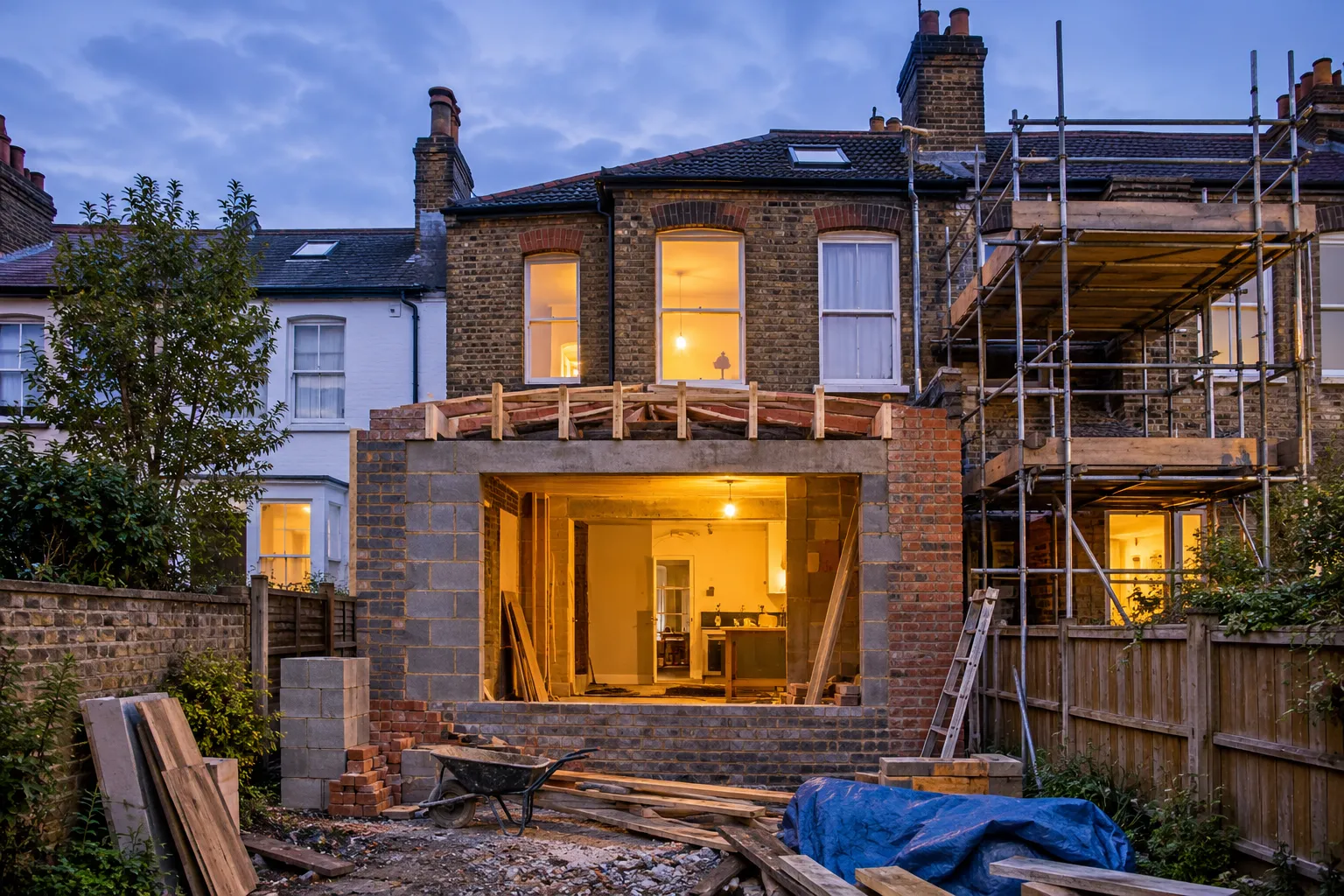
  • £2bn of London Building Work on Hold: FMB Says 35% of Homeowners Can’t Find a Builder They Trust, What It Means for Extensions and Party Wall Notices (November 2026)

    £2bn of London Building Work on Hold: FMB Says 35% of Homeowners Can’t Find a Builder They Trust, What It Means for Extensions and Party Wall Notices (November 2026)

    Thirty-five out of every hundred London homeowners have shelved a home improvement in the past five years simply because they could not find a builder they trust. That is not a vague impression. It is the headline finding from new research published by the Federation of Master Builders (FMB), and it points to a growing bottleneck that is now tangled up with London building work on hold party wall questions for anyone planning an extension, loft conversion, or basement dig.

    The timing matters. The FMB released its findings on 23 October 2026, just five days before the Autumn Budget, clearly aiming to put pressure on ministers to act. For homeowners, the practical question is different: if trustworthy builders are scarce and booked up for months, how do you avoid your project stalling even further once legal notices, neighbour disputes, and scheduling collide?

    Key Takeaways

    • 35% of London homeowners have delayed building work in the last five years because they could not find a trustworthy builder, the highest rate in the UK.
    • Stalled work is worth an estimated £2 billion a year in London alone, part of £11.2 billion nationwide.
    • More than a quarter of homeowners having work done were upgrading electrics, plumbing or heating to keep their homes safe.
    • Rising mortgage rates are pushing more Londoners toward extending rather than moving, adding pressure to an already stretched building trade.
    • Serving party wall notices early, while a reliable builder is still being found, prevents legal delays stacking on top of building delays.

    Why London Building Work on Hold Party Wall Delays Are Piling Up

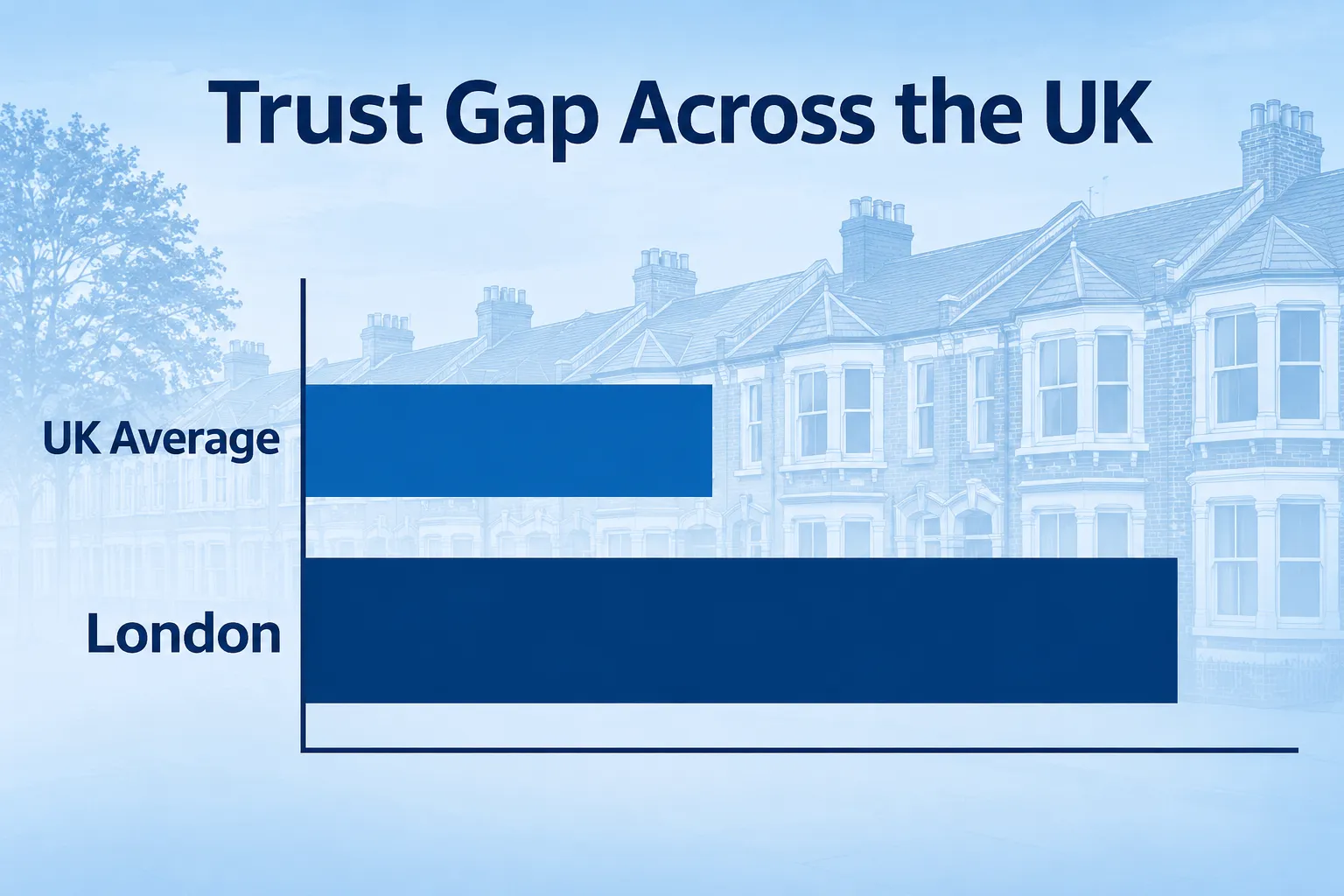
    London’s trust problem with builders is not evenly spread across the country. According to the FMB, the national average for homeowners delaying work due to lack of trust sits at around one in five. London’s rate of 35% is nearly double that, making it the worst-affected region in the UK.

    Why London Building Work on Hold Party Wall Delays Are Piling Up

    Tom Peardon, FMB London Director, put it bluntly: “London homeowners are the worst affected in the country.” That single line captures why the capital’s housing stock, much of it Victorian and Edwardian terraces sharing party walls, is facing a unique squeeze.

    The £2 billion of delayed work in London is part of a much larger national picture. Across the UK, the FMB puts the figure at £11.2 billion a year. Crucially, this is not all cosmetic spending being postponed. More than a quarter of homeowners having work done were upgrading electrics, plumbing or heating to keep their homes safe, improvements tied directly to safety rather than style.

    The FMB’s asks include:

    • Mandatory licensing of domestic building companies, so homeowners can check credentials before hiring.
    • Faster planning decisions for smaller developers and builders.
    • A UK-wide network of Build Academies to train the next generation of apprentices.

    Until any of that materialises, homeowners are left navigating a market where good builders are rare and in high demand.

    How Rising Mortgage Rates Are Adding Pressure

    There is a second force pushing Londoners toward extending rather than moving. Moneyfacts reported on 4 November 2026 that the average new mortgage rate had reached a three-year high of 5.89%, with the average two-year fixed rate at 5.97%. Moving house now carries a heavier borrowing cost than it did a year or two ago.

    The logical response for many owners is to stay put and improve what they already have: a side-return extension, a loft conversion, a basement dig, or a garden room. That decision adds even more demand onto a building sector already struggling to supply enough trusted labour, which is exactly why London building work on hold party wall issues are becoming more common rather than less.

    Party Wall Notices and London Building Work on Hold: What the Law Actually Requires

    Here is where many projects grind to an unexpected halt. Even once a trustworthy builder is finally booked, the legal clock on party wall matters has its own rules, and ignoring them can stall a project just as effectively as a missing tradesperson.

    Party Wall Notices and London Building Work on Hold: What the Law Actually Requires

    Under the Party Wall etc. Act 1996, which applies in England and Wales, building owners must serve formal notice before:

    Type of work Minimum notice period
    Work to a party wall or party structure 2 months
    Building a new wall at the line of junction 1 month
    Excavating within 3 metres of a neighbour’s structure (to a lower level than its foundations) 1 month
    Excavating within 6 metres where a 45-degree line from the neighbour’s foundations is cut 1 month

    Once a notice is served, the adjoining owner has 14 days to respond. If they dissent, or simply do not respond to a party structure or excavation notice, a dispute is deemed to have arisen automatically. At that point, surveyors are appointed to agree a party wall award before work can proceed. A schedule of condition recording the neighbour’s property is normally carried out before work starts, protecting both sides if damage is later disputed.

    One detail trips up many homeowners: a served notice lapses if work does not begin within 12 months. And the Party Wall Act process is entirely separate from planning permission and Building Regulations approval, so ticking one box does not tick the others.

    “Neighbours should not be left to find out a party wall project is happening when the scaffolding arrives.”

    Serving Notices Early Avoids Compounding Delays

    With good builders booked months in advance, the smartest move is to start the party wall notice process as soon as a project is confirmed, not after a contractor is finally secured. Because the response window and potential award process can take weeks, running it in parallel with the search for a builder, rather than afterward, prevents two separate delays from stacking on top of each other.

    Homeowners should also treat the trust problem the FMB has identified as a reason to vet contractors more carefully, not less. Before signing anything, check:

    • Proof of public liability insurance.
    • References from recent, comparable local jobs.
    • A written contract setting out scope, timescales, and payment stages.

    A trustworthy builder and a properly served party wall notice are two separate safeguards. Skipping either one is how projects stall for months.

    FAQ: London Building Work on Hold Party Wall Questions

    What percentage of London homeowners have delayed building work due to lack of trust in builders? The FMB’s October 2026 research found 35% of London homeowners had put off work in the last five years because they could not find a builder they trust, the highest rate in the UK.

    How much building work is currently on hold in London? The FMB estimates £2 billion a year of building work is delayed in London, part of a £11.2 billion total across the UK.

    Do I need a party wall notice for a loft conversion? If the work affects a shared party wall or structure, a notice is required with at least two months’ notice under the Party Wall etc. Act 1996.

    What happens if my neighbour does not respond to a party wall notice? If there is no response within 14 days to a party structure or excavation notice, a dispute is deemed to have arisen and surveyors are appointed to agree an award.

    Does a party wall notice replace the need for planning permission? No. The Party Wall Act process is entirely separate from planning permission and Building Regulations approval.

    How long does a served party wall notice remain valid? A notice lapses if the work does not begin within 12 months of being served.

    Conclusion

    The FMB’s findings make one thing clear: London’s building trade is under strain, and the trust gap between homeowners and contractors is now large enough to stall £2 billion of work a year. With mortgage rates pushing more owners toward extending rather than moving, demand for reliable builders will likely keep rising faster than supply.

    The practical response is to decouple the two sources of delay. Vet builders thoroughly using insurance checks, references, and written contracts, and start the party wall notice process the moment a project is confirmed rather than waiting for a contractor to be secured. Taking both steps early, rather than sequentially, is the clearest way to keep an extension, loft conversion, or basement project moving instead of joining the backlog.

  • Budget 2026 Promises No Major Building Regulation Changes This Parliament, But the Building Safety Levy and Future Homes Standard Still Land: What London Builders and Neighbours Need to Know (November 2026)

    Budget 2026 Promises No Major Building Regulation Changes This Parliament, But the Building Safety Levy and Future Homes Standard Still Land: What London Builders and Neighbours Need to Know (November 2026)

    The government has told the housebuilding industry something rare: stop bracing for change. The Autumn Budget, published Wednesday 28 October 2026, promised no major changes to building regulations in England for the rest of this Parliament. Yet in the same month, a new levy took effect and a major technical standard quietly locked in its 2027 start date. For London homeowners and developers planning works in 2027, this is a confusing moment, and it is exactly why Budget 2026 building regulations stability Building Safety Levy questions are now landing in surveyors’ inboxes daily.

    This article, written in November 2026, sets out what has actually changed, what has not, and how it interacts with the Party Wall etc. Act 1996 for anyone planning extensions, loft conversions, basements or infill schemes.

    Key Takeaways

    • The Budget’s “no major changes” pledge is a policy statement, not law, building-safety reforms and Grenfell Tower Inquiry work continue regardless.
    • The Building Safety Levy started on 1 October 2026 for qualifying major residential schemes, triggered by building control applications, not planning permission.
    • The Future Homes Standard (SI 2026/335) mostly takes effect 24 March 2027, with higher-risk-building provisions following on 24 September 2027.
    • Transitional protection exists for schemes with full-plans applications made before 24 March 2027 and work starting before 24 March 2028.
    • Party wall notices still run on their own statutory clocks (two months for a Party Structure Notice under section 3, one month for a Line of Junction Notice under section 1 or an excavation notice under section 6, with a 14-day response window in every case) and should be served early to avoid clashing with these regulatory deadlines.

    What the Budget 2026 Building Regulations Stability Building Safety Levy Pledge Actually Means

    The Budget wording is carefully limited. Ministers pledged stability on building regulations to give housebuilders certainty on costs and technical requirements. It is a statement of intent, not a statutory instrument, and it does not define “major change.” Two carve-outs matter:

    What the Budget 2026 Building Regulations Stability Building Safety Levy Pledge Actually Means
    • Building-safety improvements, including Grenfell Tower Inquiry recommendations, continue unaffected.
    • Ministers may still introduce “more proportionate” rules if they support development.

    So “stability” does not mean “frozen.” Existing law already in the pipeline, including the levy and the Future Homes Standard, proceeds exactly as scheduled.

    The Building Safety Levy: Already Live Since 1 October 2026

    The Building Safety Levy came into force on 1 October 2026. It applies to major residential developments of 10 or more dwellings, or 30 or more purpose-built student bed spaces, where the building control application is submitted on or after that date.

    Key mechanics, according to Walker Morris (October 2026):

    Feature Detail
    Trigger Building control application date, not planning permission
    Liability Falls on the named client
    Calculation Chargeable gross internal area, RICS Code of Measuring Practice (6th edition)
    Rates Vary by local authority
    Discount 50% for previously-developed land
    Payment point Due at completion notice or first occupation
    Enforcement Non-payment can block completion certificates

    For most individual householder extensions and loft conversions, the levy’s scale thresholds mean it will not apply. But for larger infill schemes, flat conversions, or small blocks reaching ten units, it is now a real cost line that affects viability and cashflow planning.

    Future Homes Standard: Dates Already Fixed

    The Future Homes Standard regulations, SI 2026/335, were made on 23 March 2026. They are unaffected by the Budget’s stability pledge because they are already law. Key dates:

    • Most provisions, including the Part L changes and an on-site renewable electricity requirement for new dwellings, take effect 24 March 2027.
    • Certain higher-risk-building provisions follow on 24 September 2027.
    • Transitional protection applies where notices or full-plans applications were submitted before 24 March 2027 and work commences before 24 March 2028.

    Developers with schemes close to these thresholds should check whether submitting a full-plans application before March 2027 preserves the current, less onerous technical route.

    OBR’s Warning on Housing Supply

    The Office for Budget Responsibility, in its 28 October 2026 forecast, cut its UK net housing additions projection by 190,000 over the forecast period, citing higher interest rates, affordability pressures and regulatory costs. This is a reminder that policy stability alone does not remove the financial headwinds facing London schemes.

    OBR's Warning on Housing Supply

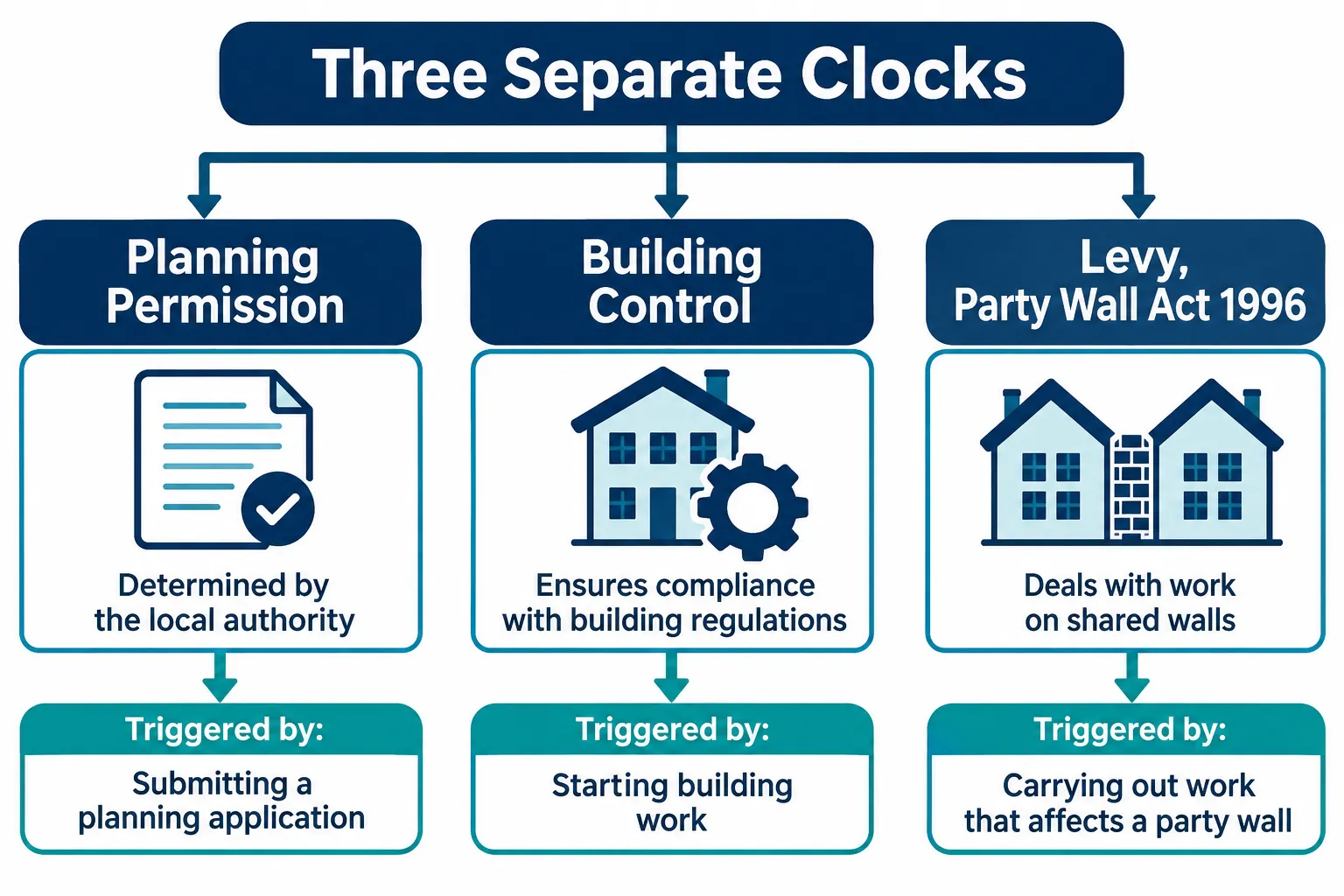
    Planning, Building Regs and the Party Wall Act: Three Separate Clocks

    Homeowners often assume these three consents move together. They do not.

    • Planning permission governs land use, design and external impact.
    • Building regulations/building control governs structural safety, fire, energy and now triggers the Building Safety Levy where applicable.
    • The Party Wall etc. Act 1996 governs work affecting shared walls, boundaries and excavations near a neighbour’s foundations, entirely separate from planning or building control approval.

    A project can have planning permission and a building control application in progress while the party wall notice has not even been served yet, and that is often where delays start.

    Why Serving Party Wall Notice Early Matters Before March 2027

    Party wall notices carry statutory response periods set by the Party Wall etc. Act 1996: a Party Structure Notice under section 3, covering works to an existing party wall or structure, requires at least two months’ notice. A Line of Junction Notice under section 1, for a new wall built at or astride the boundary, and a notice for adjacent excavation under section 6, each require at least one month’s notice. In every case, the adjoining owner has 14 days to respond, after which a dispute is deemed to have arisen if no consent is given.

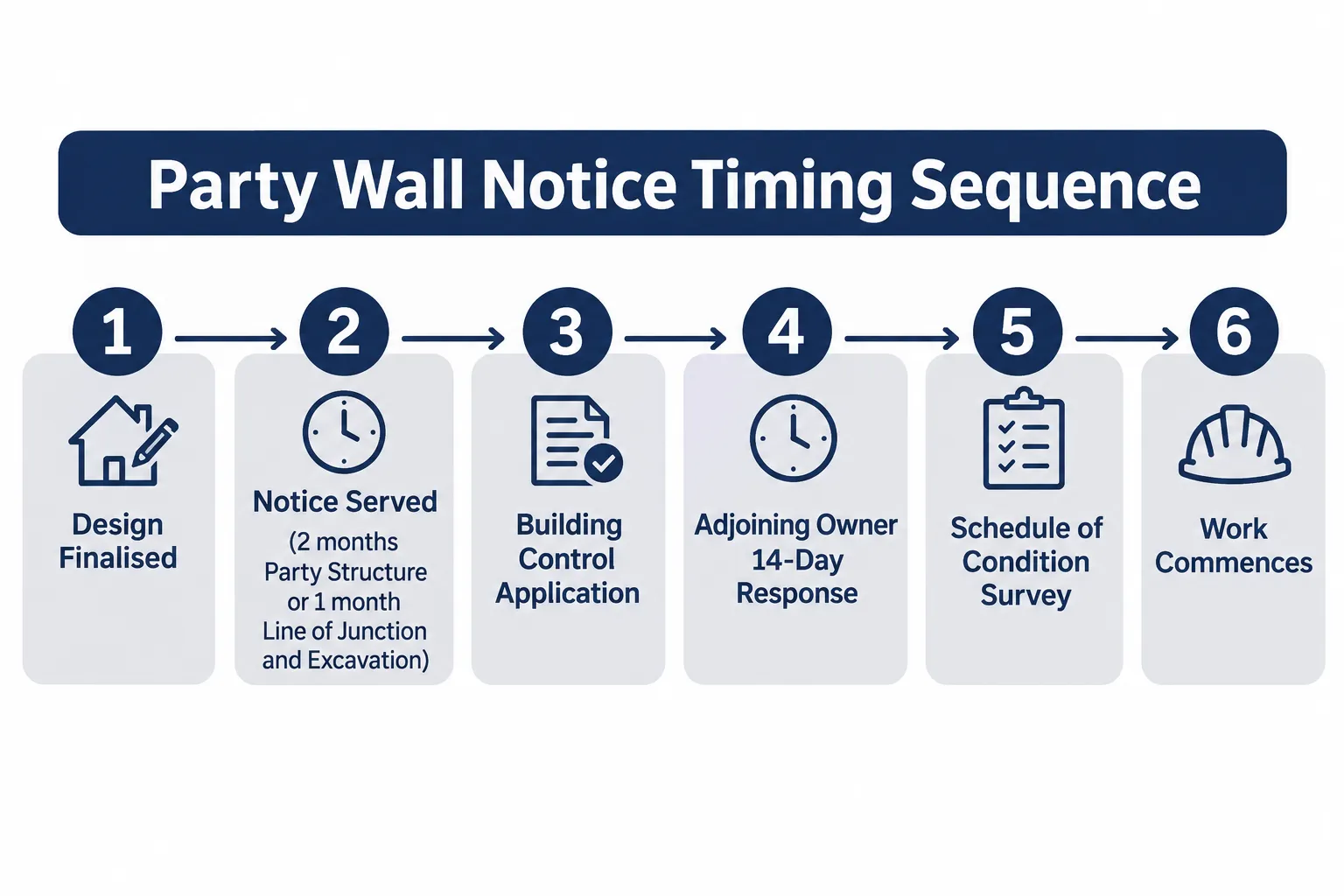
    For anyone targeting a 2027 start date ahead of the Future Homes Standard’s 24 March deadline, this timing matters:

    1. Design and specification finalised.
    2. Party wall notice served, starting the one- or two-month statutory clock immediately depending on notice type.
    3. Building control application submitted, check levy and Part L implications.
    4. Adjoining owner responds within 14 days, consents, or a surveyor is appointed.
    5. Schedule of Condition survey carried out to protect both parties.
    6. Work commences once notices have run their course and approvals are in place.

    Leaving the party wall notice until after building control is agreed risks losing weeks that cannot be recovered once a transitional deadline has passed. A Schedule of Condition, prepared before work starts, remains the best protection against later disputes over cracks or damage, regardless of which regulatory regime applies.

    FAQ

    Does the Budget mean building regulations are frozen for London extensions? No. It is a policy pledge to avoid major new changes, not a block on existing scheduled law like the Future Homes Standard or Building Safety Levy.

    Will my loft conversion be hit by the Building Safety Levy? Most single-dwelling projects fall below the 10-dwelling or 30-bed-space thresholds, so the levy typically will not apply, but larger conversions and infill blocks should check carefully.

    When does the Future Homes Standard actually start? Most provisions apply from 24 March 2027, with higher-risk-building elements following on 24 September 2027, subject to transitional protections.

    Does a party wall notice depend on building control approval? No. The Party Wall etc. Act 1996 runs independently of planning and building control timelines, with its own two-month or one-month notice periods depending on the works involved.

    Should I get a Schedule of Condition before neighbouring works start? Yes, it is strongly advisable for both the building owner and adjoining owner, to record the pre-works condition of shared structures.

    Conclusion

    The headline from Budget 2026 is reassurance, but the real-world deadlines have not moved. The Building Safety Levy is already live, and the Future Homes Standard’s March 2027 start date is fixed in law. For London homeowners and developers, the practical priority is sequencing: finalise designs, serve party wall notices promptly under the correct statutory period, and check building control timing against these dates. Anyone unsure how these rules interact with their specific project should take professional advice from a RICS-regulated surveyor before works begin.

  • Building Regulations Freeze Budget 2026 Home Extensions London: What Homeowners Need to Know

    Chancellor John Healey used eleven words buried in the Autumn Budget to change the calculus for thousands of London homeowners planning loft conversions and rear extensions: no major Building Regulations changes until the next election. That single commitment, delivered on 28 October 2026, has sent builders, architects and party wall surveyors scrambling to work out what it actually means on the ground.

    The Building Regulations freeze Budget 2026 home extensions London announcement is not about party walls, boundaries or neighbour disputes. It is about the technical construction standards that govern insulation, ventilation, fire safety and structural design. But for anyone about to start building work close to a shared wall or boundary, understanding what has changed, and, just as importantly, what has not, matters enormously.

    Key Takeaways

    • The Budget 2026 freeze pauses major Building Regulations changes for the rest of this Parliament, aiming to give builders cost and timescale certainty.
    • Building-safety reforms linked to the Grenfell Tower Inquiry are specifically excluded from the freeze, as is Gateway 2 for higher-risk buildings.
    • The Budget document does not name which specific planned updates (such as future energy-efficiency rules) are paused, so homeowners should treat claims about exact scope cautiously.
    • The Party Wall etc. Act 1996 is completely unaffected. Notice periods, surveyor appointments and awards work exactly as before.
    • With stamp duty and mortgage rates making moving expensive, more London owners are extending rather than relocating, making party wall compliance more relevant than ever.

    What the Budget 2026 Building Regulations Freeze Actually Says

    The government’s position, set out alongside the wider Autumn Budget package, is that it will hold back major changes to Building Regulations for the remainder of the current Parliament. The stated aim is to give builders and developers greater certainty and to cut the cost of compliance, after years of shifting technical standards.

    Three things are important to flag honestly:

    1. Building-safety reforms are excluded. Anything stemming from the Grenfell Tower Inquiry recommendations continues as planned.
    2. Gateway 2 is untouched. The pre-construction control point for higher-risk buildings under the Building Safety Act continues to operate as normal.
    3. Smaller tweaks remain possible. Officials have left room for amendments that make existing requirements “more proportionate”, in other words, simplifications rather than new burdens.

    Crucially, the Budget document does not list which specific forthcoming changes are now paused. It is not officially confirmed, for example, whether planned future energy-efficiency updates to Part L are among those held back. Homeowners and builders should wait for departmental guidance rather than assume full details.

    Why the Freeze Happened: The OBR’s Warning

    The Office for Budget Responsibility gave the Treasury a blunt assessment: regulatory and fiscal changes since 2019 have “increased the cost, complexity and timescales of residential development.” The OBR reduced its net housing additions forecast by 190,000 homes, citing this regulatory drag as a contributing factor.

    That analysis appears to have influenced the decision to pause further technical changes, a signal that government wants stability in the construction sector rather than another wave of compliance costs.

    Why London Homeowners Are Choosing to Extend, Not Move

    The freeze lands at a moment when several other financial pressures are pushing London homeowners toward home improvement rather than relocation:

    Factor Current Position
    Stamp duty (over £1.5m) 12 percent, unchanged
    Stamp duty (£250k,£925k band) 5 percent
    Mansion tax Confirmed at £2m threshold from April 2028
    Fixed mortgage rates Rose in October 2026
    Bank Rate Expected to rise to 4 percent on 5 November 2026

    With moving costs elevated and borrowing more expensive, loft conversions, rear extensions and basement digs remain attractive ways to add space without triggering stamp duty or a new mortgage deal. The Building Regulations freeze Budget 2026 home extensions London policy reinforces this trend by promising technical stability for anyone starting a project now.

    It is also worth briefly noting reported changes, said to take effect from 31 October 2026, that would delegate many householder extension planning applications in England to planning officers rather than committees. This is a separate, reported development and should be treated cautiously until confirmed by formal planning guidance, but it adds to a picture of a system trying to speed up the approval pipeline for home extensions.

    What the Freeze Does Not Touch: The Party Wall etc. Act 1996

    This is the point many homeowners miss. The Budget 2026 Building Regulations freeze has no bearing whatsoever on the Party Wall etc. Act 1996. Building Regulations and party wall law are entirely separate legal frameworks, administered under different legislation with different purposes.

    If a project involves any of the following, the Act still applies in full:

    • Work directly to a shared wall or structure between two properties
    • Building a new wall at or astride the boundary line
    • Excavating within 3 metres of a neighbour’s building where the new foundations go deeper than theirs
    • Excavating within 6 metres where a line drawn at 45 degrees from the neighbour’s foundation would be cut by the new work

    Notice Periods Remain Unchanged

    “The freeze is about construction standards, not neighbour consent. Anyone skipping party wall notice on the assumption that ‘the rules have changed’ is making a costly mistake.”

    • Section 1 (new walls on the boundary): one month’s notice
    • Section 2 (works to an existing party wall): two months’ notice
    • Section 6 (excavations near a neighbour’s foundations): one month’s notice

    Neighbours then have 14 days to respond. If they consent, work can proceed. If they dissent or fail to respond, a surveyor, either one agreed by both parties or one appointed by each side, must be brought in.

    The Surveyor Process Still Applies

    • A schedule of condition is typically prepared before work starts, recording the existing state of the neighbouring property.
    • An award is then drawn up, setting out what work is permitted, how it will be carried out, and how any damage will be resolved.
    • Disputes are resolved through the surveyor mechanism, not through planning or Building Regulations officers.

    Practical Checklist for London Loft Conversions, Extensions and Basements

    For anyone starting a project under the current climate, the following steps remain essential regardless of the regulatory freeze:

    1. Confirm whether the Act applies, check boundary proximity and excavation depth against the 3m/6m rules.
    2. Serve notice early, two months ahead for party wall works, one month for new boundary walls and excavations.
    3. Commission a schedule of condition before any work begins, especially for loft conversions affecting shared roof structures.
    4. Appoint a surveyor promptly if a neighbour dissents, to avoid delaying the project.
    5. Check Building Regulations compliance separately, the freeze affects future changes, not current baseline requirements, which still apply in full.
    6. Monitor planning delegation changes for extensions, as reported adjustments to decision-making may affect timescales.
    7. Budget for rising finance costs, given expected Bank Rate movement in November 2026.

    FAQ

    Does the Building Regulations freeze mean current rules no longer apply? No. Existing Building Regulations remain fully in force. The freeze only pauses major future changes for the rest of this Parliament.

    Does the freeze affect party wall notices or surveyor fees? No. The Party Wall etc. Act 1996 is a separate piece of legislation and is completely unaffected by the Budget announcement.

    Are energy-efficiency rules frozen too? This is not confirmed. The Budget document does not specify which planned changes are paused, so homeowners should seek current departmental guidance before assuming any particular rule is on hold.

    Does Gateway 2 still apply to higher-risk buildings? Yes. Gateway 2 continues to operate exactly as before; it is explicitly excluded from the freeze.

    Will the freeze speed up my extension project? It should create more cost certainty for builders, but it does not remove the need for planning permission, Building Regulations approval, or party wall notices where applicable.

    Conclusion

    The Budget 2026 Building Regulations freeze is a significant signal of policy stability for London’s construction sector, but it changes less than many homeowners assume. Technical standards stay as they are for now; building-safety reforms and Gateway 2 continue unaffected; and critically, the Party Wall etc. Act 1996 operates exactly as it did before the Budget. Anyone planning a loft conversion, extension or basement in London should still serve notice on time, secure a schedule of condition, and appoint a surveyor where needed. The freeze offers reassurance on cost and complexity, it does not remove the legal obligations owed to neighbours. Speak to a qualified party wall surveyor before starting any boundary-adjacent work to stay compliant and avoid disputes.

  • From 31 October 2026, Planning Officers Decide Extensions: What London Homeowners Need to Know

    Three days from now, the rules for who approves your loft conversion or rear extension change permanently. Starting 31 October 2026, planning officers decide extensions in nearly every London borough, stripping ward councillors and planning committees of the power to intervene in most householder applications. If you are currently drawing up plans, or you have a neighbour who is, this shift matters more than most people realise.

    This is not a tweak to planning policy. It is a structural overhaul of who holds the pen on your decision notice. And it arrives alongside a separate, unchanged legal duty that still trips up homeowners every year: the Party Wall Act 1996.

    Key Takeaways

    • From 31 October 2026, planning officers decide extensions and loft conversions under a new National Scheme of Delegation, committees are no longer involved in standard householder applications.
    • Ward councillors can no longer “call in” applications, and public objection numbers no longer force a committee hearing.
    • Larger schemes (Schedule 2) can still reach committee, but only if they pass a statutory significance test and get sign-off from both a senior officer and a nominated councillor.
    • Planning permission and Party Wall Act consent remain entirely separate. Getting planning approval does not remove your legal duty to serve party wall notices.
    • Homeowners should align their party wall notice timeline with their planning application from the outset, not after approval lands.

    Why Planning Officers Decide Extensions From 31 October 2026

    The change comes from the Town and Country Planning (Discharge of Local Planning Authority Functions) (England) Regulations 2026, following government guidance published on 1 June 2026. It introduces a National Scheme of Delegation that every council in England must adopt.

    Under Schedule 1 of the new scheme, officers, not committees, must decide:

    • Householder applications, including extensions and loft conversions
    • Minor commercial development
    • Minor residential development of up to 9 homes on sites under 0.5 hectares
    • Reserved matters and discharge of conditions
    • Prior approval for permitted development rights
    • Permission in principle
    • Non-material amendments
    • Certificates of lawfulness
    • Biodiversity gain plans

    This is the category almost every London homeowner’s extension, side return, or loft conversion falls into. Once the scheme applies, your application goes to a planning officer’s desk for a delegated decision. There is no councillor vote, no committee agenda item, and no public meeting where neighbours can argue their case in person.

    When a Committee Can Still Get Involved

    Larger or more complex schemes move to Schedule 2. Even there, committee referral is now the exception rather than the norm. For a Schedule 2 application to reach committee, it must pass a statutory significance test, and both a nominated senior planning officer and a nominated committee member must agree to the referral.

    Exceptions also apply where an application is linked to listed building consent, is retrospective under section 73A, or is submitted by or on behalf of the council itself. These cases bypass the officer-only route and can still go to committee without the significance test.

    Councils are required to update their constitutions to reflect these rules and publish records of every referral decision. Planning committees themselves are now capped at 13 councillors. Legal commentary, including guidance from law firm Freeths, has warned that committee decisions made in breach of the new scheme could be vulnerable to judicial review.

    What Changes in Practice for Homeowners

    The headline effect: ward councillors can no longer call applications in, and a set number of public objections no longer automatically triggers a committee hearing. For years, a vocal group of neighbours writing to their councillor could sometimes force a straightforward extension into a committee room, adding months of delay and uncertainty. That route has effectively closed for standard householder schemes.

    This has several practical consequences.

    More consistency, less local politics. Decisions now rest on planning policy and officer judgement rather than ward-level lobbying. A well-designed, policy-compliant extension should move through the system on its merits.

    Design compliance matters more than ever. Since officers are applying published planning policy directly, schemes that sit comfortably within permitted development thinking and local design guidance are far more likely to sail through without drama.

    Objections still count, but differently. Neighbours can still object, and officers must consider those objections. What has changed is that objections alone no longer force escalation to committee. The officer weighs them against policy and decides.

    Faster, but not guaranteed faster for everyone. Removing the committee bottleneck should reduce delay for the vast majority of standard cases. Complex or controversial Schedule 2 schemes may still face the same scrutiny as before.

    Permitted Development Limits Have Not Moved

    It is worth stressing: this reform changes who decides, not what you’re allowed to build. The physical limits for permitted development remain exactly as they were.

    Type of work Limit
    Single-storey rear extension (terraced/semi) 3m, extendable to 6m under prior approval
    Single-storey rear extension (detached) 4m, extendable to 8m under prior approval
    Two-storey rear extension 3m
    Maximum single-storey height 4m
    Loft conversion volume (terraced) 40m³
    Loft conversion volume (detached/semi) 50m³
    Garden coverage No more than 50% built on

    Under the prior approval neighbour consultation scheme, neighbours still get 21 days to comment, and the council still has 42 days to decide. None of that machinery has changed, only the committee layer above standard applications has gone.

    Planning Officers Decide Extensions, But the Party Wall Act Still Applies

    This is the point many homeowners miss, and it is the one that causes real problems on site. Planning permission and Party Wall Act consent are two completely separate legal processes. Securing a swift decision from a planning officer does nothing to discharge your duty under the Party Wall Act 1996.

    If your project involves:

    • Work to a shared wall with a neighbour
    • Building on or astride the boundary line
    • Excavating within 3 metres (or 6 metres in some cases) of a neighbour’s foundations, where your work goes below their foundation level

    …you must serve formal notice. The standard timeframes are two months’ notice for party structure works, and one month’s notice for new walls at the boundary and for adjacent excavation. Neighbours then have 14 days to respond. If they dissent, the matter proceeds to a Party Wall Award, prepared by either an agreed surveyor or two surveyors, one appointed by each side.

    Planning approval tells you that you can build. The Party Wall Act governs how you build next to a neighbour. One does not replace the other.

    Timing Your Notices Around the New Decision Process

    With planning officers now deciding extensions faster and with fewer delays, many homeowners may find themselves approved and ready to build sooner than expected. That makes early party wall planning even more important. Serve notices once your design is settled, ideally while your planning application is still being assessed, rather than waiting for the decision notice to land. This avoids a scenario where planning is approved but party wall matters stall your start date by weeks or months.

    FAQ

    Does the 31 October 2026 change affect permitted development rights? No. Permitted development limits and the prior approval process remain unchanged. Only the decision-making route for applications requiring full planning permission has shifted.

    Can my neighbours still object to my extension after this change? Yes. Objections are still considered by the planning officer. What has ended is the automatic escalation to committee based on objection numbers.

    Will my application be decided faster now that planning officers decide extensions? Likely yes for standard householder applications, since the committee bottleneck is removed. Complex or Schedule 2 cases may still take longer.

    Do I still need Party Wall Act notice if I have planning permission? Yes. Planning permission and the Party Wall Act are entirely separate legal requirements. Planning approval does not substitute for party wall notice or consent.

    What happens if my neighbour dissents to my party wall notice? A Party Wall Award is prepared, either by a surveyor agreed by both parties or by two surveyors, one for each side, resolving the terms of the works.

    Can a council still send my extension to committee? Only if it falls under Schedule 2 and passes the statutory significance test with sign-off from a senior officer and a nominated committee member, or falls under specific exceptions like listed building links or retrospective applications.

    Conclusion

    The move to officer-only decisions for standard applications marks one of the most significant procedural shifts in English planning in years. For London homeowners, the message is clear: policy-compliant, well-prepared extension plans should move through the system more predictably once planning officers decide extensions without committee interference. But this reform says nothing about your neighbour’s legal rights under the Party Wall Act 1996.

    Before you submit your application or break ground, get your party wall notices drafted and timed correctly. Speak with Party Wall Surveyor London to confirm your notice requirements, align your timeline with your planning submission, and avoid a situation where a fast planning decision is undermined by an unresolved party wall dispute.

  • Extend Instead of Move: Party Wall Rules for London in October 2026

    A £350,000 London move now costs roughly £7,500 in stamp duty alone, before legal fees, agents, surveys, and removals push the total toward £13,000 or higher. Add a mortgage market where five-year fixes average 6%, and the maths behind staying put and building out has rarely looked more compelling. This is why the decision to extend instead of move party wall London October 2026 planning is becoming the default conversation for homeowners across the capital.

    Budget Week adds another layer of uncertainty. With the Autumn Budget landing on 28 October 2026, and a possible Bank Rate rise expected on 5 November, timing matters as much as design. This guide explains the financial backdrop and walks through the Party Wall etc. Act 1996 checklist every London owner needs before breaking ground.

    Key Takeaways

    • Average five-year fixed mortgage rates have reached around 6%, making a fresh mortgage for moving far more expensive than staying put.[1][2]
    • London sales activity is weakening: agreed sales are down, 38% of listings have had price cuts, and average asking prices have fallen 1.7% year-on-year.
    • Moving costs average roughly £13,000 in 2026, rising above £20,000 for higher-value London properties.
    • The Party Wall etc. Act 1996 still governs extensions, loft conversions, and basement digs unchanged, no Budget reform is expected.[3][4][5]
    • Serving notices early, before Budget Week rate shifts, protects project timelines and budgets.

    Why Extend Instead of Move: The Party Wall London October 2026 Calculation

    Owners who locked in cheap mortgages years ago face a harsh reset if they sell and rebuy today. Average five-year fixes sit near 6%, two-year fixes around 5.97%, and standard variable rates have climbed above 7.1%.[2] Even at 70-80% loan-to-value, two-year deals from mainstream lenders like Gen H are pricing around 6.04%.

    Meanwhile, the Bank of England base rate has held at 3.75% through 2026, but that has not translated into cheaper headline mortgage products, with some home loans still priced near 8.2%.[6][7][8] Tracker mortgages have become more attractive relative to fixes, though they carry future-rate risk.[9]

    Pull quote: “Many owners on legacy sub-3% deals would see their monthly payments jump significantly simply by moving house in today’s market.”

    Layer on London’s softening sales market, agreed sales down nationally by 8%, buyer enquiries down 9%, and 38% of London listings carrying price reductions, and the case to extend instead of move strengthens further. Average London asking prices have slipped 1.7% year-on-year to £673,942, with ONS data showing a 2.2% annual decline across the capital.

    The Real Cost of Moving vs Building Out

    Cost Item Moving (Typical) Extending (Typical)
    Stamp duty (£350k purchase) ~£7,500 None
    Agent + legal fees ~£4,000,£6,000 Minimal
    Survey costs ~£500,£1,500 Structural survey only
    Removals ~£1,000,£2,000 None
    Party wall surveyor fees None £700,£1,500+ per surveyor
    Total estimate £13,000,£20,000+ Project-dependent, no transaction tax

    Nearly one in 15 homes in England and Wales now carries an “Improvement Indicator” after substantial works, with over 103,000 homes added to this VOA register in a single year, evidence that extending has become a mainstream strategy, not a niche one.

    Extend Instead of Move: Party Wall London October 2026 Legal Basics

    The Party Wall etc. Act 1996 applies regardless of what happens in the Budget. Pre-Budget housing briefings focus on planning reform, energy efficiency, and skills, not neighbour-law changes.[3][4][5] Assume the existing framework applies unchanged.

    Section 1: Building a New Wall at the Boundary

    Covers constructing a wall astride or up to the boundary line with a neighbouring property. Requires a Line of Junction Notice with one month’s notice before work starts.

    Section 2: Works to an Existing Party Wall

    Covers cutting into, raising, underpinning, or demolishing and rebuilding a shared wall, common in loft conversions and rear extensions. Requires a Party Structure Notice with two months’ notice.

    Section 6: Excavation Near a Neighbour’s Foundations

    Applies to basement digs or deep foundations within 3 metres (if deeper than the neighbour’s foundations) or 6 metres (depending on depth and angle) of a neighbouring structure. Requires one month’s notice.

    The Notice and Response Process

    1. Serve notice in writing, specifying the proposed works and start date.
    2. Neighbour has 14 days to respond: consent, dissent, or stay silent (silence counts as dissent after 14 days).
    3. If consent is given, works can proceed as planned.
    4. If dissent occurs, an agreed surveyor (one surveyor for both parties) or two surveyors (one per party) must be appointed.
    5. Surveyors prepare a schedule of condition of the neighbouring property to protect both sides from later disputes.
    6. Surveyors issue a party wall award, detailing permitted works, access rights, working hours, and making-good obligations.
    7. Works must start within the validity period set by the notice or award, typically 12 months.

    Who Pays for Party Wall Surveyors

    Generally, the building owner (the person extending) pays all reasonable surveyor fees, including the neighbour’s appointed surveyor if one is appointed. This applies even where the neighbour’s objection seems minor.

    Timing Works Around Budget Week and Rate Decisions

    With the Budget set for 28 October 2026, stamp duty changes have reportedly been ruled out, but the Boiler Upgrade Scheme’s £7,500 grant may face cuts. Neither directly touches party wall law, but both affect overall project budgets for energy-efficient retrofits bundled into extensions.

    Given that mortgage deals are repricing within days and attractive further-advance rates can vanish quickly, owners should secure financing early rather than waiting for Budget clarity.[9][10] Serving party wall notices in parallel, rather than after planning permission is finalised, avoids the common bottleneck where the 14-day dissent window and surveyor appointment process add weeks to a project timeline.

    RICS data shows new buyer enquiries fell sharply earlier in 2026, reinforcing that the sales market remains soft while rates stay elevated, another reason many are choosing to extend instead of move through party wall London October 2026 projects rather than wait for a market recovery.

    Permitted Development and Planning Considerations

    Many single-storey rear extensions, loft conversions, and some outbuildings fall under permitted development rights, avoiding full planning applications. However, permitted development does not remove the need for Party Wall Act compliance, these are separate legal regimes. Even approved planning or permitted development works affecting a shared wall or nearby foundations still require notices.

    Practical Checklist for London Extensions

    • Confirm whether works are notifiable under Section 1, 2, or 6.
    • Identify all affected neighbours and shared structures.
    • Draft and serve correct notices in writing, with clear start dates.
    • Allow the full statutory notice period (one or two months).
    • Track the 14-day response window carefully.
    • Appoint surveyor(s) promptly if dissent occurs.
    • Commission a schedule of condition before work begins.
    • Obtain a signed party wall award before any notifiable work starts.
    • Confirm financing is secured and rate-locked ahead of Budget Week volatility.

    FAQ

    Does the Party Wall Act change because of the Autumn Budget? No. Pre-Budget briefings focus on planning and energy policy, not party wall law. The Act remains unchanged.[3][4][5]

    How long does the party wall process take? Minimum one to two months for notice periods, longer if a neighbour dissents and surveyors are appointed.

    Can I start work before serving notice? No. Starting notifiable work without proper notice can lead to injunctions or forced remedial costs.

    Who pays if my neighbour appoints their own surveyor? The building owner typically pays both surveyors’ reasonable fees.

    Is extending cheaper than moving in 2026? Often yes, given moving costs near £13,000,£20,000 plus mortgage resets near 6%, though individual project costs vary.

    Do I need a schedule of condition? Strongly recommended. It protects both parties from disputes over pre-existing damage once work finishes.

    Conclusion

    High mortgage rates, a softening London sales market, and steep transaction costs are pushing owners to extend instead of move through party wall London October 2026 projects rather than relist and rebuy. The Party Wall etc. Act 1996 remains the governing framework, unaffected by Budget Week announcements. The practical path forward: confirm notifiable works early, serve notices without delay, secure financing before rates shift further, and engage a qualified party wall surveyor to keep the project compliant and on schedule.

    Party Wall Notice Calculator .cg-pw-wrap{max-width:600px;margin:0 auto;font-family:Arial,sans-serif;border:1px solid #ddd;border-radius:8px;padding:20px;background:#fafafa} .cg-pw-wrap h2{font-size:18px;color:#1a3c6e;margin-top:0} .cg-pw-wrap select,.cg-pw-wrap button{width:100%;padding:10px;margin:8px 0;border-radius:5px;border:1px solid #ccc;font-size:15px} .cg-pw-wrap button{background:#1a3c6e;color:#fff;border:none;cursor:pointer} .cg-pw-wrap button:hover{background:#13305a} .cg-result{background:#fff;border-left:4px solid #1a3c6e;padding:12px;margin-top:12px;border-radius:4px;font-size:14px} .cg-result strong{color:#1a3c6e}

    Which Party Wall Notice Do I Need?

    New wall at/astride the boundary Cutting into or altering a shared wall (loft conversion, chimney breast) Excavation/basement dig near neighbour’s foundations
    Select a work type and click the button.
    function cgCalc(){ var v=document.getElementById(‘cg-work’).value; var out=document.getElementById(‘cg-out’); var data={ s1:{act:”Section 1″,notice:”1 month”,desc:”You must serve a Line of Junction Notice at least one month before starting work.”}, s2:{act:”Section 2″,notice:”2 months”,desc:”You must serve a Party Structure Notice at least two months before starting work.”}, s6:{act:”Section 6″,notice:”1 month”,desc:”You must serve an Excavation Notice at least one month before starting, if within 3m or 6m of neighbouring foundations.”} }; var d=data[v]; out.innerHTML=”“+d.act+” applies.
    Required notice period: “+d.notice+”
    “+d.desc+”

    Neighbour has 14 days to respond once served.”; }

    References

    1. C8r4yxpry5e9o. bbc.co.uk.
    2. Mortgage Rates. forbes.com.
    3. Autumn Budget 2026. housing.org.uk.
    4. Autumn Budget 2026. fmb.org.uk.
    5. Autumn Budget 2026 What Regeneration Leaders Need to Know. mondaq.com.
    6. Bos Rate Guide Spec Remo. bankofscotland.co.uk.
    7. Latest Mortgage Rates. santanderforintermediaries.co.uk.
    8. Mortgage Rates. mpamag.com.
    9. UK Interest Rates. ft.com.
    10. 26647986.mortgage Rate Warning Cheap Deals Disappear Within Days. yourlocalguardian.co.uk.
  • Empty House Next Door? What England’s New Six-Month Empty Homes Powers from 5 November 2026 Mean for Party Wall Notices in London

    Fewer than half of English councils have an empty-homes strategy, yet over 359,000 UK homes have sat empty for more than six months. From 5 November 2026, the threshold for a council to seize management control of such a property dropped sharply, and if that empty house happens to share a wall with yours, the rules around an empty adjoining property party wall notice EDMO November 2026 just became a lot more relevant to London homeowners planning building work.

    This change does not rewrite the Party Wall etc. Act 1996. But it does change who you might deal with, how hard it is to find an owner, and why your paperwork needs to be airtight before you dig a single footing.

    Key Takeaways

    • From 5 November 2026, councils can seek an interim Empty Dwelling Management Order (EDMO) after just six months of vacancy, down from two years.
    • An EDMO transfers management, not ownership, party wall notices must still go to the registered owner, not the council.
    • The Party Wall Act 1996 is unchanged; Section 15 still lets you serve notice on “The Owner” and fix it to the property if the owner cannot be traced.
    • Empty neighbouring properties carry higher risk of undetected damp, cracking, or subsidence, a detailed schedule of condition is essential.
    • Councils running an EDMO may become a useful contact for access and inspections, even though they are not the legal adjoining owner.

    What Is Changing on 5 November 2026

    Under the Housing (Empty Dwelling Management Orders) (Prescribed Period of Time and Prescribed Requirements) (England) (Amendment) Order 2026 (SI 2026/1085), councils can apply to the First-tier Tribunal (Property Chamber) for an interim EDMO once a dwelling has been empty for six months. This restores the original Housing Act 2004 threshold, reversing a 2012 change that had stretched it to two years.

    Councils no longer need to prove nuisance or demonstrate community support. They must still:

    • Make reasonable efforts to notify the owner and establish their intentions
    • Give at least three months’ written notice (or show all reasonable efforts to do so)
    • Respect exceptions, homes genuinely marketed for sale or let, holiday homes, owners temporarily absent for care or armed-forces service, and homes of deceased owners (excepted until six months after probate)

    Applications lodged before 5 November 2026 stay under the old two-year rules. Propertymark, reporting on the change on 23 October 2026, stressed EDMOs “should be used only as a last resort,” noting only around a quarter of councils even have a dedicated empty-homes budget.

    Crucially, an interim EDMO gives the council landlord-style management rights but not ownership. The council needs the owner’s consent to let the property during the interim period. Only a final EDMO, which can run up to seven years, allows letting without consent.

    Why This Matters for an Empty Adjoining Property Party Wall Notice EDMO November 2026 Situation

    If you are planning works under the Party Wall Act, excavating near a boundary, building on the line of junction, or working directly on a shared wall, you must serve notice on the “adjoining owner.” That means the freeholder and any leaseholder holding a tenancy of more than one year.

    An EDMO does not change who that adjoining owner is in law. Even where a council manages an empty property next door, your empty adjoining property party wall notice EDMO November 2026 obligations remain owed to the registered title holder, not the local authority.

    That said, the council’s involvement can be genuinely useful in practice:

    • The council’s empty-homes team may hold up-to-date contact details for the owner
    • They may be able to arrange access for a schedule of condition survey
    • They can confirm whether an EDMO application is pending, which signals a property has been vacant and potentially neglected for some time

    Pull quote: “An EDMO changes who manages the house next door, it does not change who you must legally notify under the Party Wall Act.”

    Finding and Serving the Owner When a Property Is Empty

    Locating an absent owner is often the hardest part of the process, EDMO or not. Recommended steps:

    1. Check HM Land Registry. A title register costs £7 and usually reveals the registered proprietor and any mortgage lender’s address.
    2. Serve by post to the empty property itself and to any address shown on the register, including a solicitor or mortgagee if listed.
    3. Use Section 15 if the owner is unknown. The Party Wall Act allows notice to be addressed to “The Owner” and physically fixed to a conspicuous part of the premises.
    4. Wait 14 days. If there is no response, a dispute is deemed to have arisen, and under Section 10(4) the building owner can appoint a surveyor to act on the adjoining owner’s behalf.
    5. Keep dated proof of every notice served, every letter posted, and every photograph taken of a notice fixed to the property.

    This process already existed before the 2026 reforms. The empty adjoining property party wall notice EDMO November 2026 context simply raises the odds you will encounter a long-vacant neighbour and need to use it correctly.

    Condition Risk: Why an Empty House Next Door Needs Extra Scrutiny

    Nobody is reporting leaks, cracks, or subsidence in a house that has stood empty for six months or more. Problems can develop silently:

    Risk Factor Why It Matters for Party Wall Works
    Undetected damp or rot Can weaken the shared wall before works even begin
    Unmonitored subsidence Hard to attribute movement to your works versus pre-existing decay
    Pest infestation May spread through cavity walls during excavation
    Structural neglect Increases risk of damage claims after your works
    Poor access Empty properties may be boarded, alarmed, or securely locked

    A thorough schedule of condition, completed before works start, is essential. It should include dated, time-stamped photographs, written notes on existing cracks or damp, and ideally a report from a qualified party wall surveyor. Without this record, it becomes very difficult to prove your works did not cause pre-existing damage, a dispute that becomes harder still if the owner is absent and unresponsive.

    Working with the Council Where an EDMO Applies

    If a council has an interim or final EDMO in place next door, treat the empty-homes officer as a practical point of contact for access and inspection, but not as a substitute for serving the statutory notice correctly. Send your Party Wall notice to:

    • The registered owner at their last known address
    • The empty property itself
    • Any address the council confirms is current, as a courtesy copy

    Where the council assists with access for your schedule of condition, document that assistance too, including who granted access and when.

    FAQ

    Does an EDMO mean I notify the council instead of the owner? No. You must still serve the party wall notice on the legal owner. The council manages the property under an EDMO but does not become the owner.

    What if I cannot find the owner at all? Use Section 15 of the Party Wall Act: address the notice to “The Owner” and fix it to a conspicuous part of the premises, then wait 14 days before treating a dispute as arisen.

    Can the council sell the empty house under an EDMO? No. An EDMO transfers management rights only, for up to seven years under a final order. Ownership and the right to sell remain with the registered owner.

    Does the six-month EDMO threshold apply to all empty homes? No. Exceptions cover homes genuinely marketed for sale or letting, holiday homes, owners away for care or armed-forces reasons, and homes of deceased owners until six months after probate.

    Is a schedule of condition legally required? It is not mandatory, but it is strongly recommended, especially next to a long-vacant property where damage disputes are harder to resolve without evidence.

    Conclusion

    The shift to a six-month EDMO threshold from 5 November 2026 is a housing policy change, not a Party Wall Act amendment, but it raises the practical stakes for London owners planning building work next to a vacant property. Identify the registered owner through HM Land Registry, serve notice correctly using Section 15 where needed, commission a detailed schedule of condition, and treat any council empty-homes team as a helpful contact rather than a legal substitute for the owner. Where ownership is unclear or access is difficult, instruct a qualified party wall surveyor early to keep your project on firm legal ground.

    .cg-edmo-wrap{font-family:Arial,sans-serif;max-width:650px;margin:0 auto;border:1px solid #ccc;border-radius:8px;padding:16px;background:#f9fafb} .cg-edmo-wrap h3{margin-top:0;color:#1a3b5d;font-size:18px} .cg-edmo-step{background:#fff;border-left:4px solid #1a3b5d;padding:10px 12px;margin:8px 0;border-radius:4px;font-size:14px} .cg-edmo-btns{display:flex;gap:8px;flex-wrap:wrap;margin:10px 0} .cg-edmo-btn{flex:1;min-width:120px;padding:8px;border:1px solid #1a3b5d;background:#fff;color:#1a3b5d;border-radius:5px;cursor:pointer;font-size:13px} .cg-edmo-btn.active{background:#1a3b5d;color:#fff} .cg-edmo-result{margin-top:10px;font-size:14px;background:#eef3f8;padding:10px;border-radius:5px;display:none}

    Empty Neighbour Owner-Tracing Checklist

    Select your situation to see the next step under the Party Wall Act 1996.

    Serve notice by post to the property and any registered address from HM Land Registry (£7 title search). Keep dated proof of posting.
    Use Section 15: address notice to “The Owner” and fix it to a conspicuous part of the premises. Photograph the notice in place with a date stamp.
    A dispute is deemed to arise. Under Section 10(4), appoint a surveyor to act on the adjoining owner’s behalf and proceed with the award process.
    Notice still goes to the registered owner, not the council. Use the council’s empty-homes team as a contact for access and condition surveys only.
    document.querySelectorAll(‘.cg-edmo-btn’).forEach(function(b){ b.addEventListener(‘click’,function(){ document.querySelectorAll(‘.cg-edmo-btn’).forEach(x=>x.classList.remove(‘active’)); document.querySelectorAll(‘.cg-edmo-result’).forEach(x=>x.style.display=’none’); b.classList.add(‘active’); document.getElementById(b.getAttribute(‘data-r’)).style.display=’block’; }); });
  • Extend or Move? London October 2026 Party Wall Rules Explained as Sales Slow and Mortgages Bite

    Extend or Move? London October 2026 Party Wall Rules Explained as Sales Slow and Mortgages Bite

    Last updated: October 20, 2026

    Eight percent fewer sales were agreed across Britain in the four weeks to mid-October 2026 than in the same period last year, according to Rightmove’s October House Price Index, published 19 October 2026. In London, where the average asking price now sits at £673,942, homes are taking 78 days to find a buyer. For many homeowners, that arithmetic is tipping the extend-or-move decision firmly towards staying put and building out.

    Quick Answer

    With London sales down 8%, buyer enquiries down 9%, and typical new mortgage costs up roughly £250 a month according to Rightmove’s October 2026 data, extending has become the more attractive option for many London homeowners this autumn. Anyone planning a loft conversion, rear extension or basement dig that touches a shared wall, boundary or nearby foundations needs to understand the Party Wall etc. Act 1996, because skipping notices can delay or derail a project even when the building work itself is straightforward.

    Key Takeaways

    • Agreed sales in Britain fell 8% and buyer enquiries fell 9% in October 2026 versus October 2025 (Rightmove).
    • 38% of London listings have had a price reduction; reduced homes take 119 days to sell versus 39 days for correctly priced ones (Rightmove, October 2026).
    • Rightmove’s average two-year fixed mortgage rate is 5.55%, up from 5.29% a month earlier and 4.25% in February 2026, adding about £250 a month to a typical new mortgage.
    • Tembo reported average two-year and five-year fixed rates near 6% (5.97% and 5.99%) on 15 October 2026.
    • The Autumn Budget lands on 28 October 2026 and the Bank of England’s next rate decision is 5 November 2026, with markets pricing in a possible rise.
    • The Prime Minister has ruled out changing stamp duty in this Budget, removing one layer of uncertainty for movers.
    • The Party Wall etc. Act 1996 applies to work on shared walls, boundary building, and excavation within 3 or 6 metres of a neighbour’s structure.
    • Notice periods are two months for party structure works and one month for line of junction or adjacent excavation works.
    • A dissenting neighbour triggers the surveyor appointment process and a formal party wall award before work can proceed.

    Is it cheaper to extend your house or move in London 2026?

    Moving has become materially more expensive and slower in London this autumn, which is pushing the balance towards extending for owners who already have reasonable space and equity. Rightmove’s October 2026 figures show London homes taking 78 days on average to find a buyer, with 38% of listings already reduced and those reduced homes taking 119 days to sell against 39 days for correctly priced stock.

    Moving costs stack up quickly: estate agency fees, legal fees, removals, and a new mortgage priced at close to the 5.55% average two-year fix Rightmove reports (or nearer 6% on some products, per Tembo’s 15 October 2026 figures). That £250-a-month increase in typical new mortgage costs since February 2026 changes affordability calculations for anyone trading up.

    Extending avoids stamp duty, estate agency fees and the uncertainty of a chain entirely. It also sidesteps the slower market: a seller currently needs 78 days just to find a buyer, then more time to complete.

    Choose to extend if: you like your location, your current mortgage rate is lower than today’s market rate, and the extension cost is less than the stamp duty and moving costs of an equivalent upsize. Choose to move if: your current property cannot physically accommodate the space you need, or planning restrictions rule out extending.

    What is a party wall and when do I actually need one?

    A party wall is a wall shared between two properties, such as the dividing wall between two terraced or semi-detached houses, or a garden wall built astride a boundary. The Party Wall etc. Act 1996 governs any building work that affects that shared structure or nearby boundaries.

    The Act applies in three main situations:

    • Work directly on a party wall or party structure, cutting into it, raising it, underpinning it, or demolishing and rebuilding it.
    • Building a new wall at or astride the boundary line (the “line of junction”) with a neighbouring property.
    • Excavating within 3 metres of a neighbour’s building where the new foundations will go deeper than the neighbour’s existing foundations, or within 6 metres if the excavation is deep and at a certain angle to their foundations.
    What is a party wall and when do I actually need one?

    Most London terraced and semi-detached properties built in the Victorian and Edwardian eras have at least one shared wall, so the Act is relevant to the majority of loft conversions, side-return extensions, and basement projects in the capital.

    Do you need a party wall for a loft conversion?

    Yes, in most cases, because loft conversions typically involve inserting beams into, or raising, a party wall shared with a neighbouring property. Even a modest dormer loft conversion in a typical London terrace usually requires a party structure notice before work starts.

    Exceptions exist: a loft conversion that stays entirely within the roof void without touching the party wall, and does not involve any new load-bearing work on the shared structure, may fall outside the Act. This is uncommon in practice, since most loft conversions need new steel beams that bear on the party wall for structural support.

    Can you extend a house without dealing with party walls?

    Yes, if the extension does not touch a shared wall, does not sit on or near the boundary, and does not involve excavation within the 3-metre or 6-metre thresholds described above. A free-standing rear extension set well away from both boundaries, with shallow foundations that don’t affect a neighbour’s foundations, might not trigger the Act.

    In practice, this is rare in London, where plots are narrow and side-return and rear extensions almost always come close to a boundary or involve foundations near a neighbour’s wall. Always check the specific site layout with a surveyor before assuming the Act doesn’t apply.

    When don’t you legally need a party wall agreement?

    The Act does not apply where none of the three trigger conditions above are met, for example minor internal work that doesn’t touch a shared structure, loft insulation with no structural alteration, or an extension sited far enough from both boundaries and deep enough to avoid the excavation distance rules. Routine redecoration, replacing fixtures, or re-roofing within your own property line generally fall outside the Act entirely.

    Do I need my neighbour’s permission for a party wall?

    You don’t need permission in the sense of a yes/no approval, but you must serve formal written notice and allow your neighbour the chance to respond, consent, or dissent. Consent in writing means work can proceed without a surveyor being appointed; dissent, or no response within the statutory period, means the dispute resolution procedure in the Act kicks in automatically.

    What happens if you build an extension without a party wall agreement?

    Building without serving required notices leaves a homeowner exposed to an injunction stopping work, a claim for damages, or a neighbour disputing liability for any damage caused. Courts take the absence of proper notice seriously, and a neighbour who later discovers unauthorised work near their foundations or wall can demand remedial action at the homeowner’s expense.

    What happens if you build an extension without a party wall agreement?

    How long does the party wall process take start to finish?

    The statutory minimum is one to two months from serving notice before work can begin, but add time for response, negotiation, and any dispute resolution. For a straightforward project with a cooperative neighbour, expect six to ten weeks from notice to award or consent. Where a neighbour dissents, factor in several additional weeks for surveyor appointment and drafting of the award.

    • Party structure notice: two months’ notice required before starting work.
    • Line of junction notice (new wall at the boundary): one month’s notice.
    • Adjacent excavation notice: one month’s notice.
    • If a neighbour dissents or fails to respond within 14 days of a party structure notice, a dispute is deemed to exist and surveyors must be appointed.

    What happens if a neighbour dissents, and what does an award cover?

    If a neighbour dissents, each party appoints a surveyor (or they agree to use one “agreed surveyor”), and those surveyors produce a party wall award covering the work, timing, access arrangements, and a schedule of condition for the neighbouring property. The award is legally binding on both owners and sets out exactly what can be done and how disputes over damage will be resolved.

    How much does a party wall surveyor cost in London, and what’s included in the fees?

    Party wall surveyor fees vary by project complexity and the number of surveyors involved, but typically cover the notice drafting, site inspections, the schedule of condition, negotiation between parties, and preparation of the award itself. Where a neighbour appoints their own surveyor, the building owner usually pays both surveyors’ reasonable fees under the Act.

    Budget considerations:

    • Simple single-wall notices with a cooperative neighbour cost less than multi-surveyor disputes.
    • Basement and excavation projects typically involve higher fees due to structural monitoring and more detailed schedules of condition.
    • Fees are separate from, and additional to, any building contractor or architect costs.

    Average cost of a house extension in London right now

    Extension costs vary enormously by type and finish, and this article does not have a verified 2026 figure to cite for London-specific build costs. Homeowners should obtain quotes from builders and quantity surveyors for an accurate, current estimate rather than relying on generic national averages, since London labour and material costs typically run higher than the rest of the country.

    Most common party wall mistakes people make

    The most frequent mistake is starting building work before notices have been served or before the notice period has expired, which risks injunctions and disputes. Other recurring errors include:

    • Assuming a verbal chat with a neighbour counts as formal notice (it does not; notice must be in writing).
    • Underestimating how long dissent and surveyor appointment can add to a project timeline.
    • Failing to commission a schedule of condition, which makes it harder to resolve later disagreements about damage.
    • Serving notice too close to the planned start date, leaving no buffer for response or negotiation.

    Are listed buildings and Victorian terraces treated differently for party walls?

    The Party Wall etc. Act 1996 itself applies the same way regardless of a building’s age or listed status, but listed buildings carry additional planning and conservation consents that run alongside, not instead of, party wall requirements. Victorian and Edwardian terraces, common across London, are especially likely to trigger the Act because of their shared party walls and shallow historic foundations, which make adjacent excavation rules particularly relevant.

    Is it worth extending if you’re planning to sell soon?

    Extending shortly before selling is worth it only if the added space clearly lifts resale value by more than the build cost and the time lost to construction and notice periods. With homes taking 78 days to find a buyer in London and reduced-price homes taking 119 days according to Rightmove’s October 2026 data, a poorly planned extension that delays a sale into a softer market can cost more than it gains. Sellers under time pressure may do better pricing correctly from the outset rather than extending.

    What this means for you

    For London homeowners weighing extend or move in October 2026, party wall compliance should be factored into the decision alongside build costs and mortgage rates. With the Autumn Budget on 28 October 2026 and the Bank of England’s decision on 5 November 2026 adding further uncertainty to mortgage pricing, those planning to extend should start the notice process as early as possible to avoid delays stacking up during an already slower market. Anyone unsure whether their project triggers the Act should get a professional assessment before finalising design drawings, since retrofitting party wall compliance after planning permission is granted can cost valuable weeks.

    FAQ

    Does the Party Wall Act apply to flats as well as houses? Yes, where flats share a structural wall or floor with a neighbouring unit, the same notice and award principles apply.

    Can I serve a party wall notice myself? Yes, homeowners can serve notice without a surveyor, but professional advice reduces the risk of invalid notices or missed timescales.

    What if my neighbour simply ignores the notice? No response within 14 days of a party structure notice is treated as dissent, triggering the surveyor appointment process automatically.

    Does a party wall award affect building regulations or planning permission? No, a party wall award is separate from planning permission and building regulations approval; all three may be needed for a single project.

    How soon before building work should I serve notice? Serve a party structure notice at least two months, and a line of junction or excavation notice at least one month, before the planned start date, ideally with extra buffer for negotiation.

    Will extending cost less than moving in London right now? It can, given Rightmove’s October 2026 data showing slower sales, more reductions, and mortgage rates up about £250 a month since February, but the answer depends on individual build costs versus moving costs.

    Conclusion

    London’s housing market in October 2026 is giving homeowners a clear signal: moving is slower and more expensive than it was a year ago, and extending is becoming the more practical route for many. But building out only works smoothly when party wall obligations are handled correctly from the start. Anyone planning a loft conversion, rear extension or basement project should identify whether the Party Wall etc. Act 1996 applies, serve the correct notices early, and budget for a surveyor’s involvement if a neighbour dissents. Getting this right protects the project timeline and the relationship with the people next door, both of which matter more than ever when the wider market is moving this slowly.

  • Rooftop Extensions London Party Wall Rules: What the Assembly’s 500,000-Home Push Means for Owners

    Rooftop Extensions London Party Wall Rules: What the Assembly’s 500,000-Home Push Means for Owners

    Half a million homes. That is the upper estimate now sitting in a letter from the London Assembly’s Planning and Regeneration Committee to Mayor Sadiq Khan, and it is built entirely on space London already owns: the air above its existing rooftops. On 7 October 2026, the committee argued that between 140,000 and 500,000 new homes could be built upward rather than outward, without touching a single green belt field. For owners already weighing a loft conversion or mansard, the politics are suddenly moving fast, but the legal mechanics of rooftop extensions London party wall law have not changed at all, and they remain the part most people get wrong.

    This matters right now because London homes are sitting on the market for an average of 78 days before finding a buyer, according to Rightmove data from September 2026. Many owners are choosing to extend rather than sell. Whether that extension is a single loft conversion or a full mansard across a terrace, the Party Wall etc. Act 1996 will almost certainly apply, and ignoring it is the fastest way to turn a profitable project into a legal dispute.

    Key Takeaways

    • The London Assembly’s Planning and Regeneration Committee wants a citywide rooftop-extension “pattern book,” citing estimates of up to 500,000 potential new homes built above existing buildings.
    • Planning permission and the Party Wall Act are separate legal processes, getting planning consent does not remove the need for party wall notices.
    • Any work raising, cutting into, or resting on a party wall or party structure needs a Party Structure Notice served at least two months before work starts.
    • Boroughs like Tower Hamlets and Haringey already show that clear design guidance accelerates approvals, but Article 4 Directions in places like Islington still require full planning permission for many roof extensions.
    • Owners in terraces and converted flats face more complex party wall arrangements because one mansard can affect several adjoining owners and leaseholders at once.

    Why the London Assembly Wants Rooftop Extensions Across London

    The Assembly’s push is not a new idea dressed up for 2026, it is a decade-old argument finally gaining institutional weight. A 2018 estimate already suggested residential rooftop developments could provide up to 180,000 new homes in London. The October 2026 letter, based on evidence heard at a July 2026 committee session chaired by James Small-Edwards AM, pushes that figure far higher, drawing on testimony from HTA Design, WSP, Historic England, Create Streets, Tower Hamlets, Haringey, Populo Living and Apex Airspace.

    Why the London Assembly Wants Rooftop Extensions Across London

    The case studies cited are concrete. Haringey’s 2013 design guide for South Tottenham has already produced at least 200 rooftop extensions. Since Tower Hamlets adopted mansard design guidelines across five conservation areas in 2017, mansard applications and approvals have risen sharply. Create Streets’ 2024 report “The Mansard Revolution” goes further, arguing that mansards impose “very little visual burden” on a street when designed well. The revised National Planning Policy Framework, updated in December 2024, now explicitly supports mansards and the use of airspace above existing buildings under certain conditions.

    Permitted development rights under Class AA, introduced in 2020, already allow some houses and blocks to add storeys with only prior approval rather than full planning permission. But many boroughs restrict this heavily inside conservation areas and Article 4 zones, Islington is a clear example, where even standard loft conversions usually need full planning permission regardless of Class AA.

    Planning Permission and Rooftop Extensions London Party Wall Law Are Not the Same Thing

    This is the point owners most often misunderstand. Winning planning permission, or qualifying under permitted development, tells you the design is acceptable to the borough. It says nothing about your legal obligations to the neighbours who share your structure.

    The Party Wall etc. Act 1996 is a separate, private law matter between adjoining owners. It applies regardless of what planning consent says, and it covers:

    • Section 2 works, raising a party wall or party parapet, cutting into a party wall to insert new beams or steels, or any work to a party structure, including floors and ceilings separating flats.
    • Section 6 works, excavating within 3 metres of a neighbouring structure (or within 6 metres where the 45-degree rule applies), relevant for new foundations supporting an added storey.

    A mansard or rooftop extension almost always triggers Section 2, because raising a party wall to carry the new storey, or resting new steelwork on it, is exactly what the Act was written to cover.

    The Party Wall Act Step-by-Step for Rooftop Extensions London

    Once planning matters are settled, or run in parallel, the party wall process follows a fixed legal sequence. Skipping steps does not speed anything up, it usually causes delay and risk.

    The Party Wall Act Step-by-Step for Rooftop Extensions London
    1. Identify every adjoining owner. On a terrace, a mansard can affect the neighbour on each side, and sometimes the building behind. In converted blocks, leaseholders below and beside the works may also qualify as adjoining owners.
    2. Serve a Party Structure Notice. This must go out at least two months before work begins, describing the proposed works to the party wall or structure.
    3. Wait for a response. Neighbours have 14 days to consent, dissent, or stay silent. Silence after 14 days is treated as dissent under the Act.
    4. Appoint surveyors if there is dissent. Owners can agree on one shared surveyor or each appoint their own. Surveyors then negotiate the terms of the Award together.
    5. Complete a Schedule of Condition. This records the state of the neighbouring property before work starts, protecting both sides if damage is later disputed.
    6. Receive the Party Wall Award. This legally binding document sets out what work is permitted, access rights, and any conditions to protect the adjoining structure.

    Starting construction without serving notice is a genuine legal risk, not a formality. Affected neighbours can seek an injunction to halt work, and claims for damage become far harder to resolve cleanly without a prior Schedule of Condition.

    Costs, Timelines and Common Pitfalls

    Party wall timelines run in parallel with, not instead of, the two-month statutory notice period, so owners who leave this until after planning approval often lose weeks they did not plan for. Typical pitfalls include:

    • Assuming permitted development removes the need for party wall notices (it does not).
    • Underestimating how many adjoining owners a single mansard touches on a terrace.
    • Failing to budget time for surveyor appointment when a neighbour dissents.
    • Starting demolition or steel-cutting before the Award is finalised.

    Surveyor fees and project costs vary significantly by property size, number of adjoining owners, and whether disputes arise, so owners should request a tailored estimate rather than relying on generic figures.

    What This Means for Flat Owners and Freeholders in Terraces

    Upward extensions on shared buildings are legally more layered than a single-family loft conversion. A mansard across a converted terrace house can affect the freeholder, multiple leaseholders, and neighbouring freeholders simultaneously. Each may qualify as a separate adjoining owner under the Act, each entitled to their own notice period and, if they choose, their own surveyor. Developers eyeing the Assembly’s pattern-book vision will need to plan for this complexity at the outset, not as an afterthought once scaffolding is already up.

    Frequently Asked Questions

    Does planning permission remove the need for a party wall notice? No. Planning and the Party Wall Act are entirely separate legal processes. Consent from the borough does not satisfy your obligations to adjoining owners.

    How much notice must I give neighbours before a rooftop extension? At least two months under Section 2 for work to a party wall or structure, and one month under Section 6 for nearby excavation.

    What happens if my neighbour ignores the notice? Silence after 14 days counts as dissent. Surveyors must then be appointed to agree a Party Wall Award before work can lawfully proceed.

    Can I start work while waiting for the Award? No. Starting works without a valid notice or before the Award is settled risks an injunction and complicates any later damage claims.

    Does the London Assembly’s proposal change the Party Wall Act? No. The Assembly’s pattern-book idea concerns planning policy and design guidance. The Party Wall etc. Act 1996 remains unchanged and still applies to qualifying works.

    Conclusion

    The London Assembly’s push for rooftop extensions could reshape how London adds housing over the coming decade, but for individual owners the immediate priority has not shifted: planning approval and party wall compliance are two separate legal tracks that must both be managed correctly. Anyone planning a mansard, loft conversion, or added storey should confirm their borough’s planning rules, then identify every adjoining owner affected and serve the correct Party Structure Notice well before the two-month clock needs to start. Engaging a qualified party wall surveyor early, before scaffolding goes up, remains the single most effective way to avoid delay, disputes, and legal exposure as this rooftop extensions London party wall policy debate continues through the Autumn Budget on 28 October 2026 and beyond.

  • London Plan Housing Target Party Wall 2026: Why Denser Building Means More Notices

    London Plan Housing Target Party Wall 2026: Why Denser Building Means More Notices

    Six hundred thousand homes short. That is the gap between what London’s draft spatial strategy promises and what the government says the capital actually needs. On 15 October 2026, the consultation on the new London Plan closed with a proposed target of 558,000 homes over the decade to 2037, a figure 38% lower than the number floated in last year’s consultation, and barely two-thirds of the 850,000 homes London has been assessed as needing in the same period.

    For anyone who owns, extends, or lives next to a property in London, this is not an abstract planning statistic. Whatever number the Greater London Authority finally adopts, the practical reality is the same: London has almost no greenfield land left, so new homes will overwhelmingly come from building up, down, and into existing structures. That means the London Plan housing target party wall 2026 conversation is really a conversation about scaffolding, shared walls, and the legal notices that must accompany them.

    Key Takeaways

    • The draft London Plan sets a target of 558,000 homes to 2037, against an assessed need of 850,000, a shortfall campaigners call “materially below identified need.”
    • RE:UK and Propertymark both want firmer, more deliverable targets; the debate centres on ambition versus practicality.
    • Because London has little spare land, most new housing will come from densification: extensions, basement digs, upward additions, and office conversions.
    • Nearly all of these projects trigger the Party Wall etc. Act 1996, meaning a surge in notices under sections 1, 2 and 6.
    • Rising borrowing costs (five-year fixed mortgage rates near 6% in October 2026) make getting party wall procedure right the first time even more important for project budgets.

    The London Plan Housing Target Party Wall 2026 Debate, Explained

    The numbers at the centre of this row are stark. The draft plan put forward 558,000 homes across ten years. That is well below the 850,000 figure the government’s own assessment says London requires to meet demand from population growth, overcrowding, and affordability pressure. It is also a steep retreat from the ambition shown in the prior year’s consultation draft.

    The London Plan Housing Target Party Wall 2026 Debate, Explained

    Sam Bensted, assistant director at RE:UK, summed up the criticism directly: “However, when it comes to housing, the plan does not go far enough.” Bensted argued the GLA “must be more ambitious” in setting out how homes will actually get delivered locally, warning that a watered-down London target risks becoming “an unhelpful precedent” for other regional spatial strategies across England.

    Propertymark took a more measured position on 13 October 2026, backing the draft plan’s housing targets in principle but pushing for a more practical, realistic delivery route rather than a higher number on paper. The tension between those two positions, ambition versus deliverability, is likely to shape how the final adopted plan treats brownfield release, density standards, and estate renewal policy over the coming months.

    Why Density, Not Greenfield Land, Will Deliver London’s Homes

    Regardless of whether the final figure lands closer to 558,000 or edges toward the higher need assessment, London cannot sprawl its way to more housing. The capital’s growth boundary and green belt protections mean almost every additional home has to be squeezed out of land already built on. In practice, that takes several recognisable forms:

    • Loft and roof extensions adding storeys to existing terraces and semis.
    • Basement excavations digging down to add living space beneath existing footprints.
    • Rear and side infill extensions that push closer to boundary lines with neighbouring properties.
    • Office-to-residential conversions, such as the reported plan to turn the 90,962 sq ft Griffin House office in Hammersmith into studio apartments following a £46.1 million, 18-month loan from Atelier arranged through Sheen Lane.
    • Mixed residential-logistics schemes, like the revised Fulham riverside scheme that recently gained approval for 37 additional homes, taking its total to 313.
    • Estate regeneration, where existing blocks are redeveloped at higher density on the same footprint.

    Every one of these routes to new homes shares a common legal trigger: work close to, on, or above a boundary with a neighbouring property almost always falls under the Party Wall etc. Act 1996.

    How the Party Wall Act Responds to London’s Density Push

    The Party Wall etc. Act 1996 was not written with a housing crisis in mind, but it has become the quiet mechanism that governs nearly every densification project in London. Three sections matter most:

    Section 1 covers new walls built at or astride a boundary line, relevant to infill extensions and estate regeneration schemes that push buildings closer together.

    Section 2 applies to work on an existing shared wall itself, cutting in beams, raising its height for a loft extension, underpinning it, or demolishing and rebuilding it as part of an office-to-residential conversion.

    Section 6 covers excavation within 3 metres of a neighbouring structure where the dig goes below its foundations, or within 6 metres where a line drawn at 45 degrees from the base of the neighbour’s foundation would be cut, the section that catches almost every basement conversion.

    "When it comes to housing, the plan does not go far enough", Sam Bensted, RE:UK, on the draft London Plan's 558,000-home target.

    What Building Owners Must Serve Under the London Plan Housing Target Party Wall 2026 Rules

    Anyone carrying out notifiable work is the “building owner” under the Act, regardless of how modest the project is. The core obligations are straightforward but easy to get wrong:

    What Building Owners Must Serve Under the London Plan Housing Target Party Wall 2026 Rules
    1. Serve the correct notice type, a Party Structure Notice for Section 2 works, a Line of Junction Notice for Section 1, or an Excavation Notice for Section 6.
    2. Give proper notice periods, two months for most party structure and line of junction works, one month for excavation notices.
    3. Describe the works accurately, including drawings where the scope is substantial, such as basement digs or upward extensions.
    4. Respond to a schedule of condition request, which records the pre-existing state of the adjoining property to prevent later disputes over cracks or damage.
    5. Provide security for expenses if requested, particularly for larger basement or structural schemes where risk to the neighbouring property is higher.

    What Adjoining Owners Can Expect

    Neighbours on the receiving end of a notice have real rights, not just a courtesy heads-up. They can consent to the works, dissent and require a party wall award, or appoint their own surveyor if they are uneasy relying on an “agreed surveyor” shared with the building owner. They are also entitled to a schedule of condition survey before work starts, giving them documented protection if damage occurs during the build.

    With borrowing costs rising, five-year fixed mortgage rates reached around 6% in early October 2026, according to Moneyfacts, both sides have a stronger financial incentive to avoid delay. A dispute that drags out the party wall award process can stall a build programme for weeks, adding real cost to projects already squeezed by tighter lending conditions.

    Timescales That Matter for Dense London Schemes

    Notice type Minimum notice period Typical trigger
    Party Structure Notice (Section 2) 2 months Loft conversions, wall alterations
    Line of Junction Notice (Section 1) 1 month New boundary walls, infill extensions
    Excavation Notice (Section 6) 1 month Basement digs, deep foundations

    These periods run from service of a valid notice, not from when work is scheduled to start, a detail that regularly catches out building owners working to tight contractor availability.

    Frequently Asked Questions

    Does the London Plan housing target directly change party wall law? No. The Party Wall etc. Act 1996 is separate national legislation. The London Plan sets planning policy and density targets; it does not alter notice periods, surveyor appointment rules, or the Act’s scope.

    Will more homes under any adopted target mean more party wall disputes? Likely yes. Higher density means more shared walls, more basement digs, and more upward extensions near boundaries, all of which increase the volume of notifiable work across London.

    Is planning permission the same as party wall consent? No. Planning permission addresses land use and design; party wall consent addresses physical impact on a neighbouring structure. Both are usually required separately for extensions, conversions, and basement work.

    What happens if a building owner skips serving notice? The adjoining owner can seek an injunction to halt work, and the building owner may be liable for resulting damage without the usual protections an award provides.

    Does office-to-residential conversion trigger the Act? Often yes, particularly where structural alterations touch shared walls or floors adjoining another building, as is likely with large-scale conversions like the Griffin House scheme in Hammersmith.

    Conclusion

    Whatever final figure the GLA settles on after this consultation, the direction of travel is unmistakable: London’s housing future depends on building into, over, and under existing structures rather than outward onto new land. That reality puts the Party Wall etc. Act 1996 at the centre of the capital’s housing delivery story, not at its margins.

    Building owners planning an extension, basement, or conversion should start the party wall process early, well before contractors are booked, to avoid the notice periods delaying a tight build schedule. Adjoining owners should request a schedule of condition as a matter of course and understand their right to an independent surveyor. In a market defined by the London Plan housing target party wall 2026 debate and tightening finance costs, getting the legal groundwork right from day one protects budgets, timelines, and neighbourly relations alike.