Looking for expert solutions?
Request a Quote

Tag: party wall act 1996

  • Improve, Don’t Move: London Home Extensions, Mansion Tax Valuation and Party Wall Rules for September 2026

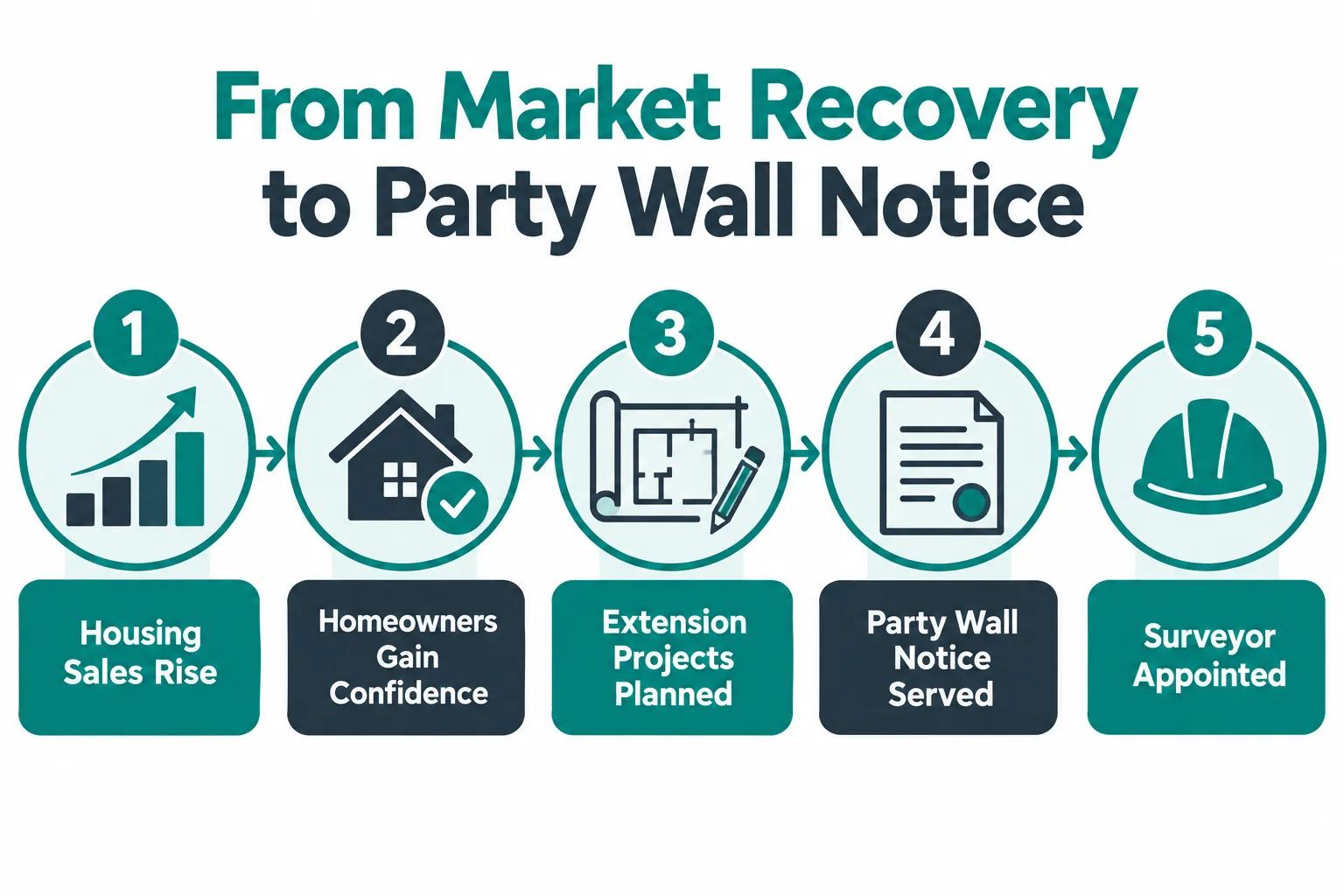
    Five point nine two per cent. That is the average two-year fixed mortgage rate Moneyfacts recorded on 28 September 2026, up from 5.59% just a month earlier. For a homeowner weighing up a bigger house against a bigger loft, that jump alone can decide the argument. Add prime London sale prices down 8% annually, with sellers accepting an average 10.4% discount to their original asking price according to LonRes, and the maths on moving looks increasingly unattractive. This is why the conversation around London home extensions mansion tax valuation party wall September 2026 has become so pressing for homeowners across the capital: building up, back or down is now often cheaper and less risky than selling and buying again, but it brings its own valuation questions and legal obligations, particularly under the Party Wall etc. Act 1996.

    This article sets out where mortgage rates and prices stand today, how a new High Value Council Tax Surcharge due in 2028 could interact with extension plans, what you can build without planning permission, and exactly which building works trigger party wall notices, with timelines, costs and a pre-works checklist for autumn 2026.

    Key Takeaways

    • Two-year fixed mortgage rates hit 5.92% on 28 September 2026, up sharply in a month, while Bank Rate held at 3.75% on 17 September, making home improvement more attractive than a house move for many Londoners.
    • A new High Value Council Tax Surcharge starts April 2028 on homes worth £2m or more, with bands of £2,500 to £7,500 a year; a national valuation exercise is under way and owners will be notified in autumn 2027.
    • Most single-storey rear extensions and loft conversions still fall within permitted development limits, but side returns, shared foundations and basement digs almost always require formal party wall notices.
    • Section 1, 2 and 6 notices carry one- or two-month notice periods; ignoring them risks injunctions, delays and additional cost.
    • Specialist party wall surveyors can prepare notices, negotiate awards, act as agreed surveyor, and produce a schedule of condition to protect both neighbours.

    Rates, Prices and the “Improve, Don’t Move” Calculation

    The Bank of England held Bank Rate at 3.75% on 17 September, a split 6-3 decision, with markets widely expecting a rise at the next meeting on 5 November. That backdrop has not stopped mortgage pricing from climbing: the average five-year fix now stands at 5.94%, barely below the two-year rate. For anyone comparing a remortgage-funded extension against selling up, the sums increasingly favour staying put.

    Meanwhile, LonRes data shows prime London sale prices down 8% year-on-year, with sellers typically settling for a 10.4% discount against their original asking price. Selling a family home in this market, only to compete for a bigger one at inflated borrowing costs, is a hard sell. Extending, a side return, a loft conversion, a basement, lets families gain space without re-entering a stalling sales market or resetting a mortgage at today’s higher rates.

    The Value Question: Could Your Extension Trigger the £2m Surcharge?

    Any serious discussion of London home extensions mansion tax valuation party wall September 2026 has to address the elephant in the room: the incoming High Value Council Tax Surcharge. From April 2028, homes valued at £2m or more will attract an additional charge on top of standard council tax, set across four bands from £2,500 to £7,500 a year. Around 165,000 households are expected to be affected nationally. Roughly half of England’s £2m-plus homes sit in London, and 85% are in London and the South East, meaning this is overwhelmingly a London and commuter-belt story.

    The valuation exercise behind the surcharge is the first of its kind since 1991. It is under way now, with owners due to be notified of their band in autumn 2027 and given six months to challenge the figure. Expected revenue from the surcharge is £0.4bn in 2029-30.

    There are unconfirmed reports suggesting the £2m threshold could be lowered to £1.5m. This remains speculation only, unconfirmed by government, and should not drive extension decisions today, but it is worth watching as the valuation exercise progresses.

    Will an Extension Push You Into the Band?

    A well-executed loft conversion, side-return kitchen or basement can add meaningful value to a London property, sometimes enough to cross the £2m line where a home previously sat just below it. In most cases, though, the added value from a sensible extension will outweigh a £2,500 to £7,500 annual surcharge many times over. For most owners, the surcharge is a modest ongoing cost relative to the capital gain and improved living space an extension delivers.

    Where the valuation looks wrong, for example, if the automated exercise overstates a property’s worth based on a neighbouring sale rather than its own condition, an independent RICS valuation, commissioned ahead of or during the autumn 2027 notification window, is the sensible way to support a formal challenge. Keeping renovation records, photographs and receipts from any extension work will also help demonstrate the property’s true condition and value if a challenge becomes necessary.

    What You Can Build Under Permitted Development vs Planning Permission

    No permitted development changes have taken effect in 2026, so the long-standing limits still apply. Understanding them matters before any party wall question even arises.

    Rear extensions (single storey):

    • Up to 3m for terraced and semi-detached houses, or 4m for detached houses, without planning permission.
    • Up to 6m (terraced/semi-detached) or 8m (detached) under the prior approval neighbour consultation scheme, which involves a 21-day neighbour comment period and a 42-day council decision.

    Loft conversions:

    • Up to 40 cubic metres of additional roof space for terraced houses.
    • Up to 50 cubic metres for detached and semi-detached houses.

    Outbuildings and overall coverage:

    • Extensions and outbuildings combined must not cover more than 50% of the property’s curtilage (garden and grounds).

    Staying within these limits avoids a planning application, but it does not exempt anyone from the Party Wall etc. Act 1996. Permitted development and party wall law are entirely separate legal frameworks, and many homeowners are caught out assuming that “no planning permission needed” means “no notice needed” too.

    Which Works Trigger the Party Wall Act

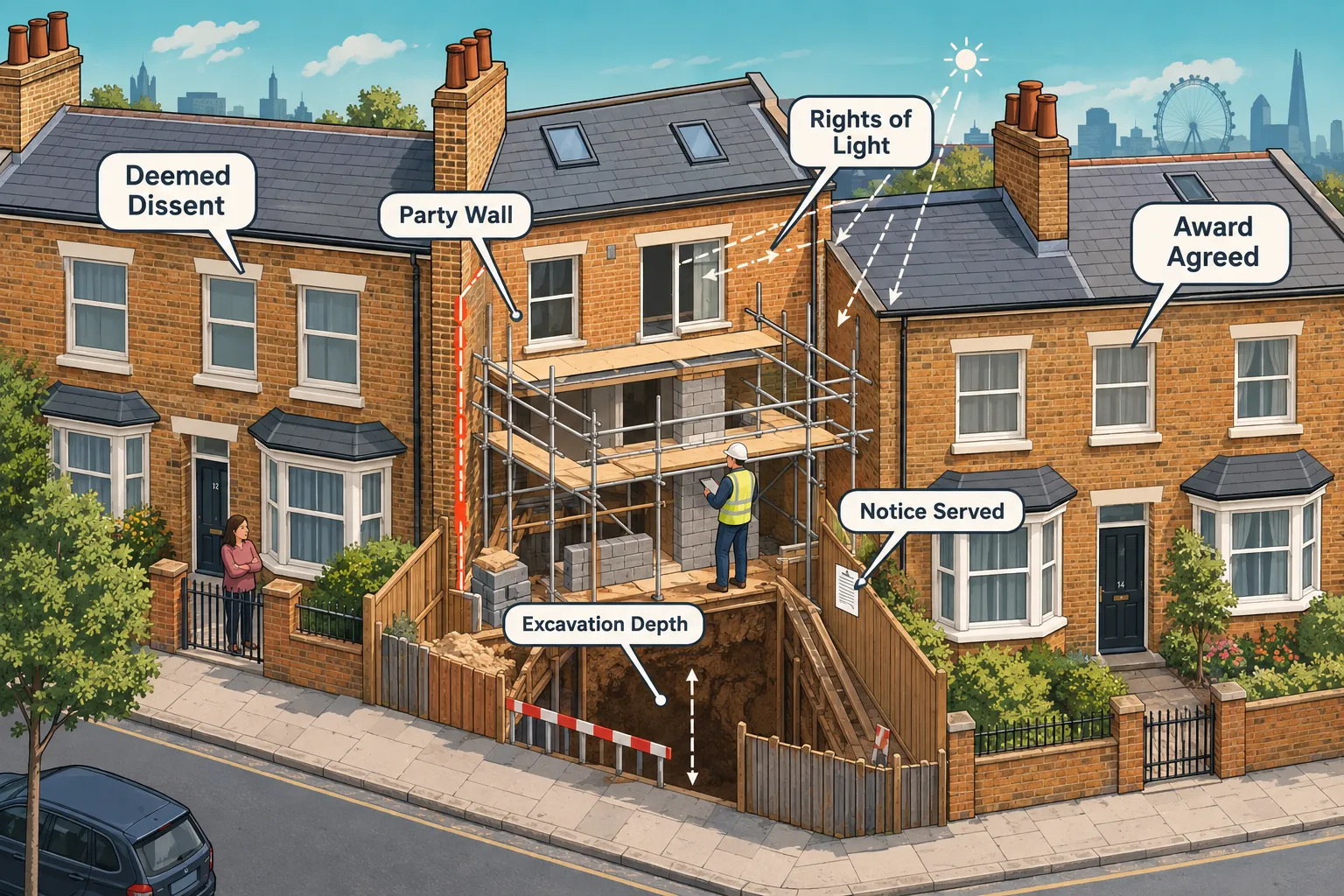
    The Party Wall etc. Act 1996 applies regardless of whether your project needs planning permission. The works most commonly triggering formal notice in London extension projects include:

    • Side return extensions that build against or connect to a shared party wall.
    • Rear extension foundations that go below the level of a neighbour’s foundations, particularly in Victorian and Edwardian terraces with shallow original footings.
    • Loft conversions where steel beams are inserted into or bear on a party wall to support new floor loads.
    • Basement excavation and underpinning, which almost always falls within the Act’s excavation provisions given typical London plot widths.

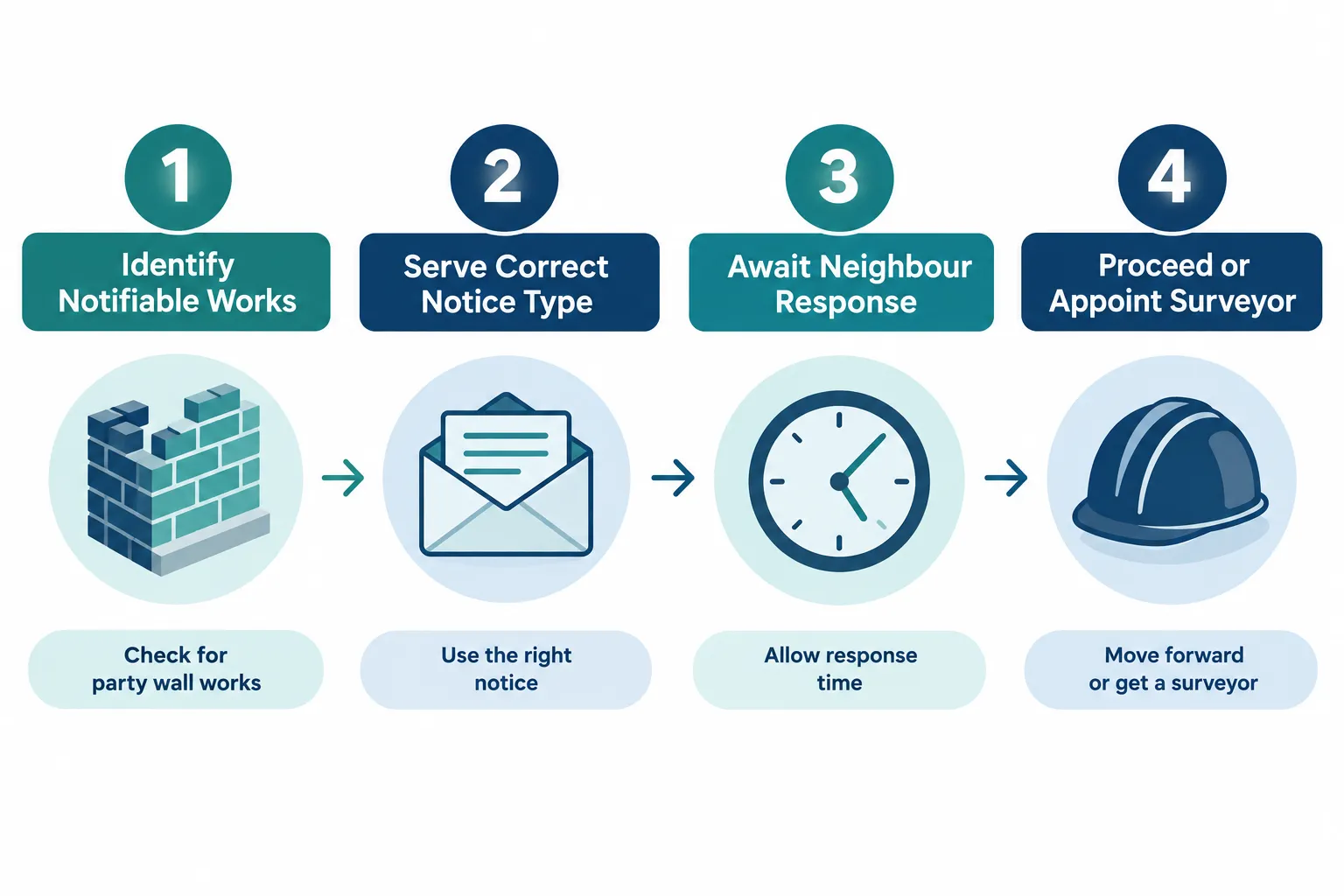
    The Act sets out three key notice types, explained in detail in our guide to party wall notices:

    • Section 1, building a new wall at or astride the boundary. Requires one month’s notice.
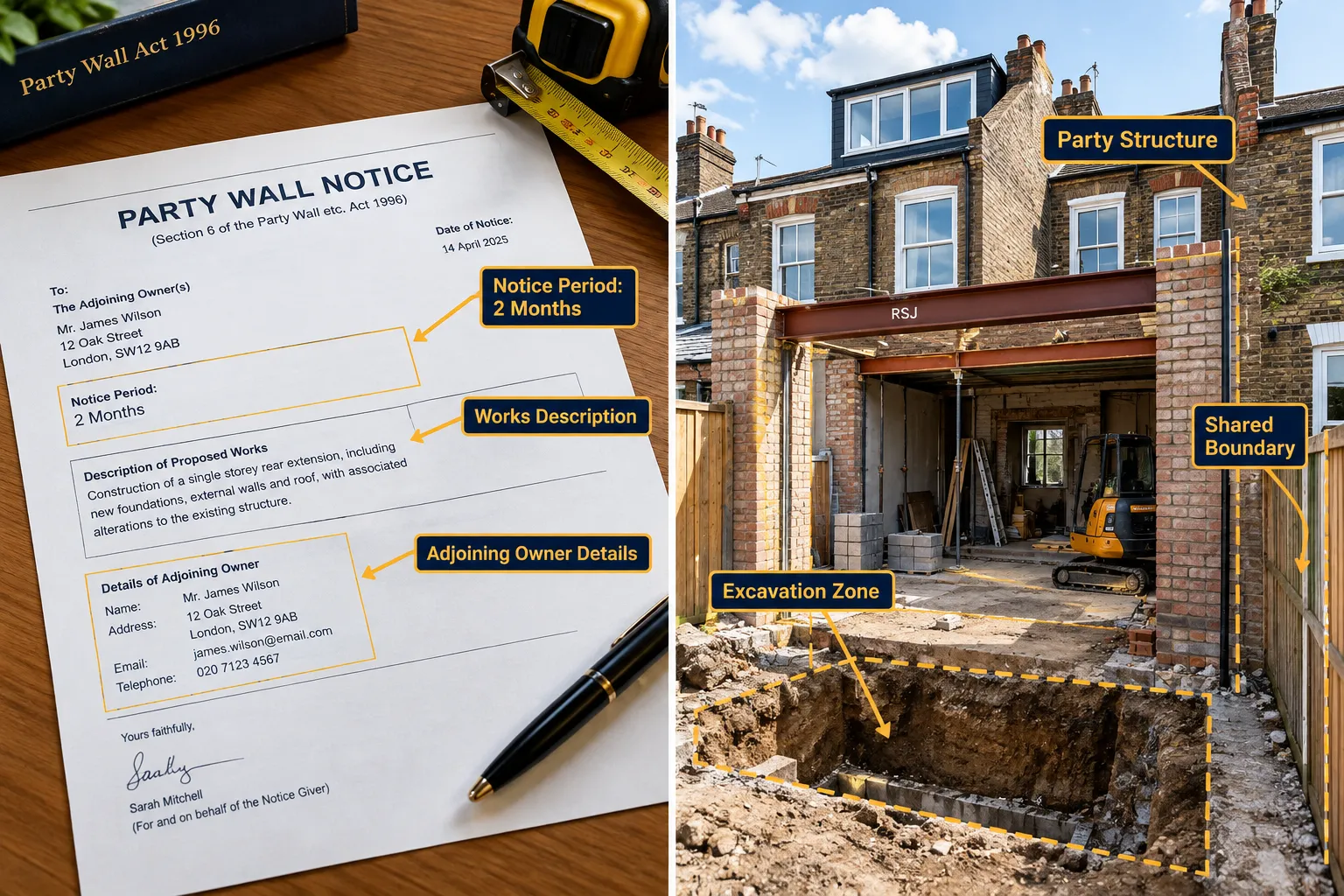
    • Section 2, carrying out works to an existing party wall or structure, such as cutting in beams or raising a shared wall. Requires two months’ notice.
    • Section 6, excavating within 3m of a neighbouring structure where the new work goes deeper than the neighbour’s foundations, or within 6m on a deeper trajectory. Requires one month’s notice.

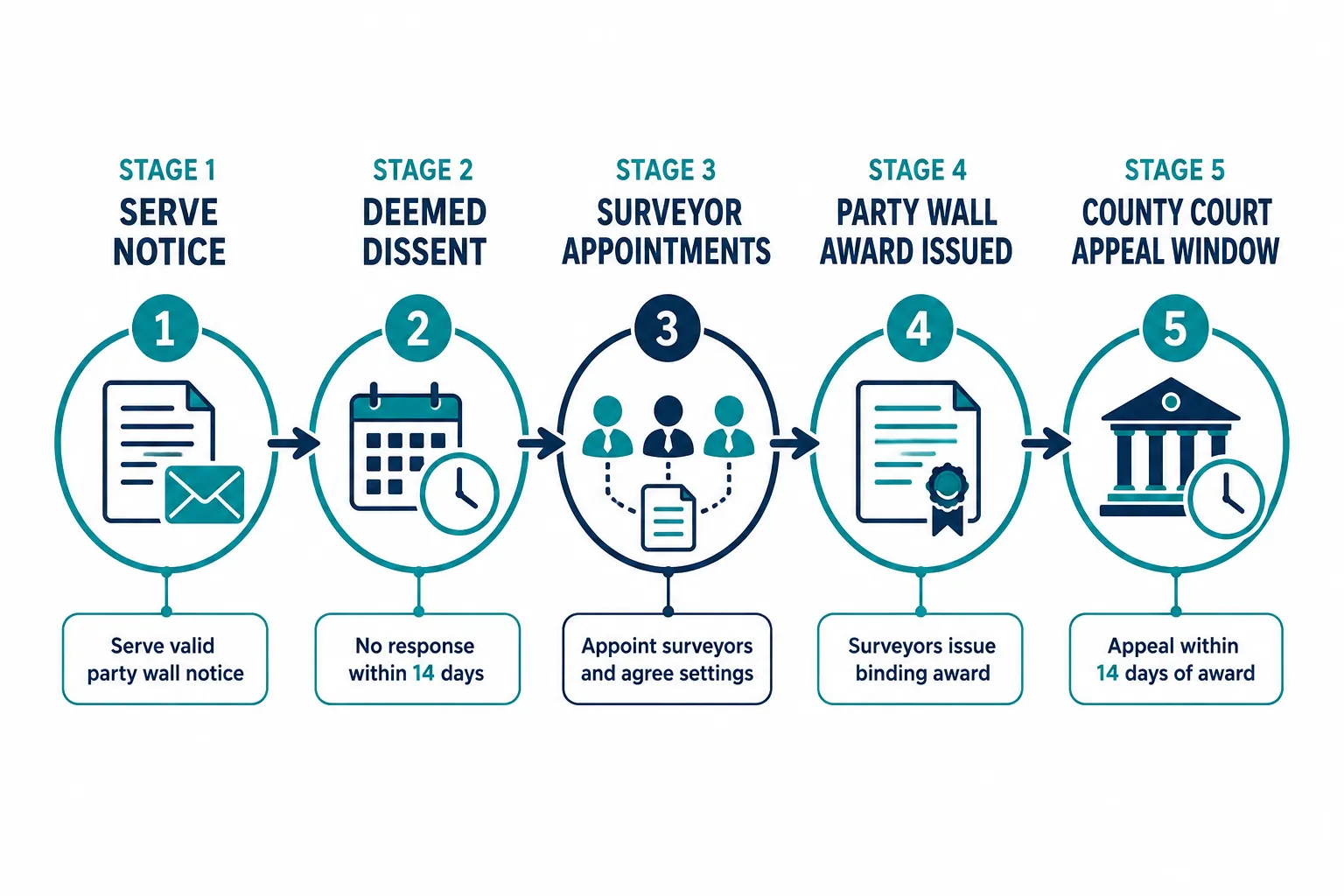
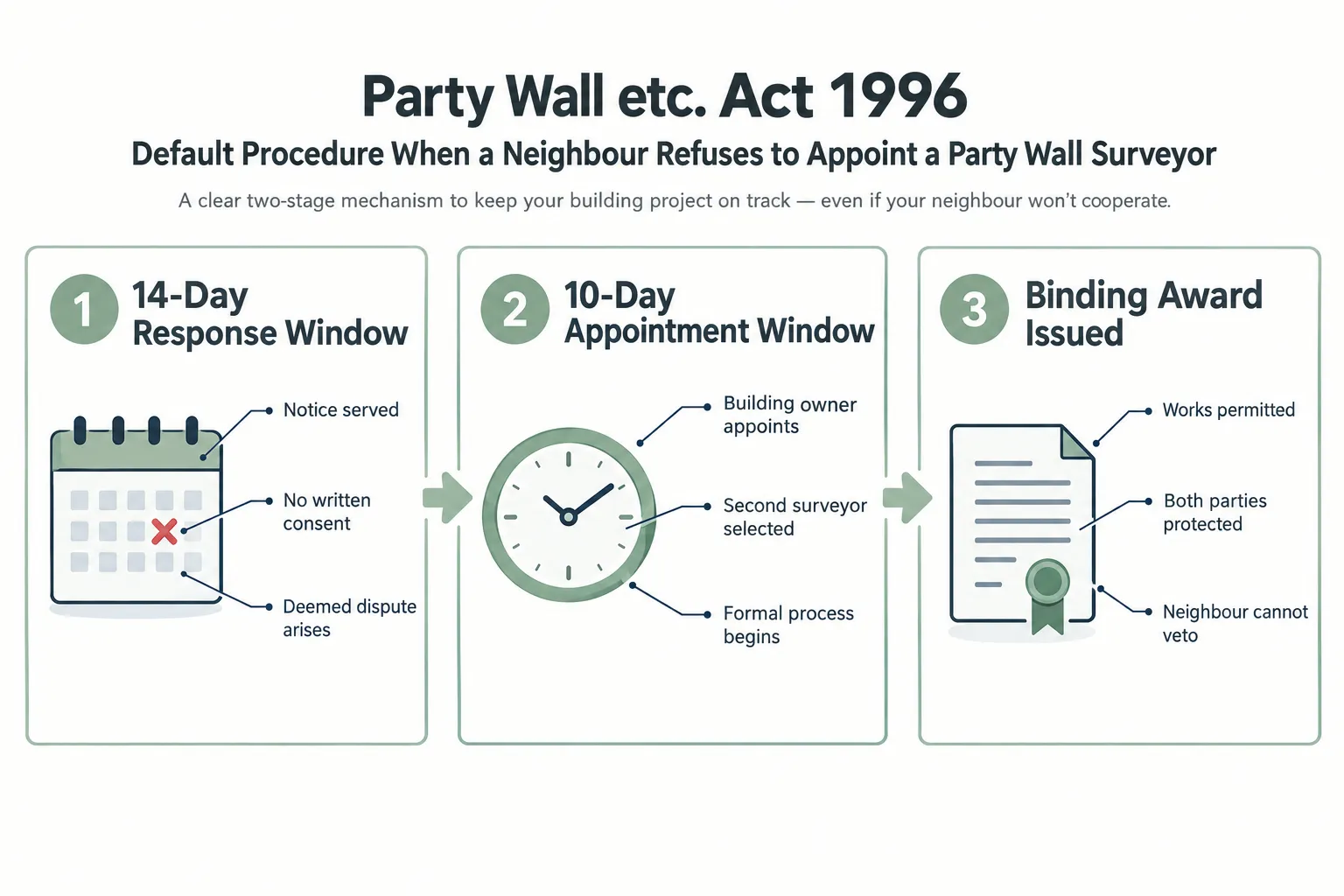
    Neighbours have 14 days to respond to a notice. If they dissent, or fail to respond, surveyors are appointed and a party wall award is prepared before work can lawfully proceed.

    Notice Type Triggering Work Notice Period Neighbour Response
    Section 1 New wall at/astride boundary 1 month 14 days
    Section 2 Works to existing party wall/structure 2 months 14 days
    Section 6 Excavation within 3m/6m below neighbour’s foundations 1 month 14 days

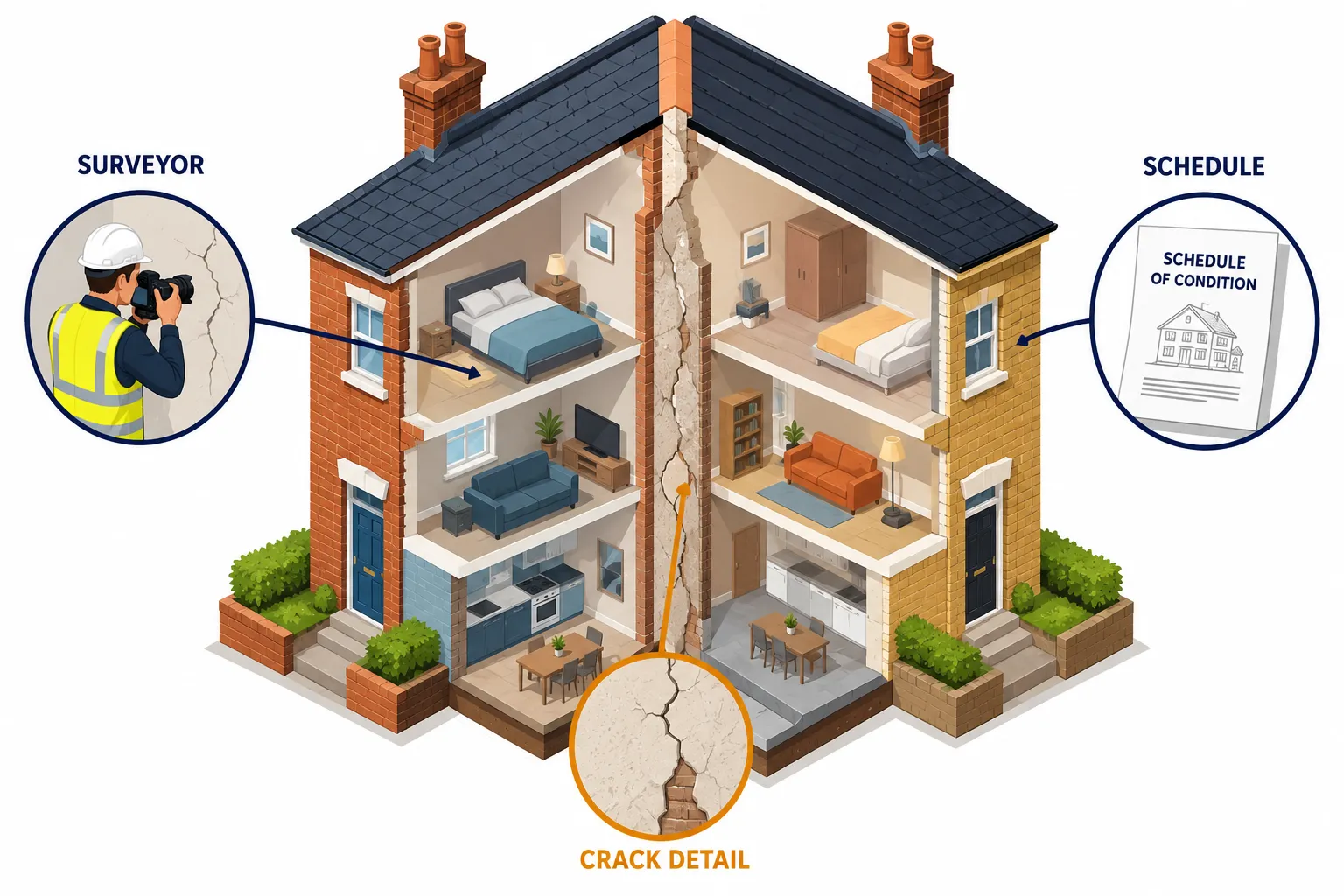
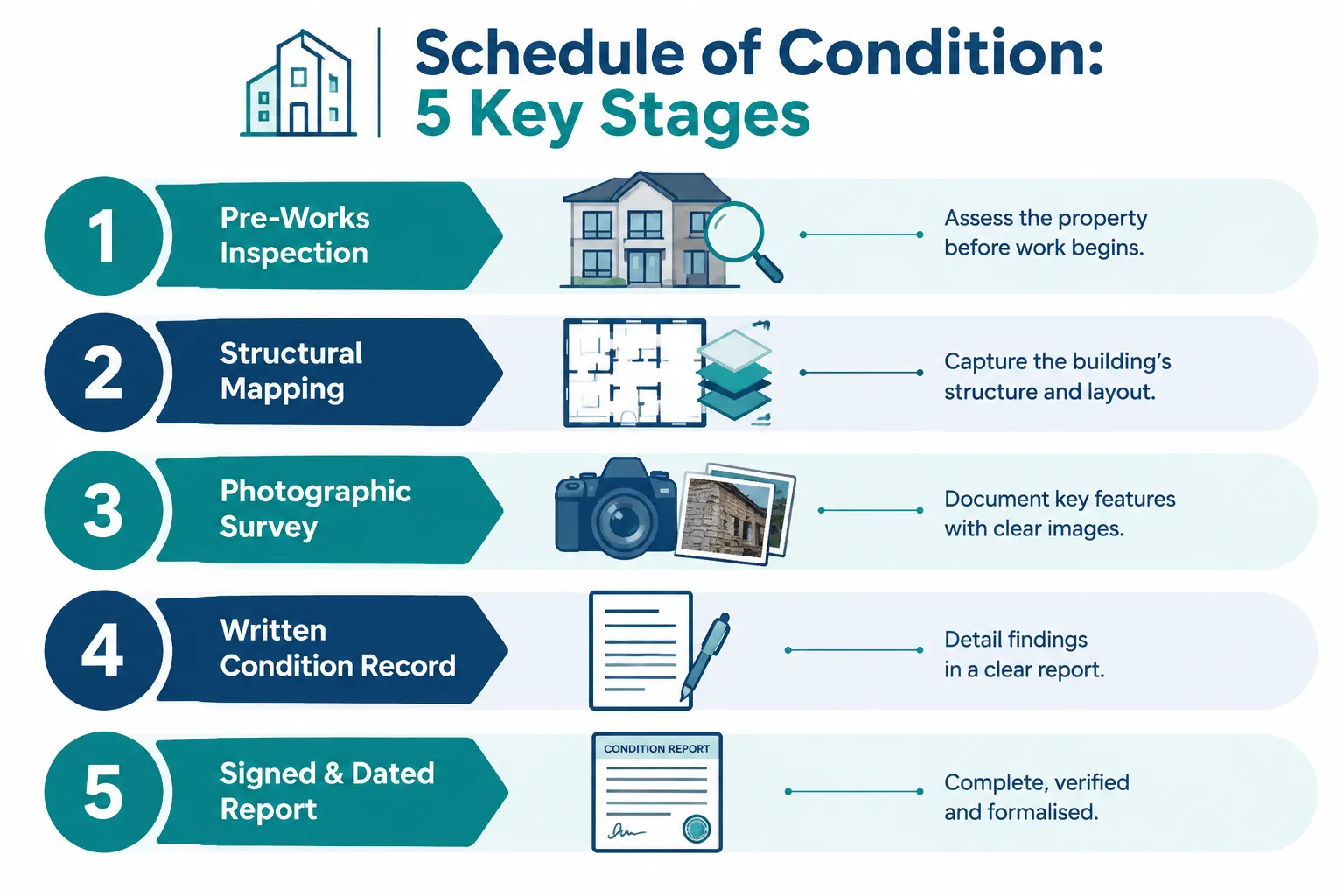
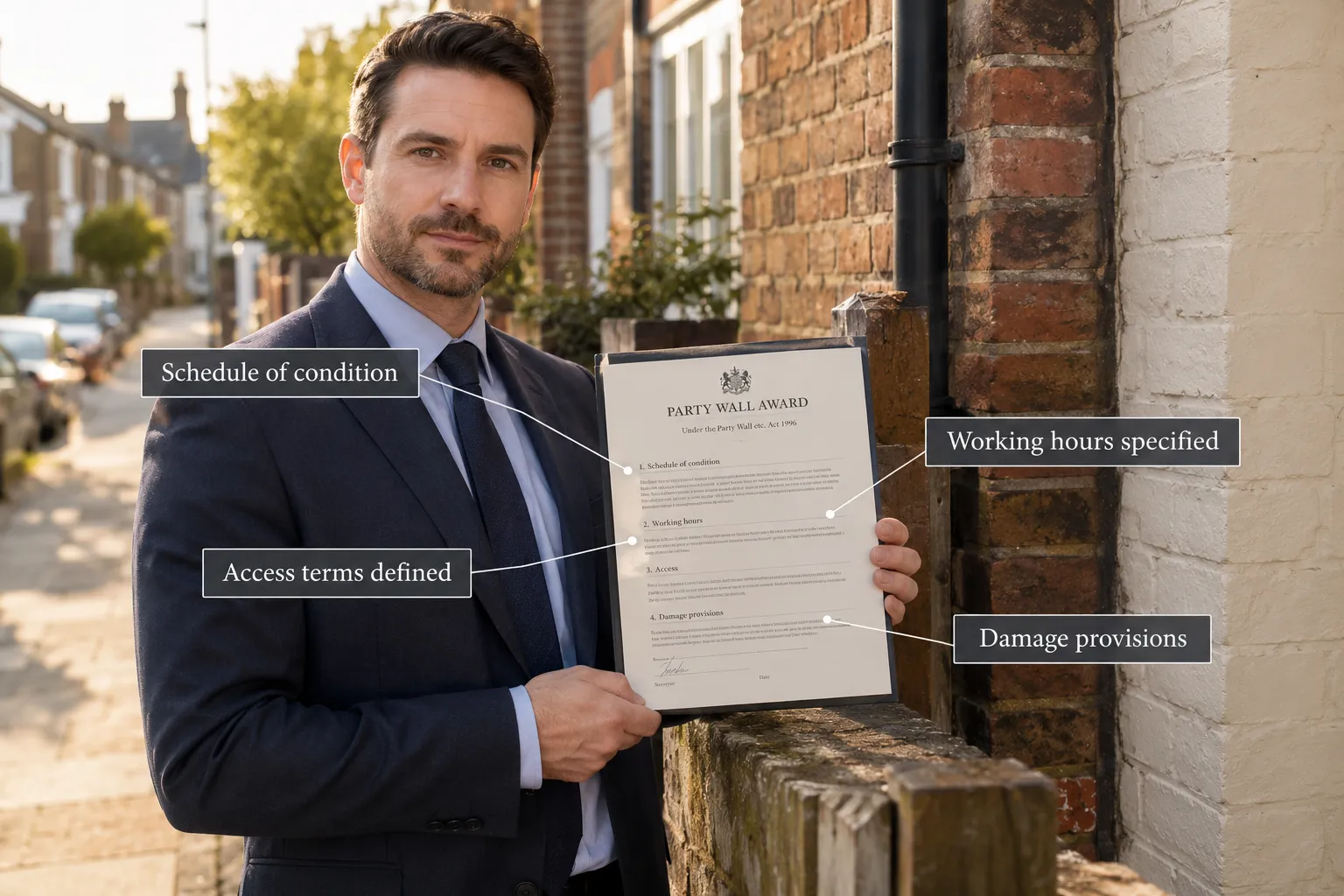
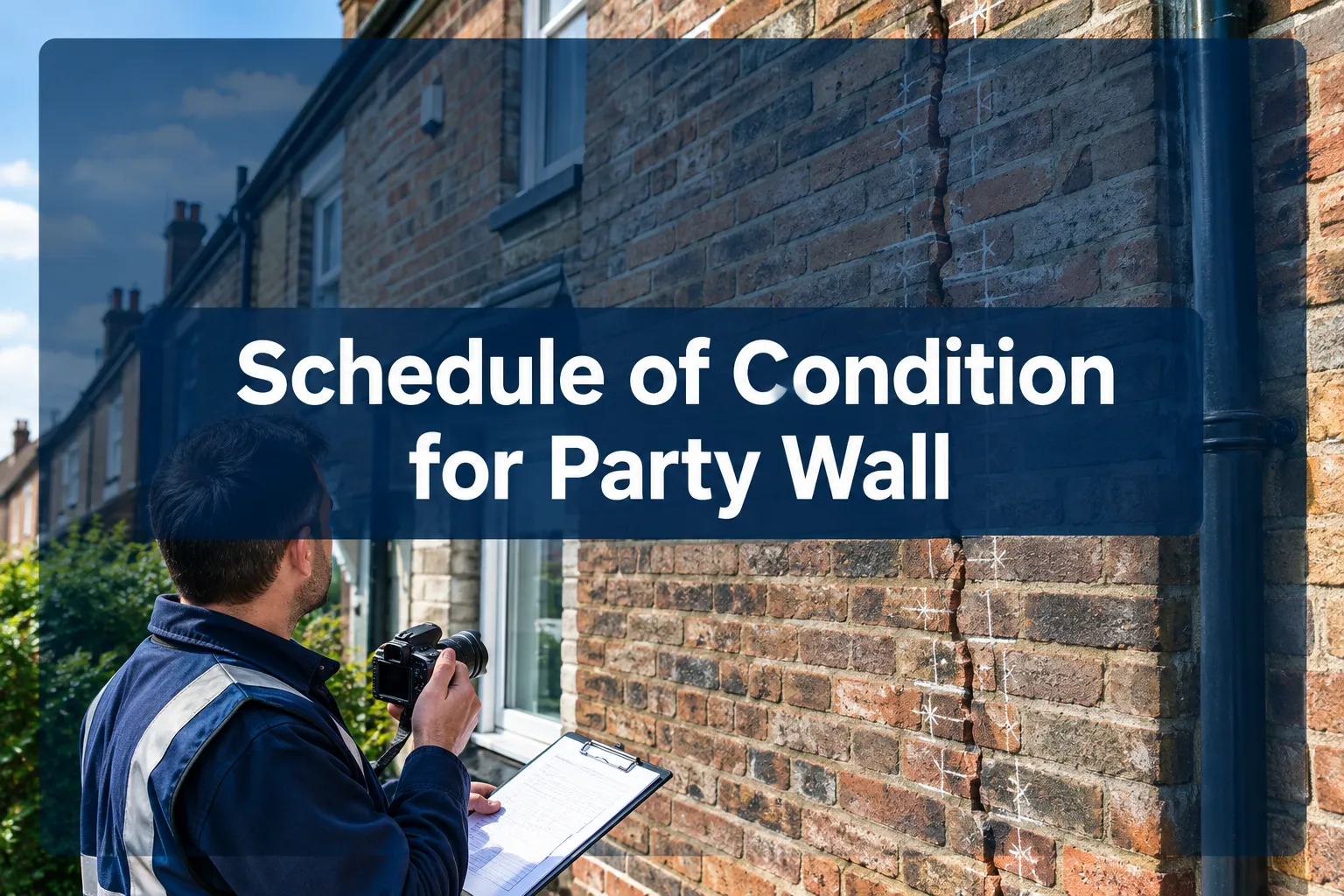
    Once dissent is registered, surveyors typically prepare a party wall award covering the scope of works, working hours, access arrangements and protective measures. A schedule of condition, a detailed photographic and written record of the neighbouring property before work starts, is standard practice and protects both sides against later disputes over pre-existing damage.

    The Cost of Skipping Notices

    Serving notice properly is far cheaper than the alternative. Where a homeowner proceeds without serving the required notice, or ignores a neighbour’s dissent, the neighbour can seek an injunction to halt work, generally a slow, stressful and costly outcome for everyone involved, on top of legal fees and potential remedial costs if damage occurs. Our guide to party wall costs explains typical surveyor fees and how to keep them proportionate, while our article on keeping party wall costs down covers practical steps to avoid unnecessary expense.

    It is possible, in principle, to reach a party wall agreement without appointing a surveyor where neighbours are cooperative, but once there is any dissent, appointing a qualified surveyor (either an agreed surveyor for both parties, or one each) becomes the only route to a lawful award.

    Advice for Neighbours Receiving a Notice

    If you receive a Section 1, 2 or 6 notice from a neighbour planning works this autumn:

    • Read it carefully and note the response deadline, you have 14 days.
    • You are entitled to a schedule of condition of your own property before work begins.
    • Consent, dissent, or appoint a surveyor, doing nothing is not a safe option, as it can be treated as dissent and slow the process.
    • Our explainer on how to respond to a party wall notice walks through each option in plain language.

    Checklist Before Starting Works This Autumn

    • Confirm whether your extension or loft conversion sits within permitted development limits or needs a planning application.
    • Identify every wall, boundary and excavation point that could fall under Sections 1, 2 or 6.
    • Serve notices with the correct notice period, one month for Sections 1 and 6, two months for Section 2.
    • Commission a schedule of condition on neighbouring properties before work starts.
    • Keep a file of extension costs and improvements in case a future council tax valuation challenge is needed.
    • Budget for surveyor fees as part of the project, not an afterthought.

    Homeowners in outer boroughs should also check local variations, see our location guides for East London, North London, West London, Central London and South London.

    FAQ

    Does every rear extension need a party wall notice? Not necessarily. A detached extension away from any shared wall may not trigger the Act, but most terraced and semi-detached rear extensions involve foundations near a neighbour’s, triggering Section 6.

    Will the £2m surcharge apply immediately if my extension pushes value over the line? No. The surcharge starts in April 2028, following the current valuation exercise. Owners will be notified in autumn 2027 and have six months to challenge.

    Can I challenge a valuation I think is wrong? Yes. A RICS valuation report, supported by evidence about the property’s actual condition and any works carried out, is the standard basis for a challenge during the six-month window.

    What happens if my neighbour ignores my party wall notice? No response within 14 days is generally treated as dissent, which leads to the appointment of surveyors and a formal award before work can proceed.

    Is the £1.5m threshold change confirmed? No. It is reported speculation only and has not been confirmed by government. Plans should be based on the confirmed £2m threshold.

    Do I need a surveyor if my neighbour agrees straight away? It is possible to proceed without one where both parties are in full agreement, but any dissent, or works involving excavation and shared structures, generally requires an appointed surveyor to issue a valid award.

    Conclusion

    With mortgage rates climbing and prime London prices under pressure, extending has become the rational choice for many homeowners rather than moving. But bigger projects bring bigger obligations, both towards the coming council tax valuation regime and towards neighbours under the Party Wall etc. Act 1996. Getting notices, schedules of condition and awards right from the outset avoids injunctions, delays and disputes later. Party Wall Surveyor London prepares Section 1, 2 and 6 notices, acts as agreed surveyor or appointed surveyor, negotiates awards, and produces detailed schedules of condition for homeowners and neighbours across the capital. Before works begin this autumn, get the paperwork right, it is far cheaper than fixing problems after the diggers arrive.

  • Party Wall Act 1996 disputes London 2026 case law court avoidance: what property owners need to know

    Last updated: September 25, 2026

    One Court of Appeal ruling has quietly changed the risk calculus for every London extension and basement project. Since Power & Kyson v Shah [2023] EWCA Civ 239, building owners who skip a party wall notice no longer face the surveyor system at all, they face the High Court, full stop [2][6].

    Quick Answer

    Party Wall Act 1996 disputes in London during 2026 are increasingly shaped by Power & Kyson v Shah, which confirmed that surveyors have no jurisdiction over notifiable works carried out without a valid notice [2][6][9]. That leaves neighbours to pursue trespass or nuisance claims through the courts instead of a quicker surveyor’s award. Court avoidance in 2026 depends almost entirely on serving correct notices early, appointing surveyors promptly, and using the Act’s award system rather than letting disputes drift into common-law litigation [4][11][14].

    Key Takeaways

    • The Party Wall Act 1996 only protects parties who serve or receive a valid notice; without one, there is no statutory dispute for surveyors to resolve [2][6].
    • Power & Kyson v Shah [2023] EWCA Civ 239 is the leading 2026 authority: no notice means no section 10 jurisdiction, pushing neighbours toward common-law claims [2][6][9][15].
    • Common-law routes (trespass, nuisance, negligence) are generally slower and costlier than a party wall award [9][14].
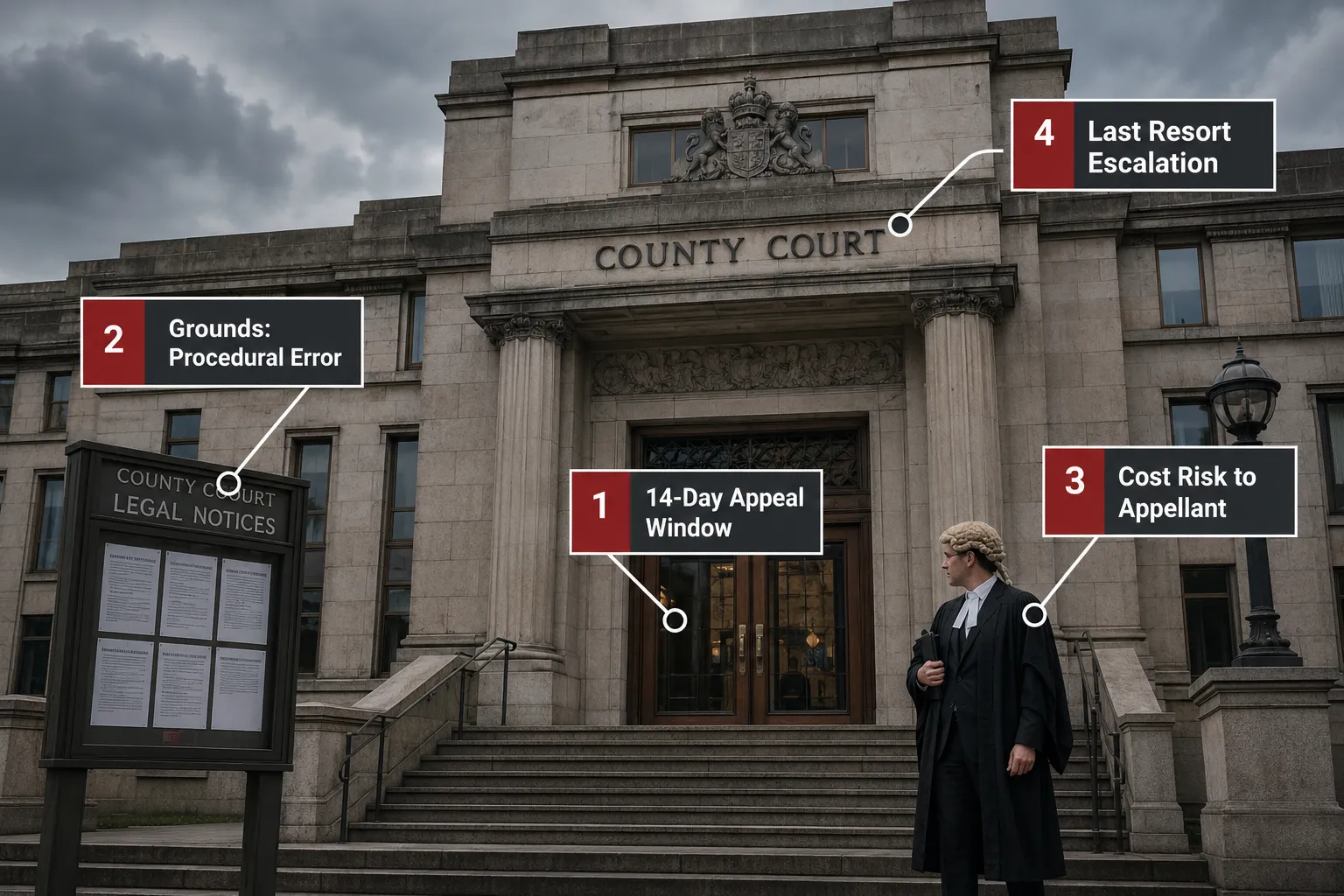
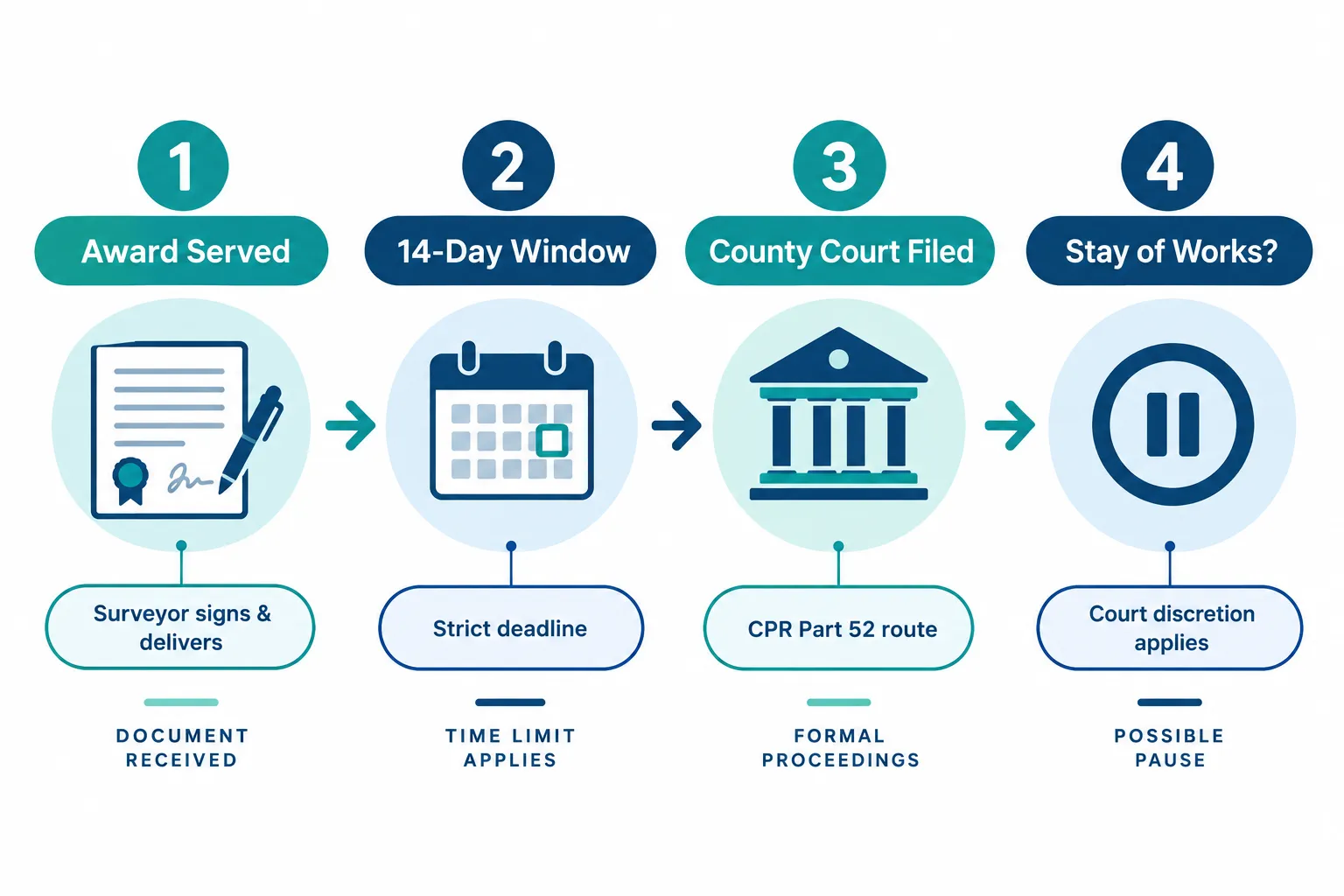
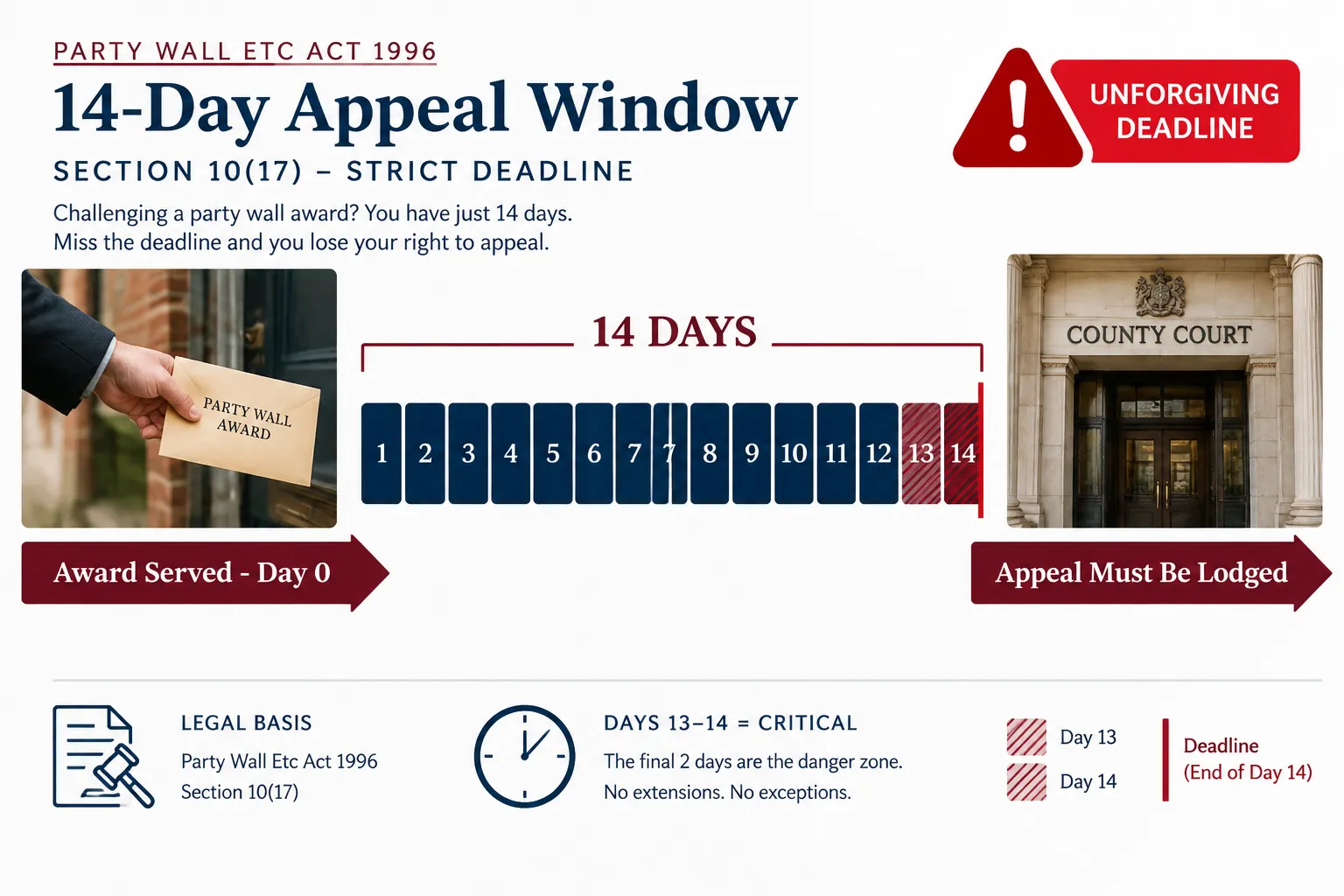
    • Party wall awards remain legally binding and can only be appealed to the county court within 14 days [4][11].
    • London basement and rear-extension projects are the most frequent source of disputes because of excavation, shared foundations and vibration damage [1][14].
    • Early notice, prompt surveyor appointment and clear schedules of condition are the most reliable ways to stay inside the Act’s framework and out of court [4][11][14].
    • RICS commentary in 2026 questions whether parts of the Act are becoming ineffective where notice is skipped, and floats possible reform [10][13].

    What is the Party Wall Act 1996 and how does it apply in London

    The Party Wall etc. Act 1996 is the statute governing work on shared walls, boundary structures and excavations near a neighbour’s property, and it applies across England and Wales including every London borough [5]. It gives building owners a right to carry out certain works while giving adjoining owners a right to compensation, access and a say in how work proceeds.

    In London, where terraced houses, semi-detached properties and close-set flats are the norm, the Act is triggered constantly by:

    • Building or repairing a wall that sits on the boundary between two properties.
    • Cutting into a party wall to insert beams, damp-proof courses or steel supports.
    • Excavating within 3 metres of a neighbouring building where the excavation goes deeper than the neighbour’s foundations, or within 6 metres if it cuts a line drawn downward from the foundation at 45 degrees [5][11].

    The government’s explanatory booklet, refreshed in 2026, still frames the Act as a mechanism to prevent and resolve disputes about party structures, boundary walls and nearby excavation before they escalate [11]. The core provisions, notices, surveyor appointments, and awards, have not changed substantively, aside from narrow statutory carve-outs such as the exclusion of section 2 for the Cambridge Waste Water Treatment Plant Relocation Order 2025, which shows Parliament is willing to legislate around specific infrastructure but has not yet addressed the wider issues raised by Power v Shah [12].

    Party Wall Act disputes London 2026 recent case law

    The single most important case shaping 2026 practice is Power & Kyson v Shah [2023] EWCA Civ 239, which held that surveyors have no jurisdiction under section 10 if the building owner never served a notice for notifiable works [2][6][9][15]. This means the Act’s entire dispute-resolution machinery, surveyor appointments, awards, the 14-day appeal window, simply does not switch on.

    Specialist commentary describes this as creating a “contradiction at the heart of party wall jurisdiction”: failing to serve notice breaches the Act, yet that same failure removes the neighbour’s statutory protection, leaving only slower and pricier common-law remedies [2][10]. Falcon Chambers and New Law Journal commentary confirms the ratio decidendi: without a served notice, there is no “building owner” in the Act’s legal sense, so no statutory dispute exists for surveyors to resolve [6][15].

    Other cases still cited by London surveyors in 2026 include:

    • Raheel Shah v Ken Power [2022] EWHC 209 (QB), addressing damage assessment and causation principles that feed into how awards allocate compensation [7][8].
    • Rashid v Sharif [2014] EWCA Civ 377, still referenced for classifying party fence walls and apportioning responsibility [3].

    The Trowers & Hamlins 2024/2026 analysis of these authorities highlights how courts separate pre-existing structural defects from damage genuinely caused by notifiable works, with compensation reduced where damage predates the project [3]. RICS journal commentary asks whether parts of the Act are becoming “obsolete” in practice, since Power v Shah confirms common law is the only route once notice has been skipped, and argues this could weaken neighbour protection in dense cities like London unless reform follows [10][13].

    “Failing to serve notice both breaches the Act and removes its protections, a contradiction that defeats the Act’s protective purpose.”, paraphrased from 2026 doctrinal commentary on Power v Shah [2][10]

    What counts as a party wall dispute under the 1996 act

    A statutory dispute exists once a building owner has served a valid notice and the adjoining owner either dissents, fails to respond within 14 days, or disagrees on how work should proceed [5][11]. Only then does the surveyor system, an agreed surveyor, or two surveyors plus a third, have authority to make a binding award.

    Common triggers for a formal dispute include:

    • Disagreement over the scope of underpinning or excavation depth.
    • Refusal of access for the building owner’s contractors.
    • Disputes over the schedule of condition (the “before” record of the neighbour’s property).
    • Compensation claims after cracking, subsidence or vibration damage appears mid-build.

    Decision rule: if notice has been properly served and 14 days pass without written consent, a dispute is deemed to have arisen automatically, and either party can appoint a surveyor [11]. If no notice was served at all, there is no statutory dispute under Power v Shah, only a potential common-law claim [2][6].

    How do you avoid court when there’s a Party Wall Act dispute

    Avoiding court means keeping every dispute inside the Act’s award system rather than letting it spill into trespass or nuisance litigation. The single biggest lever is serving a valid, correctly detailed notice before any notifiable work starts [4][11][14].

    Practical steps that London surveyors are recommending in September 2026:

    1. Serve notice early, at least two months before starting work on a party structure, or one month before excavation, giving neighbours proper time to respond [5][11].
    2. Commission a schedule of condition on the neighbouring property before work begins, to prevent arguments about pre-existing versus new damage [3].
    3. Appoint surveyors promptly once a dispute is deemed to arise, rather than letting weeks pass while positions harden [4].
    4. Use an agreed surveyor where relationships are still cordial, since this is usually faster and cheaper than three separate surveyors [4][14].
    5. Respond to the award within the 14-day appeal window if genuinely necessary, but treat appeal as a last resort given the cost of county court proceedings [4][11].

    Common mistake: building owners sometimes assume informal texts or emails to a neighbour count as notice. They do not. Notice must follow the Act’s formal requirements, and getting this wrong is precisely what exposed building owners to common-law claims in Power v Shah [2][6].

    Party Wall Act disputes who needs a surveyor and why

    Anyone served with a party wall notice who does not consent in writing effectively needs a surveyor, because once a dispute is deemed to exist, the Act requires surveyor involvement to produce a binding award [5][11]. Building owners undertaking notifiable works also need to instruct a surveyor from the outset to ensure notices and schedules of condition are correct.

    Surveyors matter because they:

    • Draft and serve notices that meet the Act’s technical requirements.
    • Prepare or review schedules of condition to protect both sides against false damage claims.
    • Produce awards covering the scope of works, working hours, access rights and security for expenses.
    • Act as an independent referee, reducing the emotional temperature between neighbours.

    Edge case: in flats and shared freeholds, more than one adjoining owner may need separate notices, and each may appoint their own surveyor, increasing cost and coordination complexity on larger London developments [14].

    What are common mistakes people make with party wall disputes

    The most damaging mistake is starting notifiable work without serving notice at all, which, following Power v Shah, strips away the Act’s protections entirely and forces neighbours into court-based common-law claims [2][6][9]. This is especially common on basement conversions where owners underestimate how deep excavation triggers the Act.

    Other frequent errors include:

    • Treating verbal agreement with a neighbour as sufficient, without a written award.
    • Ignoring a notice completely, assuming it will “go away.”
    • Failing to record the condition of the neighbouring property before excavation starts.
    • Appointing a surveyor who is not genuinely independent, risking a challengeable award.
    • Rushing the works programme without allowing for the statutory notice periods.

    Quick example: a Zone 2 London homeowner extending a rear kitchen and lowering a basement floor without notice found their neighbour later suing for trespass and nuisance after cracking appeared, a claim that, post Power v Shah, bypassed the party wall surveyor system entirely and went straight to litigation [2][9].

    What happens if you ignore a party wall notice in London

    Ignoring a notice for 14 days is treated as a dissent, which automatically triggers the statutory dispute procedure and surveyor appointment [5][11]. It does not stop the building owner’s works, and it does not protect the neighbour from anything, it simply moves the matter to surveyors.

    By contrast, if a building owner ignores its own duty to serve notice in the first place, the consequences are different and, under Power v Shah, arguably worse for the neighbour: there is no statutory dispute at all, so the neighbour must rely on common-law claims like trespass or nuisance through the courts [2][6][9]. Building owners retain a common-law right to carry out certain works, but risk more expensive litigation exposure if they bypass the Act rather than resolve matters via an award [9][14].

    How much does it cost to resolve a party wall dispute

    Resolving a dispute through the Act’s surveyor system is normally far cheaper than court litigation, though exact fees vary by project size and complexity. Surveyor fees for straightforward extensions in London are typically a few hundred to low thousands of pounds per surveyor, while contested basement schemes with structural engineering input can run considerably higher [1][14] (industry-reported ranges, not official statistics).

    Party wall award vs. court litigation, quick comparison
    Factor Party wall award Court litigation
    Typical timeframe Weeks to a few months Many months to years
    Typical cost Lower, surveyor fees only Higher, legal and court fees
    Who decides Independent surveyor(s) Judge
    Appeal route County court, 14 days Standard appeal process
    Requires valid notice? Yes [2][6] No

    Litigation costs escalate quickly once trespass or nuisance claims are involved, because both sides typically need solicitors, expert structural evidence and, potentially, barristers [9][14].

    What’s the difference between party wall awards and court cases, and can you settle without going to court

    A party wall award is a legally binding decision made by appointed surveyors under the Act, covering the works, access and compensation, and it can only be challenged by appeal to the county court within 14 days of service [4][11]. Court cases, by contrast, are full civil claims, usually trespass, nuisance or negligence, heard by a judge, with no equivalent statutory 14-day fast-track.

    Yes, settling without court is entirely possible and remains the norm for the majority of London party wall matters, provided notice was validly served [4][14]. The award mechanism exists specifically to avoid litigation: once surveyors sign an award, both parties are bound unless a timely appeal is lodged. Where no notice was served, however, settlement without court becomes harder, because there is no statutory framework compelling either side to negotiate, parties are left to reach a private agreement or proceed to litigation [2][9].

    How long does a party wall dispute take, and when do disputes end up in court

    A dispute handled through the Act typically resolves in a few weeks to a few months, depending on surveyor availability and the complexity of the works [4][14]. Disputes end up in court mainly in two scenarios: first, when a party appeals an award within the 14-day window; second, and increasingly since 2023, when no notice was served at all and the adjoining owner must sue for trespass or nuisance instead [2][6][9].

    Decision rule: choose the surveyor-award route if notice has been served and both sides accept the Act applies. Expect litigation if notice was skipped, or if one party disputes whether the Act’s jurisdiction even attaches to the works, this is the exact fact pattern that produced Power v Shah [2][6].

    Party Wall Act disputes: what’s the alternative to litigation, and what triggers a dispute in the first place

    The main alternative to litigation is the Act’s own surveyor-award system, supplemented in some cases by mediation before a formal dispute is even declared [4][11][14]. Triggers for disputes typically involve excavation depth, foundation proximity, and disagreement over compensation for cracking or settlement, all common on London basement and rear-extension schemes where properties sit close together [1][14].

    Forward-looking commentary in 2026 predicts that, unless higher courts or Parliament revisit the Power v Shah line, surveyors and lawyers will increasingly run parallel strategies: using the Act’s award process where notice was validly served, while preparing common-law claims or defences in case jurisdiction is disputed [2][10][15]. Analysts expect more hybrid disputes in London, blending party wall awards, engineering evidence, and nuisance or trespass claims, which makes early legal advice essential to keep matters manageable [3][9][14].

    Conclusion

    The Party Wall Act 1996 remains the fastest and cheapest route to resolving disputes over shared walls, extensions and basement excavations across London, but only when the process is followed from day one. Power & Kyson v Shah [2023] EWCA Civ 239 has made clear that skipping notice does not just risk a slap on the wrist, it removes the Act’s protections entirely and forces neighbours toward costly common-law litigation [2][6][9]. As of September 2026, the practical advice from London surveyors is unchanged in principle but sharper in urgency: serve notice correctly, appoint a surveyor promptly, document the neighbouring property’s condition before work starts, and treat the award system as the default route rather than an optional extra.

    Property owners planning basement or extension work should instruct a party wall surveyor before finalising a build programme. Neighbours who receive a notice should respond in writing within 14 days rather than ignoring it, and should seek their own surveyor if anything about the proposed works seems unclear. Both sides benefit from treating the Act as a tool for cooperation rather than confrontation, because the real alternative, as 2026 case law confirms, is a courtroom.

    FAQ

    Does the Party Wall Act 1996 still apply the same way in London in 2026? Yes. The core statutory framework on notices, surveyor appointments and awards is unchanged, though Power v Shah has clarified that the Act only applies once a valid notice has been served [2][5][6].

    What is the single biggest cause of party wall disputes on London basement projects? Excavation near shared foundations, particularly where depth or proximity triggers the Act’s notice requirements, is the most common flashpoint, often combined with disagreement over damage caused by vibration or settlement [1][14].

    Can a neighbour stop building work using the Party Wall Act? No. The Act does not give neighbours a veto; it gives them a right to a surveyor’s award covering how work proceeds, access and compensation, once a dispute is deemed to have arisen [5][11].

    What should I do if I receive a party wall notice in London? Respond in writing within 14 days, either consenting or dissenting, and consider appointing your own surveyor if you have any concerns about the proposed works [11].

    Is it cheaper to use a party wall surveyor or go to court? Using a party wall surveyor and award system is almost always cheaper and faster than litigation, since court claims for trespass or nuisance involve solicitors, expert evidence and longer timescales [4][9][14].

    What did Power & Kyson v Shah actually decide? The Court of Appeal held that surveyors have no jurisdiction under section 10 of the Act where the building owner never served a notice for notifiable works, meaning the adjoining owner must pursue common-law remedies instead [2][6][9][15].

    References

    [1] Page – peterbarry.co.uk [2] Kyson Power V Shah A Contradiction – lkbc.co.uk [3] Party Wall Etc Act 1996 – trowers.com [4] Last Man Standing – partywallconsultancy.co.uk [5] legislation.gov.uk – legislation.gov.uk [6] Party Wall Disputes In On The Act – falcon-chambers.com [7] Raheel Shah V Ken 896598342 – vlex.co.uk [8] 63fa59d8afc23314151e1043 – casemine.com [9] Party Wall Etc Act 1996 V Common Law – osborneslaw.com [10] Whycourtofappealwrong – lkbc.co.uk

  • London Party Wall Notices September 2026: BoE Rate Hold, Autumn Budget Speculation and the Renovation Surge

    London Party Wall Notices September 2026: BoE Rate Hold, Autumn Budget Speculation and the Renovation Surge

    Last updated: September 17, 2026

    Quick Answer

    The Bank of England held Bank Rate at 3.75% at today’s meeting on 17 September 2026, extending a stable borrowing environment that is encouraging London homeowners to press ahead with extensions, loft conversions and basement digs before any Autumn Budget property-tax changes land.[1][3][6] That construction activity is pushing up the number of party wall notices being served across the capital, with typical surveyor fees for September 2026 running from £950 to £2,500 or more depending on complexity and whether a dispute arises.

    Key Takeaways

    • The Bank of England kept Bank Rate at 3.75% on 17 September 2026, matching near-unanimous economist expectations from a Reuters poll of 65 forecasters.[9][5]
    • Nearly 90% of polled economists expect rates to stay at 3.75% for the rest of 2026, giving renovation borrowers a predictable financing backdrop.[9]
    • Autumn Budget 2026 speculation about capital gains tax, a possible mansion tax and wider property-tax reform remains unconfirmed but is fuelling homeowner urgency.[7][11]
    • Party wall notices are legally required under the Party Wall etc. Act 1996 for most work on or near a shared boundary wall, including many extensions and loft conversions.
    • Notice periods are two months for wall works and one month for excavations near a neighbour’s foundations.
    • London surveyor fees for party wall matters in September 2026 typically range from £950 to £2,500+, rising with dissent or dispute.
    • A neighbour who dissents does not stop the project outright, it triggers a formal Party Wall Award process instead.
    • Skipping a required notice can lead to injunctions, forced remedial work and personal liability for damage.

    What Is a Party Wall Notice in London Party Wall Notices September 2026?

    A party wall notice is a formal written document served on a neighbouring owner under the Party Wall etc. Act 1996, giving legal notice of planned building work that touches or affects a shared wall, boundary or nearby foundations. It is separate from planning permission and building regulations, a homeowner can have full planning approval and still be legally required to serve notice on next door.

    In practice, the notice sets out:

    • What work is planned and roughly when it will start
    • Which wall, boundary or foundation area is affected
    • The homeowner’s proposed method of construction (for excavations near a boundary)

    The Act applies specifically in England and Wales, and London’s dense terraced and semi-detached housing stock means a very high proportion of extensions, loft conversions and basement projects trigger at least one notice. Choose a party wall notice service if works involve a shared wall, boundary excavation, or building astride the line of junction, this covers most inner and outer London terrace and semi projects.

    Do I Need a Party Wall Notice for My Renovation?

    A party wall notice is needed whenever work involves cutting into, underpinning, raising, or building against a shared wall, or excavating within three to six metres of a neighbour’s foundations at certain depths. It is not automatically required for every home improvement, many internal-only projects fall outside the Act entirely.

    Common trigger scenarios in London:

    • Rear or side return extensions that connect to or sit on a shared boundary wall
    • Loft conversions requiring new steel beams bearing on a party wall
    • Basement or lower-ground-floor digs that excavate close to a neighbour’s footings
    • Building a new wall on, or astride, the line of junction between two properties
    • Cutting into a party wall for damp-proofing, chimney removal, or flashing work

    Decision rule: if the nearest point of digging or structural alteration is within three metres of the neighbouring foundation (or six metres where deeper excavation reduces load-bearing angle rules), a notice is very likely required. When in doubt, a short consultation with a chartered party wall surveyor resolves the question quickly and cheaply compared with getting it wrong.

    Party Wall Notice for Extensions vs Loft Conversions

    Extensions and loft conversions trigger different notice types under the same Act, and mixing them up is a common mistake. Extensions typically fall under Section 1 (line of junction) or Section 2 (party structure) notices, while loft conversions usually fall under Section 2 because new steel beams or padstones bear directly onto the existing party wall.

    • Extensions: often need a Line of Junction notice (new wall on the boundary) plus a party structure notice if the extension connects into an existing shared wall.
    • Loft conversions: almost always need a party structure notice because ridge beams, steel supports or chimney breast alterations touch the party wall between terraced or semi-detached homes.
    • Basement conversions: need notice under Section 6 (adjacent excavation), which has the shorter one-month notice period.

    Is a Party Wall Notice Required for Internal Walls?

    Purely internal, non-shared walls within a single property do not require a party wall notice, because the Act only governs walls, boundaries and structures shared with, or adjacent to, a neighbouring owner. Removing an internal stud wall in the middle of a house, for example, sits entirely outside the Act.

    A notice becomes necessary only when the “internal” wall in question is actually a party wall, meaning it straddles or forms part of the boundary between two properties, even if it feels internal to the homeowner doing the work.

    Party Wall Notice Requirements September 2026: Timing and the Line of Junction

    Notice periods under the Party Wall etc. Act 1996 are fixed by law and have not changed for September 2026: two months for work to an existing party wall or structure, and one month for excavation-only projects under Section 6. These periods start from the date the notice is validly served, not from the date work is planned to begin.

    Type of work Section of the Act Notice period Typical London trigger
    Party structure alterations Section 2 2 months Loft conversion beams, chimney removal
    New wall on the boundary Section 1 (Line of Junction) 1 month Rear extension wall on the boundary line
    Excavation near foundations Section 6 1 month Basement dig, deep footings

    The Line of Junction is the legal boundary line between two properties, and Section 1 notices apply when a homeowner wants to build a new wall on or astride that line. Neighbours can agree to a wall built entirely on the boundary (shared cost, shared use) or insist it sits wholly on the building owner’s own land, the notice period gives them a month to state a preference.

    Common mistake: starting building work before the notice period has run its course, even with a friendly neighbour, invalidates the statutory protection and can leave the homeowner exposed if a dispute later emerges.

    How Much Does a Party Wall Notice Cost in London September 2026?

    London homeowners in September 2026 should budget roughly £950 to £2,500 or more in surveyor fees per party wall matter, with the final figure depending on the number of adjoining owners, project complexity, and whether the neighbour appoints their own surveyor.

    Scenario Typical September 2026 London cost
    Simple loft conversion, agreed neighbour, one surveyor acting for both £950,£1,400
    Single-storey rear extension, one adjoining owner £1,200,£1,800
    Basement or excavation works, two adjoining owners £1,800,£2,500
    Dissenting neighbour, separate surveyors appointed, formal Award needed £2,500,£4,000+

    Edge case: where a neighbour appoints their own surveyor rather than accepting the building owner’s proposed surveyor, the building owner is normally responsible for paying both surveyors’ reasonable fees. This is a legal obligation under the Act, not a courtesy, and it is a major reason costs escalate once a notice is contested.

    Party Wall Notice vs Party Wall Award: What’s the Difference?

    A party wall notice is the initial written warning of intended works, while a party wall award is the binding legal document a surveyor (or surveyors) produces once a notice has been served and either agreed or disputed. The notice starts the clock; the award sets the rules.

    • Notice: served by the building owner, states intent, starts the one- or two-month statutory period.
    • Award: drawn up by an agreed surveyor or two appointed surveyors, sets out the work method, timing, access rights, and a schedule of condition for the neighbouring property.

    If a neighbour consents in writing to a notice, no award is strictly needed. If they dissent, stay silent for 14 days, or ask for more detail, an award becomes the mechanism that lets works legally proceed while protecting both properties.

    Can My Neighbour Reject a Party Wall Notice?

    A neighbour cannot simply refuse to allow lawful party wall works to happen, but they can dissent from the notice, which moves the matter into the formal surveyor and award process rather than stopping the project. Dissent is common and does not signal a hostile relationship, it is often the safer legal route for both sides.

    Three outcomes follow a served notice:

    1. Written consent, works proceed on the terms proposed, no award needed.
    2. No response after 14 days, treated in law as a dispute, triggering surveyor appointment.
    3. Written dissent, the neighbour appoints their own surveyor (or agrees to share one), and an award is drawn up.

    Choose formal dissent if: the neighbour wants an independent schedule of condition recorded before work starts, wants their own surveyor reviewing the excavation method, or is concerned about vibration, noise, or access. This protects both parties and rarely delays a well-managed project by more than a few weeks.

    What Happens If You Don’t Serve a Party Wall Notice?

    Failing to serve a required party wall notice exposes the building owner to a court injunction halting work, liability for any damage caused to the neighbouring property, and potential legal costs even where the work itself was otherwise lawful and well built. Courts take the absence of notice seriously because it removes the neighbour’s statutory right to inspect, comment, or record a schedule of condition beforehand.

    Practical consequences seen across London include:

    • Stop-work orders issued mid-build, adding weeks of delay and site costs
    • Disputes over pre-existing cracks or damp being blamed on the unnotified works
    • Difficulty selling the property later, since conveyancing solicitors routinely ask for party wall paperwork

    Common mistake: assuming a friendly relationship with a neighbour removes the legal requirement to serve notice. Verbal agreement offers no protection if damage occurs later and there is no schedule of condition on record.

    How the BoE Rate Hold and Autumn Budget 2026 Speculation Are Driving London’s Renovation Surge

    The Bank of England’s decision to hold Bank Rate at 3.75% on 17 September 2026 gives London homeowners a stable, largely predictable borrowing cost for extension and conversion loans, and this stability is one factor behind sustained renovation activity feeding into party wall notice volumes.[1][3][6] Bank Rate has sat at 3.75% since December 2025, and a Reuters poll of 65 economists conducted 4-8 September 2026 found near-unanimous agreement that the rate would hold this month, with most expecting no change through the rest of 2026.[9][5]

    Alongside that, Autumn Budget 2026 previews have discussed, though not confirmed, potential reforms to property taxation, including speculation around capital gains tax treatment and a so-called mansion tax on higher-value homes, alongside broader modelling exercises such as replacing stamp duty and council tax with an annual property tax.[7] Sector commentary is clear that these remain rumours and modelling scenarios rather than confirmed policy, and that a full stamp-duty and council-tax replacement, along with a specific land-value tax proposal, have reportedly been ruled out for this Budget.[7] There is no official confirmation of any change until the Chancellor’s statement in Parliament, expected around the Autumn Budget date.

    How the two forces combine:

    • A stable Bank Rate reduces uncertainty around mortgage top-ups or renovation loans used to fund extensions and loft conversions.
    • Budget speculation about property taxes, even unconfirmed, motivates some owners to complete or lock in improvements before any rule changes take effect.
    • More live building projects on shared boundaries directly means more required party wall notices across London boroughs.

    It is worth stressing that this renovation-to-party-wall-notice link is an inferred pattern based on market and policy context rather than a published, verified statistic, there is no official national dataset tracking party wall notice volumes, since these are handled by private surveyors rather than government bodies.

    How to Choose a Party Wall Surveyor

    Choose a party wall surveyor who holds recognised professional accreditation (such as RICS or FPWS membership), has direct experience with London terraced and semi-detached properties, and is transparent about fees before any notice is served. The right surveyor should also be willing to act as an “agreed surveyor” for straightforward cases to keep costs down for both sides.

    Checklist for choosing well:

    1. Confirm professional accreditation and ask for two recent London-based references.
    2. Ask for a written fee estimate covering notice drafting, site inspection, and award preparation.
    3. Check whether they are comfortable acting as an agreed surveyor for both owners on simple projects.
    4. Ask how they handle a schedule of condition and photographic evidence.
    5. Clarify response times, a slow surveyor can eat into the one- or two-month notice window unnecessarily.

    Example: a homeowner in Islington planning a loft conversion appoints a surveyor who also drafts the notice, serves it correctly on both neighbouring flats, and negotiates one agreed surveyor role for a straightforward case, keeping total fees near the lower end of the £950,£1,400 range.

    Party Wall Notice Disputes: How to Resolve Them

    Most party wall disputes are resolved through the surveyor and award process rather than court, and early communication with the neighbour before formal notice is served prevents the majority of conflicts. A short, friendly conversation explaining the planned dates, likely noise, and access needs often heads off formal dissent altogether.

    Practical steps to avoid and resolve disputes:

    • Talk first, notify second: share plans informally before the statutory notice lands on the doormat.
    • Commission a schedule of condition: a dated, photographed record of the neighbouring property’s current state protects both owners against later blame.
    • Use one agreed surveyor where possible: cheaper and faster than two competing surveyors, provided both owners trust the process.
    • Respond to dissent calmly: dissent is a legal safeguard, not an attack, and usually just adds a surveyor appointment step.
    • Keep to the agreed method statement: deviating from the award’s approved construction method is the single most common cause of escalated disputes mid-build.

    Frequently Asked Questions

    Do I need a party wall notice for a small single-storey extension in London? Most likely yes, if the extension connects to or is built on a shared boundary wall, or involves excavation within three to six metres of a neighbour’s foundations. A quick check with a surveyor confirms whether the specific footprint triggers the Act.

    How long before starting work should I serve a party wall notice? Serve a Section 2 party structure notice at least two months before starting wall works, and a Section 6 excavation notice at least one month before digging begins. Building before these periods expire, even with a cooperative neighbour, removes statutory protection.

    What if my neighbour ignores the notice completely? No response within 14 days is treated in law as a dispute, which automatically triggers the surveyor appointment and award process rather than leaving the project stuck.

    Can I serve a party wall notice myself without a surveyor? Yes, homeowners can legally serve their own notice, but incorrect wording or timing is a common reason disputes escalate, so many choose a surveyor-appointed service to draft and serve it correctly from the outset.

    Will the September 2026 Bank Rate hold change my renovation loan costs? The Bank of England’s hold at 3.75% on 17 September 2026 means existing tracker-rate borrowing costs should not shift immediately, though fixed-rate products depend on wider swap rate movements rather than Bank Rate alone.[1][3][9]

    Is the Autumn Budget 2026 definitely bringing in a mansion tax or CGT change? No. As of mid-September 2026, mansion tax and capital gains tax changes remain speculation reported in Budget previews, not confirmed government policy, and details will only be confirmed in the Chancellor’s Autumn Budget statement.[7][11]

    Conclusion

    London’s party wall system has not changed for September 2026, but the environment around it has: a held Bank Rate of 3.75% gives renovation borrowing a settled backdrop, while Autumn Budget speculation about property taxes is nudging some homeowners to bring extension and loft conversion plans forward.[1][7][9] That combination is a sensible reason to plan carefully rather than rush. Homeowners should confirm early whether their project triggers a Section 1, 2 or 6 notice, budget realistically for surveyor fees between £950 and £2,500 or more, and build in the full one- or two-month statutory notice period before setting a start date. Talking to the neighbour before the formal notice lands, and appointing an accredited party wall surveyor to draft and serve the notice correctly, remains the most reliable way to keep a London renovation on schedule and off the dispute list.

    References

    [1] Monetary Policy – bankofengland.co.uk [3] The Interest Rate Bank Rate – bankofengland.co.uk [5] Bank England Set Hold Rates Steady Slow Qt 2026 09 14 – reuters.com [6] Current Interest Rate – bankofengland.co.uk [7] Autumn Budget 2026 Predictions – financeclearly.com [9] Bank England Hold Rates Show Patience With War Driven Inflation 2026 09 08 – reuters.com [11] Autumn Budget 2026 Predictions – financeclearly.com

    Party Wall Notice Timeline & Cost Estimator .cg-pw-wrap{font-family:Arial,Helvetica,sans-serif;max-width:640px;margin:0 auto;background:#f7f9fb;border:1px solid #d7dee5;border-radius:8px;padding:20px} .cg-pw-wrap h2{font-size:1.1rem;color:#1a2c42;margin-top:0} .cg-pw-row{margin-bottom:12px} .cg-pw-row label{display:block;font-weight:bold;font-size:0.9rem;color:#1a2c42;margin-bottom:4px} .cg-pw-row select{width:100%;padding:8px;border-radius:5px;border:1px solid #b9c4cf;font-size:0.9rem} .cg-pw-result{margin-top:16px;background:#eaf2fb;border-left:4px solid #1a5fb4;padding:12px 14px;border-radius:5px} .cg-pw-result strong{color:#1a2c42} .cg-pw-note{font-size:0.78rem;color:#5a6b7a;margin-top:10px} @media(max-width:480px){.cg-pw-wrap{padding:14px}}

    Party Wall Notice: Timeline & Cost Estimator (London, Sept 2026)

    Loft conversion (party structure) Rear/side extension on boundary Basement / deep excavation
    Likely to agree / one shared surveyor May dissent / separate surveyors
    Select options above to see your estimate.
    Estimates only, based on typical London September 2026 ranges. Actual notice periods and fees depend on project detail and surveyor appointed.
    function cgPwCalc(){ var type=document.getElementById(‘cg-pw-type’).value; var neigh=document.getElementById(‘cg-pw-neighbour’).value; var period, base; if(type===’loft’){period=’2 months (Section 2 party structure notice)’;base=[950,1400];} else if(type===’ext’){period=’1-2 months (Section 1 Line of Junction and/or Section 2)’;base=[1200,1800];} else {period=’1 month (Section 6 excavation notice)’;base=[1800,2500];} var low=base[0], high=base[1]; if(neigh===’dissent’){low=Math.round(low*1.5);high=Math.round(high*1.7)+300;} var out=document.getElementById(‘cg-pw-result’); out.innerHTML=’Notice period: ‘+period+’
    Estimated surveyor fees: £’+low.toLocaleString()+’ – £’+high.toLocaleString()+(neigh===’dissent’?’+’:”); } document.getElementById(‘cg-pw-type’).addEventListener(‘change’,cgPwCalc); document.getElementById(‘cg-pw-neighbour’).addEventListener(‘change’,cgPwCalc); cgPwCalc();
  • Mandatory Schedules of Condition and New Tech (3D Scanning, Thermal Imaging) in Modern Party Wall Awards

    Mandatory Schedules of Condition and New Tech (3D Scanning, Thermal Imaging) in Modern Party Wall Awards

    “

    Over 40% of party wall disputes that escalate to formal proceedings involve disagreements about pre-existing damage, arguments that a robust Schedule of Condition, recorded before work begins, could have resolved in minutes. That single statistic explains why current guidance and practitioner advice now treat detailed Schedules of Condition, often supported by advanced imaging technology, as essential evidence in party wall awards and damage claims.

    This article examines how mandatory Schedules of Condition and new tech (3D scanning, thermal imaging) in modern Party Wall Awards are reshaping the way surveyors protect building owners, resolve disputes, and produce legally defensible documentation in 2026.

    Key Takeaways

    • Schedules of Condition are increasingly treated as a mandatory component of Party Wall Awards, not an optional extra.
    • 3D laser scanning and thermal imaging now provide court-ready, objective evidence that traditional photography cannot match.
    • Advanced imaging technology reduces the risk of fraudulent or exaggerated damage claims after construction.
    • The Party Wall etc. Act 1996 does not prescribe a specific format for Schedules of Condition, giving surveyors flexibility to adopt new tools.
    • Choosing a qualified surveyor who uses modern documentation methods is one of the most effective ways to protect your property.
    Key Takeaways

    What Is a Schedule of Condition and Why Does It Matter in Party Wall Awards

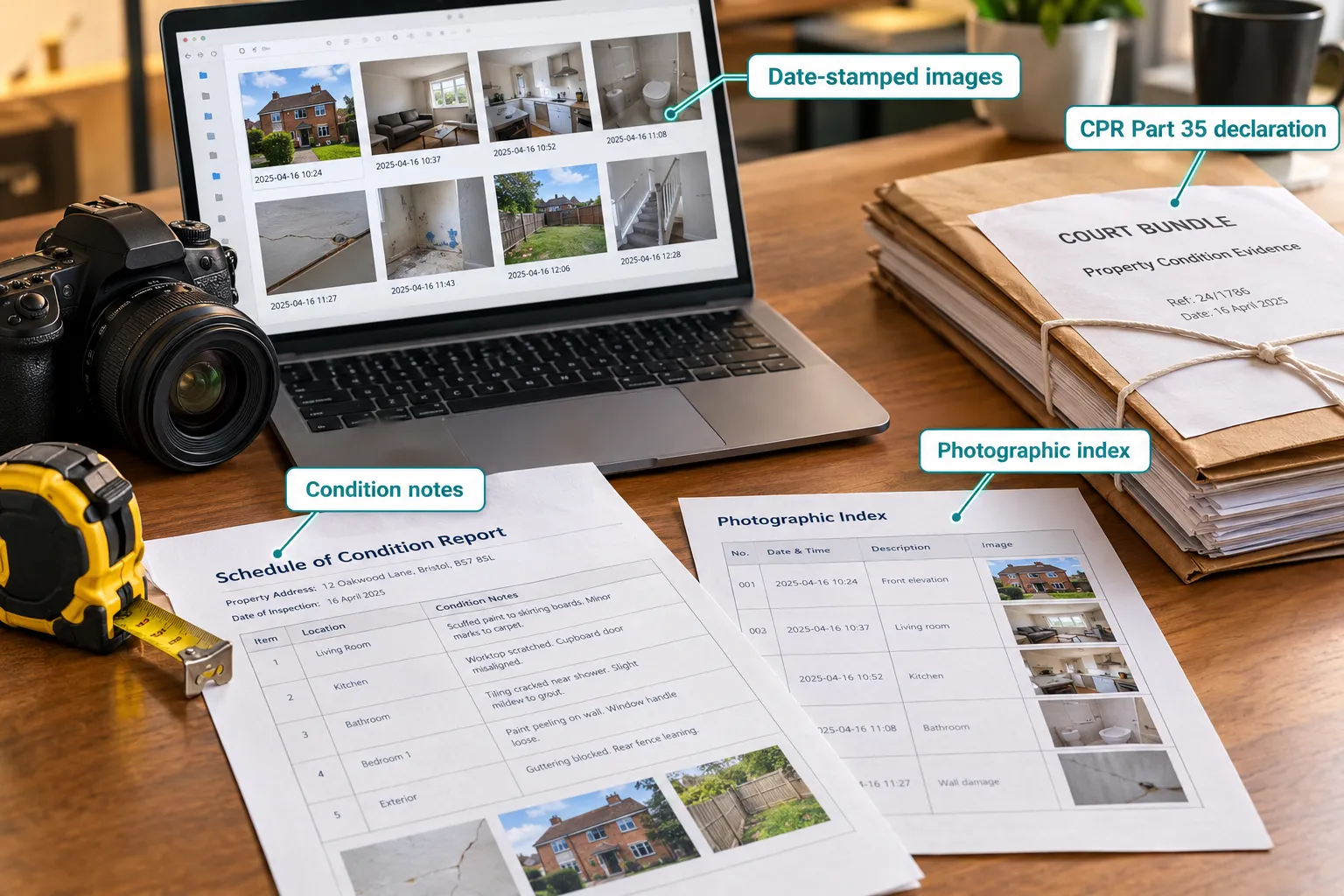
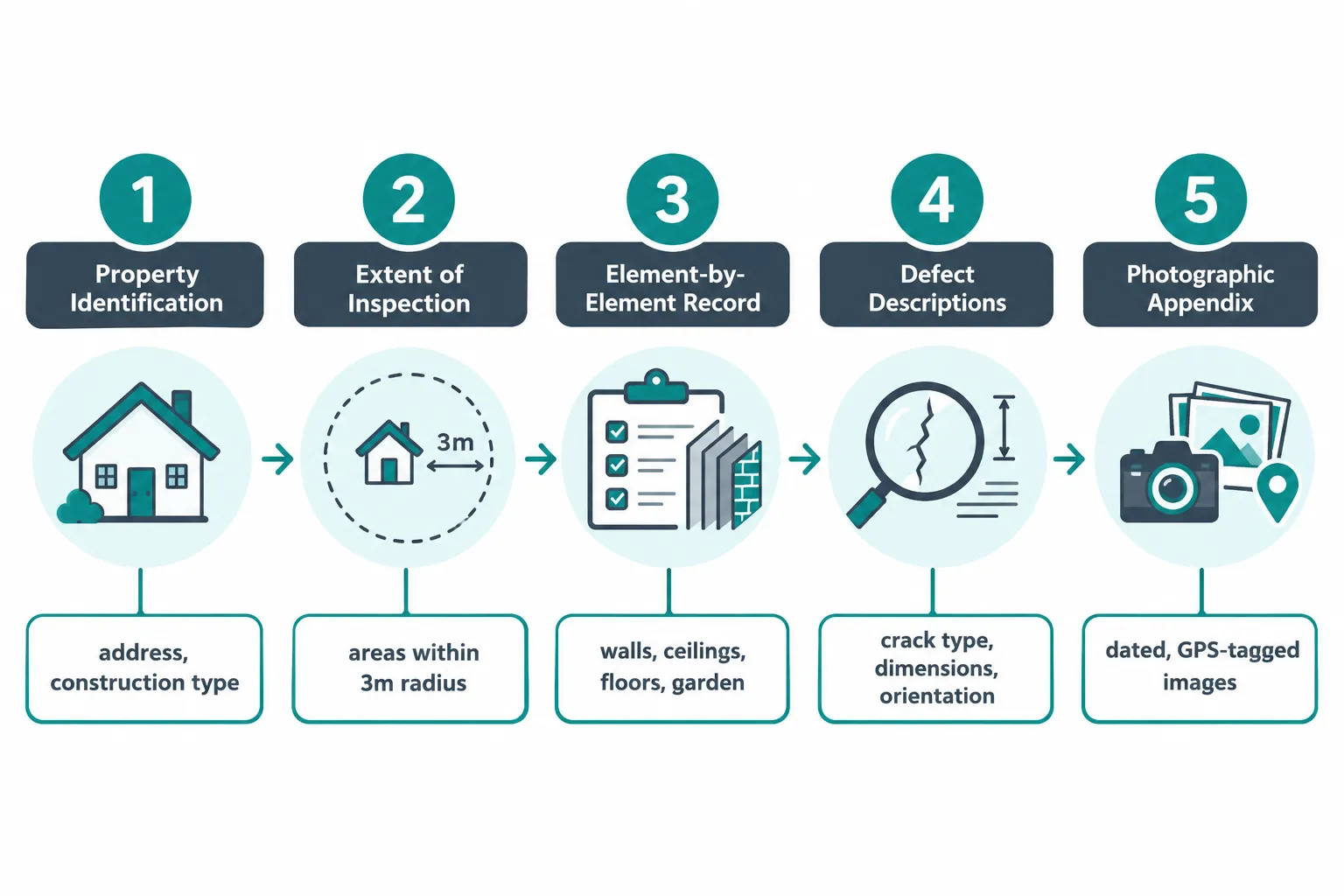
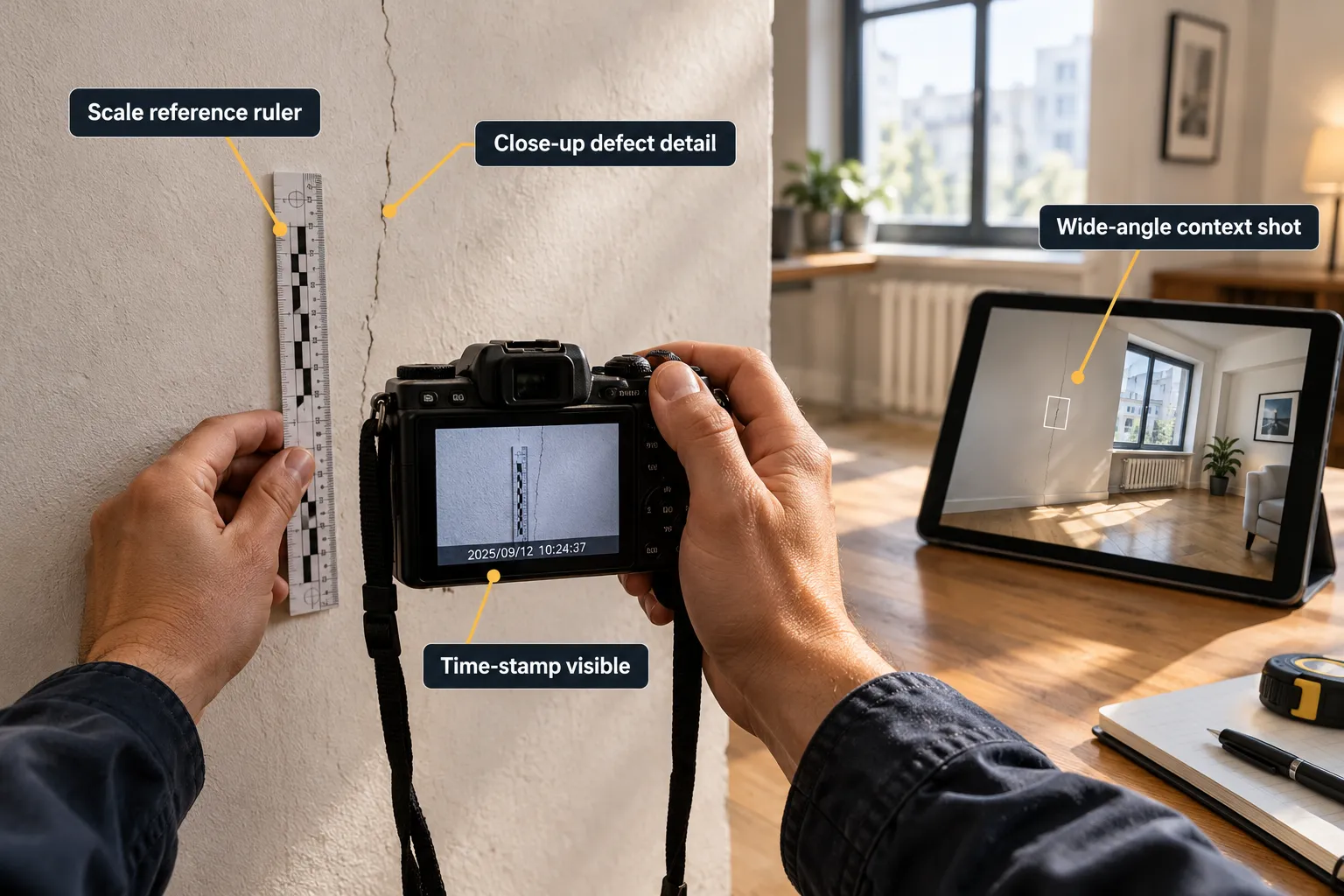
    A Schedule of Condition is a detailed record of the existing state of a neighbouring property, or the party wall itself, prepared before any notifiable building works begin. It typically includes written descriptions, photographs, and measurements of any cracks, damp patches, settlement, or structural defects already present.

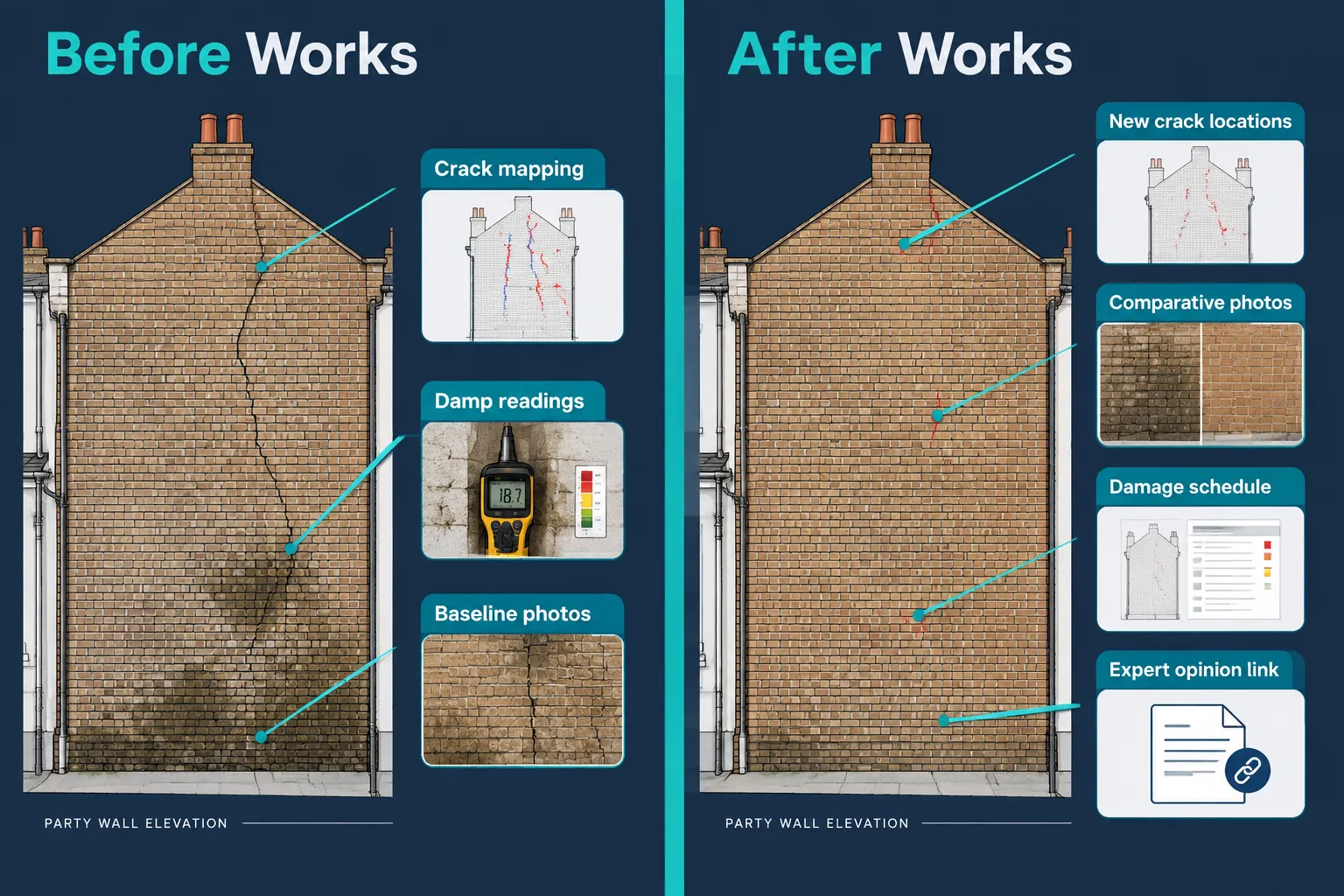
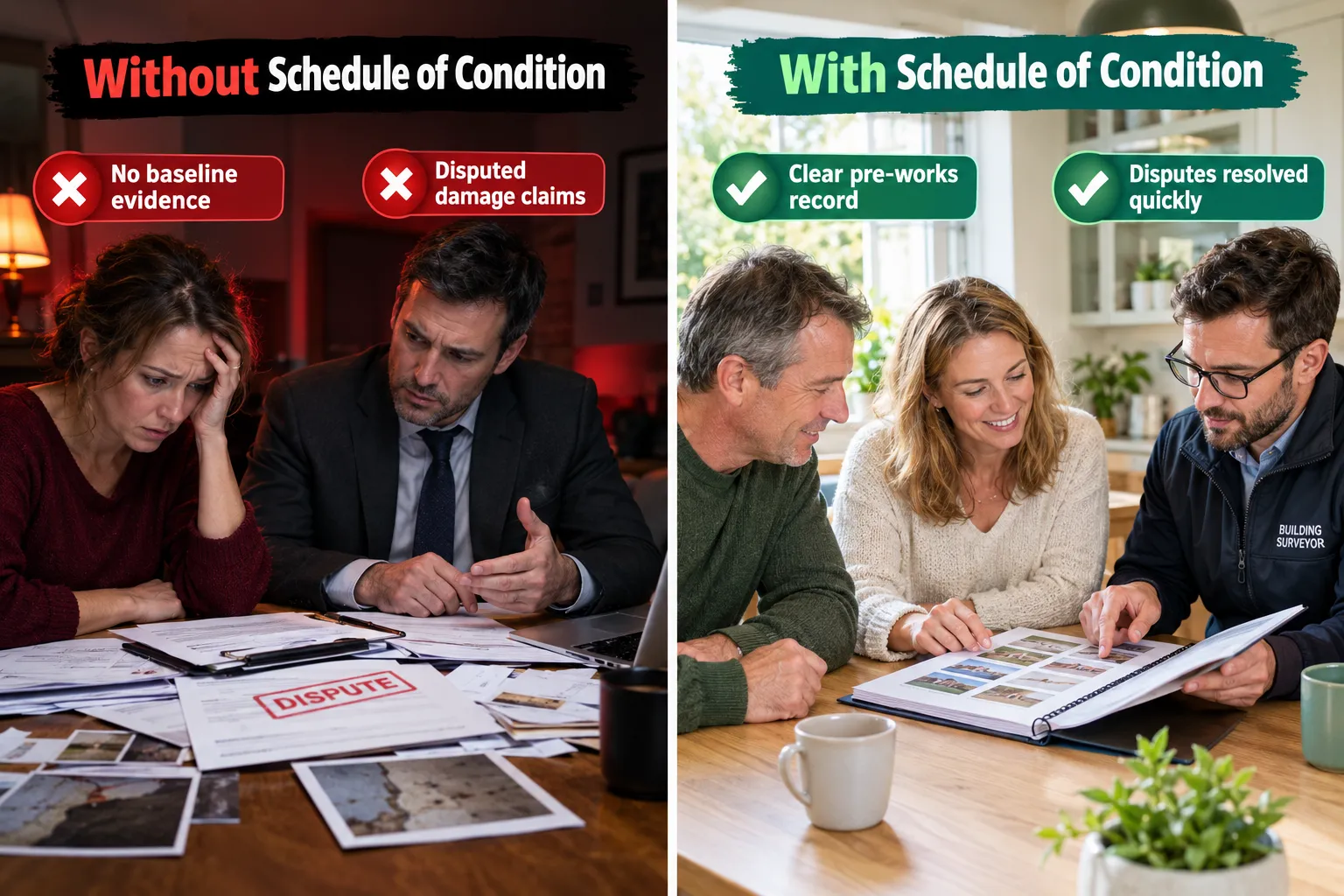
    Under the Party Wall etc. Act 1996, a building owner who carries out notifiable works is liable for any damage caused to an adjoining owner’s property. The Schedule of Condition is the baseline against which any post-construction damage is assessed. Without it, disputes about what was pre-existing and what was caused by the works become almost impossible to resolve objectively.

    The Shift Toward Mandatory Inclusion

    Historically, Schedules of Condition were recommended but not always included in every Party Wall Award. That position has changed significantly. Experienced party wall surveyors now routinely insist on a Schedule of Condition as a core component of the Award document, particularly for:

    • Basement excavations and underpinning, high-risk works that can cause settlement and cracking
    • Loft conversions involving structural steel, vibration and loading changes affect adjoining walls
    • Demolition and rebuild projects, where the risk of damage to neighbours is substantial
    • Any works within 3 metres of an adjoining foundation (under the Act’s line of junction provisions)

    The types of party wall works that trigger the Act are varied, and the level of risk differs considerably. However, the trend among practitioners is clear: when in doubt, include a Schedule of Condition.

    What a Traditional Schedule Contains

    A conventional Schedule of Condition includes:

    Element Purpose
    Written room-by-room descriptions Establishes baseline condition in plain language
    Dated photographs Visual record of cracks, staining, and defects
    Crack width measurements Quantifies existing damage for comparison
    Sketch plans or floor plans Locates defects within the property
    Surveyor’s signature and date Authenticates the document

    While this format remains valid, it has significant limitations. Photographs can be ambiguous. Crack measurements taken by hand have tolerances. Written descriptions are subjective. These weaknesses become critical when a dispute reaches an independent third surveyor or, in rare cases, the County Court.
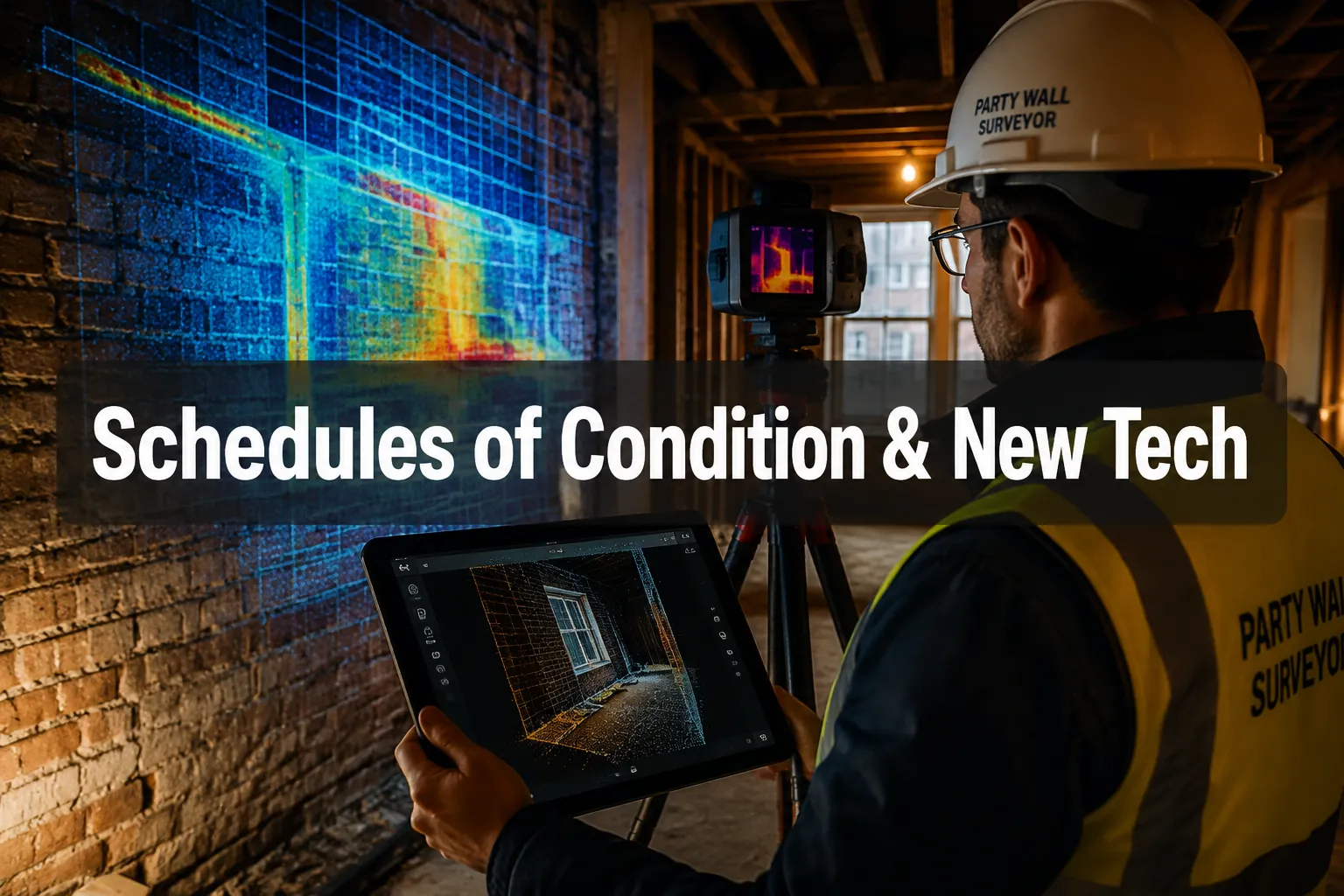
    How Mandatory Schedules of Condition and New Tech (3D Scanning, Thermal Imaging) in Modern Party Wall Awards Are Changing Practice

    The arrival of affordable, portable 3D laser scanning and thermal imaging equipment has transformed what a Schedule of Condition can achieve. These tools do not replace the surveyor’s professional judgment, they enhance the quality and defensibility of the evidence they produce.
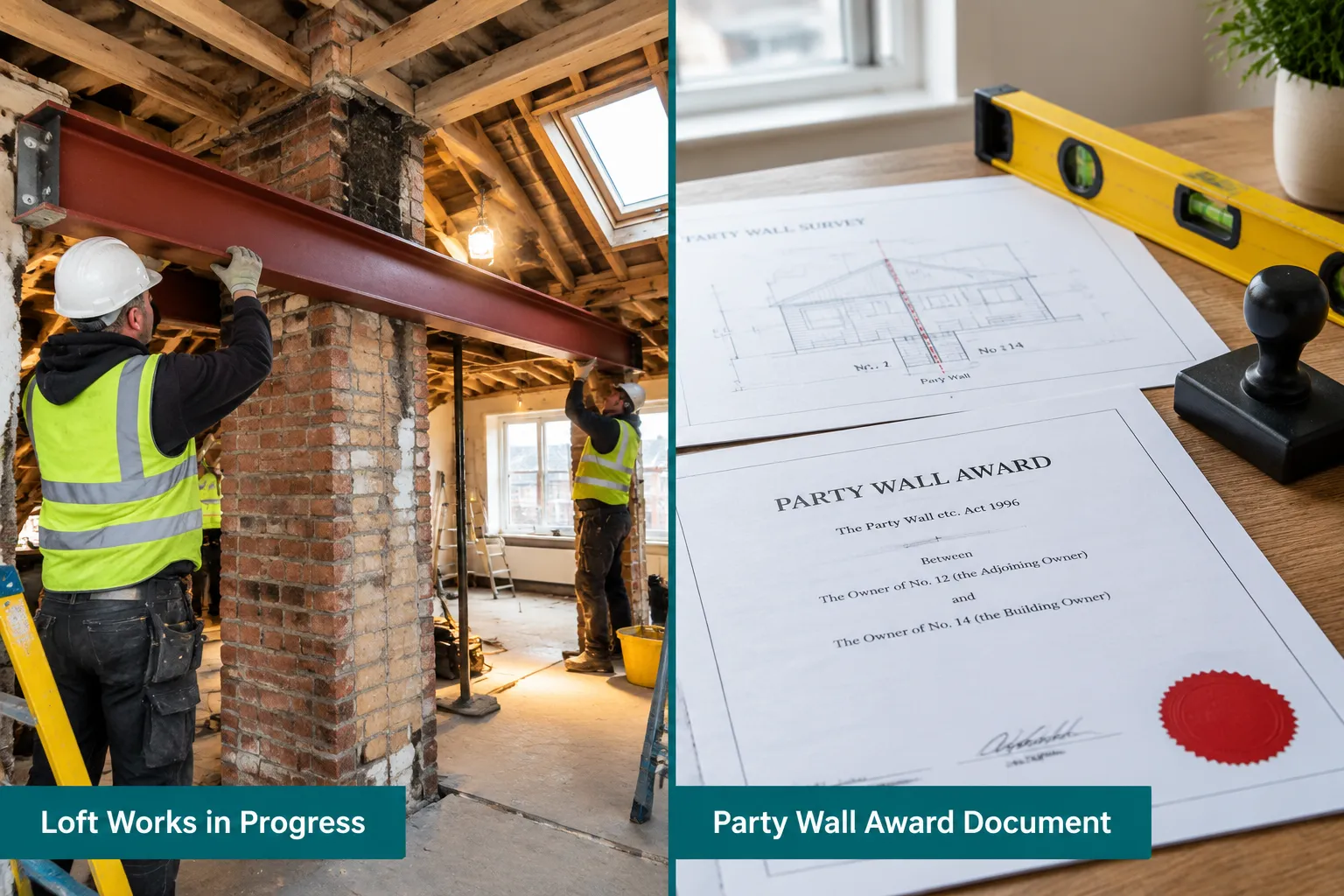
    How Mandatory Schedules of Condition and New Tech (3D Scanning, Thermal Imaging) in Modern Party Wall Awards Are Changing Pra

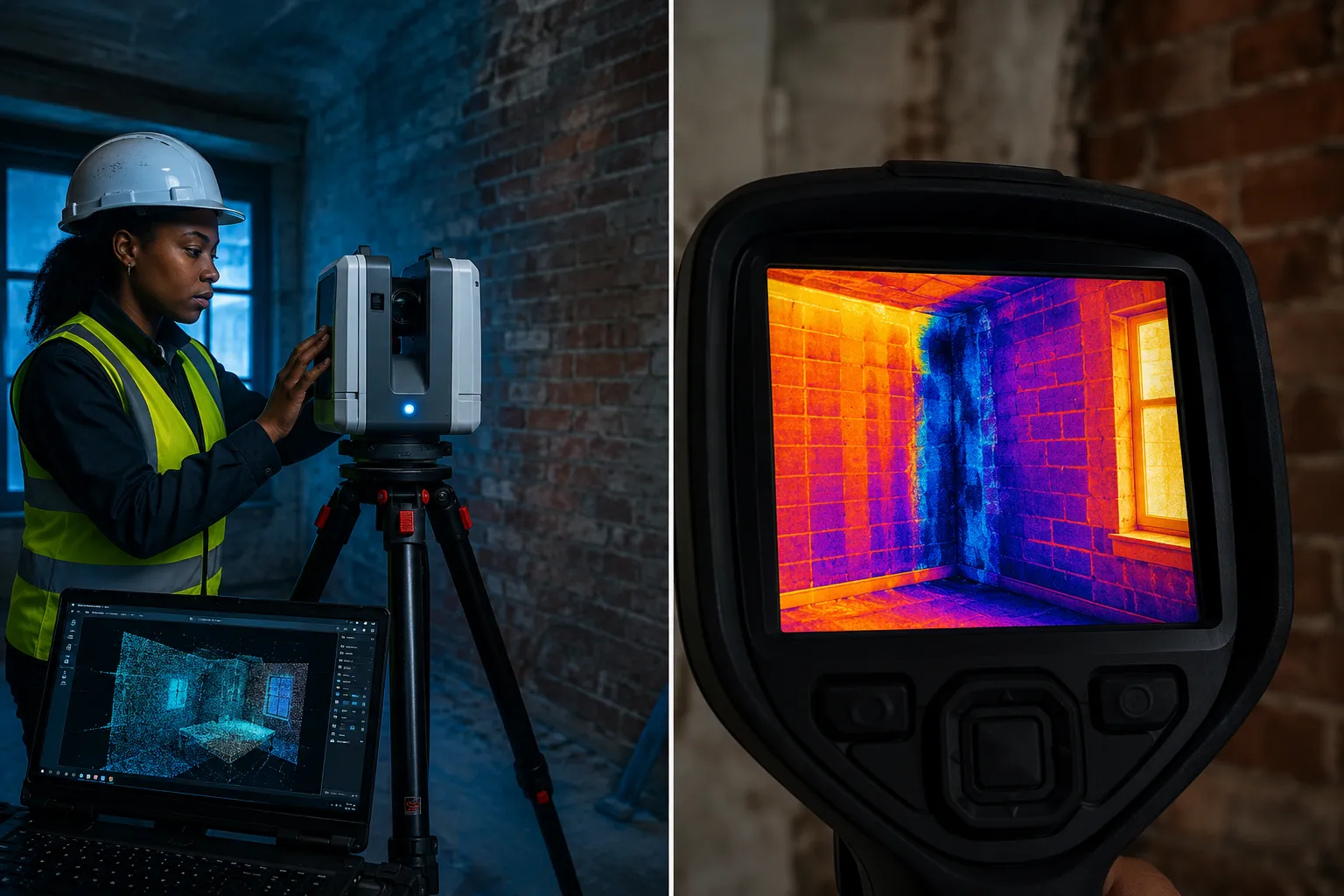
    3D Laser Scanning: Point-Cloud Documentation

    A 3D laser scanner (often called a LiDAR scanner) fires thousands of laser pulses per second at a surface, measuring the precise distance to each point. The result is a “point cloud”, a three-dimensional digital model of the scanned space accurate to within 1-2 millimetres.

    Key advantages for party wall documentation:

    • Millimetre-level accuracy, crack widths, wall deflections, and floor levels are recorded with precision that hand measurements cannot match
    • Permanent, revisitable record, the point cloud can be re-examined years later without returning to site
    • Tamper-evident, the raw scan data carries embedded timestamps and metadata, making it difficult to dispute or alter
    • Whole-room capture, a single scan session records the entire geometry of a room, not just selected details

    In practical terms, a surveyor can return to a point-cloud model after construction is complete and overlay it with a new scan to detect any movement, settlement, or deflection that occurred during the works. This before-and-after comparison is far more persuasive to a third surveyor or judge than two sets of photographs taken at different angles.

    “A point-cloud scan taken before works begin is the closest thing to a freeze-frame of a building’s condition. It removes ambiguity from damage disputes almost entirely.”

    Thermal Imaging: Revealing What the Eye Cannot See

    Thermal imaging cameras detect infrared radiation, heat, and translate it into a colour-mapped image. In the context of party wall surveys, thermal imaging serves several important functions:

    Pre-works thermal surveys can identify:

    • Hidden damp or moisture ingress already present in walls
    • Cold bridges and insulation defects
    • Voids or cavities behind plasterwork
    • Areas of previous repair that may be more vulnerable to vibration

    This matters enormously in damage claims. If a neighbouring owner later claims that a damp patch appeared after the building works, a pre-works thermal image showing heat loss or moisture at that exact location before works began is compelling counter-evidence. Conversely, if thermal imaging shows no pre-existing moisture and a post-works survey reveals new damp, the case for compensation becomes much stronger.

    Thermal imaging is particularly valuable for:

    • Basement conversions adjacent to older Victorian or Edwardian properties
    • Works involving waterproofing or tanking systems
    • Any project where ground movement or water ingress is a foreseeable risk

    Combining Both Technologies in a Single Schedule

    The most robust Schedules of Condition in 2026 combine traditional photography with 3D scanning and thermal imaging into a single, integrated document. The workflow typically looks like this:

    1. Initial site visit, written notes, traditional photographs, crack gauge measurements
    2. 3D laser scan, full point-cloud capture of affected rooms and the party wall face
    3. Thermal imaging survey, full thermal sweep of party walls, floors, and ceilings
    4. Data processing, point clouds rendered into navigable 3D models; thermal images annotated
    5. Report compilation, all data integrated into the Schedule of Condition appended to the Award

    This approach is increasingly expected on high-value or high-risk projects, and the costs of the party wall process reflect the additional time and equipment involved. However, the cost of a comprehensive Schedule of Condition is almost always far less than the cost of a disputed damage claim.

    Practical and Legal Implications of Mandatory Schedules of Condition and New Tech (3D Scanning, Thermal Imaging) in Modern Party Wall Awards

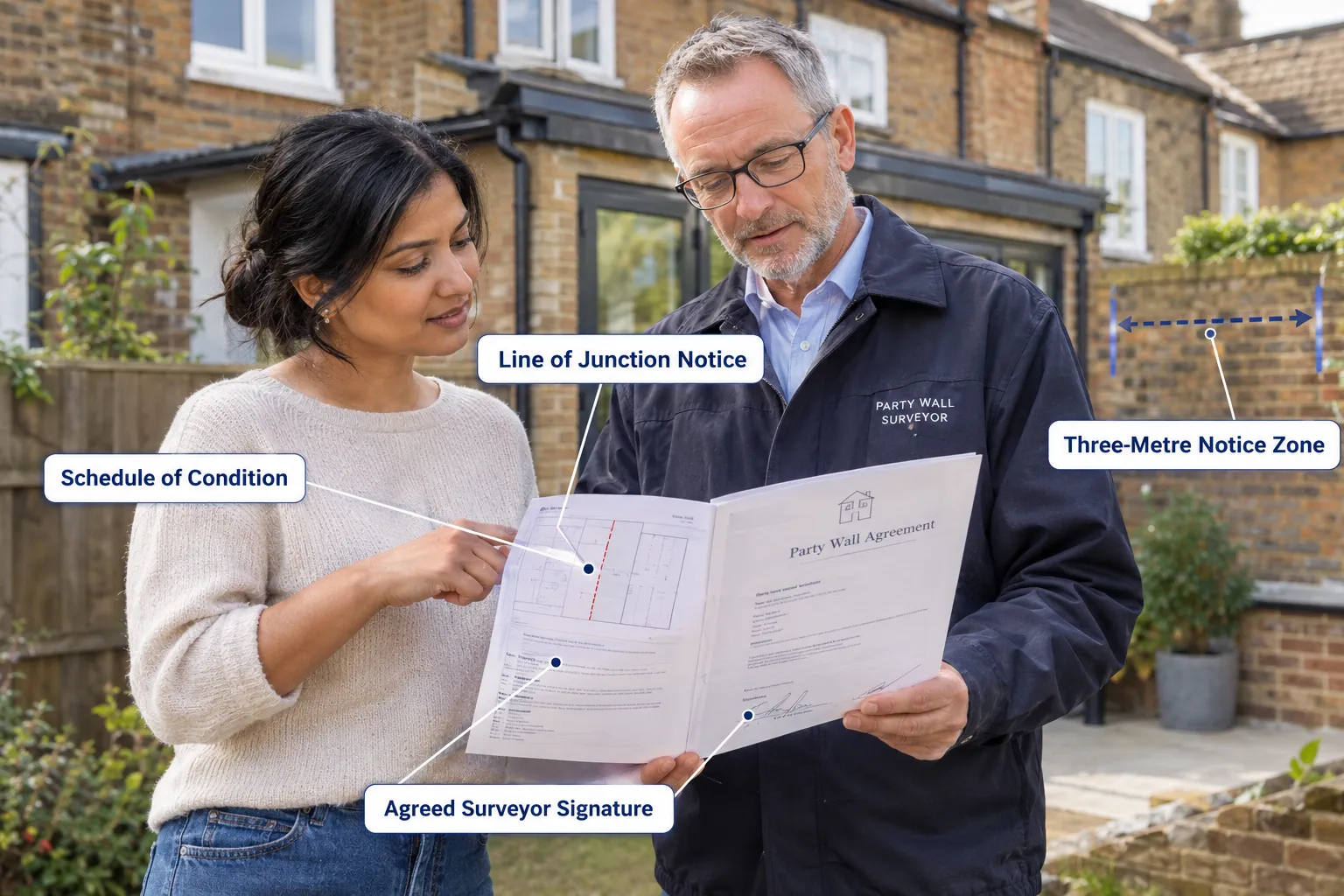
    Practical and Legal Implications of Mandatory Schedules of Condition and New Tech (3D Scanning, Thermal Imaging) in Modern Pa

    The Legal Framework: What the Act Says (and Does Not Say)

    The Party Wall etc. Act 1996 does not prescribe the format or content of a Schedule of Condition. It simply provides that a Party Wall Award may include a Schedule of Condition and that the building owner is liable for damage caused by the works. This legislative silence on format gives surveyors considerable freedom to adopt new technologies.

    What the Act does require is that the Award is a clear, enforceable document. A Schedule of Condition that uses 3D scan data and thermal images must still be presented in a way that is accessible and comprehensible to all parties. Raw point-cloud files are not useful to a layperson; rendered models, annotated screenshots, and clear written summaries are.

    For a deeper understanding of how Awards are structured, the Party Wall Contract Template Guide on Party Wall Awards provides useful context on what these documents typically contain.

    Protecting Adjoining Owners

    For the adjoining owner, the neighbour whose property is at risk, a technologically enhanced Schedule of Condition offers significant protection. It creates an objective, tamper-resistant baseline that:

    • Prevents building owners from disputing pre-existing damage claims
    • Provides clear evidence if new damage appears after works
    • Supports compensation claims with quantified, measurable data

    Adjoining owners who receive a Party Wall Notice should always request that a Schedule of Condition is prepared before works begin. If the appointed surveyor does not propose one, it is entirely reasonable to ask why.

    Protecting Building Owners

    Counterintuitively, a detailed Schedule of Condition protects building owners just as much as their neighbours. Without clear evidence of pre-existing defects, a building owner faces the risk of being held liable for damage that was already present before their works started.

    A thermal image showing pre-existing damp, or a 3D scan showing a crack that was already 3mm wide before any work began, can be the difference between a successful defence and a costly compensation payment. Those considering how to keep party wall costs down should note that investing in a thorough Schedule of Condition upfront is one of the most cost-effective risk management tools available.

    Choosing the Right Surveyor

    Not all party wall surveyors offer 3D scanning or thermal imaging as standard. When selecting a surveyor for a project involving significant risk to neighbouring properties, it is worth asking specifically:

    • Do you use 3D laser scanning for Schedules of Condition?
    • Do you carry a thermal imaging camera or work with a specialist who does?
    • How is the scan data stored and made available to all parties?
    • Is the Schedule of Condition appended to the Award as a formal exhibit?

    A qualified surveyor operating in London, whether in Central London, South London, or East London, should be able to explain their documentation approach clearly and justify why the level of technology proposed is appropriate for the specific project.

    Common Misconceptions

    “A Schedule of Condition is only needed for major works.” This is incorrect. Even relatively modest works, such as cutting into a party wall to install a beam, can cause cracking in neighbouring properties. A Schedule of Condition is appropriate for any notifiable works.

    “Photographs are sufficient.” Standard photographs are useful but limited. They capture a single viewpoint at a single moment. They cannot record wall geometry, detect hidden moisture, or provide the millimetre-level measurements that a dispute may require.

    “The adjoining owner’s surveyor will prepare the Schedule.” In an agreed surveyor scenario, one surveyor acts for both parties. In a two-surveyor scenario, it is common for the adjoining owner’s surveyor to lead on the Schedule of Condition, but both surveyors should agree its scope and content before it is finalised.

    For those navigating the process without professional support, the risks of inadequate documentation are significant. The article on having a party wall agreement without a surveyor outlines some of the pitfalls involved.

    Conclusion

    The integration of mandatory Schedules of Condition and new tech (3D scanning, thermal imaging) in modern Party Wall Awards represents one of the most significant practical advances in party wall surveying in recent years. What was once a supplementary document prepared with a camera and a notepad has become a sophisticated, legally robust piece of evidence capable of resolving disputes that would previously have required costly expert testimony.

    Actionable next steps for building owners and adjoining owners in 2026:

    1. Serve or respond to Party Wall Notices promptly, early engagement gives more time to prepare a thorough Schedule of Condition before works begin. Review the Schedule of Condition page for a detailed overview of what to expect.
    2. Ask your surveyor about advanced documentation methods, specifically whether 3D scanning or thermal imaging is appropriate for your project.
    3. Ensure the Schedule of Condition is formally appended to the Award, it should not exist as a separate, informal document.
    4. Retain all scan data and thermal images, these should be stored securely and made available to all parties named in the Award.
    5. Do not wait until damage appears, the Schedule of Condition must be prepared before works start. Once construction begins, the baseline is lost.

    The party wall process exists to protect both building owners and their neighbours. A technologically rigorous Schedule of Condition is the foundation on which that protection rests.

  • What the New RICS 8th Edition Party Wall Guidance Means for Party Wall Notices, Awards and Agreements

    What the New RICS 8th Edition Party Wall Guidance Means for Party Wall Notices, Awards and Agreements

    {“cover”:”Professional landscape format (1536×1024) hero image with bold text overlay (≤42 chars): ‘RICS 8th Edition Party Wall Guidance’ in crisp white sans-serif on a deep navy semi-transparent panel, centered with 8% safe margins from every edge. Background: bright editorial photograph of a Georgian terraced street in London, two adjoining brick townhouses sharing a party wall, shot in warm afternoon daylight, shallow depth of field on the shared wall boundary, architectural detail visible, magazine-cover polish, professional blue and warm-brick color palette, no tables or grids.”,”content”:[“Flat-vector infographic illustration in landscape format (1536×1024), bright white background with navy and amber accents, showing a stylized timeline of RICS consultation stages, three bold numbered nodes labeled ‘Draft’, ‘Consult’, ‘Publish’ connected by a horizontal arrow, small calendar icon above the center node, clean sans-serif labels under 5 words each, generous 8% safe margins, Pinterest-worthy editorial polish, no tables or pricing grids, conveys the professional standards update process clearly.”,”Editorial split-screen landscape photograph (1536×1024): left half shows a close-up of a formal Party Wall Notice document on a wooden desk under warm studio lighting, fountain pen resting on paper, crisp and sharp; right half shows a surveyor’s hand pointing to a brick party wall on a London building site in bright daylight, hard hat visible, high-contrast editorial composition, warm amber and cool grey palette, no text overlays except a short 3-word label ‘Notice vs. Site’ in small navy sans-serif centered at the split with 8% safe margin, magazine quality.”,”Cinematic editorial photograph (1536×1024) of a professional female South Asian party wall surveyor in her 40s sitting at a modern glass desk reviewing a bound Party Wall Award document, natural daylight from large windows behind her, architectural drawings rolled beside the document, shallow depth of field, cool blue-grey office tones with warm paper accent, shot from a low three-quarter angle for depth, no pricing tables or grids, any visible text on documents kept to 2-3 blurred words, editorial magazine quality, conveys authoritative professional review of formal agreements.”]

    The RICS consultation on its draft 8th edition of “Party Wall Legislation and Procedure” closed on 5 June 2026, and for every building owner, neighbour, and surveyor involved in party wall works, the clock is now ticking. Understanding what the new RICS 8th edition Party Wall guidance means for Party Wall Notices, Awards and Agreements is no longer optional; it is a practical necessity for anyone planning construction work that touches a shared wall, boundary, or excavation near a neighbouring property.

    Split-screen editorial comparison showing professional best-practice versus legal statute: left half features a dark navy

    Key Takeaways

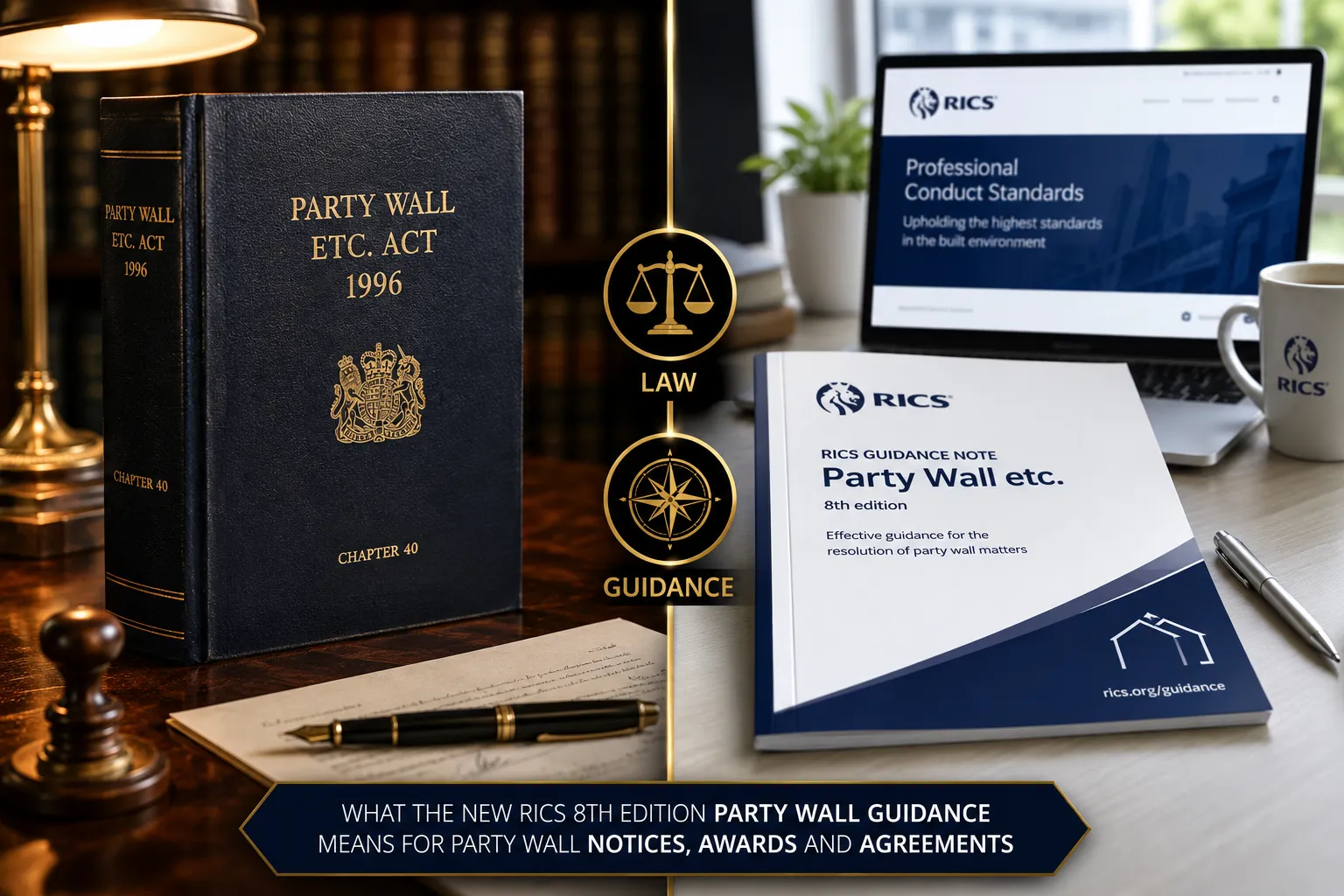
    • The RICS 8th edition is a professional best-practice standard, not a change to the law, the Party Wall etc. Act 1996 remains unchanged.
    • RICS member surveyors will be professionally judged against the new guidance, making compliance a conduct issue even though the statute is unaltered.
    • The draft tightens requirements around notice validity, service procedures, and the content of Party Wall Awards.
    • Stronger emphasis is placed on proportionality, dispute avoidance, and the use of agreed surveyors to reduce costs.
    • Building owners and adjoining owners should review their procedures now, before the final edition is published and takes effect.

    Understanding the RICS 8th Edition: What It Is and What It Is Not

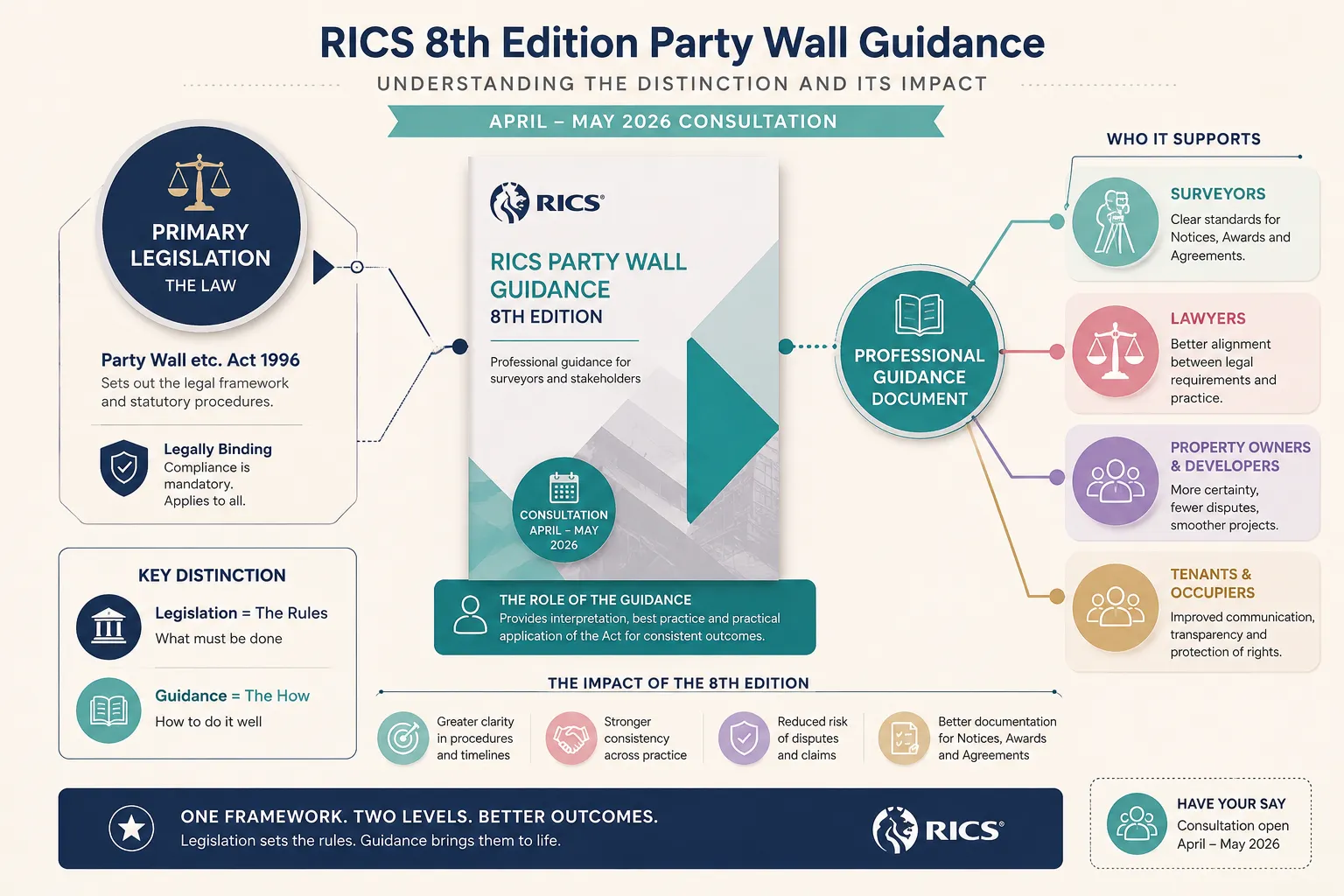
    Before examining the detail, one distinction matters above all others: the 8th edition is a professional guidance document, not primary legislation. RICS launched its consultation on the draft 8th edition of “Party Wall Legislation and Procedure” in April and May 2026, inviting surveyors, lawyers, and dispute resolution practitioners to submit comments [1]. The review process is ongoing, with RICS now analysing responses before publishing the final text [4][5].

    The Party Wall etc. Act 1996 itself has not been amended in 2026 [4][5]. Statutory requirements for notices, awards, and agreements remain exactly as Parliament set them. What changes is the professional standard against which RICS members will be judged when administering those statutory requirements [2].

    “RICS member surveyors will be professionally judged against the 8th edition, so non-compliance may carry regulatory or conduct implications even though the underlying law is unchanged.” [1][2][4]

    This distinction matters enormously in practice. A surveyor who serves a technically valid notice under the Act but does so in a manner inconsistent with 8th edition guidance could face a professional conduct challenge. Conversely, building owners who understand the new expectations can hold their surveyors to a higher standard of service.

    For a plain-language overview of how the Act itself works, the Party Wall etc. Act 1996 page provides a useful starting point.

    When Will the 8th Edition Take Effect?

    There is some uncertainty in the industry about the precise implementation window. Some commentators state the final edition will take effect three months after publication, while others describe an expectation of immediate adoption once issued [3][4][5]. Given that the consultation closed on 5 June 2026, practitioners should treat the new guidance as imminent and begin aligning their procedures accordingly [7].

    What the New RICS 8th Edition Party Wall Guidance Means for Party Wall Notices

    What the New RICS 8th Edition Party Wall Guidance Means for Party Wall Notices

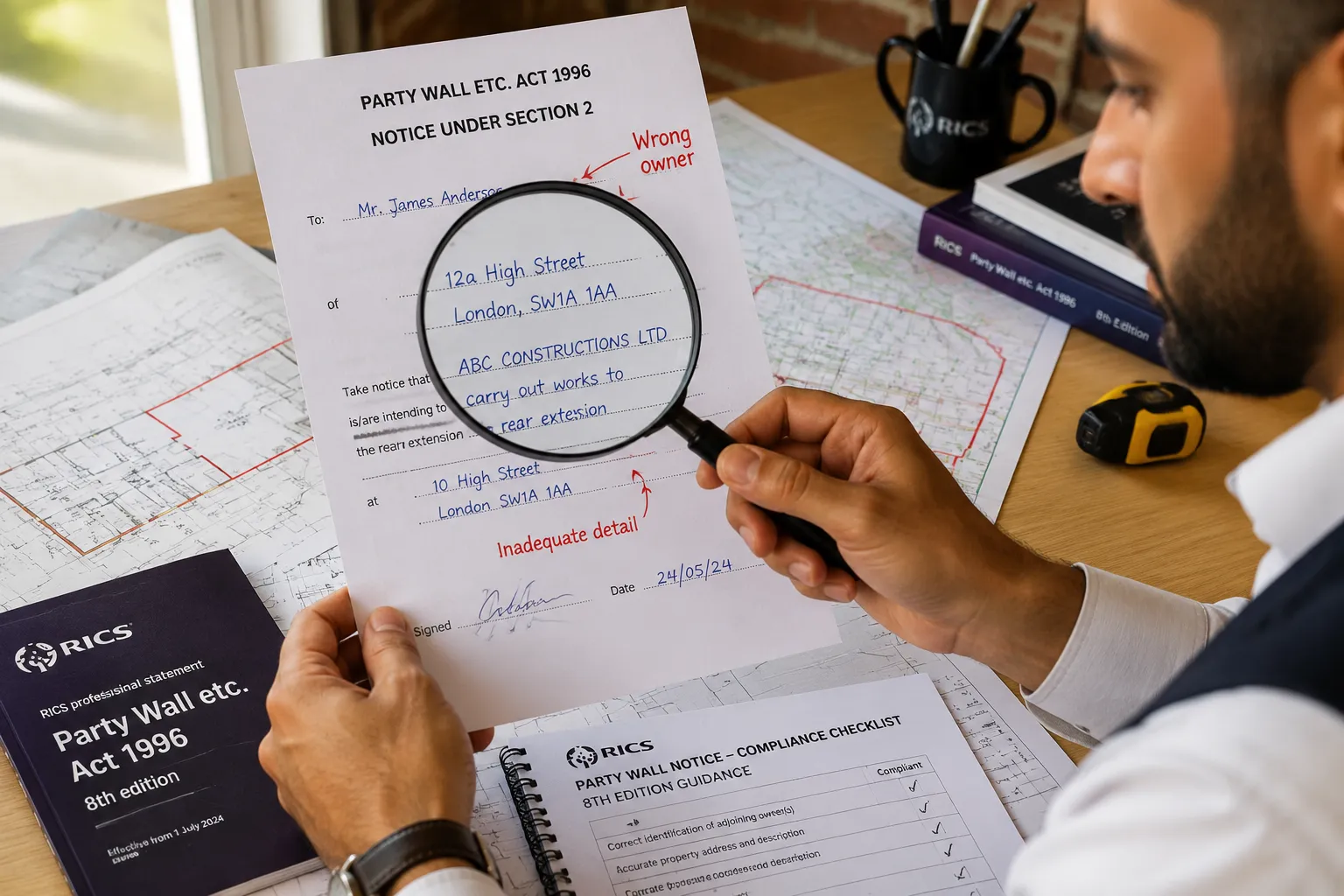
    Notice service is where many party wall disputes are born. RICS identifies defective or improperly served notices as a major source of practical problems, with delays and disputes frequently originating from notices served on the wrong owner or containing inadequate detail [1][5][7].

    Tighter Rules on Who Receives a Notice

    The draft 8th edition reinforces the need to identify the correct adjoining owner before service. This sounds straightforward, but it is a common failure point. Where a property is tenanted, both the freeholder and any long leaseholder with a qualifying interest may need to receive separate notices. Serving only one where both are required renders the notice defective and can invalidate the entire process downstream.

    For a detailed explanation of the different types of notices and how to respond to them, see Party Wall Act Notices, What They Are and How to Respond.

    Content and Validity Requirements

    The 8th edition guidance tightens expectations around the information a notice must contain. Key elements include:

    • A clear description of the proposed works
    • The address of the building to which the works relate
    • The name and address of the building owner
    • The proposed start date (respecting statutory notice periods)
    • Reference to the relevant section of the Party Wall etc. Act 1996 under which the notice is served

    Notices that omit material information, or that describe works in vague terms, risk being challenged as invalid. The guidance signals that surveyors should not proceed on the basis of a defective notice without first seeking correction [5][7].

    For those considering works that affect a shared wall structure, understanding what a Party Structure Notice is and how to serve it in London is essential reading alongside the 8th edition.

    Notice Periods and Timing

    The statutory notice periods, 1 month for a Party Structure Notice and 2 months for a Line of Junction Notice, remain unchanged. However, the 8th edition is expected to provide clearer guidance on how to calculate those periods correctly and what constitutes valid service, including service by post, by hand, and electronically where agreed [4][5].

    For a comprehensive overview of the formal notice process, the Party Wall Notices page sets out the current requirements in accessible terms.

    What the New RICS 8th Edition Party Wall Guidance Means for Party Wall Awards and Agreements

    What the New RICS 8th Edition Party Wall Guidance Means for Party Wall Awards and Agreements

    The Party Wall Award, sometimes called a Party Wall Agreement, is the formal document that governs how notifiable works are to be carried out. It protects both the building owner and the adjoining owner. The 8th edition introduces clearer expectations around the content, structure, and proportionality of Awards [3][5].

    Proportionality in Awards

    One of the most significant themes in the draft guidance is proportionality. Awards should be tailored to the scale and nature of the works. A minor loft conversion should not generate the same volume of conditions and schedules as a basement excavation beneath a neighbouring property. Overly complex Awards for straightforward works have historically driven up costs and created unnecessary friction between neighbours [5][7].

    For those concerned about costs, the guidance on how to keep Party Wall costs down is directly relevant here, proportionate Awards are one of the most effective cost-control tools available.

    Schedules of Condition

    The 8th edition is expected to strengthen guidance on Schedules of Condition, the photographic and written records of a neighbouring property’s state before works begin. These schedules are annexed to the Award and serve as the baseline for any future damage claim. The guidance emphasises:

    Element Expectation Under 8th Edition
    Scope Covers all areas at risk from the notified works
    Format Photographic evidence with written descriptions
    Timing Completed before works commence, not during
    Access Adjoining owner must be given reasonable opportunity to attend
    Retention Copies held by both surveyors and both owners

    A well-prepared Schedule of Condition protects both parties. Surveyors who produce inadequate schedules may face professional criticism under the new guidance [3][5].

    Use of Agreed Surveyors

    The 8th edition places renewed emphasis on the agreed surveyor route, where both the building owner and adjoining owner appoint the same single surveyor rather than each appointing their own. This approach can significantly reduce costs and speed up the process [4][5].

    For those exploring whether an agreed surveyor arrangement is appropriate, the article on having a Party Wall Agreement without a surveyor explains the boundaries of what is and is not possible without professional involvement.

    Award Content: What Must Be Included

    The guidance reinforces that a valid Award must address:

    • The works permitted, described with sufficient precision that a contractor can follow them
    • Working hours, to protect the adjoining owner from unreasonable disruption
    • Access rights, including notice periods before entry
    • Security for expenses, where the adjoining owner requests it
    • Dispute resolution, the mechanism for raising concerns during the works

    For a practical guide to how Awards are structured, Party Wall Awards and the Party Wall Contract Template Guide on Party Wall Awards provide detailed reference material.

    Practical Implications for Building Owners and Surveyors in 2026

    For Building Owners

    Building owners planning works in 2026 should take the following steps before the 8th edition is formally published:

    1. Audit your notice procedures, ensure you are identifying all qualifying adjoining owners, including freeholders and long leaseholders.
    2. Review your notice templates, generic templates may not meet the content expectations signalled in the draft guidance.
    3. Instruct experienced surveyors, RICS members will be held to the 8th edition standard; appointing a surveyor unfamiliar with the updated guidance creates risk.
    4. Budget for proportionate Awards, the guidance discourages unnecessarily complex documents, but a well-prepared Award still requires professional time and expertise.
    5. Consider the agreed surveyor route, where the relationship with the adjoining owner is cooperative, a single agreed surveyor can reduce costs and delays.

    Understanding the costs of the Party Wall process helps building owners set realistic budgets before works begin.

    For Surveyors

    RICS member surveyors face the most direct professional exposure from the 8th edition. Non-compliance with the guidance, even where the underlying statutory requirements are technically met, may constitute a conduct issue [1][2][4]. Surveyors should:

    • Review the draft consultation document and any published RICS response to submissions [1][2]
    • Update their notice templates and Award precedents to reflect the tightened content requirements
    • Document their reasoning where they depart from the guidance in any particular case
    • Engage with CPD on the 8th edition before it takes formal effect [3][5][7]

    The Broader Context: Dispute Avoidance

    A consistent thread running through the 8th edition consultation is the desire to reduce unnecessary disputes. Many party wall disputes arise not from genuine disagreement about works, but from procedural failures, defective notices, incomplete Awards, or poor communication between surveyors [5][7]. The new guidance seeks to address these root causes by raising the baseline standard of practice across the profession.

    Conclusion

    What the new RICS 8th edition Party Wall guidance means for Party Wall Notices, Awards and Agreements is, in essence, a raising of the professional bar. The Party Wall etc. Act 1996 remains the legal foundation, unchanged and unchallenged. But the 8th edition will set a clearer, more demanding standard for how RICS members administer that Act in practice, with particular focus on notice validity, Award proportionality, and the protection of both building owners and adjoining owners through properly prepared documentation.

    Actionable next steps for 2026:

    • If you are a building owner planning notifiable works, review your notice and surveyor appointment procedures now, before the final guidance is published.
    • If you are a surveyor, engage with the RICS consultation outcomes and update your precedents and templates accordingly.
    • If you are an adjoining owner, be aware that the new guidance strengthens your protections, particularly around Schedules of Condition and the content of Awards.
    • In all cases, seek advice from a qualified party wall surveyor who is actively tracking the 8th edition’s progress.

    The consultation closed on 5 June 2026 [4][5]. The final document could be published at any time. Those who prepare now will be better placed to comply from day one.

    References

    [1] Rics Launches Consultation On Updated Party Wall Practice Guidance – rics.org

    [2] Party Wall Legislation And Procedure – rics.org

    [3] Rics 8th Edition Party Wall Guidance Post Consultation Changes And Immediate 2026 Implementation For Surveyors – canterburysurveyors.com

    [4] Rics 8th Edition Party Wall Guidance Building Safety Levy London 2026 What Every Building Owner Must Know – princesurveyors.co.uk

    [5] Rics 8th Edition Party Wall Guidance – hudsonpartywallsurveyors.co.uk

    [6] Party Walls – rics.org

    [7] Party Wall Act Updates Post Rics 8th Edition Essential Changes Building Owners Must Know For 2026 Works – Party wall act updates post rics 8th edition essential changes building owners must know for 2026 works

  • Why 2026 Market Recovery Is Driving More Party Wall Notices: Surveyor Insights From Rising Extension Activity

    Why 2026 Market Recovery Is Driving More Party Wall Notices: Surveyor Insights From Rising Extension Activity

    A recovering housing market does not just move properties, it moves walls. As transaction volumes climb and homeowner confidence returns in 2026, a quieter but equally significant trend is unfolding: the volume of party wall notices being served across the UK, and particularly in London, is rising in step with renewed extension and improvement activity. Understanding why 2026 market recovery is driving more party wall notices, and what surveyor insights from rising extension activity reveal about the months ahead, is essential for any homeowner, developer or adjoining owner navigating this shifting landscape.

    Key Takeaways

    • The 2026 housing market recovery is creating a pipeline of home extension and improvement projects that directly increases the number of party wall notices served.
    • Extension activity is still below pre-2022 norms but is stabilising, meaning a catch-up wave of projects is likely in the second half of 2026 and into 2027.
    • Urban renewal, retrofit programmes and densification are adding complexity to party wall procedures beyond simple rear extensions.
    • Adjoining owners are becoming more aware of their rights, making disputes and formal party wall awards more common.
    • Homeowners who plan ahead, serving correct notices, understanding timelines and engaging qualified surveyors early, can avoid costly delays.

    The 2026 Housing Market Recovery: What the Data Shows

    The UK housing market entered 2026 with cautious momentum. The RICS UK Residential Market Survey for January 2026 reported early signs of recovery, with surveyors noting improving buyer sentiment despite persistent affordability pressures [11][12]. By late February, Zoopla data confirmed a strong rebound in activity: six percent more homes were listed for sale compared with a year earlier, driven by the lowest mortgage rates in four years and improved access for first-time buyers [15].

    The 2026 Housing Market Recovery: What the Data Shows

    RSM UK’s Q2 2026 Housing Tracker anticipated housing starts rising in Q3 and completions increasing in late Q3 and Q4 2026, with the Bank of England holding rates around 3.75% and mortgage reforms boosting borrowing capacity [7]. The Construction Products Association, cited by PwC’s H1 2026 outlook, projected public and private housing output rising around four percent in volume from a very low base, with private housing repair, maintenance and improvement (RMI), the category that includes extensions and retrofits, rising approximately two percent [9].

    This combination of more transactions, improving credit conditions and rising construction output forms the foundation of why 2026 market recovery is driving more party wall notices: each new extension or excavation project near a shared boundary is a potential trigger for formal statutory procedures under the Party Wall etc. Act 1996.

    Key market signals at a glance:

    Indicator Direction in 2026 Source
    Homes listed for sale +6% year-on-year Zoopla [15]
    Housing starts (Q3 forecast) Rising RSM UK [7]
    Private housing RMI output +2% forecast CPA / PwC [9]
    Householder planning applications Stabilising after -11% YoY dip Planning Portal [2]

    Extension Activity: Subdued but Building a Pipeline

    Despite the positive headline signals, extension activity in 2026 has not yet fully recovered. Planning Portal’s January 2026 Market Insight showed householder planning applications, which include the majority of home extensions, were down eleven percent year-on-year compared with January 2025, even though they rose four percent month-on-month from December [2]. Applications for larger home extensions specifically were also down eleven percent year-on-year in January, confirming that activity remains subdued [2].

    The July 2026 Market Insight report painted a similar picture: householder submissions were eight percent lower than July 2025 and four percent below June 2026, with applications for larger home extensions down ten percent compared with June and six percent versus July 2025 [3]. The recovery in extension activity is clearly lagging behind the recovery in sales transactions.

    Surveyor insight: “The pipeline is building, not yet flowing. Homeowners who bought in 2023 and 2024 are now reaching the financial confidence to start the extension they always planned.”

    Savills analysis reinforces this view. In 2025, there was roughly one home extension or improvement for every seven sales, compared with a previous norm of one in five [1]. That gap represents a significant backlog of deferred projects. As confidence and budgets recover through 2026 and 2027, that catch-up wave is expected to translate directly into more planning applications, more construction starts, and more party wall notices being served on adjoining owners.

    How Rising Extension Activity Translates Into More Party Wall Notices

    The legal mechanism connecting extension activity to party wall procedures is straightforward. The Party Wall etc. Act 1996 requires building owners to serve formal notice on adjoining owners before undertaking specific categories of work. These include:

    • Party Structure Notices: For works to an existing shared wall, such as inserting a steel beam, raising the wall height or cutting into it for a new extension. A minimum of two months’ notice is required. [8]
    • Line of Junction Notices: For building a new wall at or astride the boundary line. One month’s notice is required. [8]
    • Notices of Adjacent Excavation: For excavating within three or six metres of a neighbour’s structure (depending on depth). One month’s notice is required. [8]

    For a detailed breakdown of what a party structure notice involves and how to serve one correctly, see this guide on what is a party structure notice and how to serve it in London.

    How Rising Extension Activity Translates Into More Party Wall Notices

    Every rear extension that touches or comes close to a shared wall, every loft conversion that raises a party wall, and every basement or deep-foundation project near a neighbour’s structure generates at least one, and often several, of these notices. As the volume of such projects rises, so does the volume of statutory notices.

    A May 2026 analysis by Prince Surveyors on party wall surveys and urban renewal identified a sharp rise in party wall disputes, rights-of-light claims and nuisance actions driven specifically by government housing targets, mixed-use densification, retrofit and EPC upgrade programmes, and cladding remediation works [5]. The same analysis highlighted that infill development and retrofit projects are increasing the volume of all three types of party wall notices, not just the standard rear-extension party structure notice [5].

    Understanding the types of party wall works that trigger these obligations is an essential first step for any homeowner planning a project in 2026.

    Surveyor Insights: Why Disputes and Awards Are Becoming More Complex

    The increase in notices is only part of the story. Surveyors working across London are also reporting that the disputes arising from those notices are becoming more involved, requiring more detailed party wall awards and greater professional input than in previous cycles.

    Several factors are driving this complexity:

    1. More “deemed dissent” outcomes

    Simple Survey’s Party Wall Predictions for 2026 forecast a rise in notices ending in deemed dissent, where an adjoining owner fails to respond within 14 days and is automatically treated as having dissented [6]. Rising construction costs, more ambitious project scopes (multi-storey extensions, basements, full retrofits) and greater general awareness of compensation rights are all making neighbours more cautious about giving consent [6].

    2. Overlapping regulatory regimes

    Cladding remediation under the Building Safety Act, EPC-driven retrofit programmes and permitted development changes are all generating works that overlap with party wall obligations. Each overlap adds a layer of legal and technical complexity to the award-drafting process [5].

    3. Rights-of-light and nuisance actions

    Urban densification is bringing rights-of-light litigation into closer contact with party wall procedures. A rear extension that is perfectly compliant under the Party Wall Act may still attract a rights-of-light injunction from a neighbour, and surveyors are increasingly being asked to navigate both regimes simultaneously [5].

    4. Adjoining owners are better informed

    Awareness of the right to appoint an adjoining owner’s surveyor, whose fees are typically paid by the building owner, has grown significantly. This means more adjoining owners are exercising that right, increasing the formal surveyor involvement on each project.

    A London-focused commentary on 2026 Party Wall Act updates confirmed that statutory notice periods remain unchanged at two months for party wall works and one month for excavation [4]. That predictability is helpful for project planning, but it also means that any surge in extension activity translates directly and proportionately into more notices, more potential disputes, and more awards under the existing regime [4].

    London: The Epicentre of Rising Party Wall Activity

    London’s housing density makes it the natural focal point for rising party wall notice volumes. The city’s stock of Victorian and Edwardian terraced and semi-detached houses means that almost every extension project involves a shared wall, a boundary close to a neighbour’s foundations, or both.

    Activity is spread across all parts of the capital. In central areas, basement and lower-ground-floor extensions remain popular despite their complexity. In west and south London, rear and side-return extensions dominate. In north and east London, loft conversions and upward extensions are increasingly common as homeowners seek to add space without losing garden area.

    Homeowners and developers in these areas can find specialist support through location-specific surveying services:

    London: The Epicentre of Rising Party Wall Activity

    The urban renewal dynamic identified by Prince Surveyors is particularly acute in London, where government housing targets, permitted development rights for upward extensions, and the ongoing retrofit agenda are converging to produce a sustained high volume of notifiable works [5].

    Practical Guidance for Homeowners in the 2026 Market

    Understanding why 2026 market recovery is driving more party wall notices and surveyor insights from rising extension activity is useful context, but homeowners need practical steps. The following guidance applies whether a homeowner is the building owner planning works or the adjoining owner receiving a notice.

    For building owners planning an extension:

    • Identify whether the proposed works fall within the scope of the Party Wall etc. Act 1996 before submitting a planning application. Many projects require notice even where planning permission is not needed.
    • Serve notices at the correct time. Party structure notices require two months’ lead time; excavation notices require one month [8]. Serving late causes project delays.
    • Engage a building owner’s surveyor early to draft notices correctly and manage the process efficiently.
    • Understand the costs of the party wall process upfront, including the likelihood of paying the adjoining owner’s surveyor’s fees if they dissent.
    • Review practical strategies to keep party wall costs down without cutting corners on compliance.

    For adjoining owners receiving a notice:

    • Do not ignore a party wall notice. Failure to respond within 14 days triggers deemed dissent and the appointment of a surveyor anyway, but without any input from the adjoining owner at the outset [6].
    • Understand what the notice means and what rights it confers. A clear explanation is available in this guide on party wall act notices, what they are and how to respond.
    • Consider appointing an adjoining owner’s surveyor to protect interests. Their fees are generally borne by the building owner.
    • Request a schedule of condition before works begin. This documents the existing state of the property and is the primary evidence base for any future compensation claim.

    Notice response timeline:

    Action Deadline
    Respond to party wall notice Within 14 days of service
    Consent in writing Avoids formal award; works can proceed after notice period
    Dissent and appoint surveyor Triggers award process
    Deemed dissent (no response) Automatic after 14 days; surveyor appointed

    What to Expect in the Second Half of 2026 and Beyond

    The data points consistently toward a strengthening pipeline of extension activity in the second half of 2026. RSM UK’s Housing Tracker anticipates rising housing starts in Q3 and increasing completions in Q4 [7]. The Savills-identified backlog of deferred improvement projects among recent buyers is likely to begin unwinding as mortgage conditions stabilise [1]. PwC’s construction outlook projects private housing RMI continuing to grow modestly through the remainder of the year [9].

    For the party wall sector, this trajectory means:

    • More notices served, particularly for rear extensions, loft conversions and basement projects in dense urban areas.
    • More deemed dissents, as adjoining owners exercise greater caution in the face of complex or high-value works [6].
    • More formal awards required, as the proportion of projects requiring surveyor involvement increases.
    • Greater demand for qualified surveyors, both as building owner’s surveyors and adjoining owner’s surveyors, across all London boroughs.

    Surveyors and homeowners alike should treat the current period as a preparation window, a time to understand obligations, build professional relationships, and ensure that when the catch-up wave of extension projects arrives in earnest, the legal and procedural groundwork is already in place.

    Conclusion

    The connection between 2026’s housing market recovery and the rising volume of party wall notices is neither coincidental nor temporary. It is a direct, structural consequence of more homeowners gaining the confidence and financial capacity to undertake the extension and improvement projects they deferred during years of market uncertainty. Surveyor insights from rising extension activity confirm that the pipeline is building, that disputes are becoming more complex, and that both building owners and adjoining owners face greater procedural demands than in previous cycles.

    Actionable next steps for homeowners in 2026:

    1. If planning any works near a shared wall or boundary, check obligations under the Party Wall etc. Act 1996 before finalising project timelines.
    2. Serve notices at the correct time, two months for party structure works, one month for excavation, to avoid costly project delays.
    3. Engage a qualified party wall surveyor early, whether as a building owner or as an adjoining owner receiving a notice.
    4. If costs are a concern, explore legitimate strategies to manage the process efficiently without compromising legal compliance.
    5. Stay informed about how urban renewal, retrofit requirements and densification are adding new layers of complexity to what might appear to be straightforward extension projects.

    The 2026 market recovery is good news for homeowners and the construction sector. Navigating its party wall implications well is what separates a smooth project from an expensive dispute.

    References

    [1] Fewer Homeowners Renovate Despite Rise In Sales Savills Finds – mortgagesolutions.co.uk

    [2] January 2026 Market Insight – blog.planningportal.co.uk

    [3] June 2026 Market Insight Report 2 – blog.planningportal.co.uk

    [4] 2026 Party Wall Act Updates Key Changes Impacting Awards And Agreements In Stabilizing Property Markets – 2026 party wall act updates key changes impacting awards and agreements in stabilizing property markets

    [5] Party Wall Surveys In 2026 Urban Renewal Managing High Demand Disputes And Neighbour Relations – princesurveyors.co.uk

    [6] Simple Surveys Party Wall Predictions For 2026 – simplesurvey.co.uk

    [7] Uk Housing Tracker Outlook – rsmuk.com

    [8] When How Tell Them – gov.uk

    [9] Construction And Housebuilding Outlook H1 2026 – pwc.co.uk

    [10] Party Wall Agreement – hoa.org.uk

  • Expert Witness Party Wall Surveyors in 2026: Preparing Schedules and Photographic Evidence for Court

    Expert Witness Party Wall Surveyors in 2026: Preparing Schedules and Photographic Evidence for Court

    A single missing photograph has determined the outcome of more than one party wall dispute in the English courts. When a neighbour claims that building works cracked their plaster or undermined their foundations, the difference between winning and losing often comes down to whether a surveyor compiled a meticulous, court-ready record before the first drill bit turned. Expert Witness Party Wall Surveyors in 2026: Preparing Schedules and Photographic Evidence for Court is no longer a niche specialism, it is a defined professional discipline governed by a new global standard, tightening accreditation requirements, and a body of case law that rewards rigour and punishes guesswork.

    This article explains exactly how party wall surveyors compile and present evidence, from pre-works schedules of condition through to photographic bundles and expert reports, when disputes escalate to court or tribunal settings.

    Key Takeaways

    • RICS issued the 5th edition of its expert witness professional standard in July 2026, effective 30 November 2026, setting mandatory rules for how surveyors prepare and present evidence including schedules of condition and photographs [1]
    • Schedules of condition and photographic records are the primary factual evidence in party wall disputes; their quality directly affects liability findings under the Party Wall etc. Act 1996
    • CPR Part 35 governs expert evidence in civil proceedings, and party wall surveyors acting as expert witnesses must comply with both CPR and the RICS standard simultaneously [5]
    • Courts increasingly expect expert surveyors to be formally accredited; RICS maintains a published register of accredited expert witnesses running at least through 2027 [4][6]
    • Transparent use of technology, including digital photography, metadata, and any AI-assisted tools, is now a professional expectation, not an option [8]

    The Legal Framework Governing Expert Witness Party Wall Surveyors in 2026

    The Legal Framework Governing Expert Witness Party Wall Surveyors in 2026

    Party wall disputes sit at the intersection of property law, construction practice, and civil procedure. When a dispute cannot be resolved through the Party Wall Awards process and escalates to county court or the High Court, the surveyor’s role shifts from quasi-arbitrator to expert witness. That shift carries significant legal consequences.

    Civil Procedure Rules Part 35 is the foundational instrument. It requires that an expert witness’s overriding duty is to the court, not to the party that instructed them. Any surveyor preparing schedules of condition or photographic evidence for litigation must understand that their report will be scrutinised against this standard before it is admitted as evidence.

    Layered on top of CPR Part 35 is the RICS professional standard. In July 2026, RICS issued the 5th edition of Surveyors Acting as Expert Witnesses, which replaces the 4th edition and becomes fully effective on 30 November 2026 [1]. The new edition splits its content into two distinct parts:

    Section Status Covers
    Professional Standard Mandatory Independence, conflicts of interest, fee arrangements, report structure
    Supplementary Information Non-mandatory guidance Inspection methods, evidence presentation, joint expert meetings

    This two-tier structure is intentional. It separates the rules a surveyor must follow from the guidance that represents best practice [3]. For party wall expert witnesses, both tiers are relevant: the mandatory rules govern conduct, while the supplementary guidance shapes how schedules and photographic bundles should be assembled and explained to a tribunal.

    The 2026 Built Environment Journal analysis of expert witness duties reinforces that independence and robust, well-reasoned evidence are non-negotiable [5]. A surveyor who prepares a schedule of condition that omits pre-existing damage, or who selects only photographs that favour the instructing party, risks not only losing the case but facing professional sanction.

    Case law adds further weight. The Court of Appeal’s decision in Taylor v Jones [2024] EWCA Civ 170 clarified when a building owner is liable for remedial works under the Party Wall etc. Act 1996. Legal commentary on that case consistently stresses that carefully prepared pre-works schedules of condition and photographic records are the primary mechanism for establishing whether damage was caused by the notifiable works [15]. Earlier cases including Welter v McKeeve (2018) and Walsh v PSB Management (2022) similarly emphasise that party wall surveyors’ records constrain how liability is assessed [11].

    For practitioners working in London, understanding the Party Wall etc. Act 1996 in its full statutory context is the starting point for any expert witness engagement.

    Compiling a Schedule of Condition: Standards and Methodology

    Compiling a Schedule of Condition: Standards and Methodology

    A Schedule of Condition is the cornerstone document in any party wall expert witness case. It establishes the baseline state of an adjoining owner’s property before notifiable works begin. Without it, attributing post-works damage to the building owner’s activities becomes speculative, and courts have little tolerance for speculation.

    What a Schedule of Condition Must Record

    A thorough schedule covers the following elements:

    • Structural condition, existing cracks (mapped by location, width, and length), settlement patterns, and any signs of previous movement
    • Damp and moisture readings, baseline moisture levels in walls, floors, and ceilings adjacent to the party wall or excavation zone
    • Finishes and fittings, the condition of plasterwork, tiling, joinery, and decorative finishes in rooms directly affected by the proposed works
    • External fabric, the condition of brickwork, pointing, copings, and any boundary structures
    • Services, the location and visible condition of drainage, pipework, and electrical installations near the works

    Each item must be described precisely. Vague entries such as “minor cracking noted” are inadequate for court purposes. A court-ready schedule uses a recognised crack classification system (such as the BRE classification), records exact dimensions, and cross-references every entry to a numbered photograph.

    The Inspection Process

    The inspection itself must be systematic. A surveyor acting as an expert witness under the 5th edition RICS standard is expected to be able to justify every aspect of their methodology [1][7]. That means:

    1. Conducting the inspection personally, not delegating to an unqualified assistant
    2. Using calibrated instruments where measurements are taken
    3. Recording the date, time, weather conditions, and names of those present
    4. Noting any areas that could not be inspected and explaining why

    The Adjoining Owners Surveyor and the Building Owners Surveyor may each compile their own schedules, or they may agree a joint schedule. Where a joint schedule is produced, the 5th edition standard requires a clear audit trail: any agreement reached between opposing experts must be documented and disclosed to the instructing parties [1][3]. This prevents a situation where a joint schedule is later disputed by one side as misrepresenting what was agreed.

    Timing Is Everything

    The schedule must be completed before works commence. Courts have repeatedly found that a schedule produced after works have started carries significantly less evidential weight, because it cannot reliably distinguish pre-existing damage from works-related damage. Surveyors should serve the completed schedule on all parties and retain a copy with a verifiable creation date, a digitally signed PDF with metadata intact is now standard practice.

    Understanding the full range of Types of Party Wall Works that trigger the Act is essential for determining the correct scope of a pre-works inspection.

    Photographic Evidence: Best Practice for Expert Witness Party Wall Surveyors in 2026

    Photographic Evidence: Best Practice for Expert Witness Party Wall Surveyors in 2026

    Photographs are the most persuasive form of evidence in party wall disputes. A judge or tribunal member who has never stood inside a Victorian terrace can understand a crack in a wall instantly when shown a clear, well-lit, correctly scaled photograph. The challenge is ensuring that photographic evidence meets the standards that courts and the RICS professional standard now expect.

    Core Requirements for Court-Admissible Photographs

    Every photograph submitted as evidence should have:

    • A date and time stamp embedded in the file metadata (EXIF data)
    • A unique reference number that cross-references the schedule of condition
    • A scale reference in the frame (a crack gauge, ruler, or coin) where dimensions are relevant
    • A location shot showing the wider context, followed by a close-up of the specific defect
    • Consistent lighting, flash or supplementary lighting should be used consistently to avoid misrepresenting the severity of staining or cracking

    Photographs should be stored in a secure, unedited format. Any enhancement, adjusting brightness, contrast, or cropping, must be documented and disclosed. The RICS Modus analysis of AI and expert witness work warns explicitly that image enhancement and AI-assisted analysis must be used transparently; a surveyor who cannot explain how an image was processed risks having that evidence challenged or excluded [8].

    Organising a Photographic Bundle

    A photographic bundle for court is not simply a folder of images. It is a structured evidential document. Best practice in 2026 includes:

    • A photographic index listing each image by reference number, location, date, and brief description
    • Printed or PDF versions with annotations (arrows, labels) added as a separate overlay, never burned into the original image file
    • A narrative section in the expert report that explains what each photograph shows and why it supports the surveyor’s opinion
    • Cross-referencing between the photographic index and the schedule of condition entries

    “Carefully prepared pre-works schedules of condition and photographic evidence are critical to demonstrating whether damage was caused by the notifiable works.”, Legal commentary on Taylor v Jones [2024] EWCA Civ 170 [15]

    Technology, AI, and Evidential Integrity

    Industry commentary on the 2026 RICS standard predicts that courts will increasingly scrutinise expert methodologies, data handling, and the use of technology [7]. While no formal minimum resolution or mandatory metadata fields have been published, emerging best practice points to:

    • Systematic photo logging with a consistent naming convention
    • Secure cloud storage with access logs
    • Explicit disclosure in the expert report of the camera equipment, settings, and any post-processing applied
    • Caution with AI-assisted condition recording tools, surveyors must understand and be able to justify any AI output they rely on [8]

    Surveyors working across London, whether engaged as a Party Wall Surveyor in Central London, South London, or North London, encounter a wide range of property types and construction periods, each presenting different photographic challenges. Victorian brickwork, for example, often shows historic cracking patterns that must be distinguished clearly from fresh movement.

    Accreditation, Independence, and the Expert Report

    RICS Accreditation in 2026

    The expectation that party wall surveyors acting as expert witnesses hold formal accreditation has grown steadily. The RICS Register of Accredited Expert Witnesses, updated in September 2025, requires completion of four training modules, an ethics test, and an interview [6]. The May 2025 list of registered expert witnesses is scheduled to remain in force until 31 December 2027 [4]. Together, these timelines confirm that 2026 is a year in which courts and instructing solicitors increasingly expect surveyors preparing schedules and photographic evidence for party wall disputes to be either accredited or formally registered.

    The RICS Find a Surveyor service confirms that chartered surveyor expert witnesses are selected for their ability to provide objective, independent opinion on technical matters, with inspection-based evidence, measurements, schedules, and photographs, at the core of that work [12].

    Maintaining Independence

    The 5th edition standard places particular emphasis on independence. Key rules include:

    • A surveyor must not accept an instruction where there is a conflict of interest that cannot be managed
    • Fee arrangements must not be contingent on the outcome of proceedings
    • Expert witnesses may only meet opposing experts with prior client consent, and any meeting that touches on settlement prospects must be reported to the instructing parties [1][3]

    These rules have direct implications for party wall work. A Building Owners Surveyor who is also acting as an expert witness must be especially careful that their dual role does not compromise the independence their expert report requires.

    Structuring the Expert Report

    A court-compliant expert report in a party wall dispute typically contains:

    1. Instructions and scope, what the surveyor was asked to do and by whom
    2. Qualifications and experience, the surveyor’s relevant expertise
    3. Methodology, how the inspection was conducted and how evidence was gathered
    4. Factual findings, the schedule of condition, photographic evidence, and measurement data
    5. Opinion, the surveyor’s reasoned conclusions on causation, liability, and remedial works
    6. CPR Part 35 declaration, the mandatory statement that the expert’s duty is to the court

    The opinion section must be clearly separated from the factual findings. Courts have criticised reports that blend fact and opinion without distinction, as this makes it difficult to assess the reliability of each element independently.

    Practical Steps for Surveyors Preparing Evidence in 2026

    The convergence of the new RICS 5th edition standard, tightening accreditation requirements, and a growing body of case law means that party wall surveyors cannot afford to treat expert witness preparation as an afterthought. The following practical steps reflect current best practice:

    Before the instruction:

    • Confirm there is no conflict of interest
    • Agree the scope and fee arrangement in writing, ensuring fees are not outcome-contingent
    • Check accreditation status and update training if required [4][6]

    During the inspection:

    • Use a structured inspection checklist aligned to the schedule of condition format
    • Photograph systematically: context shot, medium shot, close-up, scale reference
    • Record all metadata and store images securely immediately after the inspection

    When preparing the report:

    • Cross-reference every schedule entry to a numbered photograph
    • Separate factual findings from expert opinion clearly
    • Disclose all tools and processes used, including any digital enhancement
    • Include the CPR Part 35 declaration

    If meeting opposing experts:

    • Obtain prior client consent
    • Keep a written record of what was discussed and agreed
    • Disclose any agreement on schedule entries or photographic interpretations to all parties [1][3]

    Surveyors who are new to expert witness work, or who want to understand how disputes arise before they reach court, should review the guidance on Party Wall Act Notices and the process for having a Party Wall Agreement without a surveyor to understand the full dispute pathway.

    Conclusion

    Expert Witness Party Wall Surveyors in 2026: Preparing Schedules and Photographic Evidence for Court represents a discipline that demands both technical precision and procedural rigour. The RICS 5th edition professional standard, effective 30 November 2026, sets a clear mandatory framework [1]. Case law, most recently Taylor v Jones, confirms that courts will scrutinise the quality of pre-works schedules and photographic records when determining liability under the Party Wall etc. Act 1996 [15]. And the move toward formal accreditation means that surveyors who have not reviewed their inspection and evidence-gathering procedures are already behind the curve [4][6].

    Actionable next steps for party wall surveyors:

    • Review current inspection and photography protocols against the 5th edition RICS standard before 30 November 2026
    • Register or update accreditation with RICS to meet the expectations of courts and instructing solicitors
    • Implement a systematic photographic logging process with secure, metadata-intact storage
    • Ensure all expert reports clearly separate factual findings from opinion and include the CPR Part 35 declaration
    • Where joint schedules of condition are agreed with opposing experts, document the process fully and disclose it to all parties

    The courts reward preparation. A surveyor who arrives at trial with a methodical, cross-referenced, date-stamped evidential record is in an entirely different position from one who relies on memory and a handful of undated photographs. In 2026, the standard for that preparation has never been higher, or more clearly defined.

    References

    [1] Surveyors Acting As Expert Witnesses – rics.org

    [2] List Of Rics Registered Expert Witnesses January 2025 V2 – rics.org

    [3] Rics Launches Global Consultation On Updated Expert Witness Standard – rics.org

    [4] List Of Rics Registered Expert Witnesses May 2025 – rics.org

    [5] Expert Witness Duties Responsibilities – ww3.rics.org

    [6] Rics Register Of Accredited Expert Witnesses September 2025 – rics.org

    [7] Rics 2026 Expert Witness Guidance Key Changes For Surveyors – rimkus.com

    [8] Ai Expert Witness – ww3.rics.org

    [9] Rics Consultation On Professional Standard For Surveyors Acting As Expert Witnesses 5th Edition 2025 – ewi.org.uk

    [10] Rics A New Edition Of Our Surveyors Acting As Activity – linkedin.com

  • Party Wall Dispute Resolution: When to Escalate Beyond Agreement and Award

    Party Wall Dispute Resolution: When to Escalate Beyond Agreement and Award

    Fewer than one in five party wall disputes ever reach a County Court, yet the consequences of escalating at the wrong moment, or failing to escalate when it is genuinely necessary, can cost property owners tens of thousands of pounds and months of delay. Understanding the precise escalation pathways in party wall dispute resolution: when to escalate beyond agreement and award is therefore one of the most practically valuable pieces of knowledge any building owner or adjoining owner can hold.

    The Party Wall etc. Act 1996 remains the governing statutory framework, with no outstanding amendments as of 2026 [6]. It creates a structured, tiered system designed to resolve most disputes through surveyors and legally binding awards, reserving courts as a genuine last resort. This article maps every stage of that system, explains the triggers that justify moving from one tier to the next, and sets out what property owners, surveyors, and legal advisers should consider before escalating.

    Key Takeaways

    • Most party wall disputes are resolved through surveyor appointments and a formal award under section 10 of the Act, court action is the exception, not the rule.
    • A failure by an adjoining owner to respond to a notice within 14 days triggers automatic deemed dissent, starting the formal dispute resolution process [3].
    • A party wall award is legally binding and allows works to proceed even without the neighbour’s consent, provided its terms are followed [7].
    • Either party has a 14-day window after service of the award to appeal to the County Court, but grounds are narrow and cost risks are significant [7].
    • The RICS draft 8th edition guidance, consulted in 2026, emphasises proportionality and early dispute avoidance over routine escalation [1][9].

    How the Party Wall Act Creates a Tiered Dispute Resolution Framework

    How the Party Wall Act Creates a Tiered Dispute Resolution Framework

    The Act does not treat every disagreement between neighbours as a formal dispute. Instead, it establishes a clear sequence: notice, response, appointment of surveyors, and award. Understanding where a matter sits within this sequence is the first step in deciding whether escalation is warranted.

    Serving Notice: The Starting Point

    Every party wall matter begins with a valid notice. Depending on the nature of the works, this may be a party structure notice, a line of junction notice, or a notice under section 6 relating to excavation near an adjoining owner’s foundations. The Party Wall Act Notices: What They Are and How to Respond guide provides a detailed breakdown of each notice type and the correct response procedures.

    Once a notice is served, the adjoining owner has 14 days to respond. They can consent, refuse, or serve a counter-notice requesting additional or protective works [3]. Critically, silence is not consent. If no response is received within 14 days, the adjoining owner is deemed to have dissented under section 6 of the Act, and a dispute is legally deemed to have arisen [10]. This automatic trigger is one of the most commonly misunderstood aspects of the process, and it is the point at which the formal dispute resolution machinery begins.

    From Deemed Dissent to Surveyor Appointments

    Once a dispute is deemed to have arisen, both parties must appoint surveyors. Each party appoints their own surveyor, or they may agree to use a single Agreed Surveyor. The surveyors’ role is to reach a Party Wall Award, a legally binding document that sets out the rights and obligations of both parties in relation to the notifiable works.

    The award covers practical matters such as:

    • The scope and method of the proposed works
    • Hours of working and access arrangements
    • Protective measures for the adjoining property
    • A schedule of condition to record the pre-works state of the neighbouring property
    • Who bears the costs of the award

    For a deeper understanding of what these documents contain and how they are structured, the Party Wall Contract Template Guide on Party Wall Awards is a useful reference.

    Escalation Within the Surveyor Framework: The Role of the Third Surveyor

    Escalation Within the Surveyor Framework: The Role of the Third Surveyor

    Not all disputes between appointed surveyors can be resolved by negotiation alone. When the two party-appointed surveyors cannot agree on the terms of an award, the matter is referred to a Third Surveyor, a neutral professional selected in advance by both parties at the time of their appointments.

    When the Third Surveyor Is Engaged

    The Third Surveyor does not automatically become involved in every case. Their role is triggered when:

    • The two appointed surveyors cannot reach agreement on a specific point within the award
    • One surveyor believes the other is acting unreasonably or outside their proper function
    • A party wishes to challenge a specific provision being proposed by the surveyors

    The Third Surveyor then makes a determination on the disputed point, and their decision is incorporated into the award. This mechanism is designed to keep technical disagreements within the surveyor framework, avoiding unnecessary court proceedings [7][12].

    The RICS draft 8th edition guidance, currently under consultation in 2026, explicitly identifies early dispute avoidance as a priority theme, encouraging surveyors to resolve disagreements through careful drafting and negotiation before involving the Third Surveyor [9]. Proportionality is a core principle: conditions and protective measures in awards should be no more onerous than necessary, reducing the likelihood that either party will seek further escalation [1][9].

    Proportionality and the Award

    A well-drafted award is the most effective tool for preventing escalation beyond the surveyor framework. Surveyors are expected to ensure that the award is balanced, practical, and proportionate to the nature of the works. Overly restrictive conditions, for example, prohibiting works during hours that are commercially reasonable, increase the risk that the building owner will challenge the award. Equally, inadequate protective measures may lead the adjoining owner to seek redress.

    For guidance on managing the costs associated with this process, the resource on how to keep party wall costs down outlines practical strategies for both parties.

    Party Wall Dispute Resolution: When to Escalate Beyond Agreement and Award to the County Court

    Party Wall Dispute Resolution: When to Escalate Beyond Agreement and Award to the County Court

    The award is a legally binding document. Once served, it allows the building owner’s works to proceed even without the adjoining owner’s agreement, provided the terms of the award are strictly complied with [7]. In the vast majority of cases, this is where the formal dispute resolution process ends.

    However, the Act provides a statutory right of appeal. Either party may appeal the award to the County Court within 14 days of service of the award [7]. This window is strict. Missing it will almost certainly mean the award stands as final.

    Grounds for Appeal: What Justifies Escalation

    The grounds for appealing a party wall award to the County Court are deliberately narrow. They are not a mechanism for general dissatisfaction. Recognised grounds include:

    Ground Description
    Procedural error The award was made without proper jurisdiction, e.g., notice was invalid or not properly served
    Unreasonable provisions Specific conditions in the award are unreasonable in the circumstances
    Failure of due process A party was not given a proper opportunity to make representations
    Conflict of interest A surveyor had an undisclosed interest that undermined impartiality

    The RICS consultation on the 8th edition specifically highlights surveyor conduct, impartiality, and conflicts of interest as areas requiring updated guidance [9]. Electronic service of notices and documents is also recognised within official guidance [4], and challenges to the validity of electronic service can, in rare cases, provide grounds for escalation.

    Cost risk is a serious consideration. Unsuccessful appellants may be ordered to pay the other party’s legal costs [7]. This means that escalating to the County Court on weak or speculative grounds can result in a significantly worse financial outcome than accepting the award and negotiating any outstanding concerns through the surveyor framework.

    When Court Action Is Genuinely Warranted

    Beyond the 14-day appeal window, court proceedings may still be appropriate in specific circumstances:

    • Breach of the award by the building owner, if works proceed outside the terms of the award, the adjoining owner may seek an injunction or damages through the courts
    • Trespass or nuisance, where works cause damage that goes beyond what the award contemplated, common law remedies remain available
    • Failure to serve notice at all, where a building owner has carried out notifiable works without serving any notice, the adjoining owner may seek damages and, in some cases, an order to undo the works

    It is worth noting that the Party Wall etc. Act 1996 framework is designed to prevent exactly these situations by requiring advance notice and agreement. Where the process has been followed correctly, the need for court action is rare.

    Mediation as an Alternative Escalation Route

    Mediation is not explicitly provided for within the Party Wall etc. Act 1996, but it is increasingly recognised as a valuable tool in party wall dispute resolution: when to escalate beyond agreement and award becomes necessary, mediation can offer a faster and less costly alternative to court proceedings.

    Mediation is particularly useful where:

    • The dispute is primarily about the relationship between neighbours rather than a technical point of law
    • Both parties want to preserve an ongoing relationship (for example, in a terraced or semi-detached property)
    • The costs of court proceedings are disproportionate to the value of the matter in dispute

    A mediator does not make a binding decision but facilitates negotiation between the parties. Any agreement reached in mediation can then be formalised through the surveyor framework or, if necessary, recorded in a separate legally binding agreement.

    Practical Escalation Checklist: A Step-by-Step Summary

    Before escalating any party wall matter beyond the award stage, property owners and their advisers should work through the following steps:

    1. Confirm the award has been properly served, check the date of service and calculate the 14-day appeal window
    2. Identify the specific ground for escalation, procedural error, unreasonable provision, or breach of the award
    3. Assess proportionality, is the cost and time of escalation proportionate to the issue at stake?
    4. Exhaust surveyor-level remedies first, has the Third Surveyor been engaged where appropriate?
    5. Consider mediation, particularly where the dispute is relational rather than purely technical
    6. Take legal advice, before filing a County Court appeal, obtain specialist advice on the strength of the grounds and the likely cost exposure
    7. Act within the 14-day window, if appealing the award, do not delay

    For those in London seeking specialist support at any stage of this process, local expertise is available through Party Wall Surveyor North London and Party Wall Surveyor South London.

    The 2026 Regulatory Landscape: What Is Changing

    The RICS launched a formal eight-week consultation on the draft 8th edition of Party Wall Legislation and Procedure in April 2026, with the consultation closing on 5 June 2026 [1][9]. This is the most significant update to practice guidance in several years, and its four core themes directly affect how escalation decisions should be made:

    1. Validity and service of notices, updated guidance on what constitutes a valid notice and the implications of defective service
    2. Surveyor appointments and conduct, strengthened expectations around impartiality and conflicts of interest
    3. Proportionality in awards, a clear steer that awards should be no more onerous than necessary
    4. Early dispute avoidance, a shift in emphasis away from routine recourse to the Third Surveyor and towards negotiated resolution [9]

    Once the final 8th edition is published, it is expected to take effect approximately three months later, with sector analysis suggesting it will start influencing practice in late 2026 [9]. While the statutory framework remains unchanged [6], this guidance will shape how surveyors, legal advisers, and dispute resolution practitioners approach escalation decisions going forward.

    The government’s own guidance on preventing and resolving party wall disputes has also been updated in 2026, reinforcing that the award process, not the courts, is the primary resolution mechanism, and that escalation beyond it should be reserved for situations where statutory rights or due process have arguably been breached [2].

    “Most issues, such as access, timing, and safeguards, should be dealt with through negotiation and the award process, reserving escalation beyond the award for situations where statutory rights or due process are arguably breached.”, Government guidance, 2026 [2]

    Conclusion

    Party wall dispute resolution: when to escalate beyond agreement and award is not a question with a single answer. The Act creates a carefully designed sequence, notice, deemed dissent, surveyor appointments, award, Third Surveyor, and finally County Court appeal, and each stage has its own triggers, timelines, and cost implications.

    The most important practical principle is this: exhaust the surveyor framework before considering court action. The Third Surveyor exists precisely to resolve disagreements that the appointed surveyors cannot settle between themselves. The County Court appeal is reserved for cases where the award itself is procedurally defective or contains genuinely unreasonable provisions, not for general dissatisfaction with the outcome.

    Actionable next steps for property owners in 2026:

    • If you have received a party wall notice, read the Party Wall Act Notices: What They Are and How to Respond guide before deciding whether to consent or dissent.
    • If works are already underway and you believe the terms of an award are being breached, seek specialist surveyor advice immediately, do not wait for damage to accumulate.
    • If you are considering a County Court appeal, take legal advice on the strength of your grounds before the 14-day window closes.
    • Keep records of all notices, correspondence, and the schedule of condition throughout the process, these documents are essential if escalation becomes necessary.

    The evolving RICS guidance and the government’s updated materials in 2026 both point in the same direction: earlier dialogue, more proportionate awards, and a strong preference for resolution within the surveyor framework. Following that approach is not just good practice, it is the most cost-effective and time-efficient route for all parties involved.

    References

    [1] RICS Launches Consultation on Updated Party Wall Practice Guidance – rics.org

    [2] Preventing and Resolving Disputes in Relation to Party Walls – gov.uk

    [3] Reaching Agreement with Neighbours – gov.uk

    [4] Building Regulations Circulars – gov.uk

    [6] Party Wall etc. Act 1996 – legislation.gov.uk

    [7] 2026 Party Wall Act Updates: Key Changes Impacting Awards and Agreements in Stabilizing Property Markets – 2026 party wall act updates key changes impacting awards and agreements in stabilizing property markets

    [9] RICS 8th Edition Party Wall Guidance – hudsonpartywallsurveyors.co.uk

    [10] Party Wall etc. Act 1996, Section 6 – legislation.gov.uk

  • Neighbour Refuses to Appoint a Party Wall Surveyor: Your Legal Rights, Default Procedures and Typical Outcomes

    Neighbour Refuses to Appoint a Party Wall Surveyor: Your Legal Rights, Default Procedures and Typical Outcomes

    Fewer than one in five party wall disputes actually reach a county court, yet thousands of building projects stall every year because an adjoining owner simply refuses to engage with the process. Understanding what happens when a neighbour refuses to appoint a party wall surveyor, and knowing the exact legal steps available, is the difference between a project that proceeds lawfully and one that grinds to an expensive halt.

    This guide sets out the complete step-by-step pathway that applies when a neighbour will not appoint a surveyor, explains the critical concept of the “deemed appointment,” and shows how a valid party wall award can still be produced and enforced, with or without the neighbour’s cooperation.

    Key Takeaways

    • A neighbour cannot legally veto qualifying works by refusing to appoint a party wall surveyor; the Party Wall etc. Act 1996 provides a clear default mechanism.
    • Once the initial 14-day response window closes without written consent, a dispute is automatically “deemed” to have arisen and the surveyor appointment process under Section 10 must begin.
    • If the neighbour still refuses after a further 10-day notice, the building owner’s surveyor can make a “deemed appointment” on the neighbour’s behalf.
    • The resulting party wall award is legally binding on both parties, regardless of whether the neighbour participated in producing it.
    • Typical timelines run 3 to 6 weeks for an award to be agreed, with total surveyor fees usually ranging from approximately £700 to £1,500.

    What the Party Wall etc. Act 1996 Actually Requires

    The Party Wall etc. Act 1996 is the statutory backbone governing all qualifying building works that affect a shared wall, boundary, or structure between neighbouring properties in England and Wales. Before any notifiable work begins, the building owner must serve a formal party wall notice on every adjoining owner. Understanding party wall notices, what they are and how to respond is the essential starting point for both sides.

    Once a valid notice is served, the adjoining owner has exactly three formal choices [6][10]:

    1. Consent in writing, work may proceed under the notice without a formal award.
    2. Dissent and appoint a surveyor, triggering the dispute resolution process under Section 10.
    3. Serve a counter-notice, requesting additional or modified works, which the adjoining owner must fund if they are the sole beneficiary.

    What the Act does not provide is a fourth option: silence or outright refusal. The legislation is deliberately designed so that an adjoining owner cannot simply do nothing and thereby block lawful works indefinitely [3][9].

    What the Party Wall etc. Act 1996 Actually Requires

    The 14-Day and 10-Day Default Procedure Explained

    When a neighbour refuses to appoint a party wall surveyor, or simply ignores the notice entirely, a specific two-stage default procedure applies. This is the core mechanism that prevents a building project from being held hostage by an uncooperative neighbour.

    Stage One: The Deemed Dispute (14 Days)

    If the adjoining owner does not respond in writing within 14 days of receiving a valid party wall notice, a dispute is automatically “deemed” to have arisen under the Act [1][9]. This is not a subjective judgment, it is a statutory trigger. The building owner does not need to prove bad faith or obstruction; the mere absence of written consent within the deadline is sufficient.

    At this point, both parties are required to appoint surveyors under Section 10 of the Act. The building owner should appoint their own surveyor promptly and notify the adjoining owner of that appointment [4][6].

    Stage Two: The 10-Day Default Notice

    If the adjoining owner still refuses to appoint a surveyor after the deemed dispute has arisen, the building owner’s surveyor serves a further formal notice under Section 10(4), giving the neighbour 10 additional days to nominate their own surveyor [2][4][6].

    This notice is a critical legal step. It must be served correctly and documented carefully, because it is the final procedural gateway before the deemed appointment mechanism activates.

    Stage Three: The Deemed Appointment

    If the 10-day period expires without the neighbour appointing a surveyor, the building owner’s surveyor is empowered by the Act to select and appoint a surveyor to act on behalf of the non-responsive adjoining owner [2][6][9]. This is known as the deemed appointment.

    The deemed-appointed surveyor acts in the adjoining owner’s interests, not the building owner’s. They are independent and must assess the works objectively. The two surveyors then proceed to produce a party wall award.

    “A neighbour cannot legally veto qualifying works by refusing to sign or appoint a surveyor. Once a dispute arises, surveyors must proceed to make an award.” [3][5]

    Two-Surveyor Process vs. Agreed Single Surveyor: What Changes When a Neighbour Refuses

    When both parties cooperate, they can agree to appoint a single “agreed surveyor” to act for both sides, typically the most cost-efficient outcome. When a neighbour refuses to appoint a party wall surveyor, that option is usually lost, and the two-surveyor process applies instead.

    Two-Surveyor Process vs. Agreed Single Surveyor: What Changes When a Neighbour Refuses

    Cost Implications

    The two-surveyor route carries higher total fees because two professionals must be paid. Current specialist guidance puts typical total surveyor fees in the range of £700 to £1,500 for straightforward cases, with the building owner usually bearing the cost [5][6][11]. For guidance on managing expenses, the resource on how to keep party wall costs down provides practical strategies.

    Time Implications

    The two-surveyor process adds procedural steps, but it does not indefinitely delay a project. Most awards are agreed within 3 to 6 weeks of the surveyors being appointed, assuming no unusual complications [5][6].

    The Neighbour’s Substantive Position

    Critically, a neighbour who refuses to engage does not improve their legal position by doing so. They remain fully bound by the award once it is made. Their refusal may increase the building owner’s costs, but it does not give the neighbour any additional rights or protections beyond those the Act already provides [2][3][5].

    Important:

    If the neighbour forces a two-surveyor process rather than agreeing to a single agreed surveyor, total surveyor fees are higher, but these are usually borne by the building owner. The neighbour still remains bound by the award and may face costs or damages if they obstruct lawful access or works. [2][5][6][7]

    What a Party Wall Award Contains and How It Protects Both Parties

    A party wall award is a formal legal document produced by the appointed surveyors. It is binding on both the building owner and the adjoining owner, regardless of whether the latter participated in the process [1][3][9].

    A standard award typically covers [6][10]:

    • Permitted works, a precise description of what the building owner is authorised to carry out
    • Working hours, the times during which noisy or disruptive work may take place
    • Schedule of condition, a photographic and written record of the adjoining property’s condition before works begin, used to assess any future damage claims
    • Access terms, the right of the building owner’s surveyor (and contractors) to enter the adjoining property for inspections
    • Protective measures, requirements for dust sheets, temporary supports, or other safeguards
    • Damage provisions, the process by which any damage caused will be assessed and remedied

    For a detailed overview of what these documents contain, see the guide on party wall awards.

    What a Party Wall Award Contains and How It Protects Both Parties

    Challenging an Award

    Either party may challenge a party wall award in the county court within 14 days of it being served. The courts will scrutinise grounds such as whether the works exceed the Act’s scope, whether there are jurisdictional errors, unreasonable conditions, errors in the schedule of condition, or evidence of surveyor bias [8][9]. Outside of exceptional circumstances, the courts retain discretion but rarely overturn awards that have been properly made [8].

    Access Rights and What Happens If a Neighbour Obstructs Them

    One area where a neighbour’s refusal can have serious practical consequences is access. The Party Wall etc. Act 1996 grants surveyors and building owners a statutory right of access to the adjoining property for the purpose of carrying out notifiable works and inspections [9].

    A neighbour cannot simply refuse entry without consequence. Persistent obstruction of lawful access can be addressed in two ways [7][9]:

    1. Through the party wall award, the surveyors can specify detailed access terms and conditions in the award itself, making the access right explicit and enforceable.
    2. Through the county court, if the neighbour continues to obstruct access after the award is made, the building owner can apply for an injunction.

    Professional guidance in 2026 emphasises that surveyors should document all access attempts carefully, preserving photographic evidence and written correspondence, so that any obstruction is clearly evidenced if court action becomes necessary [7].

    If the building owner’s surveyor cannot access the adjoining property to prepare a schedule of condition, they should note this in the award and proceed on the basis of what can be observed from the building owner’s side. This protects the building owner from unsubstantiated damage claims later [7].

    Practical Steps for Building Owners: A Summary Checklist

    When a neighbour refuses to appoint a party wall surveyor, the building owner should follow this sequence carefully:

    Step Action Timeframe
    1 Serve a valid party wall notice Before works begin
    2 Wait for the 14-day response window 14 days from service
    3 Appoint own surveyor; notify neighbour Immediately after deemed dispute
    4 Serve 10-day default notice under S.10(4) After step 3
    5 Surveyor makes deemed appointment After 10-day period expires
    6 Two surveyors produce the award Typically 3-6 weeks
    7 Wait for 14-day appeal period to expire 14 days from award service
    8 Commence works lawfully After appeal period

    Building owners should ensure their appointed surveyor is genuinely independent and suitably experienced. Using the project architect or structural engineer as the party wall surveyor is strongly discouraged because of the potential for conflicts of interest [5][14].

    For those in London, specialist local expertise is available across the city, including party wall surveyors in North London, South London, East London, and West London.

    Common Misconceptions About a Neighbour’s Right to Refuse

    Several persistent myths circulate about what a neighbour can and cannot do under the Party Wall etc. Act 1996. Addressing these directly helps both building owners and adjoining owners understand the true legal position.

    Myth 1: “My neighbour can stop my works by refusing to sign anything.” False. A refusal to sign or respond simply triggers the deemed dispute mechanism. It does not give the neighbour a veto [3][9].

    Myth 2: “If there is no agreement, I cannot start work.” False. Once a valid award has been made and the 14-day appeal period has expired, the building owner may lawfully commence the notifiable works [1][6].

    Myth 3: “The surveyor appointed for my neighbour will favour them.” Not necessarily. The deemed-appointed surveyor has a professional and statutory duty to act impartially. They are not the building owner’s advocate, they represent the adjoining owner’s interests objectively [4][9].

    Myth 4: “A party wall agreement is only needed for major works.” The Act applies to a defined range of works, including relatively modest projects. For clarity on what qualifies, the resource on types of party wall works provides a comprehensive breakdown.

    When the Adjoining Owner Is the One Carrying Out Works

    The situation is sometimes reversed: the adjoining owner is carrying out works and the building owner is the one seeking protection. In those circumstances, the guidance on what to do when a neighbour is carrying out works and the role of an adjoining owner’s surveyor become directly relevant.

    The same default procedures apply in reverse. If the building owner (in this scenario, the neighbour carrying out works) fails to serve a notice, the adjoining owner has the right to seek an injunction to halt works until the Act’s requirements are met.

    Conclusion: Actionable Next Steps

    When a neighbour refuses to appoint a party wall surveyor, the situation can feel frustrating, but the legal framework is firmly on the building owner’s side. The Party Wall etc. Act 1996 provides a clear, tested pathway that does not require the neighbour’s cooperation to reach a lawful outcome.

    Actionable next steps for building owners in 2026:

    1. Verify the notice was validly served. An improperly served notice can undermine the entire process. Check the requirements carefully before assuming the 14-day clock has started.
    2. Appoint an independent, experienced party wall surveyor immediately after the deemed dispute arises. Do not delay, every week of delay is a week added to the project timeline.
    3. Serve the 10-day default notice under Section 10(4) correctly. This step must be documented in writing and retained as evidence.
    4. Allow the deemed appointment to proceed if the neighbour remains unresponsive. Trust the process, the Act was designed for exactly this situation.
    5. Do not commence notifiable works until the award has been served and the 14-day appeal period has expired. Starting early exposes the building owner to injunctions and damages claims.
    6. Keep records of all correspondence and access attempts. These records are invaluable if the matter ever reaches the county court.

    The most common outcome in cases where a neighbour refuses to engage is straightforward: surveyors proceed, an award is produced, and the building owner starts work lawfully. The neighbour’s refusal adds time and cost, but it does not change the destination [1][3][5][6].

    References

    [1] If You Can’t Agree – gov.uk

    [2] Neighbor Refused Agreed Surveyor – partywallslimited.com

    [3] Refuse Party Wall Agreement – ansteyhorne.co.uk

    [4] Surveyor Under S10 – england.surveyone.co.uk

    [5] Party Wall Agreement Neighbour Refuses – trackeveryday.com

    [6] Neighbour Refuse Party Wall Works – princesurveyors.co.uk

    [7] How To Handle Access Problems In Party Wall And Boundary Surveys Without Weakening Your Evidence – princesurveyors.co.uk

    [8] Expert Witness Roles In Party Wall Award Challenges 2026 Case Law And RICS Best Practices – princesurveyors.co.uk

    [9] Party Wall etc. Act 1996 – legislation.gov.uk

    [10] Preventing And Resolving Disputes In Relation To Party Walls – gov.uk

  • Party Wall Award Disputes: How to Challenge, Vary or Appeal a Surveyor’s Decision in England & Wales

    Party Wall Award Disputes: How to Challenge, Vary or Appeal a Surveyor’s Decision in England & Wales

    }

    Fewer than 1% of party wall awards ever reach a County Court, yet when they do, the costs can dwarf the original building works by a significant margin [5]. For homeowners caught in a difficult dispute, understanding exactly when and how a party wall award can be challenged is the difference between a proportionate legal response and an expensive mistake.

    This guide walks through the full process of party wall award disputes: how to challenge, vary or appeal a surveyor’s decision in England & Wales, covering the statutory framework, recognised legal grounds, court procedures, costs, and practical strategies to protect your position without unnecessary escalation.

    Key Takeaways

    • A party wall award can only be appealed to the County Court within a strict 14-day window from the date it is served [2]
    • Valid grounds for appeal are narrow: they include jurisdictional error, legal mistake, and procedural unfairness, not simply disagreement with the outcome [3]
    • An award that is fundamentally flawed may be challenged as a nullity at any time, but courts apply this route sparingly [8]
    • Appeals do not automatically stop building works; a separate application for a stay of proceedings is required [8]
    • Costs in party wall appeal cases can be substantial, and courts have wide discretion over who pays [5]

    What Is a Party Wall Award and Why Disputes Arise

    A party wall award is the formal written document produced by one or more appointed surveyors under the Party Wall Etc Act 1996. It sets out the rights and obligations of both the building owner and the adjoining owner in relation to proposed works affecting a shared wall, boundary, or nearby excavation. You can read a detailed overview of how awards are structured on the Party Wall Awards page.

    Awards typically cover the scope and method of works, working hours, protective measures, access arrangements, and compensation provisions. When either party believes the award is wrong, whether due to legal error, overreach by the surveyor, or procedural failure, the Act provides a specific mechanism to challenge it.

    Disputes tend to arise in several common situations:

    • The surveyor is alleged to have acted outside the powers granted by the Act
    • One party believes the award imposes unreasonable conditions or fails to reflect the true extent of damage
    • There are questions about whether a valid dispute actually existed before the award was made
    • The process leading to the award is alleged to have been unfair or irregular

    Understanding types of party wall works that typically trigger these situations helps homeowners identify whether their concerns have legal merit before committing to a challenge.

    What Is a Party Wall Award and Why Disputes Arise

    The 14-Day Appeal Window: A Deadline That Cannot Be Ignored

    Section 10(17) of the Party Wall Etc Act 1996 gives either party the right to appeal an award to the County Court. The appeal must be lodged within 14 days of the date the award is served [2]. This is one of the most unforgiving deadlines in property law.

    “The 14-day limit is not a guideline, it is a statutory cut-off. Missing it almost certainly ends any prospect of a conventional appeal.” [3]

    Key points about the appeal window:

    • The clock starts from the date of service, not the date the party reads or acknowledges the award
    • Service is typically by hand delivery or first-class post, and the date is recorded on the award itself
    • There is no general discretion for the court to extend this period under ordinary circumstances [8]
    • If the deadline is missed, the only remaining route is a nullity challenge, a much harder legal threshold to meet

    What if the deadline has passed?

    Where the 14-day window has closed, a party may still apply to the court under CPR Part 8 to argue that the award is a nullity, meaning it was so fundamentally defective that it never had legal effect in the first place [8]. Courts treat this as a high bar. Mere legal error or disagreement with the surveyor’s judgment will not suffice. The award must be shown to be void from the outset, for example because the surveyor had no jurisdiction to act at all.

    Recognised Grounds for Challenging a Party Wall Award

    Not every grievance amounts to a valid legal ground for appeal. Courts in England and Wales apply a structured analysis when reviewing party wall award disputes. The following are the recognised grounds under which a challenge may succeed [3][8]:

    Jurisdictional Error

    A surveyor’s authority under the Act is strictly defined. If a surveyor has made an award that goes beyond the scope of the dispute, for example, by ruling on matters that were never notified under a valid party wall notice, the award may be challenged on jurisdictional grounds. This is one of the stronger grounds available.

    Absence of a Valid Dispute

    The Act only empowers surveyors to act once a dispute has arisen or is deemed to have arisen. If no valid notice was served, or if the adjoining owner consented to the works in writing, there may be no jurisdiction for an award at all [4]. An award made in the absence of a genuine dispute may be void.

    Legal Error

    Where a surveyor has misapplied the law, for example, by misinterpreting the Act’s provisions on compensation or access, this may constitute a ground of appeal. The error must be one of law, not simply a judgment call the losing party disagrees with [3].

    Procedural Unfairness

    If the process leading to the award was fundamentally unfair, for instance, if one party was denied a reasonable opportunity to make representations, this may support a challenge. Courts look carefully at whether the procedural defect actually affected the outcome [9].

    What Does NOT Constitute a Valid Ground

    It is equally important to understand what courts will not accept as grounds for appeal:

    • Mere dissatisfaction with the surveyor’s decision
    • A belief that the surveyor favoured the other party without evidence of procedural unfairness
    • New evidence that could have been presented during the surveying process
    • Disagreement with the level of compensation awarded, absent a legal error
    What Does NOT Constitute a Valid Ground

    How to Appeal: The County Court Process Under CPR Part 52

    Party wall award appeals are heard in the County Court and proceed under CPR Part 52, the standard civil appeals procedure [8]. This is an important distinction: despite some confusion in practice, these are not brought as Part 8 claims (which are reserved for nullity challenges).

    Step-by-Step Overview of the Appeal Process

    1. Obtain legal advice immediately Given the 14-day deadline, the first step is to consult a solicitor with party wall or property litigation experience as soon as the award is served.

    2. File an Appellant’s Notice (Form N161) The appeal is initiated by filing Form N161 at the appropriate County Court. The notice must set out the grounds of appeal clearly and concisely.

    3. Serve the Respondent The appellant must serve the notice on the other party (the respondent) promptly after filing.

    4. Apply for a Stay of Works if Needed An appeal does not automatically halt building works. If the building owner intends to proceed while the appeal is pending, the adjoining owner must make a separate application for a stay [8]. Courts have discretion to grant or refuse a stay, and will weigh the balance of convenience and potential harm to both parties.

    5. Attend the Hearing The County Court will list the appeal for a hearing. Both parties may be represented by solicitors or barristers. Expert witnesses, typically experienced party wall surveyors, often play a significant role in explaining technical matters to the court [9].

    6. Await Judgment The court may uphold the award, vary it, or set it aside. It also has power to make a fresh award or remit the matter back to the surveyors.

    The Role of Expert Witnesses

    In complex party wall award disputes, the court will often benefit from expert evidence on surveying practice and the technical aspects of the works. Expert witnesses in these cases are expected to comply with CPR Part 35 and RICS best practice guidance [9]. Their duty is to the court, not to the party instructing them, a distinction that matters greatly in contested proceedings.

    Varying an Award: The Less Adversarial Route

    Before committing to a court appeal, it is worth considering whether the award can be varied by agreement or through the surveyor process itself. Section 10(12) of the Act allows the appointed surveyor or surveyors to make a further award varying or supplementing an earlier one, provided a dispute still subsists [7].

    The case of Evans v Paterson (November 2021) confirmed important principles about surveyors’ jurisdiction to make further and compensation awards, reinforcing that the surveying process retains flexibility even after an initial award is made [7]. This means that in some cases, a further award, rather than a court appeal, may be the more proportionate and cost-effective way to address a genuine grievance.

    Parties should also be aware that the costs of the party wall process can escalate significantly once litigation begins. Exploring variation through the surveyor route first is almost always worth considering.

    Costs, Financial Risk, and Practical Considerations in 2026

    The financial stakes in party wall award appeals are high. In 2026, practitioners report that the total costs of a contested County Court appeal, including solicitors’ fees, expert witness fees, and court fees, routinely range from several thousand pounds to well over £20,000 for complex cases [5].

    Key cost considerations include:

    • Court fees: Filing an appeal incurs court fees based on the value of the claim
    • Solicitor and barrister fees: Hourly rates vary significantly; specialist property litigators command a premium
    • Expert witness costs: Party wall surveyors acting as expert witnesses typically charge between £150 and £350 per hour [9]
    • Adverse costs risk: If the appeal fails, the court may order the appellant to pay the respondent’s costs as well as their own
    Practical tip:

    Before filing an appeal, obtain a realistic costs estimate from your solicitor and weigh it against the financial benefit of a successful outcome. In many cases, the cost of appealing exceeds the value of what can be gained [5].

    The government’s official explanatory booklet on the Party Wall Etc Act 1996 advises that parties should always try to resolve disputes amicably before resorting to formal legal proceedings [2]. This remains sound advice in 2026, particularly given the current pressures on County Court listing times.

    For those looking to manage costs proactively from the outset, the guidance on how to keep party wall costs down offers practical strategies applicable at every stage of the process.

    Costs, Financial Risk, and Practical Considerations in 2026

    Enforcement of Awards and the Status of Works During an Appeal

    A party wall award is legally binding and enforceable once served, even if an appeal is pending [1]. The building owner is entitled to proceed with the notified works unless the court grants a stay.

    Enforcement options available to the adjoining owner include:

    • Applying to the County Court for an injunction to halt works that breach the award
    • Seeking damages for breach of the award’s conditions
    • In cases of ongoing damage, applying for an emergency injunction on short notice

    Conversely, if the building owner fails to comply with protective measures set out in the award, such as making good damage or paying compensation, the adjoining owner can enforce those obligations through the court.

    It is worth noting that where works have already been completed before an appeal is resolved, the court’s ability to provide meaningful relief may be limited. This makes early action essential.

    When to Seek Professional Help: Choosing the Right Surveyor

    The quality of the original surveying appointment significantly affects the likelihood of disputes arising. A well-qualified, impartial surveyor will produce an award that is legally sound, proportionate, and difficult to challenge successfully.

    If a dispute has already arisen and an appeal is being considered, the adjoining owner should consider appointing their own adjoining owner’s surveyor if they have not already done so. Similarly, building owners should ensure their building owner’s surveyor has the experience to defend the award if challenged.

    For those in London, specialist surveyors are available across all areas, including Central London, South London, and North London.

    Expert Outlook: Predictions for Party Wall Award Disputes in 2026 and Beyond

    Based on current practitioner analysis, several trends are expected to shape party wall award disputes in the coming years [9]:

    • Increased scrutiny of surveyors’ jurisdiction as urban development intensifies and more complex multi-party projects arise
    • Greater use of expert witnesses in County Court appeals, following clarification of their role under RICS best practice guidance
    • Growing awareness among homeowners of the 14-day appeal deadline, reducing the number of out-of-time nullity applications
    • Continued judicial reluctance to disturb awards on grounds that amount to mere disagreement with the surveyor’s professional judgment

    These are forward-looking expectations based on current industry trends, not guaranteed outcomes.

    Conclusion

    Party wall award disputes require prompt, informed action. The 14-day appeal window under the Party Wall Etc Act 1996 is unforgiving, and the grounds on which courts will intervene are deliberately narrow. Jurisdictional error, absence of a valid dispute, legal mistake, and procedural unfairness are the recognised routes, but none of them is a substitute for a well-run surveying process from the start.

    Actionable next steps for homeowners facing a disputed award:

    1. Note the exact date the award was served and calculate the 14-day deadline immediately
    2. Consult a solicitor with party wall or property litigation experience within the first 48 hours
    3. Assess whether the concern is a genuine legal ground or a disagreement with the outcome
    4. Consider whether a further award through the surveyor process is a more proportionate remedy
    5. Obtain a realistic costs estimate before committing to County Court proceedings
    6. If works are ongoing and potentially harmful, apply for a stay without delay

    Getting the right surveyor appointed at the outset, and ensuring the process is properly followed from the first notice, remains the single most effective way to avoid costly disputes altogether.

    References

    [1] If You Can’t Agree – gov.uk

    [2] The Party Wall Etc Act 1996 Explanatory Booklet – gov.uk

    [3] When To Appeal A Party Wall Award And When Not To – boundariesbook.co.uk

    [4] How To Apply For A Party Wall Award 3 – uklegalguides.com

    [5] Party Wall Award Appeal Costs 2026 – calchub.uk

    [6] UK Party Wall Agreement Guide 2026 – calchub.uk

    [7] Evans V Paterson 17 November 2021 – boundariesbook.co.uk

    [8] Appeal Party Wall Award – ansteyhorne.co.uk

    [9] Expert Witness Roles In Party Wall Award Challenges 2026 Case Law And RICS Best Practices – princesurveyors.co.uk

    [10] Party Wall FAQs – christopheranthony.org.uk

  • Schedule of Condition for Party Wall Works: What It Includes, Photos to Take and How It Prevents Claims

    Schedule of Condition for Party Wall Works: What It Includes, Photos to Take and How It Prevents Claims

    Nearly one in three party wall disputes that reach a formal surveyor involves a neighbour claiming that building works caused damage that was, in fact, already there before construction began. That single statistic explains why a Schedule of Condition for party wall works has become the most practical protective document in the entire party wall process. This article explains what a schedule of condition should contain, which photographs to take and how this document prevents damage claims from spiralling into costly, time-consuming disputes.

    Key Takeaways

    • A Schedule of Condition is a systematic written and photographic record of an adjoining property’s condition taken before notifiable works begin, creating a clear baseline for any future claims [2][10].
    • Although the Party Wall etc. Act 1996 does not make schedules of condition a statutory requirement, RICS guidance and professional practice have made them the de facto standard for all party wall awards [1][2].
    • The schedule should cover all elements within the area likely to be affected by the works, typically within a 3-metre radius for minor projects, and must be compiled before any construction starts [1][7].
    • Photographs must be dated, time-stamped, well-lit, and include both wide-angle context shots and close-up defect images with a scale reference [10][14].
    • A properly compiled schedule protects both the building owner and the adjoining owner by limiting unfounded claims and providing clear evidence if genuine damage does occur [5][10].

    What Is a Schedule of Condition and Why Does It Matter for Party Wall Works

    A Schedule of Condition is a formal, itemised record of the visible state of an adjoining owner’s property immediately before notifiable building works begin. It captures every pre-existing crack, damp patch, settlement mark, and structural defect so that none of those features can later be attributed to the new works [2][10].

    What Is a Schedule of Condition and Why Does It Matter for Party Wall Works

    The document sits at the heart of the party wall process. Under the Party Wall etc. Act 1996, building owners must serve formal notice before carrying out a range of notifiable works. Once a dispute arises, or is deemed to have arisen, a party wall award is prepared by one or more surveyors. That award will almost always reference and append a Schedule of Condition as evidence of the property’s state before works commenced [1][3].

    The RICS 7th edition guidance on party wall legislation and procedure explicitly recommends that surveyors record and append a schedule of condition to the party wall award. While statute does not compel it, this recommendation has made the schedule the professional standard across the industry [1][2]. For homeowners and building owners unfamiliar with the process, understanding types of party wall works that trigger the Act is a useful starting point before considering what protective documentation is needed.

    “A comprehensive Schedule of Condition is critical to party wall agreements because it creates a clear baseline against which any alleged damage is assessed.” [5]

    The schedule is not simply a bureaucratic formality. It is a legal document that can be relied upon in disputes, insurance claims, and even court proceedings. Its absence leaves both parties exposed: the adjoining owner cannot prove that a crack was caused by the works, and the building owner cannot prove it was pre-existing.

    What a Schedule of Condition for Party Wall Works Should Include

    Authoritative surveying guidance sets out a clear structure for what a well-prepared schedule must contain [9][12]. The following table summarises the core components.

    Component What It Records
    Statement of Purpose Explains why the schedule was prepared and its role within the party wall award
    Property Identification Full address, tenure, construction type, approximate age of building
    Extent of Inspection Which areas were inspected and which were excluded, with reasons for any limitations
    Reference to Plans Cross-reference to the building owner’s drawings so the scope of works is clear
    Element-by-Element Record Room-by-room and element-by-element descriptions of defects, including location, type, dimensions and orientation
    Notes on Existing Repairs Records of any previously repaired cracks, filled joints or patched plasterwork
    Photographic Appendix Dated, time-stamped photographs cross-referenced to the written descriptions
    Inspection Date Clearly recorded date confirming the schedule was compiled before works started

    The Element-by-Element Written Record

    The written record is the backbone of the schedule. For each inspected element, walls, ceilings, floors, staircases, chimney breasts, garden walls, outbuildings, and the party wall face itself, the surveyor must note [9][12][14]:

    • Location: which room, which wall face, which elevation
    • Type of defect: hairline crack, diagonal crack, damp staining, spalling brickwork, settlement crack
    • Dimensions: approximate length and width of each crack or affected area
    • Orientation: vertical, horizontal, diagonal, or stepped along mortar joints
    • Existing repairs: filled cracks, repointed joints, patched render

    The inspection is typically limited to those parts of the adjoining property that may reasonably be affected by the works. For minor extensions or loft conversions, this is often all areas within roughly a 3-metre radius of the proposed works [1][2][7].

    Scope and Alignment with the Party Wall Award

    One detail that is frequently overlooked is the need to align the schedule explicitly with the defined scope of works in the party wall award. This alignment limits “scope creep”: if the building owner later carries out unauthorised additional works, any resulting damage cannot easily be claimed under the original award because the schedule clearly documents what was and was not within scope [1].

    For higher-risk situations, such as works near foundations, structural collapse hazards, or social housing projects subject to Awaab’s Law, 2026 RICS protocols recommend a more formal structural assessment within the schedule. This includes crack mapping to standard categories, checks on wall ties, lintels and foundations near the party wall, hazard tier classifications, and a minimum of approximately 20 GPS-tagged photographs plus a video walkthrough, all stored in secure digital form [6][4].

    Photos to Take: Best Practices for the Photographic Record

    The photographic record is arguably the most powerful part of a Schedule of Condition for party wall works. Dark, unclear or poorly framed images have limited evidential value, while a systematic, high-quality photographic record can resolve a dispute before it escalates [14][6][11].

    Photos to Take: Best Practices for the Photographic Record

    Essential Photographic Requirements

    Every photograph in the schedule should meet the following standards [10][14]:

    • Date and time stamp: Automatically embedded via camera settings or a visible display in the frame. This confirms the images were taken before works began.
    • Wide-angle context shot: Shows the defect in the context of the full room or wall elevation, so its location is unambiguous.
    • Close-up detail shot: A second image of the same defect taken close enough to show its character and extent clearly.
    • Scale reference: A ruler, coin, or standard scale card placed beside each crack or defect. Without a scale reference, it is impossible to assess the size of a defect from a photograph alone.
    • Good lighting: Natural light supplemented by a flash or portable light source where rooms are dark. Shadows obscuring a crack reduce the image’s evidential value significantly.
    • Multiple angles: For cracks on corners, returns, or complex surfaces, at least two angles should be captured.

    Room-by-Room Coverage

    The photographic survey should follow a logical, room-by-room sequence that mirrors the written record. Recommended coverage includes [10][11]:

    • External elevations: All faces of the adjoining property, including the party wall face, garden walls, boundary structures, and outbuildings
    • Internal walls: Each wall in every room within the affected zone, even where no defects are visible (absence of defects is itself evidence)
    • Ceilings: Particularly important for loft conversions and works involving the roof structure
    • Floors: Screed cracks, tile lifting, and floor-level gaps at skirting boards
    • Staircases: Cracks at stringer-wall junctions and plaster above stair strings
    • Chimney breasts: Cracking at the junction with the party wall is common and frequently disputed

    GPS-Tagged and Digitally Archived Images

    For higher-risk projects, GPS-tagged photographs provide an additional layer of verification, confirming not only when but where each image was taken [6]. Digital archiving in a secure, time-stamped format ensures the record cannot be altered after the fact. This is increasingly expected as standard practice in 2026, particularly for larger residential and commercial party wall projects [4][5].

    How a Schedule of Condition Prevents Damage Claims

    The protective function of a Schedule of Condition for party wall works operates on two levels: it deters unfounded claims and it resolves genuine ones quickly.

    How a Schedule of Condition Prevents Damage Claims

    Deterring Unfounded Claims

    When an adjoining owner knows that every pre-existing defect in their property has been systematically recorded and photographed before works begin, the incentive to attribute old damage to the new works is significantly reduced. The schedule creates a clear, objective baseline that is difficult to dispute [2][10][5].

    Industry commentary in 2026 stresses that this deterrent effect is one of the most practical benefits of the document, particularly in urban areas where terraced and semi-detached properties share walls with multiple neighbours and where minor cracking is almost universally present before any works begin [5][13].

    Resolving Genuine Claims Efficiently

    Where damage does occur as a result of the works, the schedule enables a straightforward comparison between the pre-works condition and the post-works condition. A surveyor can quickly determine whether a crack is new, whether an existing crack has widened, or whether a damp patch has spread [2][7][10].

    This comparison process is far more efficient, and far less expensive, than a contested dispute in which both parties argue from memory or anecdote. The costs of the party wall process can escalate significantly when disputes are unresolved, making the relatively modest investment in a thorough schedule of condition highly cost-effective.

    Protecting Both Parties

    It is important to understand that the schedule protects both the building owner and the adjoining owner equally [10][11]:

    • For the adjoining owner: If the works do cause damage, the schedule provides the evidence needed to support a claim for repair or compensation.
    • For the building owner: The schedule prevents a neighbour from claiming compensation for damage that predates the works entirely.

    This mutual protection is why experienced surveyors recommend a schedule of condition even when neighbours are on good terms and have reached a party wall agreement without a formal surveyor. Relationships can change, properties can be sold, and memories are unreliable. A written and photographic record is not.

    The Schedule Within the Formal Award

    The schedule is typically appended to and explicitly referenced within the party wall award. This formal incorporation means it carries the legal weight of the award itself. Any post-works inspection can be directly compared against it, and any remediation required can be scoped precisely against the documented baseline [1][3][7].

    For those who want to understand how the award is structured and what it covers, the guide on party wall awards and contract templates provides useful context.

    When to Commission a Schedule of Condition

    Timing is critical. The schedule must be compiled before any building works start. Once construction begins, the baseline is compromised. Even a single day of vibration from demolition or excavation can alter the condition of an adjoining property, and any crack appearing after that point becomes contested [1][2][7].

    The inspection date must be clearly recorded in the document. If the schedule is prepared as part of the party wall award process, the surveyor will typically carry out the inspection after the award is agreed but before the building owner’s contractor mobilises on site.

    For anyone in the early stages of planning notifiable works, understanding party wall act notices and how to respond to them is the logical first step. The notice process triggers the formal party wall procedure, within which the schedule of condition sits.

    Conclusion

    A Schedule of Condition for party wall works is not a luxury or an optional extra. It is the single most effective tool available for preventing and resolving damage disputes between neighbours before, during, and after construction. When compiled correctly, with a thorough written record, systematic room-by-room coverage, and a high-quality photographic appendix, it protects both the building owner and the adjoining owner with equal force.

    Actionable next steps for property owners and surveyors in 2026:

    1. Commission the schedule before works begin, even one day of construction activity can compromise the baseline.
    2. Ensure the schedule is formally appended to the party wall award and explicitly cross-referenced within it.
    3. Follow photographic best practice: date-stamped, well-lit, wide-angle and close-up images with a scale reference for every defect.
    4. Align the schedule with the defined scope of works to prevent scope-creep disputes later.
    5. For higher-risk projects, adopt GPS-tagged images, crack mapping to standard categories, and digital archiving as standard.
    6. Seek a qualified party wall surveyor, particularly for complex or high-value projects, to ensure the schedule meets current RICS standards and will withstand scrutiny if a claim arises.

    For those planning works or responding to a neighbour’s notice, the Schedule of Condition service page provides further guidance on how a professional surveyor can help compile this essential document.

    References

    [1] Jan 22 Party Wall Legislation And Procedure 7th Edition – rics.org

    [2] Schedule Of Condition Report Party Wall Awards – howorth.uk

    [3] Schedule Of Condition – partywall.expert

    [4] 17 Neighbourly Matters Services Ew May 2022 – rics.org

    [5] 2026 Party Wall Act Updates Key Changes Impacting Awards And Agreements In Stabilizing Property Markets – 2026 party wall act updates key changes impacting awards and agreements in stabilizing property markets

    [6] Party Wall Surveys For Structural Collapse Hazards 2026 Rics Protocols Under Awaabs Law Retrofit Mandates – princesurveyors.co.uk

    [7] Schedules Of Condition For Party Wall Awards – taylor-mitchell.co.uk

    [9] Party Walls Specimen Schedule Of Condition – isurv.com

    [10] Party Wall Agreement – hoa.org.uk

  • Extensions and Loft Conversions: Party Wall Notice, Agreement and Award Requirements Explained

    Extensions and Loft Conversions: Party Wall Notice, Agreement and Award Requirements Explained

    Nearly 40% of homeowners who carry out extensions or loft conversions in England and Wales fail to serve the correct party wall notices before work begins, a costly oversight that can halt construction, trigger legal disputes, and expose building owners to compensation claims. Understanding the full scope of Extensions and Loft Conversions: Party Wall Notice, Agreement and Award Requirements Explained is not optional; it is a legal duty under the Party Wall etc. Act 1996 [7].

    Whether a homeowner is adding a rear extension to a London terrace or converting a loft in a semi-detached property, the Act imposes clear obligations on the “building owner” (the person carrying out the works). Permitted development rights allow certain works without planning permission, but they do not remove party wall duties, a distinction that continues to catch homeowners off guard [5][6].

    Key Takeaways

    • The Party Wall etc. Act 1996 applies to extensions and loft conversions that affect shared walls, boundaries, or foundations within defined distances.
    • Three distinct notice types exist: a Party Structure Notice, a Line of Junction Notice, and a Three/Six Metre Notice, each triggered by different types of work.
    • Neighbours have 14 days to respond to a notice; failure to respond triggers a deemed dispute, requiring surveyor appointment.
    • A Party Wall Award is a legally binding document that governs how works proceed; it is not the same as a party wall agreement.
    • Permitted development rights do not override party wall obligations, both sets of rules apply independently.

    What the Party Wall etc. Act 1996 Actually Covers

    The Party Wall etc. Act 1996 is the sole statutory framework governing works to shared walls, boundary structures, and foundations in England and Wales. It applies to three categories of work, each governed by a different notice type:

    1. Works to an existing party wall or party structure (Section 2), cutting into, raising, underpinning, or inserting beams into a shared wall.
    2. New building at or on the boundary line (Section 1), erecting a new wall astride or adjacent to the boundary.
    3. Excavation near a neighbouring building (Section 6), digging foundations within 3 metres of a neighbour’s structure to a depth below their foundations, or within 6 metres under a 45-degree line.

    For extensions and loft conversions, all three categories can be triggered simultaneously. A rear extension, for example, may involve new foundations close to the boundary (Section 6), a new wall on the boundary (Section 1), and structural work to the existing shared wall (Section 2) [1].

    “Permitted development rights and party wall obligations are entirely separate legal regimes. Having one does not substitute for the other.” [5]

    What the Party Wall etc. Act 1996 Actually Covers

    When Loft Conversions Trigger Party Wall Obligations

    Loft conversions are among the most commonly misunderstood works in relation to party wall law. Many homeowners assume that because the works are “internal,” no notice is required. This is incorrect.

    The following loft conversion activities are almost always notifiable under the Act [10]:

    • Installing steel RSJ beams that bear on or are built into a party wall
    • Raising the height of a party wall to accommodate a new roof structure
    • Cutting into the party wall to form a new structural connection
    • Inserting padstones or bearing plates into the shared wall
    • Underpinning the party wall as part of structural alterations

    In a typical London Victorian terrace, the party wall runs along the full depth of the property. Any loft conversion involving a steel beam spanning across the party wall, which is standard practice, will require a Party Structure Notice to be served on the adjoining owner before work begins [2].

    Extensions and Loft Conversions: Party Wall Notice Types and Timeframes

    Understanding which notice applies to which works is central to Extensions and Loft Conversions: Party Wall Notice, Agreement and Award Requirements Explained. Serving the wrong notice type, or no notice at all, does not make the works lawful; it simply means the building owner is proceeding without statutory protection.

    Notice Type Relevant Section Typical Trigger Minimum Notice Period
    Party Structure Notice Section 2 Steel beams in party wall, raising, cutting 2 months
    Line of Junction Notice Section 1 New wall on or at the boundary 1 month
    Three/Six Metre Notice Section 6 Excavation near neighbour’s foundations 1 month

    How to Serve a Valid Party Wall Notice

    The government’s official guidance on preventing and resolving party wall disputes sets out the minimum content requirements for a valid notice [7]. A notice must include:

    • The name and address of the building owner
    • The address of the property where works will take place
    • A description of the proposed works
    • The proposed start date
    • A statement that it is served under the relevant section of the Party Wall etc. Act 1996

    Notices must be served on every adjoining owner, which includes all registered proprietors of the neighbouring property. In a block of flats, this can mean serving multiple notices on different leaseholders and the freeholder. For a comprehensive overview of how party wall notices work and what they must contain, practitioners and homeowners should review the full statutory requirements carefully.

    What Happens After a Notice Is Served

    Once a valid notice is served, the adjoining owner has 14 days to respond in writing. Three outcomes are possible:

    1. Consent in writing, works may proceed after the notice period expires; no award is needed.
    2. Counter-notice (under Section 2 only), the adjoining owner requests additional works or modifications.
    3. Dissent or no response, a dispute is deemed to have arisen, triggering the surveyor appointment process.

    If no response is received within 14 days, the Act deems a dispute to exist automatically. At that point, both parties must appoint surveyors, either an agreed single surveyor or one each, to produce a Party Wall Award [6].

    For a detailed breakdown of how to respond to a notice as an adjoining owner, the guide on Party Wall Act notices, what they are and how to respond provides practical step-by-step guidance.

    What Happens After a Notice Is Served

    Party Wall Agreements and Awards: The Critical Distinction

    One of the most persistent sources of confusion in Extensions and Loft Conversions: Party Wall Notice, Agreement and Award Requirements Explained is the difference between a party wall agreement and a party wall award. These are not interchangeable terms.

    A party wall agreement is an informal, consensual arrangement between neighbours. It is not produced by surveyors and carries no statutory force beyond what the parties agree. It is only valid where both owners consent to the works without dispute.

    A party wall award is a formal, legally binding document produced by appointed surveyor(s) under the Act. It sets out:

    • The works permitted and how they must be carried out
    • The hours during which works may take place
    • Access rights for the building owner
    • A schedule of condition of the adjoining property (before works begin)
    • Provisions for making good any damage caused
    • Who bears the costs of the award

    The award is enforceable in the county court. Either party may appeal it within 14 days of service, but the works may proceed while an appeal is pending unless the court orders otherwise [7].

    For a thorough explanation of what a party wall award contains and how it is structured, the party wall awards resource provides authoritative detail. Homeowners who want to understand the template format before engaging surveyors may also find the party wall contract template guide on party wall awards a useful starting point.

    Can Homeowners Proceed Without a Surveyor?

    In some circumstances, where both parties consent and the works are straightforward, it is possible to document the agreement without appointing a surveyor. However, this approach carries significant risk, particularly for loft conversions involving structural works to a shared wall. Without a schedule of condition, there is no baseline record of the neighbouring property’s pre-works state, which makes resolving any damage claims extremely difficult [10].

    For homeowners exploring this route, the guide on having a party wall agreement without a surveyor outlines both the process and the risks involved.

    Practical Scenarios: London Terraces and Semi-Detached Properties

    The following scenarios illustrate how party wall obligations play out in the most common residential contexts in London.

    Scenario 1: Rear Extension on a Victorian Terrace

    A homeowner in North London plans a single-storey rear extension with new strip foundations extending 1.2 metres below ground level. The neighbouring property’s foundations are at 0.9 metres. Because the new foundations will be deeper than the neighbour’s within 3 metres, a Three Metre Notice under Section 6 is required. If the new side wall is to be built astride the boundary, a Line of Junction Notice under Section 1 is also needed. Both notices must be served at least one month before work starts [1].

    A party wall surveyor in North London can advise on the specific notice requirements based on the structural drawings.

    Scenario 2: Loft Conversion on a Semi-Detached Property

    A homeowner in South London is converting a loft with a hip-to-gable extension. The works involve:

    • Raising the party wall gable by 600mm
    • Installing two steel RSJ beams bearing on the party wall
    • Cutting pockets into the party wall for padstones

    All three elements require a Party Structure Notice under Section 2, served at least two months before work begins. If the neighbour dissents or fails to respond within 14 days, surveyors must be appointed and an award produced before any structural work to the party wall can commence [2][10].

    A party wall surveyor in South London familiar with the typical construction of Victorian and Edwardian semis can prepare the notice and, if needed, act as agreed surveyor for both parties.

    Scenario 3: Basement Extension Beneath an Extension

    Basement extensions beneath rear additions are increasingly common in London. These almost always trigger Section 6 notices due to the depth of excavation required. In some cases, right to light concerns also arise, particularly where a new extension or raised loft reduces natural light to a neighbouring habitable room [2].

    “Right to light disputes are increasingly being identified during party wall surveys on loft extensions, adding a layer of complexity that surveyors must address proactively.” [2]

    Scenario 3: Basement Extension Beneath an Extension

    Costs, Timeframes, and Common Pitfalls

    Typical Costs

    Party wall surveyor costs vary depending on the complexity of the works and whether one or two surveyors are appointed. As a general guide:

    • Agreed surveyor (both parties): Lower overall cost; typically suitable for straightforward works
    • Two surveyors (one each): Higher cost; the building owner typically bears both fees unless the adjoining owner’s surveyor acts unreasonably
    • Third surveyor: Appointed only if the two party surveyors cannot agree; rarely needed

    For a detailed breakdown of what drives party wall costs and how to manage them, the guide on how to keep party wall costs down offers practical strategies.

    Common Pitfalls to Avoid

    • Serving notice too late: The two-month notice period for Section 2 works is a minimum. Serving notice after works have started is a breach of the Act.
    • Incomplete notice content: A notice that omits the proposed start date or a description of works is invalid and must be re-served, resetting the clock.
    • Failing to identify all adjoining owners: In leasehold properties, both the leaseholder and the freeholder may be “adjoining owners” under the Act.
    • Assuming consent means no award is needed: Consent removes the need for an award, but only if given in writing within the 14-day response period.
    • Ignoring counter-notices: A counter-notice must be responded to within one month; failure to do so can create further delays.

    Forthcoming Changes to Professional Standards

    RICS is currently finalising the 8th edition of its Party Wall Legislation and Procedure guidance, following a formal consultation process [4]. Expert commentary in 2026 suggests the updated guidance will tighten standards on the content and service of notices, and clarify the obligations of surveyors when producing awards for complex structural works such as loft conversions [2][4]. Building owners and their surveyors should monitor these updates, as revised professional standards will influence best practice expectations across the industry.

    Conclusion

    Extensions and loft conversions are among the most significant investments a homeowner can make, and the party wall process is a legal safeguard that protects both the building owner and their neighbours. The core requirements of Extensions and Loft Conversions: Party Wall Notice, Agreement and Award Requirements Explained are clear: identify the correct notice type, serve it within the required timeframe, and respond appropriately to the neighbour’s reply.

    Actionable next steps for homeowners planning works in 2026:

    1. Obtain structural drawings early, party wall obligations cannot be assessed without knowing the depth of foundations and the structural connection to the party wall.
    2. Identify all adjoining owners before serving any notice, including freeholders and leaseholders in leasehold properties.
    3. Serve the correct notice type at least one month (Sections 1 and 6) or two months (Section 2) before the proposed start date.
    4. Do not assume consent, if no written response is received within 14 days, a dispute is deemed to exist and surveyors must be appointed.
    5. Engage a qualified party wall surveyor for any loft conversion involving steel beams, wall raising, or cutting into the party wall, the schedule of condition alone is worth the cost.
    6. Keep costs proportionate by exploring the agreed surveyor route where both parties are cooperative and the works are well-defined.

    The party wall process exists to enable works to proceed, not to prevent them. Approached correctly and early, it protects everyone involved.

    References

    [1] London Party Wall Extensions 2026 Rules Disputes And Neighbour Rights Explained – princesurveyors.co.uk

    [2] Party Wall Surveys For Right To Light Disputes In 2026 Loft Extensions Rics Protocols Post Planning Reforms – princesurveyors.co.uk

    [4] Rics Launches Consultation On Updated Party Wall Practice Guidance – rics.org

    [5] Permitted Development Guide – hoa.org.uk

    [6] Party Wall Agreement – hoa.org.uk

    [7] Preventing And Resolving Disputes In Relation To Party Walls – gov.uk

    [10] Party Wall Agreement Loft Conversion – houseup.co.uk