


Over one million garden rooms and outbuildings were installed across the UK in the five years following 2020, driven by the remote working revolution — yet a significant proportion of those owners never served a single Party Wall Notice. Some got lucky. Others faced disputes, delays, and legal costs that dwarfed the price of their structure. Understanding Party Wall Notices for Garden Rooms, Outbuildings, and Home Offices: Do Modern Projects Trigger the Act? is no longer a niche legal question — it is a practical necessity for any homeowner planning a detached structure in 2026.
Key Takeaways 📋
- Permitted Development status does NOT remove Party Wall Act obligations — these are two entirely separate legal regimes.
- Garden rooms, home offices, and outbuildings can trigger the Act under Section 1 (new wall on or at the boundary), Section 2 (works to an existing party wall), or Section 6 (excavation near neighbouring foundations).
- The Party Wall etc. Act 1996 has not been amended to specifically address garden rooms — the existing sections apply as they always have.
- Even a small, low-cost timber garden pod can require a formal notice if it sits close to a shared boundary.
- Serving notice early protects both building owners and neighbours and can prevent costly disputes.
What Is the Party Wall etc. Act 1996 — and Why Does It Matter for Garden Projects?
The Party Wall etc. Act 1996 is the primary legislation governing works that affect shared walls, boundaries, and foundations between neighbouring properties in England and Wales. It was designed to provide a framework for resolving disputes before they arise — not after.
The Act covers three core scenarios:
| Section | What It Covers | Typical Garden Room Relevance |
|---|---|---|
| Section 1 | New wall built on or at the line of junction (boundary) | Building a wall along a shared boundary as part of the outbuilding |
| Section 2 | Works to an existing party wall or party structure | Attaching a garden room to a shared fence wall or garden wall |
| Section 6 | Excavation within 3 m (or 6 m for deeper works) of a neighbour's foundations | Laying footings or concrete bases near the boundary |
💡 Pull Quote: "The Act does not care whether your garden room is stylish or modest — it cares about where it sits and what groundworks it requires."
Critically, no amendments to the Act have been introduced to specifically address the boom in garden rooms or home offices. Professional guidance and government sources confirm that these modern projects are assessed under the existing sections of the Act, not under any new or separate regime [5]. This means the same rules that applied to a Victorian extension apply to a contemporary cedar-clad garden studio today.
When Do Party Wall Notices for Garden Rooms, Outbuildings, and Home Offices Trigger the Act?
This is the question most homeowners get wrong — often because they confuse planning permission rules with Party Wall Act obligations. The two systems are entirely independent [1][2].
🏡 Permitted Development: A Common Misconception
Many modern garden offices are deliberately designed to fall within Permitted Development (PD) rights — meaning they do not require planning permission. The typical PD thresholds for outbuildings include:
- Maximum height of 2.5 m if the structure is within 2 m of a boundary
- Floor area generally under 15 m² for structures without sleeping accommodation
- Single storey only, not forward of the principal elevation
These design choices are sensible from a planning perspective. However, they have zero bearing on whether the Party Wall Act applies [2][3]. A garden room that is 2.4 m tall, 14 m² in floor area, and sits 500 mm from a shared boundary can still trigger a Section 1 or Section 6 notice obligation — and frequently does [8].
⚠️ Important: Getting planning permission (or not needing it) does not mean you have satisfied your Party Wall Act duties. Always assess them separately.
Section 1: Building at the Boundary
If any part of the new garden room — including its wall, base, or footing — is built on the line of junction (the shared boundary), Section 1 of the Act is engaged. This requires the building owner to serve a Line of Junction Notice on the adjoining owner at least one month before work begins [1][9].
Even if the structure is set back slightly from the boundary, if the foundations or footings encroach on or near the boundary line, Section 1 may still apply. This is a common scenario with timber-framed garden rooms that use concrete strip or pad foundations.
For a detailed overview of the different types of notices available, see this guide to Party Wall Notices.
Section 6: The Excavation Trigger 🔍
Section 6 is arguably the most frequently overlooked trigger for garden room projects. It applies when:
- Excavation occurs within 3 metres of a neighbouring structure and goes deeper than the neighbour's foundations
- Excavation occurs within 6 metres of a neighbouring structure and the excavation line intersects a 45-degree plane drawn from the bottom of the neighbour's foundations
In practical terms, this means that any concrete base, pile, or strip foundation dug close to a shared boundary could engage Section 6 — even if the garden room itself sits well away from the fence [3][5].
A Section 6 Notice must be served at least one month before the excavation begins, and the building owner must provide plans showing the depth and location of the proposed works.
Section 2: Works to an Existing Party Wall
If the garden room or outbuilding involves cutting into, building off, or otherwise affecting an existing party wall — such as a shared garden wall or fence wall — then Section 2 applies. This is less common for freestanding garden rooms but can occur when:
- The outbuilding is attached to a shared boundary wall
- New fixings, brackets, or beams are inserted into a party structure
- Weatherproofing or rendering is applied to the shared face of a wall [6]
Understanding what qualifies as a party fence wall is essential here. The Party Wall Act definition of a party fence wall is specific and differs from a standard garden fence.
How Surveyors Assess Garden Room Projects: Boundary and Excavation Risks
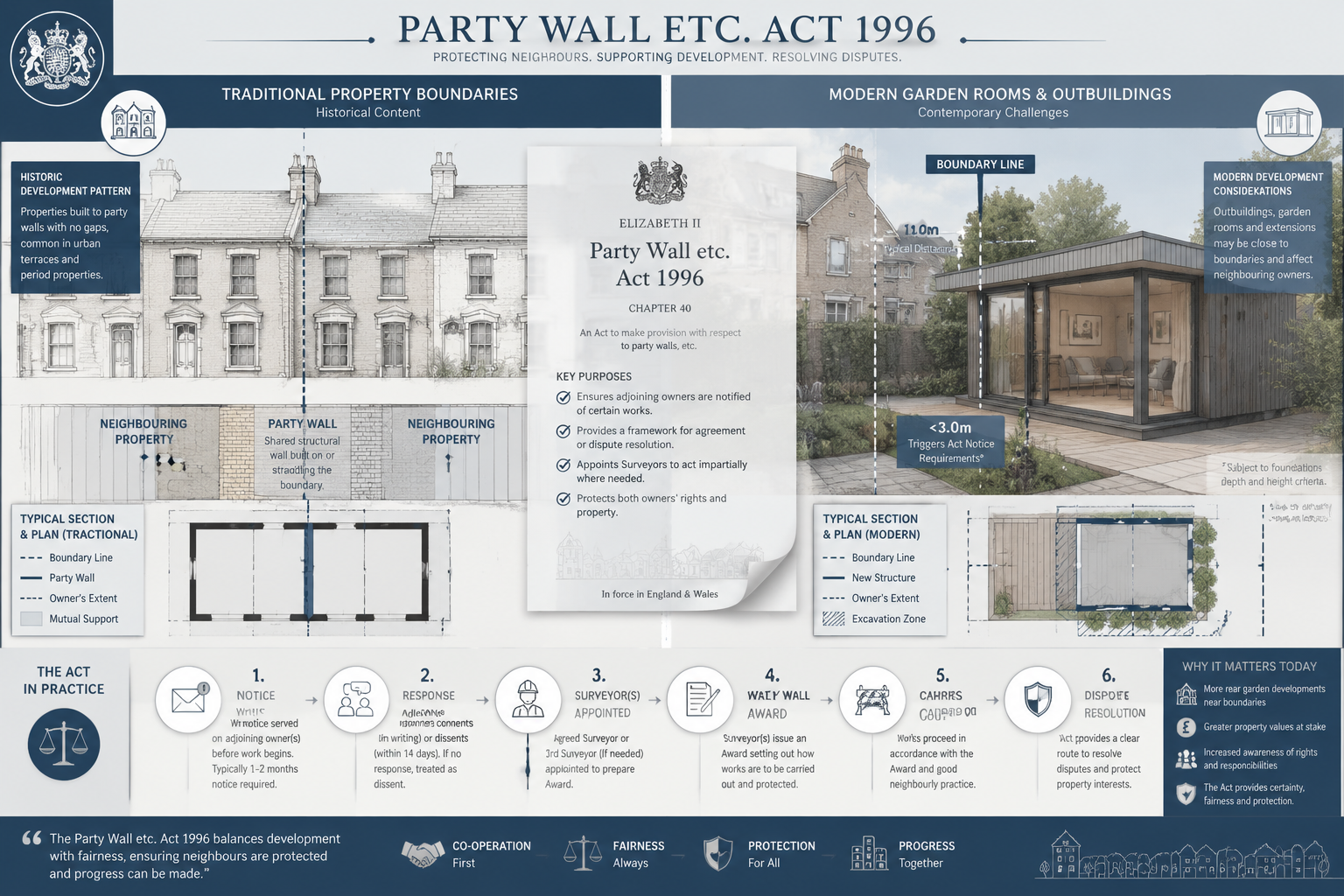
When a party wall surveyor is asked to assess a garden room or home office project, they focus on three primary risk factors:
1. Proximity to the Boundary
The closer the structure is to the shared boundary, the higher the likelihood of triggering the Act. Surveyors will measure the exact distance from the proposed structure to the line of junction and assess whether any part of the build — including overhangs, gutters, or footings — crosses or sits on that line.
2. Foundation Type and Depth
Lightweight garden rooms on surface-mounted timber bearers or adjustable feet are far less likely to trigger Section 6 than those requiring deep concrete foundations. Surveyors will request foundation drawings and compare the proposed excavation depth against the estimated depth of neighbouring foundations.
💡 Tip: Choosing a screw-pile or surface-pad foundation system can sometimes avoid Section 6 obligations entirely — but always confirm this with a qualified surveyor before proceeding.
3. Condition of Existing Shared Structures
Before any work begins, surveyors often recommend a Schedule of Condition — a photographic and written record of the current state of the neighbour's property. This protects both parties if any damage is later alleged to have been caused by the garden room construction.
What Happens If You Don't Serve Notice?
Failing to serve the required notice is not a criminal offence, but it can have serious consequences:
- Neighbours can seek an injunction to halt works
- Disputes become harder and more expensive to resolve retrospectively
- The building owner may be liable for all costs if damage occurs and no agreement was in place [9][10]
- It can complicate property sales, as solicitors increasingly ask about Party Wall compliance
For those carrying out works, understanding your obligations as a building owner is the essential first step.
Practical Steps: Serving Notice for Your Garden Room Project
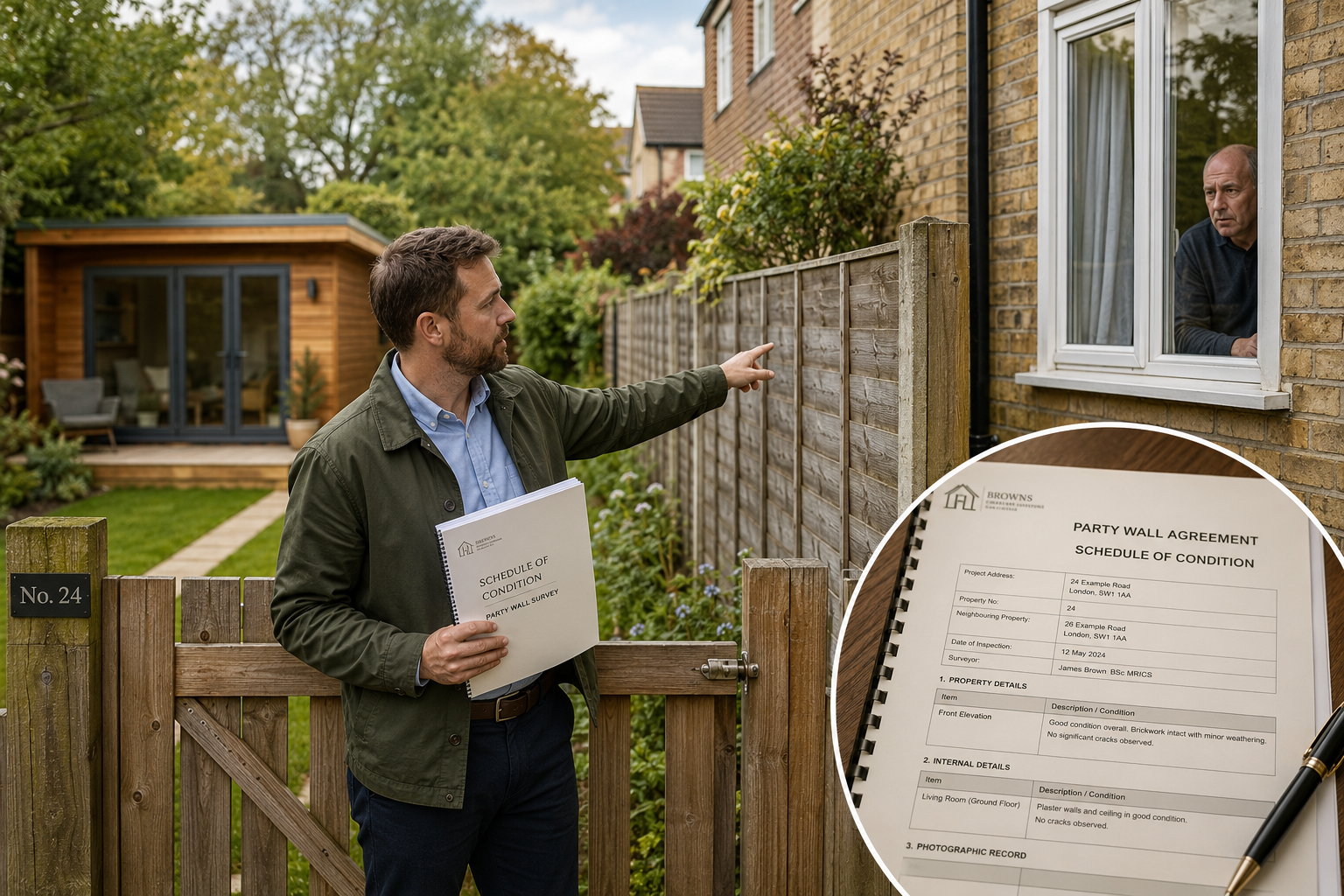
Understanding Party Wall Notices for Garden Rooms, Outbuildings, and Home Offices: Do Modern Projects Trigger the Act? is one thing — knowing what to do next is another. Here is a clear action plan:
Step 1: Assess Whether the Act Applies ✅
Before serving anything, determine which sections of the Act are engaged:
- Is any part of the build on or at the boundary? → Section 1 Notice
- Are you working on an existing shared wall? → Section 2 Notice
- Are you excavating within 3 m or 6 m of a neighbouring structure? → Section 6 Notice
If none of these apply — for example, the garden room is entirely within your land with no excavation near the boundary — the Act may not be triggered at all [8].
Step 2: Serve the Correct Notice
Notices must be served in writing and include specific information about the proposed works. Many homeowners find it helpful to review a Party Wall Notice guide to understand what each notice must contain.
Key notice periods:
- Section 1 (Line of Junction): Minimum 1 month before works start
- Section 2 (Party Structure): Minimum 2 months before works start
- Section 6 (Excavation): Minimum 1 month before works start
Step 3: Await Consent or Appoint Surveyors
Once notice is served, the adjoining owner has 14 days to respond. They can:
- Consent in writing — works can proceed without a formal Award
- Dissent and appoint a surveyor — a Party Wall Award will be drawn up
- Fail to respond — this is deemed a dissent, triggering the surveyor appointment process
If a surveyor is needed, it is worth understanding how to keep Party Wall costs down — agreed surveyors and early cooperation can significantly reduce fees.
Step 4: Proceed Under the Award
Once a Party Wall Award is in place, works can begin. The Award sets out the rights and obligations of both parties, the working hours, and any protective measures required.
Special Considerations for Home Offices and Hybrid-Use Outbuildings 🏢
The rise of detached home offices adds an additional layer of complexity. Structures used primarily as home offices may have different planning implications than purely residential garden rooms — particularly if clients visit regularly or if the structure is used for business storage [7].
However, from a Party Wall Act perspective, the intended use of the structure is irrelevant. What matters is:
- Where it is built (proximity to boundary)
- How it is built (foundation type and depth)
- What existing structures are affected (party walls, shared garden walls)
A home office pod built 300 mm from a shared boundary with concrete strip foundations will trigger the same notice obligations as a garden gym or hobby room in the same position.
For homeowners in specific London areas, local expertise matters. Whether you need a party wall surveyor in South London or a specialist in North London, professional assessment of your specific site is always the safest approach.
Frequently Asked Questions ❓
Q: My garden room is entirely on my land — do I still need a notice?
Not necessarily. If no part of the structure or its foundations encroaches on or near the boundary, and no existing party wall is affected, the Act may not apply. However, always verify with a surveyor [8].
Q: Can I serve the notice myself without a surveyor?
Yes — homeowners can serve notices themselves. However, the notice must contain specific prescribed information. Many find it helpful to use a sample Party Wall agreement template as a starting point [3].
Q: What if my neighbour ignores the notice?
Non-response within 14 days is treated as a deemed dissent, which triggers the surveyor appointment process automatically.
Q: Does the Act apply to detached properties with no shared walls?
The Act can still apply if excavation occurs within the prescribed distances of a neighbouring property's foundations — even where there is no shared wall [5].
Conclusion: Don't Let a Garden Room Become a Boundary Dispute
The boom in garden rooms, detached home offices, and modern outbuildings has created a wave of Party Wall Act questions — and a corresponding wave of homeowners who have proceeded without proper notice. The core message is straightforward: Party Wall Notices for Garden Rooms, Outbuildings, and Home Offices: Do Modern Projects Trigger the Act? — yes, they frequently do, and the rules have not changed simply because the structures are modern, stylish, or small.
Actionable Next Steps 🚀
- Map your project against Sections 1, 2, and 6 before instructing any builder or architect.
- Obtain foundation drawings early — these are essential for assessing Section 6 obligations.
- Serve notice at the right time — too late is as problematic as not at all.
- Commission a Schedule of Condition to protect yourself and your neighbour before works begin.
- Consult a qualified party wall surveyor if there is any doubt — early advice is far cheaper than retrospective dispute resolution.
The Party Wall etc. Act 1996 exists to protect everyone involved in construction near shared boundaries. Used correctly, it is not a bureaucratic obstacle — it is a framework that keeps neighbourly relations intact and projects on track.
References
[1] Garden Buildings And The Party Wall Act – https://www.bdcmagazine.com/2021/02/landlord-estate-services/building-regulations/garden-buildings-and-the-party-wall-act/
[2] Garden Offices And The Party Wall Act – https://www.peterbarry.co.uk/blog/garden-offices-and-the-party-wall-act/
[3] Garden Offices And Party Walls Explained – https://novellosurveyors.co.uk/blog/party-walls/garden-offices-and-party-walls-explained
[4] Are Garden Walls Covered By The Party Wall Act A Comprehensive Guide – https://www.expresspartywall.com/are-garden-walls-covered-by-the-party-wall-act-a-comprehensive-guide/
[5] Party Wall Common Questions – https://www.hsa-surveyors.com/party-wall-common-questions/
[6] Party Wall Act And Shared Garden Walls – https://charrettelaw.co.uk/party-wall-act-and-shared-garden-walls/
[7] Can Garden Rooms Be Used As Home Offices Without Extra Permissions – https://fitrite.info/can-garden-rooms-be-used-as-home-offices-without-extra-permissions/
[8] Is A Party Wall Agreement Needed For A Garden Room – https://newgardenroomcompany.com/is-a-party-wall-agreement-needed-for-a-garden-room/
[9] A Homeowners Guide To The Party Wall Act – https://www.cdjmarchitects.com/a-homeowners-guide-to-the-party-wall-act/
[10] Party Wall Agreements Explained – https://www.livingetc.com/advice/party-wall-agreements-explained