

Nearly 40% of party wall disputes in England and Wales involve loft conversion projects — yet most homeowners only discover they needed a formal notice after work has already begun. That single oversight can halt a build, trigger legal action, and destroy neighbourly relations overnight.
Party Wall Notices for Loft Conversions in 2026: RSJs, Roof Alterations, and What Surveyors Review Before Work Starts is a topic that deserves far more attention than it typically receives in the planning stage. Loft conversions are deceptively complex from a party wall perspective. Steel beams, chimney breast removals, and alterations to shared roof structures all carry specific legal obligations under the Party Wall etc. Act 1996 — obligations that cannot be skipped, rushed, or handled informally.
This guide breaks down exactly what triggers a notice, what documentation surveyors need to do their job properly, and where projects most commonly go wrong before a single brick is moved.
Key Takeaways 📋
- Steel RSJ beams that bear onto or are cut into a party wall require a formal Party Structure Notice — not just planning permission.
- Roof alterations along a shared boundary, including raising ridge lines or removing chimney breasts, almost always engage the Party Wall Act.
- Notices must be served at least 2 months before work starts for party structure works; failure to do so can make the build unlawful.
- Surveyors review structural drawings, schedules of condition, and engineer's calculations before issuing a Party Wall Award.
- Skipping the notice process does not make it go away — adjoining owners can seek an injunction to stop works at any time.
Why Loft Conversions Are a Party Wall Minefield
A loft conversion might look like a purely internal project. The work is happening at the top of your house, well away from ground-level boundaries — so why would neighbours be involved?
The answer lies in the structure itself.
Most terraced and semi-detached homes in London and across England share party walls that extend from the foundations all the way up through the roof space. The moment a loft conversion touches that shared wall — or the roof structure sitting on top of it — the Party Wall etc. Act 1996 is engaged.
The Three Main Triggers 🔩
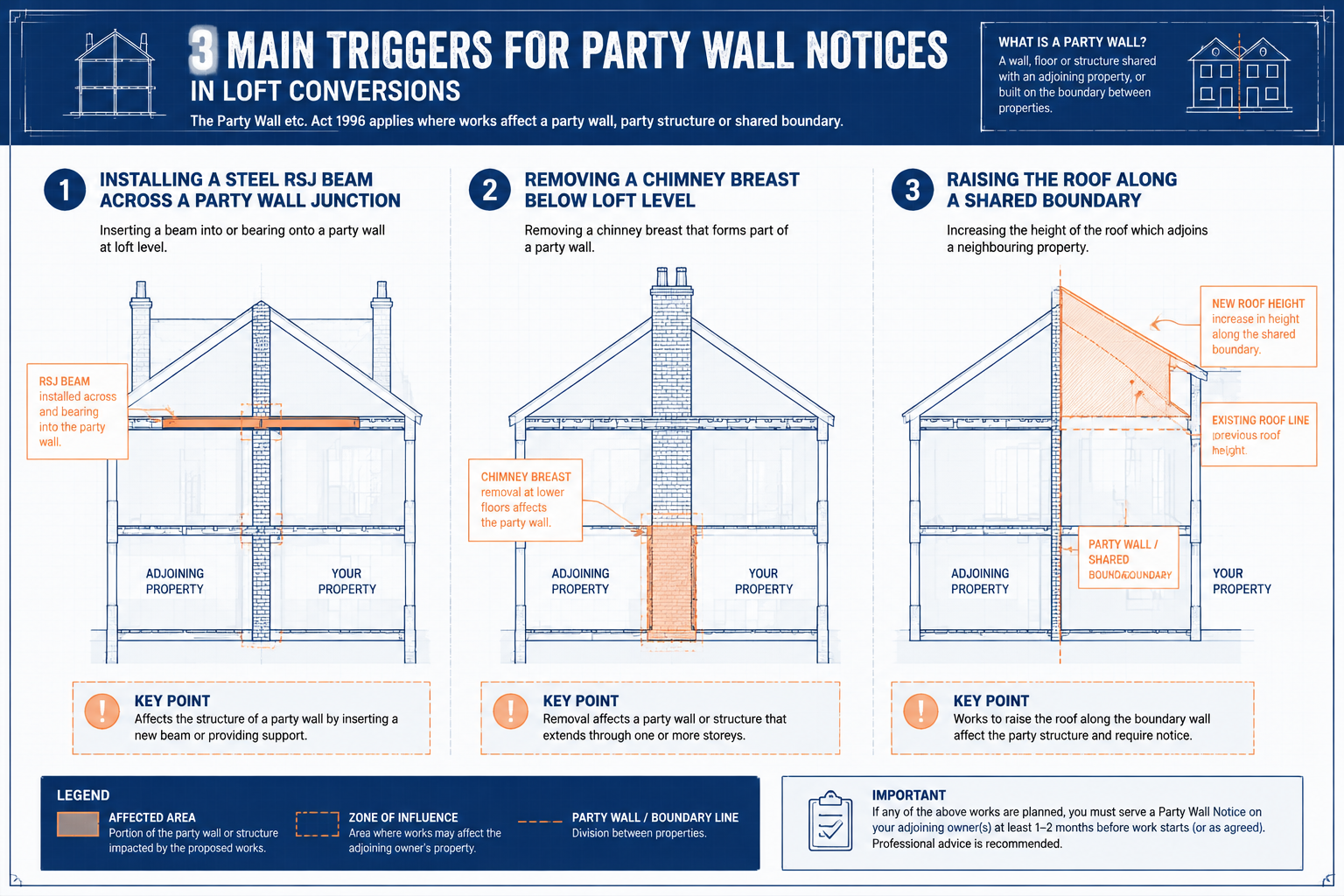
Understanding what actually triggers a notice is the first step. There are three primary scenarios in loft conversions:
| Trigger | Why It Engages the Act | Notice Type Required |
|---|---|---|
| RSJ / Steel Beam Installation | Beams often bear onto or are cut into the party wall | Party Structure Notice |
| Roof Alterations | Raising ridge lines or altering shared roof structures | Party Structure Notice |
| Chimney Breast Removal | Removing a breast below loft level affects the shared stack | Party Structure Notice |
1. RSJ and Steel Beam Works
Rolling Steel Joists (RSJs) are the backbone of most loft conversions. They carry the new floor load across the span of the building. In terraced properties, these beams almost always need to bear onto the party wall — meaning the wall is being used as a structural support. Under Section 2 of the Party Wall Act, cutting into a party wall to insert a beam, or placing a load on it, requires formal notice.
For more detail on what the Act covers, the Party Wall etc. Act 1996 explained page provides a clear breakdown of the relevant sections.
2. Roof Alterations Along a Shared Boundary
Raising a ridge line, installing a dormer, or altering roof timbers that sit on top of a party wall all fall within the scope of the Act. Even if the work appears to be entirely on your side of the roof, the structural connection to the shared wall means neighbours have a legitimate interest.
3. Chimney Breast Removal
This is one of the most overlooked triggers. Homeowners removing a chimney breast at ground or first-floor level to gain space often don't realise that the shared chimney stack — which may sit on the party wall in the loft — is directly affected. Removing structural support below changes the load distribution above, making this a notifiable work.
What Surveyors Review Before Work Starts
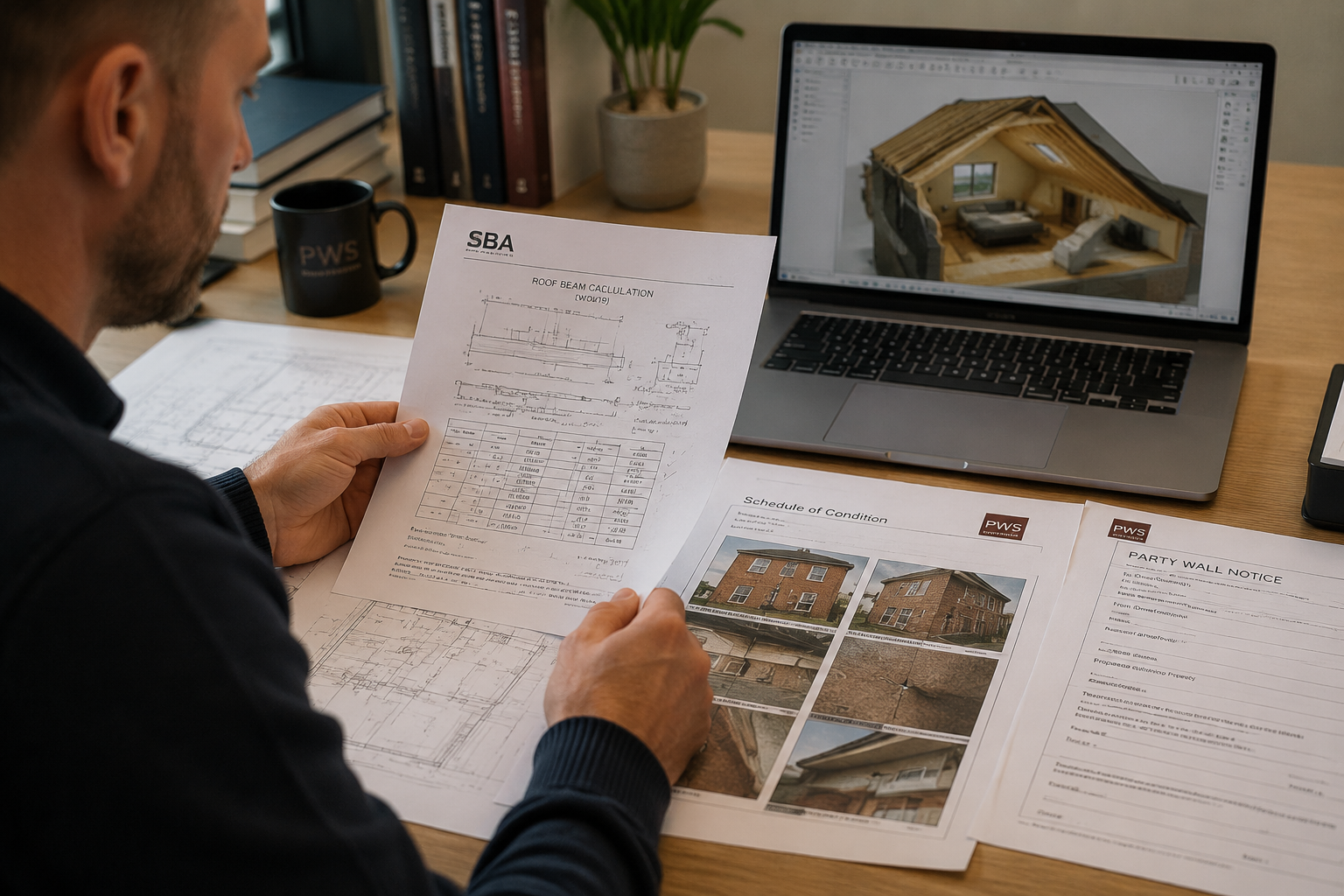
Once a notice is served and an adjoining owner dissents (or is deemed to have dissented), a surveyor — or surveyors — must be appointed. Their job is to produce a Party Wall Award: a legally binding document that sets out how the work must be carried out and protects both parties.
But before that Award can be issued, surveyors carry out a thorough review. Here is what they need to see:
Structural Engineer's Drawings and Calculations
This is non-negotiable. A surveyor cannot properly assess the impact of RSJ installation without seeing:
- Beam size and specification (e.g., 203 x 203 UC or similar)
- Bearing lengths on the party wall
- Load calculations showing what forces are being transferred
- Connection details — how the beam is fixed or padded at the wall
💬 "A surveyor who agrees to a Party Wall Award without seeing the structural engineer's drawings is not doing their job. The drawings are the foundation of the entire assessment."
Without these documents, it is impossible to determine whether the party wall can safely carry the imposed load, or whether additional strengthening is needed.
Schedule of Condition 📸
Before any work begins, a schedule of condition must be prepared. This is a photographic and written record of the adjoining property's current state — cracks in plaster, existing settlement, the condition of shared chimney stacks, and so on.
The schedule serves a critical purpose: if the neighbour later claims that the loft conversion caused a crack in their ceiling, the schedule of condition is the evidence that either confirms or refutes that claim. Without it, the building owner is exposed to potentially unfounded damage claims.
A good schedule of condition covers:
- All rooms adjacent to or below the party wall
- Existing cracks (measured and photographed)
- The condition of the shared chimney stack
- External walls and any existing boundary structures
Architectural Plans and Sections
Surveyors also need the full architectural drawings, not just the structural ones. These show:
- The extent of the loft conversion and how it relates to the party wall
- Dormer positions and their proximity to the shared boundary
- Any proposed alterations to the roof line or ridge
Method Statements for High-Risk Operations
For particularly sensitive works — such as cutting into a party wall to create a beam pocket, or propping a chimney stack during breast removal — surveyors will typically require a method statement from the contractor. This document explains, step by step, how the work will be carried out safely.
Where Projects Go Wrong Before Notices Are Even Served

The most damaging mistakes in loft conversion projects happen long before a surveyor is ever appointed. Understanding these failure points can save significant time, money, and stress.
Mistake 1: Assuming Planning Permission Covers Everything
Planning permission and the Party Wall Act are entirely separate legal frameworks. A homeowner can have full planning consent for a loft conversion and still be in breach of the Party Wall Act if no notice has been served. The two processes run in parallel and must both be satisfied.
Mistake 2: Serving Notice Too Late
The Act requires that a Party Structure Notice is served at least two months before the proposed start date. Many homeowners serve notice only a few weeks before their contractor is due to arrive — which means either:
- The build is delayed while the notice period runs, or
- Work starts unlawfully, exposing the building owner to an injunction
Understanding what a Party Structure Notice is and how to serve it is essential reading before any loft project begins.
Mistake 3: Incomplete or Informal Notice
A valid notice must contain specific information: the building owner's name and address, a description of the proposed works, and the proposed start date. Notices sent as informal letters or text messages, without the required legal content, are not valid under the Act.
For guidance on party wall notices — what they are and how to respond, there is detailed guidance available covering both the building owner's and adjoining owner's perspectives.
Mistake 4: Not Identifying All Adjoining Owners
In a terraced row, a loft conversion may affect two adjoining properties — one on each side. Both must receive notice. If the property above is a separate flat, that owner must also be notified. Missing even one adjoining owner creates a legal gap that can derail the project.
Mistake 5: Relying on a Verbal Agreement
Neighbourly goodwill is valuable, but it has no legal standing under the Party Wall Act. A neighbour who verbally agrees to the works can still serve a dispute notice the moment the first drill goes into the wall. Only a properly executed Party Wall Award provides genuine legal protection for both parties.
💬 "A handshake agreement is not a party wall agreement. It offers no protection when the relationship sours — and in construction projects, relationships can sour quickly."
The Party Wall Award: What It Contains and Why It Matters
Once surveyors have reviewed all the documentation, they produce the Party Wall Award. This document is legally binding and typically includes:
- A description of the permitted works — exactly what can be done and how
- Working hours — when noisy or disruptive work may take place
- Access rights — if surveyors or contractors need to enter the adjoining property
- The schedule of condition — appended as evidence of pre-work state
- Security for expenses — in some cases, the adjoining owner can require a financial deposit
- Rights of appeal — both parties have 14 days to appeal the Award to a County Court
Understanding party wall costs and the process is important at this stage, as the building owner typically bears the surveyor's fees when they are the one carrying out the works.
Appointing the Right Surveyor in 2026
The quality of the party wall process depends heavily on the surveyor appointed. In 2026, with loft conversions at record levels in London, the demand for experienced party wall surveyors has never been higher.
Key qualities to look for:
- ✅ Membership of the Faculty of Party Wall Surveyors (FPWS) or RICS
- ✅ Specific experience with loft conversions and structural steel works
- ✅ Clear communication with both building and adjoining owners
- ✅ Familiarity with local authority requirements in your area
For those in the capital, specialist support is available from party wall surveyors across London, including dedicated teams covering East London, South London, and North London.
Both building owners and adjoining owners have the right to appoint their own surveyor. Alternatively, both parties can agree to use a single Agreed Surveyor — which can reduce costs and speed up the process. The building owner's surveyor and adjoining owner's surveyor roles carry distinct responsibilities under the Act.
A Quick Reference: Party Wall Notice Timeline for Loft Conversions
| Stage | Action | Timing |
|---|---|---|
| Pre-Design | Identify all adjoining owners and affected structures | As early as possible |
| Design Stage | Commission structural engineer drawings | Before notice is served |
| Notice Served | Serve Party Structure Notice to all adjoining owners | Min. 2 months before start |
| Consent or Dissent | Adjoining owner responds within 14 days | After notice served |
| Surveyor Appointment | Appoint surveyor(s) if dissent is issued | Promptly after dissent |
| Document Review | Surveyors review drawings, calculations, method statements | Before Award issued |
| Schedule of Condition | Survey of adjoining property carried out | Before work starts |
| Party Wall Award Issued | Legally binding document agreed and signed | Before work starts |
| Work Commences | Build begins in accordance with the Award | After Award issued |
Conclusion: Don't Let the Notice Be an Afterthought
Party Wall Notices for Loft Conversions in 2026: RSJs, Roof Alterations, and What Surveyors Review Before Work Starts is not a bureaucratic formality — it is a legal framework that protects everyone involved in a build. The steel beams that make a loft conversion structurally possible, the roof alterations that create the headroom, and the chimney breast removals that free up floor space all carry real obligations under the Party Wall etc. Act 1996.
Actionable Next Steps ✅
- Identify your notice obligations early — before architect drawings are finalised, confirm which works will engage the Act.
- Commission structural drawings first — surveyors cannot do their job without them.
- Serve notice at the right time — two months before the proposed start date, with all legally required information included.
- Prepare a schedule of condition — protect yourself against unfounded damage claims before work begins.
- Appoint a qualified surveyor — not just any surveyor, but one with specific loft conversion and party wall experience.
- Get the Party Wall Award in place before any contractor touches the party wall.
The cost of getting this right is modest compared to the cost of getting it wrong. An injunction to stop works, legal fees, and contractor downtime can easily run into tens of thousands of pounds — all of which is avoidable with the right process in place from day one.
SEO Meta Title: Party Wall Notices for Loft Conversions 2026: RSJs & Roof Works
SEO Meta Description: Learn what triggers party wall notices in loft conversions — RSJs, roof alterations, chimney removals — and what surveyors review before work starts in 2026.