


Nearly one in three party wall notices served in the UK receives no response within the statutory 14-day window — yet the legal consequences of that silence are widely misunderstood by both building owners and their neighbours. Understanding what happens when your neighbour ignores a party wall notice is not just a procedural detail; it is the difference between a construction project that proceeds lawfully and one that grinds to a halt under a court injunction.
This guide covers the full picture of when your neighbour ignores a party wall notice: legal options, risk management, and best practice — from the moment the clock starts ticking on that unanswered notice, through surveyor appointments and Party Wall Awards, to the remedies available when the Act is ignored entirely.
Key Takeaways
- 🔑 Silence is not consent. Under the Party Wall etc. Act 1996, a neighbour who does not respond within 14 days is treated as having dissented, not agreed — triggering the formal dispute process [2][5].
- 🔑 A surveyor can be appointed on your neighbour's behalf under Section 10(4) after a further 10-day notice period, so non-response cannot permanently block your project [8].
- 🔑 Starting work without following the Act exposes building owners to injunctions and damages claims — even if a notice was served but the process was not completed [1][6].
- 🔑 A Party Wall Award is the legally binding document that authorises works and protects both parties — it is the goal of the dispute resolution process, not a punishment.
- 🔑 Early professional advice and a correctly served notice are the two most powerful tools for keeping a project on programme and avoiding costly delays.
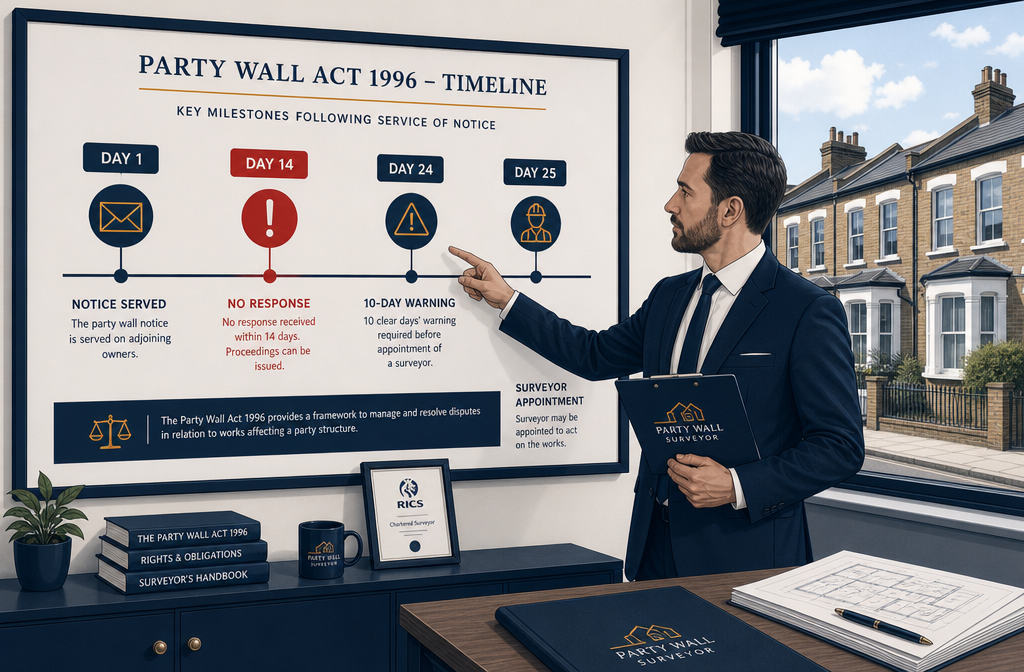
What "Ignoring" a Party Wall Notice Actually Means in Law
The 14-Day Rule and Deemed Dissent
When a building owner serves a valid party wall notice, the adjoining owner has 14 days to respond in writing. The response options are:
| Response | Legal Effect |
|---|---|
| Written consent | Works may proceed without an Award |
| Written dissent | Dispute arises; surveyors appointed |
| No response (silence) | Deemed dissent — dispute arises automatically |
💬 "Failing to respond to a party wall notice is legally interpreted as dissent, not consent — meaning the dispute resolution process must follow before any works can begin." [2]
This point is critical because some online sources incorrectly suggest that silence after 14 days equals "deemed consent," implying a building owner can simply proceed. This is wrong and potentially very costly. The authoritative reading of Section 5 of the Party Wall etc. Act 1996 — confirmed by solicitors and specialist surveyors — is that non-response triggers a dispute, not permission [2][5].
Why This Misunderstanding Is Dangerous
Acting on the "deemed consent" myth and starting works without a Party Wall Award leaves a building owner exposed to:
- ⚠️ Court injunctions halting works immediately
- ⚠️ Claims for trespass and structural damage
- ⚠️ Costs orders in legal proceedings
- ⚠️ Delays far longer than the Award process would have taken
The safer, legally sound position is always to treat silence as dissent and follow the full statutory process [6].
The Step-by-Step Process When Your Neighbour Ignores a Party Wall Notice
Understanding the precise timeline is essential for legal options, risk management, and best practice when a neighbour goes silent.
Step 1: Serve a Valid Notice
Everything depends on the notice being correctly served in the first place. A defective notice — wrong address, missing details, wrong notice type — can invalidate the entire process. For works involving excavations, the notice must be served at least one month before works begin; for structural works to a party wall, the period is typically two months [10].
For guidance on what makes a notice valid, the Party Wall Act notices guide provides a clear breakdown of requirements. If the works involve a shared wall rather than a boundary structure, understanding the difference between a party structure notice and other notice types is equally important.
Step 2: Wait 14 Days
After service, the 14-day response window begins. During this period:
- Keep proof of service (recorded delivery, hand delivery with witness, or process server)
- Do not start notifiable works
- Prepare for either outcome — consent or dispute
Step 3: Serve a 10-Day Notice
If no response arrives within 14 days, the building owner must serve a further notice giving the adjoining owner 10 more days to appoint a surveyor of their own choice. This is a statutory requirement, not optional [5][8].
Step 4: Appoint a Surveyor Under Section 10(4)
If the adjoining owner still does not respond after the 10-day notice, Section 10(4) of the Act allows the building owner's surveyor to appoint a surveyor on the adjoining owner's behalf. This is a powerful provision: it means a non-responsive neighbour cannot permanently block a lawful project [8].
The two appointed surveyors (or an agreed single surveyor) then proceed to make a Party Wall Award — the legally binding document that sets out:
- The works permitted and their scope
- Working hours and access arrangements
- A Schedule of Condition recording the pre-works state of the adjoining property
- Provisions for making good any damage
Step 5: Proceed Under the Award
Once the Award is made and served, works can lawfully begin. The Award protects both parties: the building owner has authority to proceed; the adjoining owner has a documented baseline and enforceable rights if damage occurs.
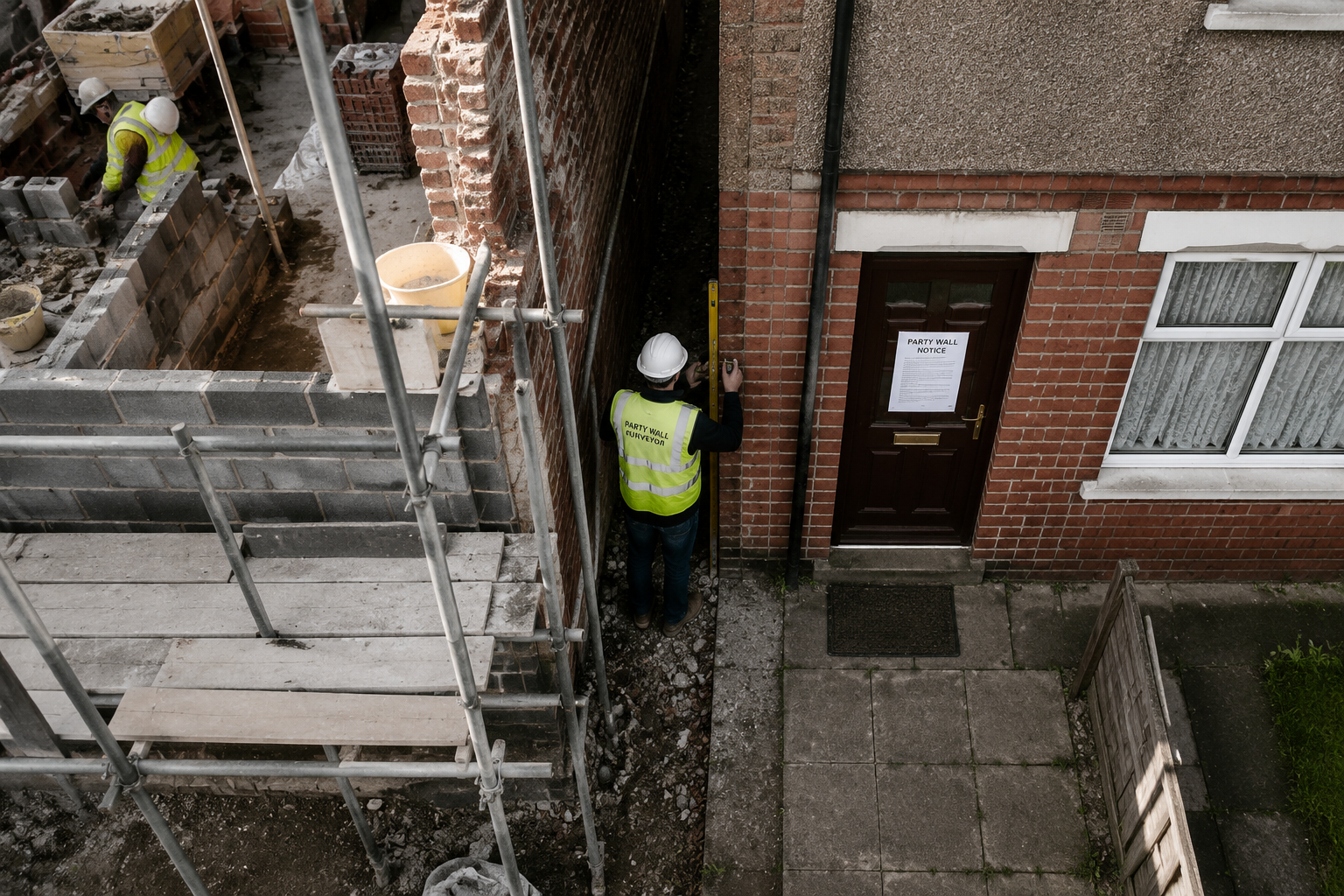
Legal Options When the Act Is Ignored Entirely
The scenario above assumes the building owner is following the Act but the adjoining owner is unresponsive. But what happens when it is the building owner who ignores the Act altogether — starting work without serving any notice?
Injunctions: The Primary Remedy
When works begin without a valid notice and Award, the adjoining owner's most powerful immediate tool is an interim injunction from the County Court or High Court. An injunction can halt works within hours or days of application [1][6].
Key points about injunctions:
- They are available even if works have already started
- Courts generally take party wall breaches seriously
- The building owner may be ordered to pay the adjoining owner's legal costs
- Works halted mid-project are often far more expensive than following the Act would have been [1]
💬 "An interim injunction is the main remedy available when works have started without a party wall notice — it can stop work immediately while the legal position is resolved." [1]
Damages and Compensation
Even after works are complete, an adjoining owner can pursue compensation for:
- Structural damage caused by the works
- Loss of enjoyment or use of their property
- Professional costs incurred in pursuing the claim
The absence of a pre-works Schedule of Condition makes proving the extent of damage harder — which is one reason why the Schedule of Condition is so valuable when the process is followed correctly [6].
No Automatic Fines
It is worth noting that the Party Wall etc. Act 1996 does not impose automatic criminal penalties or fines for non-compliance. The remedies are civil — injunctions and damages — which means the adjoining owner must take active steps to enforce their rights [6][7].
Risk Management and Best Practice for Building Owners
Keeping a project on programme while a neighbour ignores correspondence requires both legal knowledge and practical strategy. Here is what best practice looks like in 2026.
✅ Serve the Notice Early
The statutory notice periods are minimum periods. Serving notice as early as possible — ideally three to four months before works are due to start — gives maximum time to resolve any dispute before the programme is affected. For complex projects in busy urban areas, party wall surveyors in Central London and across the capital consistently advise early service as the single most effective risk management step.
✅ Use Recorded Delivery and Keep Proof
Proof of service is essential. If a neighbour later claims they never received the notice, the building owner needs documentary evidence. Use:
- Royal Mail Recorded Delivery (with tracking)
- Hand delivery witnessed by a third party
- A process server for high-value or contentious projects
✅ Instruct a Party Wall Surveyor from the Start
A qualified surveyor can serve the notice correctly, manage the 14-day and 10-day timelines, and move swiftly to Section 10(4) appointment if needed. Understanding the costs of the party wall process upfront helps building owners budget accurately and avoid surprises.
For those concerned about expense, there are also practical ways to keep party wall costs down without cutting corners on legal compliance.
✅ Document Everything
From the moment a notice is served, maintain a clear paper trail:
- Copies of all notices with dates
- Proof of delivery
- Any written or verbal responses from the neighbour
- Correspondence with surveyors
This documentation is invaluable if the matter reaches court or if a dispute arises about the Award later.
✅ Do Not Start Works Until the Award Is Made
This is the single most common and costly mistake. Even when a neighbour is being obstructive or unresponsive, starting works before the Award is made removes the legal protection the Act provides and opens the door to injunctions [1][6].
Common Mistakes to Avoid 🚫
| Mistake | Consequence |
|---|---|
| Treating silence as consent | Works are unauthorised; injunction risk |
| Skipping the 10-day notice | Section 10(4) appointment may be challenged |
| Serving an invalid notice | Entire process may need to restart |
| Starting works before the Award | Injunction, damages, and cost orders |
| Failing to commission a Schedule of Condition | Difficulty proving pre-existing vs. new damage |
What Adjoining Owners Should Know
If a neighbour has served a notice and is now proceeding through the dispute process after no response, adjoining owners should understand their position clearly.
A surveyor appointed under Section 10(4) has a duty to act impartially — they are not simply the building owner's agent. The Award they help produce must be fair to both parties [8]. Adjoining owners who feel the process is moving too fast or that their interests are not being protected should:
- Appoint their own surveyor as soon as possible — even belatedly, this may still be possible before the Award is made
- Review the Award carefully once served — there is a right of appeal to the County Court within 14 days
- Request a Schedule of Condition if one has not been commissioned — this protects against future damage disputes
For adjoining owners who have discovered that a neighbour has already started works without serving any notice, the guidance for neighbours affected by building works sets out the options clearly, including how to seek an injunction urgently.
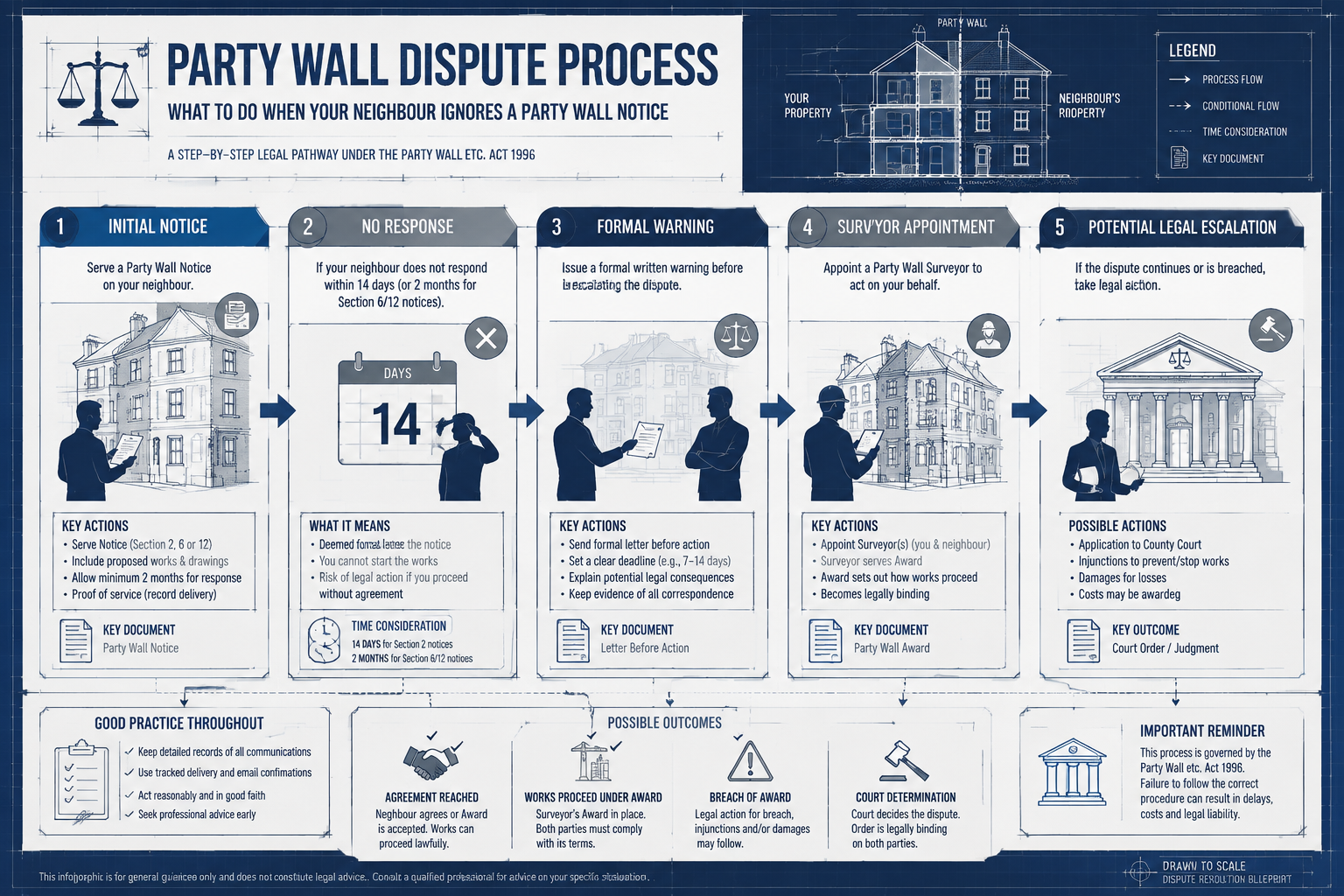
Practical Strategies to Avoid Escalation
Not every ignored notice reflects genuine hostility. Neighbours may be:
- Confused about what the notice means
- Anxious about costs they think they will have to bear
- Simply slow to open post or respond to correspondence
Before moving straight to formal dispute procedures, consider these de-escalation steps:
🤝 Have a Conversation First
A brief, friendly conversation explaining what the works involve and what the notice means can resolve apparent non-response quickly. Many adjoining owners do not realise that consenting to a notice does not mean they are agreeing to pay anything.
📞 Follow Up in Writing
Send a polite follow-up letter or email after the first week, noting that the 14-day period is approaching and inviting a response. This demonstrates good faith and creates a further paper trail.
💡 Offer to Share a Surveyor
An agreed surveyor — one surveyor acting for both parties — is often the most cost-effective and least adversarial route. Building owners can offer this option in their follow-up communications. The costs are typically lower than two separate surveyors, and the process tends to move faster [7].
⏱️ Respect the Timeline but Move Promptly
Once the 14-day period expires without response, do not delay in serving the 10-day notice. Delays compound programme risk. The statutory process is designed to be efficient when followed correctly — use it.
Conclusion: Protect Your Project, Protect Your Neighbour
The scenario of when your neighbour ignores a party wall notice is one of the most common sources of confusion and delay in UK construction projects. The good news is that the law provides a clear, workable solution: deemed dissent, the 10-day notice, and the Section 10(4) surveyor appointment mean that a non-responsive neighbour cannot permanently block lawful works.
The bad news is that misunderstanding the rules — particularly the dangerous myth that silence equals consent — can turn a straightforward project into an expensive legal dispute.
Actionable Next Steps
- Serve your notice early — allow maximum time before the programme is affected
- Keep proof of service — recorded delivery as a minimum
- Instruct a qualified party wall surveyor from the outset
- Follow the 14-day and 10-day timeline precisely — do not skip steps
- Never start notifiable works without a valid Award — the risk is never worth it
- If you are the adjoining owner and works have started without notice, seek urgent legal and surveyor advice about an injunction
For building owners and adjoining owners alike, professional guidance is the most reliable way to navigate this process. Whether the project is in North London, South London, or anywhere across the capital, specialist party wall surveyors can manage the entire process — from notice to Award — keeping projects lawful, neighbourly relationships intact, and programmes on track.
References
[1] My Neighbour Has Ignored The Party Wall Act – https://thesilverbrief.blog/2026/03/23/my-neighbour-has-ignored-the-party-wall-act/
[2] All You Need To Know About Party Wall Notices – https://www.stephensons.co.uk/site/blog/consumer-law-blog/all-you-need-to-know-about-party-wall-notices
[3] What Happens If Neighbour Ignores Party Wall Notice – https://grahamkinnear.com/landing-pages/what-happens-if-neighbour-ignores-party-wall-notice/
[5] What Happens If Your Neighbour Refuses To Sign A Party Wall Agreement – https://www.partywallslimited.com/blog/what-happens-if-your-neighbour-refuses-to-sign-a-party-wall-agreement
[6] What Happens If You Ignore The Party Wall Act – https://fpws.uk/what-happens-if-you-ignore-the-party-wall-act/
[7] Party Wall Agreement – https://hoa.org.uk/advice/guides-for-homeowners/i-am-improving/party-wall-agreement/
[8] Section 10(4) Surveyors Under Party Wall Act: Building Owner Rights When Neighbors Ignore Notices In 2026 – https://partywallsurveyorlondon.uk/blogs/section-104-surveyors-under-party-wall-act-building-owner-rights-when-neighbors-ignore-notices-in-2026/
[10] What Makes A Party Wall Notice Valid – https://www.houricanassociates.com/party-wall-news/what-makes-a-party-wall-notice-valid/