
A flat that costs £375,000 today could, according to one mayoral hopeful, cost £275,000 if London simply stripped out its red tape. That is the striking number now circulating among developers, homeowners and the people who build next door to them. The Cleverly London new build £100,000 bureaucracy claim party wall developers October 2026 story broke on 5 October 2026, when Sir James Cleverly set out his pitch to become the Conservative candidate for London Mayor, and it has reignited a long-running argument about what actually drives up the price of a London home.
For anyone planning to build, extend or live next door to a development, the headline figure matters less than the detail underneath it. This article sets out what Cleverly actually said, what makes up the real cost of a London new build, and why one piece of “bureaucracy”, the Party Wall etc. Act 1996, is not going anywhere, whatever happens in the mayoral race of May 2028.
Key Takeaways
- Sir James Cleverly claimed on 5 October 2026 that bureaucracy, taxes and charges add roughly £100,000 to the cost of a new London property, but offered no breakdown of which levies he would cut.
- The real London new-build cost stack includes land value, construction, finance, the Community Infrastructure Levy (CIL), Mayoral CIL, Section 106 affordable housing contributions, biodiversity net gain (BNG) obligations and the new Building Safety Levy, which took effect on 1 October 2026.
- ONS data shows more people are leaving London for towns like Braintree, Maidstone, Milton Keynes and Hemel Hempstead than are arriving from the rest of the UK, adding political weight to the affordability debate.
- The Party Wall etc. Act 1996 is primary legislation, not a mayoral levy, it cannot be abolished by City Hall and will continue to apply to new-build and infill schemes regardless of planning or tax reform.
- Developers and neighbours should budget time and cost for party wall notices and awards early in any project planning next to shared walls, boundaries or deep excavations.
What Cleverly Actually Claimed About London New Build Costs
Speaking as he launched his bid for the Conservative nomination, Cleverly, who announced his candidacy in August 2026 and will not seek re-election as MP for Braintree, argued that “the accumulated cost of bureaucracy, taxes, and various other things adds about £100,000 per property onto new build properties in London.” He suggested that removing this burden could bring a flat priced between £350,000 and £400,000 down to somewhere between £250,000 and £300,000, reported Property Industry Eye’s Marc da Silva.
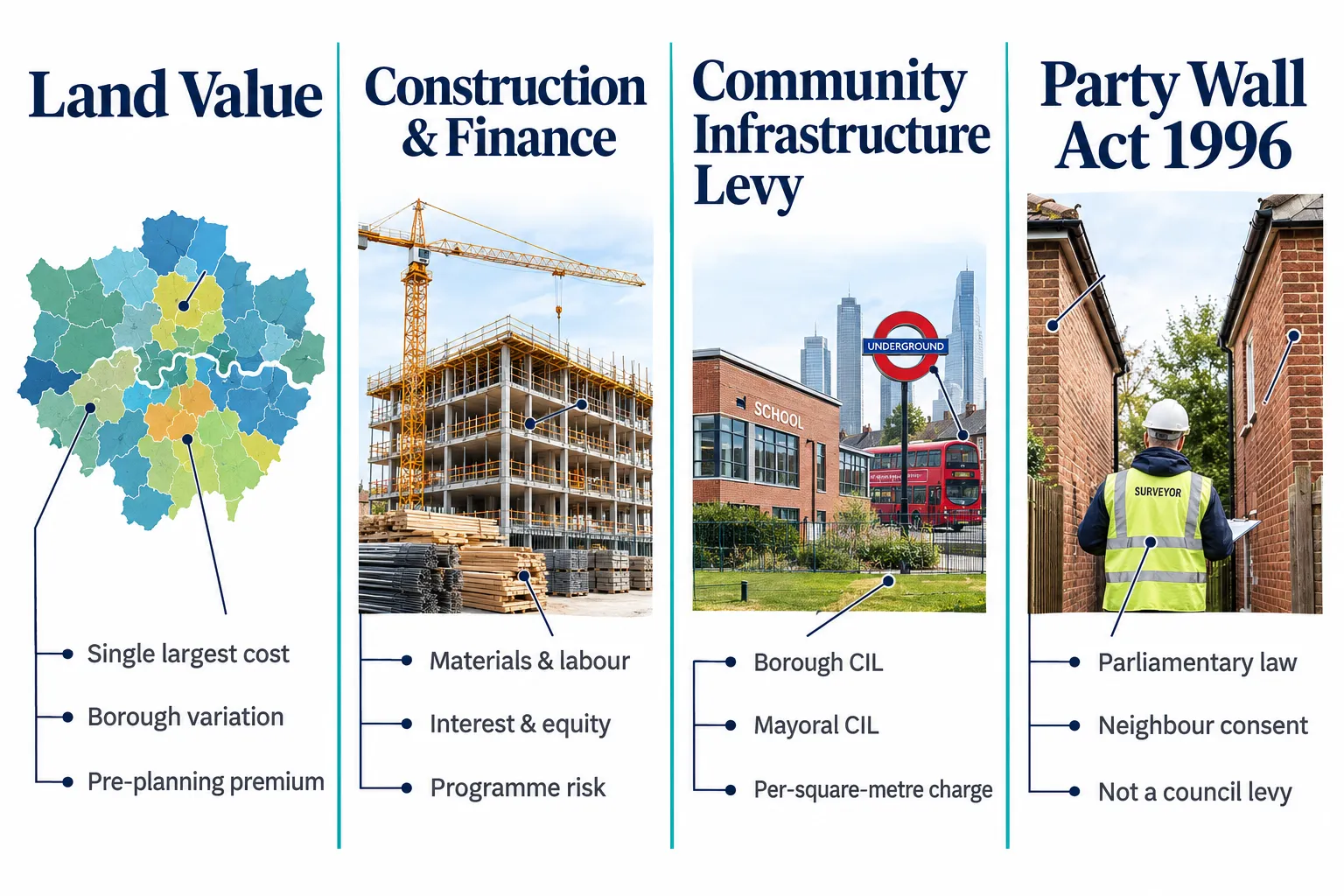
Crucially, Cleverly did not specify which taxes, levies or regulatory requirements he would scrap, or set out any mechanism to guarantee that savings would be passed on to buyers rather than absorbed by developers or landowners. He also said he would review council tax, transport costs and driving charges as part of a wider affordability platform ahead of the May 2028 election. The election itself is some way off, and Cleverly’s claim is, at this stage, a political statement rather than a costed policy.
He linked the affordability argument to migration figures from the Office for National Statistics. In the year to mid-2025, 420,500 people moved from London to other parts of the UK and a further 183,000 moved abroad, while 288,500 arrived in London from elsewhere in the UK and 235,000 came from overseas. Among the most popular destinations for those leaving London were Braintree, Maidstone, Milton Keynes and Hemel Hempstead, all commuter towns offering cheaper housing than the capital.
The Real Cost Stack Behind London New Build Prices
Unpicking the £100,000 figure requires understanding what genuinely sits inside the price of a new London home. Housebuilders and planning consultants typically point to a stack of costs that goes well beyond a single tax line.
Land value. In many London boroughs, land remains the single largest cost component, often dwarfing construction costs on a per-unit basis in high-demand areas.
Construction costs. Materials, labour, plant hire and site logistics in a dense city are all more expensive than in regional England, partly due to access constraints on tight urban plots.
Finance costs. Development finance, interest payments during the build period and contingency reserves add up, particularly on longer schemes delayed by planning or supply issues.
Planning and infrastructure levies. This is where most of the political argument actually sits:
| Charge | What it funds | Applies to |
|---|---|---|
| Community Infrastructure Levy (CIL) | Local infrastructure, roads, schools, open space | Most new development over a threshold |
| Mayoral CIL | Crossrail and strategic transport infrastructure | London-wide new development |
| Section 106 contributions | Affordable housing, local amenities | Site-specific, negotiated with the borough |
| Biodiversity Net Gain (BNG) | Habitat creation or offsetting | Most new development since BNG rules took effect |
| Building Safety Levy | Remediation of unsafe buildings | New residential development from 1 October 2026 |
The Building Safety Levy only began applying to new residential development in England on 1 October 2026, almost exactly when Cleverly made his claim, adding fresh weight to the cost-stack debate. Separately, the Conservative Party conference pledged to merge various building levies into a single, simplified levy, suggesting that reform of some kind is already on the table regardless of who wins the mayoralty.
Professional and compliance fees. Architects, planning consultants, building control, structural engineers, fire safety consultants and party wall surveyors all charge for their work, and all are necessary to get a scheme built safely and lawfully.
Supporters of deregulation argue that trimming overlapping levies and streamlining planning would lower build costs and, over time, prices. Those defending the current system point out that CIL, Mayoral CIL and Section 106 money directly fund new infrastructure, schools and affordable housing, remove the charge and you remove the funding stream, not just the cost. The national picture adds urgency either way: net additional dwellings in England fell 4.4% to 199,500 in 2025-26, meaning fewer homes are being delivered even before any policy change is weighed.
Why Party Wall Law Sits Outside the Cleverly London New Build £100,000 Bureaucracy Claim
Whatever happens to CIL, Mayoral CIL or the Building Safety Levy, one legal obligation on London developers will not change because of mayoral policy: the Party Wall etc. Act 1996. This is primary legislation passed by Parliament, not a council or Greater London Authority charge, and no Mayor of London has the power to repeal it, suspend it or reduce its notice periods.
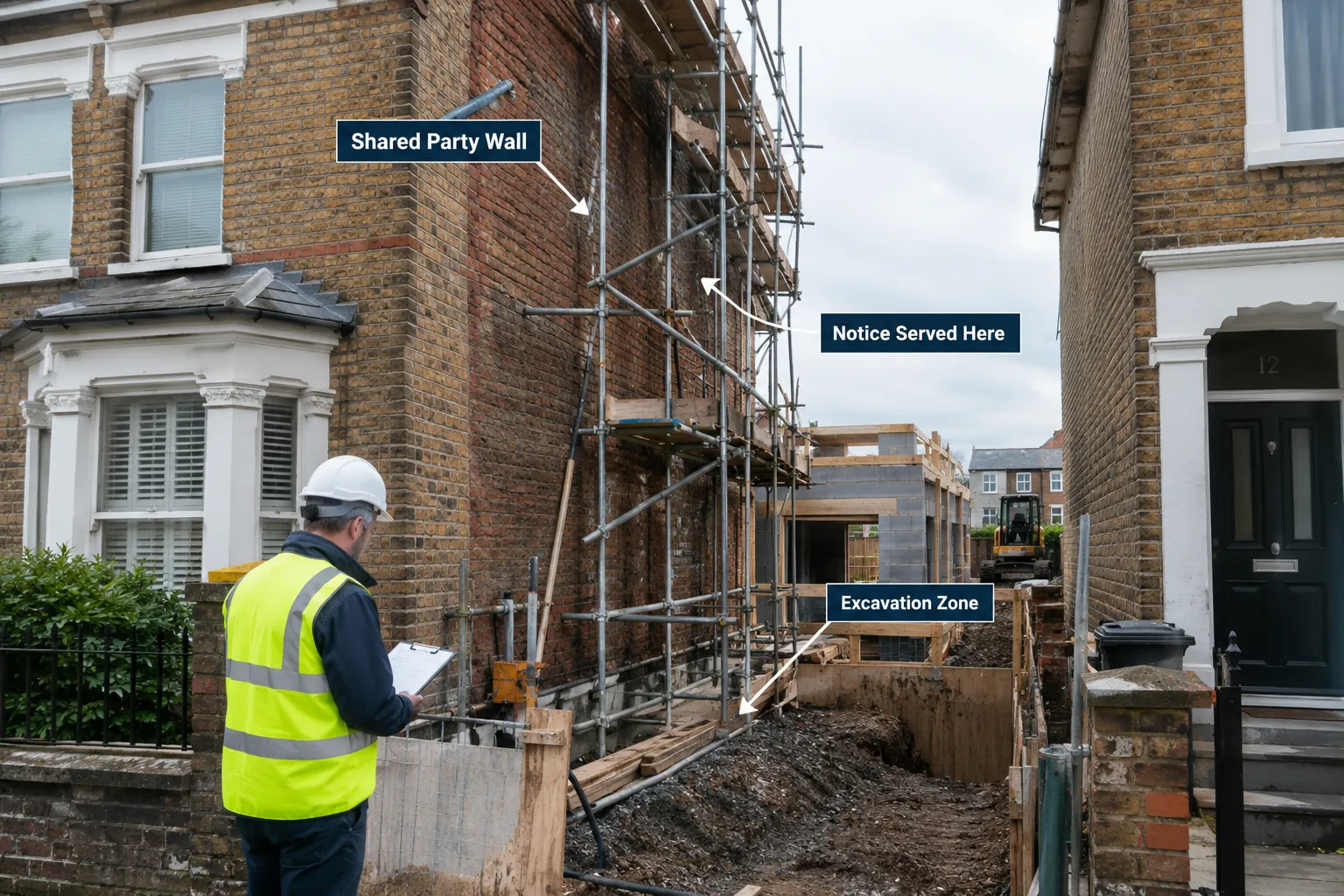
That distinction matters for anyone following the Cleverly London new build £100,000 bureaucracy claim party wall developers October 2026 debate and wondering whether party wall compliance might be swept up in future deregulation. It will not be, because the Act exists to protect a legal right that has nothing to do with planning fees or infrastructure levies: an adjoining owner’s right not to have their property damaged or devalued by a neighbour’s building works without proper notice, process and, where necessary, compensation.
When the Party Wall Act Applies to London Developments
Dense London building almost always means construction near, on, or under a boundary shared with a neighbour. The Act covers three main scenarios:
- Section 1, building a new wall at or astride the boundary line between two properties, including many infill and backland new-build schemes.
- Section 2, work to an existing party wall or party structure, such as cutting in beams, raising a wall, or underpinning a shared wall.
- Section 6, excavating within 3 metres of a neighbouring building where the new foundations will go deeper than the neighbour’s, or within 6 metres where a line drawn at 45 degrees from the base of the neighbour’s foundations would be crossed.
For a closer look at where these boundaries lie in practice, see this guide on boundary rules and how close a neighbour can build to a fence, and the broader explanation of the Party Wall etc. Act 1996 itself.
Notice Periods and the Award Process
Developers must serve the correct notice before starting relevant work:
- Two months’ notice for Section 1 and Section 2 works.
- One month’s notice for Section 6 excavation work.
Once served, an adjoining owner can consent, dissent and appoint their own surveyor, or stay silent, silence after 14 days is treated as dissent, triggering the formal surveyor process. Where owners do not agree, one or two party wall surveyors (or a third surveyor if needed) prepare a party wall award setting out the work permitted, how it will be carried out, and provisions for a schedule of condition and access. More detail on the mechanics is available in this overview of party wall awards and what a party structure notice is and how to serve it in London.
What This Means for Developers Budgeting in 2026
Party wall costs are a genuine, if modest, line in the overall cost stack, typically covering surveyor fees for both sides, schedules of condition, and any monitoring during works. Developers who build this into their programme and budget early, rather than treating it as an afterthought, avoid the delays that come from late notice service or disputed awards. Practical cost-control guidance is set out in this piece on how to keep party wall costs down, while the different categories of notifiable work are summarised in types of party wall works.
What This Means for Neighbours of New Build Schemes
For homeowners receiving a notice about works next door, whether a loft conversion, basement dig, or full infill new build, the Act is a protection, not a formality to ignore. Responding promptly, appointing a surveyor if needed, and securing a schedule of condition before work starts are the best ways to protect a property’s structure and value. Guidance on notices and responses is available in Party Wall Act notices: what they are and how to respond, and on the risks of proceeding without a surveyor.
Homeowners and developers across the capital can find local support through regional pages covering North London, Central London, West London, East London and South London.
Balancing the Deregulation Argument With Infrastructure Funding
The debate sparked by Cleverly’s comments is genuinely two-sided. Those backing deregulation argue that London’s layered system of CIL, Mayoral CIL, Section 106 and the new Building Safety Levy stacks too many separate charges onto each unit, discouraging the smaller schemes that could add supply quickly. The Conservative conference pledge to merge levies into one reflects this view.
Those defending the current charges argue that CIL funds roads and schools, Mayoral CIL has helped pay for Crossrail-scale transport infrastructure, Section 106 delivers affordable homes that would not otherwise exist, and the Building Safety Levy funds remediation of genuinely unsafe buildings following well-documented safety failures. Cutting these charges without an alternative funding source, they argue, simply shifts the cost elsewhere, onto taxpayers, onto future building safety risk, or onto reduced affordable housing delivery.
Both positions can be true at once: London new-build costs are high, and the charges that contribute to that figure also fund things Londoners rely on. What the £100,000 claim lacks, for now, is the itemised detail that would let either side test it properly.
Frequently Asked Questions
Did Sir James Cleverly say which £100,000 of costs he would cut? No. He referred broadly to “bureaucracy, taxes, and various other things” without naming specific levies, taxes or regulations he would remove.
Is the Party Wall etc. Act 1996 one of the charges Cleverly is talking about? No. The Act is not a tax or levy, it is primary legislation protecting adjoining owners’ property rights during building works, and it cannot be abolished through mayoral or planning policy.
Will the Building Safety Levy affect new London flats? Yes. It took effect on new residential development in England from 1 October 2026 and sits alongside CIL, Mayoral CIL and Section 106 as part of the overall development cost stack.
What should a developer do first when planning works near a boundary? Identify whether Section 1, 2 or 6 of the Act applies, then serve the correct notice (one or two months depending on the works) well before the planned start date, and budget for surveyor fees and a schedule of condition.
What happens if a neighbour ignores a party wall notice? Silence for 14 days is treated as dissent, which triggers the formal surveyor appointment and award process rather than allowing work to proceed unchecked.
Could future reform of London levies affect party wall timelines? Potentially, if administrative processes change, but the core notice periods and award process under the 1996 Act are set by statute and are not subject to London mayoral policy.
Conclusion
The Cleverly London new build £100,000 bureaucracy claim party wall developers October 2026 story highlights a real tension in London housing: costs are high, delivery is falling, and people are leaving for cheaper towns. But the £100,000 figure remains an unverified political claim rather than a costed, itemised plan, and genuine reform will need to grapple with the fact that CIL, Mayoral CIL, Section 106 and the Building Safety Levy each fund something specific.
For developers and neighbours alike, the practical lesson is simpler and more immediate. Party wall obligations are not part of this political argument and will not be removed by any future Mayor. Anyone planning works near a boundary, or receiving a notice about works next door, should seek early, qualified advice. Contact Party Wall Surveyor London to discuss notice requirements, awards, and how to protect a project or a property as London’s new-build debate continues through 2026 and beyond.