Looking for expert solutions?
Request a Quote

Tag: party wall agreements

  • What the New RICS 8th Edition Party Wall Guidance Means for Party Wall Notices, Awards and Agreements

    What the New RICS 8th Edition Party Wall Guidance Means for Party Wall Notices, Awards and Agreements

    {“cover”:”Professional landscape format (1536×1024) hero image with bold text overlay (≤42 chars): ‘RICS 8th Edition Party Wall Guidance’ in crisp white sans-serif on a deep navy semi-transparent panel, centered with 8% safe margins from every edge. Background: bright editorial photograph of a Georgian terraced street in London, two adjoining brick townhouses sharing a party wall, shot in warm afternoon daylight, shallow depth of field on the shared wall boundary, architectural detail visible, magazine-cover polish, professional blue and warm-brick color palette, no tables or grids.”,”content”:[“Flat-vector infographic illustration in landscape format (1536×1024), bright white background with navy and amber accents, showing a stylized timeline of RICS consultation stages, three bold numbered nodes labeled ‘Draft’, ‘Consult’, ‘Publish’ connected by a horizontal arrow, small calendar icon above the center node, clean sans-serif labels under 5 words each, generous 8% safe margins, Pinterest-worthy editorial polish, no tables or pricing grids, conveys the professional standards update process clearly.”,”Editorial split-screen landscape photograph (1536×1024): left half shows a close-up of a formal Party Wall Notice document on a wooden desk under warm studio lighting, fountain pen resting on paper, crisp and sharp; right half shows a surveyor’s hand pointing to a brick party wall on a London building site in bright daylight, hard hat visible, high-contrast editorial composition, warm amber and cool grey palette, no text overlays except a short 3-word label ‘Notice vs. Site’ in small navy sans-serif centered at the split with 8% safe margin, magazine quality.”,”Cinematic editorial photograph (1536×1024) of a professional female South Asian party wall surveyor in her 40s sitting at a modern glass desk reviewing a bound Party Wall Award document, natural daylight from large windows behind her, architectural drawings rolled beside the document, shallow depth of field, cool blue-grey office tones with warm paper accent, shot from a low three-quarter angle for depth, no pricing tables or grids, any visible text on documents kept to 2-3 blurred words, editorial magazine quality, conveys authoritative professional review of formal agreements.”]

    The RICS consultation on its draft 8th edition of “Party Wall Legislation and Procedure” closed on 5 June 2026, and for every building owner, neighbour, and surveyor involved in party wall works, the clock is now ticking. Understanding what the new RICS 8th edition Party Wall guidance means for Party Wall Notices, Awards and Agreements is no longer optional; it is a practical necessity for anyone planning construction work that touches a shared wall, boundary, or excavation near a neighbouring property.
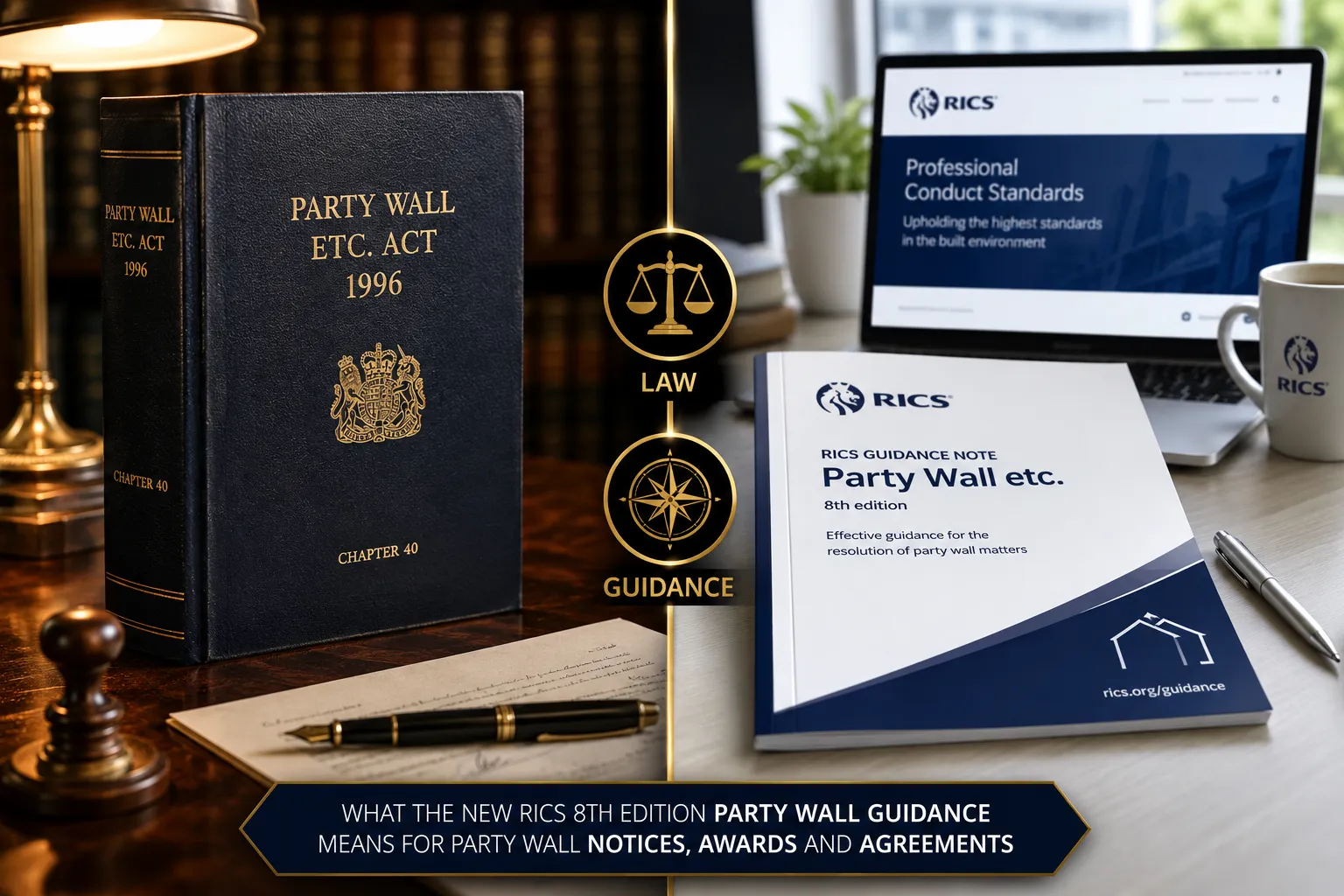
    Split-screen editorial comparison showing professional best-practice versus legal statute: left half features a dark navy

    Key Takeaways

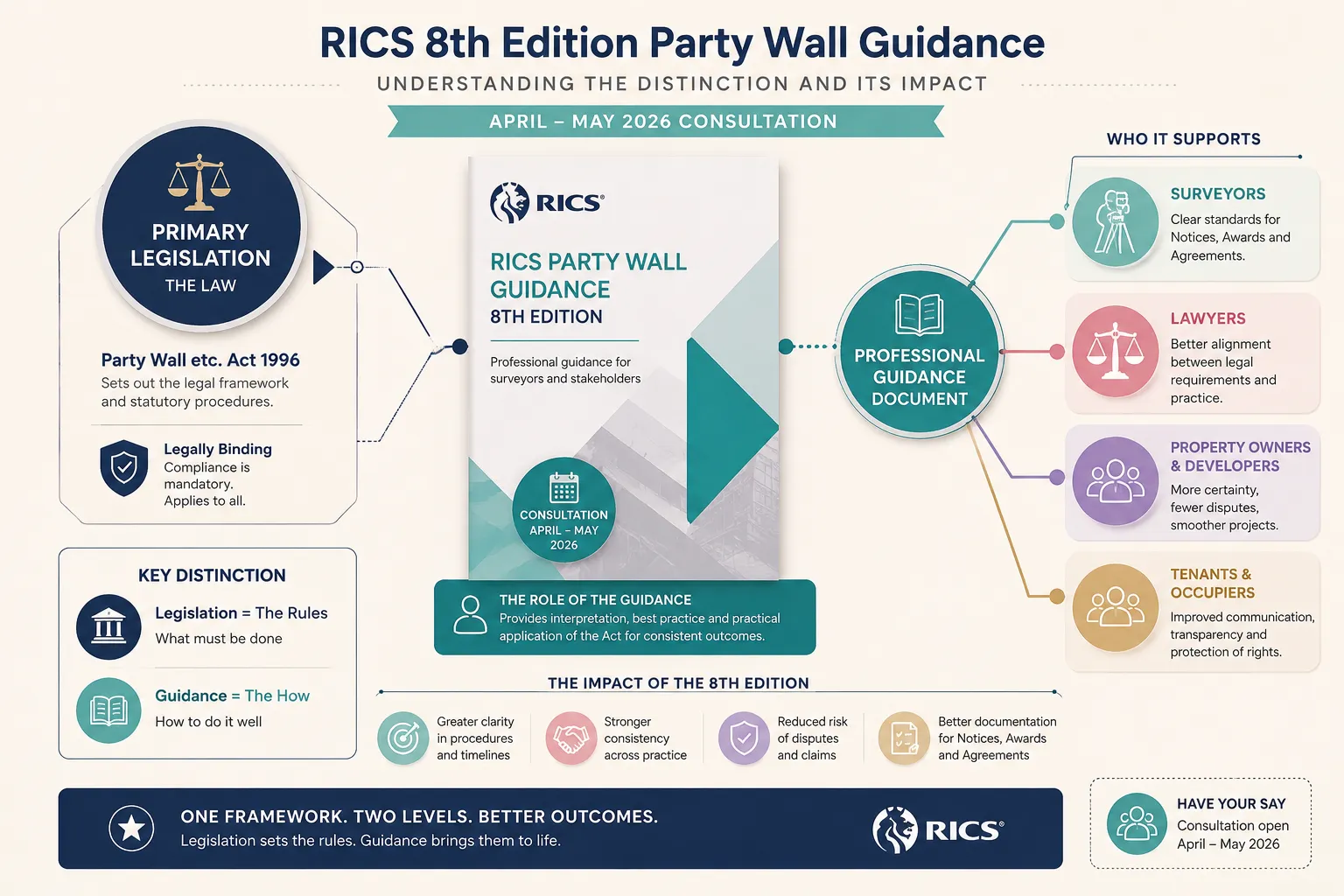
    • The RICS 8th edition is a professional best-practice standard, not a change to the law, the Party Wall etc. Act 1996 remains unchanged.
    • RICS member surveyors will be professionally judged against the new guidance, making compliance a conduct issue even though the statute is unaltered.
    • The draft tightens requirements around notice validity, service procedures, and the content of Party Wall Awards.
    • Stronger emphasis is placed on proportionality, dispute avoidance, and the use of agreed surveyors to reduce costs.
    • Building owners and adjoining owners should review their procedures now, before the final edition is published and takes effect.

    Understanding the RICS 8th Edition: What It Is and What It Is Not

    Before examining the detail, one distinction matters above all others: the 8th edition is a professional guidance document, not primary legislation. RICS launched its consultation on the draft 8th edition of “Party Wall Legislation and Procedure” in April and May 2026, inviting surveyors, lawyers, and dispute resolution practitioners to submit comments [1]. The review process is ongoing, with RICS now analysing responses before publishing the final text [4][5].

    The Party Wall etc. Act 1996 itself has not been amended in 2026 [4][5]. Statutory requirements for notices, awards, and agreements remain exactly as Parliament set them. What changes is the professional standard against which RICS members will be judged when administering those statutory requirements [2].

    “RICS member surveyors will be professionally judged against the 8th edition, so non-compliance may carry regulatory or conduct implications even though the underlying law is unchanged.” [1][2][4]

    This distinction matters enormously in practice. A surveyor who serves a technically valid notice under the Act but does so in a manner inconsistent with 8th edition guidance could face a professional conduct challenge. Conversely, building owners who understand the new expectations can hold their surveyors to a higher standard of service.

    For a plain-language overview of how the Act itself works, the Party Wall etc. Act 1996 page provides a useful starting point.

    When Will the 8th Edition Take Effect?

    There is some uncertainty in the industry about the precise implementation window. Some commentators state the final edition will take effect three months after publication, while others describe an expectation of immediate adoption once issued [3][4][5]. Given that the consultation closed on 5 June 2026, practitioners should treat the new guidance as imminent and begin aligning their procedures accordingly [7].

    What the New RICS 8th Edition Party Wall Guidance Means for Party Wall Notices
    What the New RICS 8th Edition Party Wall Guidance Means for Party Wall Notices

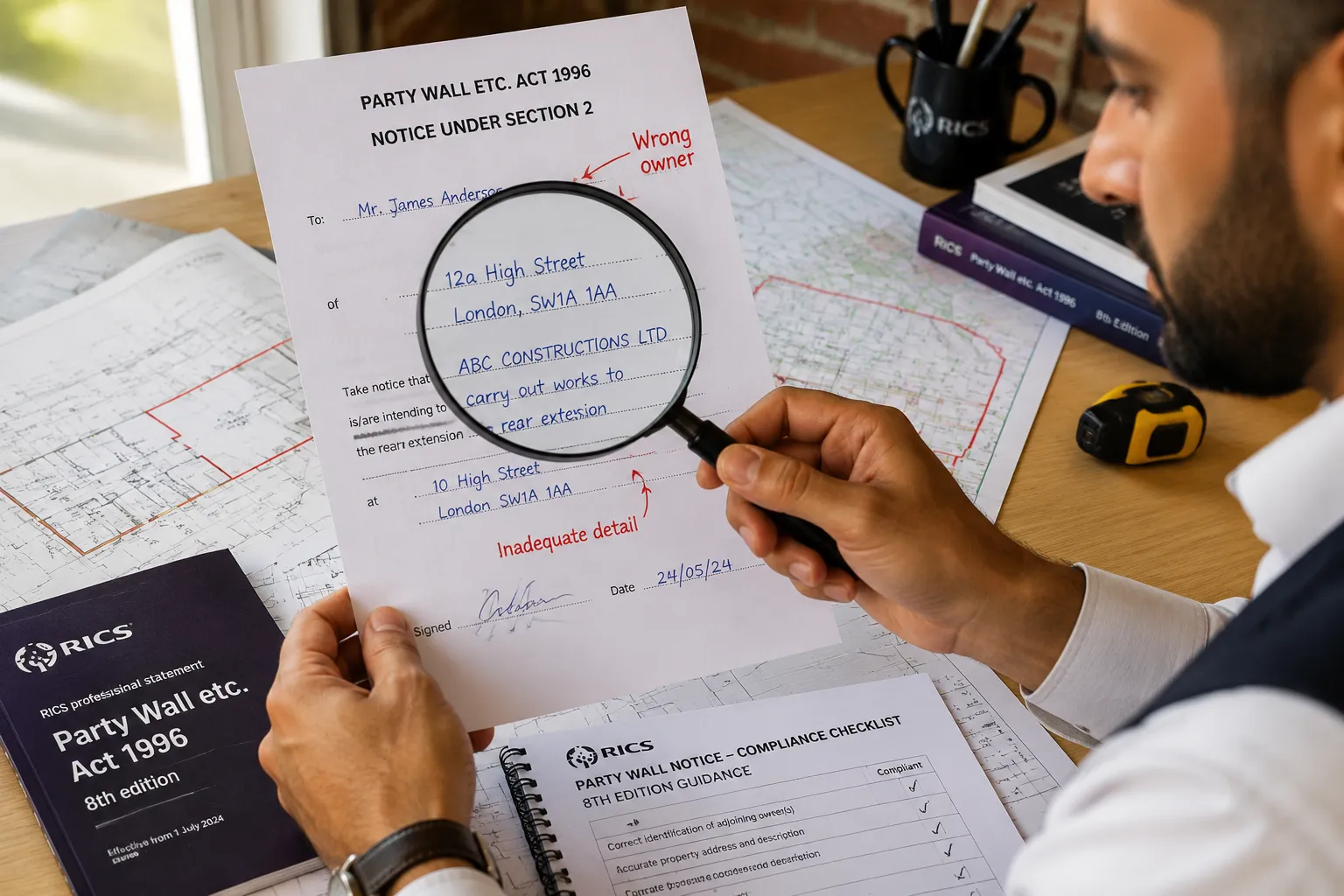
    Notice service is where many party wall disputes are born. RICS identifies defective or improperly served notices as a major source of practical problems, with delays and disputes frequently originating from notices served on the wrong owner or containing inadequate detail [1][5][7].

    Tighter Rules on Who Receives a Notice

    The draft 8th edition reinforces the need to identify the correct adjoining owner before service. This sounds straightforward, but it is a common failure point. Where a property is tenanted, both the freeholder and any long leaseholder with a qualifying interest may need to receive separate notices. Serving only one where both are required renders the notice defective and can invalidate the entire process downstream.

    For a detailed explanation of the different types of notices and how to respond to them, see Party Wall Act Notices, What They Are and How to Respond.

    Content and Validity Requirements

    The 8th edition guidance tightens expectations around the information a notice must contain. Key elements include:

    • A clear description of the proposed works
    • The address of the building to which the works relate
    • The name and address of the building owner
    • The proposed start date (respecting statutory notice periods)
    • Reference to the relevant section of the Party Wall etc. Act 1996 under which the notice is served

    Notices that omit material information, or that describe works in vague terms, risk being challenged as invalid. The guidance signals that surveyors should not proceed on the basis of a defective notice without first seeking correction [5][7].

    For those considering works that affect a shared wall structure, understanding what a Party Structure Notice is and how to serve it in London is essential reading alongside the 8th edition.

    Notice Periods and Timing

    The statutory notice periods, 1 month for a Party Structure Notice and 2 months for a Line of Junction Notice, remain unchanged. However, the 8th edition is expected to provide clearer guidance on how to calculate those periods correctly and what constitutes valid service, including service by post, by hand, and electronically where agreed [4][5].

    For a comprehensive overview of the formal notice process, the Party Wall Notices page sets out the current requirements in accessible terms.

    What the New RICS 8th Edition Party Wall Guidance Means for Party Wall Awards and Agreements
    What the New RICS 8th Edition Party Wall Guidance Means for Party Wall Awards and Agreements

    The Party Wall Award, sometimes called a Party Wall Agreement, is the formal document that governs how notifiable works are to be carried out. It protects both the building owner and the adjoining owner. The 8th edition introduces clearer expectations around the content, structure, and proportionality of Awards [3][5].

    Proportionality in Awards

    One of the most significant themes in the draft guidance is proportionality. Awards should be tailored to the scale and nature of the works. A minor loft conversion should not generate the same volume of conditions and schedules as a basement excavation beneath a neighbouring property. Overly complex Awards for straightforward works have historically driven up costs and created unnecessary friction between neighbours [5][7].

    For those concerned about costs, the guidance on how to keep Party Wall costs down is directly relevant here, proportionate Awards are one of the most effective cost-control tools available.

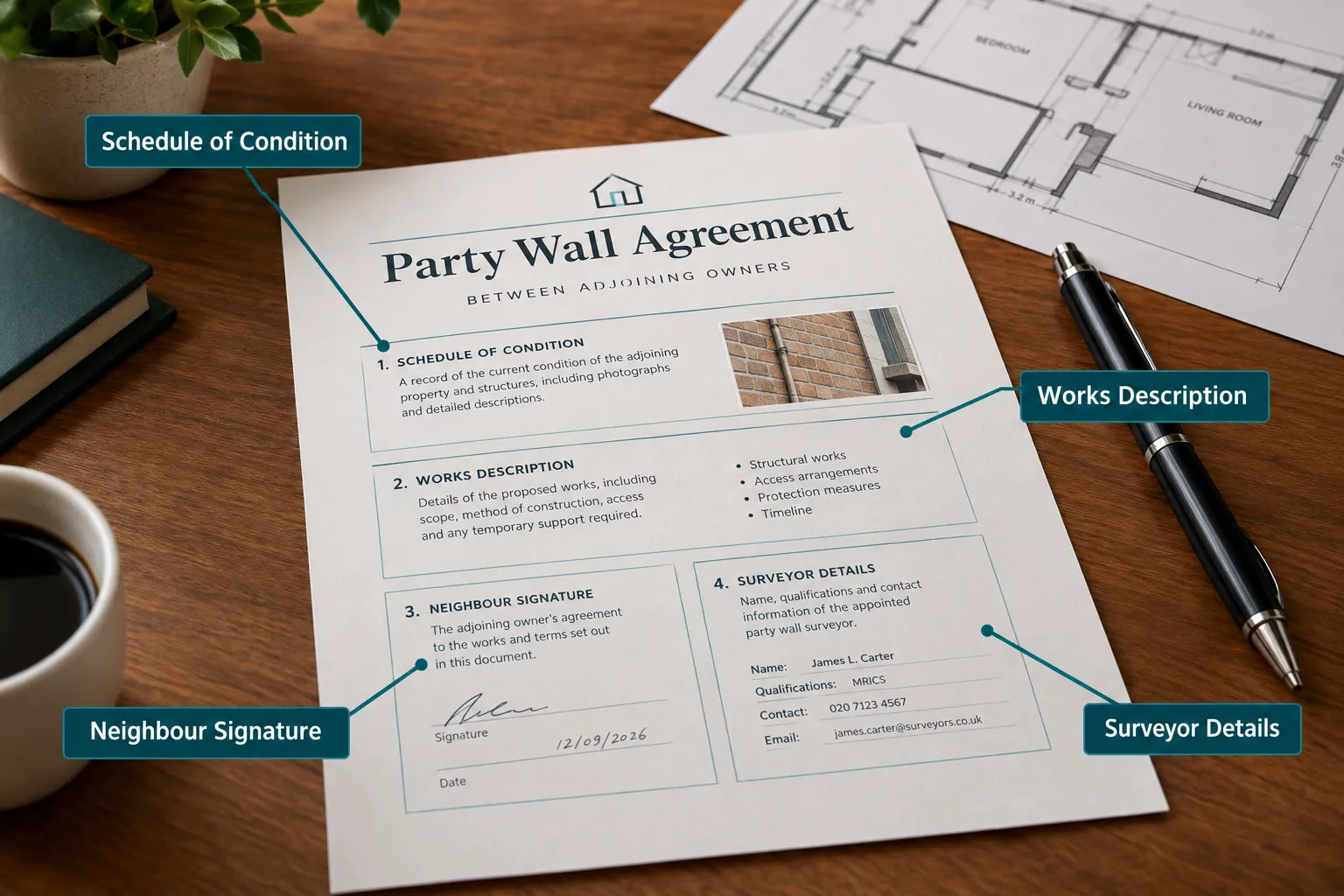
    Schedules of Condition

    The 8th edition is expected to strengthen guidance on Schedules of Condition, the photographic and written records of a neighbouring property’s state before works begin. These schedules are annexed to the Award and serve as the baseline for any future damage claim. The guidance emphasises:

    Element Expectation Under 8th Edition
    Scope Covers all areas at risk from the notified works
    Format Photographic evidence with written descriptions
    Timing Completed before works commence, not during
    Access Adjoining owner must be given reasonable opportunity to attend
    Retention Copies held by both surveyors and both owners

    A well-prepared Schedule of Condition protects both parties. Surveyors who produce inadequate schedules may face professional criticism under the new guidance [3][5].

    Use of Agreed Surveyors

    The 8th edition places renewed emphasis on the agreed surveyor route, where both the building owner and adjoining owner appoint the same single surveyor rather than each appointing their own. This approach can significantly reduce costs and speed up the process [4][5].

    For those exploring whether an agreed surveyor arrangement is appropriate, the article on having a Party Wall Agreement without a surveyor explains the boundaries of what is and is not possible without professional involvement.

    Award Content: What Must Be Included

    The guidance reinforces that a valid Award must address:

    • The works permitted, described with sufficient precision that a contractor can follow them
    • Working hours, to protect the adjoining owner from unreasonable disruption
    • Access rights, including notice periods before entry
    • Security for expenses, where the adjoining owner requests it
    • Dispute resolution, the mechanism for raising concerns during the works

    For a practical guide to how Awards are structured, Party Wall Awards and the Party Wall Contract Template Guide on Party Wall Awards provide detailed reference material.

    Practical Implications for Building Owners and Surveyors in 2026

    For Building Owners

    Building owners planning works in 2026 should take the following steps before the 8th edition is formally published:

    1. Audit your notice procedures, ensure you are identifying all qualifying adjoining owners, including freeholders and long leaseholders.
    2. Review your notice templates, generic templates may not meet the content expectations signalled in the draft guidance.
    3. Instruct experienced surveyors, RICS members will be held to the 8th edition standard; appointing a surveyor unfamiliar with the updated guidance creates risk.
    4. Budget for proportionate Awards, the guidance discourages unnecessarily complex documents, but a well-prepared Award still requires professional time and expertise.
    5. Consider the agreed surveyor route, where the relationship with the adjoining owner is cooperative, a single agreed surveyor can reduce costs and delays.

    Understanding the costs of the Party Wall process helps building owners set realistic budgets before works begin.

    For Surveyors

    RICS member surveyors face the most direct professional exposure from the 8th edition. Non-compliance with the guidance, even where the underlying statutory requirements are technically met, may constitute a conduct issue [1][2][4]. Surveyors should:

    • Review the draft consultation document and any published RICS response to submissions [1][2]
    • Update their notice templates and Award precedents to reflect the tightened content requirements
    • Document their reasoning where they depart from the guidance in any particular case
    • Engage with CPD on the 8th edition before it takes formal effect [3][5][7]

    The Broader Context: Dispute Avoidance

    A consistent thread running through the 8th edition consultation is the desire to reduce unnecessary disputes. Many party wall disputes arise not from genuine disagreement about works, but from procedural failures, defective notices, incomplete Awards, or poor communication between surveyors [5][7]. The new guidance seeks to address these root causes by raising the baseline standard of practice across the profession.

    Conclusion

    What the new RICS 8th edition Party Wall guidance means for Party Wall Notices, Awards and Agreements is, in essence, a raising of the professional bar. The Party Wall etc. Act 1996 remains the legal foundation, unchanged and unchallenged. But the 8th edition will set a clearer, more demanding standard for how RICS members administer that Act in practice, with particular focus on notice validity, Award proportionality, and the protection of both building owners and adjoining owners through properly prepared documentation.

    Actionable next steps for 2026:

    • If you are a building owner planning notifiable works, review your notice and surveyor appointment procedures now, before the final guidance is published.
    • If you are a surveyor, engage with the RICS consultation outcomes and update your precedents and templates accordingly.
    • If you are an adjoining owner, be aware that the new guidance strengthens your protections, particularly around Schedules of Condition and the content of Awards.
    • In all cases, seek advice from a qualified party wall surveyor who is actively tracking the 8th edition’s progress.

    The consultation closed on 5 June 2026 [4][5]. The final document could be published at any time. Those who prepare now will be better placed to comply from day one.

    References

    [1] Rics Launches Consultation On Updated Party Wall Practice Guidance – rics.org

    [2] Party Wall Legislation And Procedure – rics.org

    [3] Rics 8th Edition Party Wall Guidance Post Consultation Changes And Immediate 2026 Implementation For Surveyors – canterburysurveyors.com

    [4] Rics 8th Edition Party Wall Guidance Building Safety Levy London 2026 What Every Building Owner Must Know – princesurveyors.co.uk

    [5] Rics 8th Edition Party Wall Guidance – hudsonpartywallsurveyors.co.uk

    [6] Party Walls – rics.org

    [7] Party Wall Act Updates Post Rics 8th Edition Essential Changes Building Owners Must Know For 2026 Works – Party wall act updates post rics 8th edition essential changes building owners must know for 2026 works

  • Party Wall Agreements When Neighbours Consent Upfront: Streamlined Routes Without a Dispute

    Party Wall Agreements When Neighbours Consent Upfront: Streamlined Routes Without a Dispute

    Nearly 40% of party wall matters in England and Wales are resolved without a formal dispute ever arising, yet many building owners still assume the process must be adversarial, expensive, and slow. Party Wall Agreements When Neighbours Consent Upfront: Streamlined Routes Without a Dispute represent one of the most practical and underused efficiencies within the Party Wall etc. Act 1996. When a neighbour gives written consent promptly after receiving a valid notice, the entire process can be compressed into weeks rather than months, without sacrificing the legal protections the Act was designed to provide [3].

    Understanding exactly how that streamlined route works, and where it can still go wrong, is essential for any building owner planning works in 2026.

    Key Takeaways

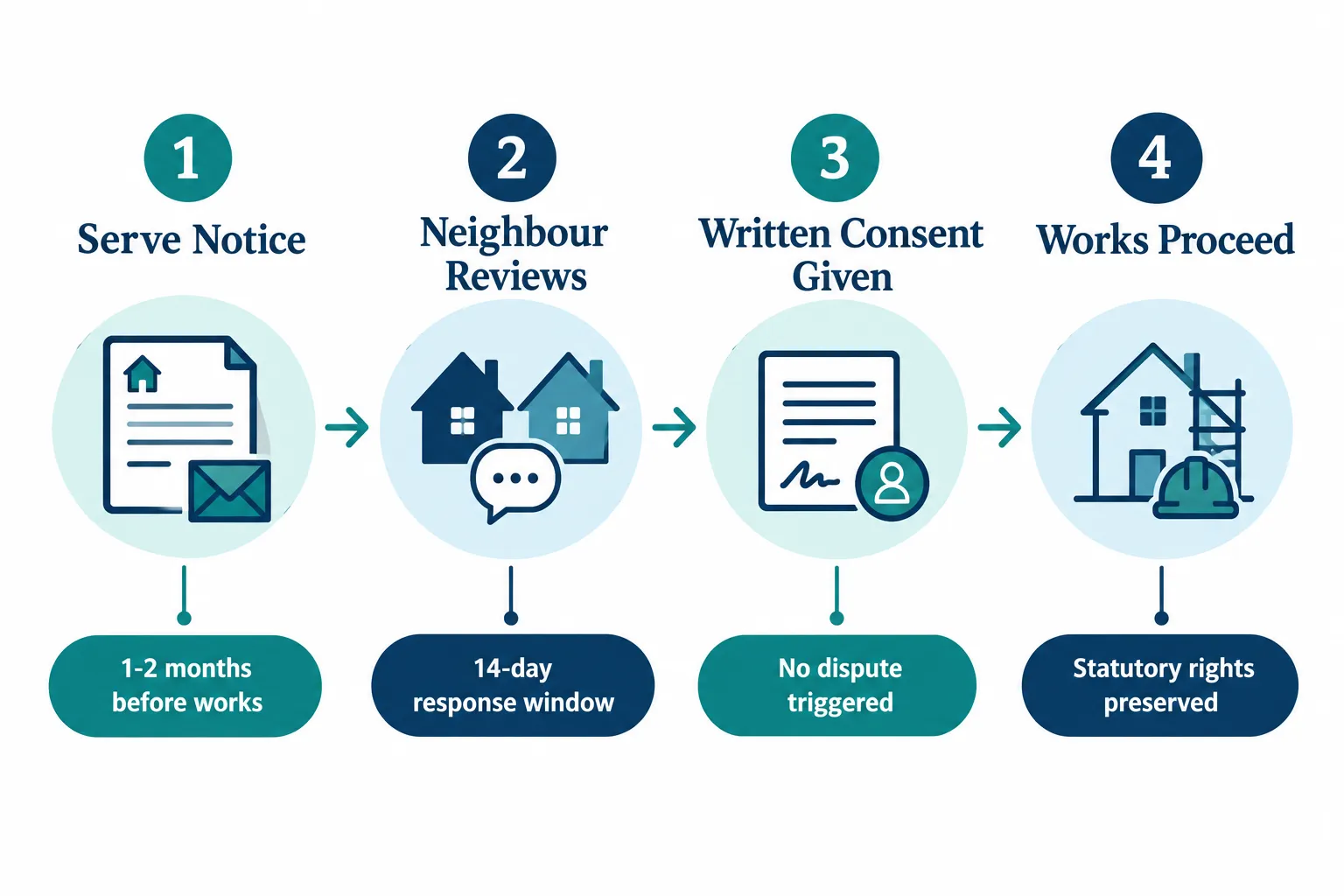
    • A neighbour’s written consent within 14 days of receiving a party wall notice removes the need for a formal party wall award, but the notice itself remains legally mandatory.
    • Consent does not waive the adjoining owner’s statutory rights; the building owner must still follow the Act’s procedures and avoid unnecessary damage.
    • Even on a consent route, a schedule of condition and a written record of agreed works are strongly advisable to prevent disputes arising mid-build.
    • A formal party wall award is still recommended when works are complex, when the boundary situation is unclear, or when either party has concerns about damage.
    • The 2026 RICS consultation on updated party wall practice guidance signals better communication standards ahead, without changing the underlying law.

    What the Party Wall etc. Act 1996 Actually Requires

    The Party Wall etc. Act 1996 is the statutory framework governing works to shared walls, boundary structures, and excavations near neighbouring buildings in England and Wales [6]. It applies to three broad categories of work:

    • Works to an existing party wall or party structure (for example, cutting into a wall to insert a steel beam, raising the height of a shared wall, or underpinning)
    • Building a new wall on or at the boundary line between two properties
    • Excavations within 3 or 6 metres of a neighbouring structure, depending on depth [5]

    For each category, the building owner must serve a formal written notice on every adjoining owner before work begins. The notice periods vary: two months’ notice is required for party structure works and new walls on the line of junction, while excavation notices require one month [5].

    Understanding what party wall notices are and how to respond to them is the essential first step before any consent conversation takes place.

    “The Act is designed to facilitate building works while protecting the interests of adjoining owners, not to obstruct reasonable development.”, RICS Consumer Guide to Party Walls [2]

    Once a valid notice is served, the adjoining owner has 14 days to respond. Their options are:

    Response Outcome
    Written consent Consent route, no award needed
    No response within 14 days Deemed dispute, surveyors appointed
    Written dissent Dispute, surveyors appointed

    The consent route is the subject of this article. It is the fastest and least costly path available under the Act [3].

    What the Party Wall etc. Act 1996 Actually Requires

    How the Consent Route Works: Party Wall Agreements When Neighbours Consent Upfront

    When an adjoining owner gives written consent within the 14-day window, a formal party wall award is not required. Works may proceed once the notice period expires, provided the building owner carries out the notifiable works in accordance with the Act [3].

    This is the core of Party Wall Agreements When Neighbours Consent Upfront: Streamlined Routes Without a Dispute, the building owner and adjoining owner reach an informal but legally significant agreement without appointing surveyors or producing a formal award document.

    What “Written Consent” Must Include

    The Act does not prescribe a rigid format for consent, but best practice requires that the consent:

    • Identifies the notice it is responding to (by date and description of works)
    • Is signed by the adjoining owner or their authorised representative
    • Is unconditional, conditional consent can create ambiguity
    • Is retained by both parties as a permanent record

    A free sample party wall agreement template can help building owners and their neighbours structure this documentation correctly from the outset.

    What Consent Does Not Remove

    A common misconception is that written consent from a neighbour removes all obligations under the Act. It does not. The building owner remains legally required to:

    1. Carry out only the works described in the notice
    2. Avoid unnecessary inconvenience to the adjoining owner
    3. Make good any damage caused to the adjoining property
    4. Provide adequate security if required
    5. Comply with any reasonable hours of working [5]

    The adjoining owner retains the right to appoint a surveyor at any point if damage occurs or the building owner exceeds the scope of the notified works. Consent is not a blank cheque [2].

    Consent vs. Party Wall Award: Knowing When a Formal Award Is Still Advisable

    The distinction between a consent-based arrangement and a formal party wall award is one of the most important practical decisions in the entire process. Party Wall Agreements When Neighbours Consent Upfront: Streamlined Routes Without a Dispute are efficient, but they are not always the safest option for either party.

    Consent vs. Party Wall Award: Knowing When a Formal Award Is Still Advisable

    When the Consent Route Is Appropriate

    The consent route works well when:

    • Works are straightforward (for example, a standard loft conversion or single-storey rear extension)
    • The party wall is in good condition and unlikely to be significantly affected
    • Both parties have a cooperative relationship and clear communication
    • The building owner is using a reputable, experienced contractor

    In these circumstances, having a party wall agreement without a surveyor is a realistic and legally sound option.

    When a Formal Party Wall Award Remains Advisable

    Despite upfront consent, a formal party wall award, produced by an agreed or appointed surveyor, offers protections that a simple consent letter cannot replicate. A formal award should still be considered when:

    • Works are complex or high-risk: deep excavations, underpinning, or significant structural alterations to a shared wall
    • The party wall is in poor condition: pre-existing cracks or structural weakness mean damage attribution disputes are likely
    • The boundary is unclear: disputes about the exact line of junction can arise mid-build without a surveyor’s input
    • Either party is risk-averse: a formal award is enforceable in the county court; a consent letter is not a court-enforceable document in the same way [4]
    • The adjoining property is tenanted or has multiple owners: ensuring all parties have consented correctly is more complex

    A party wall contract template and guide on party wall awards provides a clear overview of what a formal award contains and why it offers stronger protection in complex cases.

    The Schedule of Condition: A Non-Negotiable Best Practice

    Whether or not a formal award is produced, a schedule of condition should always be prepared before works begin. This is a photographic and written record of the adjoining property’s condition at the time works commence. It serves one critical purpose: if damage is alleged after works finish, the schedule of condition shows what was pre-existing and what is new.

    Without a schedule of condition, even the most cooperative neighbour relationship can deteriorate rapidly once cracks appear in a shared wall.

    Practical Steps to Streamline a No-Dispute Party Wall Route

    The following process represents best practice for building owners seeking to use Party Wall Agreements When Neighbours Consent Upfront: Streamlined Routes Without a Dispute effectively in 2026.

    Step 1: Identify All Notifiable Works Early

    Before any drawings are finalised, confirm which elements of the proposed works trigger the Act. This is not always obvious, for example, the difference between a party fence wall and a boundary wall affects whether the Act applies at all. Reviewing the types of party wall works that trigger notice obligations at this stage prevents costly delays later.

    Step 2: Communicate With Neighbours Before Serving Notice

    Informal early communication significantly increases the likelihood of upfront consent. Sharing plans informally, explaining the scope of works, and answering questions before serving the formal notice builds trust and reduces the chance of a reflexive dissent.

    Step 3: Serve a Clear, Complete Notice

    A poorly drafted notice is one of the most common reasons neighbours dissent or fail to respond. The notice must:

    • Describe the works clearly and in sufficient detail
    • State the proposed start date
    • Be served on all adjoining owners (including any mortgagees in some circumstances)
    • Allow the correct statutory notice period [5]

    Step 4: Request Written Consent Promptly

    Once the notice is served, follow up with the adjoining owner before the 14-day window expires. Provide a simple consent form for them to sign and return. Keep a copy of the signed consent alongside the original notice.

    Step 5: Prepare a Schedule of Condition

    Commission a schedule of condition of the adjoining property before any works begin. This can be done by a party wall surveyor, a building surveyor, or even, for straightforward cases, by the building owner and neighbour jointly, using a detailed photographic record.

    Step 6: Carry Out Works Within the Notified Scope

    Any variation to the works that affects the party wall or boundary must be re-notified. Do not assume that consent to the original works covers additional or altered works.

    Step 7: Make Good Any Damage Promptly

    If any damage occurs during works, address it immediately and document the repair. Prompt action prevents minor issues from escalating into formal disputes after the fact.

    Step 7: Make Good Any Damage Promptly

    The 2026 Regulatory Landscape: Refinement, Not Revolution

    The legal framework governing party wall matters in England and Wales has remained stable since the Party Wall etc. Act 1996 came into force. There is no current legislation to replace or significantly amend it [6].

    However, RICS launched a consultation in 2025 on updated party wall practice guidance, signalling a move toward clearer professional standards and better communication practices between surveyors and the parties they serve [8]. The direction of travel in 2026 is toward:

    • Improved transparency in how surveyors communicate fees and timelines
    • Stronger guidance on the use of agreed surveyors to reduce costs
    • Better documentation standards for consent-based arrangements
    • Clearer protocols for schedules of condition

    This is a refinement of practice, not a change in the law. The 14-day consent window, the notice periods, and the statutory rights of adjoining owners all remain unchanged [4].

    For building owners in London, local expertise matters. Whether the project is in West London, North London, or South London, a surveyor familiar with local property types and boundary conventions can help facilitate the consent route efficiently.

    Interaction With Planning Permission and Building Regulations

    Party wall consent operates entirely independently of planning permission and building regulations approval. Obtaining planning consent does not remove the obligation to serve party wall notices, and a neighbour’s party wall consent does not constitute planning approval.

    Building owners should ensure all three regimes are addressed in parallel:

    • Planning permission (where required)
    • Building regulations approval (for structural works)
    • Party wall notices and consent (for notifiable works under the 1996 Act)

    Conflating these processes is a common and costly mistake [5].

    Keeping Costs Down on the Consent Route

    One of the principal advantages of the consent route is cost. When neighbours consent upfront, neither party needs to appoint a surveyor, and no party wall award fee is incurred. The costs of the party wall process can be significant when a dispute arises, typically several hundred to several thousand pounds per surveyor, depending on complexity.

    Practical steps to keep party wall costs down include:

    • Pursuing the consent route wherever genuinely appropriate
    • Using an agreed surveyor (a single surveyor acting for both parties) when a formal award is needed
    • Preparing clear, detailed notices to avoid re-service
    • Addressing neighbour concerns early to prevent dissent

    The consent route is not just faster, it is typically the most cost-effective outcome for both parties [7].

    Conclusion

    Party Wall Agreements When Neighbours Consent Upfront: Streamlined Routes Without a Dispute offer a legally sound, cost-effective, and time-efficient alternative to the full dispute resolution process under the Party Wall etc. Act 1996. The route is available to any building owner whose neighbour provides written consent within 14 days of receiving a valid notice, and it is more achievable than many assume when the groundwork is laid correctly.

    Actionable next steps for building owners in 2026:

    1. Identify all notifiable works before finalising designs and consult the Act’s explanatory guidance if uncertain about scope.
    2. Speak informally with neighbours before serving formal notice, early communication is the single most effective way to secure upfront consent.
    3. Serve a clear, complete, and correctly timed notice using a reliable template.
    4. Obtain written consent in a signed, dated document and retain it permanently.
    5. Always prepare a schedule of condition before works begin, regardless of how cooperative the relationship appears.
    6. Seek professional advice whenever works are complex, the boundary is unclear, or either party has reservations, a formal party wall award remains the gold standard for high-risk projects.

    The consent route is not a shortcut around the law. It is the law working exactly as Parliament intended: enabling reasonable building works to proceed efficiently while protecting the rights of everyone affected.

    References

    [1] Party Walls – rics.org

    [2] Rics Consumer Guide Party Walls 1 – chpk.co.uk

    [3] Reaching Agreement With Neighbours – gov.uk

    [4] Party Wall Legislation And Procedure – rics.org

    [5] The Party Wall Etc Act 1996 Explanatory Booklet – gov.uk

    [6] legislation.gov.uk – legislation.gov.uk

    [7] Party Walls Consumer Guide 2022 – rics.org

    [8] Rics Launches Consultation On Updated Party Wall Practice Guidance – rics.org