
Nearly 40% of party wall disputes that reach the Third Surveyor stage involve procedural errors that could have been avoided with clearer guidance — and in 2026, that guidance has finally been overhauled. The RICS 8th Edition Party Wall Practice Guidance, currently in active consultation, represents the most significant revision to professional standards in this space in years. For building owners planning works this year, understanding these changes is not optional — it is essential for compliance, cost control, and dispute prevention.
This article breaks down the Party Wall Act Updates Post-RICS 8th Edition: Essential Changes Building Owners Must Know for 2026 Works, covering what has changed, why it matters, and what practical steps to take before breaking ground.
Key Takeaways 📋
- The RICS launched a formal consultation on the draft 8th Edition Party Wall Practice Guidance in April–May 2026, replacing the 7th Edition.
- The update strengthens guidance on notice validity, award drafting, fee transparency, and Third Surveyor procedures.
- Surveyor appointments are now more explicitly framed as personal and statutory — not directed by clients.
- Enhanced appendices include revised letters of appointment, updated terms of engagement, and a refreshed award template.
- Building owners who ignore these updates risk invalid notices, disputed awards, and costly delays to 2026 works.

What Is the RICS 8th Edition and Why Does It Matter in 2026?
The Royal Institution of Chartered Surveyors (RICS) is the professional body that sets practice standards for surveyors operating under the Party Wall etc. Act 1996. Its practice guidance documents are not law — but they carry significant weight in how disputes are resolved, how awards are drafted, and how surveyors are expected to conduct themselves.
The 7th Edition had served as the benchmark for years. However, changes in case law, evolving dispute patterns, and growing concerns about fee practices and procedural misuse made an update overdue. In April 2026, RICS launched a formal eight-week consultation on the draft 8th Edition, inviting input from surveyors, legal professionals, and dispute resolution practitioners [1].
💬 “The draft update establishes updated best-practice support for RICS members on when the Party Wall etc. Act 1996 applies and the procedures that follow.” — RICS [1]
For building owners, this matters because the guidance shapes how every party wall surveyor operating under RICS standards will behave — from how they draft notices to how they handle fees and resolve disagreements.
To understand the full scope of the Act itself, the Party Wall etc. Act 1996 overview provides a solid foundation before diving into the updated guidance.
Core Changes in the RICS 8th Edition: A Detailed Breakdown
1. 🔔 Strengthened Notice Validity and Service Procedures
One of the most impactful areas of the 8th Edition update concerns how notices are served and what makes them valid. The revised guidance tightens the rules around:
- Correct identification of the adjoining owner
- Proper description of the proposed works
- Timing requirements — ensuring notices are served within the correct statutory windows
Under the previous guidance, ambiguity in these areas often led to disputes about whether a notice was valid at all. The 8th Edition provides clearer procedural benchmarks, reducing the risk of a notice being challenged after works have begun.
For building owners, this means that serving a notice correctly from the outset is more important than ever. A poorly drafted notice can invalidate the entire process, exposing the building owner to injunctions or claims for damages. Understanding what party wall notices are and how to respond is a critical first step before any 2026 project begins.
| Notice Type | Statutory Notice Period | Key Risk if Invalid |
|---|---|---|
| Party Structure Notice | 2 months | Works may be injuncted |
| Line of Junction Notice | 1 month | Boundary disputes escalate |
| Adjacent Excavation Notice | 1 month | Liability for damage increases |
2. 📄 Revised Award Templates and Documentation Standards
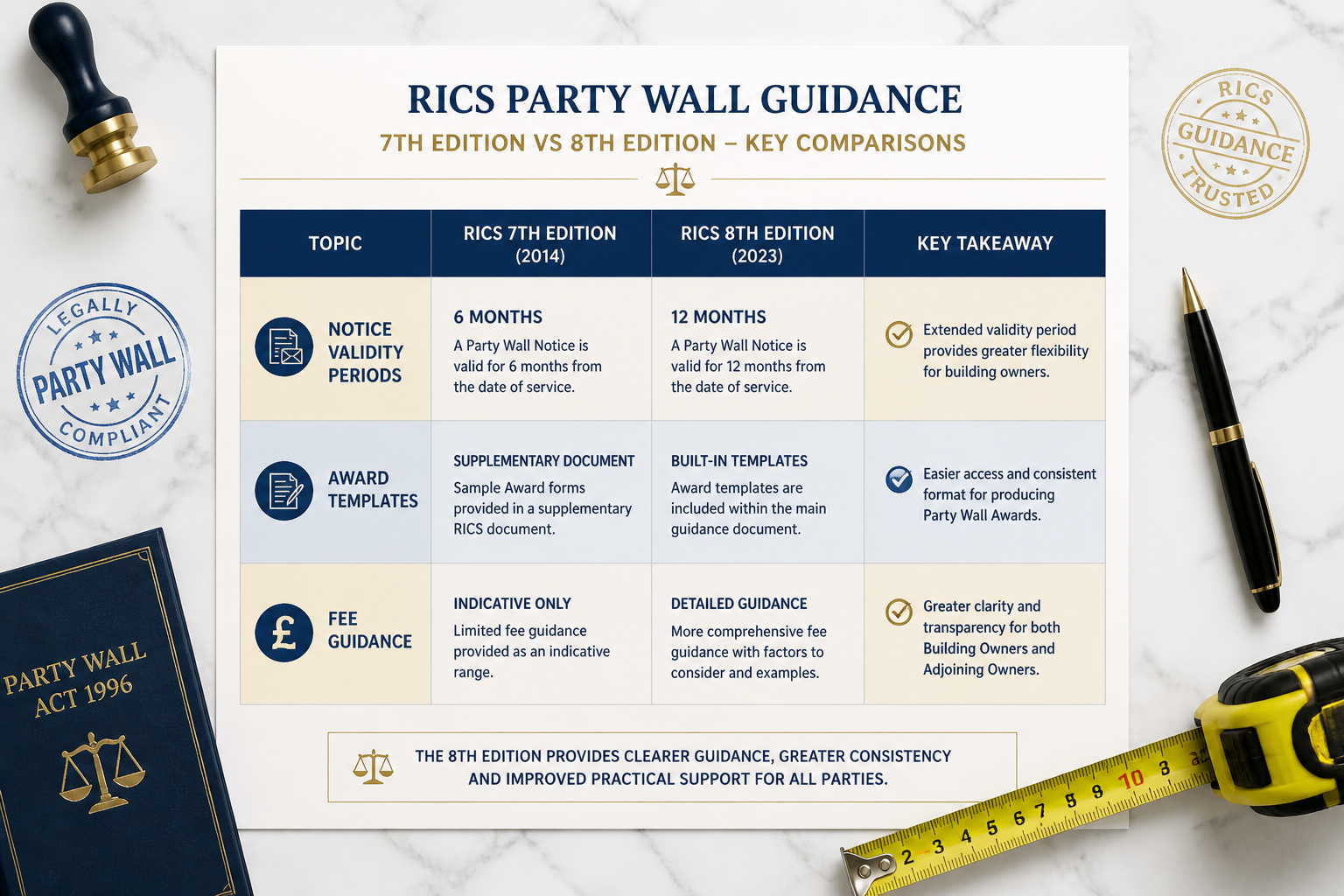
The 8th Edition introduces updated draft award templates, revised letters of appointment, and refreshed terms of engagement [1]. These are not cosmetic changes — they reflect lessons learned from disputed awards where poorly worded documents created ambiguity about the scope of permitted works or the obligations of each party.
Key improvements include:
- Clearer scope definitions within award documents
- Explicit timelines for when works may commence and must cease
- Updated indemnity and insurance clauses
- Revised compensation frameworks for damage caused during works
For anyone involved in party wall awards, these revised templates represent a significant quality upgrade. Surveyors operating under the 8th Edition will be expected to use documentation that meets these new standards — meaning building owners should expect more robust, detailed award documents going forward.
A well-drafted award protects both parties. Building owners should familiarise themselves with the structure of these documents using resources like this party wall contract template guide.
3. ⚖️ Surveyor Independence: Personal and Statutory Appointments
Perhaps the most philosophically significant change in the 8th Edition is the explicit reinforcement of surveyor independence. The guidance makes clear that party wall surveyor appointments are personal and statutory — meaning surveyors are not agents of the parties who appoint them [1].
This addresses a growing concern in the industry: building owners (and sometimes adjoining owners) attempting to direct surveyors toward outcomes that favour their interests. This behaviour has led to awards being challenged in court on the grounds of improper jurisdiction or lack of genuine dispute.
The 8th Edition guidance clarifies:
- Surveyors must act impartially and in accordance with the Act
- Appointments cannot be revoked simply because a party dislikes a surveyor’s position
- Awards made without a genuine dispute between parties may lack jurisdiction
⚠️ Important: A surveyor who allows themselves to be directed by a client risks producing an award that is legally vulnerable. Building owners should understand this distinction clearly — appointing a surveyor does not mean controlling one.
This is particularly relevant for building owners who are carrying out works and may be tempted to view the process as a formality rather than a genuine legal procedure.
How the 8th Edition Affects Fee Practices and Third Surveyor Usage
Fee Transparency and Conduct Standards 💰
The RICS 8th Edition includes strengthened regulatory and conduct guidance specifically addressing fee practices [1]. This is a direct response to concerns that some surveyors were charging disproportionate fees — particularly in cases where adjoining owners’ surveyors were billing building owners for excessive correspondence or unnecessary site visits.
The updated guidance encourages:
- Fee transparency from the point of appointment
- Proportionality between fees charged and the complexity of works
- Clear communication about who bears costs and when
For building owners, this is good news. Understanding how to keep party wall costs down becomes easier when surveyors are operating under clearer conduct standards. Unreasonable fee demands are now more clearly outside the bounds of acceptable practice under the 8th Edition.
Third Surveyor: Clearer Rules on When and How to Use Them 🔍
The Third Surveyor mechanism exists to resolve disagreements between the building owner’s surveyor and the adjoining owner’s surveyor. However, the 7th Edition left some ambiguity about when referral to a Third Surveyor is appropriate and what the process should look like.
The 8th Edition tightens this up by:
- Clarifying the circumstances under which Third Surveyor referral is appropriate
- Addressing the risk of tactical referrals designed to delay or increase costs
- Reinforcing that Third Surveyors must act independently and impartially
This matters for 2026 works because building owners who understand the Third Surveyor process are better positioned to avoid unnecessary escalation — and to use the mechanism effectively when genuine disagreement arises.
Practical Implications: What Building Owners Must Do Differently in 2026
Understanding the Party Wall Act Updates Post-RICS 8th Edition: Essential Changes Building Owners Must Know for 2026 Works is one thing — acting on them is another. Here is a practical checklist for building owners planning works this year:
✅ Pre-Works Checklist for 2026
- Identify all notifiable works — not all construction triggers the Act. Review the types of party wall works to confirm what applies to your project.
- Serve notices correctly and on time — use the updated notice templates and ensure service is documented. See guidance on party wall notices.
- Appoint a qualified RICS-registered surveyor — one who is operating under 8th Edition standards.
- Understand the award before signing off — the new award templates are more detailed. Read them carefully.
- Commission a Schedule of Condition — this protects both parties by documenting the state of adjoining properties before works begin. Learn more about schedule of condition surveys.
- Do not attempt to direct your surveyor — understand that their statutory duty is to the Act, not to you personally.
- Budget for transparent fees — ask for fee estimates upfront and in writing.
Common Mistakes to Avoid ❌
| Mistake | Consequence Under 8th Edition |
|---|---|
| Serving a vague or incomplete notice | Notice may be invalid; works can be injuncted |
| Appointing a surveyor and then directing them | Award may be challenged; surveyor may withdraw |
| Ignoring adjoining owner’s response | Deemed dissent triggers formal surveyor process |
| Underestimating award complexity | Works delayed while award is revised |
| Skipping Schedule of Condition | No baseline for damage claims; disputes escalate |
The Consultation Process: What Happens Next?
The RICS consultation on the 8th Edition ran for eight weeks from April 2026, gathering feedback from across the profession [1]. Once the consultation period closes and responses are analysed, RICS will publish the finalised 8th Edition guidance.
Building owners and surveyors should note:
- The draft guidance already signals the direction of travel — even before formal publication, surveyors are expected to align with its principles
- Legal professionals involved in property disputes are already factoring the updated standards into their advice
- The finalised document will become the primary reference point for any party wall dispute that reaches the courts or arbitration
For building owners in specific London locations, local expertise matters. Whether working in East London, North London, or South London, the 8th Edition standards apply uniformly — but local surveyors will have nuanced knowledge of how these principles play out in practice in their areas.

Why These Updates Matter Beyond Compliance
The Party Wall Act Updates Post-RICS 8th Edition: Essential Changes Building Owners Must Know for 2026 Works are not just about ticking regulatory boxes. They represent a broader shift toward:
- Greater professionalism in how party wall matters are handled
- Reduced litigation through clearer procedural standards
- Fairer outcomes for both building owners and adjoining owners
- More predictable costs through fee transparency requirements
For building owners, the message is clear: the party wall process in 2026 is more structured, more transparent, and more rigorously governed than it has ever been. Those who engage with it properly will find it a manageable — even protective — framework. Those who try to cut corners will find the updated standards leave less room to do so.
Conclusion: Actionable Next Steps for Building Owners in 2026
The RICS 8th Edition Party Wall Practice Guidance marks a genuine step forward for the profession and for property owners navigating the Party Wall etc. Act 1996. The core message is straightforward: better documentation, clearer procedures, independent surveyors, and transparent fees.
Your Action Plan 🚀
- Review your 2026 project plans against the Act’s notifiable works criteria — do not assume works are exempt without checking.
- Engage a RICS-registered party wall surveyor early — ideally before finalising project timelines, so notice periods do not delay your start date.
- Read the updated guidance or ask your surveyor to walk you through how the 8th Edition affects your specific project.
- Communicate proactively with adjoining owners — the 8th Edition’s emphasis on proper procedure makes goodwill and transparency more valuable than ever.
- Document everything — from notice service to pre-works conditions, thorough records protect building owners if disputes arise later.
The party wall process does not have to be adversarial. With the right preparation and the right professional support, it is a framework designed to protect everyone involved — including building owners. The 8th Edition simply raises the bar for how well that framework is applied.
References
[1] RICS Launches Consultation on Updated Party Wall Practice Guidance – rics.org
Speak to a RICS chartered party wall surveyor
Free initial consultation. Notices, awards and schedules of condition across London and nationwide.