Nearly one in three party wall disputes escalates beyond a simple neighbourly disagreement — not because the law is unclear, but because the first conversation never happened. Avoiding party wall disputes through pre-notice communication tactics and early surveyor consultations for 2026 renovations is not just good practice; it is the single most cost-effective decision a homeowner can make before breaking ground.
With renovation activity surging across England and Wales in 2026, the pressure on shared walls, boundaries, and neighbour relationships has never been greater. The good news? Most disputes are entirely preventable — and the strategies to prevent them start long before any formal paperwork is served.
Key Takeaways 📌
- A friendly informal chat before serving formal notice dramatically reduces the chance of dispute or refusal.
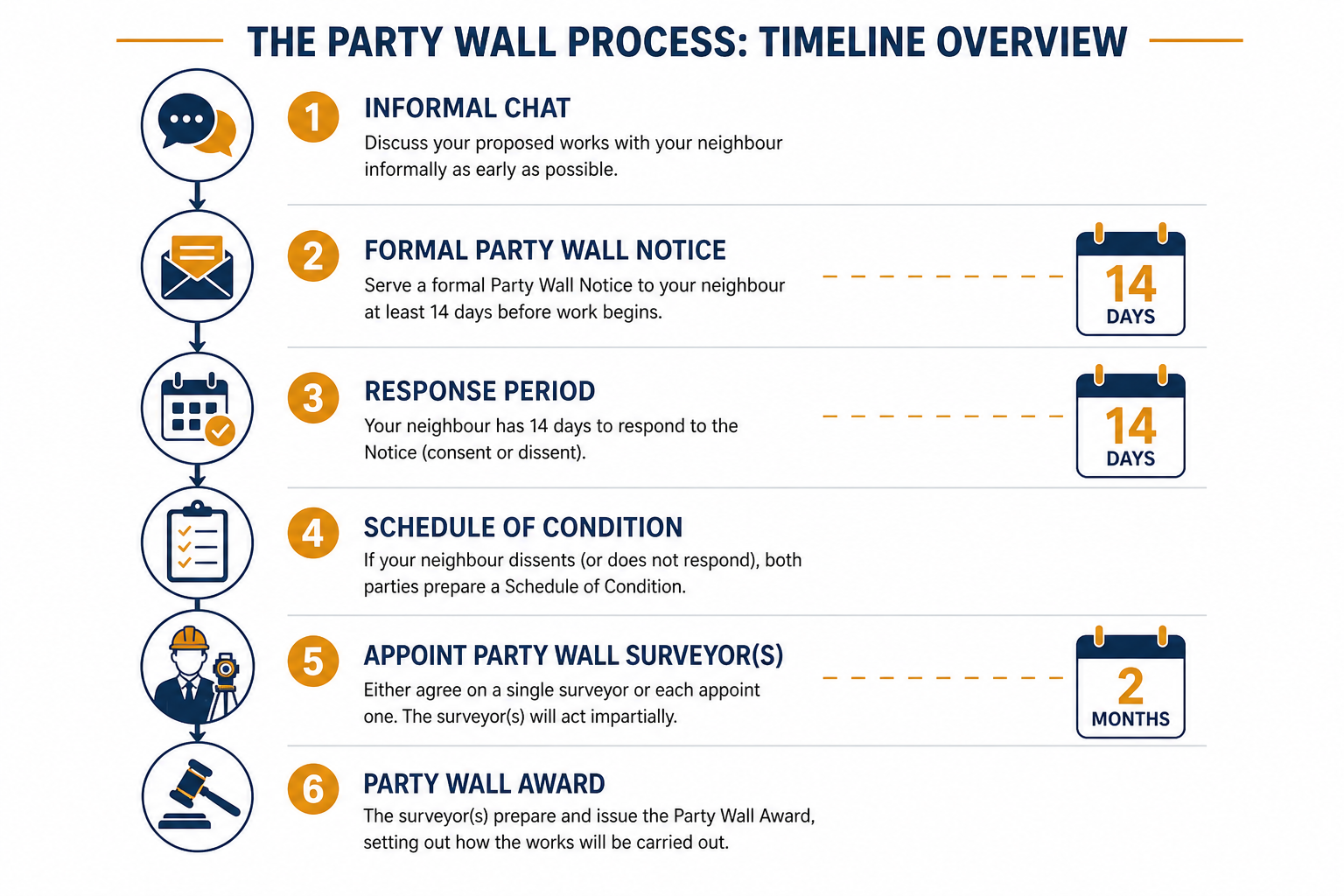
- Notice periods matter: most party wall works require 2 months’ notice; excavation works require 1 month.
- Fourteen days is all a neighbour has to respond — silence triggers an automatic dispute.
- Early surveyor consultation protects both parties and keeps costs predictable.
- A schedule of condition completed before works begin is your strongest defence against post-work claims.
Why Party Wall Disputes Are Rising in 2026
The UK’s 2026 construction uptick — driven by permitted development reforms, energy retrofit programmes, and a boom in loft conversions and rear extensions — has placed enormous strain on the party wall process [6]. More building owners are serving notices than ever before, and many adjoining owners are receiving formal legal documents through their letterboxes with no prior warning.
That cold, formal arrival of a party wall notice is often where disputes begin. Neighbours who feel blindsided are far more likely to dissent, appoint their own surveyor, and dig in for a prolonged process — even when the works themselves are perfectly reasonable.
💬 “The arguably best time to address party wall disputes is before they arise — establishing a detailed agreement ensures all property owners understand their rights and responsibilities from the outset.” [1]
Understanding the Party Wall etc. Act 1996 is the foundation of all of this. The Act applies only in England and Wales [2], and it governs works to shared walls, boundary structures, and excavations near neighbouring buildings. Getting familiar with its requirements early is non-negotiable for any 2026 renovation project.
The ‘Quick Chat’ Strategy: Pre-Notice Communication Tactics for Avoiding Party Wall Disputes
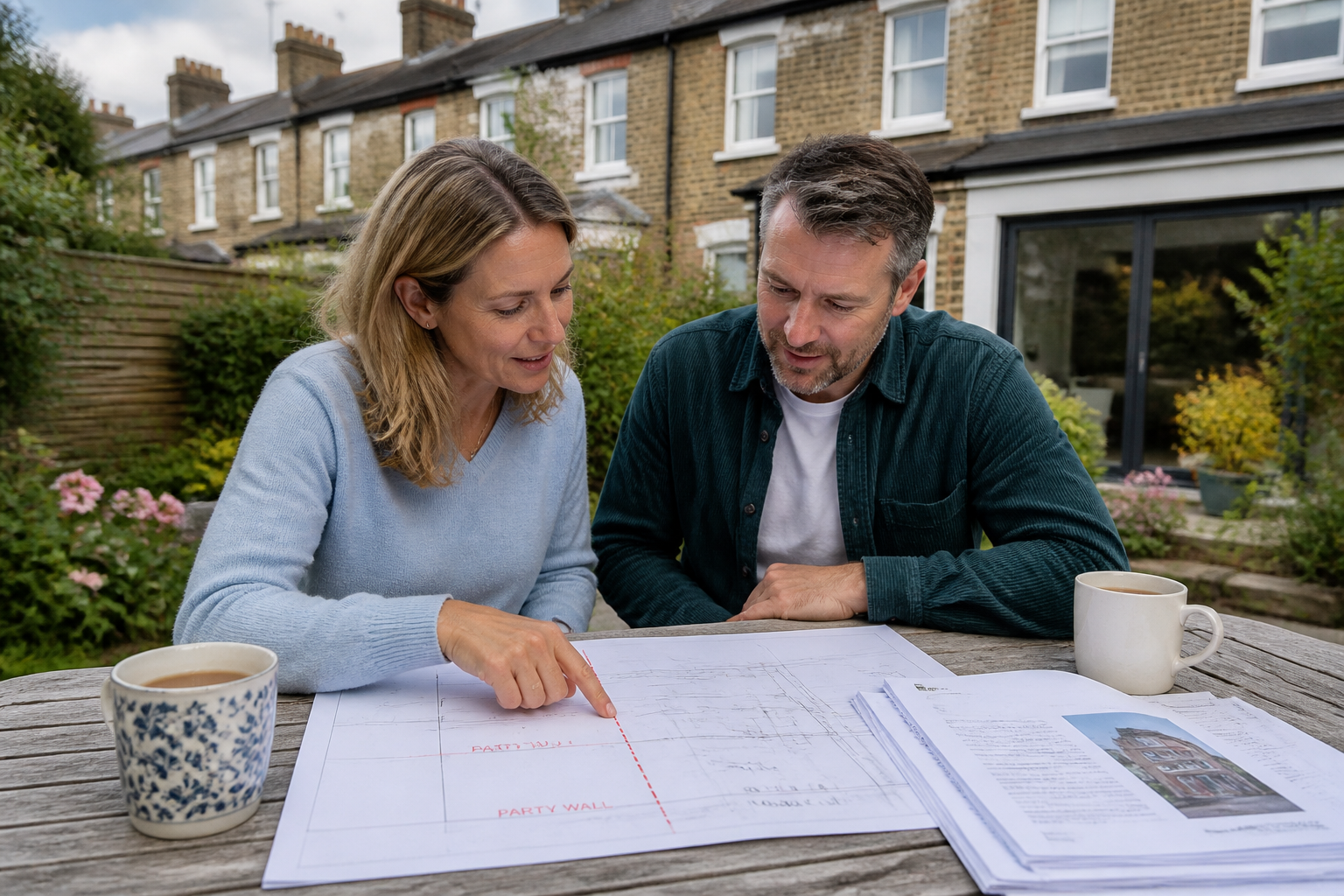
The most powerful tool in avoiding party wall disputes — and one that costs absolutely nothing — is a genuine, unhurried conversation with your neighbour before any formal notice is served.
Why Informal Communication Works
Serving a formal legal notice without any prior discussion can feel threatening to a neighbour, even when the building owner has the best intentions. The HomeOwners Alliance recommends having an informal chat first, explaining what work is planned and why, before posting anything through the letterbox [2]. This simple step transforms the dynamic from adversarial to collaborative.
What to cover in the pre-notice conversation:
- What work is being planned and roughly when it will start
- How long the works are expected to last
- What disruption (noise, dust, access) the neighbour might experience
- That a formal notice will follow — and what that means
- That the process is designed to protect both parties, not just the building owner
This approach gives the neighbour time to ask questions, raise concerns, and feel heard — all before the legal clock starts ticking.
Timing the Conversation Right
Ideally, the informal chat should happen at least 4–6 weeks before the formal notice is served. This gives the neighbour time to process the information, speak to their own advisors if they wish, and arrive at the formal notice stage feeling informed rather than ambushed.
For 2026 renovations, factor in the following statutory notice periods [2]:
| Type of Work | Required Notice Period |
|---|---|
| Works to a party wall or party structure | 2 months |
| New wall at or astride the boundary line | 1 month |
| Excavation near neighbouring foundations | 1 month |
These timelines mean that planning the conversation early is essential — especially if a project start date is fixed.
What Happens If the Neighbour Doesn’t Respond?
Here is where many building owners are caught off guard. Once a formal notice is served, the neighbour has 14 days to respond. If they fail to respond within that window, they are automatically deemed to be in dispute — regardless of whether they simply forgot or were on holiday [7]. This triggers the mandatory appointment of surveyors, adding cost and delay to the project.
A pre-notice conversation dramatically reduces the risk of this happening. A neighbour who already knows about the works and understands the process is far more likely to respond promptly — and to consent.
Serving Notice Correctly: What Every Building Owner Must Know
Even with the best pre-notice communication, the formal notice must be served correctly. Errors in the notice itself can invalidate the process and require the whole procedure to start again.
What the Notice Must Include
When serving a party wall notice, the document must clearly set out [2]:
- ✅ The building owner’s name and address
- ✅ A description of the proposed works
- ✅ The address of the property where works will take place
- ✅ The proposed start date
- ✅ All options available to the adjoining owner — consent, dissent, or appointment of a surveyor
Setting out all options clearly is not just good practice — it is a legal requirement. Failing to do so can lead to misunderstandings that escalate into formal disputes [2].
For a detailed walkthrough of the notice process, the guide on party wall act notices and how to respond provides step-by-step clarity for both building owners and adjoining owners.
Understanding What Triggers the Act
Not all works near a boundary require a party wall notice. The types of party wall works covered by the Act include:
- Cutting into a party wall to insert beams or RSJs
- Raising or underpinning a party wall
- Demolishing and rebuilding a party wall
- Excavating within 3 metres of a neighbouring building if digging below its foundation level
- Excavating within 6 metres under certain conditions
Works that do not affect the party wall — such as internal alterations entirely within one property — generally do not trigger the Act. However, if there is any doubt, consulting a surveyor early is always the safer choice.
Early Surveyor Consultations: The Cornerstone of Avoiding Party Wall Disputes in 2026 Renovations
Bringing a party wall surveyor into the process early — ideally before the formal notice is even served — is one of the most effective pre-notice communication tactics and early surveyor consultations strategies available to 2026 renovation projects.
What an Early Consultation Achieves
An early consultation with a qualified party wall surveyor provides:
- Clarity on whether the Act applies to the planned works
- Guidance on which notices need to be served and when
- Advice on how to approach the neighbour conversation professionally
- Risk assessment of the works and their likely impact on adjoining properties
- Cost forecasting — so there are no financial surprises later
For building owners in London, specialist support is available across all areas, including from a party wall surveyor in West London, East London, South London, and North London.
The Agreed Surveyor Option
One of the most cost-effective routes available under the Act is the appointment of a single agreed surveyor — one professional who acts impartially for both the building owner and the adjoining owner. Both parties can appoint this individual, ideally within ten days of a dispute arising [2].
⚠️ Critical rule: The agreed surveyor must be independent — they cannot be the same surveyor already engaged by the building owner for the construction project itself [2]. This independence is what gives the process its credibility and protects both parties.
For adjoining owners who receive a notice and are unsure how to respond, the adjoining owner’s surveyor service explains the options clearly.
Who Pays for the Surveyor?
In most cases, the building owner pays the surveyor’s fees — both their own surveyor and, typically, the adjoining owner’s surveyor costs [3]. This is an important point to communicate during the pre-notice conversation, as many neighbours assume they will face unexpected bills. Reassuring them that the costs are generally covered by the building owner removes a significant barrier to consent.
For a full breakdown, the guide on party wall costs and the process is an essential reference.
Schedule of Condition: Your Pre-Works Insurance Policy
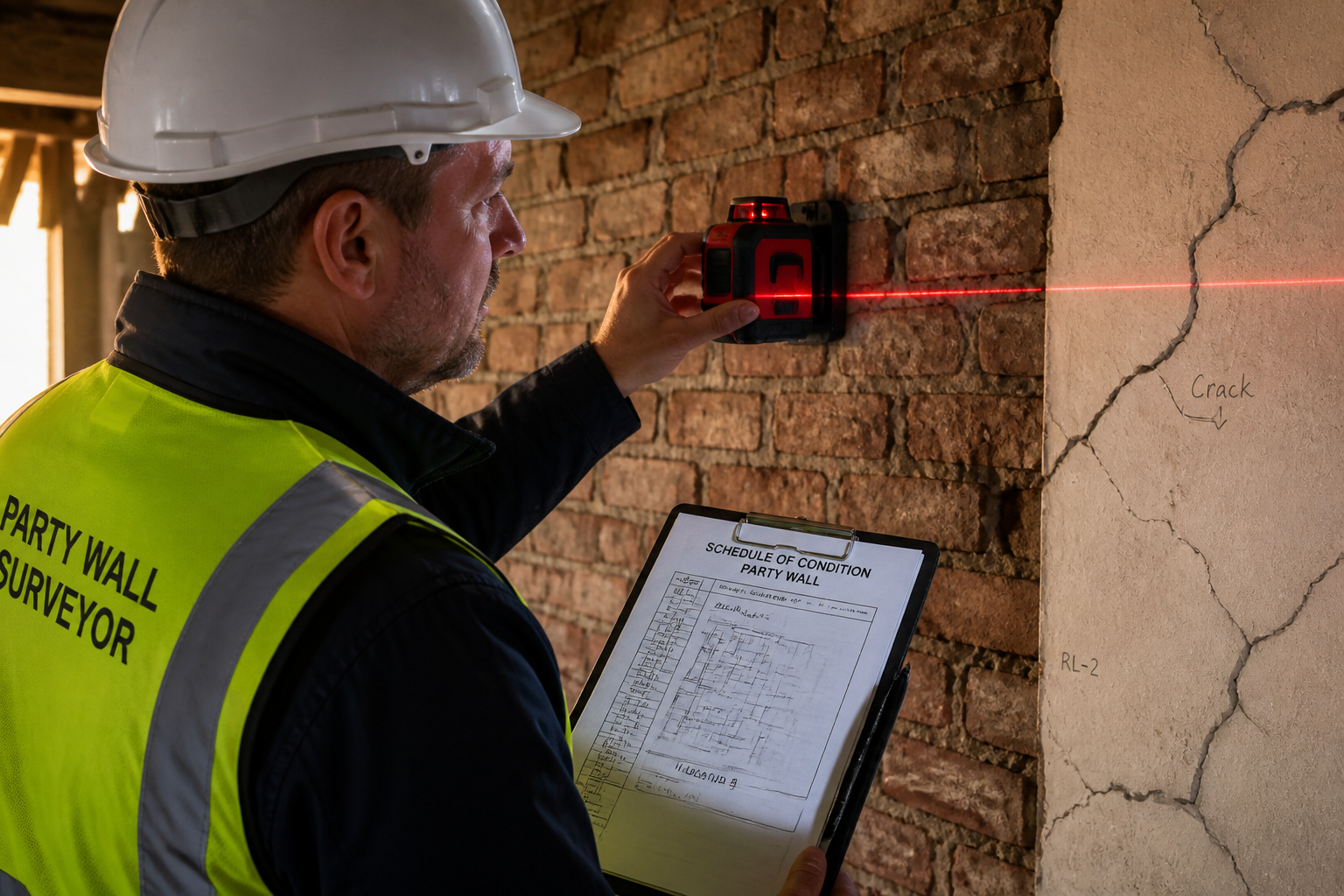
One of the most overlooked — yet most important — elements of the party wall process is the schedule of condition. This is a detailed record of the state of the adjoining property before any works begin [2].
Why It Matters
Without a schedule of condition, any crack, subsidence, or damage that appears during or after works becomes a “he said, she said” dispute. With one, there is an objective baseline. The schedule typically includes:
- 📸 Dated photographs of walls, ceilings, floors, and any existing cracks
- 📝 Written notes describing the condition of specific features
- 📐 Measurements of existing cracks or movement, sometimes using professional laser technology [1]
- 🔔 Monitoring devices in complex cases — sensors that send automatic alerts if movement occurs [1]
💡 Pro tip: Even if a surveyor has not yet been formally appointed, building owners should take dated photographs of the party wall and agree written notes of any existing cracks with copies provided to both parties [2].
A properly completed schedule of condition is not just protection for the building owner — it also protects the neighbour by ensuring that any pre-existing damage is recorded and cannot later be attributed to the new works.
When Consent Is Given: Keeping the Process Smooth
If the neighbour consents to the works — the ideal outcome of good pre-notice communication — the process becomes significantly simpler. However, consent does not mean the process ends there.
Formalising the Agreement
Even with consent, it is strongly advisable to formalise the arrangement in writing. A party wall award — also known as a party wall agreement — sets out the rights and responsibilities of both parties, the method and timing of works, and any protective measures to be taken [1].
For those exploring whether a formal agreement can be reached without a surveyor, the guide on having a party wall agreement without a surveyor outlines when this is possible and what risks to consider.
What the Agreement Should Cover
A comprehensive party wall agreement should include [1][2]:
- A full description of the works
- The agreed start date and working hours
- Access arrangements for the surveyor and contractors
- The schedule of condition (attached as an appendix)
- Details of any temporary support or protection measures
- A dispute resolution mechanism if issues arise during works
Common Mistakes That Escalate Disputes (And How to Avoid Them)
Even well-intentioned building owners can inadvertently trigger disputes through avoidable errors. Here are the most common pitfalls in 2026 renovation projects:
| ❌ Mistake | ✅ Solution |
|---|---|
| Serving notice with no prior conversation | Have the informal chat first |
| Serving notice too late | Allow for full statutory notice periods |
| Not specifying all options in the notice | Use a professionally drafted notice |
| Ignoring the 14-day response window | Follow up proactively with the neighbour |
| Starting works before the notice period expires | Respect all statutory timelines |
| Failing to document pre-works condition | Complete a schedule of condition |
| Appointing the project surveyor as the agreed surveyor | Use a fully independent professional |
Conclusion: Act Early, Communicate Often, Document Everything
The evidence is clear: the most effective strategy for avoiding party wall disputes in 2026 renovations begins not with legal paperwork, but with a genuine conversation over the garden fence.
Actionable next steps for building owners in 2026:
- 🗣️ Talk to your neighbour first — informally, warmly, and with enough time for them to ask questions before the formal notice arrives.
- 📅 Plan your timeline — factor in the 2-month notice period (or 1 month for excavations) from the very start of project planning.
- 🔍 Consult a party wall surveyor early — before the notice is served, not after a dispute has already begun.
- 📋 Commission a schedule of condition — document the state of the adjoining property before a single tool is lifted.
- 📄 Serve a complete, accurate notice — setting out all options clearly and using professionally drafted documentation.
- 🤝 Formalise consent in writing — even when the neighbour agrees, a written party wall award protects everyone.
The Party Wall etc. Act 1996 exists to protect both building owners and their neighbours. Used correctly — and approached with genuine respect for the neighbour relationship — it is a framework for collaboration, not conflict. For building owners planning works in 2026, the time to start that process is now.
References
[1] 3 Ways To Avoid Party Wall Disputes – goodkinlaw.com
[2] Party Wall Agreement – hoa.org.uk
[3] Understanding Party Wall Act What Homeowners Need Know Before Renovating – partywallslimited.com
[6] Party Wall Surveys And Neighbour Disputes During 2026s Construction Uptick Rics Compliance Framework – https://nottinghillsurveyors.com/blog/party-wall-surveys-and-neighbour-disputes-during-2026s-construction-uptick-rics-compliance-framework
[7] Avoiding Party Wall Disputes In 2026 Construction Boom Surveyor Best Practices For Notice Procedures And Early Neighbour Engagement – https://nottinghillsurveyors.com/blog/avoiding-party-wall-disputes-in-2026-construction-boom-surveyor-best-practices-for-notice-procedures-and-early-neighbour-engagement
Speak to a RICS chartered party wall surveyor
Free initial consultation. Notices, awards and schedules of condition across London and nationwide.