Looking for expert solutions?
Request a Quote

Tag: party wall award

  • Party Wall Surveyor Qualifications in London: How to Check RICS Status, Experience and Insurance Before You Instruct

    Party Wall Surveyor Qualifications in London: How to Check RICS Status, Experience and Insurance Before You Instruct

    Nearly one in three party wall disputes in London escalates because a homeowner instructed an unqualified or uninsured surveyor whose award was later challenged as invalid. Understanding party wall surveyor qualifications in London, how to check RICS status, experience and insurance before you instruct, is not a bureaucratic formality. It is the single most effective way to protect the legal standing of your notices, your award, and your building project from the outset.

    Key Takeaways

    • Party wall surveyors in London are not required by law to hold a specific qualification, but instructing an MRICS or FRICS-chartered surveyor is the standard recommended by RICS and followed by leading London firms.
    • You can verify any surveyor’s RICS membership status in seconds using the free RICS Find a Surveyor directory.
    • Professional indemnity insurance (PII) is essential; always request written confirmation of cover before instruction.
    • Experience matters: check for a demonstrable London track record, specialist party wall knowledge, and familiarity with the Party Wall Etc Act 1996.
    • A surveyor who lacks the right credentials can produce an award that is legally vulnerable, causing costly delays and disputes.

    Why Qualifications Matter Under the Party Wall Etc Act 1996

    The Party Wall etc Act 1996 gives surveyors significant statutory powers. They can enter properties, determine the scope of works, and issue legally binding party wall awards that govern how construction proceeds. Despite this authority, the Act itself does not specify that a party wall surveyor must hold any formal qualification. Any person, in theory, can be appointed as a party wall surveyor.

    This gap in the legislation creates real risk for property owners. An award prepared by someone without adequate professional knowledge may contain errors that expose it to appeal, or fail to protect the adjoining owner’s property adequately. In London, where party wall matters frequently involve complex basement excavations, loft conversions in Victorian terraces, and high-value properties in close proximity, the consequences of instructing the wrong person can be severe.

    RICS, the Royal Institution of Chartered Surveyors, addresses this directly. Its professional guidance states that chartered surveyors holding MRICS or FRICS status are the appropriate choice for party wall appointments, and its updated standards set a clear benchmark for competence [1]. The forthcoming RICS 8th Edition party wall guidance, for which consultation closed in June 2026, is expected to sharpen these competency requirements further [9].

    Key principle: The absence of a legal qualification requirement makes your own due diligence more important, not less.

    The RICS Standard: What MRICS and FRICS Mean in Practice
    The RICS Standard: What MRICS and FRICS Mean in Practice

    RICS membership is the most widely recognised mark of professional competence for surveyors in the United Kingdom. Two grades are relevant when checking party wall surveyor qualifications in London:

    Grade Full Title What It Indicates
    MRICS Member of the Royal Institution of Chartered Surveyors Full chartered status; passed Assessment of Professional Competence
    FRICS Fellow of the Royal Institution of Chartered Surveyors Senior grade; recognised for significant contribution to the profession

    Both grades require surveyors to meet continuing professional development (CPD) requirements, adhere to the RICS Rules of Conduct, and maintain professional indemnity insurance. RICS-regulated firms are also subject to firm-level oversight, which adds a further layer of accountability [8].

    RICS publishes a dedicated professional standard, Party Wall Legislation and Procedure, that sets out how chartered surveyors should handle appointments, serve notices, conduct schedule of condition surveys, and draft awards [1]. The August 2026 update to this standard reinforces best practice around impartiality, record-keeping, and the handling of disputes. Surveyors who follow this guidance are operating within a framework that protects all parties.

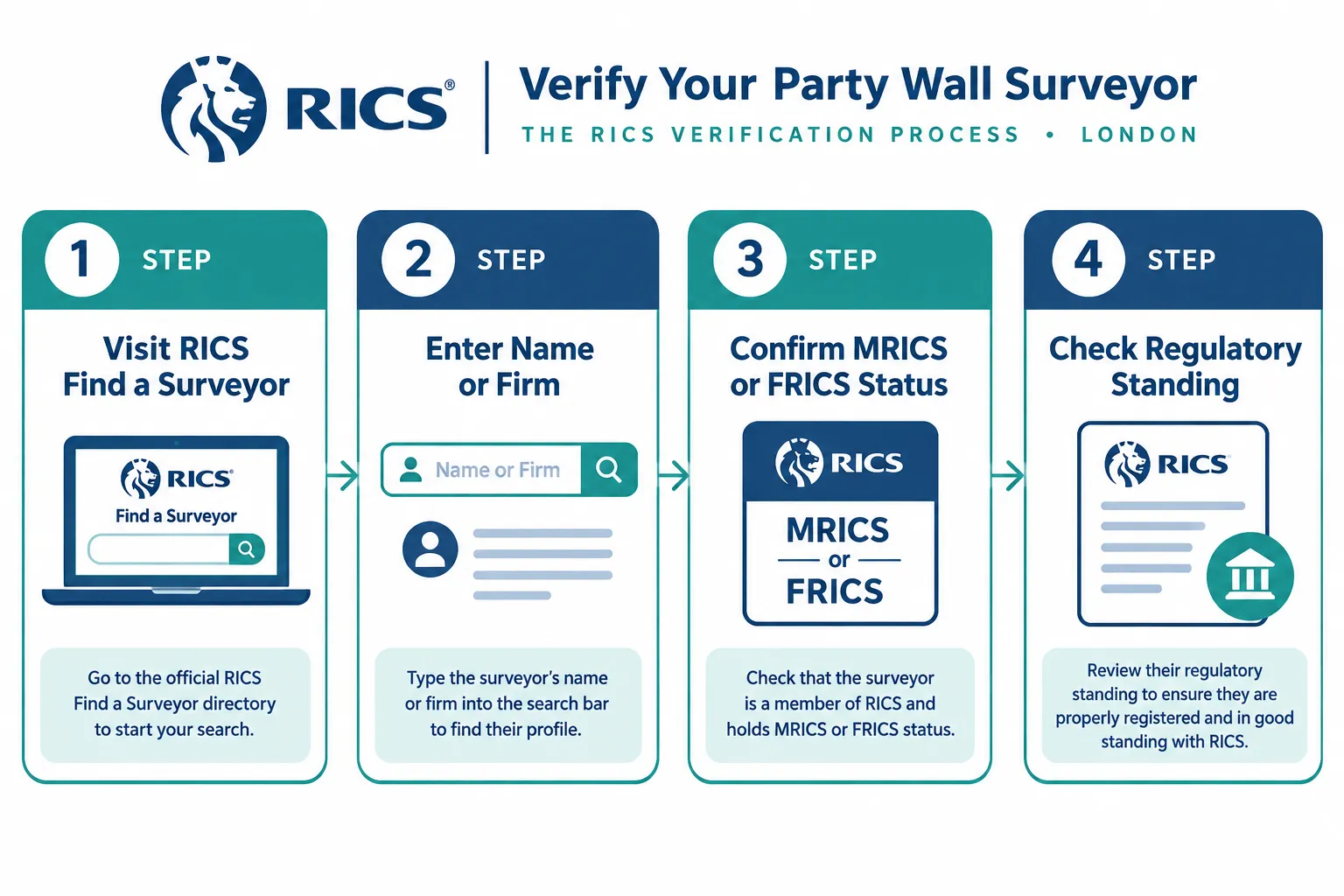
    How to verify RICS status:

    1. Go to the RICS Find a Surveyor directory at ricsfirms.com.
    2. Search by the surveyor’s name or the firm’s name.
    3. Confirm the individual holds MRICS or FRICS designation.
    4. Check that the firm itself is RICS-regulated.
    5. Note any disciplinary findings or regulatory flags.

    This search takes under two minutes and costs nothing. RICS also operates a consumer helpline specifically for party wall queries, which can assist property owners who are uncertain about a surveyor’s standing [2].

    Checking Experience: London Specialism and Track Record

    RICS membership confirms professional standing, but it does not automatically confirm specialist party wall experience. A chartered surveyor whose practice focuses on commercial valuations, for example, may hold MRICS status but have limited practical knowledge of party wall procedure.

    When assessing party wall surveyor qualifications in London, experience checks should cover three distinct areas.

    Years of Specialist Practice

    Look for a surveyor who has been practising party wall work as a primary specialism for at least five years. In London’s dense urban environment, party wall matters arise constantly, loft conversions, rear extensions, basement digs, and boundary works generate a steady volume of notices and awards. A surveyor with genuine London specialism will have handled hundreds of appointments across a range of property types and dispute scenarios [3][4].

    Ask directly:

    • How many party wall awards have you prepared in the last 12 months?
    • What proportion of your practice is party wall work?
    • Do you have experience with the specific type of works being proposed?

    London-Specific Knowledge

    London’s housing stock is distinctive. Victorian and Edwardian terraces, Georgian townhouses, and post-war blocks all present different structural considerations. A surveyor who understands the particular challenges of, say, a basement excavation in Central London or a loft conversion in a North London semi-detached will produce a more thorough schedule of condition and a more robust award than one without that contextual knowledge.

    Check the firm’s website for evidence of London-specific case experience. Leading London party wall specialists will typically reference the boroughs and property types they cover, and may publish case studies or guidance notes that demonstrate depth of knowledge [5][6].

    Team Credentials

    In larger practices, the surveyor who attends your property may not be the named partner. Confirm that the individual who will conduct the survey and draft the award holds MRICS or FRICS status, not merely that the firm’s principal does. Reputable firms are transparent about their team’s credentials and will confirm individual qualifications on request [7].

    Professional Indemnity Insurance: Why It Is Non-Negotiable
    Professional Indemnity Insurance: Why It Is Non-Negotiable

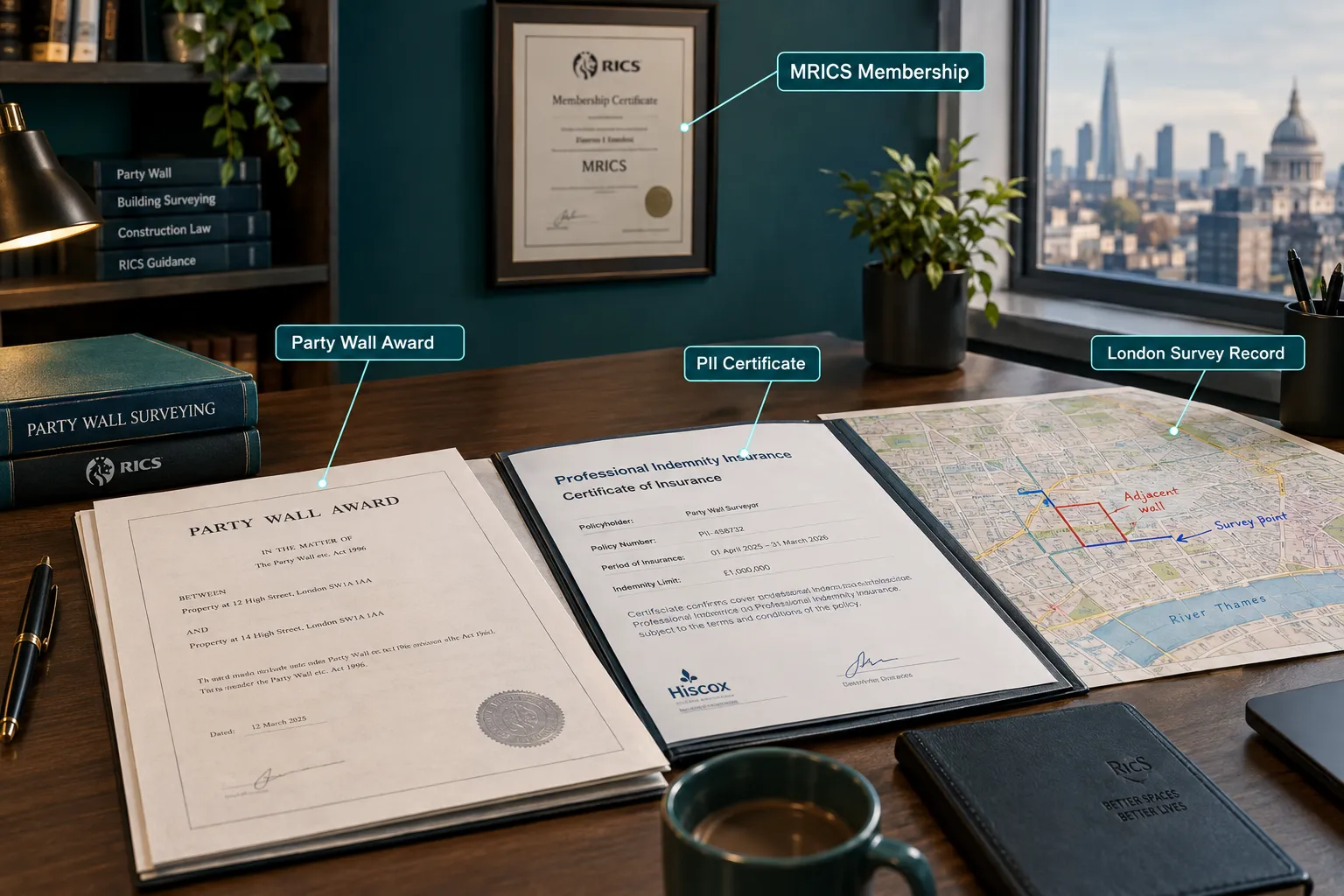
    Professional indemnity insurance (PII) protects property owners if a surveyor makes an error or omission that causes financial loss. If an award is negligently drafted and a building owner suffers damage as a result, PII is the mechanism through which compensation can be recovered.

    RICS requires all regulated firms to maintain adequate PII as a condition of membership. However, “adequate” must be interpreted in context. For party wall work in London, where property values are high and structural damage claims can be substantial, a minimum level of cover may not be sufficient.

    Before instructing any party wall surveyor, request:

    • Written confirmation that PII is in place
    • The name of the insurer and the policy number
    • The level of cover (indemnity limit per claim and in aggregate)
    • Confirmation that party wall work is explicitly covered under the policy

    Some surveyors operating as sole traders or through informal arrangements may carry insufficient cover or may have allowed their policy to lapse. This is particularly relevant when instructing an individual rather than an established firm. RICS-regulated firms are subject to annual checks on their insurance status, which is one reason firm-level regulation matters [2].

    Practical tip: If a surveyor is reluctant to provide written confirmation of PII, treat that as a significant warning sign and seek an alternative appointment.

    It is also worth noting that the costs of the party wall process can be substantial, and instructing a properly insured surveyor from the outset is far less expensive than pursuing a negligence claim after the fact.

    A Practical Verification Checklist Before You Instruct

    The following checklist consolidates the key qualification, experience, and insurance checks into a single reference. Use it before committing to any party wall surveyor appointment in London.

    Qualifications and Regulatory Status

    • Confirm the individual surveyor holds MRICS or FRICS designation via the RICS Find a Surveyor directory
    • Confirm the firm is RICS-regulated (not just that an individual within it is chartered)
    • Check for any disciplinary findings or regulatory sanctions on the RICS register
    • Ask whether the surveyor follows the RICS Party Wall Legislation and Procedure professional standard [1]

    Experience and Specialism

    • Ask how many party wall appointments the surveyor has completed in London in the past year
    • Confirm the surveyor has experience with the specific type of works being proposed (e.g., basement, loft, rear extension)
    • Review the firm’s website for published party wall awards, case studies, or London-specific guidance
    • Check whether the firm covers your area of London, whether that is South London, East London, or West London

    Insurance

    • Request written confirmation of professional indemnity insurance
    • Confirm the indemnity limit is appropriate for the value of the project and the property
    • Verify that party wall work is explicitly included within the scope of the policy
    • Check that the policy is current and will remain in force throughout the project

    Notice and Award Competence

    • Ask the surveyor to explain how they would handle service of party wall notices for your specific works
    • Confirm they understand the distinction between different types of party wall works and the corresponding notice requirements
    • Ask for a sample award or a description of the award drafting process to assess thoroughness

    How Qualifications Affect the Validity of Notices and Awards

    How Qualifications Affect the Validity of Notices and Awards

    A party wall award is only as strong as the process that produced it. Where a surveyor lacks the competence to correctly identify the scope of notifiable works, serve notices in the proper form, or draft an award that addresses all relevant matters, the resulting document can be challenged on appeal to the County Court under Section 10(17) of the Act.

    Common errors made by less experienced or unqualified practitioners include:

    • Incorrect notice type: Serving a Line of Junction Notice when a Party Structure Notice was required, or vice versa
    • Inadequate schedule of condition: Failing to document pre-existing defects thoroughly, leaving disputes about causation unresolved
    • Incomplete award: Omitting provisions for working hours, method statements, or reinstatement obligations
    • Conflict of interest: Acting in a way that compromises the surveyor’s statutory duty of impartiality

    Each of these errors can result in delays, additional costs, and in some cases, the invalidation of the award itself. A surveyor who holds MRICS status, carries adequate PII, and has a demonstrable London track record is far less likely to make these mistakes, and far better placed to remedy them if they arise.

    It is also worth understanding the distinction between a building owner’s surveyor and an adjoining owner’s surveyor. Both appointments carry the same qualification and insurance requirements. The adjoining owner’s surveyor in particular must be genuinely independent and competent to protect their client’s interests, since they are appointed specifically to scrutinise the proposed works.

    Using RICS Resources and Free Consultations

    RICS provides several consumer-facing resources that property owners in London can use at no cost. The RICS party wall consumer guide explains the process in accessible terms and directs readers to the RICS Find a Surveyor tool [8]. The RICS party walls helpline offers guidance to those who are uncertain about their obligations or who have concerns about a surveyor’s conduct [2].

    Many leading London party wall firms also offer free initial consultations. These conversations serve a dual purpose: they allow the property owner to assess the surveyor’s knowledge and communication style, and they give the surveyor an opportunity to identify any complications that may affect the appointment. A firm that offers a free consultation and is willing to answer detailed questions about its qualifications, experience, and insurance is demonstrating the transparency that should be expected of any reputable practice.

    Conclusion

    Checking party wall surveyor qualifications in London, RICS status, experience, and insurance, before instructing is not optional due diligence. It is the foundation of a legally sound party wall process. The Party Wall etc Act 1996 grants surveyors significant powers, and the validity of every notice and award depends on those powers being exercised by someone with the competence and accountability to use them correctly.

    Actionable next steps:

    1. Use the RICS Find a Surveyor directory to verify MRICS or FRICS status for any surveyor you are considering.
    2. Request written confirmation of professional indemnity insurance before signing any instruction letter.
    3. Ask specific questions about London experience and the number of party wall awards completed in the past year.
    4. Check that the firm covers your specific area of London and has experience with your type of works.
    5. Use the free RICS party walls helpline if you have any concerns about a surveyor’s standing or conduct.
    6. Review the RICS Party Wall Legislation and Procedure standard to understand what best practice looks like from the surveyor’s perspective.

    Taking these steps before instruction costs nothing and protects everything.

    References

    [1] Party Wall Legislation And Procedure – rics.org

    [2] Party Walls (RICS Helplines) – ricsfirms.com

    [3] partywallspecialistlondon.co.uk – partywallspecialistlondon.co.uk

    [4] stanleystrong.co.uk – stanleystrong.co.uk

    [5] Party Wall (Barnes and Barnes) – barnesandbarnes.london

    [6] Party Wall Surveyor (Square Point Surveyors) – squarepointsurveyors.co.uk

    [7] websterssurveyors.co.uk – websterssurveyors.co.uk

    [8] Party Walls (RICS Consumer Guide) – rics.org

    [9] RICS 8th Edition Party Wall Guidance – hudsonpartywallsurveyors.co.uk

    [10] Party Walls (RICS Firms West London) – ricsfirms.com
  • Party Wall Agreements When Neighbours Consent Upfront: Streamlined Routes Without a Dispute

    Party Wall Agreements When Neighbours Consent Upfront: Streamlined Routes Without a Dispute

    Nearly 40% of party wall matters in England and Wales are resolved without a formal dispute ever arising, yet many building owners still assume the process must be adversarial, expensive, and slow. Party Wall Agreements When Neighbours Consent Upfront: Streamlined Routes Without a Dispute represent one of the most practical and underused efficiencies within the Party Wall etc. Act 1996. When a neighbour gives written consent promptly after receiving a valid notice, the entire process can be compressed into weeks rather than months, without sacrificing the legal protections the Act was designed to provide [3].

    Understanding exactly how that streamlined route works, and where it can still go wrong, is essential for any building owner planning works in 2026.

    Key Takeaways

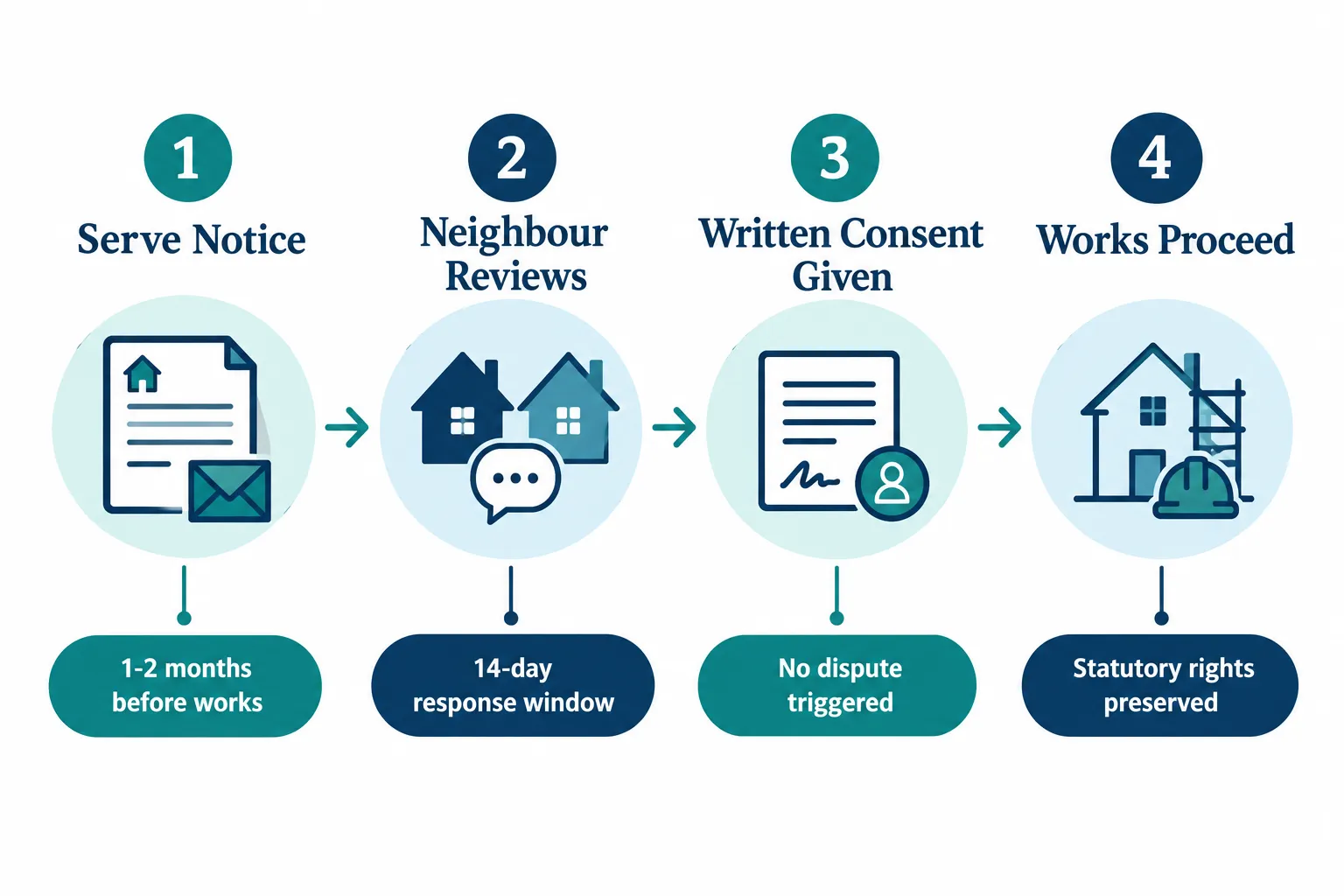
    • A neighbour’s written consent within 14 days of receiving a party wall notice removes the need for a formal party wall award, but the notice itself remains legally mandatory.
    • Consent does not waive the adjoining owner’s statutory rights; the building owner must still follow the Act’s procedures and avoid unnecessary damage.
    • Even on a consent route, a schedule of condition and a written record of agreed works are strongly advisable to prevent disputes arising mid-build.
    • A formal party wall award is still recommended when works are complex, when the boundary situation is unclear, or when either party has concerns about damage.
    • The 2026 RICS consultation on updated party wall practice guidance signals better communication standards ahead, without changing the underlying law.

    What the Party Wall etc. Act 1996 Actually Requires

    The Party Wall etc. Act 1996 is the statutory framework governing works to shared walls, boundary structures, and excavations near neighbouring buildings in England and Wales [6]. It applies to three broad categories of work:

    • Works to an existing party wall or party structure (for example, cutting into a wall to insert a steel beam, raising the height of a shared wall, or underpinning)
    • Building a new wall on or at the boundary line between two properties
    • Excavations within 3 or 6 metres of a neighbouring structure, depending on depth [5]

    For each category, the building owner must serve a formal written notice on every adjoining owner before work begins. The notice periods vary: two months’ notice is required for party structure works and new walls on the line of junction, while excavation notices require one month [5].

    Understanding what party wall notices are and how to respond to them is the essential first step before any consent conversation takes place.

    “The Act is designed to facilitate building works while protecting the interests of adjoining owners, not to obstruct reasonable development.”, RICS Consumer Guide to Party Walls [2]

    Once a valid notice is served, the adjoining owner has 14 days to respond. Their options are:

    Response Outcome
    Written consent Consent route, no award needed
    No response within 14 days Deemed dispute, surveyors appointed
    Written dissent Dispute, surveyors appointed

    The consent route is the subject of this article. It is the fastest and least costly path available under the Act [3].

    What the Party Wall etc. Act 1996 Actually Requires

    How the Consent Route Works: Party Wall Agreements When Neighbours Consent Upfront

    When an adjoining owner gives written consent within the 14-day window, a formal party wall award is not required. Works may proceed once the notice period expires, provided the building owner carries out the notifiable works in accordance with the Act [3].

    This is the core of Party Wall Agreements When Neighbours Consent Upfront: Streamlined Routes Without a Dispute, the building owner and adjoining owner reach an informal but legally significant agreement without appointing surveyors or producing a formal award document.

    What “Written Consent” Must Include

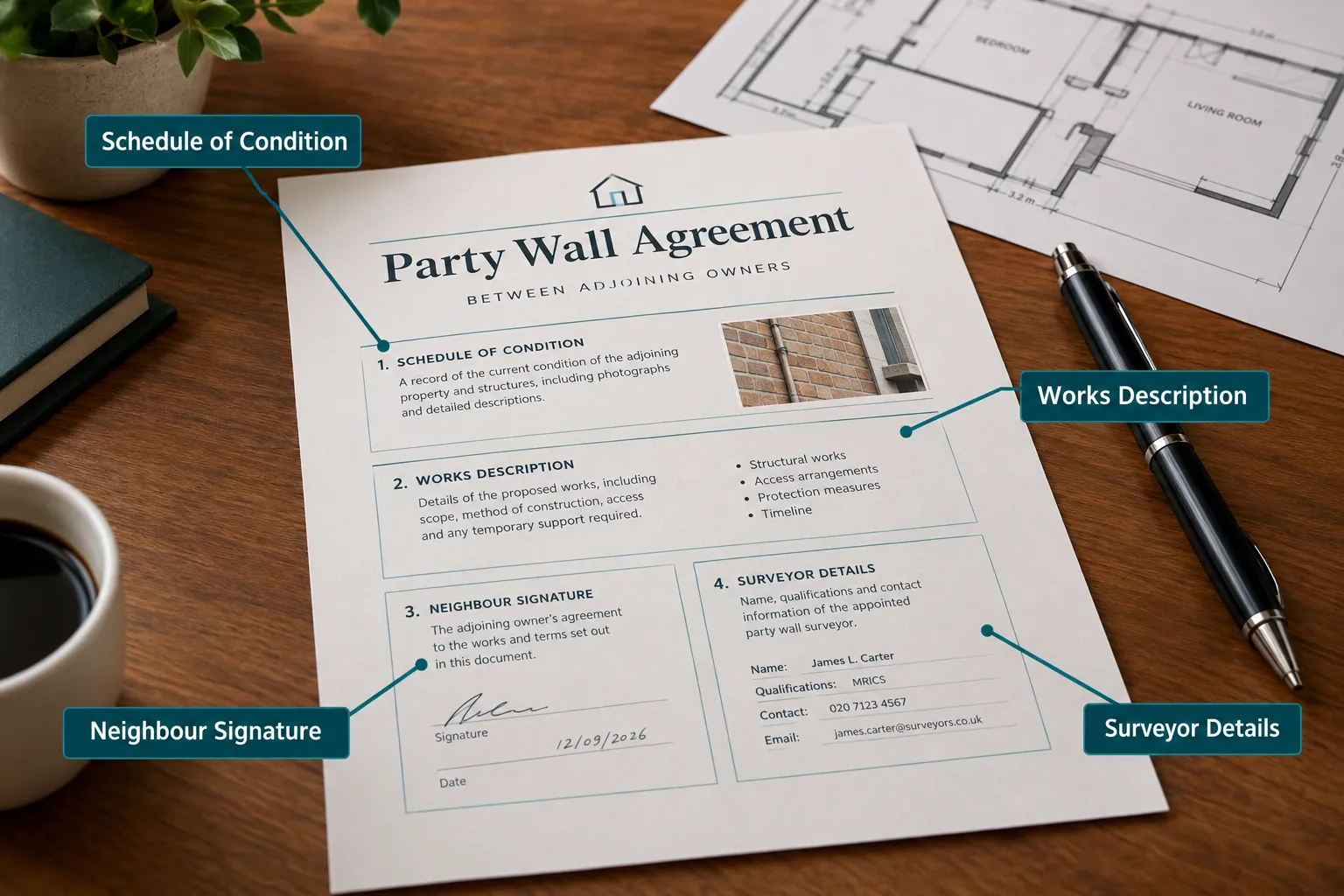
    The Act does not prescribe a rigid format for consent, but best practice requires that the consent:

    • Identifies the notice it is responding to (by date and description of works)
    • Is signed by the adjoining owner or their authorised representative
    • Is unconditional, conditional consent can create ambiguity
    • Is retained by both parties as a permanent record

    A free sample party wall agreement template can help building owners and their neighbours structure this documentation correctly from the outset.

    What Consent Does Not Remove

    A common misconception is that written consent from a neighbour removes all obligations under the Act. It does not. The building owner remains legally required to:

    1. Carry out only the works described in the notice
    2. Avoid unnecessary inconvenience to the adjoining owner
    3. Make good any damage caused to the adjoining property
    4. Provide adequate security if required
    5. Comply with any reasonable hours of working [5]

    The adjoining owner retains the right to appoint a surveyor at any point if damage occurs or the building owner exceeds the scope of the notified works. Consent is not a blank cheque [2].

    Consent vs. Party Wall Award: Knowing When a Formal Award Is Still Advisable

    The distinction between a consent-based arrangement and a formal party wall award is one of the most important practical decisions in the entire process. Party Wall Agreements When Neighbours Consent Upfront: Streamlined Routes Without a Dispute are efficient, but they are not always the safest option for either party.

    Consent vs. Party Wall Award: Knowing When a Formal Award Is Still Advisable

    When the Consent Route Is Appropriate

    The consent route works well when:

    • Works are straightforward (for example, a standard loft conversion or single-storey rear extension)
    • The party wall is in good condition and unlikely to be significantly affected
    • Both parties have a cooperative relationship and clear communication
    • The building owner is using a reputable, experienced contractor

    In these circumstances, having a party wall agreement without a surveyor is a realistic and legally sound option.

    When a Formal Party Wall Award Remains Advisable

    Despite upfront consent, a formal party wall award, produced by an agreed or appointed surveyor, offers protections that a simple consent letter cannot replicate. A formal award should still be considered when:

    • Works are complex or high-risk: deep excavations, underpinning, or significant structural alterations to a shared wall
    • The party wall is in poor condition: pre-existing cracks or structural weakness mean damage attribution disputes are likely
    • The boundary is unclear: disputes about the exact line of junction can arise mid-build without a surveyor’s input
    • Either party is risk-averse: a formal award is enforceable in the county court; a consent letter is not a court-enforceable document in the same way [4]
    • The adjoining property is tenanted or has multiple owners: ensuring all parties have consented correctly is more complex

    A party wall contract template and guide on party wall awards provides a clear overview of what a formal award contains and why it offers stronger protection in complex cases.

    The Schedule of Condition: A Non-Negotiable Best Practice

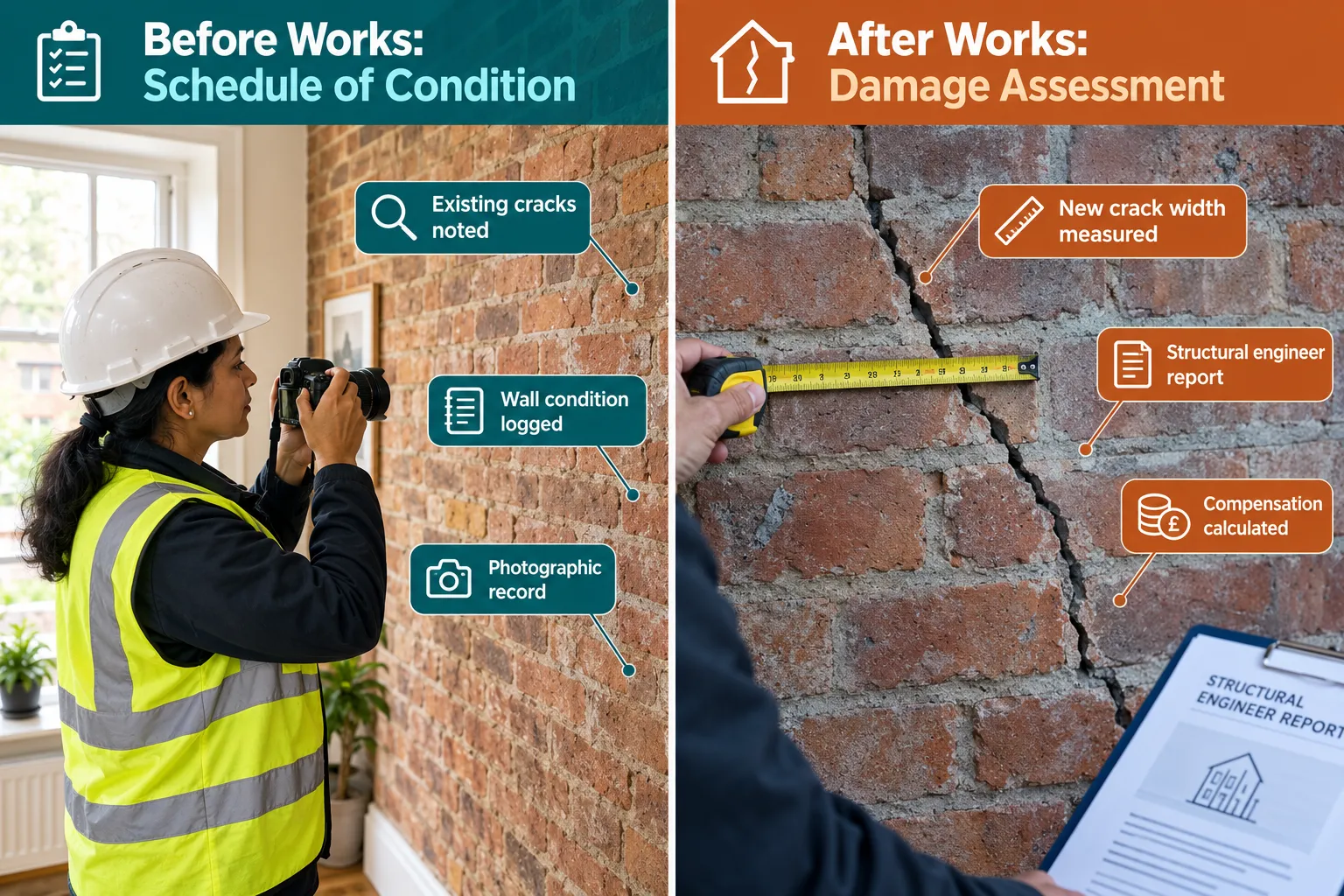
    Whether or not a formal award is produced, a schedule of condition should always be prepared before works begin. This is a photographic and written record of the adjoining property’s condition at the time works commence. It serves one critical purpose: if damage is alleged after works finish, the schedule of condition shows what was pre-existing and what is new.

    Without a schedule of condition, even the most cooperative neighbour relationship can deteriorate rapidly once cracks appear in a shared wall.

    Practical Steps to Streamline a No-Dispute Party Wall Route

    The following process represents best practice for building owners seeking to use Party Wall Agreements When Neighbours Consent Upfront: Streamlined Routes Without a Dispute effectively in 2026.

    Step 1: Identify All Notifiable Works Early

    Before any drawings are finalised, confirm which elements of the proposed works trigger the Act. This is not always obvious, for example, the difference between a party fence wall and a boundary wall affects whether the Act applies at all. Reviewing the types of party wall works that trigger notice obligations at this stage prevents costly delays later.

    Step 2: Communicate With Neighbours Before Serving Notice

    Informal early communication significantly increases the likelihood of upfront consent. Sharing plans informally, explaining the scope of works, and answering questions before serving the formal notice builds trust and reduces the chance of a reflexive dissent.

    Step 3: Serve a Clear, Complete Notice

    A poorly drafted notice is one of the most common reasons neighbours dissent or fail to respond. The notice must:

    • Describe the works clearly and in sufficient detail
    • State the proposed start date
    • Be served on all adjoining owners (including any mortgagees in some circumstances)
    • Allow the correct statutory notice period [5]

    Step 4: Request Written Consent Promptly

    Once the notice is served, follow up with the adjoining owner before the 14-day window expires. Provide a simple consent form for them to sign and return. Keep a copy of the signed consent alongside the original notice.

    Step 5: Prepare a Schedule of Condition

    Commission a schedule of condition of the adjoining property before any works begin. This can be done by a party wall surveyor, a building surveyor, or even, for straightforward cases, by the building owner and neighbour jointly, using a detailed photographic record.

    Step 6: Carry Out Works Within the Notified Scope

    Any variation to the works that affects the party wall or boundary must be re-notified. Do not assume that consent to the original works covers additional or altered works.

    Step 7: Make Good Any Damage Promptly

    If any damage occurs during works, address it immediately and document the repair. Prompt action prevents minor issues from escalating into formal disputes after the fact.

    Step 7: Make Good Any Damage Promptly

    The 2026 Regulatory Landscape: Refinement, Not Revolution

    The legal framework governing party wall matters in England and Wales has remained stable since the Party Wall etc. Act 1996 came into force. There is no current legislation to replace or significantly amend it [6].

    However, RICS launched a consultation in 2025 on updated party wall practice guidance, signalling a move toward clearer professional standards and better communication practices between surveyors and the parties they serve [8]. The direction of travel in 2026 is toward:

    • Improved transparency in how surveyors communicate fees and timelines
    • Stronger guidance on the use of agreed surveyors to reduce costs
    • Better documentation standards for consent-based arrangements
    • Clearer protocols for schedules of condition

    This is a refinement of practice, not a change in the law. The 14-day consent window, the notice periods, and the statutory rights of adjoining owners all remain unchanged [4].

    For building owners in London, local expertise matters. Whether the project is in West London, North London, or South London, a surveyor familiar with local property types and boundary conventions can help facilitate the consent route efficiently.

    Interaction With Planning Permission and Building Regulations

    Party wall consent operates entirely independently of planning permission and building regulations approval. Obtaining planning consent does not remove the obligation to serve party wall notices, and a neighbour’s party wall consent does not constitute planning approval.

    Building owners should ensure all three regimes are addressed in parallel:

    • Planning permission (where required)
    • Building regulations approval (for structural works)
    • Party wall notices and consent (for notifiable works under the 1996 Act)

    Conflating these processes is a common and costly mistake [5].

    Keeping Costs Down on the Consent Route

    One of the principal advantages of the consent route is cost. When neighbours consent upfront, neither party needs to appoint a surveyor, and no party wall award fee is incurred. The costs of the party wall process can be significant when a dispute arises, typically several hundred to several thousand pounds per surveyor, depending on complexity.

    Practical steps to keep party wall costs down include:

    • Pursuing the consent route wherever genuinely appropriate
    • Using an agreed surveyor (a single surveyor acting for both parties) when a formal award is needed
    • Preparing clear, detailed notices to avoid re-service
    • Addressing neighbour concerns early to prevent dissent

    The consent route is not just faster, it is typically the most cost-effective outcome for both parties [7].

    Conclusion

    Party Wall Agreements When Neighbours Consent Upfront: Streamlined Routes Without a Dispute offer a legally sound, cost-effective, and time-efficient alternative to the full dispute resolution process under the Party Wall etc. Act 1996. The route is available to any building owner whose neighbour provides written consent within 14 days of receiving a valid notice, and it is more achievable than many assume when the groundwork is laid correctly.

    Actionable next steps for building owners in 2026:

    1. Identify all notifiable works before finalising designs and consult the Act’s explanatory guidance if uncertain about scope.
    2. Speak informally with neighbours before serving formal notice, early communication is the single most effective way to secure upfront consent.
    3. Serve a clear, complete, and correctly timed notice using a reliable template.
    4. Obtain written consent in a signed, dated document and retain it permanently.
    5. Always prepare a schedule of condition before works begin, regardless of how cooperative the relationship appears.
    6. Seek professional advice whenever works are complex, the boundary is unclear, or either party has reservations, a formal party wall award remains the gold standard for high-risk projects.

    The consent route is not a shortcut around the law. It is the law working exactly as Parliament intended: enabling reasonable building works to proceed efficiently while protecting the rights of everyone affected.

    References

    [1] Party Walls – rics.org

    [2] Rics Consumer Guide Party Walls 1 – chpk.co.uk

    [3] Reaching Agreement With Neighbours – gov.uk

    [4] Party Wall Legislation And Procedure – rics.org

    [5] The Party Wall Etc Act 1996 Explanatory Booklet – gov.uk

    [6] legislation.gov.uk – legislation.gov.uk

    [7] Party Walls Consumer Guide 2022 – rics.org

    [8] Rics Launches Consultation On Updated Party Wall Practice Guidance – rics.org

  • Party Wall Insurance and Indemnity: What Happens If Your Neighbour’s Works Cause Damage to Your Property?

    Party Wall Insurance and Indemnity: What Happens If Your Neighbour’s Works Cause Damage to Your Property?

    Structural cracks appearing on an interior wall after a neighbour begins a loft conversion are among the most stressful discoveries a homeowner can make, and they are far more common than most people realise. Understanding the intersection of party wall insurance and indemnity, the statutory framework under the Party Wall etc. Act 1996, and the practical claim routes available is essential for any adjoining owner facing this situation in 2026.

    This article breaks down how insurance, indemnity clauses, and the Party Wall Award interact when damage occurs, who bears the financial responsibility, and how a properly prepared schedule of condition can be the difference between a swift settlement and a protracted legal dispute.

    Key Takeaways

    • The building owner is legally responsible under section 7(2) of the Party Wall etc. Act 1996 for compensating any loss or damage caused by their works, even when procedures were correctly followed.
    • A schedule of condition prepared before works begin is the single most powerful piece of evidence an adjoining owner can use to support a compensation claim.
    • A Party Wall Award issued by appointed surveyors is a binding legal document that sets out the works permitted, the access rights, and the obligation to make good any damage.
    • Compensation can cover direct repair costs, professional fees, loss of value, and landscape or garden restoration, not just visible cracks.
    • If no party wall notice was served, the adjoining owner can still invoke the Act’s dispute provisions and pursue a claim through the statutory framework or common law.

    The Legal Foundation: Who Is Responsible When Damage Occurs?

    The Legal Foundation: Who Is Responsible When Damage Occurs?

    The Party Wall etc. Act 1996 places a clear statutory duty on the “building owner”, the person carrying out the works, to protect the adjoining owner’s property throughout the construction process. Section 7(2) of the Act states that the building owner must compensate the adjoining owner and any other person for any loss or damage arising as a consequence of the works. Critically, this liability applies even when the building owner has followed every procedural step correctly [2].

    This is a strict liability provision in practical terms. The adjoining owner does not need to prove negligence; they need only demonstrate that the damage was caused by the notifiable works. The GOV.UK guidance on party walls confirms that the building owner is responsible for making good any damage caused to the adjoining property, or for paying compensation if making good is not practicable [6].

    What Works Trigger the Party Wall Act?

    Not every construction activity at a shared boundary requires formal notice. GOV.UK guidance confirms that written notice must be given before:

    • Carrying out work on an existing party wall or party structure, such as cutting into it, raising it, or underpinning it
    • Building on or at the boundary line between two properties
    • Excavating below and near the foundation level of a neighbour’s property [7]

    Minor works such as plastering, drilling for shelves, or inserting plugs do not require notice [3]. For a full breakdown of notifiable activities, the guide on types of party wall works provides a useful reference.

    Understanding whether works are notifiable is the first step. If they are, the statutory protections, including the indemnity provisions, are engaged automatically.

    How the Party Wall Award Interacts with Insurance and Indemnity

    How the Party Wall Award Interacts with Insurance and Indemnity

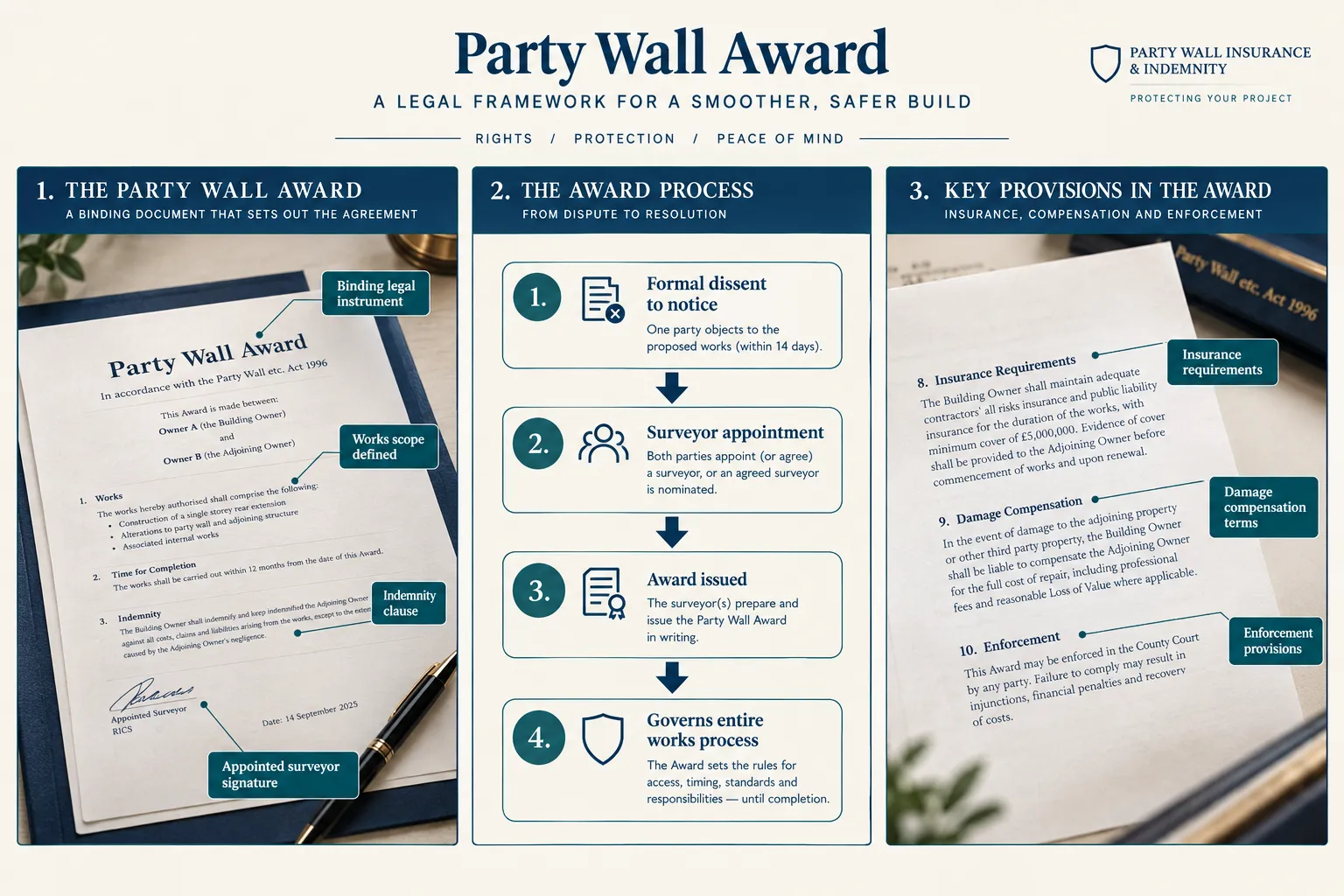
    The Party Wall Award is the central document in any dispute or damage claim. It is issued by the appointed surveyor or surveyors after a formal dissent to a party wall notice, and it functions as a binding legal instrument that governs the entire works process [2].

    What the Party Wall Award Contains

    A well-drafted Party Wall Award will typically address:

    Element Purpose
    Description of permitted works Defines the scope of what the building owner may carry out
    Schedule of condition Records the pre-works state of the adjoining property
    Access rights Sets out when and how the building owner may access the adjoining property
    Making good obligations Specifies how damage must be repaired or compensated
    Security for expenses May require the building owner to deposit funds before works begin

    The Party Wall Awards process exists precisely to create this documented framework. Without it, disputes become far harder to resolve.

    The Schedule of Condition: Your Most Important Protection

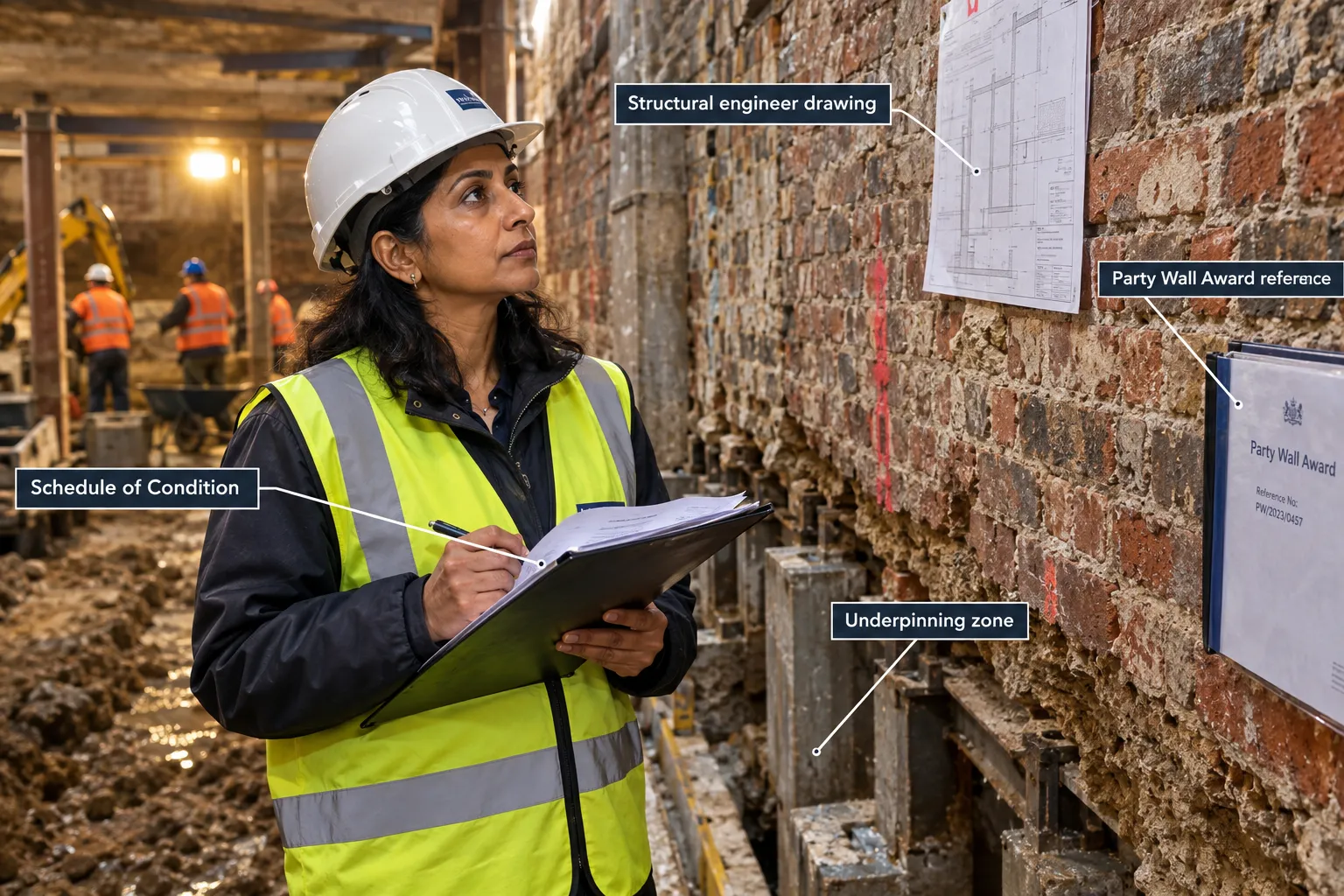
    A schedule of condition is a detailed photographic and written record of the adjoining property’s state immediately before works begin. It is typically prepared by the adjoining owner’s surveyor and appended to the Party Wall Award.

    Its importance cannot be overstated. When cracks or other damage appear after works begin, the schedule of condition provides the baseline against which new damage is measured. Without it, a building owner can argue that a crack was pre-existing, making it significantly harder for the adjoining owner to establish causation and claim compensation.

    “A schedule of condition is not merely a procedural formality, it is the evidentiary foundation of any successful damage claim under the Party Wall etc. Act 1996.”

    Insurance and the Building Owner’s Obligations

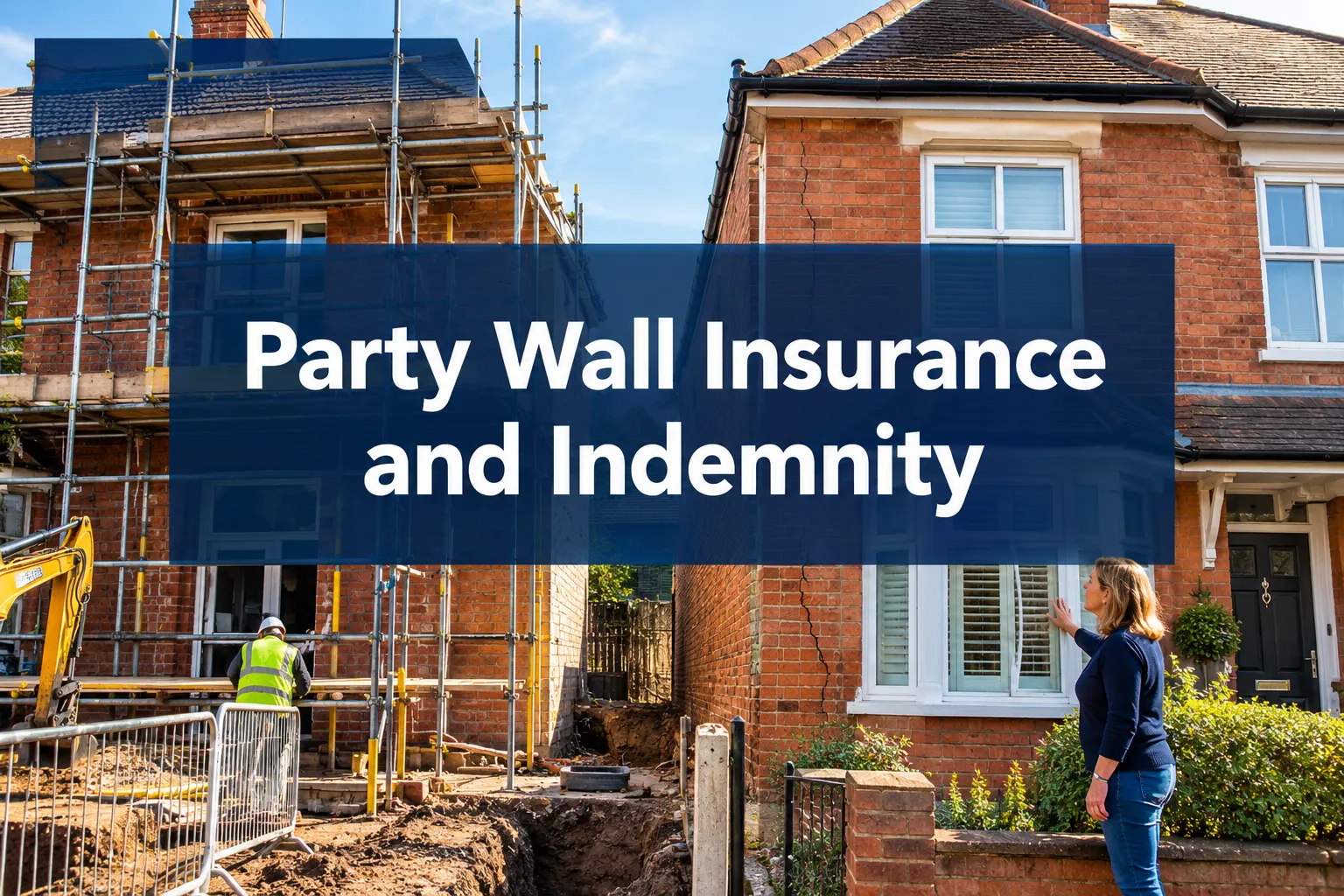
    The building owner’s standard buildings insurance policy may or may not cover damage caused to a neighbour’s property. Many policies exclude third-party property damage arising from construction works, which is why specialist party wall insurance, sometimes called contractor’s liability or adjacent property insurance, is often required.

    From the adjoining owner’s perspective, the key point is that the building owner’s insurance arrangements do not affect the statutory liability owed under section 7(2). Whether or not the building owner has adequate insurance, they remain personally liable to compensate the adjoining owner for damage caused. If the building owner’s insurer declines the claim, the adjoining owner can still pursue the building owner directly through the party wall dispute mechanism or, where necessary, through the courts.

    The RICS consumer guidance on party walls also notes that chartered surveyors acting in party wall matters must maintain adequate professional indemnity insurance [10]. This matters for adjoining owners because if a negligent surveyor appointment contributes to loss, for example, by failing to prepare an adequate schedule of condition, the surveyor’s professional indemnity policy provides an additional layer of financial protection.

    Claim Routes, Compensation Ranges, and What You Can Recover

    Claim Routes, Compensation Ranges, and What You Can Recover

    When damage occurs, the adjoining owner has several routes available, and these can run concurrently in serious cases.

    Route 1: The Party Wall Award Mechanism

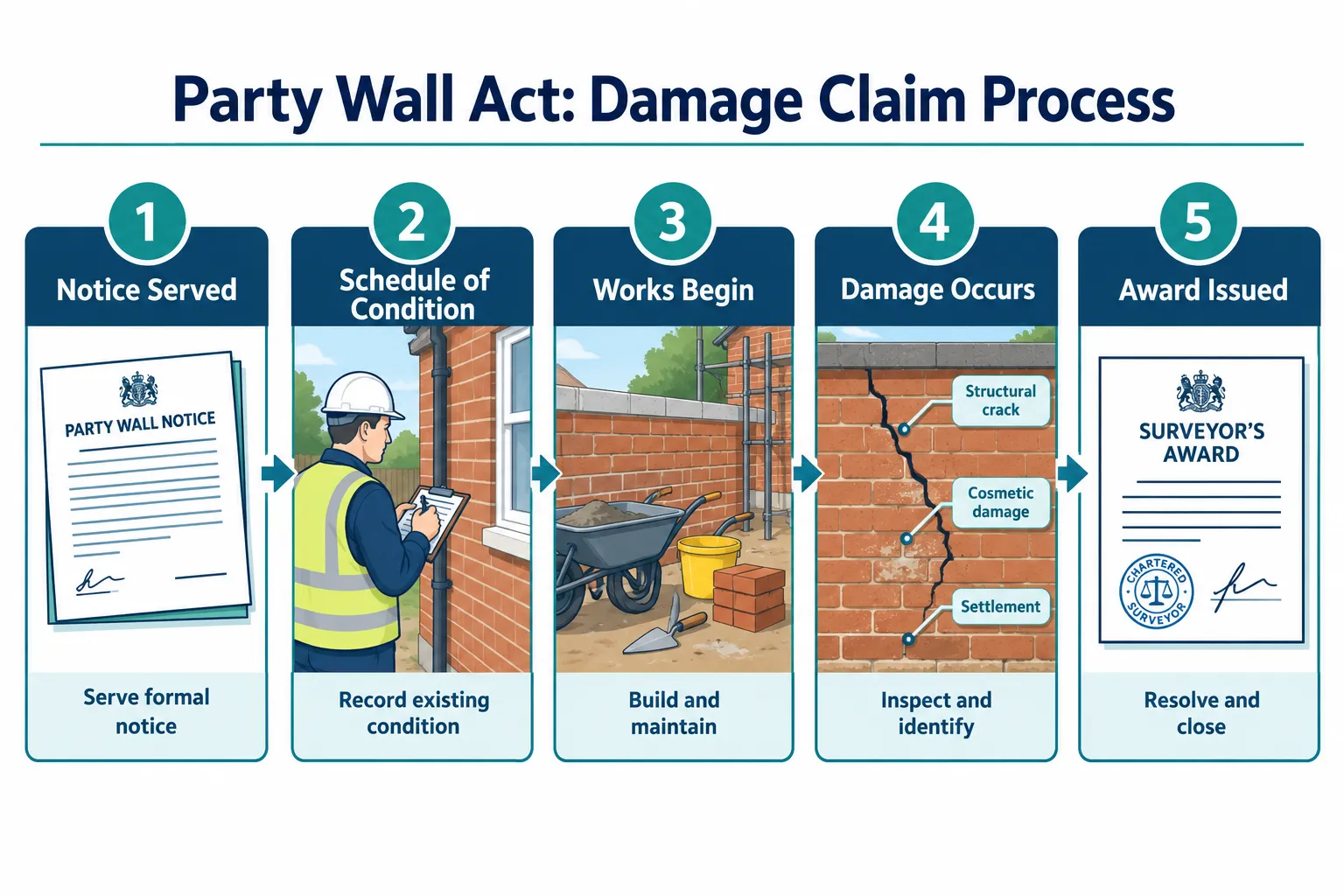
    Where a Party Wall Award is already in place, the adjoining owner’s surveyor can issue a supplementary award dealing specifically with the damage. This award will typically:

    • Identify the damage and its cause
    • Specify the remedial works required
    • Allocate the cost to the building owner
    • Address professional fees

    Under section 10(13) of the Act, the costs of the party wall procedure, including surveyor fees on both sides, are generally paid by the building owner [2]. This means the adjoining owner should not ordinarily bear the cost of appointing their own surveyor to deal with a legitimate damage claim.

    Route 2: Invoking the Act Without a Prior Award

    If the building owner failed to serve a valid party wall notice before starting works, the adjoining owner is not left without remedy. The Act’s dispute provisions can be invoked retrospectively, allowing the appointment of surveyors and the production of an award even after works have begun or been completed. This is a critical protection for adjoining owners who discover damage but were never formally notified [1].

    Route 3: Common Law Claims

    Party wall damage can also give rise to claims in private nuisance and negligence, entirely separate from the statutory framework. Substantial physical damage to a property, encroachment, or significant interference with the enjoyment of land may support these causes of action [5]. Legal expenses insurance, often included in home insurance policies as an add-on, may cover the cost of pursuing such claims.

    What Compensation Can Cover

    Compensation under the Act is not limited to the cost of repairing visible cracks. Recoverable losses can include:

    • Direct repair costs, plastering, structural reinforcement, underpinning
    • Professional fees, structural engineers, surveyors, architects
    • Loss of value, where the property’s market value is demonstrably reduced
    • Temporary accommodation costs, if the property is uninhabitable during repairs
    • Garden and landscape restoration, damage to gardens, patios, or boundary features

    The scale of potential liability varies considerably. Industry data cited by party wall practitioners indicates typical compensation ranges:

    • Minor cosmetic cracks: approximately £2,400 to £4,800
    • Settlement cracks requiring plaster repair: approximately £6,200 to £11,500
    • Structural cracks requiring reinforcement: approximately £18,000 to £45,000
    • Severe subsidence cases: approximately £75,000 to £180,000

    These figures illustrate why adequate insurance and indemnity provisions are not optional extras, they are fundamental to managing the financial risk on both sides of the party wall.

    Practical Steps for Adjoining Owners: Before, During, and After Works

    Before Works Begin

    1. Respond formally to any party wall notice. When a neighbour serves notice, the adjoining owner has 14 days to consent or dissent. Consenting without conditions removes most statutory protections. Dissenting triggers the appointment of surveyors and the production of a Party Wall Award [4]. The guide on party wall notices and how to respond covers this process in detail.

    2. Appoint a surveyor. Even where the adjoining owner is tempted to agree informally, having a surveyor involved ensures that a schedule of condition is prepared and that the Party Wall Award contains robust making-good provisions. The risks of having a party wall agreement without a surveyor are significant and should not be underestimated.

    3. Check the building owner’s insurance. Ask for confirmation that the building owner holds adequate public liability or adjacent property insurance covering damage to neighbouring properties during construction. This does not replace the statutory liability but provides a practical route to compensation.

    During Works

    • Monitor the property regularly for new cracks, movement, or water ingress
    • Photograph any new damage immediately, with date stamps
    • Report damage to the building owner and their surveyor in writing without delay
    • Keep records of all communications

    After Works

    If damage is discovered after works are complete, act promptly. The ability to invoke the Act’s dispute provisions does not expire immediately, but delay can complicate the causation argument. Seek advice from a qualified party wall surveyor and, where the damage is significant, instruct a structural engineer to provide an independent assessment.

    For those in the capital, specialist advice is available from surveyors covering Party Wall Surveyor Central London, Party Wall Surveyor South London, and Party Wall Surveyor North London depending on location.

    Common Misconceptions About Party Wall Insurance and Indemnity

    “My neighbour’s builder is responsible, not my neighbour.” Under the Act, the building owner, the property owner commissioning the works, bears the statutory liability, not the contractor. The building owner may have a separate claim against their contractor, but that is a private matter between them. The adjoining owner’s claim is against the building owner directly [2].

    “If my neighbour followed the Act correctly, I cannot claim.” This is incorrect. Section 7(2) imposes liability regardless of procedural compliance. A building owner who serves all the correct notices, obtains a Party Wall Award, and still causes damage remains liable to compensate the adjoining owner [2][6].

    “I need to go to court to recover compensation.” In most cases, the party wall surveyor mechanism resolves compensation disputes without litigation. The Party Wall Award is enforceable as a court order, and surveyors have wide powers to deal with damage claims within the statutory framework. Court proceedings are typically a last resort [4].

    “A verbal agreement is sufficient.” Verbal agreements provide no enforceable record of the pre-works condition of the property or the agreed scope of works. Written agreements, and ideally a formal Party Wall Award, are essential for protecting both parties [8].

    Conclusion

    Party wall insurance and indemnity, what happens if your neighbour’s works cause damage to your property, is a question with a clear statutory answer: the building owner is liable, the Party Wall Award is the enforcement mechanism, and the schedule of condition is the evidentiary foundation of any successful claim.

    Actionable next steps for adjoining owners in 2026:

    1. Never ignore a party wall notice. Respond within 14 days, and consider dissenting to trigger the full surveyor and award process.
    2. Insist on a schedule of condition being prepared and appended to the Party Wall Award before any works begin.
    3. Ask for evidence of the building owner’s insurance covering adjacent property damage before works commence.
    4. Document everything, photograph your property before, during, and after works, and keep written records of all communications.
    5. Act promptly if damage occurs, instruct a party wall surveyor immediately and obtain an independent structural assessment.
    6. Know that you have multiple routes, the statutory party wall mechanism, common law nuisance and negligence claims, and legal expenses insurance can all be engaged where warranted.

    If a neighbour is already carrying out works and damage has appeared, the resource on what to do when your neighbour is carrying out works is a practical starting point. The statutory framework exists to protect adjoining owners, but only those who engage with it proactively will benefit from its full protections.

    References

    [1] How To Get Redress When A Neighbours Building Work Damages Your Property Know Your Rights – hklaw.uk

    [2] The Party Wall Etc Act 1996 Explanatory Booklet – gov.uk

    [3] Preventing And Resolving Disputes In Relation To Party Walls – gov.uk

    [4] Reaching Agreement With Neighbours – gov.uk

    [5] Party Wall Disputes – lexisnexis.co.uk

    [6] When Works Begin – gov.uk

    [7] Work Tell Your Neighbour About – gov.uk

    [8] If You Disagree With Your Neighbour About A Wall Or Fence – citizensadvice.org.uk

    [9] Party Walls Building Works – gov.uk

    [10] Party Walls – rics.org

  • Party Wall Act 1996 vs Building Regulations: Why You Need Both and How They Interact on Real Projects

    Party Wall Act 1996 vs Building Regulations: Why You Need Both and How They Interact on Real Projects

    Nearly half of all neighbour disputes in England and Wales that escalate to formal legal action involve a failure to properly separate two distinct legal frameworks: the Party Wall etc. Act 1996 and Building Regulations. These are not interchangeable. They are not alternatives. They are parallel obligations that apply simultaneously on the vast majority of residential construction projects, and confusing them is one of the most expensive mistakes a building owner can make in 2026.

    Understanding the Party Wall Act 1996 vs Building Regulations distinction is not just a legal technicality. It is a practical necessity that shapes project timelines, contractor procurement, neighbour relations, and liability exposure from the first day of design through to the final completion certificate.

    Key Takeaways

    • The Party Wall etc. Act 1996 and Building Regulations are entirely separate legal regimes with different purposes, authorities, and procedures.
    • Most domestic projects, extensions, loft conversions, basement excavations, trigger both frameworks simultaneously.
    • Failing to comply with either regime can halt a project, expose the building owner to civil liability, and damage neighbour relationships permanently.
    • Sequencing matters: Party Wall notices should be served early in the design stage, not after Building Regulations approval is granted.
    • Professional guidance from a qualified party wall surveyor reduces risk, cost, and delay on any project where a shared wall or boundary is involved.

    Two Legal Regimes, One Building Project

    Two Legal Regimes, One Building Project

    The single most common misconception encountered on residential building projects is that obtaining Building Regulations approval somehow covers the Party Wall process, or vice versa. It does not. These two frameworks operate entirely independently of each other, enforced by different bodies, serving different purposes. [1]

    Building Regulations set minimum technical standards for the design and construction of buildings in England and Wales. They cover structural integrity, fire safety, energy efficiency, drainage, ventilation, and accessibility. Compliance is assessed and enforced by the local authority’s Building Control department, or by an approved inspector. A Building Regulations approval confirms that the proposed works meet those technical standards.

    The Party Wall etc. Act 1996, by contrast, is a civil piece of legislation. It governs the rights and obligations of property owners when construction works affect a shared wall, boundary structure, or the land adjacent to a neighbouring property. [4] It does not assess whether a building is structurally sound in the abstract, it protects the specific interests of the adjoining owner whose property could be affected by the works. [2]

    “Building Regulations approval does not remove the obligation to serve Party Wall notices. Both requirements exist independently and must both be satisfied.”

    Local authorities consistently reinforce this point in their guidance to homeowners. The two regimes answer entirely different questions:

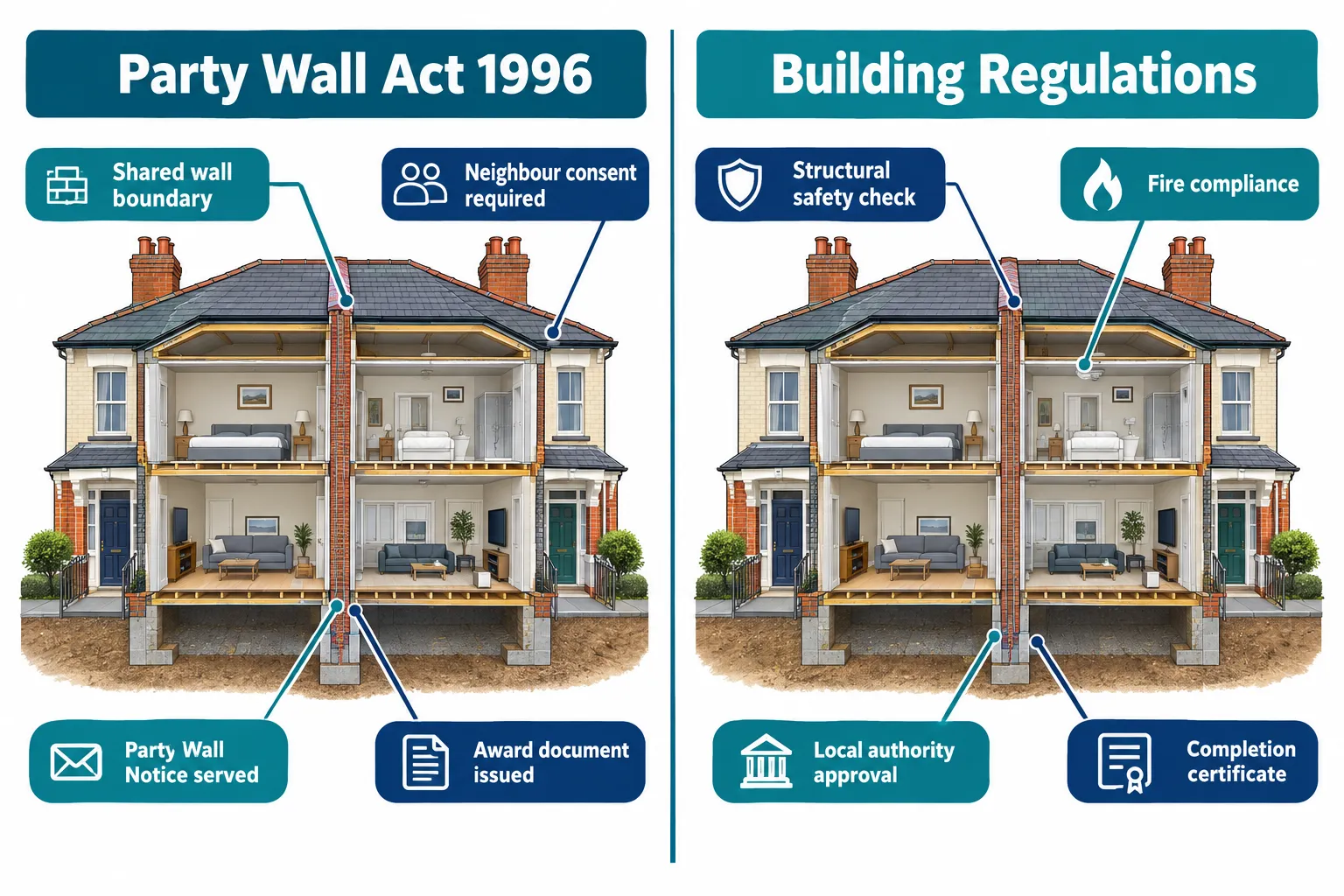
    Question Answered by
    Is this structure safe to build? Building Regulations
    Does my neighbour have rights over how I build it? Party Wall etc. Act 1996
    Will the design meet fire and energy standards? Building Regulations
    Is my neighbour protected from damage to their property? Party Wall etc. Act 1996
    Who certifies the completed work? Building Control (Regulations)
    Who records the condition of adjoining property before works? Party Wall surveyor (Act 1996)

    Understanding this table is the foundation of any competent approach to the Party Wall Act 1996 vs Building Regulations question on real projects.

    How the Party Wall Act 1996 vs Building Regulations Apply to Real Projects

    How the Party Wall Act 1996 vs Building Regulations Apply to Real Projects

    The practical interaction between these two frameworks becomes clearest when mapped against common project types. Three scenarios illustrate the point well.

    Rear Single-Storey Extension on a Terraced House

    A homeowner in East London plans a rear extension that will involve cutting into the rear wall of the property, a wall shared with the neighbour. This triggers the Party Wall etc. Act 1996 under Section 2, which covers works to an existing party wall or party structure. [10]

    At the same time, the extension requires Building Regulations approval because it involves structural alterations, new foundations, and changes to drainage.

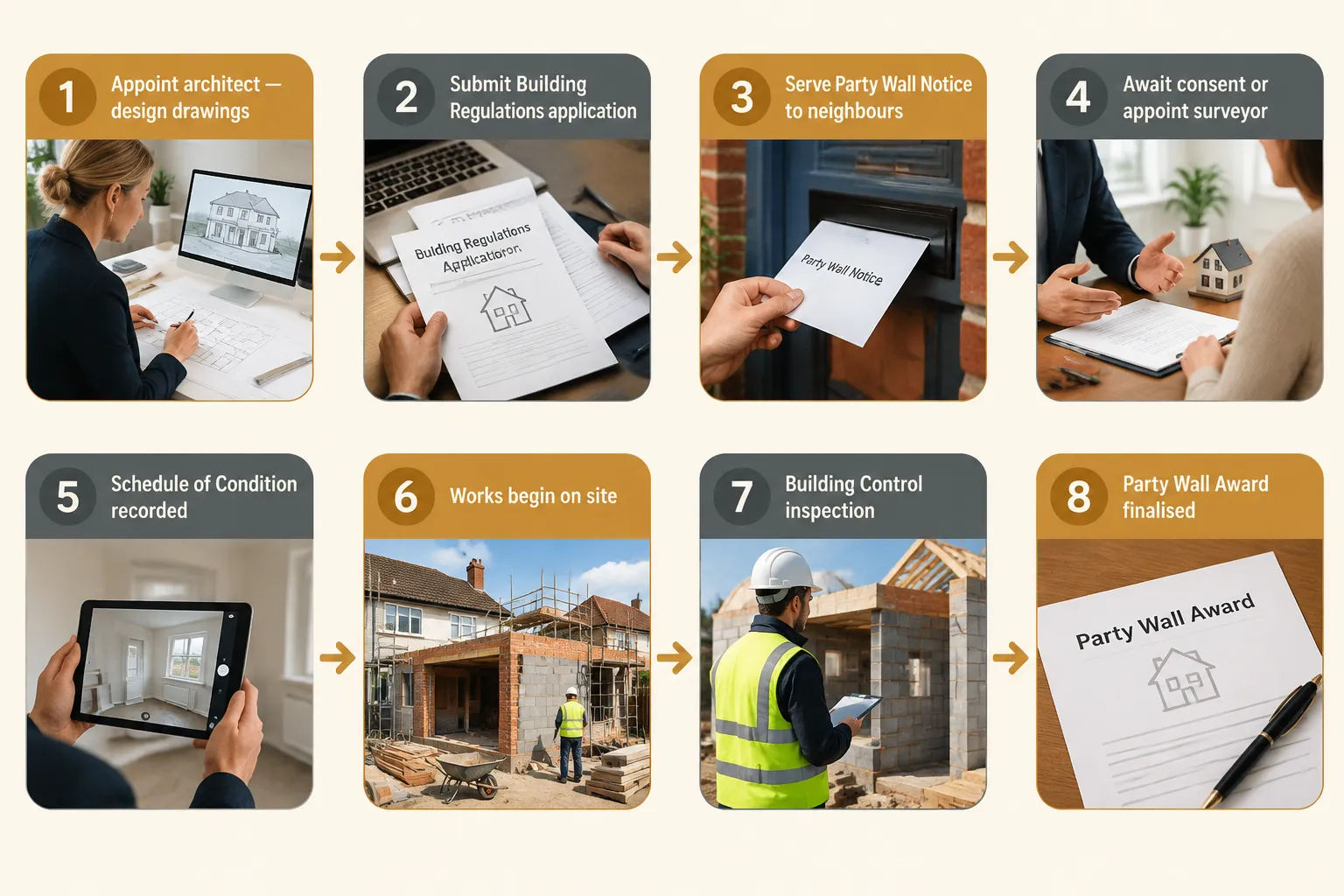
    The correct sequence is:

    1. Appoint an architect and produce design drawings.
    2. Submit a Building Regulations application (full plans application recommended for structural works).
    3. Serve a Party Wall Notice on the adjoining owner, this must happen at least two months before works commence where Section 2 works are involved.
    4. Await the neighbour’s response. If they consent in writing, works can proceed. If they dissent or do not respond within 14 days, a dispute is deemed to have arisen and surveyors must be appointed.
    5. A Party Wall Award is prepared, setting out the manner and conditions under which works are to be carried out.
    6. Building Control inspections proceed alongside the works, independently of the Party Wall process.

    A critical point: Building Regulations approval does not satisfy the notice requirements under the Act. The two processes run in parallel, not in sequence. [3]

    Loft Conversion Involving a Party Wall

    A loft conversion that requires raising a party wall, inserting steel beams into the party wall, or cutting into the party wall structure will trigger the Act. [2] Building Regulations will also apply because the conversion creates a new habitable floor, requiring compliance with fire escape routes, structural loading, insulation, and staircase standards.

    For types of party wall works such as these, the notice period under the Act is two months. Homeowners who apply for Building Regulations approval and then only serve the Party Wall notice afterwards will find their project delayed by at least two months, a costly and entirely avoidable mistake.

    The loft conversion also illustrates why a Schedule of Condition matters. Before any works begin, the party wall surveyor will inspect and document the current condition of the adjoining property, cracks, finishes, existing damage. This protects both parties: the building owner is not held liable for pre-existing damage, and the adjoining owner has a clear record if new damage does occur. [3]

    Basement Excavation Near a Neighbouring Foundation

    Basement projects are the highest-risk category under the Act. Section 6 of the Party Wall etc. Act 1996 applies where excavation is carried out within three metres of a neighbouring structure and to a lower depth than the neighbour’s foundations, or within six metres where the excavation would cut a line drawn downwards at 45 degrees from the bottom of the neighbour’s foundations. [10]

    Building Regulations will require structural calculations, drainage details, waterproofing specifications, and often a structural engineer’s sign-off. The Party Wall process will require a notice, a Schedule of Condition, and almost certainly a formal Award given the complexity of the works.

    For basement projects in particular, the interaction between the two regimes is intense. Building Control inspectors may request evidence that Party Wall procedures are in place before signing off on structural stages. Contractors should not commence excavation until both a Building Regulations application has been submitted and a Party Wall Award (or written consent from the adjoining owner) is in place.

    Why You Need Both: Risk, Liability, and Common Misconceptions

    Why You Need Both: Risk, Liability, and Common Misconceptions

    The professional bodies representing surveyors and construction professionals are unambiguous: both regimes are necessary, and neither substitutes for the other. The risks of ignoring either are substantial.

    The Risk of Ignoring Building Regulations

    Carrying out notifiable works without Building Regulations approval is a criminal offence. The local authority can require the works to be opened up for inspection or even demolished if they cannot be shown to comply. This creates a defect in the property’s title that will surface on any future sale.

    The Risk of Ignoring the Party Wall Act

    The Party Wall etc. Act 1996 does not carry criminal penalties for non-compliance, but the civil consequences are serious. An adjoining owner can seek an injunction to stop the works. Courts have consistently held that building owners who proceed without complying with the Act do so at their own risk. Any damage caused to the adjoining property will be the building owner’s liability, with no procedural protection. [2]

    Homeowners sometimes assume that because their neighbour has not complained, the Party Wall Act does not apply. This is incorrect. The obligation to serve notice arises from the nature of the works, not from the neighbour’s attitude. [1]

    Common Misconceptions Addressed

    “My architect said I only need planning permission and Building Regs.” Planning permission, Building Regulations, and the Party Wall Act are three separate requirements. A project may need all three, or any combination. None replaces another.

    “The works are entirely within my own property.” Section 6 of the Act applies to excavation near neighbouring foundations even where the excavation is entirely within the building owner’s own land. [10] The boundary of the land is not the boundary of the Act’s reach.

    “We have a good relationship with our neighbours, we don’t need a formal agreement.” Neighbour relationships can change. A verbal agreement provides no legal protection if the neighbour sells, if damage occurs, or if the relationship deteriorates. A formal Party Wall Agreement without a surveyor is possible in limited circumstances, but the risks of proceeding without proper documentation are significant.

    “The Party Wall Award covers the building work.” A Party Wall Award governs the manner in which works affecting the party wall or adjoining property are carried out. It does not certify that the works are structurally safe or compliant with Building Regulations. Both are required. [3]

    Sequencing and Coordination: Getting the Order Right

    Getting the sequence right between Party Wall procedures and Building Regulations is one of the most practical challenges on a real project. Industry guidance consistently points to the following best practice:

    Stage 1, Design: Appoint an architect. Identify at the design stage whether the works will trigger the Act. Most competent architects will flag this, but the ultimate responsibility lies with the building owner.

    Stage 2, Pre-application: Before submitting a Building Regulations application, serve Party Wall notices. For Section 3 (party structure notices) and Section 6 (adjacent excavation notices), the minimum notice period is two months. For Section 1 (building on the line of junction), the notice period is one month. [4]

    Stage 3, Parallel processing: Run the Building Regulations application and the Party Wall process simultaneously. There is no legal requirement for one to precede the other, but serving notices early avoids the scenario where Building Regulations approval is granted but works cannot start because the Party Wall process is incomplete.

    Stage 4, Pre-commencement: Before any works begin on site, confirm that either written consent has been received from all adjoining owners or a Party Wall Award is in place. Confirm that Building Regulations approval (or a valid building notice) is also in place.

    Stage 5, During works: Keep both processes active. Building Control will carry out stage inspections. The party wall surveyor may need access to inspect works affecting the party wall. Ensure the contractor is aware of both sets of obligations.

    Stage 6, Completion: Obtain the Building Regulations completion certificate. Confirm that any outstanding matters under the Party Wall Award have been resolved.

    Understanding the costs of the party wall process at the outset allows building owners to budget accurately and avoid surprises. Surveyor fees, notice preparation, and Award drafting are all foreseeable costs that should be included in the project budget from day one.

    Practical Guidance for Building Owners in 2026

    The updated official guidance published by the UK government reinforces that the Party Wall etc. Act 1996 is a practical tool for preventing disputes, not just resolving them. [2] The emphasis in 2026 is on early communication, early notice, and early documentation, all of which reduce the likelihood of costly disputes and injunctions.

    For building owners undertaking works in London, local expertise matters. Whether the project is in a dense terrace in Central London or a Victorian semi-detached in South London, the interaction between the Act and Building Regulations follows the same legal framework, but local knowledge of typical construction conditions, common party wall configurations, and local authority Building Control practices adds real value.

    Key practical steps for building owners in 2026:

    • Identify all adjoining owners early, including those above, below, and to the side in flats and maisonettes.
    • Serve notices in the correct form and within the correct notice periods. [3]
    • Do not wait for Building Regulations approval before serving Party Wall notices.
    • Appoint a qualified party wall surveyor if the neighbour dissents or fails to respond.
    • Ensure the contractor has seen and understood both the Building Regulations drawings and any Party Wall Award before starting work.
    • Retain all documentation, notices, consents, Awards, Schedules of Condition, for the full duration of the project and beyond.

    The Building Owners section of the Act places clear obligations on the person carrying out the works. Ignorance of those obligations is not a defence, and the courts have shown limited sympathy for building owners who proceed without compliance.

    Conclusion

    The Party Wall Act 1996 vs Building Regulations question is not a matter of choosing one over the other. Both frameworks apply, both serve distinct and essential purposes, and both must be managed with equal care on any project that involves a shared wall, boundary structure, or excavation near a neighbouring foundation.

    Building Regulations protect the public and future occupants by ensuring that construction meets minimum technical standards. The Party Wall etc. Act 1996 protects the specific property rights and interests of adjoining owners. Together, they form the legal framework within which safe, compliant, and neighbourly construction takes place in England and Wales.

    Actionable next steps for building owners:

    1. At the design stage, ask the architect to confirm whether the works trigger the Party Wall etc. Act 1996 and which sections apply.
    2. Serve Party Wall notices as early as possible, ideally before or simultaneously with the Building Regulations application.
    3. Budget for party wall surveyor fees from the outset. Costs are predictable and manageable when planned early.
    4. Do not begin any notifiable works on site until both Building Regulations approval and Party Wall compliance (consent or Award) are confirmed in writing.
    5. Consult a qualified party wall surveyor if there is any doubt about whether the Act applies or how to serve notices correctly.

    References

    [1] Party Walls Building Works – gov.uk

    [2] Preventing And Resolving Disputes In Relation To Party Walls – gov.uk

    [3] The Party Wall Etc Act 1996 Explanatory Booklet – gov.uk

    [4] Contents – legislation.gov.uk

    [10] Section – legislation.gov.uk